EP4220555A1 - Training method and apparatus for image segmentation model, image segmentation method and apparatus, and device - Google Patents
Training method and apparatus for image segmentation model, image segmentation method and apparatus, and device Download PDFInfo
- Publication number
- EP4220555A1 EP4220555A1 EP21905262.8A EP21905262A EP4220555A1 EP 4220555 A1 EP4220555 A1 EP 4220555A1 EP 21905262 A EP21905262 A EP 21905262A EP 4220555 A1 EP4220555 A1 EP 4220555A1
- Authority
- EP
- European Patent Office
- Prior art keywords
- image
- rescaled
- sample
- classification
- class activation
- Prior art date
- Legal status (The legal status is an assumption and is not a legal conclusion. Google has not performed a legal analysis and makes no representation as to the accuracy of the status listed.)
- Granted
Links
Images




Classifications
-
- G—PHYSICS
- G06—COMPUTING OR CALCULATING; COUNTING
- G06V—IMAGE OR VIDEO RECOGNITION OR UNDERSTANDING
- G06V10/00—Arrangements for image or video recognition or understanding
- G06V10/70—Arrangements for image or video recognition or understanding using pattern recognition or machine learning
- G06V10/77—Processing image or video features in feature spaces; using data integration or data reduction, e.g. principal component analysis [PCA] or independent component analysis [ICA] or self-organising maps [SOM]; Blind source separation
- G06V10/774—Generating sets of training patterns; Bootstrap methods, e.g. bagging or boosting
-
- G—PHYSICS
- G06—COMPUTING OR CALCULATING; COUNTING
- G06V—IMAGE OR VIDEO RECOGNITION OR UNDERSTANDING
- G06V10/00—Arrangements for image or video recognition or understanding
- G06V10/40—Extraction of image or video features
-
- G—PHYSICS
- G06—COMPUTING OR CALCULATING; COUNTING
- G06F—ELECTRIC DIGITAL DATA PROCESSING
- G06F18/00—Pattern recognition
- G06F18/20—Analysing
- G06F18/24—Classification techniques
- G06F18/241—Classification techniques relating to the classification model, e.g. parametric or non-parametric approaches
- G06F18/2415—Classification techniques relating to the classification model, e.g. parametric or non-parametric approaches based on parametric or probabilistic models, e.g. based on likelihood ratio or false acceptance rate versus a false rejection rate
-
- G—PHYSICS
- G06—COMPUTING OR CALCULATING; COUNTING
- G06N—COMPUTING ARRANGEMENTS BASED ON SPECIFIC COMPUTATIONAL MODELS
- G06N3/00—Computing arrangements based on biological models
- G06N3/02—Neural networks
- G06N3/04—Architecture, e.g. interconnection topology
- G06N3/045—Combinations of networks
-
- G—PHYSICS
- G06—COMPUTING OR CALCULATING; COUNTING
- G06N—COMPUTING ARRANGEMENTS BASED ON SPECIFIC COMPUTATIONAL MODELS
- G06N3/00—Computing arrangements based on biological models
- G06N3/02—Neural networks
- G06N3/08—Learning methods
-
- G—PHYSICS
- G06—COMPUTING OR CALCULATING; COUNTING
- G06T—IMAGE DATA PROCESSING OR GENERATION, IN GENERAL
- G06T3/00—Geometric image transformations in the plane of the image
- G06T3/40—Scaling of whole images or parts thereof, e.g. expanding or contracting
-
- G—PHYSICS
- G06—COMPUTING OR CALCULATING; COUNTING
- G06T—IMAGE DATA PROCESSING OR GENERATION, IN GENERAL
- G06T7/00—Image analysis
- G06T7/10—Segmentation; Edge detection
- G06T7/11—Region-based segmentation
-
- G—PHYSICS
- G06—COMPUTING OR CALCULATING; COUNTING
- G06T—IMAGE DATA PROCESSING OR GENERATION, IN GENERAL
- G06T7/00—Image analysis
- G06T7/10—Segmentation; Edge detection
- G06T7/149—Segmentation; Edge detection involving deformable models, e.g. active contour models
-
- G—PHYSICS
- G06—COMPUTING OR CALCULATING; COUNTING
- G06V—IMAGE OR VIDEO RECOGNITION OR UNDERSTANDING
- G06V10/00—Arrangements for image or video recognition or understanding
- G06V10/70—Arrangements for image or video recognition or understanding using pattern recognition or machine learning
- G06V10/764—Arrangements for image or video recognition or understanding using pattern recognition or machine learning using classification, e.g. of video objects
-
- G—PHYSICS
- G06—COMPUTING OR CALCULATING; COUNTING
- G06V—IMAGE OR VIDEO RECOGNITION OR UNDERSTANDING
- G06V10/00—Arrangements for image or video recognition or understanding
- G06V10/70—Arrangements for image or video recognition or understanding using pattern recognition or machine learning
- G06V10/82—Arrangements for image or video recognition or understanding using pattern recognition or machine learning using neural networks
-
- G—PHYSICS
- G06—COMPUTING OR CALCULATING; COUNTING
- G06T—IMAGE DATA PROCESSING OR GENERATION, IN GENERAL
- G06T2207/00—Indexing scheme for image analysis or image enhancement
- G06T2207/20—Special algorithmic details
- G06T2207/20081—Training; Learning
-
- G—PHYSICS
- G06—COMPUTING OR CALCULATING; COUNTING
- G06T—IMAGE DATA PROCESSING OR GENERATION, IN GENERAL
- G06T2207/00—Indexing scheme for image analysis or image enhancement
- G06T2207/20—Special algorithmic details
- G06T2207/20084—Artificial neural networks [ANN]
-
- G—PHYSICS
- G06—COMPUTING OR CALCULATING; COUNTING
- G06T—IMAGE DATA PROCESSING OR GENERATION, IN GENERAL
- G06T2207/00—Indexing scheme for image analysis or image enhancement
- G06T2207/30—Subject of image; Context of image processing
- G06T2207/30196—Human being; Person
- G06T2207/30201—Face
Definitions
- This application relates to the field of image segmentation, and in particular, to a method for training an image segmentation model, an image segmentation method, apparatus, and device.
- Image segmentation refers to dividing an image into a plurality of disjoint areas according to features such as gray scale, color, spatial texture, and geometric shape, so that these features show consistency or similarity in the same area, and show remarkable differences between different areas. Simply, the image segmentation to separate a foreground target from a background in an image.
- a threshold method is used for image segmentation.
- the basic idea of the threshold method is to calculate one or more grayscale thresholds based on grayscale features of an image, compare a grayscale value of each pixel in the image with a threshold, and finally classify pixels into appropriate categories according to comparison results. Therefore, the most critical step of the method is to solve an optimal gray threshold according to a specific criterion function.
- a target needs to have a remarkable edge or grayscale difference, target determining can only be performed based on shallow features such as image pixel values, and the precision is low.
- a method for training an image segmentation model including an encoder and a decoder, and the method including:
- an apparatus for training an image segmentation model including an encoder and a decoder
- the apparatus including:
- an image segmentation method including:
- an image segmentation apparatus including:
- a computer device including a memory and one or more processors, the memory storing computer-readable instructions, the computer-readable instructions, when executed by the one or more processors, causing the one or more processors to implement the method for training an image segmentation model and the image segmentation method according to the foregoing aspects.
- non-volatile computer-readable storage mediums storing computer-readable instructions and a program of the computer-readable instructions, the program of the computer-readable instructions, when executed by one or more processors, causing the one or more processors to implement the method for training an image segmentation model and the image segmentation method according to the foregoing aspects.
- a computer program product or a computer program including computer-readable instructions, the computer-readable instructions being stored in a computer-readable storage medium.
- a processor of a computer device reads the computer-readable instructions from the computer-readable storage medium, and executes the computer-readable instructions, so that the computer device performs the method for training an image segmentation model and the image segmentation method provided in the foregoing optional implementations.
- FIG. 1 is a schematic diagram of a computer device 101 according to an exemplary embodiment of this application.
- the computer device 101 may be a terminal or a server.
- a terminal may include at least one of a smartphone, a laptop computer, a desktop computer, a tablet computer, a smart speaker, an in-vehicle terminal, and an intelligent robot.
- the terminal is installed with a client supporting an image segmentation function.
- the client supporting an image segmentation function may be an image processing application, or a client of a video processing application.
- the image segmentation function is provided in the image processing application program and is used for intelligently identifying a human face area in an image, to automatically perform image optimization on the human face area.
- a target batch modification function is provided in the video processing application and is used for intelligently identifying a target (a person, a plant, an animal, an object, and the like) in each frame of a video, to perform unified image processing on the target in each frame of image, for example, adjust color, brightness, saturation, and the like.
- the terminal stores an image segmentation model, and in a case that the client needs to use the image segmentation function, the client may call the image segmentation model to complete image segmentation. For example, in a case that a user needs to perform image optimization on a target image, the client calls the image segmentation model to perform image segmentation on the target image, to obtain a target area in the target image and to automatically optimize the target area.
- the terminal and the server are connected to each other through a wired or wireless network.
- the method provided in this application may be performed by a client on a terminal, or may be performed by a server. That is, training of the image segmentation model may be completed by a client or by a server.
- image segmentation may be performed by calling, by the client, the locally stored image segmentation model; image segmentation may be performed by transmitting, by the client, an image segmentation request to the server, so that the server calls the image segmentation model; or image segmentation may be performed by calling, by the server, the image segmentation model in a case that the server needs to perform image segmentation on a received image.
- the terminal includes a first memory and a first processor.
- the first memory stores an image segmentation model; and the image segmentation model is called by a first processor to implement the method for training an image segmentation model provided in this application.
- the first memory may include but is not limited to the following: a random access memory (FRAM), a read only memory (ROM), a programmable read-only memory (PROM), an erasable programmable read-only memory (EPROM), or an electric erasable programmable read-only memory (EEPROM).
- FRAM random access memory
- ROM read only memory
- PROM programmable read-only memory
- EPROM erasable programmable read-only memory
- EEPROM electric erasable programmable read-only memory
- the first processor may be composed of one or more integrated circuit chips.
- the first processor may be a general-purpose processor, such as a central processing unit (CPU) or a network processor (NP).
- the first processor may implement the method for training an image segmentation model provided in this application by running a program or code.
- the server includes a second memory and a second processor.
- the second memory stores an image segmentation model, and the image segmentation model is called by the second processor to implement the method for training an image segmentation model provided in this application.
- the server receives and stores user data transmitted by the terminal, and annotates an information object based on the user data.
- the second memory may include, but is not limited to, RAM, ROM, PROM, EPROM, and EEPROM.
- the second processor can be a general-purpose processor, such as a CPU or an NP.
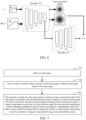
- the image segmentation model stored in the terminal or the server includes an encoder 102 and a decoder 103.
- the computer device calls the encoder 102 to perform feature extraction on a sample image X and a rescaled image R(X) to obtain a sample image feature of the sample image X and a rescaled image feature of the rescaled image R(X).
- the rescaled image R(X) is an image obtained by adjusting the scale of the sample image X.
- the rescaled image R(X) may be an image obtained by upsampling the sample image X; that is, a size of the rescaled image R(X) is two times of the size of the sample image X, or the rescaled image R(X) may be an image obtained by downsampling the sample image X; that is, the rescaled image R(X) reduces its size to half of the sample image X.
- a class activation graph 104 is calculated based on the sample image feature to obtain a sample class activation graph of the sample image, and the class activation graph 104 is calculated based on the rescaled image feature to obtain a rescaled class activation graph of the rescaled image.
- the class activation graph 104 is used for indicating contribution values of pixels in an image to a classification result of the image.
- the decoder 103 is called to decode a sample image feature to obtain a sample segmentation result of the sample image, and is called to decode the rescaled image feature to obtain a rescaled segmentation result of the rescaled image.
- the sample segmentation result includes classification probability values of pixels in the sample image.
- the rescaled segmentation result comprising classification probability values of pixels in the rescaled image.
- a loss L seg is calculated based on the sample class activation graph, the sample segmentation result, the rescaled class activation graph, and the rescaled segmentation result.
- the loss L seg includes a class activation graph loss and a rescaled loss.
- the class activation graph loss is used for training the decoder to enable the sample segmentation result to be close to the sample class activation graph, and to enable the rescaled segmentation result to be close to the rescaled class activation graph.
- the rescaled loss is used for training the decoder to enable the sample segmentation result to be close to the rescaled segmentation result.
- the decoder 103 is trained based on the class activation graph loss and the rescaled loss.
- FIG. 2 is a flowchart of a method for training an image segmentation model according to another exemplary embodiment of this application.
- the method may be performed by a computer device, for example, by the computer device shown in FIG. 1 .
- the method includes the following steps.
- Step 201 Call an encoder to perform feature extraction on a sample image and a rescaled image to obtain a sample image feature of the sample image and a rescaled image feature of the rescaled image, the rescaled image including: at least one of an image obtained by magnifying the sample image or an image obtained by reducing the sample image.
- the image segmentation model includes an encoder and a decoder.
- the image segmentation model is used for segmenting an input image to obtain an area where a classification target is located in the image.
- the image segmentation model may be used for identifying at least one type of classification targets.
- the image segmentation model may be used for identifying pixels where a cat, a dog, or a human is located in in the image.
- the image segmentation model may output, according to the input image, N probability values at which each pixel in the image pertains to the N classification targets, and further N classification probability graphs for the image to pertain to the N classification targets may be obtained, a pixel value of each pixel in an i th classification probability graph being a probability value at which the pixel pertains to an i th classification target, N being a positive integer, and i being a positive integer less than or equal to N.
- a classification target to which each pixel in an image pertains can be determined according to N classification probability graphs of the image. For example, a classification target having the greatest probability value among N probability values of a pixel is determined as the classification target to which the pixel pertains. For example, probability values at which a pixel pertains to a cat, a dog, and a human respectively are 0.1, 0.2, and 0.7, the classification target to which the pixel pertains is a human.
- an output of the image segmentation model may be a classification target graph of an image, and a value of each pixel on the classification target graph represents a classification target to which the pixel pertains. Therefore, locations (pixels) of the classification targets may be seen on the classification target graph.
- a segmentation result outputted by the image segmentation model may be the N classification probability graphs or may be the classification target graphs.
- the method provided in this embodiment is based on this idea to train an image segmentation network, so that the image segmentation network enables output segmentation results of a raw image and a rescaled image to be close to each other.
- sample images and rescaled images corresponding to the sample images need to be obtained, the rescaled images including at least one of a magnified sample image and a reduced sample image.
- the method for magnifying the sample image may be upsampling, and the method for reducing the sample image may be downsampling.
- a group of training samples includes at least one of the following three combinations:
- the method for training an image segmentation model provided in this application is described by an example of only one group of training samples, and based on the method provided in this embodiment, iterative training may be performed on the image segmentation model by using a plurality of groups of training samples.
- the sample image and the rescaled image are inputted to an encoder to perform feature extraction separately, to obtain a sample image feature of the sample image and a rescaled image feature of the rescaled image.
- the encoder used in this embodiment is an encoder that has been trained and has a relatively high feature extraction capability.
- the encoder may be an encoder in any trained image classification model.
- the image classification model is used for outputting, according to an input image, a classification target to which the image pertains.
- the classification target identified by the image classification model is the same as the classification target identified by the image segmentation model, that is, the image classification model is also used for identifying N classification targets.
- the encoder is a Convolutional Neural Network (CNN), and its specific network structure may be adjusted according to a size of an image.
- CNN Convolutional Neural Network
- Step 202 Perform class activation graph calculation based on the sample image feature to obtain a sample class activation graph, and perform class activation graph calculation based on the rescaled image feature to obtain a rescaled class activation graph.
- the sample class activation graph is used for indicating contribution values of pixels in the sample image to a classification result of the sample image
- the rescaled class activation graph is used for indicating contribution values of pixels in the rescaled image to a classification result of the rescaled image.
- the encoder is an encoder in a trained image classification model and the image feature extracted by the encoder already has feature information for classifying the image, and therefore pixels based on which the image classification model classifies the image can be obtained by performing class activation graph calculation based on the image feature outputted by the encoder.
- the decoder is trained by using the class activation graph, so that the image segmentation result outputted by the decoder is close to the class activation graph.
- Step 203 Call the decoder to decode the sample image feature to obtain a sample segmentation result of the sample image, and call the decoder to decode the rescaled image feature to obtain a rescaled segmentation result of the rescaled image.
- the sample segmentation result includes classification probability values of pixels in the sample image.
- the decoder is configured to decode the image features outputted by the encoder, to obtain segmentation results.
- the decoder is composed of a plurality of layers of convolutional neural networks.
- the decoder adopts a network structure that is reciprocal to that of the encoder.
- the encoder includes four convolutional blocks, each convolutional block is composed of two convolutional layers, and sizes of convolutional kernels are all 3 ⁇ 3.
- a pooling layer having a kernel size of 2*2 is connected to the encoder, to change an image feature outputted by the convolutional block to 1/2 of the original image feature.
- the decoder may also include four convolutional blocks, each convolutional block is composed of two convolutional layers, and sizes of convolutional kernels are all 3 ⁇ 3.
- an upsampling layer is connected to the decoder, to change the size of the image feature to two times of that of the original image feature. In this way, the size of the image inputted to encoder is the same as that of the image outputted by the decoder.
- Step 204 Calculate a class activation graph loss based on the sample class activation graph, the sample segmentation result, the rescaled class activation graph, and the rescaled segmentation result, and calculate a rescaled loss based on the sample segmentation result and the rescaled segmentation result.
- the class activation graph loss is used for training the decoder to enable the sample segmentation result to be close to the sample class activation graph, and to enable the rescaled segmentation result to be close to the rescaled class activation graph.
- the rescaled loss is used for training the decoder to enable the sample segmentation result to be close to the rescaled segmentation result.
- the class activation graph and the class activation graph loss of the segmentation result are calculated based on the idea of enabling the segmentation result to be close to the class activation graph.
- the rescaled loss between the sample segmentation result and the rescaled segmentation result is calculated based on the idea that the segmentation result of the image after the scale change is kept unchanged.
- Step 205 Train the decoder based on the class activation graph loss and the rescaled loss.
- the decoder is trained based on the class activation graph loss and the rescaled loss, so that the decoder outputs a segmentation result based on the class activation graph, and the output result of the decoder is enabled to guarantee that the segmentation result of the image after a scale change is kept unchanged.
- a sample image and a rescaled image obtained after the sample image is rescaled are separately inputted to an encoder and a decoder for image segmentation, to obtain image segmentation results of the two images, a rescaled loss can be calculated based on the two image segmentation results, and the encoder is trained by using the rescaled loss, so that the two image segmentation results are enabled to be close to each other to guarantee that the image segmentation results are kept unchanged after the image size changes.
- class activation images of the two images are calculated separately.
- the class activation graph reflects main pixels based on which image classification is performed, and therefore the image segmentation result needs to be close to the class activation graph.
- a class activation graph loss is calculated by using the segmentation results of the images and the class activation graphs of the images, and the encoder is trained by using the class activation graph loss, to finally guarantee that the image segmentation result obtained after image scaling is kept unchanged while enabling the image segmentation result outputted by the encoder to be close to the class activation graph.
- FIG. 3 is a flowchart of a method for training an image segmentation model according to another exemplary embodiment of this application.
- the method may be performed by a computer device, for example, a terminal or a server shown in FIG. 1 .
- step 301 is further included before step 202, step 202 further includes step 2021, step 204 further includes step 2041 to step 2043, and step 205 further includes step 2051 and step 2052.
- Step 301 Call a fully-connected layer to perform classification and prediction on the sample image feature, to obtain a sample classification result of the sample image; and call the fully-connected layer to perform classification and prediction on the rescaled image feature, to obtain a rescaled classification result of the rescaled image.
- the image segmentation model further includes a pretrained fully-connected layer.
- the image classification model mentioned in step 201 in the embodiments shown in FIG. 2 further includes a fully-connected layer, that is, the image classification model includes an encoder and a fully-connected layer, and after the image is inputted to the encoder for feature extraction, a classification result is obtained through the fully-connected layer.
- the image segmentation model further adopts a fully-connected layer of an image classification model, and outputs respective classification results of the sample image and the rescaled image according to the image features outputted by the encoder.
- the classification result is a vector composed of N probability values at which the image pertains to the N classification targets.
- Step 2021 Perform calculation based on the sample image feature and the sample classification result to obtain the sample class activation graph of the sample image; and perform calculation based on the rescaled image feature and the rescaled classification result to obtain the rescaled class activation graph of the rescaled image.
- c is a c th classification target in the N classification targets
- S c is a probability value of a c th class in the classification result
- N*M is a size of the image feature
- a kj i is a pixel value in a k th row and a j th column of the i th image feature
- ⁇ i c indicates a contribution value of a pixel in the k th row and the j th column of the i th image feature to that the image is classified into an i th classification target.
- L Grad ⁇ CAM c ReLU ⁇ i ⁇ i c A i L Grad ⁇ CAM c is a class activation graph in a case that the image is in the c th classification target; ReLU is an activation function, which indicates that the class activation graph focuses only on pixels having probability values greater than 0, and A i is the i th image feature.
- N class activation graphs of the image in the N classification targets can be calculated according to the calculation formulas, and an i th class activation graph is used for indicating contribution values of pixels in the image to that the image is classified into an i th classification target.
- the sample class activation graph includes N class activation graphs for indicating that the sample image is in the N classification targets; and the rescaled class activation graph includes N class activation graphs for indicating that the rescaled image is in the N classification targets.
- Step 2041 Calculate the sample class activation graph loss based on the sample class activation graph and the sample segmentation result.
- the sample class activation graph loss is obtained through calculation based on an error between the sample segmentation result and the sample class activation graph.
- a cross entropy of the sample class activation graph and the sample segmentation result is determined as the sample class activation graph loss.
- the size of the class activation graph is different from that of the segmentation result, the class activation graph further needs to be upsampled to have the same size as the segmentation result, and the class activation graph loss is then calculated according to the foregoing formula.
- the size of the segmentation result is the same as that of a raw image inputted to the image segmentation model, that is, the size of the sample segmentation result is the same as that of the sample image.
- the class activation graph is calculated based on the image feature outputted by the encoder, the size of the class activation graph is the same as that of the image feature outputted by the encoder, and the size of the image feature is smaller than the raw image. Therefore, the size of the class activation graph is smaller than that of the segmentation result.
- the class activation graph needs to be upsampled and magnified to the size of the segmentation result, and then a magnified class activation graph is substituted to the foregoing formula to calculate the class activation graph loss.
- Step 2042 Calculate the rescaled class activation graph loss based on the rescaled class activation graph and the rescaled segmentation result.
- the rescaled class activation graph loss is obtained through calculation based on an error between the rescaled segmentation result and the rescaled class activation graph.
- a cross entropy of the rescaled class activation graph and the rescaled segmentation result is determined as the rescaled class activation graph loss.
- the foregoing formula may be used for calculating the rescaled class activation graph loss.
- the rescaled class activation graph loss includes a reduced rescaled class activation graph loss and a magnified rescaled class activation graph loss. Then, the foregoing formula is used for separately calculating a reduced rescaled class activation graph loss L seg, 2.1 of the reduced scale image and a magnified rescaled class activation graph loss L seg, 2.2 of the magnified scale image.
- Step 2043 Calculate the rescaled loss based on the sample segmentation result and the rescaled segmentation result.
- a size of the outputted sample segmentation result is also different from that of the rescaled segmentation result, and therefore, in order to compare a difference between the two sizes, the sample segmentation result and the rescaled segmentation result need to be rescaled to a same size.
- a size of the output segmentation result is the same as that of the input image size, and therefore, the sample segmentation result and the rescaled segmentation result are rescaled to a same scale according to a rescale relationship between the sample image and the rescaled image.
- the computer device scales, according to a rescale relationship between the sample image and the rescaled image, the sample segmentation result to a same size as the rescaled segmentation result, to obtain a rescaled sample segmentation result.
- the rescaled loss is calculated according to an error between the rescaled segmentation result and the rescaled sample segmentation result.
- the rescaled image is an image obtained after upsampling and magnifying the sample image to two times. Then, the sample segmentation result is upsampled and magnified to two times to obtain the rescaled sample segmentation result.
- a first matrix difference between the rescaled segmentation result and the rescaled sample segmentation result is calculated, and a 2-norm of the first matrix difference is determined as the rescaled loss.
- the foregoing formula may be used for calculating the rescaled loss.
- L seg ,3 is the rescaled loss
- s 4 is the reduced rescaled segmentation result of the reduced scale image
- s 5 is the magnified rescaled segmentation result of the magnified scale image
- s 1 is the sample segmentation result
- R 4 ( s 1 ) is a sample segmentation result obtained after reduction according to a rescale relationship between the reduced scale image and the sample image
- R 5 ( s 1 ) is a sample segmentation result obtained after magn
- L seg ,3 is the rescaled loss
- s 4i is a reduced rescaled segmentation result of a reduced scale image in an i th classification target
- s 5i is a magnified rescaled segmentation result of a magnified scale image in the i th classification target
- s 1i is a sample segmentation result of the i th classification target
- R 4 ( s 1i ) is a sample segmentation result obtained after reducing the sample segmentation result of the i th classification target according to
- Step 2051 Calculate a weighted sum of the sample class activation graph loss, the rescaled class activation graph loss, and the rescaled loss.
- L seg, 1 and L seg, 2 represent that the segmentation results outputted by the constraint decoder is close to the corresponding class activation graph.
- L seg, 3 represents that a segmentation result of an image after a scale change needs to be consistent with a segmentation result of a raw image after the same scale change.
- L seg L seg , 1 + L seg , 2 + ⁇ L seg , 3
- L seg is the total loss
- L seg, 1 is the sample class activation graph loss
- L seg, 2 is the rescaled class activation graph loss
- L seg ,3 is the rescaled loss
- ⁇ is a weight of the rescaled loss.
- the foregoing formula may be used for calculating the total loss.
- the rescaled image includes two rescaled images, namely, a reduced scale image and a magnified scale image
- the rescaled class activation graph loss includes a reduced rescaled class activation graph loss and a magnified rescaled class activation graph loss.
- L seg L seg , 1 + L seg , 2.1 + L seg , 2.2 + ⁇ L seg , 3
- L seg is the total loss
- L seg, 1 is the sample class activation graph loss
- L seg, 2.1 is the rescaled class activation graph loss
- L seg, 2.2 is the rescaled class activation graph loss
- L seg, 3 is the rescaled loss
- ⁇ is the weight of the rescaled loss.
- Step 2052 Train the decoder according to the weighted sum.
- the decoder is trained according to the calculated weighted sum (the total loss), the segmentation result is constrained to be close to the class activation graph, and the segmentation results of different sizes of the same image are constrained to be consistent.
- the image segmentation model may be used for image segmentation.
- the computer device calls the image segmentation model to segment an input image to obtain an image segmentation result
- the image segmentation model includes an encoder and a decoder.
- the encoder is called to perform feature extraction on the input image to obtain an input image feature of the input image
- the decoder is called to decode the input image feature to obtain an image segmentation result of the input image
- feature extraction is performed by using an encoder of a pretrained image classification model, so that the image feature outputted by the encoder has feature information required for classification, the classification result of the image is outputted by using a fully-connected layer of the image classification model, and then the class activation graph of the image is obtained by using the classification result and the image feature.
- the class activation graph may also be outputted as an image segmentation result, the scale change of the image may greatly affect the class activation graph, and normally the scale change may not affect the image segmentation result.
- the encoder and the fully-connected layer in the image segmentation model adopt an encoder and a fully-connected layer of a trained image classification model.
- the encoder in the image classification model is a classification encoder and the fully-connected layer is a classification fully-connected layer
- the computer device sets a parameter of the encoder according to a parameter of the classification encoder in a trained image classification model, and the classification target of the image classification model is the same as that of the image segmentation model.
- a parameter of the fully-connected layer is set according to a parameter of the classification fully-connected layer in a trained image classification model, and the image classification model is used for outputting a classification result according to the input image.
- FIG. 4 is a flowchart of a method for training an image segmentation model according to another exemplary embodiment of this application.
- the method may be performed by a computer device, for example, a terminal or a server shown in FIG. 1 .
- the method includes the following steps.
- Step 401 Obtain a data sample.
- Step 402 Call a classification encoder and a classification fully-connected layer to perform feature extraction and classification on the data sample, to obtain a classification vector of the data sample and to determine a correlation between the data sample and the classification vector, the classification vector including a category vector and an intra-class style vector.
- the computer device obtains a data sample set.
- the data sample set includes data samples.
- the data samples are images.
- An image classification model is pre-established in the computer device, and the image classification model includes an encoder and a fully-connected layer connected behind the encoder.
- the image classification model may adopt a plurality of types of neural networks.
- the image classification model may adopt a convolutional neural network, and convolutional blocks of the image classification model may be adjusted according to a size of an image. A greater image indicates a greater number of convolutional blocks. For example, for a 32*32 image, two convolutional blocks may be used, and for a 96*96 image, four convolutional blocks may be used.
- the computer device inputs the data sample to the image classification model, the encoder of the image classification model performs feature extraction on the data sample to obtain a sample feature, and the fully-connected layer outputs a classification vector of the data sample according to the sample feature.
- the classification vector includes a category vector and an intra-class style vector. Elements in the category vector are probabilities at which the data sample pertains to classification targets.
- the intra-class style vector describes intra-class style information of the data sample.
- the computer device may train the image classification model by using another network model.
- the computer device may determine, by using a discriminator, a correlation between the data sample and the classification vector (the data sample corresponds to the classification vector obtained according to the data sample) and determine, by using an evaluator, a score at which the classification vector obeys a prior distribution.
- An overall network structure diagram of training the image classification model by the computer device may be shown in FIG. 5 .
- a discriminator 501 is a deep neural network composed of a plurality of fully-connected layers.
- the discriminator 501 may be a deep neural network composed of three or more fully-connected layers.
- An evaluator 502 is a deep neural network composed of a plurality of fully-connected layers.
- the evaluator 502 may be a deep neural network composed of three or more fully-connected layers.
- the discriminator 501 may determine whether a data sample is correlated with a classification vector, to maximize mutual information between the data sample and the classification vector.
- the computer device may input a data sample and an extracted classification vector to the discriminator 501 simultaneously.
- the data sample includes a first sample and a second sample. In a case that the data sample inputted to the discriminator 501 is the first sample, the extracted classification vector is from the second sample, and the first sample is different from the second sample, the first sample and the classification vector are negative samples and the discriminator 501 determines that the data sample and the classification vector are not correlated with each other.
- the data sample inputted to the discriminator 501 is the first sample and the extracted classification vector is from the first sample
- the first sample and the extracted classification vector are positive samples and the discriminator 501 determines that data sample and the classification vector are correlated with each other.
- a shoe image 503 may be used as the first sample
- a clothing image 504 may be used as the second sample
- the encoder and the fully-connected layer obtain a first classification vector according to the inputted first sample and obtain a second classification vector according to the inputted second sample.
- the first sample is correlated with the first classification vector and the first sample is not correlated with the second classification vector.
- the discriminator 501 can correctly determine whether a data sample is correlated with a classification vector, it indicates that the classification vector includes information related to the data sample, and therefore mutual information can be maximized.
- Step 403 Introduce a category prior distribution to the category vector and introduce an intra-class style prior distribution to the intra-class style vector, to determine a score at which the classification vector obeys a prior distribution.
- the evaluator introduces a prior distribution to the classification vector.
- the evaluator is also a deep neural network composed of a plurality of fully-connected layers.
- the evaluator 502 may be a deep neural network composed of three or more fully-connected layers.
- the prior distribution includes a category prior distribution and an intra-class style prior distribution.
- the category prior distribution may be referred to as a category distribution for short, and the intra-class style prior distribution may be a Gaussian distribution.
- the evaluator introduces a category distribution Z ⁇ c for a category vector z c and introduces a Gaussian distribution Z ⁇ s for an intra-class style vector z s , so that the category vector can be effectively decoupled from the intra-class style vector.
- the outputted category feature is enabled to be partially a single heat vector, so that an element having the greatest value in the single heat vector may be directly used to represent the category of the data sample, thereby avoiding a next classification operation.
- the data sample is prevented from being aggregated to one category or a few categories, but can be guaranteed to be aggregated to a required number of categories, for example, 10 categories.
- Step 404 Train an image classification model according to at least the correlation and the score.
- the computer device may perform reverse optimization on a network parameter of the image classification model by using the correlation between the data sample and the classification vector and the score at which the classification vector obeys a prior distribution.
- a back propagation method may be used to optimize the network parameters in the image classification model.
- the back propagation method may adopt an Adam-based gradient descent method.
- weight updating may be performed on the network parameters of the image classification model, the discriminator, and the evaluator.
- a learning rate is 0.0001
- a parameter ⁇ 1 which controls convergence of a loss function is set to 0.5
- ⁇ 2 is set to 0.9.
- a batch size is set to 64.
- the evaluator, the image classification model, and the discriminator may be optimized alternately with a same batch of data samples at a time.
- the loss function of the evaluator starts to converge, it indicates that the classification vector learned by the image classification model is close to the prior distribution and the training may be stopped.
- the method for training an image classification model further includes: performing enhancement on the data sample, and obtaining an enhanced classification vector through mapping by the image classification model, the enhanced classification vector including an enhanced category vector and an enhanced intra-class style vector; and determining a category feature difference between the category vector and the enhanced category vector; and the training an image classification model according to at least the correlation and the score includes: training the image classification model based on the correlation, the category feature difference, and the score.
- the computer device inputs the data sample to the image classification model, and obtains a corresponding classification vector through the encoder and the fully-connected layer.
- the classification vector includes a category vector and an intra-class style vector.
- the category vector is a vector activated by a Softmax function, and elements in the vector represent probabilities at which the data sample pertains to classification targets, and a vector dimension is set to the number of the classification targets.
- the intra-class style vector is a linearly activated vector.
- the vector describes intra-class style information of the data sample, and a vector dimension may be a preset number, for example, 50.
- the intra-class style information refers to style difference information which exists between images for a plurality of images pertaining to a same classification target.
- the category vector After different excitations, obtained values of the category vector and the intra-class style vector are different, but some information may be mixed.
- the category vector By introducing the category prior distribution to the category vector and the intra-class style prior distribution to the intra-class style vector, the category vector can be effectively decoupled from the intra-class style vector.
- a style change may not change a classification target to which a data sample pertains. That is, based on a phenomenon that specific data enhancement does not change a classification target to which a data sample pertains, in this embodiment, by performing data enhancement on the data sample and through training, the enhanced classification vector may not change.
- the computer device performs enhancement on the data sample.
- the enhancement includes random cropping of the image, random horizontal flipping, color jitter, and random combination of color channels.
- the enhanced data sample is inputted to the image classification model, and an enhanced classification vector is obtained through the encoder and the fully-connected layer.
- the computer device extracts a category vector from the classification vector, extracts an enhanced category vector from the enhanced classification vector, inputs the category vector and the enhanced category vector to the evaluator, and identifies a category feature difference between the category vector and the enhanced category vector through the evaluator.
- Elements in the vector of the category vector are probability values at which the data sample pertains to classification targets.
- the category feature difference between the category vector and the enhanced category vector may be measured by divergence.
- the computer device may perform reverse optimization on a network parameter of the image classification model by using the correlation between the data sample and the classification vector, the score at which the classification vector obeys the prior distribution, and the category feature difference between the category vector and the enhanced category vector.
- weight values corresponding to the network parameters of the image classification model, the discriminator, and the evaluator are updated.
- the image classification model may learn that the classification vector is correlated with a data sample, that the category vector may represent a classification target of the data sample, and that the intra-class style vector may represent a difference between the same type of data samples.
- the category vector of the data sample is kept unchanged, that is, the style of the data sample may change to an extent, but the data sample still pertains to the same category.
- the category vector may be enabled to be close to the single heat vector as much as possible, that is, values of most elements are close to 0, only a value of one element is close to 1, so that the classification target corresponding to the data sample can be directly determined according to the category vector.
- the data sample includes a first sample and a second sample; and the determining a correlation between the data sample and the classification vector includes: obtaining the first sample, splicing a classification vector of the first sample and a first sample vector, to generate a first sample vector (a positive sample) after the splicing; splicing a classification vector of the second sample and the first sample vector, to generate a second sample vector (a negative sample) after the splicing; and training the discriminator to output a "correlated" result according to the first sample vector and an "uncorrelated" result according to the second sample vector.
- the data sample includes a first sample and a second sample, and the first sample and the second sample may be completely different or the same.
- the first sample is inputted to the image classification model, for mapping, to obtain a first classification vector corresponding to the first sample.
- the second sample is inputted to the image classification model, for mapping, to obtain a second classification vector corresponding to the second sample.
- Both the first classification vector and the second classification vector may be vectors having a plurality of dimensions, for example, 50 dimensions.
- the computer device converts the first sample into a first sample vector.
- the computer device splices the first classification vector and the first sample vector, to generate a first sample vector after the splicing.
- the splicing may be performed by adding a first sample vector behind the first classification vector, or may be performed by adding a first classification vector behind the first sample vector.
- the computer device may splice the second classification vector and the first sample vector by using the splicing method, to generate a spliced second sample vector.
- the spliced first sample vector is inputted to the discriminator, and the discriminator outputs "1" after determining that the two are correlated and outputs "0" after determining that the two are uncorrelated; and the spliced second sample vector is inputted to the discriminator, and the discriminator outputs "1" after determining that the two are correlated and outputs "0" after determining that the two are uncorrelated.
- the discriminator can correctly determine whether a data sample is correlated with a classification vector, it indicates that the classification vector includes information related to the data sample, to maximize the mutual information, and therefore the classification vector learned by the image classification model can be enabled to be correlated with the data sample.
- the introducing a category prior distribution to the category vector and introducing an intra-class style prior distribution to the intra-class style vector, to determine a score at which the classification vector obeys a prior distribution includes: introducing the category prior distribution to the category vector by the evaluator, to obtain a category distribution result of the category vector; introducing the intra-class style prior distribution to the intra-class style vector by the evaluator, to obtain an intra-class style prior distribution result of the intra-class style vector; and scoring the category distribution result and the intra-class style prior distribution result by the evaluator, to obtain the score at which the classification vector obeys a prior distribution.
- the evaluator introduces a prior distribution to the classification vector.
- the prior distribution includes a category prior distribution and an intra-class style prior distribution.
- the category prior distribution may be referred to as a category distribution for short, and the intra-class style prior distribution may be a Gaussian distribution.
- the intra-class style vector may be Z ⁇ s ⁇ N(0, ⁇ 2 ), Z ⁇ s is a distribution of the intra-class style vector, N is a Gaussian distribution, ⁇ is a standard deviation, and ⁇ may be a preset value, for example, 0.1.
- the computer device inputs both the category vector and the intra-class style vector to the evaluator, and the evaluator outputs a category distribution result corresponding to the category vector and a Gaussian distribution result corresponding to the intra-class style vector.
- the category distribution result may be a category vector, and the category vector may be a single heat vector.
- the Gaussian distribution result may be a style vector.
- the scoring the category distribution result and the intra-class style prior distribution result by the evaluator includes: splicing the category distribution vector of the category vector and the Gaussian distribution vector of the intra-class style vector, to generate a prior distribution vector; and scoring the prior distribution vector by the evaluator, to obtain the score at which the classification vector obeys a prior distribution.
- the computer device splices the category result and the Gaussian distribution result, that is, splices the corresponding category vector and style vector.
- the splicing may be performed by adding an element of the style vector behind the last element of the category vector, or may be performed by adding an element of the style vector behind the last element of the category vector.
- the evaluator scores the spliced vector to obtain a corresponding score, which is a probability at which the classification vector obeys a prior distribution. A higher probability indicates a higher tendency for which the classification vector obeys the prior distribution.
- the outputted category vector may be enabled to be close to the single heat vector as much as possible, so that an element having the greatest value in the single heat vector may be directly used to represent the category of the data sample, thereby avoiding a next classification operation.
- the data sample is prevented from being classified to one category or a few categories, but can be guaranteed to be classified to required classification targets.
- the method for training an image classification model further includes: determining, by a discriminator, a correlation between the data sample and the classification vector; and determining, by an evaluator, a score at which the classification vector obeys a prior distribution; and the training an image classification model according to at least the correlation and the score includes: performing alternate optimization on the image classification model, the discriminator, and the evaluator according to at least the correlation and the score.
- the correlation between the data sample and the classification vector is identified by the discriminator.
- a loss function for the discriminator to identify the correlation between the data sample and the classification vector may be referred to as a mutual information loss function.
- the discriminator may be trained by the mutual information loss function.
- X is the data sample, Z is the classification vector, S is a sigmoid function, E represents an expectation, D is the discriminator, which is used for determining whether X and Z are correlated with each other, and Q ( Z
- Q Z E P X [ Q ( Z
- a smaller value of the loss function indicates a more accurate determining of the correlation, and indicates a smaller impact on the weight of each layer in the discriminator network during reverse optimization.
- the discriminator can correctly determine whether a data sample is correlated with a feature, it indicates that the feature includes information correlated with the data sample, to maximize mutual information.
- the category feature difference between the category vector and the enhanced category vector may be measured by divergence.
- the divergence may be KL divergence.
- a smaller function value of the category difference loss function indicates a smaller category feature difference between the category vector and the enhanced category vector, and correspondingly indicates a smaller probability at which the category vector changes after the data sample is undergone data enhancement.
- a score at which the classification vector obeys the prior distribution is evaluated by an evaluator.
- a loss function is introduced to the prior distribution, and the classification vector may be referred to as a prior distribution loss function.
- Different prior distribution loss functions may be defined for the image classification model and the evaluator, respectively. Through the prior distribution loss function, the classification vector mapped by the image classification model may be enabled to be close to the prior distribution as much as possible.
- Q is the image classification model
- Z is the classification vector of the data sample
- C ( Z ) is a probability value of whether the classification vector obeys the prior distribution
- Q Z is an aggregated posteriori distribution of Z
- E Z ⁇ Q Z [ C ( Z )] is a mathematical expectation at which Z obeys Qz [ C ( Z )].
- C is the evaluator
- P Z is the prior distribution
- ⁇ is a feature on a connection line of features sampled from the prior distribution P Z and the aggregated posteriori distribution Q Z
- ( ⁇ ⁇ C( ⁇ ) ⁇ 2 - 1) 2 is a gradient penalty item, which is used for enabling the evaluator C to meet the Lipschitz constraint, so that the score obtained after being evaluated by the evaluator, that is, the probability of obeying the prior distribution, does not change excessive drastically
- ⁇ is a gradient penalty item coefficient, which is set to 10.
- the mutual information loss function, the category difference loss function, and the prior distribution loss function of the image classification model may be used as loss sub-functions to define the total loss function of the image classification model.
- Each loss sub-function may have a corresponding weight.
- the total loss function of the discriminator may be defined by the mutual information loss function and its corresponding weight.
- the total loss function of the evaluator may be defined by the prior distribution loss function of the evaluator and its weight.
- the total loss function of the image classification model is in the following:
- L MI is the mutual information loss function
- L Aug is the category difference loss function
- L Adv Q is the prior distribution loss function of the image classification model
- ⁇ MI is the weight of L MI
- ⁇ Aug is the weight of L Aug
- ⁇ Adv is the weight of L Adv Q .
- ⁇ MI and ⁇ Adv may be set to corresponding fixed values, for example, ⁇ MI is set to 0.5 and ⁇ Adv is set to 1.
- ⁇ Aug is correlated with a data set of data samples and may be set by the following method.
- the computer device may generate a corresponding visual dimension reduction graph by performing nonlinear dimension reduction on the classification vector, and select the weight of the category difference loss function according to the visual dimension reduction graph.
- the visual dimension reduction graph is a result of reducing high-dimensional data to low-dimensional data, so that the result is visual.
- Low dimensions are, for example, two or three dimensions.
- a t-SNE may be used to perform nonlinear dimensionality reduction on the classification vector, and according to a processing result, a visual dimensionality reduction graph, that is, a t-SNE graph, is generated.
- a visual dimensionality reduction graph that is, a t-SNE graph
- data samples may be classified to form classification clusters.
- a value of ⁇ Aug is low
- the classification clusters of the data samples are scattered.
- obtained features tend to aggregate and the classification clusters may even overlap.
- Data sets of different data types have different classified results.
- a data sample is an image.
- a maximum value of overlapping of the classification clusters may be selected from a range of 2 to 3 as the value of ⁇ Aug , and therefore the total loss function of the image classification model is enabled to be more accurate, so that the classification result of the trained image classification model is enabled to be more accurate.
- the training of the image classification model may be performed by reverse optimization.
- the evaluator, image classification model and discriminator may be optimized alternately.
- the evaluator is optimized first, and then the image classification model and the discriminator are optimized. Further, first, the total loss function of the evaluator is used to reversely optimize the evaluator, so that a probability of the classification vector that obeys the prior distribution is close to 1, and the probability of the classification vector that does not obey the prior distribution is close to 0.
- the total loss function of the image classification model is used to reversely optimize the image classification model and the total loss function of the discriminator is used to reversely optimize the discriminator, so that the classification vector outputted by the image classification model may obtain a high score as much as possible, that is, the probability at which the classification vector obeys the prior distribution is as high as possible; the alternate optimization process is repeated, so that the classification vector outputted by the image classification model obtains a high score, that is, the probability at which the classification vector obeys the prior distribution is close to 1, thereby obeying the prior distribution.
- the performing alternate optimization on the image classification model, the discriminator, and the evaluator according to at least the correlation and the score includes: first optimizing a network parameter of the evaluator according to the score at least once; and then performing optimization on a network parameter of the image classification model according to at least the correlation and the score, and performing optimization on a network parameter of the discriminator according to the correlation.
- data samples may be randomly divided into a plurality of batches, each batch has a fixed number of data samples, and may also be referred to as a batch sample.
- the batch sample may be set to 64 data samples, that is, the batch size is set to 64.
- the computer device determines a score at which the classification vector obeys the prior distribution and determines a correlation between a data sample and a classification vector.
- the discriminator, and the evaluator the weights corresponding to the network parameters are updated.
- a network parameter of the image classification model is optimized according to the correlation between the data sample and the classification vector, the score at which the classification vector obeys the prior distribution, the category feature difference, and the total loss function of the image classification model
- the network parameter of the discriminator is optimized according to the correlation between the data sample and the classification vector and the total loss function of the discriminator. For example, after the evaluator is optimized four times, the image classification model and the discriminator are optimized once. During reverse optimization of the image classification model and the discriminator, the reverse optimization may be performed successively, or the reverse optimization may be performed simultaneously.
- an output closer to 1 indicates a smaller loss function value and indicates a smaller change in the parameter during the back propagation
- an output closer to 0 indicates a smaller loss function value and indicates a smaller change in the parameter during the back propagation.
- an output closer to 1 indicates a smaller loss function value and indicates a smaller change in the parameter during the back propagation.
- the prior distribution is not considered during the reverse optimization of the image classification model.
- the total loss function of the evaluator may indicate a difference between the feature distribution learned by the current image classification model and the prior distribution, and in a case that the total loss function of the evaluator starts to converge, it indicates that the feature distribution learned by the image classification model is close to the prior distribution and the training may be stopped.
- the image classification model can be trained by using the correlation and the score, which can effectively improve learning of the classification vector by the image classification model.
- the classification target corresponding to the data sample can be obtained according to the category vector. Therefore, the precision of data classification can be effectively improved without manual annotation. Further, effective training of an image segmentation network without manual annotation is implemented.
- FIG. 6 is a schematic diagram of training an image segmentation model by using the method for training an image segmentation model provided in this application.
- An encoder 102 in FIG. 6 adopts the encoder of the image classification model in the embodiments shown in FIG. 4 , and in a training stage of the image segmentation model, a fully-connected layer (not shown) is further connected to the encoder 102.
- the sample image x 1 and the rescaled image x 2 are respectively inputted to the encoder, and the encoder outputs a sample image feature of the sample image x 1 and a rescaled image feature of the rescaled image x 2 .
- the sample image feature is inputted to the fully-connected layer to output a sample classification result
- the rescaled image feature is inputted to the fully-connected layer to output a rescaled classification result.
- a sample class activation graph C 1 of the sample image is calculated according to a calculation formula for a class activation graph.
- a rescaled class activation graph C 2 of the rescaled image is calculated according to a calculation formula for a class activation graph.
- the sample image feature is inputted to a decoder 103 to obtain a sample segmentation result s 1 .
- the rescaled image feature is inputted to the decoder 103 to obtain a rescaled segmentation result s 2 .
- the sample class activation graph loss is calculated based on the sample class activation graph and the sample segmentation result; the rescaled class activation graph loss is calculated based on the rescaled class activation graph and the rescaled segmentation results; and the rescaled loss is calculated based on the sample segmentation result and the rescaled segmentation result.
- a weighted sum of the sample class activation graph loss, the rescaled class activation graph loss, and the rescaled loss is calculated, to obtain a total loss L seg .
- a network parameter in the decoder is optimized by a back propagation method.
- the optimization method adopts an Adam-based gradient descent method, the learning rate is 0.0001, for Adam parameters, an exponential decay rate ⁇ 1 of first-order moment estimation is set to 0.5, and an exponential decay rate ⁇ 2 of a second-order moment estimation is set to 0.9.
- the image classification model is optimized first, then the encoder part is fixed, migrated to the image segmentation model, and then the decoder part of the image segmentation model is optimized.
- an exemplary embodiment of image segmentation using a trained image segmentation model is provided.
- FIG. 7 is a flowchart of an image segmentation method according to an exemplary embodiment of this application.
- the method may be performed by a computer device, for example, a terminal or a server shown in FIG. 1 .
- the computer device that performs the method for training an image segmentation model and the computer device that performs the image segmentation method may be the same computer device, or may be different computer devices.
- the method includes the following steps.
- Step 701 Obtain an input image.
- the input image may be any image on which image segmentation needs to be performed.
- the input image may be an image including a human face.
- the input image may be an image including a lesion.
- the input image may not include the classification target of the image segmentation model either, that is, the input image may alternatively not include a human face, or, not include a lesion.
- Step 702 Call an encoder to perform feature extraction on the input image to obtain an input image feature of the input image.
- the encoder is an encoder in the image segmentation model mentioned in any of the foregoing embodiments.
- sources of the encoder vary depending on different classification targets of image segmentation models.
- a classification target of an image segmentation model is a human face
- a parameter of the encoder is set according to a parameter of a classification encoder of a human face classification model, the human face classification model being used for identifying whether the input image includes a human face.
- a parameter of the encoder is set according to a parameter of a classification encoder of a lesion classification model, the lesion classification model being used for identifying whether the input image includes a lesion.
- the encoder of the image segmentation model is set by using the classification encoder of the image classification model, the encoder of the image segmentation model can accurately extract a feature of an image in a classification task. Because the classification target of the image segmentation is the same as the classification target of the image classification, the image segmentation model can perform accurate image segmentation according to the extracted feature, which not only simplifies the process of training the image segmentation model, but also improves the segmentation precision of the image segmentation model.
- Step 703 Call a decoder to decode the input image feature to obtain an image segmentation result of the input image, the decoder being obtained through training according to a class activation graph loss and a rescaled loss, the class activation graph loss being used for training the decoder to output a segmentation result close to a class activation graph, the class activation graph being used for indicating contribution values of pixels in an image to a classification result of the image, and the rescaled loss being used for training the decoder to output similar segmentation results for a plurality of images having identical image content and different scales.
- the decoder is a decoder in the image segmentation model mentioned in any of the foregoing embodiments. Reference may be made to the foregoing embodiments for the method for training the decoder.
- the segmentation result outputted by the encoder includes probability values at which pixels in the input image pertain to classification targets, or the segmentation result outputted by the encoder includes classification targets to which pixels in the input image pertain.
- the image segmentation result includes probability values at which pixels in the input image pertain to the human face, or the image segmentation result includes whether pixels in the input image pertain to the human face.
- the image segmentation result includes probability values at which pixels in the input image pertain to the lesion, or the image segmentation result includes whether pixels in the input image pertain to the lesion.
- the image can be segmented based on a deep feature of the image, and the precision of image segmentation is improved.
- the decoder of the image segmentation model is trained based on scale invariance, the image segmentation model outputs similar image segmentation results for a plurality of images having identical image content and different scales, which is closer to an actual situation of image segmentation, and further improves the precision of the image segmentation.
- the image segmentation model provided in this application may be used in a plurality of application scenarios for image segmentation of different classification targets in an image.
- this application further provides an exemplary embodiment of training the image segmentation models corresponding to the two application scenarios.
- an exemplary embodiment of training an image segmentation model for segmenting a human face area in an image by using the method for training an image segmentation model provided in this application is provided.
- the image classification model for identifying a human face is trained.
- the image classification model includes a classification encoder and a classification fully-connected layer.
- the image classification model is used for clustering, that is, a plurality of inputted images are clustered into a class including a human face and a class not including a human face.
- Step 1 Obtain a data sample.
- Step 2 Call a classification encoder and a classification fully-connected layer to perform feature extraction and classification on the data sample, to obtain a classification vector of the data sample and to determine a correlation between the data sample and the classification vector, the classification vector including a category vector and an intra-class style vector, and the category vector being used for describing whether the input image includes a human face.
- Step 3 Introduce a category prior distribution to the category vector and introduce an intra-class style prior distribution to the intra-class style vector, to determine a score at which the classification vector obeys a prior distribution.
- Step 4 Train an image classification model according to at least the correlation and the score.
- the image segmentation model is trained based on the trained image classification model.
- the image segmentation model includes an encoder, a fully-connected layer, and a decoder in a training stage, and the image segmentation model includes an encoder and a decoder in an application stage.
- Step 1 Initialize an encoder according to a parameter of a classification encoder and initialize a fully-connected layer according to a parameter of a classification fully-connected layer, that is, the encoder and the fully-connected layer can accurately classify an input image and identify whether the image includes a human face.
- Step 2 Obtain a training data set, which includes at least one group of a sample image and a rescaled image, the sample image is an image that includes or does not include a human face, the rescaled image is an image obtained by upsampling the sample image, and a size of the rescaled image is two times of a size of the sample image.
- Step 3 Call the encoder to perform feature extraction on the sample image to obtain a sample image feature and call the fully-connected layer to perform classification on the sample image feature to obtain a sample classification result of the sample image, the sample classification result including a probability value at which the sample image includes a human face; and call the encoder to perform feature extraction on the rescaled image to obtain a rescaled image feature and call the fully-connected layer to perform classification on the rescaled image feature to obtain a rescaled classification result of the rescaled image, the rescaled classification result including a probability value at which the rescaled image includes a human face.
- Step 4 Call a decoder to decode the sample image feature to obtain a sample segmentation result of the sample image, the sample segmentation result including a probability value at which each pixel in the sample image pertains to a human face; and call the decoder to decode the rescaled image feature to obtain a rescaled segmentation result of the rescaled image, the rescaled segmentation result including a probability value at which each pixel in the rescaled image pertains to a human face.
- Step 5 Calculate a sample class activation graph of the sample image according to the sample image feature and sample classification result; and calculate a rescaled class activation graph of the rescaled image based on the rescaled image feature and the rescaled classification result.
- Step 6 Calculate a sample class activation graph loss of the sample class activation graph and the sample segmentation result, calculate a rescaled class activation graph loss of the rescaled class activation graph and the rescaled segmentation result, and calculate a rescaled loss of the sample segmentation result and the rescaled segmentation result; and calculate a weighted sum of the sample class activation graph loss, the rescaled class activation graph loss, and the rescaled loss, to obtain a total loss.
- Step 7 Train the decoder according to the total loss.
- Step 8 Repeat step 3 to step 7 to iteratively train the decoder, to obtain a final image segmentation model.
- Step 9 Segment a human face area in the image by using the trained image segmentation model.
- an exemplary embodiment of training an image segmentation model for segmenting a lesion area in an image by using the method for training an image segmentation model provided in this application is provided.
- the image classification model for identifying a lesion includes a classification encoder and a classification fully-connected layer.
- the image classification model is used for clustering, that is, a plurality of inputted images are clustered into a class including a lesion and a class not including a lesion.
- the image classification model may also be used for identifying a plurality of specific types of lesions, for example, for clustering a plurality of inputted images into a lesion 1, a lesion 2, a lesion 3, and normal.
- Step 1 Obtain a data sample.
- Step 2 Call a classification encoder and a classification fully-connected layer to perform feature extraction and classification on the data sample, to obtain a classification vector of the data sample and to determine a correlation between the data sample and the classification vector, the classification vector including a category vector and an intra-class style vector, the category vector being used for describing whether the input image includes a lesion, or, used for describing probability values at which the inputted image pertain to the plurality of lesions.
- Step 3 Introduce a category prior distribution to the category vector and introduce an intra-class style prior distribution to the intra-class style vector, to determine a score at which the classification vector obeys a prior distribution.
- Step 4 Train an image classification model according to at least the correlation and the score.
- the image segmentation model is trained based on the trained image classification model.
- the image segmentation model includes an encoder, a fully-connected layer, and a decoder in a training stage, and the image segmentation model includes an encoder and a decoder in an application stage.
- Step 1 Initialize an encoder according to a parameter of a classification encoder and initialize a fully-connected layer according to a parameter of a classification fully-connected layer, that is, the encoder and the fully-connected layer can accurately classify an input image and identify whether the image includes a lesion, or, identify which type of lesions the image pertains to.
- Step 2 Obtain a training data set, which includes at least one group of a sample image and a rescaled image, the sample image is an image that includes or does not include a lesion, the rescaled image is an image obtained by upsampling the sample image, and a size of the rescaled image is two times of a size of the sample image.
- Step 3 Call the encoder to perform feature extraction on the sample image to obtain a sample image feature and call the fully-connected layer to perform classification on the sample image feature to obtain a sample classification result of the sample image, the sample classification result including a probability value at which the sample image includes a lesion area, or the sample classification result including a probability value at which the sample image pertains to each type of lesions; and call the encoder to perform feature extraction on the rescaled image to obtain a rescaled image feature and call the fully-connected layer to perform classification on the rescaled image feature to obtain a rescaled classification result of the rescaled image, the rescaled classification result including a probability value at which the rescaled image includes a lesion, or, the rescaled classification result including a probability value at which the rescaled image pertains to each type of lesions.
- Step 4 Call the decoder to decode the sample image feature to obtain a sample segmentation result of the sample image, the sample segmentation result including a probability value at which each pixel in the sample image pertains to a lesion, or the sample segmentation result including a probability value at which each pixel in the sample image pertains to each lesion; and call the decoder to decode the rescaled image feature to obtain a rescaled segmentation result of the rescaled image, the rescaled segmentation result including a probability value at which each pixel in the rescaled image pertains to a lesion, or, the rescaled segmentation result including a probability value at which each pixel in the rescaled image pertains to each lesion.
- Step 5 Calculate a sample class activation graph of the sample image according to the sample image feature and sample classification result; and calculate a rescaled class activation graph of the rescaled image based on the rescaled image feature and the rescaled classification result.
- Step 6 Calculate a sample class activation graph loss of the sample class activation graph and the sample segmentation result, calculate a rescaled class activation graph loss of the rescaled class activation graph and the rescaled segmentation result, and calculate a rescaled loss of the sample segmentation result and the rescaled segmentation result; and calculate a weighted sum of the sample class activation graph loss, the rescaled class activation graph loss, and the rescaled loss, to obtain a total loss.
- Step 7 Train the decoder according to the total loss.
- Step 8 Repeat step 3 to step 7 to iteratively train the decoder, to obtain a final image segmentation model.
- Step 9 Segment a lesion area in the image by using the trained image segmentation model.
- FIG. 8 is a schematic structural diagram of an apparatus for training an image segmentation model according to an exemplary embodiment of this application.
- the apparatus may be implemented as all or part of a computer device by software, hardware, or a combination of both, the image segmentation model includes an encoder and a decoder, and the apparatus includes:
- the class activation graph loss includes a sample class activation graph loss and a rescaled class activation graph loss
- the loss module 604 is configured to rescale, according to a rescale relationship between the sample image and the rescaled image, the sample segmentation result to a same size as the rescaled segmentation result, to obtain a rescaled sample segmentation result; and the loss module 604 is configured to calculate the rescaled loss based on an error between the rescaled segmentation result and the rescaled sample segmentation result.
- the loss module 604 is configured to calculate a first matrix difference between the rescaled segmentation result and the rescaled sample segmentation result, and determine a 2-norm of the first matrix difference as the rescaled loss.
- the loss module 604 is configured to determine a cross entropy of the sample class activation graph and the sample segmentation result as the sample class activation graph loss; and the loss module 604 is configured to determine a cross entropy of the rescaled class activation graph and the rescaled segmentation result as the rescaled class activation graph loss.
- the loss module 604 is configured to calculate a weighted sum of the sample class activation graph loss, the rescaled class activation graph loss, and the rescaled loss; and the training module 605 is configured to train the decoder according to the weighted sum.
- the image segmentation model further includes a pretrained fully-connected layer; and the apparatus further includes:
- the encoder is a pretrained encoder; and the apparatus further includes: an initialization module 607, configured to set a parameter of the encoder according to a parameter of a classification encoder in a trained image classification model, a classification target of the image classification model being the same as that of the image segmentation model.
- the apparatus further includes: the initialization module 607, configured to set a parameter of the fully-connected layer according to a parameter of a classification fully-connected layer in a trained image classification model, a classification target of the image classification model being the same as that of the image segmentation model.
- the image classification model includes a classification encoder and a classification fully-connected layer; and the apparatus further includes: a classification training module 608, configured to obtain a data sample; call a classification encoder and a classification fully-connected layer to perform feature extraction and classification on the data sample, to obtain a classification vector of the data sample and to determine a correlation between the data sample and the classification vector, the classification vector including a category vector and an intra-class style vector; introduce a category prior distribution to the category vector and introduce an intra-class style prior distribution to the intra-class style vector, to determine a score at which the classification vector obeys a prior distribution; and train an image classification model according to at least the correlation and the score.
- a classification training module 608 configured to obtain a data sample; call a classification encoder and a classification fully-connected layer to perform feature extraction and classification on the data sample, to obtain a classification vector of the data sample and to determine a correlation between the data sample and the classification vector, the classification vector including a category vector and an intra-class style vector; introduce a category prior
- FIG. 9 is a schematic structural diagram of an image segmentation apparatus according to an exemplary embodiment of this application.
- the apparatus may be implemented as all or part of a computer device by software, hardware, or a combination of both, the image segmentation model includes an encoder and a decoder, and the apparatus includes:
- a parameter of the encoder is set according to a parameter of a classification encoder of a human face classification model, the human face classification model being used for identifying whether the input image includes a human face; and the image segmentation result includes probability values at which pixels in the input image pertain to the human face.
- a parameter of the encoder is set according to a parameter of a classification encoder of a lesion classification model, the lesion classification model being used for identifying whether the input image includes a lesion; and the image segmentation result includes probability values at which pixels in the input image pertain to the lesion.
- FIG. 10 is a schematic structural diagram of a server according to an exemplary embodiment of this application.
- a server 800 includes a CPU 801, a system memory 804 including a RAM 802 and a read-only memory (ROM) 803, and a system bus 805 connecting the system memory 804 and the CPU 801.
- the server 800 further includes a basic input/output system (I/O system) 806 assisting in transmitting information between devices in a computer, and a large-capacity storage device 807 configured to store an operating system 813, an application program 814 and another program module 815.
- I/O system basic input/output system
- the basic I/O system 806 includes a display 808 configured to display information and an input device 809 such as a mouse or a keyboard that is used for inputting information through a user account.
- the display 808 and the input device 809 are both connected to the CPU 801 by using an input/output controller 810 connected to the system bus 805.
- the display 808 and the input device 809 are both connected to the CPU 801 by using an input/output controller 810 connected to the system bus 805.
- the input/output controller 810 further provides an output to a display screen, a printer, or another type of output device.
- the mass storage device 807 is connected to the CPU 801 by using a mass storage controller (not shown) connected to the system bus 805.
- the mass storage device 807 and a computer-readable storage medium associated with the mass storage device 1007 provide non-volatile storage for the server 800.
- the mass storage device 807 may include a computer-readable storage medium (not shown) such as a hard disk or a compact disc ROM (CD-ROM) drive.
- a computer-readable storage medium such as a hard disk or a compact disc ROM (CD-ROM) drive.
- the mass storage device 807 may include a computer-readable storage medium (not shown) such as a hard disk or a compact disc ROM (CD-ROM) drive.
- the computer storage medium includes volatile and non-volatile, removable and non-removable media that are configured to store information such as computer-readable instructions, data structures, program modules, or other data and that are implemented by using any method or technology.
- the computer storage medium includes a RAM, a ROM, an erasable programmable ROM (EPROM), an electrically erasable programmable ROM (EEPROM), a flash memory or another solid-state memory technology, a CD-ROM, a digital versatile disc (DVD) or another optical memory, a tape cartridge, a magnetic cassette, a magnetic disk memory, or another magnetic storage device.
- a computer storage medium is not limited to the foregoing types.
- the foregoing system memory 804 and mass storage device 807 may be collectively referred to as a memory.
- the server 800 may further be connected, by using a network such as the Internet, to a remote computer on the network and run. That is, the server 800 may be connected to a network 812 by using a network interface unit 811 that is connected to the system bus 805, or may be connected to a network of another type or a remote computer system (not shown) by using the network interface unit 811.
- a network such as the Internet
- This application further provides a terminal, including a processor and a memory, the memory storing at least one instruction, the at least one instruction being loaded and executed by the processor to implement the method for training an image segmentation model and the image segmentation method provided in the foregoing method embodiments.
- the terminal may be a terminal provided in FIG. 11 below.
- FIG. 11 is a structural block diagram of a terminal 900 according to an exemplary embodiment of this application.
- the terminal 900 may be a smartphone, a tablet computer, a Moving Picture Experts Group Audio Layer III (MP3) player, a Moving Picture Experts Group Audio Layer IV (MP4) player, a notebook computer, or a desktop computer.
- MP3 Moving Picture Experts Group Audio Layer III
- MP4 Moving Picture Experts Group Audio Layer IV
- the terminal 900 may also be referred to as another name such as a user account device, a portable terminal, a laptop terminal, or a desktop terminal.
- the terminal 900 includes: a processor 901 and a memory 902.
- the processor 901 may include one or more processing cores such as a 4-core processor or an 8-core processor.
- the memory 902 may include one or more computer-readable storage media.
- the computer-readable storage media may be non-transitory.
- the non-transitory computer-readable storage medium in the memory 902 is configured to store at least one computer-readable instruction, the at least one computer-readable instruction is configured to be executed by the processor 901 to implement the method for training an image segmentation model and the image segmentation method according to the method embodiments of this application.
- the terminal 900 may optionally include a peripheral device interface 903 and at least one peripheral device.
- the processor 901, the memory 902, and the peripheral device interface 903 may be connected by using a bus or a signal cable.
- Each peripheral device may be connected to the peripheral device interface 903 by using a bus, a signal line, or a circuit board.
- the peripheral devices include: at least one of a radio frequency (RF) circuit 904, a display screen 905, a camera assembly 906, an audio circuit 907, a positioning assembly 908, and a power supply 909.
- RF radio frequency
- the terminal 900 also includes one or more sensors 910.
- the one or more sensors 910 include, but are not limited to: an acceleration sensor 911, a gyro sensor 912, a pressure sensor 913, a fingerprint sensor 914, an optical sensor 915, and a proximity sensor 916.
- FIG. 11 does not constitute a limitation to the terminal 900, and the terminal may include more or fewer components than those shown in the figure, or some components may be combined, or a different component arrangement may be used.
- the memory further includes one or more programs.
- the one or more programs are stored in the memory.
- the one or more programs are configured to perform the method for training an image segmentation model and the image segmentation method provided in the embodiments of this application.
- the computer device includes a processor and a memory, the memory storing at least one instruction, at least one program, a code set, or an instruction set, the at least one instruction, the at least one program, the code set, or the instruction set being loaded and executed by the processor to implement the method for training an image segmentation model and the image segmentation method provided in the foregoing method embodiments.
- This application further provides a computer-readable storage medium, storing at least one instruction, at least one program, a code set, or an instruction set, the at least one instruction, the at least one program, the code set, or the instruction set being loaded or executed by a processor to implement the method for training an image segmentation model and the image segmentation method provided in the foregoing method embodiments.
- This application further provides a computer program product or computer-readable instructions, the computer program product includes computer instructions, and the computer instructions are stored in a computer-readable storage medium.
- a processor of a computer device reads the computer-readable instructions from the computer-readable storage medium, and executes the computer-readable instructions, so that the computer device performs the method for training an image segmentation model and the image segmentation method provided in the foregoing optional implementations.
- the program may be stored in a computer-readable storage medium.
- the storage medium mentioned above may be a ROM, a magnetic disk or an optical disc.
Landscapes
- Engineering & Computer Science (AREA)
- Theoretical Computer Science (AREA)
- Physics & Mathematics (AREA)
- General Physics & Mathematics (AREA)
- Evolutionary Computation (AREA)
- Computer Vision & Pattern Recognition (AREA)
- Artificial Intelligence (AREA)
- Software Systems (AREA)
- Computing Systems (AREA)
- General Health & Medical Sciences (AREA)
- Health & Medical Sciences (AREA)
- Data Mining & Analysis (AREA)
- Multimedia (AREA)
- General Engineering & Computer Science (AREA)
- Life Sciences & Earth Sciences (AREA)
- Databases & Information Systems (AREA)
- Medical Informatics (AREA)
- Biophysics (AREA)
- Mathematical Physics (AREA)
- Molecular Biology (AREA)
- Computational Linguistics (AREA)
- Biomedical Technology (AREA)
- Probability & Statistics with Applications (AREA)
- Bioinformatics & Cheminformatics (AREA)
- Bioinformatics & Computational Biology (AREA)
- Evolutionary Biology (AREA)
- Image Analysis (AREA)
Abstract
Description
- This application claims priority to
Chinese Patent Application No. 202011487554.0, entitled "METHOD FOR TRAINING IMAGE SEGMENTATION MODEL, IMAGE SEGMENTATION METHOD, APPARATUS, AND DEVICE" and filed with the China National Intellectual Property Administration on December 16, 2020 - This application relates to the field of image segmentation, and in particular, to a method for training an image segmentation model, an image segmentation method, apparatus, and device.
- Image segmentation refers to dividing an image into a plurality of disjoint areas according to features such as gray scale, color, spatial texture, and geometric shape, so that these features show consistency or similarity in the same area, and show remarkable differences between different areas. Simply, the image segmentation to separate a foreground target from a background in an image.
- In the related art, a threshold method is used for image segmentation. The basic idea of the threshold method is to calculate one or more grayscale thresholds based on grayscale features of an image, compare a grayscale value of each pixel in the image with a threshold, and finally classify pixels into appropriate categories according to comparison results. Therefore, the most critical step of the method is to solve an optimal gray threshold according to a specific criterion function.
- By the method in the related art, a target needs to have a remarkable edge or grayscale difference, target determining can only be performed based on shallow features such as image pixel values, and the precision is low.
- Provided is a method for training an image segmentation model, the image segmentation model including an encoder and a decoder, and the method including:
- calling the encoder to perform feature extraction on a sample image and a rescaled image to obtain a sample image feature of the sample image and a rescaled image feature of the rescaled image, the rescaled image including: at least one of an image obtained by magnifying a size of the sample image and an image obtained by reducing the size of the sample image;
- performing class activation graph calculation based on the sample image feature to obtain a sample class activation graph, and performing class activation graph calculation based on the rescaled image feature to obtain a rescaled class activation graph, the sample class activation graph being used for indicating contribution values of pixels in the sample image to a classification result of the sample image, and the rescaled class activation graph being used for indicating contribution values of pixels in the rescaled image to a classification result of the rescaled image;
- calling the decoder to decode the sample image feature to obtain a sample segmentation result of the sample image, and calling the decoder to decode the rescaled image feature to obtain a rescaled segmentation result of the rescaled image, the sample segmentation result including classification probability values of pixels in the sample image;
- calculating a class activation graph loss based on the sample class activation graph, the sample segmentation result, the rescaled class activation graph, and the rescaled segmentation result, and calculating a rescaled loss based on the sample segmentation result and the rescaled segmentation result; and
- training the decoder based on the class activation graph loss and the rescaled loss, the class activation graph loss being used for training the decoder to enable the sample segmentation result to be close to the sample class activation graph, and to enable the rescaled segmentation result to be close to the rescaled class activation graph, and the rescaled loss being used for training the decoder to enable the sample segmentation result to be close to the rescaled segmentation result.
- Provided is an apparatus for training an image segmentation model, the image segmentation model including an encoder and a decoder, and the apparatus including:
- an encoding module, configured to call the encoder to perform feature extraction on a sample image and a rescaled image to obtain a sample image feature of the sample image and a rescaled image feature of the rescaled image, the rescaled image including: at least one of an image obtained by magnifying a size of the sample image and an image obtained by reducing the size of the sample image;
- a class activation graph module, configured to perform class activation graph calculation based on the sample image feature to obtain a sample class activation graph, and perform class activation graph calculation based on the rescaled image feature to obtain a rescaled class activation graph, the sample class activation graph being used for indicating contribution values of pixels in the sample image to a classification result of the sample image, and the rescaled class activation graph being used for indicating contribution values of pixels in the rescaled image to a classification result of the rescaled image;
- a decoding module, configured to call the decoder to decode the sample image feature to obtain a sample segmentation result of the sample image, and call the decoder to decode the rescaled image feature to obtain a rescaled segmentation result of the rescaled image, the sample segmentation result including classification probability values of pixels in the sample image;
- a loss module, configured to calculate a class activation graph loss based on the sample class activation graph, the sample segmentation result, the rescaled class activation graph, and the rescaled segmentation result, and calculate a rescaled loss based on the sample segmentation result and the rescaled segmentation result; and
- a training module, configured to train the decoder based on the class activation graph loss and the rescaled loss, the class activation graph loss being used for training the decoder to enable the sample segmentation result to be close to the sample class activation graph, and to enable the rescaled segmentation result to be close to the rescaled class activation graph, and the rescaled loss being used for training the decoder to enable the sample segmentation result to be close to the rescaled segmentation result.
- Provided is an image segmentation method, including:
- obtaining an input image;
- calling an encoder to perform feature extraction on the input image to obtain an input image feature of the input image; and
- calling a decoder to decode the input image feature to obtain an image segmentation result of the input image, the decoder being obtained through training according to a class activation graph loss and a rescaled loss, the class activation graph loss being used for training the decoder to output a segmentation result close to a class activation graph, the class activation graph being used for indicating contribution values of pixels in an image to a classification result of the image, and the rescaled loss being used for training the decoder to output similar segmentation results for a plurality of images having identical image content and different scales.
- Provided is an image segmentation apparatus, including:
- an obtaining module, configured to obtain an input image;
- a feature extraction module, configured to call an encoder to perform feature extraction on the input image to obtain an input image feature of the input image; and
- an image segmentation module, configured to call a decoder to decode the input image feature to obtain an image segmentation result of the input image, the decoder being obtained through training according to a class activation graph loss and a rescaled loss, the class activation graph loss being used for training the decoder to output a segmentation result close to a class activation graph, the class activation graph being used for indicating contribution values of pixels in an image to a classification result of the image, and the rescaled loss being used for training the decoder to output similar segmentation results for a plurality of images having identical image content and different scales.
- Provided is a computer device, including a memory and one or more processors, the memory storing computer-readable instructions, the computer-readable instructions, when executed by the one or more processors, causing the one or more processors to implement the method for training an image segmentation model and the image segmentation method according to the foregoing aspects.
- Provided are one or more non-volatile computer-readable storage mediums, storing computer-readable instructions and a program of the computer-readable instructions, the program of the computer-readable instructions, when executed by one or more processors, causing the one or more processors to implement the method for training an image segmentation model and the image segmentation method according to the foregoing aspects.
- Provided is a computer program product or a computer program, including computer-readable instructions, the computer-readable instructions being stored in a computer-readable storage medium. A processor of a computer device reads the computer-readable instructions from the computer-readable storage medium, and executes the computer-readable instructions, so that the computer device performs the method for training an image segmentation model and the image segmentation method provided in the foregoing optional implementations.
- To describe the technical solutions in the embodiments of this application more clearly, the following briefly introduces the accompanying drawings required for describing the embodiments. Apparently, the accompanying drawings in the following description show merely some embodiments of this application, and a person of ordinary skill in the art may still derive other drawings from these accompanying drawings without creative efforts.
-
FIG. 1 is a block diagram of a computer device according to an exemplary embodiment of this application. -
FIG. 2 is a method flowchart of a method for training an image segmentation model according to another exemplary embodiment of this application. -
FIG. 3 is a method flowchart of a method for training an image segmentation model according to another exemplary embodiment of this application. -
FIG. 4 is a method flowchart of a method for training an image classification model according to another exemplary embodiment of this application. -
FIG. 5 is a schematic diagram of a method for training an image classification model according to another exemplary embodiment of this application. -
FIG. 6 is a schematic diagram of a method for training an image segmentation model according to another exemplary embodiment of this application. -
FIG. 7 is a method flowchart of an image segmentation method according to another exemplary embodiment of this application. -
FIG. 8 is a block diagram of an apparatus for training an image segmentation model according to another exemplary embodiment of this application. -
FIG. 9 is a block diagram of an image segmentation apparatus according to another exemplary embodiment of this application. -
FIG. 10 is a schematic structural diagram of a server according to another exemplary embodiment of this application. -
FIG. 11 is a block diagram of a terminal according to another exemplary embodiment of this application. - To make the objectives, technical solutions, and advantages of this application clearer, the following further describes the implementations of this application in detail with reference to the accompanying drawings.
-
FIG. 1 is a schematic diagram of acomputer device 101 according to an exemplary embodiment of this application. Thecomputer device 101 may be a terminal or a server. - A terminal may include at least one of a smartphone, a laptop computer, a desktop computer, a tablet computer, a smart speaker, an in-vehicle terminal, and an intelligent robot. In an optional implementation, the terminal is installed with a client supporting an image segmentation function. For example, the client supporting an image segmentation function may be an image processing application, or a client of a video processing application. For example, the image segmentation function is provided in the image processing application program and is used for intelligently identifying a human face area in an image, to automatically perform image optimization on the human face area. Alternatively, a target batch modification function is provided in the video processing application and is used for intelligently identifying a target (a person, a plant, an animal, an object, and the like) in each frame of a video, to perform unified image processing on the target in each frame of image, for example, adjust color, brightness, saturation, and the like.
- Exemplarily, the terminal stores an image segmentation model, and in a case that the client needs to use the image segmentation function, the client may call the image segmentation model to complete image segmentation. For example, in a case that a user needs to perform image optimization on a target image, the client calls the image segmentation model to perform image segmentation on the target image, to obtain a target area in the target image and to automatically optimize the target area.
- The terminal and the server are connected to each other through a wired or wireless network.
- Exemplarily, the method provided in this application may be performed by a client on a terminal, or may be performed by a server. That is, training of the image segmentation model may be completed by a client or by a server. Exemplarily, in an application stage after training of the image segmentation model is completed, image segmentation may be performed by calling, by the client, the locally stored image segmentation model; image segmentation may be performed by transmitting, by the client, an image segmentation request to the server, so that the server calls the image segmentation model; or image segmentation may be performed by calling, by the server, the image segmentation model in a case that the server needs to perform image segmentation on a received image.
- The terminal includes a first memory and a first processor. The first memory stores an image segmentation model; and the image segmentation model is called by a first processor to implement the method for training an image segmentation model provided in this application. The first memory may include but is not limited to the following: a random access memory (FRAM), a read only memory (ROM), a programmable read-only memory (PROM), an erasable programmable read-only memory (EPROM), or an electric erasable programmable read-only memory (EEPROM).
- The first processor may be composed of one or more integrated circuit chips. Optionally, the first processor may be a general-purpose processor, such as a central processing unit (CPU) or a network processor (NP). Optionally, the first processor may implement the method for training an image segmentation model provided in this application by running a program or code.
- The server includes a second memory and a second processor. The second memory stores an image segmentation model, and the image segmentation model is called by the second processor to implement the method for training an image segmentation model provided in this application. Exemplarily, the server receives and stores user data transmitted by the terminal, and annotates an information object based on the user data. Optionally, the second memory may include, but is not limited to, RAM, ROM, PROM, EPROM, and EEPROM. Optionally, the second processor can be a general-purpose processor, such as a CPU or an NP.
- Exemplarily, the image segmentation model stored in the terminal or the server includes an
encoder 102 and adecoder 103. - Exemplarily, the computer device calls the
encoder 102 to perform feature extraction on a sample image X and a rescaled image R(X) to obtain a sample image feature of the sample image X and a rescaled image feature of the rescaled image R(X). It should be noted that the rescaled image R(X) is an image obtained by adjusting the scale of the sample image X. For example, the rescaled image R(X) may be an image obtained by upsampling the sample image X; that is, a size of the rescaled image R(X) is two times of the size of the sample image X, or the rescaled image R(X) may be an image obtained by downsampling the sample image X; that is, the rescaled image R(X) reduces its size to half of the sample image X. - A
class activation graph 104 is calculated based on the sample image feature to obtain a sample class activation graph of the sample image, and theclass activation graph 104 is calculated based on the rescaled image feature to obtain a rescaled class activation graph of the rescaled image. Theclass activation graph 104 is used for indicating contribution values of pixels in an image to a classification result of the image. - The
decoder 103 is called to decode a sample image feature to obtain a sample segmentation result of the sample image, and is called to decode the rescaled image feature to obtain a rescaled segmentation result of the rescaled image. The sample segmentation result includes classification probability values of pixels in the sample image. The rescaled segmentation result comprising classification probability values of pixels in the rescaled image. - A loss Lseg is calculated based on the sample class activation graph, the sample segmentation result, the rescaled class activation graph, and the rescaled segmentation result. The loss Lseg includes a class activation graph loss and a rescaled loss. The class activation graph loss is used for training the decoder to enable the sample segmentation result to be close to the sample class activation graph, and to enable the rescaled segmentation result to be close to the rescaled class activation graph. The rescaled loss is used for training the decoder to enable the sample segmentation result to be close to the rescaled segmentation result.
- The
decoder 103 is trained based on the class activation graph loss and the rescaled loss. -
FIG. 2 is a flowchart of a method for training an image segmentation model according to another exemplary embodiment of this application. The method may be performed by a computer device, for example, by the computer device shown inFIG. 1 . The method includes the following steps. - Step 201: Call an encoder to perform feature extraction on a sample image and a rescaled image to obtain a sample image feature of the sample image and a rescaled image feature of the rescaled image, the rescaled image including: at least one of an image obtained by magnifying the sample image or an image obtained by reducing the sample image.
- Exemplarily, the image segmentation model includes an encoder and a decoder. The image segmentation model is used for segmenting an input image to obtain an area where a classification target is located in the image. The image segmentation model may be used for identifying at least one type of classification targets. For example, the image segmentation model may be used for identifying pixels where a cat, a dog, or a human is located in in the image.
- Exemplarily, in a case that the image segmentation model is used for segmenting N classification targets in an image, the image segmentation model may output, according to the input image, N probability values at which each pixel in the image pertains to the N classification targets, and further N classification probability graphs for the image to pertain to the N classification targets may be obtained, a pixel value of each pixel in an ith classification probability graph being a probability value at which the pixel pertains to an ith classification target, N being a positive integer, and i being a positive integer less than or equal to N.
- Exemplarily, a classification target to which each pixel in an image pertains can be determined according to N classification probability graphs of the image. For example, a classification target having the greatest probability value among N probability values of a pixel is determined as the classification target to which the pixel pertains. For example, probability values at which a pixel pertains to a cat, a dog, and a human respectively are 0.1, 0.2, and 0.7, the classification target to which the pixel pertains is a human. Exemplarily, an output of the image segmentation model may be a classification target graph of an image, and a value of each pixel on the classification target graph represents a classification target to which the pixel pertains. Therefore, locations (pixels) of the classification targets may be seen on the classification target graph.
- In summary, a segmentation result outputted by the image segmentation model may be the N classification probability graphs or may be the classification target graphs.
- For an image, magnifying or reducing the image does not change location distribution of classification targets in the image, and therefore, an image segmentation result of a magnified or reduced image needs to be the same as a raw image (the segmentation result is rescaled to the same scale). Therefore, the method provided in this embodiment is based on this idea to train an image segmentation network, so that the image segmentation network enables output segmentation results of a raw image and a rescaled image to be close to each other.
- Therefore, during obtaining of training samples for the image segmentation model, sample images and rescaled images corresponding to the sample images need to be obtained, the rescaled images including at least one of a magnified sample image and a reduced sample image. Exemplarily, the method for magnifying the sample image may be upsampling, and the method for reducing the sample image may be downsampling.
- That is, a group of training samples includes at least one of the following three combinations:
- 1) a sample image, and a magnified scale image obtained by upsampling the sample image;
- 2) a sample image, and a reduced scale image obtained by downsampling the sample image; or
- 3) a sample image, a magnified scale image obtained by upsampling the sample image, and a reduced scale image obtained by downsampling the sample image.
- Exemplarily, for the steps of the method of this embodiment, the method for training an image segmentation model provided in this application is described by an example of only one group of training samples, and based on the method provided in this embodiment, iterative training may be performed on the image segmentation model by using a plurality of groups of training samples.
- Exemplarily, after obtaining a sample image and a rescaled image, the sample image and the rescaled image are inputted to an encoder to perform feature extraction separately, to obtain a sample image feature of the sample image and a rescaled image feature of the rescaled image.
- Exemplarily, the encoder used in this embodiment is an encoder that has been trained and has a relatively high feature extraction capability. In the training method of this embodiment, only the decoder of the image segmentation model is trained, and the encoder is not trained. The encoder may be an encoder in any trained image classification model. The image classification model is used for outputting, according to an input image, a classification target to which the image pertains. Exemplarily, the classification target identified by the image classification model is the same as the classification target identified by the image segmentation model, that is, the image classification model is also used for identifying N classification targets.
- Exemplarily, the encoder is a Convolutional Neural Network (CNN), and its specific network structure may be adjusted according to a size of an image.
- Step 202: Perform class activation graph calculation based on the sample image feature to obtain a sample class activation graph, and perform class activation graph calculation based on the rescaled image feature to obtain a rescaled class activation graph. The sample class activation graph is used for indicating contribution values of pixels in the sample image to a classification result of the sample image, and the rescaled class activation graph is used for indicating contribution values of pixels in the rescaled image to a classification result of the rescaled image.
- Exemplarily, the encoder is an encoder in a trained image classification model and the image feature extracted by the encoder already has feature information for classifying the image, and therefore pixels based on which the image classification model classifies the image can be obtained by performing class activation graph calculation based on the image feature outputted by the encoder. The decoder is trained by using the class activation graph, so that the image segmentation result outputted by the decoder is close to the class activation graph.
- Step 203: Call the decoder to decode the sample image feature to obtain a sample segmentation result of the sample image, and call the decoder to decode the rescaled image feature to obtain a rescaled segmentation result of the rescaled image. The sample segmentation result includes classification probability values of pixels in the sample image.
- Exemplarily, the decoder is configured to decode the image features outputted by the encoder, to obtain segmentation results.
- Exemplarily, the decoder is composed of a plurality of layers of convolutional neural networks. Generally, the decoder adopts a network structure that is reciprocal to that of the encoder. For example, the encoder includes four convolutional blocks, each convolutional block is composed of two convolutional layers, and sizes of convolutional kernels are all 3∗3. After each convolutional block, a pooling layer having a kernel size of 2*2 is connected to the encoder, to change an image feature outputted by the convolutional block to 1/2 of the original image feature. Correspondingly, the decoder may also include four convolutional blocks, each convolutional block is composed of two convolutional layers, and sizes of convolutional kernels are all 3∗3. Before each convolutional block, an upsampling layer is connected to the decoder, to change the size of the image feature to two times of that of the original image feature. In this way, the size of the image inputted to encoder is the same as that of the image outputted by the decoder.
- Step 204: Calculate a class activation graph loss based on the sample class activation graph, the sample segmentation result, the rescaled class activation graph, and the rescaled segmentation result, and calculate a rescaled loss based on the sample segmentation result and the rescaled segmentation result. The class activation graph loss is used for training the decoder to enable the sample segmentation result to be close to the sample class activation graph, and to enable the rescaled segmentation result to be close to the rescaled class activation graph. The rescaled loss is used for training the decoder to enable the sample segmentation result to be close to the rescaled segmentation result.
- Exemplarily, the class activation graph and the class activation graph loss of the segmentation result are calculated based on the idea of enabling the segmentation result to be close to the class activation graph. The rescaled loss between the sample segmentation result and the rescaled segmentation result is calculated based on the idea that the segmentation result of the image after the scale change is kept unchanged.
- Step 205: Train the decoder based on the class activation graph loss and the rescaled loss.
- Exemplarily, the decoder is trained based on the class activation graph loss and the rescaled loss, so that the decoder outputs a segmentation result based on the class activation graph, and the output result of the decoder is enabled to guarantee that the segmentation result of the image after a scale change is kept unchanged.
- In summary, by the method provided in this embodiment, based on the idea that image segmentation results for a same image need to be kept unchanged after the image is rescaled, a sample image and a rescaled image obtained after the sample image is rescaled are separately inputted to an encoder and a decoder for image segmentation, to obtain image segmentation results of the two images, a rescaled loss can be calculated based on the two image segmentation results, and the encoder is trained by using the rescaled loss, so that the two image segmentation results are enabled to be close to each other to guarantee that the image segmentation results are kept unchanged after the image size changes. Based on the image features outputted by the encoder, class activation images of the two images are calculated separately. The class activation graph reflects main pixels based on which image classification is performed, and therefore the image segmentation result needs to be close to the class activation graph. A class activation graph loss is calculated by using the segmentation results of the images and the class activation graphs of the images, and the encoder is trained by using the class activation graph loss, to finally guarantee that the image segmentation result obtained after image scaling is kept unchanged while enabling the image segmentation result outputted by the encoder to be close to the class activation graph.
- Exemplarily, an exemplary embodiment of calculating a class activation graph and a loss is provided.
-
FIG. 3 is a flowchart of a method for training an image segmentation model according to another exemplary embodiment of this application. The method may be performed by a computer device, for example, a terminal or a server shown inFIG. 1 . Based on the exemplary embodiment shown inFIG. 2 ,step 301 is further included beforestep 202, step 202 further includesstep 2021, step 204 further includesstep 2041 to step 2043, and step 205 further includesstep 2051 andstep 2052. - Step 301: Call a fully-connected layer to perform classification and prediction on the sample image feature, to obtain a sample classification result of the sample image; and call the fully-connected layer to perform classification and prediction on the rescaled image feature, to obtain a rescaled classification result of the rescaled image.
- Exemplarily, the image segmentation model further includes a pretrained fully-connected layer.
- Exemplarily, the image classification model mentioned in
step 201 in the embodiments shown inFIG. 2 further includes a fully-connected layer, that is, the image classification model includes an encoder and a fully-connected layer, and after the image is inputted to the encoder for feature extraction, a classification result is obtained through the fully-connected layer. The image segmentation model further adopts a fully-connected layer of an image classification model, and outputs respective classification results of the sample image and the rescaled image according to the image features outputted by the encoder. - Exemplarily, in a case that the image segmentation model and the image classification model are models used for identifying N classification targets, the classification result is a vector composed of N probability values at which the image pertains to the N classification targets.
- Step 2021: Perform calculation based on the sample image feature and the sample classification result to obtain the sample class activation graph of the sample image; and perform calculation based on the rescaled image feature and the rescaled classification result to obtain the rescaled class activation graph of the rescaled image.
- Exemplarily, calculation formulas of the class activation graph are:

where c is a cth classification target in the N classification targets, Sc is a probability value of a cth class in the classification result, N*M is a size of the image feature,


- Exemplarily, in a case that the image segmentation model is used for identifying N classification targets, N class activation graphs of the image in the N classification targets can be calculated according to the calculation formulas, and an ith class activation graph is used for indicating contribution values of pixels in the image to that the image is classified into an ith classification target.
- That is, the sample class activation graph includes N class activation graphs for indicating that the sample image is in the N classification targets; and the rescaled class activation graph includes N class activation graphs for indicating that the rescaled image is in the N classification targets.
- Step 2041: Calculate the sample class activation graph loss based on the sample class activation graph and the sample segmentation result.
- Exemplarily, the sample class activation graph loss is obtained through calculation based on an error between the sample segmentation result and the sample class activation graph. Exemplarily, a cross entropy of the sample class activation graph and the sample segmentation result is determined as the sample class activation graph loss.
- A calculation formula for the sample class activation graph loss is in the following:

where L seg,1 is the sample class activation graph loss, y 1 is the sample class activation graph, and s 1 is the sample segmentation result. - Exemplarily, the size of the class activation graph is different from that of the segmentation result, the class activation graph further needs to be upsampled to have the same size as the segmentation result, and the class activation graph loss is then calculated according to the foregoing formula. The size of the segmentation result is the same as that of a raw image inputted to the image segmentation model, that is, the size of the sample segmentation result is the same as that of the sample image. In addition, the class activation graph is calculated based on the image feature outputted by the encoder, the size of the class activation graph is the same as that of the image feature outputted by the encoder, and the size of the image feature is smaller than the raw image. Therefore, the size of the class activation graph is smaller than that of the segmentation result. For this, the class activation graph needs to be upsampled and magnified to the size of the segmentation result, and then a magnified class activation graph is substituted to the foregoing formula to calculate the class activation graph loss.
- Exemplarily, the formula is a calculation formula for the sample class activation graph loss in a case that the number of classification targets of the image segmentation network is 1, and in a case that the number of classification targets of the image segmentation network is N, the calculation formula for the sample class activation graph loss is:

where L seg,1 is the sample class activation graph loss, y 1i is a sample class activation graph of an ith classification target, and s 1i is a sample segmentation result of the ith classification target. - Step 2042: Calculate the rescaled class activation graph loss based on the rescaled class activation graph and the rescaled segmentation result.
- Exemplarily, the rescaled class activation graph loss is obtained through calculation based on an error between the rescaled segmentation result and the rescaled class activation graph. Exemplarily, a cross entropy of the rescaled class activation graph and the rescaled segmentation result is determined as the rescaled class activation graph loss.
- A calculation formula for the rescaled class activation graph loss is in the following:

where L seg,2 is the rescaled class activation graph loss, y 2 is the rescaled class activation graph, and s 2 is the rescaled segmentation result. - Exemplarily, the formula is a calculation formula for the rescaled class activation graph loss in a case that the number of classification targets of the image segmentation network is 1, and in a case that the number of classification targets of the image segmentation network is N, the calculation formula for the rescaled class activation graph loss is:

where L seg,2 is the rescaled class activation graph loss, y 2i is a rescaled class activation graph of an ith classification target, and s 2i is a rescaled segmentation result of the ith classification target. - Exemplarily, in a case that the rescaled image includes only one of a reduced scale image and a magnified scale image, the foregoing formula may be used for calculating the rescaled class activation graph loss. In a case that the rescaled image includes two rescaled images, namely, a reduced scale image and a magnified scale image, the rescaled class activation graph loss includes a reduced rescaled class activation graph loss and a magnified rescaled class activation graph loss. Then, the foregoing formula is used for separately calculating a reduced rescaled class activation graph loss L seg,2.1 of the reduced scale image and a magnified rescaled class activation graph loss L seg,2.2 of the magnified scale image.
- Step 2043: Calculate the rescaled loss based on the sample segmentation result and the rescaled segmentation result.
- Exemplarily, because the size of the sample image is different from that of the rescaled image, a size of the outputted sample segmentation result is also different from that of the rescaled segmentation result, and therefore, in order to compare a difference between the two sizes, the sample segmentation result and the rescaled segmentation result need to be rescaled to a same size. Exemplarily, because the structure of the encoder corresponds to that of the decoder, a size of the output segmentation result is the same as that of the input image size, and therefore, the sample segmentation result and the rescaled segmentation result are rescaled to a same scale according to a rescale relationship between the sample image and the rescaled image.
- That is, the computer device scales, according to a rescale relationship between the sample image and the rescaled image, the sample segmentation result to a same size as the rescaled segmentation result, to obtain a rescaled sample segmentation result. The rescaled loss is calculated according to an error between the rescaled segmentation result and the rescaled sample segmentation result.
- For example, the rescaled image is an image obtained after upsampling and magnifying the sample image to two times. Then, the sample segmentation result is upsampled and magnified to two times to obtain the rescaled sample segmentation result.
- Exemplarily, a first matrix difference between the rescaled segmentation result and the rescaled sample segmentation result is calculated, and a 2-norm of the first matrix difference is determined as the rescaled loss.
- A calculation formula for the rescaled loss may be:

where L seg,3 is the rescaled loss, s 2 is the rescaled segmentation result, s 1 is the sample segmentation result, and R(s 1) is the rescaled sample segmentation result. - Exemplarily, the formula is a calculation formula for the rescaled loss in a case that the number of classification targets of the image segmentation network is 1, and in a case that the number of classification targets of the image segmentation network is N, the calculation formula for the rescaled loss is:

where L seg,3 is the rescaled loss, s 2i is a rescaled segmentation result of an ith classification target, s 1i is a sample segmentation result of the ith classification target, and R(s 1i) is a rescaled sample segmentation result of the ith classification target. - Exemplarily, in a case that the rescaled image includes only one of a reduced scale image and a magnified scale image, the foregoing formula may be used for calculating the rescaled loss. In a case that the rescaled image includes two rescaled images, namely, a reduced scale image and a magnified scale image, the calculation formula for the rescaled loss is:

where L seg,3 is the rescaled loss, s 4 is the reduced rescaled segmentation result of the reduced scale image, s 5 is the magnified rescaled segmentation result of the magnified scale image, s 1 is the sample segmentation result, R 4(s 1) is a sample segmentation result obtained after reduction according to a rescale relationship between the reduced scale image and the sample image, and R 5(s 1) is a sample segmentation result obtained after magnification according to a rescale relationship between the magnified scale image and the sample image. - Exemplarily, the formula is a calculation formula for the rescaled loss in a case that the number of classification targets of the image segmentation network is 1, and in a case that the number of classification targets of the image segmentation network is N, the calculation formula for the rescaled loss is:

where L seg,3 is the rescaled loss, s 4i is a reduced rescaled segmentation result of a reduced scale image in an ith classification target, s 5i is a magnified rescaled segmentation result of a magnified scale image in the ith classification target, and s 1i is a sample segmentation result of the ith classification target; R 4(s 1i) is a sample segmentation result obtained after reducing the sample segmentation result of the ith classification target according to a rescale relationship between the reduced scale image and the sample image; R 5(s 1i) is a sample segmentation result obtained after magnifying the sample segmentation result of the ith classification target according to a rescale relationship between the magnified scale image and the sample image. - Step 2051: Calculate a weighted sum of the sample class activation graph loss, the rescaled class activation graph loss, and the rescaled loss.
- Exemplarily, L seg,1 and L seg,2 represent that the segmentation results outputted by the constraint decoder is close to the corresponding class activation graph. L seg,3 represents that a segmentation result of an image after a scale change needs to be consistent with a segmentation result of a raw image after the same scale change.
- Based on the three losses (the sample class activation graph loss, the rescaled class activation graph loss, and the rescaled loss), a total loss is calculated:

where Lseg is the total loss, L seg,1 is the sample class activation graph loss, L seg,2 is the rescaled class activation graph loss, L seg,3 is the rescaled loss, and λ is a weight of the rescaled loss. - Exemplarily, the weight of the sample class activation graph loss is 1, the weight of the rescaled class activation graph loss is 1, and the weight of the rescaled loss is 2, that is, λ = 2.
- Exemplarily, in a case that the rescaled image includes only one of a reduced scale image and a magnified scale image, the foregoing formula may be used for calculating the total loss. In a case that the rescaled image includes two rescaled images, namely, a reduced scale image and a magnified scale image, the rescaled class activation graph loss includes a reduced rescaled class activation graph loss and a magnified rescaled class activation graph loss. Then, the total loss is:

where Lseg is the total loss, L seg,1 is the sample class activation graph loss, L seg,2.1 is the rescaled class activation graph loss, L seg,2.2 is the rescaled class activation graph loss, L seg,3 is the rescaled loss, and λ is the weight of the rescaled loss. - Step 2052: Train the decoder according to the weighted sum.
- Exemplarily, the decoder is trained according to the calculated weighted sum (the total loss), the segmentation result is constrained to be close to the class activation graph, and the segmentation results of different sizes of the same image are constrained to be consistent.
- Exemplarily, after completing the training of the image segmentation model, the image segmentation model may be used for image segmentation.
- That is, the computer device calls the image segmentation model to segment an input image to obtain an image segmentation result, and the image segmentation model includes an encoder and a decoder.
- For example, the encoder is called to perform feature extraction on the input image to obtain an input image feature of the input image; and the decoder is called to decode the input image feature to obtain an image segmentation result of the input image.
- To sum up, in the method provided in this embodiment, feature extraction is performed by using an encoder of a pretrained image classification model, so that the image feature outputted by the encoder has feature information required for classification, the classification result of the image is outputted by using a fully-connected layer of the image classification model, and then the class activation graph of the image is obtained by using the classification result and the image feature. Although the class activation graph may also be outputted as an image segmentation result, the scale change of the image may greatly affect the class activation graph, and normally the scale change may not affect the image segmentation result. Therefore, based on the idea of scale invariance, two scales of a same image are introduced, and the decoder is trained by using an error between two segmentation results of the two scales, so that the decoder can guarantee that the segmentation results are kept unchanged after the scale change while accurately segmenting the image.
- Exemplarily, the encoder and the fully-connected layer in the image segmentation model adopt an encoder and a fully-connected layer of a trained image classification model. Exemplarily, assuming that the encoder in the image classification model is a classification encoder and the fully-connected layer is a classification fully-connected layer, in an initialization stage of the image segmentation model, the computer device sets a parameter of the encoder according to a parameter of the classification encoder in a trained image classification model, and the classification target of the image classification model is the same as that of the image segmentation model. A parameter of the fully-connected layer is set according to a parameter of the classification fully-connected layer in a trained image classification model, and the image classification model is used for outputting a classification result according to the input image.
- Provided is an exemplary embodiment of training an image classification model.
-
FIG. 4 is a flowchart of a method for training an image segmentation model according to another exemplary embodiment of this application. The method may be performed by a computer device, for example, a terminal or a server shown inFIG. 1 . The method includes the following steps. - Step 401: Obtain a data sample.
- Step 402: Call a classification encoder and a classification fully-connected layer to perform feature extraction and classification on the data sample, to obtain a classification vector of the data sample and to determine a correlation between the data sample and the classification vector, the classification vector including a category vector and an intra-class style vector.
- The computer device obtains a data sample set. The data sample set includes data samples. The data samples are images. An image classification model is pre-established in the computer device, and the image classification model includes an encoder and a fully-connected layer connected behind the encoder. The image classification model may adopt a plurality of types of neural networks. For example, the image classification model may adopt a convolutional neural network, and convolutional blocks of the image classification model may be adjusted according to a size of an image. A greater image indicates a greater number of convolutional blocks. For example, for a 32*32 image, two convolutional blocks may be used, and for a 96*96 image, four convolutional blocks may be used.
- The computer device inputs the data sample to the image classification model, the encoder of the image classification model performs feature extraction on the data sample to obtain a sample feature, and the fully-connected layer outputs a classification vector of the data sample according to the sample feature. The classification vector includes a category vector and an intra-class style vector. Elements in the category vector are probabilities at which the data sample pertains to classification targets. The intra-class style vector describes intra-class style information of the data sample. The computer device may train the image classification model by using another network model. The computer device may determine, by using a discriminator, a correlation between the data sample and the classification vector (the data sample corresponds to the classification vector obtained according to the data sample) and determine, by using an evaluator, a score at which the classification vector obeys a prior distribution. An overall network structure diagram of training the image classification model by the computer device may be shown in
FIG. 5 . - A
discriminator 501 is a deep neural network composed of a plurality of fully-connected layers. For example, thediscriminator 501 may be a deep neural network composed of three or more fully-connected layers. - An
evaluator 502 is a deep neural network composed of a plurality of fully-connected layers. Theevaluator 502 may be a deep neural network composed of three or more fully-connected layers. - The
discriminator 501 may determine whether a data sample is correlated with a classification vector, to maximize mutual information between the data sample and the classification vector. The computer device may input a data sample and an extracted classification vector to thediscriminator 501 simultaneously. The data sample includes a first sample and a second sample. In a case that the data sample inputted to thediscriminator 501 is the first sample, the extracted classification vector is from the second sample, and the first sample is different from the second sample, the first sample and the classification vector are negative samples and thediscriminator 501 determines that the data sample and the classification vector are not correlated with each other. In a case that the data sample inputted to thediscriminator 501 is the first sample and the extracted classification vector is from the first sample, the first sample and the extracted classification vector are positive samples and thediscriminator 501 determines that data sample and the classification vector are correlated with each other. InFIG. 5 , ashoe image 503 may be used as the first sample, aclothing image 504 may be used as the second sample, the encoder and the fully-connected layer obtain a first classification vector according to the inputted first sample and obtain a second classification vector according to the inputted second sample. The first sample is correlated with the first classification vector and the first sample is not correlated with the second classification vector. In a case that thediscriminator 501 can correctly determine whether a data sample is correlated with a classification vector, it indicates that the classification vector includes information related to the data sample, and therefore mutual information can be maximized. - Step 403: Introduce a category prior distribution to the category vector and introduce an intra-class style prior distribution to the intra-class style vector, to determine a score at which the classification vector obeys a prior distribution.
- The evaluator introduces a prior distribution to the classification vector. The evaluator is also a deep neural network composed of a plurality of fully-connected layers. The
evaluator 502 may be a deep neural network composed of three or more fully-connected layers. - The prior distribution includes a category prior distribution and an intra-class style prior distribution. The category prior distribution may be referred to as a category distribution for short, and the intra-class style prior distribution may be a Gaussian distribution. The evaluator introduces a category distribution Z̃c for a category vector zc and introduces a Gaussian distribution Z̃s for an intra-class style vector zs, so that the category vector can be effectively decoupled from the intra-class style vector.
- In a case that the classification vector obeys the prior distribution, the outputted category feature is enabled to be partially a single heat vector, so that an element having the greatest value in the single heat vector may be directly used to represent the category of the data sample, thereby avoiding a next classification operation. In addition, the data sample is prevented from being aggregated to one category or a few categories, but can be guaranteed to be aggregated to a required number of categories, for example, 10 categories.
- Step 404: Train an image classification model according to at least the correlation and the score.
- The computer device may perform reverse optimization on a network parameter of the image classification model by using the correlation between the data sample and the classification vector and the score at which the classification vector obeys a prior distribution. A back propagation method may be used to optimize the network parameters in the image classification model. For example, the back propagation method may adopt an Adam-based gradient descent method. In a case that the image classification model is optimized in reverse, weight updating may be performed on the network parameters of the image classification model, the discriminator, and the evaluator. During training, a learning rate is 0.0001, a parameter β 1 which controls convergence of a loss function is set to 0.5, and β 2 is set to 0.9. A batch size is set to 64. In the reverse optimization process, the evaluator, the image classification model, and the discriminator may be optimized alternately with a same batch of data samples at a time. In a case that the loss function of the evaluator starts to converge, it indicates that the classification vector learned by the image classification model is close to the prior distribution and the training may be stopped.
- In an embodiment, the method for training an image classification model further includes: performing enhancement on the data sample, and obtaining an enhanced classification vector through mapping by the image classification model, the enhanced classification vector including an enhanced category vector and an enhanced intra-class style vector; and determining a category feature difference between the category vector and the enhanced category vector; and the training an image classification model according to at least the correlation and the score includes: training the image classification model based on the correlation, the category feature difference, and the score.
- The computer device inputs the data sample to the image classification model, and obtains a corresponding classification vector through the encoder and the fully-connected layer. The classification vector includes a category vector and an intra-class style vector. The category vector is a vector activated by a Softmax function, and elements in the vector represent probabilities at which the data sample pertains to classification targets, and a vector dimension is set to the number of the classification targets. The intra-class style vector is a linearly activated vector. The vector describes intra-class style information of the data sample, and a vector dimension may be a preset number, for example, 50. Exemplarily, the intra-class style information refers to style difference information which exists between images for a plurality of images pertaining to a same classification target. After different excitations, obtained values of the category vector and the intra-class style vector are different, but some information may be mixed. By introducing the category prior distribution to the category vector and the intra-class style prior distribution to the intra-class style vector, the category vector can be effectively decoupled from the intra-class style vector.
- Because a same type of data samples may have different styles, a style change may not change a classification target to which a data sample pertains. That is, based on a phenomenon that specific data enhancement does not change a classification target to which a data sample pertains, in this embodiment, by performing data enhancement on the data sample and through training, the enhanced classification vector may not change. The computer device performs enhancement on the data sample. The enhancement includes random cropping of the image, random horizontal flipping, color jitter, and random combination of color channels. The enhanced data sample is inputted to the image classification model, and an enhanced classification vector is obtained through the encoder and the fully-connected layer. The computer device extracts a category vector from the classification vector, extracts an enhanced category vector from the enhanced classification vector, inputs the category vector and the enhanced category vector to the evaluator, and identifies a category feature difference between the category vector and the enhanced category vector through the evaluator. Elements in the vector of the category vector are probability values at which the data sample pertains to classification targets. The category feature difference between the category vector and the enhanced category vector may be measured by divergence.
- The computer device may perform reverse optimization on a network parameter of the image classification model by using the correlation between the data sample and the classification vector, the score at which the classification vector obeys the prior distribution, and the category feature difference between the category vector and the enhanced category vector. In the process of back propagation of the network, weight values corresponding to the network parameters of the image classification model, the discriminator, and the evaluator are updated. In this way, the image classification model may learn that the classification vector is correlated with a data sample, that the category vector may represent a classification target of the data sample, and that the intra-class style vector may represent a difference between the same type of data samples. After data enhancement, the category vector of the data sample is kept unchanged, that is, the style of the data sample may change to an extent, but the data sample still pertains to the same category. Moreover, due to the introduction of a constraint of the prior distribution, the category vector may be enabled to be close to the single heat vector as much as possible, that is, values of most elements are close to 0, only a value of one element is close to 1, so that the classification target corresponding to the data sample can be directly determined according to the category vector.
- In an embodiment, the data sample includes a first sample and a second sample; and the determining a correlation between the data sample and the classification vector includes: obtaining the first sample, splicing a classification vector of the first sample and a first sample vector, to generate a first sample vector (a positive sample) after the splicing; splicing a classification vector of the second sample and the first sample vector, to generate a second sample vector (a negative sample) after the splicing; and training the discriminator to output a "correlated" result according to the first sample vector and an "uncorrelated" result according to the second sample vector.
- The data sample includes a first sample and a second sample, and the first sample and the second sample may be completely different or the same. The first sample is inputted to the image classification model, for mapping, to obtain a first classification vector corresponding to the first sample. The second sample is inputted to the image classification model, for mapping, to obtain a second classification vector corresponding to the second sample. Both the first classification vector and the second classification vector may be vectors having a plurality of dimensions, for example, 50 dimensions. The computer device converts the first sample into a first sample vector. The computer device splices the first classification vector and the first sample vector, to generate a first sample vector after the splicing. The splicing may be performed by adding a first sample vector behind the first classification vector, or may be performed by adding a first classification vector behind the first sample vector. The computer device may splice the second classification vector and the first sample vector by using the splicing method, to generate a spliced second sample vector. The spliced first sample vector is inputted to the discriminator, and the discriminator outputs "1" after determining that the two are correlated and outputs "0" after determining that the two are uncorrelated; and the spliced second sample vector is inputted to the discriminator, and the discriminator outputs "1" after determining that the two are correlated and outputs "0" after determining that the two are uncorrelated. In a case that the discriminator can correctly determine whether a data sample is correlated with a classification vector, it indicates that the classification vector includes information related to the data sample, to maximize the mutual information, and therefore the classification vector learned by the image classification model can be enabled to be correlated with the data sample.
- In an embodiment, the introducing a category prior distribution to the category vector and introducing an intra-class style prior distribution to the intra-class style vector, to determine a score at which the classification vector obeys a prior distribution includes: introducing the category prior distribution to the category vector by the evaluator, to obtain a category distribution result of the category vector; introducing the intra-class style prior distribution to the intra-class style vector by the evaluator, to obtain an intra-class style prior distribution result of the intra-class style vector; and scoring the category distribution result and the intra-class style prior distribution result by the evaluator, to obtain the score at which the classification vector obeys a prior distribution.
- The evaluator introduces a prior distribution to the classification vector. The prior distribution includes a category prior distribution and an intra-class style prior distribution. The category prior distribution may be referred to as a category distribution for short, and the intra-class style prior distribution may be a Gaussian distribution. The category distribution may be Z̃c~Cat(K, p = 1/K), where Z̃c is a distribution of the category vector, Cat is the category distribution, which is a single heat vector, K is the number of classification targets, and P is a reciprocal of K. The intra-class style vector may be Z̃s~N(0, σ2), Z̃s is a distribution of the intra-class style vector, N is a Gaussian distribution, σ is a standard deviation, and σ may be a preset value, for example, 0.1.
- The computer device inputs both the category vector and the intra-class style vector to the evaluator, and the evaluator outputs a category distribution result corresponding to the category vector and a Gaussian distribution result corresponding to the intra-class style vector. The category distribution result may be a category vector, and the category vector may be a single heat vector. The Gaussian distribution result may be a style vector.
- In an embodiment, the scoring the category distribution result and the intra-class style prior distribution result by the evaluator includes: splicing the category distribution vector of the category vector and the Gaussian distribution vector of the intra-class style vector, to generate a prior distribution vector; and scoring the prior distribution vector by the evaluator, to obtain the score at which the classification vector obeys a prior distribution.
- The computer device splices the category result and the Gaussian distribution result, that is, splices the corresponding category vector and style vector. The splicing may be performed by adding an element of the style vector behind the last element of the category vector, or may be performed by adding an element of the style vector behind the last element of the category vector. The evaluator scores the spliced vector to obtain a corresponding score, which is a probability at which the classification vector obeys a prior distribution. A higher probability indicates a higher tendency for which the classification vector obeys the prior distribution. In a case that the classification vector obeys the prior distribution, the outputted category vector may be enabled to be close to the single heat vector as much as possible, so that an element having the greatest value in the single heat vector may be directly used to represent the category of the data sample, thereby avoiding a next classification operation. In addition, in a case of obeying the prior distribution, the data sample is prevented from being classified to one category or a few categories, but can be guaranteed to be classified to required classification targets.
- In an embodiment, the method for training an image classification model further includes: determining, by a discriminator, a correlation between the data sample and the classification vector; and determining, by an evaluator, a score at which the classification vector obeys a prior distribution; and the training an image classification model according to at least the correlation and the score includes: performing alternate optimization on the image classification model, the discriminator, and the evaluator according to at least the correlation and the score.
- The correlation between the data sample and the classification vector is identified by the discriminator. A loss function for the discriminator to identify the correlation between the data sample and the classification vector may be referred to as a mutual information loss function. The discriminator may be trained by the mutual information loss function. The mutual information loss function may be indicated in the following:

where X is the data sample, Z is the classification vector, S is a sigmoid function, E represents an expectation, D is the discriminator, which is used for determining whether X and Z are correlated with each other, and Q(Z|X) is a posteriori distribution of Z obtained through mapping by the image classification model; and PX is a prior distribution of the input image, QZ = EPX [Q(Z|X)] is an aggregated posteriori distribution of Z, and E (X,Z)~Q(Z|X)PX (X) indicates a mathematical expectation at which X and Z obey Q(Z|X)PX (X). In a case that X and Z are positive samples, E (X,Z)~QZ (Z)PX (X)[log (1 - S(D(X,Z)))] = 0, and in a case that X and Z are negative samples, E (X,Z)~Q(Z|X)PX (X)[logS(D(X,Z))] = 0. - In the process of training the discriminator by using the mutual information loss function, a smaller value of the loss function indicates a more accurate determining of the correlation, and indicates a smaller impact on the weight of each layer in the discriminator network during reverse optimization. In a case that the discriminator can correctly determine whether a data sample is correlated with a feature, it indicates that the feature includes information correlated with the data sample, to maximize mutual information.
- The category feature difference between the category vector and the enhanced category vector may be measured by divergence. The divergence may be KL divergence. The corresponding loss function may be referred to as a category difference loss function, using the following formula:

where KL is the KL divergence, Q is the image classification model, Zc is the category vector, X is the data sample, T is the data enhancement, Q(Zc |X) is an aggregation posteriori distribution of Zc , and Q(Zc |T(X)) is a posteriori distribution of the enhanced classification vector. - A smaller function value of the category difference loss function indicates a smaller category feature difference between the category vector and the enhanced category vector, and correspondingly indicates a smaller probability at which the category vector changes after the data sample is undergone data enhancement.
- A score at which the classification vector obeys the prior distribution is evaluated by an evaluator. A loss function is introduced to the prior distribution, and the classification vector may be referred to as a prior distribution loss function. Different prior distribution loss functions may be defined for the image classification model and the evaluator, respectively. Through the prior distribution loss function, the classification vector mapped by the image classification model may be enabled to be close to the prior distribution as much as possible. The prior distribution loss function of the image classification model may be in the following:

where Q is the image classification model, Z is the classification vector of the data sample, C(Z) is a probability value of whether the classification vector obeys the prior distribution, QZ is an aggregated posteriori distribution of Z, and E Z~QZ [C(Z)] is a mathematical expectation at which Z obeys Qz[C(Z)]. - The prior distribution loss function of the evaluator may be in the following:

where C is the evaluator, PZ is the prior distribution, Ẑ is a feature on a connection line of features sampled from the prior distribution PZ and the aggregated posteriori distribution QZ, (∥∇ẐC(Ẑ)∥2 - 1)2is a gradient penalty item, which is used for enabling the evaluator C to meet the Lipschitz constraint, so that the score obtained after being evaluated by the evaluator, that is, the probability of obeying the prior distribution, does not change excessive drastically, and λ is a gradient penalty item coefficient, which is set to 10. - In an embodiment, the mutual information loss function, the category difference loss function, and the prior distribution loss function of the image classification model may be used as loss sub-functions to define the total loss function of the image classification model. Each loss sub-function may have a corresponding weight. The total loss function of the discriminator may be defined by the mutual information loss function and its corresponding weight. The total loss function of the evaluator may be defined by the prior distribution loss function of the evaluator and its weight.
- The total loss function of the image classification model is in the following:
- The total loss function of the discriminator is in the following:

the total loss function of the discriminator is in the following:
the total loss function of the evaluator is in the following: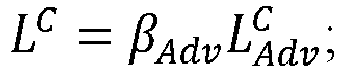
where LQ is the total loss function of the image classification model. LMI is the mutual information loss function, LAug is the category difference loss function,

- The training of the image classification model may be performed by reverse optimization. During the reverse optimization, the evaluator, image classification model and discriminator may be optimized alternately. The evaluator is optimized first, and then the image classification model and the discriminator are optimized. Further, first, the total loss function of the evaluator is used to reversely optimize the evaluator, so that a probability of the classification vector that obeys the prior distribution is close to 1, and the probability of the classification vector that does not obey the prior distribution is close to 0. Then, the total loss function of the image classification model is used to reversely optimize the image classification model and the total loss function of the discriminator is used to reversely optimize the discriminator, so that the classification vector outputted by the image classification model may obtain a high score as much as possible, that is, the probability at which the classification vector obeys the prior distribution is as high as possible; the alternate optimization process is repeated, so that the classification vector outputted by the image classification model obtains a high score, that is, the probability at which the classification vector obeys the prior distribution is close to 1, thereby obeying the prior distribution.
- In an embodiment, the performing alternate optimization on the image classification model, the discriminator, and the evaluator according to at least the correlation and the score includes: first optimizing a network parameter of the evaluator according to the score at least once; and then performing optimization on a network parameter of the image classification model according to at least the correlation and the score, and performing optimization on a network parameter of the discriminator according to the correlation.
- Further, because there are a large number of data samples, all the data samples cannot be inputted to the image classification model for training at a time. During reverse optimization, data samples may be randomly divided into a plurality of batches, each batch has a fixed number of data samples, and may also be referred to as a batch sample. For example, the batch sample may be set to 64 data samples, that is, the batch size is set to 64.
- During training, the computer device determines a score at which the classification vector obeys the prior distribution and determines a correlation between a data sample and a classification vector. During alternate optimization of the image classification model, the discriminator, and the evaluator, the weights corresponding to the network parameters are updated. First, after the network parameter of the evaluator is optimized at least once according to the score at which the classification vector obeys the prior distribution and the total loss function of the evaluator, a network parameter of the image classification model is optimized according to the correlation between the data sample and the classification vector, the score at which the classification vector obeys the prior distribution, the category feature difference, and the total loss function of the image classification model, and the network parameter of the discriminator is optimized according to the correlation between the data sample and the classification vector and the total loss function of the discriminator. For example, after the evaluator is optimized four times, the image classification model and the discriminator are optimized once. During reverse optimization of the image classification model and the discriminator, the reverse optimization may be performed successively, or the reverse optimization may be performed simultaneously.
- During reverse optimization of the evaluator, for an input of the prior distribution, an output closer to 1 indicates a smaller loss function value and indicates a smaller change in the parameter during the back propagation, and for an input of the data sample, an output closer to 0 indicates a smaller loss function value and indicates a smaller change in the parameter during the back propagation. In a case that the image classification model is reversely optimized, for an input of the data sample, an output closer to 1 indicates a smaller loss function value and indicates a smaller change in the parameter during the back propagation. The prior distribution is not considered during the reverse optimization of the image classification model. During the reverse optimization of the image classification model, the total loss function of the evaluator may indicate a difference between the feature distribution learned by the current image classification model and the prior distribution, and in a case that the total loss function of the evaluator starts to converge, it indicates that the feature distribution learned by the image classification model is close to the prior distribution and the training may be stopped.
- To sum up, by the method provided in this embodiment, for a data sample of a classification object in a classification service, there is no need to execute an additional classification algorithm, and there is no need to generate a real image to compare with a raw image. By determining the correlation between the data sample and the classification vector, and by introducing the category prior distribution to the category vector and introducing the intra-class style prior distribution to the intra-class style vector, to determine the score at which the classification vector obeys the prior distribution, the image classification model can be trained by using the correlation and the score, which can effectively improve learning of the classification vector by the image classification model. Because the feature distribution learned by the image classification model is close to the prior distribution, and the category vector is effectively decoupled from the intra-class style vector, the classification target corresponding to the data sample can be obtained according to the category vector. Therefore, the precision of data classification can be effectively improved without manual annotation. Further, effective training of an image segmentation network without manual annotation is implemented.
- Exemplarily,
FIG. 6 is a schematic diagram of training an image segmentation model by using the method for training an image segmentation model provided in this application. - An
encoder 102 inFIG. 6 adopts the encoder of the image classification model in the embodiments shown inFIG. 4 , and in a training stage of the image segmentation model, a fully-connected layer (not shown) is further connected to theencoder 102. - During training, first a sample image x1 is obtained, and the sample image x1 is upsampled (generally the length and the width are expanded to two times of the original image), to obtain a rescaled image x2 = R(x 1).
- The sample image x1 and the rescaled image x2 are respectively inputted to the encoder, and the encoder outputs a sample image feature of the sample image x1 and a rescaled image feature of the rescaled image x2.
- The sample image feature is inputted to the fully-connected layer to output a sample classification result, and the rescaled image feature is inputted to the fully-connected layer to output a rescaled classification result.
- Based on the sample classification result and the sample image feature, a sample class activation graph C1 of the sample image is calculated according to a calculation formula for a class activation graph. Based on the rescaled classification result and the rescaled image feature, a rescaled class activation graph C2 of the rescaled image is calculated according to a calculation formula for a class activation graph.
- The sample image feature is inputted to a
decoder 103 to obtain a sample segmentation result s1. The rescaled image feature is inputted to thedecoder 103 to obtain a rescaled segmentation result s2. - Two constraints are introduced, one is that the segmentation result needs to be close to the class activation graph as much as possible, and the other one is that a target area (an area where the classification target is located) divided after a scale change needs to be kept consistent through a same scale change. Based on this idea, the sample class activation graph loss is calculated based on the sample class activation graph and the sample segmentation result; the rescaled class activation graph loss is calculated based on the rescaled class activation graph and the rescaled segmentation results; and the rescaled loss is calculated based on the sample segmentation result and the rescaled segmentation result. A weighted sum of the sample class activation graph loss, the rescaled class activation graph loss, and the rescaled loss is calculated, to obtain a total loss Lseg.
- According to the total loss Lseg, a network parameter in the decoder is optimized by a back propagation method. The optimization method adopts an Adam-based gradient descent method, the learning rate is 0.0001, for Adam parameters, an exponential decay rate β 1 of first-order moment estimation is set to 0.5, and an exponential decay rate β 2 of a second-order moment estimation is set to 0.9. As mentioned above, the image classification model is optimized first, then the encoder part is fixed, migrated to the image segmentation model, and then the decoder part of the image segmentation model is optimized.
- Exemplarily, after the image segmentation model is obtained after the training, an exemplary embodiment of image segmentation using a trained image segmentation model is provided.
-
FIG. 7 is a flowchart of an image segmentation method according to an exemplary embodiment of this application. The method may be performed by a computer device, for example, a terminal or a server shown inFIG. 1 . Exemplarily, the computer device that performs the method for training an image segmentation model and the computer device that performs the image segmentation method may be the same computer device, or may be different computer devices. The method includes the following steps. - Step 701: Obtain an input image.
- Exemplarily, the input image may be any image on which image segmentation needs to be performed.
- For example, in a case that the image segmentation model is trained to segment a human face in an image, the input image may be an image including a human face. In a case that the image segmentation model is trained to segment a lesion in an image, the input image may be an image including a lesion. Certainly, the input image may not include the classification target of the image segmentation model either, that is, the input image may alternatively not include a human face, or, not include a lesion.
- Step 702: Call an encoder to perform feature extraction on the input image to obtain an input image feature of the input image.
- Exemplarily, the encoder is an encoder in the image segmentation model mentioned in any of the foregoing embodiments.
- Exemplarily, sources of the encoder vary depending on different classification targets of image segmentation models. In a case that a classification target of an image segmentation model is a human face, a parameter of the encoder is set according to a parameter of a classification encoder of a human face classification model, the human face classification model being used for identifying whether the input image includes a human face.
- In a case that a classification target of an image segmentation model is a lesion, a parameter of the encoder is set according to a parameter of a classification encoder of a lesion classification model, the lesion classification model being used for identifying whether the input image includes a lesion.
- In a case the encoder of the image segmentation model is set by using the classification encoder of the image classification model, the encoder of the image segmentation model can accurately extract a feature of an image in a classification task. Because the classification target of the image segmentation is the same as the classification target of the image classification, the image segmentation model can perform accurate image segmentation according to the extracted feature, which not only simplifies the process of training the image segmentation model, but also improves the segmentation precision of the image segmentation model.
- Step 703: Call a decoder to decode the input image feature to obtain an image segmentation result of the input image, the decoder being obtained through training according to a class activation graph loss and a rescaled loss, the class activation graph loss being used for training the decoder to output a segmentation result close to a class activation graph, the class activation graph being used for indicating contribution values of pixels in an image to a classification result of the image, and the rescaled loss being used for training the decoder to output similar segmentation results for a plurality of images having identical image content and different scales.
- Exemplarily, the decoder is a decoder in the image segmentation model mentioned in any of the foregoing embodiments. Reference may be made to the foregoing embodiments for the method for training the decoder.
- The segmentation result outputted by the encoder includes probability values at which pixels in the input image pertain to classification targets, or the segmentation result outputted by the encoder includes classification targets to which pixels in the input image pertain.
- For example, in a case that the classification target of the image segmentation model is a human face, the image segmentation result includes probability values at which pixels in the input image pertain to the human face, or the image segmentation result includes whether pixels in the input image pertain to the human face.
- For example, in a case that the classification target of the image segmentation model is a lesion, the image segmentation result includes probability values at which pixels in the input image pertain to the lesion, or the image segmentation result includes whether pixels in the input image pertain to the lesion.
- To sum up, in the method provided in this embodiment, by performing image segmentation on an input image by using a trained image segmentation model and performing feature extraction and image segmentation on the input image by using a neural network, the image can be segmented based on a deep feature of the image, and the precision of image segmentation is improved. Moreover, because the decoder of the image segmentation model is trained based on scale invariance, the image segmentation model outputs similar image segmentation results for a plurality of images having identical image content and different scales, which is closer to an actual situation of image segmentation, and further improves the precision of the image segmentation.
- Exemplarily, the image segmentation model provided in this application may be used in a plurality of application scenarios for image segmentation of different classification targets in an image. For example, in the foregoing application scenarios of human face identification and lesion identification, this application further provides an exemplary embodiment of training the image segmentation models corresponding to the two application scenarios.
- Exemplarily, an exemplary embodiment of training an image segmentation model for segmenting a human face area in an image by using the method for training an image segmentation model provided in this application is provided.
- First, the image classification model for identifying a human face is trained. The image classification model includes a classification encoder and a classification fully-connected layer. The image classification model is used for clustering, that is, a plurality of inputted images are clustered into a class including a human face and a class not including a human face.
- Step 1: Obtain a data sample.
- Step 2: Call a classification encoder and a classification fully-connected layer to perform feature extraction and classification on the data sample, to obtain a classification vector of the data sample and to determine a correlation between the data sample and the classification vector, the classification vector including a category vector and an intra-class style vector, and the category vector being used for describing whether the input image includes a human face.
- Step 3: Introduce a category prior distribution to the category vector and introduce an intra-class style prior distribution to the intra-class style vector, to determine a score at which the classification vector obeys a prior distribution.
- Step 4: Train an image classification model according to at least the correlation and the score.
- Then, the image segmentation model is trained based on the trained image classification model. The image segmentation model includes an encoder, a fully-connected layer, and a decoder in a training stage, and the image segmentation model includes an encoder and a decoder in an application stage.
- Step 1: Initialize an encoder according to a parameter of a classification encoder and initialize a fully-connected layer according to a parameter of a classification fully-connected layer, that is, the encoder and the fully-connected layer can accurately classify an input image and identify whether the image includes a human face.
- Step 2: Obtain a training data set, which includes at least one group of a sample image and a rescaled image, the sample image is an image that includes or does not include a human face, the rescaled image is an image obtained by upsampling the sample image, and a size of the rescaled image is two times of a size of the sample image.
- Step 3: Call the encoder to perform feature extraction on the sample image to obtain a sample image feature and call the fully-connected layer to perform classification on the sample image feature to obtain a sample classification result of the sample image, the sample classification result including a probability value at which the sample image includes a human face; and call the encoder to perform feature extraction on the rescaled image to obtain a rescaled image feature and call the fully-connected layer to perform classification on the rescaled image feature to obtain a rescaled classification result of the rescaled image, the rescaled classification result including a probability value at which the rescaled image includes a human face.
- Step 4: Call a decoder to decode the sample image feature to obtain a sample segmentation result of the sample image, the sample segmentation result including a probability value at which each pixel in the sample image pertains to a human face; and call the decoder to decode the rescaled image feature to obtain a rescaled segmentation result of the rescaled image, the rescaled segmentation result including a probability value at which each pixel in the rescaled image pertains to a human face.
- Step 5: Calculate a sample class activation graph of the sample image according to the sample image feature and sample classification result; and calculate a rescaled class activation graph of the rescaled image based on the rescaled image feature and the rescaled classification result.
- Step 6: Calculate a sample class activation graph loss of the sample class activation graph and the sample segmentation result, calculate a rescaled class activation graph loss of the rescaled class activation graph and the rescaled segmentation result, and calculate a rescaled loss of the sample segmentation result and the rescaled segmentation result; and calculate a weighted sum of the sample class activation graph loss, the rescaled class activation graph loss, and the rescaled loss, to obtain a total loss.
- Step 7: Train the decoder according to the total loss.
- Step 8: Repeat step 3 to step 7 to iteratively train the decoder, to obtain a final image segmentation model.
- Step 9: Segment a human face area in the image by using the trained image segmentation model.
- Exemplarily, an exemplary embodiment of training an image segmentation model for segmenting a lesion area in an image by using the method for training an image segmentation model provided in this application is provided.
- First, the image classification model for identifying a lesion is trained. The image classification model includes a classification encoder and a classification fully-connected layer. The image classification model is used for clustering, that is, a plurality of inputted images are clustered into a class including a lesion and a class not including a lesion. Exemplarily, the image classification model may also be used for identifying a plurality of specific types of lesions, for example, for clustering a plurality of inputted images into a
lesion 1, a lesion 2, a lesion 3, and normal. - Step 1: Obtain a data sample.
- Step 2: Call a classification encoder and a classification fully-connected layer to perform feature extraction and classification on the data sample, to obtain a classification vector of the data sample and to determine a correlation between the data sample and the classification vector, the classification vector including a category vector and an intra-class style vector, the category vector being used for describing whether the input image includes a lesion, or, used for describing probability values at which the inputted image pertain to the plurality of lesions.
- Step 3: Introduce a category prior distribution to the category vector and introduce an intra-class style prior distribution to the intra-class style vector, to determine a score at which the classification vector obeys a prior distribution.
- Step 4: Train an image classification model according to at least the correlation and the score.
- Then, the image segmentation model is trained based on the trained image classification model. The image segmentation model includes an encoder, a fully-connected layer, and a decoder in a training stage, and the image segmentation model includes an encoder and a decoder in an application stage.
- Step 1: Initialize an encoder according to a parameter of a classification encoder and initialize a fully-connected layer according to a parameter of a classification fully-connected layer, that is, the encoder and the fully-connected layer can accurately classify an input image and identify whether the image includes a lesion, or, identify which type of lesions the image pertains to.
- Step 2: Obtain a training data set, which includes at least one group of a sample image and a rescaled image, the sample image is an image that includes or does not include a lesion, the rescaled image is an image obtained by upsampling the sample image, and a size of the rescaled image is two times of a size of the sample image.
- Step 3: Call the encoder to perform feature extraction on the sample image to obtain a sample image feature and call the fully-connected layer to perform classification on the sample image feature to obtain a sample classification result of the sample image, the sample classification result including a probability value at which the sample image includes a lesion area, or the sample classification result including a probability value at which the sample image pertains to each type of lesions; and call the encoder to perform feature extraction on the rescaled image to obtain a rescaled image feature and call the fully-connected layer to perform classification on the rescaled image feature to obtain a rescaled classification result of the rescaled image, the rescaled classification result including a probability value at which the rescaled image includes a lesion, or, the rescaled classification result including a probability value at which the rescaled image pertains to each type of lesions.
- Step 4: Call the decoder to decode the sample image feature to obtain a sample segmentation result of the sample image, the sample segmentation result including a probability value at which each pixel in the sample image pertains to a lesion, or the sample segmentation result including a probability value at which each pixel in the sample image pertains to each lesion; and call the decoder to decode the rescaled image feature to obtain a rescaled segmentation result of the rescaled image, the rescaled segmentation result including a probability value at which each pixel in the rescaled image pertains to a lesion, or, the rescaled segmentation result including a probability value at which each pixel in the rescaled image pertains to each lesion.
- Step 5: Calculate a sample class activation graph of the sample image according to the sample image feature and sample classification result; and calculate a rescaled class activation graph of the rescaled image based on the rescaled image feature and the rescaled classification result.
- Step 6: Calculate a sample class activation graph loss of the sample class activation graph and the sample segmentation result, calculate a rescaled class activation graph loss of the rescaled class activation graph and the rescaled segmentation result, and calculate a rescaled loss of the sample segmentation result and the rescaled segmentation result; and calculate a weighted sum of the sample class activation graph loss, the rescaled class activation graph loss, and the rescaled loss, to obtain a total loss.
- Step 7: Train the decoder according to the total loss.
- Step 8: Repeat step 3 to step 7 to iteratively train the decoder, to obtain a final image segmentation model.
- Step 9: Segment a lesion area in the image by using the trained image segmentation model.
- The following is an apparatus embodiment of this application. For details not described in detail in the apparatus embodiment, reference may be made to corresponding record in the foregoing method embodiments. Details are not described herein again.
-
FIG. 8 is a schematic structural diagram of an apparatus for training an image segmentation model according to an exemplary embodiment of this application. The apparatus may be implemented as all or part of a computer device by software, hardware, or a combination of both, the image segmentation model includes an encoder and a decoder, and the apparatus includes: - an
encoding module 601, configured to call the encoder to perform feature extraction on a sample image and a rescaled image to obtain a sample image feature of the sample image and a rescaled image feature of the rescaled image, the rescaled image including: at least one of an image obtained by magnifying the sample image or an image obtained by reducing the sample image; - a class
activation graph module 602, configured to perform class activation graph calculation based on the sample image feature to obtain a sample class activation graph of the sample image, and perform class activation graph calculation based on the rescaled image feature to obtain a rescaled class activation graph of the rescaled image, the class activation graph being used for indicating contribution values of pixels in an image to a classification result of the image; - a
decoding module 603, configured to call the decoder to decode the sample image feature to obtain a sample segmentation result of the sample image, and call the decoder to decode the rescaled image feature to obtain a rescaled segmentation result of the rescaled image, the sample segmentation result including classification probability values of pixels in the sample image; - a
loss module 604, configured to calculate a class activation graph loss based on the sample class activation graph, the sample segmentation result, the rescaled class activation graph, and the rescaled segmentation result, and calculate a rescaled loss based on the sample segmentation result and the rescaled segmentation result, the class activation graph loss being used for training the decoder to enable the sample segmentation result to be close to the sample class activation graph, and to enable the rescaled segmentation result to be close to the rescaled class activation graph, and the rescaled loss being used for training the decoder to enable the sample segmentation result to be close to the rescaled segmentation result; and - a
training module 605, configured to train the decoder based on the class activation graph loss and the rescaled loss. - In an optional embodiment, the class activation graph loss includes a sample class activation graph loss and a rescaled class activation graph loss;
- the
loss module 604 is configured to calculate the sample class activation graph loss based on the sample class activation graph and the sample segmentation result; - the
loss module 604 is configured to calculate the rescaled class activation graph loss based on the rescaled class activation graph and the rescaled segmentation result; and - the
loss module 604 is configured to calculate the rescaled loss based on sample segmentation result and the rescaled segmentation result. - In an optional embodiment, the
loss module 604 is configured to rescale, according to a rescale relationship between the sample image and the rescaled image, the sample segmentation result to a same size as the rescaled segmentation result, to obtain a rescaled sample segmentation result; and
theloss module 604 is configured to calculate the rescaled loss based on an error between the rescaled segmentation result and the rescaled sample segmentation result. - In an optional embodiment, the
loss module 604 is configured to calculate a first matrix difference between the rescaled segmentation result and the rescaled sample segmentation result, and determine a 2-norm of the first matrix difference as the rescaled loss. - In an optional embodiment, the
loss module 604 is configured to determine a cross entropy of the sample class activation graph and the sample segmentation result as the sample class activation graph loss; and
theloss module 604 is configured to determine a cross entropy of the rescaled class activation graph and the rescaled segmentation result as the rescaled class activation graph loss. - In an optional embodiment, the
loss module 604 is configured to calculate a weighted sum of the sample class activation graph loss, the rescaled class activation graph loss, and the rescaled loss; and
thetraining module 605 is configured to train the decoder according to the weighted sum. - In an optional embodiment, the image segmentation model further includes a pretrained fully-connected layer; and the apparatus further includes:
- a
classification module 606, configured to call the fully-connected layer to perform classification and prediction on the sample image feature, to obtain a sample classification result of the sample image; and call the fully-connected layer to perform classification and prediction on the rescaled image feature, to obtain a rescaled classification result of the rescaled image; - the class
activation graph module 602 being configured to perform calculation based on the sample image feature and the sample classification result to obtain the sample class activation graph of the sample image; and - the class
activation graph module 602 being configured to perform calculation based on the rescaled image feature and the rescaled classification result to obtain the rescaled class activation graph of the rescaled image. - In an optional embodiment, the encoder is a pretrained encoder; and the apparatus further includes:
aninitialization module 607, configured to set a parameter of the encoder according to a parameter of a classification encoder in a trained image classification model, a classification target of the image classification model being the same as that of the image segmentation model. - In an optional embodiment, the apparatus further includes:
theinitialization module 607, configured to set a parameter of the fully-connected layer according to a parameter of a classification fully-connected layer in a trained image classification model, a classification target of the image classification model being the same as that of the image segmentation model. - In an optional embodiment, the image classification model includes a classification encoder and a classification fully-connected layer; and the apparatus further includes:
a classification training module 608, configured to obtain a data sample; call a classification encoder and a classification fully-connected layer to perform feature extraction and classification on the data sample, to obtain a classification vector of the data sample and to determine a correlation between the data sample and the classification vector, the classification vector including a category vector and an intra-class style vector; introduce a category prior distribution to the category vector and introduce an intra-class style prior distribution to the intra-class style vector, to determine a score at which the classification vector obeys a prior distribution; and train an image classification model according to at least the correlation and the score. -
FIG. 9 is a schematic structural diagram of an image segmentation apparatus according to an exemplary embodiment of this application. The apparatus may be implemented as all or part of a computer device by software, hardware, or a combination of both, the image segmentation model includes an encoder and a decoder, and the apparatus includes: - an obtaining
module 1001, configured to obtain an input image; - a
feature extraction module 1002, configured to call an encoder to perform feature extraction on the input image to obtain an input image feature of the input image; and - an
image segmentation module 1003, configured to call a decoder to decode the input image feature to obtain an image segmentation result of the input image, the decoder being obtained through training according to a class activation graph loss and a rescaled loss, the class activation graph loss being used for training the decoder to output a segmentation result close to a class activation graph, the class activation graph being used for indicating contribution values of pixels in an image to a classification result of the image, and the rescaled loss being used for training the decoder to output similar segmentation results for a plurality of images having identical image content and different scales. - In an optional embodiment, a parameter of the encoder is set according to a parameter of a classification encoder of a human face classification model, the human face classification model being used for identifying whether the input image includes a human face; and
the image segmentation result includes probability values at which pixels in the input image pertain to the human face. - In an optional embodiment, a parameter of the encoder is set according to a parameter of a classification encoder of a lesion classification model, the lesion classification model being used for identifying whether the input image includes a lesion; and
the image segmentation result includes probability values at which pixels in the input image pertain to the lesion. -
FIG. 10 is a schematic structural diagram of a server according to an exemplary embodiment of this application. Specifically, aserver 800 includes aCPU 801, asystem memory 804 including aRAM 802 and a read-only memory (ROM) 803, and asystem bus 805 connecting thesystem memory 804 and theCPU 801. Theserver 800 further includes a basic input/output system (I/O system) 806 assisting in transmitting information between devices in a computer, and a large-capacity storage device 807 configured to store anoperating system 813, anapplication program 814 and anotherprogram module 815. - The basic I/
O system 806 includes adisplay 808 configured to display information and aninput device 809 such as a mouse or a keyboard that is used for inputting information through a user account. Thedisplay 808 and theinput device 809 are both connected to theCPU 801 by using an input/output controller 810 connected to thesystem bus 805. Thedisplay 808 and theinput device 809 are both connected to theCPU 801 by using an input/output controller 810 connected to thesystem bus 805. Similarly, the input/output controller 810 further provides an output to a display screen, a printer, or another type of output device. - The
mass storage device 807 is connected to theCPU 801 by using a mass storage controller (not shown) connected to thesystem bus 805. Themass storage device 807 and a computer-readable storage medium associated with the mass storage device 1007 provide non-volatile storage for theserver 800. - That is, the
mass storage device 807 may include a computer-readable storage medium (not shown) such as a hard disk or a compact disc ROM (CD-ROM) drive. - That is, the
mass storage device 807 may include a computer-readable storage medium (not shown) such as a hard disk or a compact disc ROM (CD-ROM) drive. The computer storage medium includes volatile and non-volatile, removable and non-removable media that are configured to store information such as computer-readable instructions, data structures, program modules, or other data and that are implemented by using any method or technology. The computer storage medium includes a RAM, a ROM, an erasable programmable ROM (EPROM), an electrically erasable programmable ROM (EEPROM), a flash memory or another solid-state memory technology, a CD-ROM, a digital versatile disc (DVD) or another optical memory, a tape cartridge, a magnetic cassette, a magnetic disk memory, or another magnetic storage device. Certainly, a person skilled in the art may know that the computer storage medium is not limited to the foregoing types. The foregoingsystem memory 804 andmass storage device 807 may be collectively referred to as a memory. - According to various embodiments of this application, the
server 800 may further be connected, by using a network such as the Internet, to a remote computer on the network and run. That is, theserver 800 may be connected to anetwork 812 by using anetwork interface unit 811 that is connected to thesystem bus 805, or may be connected to a network of another type or a remote computer system (not shown) by using thenetwork interface unit 811. - This application further provides a terminal, including a processor and a memory, the memory storing at least one instruction, the at least one instruction being loaded and executed by the processor to implement the method for training an image segmentation model and the image segmentation method provided in the foregoing method embodiments. The terminal may be a terminal provided in
FIG. 11 below. -
FIG. 11 is a structural block diagram of a terminal 900 according to an exemplary embodiment of this application. The terminal 900 may be a smartphone, a tablet computer, a Moving Picture Experts Group Audio Layer III (MP3) player, a Moving Picture Experts Group Audio Layer IV (MP4) player, a notebook computer, or a desktop computer. The terminal 900 may also be referred to as another name such as a user account device, a portable terminal, a laptop terminal, or a desktop terminal. - Generally, the terminal 900 includes: a
processor 901 and amemory 902. - The
processor 901 may include one or more processing cores such as a 4-core processor or an 8-core processor. Thememory 902 may include one or more computer-readable storage media. The computer-readable storage media may be non-transitory. In some embodiments, the non-transitory computer-readable storage medium in thememory 902 is configured to store at least one computer-readable instruction, the at least one computer-readable instruction is configured to be executed by theprocessor 901 to implement the method for training an image segmentation model and the image segmentation method according to the method embodiments of this application. - In some embodiments, the terminal 900 may optionally include a
peripheral device interface 903 and at least one peripheral device. Theprocessor 901, thememory 902, and theperipheral device interface 903 may be connected by using a bus or a signal cable. Each peripheral device may be connected to theperipheral device interface 903 by using a bus, a signal line, or a circuit board. Specifically, the peripheral devices include: at least one of a radio frequency (RF)circuit 904, adisplay screen 905, acamera assembly 906, anaudio circuit 907, apositioning assembly 908, and apower supply 909. - In some embodiments, the terminal 900 also includes one or
more sensors 910. The one ormore sensors 910 include, but are not limited to: anacceleration sensor 911, agyro sensor 912, apressure sensor 913, afingerprint sensor 914, anoptical sensor 915, and aproximity sensor 916. - A person skilled in the art can understand that the structure shown in
FIG. 11 does not constitute a limitation to the terminal 900, and the terminal may include more or fewer components than those shown in the figure, or some components may be combined, or a different component arrangement may be used. - The memory further includes one or more programs. The one or more programs are stored in the memory. The one or more programs are configured to perform the method for training an image segmentation model and the image segmentation method provided in the embodiments of this application.
- This application further provides a computer device. The computer device includes a processor and a memory, the memory storing at least one instruction, at least one program, a code set, or an instruction set, the at least one instruction, the at least one program, the code set, or the instruction set being loaded and executed by the processor to implement the method for training an image segmentation model and the image segmentation method provided in the foregoing method embodiments.
- This application further provides a computer-readable storage medium, storing at least one instruction, at least one program, a code set, or an instruction set, the at least one instruction, the at least one program, the code set, or the instruction set being loaded or executed by a processor to implement the method for training an image segmentation model and the image segmentation method provided in the foregoing method embodiments.
- This application further provides a computer program product or computer-readable instructions, the computer program product includes computer instructions, and the computer instructions are stored in a computer-readable storage medium. A processor of a computer device reads the computer-readable instructions from the computer-readable storage medium, and executes the computer-readable instructions, so that the computer device performs the method for training an image segmentation model and the image segmentation method provided in the foregoing optional implementations.
- It is to be understood that "plurality of" mentioned in the specification means two or more. "And/or" describes an association relationship for describing associated objects and represents that three relationships may exist. For example, A and/or B may represent the following three cases: Only A exists, both A and B exist, and only B exists. The character "/" in this specification generally indicates an "or" relationship between the associated objects.
- A person of ordinary skill in the art may understand that all or some of steps of the embodiments may be implemented by hardware or a program instructing related hardware. The program may be stored in a computer-readable storage medium. The storage medium mentioned above may be a ROM, a magnetic disk or an optical disc.
- The foregoing descriptions are merely optional embodiments of this application, but are not intended to limit this application. Any modification, equivalent replacement, or improvement made within the spirit and principle of this application shall fall within the protection scope of this application.
Claims (20)
- A method for training an image segmentation model, performed by a computer device, the image segmentation model comprising an encoder and a decoder, and the method comprising:calling the encoder to perform feature extraction on a sample image and a rescaled image to obtain a sample image feature of the sample image and a rescaled image feature of the rescaled image, the rescaled image comprising: at least one of an image obtained by magnifying a size of the sample image and an image obtained by reducing the size of the sample image ;performing class activation graph calculation based on the sample image feature to obtain a sample class activation graph, and performing class activation graph calculation based on the rescaled image feature to obtain a rescaled class activation graph, the sample class activation graph being used for indicating contribution values of pixels in the sample image to a classification result of the sample image, and the rescaled class activation graph being used for indicating contribution values of pixels in the rescaled image to a classification result of the rescaled image;calling the decoder to decode the sample image feature to obtain a sample segmentation result of the sample image, and calling the decoder to decode the rescaled image feature to obtain a rescaled segmentation result of the rescaled image, the sample segmentation result comprising classification probability values of pixels in the sample image (203);calculating a class activation graph loss based on the sample class activation graph, the sample segmentation result, the rescaled class activation graph, and the rescaled segmentation result, and calculating a rescaled loss based on the sample segmentation result and the rescaled segmentation result; andtraining the decoder based on the class activation graph loss and the rescaled loss, the class activation graph loss being used for training the decoder to enable the sample segmentation result to be close to the sample class activation graph, and to enable the rescaled segmentation result to be close to the rescaled class activation graph, and the rescaled loss being used for training the decoder to enable the sample segmentation result to be close to the rescaled segmentation result.
- The method according to claim 1, wherein the class activation graph loss comprises a sample class activation graph loss and a rescaled class activation graph loss; and
the calculating a class activation graph loss based on the sample class activation graph, the sample segmentation result, the rescaled class activation graph, and the rescaled segmentation result, and calculating a rescaled loss based on the sample segmentation result and the rescaled segmentation result comprises:calculating the sample class activation graph loss based on the sample class activation graph and the sample segmentation result;calculating the rescaled class activation graph loss based on the rescaled class activation graph and the rescaled segmentation result; andcalculating the rescaled loss based on the sample segmentation result and the rescaled segmentation result. - The method according to claim 2, wherein the calculating the rescaled loss based on the sample segmentation result and the rescaled segmentation result comprises:rescaling, according to a rescale relationship between the sample image and the rescaled image, the sample segmentation result to a same size as the rescaled segmentation result, to obtain a rescaled sample segmentation result; andcalculating the rescaled loss based on an error between the rescaled segmentation result and the rescaled sample segmentation result.
- The method according to claim 3, wherein the calculating the rescaled loss based on an error between the rescaled segmentation result and the rescaled sample segmentation result comprises: calculating a first matrix difference between the rescaled segmentation result and the rescaled sample segmentation result, and determining a 2-norm of the first matrix difference as the rescaled loss.
- The method according to claim 2, wherein the calculating the sample class activation graph loss based on the sample class activation graph and the sample segmentation result comprises:determining a cross entropy of the sample class activation graph and the sample segmentation result as the sample class activation graph loss; andthe calculating the rescaled class activation graph loss based on the rescaled class activation graph and the rescaled segmentation result comprises:
determining a cross entropy of the rescaled class activation graph and the rescaled segmentation result as the rescaled class activation graph loss. - The method according to any of claims 2 to 5, wherein the training the decoder based on the class activation graph loss and the rescaled loss comprises:calculating a weighted sum of the sample class activation graph loss, the rescaled class activation graph loss, and the rescaled loss; andtraining the decoder according to the weighted sum.
- The method according to any of claims 1 to 5, wherein the image segmentation model further comprises a pretrained fully-connected layer; and the method further comprises:calling the fully-connected layer to perform classification and prediction on the sample image feature, to obtain a sample classification result of the sample image; and calling the fully-connected layer to perform classification and prediction on the rescaled image feature, to obtain a rescaled classification result of the rescaled image;a calculation operation of the sample class activation graph comprises:performing calculation based on the sample image feature and the sample classification result to obtain the sample class activation graph of the sample image; anda calculation operation of the rescaled class activation graph comprises:
performing calculation based on the rescaled image feature and the rescaled classification result to obtain the rescaled class activation graph of the rescaled image. - The method according to any of claims 1 to 5, wherein the encoder is a pretrained encoder; and before the calling the encoder to perform feature extraction on a sample image and a rescaled image, the method further comprises:
setting a parameter of the encoder according to a parameter of a classification encoder in a trained image classification model, a classification target of the image classification model being the same as that of the image segmentation model. - The method according to claim 7, wherein the method further comprises:
setting a parameter of the fully-connected layer according to a parameter of a classification fully-connected layer in a trained image classification model, a classification target of the image classification model being the same as that of the image segmentation model. - The method according to any of claims 1 to 5, wherein the image segmentation model comprises a classification encoder and a classification fully-connected layer; and the method further comprises:obtaining a data sample;calling the classification encoder and the classification fully-connected layer to perform feature extraction and classification on the data sample, to obtain a classification vector of the data sample and to determine a correlation between the data sample and the classification vector, the classification vector comprising a category vector and an intra-class style vector;introducing a category prior distribution to the category vector and introducing an intra-class style prior distribution to the intra-class style vector, to determine a score at which the classification vector obeys a prior distribution; andtraining an image classification model according to at least the correlation and the score.
- An image segmentation method, performed by a computer device, comprising:obtaining an input image;calling an encoder to perform feature extraction on the input image to obtain an input image feature of the input image; andcalling a decoder to decode the input image feature to obtain an image segmentation result of the input image, the decoder being obtained through training according to a class activation graph loss and a scale loss, the class activation graph loss being used for training the decoder to output a segmentation result close to a class activation graph, the class activation graph being used for indicating contribution values of pixels in an image to a classification result of the image, and the scale loss being used for training the decoder to output similar segmentation results for a plurality of images having identical image content and different scales.
- The method according to claim 11, wherein a parameter of the encoder is set according to a parameter of a classification encoder of a human face classification model, the human face classification model being used for identifying whether the input image comprises a human face; and
the image segmentation result comprises probability values at which pixels in the input image pertain to the human face. - The method according to claim 11, wherein a parameter of the encoder is set according to a parameter of a classification encoder of a lesion classification model, the lesion classification model being used for identifying whether the input image comprises a lesion; and
the image segmentation result comprises probability values at which pixels in the input image pertain to the lesion. - An apparatus for training an image segmentation model, the image segmentation model comprising an encoder and a decoder, and the apparatus comprising:an encoding module, configured to call the encoder to perform feature extraction on a sample image and a rescaled image to obtain a sample image feature of the sample image and a rescaled image feature of the rescaled image, the rescaled image comprising: at least one of an image obtained by magnifying a size of the sample image and an image obtained by reducing the size of the sample image;a class activation graph module, configured to perform class activation graph calculation based on the sample image feature to obtain a sample class activation graph, and perform class activation graph calculation based on the rescaled image feature to obtain a rescaled class activation graph, the sample class activation graph being used for indicating contribution values of pixels in the sample image to a classification result of the sample image, and the rescaled class activation graph being used for indicating contribution values of pixels in the rescaled image to a classification result of the rescaled image;a decoding module, configured to call the decoder to decode the sample image feature to obtain a sample segmentation result of the sample image, and call the decoder to decode the rescaled image feature to obtain a rescaled segmentation result of the rescaled image, the sample segmentation result comprising classification probability values of pixels in the sample image;a loss module, configured to calculate a class activation graph loss based on the sample class activation graph, the sample segmentation result, the rescaled class activation graph, and the rescaled segmentation result, and calculate a rescaled loss based on the sample segmentation result and the rescaled segmentation result; anda training module, configured to train the decoder based on the class activation graph loss and the rescaled loss, the class activation graph loss being used for training the decoder to enable the sample segmentation result to be close to the sample class activation graph, and to enable the rescaled segmentation result to be close to the rescaled class activation graph, and the rescaled loss being used for training the decoder to enable the sample segmentation result to be close to the rescaled segmentation result.
- The apparatus according to claim 14, wherein the class activation graph loss comprises a sample class activation graph loss and a rescaled class activation graph loss; and
the loss module is further configured to calculate the sample class activation graph loss based on the sample class activation graph and the sample segmentation result; calculate the rescaled class activation graph loss based on the rescaled class activation graph and the rescaled segmentation result; and calculate the rescaled loss based on the sample segmentation result and the rescaled segmentation result. - The apparatus according to claim 15, wherein the loss module is further configured to rescale, according to a rescale relationship between the sample image and the rescaled image, the sample segmentation result to a same size as the rescaled segmentation result, to obtain a rescaled sample segmentation result; and calculate the rescaled loss based on an error between the rescaled segmentation result and the rescaled sample segmentation result.
- The apparatus according to any of claims 14 to 16, wherein the image segmentation model further comprises a pretrained fully-connected layer; and the apparatus further comprises:a classification module, configured to call the fully-connected layer to perform classification and prediction on the sample image feature, to obtain a sample classification result of the sample image; and call the fully-connected layer to perform classification and prediction on the rescaled image feature, to obtain a rescaled classification result of the rescaled image;the class activation graph module being configured to perform calculation based on the sample image feature and the sample classification result to obtain the sample class activation graph of the sample image; andthe class activation graph module being configured to perform calculation based on the rescaled image feature and the rescaled classification result to obtain the rescaled class activation graph of the rescaled image.
- An image segmentation apparatus, comprising:an obtaining module, configured to obtain an input image;a feature extraction module, configured to call an encoder to perform feature extraction on the input image to obtain an input image feature of the input image; andan image segmentation module, configured to call a decoder to decode the input image feature to obtain an image segmentation result of the input image, the decoder being obtained through training according to a class activation graph loss and a rescaled loss, the class activation graph loss being used for training the decoder to output a segmentation result close to a class activation graph, the class activation graph being used for indicating contribution values of pixels in an image to a classification result of the image, and the rescaled loss being used for training the decoder to output similar segmentation results for a plurality of images having identical image content and different scales.
- A computer device, comprising a memory and one or more processors, the memory storing computer-readable instructions, the computer-readable instructions, when executed by the one or more processors, causing the one or more processors to perform the operations in the method according to any one of claims 1 to 13.
- One or more non-volatile computer-readable storage media, storing computer-readable instructions and a program of the computer-readable instructions, the program of the computer-readable instructions, when executed by one or more processors, causing the one or more processors to perform the operations in the method according to any one of claims 1 to 13.
Applications Claiming Priority (2)
| Application Number | Priority Date | Filing Date | Title |
|---|---|---|---|
| CN202011487554.0A CN113516665B (en) | 2020-12-16 | 2020-12-16 | Image segmentation model training methods, image segmentation methods, devices, and equipment |
| PCT/CN2021/124337 WO2022127333A1 (en) | 2020-12-16 | 2021-10-18 | Training method and apparatus for image segmentation model, image segmentation method and apparatus, and device |
Publications (3)
| Publication Number | Publication Date |
|---|---|
| EP4220555A1 true EP4220555A1 (en) | 2023-08-02 |
| EP4220555A4 EP4220555A4 (en) | 2024-03-20 |
| EP4220555B1 EP4220555B1 (en) | 2025-12-10 |
Family
ID=78060679
Family Applications (1)
| Application Number | Title | Priority Date | Filing Date |
|---|---|---|---|
| EP21905262.8A Active EP4220555B1 (en) | 2020-12-16 | 2021-10-18 | Training method and apparatus for image segmentation model, image segmentation method and apparatus, and device |
Country Status (4)
| Country | Link |
|---|---|
| US (1) | US12288383B2 (en) |
| EP (1) | EP4220555B1 (en) |
| CN (1) | CN113516665B (en) |
| WO (1) | WO2022127333A1 (en) |
Cited By (1)
| Publication number | Priority date | Publication date | Assignee | Title |
|---|---|---|---|---|
| KR102827305B1 (en) * | 2024-12-09 | 2025-07-02 | 주식회사 브이몬스터 | Method and apparatus for generating artificial neural network model specialized for target individual person, and method for generating virtual speech video using the generated artificial neural network model |
Families Citing this family (10)
| Publication number | Priority date | Publication date | Assignee | Title |
|---|---|---|---|---|
| CN114862740B (en) * | 2021-01-18 | 2025-09-02 | 富泰华工业(深圳)有限公司 | Defect detection method, device, electronic device and computer-readable storage medium |
| EP4283536B1 (en) * | 2021-03-05 | 2025-05-21 | Mitsubishi Electric Corporation | Signal identification device |
| US12462525B2 (en) * | 2021-10-21 | 2025-11-04 | The Toronto-Dominion Bank | Co-learning object and relationship detection with density aware loss |
| DE102022204722A1 (en) * | 2022-05-13 | 2023-11-16 | Robert Bosch Gesellschaft mit beschränkter Haftung | Method for training a convolutional neural network |
| CN115147526B (en) * | 2022-06-30 | 2023-09-26 | 北京百度网讯科技有限公司 | Training of clothing generation models, methods and devices for generating clothing images |
| CN118279626A (en) * | 2022-12-29 | 2024-07-02 | 脸萌有限公司 | Image processing method, device and electronic equipment |
| CN116342875B (en) * | 2023-02-14 | 2025-12-26 | 安徽大学 | A few-shot segmentation method based on multi-scale self-attention feature fusion |
| CN118299044A (en) * | 2024-04-25 | 2024-07-05 | 山东大学 | Self-explanatory medical image diagnosis system based on class activation diagram |
| CN118427395B (en) * | 2024-06-25 | 2024-08-30 | 腾讯科技(深圳)有限公司 | Content retrieval method, device, equipment, storage medium and program product |
| CN120411071B (en) * | 2025-06-12 | 2025-11-07 | 深圳市信润富联数字科技有限公司 | Defect detection methods, apparatus, electronic equipment and computer-readable storage media |
Family Cites Families (8)
| Publication number | Priority date | Publication date | Assignee | Title |
|---|---|---|---|---|
| US10424064B2 (en) * | 2016-10-18 | 2019-09-24 | Adobe Inc. | Instance-level semantic segmentation system |
| CA3081643A1 (en) * | 2017-11-06 | 2019-05-09 | University Health Network | Platform, device and process for annotation and classification of tissue specimens using convolutional neural network |
| CN110120047B (en) * | 2019-04-04 | 2023-08-08 | 平安科技(深圳)有限公司 | Image segmentation model training method, image segmentation method, device, equipment and medium |
| CN110543911B (en) * | 2019-08-31 | 2022-12-16 | 华南理工大学 | Weak supervision target segmentation method combined with classification task |
| CN110689081B (en) * | 2019-09-30 | 2020-08-21 | 中国科学院大学 | Weak supervision target classification and positioning method based on bifurcation learning |
| CN110969627B (en) * | 2019-11-29 | 2024-03-29 | 北京达佳互联信息技术有限公司 | Image segmentation model training method, image processing method and device |
| CN111401247B (en) * | 2020-03-17 | 2023-07-28 | 杭州小影创新科技股份有限公司 | Portrait segmentation method based on cascade convolution neural network |
| CN111582175B (en) * | 2020-05-09 | 2023-07-21 | 中南大学 | A Semantic Segmentation Method for High-Resolution Remote Sensing Imagery Using Shared Multi-Scale Adversarial Features |
-
2020
- 2020-12-16 CN CN202011487554.0A patent/CN113516665B/en active Active
-
2021
- 2021-10-18 EP EP21905262.8A patent/EP4220555B1/en active Active
- 2021-10-18 WO PCT/CN2021/124337 patent/WO2022127333A1/en not_active Ceased
-
2022
- 2022-09-29 US US17/955,726 patent/US12288383B2/en active Active
Cited By (2)
| Publication number | Priority date | Publication date | Assignee | Title |
|---|---|---|---|---|
| KR102827305B1 (en) * | 2024-12-09 | 2025-07-02 | 주식회사 브이몬스터 | Method and apparatus for generating artificial neural network model specialized for target individual person, and method for generating virtual speech video using the generated artificial neural network model |
| KR102833936B1 (en) * | 2024-12-09 | 2025-07-15 | 주식회사 브이몬스터 | Method and apparatus for generating artificial neural network model specialized for target individual person |
Also Published As
| Publication number | Publication date |
|---|---|
| EP4220555A4 (en) | 2024-03-20 |
| US12288383B2 (en) | 2025-04-29 |
| US20230021551A1 (en) | 2023-01-26 |
| WO2022127333A1 (en) | 2022-06-23 |
| CN113516665B (en) | 2026-04-03 |
| CN113516665A (en) | 2021-10-19 |
| EP4220555B1 (en) | 2025-12-10 |
Similar Documents
| Publication | Publication Date | Title |
|---|---|---|
| EP4220555B1 (en) | Training method and apparatus for image segmentation model, image segmentation method and apparatus, and device | |
| US11967151B2 (en) | Video classification method and apparatus, model training method and apparatus, device, and storage medium | |
| US11823443B2 (en) | Segmenting objects by refining shape priors | |
| CN115050064B (en) | Human face liveness detection method, device, equipment and medium | |
| US12494082B2 (en) | Face image processing method, face image processing model training method, apparatus, device, storage medium, and program product | |
| WO2021136365A1 (en) | Application development method and apparatus based on machine learning model, and electronic device | |
| CN111294646A (en) | Video processing method, device, equipment and storage medium | |
| CN110533097A (en) | Image resolution recognition method, device, electronic equipment and storage medium | |
| US20230067934A1 (en) | Action Recognition Method, Apparatus and Device, Storage Medium and Computer Program Product | |
| CN111814620A (en) | Face image quality evaluation model establishing method, optimization method, medium and device | |
| US20250200955A1 (en) | Model training method and apparatus, device, storage medium, and product | |
| US20230410465A1 (en) | Real time salient object detection in images and videos | |
| CN109271957B (en) | Face gender identification method and device | |
| CN113569888B (en) | Image annotation method, device, equipment and medium | |
| US11417096B2 (en) | Video format classification and metadata injection using machine learning | |
| CN113191364B (en) | Vehicle appearance component identification method, device, electronic equipment and medium | |
| CN110516734A (en) | A kind of image matching method, device, equipment and storage medium | |
| CN114241411B (en) | Counting model processing method, device and computer equipment based on target detection | |
| CN114529750A (en) | Image classification method, device, equipment and storage medium | |
| CN115797709B (en) | Image classification method, device, equipment and computer readable storage medium | |
| CN115761397B (en) | Model training methods, image classification methods, devices, equipment and storage media | |
| CN110717405B (en) | Face feature point positioning method, device, medium and electronic equipment | |
| WO2026020879A1 (en) | Image tampering detection method and related apparatus | |
| CN118968212A (en) | Method and device for constructing image sample generation model and image sample generation method | |
| CN112288748A (en) | A semantic segmentation network training, image semantic segmentation method and device |
Legal Events
| Date | Code | Title | Description |
|---|---|---|---|
| STAA | Information on the status of an ep patent application or granted ep patent |
Free format text: STATUS: THE INTERNATIONAL PUBLICATION HAS BEEN MADE |
|
| PUAI | Public reference made under article 153(3) epc to a published international application that has entered the european phase |
Free format text: ORIGINAL CODE: 0009012 |
|
| STAA | Information on the status of an ep patent application or granted ep patent |
Free format text: STATUS: REQUEST FOR EXAMINATION WAS MADE |
|
| 17P | Request for examination filed |
Effective date: 20230425 |
|
| AK | Designated contracting states |
Kind code of ref document: A1 Designated state(s): AL AT BE BG CH CY CZ DE DK EE ES FI FR GB GR HR HU IE IS IT LI LT LU LV MC MK MT NL NO PL PT RO RS SE SI SK SM TR |
|
| A4 | Supplementary search report drawn up and despatched |
Effective date: 20240221 |
|
| RIC1 | Information provided on ipc code assigned before grant |
Ipc: G06V 10/82 20220101ALI20240215BHEP Ipc: G06N 3/08 20230101ALI20240215BHEP Ipc: G06N 3/04 20230101ALI20240215BHEP Ipc: G06T 7/11 20170101AFI20240215BHEP |
|
| DAV | Request for validation of the european patent (deleted) | ||
| DAX | Request for extension of the european patent (deleted) | ||
| STAA | Information on the status of an ep patent application or granted ep patent |
Free format text: STATUS: EXAMINATION IS IN PROGRESS |
|
| 17Q | First examination report despatched |
Effective date: 20250509 |
|
| GRAP | Despatch of communication of intention to grant a patent |
Free format text: ORIGINAL CODE: EPIDOSNIGR1 |
|
| STAA | Information on the status of an ep patent application or granted ep patent |
Free format text: STATUS: GRANT OF PATENT IS INTENDED |
|
| INTG | Intention to grant announced |
Effective date: 20250707 |
|
| GRAS | Grant fee paid |
Free format text: ORIGINAL CODE: EPIDOSNIGR3 |
|
| GRAA | (expected) grant |
Free format text: ORIGINAL CODE: 0009210 |
|
| STAA | Information on the status of an ep patent application or granted ep patent |
Free format text: STATUS: THE PATENT HAS BEEN GRANTED |
|
| AK | Designated contracting states |
Kind code of ref document: B1 Designated state(s): AL AT BE BG CH CY CZ DE DK EE ES FI FR GB GR HR HU IE IS IT LI LT LU LV MC MK MT NL NO PL PT RO RS SE SI SK SM TR |
|
| REG | Reference to a national code |
Ref country code: CH Ref legal event code: F10 Free format text: ST27 STATUS EVENT CODE: U-0-0-F10-F00 (AS PROVIDED BY THE NATIONAL OFFICE) Effective date: 20251210 Ref country code: GB Ref legal event code: FG4D |
|
| REG | Reference to a national code |
Ref country code: DE Ref legal event code: R096 Ref document number: 602021044358 Country of ref document: DE |
|
| REG | Reference to a national code |
Ref country code: IE Ref legal event code: FG4D |
|
| REG | Reference to a national code |
Ref country code: NL Ref legal event code: FP |
|
| PG25 | Lapsed in a contracting state [announced via postgrant information from national office to epo] |
Ref country code: ES Free format text: LAPSE BECAUSE OF FAILURE TO SUBMIT A TRANSLATION OF THE DESCRIPTION OR TO PAY THE FEE WITHIN THE PRESCRIBED TIME-LIMIT Effective date: 20251210 |
|
| REG | Reference to a national code |
Ref country code: LT Ref legal event code: MG9D |
|
| PG25 | Lapsed in a contracting state [announced via postgrant information from national office to epo] |
Ref country code: NO Free format text: LAPSE BECAUSE OF FAILURE TO SUBMIT A TRANSLATION OF THE DESCRIPTION OR TO PAY THE FEE WITHIN THE PRESCRIBED TIME-LIMIT Effective date: 20260310 |
|
| PG25 | Lapsed in a contracting state [announced via postgrant information from national office to epo] |
Ref country code: FI Free format text: LAPSE BECAUSE OF FAILURE TO SUBMIT A TRANSLATION OF THE DESCRIPTION OR TO PAY THE FEE WITHIN THE PRESCRIBED TIME-LIMIT Effective date: 20251210 Ref country code: HR Free format text: LAPSE BECAUSE OF FAILURE TO SUBMIT A TRANSLATION OF THE DESCRIPTION OR TO PAY THE FEE WITHIN THE PRESCRIBED TIME-LIMIT Effective date: 20251210 |
|
| PG25 | Lapsed in a contracting state [announced via postgrant information from national office to epo] |
Ref country code: RS Free format text: LAPSE BECAUSE OF FAILURE TO SUBMIT A TRANSLATION OF THE DESCRIPTION OR TO PAY THE FEE WITHIN THE PRESCRIBED TIME-LIMIT Effective date: 20260310 |
|
| PG25 | Lapsed in a contracting state [announced via postgrant information from national office to epo] |
Ref country code: LV Free format text: LAPSE BECAUSE OF FAILURE TO SUBMIT A TRANSLATION OF THE DESCRIPTION OR TO PAY THE FEE WITHIN THE PRESCRIBED TIME-LIMIT Effective date: 20251210 |
|
| PG25 | Lapsed in a contracting state [announced via postgrant information from national office to epo] |
Ref country code: BG Free format text: LAPSE BECAUSE OF FAILURE TO SUBMIT A TRANSLATION OF THE DESCRIPTION OR TO PAY THE FEE WITHIN THE PRESCRIBED TIME-LIMIT Effective date: 20251210 |
|
| REG | Reference to a national code |
Ref country code: AT Ref legal event code: MK05 Ref document number: 1866952 Country of ref document: AT Kind code of ref document: T Effective date: 20251210 |
|
| PG25 | Lapsed in a contracting state [announced via postgrant information from national office to epo] |
Ref country code: LT Free format text: LAPSE BECAUSE OF FAILURE TO SUBMIT A TRANSLATION OF THE DESCRIPTION OR TO PAY THE FEE WITHIN THE PRESCRIBED TIME-LIMIT Effective date: 20251210 |
|
| PG25 | Lapsed in a contracting state [announced via postgrant information from national office to epo] |
Ref country code: SM Free format text: LAPSE BECAUSE OF FAILURE TO SUBMIT A TRANSLATION OF THE DESCRIPTION OR TO PAY THE FEE WITHIN THE PRESCRIBED TIME-LIMIT Effective date: 20251210 |
|
| PG25 | Lapsed in a contracting state [announced via postgrant information from national office to epo] |
Ref country code: PL Free format text: LAPSE BECAUSE OF FAILURE TO SUBMIT A TRANSLATION OF THE DESCRIPTION OR TO PAY THE FEE WITHIN THE PRESCRIBED TIME-LIMIT Effective date: 20251210 |
|
| PG25 | Lapsed in a contracting state [announced via postgrant information from national office to epo] |
Ref country code: IT Free format text: LAPSE BECAUSE OF FAILURE TO SUBMIT A TRANSLATION OF THE DESCRIPTION OR TO PAY THE FEE WITHIN THE PRESCRIBED TIME-LIMIT Effective date: 20251210 |
|
| PG25 | Lapsed in a contracting state [announced via postgrant information from national office to epo] |
Ref country code: AT Free format text: LAPSE BECAUSE OF FAILURE TO SUBMIT A TRANSLATION OF THE DESCRIPTION OR TO PAY THE FEE WITHIN THE PRESCRIBED TIME-LIMIT Effective date: 20251210 |
|
| PG25 | Lapsed in a contracting state [announced via postgrant information from national office to epo] |
Ref country code: EE Free format text: LAPSE BECAUSE OF FAILURE TO SUBMIT A TRANSLATION OF THE DESCRIPTION OR TO PAY THE FEE WITHIN THE PRESCRIBED TIME-LIMIT Effective date: 20251210 |
|
| PG25 | Lapsed in a contracting state [announced via postgrant information from national office to epo] |
Ref country code: PT Free format text: LAPSE BECAUSE OF FAILURE TO SUBMIT A TRANSLATION OF THE DESCRIPTION OR TO PAY THE FEE WITHIN THE PRESCRIBED TIME-LIMIT Effective date: 20260410 Ref country code: IS Free format text: LAPSE BECAUSE OF FAILURE TO SUBMIT A TRANSLATION OF THE DESCRIPTION OR TO PAY THE FEE WITHIN THE PRESCRIBED TIME-LIMIT Effective date: 20260410 |
|
| PG25 | Lapsed in a contracting state [announced via postgrant information from national office to epo] |
Ref country code: CZ Free format text: LAPSE BECAUSE OF FAILURE TO SUBMIT A TRANSLATION OF THE DESCRIPTION OR TO PAY THE FEE WITHIN THE PRESCRIBED TIME-LIMIT Effective date: 20251210 |
|
| PG25 | Lapsed in a contracting state [announced via postgrant information from national office to epo] |
Ref country code: SK Free format text: LAPSE BECAUSE OF FAILURE TO SUBMIT A TRANSLATION OF THE DESCRIPTION OR TO PAY THE FEE WITHIN THE PRESCRIBED TIME-LIMIT Effective date: 20251210 |
|
| PG25 | Lapsed in a contracting state [announced via postgrant information from national office to epo] |
Ref country code: SE Free format text: LAPSE BECAUSE OF FAILURE TO SUBMIT A TRANSLATION OF THE DESCRIPTION OR TO PAY THE FEE WITHIN THE PRESCRIBED TIME-LIMIT Effective date: 20251210 |