EP4220549A1 - Information processing method, program, and information processing device - Google Patents
Information processing method, program, and information processing device Download PDFInfo
- Publication number
- EP4220549A1 EP4220549A1 EP21872151.2A EP21872151A EP4220549A1 EP 4220549 A1 EP4220549 A1 EP 4220549A1 EP 21872151 A EP21872151 A EP 21872151A EP 4220549 A1 EP4220549 A1 EP 4220549A1
- Authority
- EP
- European Patent Office
- Prior art keywords
- individual
- information
- image
- school
- simulation
- Prior art date
- Legal status (The legal status is an assumption and is not a legal conclusion. Google has not performed a legal analysis and makes no representation as to the accuracy of the status listed.)
- Pending
Links
Images






Classifications
-
- G—PHYSICS
- G06—COMPUTING OR CALCULATING; COUNTING
- G06T—IMAGE DATA PROCESSING OR GENERATION, IN GENERAL
- G06T11/00—Two-dimensional [2D] image generation
- G06T11/10—Texturing; Colouring; Generation of textures or colours
-
- G—PHYSICS
- G06—COMPUTING OR CALCULATING; COUNTING
- G06T—IMAGE DATA PROCESSING OR GENERATION, IN GENERAL
- G06T5/00—Image enhancement or restoration
- G06T5/70—Denoising; Smoothing
-
- G—PHYSICS
- G06—COMPUTING OR CALCULATING; COUNTING
- G06T—IMAGE DATA PROCESSING OR GENERATION, IN GENERAL
- G06T15/00—Three-dimensional [3D] image rendering
-
- G—PHYSICS
- G06—COMPUTING OR CALCULATING; COUNTING
- G06T—IMAGE DATA PROCESSING OR GENERATION, IN GENERAL
- G06T5/00—Image enhancement or restoration
- G06T5/60—Image enhancement or restoration using machine learning, e.g. neural networks
-
- G—PHYSICS
- G06—COMPUTING OR CALCULATING; COUNTING
- G06T—IMAGE DATA PROCESSING OR GENERATION, IN GENERAL
- G06T7/00—Image analysis
- G06T7/0002—Inspection of images, e.g. flaw detection
-
- G—PHYSICS
- G06—COMPUTING OR CALCULATING; COUNTING
- G06T—IMAGE DATA PROCESSING OR GENERATION, IN GENERAL
- G06T7/00—Image analysis
- G06T7/10—Segmentation; Edge detection
- G06T7/13—Edge detection
-
- G—PHYSICS
- G06—COMPUTING OR CALCULATING; COUNTING
- G06T—IMAGE DATA PROCESSING OR GENERATION, IN GENERAL
- G06T7/00—Image analysis
- G06T7/20—Analysis of motion
- G06T7/246—Analysis of motion using feature-based methods, e.g. the tracking of corners or segments
- G06T7/251—Analysis of motion using feature-based methods, e.g. the tracking of corners or segments involving models
-
- G—PHYSICS
- G06—COMPUTING OR CALCULATING; COUNTING
- G06T—IMAGE DATA PROCESSING OR GENERATION, IN GENERAL
- G06T2207/00—Indexing scheme for image analysis or image enhancement
- G06T2207/10—Image acquisition modality
- G06T2207/10024—Color image
-
- G—PHYSICS
- G06—COMPUTING OR CALCULATING; COUNTING
- G06T—IMAGE DATA PROCESSING OR GENERATION, IN GENERAL
- G06T2207/00—Indexing scheme for image analysis or image enhancement
- G06T2207/20—Special algorithmic details
- G06T2207/20036—Morphological image processing
-
- G—PHYSICS
- G06—COMPUTING OR CALCULATING; COUNTING
- G06T—IMAGE DATA PROCESSING OR GENERATION, IN GENERAL
- G06T2207/00—Indexing scheme for image analysis or image enhancement
- G06T2207/20—Special algorithmic details
- G06T2207/20081—Training; Learning
-
- G—PHYSICS
- G06—COMPUTING OR CALCULATING; COUNTING
- G06T—IMAGE DATA PROCESSING OR GENERATION, IN GENERAL
- G06T2207/00—Indexing scheme for image analysis or image enhancement
- G06T2207/20—Special algorithmic details
- G06T2207/20084—Artificial neural networks [ANN]
-
- G—PHYSICS
- G06—COMPUTING OR CALCULATING; COUNTING
- G06T—IMAGE DATA PROCESSING OR GENERATION, IN GENERAL
- G06T2207/00—Indexing scheme for image analysis or image enhancement
- G06T2207/30—Subject of image; Context of image processing
- G06T2207/30242—Counting objects in image
-
- G—PHYSICS
- G06—COMPUTING OR CALCULATING; COUNTING
- G06V—IMAGE OR VIDEO RECOGNITION OR UNDERSTANDING
- G06V10/00—Arrangements for image or video recognition or understanding
- G06V10/70—Arrangements for image or video recognition or understanding using pattern recognition or machine learning
- G06V10/77—Processing image or video features in feature spaces; using data integration or data reduction, e.g. principal component analysis [PCA] or independent component analysis [ICA] or self-organising maps [SOM]; Blind source separation
- G06V10/774—Generating sets of training patterns; Bootstrap methods, e.g. bagging or boosting
-
- G—PHYSICS
- G06—COMPUTING OR CALCULATING; COUNTING
- G06V—IMAGE OR VIDEO RECOGNITION OR UNDERSTANDING
- G06V20/00—Scenes; Scene-specific elements
- G06V20/70—Labelling scene content, e.g. deriving syntactic or semantic representations
-
- Y—GENERAL TAGGING OF NEW TECHNOLOGICAL DEVELOPMENTS; GENERAL TAGGING OF CROSS-SECTIONAL TECHNOLOGIES SPANNING OVER SEVERAL SECTIONS OF THE IPC; TECHNICAL SUBJECTS COVERED BY FORMER USPC CROSS-REFERENCE ART COLLECTIONS [XRACs] AND DIGESTS
- Y02—TECHNOLOGIES OR APPLICATIONS FOR MITIGATION OR ADAPTATION AGAINST CLIMATE CHANGE
- Y02A—TECHNOLOGIES FOR ADAPTATION TO CLIMATE CHANGE
- Y02A40/00—Adaptation technologies in agriculture, forestry, livestock or agroalimentary production
- Y02A40/80—Adaptation technologies in agriculture, forestry, livestock or agroalimentary production in fisheries management
- Y02A40/81—Aquaculture, e.g. of fish
Definitions
- the present invention relates to an information processing method, a program, and an information processing apparatus.
- Deep learning has achieved great results in the field of computer vision and voice recognition. For example, in fish farms, there is a need to address automatic count of the number of fish, and it is expected that such a problem will be resolved with use of a method of the deep learning.
- Patent Literature 1 International Publication No. WO 2019/045091
- Precision of analysis using deep learning is dependent on training data. However, it is not easy to generate accurate training data. Further, in a case where a school of fish is handled, a large number of individuals that are not viewable due to overlapping are present, so that it is difficult to estimate needed information with high accuracy only by deep learning.
- an object of the present disclosure is to propose an information processing method, a program, and an information processing apparatus capable of easily generating training data with high accuracy.
- another object of the present disclosure is to propose an information processing method, a program, and an information processing apparatus capable of estimating information included in real data with high accuracy.
- an information processing method implemented by a computer comprises: generating a simulation image that serves as input data by computer graphics; generating label information based on parameter information that is used for a simulation; and generating ground truth data that includes the simulation image and the label information.
- a program for causing the computer to execute the information processing method, and an information processing apparatus that execute the information processing method are provided.
- FIG. 1 is a diagram for explaining an overview of the information processing according to the present disclosure.
- the present disclosure proposes a method of generating new training data using computer graphics (CG) and a data driven method for eliminating a difference between a CG image and real data (captured image). It is possible to generate a large amount of training data with high accuracy by generating the training data by CG images. Further, it is possible to estimate needed information with high accuracy based on CG parameters by generating CG images that closely resemble real data. Details of the present disclosure will be described below.
- a target TG is analyzed by an image analysis method based on a captured image CI of the target TG.
- An information processing method of the present disclosure is applicable to a wide range of fields, such as the fishing industry, the agricultural industry, the forest industry, and the manufacturing industry.
- An analysis target is appropriately set in accordance with the technical field and a purpose of the analysis.
- the analysis target may be the number of farmed fish, growing conditions, a predatory behavior, an abnormal behavior, or the like.
- the analysis target may be growing conditions of agricultural crops, crop yields, or the like.
- the analysis target may be growing conditions of trees, timber yields, or the like.
- the analysis target may be the number of products, presence or absence of defective products, or the like.
- three-dimensional CG images of a school FLK and an individual OB are generated by using computer simulation.
- the generated CG images are used as training data for deep learning.
- the training data includes a large number of data sets.
- Each of the data sets includes input data TID and ground truth data TOD.
- a simulation image SI that serves as the input data TID is generated by computer graphics.
- the ground truth data TOD is generated by adding label information to the input data TID.
- the label information is information indicating a correct answer (ground truth).
- the label information is automatically generated based on parameter information that is used for the simulation.
- a target for the simulation is determined in accordance with a purpose of training. For example, when the number of farmed fish is to be counted, simulation of the school FLK is performed. When each farmed fish is individually tracked, simulation of the individual OB is performed.
- the example in FIG. 1 is an example in which the simulation image SI of the individual OB is generated in order to track a farmed fish.
- the label information includes classification information for classifying the individual OB and location information on the individual OB.
- the classification information includes, for example, information on a type (fish species or the like) of the individual OB, a morphological feature (deformation of a fin, a defect, a body color, a pattern, or the like), or the like.
- the location information includes, for example, information indicating a center position of the individual OB and an existence range of the individual OB.
- the location information is generated by using, for example, three-dimensional coordinate information. In the example illustrated in FIG.
- a coordinate (b x , b y , b z ) of the center of the individual OB and information on a depth b d , a width b w , and a height b h of a cuboid (boundary cube) with a minimum size that contains the individual OB are illustrated as the location information.
- Information on a size of the individual OB is extracted based on the location information (information indicating the existence range) on the individual OB.
- the ground truth data TOD may include an image element IE for identifying the individual OB.
- the image element IE may be a frame element that indicates a boundary cube, for example.
- the image element IE is automatically generated based on the location information on the individual OB that is used for the simulation. In the example illustrated in FIG. 1 , the image element IE is indicated by the boundary cube, but the image element IE is not limited to this example.
- the image element IE may include, for example, a frame element that encloses the individual OB or a color element for identifying the individual OB by color.
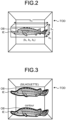
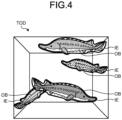
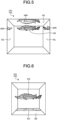
- FIG. 2 to FIG. 4 are diagrams illustrating variations of the image element IE.
- the example illustrated in FIG. 2 is an example in which the boundary cube illustrated in FIG. 1 is redisplayed.
- the example illustrated in FIG. 3 is an example in which the individual OB is replaced with a silhouette or an example in which a contour of the individual OB is bordered by a bold line.
- the example illustrated in FIG. 4 is an example in which the plurality of individuals OB are color coded.
- the boundary cube in FIG. 2 and the contour line in FIG. 3 correspond to the frame element that encloses the individual OB.
- the color coding in FIG. 4 corresponds to assignment of the color element. If the plurality of individuals OB are present, it may be possible to change a color of the frame element for each of the individuals OB or in accordance with the classification information on the individual OB.
- machine learning supervised learning using the input data TID and the ground truth data TOD as training data is performed in a deep neural network (DNN). If input data RID is input to the trained DNN, output data ROD is generated by adding the label information and the image element IE to the input data RID.
- DNN deep neural network
- the DNN extracts each of the individuals OB from the captured image CI.
- the DNN generates the classification information and the location information on each of the individuals OB based on a feature of each of the individuals OB.
- the DNN generates the label information that includes the classification information and the location information for each of the individuals OB.
- the DNN generates the image element IE for each of the individuals OB based on the location information on each of the individuals OB.
- the DNN generates a corrected image CCI by adding the image element IE of each of the individuals OB to the captured image CI.
- the DNN generates the output data ROD by adding the label information of each of the individuals OB to the corrected image CCI.
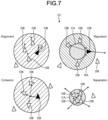
- FIG. 5 and FIG. 6 are diagrams for explaining machine learning for removing noise.
- the DNN To improve accuracy of image analysis performed by the DNN, it is possible to perform machine learning for removing noise that is included in the captured image CI. For example, if a camera is placed in a fish cage and performs image capturing, a reflected image MIR of the individual OB that moves near a water surface WS or a wall surface WL is projected on the water surface WS or the wall surface WL. At a bottom of the fish cage, a shadow SH of the individual OB is projected.
- the reflected image MIR and the shadow SH as described above are noise and may reduce accuracy of image analysis. Therefore, in the present disclosure, for example, the simulation image SI of the reflected image MIR and the shadow SH is generated, and training data is generated using the simulation image SI.
- the simulation image SI including the individual OB and the reflected images MIR is generated as the input data TID.
- the ground truth data TOD is the simulation image SI that is obtained by removing the reflected images MIR from the input data TID. If the input data TID and the ground truth data TOD are used as the training data, it is possible to obtain a DNN for removing the reflected images MIR from the captured image CI.
- the input data TID and the ground truth data TOD include the individuals OB, but the individuals OB need not always be included in these pieces of the data. For example, it is possible to generate a DNN for removing the reflected images MIR even with use of training data that is obtained by deleting the individuals OB from the input data TID and the ground truth data TOD.
- the simulation image SI including the individual OB and the shadow SH is generated as the input data TID.
- the ground truth data TOD is the simulation image SI that is obtained by removing the shadow SH from the input data TID. If the input data TID and the ground truth data TOD are used as the training data, it is possible to obtain a DNN for removing the shadow SH from the captured image CI.
- the input data TID and the ground truth data TOD include the individuals OB, but the individuals OB need not always be included in these pieces of data. For example, even with use of the training data that is obtained by removing the individuals OB from the input data TID and the ground truth data TOD as described above, it is possible to generate a DNN for removing the shadow SH.
- the simulation images SI of the school FLK and the individual OB may be generated by using a school model 23 (see FIG. 15 ) and an individual model 24 (see FIG. 15 ).
- the school model 23 is a simulation model that is based on a statistical property of the school FLK.
- the individual model 24 is a simulation model that is based on a morphological feature of the individual OB. An overview of the simulation models will be described below.
- FIG. 7 is a diagram illustrating an example of the school model 23.
- the school model 23 is generated by combining, for example, the Boids model in which three movement rules, such as separation, alignment, and cohesion, are defined, and a predator model that indicates a predatory behavior at the time of feeding.
- a repulsion area RA for encouraging movement in a direction opposite to a crowded direction is set outside a crowded area CA in which the movement rule for separation is applied.
- the predator model is generated by simulating the way the individual OB gets food that is visible to the individual OB (fish vision simulation).
- the predator model may be used to optimize food in accordance with a type of the individual OB and density in the cage.
- a degree of alignment of the individuals OB for example, a degree of alignment of the individuals OB, a degree of formation of a school, a viewing angle, a top speed, a food recognition speed, a degree of obsession with food, a duration of continuous eating (feed amount with which the individual is fully fed), a duration of eating at one time, a moving speed during eating, a size of the crowded area CA, a size of the repulsion area RA, and the like are set as parameters of the school FLK. These parameters are changed depending on the types or the sizes of the individuals OB.
- FIG. 8 illustrates the simulation image SI of the school FLK at the time of non-feeding.
- FIG. 9 is the simulation image SI of the school FLK at the time of feeding.
- FIG. 10 is the captured image CI of the school FLK at the time of non-feeding.
- FIG. 11 is the captured image CI of the school FLK at the time of feeding.
- the school FLK approximately moves in accordance with the three movement rules of separation, alignment, and cohesion. Therefore, a large number of the individuals OB are crowded in a narrow range.
- the school FLK moves in accordance with four movement rules, such as separation, alignment, cohesion, and repulsion. Due to the movement rule of repulsion, the school FLK is spread out, so that density of the school FLK is reduced.
- the number of the individuals is estimated based on the simulation image SI as illustrated in FIG. 8 .
- a shape and a size of the school FLK are changed by adjusting the parameters of the simulation. Therefore, by adjusting the parameter information until the simulation image SI closely resembles the real data, it is possible to estimate the number of the individuals with high accuracy.
- the density of the school FLK decreases at the time of feeding. Therefore, it may be possible to estimate the number of the individuals based on the image that is captured at the time of feeding. In this case, the number of the individuals OB that are not visible due to overlapping is reduced, so that it becomes easy to count the number of the individuals. Even at the time of comparison with the simulation image SI illustrated in FIG. 9 , it is possible to perform the comparison because the school FLK is not crowded.
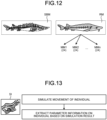
- FIG. 12 is a diagram illustrating an example of the individual model 24.
- the individual model 24 is generated based on a body structure of the individual OB.
- a skeletal muscle model is used as the individual model 24.
- a musculoskeletal SBM is obtained by dissecting the individual OB that has a standard shape and a standard size, and analyzing a skeleton of the individual OB and how muscles are attached to the skeleton.
- FIG. 12 illustrates the musculoskeletal SBM of a sturgeon.
- a reference model RM of the individual OB is reproduced from the musculoskeletal SBM.
- One or more mutation models MM1 to MMn are generated in a derived manner from the reference model RM.
- Each of the reference model RM and the mutation models MM1 to MMn serves as the individual model 24.
- the individual model 24 is used as the classification information on the individual OB.
- the mutation models are three-dimensional models of the individual OB that is morphologically abnormal. It is known that almost all of the individuals OB that were born in aquaculture have physical abnormalities (for example, a fin is bent, a shape of a fin is mutated, or a visceral disease occurs). Therefore, as the mutation models of the individual OB, for example, models related to abnormalities of a pectoral fin (for example, a pectoral fin is bent), abnormalities of a dorsal fin (for example, a dorsal fin is bent), abnormalities of a tail fin (for example, a tail fin is bent), and a contour mutation (for example, a contour of a head portion is mutated as compared to a normal individual) are generated. Meanwhile, the mutation models are not limited to those as described above. Types of the mutation models to be generated are individually determined in accordance with the type of the individual OB or an environment in which the individual OB exists.
- FIG. 13 is a diagram illustrating a movement simulation of the individual OB.
- the individual model 24 is associated with a movement feature value that is obtained by the movement simulation.
- a feature value (movement feature value) of a swimming style is extracted by fluid simulation for each of the individual models 24.
- the swimming style of the individual OB varies depending on a morphological feature of the individual OB. For example, the individual OB with a physical abnormality swims so as to compensate for the abnormality. Therefore, the feature value of the swimming style is different for each of the individual models 24.
- the feature value of the swimming style may be used as parameter information for identifying the individual OB.
- the parameter information indicating the movement feature value of the individual OB is associated with the individual model 24 and used as the classification information.
- FIG. 14 is a diagram illustrating a sturgeon that is farmed in a fish cage.
- FIG. 15 is a diagram illustrating an example of an information processing apparatus 1 to which the information processing according to the present disclosure is applied.
- the information processing apparatus 1 is a dedicated or a general-purpose computer system, such as a server.
- the DNN for the image analysis as described above is included in an analysis model 21.
- the information processing apparatus 1 includes a processing device 10 and a storage device 20.
- the processing device 10 includes, for example, an input data generation unit 11, a ground truth data generation unit 12, an image analysis unit 13, a simulation unit 14, and an estimation unit 15.
- the simulation unit 14 generates a three-dimensional simulation image SI by using a simulation model that is defined in model information 22.
- the simulation image SI is an image that is obtained by reproducing a simulation result as an image that is viewed at a certain camera angle by using a CG technology.
- the model information 22 for example, the school model 23, the individual model 24, an abnormal behavior model 25, and the like are defined.
- the abnormal behavior model 25 is a simulation model that indicates an abnormal behavior of the individual OB.
- the simulation unit 14 generates the simulation images SI of the school FLK and the individual OB based on the simulation models.
- the input data generation unit 11 generates parameter information that is needed for the simulation, and outputs the parameter information to the simulation unit 14.
- the input data generation unit 11 generates the simulation image SI that serves as the input data TID through computer graphics using the simulation unit 14.
- the ground truth data generation unit 12 generates the label information based on the parameter information that is used for the simulation.
- the ground truth data generation unit 12 generates the ground truth data TOD that includes the simulation image SI and the label information.
- the ground truth data generation unit 12 is able to generate the image element IE for identifying the individual OB, on the basis of the location information on the individual OB that is used for the simulation.
- the ground truth data generation unit 12 generates the corrected image CSI by adding the image element IE to the simulation image SI, and generates the ground truth data TOD by adding the label information to the corrected image CSI.
- the input data generation unit 11 and the ground truth data generation unit 12 generate a large number of pieces of training data.
- the analysis model 21 is generated based on machine learning in which the input data TID and the ground truth data TOD as described above are used as the training data.
- the analysis model 21 includes, for example, a DNN for analyzing the classification information and the location information on the individual OB, a DNN for analyzing the parameter information on the school FLK, a DNN for analyzing the parameter information on the individual OB, a DNN for removing the reflected image MIR, a DNN for removing the shadow SH, and the like.
- the DNNs as described above are appropriately trained in accordance with a requested function.
- Various methods are applicable to the machine learning, and a recurrent neural network (RNN), deep reinforcement learning and transformer, or the like may be used.
- RNN recurrent neural network
- the image analysis unit 13 performs image analysis on the captured image CI by using the analysis model 21.
- the image analysis unit 13 extracts the label information from the captured image CI by the image analysis.
- the image analysis unit 13 extracts needed parameter information from the extracted label information.
- the estimation unit 15 outputs the parameter information extracted by the image analysis unit 13 to the simulation unit 14.
- the estimation unit 15 generates the simulation image SI based on the extracted parameter information by using the simulation unit 14.
- the estimation unit 15 calculates a difference between the simulation image SI and the captured image CI. If the difference does not meet a condition that is set in advance, the estimation unit 15 corrects the parameter information and generates the simulation image SI.
- the estimation unit 15 repeats correction of the parameter information and generation of the simulation image SI until the difference meets the above-described condition.
- the estimation unit 15 estimates needed information based on the parameter information that has been corrected until the above-described condition is met.
- the storage device 20 stores therein, for example, a program 29 that is executed by the processing device 10, the analysis model 21, and the model information 22.
- the program 29 is a program that causes a computer to execute the information processing of the present disclosure.
- the processing device 10 performs various kinds of processing in accordance with the program 29 that is stored in the storage device 20.
- the storage device 20 may be used as a work area for temporarily storing a processing result obtained by the processing device 10.
- the storage device 20 includes, for example, an arbitrary non-transitory storage medium, such as a semiconductor storage medium and a magnetic storage medium.
- the storage device 20 includes, for example, an optical disk, a magneto-optical disk, or a flash memory.
- the program 29 is stored in, for example, a computer-readable non-transitory storage medium.
- the processing device 10 is, for example, a computer that includes a processor and a memory.
- the memory of the processing device 10 includes a random access memory (RAM) and a read only memory (ROM).
- the processing device 10 functions as the input data generation unit 11, the ground truth data generation unit 12, the image analysis unit 13, the simulation unit 14, and the estimation unit 15 by executing the program 29.
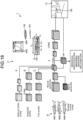
- FIG. 16 is a diagram illustrating an example of a process of estimating the number of individuals in the school FLK.
- the analysis model 21 includes a DNNA, a DNNB, a DNNC, and a DNND.
- the DNNA is a DNN for removing the reflected image MIR.
- the DNNB is a DNN for removing the shadow SH.
- the DNNC is a DNN for extracting the location information and the classification information on the individual OB.
- the DNND is a DNN for extracting the parameter information on the school FLK.
- the simulation image SI for training the DNND is a simulation image of the school FLK that is generated by using the school model 23.
- the label information of training data for the DNND is generated based on the parameter information on the school FLK that is applied to the school model 23. If the captured image CI of the school FLK is input to the DNND, the parameter information on the school FLK is extracted.
- the DNNC extracts information on a type, a position, a size, and the like of each of the individuals OB from the captured image CI.
- the DNNA and the DNNB separates noise components (the reflected image MIR and the shadow SH) that are included in the captured image CI.
- the image analysis unit 13 extracts the label information from the captured image CI of the school FLK by using the analysis model 21.
- the image analysis unit 13 extracts the parameter information on the school FLK on the basis of the extracted label information.
- the estimation unit 15 estimates the number of the individuals OB included in the school FLK on the basis of the parameter information on the school FLK.
- the estimation unit 15 At an estimation step as described above, first, the estimation unit 15 generates the simulation image SI of the school FLK on the basis of the parameter information on the school FLK and the information on the type, the position, and the size of the individual OB.
- the estimation unit 15 corrects the parameter information on the school FLK until a difference diff between the simulation image SI and the captured image CI of the school FLK meets a condition that is set in advance.
- the difference diff is calculated based on a difference between the feature value of the captured image CI and the feature value of the simulation image SI.
- the estimation unit 15 estimates the number of the individuals OB on the basis of the parameter information on the school FLK that has been corrected until the above-described condition is met.
- the simulation image SI that is generated at the estimation step includes the reflected images MIR and the shadows SH of the individuals OB.
- the number of the reflected images MIR and density of the shadows SH may be a clue for obtaining the information on the school FLK at a position in a blind spot of the camera. Therefore, the difference diff also includes a difference between the reflected images MIR and the shadows SH that are included in the simulation image SI and the reflected images MIR and the shadows SH that are included in the captured image CI.
- images at the time of non-feeding are used as the captured image CI and the simulation image SI.
- images of the school FLK at the time of feeding are used as the captured image CI and the simulation image SI.
- the density of the school FLK is reduced as compared to the time of non-feeding at which the predator model is not adopted. Therefore, the number of the individuals OB that are not viewable due to overlapping is reduced. Consequently, it is possible to detect the difference between the simulation image SI and the captured image CI with high accuracy, so that the estimation accuracy of the number of individuals is improved.
- the information processing apparatus 1 may include an input means for inputting a type and a size of targets to be counted. With this configuration, the user is able to count only the number of the individuals OB of a specific type or with a specific size.
- FIG. 17 is a diagram illustrating an example of tracking of an individual.
- the analysis model 21 includes the DNNA, the DNNB, the DNNC, and a DNNE.
- the DNNE is a DNN for adding the image element IE to each of the individuals OB on the basis of the location information and the classification information on each of the individuals that are extracted by the DNNC.
- the image analysis unit 13 applies the captured image CI to the analysis model 21 and adds the image element IE to each of the individuals OB that appears in the captured image CI.
- a different color element is added, as the image element IE, to each of the individuals OB.
- the color of the individual OB varies depending on the size, the shape, or the like of the individual OB.
- the size of the individual OB is extracted from the location information on the individual OB.
- the shape of the individual OB is extracted from the classification information (morphological feature) on the individual OB.
- the image analysis unit 13 detects the plurality of individuals OB and individually tracks each of the individuals OB on the basis of the image elements IE that are added to the individuals OB.
- FIG. 18 is a diagram illustrating an example of a method of identifying an individual and a method of detecting an abnormal behavior.
- the analysis model 21 includes the DNNA, the DNNB, the DNNC, and a DNNF.
- the DNNF is a DNN for extracting the parameter information on the individual OB.
- the simulation image SI for training the DNNF is a simulation image of the individual that is generated by using the individual model 24.
- the label information on the training data of the DNNF is generated based on the parameter information on the individual OB that is applied to the individual model 24. If the captured image CI of the individual OB is input to the DNNF, the parameter information corresponding to the morphological feature (the individual model 24) of the individual OB is extracted.
- the image analysis unit 13 extracts the label information on each of the individuals OB from the captured image CI by using the analysis model 21.
- the image analysis unit 13 extracts the parameter information on the individual OB on the basis of the label information on the individual OB, for each of the individuals OB.
- the extracted parameter information on the individual OB includes parameter information on a muscle parameter that is applied to the skeletal muscle model of the individual OB and parameter information indicating the movement feature value of the individual OB that is associated with the individual model 24, for example.
- the estimation unit 15 identifies each of the individuals OB on the basis of the parameter information on each of the individuals OB.
- the estimation unit 15 At the identification step as described above, first, the estimation unit 15 generates the simulation image SI of the individual OB on the basis of the parameter information on the individual OB.
- the estimation unit 15 corrects the parameter information on the individual OB until the difference between the simulation image and the captured image CI of the individual OB meets a condition that is set in advance.
- the difference diff is calculated based on a difference between the feature value of the captured image CI and the feature value of the simulation image SI.
- the estimation unit 15 identifies the individual OB on the basis of the parameter information on the individual OB that has been corrected until the above-described condition is met.
- the retina parameter is, for example, a parameter indicating a relationship between an event issuance direction viewed from the individual OB and a moving direction of the individual OB. For example, if a food falls in front of the individual OB and the individual OB moves in a direction different from the direction in which the food is present, it is possible to estimate that the individual OB has abnormality. Furthermore, a sturgeon with a visceral disease may perform an abnormal behavior, such as unnatural drift near a water surface. In this case, it is possible to apply the captured image CI to the abnormal behavior model 25 to extract the retina parameter, and detect abnormality of the individual OB by comparing the retina parameter with a reference value that is set in advance.
- Detection of abnormal behaviors is useful for detection of poor physical condition due to overfeeding. Therefore, it is possible to adjust or optimize a feed amount based on a detection result of the abnormal behaviors.
- FIG. 19 is a flowchart illustrating an example of the information processing method according to the present disclosure.
- the input data generation unit 11 generates the simulation image SI that serves as the input data TID by CG.
- the ground truth data generation unit 12 generates the label information based on the parameter information that is used for the simulation.
- the ground truth data generation unit 12 generates the ground truth data TOD that includes the simulation image SI and the label information.
- the processing device 10 generates the analysis model 21 based on the machine learning in which the input data TID and the ground truth data TOD are used as the training data.
- the image analysis unit 13 extracts the label information from the captured image CI by using the analysis model 21.
- the image analysis unit 13 extracts needed parameter information from the extracted label information.
- the parameter information that is extracted by the image analysis unit 13 is output to the simulation unit 14.
- the estimation unit 15 generates the simulation image SI based on the extracted parameter information by using the simulation unit 14.
- the estimation unit 15 calculates a difference between the simulation image SI and the captured image CI, and generates the simulation image SI while correcting the parameter information if the difference does not meet a condition that is set in advance.
- the estimation unit 15 repeats correction of the parameter information and generation of the simulation image SI until the difference meets the above-described condition.
- the estimation unit 15 estimates needed information on the basis of the parameter information that has been corrected until the above-described condition is met.
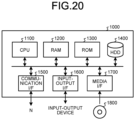
- FIG. 20 is a diagram illustrating an example of a hardware configuration of the information processing apparatus 1.
- the information processing apparatus 1 is implemented by, for example, a computer system 1000 as illustrated in FIG. 20 .
- the computer system 1000 includes a central processing unit (CPU) 1100, a RAM 1200, a ROM 1300, an HDD 1400, a communication interface (I/F) 1500, an input-output interface (I/F) 1600, and a medium interface (I/F) 1700.
- CPU central processing unit
- RAM random access memory
- ROM 1300 read-only memory
- HDD 1400 high-output interface
- I/F input-output interface
- I/F medium interface
- the CPU 1100 operates based on a program that is stored in the ROM 1300 or the HDD 1400, and controls each of the units.
- the ROM 1300 stores therein a boot program that is executed by the CPU 1100 at the time of activation of the computer system 1000, a program that is dependent on the hardware of the computer system 1000, and the like.
- the HDD 1400 stores therein a program that is executed by the CPU 1100, data that is used by the program, and the like.
- the communication interface 1500 receives data from a different device via the communication network NW, sends the received data to the CPU 1100, and transmits data generated by the CPU 1100 to a different device via the communication network NW.
- the CPU 1100 controls an output device, such as a display or a printer, and an input device, such as a keyboard or a mouse, via the input-output interface 1600.
- the CPU 1100 acquires data from the input device via the input-output interface 1600. Further, the CPU 1100 outputs the generated data to the output device via the input-output interface 1600.
- the medium interface 1700 reads a program or data that is stored in a recording medium 1800, and provides the program or the data to the CPU 1100 via the RAM 1200.
- the CPU 1100 loads the program onto the RAM 1200 from the recording medium 1800 via the medium interface 1700, and executes the loaded program.
- the recording medium 1800 is, for example, an optical recording medium, such as a digital versatile disc (DVD) or a phase change rewritable disk (PD), a magneto-optical recording medium, such as a magneto-optical disk (MO), a tape medium, a magnetic recording medium, a semiconductor memory, or the like.
- the CPU 1100 of the computer system 1000 executes the program that is loaded on the RAM 1200, and implements the functions of the processing device 10.
- the HDD 1400 stores therein data in the storage device 20.
- the CPU 1100 of the computer system 1000 reads the programs from the recording medium 1800 and executes the programs; however, as another example, it may be possible to acquire the programs from a different device via the communication network NW.
- the information processing method includes an input data generation step, and a ground truth data generation step.
- the input data generation step is for generating the simulation image SI that serves as the input data TID by computer graphics.
- the ground truth data generation step is for generating the label information based on the parameter information that is used for a simulation, and generating the ground truth data TOD that includes the simulation image and the label information.
- the program 29 according to the present disclosure causes a computer to execute the information processing as described above.
- the information processing apparatus 1 according to the present disclosures implements the information processing as described above.
- the label information on the ground truth data TOD is generated based on the parameter information that is used for the simulation. Therefore, it is possible to improve accuracy of the label information. Consequently, it is possible to easily generate training data with high accuracy.
- the information processing method includes an analysis model generation step.
- the analysis model generation step is for generating the analysis model 21 based on the machine learning in which the input data TID and the ground truth data TOD are used as training data.
- the coordinate information on the CG that is used for generating the input data TID is reflected in the label information. Therefore, with the analysis model 21 that is obtained by training, it is possible to extract the position, the shape, and the size of the individual OB and the parameter information on the school FLK that appear in the captured image CI with high accuracy.
- the information processing method includes a label information extraction step, a parameter information extraction step, a simulation image generation step, a parameter information correction step, and an estimation step.
- the label information extraction step is for extracting the label information from the captured image CI by using the analysis model 21.
- the parameter information extraction step is for extracting the parameter information based on the label information.
- the simulation image generation step is for generating the simulation image SI based on the parameter information.
- the parameter information correction step is for correcting the parameter information until a difference between the simulation image and the captured image CI meets a condition that is set in advance.
- the estimation step is for estimating information based on the parameter information that has been corrected until the above-described condition is met.
- the parameter information that is extracted by using the analysis model 21 is corrected based on the information on the difference between the simulation image SI and the captured image CI. Therefore, it is possible to obtain the parameter information that matches the real data (the captured image CI) in a preferable manner. Furthermore, the needed information is estimated based on the corrected parameter information, so that it is possible to improve information estimation accuracy.
- the simulation image SI is a simulation image of the school FLK that is generated by using the school model 23 that is based on the statistical property of the school FLK.
- the label information is generated based on the parameter information on the school FLK that is applied to the school model 23.
- the parameter information on the school FLK is extracted from the captured image CI of the school FLK with high accuracy.
- the information processing method includes a label information extraction step, a parameter information extraction step, and an estimation step.
- the label information extraction step is for extracting the label information from the captured image CI of the school FLK by using the analysis model 21.
- the parameter information extraction step is for extracting the parameter information on the school FLK based on the extracted label information.
- the estimation step is for estimating the number of the individuals OB included in the school FLK, based on the parameter information on the school FLK.
- the estimation step includes a simulation image generation step, a parameter information correction step, an individual number estimation step.
- the simulation image generation step is for generating the simulation image SI of the school FLK based on the parameter information on the school FLK.
- the parameter information correction step is for correcting the parameter information on the school FLK until a difference between the simulation image SI of the school FLK and the captured image CI meets a condition that is set in advance.
- the individual number estimation step is for estimating the number of the individuals OB based on the parameter information on the school FLK that has been corrected until the above-described condition is met.
- the parameter information that is extracted by using the analysis model 21 is corrected based on information on the difference between the simulation image SI and the captured image CI. Therefore, it is possible to obtain the parameter information that matches the real data (the captured image CI) in a preferable manner. Furthermore, the number of the individuals is estimated based on the corrected parameter information, so that it is possible to estimate the number of the individuals with high accuracy.
- the simulation image SI of the school FLK is a simulation image of the school FLK at the time of feeding.
- the simulation image SI is a simulation image of the individual OB that is generated by using the individual model 24 that is based on the morphological feature of the individual OB.
- the label information is generated based on the parameter information on the individual OB that is applied to the individual model 24.
- the parameter information on the individual OB is extracted from the captured image CI of the individual OB with high accuracy.
- the information processing method includes a label information extraction step, a parameter information extraction step, and an individual identification step.
- the label information extraction step is for extracting the label information on each of the individuals OB from the captured image CI by using the analysis model 21.
- the parameter information extraction step is for extracting the parameter information on the individual OB based on the label information on the individual OB, for each of the individuals OB.
- the individual identification step is for identifying each of the individuals OB based on the parameter information on each of the individuals OB.
- the identification step includes a simulation image generation step, a parameter information correction step, and an individual identification step.
- the simulation image generation step is for generating the simulation image SI of the individual OB based on the parameter information on the individual OB.
- the parameter information correction step is for correcting the parameter information on the individual OB until a difference between the simulation image SI and the captured image CI of the individual OB meets a condition that is set in advance.
- the individual identification step is for identifying the individual OB based on the parameter information on the individual OB that has been corrected until the above-described condition is met.
- the parameter information that is extracted by using the analysis model 21 is corrected based on the information on the difference between the simulation image SI and the captured image CI. Therefore, it is possible to obtain the parameter information that matches the real data (the captured image CI) in a preferable manner. Further, the individual OB is identified based on the corrected parameter information, so that identification accuracy of the individual OB is improved.
- the parameter information on the individual OB includes parameter information on a muscle parameter that is applied to a skeletal muscle model of the individual OB, and parameter information indicating a movement feature value of the individual OB.
- the information processing method includes an abnormality detection step.
- the abnormality detection step is for detecting an abnormality of the individual OB by applying the captured image CI of the individual OB to the abnormal behavior model 25.
- the ground truth data generation step includes an image element generation step, a corrected image generation step, and a data generation step.
- the image element generation step is for generating the image element IE for identifying the individual OB based on the location information on the individual OB that is used for the simulation.
- the corrected image generation step is for generating the corrected image CSI by adding the image element IE to the simulation image SI.
- the data generation step is for generating the ground truth data TOD by adding the label information to the corrected image CSI.
- the image element IE is added to an appropriate position in the simulation image SI with high accuracy. Furthermore, operation of adding the image element IE is automated, so that it becomes easy to perform operation of generating the ground truth data TOD.
- the image element includes a frame element for enclosing the individual OB or a color element for identifying the individual OB by color.
- the information processing method includes an image element adding step and a tracking step.
- the image element adding step is for adding the image element IE to each of the individuals OB that appear in the captured image CI by applying the captured image CI to the analysis model 21.
- the tracking step is for individually tracking each of the individuals OB based on the image element IE that is added to each of the individuals OB.
- the method of generating the training data using the CG has been described, and the method contributes to improvement in a recognition rate of any kind of computer vision, in addition to the example as described above.
- a method of precise musculoskeletal simulation using CG may be applied to a human being, a horse, or the like, in addition to a sturgeon. With this configuration, the method as described above may be widely applied to various fields using artificial intelligence (AI).
- AI artificial intelligence
Landscapes
- Engineering & Computer Science (AREA)
- Physics & Mathematics (AREA)
- General Physics & Mathematics (AREA)
- Theoretical Computer Science (AREA)
- Computer Vision & Pattern Recognition (AREA)
- Quality & Reliability (AREA)
- Computer Graphics (AREA)
- Multimedia (AREA)
- Image Analysis (AREA)
Abstract
Description
- The present invention relates to an information processing method, a program, and an information processing apparatus.
- Deep learning has achieved great results in the field of computer vision and voice recognition. For example, in fish farms, there is a need to address automatic count of the number of fish, and it is expected that such a problem will be resolved with use of a method of the deep learning.
- Patent Literature 1: International Publication No.
WO 2019/045091 - Precision of analysis using deep learning is dependent on training data. However, it is not easy to generate accurate training data. Further, in a case where a school of fish is handled, a large number of individuals that are not viewable due to overlapping are present, so that it is difficult to estimate needed information with high accuracy only by deep learning.
- To cope with this, an object of the present disclosure is to propose an information processing method, a program, and an information processing apparatus capable of easily generating training data with high accuracy. In addition, another object of the present disclosure is to propose an information processing method, a program, and an information processing apparatus capable of estimating information included in real data with high accuracy.
- According to an aspect of the present disclosure, an information processing method implemented by a computer is provided that comprises: generating a simulation image that serves as input data by computer graphics; generating label information based on parameter information that is used for a simulation; and generating ground truth data that includes the simulation image and the label information. According to the present disclosure, a program for causing the computer to execute the information processing method, and an information processing apparatus that execute the information processing method, are provided.
- According to the present disclosure, it is possible to easily generate training data with high accuracy.
-
-
FIG. 1 is a diagram for explaining an overview of information processing. -
FIG. 2 is a diagram illustrating a variation of an image element. -
FIG. 3 is a diagram illustrating a variation of image elements. -
FIG. 4 is a diagram illustrating a variation of image elements. -
FIG. 5 is a diagram for explaining machine learning for removing noise that is caused by a reflected image. -
FIG. 6 is a diagram for explaining the machine learning for removing noise that is caused by a shadow. -
FIG. 7 is a diagram illustrating an example of aschool model 23. -
FIG. 8 is a simulation image of a school at the time of non-feeding. -
FIG. 9 is a simulation image of a school at the time of feeding. -
FIG. 10 is a captured image of a school at the time of non-feeding. -
FIG. 11 is a captured image of a school at the time of feeding. -
FIG. 12 is a diagram illustrating an example of an individual model. -
FIG. 13 is a diagram illustrating individual movement simulation. -
FIG. 14 is a diagram illustrating sturgeons that are farmed in a fish cage. -
FIG. 15 is a diagram illustrating an example of an information processing apparatus. -
FIG. 16 is a diagram illustrating an example of a process of estimating the number of individuals in a school. -
FIG. 17 is a diagram illustrating an example of tracking of an individual. -
FIG. 18 is a diagram illustrating an example of an individual identification method and an abnormal behavior detection method. -
FIG. 19 is a flowchart illustrating an example of an information processing method. -
FIG. 20 is a diagram illustrating an example of a hardware configuration of the information processing apparatus. - Embodiments of the present disclosure will be described in detail below based on the drawings. In each of the embodiments below, the same components are denoted by the same reference symbols, and repeated explanation will be omitted.
-
FIG. 1 is a diagram for explaining an overview of the information processing according to the present disclosure. - The present disclosure proposes a method of generating new training data using computer graphics (CG) and a data driven method for eliminating a difference between a CG image and real data (captured image). It is possible to generate a large amount of training data with high accuracy by generating the training data by CG images. Further, it is possible to estimate needed information with high accuracy based on CG parameters by generating CG images that closely resemble real data. Details of the present disclosure will be described below.
- In the present disclosure, a target TG is analyzed by an image analysis method based on a captured image CI of the target TG. An information processing method of the present disclosure is applicable to a wide range of fields, such as the fishing industry, the agricultural industry, the forest industry, and the manufacturing industry. An analysis target is appropriately set in accordance with the technical field and a purpose of the analysis. For example, in the field of the fishing industry, the analysis target may be the number of farmed fish, growing conditions, a predatory behavior, an abnormal behavior, or the like. In the field of the agricultural industry, the analysis target may be growing conditions of agricultural crops, crop yields, or the like. In the field of the forest industry, the analysis target may be growing conditions of trees, timber yields, or the like. In the field of the manufacturing industry, the analysis target may be the number of products, presence or absence of defective products, or the like.
- In the following, an example will be described in which the information processing method of the present disclosure is adopted to tracking of a farmed fish, detection of an abnormal behavior, counting of the number of fish, or the like.
- In the present disclosure, three-dimensional CG images of a school FLK and an individual OB are generated by using computer simulation. The generated CG images are used as training data for deep learning.
- The training data includes a large number of data sets. Each of the data sets includes input data TID and ground truth data TOD. In the present disclosure, a simulation image SI that serves as the input data TID is generated by computer graphics. The ground truth data TOD is generated by adding label information to the input data TID. The label information is information indicating a correct answer (ground truth). The label information is automatically generated based on parameter information that is used for the simulation.
- A target for the simulation is determined in accordance with a purpose of training. For example, when the number of farmed fish is to be counted, simulation of the school FLK is performed. When each farmed fish is individually tracked, simulation of the individual OB is performed.
- The example in
FIG. 1 is an example in which the simulation image SI of the individual OB is generated in order to track a farmed fish. The label information includes classification information for classifying the individual OB and location information on the individual OB. The classification information includes, for example, information on a type (fish species or the like) of the individual OB, a morphological feature (deformation of a fin, a defect, a body color, a pattern, or the like), or the like. The location information includes, for example, information indicating a center position of the individual OB and an existence range of the individual OB. The location information is generated by using, for example, three-dimensional coordinate information. In the example illustrated inFIG. 1 , a coordinate (bx, by, bz) of the center of the individual OB and information on a depth bd, a width bw, and a height bh of a cuboid (boundary cube) with a minimum size that contains the individual OB are illustrated as the location information. Information on a size of the individual OB is extracted based on the location information (information indicating the existence range) on the individual OB. - The ground truth data TOD may include an image element IE for identifying the individual OB. The image element IE may be a frame element that indicates a boundary cube, for example. The image element IE is automatically generated based on the location information on the individual OB that is used for the simulation. In the example illustrated in
FIG. 1 , the image element IE is indicated by the boundary cube, but the image element IE is not limited to this example. The image element IE may include, for example, a frame element that encloses the individual OB or a color element for identifying the individual OB by color. -
FIG. 2 to FIG. 4 are diagrams illustrating variations of the image element IE. - The example illustrated in
FIG. 2 is an example in which the boundary cube illustrated inFIG. 1 is redisplayed. The example illustrated inFIG. 3 is an example in which the individual OB is replaced with a silhouette or an example in which a contour of the individual OB is bordered by a bold line. The example illustrated inFIG. 4 is an example in which the plurality of individuals OB are color coded. The boundary cube inFIG. 2 and the contour line inFIG. 3 correspond to the frame element that encloses the individual OB. The color coding inFIG. 4 corresponds to assignment of the color element. If the plurality of individuals OB are present, it may be possible to change a color of the frame element for each of the individuals OB or in accordance with the classification information on the individual OB. - Referring back to
FIG. 1 , in the present disclosure, machine learning (supervised learning) using the input data TID and the ground truth data TOD as training data is performed in a deep neural network (DNN). If input data RID is input to the trained DNN, output data ROD is generated by adding the label information and the image element IE to the input data RID. - For example, if the captured image CI is input to the DNN, the DNN extracts each of the individuals OB from the captured image CI. The DNN generates the classification information and the location information on each of the individuals OB based on a feature of each of the individuals OB. The DNN generates the label information that includes the classification information and the location information for each of the individuals OB. The DNN generates the image element IE for each of the individuals OB based on the location information on each of the individuals OB. The DNN generates a corrected image CCI by adding the image element IE of each of the individuals OB to the captured image CI. The DNN generates the output data ROD by adding the label information of each of the individuals OB to the corrected image CCI.
-
FIG. 5 and FIG. 6 are diagrams for explaining machine learning for removing noise. - To improve accuracy of image analysis performed by the DNN, it is possible to perform machine learning for removing noise that is included in the captured image CI. For example, if a camera is placed in a fish cage and performs image capturing, a reflected image MIR of the individual OB that moves near a water surface WS or a wall surface WL is projected on the water surface WS or the wall surface WL. At a bottom of the fish cage, a shadow SH of the individual OB is projected. The reflected image MIR and the shadow SH as described above are noise and may reduce accuracy of image analysis. Therefore, in the present disclosure, for example, the simulation image SI of the reflected image MIR and the shadow SH is generated, and training data is generated using the simulation image SI.
- In the example illustrated in
FIG. 5 , the simulation image SI including the individual OB and the reflected images MIR is generated as the input data TID. The ground truth data TOD is the simulation image SI that is obtained by removing the reflected images MIR from the input data TID. If the input data TID and the ground truth data TOD are used as the training data, it is possible to obtain a DNN for removing the reflected images MIR from the captured image CI. In the example illustrated inFIG. 5 , the input data TID and the ground truth data TOD include the individuals OB, but the individuals OB need not always be included in these pieces of the data. For example, it is possible to generate a DNN for removing the reflected images MIR even with use of training data that is obtained by deleting the individuals OB from the input data TID and the ground truth data TOD. - In the example in
FIG. 6 , the simulation image SI including the individual OB and the shadow SH is generated as the input data TID. The ground truth data TOD is the simulation image SI that is obtained by removing the shadow SH from the input data TID. If the input data TID and the ground truth data TOD are used as the training data, it is possible to obtain a DNN for removing the shadow SH from the captured image CI. In the example illustrated inFIG. 6 , the input data TID and the ground truth data TOD include the individuals OB, but the individuals OB need not always be included in these pieces of data. For example, even with use of the training data that is obtained by removing the individuals OB from the input data TID and the ground truth data TOD as described above, it is possible to generate a DNN for removing the shadow SH. - The simulation images SI of the school FLK and the individual OB may be generated by using a school model 23 (see
FIG. 15 ) and an individual model 24 (seeFIG. 15 ). Theschool model 23 is a simulation model that is based on a statistical property of the school FLK. Theindividual model 24 is a simulation model that is based on a morphological feature of the individual OB. An overview of the simulation models will be described below. -
FIG. 7 is a diagram illustrating an example of theschool model 23. - The
school model 23 is generated by combining, for example, the Boids model in which three movement rules, such as separation, alignment, and cohesion, are defined, and a predator model that indicates a predatory behavior at the time of feeding. In the predator model, a repulsion area RA for encouraging movement in a direction opposite to a crowded direction is set outside a crowded area CA in which the movement rule for separation is applied. The predator model is generated by simulating the way the individual OB gets food that is visible to the individual OB (fish vision simulation). The predator model may be used to optimize food in accordance with a type of the individual OB and density in the cage. - In the
school model 23, for example, a degree of alignment of the individuals OB, a degree of formation of a school, a viewing angle, a top speed, a food recognition speed, a degree of obsession with food, a duration of continuous eating (feed amount with which the individual is fully fed), a duration of eating at one time, a moving speed during eating, a size of the crowded area CA, a size of the repulsion area RA, and the like are set as parameters of the school FLK. These parameters are changed depending on the types or the sizes of the individuals OB. -
FIG. 8 illustrates the simulation image SI of the school FLK at the time of non-feeding.FIG. 9 is the simulation image SI of the school FLK at the time of feeding.FIG. 10 is the captured image CI of the school FLK at the time of non-feeding.FIG. 11 is the captured image CI of the school FLK at the time of feeding. - As illustrated in
FIG. 8 andFIG. 10 , at the time of non-feeding, the school FLK approximately moves in accordance with the three movement rules of separation, alignment, and cohesion. Therefore, a large number of the individuals OB are crowded in a narrow range. As illustrated inFIG. 9 andFIG. 11 , at the time of feeding, the school FLK moves in accordance with four movement rules, such as separation, alignment, cohesion, and repulsion. Due to the movement rule of repulsion, the school FLK is spread out, so that density of the school FLK is reduced. - As illustrated in
FIG. 10 , in the crowded school FLK, a large number of the individuals OB that are not visible because of overlapping with each other are present, so that it is difficult to accurately count the number of the individuals. Therefore, the number of the individuals is estimated based on the simulation image SI as illustrated inFIG. 8 . A shape and a size of the school FLK are changed by adjusting the parameters of the simulation. Therefore, by adjusting the parameter information until the simulation image SI closely resembles the real data, it is possible to estimate the number of the individuals with high accuracy. - As illustrated in
FIG. 11 , the density of the school FLK decreases at the time of feeding. Therefore, it may be possible to estimate the number of the individuals based on the image that is captured at the time of feeding. In this case, the number of the individuals OB that are not visible due to overlapping is reduced, so that it becomes easy to count the number of the individuals. Even at the time of comparison with the simulation image SI illustrated inFIG. 9 , it is possible to perform the comparison because the school FLK is not crowded. -
FIG. 12 is a diagram illustrating an example of theindividual model 24. - The
individual model 24 is generated based on a body structure of the individual OB. As theindividual model 24, for example, a skeletal muscle model is used. A musculoskeletal SBM is obtained by dissecting the individual OB that has a standard shape and a standard size, and analyzing a skeleton of the individual OB and how muscles are attached to the skeleton.FIG. 12 illustrates the musculoskeletal SBM of a sturgeon. A reference model RM of the individual OB is reproduced from the musculoskeletal SBM. One or more mutation models MM1 to MMn (n is an integer equal to or larger than one) are generated in a derived manner from the reference model RM. Each of the reference model RM and the mutation models MM1 to MMn serves as theindividual model 24. Theindividual model 24 is used as the classification information on the individual OB. - The mutation models are three-dimensional models of the individual OB that is morphologically abnormal. It is known that almost all of the individuals OB that were born in aquaculture have physical abnormalities (for example, a fin is bent, a shape of a fin is mutated, or a visceral disease occurs). Therefore, as the mutation models of the individual OB, for example, models related to abnormalities of a pectoral fin (for example, a pectoral fin is bent), abnormalities of a dorsal fin (for example, a dorsal fin is bent), abnormalities of a tail fin (for example, a tail fin is bent), and a contour mutation (for example, a contour of a head portion is mutated as compared to a normal individual) are generated. Meanwhile, the mutation models are not limited to those as described above. Types of the mutation models to be generated are individually determined in accordance with the type of the individual OB or an environment in which the individual OB exists.
-
FIG. 13 is a diagram illustrating a movement simulation of the individual OB. - The
individual model 24 is associated with a movement feature value that is obtained by the movement simulation. In the example of the sturgeon, a feature value (movement feature value) of a swimming style is extracted by fluid simulation for each of theindividual models 24. The swimming style of the individual OB varies depending on a morphological feature of the individual OB. For example, the individual OB with a physical abnormality swims so as to compensate for the abnormality. Therefore, the feature value of the swimming style is different for each of theindividual models 24. The feature value of the swimming style may be used as parameter information for identifying the individual OB. The parameter information indicating the movement feature value of the individual OB is associated with theindividual model 24 and used as the classification information. -
FIG. 14 is a diagram illustrating a sturgeon that is farmed in a fish cage. - Almost all of sturgeons in the farm have certain physical abnormalities. For example, among an individual OB1 to an individual OB4, shapes of pectoral fins, dorsal fins, and tail fins are not uniform, and contours are also slightly different from one another. Therefore, it is possible to assign a mutation model to each of the sturgeons in accordance with a physical abnormality. Even among the sturgeons to which the same mutation model is assigned, degrees of the physical abnormalities vary. Therefore, the parameter information that indicates the movement feature value of the individual OB varies for each of the sturgeons. Consequently, if the parameter information on each of the individuals OB is detected by the movement simulation, it is possible to identify each of the individuals OB based on the detected parameter information.
-
FIG. 15 is a diagram illustrating an example of an information processing apparatus 1 to which the information processing according to the present disclosure is applied. - The information processing apparatus 1 is a dedicated or a general-purpose computer system, such as a server. The DNN for the image analysis as described above is included in an
analysis model 21. The information processing apparatus 1 includes aprocessing device 10 and astorage device 20. Theprocessing device 10 includes, for example, an inputdata generation unit 11, a ground truthdata generation unit 12, animage analysis unit 13, asimulation unit 14, and an estimation unit 15. - The
simulation unit 14 generates a three-dimensional simulation image SI by using a simulation model that is defined inmodel information 22. The simulation image SI is an image that is obtained by reproducing a simulation result as an image that is viewed at a certain camera angle by using a CG technology. In themodel information 22, for example, theschool model 23, theindividual model 24, an abnormal behavior model 25, and the like are defined. The abnormal behavior model 25 is a simulation model that indicates an abnormal behavior of the individual OB. Thesimulation unit 14 generates the simulation images SI of the school FLK and the individual OB based on the simulation models. - The input
data generation unit 11 generates parameter information that is needed for the simulation, and outputs the parameter information to thesimulation unit 14. The inputdata generation unit 11 generates the simulation image SI that serves as the input data TID through computer graphics using thesimulation unit 14. - The ground truth
data generation unit 12 generates the label information based on the parameter information that is used for the simulation. The ground truthdata generation unit 12 generates the ground truth data TOD that includes the simulation image SI and the label information. The ground truthdata generation unit 12 is able to generate the image element IE for identifying the individual OB, on the basis of the location information on the individual OB that is used for the simulation. In this case, the ground truthdata generation unit 12 generates the corrected image CSI by adding the image element IE to the simulation image SI, and generates the ground truth data TOD by adding the label information to the corrected image CSI. - The input
data generation unit 11 and the ground truthdata generation unit 12 generate a large number of pieces of training data. Theanalysis model 21 is generated based on machine learning in which the input data TID and the ground truth data TOD as described above are used as the training data. Theanalysis model 21 includes, for example, a DNN for analyzing the classification information and the location information on the individual OB, a DNN for analyzing the parameter information on the school FLK, a DNN for analyzing the parameter information on the individual OB, a DNN for removing the reflected image MIR, a DNN for removing the shadow SH, and the like. The DNNs as described above are appropriately trained in accordance with a requested function. Various methods are applicable to the machine learning, and a recurrent neural network (RNN), deep reinforcement learning and transformer, or the like may be used. - The
image analysis unit 13 performs image analysis on the captured image CI by using theanalysis model 21. Theimage analysis unit 13 extracts the label information from the captured image CI by the image analysis. Theimage analysis unit 13 extracts needed parameter information from the extracted label information. - The estimation unit 15 outputs the parameter information extracted by the
image analysis unit 13 to thesimulation unit 14. The estimation unit 15 generates the simulation image SI based on the extracted parameter information by using thesimulation unit 14. The estimation unit 15 calculates a difference between the simulation image SI and the captured image CI. If the difference does not meet a condition that is set in advance, the estimation unit 15 corrects the parameter information and generates the simulation image SI. The estimation unit 15 repeats correction of the parameter information and generation of the simulation image SI until the difference meets the above-described condition. The estimation unit 15 estimates needed information based on the parameter information that has been corrected until the above-described condition is met. - The
storage device 20 stores therein, for example, aprogram 29 that is executed by theprocessing device 10, theanalysis model 21, and themodel information 22. Theprogram 29 is a program that causes a computer to execute the information processing of the present disclosure. Theprocessing device 10 performs various kinds of processing in accordance with theprogram 29 that is stored in thestorage device 20. Thestorage device 20 may be used as a work area for temporarily storing a processing result obtained by theprocessing device 10. Thestorage device 20 includes, for example, an arbitrary non-transitory storage medium, such as a semiconductor storage medium and a magnetic storage medium. Thestorage device 20 includes, for example, an optical disk, a magneto-optical disk, or a flash memory. Theprogram 29 is stored in, for example, a computer-readable non-transitory storage medium. - The
processing device 10 is, for example, a computer that includes a processor and a memory. The memory of theprocessing device 10 includes a random access memory (RAM) and a read only memory (ROM). Theprocessing device 10 functions as the inputdata generation unit 11, the ground truthdata generation unit 12, theimage analysis unit 13, thesimulation unit 14, and the estimation unit 15 by executing theprogram 29. -
FIG. 16 is a diagram illustrating an example of a process of estimating the number of individuals in the school FLK. - The
analysis model 21 includes a DNNA, a DNNB, a DNNC, and a DNND. The DNNA is a DNN for removing the reflected image MIR. The DNNB is a DNN for removing the shadow SH. The DNNC is a DNN for extracting the location information and the classification information on the individual OB. The DNND is a DNN for extracting the parameter information on the school FLK. - The simulation image SI for training the DNND is a simulation image of the school FLK that is generated by using the
school model 23. The label information of training data for the DNND is generated based on the parameter information on the school FLK that is applied to theschool model 23. If the captured image CI of the school FLK is input to the DNND, the parameter information on the school FLK is extracted. The DNNC extracts information on a type, a position, a size, and the like of each of the individuals OB from the captured image CI. The DNNA and the DNNB separates noise components (the reflected image MIR and the shadow SH) that are included in the captured image CI. - The
image analysis unit 13 extracts the label information from the captured image CI of the school FLK by using theanalysis model 21. Theimage analysis unit 13 extracts the parameter information on the school FLK on the basis of the extracted label information. The estimation unit 15 estimates the number of the individuals OB included in the school FLK on the basis of the parameter information on the school FLK. - At an estimation step as described above, first, the estimation unit 15 generates the simulation image SI of the school FLK on the basis of the parameter information on the school FLK and the information on the type, the position, and the size of the individual OB. The estimation unit 15 corrects the parameter information on the school FLK until a difference diff between the simulation image SI and the captured image CI of the school FLK meets a condition that is set in advance. The difference diff is calculated based on a difference between the feature value of the captured image CI and the feature value of the simulation image SI. The estimation unit 15 estimates the number of the individuals OB on the basis of the parameter information on the school FLK that has been corrected until the above-described condition is met.
- The simulation image SI that is generated at the estimation step includes the reflected images MIR and the shadows SH of the individuals OB. The number of the reflected images MIR and density of the shadows SH may be a clue for obtaining the information on the school FLK at a position in a blind spot of the camera. Therefore, the difference diff also includes a difference between the reflected images MIR and the shadows SH that are included in the simulation image SI and the reflected images MIR and the shadows SH that are included in the captured image CI. By taking into account difference information on the reflected images MIR and the shadows SH, it is possible to estimate the number of the individuals with high accuracy.
- In the example illustrated in
FIG. 16 , images at the time of non-feeding are used as the captured image CI and the simulation image SI. However, it may be possible to use images of the school FLK at the time of feeding as the captured image CI and the simulation image SI. At the time of feeding at which the predator model is adopted, the density of the school FLK is reduced as compared to the time of non-feeding at which the predator model is not adopted. Therefore, the number of the individuals OB that are not viewable due to overlapping is reduced. Consequently, it is possible to detect the difference between the simulation image SI and the captured image CI with high accuracy, so that the estimation accuracy of the number of individuals is improved. - Meanwhile, the DNNC detects the types and the sizes of the individuals OB. Therefore, the information processing apparatus 1 may include an input means for inputting a type and a size of targets to be counted. With this configuration, the user is able to count only the number of the individuals OB of a specific type or with a specific size.
-
FIG. 17 is a diagram illustrating an example of tracking of an individual. - The
analysis model 21 includes the DNNA, the DNNB, the DNNC, and a DNNE. The DNNE is a DNN for adding the image element IE to each of the individuals OB on the basis of the location information and the classification information on each of the individuals that are extracted by the DNNC. - The
image analysis unit 13 applies the captured image CI to theanalysis model 21 and adds the image element IE to each of the individuals OB that appears in the captured image CI. In the example illustrated inFIG. 17 , a different color element is added, as the image element IE, to each of the individuals OB. The color of the individual OB varies depending on the size, the shape, or the like of the individual OB. The size of the individual OB is extracted from the location information on the individual OB. The shape of the individual OB is extracted from the classification information (morphological feature) on the individual OB. Theimage analysis unit 13 detects the plurality of individuals OB and individually tracks each of the individuals OB on the basis of the image elements IE that are added to the individuals OB. -
FIG. 18 is a diagram illustrating an example of a method of identifying an individual and a method of detecting an abnormal behavior. - The
analysis model 21 includes the DNNA, the DNNB, the DNNC, and a DNNF. The DNNF is a DNN for extracting the parameter information on the individual OB. - The simulation image SI for training the DNNF is a simulation image of the individual that is generated by using the
individual model 24. The label information on the training data of the DNNF is generated based on the parameter information on the individual OB that is applied to theindividual model 24. If the captured image CI of the individual OB is input to the DNNF, the parameter information corresponding to the morphological feature (the individual model 24) of the individual OB is extracted. - The
image analysis unit 13 extracts the label information on each of the individuals OB from the captured image CI by using theanalysis model 21. Theimage analysis unit 13 extracts the parameter information on the individual OB on the basis of the label information on the individual OB, for each of the individuals OB. The extracted parameter information on the individual OB includes parameter information on a muscle parameter that is applied to the skeletal muscle model of the individual OB and parameter information indicating the movement feature value of the individual OB that is associated with theindividual model 24, for example. The estimation unit 15 identifies each of the individuals OB on the basis of the parameter information on each of the individuals OB. - At the identification step as described above, first, the estimation unit 15 generates the simulation image SI of the individual OB on the basis of the parameter information on the individual OB. The estimation unit 15 corrects the parameter information on the individual OB until the difference between the simulation image and the captured image CI of the individual OB meets a condition that is set in advance. The difference diff is calculated based on a difference between the feature value of the captured image CI and the feature value of the simulation image SI. The estimation unit 15 identifies the individual OB on the basis of the parameter information on the individual OB that has been corrected until the above-described condition is met.
- It is possible to recognize an abnormal behavior by a simulation using a retina parameter of the individual OB. The retina parameter is, for example, a parameter indicating a relationship between an event issuance direction viewed from the individual OB and a moving direction of the individual OB. For example, if a food falls in front of the individual OB and the individual OB moves in a direction different from the direction in which the food is present, it is possible to estimate that the individual OB has abnormality. Furthermore, a sturgeon with a visceral disease may perform an abnormal behavior, such as unnatural drift near a water surface. In this case, it is possible to apply the captured image CI to the abnormal behavior model 25 to extract the retina parameter, and detect abnormality of the individual OB by comparing the retina parameter with a reference value that is set in advance.
- Detection of abnormal behaviors is useful for detection of poor physical condition due to overfeeding. Therefore, it is possible to adjust or optimize a feed amount based on a detection result of the abnormal behaviors.
-
FIG. 19 is a flowchart illustrating an example of the information processing method according to the present disclosure. - At Step S1, the input
data generation unit 11 generates the simulation image SI that serves as the input data TID by CG. - At Step S2, the ground truth
data generation unit 12 generates the label information based on the parameter information that is used for the simulation. - At Step S3, the ground truth
data generation unit 12 generates the ground truth data TOD that includes the simulation image SI and the label information. - At Step S4, the
processing device 10 generates theanalysis model 21 based on the machine learning in which the input data TID and the ground truth data TOD are used as the training data. - At Step S5, the
image analysis unit 13 extracts the label information from the captured image CI by using theanalysis model 21. - At Step S6, the
image analysis unit 13 extracts needed parameter information from the extracted label information. - At Step S7, the parameter information that is extracted by the
image analysis unit 13 is output to thesimulation unit 14. The estimation unit 15 generates the simulation image SI based on the extracted parameter information by using thesimulation unit 14. - At Step S8, the estimation unit 15 calculates a difference between the simulation image SI and the captured image CI, and generates the simulation image SI while correcting the parameter information if the difference does not meet a condition that is set in advance. The estimation unit 15 repeats correction of the parameter information and generation of the simulation image SI until the difference meets the above-described condition.
- At Step S9, the estimation unit 15 estimates needed information on the basis of the parameter information that has been corrected until the above-described condition is met.
-
FIG. 20 is a diagram illustrating an example of a hardware configuration of the information processing apparatus 1. - The information processing apparatus 1 is implemented by, for example, a
computer system 1000 as illustrated inFIG. 20 . Thecomputer system 1000 includes a central processing unit (CPU) 1100, aRAM 1200, aROM 1300, anHDD 1400, a communication interface (I/F) 1500, an input-output interface (I/F) 1600, and a medium interface (I/F) 1700. - The CPU 1100 operates based on a program that is stored in the
ROM 1300 or theHDD 1400, and controls each of the units. TheROM 1300 stores therein a boot program that is executed by the CPU 1100 at the time of activation of thecomputer system 1000, a program that is dependent on the hardware of thecomputer system 1000, and the like. - The
HDD 1400 stores therein a program that is executed by the CPU 1100, data that is used by the program, and the like. Thecommunication interface 1500 receives data from a different device via the communication network NW, sends the received data to the CPU 1100, and transmits data generated by the CPU 1100 to a different device via the communication network NW. - The CPU 1100 controls an output device, such as a display or a printer, and an input device, such as a keyboard or a mouse, via the input-
output interface 1600. The CPU 1100 acquires data from the input device via the input-output interface 1600. Further, the CPU 1100 outputs the generated data to the output device via the input-output interface 1600. - The
medium interface 1700 reads a program or data that is stored in arecording medium 1800, and provides the program or the data to the CPU 1100 via theRAM 1200. The CPU 1100 loads the program onto theRAM 1200 from therecording medium 1800 via themedium interface 1700, and executes the loaded program. Therecording medium 1800 is, for example, an optical recording medium, such as a digital versatile disc (DVD) or a phase change rewritable disk (PD), a magneto-optical recording medium, such as a magneto-optical disk (MO), a tape medium, a magnetic recording medium, a semiconductor memory, or the like. - For example, when the
computer system 1000 functions as the information processing apparatus 1 of the present disclosure, the CPU 1100 of thecomputer system 1000 executes the program that is loaded on theRAM 1200, and implements the functions of theprocessing device 10. TheHDD 1400 stores therein data in thestorage device 20. The CPU 1100 of thecomputer system 1000 reads the programs from therecording medium 1800 and executes the programs; however, as another example, it may be possible to acquire the programs from a different device via the communication network NW. - As described above, the information processing method according to the present disclosure includes an input data generation step, and a ground truth data generation step. The input data generation step is for generating the simulation image SI that serves as the input data TID by computer graphics. The ground truth data generation step is for generating the label information based on the parameter information that is used for a simulation, and generating the ground truth data TOD that includes the simulation image and the label information. The
program 29 according to the present disclosure causes a computer to execute the information processing as described above. The information processing apparatus 1 according to the present disclosures implements the information processing as described above. - With this configuration, the label information on the ground truth data TOD is generated based on the parameter information that is used for the simulation. Therefore, it is possible to improve accuracy of the label information. Consequently, it is possible to easily generate training data with high accuracy.
- The information processing method according to the present disclosure includes an analysis model generation step. The analysis model generation step is for generating the
analysis model 21 based on the machine learning in which the input data TID and the ground truth data TOD are used as training data. - With this configuration, the coordinate information on the CG that is used for generating the input data TID is reflected in the label information. Therefore, with the
analysis model 21 that is obtained by training, it is possible to extract the position, the shape, and the size of the individual OB and the parameter information on the school FLK that appear in the captured image CI with high accuracy. - The information processing method according to the present disclosure includes a label information extraction step, a parameter information extraction step, a simulation image generation step, a parameter information correction step, and an estimation step. The label information extraction step is for extracting the label information from the captured image CI by using the
analysis model 21. The parameter information extraction step is for extracting the parameter information based on the label information. The simulation image generation step is for generating the simulation image SI based on the parameter information. The parameter information correction step is for correcting the parameter information until a difference between the simulation image and the captured image CI meets a condition that is set in advance. The estimation step is for estimating information based on the parameter information that has been corrected until the above-described condition is met. - With this configuration, the parameter information that is extracted by using the
analysis model 21 is corrected based on the information on the difference between the simulation image SI and the captured image CI. Therefore, it is possible to obtain the parameter information that matches the real data (the captured image CI) in a preferable manner. Furthermore, the needed information is estimated based on the corrected parameter information, so that it is possible to improve information estimation accuracy. - The simulation image SI is a simulation image of the school FLK that is generated by using the
school model 23 that is based on the statistical property of the school FLK. The label information is generated based on the parameter information on the school FLK that is applied to theschool model 23. - With this configuration, the parameter information on the school FLK is extracted from the captured image CI of the school FLK with high accuracy.
- The information processing method according to the present disclosure includes a label information extraction step, a parameter information extraction step, and an estimation step. The label information extraction step is for extracting the label information from the captured image CI of the school FLK by using the
analysis model 21. The parameter information extraction step is for extracting the parameter information on the school FLK based on the extracted label information. The estimation step is for estimating the number of the individuals OB included in the school FLK, based on the parameter information on the school FLK. - With this configuration, it is possible to estimate the number of individuals in the school FLK with high accuracy.
- The estimation step includes a simulation image generation step, a parameter information correction step, an individual number estimation step. The simulation image generation step is for generating the simulation image SI of the school FLK based on the parameter information on the school FLK. The parameter information correction step is for correcting the parameter information on the school FLK until a difference between the simulation image SI of the school FLK and the captured image CI meets a condition that is set in advance. The individual number estimation step is for estimating the number of the individuals OB based on the parameter information on the school FLK that has been corrected until the above-described condition is met.
- With this configuration, the parameter information that is extracted by using the
analysis model 21 is corrected based on information on the difference between the simulation image SI and the captured image CI. Therefore, it is possible to obtain the parameter information that matches the real data (the captured image CI) in a preferable manner. Furthermore, the number of the individuals is estimated based on the corrected parameter information, so that it is possible to estimate the number of the individuals with high accuracy. - The simulation image SI of the school FLK is a simulation image of the school FLK at the time of feeding.
- With this configuration, at the time of feeding at which the predator model is adopted, the density of the school FLK is reduced as compared to the time of non-feeding at which the predator model is not adopted. Therefore, the number of the individuals OB that are not viewable due to overlapping is reduced. Consequently, it is possible to detect the difference between the simulation image SI and the captured image CI with high accuracy, so that the estimation accuracy of the number of individuals is improved.
- The simulation image SI is a simulation image of the individual OB that is generated by using the
individual model 24 that is based on the morphological feature of the individual OB. The label information is generated based on the parameter information on the individual OB that is applied to theindividual model 24. - With this configuration, the parameter information on the individual OB is extracted from the captured image CI of the individual OB with high accuracy.
- The information processing method according to the present disclosure includes a label information extraction step, a parameter information extraction step, and an individual identification step. The label information extraction step is for extracting the label information on each of the individuals OB from the captured image CI by using the
analysis model 21. The parameter information extraction step is for extracting the parameter information on the individual OB based on the label information on the individual OB, for each of the individuals OB. The individual identification step is for identifying each of the individuals OB based on the parameter information on each of the individuals OB. - With this configuration, it is possible to identify the individual OB with high accuracy.
- The identification step includes a simulation image generation step, a parameter information correction step, and an individual identification step. The simulation image generation step is for generating the simulation image SI of the individual OB based on the parameter information on the individual OB. The parameter information correction step is for correcting the parameter information on the individual OB until a difference between the simulation image SI and the captured image CI of the individual OB meets a condition that is set in advance. The individual identification step is for identifying the individual OB based on the parameter information on the individual OB that has been corrected until the above-described condition is met.
- With this configuration, the parameter information that is extracted by using the
analysis model 21 is corrected based on the information on the difference between the simulation image SI and the captured image CI. Therefore, it is possible to obtain the parameter information that matches the real data (the captured image CI) in a preferable manner. Further, the individual OB is identified based on the corrected parameter information, so that identification accuracy of the individual OB is improved. - The parameter information on the individual OB includes parameter information on a muscle parameter that is applied to a skeletal muscle model of the individual OB, and parameter information indicating a movement feature value of the individual OB.
- With this configuration, it is possible to identify the individual OB based on both of the morphological feature and a feature of the movement of the individual OB with high accuracy.
- The information processing method according to the present disclosure includes an abnormality detection step. The abnormality detection step is for detecting an abnormality of the individual OB by applying the captured image CI of the individual OB to the abnormal behavior model 25.
- With this configuration, it is possible to recognize a health condition of the identified individual OB.
- The ground truth data generation step includes an image element generation step, a corrected image generation step, and a data generation step. The image element generation step is for generating the image element IE for identifying the individual OB based on the location information on the individual OB that is used for the simulation. The corrected image generation step is for generating the corrected image CSI by adding the image element IE to the simulation image SI. The data generation step is for generating the ground truth data TOD by adding the label information to the corrected image CSI.
- With this configuration, the image element IE is added to an appropriate position in the simulation image SI with high accuracy. Furthermore, operation of adding the image element IE is automated, so that it becomes easy to perform operation of generating the ground truth data TOD.
- The image element includes a frame element for enclosing the individual OB or a color element for identifying the individual OB by color.
- With this configuration, the individual OB is clearly distinguished from a different image area.
- The information processing method according to the present disclosure includes an image element adding step and a tracking step. The image element adding step is for adding the image element IE to each of the individuals OB that appear in the captured image CI by applying the captured image CI to the
analysis model 21. The tracking step is for individually tracking each of the individuals OB based on the image element IE that is added to each of the individuals OB. - With this configuration, it becomes easy to perform tracking by using the image element IE as a clue.
- The components of the apparatuses illustrated in the drawings are conceptual function, and need not be physically configured in the manner illustrated in the drawings. In other words, specific forms of distribution and integration of the apparatuses are not limited to those illustrated in the drawings, and all or part of the apparatuses may be functionally or physically distributed or integrated in arbitrary units depending on various loads or use conditions
- Thus, some embodiments of the present application have been described in detail based on the drawings, but the embodiments are mere examples, and the present invention may be embodied with various changes or modifications based on knowledge of a person skilled in the art, in addition to the modes that are described in the section of the disclosure of the present invention.
- In the embodiments as described above, the method of generating the training data using the CG has been described, and the method contributes to improvement in a recognition rate of any kind of computer vision, in addition to the example as described above. A method of precise musculoskeletal simulation using CG may be applied to a human being, a horse, or the like, in addition to a sturgeon. With this configuration, the method as described above may be widely applied to various fields using artificial intelligence (AI).
-
- 1
- information processing apparatus
- 21
- analysis model
- 23
- school model
- 24
- individual model
- 25
- abnormal behavior model
- 29
- program
- CI
- captured image
- CSI
- corrected image
- FLK
- school
- IE
- image element
- OB
- individual
- SI
- simulation image
- TID
- input data
- TOD
- ground truth data
Claims (17)
- An information processing method implemented by a computer, the information processing method comprising:generating a simulation image that serves as input data by computer graphics;generating label information based on parameter information that is used for a simulation; andgenerating ground truth data that includes the simulation image and the label information.
- The information processing method according to claim 1, further comprising:
generating an analysis model based on machine learning in which the input data and the ground truth data are used as training data. - The information processing method according to claim 2, further comprising:extracting the label information from a captured image by using the analysis model;extracting parameter information based on the label information;generating a simulation image based on the parameter information;correcting the parameter information until a difference between the simulation image and the captured image meets a condition that is set in advance; andestimating information based on the parameter information that has been corrected until the condition is met.
- The information processing method according to claim 2, whereinthe simulation image is a simulation image of a school that is generated by using a school model that is based on a statistical property of the school, andthe label information is generated based on parameter information on the school that is applied to the school model.
- The information processing method according to claim 4, further comprising:extracting the label information from a captured image of the school by using the analysis model;extracting parameter information on the school based on the label information; andestimating number of individuals that are included in the school based on the parameter information on the school.
- The information processing method according to claim 5, wherein
the estimating includesgenerating a simulation image of the school based on the parameter information on the school,correcting the parameter information on the school until a difference between a simulation image and the captured image of the school meets a condition that is set in advance, andestimating number of the individuals based on the parameter information on the school that has been corrected until the condition is met. - The information processing method according to claim 5 or 6, wherein the simulation image of the school is a simulation image of the school at a time of feeding.
- The information processing method according to claim 2, whereinthe simulation image is a simulation image of the individual that is generated by using an individual model that is based on a morphological feature of the individual, andthe label information is generated based on parameter information on the individual that is applied to the individual model.
- The information processing method according to claim 8, further comprising:extracting label information on each of individuals from a captured image by using the analysis model;extracting parameter information on an individual based on the label information on the individual, for each of the individuals; andidentifying each of the individuals based on the parameter information on each of the individuals.
- The information processing method according to claim 9, wherein
the identifying includesgenerating a simulation image of the individual based on the parameter information on the individual,correcting the parameter information on the individual until a difference between the simulation image and the captured image of the individual meets a condition that is set in advance, andidentifying the individual based on the parameter information on the individual that has been corrected until the condition is met. - The information processing method according to claim 10, wherein the parameter information on the individual includes parameter information on a muscle parameter that is applied to a skeletal muscle model of the individual and parameter information indicating a movement feature value of the individual.
- The information processing method according to any one of claims 9 to 11, further comprising:
detecting an abnormality of the individual by applying the captured image of the individual to an abnormal behavior model. - The information processing method according to any one of claims 8 to 12, wherein
the generating the ground truth data includesgenerating an image element for identifying the individual based on location information on the individual that is used for the simulation,generating a corrected image by adding the image element to the simulation image, andgenerating the ground truth data by adding the label information to the corrected image. - The information processing method according to claim 13, wherein the image element includes one of a frame element for enclosing the individual and a color element for identifying the individual by color.
- The information processing method according to claim 13 or 14, further comprising:adding the image element to each of the individuals that appear in the captured image by applying the captured image to the analysis model; andindividually tracing each of the individuals based on the image element that is added to each of the individuals.
- A program that causes a computer to execute:generating a simulation image that serves as input data by computer graphics;generating label information based on parameter information that is used for a simulation; andgenerating ground truth data that includes the simulation image and the label information.
- An information processing apparatus comprising:an input data generation unit that generates a simulation image that serves as input data by computer graphics; anda ground truth data generation unit that generates label information based on parameter information that is used for a simulation, and generates ground truth data that includes the simulation image and the label information.
Applications Claiming Priority (2)
| Application Number | Priority Date | Filing Date | Title |
|---|---|---|---|
| JP2020162573A JP7121781B2 (en) | 2020-09-28 | 2020-09-28 | Information processing method, program and information processing device |
| PCT/JP2021/032773 WO2022065020A1 (en) | 2020-09-28 | 2021-09-07 | Information processing method, program, and information processing device |
Publications (2)
| Publication Number | Publication Date |
|---|---|
| EP4220549A1 true EP4220549A1 (en) | 2023-08-02 |
| EP4220549A4 EP4220549A4 (en) | 2024-10-09 |
Family
ID=80845179
Family Applications (1)
| Application Number | Title | Priority Date | Filing Date |
|---|---|---|---|
| EP21872151.2A Pending EP4220549A4 (en) | 2020-09-28 | 2021-09-07 | INFORMATION PROCESSING METHOD, PROGRAM AND INFORMATION PROCESSING DEVICE |
Country Status (5)
| Country | Link |
|---|---|
| US (1) | US20250124615A1 (en) |
| EP (1) | EP4220549A4 (en) |
| JP (1) | JP7121781B2 (en) |
| CN (1) | CN116157835A (en) |
| WO (1) | WO2022065020A1 (en) |
Cited By (1)
| Publication number | Priority date | Publication date | Assignee | Title |
|---|---|---|---|---|
| EP4618037A4 (en) * | 2022-12-22 | 2026-04-15 | Softbank Corp | INFORMATION PROCESSING PROGRAM, INFORMATION PROCESSING DEVICE AND INFORMATION PROCESSING PROCESS |
Families Citing this family (3)
| Publication number | Priority date | Publication date | Assignee | Title |
|---|---|---|---|---|
| US12514236B2 (en) | 2021-10-28 | 2026-01-06 | Softbank Corp. | Information processing method, non-transitory computer-readable recording medium, and information processor |
| US20240037917A1 (en) * | 2022-07-28 | 2024-02-01 | Softbank Corp. | Information processing method, non-transitory computer-readable storage medium, and information processing device |
| JP7786689B1 (en) * | 2024-11-11 | 2025-12-16 | ソフトバンク株式会社 | Information processing device, information processing method, and control program |
Family Cites Families (10)
| Publication number | Priority date | Publication date | Assignee | Title |
|---|---|---|---|---|
| JP2003208561A (en) | 2002-01-15 | 2003-07-25 | Digial Media Factory Inc | Behavior simulation system, simulation method and program |
| JP5747753B2 (en) * | 2011-09-08 | 2015-07-15 | 大日本印刷株式会社 | Individual identification system, individual identification method, and program |
| US9165190B2 (en) | 2012-09-12 | 2015-10-20 | Avigilon Fortress Corporation | 3D human pose and shape modeling |
| US10346688B2 (en) | 2016-01-12 | 2019-07-09 | Hitachi Kokusai Electric Inc. | Congestion-state-monitoring system |
| WO2019045091A1 (en) | 2017-09-04 | 2019-03-07 | 日本電気株式会社 | Information processing device, counter system, counting method, and program storage medium |
| JP7211428B2 (en) | 2018-11-21 | 2023-01-24 | 日本電気株式会社 | Information processing device, control method, and program |
| JP6675691B1 (en) * | 2019-01-22 | 2020-04-01 | 日本金銭機械株式会社 | Learning data generation method, program, learning data generation device, and inference processing method |
| US20220157049A1 (en) * | 2019-03-12 | 2022-05-19 | Nec Corporation | Training data generator, training data generating method, and training data generating program |
| CN111047693A (en) * | 2019-12-27 | 2020-04-21 | 浪潮(北京)电子信息产业有限公司 | Image training data set generation method, device, equipment and medium |
| CN111401192B (en) * | 2020-03-10 | 2023-07-18 | 深圳市腾讯计算机系统有限公司 | Model training method and related device based on artificial intelligence |
-
2020
- 2020-09-28 JP JP2020162573A patent/JP7121781B2/en active Active
-
2021
- 2021-09-07 CN CN202180061884.XA patent/CN116157835A/en active Pending
- 2021-09-07 US US18/024,974 patent/US20250124615A1/en active Pending
- 2021-09-07 EP EP21872151.2A patent/EP4220549A4/en active Pending
- 2021-09-07 WO PCT/JP2021/032773 patent/WO2022065020A1/en not_active Ceased
Cited By (1)
| Publication number | Priority date | Publication date | Assignee | Title |
|---|---|---|---|---|
| EP4618037A4 (en) * | 2022-12-22 | 2026-04-15 | Softbank Corp | INFORMATION PROCESSING PROGRAM, INFORMATION PROCESSING DEVICE AND INFORMATION PROCESSING PROCESS |
Also Published As
| Publication number | Publication date |
|---|---|
| CN116157835A (en) | 2023-05-23 |
| WO2022065020A1 (en) | 2022-03-31 |
| US20250124615A1 (en) | 2025-04-17 |
| JP2022055140A (en) | 2022-04-07 |
| EP4220549A4 (en) | 2024-10-09 |
| JP7121781B2 (en) | 2022-08-18 |
Similar Documents
| Publication | Publication Date | Title |
|---|---|---|
| US20250124615A1 (en) | Information processing method, non-transitory storage medium, and information processing apparatus | |
| Wang et al. | ASAS-NANP SYMPOSIUM: Applications of machine learning for livestock body weight prediction from digital images | |
| US11790643B2 (en) | Deep learning for tooth detection and evaluation | |
| Alvarez et al. | Body condition estimation on cows from depth images using Convolutional Neural Networks | |
| US12536352B2 (en) | Realistic plant growth modeling | |
| Van Hertem et al. | Comparison of segmentation algorithms for cow contour extraction from natural barn background in side view images | |
| KR102250864B1 (en) | Method and device for cutting by quantity based on artificial intelligence | |
| Giannone et al. | Automated dairy cow identification and feeding behaviour analysis using a computer vision model based on YOLOv8 | |
| Merenda et al. | Development and validation of machine-learning models for monitoring individual behaviors in group-housed broiler chickens | |
| US20200202511A1 (en) | System and method to analyse an animal's image for market value determination | |
| Lu et al. | Extracting body surface dimensions from top-view images of pigs | |
| Amraei et al. | Development of a transfer function for weight prediction of live broiler chicken using machine vision | |
| CN114155377A (en) | Poultry self-adaptive feeding method based on artificial intelligence and growth cycle analysis | |
| Patman et al. | Biosense: Real-time object tracking for animal movement and behavior research | |
| JP7265672B2 (en) | Information processing method, program and information processing device | |
| Devi et al. | Deep learning aided computer vision system for automated linear type trait evaluation in dairy cows | |
| Evangelista et al. | YOLOV7 and DeepSORT for intelligent Quail Behavioral Activities monitoring | |
| JP2020106422A (en) | Weight estimation device, weight estimation method, and program | |
| Hansen et al. | Non-intrusive automated measurement of dairy cow body condition using 3D video | |
| Eryigit et al. | Classification of Trifolium seeds by computer vision methods | |
| CN121942009A (en) | System and method for determining at least one physical parameter of a bovine subject based on range imaging | |
| EP4305958B1 (en) | Information processing program, information processing method, and information processing device | |
| EP4280160A1 (en) | Information processing program and information processing device | |
| CN119012911A (en) | Method and system for determining spatial feed insertion distribution for feeding crustaceans | |
| Kárpinszky et al. | Pig weight estimation according to RGB image analysis |
Legal Events
| Date | Code | Title | Description |
|---|---|---|---|
| STAA | Information on the status of an ep patent application or granted ep patent |
Free format text: STATUS: THE INTERNATIONAL PUBLICATION HAS BEEN MADE |
|
| PUAI | Public reference made under article 153(3) epc to a published international application that has entered the european phase |
Free format text: ORIGINAL CODE: 0009012 |
|
| STAA | Information on the status of an ep patent application or granted ep patent |
Free format text: STATUS: REQUEST FOR EXAMINATION WAS MADE |
|
| 17P | Request for examination filed |
Effective date: 20230228 |
|
| AK | Designated contracting states |
Kind code of ref document: A1 Designated state(s): AL AT BE BG CH CY CZ DE DK EE ES FI FR GB GR HR HU IE IS IT LI LT LU LV MC MK MT NL NO PL PT RO RS SE SI SK SM TR |
|
| DAV | Request for validation of the european patent (deleted) | ||
| DAX | Request for extension of the european patent (deleted) | ||
| A4 | Supplementary search report drawn up and despatched |
Effective date: 20240909 |
|
| RIC1 | Information provided on ipc code assigned before grant |
Ipc: G06T 7/246 20170101ALI20240903BHEP Ipc: G06T 5/70 20240101ALI20240903BHEP Ipc: G06T 5/60 20240101ALI20240903BHEP Ipc: G06T 7/00 20170101AFI20240903BHEP |
|
| STAA | Information on the status of an ep patent application or granted ep patent |
Free format text: STATUS: EXAMINATION IS IN PROGRESS |
|
| 17Q | First examination report despatched |
Effective date: 20250502 |