EP4219437B1 - Bakuchiol derivative, pharmaceutically acceptable salt thereof, preparation method therefor and application thereof - Google Patents
Bakuchiol derivative, pharmaceutically acceptable salt thereof, preparation method therefor and application thereof Download PDFInfo
- Publication number
- EP4219437B1 EP4219437B1 EP20959253.4A EP20959253A EP4219437B1 EP 4219437 B1 EP4219437 B1 EP 4219437B1 EP 20959253 A EP20959253 A EP 20959253A EP 4219437 B1 EP4219437 B1 EP 4219437B1
- Authority
- EP
- European Patent Office
- Prior art keywords
- compound
- alkyl
- formula
- bakuchiol
- mmol
- Prior art date
- Legal status (The legal status is an assumption and is not a legal conclusion. Google has not performed a legal analysis and makes no representation as to the accuracy of the status listed.)
- Active
Links
Images
Classifications
-
- C—CHEMISTRY; METALLURGY
- C07—ORGANIC CHEMISTRY
- C07C—ACYCLIC OR CARBOCYCLIC COMPOUNDS
- C07C43/00—Ethers; Compounds having groups, groups or groups
- C07C43/02—Ethers
- C07C43/20—Ethers having an ether-oxygen atom bound to a carbon atom of a six-membered aromatic ring
- C07C43/225—Ethers having an ether-oxygen atom bound to a carbon atom of a six-membered aromatic ring containing halogen
-
- A—HUMAN NECESSITIES
- A61—MEDICAL OR VETERINARY SCIENCE; HYGIENE
- A61K—PREPARATIONS FOR MEDICAL, DENTAL OR TOILETRY PURPOSES
- A61K31/00—Medicinal preparations containing organic active ingredients
- A61K31/075—Ethers or acetals
- A61K31/085—Ethers or acetals having an ether linkage to aromatic ring nuclear carbon
-
- A—HUMAN NECESSITIES
- A61—MEDICAL OR VETERINARY SCIENCE; HYGIENE
- A61K—PREPARATIONS FOR MEDICAL, DENTAL OR TOILETRY PURPOSES
- A61K31/00—Medicinal preparations containing organic active ingredients
- A61K31/13—Amines
- A61K31/135—Amines having aromatic rings, e.g. ketamine, nortriptyline
- A61K31/138—Aryloxyalkylamines, e.g. propranolol, tamoxifen, phenoxybenzamine
-
- A—HUMAN NECESSITIES
- A61—MEDICAL OR VETERINARY SCIENCE; HYGIENE
- A61K—PREPARATIONS FOR MEDICAL, DENTAL OR TOILETRY PURPOSES
- A61K31/00—Medicinal preparations containing organic active ingredients
- A61K31/13—Amines
- A61K31/14—Quaternary ammonium compounds, e.g. edrophonium, choline
-
- A—HUMAN NECESSITIES
- A61—MEDICAL OR VETERINARY SCIENCE; HYGIENE
- A61K—PREPARATIONS FOR MEDICAL, DENTAL OR TOILETRY PURPOSES
- A61K31/00—Medicinal preparations containing organic active ingredients
- A61K31/13—Amines
- A61K31/155—Amidines (), e.g. guanidine (H2N—C(=NH)—NH2), isourea (N=C(OH)—NH2), isothiourea (—N=C(SH)—NH2)
-
- A—HUMAN NECESSITIES
- A61—MEDICAL OR VETERINARY SCIENCE; HYGIENE
- A61K—PREPARATIONS FOR MEDICAL, DENTAL OR TOILETRY PURPOSES
- A61K31/00—Medicinal preparations containing organic active ingredients
- A61K31/33—Heterocyclic compounds
-
- A—HUMAN NECESSITIES
- A61—MEDICAL OR VETERINARY SCIENCE; HYGIENE
- A61K—PREPARATIONS FOR MEDICAL, DENTAL OR TOILETRY PURPOSES
- A61K31/00—Medicinal preparations containing organic active ingredients
- A61K31/33—Heterocyclic compounds
- A61K31/395—Heterocyclic compounds having nitrogen as a ring hetero atom, e.g. guanethidine or rifamycins
- A61K31/40—Heterocyclic compounds having nitrogen as a ring hetero atom, e.g. guanethidine or rifamycins having five-membered rings with one nitrogen as the only ring hetero atom, e.g. sulpiride, succinimide, tolmetin, buflomedil
-
- A—HUMAN NECESSITIES
- A61—MEDICAL OR VETERINARY SCIENCE; HYGIENE
- A61K—PREPARATIONS FOR MEDICAL, DENTAL OR TOILETRY PURPOSES
- A61K31/00—Medicinal preparations containing organic active ingredients
- A61K31/33—Heterocyclic compounds
- A61K31/395—Heterocyclic compounds having nitrogen as a ring hetero atom, e.g. guanethidine or rifamycins
- A61K31/41—Heterocyclic compounds having nitrogen as a ring hetero atom, e.g. guanethidine or rifamycins having five-membered rings with two or more ring hetero atoms, at least one of which being nitrogen, e.g. tetrazole
- A61K31/4164—1,3-Diazoles
-
- A—HUMAN NECESSITIES
- A61—MEDICAL OR VETERINARY SCIENCE; HYGIENE
- A61K—PREPARATIONS FOR MEDICAL, DENTAL OR TOILETRY PURPOSES
- A61K31/00—Medicinal preparations containing organic active ingredients
- A61K31/33—Heterocyclic compounds
- A61K31/395—Heterocyclic compounds having nitrogen as a ring hetero atom, e.g. guanethidine or rifamycins
- A61K31/435—Heterocyclic compounds having nitrogen as a ring hetero atom, e.g. guanethidine or rifamycins having six-membered rings with one nitrogen as the only ring hetero atom
- A61K31/44—Non condensed pyridines; Hydrogenated derivatives thereof
-
- A—HUMAN NECESSITIES
- A61—MEDICAL OR VETERINARY SCIENCE; HYGIENE
- A61K—PREPARATIONS FOR MEDICAL, DENTAL OR TOILETRY PURPOSES
- A61K31/00—Medicinal preparations containing organic active ingredients
- A61K31/33—Heterocyclic compounds
- A61K31/395—Heterocyclic compounds having nitrogen as a ring hetero atom, e.g. guanethidine or rifamycins
- A61K31/495—Heterocyclic compounds having nitrogen as a ring hetero atom, e.g. guanethidine or rifamycins having six-membered rings with two or more nitrogen atoms as the only ring heteroatoms, e.g. piperazine or tetrazines
-
- A—HUMAN NECESSITIES
- A61—MEDICAL OR VETERINARY SCIENCE; HYGIENE
- A61K—PREPARATIONS FOR MEDICAL, DENTAL OR TOILETRY PURPOSES
- A61K31/00—Medicinal preparations containing organic active ingredients
- A61K31/33—Heterocyclic compounds
- A61K31/395—Heterocyclic compounds having nitrogen as a ring hetero atom, e.g. guanethidine or rifamycins
- A61K31/54—Heterocyclic compounds having nitrogen as a ring hetero atom, e.g. guanethidine or rifamycins having six-membered rings with at least one nitrogen and one sulfur as the ring hetero atoms, e.g. sulthiame
-
- A—HUMAN NECESSITIES
- A61—MEDICAL OR VETERINARY SCIENCE; HYGIENE
- A61P—SPECIFIC THERAPEUTIC ACTIVITY OF CHEMICAL COMPOUNDS OR MEDICINAL PREPARATIONS
- A61P31/00—Antiinfectives, i.e. antibiotics, antiseptics, chemotherapeutics
- A61P31/04—Antibacterial agents
-
- C—CHEMISTRY; METALLURGY
- C07—ORGANIC CHEMISTRY
- C07C—ACYCLIC OR CARBOCYCLIC COMPOUNDS
- C07C217/00—Compounds containing amino and etherified hydroxy groups bound to the same carbon skeleton
- C07C217/02—Compounds containing amino and etherified hydroxy groups bound to the same carbon skeleton having etherified hydroxy groups and amino groups bound to acyclic carbon atoms of the same carbon skeleton
- C07C217/04—Compounds containing amino and etherified hydroxy groups bound to the same carbon skeleton having etherified hydroxy groups and amino groups bound to acyclic carbon atoms of the same carbon skeleton the carbon skeleton being acyclic and saturated
- C07C217/06—Compounds containing amino and etherified hydroxy groups bound to the same carbon skeleton having etherified hydroxy groups and amino groups bound to acyclic carbon atoms of the same carbon skeleton the carbon skeleton being acyclic and saturated having only one etherified hydroxy group and one amino group bound to the carbon skeleton, which is not further substituted
- C07C217/14—Compounds containing amino and etherified hydroxy groups bound to the same carbon skeleton having etherified hydroxy groups and amino groups bound to acyclic carbon atoms of the same carbon skeleton the carbon skeleton being acyclic and saturated having only one etherified hydroxy group and one amino group bound to the carbon skeleton, which is not further substituted the oxygen atom of the etherified hydroxy group being further bound to a carbon atom of a six-membered aromatic ring
- C07C217/16—Compounds containing amino and etherified hydroxy groups bound to the same carbon skeleton having etherified hydroxy groups and amino groups bound to acyclic carbon atoms of the same carbon skeleton the carbon skeleton being acyclic and saturated having only one etherified hydroxy group and one amino group bound to the carbon skeleton, which is not further substituted the oxygen atom of the etherified hydroxy group being further bound to a carbon atom of a six-membered aromatic ring the six-membered aromatic ring or condensed ring system containing that ring not being further substituted
-
- C—CHEMISTRY; METALLURGY
- C07—ORGANIC CHEMISTRY
- C07C—ACYCLIC OR CARBOCYCLIC COMPOUNDS
- C07C217/00—Compounds containing amino and etherified hydroxy groups bound to the same carbon skeleton
- C07C217/02—Compounds containing amino and etherified hydroxy groups bound to the same carbon skeleton having etherified hydroxy groups and amino groups bound to acyclic carbon atoms of the same carbon skeleton
- C07C217/04—Compounds containing amino and etherified hydroxy groups bound to the same carbon skeleton having etherified hydroxy groups and amino groups bound to acyclic carbon atoms of the same carbon skeleton the carbon skeleton being acyclic and saturated
- C07C217/06—Compounds containing amino and etherified hydroxy groups bound to the same carbon skeleton having etherified hydroxy groups and amino groups bound to acyclic carbon atoms of the same carbon skeleton the carbon skeleton being acyclic and saturated having only one etherified hydroxy group and one amino group bound to the carbon skeleton, which is not further substituted
- C07C217/14—Compounds containing amino and etherified hydroxy groups bound to the same carbon skeleton having etherified hydroxy groups and amino groups bound to acyclic carbon atoms of the same carbon skeleton the carbon skeleton being acyclic and saturated having only one etherified hydroxy group and one amino group bound to the carbon skeleton, which is not further substituted the oxygen atom of the etherified hydroxy group being further bound to a carbon atom of a six-membered aromatic ring
- C07C217/18—Compounds containing amino and etherified hydroxy groups bound to the same carbon skeleton having etherified hydroxy groups and amino groups bound to acyclic carbon atoms of the same carbon skeleton the carbon skeleton being acyclic and saturated having only one etherified hydroxy group and one amino group bound to the carbon skeleton, which is not further substituted the oxygen atom of the etherified hydroxy group being further bound to a carbon atom of a six-membered aromatic ring the six-membered aromatic ring or condensed ring system containing that ring being further substituted
-
- C—CHEMISTRY; METALLURGY
- C07—ORGANIC CHEMISTRY
- C07C—ACYCLIC OR CARBOCYCLIC COMPOUNDS
- C07C217/00—Compounds containing amino and etherified hydroxy groups bound to the same carbon skeleton
- C07C217/54—Compounds containing amino and etherified hydroxy groups bound to the same carbon skeleton having etherified hydroxy groups bound to carbon atoms of at least one six-membered aromatic ring and amino groups bound to acyclic carbon atoms or to carbon atoms of rings other than six-membered aromatic rings of the same carbon skeleton
- C07C217/56—Compounds containing amino and etherified hydroxy groups bound to the same carbon skeleton having etherified hydroxy groups bound to carbon atoms of at least one six-membered aromatic ring and amino groups bound to acyclic carbon atoms or to carbon atoms of rings other than six-membered aromatic rings of the same carbon skeleton with amino groups linked to the six-membered aromatic ring, or to the condensed ring system containing that ring, by carbon chains not further substituted by singly-bound oxygen atoms
- C07C217/62—Compounds containing amino and etherified hydroxy groups bound to the same carbon skeleton having etherified hydroxy groups bound to carbon atoms of at least one six-membered aromatic ring and amino groups bound to acyclic carbon atoms or to carbon atoms of rings other than six-membered aromatic rings of the same carbon skeleton with amino groups linked to the six-membered aromatic ring, or to the condensed ring system containing that ring, by carbon chains not further substituted by singly-bound oxygen atoms linked by carbon chains having at least three carbon atoms between the amino groups and the six-membered aromatic ring or the condensed ring system containing that ring
-
- C—CHEMISTRY; METALLURGY
- C07—ORGANIC CHEMISTRY
- C07C—ACYCLIC OR CARBOCYCLIC COMPOUNDS
- C07C235/00—Carboxylic acid amides, the carbon skeleton of the acid part being further substituted by oxygen atoms
- C07C235/02—Carboxylic acid amides, the carbon skeleton of the acid part being further substituted by oxygen atoms having carbon atoms of carboxamide groups bound to acyclic carbon atoms and singly-bound oxygen atoms bound to the same carbon skeleton
- C07C235/04—Carboxylic acid amides, the carbon skeleton of the acid part being further substituted by oxygen atoms having carbon atoms of carboxamide groups bound to acyclic carbon atoms and singly-bound oxygen atoms bound to the same carbon skeleton the carbon skeleton being acyclic and saturated
- C07C235/12—Carboxylic acid amides, the carbon skeleton of the acid part being further substituted by oxygen atoms having carbon atoms of carboxamide groups bound to acyclic carbon atoms and singly-bound oxygen atoms bound to the same carbon skeleton the carbon skeleton being acyclic and saturated having the nitrogen atom of at least one of the carboxamide groups bound to an acyclic carbon atom of a hydrocarbon radical substituted by carboxyl groups
-
- C—CHEMISTRY; METALLURGY
- C07—ORGANIC CHEMISTRY
- C07C—ACYCLIC OR CARBOCYCLIC COMPOUNDS
- C07C271/00—Derivatives of carbamic acids, i.e. compounds containing any of the groups, the nitrogen atom not being part of nitro or nitroso groups
- C07C271/06—Esters of carbamic acids
- C07C271/08—Esters of carbamic acids having oxygen atoms of carbamate groups bound to acyclic carbon atoms
- C07C271/10—Esters of carbamic acids having oxygen atoms of carbamate groups bound to acyclic carbon atoms with the nitrogen atoms of the carbamate groups bound to hydrogen atoms or to acyclic carbon atoms
- C07C271/22—Esters of carbamic acids having oxygen atoms of carbamate groups bound to acyclic carbon atoms with the nitrogen atoms of the carbamate groups bound to hydrogen atoms or to acyclic carbon atoms to carbon atoms of hydrocarbon radicals substituted by carboxyl groups
-
- C—CHEMISTRY; METALLURGY
- C07—ORGANIC CHEMISTRY
- C07C—ACYCLIC OR CARBOCYCLIC COMPOUNDS
- C07C279/00—Derivatives of guanidine, i.e. compounds containing the group, the singly-bound nitrogen atoms not being part of nitro or nitroso groups
- C07C279/04—Derivatives of guanidine, i.e. compounds containing the group, the singly-bound nitrogen atoms not being part of nitro or nitroso groups having nitrogen atoms of guanidine groups bound to acyclic carbon atoms of a carbon skeleton
- C07C279/08—Derivatives of guanidine, i.e. compounds containing the group, the singly-bound nitrogen atoms not being part of nitro or nitroso groups having nitrogen atoms of guanidine groups bound to acyclic carbon atoms of a carbon skeleton being further substituted by singly-bound oxygen atoms
-
- C—CHEMISTRY; METALLURGY
- C07—ORGANIC CHEMISTRY
- C07C—ACYCLIC OR CARBOCYCLIC COMPOUNDS
- C07C279/00—Derivatives of guanidine, i.e. compounds containing the group, the singly-bound nitrogen atoms not being part of nitro or nitroso groups
- C07C279/04—Derivatives of guanidine, i.e. compounds containing the group, the singly-bound nitrogen atoms not being part of nitro or nitroso groups having nitrogen atoms of guanidine groups bound to acyclic carbon atoms of a carbon skeleton
- C07C279/14—Derivatives of guanidine, i.e. compounds containing the group, the singly-bound nitrogen atoms not being part of nitro or nitroso groups having nitrogen atoms of guanidine groups bound to acyclic carbon atoms of a carbon skeleton being further substituted by carboxyl groups
-
- C—CHEMISTRY; METALLURGY
- C07—ORGANIC CHEMISTRY
- C07C—ACYCLIC OR CARBOCYCLIC COMPOUNDS
- C07C323/00—Thiols, sulfides, hydropolysulfides or polysulfides substituted by halogen, oxygen or nitrogen atoms, or by sulfur atoms not being part of thio groups
- C07C323/23—Thiols, sulfides, hydropolysulfides or polysulfides substituted by halogen, oxygen or nitrogen atoms, or by sulfur atoms not being part of thio groups containing thio groups and nitrogen atoms, not being part of nitro or nitroso groups, bound to the same carbon skeleton
- C07C323/24—Thiols, sulfides, hydropolysulfides or polysulfides substituted by halogen, oxygen or nitrogen atoms, or by sulfur atoms not being part of thio groups containing thio groups and nitrogen atoms, not being part of nitro or nitroso groups, bound to the same carbon skeleton having the sulfur atoms of the thio groups bound to acyclic carbon atoms of the carbon skeleton
- C07C323/25—Thiols, sulfides, hydropolysulfides or polysulfides substituted by halogen, oxygen or nitrogen atoms, or by sulfur atoms not being part of thio groups containing thio groups and nitrogen atoms, not being part of nitro or nitroso groups, bound to the same carbon skeleton having the sulfur atoms of the thio groups bound to acyclic carbon atoms of the carbon skeleton the carbon skeleton being acyclic and saturated
-
- C—CHEMISTRY; METALLURGY
- C07—ORGANIC CHEMISTRY
- C07C—ACYCLIC OR CARBOCYCLIC COMPOUNDS
- C07C323/00—Thiols, sulfides, hydropolysulfides or polysulfides substituted by halogen, oxygen or nitrogen atoms, or by sulfur atoms not being part of thio groups
- C07C323/50—Thiols, sulfides, hydropolysulfides or polysulfides substituted by halogen, oxygen or nitrogen atoms, or by sulfur atoms not being part of thio groups containing thio groups and carboxyl groups bound to the same carbon skeleton
- C07C323/51—Thiols, sulfides, hydropolysulfides or polysulfides substituted by halogen, oxygen or nitrogen atoms, or by sulfur atoms not being part of thio groups containing thio groups and carboxyl groups bound to the same carbon skeleton having the sulfur atoms of the thio groups bound to acyclic carbon atoms of the carbon skeleton
- C07C323/57—Thiols, sulfides, hydropolysulfides or polysulfides substituted by halogen, oxygen or nitrogen atoms, or by sulfur atoms not being part of thio groups containing thio groups and carboxyl groups bound to the same carbon skeleton having the sulfur atoms of the thio groups bound to acyclic carbon atoms of the carbon skeleton the carbon skeleton being further substituted by nitrogen atoms, not being part of nitro or nitroso groups
- C07C323/58—Thiols, sulfides, hydropolysulfides or polysulfides substituted by halogen, oxygen or nitrogen atoms, or by sulfur atoms not being part of thio groups containing thio groups and carboxyl groups bound to the same carbon skeleton having the sulfur atoms of the thio groups bound to acyclic carbon atoms of the carbon skeleton the carbon skeleton being further substituted by nitrogen atoms, not being part of nitro or nitroso groups with amino groups bound to the carbon skeleton
- C07C323/59—Thiols, sulfides, hydropolysulfides or polysulfides substituted by halogen, oxygen or nitrogen atoms, or by sulfur atoms not being part of thio groups containing thio groups and carboxyl groups bound to the same carbon skeleton having the sulfur atoms of the thio groups bound to acyclic carbon atoms of the carbon skeleton the carbon skeleton being further substituted by nitrogen atoms, not being part of nitro or nitroso groups with amino groups bound to the carbon skeleton with acylated amino groups bound to the carbon skeleton
-
- C—CHEMISTRY; METALLURGY
- C07—ORGANIC CHEMISTRY
- C07C—ACYCLIC OR CARBOCYCLIC COMPOUNDS
- C07C69/00—Esters of carboxylic acids; Esters of carbonic or haloformic acids
- C07C69/66—Esters of carboxylic acids having esterified carboxylic groups bound to acyclic carbon atoms and having any of the groups OH, O—metal, —CHO, keto, ether, acyloxy, groups, groups, or in the acid moiety
- C07C69/73—Esters of carboxylic acids having esterified carboxylic groups bound to acyclic carbon atoms and having any of the groups OH, O—metal, —CHO, keto, ether, acyloxy, groups, groups, or in the acid moiety of unsaturated acids
- C07C69/734—Ethers
- C07C69/736—Ethers the hydroxy group of the ester being etherified with a hydroxy compound having the hydroxy group bound to a carbon atom of a six-membered aromatic ring
-
- C—CHEMISTRY; METALLURGY
- C07—ORGANIC CHEMISTRY
- C07D—HETEROCYCLIC COMPOUNDS
- C07D207/00—Heterocyclic compounds containing five-membered rings not condensed with other rings, with one nitrogen atom as the only ring hetero atom
- C07D207/02—Heterocyclic compounds containing five-membered rings not condensed with other rings, with one nitrogen atom as the only ring hetero atom with only hydrogen or carbon atoms directly attached to the ring nitrogen atom
- C07D207/04—Heterocyclic compounds containing five-membered rings not condensed with other rings, with one nitrogen atom as the only ring hetero atom with only hydrogen or carbon atoms directly attached to the ring nitrogen atom having no double bonds between ring members or between ring members and non-ring members
-
- C—CHEMISTRY; METALLURGY
- C07—ORGANIC CHEMISTRY
- C07D—HETEROCYCLIC COMPOUNDS
- C07D213/00—Heterocyclic compounds containing six-membered rings, not condensed with other rings, with one nitrogen atom as the only ring hetero atom and three or more double bonds between ring members or between ring members and non-ring members
- C07D213/02—Heterocyclic compounds containing six-membered rings, not condensed with other rings, with one nitrogen atom as the only ring hetero atom and three or more double bonds between ring members or between ring members and non-ring members having three double bonds between ring members or between ring members and non-ring members
- C07D213/04—Heterocyclic compounds containing six-membered rings, not condensed with other rings, with one nitrogen atom as the only ring hetero atom and three or more double bonds between ring members or between ring members and non-ring members having three double bonds between ring members or between ring members and non-ring members having no bond between the ring nitrogen atom and a non-ring member or having only hydrogen or carbon atoms directly attached to the ring nitrogen atom
- C07D213/24—Heterocyclic compounds containing six-membered rings, not condensed with other rings, with one nitrogen atom as the only ring hetero atom and three or more double bonds between ring members or between ring members and non-ring members having three double bonds between ring members or between ring members and non-ring members having no bond between the ring nitrogen atom and a non-ring member or having only hydrogen or carbon atoms directly attached to the ring nitrogen atom with substituted hydrocarbon radicals attached to ring carbon atoms
- C07D213/36—Radicals substituted by singly-bound nitrogen atoms
-
- C—CHEMISTRY; METALLURGY
- C07—ORGANIC CHEMISTRY
- C07D—HETEROCYCLIC COMPOUNDS
- C07D213/00—Heterocyclic compounds containing six-membered rings, not condensed with other rings, with one nitrogen atom as the only ring hetero atom and three or more double bonds between ring members or between ring members and non-ring members
- C07D213/02—Heterocyclic compounds containing six-membered rings, not condensed with other rings, with one nitrogen atom as the only ring hetero atom and three or more double bonds between ring members or between ring members and non-ring members having three double bonds between ring members or between ring members and non-ring members
- C07D213/04—Heterocyclic compounds containing six-membered rings, not condensed with other rings, with one nitrogen atom as the only ring hetero atom and three or more double bonds between ring members or between ring members and non-ring members having three double bonds between ring members or between ring members and non-ring members having no bond between the ring nitrogen atom and a non-ring member or having only hydrogen or carbon atoms directly attached to the ring nitrogen atom
- C07D213/24—Heterocyclic compounds containing six-membered rings, not condensed with other rings, with one nitrogen atom as the only ring hetero atom and three or more double bonds between ring members or between ring members and non-ring members having three double bonds between ring members or between ring members and non-ring members having no bond between the ring nitrogen atom and a non-ring member or having only hydrogen or carbon atoms directly attached to the ring nitrogen atom with substituted hydrocarbon radicals attached to ring carbon atoms
- C07D213/36—Radicals substituted by singly-bound nitrogen atoms
- C07D213/42—Radicals substituted by singly-bound nitrogen atoms having hetero atoms attached to the substituent nitrogen atom
-
- C—CHEMISTRY; METALLURGY
- C07—ORGANIC CHEMISTRY
- C07D—HETEROCYCLIC COMPOUNDS
- C07D233/00—Heterocyclic compounds containing 1,3-diazole or hydrogenated 1,3-diazole rings, not condensed with other rings
- C07D233/54—Heterocyclic compounds containing 1,3-diazole or hydrogenated 1,3-diazole rings, not condensed with other rings having two double bonds between ring members or between ring members and non-ring members
- C07D233/64—Heterocyclic compounds containing 1,3-diazole or hydrogenated 1,3-diazole rings, not condensed with other rings having two double bonds between ring members or between ring members and non-ring members with substituted hydrocarbon radicals attached to ring carbon atoms, e.g. histidine
-
- C—CHEMISTRY; METALLURGY
- C07—ORGANIC CHEMISTRY
- C07D—HETEROCYCLIC COMPOUNDS
- C07D257/00—Heterocyclic compounds containing rings having four nitrogen atoms as the only ring hetero atoms
- C07D257/02—Heterocyclic compounds containing rings having four nitrogen atoms as the only ring hetero atoms not condensed with other rings
-
- C—CHEMISTRY; METALLURGY
- C07—ORGANIC CHEMISTRY
- C07D—HETEROCYCLIC COMPOUNDS
- C07D259/00—Heterocyclic compounds containing rings having more than four nitrogen atoms as the only ring hetero atoms
-
- C—CHEMISTRY; METALLURGY
- C07—ORGANIC CHEMISTRY
- C07D—HETEROCYCLIC COMPOUNDS
- C07D263/00—Heterocyclic compounds containing 1,3-oxazole or hydrogenated 1,3-oxazole rings
- C07D263/02—Heterocyclic compounds containing 1,3-oxazole or hydrogenated 1,3-oxazole rings not condensed with other rings
- C07D263/08—Heterocyclic compounds containing 1,3-oxazole or hydrogenated 1,3-oxazole rings not condensed with other rings having one double bond between ring members or between a ring member and a non-ring member
- C07D263/16—Heterocyclic compounds containing 1,3-oxazole or hydrogenated 1,3-oxazole rings not condensed with other rings having one double bond between ring members or between a ring member and a non-ring member with hetero atoms or with carbon atoms having three bonds to hetero atoms with at the most one bond to halogen, e.g. ester or nitrile radicals, directly attached to ring carbon atoms
- C07D263/18—Oxygen atoms
- C07D263/20—Oxygen atoms attached in position 2
-
- C—CHEMISTRY; METALLURGY
- C07—ORGANIC CHEMISTRY
- C07D—HETEROCYCLIC COMPOUNDS
- C07D263/00—Heterocyclic compounds containing 1,3-oxazole or hydrogenated 1,3-oxazole rings
- C07D263/02—Heterocyclic compounds containing 1,3-oxazole or hydrogenated 1,3-oxazole rings not condensed with other rings
- C07D263/08—Heterocyclic compounds containing 1,3-oxazole or hydrogenated 1,3-oxazole rings not condensed with other rings having one double bond between ring members or between a ring member and a non-ring member
- C07D263/16—Heterocyclic compounds containing 1,3-oxazole or hydrogenated 1,3-oxazole rings not condensed with other rings having one double bond between ring members or between a ring member and a non-ring member with hetero atoms or with carbon atoms having three bonds to hetero atoms with at the most one bond to halogen, e.g. ester or nitrile radicals, directly attached to ring carbon atoms
- C07D263/18—Oxygen atoms
- C07D263/20—Oxygen atoms attached in position 2
- C07D263/24—Oxygen atoms attached in position 2 with hydrocarbon radicals, substituted by oxygen atoms, attached to other ring carbon atoms
-
- C—CHEMISTRY; METALLURGY
- C07—ORGANIC CHEMISTRY
- C07D—HETEROCYCLIC COMPOUNDS
- C07D263/00—Heterocyclic compounds containing 1,3-oxazole or hydrogenated 1,3-oxazole rings
- C07D263/02—Heterocyclic compounds containing 1,3-oxazole or hydrogenated 1,3-oxazole rings not condensed with other rings
- C07D263/30—Heterocyclic compounds containing 1,3-oxazole or hydrogenated 1,3-oxazole rings not condensed with other rings having two or three double bonds between ring members or between ring members and non-ring members
- C07D263/34—Heterocyclic compounds containing 1,3-oxazole or hydrogenated 1,3-oxazole rings not condensed with other rings having two or three double bonds between ring members or between ring members and non-ring members with hetero atoms or with carbon atoms having three bonds to hetero atoms with at the most one bond to halogen, e.g. ester or nitrile radicals, directly attached to ring carbon atoms
- C07D263/36—One oxygen atom
- C07D263/38—One oxygen atom attached in position 2
-
- C—CHEMISTRY; METALLURGY
- C07—ORGANIC CHEMISTRY
- C07D—HETEROCYCLIC COMPOUNDS
- C07D295/00—Heterocyclic compounds containing polymethylene-imine rings with at least five ring members, 3-azabicyclo [3.2.2] nonane, piperazine, morpholine or thiomorpholine rings, having only hydrogen atoms directly attached to the ring carbon atoms
- C07D295/04—Heterocyclic compounds containing polymethylene-imine rings with at least five ring members, 3-azabicyclo [3.2.2] nonane, piperazine, morpholine or thiomorpholine rings, having only hydrogen atoms directly attached to the ring carbon atoms with substituted hydrocarbon radicals attached to ring nitrogen atoms
- C07D295/08—Heterocyclic compounds containing polymethylene-imine rings with at least five ring members, 3-azabicyclo [3.2.2] nonane, piperazine, morpholine or thiomorpholine rings, having only hydrogen atoms directly attached to the ring carbon atoms with substituted hydrocarbon radicals attached to ring nitrogen atoms substituted by singly bound oxygen or sulfur atoms
- C07D295/084—Heterocyclic compounds containing polymethylene-imine rings with at least five ring members, 3-azabicyclo [3.2.2] nonane, piperazine, morpholine or thiomorpholine rings, having only hydrogen atoms directly attached to the ring carbon atoms with substituted hydrocarbon radicals attached to ring nitrogen atoms substituted by singly bound oxygen or sulfur atoms with the ring nitrogen atoms and the oxygen or sulfur atoms attached to the same carbon chain, which is not interrupted by carbocyclic rings
- C07D295/088—Heterocyclic compounds containing polymethylene-imine rings with at least five ring members, 3-azabicyclo [3.2.2] nonane, piperazine, morpholine or thiomorpholine rings, having only hydrogen atoms directly attached to the ring carbon atoms with substituted hydrocarbon radicals attached to ring nitrogen atoms substituted by singly bound oxygen or sulfur atoms with the ring nitrogen atoms and the oxygen or sulfur atoms attached to the same carbon chain, which is not interrupted by carbocyclic rings to an acyclic saturated chain
-
- C—CHEMISTRY; METALLURGY
- C07—ORGANIC CHEMISTRY
- C07D—HETEROCYCLIC COMPOUNDS
- C07D295/00—Heterocyclic compounds containing polymethylene-imine rings with at least five ring members, 3-azabicyclo [3.2.2] nonane, piperazine, morpholine or thiomorpholine rings, having only hydrogen atoms directly attached to the ring carbon atoms
- C07D295/04—Heterocyclic compounds containing polymethylene-imine rings with at least five ring members, 3-azabicyclo [3.2.2] nonane, piperazine, morpholine or thiomorpholine rings, having only hydrogen atoms directly attached to the ring carbon atoms with substituted hydrocarbon radicals attached to ring nitrogen atoms
- C07D295/12—Heterocyclic compounds containing polymethylene-imine rings with at least five ring members, 3-azabicyclo [3.2.2] nonane, piperazine, morpholine or thiomorpholine rings, having only hydrogen atoms directly attached to the ring carbon atoms with substituted hydrocarbon radicals attached to ring nitrogen atoms substituted by singly or doubly bound nitrogen atoms
- C07D295/125—Heterocyclic compounds containing polymethylene-imine rings with at least five ring members, 3-azabicyclo [3.2.2] nonane, piperazine, morpholine or thiomorpholine rings, having only hydrogen atoms directly attached to the ring carbon atoms with substituted hydrocarbon radicals attached to ring nitrogen atoms substituted by singly or doubly bound nitrogen atoms with the ring nitrogen atoms and the substituent nitrogen atoms attached to the same carbon chain, which is not interrupted by carbocyclic rings
- C07D295/13—Heterocyclic compounds containing polymethylene-imine rings with at least five ring members, 3-azabicyclo [3.2.2] nonane, piperazine, morpholine or thiomorpholine rings, having only hydrogen atoms directly attached to the ring carbon atoms with substituted hydrocarbon radicals attached to ring nitrogen atoms substituted by singly or doubly bound nitrogen atoms with the ring nitrogen atoms and the substituent nitrogen atoms attached to the same carbon chain, which is not interrupted by carbocyclic rings to an acyclic saturated chain
-
- C—CHEMISTRY; METALLURGY
- C07—ORGANIC CHEMISTRY
- C07K—PEPTIDES
- C07K5/00—Peptides containing up to four amino acids in a fully defined sequence; Derivatives thereof
- C07K5/04—Peptides containing up to four amino acids in a fully defined sequence; Derivatives thereof containing only normal peptide links
- C07K5/06—Dipeptides
- C07K5/06086—Dipeptides with the first amino acid being basic
-
- C—CHEMISTRY; METALLURGY
- C07—ORGANIC CHEMISTRY
- C07K—PEPTIDES
- C07K5/00—Peptides containing up to four amino acids in a fully defined sequence; Derivatives thereof
- C07K5/04—Peptides containing up to four amino acids in a fully defined sequence; Derivatives thereof containing only normal peptide links
- C07K5/06—Dipeptides
- C07K5/06086—Dipeptides with the first amino acid being basic
- C07K5/06095—Arg-amino acid
-
- C—CHEMISTRY; METALLURGY
- C07—ORGANIC CHEMISTRY
- C07K—PEPTIDES
- C07K5/00—Peptides containing up to four amino acids in a fully defined sequence; Derivatives thereof
- C07K5/04—Peptides containing up to four amino acids in a fully defined sequence; Derivatives thereof containing only normal peptide links
- C07K5/08—Tripeptides
- C07K5/0815—Tripeptides with the first amino acid being basic
-
- C—CHEMISTRY; METALLURGY
- C07—ORGANIC CHEMISTRY
- C07K—PEPTIDES
- C07K5/00—Peptides containing up to four amino acids in a fully defined sequence; Derivatives thereof
- C07K5/04—Peptides containing up to four amino acids in a fully defined sequence; Derivatives thereof containing only normal peptide links
- C07K5/08—Tripeptides
- C07K5/0815—Tripeptides with the first amino acid being basic
- C07K5/0817—Tripeptides with the first amino acid being basic the first amino acid being Arg
-
- C—CHEMISTRY; METALLURGY
- C07—ORGANIC CHEMISTRY
- C07K—PEPTIDES
- C07K5/00—Peptides containing up to four amino acids in a fully defined sequence; Derivatives thereof
- C07K5/04—Peptides containing up to four amino acids in a fully defined sequence; Derivatives thereof containing only normal peptide links
- C07K5/10—Tetrapeptides
- C07K5/1019—Tetrapeptides with the first amino acid being basic
-
- A—HUMAN NECESSITIES
- A61—MEDICAL OR VETERINARY SCIENCE; HYGIENE
- A61K—PREPARATIONS FOR MEDICAL, DENTAL OR TOILETRY PURPOSES
- A61K38/00—Medicinal preparations containing peptides
-
- C—CHEMISTRY; METALLURGY
- C07—ORGANIC CHEMISTRY
- C07C—ACYCLIC OR CARBOCYCLIC COMPOUNDS
- C07C2601/00—Systems containing only non-condensed rings
- C07C2601/12—Systems containing only non-condensed rings with a six-membered ring
- C07C2601/16—Systems containing only non-condensed rings with a six-membered ring the ring being unsaturated
-
- C—CHEMISTRY; METALLURGY
- C07—ORGANIC CHEMISTRY
- C07C—ACYCLIC OR CARBOCYCLIC COMPOUNDS
- C07C2603/00—Systems containing at least three condensed rings
- C07C2603/02—Ortho- or ortho- and peri-condensed systems
- C07C2603/04—Ortho- or ortho- and peri-condensed systems containing three rings
- C07C2603/06—Ortho- or ortho- and peri-condensed systems containing three rings containing at least one ring with less than six ring members
- C07C2603/10—Ortho- or ortho- and peri-condensed systems containing three rings containing at least one ring with less than six ring members containing five-membered rings
- C07C2603/12—Ortho- or ortho- and peri-condensed systems containing three rings containing at least one ring with less than six ring members containing five-membered rings only one five-membered ring
- C07C2603/18—Fluorenes; Hydrogenated fluorenes
Definitions
- the disclosure relates to the technical field of medicinal chemistry, in particular to bakuchiol derivatives, pharmaceutically acceptable salts thereof, and a preparation method and use of the same.
- Vig, OP et al., "Biological Active Agents: Synthesis of Bakuchiol Analogues," Journal of the Indian Chemical Society, 1984, 61(10): 893-894 discusses the synthesis of bakuchiol analogues and their antibacterial activity against several bacterial and fungal strains, including S. aureus and E. coli.
- the bacterial strains tested in this document are all non-resistant strains, and there is no study or technical indication of the activity of these compounds against resistant bacteria such as MRSA.
- the bakuchiol derivative has a structure shown in formula (I):
- the preparation method includes the following step:
- the compounds disclosed herein can be used in a method for treating or preventing bacterial infection, including administration of an effective amount of the above bakuchiol derivative and a pharmaceutically acceptable salt thereof or the above pharmaceutical composition.
- the disclosure designs and synthesizes a series of amphiphilic antibacterial compounds based on bakuchiol, which have comparatively excellent antibacterial activity.
- the bakuchiol derivatives and pharmaceutically acceptable salts thereof exhibit excellent antibacterial activity on both Gram-positive bacteria (including methicillin-resistant Staphylococcus aureus ) and Gram-negative bacteria, have good water solubility, show comparatively low cytotoxicity and hemolytic activity on mammalian cells, possess comparatively high membrane selectivity and comparatively favorable druggability, and could overcome the generation of drug resistance of bacteria in drug resistance research simulated in a laboratory.
- Alkyl refers to a saturated aliphatic hydrocarbon group, including straight-chain and branched-chain groups.
- C 1-16 alkyl refers to an alkyl group containing 1 to 16 carbon atoms.
- Non-limiting examples of alkyl in the disclosure include: methyl, ethyl, n-propyl, isopropyl, n-butyl, isobutyl, tert-butyl, sec-butyl, n-pentyl, 1,1-dimethylpropyl, 1,2-dimethylpropyl, 2,2-dimethylpropyl, 1-ethylpropyl, 2-methylbutyl, 3-methylbutyl, n-hexyl, 1-ethyl-2-methylpropyl, 1,1,2-trimethylpropyl, 1,1-dimethylbutyl, 1,2-dimethylbutyl, 2,2-dimethylbutyl, 1,3-dimethylbutyl, 2-ethylbutyl, 2-methyl
- alkoxy refers to a group having -O-alkyl, i.e. an alkyl group as defined above attached to a parent nucleus structure via an oxygen atom. Suitable examples of phrases containing this term include, but not limited to, methoxy (-O-CH 3 or -OMe), ethoxy (-O-CH 2 CH 3 or -OEt) and tert-butoxy (-O-C(CH 3 ) 3 or -OtBu).
- the heterocyclyl ring contains 5 to 6 ring atoms, of which 1 to 2 are heteroatoms.
- heterocyclyl is dihydrofuranyl, tetrahydrofuranyl, pyrrolidinyl, piperidinyl, piperazinyl, morpholinyl, thiomorpholinyl or homopiperazinyl, etc.
- aryl groups interrupted by short non-aromatic units for example, ⁇ 10% of non-H atoms, such as C, N or O atoms
- acenaphthene, fluorene, or 9,9-diarylfluorene, triarylamine and diarylether systems should also be included in the definition of aryl.
- Ammonia refers to a derivative of ammonia, having structural characteristics of a formula -N(X) 2 , where each "X” is independently H, substituted or unsubstituted alkyl, substituted or unsubstituted cycloalkyl, substituted or unsubstituted heterocyclyl, etc.
- Non-limiting types of amino include -NH 2 , -N(alkyl) 2 , -NH(alkyl), -N(cycloalkyl) 2 , -NH(cycloalkyl), -N(heterocyclyl) 2 , -NH(heterocyclyl), - N(aryl) 2 , -NH(aryl), -N(alkyl)(aryl), -N(alkyl)(heterocyclyl), -N(cycloalkyl)(heterocyclyl), - N(aryl)(heteroaryl), -N(alkyl)(heteroaryl), etc.
- the compounds of the disclosure can exist in non-solvated forms and solvated forms containing pharmaceutically acceptable solvents (such as water, ethanol, etc.), that is, both solvated and non-solvated forms are included.
- pharmaceutically acceptable solvents such as water, ethanol, etc.
- a "pharmaceutical composition” denotes a mixture containing one or more of the compounds described herein or physiologically/pharmaceutically acceptable salts thereof or prodrugs and other chemical components, as well as additional components. such as physiologically/pharmaceutically acceptable carriers and excipients.
- the purpose of the pharmaceutical composition is to promote the administration to organisms, facilitate the absorption of active ingredients and further exert biological activity.
- the excipients contained in the composition may be one or more buffers, stabilizers, anti-sticking agents, surfactants, wetting agents, lubricants, emulsifiers, adhesives, suspending agents, disintegrating agents, fillers, adsorbents, coating, (intestinal or slow-release) preservatives, antioxidants, opaquing agents, glidants, processing aids, colorants, sweeteners, perfuming agents, flavoring agents and other known additives.
- “Pharmaceutically acceptable salt” refers to an organic or inorganic salt of a pharmaceutically acceptable compound.
- salts refer to salts prepared from pharmaceutically acceptable nontoxic bases including inorganic bases and organic bases.
- the salts are derived from inorganic bases containing aluminum, ammonium, calcium, copper, iron, lithium, magnesium, manganese salts, manganese, potassium, sodium, zinc, etc. Specific examples include ammonium, calcium, magnesium, potassium and sodium salts.
- the salts are derived from pharmaceutically acceptable organic nontoxic bases.
- the organic nontoxic bases include salts of primary, secondary and tertiary amines, substituted amines including naturally occurring substituted amines, cyclic amines and basic ion exchange resins such as arginine, betaine, caffeine, choline, N,N'-dibenzylethylenediamine, ethylenediamine, 2-diethylaminoethanol, 2-dimethylaminoethanol, ethanolamine, ethylenediamine, N-ethylmorpholine, N-ethylhexahydropyridine, reduced glucosamine, glucosamine, histidine, hydrabamine, isopropylamine, lysine, meglumine, morpholine, piperazine, piperidine, polyamine resin, procaine, purine, theobromine, triethylamine, trimethylamine, tripropylamine, tromethamine and the like.
- basic ion exchange resins such as arginine, betaine, caffeine,
- salts may be prepared from pharmaceutically acceptable nontoxic acids including inorganic and organic acids.
- acids include acetic acid, benzenesulfonic acid, benzoic acid, camphorsulfonic acid, citric acid, ethanesulfonic acid, fumaric acid, gluconic acid, hydrobromic acid, hydrochloric acid, hydroxyethylsulfonic acid, lactic acid, maleic acid, malic acid, amygdalic acid, methanesulfonic acid, mucic acid, nitric acid, pamoic acid, pantothenic acid, phosphoric acid, sulfuric acid, succinic acid, tartaric acid, p-toluenesulfonic acid and the like.
- exemplary salts include, but not limited to, sulfate, citrate, acetate, oxalate, chloride, bromide, iodide, nitrate, sulfate, phosphate, superphosphate, isonicotinic acid, lactic acid, salicylate, acid citrate, tartrate, oleate, tannate, pantothenate, bitartrate, ascorbate, succinate, fumarate, maleate, gentisate, gluconate, glucuronate, saccharate, formate, benzoate, glutamate, methanesulfonate, ethanesulfonate, benzenesulfonate, p-toluenesulfonate and pamoate (for example, 1,1'-methylene-bis-(2-hydroxy-3-n
- pharmaceutical preparations containing the compounds may be tablets, capsules, oral liquids, pills, granules, powders, ointments, patches, suppositories, buccal tablets, eye drops, eye ointments, ear drops, sprays, aerosols, inhalants, injections, etc.
- terapéuticaally effective amount refers to the amount of an effective compound or pharmaceutical agent, which is the minimum amount necessary to improve, cure or treat one or more symptoms of a disease or disorder.
- the compound and the pharmaceutical composition of the disclosure may be administered alone or in combination with other drugs.
- the active agent when the active agent exists in divided doses of a preparation, the active agent may be administered individually or in combination.
- the administration of one drug may be performed before, at the same time of or after the administration of another drug.
- the "effective amount" of a second drug will depend on the type of drug being used.
- agent whose specific source is not indicated in the disclosure is a conventional one available in the market.
- An embodiment of the disclosure provides a bakuchiol derivative and a pharmaceutically acceptable salt thereof, having a structure shown in formula (I):
- bakuchiol derivative and a pharmaceutically acceptable salt thereof have a structure shown in formula (I'):
- R 3 is selected from: H, methyl, ethyl or isopropyl.
- R 4 and R 5 are each independently selected from: H, C 1-10 alkyl, COOR 8 , -Fmoc and R a -substituted C 1-10 alkyl; and R 4 and R 5 together with N linked thereto may form a 5- to 15-membered heterocyclic ring, a 5-to 10-membered heteroaromatic ring, a 5- to 15-membered heterocyclic ring substituted by R b and a 5- to 15-membered heteroaromatic ring substituted by R b .
- heterocyclyl is selected from the following structural groups: where q 1 , q 2 , q 3 and q 4 are each independently selected from: 1, 2, 3 or 4.
- each of R a1 and R a2 is independently H, C 1-4 alkyl or NR c1 R c2 -substituted C 1-4 alkyl.
- R a3 is C 1-4 alkyl.
- each of R c1 and R c2 is independently H or C 1-4 alkyl.
- R b is selected from H, C 1-6 alkyl or -(CH 2 ) p NR b1 R b2 , where p is 0, 1, 2, 3, 4, 5 or 6.
- each of R b1 and R b2 is independently H or C 1-4 alkyl.
- R 1 and R 2 are not simultaneously H. Further, one of R 1 and R 2 is H, and another one is In an embodiment, R 12 and R 13 are both H. In an embodiment, one of R 12 and R 13 is H, and another one is selected from In an embodiment, R 22 and R 23 are both H. In an embodiment, one of R 22 and R 23 is H, and another one is selected from In an embodiment, R 32 and R 33 are both H. In an embodiment, one of R 32 and R 33 is H, and another one is selected from an embodiment, R 42 and R 43 are both H. In an embodiment, one of R 42 and R 43 is H, and another one is selected from In an embodiment, R 52 and R 53 are both H.
- R 52 and R 53 is H, and another one is selected from Further, R 14 , R 24 , R 34 , R 44 , R 54 , R 64 and R 74 are each independently selected from: H, guanidyl, - NR 4 R 5 , -SR 4 , 5- to 10-membered nitrogen-containing heteroaryl, Further, R 14 , R 24 , R 34 , R 44 , R 54 , R 64 and R 74 are each independently selected from H, guanidyl, -NR 4 R 5 , -SR 4 , 5-membered nitrogen-containing heteroaryl Further, R 14 , R 24 , R 34 , R 44 , R 54 , R 64 and R 74 are each independently selected from H, guanidyl, -NR 4 R 5 , -N(CH 3 ) 2 , -SCH 3 , Further, R 4 and R 5 are each independently selected from H or C 1-4 alkyl. Furthermore, R 4 and R 5 are each independently selected from: H,
- bakuchiol derivative is selected from compounds of the following general formula: where X is NR 12 R 13 , OR 15 or
- X is OR 15 , and R 14 is selected from: H, guanidyl, -NH 2 , -SCH 3 , Further, in the above general formula (II) or formula (II'), X is NR 12 R 13 , and at least one of R 14 , R 24 , R 34 , R 44 , R 54 , R 64 and R 74 is guanidyl.
- X is NR 12 R 13 ; one of R 12 and R 13 is H, and another one is selected from one of R 22 and R 23 is H, and another one is selected from one of R 32 and R 33 is H, and another one is selected from one of R 42 and R 43 is H, and another one is selected from and one of R 62 and R 63 is H, and another one is selected from
- X is NR 12 R 13 ; and one of R 12 and R 13 is H, and another one is selected from
- X is NR 12 R 13 ; one of R 12 and R 13 is H, and another one is selected from and one of R 22 and R 23 is H, and another one is selected from
- the above bakuchiol derivative is selected from compounds of the following general formulae: Further, the above bakuchiol derivative is selected from the following compounds:
- a step of ester hydrolysis is the same as S303, and a step of condensation reaction is the same as S304.
- reaction substrates are different.
- a compound shown in formula (III) with X 2 being OR 35 is used as the substrate to perform a hydrolysis reaction to obtain carboxylic acid, and the carboxylic acid based compound is then used as the substrate to perform a condensation reaction with a corresponding substance.
- the conditions of the hydrolysis and condensation reactions are not particularly limited, and the existing hydrolysis and condensation reaction conditions may be adopted.
- An embodiment of the disclosure also provides a pharmaceutical composition including the above bakuchiol derivative and a pharmaceutically acceptable salt thereof, and a pharmaceutically acceptable excipient.
- An embodiment of the disclosure provides use of the above bakuchiol derivative and a pharmaceutically acceptable salt thereof or the above pharmaceutical composition in preparation of antibacterial agents.
- An embodiment of the disclosure provides a method for treating or preventing bacterial infection, including administration of an effective amount of the above bakuchiol derivative and a pharmaceutically acceptable salt thereof or the above pharmaceutical composition.
- bakuchiol (162 mg, 0.632 mmol), potassium carbonate (436.6 mg, 3.16 mmol) and 1,4-dibromobutane (565.3 ⁇ L, 4.74 mmol) used as starting materials were prepared into compound 2 as a yellow oil (207.6 mg, 84%).
- compound 2 (63.6 mg, 0.163 mmol) and N , N '-dimethyl-1,3-propanediamine (203 ⁇ L, 1.62 mmol) used as starting materials were prepared into compound 24 as a yellow oil (56.5 mg, 87%).
- compound 2 47 mg, 0.12 mmol
- 2-(methylthio)ethylamine 55.8 ⁇ L, 0.600 mmol
- compound 2 60.65 mg, 0.155 mmol
- N , N , N '-trimethyl-1,3-propanediamine 113.5 ⁇ L, 0.775 mmol
- compound 2 (67.1 mg, 0.171 mmol) and N,N',N" -trimethyldipropylenetriamine (208 ⁇ L, 1.03 mmol) used as starting materials were prepared into compound 27 as a yellow oil (58.3 mg, 72%).
- compound 2 50 mg, 0.128 mmol
- tris(2-aminoethyl)amine 96 ⁇ L, 0.639 mmol
- Antibacterial activity assay The antibacterial activities of all the compounds were determined according to a broth dilution method specified in Clinical and Laboratory Standards Institute (CLSI) guidelines. Bacterial cells were inoculated on a Mueller-Hinton agar (MHA) plate for overnight culture, and the concentration of the bacterial cells was adjusted to about 1 ⁇ 10 6 colony-forming units (CFU)/mL with phosphate buffered saline (PBS). First, a 1000 ⁇ g/mL stock solution (a final concentration of dimethyl sulfoxide (DMSO) was ⁇ 2%) was prepared by dissolving a sample in DMSO/H 2 O.
- CFU colony-forming units
- PBS phosphate buffered saline
- Hemolytic activity assay Rabbit red blood cells were centrifuged at 2500 rpm for 3 minutes and then washed twice with PBS. Subsequently, a 8% (v/v) cell suspension was prepared by resuspending the rabbit red blood cells with PBS. A sample was first dissolved in DMSO or PBS (a final concentration of DMSO was ⁇ 0.5%), and then diluted with PBS to prepare two-fold gradient dilutions (400 ⁇ g/mL to 3.125 ⁇ g/mL). The rabbit red blood cell suspension (100 ⁇ L) was mixed with the two-fold gradient dilutions (100 ⁇ L) of the sample.
- test systems for compounds 38, 44-45, 58-61 and 63-64 contained 0.05% of Tween 80.
- the supernatant (100 ⁇ L) was transferred to a new 96-well plate. Absorbance at 576 nm was measured using a Biotek multifunctional microplate reader.
- the positive control group was treated with a 2% Triton X-100 solution, and the negative control group was treated with PBS or 0.5% DMSO.
- % hemolytic activity [(Abs sample- Abs negative control )/(Abs positive control- AbS negative control )] ⁇ 100. All experiments were carried out in at least two duplicates, and biological repeatability could be achieved.
- cytotoxicities of a compound to be tested to mouse fibroblasts NCTC clone 929, mouse corneal cells CM120 and human hepatocellular carcinoma cells Hep-G2 were evaluated by a CCK-8 method.
- Cells were inoculated to a 96-well plate according to the cell amount described in a CCK-8 kit (Beyotime, PRC) specification, and cultured at 37 °C with 5% CO 2 for 24 h. Then, a specific concentration of the sample to be tested was added to each well. Inoculation was further performed at 37 °C in an incubator for 24 h. Finally, a CCK-8 solution having a final concentration of 10% was added to each well.
- mice inoculated onto a Mueller Hinton agar (MHA) plate were suspended with PBS, and the concentration of the bacterial cells was adjusted to about 5 ⁇ 10 7 CFU/mL for corneal infection in mice.
- MHA Mueller Hinton agar
- mice were anesthetized. Then, the cornea of the left eye of the mouse was scratched with a sterile needle, and 15 ⁇ L of bacterial suspension was dropped on the injured cornea.
- mice were randomized into three groups (5 mice per group). Three compounds (0.5% 60, 5% glucose solution and 5% vancomycin) were applied topically four times a day for consecutive three days, respectively. Finally, the mice were euthanized, and their corneas were collected. Viable bacteria were counted by an MHA plate counting method. the P value was calculated using SPSS 22.0 software and P ⁇ 0.05 was considered as being statistically significant.
- CD-1 mice (6-8 weeks, with an average weight of 25 g) were used as an abdominal infection model.
- the mice were injected with S. aureus ATCC29213 (OD 600 ⁇ 1.0) intraperitoneally, and the mice were randomized into three groups (5 mice per group). After 1 hour of infection, one group was dosed with 58 (5 mg/kg) intravenously for treatment, once every 4 hours; and meanwhile, one group dosed with vancomycin (20 mg/kg, IP) was used as a positive control group, and the other group dosed with a 0.9% sodium chloride injection was used as a blank control group. After two days of treatment, the survival rate of the mice was investigated.
- Active compounds 44 and 60 at 100 ⁇ g/mL show no obvious cytotoxicity to mouse corneal cells, with the cell survival rate being still kept at more than 90%.
- Active compounds 58 and 60 at 100 ⁇ g/mL show no obvious cytotoxicity to mouse fibroblasts NCTC clone 929, with the cell survival rate being still kept at 89.3 ⁇ 0.6% and 93.7 ⁇ 0.7%, respectively.
- the hemolytic toxicities of active compounds 45, 53, 58, 60, 61, 64 and 63 are very low, with the HC50 values (the concentration of a compound necessary to lyse 50% rabbit red blood cells) being all more than 400 ⁇ g/mL.
- the hemolytic toxicity of active compound 28 is also relatively low, with the HC50 value being 112.9 ⁇ 5.0 ⁇ g/mL. The above results show that these bakuchiol compounds have comparatively high safety.
- compound 60 shows an excellent antibacterial effect in the mouse model of corneal infection caused by S. aureus ATCC29213 (administrated topically); and 58 shows excellent pharmacokinetic characteristics in mice, and shows excellent antibacterial efficacy in the mouse model of abdominal infection (administrated subcutaneously, intraperitoneally and intravenously, respectively).
- Such bakuchiol derivatives based on new molecular entities and new antibacterial mechanisms can effectively fight against drug-resistant bacterial infections, providing a new solution to the current antibiotic resistance crisis.
Landscapes
- Chemical & Material Sciences (AREA)
- Organic Chemistry (AREA)
- Health & Medical Sciences (AREA)
- Medicinal Chemistry (AREA)
- Life Sciences & Earth Sciences (AREA)
- General Health & Medical Sciences (AREA)
- Pharmacology & Pharmacy (AREA)
- Animal Behavior & Ethology (AREA)
- Public Health (AREA)
- Veterinary Medicine (AREA)
- Epidemiology (AREA)
- Genetics & Genomics (AREA)
- Biochemistry (AREA)
- Proteomics, Peptides & Aminoacids (AREA)
- Molecular Biology (AREA)
- Biophysics (AREA)
- Communicable Diseases (AREA)
- Nuclear Medicine, Radiotherapy & Molecular Imaging (AREA)
- Oncology (AREA)
- General Chemical & Material Sciences (AREA)
- Chemical Kinetics & Catalysis (AREA)
- Pharmaceuticals Containing Other Organic And Inorganic Compounds (AREA)
- Medicinal Preparation (AREA)
- Medicines That Contain Protein Lipid Enzymes And Other Medicines (AREA)
- Peptides Or Proteins (AREA)
Description
- The disclosure relates to the technical field of medicinal chemistry, in particular to bakuchiol derivatives, pharmaceutically acceptable salts thereof, and a preparation method and use of the same.
- The invention is as defined in the claims.
- At present, infectious diseases have become the main cause of human death in the world, and multidrug-resistant bacteria are one of the most common causes of infection death. Antibiotic resistance of bacteria along with a sharp increase in morbidity and mortality and expensive treatment costs poses a serious threat to the global public health system. The World Health Organization and many countries have realized that the problem of antibiotic resistance will seriously hinder the control of infectious diseases and endanger human health. However, most pharmaceutical companies have greatly reduced their investment in the research and development of antibacterial agents since the antibacterial agents have a short medication cycle and drug resistance can be easily produced. In the past two decades, the number of approved new antibacterial agents has decreased drastically, especially of those based on new molecular entities. Therefore, there is an urgent need to develop a new antibacterial agent with high efficiency and low toxicity, which can effectively overcome the generation of drug resistance.
- Wu CZ et al., "Hypoxia-inducible factor-1 and nuclear factor κB inhibitory meroterpene analogues of bakuchiol, a constituent of the seeds of Psoralea corylifolia," Bioorganic & Medicinal Chemistry Letters, 2008, 18(8): 2455-2459 discloses several derivatives of bakuchiol and studies their activity in inhibiting HIF-1 (hypoxia-inducible factor-1) and NF-κB (nuclear factor κB). Although the document discusses the derivatization of bakuchiol, it does not provide any data regarding the antibacterial activity of these derivatives, especially concerning their inhibitory effects on resistant bacterial strains.
- Vig, OP et al., "Biological Active Agents: Synthesis of Bakuchiol Analogues," Journal of the Indian Chemical Society, 1984, 61(10): 893-894 discusses the synthesis of bakuchiol analogues and their antibacterial activity against several bacterial and fungal strains, including S. aureus and E. coli. However, the bacterial strains tested in this document are all non-resistant strains, and there is no study or technical indication of the activity of these compounds against resistant bacteria such as MRSA.
- Based on this, it is necessary to provide a bakuchiol derivative, a pharmaceutically acceptable salt thereof, and a preparation method and use of the same.
- Provided are a bakuchiol derivative and a pharmaceutically acceptable salt thereof. The bakuchiol derivative has a structure shown in formula (I):

- where n is an integer from 1 to 16;
- R is selected from halogens, -CONR1R2, -COOR3, -NR4R5,

- R1 and R2 are each independently selected from: -H,


- R12 and R13 are each independently selected from: -H,


- R22 and R23 are each independently selected from: -H,


- R32 and R33 are each independently selected from: -H,


- R42 and R43 are each independently selected from: -H,


- R52 and R53 are each independently selected from: -H,
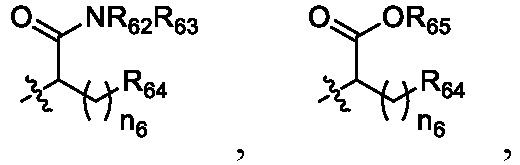

- R62 and R63 are each independently selected from: -H or

- where R14, R24, R34, R44, R54, R64 and R74 are each independently selected from: -H, guanidyl, - NR4R5, -SR4, 5- to 20-membered nitrogen-containing heteroaryl,

- R15-R17, R25-R27, R35-R37, R45-R47, R55-R57 and R65-R67 are each independently selected from: - H or C1-6 alkyl;
- R18, R28, R38, R48, R58 and R68 are each independently selected from: -H, C1-6 alkyl or halogen;
- each of n1, n2, n3, n4, n5, n6 and n7 is independently 0, 1, 2, 3, 4, 5, 6, 7, 8, 9 or 10;
- R77 is selected from: -H or C1-6 alkyl;
- R3 is selected from: -H or C1-4 alkyl;
- R4 and R5 are each independently selected from: -H, C1-16 alkyl, COOR8, -Fmoc or Ra-substituted C1-16 alkyl; or R4 and R5 together with N linked thereto may form a 5- to 20-membered heterocyclic ring, a 5- to 20-membered heteroaromatic ring, a 5- to 20-membered heterocyclic ring substituted by Rb or a 5- to 20-membered heteroaromatic ring substituted by Rb;
- Ra is selected from: 5- to 10-membered aryl, 5- to 10-membered heteroaryl, -NRa1Ra2 or -SRa3;
- Rb is selected from: C1-10 alkyl, -(CH2)pNRb1Rb2 or -SRb3, where p is 0, 1, 2, 3, 4, 5, 6, 7, 8, 9 or 10;
- each of Ra1, Ra2, Rb1 and Rb2 is independently -H, C1-10 alkyl or Rc-substituted C1-10 alkyl; or Ra1 and Ra2 together with a N atom linked thereto may form a 5- to 10-membered heterocyclic ring or a 5- to 10-membered heteroaromatic ring; or Rb1 and Rb2 together with a N atom linked thereto may form a 5- to 10-membered heterocyclic ring or a 5- to 10-membered heteroaromatic ring;
- each of Ra3 and Rb3 is independently C1-10 alkyl;
- Rc is selected from: -NRc1Rc2, guanidyl or 5- to 6-membered nitrogen-containing heteroaryl, where each of Rc1 and Rc2 is independently: -H, C1-4 alkyl; or Rc1 and Rc2 together with a N atom linked thereto may form a 5- to 10-membered heterocyclic ring or a 5- to 10-membered heteroaromatic ring;
- R6 is C1-4 alkyl; R7 is selected from: -H or C1-4 alkyl; R8 is -H, C1-6 alkyl or

- Y- is an anion.
- Provided is a preparation method of the above bakuchiol derivative and a pharmaceutically acceptable salt thereof. When R is a halogen, the preparation method includes the following step:

- reacting a compound shown in formula (I-1) with

- when R is NR4R5,


- reacting a compound shown in formula (I-1) with

- reacting the intermediate with R being Br with HNR4R5, to obtain a compound shown in formula (I) with R being NR4R5;
- reacting the compound shown in formula (I) with R being NR4R5 with haloalkyl, to obtain a compound shown in formula (I) with R being

- reacting a compound shown in formula (I) with R being NH2 with


- when R is selected from CONR1R2 and -COOR3, the preparation method includes the following steps:

- performing a condensation reaction on a compound shown in formula (I-1) and an alkyl bromoalkylate, to obtain a compound shown in formula (I) with R being -COOR3;
- hydrolyzing to obtain a compound shown in formula (I-2); and
- performing a condensation reaction on the compound shown in formula (I-2) and


- Provided is a pharmaceutical composition including at least one of the above bakuchiol derivative and a pharmaceutically acceptable salt thereof, and a pharmaceutically acceptable excipient.
- Provided is use of the above bakuchiol derivative and a pharmaceutically acceptable salt thereof or the above pharmaceutical composition in preparation of antibacterial agents.
- Provided is use of the above bakuchiol derivative and a pharmaceutically acceptable salt thereof or the above pharmaceutical composition in preparation of drugs for treating or preventing diseases caused by bacterial infection.
- Provided is use of the above bakuchiol derivative and a pharmaceutically acceptable salt thereof or the above pharmaceutical composition in preparation of drugs for treating or preventing infectious diseases.
- The compounds disclosed herein can be used in a method for treating or preventing bacterial infection, including administration of an effective amount of the above bakuchiol derivative and a pharmaceutically acceptable salt thereof or the above pharmaceutical composition.
- The disclosure designs and synthesizes a series of amphiphilic antibacterial compounds based on bakuchiol, which have comparatively excellent antibacterial activity. Specifically, the bakuchiol derivatives and pharmaceutically acceptable salts thereof exhibit excellent antibacterial activity on both Gram-positive bacteria (including methicillin-resistant Staphylococcus aureus) and Gram-negative bacteria, have good water solubility, show comparatively low cytotoxicity and hemolytic activity on mammalian cells, possess comparatively high membrane selectivity and comparatively favorable druggability, and could overcome the generation of drug resistance of bacteria in drug resistance research simulated in a laboratory.
-
-
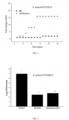
FIG. 1 is a graph showing drug resistance of S. aureus ATCC29213 to acompound 60 and norfloxacin; and -
FIG. 2 is a bar graph showing in vivo antibacterial efficacy of thecompound 60 in a mouse model of cornea infection caused by S. aureus ATCC29213. - In order to facilitate the understanding of the disclosure, the disclosure will be described more comprehensively below, and preferred embodiments of the disclosure will be given.
- Unless stated to the contrary, the following terms used in the description and claims have the following meanings.
- In the disclosure, the term "optionally substituted by one or more substituents" means being substituted by one or more substituents, or unsubstituted. Specifically, "optional" or "optional" means that an event or environment described subsequently may but does not have to occur, and this description includes occasions when the event or environment occurs or does not occur. For example, "C1-16 alkyl is optionally substituted by one or more hydroxyl groups" means that hydroxyl groups may but do not have to exist, and this description includes a situation in which C1-16 alkyl is substituted by hydroxyl groups and a situation in which C1-16 alkyl is not substituted by hydroxyl groups.
- In the disclosure, "may form a ring together with ..." indicates that this situation may or may not occur. For example, Ra1 and Ra2 together with a N atom linked thereto may form a 5- to 10-membered heterlcyclic ring, indicating that Ra1 and Ra2 together with a N atom linked thereto may form a 5- to 10-membered heterlcyclic ring and may not form a 5- to 10-membered heterlcyclic ring.
- "Alkyl" refers to a saturated aliphatic hydrocarbon group, including straight-chain and branched-chain groups. C1-16 alkyl refers to an alkyl group containing 1 to 16 carbon atoms. Non-limiting examples of alkyl in the disclosure include: methyl, ethyl, n-propyl, isopropyl, n-butyl, isobutyl, tert-butyl, sec-butyl, n-pentyl, 1,1-dimethylpropyl, 1,2-dimethylpropyl, 2,2-dimethylpropyl, 1-ethylpropyl, 2-methylbutyl, 3-methylbutyl, n-hexyl, 1-ethyl-2-methylpropyl, 1,1,2-trimethylpropyl, 1,1-dimethylbutyl, 1,2-dimethylbutyl, 2,2-dimethylbutyl, 1,3-dimethylbutyl, 2-ethylbutyl, 2-methylpentyl, 3-methylpentyl, 4-methylpentyl and 2,3-dimethylbutyl. C1-C4 alkyl refers to an alkyl group containing 1 to 4 carbon atoms. In an embodiment, C1-C4 alkyl is methyl, ethyl, n-propyl, isopropyl, n-butyl, isobutyl, tert-butyl and sec-butyl. Alkyl may be substituted or unsubstituted, and when it is substituted, a substituent may be substituted at any available point of attachment.
- The term "alkoxy" refers to a group having -O-alkyl, i.e. an alkyl group as defined above attached to a parent nucleus structure via an oxygen atom. Suitable examples of phrases containing this term include, but not limited to, methoxy (-O-CH3 or -OMe), ethoxy (-O-CH2CH3 or -OEt) and tert-butoxy (-O-C(CH3)3 or -OtBu).
- "Heterocyclyl" refers to a saturated or partially unsaturated monocyclic or polycyclic cyclic hydrocarbon substituent, i.e. a ring moiety in which one or more ring atoms are selected from heteroatoms such as nitrogen, oxygen or S(O)m (where m is an integer from 0 to 2), preferably nitrogen or oxygen heteroatoms, but excluding -O-O-, -O-S- or -S-S-; and the remaining ring atoms are carbon. 5- to 20-membered heterocyclyl refers to a ring containing 5 to 20 ring atoms, at least one of which is a heteroatom. Preferably, the heterocyclyl ring contains 5 to 6 ring atoms, of which 1 to 2 are heteroatoms. In an embodiment, heterocyclyl is dihydrofuranyl, tetrahydrofuranyl, pyrrolidinyl, piperidinyl, piperazinyl, morpholinyl, thiomorpholinyl or homopiperazinyl, etc.
- "Aryl" refers to an aromatic hydrocarbon group derived by removing a hydrogen atom on the basis of an aromatic ring compound, which may be monocyclic aryl, fused aryl or polycyclic aryl. For polycyclic ring species, at least one of them is an aromatic ring system. For example, 5- to 20-membered aryl refers to an aryl group having 5 to 20 ring atoms, and the aryl group is optionally further substituted. Suitable examples of "aryl" in the disclosure include, but not limited to, benzene, biphenyl, naphthalene, anthracene, phenanthrene, perylene, triphenylene and derivatives thereof. It could be understood that a plurality of aryl groups interrupted by short non-aromatic units (for example, < 10% of non-H atoms, such as C, N or O atoms), specifically such as acenaphthene, fluorene, or 9,9-diarylfluorene, triarylamine and diarylether systems, should also be included in the definition of aryl.
- "Heteroaryl" means that at least one carbon atom is replaced by a non-carbon atom on the basis of aryl, and the non-carbon atom may be a N atom, an O atom, a S atom, etc. For example, "5- to 20-membered heteroaryl" refers to a heteroaryl group having 5 to 20 ring atoms, and the heteroaryl group is optionally further substituted. Suitable examples of "heteroaryl" in the disclosure include, but not limited to, furan, benzofuran, thiophene, benzothiophene, pyrrole, pyrazole, triazole, imidazole, oxazole, oxadiazole, thiazole, tetrazole, indole, carbazole, pyrroloimidazole, pyrrolopyrrole, thienopyrrole, thienothiophene, furopyrrole, furofuran, thienofuran, benzisoxazole, benzisothiazole, benzimidazole, pyridine, pyrazine, pyridazine, pyrimidine, triazine, quinoline, isoquinoline, cinnoline, quinoxaline, phenanthridine, perimidine, quinazoline and quinazolinone.
- "Amino" refers to a derivative of ammonia, having structural characteristics of a formula -N(X)2, where each "X" is independently H, substituted or unsubstituted alkyl, substituted or unsubstituted cycloalkyl, substituted or unsubstituted heterocyclyl, etc. Non-limiting types of amino include -NH2, -N(alkyl)2, -NH(alkyl), -N(cycloalkyl)2, -NH(cycloalkyl), -N(heterocyclyl)2, -NH(heterocyclyl), - N(aryl)2, -NH(aryl), -N(alkyl)(aryl), -N(alkyl)(heterocyclyl), -N(cycloalkyl)(heterocyclyl), - N(aryl)(heteroaryl), -N(alkyl)(heteroaryl), etc.
- "Halogen" or "halo" refers to F, Cl, Br or I.
- Guanidyl refers to

- In the disclosure, when the configuration of chiral carbon atoms is not indicated, it should be understood as including any configuration acceptable in the art.
- The compounds of the disclosure can exist in non-solvated forms and solvated forms containing pharmaceutically acceptable solvents (such as water, ethanol, etc.), that is, both solvated and non-solvated forms are included.
- In the disclosure, a single bond interrupted by a wave "" represents an attachment position. For example,


- In the disclosure, a certain substitutable site may be substituted by one or more substituents, and when there are a plurality of substituents for this substitutable site, the plurality of substituents may be the same as or different from each other.
- A "pharmaceutical composition" denotes a mixture containing one or more of the compounds described herein or physiologically/pharmaceutically acceptable salts thereof or prodrugs and other chemical components, as well as additional components. such as physiologically/pharmaceutically acceptable carriers and excipients. The purpose of the pharmaceutical composition is to promote the administration to organisms, facilitate the absorption of active ingredients and further exert biological activity.
- The excipients contained in the composition may be one or more buffers, stabilizers, anti-sticking agents, surfactants, wetting agents, lubricants, emulsifiers, adhesives, suspending agents, disintegrating agents, fillers, adsorbents, coating, (intestinal or slow-release) preservatives, antioxidants, opaquing agents, glidants, processing aids, colorants, sweeteners, perfuming agents, flavoring agents and other known additives.
- "Pharmaceutically acceptable salt" refers to an organic or inorganic salt of a pharmaceutically acceptable compound.
- When the compound is acidic or includes bioelectronic isotopes that are sufficiently acidic, appropriate "pharmaceutically acceptable salts" refer to salts prepared from pharmaceutically acceptable nontoxic bases including inorganic bases and organic bases. The salts are derived from inorganic bases containing aluminum, ammonium, calcium, copper, iron, lithium, magnesium, manganese salts, manganese, potassium, sodium, zinc, etc. Specific examples include ammonium, calcium, magnesium, potassium and sodium salts. The salts are derived from pharmaceutically acceptable organic nontoxic bases. The organic nontoxic bases include salts of primary, secondary and tertiary amines, substituted amines including naturally occurring substituted amines, cyclic amines and basic ion exchange resins such as arginine, betaine, caffeine, choline, N,N'-dibenzylethylenediamine, ethylenediamine, 2-diethylaminoethanol, 2-dimethylaminoethanol, ethanolamine, ethylenediamine, N-ethylmorpholine, N-ethylhexahydropyridine, reduced glucosamine, glucosamine, histidine, hydrabamine, isopropylamine, lysine, meglumine, morpholine, piperazine, piperidine, polyamine resin, procaine, purine, theobromine, triethylamine, trimethylamine, tripropylamine, tromethamine and the like.
- When the compound is basic or includes bioelectronic isotopes that are sufficiently basic, salts may be prepared from pharmaceutically acceptable nontoxic acids including inorganic and organic acids. Such acids include acetic acid, benzenesulfonic acid, benzoic acid, camphorsulfonic acid, citric acid, ethanesulfonic acid, fumaric acid, gluconic acid, hydrobromic acid, hydrochloric acid, hydroxyethylsulfonic acid, lactic acid, maleic acid, malic acid, amygdalic acid, methanesulfonic acid, mucic acid, nitric acid, pamoic acid, pantothenic acid, phosphoric acid, sulfuric acid, succinic acid, tartaric acid, p-toluenesulfonic acid and the like. Specific examples include citric acid, hydrobromic acid, hydrochloric acid, phosphoric acid, sulfuric acid, maleic acid and tartaric acid. Other exemplary salts include, but not limited to, sulfate, citrate, acetate, oxalate, chloride, bromide, iodide, nitrate, sulfate, phosphate, superphosphate, isonicotinic acid, lactic acid, salicylate, acid citrate, tartrate, oleate, tannate, pantothenate, bitartrate, ascorbate, succinate, fumarate, maleate, gentisate, gluconate, glucuronate, saccharate, formate, benzoate, glutamate, methanesulfonate, ethanesulfonate, benzenesulfonate, p-toluenesulfonate and pamoate (for example, 1,1'-methylene-bis-(2-hydroxy-3-naphthoate)).
- In addition, pharmaceutical preparations containing the compounds may be tablets, capsules, oral liquids, pills, granules, powders, ointments, patches, suppositories, buccal tablets, eye drops, eye ointments, ear drops, sprays, aerosols, inhalants, injections, etc.
- The term "therapeutically effective amount" refers to the amount of an effective compound or pharmaceutical agent, which is the minimum amount necessary to improve, cure or treat one or more symptoms of a disease or disorder.
- In addition, the compound and the pharmaceutical composition of the disclosure may be administered alone or in combination with other drugs. For combined therapy with more than one active agent, when the active agent exists in divided doses of a preparation, the active agent may be administered individually or in combination. In addition, the administration of one drug may be performed before, at the same time of or after the administration of another drug. During the administration in combination with other drugs, the "effective amount" of a second drug will depend on the type of drug being used.
- The compound or the pharmaceutical composition of the disclosure may also be included in a kit.
- It should be noted that the agent whose specific source is not indicated in the disclosure is a conventional one available in the market.
- An embodiment of the disclosure provides a bakuchiol derivative and a pharmaceutically acceptable salt thereof, having a structure shown in formula (I):
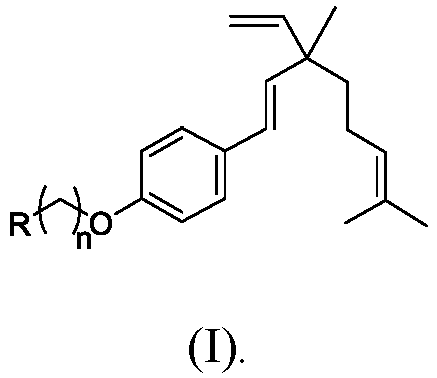
- Further, the bakuchiol derivative and a pharmaceutically acceptable salt thereof have a structure shown in formula (I'):

- where n is an integer from 1 to 16. In an embodiment, n is 1, 2, 3, 4, 5, 6, 7, 8, 9, 10, 11 or 12;
- R is selected from halogen, CONR1R2, -COOR3, NR4R5,

- R1 and R2 are each independently selected from: -H,


- R12 and R13 are each independently selected from: -H,


- R22 and R23 are each independently selected from: -H,
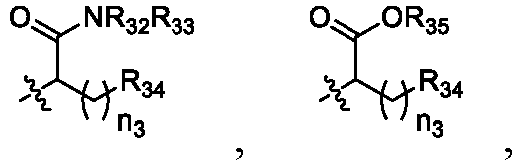

- R32 and R33 are each independently selected from: -H,


- R42 and R43 are each independently selected from: -H,

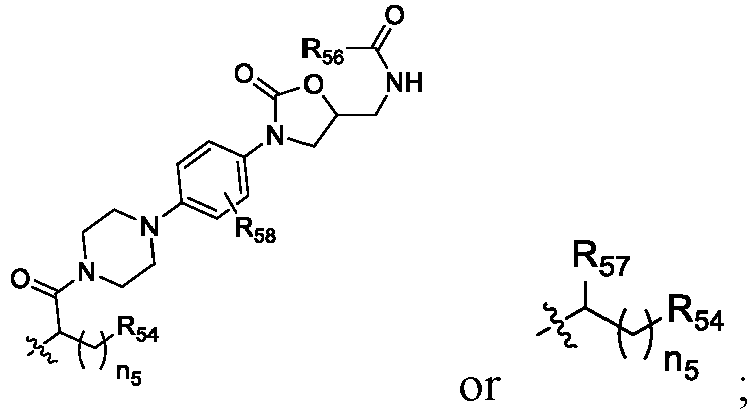
- R52 and R53 are each independently selected from: -H,

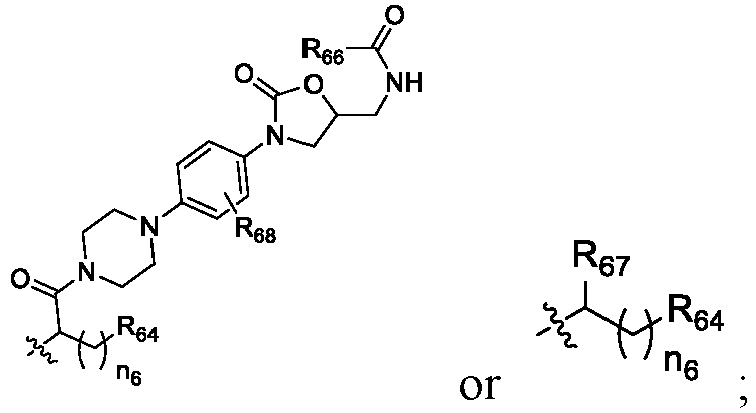
- R62 and R63 are each independently selected from: -H or

- where R14, R24, R34, R44, R54, R64 and R74 are each independently selected from: -H, guanidyl, - NR4R5, -SR4, 5- to 20-membered nitrogen-containing heteroaryl,

- R15-R17, R25-R27, R35-R37, R45-R47, R55-R57 and R65-R67 are each independently selected from: -H or C1-6 alkyl;
- R18, R28, R38, R48, R58 and R68 are each independently selected from: -H, C1-6 alkyl or halogen;
- each of n1, n2, n3, n4, n5, n6 and n7 is independently 0, 1, 2, 3, 4, 5, 6, 7, 8, 9 or 10;
- R77 is selected from: -H or C1-6 alkyl;
- R3 is selected from: -H or C1-4 alkyl;
- R4 and R5 are each independently selected from: -H, C1-16 alkyl, COOR8, -Fmoc or Ra-substituted C1-16 alkyl; or R4 and R5 together with N linked thereto may form a 5- to 20-membered heterocyclic ring, a 5- to 20-membered heteroaromatic ring, a 5- to 20-membered heterocyclic ring substituted by Rb or a 5- to 20-membered heteroaromatic ring substituted by Rb;
- Ra is selected from: 5- to 10-membered aryl, 5- to 10-membered heteroaryl, -NRa1Ra2 or -SRa3;
- Rb is selected from: C1-10 alkyl, -(CH2)pNRb1Rb2 or -SRb3, where p is 0, 1, 2, 3, 4, 5, 6, 7, 8, 9 or 10;
- each of Ra1, Ra2, Rb1 and Rb2 is independently -H, C1-10 alkyl or Rc-substituted C1-10 alkyl; or Ra1 and Ra2 together with a N atom linked thereto may form a 5- to 10-membered heterocyclic ring or a 5- to 10-membered heteroaromatic ring; or Rb1 and Rb2 together with a N atom linked thereto may form a 5- to 10-membered heterocyclic ring or a 5- to 10-membered heteroaromatic ring;
- each of Ra3 and Rb3 is independently C1-10 alkyl;
- Rc is selected from: -NRc1Rc2, guanidyl or 5- to 6-membered nitrogen-containing heteroaryl, where each of Rc1 and Rc2 is independently: -H, C1-4 alkyl; or Rc1 and Rc2 together with a N atom linked thereto may form a 5- to 10-membered heterocyclic ring or a 5- to 10-membered heteroaromatic ring;
- R6 is C1-4 alkyl; R7 is selected from: -H or C1-4 alkyl; R8 is -H, C1-6 alkyl or

- Y- is an anion. Furthermore, Y- is a halogen anion. Furthermore, Y- is an iodide ion.
- In the disclosure, bakuchiol used as a starting material is prepared into a series of amphiphilic cationic bakuchiol compounds. Bakuchiol contains a hydrophobic skeleton consisting of a benzene ring and an isopentenyl lipid chain, and has good antibacterial activity on gram-positive bacteria. By introducing different cationic groups into the molecular skeleton of bakuchiol, a series of cationic amphiphilic bakuchiol compounds may be synthesized as small molecular antibacterial peptide mimetics. Cationic groups introduced into bakuchiol derivatives may enhance the interaction between the bakuchiol derivatives and negatively charged bacterial cell membranes through electrostatic interaction, and its hydrophobic portions may be inserted into phospholipid bilayers of the bacterial cell membranes through hydrophobic interaction, thereby destroying the integrity of the bacterial cell membranes, leading to the leakage of cell contents and eventually leading to death of bacteria. the structure of the bakuchiol derivatives is systematically optimized to obtain a series of new antibacterial agents with high efficiency and low toxicity, which have membrane targeting or multi-targeting properties and could overcome the generation of drug resistance of bacteria.
- Further, R3 is selected from: H, methyl, ethyl or isopropyl.
- Further, R4 and R5 are each independently selected from: H, C1-12 alkyl, COOR8, -Fmoc and Ra-substituted C1-12 alkyl; and R4 and R5 together with N linked thereto may form a 5- to 15-membered heterocyclic ring, a 5- to 10-membered heteroaromatic ring, a 5- to 15-membered heterocyclic ring substituted by Rb and a 5- to 15-membered heteroaromatic ring substituted by Rb. Further, R4 and R5 are each independently selected from: H, C1-10 alkyl, COOR8, -Fmoc and Ra-substituted C1-10 alkyl; and R4 and R5 together with N linked thereto may form a 5- to 15-membered heterocyclic ring, a 5-to 10-membered heteroaromatic ring, a 5- to 15-membered heterocyclic ring substituted by Rb and a 5- to 15-membered heteroaromatic ring substituted by Rb.
- Further, heterocyclyl is selected from the following structural groups:

- Furthermore, heterocyclyl is selected from:

- Further, Ra is selected from pyridine, pyrimidine, triazine, -NRa1Ra2 or -SRa3. Furthermore, Ra is selected from pyridine, -NRa1Ra2 or -SRa3.
- Further, each of Ra1 and Ra2 is independently H, C1-4 alkyl or NRc1Rc2-substituted C1-4 alkyl. Further, Ra3 is C1-4 alkyl. Further, each of Rc1 and Rc2 is independently H or C1-4 alkyl. Further, Rb is selected from H, C1-6 alkyl or -(CH2)pNRb1Rb2, where p is 0, 1, 2, 3, 4, 5 or 6. Furthermore, each of Rb1 and Rb2 is independently H or C1-4 alkyl.
- Further, R is selected from the following groups:


- Further, R1 and R2 are not simultaneously H. Further, one of R1 and R2 is H, and another one is


- Further, the above bakuchiol derivative is selected from compounds of the following general formula:


- Further, the above bakuchiol derivative is selected from compounds of the following general formula:

- Further, in the above general formula (II) or formula (II'), X is OR15, and R14 is selected from: H, guanidyl, -NH2, -SCH3,

- Further, in the above general formula (II) or formula (II'), X is NR12R13; one of R12 and R13 is H, and another one is selected from


- In an embodiment, in the above general formula (II) or formula (II'), X is

- In an embodiment, in the above general formula (II) or formula (II'), X is NR12R13; and one of R12 and R13 is H, and another one is selected from

- In an embodiment, in the above general formula (II) or formula (II'), X is NR12R13; one of R12 and R13 is H, and another one is selected from


- In an embodiment, in the above general formula (II) or formula (II'), X is NR12R13; one of R12 and R13 is H, and another one is selected from


- Further, the above bakuchiol derivative is selected from compounds of the following general formulae:


(III) ; (IV) 

(V) (VI) 
(VII) 

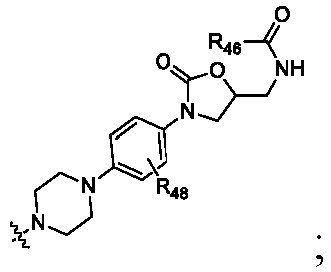
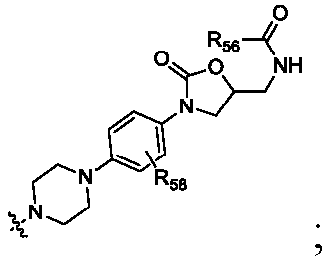
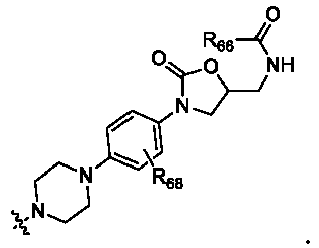
- Further, the above bakuchiol derivative is selected from compounds of the following general formulae:
Further, the above bakuchiol derivative is selected from the following compounds:
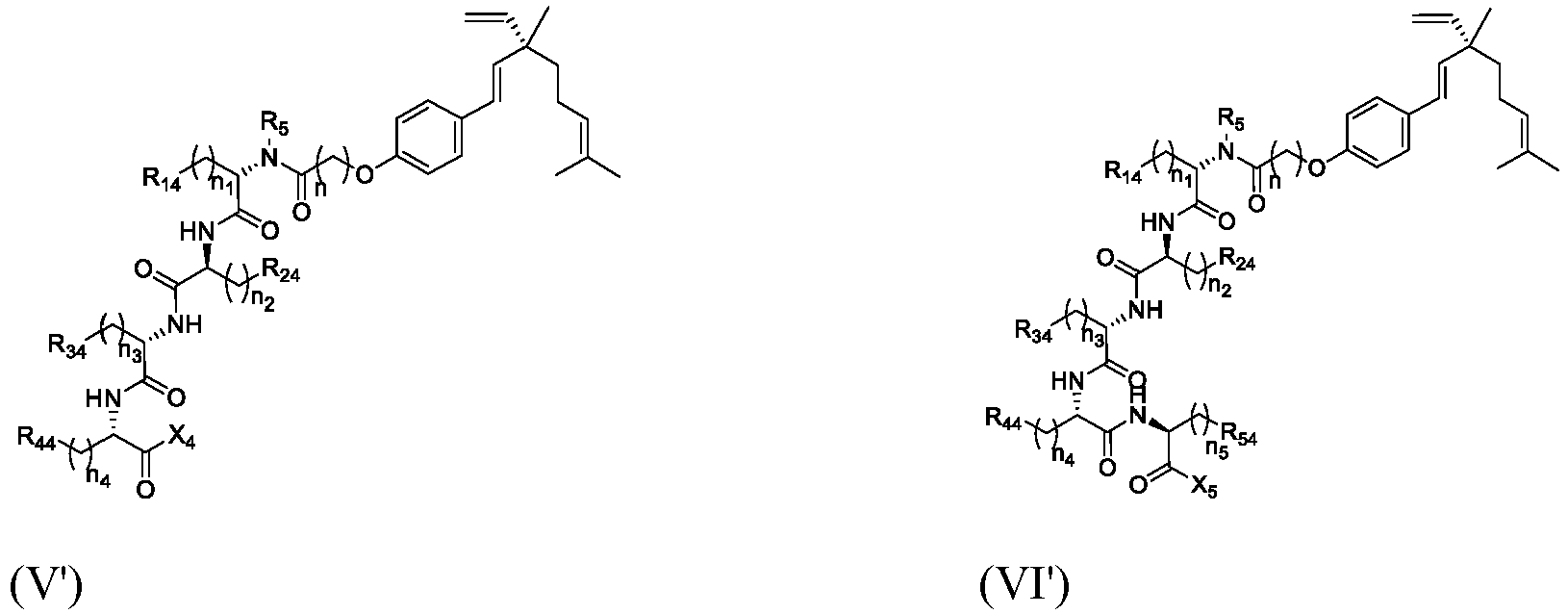


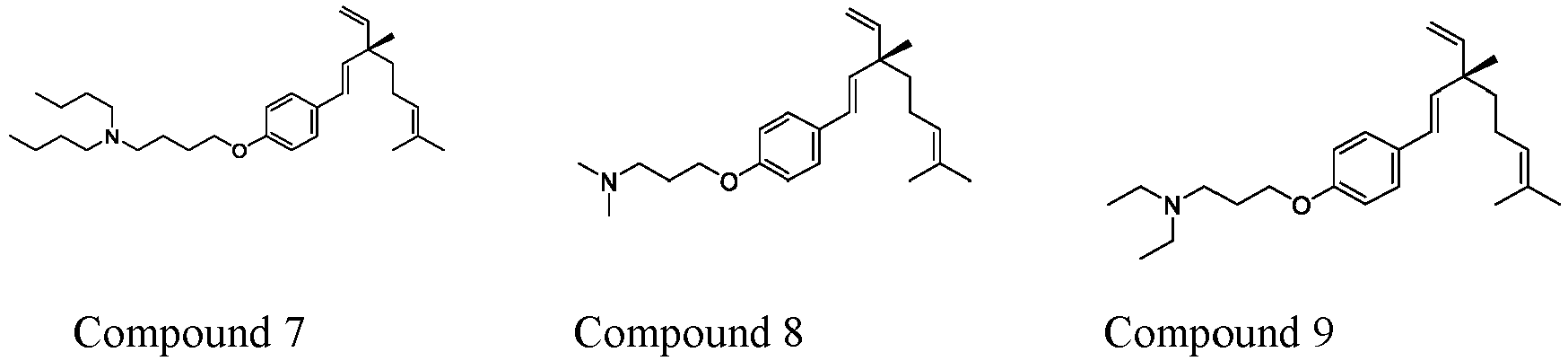


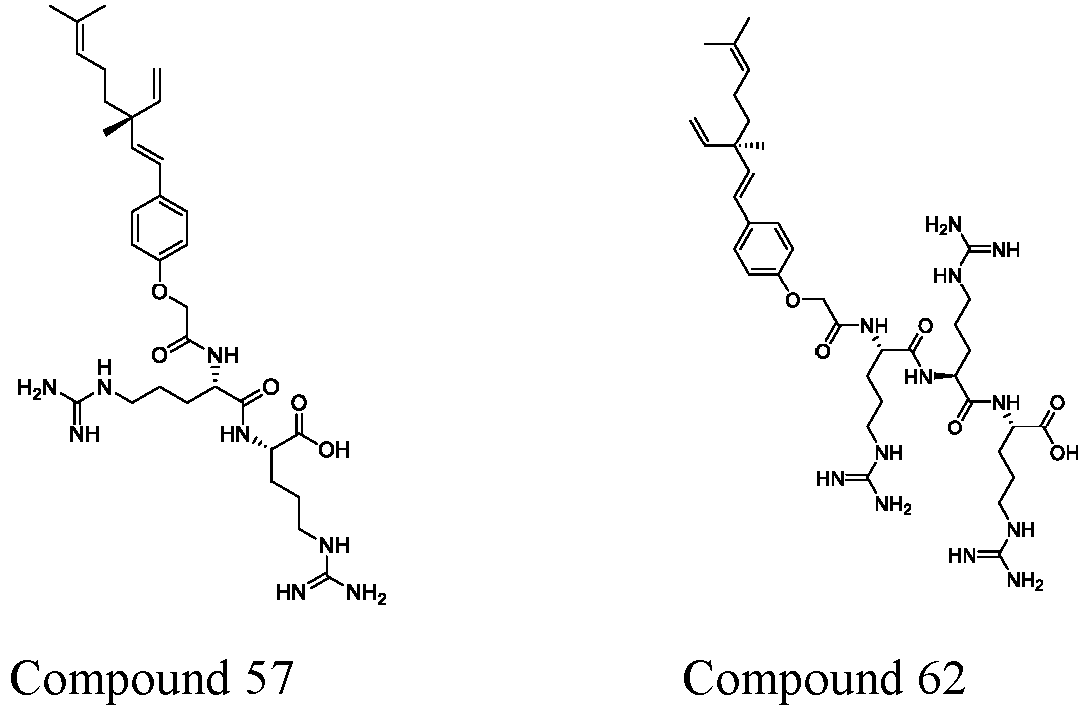
- An embodiment of the disclosure also provides a preparation method of the above bakuchiol derivative.
- (1) When R is a halogen, the preparation method includes the following step:


- (2) when R is NR4R5,


- S201: a compound shown in formula (I-1) is reacted with

- S202: the compound shown in formula (I) with R being Br is reacted with HNR4R5, to obtain a compound shown in formula (I) with R being NR4R5;
- S203: the compound shown in formula (I) with R being NR4R5 is reacted with haloalkyl, to obtain a compound shown in formula (I) with R being

- S204: a compound shown in formula (I) with R being NH2 is reacted with


- S201: a compound shown in formula (I-1) is reacted with
- (3) when R is selected from CONR1R2 and -COOR3, the preparation method includes the following steps:

- S301: a condensation reaction is performed on a compound shown in formula (I-1) and alkyl ester of bromoalkyl acid, to obtain a compound shown in formula (I) with R being -COOR3;
- further, alkyl ester of bromoalkyl acid is C1-6 alkyl bromoacetate;
- S302: a condensation reaction is performed on the compound shown in formula (I-2) and

- S303: a hydrolysis reaction is performed on a compound shown in formula (II-1), to obtain a compound shown in formula (II-2);

- S304: a condensation reaction is performed on the compound shown in formula (II-2) and


- S305: optionally, according to this cycle, a compound containing an ester group is hydrolyzed, and a condensation reaction with corresponding amine is then performed to obtain compounds shown in formula (IV), (V), (VI) or (VII). The structure and definition of each general formula are as mentioned above, and will not be repeated here.
- It could be understood that a step of ester hydrolysis is the same as S303, and a step of condensation reaction is the same as S304. The difference lies in that reaction substrates are different. For example, a compound shown in formula (III) with X2 being OR35 is used as the substrate to perform a hydrolysis reaction to obtain carboxylic acid, and the carboxylic acid based compound is then used as the substrate to perform a condensation reaction with a corresponding substance. The conditions of the hydrolysis and condensation reactions are not particularly limited, and the existing hydrolysis and condensation reaction conditions may be adopted.
- An embodiment of the disclosure also provides a pharmaceutical composition including the above bakuchiol derivative and a pharmaceutically acceptable salt thereof, and a pharmaceutically acceptable excipient.
- An embodiment of the disclosure provides use of the above bakuchiol derivative and a pharmaceutically acceptable salt thereof or the above pharmaceutical composition in preparation of antibacterial agents.
- An embodiment of the disclosure provides use of the above bakuchiol derivative and a pharmaceutically acceptable salt thereof or the above pharmaceutical composition in preparation of drugs for treating and preventing diseases caused by bacterial infection.
- An embodiment of the disclosure provides a method for treating or preventing bacterial infection, including administration of an effective amount of the above bakuchiol derivative and a pharmaceutically acceptable salt thereof or the above pharmaceutical composition.
- Bakuchiol (162 mg, 0.632 mmol) was dissolved in acetone (10 mL). Then, potassium carbonate (436.6 mg, 3.16 mmol) and 1,3-dibromopropane (480.8 µL, 4.74 mmol) were added. The mixture was stirred under reflux for 6 hours. After the reaction, the reaction mixture was diluted with ethyl acetate and extracted twice with water. The organic phase was concentrated under reduced pressure. The crude product was purified by silica gel column chromatography (petroleum ether/ethyl acetate, 8: 1, v/v), to afford compound 1 as a colorless clear oil (190.2 mg, 80%). 1H NMR (400 MHz, CDCl3) δ 7.29 (d, J = 8.7 Hz, 2H), 6.84 (d, J = 8.7 Hz, 2H), 6.27 (d, J = 16.3 Hz, 1H), 6.07 (d, J = 16.2 Hz, 1H), 5.89 (dd, J = 17.4, 10.8 Hz, 1H), 5.15-5.08 (m, 1H), 5.06-4.99 (m, 2H), 4.10 (t, J = 5.8 Hz, 2H), 3.60 (t, J = 6.5 Hz, 2H), 2.36-2.25 (m, 2H), 2.00-1.91 (m, 2H), 1.68 (s, 3H), 1.59 (s, 3H), 1.52-1.47 (m, 2H), 1.20 (s, 3H). 13C NMR (100 MHz, CDCl3) δ 157.91, 146.05, 136.06, 131.38, 131.07, 127.27 (2×CH), 126.57, 124.89, 114.64 (2×CH), 111.96, 65.45, 42.62, 41.38, 32.48, 30.11, 25.79, 23.44, 23.32, 17.73. HRMS (ESI+): calculated for C21H29BrO [M + H]+ 377.1480, found 377.1475.
- According to the method for synthesis of compound 1, bakuchiol (162 mg, 0.632 mmol), potassium carbonate (436.6 mg, 3.16 mmol) and 1,4-dibromobutane (565.3 µL, 4.74 mmol) used as starting materials were prepared into
compound 2 as a yellow oil (207.6 mg, 84%). 1H NMR (400 MHz, CDCl3) δ 7.28 (d, J = 8.7 Hz, 2H), 6.82 (d, J = 8.7 Hz, 2H), 6.26 (d, J = 16.3 Hz, 1H), 6.06 (d, J = 16.2 Hz, 1H), 5.88 (dd, J = 17.4, 10.8 Hz, 1H), 5.15-5.08 (m, 1H), 5.06-4.98 (m, 2H), 3.99 (t, J = 6.1 Hz, 2H), 3.49 (t, J = 6.6 Hz, 2H), 2.11-2.03 (m, 2H), 1.99-1.91 (m, 4H), 1.68 (s, 3H), 1.58 (s, 3H), 1.52-1.47 (m, 2H), 1.20 (s, 3H). 13C NMR (100 MHz, CDCl3) δ 158.09, 146.06, 135.94, 131.37, 130.87, 127.25 (2×CH), 126.59, 124.90, 114.56 (2×CH), 111.94, 66.94, 42.62, 41.38, 33.56, 29.55, 27.99, 25.78, 23.44, 23.31, 17.72. HRMS (ESI+): calculated for C22H31BrO [M +H]+ 391.1637 found 391.1632. - According to the method for synthesis of compound 1, bakuchiol (48.2 mg, 0.301 mmol), potassium carbonate (129.9 mg, 0.94 mmol) and 1,8-dibromooctane (259 µL, 1.41 mmol) used as starting materials were prepared into
compound 3 as a white oil (40.5 mg, 48%). 1HNMR (400 MHz, CDCl3) δ 7.28 (d, J = 8.8 Hz, 2H), 6.83 (d, J = 8.7 Hz, 2H), 6.26 (d, J = 16.3 Hz, 1H), 6.06 (d, J = 16.2 Hz, 1H), 5.89 (dd, J = 17.4, 10.8 Hz, 1H), 5.11 (t, J = 7.1 Hz, 1H), 5.06-4.98 (m, 2H), 3.95 (t, J = 6.5 Hz, 2H), 3.41 (t, J = 6.8 Hz, 2H), 2.00-1.91 (m, 2H), 1.90-1.73 (m, 4H), 1.68 (s, 3H), 1.59 (s, 3H), 1.52-1.42 (m, 6H), 1.38-1.34 (m, 4H), 1.20 (s, 3H). 13C NMR (100 MHz, CDCl3) δ 158.34, 146.10, 135.73, 131.39, 130.59, 127.21 (2×CH), 126.65, 124.90, 114.58 (2×CH), 111.93, 68.02, 42.62, 41.39, 34.13, 32.87, 29.32, 29.28, 28.78, 28.19, 26.04, 25.81, 23.44, 23.32, 17.74. HRMS (ESI+): calculated for C26H39BrO [M + H]+ 447.2263, found 447.2258. - According to the method for synthesis of compound 1, bakuchiol (49.5 mg, 0.193 mmol), potassium carbonate (133.4 mg, 0.965 mmol) and 1,10-dibromodecane (325 µL, 1.45 mmol) used as starting materials were prepared into compound 4 as a yellow oil (46.9 mg, 52%). 1H NMR (400 MHz, CDCl3) δ 7.27 (d, J = 8.6 Hz, 2H), 6.82 (d, J = 8.8 Hz, 2H), 6.25 (d, J = 16.3 Hz, 1H), 6.05 (d, J = 16.2 Hz, 1H), 5.87 (dd, J = 17.4, 10.8 Hz, 1H), 5.13-5.07 (m, 1H), 5.04-4.97 (m, 2H), 3.93 (t, J = 6.6 Hz, 2H), 3.40 (t, J = 6.9 Hz, 2H), 1.99-1.89 (m, 2H), 1.89-1.70 (m, 4H), 1.67 (s, 3H), 1.57 (s, 3H), 1.52-1.39 (m, 6H), 1.37-1.29 (m, 8H), 1.19 (s, 3H). 13C NMR (100 MHz, CDCl3) δ 158.37, 146.10, 135.71, 131.39, 130.56, 127.21 (2×CH), 126.66, 124.91, 114.58 (2×CH), 111.93, 68.08, 42.62, 41.39, 34.18, 32.91, 29.54, 29.45, 29.43, 29.35, 28.84, 28.25, 26.11, 25.81, 23.44, 23.32, 17.75. HRMS (ESI+): calculated for C28H43BrO [M + H]+ 475.2576, found 475.3253.
- Compound 2 (35 mg, 0.089 mmol) was dissolved in an anhydrous DMF (4 mL) solution. Then, dimethylamine (1 mL) was added. The mixture was stirred at 50°C for 24 hours. After the reaction, the reaction mixture was diluted with ethyl acetate and extracted twice with water. The organic phase was concentrated under reduced pressure. The crude product was purified by RP-HPLC, to afford
compound 5 as a yellow oil (23 mg, 74%). 1H NMR (400 MHz, CDCl3) δ 7.27 (d, J = 9.9 Hz, 2H), 6.82 (d, J = 8.7 Hz, 2H), 6.26 (d, J = 16.3 Hz, 1H), 6.05 (d, J = 16.2 Hz, 1H), 5.88 (dd, J = 17.4, 10.8 Hz, 1H), 5.14-5.07 (m, 1H), 5.05-4.98 (m, 2H), 3.97 (t, J = 6.4 Hz, 2H), 2.36-2.30 (m, 2H), 2.23 (s, 6H), 1.99-1.92 (m, 2H), 1.85-1.76 (m, 4H), 1.67 (s, 3H), 1.58 (s, 3H), 1.52-1.47 (m, 2H), 1.19 (s, 3H). 13C NMR (100 MHz, CDCl3) δ 158.30, 146.10, 135.76, 131.36, 130.65, 127.20 (2×CH), 126.65, 124.91, 114.61, 111.91, 100.00, 67.83, 59.47, 45.50 (2×CH3), 42.60, 41.39, 27.25, 25.78, 24.29, 23.45, 23.31, 17.72.HRMS (ESI+): calculated for C24H37NO [M + H]+ 356.2953, found 356.2947. - According to the method for synthesis of
compound 5, compound 2 (35 mg, 0.089 mmol) and diethylamine (1 mL) used as starting materials were prepared intocompound 6 as a yellow oil (22.3 mg, 66%). 1H NMR (400 MHz, CDCl3) δ 7.27 (d, J = 9.9 Hz, 2H), 6.82 (d, J = 8.7 Hz, 2H), 6.26 (d, J = 16.3 Hz, 1H), 6.05 (d, J = 16.2 Hz, 1H), 5.88 (dd, J = 17.4, 10.8 Hz, 1H), 5.14-5.08 (m, 1H), 5.05-4.97 (m, 2H), 3.97 (t, J = 6.4 Hz, 2H), 2.61-2.46 (m, 6H), 2.00-1.92 (m, 2H), 1.82-1.74 (m, 4H), 1.67 (s, 3H), 1.58 (s, 3H), 1.52-1.46 (m, 2H), 1.19 (s, 3H), 1.03 (t, J = 7.2 Hz, 6H). 13C NMR (100 MHz, CDCl3) δ 158.27, 146.09, 135.79, 131.36, 130.68, 127.21 (2×CH), 126.64, 124.90, 114.60 (2×CH), 111.91, 67.85, 52.48, 46.85 (2×CH2), 42.60, 41.39, 27.40, 25.78 (2×CH2), 23.45, 23.31, 17.72, 11.46 (2×CH3). HRMS (ESI+): calculated for C26H41NO [M + H]+ 384.3266, found 384.3260. - According to the method for synthesis of compound 9, compound 2 (62.1 mg, 0.159 mmol) and dibutylamine (1 mL) used as starting materials were prepared into compound 7 as a yellow oil (59.1 mg, 88%). 1H NMR (400 MHz, CDCl3) δ 7.28 (d, J = 8.7 Hz, 2H), 6.83 (d, J = 8.7 Hz, 2H), 6.26 (d, J = 16.3 Hz, 1H), 6.05 (d, J = 16.2 Hz, 1H), 5.88 (dd, J = 17.4, 10.8 Hz, 1H), 5.14-5.07 (m, 1H), 5.06-4.97 (m, 2H), 3.96 (t, J = 6.5 Hz, 2H), 2.51-2.44 (m, 2H), 2.43-2.37 (m, 4H), 1.99-1.91 (m, 2H), 1.83-1.69 (m, 4H), 1.67 (s, 3H), 1.58 (s, 3H), 1.52-1.46 (m, 2H), 1.45-1.37 (m, 4H), 1.35-1.28 (m, 4H), 1.19 (s, 3H), 0.91 (t, J = 7.3 Hz, 6H). 13C NMR (100 MHz, ) δ 158.31, 146.10, 135.76, 131.36, 130.64, 127.20 (2×CH), 126.66, 124.91, 114.61 (2×CH), 111.91, 67.93, 53.81 (2×CH2), 53.76, 42.60, 41.39, 29.79, 29.03, 27.36, 25.78 (2×CH2), 23.45, 23.31, 20.82 (2×CH2), 17.72, 14.16 (2×CH3). HRMS (ESI+): calculated for C30H49NO [M + H]+ 440.3892, found 440.3892.
- According to the method for synthesis of
compound 5, compound 1 (49 mg, 0.130 mmol) and diethylamine (1 mL) used as starting materials were prepared intocompound 8. The crude product was purified by silica gel column chromatography (ethyl acetate/ethanol, 1: 1, v/v) as a yellow oil (38.6 mg, 87%). 1H NMR (400 MHz, CDCl3) δ 7.25 (d, J = 8.7 Hz, 2H), 6.81 (d, J = 8.6 Hz, 2H), 6.23 (d, J = 16.2 Hz, 1H), 6.03 (d, J = 16.2 Hz, 1H), 5.86 (dd, J = 17.4, 10.8 Hz, 1H), 5.08 (t, J = 6.6 Hz, 1H), 5.05-4.95 (m, 2H), 3.98 (t, J = 6.4 Hz, 2H), 2.47-2.41 (m, 2H), 2.24 (s, 6H), 1.98-1.89 (m, 4H), 1.65 (s, 3H), 1.56 (s, 3H), 1.50-1.43 (m, 2H), 1.17 (s, 3H). 13C NMR (100 MHz, CDCl3) δ 158.24, 146.09, 135.80, 131.36, 130.71, 127.21 (2×CH), 126.64, 124.91, 114.60 (2×CH), 111.91, 66.32, 56.49, 45.53 (2×CH3), 42.60, 41.39, 27.57, 25.78, 23.44, 23.31, 17.72. HRMS (ESI+): calculated for C23H35NO [M + H]+ 342.2797, found 342.2791. - According to the method for synthesis of
compound 5, compound 1 (59.6 mg, 0.158 mmol) and diethylamine (1 mL) used as starting materials were prepared into compound 9 as a yellow oil (48.9 mg, 91%). 1H NMR (400 MHz, CDCl3) δ 7.28 (d, J = 8.7 Hz, 2H), 6.83 (d, J = 8.7 Hz, 2H), 6.26 (d, J = 16.3 Hz, 1H), 6.06 (d, J = 16.2 Hz, 1H), 5.88 (dd, J = 17.4, 10.8 Hz, 1H), 5.15-5.08 (m, 1H), 5.06-4.97 (m, 2H), 4.00 (t, J = 6.3 Hz, 2H), 2.64-2.51 (m, 6H), 2.00-1.88 (m, 4H), 1.67 (s, 3H), 1.58 (s, 3H), 1.52-1.46 (m, 2H), 1.20 (s, 3H), 1.04 (t, J = 7.1 Hz, 6H). 13C NMR (100 MHz, CDCl3) δ 158.33, 146.10, 135.74, 131.35, 130.63, 127.19 (2×CH), 126.67, 124.91, 114.61 (2×CH), 111.91, 66.49, 49.46, 47.09 (2×CH2), 42.60, 41.39, 27.06, 25.78, 23.45, 23.32, 17.72, 11.84 (2×CH3). HRMS (ESI+): calculated for C25H39NO [M + H]+ 370.3110, found 370.3103. - According to the method for synthesis of
compound 5, compound 1 (59.5 mg, 0.158 mmol) and dibutylamine (1 mL) used as starting materials were prepared intocompound 10 as a colorless clear oil (56 mg, 86%). 1H NMR (400 MHz, CDCl3) δ 7.28 (d, J = 8.7 Hz, 2H), 6.83 (d, J = 8.7 Hz, 2H), 6.26 (d, J = 16.3 Hz, 1H), 6.06 (d, J = 16.2 Hz, 1H), 5.89 (dd, J = 17.4, 10.8 Hz, 1H), 5.15-5.08 (m, 1H), 5.06-4.98 (m, 2H), 4.00 (t, J = 6.4 Hz, 2H), 2.61-2.54 (m, 2H), 2.44-2.38 (m, 4H), 1.97-1.87 (m, 4H), 1.68 (s, 3H), 1.59 (s, 3H), 1.52-1.46 (m, 2H), 1.44-1.38 (m, 4H), 1.33-1.28 (m, 4H), 1.20 (s, 3H), 0.90 (t, J = 7.3 Hz, 6H). 13C NMR (100 MHz, CDCl3) δ 158.36, 146.11, 135.70, 131.35, 130.59, 127.18 (2×CH), 126.69, 124.92, 114.61 (2×CH), 111.90, 66.45, 54.06 (2×CH2), 50.63, 42.60, 41.40, 29.38, 27.17, 25.78 (2×CH2), 23.46, 23.32, 20.81 (2×CH2), 17.72, 14.18 (2×CH3). HRMS (ESI+): calculated for C29H47NO [M + H]+ 426.3736, found 426.3728. - According to the method for synthesis of
compound 5, compound 3 (40.5 mg, 0.091 mmol) and diethylamine (1 mL) used as starting materials were prepared into compound 11 as a yellow oil (32.3 mg, 81%). 1H NMR (400 MHz, CD3OD) δ 7.27 (d, J = 8.7 Hz, 2H), 6.82 (d, J = 8.7 Hz, 2H), 6.26 (d, J = 16.3 Hz, 1H), 6.07 (d, J = 16.3 Hz, 1H), 5.90 (dd, J = 17.4, 10.8 Hz, 1H), 5.15-5.08 (m, 1H), 5.05-4.98 (m, 2H), 3.95 (t, J = 6.4 Hz, 2H), 2.89 (q, J = 7.3 Hz, 4H), 2.81-2.75 (m, 2H), 2.00-1.92 (m, 2H), 1.81-1.72 (m, 2H), 1.66 (s, 3H), 1.62-1.55 (m, 5H), 1.51-1.45 (m, 4H), 1.42-1.34 (m, 6H), 1.20-1.15 (m, 9H). 13C NMR (100 MHz, CD3OD) δ 159.78, 147.33, 136.40, 131.99, 131.82, 128.15 (2×CH), 128.01, 125.94, 115.50 (2×CH), 112.28, 68.86, 53.35, 47.95 (2×CH2), 43.54, 42.57, 30.36 (2×CH2), 30.30, 28.09, 27.07, 25.90 (2×CH2), 24.36, 23.86, 17.69, 10.06 (2×CH3). HRMS (ESI+): calculated for C30H49NO [M + H]+ 440.3892, found 440.3875. - According to the method for synthesis of
compound 5, compound 4 (46.9 mg, 0.099 mmol) and diethylamine (1 mL) used as starting materials were prepared intocompound 12 as an orange oil (34.8 mg, 76%). 1H NMR (400 MHz, CD3OD) δ 7.26 (d, J = 8.7 Hz, 2H), 6.82 (d, J = 8.7 Hz, 2H), 6.26 (d, J = 16.3 Hz, 1H), 6.07 (d, J = 16.3 Hz, 1H), 5.90 (dd, J = 17.4, 10.8 Hz, 1H), 5.15-5.08 (m, 1H), 5.06-4.97 (m, 2H), 3.94 (t, J = 6.4 Hz, 2H), 3.18 (q, J = 7.3 Hz, 4H), 3.11-3.02 (m, 2H), 2.02-1.91 (m, 2H), 1.82-1.60 (m, 7H), 1.57 (s, 3H), 1.52-1.42 (m, 4H), 1.42-1.33 (m, 10H), 1.29 (t, J = 7.3 Hz, 6H), 1.19 (s, 3H). 13C NMR (100 MHz, CD3OD) δ 159.78, 147.31, 136.39, 131.98, 131.79, 128.15 (2×CH), 128.00, 125.94, 115.49 (2×CH), 112.29, 68.91, 52.95, 48.15 (2×CH2), 43.54, 42.56, 30.55, 30.44 (2×CH2), 30.41, 30.20, 27.64, 27.15, 25.92, 24.91, 24.35, 23.85, 17.70, 9.08 (2×CH3). HRMS (ESI+): calculated for C32H53NO [M + H]+ 468.4205, found 468.4199. - According to the method for synthesis of compound 24, compound 2 (69.3 mg, 0.177 mmol) and ammonia water (3 mL) used as starting materials were prepared into compound 13 as a yellow foam (44.8 mg, 77%). 1H NMR (400 MHz, CD3OD) δ 7.28 (d, J = 8.7 Hz, 2H), 6.88-6.83 (m, 2H), 6.26 (d, J = 16.3 Hz, 1H), 6.08 (d, J = 16.3 Hz, 1H), 5.90 (dd, J = 17.5, 10.8 Hz, 1H), 5.14-5.09 (m, 1H), 5.05-4.99 (m, 2H), 4.03 (t, J = 5.3 Hz, 2H), 3.13-3.06 (m, 2H), 2.00-1.84 (m, 6H), 1.66 (s, 3H), 1.57 (s, 3H), 1.50-1.45 (m, 2H), 1.19 (s, 3H). 13C NMR (100 MHz, CD3OD) δ 159.44, 147.28, 136.63, 132.14, 131.98, 128.18 (2×CH), 127.92, 125.93, 115.51 (2×CH), 112.29, 68.17, 43.54, 42.54, 40.52, 27.29, 25.89, 25.69, 24.35, 23.86, 17.68. HRMS (ESI+): calculated for C22H33NO [M+H]+ 328.2640, found 328.2632.
- According to the method for synthesis of
compound 5, compound 2 (38.9 mg, 0.099 mmol) and ethylamine (1 mL) used as starting materials were prepared into compound 14 as a yellow oil (30.1 mg, 85%). 1H NMR (400 MHz, CD3OD) δ 7.28 (d, J = 8.7 Hz, 2H), 6.85 (d, J = 8.7 Hz, 2H), 6.26 (d, J = 16.3 Hz, 1H), 6.08 (d, J = 16.3 Hz, 1H), 5.90 (dd, J = 17.5, 10.8 Hz, 1H), 5.12 (t, J = 7.2 Hz, 1H), 5.05-4.97 (m, 2H), 4.02 (t, J = 5.3 Hz, 2H), 3.11-2.98 (m, 4H), 2.00-1.92 (m, 2H), 1.91-1.81 (m, 4H), 1.66 (s, 3H), 1.57 (s, 3H), 1.51-1.44 (m, 2H), 1.31 (t, J = 7.3 Hz, 3H), 1.19 (s, 3H). 13C NMR (100 MHz, CD3OD) δ 159.44, 147.31, 136.69, 132.20, 132.00, 128.21 (2×CH), 127.93, 125.95, 115.54 (2×CH), 112.31, 68.12, 48.22, 43.94, 43.56, 42.56, 27.38, 25.90, 24.44, 24.36, 23.87, 17.69, 11.56. HRMS (ESI+): calculated for C24H37NO [M + H]+ 356.2953, found 356.2949. - According to the method for synthesis of
compound 5, compound 2 (43 mg, 0.11 mmol) and n-butylamine (1 mL) used as starting materials were prepared intocompound 15 as a yellow oil (35.5 mg, 84%). 1H NMR (400 MHz, CD3OD) δ 7.28 (d, J = 7.3 Hz, 2H), 6.85 (d, J = 8.4 Hz, 2H), 6.26 (d, J = 15.8 Hz, 1H), 6.12-6.03 (m, 1H), 5.96-5.84 (m, 1H), 5.11 (t, J = 7.8 Hz, 1H), 5.05-4.98 (m, 2H), 4.06-3.99 (m, 2H), 3.08-3.00 (m, 2H), 3.00-2.93 (m, 2H), 2.00-1.91 (m, 2H), 1.90-1.80 (m, 4H), 1.70-1.61 (m, 5H), 1.57 (s, 3H), 1.50-1.37 (m, 4H), 1.20-1.17 (m, 3H), 1.01-0.95 (m, 3H). 13C NMR (100 MHz, CD3OD) δ 159.41, 147.28, 136.67, 132.16, 132.00, 128.19 (2×CH), 127.90, 125.92, 115.54 (2×CH), 112.30, 68.14, 48.74 (2×CH2), 43.53, 42.53, 29.44, 27.41, 25.89, 24.48, 24.33, 23.85, 20.84, 17.68, 13.92. HRMS (ESI+): calculated for C26H41NO [M + H]+ 384.3266, found 384.3261. - According to the method for synthesis of
compound 5, compound 2 (65.8 mg, 0.168 mmol) and n-hexylamine (1 mL) used as starting materials were prepared into compound 16 as a yellow oil (46.7 mg, 68%). 1H NMR (400 MHz, CDCl3) δ 7.24 (d, J = 8.1 Hz, 2H), 6.76 (d, J = 8.7 Hz, 2H), 6.23 (d, J = 16.3 Hz, 1H), 6.03 (d, J = 16.2 Hz, 1H), 5.86 (dd, J = 17.4, 10.8 Hz, 1H), 5.13-5.06 (m, 1H), 5.04-4.96 (m, 2H), 3.89 (t, J = 5.9 Hz, 2H), 2.98-2.80 (m, 4H), 1.98-1.86 (m, 4H), 1.82-1.65 (m, 7H), 1.56 (s, 3H), 1.50-1.44 (m, 2H), 1.31-1.21 (m, 6H), 1.17 (s, 3H), 0.84 (t, J = 6.8 Hz, 3H). 13C NMR (100 MHz, CDCl3) δ 168.26, 157.88, 146.03, 135.96, 131.36, 130.96, 127.25, 126.56, 124.88, 114.54 (2×CH), 111.95, 67.04, 47.65, 47.28, 42.60, 41.37, 31.28, 26.58, 26.51, 25.99, 25.78, 23.41, 23.30, 23.10, 22.50, 17.71, 14.00. HRMS (ESI+): calculated for C28H45NO [M+H]+ 412.3579, found 412.3573. - According to the method for synthesis of
compound 5, compound 2 (34.7 mg, 0.089 mmol) and n-octylamine (1 mL) used as starting materials were prepared into compound 17 as a yellow oil (28.4 mg, 72%). 1H NMR (400 MHz, CD3OD) δ 7.25 (d, J = 8.8 Hz, 2H), 6.82 (d, J = 8.8 Hz, 2H), 6.24 (d, J = 16.3 Hz, 1H), 6.05 (d, J = 16.3 Hz, 1H), 5.88 (dd, J = 17.4, 10.8 Hz, 1H), 5.12-5.06 (m, 1H), 5.04-4.95 (m, 2H), 4.07-3.92 (m, 2H), 3.08-2.76 (m, 4H), 1.99-1.78 (m, 6H), 1.63 (s, 5H), 1.55 (s, 3H), 1.48-1.42 (m, 2H), 1.36-1.26 (m, 10H), 1.17 (s, 3H), 0.88 (t, J = 6.9 Hz, 3H). 13C NMR (100 MHz, CD3OD) δ 159.44, 147.30, 136.67, 132.18, 131.99, 128.20, 127.93, 125.94, 115.54 (2×CH), 112.29, 101.33, 68.17, 48.55, 48.54, 43.55, 42.55, 32.90, 30.24, 30.20, 30.19, 27.68, 27.45, 25.88, 24.3 5, 23.87, 23.68, 23.67, 17.67, 14.41. HRMS (ESI+): calculated for C30H49NO [M + H]+ 440.3892, found 440.3886. - According to the method for synthesis of
compound 5, compound 2 (66.7 mg, 0.170 mmol) and n-decylamine (1 mL) used as starting materials were prepared into compound 18 as a yellow oil (64.8 mg, 81%). 1H NMR (400 MHz, CDCl3) δ 7.26-7.23 (m, 2H), 6.77 (d, J = 8.8 Hz, 2H), 6.24 (d, J = 16.2 Hz, 1H), 6.04 (d, J = 16.2 Hz, 1H), 5.87 (dd, J = 17.4, 10.7 Hz, 1H), 5.13-5.07 (m, 1H), 5.04-4.97 (m, 2H), 3.90 (t, J = 5.9 Hz, 2H), 2.99-2.90 (m, 2H), 2.89-2.81 (m, 2H), 1.99-1.85 (m, 4H), 1.84-1.60 (m, 7H), 1.57 (s, 3H), 1.51-1.45 (m, 2H), 1.29-1.18 (m, 17H), 0.86 (t, J = 6.9 Hz, 3H). 13C NMR (100 MHz, CDCl3) δ 167.98, 157.87, 146.01, 135.97, 131.35, 130.96, 127.25, 126.56, 124.88, 114.54 (2×CH), 111.95, 67.04, 47.68, 47.32, 42.60, 41.36, 31.95, 29.56, 29.52, 29.35, 29.18, 26.87, 26.57, 26.05, 25.78, 23.41, 23.30, 23.11, 22.74, 17.71, 14.19. HRMS (ESI+): calculated for C32H53NO [M+H]+ 468.4205, found 468.4197. - According to the method for synthesis of
compound 8, compound 2 (47.3 mg, 0.121 mmol) and thiomorpholine (1 mL) used as starting materials were prepared into compound 19 as a yellow oil (39.5 mg, 81%). 1H NMR (400 MHz, CDCl3) δ 7.28 (d, J = 8.7 Hz, 2H), 6.82 (d, J = 8.7 Hz, 2H), 6.26 (d, J = 16.3 Hz, 1H), 6.06 (d, J = 16.2 Hz, 1H), 5.88 (dd, J = 17.4, 10.8 Hz, 1H), 5.15-5.07 (m, 1H), 5.06-4.96 (m, 2H), 3.96 (t, J = 6.3 Hz, 2H), 2.75-2.61 (m, 8H), 2.46-2.38 (m, 2H), 2.00-1.91 (m, 2H), 1.81-1.73 (m, 2H), 1.70-1.62 (m, 5H), 1.58 (s, 3H), 1.52-1.45 (m, 2H), 1.20 (s, 3H). 13C NMR (100 MHz, CDCl3) δ 158.24, 146.08, 135.82, 131.36, 130.70, 127.22 (2×CH), 126.63, 124.90, 114.58 (2×CH), 111.93, 67.77, 58.99, 55.08 (2×CH2), 42.61, 41.39, 28.07 (2×CH2), 27.31, 25.79, 23.45, 23.32, 23.13, 17.73. HRMS (ESI+): calculated for C26H39NOS [M+H]+ 414.2831, found 414.2822. - According to the method for synthesis of
compound 5, compound 2 (47.3 mg, 0.121 mmol) and tetrahydropyrrole (1 mL) used as starting materials were prepared intocompound 20 as a colorless clear oil (40.5 mg, 88%). 1H NMR (400 MHz, CDCl3) δ 7.27 (d, J = 8.7 Hz, 2H), 6.84 (d, J = 8.7 Hz, 2H), 6.26 (d, J = 16.3 Hz, 1H), 6.07 (d, J = 16.3 Hz, 1H), 5.90 (dd, J = 17.4, 10.8 Hz, 1H), 5.15-5.07 (m, 1H), 5.05-4.97 (m, 2H), 4.00 (t, J = 5.6 Hz, 2H), 2.88 (dt, J = 15.1, 6.7 Hz, 6H), 1.99-1.88 (m, 6H), 1.83-1.76 (m, 4H), 1.66 (s, 3H), 1.57 (s, 3H), 1.50-1.44 (m, 2H), 1.19 (s, 3H). 13C NMR (100 MHz, CDCl3) δ 159.55, 147.30, 136.57, 132.04, 131.97, 128.18 (2×CH), 127.96, 125.95, 115.55 (2×CH), 112.30, 68.38, 56.69, 54.98 (2×CH2), 43.54, 42.55, 28.00, 25.90, 25.32, 24.35, 24.06 (2×CH2), 23.88, 17.70. HRMS (ESI+): calculated for C26H39NO [M + H]+ 382.3110, found 382.3101. - According to the method for synthesis of
compound 5, compound 2 (66.3 mg, 0.169 mmol) and 1-methylpiperazine (1 mL) used as starting materials were prepared into compound 21 as a brown oil (48.7 mg, 71%). 1H NMR (400 MHz, CDCl3) δ 7.28-7.25 (m, 2H), 6.79 (d, J = 8.7 Hz, 2H), 6.24 (d, J = 16.3 Hz, 1H), 6.04 (d, J = 16.2 Hz, 1H), 5.86 (dd, J = 17.4, 10.8 Hz, 1H), 5.12-5.05 (m, 1H), 5.03-4.96 (m, 2H), 3.94 (t, J = 6.1 Hz, 2H), 2.88-2.45 (m, 10H), 2.43 (s, 3H), 1.98-1.88 (m, 2H), 1.82-1.67 (m, 4H), 1.65 (s, 3H), 1.56 (s, 3H), 1.50-1.44 (m, 2H), 1.17 (s, 3H). 13C NMR (100 MHz, CDCl3) δ 167.96, 158.13, 146.05, 135.88, 131.37, 130.76, 127.23, 126.58, 124.88, 114.55 (2×CH), 111.94, 67.53, 57.50, 53.62 (2×CH2), 51.37 (2×CH2), 44.64, 42.61, 41.37, 27.14, 25.79, 23.42, 23.30, 22.91, 17.72. HRMS (ESI+): calculated for C27H42N2O [M+H]+ 411.3375, found 411.3365. - According to the method for synthesis of
compound 5, compound 2 (66.3 mg, 0.169 mmol) and dimethylpyridinamine (1 mL) used as starting materials were prepared into compound 22 as a brown gel (71.4 mg, 83%). 1H NMR (400 MHz, CDCl3) δ 8.53-8.48 (m, 2H), 7.65-7.58 (m, 2H), 7.51 (d, J = 7.8 Hz, 2H), 7.26-7.22 (m, 2H), 7.15-7.08 (m, 2H), 6.75 (d, J = 8.7 Hz, 2H), 6.24 (d, J = 16.3 Hz, 1H), 6.04 (d, J = 16.2 Hz, 1H), 5.87 (dd, J = 17.4, 10.8 Hz, 1H), 5.13-5.06 (m, 1H), 5.04-4.96 (m, 2H), 3.85 (t, J = 6.2 Hz, 2H), 3.81 (s, 4H), 2.59 (t, J = 6.9 Hz, 2H), 1.99-1.89 (m, 2H), 1.80-1.62 (m, 7H), 1.56 (s, 3H), 1.51-1.44 (m, 2H), 1.18 (s, 3H). 13C NMR (100 MHz, CDCl3) δ 159.94, 158.24 (2×C), 149.02 (2xCH), 146.08, 136.51 (2×CH), 135.75, 131.36, 130.61, 127.18 (2×CH), 126.65, 124.90, 123.01 (2×CH), 122.02 (2×CH), 114.58 (2×CH), 111.93, 67.74, 60.50 (2×CH2), 53.96, 42.61, 41.38, 27.04, 25.79, 23.70, 23.44, 23.31, 17.73. HRMS ((ESI+): calculated for C34H43N3O [M+H]+ 510.3484, found 510.3478. - According to the method for synthesis of
compound 5, compound 2 (67.6 mg, 0.173 mmol) and 1-(3-dimethylaminopropyl) piperazine (1 mL) used as starting materials were prepared into compound 23 as a brown gel (68.4 mg, 83%). 1H NMR (400 MHz, CDCl3) δ 7.27-7.23 (m, 2H), 6.79 (d, J = 8.5 Hz, 2H), 6.23 (d, J = 16.2 Hz, 1H), 6.03 (d, J = 16.2 Hz, 1H), 5.85 (dd, J = 17.4, 10.8 Hz, 1H), 5.11-5.05 (m, 1H), 5.03-4.94 (m, 2H), 3.93 (t, J = 6.1 Hz, 2H), 2.63-2.39 (m, 20H), 1.97-1.88 (m, 2H), 1.82-1.73 (m, 4H), 1.69-1.62 (m, 5H), 1.55 (s, 3H), 1.49-1.42 (m, 2H), 1.17 (s, 3H). 13C NMR (100 MHz, CDCl3) δ 168.54, 158.19, 146.06, 135.80, 131.36, 130.68, 127.21, 126.61, 124.88, 114.56 (2×CH), 111.92, 67.67, 57.96, 56.62, 55.66, 52.62 (2×CH2), 43.90 (2×CH3), 42.60, 41.37, 27.28, 25.78, 23.43, 23.30, 23.16, 23.07, 17.72. HRMS (ESI+): calculated for C31H51N3O [M+H]+ 482.4110, found 482.4101. - According to the method for synthesis of
compound 5, compound 2 (63.6 mg, 0.163 mmol) and N,N'-dimethyl-1,3-propanediamine (203 µL, 1.62 mmol) used as starting materials were prepared into compound 24 as a yellow oil (56.5 mg, 87%). 1H NMR (400 MHz, CD3OD) δ 7.27 (dd, J = 8.7, 1.9 Hz, 2H), 6.84 (d, J = 8.8 Hz, 2H), 6.26 (d, J = 16.3 Hz, 1H), 6.07 (d, J = 16.3 Hz, 1H), 5.90 (dd, J = 17.4, 10.8 Hz, 1H), 5.15-5.09 (m, 1H), 5.06-4.98 (m, 2H), 4.03-3.95 (m, 2H), 3.37-3.31 (m, 2H), 2.98-2.84 (m, 2H), 2.60-2.36 (m, 5H), 2.33-2.24 (m, 3H), 2.00-1.92 (m, 2H), 1.85-1.67 (m, 6H), 1.66 (s, 3H), 1.57 (s, 3H), 1.51-1.45 (m, 2H), 1.19 (s, 3H). 13C NMR (100 MHz, CDCl3) δ 157.84, 145.92, 136.05, 131.38, 130.90, 127.30 (2×CH), 126.43, 124.83, 114.54 (2×CH), 112.03, 67.10, 55.01, 47.70, 45.12, 43.16, 42.98, 42.60, 41.31, 26.45, 25.82 (2×CH2), 23.29, 23.17, 21.76, 17.75. HRMS ((ESI+): calculated for C27H44N2O [M+H]+ 413.3532, found 413.3523. - According to the method for synthesis of compound 24, compound 2 (47 mg, 0.12 mmol) and 2-(methylthio)ethylamine (55.8 µL, 0.600 mmol) used as starting materials were prepared into
compound 25 as a yellow oil (23.2 mg, 60%). 1H NMR (400 MHz, CDCl3) δ 7.27 (d, J = 8.8 Hz, 2H), 6.82 (d, J = 8.8 Hz, 2H), 6.25 (d, J = 16.3 Hz, 1H), 6.05 (d, J = 16.2 Hz, 1H), 5.88 (dd, J = 17.4, 10.8 Hz, 1H), 5.13-5.07 (m, 1H), 5.05-4.98 (m, 2H), 3.96 (t, J = 6.3 Hz, 2H), 2.85 (t, J = 6.5 Hz, 2H), 2.73-2.61 (m, 4H), 2.23 (s, 3H), 2.10-2.10 (m, 2H), 1.98-1.91 (m, 2H), 1.86-1.77 (m, 2H), 1.73-1.69 (m, 1H), 1.67 (s, 3H), 1.57 (s, 3H), 1.51-1.46 (m, 2H), 1.19 (s, 3H). 13C NMR (100 MHz, CDCl3) δ 158.20, 146.07, 135.81, 131.38, 130.70, 127.22 (2×CH), 126.62, 124.89, 114.58 (2×CH), 111.93, 67.75, 49.10, 47.65, 42.61, 41.38, 34.12, 27.11, 26.51, 25.79, 23.43, 23.31, 17.73, 15.36. HRMS (ESI+): calculated for C25H39NOS [M+H]+ 402.2831, found 402.2822. - According to the method for synthesis of compound 24, compound 2 (60.65 mg, 0.155 mmol) and N,N,N'-trimethyl-1,3-propanediamine (113.5 µL, 0.775 mmol) used as starting materials were prepared into compound 26 as a yellow oil (46.3 mg, 70%). 1H NMR (400 MHz, CD3OD) δ 7.29 (d, J = 8.7 Hz, 2H), 6.86 (d, J = 8.8 Hz, 2H), 6.26 (d, J = 16.3 Hz, 1H), 6.08 (d, J = 16.3 Hz, 1H), 5.90 (dd, J = 17.4, 10.8 Hz, 1H), 5.15-5.09 (m, 1H), 5.06-4.98 (m, 2H), 4.03 (t, J = 5.5 Hz, 2H), 3.07-2.97 (m, 6H), 2.73-2.69 (m, 9H), 2.07-1.92 (m, 4H), 1.90-1.81 (m, 4H), 1.66 (s, 3H), 1.57 (s, 3H), 1.51-1.44 (m, 2H), 1.19 (s, 3H). 13C NMR (100 MHz, CD3OD) δ 159.47, 147.29, 136.65, 132.13, 131.99, 128.20 (2×CH), 127.92, 125.94, 115.55 (2×CH), 112.30, 68.20, 57.45, 43.87, 43.81, 43.55 (3×CH3), 42.54, 40.78, 27.58, 25.89, 24.35, 23.84, 22.92, 21.62, 17.69. HRMS (ESI+): calculated for C28H46N2O [M + H]+ 427.3688, found 427.3679.
- According to the method for synthesis of
compound 5, compound 2 (67.1 mg, 0.171 mmol) and N,N',N"-trimethyldipropylenetriamine (208 µL, 1.03 mmol) used as starting materials were prepared into compound 27 as a yellow oil (58.3 mg, 72%). 1H NMR (400 MHz, CD3OD) δ 7.28 (d, J = 8.7 Hz, 2H), 6.85 (d, J = 8.7 Hz, 2H), 6.26 (d, J = 16.3 Hz, 1H), 6.08 (d, J = 16.3 Hz, 1H), 5.90 (dd, J = 17.4, 10.8 Hz, 1H), 5.16-5.09 (m, 1H), 5.06-4.98 (m, 2H), 4.01 (t, J = 5.2 Hz, 2H), 3.38-3.31 (m, 2H), 2.99-2.84 (m, 2H), 2.82-2.61 (m, 5H), 2.56-2.36 (m, 7H), 2.34-2.23 (m, 3H), 2.00-1.90 (m, 2H), 1.85-1.72 (m, 8H), 1.66 (s, 3H), 1.57 (s, 3H), 1.51-1.45 (m, 2H), 1.19 (s, 3H). 13C NMR (100 MHz, CDCl3) δ 157.79, 145.96, 136.06, 131.41, 130.97, 127.29 (2×CH), 126.44, 124.82, 114.48 (2×CH), 112.00, 66.92, 55.61, 54.00, 53.58, 53.38, 47.60, 42.61 (2×CH3), 41.32, 40.89, 39.50, 33.14, 26.52, 25.81, 23.32, 23.28, 22.09, 20.99, 17.73. HRMS (ESI+): calculated for C31H53N3O [M+H]+ 484.4267, found 484.4258. - According to the method for synthesis of compound 24, compound 2 (56 mg, 0.143 mmol) and N'-[3-(dimethylamino)propyl]-N,N-dimethyl-1,3-propanediamine (159 µL, 0.715 mmol) used as starting materials were prepared into compound 28 as a yellow gel (67.1 mg, 94%). 1H NMR (400 MHz, CD3OD) δ 7.32-7.27 (m, 2H), 6.91-6.83 (m, 2H), 6.27 (d, J = 16.2 Hz, 1H), 6.14-6.05 (m, 1H), 5.90 (dd, J = 17.5, 10.8 Hz, 1H), 5.16-5.08 (m, 1H), 5.06-4.98 (m, 2H), 4.12-3.98 (m, 2H), 3.50-3.38 (m, 3H), 3.21-2.97 (m, 9H), 2.87-2.72 (m, 10H), 2.24-1.73 (m, 10H), 1.66 (s, 3H), 1.57 (s, 3H), 1.50-1.45 (m, 2H), 1.19 (s, 3H). 13C NMR (100 MHz, CD3OD) δ 159.57, 159.37, 147.28, 136.63, 131.99, 128.21, 127.90, 127.88, 125.92, 115.56, 115.54, 112.30, 68.53, 67.96, 51.59, 51.37, 51.32, 43.55 (2×CH3), 43.41, 43.40, 43.35 (2×CH3), 42.53, 27.13, 25.89, 25.87, 24.34, 23.83, 20.73, 17.68, 17.66. HRMS (ESI+): calculated for C32H55N3O [M + H]+ 498.4423, found 498.4411.
- According to the method for synthesis of compound 24, compound 2 (50 mg, 0.128 mmol) and tris(2-aminoethyl)amine (96 µL, 0.639 mmol) used as starting materials were prepared into compound 29 as a yellow gel (37.4 mg, 64%). 1H NMR (400 MHz, CD3OD) δ 7.28 (d, J = 8.6 Hz, 2H), 6.85 (d, J = 8.7 Hz, 2H), 6.26 (d, J = 16.2 Hz, 1H), 6.08 (d, J = 16.2 Hz, 1H), 5.90 (dd, J = 17.5, 10.7 Hz, 1H), 5.12 (t, J = 7.2 Hz, 1H), 5.05-5.01 (m, 2H), 4.02 (t, J = 5.5 Hz, 2H), 3.18-3.01 (m, 8H), 2.87-2.72 (m, 6H), 2.00-1.82 (m, 6H), 1.66 (s, 3H), 1.57 (s, 3H), 1.51-1.44 (m, 2H), 1.19 (s, 3H). 13C NMR (100 MHz, CD3OD) δ 159.44, 147.28, 136.62, 132.11, 132.00, 128.18 (2×CH), 127.91, 125.92, 115.53 (2×CH), 112.29, 68.13, 52.53 (2×CH2), 51.52, 46.28, 43.54 (3×CH2), 42.53, 38.07, 27.52, 25.89, 24.42, 24.34, 23.84, 17.67. HRMS (ESI+): calculated for C28H48N4O [M+H]+ 457.3906, found 457.3890.
- According to the method for synthesis of compound 24, compound 2 (36.7 mg, 0.094 mmol) and 1,4,8,11-tetraazacyclotetradecane (147 µL, 0.75 mmol) used as starting materials were prepared into compound 30 as a yellow gel (29.8 mg, 62%). 1H NMR (400 MHz, CD3OD) δ 7.29 (d, J = 8.7 Hz, 2H), 6.87 (d, J = 8.8 Hz, 2H), 6.27 (d, J = 16.3 Hz, 1H), 6.09 (d, J = 16.3 Hz, 1H), 5.91 (dd, J = 17.5, 10.8 Hz, 1H), 5.15-5.10 (m, 1H), 5.05-4.99 (m, 2H), 4.08-3.98 (m, 2H), 3.58-3.35 (m, 2H), 3.24-3.09 (m, 6H), 2.99-2.50 (m, 10H), 2.00-1.64 (m, 13H), 1.57 (s, 3H), 1.50-1.44 (m, 2H), 1.20 (s, 3H). 13C NMR (100 MHz, ) δ 159.55, 147.28, 136.67, 132.09, 132.00, 128.22 (2×CH), 127.89, 125.92, 115.56 (2×CH), 112.30, 68.42, 54.07, 51.98, 51.76, 50.65, 50.44, 47.44 (2×CH2), 45.94, 45.76, 43.55, 42.54, 28.04, 25.89, 25.47, 24.35, 23.84, 23.36, 21.34, 17.68. HRMS ((ESI+): calculated for C32H54N4O [M+H]+ 511.4376, found 511.4367.
- According to the method for synthesis of compound 24, compound 2 (56 mg, 0.143 mmol) and 1,4,7,10,13-pentazacyclopentadecane (176.3 µL, 0.715 mmol) used as starting materials were prepared into compound 31 as a yellow gel (68.8 mg, 92%). 1H NMR (400 MHz, CD3OD) δ 7.26 (dd, J = 8.5, 3.4 Hz, 2H), 6.84 (dd, J = 8.7, 5.0 Hz, 2H), 6.24 (d, J = 16.3 Hz, 1H), 6.06 (dd, J = 16.3, 2.1 Hz, 1H), 5.88 (dd, J = 17.5, 10.8 Hz, 1H), 5.12-5.06 (m, 1H), 5.03-4.95 (m, 2H), 4.07-3.39 (m, 10H), 3.15-2.60 (m, 14H), 1.97-1.89 (m, 2H), 1.80-1.60 (m, 7H), 1.55 (s, 3H), 1.48-1.42 (m, 2H), 1.17 (s, 3H). 13C NMR (100 MHz, CD3OD) δ 159.55, 147.27, 136.70, 136.60, 132.00, 128.25, 128.20, 127.91, 127.87, 125.91, 115.52, 112.31, 68.66, 52.22, 51.95, 51.22, 48.04, 47.79, 46.85, 46.72, 46.22, 45.54, 45.09, 44.88, 43.55, 42.53, 28.23, 25.90, 24.34, 23.83, 22.49, 17.69. HRMS (ESI+): calculated for C32H55N5O [M+H]+ 526.4485, found 526.4476.
- Compound 5 (31.7 mg, 0.089 mmol) was dissolved in methanol (8 mL). Then, iodomethane (1 mL) was added. The reaction mixture was stirred at room temperature over night. After the reaction, the reaction mixture was diluted with n-butanol and extracted twice with water. The organic phase was concentrated under reduced pressure. The crude product was purified by RP-HPLC, to afford compound 32 as a yellow gel (31.6 mg, 72%). 1H NMR (400 MHz, CD3OD) δ 7.29 (d, J = 8.7 Hz, 2H), 6.87 (d, J = 8.7 Hz, 2H), 6.27 (d, J = 16.3 Hz, 1H), 6.08 (d, J = 16.3 Hz, 1H), 5.90 (dd, J = 17.5, 10.8 Hz, 1H), 5.15-5.09 (m, 1H), 5.06-4.97 (m, 2H), 4.06 (t, J = 5.9 Hz, 2H), 3.46-3.38 (m, 2H), 3.14 (s, 9H), 2.04-1.82 (m, 6H), 1.66 (s, 3H), 1.57 (s, 3H), 1.51-1.45 (m, 2H), 1.19 (s, 3H). 13C NMR (100 MHz, CD3OD) δ 159.38, 147.29, 136.72, 132.23, 131.99, 128.21 (2×CH), 127.90, 125.94, 115.56 (2×CH), 112.30, 67.93, 67.54, 53.54, 53.50, 53.46, 43.55, 42.54, 27.17, 25.88, 24.35, 23.84, 21.10, 17.67.HRMS (ESI+): calculated for C25H40INO [M- I]+ 370.3104, found 370.3105.
- According to the method for synthesis of compound 32, compound 6 (31.3 mg, 0.082 mmol) and iodomethane (1 mL) used as starting materials were prepared into compound 33 as a yellow gel (34.7 mg, 83%). 1H NMR (400 MHz, CD3OD) δ 7.29 (d, J = 8.7 Hz, 2H), 6.88 (d, J = 8.8 Hz, 2H), 6.27 (d, J = 16.3 Hz, 1H), 6.09 (d, J = 16.3 Hz, 1H), 5.90 (dd, J = 17.5, 10.8 Hz, 1H), 5.15-5.08 (m, 1H), 5.06-4.98 (m, 2H), 4.06 (t, J = 5.7 Hz, 2H), 3.41-3.31 (m, 6H), 3.00 (s, 3H), 1.99-1.83 (m, 6H), 1.66 (s, 3H), 1.57 (s, 3H), 1.51-1.45 (m, 2H), 1.36-1.31 (m, 6H), 1.19 (s, 3H). 13C NMR (100 MHz, CD3OD) δ 159.34, 147.29, 136.76, 132.28, 131.99, 128.22 (2×CH), 127.89, 125.94, 115.56 (2×CH), 112.30, 67.89, 61.22, 57.61, 57.58, 57.54, 43.55, 42.54, 27.08, 25.88, 24.35, 23.85, 20.16, 17.67, 9.12, 8.01. HRMS (ESI+): calculated for C27H44INO [M - I]+ 398.3417, found 398.3418.
- According to the method for synthesis of compound 32, compound 7 (34.5 mg, 0.078 mmol) and iodomethane(1 mL) used as starting materials were prepared into compound 34 as a yellow oil (37 mg, 81%). 1H NMR (400 MHz, CD3OD) δ 7.27 (d, J = 8.8 Hz, 2H), 6.85 (d, J = 8.8 Hz, 2H), 6.24 (d, J = 16.3 Hz, 1H), 6.06 (d, J = 16.3 Hz, 1H), 5.88 (dd, J = 17.5, 10.8 Hz, 1H), 5.13-5.06 (m, 1H), 5.03-4.95 (m, 2H), 4.04 (t, J = 5.7 Hz, 2H), 3.36-3.30 (m, 2H), 3.28-3.21 (m, 4H), 3.00 (s, 3H), 1.98-1.78 (m, 6H), 1.73-1.61 (m, 7H), 1.54 (s, 3H), 1.49-1.34 (m, 6H), 1.18-1.15 (m, 3H), 0.97 (t, J = 7.4 Hz, 6H). 13C NMR (100 MHz, CD3OD) δ 159.30, 147.28, 136.76, 132.29, 131.98, 128.24 (2×CH), 127.88, 125.94, 115.56 (2×CH), 112.30, 67.71, 62.71, 62.68, 62.65, 62.07, 43.55, 42.54, 26.96, 25.89, 25.12 (2×CH2), 24.35, 23.86, 20.74, 20.72, 20.14, 17.68, 13.93 (2×CH3). HRMS (ESI+): calculated for C31H52INO [M - I]+ 454.4043, found 454.4043.
- According to the method for synthesis of compound 38, 13 (45.6 mg, 0.139 mmol), 1H-pyrazole-1-carboxamidine hydrochloride (61.2 mg, 0.418 mmol) and DIPEA (138 µL, 0.835 mmol) used as starting materials were prepared into compound 35 as a yellow gel (30.6 mg, 55%). 1H NMR (400 MHz, CD3OD) δ 7.28 (d, J = 8.6 Hz, 2H), 6.85 (d, J = 8.8 Hz, 2H), 6.26 (d, J = 16.3 Hz, 1H), 6.07 (d, J = 16.3 Hz, 1H), 5.90 (dd, J = 17.5, 10.8 Hz, 1H), 5.16-5.09 (m, 1H), 5.05-4.98 (m, 2H), 4.00 (t, J = 5.9 Hz, 2H), 3.25 (t, J = 6.9 Hz, 2H), 2.00-1.92 (m, 2H), 1.88-1.74 (m, 4H), 1.66 (s, 3H), 1.57 (s, 3H), 1.50-1.45 (m, 2H), 1.19 (s, 3H). 13C NMR (100 MHz, CD3OD) δ 159.54, 158.70, 147.28, 136.55, 132.03, 131.97, 128.15 (2×CH), 127.94, 125.92, 115.51 (2×CH), 112.28, 68.36, 43.53, 42.53, 42.17, 27.46, 26.76, 25.88, 24.33, 23.84, 17.67. HRMS (ESI+): calculated for C23H35N3O [M + H]+ 370.2858, found 370.2849.
- Bakuchiol (93.5 mg, 0.357 mmol) was dissolved in acetone (10 mL). Then, potassium carbonate (123.5 mg, 0.893 mmol) and ethyl bromoacetate (81 µL, 0.081 mmol) were added. The reaction mixture was stirred under reflux for 3 h. After the reaction, the resulting mixture was diluted with ethyl acetate and extracted twice with water. The organic phase was concentrated under reduced pressure. The crude product was purified by silica gel column chromatography (petroleum ether/ethyl acetate, 6: 1, v/v), to afford compound 36 as a pale yellow oil (114.1 mg, 93%). 1H NMR (400 MHz, CDCl3) δ 7.29 (d, J = 8.7 Hz, 2H), 6.85 (d, J = 8.8 Hz, 2H), 6.26 (d, J = 16.3 Hz, 1H), 6.08 (d, J = 16.3 Hz, 1H), 5.88 (dd, J = 17.4, 10.7 Hz, 1H), 5.14-5.07 (m, 1H), 5.06-4.98 (m, 2H), 4.61 (s, 2H), 4.27 (q, J = 7.1 Hz, 2H), 1.99-1.91 (m, 2H), 1.67 (s, 3H), 1.58 (s, 3H), 1.52-1.47 (m, 2H), 1.30 (t, J = 7.1 Hz, 3H), 1.19 (s, 3H). 13C NMR (100 MHz, CDCl3) δ 169.03, 157.02, 145.96, 136.51, 131.85, 131.40, 127.31 (2×CH), 126.43, 124.86, 114.80 (2×CH), 112.02, 65.64, 61.46, 42.64, 41.35, 25.78, 23.42, 23.31, 17.72, 14.25. HRMS (ESI+): calculated for C22H30O3 [M + H]+ 343.2273, found 343.2265.
- Compound 36 (121.8 mg, 0.356 mmol) was dissolved in tetrahydrofuran (10 mL). Then, a solution of LiOH (34.1 mg, 1.42 mmol) in water (5 mL) was added. The reaction mixture was stirred at room temperature for 0.5 hour. Then, the resulting mixture was acidified with acetic acid and extracted twice with n-butanol and water. The combined organic phase was concentrated under reduced pressure, to afford a crude product 37. Compound 37 was directly used in the next reaction without further purification. Compound 37 was dissolved in anhydrous DMF (8 mL). Then, HATU (405.6 mg, 1.07 mmol), H-Arg-OMe·2HCl (278.6 mg, 1.07 mmol), HOBt (144.1 mg, 1.07 mmol), EDC·HCl (204.5mg, 1.07mmol) and DIPEA (470.1 µL, 2.84 mmol) were added. The reaction mixture was stirred at room temperature for 48 hours. After the reaction, the reaction mixture was extracted twice with n-butanol and water. The organic phase was concentrated under reduced pressure. The resulting crude product was purified by RP-HPLC, to afford compound 38 as a yellow gel (122.4 mg, 71%). 1H NMR (400 MHz, CDCl3) δ 8.15 (s, 1H), 7.59 (d, J = 8.0 Hz, 1H), 7.29 (d, J = 8.7 Hz, 2H), 7.07 (br, 3H), 6.86 (d, J = 8.7 Hz, 2H), 6.24 (d, J = 16.2 Hz, 1H), 6.07 (d, J = 16.2 Hz, 1H), 5.86 (dd, J = 17.5, 10.7 Hz, 1H), 5.09 (t, J = 7.1 Hz, 1H), 5.06-4.96 (m, 2H), 4.64-4.42 (m, 3H), 3.72 (s, 3H), 3.20 (d, J = 55.2 Hz, 2H), 2.01-1.91 (m, 6H), 1.66 (s, 3H), 1.57 (s, 3H), 1.51-1.45 (m, 2H), 1.18 (s, 3H). 13C NMR (100 MHz, CD3OD) δ 173.31, 171.43, 158.65, 158.29, 147.19, 137.37, 133.23, 132.02, 128.28 (2×CH), 127.71, 125.90, 115.96 (2×CH), 112.37, 68.17, 52.94, 52.84, 43.59, 42.51, 41.77, 29.49, 26.23, 25.88, 24.34, 23.79, 17.67. HRMS (ESI+): calculated for C27H40N4O4 [M + H]+ 485.3128, found 485.3125.
- According to the method for synthesis of compound 38, 36 (40.9 mg, 0.119 mmol), HATU (136 mg, 0.358 mmol), H-Arg-NH2·2HCl (93.9 mg, 0.358 mmol), HOBt (48.2 mg, 0.358 mmol), EDC·HCl (68.4 mg, 0.358 mmol) and DIPEA (157.9 µL, 0.955 mmol) used as starting materials were prepared into compound 39 as a yellow gel (30.6 mg, 55%). 1H NMR (400 MHz, CD3OD) δ 7.33 (d, J = 8.7 Hz, 2H), 6.94 (d, J = 8.8 Hz, 2H), 6.28 (d, J = 16.3 Hz, 1H), 6.12 (d, J = 16.3 Hz, 1H), 5.91 (dd, J = 17.5, 10.8 Hz, 1H), 5.16-5.08 (m, 1H), 5.06-4.98 (m, 2H), 4.60-4.56 (m, 2H), 4.52-4.48 (m, 1H), 3.21-3.14 (m, 2H), 1.99-1.72 (m, 4H), 1.66 (s, 3H), 1.63-1.55 (m, 5H), 1.51-1.45 (m, 2H), 1.20 (s, 3H). 13C NMR (100 MHz, CD3OD) δ 171.14, 158.63, 158.20, 147.19, 137.43, 133.29, 132.03, 128.33 (2×CH), 127.70, 125.91, 115.93, 112.38, 101.33, 68.22, 53.31, 43.60, 42.51, 41.88, 30.52, 26.13, 25.87, 24.34, 23.80, 17.67. HRMS (ESI+): calculated for C26H39N5O3 [M + H]+ 470.3131, found 470.3127.
- According to the method for synthesis of compound 38, 36 (99.6 mg, 0.291 mmol), HATU (221.2 mg, 0.582 mmol), H-His-OMe·2HCl (140.8 mg, 0.582 mmol), HOBt (78.4 mg, 0.582 mmol), EDC·HCl (111.2 mg, 0.582 mmol) and DIPEA (288 µL, 1.74 mmol) used as starting materials were prepared into compound 40 as a yellow gel (87.4 mg, 64%). 1H NMR (400 MHz, CD3OD) δ 7.94 (s, 1H), 7.31 (d, J = 8.7 Hz, 2H), 6.98-6.84 (m, 3H), 6.28 (d, J = 16.3 Hz, 1H), 6.12 (d, J = 16.3 Hz, 1H), 5.91 (dd, J = 17.5, 10.8 Hz, 1H), 5.15-5.08 (m, 1H), 5.07-4.98 (m, 2H), 4.83-4.79 (m, 1H), 4.54-4.46 (m, 2H), 3.72 (s, 3H), 3.26-3.09 (m, 2H), 2.00-1.92 (m, 2H), 1.66 (s, 3H), 1.57 (s, 3H), 1.51-1.46 (m, 2H), 1.20 (s, 3H). 13C NMR (100 MHz, CD3OD) δ 171.02, 169.03, 156.31, 145.80, 136.84, 134.51, 132.11, 131.46, 130.82, 127.41 (2×CH), 126.20, 124.78, 116.80, 114.87 (2×CH), 112.14, 67.23, 52.96, 51.77, 42.66, 41.28, 28.11, 25.83, 23.28, 23.24, 17.76. HRMS ((ESI+): calculated for C27H35N3O4 [M + H]+ 466.2706, found 466.2698.
- According to the method for synthesis of compound 38, 36 (50 mg, 0.146 mmol), HATU (111 mg, 0.292 mmol), H-Lys(Boc)-OMe·HCl (108.3 mg, 0.365 mmol), HOBt (39.3 mg, 0.292 mmol), EDC·HCl (55.8 mg, 0.292 mmol) and DIPEA (144.8 µL, 0.876 mmol) used as starting materials were prepared into compound 41 as a yellow gel (72.5 mg, 82%). 1H NMR (400 MHz, CDCl3) δ 7.30 (d, J = 8.8 Hz, 2H), 7.04 (d, J = 8.3 Hz, 1H), 6.87 (d, J = 8.8 Hz, 2H), 6.25 (d, J = 16.3 Hz, 1H), 6.08 (d, J = 16.2 Hz, 1H), 5.86 (dd, J = 17.5, 10.7 Hz, 1H), 5.13-4.94 (m, 3H), 4.72-4.60 (m, 1H), 4.57-4.44 (m, 3H), 3.73 (s, 3H), 3.10-2.98 (m, 2H), 1.96-1.71 (m, 4H), 1.65 (s, 3H), 1.56 (s, 3H), 1.50-1.43 (m, 4H), 1.41 (s, 9H), 1.31-1.23 (m, 2H), 1.18 (s, 3H). HRMS (ESI+): calculated for C32H48N2O6 [M + Na]+ 579.3410, found 579.3398.
- According to the method for synthesis of compound 44, 36 (48 mg, 0.14 mmol), HATU (133.9 mg, 0.352 mmol), H-Ala-OMe·HCl (59 mg, 0.423 mmol) and DIPEA (186 µL, 1.13 mmol) used as starting materials were prepared into a crude product which is compound 42. After the reaction, the resulting mixture was diluted with ethyl acetate and extracted twice with water. The organic phase was concentrated under reduced pressure. The crude product was purified by silica gel column chromatography (petroleum ether/ethyl acetate, 2: 1, v/v), to afford compound 42 as a colorless clear gel (45.2 mg, 81%). 1H NMR (400 MHz, CDCl3) δ 7.32 (d, J = 8.8 Hz, 2H), 7.13 (d, J = 7.6 Hz, 1H), 6.88 (d, J = 8.8 Hz, 2H), 6.26 (d, J = 16.3 Hz, 1H), 6.09 (d, J = 16.3 Hz, 1H), 5.87 (dd, J = 17.4, 10.7 Hz, 1H), 5.15-5.07 (m, 1H), 5.06-4.96 (m, 2H), 4.76-4.63 (m, 1H), 4.49 (s, 2H), 3.76 (s, 3H), 1.99-1.90 (m, 2H), 1.67 (s, 3H), 1.58 (s, 3H), 1.51-1.45 (m, 5H), 1.19 (s, 3H). 13C NMR (100 MHz, CDCl3) δ 173.07, 167.93, 156.28, 145.85, 136.84, 132.22, 131.47, 127.47 (2×CH), 126.26, 124.81, 114.87 (2×CH), 112.12, 67.41, 52.71, 47.70, 42.68, 41.32, 25.82, 23.33, 23.30, 18.48, 17.75. HRMS (ESI+): calculated for C24H33NO4 [M + H]+ 400.2488, found 400.2471.
- According to the method for synthesis of compound 44, 36 (79.5 mg, 0.232 mmol), HATU (176.5 mg, 0.464 mmol), H-Lys(Fmoc)-OH·HCl (243.1 mg, 0.58 mmol) and DIPEA (230 µL, 1.39 mmol) used as starting materials were prepared into compound 43 as a colorless clear gel (155.5 mg, 98%). HRMS (ESI+): calculated for C42H50N2O6 [M + H]+ 679.3747, found 679.3727.
- According to the method for synthesis of compound 38, 36 (89.3 mg, 0.261 mmol), HATU (198.3 mg, 0.522 mmol), H-Arg-Arg-OMe·2HCl (217.7 mg, 0.522 mmol) and DIPEA (174 µL, 1.04 mmol) used as starting materials were prepared into compound 44 as a while colloidal solid (166 mg, 98%). 1H NMR (400 MHz, CD3OD) δ 7.33 (d, J = 8.8 Hz, 2H), 6.93 (d, J = 8.8 Hz, 2H), 6.28 (d, J = 16.3 Hz, 1H), 6.12 (d, J = 16.3 Hz, 1H), 5.91 (dd, J = 17.5, 10.8 Hz, 1H), 5.15-5.09 (m, 1H), 5.07-4.98 (m, 2H), 4.58 (s, 2H), 4.52-4.44 (m, 2H), 3.73 (s, 3H), 3.25-3.12 (m, 4H), 2.01-1.86 (m, 4H), 1.83-1.62 (m, 9H), 1.57 (s, 3H), 1.52-1.45 (m, 2H), 1.20 (s, 3H). 13C NMR (100 MHz, CD3OD) δ 173.80, 173.51, 171.21, 158.69, 158.24 (2×C), 147.19, 137.46, 133.28, 132.05, 128.33 (2×CH), 127.68, 125.90, 115.91 (2×CH), 112.39, 68.08, 53.94, 53.17, 52.90, 43.60, 42.51, 41.93, 41.78, 30.28, 29.49, 26.17, 26.08, 25.87, 24.34, 23.79, 17.67. HRMS (ESI+): calculated for C33H52N8O5 [M + H]+ 641.4139, found 641.4130.
- According to the method for synthesis of compound 44, 36 (54.7 mg, 0.160 mmol), HATU (121.7 mg, 0.32 mmol), H-Arg-Arg-Arg-OMe·2HCl (160.2 mg, 0.32 mmol) and DIPEA (158.4 µL, 0.96 mmol) used as starting materials were prepared into compound 45 as a white gel (118.5 mg, 93%). 1H NMR (400 MHz, CD3OD) δ 7.33 (d, J = 8.8 Hz, 2H), 6.93 (d, J = 8.8 Hz, 2H), 6.28 (d, J = 16.3 Hz, 1H), 6.12 (d, J = 16.3 Hz, 1H), 5.91 (dd, J = 17.5, 10.8 Hz, 1H), 5.15-5.09 (m, 1H), 5.06-4.98 (m, 2H), 4.59 (s, 2H), 4.49-4.36 (m, 3H), 3.72 (s, 3H), 3.22-3.16 (m, 6H), 1.98-1.63 (m, 17H), 1.57 (s, 3H), 1.52-1.45 (m, 2H), 1.20 (s, 3H). 13C NMR (100 MHz, CD3OD) δ 174.00, 173.78, 173.58, 171.42, 158.65, 158.22 (3×C), 147.16, 137.41, 133.20, 132.03, 128.33, 127.66, 125.88, 115.86 (2×CH), 112.40, 101.32, 68.02, 54.23, 54.12, 53.30, 52.87, 43.59, 42.49, 41.90, 41.85, 41.80, 30.11, 30.06, 29.41, 26.21, 26.15, 26.11, 25.88, 24.33, 23.75, 17.67. HRMS (ESI+): calculated for C39H64N12O6 [M + H]+ 797.5150, found 797.5121.
- According to the method for synthesis of compound 42, 36 (48 mg, 0.14 mmol), HATU (160.7 mg, 0.423 mmol), H-Met-OMe·HCl (84.4 mg, 0.423 mmol) and DIPEA (186 µL, 1.13 mmol) used as starting materials were prepared into compound 46 as a colorless clear gel (50.4 mg, 78%). 1H NMR (400 MHz, CDCl3) δ 7.30 (d, J = 8.8 Hz, 2H), 7.23 (d, J = 8.2 Hz, 1H), 6.86 (d, J = 8.8 Hz, 2H), 6.25 (d, J = 16.3 Hz, 1H), 6.08 (d, J = 16.2 Hz, 1H), 5.86 (dd, J = 17.5, 10.7 Hz, 1H), 5.13-5.05 (m, 1H), 5.04-4.97 (m, 2H), 4.84-4.74 (m, 1H), 4.50 (s, 2H), 3.75 (s, 3H), 2.53-2.43 (m, 2H), 2.25-1.89 (m, 7H), 1.66 (s, 3H), 1.56 (s, 3H), 1.51-1.45 (m, 2H), 1.18 (s, 3H). 13C NMR (100 MHz, CDCl3) δ 172.01, 168.32, 156.23, 145.84, 136.89, 132.28, 131.47, 127.49 (2×CH), 126.23, 124.80, 114.83 (2×CH), 112.13, 67.39, 52.78, 51.12, 42.68, 41.32, 31.54, 29.95, 25.82, 23.33, 23.30, 17.75, 15.54. HRMS (ESI+): calculated for C26H37NO4S [M + H]+ 460.2522, found 460.2507.
- 43 (76 mg, 0.112 mmol) was dissolved in anhydrous DMF (4 mL). Then, piperidine (1 mL) was added. The reaction mixture was stirred at room temperature for 0.5 h. After the reaction, the resulting mixture was diluted with n-butanol and extracted twice with water. The organic phase was concentrated under reduced pressure. The crude product was purified by RP-HPLC, to afford compound 47 as a yellow gel (38.2 mg, 75%). 1H NMR (400 MHz, CDCl3) δ 7.32 (dd, J = 19.6, 8.5 Hz, 3H), 6.86 (d, J = 8.7 Hz, 2H), 6.24 (d, J = 16.2 Hz, 1H), 6.08 (d, J = 16.2 Hz, 1H), 5.86 (dd, J = 17.4, 10.8 Hz, 1H), 5.09 (t, J = 7.1 Hz, 1H), 5.06-4.97 (m, 2H), 4.70-4.59 (m, 1H), 4.57-4.40 (m, 2H), 3.77-3.67 (m, 3H), 2.88 (s, 2H), 1.98-1.62 (m, 9H), 1.57 (s, 3H), 1.52-1.34 (m, 4H), 1.18 (s, 3H). 13C NMR (100 MHz, CDCl3) δ 172.28, 168.63, 156.25, 145.82, 136.86, 132.22, 131.46, 127.46 (2×CH), 126.23, 124.79, 114.94 (2×CH), 112.13, 67.32, 52.76, 51.48, 42.67, 41.30, 39.19, 31.97, 27.08, 25.83 (2×CH2), 23.29, 22.46, 17.76. HRMS (ESI+): calculated for C27H40N2O4 [M + H]+ 457.3066, found 457.3050.
- According to the method for synthesis of compound 38, 38 (43.2 mg, 0.092 mmol), HATU (69.9 mg, 0.184 mmol), H-Arg-NH2·2HCl (45.2 mg, 0.184 mmol), HOBt (24.8 mg, 0.184 mmol), EDC·HCl (35.2 mg, 0.184 mmol) and DIPEA (91.9 µL, 0.551 mmol) used as starting materials were prepared into compound 49 as a yellow gel (26.6 mg, 47%). 1H NMR (400 MHz, CD3OD) δ 7.33 (d, J = 8.8 Hz, 2H), 6.93 (d, J = 8.8 Hz, 2H), 6.28 (d, J = 16.3 Hz, 1H), 6.12 (d, J = 16.3 Hz, 1H), 5.91 (dd, J= 17.5, 10.8 Hz, 1H), 5.15-5.09 (m, 1H), 5.06-4.99 (m, 2H), 4.58 (s, 2H), 4.50-4.45 (m, 1H), 4.42-4.36 (m, 1H), 3.21-3.15 (m, 4H), 2.01-1.74 (m, 6H), 1.69-1.61 (m, 7H), 1.57 (s, 3H), 1.52-1.45 (m, 2H), 1.20 (s, 3H). 13C NMR (100 MHz, CD3OD) δ 176.28, 173.66, 171.35, 158.70, 158.25 (2×C), 147.18, 137.44, 133.25, 132.04, 128.33 (2×CH), 127.68, 125.90, 115.92 (2×CH), 112.39, 68.11, 54.06, 53.89, 43.60, 42.51, 41.88, 41.86, 30.36, 30.10, 26.23, 26.03, 25.87, 24.34, 23.80, 17.67. HRMS (ESI+): calculated for C32H51N9O4 [M + H]+ 626.4142, found 626.4135.
- According to the method for synthesis of compound 49, 38 (93 mg, 0.192 mmol), HATU (218.9 mg, 0.576 mmol), H-His-OMe·2HCl (139.4 mg, 0.576 mmol), HOBt (77.6 mg, 0.576 mmol), EDC·HCl (110.1 mg, 0.576 mmol) and DIPEA (190.3 µL, 1.15 mmol) used as starting materials were prepared into compound 50 as a yellow gel (60.6 mg, 51%). 1H NMR (400 MHz, CD3OD) δ 7.72 (s, 1H), 7.33 (d, J = 8.8 Hz, 2H), 6.93 (d, J = 8.7 Hz, 3H), 6.28 (d, J = 16.3 Hz, 1H), 6.12 (d, J = 16.3 Hz, 1H), 5.91 (dd, J = 17.5, 10.8 Hz, 1H), 5.15-5.09 (m, 1H), 5.06-4.99 (m, 2H), 4.73-4.67 (m, 1H), 4.56 (s, 2H), 4.53-4.48 (m, 1H), 3.71 (s, 3H), 3.20-3.02 (m, 4H), 2.01-1.70 (m, 4H), 1.66 (s, 3H), 1.63-1.56 (m, 5H), 1.51-1.46 (m, 2H), 1.20 (s, 3H). 13C NMR (100 MHz, CD3OD) δ 173.51, 172.65, 171.12, 168.75, 158.60, 158.20, 158.17, 147.16, 137.36, 135.88, 133.19, 133.01, 132.04, 128.33, 127.66, 125.88, 118.33, 115.88, 112.40, 68.06, 53.68, 53.02, 43.60, 42.49, 41.83, 38.88, 30.22, 28.99, 26.02, 25.90, 24.33, 23.73, 17.68. HRMS (ESI+): calculated for C33H47N7O5 [M + H]+ 622.3717, found 622.3692.
- Compound 38 (63.7 mg, 0.131 mmol) was dissolved in anhydrous DMF (8 mL). Then, HATU (124.9 mg, 0.329 mmol), H-Lys(Fmoc)-OH·HCl (137.7 mg, 0.329 mmol) and DIPEA (130 µL, 0.789 mmol) were added. According to the method for synthesis of compound 43, compound 65 was prepared. After the reaction, the reaction mixture was extracted twice with n-butanol and water. The organic phase was concentrated under reduced pressure. Compound 65 was used in the next reaction without further purification. Subsequently, the crude product 65 was dissolved in anhydrous DMF (4 mL). Piperidine (1 mL) was added. According to the method for synthesis of 47, 51 was prepared as an orange gel (44.5 mg, 55%). 1H NMR (400 MHz, CD3OD) δ 7.33 (d, J = 8.8 Hz, 2H), 6.93 (d, J = 8.8 Hz, 2H), 6.28 (d, J = 16.3 Hz, 1H), 6.12 (d, J = 16.3 Hz, 1H), 5.91 (dd, J = 17.5, 10.8 Hz, 1H), 5.14-5.09 (m, 1H), 5.07-5.00 (m, 2H), 4.58 (s, 2H), 4.50-4.42 (m, 2H), 3.72 (s, 3H), 3.25-3.17 (m, 2H), 2.92-2.82 (m, 2H), 2.01-1.89 (m, 4H), 1.78-1.62 (m, 9H), 1.57 (s, 3H), 1.52-1.45 (m, 4H), 1.20 (s, 3H). 13C NMR (100 MHz, CD3OD) δ 173.89, 173.75, 171.25, 158.66, 158.24 (2×C), 147.17, 137.38, 133.18, 132.04, 128.34 (2×CH), 127.66, 125.88, 115.87 (2×CH), 112.40, 67.97, 54.04, 53.17, 52.86, 43.60, 42.50, 41.87, 40.40, 31.67, 30.19, 27.78, 26.08, 25.90, 24.34, 23.73, 23.69, 17.68. HRMS (ESI+): calculated for C33H52N6O5 [M + H]+ 613.4077, found 613.4056.
- According to the method for synthesis of compound 38, 38 (40 mg, 0.083 mmol), HATU (62.8 mg, 0.165 mmol), N,N-diethyl-1,3-propanediamine (78.1 µL, 0.495 mmol) and DIPEA (68.2 µL, 0.413 mmol) used as starting materials were prepared into compound 52 as a yellow gel (43.2 mg, 89%). 1H NMR (400 MHz, CDCl3) δ 7.29 (d, J = 8.5 Hz, 2H), 6.90 (d, J = 8.4 Hz, 2H), 6.25 (d, J = 16.3 Hz, 1H), 6.09 (d, J = 16.3 Hz, 1H), 5.87 (dd, J = 17.5, 10.8 Hz, 1H), 5.08 (t, J = 7.2 Hz, 1H), 5.02-4.95 (m, 2H), 4.56 (s, 2H), 4.32-4.26 (m, 1H), 3.28-3.26 (m, 2H), 3.17-3.02 (m, 8H), 1.97-1.69 (m, 6H), 1.68-1.55 (m, 5H), 1.54 (s, 3H), 1.48-1.42 (m, 2H), 1.23 (t, J = 7.3 Hz, 6H), 1.16 (s, 3H). 13C NMR (100 MHz, CDCl3) δ 172.59 (2×C), 156.81, 156.48, 145.79, 136.69, 131.87, 131.42, 127.40, 126.23, 124.78, 114.94, 114.91, 112.10, 100.00, 60.53, 58.51, 58.44, 50.85 (2×CH2), 46.34, 42.63 (2×CH2), 41.27, 25.81 (2×CH2), 23.28, 23.21, 21.18, 17.75, 14.29, 8.43 (2×CH3). HRMS (ESI+): calculated for C33H54N6O3 [M + H]+ 583.4336, found 583.4327.
- According to the method for synthesis of compound 38, 38 (48 mg, 0.101 mmol), HATU (115.3 mg, 0.303 mmol), (S)-N-((3-(3-fluoro-4-piperazin-1-ylphenyl)-2-oxooxazolidin-5-yl)methyl)-acetamide (85.0 mg, 0.253 mmol), HOBt (46.4 mg, 0.303 mmol), EDC·HCl (58.3 mg, 0.303 mmol) and DIPEA (133.7 µL, 0.809 mmol) used as starting materials were prepared into compound 53 as a yellow gel (32.4 mg, 41%). 1H NMR (400 MHz, CD3OD) δ 7.50 (dd, J = 14.5, 2.5 Hz, 1H), 7.32 (d, J = 8.7 Hz, 2H), 7.17 (d, J = 8.7 Hz, 1H), 7.03 (t, J = 9.1 Hz, 1H), 6.94 (d, J = 8.8 Hz, 2H), 6.27 (d, J = 16.3 Hz, 1H), 6.11 (d, J = 16.3 Hz, 1H), 5.89 (dd, J = 17.5, 10.8 Hz, 1H), 5.14-5.09 (m, 1H), 5.05-4.97 (m, 3H), 4.83-4.74 (m, 2H), 4.61-4.56 (m, 2H), 4.11 (t, J = 9.0 Hz, 1H), 3.92-3.75 (m, 3H), 3.73-3.61 (m, 2H), 3.55 (d, J = 5.0 Hz, 2H), 3.28-3.14 (m, 2H), 3.10-2.93 (m, 4H), 1.99-1.74 (m, 7H), 1.67-1.60 (m, 5H), 1.57 (s, 3H), 1.50-1.45 (m, 2H), 1.19 (s, 3H). 13C NMR (100 MHz, CD3OD) δ 174.06, 171.20, 170.77, 158.61, 158.17, 158.03, 156.56, 155.59, 147.17, 137.45, 137.00, 135.38, 133.30, 132.03, 128.35, 127.66, 125.90, 120.85, 115.97, 115.49, 112.40, 108.55, 108.29, 73.46, 68.16, 49.85, 48.34 (2×CH2), 46.95, 43.59 (2×CH2), 43.52, 43.14, 42.49, 41.96, 30.28, 25.89 (2×CH3), 24.34, 23.78, 22.46, 17.69.
- According to the method for synthesis of compound 40, 40 (66.4 mg, 0.143 mmol), HATU (108.5 mg, 0.285 mmol), H-His-OMe·2HCl (86.3 mg, 0.357 mmol), HOBt (38.4 mg, 0.285 mmol), EDC·HCl (54.5 mg, 0.285 mmol) and DIPEA (141.4 µL, 0.856 mmol) used as starting materials were prepared into compound 55 as a yellow gel (41.2 mg, 48%). 1H NMR (400 MHz, CD3OD) δ 8.28 (d, J = 9.4 Hz, 2H), 8.11 (d, J = 40.2 Hz, 2H), 7.28 (d, J = 8.8 Hz, 2H), 7.07 (d, J = 25.4 Hz, 2H), 6.85 (d, J = 8.7 Hz, 2H), 6.17 (dd, J = 64.9, 16.3 Hz, 2H), 5.88 (dd, J = 17.5, 10.8 Hz, 1H), 5.12-4.94 (m, 4H), 4.74-4.64 (m, 2H), 4.55-4.41 (m, 2H), 3.70 (s, 3H), 3.19-3.06 (m, 2H), 2.78 (s, 2H), 1.98-1.89 (m, 2H), 1.63 (s, 3H), 1.54 (s, 3H), 1.49-1.41 (m, 2H), 1.17 (s, 3H). 13C NMR (100 MHz, CD3OD) δ 172.47, 172.35, 171.08, 158.18, 147.18, 137.45, 135.76, 135.63, 133.24, 132.74, 132.03, 132.00, 128.31, 127.68, 125.90, 118.32, 118.16, 115.90, 115.87, 112.38, 97.37, 68.14, 53.66, 53.09, 43.60, 42.50, 38.88, 29.25, 28.52, 25.87, 24.34, 23.78, 17.67. HRMS (ESI+): calculated for C33H42N6O5 [M + H]+ 603.3295, found 603.3278.
- According to the method for synthesis of compound 51, 40 (89.9 mg, 0.193 mmol), HATU (220.1 mg, 0.597 mmol), H-Lys(Fmoc)-OH·HCl (242.7 mg, 0.597 mmol) and DIPEA (255 µL, 1.54 mmol) used as starting materials were prepared into compound 56 as a yellow gel (39.5 mg, 35%). 1H NMR (400 MHz, CD3OD) δ 7.82 (s, 1H), 7.31 (d, J = 8.7 Hz, 2H), 6.98 (s, 1H), 6.88 (d, J = 8.8 Hz, 2H), 6.28 (d, J = 16.3 Hz, 1H), 6.12 (d, J = 16.3 Hz, 1H), 5.91 (dd, J = 17.5, 10.8 Hz, 1H), 5.15-5.09 (m, 1H), 5.08-5.02 (m, 2H), 4.70-4.63 (m, 1H), 4.55-4.43 (m, 3H), 3.74-3.69 (m, 3H), 3.19-3.03 (m, 2H), 2.91-2.83 (m, 2H), 1.98-1.92 (m, 2H), 1.77-1.55 (m, 10H), 1.52-1.42 (m, 4H), 1.20 (s, 3H). 13C NMR (100 MHz, CD3OD) δ 173.64, 173.24, 171.21, 158.21, 147.17, 137.35, 136.19, 133.14, 132.04, 128.31 (2×CH), 127.69, 125.88, 117.97, 115.86 (2×CH), 112.40, 101.32, 67.99, 54.49, 53.11, 52.86, 43.60, 42.50, 40.41, 31.79, 29.93, 27.77, 25.90, 24.34, 23.74, 23.57, 17.69. HRMS ((ESI+): calculated for C33H47N5O5 [M + H]+ 594.3655, found 594.3637.
- According to the method for synthesis of compound 38, 44 (74.7 mg, 0.119 mmol), HATU (135.9 mg, 0.358 mmol), H-Arg-NH2·2HCl (93.7 mg, 0.358 mmol), HOBt (47.6 mg, 0.358 mmol), EDC·HCl (68.5 mg, 0.358 mmol) and DIPEA (157.6 µL, 0.953 mmol) used as starting materials were prepared into compound 58 as a yellow gel (66.6 mg, 70%). 1H NMR (400 MHz, CD3OD) δ 7.33 (d, J = 8.7 Hz, 2H), 6.93 (d, J = 8.7 Hz, 2H), 6.28 (d, J = 16.3 Hz, 1H), 6.12 (d, J = 16.3 Hz, 1H), 5.91 (dd, J = 17.4, 10.8 Hz, 1H), 5.12 (t, J = 7.2 Hz, 1H), 5.07-4.92 (m, 3H), 4.59 (s, 2H), 4.49-4.32 (m, 3H), 3.22-3.15 (m, 6H), 2.00-1.73 (m, 8H), 1.66 (s, 9H), 1.57 (s, 3H), 1.51-1.46 (m, 2H), 1.20 (s, 3H). 13C NMR (100 MHz, CD3OD) δ 176.33, 173.84, 171.47, 169.92, 158.69, 158.24 (3×C), 147.17, 137.43, 133.22, 132.04, 128.33, 127.67, 125.89, 115.89 (2×CH), 112.40, 101.33, 68.08, 54.48, 54.25, 53.93, 43.60 (3×CH2), 42.50, 41.84, 30.42, 30.07, 29.87, 26.24, 26.14, 25.88, 24.34 (2×CH2), 23.77, 17.68. HRMS (ESI+): calculated for C38H63N13O5 [M + H]+ 782.5153, found 782.5142.
- According to the method for synthesis of compound 38, 44 (38.9 mg, 0.061 mmol), HATU (69.3 mg, 0.182 mmol), (S)-N-((3-(3-fluoro-4-piperazin-1-ylphenyl)-2-oxooxazolidin-5-yl)methyl)-acetamide (40.9 mg, 0.122 mmol), HOBt (27.9 mg, 0.182 mmol), EDC·HCl (35.7 mg, 0.182 mmol) and DIPEA (80.3 µL, 0.486 mmol) used as starting materials were prepared into compound 59 as a yellow gel (23.2 mg, 41%). 1H NMR (400 MHz, CD3OD) δ 7.51 (d, J = 14.6 Hz, 1H), 7.33 (d, J = 8.6 Hz, 2H), 7.18 (d, J = 8.9 Hz, 1H), 7.09-7.01 (m, 1H), 6.93 (d, J = 6.6 Hz, 2H), 6.28 (d, J = 16.4 Hz, 1H), 6.13 (d, J = 16.3 Hz, 1H), 5.97-5.82 (m, 1H), 5.16-5.09 (m, 1H), 5.08-4.95 (m, 3H), 4.79-4.46 (m, 3H), 4.11 (t, J = 9.2 Hz, 1H), 3.88-3.50 (m, 6H), 3.30-2.84 (m, 10H), 2.05-1.72 (m, 8H), 1.72-1.53 (m, 11H), 1.51-1.43 (m, 2H), 1.20 (s, 3H). 13C NMR (100 MHz, CD3OD) δ 174.10, 173.42, 171.61, 171.26, 169.98, 158.68, 158.25, 158.24, 156.61, 147.17 (2×CH), 137.43, 137.04, 134.99, 133.22, 132.05, 128.34 (2×CH), 127.67, 125.89 (2×CH), 115.89 (2×CH), 113.39, 112.40, 73.50, 53.95, 50.16, 49.71, 48.34 (2×CH2), 48.33 (2×CH2), 48.32, 43.60, 43.13, 42.50, 41.91, 41.84, 30.22, 29.92, 25.96, 25.88 (2×CH2), 24.34, 23.78, 22.44, 17.68. HRMS (ESI+): calculated for C48H69FN12O7 [M + H]+ 945.5474, found 945.5457.
- According to the method for synthesis of compound 44, 44 (52.6 mg, 0.084 mmol), HATU (63.8 mg, 0.168 mmol), H-Arg-Arg-OMe·2HCl (70.1 mg, 0.168 mmol) and DIPEA (55.5 µL, 0.336 mmol) used as starting materials were prepared into
compound 60 as a white foam (43.3 mg, 55%). 1H NMR (400 MHz, CD3OD) δ 7.32 (d, J = 8.7 Hz, 2H), 6.93 (d, J = 8.7 Hz, 2H), 6.28 (d, J = 16.3 Hz, 1H), 6.12 (d, J = 16.3 Hz, 1H), 5.91 (dd, J = 17.5, 10.8 Hz, 1H), 5.12 (t, J = 7.2 Hz, 1H), 5.06-4.98 (m, 2H), 4.60 (s, 2H), 4.45-4.34 (m, 4H), 3.72 (s, 3H), 3.23-3.15 (m, 8H), 1.99-1.86 (m, 6H), 1.83-1.70 (m, 6H), 1.69-1.61 (m, 9H), 1.57 (s, 3H), 1.51-1.46 (m, 2H), 1.20 (s, 3H). 13C NMR (100 MHz, CD3OD) δ 174.08, 173.97, 173.86, 173.59, 171.51, 158.68 (2×C), 158.67 (2×C), 158.22, 147.15, 137.40, 133.19, 132.03, 128.32 (2×CH), 127.65, 125.88, 115.87 (2×CH), 112.39, 68.04, 54.39, 54.28, 54.25, 53.36, 52.88, 43.59 (2×CH2), 42.48, 41.92, 41.85, 41.80, 30.16, 29.98, 29.89, 29.40, 26.28, 26.17, 26.15, 26.13, 25.88, 24.33, 23.74, 17.67. HRMS (ESI+): calculated for C45H76N16O7 [M + 2H]2+ 477.3120, found 477.3114. - According to the method for synthesis of
compound 60, 44 (67.2 mg, 0.107 mmol), HATU (101.9 mg, 0.268 mmol), H-Arg-Arg-NH2·2HCl (107.8 mg, 0.268 mmol) and DIPEA (141.8 µL, 0.858 mmol) used as starting materials were prepared into compound 61 as a yellow gel (56.8 mg, 57%). 1H NMR (400 MHz, CD3OD) δ 7.33 (d, J = 8.8 Hz, 2H), 6.93 (d, J = 8.8 Hz, 2H), 6.28 (d, J = 16.3 Hz, 1H), 6.12 (d, J = 16.3 Hz, 1H), 5.91 (dd, J = 17.5, 10.8 Hz, 1H), 5.15-5.09 (m, 1H), 5.06-4.99 (m, 2H), 4.60 (s, 2H), 4.47-4.41 (m, 1H), 4.38-4.31 (m, 3H), 3.22-3.16 (m, 8H), 2.00-1.85 (m, 6H), 1.82-1.72 (m, 4H), 1.70-1.62 (m, 11H), 1.57 (s, 3H), 1.51-1.46 (m, 2H), 1.20 (s, 3H). 13C NMR (100 MHz, CD3OD) δ 176.35, 174.12, 174.09, 173.89, 171.56, 169.99, 158.69 (4×C), 158.24, 147.16, 137.45, 133.23, 132.04, 128.33 (2×CH), 127.66, 125.89, 115.88 (2×CH), 112.40, 68.08, 54.57, 54.50, 54.39, 54.00, 43.60 (3×CH2), 42.50, 41.89, 41.84, 30.41, 29.99, 29.96, 29.85, 26.31, 26.23, 26.18, 26.12, 25.88, 24.34, 23.76, 17.67. HRMS (ESI+): calculated for C44H75N17O6 [M + 2H]2+ 469.8122, found 469.8108. - According to the method for synthesis of compound 38, 45 (47 mg, 0.059 mmol), HATU (67.3 mg, 0.177 mmol), (S)-N-((3-(3-fluoro-4-piperazin-1-ylphenyl)-2-oxooxazolidin-5-yl)methyl)-acetamide (49.6 mg, 0.147 mmol), HOBt (27.1 mg, 0.177 mmol), EDC·HCl (33.8 mg, 0.177 mmol) and DIPEA (78 µL, 0.472 mmol) used as starting materials were prepared into compound 63 as a yellow gel (18.5 mg, 28%). 1H NMR (400 MHz, CD3OD) δ 7.53-7.43 (m, 1H), 7.30 (d, J = 8.8 Hz, 2H), 7.15 (d, J = 8.2 Hz, 1H), 7.03 (t, J = 9.1 Hz, 1H), 6.90 (d, J = 8.7 Hz, 2H), 6.25 (d, J = 16.3 Hz, 1H), 6.09 (d, J = 16.3 Hz, 1H), 5.88 (dd, J = 17.5, 10.8 Hz, 1H), 5.09 (t, J = 7.2 Hz, 1H), 5.03-4.96 (m, 2H), 4.82-4.70 (m, 2H), 4.61-4.53 (m, 2H), 4.47-4.34 (m, 2H), 4.12-4.02 (m, 1H), 3.84-3.64 (m, 4H), 3.55-3.48 (m, 2H), 3.25-3.12 (m, 6H), 3.10-2.82 (m, 5H), 1.97-1.57 (m, 20H), 1.54 (s, 3H), 1.49-1.42 (m, 2H), 1.17 (s, 3H). 13C NMR (100 MHz, CD3OD) δ 174.08, 173.86, 173.56, 171.62, 171.40, 170.11, 158.71, 158.23, 158.22, 156.60, 155.61, 147.15, 137.45, 133.21, 132.04, 128.33, 127.65, 125.88, 120.91, 115.93, 115.91, 115.57, 115.53, 112.41, 108.60, 108.34, 101.31, 73.47, 68.09, 54.34, 54.14, 52.48, 52.21, 51.13, 51.10, 50.16 (2×CH2), 43.59 (2×CH2), 43.13, 42.48, 41.93, 41.84, 30.12, 30.02, 29.96, 26.19, 26.13, 25.98, 25.88, 24.33, 23.77, 22.46, 17.68.
- According to the method for synthesis of
compound 60, 45 (53.9 mg, 0.068 mmol), HATU (51.4 mg, 0.135 mmol), H-Arg-Arg-Arg-OMe·2HCl (67.7 mg, 0.135 mmol) and DIPEA (67.1 µL, 0.407 mmol) used as starting materials were prepared into compound 64 as a yellow gel (12.9 mg, 16%). 1H NMR (400 MHz, CD3OD) δ 7.30 (d, J = 8.7 Hz, 2H), 6.90 (d, J = 8.7 Hz, 2H), 6.26 (d, J = 16.3 Hz, 1H), 6.10 (d, J = 16.3 Hz, 1H), 5.88 (dd, J = 17.5, 10.8 Hz, 1H), 5.13-5.06 (m, 1H), 5.05-4.95 (m, 2H), 4.58 (s, 2H), 4.42-4.29 (m, 6H), 3.69 (s, 3H), 3.21-3.14 (m, 12H), 1.96-1.82 (m, 8H), 1.80-1.60 (m, 21H), 1.55 (s, 3H), 1.49-1.42 (m, 2H), 1.17 (s, 3H). 13C NMR (100 MHz, CD3OD) δ 174.26, 174.14, 173.97, 173.60, 173.01, 171.69, 170.23, 158.67 (6×C), 158.22, 147.14, 137.39, 133.16, 132.05, 128.35, 128.33, 127.64, 125.87, 115.84 (2×CH), 112.42, 68.01, 61.55 (5×CH), 53.40, 52.89, 43.60 (5×CH2), 42.48, 41.88, 41.80, 30.17, 30.00, 29.88, 29.68, 29.38, 26.29, 26.18, 25.90 (4×CH2), 24.33, 23.71, 20.88, 17.68, 14.47. HRMS (ESI+): calculated for C57H100N24O9 [M + 2H] 2+ 633.4131, found 633.4116. - Antibacterial activity assay. The antibacterial activities of all the compounds were determined according to a broth dilution method specified in Clinical and Laboratory Standards Institute (CLSI) guidelines. Bacterial cells were inoculated on a Mueller-Hinton agar (MHA) plate for overnight culture, and the concentration of the bacterial cells was adjusted to about 1×10⁶ colony-forming units (CFU)/mL with phosphate buffered saline (PBS). First, a 1000 µg/mL stock solution (a final concentration of dimethyl sulfoxide (DMSO) was ≤ 2%) was prepared by dissolving a sample in DMSO/H2O. Then, the stock solution was diluted with Mueller-Hinton Broth (MHB) to an initial concentration of 100 µg/mL, and the sample solution (100 µL) was subjected to two-fold gradient dilution with MHB in a 96-well plate, to obtain 100 µg/mL to 0.78 µg/mL serial dilutions. Then, a bacterial suspension (100 µL) was added to each well of the 96-well plate and mixed with the test sample solution (100 µL). Among them, test systems for compounds 38, 44-45, 58-61 and 63-64 contained 0.05% of Tween 80. Finally, the 96-well plate was incubated at 37°C for 24 hours. Absorbances at 600 nm at 0 and 24 h were measured. An minimum inhibitory concentration (MIC) value was defined as the lowest concentration where no visible bacterial growth occurred. All experiments were carried out in at least two duplicates, and biological repeatability could be achieved.
- Hemolytic activity assay. Rabbit red blood cells were centrifuged at 2500 rpm for 3 minutes and then washed twice with PBS. Subsequently, a 8% (v/v) cell suspension was prepared by resuspending the rabbit red blood cells with PBS. A sample was first dissolved in DMSO or PBS (a final concentration of DMSO was ≤ 0.5%), and then diluted with PBS to prepare two-fold gradient dilutions (400 µg/mL to 3.125 µg/mL). The rabbit red blood cell suspension (100 µL) was mixed with the two-fold gradient dilutions (100 µL) of the sample. Then, the mixture was added to a sterile 96-well plate, incubated at 37°C for 1 hour, and then centrifuged at 2500 rpm for 5 minutes. Among them, test systems for compounds 38, 44-45, 58-61 and 63-64 contained 0.05% of Tween 80. The supernatant (100 µL) was transferred to a new 96-well plate. Absorbance at 576 nm was measured using a Biotek multifunctional microplate reader. The positive control group was treated with a 2% Triton X-100 solution, and the negative control group was treated with PBS or 0.5% DMSO. The hemolytic activity was calculated by the following equation: % hemolytic activity = [(Abssample-Absnegative control)/(Abspositive control-AbSnegative control)]×100. All experiments were carried out in at least two duplicates, and biological repeatability could be achieved.
- Assay of toxicity to mammalian cells. The cytotoxicities of a compound to be tested to mouse fibroblasts NCTC clone 929, mouse corneal cells CM120 and human hepatocellular carcinoma cells Hep-G2 were evaluated by a CCK-8 method. Cells were inoculated to a 96-well plate according to the cell amount described in a CCK-8 kit (Beyotime, PRC) specification, and cultured at 37 °C with 5% CO2 for 24 h. Then, a specific concentration of the sample to be tested was added to each well. Inoculation was further performed at 37 °C in an incubator for 24 h. Finally, a CCK-8 solution having a final concentration of 10% was added to each well. Incubation was further performed in the incubator for 1.0 h before absorbance at 450 nm (OD450) of the solution was measured by a microplate reader. According to formula (2), the cytotoxicity of the sample to be tested could be obtained:

- Asample: absorbance of a well with cells, a CCK8 solution and a sample solution to be tested;
- Ablank: absorbance of a well with a culture medium and a CCK8 solution but without cells; and
- Ano sample: absorbance of a well with cells and a CCK8 solution but without a sample solution to be tested.
- Evaluation of development tendency of drug resistance. Initial MIC values of
compound 60, norfloxacin and gatifloxacin against S. aureus ATCC29213 were obtained by the above MIC determination method. Bacterial cells in a 96-well plate with a concentration of 0.5×MIC were taken out to prepare a bacterial suspension (about 1×10⁶ CFU/mL) for the next MIC value determination. After incubating the sample at 37°C for 24 hours, the change in the MIC value of each compound was measured. This experiment was carried out consecutively for 15 days. - Evaluation of in vivo efficacy. The experiment for evaluating in vivo antibacterial efficacy of animals had been approved by the Laboratory Animal Center of South China Agricultural University and was carried out according to the policy of the Ministry of Health of the People's Republic of China. Female C57BL6 mice (6-8 weeks, with an average weight of 20 g) were used as a bacterial keratitis model. In order to establish an immunosuppressive mouse model, cyclophosphamide (100 mg/kg) was injected intraperitoneally to mice three
times 5 days before infection. Bacterial cells (S. aureus ATCC 29213) inoculated onto a Mueller Hinton agar (MHA) plate were suspended with PBS, and the concentration of the bacterial cells was adjusted to about 5×10⁷ CFU/mL for corneal infection in mice. First, the mice were anesthetized. Then, the cornea of the left eye of the mouse was scratched with a sterile needle, and 15 µL of bacterial suspension was dropped on the injured cornea. One day after infection, the mice were randomized into three groups (5 mice per group). Three compounds (0.5% 60, 5% glucose solution and 5% vancomycin) were applied topically four times a day for consecutive three days, respectively. Finally, the mice were euthanized, and their corneas were collected. Viable bacteria were counted by an MHA plate counting method. the P value was calculated using SPSS 22.0 software and P≤0.05 was considered as being statistically significant. - CD-1 mice (6-8 weeks, with an average weight of 25 g) were used as an abdominal infection model. First, the mice were injected with S. aureus ATCC29213 (OD600 ≈ 1.0) intraperitoneally, and the mice were randomized into three groups (5 mice per group). After 1 hour of infection, one group was dosed with 58 (5 mg/kg) intravenously for treatment, once every 4 hours; and meanwhile, one group dosed with vancomycin (20 mg/kg, IP) was used as a positive control group, and the other group dosed with a 0.9% sodium chloride injection was used as a blank control group. After two days of treatment, the survival rate of the mice was investigated.
- Results of in vitro antibacterial activities of the bakuchiol derivatives are shown in tables 1 and 2.
- Among them, compounds 5, 6, 9, 11-16, 23-35, 38, 39, 44, 45, 49, 51-53 and 58-64 show excellent antibacterial activities against Gram-positive bacteria, with the minimum inhibitory concentration (MIC) being 0.39-3.125 µg/mL. Compounds 23, 24, 26-30, 44, 59 and 63 exhibit broad-spectrum antibacterial activities and also show excellent antibacterial activities against Gram-negative bacteria, with the MIC value being 1.56-3.125 µg/mL.
Table 1. In vitro antibacterial activities of bakuchiol derivatives 5-29 (µg/mL) Compd MIC (µg/mL) S. aureus ATCC29213 E. coli ATCC25922 MRSA N315 MRSA NCTC10442 5 1.56 >50 1.56 3.125 6 3.125 >100 3.125 3.125 8 6.25 >100 6.25 6.25 9 3.125 >100 3.125 3.125 11 3.125 >100 1.56 1.56 12 12.5 >100 3.125 3.125 13 1.56 12.5 0.78 1.56 14 1.56 12.5 0.78 1.56 15 1.56 12.5 1.56 1.56 16 1.56 100 0.78 1.56 17 6.25 >100 1.56 3.125 18 50 >100 12.5 50 20 1.56 >100 1.56 1.56 21 1.56 >100 3.125 3.125 22 3.125 >100 1.56 1.56 23 1.56 3.125 0.78 3.125 24 1.56 1.56 0.78 1.56 25 0.78 50 0.78 1.56 26 1.56 3.125 1.56 3.125 27 1.56 1.56 0.78 1.56 28 1.56 3.125 1.56 1.56 29 0.78 3.125 0.78 0.78 30 0.78 3.125 0.78 0.78 Table 2. In vitro antibacterial activities of bakuchiol derivatives 30-64 (µg/mL) Compd MIC (µg/mL) S. aureus ATCC29213 E. coli ATCC25922 MRSA N315 MRSA NCTC10442 31 1.56 6.25 0.78 1.56 32 0.78 6.25 0.78 0.78 33 1.56 12.5 0.39 0.78 34 1.56 6.25 0.78 0.39 35 3.125 25 1.56 3.125 38 0.78 6.25 1.56 0.78 39 3.125 12.5 3.125 3.125 40 6.25 >100 6.25 6.25 44 0.78 3.125 0.78 1.56 45 0.39 6.25 0.78 1.56 47 6.25 12.5 6.25 6.25 49 1.56 12.5 3.125 1.56 50 6.25 12.5 6.25 6.25 51 1.56 6.25 1.56 3.125 52 1.56 25 0.78 0.78 53 0.78 6.25 0.78 0.78 55 12.5 >100 12.5 12.5 56 6.25 25 6.25 6.25 58 0.39 12.5 0.39 0.39 59 0.78 1.56 0.78 0.78 60 0.39 12.5 0.39 0.78 61 0.78 25 0.39 0.78 63 0.78 3.125 0.78 0.78 64 1.56 25 1.56 1.56 -
Active compounds 44 and 60 at 100 µg/mL show no obvious cytotoxicity to mouse corneal cells, with the cell survival rate being still kept at more than 90%.Active compounds 58 and 60 at 100 µg/mL show no obvious cytotoxicity to mouse fibroblasts NCTC clone 929, with the cell survival rate being still kept at 89.3±0.6% and 93.7±0.7%, respectively. - The hemolytic toxicities of
active compounds 45, 53, 58, 60, 61, 64 and 63 are very low, with the HC50 values (the concentration of a compound necessary to lyse 50% rabbit red blood cells) being all more than 400 µg/mL. The hemolytic toxicity of active compound 28 is also relatively low, with the HC50 value being 112.9±5.0 µg/mL. The above results show that these bakuchiol compounds have comparatively high safety. - Overcoming the generation of drug resistance of bacteria has become one of the most important indicators for evaluating new antibacterial compounds. As shown in
FIG. 1 , after 15 days of continuous passage, the MIC value ofcompound 60 does not change significantly. However, obvious drug resistance to norfloxacin is produced, and there is a 16-fold increase in the MIC value after 15 days of continuous passage. These results show thatcompound 60 can effectively overcome the generation of drug resistance of bacteria. -
Compounds 58 and 60 show excellent in vitro antibacterial activities against Gram-positive bacteria as well as very low hemolytic activities and cytotoxicities. In a mouse model of bacterial keratitis caused by S. aureus ATCC29213, as shown inFIG. 2 , the topical use of 0.5% compound Compounds 58 and 60 show excellent in vivo antibacterial efficacy, which is comparable to vancomycin. These results show that compounds 58 and 60 can cure the bacterial infection caused by S. aureus. - It can be seen that
compound 60 shows an excellent antibacterial effect in the mouse model of corneal infection caused by S. aureus ATCC29213 (administrated topically); and 58 shows excellent pharmacokinetic characteristics in mice, and shows excellent antibacterial efficacy in the mouse model of abdominal infection (administrated subcutaneously, intraperitoneally and intravenously, respectively). Such bakuchiol derivatives based on new molecular entities and new antibacterial mechanisms can effectively fight against drug-resistant bacterial infections, providing a new solution to the current antibiotic resistance crisis.
Claims (15)
- A bakuchiol derivative and a pharmaceutically acceptable salt thereof, the bakuchiol derivative having a structure shown in formula (I):
 wherein n is an integer from 1 to 16;R is selected from halo, -CONR1R2, -COOR3, -NR4R5,
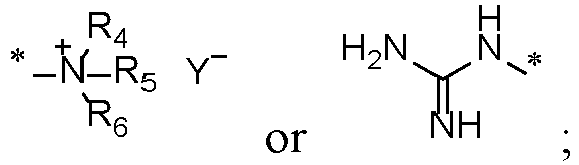 R1 and R2 are each independently selected from: -H,
 R12 and R13 are each independently selected from: -H,
 R22 and R23 are each independently selected from: -H,
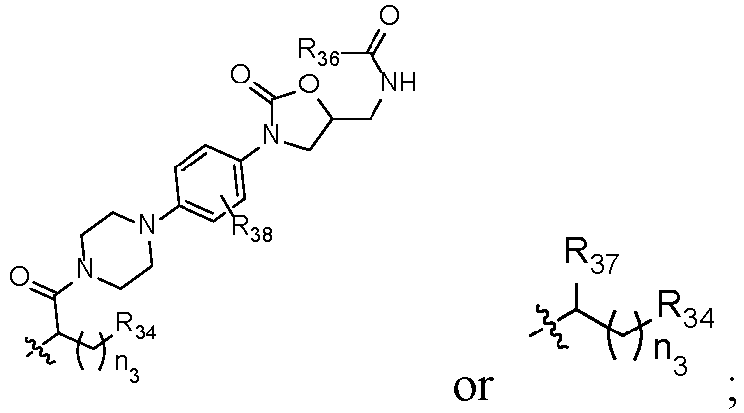 R32 and R33 are each independently selected from: -H,
 R42 and R43 are each independently selected from: -H,
 R52 and R53 are each independently selected from: -H,
 R62 and R63 are each independently selected from: -H or
 wherein R14, R24, R34, R44, R54, R64 and R74 are each independently selected from: -H, guanidyl, -NR4R5, -SR4, 5- to 20-membered nitrogen-containing heteroaryl,
 R15-R17, R25-R27, R35-R37, R45-R47, R55-R57 and R65-R67 are each independently selected from: - H or C1-6 alkyl;R18, R28, R38, R48, R58 and R68 are each independently selected from: -H, C1-6 alkyl or halogen;each of n1, n2, n3, n4, n5, n6 and n7 is independently 0, 1, 2, 3, 4, 5, 6, 7, 8, 9 or 10;R77 is selected from: -H or C1-6 alkyl;R3 is selected from: -H or C1-4 alkyl;R4 and R5 are each independently selected from: -H, C1-16 alkyl, COOR8, -Fmoc or Ra-substituted C1-16 alkyl; or R4 and R5 together with N linked thereto are capable of forming a 5- to 20-membered heterocyclic ring, a 5- to 20-membered heteroaromatic ring, a 5- to 20-membered heterocyclic ring substituted by Rb or a 5- to 20-membered heteroaromatic ring substituted by Rb;Ra is selected from: 5- to 10-membered aryl, 5- to 10-membered heteroaryl, -NRa1Ra2 or -SRa3;Rb is selected from: C1-10 alkyl, -(CH2)pNRb1Rb2 or -SRb3, wherein p is 0, 1, 2, 3, 4, 5, 6, 7, 8, 9 or 10;each of Ra1, Ra2, Rb1 and Rb2 is independently -H, C1-10 alkyl or Rc-substituted C1-10 alkyl; or Ra1 and Ra2 together with a N atom linked thereto are capable of forming a 5- to 10-membered heterocyclic ring or a 5- to 10-membered heteroaromatic ring; or Rb1 and Rb2 together with a N atom linked thereto are capable of forming a 5- to 10-membered heterocyclic ring or a 5- to 10-membered heteroaromatic ring;each of Ra3 and Rb3 is independently C1-10 alkyl;Rc is selected from: -NRc1Rc2, guanidyl or 5- to 6-membered nitrogen-containing heteroaryl, wherein each of Rc1 and Rc2 is independently: -H, C1-4 alkyl; or Rc1 and Rc2 together with a N atom linked thereto are capable of forming a 5- to 10-membered heterocyclic ring or a 5- to 10-membered heteroaromatic ring;R6 is C1-4 alkyl; R7 is selected from: -H or C1-4 alkyl; R8 is -H, C1-6 alkyl or
 Y- is an anion.
 - The bakuchiol derivative and a pharmaceutically acceptable salt thereof according to claim 1, having a structure shown in formula (I'):

- The bakuchiol derivative and a pharmaceutically acceptable salt thereof according to claim 1, wherein R4 and R5 are each independently selected from: H, C1-12 alkyl, COOR8, -Fmoc or Ra-substituted C1-10 alkyl; or R4 and R5 together with N linked thereto are capable of forming the following heterocyclic rings:
 wherein Ra is selected from pyridine, pyrimidine, triazine, -NRa1Ra2 or -SRa3;each of Ra1 and Ra2 is independently H, C1-4 alkyl or NRc1Rc2-substituted C1-4 alkyl; Ra3 is C1-4 alkyl;each of Rc1 and Rc2 is independently H or C1-4 alkyl;Rb is selected from H, C1-6 alkyl or -(CH2)pNRb1Rb2, wherein p is 0, 1, 2, 3, 4, 5 or 6; andeach of Rb1 and Rb2 is independently H or C1-4 alkyl.
 - The bakuchiol derivative and a pharmaceutically acceptable salt thereof according to claim 1, wherein R is selected from the following groups:


- The bakuchiol derivative and a pharmaceutically acceptable salt thereof according to claim 1, wherein R14, R24, R34, R44, R54, R64 and R74 are each independently selected from: -H, guanidyl, - NR4R5, -SR4, 5-membered nitrogen-containing heteroaryl,

R8 is C1-4 alkyl. - The bakuchiol derivative and a pharmaceutically acceptable salt thereof according to claim 1, selected from a compound of the following general formula:


- The bakuchiol derivative and a pharmaceutically acceptable salt thereof according to claim 6, wherein X is OR15, and R14 is selected from: H, guanidyl, -NH2, -SCH3,

- The bakuchiol derivative and a pharmaceutically acceptable salt thereof according to claim 6, wherein X is NR12R13; one of R12 and R13 is H, and another one is selected from

 one of R22 and R23 is H, and another one is selected from
 one of R32 and R33 is H, and another one is selected from
 one of R42 and R43 is H, and another one is selected from
 one of R62 and R63 is H, and another one is selected from
- The bakuchiol derivative and a pharmaceutically acceptable salt thereof according to claim 6, wherein
 X is NR12R13; and one of R12 and R13 is H, and another one is selected from
 X is NR12R13; one of R12 and R13 is H, and another one is selected from
 X is NR12R13; one of R12 and R13 is H, and another one is selected from

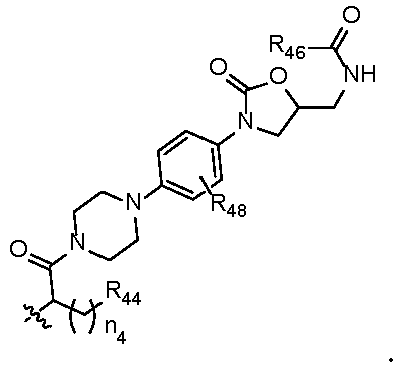
- The bakuchiol derivative and a pharmaceutically acceptable salt thereof according to claim 1, selected from a compound of any of the following general formulae:
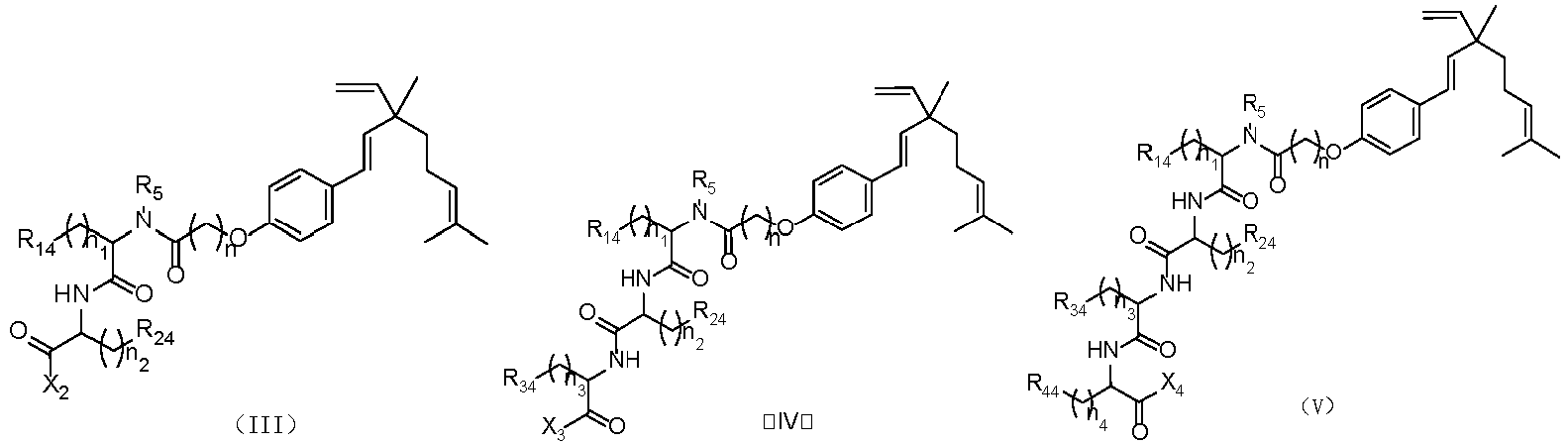


- The bakuchiol derivative and a pharmaceutically acceptable salt thereof according to claim 1, selected from the following compounds:



- A preparation method of the bakuchiol derivative and a pharmaceutically acceptable salt thereof of any one of claims 1-11, wherein when R is a halogen, the preparation method comprises the following step:
 reacting a compound shown in formula (I-1) with
 when R is NR4R5,
 reacting a compound shown in formula (I-1) with
 reacting the intermediate with R being Br with HNR4R5, to obtain a compound shown in formula (I) with R being NR4R5;reacting the compound shown in formula (I) with R being NR4R5 with haloalkyl, to obtain a compound shown in formula (I) with R being
 reacting a compound shown in formula (I) with R being NH2 with
 compound shown in formula (I) with R being
 when R is selected from CONR1R2 and -COOR3, the preparation method comprises the following steps:
 performing a condensation reaction on a compound shown in formula (I-1) and an alkyl bromoalkylate, to obtain a compound shown in formula (I) with R being -COOR3;hydrolyzing to obtain a compound shown in formula (I-2); andperforming a condensation reaction on the compound shown in formula (I-2) and

- The preparation method according to claim 12, wherein when R is selected from CONR1R2, the preparation method further comprises the following steps:
 performing a hydrolysis reaction on a compound shown in formula (II-1), to obtain a compound shown in formula (II-2);performing a condensation reaction on the compound shown in formula (II-2) and
 optionally, according to this cycle, hydrolyzing a compound containing an ester group, and then performing a condensation reaction with corresponding amine, to obtain a compound shown in formula (I) containing a target fragment;wherein X2 is as defined in claim 10.
 - A pharmaceutical composition comprising at least one of the bakuchiol derivative and a pharmaceutically acceptable salt thereof of any one of claims 1-11, and a pharmaceutically acceptable excipient.
- Use of the bakuchiol derivative and a pharmaceutically acceptable salt thereof of any one of claims 1-11 or the pharmaceutical composition of claim 14 in the preparation of antibacterial agents.
Applications Claiming Priority (2)
| Application Number | Priority Date | Filing Date | Title |
|---|---|---|---|
| CN202011152645.9A CN113896620B (en) | 2020-10-26 | 2020-10-26 | Bavacrol derivatives, pharmaceutically acceptable salts thereof, and preparation method and application thereof |
| PCT/CN2020/125481 WO2022088091A1 (en) | 2020-10-26 | 2020-10-30 | Bakuchiol derivative, pharmaceutically acceptable salt thereof, preparation method therefor and application thereof |
Publications (4)
| Publication Number | Publication Date |
|---|---|
| EP4219437A1 EP4219437A1 (en) | 2023-08-02 |
| EP4219437A4 EP4219437A4 (en) | 2024-04-10 |
| EP4219437B1 true EP4219437B1 (en) | 2025-04-16 |
| EP4219437C0 EP4219437C0 (en) | 2025-04-16 |
Family
ID=79186200
Family Applications (1)
| Application Number | Title | Priority Date | Filing Date |
|---|---|---|---|
| EP20959253.4A Active EP4219437B1 (en) | 2020-10-26 | 2020-10-30 | Bakuchiol derivative, pharmaceutically acceptable salt thereof, preparation method therefor and application thereof |
Country Status (7)
| Country | Link |
|---|---|
| US (1) | US11912650B2 (en) |
| EP (1) | EP4219437B1 (en) |
| JP (1) | JP7469567B2 (en) |
| KR (1) | KR102630858B1 (en) |
| CN (1) | CN113896620B (en) |
| ES (1) | ES3030919T3 (en) |
| WO (1) | WO2022088091A1 (en) |
Families Citing this family (2)
| Publication number | Priority date | Publication date | Assignee | Title |
|---|---|---|---|---|
| CN117247327B (en) * | 2023-10-13 | 2025-09-12 | 深圳市护家科技有限公司 | Preparation method and application of bakuchiol derivatives and salts thereof |
| CN118598783B (en) * | 2024-05-21 | 2025-03-11 | 暨南大学 | Mercaptophenol derivatives and their applications |
Family Cites Families (7)
| Publication number | Priority date | Publication date | Assignee | Title |
|---|---|---|---|---|
| US20070088067A1 (en) | 2003-09-05 | 2007-04-19 | Tidwell Richards R | Novel amidine compounds for treating microbial infections |
| US8338638B2 (en) * | 2006-08-25 | 2012-12-25 | Unichem Laboratories Ltd. | Antimicrobial derivatives of anacardic acid and process for preparing the same |
| FR2981275B1 (en) * | 2011-10-18 | 2015-03-20 | Jean Noel Thorel | MEROTERPENE-BASED COMPOSITION FOR OILY SKIN, ACNETIC SKIN OR ACNE-DENIED |
| CA2875964C (en) | 2012-06-07 | 2018-01-02 | Georgia State University Research Foundation, Inc. | Seca inhibitors and methods of making and using thereof |
| CN104755452A (en) * | 2012-11-02 | 2015-07-01 | 株式会社成和化成 | Propyl phenyl ether derivative, melanin production inhibitor, whitening agent, antibacterial agent and cosmetic containing same |
| KR101734756B1 (en) * | 2016-03-28 | 2017-05-12 | 원광대학교산학협력단 | Composition of materials containing fluoride varnish and antibacterial agents for prevention and treatment of dental caries |
| US12599588B2 (en) | 2019-01-18 | 2026-04-14 | Japan Science And Technology Agency | Inhibitor for V-ATPase activity, antibacterial agent, medicine, antibacterial method and screening method |
-
2020
- 2020-10-26 CN CN202011152645.9A patent/CN113896620B/en active Active
- 2020-10-30 KR KR1020237015909A patent/KR102630858B1/en active Active
- 2020-10-30 EP EP20959253.4A patent/EP4219437B1/en active Active
- 2020-10-30 ES ES20959253T patent/ES3030919T3/en active Active
- 2020-10-30 JP JP2023527021A patent/JP7469567B2/en active Active
- 2020-10-30 US US18/033,414 patent/US11912650B2/en active Active
- 2020-10-30 WO PCT/CN2020/125481 patent/WO2022088091A1/en not_active Ceased
Also Published As
| Publication number | Publication date |
|---|---|
| US20230391717A1 (en) | 2023-12-07 |
| CN113896620A (en) | 2022-01-07 |
| CN113896620B (en) | 2022-11-15 |
| JP7469567B2 (en) | 2024-04-16 |
| KR102630858B1 (en) | 2024-01-31 |
| WO2022088091A1 (en) | 2022-05-05 |
| KR20230082047A (en) | 2023-06-08 |
| ES3030919T3 (en) | 2025-07-02 |
| EP4219437A4 (en) | 2024-04-10 |
| EP4219437A1 (en) | 2023-08-02 |
| JP2023544643A (en) | 2023-10-24 |
| US11912650B2 (en) | 2024-02-27 |
| EP4219437C0 (en) | 2025-04-16 |
Similar Documents
| Publication | Publication Date | Title |
|---|---|---|
| US9745335B2 (en) | N-substituted second generation derivatives of antifungal antibiotic amphotericin B and methods of their preparation and application | |
| Funabashi et al. | A new anti-MRSA dipeptide, TAN-1057 A | |
| HU229483B1 (en) | Mutilin derivatives and their use as antibacterials | |
| WO2010130007A1 (en) | Antimicrobial compounds | |
| NZ241216A (en) | Amides of antibiotic ge2270 factors, their preparation and pharmaceutical compositions thereof | |
| EP4219437A1 (en) | Bakuchiol derivative, pharmaceutically acceptable salt thereof, preparation method therefor and application thereof | |
| JP5134181B2 (en) | Antibacterial mutilin | |
| US20020065219A1 (en) | Water soluble thiazolyl peptide derivatives | |
| DE69718442T2 (en) | DERIVATIVES OF THE ANTIBIOTIC FACTOR GE2270 | |
| CN101671367B (en) | Pleuromutilin phosphate compounds, medicinal composition thereof, preparation method thereof and application thereof | |
| EP4079305B1 (en) | Compounds for use in the treatment of pneumonia caused by certain carbapenem-resistant or carbapenem-susceptible bacteria | |
| CN115536716B (en) | Amphotericin B semisynthetic derivatives and their preparation methods and uses | |
| HK40089915B (en) | Bakuchiol derivative, pharmaceutically acceptable salt thereof, preparation method therefor and application thereof | |
| HK40089915A (en) | Bakuchiol derivative, pharmaceutically acceptable salt thereof, preparation method therefor and application thereof | |
| EP0345627B1 (en) | 9-R-azacyclic erythromycin antibiotics | |
| CN104447450A (en) | Cysteine amide type pleuromutilin derivative as well as preparation method and medical application thereof | |
| US6818654B2 (en) | Antibacterial compounds | |
| EP3901150A1 (en) | Application of monocyclic beta-lactam compound in pharmacy | |
| Maruyama et al. | CP5484, a novel quaternary carbapenem with potent anti-MRSA activity and reduced toxicity | |
| MXPA02005791A (en) | Pseudomycin phosphate prodrugs. | |
| US6962943B2 (en) | Gabusectin derivatives, processes for preparing them and their use | |
| EP3612512A1 (en) | Antimicrobial agents | |
| EP3522896A2 (en) | Ketolides having antibacterial activity | |
| EP4139328A1 (en) | Guanidine-modified c-terminus vancomycin compounds, compositions and methods | |
| AU2002366191B2 (en) | Gabusectin derivatives, method for the production thereof and use of the same |
Legal Events
| Date | Code | Title | Description |
|---|---|---|---|
| STAA | Information on the status of an ep patent application or granted ep patent |
Free format text: STATUS: THE INTERNATIONAL PUBLICATION HAS BEEN MADE |
|
| PUAI | Public reference made under article 153(3) epc to a published international application that has entered the european phase |
Free format text: ORIGINAL CODE: 0009012 |
|
| STAA | Information on the status of an ep patent application or granted ep patent |
Free format text: STATUS: REQUEST FOR EXAMINATION WAS MADE |
|
| 17P | Request for examination filed |
Effective date: 20230425 |
|
| AK | Designated contracting states |
Kind code of ref document: A1 Designated state(s): AL AT BE BG CH CY CZ DE DK EE ES FI FR GB GR HR HU IE IS IT LI LT LU LV MC MK MT NL NO PL PT RO RS SE SI SK SM TR |
|
| REG | Reference to a national code |
Ref country code: HK Ref legal event code: DE Ref document number: 40089915 Country of ref document: HK |
|
| DAV | Request for validation of the european patent (deleted) | ||
| DAX | Request for extension of the european patent (deleted) | ||
| A4 | Supplementary search report drawn up and despatched |
Effective date: 20240312 |
|
| RIC1 | Information provided on ipc code assigned before grant |
Ipc: C07K 5/06 20060101ALI20240305BHEP Ipc: C07D 213/36 20060101ALI20240305BHEP Ipc: C07C 323/25 20060101ALI20240305BHEP Ipc: C07C 43/225 20060101ALI20240305BHEP Ipc: A61P 31/04 20060101ALI20240305BHEP Ipc: A61K 31/085 20060101ALI20240305BHEP Ipc: C07C 43/20 20060101AFI20240305BHEP |
|
| GRAP | Despatch of communication of intention to grant a patent |
Free format text: ORIGINAL CODE: EPIDOSNIGR1 |
|
| STAA | Information on the status of an ep patent application or granted ep patent |
Free format text: STATUS: GRANT OF PATENT IS INTENDED |
|
| RIC1 | Information provided on ipc code assigned before grant |
Ipc: C07K 5/06 20060101ALI20241113BHEP Ipc: C07D 213/36 20060101ALI20241113BHEP Ipc: C07C 323/25 20060101ALI20241113BHEP Ipc: C07C 43/225 20060101ALI20241113BHEP Ipc: A61P 31/04 20060101ALI20241113BHEP Ipc: A61K 31/085 20060101ALI20241113BHEP Ipc: C07C 43/20 20060101AFI20241113BHEP |
|
| INTG | Intention to grant announced |
Effective date: 20241127 |
|
| GRAS | Grant fee paid |
Free format text: ORIGINAL CODE: EPIDOSNIGR3 |
|
| GRAA | (expected) grant |
Free format text: ORIGINAL CODE: 0009210 |
|
| STAA | Information on the status of an ep patent application or granted ep patent |
Free format text: STATUS: THE PATENT HAS BEEN GRANTED |
|
| AK | Designated contracting states |
Kind code of ref document: B1 Designated state(s): AL AT BE BG CH CY CZ DE DK EE ES FI FR GB GR HR HU IE IS IT LI LT LU LV MC MK MT NL NO PL PT RO RS SE SI SK SM TR |
|
| REG | Reference to a national code |
Ref country code: GB Ref legal event code: FG4D |
|
| REG | Reference to a national code |
Ref country code: CH Ref legal event code: EP Ref country code: DE Ref legal event code: R096 Ref document number: 602020049773 Country of ref document: DE |
|
| REG | Reference to a national code |
Ref country code: IE Ref legal event code: FG4D |
|
| U01 | Request for unitary effect filed |
Effective date: 20250416 |
|
| U07 | Unitary effect registered |
Designated state(s): AT BE BG DE DK EE FI FR IT LT LU LV MT NL PT RO SE SI Effective date: 20250424 |
|
| REG | Reference to a national code |
Ref country code: ES Ref legal event code: FG2A Ref document number: 3030919 Country of ref document: ES Kind code of ref document: T3 Effective date: 20250702 |
|
| PG25 | Lapsed in a contracting state [announced via postgrant information from national office to epo] |
Ref country code: GR Free format text: LAPSE BECAUSE OF FAILURE TO SUBMIT A TRANSLATION OF THE DESCRIPTION OR TO PAY THE FEE WITHIN THE PRESCRIBED TIME-LIMIT Effective date: 20250717 Ref country code: NO Free format text: LAPSE BECAUSE OF FAILURE TO SUBMIT A TRANSLATION OF THE DESCRIPTION OR TO PAY THE FEE WITHIN THE PRESCRIBED TIME-LIMIT Effective date: 20250716 |
|
| PG25 | Lapsed in a contracting state [announced via postgrant information from national office to epo] |
Ref country code: PL Free format text: LAPSE BECAUSE OF FAILURE TO SUBMIT A TRANSLATION OF THE DESCRIPTION OR TO PAY THE FEE WITHIN THE PRESCRIBED TIME-LIMIT Effective date: 20250416 |
|
| PGFP | Annual fee paid to national office [announced via postgrant information from national office to epo] |
Ref country code: GB Payment date: 20250923 Year of fee payment: 6 |
|
| PG25 | Lapsed in a contracting state [announced via postgrant information from national office to epo] |
Ref country code: HR Free format text: LAPSE BECAUSE OF FAILURE TO SUBMIT A TRANSLATION OF THE DESCRIPTION OR TO PAY THE FEE WITHIN THE PRESCRIBED TIME-LIMIT Effective date: 20250416 |
|
| PG25 | Lapsed in a contracting state [announced via postgrant information from national office to epo] |
Ref country code: RS Free format text: LAPSE BECAUSE OF FAILURE TO SUBMIT A TRANSLATION OF THE DESCRIPTION OR TO PAY THE FEE WITHIN THE PRESCRIBED TIME-LIMIT Effective date: 20250716 |
|
| PG25 | Lapsed in a contracting state [announced via postgrant information from national office to epo] |
Ref country code: IS Free format text: LAPSE BECAUSE OF FAILURE TO SUBMIT A TRANSLATION OF THE DESCRIPTION OR TO PAY THE FEE WITHIN THE PRESCRIBED TIME-LIMIT Effective date: 20250816 |
|
| U20 | Renewal fee for the european patent with unitary effect paid |
Year of fee payment: 6 Effective date: 20250923 |
|
| U1N | Appointed representative for the unitary patent procedure changed after the registration of the unitary effect |
Representative=s name: LORENZ SEIDLER GOSSEL PART. MBB; DE |
|
| PG25 | Lapsed in a contracting state [announced via postgrant information from national office to epo] |
Ref country code: SM Free format text: LAPSE BECAUSE OF FAILURE TO SUBMIT A TRANSLATION OF THE DESCRIPTION OR TO PAY THE FEE WITHIN THE PRESCRIBED TIME-LIMIT Effective date: 20250416 |
|
| PG25 | Lapsed in a contracting state [announced via postgrant information from national office to epo] |
Ref country code: CZ Free format text: LAPSE BECAUSE OF FAILURE TO SUBMIT A TRANSLATION OF THE DESCRIPTION OR TO PAY THE FEE WITHIN THE PRESCRIBED TIME-LIMIT Effective date: 20250416 |
|
| PG25 | Lapsed in a contracting state [announced via postgrant information from national office to epo] |
Ref country code: SK Free format text: LAPSE BECAUSE OF FAILURE TO SUBMIT A TRANSLATION OF THE DESCRIPTION OR TO PAY THE FEE WITHIN THE PRESCRIBED TIME-LIMIT Effective date: 20250416 |
|
| PGFP | Annual fee paid to national office [announced via postgrant information from national office to epo] |
Ref country code: ES Payment date: 20251111 Year of fee payment: 6 |
|
| PLBE | No opposition filed within time limit |
Free format text: ORIGINAL CODE: 0009261 |
|
| STAA | Information on the status of an ep patent application or granted ep patent |
Free format text: STATUS: NO OPPOSITION FILED WITHIN TIME LIMIT |
|
| REG | Reference to a national code |
Ref country code: CH Ref legal event code: L10 Free format text: ST27 STATUS EVENT CODE: U-0-0-L10-L00 (AS PROVIDED BY THE NATIONAL OFFICE) Effective date: 20260225 |
|
| 26N | No opposition filed |
Effective date: 20260119 |