EP4218755A1 - Method for preparing crystalline particles of 1-(3-cyano-1-isopropyl-indole-5-yl)pyrazole-4-carboxylic acid, and pharmaceutical composition comprising same - Google Patents
Method for preparing crystalline particles of 1-(3-cyano-1-isopropyl-indole-5-yl)pyrazole-4-carboxylic acid, and pharmaceutical composition comprising same Download PDFInfo
- Publication number
- EP4218755A1 EP4218755A1 EP21889522.5A EP21889522A EP4218755A1 EP 4218755 A1 EP4218755 A1 EP 4218755A1 EP 21889522 A EP21889522 A EP 21889522A EP 4218755 A1 EP4218755 A1 EP 4218755A1
- Authority
- EP
- European Patent Office
- Prior art keywords
- formula
- crystalline particles
- compound
- pharmaceutical composition
- content
- Prior art date
- Legal status (The legal status is an assumption and is not a legal conclusion. Google has not performed a legal analysis and makes no representation as to the accuracy of the status listed.)
- Withdrawn
Links
Images

Classifications
-
- A—HUMAN NECESSITIES
- A61—MEDICAL OR VETERINARY SCIENCE; HYGIENE
- A61K—PREPARATIONS FOR MEDICAL, DENTAL OR TOILETRY PURPOSES
- A61K31/00—Medicinal preparations containing organic active ingredients
- A61K31/33—Heterocyclic compounds
- A61K31/395—Heterocyclic compounds having nitrogen as a ring hetero atom, e.g. guanethidine or rifamycins
- A61K31/41—Heterocyclic compounds having nitrogen as a ring hetero atom, e.g. guanethidine or rifamycins having five-membered rings with two or more ring hetero atoms, at least one of which being nitrogen, e.g. tetrazole
- A61K31/415—1,2-Diazoles
- A61K31/4155—1,2-Diazoles non condensed and containing further heterocyclic rings
-
- A—HUMAN NECESSITIES
- A61—MEDICAL OR VETERINARY SCIENCE; HYGIENE
- A61K—PREPARATIONS FOR MEDICAL, DENTAL OR TOILETRY PURPOSES
- A61K9/00—Medicinal preparations characterised by special physical form
- A61K9/20—Pills, tablets, discs, rods
-
- A—HUMAN NECESSITIES
- A61—MEDICAL OR VETERINARY SCIENCE; HYGIENE
- A61K—PREPARATIONS FOR MEDICAL, DENTAL OR TOILETRY PURPOSES
- A61K9/00—Medicinal preparations characterised by special physical form
- A61K9/20—Pills, tablets, discs, rods
- A61K9/2004—Excipients; Inactive ingredients
- A61K9/2022—Organic macromolecular compounds
- A61K9/205—Polysaccharides, e.g. alginate, gums; Cyclodextrin
- A61K9/2054—Cellulose; Cellulose derivatives, e.g. hydroxypropyl methylcellulose
-
- A—HUMAN NECESSITIES
- A61—MEDICAL OR VETERINARY SCIENCE; HYGIENE
- A61K—PREPARATIONS FOR MEDICAL, DENTAL OR TOILETRY PURPOSES
- A61K9/00—Medicinal preparations characterised by special physical form
- A61K9/20—Pills, tablets, discs, rods
- A61K9/2072—Pills, tablets, discs, rods characterised by shape, structure or size; Tablets with holes, special break lines or identification marks; Partially coated tablets; Disintegrating flat shaped forms
- A61K9/2077—Tablets comprising drug-containing microparticles in a substantial amount of supporting matrix; Multiparticulate tablets
-
- A—HUMAN NECESSITIES
- A61—MEDICAL OR VETERINARY SCIENCE; HYGIENE
- A61P—SPECIFIC THERAPEUTIC ACTIVITY OF CHEMICAL COMPOUNDS OR MEDICINAL PREPARATIONS
- A61P1/00—Drugs for disorders of the alimentary tract or the digestive system
-
- A—HUMAN NECESSITIES
- A61—MEDICAL OR VETERINARY SCIENCE; HYGIENE
- A61P—SPECIFIC THERAPEUTIC ACTIVITY OF CHEMICAL COMPOUNDS OR MEDICINAL PREPARATIONS
- A61P13/00—Drugs for disorders of the urinary system
- A61P13/12—Drugs for disorders of the urinary system of the kidneys
-
- A—HUMAN NECESSITIES
- A61—MEDICAL OR VETERINARY SCIENCE; HYGIENE
- A61P—SPECIFIC THERAPEUTIC ACTIVITY OF CHEMICAL COMPOUNDS OR MEDICINAL PREPARATIONS
- A61P19/00—Drugs for skeletal disorders
- A61P19/02—Drugs for skeletal disorders for joint disorders, e.g. arthritis, arthrosis
-
- A—HUMAN NECESSITIES
- A61—MEDICAL OR VETERINARY SCIENCE; HYGIENE
- A61P—SPECIFIC THERAPEUTIC ACTIVITY OF CHEMICAL COMPOUNDS OR MEDICINAL PREPARATIONS
- A61P19/00—Drugs for skeletal disorders
- A61P19/06—Antigout agents, e.g. antihyperuricemic or uricosuric agents
-
- A—HUMAN NECESSITIES
- A61—MEDICAL OR VETERINARY SCIENCE; HYGIENE
- A61P—SPECIFIC THERAPEUTIC ACTIVITY OF CHEMICAL COMPOUNDS OR MEDICINAL PREPARATIONS
- A61P29/00—Non-central analgesic, antipyretic or antiinflammatory agents, e.g. antirheumatic agents; Non-steroidal antiinflammatory drugs [NSAID]
-
- A—HUMAN NECESSITIES
- A61—MEDICAL OR VETERINARY SCIENCE; HYGIENE
- A61P—SPECIFIC THERAPEUTIC ACTIVITY OF CHEMICAL COMPOUNDS OR MEDICINAL PREPARATIONS
- A61P3/00—Drugs for disorders of the metabolism
- A61P3/08—Drugs for disorders of the metabolism for glucose homeostasis
- A61P3/10—Drugs for disorders of the metabolism for glucose homeostasis for hyperglycaemia, e.g. antidiabetics
-
- A—HUMAN NECESSITIES
- A61—MEDICAL OR VETERINARY SCIENCE; HYGIENE
- A61P—SPECIFIC THERAPEUTIC ACTIVITY OF CHEMICAL COMPOUNDS OR MEDICINAL PREPARATIONS
- A61P9/00—Drugs for disorders of the cardiovascular system
-
- A—HUMAN NECESSITIES
- A61—MEDICAL OR VETERINARY SCIENCE; HYGIENE
- A61P—SPECIFIC THERAPEUTIC ACTIVITY OF CHEMICAL COMPOUNDS OR MEDICINAL PREPARATIONS
- A61P9/00—Drugs for disorders of the cardiovascular system
- A61P9/04—Inotropic agents, i.e. stimulants of cardiac contraction; Drugs for heart failure
-
- A—HUMAN NECESSITIES
- A61—MEDICAL OR VETERINARY SCIENCE; HYGIENE
- A61P—SPECIFIC THERAPEUTIC ACTIVITY OF CHEMICAL COMPOUNDS OR MEDICINAL PREPARATIONS
- A61P9/00—Drugs for disorders of the cardiovascular system
- A61P9/12—Antihypertensives
-
- C—CHEMISTRY; METALLURGY
- C07—ORGANIC CHEMISTRY
- C07D—HETEROCYCLIC COMPOUNDS
- C07D403/00—Heterocyclic compounds containing two or more hetero rings, having nitrogen atoms as the only ring hetero atoms, not provided for by group C07D401/00
- C07D403/02—Heterocyclic compounds containing two or more hetero rings, having nitrogen atoms as the only ring hetero atoms, not provided for by group C07D401/00 containing two hetero rings
- C07D403/04—Heterocyclic compounds containing two or more hetero rings, having nitrogen atoms as the only ring hetero atoms, not provided for by group C07D401/00 containing two hetero rings directly linked by a ring-member-to-ring-member bond
Definitions
- the present invention relates to a pharmaceutical composition
- a pharmaceutical composition comprising crystalline particles of a compound of Formula 1 (1-(3-cyano-1-isopropyl-indol-5-yl)pyrazole-4-carboxylic acid) or a pharmaceutically acceptable salt thereof, comprising 0.2% by weight or less of a compound of Formula 2 below (1-(3-cyano-1-isopropyl-1H-indol-5-yl)-1H-pyrazole-4-methyl ester):
- Xanthine oxidase is an enzyme that converts hypoxanthine to xanthine and also the formed xanthine to uric acid. When there is too much uric acid in the body, it causes various diseases including gout disease, etc.
- Gout disease refers to a condition in which uric acid crystals accumulate in the cartilage, ligaments, and surrounding tissues of the joint, causing severe inflammation and pain, and the incidence of gout disease has been steadily increasing over the past 40 years.
- substances that inhibit the activity of xanthine oxidase can effectively treat xanthine oxidase-related diseases, such as hyperuricacidemia, gout disease, heart failure, cardiovascular diseases, hypertension, diabetes, kidney diseases, inflammation, joint diseases and inflammatory bowel diseases.
- xanthine oxidase-related diseases such as hyperuricacidemia, gout disease, heart failure, cardiovascular diseases, hypertension, diabetes, kidney diseases, inflammation, joint diseases and inflammatory bowel diseases.
- Korean Patent No. 1751325 (Patent Document 1) provides a compound of Formula 1 (1-(3-cyano-1-isopropyl-indol-5-yl) pyrazole-4-carboxylic acid) and a method for preparing the compound
- Korean Patent No. 1424013 (Patent Document 2) provides various types of crystalline forms obtained by using various solvents and methods for preparing the same.
- the crystalline particles of Formula 1 according to the conventional preparation method of Patent Document 1 have a problem of poor flowability, so there was a difficulty in the stable and reproducible preparation process of the finished product, and in the case of Patent Document 2, it relates to each crystalline form itself, and the flowability thereof has not been analyzed.
- the present invention provides crystalline particles of the compound of Formula 1 or a pharmaceutically acceptable salt thereof, comprising 0.2 wt.% or less of the compound of Formula 2 below.
- the crystalline particles of the present invention may further comprise the compound of Formula 3 below.
- the present invention provides a method for preparing crystalline particles of Formula 1 comprising the compound of Formula 2 in an amount of 0.2 wt.% or less, and crystalline particles prepared by the above preparation method.
- the Carr index of the crystalline particles of the present invention is 25 or less, 20 or less, 10 or less, or 7 or less.
- the present invention provides a pharmaceutical composition for the treatment or prevention of xanthine oxidase-related diseases selected from the group consisting of hyperuricacidemia, gout disease, heart failure, cardiovascular diseases, hypertension, diabetes, renal diseases, inflammation, joint diseases and inflammatory bowel diseases, comprising crystalline particles of the compound of Formula 1 or a pharmaceutically acceptable salt thereof, comprising the compound of Formula 2 in an amount of 0.2 wt.% or less.
- the crystalline particles of the compound of Formula 1 or a pharmaceutically acceptable salt thereof comprising the compound of Formula 2 in an amount of 0.2 wt.% or less, according to the present invention, have a size, shape and distribution that improve uniformity and flowability as well as being optimized for input into the preparation process of the finished drug product, thereby increasing the content uniformity in the preparation process of the finished product and minimizing breakage during compressing into tablets, and thus can be used as a raw material pharmaceutical product suitable for the preparation process of the finished drug product.
- FIG. 1 shows micrographs of crystalline particles prepared in Examples and Comparative Examples.
- compound of Formula 1 is 1-(3-cyano-1-isopropyl-indol-5-yl)pyrazole-4-carboxylic acid, which is known to inhibit xanthine oxidase and prevent the deposition of uric acid in the body.
- the compound of Formula 1 can treat or prevent diseases selected from the group consisting of hyperuricacidemia, gout disease, heart failure, cardiovascular diseases, hypertension, diabetes, renal diseases, inflammation, joint diseases and inflammatory bowel diseases which are diseases related to the deposition of uric acid in the body.
- the compound of Formula 1 has a very low solubility characteristic in organic solvents and water due to the structural characteristics generated by the coupling reaction of pyrazole and indole, and thus has a characteristic that it is very difficult to control the size, shape and distribution of crystalline particles.
- the crystalline particles prepared by the preparation method of Patent Document 1 which is a conventional preparation method of the compound of Formula 1 have a problem of poor flowability, making it difficult for the preparation process of the finished drug product to be stable and reproducible.
- flowability was not analyzed, and also there was a difficulty in manufacturing as a bulk raw material pharmaceutical product.
- the researchers of the present invention have continued their research to prepare the crystalline particles of the above Formula 1 with good flowability, and as a result, have found that the compounds prepared by the conventional method include not only the compound of Formula 1, but also the compound of the following Formula 2 which is methyl-esterified at the C4 position of pyrazole of the compound of Formula 1 and the compound of the following Formula 3, which is an amide compound decomposed at the cyano group at the C3 position of the indole, and have confirmed that the shape and flowability of the crystalline particles vary depending on the amount of the compounds of Formula 2 and Formula 3.
- tapped density means the changed volume when the container is tapped after packing the powder, which means that the voids between particles are reduced.
- porosity can be confirmed by checking the changes in bulk density (apparent density) and tapped density.
- Carr index (CI) (Carr, 1965) and Hausner ratio (HR) (Hausner, 1967).
- Table 1 shows the classification of the flowability of the granular powder according to the Carr index and Hausner ratio.
- Table 1 Carr index(flowability) % Flowability/cohesiveness Hausner ratio(cohesiveness) ⁇ 10 Excellent 1.00 ⁇ 1.11 11 ⁇ 15 Good 1.12 ⁇ 1.18 16 ⁇ 20 Fair 1.19 ⁇ 1.25 21 ⁇ 25 Passable 1.26 ⁇ 1.34 26 ⁇ 31 Poor 1.35 ⁇ 1.45 32 ⁇ 38 Very poor 1.46 ⁇ 1.59 >38 Very, very poor >1.6
- Both bulk density and tapped density are properties related to the Carr index, which can affect a variety of formulations and in particular can affect the uniformity of the preparation.
- the standard of the Carr index commonly used in raw materials in the pharmaceutical field is 20% or less, and a Carr index of 5 to 15% indicates excellent to good flowability.
- the Hausner ratio is the ratio of tapped density to bulk density and is an estimate of the friction between particles.
- a commonly used ratio is a ratio of 1.2 or less, which is an indication of acceptable friction, i.e. good flowability of the powder.
- the compound of Formula 2 When the compound of Formula 2 is contained to the compound of Formula 1, if the compound of Formula 2 is contained in an amount of 0.246%, although the Carr index exceeds 20% and the Hausner ratio exceeds 1.25, these are values that can be used for pharmaceutical preparation. However, if the compound of Formula 2 is contained in an amount of 0.169%, the Carr index is 5.89% and the Hausner ratio is 1.06, showing very good results in both flowability and cohesiveness. However, if the compound of Formula 3 is contained, regardless of the good shape of the crystalline particles, the values of Carr index and Hausner ratio are higher than generally accepted values, and also it shows good results as its content is increased.
- both the compounds of Formula 2 and Formula 3 may be generated along with the compound of Formula 1 in the preparation process of the compound of Formula 1, as the content of the compound of Formula 2 is increased, the size and shape of the crystalline particles are irregular, and their flowability is deteriorated, whereas as the content of the compound of Formula 3 is increased, the size and shape of the crystalline particles become uniform, and their flowability becomes better.
- the compound of Formula 1 comprises the compound of Formula 2 in an amount of 0.2 wt.% or less based on all of the crystalline particles.
- the shape and size of the crystalline particles are good, the particle size distribution is even, and the flowability is good.
- the shape and size of the crystalline particles become non-uniform, and the particle size distribution and flowability become poor, it cannot be used as a raw material pharmaceutical product.
- a preparation method for preparing the desired crystalline particles is as follows.
- the method comprises the steps of,
- reaction temperature of step a) in the preparation method is maintained at 21 to 27 °C.
- step of adding HCl dropwise in step c) can be divided and proceeded in two steps of,
- the content of the compound of Formula 2 of the crystalline particles prepared by the above preparation method is 0.2 wt.% or less, 0.1 wt.% or less, 0.05 wt.% or less.
- the crystalline particles according to the present invention have a size, shape and distribution that improve uniformity and flowability as well as being optimized for input into the preparation process of the finished drug product, thereby increasing the content uniformity in the preparation process of the finished product and minimizing breakage during compressing into tablets, and thus can be used as a raw material pharmaceutical product suitable for the preparation process of the finished drug product.
- the crystalline particles of the present invention can be administered as such to human patients as an active pharmaceutical ingredient (API), or administered with other active pharmaceutical ingredients as in combination therapy, or administered as a pharmaceutical composition in admixture with a suitable carrier or excipient.
- API active pharmaceutical ingredient
- the pharmaceutical composition of the present invention can be prepared in a known manner, for example, by means such as conventional mixing, dissolving, granulating, tableting, powdering, emulsifying, encapsulating, trapping or lyophilizing process.
- the pharmaceutical composition according to the present invention can be prepared in a conventional manner using one or more pharmaceutically acceptable carriers which are intended to include excipients or adjuvants which facilitate processing of the active compound into a formulation that can be used pharmaceutically.
- suitable formulations depend on the route of administration chosen. It is possible to use as appropriate any of the known techniques, the known carriers and excipients, and the means known in the art, for example, in Remingston's Pharmaceutical Sciences.
- the crystalline particles of the present invention may be formulated as an injectable preparation or an oral tablet, etc. according to the desired purpose, and preferably may be formulated as an oral tablet.
- the components of the present invention may be formulated in a liquid solution, preferably in a pharmaceutically suitable buffer such as Hank's solution, Ringer's solution, or physiological saline.
- a suitable penetrating adjuvant is used in the formulation.
- penetrating adjuvants are generally known in the art.
- the active compounds can be readily formulated by combining the active compounds with pharmaceutically acceptable carriers known in the art.
- Such carriers enable the compounds of the present invention to be formulated as tablets, powders, granules, dragees, capsules, liquids, gels, syrups, slurries, suspensions, and the like.
- tablets, capsules, pills, powders and granules are used, and tablets are particularly useful.
- An oral tablet can be prepared, for example, as follows.
- the oral preparation according to the present invention contains crystalline particles of the compound of Formula 1 comprising the compound of Formula 2 in an amount of 0.2% by weight or less, or a pharmaceutically acceptable salt thereof as API, and contains one or two or more excipients that may be selected from diluents, disintegrants, binders, glidants, stabilizers and lubricants.
- the diluent may be selected from the group consisting of microcrystalline cellulose, lactose monohydrate, lactose anhydride, lactose, starch, mannitol, carboxymethylcellulose, sorbitol, and combinations thereof, but is not limited thereto.
- the disintegrant may be selected from the group consisting of low-substituted hydroxypropyl cellulose, crospovidone, croscarmellose sodium, sodium starch glycolate, F-melt, and combinations thereof, but is not limited thereto.
- the binder may be selected from the group consisting of hydroxypropylcellulose, hydroxypropyl methylcellulose, hypromellose, polyvinylacetic acid, povidone, polyvinylpyrrolidone, copovidone, macrogol, sodium lauryl sulfate, light anhydrous silicic acid, synthetic aluminum silicate, silicate derivatives such as calcium silicate or magnesium metasilicate aluminate, phosphates such as calcium hydrogen phosphate, carbonates such as calcium carbonate, pre-gelatinized starch, gums such as acacia gum, gelatin, cellulose derivatives such as ethyl cellulose, and mixtures thereof, but is not limited thereto.
- the glidant may be selected from the group consisting of colloidal silicon dioxide, hydrated silicon dioxide, and combinations thereof, but is not limited thereto.
- the lubricant may be selected from the group consisting of magnesium stearate, silicon dioxide, talc, light anhydrous silicic acid, sodium stearyl fumarate, and combinations thereof, but is not limited thereto.
- the content of API contained in the oral tablet may be about 20 to 70 wt.%, about 20 to 60 wt.%, about 20 to 50 wt.%, about 20 to 45 wt.%, about 30 to 70 wt.%, about 30 to 60 wt.%, or about 30 to 50 wt.%, about 30 to 45 wt.%, about 40 to 70 wt.%, about 40 to 60 wt.%, about 40 to 50 wt.%, about 40 to 45 wt.% based on the total weight of the oral tablet.
- the API may be contained in an amount of, for example, about 50 mg to 500 mg, about 50 mg to 400 mg, about 50 mg to 300 mg, about 50 mg to 200 mg, about 50 mg to 100 mg, about 100 mg to 500 mg, about 100 mg to 400 mg, about 100 mg to 300 mg, about 100 mg to 200 mg, about 200 mg to 500 mg, about 200 mg to 400 mg, about 200 mg to 300 mg, about 300 mg to 500 mg, about 300 mg to 400 mg per unit dosage form.
- the API may be contained in an amount of 50 mg, 100 mg, 150 mg, 200 mg, 300 mg, 400 mg or 500 mg per unit dosage form.
- the compound of Formula 2 of the API may be contained in an amount of 0.2 wt.% or less based on the total content of the API.
- the pharmaceutical composition according to the present invention contains crystalline particles of the compound of Formula 1 or a pharmaceutically acceptable salt thereof, comprising compound of Formula 2 in an amount of 0.2 wt.% or less, in an amount effective to achieve its intended purpose.
- a therapeutically effective amount means an amount of a compound effective to prolong the survival of the subject being treated or to prevent, alleviate or ameliorate the symptoms of a disease. Determination of the therapeutically effective amount is within the ability of one of ordinary skill in the art, particularly in light of the detailed disclosure provided herein.
- the dosage is depending on the doctor's prescription based on factors such as the patient's weight, age, and the specific nature and symptoms of the disease.
- the dosage required for the treatment of adults is usually in the range of about 1 to 1000 mg per day, depending on the frequency and intensity of administration.
- a total dose of about 1 to 500 mg per day it will suffice usually for a total dose of about 1 to 500 mg per day as separate single doses.
- a higher daily dose may be also desirable.
- the present invention also provides a method for treating or preventing human xanthine oxidase-related diseases by using the crystalline particles of the compound of Formula 1 or a pharmaceutically acceptable salt thereof comprising the compound of Formula 2 in an amount of 0.2 wt.% or less, in a therapeutically effective amount.
- human xanthine oxidase-related disease is a disease that can be treated or prevented by inhibiting human xanthine oxidase, which may be, for example, but is not limited to, hyperuricacidemia, gout disease, heart failure, cardiovascular diseases, hypertension, diabetes, diabete-related complications, renal diseases, inflammation, joint diseases and inflammatory bowel diseases.
- diabete-related complications include hyperlipidemia, arteriosclerosis, obesity, hypertension, retinopathy, renal failure, etc. ( Circulation Research, 2006, 98, 169-171 ; Hypertension 2003, 41, 1183-90 ).
- treatment means stopping or delaying the progression of a disease, when used for a subject showing symptoms of the onset of a disease
- prevention means stopping or delaying the symptoms of the onset of a disease, when used for a subject that does not show symptoms of the onset of a disease but is at high risk of developing such a disease.
- the title compound was obtained through the following procedures (1), (2), and (3).
- Oxalyl chloride (0.56 ml) was added to 50 ml of anhydrous dichloromethane, and N,N-dimethylformamide (0.51 mi) was added at 0°C, followed by stirring at 0°C for 30 minutes.
- a mixture of compound 1-(1H-indol-5-yl)pyrazole-4-carboxylic acid ethyl ester (1.40 g) and 50 ml of dichloromethane was added, and stirred at room temperature under reflux for 1 hour, and then the solvent was removed.
- 1-(3-formyl-1H-indol-5-yl)pyrazole-4-carboxylic acid ethyl ester obtained in step (1) was dissolved in 150 ml of pyridine, and hydroxyammonium chloride (499 mg) was added thereto. The mixture was stirred under reflux while heating for 5 hours. After completion of the reaction, the solvent was concentrated under reduced pressure and filtered through silica gel using acetone as a solvent to obtain the title compound.
- the filtered solid was washed with purified water and then vacuum dried to obtain a final product (14.83 kg) in the form of crystalline particles of 1-(3-cyano-1-isopropyl-indol-5-yl)pyrazole-4-carboxylic acid (Formula 1).
- the product mainly includes the compound of Formula 1 as shown below, but includes some of the compounds of Formula 2 and Formula 3 as shown below, and in particular, the content of the compound of Formula 2 was measured to be 0.24%.
- Preparation Example 1 Preparation of crystalline particles of Formula 1 comprising various concentrations of an additive compound (compound of Formula 2)
- Example 3 The filtered solid was washed with purified water and then dried to obtain crystalline particles which is the target compound. As a result of measuring the content of the compound of Formula 2 in the obtained crystalline particles by HPLC, it was confirmed as 0.169% (Example 1), 0.246% (Example 2) and 1.646% (Example 3).
- Preparation Example 2 Preparation of crystalline particles of Formula 1 comprising various concentrations of an additive compound (compound of Formula 3)
- Table 2 below shows the content of the additive compound comprised in the crystalline particles prepared in each Example and Comparative Example.
- Table 2 Note Example 1 Example 2 Example 3 Comparative Example 1 Comparative Example 2 Compound of Formula 1 29.95g 29.925g 29.5g 40g 25g Additive compound Formula 2 0.05g 0.075g 0.5g - - Formula 3 - - - 1.25g 5g Content of additive compound measured after purification process 0.169% 0.246% 1.6460 0.153% 1.243%
- the particles in the crystalline form of Examples 1 to 3 have a square hexahedral shape as the content of the compound of Formula 2 is increased, but there are tendencies for the size of the particles to be non-uniform (Example 2), and for non-uniform plate-shaped particles and fine powder to increase (Example 3) . Therefore, it can be seen that even if the compound of Formula 1 comprises 0.246% of the compound of Formula 2, some non-uniform particles are comprised, but elatively uniform square hexahedron shapes are shown.
- Comparative Examples 1 and 2 show different aspects from Examples 1 to 3.
- the crystalline particles in Comparative Example 1 are not only non-uniform in shape, but also produce a lot of fine powder, so it is difficult to put them into the preparation process of the finished product.
- the shape of the crystalline particles is relatively close to the shape of a square hexahedron, and the size of the particles is uniform, and in the case of the compound of Formula 3, as its content is increased, the shape and size of the crystalline particles become better.
- the volume average particle distribution and particle size distribution of the crystalline particles prepared in Preparation Examples, Examples and Comparative Examples were measured by a wet method using a laser diffraction particle size analyzer.
- DV10/DV50 and DV50/DV90 mean particle diameters of particles corresponding to 10%, 50%, and 90% of the total number of particles, respectively, when the measured particles are arranged in order from smallest to largest in particle size.
- Example 1 As shown in Table 1 below, it can be seen that yhe crystalline particles of Examples 1 and 2 have a relatively uniform particle size distribution compared to Comparative Examples, but the particle size of the particles becomes smaller. However, it can be seen that Example 3 and Comparative Examples 1 and 2 have uneven particle size distribution.
- Table 3 Size Classes ( ⁇ m) DV 10 /DV 50 DV 50 /DV 90 DV (10) DV (50) DV (90) Example 1 107 172 273 0.622 0.63 Example 2 87.4 142 224 0.615 0.633 Example 3 86.5 181 321 0.478 0.564 Comparative Example 1 38 141 251 0.270 0.561 Comparative Example 2 87.6 151 245 0.58 0.616
- the bulk density and tapped density of crystalline particles prepared according to Preparation Examples, Examples and Comparative Examples were measured.
- the bulk density is the volume when about 50 g of granular powder is put into the measuring cylinder
- the tapped density is the volume when there is no further change in volume after lightly tapping the measuring cylinder on the floor at a constant height 100 times.
- the bulk density refers to the volume occupied by a certain mass of powder, which refers to the sum of the volume of the powder and the volume of voids between particles as the total volume.
- Carr index is a measure of the compressibility of a powder and is defined as a percentage of (tapped density - bulk density)/tapped density. As the index is increased, the powder becomes more compactible and less flowable.
- the Husner ratio is the ratio of tapped density to bulk density and is an estimate of the friction between particles.
- the crystalline particles of Example 1 have a Carr index of 5.89%, and a Hausner ratio of 1.06, and show very good results in both flowability and cohesiveness (Excellent), and the values of Example 2 are not as good as those of Example 1, but overally they have acceptable flowability and cohesiveness in a pharmaceutical formulation.
- the crystalline particles of Example 3 showed good particle size distribution as in Example 1 in the particle size distribution analyzed above, since they have a Carr index of about 30% and a Hausner ratio of 1.42, they have characteristics that cannot be used in a general formulation.
- the crystalline particles of Comparative Example 1 have a Carr index of 35.58% and a Hausner ratio of 1.56, which have inferior effects (poor flowability and high cohesiveness characteristics) than the crystalline particles of Example 3, but the crystalline particles of Comparative Example 2 have improved values compared to those of Comparative Example 1, which are similar to those of Example 2 above.
- the compound of Formula 2 may be comprised in an amount of 0.246%, and when the content is 0.2% or less, it is possible to obtain crystalline particles with very good flowability.
- the filtered solid was washed with purified water (624 L) and dried under nitrogen and vacuum to obtain a final compound (273.2 kg) comprising 1-(3-cyano-1-isopropyl-indol-5-yl)pyrazole-4-carboxylic acid.
- the content of the compound of Formula 2 was measured to be 0.02 wt.%.
Landscapes
- Health & Medical Sciences (AREA)
- Chemical & Material Sciences (AREA)
- Medicinal Chemistry (AREA)
- Pharmacology & Pharmacy (AREA)
- Life Sciences & Earth Sciences (AREA)
- Animal Behavior & Ethology (AREA)
- General Health & Medical Sciences (AREA)
- Public Health (AREA)
- Veterinary Medicine (AREA)
- Organic Chemistry (AREA)
- Engineering & Computer Science (AREA)
- Bioinformatics & Cheminformatics (AREA)
- General Chemical & Material Sciences (AREA)
- Chemical Kinetics & Catalysis (AREA)
- Nuclear Medicine, Radiotherapy & Molecular Imaging (AREA)
- Epidemiology (AREA)
- Diabetes (AREA)
- Rheumatology (AREA)
- Cardiology (AREA)
- Physical Education & Sports Medicine (AREA)
- Pain & Pain Management (AREA)
- Heart & Thoracic Surgery (AREA)
- Emergency Medicine (AREA)
- Endocrinology (AREA)
- Hematology (AREA)
- Obesity (AREA)
- Immunology (AREA)
- Orthopedic Medicine & Surgery (AREA)
- Hospice & Palliative Care (AREA)
- Urology & Nephrology (AREA)
- Pharmaceuticals Containing Other Organic And Inorganic Compounds (AREA)
- Medicinal Preparation (AREA)
- Plural Heterocyclic Compounds (AREA)
Abstract
Description
- This application claims the benefit of priority based on
Korean Patent Application No. 10-2020-0145750 filed on November 04, 2020 - The present invention relates to a pharmaceutical composition comprising crystalline particles of a compound of Formula 1 (1-(3-cyano-1-isopropyl-indol-5-yl)pyrazole-4-carboxylic acid) or a pharmaceutically acceptable salt thereof, comprising 0.2% by weight or less of a compound of
Formula 2 below (1-(3-cyano-1-isopropyl-1H-indol-5-yl)-1H-pyrazole-4-methyl ester):

- Xanthine oxidase is an enzyme that converts hypoxanthine to xanthine and also the formed xanthine to uric acid. When there is too much uric acid in the body, it causes various diseases including gout disease, etc.
- Gout disease refers to a condition in which uric acid crystals accumulate in the cartilage, ligaments, and surrounding tissues of the joint, causing severe inflammation and pain, and the incidence of gout disease has been steadily increasing over the past 40 years.
- Therefore, substances that inhibit the activity of xanthine oxidase can effectively treat xanthine oxidase-related diseases, such as hyperuricacidemia, gout disease, heart failure, cardiovascular diseases, hypertension, diabetes, kidney diseases, inflammation, joint diseases and inflammatory bowel diseases.
- On the other hand, as a substance inhibiting the activity of xanthine oxidase,
Korean Patent No. 1751325 Korean Patent No. 1424013 - However, the crystalline particles of Formula 1 according to the conventional preparation method of
Patent Document 1 have a problem of poor flowability, so there was a difficulty in the stable and reproducible preparation process of the finished product, and in the case ofPatent Document 2, it relates to each crystalline form itself, and the flowability thereof has not been analyzed. - Therefore, there is a need for further development of the crystalline particles of Formula 1 with improved flowability, which are optimized for the size, shape, and distribution of the crystalline particles to be added to the preparation process of the finished product.
-
- (Patent Document 1)
Korean Patent No. 1751325 (2017.06.21 - (Patent Document 2)
Korean Patent No. 1424013 (2014.07.22 - Accordingly, the inventors of the present invention have conducted various studies to solve the above problems, and as a result, have confirmed that compounds of Formula 2 and Formula 3 may be generated during the manufacturing process of the compound of Formula 1 below, and that by adjusting the content of the compound of
Formula 2 to a specific range, it is possible to obtain crystalline particles optimized for input into the preparation process of the finished drug product, thereby completing the present invention. - Accordingly, it is an object of the present invention to provide crystalline particles of the compound of Formula 1 or a pharmaceutically acceptable salt thereof, comprising 0.2 wt.% or less of the compound of
Formula 2 optimized for input into the preparation process of the finished drug product, and a pharmaceutical composition including the same.


- The present invention provides crystalline particles of the compound of
Formula 1 or a pharmaceutically acceptable salt thereof, comprising 0.2 wt.% or less of the compound ofFormula 2 below.

- The crystalline particles of the present invention may further comprise the compound of Formula 3 below.


- The present invention provides a method for preparing crystalline particles of
Formula 1 comprising the compound ofFormula 2 in an amount of 0.2 wt.% or less, and crystalline particles prepared by the above preparation method. - The Carr index of the crystalline particles of the present invention is 25 or less, 20 or less, 10 or less, or 7 or less.
- The present invention provides a pharmaceutical composition for the treatment or prevention of xanthine oxidase-related diseases selected from the group consisting of hyperuricacidemia, gout disease, heart failure, cardiovascular diseases, hypertension, diabetes, renal diseases, inflammation, joint diseases and inflammatory bowel diseases, comprising crystalline particles of the compound of
Formula 1 or a pharmaceutically acceptable salt thereof, comprising the compound ofFormula 2 in an amount of 0.2 wt.% or less. - The crystalline particles of the compound of Formula 1 or a pharmaceutically acceptable salt thereof comprising the compound of
Formula 2 in an amount of 0.2 wt.% or less, according to the present invention, have a size, shape and distribution that improve uniformity and flowability as well as being optimized for input into the preparation process of the finished drug product, thereby increasing the content uniformity in the preparation process of the finished product and minimizing breakage during compressing into tablets, and thus can be used as a raw material pharmaceutical product suitable for the preparation process of the finished drug product. -
FIG. 1 shows micrographs of crystalline particles prepared in Examples and Comparative Examples. - Hereinafter, the present invention will be described in detail with reference to the accompanying drawings so that those of ordinary skill in the art to which the present invention pertains can easily practice the present invention.
- The terms and words used in the present specification and claims should not be construed as limited to ordinary or dictionary terms, and should be construed in a sense and concept consistent with the technical idea of the present invention, based on the principle that the inventor can properly define the concept of a term to describe his invention in the best way possible.
- The terminology used herein is for the purpose of describing particular embodiments only and is not intended to be limiting of the present invention. The singular forms "a," "an," and "the" include plural referents unless the context clearly dictates otherwise. It is to be understood that the terms "comprise", or "have", etc., as used in the present specification, are intended to designate the presence of stated features, numbers, steps, operations, components, parts or combinations thereof, but not to preclude the possibility of the presence or addition of one or more other features, numbers, steps, operations, components, parts, or combinations thereof.
- In the present invention, compound of Formula 1 is 1-(3-cyano-1-isopropyl-indol-5-yl)pyrazole-4-carboxylic acid, which is known to inhibit xanthine oxidase and prevent the deposition of uric acid in the body. In addition, the compound of Formula 1 can treat or prevent diseases selected from the group consisting of hyperuricacidemia, gout disease, heart failure, cardiovascular diseases, hypertension, diabetes, renal diseases, inflammation, joint diseases and inflammatory bowel diseases which are diseases related to the deposition of uric acid in the body.

- The compound of Formula 1 has a very low solubility characteristic in organic solvents and water due to the structural characteristics generated by the coupling reaction of pyrazole and indole, and thus has a characteristic that it is very difficult to control the size, shape and distribution of crystalline particles. In particular, the crystalline particles prepared by the preparation method of
Patent Document 1, which is a conventional preparation method of the compound of Formula 1 have a problem of poor flowability, making it difficult for the preparation process of the finished drug product to be stable and reproducible. For the crystalline form compound ofPatent Document 2, flowability was not analyzed, and also there was a difficulty in manufacturing as a bulk raw material pharmaceutical product. - Accordingly, the researchers of the present invention have continued their research to prepare the crystalline particles of the
above Formula 1 with good flowability, and as a result, have found that the compounds prepared by the conventional method include not only the compound of Formula 1, but also the compound of the followingFormula 2 which is methyl-esterified at the C4 position of pyrazole of the compound ofFormula 1 and the compound of the followingFormula 3, which is an amide compound decomposed at the cyano group at the C3 position of the indole, and have confirmed that the shape and flowability of the crystalline particles vary depending on the amount of the compounds of Formula 2 and Formula 3.

- In the present invention, in order to analyze the effect of the compounds of Formula 2 and Formula 3 on on the generation of crystalline particles of the compound of
Formula 1, which is an active material having inhibitory activity against xanthine oxidase, after preparing crystalline particles by adding the compound of Formula 2 orFormula 3 in an arbitrary amount to the compound ofFormula 1 having a purity of 100%, Carr index and Hausner ratio related to flowability and cohesiveness of crystalline particles were analyzed by analyzing shape and particle size, tapped density, and apparent density of crystalline particles. - First, in the case of compound of Formula 2, as its content is increased, there are tendencies for the size of the crystalline particles to be non-uniform and for the plate-shaped crystalline particles to increase. However, in the case of compound of Formula 3, as its content is increased, since the shape of the crystalline particles is relatively close to that of a square hexahedron and their size is uniform, it can be seen that as the content of the compound of Formula 3 is increased, the shape and size of the crystalline particles become good (
FIG. 1 ). Also, even in the case of particle size distribution, it can be seen that as the content of compound of Formula 2 is increased, the particle size distribution is not even, whereas as the content of Formula 3 is increased, the particle size distribution becomes even (Table 3). - The tapped density and bulk density were analyzed to analyze flowability and cohesiveness. tapped density means the changed volume when the container is tapped after packing the powder, which means that the voids between particles are reduced. In addition, the porosity can be confirmed by checking the changes in bulk density (apparent density) and tapped density. In general, the flowability and cohesiveness of the granular powder were evaluated using Carr index (CI) (Carr, 1965) and Hausner ratio (HR) (Hausner, 1967).
- The table below shows the classification of the flowability of the granular powder according to the Carr index and Hausner ratio.
Table 1: Carr index(flowability) % Flowability/cohesiveness Hausner ratio(cohesiveness) <10 Excellent 1.00∼1.11 11∼15 Good 1.12∼1.18 16∼20 Fair 1.19∼1.25 21∼25 Passable 1.26∼1.34 26∼31 Poor 1.35∼1.45 32∼38 Very poor 1.46∼1.59 >38 Very, very poor >1.6 - Both bulk density and tapped density are properties related to the Carr index, which can affect a variety of formulations and in particular can affect the uniformity of the preparation. Specifically, the standard of the Carr index commonly used in raw materials in the pharmaceutical field is 20% or less, and a Carr index of 5 to 15% indicates excellent to good flowability. The Hausner ratio is the ratio of tapped density to bulk density and is an estimate of the friction between particles. A commonly used ratio is a ratio of 1.2 or less, which is an indication of acceptable friction, i.e. good flowability of the powder.
- When the compound of Formula 2 is contained to the compound of Formula 1, if the compound of Formula 2 is contained in an amount of 0.246%, although the Carr index exceeds 20% and the Hausner ratio exceeds 1.25, these are values that can be used for pharmaceutical preparation. However, if the compound of Formula 2 is contained in an amount of 0.169%, the Carr index is 5.89% and the Hausner ratio is 1.06, showing very good results in both flowability and cohesiveness. However, if the compound of Formula 3 is contained, regardless of the good shape of the crystalline particles, the values of Carr index and Hausner ratio are higher than generally accepted values, and also it shows good results as its content is increased.
- Accordingly, it can be seen that although both the compounds of Formula 2 and Formula 3 may be generated along with the compound of Formula 1 in the preparation process of the compound of Formula 1, as the content of the compound of Formula 2 is increased, the size and shape of the crystalline particles are irregular, and their flowability is deteriorated, whereas as the content of the compound of Formula 3 is increased, the size and shape of the crystalline particles become uniform, and their flowability becomes better.
- Overally, in order to obtain crystalline particles having good flowability, it is preferable that the compound of Formula 1 comprises the compound of
Formula 2 in an amount of 0.2 wt.% or less based on all of the crystalline particles. When comprised within the range of the above-mentioned content, the shape and size of the crystalline particles are good, the particle size distribution is even, and the flowability is good. However, when comprised outside the range of the above-mentioned content, since the shape and size of the crystalline particles become non-uniform, and the particle size distribution and flowability become poor, it cannot be used as a raw material pharmaceutical product. - A preparation method for preparing the desired crystalline particles is as follows.
- The method comprises the steps of,
- a) adding 1-(3-cyano-1-isopropyl-indol-5-yl)pyrazole-4-carboxylic acid ethyl ester, tetrahydrofuran, and methanol to the reactor, and then slowly adding 10 N NaOH;
- b) further adding purified water and ethyl acetate;
- c) crystallizing by dropwise addition of HCl; and
- d) washing and drying the resulting crystals.
- In addition, the reaction temperature of step a) in the preparation method is maintained at 21 to 27 °C.
- In addition, the step of adding HCl dropwise in step c) can be divided and proceeded in two steps of,
- c-1) firstly adding HCl dropwise until pH 5 to 6 to generate nuclei; and
- c-2) secondly adding HCl dropwise to the time point of
pH 2 to 3. - The content of the compound of
Formula 2 of the crystalline particles prepared by the above preparation method is 0.2 wt.% or less, 0.1 wt.% or less, 0.05 wt.% or less. - The crystalline particles according to the present invention have a size, shape and distribution that improve uniformity and flowability as well as being optimized for input into the preparation process of the finished drug product, thereby increasing the content uniformity in the preparation process of the finished product and minimizing breakage during compressing into tablets, and thus can be used as a raw material pharmaceutical product suitable for the preparation process of the finished drug product.
- The crystalline particles of the present invention can be administered as such to human patients as an active pharmaceutical ingredient (API), or administered with other active pharmaceutical ingredients as in combination therapy, or administered as a pharmaceutical composition in admixture with a suitable carrier or excipient.
- The pharmaceutical composition of the present invention can be prepared in a known manner, for example, by means such as conventional mixing, dissolving, granulating, tableting, powdering, emulsifying, encapsulating, trapping or lyophilizing process.
- Accordingly, the pharmaceutical composition according to the present invention can be prepared in a conventional manner using one or more pharmaceutically acceptable carriers which are intended to include excipients or adjuvants which facilitate processing of the active compound into a formulation that can be used pharmaceutically. Suitable formulations depend on the route of administration chosen. It is possible to use as appropriate any of the known techniques, the known carriers and excipients, and the means known in the art, for example, in Remingston's Pharmaceutical Sciences.
- For example, in the present invention, the crystalline particles of the present invention may be formulated as an injectable preparation or an oral tablet, etc. according to the desired purpose, and preferably may be formulated as an oral tablet.
- For injection, the components of the present invention may be formulated in a liquid solution, preferably in a pharmaceutically suitable buffer such as Hank's solution, Ringer's solution, or physiological saline. For administration by mucosal penetration, a suitable penetrating adjuvant is used in the formulation. Such penetrating adjuvants are generally known in the art.
- For oral administration, the active compounds can be readily formulated by combining the active compounds with pharmaceutically acceptable carriers known in the art. Such carriers enable the compounds of the present invention to be formulated as tablets, powders, granules, dragees, capsules, liquids, gels, syrups, slurries, suspensions, and the like. Preferably, tablets, capsules, pills, powders and granules are used, and tablets are particularly useful. An oral tablet can be prepared, for example, as follows.
- The oral preparation according to the present invention contains crystalline particles of the compound of
Formula 1 comprising the compound ofFormula 2 in an amount of 0.2% by weight or less, or a pharmaceutically acceptable salt thereof as API, and contains one or two or more excipients that may be selected from diluents, disintegrants, binders, glidants, stabilizers and lubricants. - For example, the diluent may be selected from the group consisting of microcrystalline cellulose, lactose monohydrate, lactose anhydride, lactose, starch, mannitol, carboxymethylcellulose, sorbitol, and combinations thereof, but is not limited thereto. The disintegrant may be selected from the group consisting of low-substituted hydroxypropyl cellulose, crospovidone, croscarmellose sodium, sodium starch glycolate, F-melt, and combinations thereof, but is not limited thereto. The binder may be selected from the group consisting of hydroxypropylcellulose, hydroxypropyl methylcellulose, hypromellose, polyvinylacetic acid, povidone, polyvinylpyrrolidone, copovidone, macrogol, sodium lauryl sulfate, light anhydrous silicic acid, synthetic aluminum silicate, silicate derivatives such as calcium silicate or magnesium metasilicate aluminate, phosphates such as calcium hydrogen phosphate, carbonates such as calcium carbonate, pre-gelatinized starch, gums such as acacia gum, gelatin, cellulose derivatives such as ethyl cellulose, and mixtures thereof, but is not limited thereto. The glidant may be selected from the group consisting of colloidal silicon dioxide, hydrated silicon dioxide, and combinations thereof, but is not limited thereto. The lubricant may be selected from the group consisting of magnesium stearate, silicon dioxide, talc, light anhydrous silicic acid, sodium stearyl fumarate, and combinations thereof, but is not limited thereto.
- The content of API contained in the oral tablet may be about 20 to 70 wt.%, about 20 to 60 wt.%, about 20 to 50 wt.%, about 20 to 45 wt.%, about 30 to 70 wt.%, about 30 to 60 wt.%, or about 30 to 50 wt.%, about 30 to 45 wt.%, about 40 to 70 wt.%, about 40 to 60 wt.%, about 40 to 50 wt.%, about 40 to 45 wt.% based on the total weight of the oral tablet.
- In addition, the API may be contained in an amount of, for example, about 50 mg to 500 mg, about 50 mg to 400 mg, about 50 mg to 300 mg, about 50 mg to 200 mg, about 50 mg to 100 mg, about 100 mg to 500 mg, about 100 mg to 400 mg, about 100 mg to 300 mg, about 100 mg to 200 mg, about 200 mg to 500 mg, about 200 mg to 400 mg, about 200 mg to 300 mg, about 300 mg to 500 mg, about 300 mg to 400 mg per unit dosage form.
- In addition, the API may be contained in an amount of 50 mg, 100 mg, 150 mg, 200 mg, 300 mg, 400 mg or 500 mg per unit dosage form.
- In addition, the compound of
Formula 2 of the API may be contained in an amount of 0.2 wt.% or less based on the total content of the API. - The pharmaceutical composition according to the present invention contains crystalline particles of the compound of
Formula 1 or a pharmaceutically acceptable salt thereof, comprising compound ofFormula 2 in an amount of 0.2 wt.% or less, in an amount effective to achieve its intended purpose. - Specifically, a therapeutically effective amount means an amount of a compound effective to prolong the survival of the subject being treated or to prevent, alleviate or ameliorate the symptoms of a disease. Determination of the therapeutically effective amount is within the ability of one of ordinary skill in the art, particularly in light of the detailed disclosure provided herein.
- When formulated in a unit dosage form, it is preferable to contain as an active ingredient about 0.1 to 1,000 mg of crystalline particles of the compound of
Formula 1 or a pharmaceutically acceptable salt thereof, comprising the compound ofFormula 2 in an amount of 0.2 wt.% or less, per unit dosage form. The dosage is depending on the doctor's prescription based on factors such as the patient's weight, age, and the specific nature and symptoms of the disease. However, the dosage required for the treatment of adults is usually in the range of about 1 to 1000 mg per day, depending on the frequency and intensity of administration. When administered intramuscularly, intravenously or orally to adults, it will suffice usually for a total dose of about 1 to 500 mg per day as separate single doses. However, for some patients, a higher daily dose may be also desirable. - The present invention also provides a method for treating or preventing human xanthine oxidase-related diseases by using the crystalline particles of the compound of
Formula 1 or a pharmaceutically acceptable salt thereof comprising the compound ofFormula 2 in an amount of 0.2 wt.% or less, in a therapeutically effective amount. - The term "human xanthine oxidase-related disease" is a disease that can be treated or prevented by inhibiting human xanthine oxidase, which may be, for example, but is not limited to, hyperuricacidemia, gout disease, heart failure, cardiovascular diseases, hypertension, diabetes, diabete-related complications, renal diseases, inflammation, joint diseases and inflammatory bowel diseases. Examples of the diabete-related complications include hyperlipidemia, arteriosclerosis, obesity, hypertension, retinopathy, renal failure, etc. (Circulation Research, 2006, 98, 169-171; Hypertension 2003, 41, 1183-90).
- The term "treatment" means stopping or delaying the progression of a disease, when used for a subject showing symptoms of the onset of a disease, and the term "prevention" means stopping or delaying the symptoms of the onset of a disease, when used for a subject that does not show symptoms of the onset of a disease but is at high risk of developing such a disease.
- The present invention will be described in more detail based on the following Examples and Experimental Examples. However, these Examples and Experimental Examples are only for helping the understanding of the present invention, and the scope of the present invention is not limited to these Examples and Experimental Examples in any sense.
- The title compound was obtained through the following procedures (1), (2), and (3).
-

- Oxalyl chloride (0.56 mℓ) was added to 50 mℓ of anhydrous dichloromethane, and N,N-dimethylformamide (0.51 mi) was added at 0°C, followed by stirring at 0°C for 30 minutes. To this reaction solution, a mixture of compound 1-(1H-indol-5-yl)pyrazole-4-carboxylic acid ethyl ester (1.40 g) and 50 mℓ of dichloromethane was added, and stirred at room temperature under reflux for 1 hour, and then the solvent was removed. 100 mℓ of tetrahydrofuran and 100 ml of a 20% aqueous ammonium acetate solution were added, and the mixture was stirred under reflux while heating for 30 minutes. After completion of the reaction, the reaction solution was cooled, ethyl acetate was added, washed with an aqueous sodium hydrogen carbonate solution, and then the organic layer was dried over anhydrous magnesium sulfate and concentrated under reduced pressure to obtain the title compound.
-

-

-

-
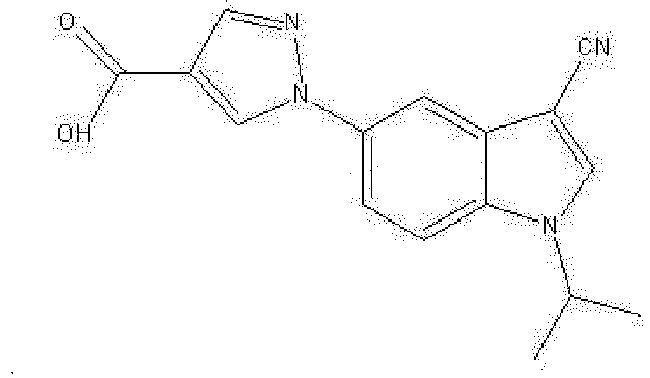
Formula 1 as shown below, but includes some of the compounds ofFormula 2 andFormula 3 as shown below, and in particular, the content of the compound ofFormula 2 was measured to be 0.24%.


- In order to analyze the role of
Formula 2 comprised in the crystalline particles of the compound ofFormula 1 prepared in Synthesis Example 1-3 above, the compound ofFormula 1 was mixed with a specific amount of compound ofFormula 2 by the following method to prepare crystalline particles (Examples 1 to 3). - After mixing the compound of
Formula 1 and the compound ofFormula 2 at the content ratio shown in Table 2, 90 mℓ of acetone and 9.9 mℓ of EtOAc were added, and then 105 mℓ of 1N NaOH was slowly added dropwise for 1 hour and stirred to remove solid impurities. 0.15 mℓ of 6N HCl was added to the filtrate to lower the pH to pH=7-8, and then heated to 50±5°C, and 16.2 mℓ of 6N HCl was slowly added while maintaining this temperature. After the dropwise addition was completed, pH=5±0.5 of the reaction mixture was confirmed, and cooling was started to lower the temperature of the reaction mixture to 25 °C, followed by filtration. The filtered solid was washed with purified water and then dried to obtain crystalline particles which is the target compound. As a result of measuring the content of the compound ofFormula 2 in the obtained crystalline particles by HPLC, it was confirmed as 0.169% (Example 1), 0.246% (Example 2) and 1.646% (Example 3). - In order to analyze the role of
Formula 3 comprised in the crystalline particles of the compound ofFormula 1 prepared in Synthesis Example 1-3 above, the compound ofFormula 1 was mixed with a specific amount of compound ofFormula 3 by the following method to prepare crystalline particles (Comparative Examples 1 and 2). - 40 g of compound of
Formula 1, 1.25 g of compound ofFormula 3, 120 mℓ of acetone, and 140 mℓ of 1N NaOH were slowly added dropwise over 1 hour. After the mixture was stirred, solid impurities were removed. 0.2 mℓ of 6N HCl was added to the filtrate to lower the pH to pH=7-8, and then heated to 50±5°C, and 21.6 mℓ of 6N HCl was slowly added while maintaining this temperature. After the dropwise addition was completed, pH=5±0.5 of the reaction mixture was confirmed, and cooling was started to lower the temperature of the reaction mixture to 25 °C, followed by filtration. The filtered solid was washed with purified water and then dried to obtain crystalline particles which is the target compound. As a result of measuring the content of the compound ofFormula 3 in the obtained crystalline particles by HPLC, it was confirmed as 0.153% (Comparative Example 1). - 25 g of compound of
Formula 1, 35 g of compound ofFormula 3, 90 mℓ of acetone, 9.9 mℓ of EtOAc, and 105 mℓ of 1N NaOH were slowly added dropwise over 1 hour. After the mixture was stirred, solid impurities were removed. 0.15 mℓ of 6N HCl was added to the filtrate to lower the pH to pH=7-8, and then heated to 50±5°C, and 16.2 mℓ of 6N HCl was slowly added while maintaining this temperature. After the dropwise addition was completed, pH=5±0.5 of the reaction mixture was confirmed, and cooling was started to lower the temperature of the reaction mixture to 25 °C, followed by filtration. The filtered solid was washed with purified water and then dried to obtain crystalline particles which is the target compound. As a result of measuring the content of the compound ofFormula 3 in the obtained crystalline particles by HPLC, it was confirmed as 1.243% (Comparative Example 2). - Table 2 below shows the content of the additive compound comprised in the crystalline particles prepared in each Example and Comparative Example.
Table 2: Note Example 1 Example 2 Example 3 Comparative Example 1 Comparative Example 2 Compound of Formula 129.95g 29.925g 29.5g 40g 25g Additive compound Formula 2 0.05g 0.075g 0.5g - - Formula 3 - - - 1.25g 5g Content of additive compound measured after purification process 0.169% 0.246% 1.6460 0.153% 1.243% - For the crystalline particles prepared in Examples and Comparative Examples, the shape of the particles was observed and measured with a scanning electron microscope (SEM).
- As a result of the analysis, as shown in
FIG. 1 , the particles in the crystalline form of Examples 1 to 3 have a square hexahedral shape as the content of the compound ofFormula 2 is increased, but there are tendencies for the size of the particles to be non-uniform (Example 2), and for non-uniform plate-shaped particles and fine powder to increase (Example 3) . Therefore, it can be seen that even if the compound ofFormula 1 comprises 0.246% of the compound ofFormula 2, some non-uniform particles are comprised, but elatively uniform square hexahedron shapes are shown. - However, Comparative Examples 1 and 2 show different aspects from Examples 1 to 3. The crystalline particles in Comparative Example 1 are not only non-uniform in shape, but also produce a lot of fine powder, so it is difficult to put them into the preparation process of the finished product. However, it can be seen that in the case of Comparative Example 2, the shape of the crystalline particles is relatively close to the shape of a square hexahedron, and the size of the particles is uniform, and in the case of the compound of
Formula 3, as its content is increased, the shape and size of the crystalline particles become better. - Therefore, unlike
Chemical Formula 2, since it can be seen that unlike the compound ofFormula 2, the compound ofFormula 3 shows crystalline particles having a uniform square hexahedron shape that can be put into the preparation process of the finished product as its content is increased, it can be seen that the compounds ofFormulas Formula 1 have completely different properties from each other. - The volume average particle distribution and particle size distribution of the crystalline particles prepared in Preparation Examples, Examples and Comparative Examples were measured by a wet method using a laser diffraction particle size analyzer.
- It can be said that the particle size distribution is better as the values of DV10/DV50 and DV50/DV90 used as indicators are larger. Here, DV10, DV50, and DV90 mean particle diameters of particles corresponding to 10%, 50%, and 90% of the total number of particles, respectively, when the measured particles are arranged in order from smallest to largest in particle size.
- As shown in Table 1 below, it can be seen that yhe crystalline particles of Examples 1 and 2 have a relatively uniform particle size distribution compared to Comparative Examples, but the particle size of the particles becomes smaller. However, it can be seen that Example 3 and Comparative Examples 1 and 2 have uneven particle size distribution.
Table 3: Size Classes (µm) DV10/DV50 DV50/DV90 DV (10) DV (50) DV (90) Example 1 107 172 273 0.622 0.63 Example 2 87.4 142 224 0.615 0.633 Example 3 86.5 181 321 0.478 0.564 Comparative Example 1 38 141 251 0.270 0.561 Comparative Example 2 87.6 151 245 0.58 0.616 - The bulk density and tapped density of crystalline particles prepared according to Preparation Examples, Examples and Comparative Examples were measured. The bulk density is the volume when about 50 g of granular powder is put into the measuring cylinder, and the tapped density is the volume when there is no further change in volume after lightly tapping the measuring cylinder on the floor at a constant height 100 times. The bulk density refers to the volume occupied by a certain mass of powder, which refers to the sum of the volume of the powder and the volume of voids between particles as the total volume.
- The flowability and cohesiveness of the granular powder were calculated by the Carr index of Equation (3) and the Hausner ratio of Equation (4) using the bulk density and tapped density measured above according to the method of Jinapong et al (2008).


Table 4: Note Bulk density (g/mℓ) Tapped density (g/mℓ) Carr index (%) Hausner ratio Example1 0.76 0.81 5.89 1.06 Example 2 0.62 0.78 21.21 1.27 Example 3 0.45 0.64 29.74 1.42 Comparative Example 1 0.45 0.71 35.58 1.56 Comparative Example 2 0.64 0.82 21.83 1.28 - Carr index is a measure of the compressibility of a powder and is defined as a percentage of (tapped density - bulk density)/tapped density. As the index is increased, the powder becomes more compactible and less flowable. The Husner ratio is the ratio of tapped density to bulk density and is an estimate of the friction between particles.
- The crystalline particles of Example 1 have a Carr index of 5.89%, and a Hausner ratio of 1.06, and show very good results in both flowability and cohesiveness (Excellent), and the values of Example 2 are not as good as those of Example 1, but overally they have acceptable flowability and cohesiveness in a pharmaceutical formulation. However, although the crystalline particles of Example 3 showed good particle size distribution as in Example 1 in the particle size distribution analyzed above, since they have a Carr index of about 30% and a Hausner ratio of 1.42, they have characteristics that cannot be used in a general formulation.
- The crystalline particles of Comparative Example 1 have a Carr index of 35.58% and a Hausner ratio of 1.56, which have inferior effects (poor flowability and high cohesiveness characteristics) than the crystalline particles of Example 3, but the crystalline particles of Comparative Example 2 have improved values compared to those of Comparative Example 1, which are similar to those of Example 2 above.
- Therefore, in order to obtain crystalline particles including the compound of
Formula 1 having good flowability, the compound ofFormula 2 may be comprised in an amount of 0.246%, and when the content is 0.2% or less, it is possible to obtain crystalline particles with very good flowability. - Since it was confirmed from the above Experimental Examples that in the crystalline particles of the compound of
Formula 1, as the compound ofFormula 2 is incorporated in a smaller amount, especially in an amount of 0.2% or less, crystalline particles having uniformity and excellent flowability can be obtained. Therefore, by reflecting this, the preparation method ofFormula 1 comprising the compound ofFormula 2 in an amount of 0.2% or less was derived. - 1-(3-cyano-1-isopropyl-indol-5-yl)pyrazole-4-carboxylic acid ethyl ester (312 kg) obtained in Synthesis Example 1-2, tetrahydrofuran (554 kg) and methanol (624 L) were added to the reactor, and then 10 N NaOH (386 kg) was slowly added. Since the reaction is an exothermic reaction, it was added for about 1 hour, while taking care not to exceed the internal temperature of 27 °C. After completion of the dropwise addition, the reaction was allowed to proceed in the range of 21 to 27 °C. After completion of the reaction, purified water (624 L) and ethyl acetate (197 kg) were added, and 3N HCl (1048 kg) was slowly added dropwise while maintaining 30 to 35 °C. 3N HCl was divided into first and second dropwise additions, and the first dropwise addition was carried out for the 1st nucleation of the solid until the time point at which pH = 5 to 6. The reaction mixture in which a solid was produced was stirred for 30 minutes, and then the second dropwise addition was carried out until the time point at which pH = 2 to 3. After completion of the dropwise addition, the mixture was cooled to room temperature, aged at this temperature for 30 minutes, and then filtered. The filtered solid was washed with purified water (624 L) and dried under nitrogen and vacuum to obtain a final compound (273.2 kg) comprising 1-(3-cyano-1-isopropyl-indol-5-yl)pyrazole-4-carboxylic acid. In particular, the content of the compound of
Formula 2 was measured to be 0.02 wt.%. - In addition, it was confirmed that the particle size distribution and flowability of the final product were very good.
- Accordingly, it was confirmed that in the method of Synthesis Example 1-3, which is the existing manufacturing method of the compound of
Formula 1, when the temperature of the process of mixing and reacting 1-(3-cyano-1-isopropyl-indol-5-yl)pyrazole-4-carboxylic acid ethyl ester, tetrahydrofuran, methanol and 10 N NaOH is set to 27°C, ethyl acetate is added together when adding purified water after the reaction, and the dropwise addition of HCl is divided into two steps, thus the content of the compound ofFormula 2 may be adjusted to 0.2 wt.% or less. - In order to prepare an oral tablet comprising the compound of
Formula 1 comprising partially the compound ofFormula 2 as an API, the excipients listed in the table below were mixed with the API, and then oral tablets were prepared using a tablet machine.Table 5: Function Ingredient Preparation Example 3 Preparation Example 4 Preparation Example 5 Preparation Example 6 API Crystalline particles of Synthesis Examples 1-4 45.5% 45.5% 45.5% 45.5% Diluent Microcrystal line cellulose 47.6% 43.6% 43.6% 43.6% Starch - - - - Lactose anhydride - - - - Disintegra ting Crospovidone 4.4% 4.5% - - Croscarmello se sodium - - 4.5% - Sodium starch glycolate - - - 4.50 Binder Copovidone - 4.5% - - Povidone - - 4.50 - Hydroxypropy 1 cellulose- - - 4.5% Glidant Colloidal silicon dioxide 0.50 1% 1% 1% Lubricant Sodium stearyl fumarate 20 - 0.8% - Magnesium stearate - 0.80 - 0.8%
Claims (13)
- A pharmaceutical composition for the treatment or prevention of xanthine oxidase-related diseases selected from the group consisting of hyperuricacidemia, gout disease, heart failure, cardiovascular diseases, hypertension, diabetes, renal diseases, inflammation, joint diseases, and inflammatory bowel diseases, comprising crystalline particles of the compound of Formula 1 below or a pharmaceutically acceptable salt thereof comprising the compound of Formula 2 below in an amount of 0.2 wt.% or less; and a pharmaceutically acceptable excipient:


- The pharmaceutical composition according to claim 1, wherein the content of the crystalline particles is 20 to 70 wt.% based on the total 100 wt.% of the pharmaceutical composition.
- The pharmaceutical composition according to claim 2, wherein the content of the crystalline particles is 30 to 60 wt.% based on the total 100 wt.% of the pharmaceutical composition.
- The pharmaceutical composition according to claim 3, wherein the content of the crystalline particles is 40 to 50 wt.% based on the total 100 wt.% of the pharmaceutical composition.
- The pharmaceutical composition according to claim 1, wherein the following compound of Formula 3 is further comprised.

- A method for preparing crystalline particles of Formula 1 comprising the compound of Formula 2 in an amount of 0.2 wt.% or less, which comprises the steps of,a) mixing 1-(3-cyano-1-isopropyl-indol-5-yl)pyrazole-4-carboxylic acid ethyl ester, tetrahydrofuran, and methanol to the reactor, and then slowly adding NaOH and reacting it;b) adding purified water and ethyl acetate;c) crystallizing by dropwise addition of HCl; andd) washing and drying the resulting crystals.
- The method for preparing the crystalline particles according to claim 6, wherein in step a), the reaction temperature is maintained at 21 to 27°C.
- The method for preparing the crystalline particles according to claim 7, wherein step c) comprises two steps of,c-1) firstly adding HCl dropwise until pH 5 to 6 to generate nuclei; andc-2) secondly adding HCl dropwise until the time point of pH 2 to 3.
- Crystalline particles prepared by the method of any one of claims 6 to 8.
- The crystalline particles according to claim 9, wherein the crystalline particles contain 0.2 wt.% or less of the compound of Formula 2.
- An oral tablet comprising the crystalline particles of claim 10 as an active pharmaceutical ingredient (API), wherein the content of the API is 20 to 70 wt.% based on the total 100 wt.% of the tablet.
- The oral tablet according to claim 11, wherein content of the API is 30 to 60 wt.% based on the total 100 wt.% of the tablet.
- The oral tablet according to claim 12, wherein content of the API is 40 to 50 wt.% based on the total 100 wt.% of the tablet.
Applications Claiming Priority (2)
| Application Number | Priority Date | Filing Date | Title |
|---|---|---|---|
| KR20200145750 | 2020-11-04 | ||
| PCT/KR2021/015708 WO2022098057A1 (en) | 2020-11-04 | 2021-11-02 | Method for preparing crystalline particles of 1-(3-cyano-1-isopropyl-indole-5-yl)pyrazole-4-carboxylic acid, and pharmaceutical composition comprising same |
Publications (2)
| Publication Number | Publication Date |
|---|---|
| EP4218755A1 true EP4218755A1 (en) | 2023-08-02 |
| EP4218755A4 EP4218755A4 (en) | 2024-03-27 |
Family
ID=81458100
Family Applications (1)
| Application Number | Title | Priority Date | Filing Date |
|---|---|---|---|
| EP21889522.5A Withdrawn EP4218755A4 (en) | 2020-11-04 | 2021-11-02 | Method for preparing crystalline particles of 1-(3-cyano-1-isopropyl-indole-5-yl)pyrazole-4-carboxylic acid, and pharmaceutical composition comprising same |
Country Status (16)
| Country | Link |
|---|---|
| US (1) | US20240000750A1 (en) |
| EP (1) | EP4218755A4 (en) |
| JP (1) | JP7667270B2 (en) |
| KR (1) | KR20220060488A (en) |
| CN (1) | CN116456979A (en) |
| AR (1) | AR123999A1 (en) |
| AU (1) | AU2021374260B2 (en) |
| CA (1) | CA3194595A1 (en) |
| CL (1) | CL2023001025A1 (en) |
| CO (1) | CO2023007110A2 (en) |
| MX (1) | MX2023004835A (en) |
| MY (1) | MY208699A (en) |
| PE (1) | PE20240139A1 (en) |
| TW (3) | TW202509020A (en) |
| WO (1) | WO2022098057A1 (en) |
| ZA (1) | ZA202305840B (en) |
Cited By (3)
| Publication number | Priority date | Publication date | Assignee | Title |
|---|---|---|---|---|
| EP4257123A4 (en) * | 2020-12-01 | 2024-05-08 | Lg Chem, Ltd. | Stable oral formulation containing 1-(3-cyano-1-isopropyl-indol-5-yl)pyrazole-4-carboxylic acid |
| EP4257124A4 (en) * | 2020-12-01 | 2024-05-29 | Lg Chem, Ltd. | ORAL FORMULATION CONTAINING 1-(3-CYANO-1-ISOPROPYL-INDOL-5-YL)PYRAZOLE-4-CARBOXYLIC ACID AND METHOD FOR THE PREPARATION THEREOF |
| EP4342894A4 (en) * | 2021-07-02 | 2024-08-21 | Lg Chem, Ltd. | Method for preparing xanthine oxidase inhibitor |
Families Citing this family (1)
| Publication number | Priority date | Publication date | Assignee | Title |
|---|---|---|---|---|
| JP7639173B2 (en) * | 2021-04-16 | 2025-03-04 | エルジー・ケム・リミテッド | Oral preparations containing 1-(3-cyano-1-isopropyl-indol-5-yl)pyrazole-4-carboxylic acid |
Family Cites Families (5)
| Publication number | Priority date | Publication date | Assignee | Title |
|---|---|---|---|---|
| DE19602505A1 (en) * | 1996-01-25 | 1997-07-31 | Merck Patent Gmbh | 1- (pyrazol-4-indol-3-yl) piperidines |
| HRP20130900T1 (en) * | 2007-04-11 | 2013-11-08 | Kissei Pharmaceutical Co., Ltd. | INDOLA (AZA) DERIVATIVE AND ITS USE IN MEDICAL PURPOSES |
| TWI423962B (en) * | 2009-10-07 | 2014-01-21 | Lg Life Sciences Ltd | Novel compounds effective as xanthine oxidase inhibitors, method for preparing the same, and pharmaceutical composition containing the same |
| TWI548630B (en) | 2011-04-06 | 2016-09-11 | Lg生命科學有限公司 | 1-(3-cyano-1-isopropyl-indol-5-yl)pyrazole-4-carboxylic acid crystalline form and the producing method thereof |
| KR20200145750A (en) | 2019-06-19 | 2020-12-30 | 한국전자통신연구원 | Method and apparatus for video encoding/decoding using spatial temporal prediction |
-
2021
- 2021-11-02 MX MX2023004835A patent/MX2023004835A/en unknown
- 2021-11-02 AU AU2021374260A patent/AU2021374260B2/en active Active
- 2021-11-02 EP EP21889522.5A patent/EP4218755A4/en not_active Withdrawn
- 2021-11-02 MY MYPI2023002328A patent/MY208699A/en unknown
- 2021-11-02 JP JP2023526427A patent/JP7667270B2/en active Active
- 2021-11-02 CN CN202180072645.4A patent/CN116456979A/en active Pending
- 2021-11-02 US US18/251,646 patent/US20240000750A1/en active Pending
- 2021-11-02 CA CA3194595A patent/CA3194595A1/en active Pending
- 2021-11-02 TW TW113117906A patent/TW202509020A/en unknown
- 2021-11-02 WO PCT/KR2021/015708 patent/WO2022098057A1/en not_active Ceased
- 2021-11-02 KR KR1020210148950A patent/KR20220060488A/en not_active Ceased
- 2021-11-02 TW TW110140777A patent/TWI848241B/en active
- 2021-11-02 PE PE2023001502A patent/PE20240139A1/en unknown
- 2021-11-02 TW TW112120157A patent/TWI884455B/en active
- 2021-11-04 AR ARP210103066A patent/AR123999A1/en unknown
-
2023
- 2023-04-10 CL CL2023001025A patent/CL2023001025A1/en unknown
- 2023-05-30 CO CONC2023/0007110A patent/CO2023007110A2/en unknown
- 2023-05-31 ZA ZA2023/05840A patent/ZA202305840B/en unknown
Cited By (3)
| Publication number | Priority date | Publication date | Assignee | Title |
|---|---|---|---|---|
| EP4257123A4 (en) * | 2020-12-01 | 2024-05-08 | Lg Chem, Ltd. | Stable oral formulation containing 1-(3-cyano-1-isopropyl-indol-5-yl)pyrazole-4-carboxylic acid |
| EP4257124A4 (en) * | 2020-12-01 | 2024-05-29 | Lg Chem, Ltd. | ORAL FORMULATION CONTAINING 1-(3-CYANO-1-ISOPROPYL-INDOL-5-YL)PYRAZOLE-4-CARBOXYLIC ACID AND METHOD FOR THE PREPARATION THEREOF |
| EP4342894A4 (en) * | 2021-07-02 | 2024-08-21 | Lg Chem, Ltd. | Method for preparing xanthine oxidase inhibitor |
Also Published As
| Publication number | Publication date |
|---|---|
| CL2023001025A1 (en) | 2023-12-11 |
| TW202336015A (en) | 2023-09-16 |
| TW202509020A (en) | 2025-03-01 |
| ZA202305840B (en) | 2024-09-25 |
| MX2023004835A (en) | 2023-05-10 |
| TWI884455B (en) | 2025-05-21 |
| AU2021374260B2 (en) | 2024-12-19 |
| AU2021374260A9 (en) | 2025-01-16 |
| EP4218755A4 (en) | 2024-03-27 |
| US20240000750A1 (en) | 2024-01-04 |
| CO2023007110A2 (en) | 2023-07-10 |
| CA3194595A1 (en) | 2022-05-12 |
| AU2021374260A1 (en) | 2023-06-01 |
| KR20220060488A (en) | 2022-05-11 |
| AR123999A1 (en) | 2023-02-01 |
| JP7667270B2 (en) | 2025-04-22 |
| WO2022098057A1 (en) | 2022-05-12 |
| JP2023548160A (en) | 2023-11-15 |
| TWI848241B (en) | 2024-07-11 |
| TW202225158A (en) | 2022-07-01 |
| MY208699A (en) | 2025-05-25 |
| PE20240139A1 (en) | 2024-01-30 |
| CN116456979A (en) | 2023-07-18 |
Similar Documents
| Publication | Publication Date | Title |
|---|---|---|
| AU2021374260B2 (en) | Method for preparing crystalline particles of 1-(3-cyano-1-isopropyl-indole-5-yl)pyrazole-4-carboxylic acid, and pharmaceutical composition comprising same | |
| EP3845221B1 (en) | Solid state forms of sofosbuvir | |
| US12365680B2 (en) | Polymorphs of the hydrochloride salt of linaprazan glurate | |
| EP1853232B1 (en) | Stable crystalline form of bifeprunox mesylate, dosage forms thereof adn methods for using them | |
| EP1292303A1 (en) | A stable pharmaceutical formulation comprising torsemide modification ii | |
| KR20200039838A (en) | Phenyl amino pyrimidine compound or polymorph of salt thereof | |
| HK40094242A (en) | Method for preparing crystalline particles of 1-(3-cyano-1-isopropyl-indole-5-yl)pyrazole-4-carboxylic acid, and pharmaceutical composition comprising same | |
| EP4055000B1 (en) | Process for the preparation of ferric organic compounds | |
| US20030022921A1 (en) | Stable pharmaceutical formulation comprising torsemide modification II | |
| US20230174525A1 (en) | Polymorphs of a hydrochloride salt of pn6047 | |
| HK40092799A (en) | Polymorphs of a hydrochloride salt of pn6047 | |
| AU2001238617A1 (en) | A stable pharmaceutical formulation comprising torsemide modification II |
Legal Events
| Date | Code | Title | Description |
|---|---|---|---|
| STAA | Information on the status of an ep patent application or granted ep patent |
Free format text: STATUS: THE INTERNATIONAL PUBLICATION HAS BEEN MADE |
|
| PUAI | Public reference made under article 153(3) epc to a published international application that has entered the european phase |
Free format text: ORIGINAL CODE: 0009012 |
|
| STAA | Information on the status of an ep patent application or granted ep patent |
Free format text: STATUS: REQUEST FOR EXAMINATION WAS MADE |
|
| 17P | Request for examination filed |
Effective date: 20230427 |
|
| AK | Designated contracting states |
Kind code of ref document: A1 Designated state(s): AL AT BE BG CH CY CZ DE DK EE ES FI FR GB GR HR HU IE IS IT LI LT LU LV MC MK MT NL NO PL PT RO RS SE SI SK SM TR |
|
| DAV | Request for validation of the european patent (deleted) | ||
| DAX | Request for extension of the european patent (deleted) | ||
| A4 | Supplementary search report drawn up and despatched |
Effective date: 20240226 |
|
| RIC1 | Information provided on ipc code assigned before grant |
Ipc: A61P 9/00 20060101ALI20240220BHEP Ipc: A61P 1/00 20060101ALI20240220BHEP Ipc: A61P 19/02 20060101ALI20240220BHEP Ipc: A61P 29/00 20060101ALI20240220BHEP Ipc: A61P 13/12 20060101ALI20240220BHEP Ipc: A61P 3/10 20060101ALI20240220BHEP Ipc: A61P 9/12 20060101ALI20240220BHEP Ipc: A61P 9/04 20060101ALI20240220BHEP Ipc: A61P 19/06 20060101ALI20240220BHEP Ipc: A61K 9/20 20060101ALI20240220BHEP Ipc: A61K 31/4155 20060101AFI20240220BHEP |
|
| STAA | Information on the status of an ep patent application or granted ep patent |
Free format text: STATUS: EXAMINATION IS IN PROGRESS |
|
| 17Q | First examination report despatched |
Effective date: 20241030 |
|
| GRAP | Despatch of communication of intention to grant a patent |
Free format text: ORIGINAL CODE: EPIDOSNIGR1 |
|
| STAA | Information on the status of an ep patent application or granted ep patent |
Free format text: STATUS: GRANT OF PATENT IS INTENDED |
|
| INTG | Intention to grant announced |
Effective date: 20250311 |
|
| STAA | Information on the status of an ep patent application or granted ep patent |
Free format text: STATUS: THE APPLICATION IS DEEMED TO BE WITHDRAWN |
|
| 18D | Application deemed to be withdrawn |
Effective date: 20250712 |