EP4217810B1 - System and method for controlling a mobile industrial robot using a probabilistic occupancy grid - Google Patents
System and method for controlling a mobile industrial robot using a probabilistic occupancy grid Download PDFInfo
- Publication number
- EP4217810B1 EP4217810B1 EP20781354.4A EP20781354A EP4217810B1 EP 4217810 B1 EP4217810 B1 EP 4217810B1 EP 20781354 A EP20781354 A EP 20781354A EP 4217810 B1 EP4217810 B1 EP 4217810B1
- Authority
- EP
- European Patent Office
- Prior art keywords
- chromaticity
- cell
- elevation
- map
- values
- Prior art date
- Legal status (The legal status is an assumption and is not a legal conclusion. Google has not performed a legal analysis and makes no representation as to the accuracy of the status listed.)
- Active
Links
Images
Classifications
-
- G—PHYSICS
- G05—CONTROLLING; REGULATING
- G05D—SYSTEMS FOR CONTROLLING OR REGULATING NON-ELECTRIC VARIABLES
- G05D1/00—Control of position, course, altitude or attitude of land, water, air or space vehicles, e.g. using automatic pilots
- G05D1/02—Control of position or course in two dimensions
- G05D1/021—Control of position or course in two dimensions specially adapted to land vehicles
- G05D1/0268—Control of position or course in two dimensions specially adapted to land vehicles using internal positioning means
- G05D1/0274—Control of position or course in two dimensions specially adapted to land vehicles using internal positioning means using mapping information stored in a memory device
-
- G—PHYSICS
- G05—CONTROLLING; REGULATING
- G05D—SYSTEMS FOR CONTROLLING OR REGULATING NON-ELECTRIC VARIABLES
- G05D1/00—Control of position, course, altitude or attitude of land, water, air or space vehicles, e.g. using automatic pilots
- G05D1/02—Control of position or course in two dimensions
- G05D1/021—Control of position or course in two dimensions specially adapted to land vehicles
- G05D1/0212—Control of position or course in two dimensions specially adapted to land vehicles with means for defining a desired trajectory
- G05D1/0214—Control of position or course in two dimensions specially adapted to land vehicles with means for defining a desired trajectory in accordance with safety or protection criteria, e.g. avoiding hazardous areas
-
- B—PERFORMING OPERATIONS; TRANSPORTING
- B25—HAND TOOLS; PORTABLE POWER-DRIVEN TOOLS; MANIPULATORS
- B25J—MANIPULATORS; CHAMBERS PROVIDED WITH MANIPULATION DEVICES
- B25J5/00—Manipulators mounted on wheels or on carriages
-
- G—PHYSICS
- G01—MEASURING; TESTING
- G01C—MEASURING DISTANCES, LEVELS OR BEARINGS; SURVEYING; NAVIGATION; GYROSCOPIC INSTRUMENTS; PHOTOGRAMMETRY OR VIDEOGRAMMETRY
- G01C21/00—Navigation; Navigational instruments not provided for in groups G01C1/00 - G01C19/00
- G01C21/20—Instruments for performing navigational calculations
- G01C21/206—Instruments for performing navigational calculations specially adapted for indoor navigation
-
- G—PHYSICS
- G05—CONTROLLING; REGULATING
- G05D—SYSTEMS FOR CONTROLLING OR REGULATING NON-ELECTRIC VARIABLES
- G05D1/00—Control of position, course, altitude or attitude of land, water, air or space vehicles, e.g. using automatic pilots
- G05D1/0088—Control of position, course, altitude or attitude of land, water, air or space vehicles, e.g. using automatic pilots characterized by the autonomous decision making process, e.g. artificial intelligence, predefined behaviours
-
- G—PHYSICS
- G05—CONTROLLING; REGULATING
- G05D—SYSTEMS FOR CONTROLLING OR REGULATING NON-ELECTRIC VARIABLES
- G05D1/00—Control of position, course, altitude or attitude of land, water, air or space vehicles, e.g. using automatic pilots
- G05D1/02—Control of position or course in two dimensions
- G05D1/021—Control of position or course in two dimensions specially adapted to land vehicles
- G05D1/0231—Control of position or course in two dimensions specially adapted to land vehicles using optical position detecting means
- G05D1/0246—Control of position or course in two dimensions specially adapted to land vehicles using optical position detecting means using a video camera in combination with image processing means
- G05D1/0248—Control of position or course in two dimensions specially adapted to land vehicles using optical position detecting means using a video camera in combination with image processing means in combination with a laser
-
- G—PHYSICS
- G05—CONTROLLING; REGULATING
- G05D—SYSTEMS FOR CONTROLLING OR REGULATING NON-ELECTRIC VARIABLES
- G05D1/00—Control of position, course, altitude or attitude of land, water, air or space vehicles, e.g. using automatic pilots
- G05D1/20—Control system inputs
- G05D1/24—Arrangements for determining position or orientation
- G05D1/246—Arrangements for determining position or orientation using environment maps, e.g. simultaneous localisation and mapping [SLAM]
- G05D1/2464—Arrangements for determining position or orientation using environment maps, e.g. simultaneous localisation and mapping [SLAM] using an occupancy grid
-
- G—PHYSICS
- G05—CONTROLLING; REGULATING
- G05D—SYSTEMS FOR CONTROLLING OR REGULATING NON-ELECTRIC VARIABLES
- G05D1/00—Control of position, course, altitude or attitude of land, water, air or space vehicles, e.g. using automatic pilots
- G05D1/60—Intended control result
- G05D1/617—Safety or protection, e.g. defining protection zones around obstacles or avoiding hazards
-
- G—PHYSICS
- G06—COMPUTING OR CALCULATING; COUNTING
- G06V—IMAGE OR VIDEO RECOGNITION OR UNDERSTANDING
- G06V10/00—Arrangements for image or video recognition or understanding
- G06V10/40—Extraction of image or video features
- G06V10/56—Extraction of image or video features relating to colour
-
- G—PHYSICS
- G06—COMPUTING OR CALCULATING; COUNTING
- G06V—IMAGE OR VIDEO RECOGNITION OR UNDERSTANDING
- G06V20/00—Scenes; Scene-specific elements
- G06V20/50—Context or environment of the image
- G06V20/56—Context or environment of the image exterior to a vehicle by using sensors mounted on the vehicle
-
- G—PHYSICS
- G06—COMPUTING OR CALCULATING; COUNTING
- G06V—IMAGE OR VIDEO RECOGNITION OR UNDERSTANDING
- G06V2201/00—Indexing scheme relating to image or video recognition or understanding
- G06V2201/06—Recognition of objects for industrial automation
Definitions
- the present disclosure relates to the field of robot navigation and, in particular, to methods and devices for controlling a mobile industrial robot on the basis of a probabilistic occupancy grid representing a substrate on which the robot can move.
- a satisfactory perception mechanism should enable the robot to navigate constrained and populated environments efficiently, while at the same time avoiding destructive collisions.
- Objects mixed with other objects of different heights, objects with small dimensions, transparent or reflective objects, dark or black objects are all known to cause difficulties to perception mechanisms attempting to discover and correctly assess them.
- So-called occupancy grids, or probability maps, are frequently used tools for modeling the navigable environment of a mobile robot.
- the cells of the occupancy grid are initialized with neutral probability values, which are subsequently refined based on acquired sensor data.
- the problem of updating such a probability map based on a sequence of sensor measurements made from a moving platform is discussed in a preprint by Chr. Robbiano et al., "Bayesian Learning of Occupancy Grids", retrieved from arxiv.org/abs/1911.07915 .
- the present disclosure aims to improve the prior art techniques.
- US2019080463A1 discloses a machine-learning algorithm for finding a height map of an environment.
- a probabilistic generative appearance model which is iteratively refined into agreement with an observed color map, is an optional further output of the algorithm.
- the observed color map is used to develop the appearance model.
- There height map does not direct depend on the color map.
- US20160860soA1 proposes computerized techniques for determining salient features in an image or video. An aim of these techniques is to enable the computer to perceive the image like a human.
- One objective is to make available methods and devices for providing an occupancy grid to support the controlling of a mobile industrial robot. Another objective is to enable maintenance and successive refinement of such occupancy grid on the basis of continuing measurements by a color-depth sensor, notably a robot-mounted color-depth sensor.
- a particular objective is to propose efficient data processing techniques suited for use cases where RGB-D (red-green-blue plus depth, i.e., color image and depth map) measurements are available.
- the inventor has realized that, to judge whether a cell is free or occupied, it is expedient to identify globally dominant chromaticity values and search for cells in which, concurrently, the chromaticity value of the cell belongs to the globally dominant ones and the elevation value is comparatively small.
- a criterion based on this combination is therefore a useful tool for building an algorithm that converges in reasonable time, produces a highly accurate occupancy grid, or both.
- the potential productive clock time that the robot spends waiting for a fresh occupancy grid to be generated (or for an update of an existing occupancy grid) is reduced.
- robot navigation may become safer and more precise.
- a robot controller with the technical features of claim 8, which is configured for controlling at least one mobile industrial robot.
- the robot controller comprises an input interface, processing circuitry and output interface and it is configured to perform the above method.
- the invention further relates to a computer program containing instructions for causing a computer, or the robot controller in particular, to carry out the above method.
- the computer program may be stored or distributed on a data carrier.
- a “data carrier” may be a transitory data carrier, such as modulated electromagnetic or optical waves, or a non-transitory data carrier.
- Non-transitory data carriers include volatile and non-volatile memories, such as permanent and non-permanent storages of magnetic, optical or solid-state type. Still within the scope of "data carrier”, such memories may be fixedly mounted or portable.
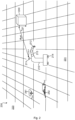
- Figure 2 depicts a setting where the present invention may be applied.
- an industrial robot 210 is movable over a substrate 220 by means of wheels 214, bands, claws, movable suction cups or other means of propulsion and/or attachment.
- the substrate 220 may be a planar or curved surface with a horizontal, slanted or vertical orientation; it may optionally be provided with rails or other movement guides adapted to cooperate with the robot 210.
- Example substrates 220 include an indoor floor, outdoor ground, a surface preconditioned to facilitate driving etc. Present are furthermore physical objects which may act as obstacles of different seriousness to the robot's 210 movement over the substrate 220.
- figure 2 shows a box-shaped object 240 comparable to the robot's 210 height, a puddle of liquid 241 and a moderately sized heap of powdery material 242. From these, the puddle of liquid 241 will normally not impede the robot's 210 movement, and it is therefore an aim that it be treated as a non-obstacle that the algorithm to be described below.
- the bookkeeping of obstacles relies on an occupancy grid 230, a data structure which associates each of the multiple cells 231 of the grid with an occupancy probability p.
- An occupancy probability of a cell at grid indices ( x, y ) may be denoted p ( x, y ) .
- the resolution of the grid may be expressed as a cell size parameter w res , which may be of the order of 0.01 m to 1 m, such as 0.05 m, 0.10 m or 0.20 m. For navigation of relatively slower-moving and sensitive robots 210, a smaller cell size is preferable.
- grid indices ( x, y ) refer to the discretized grid at resolution w res .
- the fact that grid indices ( x, y ) correspond to converted coordinates ( X, Y, Z ) may be written ( X, Y, Z ) ⁇ ( x, y ); it is noted that this is a rank-deficient operation which is in general not invertible.
- the grid indices may optionally be extended with a height index z into an integer triplet ( x, y, z ), each triplet referring to a cubic grid cell (voxel).
- x, y, z a triplet referring to a cubic grid cell (voxel).
- uppercase letters are preferred for coordinates and lowercase letters for grid and height indices.
- an occupancy probability of a cell may be understood as the posterior probability that a physical object is present in the cell.
- Cells with occupancy probability values in the range (0.5,1.0] may be treated as occupied cells, and cells with values in [0.0,0.5) may be taken to be free.
- the left-out value 0.5 represents an unknown occupancy status.
- the occupancy grid 230 is a probabilistic representation that goes beyond the binary distinction occupied/free and thereby enables sensor fusion and the nuanced combining of multiple measurements by a single sensor.
- the robot 210 is shown equipped with a movable arm 213, end effector 212 and sensor 211.
- the sensor may be elevated, i.e., located some distance Z a above the level of the substrate 220 to make efficient use of its field of view.
- the sensor 211 may be configured to employ at least one measuring principle that includes sensing an incident electromagnetic wave reflected or emitted by the objects 240, 241, 242 on the substrate 230 or the substrate 230 itself. To exemplify, an incident ray from the box 240 is shown in figure 2 .
- the sensor 211 has the ability of providing an elevation map and a chromaticity map of the substrate 220 and any physical objects present on the substrate 220.
- an RGB-D sensor may produce a two-dimensional color bitmap, where at least some pixels are annotated with depth values, representing an image plane orthogonal to the orientation of the angle of incidence S. Such depth-annotated pixels may be converted into a point cloud, where each point is represented in three-dimensional coordinates (e.g., cartesian, spherical, radial) and additionally carries a color or chromaticity value.
- the RGB-D sensor may produce a point cloud directly. Libraries with generically applicable software routines for analyzing point-cloud data and performing operations thereon are available, e.g., from The Point Cloud Library ( https: // pointclouds.org ) .
- FIG 3 is a schematic representation of a robot controller 300 suitable for controlling the robot 210 of figure 2 .
- the robot controller 300 may be integral with the robot 210 or may be implemented as a separate, stationary or mobile unit. It comprises an input interface 310 configured to receive occupancy-related measurements obtained by the sensor 211 on the robot, processing circuitry 320 configured to assign an occupancy probability on the basis of the received occupancy-related measurements, an output interface 330 for supplying commands to the robot 210, as well as an operator interface 340.
- the interfaces 320, 340 and processing circuitry 320 may be local resources or networked (or cloud) resources; in particular, the processing circuitry 320 may include one processor or multiple processors.
- the operator interface 340 may be a text-based, graphical, auditory and/or haptic interface, by which the robot controller 300 may receive instructions directing on high level the commands to be fed to the robot 210, and by which it may output human-intelligible information indicative of a state or condition of the robot 210.
- Figure 3 furthermore indicates an example set of communicative connections (data connections) among the internal functional components 310, 320, 330, 340 of the robot controller 300.
- the connections may be implemented as a central bus providing multipoint connectivity.
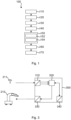
- the robot controller 300 may perform the method 100 depicted in figure 1 .
- the occupancy grid is initiated. It may take into account the geometry of the substrate 220 and a configured value of the cell size w res .
- a specific placeholder value may be assigned, so as to signify that the occupancy probability has not yet been updated in view of an occupancy-related measurement.
- a second step 120 an elevation map and a chromaticity map of the substrate 220 are obtained.
- the reference level may coincide with the substrate 220 or may be a dedicated reference plane; the latter option may simplify calculations in cases where the substrate 220 is curved.
- the resolution of the elevation map may be one value per cell 231 of the occupancy grid 230 or a finer resolution; the elevation value may be continuous or discretized in agreement with the grid resolution w res .
- the physical objects 240, 241, 242 have respective elevations h 240 , h 241 , h 242 .
- a chromaticity map associates points of the substrate 220 with respective chromaticity values. Similar to the elevation map, it is sufficient for the chromaticity map to have one chromaticity value per cell 231 of the occupancy grid 230.
- the chromaticity may refer to any suitable color model, such as RGB, HSL, HSV, Munsell, NCS and the like. For purposes of illustration and not limitation, an RGB representation will be used in this description. If multiple points within one cell 231 carry chromaticity values, then their mean value or a value obtained by global smoothing (e.g., fitting a function similar to function h discussed below) may be applied as the chromaticity value of the cell. Alternatively, the multiple chromaticity values are left unchanged, the dominance criterion is assessed for each, and all outcomes of these assessments in the cell are merged into one.
- the data source of the two maps may be the sensor 211 which, as noted, may be an RGB-D sensor.
- the sensor's 211 output may be (or be convertible into) point-cloud data items of the form ( X i , Y i , Z i , R i , G i , B i ), where the three pixel intensity components are separate, or of the form ( X i , Y i , Z i , RGB i ), where the pixel intensity components are concatenated into one binary value.
- the second step 120 may include:
- the elevation extraction may optionally include a preprocessing operation 130, which eliminates point-cloud points located in remote regions compared to the sensor and/or physically unattainable points.
- the remote regions in this sense which may be poorly visible from the sensor 211, may correspond to such points ( X i , Y i , Z i ) which satisfy a criterion C 1 : X i Y i ⁇ X a Y a ⁇ d 1 where
- the constant d 1 is dependent on the sensor hardware and the degree of difficulty of the navigable environment; it may for example be of the order of tens of meters in an indoor use case. While the above expression refers to the two-dimensional distance (i.e., measured parallel to the substrate 220), variations of criterion C1 may refer to a three-dimensional distance. Examples of physically unattainable points ( X i , Y i , Z i ), to be removed in the preprocessing operation, are those for which Z i ⁇ Z min , which may be due to sensor artefacts.
- the preprocessing operation 130 may further include eliminating point-cloud points which represent outlier values of the elevation.
- the fact that an elevation value differs significantly from other observations may suggest its correctness is doubtful, and it may thus be considered to be an outlier.
- Each of R, G, B may be a number in the range [0,255] which is in a linear relationship with the corresponding intensity of that color component.
- the intensity normalization may help eliminate measurement artefacts related to uneven illumination of different regions of the substrate 220.
- a mean elevation Z ave ( x, y ) of each cell is computed and a first partial occupancy probability p 1 is derived.
- the execution of the fourth step 140 may be restricted to such cells 231 of the occupancy grid 230 for which the elevation map contains elevation data.
- the function h may have a predetermined smoothness (e.g., n times continuously differentiable), which is defined on the substrate 220 and fitted to the point-cloud data in such manner that said surface constitutes an L q approximation for some q ⁇ 0 or is 'close' to the point-cloud data in another suitable sense.
- This alternative way of computing the mean elevation may make the data accuracy more uniform, as it reduces the random impact of the rounding/quantizing into grid cells of the sensor data.
- the maximum height Z max may be equal to the height at which the sensor 211 is arranged, as this may correspond to the height of the tallest objects that are visible to the sensor 211 without obscuration.
- the maximum height Z max is set to a value corresponding to what is, for other reasons, considered to be the height of the tallest physical object on the substrate 220 that can be reliably discovered by the sensor 211 in normal operating conditions.
- a subsequent step 150 of the method 100 comprises multiple substeps 152, 154 where the chromaticity data is processed with the ultimate aim of determining a second partial occupancy probability p 2 for at least some cells 231 of the occupancy grid 230.
- a first substep 152 the distribution of the chromaticity is estimated to identify dominant chromaticity values.
- the estimation may include forming a histogram with respect to a set of predefined bins or color categories.
- Figure 5 shows an example partition (mesh) of the ( r, g ) color space into squares of approximately uniform size, which have been numbered sequentially or have been provided with other identifiers.
- the definition of the partition is equivalent to a function C ( r, g ) which maps a pair of normalized pixel intensity values ( r, g ) to a sequential number of the bin.
- Figure 6 shows an alternative partition reflecting the fact that the perceived chromaticity varies relatively slower in the vicinity of the corners (0,0), (1,0), (0,1) and therefore can be reliably captured by a smaller number of bins.
- the partition illustrated in figure 5 and to some extent the one in figure 6 may be said to represent world-agnostic partitions, more precisely, in the sense that the density of bins is approximately uniform over the color space. In a use case where it is known or expected that certain chromaticity values are absent or very unusual, such a priori knowledge may be utilized to fashion a color space partition with locally reduced and/or locally increased density.
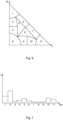
- Figure 7 shows a histogram referring to the eleven-bin partition of figure 6 for an example chromaticity map.
- the vertical axis represents a frequency f of chromaticity of the respective bins.
- the frequency f may be an incidence, such as a number or normalized number of observations falling in each of the bins.
- the first substep 152 may start from a parameterization of a probability density function (ansatz) and vary its parameters so that it matches the sensor data.
- ansatz probability density function
- the dominant chromaticity values correspond to those of bin 2.
- a second tier of dominant chromaticity values may include bins 1 and 10.
- a second substep 154 makes use of the knowledge gained from the distribution of the chromaticity, as may be visualized in the form of a histogram.
- a cell-wise chromaticity value which is equal or close to a dominant chromaticity value (referring to the chromaticity map globally) and occurs in the same grid cell as a non-significant elevation value may suggest that the cell is non-occupied, i.e., free from physical objects.
- the first and second partial occupancy probabilities p 1 ( x, y ) and p 2 ( x, y ) for a cell at grid coordinates ( x, y ) are merged to obtain an occupancy probability p ( x, y ) to be assigned to the cell in the occupancy grid 230.
- the first and second partial occupancy probabilities may be combined linearly or nonlinearly.
- Suitable coefficient values may be determined by empirical evaluation, wherein an initial guess may reflect the expected data quality of the elevation map and the chromaticity map, or its value as guidance for judging whether a physical object is present in the cell.
- each one of the two partial occupancy probabilities contributes reflects the inventor's realization that the combination of a dominant chromaticity value and a low elevation is significant to suggest that a cell is likely free, i.e., that a low occupancy probability is to be assigned. It is recalled from the example of figure 2 that the puddle of liquid 241 has a color different than the substrate 220, which taken alone suggests that it is an obstacle, but at the same time a negligible elevation h 241 ⁇ 0, which will tend to disqualify it as an obstacle.
- the first and second partial occupancy probabilities p 1 ( x, y ) and p 2 ( x, y ) are further merged with a pre-existing occupancy probability p old ( x, y ) of the cell.
- a recursive rule as Bayes' rule, may be applied.
- the robot controller 300 may control movement of the industrial robot 310 on the basis of the occupancy grid. Such controlling may include local motion planning, tactical route planning, collision avoidance, speed regulation and similar tasks.
Landscapes
- Engineering & Computer Science (AREA)
- Radar, Positioning & Navigation (AREA)
- Physics & Mathematics (AREA)
- Remote Sensing (AREA)
- General Physics & Mathematics (AREA)
- Automation & Control Theory (AREA)
- Aviation & Aerospace Engineering (AREA)
- Multimedia (AREA)
- Theoretical Computer Science (AREA)
- Evolutionary Computation (AREA)
- Robotics (AREA)
- Game Theory and Decision Science (AREA)
- Artificial Intelligence (AREA)
- Health & Medical Sciences (AREA)
- Business, Economics & Management (AREA)
- Mechanical Engineering (AREA)
- Medical Informatics (AREA)
- Optics & Photonics (AREA)
- Computer Vision & Pattern Recognition (AREA)
- Electromagnetism (AREA)
- Image Analysis (AREA)
- Control Of Position, Course, Altitude, Or Attitude Of Moving Bodies (AREA)
- Image Processing (AREA)
- Manipulator (AREA)
Description
- The present disclosure relates to the field of robot navigation and, in particular, to methods and devices for controlling a mobile industrial robot on the basis of a probabilistic occupancy grid representing a substrate on which the robot can move.
- Significant research has been and is being devoted to the problem of developing perception mechanisms for supporting control systems in mobile industrial robots. A satisfactory perception mechanism should enable the robot to navigate constrained and populated environments efficiently, while at the same time avoiding destructive collisions. Objects mixed with other objects of different heights, objects with small dimensions, transparent or reflective objects, dark or black objects are all known to cause difficulties to perception mechanisms attempting to discover and correctly assess them.
- So-called occupancy grids, or probability maps, are frequently used tools for modeling the navigable environment of a mobile robot. The cells of the occupancy grid are initialized with neutral probability values, which are subsequently refined based on acquired sensor data. The problem of updating such a probability map based on a sequence of sensor measurements made from a moving platform is discussed in a preprint by Chr. Robbiano et al., "Bayesian Learning of Occupancy Grids", retrieved from arxiv.org/abs/1911.07915 .
- Particularly addressing an indoor mobile robot application where the navigable environment is modeled by a two-dimensional occupancy grid, the present disclosure aims to improve the prior art techniques.
-
US2019080463A1 discloses a machine-learning algorithm for finding a height map of an environment. A probabilistic generative appearance model, which is iteratively refined into agreement with an observed color map, is an optional further output of the algorithm. The observed color map is used to develop the appearance model. There height map does not direct depend on the color map. - Starting from a psychophysical definition of "saliency" as the ability to attract attention to a particular stimulus,
US20160860soA1 - One objective is to make available methods and devices for providing an occupancy grid to support the controlling of a mobile industrial robot. Another objective is to enable maintenance and successive refinement of such occupancy grid on the basis of continuing measurements by a color-depth sensor, notably a robot-mounted color-depth sensor. A particular objective is to propose efficient data processing techniques suited for use cases where RGB-D (red-green-blue plus depth, i.e., color image and depth map) measurements are available.
- These and other objectives are achieved by the method and the robot controller according to the invention defined by the independent claims. The dependent claims are directed to embodiments of the invention.
- In a first aspect, there is provided a method of controlling an industrial robot movable on a substrate with the technical features according to
claim 1. - The inventor has realized that, to judge whether a cell is free or occupied, it is expedient to identify globally dominant chromaticity values and search for cells in which, concurrently, the chromaticity value of the cell belongs to the globally dominant ones and the elevation value is comparatively small. A criterion based on this combination is therefore a useful tool for building an algorithm that converges in reasonable time, produces a highly accurate occupancy grid, or both. As a result, the potential productive clock time that the robot spends waiting for a fresh occupancy grid to be generated (or for an update of an existing occupancy grid) is reduced. Likewise, robot navigation may become safer and more precise.
- In a second aspect, there is provided a robot controller with the technical features of
claim 8, which is configured for controlling at least one mobile industrial robot. The robot controller comprises an input interface, processing circuitry and output interface and it is configured to perform the above method. - The invention further relates to a computer program containing instructions for causing a computer, or the robot controller in particular, to carry out the above method. The computer program may be stored or distributed on a data carrier. As used herein, a "data carrier" may be a transitory data carrier, such as modulated electromagnetic or optical waves, or a non-transitory data carrier. Non-transitory data carriers include volatile and non-volatile memories, such as permanent and non-permanent storages of magnetic, optical or solid-state type. Still within the scope of "data carrier", such memories may be fixedly mounted or portable.
- Generally, all terms used in the claims are to be interpreted according to their ordinary meaning in the technical field, unless explicitly defined otherwise herein. All references to "a/an/the element, apparatus, component, means, step, etc." are to be interpreted openly as referring to at least one instance of the element, apparatus, component, means, step, etc., unless explicitly stated otherwise. The steps of any method disclosed herein do not have to be performed in the exact order disclosed, unless explicitly stated.
- Aspects and embodiments are now described, by way of example, with reference to the accompanying drawings, on which:
-
figure 1 is a flowchart of a method according to an embodiment; -
figure 2 is a perspective view of an industrial robot adapted to move on a substrate, modeled as a two-dimensional occupancy grid, and objects thereon representing potential obstacles to the robot's movement; -
figure 3 is a block diagram of a robot controller according to an embodiment; -
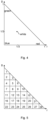
figure 4 illustrates a two-dimensional color space parametrized, in accordance with a color model, by normalized (intensity-normalized) green and red components of pixel intensity values; -
figures 5 and6 illustrate example partitions into numbered bins of the color space offigure 4 ; and -
figure 7 is a histogram, with reference to the partition according tofigure 6 , of an example chromaticity map. - The aspects of the present disclosure will now be described more fully hereinafter with reference to the accompanying drawings, on which certain embodiments of the invention are shown. These aspects may, however, be embodied in many different forms and should not be construed as limiting; rather, the embodiments are provided by way of example so that this disclosure will be thorough and complete, and to fully convey the scope of all aspects of invention to those skilled in the art. Like numbers refer to like elements throughout the description.
-
Figure 2 depicts a setting where the present invention may be applied. Here, anindustrial robot 210 is movable over asubstrate 220 by means ofwheels 214, bands, claws, movable suction cups or other means of propulsion and/or attachment. Thesubstrate 220 may be a planar or curved surface with a horizontal, slanted or vertical orientation; it may optionally be provided with rails or other movement guides adapted to cooperate with therobot 210.Example substrates 220 include an indoor floor, outdoor ground, a surface preconditioned to facilitate driving etc. Present are furthermore physical objects which may act as obstacles of different seriousness to the robot's 210 movement over thesubstrate 220. To exemplify,figure 2 shows a box-shaped object 240 comparable to the robot's 210 height, a puddle ofliquid 241 and a moderately sized heap ofpowdery material 242. From these, the puddle ofliquid 241 will normally not impede the robot's 210 movement, and it is therefore an aim that it be treated as a non-obstacle that the algorithm to be described below. - The bookkeeping of obstacles relies on an
occupancy grid 230, a data structure which associates each of themultiple cells 231 of the grid with an occupancy probability p. An occupancy probability of a cell at grid indices (x, y) may be denoted p(x, y). The resolution of the grid may be expressed as a cell size parameter wres, which may be of the order of 0.01 m to 1 m, such as 0.05 m, 0.10 m or 0.20 m. For navigation of relatively slower-moving andsensitive robots 210, a smaller cell size is preferable. In the present disclosure, unless otherwise indicated, grid indices (x, y) refer to the discretized grid at resolution wres. The grid indices may for example be represented as integer pairs, and real-valued cartesian coordinates (X, Y, Z) (which may have been read from a sensor) may be converted into grid indices (x, y) by orthogonal projection on the Z = 0 plane (corresponding to the substrate 220) combined with a rounding operation. The fact that grid indices (x, y) correspond to converted coordinates (X, Y, Z) may be written (X, Y, Z)~(x, y); it is noted that this is a rank-deficient operation which is in general not invertible. The grid indices may optionally be extended with a height index z into an integer triplet (x, y, z), each triplet referring to a cubic grid cell (voxel). In this disclosure, uppercase letters are preferred for coordinates and lowercase letters for grid and height indices. - The present disclosure will rely on ordinary terminology and the commonly embraced theoretical basics of occupancy grids. In particular, an occupancy probability of a cell may be understood as the posterior probability that a physical object is present in the cell. The highest likelihood that a physical object is present corresponds to the value p = 1. Cells with occupancy probability values in the range (0.5,1.0] may be treated as occupied cells, and cells with values in [0.0,0.5) may be taken to be free. The left-out value 0.5 represents an unknown occupancy status. The
occupancy grid 230 is a probabilistic representation that goes beyond the binary distinction occupied/free and thereby enables sensor fusion and the nuanced combining of multiple measurements by a single sensor. In some embodiments, an alternative occupancy grid is used where each cell is associated with a probability (a 'non-occupancy probability') p' that the cell is free, i.e., no physical object is present. This means that the highest likelihood that a physical object is present corresponds to the value p' = 0. - The
robot 210 is shown equipped with amovable arm 213,end effector 212 andsensor 211. The sensor may be elevated, i.e., located some distance Za above the level of thesubstrate 220 to make efficient use of its field of view. Thesensor 211 may be configured to employ at least one measuring principle that includes sensing an incident electromagnetic wave reflected or emitted by theobjects substrate 230 or thesubstrate 230 itself. To exemplify, an incident ray from thebox 240 is shown infigure 2 . In particular, thesensor 211 has the ability of providing an elevation map and a chromaticity map of thesubstrate 220 and any physical objects present on thesubstrate 220. For instance, an RGB-D sensor may produce a two-dimensional color bitmap, where at least some pixels are annotated with depth values, representing an image plane orthogonal to the orientation of the angle of incidence S. Such depth-annotated pixels may be converted into a point cloud, where each point is represented in three-dimensional coordinates (e.g., cartesian, spherical, radial) and additionally carries a color or chromaticity value. Alternatively, the RGB-D sensor may produce a point cloud directly. Libraries with generically applicable software routines for analyzing point-cloud data and performing operations thereon are available, e.g., from The Point Cloud Library (https://pointclouds.org). -
Figure 3 is a schematic representation of arobot controller 300 suitable for controlling therobot 210 offigure 2 . Therobot controller 300 may be integral with therobot 210 or may be implemented as a separate, stationary or mobile unit. It comprises aninput interface 310 configured to receive occupancy-related measurements obtained by thesensor 211 on the robot,processing circuitry 320 configured to assign an occupancy probability on the basis of the received occupancy-related measurements, anoutput interface 330 for supplying commands to therobot 210, as well as anoperator interface 340. Theinterfaces processing circuitry 320 may be local resources or networked (or cloud) resources; in particular, theprocessing circuitry 320 may include one processor or multiple processors. Theoperator interface 340 may be a text-based, graphical, auditory and/or haptic interface, by which therobot controller 300 may receive instructions directing on high level the commands to be fed to therobot 210, and by which it may output human-intelligible information indicative of a state or condition of therobot 210.Figure 3 furthermore indicates an example set of communicative connections (data connections) among the internalfunctional components robot controller 300. Alternatively, the connections may be implemented as a central bus providing multipoint connectivity. - To establish and maintain the occupancy grid, the
robot controller 300 may perform themethod 100 depicted infigure 1 . - In a
first step 110, the occupancy grid is initiated. It may take into account the geometry of thesubstrate 220 and a configured value of the cell size wres. The initiation may further include assigning a neutral occupancy probability (e.g., p = 0.5, corresponding to an unknown occupancy state) to allcells 231 of theoccupancy grid 230. Alternatively, a specific placeholder value may be assigned, so as to signify that the occupancy probability has not yet been updated in view of an occupancy-related measurement. - In a
second step 120, an elevation map and a chromaticity map of thesubstrate 220 are obtained. - As used herein, an elevation map associates each point of the
substrate 220 with a value of the elevation (or height) above a reference level Z = Zmin. The reference level may coincide with thesubstrate 220 or may be a dedicated reference plane; the latter option may simplify calculations in cases where thesubstrate 220 is curved. The resolution of the elevation map may be one value percell 231 of theoccupancy grid 230 or a finer resolution; the elevation value may be continuous or discretized in agreement with the grid resolution wres. In the example illustrated infigure 2 , thephysical objects - A chromaticity map associates points of the
substrate 220 with respective chromaticity values. Similar to the elevation map, it is sufficient for the chromaticity map to have one chromaticity value percell 231 of theoccupancy grid 230. The chromaticity may refer to any suitable color model, such as RGB, HSL, HSV, Munsell, NCS and the like. For purposes of illustration and not limitation, an RGB representation will be used in this description. If multiple points within onecell 231 carry chromaticity values, then their mean value or a value obtained by global smoothing (e.g., fitting a function similar to function h discussed below) may be applied as the chromaticity value of the cell. Alternatively, the multiple chromaticity values are left unchanged, the dominance criterion is assessed for each, and all outcomes of these assessments in the cell are merged into one. - The data source of the two maps may be the
sensor 211 which, as noted, may be an RGB-D sensor. The sensor's 211 output may be (or be convertible into) point-cloud data items of the form (Xi, Yi, Zi, Ri, Gi, Bi ), where the three pixel intensity components are separate, or of the form (Xi, Yi, Zi, RGBi ), where the pixel intensity components are concatenated into one binary value. Then, starting from a tuple of this form, thesecond step 120 may include: - a discretization operation, in which the horizontal coordinates (Xi, Yi ) are converted (rounded) to grid coordinates (x, y);
- an elevation extraction, in which the elevation Zi is associated with the cell at grid coordinates (x, y); and
- a chromaticity extraction, in which the chromaticity data (Ri, Gi, Bi) or RGBi is associated with the cell at grid coordinates (x, y).
- The elevation extraction may optionally include a
preprocessing operation 130, which eliminates point-cloud points located in remote regions compared to the sensor and/or physically unattainable points. The remote regions in this sense, which may be poorly visible from thesensor 211, may correspond to such points (Xi, Yi, Zi ) which satisfy a criterion
sensor 211 and d 1 is a constant (cutoff point). The constant d 1 is dependent on the sensor hardware and the degree of difficulty of the navigable environment; it may for example be of the order of tens of meters in an indoor use case. While the above expression refers to the two-dimensional distance (i.e., measured parallel to the substrate 220), variations of criterion C1 may refer to a three-dimensional distance. Examples of physically unattainable points (Xi, Yi, Zi ), to be removed in the preprocessing operation, are those for which Zi < Zmin, which may be due to sensor artefacts. - The
preprocessing operation 130 may further include eliminating point-cloud points which represent outlier values of the elevation. The fact that an elevation value differs significantly from other observations may suggest its correctness is doubtful, and it may thus be considered to be an outlier. Again, reference is made to the software routines available from The Point Cloud Library (https://pointclouds.org). - The chromaticity extraction may optionally include an intensity normalization, in which a pixel intensity triplet (R, G, B) is mapped to a pair (r, g) such that

Figure 4 is a graphical representation of the resulting two-dimensional color space. Reference colors green, blue and red have been indicated alongside with white, which corresponds to a flat spectrum where R = G = B. The intensity normalization may help eliminate measurement artefacts related to uneven illumination of different regions of thesubstrate 220. - In a
fourth step 140, a mean elevation Zave (x, y) of each cell is computed and a first partial occupancy probability p 1 is derived. The execution of thefourth step 140 may be restricted tosuch cells 231 of theoccupancy grid 230 for which the elevation map contains elevation data. The mean elevation may be computed as follows:
substrate 220 and fitted to the point-cloud data in such manner that said surface constitutes an Lq approximation for some q ≥ 0 or is 'close' to the point-cloud data in another suitable sense. The mean elevation is obtained by sampling the surface ε at each grid cell, as follows:
- From the mean elevation, the first partial probability may be computed as follows:

sensor 211 is arranged, as this may correspond to the height of the tallest objects that are visible to thesensor 211 without obscuration. Alternatively, the maximum height Zmax is set to a value corresponding to what is, for other reasons, considered to be the height of the tallest physical object on thesubstrate 220 that can be reliably discovered by thesensor 211 in normal operating conditions. - A
subsequent step 150 of themethod 100 comprisesmultiple substeps cells 231 of theoccupancy grid 230. - In a
first substep 152, the distribution of the chromaticity is estimated to identify dominant chromaticity values. The estimation may include forming a histogram with respect to a set of predefined bins or color categories.Figure 5 shows an example partition (mesh) of the (r, g) color space into squares of approximately uniform size, which have been numbered sequentially or have been provided with other identifiers. The definition of the partition is equivalent to a function C(r, g) which maps a pair of normalized pixel intensity values (r, g) to a sequential number of the bin.Figure 6 shows an alternative partition reflecting the fact that the perceived chromaticity varies relatively slower in the vicinity of the corners (0,0), (1,0), (0,1) and therefore can be reliably captured by a smaller number of bins. - The partition illustrated in
figure 5 and to some extent the one infigure 6 may be said to represent world-agnostic partitions, more precisely, in the sense that the density of bins is approximately uniform over the color space. In a use case where it is known or expected that certain chromaticity values are absent or very unusual, such a priori knowledge may be utilized to fashion a color space partition with locally reduced and/or locally increased density.Figure 7 shows a histogram referring to the eleven-bin partition offigure 6 for an example chromaticity map. The vertical axis represents a frequency f of chromaticity of the respective bins. The frequency f may be an incidence, such as a number or normalized number of observations falling in each of the bins. For example, one may define
- As an alternative to using a histogram, the
first substep 152 may start from a parameterization of a probability density function (ansatz) and vary its parameters so that it matches the sensor data. - In the histogram plotted in
figure 7 , the dominant chromaticity values correspond to those ofbin 2. A second tier of dominant chromaticity values may includebins - A
second substep 154 makes use of the knowledge gained from the distribution of the chromaticity, as may be visualized in the form of a histogram. As explained, the inventor has realized that a cell-wise chromaticity value which is equal or close to a dominant chromaticity value (referring to the chromaticity map globally) and occurs in the same grid cell as a non-significant elevation value may suggest that the cell is non-occupied, i.e., free from physical objects. Therefore, for a cell at grid coordinates (x, y) which is associated with chromaticity (r, g) = (r(x, y), g(x, y)), the second partial occupancy probability may be assigned as per


- In a
next step 160, the first and second partial occupancy probabilities p 1(x, y) and p 2(x, y) for a cell at grid coordinates (x, y) are merged to obtain an occupancy probability p(x, y) to be assigned to the cell in theoccupancy grid 230. The first and second partial occupancy probabilities may be combined linearly or nonlinearly. One may for example set
- The fact that each one of the two partial occupancy probabilities contributes reflects the inventor's realization that the combination of a dominant chromaticity value and a low elevation is significant to suggest that a cell is likely free, i.e., that a low occupancy probability is to be assigned. It is recalled from the example of
figure 2 that the puddle ofliquid 241 has a color different than thesubstrate 220, which taken alone suggests that it is an obstacle, but at the same time a negligible elevation h 241 ≈ 0, which will tend to disqualify it as an obstacle. - In some embodiments, the first and second partial occupancy probabilities p 1(x, y) and p 2(x, y) are further merged with a pre-existing occupancy probability pold (x, y) of the cell. For this purpose, a recursive rule, as Bayes' rule, may be applied. The merging may proceed as follows:

- As a
final step 170 of themethod 100, therobot controller 300 may control movement of theindustrial robot 310 on the basis of the occupancy grid. Such controlling may include local motion planning, tactical route planning, collision avoidance, speed regulation and similar tasks. - The aspects of the present disclosure have mainly been described above with reference to a few embodiments. However, as is readily appreciated by a person skilled in the art, other embodiments than the ones disclosed above are equally possible within the scope of the invention, as defined by the appended patent claims.
Claims (10)
- A method (100) of controlling an industrial robot (210), which is movable on a substrate (220), comprising:initializing (110) an occupancy grid (230) of cells (231) which each represents a portion of the substrate and is associated with an occupancy probability that some physical object (240) is present in the cell;obtaining (120) an elevation map and a chromaticity map of the substrate;computing (140), on the basis of the elevation map, a mean elevation of each cell and deriving a first partial occupancy probability, wherein a relatively higher value of the first partial occupancy probability corresponds to a relatively greater mean elevation and a relatively lower value of the first partial occupancy probability corresponds to a relatively smaller mean elevation;on the basis of the chromaticity map,- estimating (152) a distribution of the chromaticity,- identifying dominant chromaticity values, and- computing (154), on the basis of a chromaticity of each cell, a second partial occupancy probability, wherein a relatively lower value of the second partial occupancy probability is assigned to the cell if its chromaticity is one of the dominant chromaticity values and a relatively higher value of the second partial occupancy probability is assigned to the cell if its chromaticity is not one of the dominant chromaticity values;merging (160), for each cell, the first and second partial occupancy probabilities into an occupancy probability for the cell; andcontrolling (170) the industrial robot on the basis of the occupancy grid.
- The method of claim 1, wherein the elevation map and chromaticity map are obtained from an RGB-D sensor (211).
- The method of claim 1 or 2, further comprising, prior to the computation of the mean elevation, eliminating (130) outlier values of the elevation and/or physically unattainable values of the elevation and/or values of the elevation for remote regions of the substrate.
- The method of any of the preceding claims, wherein said estimating a distribution of the chromaticity includes forming a histogram with predefined bins.
- The method of any of the preceding claims, wherein the chromaticity map comprises values in two-dimensional chromaticity space obtained by normalizing triplets of pixel intensity values.
- The method of any of the preceding claims, wherein the merging (160) of the first and second partial occupancy probabilities includes computing a weighted average.
- The method of any of the preceding claims, wherein the merging (160) further comprises merging, for each cell, the first and second partial occupancy probabilities with a pre-existing occupancy probability of the cell.
- A robot controller (300) configured to control at least one industrial robot (210), which is movable on a substrate (220), the robot controller comprising:an input interface (310) for receiving data representative of an elevation map and a chromaticity map of the substrate from at least one sensor (211);processing circuitry (320) configured to perform the steps of any of the preceding claims; andan output interface (330) for supplying said commands to the industrial robot.
- A computer program comprising instructions for causing the robot controller of claim 8 to perform the method of any of claims 1 to 7.
- A data carrier storing the computer program of claim 9.
Applications Claiming Priority (1)
| Application Number | Priority Date | Filing Date | Title |
|---|---|---|---|
| PCT/EP2020/076970 WO2022063412A1 (en) | 2020-09-25 | 2020-09-25 | System and method for controlling a mobile industrial robot using a probabilistic occupancy grid |
Publications (2)
| Publication Number | Publication Date |
|---|---|
| EP4217810A1 EP4217810A1 (en) | 2023-08-02 |
| EP4217810B1 true EP4217810B1 (en) | 2025-05-07 |
Family
ID=72665261
Family Applications (1)
| Application Number | Title | Priority Date | Filing Date |
|---|---|---|---|
| EP20781354.4A Active EP4217810B1 (en) | 2020-09-25 | 2020-09-25 | System and method for controlling a mobile industrial robot using a probabilistic occupancy grid |
Country Status (4)
| Country | Link |
|---|---|
| US (1) | US12613521B2 (en) |
| EP (1) | EP4217810B1 (en) |
| CN (1) | CN116209966B (en) |
| WO (1) | WO2022063412A1 (en) |
Family Cites Families (10)
| Publication number | Priority date | Publication date | Assignee | Title |
|---|---|---|---|---|
| US20090018712A1 (en) * | 2007-07-13 | 2009-01-15 | Jerry Richard Duncan | Method and system for remotely monitoring and controlling a vehicle via a virtual environment |
| US10055850B2 (en) * | 2014-09-19 | 2018-08-21 | Brain Corporation | Salient features tracking apparatus and methods using visual initialization |
| GB2550347A (en) * | 2016-05-13 | 2017-11-22 | The Imp College Of Science Tech & Medicine | Real-Time Height Mapping |
| EP3460516B1 (en) * | 2017-09-20 | 2020-05-27 | Aptiv Technologies Limited | A device and a method for distinguishing between traversable and non-traversable objects |
| DE102018201570A1 (en) * | 2018-02-01 | 2019-08-01 | Robert Bosch Gmbh | Multiple target object tracking method, apparatus and computer program for performing multiple target object tracking on moving objects |
| CN109541634B (en) * | 2018-12-28 | 2023-01-17 | 歌尔股份有限公司 | Path planning method and device and mobile device |
| WO2020157138A1 (en) * | 2019-01-30 | 2020-08-06 | Sony Corporation | Object detection apparatus, system and method |
| CN111476286A (en) * | 2020-04-02 | 2020-07-31 | 哈尔滨工程大学 | A method of constructing maps for mobile robots |
| US11880209B2 (en) * | 2020-05-15 | 2024-01-23 | Samsung Electronics Co., Ltd. | Electronic apparatus and controlling method thereof |
| CN111598916A (en) * | 2020-05-19 | 2020-08-28 | 金华航大北斗应用技术有限公司 | Preparation method of indoor occupancy grid map based on RGB-D information |
-
2020
- 2020-09-25 EP EP20781354.4A patent/EP4217810B1/en active Active
- 2020-09-25 CN CN202080105339.1A patent/CN116209966B/en active Active
- 2020-09-25 US US18/246,066 patent/US12613521B2/en active Active
- 2020-09-25 WO PCT/EP2020/076970 patent/WO2022063412A1/en not_active Ceased
Also Published As
| Publication number | Publication date |
|---|---|
| US20230367321A1 (en) | 2023-11-16 |
| US12613521B2 (en) | 2026-04-28 |
| CN116209966A (en) | 2023-06-02 |
| WO2022063412A1 (en) | 2022-03-31 |
| EP4217810A1 (en) | 2023-08-02 |
| CN116209966B (en) | 2025-04-29 |
Similar Documents
| Publication | Publication Date | Title |
|---|---|---|
| US11227434B2 (en) | Map constructing apparatus and map constructing method | |
| US10885352B2 (en) | Method, apparatus, and device for determining lane line on road | |
| US10740606B2 (en) | Method for assigning particular classes of interest within measurement data | |
| US10983217B2 (en) | Method and system for semantic label generation using sparse 3D data | |
| US20220244740A1 (en) | Method of constructing indoor two-dimensional semantic map with wall corner as critical feature based on robot platform | |
| CN109551459B (en) | Robot system and workpiece removal method | |
| US11748998B1 (en) | Three-dimensional object estimation using two-dimensional annotations | |
| EP2348375A1 (en) | Environmental map correction device and autonomous migration device | |
| JP6895563B2 (en) | Robot system, model generation method, and model generation program | |
| US20210304496A1 (en) | Method and system for automatically processing point cloud based on reinforcement learning | |
| US11417007B2 (en) | Electronic apparatus and method for controlling thereof | |
| US11562524B2 (en) | Mobile robots to generate occupancy maps | |
| CN111860072A (en) | Parking control method, device, computer device, and computer-readable storage medium | |
| TW202230290A (en) | Map construction apparatus and method | |
| US11119498B2 (en) | Systems and methods for simulation utilizing a segmentable monolithic mesh | |
| EP3703008A1 (en) | Object detection and 3d box fitting | |
| KR102180036B1 (en) | Method for generating predicted path data of objects, apparatus therefor, and unmanned ground vehicle | |
| CN114353779A (en) | Method for rapidly updating local cost map of robot by point cloud projection | |
| WO2025052319A1 (en) | Method and system of processing three-dimensional point clouds to determine ground and non-ground points | |
| US20240303856A1 (en) | Simultaneous localization and mapping (slam) method | |
| CN116982081A (en) | Method, construction robot system and computer program product for positioning a mobile construction robot at a construction site using semantic segmentation | |
| EP4217810B1 (en) | System and method for controlling a mobile industrial robot using a probabilistic occupancy grid | |
| EP4217809B1 (en) | System and method for controlling a mobile industrial robot using a probabilistic occupancy grid | |
| Ruiz-Mayor et al. | Perceptual ambiguity maps for robot localizability with range perception | |
| JP7763223B2 (en) | Information processing device, method, and program |
Legal Events
| Date | Code | Title | Description |
|---|---|---|---|
| STAA | Information on the status of an ep patent application or granted ep patent |
Free format text: STATUS: UNKNOWN |
|
| STAA | Information on the status of an ep patent application or granted ep patent |
Free format text: STATUS: THE INTERNATIONAL PUBLICATION HAS BEEN MADE |
|
| PUAI | Public reference made under article 153(3) epc to a published international application that has entered the european phase |
Free format text: ORIGINAL CODE: 0009012 |
|
| STAA | Information on the status of an ep patent application or granted ep patent |
Free format text: STATUS: REQUEST FOR EXAMINATION WAS MADE |
|
| 17P | Request for examination filed |
Effective date: 20230313 |
|
| AK | Designated contracting states |
Kind code of ref document: A1 Designated state(s): AL AT BE BG CH CY CZ DE DK EE ES FI FR GB GR HR HU IE IS IT LI LT LU LV MC MK MT NL NO PL PT RO RS SE SI SK SM TR |
|
| DAV | Request for validation of the european patent (deleted) | ||
| DAX | Request for extension of the european patent (deleted) | ||
| STAA | Information on the status of an ep patent application or granted ep patent |
Free format text: STATUS: EXAMINATION IS IN PROGRESS |
|
| 17Q | First examination report despatched |
Effective date: 20240131 |
|
| REG | Reference to a national code |
Ref country code: DE Free format text: PREVIOUS MAIN CLASS: G05D0001020000 Ref country code: DE Ref legal event code: R079 Ref document number: 602020050919 Country of ref document: DE Free format text: PREVIOUS MAIN CLASS: G05D0001020000 Ipc: G05D0001000000 |
|
| GRAP | Despatch of communication of intention to grant a patent |
Free format text: ORIGINAL CODE: EPIDOSNIGR1 |
|
| STAA | Information on the status of an ep patent application or granted ep patent |
Free format text: STATUS: GRANT OF PATENT IS INTENDED |
|
| RIC1 | Information provided on ipc code assigned before grant |
Ipc: G05D 1/00 20060101AFI20241209BHEP |
|
| INTG | Intention to grant announced |
Effective date: 20241223 |
|
| GRAS | Grant fee paid |
Free format text: ORIGINAL CODE: EPIDOSNIGR3 |
|
| GRAA | (expected) grant |
Free format text: ORIGINAL CODE: 0009210 |
|
| STAA | Information on the status of an ep patent application or granted ep patent |
Free format text: STATUS: THE PATENT HAS BEEN GRANTED |
|
| AK | Designated contracting states |
Kind code of ref document: B1 Designated state(s): AL AT BE BG CH CY CZ DE DK EE ES FI FR GB GR HR HU IE IS IT LI LT LU LV MC MK MT NL NO PL PT RO RS SE SI SK SM TR |
|
| REG | Reference to a national code |
Ref country code: GB Ref legal event code: FG4D |
|
| REG | Reference to a national code |
Ref country code: CH Ref legal event code: EP |
|
| REG | Reference to a national code |
Ref country code: DE Ref legal event code: R096 Ref document number: 602020050919 Country of ref document: DE |
|
| REG | Reference to a national code |
Ref country code: IE Ref legal event code: FG4D |
|
| REG | Reference to a national code |
Ref country code: NL Ref legal event code: MP Effective date: 20250507 |
|
| PG25 | Lapsed in a contracting state [announced via postgrant information from national office to epo] |
Ref country code: FI Free format text: LAPSE BECAUSE OF FAILURE TO SUBMIT A TRANSLATION OF THE DESCRIPTION OR TO PAY THE FEE WITHIN THE PRESCRIBED TIME-LIMIT Effective date: 20250507 Ref country code: ES Free format text: LAPSE BECAUSE OF FAILURE TO SUBMIT A TRANSLATION OF THE DESCRIPTION OR TO PAY THE FEE WITHIN THE PRESCRIBED TIME-LIMIT Effective date: 20250507 Ref country code: PT Free format text: LAPSE BECAUSE OF FAILURE TO SUBMIT A TRANSLATION OF THE DESCRIPTION OR TO PAY THE FEE WITHIN THE PRESCRIBED TIME-LIMIT Effective date: 20250908 |
|
| PGFP | Annual fee paid to national office [announced via postgrant information from national office to epo] |
Ref country code: DE Payment date: 20250919 Year of fee payment: 6 |
|
| REG | Reference to a national code |
Ref country code: LT Ref legal event code: MG9D |
|
| PG25 | Lapsed in a contracting state [announced via postgrant information from national office to epo] |
Ref country code: GR Free format text: LAPSE BECAUSE OF FAILURE TO SUBMIT A TRANSLATION OF THE DESCRIPTION OR TO PAY THE FEE WITHIN THE PRESCRIBED TIME-LIMIT Effective date: 20250808 Ref country code: NO Free format text: LAPSE BECAUSE OF FAILURE TO SUBMIT A TRANSLATION OF THE DESCRIPTION OR TO PAY THE FEE WITHIN THE PRESCRIBED TIME-LIMIT Effective date: 20250807 |
|
| PG25 | Lapsed in a contracting state [announced via postgrant information from national office to epo] |
Ref country code: PL Free format text: LAPSE BECAUSE OF FAILURE TO SUBMIT A TRANSLATION OF THE DESCRIPTION OR TO PAY THE FEE WITHIN THE PRESCRIBED TIME-LIMIT Effective date: 20250507 Ref country code: NL Free format text: LAPSE BECAUSE OF FAILURE TO SUBMIT A TRANSLATION OF THE DESCRIPTION OR TO PAY THE FEE WITHIN THE PRESCRIBED TIME-LIMIT Effective date: 20250507 |
|
| REG | Reference to a national code |
Ref country code: AT Ref legal event code: MK05 Ref document number: 1793160 Country of ref document: AT Kind code of ref document: T Effective date: 20250507 |
|
| PG25 | Lapsed in a contracting state [announced via postgrant information from national office to epo] |
Ref country code: BG Free format text: LAPSE BECAUSE OF FAILURE TO SUBMIT A TRANSLATION OF THE DESCRIPTION OR TO PAY THE FEE WITHIN THE PRESCRIBED TIME-LIMIT Effective date: 20250507 |
|
| PG25 | Lapsed in a contracting state [announced via postgrant information from national office to epo] |
Ref country code: HR Free format text: LAPSE BECAUSE OF FAILURE TO SUBMIT A TRANSLATION OF THE DESCRIPTION OR TO PAY THE FEE WITHIN THE PRESCRIBED TIME-LIMIT Effective date: 20250507 |
|
| PG25 | Lapsed in a contracting state [announced via postgrant information from national office to epo] |
Ref country code: AT Free format text: LAPSE BECAUSE OF FAILURE TO SUBMIT A TRANSLATION OF THE DESCRIPTION OR TO PAY THE FEE WITHIN THE PRESCRIBED TIME-LIMIT Effective date: 20250507 |
|
| PG25 | Lapsed in a contracting state [announced via postgrant information from national office to epo] |
Ref country code: RS Free format text: LAPSE BECAUSE OF FAILURE TO SUBMIT A TRANSLATION OF THE DESCRIPTION OR TO PAY THE FEE WITHIN THE PRESCRIBED TIME-LIMIT Effective date: 20250807 |
|
| PG25 | Lapsed in a contracting state [announced via postgrant information from national office to epo] |
Ref country code: IS Free format text: LAPSE BECAUSE OF FAILURE TO SUBMIT A TRANSLATION OF THE DESCRIPTION OR TO PAY THE FEE WITHIN THE PRESCRIBED TIME-LIMIT Effective date: 20250907 |
|
| PG25 | Lapsed in a contracting state [announced via postgrant information from national office to epo] |
Ref country code: LV Free format text: LAPSE BECAUSE OF FAILURE TO SUBMIT A TRANSLATION OF THE DESCRIPTION OR TO PAY THE FEE WITHIN THE PRESCRIBED TIME-LIMIT Effective date: 20250507 |
|
| PG25 | Lapsed in a contracting state [announced via postgrant information from national office to epo] |
Ref country code: DK Free format text: LAPSE BECAUSE OF FAILURE TO SUBMIT A TRANSLATION OF THE DESCRIPTION OR TO PAY THE FEE WITHIN THE PRESCRIBED TIME-LIMIT Effective date: 20250507 Ref country code: SM Free format text: LAPSE BECAUSE OF FAILURE TO SUBMIT A TRANSLATION OF THE DESCRIPTION OR TO PAY THE FEE WITHIN THE PRESCRIBED TIME-LIMIT Effective date: 20250507 |
|
| PG25 | Lapsed in a contracting state [announced via postgrant information from national office to epo] |
Ref country code: CZ Free format text: LAPSE BECAUSE OF FAILURE TO SUBMIT A TRANSLATION OF THE DESCRIPTION OR TO PAY THE FEE WITHIN THE PRESCRIBED TIME-LIMIT Effective date: 20250507 |
|
| PG25 | Lapsed in a contracting state [announced via postgrant information from national office to epo] |
Ref country code: EE Free format text: LAPSE BECAUSE OF FAILURE TO SUBMIT A TRANSLATION OF THE DESCRIPTION OR TO PAY THE FEE WITHIN THE PRESCRIBED TIME-LIMIT Effective date: 20250507 |
|
| PG25 | Lapsed in a contracting state [announced via postgrant information from national office to epo] |
Ref country code: SK Free format text: LAPSE BECAUSE OF FAILURE TO SUBMIT A TRANSLATION OF THE DESCRIPTION OR TO PAY THE FEE WITHIN THE PRESCRIBED TIME-LIMIT Effective date: 20250507 |
|
| PG25 | Lapsed in a contracting state [announced via postgrant information from national office to epo] |
Ref country code: IT Free format text: LAPSE BECAUSE OF FAILURE TO SUBMIT A TRANSLATION OF THE DESCRIPTION OR TO PAY THE FEE WITHIN THE PRESCRIBED TIME-LIMIT Effective date: 20250507 |
|
| REG | Reference to a national code |
Ref country code: DE Ref legal event code: R097 Ref document number: 602020050919 Country of ref document: DE |
|
| PG25 | Lapsed in a contracting state [announced via postgrant information from national office to epo] |
Ref country code: RO Free format text: LAPSE BECAUSE OF FAILURE TO SUBMIT A TRANSLATION OF THE DESCRIPTION OR TO PAY THE FEE WITHIN THE PRESCRIBED TIME-LIMIT Effective date: 20250507 |
|
| PLBE | No opposition filed within time limit |
Free format text: ORIGINAL CODE: 0009261 |
|
| STAA | Information on the status of an ep patent application or granted ep patent |
Free format text: STATUS: NO OPPOSITION FILED WITHIN TIME LIMIT |
|
| REG | Reference to a national code |
Ref country code: CH Ref legal event code: L10 Free format text: ST27 STATUS EVENT CODE: U-0-0-L10-L00 (AS PROVIDED BY THE NATIONAL OFFICE) Effective date: 20260318 |
|
| 26N | No opposition filed |
Effective date: 20260210 |