EP4217662B1 - Systems and method for a non-pressurized, closed loop water sub-system for a heating, ventilation, and air conditioning system - Google Patents
Systems and method for a non-pressurized, closed loop water sub-system for a heating, ventilation, and air conditioning system Download PDFInfo
- Publication number
- EP4217662B1 EP4217662B1 EP21791170.0A EP21791170A EP4217662B1 EP 4217662 B1 EP4217662 B1 EP 4217662B1 EP 21791170 A EP21791170 A EP 21791170A EP 4217662 B1 EP4217662 B1 EP 4217662B1
- Authority
- EP
- European Patent Office
- Prior art keywords
- fluid
- heat exchanger
- membrane
- sub
- expansion tank
- Prior art date
- Legal status (The legal status is an assumption and is not a legal conclusion. Google has not performed a legal analysis and makes no representation as to the accuracy of the status listed.)
- Active
Links
Images


Classifications
-
- F—MECHANICAL ENGINEERING; LIGHTING; HEATING; WEAPONS; BLASTING
- F24—HEATING; RANGES; VENTILATING
- F24F—AIR-CONDITIONING; AIR-HUMIDIFICATION; VENTILATION; USE OF AIR CURRENTS FOR SCREENING
- F24F3/00—Air-conditioning systems in which conditioned primary air is supplied from one or more central stations to distributing units in the rooms or spaces where it may receive secondary treatment; Apparatus specially designed for such systems
- F24F3/12—Air-conditioning systems in which conditioned primary air is supplied from one or more central stations to distributing units in the rooms or spaces where it may receive secondary treatment; Apparatus specially designed for such systems characterised by the treatment of the air otherwise than by heating and cooling
- F24F3/14—Air-conditioning systems in which conditioned primary air is supplied from one or more central stations to distributing units in the rooms or spaces where it may receive secondary treatment; Apparatus specially designed for such systems characterised by the treatment of the air otherwise than by heating and cooling by humidification; by dehumidification
- F24F3/1411—Air-conditioning systems in which conditioned primary air is supplied from one or more central stations to distributing units in the rooms or spaces where it may receive secondary treatment; Apparatus specially designed for such systems characterised by the treatment of the air otherwise than by heating and cooling by humidification; by dehumidification by absorbing or adsorbing water, e.g. using an hygroscopic desiccant
- F24F3/1417—Air-conditioning systems in which conditioned primary air is supplied from one or more central stations to distributing units in the rooms or spaces where it may receive secondary treatment; Apparatus specially designed for such systems characterised by the treatment of the air otherwise than by heating and cooling by humidification; by dehumidification by absorbing or adsorbing water, e.g. using an hygroscopic desiccant with liquid hygroscopic desiccants
-
- F—MECHANICAL ENGINEERING; LIGHTING; HEATING; WEAPONS; BLASTING
- F28—HEAT EXCHANGE IN GENERAL
- F28F—DETAILS OF HEAT-EXCHANGE AND HEAT-TRANSFER APPARATUS, OF GENERAL APPLICATION
- F28F13/00—Arrangements for modifying heat-transfer, e.g. increasing, decreasing
- F28F13/06—Arrangements for modifying heat-transfer, e.g. increasing, decreasing by affecting the pattern of flow of the heat-exchange media
-
- B—PERFORMING OPERATIONS; TRANSPORTING
- B60—VEHICLES IN GENERAL
- B60H—ARRANGEMENTS OF HEATING, COOLING, VENTILATING OR OTHER AIR-TREATING DEVICES SPECIALLY ADAPTED FOR PASSENGER OR GOODS SPACES OF VEHICLES
- B60H1/00—Heating, cooling or ventilating devices
- B60H1/32—Cooling devices
- B60H1/3204—Cooling devices using compression
- B60H1/3228—Cooling devices using compression characterised by refrigerant circuit configurations
- B60H1/32284—Cooling devices using compression characterised by refrigerant circuit configurations comprising two or more secondary circuits, e.g. at evaporator and condenser side
-
- B—PERFORMING OPERATIONS; TRANSPORTING
- B60—VEHICLES IN GENERAL
- B60H—ARRANGEMENTS OF HEATING, COOLING, VENTILATING OR OTHER AIR-TREATING DEVICES SPECIALLY ADAPTED FOR PASSENGER OR GOODS SPACES OF VEHICLES
- B60H1/00—Heating, cooling or ventilating devices
- B60H1/32—Cooling devices
- B60H1/3204—Cooling devices using compression
- B60H1/323—Cooling devices using compression characterised by comprising auxiliary or multiple systems, e.g. plurality of evaporators, or by involving auxiliary cooling devices
-
- F—MECHANICAL ENGINEERING; LIGHTING; HEATING; WEAPONS; BLASTING
- F24—HEATING; RANGES; VENTILATING
- F24F—AIR-CONDITIONING; AIR-HUMIDIFICATION; VENTILATION; USE OF AIR CURRENTS FOR SCREENING
- F24F5/00—Air-conditioning systems or apparatus not covered by F24F1/00 or F24F3/00, e.g. using solar heat or combined with household units such as an oven or water heater
- F24F5/0003—Exclusively-fluid systems
-
- F—MECHANICAL ENGINEERING; LIGHTING; HEATING; WEAPONS; BLASTING
- F24—HEATING; RANGES; VENTILATING
- F24F—AIR-CONDITIONING; AIR-HUMIDIFICATION; VENTILATION; USE OF AIR CURRENTS FOR SCREENING
- F24F3/00—Air-conditioning systems in which conditioned primary air is supplied from one or more central stations to distributing units in the rooms or spaces where it may receive secondary treatment; Apparatus specially designed for such systems
- F24F3/12—Air-conditioning systems in which conditioned primary air is supplied from one or more central stations to distributing units in the rooms or spaces where it may receive secondary treatment; Apparatus specially designed for such systems characterised by the treatment of the air otherwise than by heating and cooling
- F24F3/14—Air-conditioning systems in which conditioned primary air is supplied from one or more central stations to distributing units in the rooms or spaces where it may receive secondary treatment; Apparatus specially designed for such systems characterised by the treatment of the air otherwise than by heating and cooling by humidification; by dehumidification
- F24F2003/1435—Air-conditioning systems in which conditioned primary air is supplied from one or more central stations to distributing units in the rooms or spaces where it may receive secondary treatment; Apparatus specially designed for such systems characterised by the treatment of the air otherwise than by heating and cooling by humidification; by dehumidification comprising semi-permeable membrane
-
- F—MECHANICAL ENGINEERING; LIGHTING; HEATING; WEAPONS; BLASTING
- F24—HEATING; RANGES; VENTILATING
- F24F—AIR-CONDITIONING; AIR-HUMIDIFICATION; VENTILATION; USE OF AIR CURRENTS FOR SCREENING
- F24F3/00—Air-conditioning systems in which conditioned primary air is supplied from one or more central stations to distributing units in the rooms or spaces where it may receive secondary treatment; Apparatus specially designed for such systems
- F24F3/12—Air-conditioning systems in which conditioned primary air is supplied from one or more central stations to distributing units in the rooms or spaces where it may receive secondary treatment; Apparatus specially designed for such systems characterised by the treatment of the air otherwise than by heating and cooling
- F24F3/14—Air-conditioning systems in which conditioned primary air is supplied from one or more central stations to distributing units in the rooms or spaces where it may receive secondary treatment; Apparatus specially designed for such systems characterised by the treatment of the air otherwise than by heating and cooling by humidification; by dehumidification
- F24F2003/144—Air-conditioning systems in which conditioned primary air is supplied from one or more central stations to distributing units in the rooms or spaces where it may receive secondary treatment; Apparatus specially designed for such systems characterised by the treatment of the air otherwise than by heating and cooling by humidification; by dehumidification by dehumidification only
-
- F—MECHANICAL ENGINEERING; LIGHTING; HEATING; WEAPONS; BLASTING
- F24—HEATING; RANGES; VENTILATING
- F24F—AIR-CONDITIONING; AIR-HUMIDIFICATION; VENTILATION; USE OF AIR CURRENTS FOR SCREENING
- F24F3/00—Air-conditioning systems in which conditioned primary air is supplied from one or more central stations to distributing units in the rooms or spaces where it may receive secondary treatment; Apparatus specially designed for such systems
- F24F3/12—Air-conditioning systems in which conditioned primary air is supplied from one or more central stations to distributing units in the rooms or spaces where it may receive secondary treatment; Apparatus specially designed for such systems characterised by the treatment of the air otherwise than by heating and cooling
- F24F3/14—Air-conditioning systems in which conditioned primary air is supplied from one or more central stations to distributing units in the rooms or spaces where it may receive secondary treatment; Apparatus specially designed for such systems characterised by the treatment of the air otherwise than by heating and cooling by humidification; by dehumidification
- F24F2003/1458—Air-conditioning systems in which conditioned primary air is supplied from one or more central stations to distributing units in the rooms or spaces where it may receive secondary treatment; Apparatus specially designed for such systems characterised by the treatment of the air otherwise than by heating and cooling by humidification; by dehumidification using regenerators
-
- F—MECHANICAL ENGINEERING; LIGHTING; HEATING; WEAPONS; BLASTING
- F24—HEATING; RANGES; VENTILATING
- F24F—AIR-CONDITIONING; AIR-HUMIDIFICATION; VENTILATION; USE OF AIR CURRENTS FOR SCREENING
- F24F5/00—Air-conditioning systems or apparatus not covered by F24F1/00 or F24F3/00, e.g. using solar heat or combined with household units such as an oven or water heater
- F24F5/0007—Air-conditioning systems or apparatus not covered by F24F1/00 or F24F3/00, e.g. using solar heat or combined with household units such as an oven or water heater cooling apparatus specially adapted for use in air-conditioning
- F24F5/0017—Air-conditioning systems or apparatus not covered by F24F1/00 or F24F3/00, e.g. using solar heat or combined with household units such as an oven or water heater cooling apparatus specially adapted for use in air-conditioning using cold storage bodies, e.g. ice
- F24F2005/0025—Air-conditioning systems or apparatus not covered by F24F1/00 or F24F3/00, e.g. using solar heat or combined with household units such as an oven or water heater cooling apparatus specially adapted for use in air-conditioning using cold storage bodies, e.g. ice using heat exchange fluid storage tanks
-
- F—MECHANICAL ENGINEERING; LIGHTING; HEATING; WEAPONS; BLASTING
- F24—HEATING; RANGES; VENTILATING
- F24F—AIR-CONDITIONING; AIR-HUMIDIFICATION; VENTILATION; USE OF AIR CURRENTS FOR SCREENING
- F24F3/00—Air-conditioning systems in which conditioned primary air is supplied from one or more central stations to distributing units in the rooms or spaces where it may receive secondary treatment; Apparatus specially designed for such systems
- F24F3/12—Air-conditioning systems in which conditioned primary air is supplied from one or more central stations to distributing units in the rooms or spaces where it may receive secondary treatment; Apparatus specially designed for such systems characterised by the treatment of the air otherwise than by heating and cooling
- F24F3/14—Air-conditioning systems in which conditioned primary air is supplied from one or more central stations to distributing units in the rooms or spaces where it may receive secondary treatment; Apparatus specially designed for such systems characterised by the treatment of the air otherwise than by heating and cooling by humidification; by dehumidification
- F24F3/147—Air-conditioning systems in which conditioned primary air is supplied from one or more central stations to distributing units in the rooms or spaces where it may receive secondary treatment; Apparatus specially designed for such systems characterised by the treatment of the air otherwise than by heating and cooling by humidification; by dehumidification with both heat and humidity transfer between supplied and exhausted air
-
- F—MECHANICAL ENGINEERING; LIGHTING; HEATING; WEAPONS; BLASTING
- F24—HEATING; RANGES; VENTILATING
- F24F—AIR-CONDITIONING; AIR-HUMIDIFICATION; VENTILATION; USE OF AIR CURRENTS FOR SCREENING
- F24F5/00—Air-conditioning systems or apparatus not covered by F24F1/00 or F24F3/00, e.g. using solar heat or combined with household units such as an oven or water heater
- F24F5/0007—Air-conditioning systems or apparatus not covered by F24F1/00 or F24F3/00, e.g. using solar heat or combined with household units such as an oven or water heater cooling apparatus specially adapted for use in air-conditioning
- F24F5/001—Compression cycle type
-
- F—MECHANICAL ENGINEERING; LIGHTING; HEATING; WEAPONS; BLASTING
- F28—HEAT EXCHANGE IN GENERAL
- F28F—DETAILS OF HEAT-EXCHANGE AND HEAT-TRANSFER APPARATUS, OF GENERAL APPLICATION
- F28F2255/00—Heat exchanger elements made of materials having special features or resulting from particular manufacturing processes
- F28F2255/02—Flexible elements
Definitions
- the field of the invention relates generally to heating, ventilation, and air conditioning systems and the like, and more particularly, to systems and methods for a non-pressurized, closed loop water sub-system of a heating, ventilation, and air conditioning system.
- HVAC systems may include multiple sub-systems that improve the heating, cooling, and moisture removal capabilities of the HVAC system.
- HVAC systems may include a refrigerant sub-system, a hot water sub-system, and a cold water sub-system, which improve the efficiency of the HVAC system.
- the HVAC system may also include a heat exchanger having a membrane that channels a flow of heat exchange fluid through the heat exchanger. The heat exchanger enables the HVAC system to exchange heat between multiple heat exchange fluids simultaneously.
- the membrane is maintained in a collapsed configuration.
- the hot and cold water sub-systems are open, non-pressurized systems to maintain the membrane in the collapsed configuration.
- WO 2019/089967 A1 discloses an HVAC system having a heat exchanger with a membrane for channeling a first fluid through the heat exchanger, the membrane disposed for heat transfer between the first fluid and a second fluid, and a closed loop sub-system for transferring heat from the heat exchanger to a refrigerant sub-system.
- a heating, ventilation, and air conditioning system includes first and second fluids, a heat exchanger, a refrigerant sub-system, and at least one closed loop sub-system.
- the heat exchanger includes a membrane for channeling the first fluid through the heat exchanger and is disposed for heat transfer between the first fluid and the second fluid.
- the membrane defines an inlet having an inlet height relative to grade.
- the closed loop sub-system transfers heat from the heat exchanger to the refrigerant sub-system and includes an expansion tank containing the first fluid.
- a level of the first fluid within the expansion tank has a level height relative to grade.
- the expansion tank is positioned relative to the heat exchanger such that the inlet height is greater than the level height and the membrane is maintained in a collapsed configuration.
- a closed loop sub-system for a heating, ventilation, and air conditioning system including first and second fluids includes a heat exchanger and an expansion tank.
- the heat exchanger includes a membrane for channeling the first fluid through the heat exchanger.
- the membrane is disposed for heat transfer between the first fluid and the second fluid.
- the membrane defines an inlet having an inlet height relative to grade.
- the expansion tank contains the first fluid.
- a level of the first fluid within the expansion tank has a level height relative to grade.
- the expansion tank is positioned relative to the heat exchanger such that the inlet height is greater than the level height and the membrane is maintained in a collapsed configuration.
- a method of transferring heat from a refrigerant loop of a heating, ventilation, and air conditioning (HVAC) system to a heat exchanger of the HVAC system using a closed loop sub-system includes channeling a first fluid from a membrane of the heat exchanger to an expansion tank.
- the HVAC system includes first and second fluids, the sub-system includes the expansion tank, and the heat exchanger includes the membrane.
- the membrane defines an inlet having an inlet height relative to grade.
- a level of the first fluid within the expansion tank has a level height relative to grade.
- the method also includes channeling the first fluid from the expansion tank to the membrane.
- the expansion tank is positioned relative to the heat exchanger such that the inlet height is greater than the level height and the membrane is maintained in a collapsed configuration.
- the method further includes exchanging heat from the first fluid to the second fluid using the membrane.
- FIG. 1 is a schematic flow diagram of a heating, ventilation, and air conditioning (HVAC) system 100.
- HVAC heating, ventilation, and air conditioning
- the HVAC system 100 may be any type of HVAC system, the HVAC system 100 is more efficient than prior HVAC systems because the HVAC system 100 includes sub-systems 102-110 which improve the heating, cooling, and moisture removal capabilities of system 100 when compared to prior systems.
- the HVAC system 100 includes a refrigerant sub-system 102, two water sub-systems 104 and 106, a conditioning sub-system 108, and a regeneration sub-system 110.
- the water sub-systems 104 and 106 include a hot water sub-system 104 and a cold water sub-system 106.
- the conditioning sub-system 108 removes heat and moisture from a flow of conditioning inlet air 112 and channels a flow of conditioning outlet air 114 to a structure or vehicle (not shown).
- the flow of conditioning outlet air 114 has a lower temperature and humidity than the flow of conditioning inlet air 112 because the conditioning sub-system 108 has removed heat and moisture from the air.
- the sub-systems 102-110 transfer the heat and moisture from the conditioning sub-system 108 to the regeneration sub-system 110.
- the regeneration sub-system 110 transfers the heat and moisture into a flow of regeneration inlet air 116 and channels a flow of regeneration outlet air 118 to the atmosphere.
- the conditioning sub-system 108 shares a first heat exchanger 120 with the cold water sub-system 106 and the regeneration sub-system 110 and interfaces with the cold water sub-system and the regeneration sub-system through the first heat exchanger.
- the first heat exchanger 120 is a 3-way heat exchanger that transfers heat from the flow of conditioning inlet air 112 to a flow of a first fluid and a transfers heat and moisture from the flow of conditioning inlet air 112 to a flow of a second fluid.
- the first heat exchanger 120 includes a moisture membrane (not shown) that permits both heat and moisture to be transferred from the flow of conditioning inlet air 112 to the flow of the second fluid and a membrane 122 that channels the flow of the first fluid through the first heat exchanger 120 and transfers heat from the flow of conditioning inlet air 112 and the flow of the second fluid to the flow of the first fluid.
- the flow of the first fluid is a flow of water circulated by the cold water sub-system 106
- the flow of the second fluid is a flow of a liquid desiccant circulated by the conditioning sub-system 108 and the regeneration sub-system 110.
- the first fluid may be any fluid that enables the conditioning sub-system 108 and the cold water sub-system 106 to operate as described herein
- the second fluid may be any fluid that enables the conditioning sub-system 108 and the regeneration sub-system 110 to operate as described herein.
- the cold water sub-system 106 is a non-pressurized, closed loop sub-system that enables the first heat exchanger 120 to include non-pressurized elements, which enables the first heat exchanger to exchange heat between the flow of conditioning inlet air 112, the first fluid, and the second fluid.
- the cold water sub-system 106 shares the first heat exchanger 120 with the conditioning sub-system 108 and shares an evaporator 124 with the refrigerant sub-system 102. As described below, the cold water sub-system 106 transfers heat from the first heat exchanger 120 to the evaporator 124 or to the atmosphere. More specifically, the cold water sub-system 106 may include additional heat transfer equipment that transfers heat to the atmosphere. The remainder of the heat is transferred to the refrigerant sub-system 102 through the evaporator 124. Additionally, the cold water sub-system 106 is a non-pressurized, closed system that does not permit material from the surrounding environment to enter the sub-system, preventing contaminates from entering the sub-system and contaminating the sub-system. As used herein, non-pressurized means that the sub-system operates at 0.345 barg (5 pounds per square inch gauge pressure (psig)) or less.
- psig pounds per square inch gauge pressure
- the refrigerant sub-system 102 shares the evaporator 124 with the cold water sub-system 106 and shares a condenser 126 with the hot water sub-system 104.
- the refrigerant sub-system 102 may also include an expansion valve (not shown) and a compressor (not shown).
- the refrigerant sub-system 102 transfers heat from the evaporator 124 to the condenser 126, and the condenser 126 transfers heat to the hot water sub-system 104.
- the refrigerant sub-system 102 channels a flow of a third fluid from the evaporator 124 to the condenser 126, and the third fluid transfers the heat from the evaporator 124 to the condenser 126.
- the third fluid is a refrigerant.
- the third fluid may be any fluid that enables the refrigerant sub-system 102 to operate as described herein.
- the hot water sub-system 104 shares a second heat exchanger 128 with the regeneration sub-system 110 and shares the condenser 126 with the refrigerant sub-system 102. As described below, the hot water sub-system 104 transfers heat from the condenser 126 to the second heat exchanger 128 or to the atmosphere. More specifically, the hot water sub-system 104 may include additional heat transfer equipment that transfers heat to the atmosphere. The remainder of the heat is transferred to regeneration sub-system 110 through the second heat exchanger 128. Additionally, the hot water sub-system 104 is a non-pressurized, closed system that does not permit material from the surrounding environment to enter the sub-system, preventing contaminates from entering the sub-system and contaminating the sub-system. As used herein, non-pressurized means that the sub-system operates at 0.345 barg (5 psig) or less.
- the regeneration sub-system 110 shares the second heat exchanger 128 with the hot water sub-system 104 and the conditioning sub-system 108 and interfaces with the hot water sub-system and the conditioning sub-system through the second heat exchanger.
- the second heat exchanger 128 is a 3-way heat exchanger that transfers heat from a flow of a first fluid to the flow of regeneration inlet air 116 and a transfers heat and moisture from a flow of a second fluid to the flow of regeneration inlet air 116.
- the second heat exchanger 128 includes a moisture membrane (not shown) that permits both heat and moisture to be transferred from the flow of a second fluid to the flow of regeneration inlet air 116 and a membrane 122 that channels the flow of the first fluid through the second heat exchanger 128 and transfers heat from the flow of the first fluid to the flow of regeneration inlet air 116 and the flow of the second fluid.
- the flow of the first fluid is a flow of water circulated by the hot water sub-system 104
- the flow of the second fluid is a flow of a liquid desiccant circulated by the conditioning sub-system 108 and the regeneration sub-system 110.
- the first fluid may be any fluid that enables the regeneration sub-system 110 and the hot water sub-system 104 to operate as described herein
- the second fluid may be any fluid that enables the regeneration sub-system 110 and the conditioning sub-system 108 to operate as described herein.
- the hot water sub-system 104 is a non-pressurized, closed loop sub-system that enables the second heat exchanger 128 to include non-pressurized elements, which enables the second heat exchanger to exchange heat between the flow of regeneration inlet air 116, the first fluid, and the second fluid.
- the first heat exchanger 120 and the second heat exchanger 128 are substantially the same. In alternative embodiments, the first heat exchanger 120 and the second heat exchanger 128 are different. Specifically, in this embodiment, both the first heat exchanger 120 and the second heat exchanger 128 include the membrane 122 for channeling the flow of the first fluid through the heat exchangers and for exchanging heat between the first fluid, the second fluid, and a flow of air.
- the membrane 122 is a non-rigid, flexible material that permits heat transfer into and out of the first fluid while preventing the first fluid from mixing with any other fluid, including the second fluid and the flow of air.
- the membrane 122 is a non-rigid, flexible material that is designed to be non-pressurized (operate at or below 0.345 barg ( 5 psig)) and is not designed to operate at a substantially greater pressure (e.g., 0.69 barg (10 psig)). More specifically, in this embodiment, the membrane 122 includes a bladder or polymer sack that permits heat transfer into and out of the first fluid while preventing the first fluid from mixing with any other fluid, including the second fluid and the flow of air and operates at or below 0.345 barg (5 psig).
- the membrane 122 is flexible because the material that forms the membrane is capable of bending without breaking and the membrane is non-rigid because the membrane is capable of changing size and shape without breaking.
- the membrane 122 is flexible and non-rigid because the membrane is maintained in a collapsed configuration.
- the membrane 122 is formed of any material and has any degree of flexibility and rigidity that enables the first heat exchanger 120 and the second heat exchanger 128 to operate as described herein.
- the membrane 122 is filled with the first fluid and is positioned proximate the second fluid and the flow of air within the first and second heat exchangers 120 and 128.
- the membrane 122 physically contacts at least one of the second fluid and the flow of air to promote enhanced heat transfer between the first fluid, the second fluid, and the flow of air.
- the membrane 122 may be immersed in the flow of the second fluid and/or the flow of air to promote enhanced heat transfer between the first fluid, the second fluid, and the flow of air.
- the first heat exchanger 120 and the second heat exchanger 128 are non-pressurized heat exchangers because they include non-pressurized elements (the membrane 122) and portions of the heat exchangers are designed to be non-pressurized (operate at or below 0.345 barg (5 psig)).
- the membrane 122 is maintained in the collapsed configuration during operation of the first and second heat exchangers 120 and 128.
- the collapsed configuration increases a surface area to volume ratio of the membrane 122, increasing the heat transfer coefficient and increasing overall heat transfer between the first fluid, the second fluid, and the flow of air. If the membrane 122 is filled with the first fluid such that the membrane expands like a balloon, a portion of the first fluid interior to the balloon-like membrane is not proximate the second fluid and/or the flow of air, reducing heat exchange between the interior portion of the first fluid and the second fluid and/or the flow of air.
- the membrane 122 is maintained in a collapsed configuration, all of the first fluid within the membrane is proximate the second fluid and/or the flow of air, increasing heat exchange between the first fluid and the second fluid and/or the flow of air.
- the water sub-systems 104 and 106 are arranged and operated to maintain the membrane 122 in the collapsed configuration. More specifically, the water sub-systems 104 and 106 are arranged and operated to be non-pressurized to maintain an inlet 130 of the first and second heat exchangers 120 and 128 at a negative pressure, maintaining the membrane 122 in the collapsed configuration.
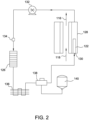
- FIG. 2 is a schematic flow diagram of the hot water sub-system 104.
- the hot water sub-system 104 includes the second heat exchanger 128, the condenser 126, a first pump 132, a first air-first fluid heat exchanger 134, a second air-first fluid heat exchanger 136, a first air scoop 138, and a first expansion tank 140.
- the first pump 132 is a centrifugal pump that receives the flow of the first fluid from the second heat exchanger 128 and pumps the first fluid to the condenser 126, the first air-first fluid heat exchanger 134, the second air-first fluid heat exchanger 136, the first air scoop 138, and the first expansion tank 140.
- the pump 136 may be any type of pump that enables the hot water sub-system 104 to operate as described herein.
- the first and second air-first fluid heat exchangers 134 and 136 may be any type of heat exchanger that transfers heat from the first fluid to a flow of air.
- the first air scoop 138 is an air eliminator positioned downstream of the condenser 126, the first air-first fluid heat exchanger 134, and the second air-first fluid heat exchanger 136. Air may be entrained in the first fluid (water), and the entrained air may cause operational issues for the heat exchangers 128, 134, and 136 and the first pump 132. The first air scoop 138 removes entrained air within the first fluid, improving the operation of the hot water sub-system 104. Additionally, the first air scoop 138 is coupled to the first expansion tank 140 and includes an inlet that enables an operator to add or fill the hot water sub-system 104 with the first fluid.
- FIG. 3 is a schematic diagram of the first expansion tank 140 and the second heat exchanger 128 illustrating the positions of the first expansion tank relative to the second heat exchanger.
- the first expansion tank 140 includes a shell 142 and a bladder 144 positioned within the shell.
- the bladder 144 includes a flexible bladder or polymer sack that contains the first fluid.
- the shell 142 defines a hole 146 that enables fluid communication between an interior 148 of the shell and the atmosphere.
- the hole 146 maintains the interior 148 of the shell 142 at atmospheric pressure. Additionally, because the bladder 144 is flexible, the bladder and the first fluid within the bladder are also maintained at atmospheric pressure.
- the shell 142 has a width 150 and a length 152 that maintain a level 154 of the first fluid within the bladder 144 within a predetermined range 156.
- the width 150 and the length 152 are determined such that changes in the volume of the first fluid within the hot water sub-system 104 due to temperature changes do not cause the level 154 of the first fluid within the bladder 144 to exceed or fall below the predetermined range 156.
- the inlet 130 of the second heat exchanger 128 is positioned at an inlet height 158 relative to grade 160, and the predetermined range 156 is positioned at a range height 162 relative to grade 160.
- the inlet height 158 is greater than the range height 162 such that the inlet 130 of the second heat exchanger 128 is maintained above (or higher than) the level 154 of the first fluid within the bladder 144. That is, the range height 162 is less than the inlet height 158 such that the level 154 of the first fluid within the bladder 144 is maintained below (or lower than) the inlet 130 of the second heat exchanger 128.
- the first fluid is channeled from the bladder 144 to the membrane 122.
- a pressure of the inlet of the second heat exchanger is maintained at a negative pressure.
- the negative pressure causes the membrane 122 to collapse into the collapsed configuration, increasing the heat transfer coefficient and increasing overall heat transfer between the first fluid, the second fluid, and the flow of air. Accordingly, the relative positions of the first expansion tank 140 and the second heat exchanger 128 maintain the membrane 122 in the collapsed configuration.
- the relative positions of the level 154 of the first fluid within the bladder 144 and the inlet 130 of the second heat exchanger 128 cause the pressure of the inlet of the second heat exchanger to be maintained at a negative pressure and maintain the membrane 122 in the collapsed configuration.
- the bladder 144 enables the hot water sub-system 104 to be a non-pressurized, closed system while enabling the first fluid within the bladder to be maintained at atmospheric pressure.
- the hole 146 maintains the first fluid within the bladder 144 at atmospheric pressure, and the bladder 144 prevents contaminates from entering the hot water sub-system 104 while allowing the first fluid within the bladder to be maintained at atmospheric pressure.
- the combination of the bladder 144, the hole 146, and the arrangement of the inlet height 158 relative to the level 154 of the first fluid within the bladder 144 enables the hot water sub-system 104 to maintain the pressure of the inlet 130 of the second heat exchanger 128 at a negative pressure.
- the negative pressure of the inlet 130 of the second heat exchanger 128 enables the membrane 122 to be maintained in the collapsed configuration and enables the second heat exchanger 128 to include non-pressurized elements.
- the combination of the bladder 144, the hole 146, and the arrangement of the inlet height 158 relative to the level 154 of the first fluid within the bladder 144 enables the hot water sub-system 104 to maintain the pressure of the inlet 130 of the second heat exchanger 128 at a negative pressure, enabling the inclusion of non-pressurized elements within the second heat exchanger 128. Moreover, maintaining the inlet 130 of the second heat exchanger 128 at a negative pressure maintains the membrane 122 in the collapsed configuration, increasing the surface area to volume ratio of the membrane, increasing the heat transfer coefficient, and increasing overall heat transfer between the first fluid, the second fluid, and the flow of air.
- the hot water sub-system 104 includes additional equipment that maintains the inlet 130 of the second heat exchanger 128 at a negative pressure.
- the hot water sub-system 104 may include fluid motive devices (e.g. a pump) or pipe fittings (e.g. orifice plates) that maintain the inlet 130 of the second heat exchanger 128 at a negative pressure.
- the hot water sub-system 104 of these alternative embodiments not according to the invention may include any equipment that enables the sub-system to be a closed system while also maintaining the inlet 130 of the second heat exchanger 128 at a negative pressure.
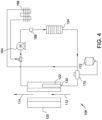
- FIG. 4 is a schematic flow diagram of the cold water sub-system 106.
- the cold water sub-system 106 includes the first heat exchanger 120, the evaporator 124, a second pump 164, a third air-first fluid heat exchanger 166, a fourth air-first fluid heat exchanger 168, a second air scoop 170, and a second expansion tank 172.
- the cold water sub-system 106 operates in a substantially similar manner as the hot water sub-system 104. Specifically, the cold water sub-system 106 is a closed system and the second expansion tank 172 and the first heat exchanger 120 are arranged to maintain the membrane 122 in the first heat exchanger 120 in the collapsed configuration as described above.
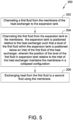
- FIG. 5 is a flow diagram of a method 200 of transferring heat from a refrigerant loop of a HVAC system to a heat exchanger of the HVAC system using a closed loop water sub-system.
- the sub-system includes an expansion tank and the heat exchanger includes a membrane.
- the method 200 includes channeling 202 a first fluid from the membrane of the heat exchanger to the expansion tank.
- the method 200 also includes channeling 204 the first fluid from the expansion tank to the membrane.
- the expansion tank is positioned relative to the heat exchanger such that a level of the first fluid within the expansion tank is positioned below an inlet of the first fluid of the heat exchanger.
- the position of the level of the first fluid in the expansion tank relative to the inlet of the heat exchanger maintains the membrane in a collapsed configuration.
- the method 200 further includes exchanging 206 heat from the first fluid to a second fluid using the membrane.
- the HVAC systems described herein include multiple sub-systems for removing heat and moisture from a flow of air.
- the HVAC systems include a refrigerant sub-system, a hot water sub-system, and a cold water sub-system, which improve the efficiency of the HVAC systems.
- the hot and cold water sub-systems are non-pressurized, closed systems to prevent contaminates from entering the sub-systems.
- the HVAC systems also include a heat exchanger having a membrane that channels a flow of heat exchange fluid through the heat exchanger. The heat exchanger enables the HVAC system to exchange heat between multiple heat exchange fluids simultaneous. In order to maintain a predetermined amount of heat transfer between the heat exchange fluids, the membrane is maintained in a collapsed configuration.
- the hot and cold water sub-systems each include an expansion tank including a shell and a bladder.
- the shell defines a hole that exposes an interior of the shell and the bladder to the environment and maintains the fluid within the bladder at atmospheric pressure.
- the bladder prevents contaminates from entering the system, closing the sub-system, while allowing the fluid within the bladder to be maintained at atmospheric pressure.
- the shell is sized and shaped to maintain a level of the fluid within the bladder within a predetermined range.
- the expansion tank and the heat exchanger are positioned such that an inlet of the membrane is positioned above the predetermined range.
- the inlet of the membrane is maintained at a negative pressure and the membrane is maintained in the collapsed configuration.
- the HVAC systems described herein include non-pressurized, closed sub-systems while also maintaining the membrane in the collapsed configuration.
Landscapes
- Engineering & Computer Science (AREA)
- Mechanical Engineering (AREA)
- Physics & Mathematics (AREA)
- Thermal Sciences (AREA)
- General Engineering & Computer Science (AREA)
- Chemical & Material Sciences (AREA)
- Combustion & Propulsion (AREA)
- Life Sciences & Earth Sciences (AREA)
- Sustainable Development (AREA)
- Heat-Exchange Devices With Radiators And Conduit Assemblies (AREA)
Description
- The field of the invention relates generally to heating, ventilation, and air conditioning systems and the like, and more particularly, to systems and methods for a non-pressurized, closed loop water sub-system of a heating, ventilation, and air conditioning system.
- Heating, ventilation, and air conditioning (HVAC) systems may include multiple sub-systems that improve the heating, cooling, and moisture removal capabilities of the HVAC system. For example, HVAC systems may include a refrigerant sub-system, a hot water sub-system, and a cold water sub-system, which improve the efficiency of the HVAC system. Additionally, the HVAC system may also include a heat exchanger having a membrane that channels a flow of heat exchange fluid through the heat exchanger. The heat exchanger enables the HVAC system to exchange heat between multiple heat exchange fluids simultaneously. In order to maintain a predetermined amount of heat transfer between the heat exchange fluids, the membrane is maintained in a collapsed configuration. Specifically, the hot and cold water sub-systems are open, non-pressurized systems to maintain the membrane in the collapsed configuration. However, contaminants may enter the hot and cold water sub-systems, reducing the efficiency of the sub-systems, because the hot and cold water sub-systems are open systems. Improved systems, and related methods, are needed.
WO 2019/089967 A1 discloses an HVAC system having a heat exchanger with a membrane for channeling a first fluid through the heat exchanger, the membrane disposed for heat transfer between the first fluid and a second fluid, and a closed loop sub-system for transferring heat from the heat exchanger to a refrigerant sub-system. - This background section is intended to introduce the reader to various aspects of art that may be related to various aspects of the present invention, which are described and/or claimed below. This discussion is believed to be helpful in providing the reader with background information to facilitate a better understanding of the various aspects of the present invention. Accordingly, it should be understood that these statements are to be read in this light, and not as admissions of prior art.
- In one aspect of the invention as defined in claim 1, a heating, ventilation, and air conditioning system includes first and second fluids, a heat exchanger, a refrigerant sub-system, and at least one closed loop sub-system. The heat exchanger includes a membrane for channeling the first fluid through the heat exchanger and is disposed for heat transfer between the first fluid and the second fluid. The membrane defines an inlet having an inlet height relative to grade. The closed loop sub-system transfers heat from the heat exchanger to the refrigerant sub-system and includes an expansion tank containing the first fluid. A level of the first fluid within the expansion tank has a level height relative to grade. The expansion tank is positioned relative to the heat exchanger such that the inlet height is greater than the level height and the membrane is maintained in a collapsed configuration.
- In another aspect of the invention as defined in claim 6, a closed loop sub-system for a heating, ventilation, and air conditioning system including first and second fluids includes a heat exchanger and an expansion tank. The heat exchanger includes a membrane for channeling the first fluid through the heat exchanger. The membrane is disposed for heat transfer between the first fluid and the second fluid. The membrane defines an inlet having an inlet height relative to grade. The expansion tank contains the first fluid. A level of the first fluid within the expansion tank has a level height relative to grade. The expansion tank is positioned relative to the heat exchanger such that the inlet height is greater than the level height and the membrane is maintained in a collapsed configuration.
- In yet another aspect of the invention as defined in claim 11, a method of transferring heat from a refrigerant loop of a heating, ventilation, and air conditioning (HVAC) system to a heat exchanger of the HVAC system using a closed loop sub-system includes channeling a first fluid from a membrane of the heat exchanger to an expansion tank. The HVAC system includes first and second fluids, the sub-system includes the expansion tank, and the heat exchanger includes the membrane. The membrane defines an inlet having an inlet height relative to grade. A level of the first fluid within the expansion tank has a level height relative to grade. The method also includes channeling the first fluid from the expansion tank to the membrane. The expansion tank is positioned relative to the heat exchanger such that the inlet height is greater than the level height and the membrane is maintained in a collapsed configuration. The method further includes exchanging heat from the first fluid to the second fluid using the membrane.
- Various refinements exist of the features noted in relation to the above-mentioned aspects. Further features of the invention are defined in the dependent claims.
-
-
FIG. 1 is a schematic flow diagram of a heating, ventilation, and air conditioning (HVAC) system. -
FIG. 2 is a schematic flow diagram of a hot water sub-system illustrated inFIG. 1 . -
FIG. 3 is a schematic diagram of a first expansion tank and a second heat exchanger illustrated inFIG. 2 . -
FIG. 4 is a schematic flow diagram of a cold water sub-system illustrated inFIG. 1 . -
FIG. 5 is a flow diagram of a method of transferring heat from a refrigerant loop to a heat exchanger using the closed loop water sub-system illustrated inFIGS. 2 and4 . - Corresponding reference characters indicate corresponding parts throughout the drawings.
-
FIG. 1 is a schematic flow diagram of a heating, ventilation, and air conditioning (HVAC)system 100. While theHVAC system 100 may be any type of HVAC system, theHVAC system 100 is more efficient than prior HVAC systems because theHVAC system 100 includes sub-systems 102-110 which improve the heating, cooling, and moisture removal capabilities ofsystem 100 when compared to prior systems. Specifically, theHVAC system 100 includes arefrigerant sub-system 102, twowater sub-systems conditioning sub-system 108, and aregeneration sub-system 110. Thewater sub-systems hot water sub-system 104 and acold water sub-system 106. Theconditioning sub-system 108 removes heat and moisture from a flow of conditioninginlet air 112 and channels a flow of conditioningoutlet air 114 to a structure or vehicle (not shown). The flow of conditioningoutlet air 114 has a lower temperature and humidity than the flow of conditioninginlet air 112 because theconditioning sub-system 108 has removed heat and moisture from the air. The sub-systems 102-110 transfer the heat and moisture from theconditioning sub-system 108 to theregeneration sub-system 110. Theregeneration sub-system 110 transfers the heat and moisture into a flow ofregeneration inlet air 116 and channels a flow ofregeneration outlet air 118 to the atmosphere. - The
conditioning sub-system 108 shares afirst heat exchanger 120 with thecold water sub-system 106 and theregeneration sub-system 110 and interfaces with the cold water sub-system and the regeneration sub-system through the first heat exchanger. In this embodiment, thefirst heat exchanger 120 is a 3-way heat exchanger that transfers heat from the flow of conditioninginlet air 112 to a flow of a first fluid and a transfers heat and moisture from the flow of conditioninginlet air 112 to a flow of a second fluid. Thefirst heat exchanger 120 includes a moisture membrane (not shown) that permits both heat and moisture to be transferred from the flow of conditioninginlet air 112 to the flow of the second fluid and amembrane 122 that channels the flow of the first fluid through thefirst heat exchanger 120 and transfers heat from the flow ofconditioning inlet air 112 and the flow of the second fluid to the flow of the first fluid. In the illustrated embodiment, the flow of the first fluid is a flow of water circulated by thecold water sub-system 106, and the flow of the second fluid is a flow of a liquid desiccant circulated by theconditioning sub-system 108 and theregeneration sub-system 110. In alternative embodiments, the first fluid may be any fluid that enables theconditioning sub-system 108 and thecold water sub-system 106 to operate as described herein, and the second fluid may be any fluid that enables theconditioning sub-system 108 and theregeneration sub-system 110 to operate as described herein. As described below, thecold water sub-system 106 is a non-pressurized, closed loop sub-system that enables thefirst heat exchanger 120 to include non-pressurized elements, which enables the first heat exchanger to exchange heat between the flow ofconditioning inlet air 112, the first fluid, and the second fluid. - The
cold water sub-system 106 shares thefirst heat exchanger 120 with theconditioning sub-system 108 and shares anevaporator 124 with therefrigerant sub-system 102. As described below, thecold water sub-system 106 transfers heat from thefirst heat exchanger 120 to theevaporator 124 or to the atmosphere. More specifically, thecold water sub-system 106 may include additional heat transfer equipment that transfers heat to the atmosphere. The remainder of the heat is transferred to therefrigerant sub-system 102 through theevaporator 124. Additionally, thecold water sub-system 106 is a non-pressurized, closed system that does not permit material from the surrounding environment to enter the sub-system, preventing contaminates from entering the sub-system and contaminating the sub-system. As used herein, non-pressurized means that the sub-system operates at 0.345 barg (5 pounds per square inch gauge pressure (psig)) or less. - The
refrigerant sub-system 102 shares theevaporator 124 with thecold water sub-system 106 and shares acondenser 126 with thehot water sub-system 104. Therefrigerant sub-system 102 may also include an expansion valve (not shown) and a compressor (not shown). Therefrigerant sub-system 102 transfers heat from theevaporator 124 to thecondenser 126, and thecondenser 126 transfers heat to thehot water sub-system 104. Specifically, therefrigerant sub-system 102 channels a flow of a third fluid from theevaporator 124 to thecondenser 126, and the third fluid transfers the heat from theevaporator 124 to thecondenser 126. In this embodiment, the third fluid is a refrigerant. In alternative embodiments, the third fluid may be any fluid that enables therefrigerant sub-system 102 to operate as described herein. - The
hot water sub-system 104 shares asecond heat exchanger 128 with theregeneration sub-system 110 and shares thecondenser 126 with therefrigerant sub-system 102. As described below, thehot water sub-system 104 transfers heat from thecondenser 126 to thesecond heat exchanger 128 or to the atmosphere. More specifically, thehot water sub-system 104 may include additional heat transfer equipment that transfers heat to the atmosphere. The remainder of the heat is transferred toregeneration sub-system 110 through thesecond heat exchanger 128. Additionally, thehot water sub-system 104 is a non-pressurized, closed system that does not permit material from the surrounding environment to enter the sub-system, preventing contaminates from entering the sub-system and contaminating the sub-system. As used herein, non-pressurized means that the sub-system operates at 0.345 barg (5 psig) or less. - The
regeneration sub-system 110 shares thesecond heat exchanger 128 with thehot water sub-system 104 and theconditioning sub-system 108 and interfaces with the hot water sub-system and the conditioning sub-system through the second heat exchanger. In this embodiment, thesecond heat exchanger 128 is a 3-way heat exchanger that transfers heat from a flow of a first fluid to the flow ofregeneration inlet air 116 and a transfers heat and moisture from a flow of a second fluid to the flow ofregeneration inlet air 116. Thesecond heat exchanger 128 includes a moisture membrane (not shown) that permits both heat and moisture to be transferred from the flow of a second fluid to the flow ofregeneration inlet air 116 and amembrane 122 that channels the flow of the first fluid through thesecond heat exchanger 128 and transfers heat from the flow of the first fluid to the flow ofregeneration inlet air 116 and the flow of the second fluid. In the illustrated embodiment, the flow of the first fluid is a flow of water circulated by thehot water sub-system 104, and the flow of the second fluid is a flow of a liquid desiccant circulated by theconditioning sub-system 108 and theregeneration sub-system 110. In alternative embodiments, the first fluid may be any fluid that enables theregeneration sub-system 110 and thehot water sub-system 104 to operate as described herein, and the second fluid may be any fluid that enables theregeneration sub-system 110 and theconditioning sub-system 108 to operate as described herein. As described below, thehot water sub-system 104 is a non-pressurized, closed loop sub-system that enables thesecond heat exchanger 128 to include non-pressurized elements, which enables the second heat exchanger to exchange heat between the flow ofregeneration inlet air 116, the first fluid, and the second fluid. - Still with reference to
FIG. 1 , thefirst heat exchanger 120 and thesecond heat exchanger 128 are substantially the same. In alternative embodiments, thefirst heat exchanger 120 and thesecond heat exchanger 128 are different. Specifically, in this embodiment, both thefirst heat exchanger 120 and thesecond heat exchanger 128 include themembrane 122 for channeling the flow of the first fluid through the heat exchangers and for exchanging heat between the first fluid, the second fluid, and a flow of air. In one embodiment, themembrane 122 is a non-rigid, flexible material that permits heat transfer into and out of the first fluid while preventing the first fluid from mixing with any other fluid, including the second fluid and the flow of air. Specifically, themembrane 122 is a non-rigid, flexible material that is designed to be non-pressurized (operate at or below 0.345 barg ( 5 psig)) and is not designed to operate at a substantially greater pressure (e.g., 0.69 barg (10 psig)). More specifically, in this embodiment, themembrane 122 includes a bladder or polymer sack that permits heat transfer into and out of the first fluid while preventing the first fluid from mixing with any other fluid, including the second fluid and the flow of air and operates at or below 0.345 barg (5 psig). Themembrane 122 is flexible because the material that forms the membrane is capable of bending without breaking and the membrane is non-rigid because the membrane is capable of changing size and shape without breaking. As discussed below, in this embodiment, themembrane 122 is flexible and non-rigid because the membrane is maintained in a collapsed configuration. In alternative embodiments, themembrane 122 is formed of any material and has any degree of flexibility and rigidity that enables thefirst heat exchanger 120 and thesecond heat exchanger 128 to operate as described herein. - The
membrane 122 is filled with the first fluid and is positioned proximate the second fluid and the flow of air within the first andsecond heat exchangers membrane 122 physically contacts at least one of the second fluid and the flow of air to promote enhanced heat transfer between the first fluid, the second fluid, and the flow of air. For example, themembrane 122 may be immersed in the flow of the second fluid and/or the flow of air to promote enhanced heat transfer between the first fluid, the second fluid, and the flow of air. Thefirst heat exchanger 120 and thesecond heat exchanger 128 are non-pressurized heat exchangers because they include non-pressurized elements (the membrane 122) and portions of the heat exchangers are designed to be non-pressurized (operate at or below 0.345 barg (5 psig)). - To promote enhanced heat transfer between the first fluid, the second fluid, and the flow of air, the
membrane 122 is maintained in the collapsed configuration during operation of the first andsecond heat exchangers membrane 122, increasing the heat transfer coefficient and increasing overall heat transfer between the first fluid, the second fluid, and the flow of air. If themembrane 122 is filled with the first fluid such that the membrane expands like a balloon, a portion of the first fluid interior to the balloon-like membrane is not proximate the second fluid and/or the flow of air, reducing heat exchange between the interior portion of the first fluid and the second fluid and/or the flow of air. However, if themembrane 122 is maintained in a collapsed configuration, all of the first fluid within the membrane is proximate the second fluid and/or the flow of air, increasing heat exchange between the first fluid and the second fluid and/or the flow of air. As described below, thewater sub-systems membrane 122 in the collapsed configuration. More specifically, thewater sub-systems inlet 130 of the first andsecond heat exchangers membrane 122 in the collapsed configuration. -
FIG. 2 is a schematic flow diagram of thehot water sub-system 104. Thehot water sub-system 104 includes thesecond heat exchanger 128, thecondenser 126, afirst pump 132, a first air-firstfluid heat exchanger 134, a second air-firstfluid heat exchanger 136, afirst air scoop 138, and afirst expansion tank 140. In this embodiment, thefirst pump 132 is a centrifugal pump that receives the flow of the first fluid from thesecond heat exchanger 128 and pumps the first fluid to thecondenser 126, the first air-firstfluid heat exchanger 134, the second air-firstfluid heat exchanger 136, thefirst air scoop 138, and thefirst expansion tank 140. However, in alternative embodiments, thepump 136 may be any type of pump that enables thehot water sub-system 104 to operate as described herein. Additionally, the first and second air-firstfluid heat exchangers - In the illustrated embodiment, the
first air scoop 138 is an air eliminator positioned downstream of thecondenser 126, the first air-firstfluid heat exchanger 134, and the second air-firstfluid heat exchanger 136. Air may be entrained in the first fluid (water), and the entrained air may cause operational issues for theheat exchangers first pump 132. Thefirst air scoop 138 removes entrained air within the first fluid, improving the operation of thehot water sub-system 104. Additionally, thefirst air scoop 138 is coupled to thefirst expansion tank 140 and includes an inlet that enables an operator to add or fill thehot water sub-system 104 with the first fluid. -
FIG. 3 is a schematic diagram of thefirst expansion tank 140 and thesecond heat exchanger 128 illustrating the positions of the first expansion tank relative to the second heat exchanger. Thefirst expansion tank 140 includes ashell 142 and abladder 144 positioned within the shell. Thebladder 144 includes a flexible bladder or polymer sack that contains the first fluid. Theshell 142 defines ahole 146 that enables fluid communication between an interior 148 of the shell and the atmosphere. Thehole 146 maintains theinterior 148 of theshell 142 at atmospheric pressure. Additionally, because thebladder 144 is flexible, the bladder and the first fluid within the bladder are also maintained at atmospheric pressure. Additionally, theshell 142 has awidth 150 and alength 152 that maintain alevel 154 of the first fluid within thebladder 144 within apredetermined range 156. Specifically, thewidth 150 and thelength 152 are determined such that changes in the volume of the first fluid within thehot water sub-system 104 due to temperature changes do not cause thelevel 154 of the first fluid within thebladder 144 to exceed or fall below thepredetermined range 156. - As shown in
FIG. 3 , theinlet 130 of thesecond heat exchanger 128 is positioned at aninlet height 158 relative tograde 160, and thepredetermined range 156 is positioned at arange height 162 relative tograde 160. Theinlet height 158 is greater than therange height 162 such that theinlet 130 of thesecond heat exchanger 128 is maintained above (or higher than) thelevel 154 of the first fluid within thebladder 144. That is, therange height 162 is less than theinlet height 158 such that thelevel 154 of the first fluid within thebladder 144 is maintained below (or lower than) theinlet 130 of thesecond heat exchanger 128. Additionally, the first fluid is channeled from thebladder 144 to themembrane 122. Because thelevel 154 of the first fluid within thebladder 144 is maintained below (or lower than) theinlet 130 of thesecond heat exchanger 128, a pressure of the inlet of the second heat exchanger is maintained at a negative pressure. The negative pressure causes themembrane 122 to collapse into the collapsed configuration, increasing the heat transfer coefficient and increasing overall heat transfer between the first fluid, the second fluid, and the flow of air. Accordingly, the relative positions of thefirst expansion tank 140 and thesecond heat exchanger 128 maintain themembrane 122 in the collapsed configuration. More specifically, the relative positions of thelevel 154 of the first fluid within thebladder 144 and theinlet 130 of thesecond heat exchanger 128 cause the pressure of the inlet of the second heat exchanger to be maintained at a negative pressure and maintain themembrane 122 in the collapsed configuration. Additionally, thebladder 144 enables thehot water sub-system 104 to be a non-pressurized, closed system while enabling the first fluid within the bladder to be maintained at atmospheric pressure. - The
hole 146 maintains the first fluid within thebladder 144 at atmospheric pressure, and thebladder 144 prevents contaminates from entering thehot water sub-system 104 while allowing the first fluid within the bladder to be maintained at atmospheric pressure. The combination of thebladder 144, thehole 146, and the arrangement of theinlet height 158 relative to thelevel 154 of the first fluid within thebladder 144 enables thehot water sub-system 104 to maintain the pressure of theinlet 130 of thesecond heat exchanger 128 at a negative pressure. The negative pressure of theinlet 130 of thesecond heat exchanger 128 enables themembrane 122 to be maintained in the collapsed configuration and enables thesecond heat exchanger 128 to include non-pressurized elements. The combination of thebladder 144, thehole 146, and the arrangement of theinlet height 158 relative to thelevel 154 of the first fluid within thebladder 144 enables thehot water sub-system 104 to maintain the pressure of theinlet 130 of thesecond heat exchanger 128 at a negative pressure, enabling the inclusion of non-pressurized elements within thesecond heat exchanger 128. Moreover, maintaining theinlet 130 of thesecond heat exchanger 128 at a negative pressure maintains themembrane 122 in the collapsed configuration, increasing the surface area to volume ratio of the membrane, increasing the heat transfer coefficient, and increasing overall heat transfer between the first fluid, the second fluid, and the flow of air. - In alternative embodiments not according to the invention, rather than arranging the
second heat exchanger 128 and thefirst expansion tank 140 to maintain themembrane 122 in the collapsed configuration, thehot water sub-system 104 includes additional equipment that maintains theinlet 130 of thesecond heat exchanger 128 at a negative pressure. For example, thehot water sub-system 104 may include fluid motive devices (e.g. a pump) or pipe fittings (e.g. orifice plates) that maintain theinlet 130 of thesecond heat exchanger 128 at a negative pressure. Thehot water sub-system 104 of these alternative embodiments not according to the invention may include any equipment that enables the sub-system to be a closed system while also maintaining theinlet 130 of thesecond heat exchanger 128 at a negative pressure. -
FIG. 4 is a schematic flow diagram of thecold water sub-system 106. Thecold water sub-system 106 includes thefirst heat exchanger 120, theevaporator 124, asecond pump 164, a third air-firstfluid heat exchanger 166, a fourth air-firstfluid heat exchanger 168, asecond air scoop 170, and asecond expansion tank 172. Thecold water sub-system 106 operates in a substantially similar manner as thehot water sub-system 104. Specifically, thecold water sub-system 106 is a closed system and thesecond expansion tank 172 and thefirst heat exchanger 120 are arranged to maintain themembrane 122 in thefirst heat exchanger 120 in the collapsed configuration as described above. -
FIG. 5 is a flow diagram of amethod 200 of transferring heat from a refrigerant loop of a HVAC system to a heat exchanger of the HVAC system using a closed loop water sub-system. The sub-system includes an expansion tank and the heat exchanger includes a membrane. Themethod 200 includes channeling 202 a first fluid from the membrane of the heat exchanger to the expansion tank. Themethod 200 also includes channeling 204 the first fluid from the expansion tank to the membrane. The expansion tank is positioned relative to the heat exchanger such that a level of the first fluid within the expansion tank is positioned below an inlet of the first fluid of the heat exchanger. The position of the level of the first fluid in the expansion tank relative to the inlet of the heat exchanger maintains the membrane in a collapsed configuration. Themethod 200 further includes exchanging 206 heat from the first fluid to a second fluid using the membrane. - The HVAC systems described herein include multiple sub-systems for removing heat and moisture from a flow of air. Specifically, the HVAC systems include a refrigerant sub-system, a hot water sub-system, and a cold water sub-system, which improve the efficiency of the HVAC systems. The hot and cold water sub-systems are non-pressurized, closed systems to prevent contaminates from entering the sub-systems. The HVAC systems also include a heat exchanger having a membrane that channels a flow of heat exchange fluid through the heat exchanger. The heat exchanger enables the HVAC system to exchange heat between multiple heat exchange fluids simultaneous. In order to maintain a predetermined amount of heat transfer between the heat exchange fluids, the membrane is maintained in a collapsed configuration. Equipment within the hot and cold water sub-systems is arranged to maintain the membrane in the collapsed configuration. Specifically, the hot and cold water sub-systems each include an expansion tank including a shell and a bladder. The shell defines a hole that exposes an interior of the shell and the bladder to the environment and maintains the fluid within the bladder at atmospheric pressure. The bladder prevents contaminates from entering the system, closing the sub-system, while allowing the fluid within the bladder to be maintained at atmospheric pressure. The shell is sized and shaped to maintain a level of the fluid within the bladder within a predetermined range. The expansion tank and the heat exchanger are positioned such that an inlet of the membrane is positioned above the predetermined range. Thus, the inlet of the membrane is maintained at a negative pressure and the membrane is maintained in the collapsed configuration. Accordingly, the HVAC systems described herein include non-pressurized, closed sub-systems while also maintaining the membrane in the collapsed configuration.
- Example embodiments of HVAC systems and methods of operating the systems are described above in detail. The systems and methods are not limited to the specific embodiments described herein, but by the scope of the claims.
- When introducing elements of the present invention or the embodiment(s) thereof, the articles "a", "an", "the" and "said" are intended to mean that there are one or more of the elements. The terms "comprising," "including," "containing" and "having" are intended to be inclusive and mean that there may be additional elements other than the listed elements. The use of terms indicating a particular orientation (e.g., "top", "bottom", "side", etc.) is for convenience of description and does not require any particular orientation of the item described.
- Various changes can be made in the above systems and methods without departing from the scope of the invention as defined in the appended claims..All matter contained in the above description and shown in the accompanying drawing(s) shall be interpreted as illustrative and not in a limiting sense.
Claims (15)
- A heating, ventilation, and air conditioning (HVAC) system (100) including first and second fluids, the HVAC system (100) comprising:
a first heat exchanger (128, 120) including a membrane (122) adapted for channeling the first fluid through the first heat exchanger (128, 120), the membrane (122) disposed for heat transfer between the first fluid and the second fluid, the membrane (122) defining an inlet (130), characterized in that:the first heat exchanger (128, 120) is configured for being positioned such that the inlet (130) has an inlet height (158) relative to grade (160); and the HVAC system (100) further comprisesa refrigerant sub-system (110) containing a third fluid; andat least one closed loop sub-system (104, 106) containing the first fluid adapted for transferring heat from the first heat exchanger (128, 120) to a second heat exchanger (126, 124), the second heat exchanger (126, 124) adapted for transferring heat from the first fluid to the third fluid in the refrigerant sub-system (110), the closed loop sub-system (104, 106) comprising:
an expansion tank (140, 172) containing the first fluid, wherein the expansion tank (140, 172) is configured for being positioned such that a level (154) of the first fluid within the expansion tank (140, 172) has a level height (162) relative to grade (160), wherein the expansion tank (140, 172) is configured for being positioned relative to the first heat exchanger (128, 120) such that the inlet height (158) is greater than the level height (162) and such that a pressure of the first fluid at the inlet (130) is maintained at a negative pressure to maintain the membrane (122) in a collapsed configuration. - The HVAC system (100) of claim 1, wherein the expansion tank (140, 172) includes a shell (142) and a bladder (144) positioned within the shell (142).
- The HVAC system (100) of claim 2, wherein a length (152) and a width (150) of the shell (142) are configured to maintain the level height (162) of the first fluid within the bladder (144) within a predetermined range (156).
- The HVAC system (100) of claim 2, wherein the shell (142) defines a hole (146) such that an interior (148) of the shell (142) and the first fluid within the bladder (144) are exposed to the environment and are maintained at atmospheric pressure.
- The HVAC system (100) of claim 1, wherein the membrane (122) is a flexible membrane or a non-rigid membrane.
- A closed loop sub-system (104, 106) for a heating, ventilation, and air conditioning (HVAC) system (100) including first and second fluids, the sub-system (104, 106) comprising:
a heat exchanger (128, 120) including a membrane (122) adapted for channeling the first fluid through the heat exchanger (128, 120), the membrane (122) configured for heat transfer between the first fluid and the second fluid, the membrane (122) defining an inlet (130), characterized in that:the heat exchanger (128, 120) is configured for being positioned such that the inlet (130) has an inlet height (158) relative to grade (160); and the subsystem (104, 106) further comprisesan expansion tank (140, 172) containing the first fluid, wherein the expansion tank (140, 172) is configured for being positioned such that a level (154) of the first fluid within the expansion tank (140, 172) has a level height (162) relative to grade (160), wherein the expansion tank (140, 172) is configured for being positioned relative to the heat exchanger (128, 120) such that the inlet height (158) is greater than the level height (162) and such that a pressure of the of the first fluid at the inlet (130) is maintained at a negative pressure to maintain the membrane (122) in a collapsed configuration. - The sub-system (104, 106) of claim 6, wherein the expansion tank (140 or 172) includes a shell (142) and a bladder (144) positioned within the shell.
- The sub-system (104, 106) of claim 7, wherein a length (152) and a width (150) of the shell (142) are configured to maintain the level height (162) of the first fluid within the bladder (144) within a predetermined range (156).
- The sub-system (104, 106) of claim 7, wherein the shell (142) defines a hole (146) such that an interior (148) of the shell (142) and the first fluid within the bladder (144) are exposed to the environment and are maintained at atmospheric pressure.
- The sub-system (104, 106) of claim 6, further comprising an air scoop (138, 170) coupled to the expansion tank (140, 172) for removing entrained air from the first fluid.
- A method of transferring heat from a refrigerant loop of a heating, ventilation, and air conditioning (HVAC) system (100) to a heat exchanger (128, 120) of the HVAC system using a closed loop sub-system (104, 106), wherein the HVAC system (100) includes first and second fluids, the sub-system (104, 106) includes an expansion tank (140, 172) and the heat exchanger (128, 120) includes a membrane (122),
characterized in that the membrane (122) defines an inlet (130), the heat exchanger (128, 120) is positioned such that the inlet has an inlet height (158) relative to grade (160), the expansion tank (140, 172) is positioned such that a level (154) of the first fluid within the expansion tank (140, 172) has a level height (162) relative to grade (160), and the method comprises:channeling the first fluid from the membrane (122) of the heat exchanger (128, 120) to the expansion tank (140, 172);channeling the first fluid from the expansion tank (140, 172) to the membrane (122), the expansion tank (140, 172) is positioned relative to the heat exchanger (128, 120) such that the inlet height (158) is greater than the level height (162);maintaining a pressure of the first fluid at the inlet (130) of the membrane (122) at a negative pressure to maintain the membrane (122) in a collapsed configuration; andexchanging heat from the first fluid to the second fluid using the membrane (122). - The method of claim 11, wherein the sub-system (106) further includes a condenser (124), and the method further comprises channeling the first fluid to the condenser (124) and exchanging heat between the first fluid and a refrigerant using the condenser (124).
- The method of claim 11 further comprising maintaining a pressure of the first fluid within the expansion tank (140, 172) at or near atmospheric pressure.
- The method of claim 11 further comprising removing entrained air from the first fluid using an air scoop (138, 170).
- The method of claim 11 further comprising pumping the first fluid from the membrane (122) to the expansion tank (140, 172).
Applications Claiming Priority (2)
| Application Number | Priority Date | Filing Date | Title |
|---|---|---|---|
| US17/033,416 US11385000B2 (en) | 2020-09-25 | 2020-09-25 | Systems and methods for a non-pressurized closed loop water sub-system |
| PCT/US2021/051251 WO2022066618A1 (en) | 2020-09-25 | 2021-09-21 | Systems and method for a non-pressurized, closed loop water sub-system for a heating, ventilation, and air conditioning system |
Publications (2)
| Publication Number | Publication Date |
|---|---|
| EP4217662A1 EP4217662A1 (en) | 2023-08-02 |
| EP4217662B1 true EP4217662B1 (en) | 2024-08-28 |
Family
ID=78135190
Family Applications (1)
| Application Number | Title | Priority Date | Filing Date |
|---|---|---|---|
| EP21791170.0A Active EP4217662B1 (en) | 2020-09-25 | 2021-09-21 | Systems and method for a non-pressurized, closed loop water sub-system for a heating, ventilation, and air conditioning system |
Country Status (4)
| Country | Link |
|---|---|
| US (1) | US11385000B2 (en) |
| EP (1) | EP4217662B1 (en) |
| CN (1) | CN116324285A (en) |
| WO (1) | WO2022066618A1 (en) |
Families Citing this family (4)
| Publication number | Priority date | Publication date | Assignee | Title |
|---|---|---|---|---|
| KR20260039753A (en) * | 2023-08-21 | 2026-03-20 | 코프랜드 엘피 | 3-way heat exchange module with uniform fluid distribution |
| WO2025085954A1 (en) * | 2023-10-25 | 2025-05-01 | Fugu Carbon Pty Ltd | Apparatus and method for adsorbing and desorbing co 2 from air and a heat exchanger |
| US12337371B1 (en) | 2023-12-20 | 2025-06-24 | Copeland Lp | Systems and methods for assembling liquid desiccant air conditioner panels using flexible alignment features |
| WO2025228821A1 (en) * | 2024-04-30 | 2025-11-06 | Qvantum Industries Ab | A buffer tank and a heat pump arrangement |
Family Cites Families (20)
| Publication number | Priority date | Publication date | Assignee | Title |
|---|---|---|---|---|
| US3814172A (en) * | 1972-03-28 | 1974-06-04 | Apv Co Ltd | Heat exchangers |
| US7147071B2 (en) * | 2004-02-04 | 2006-12-12 | Battelle Energy Alliance, Llc | Thermal management systems and methods |
| TW556820U (en) * | 2003-02-26 | 2003-10-01 | Wu Bau-Guei Li | Expansion type water tank having membrane air chamber |
| US8205668B2 (en) * | 2008-06-24 | 2012-06-26 | GM Global Technology Operations LLC | Heat exchanger with disimilar metal properties |
| KR102107636B1 (en) | 2010-05-25 | 2020-05-29 | 7에이씨 테크놀로지스, 아이엔씨. | Methods and systems using liquid desiccants for air-conditioning and other processes |
| WO2013131436A1 (en) * | 2012-03-05 | 2013-09-12 | Rong Guohua | Air-conditioning unit with heat recovery |
| ES2755800T3 (en) | 2012-06-11 | 2020-04-23 | 7Ac Tech Inc | Methods and systems for turbulent and corrosion resistant heat exchangers |
| EP2929256A4 (en) | 2012-12-04 | 2016-08-03 | 7Ac Technologies Inc | METHODS AND SYSTEMS FOR COOLING BUILDINGS WITH HIGH THERMAL LOADS THROUGH DESICCANT COOLERS |
| CN103134121B (en) * | 2013-02-19 | 2015-06-17 | 东南大学 | Membrane method dehumidification device and method based on vapor compression and solution absorption |
| CN108443996B (en) | 2013-03-01 | 2021-04-20 | 7Ac技术公司 | Desiccant air conditioning method and system |
| US9109808B2 (en) * | 2013-03-13 | 2015-08-18 | Venmar Ces, Inc. | Variable desiccant control energy exchange system and method |
| EP2971984A4 (en) | 2013-03-14 | 2017-02-01 | 7AC Technologies, Inc. | Methods and systems for liquid desiccant air conditioning system retrofit |
| ES2759926T3 (en) | 2013-06-12 | 2020-05-12 | 7Ac Tech Inc | Liquid Desiccant Air Conditioning System |
| JP2015210005A (en) * | 2014-04-25 | 2015-11-24 | 株式会社前川製作所 | Dehumidifying air conditioning method and apparatus |
| CN107110525B (en) | 2014-11-21 | 2020-02-11 | 7Ac技术公司 | Method and system for micro-fluidic desiccant air conditioning |
| DE102016114345A1 (en) * | 2016-08-03 | 2018-02-08 | Denso Automotive Deutschland Gmbh | Expansion element for a refrigerant circuit and method for operating a refrigerant circuit |
| IT201700015758A1 (en) | 2017-02-14 | 2018-08-14 | Univ Degli Studi Genova | Integrated high energy efficiency air conditioning system. |
| CN107314459A (en) * | 2017-07-08 | 2017-11-03 | 佛山市正略信息科技有限公司 | A kind of double mode domestic dehumidifying machine |
| EP3704415A4 (en) | 2017-11-01 | 2021-11-03 | 7AC Technologies, Inc. | TANK SYSTEM FOR AN AIR CONDITIONING SYSTEM WITH LIQUID DRYING AGENTS |
| EP3704414A4 (en) * | 2017-11-01 | 2021-07-28 | 7AC Technologies, Inc. | PROCEDURES AND SYSTEMS FOR AIR CONDITIONING WITH LIQUID DRYING AGENTS |
-
2020
- 2020-09-25 US US17/033,416 patent/US11385000B2/en active Active
-
2021
- 2021-09-21 WO PCT/US2021/051251 patent/WO2022066618A1/en not_active Ceased
- 2021-09-21 CN CN202180065349.1A patent/CN116324285A/en active Pending
- 2021-09-21 EP EP21791170.0A patent/EP4217662B1/en active Active
Also Published As
| Publication number | Publication date |
|---|---|
| WO2022066618A1 (en) | 2022-03-31 |
| CN116324285A (en) | 2023-06-23 |
| EP4217662A1 (en) | 2023-08-02 |
| US11385000B2 (en) | 2022-07-12 |
| US20220099390A1 (en) | 2022-03-31 |
Similar Documents
| Publication | Publication Date | Title |
|---|---|---|
| EP4217662B1 (en) | Systems and method for a non-pressurized, closed loop water sub-system for a heating, ventilation, and air conditioning system | |
| US7430878B2 (en) | Air conditioning system and methods | |
| USRE39288E1 (en) | Heat pump system and method for air-conditioning | |
| US8943844B2 (en) | Desiccant-based air conditioning system | |
| CN101713595B (en) | Systems and installations comprising combined condensers and evaporators | |
| US20050279115A1 (en) | Method and apparatus for evaporative cooling of a cooling fluid | |
| JP2000274977A (en) | Heat-exchanging device and heat extraction method | |
| US20090229799A1 (en) | Heat exchanger and airflow therethrough | |
| EP3899380B1 (en) | Evaporative cooler wet and dry mode control | |
| WO1996033378A1 (en) | Heat pump system and method for air-conditioning | |
| CN104340011A (en) | Cabin exhaust air heat recovery system including heat pump system having non-freezing evaporator | |
| EP2198215B1 (en) | Heat exchanger and method for a refrigeration system | |
| CN113703309B (en) | Personnel and equipment mixing cabin with high-integration environmental control system | |
| US12066212B2 (en) | Systems and methods for a refrigerant sub-system for a heating, ventilation, and air conditioning system | |
| US20100180610A1 (en) | Refrigerant Subcooling in a Vehicle HVAC System | |
| EP3504490B1 (en) | Falling film evaporator | |
| US4971245A (en) | Heater-cooler of a vehicle cab | |
| CN209159336U (en) | Automobile heat pump air-conditioning system, air conditioning for automobiles and automobile | |
| CN213872964U (en) | Heat pump dehumidification system | |
| CN210088978U (en) | Low-temperature workshop temperature control system | |
| JP2005009730A (en) | Air conditioner | |
| CN110920348A (en) | Heat exchanger unit | |
| CN1719145A (en) | Device of air conditioner outdoor unit for preventing drained water from freezing | |
| KR19990052871A (en) | Radiator Coolant Reservoir Tank with Air Bag | |
| CN106989544A (en) | A kind of room air conditioning condenser for vehicle |
Legal Events
| Date | Code | Title | Description |
|---|---|---|---|
| STAA | Information on the status of an ep patent application or granted ep patent |
Free format text: STATUS: UNKNOWN |
|
| STAA | Information on the status of an ep patent application or granted ep patent |
Free format text: STATUS: THE INTERNATIONAL PUBLICATION HAS BEEN MADE |
|
| PUAI | Public reference made under article 153(3) epc to a published international application that has entered the european phase |
Free format text: ORIGINAL CODE: 0009012 |
|
| STAA | Information on the status of an ep patent application or granted ep patent |
Free format text: STATUS: REQUEST FOR EXAMINATION WAS MADE |
|
| 17P | Request for examination filed |
Effective date: 20230310 |
|
| AK | Designated contracting states |
Kind code of ref document: A1 Designated state(s): AL AT BE BG CH CY CZ DE DK EE ES FI FR GB GR HR HU IE IS IT LI LT LU LV MC MK MT NL NO PL PT RO RS SE SI SK SM TR |
|
| RAP1 | Party data changed (applicant data changed or rights of an application transferred) |
Owner name: COPELAND LP |
|
| DAV | Request for validation of the european patent (deleted) | ||
| DAX | Request for extension of the european patent (deleted) | ||
| GRAJ | Information related to disapproval of communication of intention to grant by the applicant or resumption of examination proceedings by the epo deleted |
Free format text: ORIGINAL CODE: EPIDOSDIGR1 |
|
| GRAP | Despatch of communication of intention to grant a patent |
Free format text: ORIGINAL CODE: EPIDOSNIGR1 |
|
| GRAP | Despatch of communication of intention to grant a patent |
Free format text: ORIGINAL CODE: EPIDOSNIGR1 |
|
| STAA | Information on the status of an ep patent application or granted ep patent |
Free format text: STATUS: GRANT OF PATENT IS INTENDED |
|
| RIC1 | Information provided on ipc code assigned before grant |
Ipc: B60H 3/02 20060101ALI20240321BHEP Ipc: B60H 1/32 20060101ALI20240321BHEP Ipc: F24F 5/00 20060101ALI20240321BHEP Ipc: F24F 3/14 20060101AFI20240321BHEP |
|
| INTG | Intention to grant announced |
Effective date: 20240423 |
|
| GRAS | Grant fee paid |
Free format text: ORIGINAL CODE: EPIDOSNIGR3 |
|
| GRAA | (expected) grant |
Free format text: ORIGINAL CODE: 0009210 |
|
| STAA | Information on the status of an ep patent application or granted ep patent |
Free format text: STATUS: THE PATENT HAS BEEN GRANTED |
|
| AK | Designated contracting states |
Kind code of ref document: B1 Designated state(s): AL AT BE BG CH CY CZ DE DK EE ES FI FR GB GR HR HU IE IS IT LI LT LU LV MC MK MT NL NO PL PT RO RS SE SI SK SM TR |
|
| REG | Reference to a national code |
Ref country code: CH Ref legal event code: EP |
|
| REG | Reference to a national code |
Ref country code: DE Ref legal event code: R096 Ref document number: 602021018037 Country of ref document: DE |
|
| REG | Reference to a national code |
Ref country code: IE Ref legal event code: FG4D |
|
| REG | Reference to a national code |
Ref country code: DE Ref document number: 602021018037 Country of ref document: DE Ref country code: DE Ref legal event code: R082 Ref document number: 602021018037 Country of ref document: DE Representative=s name: MAIWALD GMBH, DE |
|
| REG | Reference to a national code |
Ref country code: LT Ref legal event code: MG9D |
|
| PG25 | Lapsed in a contracting state [announced via postgrant information from national office to epo] |
Ref country code: NO Free format text: LAPSE BECAUSE OF FAILURE TO SUBMIT A TRANSLATION OF THE DESCRIPTION OR TO PAY THE FEE WITHIN THE PRESCRIBED TIME-LIMIT Effective date: 20241128 |
|
| REG | Reference to a national code |
Ref country code: AT Ref legal event code: MK05 Ref document number: 1718314 Country of ref document: AT Kind code of ref document: T Effective date: 20240828 |
|
| PG25 | Lapsed in a contracting state [announced via postgrant information from national office to epo] |
Ref country code: PT Free format text: LAPSE BECAUSE OF FAILURE TO SUBMIT A TRANSLATION OF THE DESCRIPTION OR TO PAY THE FEE WITHIN THE PRESCRIBED TIME-LIMIT Effective date: 20241230 Ref country code: GR Free format text: LAPSE BECAUSE OF FAILURE TO SUBMIT A TRANSLATION OF THE DESCRIPTION OR TO PAY THE FEE WITHIN THE PRESCRIBED TIME-LIMIT Effective date: 20241129 Ref country code: NL Free format text: LAPSE BECAUSE OF FAILURE TO SUBMIT A TRANSLATION OF THE DESCRIPTION OR TO PAY THE FEE WITHIN THE PRESCRIBED TIME-LIMIT Effective date: 20240828 Ref country code: FI Free format text: LAPSE BECAUSE OF FAILURE TO SUBMIT A TRANSLATION OF THE DESCRIPTION OR TO PAY THE FEE WITHIN THE PRESCRIBED TIME-LIMIT Effective date: 20240828 Ref country code: PL Free format text: LAPSE BECAUSE OF FAILURE TO SUBMIT A TRANSLATION OF THE DESCRIPTION OR TO PAY THE FEE WITHIN THE PRESCRIBED TIME-LIMIT Effective date: 20240828 |
|
| PG25 | Lapsed in a contracting state [announced via postgrant information from national office to epo] |
Ref country code: BG Free format text: LAPSE BECAUSE OF FAILURE TO SUBMIT A TRANSLATION OF THE DESCRIPTION OR TO PAY THE FEE WITHIN THE PRESCRIBED TIME-LIMIT Effective date: 20240828 |
|
| PG25 | Lapsed in a contracting state [announced via postgrant information from national office to epo] |
Ref country code: LV Free format text: LAPSE BECAUSE OF FAILURE TO SUBMIT A TRANSLATION OF THE DESCRIPTION OR TO PAY THE FEE WITHIN THE PRESCRIBED TIME-LIMIT Effective date: 20240828 |
|
| REG | Reference to a national code |
Ref country code: NL Ref legal event code: MP Effective date: 20240828 |
|
| PG25 | Lapsed in a contracting state [announced via postgrant information from national office to epo] |
Ref country code: IS Free format text: LAPSE BECAUSE OF FAILURE TO SUBMIT A TRANSLATION OF THE DESCRIPTION OR TO PAY THE FEE WITHIN THE PRESCRIBED TIME-LIMIT Effective date: 20241228 Ref country code: AT Free format text: LAPSE BECAUSE OF FAILURE TO SUBMIT A TRANSLATION OF THE DESCRIPTION OR TO PAY THE FEE WITHIN THE PRESCRIBED TIME-LIMIT Effective date: 20240828 |
|
| PG25 | Lapsed in a contracting state [announced via postgrant information from national office to epo] |
Ref country code: HR Free format text: LAPSE BECAUSE OF FAILURE TO SUBMIT A TRANSLATION OF THE DESCRIPTION OR TO PAY THE FEE WITHIN THE PRESCRIBED TIME-LIMIT Effective date: 20240828 |
|
| PG25 | Lapsed in a contracting state [announced via postgrant information from national office to epo] |
Ref country code: RS Free format text: LAPSE BECAUSE OF FAILURE TO SUBMIT A TRANSLATION OF THE DESCRIPTION OR TO PAY THE FEE WITHIN THE PRESCRIBED TIME-LIMIT Effective date: 20241128 Ref country code: ES Free format text: LAPSE BECAUSE OF FAILURE TO SUBMIT A TRANSLATION OF THE DESCRIPTION OR TO PAY THE FEE WITHIN THE PRESCRIBED TIME-LIMIT Effective date: 20240828 |
|
| PG25 | Lapsed in a contracting state [announced via postgrant information from national office to epo] |
Ref country code: RS Free format text: LAPSE BECAUSE OF FAILURE TO SUBMIT A TRANSLATION OF THE DESCRIPTION OR TO PAY THE FEE WITHIN THE PRESCRIBED TIME-LIMIT Effective date: 20241128 Ref country code: PT Free format text: LAPSE BECAUSE OF FAILURE TO SUBMIT A TRANSLATION OF THE DESCRIPTION OR TO PAY THE FEE WITHIN THE PRESCRIBED TIME-LIMIT Effective date: 20241230 Ref country code: PL Free format text: LAPSE BECAUSE OF FAILURE TO SUBMIT A TRANSLATION OF THE DESCRIPTION OR TO PAY THE FEE WITHIN THE PRESCRIBED TIME-LIMIT Effective date: 20240828 Ref country code: NO Free format text: LAPSE BECAUSE OF FAILURE TO SUBMIT A TRANSLATION OF THE DESCRIPTION OR TO PAY THE FEE WITHIN THE PRESCRIBED TIME-LIMIT Effective date: 20241128 Ref country code: NL Free format text: LAPSE BECAUSE OF FAILURE TO SUBMIT A TRANSLATION OF THE DESCRIPTION OR TO PAY THE FEE WITHIN THE PRESCRIBED TIME-LIMIT Effective date: 20240828 Ref country code: LV Free format text: LAPSE BECAUSE OF FAILURE TO SUBMIT A TRANSLATION OF THE DESCRIPTION OR TO PAY THE FEE WITHIN THE PRESCRIBED TIME-LIMIT Effective date: 20240828 Ref country code: IS Free format text: LAPSE BECAUSE OF FAILURE TO SUBMIT A TRANSLATION OF THE DESCRIPTION OR TO PAY THE FEE WITHIN THE PRESCRIBED TIME-LIMIT Effective date: 20241228 Ref country code: HR Free format text: LAPSE BECAUSE OF FAILURE TO SUBMIT A TRANSLATION OF THE DESCRIPTION OR TO PAY THE FEE WITHIN THE PRESCRIBED TIME-LIMIT Effective date: 20240828 Ref country code: GR Free format text: LAPSE BECAUSE OF FAILURE TO SUBMIT A TRANSLATION OF THE DESCRIPTION OR TO PAY THE FEE WITHIN THE PRESCRIBED TIME-LIMIT Effective date: 20241129 Ref country code: FI Free format text: LAPSE BECAUSE OF FAILURE TO SUBMIT A TRANSLATION OF THE DESCRIPTION OR TO PAY THE FEE WITHIN THE PRESCRIBED TIME-LIMIT Effective date: 20240828 Ref country code: ES Free format text: LAPSE BECAUSE OF FAILURE TO SUBMIT A TRANSLATION OF THE DESCRIPTION OR TO PAY THE FEE WITHIN THE PRESCRIBED TIME-LIMIT Effective date: 20240828 Ref country code: BG Free format text: LAPSE BECAUSE OF FAILURE TO SUBMIT A TRANSLATION OF THE DESCRIPTION OR TO PAY THE FEE WITHIN THE PRESCRIBED TIME-LIMIT Effective date: 20240828 Ref country code: AT Free format text: LAPSE BECAUSE OF FAILURE TO SUBMIT A TRANSLATION OF THE DESCRIPTION OR TO PAY THE FEE WITHIN THE PRESCRIBED TIME-LIMIT Effective date: 20240828 |
|
| PG25 | Lapsed in a contracting state [announced via postgrant information from national office to epo] |
Ref country code: RO Free format text: LAPSE BECAUSE OF FAILURE TO SUBMIT A TRANSLATION OF THE DESCRIPTION OR TO PAY THE FEE WITHIN THE PRESCRIBED TIME-LIMIT Effective date: 20240828 Ref country code: SM Free format text: LAPSE BECAUSE OF FAILURE TO SUBMIT A TRANSLATION OF THE DESCRIPTION OR TO PAY THE FEE WITHIN THE PRESCRIBED TIME-LIMIT Effective date: 20240828 Ref country code: DK Free format text: LAPSE BECAUSE OF FAILURE TO SUBMIT A TRANSLATION OF THE DESCRIPTION OR TO PAY THE FEE WITHIN THE PRESCRIBED TIME-LIMIT Effective date: 20240828 |
|
| PG25 | Lapsed in a contracting state [announced via postgrant information from national office to epo] |
Ref country code: EE Free format text: LAPSE BECAUSE OF FAILURE TO SUBMIT A TRANSLATION OF THE DESCRIPTION OR TO PAY THE FEE WITHIN THE PRESCRIBED TIME-LIMIT Effective date: 20240828 |
|
| PG25 | Lapsed in a contracting state [announced via postgrant information from national office to epo] |
Ref country code: CZ Free format text: LAPSE BECAUSE OF FAILURE TO SUBMIT A TRANSLATION OF THE DESCRIPTION OR TO PAY THE FEE WITHIN THE PRESCRIBED TIME-LIMIT Effective date: 20240828 |
|
| PG25 | Lapsed in a contracting state [announced via postgrant information from national office to epo] |
Ref country code: SK Free format text: LAPSE BECAUSE OF FAILURE TO SUBMIT A TRANSLATION OF THE DESCRIPTION OR TO PAY THE FEE WITHIN THE PRESCRIBED TIME-LIMIT Effective date: 20240828 Ref country code: IT Free format text: LAPSE BECAUSE OF FAILURE TO SUBMIT A TRANSLATION OF THE DESCRIPTION OR TO PAY THE FEE WITHIN THE PRESCRIBED TIME-LIMIT Effective date: 20240828 |
|
| REG | Reference to a national code |
Ref country code: CH Ref legal event code: PL |
|
| PG25 | Lapsed in a contracting state [announced via postgrant information from national office to epo] |
Ref country code: LU Free format text: LAPSE BECAUSE OF NON-PAYMENT OF DUE FEES Effective date: 20240921 |
|
| REG | Reference to a national code |
Ref country code: DE Ref legal event code: R097 Ref document number: 602021018037 Country of ref document: DE |
|
| PLBE | No opposition filed within time limit |
Free format text: ORIGINAL CODE: 0009261 |
|
| STAA | Information on the status of an ep patent application or granted ep patent |
Free format text: STATUS: NO OPPOSITION FILED WITHIN TIME LIMIT |
|
| PG25 | Lapsed in a contracting state [announced via postgrant information from national office to epo] |
Ref country code: MC Free format text: LAPSE BECAUSE OF FAILURE TO SUBMIT A TRANSLATION OF THE DESCRIPTION OR TO PAY THE FEE WITHIN THE PRESCRIBED TIME-LIMIT Effective date: 20240828 |
|
| REG | Reference to a national code |
Ref country code: BE Ref legal event code: MM Effective date: 20240930 |
|
| PG25 | Lapsed in a contracting state [announced via postgrant information from national office to epo] |
Ref country code: BE Free format text: LAPSE BECAUSE OF NON-PAYMENT OF DUE FEES Effective date: 20240930 |
|
| PG25 | Lapsed in a contracting state [announced via postgrant information from national office to epo] |
Ref country code: FR Free format text: LAPSE BECAUSE OF NON-PAYMENT OF DUE FEES Effective date: 20241028 |
|
| PG25 | Lapsed in a contracting state [announced via postgrant information from national office to epo] |
Ref country code: CH Free format text: LAPSE BECAUSE OF NON-PAYMENT OF DUE FEES Effective date: 20240930 |
|
| PG25 | Lapsed in a contracting state [announced via postgrant information from national office to epo] |
Ref country code: IE Free format text: LAPSE BECAUSE OF NON-PAYMENT OF DUE FEES Effective date: 20240921 |
|
| 26N | No opposition filed |
Effective date: 20250530 |
|
| PG25 | Lapsed in a contracting state [announced via postgrant information from national office to epo] |
Ref country code: SE Free format text: LAPSE BECAUSE OF FAILURE TO SUBMIT A TRANSLATION OF THE DESCRIPTION OR TO PAY THE FEE WITHIN THE PRESCRIBED TIME-LIMIT Effective date: 20240828 |
|
| PGFP | Annual fee paid to national office [announced via postgrant information from national office to epo] |
Ref country code: DE Payment date: 20250820 Year of fee payment: 5 |
|
| PG25 | Lapsed in a contracting state [announced via postgrant information from national office to epo] |
Ref country code: CY Free format text: LAPSE BECAUSE OF FAILURE TO SUBMIT A TRANSLATION OF THE DESCRIPTION OR TO PAY THE FEE WITHIN THE PRESCRIBED TIME-LIMIT; INVALID AB INITIO Effective date: 20210921 |
|
| PG25 | Lapsed in a contracting state [announced via postgrant information from national office to epo] |
Ref country code: HU Free format text: LAPSE BECAUSE OF FAILURE TO SUBMIT A TRANSLATION OF THE DESCRIPTION OR TO PAY THE FEE WITHIN THE PRESCRIBED TIME-LIMIT; INVALID AB INITIO Effective date: 20210921 |