EP4216660A1 - Sidelink transmission method and terminal - Google Patents
Sidelink transmission method and terminal Download PDFInfo
- Publication number
- EP4216660A1 EP4216660A1 EP20957552.1A EP20957552A EP4216660A1 EP 4216660 A1 EP4216660 A1 EP 4216660A1 EP 20957552 A EP20957552 A EP 20957552A EP 4216660 A1 EP4216660 A1 EP 4216660A1
- Authority
- EP
- European Patent Office
- Prior art keywords
- sidelink
- terminal
- timer
- retransmission timer
- psfch
- Prior art date
- Legal status (The legal status is an assumption and is not a legal conclusion. Google has not performed a legal analysis and makes no representation as to the accuracy of the status listed.)
- Granted
Links
Images


Classifications
-
- H—ELECTRICITY
- H04—ELECTRIC COMMUNICATION TECHNIQUE
- H04L—TRANSMISSION OF DIGITAL INFORMATION, e.g. TELEGRAPHIC COMMUNICATION
- H04L1/00—Arrangements for detecting or preventing errors in the information received
- H04L1/12—Arrangements for detecting or preventing errors in the information received by using return channel
- H04L1/16—Arrangements for detecting or preventing errors in the information received by using return channel in which the return channel carries supervisory signals, e.g. repetition request signals
- H04L1/18—Automatic repetition systems, e.g. Van Duuren systems
- H04L1/1829—Arrangements specially adapted for the receiver end
- H04L1/1848—Time-out mechanisms
-
- H—ELECTRICITY
- H04—ELECTRIC COMMUNICATION TECHNIQUE
- H04W—WIRELESS COMMUNICATION NETWORKS
- H04W76/00—Connection management
- H04W76/20—Manipulation of established connections
- H04W76/23—Manipulation of direct-mode connections
-
- H—ELECTRICITY
- H04—ELECTRIC COMMUNICATION TECHNIQUE
- H04W—WIRELESS COMMUNICATION NETWORKS
- H04W52/00—Power management, e.g. Transmission Power Control [TPC] or power classes
- H04W52/02—Power saving arrangements
- H04W52/0209—Power saving arrangements in terminal devices
- H04W52/0212—Power saving arrangements in terminal devices managed by the network, e.g. network or access point is leader and terminal is follower
- H04W52/0216—Power saving arrangements in terminal devices managed by the network, e.g. network or access point is leader and terminal is follower using a pre-established activity schedule, e.g. traffic indication frame
-
- H—ELECTRICITY
- H04—ELECTRIC COMMUNICATION TECHNIQUE
- H04L—TRANSMISSION OF DIGITAL INFORMATION, e.g. TELEGRAPHIC COMMUNICATION
- H04L1/00—Arrangements for detecting or preventing errors in the information received
- H04L1/12—Arrangements for detecting or preventing errors in the information received by using return channel
- H04L1/16—Arrangements for detecting or preventing errors in the information received by using return channel in which the return channel carries supervisory signals, e.g. repetition request signals
- H04L1/18—Automatic repetition systems, e.g. Van Duuren systems
- H04L1/1812—Hybrid protocols; Hybrid automatic repeat request [HARQ]
-
- H—ELECTRICITY
- H04—ELECTRIC COMMUNICATION TECHNIQUE
- H04L—TRANSMISSION OF DIGITAL INFORMATION, e.g. TELEGRAPHIC COMMUNICATION
- H04L69/00—Network arrangements, protocols or services independent of the application payload and not provided for in the other groups of this subclass
- H04L69/28—Timers or timing mechanisms used in protocols
-
- H—ELECTRICITY
- H04—ELECTRIC COMMUNICATION TECHNIQUE
- H04W—WIRELESS COMMUNICATION NETWORKS
- H04W52/00—Power management, e.g. Transmission Power Control [TPC] or power classes
- H04W52/02—Power saving arrangements
- H04W52/0209—Power saving arrangements in terminal devices
- H04W52/0212—Power saving arrangements in terminal devices managed by the network, e.g. network or access point is leader and terminal is follower
- H04W52/0219—Power saving arrangements in terminal devices managed by the network, e.g. network or access point is leader and terminal is follower where the power saving management affects multiple terminals
-
- H—ELECTRICITY
- H04—ELECTRIC COMMUNICATION TECHNIQUE
- H04W—WIRELESS COMMUNICATION NETWORKS
- H04W52/00—Power management, e.g. Transmission Power Control [TPC] or power classes
- H04W52/02—Power saving arrangements
- H04W52/0209—Power saving arrangements in terminal devices
- H04W52/0225—Power saving arrangements in terminal devices using monitoring of external events, e.g. the presence of a signal
- H04W52/0229—Power saving arrangements in terminal devices using monitoring of external events, e.g. the presence of a signal where the received signal is a wanted signal
-
- H—ELECTRICITY
- H04—ELECTRIC COMMUNICATION TECHNIQUE
- H04W—WIRELESS COMMUNICATION NETWORKS
- H04W52/00—Power management, e.g. Transmission Power Control [TPC] or power classes
- H04W52/02—Power saving arrangements
- H04W52/0209—Power saving arrangements in terminal devices
- H04W52/0225—Power saving arrangements in terminal devices using monitoring of external events, e.g. the presence of a signal
- H04W52/0229—Power saving arrangements in terminal devices using monitoring of external events, e.g. the presence of a signal where the received signal is a wanted signal
- H04W52/0235—Power saving arrangements in terminal devices using monitoring of external events, e.g. the presence of a signal where the received signal is a wanted signal where the received signal is a power saving command
-
- H—ELECTRICITY
- H04—ELECTRIC COMMUNICATION TECHNIQUE
- H04W—WIRELESS COMMUNICATION NETWORKS
- H04W52/00—Power management, e.g. Transmission Power Control [TPC] or power classes
- H04W52/02—Power saving arrangements
- H04W52/0209—Power saving arrangements in terminal devices
- H04W52/0261—Power saving arrangements in terminal devices managing power supply demand, e.g. depending on battery level
- H04W52/0274—Power saving arrangements in terminal devices managing power supply demand, e.g. depending on battery level by switching on or off the equipment or parts thereof
- H04W52/028—Power saving arrangements in terminal devices managing power supply demand, e.g. depending on battery level by switching on or off the equipment or parts thereof switching on or off only a part of the equipment circuit blocks
-
- H—ELECTRICITY
- H04—ELECTRIC COMMUNICATION TECHNIQUE
- H04W—WIRELESS COMMUNICATION NETWORKS
- H04W72/00—Local resource management
- H04W72/20—Control channels or signalling for resource management
- H04W72/23—Control channels or signalling for resource management in the downlink direction of a wireless link, i.e. towards a terminal
- H04W72/232—Control channels or signalling for resource management in the downlink direction of a wireless link, i.e. towards a terminal the control data signalling from the physical layer, e.g. DCI signalling
-
- H—ELECTRICITY
- H04—ELECTRIC COMMUNICATION TECHNIQUE
- H04W—WIRELESS COMMUNICATION NETWORKS
- H04W72/00—Local resource management
- H04W72/20—Control channels or signalling for resource management
- H04W72/25—Control channels or signalling for resource management between terminals via a wireless link, e.g. sidelink
-
- H—ELECTRICITY
- H04—ELECTRIC COMMUNICATION TECHNIQUE
- H04W—WIRELESS COMMUNICATION NETWORKS
- H04W72/00—Local resource management
- H04W72/40—Resource management for direct mode communication, e.g. D2D or sidelink
-
- H—ELECTRICITY
- H04—ELECTRIC COMMUNICATION TECHNIQUE
- H04W—WIRELESS COMMUNICATION NETWORKS
- H04W76/00—Connection management
- H04W76/20—Manipulation of established connections
- H04W76/28—Discontinuous transmission [DTX]; Discontinuous reception [DRX]
-
- H—ELECTRICITY
- H04—ELECTRIC COMMUNICATION TECHNIQUE
- H04W—WIRELESS COMMUNICATION NETWORKS
- H04W92/00—Interfaces specially adapted for wireless communication networks
- H04W92/16—Interfaces between hierarchically similar devices
- H04W92/18—Interfaces between hierarchically similar devices between terminal devices
-
- H—ELECTRICITY
- H04—ELECTRIC COMMUNICATION TECHNIQUE
- H04L—TRANSMISSION OF DIGITAL INFORMATION, e.g. TELEGRAPHIC COMMUNICATION
- H04L1/00—Arrangements for detecting or preventing errors in the information received
- H04L1/12—Arrangements for detecting or preventing errors in the information received by using return channel
- H04L1/16—Arrangements for detecting or preventing errors in the information received by using return channel in which the return channel carries supervisory signals, e.g. repetition request signals
- H04L1/18—Automatic repetition systems, e.g. Van Duuren systems
- H04L1/1822—Automatic repetition systems, e.g. Van Duuren systems involving configuration of automatic repeat request [ARQ] with parallel processes
-
- H—ELECTRICITY
- H04—ELECTRIC COMMUNICATION TECHNIQUE
- H04L—TRANSMISSION OF DIGITAL INFORMATION, e.g. TELEGRAPHIC COMMUNICATION
- H04L1/00—Arrangements for detecting or preventing errors in the information received
- H04L1/12—Arrangements for detecting or preventing errors in the information received by using return channel
- H04L1/16—Arrangements for detecting or preventing errors in the information received by using return channel in which the return channel carries supervisory signals, e.g. repetition request signals
- H04L1/18—Automatic repetition systems, e.g. Van Duuren systems
- H04L1/1829—Arrangements specially adapted for the receiver end
- H04L1/1864—ARQ related signaling
-
- Y—GENERAL TAGGING OF NEW TECHNOLOGICAL DEVELOPMENTS; GENERAL TAGGING OF CROSS-SECTIONAL TECHNOLOGIES SPANNING OVER SEVERAL SECTIONS OF THE IPC; TECHNICAL SUBJECTS COVERED BY FORMER USPC CROSS-REFERENCE ART COLLECTIONS [XRACs] AND DIGESTS
- Y02—TECHNOLOGIES OR APPLICATIONS FOR MITIGATION OR ADAPTATION AGAINST CLIMATE CHANGE
- Y02D—CLIMATE CHANGE MITIGATION TECHNOLOGIES IN INFORMATION AND COMMUNICATION TECHNOLOGIES [ICT], I.E. INFORMATION AND COMMUNICATION TECHNOLOGIES AIMING AT THE REDUCTION OF THEIR OWN ENERGY USE
- Y02D30/00—Reducing energy consumption in communication networks
- Y02D30/70—Reducing energy consumption in communication networks in wireless communication networks
Definitions
- the disclosure relate to the technical field of communication, and more particularly, to a sidelink transmission method and a terminal.
- D2D communication is a transmission technology based on sidelink (SL). Unlike manners in which communication data in a conventional cellular system is received or transmitted by a base station, a Vehicle to Everything (V2X) system uses a terminal-to-terminal direct communication manner, and thus has higher spectral efficiency and lower transmission delay.
- V2X Vehicle to Everything
- DRX Discontinuous Reception
- LTE long-term evolution
- DRX Discontinuous Reception
- a problem which needs to be considered is how to optimize the DRX to reduce energy consumption of a terminal.
- Embodiments of the disclosure provide a sidelink transmission method and a terminal, which may reduce energy consumption of a terminal for sidelink transmission.
- An embodiment of the disclosure provides a sidelink transmission method, which includes the following operations.
- a terminal receives downlink information.
- the downlink information is configured to indicate resource grant of a sidelink.
- the terminal controls a state of a timer related to DRX for the sidelink based on a first event.
- An embodiment of the disclosure provides a sidelink transmission method, which includes the following operations.
- a terminal receives sidelink information.
- the sidelink information is configured to indicate resource grant of a sidelink.
- the terminal controls a state of a timer related to DRX for the sidelink based on a first event.
- An embodiment of the disclosure provides a terminal, including a reception unit and a processing unit.
- the reception unit is configured to receive downlink information.
- the downlink information is configured to indicate resource grant of a sidelink.
- the processing unit is configured to control a state of a timer related to DRX for the sidelink based on a first event.
- An embodiment of the disclosure provides a terminal, including a reception unit and a processing unit.
- the reception unit is configured to receive sidelink information.
- the sidelink information is configured to indicate resource grant of a sidelink.
- the processing unit is configured to control a state of a timer related to DRX for the sidelink based on a first event.
- An embodiment of the disclosure provides a terminal, which includes a processor and a memory.
- the memory is configured to store a computer program
- the processor is configured to call and run the computer program stored in the memory to enable the terminal device to execute the above sidelink transmission method.
- GSM Global System of Mobile communication
- CDMA Code Division Multiple Access
- WCDMA Wideband Code Division Multiple Access
- GPRS General Packet Radio Service
- LTE Long Term Evolution
- LTE-A Advanced long term evolution
- NR New Radio
- NTN Non-Terrestrial Network
- UMTS Universal Mobile Telecommunication System
- WLAN Wireless Local Area Network
- WiFi Wireless Fidelity
- 5G 5th-Generation communication
- a mobile communication system may not only support conventional communication, but also support communication such as D2D communication, Machine to Machine (M2M) communication, Machine Type Communication (MTC), Vehicle to Vehicle (V2V) communication, or V2X communication, or the like, and the embodiments of the disclosure may also be applied to these communication systems.
- M2M Machine to Machine
- MTC Machine Type Communication
- V2V Vehicle to Vehicle
- V2X V2X communication
- the communication system in the embodiments of the disclosure may be applied to a Carrier Aggregation (CA) scenario, or may be applied to a Dual Connectivity (DC) scenario, or may be applied to a standalone (SA) networking scenario.
- CA Carrier Aggregation
- DC Dual Connectivity
- SA standalone networking scenario.
- the communication system in the embodiments of the disclosure may be applied to an unlicensed spectrum.
- the unlicensed spectrum may also be considered to be a shared spectrum.
- the communication system in the embodiments of the disclosure may also be applied to a licensed spectrum.
- the licensed spectrum may also be considered to be a non-shared spectrum.
- the embodiments of the disclosure describe various embodiments in combination with a network device and a terminal device.
- the terminal device may also be referred to as a User Equipment (UE), an access terminal, a user unit, a user station, a mobile station, a mobile platform, a remote station, a remote terminal, a mobile device, a user terminal, a terminal, a wireless communication device, a user agent, or a user device, or the like.
- UE User Equipment
- the terminal device may be a STAION (ST) in WLAN, or may be a cellular phone, a cordless phone, a Session Initiation Protocol (SIP) phone, a Wireless Local Loop (WLL) station, a Personal Digital Assistant (PDA) device, a handheld device with a wireless communication function, a computing device or other processing devices connected to a wireless modem, a vehicle-mounted device, a wearable device, a terminal device in a next-generation communication system such as an NR network, or a terminal device in a future-evolved Public Land Mobile Network (PLMN) network, or the like.
- ST STAION
- SIP Session Initiation Protocol
- WLL Wireless Local Loop
- PDA Personal Digital Assistant
- the terminal device may be deployed on land, including indoor or outdoor, handheld, wearable, or vehicle-mounted; or may be deployed on a water surface (such as a ship); or may be deployed in the air (such as an aircraft, a balloon, a satellite, or the like).
- the terminal device may be a mobile phone, a tablet computer (Pad), a computer with a wireless transceiving function, a Virtual Reality (VR) terminal device, an Augmented Reality (AR) terminal device, a wireless terminal device in industrial control, a wireless terminal device in self driving, a wireless terminal device in remote medical, a wireless terminal device in smart grid, a wireless terminal device in transportation safety, a wireless terminal device in smart city, or a wireless terminal device in smart home, or the like.
- a mobile phone a tablet computer (Pad), a computer with a wireless transceiving function
- a Virtual Reality (VR) terminal device an Augmented Reality (AR) terminal device
- a wireless terminal device in industrial control a wireless terminal device in self driving
- a wireless terminal device in remote medical a wireless terminal device in smart grid, a wireless terminal device in transportation safety, a wireless terminal device in smart city, or a wireless terminal device in smart home, or the like.
- the terminal device may also be a wearable device.
- the wearable device may also be referred to as a wearable smart device, which is a general term of wearable devices developed by applying a wearable technology to intelligently design daily wearable objects, such as glasses, gloves, watches, clothing, shoes, or the like.
- the wearable device is directly worn on the body, or is a portable device integrated into a user's clothing or accessory.
- the wearable device is not only a hardware device, but also achieves powerful functions through software support, data interaction and cloud interaction.
- a generalized wearable smart device has full functions and a large size, and may not rely on a smart phone to implement full or part of the functions, such as a smart watch, or smart glasses, or the like; or only focus on a certain type of application function, and needs to be used in cooperation with other devices such as a smart phone, such as various kinds of smart bracelets, smart jewelry, or the like, for monitoring physical signs.
- the network device may be a device communicating with a mobile device.
- the network device may be an Access Point (AP) in WLAN, a Base Transceiver Station (BTS) in GSM or CDMA, or a NodeB (NB) in WCDMA, or an Evolutional Node B (eNB or eNodeB) in LTE, or a relay station or AP, or a network device (gNB) in a vehicle-mounted device, a wearable device and an NR network, or a network device in a future-evolved PLMN network, or a network device in an NTN network, or the like.
- AP Access Point
- BTS Base Transceiver Station
- NB NodeB
- eNB or eNodeB Evolutional Node B
- gNB network device
- gNB network device in a vehicle-mounted device
- a network device in a future-evolved PLMN network or a network device in an N
- the network device may have a mobility characteristic, for example, the network device may be a mobile device.
- the network device may be a satellite or a balloon station.
- the satellite may be a Low Earth Orbit (LEO) satellite, a Medium Earth Orbit (MEO) satellite, a Geostationary Earth Orbit (GEO) satellite, a High Elliptical Orbit (HEO) satellite, or the like.
- the network device may also be a base station arranged at a position such as land or water area, or other positions.
- the network device may provide services for a cell, and the terminal device may communicate with the network device through transmission resources (such as frequency domain resources or spectrum resources) used by the cell.
- the cell may be a cell corresponding to the network device (such as a base station), and the cell may belong to a macro base station, or may belong to a base station corresponding to a small cell.
- the small cell may include a metro cell, a micro cell, a pico cell, a femto cell, or the like.
- the small cells have characteristics of small coverage and low transmission power, and are suitable for providing high-rate data transmission services.
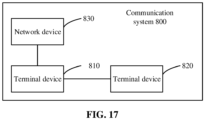
- FIG. 1 exemplarily shows a communication system 100, which includes a network device 110 and two terminal devices 120.
- the communication system 100 may include multiple network devices 110, and other numbers of terminal devices 120 may be included within a respective coverage of each of the network devices 110, which are not limited in the embodiments of the disclosure.
- the communication system 100 may further include other network entities such as a Mobility Management Entity (MME), an Access and Mobility Management Function (AMF), or the like, which are not limited in the embodiments of the disclosure.
- MME Mobility Management Entity
- AMF Access and Mobility Management Function
- the network device may further include an access network device and a core network device. That is, a wireless communication system may further include multiple core networks communicating with the access network device.
- the access network device may be an eNB or e-NodeB, a macro base station, a micro base station (also referred to as a "small base station"), a pico base station, an AP, a transmission point (TP), or a new generation Node B (gNodeB) in a LTE system, a Next Radio (NR) system or an Authorized Auxiliary Access Long-Term Evolution (LAA-LTE) system, or the like.
- a wireless communication system may further include multiple core networks communicating with the access network device.
- the access network device may be an eNB or e-NodeB, a macro base station, a micro base station (also referred to as a "small base station"), a pico base station, an AP, a transmission point (TP), or a new generation Node B (gNodeB) in
- a device with a communication function in a network/system may be referred to as a communication device.
- the communication device may include a network device and a terminal device of which each has a communication function.
- Each of the network device and the terminal device may be a specific device in the embodiments of the disclosure, and is not elaborated here.
- the communication device may further include other devices in the communication system, such as a network controller, a MME or other network entities, which are not limited in the embodiments of the disclosure.
- system and “network” in the disclosure may usually be used interchangeably.
- term “and/or” refers to only an association relationship for describing associated objects and represents that three relationships may exist.
- a and/or B may represent three cases: i.e., only A exists, both A and B exist, and only B exists.
- character “j” in the disclosure usually represents that previous and next associated objects form an "or" relationship.
- indication mentioned in the embodiments of the disclosure may be a direct indication, or may be an indirect indication, or may be represented as having an association relationship.
- A indicates B, which may indicate that A directly indicates B, for example, B may be obtained by A; or may indicate that A indirectly indicates B, for example, A indicates C, and B may be obtained by C; or may indicate that A and B have an association relationship there-between.
- corresponding may indicate that there are direct or indirect correspondences between two objects, or may indicate that the two objects have an association relationship there-between, or may have an indicating and indicated relationship, a configuring and configured relationship, or the like.
- the 3rd Generation Partnership Project includes the following transmission modes: mode-A and mode-B.
- Mode-A transmission resources of a terminal are allocated by a base station, and the terminal transmits data on a sidelink according to resources allocated by the base station.
- the base station may allocate resources for single transmission to the terminal, or may allocate resources for semi-static transmission to the terminal.
- Mode-B the terminal device selects a resource from a resource pool to transmit data, and the terminal device may be a vehicle-mounted terminal in V2X.
- D2D may include the following scenarios:
- NR V2X is not limited to a broadcast scenario, and is further expanded to unicast and multicast scenarios. Application of V2X is studied in these scenarios.
- NR V2X Similar to LTE V2X, NR V2X also defines two resource grant modes, i.e., the above-mentioned mode-A and mode-B. Furthermore, a user may be in a mixed mode, that is, the user may not only use the mode-A to obtain resources, but also use the mode-B to obtain resources.
- NR V2X introduces feedback-based HARQ retransmission, which is not limited to unicast communication, and also includes multicast communication.
- a user needs to perform DRX during downlink reception to save power.
- a network may transmit resource grant for a sidelink to the user through downlink (that is, by way of the mode-A)
- resource grant for a sidelink that is, by way of the mode-A
- a UE may be configured as the mode-A and use the DRX simultaneously.
- the network does not specifically optimize the DRX with respect to the "resource grant for a sidelink". That is, the UE may determine whether to enter sleep for power saving according to Uu interface rather than parameters/timers related to the sidelink, or the like.
- UE cannot be configured as the mode-A and use the DRX simultaneously at present.
- the disclosure may be applied to the NR.
- the DRX is specifically optimized with respect to the "resource grant for a sidelink", and parameters and timers related to the DRX with respect to the "resource grant for a sidelink" are proposed.
- FIG. 4 is a flowchart of a sidelink transmission method 200 according to an embodiment of the disclosure. The method may be optionally applied to the system illustrated in FIG. 1 to FIG. 3 , but is not limited thereto. The method includes at least part of the following contents.
- a terminal receives downlink information.
- the downlink information is configured to indicate resource grant of a sidelink.
- the terminal controls a state of a timer related to DRX for the sidelink based on a first event.
- the terminal may receive first information which is configured to indicate the resource grant of the sidelink.
- the first information may be downlink information.
- the terminal receives downlink information from a network side such as a base station.
- the downlink information is configured to indicate the resource grant of the sidelink.
- the terminal controls the state of the timer related to the DRX for the sidelink based on the first event.
- the downlink information is carried by a Physical Downlink Control Channel (PDCCH).
- PDCH Physical Downlink Control Channel
- the timer related to the DRX comprises at least one of a round-trip time (RTT) timer or a retransmission timer.
- RTT round-trip time
- the state of the timer related to the DRX for the sidelink is controlled, which may include at least one of the following operations.
- the RTT timer for the sidelink is started.
- a retransmission timer for the sidelink is started.
- the terminal may start the RTT timer for the sidelink based on the first event.
- the terminal may start the retransmission timer for the sidelink.
- the state of the timer related to the DRX for the sidelink is controlled, which may include the following operation.
- a retransmission timer for the sidelink is started.
- the terminal may start the retransmission timer for the sidelink based on the first event.
- the state of the timer related to the DRX for the sidelink is controlled, which may further include the following operation.
- a running retransmission timer for the sidelink is stopped.
- transmission of the sidelink may be continuous.
- the terminal may stop the running retransmission timer based on the first event. Then, a RTT timer for the sidelink is started. In response to the expiration of the RTT timer, the retransmission timer for the sidelink is started.
- the terminal may restart the retransmission timer for the sidelink based on the first event.
- the terminal after the terminal starts the retransmission timer for the sidelink, the terminal is in a wake-up state of DRX and may monitor a downlink channel during operation of the retransmission timer. For example, the terminal performs downlink PDCCH reception for a specific HARQ process of the sidelink. After the terminal obtains the resource grant for the sidelink allocated by the network to the terminal, the terminal may perform sidelink communication with other terminals of the sidelink based on the resource grant for the sidelink. In case that the retransmission timer for the sidelink is not started, the terminal is in a sleep state of DRX and may not monitor the downlink channel, thereby achieving energy saving and power saving effects.
- the terminal after the terminal starts the RTT timer for the sidelink, the terminal does not need to monitor the downlink channel during operation of the timer. For example, during the operation of the RTT timer, the terminal does not need to perform downlink PDCCH reception, or does not need to perform the downlink PDCCH reception for a specific HARQ process of the sidelink.
- the method may further include the operation that the terminal determines whether to start the retransmission timer for the sidelink based on feedback information.
- the terminal determines whether to start the retransmission timer for the sidelink based on the feedback information, which may include at least one of the following operations.
- the retransmission timer for the sidelink is not started, in response to the feedback information being acknowledgement (ACK) information.
- ACK acknowledgement
- the retransmission timer for the sidelink is started, in response to the feedback information being non-acknowledgement (NACK) information.
- NACK non-acknowledgement
- the retransmission timer for the sidelink is started, in response to reception of the feedback information.
- the retransmission timer for the sidelink is not started, in response to no reception of the feedback information.
- the terminal may determine whether to start the retransmission timer for the sidelink based on a transmission situation of a peer side represented by the received feedback information.
- the feedback information received by the terminal is the ACK information, which may indicate that the peer side successfully receives data from the terminal, and the retransmission timer for the sidelink may not be started.
- the feedback information received by the terminal is the NACK information, which may indicate that the peer side does not successfully receive the data from the terminal, and the retransmission timer for the sidelink may be started.
- the terminal may determine whether to start the retransmission timer for the sidelink based on whether the feedback information is received.
- the terminal does not receive the feedback information from the peer side, which may indicate that the peer side successfully receives the data from the terminal or the peer side does not need the retransmission, and the retransmission timer for the sidelink may not be started.
- the terminal receives the feedback information, which may indicate that the peer side does not successfully receive the data from the terminal or the peer side needs the retransmission, and the retransmission timer for the sidelink may be started.
- the first event may include that the terminal receives downlink resources including the downlink information.
- the downlink resources may be control channels or data channels, such as PDCCHs or Physical Downlink Shared Channels (PDSCHs).
- PDCCHs Physical Downlink Shared Channels
- the first event (i.e., the terminal receives the downlink resources including the downlink information) may include: when the terminal receives the downlink resources including the downlink information.
- the retransmission timer for the sidelink may be started when the terminal receives the PDCCH.
- the RTT timer for the sidelink may be started when the terminal receives the PDCCH, and the retransmission timer for the sidelink may be started in response to the expiration of the RTT timer.
- the first event may include that the terminal has received the downlink resources including the downlink information.
- the first event does not occur along with reception of the downlink resources, instead, there is a certain interval in time sequence there-between.
- the first event occurs at a first time unit or a specific number of time units after the terminal receives the downlink resources including the downlink information. For example, at a next slot, a next symbol, or a predetermined number of slots or symbols in time sequence after the downlink resources are received, the first event may control the state of the timer related to the DRX for the sidelink.
- the retransmission timer for the sidelink may be started after the terminal receives the PDCCH.
- the RTT timer for the sidelink may be started after the terminal receives the PDCCH, and the retransmission timer for the sidelink may be started in response to the expiration of the RTT timer.
- the first event may include: a first time period having passed after the terminal receives the PDCCH including the downlink information.
- the first time period may be a delay requirement for processing retransmission after the terminal receives the PDCCH.
- the first event (i.e., a first time period having passed after the terminal receives the PDCCH including the downlink information) may include: the first time period having passed from the time when the terminal receives the PDCCH including the downlink information.
- the retransmission timer for the sidelink may be started after the first time period after the terminal receives the PDCCH.
- the RTT timer for the sidelink may be started after the first time period after the terminal receives the PDCCH, and the retransmission timer for the sidelink may be started in response to the expiration of the RTT timer.
- the first event may include that the terminal transmits at least one of a Physical Sidelink Control Channel (PSCCH) or a Physical Sidelink Shared Channel (PSSCH).
- PSCCH Physical Sidelink Control Channel
- PSSCH Physical Sidelink Shared Channel
- the first event may only include that the terminal transmits at least one of the PSCCH or the PSSCH.
- the first event may also include both that the terminal receives the PDCCH and that the terminal transmits at least one of the PSCCH or the PSSCH.
- the first event (i.e., the terminal transmits at least one of the PSCCH or the PSSCH) may include: when the terminal transmits at least one of the PSCCH or the PSSCH.
- the retransmission timer for the sidelink may be started when the terminal transmits at least one of the PSCCH or the PSSCH.
- the RTT timer for the sidelink may be started when the terminal transmits at least one of the PSCCH or the PSSCH, and the retransmission timer for the sidelink may be started in response to the expiration of the RTT timer.
- the RTT timer for the sidelink may be started when the terminal receives the PDCCH, and the retransmission timer for the sidelink may be started in response to the expiration of the RTT timer.
- the RTT timer for the sidelink may be restarted when the terminal transmits the PSSCH, and the retransmission timer for the sidelink may be restarted in response to the expiration of the RTT timer.
- the first event (i.e., the terminal transmits at least one of the PSCCH or the PSSCH) may include: after the terminal transmits at least one of the PSCCH or the PSSCH.
- the state of the timer related to the DRX for the sidelink may be controlled at a first time unit after the terminal transmits at least one of the PSCCH or the PSSCH.
- the retransmission timer for the sidelink may be started after the terminal transmits at least one of the PSCCH or the PSSCH.
- the RTT timer for the sidelink may be started after the terminal transmits at least one of the PSCCH or the PSSCH, and the retransmission timer for the sidelink may be started in response to the expiration of the RTT timer.
- the retransmission timer for the sidelink may be started after the terminal receives the PDCCH.
- the retransmission timer for the sidelink may be restarted after the terminal transmits the PSCCH.
- the RTT timer for the sidelink may be started after the terminal receives the PDCCH, and the retransmission timer for the sidelink may be started in response to the expiration of the RTT timer.
- the RTT timer for the sidelink may be restarted after the terminal transmits the PSSCH, and the retransmission timer for the sidelink may be restarted in response to the expiration of the RTT timer.
- the first event may include: a second time period having passed after the terminal transmits at least one of the PSCCH or the PSSCH.
- the second time period may be a delay requirement for processing retransmission after the terminal transmits at least one of the PSCCH or the PSSCH.
- the first event (i.e., the second time period having passed after the terminal transmits at least one of the PSCCH or the PSSCH) may include: the second time period having passed from the time when the terminal transmits the PSCCH, and/or the second time period having passed from the time when the terminal transmits the PSSCH.
- the retransmission timer for the sidelink may be started after the second time period from the time when the terminal transmits at least one of the PSCCH or the PSSCH.
- the RTT timer for the sidelink may be started after the second time period from the time when the terminal transmits at least one of the PSCCH or the PSSCH, and the retransmission timer for the sidelink may be started in response to the expiration of the RTT timer.
- the retransmission timer for the sidelink may be started after the terminal receives the PDCCH.
- the retransmission timer for the sidelink may be restarted after the second time period from the time when the terminal transmits PSCCH.
- the RTT timer for the sidelink may be started after the terminal receives the PDCCH, and the retransmission timer for the sidelink may be started in response to the expiration of the RTT timer.
- the RTT timer for the sidelink may be restarted after the second time period from the time when the terminal transmits PSSCH, and the retransmission timer for the sidelink may be restarted in response to the expiration of the RTT timer.
- the first event may include:
- the terminal receives a Physical Sidelink Feedback Channel (PSFCH).
- PSFCH Physical Sidelink Feedback Channel
- the first event may only include that the terminal receives the PSFCH.
- the first event may also include both that the terminal receives the PDCCH and that the terminal receives the PSFCH.
- the first event may also include that the terminal receives the PDCCH, that the terminal transmits at least one of the PSCCH or the PSSCH, and that the terminal receives the PSFCH.
- the first event may include: when the terminal receives the PSFCH.
- the retransmission timer for the sidelink may be started when the terminal receives the PSFCH.
- the RTT timer for the sidelink may be started when the terminal receives the PSFCH, and the retransmission timer for the sidelink may be started in response to the expiration of the RTT timer.
- the retransmission timer for the sidelink may be started after the terminal receives the PDCCH.
- the retransmission timer for the sidelink may be restarted when the terminal transmits the PSSCH.
- the retransmission timer for the sidelink may be restarted again when the terminal receives the PSFCH.
- the RTT timer for the sidelink may be started when the terminal receives the PDCCH, and the retransmission timer for the sidelink may be started in response to the expiration of the RTT timer.
- the RTT timer for the sidelink may be restarted after the terminal transmits the PSSCH, and the retransmission timer for the sidelink may be started in response to the expiration of the RTT timer.
- the RTT timer for the sidelink may be restarted again when the terminal receives the PSFCH, and the retransmission timer for the sidelink may be started in response to the expiration of the RTT timer.
- the first event may include: after the terminal receives the PSFCH.
- the state of the timer related to the DRX for the sidelink is controlled at a first time unit after the terminal receives the PSFCH.
- the retransmission timer for the sidelink may be started after the terminal receives the PSFCH.
- the RTT timer for the sidelink may be started after the terminal receives the PSFCH, and the retransmission timer for the sidelink may be started in response to the expiration of the RTT timer.
- the retransmission timer for the sidelink may be started after the terminal receives the PDCCH.
- the retransmission timer for the sidelink may be restarted after the terminal transmits the PSSCH.
- the retransmission timer for the sidelink may be restarted again after the terminal receives the PSFCH.
- the RTT timer for the sidelink may be started after the terminal receives the PDCCH, and the retransmission timer for the sidelink may be started in response to the expiration of the RTT timer.
- the RTT timer for the sidelink may be restarted after the terminal transmits the PSSCH, and the retransmission timer for the sidelink may be started in response to the expiration of the RTT timer.
- the RTT timer for the sidelink may be restarted again after the terminal receives the PSFCH, and the retransmission timer for the sidelink may be started in response to the expiration of the RTT timer.
- the first event includes: a third time period having passed after the terminal receives the PSFCH.
- the third time period may be a delay requirement for processing retransmission after the terminal transmits the PSFCH.
- the first event i.e., the third time period having passed after the terminal receives the PSFCH
- the first event may include: the third time period having passed from the time when the terminal receives PSFCH.
- the retransmission timer for the sidelink may be started after the third time period from the time when the terminal receives the PSFCH.
- the RTT timer for the sidelink may be started after the third time period from the time when the terminal receives the PSFCH, and the retransmission timer for the sidelink may be started in response to the expiration of the RTT timer.
- the retransmission timer for the sidelink may be started after the terminal receives the PDCCH.
- the retransmission timer for the sidelink may be restarted after the terminal transmits the PSSCH.
- the retransmission timer for the sidelink may be restarted again after the third time period from the time when the terminal receives the PSFCH.
- the RTT timer for the sidelink may be started after the terminal receives the PDCCH, and the retransmission timer for the sidelink may be started in response to the expiration of the RTT timer.
- the RTT timer for the sidelink may be restarted after the terminal transmits the PSSCH, and the retransmission timer for the sidelink may be started in response to the expiration of the RTT timer.
- the RTT timer for the sidelink may be restarted again after the third time period from the time when the terminal receives the PSFCH, and the retransmission timer for the sidelink may be started in response to the expiration of the RTT timer.
- the first event includes: the terminal transmits a Physical Uplink Control Channel (PUCCH).
- PUCCH Physical Uplink Control Channel
- the first event may only include that the terminal transmits the PUCCH.
- the first event may also include both that the terminal receives the PDCCH and that the terminal transmits the PUCCH.
- the first event may also include that the terminal receives the PDCCH, that the terminal transmits at least one of the PSCCH or the PSSCH, and that the terminal transmits the PUCCH.
- the first event may also include that the terminal receives the PDCCH, that the terminal transmits at least one of the PSCCH or the PSSCH, that the terminal receives the PSFCH, and that the terminal transmits the PUCCH.
- the first event may include: when the terminal transmits the PUCCH.
- the retransmission timer for the sidelink may be started when the terminal transmits the PUCCH.
- the RTT timer for the sidelink may be started when the terminal transmits the PUCCH, and the retransmission timer for the sidelink may be started in response to the expiration of the RTT timer.
- the retransmission timer for the sidelink may be started when the terminal receives the PDCCH.
- the retransmission timer for the sidelink may be restarted when the terminal transmits the PUCCH.
- the retransmission timer for the sidelink may be started after the terminal receives the PDCCH, and the retransmission timer for the sidelink may be restarted when the terminal transmits the PSSCH.
- the retransmission timer for the sidelink may be restarted again after the terminal receives the PSFCH.
- the retransmission timer for the sidelink may be restarted when the terminal transmits the PUCCH.
- the first event may include: after the terminal transmits the PUCCH.
- the state of the timer related to the DRX for the sidelink is controlled at a first time unit after the terminal transmits the PUCCH.
- the retransmission timer for the sidelink may be started after the terminal transmits the PUCCH.
- the RTT timer for the sidelink may be started after the terminal transmits the PUCCH, and the retransmission timer for the sidelink may be started in response to the expiration of the RTT timer.
- a retransmission timer for the sidelink may be started after the terminal receives the PDCCH.
- the retransmission timer for the sidelink may be restarted after the terminal transmits the PUCCH.
- the retransmission timer for the sidelink may be started after the terminal receives the PDCCH.
- the retransmission timer for the sidelink may be restarted after the terminal transmits the PSSCH.
- the retransmission timer for the sidelink may be restarted again after the terminal receives the PSFCH.
- the retransmission timer for the sidelink may be restarted after the terminal transmits the PUCCH.
- the RTT timer for the sidelink may be started after the terminal receives the PDCCH, and the retransmission timer for the sidelink may be started in response to the expiration of the RTT timer.
- the RTT timer for the sidelink may be restarted after the terminal transmits the PSSCH, and the retransmission timer for the sidelink may be started in response to the expiration of the RTT timer.
- the RTT timer for the sidelink may be restarted again after the terminal receives the PSFCH, and the retransmission timer for the sidelink may be started in response to the expiration of the RTT timer.
- the RTT timer for the sidelink may be restarted again after the terminal transmits the PUCCH, and the retransmission timer for the sidelink may be started in response to the expiration of the RTT timer.
- the first event includes: a fourth time period having passed after the terminal transmits the PUCCH.
- the fourth time period may be a delay requirement for processing retransmission after the terminal transmits the PUCCH.
- the first event i.e., the fourth time period having passed after the terminal transmits the PUCCH
- the first event may include: the fourth time period having passed from the time when the terminal transmits the PUCCH.
- the retransmission timer for the sidelink may be started after the fourth time period from the time when the terminal transmits PUCCH.
- the RTT timer for the sidelink may be started after the fourth time period from the time when the terminal transmits the PUCCH, and the retransmission timer for the sidelink may be started in response to the expiration of the RTT timer.
- the retransmission timer for the sidelink may be started after the terminal receives the PDCCH.
- the retransmission timer for the sidelink may be restarted after the fourth time period from the time when the terminal transmits the PUCCH.
- the retransmission timer for the sidelink may be started after the terminal receives the PDCCH.
- the retransmission timer for the sidelink may be restarted after the terminal transmits the PSSCH.
- the retransmission timer for the sidelink may be restarted again after the terminal receives the PSFCH.
- the retransmission timer for the sidelink may be restarted after the fourth time period from the time when the terminal transmits PUCCH.
- the RTT timer for the sidelink may be started after the terminal receives the PDCCH, and the retransmission timer for the sidelink may be started in response to the expiration of the RTT timer.
- the RTT timer for the sidelink may be restarted after the terminal transmits the PSSCH, and the retransmission timer for the sidelink may be started in response to the expiration of the RTT timer.
- the RTT timer for the sidelink may be restarted again after the terminal receives the PSFCH, and the retransmission timer for the sidelink may be started in response to the expiration of the RTT timer.
- the RTT timer for the sidelink may be restarted again after the fourth time period from the time when the terminal transmits the PUCCH, and the retransmission timer for the sidelink may be started in response to the expiration of the RTT timer.
- the method is performed in at least one of the following conditions: the PUCCH having been configured, the PUCCH not being configured, the PSFCH having been configured, the PSFCH having been used, the PSFCH not being configured, or the PSFCH not being used.
- the first event has an association relationship with the conditions for performing the method.
- different events may correspond to different execution conditions.
- the event is: after the terminal receives the PDCCH
- the execution conditions may include at least one of: the PUCCH not being configured, the PSFCH not being configured or the PSFCH not being used.
- the event is: after the terminal transmits at least one of the PSCCH or the PSSCH
- the execution conditions may include at least one of: the PUCCH not being configured, the PSFCH not being configured, or the PSFCH not being used.
- the event is: after the terminal receives the PSFCH
- the execution conditions may include at least one of: the PUCCH not being configured, the PSFCH having been configured, or the PSFCH having been used.
- the event is: after the terminal transmits the PUCCH
- the execution conditions may include at least one of: the PUCCH having been configured, the PSFCH having been configured, the PSFCH having been used, the PSFCH not being configured, or the PSFCH not being used.
- various correspondences between the events and the conditions may also be set separately, and an event for triggering the timer may be selected based on different execution conditions.
- the event is: after the terminal receives the PDCCH, and a corresponding condition is that the PUCCH is not configured and the PSFCH is not configured.
- the event is: after the terminal transmits at least one of the PSCCH or the PSSCH, and a corresponding condition is that the PUCCH has been configured and the PSFCH is not configured.
- the event is: after the terminal receives the PSFCH, and a corresponding condition is that the PUCCH is not configured and PSFCH has been configured.
- the event is: after the terminal transmits the PUCCH, and a corresponding condition is that PUCCH has been configured and PSFCH has been configured.
- the event is: after the terminal receives the PDCCH, and a corresponding condition is that the PUCCH is not configured, the PSFCH is not configured and the PSFCH is not used.
- the event is: after the terminal transmits at least one of the PSCCH or the PSSCH, and a corresponding condition is that the PUCCH has been configured, the PSFCH is not configured and the PSFCH is not used.
- the event is: after the terminal receives the PSFCH, and a corresponding condition is that the PUCCH is not configured, the PSFCH has been configured and the PSFCH has been used.
- the event is: after the terminal transmits the PUCCH, and a corresponding condition is that the PUCCH has been configured, the PSFCH has been configured and the PSFCH is not used.
- the state of the timer related to the DRX for the sidelink may be controlled based on the events, so that the DRX may be optimized to reduce energy consumption of the terminal for sidelink transmission.
- the terminal may control the state of the timer related to the DRX for the sidelink based on some events after receiving the downlink information from the network, thereby reducing the energy consumption of the terminal for the sidelink transmission.
- a time point of starting the timer in the embodiments of the disclosure may be a first time unit (symbol, slot, or the like) after the event occurs.
- the event may be a transmitting/receiving behavior of a specific channel such as the PDCCH, the PSCCH, the PSSCH, the PSFCH, the PUCCH, or the like.
- the timer may be started at the first or the last time unit of the channel.
- the timer in the embodiments of the disclosure is introduced as follows.
- the RTT timer during operation of the timer, the UE does not need to perform downlink PDCCH reception, or does not need to perform the downlink PDCCH reception for a specific HARQ process of the sidelink.
- the retransmission timer during operation of the timer, the UE needs to perform the downlink PDCCH reception, or needs to perform the downlink PDCCH reception for a specific HARQ process of the sidelink.
- the timer is started according to the PDCCH.
- the example may include the following operations.
- the UE may also start the timer related to the DRX after a first time period after receiving the PDCCH.
- the first time period may be a delay requirement for processing retransmission after the UE receives the PDCCH.
- manners of starting the timer may include at least one of the followings.
- whether to start the retransmission timer may be determined based on feedback information.
- One manner may include that whether to start the retransmission timer for the sidelink is determined according to whether a UE at a reception side feeds back the ACK. If the ACK is fed back, the retransmission timer for the sidelink is not started. Otherwise, the retransmission timer for the sidelink is started.
- Another manner may include that whether to start the retransmission timer for the sidelink is determined according to whether the UE at the reception side feeds back information. If the information is fed back, the retransmission timer for the sidelink is started. Otherwise, the retransmission timer for the sidelink is not started.
- solution of the example may be used in at least one of the following cases.
- the timer is started according to the PSCCH/PSSCH.
- the example may include the following operations.
- the UE may also start the timer related to the DRX after a second time period after transmitting at least one of the PSCCH or the PSSCH.
- the second time period may be a delay requirement for processing retransmission after the UE transmits at least one of the PSCCH or the PSSCH.
- descriptions of determining whether to start the retransmission timer based on the feedback information may refer to the first example.
- solution of the example may be used in at least one of the following cases.
- the timer is started according to the PSFCH.
- the example may include the following operations.
- UE may also start the timer related to the DRX after a third time period after receiving the PSFCH.
- the third time period may be a delay requirement for processing retransmission after the UE transmits the PSFCH.
- descriptions of determining whether to start the retransmission timer based on the feedback information may refer to the first example.
- solution of the example may be used in at least one of the following cases:
- the timer is started according to the PUCCH.
- the example may include the following operations.
- UE may also start the timer related to the DRX after a fourth time period after transmitting PUCCH.
- the fourth time period may be a delay requirement for processing retransmission after the UE transmits the PUCCH.
- descriptions of determining whether to start the retransmission timer based on the feedback information may refer to the first example.
- solution of the example may be used in at least one of the following cases:
- the UE starts at least one of the RTT timer or the retransmission timer based on the event of the first example. Then, the UE starts at least one of the RTT timer or the retransmission timer based on at least one event of the second example, the third example or the fourth example.
- Manners of restarting at least one of the RTT timer or the retransmission timer may include: (1) when a RTT timer is running at this time: if the RTT timer needs to be started, the running RTT timer is restarted, and if the retransmission timer needs to be started, the retransmission timer is started after the expiration of the current RTT timer. (2) when the retransmission timer is running at this time: if the retransmission timer needs to be started, the retransmission timer is restarted.
- the UE starts at least one of the RTT timer or the retransmission timer based on the event of the second example. Then, the UE starts at least one of the RTT timer or the retransmission timer based on at least one event of the first example, the third example or the fourth example. Manners of restarting at least one of the RTT timer or the retransmission timer may refer to related descriptions of the above examples.
- the UE starts at least one of the RTT timer or the retransmission timer based on the event of the third example. Then, the UE starts at least one of the RTT timer or the retransmission timer based on at least one event of the first example, the second example or the fourth example. Manners of restarting at least one of the RTT timer or the retransmission timer may refer to related descriptions of the above examples.
- the UE starts at least one of the RTT timer or the retransmission timer based on the event of the fourth example. Then, the UE starts at least the RTT timer or the retransmission timer based on at least one event of the first example, the second example or the third example. Manners of restarting at least one of the RTT timer or the retransmission timer may refer to related descriptions of the above examples.
- a power saving mechanism of the sidelink is optimized, so that a power saving effect may still be achieved on downlink reception in case that the network schedules the resources of the sidelink.
- FIG. 9 is a flowchart of a sidelink transmission method 300 according to another embodiment of the disclosure.
- the method may be optionally applied to the system illustrated in FIG. 1 to FIG. 3 , but is not limited thereto.
- the method includes at least part of the following contents.
- a terminal receives sidelink information.
- the sidelink information is configured to indicate resource grant of a sidelink.
- the terminal controls a state of a timer related to DRX for the sidelink based on a first event.
- the terminal may receive first information which is configured to indicate the resource grant of the sidelink.
- the first information may be sidelink information.
- an RX-UE (a terminal at a reception side) receives sidelink information from a TX-UE (a terminal at a transmission side), and the sidelink information is configured to indicate the resource grant of the sidelink.
- the terminal controls the state of the timer related to the DRX for the sidelink based on the first event.
- the sidelink information is carried by a PSCCH.
- the timer related to the DRX includes at least a RTT timer or a retransmission timer.
- the state of the timer related to the DRX for the sidelink is controlled, which may include at least one of the following operations.
- the RTT timer for the sidelink is started.
- a retransmission timer for the sidelink is started.
- the terminal may start the RTT timer for the sidelink based on the first event.
- the terminal may start the retransmission timer for the sidelink.
- the state of the timer related to the DRX for the sidelink is controlled, which may include the following operation.
- a retransmission timer for the sidelink is started.
- the terminal may start the retransmission timer for the sidelink based on the first event.
- the method may further include the operation that the terminal determines whether to start the retransmission timer for the sidelink based on feedback information.
- the terminal determines whether to start the retransmission timer for the sidelink based on the feedback information, which may include at least one of the following operations.
- the retransmission timer for the sidelink is not started, in response to the feedback information being ACK information.
- the retransmission timer for the sidelink is started, in response to the feedback information being NACK information.
- the terminal may determine whether to start the retransmission timer for the sidelink based on a transmission situation of a peer side represented by the received feedback information.
- the feedback information received by the terminal is the ACK information, which may indicate that the peer side successfully receives data from the terminal, and the retransmission timer for the sidelink may not be started.
- the feedback information received by the terminal is the NACK information, which may indicate that the peer side does not successfully receive the data from the terminal, and the retransmission timer for the sidelink may be started.
- the terminal may determine whether to start the retransmission timer for the sidelink based on whether the feedback information is received.
- the terminal does not receive the feedback information from the peer side, which may indicate that the peer side successfully receives the data from the terminal or the peer side does not need the retransmission, and the retransmission timer for the sidelink may not be started.
- the terminal receives the feedback information, which may indicate that the peer side does not successfully receive the data from the terminal or the peer side needs the retransmission, and the retransmission timer for the sidelink may be started.
- the state of the timer related to the DRX for the sidelink is controlled, which may further include the following operation.
- a running retransmission timer for the sidelink is stopped.
- transmission of the sidelink may be continuous.
- the terminal may stop the running retransmission timer based on the first event. Then, a RTT timer for the sidelink is started. In response to the expiration of the RTT timer, the retransmission timer for the sidelink is started.
- the terminal may restart the retransmission timer for the sidelink based on the first event.
- the terminal after the terminal starts the retransmission timer for the sidelink, the terminal is in a wake-up state of DRX and may monitor a downlink channel during operation of the retransmission timer. For example, the terminal performs downlink PDCCH reception for a specific HARQ process of the sidelink. After the terminal obtains the resource grant for the sidelink allocated by the network to the terminal, the terminal may perform sidelink communication with other terminals of the sidelink based on the resource grant for the sidelink. In case that the retransmission timer for the sidelink is not started, the terminal is in a sleep state of DRX and may not monitor the downlink channel, thereby achieving energy saving and power saving effects.
- the terminal after the terminal starts the RTT timer for the sidelink, the terminal does not need to monitor the downlink channel during operation of the timer. For example, during the operation of the RTT timer, the terminal does not need to perform downlink PDCCH reception, or does not need to perform the downlink PDCCH reception for a specific HARQ process of the sidelink.
- the first event may include that the terminal receives sidelink resources including the sidelink information.
- the sidelink resources may be a control channel or a data channel, such as at least one of a PSCCH or a PSSCH.
- the first event includes: a fifth time period having passed after the terminal receives at least one of the PSCCH or the PSSCH.
- the fifth time period may be a delay requirement for processing retransmission after the terminal receives at least one of the PSCCH or the PSSCH.
- the first event (i.e., the fifth time period having passed after the terminal receives at least one of the PSCCH or the PSSCH) may include: the fifth time period having passed from the time when the terminal receives the PSCCH, and/or the fifth time period having passed from the time when the terminal receives the PSSCH.
- the retransmission timer for the sidelink may be started after the fifth time period from the time when the terminal receives the PSCCH.
- the RTT timer for the sidelink may be started after the fifth time period from the time when the terminal receives the PSSCH, and the retransmission timer for the sidelink may be started in response to the expiration of the RTT timer.
- the retransmission timer for the sidelink may be restarted after the terminal receives the PSCCH.
- the retransmission timer for the sidelink may be restarted after the fifth time period from the time when the terminal receives the PSSCH.
- the retransmission timer for the sidelink may be started after the fifth time period from the time when the terminal receives the PSCCH.
- the RTT retransmission timer for the sidelink may be restarted after the fifth time period from the time when the terminal receives the PSSCH, and the retransmission timer for the sidelink is restarted in response to the expiration of the RTT timer.
- the first event may include that the terminal transmits a PSFCH.
- the first event may include: a sixth time period having passed after the terminal transmits the PSFCH.
- the sixth time period may be a delay requirement for processing retransmission after the terminal transmits the PSFCH.
- the first event i.e., the sixth time period having passed after the terminal transmits the PSFCH
- the sixth time period having passed from the time when the terminal transmits the PSFCH.
- the retransmission timer for the sidelink may be started after the sixth time period from the time when the terminal transmits the PSFCH.
- the RTT timer for the sidelink may be started after the sixth time period from the time when the terminal transmits the PSFCH, and the retransmission timer for the sidelink may be started in response to the expiration of the RTT timer.
- the retransmission timer for the sidelink may be restarted after the terminal receives the PSSCH.
- the retransmission timer for the sidelink may be restarted again after the sixth time period from the time when the terminal transmits the PSFCH.
- the RTT timer for the sidelink is restarted after the terminal receives the PSSCH, and the retransmission timer for the sidelink may be started in response to the expiration of the RTT timer.
- the RTT timer for the sidelink may be restarted again after the sixth time period from the time when the terminal transmits the PSFCH, and the retransmission timer for the sidelink may be started in response to the expiration of the RTT timer.
- the method is performed in at least one of the following conditions: the PSFCH having been configured, the PSFCH having been used, the PSFCH not being configured, or the PSFCH not being used.
- the first event has an association relationship with the conditions for performing the method.
- the timer is started according to the PSCCH.
- the example may include the following operations.
- the UE may also start the timer related to the DRX after a fifth time period after receiving the PSCCH.
- the fifth time period may be a delay requirement for processing retransmission after the UE receives the PSCCH.
- manners of starting the timer may include at least one of the followings.
- the retransmission timer may be separately defined for different HARQ processes of the sidelink.
- whether to start the retransmission timer may be determined based on feedback information.
- One manner may include that whether to start the retransmission timer for the sidelink is determined according to whether a UE at a reception side feeds back the ACK. If the ACK is fed back, the retransmission timer for the sidelink is not started. Otherwise, the retransmission timer for the sidelink is started.
- Another manner may include that whether to start the retransmission timer for the sidelink is determined according to whether the UE at the reception side feeds back information. If the information is fed back, the retransmission timer for the sidelink is started. Otherwise, the retransmission timer for the sidelink is not started.
- solution of the example may be used in at least one of the following cases: a) The PSCCH is not configured; b) The PSFCH is not configured; or c) The PSFCH is not used.
- the timer is started according to the PSCCH/PSSCH.
- the example may include the following operations.
- the UE may also start the timer related to the DRX after a fifth time period after receiving the PSSCH.
- the fifth time period may be a delay requirement for processing retransmission after the UE transmits the PSCCH.
- the fifth time period in the example may be different from the fifth time period in the fifth example in terms of their specific time lengths.
- descriptions of determining whether to start the retransmission timer based on feedback information may refer to the fifth example.
- solution of the example may be used in at least one of the following cases: a) The PSFCH is not configured; or b) The PSFCH is not used.
- the timer is started according to the PSFCH.
- the example may include the following operations.
- the UE may also start the timer related to the DRX after a sixth time period after transmitting the PSFCH.
- the sixth time period may be a delay requirement for processing retransmission after the UE transmits the PSFCH.
- descriptions of determining whether to start the retransmission timer based on feedback information may refer to the fifth example.
- solution of the example may be used in at least one of the following cases: a) The PSFCH has been configured; or b) The PSFCH has been used.
- the UE starts at least one of the RTT timer or the retransmission timer based on the event of the fifth example. Then, the UE starts at least one of the RTT timer or the retransmission timer based on at least one event of the sixth example or the seventh example.
- Manners of restarting at least one of the RTT timer or the retransmission timer may include: (1) when a RTT timer is running at this time: if the RTT timer needs to be started, the running RTT timer is restarted, and if the retransmission timer needs to be started, the retransmission timer is started after the expiration of the current RTT timer. (2) when the retransmission timer is running at this time: if the retransmission timer needs to be started, the retransmission timer is restarted.
- the UE starts at least one of the RTT timer or the retransmission timer based on the event of the sixth example. Then, the UE starts at least one of the RTT timer or the retransmission timer based on at least one event of the fifth example or the seventh example. Manners of restarting at least one of the RTT timer or the retransmission timer may refer to related descriptions of the above examples.
- the UE starts at least one of the RTT timer or the retransmission timer based on the event of the seventh example. Then, the UE starts at least one of the RTT timer or the retransmission timer based on at least one event of the fifth example or the sixth example. Manners of restarting at least one of the RTT timer or the retransmission timer may refer to related descriptions of the above examples.
- a power saving mechanism of the sidelink is optimized, so that a power saving effect may still be achieved on sidelink reception in the case that resources are transmitted on the sidelink.
- FIG. 13 is a block diagram of a terminal 400 according to an embodiment of the disclosure.
- the terminal 400 may include a reception unit 410 and a processing unit 420.
- the reception unit 410 is configured to receive downlink information.
- the downlink information is configured to indicate resource grant of a sidelink.
- the processing unit 420 is configured to control a state of a timer related to DRX for the sidelink based on a first event.
- the downlink information is carried by a PDCCH.
- the timer related to the DRX includes at least one of a RTT timer or a retransmission timer.
- the processing unit is further configured to perform at least one of following operations.
- a RTT timer for the sidelink is started.
- a retransmission timer for the sidelink is started in response to expiration of the RTT timer.
- the processing unit is further configured to start the retransmission timer for the sidelink.
- the processing unit is further configured to determine whether to start the retransmission timer for the sidelink based on feedback information.
- the processing unit is further configured to perform at least one of the following operations.
- the retransmission timer for the sidelink is not started, in response to the feedback information being ACK information.
- the retransmission timer for the sidelink is started, in response to the feedback information being NACK information.
- the retransmission timer for the sidelink is started, in response to reception of the feedback information.
- the retransmission timer for the sidelink is not started, in response to no reception of the feedback information.
- the processing unit is further configured to stop a running retransmission timer for the sidelink.
- the first event may refer to related descriptions in the method 200.
- conditions for running the processing unit of the terminal may refer to related descriptions in the method 200.
- the first event has an association relationship with the conditions for running the processing unit of the terminal.
- the terminal 400 of the embodiments of the disclosure may implement corresponding functions of the terminal in the foregoing method embodiment.
- Processes, functions, implementations and beneficial effects corresponding to modules (sub-modules, units, or components, or the like) of the terminal 400 may refer to corresponding descriptions in the foregoing embodiments of the method 200, and would not be elaborated here.
- the functions described with respect to the modules (sub-modules, units, or components, or the like) of the terminal 400 of the embodiments of the disclosure may be implemented by different modules (sub-modules, units, or components, or the like), or may be implemented by the same module (sub-module, unit, or component, or the like).
- FIG. 14 is a block diagram of a terminal 500 according to another embodiment of the disclosure.
- the terminal 500 may include a reception unit 510 and a processing unit 520.
- the reception unit 510 is configured to receive sidelink information.
- the sidelink information is configured to indicate resource grant of a sidelink.
- the processing unit 520 is configured to control a state of a timer related to DRX for the sidelink based on a first event.
- the sidelink information is carried by a PSCCH.
- the timer related to the DRX includes at least one of a RTT timer or a retransmission timer.
- the processing unit is further configured to perform at least one of following operations.
- a RTT timer for the sidelink is started.
- a retransmission timer for the sidelink is started in response to expiration of the RTT timer.
- the processing unit is further configured to start the retransmission timer for the sidelink.
- the processing unit is further configured to determine whether to start the retransmission timer for the sidelink based on feedback information.
- the processing unit is further configured to perform at least one of following operations.
- the retransmission timer for the sidelink is not started, in response to the feedback information being ACK information.
- the retransmission timer for the sidelink is started, in response to the feedback information being NACK information.
- the processing unit is further configured to stop a running retransmission timer for the sidelink.
- the first event may refer to related descriptions in the method 300.
- conditions for running the processing unit of the terminal may refer to related descriptions in the method 300.
- the first event has an association relationship with the conditions for running the processing unit of the terminal.
- the terminal 500 of the embodiments of the disclosure may implement corresponding functions of the terminal in the foregoing method embodiment.
- Processes, functions, implementations and beneficial effects corresponding to modules (sub-modules, units, or components, or the like) of the terminal 500 may refer to corresponding descriptions in the foregoing embodiments of the method 300, and would not be elaborated here.
- the functions described with respect to the modules (sub-modules, units, or components, or the like) of the terminal 500 of the embodiments of the disclosure may be implemented by different modules (sub-modules, units, or components, or the like), or may be implemented by the same module (sub-module, unit, or component, or the like).
- FIG. 15 is a structural diagram of a communication device 600 according to an embodiment of the disclosure.
- the communication device 600 includes a processor 610 which may call and run a computer program from a memory to enable the communication device 600 to implement the methods of the embodiments of the disclosure.
- the communication device 600 may further include a memory 620 and a transceiver 630.
- FIG. 16 is a structural diagram of a chip 700 according to an embodiment of the disclosure.
- the chip 700 includes a processor 710 which may call and run a computer program from a memory to implement the methods of the embodiments of the disclosure.
- the chip 700 may further include a memory 720, an input interface 730, and an output interface 740.
- FIG. 17 is a block diagram of a communication system 800 according to an embodiment of the disclosure.
- the communication system 800 includes a terminal device 810, a terminal device 820 and a network device 830.
- the terminal device 810 is configured to receive downlink information which is configured to indicate resource grant of a sidelink, and control a state of a timer related to DRX for the sidelink based on a first event.
- the terminal device 820 is configured to perform sidelink communication with the terminal device 810.
- the network device 830 is configured to transmit the downlink information.
- the terminal device 810 is configured to implement corresponding functions implemented by the terminal at the transmission side in the foregoing methods.
- the terminal device 820 is configured to implement corresponding functions implemented by the terminal at the reception side in the foregoing methods.
- the network device 830 is configured to implement corresponding functions implemented by the network device in the foregoing methods. Details are not elaborated here for brevity.
- size of a serial number of each process does not indicate an execution sequence of each process, and the execution sequence of each process should be determined by its function and internal logic, and should not form any limitation on implementation processes of the embodiments of the disclosure.
Landscapes
- Engineering & Computer Science (AREA)
- Computer Networks & Wireless Communication (AREA)
- Signal Processing (AREA)
- Computer Security & Cryptography (AREA)
- Mobile Radio Communication Systems (AREA)
- Telephone Function (AREA)
- Two-Way Televisions, Distribution Of Moving Picture Or The Like (AREA)
- Addition Polymer Or Copolymer, Post-Treatments, Or Chemical Modifications (AREA)
Abstract
Description
- The disclosure relate to the technical field of communication, and more particularly, to a sidelink transmission method and a terminal.
- Device to Device (D2D) communication is a transmission technology based on sidelink (SL). Unlike manners in which communication data in a conventional cellular system is received or transmitted by a base station, a Vehicle to Everything (V2X) system uses a terminal-to-terminal direct communication manner, and thus has higher spectral efficiency and lower transmission delay.
- In a long-term evolution (LTE) system, Discontinuous Reception (DRX) is an energy-saving mechanism. In sidelink transmission, a problem which needs to be considered is how to optimize the DRX to reduce energy consumption of a terminal.
- Embodiments of the disclosure provide a sidelink transmission method and a terminal, which may reduce energy consumption of a terminal for sidelink transmission.
- An embodiment of the disclosure provides a sidelink transmission method, which includes the following operations.
- A terminal receives downlink information. The downlink information is configured to indicate resource grant of a sidelink.
- The terminal controls a state of a timer related to DRX for the sidelink based on a first event.
- An embodiment of the disclosure provides a sidelink transmission method, which includes the following operations.
- A terminal receives sidelink information. The sidelink information is configured to indicate resource grant of a sidelink.
- The terminal controls a state of a timer related to DRX for the sidelink based on a first event.
- An embodiment of the disclosure provides a terminal, including a reception unit and a processing unit.
- The reception unit is configured to receive downlink information. The downlink information is configured to indicate resource grant of a sidelink.
- The processing unit is configured to control a state of a timer related to DRX for the sidelink based on a first event.
- An embodiment of the disclosure provides a terminal, including a reception unit and a processing unit.
- The reception unit is configured to receive sidelink information. The sidelink information is configured to indicate resource grant of a sidelink.
- The processing unit is configured to control a state of a timer related to DRX for the sidelink based on a first event.
- An embodiment of the disclosure provides a terminal, which includes a processor and a memory. The memory is configured to store a computer program, and the processor is configured to call and run the computer program stored in the memory to enable the terminal device to execute the above sidelink transmission method.
-
-
FIG. 1 is a diagram of an application scenario according to an embodiment of the disclosure. -
FIG. 2 is a diagram of a mode-A. -
FIG. 3 is a diagram of a mode-B. -
FIG. 4 is a flowchart of a sidelink transmission method according to an embodiment of the disclosure. -
FIG. 5 is a diagram of a first example. -
FIG. 6 is a diagram of a second example. -
FIG. 7 is a diagram of a third example. -
FIG. 8 is a diagram of a fourth example. -
FIG. 9 is another flowchart of a sidelink transmission method according to an embodiment of the disclosure. -
FIG. 10 is a diagram of a fifth example. -
FIG. 11 is a diagram of a sixth example. -
FIG. 12 is a diagram of a seventh example. -
FIG. 13 is a block diagram of a terminal according to an embodiment of the disclosure. -
FIG. 14 is a block diagram of a terminal according to another embodiment of the disclosure. -
FIG. 15 is a block diagram of a communication device according to an embodiment of the disclosure. -
FIG. 16 is a block diagram of a chip according to an embodiment of the disclosure. -
FIG. 17 is a block diagram of a communication system according to an embodiment of the disclosure. - Technical solutions in the embodiments of the disclosure would be described below in combination with the drawings in the embodiments of the disclosure.
- The embodiments of the disclosure may be applied to various communication systems, such as a Global System of Mobile communication (GSM) system, a Code Division Multiple Access (CDMA) system, a Wideband Code Division Multiple Access (WCDMA) system, a General Packet Radio Service (GPRS), a Long Term Evolution (LTE) system, an Advanced long term evolution (LTE-A) system, a New Radio (NR) system, an evolution system of NR system, a LTE-based access to unlicensed spectrum (LTE-U) system, a NR-based access to unlicensed spectrum (NR-U) system, a Non-Terrestrial Network (NTN) system, a Universal Mobile Telecommunication System (UMTS), a Wireless Local Area Network (WLAN), a Wireless Fidelity (WiFi), a 5th-Generation communication (5G) system, or another communication system, or the like.
- Generally speaking, a limited number of connections are supported by a conventional communication system, and are also easy to be implemented. However, with the development of communication technologies, a mobile communication system may not only support conventional communication, but also support communication such as D2D communication, Machine to Machine (M2M) communication, Machine Type Communication (MTC), Vehicle to Vehicle (V2V) communication, or V2X communication, or the like, and the embodiments of the disclosure may also be applied to these communication systems.
- Optionally, the communication system in the embodiments of the disclosure may be applied to a Carrier Aggregation (CA) scenario, or may be applied to a Dual Connectivity (DC) scenario, or may be applied to a standalone (SA) networking scenario.
- Optionally, the communication system in the embodiments of the disclosure may be applied to an unlicensed spectrum. The unlicensed spectrum may also be considered to be a shared spectrum. Alternatively, the communication system in the embodiments of the disclosure may also be applied to a licensed spectrum. The licensed spectrum may also be considered to be a non-shared spectrum.
- The embodiments of the disclosure describe various embodiments in combination with a network device and a terminal device. The terminal device may also be referred to as a User Equipment (UE), an access terminal, a user unit, a user station, a mobile station, a mobile platform, a remote station, a remote terminal, a mobile device, a user terminal, a terminal, a wireless communication device, a user agent, or a user device, or the like.
- The terminal device may be a STAION (ST) in WLAN, or may be a cellular phone, a cordless phone, a Session Initiation Protocol (SIP) phone, a Wireless Local Loop (WLL) station, a Personal Digital Assistant (PDA) device, a handheld device with a wireless communication function, a computing device or other processing devices connected to a wireless modem, a vehicle-mounted device, a wearable device, a terminal device in a next-generation communication system such as an NR network, or a terminal device in a future-evolved Public Land Mobile Network (PLMN) network, or the like.
- In the embodiments of the disclosure, the terminal device may be deployed on land, including indoor or outdoor, handheld, wearable, or vehicle-mounted; or may be deployed on a water surface (such as a ship); or may be deployed in the air (such as an aircraft, a balloon, a satellite, or the like).
- In the embodiments of the disclosure, the terminal device may be a mobile phone, a tablet computer (Pad), a computer with a wireless transceiving function, a Virtual Reality (VR) terminal device, an Augmented Reality (AR) terminal device, a wireless terminal device in industrial control, a wireless terminal device in self driving, a wireless terminal device in remote medical, a wireless terminal device in smart grid, a wireless terminal device in transportation safety, a wireless terminal device in smart city, or a wireless terminal device in smart home, or the like.
- As an example rather than limitation, in the embodiments of the disclosure, the terminal device may also be a wearable device. The wearable device may also be referred to as a wearable smart device, which is a general term of wearable devices developed by applying a wearable technology to intelligently design daily wearable objects, such as glasses, gloves, watches, clothing, shoes, or the like. The wearable device is directly worn on the body, or is a portable device integrated into a user's clothing or accessory. The wearable device is not only a hardware device, but also achieves powerful functions through software support, data interaction and cloud interaction. A generalized wearable smart device has full functions and a large size, and may not rely on a smart phone to implement full or part of the functions, such as a smart watch, or smart glasses, or the like; or only focus on a certain type of application function, and needs to be used in cooperation with other devices such as a smart phone, such as various kinds of smart bracelets, smart jewelry, or the like, for monitoring physical signs.
- In the embodiments of the disclosure, the network device may be a device communicating with a mobile device. The network device may be an Access Point (AP) in WLAN, a Base Transceiver Station (BTS) in GSM or CDMA, or a NodeB (NB) in WCDMA, or an Evolutional Node B (eNB or eNodeB) in LTE, or a relay station or AP, or a network device (gNB) in a vehicle-mounted device, a wearable device and an NR network, or a network device in a future-evolved PLMN network, or a network device in an NTN network, or the like.
- As an example rather than limitation, in the embodiments of the disclosure, the network device may have a mobility characteristic, for example, the network device may be a mobile device. Optionally, the network device may be a satellite or a balloon station. For example, the satellite may be a Low Earth Orbit (LEO) satellite, a Medium Earth Orbit (MEO) satellite, a Geostationary Earth Orbit (GEO) satellite, a High Elliptical Orbit (HEO) satellite, or the like. Optionally, the network device may also be a base station arranged at a position such as land or water area, or other positions.
- In the embodiments of the disclosure, the network device may provide services for a cell, and the terminal device may communicate with the network device through transmission resources (such as frequency domain resources or spectrum resources) used by the cell. The cell may be a cell corresponding to the network device (such as a base station), and the cell may belong to a macro base station, or may belong to a base station corresponding to a small cell. The small cell may include a metro cell, a micro cell, a pico cell, a femto cell, or the like. The small cells have characteristics of small coverage and low transmission power, and are suitable for providing high-rate data transmission services.
-
FIG. 1 exemplarily shows acommunication system 100, which includes anetwork device 110 and twoterminal devices 120. Optionally, thecommunication system 100 may includemultiple network devices 110, and other numbers ofterminal devices 120 may be included within a respective coverage of each of thenetwork devices 110, which are not limited in the embodiments of the disclosure. - Optionally, the
communication system 100 may further include other network entities such as a Mobility Management Entity (MME), an Access and Mobility Management Function (AMF), or the like, which are not limited in the embodiments of the disclosure. - The network device may further include an access network device and a core network device. That is, a wireless communication system may further include multiple core networks communicating with the access network device. The access network device may be an eNB or e-NodeB, a macro base station, a micro base station (also referred to as a "small base station"), a pico base station, an AP, a transmission point (TP), or a new generation Node B (gNodeB) in a LTE system, a Next Radio (NR) system or an Authorized Auxiliary Access Long-Term Evolution (LAA-LTE) system, or the like.
- It should be understood that in the embodiments of the disclosure, a device with a communication function in a network/system may be referred to as a communication device. Taking the communication system illustrated in
FIG. 1 as an example, the communication device may include a network device and a terminal device of which each has a communication function. Each of the network device and the terminal device may be a specific device in the embodiments of the disclosure, and is not elaborated here. The communication device may further include other devices in the communication system, such as a network controller, a MME or other network entities, which are not limited in the embodiments of the disclosure. - It should be understood that terms "system" and "network" in the disclosure may usually be used interchangeably. In the disclosure, term "and/or" refers to only an association relationship for describing associated objects and represents that three relationships may exist. For example, A and/or B may represent three cases: i.e., only A exists, both A and B exist, and only B exists. Furthermore, character "j" in the disclosure usually represents that previous and next associated objects form an "or" relationship.
- It should be understood that "indication" mentioned in the embodiments of the disclosure may be a direct indication, or may be an indirect indication, or may be represented as having an association relationship. For example, A indicates B, which may indicate that A directly indicates B, for example, B may be obtained by A; or may indicate that A indirectly indicates B, for example, A indicates C, and B may be obtained by C; or may indicate that A and B have an association relationship there-between.
- In descriptions of the embodiments of the disclosure, term "corresponding" may indicate that there are direct or indirect correspondences between two objects, or may indicate that the two objects have an association relationship there-between, or may have an indicating and indicated relationship, a configuring and configured relationship, or the like.
- In order to facilitate understanding the technical solutions of the embodiments of the disclosure, related technologies of the embodiments of the disclosure are described below. The following related technologies may be used as optional solutions, and may be arbitrarily combined with the technical solutions of the embodiments of the disclosure, which belong to a scope of protection of the embodiments of the disclosure.
- As illustrated in
FIG. 2 and FIG. 3 , the 3rd Generation Partnership Project (3GPP) includes the following transmission modes: mode-A and mode-B. - Mode-A: transmission resources of a terminal are allocated by a base station, and the terminal transmits data on a sidelink according to resources allocated by the base station. The base station may allocate resources for single transmission to the terminal, or may allocate resources for semi-static transmission to the terminal.
- Mode-B: the terminal device selects a resource from a resource pool to transmit data, and the terminal device may be a vehicle-mounted terminal in V2X.
- In an evolution process of 3GPP protocol, D2D may include the following scenarios:
- Proximity based Service (ProSe): D2D communication in Rel-12/13 mainly aims at a ProSe scenario, and is applicable to services of public security types.
- V2X: in Rel-14/15, a V2X system mainly aims at a V2V communication scenario, and mainly faces services of communication between vehicles moving at relatively high-speeds, and communication between the vehicles and persons.
- Wearable device (FeD2D): in Rel-14, FeD2D mainly aims at a scenario where a wearable device accesses a network through a mobile phone, and mainly faces scenarios of low moving speed and low power access.
- Based on LTE V2X, NR V2X is not limited to a broadcast scenario, and is further expanded to unicast and multicast scenarios. Application of V2X is studied in these scenarios.
- Similar to LTE V2X, NR V2X also defines two resource grant modes, i.e., the above-mentioned mode-A and mode-B. Furthermore, a user may be in a mixed mode, that is, the user may not only use the mode-A to obtain resources, but also use the mode-B to obtain resources.
- Unlike LTE V2X, in addition to Hybrid Automatic Repeat reQuest (HARQ) retransmission without feedback and initiated by UE autonomously, NR V2X introduces feedback-based HARQ retransmission, which is not limited to unicast communication, and also includes multicast communication.
- DRX is introduced as follows.
- A user needs to perform DRX during downlink reception to save power. Considering that a network may transmit resource grant for a sidelink to the user through downlink (that is, by way of the mode-A), a problem existed here is how to perform DRX during downlink reception with respect to the "resource grant for a sidelink".
- In LTE, a UE may be configured as the mode-A and use the DRX simultaneously. However, the network does not specifically optimize the DRX with respect to the "resource grant for a sidelink". That is, the UE may determine whether to enter sleep for power saving according to Uu interface rather than parameters/timers related to the sidelink, or the like. In NR, UE cannot be configured as the mode-A and use the DRX simultaneously at present.
- The disclosure may be applied to the NR. In a scenario where the UE can be configured as the mode-A and use the DRX simultaneously, the DRX is specifically optimized with respect to the "resource grant for a sidelink", and parameters and timers related to the DRX with respect to the "resource grant for a sidelink" are proposed.
-
FIG. 4 is a flowchart of asidelink transmission method 200 according to an embodiment of the disclosure. The method may be optionally applied to the system illustrated inFIG. 1 to FIG. 3 , but is not limited thereto. The method includes at least part of the following contents. - At S210, a terminal receives downlink information. The downlink information is configured to indicate resource grant of a sidelink.
- At S220, the terminal controls a state of a timer related to DRX for the sidelink based on a first event.
- Optionally, the terminal may receive first information which is configured to indicate the resource grant of the sidelink. The first information may be downlink information. For example, the terminal receives downlink information from a network side such as a base station. The downlink information is configured to indicate the resource grant of the sidelink. Then, the terminal controls the state of the timer related to the DRX for the sidelink based on the first event.
- Optionally, in the embodiment of the disclosure, the downlink information is carried by a Physical Downlink Control Channel (PDCCH).
- Optionally, in the embodiment of the disclosure, the timer related to the DRX comprises at least one of a round-trip time (RTT) timer or a retransmission timer.
- Optionally, in the embodiment of the disclosure, the state of the timer related to the DRX for the sidelink is controlled, which may include at least one of the following operations.
- The RTT timer for the sidelink is started.
- In response to expiration of the RTT timer, a retransmission timer for the sidelink is started.
- For example, in a case that the timer related to the DRX includes the RTT timer for the sidelink and the retransmission timer for the sidelink, the terminal may start the RTT timer for the sidelink based on the first event. In response to the expiration of the RTT timer, the terminal may start the retransmission timer for the sidelink.
- Optionally, in the embodiment of the disclosure, the state of the timer related to the DRX for the sidelink is controlled, which may include the following operation.
- A retransmission timer for the sidelink is started.
- For example, in a case that the timer related to the DRX includes the retransmission timer for the sidelink, the terminal may start the retransmission timer for the sidelink based on the first event.
- Optionally, in the embodiment of the disclosure, the state of the timer related to the DRX for the sidelink is controlled, which may further include the following operation.
- A running retransmission timer for the sidelink is stopped.
- For example, transmission of the sidelink may be continuous. In a case that there is a retransmission timer running in the sidelink, the terminal may stop the running retransmission timer based on the first event. Then, a RTT timer for the sidelink is started. In response to the expiration of the RTT timer, the retransmission timer for the sidelink is started.
- For another example, in a case that there is no RTT timer for the sidelink, the terminal may restart the retransmission timer for the sidelink based on the first event.
- In the embodiment of the disclosure, after the terminal starts the retransmission timer for the sidelink, the terminal is in a wake-up state of DRX and may monitor a downlink channel during operation of the retransmission timer. For example, the terminal performs downlink PDCCH reception for a specific HARQ process of the sidelink. After the terminal obtains the resource grant for the sidelink allocated by the network to the terminal, the terminal may perform sidelink communication with other terminals of the sidelink based on the resource grant for the sidelink. In case that the retransmission timer for the sidelink is not started, the terminal is in a sleep state of DRX and may not monitor the downlink channel, thereby achieving energy saving and power saving effects.
- In the embodiment of the disclosure, after the terminal starts the RTT timer for the sidelink, the terminal does not need to monitor the downlink channel during operation of the timer. For example, during the operation of the RTT timer, the terminal does not need to perform downlink PDCCH reception, or does not need to perform the downlink PDCCH reception for a specific HARQ process of the sidelink.
- Optionally, in the embodiment of the disclosure, the method may further include the operation that the terminal determines whether to start the retransmission timer for the sidelink based on feedback information.
- Optionally, in the embodiment of the disclosure, the terminal determines whether to start the retransmission timer for the sidelink based on the feedback information, which may include at least one of the following operations.
- The retransmission timer for the sidelink is not started, in response to the feedback information being acknowledgement (ACK) information.
- The retransmission timer for the sidelink is started, in response to the feedback information being non-acknowledgement (NACK) information.
- The retransmission timer for the sidelink is started, in response to reception of the feedback information.
- The retransmission timer for the sidelink is not started, in response to no reception of the feedback information.
- For example, the terminal may determine whether to start the retransmission timer for the sidelink based on a transmission situation of a peer side represented by the received feedback information. The feedback information received by the terminal is the ACK information, which may indicate that the peer side successfully receives data from the terminal, and the retransmission timer for the sidelink may not be started. The feedback information received by the terminal is the NACK information, which may indicate that the peer side does not successfully receive the data from the terminal, and the retransmission timer for the sidelink may be started.
- For another example, the terminal may determine whether to start the retransmission timer for the sidelink based on whether the feedback information is received. The terminal does not receive the feedback information from the peer side, which may indicate that the peer side successfully receives the data from the terminal or the peer side does not need the retransmission, and the retransmission timer for the sidelink may not be started. The terminal receives the feedback information, which may indicate that the peer side does not successfully receive the data from the terminal or the peer side needs the retransmission, and the retransmission timer for the sidelink may be started.
- Optionally, in the embodiment of the disclosure, the first event may include that the terminal receives downlink resources including the downlink information. The downlink resources may be control channels or data channels, such as PDCCHs or Physical Downlink Shared Channels (PDSCHs).
- Optionally, the first event (i.e., the terminal receives the downlink resources including the downlink information) may include: when the terminal receives the downlink resources including the downlink information.
- For example, the retransmission timer for the sidelink may be started when the terminal receives the PDCCH. For another example, the RTT timer for the sidelink may be started when the terminal receives the PDCCH, and the retransmission timer for the sidelink may be started in response to the expiration of the RTT timer.
- Optionally, the first event (i.e., the terminal receives the downlink resources including the downlink information) may include that the terminal has received the downlink resources including the downlink information. What means by terminal having received the downlink resources including the downlink information is that the first event does not occur along with reception of the downlink resources, instead, there is a certain interval in time sequence there-between. Exemplarily, the first event occurs at a first time unit or a specific number of time units after the terminal receives the downlink resources including the downlink information. For example, at a next slot, a next symbol, or a predetermined number of slots or symbols in time sequence after the downlink resources are received, the first event may control the state of the timer related to the DRX for the sidelink.
- For example, the retransmission timer for the sidelink may be started after the terminal receives the PDCCH. For another example, the RTT timer for the sidelink may be started after the terminal receives the PDCCH, and the retransmission timer for the sidelink may be started in response to the expiration of the RTT timer.
- Optionally, in the embodiment of the disclosure, the first event may include: a first time period having passed after the terminal receives the PDCCH including the downlink information.
- Optionally, in the embodiment of the disclosure, the first time period may be a delay requirement for processing retransmission after the terminal receives the PDCCH.
- Optionally, the first event (i.e., a first time period having passed after the terminal receives the PDCCH including the downlink information) may include: the first time period having passed from the time when the terminal receives the PDCCH including the downlink information.
- For example, the retransmission timer for the sidelink may be started after the first time period after the terminal receives the PDCCH. For another example, the RTT timer for the sidelink may be started after the first time period after the terminal receives the PDCCH, and the retransmission timer for the sidelink may be started in response to the expiration of the RTT timer.
- Optionally, in the embodiment of the disclosure, the first event may include that the terminal transmits at least one of a Physical Sidelink Control Channel (PSCCH) or a Physical Sidelink Shared Channel (PSSCH).
- Exemplarily, the first event may only include that the terminal transmits at least one of the PSCCH or the PSSCH. The first event may also include both that the terminal receives the PDCCH and that the terminal transmits at least one of the PSCCH or the PSSCH.
- Optionally, the first event (i.e., the terminal transmits at least one of the PSCCH or the PSSCH) may include: when the terminal transmits at least one of the PSCCH or the PSSCH.
- For example, the retransmission timer for the sidelink may be started when the terminal transmits at least one of the PSCCH or the PSSCH.
- For another example, the RTT timer for the sidelink may be started when the terminal transmits at least one of the PSCCH or the PSSCH, and the retransmission timer for the sidelink may be started in response to the expiration of the RTT timer.
- For another example, the RTT timer for the sidelink may be started when the terminal receives the PDCCH, and the retransmission timer for the sidelink may be started in response to the expiration of the RTT timer. The RTT timer for the sidelink may be restarted when the terminal transmits the PSSCH, and the retransmission timer for the sidelink may be restarted in response to the expiration of the RTT timer.
- Optionally, the first event (i.e., the terminal transmits at least one of the PSCCH or the PSSCH) may include: after the terminal transmits at least one of the PSCCH or the PSSCH. Exemplarily, the state of the timer related to the DRX for the sidelink may be controlled at a first time unit after the terminal transmits at least one of the PSCCH or the PSSCH.
- For example, the retransmission timer for the sidelink may be started after the terminal transmits at least one of the PSCCH or the PSSCH.
- For another example, the RTT timer for the sidelink may be started after the terminal transmits at least one of the PSCCH or the PSSCH, and the retransmission timer for the sidelink may be started in response to the expiration of the RTT timer.
- For another example, the retransmission timer for the sidelink may be started after the terminal receives the PDCCH. The retransmission timer for the sidelink may be restarted after the terminal transmits the PSCCH.
- For another example, the RTT timer for the sidelink may be started after the terminal receives the PDCCH, and the retransmission timer for the sidelink may be started in response to the expiration of the RTT timer. The RTT timer for the sidelink may be restarted after the terminal transmits the PSSCH, and the retransmission timer for the sidelink may be restarted in response to the expiration of the RTT timer.
- Optionally, in the embodiment of the disclosure, the first event may include: a second time period having passed after the terminal transmits at least one of the PSCCH or the PSSCH.
- Optionally, in the embodiment of the disclosure, the second time period may be a delay requirement for processing retransmission after the terminal transmits at least one of the PSCCH or the PSSCH.
- Optionally, the first event (i.e., the second time period having passed after the terminal transmits at least one of the PSCCH or the PSSCH) may include: the second time period having passed from the time when the terminal transmits the PSCCH, and/or the second time period having passed from the time when the terminal transmits the PSSCH.
- For example, the retransmission timer for the sidelink may be started after the second time period from the time when the terminal transmits at least one of the PSCCH or the PSSCH.
- For another example, the RTT timer for the sidelink may be started after the second time period from the time when the terminal transmits at least one of the PSCCH or the PSSCH, and the retransmission timer for the sidelink may be started in response to the expiration of the RTT timer.
- For another example, the retransmission timer for the sidelink may be started after the terminal receives the PDCCH. The retransmission timer for the sidelink may be restarted after the second time period from the time when the terminal transmits PSCCH.
- For another example, the RTT timer for the sidelink may be started after the terminal receives the PDCCH, and the retransmission timer for the sidelink may be started in response to the expiration of the RTT timer. The RTT timer for the sidelink may be restarted after the second time period from the time when the terminal transmits PSSCH, and the retransmission timer for the sidelink may be restarted in response to the expiration of the RTT timer.
- Optionally, in the embodiment of the disclosure, the first event may include:
- The terminal receives a Physical Sidelink Feedback Channel (PSFCH).
- Exemplarily, the first event may only include that the terminal receives the PSFCH. The first event may also include both that the terminal receives the PDCCH and that the terminal receives the PSFCH. The first event may also include that the terminal receives the PDCCH, that the terminal transmits at least one of the PSCCH or the PSSCH, and that the terminal receives the PSFCH.
- Optionally, the first event may include: when the terminal receives the PSFCH.
- For example, the retransmission timer for the sidelink may be started when the terminal receives the PSFCH.
- For another example, the RTT timer for the sidelink may be started when the terminal receives the PSFCH, and the retransmission timer for the sidelink may be started in response to the expiration of the RTT timer.
- For another example, the retransmission timer for the sidelink may be started after the terminal receives the PDCCH. The retransmission timer for the sidelink may be restarted when the terminal transmits the PSSCH. The retransmission timer for the sidelink may be restarted again when the terminal receives the PSFCH.
- For another example, the RTT timer for the sidelink may be started when the terminal receives the PDCCH, and the retransmission timer for the sidelink may be started in response to the expiration of the RTT timer. The RTT timer for the sidelink may be restarted after the terminal transmits the PSSCH, and the retransmission timer for the sidelink may be started in response to the expiration of the RTT timer. The RTT timer for the sidelink may be restarted again when the terminal receives the PSFCH, and the retransmission timer for the sidelink may be started in response to the expiration of the RTT timer.
- Optionally, the first event may include: after the terminal receives the PSFCH. Exemplarily, the state of the timer related to the DRX for the sidelink is controlled at a first time unit after the terminal receives the PSFCH.
- For example, the retransmission timer for the sidelink may be started after the terminal receives the PSFCH.
- For another example, the RTT timer for the sidelink may be started after the terminal receives the PSFCH, and the retransmission timer for the sidelink may be started in response to the expiration of the RTT timer.
- For another example, the retransmission timer for the sidelink may be started after the terminal receives the PDCCH. The retransmission timer for the sidelink may be restarted after the terminal transmits the PSSCH. The retransmission timer for the sidelink may be restarted again after the terminal receives the PSFCH.
- For another example, the RTT timer for the sidelink may be started after the terminal receives the PDCCH, and the retransmission timer for the sidelink may be started in response to the expiration of the RTT timer. The RTT timer for the sidelink may be restarted after the terminal transmits the PSSCH, and the retransmission timer for the sidelink may be started in response to the expiration of the RTT timer. The RTT timer for the sidelink may be restarted again after the terminal receives the PSFCH, and the retransmission timer for the sidelink may be started in response to the expiration of the RTT timer.
- Optionally, in the embodiment of the disclosure, the first event includes: a third time period having passed after the terminal receives the PSFCH.
- Optionally, in the embodiment of the disclosure, the third time period may be a delay requirement for processing retransmission after the terminal transmits the PSFCH.
- Optionally, the first event (i.e., the third time period having passed after the terminal receives the PSFCH) may include: the third time period having passed from the time when the terminal receives PSFCH.
- For example, the retransmission timer for the sidelink may be started after the third time period from the time when the terminal receives the PSFCH.
- For another example, the RTT timer for the sidelink may be started after the third time period from the time when the terminal receives the PSFCH, and the retransmission timer for the sidelink may be started in response to the expiration of the RTT timer.
- For another example, the retransmission timer for the sidelink may be started after the terminal receives the PDCCH. The retransmission timer for the sidelink may be restarted after the terminal transmits the PSSCH. The retransmission timer for the sidelink may be restarted again after the third time period from the time when the terminal receives the PSFCH.
- For another example, the RTT timer for the sidelink may be started after the terminal receives the PDCCH, and the retransmission timer for the sidelink may be started in response to the expiration of the RTT timer. The RTT timer for the sidelink may be restarted after the terminal transmits the PSSCH, and the retransmission timer for the sidelink may be started in response to the expiration of the RTT timer. The RTT timer for the sidelink may be restarted again after the third time period from the time when the terminal receives the PSFCH, and the retransmission timer for the sidelink may be started in response to the expiration of the RTT timer.
- Optionally, in the embodiment of the disclosure, the first event includes: the terminal transmits a Physical Uplink Control Channel (PUCCH).
- Exemplarily, the first event may only include that the terminal transmits the PUCCH. The first event may also include both that the terminal receives the PDCCH and that the terminal transmits the PUCCH. The first event may also include that the terminal receives the PDCCH, that the terminal transmits at least one of the PSCCH or the PSSCH, and that the terminal transmits the PUCCH. The first event may also include that the terminal receives the PDCCH, that the terminal transmits at least one of the PSCCH or the PSSCH, that the terminal receives the PSFCH, and that the terminal transmits the PUCCH.
- Optionally, the first event may include: when the terminal transmits the PUCCH.
- For example, the retransmission timer for the sidelink may be started when the terminal transmits the PUCCH.
- For another example, the RTT timer for the sidelink may be started when the terminal transmits the PUCCH, and the retransmission timer for the sidelink may be started in response to the expiration of the RTT timer.
- For another example, the retransmission timer for the sidelink may be started when the terminal receives the PDCCH. The retransmission timer for the sidelink may be restarted when the terminal transmits the PUCCH.
- For another example, the retransmission timer for the sidelink may be started after the terminal receives the PDCCH, and the retransmission timer for the sidelink may be restarted when the terminal transmits the PSSCH. The retransmission timer for the sidelink may be restarted again after the terminal receives the PSFCH. The retransmission timer for the sidelink may be restarted when the terminal transmits the PUCCH.
- Optionally, the first event may include: after the terminal transmits the PUCCH. Exemplarily, the state of the timer related to the DRX for the sidelink is controlled at a first time unit after the terminal transmits the PUCCH.
- For example, the retransmission timer for the sidelink may be started after the terminal transmits the PUCCH.
- For another example, the RTT timer for the sidelink may be started after the terminal transmits the PUCCH, and the retransmission timer for the sidelink may be started in response to the expiration of the RTT timer.
- For another example, a retransmission timer for the sidelink may be started after the terminal receives the PDCCH. The retransmission timer for the sidelink may be restarted after the terminal transmits the PUCCH.
- For another example, the retransmission timer for the sidelink may be started after the terminal receives the PDCCH. The retransmission timer for the sidelink may be restarted after the terminal transmits the PSSCH. The retransmission timer for the sidelink may be restarted again after the terminal receives the PSFCH. The retransmission timer for the sidelink may be restarted after the terminal transmits the PUCCH.
- For another example, the RTT timer for the sidelink may be started after the terminal receives the PDCCH, and the retransmission timer for the sidelink may be started in response to the expiration of the RTT timer. The RTT timer for the sidelink may be restarted after the terminal transmits the PSSCH, and the retransmission timer for the sidelink may be started in response to the expiration of the RTT timer. The RTT timer for the sidelink may be restarted again after the terminal receives the PSFCH, and the retransmission timer for the sidelink may be started in response to the expiration of the RTT timer. The RTT timer for the sidelink may be restarted again after the terminal transmits the PUCCH, and the retransmission timer for the sidelink may be started in response to the expiration of the RTT timer.
- Optionally, in the embodiment of the disclosure, the first event includes: a fourth time period having passed after the terminal transmits the PUCCH.
- Optionally, in the embodiment of the disclosure, the fourth time period may be a delay requirement for processing retransmission after the terminal transmits the PUCCH.
- Optionally, the first event (i.e., the fourth time period having passed after the terminal transmits the PUCCH) may include: the fourth time period having passed from the time when the terminal transmits the PUCCH.
- For example, the retransmission timer for the sidelink may be started after the fourth time period from the time when the terminal transmits PUCCH.
- For another example, the RTT timer for the sidelink may be started after the fourth time period from the time when the terminal transmits the PUCCH, and the retransmission timer for the sidelink may be started in response to the expiration of the RTT timer.
- For another example, the retransmission timer for the sidelink may be started after the terminal receives the PDCCH. The retransmission timer for the sidelink may be restarted after the fourth time period from the time when the terminal transmits the PUCCH.
- For another example, the retransmission timer for the sidelink may be started after the terminal receives the PDCCH. The retransmission timer for the sidelink may be restarted after the terminal transmits the PSSCH. The retransmission timer for the sidelink may be restarted again after the terminal receives the PSFCH. The retransmission timer for the sidelink may be restarted after the fourth time period from the time when the terminal transmits PUCCH.
- For another example, the RTT timer for the sidelink may be started after the terminal receives the PDCCH, and the retransmission timer for the sidelink may be started in response to the expiration of the RTT timer. The RTT timer for the sidelink may be restarted after the terminal transmits the PSSCH, and the retransmission timer for the sidelink may be started in response to the expiration of the RTT timer. The RTT timer for the sidelink may be restarted again after the terminal receives the PSFCH, and the retransmission timer for the sidelink may be started in response to the expiration of the RTT timer. The RTT timer for the sidelink may be restarted again after the fourth time period from the time when the terminal transmits the PUCCH, and the retransmission timer for the sidelink may be started in response to the expiration of the RTT timer.
- Optionally, in the embodiment of the disclosure, the method is performed in at least one of the following conditions: the PUCCH having been configured, the PUCCH not being configured, the PSFCH having been configured, the PSFCH having been used, the PSFCH not being configured, or the PSFCH not being used.
- Optionally, in the embodiment of the disclosure, the first event has an association relationship with the conditions for performing the method.
- In the embodiment of the disclosure, different events may correspond to different execution conditions.
- For example, the event is: after the terminal receives the PDCCH, and the execution conditions may include at least one of: the PUCCH not being configured, the PSFCH not being configured or the PSFCH not being used.
- For another example, the event is: after the terminal transmits at least one of the PSCCH or the PSSCH, and the execution conditions may include at least one of: the PUCCH not being configured, the PSFCH not being configured, or the PSFCH not being used.
- For another example, the event is: after the terminal receives the PSFCH, and the execution conditions may include at least one of: the PUCCH not being configured, the PSFCH having been configured, or the PSFCH having been used.
- For another example, the event is: after the terminal transmits the PUCCH, and the execution conditions may include at least one of: the PUCCH having been configured, the PSFCH having been configured, the PSFCH having been used, the PSFCH not being configured, or the PSFCH not being used.
- In the embodiment of the disclosure, various correspondences between the events and the conditions may also be set separately, and an event for triggering the timer may be selected based on different execution conditions.
- For example, the event is: after the terminal receives the PDCCH, and a corresponding condition is that the PUCCH is not configured and the PSFCH is not configured. The event is: after the terminal transmits at least one of the PSCCH or the PSSCH, and a corresponding condition is that the PUCCH has been configured and the PSFCH is not configured. The event is: after the terminal receives the PSFCH, and a corresponding condition is that the PUCCH is not configured and PSFCH has been configured. The event is: after the terminal transmits the PUCCH, and a corresponding condition is that PUCCH has been configured and PSFCH has been configured.
- For another example, the event is: after the terminal receives the PDCCH, and a corresponding condition is that the PUCCH is not configured, the PSFCH is not configured and the PSFCH is not used. The event is: after the terminal transmits at least one of the PSCCH or the PSSCH, and a corresponding condition is that the PUCCH has been configured, the PSFCH is not configured and the PSFCH is not used. The event is: after the terminal receives the PSFCH, and a corresponding condition is that the PUCCH is not configured, the PSFCH has been configured and the PSFCH has been used. The event is: after the terminal transmits the PUCCH, and a corresponding condition is that the PUCCH has been configured, the PSFCH has been configured and the PSFCH is not used.
- According to the embodiments of the disclosure, the state of the timer related to the DRX for the sidelink may be controlled based on the events, so that the DRX may be optimized to reduce energy consumption of the terminal for sidelink transmission. For example, in a scenario where the terminal is configured as the mode-A and uses the DRX mechanism, the terminal may control the state of the timer related to the DRX for the sidelink based on some events after receiving the downlink information from the network, thereby reducing the energy consumption of the terminal for the sidelink transmission.
- In an application example, a time point of starting the timer in the embodiments of the disclosure may be a first time unit (symbol, slot, or the like) after the event occurs. The event may be a transmitting/receiving behavior of a specific channel such as the PDCCH, the PSCCH, the PSSCH, the PSFCH, the PUCCH, or the like. When the channel includes one or more time units, the timer may be started at the first or the last time unit of the channel.
- The timer in the embodiments of the disclosure is introduced as follows.
- The RTT timer: during operation of the timer, the UE does not need to perform downlink PDCCH reception, or does not need to perform the downlink PDCCH reception for a specific HARQ process of the sidelink.
- The retransmission timer: during operation of the timer, the UE needs to perform the downlink PDCCH reception, or needs to perform the downlink PDCCH reception for a specific HARQ process of the sidelink.
- Several examples are used below to explain the operation that the terminal controls the state of the timer related to the DRX for the sidelink based on the first event after receiving the downlink information.
- First example: the timer is started according to the PDCCH. Referring to
FIG. 5 , the example may include the following operations. - 1. UE receives the PDCCH.
- 2. In a case that the PDCCH indicates resource grant of the sidelink, the timer related to the DRX is started, for example:
- a) The RTT timer for the sidelink is started; and/or
- b) The retransmission timer (Re-Tx timer) for the sidelink is started.
- Furthermore, the UE may also start the timer related to the DRX after a first time period after receiving the PDCCH. The first time period may be a delay requirement for processing retransmission after the UE receives the PDCCH.
- Specifically, manners of starting the timer may include at least one of the followings.
- a) In a case that the RTT timer and the retransmission timer are included, the retransmission timer for the sidelink is stopped, and the retransmission timer for the sidelink is started in response to the expiration of the RTT timer.
- b) In case that only the retransmission timer is included, the running retransmission timer for the sidelink is stopped, and the retransmission timer for the sidelink is restarted.
- Optionally, whether to start the retransmission timer may be determined based on feedback information. One manner may include that whether to start the retransmission timer for the sidelink is determined according to whether a UE at a reception side feeds back the ACK. If the ACK is fed back, the retransmission timer for the sidelink is not started. Otherwise, the retransmission timer for the sidelink is started. Another manner may include that whether to start the retransmission timer for the sidelink is determined according to whether the UE at the reception side feeds back information. If the information is fed back, the retransmission timer for the sidelink is started. Otherwise, the retransmission timer for the sidelink is not started.
- Optionally, solution of the example may be used in at least one of the following cases.
- a) The PUCCH is not configured.
- b) The PSFCH is not configured.
- c) The PSFCH is not used.
- Second example: the timer is started according to the PSCCH/PSSCH. Referring to
FIG. 6 , the example may include the following operations. - 1. The UE receives the PDCCH.
- 2. In a case that the PDCCH indicates the resource grant of the sidelink, the UE performs transmission of the PSCCH/PSSCH according to the resource grant.
- 3. After the transmission of the PSCCH/PSSCH is performed, the timer related to the DRX is started, for example:
- a) The RTT timer for the sidelink is started; and/or
- b) The retransmission timer for the sidelink is started.
- Furthermore, the UE may also start the timer related to the DRX after a second time period after transmitting at least one of the PSCCH or the PSSCH. The second time period may be a delay requirement for processing retransmission after the UE transmits at least one of the PSCCH or the PSSCH.
- Specifically, descriptions of manners of starting the timer may refer to the first example.
- Optionally, descriptions of determining whether to start the retransmission timer based on the feedback information may refer to the first example.
- Optionally, solution of the example may be used in at least one of the following cases.
- a) The PUCCH is not configured.
- b) The PSFCH is not configured.
- c) The PSFCH is not used.
- Third example: the timer is started according to the PSFCH. Referring to
FIG. 7 , the example may include the following operations. - 1. The UE receives the PDCCH.
- 2. If the PDCCH indicates the resource grant of the sidelink, the UE performs the transmission of the PSCCH/PSSCH according to the resource grant.
- 3. The UE receives the PSFCH corresponding to the transmission of the PSCCH/PSSCH.
- 4. After the PSFCH is received, the timer related to the DRX is started, for example:
- a) The RTT timer for the sidelink is started; and/or
- b) The retransmission timer for the sidelink is started.
- Furthermore, UE may also start the timer related to the DRX after a third time period after receiving the PSFCH. The third time period may be a delay requirement for processing retransmission after the UE transmits the PSFCH.
- Specifically, descriptions of manners of starting the timer may refer to the first example.
- Optionally, descriptions of determining whether to start the retransmission timer based on the feedback information may refer to the first example.
- Optionally, solution of the example may be used in at least one of the following cases:
- a) The PUCCH is not configured.
- b) The PSFCH has been configured.
- c) The PSFCH has been used.
- Fourth example: the timer is started according to the PUCCH. Referring to
FIG. 8 , the example may include the following operations. - 1. The UE receives the PDCCH.
- 2. If the PDCCH indicates the resource grant of the sidelink, the UE performs the transmission of the PSCCH/PSSCH according to the resource grant.
- 3. The UE receives the PSFCH corresponding to the transmission of PSCCH/PSSCH.
- 4. The UE reports the PUCCH.
- 5. After the PUCCH is reported, the timer related to the DRX is started, for example:
- a) The RTT timer for the sidelink is started; and/or
- b) The retransmission timer for the sidelink is started.
- Furthermore, UE may also start the timer related to the DRX after a fourth time period after transmitting PUCCH. The fourth time period may be a delay requirement for processing retransmission after the UE transmits the PUCCH.
- Specifically, descriptions of manners of starting the timer may refer to the first example.
- Optionally, descriptions of determining whether to start the retransmission timer based on the feedback information may refer to the first example.
- Optionally, solution of the example may be used in at least one of the following cases:
- a) The PUCCH has been configured.
- b) The PSFCH has been configured.
- c) The PSFCH has been used.
- e) The PSFCH is not configured.
- f) The PSFCH is not used.
- Furthermore, solutions of the first to fourth examples may be combined.
- For example, the UE starts at least one of the RTT timer or the retransmission timer based on the event of the first example. Then, the UE starts at least one of the RTT timer or the retransmission timer based on at least one event of the second example, the third example or the fourth example. Manners of restarting at least one of the RTT timer or the retransmission timer may include: (1) when a RTT timer is running at this time: if the RTT timer needs to be started, the running RTT timer is restarted, and if the retransmission timer needs to be started, the retransmission timer is started after the expiration of the current RTT timer. (2) when the retransmission timer is running at this time: if the retransmission timer needs to be started, the retransmission timer is restarted.
- For another example, the UE starts at least one of the RTT timer or the retransmission timer based on the event of the second example. Then, the UE starts at least one of the RTT timer or the retransmission timer based on at least one event of the first example, the third example or the fourth example. Manners of restarting at least one of the RTT timer or the retransmission timer may refer to related descriptions of the above examples.
- For another example, the UE starts at least one of the RTT timer or the retransmission timer based on the event of the third example. Then, the UE starts at least one of the RTT timer or the retransmission timer based on at least one event of the first example, the second example or the fourth example. Manners of restarting at least one of the RTT timer or the retransmission timer may refer to related descriptions of the above examples.
- For another example, the UE starts at least one of the RTT timer or the retransmission timer based on the event of the fourth example. Then, the UE starts at least the RTT timer or the retransmission timer based on at least one event of the first example, the second example or the third example. Manners of restarting at least one of the RTT timer or the retransmission timer may refer to related descriptions of the above examples.
- According to the embodiments of the disclosure, a power saving mechanism of the sidelink is optimized, so that a power saving effect may still be achieved on downlink reception in case that the network schedules the resources of the sidelink.
-
FIG. 9 is a flowchart of asidelink transmission method 300 according to another embodiment of the disclosure. The method may be optionally applied to the system illustrated inFIG. 1 to FIG. 3 , but is not limited thereto. The method includes at least part of the following contents. - At S310, a terminal receives sidelink information. The sidelink information is configured to indicate resource grant of a sidelink.
- At S320, the terminal controls a state of a timer related to DRX for the sidelink based on a first event.
- Optionally, the terminal may receive first information which is configured to indicate the resource grant of the sidelink. The first information may be sidelink information. For example, an RX-UE (a terminal at a reception side) receives sidelink information from a TX-UE (a terminal at a transmission side), and the sidelink information is configured to indicate the resource grant of the sidelink. The terminal controls the state of the timer related to the DRX for the sidelink based on the first event.
- Optionally, in the embodiment of the disclosure, the sidelink information is carried by a PSCCH.
- Optionally, in the embodiment of the disclosure, the timer related to the DRX includes at least a RTT timer or a retransmission timer.
- Optionally, in the embodiment of the disclosure, the state of the timer related to the DRX for the sidelink is controlled, which may include at least one of the following operations.
- The RTT timer for the sidelink is started.
- In response to expiration of the RTT timer, a retransmission timer for the sidelink is started.
- For example, in a case that the timer related to the DRX includes the RTT timer for the sidelink and the retransmission timer for the sidelink, the terminal may start the RTT timer for the sidelink based on the first event. In response to the expiration of the RTT timer, the terminal may start the retransmission timer for the sidelink.
- Optionally, in the embodiment of the disclosure, the state of the timer related to the DRX for the sidelink is controlled, which may include the following operation.
- A retransmission timer for the sidelink is started.
- For example, in a case that the timer related to the DRX includes the retransmission timer for the sidelink, the terminal may start the retransmission timer for the sidelink based on the first event.
- Optionally, in the embodiment of the disclosure, the method may further include the operation that the terminal determines whether to start the retransmission timer for the sidelink based on feedback information.
- Optionally, in the embodiment of the disclosure, the terminal determines whether to start the retransmission timer for the sidelink based on the feedback information, which may include at least one of the following operations.
- The retransmission timer for the sidelink is not started, in response to the feedback information being ACK information.
- The retransmission timer for the sidelink is started, in response to the feedback information being NACK information.
- For example, the terminal may determine whether to start the retransmission timer for the sidelink based on a transmission situation of a peer side represented by the received feedback information. The feedback information received by the terminal is the ACK information, which may indicate that the peer side successfully receives data from the terminal, and the retransmission timer for the sidelink may not be started. The feedback information received by the terminal is the NACK information, which may indicate that the peer side does not successfully receive the data from the terminal, and the retransmission timer for the sidelink may be started.
- For another example, the terminal may determine whether to start the retransmission timer for the sidelink based on whether the feedback information is received. The terminal does not receive the feedback information from the peer side, which may indicate that the peer side successfully receives the data from the terminal or the peer side does not need the retransmission, and the retransmission timer for the sidelink may not be started. The terminal receives the feedback information, which may indicate that the peer side does not successfully receive the data from the terminal or the peer side needs the retransmission, and the retransmission timer for the sidelink may be started.
- Optionally, in the embodiment of the disclosure, the state of the timer related to the DRX for the sidelink is controlled, which may further include the following operation.
- A running retransmission timer for the sidelink is stopped.
- For example, transmission of the sidelink may be continuous. In a case that there is a retransmission timer running in the sidelink, the terminal may stop the running retransmission timer based on the first event. Then, a RTT timer for the sidelink is started. In response to the expiration of the RTT timer, the retransmission timer for the sidelink is started.
- For another example, in a case that there is no RTT timer for the sidelink, the terminal may restart the retransmission timer for the sidelink based on the first event.
- In the embodiment of the disclosure, after the terminal starts the retransmission timer for the sidelink, the terminal is in a wake-up state of DRX and may monitor a downlink channel during operation of the retransmission timer. For example, the terminal performs downlink PDCCH reception for a specific HARQ process of the sidelink. After the terminal obtains the resource grant for the sidelink allocated by the network to the terminal, the terminal may perform sidelink communication with other terminals of the sidelink based on the resource grant for the sidelink. In case that the retransmission timer for the sidelink is not started, the terminal is in a sleep state of DRX and may not monitor the downlink channel, thereby achieving energy saving and power saving effects.
- In the embodiment of the disclosure, after the terminal starts the RTT timer for the sidelink, the terminal does not need to monitor the downlink channel during operation of the timer. For example, during the operation of the RTT timer, the terminal does not need to perform downlink PDCCH reception, or does not need to perform the downlink PDCCH reception for a specific HARQ process of the sidelink.
- Optionally, in the embodiment of the disclosure, the first event may include that the terminal receives sidelink resources including the sidelink information. The sidelink resources may be a control channel or a data channel, such as at least one of a PSCCH or a PSSCH.
- Optionally, in the embodiment of the disclosure, the first event includes: a fifth time period having passed after the terminal receives at least one of the PSCCH or the PSSCH.
- Optionally, in the embodiment of the disclosure, the fifth time period may be a delay requirement for processing retransmission after the terminal receives at least one of the PSCCH or the PSSCH.
- Optionally, the first event (i.e., the fifth time period having passed after the terminal receives at least one of the PSCCH or the PSSCH) may include: the fifth time period having passed from the time when the terminal receives the PSCCH, and/or the fifth time period having passed from the time when the terminal receives the PSSCH.
- For example, the retransmission timer for the sidelink may be started after the fifth time period from the time when the terminal receives the PSCCH.
- For another example, the RTT timer for the sidelink may be started after the fifth time period from the time when the terminal receives the PSSCH, and the retransmission timer for the sidelink may be started in response to the expiration of the RTT timer.
- For another example, the retransmission timer for the sidelink may be restarted after the terminal receives the PSCCH. The retransmission timer for the sidelink may be restarted after the fifth time period from the time when the terminal receives the PSSCH.
- For another example, the retransmission timer for the sidelink may be started after the fifth time period from the time when the terminal receives the PSCCH. The RTT retransmission timer for the sidelink may be restarted after the fifth time period from the time when the terminal receives the PSSCH, and the retransmission timer for the sidelink is restarted in response to the expiration of the RTT timer.
- Optionally, in the embodiment of the disclosure, the first event may include that the terminal transmits a PSFCH.
- Optionally, in the embodiment of the disclosure, the first event may include: a sixth time period having passed after the terminal transmits the PSFCH.
- Optionally, in the embodiment of the disclosure, the sixth time period may be a delay requirement for processing retransmission after the terminal transmits the PSFCH.
- Optionally, the first event (i.e., the sixth time period having passed after the terminal transmits the PSFCH) may include: the sixth time period having passed from the time when the terminal transmits the PSFCH.
- For example, the retransmission timer for the sidelink may be started after the sixth time period from the time when the terminal transmits the PSFCH.
- For another example, the RTT timer for the sidelink may be started after the sixth time period from the time when the terminal transmits the PSFCH, and the retransmission timer for the sidelink may be started in response to the expiration of the RTT timer.
- For another example, the retransmission timer for the sidelink may be restarted after the terminal receives the PSSCH. The retransmission timer for the sidelink may be restarted again after the sixth time period from the time when the terminal transmits the PSFCH.
- For another example, the RTT timer for the sidelink is restarted after the terminal receives the PSSCH, and the retransmission timer for the sidelink may be started in response to the expiration of the RTT timer. The RTT timer for the sidelink may be restarted again after the sixth time period from the time when the terminal transmits the PSFCH, and the retransmission timer for the sidelink may be started in response to the expiration of the RTT timer.
- Optionally, in the embodiment of the disclosure, the method is performed in at least one of the following conditions: the PSFCH having been configured, the PSFCH having been used, the PSFCH not being configured, or the PSFCH not being used.
- Optionally, in the embodiment of the disclosure, the first event has an association relationship with the conditions for performing the method.
- Specific examples of the first event, the conditions, or the like in the embodiments of the
method 300 performed by the terminal may refer to related descriptions in theabove method 200, which are not elaborated here for brevity. - Several examples are used below to explain the operation that the terminal controls the state of the timer related to the DRX for the sidelink based on the first event after receiving the sidelink information.
- Fifth example: the timer is started according to the PSCCH. Referring to
FIG. 10 , the example may include the following operations. - 1. UE receives the PSCCH.
- 2. In a case that the PSCCH indicates resource grant of a sidelink, the timer related to the DRX is started, for example:
- a) The RTT timer for the sidelink is started; and/or
- b) The retransmission timer (Re-Tx timer) for the sidelink is started.
- Furthermore, the UE may also start the timer related to the DRX after a fifth time period after receiving the PSCCH. The fifth time period may be a delay requirement for processing retransmission after the UE receives the PSCCH.
- Specifically, manners of starting the timer may include at least one of the followings.
- a) In a case that the RTT timer and the retransmission timer are included, the retransmission timer for the sidelink is stopped, and the retransmission timer for the sidelink is started in response to the expiration of the RTT timer.
- b) In case that only the retransmission timer is included, the running retransmission timer for the sidelink is stopped, and the retransmission timer for the sidelink is restarted.
- Optionally, the retransmission timer may be separately defined for different HARQ processes of the sidelink. Optionally, whether to start the retransmission timer may be determined based on feedback information. One manner may include that whether to start the retransmission timer for the sidelink is determined according to whether a UE at a reception side feeds back the ACK. If the ACK is fed back, the retransmission timer for the sidelink is not started. Otherwise, the retransmission timer for the sidelink is started. Another manner may include that whether to start the retransmission timer for the sidelink is determined according to whether the UE at the reception side feeds back information. If the information is fed back, the retransmission timer for the sidelink is started. Otherwise, the retransmission timer for the sidelink is not started.
- Optionally, solution of the example may be used in at least one of the following cases: a) The PSCCH is not configured; b) The PSFCH is not configured; or c) The PSFCH is not used.
- Sixth example: the timer is started according to the PSCCH/PSSCH. Referring to
FIG. 11 , the example may include the following operations. - 1. The UE receives the PSCCH.
- 2. In a case that the PSCCH indicates resource grant of a sidelink, the UE performs reception of the PSSCH according to the resource grant.
- 3. After the PSSCH is received, a timer related to the DRX is started, for example:
- a) The RTT timer for the sidelink is started; and/or
- b) The retransmission timer for the sidelink is started.
- Furthermore, the UE may also start the timer related to the DRX after a fifth time period after receiving the PSSCH. The fifth time period may be a delay requirement for processing retransmission after the UE transmits the PSCCH. The fifth time period in the example may be different from the fifth time period in the fifth example in terms of their specific time lengths.
- Specifically, descriptions of manners of starting the timer may refer to the fifth example.
- Optionally, descriptions of determining whether to start the retransmission timer based on feedback information may refer to the fifth example.
- Optionally, solution of the example may be used in at least one of the following cases: a) The PSFCH is not configured; or b) The PSFCH is not used.
- Seventh example: the timer is started according to the PSFCH. Referring to
FIG. 12 , the example may include the following operations. - 1. The UE receives the PSCCH.
- 2. In a case that the PSCCH indicates resource grant of a sidelink, the UE performs reception of the PSSCH according to the resource grant.
- 3. The UE transmits the PSFCH corresponding to the PSSCH.
- 4. After the PSFCH is transmitted, the timer related to the DRX is started, for example:
- a) The RTT timer for the sidelink is started; and/or
- b) The retransmission timer for the sidelink is started.
- Furthermore, the UE may also start the timer related to the DRX after a sixth time period after transmitting the PSFCH. The sixth time period may be a delay requirement for processing retransmission after the UE transmits the PSFCH.
- Specifically, descriptions of manners of starting the timer may refer to the fifth example.
- Optionally, descriptions of determining whether to start the retransmission timer based on feedback information may refer to the fifth example.
- Optionally, solution of the example may be used in at least one of the following cases: a) The PSFCH has been configured; or b) The PSFCH has been used.
- Furthermore, solutions of the fifth to seventh examples may be combined.
- For example, the UE starts at least one of the RTT timer or the retransmission timer based on the event of the fifth example. Then, the UE starts at least one of the RTT timer or the retransmission timer based on at least one event of the sixth example or the seventh example. Manners of restarting at least one of the RTT timer or the retransmission timer may include: (1) when a RTT timer is running at this time: if the RTT timer needs to be started, the running RTT timer is restarted, and if the retransmission timer needs to be started, the retransmission timer is started after the expiration of the current RTT timer. (2) when the retransmission timer is running at this time: if the retransmission timer needs to be started, the retransmission timer is restarted.
- For another example, the UE starts at least one of the RTT timer or the retransmission timer based on the event of the sixth example. Then, the UE starts at least one of the RTT timer or the retransmission timer based on at least one event of the fifth example or the seventh example. Manners of restarting at least one of the RTT timer or the retransmission timer may refer to related descriptions of the above examples.
- For another example, the UE starts at least one of the RTT timer or the retransmission timer based on the event of the seventh example. Then, the UE starts at least one of the RTT timer or the retransmission timer based on at least one event of the fifth example or the sixth example. Manners of restarting at least one of the RTT timer or the retransmission timer may refer to related descriptions of the above examples.
- According to the embodiments of the disclosure, a power saving mechanism of the sidelink is optimized, so that a power saving effect may still be achieved on sidelink reception in the case that resources are transmitted on the sidelink.
-
FIG. 13 is a block diagram of a terminal 400 according to an embodiment of the disclosure. The terminal 400 may include areception unit 410 and aprocessing unit 420. - The
reception unit 410 is configured to receive downlink information. The downlink information is configured to indicate resource grant of a sidelink. - The
processing unit 420 is configured to control a state of a timer related to DRX for the sidelink based on a first event. - Optionally, in the embodiment of the disclosure, the downlink information is carried by a PDCCH.
- Optionally, in the embodiment of the disclosure, the timer related to the DRX includes at least one of a RTT timer or a retransmission timer.
- Optionally, in the embodiment of the disclosure, the processing unit is further configured to perform at least one of following operations.
- A RTT timer for the sidelink is started.
- A retransmission timer for the sidelink is started in response to expiration of the RTT timer.
- Optionally, in the embodiment of the disclosure, the processing unit is further configured to start the retransmission timer for the sidelink.
- Optionally, in the embodiment of the disclosure, the processing unit is further configured to determine whether to start the retransmission timer for the sidelink based on feedback information.
- Optionally, in the embodiment of the disclosure, the processing unit is further configured to perform at least one of the following operations.
- The retransmission timer for the sidelink is not started, in response to the feedback information being ACK information.
- The retransmission timer for the sidelink is started, in response to the feedback information being NACK information.
- The retransmission timer for the sidelink is started, in response to reception of the feedback information.
- The retransmission timer for the sidelink is not started, in response to no reception of the feedback information.
- Optionally, in the embodiment of the disclosure, the processing unit is further configured to stop a running retransmission timer for the sidelink.
- Optionally, in the embodiment of the disclosure, the first event may refer to related descriptions in the
method 200. - Optionally, in the embodiment of the disclosure, conditions for running the processing unit of the terminal may refer to related descriptions in the
method 200. - Optionally, in the embodiment of the disclosure, the first event has an association relationship with the conditions for running the processing unit of the terminal.
- The
terminal 400 of the embodiments of the disclosure may implement corresponding functions of the terminal in the foregoing method embodiment. Processes, functions, implementations and beneficial effects corresponding to modules (sub-modules, units, or components, or the like) of the terminal 400 may refer to corresponding descriptions in the foregoing embodiments of themethod 200, and would not be elaborated here. It should be noted that the functions described with respect to the modules (sub-modules, units, or components, or the like) of theterminal 400 of the embodiments of the disclosure may be implemented by different modules (sub-modules, units, or components, or the like), or may be implemented by the same module (sub-module, unit, or component, or the like). -
FIG. 14 is a block diagram of a terminal 500 according to another embodiment of the disclosure. The terminal 500 may include areception unit 510 and aprocessing unit 520. - The
reception unit 510 is configured to receive sidelink information. The sidelink information is configured to indicate resource grant of a sidelink. - The
processing unit 520 is configured to control a state of a timer related to DRX for the sidelink based on a first event. - Optionally, in the embodiment of the disclosure, the sidelink information is carried by a PSCCH.
- Optionally, in the embodiment of the disclosure, the timer related to the DRX includes at least one of a RTT timer or a retransmission timer.
- Optionally, in the embodiment of the disclosure, the processing unit is further configured to perform at least one of following operations.
- A RTT timer for the sidelink is started.
- A retransmission timer for the sidelink is started in response to expiration of the RTT timer.
- Optionally, in the embodiment of the disclosure, the processing unit is further configured to start the retransmission timer for the sidelink.
- Optionally, in the embodiment of the disclosure, the processing unit is further configured to determine whether to start the retransmission timer for the sidelink based on feedback information.
- Optionally, in the embodiment of the disclosure, the processing unit is further configured to perform at least one of following operations.
- The retransmission timer for the sidelink is not started, in response to the feedback information being ACK information.
- The retransmission timer for the sidelink is started, in response to the feedback information being NACK information.
- Optionally, in the embodiment of the disclosure, the processing unit is further configured to stop a running retransmission timer for the sidelink.
- Optionally, in the embodiment of the disclosure, the first event may refer to related descriptions in the
method 300. - Optionally, in the embodiment of the disclosure, conditions for running the processing unit of the terminal may refer to related descriptions in the
method 300. - Optionally, in the embodiment of the disclosure, the first event has an association relationship with the conditions for running the processing unit of the terminal.
- The
terminal 500 of the embodiments of the disclosure may implement corresponding functions of the terminal in the foregoing method embodiment. Processes, functions, implementations and beneficial effects corresponding to modules (sub-modules, units, or components, or the like) of the terminal 500 may refer to corresponding descriptions in the foregoing embodiments of themethod 300, and would not be elaborated here. It should be noted that the functions described with respect to the modules (sub-modules, units, or components, or the like) of theterminal 500 of the embodiments of the disclosure may be implemented by different modules (sub-modules, units, or components, or the like), or may be implemented by the same module (sub-module, unit, or component, or the like). -
FIG. 15 is a structural diagram of acommunication device 600 according to an embodiment of the disclosure. Thecommunication device 600 includes aprocessor 610 which may call and run a computer program from a memory to enable thecommunication device 600 to implement the methods of the embodiments of the disclosure. Thecommunication device 600 may further include amemory 620 and atransceiver 630. -
FIG. 16 is a structural diagram of achip 700 according to an embodiment of the disclosure. Thechip 700 includes aprocessor 710 which may call and run a computer program from a memory to implement the methods of the embodiments of the disclosure. Thechip 700 may further include amemory 720, aninput interface 730, and anoutput interface 740. -
FIG. 17 is a block diagram of a communication system 800 according to an embodiment of the disclosure. The communication system 800 includes aterminal device 810, aterminal device 820 and anetwork device 830. - The
terminal device 810 is configured to receive downlink information which is configured to indicate resource grant of a sidelink, and control a state of a timer related to DRX for the sidelink based on a first event. - The
terminal device 820 is configured to perform sidelink communication with theterminal device 810. - The
network device 830 is configured to transmit the downlink information. - The
terminal device 810 is configured to implement corresponding functions implemented by the terminal at the transmission side in the foregoing methods. Theterminal device 820 is configured to implement corresponding functions implemented by the terminal at the reception side in the foregoing methods. Thenetwork device 830 is configured to implement corresponding functions implemented by the network device in the foregoing methods. Details are not elaborated here for brevity. - It should be understood that in various embodiments of the disclosure, size of a serial number of each process does not indicate an execution sequence of each process, and the execution sequence of each process should be determined by its function and internal logic, and should not form any limitation on implementation processes of the embodiments of the disclosure.
- It should be clearly understood by those skilled in the art that for convenience and brevity of descriptions, specific working processes of the system, device and unit as mentioned above may refer to corresponding processes in the foregoing method embodiments, which are not elaborated here.
- The foregoing are only specific embodiments of the disclosure, however, the scope of protection of the disclosure is not limited thereto. Variation and substitution which may be readily conceived by those skilled in the art within the technical scope disclosed in the disclosure should fall within the scope of protection of the disclosure. Therefore, the scope of protection of the disclosure should conform to the scope of protection of the claims.
Claims (69)
- A sidelink transmission method, comprising:receiving, by a terminal, downlink information, wherein the downlink information is configured to indicate resource grant of a sidelink; andcontrolling, by the terminal, a state of a timer related to discontinuous reception (DRX) for the sidelink based on a first event.
- The method of claim 1, wherein the downlink information is carried by a Physical Downlink Control Channel (PDCCH).
- The method of claim 1 or 2, wherein the timer related to the DRX comprises at least one of a round-trip time (RTT) timer or a retransmission timer.
- The method of any one of claims 1 to 3, wherein controlling the state of the timer related to the DRX for the sidelink comprises at least one of following operations:starting the RTT timer for the sidelink; orin response to expiration of the RTT timer, starting the retransmission timer for the sidelink.
- The method of any one of claims 1 to 3, wherein controlling the state of the timer related to the DRX for the sidelink comprises:
starting the retransmission timer for the sidelink. - The method of claim 4 or 5, further comprising:
determining, by the terminal, whether to start the retransmission timer for the sidelink based on feedback information. - The method of claim 6, wherein determining, by the terminal, whether to start the retransmission timer for the sidelink based on the feedback information comprises at least one of following operations:not starting the retransmission timer for the sidelink, in response to the feedback information being acknowledgement (ACK) information;starting the retransmission timer for the sidelink, in response to the feedback information being non-acknowledgement (NACK) information;starting the retransmission timer for the sidelink, in response to reception of the feedback information; ornot starting the retransmission timer for the sidelink, in response to no reception of the feedback information.
- The method of any one of claims 4 to 7, wherein controlling the state of the timer related to the DRX for the sidelink comprises:
stopping a running retransmission timer for the sidelink. - The method of any one of claims 1 to 8, wherein the first event comprises:
receiving, by the terminal, a Physical Downlink Control Channel (PDCCH) comprising the downlink information. - The method of any one of claims 1 to 9, wherein the first event comprises:
a first time period having passed after receiving, by the terminal, the PDCCH comprising the downlink information. - The method of any one of claims 1 to 10, wherein the first event comprises:
transmitting, by the terminal, at least one of a Physical Sidelink Control Channel (PSCCH) or a Physical Sidelink Shared Channel (PSSCH). - The method of any one of claims 1 to 11, wherein the first event comprises:
a second time period having passed after transmitting, by the terminal, at least one of the PSCCH or the PSSCH. - The method of any one of claims 1 to 12, wherein the first event comprises:
receiving, by the terminal, a Physical Sidelink Feedback Channel (PSFCH). - The method of any one of claims 1 to 13, wherein the first event comprises:
a third time period having passed after receiving, by the terminal, the PSFCH. - The method of any one of claims 1 to 14, wherein the first event comprises:
transmitting, by the terminal, a Physical Uplink Control Channel (PUCCH). - The method of any one of claims 1 to 15, wherein the first event comprises:
a fourth time period having passed after transmitting, by the terminal, the PUCCH. - The method of any one of claims 9 to 16, wherein the method is performed in at least one of following conditions: the PUCCH having been configured, the PUCCH not being configured, the PSFCH having been configured, the PSFCH having been used, the PSFCH not being configured, or the PSFCH not being used.
- The method of any one of claims 1 to 17, wherein the first event has an association relationship with the conditions for performing the method.
- A sidelink transmission method, comprising:receiving, by a terminal, sidelink information, wherein the sidelink information is configured to indicate resource grant of a sidelink; andcontrolling, by the terminal, a state of a timer related to discontinuous reception (DRX) for the sidelink based on a first event.
- The method of claim 19, wherein the sidelink information is carried by a Physical Sidelink Control Channel (PSCCH).
- The method of claim 19 or 20, wherein the timer related to the DRX comprises at least one of a round-trip time (RTT) timer or a retransmission timer.
- The method of any one of claims 19 to 21, wherein controlling the state of the timer related to the DRX for the sidelink comprises at least one of following operations:starting the RTT timer for the sidelink; orin response to expiration of the RTT timer, starting the retransmission timer for the sidelink.
- The method of any one of claims 19 to 22, wherein controlling the state of the timer related to the DRX for the sidelink comprises:
starting the retransmission timer for the sidelink. - The method of claim 22 or 23, further comprising:
determining, by the terminal, whether to start the retransmission timer for the sidelink based on feedback information. - The method of claim 24, wherein determining, by the terminal, whether to start the retransmission timer for the sidelink based on the feedback information comprises at least one of following operations:not starting the retransmission timer for the sidelink, in response to the feedback information being acknowledgement (ACK) information; orstarting the retransmission timer for the sidelink, in response to the feedback information being non-acknowledgement (NACK) information.
- The method of any one of claims 22 to 25, wherein controlling the state of the timer related to the DRX for the sidelink comprises:
stopping a running retransmission timer for the sidelink. - The method of any one of claims 19 to 26, wherein the first event comprises:
receiving, by the terminal, at least one of a Physical Sidelink Control Channel (PSCCH) or a Physical Sidelink Shared Channel (PSSCH). - The method of any one of claims 19 to 27, wherein the first event comprises:
a fifth time period having passed after receiving, by the terminal, at least one of the PSCCH or the PSSCH. - The method of any one of claims 19 to 28, wherein the first event comprises:
transmitting, by the terminal, a Physical Sidelink Feedback Channel (PSFCH). - The method of any one of claims 19 to 29, wherein the first event comprises:
a sixth time period having passed after transmitting, by the terminal, the PSFCH. - The method of any one of claims 27 to 30, wherein the method is performed in at least one of following conditions: the PSFCH having been configured, the PSFCH having been used, the PSFCH not being configured, or the PSFCH not being used.
- The method of any one of claims 19 to 31, wherein the first event has an association relationship with the conditions for performing the method.
- A terminal, comprising:a reception unit, configured to receive downlink information, wherein the downlink information is configured to indicate resource grant of a sidelink; anda processing unit, configured to control a state of a timer related to discontinuous reception (DRX) for the sidelink based on a first event.
- The terminal of claim 33, wherein the downlink information is carried by a Physical Downlink Control Channel (PDCCH).
- The terminal of claim 33 or 34, wherein the timer related to the DRX comprises at least one of a round-trip time (RTT) timer or a retransmission timer.
- The terminal of any one of claims 33 to 35, wherein the processing unit is further configured to perform at least one of following operations:starting the RTT timer for the sidelink; orin response to expiration of the RTT timer, starting the retransmission timer for the sidelink
- The terminal of any one of claims 33 to 36, wherein the processing unit is further configured to start the retransmission timer for the sidelink.
- The terminal of claim 36 or 37, wherein the processing unit is further configured to determine whether to start the retransmission timer for the sidelink based on feedback information.
- The terminal of claim 38, wherein the processing unit is further configured to perform at least one of:not starting the retransmission timer for the sidelink, in response to the feedback information being acknowledgement (ACK) information;starting the retransmission timer for the sidelink, in response to the feedback information being non-acknowledgement (NACK) information;starting the retransmission timer for the sidelink, in response to reception of the feedback information; ornot starting the retransmission timer for the sidelink, in response to non-reception of the feedback information.
- The terminal of any one of claims 36 to 39, wherein the processing unit is further configured to stop a running retransmission timer for the sidelink.
- The terminal of any one of claims 33 to 40, wherein the first event comprises:
receiving, by the terminal, a Physical Downlink Control Channel (PDCCH) comprising the downlink information. - The terminal of any one of claims 33 to 41, wherein the first event comprises:
a first time period having passed after receiving, by the terminal, the PDCCH comprising the downlink information. - The terminal of any one of claims 33 to 42, wherein the first event comprises:
transmitting, by the terminal, at least one of a Physical Sidelink Control Channel (PSCCH) or a Physical Sidelink Shared Channel (PSSCH). - The terminal of any one of claims 33 to 43, wherein the first event comprises:
a second time period having passed after transmitting, by the terminal, at least one of the PSCCH or the PSSCH. - The terminal of any one of claims 33 to 44, wherein the first event comprises:
receiving, by the terminal, a Physical Sidelink Feedback Channel (PSFCH). - The terminal of any one of claims 33 to 45, wherein the first event comprises:
a third time period having passed after receiving, by the terminal, the PSFCH. - The terminal of any one of claims 33 to 46, wherein the first event comprises:
transmitting, by the terminal, a Physical Uplink Control Channel (PUCCH). - The terminal of any one of claims 33 to 47, wherein the first event comprises:
a fourth time period having passed after transmitting, by the terminal, the PUCCH. - The terminal of any one of claims 41 to 48, wherein the processing unit of the terminal is run in at least one of following conditions: the PUCCH having been configured, the PUCCH not being configured, the PSFCH having been configured, the PSFCH having been used, the PSFCH not being configured, or the PSFCH not being used.
- The terminal of any one of claims 33 to 49, wherein the first event has an association relationship with the conditions for running the processing unit of the terminal.
- A terminal, comprising:a reception unit, configured to receive sidelink information, wherein the sidelink information is configured to indicate resource grant of a sidelink; anda processing unit, configured to control a state of a timer related to discontinuous reception (DRX) for the sidelink based on a first event.
- The terminal of claim 51, wherein the sidelink information is carried by a Physical Sidelink Control Channel (PSCCH).
- The terminal of claim 51 or 52, wherein the timer related to the DRX comprises at least one of a round-trip time (RTT) timer or a retransmission timer.
- The terminal of any one of claims 51 to 53, wherein the processing unit is further configured to perform at least one of following operations:starting the RTT timer for the sidelink; orin response to expiration of the RTT timer, starting the retransmission timer for the sidelink.
- The terminal of any one of claims 51 to 54, wherein the processing unit is further configured to start the retransmission timer for the sidelink.
- The terminal of claim 54 or 55, wherein the processing unit is further configured to determine whether to start the retransmission timer for the sidelink based on feedback information.
- The terminal of claim 56, wherein the processing unit is further configured to perform at least one of following operations:not starting the retransmission timer for the sidelink, in response to the feedback information being acknowledgement (ACK) information; orstarting the retransmission timer for the sidelink, in response to the feedback information being non-acknowledgement (NACK) information.
- The terminal of any one of claims 54 to 57, wherein the processing unit is further configured to stop a running retransmission timer for the sidelink.
- The terminal of any one of claims 51 to 58, wherein the first event comprises:
receiving, by the terminal, at least one of a Physical Sidelink Control Channel (PSCCH) or a Physical Sidelink Shared Channel (PSSCH). - The terminal of any one of claims 51 to 59, wherein the first event comprises:
a fifth time period having passed after receiving, by the terminal, at least one of the PSCCH or the PSSCH. - The terminal of any one of claims 51 to 60, wherein the first event comprises:
transmitting, by the terminal, a Physical Sidelink Feedback Channel (PSFCH). - The terminal of any one of claims 51 to 61, wherein the first event comprises:
a sixth time period having passed after transmitting, by the terminal, the PSFCH. - The terminal of any one of claims 59 to 62, wherein the processing unit of the terminal is run in at least one of following conditions: the PSFCH having been configured, the PSFCH having been used, the PSFCH not being configured, or the PSFCH not being used.
- The terminal of any one of claims 51 to 63, wherein the first event has an association relationship with the conditions for running the processing unit of the terminal.
- A terminal, comprising a processor and a memory, wherein the memory is configured to store a computer program, and the processor is configured to call and run the computer program stored in the memory to execute the method of any one of claims 1 to 32.
- A chip, comprising a processor, wherein the processor is configured to call and run a computer program from a memory to enable a device installed with the chip to execute the method of any one of claims 1 to 32.
- A computer-readable storage medium, having stored thereon a computer program which enables a computer to execute the method of any one of claims 1 to 32.
- A computer program product, comprising a computer program instruction which enables a computer to execute the method of any one of claims 1 to 32.
- A computer program, configured to enable a computer to execute the method of any one of claims 1 to 32.
Applications Claiming Priority (2)
| Application Number | Priority Date | Filing Date | Title |
|---|---|---|---|
| PCT/CN2020/121318 WO2022077395A1 (en) | 2020-10-15 | 2020-10-15 | Sidelink transmission method and terminal |
| PCT/CN2020/142028 WO2022077778A1 (en) | 2020-10-15 | 2020-12-31 | Sidelink transmission method and terminal |
Publications (3)
| Publication Number | Publication Date |
|---|---|
| EP4216660A1 true EP4216660A1 (en) | 2023-07-26 |
| EP4216660A4 EP4216660A4 (en) | 2024-03-06 |
| EP4216660B1 EP4216660B1 (en) | 2025-12-24 |
Family
ID=81207623
Family Applications (2)
| Application Number | Title | Priority Date | Filing Date |
|---|---|---|---|
| EP20957174.4A Active EP4216651B1 (en) | 2020-10-15 | 2020-10-15 | Sidelink transmission method and terminal |
| EP20957552.1A Active EP4216660B1 (en) | 2020-10-15 | 2020-12-31 | Sidelink transmission method and terminal |
Family Applications Before (1)
| Application Number | Title | Priority Date | Filing Date |
|---|---|---|---|
| EP20957174.4A Active EP4216651B1 (en) | 2020-10-15 | 2020-10-15 | Sidelink transmission method and terminal |
Country Status (7)
| Country | Link |
|---|---|
| US (2) | US12557170B2 (en) |
| EP (2) | EP4216651B1 (en) |
| JP (1) | JP2023546885A (en) |
| KR (1) | KR20230087512A (en) |
| CN (3) | CN116097887B (en) |
| AU (1) | AU2020471935A1 (en) |
| WO (2) | WO2022077395A1 (en) |
Families Citing this family (5)
| Publication number | Priority date | Publication date | Assignee | Title |
|---|---|---|---|---|
| US20240357702A1 (en) * | 2015-09-30 | 2024-10-24 | Lg Electronics Inc. | Method and apparatus for carrying out wireless communication related to mac reset in nr v2x |
| CN116097887B (en) * | 2020-10-15 | 2025-02-11 | Oppo广东移动通信有限公司 | Sidelink transmission method and terminal |
| US12207335B2 (en) * | 2021-01-12 | 2025-01-21 | Lg Electronics Inc. | Method and apparatus for performing a SL DRX operation based on a HARQ feedback in NR V2X |
| CN115190459A (en) * | 2021-04-01 | 2022-10-14 | 夏普株式会社 | Method performed by user equipment and user equipment |
| JP2024124088A (en) * | 2023-03-02 | 2024-09-12 | 株式会社ジャパンディスプレイ | Display device |
Family Cites Families (27)
| Publication number | Priority date | Publication date | Assignee | Title |
|---|---|---|---|---|
| EP2929751B1 (en) * | 2012-12-10 | 2016-11-02 | Telefonaktiebolaget LM Ericsson (publ) | A wireless device, a radio network node and methods for discontinuous reception in device to device communications |
| CN105794272B (en) | 2013-10-28 | 2019-03-08 | Lg电子株式会社 | Method and apparatus for wireless communication |
| WO2017137861A1 (en) * | 2016-02-12 | 2017-08-17 | Nokia Technologies Oy | Apparatus and method for drx mechanisms for single harq process operation in nb-iot |
| CN108307486A (en) * | 2016-08-11 | 2018-07-20 | 索尼公司 | Electronic equipment and method for network-control end and network node |
| WO2018064477A1 (en) * | 2016-09-30 | 2018-04-05 | Intel IP Corporation | Systems and methods for discontinuous reception in device-to-device communication |
| EP3469753B1 (en) * | 2017-03-23 | 2023-02-22 | LG Electronics Inc. | Method and user equipment for receiving downlink signals |
| US10638361B2 (en) * | 2017-06-06 | 2020-04-28 | Charter Communications Operating, Llc | Methods and apparatus for dynamic control of connections to co-existing radio access networks |
| TWI678125B (en) | 2017-09-28 | 2019-11-21 | 香港商鴻穎創新有限公司 | Device and method for controlling discontinuous reception of new radio |
| JP7086188B2 (en) * | 2017-11-16 | 2022-06-17 | オッポ広東移動通信有限公司 | Wireless communication method and terminal device |
| CN111405610B (en) * | 2019-01-03 | 2022-04-05 | 海信集团有限公司 | Method and equipment for receiving data by D2D |
| KR102416866B1 (en) * | 2019-02-21 | 2022-07-05 | 아서스테크 컴퓨터 인코포레이션 | Method and apparatus for improving retransmission scheduling of sidelink communication in a wireless communication system |
| CN114008960B (en) | 2019-05-01 | 2024-12-06 | 苹果公司 | Control channel signaling for user equipment (UE) power saving |
| RU2712434C1 (en) | 2019-08-08 | 2020-01-28 | Сан Пэтент Траст | Controlling multiple transmissions of direct connection during direct connection control period |
| CN112399644B (en) * | 2019-08-16 | 2023-01-13 | 华为技术有限公司 | Discontinuous receiving method, related device and system |
| WO2021080240A1 (en) * | 2019-10-24 | 2021-04-29 | 주식회사 케이티 | Method for controlling sidelink communication, and apparatus therefor |
| WO2021138789A1 (en) * | 2020-01-07 | 2021-07-15 | Mediatek Inc. | Methods and apparatus for sidelink drx operation |
| US11856638B2 (en) * | 2020-02-11 | 2023-12-26 | Qualcomm Incorporated | Discontinuous reception configuration and sidelink operation with mode-1 and mode-2 scheduling |
| WO2021179263A1 (en) * | 2020-03-12 | 2021-09-16 | 北京小米移动软件有限公司 | Method and apparatus for selecting destination address in sidelink, and storage medium |
| US11758481B2 (en) * | 2020-03-26 | 2023-09-12 | Qualcomm Incorporated | Independent sidelink (SL) discontinuous reception (DRX) |
| CN111556590B (en) * | 2020-04-13 | 2022-07-19 | 中国信息通信研究院 | Side link discontinuous receiving method |
| CN111670603B (en) * | 2020-04-13 | 2023-07-11 | 北京小米移动软件有限公司 | Method, device, communication device and storage medium for monitoring channel |
| US11997744B2 (en) * | 2020-07-08 | 2024-05-28 | Samsung Electronics Co., Ltd. | Method and apparatus for sidelink DRX operations in a wireless communication system |
| US20230276527A1 (en) | 2020-07-13 | 2023-08-31 | Lenovo (Singapore) Pte. Ltd. | Discontinuous reception configuration parameters for communication |
| KR20220011444A (en) * | 2020-07-21 | 2022-01-28 | 삼성전자주식회사 | A method and an apparatus for supporting sidelink discontinuous reception in wireless communication system |
| US11849396B2 (en) * | 2020-09-24 | 2023-12-19 | Qualcomm Incorporated | Discontinuous reception (DRX) with sidelink (SL) |
| EP4221386A4 (en) * | 2020-09-25 | 2024-10-23 | LG Electronics Inc. | OPERATING METHOD AND DEVICE USING A NON-ACTIVATION PERIOD OF A DRX SL CONFIGURATION IN NR V2X |
| CN116097887B (en) * | 2020-10-15 | 2025-02-11 | Oppo广东移动通信有限公司 | Sidelink transmission method and terminal |
-
2020
- 2020-10-15 CN CN202080105130.5A patent/CN116097887B/en active Active
- 2020-10-15 WO PCT/CN2020/121318 patent/WO2022077395A1/en not_active Ceased
- 2020-10-15 EP EP20957174.4A patent/EP4216651B1/en active Active
- 2020-12-31 CN CN202080105134.3A patent/CN116368938A/en active Pending
- 2020-12-31 WO PCT/CN2020/142028 patent/WO2022077778A1/en not_active Ceased
- 2020-12-31 EP EP20957552.1A patent/EP4216660B1/en active Active
- 2020-12-31 JP JP2023523101A patent/JP2023546885A/en not_active Withdrawn
- 2020-12-31 AU AU2020471935A patent/AU2020471935A1/en not_active Abandoned
- 2020-12-31 CN CN202310898358.XA patent/CN117812757A/en active Pending
- 2020-12-31 KR KR1020237014073A patent/KR20230087512A/en not_active Withdrawn
-
2022
- 2022-12-22 US US18/145,660 patent/US12557170B2/en active Active
- 2022-12-27 US US18/146,549 patent/US12557171B2/en active Active
Also Published As
| Publication number | Publication date |
|---|---|
| KR20230087512A (en) | 2023-06-16 |
| US20230239961A1 (en) | 2023-07-27 |
| EP4216651B1 (en) | 2025-08-13 |
| CN116097887B (en) | 2025-02-11 |
| CN116368938A (en) | 2023-06-30 |
| EP4216651A1 (en) | 2023-07-26 |
| CN116097887A (en) | 2023-05-09 |
| JP2023546885A (en) | 2023-11-08 |
| WO2022077395A1 (en) | 2022-04-21 |
| WO2022077778A1 (en) | 2022-04-21 |
| CN117812757A (en) | 2024-04-02 |
| US12557171B2 (en) | 2026-02-17 |
| EP4216651A4 (en) | 2023-11-15 |
| EP4216660B1 (en) | 2025-12-24 |
| AU2020471935A1 (en) | 2023-06-08 |
| US12557170B2 (en) | 2026-02-17 |
| US20240023015A1 (en) | 2024-01-18 |
| AU2020471935A9 (en) | 2024-07-25 |
| EP4216660A4 (en) | 2024-03-06 |
Similar Documents
| Publication | Publication Date | Title |
|---|---|---|
| CN113728697B (en) | Wireless communication method and terminal equipment | |
| US12557171B2 (en) | Sidelink transmission method and terminal | |
| WO2023102788A1 (en) | Wireless communication method, and terminal device and network device | |
| US20240349384A1 (en) | Control method and communication device | |
| WO2021253412A1 (en) | Wireless communication method and terminal device | |
| WO2021253414A1 (en) | Wireless communication method and terminal device | |
| CN116530160B (en) | Methods for terminal devices to switch Search Space Set (SSSG) packets, terminal devices, and network devices. | |
| US20230224091A1 (en) | Wireless communication method and device | |
| US12574995B2 (en) | Discontinuous reception communication method and terminal device | |
| US20250261120A1 (en) | Wireless communication method, terminal device, and network device | |
| WO2022205095A1 (en) | Wireless communication method and terminal device | |
| CN116868653A (en) | Wireless communication method and device | |
| CN119698784A (en) | Wireless communication method and terminal device | |
| CN116648968A (en) | Method and terminal device for wireless communication | |
| WO2022067729A1 (en) | Discontinuous reception method, terminal device and network device | |
| CN116420425B (en) | Sidelink resource request methods, terminal devices, and network devices | |
| WO2023133745A1 (en) | Wireless communication methods, terminal devices and network devices | |
| CN119014054A (en) | Connection establishment method and terminal |
Legal Events
| Date | Code | Title | Description |
|---|---|---|---|
| STAA | Information on the status of an ep patent application or granted ep patent |
Free format text: STATUS: THE INTERNATIONAL PUBLICATION HAS BEEN MADE |
|
| PUAI | Public reference made under article 153(3) epc to a published international application that has entered the european phase |
Free format text: ORIGINAL CODE: 0009012 |
|
| STAA | Information on the status of an ep patent application or granted ep patent |
Free format text: STATUS: REQUEST FOR EXAMINATION WAS MADE |
|
| 17P | Request for examination filed |
Effective date: 20221216 |
|
| AK | Designated contracting states |
Kind code of ref document: A1 Designated state(s): AL AT BE BG CH CY CZ DE DK EE ES FI FR GB GR HR HU IE IS IT LI LT LU LV MC MK MT NL NO PL PT RO RS SE SI SK SM TR |
|
| DAV | Request for validation of the european patent (deleted) | ||
| DAX | Request for extension of the european patent (deleted) | ||
| REG | Reference to a national code |
Ref country code: DE Ref legal event code: R079 Ipc: H04W0076280000 Ref country code: DE Ref legal event code: R079 Ref document number: 602020064594 Country of ref document: DE Free format text: PREVIOUS MAIN CLASS: H04W0076230000 Ipc: H04W0076280000 |
|
| A4 | Supplementary search report drawn up and despatched |
Effective date: 20240207 |
|
| RIC1 | Information provided on ipc code assigned before grant |
Ipc: H04L 1/1822 20230101ALN20240201BHEP Ipc: H04W 92/18 20090101ALN20240201BHEP Ipc: H04W 52/02 20090101ALI20240201BHEP Ipc: H04L 1/1829 20230101ALI20240201BHEP Ipc: H04W 72/40 20230101ALI20240201BHEP Ipc: H04W 76/28 20180101AFI20240201BHEP |
|
| STAA | Information on the status of an ep patent application or granted ep patent |
Free format text: STATUS: EXAMINATION IS IN PROGRESS |
|
| 17Q | First examination report despatched |
Effective date: 20241111 |
|
| GRAP | Despatch of communication of intention to grant a patent |
Free format text: ORIGINAL CODE: EPIDOSNIGR1 |
|
| STAA | Information on the status of an ep patent application or granted ep patent |
Free format text: STATUS: GRANT OF PATENT IS INTENDED |
|
| RIC1 | Information provided on ipc code assigned before grant |
Ipc: H04W 76/28 20180101AFI20250829BHEP Ipc: H04W 72/40 20230101ALI20250829BHEP Ipc: H04L 1/1829 20230101ALI20250829BHEP Ipc: H04W 52/02 20090101ALI20250829BHEP Ipc: H04W 92/18 20090101ALN20250829BHEP Ipc: H04L 1/1822 20230101ALN20250829BHEP |
|
| INTG | Intention to grant announced |
Effective date: 20250910 |
|
| GRAS | Grant fee paid |
Free format text: ORIGINAL CODE: EPIDOSNIGR3 |
|
| GRAA | (expected) grant |
Free format text: ORIGINAL CODE: 0009210 |
|
| STAA | Information on the status of an ep patent application or granted ep patent |
Free format text: STATUS: THE PATENT HAS BEEN GRANTED |
|
| AK | Designated contracting states |
Kind code of ref document: B1 Designated state(s): AL AT BE BG CH CY CZ DE DK EE ES FI FR GB GR HR HU IE IS IT LI LT LU LV MC MK MT NL NO PL PT RO RS SE SI SK SM TR |
|
| REG | Reference to a national code |
Ref country code: CH Ref legal event code: F10 Free format text: ST27 STATUS EVENT CODE: U-0-0-F10-F00 (AS PROVIDED BY THE NATIONAL OFFICE) Effective date: 20251224 Ref country code: GB Ref legal event code: FG4D |
|
| REG | Reference to a national code |
Ref country code: DE Ref legal event code: R096 Ref document number: 602020064594 Country of ref document: DE |
|
| P01 | Opt-out of the competence of the unified patent court (upc) registered |
Free format text: CASE NUMBER: UPC_APP_0001937_4216660/2026 Effective date: 20260120 |
|
| PGFP | Annual fee paid to national office [announced via postgrant information from national office to epo] |
Ref country code: GB Payment date: 20260112 Year of fee payment: 6 |
|
| REG | Reference to a national code |
Ref country code: LT Ref legal event code: MG9D |
|
| PG25 | Lapsed in a contracting state [announced via postgrant information from national office to epo] |
Ref country code: NO Free format text: LAPSE BECAUSE OF FAILURE TO SUBMIT A TRANSLATION OF THE DESCRIPTION OR TO PAY THE FEE WITHIN THE PRESCRIBED TIME-LIMIT Effective date: 20260324 |
|
| PGFP | Annual fee paid to national office [announced via postgrant information from national office to epo] |
Ref country code: DE Payment date: 20260107 Year of fee payment: 6 |
|
| PG25 | Lapsed in a contracting state [announced via postgrant information from national office to epo] |
Ref country code: FI Free format text: LAPSE BECAUSE OF FAILURE TO SUBMIT A TRANSLATION OF THE DESCRIPTION OR TO PAY THE FEE WITHIN THE PRESCRIBED TIME-LIMIT Effective date: 20251224 Ref country code: HR Free format text: LAPSE BECAUSE OF FAILURE TO SUBMIT A TRANSLATION OF THE DESCRIPTION OR TO PAY THE FEE WITHIN THE PRESCRIBED TIME-LIMIT Effective date: 20251224 |
|
| PG25 | Lapsed in a contracting state [announced via postgrant information from national office to epo] |
Ref country code: RS Free format text: LAPSE BECAUSE OF FAILURE TO SUBMIT A TRANSLATION OF THE DESCRIPTION OR TO PAY THE FEE WITHIN THE PRESCRIBED TIME-LIMIT Effective date: 20260324 |
|
| PGFP | Annual fee paid to national office [announced via postgrant information from national office to epo] |
Ref country code: FR Payment date: 20260114 Year of fee payment: 6 |
|
| PG25 | Lapsed in a contracting state [announced via postgrant information from national office to epo] |
Ref country code: LV Free format text: LAPSE BECAUSE OF FAILURE TO SUBMIT A TRANSLATION OF THE DESCRIPTION OR TO PAY THE FEE WITHIN THE PRESCRIBED TIME-LIMIT Effective date: 20251224 |
|
| REG | Reference to a national code |
Ref country code: NL Ref legal event code: MP Effective date: 20251224 |
|
| PG25 | Lapsed in a contracting state [announced via postgrant information from national office to epo] |
Ref country code: BG Free format text: LAPSE BECAUSE OF FAILURE TO SUBMIT A TRANSLATION OF THE DESCRIPTION OR TO PAY THE FEE WITHIN THE PRESCRIBED TIME-LIMIT Effective date: 20251224 |
|
| REG | Reference to a national code |
Ref country code: AT Ref legal event code: MK05 Ref document number: 1872045 Country of ref document: AT Kind code of ref document: T Effective date: 20251224 |
|
| PG25 | Lapsed in a contracting state [announced via postgrant information from national office to epo] |
Ref country code: NL Free format text: LAPSE BECAUSE OF FAILURE TO SUBMIT A TRANSLATION OF THE DESCRIPTION OR TO PAY THE FEE WITHIN THE PRESCRIBED TIME-LIMIT Effective date: 20251224 |
|
| PG25 | Lapsed in a contracting state [announced via postgrant information from national office to epo] |
Ref country code: LT Free format text: LAPSE BECAUSE OF FAILURE TO SUBMIT A TRANSLATION OF THE DESCRIPTION OR TO PAY THE FEE WITHIN THE PRESCRIBED TIME-LIMIT Effective date: 20251224 |
|
| PG25 | Lapsed in a contracting state [announced via postgrant information from national office to epo] |
Ref country code: SM Free format text: LAPSE BECAUSE OF FAILURE TO SUBMIT A TRANSLATION OF THE DESCRIPTION OR TO PAY THE FEE WITHIN THE PRESCRIBED TIME-LIMIT Effective date: 20251224 |
|
| PG25 | Lapsed in a contracting state [announced via postgrant information from national office to epo] |
Ref country code: PT Free format text: LAPSE BECAUSE OF NON-PAYMENT OF DUE FEES Effective date: 20251224 |
|
| PG25 | Lapsed in a contracting state [announced via postgrant information from national office to epo] |
Ref country code: ES Free format text: LAPSE BECAUSE OF FAILURE TO SUBMIT A TRANSLATION OF THE DESCRIPTION OR TO PAY THE FEE WITHIN THE PRESCRIBED TIME-LIMIT Effective date: 20251224 |
|
| PG25 | Lapsed in a contracting state [announced via postgrant information from national office to epo] |
Ref country code: PL Free format text: LAPSE BECAUSE OF FAILURE TO SUBMIT A TRANSLATION OF THE DESCRIPTION OR TO PAY THE FEE WITHIN THE PRESCRIBED TIME-LIMIT Effective date: 20251224 |
|
| PG25 | Lapsed in a contracting state [announced via postgrant information from national office to epo] |
Ref country code: IT Free format text: LAPSE BECAUSE OF FAILURE TO SUBMIT A TRANSLATION OF THE DESCRIPTION OR TO PAY THE FEE WITHIN THE PRESCRIBED TIME-LIMIT Effective date: 20251224 |
|
| PG25 | Lapsed in a contracting state [announced via postgrant information from national office to epo] |
Ref country code: AT Free format text: LAPSE BECAUSE OF FAILURE TO SUBMIT A TRANSLATION OF THE DESCRIPTION OR TO PAY THE FEE WITHIN THE PRESCRIBED TIME-LIMIT Effective date: 20251224 |
|
| PG25 | Lapsed in a contracting state [announced via postgrant information from national office to epo] |
Ref country code: EE Free format text: LAPSE BECAUSE OF FAILURE TO SUBMIT A TRANSLATION OF THE DESCRIPTION OR TO PAY THE FEE WITHIN THE PRESCRIBED TIME-LIMIT Effective date: 20251224 |
|
| PG25 | Lapsed in a contracting state [announced via postgrant information from national office to epo] |
Ref country code: IS Free format text: LAPSE BECAUSE OF FAILURE TO SUBMIT A TRANSLATION OF THE DESCRIPTION OR TO PAY THE FEE WITHIN THE PRESCRIBED TIME-LIMIT Effective date: 20260424 Ref country code: PT Free format text: LAPSE BECAUSE OF FAILURE TO SUBMIT A TRANSLATION OF THE DESCRIPTION OR TO PAY THE FEE WITHIN THE PRESCRIBED TIME-LIMIT Effective date: 20260424 |
|
| PG25 | Lapsed in a contracting state [announced via postgrant information from national office to epo] |
Ref country code: CZ Free format text: LAPSE BECAUSE OF FAILURE TO SUBMIT A TRANSLATION OF THE DESCRIPTION OR TO PAY THE FEE WITHIN THE PRESCRIBED TIME-LIMIT Effective date: 20251224 |
|
| REG | Reference to a national code |
Ref country code: CH Ref legal event code: H13 Free format text: ST27 STATUS EVENT CODE: U-0-0-H10-H13 (AS PROVIDED BY THE NATIONAL OFFICE) Effective date: 20260723 |
|
| PG25 | Lapsed in a contracting state [announced via postgrant information from national office to epo] |
Ref country code: SK Free format text: LAPSE BECAUSE OF FAILURE TO SUBMIT A TRANSLATION OF THE DESCRIPTION OR TO PAY THE FEE WITHIN THE PRESCRIBED TIME-LIMIT Effective date: 20251224 |
|
| PG25 | Lapsed in a contracting state [announced via postgrant information from national office to epo] |
Ref country code: RO Free format text: LAPSE BECAUSE OF FAILURE TO SUBMIT A TRANSLATION OF THE DESCRIPTION OR TO PAY THE FEE WITHIN THE PRESCRIBED TIME-LIMIT Effective date: 20251224 |
|
| PG25 | Lapsed in a contracting state [announced via postgrant information from national office to epo] |
Ref country code: SE Free format text: LAPSE BECAUSE OF FAILURE TO SUBMIT A TRANSLATION OF THE DESCRIPTION OR TO PAY THE FEE WITHIN THE PRESCRIBED TIME-LIMIT Effective date: 20251224 |