EP4215440B1 - Rotatable shared armrest - Google Patents
Rotatable shared armrest Download PDFInfo
- Publication number
- EP4215440B1 EP4215440B1 EP23152437.2A EP23152437A EP4215440B1 EP 4215440 B1 EP4215440 B1 EP 4215440B1 EP 23152437 A EP23152437 A EP 23152437A EP 4215440 B1 EP4215440 B1 EP 4215440B1
- Authority
- EP
- European Patent Office
- Prior art keywords
- armrest
- locking
- rotatable
- superior surface
- stationary shaft
- Prior art date
- Legal status (The legal status is an assumption and is not a legal conclusion. Google has not performed a legal analysis and makes no representation as to the accuracy of the status listed.)
- Active
Links
Images





Classifications
-
- B—PERFORMING OPERATIONS; TRANSPORTING
- B64—AIRCRAFT; AVIATION; COSMONAUTICS
- B64D—EQUIPMENT FOR FITTING IN OR TO AIRCRAFT; FLIGHT SUITS; PARACHUTES; ARRANGEMENT OR MOUNTING OF POWER PLANTS OR PROPULSION TRANSMISSIONS IN AIRCRAFT
- B64D11/00—Passenger or crew accommodation; Flight-deck installations not otherwise provided for
- B64D11/06—Arrangements of seats, or adaptations or details specially adapted for aircraft seats
- B64D11/0646—Seats characterised by special features of stationary arms, foot or head rests
-
- B—PERFORMING OPERATIONS; TRANSPORTING
- B60—VEHICLES IN GENERAL
- B60N—SEATS SPECIALLY ADAPTED FOR VEHICLES; VEHICLE PASSENGER ACCOMMODATION NOT OTHERWISE PROVIDED FOR
- B60N2/00—Seats specially adapted for vehicles; Arrangement or mounting of seats in vehicles
- B60N2/75—Arm-rests
- B60N2/763—Arm-rests adjustable
-
- B—PERFORMING OPERATIONS; TRANSPORTING
- B60—VEHICLES IN GENERAL
- B60N—SEATS SPECIALLY ADAPTED FOR VEHICLES; VEHICLE PASSENGER ACCOMMODATION NOT OTHERWISE PROVIDED FOR
- B60N2/00—Seats specially adapted for vehicles; Arrangement or mounting of seats in vehicles
- B60N2/75—Arm-rests
- B60N2/763—Arm-rests adjustable
- B60N2/767—Angle adjustment
-
- B—PERFORMING OPERATIONS; TRANSPORTING
- B60—VEHICLES IN GENERAL
- B60N—SEATS SPECIALLY ADAPTED FOR VEHICLES; VEHICLE PASSENGER ACCOMMODATION NOT OTHERWISE PROVIDED FOR
- B60N2/00—Seats specially adapted for vehicles; Arrangement or mounting of seats in vehicles
- B60N2/75—Arm-rests
- B60N2/763—Arm-rests adjustable
- B60N2/777—Transversal adjustment
Definitions
- a shared armrest is defined in claim 1.
- the shared armrest includes a shaft to allow the arm pad to rotate and a locking mechanism defining a set of stopping positions.
- a cam driven divider extends from the arm pad as the arm pad is rotated to further define delineate portions of the expanded arm pad for each passenger.
- inventive concepts are not limited in their application to the details of construction and the arrangement of the components or steps or methodologies set forth in the following description or illustrated in the drawings.
- inventive concepts disclosed herein may be practiced without these specific details.
- well-known features may not be described in detail to avoid unnecessarily complicating the instant disclosure.
- inventive concepts disclosed herein are capable of other embodiments or of being practiced or carried out in various ways. Also, it is to be understood that the phraseology and terminology employed herein is for the purpose of description and should not be regarded as limiting.
- a letter following a reference numeral is intended to reference an embodiment of the feature or element that may be similar, but not necessarily identical, to a previously described element or feature bearing the same reference numeral (e.g., 1, 1a, 1b).
- reference numeral e.g. 1, 1a, 1b
- Such shorthand notations are used for purposes of convenience only, and should not be construed to limit the inventive concepts disclosed herein in any way unless expressly stated to the contrary.
- any reference to "one embodiment,” or “some embodiments” means that a particular element, feature, structure, or characteristic described in connection with the embodiment is included in at least one embodiment of the inventive concepts disclosed herein.
- the appearances of the phrase “in some embodiments” in various places in the specification are not necessarily all referring to the same embodiment, and embodiments of the inventive concepts disclosed may include one or more of the features expressly described or inherently present herein, or any combination of sub-combination of two or more such features, along with any other features which may not necessarily be expressly described or inherently present in the instant disclosure.
- inventions of the inventive concepts disclosed herein are directed to a rotatable armrest.
- the rotatable armrest includes a shaft to allow the arm pad to rotate and a locking mechanism defining a set of stopping positions.
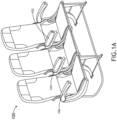
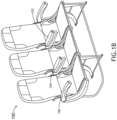
- a set of commercial aircraft seats 100 may include traditional armrests 106 designed for a single passenger; for example, at the ends of each row; and rotatable armrests 102, 104 between passenger seats.
- the rotatable armrests 102, 104 may define a cross sectional profile with some surfaces that match the profile of the traditional armrest 106 for the comfort of the passengers.
- the rotatable armrest 102, 104 may be placed in a first, vertical configuration 102 where the rotatable armrest 102, 104 is narrow.
- the first, vertical configuration 102 offers a superior contact surface that corresponds to the superior contact surface of the traditional armrest 106.
- the rotatable armrest 102, 104 may be placed in a second, horizontal configuration 104 where extended surface are rotated to become the superior contact surfaces.
- FIG. 2 a perspective detail view of a rotatable armrest according to an exemplary embodiment is shown.
- the rotatable armrest defines a vertical superior surface 200 that is the primary armrest surface when the rotatable armrest is in a vertical configuration, and a horizontal superior surface 202 that is the primary armrest surface when the rotatable armrest is in a horizontal configuration.
- a stationary shaft 206 defines the axis of rotation for the rotatable armrest, and a spring biased button 204 disengages a locking mechanism configured to maintain the rotatable armrest in one or a number of predefined orientations.
- the rotatable armrest includes a non-rotating portion for housing mechanisms such as a seat recline button, headphone jacks, etc.
- the non-rotating portion may be unnecessary; for example, where the recline button is disposed in a non-rotating housing including the spring biased button 204, the non-rotating portion may be excluded.
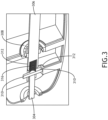
- the rotatable armrest includes a stationary shaft 306 affixed to a structural component of the seat.
- the stationary shaft 306 may engage internal structures of the arm pad via one or more bearings 308 that allow the arm pad to rotate about the stationary shaft 306.
- a locking mechanism retains the arm pad in one of a number of possible orientations.
- the locking mechanism comprises a release button 304 with one or more locking protrusions 310.
- the locking protrusions 310 engage locking recesses 312 defined by internal structures of the arm pad.
- the locking recesses 312 are disposed periodically about the stationary shaft 306 to stop the rotation of the arm pad at predefined points; for example, locking recesses 312 may be disposed every 90° around the stationary shaft 306 so that the arm pad may be locked in either a vertical or horizontal orientation.
- a biasing element 316 such as a spring or other linear actuator biases the button 304 and corresponding locking protrusions 310 toward a locked configuration where the locking protrusions 310 engage the locking recesses 312.
- FIGS. 4A-4B front views of a rotatable armrest according to an exemplary embodiment are shown.
- the rotatable armrest defines a narrow vertical superior contact surface 400 and wide horizontal superior contact surface 402.
- the narrow vertical superior contact surface 400 is on top, where passengers routinely rest their arms.
- the rotatable armrest would be in the first, vertical orientation.
- a either passenger may push a button 404 to disengage an internal locking mechanism and rotate the rotatable armrest to a second, horizontal orientation (as in FIG. 4B ) such that the wide horizontal superior contact surface 402 is on top.
- the wide horizontal superior contact surface 402 provides substantially double the area for passengers to rest their arms.
- FIGS. 5A-5B front views of a rotatable armrest according to an exemplary embodiment are shown.
- the rotatable armrest defines a narrow vertical superior contact surface 500 while in a first, vertical orientation (as in FIG. 5A ), and a wide horizontal superior contact surface 502 while in a second, horizontal orientation (as in FIG. 5B ).
- the rotatable armrest is releasably locked into either the first, vertical orientation or second, horizontal orientation via an internal locking mechanism, releasable via a button 504.
- the narrow vertical superior contact surface 500 is configured to generally correspond in profile and relative height to a non-rotatable, standard armrest. When in the first, vertical orientation, a passenger would not feel any difference between the rotatable armrest and a non-rotatable armrest.
- the wide horizontal superior contact surface 502 may define a slanted profile with a peak portion 506.
- the slanted profile provides a larger contact surface for each passenger as compared to a strictly horizontal surface.
- the peak portion 506 defines a tactile divider; passengers are able to feel the feel the peak portion 506 and know that it demarks each passenger's portion of the armrest.
- the narrow vertical superior contact surface 600 is configured to generally correspond in profile and relative height to a non-rotatable, standard armrest. When in the first, vertical orientation, a passenger would not feel any difference between the rotatable armrest and a non-rotatable armrest.
- the wide horizontal superior contact surface 602 may define a curved profile. The curved profile provides a larger contact surface for each passenger as compared to a strictly horizontal surface and may provide a subtle tactile divider that passengers are able to feel.
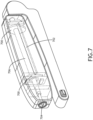
- a perspective detail view of a rotatable armrest is shown.
- a rotatable armrest includes a stationary shaft 706 and button 704 to release an internal locking mechanism
- the rotatable armrest includes one or more cams 700 configured to control the movement of one or more extendable dividers 702.
- Wide, horizontal superior surfaces of the rotatable armrest may define openings to allow the extendable dividers 702 to protrude above the surface when in a horizontal orientation.
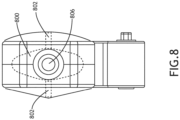
- the rotatable armrest includes a stationary shaft 806 that defines an axis of rotation for the rotatable armrest.
- One or more cams 800 are disposed in a fixed position relative to the stationary shaft 806.
- the cams 800 define a profile to control the movement of extendable dividers 802.
- the extendable dividers 802 may be biased to stay inside the rotatable armrest when in a vertical orientation to prevent the extendable dividers from being an incumbrance. While the rotatable armrest is being rotated into a horizontal configuration, the cams 800 push the extendable dividers 802 though openings in the wide horizontal superior surface.
- the extendable dividers 802 provide a delineation between passenger space.
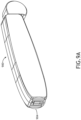
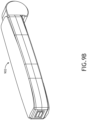
- FIGS. 9A-9C perspective views of a rotatable armrest 900, 902 according to an exemplary embodiment are shown.
- the rotatable armrest 900, 902 may include aircraft seat utility mechanisms 904 such as a seat recline button 908 in addition an armrest rotation button 906.
- the seat utility mechanisms 904 may be affixed to the armrest housing and therefore configured to rotate with the armrest 900, 902. It may be appreciated that in such embodiments, the mechanisms that effectuate seat utility, such as the recline function, must be flexible enough to operate in either a vertical configuration 900 or a horizontal configuration 902; for example, a cable.
- the rotatable armrest 1000, 1002 may include aircraft seat utility mechanisms 1004.
- a utility mechanism housing (including a seat recline button 1008, 1012 and armrest rotation button 1006, 1010) may be affixed to a stationary element within the armrest housing and therefore configured to remain stationary with respect to the armrest 1000, 1002 during rotation. It may be appreciated that in such embodiments, the mechanisms that effectuate seat utility, such as the recline function, may be substantially rigid.
Landscapes
- Engineering & Computer Science (AREA)
- Aviation & Aerospace Engineering (AREA)
- Transportation (AREA)
- Mechanical Engineering (AREA)
- Seats For Vehicles (AREA)
Description
- The present application claims the benefit of
Indian Prov. App. No. 202241003735 (filed January 22, 2022 - Many commercial aircraft seats utilize a shared armrest between two passengers. The shared armrest is a common source of complaints as existing designs offer insufficient space for both passengers. Immutable space constraints and safety considerations will not permit a larger armrest. It would be advantageous if a mechanism existed for afford passengers more room and better space delineation.
EP 2 698 276 B1 describes an armrest assembly. - A shared armrest is defined in claim 1. The shared armrest includes a shaft to allow the arm pad to rotate and a locking mechanism defining a set of stopping positions.
- In a further aspect, the profile of the arm pad is defined to clearly delineate portions of the expanded arm pad for each passenger.
- A cam driven divider extends from the arm pad as the arm pad is rotated to further define delineate portions of the expanded arm pad for each passenger.
- It is to be understood that both the foregoing general description and the following detailed description are exemplary and explanatory only and should not restrict the scope of the claims. The accompanying drawings, which are incorporated in and constitute a part of the specification, illustrate exemplary embodiments of the inventive concepts disclosed herein and together with the general description, serve to explain the principles.
- The numerous advantages of the embodiments of the inventive concepts disclosed herein may be better understood by those skilled in the art by reference to the accompanying figures in which:
-
FIG. 1A shows an environmental view of a rotatable armrest in a first configuration according to an exemplary embodiment; -
FIG. 1B shows an environmental view of a rotatable armrest in a second configuration according to an exemplary embodiment; -
FIG. 2 shows a perspective detail view of a rotatable armrest according to an exemplary embodiment; -
FIG. 3 shows a detail cross-sectional view of a locking mechanism in a rotatable armrest according to an exemplary embodiment; -
FIG. 4A shows a front view of a rotatable armrest in a first configuration according to an exemplary embodiment; -
FIG. 4B shows a front view of a rotatable armrest in a second configuration according to an exemplary embodiment; -
FIG. 5A shows a front view of a rotatable armrest in a first configuration according to an exemplary embodiment; -
FIG. 5B shows a front view of a rotatable armrest in a second configuration according to an exemplary embodiment; -
FIG. 6A shows a front view of a rotatable armrest in a first configuration according to an exemplary embodiment; -
FIG. 6B shows a front view of a rotatable armrest in a second configuration according to an exemplary embodiment; -
FIG. 7 shows a perspective detail view of a rotatable armrest according to an exemplary embodiment; -
FIG. 8 shows a front detail view of a rotatable armrest according to an exemplary embodiment; -
FIG. 9A shows a perspective view of a rotatable armrest in a first configuration according to an exemplary embodiment; -
FIG. 9B shows a perspective view of a rotatable armrest in a second configuration according to an exemplary embodiment; -
FIG. 9C shows a perspective detail view of a rotatable armrest according to an exemplary embodiment; -
FIG. 10A shows a perspective view of a rotatable armrest in a first configuration according to an exemplary embodiment; -
FIG. 10B shows a perspective view of a rotatable armrest in a second configuration according to an exemplary embodiment; -
FIG. 10C shows a perspective detail view of a rotatable armrest according to an exemplary embodiment; - Before explaining at least one embodiment of the inventive concepts disclosed herein in detail, it is to be understood that the inventive concepts are not limited in their application to the details of construction and the arrangement of the components or steps or methodologies set forth in the following description or illustrated in the drawings. In the following detailed description of embodiments of the instant inventive concepts, numerous specific details are set forth in order to provide a more thorough understanding of the inventive concepts. However, it will be apparent to one of ordinary skill in the art having the benefit of the instant disclosure that the inventive concepts disclosed herein may be practiced without these specific details. In other instances, well-known features may not be described in detail to avoid unnecessarily complicating the instant disclosure. The inventive concepts disclosed herein are capable of other embodiments or of being practiced or carried out in various ways. Also, it is to be understood that the phraseology and terminology employed herein is for the purpose of description and should not be regarded as limiting.
- As used herein a letter following a reference numeral is intended to reference an embodiment of the feature or element that may be similar, but not necessarily identical, to a previously described element or feature bearing the same reference numeral (e.g., 1, 1a, 1b). Such shorthand notations are used for purposes of convenience only, and should not be construed to limit the inventive concepts disclosed herein in any way unless expressly stated to the contrary.
- Further, unless expressly stated to the contrary, "or" refers to an inclusive or and not to an exclusive or. For example, a condition A or B is satisfied by anyone of the following: A is true (or present) and B is false (or not present), A is false (or not present) and B is true (or present), and both A and B are true (or present).
- In addition, use of the "a" or "an" are employed to describe elements and components of embodiments of the instant inventive concepts. This is done merely for convenience and to give a general sense of the inventive concepts, and "a" and "an" are intended to include one or at least one and the singular also includes the plural unless it is obvious that it is meant otherwise.
- Finally, as used herein any reference to "one embodiment," or "some embodiments" means that a particular element, feature, structure, or characteristic described in connection with the embodiment is included in at least one embodiment of the inventive concepts disclosed herein. The appearances of the phrase "in some embodiments" in various places in the specification are not necessarily all referring to the same embodiment, and embodiments of the inventive concepts disclosed may include one or more of the features expressly described or inherently present herein, or any combination of sub-combination of two or more such features, along with any other features which may not necessarily be expressly described or inherently present in the instant disclosure.
- Broadly, embodiments of the inventive concepts disclosed herein are directed to a rotatable armrest. The rotatable armrest includes a shaft to allow the arm pad to rotate and a locking mechanism defining a set of stopping positions.
- Referring to
FIGS. 1A-1B , environmental views of arotatable armrest commercial aircraft seats 100 may includetraditional armrests 106 designed for a single passenger; for example, at the ends of each row; androtatable armrests rotatable armrests traditional armrest 106 for the comfort of the passengers. - The
rotatable armrest vertical configuration 102 where therotatable armrest vertical configuration 102 offers a superior contact surface that corresponds to the superior contact surface of thetraditional armrest 106. When passengers desire more armrest space, therotatable armrest horizontal configuration 104 where extended surface are rotated to become the superior contact surfaces. - Referring to
FIG. 2 , a perspective detail view of a rotatable armrest according to an exemplary embodiment is shown. The rotatable armrest defines a verticalsuperior surface 200 that is the primary armrest surface when the rotatable armrest is in a vertical configuration, and a horizontalsuperior surface 202 that is the primary armrest surface when the rotatable armrest is in a horizontal configuration. Astationary shaft 206 defines the axis of rotation for the rotatable armrest, and a springbiased button 204 disengages a locking mechanism configured to maintain the rotatable armrest in one or a number of predefined orientations. - In at least one embodiment, the rotatable armrest includes a non-rotating portion for housing mechanisms such as a seat recline button, headphone jacks, etc. In some embodiments, the non-rotating portion may be unnecessary; for example, where the recline button is disposed in a non-rotating housing including the spring
biased button 204, the non-rotating portion may be excluded. - Referring to
FIG. 3 , a detail cross-sectional view of a locking mechanism in a rotatable armrest according to an exemplary embodiment is shown. The rotatable armrest includes astationary shaft 306 affixed to a structural component of the seat. In at least one embodiment, thestationary shaft 306 may engage internal structures of the arm pad via one ormore bearings 308 that allow the arm pad to rotate about thestationary shaft 306. - A locking mechanism retains the arm pad in one of a number of possible orientations. In at least one embodiment, the locking mechanism comprises a
release button 304 with one ormore locking protrusions 310. The lockingprotrusions 310 engage lockingrecesses 312 defined by internal structures of the arm pad. The locking recesses 312 are disposed periodically about thestationary shaft 306 to stop the rotation of the arm pad at predefined points; for example, lockingrecesses 312 may be disposed every 90° around thestationary shaft 306 so that the arm pad may be locked in either a vertical or horizontal orientation. - In at least one embodiment, a biasing
element 316 such as a spring or other linear actuator biases thebutton 304 and corresponding lockingprotrusions 310 toward a locked configuration where the lockingprotrusions 310 engage the locking recesses 312. - Referring to
FIGS. 4A-4B , front views of a rotatable armrest according to an exemplary embodiment are shown. The rotatable armrest defines a narrow verticalsuperior contact surface 400 and wide horizontalsuperior contact surface 402. In a first, vertical orientation (as inFIG. 4A ), the narrow verticalsuperior contact surface 400 is on top, where passengers routinely rest their arms. During some phases of flight where passengers are required to be minimally encumbered, the rotatable armrest would be in the first, vertical orientation. - When more armrest space is desired, a either passenger may push a
button 404 to disengage an internal locking mechanism and rotate the rotatable armrest to a second, horizontal orientation (as inFIG. 4B ) such that the wide horizontalsuperior contact surface 402 is on top. The wide horizontalsuperior contact surface 402 provides substantially double the area for passengers to rest their arms. - Referring to
FIGS. 5A-5B , front views of a rotatable armrest according to an exemplary embodiment are shown. The rotatable armrest defines a narrow verticalsuperior contact surface 500 while in a first, vertical orientation (as inFIG. 5A ), and a wide horizontalsuperior contact surface 502 while in a second, horizontal orientation (as inFIG. 5B ). The rotatable armrest is releasably locked into either the first, vertical orientation or second, horizontal orientation via an internal locking mechanism, releasable via abutton 504. - In at least one embodiment, the narrow vertical
superior contact surface 500 is configured to generally correspond in profile and relative height to a non-rotatable, standard armrest. When in the first, vertical orientation, a passenger would not feel any difference between the rotatable armrest and a non-rotatable armrest. - In at least one embodiment, the wide horizontal
superior contact surface 502 may define a slanted profile with apeak portion 506. The slanted profile provides a larger contact surface for each passenger as compared to a strictly horizontal surface. Furthermore, thepeak portion 506 defines a tactile divider; passengers are able to feel the feel thepeak portion 506 and know that it demarks each passenger's portion of the armrest. - Referring to
FIGS. 6A-6B , front views of a rotatable armrest according to an exemplary embodiment are shown. In at least one embodiment, the narrow verticalsuperior contact surface 600 is configured to generally correspond in profile and relative height to a non-rotatable, standard armrest. When in the first, vertical orientation, a passenger would not feel any difference between the rotatable armrest and a non-rotatable armrest. In at least one embodiment, the wide horizontalsuperior contact surface 602 may define a curved profile. The curved profile provides a larger contact surface for each passenger as compared to a strictly horizontal surface and may provide a subtle tactile divider that passengers are able to feel. - Referring to
FIG. 7 , a perspective detail view of a rotatable armrest according to an exemplary embodiment is shown. Where a rotatable armrest includes astationary shaft 706 andbutton 704 to release an internal locking mechanism, the rotatable armrest includes one ormore cams 700 configured to control the movement of one or moreextendable dividers 702. Wide, horizontal superior surfaces of the rotatable armrest may define openings to allow theextendable dividers 702 to protrude above the surface when in a horizontal orientation. - Referring to
FIG. 8 , a front detail view of a rotatable armrest according to an exemplary embodiment is shown. The rotatable armrest includes astationary shaft 806 that defines an axis of rotation for the rotatable armrest. One ormore cams 800 are disposed in a fixed position relative to thestationary shaft 806. Thecams 800 define a profile to control the movement ofextendable dividers 802. Theextendable dividers 802 may be biased to stay inside the rotatable armrest when in a vertical orientation to prevent the extendable dividers from being an incumbrance. While the rotatable armrest is being rotated into a horizontal configuration, thecams 800 push theextendable dividers 802 though openings in the wide horizontal superior surface. Theextendable dividers 802 provide a delineation between passenger space. - Referring to
FIGS. 9A-9C , perspective views of arotatable armrest rotatable armrest seat utility mechanisms 904 such as aseat recline button 908 in addition anarmrest rotation button 906. In some embodiments, theseat utility mechanisms 904 may be affixed to the armrest housing and therefore configured to rotate with thearmrest vertical configuration 900 or ahorizontal configuration 902; for example, a cable. - Referring to
FIGS. 10A-10C , perspective views of a rotatable armrest according to an exemplary embodiment are shown. In at least one embodiment, where it is desirable to obviate the need for a non-rotating portion housing mechanisms such as a seat recline button, headphone jacks, etc., therotatable armrest seat utility mechanisms 1004. A utility mechanism housing (including aseat recline button armrest rotation button 1006, 1010) may be affixed to a stationary element within the armrest housing and therefore configured to remain stationary with respect to thearmrest - It is believed that the inventive concepts disclosed herein and many of their attendant advantages will be understood by the foregoing description of embodiments of the inventive concepts disclosed, and it will be apparent that various changes may be made in the form, construction, and arrangement of the components thereof without departing from the broad scope of the inventive concepts disclosed herein or without sacrificing all of their material advantages; and individual features from various embodiments may be combined to arrive at other embodiments as far as it remains within the scope of the following claims.
Claims (9)
- A shared armrest comprising:a stationary shaft (206);a rotatable armrest pad; anda locking mechanism,wherein:the locking mechanism is configured to releasable retain the rotatable armrest pad in either the first configuration or the second configuration, and characterized by further comprising:the rotatable armrest pad defines a first superior surface (200) and a second superior surface (202), the second superior surface being wider than the first superior surface;the rotatable armrest pad configured to rotate about the stationary shaft (206) from a first configuration, where the first superior surface (200) is disposed at a top of the shared armrest, to a second configuration, where the second superior surface (202) is disposed at the top of the shared armrest; andat least one cam (700); andat least one extendable divider (702),wherein:the at least one extendable divider (702) is configured to translate radially through an opening defined by the second superior surface; andthe at least one cam (700) is configured to direct the radial translation of the extendable divider as the rotatable armrest pad is rotated.
- The shared armrest of Claim 1, wherein the locking mechanism comprises:a button (204) partially disposed within the stationary shaft (206); anda biasing element (316) configured to bias the button (204) toward a locking configuration, and preferably wherein:the locking mechanism further comprises one or more locking protrusions (310), each configured to engage a locking recess (312); andthe armrest pad comprises an internal structure defining a plurality of locking recesses (312) disposed periodically about the stationary shaft, each configured to engage a locking protrusion of the locking mechanism, and more preferably wherein the plurality of locking recesses are disposed every 90° about the stationary shaft.
- The shared armrest of any preceding Claim, wherein the second superior surface (202) comprises a curved profile.
- The shared armrest of any of Claims 1-2, wherein the second superior surface (202) comprises an angled profile defining a peak along a centerline.
- An aircraft seat comprising:
at least one shared armrest comprising the shared armrest of claim 1. - The aircraft seat of Claim 5, wherein the locking mechanism comprises:a button (204) partially disposed within the stationary shaft; anda biasing element (316) configured to bias the button toward a locking configuration.
- The aircraft seat of Claim 6, wherein:the locking mechanism further comprises one or more locking protrusions (310), each configured to engage a locking recess (312); andthe armrest pad comprises an internal structure defining a plurality of locking recesses (312) disposed periodically about the stationary shaft (306), each configured to engage a locking protrusion of the locking mechanism.
- The aircraft seat of Claim 7, wherein the plurality of locking recesses (312) are disposed every 90° about the stationary shaft.
- The aircraft seat of any of Claims 5-8, wherein the second superior surface (202) comprises a curved profile; or
wherein the second superior surface (202) comprises an angled profile defining a peak along a centerline.
Applications Claiming Priority (2)
| Application Number | Priority Date | Filing Date | Title |
|---|---|---|---|
| IN202241003735 | 2022-01-22 | ||
| US18/090,193 US12220066B2 (en) | 2022-01-22 | 2022-12-28 | Rotatable shared armrest |
Publications (2)
| Publication Number | Publication Date |
|---|---|
| EP4215440A1 EP4215440A1 (en) | 2023-07-26 |
| EP4215440B1 true EP4215440B1 (en) | 2025-04-16 |
Family
ID=85018108
Family Applications (1)
| Application Number | Title | Priority Date | Filing Date |
|---|---|---|---|
| EP23152437.2A Active EP4215440B1 (en) | 2022-01-22 | 2023-01-19 | Rotatable shared armrest |
Country Status (1)
| Country | Link |
|---|---|
| EP (1) | EP4215440B1 (en) |
Family Cites Families (4)
| Publication number | Priority date | Publication date | Assignee | Title |
|---|---|---|---|---|
| EP2698276B1 (en) * | 2012-08-16 | 2015-05-27 | Airbus (S.A.S.) | Armrest assembly |
| JP2017043229A (en) * | 2015-08-27 | 2017-03-02 | トヨタ紡織株式会社 | Vehicle seat armrests and vehicle seats |
| FR3083491B1 (en) * | 2018-07-03 | 2021-09-24 | Sncf Mobilites | PASSENGER SEAT OF A TRANSPORT VEHICLE AND TRANSPORT VEHICLE EQUIPPED WITH SUCH SEATS |
| US11535380B2 (en) * | 2018-07-31 | 2022-12-27 | Safran Seats Usa Llc | Rotating armrest assembly |
-
2023
- 2023-01-19 EP EP23152437.2A patent/EP4215440B1/en active Active
Also Published As
| Publication number | Publication date |
|---|---|
| EP4215440A1 (en) | 2023-07-26 |
Similar Documents
| Publication | Publication Date | Title |
|---|---|---|
| CN111806697B (en) | Locking mechanism for rotating member control | |
| EP4053018B1 (en) | Extendable armrest with automatic retraction features | |
| EP3856635B1 (en) | Multi-latch assembly for selective retention of aircraft passenger tray table and/or other deployable components | |
| EP3640136B1 (en) | Supplemental recline panel for aircraft cabin attendant seat | |
| EP2720578A1 (en) | Disc recliner with internal leaf springs | |
| CN105291907A (en) | Angular adjustment device for a vehicle seat | |
| EP3829923B1 (en) | Rotating armrest assembly | |
| EP1073582B1 (en) | Gallery retainer | |
| EP4215440B1 (en) | Rotatable shared armrest | |
| EP1659021B1 (en) | Lockable turntable for a seat | |
| US12220066B2 (en) | Rotatable shared armrest | |
| US20150337572A1 (en) | Door for vehicle console | |
| US20230249831A1 (en) | Passenger seating assembly with swinging seatpan for increased passenger egress space | |
| EP3722147B1 (en) | Rotary backrest recline mechanism | |
| EP4289740B1 (en) | Concentric armrest pivot | |
| EP4223640B1 (en) | Armrest assembly with hidden pivot shaft and discreet retention | |
| US11591091B2 (en) | Pinch point free rotatable aircraft armrest | |
| EP4140887B1 (en) | Foldable attendant step | |
| EP4015386B1 (en) | Cabin attendant seat with height adjustable seat pan | |
| EP4257488B1 (en) | Aircraft seat arm o-ring friction mechanism | |
| US20250214709A1 (en) | Meal table with rotational lifting assistance | |
| US12091176B2 (en) | Modular passenger seat system | |
| EP4588803A1 (en) | Sliding and semi-automated latch mechanism for passenger seat meal table | |
| EP4074545B1 (en) | Headrest tilt mechanism utilizing gear reduction | |
| EP3872366B1 (en) | Mechanical shaft locking mechanism with back drive prevention |
Legal Events
| Date | Code | Title | Description |
|---|---|---|---|
| PUAI | Public reference made under article 153(3) epc to a published international application that has entered the european phase |
Free format text: ORIGINAL CODE: 0009012 |
|
| STAA | Information on the status of an ep patent application or granted ep patent |
Free format text: STATUS: THE APPLICATION HAS BEEN PUBLISHED |
|
| AK | Designated contracting states |
Kind code of ref document: A1 Designated state(s): AL AT BE BG CH CY CZ DE DK EE ES FI FR GB GR HR HU IE IS IT LI LT LU LV MC ME MK MT NL NO PL PT RO RS SE SI SK SM TR |
|
| STAA | Information on the status of an ep patent application or granted ep patent |
Free format text: STATUS: REQUEST FOR EXAMINATION WAS MADE |
|
| 17P | Request for examination filed |
Effective date: 20240126 |
|
| RBV | Designated contracting states (corrected) |
Designated state(s): AL AT BE BG CH CY CZ DE DK EE ES FI FR GB GR HR HU IE IS IT LI LT LU LV MC ME MK MT NL NO PL PT RO RS SE SI SK SM TR |
|
| RIC1 | Information provided on ipc code assigned before grant |
Ipc: B60N 2/75 20180101ALI20241011BHEP Ipc: B64D 11/06 20060101AFI20241011BHEP |
|
| GRAP | Despatch of communication of intention to grant a patent |
Free format text: ORIGINAL CODE: EPIDOSNIGR1 |
|
| STAA | Information on the status of an ep patent application or granted ep patent |
Free format text: STATUS: GRANT OF PATENT IS INTENDED |
|
| INTG | Intention to grant announced |
Effective date: 20241126 |
|
| GRAS | Grant fee paid |
Free format text: ORIGINAL CODE: EPIDOSNIGR3 |
|
| GRAA | (expected) grant |
Free format text: ORIGINAL CODE: 0009210 |
|
| STAA | Information on the status of an ep patent application or granted ep patent |
Free format text: STATUS: THE PATENT HAS BEEN GRANTED |
|
| AK | Designated contracting states |
Kind code of ref document: B1 Designated state(s): AL AT BE BG CH CY CZ DE DK EE ES FI FR GB GR HR HU IE IS IT LI LT LU LV MC ME MK MT NL NO PL PT RO RS SE SI SK SM TR |
|
| REG | Reference to a national code |
Ref country code: GB Ref legal event code: FG4D |
|
| REG | Reference to a national code |
Ref country code: CH Ref legal event code: EP |
|
| REG | Reference to a national code |
Ref country code: IE Ref legal event code: FG4D |
|
| REG | Reference to a national code |
Ref country code: DE Ref legal event code: R096 Ref document number: 602023002867 Country of ref document: DE |
|
| REG | Reference to a national code |
Ref country code: NL Ref legal event code: MP Effective date: 20250416 |
|
| PG25 | Lapsed in a contracting state [announced via postgrant information from national office to epo] |
Ref country code: NL Free format text: LAPSE BECAUSE OF FAILURE TO SUBMIT A TRANSLATION OF THE DESCRIPTION OR TO PAY THE FEE WITHIN THE PRESCRIBED TIME-LIMIT Effective date: 20250416 |
|
| REG | Reference to a national code |
Ref country code: AT Ref legal event code: MK05 Ref document number: 1785481 Country of ref document: AT Kind code of ref document: T Effective date: 20250416 |
|
| PG25 | Lapsed in a contracting state [announced via postgrant information from national office to epo] |
Ref country code: ES Free format text: LAPSE BECAUSE OF FAILURE TO SUBMIT A TRANSLATION OF THE DESCRIPTION OR TO PAY THE FEE WITHIN THE PRESCRIBED TIME-LIMIT Effective date: 20250416 Ref country code: FI Free format text: LAPSE BECAUSE OF FAILURE TO SUBMIT A TRANSLATION OF THE DESCRIPTION OR TO PAY THE FEE WITHIN THE PRESCRIBED TIME-LIMIT Effective date: 20250416 Ref country code: PT Free format text: LAPSE BECAUSE OF FAILURE TO SUBMIT A TRANSLATION OF THE DESCRIPTION OR TO PAY THE FEE WITHIN THE PRESCRIBED TIME-LIMIT Effective date: 20250818 |
|
| REG | Reference to a national code |
Ref country code: LT Ref legal event code: MG9D |
|
| PG25 | Lapsed in a contracting state [announced via postgrant information from national office to epo] |
Ref country code: GR Free format text: LAPSE BECAUSE OF FAILURE TO SUBMIT A TRANSLATION OF THE DESCRIPTION OR TO PAY THE FEE WITHIN THE PRESCRIBED TIME-LIMIT Effective date: 20250717 Ref country code: NO Free format text: LAPSE BECAUSE OF FAILURE TO SUBMIT A TRANSLATION OF THE DESCRIPTION OR TO PAY THE FEE WITHIN THE PRESCRIBED TIME-LIMIT Effective date: 20250716 |
|
| PG25 | Lapsed in a contracting state [announced via postgrant information from national office to epo] |
Ref country code: PL Free format text: LAPSE BECAUSE OF FAILURE TO SUBMIT A TRANSLATION OF THE DESCRIPTION OR TO PAY THE FEE WITHIN THE PRESCRIBED TIME-LIMIT Effective date: 20250416 |
|
| PG25 | Lapsed in a contracting state [announced via postgrant information from national office to epo] |
Ref country code: BG Free format text: LAPSE BECAUSE OF FAILURE TO SUBMIT A TRANSLATION OF THE DESCRIPTION OR TO PAY THE FEE WITHIN THE PRESCRIBED TIME-LIMIT Effective date: 20250416 |
|
| PG25 | Lapsed in a contracting state [announced via postgrant information from national office to epo] |
Ref country code: HR Free format text: LAPSE BECAUSE OF FAILURE TO SUBMIT A TRANSLATION OF THE DESCRIPTION OR TO PAY THE FEE WITHIN THE PRESCRIBED TIME-LIMIT Effective date: 20250416 |
|
| PG25 | Lapsed in a contracting state [announced via postgrant information from national office to epo] |
Ref country code: AT Free format text: LAPSE BECAUSE OF FAILURE TO SUBMIT A TRANSLATION OF THE DESCRIPTION OR TO PAY THE FEE WITHIN THE PRESCRIBED TIME-LIMIT Effective date: 20250416 |
|
| PG25 | Lapsed in a contracting state [announced via postgrant information from national office to epo] |
Ref country code: RS Free format text: LAPSE BECAUSE OF FAILURE TO SUBMIT A TRANSLATION OF THE DESCRIPTION OR TO PAY THE FEE WITHIN THE PRESCRIBED TIME-LIMIT Effective date: 20250716 |
|
| PG25 | Lapsed in a contracting state [announced via postgrant information from national office to epo] |
Ref country code: IS Free format text: LAPSE BECAUSE OF FAILURE TO SUBMIT A TRANSLATION OF THE DESCRIPTION OR TO PAY THE FEE WITHIN THE PRESCRIBED TIME-LIMIT Effective date: 20250816 |
|
| PG25 | Lapsed in a contracting state [announced via postgrant information from national office to epo] |
Ref country code: LV Free format text: LAPSE BECAUSE OF FAILURE TO SUBMIT A TRANSLATION OF THE DESCRIPTION OR TO PAY THE FEE WITHIN THE PRESCRIBED TIME-LIMIT Effective date: 20250416 |
|
| PG25 | Lapsed in a contracting state [announced via postgrant information from national office to epo] |
Ref country code: SM Free format text: LAPSE BECAUSE OF FAILURE TO SUBMIT A TRANSLATION OF THE DESCRIPTION OR TO PAY THE FEE WITHIN THE PRESCRIBED TIME-LIMIT Effective date: 20250416 Ref country code: DK Free format text: LAPSE BECAUSE OF FAILURE TO SUBMIT A TRANSLATION OF THE DESCRIPTION OR TO PAY THE FEE WITHIN THE PRESCRIBED TIME-LIMIT Effective date: 20250416 |
|
| PGFP | Annual fee paid to national office [announced via postgrant information from national office to epo] |
Ref country code: FR Payment date: 20251217 Year of fee payment: 4 |
|
| REG | Reference to a national code |
Ref country code: DE Ref legal event code: R097 Ref document number: 602023002867 Country of ref document: DE |
|
| PG25 | Lapsed in a contracting state [announced via postgrant information from national office to epo] |
Ref country code: CZ Free format text: LAPSE BECAUSE OF FAILURE TO SUBMIT A TRANSLATION OF THE DESCRIPTION OR TO PAY THE FEE WITHIN THE PRESCRIBED TIME-LIMIT Effective date: 20250416 |
|
| PG25 | Lapsed in a contracting state [announced via postgrant information from national office to epo] |
Ref country code: EE Free format text: LAPSE BECAUSE OF FAILURE TO SUBMIT A TRANSLATION OF THE DESCRIPTION OR TO PAY THE FEE WITHIN THE PRESCRIBED TIME-LIMIT Effective date: 20250416 |
|
| PG25 | Lapsed in a contracting state [announced via postgrant information from national office to epo] |
Ref country code: SK Free format text: LAPSE BECAUSE OF FAILURE TO SUBMIT A TRANSLATION OF THE DESCRIPTION OR TO PAY THE FEE WITHIN THE PRESCRIBED TIME-LIMIT Effective date: 20250416 |
|
| PG25 | Lapsed in a contracting state [announced via postgrant information from national office to epo] |
Ref country code: IT Free format text: LAPSE BECAUSE OF FAILURE TO SUBMIT A TRANSLATION OF THE DESCRIPTION OR TO PAY THE FEE WITHIN THE PRESCRIBED TIME-LIMIT Effective date: 20250416 |
|
| PLBE | No opposition filed within time limit |
Free format text: ORIGINAL CODE: 0009261 |
|
| STAA | Information on the status of an ep patent application or granted ep patent |
Free format text: STATUS: NO OPPOSITION FILED WITHIN TIME LIMIT |
|
| REG | Reference to a national code |
Ref country code: CH Ref legal event code: L10 Free format text: ST27 STATUS EVENT CODE: U-0-0-L10-L00 (AS PROVIDED BY THE NATIONAL OFFICE) Effective date: 20260225 |
|
| 26N | No opposition filed |
Effective date: 20260119 |
|
| PGFP | Annual fee paid to national office [announced via postgrant information from national office to epo] |
Ref country code: DE Payment date: 20251217 Year of fee payment: 4 |