EP4215418B1 - A console box assembly - Google Patents
A console box assembly Download PDFInfo
- Publication number
- EP4215418B1 EP4215418B1 EP22153027.2A EP22153027A EP4215418B1 EP 4215418 B1 EP4215418 B1 EP 4215418B1 EP 22153027 A EP22153027 A EP 22153027A EP 4215418 B1 EP4215418 B1 EP 4215418B1
- Authority
- EP
- European Patent Office
- Prior art keywords
- actuator member
- armrest
- actuator
- claw
- rotation part
- Prior art date
- Legal status (The legal status is an assumption and is not a legal conclusion. Google has not performed a legal analysis and makes no representation as to the accuracy of the status listed.)
- Active
Links
Images




Classifications
-
- B—PERFORMING OPERATIONS; TRANSPORTING
- B60—VEHICLES IN GENERAL
- B60R—VEHICLES, VEHICLE FITTINGS, OR VEHICLE PARTS, NOT OTHERWISE PROVIDED FOR
- B60R7/00—Stowing or holding appliances inside vehicle primarily intended for personal property smaller than suit-cases, e.g. travelling articles, or maps
- B60R7/04—Stowing or holding appliances inside vehicle primarily intended for personal property smaller than suit-cases, e.g. travelling articles, or maps in driver or passenger space, e.g. using racks
-
- B—PERFORMING OPERATIONS; TRANSPORTING
- B60—VEHICLES IN GENERAL
- B60N—SEATS SPECIALLY ADAPTED FOR VEHICLES; VEHICLE PASSENGER ACCOMMODATION NOT OTHERWISE PROVIDED FOR
- B60N2/00—Seats specially adapted for vehicles; Arrangement or mounting of seats in vehicles
- B60N2/75—Arm-rests
- B60N2/763—Arm-rests adjustable
- B60N2/773—Longitudinal adjustment
Definitions
- the present disclosure relates to an adjustable console box for a vehicle, such as a motor vehicle.
- Vehicles such as motor vehicles, often comprise a centre console unit including a console box defining a storage volume for occupants of the vehicle to store items in during a journey in the vehicle.
- the console box may comprise a lid for closing the storage volume to secure the items within the storage volume.
- the console box may comprise a latch mechanism for securing the lid of the console box in a closed position.
- Console boxes typically comprise an armrest for an occupant of the vehicle, such as a driver, to rest their arm on whilst travelling in the vehicle. It is often desirable for the position of the armrest to be adjustable, so that the occupant can arrange the armrest in an ergonomically advantageous position. When the armrest is to be used by the driver, the driver may wish to fix the position of the armrest in a suitable position to allow the driver to reach and operate vehicle controls whilst their arm is resting on the armrest.
- a console box assembly according to the preamble of claim 1 is known from JP H0699775 A .
- a console box assembly comprising: a box body defining a storage volume and a carrier pivotally coupled to the box body.
- the carrier may be configured to form a lid for closing an opening into the storage volume.
- the console box assembly further comprises an armrest slideable relative to the carrier; and a latch mechanism for latching the carrier to the box body.
- the latch mechanism may be to fix the position of the carrier relative to the box body, e.g. such that the carrier closes the opening into the storage volume.
- the latch mechanism comprises: an opening formed in an internal wall of the box body; a claw or latch movably, e.g.
- a latch actuator coupled to the armrest; a rotation part pivotally supported on the carrier for rotation about a rotation part axis, wherein the claw is coupled the rotation part, e.g. at a position spaced apart from the rotation part axis; a first actuator member coupled to the latch actuator; and a second actuator member coupled to the rotation part, wherein the first actuator member is arranged to engage the second actuator member and urge the second actuator member to rotate the rotation part in response to actuation of the latch actuator, e.g. regardless of the slide position of the armrest, so that the claw disengages from the opening.
- the second actuator member may be pivotally supported on the carrier for rotation about a second actuator member axis.
- the second actuator member axis may have a component parallel with the rotation part axis.
- the first actuator member may be pivotally supported on the armrest for rotation about a first actuator member axis.
- the first actuator member axis may be at an angle relative to the second actuator member axis.
- the first actuator member may have an engaging surface.
- the engaging surface may be arranged to contact an engagement surface formed on the second actuator member when the latch actuator is actuated, and urge the second actuator member to rotate the rotation part.
- the first actuator member may be coupled to the latch actuator at a first end of the first actuator member.
- the engaging surface may be formed at a second end of the first actuator member.
- the first actuator member may be pivotally support on the armrest at a position on the first actuator member between the first and second ends.
- the engagement surface may be disposed between the second actuator member axis and the position at which the second actuator member is coupled to the rotation part.
- the engagement surface may extend along the second actuator member in a direction with a component in a direction in which the armrest is moveably, e.g. slideable, relative to the carrier.
- the position on the engagement surface at which the engaging surface engages the engagement surface may vary as the armrest is slid relative to the carrier.
- the latch mechanism may be configured, e.g. the first and/or second actuator member axed, and/or the rotation part pivot axis may be arranged, such that a movement of the claw when the latch actuator is actuated is greater than an extent of engagement between the claw and the opening in all positions of the armrest relative to the carrier.
- At least one of the engaging surface and the engagement surface may comprise a ramp surface.
- the ramp surface may be arranged such that engagement between the engaging surface and the engagement surface causes the engaging surface and the engagement surface to slide relative to one another, thereby urging the second actuator member to move relative to the first actuator member.
- the latch mechanism may further comprise a further claw movably supported on the carrier for engaging a further opening in the box body to latch the carrier to the box body.
- the further claw may be coupled to the rotation part, e.g. at a position spaced apart from the rotation part pivot axis, such that the further claw is moved to disengage from the further opening, e.g. regardless of the slide position of the armrest, when the latch mechanism is actuated.
- the further claw may be coupled to the rotation part on an opposite side of the rotation part axis from the position at which the claw is coupled to the rotation part.
- the claw may be configured to engage the opening on a same side of the rotation part axis as the position at which the claw is coupled to the rotation part.
- the further claw may comprise an arcuate portion arranged such that the further claw engages the further opening on the same side of the rotation part axis that the claw engages the opening.
- a console box assembly comprising: an armrest having an upper body and a lower body; and a height adjustment mechanism for adjusting a height between an upper surface of the upper body and a lower extent of the lower body, wherein the height adjustment mechanism comprises: a scissor linkage mechanism comprising: a first link member having a first end and a second end, wherein the first end is pivotally coupled to the lower body; and a second link member having a first end and a second end, wherein the first end is pivotally and slideably coupled to the lower body, wherein the first and second link members are pivotally coupled together at a position between the first and second ends of the first and second link members, and wherein the second ends of the first and second link members are arranged to contact the upper body and prevent the distance between the upper surface of the upper body and a lower extent of the lower body reducing to less than a distance between the first and second ends of the first and second link member; a first rack coupled to the first end of the second link
- the console box assembly may further comprise a biasing element for biasing the first and second link elements to pivot relative to one another in order to increase the distance between the first and second ends of the first and second link members respectively in the height direction.
- the console box assembly may further comprise a damping element arranged to damp pivoting movements of the first and second link members relative to one another.
- the damping element may be coupled to the lower body.
- the damping element may be a rotational damper comprising a gear engaged with first rack.
- the second rack may be pivotally coupled to the lower body.
- the actuator may be configured to pivot second rack to disengage second rack from first rack.
- the first and second link members may be housed inside the lower body and/or the upper body.
- a console box assembly 100 for a vehicle such as a motor vehicle, according to arrangements of the present disclosure, comprises a box body 110, a carrier 120 and an armrest 130.
- the console box assembly 100 may be mounted, e.g. fixedly mounted, within a vehicle interior.
- the box body 110 of the console box assembly 100 may be configured to be fixedly mounted adjacent to a seat of the vehicle.
- the console box assembly 100 may be to form at least part of a centre console for the vehicle.
- the box body 110 may define a storage volume 112, e.g. for items to be stored within the console box assembly.
- the carrier 120 and/or the armrest 130 may be configured to form a lid for closing, e.g. covering, an opening 114 into the storage volume 112.
- the carrier 120 may be movably, e.g. pivotally, mountable relative to the box body 110 in order to form the lid for selectively closing the opening 114.
- the armrest 130 may be further configured to provide an ergonomic surface for an occupant of vehicle to rest their arm on, e.g. when travelling in or driving the vehicle.
- the position of the armrest 130 may be adjustable relative to the carrier 120 and/or the box body 110.
- the armrest 130 may be movable, e.g. slideably movable, relative to the carrier 120 and/or box body 110 in a sliding direction D 1 . In this way, the position of the armrest 130 relative to the seat of the vehicle may be adjusted.
- the sliding direction D 1 of the armrest 130 may be at least partially aligned with a direction in which the seat of the vehicle faces, e.g. a longitudinal direction of the vehicle. In the arrangement depicted, the sliding direction D 1 is aligned with a longitudinal direction of the console box assembly 100.
- the console box assembly 100 further comprises a mechanism 140 for enabling the armrest 130 to be moved relative to the carrier 120.
- the mechanism 140 may be a sliding mechanism for enabling the armrest 130 to be displaced, e.g. slid, relative to the carrier 120.
- the mechanism 140 may enable the armrest 130 to slide relative to the carrier in the sliding direction D 1 . In this way, the position of the ergonomic surface 132a of the armrest may be selectively adjusted.
- the mechanism 140 may further comprise a lock mechanism 150 for locking the position of the armrest 130 relative to the carrier 120, e.g. in the sliding direction D 1 .
- the lock mechanism 150 may be configured to selectively lock the mechanism 140 to prevent movement of the armrest 130 by virtue of the mechanism 140.
- the armrest 130 may comprise an upper body 132 and a lower body 134.
- the ergonomic surface of the armrest may be provided by the upper body 132.
- the ergonomic surface may be an upper surface 132a of the upper body.
- the upper body 132 may be movably coupled to the lower body 134.
- the upper body 132 may be pivotally coupled to the lower body 134. Moving, e.g. pivoting, the upper body 132 relative to the lower body 134 may actuate a mechanism of the armrest 130, such as the lock mechanism 150 for locking the position of the armrest 130 relative to the carrier 120.
- the console box assembly 100 further comprises a latch mechanism 200 for latching, e.g. selectively securing, the carrier 120 to the box body 110.
- the latch mechanism 200 may be configured to selectively fix the position of the carrier 120 relative to the box body 110.
- the latch mechanism 200 may be configured to latch the carrier 120 to the box body 110 in a position in which the carrier 120 closes, e.g. covers or fills, the opening 114 into the storage volume 112.
- the latch mechanism 200 comprises a first claw, or bolt, 212 movably, e.g. slideably and/or pivotally, supported on the carrier 120.
- the latch mechanism 200 further comprises one or more openings 110a formed in the box body 110, e.g. in an internal wall 110b of the box body 110.
- the latch mechanism 200 is configured to selectively move the first claw 212 relative to the box body 110 so that the first claw 212 selectively engages and disengages from one of the openings 110a in the box body 110.
- the latch mechanism 200 may further comprise a second claw, or bolt, 214 movably, e.g. slideably and/or pivotally, supported on the carrier 120.
- the latch mechanism 200 may be configured to selectively move the second claw 214 relative to the box body 110 so that the second claw selectively engages and disengages from another of the openings 110a in the box body 110.
- the latch mechanism 200 is configured such that the first and second claws 214, 214 are moved in lateral directions, e.g. opposing lateral directions, of the console box assembly 100.
- the lateral directions may be perpendicular to the sliding direction D 1 of the console box assembly.
- the first and second claws are configured to enter, e.g. move or project into, respective openings 110a in the box body 110 in the lateral directions, and the openings 110a are oriented accordingly.
- the latch mechanism 200 may be configured to selectively move the first and second claws 212, 214 in any other direction, or directions.
- the openings 110a may be oriented accordingly, to receive the first and second claws 212, 214 moving in the other directions.
- the latch mechanism 200 further comprises a latch actuator 216.
- the latch actuator is moveably, e.g. pivotally, coupled to the armrest 130, such as the upper body 132 and/or lower body 134 of the armrest.
- the latch mechanism 200 is configured such that movement of the latch actuator 216 relative to the armrest 130 causes the first claw 212, and optionally the second claw 214, to move relative to the carrier 120 to engage, or become disengaged from the respective openings 110a in the box body.
- the latch actuator may comprise a body part 216a, a handle part 216b, to be acted on by a user to move the latch actuator 216, and one or more spindle parts 216c for supporting pivotal movement of the latch actuator 216 relative to the armrest 130.
- the spindle parts 216c may be received within openings formed in the armrest 130 to support pivotal movement of the latch actuator 216.
- the spindle parts 216c may be arranged to support rotation of the latch actuator about a latch actuator axis 216d.
- the latch actuator axis 216d may extend in a direction with a component perpendicular to the sliding direction D 1 of the armrest, e.g. a direction parallel with the lateral direction of the armrest 130.
- the latch mechanism 200 further comprises a rotation part 218.
- the rotation part 218 is pivotally supported on the carrier 120 for rotation about a rotation part axis 218a.
- the rotation part axis 218a may extend in a direction with a component perpendicular to the latch actuator axis 216d, and optionally the sliding direction D 1 .
- the rotation part axis 218a may extend in a vertical direction, e.g. when the console box assembly is installed within a vehicle.
- the first and second claws 212, 214 may be coupled to the rotation part 218.
- the first and second claws 212, 214 may be coupled to the rotation part 218 at positions on the rotation part 218 spaced apart from the rotation part axis 218a. In this way, rotation of the rotation part 218 causes displacement of the first and second claws 212, 214.
- rotation of the rotation part 218 may cause the first and second claws 212, 242 to move in directions perpendicular to the rotation part axis 218a, such as the lateral direction.
- first and second claws 212, 214 may be configured to move in opposing directions, and in such arrangements, the first and second claws 212, 214 may be coupled to the rotation part 218 on opposite sides of the rotation part axis 218a from one another, e.g. relative to a longitudinal direction of the console box assembly 100.
- the second claw 214 may be configured to engage one of the openings 110a on a same side of the rotation part axis 218a as the position at which the second claw is coupled to the rotation part, e.g. in the longitudinal direction of the console box assembly.
- the first claw 212 may comprise an arcuate portion 212a arranged such that the first claw 212 engages another of the openings 110a on the same side of the rotation part axis as the opening engaged by the second claw, e.g. which is on an opposite side of the rotation part axis 218a from the position at which the first claw 212 is coupled to the rotation part in the longitudinal direction.
- the openings 110a may be substantially aligned in the longitudinal direction of the console box assembly.
- the latch mechanism 200 further comprises a first actuator member 220 and a second actuator member 222.
- the first actuator member 220 is coupled to the latch actuator 216.
- the second actuator member 222 is coupled to the rotation part 218.
- the latch mechanism 200 is configured such that the first actuator member 220 is moved, e.g. pivoted, when the latch actuator 216 is actuated.
- the first actuator member 220 is configured to engage the second actuator member 222 so that, when the first actuator member 220 moves, e.g. due to the latch actuator being actuated, the first actuator member 220 urges the second actuator member to move and rotate the rotation part 218.
- the latch mechanism 200 is thereby configured such that actuating the latch actuator 216 causes the rotation part 218 to rotate. As described above, rotation of the rotation part 218 causes the first and second claws 212, 214 to move relative to the box body 110, e.g. to engage or disengage from the openings 110a in the box body.
- the first actuator member 220 may be movably, e.g. pivotally, mounted on the armrest 130.
- the first actuator member 220 may be pivotally coupled to the upper or lower body 132, 134 of the armrest for pivotal movement about a first actuator member axis 220c.
- the first actuator member axis 220c may extend in a direction with a component perpendicular to the sliding direction D 1 of the armrest, e.g. a direction parallel with the lateral direction of the armrest 130.
- the first actuator member axis 220c may extend in a direction parallel with the latch actuator axis 216d.
- the first actuator member 220 comprises a first end 220a and a second end 220b.
- the first actuator member may be coupled to the latch actuator 216 at the first end 220a.
- the first end 220a of the first actuator member may be pivotally coupled to the body part 216a of the latch actuator at a position on the latch actuator spaced apart from the latch actuator axis 216d.
- the first actuator member 220 may be configured to engage the second actuator member 222 at the second end 220b of the first actuator member.
- the first actuator member 220 may be coupled to the armrest 130 at a position between the first and second ends 220a, 220b.
- the second actuator member 222 may be movably, e.g. pivotally, mounted on the carrier 120.
- the second actuator member 222 may be supported for pivotal movement about a second actuator member axis 222c having at least a component parallel with the rotation part axis 218d.
- the second actuator member axis 222c may be at an angle, e.g. perpendicular, relative to the first actuator member axis 220c.
- the second actuator member 222 may comprise a first end 222a and a second end 222b.
- the second actuator member 222 may be coupled to the rotation part 218 at the first end 222a.
- the second actuator member 222 may be movably, e.g. pivotally, coupled to the carrier 120 at the second end 222b.
- the second actuator member 222 may be configured to engage (or be engaged by) the first actuator member 220 at a position on the second actuator member between the first and second ends 222a, 222b.
- the first actuator member 220 may comprise an engaging portion 220d for engaging the second actuator member 222.
- the engaging portion 220d may be formed at the second end 222b of the first actuator member.
- the engaging portion 220d may comprise an engaging surface 220e.
- the second actuator member 222 may comprise an engagement surface 222d and the first and second actuator members 220, 222 may be configured such that engagement between the first and second actuator members is between the engaging surface 220e of the first actuator member and the engagement surface 222d of the second actuator member.
- At least one of the engaging surface 220e and the engagement surface 222d comprises a ramp surface.
- the ramp surface is arranged such that engagement between the engaging surface 220e and the engagement surface 222d causes the engaging surface and the engagement surface to slide relative to one another, thereby urging the second actuator member 222 to move relative to the first actuator member 220.
- the engaging surface 220e may comprise a ramp surface and the engagement surface 222d may comprise a complementary ramp surface.
- the ramp surface and complementary ramp surface may be arranged such that engagement between the ramp surface and complementary ramp surface causes the complementary ramp surface to slide over the ramp surface, thereby urging the second actuator member to move relative the first actuator member.
- At least one of the engaging surface 220e and the engagement surface 222d is angled relative to a direction in which the first actuator member 220, e.g. the second end 220b of the first actuation member, moves when actuated by the latch actuator 216. Due to the angle of the engaging surface 220e and/or the engagement surface 222d, when the first actuator member 220 engages the second actuator member 222, the second actuator member is urged to move in a direction at an angle, e.g. perpendicular, relative to the direction in which the first actuator member 220 moves to engage the second actuator member.
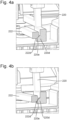
- Figure 4a depicts the relative positions of the first and second actuator members 220, 222 in a first position, prior to the second actuator member 222 being urged to move by the first actuator member 220
- Figure 4b depicts the relative positions of the first and second actuator members 220, 222 in a second position, after the second actuator member has been urged to move by the first actuator member.
- a position on the engaging surface 220e at which the first and second actuator members engage moves over the engaging surface.
- a position on the engagement surface 222d at which the first and second actuator members engage may move over the engagement surface.
- the engagement surface 222d may extend along the second actuator member 222 at least partially over a length of the second actuator member between the first end 222a and the second end 222b.
- a length of the second actuator member 222 between the first and second ends 222a, 222b may be greater than a distance, e.g. a maximum distance, that the armrest 130 is able to move relative to the carrier 120 in the sliding direction D 1 .
- the length over which the engagement surface 222d extends may be greater than or equal to the distance, e.g. the maximum distance, that the armrest 130 is able to move relative to the carrier 120 in the sliding direction D 1 . In this way, the engaging surface 220e of the first actuator member may remain in contact with the engagement surface 222d of the second actuator member when the armrest 130 is moved relative to the carrier 120 in the sliding direction D 1 .
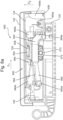
- Figures 5a and 5b show the console box assembly 100 with a portion of the armrest 130 omitted for clarity of illustration.
- Figures 5a and 5b depict the extents of permitted movements of the armrest 130 relative to the carrier 12, e.g by virtue of the mechanism 140, according to one or more arrangements.
- Figure 5a shows the console box assembly 100 in a configuration in which the armrest 130 is positioned so as to substantially overlie the carrier 120 in the sliding direction D 1 .
- the position of the armrest 130 depicted in Figure 5a may be referred to as a minimum displacement position of the armrest 130.
- the position of the armrest 130 depicted in Figure 5a may be a rearmost extent of the permitted movement of the armrest 130 relative to the carrier 120.
- the engagement portion 220d of the first actuator member is at least partially aligned with the second actuator member 222 between the first and second ends 222a, 222b of the second actuator member, so that the engaging surface 220e can engage the engagement surface 222d of the second actuator member and urge the second actuator member 222 to move, as described above.
- Figure 5b shows the console box assembly 100 in a configuration in which the armrest 130 has been moved, e.g. slid, a distance in the sliding direction D 1 .
- the armrest 130 may be in a maximum displacement position, e.g. in which the armrest is in a maximum forward position relative to the carrier 120.
- the engaging portion 220d of the first actuator member remains at least partially aligned with the second actuator member between the first and second ends 222a, 222b of the second actuator member, so that the engaging surface 220e remains engaged or able to engage with, the engagement surface 222d of the second actuator member, and can urge the second actuator member 222 to move, as described above.
- the engaging surface 220e can engage the engagement surface 222d at a position closer to the second end 222b of the second actuator member than when the armrest is in the maximum displacement position.
- the second actuator member may be pivotally coupled to the carrier 120 at the second end 222b of the second actuator member. Hence, a distance that the first end 222a of the second actuator member can be urged to move due to the engagement between the first and second actuator members 220, 222 is greater when the armrest is in the minimum displacement position compared to when the armrest is in the maximum displacement position. This difference in movement of the second end 222b of the second actuator member is reflected in reduced movement of the first and second claws 212, 214 when the latch mechanism 200 is actuated whilst the armrest is in the maximum displacement position.
- the first and second claws 212, 214 protrude outwardly from the carrier 120, e.g. towards the openings 110a, by a greater distance than when the latch mechanism 200 is actuated whilst the armrest 130 is in the minimum displacement position depicted in Figure 5a .
- the latch mechanism 200 is configured such that the movement of the first and second claws 212, 214 under the action of the latch mechanism 200, e.g. due to actuation of the latch actuator 216, is sufficient to selectively disengage the first and second claws 212, 214 from the respective openings 110a of the box body 110 in any position of the armrest 130 between the minimum and maximum displacement positions of the armrest 130.
- the console box assembly 600 may be similar to the console box assembly 100 and features described above in relation to the console box assembly 100 may apply equally to the console box assembly 600.
- the console box assembly 600 comprises the armrest 130, having the upper body 132 and the lower body 134 and the carrier 120.
- the console box assembly 600 may comprise the mechanism 140, and may further comprise the slide lock mechanism 150.
- the console box assembly 600 further comprises a height adjustment mechanism 650 for adjusting a position, e.g. height, of the upper body 132 of the armrest 130.
- the height adjustment mechanism may be for adjusting a distance, e.g. in a vertical direction, between the upper surface 132a of the upper body 132 and the lower body 134 of the armrest 130.
- the height adjustment mechanism 650 comprises a first link member 662 and a second link member 664.
- the first and second link members 662, 664 each comprise a first end 662a, 664a and a second end 662b, 664b.
- the first and second link members 662, 664 are pivotally coupled to one another at a positions between the first and second ends of the link members.
- the first and second link members are configured to form a scissor linkage mechanism 660.
- the first and second link members 662, 644 may be housed inside the upper body 132 and/or the lower body 134.
- the first end 662a of the first link member is pivotally coupled to the lower body 134 of the armrest and the first end 664a of the second link member is pivotally and slideably coupled to the lower body 134.
- the second ends 662b, 664b of the first and second link members are configured to contact the upper body 132 of the armrest and prevent the distance between the upper surface 132a of the upper body and the lower body 142, e.g. a lower extent of the lower body, reducing to less than a distance between the first and second ends of the first and second link members in the second direction D 2 , e.g. the vertical direction.
- the second direction D 2 comprises at least a component in a direction perpendicular to the sliding direction D 1 .
- the height adjustment mechanism 650 further comprises a first rack 652 coupled to the first end 664a of the second link member and a second rack 654 coupled to the lower body 134.
- the first and second racks 652, 654 are configured to engage one another in order to restrict movement of the first rack 652 relative to the second rack 654 in a direction in which the first end 664a of the second link member slides relative to the lower body 134.
- the first and/or second rack 652, 654 may comprise a plurality of teeth spaced along the respective racks in the direction in which the first end 664a of the second link member slides relative to the lower body 134.
- the height adjustment mechanism 650 further comprises a rack actuator 656 for selectively disengaging the second rack 654 from the first rack 652, e.g. in order to permit the first end 664a of the second link member to slide relative to the lower body 134.
- the rack actuator 656 may comprise a lever portion 656a pivotally coupled to the lower body 134 of the armrest, and a button portion 656b to be displaced by a user of the armrest in order to pivot the lever arm portion 656a to thereby displace the second rack 654 to disengage from the first rack 652.
- the second rack 654 may be pivotal mounted on the lower body 134 and may be pivoted relative to the first rack 652 by actuating the rack actuator 656 to disengage from the first rack 652.
- the second rack 654 may be biased into a position in which the second rack engages the first rack 652.
- the height adjustment mechanism 650 may comprise one or more biasing members, such as springs 658, configured to bias the second rack 654 to engage the first rack 652.
- the height adjustment mechanism 650 may further comprise a damper 670 configured to damp, e.g. provide resistance against, movement of the upper body 132 relative to the lower body 134 in the second direction D 2 .
- the damper 670 may be a rotational damper and may comprise a gear wheel 672 having teeth engaged with teeth of the first rack 652.
- the damper 670 may be coupled, e.g. fixedly coupled, to the lower body 134.
- the gear wheel 672 of the damper may be rotated by virtue of its engagement with the teeth of the first rack 652 and movement of lower body relative to the upper body may thereby be damped.
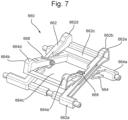
- the first link member 662 comprises an opening 662c formed between the first and second ends 662a, 664b of the first link member.
- the second member may extend through the opening 662c and the first and second link members 662, 664 may be pivotally coupled together at the opening.
- the second link member 664 may similarly comprise an opening 664c formed between the first and second ends 664a, 664b of the second link member.
- the first link member may extend through the opening 664c and the first and second link members 662, 664 may be pivotally coupled together at the opening 664c.
- the first link member 662 may comprise two or more contact surface portions 662d, 662e formed at the second end 662b of the first link member.
- the two or more contact surface portions may be arranged to contact the upper part 132 of the armrest 130 at laterally spaced positions on the upper part 132.
- two or more contact surface portions may be arranged to contact the upper part 132 of the armrest 130 at opposing lateral sides of the upper part 132.
- the laterally spaced apart positions may be spaced apart in a direction perpendicular to the sliding direction D 1 .
- the second link member 664 may similarly comprise two or more contact surface portions 664d, 664e formed at the second end 664b of the second link member.
- the two or more contact surface portions may be arranged to contact the upper part 132 of the armrest 130 at laterally spaced positions on the upper part 132.
- the two or more contact surface portions may be arranged to contact the upper part 132 of the armrest 130 at opposing lateral sides of the upper part 132.
- the height adjustment mechanism 650 may further comprise one or more biasing elements 668, such as coil springs, for biasing the first and second link members 662, 664 to pivot relative to one another in order to increase the distance between the first and second ends 662a, 664a, 662b, 664b of the first and second link members respectively in the second direction D1, e.g. the height direction.
- biasing elements 668 such as coil springs
- the height adjustment mechanism 650 is arranged such that the second ends of the first and second link members are spaced apart in a longitudinal direction of the armrest 130, e.g. a direction parallel with a direction in which a user faces when using the armrest and/or the sliding direction of the armrest.
- the height adjustment mechanism may be oriented on the console box assembly 600, such that the second ends of the first and second link members are spaced apart in a lateral direction of the armrest, e.g. a direction perpendicular to a direction in which a user faces when using the armrest and/or the sliding direction of the armrest.
- the directions in which the other parts of the height adjustment mechanism move and are spaced apart from one another in would be reoriented accordingly.
- the two or more contact surface portions on the first and second link members may be arranged to contact the upper part 132 of the armrest 130 at positions on the upper part 132 spaced apart in the longitudinal direction of the armrest 130.
Landscapes
- Engineering & Computer Science (AREA)
- Mechanical Engineering (AREA)
- Aviation & Aerospace Engineering (AREA)
- Transportation (AREA)
- Vehicle Step Arrangements And Article Storage (AREA)
- Seats For Vehicles (AREA)
Description
- The present disclosure relates to an adjustable console box for a vehicle, such as a motor vehicle.
- Vehicles, such as motor vehicles, often comprise a centre console unit including a console box defining a storage volume for occupants of the vehicle to store items in during a journey in the vehicle. The console box may comprise a lid for closing the storage volume to secure the items within the storage volume. The console box may comprise a latch mechanism for securing the lid of the console box in a closed position.
- Console boxes typically comprise an armrest for an occupant of the vehicle, such as a driver, to rest their arm on whilst travelling in the vehicle. It is often desirable for the position of the armrest to be adjustable, so that the occupant can arrange the armrest in an ergonomically advantageous position. When the armrest is to be used by the driver, the driver may wish to fix the position of the armrest in a suitable position to allow the driver to reach and operate vehicle controls whilst their arm is resting on the armrest. A console box assembly according to the preamble of claim 1 is known from
JP H0699775 A - According to an aspect of the present disclosure, there is provided a console box assembly comprising: a box body defining a storage volume and a carrier pivotally coupled to the box body. The carrier may be configured to form a lid for closing an opening into the storage volume. The console box assembly further comprises an armrest slideable relative to the carrier; and a latch mechanism for latching the carrier to the box body. The latch mechanism may be to fix the position of the carrier relative to the box body, e.g. such that the carrier closes the opening into the storage volume. The latch mechanism comprises: an opening formed in an internal wall of the box body; a claw or latch movably, e.g. slideably, supported on the carrier for engaging the opening to latch the carrier to the box body; a latch actuator coupled to the armrest; a rotation part pivotally supported on the carrier for rotation about a rotation part axis, wherein the claw is coupled the rotation part, e.g. at a position spaced apart from the rotation part axis; a first actuator member coupled to the latch actuator; and a second actuator member coupled to the rotation part, wherein the first actuator member is arranged to engage the second actuator member and urge the second actuator member to rotate the rotation part in response to actuation of the latch actuator, e.g. regardless of the slide position of the armrest, so that the claw disengages from the opening.
- The second actuator member may be pivotally supported on the carrier for rotation about a second actuator member axis. The second actuator member axis may have a component parallel with the rotation part axis.
- The first actuator member may be pivotally supported on the armrest for rotation about a first actuator member axis. The first actuator member axis may be at an angle relative to the second actuator member axis.
- The first actuator member may have an engaging surface. The engaging surface may be arranged to contact an engagement surface formed on the second actuator member when the latch actuator is actuated, and urge the second actuator member to rotate the rotation part.
- The first actuator member may be coupled to the latch actuator at a first end of the first actuator member. The engaging surface may be formed at a second end of the first actuator member. The first actuator member may be pivotally support on the armrest at a position on the first actuator member between the first and second ends.
- The engagement surface may be disposed between the second actuator member axis and the position at which the second actuator member is coupled to the rotation part. The engagement surface may extend along the second actuator member in a direction with a component in a direction in which the armrest is moveably, e.g. slideable, relative to the carrier.
- The position on the engagement surface at which the engaging surface engages the engagement surface may vary as the armrest is slid relative to the carrier.
- The latch mechanism may be configured, e.g. the first and/or second actuator member axed, and/or the rotation part pivot axis may be arranged, such that a movement of the claw when the latch actuator is actuated is greater than an extent of engagement between the claw and the opening in all positions of the armrest relative to the carrier.
- At least one of the engaging surface and the engagement surface may comprise a ramp surface. The ramp surface may be arranged such that engagement between the engaging surface and the engagement surface causes the engaging surface and the engagement surface to slide relative to one another, thereby urging the second actuator member to move relative to the first actuator member.
- The latch mechanism may further comprise a further claw movably supported on the carrier for engaging a further opening in the box body to latch the carrier to the box body. The further claw may be coupled to the rotation part, e.g. at a position spaced apart from the rotation part pivot axis, such that the further claw is moved to disengage from the further opening, e.g. regardless of the slide position of the armrest, when the latch mechanism is actuated.
- The further claw may be coupled to the rotation part on an opposite side of the rotation part axis from the position at which the claw is coupled to the rotation part.
- The claw may be configured to engage the opening on a same side of the rotation part axis as the position at which the claw is coupled to the rotation part. The further claw may comprise an arcuate portion arranged such that the further claw engages the further opening on the same side of the rotation part axis that the claw engages the opening.
- According to another aspect of the present disclosure, there is provided a console box assembly comprising: an armrest having an upper body and a lower body; and a height adjustment mechanism for adjusting a height between an upper surface of the upper body and a lower extent of the lower body, wherein the height adjustment mechanism comprises: a scissor linkage mechanism comprising: a first link member having a first end and a second end, wherein the first end is pivotally coupled to the lower body; and a second link member having a first end and a second end, wherein the first end is pivotally and slideably coupled to the lower body, wherein the first and second link members are pivotally coupled together at a position between the first and second ends of the first and second link members, and wherein the second ends of the first and second link members are arranged to contact the upper body and prevent the distance between the upper surface of the upper body and a lower extent of the lower body reducing to less than a distance between the first and second ends of the first and second link member; a first rack coupled to the first end of the second link member; a second rack coupled to the lower body, wherein the first and second racks are configured to engage one another in order to restrict movement of the first rack relative to the second rack in a direction in which the first end of the second link member slides relative to the lower body; and an actuator for selectively disengaging the second rack from the first rack.
- The console box assembly may further comprise a biasing element for biasing the first and second link elements to pivot relative to one another in order to increase the distance between the first and second ends of the first and second link members respectively in the height direction.
- The console box assembly may further comprise a damping element arranged to damp pivoting movements of the first and second link members relative to one another. The damping element may be coupled to the lower body. The damping element may be a rotational damper comprising a gear engaged with first rack.
- The second rack may be pivotally coupled to the lower body. The actuator may be configured to pivot second rack to disengage second rack from first rack. The first and second link members may be housed inside the lower body and/or the upper body.
- To avoid unnecessary duplication of effort and repetition of text in the specification, certain features are described in relation to only one or several aspects or embodiments of the invention. However, it is to be understood that, where it is technically possible, features described in relation to any aspect or embodiment of the invention may also be used with any other aspect or embodiment of the invention.
- For a better understanding of the present invention, and to show more clearly how it may be carried into effect, reference will now be made, by way of example, to the accompanying drawings, in which:
-
Figure 1 is a side cross-sectional view of a console box assembly comprising a latch mechanism, according to arrangements of the present disclosure; -
Figures 2a and 2b are perspective views of the latch mechanism for the console box assembly shown inFigure 1 , in latched and unlatched configurations respectively; -
Figure 3 is a front view of the console box assembly shown inFigure 1 ; -
Figures 4a and 4b are partial cross-sectional views of first and second actuator members of the latch mechanism in first and second positions respectively; -
Figures 5a and 5b are perspective, partially cut away views of the console box assembly illustrating the extents of movement of the armrest of the console box assembly relative to a carrier of the console box assembly; -
Figure 6a is a side cross-sectional view of the console box assembly, with a height adjustment mechanism being locked in a lowered configuration; -
Figure 6b is a side cross-sectional view of the console box assembly, with the height adjustment mechanism being unlocked in a raised configuration; and -
Figure 7 is a perspective view of a scissor mechanism for the height adjustment mechanism shown in Figures 8a and 8b. - With reference to
Figure 1 , aconsole box assembly 100 for a vehicle, such as a motor vehicle, according to arrangements of the present disclosure, comprises abox body 110, acarrier 120 and anarmrest 130. Theconsole box assembly 100 may be mounted, e.g. fixedly mounted, within a vehicle interior. For example, thebox body 110 of theconsole box assembly 100 may be configured to be fixedly mounted adjacent to a seat of the vehicle. In one or more arrangements, theconsole box assembly 100 may be to form at least part of a centre console for the vehicle. - The
box body 110 may define astorage volume 112, e.g. for items to be stored within the console box assembly. Thecarrier 120 and/or thearmrest 130 may be configured to form a lid for closing, e.g. covering, anopening 114 into thestorage volume 112. For example, thecarrier 120 may be movably, e.g. pivotally, mountable relative to thebox body 110 in order to form the lid for selectively closing theopening 114. - The
armrest 130 may be further configured to provide an ergonomic surface for an occupant of vehicle to rest their arm on, e.g. when travelling in or driving the vehicle. In order to improve the ergonomic function of thearmrest 130, the position of thearmrest 130 may be adjustable relative to thecarrier 120 and/or thebox body 110. In particular, thearmrest 130 may be movable, e.g. slideably movable, relative to thecarrier 120 and/orbox body 110 in a sliding direction D1. In this way, the position of thearmrest 130 relative to the seat of the vehicle may be adjusted. When theconsole box assembly 100 is installed within a vehicle, the sliding direction D1 of thearmrest 130 may be at least partially aligned with a direction in which the seat of the vehicle faces, e.g. a longitudinal direction of the vehicle. In the arrangement depicted, the sliding direction D1 is aligned with a longitudinal direction of theconsole box assembly 100. - The
console box assembly 100 further comprises amechanism 140 for enabling thearmrest 130 to be moved relative to thecarrier 120. For example, themechanism 140 may be a sliding mechanism for enabling thearmrest 130 to be displaced, e.g. slid, relative to thecarrier 120. Themechanism 140 may enable thearmrest 130 to slide relative to the carrier in the sliding direction D1. In this way, the position of theergonomic surface 132a of the armrest may be selectively adjusted. - The
mechanism 140 may further comprise alock mechanism 150 for locking the position of thearmrest 130 relative to thecarrier 120, e.g. in the sliding direction D1. Thelock mechanism 150 may be configured to selectively lock themechanism 140 to prevent movement of thearmrest 130 by virtue of themechanism 140. - The
armrest 130 may comprise anupper body 132 and alower body 134. The ergonomic surface of the armrest may be provided by theupper body 132. For example, the ergonomic surface may be anupper surface 132a of the upper body. Theupper body 132 may be movably coupled to thelower body 134. For example, theupper body 132 may be pivotally coupled to thelower body 134. Moving, e.g. pivoting, theupper body 132 relative to thelower body 134 may actuate a mechanism of thearmrest 130, such as thelock mechanism 150 for locking the position of thearmrest 130 relative to thecarrier 120. - Referring now to
Figures 2a, 2b and3 , in addition toFigure 1 , theconsole box assembly 100 further comprises alatch mechanism 200 for latching, e.g. selectively securing, thecarrier 120 to thebox body 110. Thelatch mechanism 200 may be configured to selectively fix the position of thecarrier 120 relative to thebox body 110. Thelatch mechanism 200 may be configured to latch thecarrier 120 to thebox body 110 in a position in which thecarrier 120 closes, e.g. covers or fills, theopening 114 into thestorage volume 112. - The
latch mechanism 200 comprises a first claw, or bolt, 212 movably, e.g. slideably and/or pivotally, supported on thecarrier 120. Thelatch mechanism 200 further comprises one ormore openings 110a formed in thebox body 110, e.g. in aninternal wall 110b of thebox body 110. Thelatch mechanism 200 is configured to selectively move thefirst claw 212 relative to thebox body 110 so that thefirst claw 212 selectively engages and disengages from one of theopenings 110a in thebox body 110. - As shown in
Figures 2a, 2b and3 , thelatch mechanism 200 may further comprise a second claw, or bolt, 214 movably, e.g. slideably and/or pivotally, supported on thecarrier 120. Thelatch mechanism 200 may be configured to selectively move thesecond claw 214 relative to thebox body 110 so that the second claw selectively engages and disengages from another of theopenings 110a in thebox body 110. - In the arrangements described herein, the
latch mechanism 200 is configured such that the first andsecond claws console box assembly 100. The lateral directions may be perpendicular to the sliding direction D1 of the console box assembly. The first and second claws are configured to enter, e.g. move or project into,respective openings 110a in thebox body 110 in the lateral directions, and theopenings 110a are oriented accordingly. In other arrangements, thelatch mechanism 200 may be configured to selectively move the first andsecond claws openings 110a may be oriented accordingly, to receive the first andsecond claws - The
latch mechanism 200 further comprises alatch actuator 216. The latch actuator is moveably, e.g. pivotally, coupled to thearmrest 130, such as theupper body 132 and/orlower body 134 of the armrest. Thelatch mechanism 200 is configured such that movement of thelatch actuator 216 relative to thearmrest 130 causes thefirst claw 212, and optionally thesecond claw 214, to move relative to thecarrier 120 to engage, or become disengaged from therespective openings 110a in the box body. As depicted, the latch actuator may comprise abody part 216a, ahandle part 216b, to be acted on by a user to move thelatch actuator 216, and one ormore spindle parts 216c for supporting pivotal movement of thelatch actuator 216 relative to thearmrest 130. For example, thespindle parts 216c may be received within openings formed in thearmrest 130 to support pivotal movement of thelatch actuator 216. Thespindle parts 216c may be arranged to support rotation of the latch actuator about alatch actuator axis 216d. Thelatch actuator axis 216d may extend in a direction with a component perpendicular to the sliding direction D1 of the armrest, e.g. a direction parallel with the lateral direction of thearmrest 130. - The
latch mechanism 200 further comprises arotation part 218. Therotation part 218 is pivotally supported on thecarrier 120 for rotation about arotation part axis 218a. As depicted, therotation part axis 218a may extend in a direction with a component perpendicular to thelatch actuator axis 216d, and optionally the sliding direction D1. For example, therotation part axis 218a may extend in a vertical direction, e.g. when the console box assembly is installed within a vehicle. - The first and
second claws rotation part 218. In particular, the first andsecond claws rotation part 218 at positions on therotation part 218 spaced apart from therotation part axis 218a. In this way, rotation of therotation part 218 causes displacement of the first andsecond claws rotation part 218 may cause the first andsecond claws 212, 242 to move in directions perpendicular to therotation part axis 218a, such as the lateral direction. - As described above, the first and
second claws second claws rotation part 218 on opposite sides of therotation part axis 218a from one another, e.g. relative to a longitudinal direction of theconsole box assembly 100. - As depicted, the
second claw 214 may be configured to engage one of theopenings 110a on a same side of therotation part axis 218a as the position at which the second claw is coupled to the rotation part, e.g. in the longitudinal direction of the console box assembly. Thefirst claw 212 may comprise an arcuate portion 212a arranged such that thefirst claw 212 engages another of theopenings 110a on the same side of the rotation part axis as the opening engaged by the second claw, e.g. which is on an opposite side of therotation part axis 218a from the position at which thefirst claw 212 is coupled to the rotation part in the longitudinal direction. Theopenings 110a may be substantially aligned in the longitudinal direction of the console box assembly. - The
latch mechanism 200 further comprises afirst actuator member 220 and asecond actuator member 222. Thefirst actuator member 220 is coupled to thelatch actuator 216. Thesecond actuator member 222 is coupled to therotation part 218. Thelatch mechanism 200 is configured such that thefirst actuator member 220 is moved, e.g. pivoted, when thelatch actuator 216 is actuated. Thefirst actuator member 220 is configured to engage thesecond actuator member 222 so that, when thefirst actuator member 220 moves, e.g. due to the latch actuator being actuated, thefirst actuator member 220 urges the second actuator member to move and rotate therotation part 218. Thelatch mechanism 200 is thereby configured such that actuating thelatch actuator 216 causes therotation part 218 to rotate. As described above, rotation of therotation part 218 causes the first andsecond claws box body 110, e.g. to engage or disengage from theopenings 110a in the box body. - The
first actuator member 220 may be movably, e.g. pivotally, mounted on thearmrest 130. For example, thefirst actuator member 220 may be pivotally coupled to the upper orlower body actuator member axis 220c. The firstactuator member axis 220c may extend in a direction with a component perpendicular to the sliding direction D1 of the armrest, e.g. a direction parallel with the lateral direction of thearmrest 130. The firstactuator member axis 220c may extend in a direction parallel with thelatch actuator axis 216d. - The
first actuator member 220 comprises afirst end 220a and asecond end 220b. The first actuator member may be coupled to thelatch actuator 216 at thefirst end 220a. For example, thefirst end 220a of the first actuator member may be pivotally coupled to thebody part 216a of the latch actuator at a position on the latch actuator spaced apart from thelatch actuator axis 216d. Thefirst actuator member 220 may be configured to engage thesecond actuator member 222 at thesecond end 220b of the first actuator member. Thefirst actuator member 220 may be coupled to thearmrest 130 at a position between the first andsecond ends - The
second actuator member 222 may be movably, e.g. pivotally, mounted on thecarrier 120. In particular, thesecond actuator member 222 may be supported for pivotal movement about a secondactuator member axis 222c having at least a component parallel with the rotation part axis 218d. The secondactuator member axis 222c may be at an angle, e.g. perpendicular, relative to the firstactuator member axis 220c. Thesecond actuator member 222 may comprise afirst end 222a and asecond end 222b. Thesecond actuator member 222 may be coupled to therotation part 218 at thefirst end 222a. Thesecond actuator member 222 may be movably, e.g. pivotally, coupled to thecarrier 120 at thesecond end 222b. Thesecond actuator member 222 may be configured to engage (or be engaged by) thefirst actuator member 220 at a position on the second actuator member between the first andsecond ends - With reference to
Figures 4a and 4b , thefirst actuator member 220 may comprise an engagingportion 220d for engaging thesecond actuator member 222. The engagingportion 220d may be formed at thesecond end 222b of the first actuator member. The engagingportion 220d may comprise anengaging surface 220e. Thesecond actuator member 222 may comprise anengagement surface 222d and the first andsecond actuator members engaging surface 220e of the first actuator member and theengagement surface 222d of the second actuator member. - At least one of the
engaging surface 220e and theengagement surface 222d comprises a ramp surface. The ramp surface is arranged such that engagement between theengaging surface 220e and theengagement surface 222d causes the engaging surface and the engagement surface to slide relative to one another, thereby urging thesecond actuator member 222 to move relative to thefirst actuator member 220. For example, the engagingsurface 220e may comprise a ramp surface and theengagement surface 222d may comprise a complementary ramp surface. The ramp surface and complementary ramp surface may be arranged such that engagement between the ramp surface and complementary ramp surface causes the complementary ramp surface to slide over the ramp surface, thereby urging the second actuator member to move relative the first actuator member. - At least one of the
engaging surface 220e and theengagement surface 222d, e.g. the ramp surface and/or complementary ramp surface, is angled relative to a direction in which thefirst actuator member 220, e.g. thesecond end 220b of the first actuation member, moves when actuated by thelatch actuator 216. Due to the angle of theengaging surface 220e and/or theengagement surface 222d, when thefirst actuator member 220 engages thesecond actuator member 222, the second actuator member is urged to move in a direction at an angle, e.g. perpendicular, relative to the direction in which thefirst actuator member 220 moves to engage the second actuator member. -
Figure 4a depicts the relative positions of the first andsecond actuator members second actuator member 222 being urged to move by thefirst actuator member 220, andFigure 4b depicts the relative positions of the first andsecond actuator members second actuator member 222 is urged to move by thefirst actuator member 220, a position on theengaging surface 220e at which the first and second actuator members engage moves over the engaging surface. Additionally or alternatively, a position on theengagement surface 222d at which the first and second actuator members engage may move over the engagement surface. - Due to the relative arrangements of the pivot axes 220c, 222c, 218a of the first and second actuator members, and the rotation part, movement of the second actuator member due to the engagement by the
first actuator member 220 may act to rotate therotation part 218 about therotation part axis 218a. - Returning to
Figures 2a and 2b , theengagement surface 222d may extend along thesecond actuator member 222 at least partially over a length of the second actuator member between thefirst end 222a and thesecond end 222b. A length of thesecond actuator member 222 between the first andsecond ends armrest 130 is able to move relative to thecarrier 120 in the sliding direction D1. The length over which theengagement surface 222d extends may be greater than or equal to the distance, e.g. the maximum distance, that thearmrest 130 is able to move relative to thecarrier 120 in the sliding direction D1. In this way, the engagingsurface 220e of the first actuator member may remain in contact with theengagement surface 222d of the second actuator member when thearmrest 130 is moved relative to thecarrier 120 in the sliding direction D1. -
Figures 5a and 5b show theconsole box assembly 100 with a portion of thearmrest 130 omitted for clarity of illustration.Figures 5a and 5b depict the extents of permitted movements of thearmrest 130 relative to the carrier 12, e.g by virtue of themechanism 140, according to one or more arrangements. -
Figure 5a shows theconsole box assembly 100 in a configuration in which thearmrest 130 is positioned so as to substantially overlie thecarrier 120 in the sliding direction D1. The position of thearmrest 130 depicted inFigure 5a may be referred to as a minimum displacement position of thearmrest 130. When the sliding direction D1 is aligned with a longitudinal direction of theconsole box assembly 100 the position of thearmrest 130 depicted inFigure 5a may be a rearmost extent of the permitted movement of thearmrest 130 relative to thecarrier 120. - When the armrest is in the minimum displacement position, the
engagement portion 220d of the first actuator member is at least partially aligned with thesecond actuator member 222 between the first andsecond ends engaging surface 220e can engage theengagement surface 222d of the second actuator member and urge thesecond actuator member 222 to move, as described above. -
Figure 5b shows theconsole box assembly 100 in a configuration in which thearmrest 130 has been moved, e.g. slid, a distance in the sliding direction D1. In the configuration shown inFigure 5b , thearmrest 130 may be in a maximum displacement position, e.g. in which the armrest is in a maximum forward position relative to thecarrier 120. As can be seen inFigure 5b , when thearmrest 130 is in the maximum displacement position, the engagingportion 220d of the first actuator member remains at least partially aligned with the second actuator member between the first andsecond ends engaging surface 220e remains engaged or able to engage with, theengagement surface 222d of the second actuator member, and can urge thesecond actuator member 222 to move, as described above. - As depicted in
Figures 5a and 5b , when thearmrest 130 is in the minimum displacement position, the engagingsurface 220e can engage theengagement surface 222d at a position closer to thesecond end 222b of the second actuator member than when the armrest is in the maximum displacement position. As described above, the second actuator member may be pivotally coupled to thecarrier 120 at thesecond end 222b of the second actuator member. Hence, a distance that thefirst end 222a of the second actuator member can be urged to move due to the engagement between the first andsecond actuator members second end 222b of the second actuator member is reflected in reduced movement of the first andsecond claws latch mechanism 200 is actuated whilst the armrest is in the maximum displacement position. - As illustrated in
Figure 5b , when thelatch mechanism 200 is actuated whilst thearmrest 130 is in the maximum displacement position, the first andsecond claws carrier 120, e.g. towards theopenings 110a, by a greater distance than when thelatch mechanism 200 is actuated whilst thearmrest 130 is in the minimum displacement position depicted inFigure 5a . Thelatch mechanism 200 is configured such that the movement of the first andsecond claws latch mechanism 200, e.g. due to actuation of thelatch actuator 216, is sufficient to selectively disengage the first andsecond claws respective openings 110a of thebox body 110 in any position of thearmrest 130 between the minimum and maximum displacement positions of thearmrest 130. - With reference to
Figures 6a and6b , aconsole box assembly 600 according to another arrangement of the present disclosure will now be described. Theconsole box assembly 600 may be similar to theconsole box assembly 100 and features described above in relation to theconsole box assembly 100 may apply equally to theconsole box assembly 600. In particular, theconsole box assembly 600 comprises thearmrest 130, having theupper body 132 and thelower body 134 and thecarrier 120. Theconsole box assembly 600 may comprise themechanism 140, and may further comprise theslide lock mechanism 150. - The
console box assembly 600 further comprises aheight adjustment mechanism 650 for adjusting a position, e.g. height, of theupper body 132 of thearmrest 130. In particular, the height adjustment mechanism may be for adjusting a distance, e.g. in a vertical direction, between theupper surface 132a of theupper body 132 and thelower body 134 of thearmrest 130. - The
height adjustment mechanism 650 comprises afirst link member 662 and asecond link member 664. The first andsecond link members first end second end second link members scissor linkage mechanism 660. The first andsecond link members 662, 644 may be housed inside theupper body 132 and/or thelower body 134. - The
first end 662a of the first link member is pivotally coupled to thelower body 134 of the armrest and thefirst end 664a of the second link member is pivotally and slideably coupled to thelower body 134. The second ends 662b, 664b of the first and second link members are configured to contact theupper body 132 of the armrest and prevent the distance between theupper surface 132a of the upper body and the lower body 142, e.g. a lower extent of the lower body, reducing to less than a distance between the first and second ends of the first and second link members in the second direction D2, e.g. the vertical direction. In the arrangement shown, the second direction D2 comprises at least a component in a direction perpendicular to the sliding direction D1. - The
height adjustment mechanism 650 further comprises afirst rack 652 coupled to thefirst end 664a of the second link member and asecond rack 654 coupled to thelower body 134. The first andsecond racks first rack 652 relative to thesecond rack 654 in a direction in which thefirst end 664a of the second link member slides relative to thelower body 134. For example, the first and/orsecond rack first end 664a of the second link member slides relative to thelower body 134. - The
height adjustment mechanism 650 further comprises arack actuator 656 for selectively disengaging thesecond rack 654 from thefirst rack 652, e.g. in order to permit thefirst end 664a of the second link member to slide relative to thelower body 134. - As depicted in
Figures 6a and6b , therack actuator 656 may comprise alever portion 656a pivotally coupled to thelower body 134 of the armrest, and abutton portion 656b to be displaced by a user of the armrest in order to pivot thelever arm portion 656a to thereby displace thesecond rack 654 to disengage from thefirst rack 652. As illustrated, thesecond rack 654 may be pivotal mounted on thelower body 134 and may be pivoted relative to thefirst rack 652 by actuating therack actuator 656 to disengage from thefirst rack 652. Thesecond rack 654 may be biased into a position in which the second rack engages thefirst rack 652. For example, theheight adjustment mechanism 650 may comprise one or more biasing members, such assprings 658, configured to bias thesecond rack 654 to engage thefirst rack 652. - The
height adjustment mechanism 650 may further comprise adamper 670 configured to damp, e.g. provide resistance against, movement of theupper body 132 relative to thelower body 134 in the second direction D2. As depicted, thedamper 670 may be a rotational damper and may comprise agear wheel 672 having teeth engaged with teeth of thefirst rack 652. Thedamper 670 may be coupled, e.g. fixedly coupled, to thelower body 134. When thefirst rack 652 moved relative to the lower body, e.g. together with thefirst end 664a of the second link member. Thegear wheel 672 of the damper may be rotated by virtue of its engagement with the teeth of thefirst rack 652 and movement of lower body relative to the upper body may thereby be damped. - As depicted in
Figure 7 , thefirst link member 662 comprises anopening 662c formed between the first andsecond ends opening 662c and the first andsecond link members second link member 664 may similarly comprise anopening 664c formed between the first andsecond ends opening 664c and the first andsecond link members opening 664c. - As illustrated, the
first link member 662 may comprise two or morecontact surface portions second end 662b of the first link member. The two or more contact surface portions may be arranged to contact theupper part 132 of thearmrest 130 at laterally spaced positions on theupper part 132. For example, two or more contact surface portions may be arranged to contact theupper part 132 of thearmrest 130 at opposing lateral sides of theupper part 132. The laterally spaced apart positions may be spaced apart in a direction perpendicular to the sliding direction D1. Thesecond link member 664 may similarly comprise two or morecontact surface portions second end 664b of the second link member. The two or more contact surface portions may be arranged to contact theupper part 132 of thearmrest 130 at laterally spaced positions on theupper part 132. For example, the two or more contact surface portions may be arranged to contact theupper part 132 of thearmrest 130 at opposing lateral sides of theupper part 132. - As depicted in
Figure 7 , theheight adjustment mechanism 650 may further comprise one ormore biasing elements 668, such as coil springs, for biasing the first andsecond link members second ends - In the arrangement depicted in
Figures 6a and6b , and as described above, theheight adjustment mechanism 650 is arranged such that the second ends of the first and second link members are spaced apart in a longitudinal direction of thearmrest 130, e.g. a direction parallel with a direction in which a user faces when using the armrest and/or the sliding direction of the armrest. However, in other arrangements, the height adjustment mechanism may be oriented on theconsole box assembly 600, such that the second ends of the first and second link members are spaced apart in a lateral direction of the armrest, e.g. a direction perpendicular to a direction in which a user faces when using the armrest and/or the sliding direction of the armrest. In such arrangements, it will be appreciated that the directions in which the other parts of the height adjustment mechanism move and are spaced apart from one another in would be reoriented accordingly. For example, the two or more contact surface portions on the first and second link members may be arranged to contact theupper part 132 of thearmrest 130 at positions on theupper part 132 spaced apart in the longitudinal direction of thearmrest 130. - It will be appreciated by those skilled in the art that although the invention has been described by way of example, with reference to one or more exemplary examples, it is not limited to the disclosed examples and that alternative examples could be constructed without departing from the scope of the invention as defined by the appended claims.
Claims (14)
- A console box assembly (100) comprising:a box body (110) defining a storage volume (112);a carrier (120) pivotally coupled to the box body;an armrest (130) slideable relative to the carrier; anda latch mechanism (200) for latching the carrier to the box body, wherein the latch mechanism comprises:an opening (110a) formed in an internal wall (110b) of the box body;a claw (212) movably supported on the carrier for engaging the opening to latch the carrier to the box body;a latch actuator (216) coupled to the armrest;a rotation part (218) pivotally supported on the carrier for rotation about a rotation part axis (218a), characterized in thatthe claw is coupled the rotation part; wherein a first actuator member (220) coupled to the latch actuator; anda second actuator member (222) coupled to the rotation part, wherein the first actuator member is arranged to engage the second actuator member and urge the second actuator member to rotate the rotation part in response to actuation of the latch actuator regardless of the slide position of the armrest, so that the claw disengages from the opening.
- The console box assembly of claim 1, wherein the second actuator member is pivotally supported on the carrier for rotation about a second actuator member axis (222c).
- The console box assembly of claim 2, wherein the second actuator member axis has a component parallel with the rotation part axis.
- The console box assembly of claim 2 or 3, wherein the first actuator member is pivotally supported on the armrest for rotation about a first actuator member axis (220c), wherein the first actuator member axis is at an angle relative to the second actuator member axis.
- The console box assembly of any of the preceding claims, wherein the first actuator member has an engaging surface (220e) wherein the engaging surface is arranged to contact an engagement surface (222d) formed on the second actuator member when the latch actuator is actuated, and urge the second actuator member to rotate the rotation part.
- The console box assembly of claim 5, wherein the first actuator member is coupled to the latch actuator at a first end (220a) of the first actuator member, wherein the engaging surface is formed at a second end (220b) of the first actuator member, and wherein the first actuator member is pivotally supported on the armrest at a position on the first actuator member between the first and second ends.
- The console box assembly of claim 5 or 6, wherein the engagement surface is disposed between the second actuator member axis and the position at which the second actuator member is coupled to the rotation part.
- The console box assembly of any of claims 5 to 7, wherein the engagement surface extends along the second actuator member in a direction with a component in a direction (Di) in which the armrest is slideable relative to the carrier
- The console box assembly according to any of claims 5 to 8, wherein the position at which the engaging surface engages the engagement surface varies as the armrest is slid relative to the carrier.
- The console box assembly of claim 9, wherein the latch mechanism is configured such that a movement of the claw when the latch actuator is actuated is greater than an extent of engagement between the claw and the opening in all positions of the armrest relative to the carrier.
- The console box assembly according to any of claims 5 to 10, wherein at least one of the engaging surface and the engagement surface comprises a ramp surface, wherein the ramp surface is arranged such that engagement between the engaging surface and the engagement surface causes the engaging surface and the engagement surface to slide relative to one another, thereby urging the second actuator member to move relative to the first actuator member.
- The console box assembly of any of the preceding claims, wherein the latch mechanism further comprises a further claw (214) movably supported on the carrier for engaging a further opening (110a) in the box body to latch the carrier to the box body, wherein the further claw is coupled to the rotation part, such that the further claw disengages the further opening regardless of the slide position of the armrest when the latch mechanism is actuated.
- The console box assembly of claim 12, wherein the further claw is coupled to the rotation part on an opposite side of the rotation part axis from the position at which the claw is coupled to the rotation part.
- The console box assembly of claim 12 or 13, wherein the claw is configured to engage the opening on a same side of the rotation part axis as the position at which the claw is coupled to the rotation part, and wherein the further claw comprises an arcuate portion arranged such that the further claw engages the further opening on the same side of the rotation part axis that the claw engages the opening.
Priority Applications (1)
| Application Number | Priority Date | Filing Date | Title |
|---|---|---|---|
| EP22153027.2A EP4215418B1 (en) | 2022-01-24 | 2022-01-24 | A console box assembly |
Applications Claiming Priority (1)
| Application Number | Priority Date | Filing Date | Title |
|---|---|---|---|
| EP22153027.2A EP4215418B1 (en) | 2022-01-24 | 2022-01-24 | A console box assembly |
Publications (2)
| Publication Number | Publication Date |
|---|---|
| EP4215418A1 EP4215418A1 (en) | 2023-07-26 |
| EP4215418B1 true EP4215418B1 (en) | 2024-03-13 |
Family
ID=80001344
Family Applications (1)
| Application Number | Title | Priority Date | Filing Date |
|---|---|---|---|
| EP22153027.2A Active EP4215418B1 (en) | 2022-01-24 | 2022-01-24 | A console box assembly |
Country Status (1)
| Country | Link |
|---|---|
| EP (1) | EP4215418B1 (en) |
Family Cites Families (2)
| Publication number | Priority date | Publication date | Assignee | Title |
|---|---|---|---|---|
| JP3205787B2 (en) * | 1992-09-18 | 2001-09-04 | 株式会社イノアックコーポレーション | Console lid slide rotation structure |
| KR101293919B1 (en) * | 2011-11-30 | 2013-08-08 | 현대자동차주식회사 | Sliding Open Device of Console Box for Automobile |
-
2022
- 2022-01-24 EP EP22153027.2A patent/EP4215418B1/en active Active
Also Published As
| Publication number | Publication date |
|---|---|
| EP4215418A1 (en) | 2023-07-26 |
Similar Documents
| Publication | Publication Date | Title |
|---|---|---|
| EP3230120B1 (en) | Armrest assembly for vehicle interior | |
| EP2485918B1 (en) | Sliding easy entry release mechanism with rest in full rear position | |
| US6817646B2 (en) | Vehicle seat | |
| US5158338A (en) | Automotive seat assembly | |
| US4881774A (en) | Memory seat track assembly for vehicle seat | |
| US5695247A (en) | Safety lock-out mechanism for use in a sliding vehicle seat | |
| CN107618405B (en) | Tilting and sliding system for vehicle seat | |
| US20090085367A1 (en) | Apparatus and methods to integrally form lever operated cables with vehicle seats | |
| CN110043141B (en) | Locking mechanism for vehicle | |
| US20140042289A1 (en) | Slide rail device for vehicle | |
| JPH0838291A (en) | Articulating device for seat structure | |
| JPH08184237A (en) | Lock mechanism of turning cover | |
| US5156437A (en) | Automotive seat assembly | |
| CN112144991A (en) | Bi-directional inertial latch for vehicle interior components | |
| EP4215418B1 (en) | A console box assembly | |
| EP3902703B1 (en) | Stow to floor seat assembly | |
| EP4215417B1 (en) | A console box assembly | |
| US11993183B2 (en) | Seat slide device | |
| KR101922163B1 (en) | Console Box | |
| WO2000040432A1 (en) | Seat track with zero chuck lock | |
| US5810444A (en) | Seat latch blockout mechanism | |
| EP3752389B1 (en) | Internal full memory seat track with interlock | |
| CN114126918B (en) | Seat track assembly with memory mechanism | |
| JP7363005B2 (en) | car lock | |
| JP7814571B2 (en) | Vehicle storage device |
Legal Events
| Date | Code | Title | Description |
|---|---|---|---|
| PUAI | Public reference made under article 153(3) epc to a published international application that has entered the european phase |
Free format text: ORIGINAL CODE: 0009012 |
|
| STAA | Information on the status of an ep patent application or granted ep patent |
Free format text: STATUS: REQUEST FOR EXAMINATION WAS MADE |
|
| 17P | Request for examination filed |
Effective date: 20220721 |
|
| AK | Designated contracting states |
Kind code of ref document: A1 Designated state(s): AL AT BE BG CH CY CZ DE DK EE ES FI FR GB GR HR HU IE IS IT LI LT LU LV MC MK MT NL NO PL PT RO RS SE SI SK SM TR |
|
| GRAP | Despatch of communication of intention to grant a patent |
Free format text: ORIGINAL CODE: EPIDOSNIGR1 |
|
| STAA | Information on the status of an ep patent application or granted ep patent |
Free format text: STATUS: GRANT OF PATENT IS INTENDED |
|
| INTG | Intention to grant announced |
Effective date: 20231218 |
|
| GRAS | Grant fee paid |
Free format text: ORIGINAL CODE: EPIDOSNIGR3 |
|
| GRAA | (expected) grant |
Free format text: ORIGINAL CODE: 0009210 |
|
| STAA | Information on the status of an ep patent application or granted ep patent |
Free format text: STATUS: THE PATENT HAS BEEN GRANTED |
|
| AK | Designated contracting states |
Kind code of ref document: B1 Designated state(s): AL AT BE BG CH CY CZ DE DK EE ES FI FR GB GR HR HU IE IS IT LI LT LU LV MC MK MT NL NO PL PT RO RS SE SI SK SM TR |
|
| REG | Reference to a national code |
Ref country code: GB Ref legal event code: FG4D |
|
| REG | Reference to a national code |
Ref country code: CH Ref legal event code: EP |
|
| REG | Reference to a national code |
Ref country code: DE Ref legal event code: R096 Ref document number: 602022002290 Country of ref document: DE |
|
| REG | Reference to a national code |
Ref country code: IE Ref legal event code: FG4D |
|
| PG25 | Lapsed in a contracting state [announced via postgrant information from national office to epo] |
Ref country code: LT Free format text: LAPSE BECAUSE OF FAILURE TO SUBMIT A TRANSLATION OF THE DESCRIPTION OR TO PAY THE FEE WITHIN THE PRESCRIBED TIME-LIMIT Effective date: 20240313 |
|
| REG | Reference to a national code |
Ref country code: LT Ref legal event code: MG9D |
|
| PG25 | Lapsed in a contracting state [announced via postgrant information from national office to epo] |
Ref country code: GR Free format text: LAPSE BECAUSE OF FAILURE TO SUBMIT A TRANSLATION OF THE DESCRIPTION OR TO PAY THE FEE WITHIN THE PRESCRIBED TIME-LIMIT Effective date: 20240614 |
|
| REG | Reference to a national code |
Ref country code: NL Ref legal event code: MP Effective date: 20240313 |
|
| PG25 | Lapsed in a contracting state [announced via postgrant information from national office to epo] |
Ref country code: HR Free format text: LAPSE BECAUSE OF FAILURE TO SUBMIT A TRANSLATION OF THE DESCRIPTION OR TO PAY THE FEE WITHIN THE PRESCRIBED TIME-LIMIT Effective date: 20240313 Ref country code: RS Free format text: LAPSE BECAUSE OF FAILURE TO SUBMIT A TRANSLATION OF THE DESCRIPTION OR TO PAY THE FEE WITHIN THE PRESCRIBED TIME-LIMIT Effective date: 20240613 |
|
| PG25 | Lapsed in a contracting state [announced via postgrant information from national office to epo] |
Ref country code: ES Free format text: LAPSE BECAUSE OF FAILURE TO SUBMIT A TRANSLATION OF THE DESCRIPTION OR TO PAY THE FEE WITHIN THE PRESCRIBED TIME-LIMIT Effective date: 20240313 |
|
| PG25 | Lapsed in a contracting state [announced via postgrant information from national office to epo] |
Ref country code: RS Free format text: LAPSE BECAUSE OF FAILURE TO SUBMIT A TRANSLATION OF THE DESCRIPTION OR TO PAY THE FEE WITHIN THE PRESCRIBED TIME-LIMIT Effective date: 20240613 Ref country code: NO Free format text: LAPSE BECAUSE OF FAILURE TO SUBMIT A TRANSLATION OF THE DESCRIPTION OR TO PAY THE FEE WITHIN THE PRESCRIBED TIME-LIMIT Effective date: 20240613 Ref country code: LT Free format text: LAPSE BECAUSE OF FAILURE TO SUBMIT A TRANSLATION OF THE DESCRIPTION OR TO PAY THE FEE WITHIN THE PRESCRIBED TIME-LIMIT Effective date: 20240313 Ref country code: HR Free format text: LAPSE BECAUSE OF FAILURE TO SUBMIT A TRANSLATION OF THE DESCRIPTION OR TO PAY THE FEE WITHIN THE PRESCRIBED TIME-LIMIT Effective date: 20240313 Ref country code: GR Free format text: LAPSE BECAUSE OF FAILURE TO SUBMIT A TRANSLATION OF THE DESCRIPTION OR TO PAY THE FEE WITHIN THE PRESCRIBED TIME-LIMIT Effective date: 20240614 Ref country code: FI Free format text: LAPSE BECAUSE OF FAILURE TO SUBMIT A TRANSLATION OF THE DESCRIPTION OR TO PAY THE FEE WITHIN THE PRESCRIBED TIME-LIMIT Effective date: 20240313 Ref country code: ES Free format text: LAPSE BECAUSE OF FAILURE TO SUBMIT A TRANSLATION OF THE DESCRIPTION OR TO PAY THE FEE WITHIN THE PRESCRIBED TIME-LIMIT Effective date: 20240313 Ref country code: BG Free format text: LAPSE BECAUSE OF FAILURE TO SUBMIT A TRANSLATION OF THE DESCRIPTION OR TO PAY THE FEE WITHIN THE PRESCRIBED TIME-LIMIT Effective date: 20240313 |
|
| REG | Reference to a national code |
Ref country code: AT Ref legal event code: MK05 Ref document number: 1665470 Country of ref document: AT Kind code of ref document: T Effective date: 20240313 |
|
| PG25 | Lapsed in a contracting state [announced via postgrant information from national office to epo] |
Ref country code: SE Free format text: LAPSE BECAUSE OF FAILURE TO SUBMIT A TRANSLATION OF THE DESCRIPTION OR TO PAY THE FEE WITHIN THE PRESCRIBED TIME-LIMIT Effective date: 20240313 Ref country code: LV Free format text: LAPSE BECAUSE OF FAILURE TO SUBMIT A TRANSLATION OF THE DESCRIPTION OR TO PAY THE FEE WITHIN THE PRESCRIBED TIME-LIMIT Effective date: 20240313 |
|
| PG25 | Lapsed in a contracting state [announced via postgrant information from national office to epo] |
Ref country code: NL Free format text: LAPSE BECAUSE OF FAILURE TO SUBMIT A TRANSLATION OF THE DESCRIPTION OR TO PAY THE FEE WITHIN THE PRESCRIBED TIME-LIMIT Effective date: 20240313 |
|
| PG25 | Lapsed in a contracting state [announced via postgrant information from national office to epo] |
Ref country code: NL Free format text: LAPSE BECAUSE OF FAILURE TO SUBMIT A TRANSLATION OF THE DESCRIPTION OR TO PAY THE FEE WITHIN THE PRESCRIBED TIME-LIMIT Effective date: 20240313 |
|
| PG25 | Lapsed in a contracting state [announced via postgrant information from national office to epo] |
Ref country code: IS Free format text: LAPSE BECAUSE OF FAILURE TO SUBMIT A TRANSLATION OF THE DESCRIPTION OR TO PAY THE FEE WITHIN THE PRESCRIBED TIME-LIMIT Effective date: 20240713 |
|
| PG25 | Lapsed in a contracting state [announced via postgrant information from national office to epo] |
Ref country code: SM Free format text: LAPSE BECAUSE OF FAILURE TO SUBMIT A TRANSLATION OF THE DESCRIPTION OR TO PAY THE FEE WITHIN THE PRESCRIBED TIME-LIMIT Effective date: 20240313 Ref country code: PT Free format text: LAPSE BECAUSE OF FAILURE TO SUBMIT A TRANSLATION OF THE DESCRIPTION OR TO PAY THE FEE WITHIN THE PRESCRIBED TIME-LIMIT Effective date: 20240715 |
|
| PG25 | Lapsed in a contracting state [announced via postgrant information from national office to epo] |
Ref country code: CZ Free format text: LAPSE BECAUSE OF FAILURE TO SUBMIT A TRANSLATION OF THE DESCRIPTION OR TO PAY THE FEE WITHIN THE PRESCRIBED TIME-LIMIT Effective date: 20240313 Ref country code: EE Free format text: LAPSE BECAUSE OF FAILURE TO SUBMIT A TRANSLATION OF THE DESCRIPTION OR TO PAY THE FEE WITHIN THE PRESCRIBED TIME-LIMIT Effective date: 20240313 |
|
| PG25 | Lapsed in a contracting state [announced via postgrant information from national office to epo] |
Ref country code: AT Free format text: LAPSE BECAUSE OF FAILURE TO SUBMIT A TRANSLATION OF THE DESCRIPTION OR TO PAY THE FEE WITHIN THE PRESCRIBED TIME-LIMIT Effective date: 20240313 |
|
| PG25 | Lapsed in a contracting state [announced via postgrant information from national office to epo] |
Ref country code: PL Free format text: LAPSE BECAUSE OF FAILURE TO SUBMIT A TRANSLATION OF THE DESCRIPTION OR TO PAY THE FEE WITHIN THE PRESCRIBED TIME-LIMIT Effective date: 20240313 |
|
| PG25 | Lapsed in a contracting state [announced via postgrant information from national office to epo] |
Ref country code: SK Free format text: LAPSE BECAUSE OF FAILURE TO SUBMIT A TRANSLATION OF THE DESCRIPTION OR TO PAY THE FEE WITHIN THE PRESCRIBED TIME-LIMIT Effective date: 20240313 |
|
| PG25 | Lapsed in a contracting state [announced via postgrant information from national office to epo] |
Ref country code: SM Free format text: LAPSE BECAUSE OF FAILURE TO SUBMIT A TRANSLATION OF THE DESCRIPTION OR TO PAY THE FEE WITHIN THE PRESCRIBED TIME-LIMIT Effective date: 20240313 Ref country code: SK Free format text: LAPSE BECAUSE OF FAILURE TO SUBMIT A TRANSLATION OF THE DESCRIPTION OR TO PAY THE FEE WITHIN THE PRESCRIBED TIME-LIMIT Effective date: 20240313 Ref country code: RO Free format text: LAPSE BECAUSE OF FAILURE TO SUBMIT A TRANSLATION OF THE DESCRIPTION OR TO PAY THE FEE WITHIN THE PRESCRIBED TIME-LIMIT Effective date: 20240313 Ref country code: PT Free format text: LAPSE BECAUSE OF FAILURE TO SUBMIT A TRANSLATION OF THE DESCRIPTION OR TO PAY THE FEE WITHIN THE PRESCRIBED TIME-LIMIT Effective date: 20240715 Ref country code: PL Free format text: LAPSE BECAUSE OF FAILURE TO SUBMIT A TRANSLATION OF THE DESCRIPTION OR TO PAY THE FEE WITHIN THE PRESCRIBED TIME-LIMIT Effective date: 20240313 Ref country code: IS Free format text: LAPSE BECAUSE OF FAILURE TO SUBMIT A TRANSLATION OF THE DESCRIPTION OR TO PAY THE FEE WITHIN THE PRESCRIBED TIME-LIMIT Effective date: 20240713 Ref country code: EE Free format text: LAPSE BECAUSE OF FAILURE TO SUBMIT A TRANSLATION OF THE DESCRIPTION OR TO PAY THE FEE WITHIN THE PRESCRIBED TIME-LIMIT Effective date: 20240313 Ref country code: CZ Free format text: LAPSE BECAUSE OF FAILURE TO SUBMIT A TRANSLATION OF THE DESCRIPTION OR TO PAY THE FEE WITHIN THE PRESCRIBED TIME-LIMIT Effective date: 20240313 Ref country code: AT Free format text: LAPSE BECAUSE OF FAILURE TO SUBMIT A TRANSLATION OF THE DESCRIPTION OR TO PAY THE FEE WITHIN THE PRESCRIBED TIME-LIMIT Effective date: 20240313 |
|
| PG25 | Lapsed in a contracting state [announced via postgrant information from national office to epo] |
Ref country code: IT Free format text: LAPSE BECAUSE OF FAILURE TO SUBMIT A TRANSLATION OF THE DESCRIPTION OR TO PAY THE FEE WITHIN THE PRESCRIBED TIME-LIMIT Effective date: 20240313 |
|
| REG | Reference to a national code |
Ref country code: DE Ref legal event code: R097 Ref document number: 602022002290 Country of ref document: DE |
|
| PG25 | Lapsed in a contracting state [announced via postgrant information from national office to epo] |
Ref country code: IT Free format text: LAPSE BECAUSE OF FAILURE TO SUBMIT A TRANSLATION OF THE DESCRIPTION OR TO PAY THE FEE WITHIN THE PRESCRIBED TIME-LIMIT Effective date: 20240313 |
|
| PG25 | Lapsed in a contracting state [announced via postgrant information from national office to epo] |
Ref country code: DK Free format text: LAPSE BECAUSE OF FAILURE TO SUBMIT A TRANSLATION OF THE DESCRIPTION OR TO PAY THE FEE WITHIN THE PRESCRIBED TIME-LIMIT Effective date: 20240313 |
|
| PLBE | No opposition filed within time limit |
Free format text: ORIGINAL CODE: 0009261 |
|
| STAA | Information on the status of an ep patent application or granted ep patent |
Free format text: STATUS: NO OPPOSITION FILED WITHIN TIME LIMIT |
|
| PG25 | Lapsed in a contracting state [announced via postgrant information from national office to epo] |
Ref country code: DK Free format text: LAPSE BECAUSE OF FAILURE TO SUBMIT A TRANSLATION OF THE DESCRIPTION OR TO PAY THE FEE WITHIN THE PRESCRIBED TIME-LIMIT Effective date: 20240313 |
|
| 26N | No opposition filed |
Effective date: 20241216 |
|
| PG25 | Lapsed in a contracting state [announced via postgrant information from national office to epo] |
Ref country code: SI Free format text: LAPSE BECAUSE OF FAILURE TO SUBMIT A TRANSLATION OF THE DESCRIPTION OR TO PAY THE FEE WITHIN THE PRESCRIBED TIME-LIMIT Effective date: 20240313 |
|
| REG | Reference to a national code |
Ref country code: CH Ref legal event code: PL |
|
| PG25 | Lapsed in a contracting state [announced via postgrant information from national office to epo] |
Ref country code: MC Free format text: LAPSE BECAUSE OF FAILURE TO SUBMIT A TRANSLATION OF THE DESCRIPTION OR TO PAY THE FEE WITHIN THE PRESCRIBED TIME-LIMIT Effective date: 20240313 Ref country code: LU Free format text: LAPSE BECAUSE OF NON-PAYMENT OF DUE FEES Effective date: 20250124 |
|
| PG25 | Lapsed in a contracting state [announced via postgrant information from national office to epo] |
Ref country code: BE Free format text: LAPSE BECAUSE OF NON-PAYMENT OF DUE FEES Effective date: 20250131 |
|
| PG25 | Lapsed in a contracting state [announced via postgrant information from national office to epo] |
Ref country code: FR Free format text: LAPSE BECAUSE OF NON-PAYMENT OF DUE FEES Effective date: 20250131 |
|
| PG25 | Lapsed in a contracting state [announced via postgrant information from national office to epo] |
Ref country code: CH Free format text: LAPSE BECAUSE OF NON-PAYMENT OF DUE FEES Effective date: 20250131 |
|
| REG | Reference to a national code |
Ref country code: BE Ref legal event code: MM Effective date: 20250131 |
|
| PGFP | Annual fee paid to national office [announced via postgrant information from national office to epo] |
Ref country code: GB Payment date: 20251220 Year of fee payment: 5 |
|
| PG25 | Lapsed in a contracting state [announced via postgrant information from national office to epo] |
Ref country code: IE Free format text: LAPSE BECAUSE OF NON-PAYMENT OF DUE FEES Effective date: 20250124 |
|
| PGFP | Annual fee paid to national office [announced via postgrant information from national office to epo] |
Ref country code: DE Payment date: 20251217 Year of fee payment: 5 |