EP4213594A1 - Aluminum garnet nanoparticles - Google Patents
Aluminum garnet nanoparticles Download PDFInfo
- Publication number
- EP4213594A1 EP4213594A1 EP22152028.1A EP22152028A EP4213594A1 EP 4213594 A1 EP4213594 A1 EP 4213594A1 EP 22152028 A EP22152028 A EP 22152028A EP 4213594 A1 EP4213594 A1 EP 4213594A1
- Authority
- EP
- European Patent Office
- Prior art keywords
- nanoparticles
- mixture
- alkoxide
- salt
- luminescent material
- Prior art date
- Legal status (The legal status is an assumption and is not a legal conclusion. Google has not performed a legal analysis and makes no representation as to the accuracy of the status listed.)
- Pending
Links
Images




Classifications
-
- H—ELECTRICITY
- H05—ELECTRIC TECHNIQUES NOT OTHERWISE PROVIDED FOR
- H05B—ELECTRIC HEATING; ELECTRIC LIGHT SOURCES NOT OTHERWISE PROVIDED FOR; CIRCUIT ARRANGEMENTS FOR ELECTRIC LIGHT SOURCES, IN GENERAL
- H05B33/00—Electroluminescent light sources
- H05B33/12—Light sources with substantially two-dimensional [2D] radiating surfaces
- H05B33/14—Light sources with substantially two-dimensional [2D] radiating surfaces characterised by the chemical or physical composition or the arrangement of the electroluminescent material, or by the simultaneous addition of the electroluminescent material in or onto the light source
-
- C—CHEMISTRY; METALLURGY
- C09—DYES; PAINTS; POLISHES; NATURAL RESINS; ADHESIVES; COMPOSITIONS NOT OTHERWISE PROVIDED FOR; APPLICATIONS OF MATERIALS NOT OTHERWISE PROVIDED FOR
- C09K—MATERIALS FOR MISCELLANEOUS APPLICATIONS, NOT PROVIDED FOR ELSEWHERE
- C09K11/00—Luminescent materials, e.g. electroluminescent or chemiluminescent
- C09K11/08—Luminescent materials, e.g. electroluminescent or chemiluminescent containing inorganic luminescent materials
- C09K11/77—Luminescent materials, e.g. electroluminescent or chemiluminescent containing inorganic luminescent materials containing rare earth metals
- C09K11/7766—Luminescent materials, e.g. electroluminescent or chemiluminescent containing inorganic luminescent materials containing rare earth metals containing two or more rare earth metals
- C09K11/7774—Aluminates
Definitions
- the invention relates to rare-earth metal doped aluminum-based garnet nanoparticles.
- the invention further relates to methods of making rare-earth metal doped aluminum-based garnet nanoparticles.
- the invention further relates to luminescent materials and compositions comprising the nanoparticles of the invention.
- the invention further relates to devices comprising the luminescent material and/or composition of the invention.
- Luminescent down-conversion materials play an important role in solid-state lighting devices for illumination and display applications, among others.
- Y 3 Al 5 O 12 :Ce (YAG:Ce) is a well-known down-conversion material used on micron-scale in various applications, such as white LEDs.
- Lu 3 Al 5 O 12 :Ce (LuAG:Ce) is similarly a well-known down-conversion material used on micron-scale in various applications, such as white LEDs.
- WO2018/167266 discloses compositions comprising a light emitting material and a sensitizer material, wherein the light emitting material and the sensitizer material are selected such that the sensitizer material has an emission spectrum which overlaps at least partly with one or more excitation bands of the light emitting material and wherein the light emitting material and sensitizer material are so arranged to each other to allow non-radiative energy transfer from the sensitizer material to the light emitting material.
- This application also describes methods for the preparation thereof.
- Non-radiative energy transfer (sometimes also referred to as Fluorescent Resonance Energy Transfer, FRET) from the sensitizer material to the light emitting material involves the non-radiative transfer of energy from an excited sensitizer ion in the sensitizer material to an acceptor (or emitter) ion in the light emitting material. It is evidenced by increased emission from an emitter ion in the light emitting material upon selective excitation of the sensitizer ion in the sensitizer material.
- FRET Fluorescent Resonance Energy Transfer
- Nanomaterials are of interest due to their high surface area and small volume, which enables to arrange luminescent materials close in space to harness inter-particle FRET.
- a method for preparing rare-earth metal doped garnet nanoparticles comprising:
- rare-earth metal doped garnet nanoparticles obtainable by the method of the invention.
- a luminescent composition comprising a first luminescent material capable of emitting light in a first wavelength range and a second luminescent material being capable of absorbing light in a second wavelength range, and having an emission spectrum which overlaps at least partly with one or more of the excitation bands of said first luminescent material, wherein at least one of said first luminescent material or said second luminescent material comprises the nanoparticles according to the invention.
- the nanoparticles according to the invention show good absorption/emission properties and are suited for mixing in luminescent compositions. They have high photoluminescence quantum yield (QY) and crystallinity, even at small particle sizes. They can advantageously be used in compositions, wherein non-radiative energy transfer (sometimes also referred to as Fluorescent Resonance Energy Transfer, FRET) is desired.
- QY photoluminescence quantum yield
- FRET Fluorescent Resonance Energy Transfer
- the method according to the invention allows obtaining the nanoparticles according to the invention.
- the invention provides a method for preparing rare-earth metal doped garnet nanoparticles.
- the method according to the invention for prepare rare-earth metal doped garnet nanoparticles comprises mixing (i) yttrium salt and/or yttrium alkoxide and/or a lutetium salt and/or lutetium alkoxide, (ii) aluminum salt and/or aluminum alkoxide, (iii) rare earth metal salt and/or rare earth metal alkoxide, (iv) phosphate salt or organic phosphate, and (v) a solvent comprising a glycol to obtain a mixture.
- any suitable yttrium salt and/or alkoxide, lutetium salt and/or alkoxide, aluminum salt and/or alkoxide and rare earth metal salt and/or alkoxide may be used that can be dissolved in the solvent comprising a glycol, for instance at the temperature at which the mixture is heated in stage b.
- the skilled person is able to determine the relative amounts of the salts and/or alkoxides such as to obtain the desired ratios of the ions in the nanoparticles.
- an yttrium salt and/or yttrium alkoxide is used. This allows to obtain yttrium aluminum garnet (YAG)-type nanoparticles.
- the yttrium salt is selected from the group consisting of halides, acetates, acetylacetonates, sulfates, nitrates, and/or a hydrated form of these substances. More preferably, the yttrium salt is selected from acetates or a hydrated form thereof.
- the yttrium alkoxide has the formula Y(OR) 3 , wherein RO - is the alkoxide and R is a C1-C4 group.
- the alkoxide is an isopropoxide, ethoxide and/or tert-butoxide.
- a lutetium salt and/or lutetium alkoxide is used. This allows to obtain lutetium aluminum garnet (LuAG)-type nanoparticles.
- the lutetium salt is selected from the group consisting of halides, acetates, acetylacetonates, sulfates, nitrates, and/or a hydrated form of these substances. More preferably, the lutetium salt is selected from acetates or a hydrated form thereof.
- the lutetium alkoxide has the formula Lu(OR) 3 , wherein RO - is the alkoxide and R is a C1-C4 group.
- the alkoxide is an isopropoxide, ethoxide and/or tert-butoxide.
- a mixture of an yttrium and a lutetium salt and/or alkoxide is used. This allows to obtain yttrium lutetium aluminum garnet ((Y,Lu)AG)-type nanoparticles.
- the skilled person is able to determine the relative amounts of the salts and/or alkoxides such as to obtain the desired ratios of the ions in the nanoparticles.
- the skilled person is therefore able to determine the amount of yttrium and/or lutetium relative to the amount of aluminum, to obtain the desired YAG:RE or LuAG:RE ratios.
- the skilled person is also able to determine the amount of rare earth relative to yttrium and/or lutetium to obtain the desired doping concentrations.
- stoichiometric aluminum garnets the ratio of (rare earth + yttrium + lutetium)/Al is 0.6.
- the mixture further comprises additional yttrium salt and/or alkoxide and/or lutetium salt and/or alkoxide and/or rare earth salt and/or alkoxide.
- the amount of additional Y and/or Lu and/or rare earth in the mixture is at least the molar equivalent of phosphate. More preferably, the amount of further Y and/or Lu and/or rare earth is at least 1.8 times the molar equivalent of phosphate. This is found to improve the quality and luminescence efficiency of the nanocrystals and to facilitate obtaining a small particle size. Without being bound by theory, it is thought that this facilitates the formation of (Y or Lu or rare earth)PO 4 without interfering with the formation of YAG or LuAG.
- the yttrium salt and/or alkoxide and/or lutetium salt and/or alkoxide is present in the mixture in an amount such that the molar (Y and/or Lu):Al ratio is at least about 0.25, preferably at least about 0.3.
- the molar (Y and/or Lu):Al ratio is preferably at most about 1.8, more preferably at most about 1.75.
- some of the yttrium salt and/or alkoxide and/or lutetium salt and/or alkoxide is substituted by a gadolinium salt and/or alkoxide.
- This may result in gadolinium substitution at some of the yttrium or lutetium sites in the YAG/LuAG/(Y,Lu)AG-lattice, and can result in a shift of the excitation/emission spectrum.
- the substitution of the yttrium salt and/or alkoxide and/or lutetium salt and/or alkoxide by a gadolinium salt and/or alkoxide can be used to tune the excitation/emission spectrum of the product.
- the aluminum salt is selected from the group consisting of halides, acetates, acetylacetonates, sulfates, nitrates, and/or a hydrated form of these substances.
- the aluminum alkoxide has the formula Al(OR) 3 , wherein RO - is the alkoxide and R is a C1-C4 group.
- the alkoxide is an isopropoxide, ethoxide and/or tert-butoxide.
- some of the aluminum salt and/or alkoxide is substituted by a gallium salt and/or alkoxide.
- This may result in gallium substitution at some of the aluminum sites in the YAG/LuAG/(Y,Lu)AG-lattice, and can result in a shift of the excitation/emission spectrum.
- the substitution of the aluminum salt and/or alkoxide by a gallium salt and/or alkoxide can be used to tune the excitation/emission spectrum of the product.
- the rare earth metal salt is selected from the group consisting of halides, acetates, acetylacetonates, sulfates, nitrates, and/or a hydrated form of these substances. More preferably, the rare earth metal salt is selected from acetates or a hydrated form thereof.
- the rare earth metal alkoxide has the formula RE(OR) 3 , wherein RO - is the alkoxide and R is a C1-C4 group.
- the alkoxide is an isopropoxide, ethoxide and/or tert-butoxide.
- the rare earth metal is cerium and/or terbium.
- Ce 3+ shows, upon suitable excitation, yellow-green emission.
- Tb 3+ shows, upon suitable excitation, green emission.
- the rare earth metal is a combination of cerium and terbium.
- the rare earth metal is present as a dopant.
- the doping ratio is between 0.01% and 3% for cerium doped nanoparticles, more preferably the doping ratio is 2.5%.
- the doping ratio is the percentage of doping ions relative to the total of doping ions and yttrium or lutetium atoms in the crystal lattice.
- the doping ratio of cerium is between about 0.01% and about 2.5%, and the doping ratio of terbium is at least about 30%.
- the rare earth metal salt and/or alkoxide is present in the mixture such that the molar RE:Al ratio is at least about 0.25, preferably at least about 0.3.
- the molar RE:Al ratio is preferably at most about 1.5, more preferably at most about 1.45.
- R and/or R' is preferably hydrogen or a C1-C4 group. More preferably, the phosphate salt and/or organic phosphate is H 3 PO 4 , P 2 O 5 , trimethyl phosphate (TMP), or tributyl phosphate (TBP).
- the phosphate salt or organic phosphate is present in the mixture in an amount such that the molar P:Al ratio is between about 0.020 and about 0.250, more preferably between about 0.020 and about 0.108, even more preferably between about 0.054 and about 0.108.
- the mixture comprises a solvent comprising one or more glycols.
- the sum content of the glycols in the solvent is at least about 90 vol.%, preferably at least about 95 vol.% of said one or more glycols, more preferably at least about 98 vol.% of said one or more glycols, most preferably at least about 99 vol.%.
- the salts and/or alkoxides are soluble in the solvent.
- a glycol is generally known as an organic compound which comprises two hydroxyl groups.
- the one or more glycols are chosen from the group of 1,4-butanediol, 1,3-butanediol, 1,2-butanediol, 1,5-pentanediol, 1,4-pentanediol, 1,3-pentanediol, 1,2-pentanediol, ethylene glycol, polyethylene glycol, and diethylene glycol.
- the solvent comprises 1,4-butanediol and diethylene glycol. More preferably, the solvent comprises between about 75 and about 95 vol.% 1,4-butanediol and between about 5 and about 25 vol% diethylene glycol. Most preferably, the solvent comprises between about 80 and about 90 vol% 1,4-butanediol and between about 10 and about 20 vol% diethylene glycol. It has been found that this mixture works especially well with the invention.
- the amount of solvent in the mixture may vary within wide limits. The skilled person is able to determine the amount enabling dissolution of the salts and/or alkoxides (i), (ii), (iii), and (iv).
- the mixture can comprise the equivalent of about 1.8 mmol YAG or LuAG in about 90 mL glycol.
- the solvent comprises diethylene glycol in an amount to obtain a molar ratio of aluminum:diethylene glycol between about 0.012 and about 0.030. This is found improve the yield of nanoparticles with sizes ⁇ 20 nm.
- the amount of water present in the mixture is preferably less than about 1 wt.%, more preferably less than about 0.1 wt.%.
- the method comprises removing water from at least one of the (i) yttrium salt and/or alkoxide and/or lutetium salt and/or alkoxide, (ii) aluminum salt and/or alkoxide, (iii) rare earth metal salt and/or alkoxide, (iv) phosphate salt and/or organic phosphate and (v) the solvent comprising a glycol, prior to mixing.
- the method comprises removing water from all of the (i) yttrium salt and/or alkoxide and/or lutetium salt and/or alkoxide, (ii) aluminum salt and/or alkoxide, (iii) rare earth metal salt and/or alkoxide, (iv) phosphate salt and/or organic phosphate and (v) the solvent comprising a glycol, prior to mixing.
- Removing water may be effected in any suitable manner.
- said removing water comprises drying and/or dehydrating of the yttrium salt, aluminum salt, rare earth metal salt and/or phosphate salt.
- Removing of water may be performed using a Schlenk setup, in which one flask containing the salt is heated above about 100 °C, while vacuum is applied.
- the flask containing the salt is connected to another flask which is not heated and contains a desiccant, for example P 2 O 5 .
- the flask containing the salt is heated to about 120 °C while vacuum is applied for several hours. More preferably, for about 12-18 hours.
- the dried salts are preferably stored in a dry and moisture free fashion.
- water is removed from the organic phosphate prior to mixing.
- the organic phosphate is preferably dried in a similar manner as described above for the salts.
- said removing water comprises distillation of the yttrium alkoxide, aluminum alkoxide and/or rare earth metal alkoxide, i.e. distillation of a metal alkoxide.
- Removing of water may be performed with a Schlenk setup, in which one flask containing the metal alkoxide is heated to or slightly above the boiling point of the alkoxide while vacuum is applied. The flask containing the alkoxide is connected to another flask which is not heated. Pure metal alkoxide condenses in the empty flask when a temperature/pressure combination is reached which results in the boiling of the metal alkoxide. The pure metal alkoxide can then be stored in a dry and moisture free fashion. The skilled person is capable of controlling the temperature/pressure combination such that the metal alkoxide can be distilled.
- the aluminum is provided as aluminum isopropoxide which is distilled prior to mixing.
- the flask containing aluminum isopropoxide is heated to about 170 °C while vacuum is applied. Pure aluminum isopropoxide condenses in the empty flask when a temperature of about 135 °C is reached by a pressure of 10 mmHg.
- the purified aluminum isopropoxide is stored in a dry and moisture free fashion.
- the method comprises removing water from the glycol. This may be done by storing the glycol in an inert atmosphere and/or adding molecular sieves.
- the mixture may be prepared in any suitable manner.
- the preparation of the mixture comprises:
- Mixing may be enhanced by using an Ultra-Turrax mixer, a vortex mixer, or another type of mixing equipment.
- said further (i) yttrium salt and/or alkoxide and/or lutetium salt and/or alkoxide and/or rare earth salt and/or alkoxide is added to the first mixture.
- said further (i) yttrium salt and/or alkoxide and/or lutetium salt and/or alkoxide and/or rare earth salt and/or alkoxide is added to the second mixture. In all embodiments, a final mixture is formed.
- the method according to the invention comprises heating the mixture. This allows the salts and/or alkoxides and phosphate to dissolve in the solvent comprising the glycol.
- the mixture is heated in an autoclave reactor.
- the autoclave reactor is purged with inert gas and heated to the reaction temperature, while stirring.
- the autoclave might be heated using either thermal radiation (conventional heating), or electromagnetic radiation (e.g. microwaves).
- the heating is effected at a temperature of at least about 190 °C, preferably at least about 280 °C, and/or at a temperature of at most about 340 °C, preferably at most about 320 °C. More preferably, the heating is effected at a temperature of about 300 °C.
- the heating is effected at pressure or results in an increased pressure.
- said pressure is about 10 bar or more, preferably about 20 bar or more, and/or at a pressure of about 60 bar or less, preferably about 30 bar or less.
- the heating is performed in a closed vessel, such as an autoclave reactor, such that the heating results in an increased pressure.
- said heating comprises heating for a period of at least about 1 hour, preferably at least about 1.5 hour, more preferably at least about 2 hours, and/or for a period of at most about 8 hours, preferably at most about 6 hours.
- the method of the invention comprises subjecting the mixture to a precipitation stage. As a result of the precipitation stage a precipitate comprising nanoparticles is obtained.
- the precipitation stage comprises allowing the mixture to cool. More preferably, if using an autoclave reactor, the autoclave reactor is cooled to room temperature before opening.
- the precipitation stage comprises a size selection step to remove large crystals from the reaction product.
- the size selection step is performed by centrifugation of the mixture. For example, this may be done by centrifugation of the mixture at about 800-25000 RCF (relative centrifugal force), preferably about 20000 RCF, for about 2-120 minutes, preferably about 15-30 minutes.
- said subjecting the mixture to a precipitation stage comprises contacting said mixture with an antisolvent, more preferably wherein the antisolvent is a mixture of a polar organic solvent and a miscible non-polar organic solvent, even more preferably an alcohol or ketone and an ether, even more preferably a C1-C4 alcohol or ketone and an ether, even more preferably acetone and diethylether.
- the antisolvent is a mixture of a polar organic solvent and a miscible non-polar organic solvent, even more preferably an alcohol or ketone and an ether, even more preferably a C1-C4 alcohol or ketone and an ether, even more preferably acetone and diethylether.
- the antisolvent has a relatively low boiling point, as this facilitates removal of the liquid later in the process.
- the precipitation stage comprises contacting the mixture with an antisolvent, followed by centrifugation. Even more preferably, said contacting the mixture with an antisolvent, followed by centrifugation is repeated.
- the method of the invention is executed in inert atmosphere, such as N 2 or Ar.
- rare-earth metal doped garnet nanoparticles there is further provided rare-earth metal doped garnet nanoparticles.
- the nanoparticles of the invention may comprise Y 3 Al 5 O 12 :RE (YAG:RE), Lu 3 Al 5 O 12 :RE (LuAG:RE) or (Y x ,Lu (1-x) ) 3 Al 5 O 12 :RE ((Lu,Y)AG:RE), wherein RE is a rare-earth metal x can have any value between 0 and 1.
- RE is cerium and/or terbium.
- the cerium and/or terbium is present as a trivalent ion, i.e. Ce 3+ or Tb 3+ .
- Ce 3+ shows, upon suitable excitation, yellow-green emission.
- Tb 3+ shows, upon suitable excitation, green emission.
- RE is a combination of cerium and terbium.
- the rare earth metal is present as a dopant.
- the doping ratio is between about 0.01% and about 3% for cerium doped nanoparticles, more preferably the doping ratio is about 2.5%.
- the doping ratio is the percentage of doping ions relative to the total of doping ions and yttrium atoms in the crystal lattice.
- the doping ratio of cerium is between about 0.01% and about 2.5%, and the doping ratio of terbium is at least about 30%.
- the nanoparticles comprise phosphorus, or comprise a Y 3 Al 5 O 12 :RE (YAG:RE), Lu 3 Al 5 O 12 :RE (LuAG:RE) or (Y x ,Lu (1-x) ) 3 Al 5 O 12 :RE ((Lu,Y)AG:RE) phase coexisting with a phosphorus-containing phase.
- "coexist” means that the YAG:RE, LuAG:RE or (Y,Lu)AG:RE phase can be present in the same particle as the phosphorus-containing phase, but also that the phases may form discrete, separate particles in the same mixture.
- Phosphorus may be detected in the nanoparticles or in a mixture comprising the nanoparticles through elemental analysis, such as inductively coupled plasma mass spectroscopy (ICP-MS), or Energy Dispersive X-ray Spectroscopy (EDS).
- ICP-MS inductively coupled plasma mass spectroscopy
- EDS Energy Dispersive X-ray Spectroscopy
- the phosphorus is present in a phosphate phase.
- the phosphate phase is of the structure (Y and/or Lu and/or RE)PO 4 .
- a YAG:RE-phase, LuAG:RE-phase or (Lu,Y)AG:RE-phase may coexist with a phosphate phase.
- the phosphate phase is a (Y, Lu and/or RE)PO 4 phase or a mixture thereof.
- the (Y, Lu and/or RE)PO 4 phase may be attached to the YAG:RE or LuAG:RE nanoparticles.
- the (Y, Lu and/or RE)PO 4 phase may form a protective shell around the YAG:RE, LuAG:RE or (Y,Lu)AG:RE nanoparticles.
- the (Y, Lu and/or RE)PO 4 phase may form discrete, separate particles from the YAG:RE, LuAG:RE or (Y,Lu)AG:RE nanoparticles in the same mixture.
- the phosphate phase may be detected based on an optical fingerprint of (Y, Lu)PO 4 :RE phase or (RE)PO 4 phase.
- the phosphate phase may also be detected by Energy Dispersive X-ray Spectroscopy (EDS), X-ray powder diffraction (XRD), or X-ray Photoelectron Spectroscopy (XPS).
- Nanoparticles according to the invention include particles of which at least one dimension is at a nanometer scale, preferably ⁇ 100 nm.
- the nanoparticles according to the invention have at least one dimension ⁇ 70 nm.
- the D 50 value of the smallest dimension of the nanoparticles is preferably ⁇ 0.5 nm and ⁇ 100 nm, more preferably ⁇ 0.5 nm and ⁇ 50 nm, most preferably ⁇ 0.5 nm and ⁇ 10 nm, as measured using transmission electron microscopy (TEM).
- D 50 is defined as the median value of the length of the smallest dimension of the nanoparticles, measured from an ensemble of at least 50 representative particles.
- the size of the nanoparticles can also be determined with a physisorption technique, for example N 2 -physisorption.
- the nanoparticles are preferably capable of luminescence.
- the nanoparticles may show an increased photoluminescence quantum yield compared to YAG:RE or LuAG:RE nanoparticles known in the art.
- the photoluminescence quantum yield is as high as possible and at least about 10%. More preferably, the photoluminescence quantum yield is at least about 30%. More preferably, the photoluminescence quantum yield is at least about 50%.
- the nanoparticles according to the invention are capable of emitting in the yellow and/or green spectral range.
- green emitting material refers to a material, which, upon suitable excitation, has one or more emission bands between 510 nm to 560 nm.
- the nanoparticles wherein RE is cerium or both cerium and terbium according to the invention are capable of emitting in the yellow and/or green spectral range.
- a luminescent composition comprising the nanoparticles obtainable by the method of the invention, or the nanoparticles of the invention.
- the luminescent composition comprises a first luminescent material and a second luminescent material, wherein at least one of said first luminescent material or said second luminescent material comprises the nanoparticles according to the invention or obtainable with the method according to the invention.
- the luminescent composition comprises a first luminescent material capable of emitting light in a first wavelength range and a second luminescent material being capable of absorbing light in a second wavelength range, and having an emission spectrum which overlaps at least partly with one or more of the excitation bands of said first luminescent material.
- At least one of said first luminescent material or said second luminescent material comprises the nanoparticles according to the invention or the nanoparticles obtainable with the method according to the invention.
- the first luminescent material and second luminescent material are so arranged to each other to allow non-radiative energy transfer from the second luminescent material to the first luminescent material.
- the first luminescent material is capable of emitting light in a first wavelength range.
- the skilled person will understand that the first luminescent material functions as an emitting material in the luminescent composition according to the invention.
- the first wavelength range may be any wavelength range of interest. Preferred wavelength ranges will be described hereinafter.
- the second luminescent material is capable of absorbing light in a second wavelength range.
- the skilled person will understand that the second luminescent material functions as a sensitizer material in the luminescent composition according to the invention.
- the second wavelength range may be any wavelength range of interest. Preferred wavelength ranges will be described hereinafter.
- the second luminescent material has, when excited by light in the second wavelength range, an emission spectrum which overlaps at least partly with one or more excitation bands of said first luminescent material.
- the skilled person is well able to determine the overlap of the spectra based on spectra known in the art or by determining the spectra by routine experimentation, which is for example disclosed in WO2020/053429 .
- the overlap of said emission spectrum of said second material and one or more excitation bands of said first material is in the blue (440 to 480 nm), green (510 to 560 nm) or yellow (560 to 580 nm) wavelength range.
- said first luminescent material and said second luminescent material are so arranged to each other to allow non-radiative energy transfer (sometimes also referred to as Fluorescent Resonance Energy Transfer, FRET) from said second luminescent material (sensitizer material) to said first luminescent material (emitter material).
- FRET Fluorescent Resonance Energy Transfer
- this comprises close proximity between the first and second luminescent materials, for instance from about 0.5 nm to about 20 nm in distance.
- the skilled person is well aware how non-radiative energy transfer may be achieved. This is, for instance, described in WO2018/167266 , the contents of which are herewith incorporated by reference.
- non-radiative energy transfer involves non-radiative transfer of energy from an excited sensitizer material to an acceptor (or emitter) ion in the emitting material. It is evidenced by increased selective excitation of the sensitizer material resulting in increased emission from an emitter ion in the emitting material.
- the non-radiative energy transfer of interest may originate from either Forster- or Dexter-type energy transfer. In case quantum dots are used, especially Dexter-type energy transfer is of interest, due to the often delocalized wavefunctions in quantum dots, leading to increased distances at which efficient energy transfer can occur.
- the first luminescent material and/or the second luminescent material comprise rare-earth metal doped garnet nanoparticles.
- the rare-earth metal doped garnet nanoparticles have desirable luminescent properties. Examples of a rare-earth metal doped garnet nanoparticles suitable for the first luminescent material and/or second luminescent material is YAG:RE nanoparticles, LuAG:RE nanoparticles, and/or the rare-earth metal doped garnet nanoparticles of the invention.
- the first luminescent material comprises the rare-earth metal doped garnet nanoparticles of the invention, where the rare-earth metal is terbium. These ions have desired ab sorption/emission characteristics.
- said second luminescent material comprises the rare-earth metal doped garnet nanoparticles according to the invention.
- the rare-earth metal doped garnet nanoparticles according to the invention are well suited for use in luminescent compositions. More preferably, the rare earth metal is cerium, or cerium and terbium. These ions have desired absorption/emission characteristics.
- said first luminescent material and said second luminescent material are in the form of nanoparticles.
- Suitable nanoparticles include particles of which at least one dimension is at a nanometer scale, preferably ⁇ 100 nm. The small size allows smaller distances between the surfaces of the first and second material, which (further) enables inter-particle non-radiative energy transfer to occur. Providing both materials in the form of nanoparticles allows more efficient mixing and even distribution of the particles, which further promotes inter-particle non-radiative energy transfer to occur.
- the D 50 value of the smallest dimension of the nanoparticles is preferably ⁇ 0.5 nm and ⁇ 100 nm, more preferably ⁇ 0.5 nm and ⁇ 50 nm, most preferably ⁇ 0.5 nm and ⁇ 10 nm, as measured using transmission electron microscopy (TEM).
- D 50 is defined as the median value of the length of the smallest dimension of the nanoparticles, measured from an ensemble of at least 50 representative particles.
- the first luminescent material is provided as a bulk material with the second luminescent material provided on the first luminescent material.
- the term "bulk” especially means and/or includes greater than nanoscale, for example greater than 100 nm in diameter and including micro-size scales.
- the second luminescent material may comprise the rare-earth metal doped garnet nanoparticles according to the invention.
- the first luminescent material is preferably as described below. More preferably, the second luminescent material comprises the rare-earth metal doped garnet nanoparticles of the invention, wherein the rare earth metal is cerium or cerium and terbium, and the first luminescent material is as described below.
- the skilled person will understand that the first and second material have to be in close proximity for FRET to occur.
- the nanoparticles according to the invention might be treated as described in WO2020/053429 and/or WO2021/043762 , both of which are hereby incorporated by reference.
- the first luminescent material is capable of emitting light in a first wavelength range.
- the first wavelength range may be any wavelength range of interest.
- the first luminescent material comprises a red or green emitting material.
- red emitting material refers to a material which, upon suitable excitation, has one or more emission bands between 600 nm and 700 nm and the term green emitting material refers to a material which, upon suitable excitation, has one or more emission bands between 510 and 560 nm.
- green emitting material refers to a material which, upon suitable excitation, has one or more emission bands between 510 and 560 nm.
- Providing a red or green emitting material can be desirable for color rendering purposes.
- the first luminescent material is a material having, upon suitable excitation, one or more emission bands between 700 and 1400 nm (IR-A), between 580 and 600 nm (amber and/or orange), between 560 and 580 nm (yellow), between 480 and 510 nm (cyan), between 440 and 480 nm (blue), between 400-440 nm (violet), between 315-400 nm (UV-A), and/or between 280-315 nm (UV-B).
- the first luminescent material comprises a rare-earth doped phosphor material.
- the phosphor materials may be divalent or trivalent rare-earth doped phosphors.
- suitable rare-earth doped phosphor materials include, but are not limited to: LaPO 4 :Eu 3+ (and/or Tb 3+ ), CaAlSiN 3 :Eu 2+ , Y 2 O 3 :Eu 3+ (and/or Tb 3+ ), Y(V,P)O 4 :Eu 3+ (and/or Tb 3+ ), Lu 3 Al 5 O 12 :Ce 3+ (or Eu 3+ and/or Tb 3+ ), Y 3 Al 5 O 12 :Ce 3+ (or Eu 3+ and/or Tb 3+ ), BaMgAl 14 O 23 :Mn 2+ , Mg(Al,Ga) 2 O 4 :Mn 2+ , Zn 2 SiO 4 :Mn 2+ , K 2
- the first luminescent material may comprise the rare-earth metal doped garnet nanoparticles according to the invention.
- Phosphor materials may be procured today on the open market, or may be synthesized, for example as described in [ Riwotzki, K.; Meyssamy, H.; Kornowski, A.; Haase, M. J. Phys. Chem. B. 2000, 104, 2824-2828 ].
- rare-earth doped phosphor materials comprise a host lattice doped with optically active ions.
- the first luminescent material may have any suitable host lattice.
- the host lattice may for instance be selected from the group consisting of oxides, fluorides, nitrides, borates, garnets, molybdates, phosphates, vanadates, chlorides, sulfides, selenides, silicates, aluminates, oxyfluorides, oxychlorides, oxynitrides, oxysulfides, oxyselenides, fluorochlorides, fluorosilicates and fluorobromides or combinations of these or another inorganic host material in which the optically active ions can be incorporated.
- the host lattice of the first luminescent material is an oxide, phosphate, vanadate or a combination thereof, more preferably selected from the group consisting of Y 3 Al 5 O 12 ("YAG”), Lu 3 Al 5 O 12 (“LuAG”), Y 2 O 3 , YVPO 4 , YVO 4 or LaPO 4 or a combination thereof.
- said preferred host lattice of the first luminescent material is doped with one or more ions selected from the group consisting of Eu 3+ , Tb 3+ , Mn 2+ and Mn 4+ . These ions provide good emission characteristics, such as emission bands that are strong and/or in the red or green part of the visible spectrum.
- the first luminescent material may for example have a host lattice doped having a doping ratio of at least about 10%, more preferably having a doping ratio of between about 15% and about 80%.
- the first luminescent material may for example have a host lattice doped having a doping ratio of at least about 15%, more preferably between about 30% and about 80% Tb 3+ .
- the first luminescent material may for example have a host lattice doped having a doping ratio of about 0.1-30%, most preferably between about 1-10%.
- Mn 2+ doping the first luminescent material may for example have a host lattice doped having a doping ratio of about 0.1-30%, most preferably between about 1-10%.
- the first luminescent material is selected from the group consisting of (Ca,Sr)Ga 2 O 6 :Eu 3+ (or Tb 3+ ), (Ca,Sr,Ba)La 2 Bi 2 (SiO 4 ) 3 O:Eu 3+ (or Tb 3+ ), (Ca,Sr,Ba)SnO 3 :Eu 3+ (and/or Tb 3+ ), (Ca,Y,Gd)MoO 4 :Eu 3+ (or Tb 3+ ), (Y,Gd)BO 3 (pseudo-vaterite) :Eu 3+ (or Tb 3+ ), (Y,Tb)SiO 5 :Eu 3+ (or Tb 3+ ), A-La 2 O 3 :Eu 3+ (or Tb 3+ ), Ba 2 (SiO 4 ):O 2- :Eu 3+ (or Tb 3+ ), Ba 2 MgSi 2 O 7 :E
- the second luminescent material preferably comprises the rare-earth metal doped garnet nanoparticles according to the invention.
- the rare earth metal is preferably cerium and/or terbium.
- the first luminescent material may comprise nanoparticles according to the invention.
- the second luminescent material is preferably as described below.
- any suitable inorganic luminescent material may be used as second luminescent material.
- the second material is capable of absorbing light in a second wavelength range.
- the second wavelength may be any wavelength range of interest.
- the second luminescent material has one or more excitation bands in the wavelength range between 380 to 580 nm, preferably wherein said second luminescent material has one or more excitation bands in the UV-A (315 to 400 nm), violet (400 to 440 nm), blue (440 to 480 nm) or green (510 to 560 nm) wavelength range, most preferably in the blue (440 to 480 nm) wavelength range.
- LEDs based on (Al,In,Ga)N provide efficient "pump" light generation in the violet to blue wavelength range (about 400 nm to about 480 nm).
- Examples of blue-excitable materials are CaAlSiN 3 :Eu 2+ , Y 3 Al 5 O 12 :Ce 3+ , CsPbBr 3 , CdSe, InP.
- the second luminescent material is a material having one or more excitation bands between 700 and 1400 nm (IR-A), between 580 and 600 nm (amber and/or orange), between 560 and 580 nm (yellow), between 510-560 nm (green), between 480 and 510 nm (cyan), between 440 and 480 nm (blue), between 400-440 nm (violet), between 315-400 nm (UV-A), and/or between 280-315 nm (UV-B).
- the host lattice of the second luminescent material is a garnet, fluoride, silicate, phosphate or nitride, more preferably selected from the group consisting of Y 3 Al 5 O 12 ("YAG”), Lu 3 Al 5 O 12 (“LuAG”), MgF 2 , CaF 2 , Sr 2 SiO 4 , Ba 2 SiO 4 , Ca 2 MgSi 2 O 7 , LiSrPO 4 , CaAlSiN 3 or a combination thereof.
- YAG Y 3 Al 5 O 12
- LuAG Lu 3 Al 5 O 12
- said preferred host lattice of the second luminescent material is doped with one or more ions selected from of the group consisting of Eu 2+ , Pb 2+ , Bi 3+ and Ce 3+ , more preferably Eu 2+ or Ce 3+ in combination with Tb 3+ , most preferably Ce 3+ in combination with Tb 3+ .
- the host lattice of the second luminescent material or precursor thereof is a garnet, such as Y 3 Al 5 O 12 (“YAG”) or Lu 3 Al 5 O 12 (“LuAG”) or a combination thereof.
- the host lattice is selected from the group consisting of Y 3 Al 5 O 12 (“YAG”) or Lu 3 Al 5 O 12 (“LuAG”) or a combination thereof and the dopant includes Ce 3+ , optionally in combination with Tb 3+ .
- the second luminescent material has a host lattice doped at a level of about 0.05-5%, more preferably about 0.1-4%.
- the first luminescent material comprises Y 2 O 3 :RE, wherein RE is europium(III), and the second luminescent material comprises the rare-earth metal doped garnet nanoparticles according to the invention, wherein the rare earth metal is cerium and/or terbium. More preferably, the Y 2 O 3 :RE material is provided as nanoparticles.
- the first luminescent material comprises rare-earth metal doped nanoparticles, wherein the rare earth metal is europium(III), and the second luminescent material comprises the rare-earth metal doped garnet nanoparticles of the invention, wherein the rare earth metal is cerium(III) and/or terbium(III).
- the invention further relates to a light-emitting device comprising the luminescent material obtainable by the method according to the invention.
- the light-emitting device further comprises an excitation source for the luminescent material, such as for the second luminescent material.
- the excitation sources is a UV-A, violet, or blue light emitting material which emits light towards the luminescent material with a wavelength of 315-400 nm (UV-A), 400-440 nm (violet), or 440-480 nm (blue), more preferably between 430-465 nm.
- the light emitting device may be constructed from a blue emitting LED with the rare-earth metal doped garnet nanoparticles or luminescent composition according to the inventions deposited on top of the LED chip.
- the nanoparticles according to the invention may be bound in a polymer or silicone slurry that is deposited on the blue LED chip and subsequently cured.
- the invention further relates to a lighting system comprising a light emitting device according to the invention.
- the lighting system is selected from the group consisting of a lamp or luminaire, office lighting systems, household application systems, shop lighting systems, home lighting systems, accent lighting systems, spot lighting systems, theatre lighting systems, fibre-optics application systems, projection systems, self-lit display systems, pixelated display systems, segmented display systems, warning sign systems, medical lighting application systems, indicator sign systems, and decorative lighting systems, portable systems, automotive applications and green house lighting systems.
- the invention further relates to the use of luminescent compositions according to the invention or luminescent materials comprising the rare-earth metal doped garnet nanoparticles of the invention as a taggant.
- a taggant is a marker added to materials to allow various forms of testing.
- the overall excitation/emission spectra of the luminescent materials and/or luminescent compositions according to the invention may have unique signatures, compared to conventional approaches, such that they may be useful as taggants in anti-counterfeiting applications.
- US7667828B discloses a tagging system containing multiple types of taggants that differ from each other.
- Yttrium acetate was placed in a flask connected by a U-bend glass tube with another Schlenk flask filled with P 2 O 5 . The latter was connected with a vacuum line. Then vacuum was slowly applied to prevent the powders from getting sucked into the pump. The flask with acetate was heated at 120 °C for one night while maintaining the vacuum in the system. The white powder of P 2 O 5 became colored and caramel-like in an exothermic process. The flask with yttrium acetate was then cooled down and the product stored under argon at 100 °C.
- the reaction process was performed under argon atmosphere to avoid water moisture. 8.8 mmol of distilled aluminium isopropoxide, 5.28 mmol of dried yttrium acetate and 0.2 mmol of cerium acetate was mixed in a beaker comprising 88 ml of glycol solvent composed of 13.2 ml (15% v/v) diethylene glycol and 74.8 ml (85% v/v) 1,4-butanediol.
- the mixture was homogenized using an Ultra-Turrax mixer at 8000 RPM (round per minute) for 10 minutes.
- the beaker with the mixture was transferred into a 300 ml autoclave with an additional 30 ml of the 1,4-butanediol/diethylene glycol (85/15 v/v) added to fill the gap between the autoclave and the beaker.
- the autoclave was purged with N 2 for 5 minutes and heated to 300°C (at a rate of 3°C/min) under constant mechanical stirring setting at 450 RPM, then maintained at 300 °C for 2 hours.
- the autoclave was cooled down to room temperature before opening.
- the obtained colloidal solution was centrifuged at 19000 RCF (relative centrifugal force) for 25 minutes to remove bigger particles (if any were present).
- the supernatant containing the small nanoparticles was washed with a mixture of 100 mL acetone and 200 mL diethyl ether prior to centrifugation at 19000 RCF for 25 minutes.
- a second washing procedure was conducted with same amount of the acetone/diethyl ether mixture followed by centrifugation for 9 minutes, to remove residual glycol solvents.
- the product was dried.
- the quantum yield of the prepared YAG:Ce nanocrystals is 2.4%.
- a size histogram based on TEM image analysis is shown in Figure 1 , showing a D 50 value of 4.1 nm.
- Emission and excitation spectra are shown in Figure 2 , with the excitation being the left line and the emission being the right line.
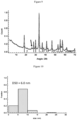
- XRD is shown in Figure 3 , showing diffraction peaks corresponding to the YAG phase.
- the AlO 4 /AlO 6 ratio was calculated based on 27 Al NMR and determined to be 0.86 for this sample, which is much lower than 1.50 for a perfect crystalline YAG lattice.
- Drying and distillation steps were performed as described above in the comparative experiment A.
- the process was performed under argon atmosphere to avoid water moisture.
- the mixture was homogenized using an Ultra-Turrax mixer at 8000 RPM (round per minute) for 10 minutes.
- the beaker with the mixture was then transferred into a 300 ml autoclave with an additional 30 ml of the 1,4-butanediol/diethylene glycol (85/15 v/v) added to fill the gap between the autoclave and the beaker.
- the autoclave was purged with N 2 for 5 minutes and heated to 300 °C (at a rate of 3 °C/minute) under constant mechanical stirring at 450 RPM, then maintained at 300 °C for 2 hours.
- the quantum yield of the as-prepared cerium doped garnet nanocrystals was 2.17%.
- a size histogram based on TEM image analysis is shown in Figure 4 , showing a D 50 value of 5.8 nm.
- Emission and excitation spectra are shown in Figure 5 , wherein the excitation line is on the left and the emission line is on the right.
- Figure 6 shows the particle size and total yield of the small fraction as function of Al/diethylene glycol ratio. It can be seen that increasing aluminum resulted in smaller particles, but also in a smaller total yield.
- the process was performed under argon atmosphere to avoid water moisture.
- the mixture was homogenized using an Ultra-Turrax mixer at 8000 RPM (round per minute) for 10 minutes.
- the beaker with the mixture was then transferred into a 300 ml autoclave with an additional 30 ml of the 1,4-butanediol/diethylene glycol (85/15 v/v) added to fill the gap between the autoclave and the beaker.
- the autoclave was purged with N 2 for 5 minutes and heated to 300 °C (at a rate of 3 °C/minute) under constant mechanical stirring at 450 RPM, then maintained at 300 °C for 2 hours.
- the product was purified according to the steps described above in the comparative experiment A.
- the quantum yield of the as-prepared cerium doped garnet nanocrystals is 13.1%.
- a size histogram based on TEM image analysis is shown in Figure 7 , showing a D 50 value of 8.8 nm.
- Emission spectrum is shown in Figure 8 .
- XRD is shown in Figure 9 .
- the AlO 4 /AlO 6 ratio was calculated based on 27 Al NMR and determined to be 0.71 for this sample.
- Example 2 YAG synthesis with PO 4 and extra Y
- the process was performed under argon atmosphere to avoid water moisture.
- the mixture was homogenized using an Ultra-Turrax mixer at 8000 RPM (round per minute) for 10 minutes.
- the beaker with the mixture was then transferred into a 300 ml autoclave with an additional 30 ml of the 1,4-butanediol/diethylene glycol (85/15 v/v) added to fill the gap between the autoclave and the beaker.
- the autoclave was purged with N 2 for 5 minutes and heated to 300 °C (at a rate of 3 °C/minute) under constant mechanical stirring at 450 RPM, then maintained at 300 °C for 2 hours.
- the quantum yield of the as-prepared cerium doped garnet nanocrystals was 24.8%.
- a size histogram based on TEM image analysis is shown in Figure 10 , showing a D 50 value of 6.0 nm.
- Emission and excitation spectra are shown in Figure 11 , wherein the excitation line is on the left side (shorter wavelengths) and the emission line is on the right side (longer wavelengths).
- XRD is shown in Figure 12 .
- the AlO 4 /AlO 6 ratio was calculated based on 27 Al NMR and determined to be 1.19 for this sample. This shows that the additional yttrium allowed for a more crystalline YAG-lattice.
- An overview picture of obtained particle sizes and QY of the samples described in the comparative experiments A and B and examples 1 and2 is shown in Figure 13 .
- Example 3 Luminescent composition
- YAG:Ce nanoparticles according to the invention were mixed with Y 2 O 3 :Eu nanoplatelets in a 1:1 weight ratio.
- the luminescent composition was excited at 440 nm, which is where Ce 3+ has an excitation band, but Tb 3+ and Eu 3+ do not, and the emission spectrum was recorded.
- the emission spectrum of the luminescent composition in Figure 14 shows peaks characteristic for YAG:Ce,Tb and Eu 3+ , upon excitation of the Ce ions at a wavelength of 440 nm. This shows that IFRET is achieved.
Landscapes
- Chemical & Material Sciences (AREA)
- Inorganic Chemistry (AREA)
- Engineering & Computer Science (AREA)
- Materials Engineering (AREA)
- Organic Chemistry (AREA)
- Luminescent Compositions (AREA)
Abstract
Description
- The invention relates to rare-earth metal doped aluminum-based garnet nanoparticles. The invention further relates to methods of making rare-earth metal doped aluminum-based garnet nanoparticles. The invention further relates to luminescent materials and compositions comprising the nanoparticles of the invention. The invention further relates to devices comprising the luminescent material and/or composition of the invention.
- Luminescent down-conversion materials play an important role in solid-state lighting devices for illumination and display applications, among others.
- Y3Al5O12:Ce (YAG:Ce) is a well-known down-conversion material used on micron-scale in various applications, such as white LEDs.
- Lu3Al5O12:Ce (LuAG:Ce) is similarly a well-known down-conversion material used on micron-scale in various applications, such as white LEDs.
-
WO2018/167266 discloses compositions comprising a light emitting material and a sensitizer material, wherein the light emitting material and the sensitizer material are selected such that the sensitizer material has an emission spectrum which overlaps at least partly with one or more excitation bands of the light emitting material and wherein the light emitting material and sensitizer material are so arranged to each other to allow non-radiative energy transfer from the sensitizer material to the light emitting material. This application also describes methods for the preparation thereof. - Non-radiative energy transfer (sometimes also referred to as Fluorescent Resonance Energy Transfer, FRET) from the sensitizer material to the light emitting material involves the non-radiative transfer of energy from an excited sensitizer ion in the sensitizer material to an acceptor (or emitter) ion in the light emitting material. It is evidenced by increased emission from an emitter ion in the light emitting material upon selective excitation of the sensitizer ion in the sensitizer material.
- Nanomaterials are of interest due to their high surface area and small volume, which enables to arrange luminescent materials close in space to harness inter-particle FRET.
- A glycothermal synthesis method to obtain nanoscale YAG:Ce is presented in Odziomek et al. J. Mater. Chem. C, 2017, 5,12561. The particle size reported is ~8 nm and the photoluminescence quantum yield (QY) appears low.
- Thus, there is a need for rare-earth metal doped garnet particles exhibiting increased photoluminescence QY while keeping the obtained particles small (< 20 nm) and for a method for the preparation thereof.
- According to the invention, there is provided a method for preparing rare-earth metal doped garnet nanoparticles, comprising:
- a. preparing a mixture comprising (i) yttrium salt and/or alkoxide and/or lutetium salt and/or alkoxide, (ii) aluminum salt and/or alkoxide, (iii) rare earth metal salt and/or alkoxide, (iv) phosphate salt and/or organic phosphate, and (v) a solvent comprising a glycol,
- b. heating the mixture, and
- c. subjecting the mixture to a precipitation stage.
- According to the invention, there is further provided rare-earth metal doped garnet nanoparticles obtainable by the method of the invention.
- According to the invention there is further provided a luminescent composition comprising a first luminescent material capable of emitting light in a first wavelength range and a second luminescent material being capable of absorbing light in a second wavelength range, and having an emission spectrum which overlaps at least partly with one or more of the excitation bands of said first luminescent material, wherein at least one of said first luminescent material or said second luminescent material comprises the nanoparticles according to the invention.
- The nanoparticles according to the invention show good absorption/emission properties and are suited for mixing in luminescent compositions. They have high photoluminescence quantum yield (QY) and crystallinity, even at small particle sizes. They can advantageously be used in compositions, wherein non-radiative energy transfer (sometimes also referred to as Fluorescent Resonance Energy Transfer, FRET) is desired.
- The method according to the invention allows obtaining the nanoparticles according to the invention.
-
-
FIGURE 1 shows a size histogram of YAG nanoparticles made via the procedure known in the art and comparative example A. -
FIGURE 2 shows the emission and excitation spectra of these nanoparticles. -
FIGURE 3 shows the XRD of these nanoparticles and a YAG reference pattern. -
FIGURE 4 shows a size histogram of YAG nanoparticles made with extra yttrium added in the reaction mixture as described in comparative example B. -
FIGURE 5 shows the emission and excitation spectra of these nanoparticles. -
FIGURE 6 shows the particle size and yield of the small fraction as function of Al/DEG ration in the reaction mixture. -
FIGURE 7 shows the size histogram of YAG nanoparticles made with phosphate added in the reaction mixture as described in example 1. -
FIGURE 8 shows the emission spectrum of these nanoparticles. -
FIGURE 9 shows the XRD of these nanoparticles and a YAG reference pattern. An additional peak at 25.8 2Θ (arrow pointing) indicates the presence of a PO4 phase. -
FIGURE 10 shows the size histogram of YAG nanoparticles made with phosphate and extra yttrium added in the reaction mixture as described in example 2. -
FIGURE 11 shows the emission and excitation spectra of these nanoparticles. -
FIGURE 12 shows the XRD of these nanoparticles and a YAG reference pattern. An additional peak at 25.8 2Θ (arrow pointing) indicates the presence of a PO4 phase. -
FIGURE 13 shows the size vs. QY of the YAG:Ce samples made according to comparative experiments A and B, and examples 1 and 2. -
FIGURE 14 shows the emission spectrum of a luminescent composition comprising YAG:Ce,Tb nanoparticles made according to the invention and Y2O3:Eu nanoplatelets. Excitation was performed at a wavelength of 440 nm. Peaks characteristic for both YAG:Ce,Tb and Eu3+ are observed, which indicates IFRET. - The invention provides a method for preparing rare-earth metal doped garnet nanoparticles.
- The method according to the invention for prepare rare-earth metal doped garnet nanoparticles comprises mixing (i) yttrium salt and/or yttrium alkoxide and/or a lutetium salt and/or lutetium alkoxide, (ii) aluminum salt and/or aluminum alkoxide, (iii) rare earth metal salt and/or rare earth metal alkoxide, (iv) phosphate salt or organic phosphate, and (v) a solvent comprising a glycol to obtain a mixture.
- Any suitable yttrium salt and/or alkoxide, lutetium salt and/or alkoxide, aluminum salt and/or alkoxide and rare earth metal salt and/or alkoxide may be used that can be dissolved in the solvent comprising a glycol, for instance at the temperature at which the mixture is heated in stage b.
- The skilled person is able to determine the relative amounts of the salts and/or alkoxides such as to obtain the desired ratios of the ions in the nanoparticles.
- In an embodiment, an yttrium salt and/or yttrium alkoxide is used. This allows to obtain yttrium aluminum garnet (YAG)-type nanoparticles.
- Preferably, the yttrium salt is selected from the group consisting of halides, acetates, acetylacetonates, sulfates, nitrates, and/or a hydrated form of these substances. More preferably, the yttrium salt is selected from acetates or a hydrated form thereof.
- Preferably, the yttrium alkoxide has the formula Y(OR)3, wherein RO- is the alkoxide and R is a C1-C4 group. Preferably, the alkoxide is an isopropoxide, ethoxide and/or tert-butoxide.
- In an embodiment, a lutetium salt and/or lutetium alkoxide is used. This allows to obtain lutetium aluminum garnet (LuAG)-type nanoparticles.
- Preferably, the lutetium salt is selected from the group consisting of halides, acetates, acetylacetonates, sulfates, nitrates, and/or a hydrated form of these substances. More preferably, the lutetium salt is selected from acetates or a hydrated form thereof.
- Preferably, the lutetium alkoxide has the formula Lu(OR)3, wherein RO- is the alkoxide and R is a C1-C4 group. Preferably, the alkoxide is an isopropoxide, ethoxide and/or tert-butoxide.
- In an embodiment, a mixture of an yttrium and a lutetium salt and/or alkoxide is used. This allows to obtain yttrium lutetium aluminum garnet ((Y,Lu)AG)-type nanoparticles.
- As previously stated, the skilled person is able to determine the relative amounts of the salts and/or alkoxides such as to obtain the desired ratios of the ions in the nanoparticles. The skilled person is therefore able to determine the amount of yttrium and/or lutetium relative to the amount of aluminum, to obtain the desired YAG:RE or LuAG:RE ratios. The skilled person is also able to determine the amount of rare earth relative to yttrium and/or lutetium to obtain the desired doping concentrations. In stoichiometric aluminum garnets the ratio of (rare earth + yttrium + lutetium)/Al is 0.6.
- Preferably, the mixture further comprises additional yttrium salt and/or alkoxide and/or lutetium salt and/or alkoxide and/or rare earth salt and/or alkoxide. Preferably, the amount of additional Y and/or Lu and/or rare earth in the mixture is at least the molar equivalent of phosphate. More preferably, the amount of further Y and/or Lu and/or rare earth is at least 1.8 times the molar equivalent of phosphate. This is found to improve the quality and luminescence efficiency of the nanocrystals and to facilitate obtaining a small particle size. Without being bound by theory, it is thought that this facilitates the formation of (Y or Lu or rare earth)PO4 without interfering with the formation of YAG or LuAG.
- Preferably, the yttrium salt and/or alkoxide and/or lutetium salt and/or alkoxide is present in the mixture in an amount such that the molar (Y and/or Lu):Al ratio is at least about 0.25, preferably at least about 0.3. The molar (Y and/or Lu):Al ratio is preferably at most about 1.8, more preferably at most about 1.75.
- Preferably, some of the yttrium salt and/or alkoxide and/or lutetium salt and/or alkoxide is substituted by a gadolinium salt and/or alkoxide. This may result in gadolinium substitution at some of the yttrium or lutetium sites in the YAG/LuAG/(Y,Lu)AG-lattice, and can result in a shift of the excitation/emission spectrum. Thus, the substitution of the yttrium salt and/or alkoxide and/or lutetium salt and/or alkoxide by a gadolinium salt and/or alkoxide can be used to tune the excitation/emission spectrum of the product.
- Preferably, the aluminum salt is selected from the group consisting of halides, acetates, acetylacetonates, sulfates, nitrates, and/or a hydrated form of these substances.
- Preferably, the aluminum alkoxide has the formula Al(OR)3, wherein RO- is the alkoxide and R is a C1-C4 group. Preferably, the alkoxide is an isopropoxide, ethoxide and/or tert-butoxide.
- More preferably, aluminum isopropoxide is used.
- Preferably, some of the aluminum salt and/or alkoxide is substituted by a gallium salt and/or alkoxide. This may result in gallium substitution at some of the aluminum sites in the YAG/LuAG/(Y,Lu)AG-lattice, and can result in a shift of the excitation/emission spectrum. Thus, the substitution of the aluminum salt and/or alkoxide by a gallium salt and/or alkoxide can be used to tune the excitation/emission spectrum of the product.
- Preferably, the rare earth metal salt is selected from the group consisting of halides, acetates, acetylacetonates, sulfates, nitrates, and/or a hydrated form of these substances. More preferably, the rare earth metal salt is selected from acetates or a hydrated form thereof.
- Preferably, the rare earth metal alkoxide has the formula RE(OR)3, wherein RO- is the alkoxide and R is a C1-C4 group. Preferably, the alkoxide is an isopropoxide, ethoxide and/or tert-butoxide.
- Preferably, the rare earth metal is cerium and/or terbium. Ce3+ shows, upon suitable excitation, yellow-green emission. Tb3+ shows, upon suitable excitation, green emission. More preferably, the rare earth metal is a combination of cerium and terbium.
- The rare earth metal is present as a dopant. Preferably, the doping ratio is between 0.01% and 3% for cerium doped nanoparticles, more preferably the doping ratio is 2.5%. As used herein, the doping ratio is the percentage of doping ions relative to the total of doping ions and yttrium or lutetium atoms in the crystal lattice.
- Preferably, in the case of nanoparticles co-doped with both cerium and terbium, the doping ratio of cerium is between about 0.01% and about 2.5%, and the doping ratio of terbium is at least about 30%.
- Preferably, the rare earth metal salt and/or alkoxide is present in the mixture such that the molar RE:Al ratio is at least about 0.25, preferably at least about 0.3. The molar RE:Al ratio is preferably at most about 1.5, more preferably at most about 1.45.
- Preferably the phosphate salt and/or organic phosphate is selected from the group of phosphate (P(V)) esters with general structure P(=O)(OR)3, phosphonates with general structure RP(=O)(OR')2, phosphinates with general structure R2P(=O)(OR'), phosphoric acids, or phosphoric acid anhydrides. R and/or R' is preferably hydrogen or a C1-C4 group. More preferably, the phosphate salt and/or organic phosphate is H3PO4, P2O5, trimethyl phosphate (TMP), or tributyl phosphate (TBP).
- Preferably the phosphate salt or organic phosphate is present in the mixture in an amount such that the molar P:Al ratio is between about 0.020 and about 0.250, more preferably between about 0.020 and about 0.108, even more preferably between about 0.054 and about 0.108.
- The mixture comprises a solvent comprising one or more glycols. Preferably, the sum content of the glycols in the solvent is at least about 90 vol.%, preferably at least about 95 vol.% of said one or more glycols, more preferably at least about 98 vol.% of said one or more glycols, most preferably at least about 99 vol.%. The salts and/or alkoxides are soluble in the solvent.
- A glycol is generally known as an organic compound which comprises two hydroxyl groups. Preferably, the one or more glycols are chosen from the group of 1,4-butanediol, 1,3-butanediol, 1,2-butanediol, 1,5-pentanediol, 1,4-pentanediol, 1,3-pentanediol, 1,2-pentanediol, ethylene glycol, polyethylene glycol, and diethylene glycol. More preferably, the solvent comprises 1,4-butanediol and diethylene glycol. More preferably, the solvent comprises between about 75 and about 95
vol.% 1,4-butanediol and between about 5 and about 25 vol% diethylene glycol. Most preferably, the solvent comprises between about 80 and about 90 vol% 1,4-butanediol and between about 10 and about 20 vol% diethylene glycol. It has been found that this mixture works especially well with the invention. - The amount of solvent in the mixture may vary within wide limits. The skilled person is able to determine the amount enabling dissolution of the salts and/or alkoxides (i), (ii), (iii), and (iv). For example, the mixture can comprise the equivalent of about 1.8 mmol YAG or LuAG in about 90 mL glycol.
- Preferably, the solvent comprises diethylene glycol in an amount to obtain a molar ratio of aluminum:diethylene glycol between about 0.012 and about 0.030. This is found improve the yield of nanoparticles with sizes < 20 nm.
- It has been found in prior art (Odziomek et al. J. Mater. Chem. C, 2017, 5,12561.) that nanoparticles with smaller size and less clustering or aggregation are obtained when less water is present.
- Therefore, the amount of water present in the mixture is preferably less than about 1 wt.%, more preferably less than about 0.1 wt.%.
- Preferably, the method comprises removing water from at least one of the (i) yttrium salt and/or alkoxide and/or lutetium salt and/or alkoxide, (ii) aluminum salt and/or alkoxide, (iii) rare earth metal salt and/or alkoxide, (iv) phosphate salt and/or organic phosphate and (v) the solvent comprising a glycol, prior to mixing. More preferably, the method comprises removing water from all of the (i) yttrium salt and/or alkoxide and/or lutetium salt and/or alkoxide, (ii) aluminum salt and/or alkoxide, (iii) rare earth metal salt and/or alkoxide, (iv) phosphate salt and/or organic phosphate and (v) the solvent comprising a glycol, prior to mixing.
- Removing water may be effected in any suitable manner. Preferably, said removing water comprises drying and/or dehydrating of the yttrium salt, aluminum salt, rare earth metal salt and/or phosphate salt.
- Removing of water may be performed using a Schlenk setup, in which one flask containing the salt is heated above about 100 °C, while vacuum is applied. The flask containing the salt is connected to another flask which is not heated and contains a desiccant, for example P2O5. Preferably, the flask containing the salt is heated to about 120 °C while vacuum is applied for several hours. More preferably, for about 12-18 hours. The dried salts are preferably stored in a dry and moisture free fashion.
- Preferably, water is removed from the organic phosphate prior to mixing. The organic phosphate is preferably dried in a similar manner as described above for the salts.
- Preferably, said removing water comprises distillation of the yttrium alkoxide, aluminum alkoxide and/or rare earth metal alkoxide, i.e. distillation of a metal alkoxide.
- Removing of water may be performed with a Schlenk setup, in which one flask containing the metal alkoxide is heated to or slightly above the boiling point of the alkoxide while vacuum is applied. The flask containing the alkoxide is connected to another flask which is not heated. Pure metal alkoxide condenses in the empty flask when a temperature/pressure combination is reached which results in the boiling of the metal alkoxide. The pure metal alkoxide can then be stored in a dry and moisture free fashion. The skilled person is capable of controlling the temperature/pressure combination such that the metal alkoxide can be distilled.
- Preferably, the aluminum is provided as aluminum isopropoxide which is distilled prior to mixing. The flask containing aluminum isopropoxide is heated to about 170 °C while vacuum is applied. Pure aluminum isopropoxide condenses in the empty flask when a temperature of about 135 °C is reached by a pressure of 10 mmHg. The purified aluminum isopropoxide is stored in a dry and moisture free fashion.
- Preferably, the method comprises removing water from the glycol. This may be done by storing the glycol in an inert atmosphere and/or adding molecular sieves.
- The mixture may be prepared in any suitable manner. In a preferred embodiment, the preparation of the mixture comprises:
- 1 mixing the (i) yttrium salt and/or alkoxide and/or lutetium salt and/or alkoxide, (ii) aluminum salt and/or alkoxide and (iii) rare earth metal salt and/or alkoxide to obtain a first mixture.
- 2 adding the first mixture to the glycol and mixing to obtain a second mixture.
- 3 adding the (iv) phosphate salt and/or organic phosphate to the second mixture; and,
- 4 optionally, adding further (i) yttrium salt and/or alkoxide or lutetium salt and/or alkoxide and/or rare earth salt and/or alkoxide to said first or second mixture.
- Mixing may be enhanced by using an Ultra-Turrax mixer, a vortex mixer, or another type of mixing equipment.
- In an embodiment, said further (i) yttrium salt and/or alkoxide and/or lutetium salt and/or alkoxide and/or rare earth salt and/or alkoxide is added to the first mixture. In another embodiment, said further (i) yttrium salt and/or alkoxide and/or lutetium salt and/or alkoxide and/or rare earth salt and/or alkoxide is added to the second mixture. In all embodiments, a final mixture is formed.
- The method according to the invention comprises heating the mixture. This allows the salts and/or alkoxides and phosphate to dissolve in the solvent comprising the glycol.
- Preferably, the mixture is heated in an autoclave reactor. Preferably, the autoclave reactor is purged with inert gas and heated to the reaction temperature, while stirring. The autoclave might be heated using either thermal radiation (conventional heating), or electromagnetic radiation (e.g. microwaves).
- Preferably, the heating is effected at a temperature of at least about 190 °C, preferably at least about 280 °C, and/or at a temperature of at most about 340 °C, preferably at most about 320 °C. More preferably, the heating is effected at a temperature of about 300 °C.
- Preferably, the heating is effected at pressure or results in an increased pressure. Preferably, said pressure is about 10 bar or more, preferably about 20 bar or more, and/or at a pressure of about 60 bar or less, preferably about 30 bar or less. More preferably, the heating is performed in a closed vessel, such as an autoclave reactor, such that the heating results in an increased pressure.
- Preferably, said heating comprises heating for a period of at least about 1 hour, preferably at least about 1.5 hour, more preferably at least about 2 hours, and/or for a period of at most about 8 hours, preferably at most about 6 hours.
- The method of the invention comprises subjecting the mixture to a precipitation stage. As a result of the precipitation stage a precipitate comprising nanoparticles is obtained.
- Preferably, the precipitation stage comprises allowing the mixture to cool. More preferably, if using an autoclave reactor, the autoclave reactor is cooled to room temperature before opening.
- Preferably, the precipitation stage comprises a size selection step to remove large crystals from the reaction product. More preferably, the size selection step is performed by centrifugation of the mixture. For example, this may be done by centrifugation of the mixture at about 800-25000 RCF (relative centrifugal force), preferably about 20000 RCF, for about 2-120 minutes, preferably about 15-30 minutes.
- Preferably, said subjecting the mixture to a precipitation stage comprises contacting said mixture with an antisolvent, more preferably wherein the antisolvent is a mixture of a polar organic solvent and a miscible non-polar organic solvent, even more preferably an alcohol or ketone and an ether, even more preferably a C1-C4 alcohol or ketone and an ether, even more preferably acetone and diethylether. The addition of antisolvent facilitates precipitation and the separation of the precipitate. Preferably, the antisolvent has a relatively low boiling point, as this facilitates removal of the liquid later in the process.
- More preferably, the precipitation stage comprises contacting the mixture with an antisolvent, followed by centrifugation. Even more preferably, said contacting the mixture with an antisolvent, followed by centrifugation is repeated.
- Preferably, the method of the invention is executed in inert atmosphere, such as N2 or Ar.
- According to the invention, there is further provided rare-earth metal doped garnet nanoparticles.
- The methods as described above allow to obtain the nanoparticles of the invention.
- The nanoparticles of the invention may comprise Y3Al5O12:RE (YAG:RE), Lu3Al5O12:RE (LuAG:RE) or (Yx,Lu(1-x))3Al5O12:RE ((Lu,Y)AG:RE), wherein RE is a rare-earth metal x can have any value between 0 and 1.
- Preferably, RE is cerium and/or terbium. The cerium and/or terbium is present as a trivalent ion, i.e. Ce3+ or Tb3+. Ce3+ shows, upon suitable excitation, yellow-green emission. Tb3+ shows, upon suitable excitation, green emission. More preferably, RE is a combination of cerium and terbium.
- The rare earth metal is present as a dopant. Preferably, the doping ratio is between about 0.01% and about 3% for cerium doped nanoparticles, more preferably the doping ratio is about 2.5%. As used herein, the doping ratio is the percentage of doping ions relative to the total of doping ions and yttrium atoms in the crystal lattice.
- Preferably, in the case of nanoparticles co-doped with both cerium and terbium, the doping ratio of cerium is between about 0.01% and about 2.5%, and the doping ratio of terbium is at least about 30%.
- Preferably, the nanoparticles comprise phosphorus, or comprise a Y3Al5O12:RE (YAG:RE), Lu3Al5O12:RE (LuAG:RE) or (Yx,Lu(1-x))3Al5O12:RE ((Lu,Y)AG:RE) phase coexisting with a phosphorus-containing phase. As used herein, "coexist" means that the YAG:RE, LuAG:RE or (Y,Lu)AG:RE phase can be present in the same particle as the phosphorus-containing phase, but also that the phases may form discrete, separate particles in the same mixture. Phosphorus may be detected in the nanoparticles or in a mixture comprising the nanoparticles through elemental analysis, such as inductively coupled plasma mass spectroscopy (ICP-MS), or Energy Dispersive X-ray Spectroscopy (EDS).
- More preferably, the phosphorus is present in a phosphate phase. Even more preferably, the phosphate phase is of the structure (Y and/or Lu and/or RE)PO4.
- In the nanoparticles of the invention, a YAG:RE-phase, LuAG:RE-phase or (Lu,Y)AG:RE-phase may coexist with a phosphate phase. Preferably, the phosphate phase is a (Y, Lu and/or RE)PO4 phase or a mixture thereof. The (Y, Lu and/or RE)PO4 phase may be attached to the YAG:RE or LuAG:RE nanoparticles. The (Y, Lu and/or RE)PO4 phase may form a protective shell around the YAG:RE, LuAG:RE or (Y,Lu)AG:RE nanoparticles. The (Y, Lu and/or RE)PO4 phase may form discrete, separate particles from the YAG:RE, LuAG:RE or (Y,Lu)AG:RE nanoparticles in the same mixture. The phosphate phase may be detected based on an optical fingerprint of (Y, Lu)PO4:RE phase or (RE)PO4 phase. The phosphate phase may also be detected by Energy Dispersive X-ray Spectroscopy (EDS), X-ray powder diffraction (XRD), or X-ray Photoelectron Spectroscopy (XPS).
- Nanoparticles according to the invention include particles of which at least one dimension is at a nanometer scale, preferably ≤ 100 nm. Preferably, the nanoparticles according to the invention have at least one dimension ≤ 70 nm. Furthermore, the D50 value of the smallest dimension of the nanoparticles is preferably ≥ 0.5 nm and ≤ 100 nm, more preferably ≥ 0.5 nm and ≤ 50 nm, most preferably ≥ 0.5 nm and ≤ 10 nm, as measured using transmission electron microscopy (TEM). D50 is defined as the median value of the length of the smallest dimension of the nanoparticles, measured from an ensemble of at least 50 representative particles. The size of the nanoparticles can also be determined with a physisorption technique, for example N2-physisorption.
- The nanoparticles are preferably capable of luminescence.
- The nanoparticles may show an increased photoluminescence quantum yield compared to YAG:RE or LuAG:RE nanoparticles known in the art. Preferably, the photoluminescence quantum yield is as high as possible and at least about 10%. More preferably, the photoluminescence quantum yield is at least about 30%. More preferably, the photoluminescence quantum yield is at least about 50%.
- Preferably, the nanoparticles according to the invention are capable of emitting in the yellow and/or green spectral range. As used herein, the term green emitting material refers to a material, which, upon suitable excitation, has one or more emission bands between 510 nm to 560 nm.
- More preferably, the nanoparticles wherein RE is cerium or both cerium and terbium according to the invention are capable of emitting in the yellow and/or green spectral range.
- There is further provided a luminescent composition comprising the nanoparticles obtainable by the method of the invention, or the nanoparticles of the invention.
- Preferably, the luminescent composition comprises a first luminescent material and a second luminescent material, wherein at least one of said first luminescent material or said second luminescent material comprises the nanoparticles according to the invention or obtainable with the method according to the invention.
- Preferably, the luminescent composition comprises a first luminescent material capable of emitting light in a first wavelength range and a second luminescent material being capable of absorbing light in a second wavelength range, and having an emission spectrum which overlaps at least partly with one or more of the excitation bands of said first luminescent material. At least one of said first luminescent material or said second luminescent material comprises the nanoparticles according to the invention or the nanoparticles obtainable with the method according to the invention.
- Preferably, the first luminescent material and second luminescent material are so arranged to each other to allow non-radiative energy transfer from the second luminescent material to the first luminescent material.
- The first luminescent material is capable of emitting light in a first wavelength range. The skilled person will understand that the first luminescent material functions as an emitting material in the luminescent composition according to the invention. The first wavelength range may be any wavelength range of interest. Preferred wavelength ranges will be described hereinafter.
- The second luminescent material is capable of absorbing light in a second wavelength range. The skilled person will understand that the second luminescent material functions as a sensitizer material in the luminescent composition according to the invention. The second wavelength range may be any wavelength range of interest. Preferred wavelength ranges will be described hereinafter.
- The second luminescent material has, when excited by light in the second wavelength range, an emission spectrum which overlaps at least partly with one or more excitation bands of said first luminescent material. The skilled person is well able to determine the overlap of the spectra based on spectra known in the art or by determining the spectra by routine experimentation, which is for example disclosed in
WO2020/053429 . - Preferably, the overlap of said emission spectrum of said second material and one or more excitation bands of said first material is in the blue (440 to 480 nm), green (510 to 560 nm) or yellow (560 to 580 nm) wavelength range.
- Preferably, said first luminescent material and said second luminescent material are so arranged to each other to allow non-radiative energy transfer (sometimes also referred to as Fluorescent Resonance Energy Transfer, FRET) from said second luminescent material (sensitizer material) to said first luminescent material (emitter material). Generally, this comprises close proximity between the first and second luminescent materials, for instance from about 0.5 nm to about 20 nm in distance. The skilled person is well aware how non-radiative energy transfer may be achieved. This is, for instance, described in
WO2018/167266 , the contents of which are herewith incorporated by reference. The skilled person will understand that non-radiative energy transfer involves non-radiative transfer of energy from an excited sensitizer material to an acceptor (or emitter) ion in the emitting material. It is evidenced by increased selective excitation of the sensitizer material resulting in increased emission from an emitter ion in the emitting material. The non-radiative energy transfer of interest may originate from either Forster- or Dexter-type energy transfer. In case quantum dots are used, especially Dexter-type energy transfer is of interest, due to the often delocalized wavefunctions in quantum dots, leading to increased distances at which efficient energy transfer can occur. The skilled person will realize that - since resonant energy transfer is in first order inversely proportional to inter-ion distance at the power of 6 (in case of Forster-type energy transfer), or exponentially proportional to the distance (in case of Dexter-type energy transfer) - the arrangement to allow non-radiative energy transfer may be effected by proper engineering of the effective distances between the sensitizer material and the emitter ions in the emitting material. - Preferably, the first luminescent material and/or the second luminescent material comprise rare-earth metal doped garnet nanoparticles. This allows a large interaction surface between the first and second material, which (further) enables non-radiative energy transfer to occur. The rare-earth metal doped garnet nanoparticles have desirable luminescent properties. Examples of a rare-earth metal doped garnet nanoparticles suitable for the first luminescent material and/or second luminescent material is YAG:RE nanoparticles, LuAG:RE nanoparticles, and/or the rare-earth metal doped garnet nanoparticles of the invention.
- Preferably, the first luminescent material comprises the rare-earth metal doped garnet nanoparticles of the invention, where the rare-earth metal is terbium. These ions have desired ab sorption/emission characteristics.
- Preferably, said second luminescent material comprises the rare-earth metal doped garnet nanoparticles according to the invention. The rare-earth metal doped garnet nanoparticles according to the invention are well suited for use in luminescent compositions. More preferably, the rare earth metal is cerium, or cerium and terbium. These ions have desired absorption/emission characteristics.
- Preferably said first luminescent material and said second luminescent material are in the form of nanoparticles. Suitable nanoparticles include particles of which at least one dimension is at a nanometer scale, preferably ≤ 100 nm. The small size allows smaller distances between the surfaces of the first and second material, which (further) enables inter-particle non-radiative energy transfer to occur. Providing both materials in the form of nanoparticles allows more efficient mixing and even distribution of the particles, which further promotes inter-particle non-radiative energy transfer to occur.
- As discussed, the D50 value of the smallest dimension of the nanoparticles is preferably ≥ 0.5 nm and ≤ 100 nm, more preferably ≥ 0.5 nm and ≤ 50 nm, most preferably ≥ 0.5 nm and ≤ 10 nm, as measured using transmission electron microscopy (TEM). D50 is defined as the median value of the length of the smallest dimension of the nanoparticles, measured from an ensemble of at least 50 representative particles.
- In another preferred embodiment, the first luminescent material is provided as a bulk material with the second luminescent material provided on the first luminescent material. In this context the term "bulk" especially means and/or includes greater than nanoscale, for example greater than 100 nm in diameter and including micro-size scales.
- As discussed, the second luminescent material may comprise the rare-earth metal doped garnet nanoparticles according to the invention. In compositions wherein the second luminescent material comprises the nanoparticles of the invention, the first luminescent material is preferably as described below. More preferably, the second luminescent material comprises the rare-earth metal doped garnet nanoparticles of the invention, wherein the rare earth metal is cerium or cerium and terbium, and the first luminescent material is as described below.
- The skilled person will understand that the first and second material have to be in close proximity for FRET to occur. The nanoparticles according to the invention might be treated as described in
WO2020/053429 and/orWO2021/043762 , both of which are hereby incorporated by reference. - The first luminescent material is capable of emitting light in a first wavelength range. The first wavelength range may be any wavelength range of interest.
- Preferably, the first luminescent material comprises a red or green emitting material. As used herein the term red emitting material refers to a material which, upon suitable excitation, has one or more emission bands between 600 nm and 700 nm and the term green emitting material refers to a material which, upon suitable excitation, has one or more emission bands between 510 and 560 nm. Providing a red or green emitting material can be desirable for color rendering purposes. According to alternative aspects of the invention, the first luminescent material is a material having, upon suitable excitation, one or more emission bands between 700 and 1400 nm (IR-A), between 580 and 600 nm (amber and/or orange), between 560 and 580 nm (yellow), between 480 and 510 nm (cyan), between 440 and 480 nm (blue), between 400-440 nm (violet), between 315-400 nm (UV-A), and/or between 280-315 nm (UV-B).
- In a preferred embodiment, the first luminescent material comprises a rare-earth doped phosphor material. The phosphor materials may be divalent or trivalent rare-earth doped phosphors. Examples of suitable rare-earth doped phosphor materials include, but are not limited to: LaPO4:Eu3+ (and/or Tb3+), CaAlSiN3:Eu2+, Y2O3:Eu3+ (and/or Tb3+), Y(V,P)O4:Eu3+ (and/or Tb3+), Lu3Al5O12:Ce3+ (or Eu3+ and/or Tb3+), Y3Al5O12:Ce3+ (or Eu3+ and/or Tb3+), BaMgAl14O23:Mn2+, Mg(Al,Ga)2O4:Mn2+, Zn2SiO4:Mn2+, K2SiF6:Mn4+, MgF2.GeO2:Mn4+, and combinations thereof.
- As discussed, the first luminescent material may comprise the rare-earth metal doped garnet nanoparticles according to the invention.
- Phosphor materials may be procured today on the open market, or may be synthesized, for example as described in [Riwotzki, K.; Meyssamy, H.; Kornowski, A.; Haase, M. J. Phys. Chem. B. 2000, 104, 2824-2828].
- As is known to the skilled person, rare-earth doped phosphor materials comprise a host lattice doped with optically active ions.
- The first luminescent material may have any suitable host lattice. The host lattice may for instance be selected from the group consisting of oxides, fluorides, nitrides, borates, garnets, molybdates, phosphates, vanadates, chlorides, sulfides, selenides, silicates, aluminates, oxyfluorides, oxychlorides, oxynitrides, oxysulfides, oxyselenides, fluorochlorides, fluorosilicates and fluorobromides or combinations of these or another inorganic host material in which the optically active ions can be incorporated.
- Preferably, the host lattice of the first luminescent material is an oxide, phosphate, vanadate or a combination thereof, more preferably selected from the group consisting of Y3Al5O12 ("YAG"), Lu3Al5O12 ("LuAG"), Y2O3, YVPO4, YVO4 or LaPO4 or a combination thereof. Preferably, said preferred host lattice of the first luminescent material is doped with one or more ions selected from the group consisting of Eu3+, Tb3+, Mn2+ and Mn4+. These ions provide good emission characteristics, such as emission bands that are strong and/or in the red or green part of the visible spectrum.
- In case of Eu3+ doping, the first luminescent material may for example have a host lattice doped having a doping ratio of at least about 10%, more preferably having a doping ratio of between about 15% and about 80%. In case Tb3+ doping, the first luminescent material may for example have a host lattice doped having a doping ratio of at least about 15%, more preferably between about 30% and about 80% Tb3+. In case of Mn4+ doping, the first luminescent material may for example have a host lattice doped having a doping ratio of about 0.1-30%, most preferably between about 1-10%. In case of Mn2+ doping, the first luminescent material may for example have a host lattice doped having a doping ratio of about 0.1-30%, most preferably between about 1-10%.
- In an exemplary embodiment, the first luminescent material is selected from the group consisting of (Ca,Sr)Ga2O6:Eu3+ (or Tb3+), (Ca,Sr,Ba)La2Bi2(SiO4)3O:Eu3+ (or Tb3+), (Ca,Sr,Ba)SnO3:Eu3+ (and/or Tb3+), (Ca,Y,Gd)MoO4:Eu3+ (or Tb3+), (Y,Gd)BO3 (pseudo-vaterite) :Eu3+ (or Tb3+), (Y,Tb)SiO5:Eu3+ (or Tb3+), A-La2O3:Eu3+ (or Tb3+), Ba2(SiO4):O2-:Eu3+ (or Tb3+), Ba2MgSi2O7:Eu3+ (or Tb3+), Ba2Y(BO3)2Cl:Eu3+ (or Tb3+), Ba3(PO4)2:Eu3+ (or Tb3+), Ba3Ca3(PO4)4:Eu3+ (or Tb3+), Ba3Gd(BO3)3:Eu3+ (or Tb3+), Ba3Gd2(BO3)4:Eu3+ (or Tb3+), Ba3La2(BO3)4:Eu3+ (or Tb3+), Ba3V2O8:Eu3+ (or Tb3+), Ba3Y2(BO3)4:Eu3+ (or Tb3+), BaB8O13:Eu3+ (or Tb3+), BaBPO5:Eu3+ (or Tb3+), BaFCl:Eu3+ (or Tb3+), BaGd2O4:Eu3+ (or Tb3+), BaGd4Si5O17:Sm:Eu3+ (or Tb3+), BaGdB9O16:Eu3+ (or Tb3+), BaLaB9O16:Eu3+ (or Tb3+), BaSO4:Eu3+ (or Tb3+), BaY2F8:Yb:Eu3+ (or Tb3+), BaY2Si3O10:Eu3+ (or Tb3+), BaYB9O16:Eu3+ (or Tb3+), BaZr(BO3)2:Eu3+ (or Tb3+), BaZrO3:Eu3+ (or Tb3+), BaZrO3:Eu3+ (or Tb3+), b-BaB2O4:Eu3+ (or Tb3+), B-Gd2O3:Eu3+ (or Tb3+), Ca2Al(AlSiO7) :Eu3+ (or Tb3+), Ca2Gd2(GeO4)2O:Eu3+ (or Tb3+), Ca2Gd8(SiO4)6O2:Eu3+ (or Tb3+), Ca2Gd8Si6O26:Eu3+ (or Tb3+), Ca2La8(SiO4)6O2:Eu3+ (or Tb3+), Ca3(BO3)2:Eu3+ (or Tb3+), Ca3Al2O6:Eu3+ (or Tb3+), Ca3Gd2(BO3)4:Eu3+ (or Tb3+), Ca3La2(BO3)4:Eu3+ (or Tb3+), Ca3Y2(BO3)4:Eu3+ (or Tb3+), Ca4GdO(BO3)3:Eu3+ (or Tb3+), Ca5(PO11)3F:Eu3+ (or Tb3+), Ca5(PO4)3Br:Eu3+ (or Tb3+), Ca5(PO4)3F:(4f-site) :Eu3+ (or Tb3+), Ca5(PO4)3F:(6h-site) :Eu3+ (or Tb3+), Ca5(PO4)3OH:Eu3+ (or Tb3+), CaBPO5:Eu3+ (or Tb3+), CaF2:Eu3+ (or Tb3+), CaLaB7O13:Eu3+ (or Tb3+), calcite-CaCO3:Eu3+ (or Tb3+), CaO:Eu3+ (or Tb3+), CaSO4:Eu3+ (or Tb3+), CaYO(BO3):Eu3+ (or Tb3+), C-Gd2O3:Eu3+ (or Tb3+), C-Lu2O3:(C2) :Eu3+ (or Tb3+), C-Lu2O3:(C3i):Eu3+ (or Tb3+), Cs2NaYF6:Tm:Eu3+ (or Tb3+), C-Sc2O3:Yb:Eu3+ (or Tb3+), C-Y2O3:Eu3+ (or Tb3+), Eu3+ (or Tb3+)[(ttfa)3(phen)]0:Eu3+ (or Tb3+), Gd17.33(BO3)4(B2O5)2O16:Eu3+ (or Tb3+), Gd2BaZnO5:Eu3+ (or Tb3+), Gd2O2(SO4) :Eu3+ (or Tb3+), Gd2P4O13:Eu3+ (or Tb3+), Gd3O4Br:Eu3+ (or Tb3+), Gd3PO7:Eu3+ (or Tb3+), Gd3Te2Li3O12:Eu3+ (or Tb3+), Gd8P2O17:Eu3+ (or Tb3+), GdA13 (BO3)4:Eu3+ (or Tb3+), GdAlO3:Eu3+ (or Tb3+), GdAlO3:Eu3+ (or Tb3+), GdB3O6:Eu3+ (or Tb3+), GdBO3:Eu3+ (or Tb3+), GdGaO3:Eu3+ (or Tb3+), GdOBr:Eu3+ (or Tb3+), GdOCl:Eu3+ (or Tb3+), GdP3O9:Eu3+ (or Tb3+), GdPO4:Eu3+ (or Tb3+), I-CaB2O4:Eu3+ (or Tb3+), InBO3:Eu3+ (or Tb3+), I-SrB2O4:Eu3+ (or Tb3+), KCaGd(PO4)2:Eu3+ (or Tb3+), La26O27(BO3)8:Eu3+ (or Tb3+), La2BaZnO5:Eu3+ (or Tb3+), La2Hf2O7:Eu3+ (or Tb3+), La2O2(SO4):Eu3+ (or Tb3+), La2O2S:Eu3+ (or Tb3+), La2W3O12:Eu3+ (or Tb3+), La2Zr3(MoO4)9:Eu3+ (or Tb3+), La3TaO4Cl6:Eu3+ (or Tb3+), La3WO6Cl3:Eu3+ (or Tb3+), LaAlO3:Eu3+ (or Tb3+), LaB3O6:Eu3+ (or Tb3+), LaBO3:Eu3+ (or Tb3+), LaF3:Eu3+ (or Tb3+), LaGaO3:Eu3+ (or Tb3+), LaMgB5O10:Eu3+ (or Tb3+), LaOBr:Eu3+ (or Tb3+), LaOCl:Eu3+ (or Tb3+), LaOF:Eu3+ (or Tb3+), LaOI:Eu3+ (or Tb3+), LaP3O9:Eu3+ (or Tb3+), LaPO4:Eu3+ (or Tb3+), LaYO3:Eu3+ (or Tb3+), Li2Lu5O4(BO3)3:Eu3+ (or Tb3+), Li3Ba2La3(MoO4)8:Eu3+ (or Tb3+), Li3La2(BO3)3:Eu3+ (or Tb3+), Li6Gd(BO3)3:Eu3+ (or Tb3+), Li6Y(BO3)3:Eu3+ (or Tb3+), LiCaAlF6:Eu3+ (or Tb3+), LiEu3+ (or Tb3+), Mo2O8:Eu3+ (or Tb3+), LiGd6O5(BO3)3:Eu3+ (or Tb3+), LiGdF4:Eu3+ (or Tb3+), LiGdGeO4:Eu3+ (or Tb3+), LiGdO2:Eu3+ (or Tb3+), LiGdSiO4:Eu3+ (or Tb3+), LiLa2O2BO3:Eu3+ (or Tb3+), LiLaGeO4:Eu3+ (or Tb3+), LiLaO2:Eu3+ (or Tb3+), LiLaP4O12:Eu3+ (or Tb3+), LiLaSiO4:Eu3+ (or Tb3+), LiLuGeO4:Eu3+ (or Tb3+), LiLuO2:Eu3+ (or Tb3+), LiLuSiO4:Eu3+ (or Tb3+), LiScO2:Eu3+ (or Tb3+), LiSr2YO4:Eu3+ (or Tb3+), LiSrAlF6:Eu3+ (or Tb3+), LiY6O5(BO3)3:Eu3+ (or Tb3+), LiYF4:Eu3+ (or Tb3+), LiYGeO4:Eu3+ (or Tb3+), LiYO2:Eu3+ (or Tb3+), LiYSiO4:Eu3+ (or Tb3+), Lu2O2(SO4):Eu3+ (or Tb3+), Lu2Si2O7:Eu3+ (or Tb3+), Lu3Al5O12:Eu3+ (or Tb3+), Lu3Al5O12:Yb:Eu3+ (or Tb3+), LuBO3:Eu3+ (or Tb3+), LuBO3 (calcite):Eu3+ (or Tb3+), LuOCl:Eu3+ (or Tb3+), LuPO4:Eu3+ (or Tb3+), Mg2Gd8(SiO4)6O2:Eu3+ (or Tb3+), Mg2La8(SiO4)6O2:Eu3+ (or Tb3+), MgO:Eu3+ (or Tb3+), MgSiO3:Eu3+ (or Tb3+), Na3YSi3O9:Eu3+ (or Tb3+), Na6Gd(BO3)3:Eu3+ (or Tb3+), NaGdGeO4:Eu3+ (or Tb3+), NaGdO2:Eu3+ (or Tb3+), NaGdSiO4:Eu3+ (or Tb3+), NaLaGeO4:Eu3+ (or Tb3+), NaLaO2:Eu3+ (or Tb3+), NaLaSiO4:Eu3+ (or Tb3+), NaLuGeO4:Eu3+ (or Tb3+), NaLuSiO4:Eu3+ (or Tb3+), NaScO2:Eu3+ (or Tb3+), NaSrLa(VO4)2:Eu3+ (or Tb3+), NaYGeO4:Eu3+ (or Tb3+), NaYSiO4:Eu3+ (or Tb3+), ScBO3:Eu3+ (or Tb3+), ScOCl:Eu3+ (or Tb3+), ScPO4:Eu3+ (or Tb3+), Sr2B2O5:Eu3+ (or Tb3+), Sr2Gd8(SiO4)6O2:Eu3+ (or Tb3+), Sr2La2Zn2O7:Eu3+ (or Tb3+), Sr2La2Zn2O7:Eu3+ (or Tb3+), Sr2LaAlO5:Eu3+ (or Tb3+), Sr3(BO3)2:Eu3+ (or Tb3+), Sr3(PO4)2:Eu3+ (or Tb3+), Sr3(PO4)2:Sm:Eu3+ (or Tb3+), Sr3Gd2(BO3)4:Eu3+ (or Tb3+), Sr3La2(BO3)4:Eu3+ (or Tb3+), Sr3La6(SiO4)6:Eu3+ (or Tb3+), Sr3Y2(BO3)4:Eu3+ (or Tb3+), Sr5(PO4)3F:Eu3+ (or Tb3+), Sr9Ln(VO4)7:Eu3+ (or Tb3+), SrAl2B2O7:Eu3+ (or Tb3+), SrB4O7:Eu3+ (or Tb3+), SrB6O10:Eu3+ (or Tb3+), SrCO3:Eu3+ (or Tb3+), SrGdAlO4:Eu3+ (or Tb3+), SrHfO3:Tm:Eu3+ (or Tb3+), SrLa2BeO5:(4c):Eu3+ (or Tb3+), SrLa2BeO5:(8d):Eu3+ (or Tb3+), SrLaAlO4:Eu3+ (or Tb3+), SrLaGa3O7:Eu3+ (or Tb3+), SrLaO(BO3):Eu3+ (or Tb3+), SrO:Eu3+ (or Tb3+), SrY2O4:(Sr-site):Eu3+ (or Tb3+), SrY2O4:(Y-site1):Eu3+ (or Tb3+), SrY2O4:(Y-site2):Eu3+ (or Tb3+), Tb2Mo3O12:Eu3+ (or Tb3+), Tb2W3O12:Eu3+ (or Tb3+), TbBO3:Eu3+ (or Tb3+), ThO2:Eu3+ (or Tb3+), X1-Gd2SiO5:Eu3+ (or Tb3+), X1-Y2SiO5:Eu3+ (or Tb3+), X2-Y2SiO5:Eu3+ (or Tb3+), Y17.33(BO3)4(B2O5)2O16:Eu3+ (or Tb3+), Y2Ge2O7:Eu3+ (or Tb3+), Y2GeO5:Eu3+ (or Tb3+), Y2O2(SO4):Eu3+ (or Tb3+), Y2O2S:Eu3+ (or Tb3+), Y2O2S:Eu3+ (or Tb3+), Y2O3:Eu3+ (or Tb3+), Y2P4O13:Eu3+ (or Tb3+), Y2Si2O7:Eu3+ (or Tb3+), Y2SiO5:Eu3+ (or Tb3+), Y3Al5O12:Eu3+ (or Tb3+), Y3O4Br:Eu3+ (or Tb3+), Y3O4Cl:Eu3+ (or Tb3+), Y3PO7:Eu3+ (or Tb3+), Y4GeO8:Eu3+ (or Tb3+), Y8P2O17:Eu3+ (or Tb3+), YAl3(BO3)4:Eu3+ (or Tb3+), YAlO3:Eu3+ (or Tb3+), YBO3:Eu3+ (or Tb3+), YbOBr:Yb:Eu3+ (or Tb3+), YF3:Eu3+ (or Tb3+), YOBr:Eu3+ (or Tb3+), YOCl:Eu3+ (or Tb3+), YOCl:Eu3+ (or Tb3+), YOF:Eu3+ (or Tb3+), YOF:Eu3+ (or Tb3+), YP3O9:Eu3+ (or Tb3+), YPO4:Eu3+ (or Tb3+), YTaO4:Eu3+ (or Tb3+), YVO4:Eu3+ (or Tb3+), ZrP2O7:Eu3+ (or Tb3+), Y3Al5O12:Ce3+, Lu3Al5O12:Ce3+ or mixtures thereof.
- The skilled person will understand that the notation :Eu3+ (or :Tb3+ or :Ce3+ or :Mn2+ or :Mn4+) indicates that the host lattice is doped with Eu3+ (or with Tb3+, or with Ce3+ or with Mn2+ or with Mn4+).
- The second luminescent material preferably comprises the rare-earth metal doped garnet nanoparticles according to the invention. In such compositions, the rare earth metal is preferably cerium and/or terbium.
- As discussed, the first luminescent material may comprise nanoparticles according to the invention. In compositions wherein the first luminescent material comprises the nanoparticles according to the invention, the second luminescent material is preferably as described below.
- Any suitable inorganic luminescent material may be used as second luminescent material. The second material is capable of absorbing light in a second wavelength range. The second wavelength may be any wavelength range of interest.
- Preferably, the second luminescent material has one or more excitation bands in the wavelength range between 380 to 580 nm, preferably wherein said second luminescent material has one or more excitation bands in the UV-A (315 to 400 nm), violet (400 to 440 nm), blue (440 to 480 nm) or green (510 to 560 nm) wavelength range, most preferably in the blue (440 to 480 nm) wavelength range. LEDs based on (Al,In,Ga)N provide efficient "pump" light generation in the violet to blue wavelength range (about 400 nm to about 480 nm). Examples of blue-excitable materials are CaAlSiN3:Eu2+, Y3Al5O12:Ce3+, CsPbBr3, CdSe, InP.
- In other aspects of the invention, the second luminescent material is a material having one or more excitation bands between 700 and 1400 nm (IR-A), between 580 and 600 nm (amber and/or orange), between 560 and 580 nm (yellow), between 510-560 nm (green), between 480 and 510 nm (cyan), between 440 and 480 nm (blue), between 400-440 nm (violet), between 315-400 nm (UV-A), and/or between 280-315 nm (UV-B).
- In another preferred embodiment, the host lattice of the second luminescent material is a garnet, fluoride, silicate, phosphate or nitride, more preferably selected from the group consisting of Y3Al5O12 ("YAG"), Lu3Al5O12 ("LuAG"), MgF2, CaF2, Sr2SiO4, Ba2SiO4, Ca2MgSi2O7, LiSrPO4, CaAlSiN3 or a combination thereof. Preferably, said preferred host lattice of the second luminescent material is doped with one or more ions selected from of the group consisting of Eu2+, Pb2+, Bi3+ and Ce3+, more preferably Eu2+ or Ce3+ in combination with Tb3+, most preferably Ce3+ in combination with Tb3+.
- Preferably, the host lattice of the second luminescent material or precursor thereof is a garnet, such as Y3Al5O12 ("YAG") or Lu3Al5O12 ("LuAG") or a combination thereof. Most preferably, the host lattice is selected from the group consisting of Y3Al5O12 ("YAG") or Lu3Al5O12 ("LuAG") or a combination thereof and the dopant includes Ce3+, optionally in combination with Tb3+.
- Preferably, in the case of Ce3+ doping, the second luminescent material has a host lattice doped at a level of about 0.05-5%, more preferably about 0.1-4%.
- Preferably, the first luminescent material comprises Y2O3:RE, wherein RE is europium(III), and the second luminescent material comprises the rare-earth metal doped garnet nanoparticles according to the invention, wherein the rare earth metal is cerium and/or terbium. More preferably, the Y2O3:RE material is provided as nanoparticles.
- In a preferred embodiment, the first luminescent material comprises rare-earth metal doped nanoparticles, wherein the rare earth metal is europium(III), and the second luminescent material comprises the rare-earth metal doped garnet nanoparticles of the invention, wherein the rare earth metal is cerium(III) and/or terbium(III).
- The invention further relates to a light-emitting device comprising the luminescent material obtainable by the method according to the invention. Preferably the light-emitting device further comprises an excitation source for the luminescent material, such as for the second luminescent material. Preferably the excitation sources is a UV-A, violet, or blue light emitting material which emits light towards the luminescent material with a wavelength of 315-400 nm (UV-A), 400-440 nm (violet), or 440-480 nm (blue), more preferably between 430-465 nm.
- The light emitting device may be constructed from a blue emitting LED with the rare-earth metal doped garnet nanoparticles or luminescent composition according to the inventions deposited on top of the LED chip. The nanoparticles according to the invention may be bound in a polymer or silicone slurry that is deposited on the blue LED chip and subsequently cured.
- The invention further relates to a lighting system comprising a light emitting device according to the invention. Preferably, the lighting system is selected from the group consisting of a lamp or luminaire, office lighting systems, household application systems, shop lighting systems, home lighting systems, accent lighting systems, spot lighting systems, theatre lighting systems, fibre-optics application systems, projection systems, self-lit display systems, pixelated display systems, segmented display systems, warning sign systems, medical lighting application systems, indicator sign systems, and decorative lighting systems, portable systems, automotive applications and green house lighting systems.
- The invention further relates to the use of luminescent compositions according to the invention or luminescent materials comprising the rare-earth metal doped garnet nanoparticles of the invention as a taggant. A taggant is a marker added to materials to allow various forms of testing. The overall excitation/emission spectra of the luminescent materials and/or luminescent compositions according to the invention may have unique signatures, compared to conventional approaches, such that they may be useful as taggants in anti-counterfeiting applications. For instance,
US7667828B discloses a tagging system containing multiple types of taggants that differ from each other. - The invention is further defined in the following clauses:
- 1. A method for preparing rare-earth metal doped garnet nanoparticles, comprising:
- a. preparing a mixture comprising (i) yttrium salt and/or alkoxide and/or lutetium salt and/or alkoxide, (ii) aluminum salt and/or alkoxide, (iii) rare earth metal salt and/or alkoxide, (iv) phosphate salt and/or organic phosphate; and (v) a solvent comprising a glycol,
- b. heating the mixture, and
- c. subjecting the mixture to a precipitation stage.
- 2. The method according to
clause 1, wherein the rare-earth metal is cerium, terbium, or a mixture thereof. - 3. The method according to
clause 1 orclause 2, wherein the phosphate salt and/or organic phosphate is selected from the group of phosphate (P(V)) esters with general structure P(=O)(OR)3, phosphonates with general structure RP(=O)(OR')2, phosphinates with general structure R2P(=O)(OR'). - 4. The method according to any preceding clause, wherein the phosphate salt or organic phosphate is present in the mixture in an amount such that the molar P:A1 ratio is between about 0.020 and about 0.250.
- 5. The method according to any preceding clause, wherein the solvent comprises diethylene glycol in an amount to obtain a molar ratio of aluminum:diethylene glycol of between about 0.012 and about 0.030.
- 6. The method according to any preceding clause, wherein the yttrium salt and/or alkoxide and/or lutetium salt and/or alkoxide is present in the mixture in an amount such that the molar (Y and/or Lu):Al ratio is at least about 0.25, preferably at least about 0.3, and/or such that the molar (Y and/or Lu):Al ratio is at most about 1.8, preferably at most about 1.75.
- 7. The method according to any preceding clause, wherein an autoclave reactor is used.
- 8. The method according to any preceding clause, wherein said heating comprises heating for a period of at least about 1 hour, preferably at least about 1.5 hour, more preferably at least about 2 hours, and/or for a period of at most about 8 hours, preferably at most about 6 hours.
- 9. The method according to any preceding clause, wherein said heating is effected at, or results in, a pressure of about 10 bar or more, preferably about 20 bar or more, and/or a pressure of about 60 bar or less, preferably about 30 bar or less.
- 10. The method according to any preceding clause, wherein said heating is effected at a temperature of at least about 190 °C, preferably at least about 280 °C, and/or at a temperature of at most about 340 °C, preferably at most about 320 °C.
- 11. The method according to any preceding clause, wherein said precipitation stage comprises allowing the mixture to cool.
- 12. The method according to any preceding clauses, wherein said precipitation stage comprises a size selective precipitation to remove large crystals from the reaction product, wherein preferably the size selective precipitation is performed by sedimentation, possibly by centrifugation of the mixture.
- 13. The method according to any preceding clause, wherein said subjecting the mixture to a precipitation stage comprises contacting said mixture with an antisolvent, preferably wherein the antisolvent is a mixture of a polar organic solvent and a miscible non-polar organic solvent, more preferably an alcohol or ketone and an ether, more preferably a C1-C4 alcohol or ketone and an ether, more preferably acetone and diethylether.
- 14. Rare-earth metal doped garnet nanoparticles obtainable by the method according to any of the preceding clauses.
- 15. The nanoparticles of clause 14, wherein the nanoparticles comprise phosphorus, or wherein the nanoparticles comprise a Y3Al5O12:RE (YAG:RE), Lu3Al5O12:RE (LuAG:RE) or (Yx,Lu(1-x))3Al5O12:RE ((Lu,Y)AG:RE) phase coexisting with a phosphorus containing phase, preferably wherein the phosphorus is present in a phosphate phase.
- 16. The nanoparticles of clause 14 or
clause 15, wherein the D50 value of the smallest dimension of the nanoparticles is ≥ 0.5 nm and ≤ 100 nm, preferably ≥ 0.5 nm and ≤ 50 nm, preferably ≥ 0.5 nm and ≤ 10 nm. - 17. The nanoparticles of any of clauses 14-16, wherein the quantum yield is at least about 10%, preferably at least about 30%, more preferably at least about 50%.
- 18. The nanoparticles of any of clauses 14-17, capable of emitting in the green and/or yellow spectral range.
- 19. The nanoparticles of any of clauses 14-18, wherein the rare-earth metal is cerium and/or terbium, preferably wherein the rare-earth metal ion is Ce3+ and/or Tb3+.
- 20. A luminescent composition comprising the nanoparticles according to any one of clauses 14 to 19.
- 21. A luminescent composition according to
clause 20, comprising a first luminescent material capable of emitting light in a first wavelength range and a second luminescent material being capable of absorbing light in a second wavelength range, and having an emission spectrum which overlaps at least partly with one or more of the excitation bands of said first luminescent material, wherein at least one of said first luminescent material or said second luminescent material comprises nanoparticles according to any one of clauses 14 to 19. - 22. A luminescent composition according to clause 21 wherein the first luminescent material and second luminescent material are so arranged to each other to allow non-radiative energy transfer from the second luminescent material to the first luminescent material.
- 23. Luminescent composition according to any of clauses 20-22, wherein the second material comprises nanoparticles according to any of clauses 14-19, and the first material comprises Y2O3:Eu3+ or Y2O3:Eu3+,Tb3+ nanoparticles.
- 24. Light emitting device comprising the luminescent composition according to any one of
clauses 20 to 23 and a violet and/or blue light emitting semiconductor material. - 25. A system comprising the luminescent composition according to any one of
clauses 20 to 23 and/or a light emitting device according to clause 24, the system being one or more of the following:- a. office lighting systems
- b. household application systems
- c. shop lighting systems,
- d. home lighting systems,
- e. accent lighting systems,
- f. spot lighting systems,
- g. theatre lighting systems,
- h. fibre-optics application systems,
- i. projection systems,
- j. self-lit display systems,
- k. pixelated display systems,
- l. segmented display systems,
- m. warning sign systems,
- n. medical lighting application systems,
- o. indicator sign systems, and
- p. decorative lighting systems
- q. portable systems
- r. automotive applications
- s. green house lighting systems
- t. display backlighting
- u. emissive displays
- v. microLEDs
- 26. Use of a luminescent composition according to any one of
clauses 20 to 23 as a taggant, for example in applications such as anti-counterfeiting. - The invention will now further be illustrated using the following examples, without however being limited thereto.
- The following procedure was performed, as described by reference Odziomek et al. J. Mater. Chem. C, 2017, 5,12561.
- Commercial aluminum isopropoxide powder was placed in a flask connected by a short U-bend glass tube with an empty Schlenk flask. The latter was connected to a vacuum pump. Then vacuum was slowly applied to prevent the powders from getting sucked into the pump. The flask with isopropoxide was then slowly heated to 170°C while maintaining the vacuum in the system. Pure transparent thick aluminum isopropoxide liquid was slowly condensed into the empty Schlenk flask when the vapor temperature reached 135°C at a pressure of 10 mmHg. The distillation was stopped when no more liquid came out of the heated flask. Finally, the flask with freshly distilled aluminum isopropoxide was cooled down and then stored under argon at 100 °C.
- Yttrium acetate was placed in a flask connected by a U-bend glass tube with another Schlenk flask filled with P2O5. The latter was connected with a vacuum line. Then vacuum was slowly applied to prevent the powders from getting sucked into the pump. The flask with acetate was heated at 120 °C for one night while maintaining the vacuum in the system. The white powder of P2O5 became colored and caramel-like in an exothermic process. The flask with yttrium acetate was then cooled down and the product stored under argon at 100 °C.
- The above process was repeated with cerium acetate.
- The as-purchased 1,4-butanediol and diethylene glycol were stored in an argon environment and dried with the presence of 4A molecular sieve.
- The reaction process was performed under argon atmosphere to avoid water moisture. 8.8 mmol of distilled aluminium isopropoxide, 5.28 mmol of dried yttrium acetate and 0.2 mmol of cerium acetate was mixed in a beaker comprising 88 ml of glycol solvent composed of 13.2 ml (15% v/v) diethylene glycol and 74.8 ml (85% v/v) 1,4-butanediol.
- The mixture was homogenized using an Ultra-Turrax mixer at 8000 RPM (round per minute) for 10 minutes.
- The beaker with the mixture was transferred into a 300 ml autoclave with an additional 30 ml of the 1,4-butanediol/diethylene glycol (85/15 v/v) added to fill the gap between the autoclave and the beaker. The autoclave was purged with N2 for 5 minutes and heated to 300°C (at a rate of 3°C/min) under constant mechanical stirring setting at 450 RPM, then maintained at 300 °C for 2 hours.
- The autoclave was cooled down to room temperature before opening. The obtained colloidal solution was centrifuged at 19000 RCF (relative centrifugal force) for 25 minutes to remove bigger particles (if any were present). The supernatant containing the small nanoparticles was washed with a mixture of 100 mL acetone and 200 mL diethyl ether prior to centrifugation at 19000 RCF for 25 minutes. A second washing procedure was conducted with same amount of the acetone/diethyl ether mixture followed by centrifugation for 9 minutes, to remove residual glycol solvents. The product was dried.
- The quantum yield of the prepared YAG:Ce nanocrystals is 2.4%. A size histogram based on TEM image analysis is shown in
Figure 1 , showing a D50 value of 4.1 nm. Emission and excitation spectra are shown inFigure 2 , with the excitation being the left line and the emission being the right line. XRD is shown inFigure 3 , showing diffraction peaks corresponding to the YAG phase. The AlO4/AlO6 ratio was calculated based on 27Al NMR and determined to be 0.86 for this sample, which is much lower than 1.50 for a perfect crystalline YAG lattice. - Drying and distillation steps were performed as described above in the comparative experiment A. The process was performed under argon atmosphere to avoid water moisture.
- 8.8 mmol of distilled aluminium isopropoxide, 6.9 mmol of dried yttrium acetate and 0.2 mmol of cerium acetate was mixed in a beaker comprising 88 ml of glycol solvent composed of 13.2 ml (15% v/v) diethylene glycol and 74.8 ml (85% v/v) 1,4-butanediol.
- The mixture was homogenized using an Ultra-Turrax mixer at 8000 RPM (round per minute) for 10 minutes.
- The beaker with the mixture was then transferred into a 300 ml autoclave with an additional 30 ml of the 1,4-butanediol/diethylene glycol (85/15 v/v) added to fill the gap between the autoclave and the beaker. The autoclave was purged with N2 for 5 minutes and heated to 300 °C (at a rate of 3 °C/minute) under constant mechanical stirring at 450 RPM, then maintained at 300 °C for 2 hours.
- The quantum yield of the as-prepared cerium doped garnet nanocrystals was 2.17%. A size histogram based on TEM image analysis is shown in
Figure 4 , showing a D50 value of 5.8 nm. Emission and excitation spectra are shown inFigure 5 , wherein the excitation line is on the left and the emission line is on the right. - The procedure as described in comparative experiment A was followed, with variations in the solvent ratio.
-
Figure 6 shows the particle size and total yield of the small fraction as function of Al/diethylene glycol ratio. It can be seen that increasing aluminum resulted in smaller particles, but also in a smaller total yield. - Drying and distillation steps were performed as described above in the comparative experiment A.
- The process was performed under argon atmosphere to avoid water moisture.
- 8.8 mmol of distilled aluminium isopropoxide, 5.28 mmol of dried yttrium acetate and 0.2 mmol of cerium acetate was mixed in a beaker comprising 88 ml of glycol solvent composed of 13.2 ml (15% v/v) diethylene glycol and 74.8 ml (85% v/v) 1,4-butanediol.
- 0.48 mmol phosphoric acid (100% pure grade) was added to the mixture.
- The mixture was homogenized using an Ultra-Turrax mixer at 8000 RPM (round per minute) for 10 minutes.
- The beaker with the mixture was then transferred into a 300 ml autoclave with an additional 30 ml of the 1,4-butanediol/diethylene glycol (85/15 v/v) added to fill the gap between the autoclave and the beaker. The autoclave was purged with N2 for 5 minutes and heated to 300 °C (at a rate of 3 °C/minute) under constant mechanical stirring at 450 RPM, then maintained at 300 °C for 2 hours.
- The product was purified according to the steps described above in the comparative experiment A.
- The quantum yield of the as-prepared cerium doped garnet nanocrystals is 13.1%. A size histogram based on TEM image analysis is shown in
Figure 7 , showing a D50 value of 8.8 nm. Emission spectrum is shown inFigure 8 . XRD is shown inFigure 9 . The AlO4/AlO6 ratio was calculated based on 27Al NMR and determined to be 0.71 for this sample. - Drying and distillation steps were performed as described above in the comparative experiment A.
- The process was performed under argon atmosphere to avoid water moisture.
- 8.8 mmol of distilled aluminium isopropoxide, 6.9 mmol of dried yttrium acetate and 0.2 mmol of cerium acetate was mixed in a beaker comprising 88 ml of glycol solvent composed of 13.2 ml (15% v/v) diethylene glycol and 74.8 ml (85% v/v) 1,4-butanediol.
- 0.48 mmol phosphoric acid (100% pure grade) was added to the mixture.
- The mixture was homogenized using an Ultra-Turrax mixer at 8000 RPM (round per minute) for 10 minutes.
- The beaker with the mixture was then transferred into a 300 ml autoclave with an additional 30 ml of the 1,4-butanediol/diethylene glycol (85/15 v/v) added to fill the gap between the autoclave and the beaker. The autoclave was purged with N2 for 5 minutes and heated to 300 °C (at a rate of 3 °C/minute) under constant mechanical stirring at 450 RPM, then maintained at 300 °C for 2 hours.
- The quantum yield of the as-prepared cerium doped garnet nanocrystals was 24.8%. A size histogram based on TEM image analysis is shown in
Figure 10 , showing a D50 value of 6.0 nm. Emission and excitation spectra are shown inFigure 11 , wherein the excitation line is on the left side (shorter wavelengths) and the emission line is on the right side (longer wavelengths). XRD is shown inFigure 12 . The AlO4/AlO6 ratio was calculated based on 27Al NMR and determined to be 1.19 for this sample. This shows that the additional yttrium allowed for a more crystalline YAG-lattice. An overview picture of obtained particle sizes and QY of the samples described in the comparative experiments A and B and examples 1 and2 is shown inFigure 13 . - YAG:Ce nanoparticles according to the invention were mixed with Y2O3:Eu nanoplatelets in a 1:1 weight ratio.
- 5 mL dry methanol was added and the mixing was enhanced by sonification in an ultrasonic bath during 1.5 hours.
- The mixture was dried.
- Analysis with HAADF-STEM and EDS elemental mapping show that mixing on the nanoscale was achieved.
- The luminescent composition was excited at 440 nm, which is where Ce3+ has an excitation band, but Tb3+ and Eu3+ do not, and the emission spectrum was recorded.
- The emission spectrum of the luminescent composition in
Figure 14 shows peaks characteristic for YAG:Ce,Tb and Eu3+, upon excitation of the Ce ions at a wavelength of 440 nm. This shows that IFRET is achieved.
Claims (19)
- A method for preparing rare-earth metal doped garnet nanoparticles, comprising:a. preparing a mixture comprising (i) yttrium salt and/or alkoxide and/or lutetium salt and/or alkoxide, (ii) aluminum salt and/or alkoxide, (iii) rare earth metal salt and/or alkoxide, (iv) phosphate salt and/or organic phosphate; and (v) a solvent comprising a glycol,b. heating the mixture, andc. subjecting the mixture to a precipitation stage.
- The method according to claim 1, wherein the rare-earth metal is cerium, terbium, or a mixture thereof.
- The method according to claim 1 or claim 2, wherein the phosphate salt and/or organic phosphate is selected from the group of phosphate (P(V)) esters with general structure P(=O)(OR)3, phosphonates with general structure RP(=O)(OR')2, phosphinates with general structure R2P(=O)(OR'), and/or wherein the phosphate salt or organic phosphate is present in the mixture in an amount such that the molar P:Al ratio is between about 0.020 and about 0.250.
- The method according to any preceding claim, wherein the solvent comprises diethylene glycol in an amount to obtain a molar ratio of aluminum:diethylene glycol of between about 0.012 and about 0.030.
- The method according to any preceding claim, wherein the yttrium salt and/or alkoxide and/or lutetium salt and/or alkoxide is present in the mixture in an amount such that the molar (Y and/or Lu):Al ratio is at least about 0.25, preferably at least about 0.3, and/or such that the molar (Y and/or Lu):Al ratio is at most about 1.8, preferably at most about 1.75.
- The method according to any preceding claim, wherein an autoclave reactor is used.
- The method according to any preceding claim, wherein- said heating comprises heating for a period of at least about 1 hour, preferably at least about 1.5 hour, more preferably at least about 2 hours, and/or for a period of at most about 8 hours, preferably at most about 6 hours;- said heating is effected at, or results in, a pressure of 10 bar or more, preferably 20 bar or more, and/or a pressure of 60 bar or less, preferably 30 bar or less; and/or- said heating is effected at a temperature of at least about 190 °C, preferably at least about 280 °C, and/or at a temperature of at most about 340 °C, preferably at most about 320 °C.
- The method according to any preceding claim, wherein- said precipitation stage comprises allowing the mixture to cool;- said precipitation stage comprises a size selective precipitation to remove large crystals from the reaction product, wherein preferably the size selective precipitation is performed by sedimentation, possibly by centrifugation of the mixture; and/or- said subjecting the mixture to a precipitation stage comprises contacting said mixture with an antisolvent, preferably wherein the antisolvent is a mixture of a polar organic solvent and a miscible non-polar organic solvent, more preferably an alcohol or ketone and an ether, more preferably a C1-C4 alcohol or ketone and an ether, more preferably acetone and diethylether.
- Rare-earth metal doped garnet nanoparticles obtainable by the method according to any of the preceding claims.
- The nanoparticles of claim 9, wherein the nanoparticles comprise phosphorus, or wherein the nanoparticles comprise a Y3Al5O12:RE (YAG:RE), Lu3Al5O12:RE (LuAG:RE) or (Yx,Lu(1-x))3Al5O12:RE ((Lu,Y)AG:RE) phase coexisting with a phosphorus containing phase, preferably wherein the phosphorus is present in a phosphate phase.
- The nanoparticles of claim 9 or claim 10, wherein the D50 value of the smallest dimension of the nanoparticles is ≥ 0.5 nm and ≤ 100 nm, preferably ≥ 0.5 nm and ≤ 50 nm, preferably ≥ 0.5 nm and ≤ 10 nm.
- The nanoparticles of any of claims 9-11, wherein the quantum yield is at least about 10%, preferably at least about 30%, more preferably at least about 50%.
- The nanoparticles of any of claims 9-12, capable of emitting in the green and/or yellow spectral range.
- The nanoparticles of any of claims 9-13, wherein the rare-earth metal is cerium and/or terbium, preferably wherein the rare-earth metal ion is Ce3+ and/or Tb3+.
- A luminescent composition comprising the nanoparticles according to any one of claims 9 to 14.
- A luminescent composition according to claim 15, comprising a first luminescent material capable of emitting light in a first wavelength range and a second luminescent material being capable of absorbing light in a second wavelength range, and having an emission spectrum which overlaps at least partly with one or more of the excitation bands of said first luminescent material, wherein at least one of said first luminescent material or said second luminescent material comprises nanoparticles according to any one of claims 9 to 14,preferably wherein the first luminescent material and second luminescent material are so arranged to each other to allow non-radiative energy transfer from the second luminescent material to the first luminescent material,wherein preferably the second material comprises nanoparticles according to any of claims 9-14, and the first material comprises Y2O3:Eu3+ or Y2O3:Eu3+,Tb3+ nanoparticles.
- Light emitting device comprising the luminescent composition according to any one of claims 15 to 16 and a violet and/or blue light emitting semiconductor material.
- A system comprising the luminescent composition according to any one of claims 15 to 16 and/or a light emitting device according to claim 17, the system being one or more of the following:a. office lighting systemsb. household application systemsc. shop lighting systems,d. home lighting systems,e. accent lighting systems,f. spot lighting systems,g. theatre lighting systems,h. fibre-optics application systems,i. projection systems,j. self-lit display systems,k. pixelated display systems,l. segmented display systems,m. warning sign systems,n. medical lighting application systems,o. indicator sign systems, andp. decorative lighting systemsq. portable systemsr. automotive applicationss. green house lighting systemst. display backlightingu. emissive displaysv. microLEDs
- Use of a luminescent composition according to any one of claims 15 to 16 as a taggant, for example in applications such as anti-counterfeiting.
Priority Applications (1)
| Application Number | Priority Date | Filing Date | Title |
|---|---|---|---|
| EP22152028.1A EP4213594A1 (en) | 2022-01-18 | 2022-01-18 | Aluminum garnet nanoparticles |
Applications Claiming Priority (1)
| Application Number | Priority Date | Filing Date | Title |
|---|---|---|---|
| EP22152028.1A EP4213594A1 (en) | 2022-01-18 | 2022-01-18 | Aluminum garnet nanoparticles |
Publications (1)
| Publication Number | Publication Date |
|---|---|
| EP4213594A1 true EP4213594A1 (en) | 2023-07-19 |
Family
ID=79730254
Family Applications (1)
| Application Number | Title | Priority Date | Filing Date |
|---|---|---|---|
| EP22152028.1A Pending EP4213594A1 (en) | 2022-01-18 | 2022-01-18 | Aluminum garnet nanoparticles |
Country Status (1)
| Country | Link |
|---|---|
| EP (1) | EP4213594A1 (en) |
Cited By (1)
| Publication number | Priority date | Publication date | Assignee | Title |
|---|---|---|---|---|
| EP4610230A1 (en) * | 2024-03-01 | 2025-09-03 | Seaborough Materials IP B.V. | Synthesis of high-quality garnet nanoparticles |
Citations (6)
| Publication number | Priority date | Publication date | Assignee | Title |
|---|---|---|---|---|
| US7667828B2 (en) | 2007-07-31 | 2010-02-23 | Hewlett-Packard Development Company, L.P. | Tagging systems using energy exchange |
| US20150166888A1 (en) * | 2012-07-20 | 2015-06-18 | Mitsubishi Chemical Corporation | Light-emitting device, wavelength conversion member, phosphor composition and phosphor mixture |
| WO2018167266A1 (en) | 2017-03-17 | 2018-09-20 | Seaborough Ip I B.V. | Converter system |
| CN106905970B (en) * | 2017-03-14 | 2020-01-14 | 河北利福光电技术有限公司 | Combined auxiliary agent and method for preparing uniform large-particle YAG fluorescent powder and large-particle YAG fluorescent powder |
| WO2020053429A2 (en) | 2018-09-14 | 2020-03-19 | Seaborough Ip I B.V. | Method for treating a luminescent material comprising organic ligands |
| WO2021043762A1 (en) | 2019-09-03 | 2021-03-11 | Seaborough Ip I B.V. | Annealing method |
-
2022
- 2022-01-18 EP EP22152028.1A patent/EP4213594A1/en active Pending
Patent Citations (6)
| Publication number | Priority date | Publication date | Assignee | Title |
|---|---|---|---|---|
| US7667828B2 (en) | 2007-07-31 | 2010-02-23 | Hewlett-Packard Development Company, L.P. | Tagging systems using energy exchange |
| US20150166888A1 (en) * | 2012-07-20 | 2015-06-18 | Mitsubishi Chemical Corporation | Light-emitting device, wavelength conversion member, phosphor composition and phosphor mixture |
| CN106905970B (en) * | 2017-03-14 | 2020-01-14 | 河北利福光电技术有限公司 | Combined auxiliary agent and method for preparing uniform large-particle YAG fluorescent powder and large-particle YAG fluorescent powder |
| WO2018167266A1 (en) | 2017-03-17 | 2018-09-20 | Seaborough Ip I B.V. | Converter system |
| WO2020053429A2 (en) | 2018-09-14 | 2020-03-19 | Seaborough Ip I B.V. | Method for treating a luminescent material comprising organic ligands |
| WO2021043762A1 (en) | 2019-09-03 | 2021-03-11 | Seaborough Ip I B.V. | Annealing method |
Non-Patent Citations (3)
| Title |
|---|
| HUH YOUNG-DUK: "The Optical Properties of(Y 1-x Gd x ) 3-z (Al 1-y Ga y ) 5 O 12 :Ce z Phosphors for White LED", BULLETIN OF THE KOREAN CHEMICAL SOCIETY, vol. 23, no. 10, 20 October 2002 (2002-10-20), KR, pages 1435 - 1454, XP055973246, ISSN: 0253-2964, Retrieved from the Internet <URL:http://journal.kcsnet.or.kr/main/j_search/j_archives.htm?qpage=j_search&spage=b_bkcs&dpage=ar> DOI: 10.5012/bkcs.2002.23.10.1435 * |
| ODZIOMEK ET AL., J. MATER. CHEM. C, vol. 5, 2017, pages 12561 |
| RIWOTZKI, K.MEYSSAMY, H.KORNOWSKI, A.HAASE, M. J., PHYS. CHEM. B., vol. 104, 2000, pages 2824 - 2828 |
Cited By (2)
| Publication number | Priority date | Publication date | Assignee | Title |
|---|---|---|---|---|
| EP4610230A1 (en) * | 2024-03-01 | 2025-09-03 | Seaborough Materials IP B.V. | Synthesis of high-quality garnet nanoparticles |
| WO2025181043A1 (en) * | 2024-03-01 | 2025-09-04 | Seaborough Materials Ip B.V. | Synthesis of high-quality garnet nanoparticles |
Similar Documents
| Publication | Publication Date | Title |
|---|---|---|
| Jamalaiah et al. | Near UV excited SrAl2O4: Dy3+ phosphors for white LED applications | |
| Yu et al. | Synthesis, structure, and peculiar green emission of NaBaBO 3: Ce 3+ phosphors | |
| US20220177778A1 (en) | Annealing method | |
| US9045679B2 (en) | Europium, and yttrium oxide or gadolinium oxide core/shell composition, phosphor including said composition, and methods for preparing same | |
| KR102585911B1 (en) | Suspension of a magnesium silicate, method for making same and use thereof as a phosphor | |
| Wang et al. | White light emitting from YVO4/Y2O3: Eu3+, Bi3+ composite phosphors for UV light-emitting diodes | |
| Teng et al. | The development of new phosphors of Tb3+/Eu3+ co-doped Gd3Al5O12 with tunable emission | |
| Wang et al. | Abnormal luminescent property of Mn 2+ in α-LiZnBO 3: Mn 2+ | |
| Shyichuk et al. | Photoluminescence properties of nanosized strontium-yttrium borate phosphor Sr3Y2 (BO3) 4: Eu3+ obtained by the sol-gel Pechini method | |
| Huo et al. | Effective assembly of a novel aluminum-oxynitride BaAl11O16N activated by Eu2+ and Mn2+ via salt-flux assistance and its photophysical investigation | |
| EP3768800B1 (en) | Mn-activated oxidohalides as conversion luminescent materials for led-based solid state light sources | |
| EP4165142B1 (en) | Y2o3:re nanoparticles | |
| EP4213594A1 (en) | Aluminum garnet nanoparticles | |
| EP4311847A1 (en) | Composite luminescent particles | |
| US20160251574A1 (en) | Composition containing a core-shell aluminate, phosphor obtained from said composition, and preparation methods | |
| Vishwakarma et al. | Enhancement of luminescent properties in Eu3+ doped BaNb2O6 nanophosphor synthesized by facile metal citrate gel method | |
| Jung | Changes in structure and luminescence properties according to the Tb3+ doping concentration of crystalline BaMoO4 synthesized at room temperature and application in LED color filters | |
| EP4206302A1 (en) | A3b5o12:re garnet nanoparticles | |
| Singh et al. | Green emission from a Eu2+-activated SrAl2O4 phosphor: a photoluminescence and electron spin resonance study | |
| EP4435075A1 (en) | Method for treating luminescent nanoparticles | |
| US20250051642A1 (en) | Microjet reactor based synthesis of nanophosphors | |
| EP4527904A1 (en) | Method for treating luminescent nanoparticles | |
| Luitel et al. | Preparation and characteristics of Eu and Dy doped Sr4Al14O25 Phosphor | |
| Baig et al. | Luminescence of Na3Ca2 (SO4) 3Cl Doped with Samarium Phodphor |
Legal Events
| Date | Code | Title | Description |
|---|---|---|---|
| PUAI | Public reference made under article 153(3) epc to a published international application that has entered the european phase |
Free format text: ORIGINAL CODE: 0009012 |
|
| STAA | Information on the status of an ep patent application or granted ep patent |
Free format text: STATUS: THE APPLICATION HAS BEEN PUBLISHED |
|
| AK | Designated contracting states |
Kind code of ref document: A1 Designated state(s): AL AT BE BG CH CY CZ DE DK EE ES FI FR GB GR HR HU IE IS IT LI LT LU LV MC MK MT NL NO PL PT RO RS SE SI SK SM TR |
|
| STAA | Information on the status of an ep patent application or granted ep patent |
Free format text: STATUS: REQUEST FOR EXAMINATION WAS MADE |
|
| 17P | Request for examination filed |
Effective date: 20240119 |
|
| RBV | Designated contracting states (corrected) |
Designated state(s): AL AT BE BG CH CY CZ DE DK EE ES FI FR GB GR HR HU IE IS IT LI LT LU LV MC MK MT NL NO PL PT RO RS SE SI SK SM TR |
|
| RAP3 | Party data changed (applicant data changed or rights of an application transferred) |
Owner name: UNIVERSITE CLAUDE BERNARD - LYON 1 Owner name: CENTRE NATIONAL DE LA RECHERCHE SCIENTIFIQUE Owner name: ECOLE NORMALE SUPERIEURE DE LYON Owner name: SEABOROUGH MATERIALS IP B.V. |
|
| RAP3 | Party data changed (applicant data changed or rights of an application transferred) |
Owner name: UNIVERSITE CLAUDE BERNARD - LYON 1 Owner name: CENTRE NATIONAL DE LA RECHERCHE SCIENTIFIQUE Owner name: ECOLE NORMALE SUPERIEURE DE LYON Owner name: SEABOROUGH MATERIALS IP B.V. |
|
| STAA | Information on the status of an ep patent application or granted ep patent |
Free format text: STATUS: EXAMINATION IS IN PROGRESS |
|
| 17Q | First examination report despatched |
Effective date: 20250718 |
|
| GRAP | Despatch of communication of intention to grant a patent |
Free format text: ORIGINAL CODE: EPIDOSNIGR1 |
|
| STAA | Information on the status of an ep patent application or granted ep patent |
Free format text: STATUS: GRANT OF PATENT IS INTENDED |
|
| INTG | Intention to grant announced |
Effective date: 20260226 |