EP4213579A1 - 5g avoidance during lte-based real-time communications - Google Patents
5g avoidance during lte-based real-time communications Download PDFInfo
- Publication number
- EP4213579A1 EP4213579A1 EP23158160.4A EP23158160A EP4213579A1 EP 4213579 A1 EP4213579 A1 EP 4213579A1 EP 23158160 A EP23158160 A EP 23158160A EP 4213579 A1 EP4213579 A1 EP 4213579A1
- Authority
- EP
- European Patent Office
- Prior art keywords
- connection
- data transmission
- real
- ran
- ceasing
- Prior art date
- Legal status (The legal status is an assumption and is not a legal conclusion. Google has not performed a legal analysis and makes no representation as to the accuracy of the status listed.)
- Granted
Links
Images



Classifications
-
- H—ELECTRICITY
- H04—ELECTRIC COMMUNICATION TECHNIQUE
- H04W—WIRELESS COMMUNICATION NETWORKS
- H04W76/00—Connection management
- H04W76/10—Connection setup
- H04W76/15—Setup of multiple wireless link connections
- H04W76/16—Involving different core network technologies, e.g. a packet-switched [PS] bearer in combination with a circuit-switched [CS] bearer
-
- C—CHEMISTRY; METALLURGY
- C07—ORGANIC CHEMISTRY
- C07C—ACYCLIC OR CARBOCYCLIC COMPOUNDS
- C07C2/00—Preparation of hydrocarbons from hydrocarbons containing a smaller number of carbon atoms
- C07C2/02—Preparation of hydrocarbons from hydrocarbons containing a smaller number of carbon atoms by addition between unsaturated hydrocarbons
- C07C2/04—Preparation of hydrocarbons from hydrocarbons containing a smaller number of carbon atoms by addition between unsaturated hydrocarbons by oligomerisation of well-defined unsaturated hydrocarbons without ring formation
- C07C2/06—Preparation of hydrocarbons from hydrocarbons containing a smaller number of carbon atoms by addition between unsaturated hydrocarbons by oligomerisation of well-defined unsaturated hydrocarbons without ring formation of alkenes, i.e. acyclic hydrocarbons having only one carbon-to-carbon double bond
- C07C2/08—Catalytic processes
- C07C2/26—Catalytic processes with hydrides or organic compounds
- C07C2/32—Catalytic processes with hydrides or organic compounds as complexes, e.g. acetyl-acetonates
-
- H—ELECTRICITY
- H04—ELECTRIC COMMUNICATION TECHNIQUE
- H04W—WIRELESS COMMUNICATION NETWORKS
- H04W76/00—Connection management
- H04W76/20—Manipulation of established connections
- H04W76/22—Manipulation of transport tunnels
-
- H—ELECTRICITY
- H04—ELECTRIC COMMUNICATION TECHNIQUE
- H04W—WIRELESS COMMUNICATION NETWORKS
- H04W76/00—Connection management
- H04W76/30—Connection release
- H04W76/34—Selective release of ongoing connections
-
- C—CHEMISTRY; METALLURGY
- C07—ORGANIC CHEMISTRY
- C07C—ACYCLIC OR CARBOCYCLIC COMPOUNDS
- C07C2527/00—Catalysts comprising the elements or compounds of halogens, sulfur, selenium, tellurium, phosphorus or nitrogen; Catalysts comprising carbon compounds
- C07C2527/06—Halogens; Compounds thereof
- C07C2527/128—Compounds comprising a halogen and an iron group metal or a platinum group metal
-
- C—CHEMISTRY; METALLURGY
- C07—ORGANIC CHEMISTRY
- C07C—ACYCLIC OR CARBOCYCLIC COMPOUNDS
- C07C2531/00—Catalysts comprising hydrides, coordination complexes or organic compounds
- C07C2531/02—Catalysts comprising hydrides, coordination complexes or organic compounds containing organic compounds or metal hydrides
-
- C—CHEMISTRY; METALLURGY
- C07—ORGANIC CHEMISTRY
- C07C—ACYCLIC OR CARBOCYCLIC COMPOUNDS
- C07C2531/00—Catalysts comprising hydrides, coordination complexes or organic compounds
- C07C2531/02—Catalysts comprising hydrides, coordination complexes or organic compounds containing organic compounds or metal hydrides
- C07C2531/04—Catalysts comprising hydrides, coordination complexes or organic compounds containing organic compounds or metal hydrides containing carboxylic acids or their salts
-
- C—CHEMISTRY; METALLURGY
- C07—ORGANIC CHEMISTRY
- C07C—ACYCLIC OR CARBOCYCLIC COMPOUNDS
- C07C2531/00—Catalysts comprising hydrides, coordination complexes or organic compounds
- C07C2531/02—Catalysts comprising hydrides, coordination complexes or organic compounds containing organic compounds or metal hydrides
- C07C2531/12—Catalysts comprising hydrides, coordination complexes or organic compounds containing organic compounds or metal hydrides containing organo-metallic compounds or metal hydrides
- C07C2531/14—Catalysts comprising hydrides, coordination complexes or organic compounds containing organic compounds or metal hydrides containing organo-metallic compounds or metal hydrides of aluminium or boron
-
- C—CHEMISTRY; METALLURGY
- C07—ORGANIC CHEMISTRY
- C07C—ACYCLIC OR CARBOCYCLIC COMPOUNDS
- C07C2531/00—Catalysts comprising hydrides, coordination complexes or organic compounds
- C07C2531/16—Catalysts comprising hydrides, coordination complexes or organic compounds containing coordination complexes
- C07C2531/22—Organic complexes
-
- C—CHEMISTRY; METALLURGY
- C07—ORGANIC CHEMISTRY
- C07C—ACYCLIC OR CARBOCYCLIC COMPOUNDS
- C07C2531/00—Catalysts comprising hydrides, coordination complexes or organic compounds
- C07C2531/26—Catalysts comprising hydrides, coordination complexes or organic compounds containing in addition, inorganic metal compounds not provided for in groups C07C2531/02 - C07C2531/24
- C07C2531/28—Catalysts comprising hydrides, coordination complexes or organic compounds containing in addition, inorganic metal compounds not provided for in groups C07C2531/02 - C07C2531/24 of the platinum group metals, iron group metals or copper
-
- H—ELECTRICITY
- H04—ELECTRIC COMMUNICATION TECHNIQUE
- H04W—WIRELESS COMMUNICATION NETWORKS
- H04W88/00—Devices specially adapted for wireless communication networks, e.g. terminals, base stations or access point devices
- H04W88/08—Access point devices
- H04W88/10—Access point devices adapted for operation in multiple networks, e.g. multi-mode access points
-
- Y—GENERAL TAGGING OF NEW TECHNOLOGICAL DEVELOPMENTS; GENERAL TAGGING OF CROSS-SECTIONAL TECHNOLOGIES SPANNING OVER SEVERAL SECTIONS OF THE IPC; TECHNICAL SUBJECTS COVERED BY FORMER USPC CROSS-REFERENCE ART COLLECTIONS [XRACs] AND DIGESTS
- Y02—TECHNOLOGIES OR APPLICATIONS FOR MITIGATION OR ADAPTATION AGAINST CLIMATE CHANGE
- Y02P—CLIMATE CHANGE MITIGATION TECHNOLOGIES IN THE PRODUCTION OR PROCESSING OF GOODS
- Y02P20/00—Technologies relating to chemical industry
- Y02P20/50—Improvements relating to the production of bulk chemicals
- Y02P20/52—Improvements relating to the production of bulk chemicals using catalysts, e.g. selective catalysts
Definitions
- Radio resource control (RRC) reconfiguration messages can negatively impact the quality of the voice, video, or other real-time communications.
- RRC radio resource control
- RAN radio access network
- LTE Long-Term Evolution
- NR New Radio
- 4G fourth generation
- 5G fifth generation
- the RAN When a RAN receives a request for a data transmission and a real-time communication session over an LTE connection is already established, the RAN utilizes the LTE connection, not a NR connection, for the data transmission. Additionally, when a request for a further real-time communication is received and there is an active data transmission session over the NR connection, the RAN may cease allocating traffic to the NR connection for downlink. Also, or instead, the RAN may reconfigure the data transmission session to send data over the LTE connection.
- the RAN may perform a series of operations responsive to receiving a request for a data transmission session.
- the RAN may determine if A) a real-time communication session is established and B) a NR connection between the RAN and the request-making user equipment (LTE) is absent or idle. If the answer to A) and B) is "yes," the RAN may utilize a LTE connection between the RAN and UE to support the data transmission session. If the answer to either A) or B) is "no", the RAN may utilize the NR connection to support the data transmission session.
- LTE request-making user equipment
- the RAN may also be configured to take one of two different approaches to handling a request for a real-time communication.
- the RAN may determine if a data transmission session over a NR connection is active. If the data transmission session over the NR connection is active, the RAN may cease allocating traffic to the NR connection for downlink and, following that, may establish the real-time communication session over a LTE connection. As a result of ceasing to allocate traffic to the NR connection, the NR connection will eventually be released. Alternatively, before that release happens, the RAN may reconfigure the data transmission session to utilize the LTE connection.
- the RAN may determine if a data transmission buffer size is less than a threshold. If less than the threshold, the RAN may perform the ceasing, as described above. If the data transmission buffer size meets or exceeds the threshold, the RAN may instead reconfigure the data transmission session to utilize the LTE connection.
- the RAN may determine if a data transmission session over a NR connection is active. If the data transmission session over the NR connection is active, the RAN may reconfigure the data transmission session to utilize a LTE connection and, following that, may establish the real-time communication session over the LTE connection.
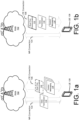
- FIGs. 1a-1b illustrate an example overview of a RAN configured to avoid impact of control messaging on real-time communications.
- a RAN 102 may have both a NR connection 104 and a LTE connection 106 with a UE 108.
- the NR connection 104 may be used for data transmissions 110
- the LTE connection 106 may be used for real-time communications 112, as well as control messaging 114.
- the use of the NR connection 104 for the data transmissions 110 results in a volume of control messaging 114 that impacts the quality of the real-time communications 112.
- data transmissions 110 are switched to the LTE connection 106 when real-time communications 112 are established, resulting in a reduced volume of control messaging 114.
- the RAN 102 may be one of a number of localized access networks of a telecommunication network, the telecommunication network providing connectivity to UEs, such as UEs subscribing to the telecommunication network and visiting UEs, both for communications and for data publishing and consumption.
- Such communications may include voice calling, video calling, text messaging, multimedia messaging, conferencing, etc.
- Data publishing and consumption may include streaming of video, voice, images, etc., browsing of network content, participation in social media, participation in online games, etc.
- UE 108 may connect to RAN 102, which in turn may connect to a remote LTE, computing device, or service via the telecommunication network and, in some examples, one or more other networks.
- the telecommunication network may include a core network and one or more other RANs.
- Example access networks may utilize any Third Generation Partnership Project (3GPP) Standard 3G, 4G, 5G, etc. technology or other 3G, 4G, 5G, etc. technology.
- example access networks may include unlicensed wireless networks, such as WiFi ® or WiMax ® networks, and/or wired access networks.
- An example core network may be a packet-based network and may support legacy, circuit-switched connections.
- the core network may also include 3GPP Internet Protocol (IP) Multimedia Subsystem (IMS) technology in support of packet-based communications.
- IP Internet Protocol
- IMS Multimedia Subsystem
- Such 3GPP IMS technology may support communications made using the Session Initiation Protocol (SIP).
- SIP Session Initiation Protocol
- the RAN 102 may include a cell tower; one or more base station units coupled to the cell tower, offering connectivity to cell areas of varying sizes, and using various technology types; one or more power sources; and mechanisms for connecting the base station unit(s) to the core network.
- the RAN 102 may include at least an eNode B (eNB) base station for supporting the LTE connection 106 and a gNode B (gNB) base station for supporting the NR connection 104.
- the eNB and gNB may be implemented in a single computing device or through multiple computing devices and may represent an ENDC (E-UTRAN (Evolved UMTS (Universal Mobile Telecommunications Service) Terrestrial Radio Access Network) New Radio - Dual Connectivity) solution.
- the ENDC solution enables the LTE 108 to connect to the eNB through the LTE connection 106, with the eNB serving as a master node, and to the gNB through the NR connection 104, with the gNB serving as a secondary node.
- ENDC solutions are specified in greater detail by 3GPP standards.
- Each base station may also include a scheduler to allocate channels of frequency bands or time slots for frequency bands, as well as a PDCP (Packet Data Convergence Protocol) flow controller.
- the computing device implementing the gNB may include at least a NR transceiver to support the NR connection 104
- the computing device implementing the eNB may include at least a LTE transceiver to support the LTE connection 106.
- An example computing device configured to implement a eNB and gNB of the RAN 102 is illustrated in FIG. 5 and described further herein with reference to that figure.
- the UE 108 may be any sort of wireless communication device, such as a cellular handset, a tablet computer, a personal computer, a desktop computing device, a media player, etc.
- the UE 108 may include one or more radios for wireless communication and/or wired port(s), may include both input and output components, and may have a Subscriber Identity Module (SIM) or other technology that securely stores identity information for the UE 108.
- SIM Subscriber Identity Module
- the radio may be capable of communicating with both the eNB and gNB of the RAN 102 through the LTE connection 106 and the NR connection 104, respectively.
- one radio of the LTE 108 may be used to communicate with the gNB over the NR connection 104, and the other radio of the UE 108 may be used to communicate with the eNB over the LTE connection 106.
- the UE 108 may engage in data transmissions 110, real-time communications 112, and control messaging 114.
- the LTE connection 106 may involve multiple frequency bands and multiple bearers, with separate bearers for real-time communications 112 and for data transmissions (such as, e.g., data transmissions 110, as shown in FIG. 1b ).
- Control messaging 114 may be transmitted using either bearer.
- the NR connection 104 could similarly support multiple bearers, NR connections, such as NR connection 104, are often used only for data transmissions, such as data transmission 110. This limited use reflects the characteristics associated with the spectrum utilized for NR connections, such as shorter range and greater susceptibility to interference.
- the data transmission 110 may be part of any data transmission session and may involve any one or more of streaming of video, voice, images, etc., browsing of network content, participation in social media, or participation in online games, among others.
- the real-time communications 112 may be part of any data service, such as voice over LTE (VoLTE) or video over LTE (ViLTE).
- Control messaging 114 may include RRC reconfiguration messages for establishing or releasing the radio bearer for the NR connection 104.
- the use of the NR connection 104 for data transmission 110 results in a higher volume of control messaging 114.
- the higher volume of control messaging 114 may reflect difficulties that the LTE 108 experiences with the NR connection 104, such as frequent loss of connectivity, packet loss, etc.
- the UE 108 may send control messages 114, such as RRC reconfiguration messages, via the LTE connection 106 requesting that the RAN 102 establish or release the bearer corresponding to the NR connection 104.
- control messages 114 in turn impact the quality of the real-time communication 112 supported by the LTE connection 106
- FIG. 1b illustrates a RAN 102 configured to reduce the control messaging 114 transmitted over the LTE connection 106 during real-time communications 112.
- the RAN 102 utilizes the LTE connection 106 for the data transmission 110.
- the RAN 102 utilizes the LTE connection 106 to service new requests for data transmission that are received when a real-time communication 112 is established.
- the RAN 102 performs at least one of ceasing to allocate traffic to downlink for the NR connection 104 or reconfiguring the data transmission 110 to utilize the LTE connection 106.
- the RAN 102 may first determine if A) a real-time communication 112 is currently established and B) the NR connection 104 is absent or idle. If the answer to A) and B) is "yes," the RAN 102 may utilize the LTE connection 106 to support the data transmission 110. This may involve establishing a data bearer for the LTE connection 106 or utilizing an existing bearer. If the answer to either A) or B) is "no", the RAN 102 may utilize the NR connection 104 to support the data transmission 110.
- the RAN 102 may determine if a data transmission 110 over the NR connection 110 is active. If the data transmission 110 over the NR connection 104 is active, a PDCP flow controller of the RAN 102 may cease allocating traffic to the NR connection 104 for downlink and, following that, the RAN 102 may establish the real-time communication 112 over the LTE connection 106. As a result of ceasing to allocate traffic to the NR connection 104, the NR connection 104 will eventually be released by the RAN 102. Alternatively, before that release happens, the RAN 102 may reconfigure the data transmission 110 to utilize the LTE connection 106.
- the RAN 102 may determine if a data transmission buffer size is less than a threshold. If less than the threshold, the RAN 102 may perform the ceasing, as described above. If the data transmission buffer size meets or exceeds the threshold, the RAN 102 may instead reconfigure the data transmission 110 to utilize the LTE connection 106. While reconfiguring the data transmission 110 to utilize the LTE connection 106 may involve control messaging 114, the result of the change - data transmission 110 over the LTE connection 106 - will mean a lower overall volume of control messaging, as the NR connection 104 will no longer be supporting the data transmission 110.
- the RAN 102 may determine if a data transmission 110 over a NR connection is active and, if active, the RAN may reconfigure the data transmission 110 to utilize the LTE connection 106. This reconfiguration may happen right after making the determination to ensure a minimum of control messaging 114. Following that, the RAN 102 may establish the real-time communication 112 over the LTE connection 106.
- FIGs. 2-4 illustrate example processes. These processes are illustrated as logical flow graphs, each operation of which represents a sequence of operations that can be implemented in hardware, software, or a combination thereof.
- the operations represent computer-executable instructions stored on one or more computer-readable storage media that, when executed by one or more processors, perform the recited operations.
- computer-executable instructions include routines, programs, objects, components, data structures, and the like that perform particular functions or implement particular abstract data types.
- the order in which the operations are described is not intended to be construed as a limitation, and any number of the described operations can be combined in any order and/or in parallel to implement the processes.
- FIG. 2 illustrates a flow chart of an example process for handling a request for a data transmission received during an established real-time communication session.
- a RAN may receive a request for a data transmission session from, e.g., a UE.
- the RAN may determine whether a real-time communication session is established, and at 206, the RAN may further determine whether a NR connection is absent or idle.
- the real-time communication session is one of a VoLTE communication session or a ViLTE communication session and is supported by an LTE connection.
- the RAN may utilize an LTE connection to service the request.
- the RAN may utilize the NR connection to service the request or establish the NR connection to service the request.
- the RAN may reconfigure the data transmission session to utilize the NR connection or may continue to utilize the LTE connection for the data transmission session.
- FIG. 3 illustrates a flow chart of one example process for handling a request for a real-time communication received while a data transmission session is active.
- a RAN may receive a request to for a real-time communication session from, e.g., a UE.
- the RAN may determine whether a data transmission session over the NR connection is active. If active, the RAN may proceed to further determine, at 306, whether a data transmission buffer size is less than a threshold. If the data transmission buffer size is less than a threshold, the RAN ceases, at 308, to allocate traffic to the NR connection for downlink. At 310, after performing the ceasing for a threshold amount of time, the RAN releases the NR connection.
- the RAN reconfigures the data transmission session to send data over the LTE connection.
- the reconfiguring at 312 may also be performed following the ceasing at 308.
- the RAN may establish the real-time communication session after performing the reconfiguring at 312 or after the ceasing at 308. Also, when the RAN determines at 304 that the data transmission session over the NR connection is not active, the RAN may proceed to establish the real-time communication session at 314.
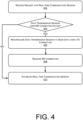
- FIG. 4 illustrates a flow chart of another example process for handling a request for a real-time communication received while a data transmission session is active.
- a RAN may receive a request to for a real-time communication session from, e.g., a UE.
- the RAN may determine whether a data transmission session over the NR connection is active.
- the RAN may reconfigure the data transmission session to send data over the LTE connection. Such reconfiguration may happen a single time upon completion of the determining at 404. Further, at 408, after reconfiguring the data transmission session to send data over the LTE connection, the RAN may release the NR connection.
- the RAN may establish the real-time communication session after performing the reconfiguring. Also, when the RAN determines at 404 that the data transmission session over the NR connection is not active, the RAN may proceed to establish the real-time communication session at 410.
- FIG. 5 illustrates an example architecture of a computing device of a RAN.
- the RAN may be an example of a RAN 102, which is described further herein.
- the computing device 500 can have a system memory 502.
- the system memory 302 can store a scheduler 504, a PDCP flow controller 506, threshold and/or configuration 508, and/or other modules and data 510.
- the computing device 500 can also include processor(s) 512, removable storage 514, non-removable storage 516, input device(s) 518, output device(s) 520, an NR transceiver 522, and an LTE transceiver 524.
- system memory 502 can be volatile (such as random-access memory (RAM)), non-volatile (such as read-only memory (ROM), flash memory, etc.), or some combination of the two.
- Example system memory 502 can include one or more of RAM, ROM, electronically erasable programmable ROM (EEPROM), a Flash Memory, a hard drive, a memory card, an optical storage, a magnetic cassette, a magnetic tape, a magnetic disk storage or another magnetic storage devices, or any other medium.
- scheduler 504 Examples of the scheduler 504, the PDCP flow controller 506, and the threshold and/or configuration 508 are described above in detail with reference to FIG. 1 . As noted, these components may be involved in allocating data, allocating time slots, establishing and releasing radio bearers, among other functions.
- the other modules and data 510 can be utilized by the computing device 500 to perform or enable performing any action taken by the computing device 500.
- the other modules and data 510 can include a platform and applications, and data utilized by the platform and applications.
- the processor(s) 512 can be a central processing unit (CPU), a graphics processing unit (GPU), both CPU and GPU, or other processing unit or component known in the art.
- CPU central processing unit
- GPU graphics processing unit
- both CPU and GPU or other processing unit or component known in the art.
- the computing device 500 can also include additional data storage devices (removable and/or non-removable) such as, for example, magnetic disks, optical disks, or tape. Such additional storage is illustrated in FIG. 5 by removable storage 514 and non-removable storage 516.
- Non-transitory computer-readable media may include volatile and nonvolatile, removable and non-removable media implemented in any method or technology for storage of information, such as computer readable instructions, data structures, program modules, or other data.
- System memory 502, removable storage 514 and non-removable storage 516 are all examples of non-transitory computer-readable media.
- Non-transitory computer-readable media include, but are not limited to, RAM, ROM, EEPROM, flash memory or other memory technology, compact disc - ROM (CD-ROM), digital versatile discs (DVD) or other optical storage, magnetic cassettes, magnetic tape, magnetic disk storage or other magnetic storage devices, or any other medium which can be used to store the desired information and which can be accessed by the computing device 500. Any such computer-readable storage media can be part of the computing device 500. In various examples, any or all of system memory 502, removable storage 514, and non-removable storage 516, store programming instructions which, when executed, implement some or all of the above-described operations of the computing device 500.
- the computing device 500 can also have input device(s) 518, such as a keyboard, a mouse, a touch-sensitive display, voice input device, etc., and/or output device(s) 520 such as a display, speakers, a printer, etc. These devices are well known in the art and need not be discussed at length here.
- input device(s) 518 such as a keyboard, a mouse, a touch-sensitive display, voice input device, etc.
- output device(s) 520 such as a display, speakers, a printer, etc.
- the computing device 500 can also include one or more transceiver, such as the NR transceiver 522 and the LTE transceiver 524 to facilitate communication with other devices, such as one or more UEs.
- transceiver such as the NR transceiver 522 and the LTE transceiver 524 to facilitate communication with other devices, such as one or more UEs.
Landscapes
- Chemical & Material Sciences (AREA)
- Organic Chemistry (AREA)
- Engineering & Computer Science (AREA)
- Computer Networks & Wireless Communication (AREA)
- Signal Processing (AREA)
- Chemical Kinetics & Catalysis (AREA)
- Mobile Radio Communication Systems (AREA)
Abstract
Description
- Concurrent transmission of voice, video, or other real-time communications along with control messaging, such as radio resource control (RRC) reconfiguration messages can negatively impact the quality of the voice, video, or other real-time communications. When a radio access network (RAN) provides, for example, voice or video services over a Long-Term Evolution (LTE) connection and provides data transmission separately over a New Radio (NR) connection, the characteristics of NR connections may lead to increased RRC reconfiguration messaging. Networks offering LTE connections are often referred to as fourth generation (4G) networks, and network offering NR connections are often referred to as fifth generation (5G) networks.
- Accordingly there is provided a radio access network, method, and non-transitory computer-readable medium as detailed in the claims that follow.
- The detailed description is set forth with reference to the accompanying figures. In the figures, the left-most digit(s) of a reference number identifies the figure in which the reference number first appears. The use of the same reference numbers in different figures indicates similar or identical items or features.
-
FIGs. 1a-1b illustrate an example overview of a RAN configured to avoid impact of control messaging on real-time communications. -
FIG. 2 illustrates a flow chart of an example process for handling a request for a data transmission received during an established real-time communication session. -
FIG. 3 illustrates a flow chart of one example process for handling a request for a real-time communication received while a data transmission session is active. -
FIG. 4 illustrates a flow chart of another example process for handling a request for a real-time communication received while a data transmission session is active. -
FIG. 5 illustrates an example architecture of a computing device of a RAN. - When a RAN receives a request for a data transmission and a real-time communication session over an LTE connection is already established, the RAN utilizes the LTE connection, not a NR connection, for the data transmission. Additionally, when a request for a further real-time communication is received and there is an active data transmission session over the NR connection, the RAN may cease allocating traffic to the NR connection for downlink. Also, or instead, the RAN may reconfigure the data transmission session to send data over the LTE connection.
- In various implementations, the RAN may perform a series of operations responsive to receiving a request for a data transmission session. First, upon receiving the request for a data transmission session, the RAN may determine if A) a real-time communication session is established and B) a NR connection between the RAN and the request-making user equipment (LTE) is absent or idle. If the answer to A) and B) is "yes," the RAN may utilize a LTE connection between the RAN and UE to support the data transmission session. If the answer to either A) or B) is "no", the RAN may utilize the NR connection to support the data transmission session.
- The RAN may also be configured to take one of two different approaches to handling a request for a real-time communication. Under a first approach, upon receiving a request for a real-time communication session, the RAN may determine if a data transmission session over a NR connection is active. If the data transmission session over the NR connection is active, the RAN may cease allocating traffic to the NR connection for downlink and, following that, may establish the real-time communication session over a LTE connection. As a result of ceasing to allocate traffic to the NR connection, the NR connection will eventually be released. Alternatively, before that release happens, the RAN may reconfigure the data transmission session to utilize the LTE connection. Further, in some implementations, after determining that the data transmission session is active, the RAN may determine if a data transmission buffer size is less than a threshold. If less than the threshold, the RAN may perform the ceasing, as described above. If the data transmission buffer size meets or exceeds the threshold, the RAN may instead reconfigure the data transmission session to utilize the LTE connection.
- Under a second of the two different approaches, upon receiving the request for a real-time communication session, the RAN may determine if a data transmission session over a NR connection is active. If the data transmission session over the NR connection is active, the RAN may reconfigure the data transmission session to utilize a LTE connection and, following that, may establish the real-time communication session over the LTE connection.
-
FIGs. 1a-1b illustrate an example overview of a RAN configured to avoid impact of control messaging on real-time communications. As illustrated inFIG. 1a , a RAN 102 may have both aNR connection 104 and aLTE connection 106 with a UE 108. TheNR connection 104 may be used fordata transmissions 110, and theLTE connection 106 may be used for real-time communications 112, as well ascontrol messaging 114. The use of theNR connection 104 for thedata transmissions 110 results in a volume ofcontrol messaging 114 that impacts the quality of the real-time communications 112. InFIG. 1b ,data transmissions 110 are switched to theLTE connection 106 when real-time communications 112 are established, resulting in a reduced volume ofcontrol messaging 114. - In various implementations, the RAN 102 may be one of a number of localized access networks of a telecommunication network, the telecommunication network providing connectivity to UEs, such as UEs subscribing to the telecommunication network and visiting UEs, both for communications and for data publishing and consumption. Such communications may include voice calling, video calling, text messaging, multimedia messaging, conferencing, etc. Data publishing and consumption may include streaming of video, voice, images, etc., browsing of network content, participation in social media, participation in online games, etc. UE 108 may connect to RAN 102, which in turn may connect to a remote LTE, computing device, or service via the telecommunication network and, in some examples, one or more other networks.
- In addition to the RAN 102, the telecommunication network may include a core network and one or more other RANs. Example access networks may utilize any Third Generation Partnership Project (3GPP) Standard 3G, 4G, 5G, etc. technology or other 3G, 4G, 5G, etc. technology. Alternatively or additionally, example access networks may include unlicensed wireless networks, such as WiFi® or WiMax® networks, and/or wired access networks. An example core network may be a packet-based network and may support legacy, circuit-switched connections. The core network may also include 3GPP Internet Protocol (IP) Multimedia Subsystem (IMS) technology in support of packet-based communications. Such 3GPP IMS technology may support communications made using the Session Initiation Protocol (SIP).
- As illustrated in
FIGs. 1a-1b , the RAN 102 may include a cell tower; one or more base station units coupled to the cell tower, offering connectivity to cell areas of varying sizes, and using various technology types; one or more power sources; and mechanisms for connecting the base station unit(s) to the core network. - For example, the RAN 102 may include at least an eNode B (eNB) base station for supporting the
LTE connection 106 and a gNode B (gNB) base station for supporting theNR connection 104. The eNB and gNB may be implemented in a single computing device or through multiple computing devices and may represent an ENDC (E-UTRAN (Evolved UMTS (Universal Mobile Telecommunications Service) Terrestrial Radio Access Network) New Radio - Dual Connectivity) solution. The ENDC solution enables theLTE 108 to connect to the eNB through theLTE connection 106, with the eNB serving as a master node, and to the gNB through theNR connection 104, with the gNB serving as a secondary node. ENDC solutions are specified in greater detail by 3GPP standards. - Each base station may also include a scheduler to allocate channels of frequency bands or time slots for frequency bands, as well as a PDCP (Packet Data Convergence Protocol) flow controller. Further, the computing device implementing the gNB may include at least a NR transceiver to support the
NR connection 104, and the computing device implementing the eNB may include at least a LTE transceiver to support theLTE connection 106. An example computing device configured to implement a eNB and gNB of theRAN 102 is illustrated inFIG. 5 and described further herein with reference to that figure. - In various implementations, the UE 108 may be any sort of wireless communication device, such as a cellular handset, a tablet computer, a personal computer, a desktop computing device, a media player, etc. The UE 108 may include one or more radios for wireless communication and/or wired port(s), may include both input and output components, and may have a Subscriber Identity Module (SIM) or other technology that securely stores identity information for the UE 108. In a single radio implementation, the radio may be capable of communicating with both the eNB and gNB of the
RAN 102 through theLTE connection 106 and theNR connection 104, respectively. In dual radio implementations, one radio of theLTE 108 may be used to communicate with the gNB over theNR connection 104, and the other radio of theUE 108 may be used to communicate with the eNB over theLTE connection 106. Via the radio(s), its platform, and one or more applications, theUE 108 may engage indata transmissions 110, real-time communications 112, andcontrol messaging 114. - In some implementations, the
LTE connection 106 may involve multiple frequency bands and multiple bearers, with separate bearers for real-time communications 112 and for data transmissions (such as, e.g.,data transmissions 110, as shown inFIG. 1b ).Control messaging 114 may be transmitted using either bearer. While theNR connection 104 could similarly support multiple bearers, NR connections, such asNR connection 104, are often used only for data transmissions, such asdata transmission 110. This limited use reflects the characteristics associated with the spectrum utilized for NR connections, such as shorter range and greater susceptibility to interference. - As noted herein, the
data transmission 110 may be part of any data transmission session and may involve any one or more of streaming of video, voice, images, etc., browsing of network content, participation in social media, or participation in online games, among others. The real-time communications 112 may be part of any data service, such as voice over LTE (VoLTE) or video over LTE (ViLTE).Control messaging 114, as mentioned, may include RRC reconfiguration messages for establishing or releasing the radio bearer for theNR connection 104. - In various implementations, as illustrated in
FIG. 1a , the use of theNR connection 104 fordata transmission 110 results in a higher volume ofcontrol messaging 114. The higher volume ofcontrol messaging 114 may reflect difficulties that theLTE 108 experiences with theNR connection 104, such as frequent loss of connectivity, packet loss, etc. Responsive to these conditions, theUE 108 may sendcontrol messages 114, such as RRC reconfiguration messages, via theLTE connection 106 requesting that theRAN 102 establish or release the bearer corresponding to theNR connection 104. Thesecontrol messages 114 in turn impact the quality of the real-time communication 112 supported by theLTE connection 106 -
FIG. 1b , in contrast, illustrates aRAN 102 configured to reduce thecontrol messaging 114 transmitted over theLTE connection 106 during real-time communications 112. To reduce the control messaging 224, theRAN 102 utilizes theLTE connection 106 for thedata transmission 110. TheRAN 102 utilizes theLTE connection 106 to service new requests for data transmission that are received when a real-time communication 112 is established. And when adata transmission 110 over theNR connection 104 is active and a request for real-time communication 112 is received, theRAN 102 performs at least one of ceasing to allocate traffic to downlink for theNR connection 104 or reconfiguring thedata transmission 110 to utilize theLTE connection 106. - For example, upon receiving a data transmission request from a
LTE 108, theRAN 102 may first determine if A) a real-time communication 112 is currently established and B) theNR connection 104 is absent or idle. If the answer to A) and B) is "yes," theRAN 102 may utilize theLTE connection 106 to support thedata transmission 110. This may involve establishing a data bearer for theLTE connection 106 or utilizing an existing bearer. If the answer to either A) or B) is "no", theRAN 102 may utilize theNR connection 104 to support thedata transmission 110. - Further, upon receiving a real-time communication request from the
UE 108, theRAN 102 may determine if adata transmission 110 over theNR connection 110 is active. If thedata transmission 110 over theNR connection 104 is active, a PDCP flow controller of theRAN 102 may cease allocating traffic to theNR connection 104 for downlink and, following that, theRAN 102 may establish the real-time communication 112 over theLTE connection 106. As a result of ceasing to allocate traffic to theNR connection 104, theNR connection 104 will eventually be released by theRAN 102. Alternatively, before that release happens, theRAN 102 may reconfigure thedata transmission 110 to utilize theLTE connection 106. Further, in some implementations, after determining that thedata transmission 110 is active, theRAN 102 may determine if a data transmission buffer size is less than a threshold. If less than the threshold, theRAN 102 may perform the ceasing, as described above. If the data transmission buffer size meets or exceeds the threshold, theRAN 102 may instead reconfigure thedata transmission 110 to utilize theLTE connection 106. While reconfiguring thedata transmission 110 to utilize theLTE connection 106 may involvecontrol messaging 114, the result of the change -data transmission 110 over the LTE connection 106 - will mean a lower overall volume of control messaging, as theNR connection 104 will no longer be supporting thedata transmission 110. - Alternatively, upon receiving a request for a real-
time communication 112 from theUE 108, theRAN 102 may determine if adata transmission 110 over a NR connection is active and, if active, the RAN may reconfigure thedata transmission 110 to utilize theLTE connection 106. This reconfiguration may happen right after making the determination to ensure a minimum ofcontrol messaging 114. Following that, theRAN 102 may establish the real-time communication 112 over theLTE connection 106. -
FIGs. 2-4 illustrate example processes. These processes are illustrated as logical flow graphs, each operation of which represents a sequence of operations that can be implemented in hardware, software, or a combination thereof. In the context of software, the operations represent computer-executable instructions stored on one or more computer-readable storage media that, when executed by one or more processors, perform the recited operations. Generally, computer-executable instructions include routines, programs, objects, components, data structures, and the like that perform particular functions or implement particular abstract data types. The order in which the operations are described is not intended to be construed as a limitation, and any number of the described operations can be combined in any order and/or in parallel to implement the processes. -
FIG. 2 illustrates a flow chart of an example process for handling a request for a data transmission received during an established real-time communication session. As illustrated at 202, a RAN may receive a request for a data transmission session from, e.g., a UE. - At 204, the RAN may determine whether a real-time communication session is established, and at 206, the RAN may further determine whether a NR connection is absent or idle. In some examples, the real-time communication session is one of a VoLTE communication session or a ViLTE communication session and is supported by an LTE connection.
- At 208, when the real-time communication session is established and the NR connection is absent or idle, the RAN may utilize an LTE connection to service the request. Alternatively, at 210, when the real-time communication session is not established or the NR connection is active, the RAN may utilize the NR connection to service the request or establish the NR connection to service the request.
- At 212, following completion of the real-time communication session, the RAN may reconfigure the data transmission session to utilize the NR connection or may continue to utilize the LTE connection for the data transmission session.
-
FIG. 3 illustrates a flow chart of one example process for handling a request for a real-time communication received while a data transmission session is active. As illustrated, at 302, a RAN may receive a request to for a real-time communication session from, e.g., a UE. - At 304, upon receiving the request, the RAN may determine whether a data transmission session over the NR connection is active. If active, the RAN may proceed to further determine, at 306, whether a data transmission buffer size is less than a threshold. If the data transmission buffer size is less than a threshold, the RAN ceases, at 308, to allocate traffic to the NR connection for downlink. At 310, after performing the ceasing for a threshold amount of time, the RAN releases the NR connection.
- At 312, if the data transmission buffer size meets or exceeds a threshold, the RAN reconfigures the data transmission session to send data over the LTE connection. In some examples, the reconfiguring at 312 may also be performed following the ceasing at 308.
- At 314, the RAN may establish the real-time communication session after performing the reconfiguring at 312 or after the ceasing at 308. Also, when the RAN determines at 304 that the data transmission session over the NR connection is not active, the RAN may proceed to establish the real-time communication session at 314.
-
FIG. 4 illustrates a flow chart of another example process for handling a request for a real-time communication received while a data transmission session is active. As illustrated, at 402, a RAN may receive a request to for a real-time communication session from, e.g., a UE. - At 404, upon receiving the request, the RAN may determine whether a data transmission session over the NR connection is active.
- At 406, upon determining that the data transmission session over the NR connection is active, the RAN may reconfigure the data transmission session to send data over the LTE connection. Such reconfiguration may happen a single time upon completion of the determining at 404. Further, at 408, after reconfiguring the data transmission session to send data over the LTE connection, the RAN may release the NR connection.
- At 410, the RAN may establish the real-time communication session after performing the reconfiguring. Also, when the RAN determines at 404 that the data transmission session over the NR connection is not active, the RAN may proceed to establish the real-time communication session at 410.
-
FIG. 5 illustrates an example architecture of a computing device of a RAN. The RAN may be an example of aRAN 102, which is described further herein. Thecomputing device 500 can have asystem memory 502. The system memory 302 can store ascheduler 504, aPDCP flow controller 506, threshold and/or configuration 508, and/or other modules anddata 510. Thecomputing device 500 can also include processor(s) 512,removable storage 514,non-removable storage 516, input device(s) 518, output device(s) 520, anNR transceiver 522, and anLTE transceiver 524. - In various examples,
system memory 502 can be volatile (such as random-access memory (RAM)), non-volatile (such as read-only memory (ROM), flash memory, etc.), or some combination of the two.Example system memory 502 can include one or more of RAM, ROM, electronically erasable programmable ROM (EEPROM), a Flash Memory, a hard drive, a memory card, an optical storage, a magnetic cassette, a magnetic tape, a magnetic disk storage or another magnetic storage devices, or any other medium. - Examples of the
scheduler 504, thePDCP flow controller 506, and the threshold and/or configuration 508 are described above in detail with reference toFIG. 1 . As noted, these components may be involved in allocating data, allocating time slots, establishing and releasing radio bearers, among other functions. - The other modules and
data 510 can be utilized by thecomputing device 500 to perform or enable performing any action taken by thecomputing device 500. The other modules anddata 510 can include a platform and applications, and data utilized by the platform and applications. - In some embodiments, the processor(s) 512 can be a central processing unit (CPU), a graphics processing unit (GPU), both CPU and GPU, or other processing unit or component known in the art.
- The
computing device 500 can also include additional data storage devices (removable and/or non-removable) such as, for example, magnetic disks, optical disks, or tape. Such additional storage is illustrated inFIG. 5 byremovable storage 514 andnon-removable storage 516. Non-transitory computer-readable media may include volatile and nonvolatile, removable and non-removable media implemented in any method or technology for storage of information, such as computer readable instructions, data structures, program modules, or other data.System memory 502,removable storage 514 andnon-removable storage 516 are all examples of non-transitory computer-readable media. Non-transitory computer-readable media include, but are not limited to, RAM, ROM, EEPROM, flash memory or other memory technology, compact disc - ROM (CD-ROM), digital versatile discs (DVD) or other optical storage, magnetic cassettes, magnetic tape, magnetic disk storage or other magnetic storage devices, or any other medium which can be used to store the desired information and which can be accessed by thecomputing device 500. Any such computer-readable storage media can be part of thecomputing device 500. In various examples, any or all ofsystem memory 502,removable storage 514, andnon-removable storage 516, store programming instructions which, when executed, implement some or all of the above-described operations of thecomputing device 500. - In some examples, the
computing device 500 can also have input device(s) 518, such as a keyboard, a mouse, a touch-sensitive display, voice input device, etc., and/or output device(s) 520 such as a display, speakers, a printer, etc. These devices are well known in the art and need not be discussed at length here. - The
computing device 500 can also include one or more transceiver, such as theNR transceiver 522 and theLTE transceiver 524 to facilitate communication with other devices, such as one or more UEs. - Although the subject matter has been described in language specific to structural features and/or methodological acts, it is to be understood that the subject matter is not necessarily limited to the specific features or acts described above. Rather, the specific features and acts described above are disclosed as example embodiments.
- The present teaching may also extend to the features of one or more of the following numbered clauses:
-
- 1. A radio access network, comprising:
- a processor;
- a Long-Term Evolution (LTE) transceiver coupled to the processor and configured to send and receive at least real-time communications and data transmissions;
- a new radio (NR) transceiver coupled to the process and configured to send and receive at least data transmissions; and
- memory coupled to the processor and storing instructions that, when executed by the processor, cause the radio access network to perform operations including:
- receiving a first request for a first data transmission session;
- upon receiving the first request, determining whether a first real-time communication session is established and whether a NR connection is absent or idle;
- when the first real-time communication session is established and the NR connection is absent or idle, utilizing an LTE connection to service the first request;
- receiving a second request to for a second real-time communication session;
- upon receiving the second request, determining whether a second data transmission session over the NR connection is active;
- when the second data transmission session is active, performing at least one of:
- ceasing to allocate traffic to the NR connection for downlink, or
- reconfiguring the second data transmission session to send data over the LTE connection.
- 2. The radio access network of clause 1, wherein the first real-time communication session or the second real-time communication session is one of a voice over LTE (VoLTE) communication session or a video over LTE (ViLTE) communication session.
- 3. The radio access network of clause 1, wherein the first real-time communication session or the second real-time communication session is supported by the LTE connection.
- 4. The radio access network of clause 1, wherein the operations further include, when the first real-time communication session is not established, utilizing the NR connection to service the first request or establishing the NR connection to service the first request.
- 5. The radio access network of clause 1, wherein the operations further include, following completion of the first real-time communication session, reconfiguring the first data transmission session to utilize the NR connection.
- 6. The radio access network of clause 1, wherein the radio access network performs the ceasing if a data transmission buffer size is less than a threshold and performs the reconfiguring if the data transmission buffer size meets or exceeds the threshold.
- 7. The radio access network of clause 1, wherein performing the ceasing includes performing the ceasing for a threshold amount of time to cause release of the NR connection.
- 8. The radio access network of clause 1, wherein performing at least one of the ceasing and the reconfiguring comprises performing the reconfiguring after performing the ceasing for a threshold amount of time.
- 9. The radio access network of clause 1, wherein performing the reconfiguring includes:
- performing the reconfiguring a single time upon determining whether the second data transmission session over the NR connection is active; and
- releasing the NR connection.
- 10. The radio access network of clause 1, wherein the operations further include establishing the second real-time communication session after performing the reconfiguring or the ceasing.
- 11. A method comprising:
- receiving, by a radio access network (RAN), a request to for a real-time communication session;
- upon receiving the request, determining, by the RAN, whether a data transmission session over a new radio (NR) connection is active; and
- when the second data transmission session is active, ceasing, by the RAN, to allocate traffic to the NR connection for downlink.
- 12. The method of clause 11, wherein the ceasing includes performing the ceasing conditionally based on whether a data transmission buffer size is less than a threshold, and the method further comprises, if the data transmission buffer size meets or exceeds the threshold, reconfiguring the second data transmission session to send data over a Long-Term Evolution (LTE) connection.
- 13. The method of clause 11, wherein the ceasing includes ceasing for a threshold amount of time to cause release of the NR connection.
- 14. The method of clause 11, further comprising, after ceasing to allocate traffic to the NR connection for downlink, reconfiguring the second data transmission session to send data over a Long-Term Evolution (LTE) connection.
- 15. The method of clause 11, further comprising establishing the real-time communication session after ceasing to allocate traffic to the NR connection for downlink.
- 16. A non-transitory computer-readable medium having programming instructions stored thereon that, when executed by a computing device of a radio access network cause the radio access network to perform operations comprising:
- receiving a first request for a first data transmission session;
- upon receiving the first request, determining whether a first real-time communication session is established and whether a new radio (NR) connection is absent or idle;
- when the first real-time communication session is established and the NR connection is absent or idle, utilizing a Long-Term Evolution (LTE) connection to service the first request;
- receiving a second request to for a second real-time communication session;
- upon receiving the second request, determining whether a second data transmission session over the NR connection is active;
- when the second data transmission session is active, reconfiguring the second data transmission session to send data over the LTE connection.
- 17. The non-transitory computer-readable medium of clause 16, wherein the reconfiguring includes:
- reconfiguring the second data transmission session a single time upon determining whether the second data transmission session over the NR connection is active; and
- releasing the NR connection.
- 18. The non-transitory computer-readable medium of clause 16, wherein the operations further comprise, following completion of the first real-time communication session, reconfiguring the first data transmission session to utilize the NR connection.
- 19. The non-transitory computer-readable medium of clause 16, wherein the operations further comprise, when the first real-time communication session is not established, utilizing the NR connection to service the first request or establishing the NR connection to service the first request.
- 20. The non-transitory computer-readable medium of clause 16, wherein the operations further comprise establishing the second real-time communication session after performing the reconfiguring.
Claims (15)
- A radio access network, comprising:a processor;a Long-Term Evolution, LTE, transceiver coupled to the processor and configured to send and receive at least real-time communications and data transmissions;a new radio, NR, transceiver coupled to the processor and configured to send and receive at least data transmissions; andmemory coupled to the processor and storing instructions that, when executed by the processor, cause the radio access network to perform operations comprising:receiving (302) a request for a real-time communication session;upon receiving the request, determining (304) whether a data transmission session over a NR connection is active;when the data transmission session is active, ceasing (306) to allocate traffic to the NR connection for downlink.
- The radio access network of claim 1, wherein ceasing to allocate the traffic to the NR connection for the downlink comprises ceasing to allocate the traffic to the NR connection for the downlink for a threshold amount of time,
optionally wherein the threshold amount of time comprises an amount of time sufficient to cause a release of the NR connection. - The radio access network of any preceding claim, wherein the operations further comprise reconfiguring the data transmission session to send data over an LTE connection after ceasing to allocate traffic to the NR connection for downlink.
- The radio access network of claim 1 or 2, wherein the operations further comprise establishing the real-time communication session after ceasing to allocate traffic to the NR connection for downlink,
optionally wherein the operations further comprise reconfiguring the data transmission session to utilize the NR connection after completing the real-time communication session. - The radio access network of any preceding claim, wherein the operations further comprise, when the data transmission session is not active, utilizing the NR connection to service the request for the real-time communication session.
- A method comprising:receiving, by a radio access network, RAN, a request to for a real-time communication session;upon receiving the request, determining, by the RAN, whether a data transmission session over a new radio, NR, connection is active; andwhen the data transmission session is active, ceasing, by the RAN, to allocate traffic to the NR connection for downlink.
- The method of claim 6, wherein the real-time communication session is one of a voice over Long-Term Evolution, VoLTE, communication session or a video over Long-Term Evolution, ViLTE, communication session,
optionally the method further comprising utilizing a Long-Term Evolution, LTE, connection to service the request for the real-time communication session. - The method of any one of claims 6 to 7, wherein ceasing to allocate the traffic to the NR connection for the downlink comprises ceasing to allocate the traffic to the NR connection for the downlink for a threshold amount of time,
optionally the method further comprising reconfiguring the data transmission session to send data over the NR connection after ceasing to allocate the traffic to the NR connection for the downlink for the threshold amount of time. - The method of any one of claims 6 to 8, further comprising releasing the NR connection after ceasing to allocate the traffic to the NR connection for the downlink for a threshold amount of time.
- The method of any one of claims 6 to 9, further comprising when the data transmission session is not active, utilizing the NR connection to service the request for the real-time communication session.
- A non-transitory computer-readable medium having programming instructions stored thereon that, when executed by a computing device of a radio access network, RAN, cause the radio access network to perform operations comprising:receiving, by the RAN, a request to for a real-time communication session;upon receiving the request, determining, by the RAN, whether a data transmission session over a new radio, NR, connection is active; andwhen the data transmission session is active, ceasing, by the RAN, to allocate traffic to the NR connection for downlink.
- The non-transitory computer-readable medium of claim 11, wherein the operations further comprise, when the data transmission session is not active, utilizing a Long-Term Evolution, LTE, connection to service the request for the real-time communication session.
- The non-transitory computer-readable medium of claim 11 or 12, wherein the operations further comprise reconfiguring the data transmission session to utilize the NR connection after completing the real-time communication session.
- The non-transitory computer-readable medium of any one of claims 11 to 13, wherein ceasing to allocate the traffic to the NR connection for the downlink comprises ceasing to allocate the traffic to the NR connection for the downlink for a threshold amount of time.
- The non-transitory computer-readable medium of any one of claims 11 to 14, wherein the operations further comprise reconfiguring the data transmission session to send data over an LTE connection after ceasing to allocate traffic to the NR connection for downlink,
optionally wherein the operations further comprise releasing the NR connection and establishing the real-time communication session.
Applications Claiming Priority (2)
| Application Number | Priority Date | Filing Date | Title |
|---|---|---|---|
| US16/696,375 US11212859B2 (en) | 2019-11-26 | 2019-11-26 | 5G avoidance during LTE-based real-time communications |
| EP20207838.2A EP3829261B1 (en) | 2019-11-26 | 2020-11-16 | 5g avoidance during lte-based real-time communications |
Related Parent Applications (2)
| Application Number | Title | Priority Date | Filing Date |
|---|---|---|---|
| EP20207838.2A Division EP3829261B1 (en) | 2019-11-26 | 2020-11-16 | 5g avoidance during lte-based real-time communications |
| EP20207838.2A Division-Into EP3829261B1 (en) | 2019-11-26 | 2020-11-16 | 5g avoidance during lte-based real-time communications |
Publications (2)
| Publication Number | Publication Date |
|---|---|
| EP4213579A1 true EP4213579A1 (en) | 2023-07-19 |
| EP4213579B1 EP4213579B1 (en) | 2026-05-13 |
Family
ID=73452098
Family Applications (2)
| Application Number | Title | Priority Date | Filing Date |
|---|---|---|---|
| EP20207838.2A Active EP3829261B1 (en) | 2019-11-26 | 2020-11-16 | 5g avoidance during lte-based real-time communications |
| EP23158160.4A Active EP4213579B1 (en) | 2019-11-26 | 2020-11-16 | 5g avoidance during lte-based real-time communications |
Family Applications Before (1)
| Application Number | Title | Priority Date | Filing Date |
|---|---|---|---|
| EP20207838.2A Active EP3829261B1 (en) | 2019-11-26 | 2020-11-16 | 5g avoidance during lte-based real-time communications |
Country Status (2)
| Country | Link |
|---|---|
| US (3) | US11212859B2 (en) |
| EP (2) | EP3829261B1 (en) |
Families Citing this family (6)
| Publication number | Priority date | Publication date | Assignee | Title |
|---|---|---|---|---|
| CN114208374B (en) * | 2019-07-29 | 2023-12-29 | 高通股份有限公司 | Techniques for cell selection for dual connectivity |
| US11212859B2 (en) | 2019-11-26 | 2021-12-28 | T-Mobile Usa, Inc. | 5G avoidance during LTE-based real-time communications |
| US11477832B2 (en) | 2020-06-11 | 2022-10-18 | T-Mobile Usa, Inc. | Battery management using selective EN-DC enablement |
| US11290914B1 (en) * | 2020-09-14 | 2022-03-29 | T-Mobile Usa, Inc. | Dual connectivity control based on downlink data at a 4G base station |
| US11843983B1 (en) * | 2021-08-06 | 2023-12-12 | T-Mobile Innovations Llc | Re-directing a dual configuration (NSA/SA) UE to standalone 5G NR node |
| US12538162B2 (en) * | 2022-10-12 | 2026-01-27 | T-Mobile Usa, Inc. | Traffic reconfiguration for user throughput |
Citations (3)
| Publication number | Priority date | Publication date | Assignee | Title |
|---|---|---|---|---|
| EP3769565A1 (en) * | 2018-08-21 | 2021-01-27 | Samsung Electronics Co., Ltd. | Method and system for providing 5g services to user equipment in wireless communication network |
| EP3780757A1 (en) * | 2019-08-16 | 2021-02-17 | Apple Inc. | 5g nr voice call eps fallback enhancements |
| EP3782429A1 (en) * | 2018-07-17 | 2021-02-24 | Samsung Electronics Co., Ltd. | Method and system for providing simultaneous voice and data services in en-dc capable user equipment |
Family Cites Families (21)
| Publication number | Priority date | Publication date | Assignee | Title |
|---|---|---|---|---|
| CN111669837B (en) * | 2017-07-07 | 2024-04-02 | 皇家飞利浦有限公司 | Interference coordination method and device, base station and user equipment |
| CN109392042B (en) * | 2017-08-14 | 2021-10-26 | 华为技术有限公司 | Session management method, inter-system interoperation method and network device |
| WO2019071377A1 (en) * | 2017-10-09 | 2019-04-18 | Qualcomm Incorporated | Configuration for legacy voice support in 5g |
| EP3731569B1 (en) * | 2018-01-11 | 2025-02-19 | Ntt Docomo, Inc. | User device |
| CN113573423B (en) * | 2018-05-30 | 2024-01-16 | 华为技术有限公司 | A communication method and device |
| US10681559B2 (en) * | 2018-06-29 | 2020-06-09 | Verizon Patent And Licensing Inc. | Method and system for supporting voice calls in 5G new radio environments |
| US10980074B2 (en) * | 2018-07-03 | 2021-04-13 | Mediatek Inc. | Apparatuses and methods for supporting dual talk of multiple subscriber identities |
| CN110234131A (en) * | 2018-07-28 | 2019-09-13 | 华为技术有限公司 | A kind of communication means and device |
| US10764957B2 (en) * | 2018-08-27 | 2020-09-01 | Samsung Electronics Co., Ltd | Method and UE for optimizing resources of wireless communication network while providing 5G services |
| CN112753247B (en) * | 2018-09-27 | 2024-07-19 | 三星电子株式会社 | Device and method for performing dual connection in wireless communication system |
| US10911995B2 (en) * | 2019-03-15 | 2021-02-02 | Mediatek Inc. | Apparatuses and methods for dual active of multiple subscriber identities |
| US11115877B2 (en) * | 2019-04-01 | 2021-09-07 | T-Mobile Usa, Inc. | Communication fallback in 5G systems and methods |
| US11601880B2 (en) * | 2019-05-01 | 2023-03-07 | Qualcomm Incorporated | Power management for a user equipment in a multi-radio connectivity mode or carrier aggregation mode |
| US11026129B2 (en) * | 2019-05-31 | 2021-06-01 | Verizon Patent And Licensing Inc. | System and method for returning to 5G after fallback |
| US10959147B2 (en) * | 2019-06-28 | 2021-03-23 | T-Mobile Usa, Inc. | Accelerated return to 5G after LTE fall back |
| US12127283B2 (en) * | 2019-07-03 | 2024-10-22 | Samsung Electronics Co., Ltd. | Method and apparatus for optimizing service delivery operating in EN-DC mode |
| US20210022073A1 (en) * | 2019-07-19 | 2021-01-21 | T-Mobile Usa, Inc. | Selecting Among Various Dual Connectivity and Single Connectivity Configurations |
| US11044783B2 (en) * | 2019-07-22 | 2021-06-22 | Qualcomm Incorporated | Data service and voice over long term evolution support in a multi-subscriber identity module system using a single transceiver |
| WO2021013130A1 (en) * | 2019-07-25 | 2021-01-28 | 华为技术有限公司 | Communication method and terminal device |
| US11337119B2 (en) * | 2019-08-07 | 2022-05-17 | Verizon Patent And Licensing Inc. | Next generation to long term evolution (LTE) fallback for voice calls |
| US11212859B2 (en) | 2019-11-26 | 2021-12-28 | T-Mobile Usa, Inc. | 5G avoidance during LTE-based real-time communications |
-
2019
- 2019-11-26 US US16/696,375 patent/US11212859B2/en active Active
-
2020
- 2020-11-16 EP EP20207838.2A patent/EP3829261B1/en active Active
- 2020-11-16 EP EP23158160.4A patent/EP4213579B1/en active Active
-
2021
- 2021-12-22 US US17/559,150 patent/US11702376B2/en active Active
-
2023
- 2023-06-01 US US18/204,532 patent/US12225611B2/en active Active
Patent Citations (3)
| Publication number | Priority date | Publication date | Assignee | Title |
|---|---|---|---|---|
| EP3782429A1 (en) * | 2018-07-17 | 2021-02-24 | Samsung Electronics Co., Ltd. | Method and system for providing simultaneous voice and data services in en-dc capable user equipment |
| EP3769565A1 (en) * | 2018-08-21 | 2021-01-27 | Samsung Electronics Co., Ltd. | Method and system for providing 5g services to user equipment in wireless communication network |
| EP3780757A1 (en) * | 2019-08-16 | 2021-02-17 | Apple Inc. | 5g nr voice call eps fallback enhancements |
Also Published As
| Publication number | Publication date |
|---|---|
| US12225611B2 (en) | 2025-02-11 |
| EP3829261A1 (en) | 2021-06-02 |
| US20210160945A1 (en) | 2021-05-27 |
| US11212859B2 (en) | 2021-12-28 |
| US20230312435A1 (en) | 2023-10-05 |
| EP4213579B1 (en) | 2026-05-13 |
| US20220112143A1 (en) | 2022-04-14 |
| US11702376B2 (en) | 2023-07-18 |
| EP3829261B1 (en) | 2023-06-14 |
Similar Documents
| Publication | Publication Date | Title |
|---|---|---|
| US12225611B2 (en) | 5G avoidance during LTE-based real-time communications | |
| EP3494726B1 (en) | Information indication method and terminal device | |
| EP3316659B1 (en) | Management method and apparatus that support sharing of rf processor by multiple sim cards | |
| US11026274B2 (en) | Session connection establishment method and system, and related device | |
| US11057904B2 (en) | Prioritization of mobile terminating radio resource control connections | |
| EP4193668A1 (en) | Conditional handover with dual connectivity | |
| US10660145B2 (en) | Method and device for indicating network mode | |
| EP3836735B1 (en) | Methods and apparatus for resuming data radio bearer | |
| US20230134762A1 (en) | Apparatus, Method, and Computer Program | |
| US20260067861A1 (en) | Paging message for mobile terminating small data transmission | |
| EP4199597A1 (en) | Communication method and device | |
| CN102246573B (en) | Random access method, enodeb and terminal equipment | |
| EP3562218A1 (en) | Management method and device for discontinuous reception | |
| US9693236B2 (en) | Licensed shared access spectrum allocation | |
| KR20170089097A (en) | Method and Apparatus for Uplink Resource Allocation in a Mobile Communication System | |
| CN111819902B (en) | Random access method and device | |
| US20130148618A1 (en) | Method and apparatus for providing for multiplexed use of a resource on a transmission medium | |
| WO2024230658A1 (en) | Information processing method and apparatus, communication device and readable storage medium | |
| US11134503B2 (en) | Dynamic allocation of transmission slots based on UE information | |
| CN102882588B (en) | Method for communication transmission and system | |
| US20240306149A1 (en) | Intelligent carrier aggregation for two-way traffic | |
| US20260040275A1 (en) | Paging response method and communication device | |
| US20240381313A1 (en) | Paging in a multiple universal subscriber identity module device | |
| US12581462B2 (en) | Resource configuration method and apparatus, communication device and storage medium | |
| CN110300439A (en) | A kind of method and device of cell selection and gravity treatment |
Legal Events
| Date | Code | Title | Description |
|---|---|---|---|
| PUAI | Public reference made under article 153(3) epc to a published international application that has entered the european phase |
Free format text: ORIGINAL CODE: 0009012 |
|
| STAA | Information on the status of an ep patent application or granted ep patent |
Free format text: STATUS: THE APPLICATION HAS BEEN PUBLISHED |
|
| AC | Divisional application: reference to earlier application |
Ref document number: 3829261 Country of ref document: EP Kind code of ref document: P |
|
| AK | Designated contracting states |
Kind code of ref document: A1 Designated state(s): AL AT BE BG CH CY CZ DE DK EE ES FI FR GB GR HR HU IE IS IT LI LT LU LV MC MK MT NL NO PL PT RO RS SE SI SK SM TR |
|
| STAA | Information on the status of an ep patent application or granted ep patent |
Free format text: STATUS: REQUEST FOR EXAMINATION WAS MADE |
|
| 17P | Request for examination filed |
Effective date: 20231214 |
|
| RBV | Designated contracting states (corrected) |
Designated state(s): AL AT BE BG CH CY CZ DE DK EE ES FI FR GB GR HR HU IE IS IT LI LT LU LV MC MK MT NL NO PL PT RO RS SE SI SK SM TR |
|
| GRAP | Despatch of communication of intention to grant a patent |
Free format text: ORIGINAL CODE: EPIDOSNIGR1 |
|
| STAA | Information on the status of an ep patent application or granted ep patent |
Free format text: STATUS: GRANT OF PATENT IS INTENDED |
|
| RIC1 | Information provided on ipc code assigned before grant |
Ipc: H04W 76/16 20180101AFI20251124BHEP Ipc: C07C 2/32 20060101ALI20251124BHEP |
|
| INTG | Intention to grant announced |
Effective date: 20251211 |
|
| GRAS | Grant fee paid |
Free format text: ORIGINAL CODE: EPIDOSNIGR3 |
|
| GRAA | (expected) grant |
Free format text: ORIGINAL CODE: 0009210 |
|
| STAA | Information on the status of an ep patent application or granted ep patent |
Free format text: STATUS: THE PATENT HAS BEEN GRANTED |
|
| AC | Divisional application: reference to earlier application |
Ref document number: 3829261 Country of ref document: EP Kind code of ref document: P |
|
| AK | Designated contracting states |
Kind code of ref document: B1 Designated state(s): AL AT BE BG CH CY CZ DE DK EE ES FI FR GB GR HR HU IE IS IT LI LT LU LV MC MK MT NL NO PL PT RO RS SE SI SK SM TR |
|
| REG | Reference to a national code |
Ref country code: CH Ref legal event code: F10 Free format text: ST27 STATUS EVENT CODE: U-0-0-F10-F00 (AS PROVIDED BY THE NATIONAL OFFICE) Effective date: 20260513 |