EP4212981B1 - Thermostat with detachable dial control - Google Patents
Thermostat with detachable dial control Download PDFInfo
- Publication number
- EP4212981B1 EP4212981B1 EP23151297.1A EP23151297A EP4212981B1 EP 4212981 B1 EP4212981 B1 EP 4212981B1 EP 23151297 A EP23151297 A EP 23151297A EP 4212981 B1 EP4212981 B1 EP 4212981B1
- Authority
- EP
- European Patent Office
- Prior art keywords
- control unit
- dial control
- thermostat
- wall mounted
- detachable
- Prior art date
- Legal status (The legal status is an assumption and is not a legal conclusion. Google has not performed a legal analysis and makes no representation as to the accuracy of the status listed.)
- Active
Links
Images




Classifications
-
- G—PHYSICS
- G05—CONTROLLING; REGULATING
- G05D—SYSTEMS FOR CONTROLLING OR REGULATING NON-ELECTRIC VARIABLES
- G05D23/00—Control of temperature
- G05D23/19—Control of temperature characterised by the use of electric means
- G05D23/1902—Control of temperature characterised by the use of electric means characterised by the use of a variable reference value
- G05D23/1905—Control of temperature characterised by the use of electric means characterised by the use of a variable reference value associated with tele control
-
- F—MECHANICAL ENGINEERING; LIGHTING; HEATING; WEAPONS; BLASTING
- F24—HEATING; RANGES; VENTILATING
- F24F—AIR-CONDITIONING; AIR-HUMIDIFICATION; VENTILATION; USE OF AIR CURRENTS FOR SCREENING
- F24F11/00—Control or safety arrangements
- F24F11/50—Control or safety arrangements characterised by user interfaces or communication
- F24F11/52—Indication arrangements, e.g. displays
-
- H—ELECTRICITY
- H02—GENERATION; CONVERSION OR DISTRIBUTION OF ELECTRIC POWER
- H02J—ELECTRIC POWER NETWORKS; CIRCUIT ARRANGEMENTS OR SYSTEMS FOR SUPPLYING OR DISTRIBUTING ELECTRIC POWER; SYSTEMS FOR STORING ELECTRIC ENERGY
- H02J50/00—Circuit arrangements or systems for wireless supply or distribution of electric power
- H02J50/10—Circuit arrangements or systems for wireless supply or distribution of electric power using inductive coupling
-
- F—MECHANICAL ENGINEERING; LIGHTING; HEATING; WEAPONS; BLASTING
- F24—HEATING; RANGES; VENTILATING
- F24F—AIR-CONDITIONING; AIR-HUMIDIFICATION; VENTILATION; USE OF AIR CURRENTS FOR SCREENING
- F24F11/00—Control or safety arrangements
- F24F11/50—Control or safety arrangements characterised by user interfaces or communication
- F24F11/56—Remote control
Definitions
- HVAC heating, ventilation, and air conditioning
- HVAC heating, ventilation, and air conditioning
- U.S. Patent Application Publication No. 2012/0131504 describes a thermostat for controlling an HVAC system, the thermostat having a user interface that is visually pleasing, approachable, and easy to use while also providing intuitive navigation within a menu system.
- an electronic display of the thermostat shows a population of tick marks arranged in an arcuate layout. These include a plurality of background tick marks, a setpoint tick mark representing the setpoint temperature, and an ambient temperature tick mark representing the ambient temperature.
- the setpoint temperature is dynamically changeable according to a tracked rotational input motion of a ring-shaped user interface component of the thermostat.
- a plurality of user-selectable menu options is displayed in an arcuate arrangement along a menu option range area. The respective menu options are selectively highlighted according to the tracked rotational input motion of the ring-shaped user interface component.
- U.S. Patent Application Publication No. 2021/0164680 relates to a thermostat including a control base configured to couple with and support a portable thermostat, wherein the control base is configured to determine a measure of an environmental condition of a local environment of the control base and communication circuitry of the control base configured to communicate the measure to facilitate control of an HVAC system.
- thermostat comprises a detachable dial control unit that may be positioned in an anchoring component.
- the detachable dial control unit may be removed while still allowing the user to change thermostatic settings of a heating, ventilation, and air conditioning (HVAC) system by rotating an outer ring indicative of thermostatic information and sending the information to a headless control unit/wall mounted unit via a wireless communication channel.
- HVAC heating, ventilation, and air conditioning
- alignment and adhesion of a detachable dial control unit with the anchoring component is facilitated by a plurality of alignment magnets having a magnetic polarity pattern.
- Each of the alignment magnets correspond to a corresponding complementary magnet located at the mating anchoring component such as a wall plate, wireless recharging dock, or wall mounted unit.
- a wireless charging dock or wall mounted unit comprises a wireless recharging circuit that recharges the detachable dial control unit via an activated electromagnetic induction path.
- the detachable dial control unit comprises an activation magnet.
- the wireless charging dock or wall mounted unit has a Hall effect device that detects when the activation magnet is within a predetermined distance when activating the wireless recharging circuit.
- a detachable dial control unit may be paired with a headless control unit/wall mounted unit.
- the detachable dial control unit and the headless control unit/wall mounted unit may interact with each other.
- a detachable dial control unit comprises a micro suction pad covering the at least three alignment magnets.
- the micro suction pad provides for easy and stable attachment to any flat surface after detachment from the wall plate, wireless charging dock, anchoring component, or wall mounted unit.
- a detachable dial control unit may interact with a paired headless control unit/wall mounted unit while the detachable dial control unit is being charged by a wireless recharging dock/wall mounted unit. Also, the wall mounted unit and detachable dial control unit may be paired and the detachable dial control unit charged.
- a thermostat are either fixed on the wall in a common area, fixed nearby heating equipment, or used as a remote control in a wireless configuration situation.
- fixed wires connect the thermostat to a heating, ventilation, and air conditioning (HVAC) system.
- HVAC heating, ventilation, and air conditioning
- FIG. 1 shows a front view of thermostat 100 according to one or more aspects of the disclosure.
- Thermostat 100 comprises two functional portions: wall-mounted unit 101 and detachable dial control unit 102.
- Wall-mounted unit 101 (which may be referred to as an anchoring component or a headless control unit) operates as a terminal connector to the wall, allowing HVAC and power cables to be connected to thermostat 100.
- Detachable dial control unit 102 functions as a user interface and works in conjunction with wall-mounted unit 101 as a fully functional thermostat.
- a wall mounted unit is equivalent to a wireless charging dock with a headless control unit.
- Detachable dial control unit 102 may include display 104 providing an informational display and outer ring 103 that can be rotated, pressed, and/or touched by a user for entering data to thermostat 100, for example, setting temperature set points, selecting menu options, and other thermostatic information.
- Dial control unit may include a built-in temperature sensor (not explicitly shown) to measure the ambient temperature.
- Display 104 for example, may show temperature and/or other system information.
- Detachable dial control unit 102 may comprise one or more micro suction pads at the bottom of it.
- a surface for example, a table surface
- a user can rotate, press, and/or touch dial control unit 102 and set the parameters since dial control unit 102 is held in a stationary manner to the surface.
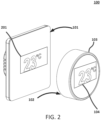
- FIG. 2 shows control unit 102 when detached from wall unit 101 of thermostat 100 shown in Figures 1 and 2 according to one or more aspects of the disclosure.
- One aspect of the embodiments allows dial control unit 102 to be detached from wall mounted unit 101 while providing full HVAC functionality.
- Dial control unit 102 communicates with wall mounted unit 101 over wireless radio frequency (RF) communication (via a wireless transmitter and receiver not explicitly shown).
- RF radio frequency
- dial control unit 102 operation of dial control unit 102 may be the same when dial control 102 is attached to or detached from wall mounted unit 101.
- mode setting and/or temperature setting may be confirmed by pressing down and/or touching on dial control unit 102.
- settings may be initiated by a user touching an appropriate portion of dial control unit 102.
- Wall mounted unit 101 may include a built-in temperature sensor (not explicitly shown) to measure the ambient temperature when dial control unit 102 is detached from wall mounted unit 101. Also, wall mounted unit 101 may include display 201 displaying temperature and/or other system information when dial control unit 102 is detached.
- Wall mounted unit 101 may also include an occupancy sensor (not explicitly shown) so that thermostat 100 can automatically change its operation when one or more occupants are detected.
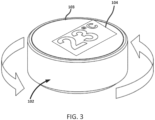
- FIG. 3 shows detachable dial control unit 102 of thermostat shown in Figures 1 and 2 .
- a user may detach thermostat unit 102 from wall mount unit 101, while continuing to interact with thermostat 100 to control an HVAC system.
- Detachable dial control unit 102 may be attached to wall mount unit 101, but is not limited to, by a magnetic attraction of magnets so that a user can easily remove detachable dial control unit 102 from wall mount unit 101 by pulling on it. Because detachable dial control unit 102 electrically connects to wall mount unit 101 through a duplex wireless communication channel, no wires or connectors need to be detached when separating the units.
- the user may enter thermostatic information (setting a function or a parameter of thermostat 100) into thermostat 100 by rotating ring 103 clockwise or counterclockwise, where the rotational position of ring 103 may be tracked.
- the user may press down or touch detachable dial control unit 102 to confirm the function or parameter setting and may view the thermostatic settings on display 104 entered via ring 103.
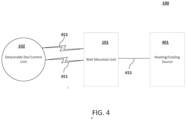
- FIG. 4 shows thermostat 100, which includes detachable dial control unit 102 communicating with wall mounted unit 101 via wireless channel 451.
- a user may use thermostat 100 when detachable dial control unit 102 is attached or detached from wall mounted unit 101 because control unit 102 communicates with wall mounted unit 102 via wireless channel 451, which may support duplex operation.
- units 101 and 102 interact over wireless channel 451 when the units are attached or detached.
- the level of the signal over wireless channel 451 may to be reduced when units 101 and 102 are attached to avoid overloading (saturating) the associated wireless receiver/transmitter.
- wall mounted unit 101 Based on thermostatic information provided by detachable dial control unit 102, wall mounted unit 101 generates and sends control signals to heating/cooling source 401 (for example, a furnace, air conditioner, or heat pump) over electrical path 453.
- heating/cooling source 401 for example, a furnace, air conditioner, or heat pump
- Detachable dial control unit 102 includes a rechargeable battery (not explicitly shown).
- the rechargeable battery is recharged by wall mounted unit 101 (supporting a wireless battery charge function) via electromagnetic induction path 452.
- sensor information for example, measured temperature
- system information for example, the status of heating/cooling source 401
- wireless channel 451 in other words, in the reverse direction as feedback
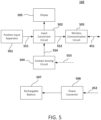
- FIG. 5 shows an embodiment of detachable control unit 102 according to one or more aspects of the disclosure.
- a user can change thermostatic settings by manipulating position input apparatus 501. For example, the user may rotate outer ring 103 (as shown in FIG. 1 ).
- a dial interface (not explicitly shown) may be coupled to outer ring 103 and is configured to obtain position information 551 from outer ring 103, where position information 551 is indicative of a thermostatic setting.
- Input conversion circuit 502 processes position information 551 by converting position information 551 to the rotational position and translating the rotational position to thermostatic information 552, which may be displayed to the user through display 505.
- input conversion circuit 502 may comprise a system on a chip (SoC) with microcontroller unit (MCU) and Zigbee (wireless) modules.
- SoC system on a chip
- MCU microcontroller unit
- Zigbee wireless
- thermostatic information 552 is sent to wall mounted unit 101 over wireless channel 451.
- Detachable dial control unit 102 may also be recharged by a magnetic field received through electromagnetic induction path 452.
- Power converter 506 converts energy of the magnetic field into electrical energy to recharge rechargeable battery 507.
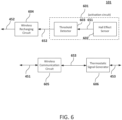
- FIG. 6 shows an embodiment of wall mounted unit 101 according to one or more aspects of the disclosure.
- Wireless communication circuit 605 receives thermostatic information from detachable dial control unit 102 via communication channel 451.
- Thermostatic signal generator 606 transforms the thermostatic information to a thermostatic signal and to present the thermostatic signal to a HVAC system over electrical path 453 via one or more terminal connectors (not explicitly shown).
- Wall mounted unit 101 supports the recharging of detachable dial control unit 102.
- Activation circuit 601 activates wireless charging circuit 604 only when detachable dial control unit 102 is sufficiently close to wall mounted unit 101. This approach conserves energy utilization by generating a magnetic signal over electromagnetic induction path 452 only when the recharging can effectively occur.
- activation circuit 601 comprises Hall effect sensor 602 and threshold detector 603.
- Hall effect sensor 602 is typically a magnetic sensor that outputs electrical signal 651 proportional to the intensity of the magnetic field around it. As will be discussed, the magnetic field is generated by an activation magnet (for example, magnet 904 as shown in FIG. 9 ). Generated signal 651 is then processed by threshold detector 603 to generate activation signal 652, which activates wireless recharging circuit 604) only when signal 651 is greater than a predetermined threshold. Consequently, wireless recharging circuit 604 is activated only when the activation magnet (and correspondingly detachable dial control unit 102) is within a predetermined distance from wall mounted unit 101. In other words, threshold detector 603 activates wireless recharging circuit 604 only when signal 651 exceeds a predetermined threshold and the predetermined threshold corresponds to a predetermined field strength of the electromagnetic induction path 452 at the predetermined distance.
- wall mounted unit 101 is associated (assigned) with a first unique code and detachable dial control unit 102 is associated (assigned) with a second unique code, where wall mounted unit 101 and detachable dial control unit 102 are uniquely paired by mapping the first unique code with the second unique code and where wall mounted unit 101 and the detachable dial control unit 102 interact with each other only when wall mounted unit 101 and detachable dial control unit 102 are paired.
- detachable dial control unit 102 may interact with wall mounted unit 101 over communication channel 451 even when detachable dial control unit 102 is being recharged (for example, when detachable dial control unit 102 is attached to wall mounted unit 101 as shown in FIG. 1 ).
- FIG. 7 shows detachable dial control unit 701a,b with wireless charging dock 702a,b according to one or more aspects of the disclosure.
- Detachable dial control unit 701a is attached to wireless charging dock 702a while detachable dial control unit 701b is removed (detached) from wireless charging dock 702b.
- wireless charging dock 702a,b supports the attachment of detachable dial control unit 701a,b and the recharging of detachable dial control unit 701a,b as previously discussed.
- wireless charging dock 702a,b typically does not have circuitry to interact with an HVAC system as does wall mounted unit 101 as shown in FIG. 4 .
- detachable dial control unit 701a,b may be paired with wall mounted unit 101. Consequently, detachable dial control unit 701a,b may be recharged while interacting with paired wall mounted unit 101 as previously discussed.
- a wireless charging dock with wall plate configuration may be paired with a headless control unit.
- FIG. 8 shows detachable dial control unit 801a,b with wall plate 802a,b according to one or more aspects of the disclosure. While wall plate 802a,b can accommodate detachable dial control unit 801a,b (in other words, detachable dial control unit 801a,b can be mounted on a wall), wall plate 802a,b typically does not have circuitry to recharge detachable dial control unit 801a,b or to interact with an HVAC system.
- detachable dial control unit 801a,b may be paired with wall mounted unit 101. Consequently, detachable dial control unit 801a may be attached to wall plate 802a while interacting with paired wall mounted unit 101 as previously discussed. With some embodiments, a wireless charging dock with wall plate configuration may be paired with a headless control unit.
- FIG. 9 shows detachable dial control unit 900 (bottom view) with alignment and adhesion magnets 901-903 and activation magnet 904. While only three alignment magnets are shown, embodiments may accommodate different number of alignment magnets (for example, two or more than three alignment magnets as needed).
- Alignment magnets 901-903 have different magnetic polarities corresponding to south pole, north pole, and north pole, respectively.
- the alignment magnets assist a user when positioning detachable dial control unit 900 to a corresponding anchoring component (wall plate, wireless recharging dock, or wall mounted unit).
- the anchoring component comprises complementary magnets having opposite polarities to corresponding alignment magnets 901-903. Consequently, each alignment magnet/complementary magnet pair will be attracted when detachable dial control unit 900 is positioned only in the upright position.
- Detachable dial control unit 900 includes activation magnet 904 that generates a magnetic field, which is detected by a Hall effect sensor located in the anchoring component.
- Detachable dial control unit 900 may also comprise micro suction pad 905 covering magnets 901-904 that assist detachable dial control unit 900 to adhere to the anchoring component such as wall mounted unit 101.
- Micro suction pad 905 comprises a material for sticking objects to surfaces. One side is typically attached to the base surface by a classical adhesive. Objects are attached to the other side by pressing them against micro suction pad 905.
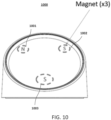
- FIG. 10 shows charging dock 1000 with complementary magnets 1001-1003 so that detachable dial control unit 900 can be aligned in an upright position according to one or more aspects of the disclosure.
- complementary magnets 1001-1003 correspond to alignment magnets 901-903 when detachable dial control unit 900 is positioned in the upright position.
- detachable dial control unit 900 is not in the upright position, some of the alignment magnet/complementary magnet pairs will repeal rather than attract, enabling a user to detect misalignment.
- FIG. 11 shows wall plate 1100 with complementary magnets 1101-1103 so that detachable dial control unit 900 can be aligned in an upright position according to one or more aspects of the disclosure.
- complementary magnets 1101-1103 correspond to alignment magnets 901-903 when detachable dial control unit 900 is positioned in the upright position.
- detachable dial control unit 900 is not in the upright position, some of the alignment magnet/complementary magnet pairs will repeal rather than attract, enabling a user to detect misalignment.
- wall mounted unit 101 may also comprise alignment magnets that operate in the same manner as discussed above.
- a first configuration comprises a detachable dial control unit and a wall mounted unit.
- a second configuration comprises a detachable dial unit, a charging dock, wall plate, and a headless control unit. With the second configuration, the detachable dial unit may continue to interact with the headless control unit while being recharged by the charging dock.
- a wireless charging dock/headless control unit/wall plate may be configured, where the headless control unit supports communication and the wireless charging dock supports recharging.
Landscapes
- Engineering & Computer Science (AREA)
- Human Computer Interaction (AREA)
- Chemical & Material Sciences (AREA)
- Combustion & Propulsion (AREA)
- Mechanical Engineering (AREA)
- General Engineering & Computer Science (AREA)
- Computer Networks & Wireless Communication (AREA)
- Power Engineering (AREA)
- Physics & Mathematics (AREA)
- General Physics & Mathematics (AREA)
- Automation & Control Theory (AREA)
- Air Conditioning Control Device (AREA)
Description
- Aspects of the disclosure relate to a thermostat for controlling a heating, ventilation, and air conditioning (HVAC) system.
- In order to control a heating, ventilation, and air conditioning (HVAC) system, a thermostat is typically fixed on the building wall in a common area, fixed nearby HVAC equipment, or used as a remote control in a wireless configuration situation. However, for many homes and industrial environments, where fixed wires connect to the HVAC system, a wall-mounted solution is used but is not flexible and is inconvenient to use.
-
U.S. Patent Application Publication No. 2012/0131504 describes a thermostat for controlling an HVAC system, the thermostat having a user interface that is visually pleasing, approachable, and easy to use while also providing intuitive navigation within a menu system. In a first mode of operation, an electronic display of the thermostat shows a population of tick marks arranged in an arcuate layout. These include a plurality of background tick marks, a setpoint tick mark representing the setpoint temperature, and an ambient temperature tick mark representing the ambient temperature. The setpoint temperature is dynamically changeable according to a tracked rotational input motion of a ring-shaped user interface component of the thermostat. In a second mode, a plurality of user-selectable menu options is displayed in an arcuate arrangement along a menu option range area. The respective menu options are selectively highlighted according to the tracked rotational input motion of the ring-shaped user interface component. -
U.S. Patent Application Publication No. 2021/0164680 relates to a thermostat including a control base configured to couple with and support a portable thermostat, wherein the control base is configured to determine a measure of an environmental condition of a local environment of the control base and communication circuitry of the control base configured to communicate the measure to facilitate control of an HVAC system. - The invention is defined by the appended claim 1. With one aspect, thermostat comprises a detachable dial control unit that may be positioned in an anchoring component. The detachable dial control unit may be removed while still allowing the user to change thermostatic settings of a heating, ventilation, and air conditioning (HVAC) system by rotating an outer ring indicative of thermostatic information and sending the information to a headless control unit/wall mounted unit via a wireless communication channel.
- With another aspect, alignment and adhesion of a detachable dial control unit with the anchoring component is facilitated by a plurality of alignment magnets having a magnetic polarity pattern. Each of the alignment magnets correspond to a corresponding complementary magnet located at the mating anchoring component such as a wall plate, wireless recharging dock, or wall mounted unit.
- According to the invention, a wireless charging dock or wall mounted unit comprises a wireless recharging circuit that recharges the detachable dial control unit via an activated electromagnetic induction path.
- According to the invention, the detachable dial control unit comprises an activation magnet. The wireless charging dock or wall mounted unit has a Hall effect device that detects when the activation magnet is within a predetermined distance when activating the wireless recharging circuit.
- With another aspect, a detachable dial control unit may be paired with a headless control unit/wall mounted unit. When paired, the detachable dial control unit and the headless control unit/wall mounted unit may interact with each other.
- With another aspect, a detachable dial control unit comprises a micro suction pad covering the at least three alignment magnets. The micro suction pad provides for easy and stable attachment to any flat surface after detachment from the wall plate, wireless charging dock, anchoring component, or wall mounted unit.
- With another aspect, a detachable dial control unit may interact with a paired headless control unit/wall mounted unit while the detachable dial control unit is being charged by a wireless recharging dock/wall mounted unit. Also, the wall mounted unit and detachable dial control unit may be paired and the detachable dial control unit charged.
- The present disclosure is illustrated by way of example and not limited in the accompanying figures in which like reference numerals indicate similar elements and in which:
-
FIG. 1 shows a front view of a thermostat according to one or more aspects of the disclosure. -
FIG. 2 shows a control unit detached from a wall mounted unit of the thermostat shown inFIG. 1 according to one or more aspects of the disclosure. -
FIG. 3 shows a detachable control unit of thermostat shown inFIGS. 1 and2 according to one or more aspects of the disclosure. -
FIG. 4 shows a detachable control unit, a wall mounted unit, and a heating/cooling source according to one or more aspects of the disclosure. -
FIG. 5 shows an embodiment of a detachable control unit according to one or more aspects of the disclosure. -
FIG. 6 shows an embodiment of a wall mounted unit according to one or more aspects of the disclosure. -
FIG. 7 shows a detachable dial control unit with wireless charging dock according to one or more aspects of the disclosure. -
FIG. 8 shows a detachable dial control unit with a wall plate according to one or more aspects of the disclosure. -
FIG. 9 shows a detachable dial control unit with alignment magnets and an activation magnet according to one or more aspects of the disclosure. -
FIG. 10 shows a charging dock with complementary magnets so that a detachable dial control unit can be aligned in an upright position according to one or more aspects of the disclosure. -
FIG. 11 shows a wall plate with complementary magnets so that a detachable dial control unit can be aligned in an upright position according to one or more aspects of the disclosure. - According to traditional approaches, a thermostat are either fixed on the wall in a common area, fixed nearby heating equipment, or used as a remote control in a wireless configuration situation. With many homes and industrial settings, fixed wires connect the thermostat to a heating, ventilation, and air conditioning (HVAC) system. For example, with 24 volt configurations commonly used in the United States and Nordic regions, a wall-mounted solution is supported; however, this approach is not flexible and is inconvenient to a user.
-
FIG. 1 shows a front view ofthermostat 100 according to one or more aspects of the disclosure. Thermostat 100 comprises two functional portions: wall-mountedunit 101 and detachabledial control unit 102. Wall-mounted unit 101 (which may be referred to as an anchoring component or a headless control unit) operates as a terminal connector to the wall, allowing HVAC and power cables to be connected tothermostat 100. Detachabledial control unit 102 functions as a user interface and works in conjunction with wall-mountedunit 101 as a fully functional thermostat. With some embodiments, a wall mounted unit is equivalent to a wireless charging dock with a headless control unit. - Detachable
dial control unit 102 may includedisplay 104 providing an informational display andouter ring 103 that can be rotated, pressed, and/or touched by a user for entering data tothermostat 100, for example, setting temperature set points, selecting menu options, and other thermostatic information. Dial control unit may include a built-in temperature sensor (not explicitly shown) to measure the ambient temperature.Display 104, for example, may show temperature and/or other system information. - Detachable
dial control unit 102 may comprise one or more micro suction pads at the bottom of it. When thedial control unit 102 is detached fromwall module 101 and placed on a surface (for example, a table surface), a user can rotate, press, and/or touchdial control unit 102 and set the parameters sincedial control unit 102 is held in a stationary manner to the surface. -
FIG. 2 showscontrol unit 102 when detached fromwall unit 101 ofthermostat 100 shown inFigures 1 and2 according to one or more aspects of the disclosure. One aspect of the embodiments allowsdial control unit 102 to be detached from wall mountedunit 101 while providing full HVAC functionality.Dial control unit 102 communicates with wall mountedunit 101 over wireless radio frequency (RF) communication (via a wireless transmitter and receiver not explicitly shown). A user may continue to operatethermostat 100 and view the status of the HVAC system using detacheddial control unit 102 within the RF range of the communication channel. - With embodiments of the disclosure, operation of
dial control unit 102 may be the same whendial control 102 is attached to or detached from wall mountedunit 101. For example, but is not limited to, mode setting and/or temperature setting may be confirmed by pressing down and/or touching ondial control unit 102. However, with some embodiments, settings may be initiated by a user touching an appropriate portion ofdial control unit 102. - Wall mounted
unit 101 may include a built-in temperature sensor (not explicitly shown) to measure the ambient temperature whendial control unit 102 is detached from wall mountedunit 101. Also, wall mountedunit 101 may includedisplay 201 displaying temperature and/or other system information whendial control unit 102 is detached. - Wall mounted
unit 101 may also include an occupancy sensor (not explicitly shown) so thatthermostat 100 can automatically change its operation when one or more occupants are detected. -
FIG. 3 shows detachabledial control unit 102 of thermostat shown inFigures 1 and2 . A user may detachthermostat unit 102 fromwall mount unit 101, while continuing to interact withthermostat 100 to control an HVAC system. - Detachable
dial control unit 102 may be attached towall mount unit 101, but is not limited to, by a magnetic attraction of magnets so that a user can easily remove detachabledial control unit 102 fromwall mount unit 101 by pulling on it. Because detachabledial control unit 102 electrically connects to wallmount unit 101 through a duplex wireless communication channel, no wires or connectors need to be detached when separating the units. - The user may enter thermostatic information (setting a function or a parameter of thermostat 100) into
thermostat 100 by rotatingring 103 clockwise or counterclockwise, where the rotational position ofring 103 may be tracked. The user may press down or touch detachabledial control unit 102 to confirm the function or parameter setting and may view the thermostatic settings ondisplay 104 entered viaring 103. -
FIG. 4 showsthermostat 100, which includes detachabledial control unit 102 communicating with wall mountedunit 101 viawireless channel 451. A user may usethermostat 100 when detachabledial control unit 102 is attached or detached from wall mountedunit 101 becausecontrol unit 102 communicates with wall mountedunit 102 viawireless channel 451, which may support duplex operation. - With an aspect of the disclosure,
units wireless channel 451 when the units are attached or detached. However, the level of the signal overwireless channel 451 may to be reduced whenunits - Based on thermostatic information provided by detachable
dial control unit 102, wall mountedunit 101 generates and sends control signals to heating/cooling source 401 (for example, a furnace, air conditioner, or heat pump) overelectrical path 453. - Detachable
dial control unit 102 includes a rechargeable battery (not explicitly shown). The rechargeable battery is recharged by wall mounted unit 101 (supporting a wireless battery charge function) viaelectromagnetic induction path 452. - With an aspect of the disclosure, sensor information (for example, measured temperature) and/or system information (for example, the status of heating/cooling source 401) may be sent back from
wall unit 101 to detachabledial control unit 102 over wireless channel 451 (in other words, in the reverse direction as feedback). -
FIG. 5 shows an embodiment ofdetachable control unit 102 according to one or more aspects of the disclosure. A user can change thermostatic settings by manipulatingposition input apparatus 501. For example, the user may rotate outer ring 103 (as shown inFIG. 1 ). A dial interface (not explicitly shown) may be coupled toouter ring 103 and is configured to obtainposition information 551 fromouter ring 103, whereposition information 551 is indicative of a thermostatic setting. -
Input conversion circuit 502 processes positioninformation 551 by convertingposition information 551 to the rotational position and translating the rotational position tothermostatic information 552, which may be displayed to the user throughdisplay 505. With some embodiments,input conversion circuit 502 may comprise a system on a chip (SoC) with microcontroller unit (MCU) and Zigbee (wireless) modules. - When the user has rotated
outer ring 103 to obtain a desired thermostatic setting, the user can enter the setting by pushing a front plate, lens, orouter ring 103. For example, the user may apply contact (pressure) 553 to contact sensing circuit 504 (for example, a switch/spring, a transducer such as a piezoelectric device, or capacitive touch screen). When the contact is sufficient,contact sensing circuit 504 generatessignal 554 instructsinput conversion circuit 502 to enter the thermostatic information and passthermostatic information 552 towireless communication circuit 503. Consequently,thermostatic information 552 is sent to wall mountedunit 101 overwireless channel 451. - Detachable
dial control unit 102 may also be recharged by a magnetic field received throughelectromagnetic induction path 452.Power converter 506 converts energy of the magnetic field into electrical energy to rechargerechargeable battery 507. -
FIG. 6 shows an embodiment of wall mountedunit 101 according to one or more aspects of the disclosure. -
Wireless communication circuit 605 receives thermostatic information from detachabledial control unit 102 viacommunication channel 451.Thermostatic signal generator 606 transforms the thermostatic information to a thermostatic signal and to present the thermostatic signal to a HVAC system overelectrical path 453 via one or more terminal connectors (not explicitly shown). - Wall mounted
unit 101 supports the recharging of detachabledial control unit 102.Activation circuit 601 activateswireless charging circuit 604 only when detachabledial control unit 102 is sufficiently close to wall mountedunit 101. This approach conserves energy utilization by generating a magnetic signal overelectromagnetic induction path 452 only when the recharging can effectively occur. - With the embodiment shown in
FIG. 6 ,activation circuit 601 comprisesHall effect sensor 602 andthreshold detector 603.Hall effect sensor 602 is typically a magnetic sensor that outputselectrical signal 651 proportional to the intensity of the magnetic field around it. As will be discussed, the magnetic field is generated by an activation magnet (for example,magnet 904 as shown inFIG. 9 ). Generatedsignal 651 is then processed bythreshold detector 603 to generateactivation signal 652, which activates wireless recharging circuit 604) only whensignal 651 is greater than a predetermined threshold. Consequently,wireless recharging circuit 604 is activated only when the activation magnet (and correspondingly detachable dial control unit 102) is within a predetermined distance from wall mountedunit 101. In other words,threshold detector 603 activateswireless recharging circuit 604 only whensignal 651 exceeds a predetermined threshold and the predetermined threshold corresponds to a predetermined field strength of theelectromagnetic induction path 452 at the predetermined distance. - With some embodiments, wall mounted
unit 101 is associated (assigned) with a first unique code and detachabledial control unit 102 is associated (assigned) with a second unique code, where wall mountedunit 101 and detachabledial control unit 102 are uniquely paired by mapping the first unique code with the second unique code and where wall mountedunit 101 and the detachabledial control unit 102 interact with each other only when wall mountedunit 101 and detachabledial control unit 102 are paired. - With some embodiments, detachable
dial control unit 102 may interact with wall mountedunit 101 overcommunication channel 451 even when detachabledial control unit 102 is being recharged (for example, when detachabledial control unit 102 is attached to wall mountedunit 101 as shown inFIG. 1 ). -
FIG. 7 shows detachabledial control unit 701a,b withwireless charging dock 702a,b according to one or more aspects of the disclosure. Detachabledial control unit 701a is attached towireless charging dock 702a while detachabledial control unit 701b is removed (detached) fromwireless charging dock 702b. - With some embodiments,
wireless charging dock 702a,b supports the attachment of detachabledial control unit 701a,b and the recharging of detachabledial control unit 701a,b as previously discussed. However,wireless charging dock 702a,b typically does not have circuitry to interact with an HVAC system as does wall mountedunit 101 as shown inFIG. 4 . - With some embodiments, detachable
dial control unit 701a,b may be paired with wall mountedunit 101. Consequently, detachabledial control unit 701a,b may be recharged while interacting with paired wall mountedunit 101 as previously discussed. With some embodiments, a wireless charging dock with wall plate configuration may be paired with a headless control unit. -
FIG. 8 shows detachabledial control unit 801a,b withwall plate 802a,b according to one or more aspects of the disclosure. Whilewall plate 802a,b can accommodate detachabledial control unit 801a,b (in other words, detachabledial control unit 801a,b can be mounted on a wall),wall plate 802a,b typically does not have circuitry to recharge detachabledial control unit 801a,b or to interact with an HVAC system. - With some embodiments, detachable
dial control unit 801a,b may be paired with wall mountedunit 101. Consequently, detachabledial control unit 801a may be attached towall plate 802a while interacting with paired wall mountedunit 101 as previously discussed. With some embodiments, a wireless charging dock with wall plate configuration may be paired with a headless control unit. -
FIG. 9 shows detachable dial control unit 900 (bottom view) with alignment and adhesion magnets 901-903 andactivation magnet 904. While only three alignment magnets are shown, embodiments may accommodate different number of alignment magnets (for example, two or more than three alignment magnets as needed). - Alignment magnets 901-903 have different magnetic polarities corresponding to south pole, north pole, and north pole, respectively. The alignment magnets assist a user when positioning detachable
dial control unit 900 to a corresponding anchoring component (wall plate, wireless recharging dock, or wall mounted unit). As will be discussed, the anchoring component comprises complementary magnets having opposite polarities to corresponding alignment magnets 901-903. Consequently, each alignment magnet/complementary magnet pair will be attracted when detachabledial control unit 900 is positioned only in the upright position. - Detachable
dial control unit 900 includesactivation magnet 904 that generates a magnetic field, which is detected by a Hall effect sensor located in the anchoring component. - Detachable
dial control unit 900 may also comprisemicro suction pad 905 covering magnets 901-904 that assist detachabledial control unit 900 to adhere to the anchoring component such as wall mountedunit 101.Micro suction pad 905 comprises a material for sticking objects to surfaces. One side is typically attached to the base surface by a classical adhesive. Objects are attached to the other side by pressing them againstmicro suction pad 905. -
FIG. 10 shows charging dock 1000 with complementary magnets 1001-1003 so that detachabledial control unit 900 can be aligned in an upright position according to one or more aspects of the disclosure. Referring toFIG. 9 , complementary magnets 1001-1003 correspond to alignment magnets 901-903 when detachabledial control unit 900 is positioned in the upright position. When detachabledial control unit 900 is not in the upright position, some of the alignment magnet/complementary magnet pairs will repeal rather than attract, enabling a user to detect misalignment. -
FIG. 11 showswall plate 1100 with complementary magnets 1101-1103 so that detachabledial control unit 900 can be aligned in an upright position according to one or more aspects of the disclosure. - Referring to
FIG. 9 , complementary magnets 1101-1103 correspond to alignment magnets 901-903 when detachabledial control unit 900 is positioned in the upright position. When detachabledial control unit 900 is not in the upright position, some of the alignment magnet/complementary magnet pairs will repeal rather than attract, enabling a user to detect misalignment. - With some embodiments, wall mounted
unit 101 may also comprise alignment magnets that operate in the same manner as discussed above. - With some embodiments, two configurations may be supported. A first configuration comprises a detachable dial control unit and a wall mounted unit. A second configuration comprises a detachable dial unit, a charging dock, wall plate, and a headless control unit. With the second configuration, the detachable dial unit may continue to interact with the headless control unit while being recharged by the charging dock. With some embodiments, a wireless charging dock/headless control unit/wall plate may be configured, where the headless control unit supports communication and the wireless charging dock supports recharging.
- Aspects of the invention have been described in terms of illustrative embodiments thereof. Numerous other embodiments, modifications and variations within the scope of the disclosed invention will occur to persons of ordinary skill in the art from a review of this entire disclosure. For example, one of ordinary skill in the art will appreciate that the steps illustrated in the illustrative figures may be performed in other than the recited order, and that one or more steps illustrated may be optional in accordance with aspects of the disclosure.
Claims (12)
- A thermostat (100) for controlling a heating, ventilation, and air conditioning (HVAC) system, the thermostat (100) comprising:a wall mounted unit (101) configured to be mounted on a wall, the wall mounted unit (101) comprising:at least one terminal connector configured to connect to the HVAC system;a first wireless receiver;a wireless recharging circuit (604) configured to recharge a rechargeable battery via an electromagnetic induction path (452);a Hall effect sensor (602) configured to output a signal to initiate an activation of the wireless recharging circuit (604); anda detachable dial control unit (102) that is capable of being detached from the wall mounted unit (101) while enabling a user to enter thermostatic information through the detachable dial control unit (102), the detachable dial control unit (102) comprising:a display (104);a contact sensing circuit (504);the rechargeable battery configured to be rechargeable via the electromagnetic induction path (452);an activation magnet configured to cause, when within a predetermined distance from the Hall effect sensor (602), the Hall effect sensor to output the signal to initiate the activation of the wireless recharging circuit (604);an outer ring (103) that is able to rotate, wherein a rotational position is indicative of thermostatic information;a portion of the detachable dial control unit (102), wherein the thermostatic information is confirmed when the contact sensing circuit (504) detects at least a predetermined degree of contact against the portion; anda first wireless transmitter configured to convey the thermostatic information to the first wireless receiver via a wireless duplex communication channel.
- The thermostat (100) of claim 1, wherein the thermostatic information is sent through the first wireless transmitter of the detachable dial control unit (102) to the first wireless receiver of the wall mounted unit (101).
- The thermostat (100) of claim 2, wherein the detachable dial control unit (102) further comprises:a dial interface that is coupled to the outer ring (103) and is configured to obtain position information from the outer ring (103), wherein the position information is indicative of a setting; anda first computing device configured to obtain the position information from the dial interface and configured to convert the position information to the rotational position, and configured to translate the rotational position to the thermostatic information.
- The thermostat (100) of claim 3, wherein the wall mounted unit (101) comprises:
a second computing device configured to obtain the thermostatic information from the first wireless receiver, configured to transform the thermostatic information to a thermostatic signal, and configured to present the thermostatic signal to the at least one terminal connector. - The thermostat (100) of claim 1, wherein the wall mounted unit (101) comprises a second wireless transmitter and the detachable dial control unit (102) comprises a second wireless receiver and wherein the wall mounted unit (101) is configured to send sensor and/or status information to the detachable dial control unit (102) from the second wireless transmitter to the second wireless receiver over the wireless duplex communication channel.
- The thermostat (100) of claim 1, wherein the wall mounted unit (101) further comprises a threshold detector (603), wherein the threshold detector (603) is configured to obtain the output signal from the Hall effect sensor (602), wherein the threshold detector (603) is configured to activate the wireless recharging circuit (604) only when the output signal exceeds a predetermined threshold, and wherein the predetermined threshold corresponds to a predetermined field strength of the electromagnetic induction path (452) at the predetermined distance.
- The thermostat (100) of claim 1, wherein the wall mounted unit (101) is associated with a first unique code and the detachable dial control unit (102) is associated with a second unique code, wherein the wall mounted unit (101) and the detachable dial control unit (102) are uniquely paired by mapping the first unique code with the second unique code, and wherein the wall mounted unit (101) and the detachable dial control unit (102) interact with each other only when the wall mounted unit (101) and the detachable dial control unit (102) are paired.
- The thermostat (100) of claim 1, wherein the portion of the detachable dial control unit (102) comprises a transparent lens covering the display (104).
- The thermostat (100) of claim 8, wherein the portion of the detachable dial control unit (102) further comprises the outer ring (103).
- The thermostat (100) of claim 1, wherein the detachable dial control unit (102) comprises at least three alignment magnets (901-903) and the wall mounted unit (101) comprises at least three complementary magnets that have opposite magnetic polarities, and wherein each complementary magnet has an opposite magnetic polarity to a corresponding magnetic polarity of a corresponding alignment magnet.
- The thermostat (100) of claim 10, wherein the detachable dial control unit (102) comprises a micro suction pad covering the at least three alignment magnets (901-903) and wherein the micro suction pad is configured to adhere to a flat surface after detachment from the wall mounted unit (101).
- The thermostat (100) of claim 10, wherein the at least three alignment magnets (901-903) are characterized by a pattern of magnetic polarities in order to detect a misalignment of the detachable dial control unit (102) to the wall mounted unit (101).
Priority Applications (1)
| Application Number | Priority Date | Filing Date | Title |
|---|---|---|---|
| EP25175991.6A EP4624818A3 (en) | 2022-01-18 | 2023-01-12 | Thermostat with detachable dial control |
Applications Claiming Priority (2)
| Application Number | Priority Date | Filing Date | Title |
|---|---|---|---|
| US202263300323P | 2022-01-18 | 2022-01-18 | |
| US18/148,069 US12429242B2 (en) | 2022-01-18 | 2022-12-29 | Thermostat with detachable dial control |
Related Child Applications (1)
| Application Number | Title | Priority Date | Filing Date |
|---|---|---|---|
| EP25175991.6A Division EP4624818A3 (en) | 2022-01-18 | 2023-01-12 | Thermostat with detachable dial control |
Publications (2)
| Publication Number | Publication Date |
|---|---|
| EP4212981A1 EP4212981A1 (en) | 2023-07-19 |
| EP4212981B1 true EP4212981B1 (en) | 2025-05-14 |
Family
ID=84943488
Family Applications (2)
| Application Number | Title | Priority Date | Filing Date |
|---|---|---|---|
| EP25175991.6A Pending EP4624818A3 (en) | 2022-01-18 | 2023-01-12 | Thermostat with detachable dial control |
| EP23151297.1A Active EP4212981B1 (en) | 2022-01-18 | 2023-01-12 | Thermostat with detachable dial control |
Family Applications Before (1)
| Application Number | Title | Priority Date | Filing Date |
|---|---|---|---|
| EP25175991.6A Pending EP4624818A3 (en) | 2022-01-18 | 2023-01-12 | Thermostat with detachable dial control |
Country Status (2)
| Country | Link |
|---|---|
| US (2) | US12429242B2 (en) |
| EP (2) | EP4624818A3 (en) |
Families Citing this family (2)
| Publication number | Priority date | Publication date | Assignee | Title |
|---|---|---|---|---|
| USD1059188S1 (en) * | 2023-08-11 | 2025-01-28 | Computime Limited | Thermostat |
| USD1059194S1 (en) * | 2023-08-11 | 2025-01-28 | Computime Limited | Docking station for a thermostat |
Citations (1)
| Publication number | Priority date | Publication date | Assignee | Title |
|---|---|---|---|---|
| US20120131504A1 (en) * | 2010-11-19 | 2012-05-24 | Nest Labs, Inc. | Thermostat graphical user interface |
Family Cites Families (51)
| Publication number | Priority date | Publication date | Assignee | Title |
|---|---|---|---|---|
| US6574581B1 (en) | 1994-10-25 | 2003-06-03 | Honeywell International Inc. | Profile based method for deriving a temperature setpoint using a ‘delta’ based on cross-indexing a received price-point level signal |
| US6364069B1 (en) | 2001-06-07 | 2002-04-02 | Westinghouse Air Brake Technologies Corporation | Electronic sensor for a quick release hand brake |
| US9113880B2 (en) | 2007-10-05 | 2015-08-25 | Covidien Lp | Internal backbone structural chassis for a surgical device |
| US7181317B2 (en) | 2003-12-02 | 2007-02-20 | Honeywell International Inc. | Controller interface with interview programming |
| US7142948B2 (en) | 2004-01-07 | 2006-11-28 | Honeywell International Inc. | Controller interface with dynamic schedule display |
| US7140551B2 (en) | 2004-03-01 | 2006-11-28 | Honeywell International Inc. | HVAC controller |
| US7159790B2 (en) | 2004-06-22 | 2007-01-09 | Honeywell International Inc. | Thermostat with offset drive |
| US7159789B2 (en) | 2004-06-22 | 2007-01-09 | Honeywell International Inc. | Thermostat with mechanical user interface |
| US7476988B2 (en) | 2005-11-23 | 2009-01-13 | Honeywell International Inc. | Power stealing control devices |
| US8385822B2 (en) * | 2008-09-26 | 2013-02-26 | Hewlett-Packard Development Company, L.P. | Orientation and presence detection for use in configuring operations of computing devices in docked environments |
| US8203310B2 (en) | 2008-10-20 | 2012-06-19 | The Raymond Corporation | Energy storage module for load leveling in lift truck or other electrical vehicle |
| US8195313B1 (en) | 2010-11-19 | 2012-06-05 | Nest Labs, Inc. | Thermostat user interface |
| US9268344B2 (en) * | 2010-11-19 | 2016-02-23 | Google Inc. | Installation of thermostat powered by rechargeable battery |
| WO2012129266A1 (en) | 2011-03-22 | 2012-09-27 | Raytheon Company | Systems and methods providing a wearable power generator |
| US9343716B2 (en) | 2011-12-29 | 2016-05-17 | Apple Inc. | Flexible battery pack |
| US8927137B2 (en) | 2012-05-01 | 2015-01-06 | Microsun Technologies Llc | Fail safe damage resistant battery matrix |
| US10468642B2 (en) | 2012-05-18 | 2019-11-05 | Iterna, Llc | Rechargeable storage battery with improved performance |
| CN105229895A (en) * | 2012-10-11 | 2016-01-06 | 鲍尔马特技术有限公司 | Inductive power transfer system and method for simultaneous transmission of digital messages |
| US20140203091A1 (en) | 2013-01-24 | 2014-07-24 | Unnikrishnan Ramachandran Nair | Portable digital thermostat |
| US9442522B2 (en) | 2013-07-11 | 2016-09-13 | Kevin Alan Tussy | Accessory for wearable computer |
| CN105814803B (en) | 2013-12-27 | 2019-02-01 | 阿莫绿色技术有限公司 | Wearable devices with flexible batteries |
| US10020476B2 (en) | 2014-03-28 | 2018-07-10 | American Lithium Energy Corporation | Articulate battery case |
| EP3002933B1 (en) | 2014-06-24 | 2019-11-06 | Huawei Technologies Co. Ltd. | User terminal light control method and corresponding apparatus |
| KR102343269B1 (en) | 2014-08-28 | 2021-12-27 | 삼성전자주식회사 | Wearable Electronic Device |
| US20160116183A1 (en) * | 2014-10-27 | 2016-04-28 | Lennox Industries Inc. | Magnetically mounted wall thermostat |
| WO2016073757A1 (en) | 2014-11-05 | 2016-05-12 | Seed Labs Sp. Z O.O. | Sensory and control platform for an automation system |
| US9564761B2 (en) | 2014-11-21 | 2017-02-07 | Palladium Energy, Inc. | Conformable wearable battery with removable command module |
| US10256511B2 (en) | 2015-05-28 | 2019-04-09 | Bren-Tronics, Inc. | Secondary battery housing with control electronics |
| EP3316515B1 (en) | 2015-06-24 | 2020-04-01 | LG Electronics Inc. | Electronic device, smart home system using electronic device, and method for controlling smart home system |
| US10666084B2 (en) | 2015-07-10 | 2020-05-26 | Apple Inc. | Detection and notification of an unpowered releasable charging device |
| US10020668B2 (en) | 2015-07-27 | 2018-07-10 | Apple Inc. | Charging apparatus for wearable electronic device |
| LU92790B1 (en) * | 2015-08-06 | 2017-02-14 | Ipalco Bv | A system for automatically establishing a temporary electrical power connection |
| US10209688B2 (en) | 2015-08-26 | 2019-02-19 | Google Llc | Smart thermostat robust against adverse effects from internal heat-generating components |
| CN108369021B (en) | 2015-08-26 | 2020-01-17 | 谷歌有限责任公司 | Thermostats in which multiple sensing systems are integrated |
| EP3541092B1 (en) | 2015-09-30 | 2021-08-11 | Apple Inc. | Earbud case with charging system |
| US10486538B2 (en) | 2015-11-02 | 2019-11-26 | Hyundai America Technical Center, Inc. | Electromagnetic field controlling system and method for vehicle wireless charging system |
| KR101919069B1 (en) | 2016-01-12 | 2018-11-15 | 주식회사 아모그린텍 | wearable device |
| CN109416991B (en) | 2016-06-03 | 2020-04-21 | 路创技术有限责任公司 | Battery powered retrofit remote control |
| US10756371B2 (en) | 2016-08-17 | 2020-08-25 | Honeywell International Inc. | Hybrid fuel cell |
| GB2553128B (en) | 2016-08-24 | 2020-02-26 | Dst Innovations Ltd | Rechargeable power cells |
| NL2017395B1 (en) | 2016-08-30 | 2018-03-08 | Dcpower Holding B V | A replaceable smart battery pack, a battery pack holder and a mobile power supply system |
| KR102285073B1 (en) | 2017-03-31 | 2021-08-03 | 삼성전자주식회사 | Method for providing content corresponding to accessory devices and electronic device thereof |
| US10955162B2 (en) | 2018-03-07 | 2021-03-23 | Johnson Controls Technology Company | Portable thermostat systems and methods |
| US20200083560A1 (en) | 2018-09-06 | 2020-03-12 | Honda Motor Co., Ltd. | Flexible lithium-ion battery |
| KR20200071835A (en) | 2018-12-03 | 2020-06-22 | 현대자동차주식회사 | In-vehicle control apparatus using detachable knob and method for controlling the same |
| CN113302573A (en) | 2019-01-04 | 2021-08-24 | 伊奎蒂公司 | Wearable mobile electronic system |
| US11070098B2 (en) | 2019-01-16 | 2021-07-20 | Google Llc | Wireless charger with adaptive alignment assistance |
| KR102812859B1 (en) | 2019-03-27 | 2025-05-26 | 현대자동차주식회사 | In-vehicle control apparatus using knob provided with display and method for controlling the same |
| CN114631005B (en) | 2019-08-30 | 2025-03-04 | 马格纳电子系统公司 | Monitor allocation system and method |
| US12038190B2 (en) * | 2019-12-04 | 2024-07-16 | Ademco Inc. | Identification device for an HVAC controller |
| WO2021248002A1 (en) | 2020-06-05 | 2021-12-09 | Ademco Inc. | Determining rotation using sensor displaced from magnet |
-
2022
- 2022-12-29 US US18/148,069 patent/US12429242B2/en active Active
-
2023
- 2023-01-12 EP EP25175991.6A patent/EP4624818A3/en active Pending
- 2023-01-12 EP EP23151297.1A patent/EP4212981B1/en active Active
-
2025
- 2025-09-08 US US19/322,616 patent/US20260071773A1/en active Pending
Patent Citations (1)
| Publication number | Priority date | Publication date | Assignee | Title |
|---|---|---|---|---|
| US20120131504A1 (en) * | 2010-11-19 | 2012-05-24 | Nest Labs, Inc. | Thermostat graphical user interface |
Also Published As
| Publication number | Publication date |
|---|---|
| EP4212981A1 (en) | 2023-07-19 |
| US12429242B2 (en) | 2025-09-30 |
| EP4624818A2 (en) | 2025-10-01 |
| US20230228441A1 (en) | 2023-07-20 |
| US20260071773A1 (en) | 2026-03-12 |
| EP4624818A3 (en) | 2025-11-12 |
Similar Documents
| Publication | Publication Date | Title |
|---|---|---|
| US20260071773A1 (en) | Thermostat with Detachable Dial Control | |
| US11659271B2 (en) | Electronic device to control screen property based on distance between pen input device and electronic device and method of controlling same | |
| TW201629714A (en) | Position pointer and signal processor | |
| JP7053550B2 (en) | Control system | |
| CN108808880A (en) | Magnetic control knob and electrical equipment | |
| CN106849208A (en) | The charging device of charging bracket and mobile phone | |
| CN212849957U (en) | Protective shell | |
| US20160261219A1 (en) | Frequency converter and drive system | |
| CN201600773U (en) | Multifunctional remote controller | |
| CN113131591A (en) | Charging method of wireless charging system and protective shell | |
| CN102087777A (en) | Multifunctional remote controller and manufacture method thereof | |
| CN116466766A (en) | Thermostat with removable dial control | |
| KR101891061B1 (en) | driving device for remote control of capacitive touch sensor and smart home system therewith | |
| CN216121877U (en) | Device for configuring wireless charging transmitting system and receiving equipment | |
| KR100386005B1 (en) | A charging system for portable equipment | |
| CN205656759U (en) | Remote controller and have control system of remote controller | |
| RU2584818C2 (en) | Electrical installation device with charging device and configured for mounting mobile audio and communication device | |
| KR20160061837A (en) | monitoring apparatus of wireless power transmission using electromagnetic induction | |
| AU2019100181A4 (en) | An electronic apparatus for remotely controlling wall switches. | |
| US20260086637A1 (en) | Ring-shaped wearable devices, systems, and methods of use thereof | |
| AU2017101937A4 (en) | Electrical outlet faceplate and system | |
| AU2017101935A4 (en) | Electrical outlet faceplate and system | |
| AU2017101936A4 (en) | Electrical outlet faceplate and system | |
| CN209765311U (en) | Panel-switch and switch system | |
| CN209912496U (en) | Voice control panel |
Legal Events
| Date | Code | Title | Description |
|---|---|---|---|
| PUAI | Public reference made under article 153(3) epc to a published international application that has entered the european phase |
Free format text: ORIGINAL CODE: 0009012 |
|
| STAA | Information on the status of an ep patent application or granted ep patent |
Free format text: STATUS: THE APPLICATION HAS BEEN PUBLISHED |
|
| AK | Designated contracting states |
Kind code of ref document: A1 Designated state(s): AL AT BE BG CH CY CZ DE DK EE ES FI FR GB GR HR HU IE IS IT LI LT LU LV MC ME MK MT NL NO PL PT RO RS SE SI SK SM TR |
|
| STAA | Information on the status of an ep patent application or granted ep patent |
Free format text: STATUS: REQUEST FOR EXAMINATION WAS MADE |
|
| 17P | Request for examination filed |
Effective date: 20240119 |
|
| RBV | Designated contracting states (corrected) |
Designated state(s): AL AT BE BG CH CY CZ DE DK EE ES FI FR GB GR HR HU IE IS IT LI LT LU LV MC ME MK MT NL NO PL PT RO RS SE SI SK SM TR |
|
| STAA | Information on the status of an ep patent application or granted ep patent |
Free format text: STATUS: EXAMINATION IS IN PROGRESS |
|
| 17Q | First examination report despatched |
Effective date: 20240510 |
|
| GRAP | Despatch of communication of intention to grant a patent |
Free format text: ORIGINAL CODE: EPIDOSNIGR1 |
|
| STAA | Information on the status of an ep patent application or granted ep patent |
Free format text: STATUS: GRANT OF PATENT IS INTENDED |
|
| RIC1 | Information provided on ipc code assigned before grant |
Ipc: F24F 11/52 20180101ALI20241203BHEP Ipc: F24F 11/00 20180101ALI20241203BHEP Ipc: G05D 23/19 20060101AFI20241203BHEP |
|
| INTG | Intention to grant announced |
Effective date: 20241216 |
|
| GRAS | Grant fee paid |
Free format text: ORIGINAL CODE: EPIDOSNIGR3 |
|
| GRAA | (expected) grant |
Free format text: ORIGINAL CODE: 0009210 |
|
| STAA | Information on the status of an ep patent application or granted ep patent |
Free format text: STATUS: THE PATENT HAS BEEN GRANTED |
|
| AK | Designated contracting states |
Kind code of ref document: B1 Designated state(s): AL AT BE BG CH CY CZ DE DK EE ES FI FR GB GR HR HU IE IS IT LI LT LU LV MC ME MK MT NL NO PL PT RO RS SE SI SK SM TR |
|
| REG | Reference to a national code |
Ref country code: GB Ref legal event code: FG4D |
|
| REG | Reference to a national code |
Ref country code: CH Ref legal event code: EP |
|
| REG | Reference to a national code |
Ref country code: DE Ref legal event code: R096 Ref document number: 602023003398 Country of ref document: DE |
|
| REG | Reference to a national code |
Ref country code: IE Ref legal event code: FG4D |
|
| REG | Reference to a national code |
Ref country code: NL Ref legal event code: MP Effective date: 20250514 |
|
| PG25 | Lapsed in a contracting state [announced via postgrant information from national office to epo] |
Ref country code: FI Free format text: LAPSE BECAUSE OF FAILURE TO SUBMIT A TRANSLATION OF THE DESCRIPTION OR TO PAY THE FEE WITHIN THE PRESCRIBED TIME-LIMIT Effective date: 20250514 Ref country code: PT Free format text: LAPSE BECAUSE OF FAILURE TO SUBMIT A TRANSLATION OF THE DESCRIPTION OR TO PAY THE FEE WITHIN THE PRESCRIBED TIME-LIMIT Effective date: 20250915 Ref country code: ES Free format text: LAPSE BECAUSE OF FAILURE TO SUBMIT A TRANSLATION OF THE DESCRIPTION OR TO PAY THE FEE WITHIN THE PRESCRIBED TIME-LIMIT Effective date: 20250514 |
|
| REG | Reference to a national code |
Ref country code: LT Ref legal event code: MG9D |
|
| PG25 | Lapsed in a contracting state [announced via postgrant information from national office to epo] |
Ref country code: NO Free format text: LAPSE BECAUSE OF FAILURE TO SUBMIT A TRANSLATION OF THE DESCRIPTION OR TO PAY THE FEE WITHIN THE PRESCRIBED TIME-LIMIT Effective date: 20250814 Ref country code: GR Free format text: LAPSE BECAUSE OF FAILURE TO SUBMIT A TRANSLATION OF THE DESCRIPTION OR TO PAY THE FEE WITHIN THE PRESCRIBED TIME-LIMIT Effective date: 20250815 |
|
| PG25 | Lapsed in a contracting state [announced via postgrant information from national office to epo] |
Ref country code: NL Free format text: LAPSE BECAUSE OF FAILURE TO SUBMIT A TRANSLATION OF THE DESCRIPTION OR TO PAY THE FEE WITHIN THE PRESCRIBED TIME-LIMIT Effective date: 20250514 Ref country code: PL Free format text: LAPSE BECAUSE OF FAILURE TO SUBMIT A TRANSLATION OF THE DESCRIPTION OR TO PAY THE FEE WITHIN THE PRESCRIBED TIME-LIMIT Effective date: 20250514 |
|
| REG | Reference to a national code |
Ref country code: AT Ref legal event code: MK05 Ref document number: 1795316 Country of ref document: AT Kind code of ref document: T Effective date: 20250514 |
|
| PG25 | Lapsed in a contracting state [announced via postgrant information from national office to epo] |
Ref country code: BG Free format text: LAPSE BECAUSE OF FAILURE TO SUBMIT A TRANSLATION OF THE DESCRIPTION OR TO PAY THE FEE WITHIN THE PRESCRIBED TIME-LIMIT Effective date: 20250514 |
|
| PG25 | Lapsed in a contracting state [announced via postgrant information from national office to epo] |
Ref country code: HR Free format text: LAPSE BECAUSE OF FAILURE TO SUBMIT A TRANSLATION OF THE DESCRIPTION OR TO PAY THE FEE WITHIN THE PRESCRIBED TIME-LIMIT Effective date: 20250514 |
|
| PG25 | Lapsed in a contracting state [announced via postgrant information from national office to epo] |
Ref country code: AT Free format text: LAPSE BECAUSE OF FAILURE TO SUBMIT A TRANSLATION OF THE DESCRIPTION OR TO PAY THE FEE WITHIN THE PRESCRIBED TIME-LIMIT Effective date: 20250514 |
|
| PG25 | Lapsed in a contracting state [announced via postgrant information from national office to epo] |
Ref country code: RS Free format text: LAPSE BECAUSE OF FAILURE TO SUBMIT A TRANSLATION OF THE DESCRIPTION OR TO PAY THE FEE WITHIN THE PRESCRIBED TIME-LIMIT Effective date: 20250814 |
|
| PG25 | Lapsed in a contracting state [announced via postgrant information from national office to epo] |
Ref country code: IS Free format text: LAPSE BECAUSE OF FAILURE TO SUBMIT A TRANSLATION OF THE DESCRIPTION OR TO PAY THE FEE WITHIN THE PRESCRIBED TIME-LIMIT Effective date: 20250914 |
|
| PG25 | Lapsed in a contracting state [announced via postgrant information from national office to epo] |
Ref country code: LV Free format text: LAPSE BECAUSE OF FAILURE TO SUBMIT A TRANSLATION OF THE DESCRIPTION OR TO PAY THE FEE WITHIN THE PRESCRIBED TIME-LIMIT Effective date: 20250514 |
|
| PG25 | Lapsed in a contracting state [announced via postgrant information from national office to epo] |
Ref country code: DK Free format text: LAPSE BECAUSE OF FAILURE TO SUBMIT A TRANSLATION OF THE DESCRIPTION OR TO PAY THE FEE WITHIN THE PRESCRIBED TIME-LIMIT Effective date: 20250514 Ref country code: SM Free format text: LAPSE BECAUSE OF FAILURE TO SUBMIT A TRANSLATION OF THE DESCRIPTION OR TO PAY THE FEE WITHIN THE PRESCRIBED TIME-LIMIT Effective date: 20250514 |
|
| PG25 | Lapsed in a contracting state [announced via postgrant information from national office to epo] |
Ref country code: CZ Free format text: LAPSE BECAUSE OF FAILURE TO SUBMIT A TRANSLATION OF THE DESCRIPTION OR TO PAY THE FEE WITHIN THE PRESCRIBED TIME-LIMIT Effective date: 20250514 |
|
| PG25 | Lapsed in a contracting state [announced via postgrant information from national office to epo] |
Ref country code: EE Free format text: LAPSE BECAUSE OF FAILURE TO SUBMIT A TRANSLATION OF THE DESCRIPTION OR TO PAY THE FEE WITHIN THE PRESCRIBED TIME-LIMIT Effective date: 20250514 |
|
| PG25 | Lapsed in a contracting state [announced via postgrant information from national office to epo] |
Ref country code: SK Free format text: LAPSE BECAUSE OF FAILURE TO SUBMIT A TRANSLATION OF THE DESCRIPTION OR TO PAY THE FEE WITHIN THE PRESCRIBED TIME-LIMIT Effective date: 20250514 |
|
| PG25 | Lapsed in a contracting state [announced via postgrant information from national office to epo] |
Ref country code: IT Free format text: LAPSE BECAUSE OF FAILURE TO SUBMIT A TRANSLATION OF THE DESCRIPTION OR TO PAY THE FEE WITHIN THE PRESCRIBED TIME-LIMIT Effective date: 20250514 |
|
| REG | Reference to a national code |
Ref country code: DE Ref legal event code: R097 Ref document number: 602023003398 Country of ref document: DE |
|
| PLBE | No opposition filed within time limit |
Free format text: ORIGINAL CODE: 0009261 |
|
| STAA | Information on the status of an ep patent application or granted ep patent |
Free format text: STATUS: NO OPPOSITION FILED WITHIN TIME LIMIT |
|
| REG | Reference to a national code |
Ref country code: CH Ref legal event code: L10 Free format text: ST27 STATUS EVENT CODE: U-0-0-L10-L00 (AS PROVIDED BY THE NATIONAL OFFICE) Effective date: 20260325 |
|
| PGFP | Annual fee paid to national office [announced via postgrant information from national office to epo] |
Ref country code: DE Payment date: 20260128 Year of fee payment: 4 |
|
| PGFP | Annual fee paid to national office [announced via postgrant information from national office to epo] |
Ref country code: FR Payment date: 20260126 Year of fee payment: 4 |
|
| 26N | No opposition filed |
Effective date: 20260217 |