EP4212669A1 - Artificial grass turf for padel courts and installation method - Google Patents
Artificial grass turf for padel courts and installation method Download PDFInfo
- Publication number
- EP4212669A1 EP4212669A1 EP20953175.5A EP20953175A EP4212669A1 EP 4212669 A1 EP4212669 A1 EP 4212669A1 EP 20953175 A EP20953175 A EP 20953175A EP 4212669 A1 EP4212669 A1 EP 4212669A1
- Authority
- EP
- European Patent Office
- Prior art keywords
- elements
- court
- colour
- area
- central
- Prior art date
- Legal status (The legal status is an assumption and is not a legal conclusion. Google has not performed a legal analysis and makes no representation as to the accuracy of the status listed.)
- Granted
Links
Images

Classifications
-
- E—FIXED CONSTRUCTIONS
- E01—CONSTRUCTION OF ROADS, RAILWAYS, OR BRIDGES
- E01C—CONSTRUCTION OF, OR SURFACES FOR, ROADS, SPORTS GROUNDS, OR THE LIKE; MACHINES OR AUXILIARY TOOLS FOR CONSTRUCTION OR REPAIR
- E01C13/00—Pavings or foundations specially adapted for playgrounds or sports grounds; Drainage, irrigation or heating of sports grounds
- E01C13/08—Surfaces simulating grass ; Grass-grown sports grounds
-
- A—HUMAN NECESSITIES
- A63—SPORTS; GAMES; AMUSEMENTS
- A63C—SKATES; SKIS; ROLLER SKATES; DESIGN OR LAYOUT OF COURTS, RINKS OR THE LIKE
- A63C19/00—Design or layout of playing courts, rinks, bowling greens or areas for water-skiing; Covers therefor
- A63C19/04—Mats or carpets for courts
Definitions
- the following invention relates to an artificial grass turf for padel courts and the installation method thereof, such that it improves both the interaction of the player and of the ball with the playing surface, and also reduces court installation time.
- artificial grass turfs used for padel courts are obtained from fibres made up of several threads, all having equal cross-section, twisted together, defining straight fibres in their weave according to the desired height.
- all the turfs used to configure the court have the same colour, defining single-colour courts with the corresponding separating lines of the playing surface.
- the installation of the padel courts is based on the use of rolls (usually three rolls, two 20x4 m and one 20x2 m roll) whereby, in the assembly thereof, arranged longitudinally attached to each other, the entire surface of the court is made up and wherein, subsequently, the white lines separating the playing surfaces must be incorporated.
- the bands must be cut, using a special tool for this purpose, in which the bands must be incorporated as white separating lines. This operation, in addition to the time invested for it, causes many adhesion joints and therefore a greater possibility of peeling off and a greater possibility of strange bounces of the ball.
- This report describes an artificial grass turf for padel courts and the installation method thereof, so that the artificial grass turf combines at least texturised monofilaments having a rectangular cross-section with rounded smaller sides and a central rib with texturised monofilaments having a parallelogram-shaped cross-section with curved-concave sides and the turf comprises:
- the second area of the two elements that define two bicolour areas separated by a transverse white line has a length of approximately 1/3 of the length of the first area corresponding to the service surface.
- the second area of the two elements that define two bicolour areas separated by a transverse white line has the same colour as the two single-colour elements corresponding to the central lateral portion of the court, as well as the single-colour element with the central longitudinal white line.
- the two bicolour areas will have a blue colour of different tones, one being darker than the other, although, logically, they could have other colours.
- the two elements that define two single-colour areas separated by a transverse white line, a first area corresponding to the service surface and a second area to the central portion of the court can have the same colour similar to that of single-colour elements.
- the court will have a single colour with the marking white lines for marking the court and, it could even be the case that the court was white and the marking lines were of any other colour, the different elements being executed in a similar manner as indicated.
- the central longitudinal single-colour element overlaps on the two elements that define the two bicolour areas separated by a transverse white line, a first area corresponding to the service surface and a second area to the central portion, exceeding the second area and extending approximately 20 cm through the first area.
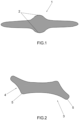
- the artificial grass turf for padel courts is based on the combination of at least texturised monofilaments having a rectangular general section 1 with their smaller sides rounded and equipped with a rounded central rib 2, with texturised monofilaments having a parallelogram-shaped section 3 with its four curved-concave sides 4 and four asymmetrical ribs 5 that act as lateral reinforcements.
- Both monofilaments are made of polyethylene (PE) and specific additives that are characterised by their high resistance and ultraviolet (UV) treatment, resistant to heat and extreme weather variations, improving their durability and freeing them from part of the stress that occurs when pressed by the interaction of the player, giving the court greater ball speed and reducing wear.
- PE polyethylene
- UV ultraviolet
- the turf can be made, both based on the minimum of the two monofilaments described, or it can be made with more additional monofilaments having different cross sections.
- the turf that makes up the entire padel court is determined by two elements 6 that define two bicolour areas 7 and 8 separated by a transverse white line 9, a first area 7 corresponding to the service surface and a second area 8 corresponding to the central portion of the court, a pair of single-colour elements 10 corresponding to the central lateral portion of the court, and a single-colour element 11 with a white central longitudinal line 12 corresponding to the central longitudinal portion of the court.
- the second area 8 of the two elements 6 that define two bicolour areas separated by the transverse white line 9, has a length of approximately 1/3 of the length of the first area 7 corresponding to the service surface.
- the second area 8 of the two elements 6 that define two bicolour areas 7 and 8 separated by the transverse white line 9 has the same colour as the pair of single-colour elements 10 corresponding to the central lateral portion of the court, as well as the single-colour element 11 with the white central longitudinal line 12 that marks the central line of the court.
- the pair of single-colour elements 10 corresponding to the central lateral portion of the court will be installed, and, finally, the single-colour element 11 will be installed with a white central longitudinal line 12, (longitudinal divider of the central portion of the court) corresponding to the central longitudinal portion of the court.
- the central longitudinal single-colour element 11 In the assembly of the central longitudinal single-colour element 11, at its two ends, it overlaps on the two elements 6 that define the two bicolour areas 7 and 8 separated by a transverse white line 9, a first area 7 corresponding to the service surface and a second area 8 corresponding to the central portion of the court, exceeding the second area 8 and extending approximately 20 cm through the first area 7, so that the purpose of said execution is that the end coloured areas 13 of the central longitudinal single-colour element 11 that overlap at both ends, are cut out and eliminated, leaving the separating white longitudinal central line 12, which will be inserted in the corresponding cuts previously made in the two elements 6 that define two bicolour areas 7 and 8.
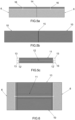
- Figure 5a shows how the two elements 6 are obtained by means of the central cut of a first roll 14, while the pair of single-colour elements 10 are also obtained by means of the central cut of a second roll 15, allowing the manufacture thereof to be optimised, while the central single-colour element 11 is manufactured in such a way that it overlaps the elements 6 at both ends, allowing the overlapping coloured areas 13 to be cut out and eliminated, leaving a white longitudinal central line section 12' at both ends.
- the different elements that make up the court surface can be placed transversely with respect to each other or in different longitudinal directions, avoiding the creation of the "shaded" effect.
- the sand will be incorporated on the entire surface of the court, leaving it perfectly distributed penetrating between the texturised filaments and being trapped therebetween, providing an excellent sports function as it is not unevenly distributed on the surface.
- the marking of the game lines in situ is eliminated, directly eliminating the adhesion joints and therefore the possibility of peeling off as the lines are directly inserted into the turfs that make up the flooring, reducing installation time and materials, that is, bonding tapes and installation adhesive.
Landscapes
- Engineering & Computer Science (AREA)
- Architecture (AREA)
- Civil Engineering (AREA)
- Structural Engineering (AREA)
- Road Paving Structures (AREA)
Abstract
Description
- The following invention relates to an artificial grass turf for padel courts and the installation method thereof, such that it improves both the interaction of the player and of the ball with the playing surface, and also reduces court installation time.
- As is known, padel has experienced a significant boom in recent years, both at a professional and amateur level, the number of courts having increased considerably, such that in its evolution it is about introducing improvements that have an impact on a reduction of the risk of injury and offer optimum performance for the player.
- Thus, conventionally, artificial grass turfs used for padel courts are obtained from fibres made up of several threads, all having equal cross-section, twisted together, defining straight fibres in their weave according to the desired height.
- Likewise, all the turfs used to configure the court have the same colour, defining single-colour courts with the corresponding separating lines of the playing surface.
- Moreover, the installation of the padel courts is based on the use of rolls (usually three rolls, two 20x4 m and one 20x2 m roll) whereby, in the assembly thereof, arranged longitudinally attached to each other, the entire surface of the court is made up and wherein, subsequently, the white lines separating the playing surfaces must be incorporated.
- In this way, once the artificial grass turf rolls have been arranged, the bands must be cut, using a special tool for this purpose, in which the bands must be incorporated as white separating lines. This operation, in addition to the time invested for it, causes many adhesion joints and therefore a greater possibility of peeling off and a greater possibility of strange bounces of the ball.
- Moreover, when assembling the conventional artificial grass turf rolls, it must be kept in mind that the rolls must be assembled, all of them in the same direction, since, if they are assembled not just in the transverse direction, but in a different longitudinal direction, a "shading" is produced, that is to say, both areas of different tonality are visually appreciated.
- This report describes an artificial grass turf for padel courts and the installation method thereof, so that the artificial grass turf combines at least texturised monofilaments having a rectangular cross-section with rounded smaller sides and a central rib with texturised monofilaments having a parallelogram-shaped cross-section with curved-concave sides and the turf comprises:
- two elements that define two bicolour areas separated by a transverse white line, a first area corresponding to the service surface and a second area to the central portion of the court;
- two single-colour elements corresponding to the central lateral portion of the court, and;
- a single-colour element with a white central longitudinal line corresponding to the central longitudinal portion of the court.
- Thus, when making the carpet, at least two monofilaments having different cross-sections will be combined.
- The second area of the two elements that define two bicolour areas separated by a transverse white line, has a length of approximately 1/3 of the length of the first area corresponding to the service surface.
- Moreover, the second area of the two elements that define two bicolour areas separated by a transverse white line has the same colour as the two single-colour elements corresponding to the central lateral portion of the court, as well as the single-colour element with the central longitudinal white line.
- In a preferred embodiment of the invention, the two bicolour areas will have a blue colour of different tones, one being darker than the other, although, logically, they could have other colours.
- In a practical variant embodiment of the invention, the two elements that define two single-colour areas separated by a transverse white line, a first area corresponding to the service surface and a second area to the central portion of the court, can have the same colour similar to that of single-colour elements.
- Thus, in this variant, the court will have a single colour with the marking white lines for marking the court and, it could even be the case that the court was white and the marking lines were of any other colour, the different elements being executed in a similar manner as indicated.
- According to the artificial grass turf for padel courts described in the process followed when installing same, the following steps or phases follow one another:
- installing the two elements defined by two bicolour areas separated by a transverse white line, corresponding to the areas of both service surfaces and a second area of the central portion of the court;
- installing the two single-colour elements corresponding to the central lateral portion of the court, and;
- installing the single-colour element with a white central longitudinal line corresponding to the central longitudinal portion of the court.
- The central longitudinal single-colour element, at its two ends, overlaps on the two elements that define the two bicolour areas separated by a transverse white line, a first area corresponding to the service surface and a second area to the central portion, exceeding the second area and extending approximately 20 cm through the first area.
- The coloured portions of the ends of the central longitudinal single-colour element that overlaps on both sides are cut out and eliminated, leaving the separating white line, which will be inserted in the corresponding cuts previously made in the two elements that define two bicolour areas, such that in this way the placement of independent white bands is avoided that can lead to different turf thicknesses that, even if they are minimal, can lead to bad bounces of the ball.
- Moreover, it should be noted that the installation process of the different elements could be different from the one highlighted.
- To complement the following description and for the purpose of helping to better understand the features of the invention, a set of drawings is attached to the present specification, in the figures of which, by illustration and not limitation, the most characteristic details of the invention are represented.
-
-
Figure 1 shows a cross-sectional view of a texturised monofilament used in artificial grass turfs, having a general rectangular configuration with rounded smaller sides and equipped with a rounded central rib. -
Figure 2 shows a cross-sectional view of a texturised monofilament used in artificial grass turfs, having a general parallelogram-shaped configuration with its curved-concave sides defining four grooves and four asymmetrical ribs. -
Figure 3 shows a view of the court configured according to the invention in which two colours corresponding to the service surface and the central surface are defined, separated by the respective transverse white service lines. -
Figure 4 shows a view in which the different elements that in the assembly thereof make up the padel court of the invention are represented. -
Figures 5a, 5b and 5c show a view of a practical execution from which the different elements are obtained that, once obtained, configure the padel court in the assembly thereof, being able to observe how the two bicolour elements are obtained from a first roll and how the pair of single-colour elements are also obtained from a second roll and the central single-colour element is manufactured, oversized, independently. -
Figure 6 shows a view of the padel court as it is configured from the different elements that in the assembly thereof make it up. - In view of the aforementioned figures and in accordance with the numbering adopted, it can be seen how the artificial grass turf for padel courts is based on the combination of at least texturised monofilaments having a rectangular
general section 1 with their smaller sides rounded and equipped with a roundedcentral rib 2, with texturised monofilaments having a parallelogram-shaped section 3 with its four curved-concave sides 4 and fourasymmetrical ribs 5 that act as lateral reinforcements. - Both monofilaments are made of polyethylene (PE) and specific additives that are characterised by their high resistance and ultraviolet (UV) treatment, resistant to heat and extreme weather variations, improving their durability and freeing them from part of the stress that occurs when pressed by the interaction of the player, giving the court greater ball speed and reducing wear.
- Thus, the turf can be made, both based on the minimum of the two monofilaments described, or it can be made with more additional monofilaments having different cross sections.
- Thus, the turf that makes up the entire padel court is determined by two
elements 6 that define twobicolour areas white line 9, afirst area 7 corresponding to the service surface and asecond area 8 corresponding to the central portion of the court, a pair of single-colour elements 10 corresponding to the central lateral portion of the court, and a single-colour element 11 with a white centrallongitudinal line 12 corresponding to the central longitudinal portion of the court. - The
second area 8 of the twoelements 6 that define two bicolour areas separated by the transversewhite line 9, has a length of approximately 1/3 of the length of thefirst area 7 corresponding to the service surface. - Moreover, the
second area 8 of the twoelements 6 that define twobicolour areas white line 9 has the same colour as the pair of single-colour elements 10 corresponding to the central lateral portion of the court, as well as the single-colour element 11 with the white centrallongitudinal line 12 that marks the central line of the court. - In accordance with the description relative to the different components of artificial grass turf for the configuration of a padel court, in its installation method the two
elements 6 defined by the twobicolour areas areas 7 of both service surfaces and to asecond area 8 that will form part of the central surface of the court. - Next, the pair of single-
colour elements 10 corresponding to the central lateral portion of the court will be installed, and, finally, the single-colour element 11 will be installed with a white centrallongitudinal line 12, (longitudinal divider of the central portion of the court) corresponding to the central longitudinal portion of the court. - In the assembly of the central longitudinal single-
colour element 11, at its two ends, it overlaps on the twoelements 6 that define the twobicolour areas white line 9, afirst area 7 corresponding to the service surface and asecond area 8 corresponding to the central portion of the court, exceeding thesecond area 8 and extending approximately 20 cm through thefirst area 7, so that the purpose of said execution is that the endcoloured areas 13 of the central longitudinal single-colour element 11 that overlap at both ends, are cut out and eliminated, leaving the separating white longitudinalcentral line 12, which will be inserted in the corresponding cuts previously made in the twoelements 6 that define twobicolour areas -
Figure 5a shows how the twoelements 6 are obtained by means of the central cut of afirst roll 14, while the pair of single-colour elements 10 are also obtained by means of the central cut of asecond roll 15, allowing the manufacture thereof to be optimised, while the central single-colour element 11 is manufactured in such a way that it overlaps theelements 6 at both ends, allowing the overlappingcoloured areas 13 to be cut out and eliminated, leaving a white longitudinal central line section 12' at both ends. - Thus, the pair of white longitudinal central line sections 12' of the single-
colour element 11 will be inserted into thecuts 15 previously made in the twoelements 6. - Likewise, the different elements that make up the court surface can be placed transversely with respect to each other or in different longitudinal directions, avoiding the creation of the "shaded" effect.
- Finally, once the installation of the entire turf is assembled, the sand will be incorporated on the entire surface of the court, leaving it perfectly distributed penetrating between the texturised filaments and being trapped therebetween, providing an excellent sports function as it is not unevenly distributed on the surface.
- With all this, a homogeneity and evenness of the angled and vertical bounce is obtained before and after the glass bounce from the first moment and in all the points of the court, an excellent resistance to rotational and linear traction and an excellent aesthetic appearance, as it exhibits a total uniformity and superficial visual continuity, that is to say, without the creation of the unpleasant "shading" effect.
- In addition, the marking of the game lines in situ is eliminated, directly eliminating the adhesion joints and therefore the possibility of peeling off as the lines are directly inserted into the turfs that make up the flooring, reducing installation time and materials, that is, bonding tapes and installation adhesive.
Claims (7)
- An artificial grass turf for padel courts, characterised in that the artificial grass turf combines at least texturised monofilaments having a rectangular cross-section (1) with rounded smaller sides and with a central rib (2) with texturised monofilaments having a parallelogram-shaped cross-section (3) with curved-concave sides (4), and in that the turf comprises:- two elements (6) that define two bicolour areas (7 and 8) separated by a transverse white line (9), a first area (7) corresponding to the service surface and a second area (8) corresponding to the central portion of the court;- a pair of single-colour elements (10) corresponding to the central lateral portion of the court, and;- a single-colour element (11) with a white central longitudinal line (12) corresponding to the central longitudinal portion of the court.
- The artificial grass turf for padel courts, according to claim 1, characterised in that the second area (8) of the two elements (6) that define two bicolour areas (7 and 8) separated by a transverse white line (9) presents a length of approximately 1/3 of the length of the first area (7) corresponding to the service surface.
- The artificial grass turf for padel courts, according to claim 1, characterised in that the second area (8) of the two elements (6) that define two bicolour areas (7 and 8) separated by a transverse white line (9) presents the same colour as the pair of single-colour elements (10) corresponding to the central lateral portion of the court, as well as the single-colour element (11) with the white central longitudinal line (12).
- The artificial grass turf for padel courts, according to claim 1, characterised in that the two elements (6) define two single-colour areas (7 and 8) separated by a transverse white line (9), a first area (7) corresponding to the service surface and a second area (8) corresponding to the central portion of the court, the colour of which is similar to that of the single-colour elements (10) and (11).
- An installation method, according to the preceding claims, of the artificial grass turf for padel courts, characterised in that the following phases occur in the process followed when installing the artificial grass turf:- installing the two elements (6) defined by two bicolour areas (7 and 8) separated by a transverse white line (9), corresponding to the areas (7) of both service surfaces and to a second area (8) of the central portion of the court;- installing the pair of single-colour elements (10) corresponding to the central lateral portion of the court, and;- installing the single-colour element (11) with a white central longitudinal line (12) corresponding to the central longitudinal portion of the court.
- The installation method, according to claim 4, characterised in that the central longitudinal single-colour element (11), at its two ends, overlaps on the two elements (6) that define the two bicolour areas (7 and 8) separated by a transverse white line (9), a first area (7) corresponding to the service surface and a second area (8) corresponding to the central portion of the court, exceeding the second area (8) and extending approximately 20 cm through the first area (7).
- The installation method, according to claim 4, characterised in that the coloured areas of the central longitudinal single-colour element (11) that overlap at both ends are cut out and eliminated, leaving the separating white longitudinal central line (12), which will be inserted in corresponding cuts previously made in the two elements (6) that define two bicolour areas (7 and 8).
Applications Claiming Priority (1)
| Application Number | Priority Date | Filing Date | Title |
|---|---|---|---|
| PCT/ES2020/070541 WO2022053721A1 (en) | 2020-09-09 | 2020-09-09 | Artificial grass turf for padel courts and installation method |
Publications (4)
| Publication Number | Publication Date |
|---|---|
| EP4212669A1 true EP4212669A1 (en) | 2023-07-19 |
| EP4212669A4 EP4212669A4 (en) | 2023-10-18 |
| EP4212669C0 EP4212669C0 (en) | 2025-10-22 |
| EP4212669B1 EP4212669B1 (en) | 2025-10-22 |
Family
ID=80632109
Family Applications (1)
| Application Number | Title | Priority Date | Filing Date |
|---|---|---|---|
| EP20953175.5A Active EP4212669B1 (en) | 2020-09-09 | 2020-09-09 | Artificial grass turf for padel courts and installation method |
Country Status (2)
| Country | Link |
|---|---|
| EP (1) | EP4212669B1 (en) |
| WO (1) | WO2022053721A1 (en) |
Family Cites Families (8)
| Publication number | Priority date | Publication date | Assignee | Title |
|---|---|---|---|---|
| US3771787A (en) * | 1969-01-28 | 1973-11-13 | Tennis Services Inc | Playing court surface and method of constructing same |
| JPS53125332A (en) * | 1977-04-06 | 1978-11-01 | Kureha Chemical Ind Co Ltd | Method of marking white line on artificial lawn |
| JPS6378903A (en) * | 1986-09-22 | 1988-04-09 | 株式会社 サアミ | White line arranging structure of artificial turf |
| US20040234719A1 (en) * | 2003-05-23 | 2004-11-25 | Wayne Mills Co., Inc. | Anchoring of artificial turf |
| AT505978B1 (en) * | 2007-07-31 | 2009-08-15 | Lenzing Plastics Gmbh | MONOFIL WITH NON-CIRCULAR CROSS-SECTION, THE PRODUCTION THEREOF, AND YARN MANUFACTURED THEREOF |
| KR101948617B1 (en) * | 2017-01-19 | 2019-02-15 | (주)대원그린 | Method of installing combined thuf structure |
| ES1182811U (en) * | 2017-05-03 | 2017-05-12 | Naturf Develop, S.L. | Fiber to conform artificial lawn (Machine-translation by Google Translate, not legally binding) |
| JP3222143U (en) * | 2019-04-26 | 2019-07-11 | 青島青禾人造草坪股▲フン▼有限公司Qingdao Bellinturf Industrial Co., Ltd. | Multicolor multi-type artificial turf |
-
2020
- 2020-09-09 WO PCT/ES2020/070541 patent/WO2022053721A1/en not_active Ceased
- 2020-09-09 EP EP20953175.5A patent/EP4212669B1/en active Active
Also Published As
| Publication number | Publication date |
|---|---|
| EP4212669A4 (en) | 2023-10-18 |
| EP4212669C0 (en) | 2025-10-22 |
| EP4212669B1 (en) | 2025-10-22 |
| WO2022053721A1 (en) | 2022-03-17 |
Similar Documents
| Publication | Publication Date | Title |
|---|---|---|
| US10793973B2 (en) | Synthetic fibre and an artificial lawn comprising such a fibre | |
| DE69705535T2 (en) | COMBINATION LAWN | |
| EP0103285B1 (en) | Sports shoe for athletics | |
| EP1294247A1 (en) | Sole in the form of a midsole, inner sole or insertable sole for a shoe and a shoe with said sole | |
| EP2473655B1 (en) | Fiber for artificial turf | |
| DE3706071A1 (en) | SOLE FOR SPORTSHOES, ESPECIALLY FOR FOOTBALL SHOES | |
| DE69317359T2 (en) | Inflatable sports ball | |
| DE60205023T2 (en) | TIRES WITH STRENGTHENING CONSTRUCTION | |
| ZA200705952B (en) | Artificial fibre for use in an artificial grass sport field | |
| EP4212669A1 (en) | Artificial grass turf for padel courts and installation method | |
| DE102016102792A1 (en) | Shoe made of a two-ply textile material | |
| EP2084981A1 (en) | Shoe, in particular sport shoe and/or leisure shoe | |
| AU2012278394B2 (en) | Synthetic fibre and an artificial lawn comprising such a fibre | |
| US7168883B2 (en) | Tennis surface | |
| DE102019208734B4 (en) | Method for producing an abrasion-resistant material | |
| DE2509882A1 (en) | INNOVATIVE CLUB | |
| JPH09242012A (en) | Pile yarn for artificial grass | |
| EP0779785A1 (en) | Shoe, in particular sports shoe, process and matrix for moulding the same | |
| US20250376807A1 (en) | High-permeability base fabric, artificial turf comprising same and preparation method | |
| EP0565913A1 (en) | Shoe for mountain climbers | |
| FI128620B (en) | Artificial turf | |
| AU2017210576B2 (en) | Tennis Surface | |
| DE102020000776B4 (en) | Process for manufacturing a weather-resistant straw shoe and corresponding weather-resistant straw shoe | |
| DE10241749B4 (en) | shoe | |
| DE60025784T2 (en) | Air tire with decoupled low zone |
Legal Events
| Date | Code | Title | Description |
|---|---|---|---|
| STAA | Information on the status of an ep patent application or granted ep patent |
Free format text: STATUS: THE INTERNATIONAL PUBLICATION HAS BEEN MADE |
|
| PUAI | Public reference made under article 153(3) epc to a published international application that has entered the european phase |
Free format text: ORIGINAL CODE: 0009012 |
|
| STAA | Information on the status of an ep patent application or granted ep patent |
Free format text: STATUS: REQUEST FOR EXAMINATION WAS MADE |
|
| 17P | Request for examination filed |
Effective date: 20230215 |
|
| AK | Designated contracting states |
Kind code of ref document: A1 Designated state(s): AL AT BE BG CH CY CZ DE DK EE ES FI FR GB GR HR HU IE IS IT LI LT LU LV MC MK MT NL NO PL PT RO RS SE SI SK SM TR |
|
| A4 | Supplementary search report drawn up and despatched |
Effective date: 20230914 |
|
| RIC1 | Information provided on ipc code assigned before grant |
Ipc: A63C 19/04 20060101ALI20230908BHEP Ipc: E01C 13/08 20060101AFI20230908BHEP |
|
| DAV | Request for validation of the european patent (deleted) | ||
| DAX | Request for extension of the european patent (deleted) | ||
| GRAP | Despatch of communication of intention to grant a patent |
Free format text: ORIGINAL CODE: EPIDOSNIGR1 |
|
| STAA | Information on the status of an ep patent application or granted ep patent |
Free format text: STATUS: GRANT OF PATENT IS INTENDED |
|
| INTG | Intention to grant announced |
Effective date: 20250516 |
|
| GRAS | Grant fee paid |
Free format text: ORIGINAL CODE: EPIDOSNIGR3 |
|
| GRAA | (expected) grant |
Free format text: ORIGINAL CODE: 0009210 |
|
| STAA | Information on the status of an ep patent application or granted ep patent |
Free format text: STATUS: THE PATENT HAS BEEN GRANTED |
|
| AK | Designated contracting states |
Kind code of ref document: B1 Designated state(s): AL AT BE BG CH CY CZ DE DK EE ES FI FR GB GR HR HU IE IS IT LI LT LU LV MC MK MT NL NO PL PT RO RS SE SI SK SM TR |
|
| REG | Reference to a national code |
Ref country code: CH Ref legal event code: F10 Free format text: ST27 STATUS EVENT CODE: U-0-0-F10-F00 (AS PROVIDED BY THE NATIONAL OFFICE) Effective date: 20251022 Ref country code: GB Ref legal event code: FG4D |
|
| REG | Reference to a national code |
Ref country code: DE Ref legal event code: R096 Ref document number: 602020061055 Country of ref document: DE |
|
| REG | Reference to a national code |
Ref country code: IE Ref legal event code: FG4D |
|
| U01 | Request for unitary effect filed |
Effective date: 20251121 |
|
| U07 | Unitary effect registered |
Designated state(s): AT BE BG DE DK EE FI FR IT LT LU LV MT NL PT RO SE SI Effective date: 20251128 |
|
| PG25 | Lapsed in a contracting state [announced via postgrant information from national office to epo] |
Ref country code: NO Free format text: LAPSE BECAUSE OF FAILURE TO SUBMIT A TRANSLATION OF THE DESCRIPTION OR TO PAY THE FEE WITHIN THE PRESCRIBED TIME-LIMIT Effective date: 20260122 |
|
| PG25 | Lapsed in a contracting state [announced via postgrant information from national office to epo] |
Ref country code: HR Free format text: LAPSE BECAUSE OF FAILURE TO SUBMIT A TRANSLATION OF THE DESCRIPTION OR TO PAY THE FEE WITHIN THE PRESCRIBED TIME-LIMIT Effective date: 20251022 |
|
| PG25 | Lapsed in a contracting state [announced via postgrant information from national office to epo] |
Ref country code: RS Free format text: LAPSE BECAUSE OF FAILURE TO SUBMIT A TRANSLATION OF THE DESCRIPTION OR TO PAY THE FEE WITHIN THE PRESCRIBED TIME-LIMIT Effective date: 20260122 |
|
| PG25 | Lapsed in a contracting state [announced via postgrant information from national office to epo] |
Ref country code: IS Free format text: LAPSE BECAUSE OF FAILURE TO SUBMIT A TRANSLATION OF THE DESCRIPTION OR TO PAY THE FEE WITHIN THE PRESCRIBED TIME-LIMIT Effective date: 20260222 |
|
| PG25 | Lapsed in a contracting state [announced via postgrant information from national office to epo] |
Ref country code: PL Free format text: LAPSE BECAUSE OF FAILURE TO SUBMIT A TRANSLATION OF THE DESCRIPTION OR TO PAY THE FEE WITHIN THE PRESCRIBED TIME-LIMIT Effective date: 20251022 |