EP4212219A1 - Exercise improvement instruction device, exercise improvement instruction method, and exercise improvement instruction program - Google Patents
Exercise improvement instruction device, exercise improvement instruction method, and exercise improvement instruction program Download PDFInfo
- Publication number
- EP4212219A1 EP4212219A1 EP20958622.1A EP20958622A EP4212219A1 EP 4212219 A1 EP4212219 A1 EP 4212219A1 EP 20958622 A EP20958622 A EP 20958622A EP 4212219 A1 EP4212219 A1 EP 4212219A1
- Authority
- EP
- European Patent Office
- Prior art keywords
- index
- exercise
- layer
- indexes
- improvement
- Prior art date
- Legal status (The legal status is an assumption and is not a legal conclusion. Google has not performed a legal analysis and makes no representation as to the accuracy of the status listed.)
- Pending
Links
Images



Classifications
-
- G—PHYSICS
- G06—COMPUTING OR CALCULATING; COUNTING
- G06V—IMAGE OR VIDEO RECOGNITION OR UNDERSTANDING
- G06V40/00—Recognition of biometric, human-related or animal-related patterns in image or video data
- G06V40/20—Movements or behaviour, e.g. gesture recognition
- G06V40/23—Recognition of whole body movements, e.g. for sport training
-
- A—HUMAN NECESSITIES
- A63—SPORTS; GAMES; AMUSEMENTS
- A63B—APPARATUS FOR PHYSICAL TRAINING, GYMNASTICS, SWIMMING, CLIMBING, OR FENCING; BALL GAMES; TRAINING EQUIPMENT
- A63B24/00—Electric or electronic controls for exercising apparatus of preceding groups; Controlling or monitoring of exercises, sportive games, training or athletic performances
- A63B24/0003—Analysing the course of a movement or motion sequences during an exercise or trainings sequence, e.g. swing for golf or tennis
- A63B24/0006—Computerised comparison for qualitative assessment of motion sequences or the course of a movement
-
- A—HUMAN NECESSITIES
- A61—MEDICAL OR VETERINARY SCIENCE; HYGIENE
- A61B—DIAGNOSIS; SURGERY; IDENTIFICATION
- A61B5/00—Measuring for diagnostic purposes; Identification of persons
- A61B5/103—Measuring devices for testing the shape, pattern, colour, size or movement of the body or parts thereof, for diagnostic purposes
- A61B5/11—Measuring movement of the entire body or parts thereof, e.g. head or hand tremor or mobility of a limb
-
- A—HUMAN NECESSITIES
- A61—MEDICAL OR VETERINARY SCIENCE; HYGIENE
- A61B—DIAGNOSIS; SURGERY; IDENTIFICATION
- A61B5/00—Measuring for diagnostic purposes; Identification of persons
- A61B5/103—Measuring devices for testing the shape, pattern, colour, size or movement of the body or parts thereof, for diagnostic purposes
- A61B5/11—Measuring movement of the entire body or parts thereof, e.g. head or hand tremor or mobility of a limb
- A61B5/1112—Global tracking of patients, e.g. by using GPS
-
- A—HUMAN NECESSITIES
- A61—MEDICAL OR VETERINARY SCIENCE; HYGIENE
- A61B—DIAGNOSIS; SURGERY; IDENTIFICATION
- A61B5/00—Measuring for diagnostic purposes; Identification of persons
- A61B5/103—Measuring devices for testing the shape, pattern, colour, size or movement of the body or parts thereof, for diagnostic purposes
- A61B5/11—Measuring movement of the entire body or parts thereof, e.g. head or hand tremor or mobility of a limb
- A61B5/1113—Local tracking of patients, e.g. in a hospital or private home
- A61B5/1114—Tracking parts of the body
-
- A—HUMAN NECESSITIES
- A61—MEDICAL OR VETERINARY SCIENCE; HYGIENE
- A61B—DIAGNOSIS; SURGERY; IDENTIFICATION
- A61B5/00—Measuring for diagnostic purposes; Identification of persons
- A61B5/103—Measuring devices for testing the shape, pattern, colour, size or movement of the body or parts thereof, for diagnostic purposes
- A61B5/11—Measuring movement of the entire body or parts thereof, e.g. head or hand tremor or mobility of a limb
- A61B5/1116—Determining posture transitions
-
- A—HUMAN NECESSITIES
- A61—MEDICAL OR VETERINARY SCIENCE; HYGIENE
- A61B—DIAGNOSIS; SURGERY; IDENTIFICATION
- A61B5/00—Measuring for diagnostic purposes; Identification of persons
- A61B5/103—Measuring devices for testing the shape, pattern, colour, size or movement of the body or parts thereof, for diagnostic purposes
- A61B5/11—Measuring movement of the entire body or parts thereof, e.g. head or hand tremor or mobility of a limb
- A61B5/112—Gait analysis
-
- A—HUMAN NECESSITIES
- A61—MEDICAL OR VETERINARY SCIENCE; HYGIENE
- A61B—DIAGNOSIS; SURGERY; IDENTIFICATION
- A61B5/00—Measuring for diagnostic purposes; Identification of persons
- A61B5/103—Measuring devices for testing the shape, pattern, colour, size or movement of the body or parts thereof, for diagnostic purposes
- A61B5/11—Measuring movement of the entire body or parts thereof, e.g. head or hand tremor or mobility of a limb
- A61B5/1123—Discriminating type of movement, e.g. walking or running
-
- A—HUMAN NECESSITIES
- A61—MEDICAL OR VETERINARY SCIENCE; HYGIENE
- A61B—DIAGNOSIS; SURGERY; IDENTIFICATION
- A61B5/00—Measuring for diagnostic purposes; Identification of persons
- A61B5/72—Signal processing specially adapted for physiological signals or for diagnostic purposes
- A61B5/7235—Details of waveform analysis
- A61B5/7264—Classification of physiological signals or data, e.g. using neural networks, statistical classifiers, expert systems or fuzzy systems
-
- A—HUMAN NECESSITIES
- A61—MEDICAL OR VETERINARY SCIENCE; HYGIENE
- A61B—DIAGNOSIS; SURGERY; IDENTIFICATION
- A61B5/00—Measuring for diagnostic purposes; Identification of persons
- A61B5/72—Signal processing specially adapted for physiological signals or for diagnostic purposes
- A61B5/7271—Specific aspects of physiological measurement analysis
- A61B5/7278—Artificial waveform generation or derivation, e.g. synthesizing signals from measured signals
-
- A—HUMAN NECESSITIES
- A63—SPORTS; GAMES; AMUSEMENTS
- A63B—APPARATUS FOR PHYSICAL TRAINING, GYMNASTICS, SWIMMING, CLIMBING, OR FENCING; BALL GAMES; TRAINING EQUIPMENT
- A63B24/00—Electric or electronic controls for exercising apparatus of preceding groups; Controlling or monitoring of exercises, sportive games, training or athletic performances
- A63B24/0062—Monitoring athletic performances, e.g. for determining the work of a user on an exercise apparatus, the completed jogging or cycling distance
-
- G—PHYSICS
- G06—COMPUTING OR CALCULATING; COUNTING
- G06F—ELECTRIC DIGITAL DATA PROCESSING
- G06F3/00—Input arrangements for transferring data to be processed into a form capable of being handled by the computer; Output arrangements for transferring data from processing unit to output unit, e.g. interface arrangements
- G06F3/01—Input arrangements or combined input and output arrangements for interaction between user and computer
- G06F3/048—Interaction techniques based on graphical user interfaces [GUI]
- G06F3/0481—Interaction techniques based on graphical user interfaces [GUI] based on specific properties of the displayed interaction object or a metaphor-based environment, e.g. interaction with desktop elements like windows or icons, or assisted by a cursor's changing behaviour or appearance
- G06F3/0482—Interaction with lists of selectable items, e.g. menus
-
- G—PHYSICS
- G16—INFORMATION AND COMMUNICATION TECHNOLOGY [ICT] SPECIALLY ADAPTED FOR SPECIFIC APPLICATION FIELDS
- G16H—HEALTHCARE INFORMATICS, i.e. INFORMATION AND COMMUNICATION TECHNOLOGY [ICT] SPECIALLY ADAPTED FOR THE HANDLING OR PROCESSING OF MEDICAL OR HEALTHCARE DATA
- G16H20/00—ICT specially adapted for therapies or health-improving plans, e.g. for handling prescriptions, for steering therapy or for monitoring patient compliance
- G16H20/30—ICT specially adapted for therapies or health-improving plans, e.g. for handling prescriptions, for steering therapy or for monitoring patient compliance relating to physical therapies or activities, e.g. physiotherapy, acupressure or exercising
-
- A—HUMAN NECESSITIES
- A61—MEDICAL OR VETERINARY SCIENCE; HYGIENE
- A61B—DIAGNOSIS; SURGERY; IDENTIFICATION
- A61B2503/00—Evaluating a particular growth phase or type of persons or animals
- A61B2503/10—Athletes
-
- A—HUMAN NECESSITIES
- A61—MEDICAL OR VETERINARY SCIENCE; HYGIENE
- A61B—DIAGNOSIS; SURGERY; IDENTIFICATION
- A61B2560/00—Constructional details of operational features of apparatus; Accessories for medical measuring apparatus
- A61B2560/02—Operational features
- A61B2560/0242—Operational features adapted to measure environmental factors, e.g. temperature, pollution
- A61B2560/0247—Operational features adapted to measure environmental factors, e.g. temperature, pollution for compensation or correction of the measured physiological value
-
- A—HUMAN NECESSITIES
- A61—MEDICAL OR VETERINARY SCIENCE; HYGIENE
- A61B—DIAGNOSIS; SURGERY; IDENTIFICATION
- A61B2562/00—Details of sensors; Constructional details of sensor housings or probes; Accessories for sensors
- A61B2562/02—Details of sensors specially adapted for in-vivo measurements
- A61B2562/0219—Inertial sensors, e.g. accelerometers, gyroscopes, tilt switches
-
- A—HUMAN NECESSITIES
- A61—MEDICAL OR VETERINARY SCIENCE; HYGIENE
- A61B—DIAGNOSIS; SURGERY; IDENTIFICATION
- A61B5/00—Measuring for diagnostic purposes; Identification of persons
- A61B5/103—Measuring devices for testing the shape, pattern, colour, size or movement of the body or parts thereof, for diagnostic purposes
- A61B5/1036—Measuring load distribution, e.g. podologic studies
-
- A—HUMAN NECESSITIES
- A61—MEDICAL OR VETERINARY SCIENCE; HYGIENE
- A61B—DIAGNOSIS; SURGERY; IDENTIFICATION
- A61B5/00—Measuring for diagnostic purposes; Identification of persons
- A61B5/103—Measuring devices for testing the shape, pattern, colour, size or movement of the body or parts thereof, for diagnostic purposes
- A61B5/11—Measuring movement of the entire body or parts thereof, e.g. head or hand tremor or mobility of a limb
- A61B5/1118—Determining activity level
-
- A—HUMAN NECESSITIES
- A61—MEDICAL OR VETERINARY SCIENCE; HYGIENE
- A61B—DIAGNOSIS; SURGERY; IDENTIFICATION
- A61B5/00—Measuring for diagnostic purposes; Identification of persons
- A61B5/103—Measuring devices for testing the shape, pattern, colour, size or movement of the body or parts thereof, for diagnostic purposes
- A61B5/11—Measuring movement of the entire body or parts thereof, e.g. head or hand tremor or mobility of a limb
- A61B5/1126—Measuring movement of the entire body or parts thereof, e.g. head or hand tremor or mobility of a limb using a particular sensing technique
-
- A—HUMAN NECESSITIES
- A61—MEDICAL OR VETERINARY SCIENCE; HYGIENE
- A61B—DIAGNOSIS; SURGERY; IDENTIFICATION
- A61B5/00—Measuring for diagnostic purposes; Identification of persons
- A61B5/68—Arrangements of detecting, measuring or recording means, e.g. sensors, in relation to patient
- A61B5/6801—Arrangements of detecting, measuring or recording means, e.g. sensors, in relation to patient specially adapted to be attached to or worn on the body surface
- A61B5/6802—Sensor mounted on worn items
- A61B5/681—Wristwatch-type devices
-
- A—HUMAN NECESSITIES
- A61—MEDICAL OR VETERINARY SCIENCE; HYGIENE
- A61B—DIAGNOSIS; SURGERY; IDENTIFICATION
- A61B5/00—Measuring for diagnostic purposes; Identification of persons
- A61B5/68—Arrangements of detecting, measuring or recording means, e.g. sensors, in relation to patient
- A61B5/6887—Arrangements of detecting, measuring or recording means, e.g. sensors, in relation to patient mounted on external non-worn devices, e.g. non-medical devices
- A61B5/6898—Portable consumer electronic devices, e.g. music players, telephones, tablet computers
-
- A—HUMAN NECESSITIES
- A63—SPORTS; GAMES; AMUSEMENTS
- A63B—APPARATUS FOR PHYSICAL TRAINING, GYMNASTICS, SWIMMING, CLIMBING, OR FENCING; BALL GAMES; TRAINING EQUIPMENT
- A63B24/00—Electric or electronic controls for exercising apparatus of preceding groups; Controlling or monitoring of exercises, sportive games, training or athletic performances
- A63B24/0003—Analysing the course of a movement or motion sequences during an exercise or trainings sequence, e.g. swing for golf or tennis
- A63B24/0006—Computerised comparison for qualitative assessment of motion sequences or the course of a movement
- A63B2024/0012—Comparing movements or motion sequences with a registered reference
- A63B2024/0015—Comparing movements or motion sequences with computerised simulations of movements or motion sequences, e.g. for generating an ideal template as reference to be achieved by the user
-
- A—HUMAN NECESSITIES
- A63—SPORTS; GAMES; AMUSEMENTS
- A63B—APPARATUS FOR PHYSICAL TRAINING, GYMNASTICS, SWIMMING, CLIMBING, OR FENCING; BALL GAMES; TRAINING EQUIPMENT
- A63B24/00—Electric or electronic controls for exercising apparatus of preceding groups; Controlling or monitoring of exercises, sportive games, training or athletic performances
- A63B24/0062—Monitoring athletic performances, e.g. for determining the work of a user on an exercise apparatus, the completed jogging or cycling distance
- A63B2024/0071—Distinction between different activities, movements, or kind of sports performed
-
- G—PHYSICS
- G16—INFORMATION AND COMMUNICATION TECHNOLOGY [ICT] SPECIALLY ADAPTED FOR SPECIFIC APPLICATION FIELDS
- G16H—HEALTHCARE INFORMATICS, i.e. INFORMATION AND COMMUNICATION TECHNOLOGY [ICT] SPECIALLY ADAPTED FOR THE HANDLING OR PROCESSING OF MEDICAL OR HEALTHCARE DATA
- G16H50/00—ICT specially adapted for medical diagnosis, medical simulation or medical data mining; ICT specially adapted for detecting, monitoring or modelling epidemics or pandemics
- G16H50/20—ICT specially adapted for medical diagnosis, medical simulation or medical data mining; ICT specially adapted for detecting, monitoring or modelling epidemics or pandemics for computer-aided diagnosis, e.g. based on medical expert systems
Definitions
- the present invention relates to a technology for identifying problems for improvement of exercise motions.
- mobile communication terminals such as smartphones have been becoming more lightweight, and so-called wearable devices have been actively developed, as typified by smartwatches. These devices can be worn also during exercise, such as running, and can measure exercise motions with built-in acceleration sensors and the like. There are also services and applications that provide guidance for improving exercise motions based on the measurement results.
- Patent Literature 1 Japanese Unexamined Patent Application Publication No. 2014-124448
- the present invention has been made in view of such a situation, and a purpose thereof is to provide an exercise improvement guidance device that can identify a problem that leads to effective improvement of exercise motions.
- an exercise improvement guidance device includes: a hierarchical index storage unit that stores hierarchized indexes for improvement of an exercise motion; and a problem index identification unit that evaluates the hierarchized indexes based on measurement data during an exercise and identifies a problem index.
- the hierarchized indexes are evaluated based on measurement data during an exercise, and a problem index is identified.
- a problem index that leads to effective improvement of exercise motions can be identified.
- An exercise improvement guidance method includes: a hierarchical index storing step of storing hierarchized indexes for improvement of an exercise motion; and a problem index identification step of evaluating the hierarchized indexes based on measurement data during an exercise and identifying a problem index.
- An exercise improvement guidance program causes a computer to implement: a hierarchical index storing step of storing hierarchized indexes for improvement of an exercise motion; and a problem index identification step of evaluating the hierarchized indexes based on measurement data during an exercise and identifying a problem index.
- the present invention enables identification of a problem that leads to effective improvement of exercise motions.
- indexes for improvement of exercise motions are hierarchized, and indexes in the highest layer include the "landing impact", “vertical motion”, “braking force”, and the like.
- indexes in the highest layer are subdivided stepwise toward the lower layers, and, in the lowest layer, there are indexes that can be improved individually, such as the "ground contact position", “ground contact angle”, “trunk angle”, and the like.
- FIG. 1 is an overall configuration diagram of a system that includes an exercise improvement guidance device 100 according to the embodiment.
- the exercise improvement guidance device 100 generates guidance information for improving exercise motions in running based on measurement data measured by a measurement device 20 while a user is running.
- the guidance information thus generated is displayed on a display device 30 used by the user.
- the measurement device 20 may be a wearable device, such as a smartwatch, or a smartphone that can be worn by the user during running, for example, and measures exercise motions during running with a built-in sensor.
- the measurement device 20 in the present embodiment is not limited thereto and may be any device that has a data measurement function during running and a minimum data transmission function to transmit the measurement data to the exercise improvement guidance device 100.
- a camera an image capturing device for capturing images of the user during running may be used as the measurement data to the exercise improvement guidance device 100.
- the exercise improvement guidance device 100 can acquire various measurement data associated with the user's exercise motions during running.
- a wearable device or a smartphone is used as the measurement device 20 as described above, through an acceleration sensor, an angular velocity sensor, a position sensor (such as the GPS), a magnetic sensor, and the like built into the device, basic physical quantities associated with the user's position and the exercise performed by the user can be obtained as the measurement data.
- basic information such as the user's position, speed, and acceleration during running, but also information on the details of the user's exercise motions, such as the user's posture, strength and angle of pushing off, and position and angle of ground contact during running, can be obtained.
- information regarding the running course such as the distance, altitude, and gradient, can also be obtained.
- the exercise improvement guidance device 100 can provide appropriate exercise improvement guidance also in consideration of the external environment during running. Also, when a wearable device capable of measuring biological signals, such as heartbeat, is used as the measurement device 20, which has been actively developed in recent years, the exercise improvement guidance device 100 can provide appropriate exercise improvement guidance also in consideration of the user's physical condition.
- the measurement device 20 need not necessarily be worn by the user during exercise and may measure the user during exercise from the surroundings.
- the image capturing by a camera as described previously is considered to be a typical example, but the device is not limited thereto.
- the measurement device 20 that is difficult to carry can also be used, so that the variety of available measurement data is remarkably increased.
- the various measurement devices 20 described above with examples may be used individually or may be used in combination.
- a wearable device as a first measurement device 20 may be worn by the user to perform measurement
- a camera as a second measurement device 20 may be used to capture images of the user.
- the exercise improvement guidance device 100 can analyze the user's exercise motions from multiple aspects and generate guidance information for effective improvement of the exercise motions.
- the display device 30 is a device that displays the guidance information for improving exercise motions, which has been generated by the exercise improvement guidance device 100 based on the measurement data from the measurement device 20.
- a smartphone when used as the measurement device 20, it also functions as the display device 30 that displays the guidance information.
- another device owned by the user such as a smartphone, tablet, or personal computer, is used as the display device 30.
- the means for presenting the guidance information for improving exercise motions, which has been generated by the exercise improvement guidance device 100 based on the measurement data from the measurement device 20, is not limited to the display by the display device 30.
- the guidance information described above may be presented to the user by outputting voice from a voice device.
- the exercise improvement guidance device 100 is configured on a server capable of communicating with the measurement device 20 and the display device 30 via a wide area communication network such as the Internet.
- the exercise improvement guidance device 100 includes a hierarchical index storage unit 110, a problem index identification unit 120, and a guidance information generating unit 130.
- the present embodiment is not limited to the above, and the exercise improvement guidance device 100 may be configured to be capable of communicating with the measurement device 20 and the display device 30 via a local communication network such as a LAN.
- the measurement device 20 or the display device 30 is an information processing device, such as a smartphone, tablet, or personal computer
- the functions of the exercise improvement guidance device 100 may be implemented as application software running on the information processing device.
- the data measured by the measurement device 20 may be stored in a storage medium, such as a USB flash drive, and may be read by a personal computer or the like equipped with the functions of the exercise improvement guidance device 100 so as to provide the exercise improvement guidance in the present embodiment.
- the hierarchical index storage unit 110 stores hierarchized indexes for improvement of exercise motions, such as the running form and how to use force in running.
- the hierarchical structure of indexes stored in the hierarchical index storage unit 110 is configured during the initial setup of the system, for example.
- the hierarchical structure thus configured can be used for multiple exercise sessions without being updated for a certain period of time, in order to provide consistent exercise improvement guidance.
- the hierarchical structure may be updated by adding a new index or by changing or deleting an existing index.
- teacher data showing a correlation between the performance of an exercise motion and each index may be obtained, and, based on the teacher data, a learning model into which the performance of an exercise motion is input and from which a corresponding index is output may be generated by machine learning.
- an index that leads to effective improvement of exercise motions can be preferentially set, based on the actual performance of the exercise motions. Furthermore, by autonomously analyzing a term used in each index and its biomechanical meaning, the hierarchical structure of indexes can be automatically generated.
- the problem index identification unit 120 Based on the hierarchical structure of indexes stored in the hierarchical index storage unit 110, the problem index identification unit 120 identifies a problem index with reference to measurement data during running measured by the measurement device 20. In specific, the problem index identification unit 120 evaluates the hierarchized indexes based on the measurement data during running to identify the problem index.
- the search for the problem index by the problem index identification unit 120 is performed from an upper layer toward a lower layer of the hierarchical structure. At the time, among multiple indexes in the same layer of the hierarchical structure, an index of which the divergence between predetermined reference data and the measurement data is largest is selected, and the search for the problem index is performed therefrom toward a further lower layer.
- the problem index identification unit 120 then identifies the problem index in the lowest layer of the hierarchical structure.
- the implementation is not limited to starting the search from the highest layer of the hierarchical structure. For example, the user may specify in advance an arbitrary index to be improved, and the search for the problem index may be performed from the layer of the arbitrary index toward the lower layer.
- the guidance information generating unit 130 generates guidance information for improving the problem index identified by the problem index identification unit 120.
- the guidance information thus generated is transmitted to the display device 30 and displayed on the display screen thereof.
- FIG. 2 shows an example of the hierarchical structure of indexes stored in the hierarchical index storage unit 110.
- the hierarchical structure is constituted by four layers, from a first layer L1 as the highest layer to a fourth layer L4 as the lowest layer.
- first layer L1 the "landing impact”, “vertical motion”, and “braking force”, which are major indexes used to evaluate running exercise motions, are illustratively arranged.
- indexes resulting from subdivision of each index in the first layer L1 are arranged.
- the "vertical motion" in the first layer L1 is subdivided into two indexes of "vertical motion during ground contact” and “vertical motion in the air” in the second layer L2. More specifically, problems with the "vertical motion” in the first layer L1 fall roughly into problems with vertical motions during ground contact and problems with vertical motions in the air; accordingly, indexes corresponding to the respective cases are provided in the second layer L2 so that the cause of the problem can be specifically identified.
- each of the other indexes of the "landing impact" and "braking force" in the first layer L1 is subdivided in the second layer L2 and lower, though the illustration and explanation thereof is omitted here.
- an index in an upper layer is subdivided into indexes in a lower layer, strict logic is not required, so that multiple lower indexes may overlap each other, or the combination of multiple lower indexes may not completely reproduce the upper index.
- indexes resulting from subdivision of each index in the second layer L2 are arranged.
- the "vertical motion in the air" in the second layer L2 is subdivided into two indexes of the "pushing-off angle" and "pushing-off acceleration” in the third layer L3. More specifically, problems with the "vertical motion in the air” in the second layer L2 fall roughly into problems with the pushing-off angle at takeoff and problems with the pushing-off acceleration at takeoff; accordingly, indexes corresponding to the respective cases are provided in the third layer L3 so that the cause of the problem can be specifically identified.
- the other index of the "vertical motion during ground contact" in the second layer L2 is subdivided in the third layer L3 and lower, though the illustration and explanation thereof is omitted here.
- indexes resulting from subdivision of each index in the third layer L3 are arranged.
- the "pushing-off angle" in the third layer L3 is subdivided into three indexes of the "ground contact position", “ground contact angle”, and “trunk angle” in the fourth layer L4. More specifically, problems with the "pushing-off angle” in the third layer L3 fall roughly into problems with the ground contact position, problems with the ground contact angle, and problems with the trunk angle; accordingly, indexes corresponding to the respective cases are provided in the fourth layer L4 so that the cause of the problem can be specifically identified.
- the other index of the "pushing-off acceleration" in the third layer L3 is subdivided in the fourth layer L4, though the illustration and explanation thereof is omitted here.
- a problem index to be improved can be specifically identified. For example, when there is a problem with the "vertical motion" in the first layer L1, which is the highest layer, if the specific cause of the problem is not identified, appropriate exercise improvement guidance cannot be provided. With the hierarchical structure of the present embodiment, however, when a problem of "vertical motion" in an upper layer is identified, the search for the specific cause can be conducted therefrom toward the lower layer. Thereafter, if the "ground contact position" in the fourth layer L4, which is the lowest layer, is identified as the cause, for example, the guidance information for improving it, such as "Let's make the landing position one step closer to yourself.”, can be generated.
- FIG. 3 shows the flow of exercise improvement guidance processing performed by the exercise improvement guidance device 100 using the hierarchical structure as described above.
- "S" means a step.
- measurement by the measurement device 20 is performed during a user's exercise.
- the measurement device 20 transmits the measurement data to the exercise improvement guidance device 100.
- the measurement data from the multiple measurement devices 20 may be transmitted to the exercise improvement guidance device 100.
- multiple measurement data may be transmitted to the exercise improvement guidance device 100.
- the exercise improvement guidance device 100 processes the various measurement data received at S20 and converts the data into measurement data with which each index in the hierarchical structure can be evaluated. Since many of the indexes in the hierarchical structure cannot be evaluated with the data measured by the measurement device 20 as it is, the data needs to be converted into evaluable data through appropriate arithmetic processing. For the conversion, since various methods are known in the technical field, detailed description thereof will be omitted. With regard to the following indexes described in the flowchart, for example, measurement data for evaluation can be obtained as follows.
- the "vertical motion" in the first layer L1 can be directly measured using an acceleration sensor or the like.
- the "vertical motion in the air" in the second layer L2 can be measured separately from the vertical motion during ground contact, using an acceleration sensor or the like.
- the "pushing-off angle" in the third layer L3 can be calculated based on the measurement data from an acceleration sensor or angular velocity sensor obtained during the transition from the ground contact state to the in-air state.
- the "ground contact position" in the fourth layer L4 can be obtained by calculating the relative position of the ground contact position to the takeoff position, based on the measurement data from a position sensor or the like at each of the time of takeoff (ground contact ⁇ in-air) and the time of ground contact (in-air ⁇ ground contact).
- the problem index identification unit 120 searches for a problem index based on the measurement data processed at S30.
- the S40 is constituted by S41-S44 corresponding to the four layers L1-L4 of the hierarchical structure. Through the processes of S41, S42, S43, and S44 performed in this order, the search for a problem index is conducted from an upper layer toward a lower layer of the hierarchical structure. More specifically, multiple indexes in each layer are evaluated based on the measurement data, the most problematic index is selected, and the search for the cause is conducted therefrom toward a further lower layer.
- the S41 which is a search step for the first layer L1, is constituted by S411-S413.
- indexes in the first layer L1 are evaluated based on the measurement data.
- the three indexes of the "landing impact", “vertical motion”, and “braking force” in the first layer L1 are evaluated.
- reference data representing a normal value thereof is set in advance, and the reference data is compared with the measurement data of the index processed for evaluation at S30, so as to obtain the divergence therebetween. Based on the degree of the divergence, whether or not there is a problem with the index is evaluated.
- a criterion for evaluating an index as having a problem is uniformly set to "the divergence of 10% or greater" for all indexes.
- the degree of the divergence represents urgency, i.e., priority in the exercise improvement guidance, of the index. Therefore, with regard to an index with the divergence of 20% and an index with the divergence of 15%, the former has a higher degree of urgency and corresponds to a priority index in the exercise improvement guidance.
- the problem index identification unit 120 does not identify any problem index, and the guidance information generating unit 130 terminates the process without generating the guidance information. In such a case, the guidance information generating unit 130 may generate a message to motivate the user, such as "Keep up the good work".
- the index with the largest divergence will be selected at S413.
- the "landing impact” is 15%
- the divergence of the "vertical motion” is 20%
- the divergence of the "braking force” is 7%
- the "landing impact” and "vertical motion” with the divergences of 10% or greater are problematic, but the "vertical motion” with the largest divergence has a higher degree of urgency, so that the "vertical motion” is selected as a priority index.
- the search for the problem index is conducted therefrom toward a further lower layer.
- the S42 is a search step for the second layer L2, in which a lower index of the priority index "vertical motion" selected at S413 is searched for, and is constituted by S421-S422.
- the multiple indexes of the "vertical motion during ground contact” and “vertical motion in the air” in the second layer L2, which are lower indexes of the priority index "vertical motion” in the first layer L1 are evaluated based on the measurement data.
- predetermined reference data and the measurement data are compared to obtain the divergence therebetween.
- an index with the largest divergence is selected. For example, when the divergence of the "vertical motion during ground contact" is 8% and the divergence of the "vertical motion in the air” is 15%, the "vertical motion in the air” with the largest divergence has a higher degree of urgency, so that the "vertical motion in the air” is selected as a priority index.
- the search for the problem index is conducted therefrom toward a further lower layer.
- the S43 is a search step for the third layer L3, in which a lower index of the priority index "vertical motion in the air" selected at S422 is searched for, and is constituted by S431-S432.
- the multiple indexes of the "pushing-off angle" and “pushing-off acceleration” in the third layer L3, which are lower indexes of the priority index "vertical motion in the air” in the second layer L2, are evaluated based on the measurement data.
- predetermined reference data and the measurement data are compared to obtain the divergence therebetween.
- an index with the largest divergence is selected. For example, when the divergence of the "pushing-off angle" is 17% and the divergence of the "pushing-off acceleration” is 8%, the "pushing-off angle" with the largest divergence has a higher degree of urgency, so that the "pushing-off angle" is selected as a priority index.
- the search for the problem index is conducted therefrom toward a further lower layer.
- the S44 is a search step for the fourth layer L4, in which a lower index of the priority index "pushing-off angle" selected at S432 is searched for, and is constituted by S441-S442.
- the multiple indexes of the "ground contact position", “ground contact angle”, and “trunk angle” in the fourth layer L4, which are lower indexes of the priority index "pushing-off angle” in the third layer L3, are evaluated based on the measurement data.
- predetermined reference data and the measurement data are compared to obtain the divergence therebetween.
- an index with the largest divergence is selected. For example, when the divergence of the "ground contact position" is 20%, the divergence of the "ground contact angle” is 13%, and the divergence of the "trunk angle” is 5%, the "ground contact position" with the largest divergence has a higher degree of urgency, so that the "ground contact position" is selected as a priority index. Therefore, the problem index identification unit 120 identifies the selected priority index "ground contact position" as the problem index.
- the guidance information generating unit 130 generates the guidance information, such as "Let's make the landing position one step closer to yourself.”, for improving the problem index "ground contact position" identified by the problem index identification unit 120.
- the guidance information thus generated is transmitted to the display device 30 and displayed on the display screen thereof.
- problem index identification unit 120 searches for the problem index from an upper layer toward a lower layer of the hierarchical structure, a major problem can be identified in an upper layer, and the underlying cause thereof can be identified in a lower layer. Therefore, effective exercise improvement guidance can be provided.
- the search for the problem index is performed sequentially from the first layer L1 as the highest layer toward the fourth layer as the lowest layer, and, in the search processes S41, S42, S43, and S44 in the respective layers, a priority index is identified based on the divergence between an actual measured value and a reference value of each index. Accordingly, an index with the highest degree of urgency can be identified in each layer, and an index that needs to be improved on a top-priority basis can be identified as the problem index.
- problem index identification unit 120 identifies the problem index in the fourth layer L4 as the lowest layer of the hierarchical structure, a problem index can be identified that represents the underlying cause of the problem and that facilitates the generation of specific guidance information for improvement.
- FIG. 4 shows the flow of exercise improvement guidance processing performed by the exercise improvement guidance device 100 when the user performs another running after the exercise improvement guidance according to the process flow shown in FIG. 3 is provided.
- the problem index identification unit 120 upon identification of an index in which there has been a certain degree of improvement compared to past running, searches for a problem index among other indexes present in the same layer as the index or in a higher layer. Also, when the problem index identification unit 120 has identified the same problem index as in past running, the guidance information generating unit 130 generates guidance information that is different from that in the past running.
- the processes of S10, S20, S30, and S40 are performed as in FIG.
- the problem index identification unit 120 identifies the priority index as the problem index, and the guidance information generating unit 130 generates the guidance information for improving the problem index at S50. For example, when the problem index of the current exercise is the "trunk angle", the guidance information of "Keep your trunk straight.” or the like is generated.
- the priority index is the "ground contact position", which is the same as for the previous exercise
- a criterion for judging whether or not there has been an improvement can be set arbitrarily for each index, and the divergence described previously may also be used. For example, it may be judged that there has been an improvement when the divergence has become smaller than that of the previous exercise by 5% or more. Since the divergence of the "ground contact position" of the previous exercise is 20%, if the divergence of the current exercise is smaller than 15%, it will be judged that there has been a certain degree of improvement.
- the problem index identification unit 120 identifies, as the problem index, the same "ground contact position" as for the previous exercise. In this case, the guidance information generating unit 130 generates again the guidance information for improving the "ground contact position" at S51 but generates different guidance information from the previous one. This allows the user to improve the same problem index from a different perspective.
- the index with the largest divergence among the other indexes "ground contact angle” and “trunk angle", excluding the "ground contact position”, will be identified as the problem index.
- S442 may be performed ordinarily, and the same "ground contact position" as for the previous exercise may be identified as the problem index.
- guidance information different from the previous one may preferably be generated.
- the search is continued with the target layer shifted to the second layer L2 as an upper layer.
- the search is continued with the target layer shifted to the second layer L2 as an upper layer.
- the second layer L2 which is the upper index of the "pushing-off angle” (the third layer L3).
- the problem index of the current exercise can be efficiently searched for, also in consideration of improvement from a past exercise.
- the improvement judgment processes S64, S63, S62, and S61 performed sequentially from a lower layer toward an upper layer of the hierarchical structure, in which layer there has been an improvement can be efficiently identified.
- the search for the problem index by the problem index identification unit 120 is performed from an upper layer toward a lower layer of the hierarchical structure.
- the method for searching the hierarchical structure is not limited thereto.
- the search instead of starting the search for the problem index from the highest layer, the search may be started from a layer specified in advance by the user or the system.
- the lowest layer may be searched at the beginning, and the index with the largest divergence in the layer may be identified as the problem index.
- the indexes in the layers other than the lowest layer are not considered.
- the indexes in each layer are considered, as shown in S64, S63, S62, and S61.
- the abovementioned embodiment describes an example in which every index in the highest layer L1 is subdivided into indexes in the lowest layer L4, and the depth of the hierarchical structure is uniformly four layers.
- the depth of the hierarchical structure may be different depending on each index. More specifically, when the highest layer is defined as L1, as in the embodiment, there may be an index with a depth 1 that has no hierarchical structure below the first layer L1, there may be an index with a depth 2 that is subdivided into indexes in the second layer L2, and there may be an index with a depth 3 that is subdivided into indexes in the third layer L3. At the time, not all layers need to include corresponding indexes.
- indexes resulting from subdivision of one index in the first layer L1 may not be present in the second layer L2 immediately below, but the one index may be subdivided into indexes in the third layer L3, which is further lower.
- the highest layer of every index need not necessarily be the first layer L1, and the highest index may be present in the second layer L2, the third layer L3, or the fourth layer L4.
- the search need not necessarily be performed to the lowest layer, and the depth to be searched may be specified each time by the user or the system for each index. For example, even when a hierarchical structure with the depth 3 is to be searched, if the search to the depth 2 is specified, the lowest layer of the depth 3 will not be searched, and the problem index is identified in the layer of the depth 2 thereabove.
- the problem index is identified in the lowest layer of the hierarchical structure.
- the problem index may be identified in the other layers.
- an index with the largest divergence in all layers may be identified as the problem index.
- the guidance information for an index in a layer has been generated for a past exercise and if, as a result, the index in the layer has been sufficiently improved in the current exercise
- the problem index may be identified in an upper layer. Accordingly, in consideration of the improvement of the user's exercise motions, guidance based on an appropriate layer can be provided.
- an index with the largest divergence between the reference data and the measurement data is selected in each layer, and the search for the problem index is performed toward a further lower layer.
- multiple indexes of which the divergences are larger than a preset value may be selected in each layer.
- the lower layers of each of the selected indexes are searched to identify multiple problem indexes.
- the guidance information generating unit 130 then generates the guidance information for each problem index thus identified and displays the guidance information on the display device 30.
- the multiple pieces of guidance information may be displayed on a single screen, or multiple screens may be switched by user operation so that the guidance information for each problem index can be checked.
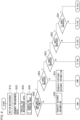
- FIG. 5 shows another example of the hierarchical structure in the form of a directed graph.
- the vertices A-K of the directed graph represent the indexes in the layers L1-L4, and each of the directed edges connecting the indexes indicates the direction of the search for a problem index.
- the first layer L1 as the highest layer there are indexes A, B, and C.
- index D is connected with edges (arrows) starting respectively from the indexes A and B in the first layer L1, which means that the index D is evaluated when the divergences of the indexes A and B are larger than a predetermined value. Therefore, if at least one of the divergences of the indexes A and B is equal to or less than the predetermined value, the search for the problem index with regard to the indexes A and B will be terminated in the first layer L1.
- a directed edge means that, when the divergence is larger than a predetermined value in this way, the process proceeds to the search for an index in the lower layer.
- the upper indexes A and B are integrated into the lower index D.
- indexes F, G, and H there are indexes F, G, and H.
- the index F is designated by an arrow from the index D in the second layer L2.
- the index G is designated by arrows from the index E in the second layer L2 and the index C in the first layer L1.
- the index H is designated by an arrow from the index E in the second layer L2.
- indexes I, J, and K there are indexes I, J, and K.
- the index I is designated by arrows from the indexes F and G in the third layer L3.
- the index J is designated by an arrow from the index G in the third layer L3.
- the index K is designated by arrows from the indexes F and H in the third layer L3.
- the present embodiment has been described employing running as an example of the exercise.
- the present invention is also applicable to other exercises.
- it is applicable to various athletics, swimming, gymnastics, walking, training and exercises for road biking or the like, dance, and ball sports such as soccer.
- each device described in the embodiment can be implemented by hardware resources, software resources, or cooperation between hardware resources and software resources.
- hardware resources processors, ROMs, RAMs, or other LSIs can be employed.
- software resources programs, such as operating system programs and application programs, can be employed.
- the present invention relates to an exercise improvement guidance device for identifying problems for improvement of exercise motions.
Landscapes
- Health & Medical Sciences (AREA)
- Life Sciences & Earth Sciences (AREA)
- Engineering & Computer Science (AREA)
- General Health & Medical Sciences (AREA)
- Physics & Mathematics (AREA)
- Medical Informatics (AREA)
- Biophysics (AREA)
- Public Health (AREA)
- Physiology (AREA)
- Animal Behavior & Ethology (AREA)
- Veterinary Medicine (AREA)
- Pathology (AREA)
- Biomedical Technology (AREA)
- Heart & Thoracic Surgery (AREA)
- Molecular Biology (AREA)
- Surgery (AREA)
- Dentistry (AREA)
- Oral & Maxillofacial Surgery (AREA)
- Physical Education & Sports Medicine (AREA)
- Psychiatry (AREA)
- Computer Vision & Pattern Recognition (AREA)
- Theoretical Computer Science (AREA)
- Artificial Intelligence (AREA)
- General Engineering & Computer Science (AREA)
- General Physics & Mathematics (AREA)
- Signal Processing (AREA)
- Human Computer Interaction (AREA)
- Evolutionary Computation (AREA)
- Primary Health Care (AREA)
- Epidemiology (AREA)
- Radar, Positioning & Navigation (AREA)
- Fuzzy Systems (AREA)
- Mathematical Physics (AREA)
- Social Psychology (AREA)
- Multimedia (AREA)
- Measurement Of The Respiration, Hearing Ability, Form, And Blood Characteristics Of Living Organisms (AREA)
- Navigation (AREA)
Abstract
Description
- The present invention relates to a technology for identifying problems for improvement of exercise motions.
- In recent years, mobile communication terminals such as smartphones have been becoming more lightweight, and so-called wearable devices have been actively developed, as typified by smartwatches. These devices can be worn also during exercise, such as running, and can measure exercise motions with built-in acceleration sensors and the like. There are also services and applications that provide guidance for improving exercise motions based on the measurement results.
- Patent Literature 1:
Japanese Unexamined Patent Application Publication No. 2014-124448 - As devices have been becoming smarter in recent years, the types of built-in sensors have been increasing. Also, since each sensor has been becoming more sophisticated, a large amount of measurement data can be obtained through a single exercise. By analyzing such measurement data, a number of problems in exercise motions can be extracted from various perspectives. However, among the problems, it is difficult to identify a problem that leads to effective improvement of the exercise motions.
- The present invention has been made in view of such a situation, and a purpose thereof is to provide an exercise improvement guidance device that can identify a problem that leads to effective improvement of exercise motions.
- To solve the problem above, an exercise improvement guidance device according to one aspect of the present invention includes: a hierarchical index storage unit that stores hierarchized indexes for improvement of an exercise motion; and a problem index identification unit that evaluates the hierarchized indexes based on measurement data during an exercise and identifies a problem index.
- In this aspect, the hierarchized indexes are evaluated based on measurement data during an exercise, and a problem index is identified. By referring to the relationships among the indexes shown in the hierarchical structure, a problem index that leads to effective improvement of exercise motions can be identified.
- An exercise improvement guidance method according to another aspect of the present invention includes: a hierarchical index storing step of storing hierarchized indexes for improvement of an exercise motion; and a problem index identification step of evaluating the hierarchized indexes based on measurement data during an exercise and identifying a problem index.
- An exercise improvement guidance program according to yet another aspect of the present invention causes a computer to implement: a hierarchical index storing step of storing hierarchized indexes for improvement of an exercise motion; and a problem index identification step of evaluating the hierarchized indexes based on measurement data during an exercise and identifying a problem index.
- Optional combinations of the aforementioned constituting elements, and implementation of the present invention in the form of methods, apparatuses, systems, recording media, and computer programs may also be practiced as additional modes of the present invention.
- The present invention enables identification of a problem that leads to effective improvement of exercise motions.
-
-
FIG. 1 is an overall configuration diagram of a system that includes an exercise improvement guidance device according to an embodiment. -
FIG. 2 is a diagram that shows an example of a hierarchical structure of indexes stored in a hierarchical index storage unit. -
FIG. 3 is a flow diagram of exercise improvement guidance processing performed by the exercise improvement guidance device using the hierarchical structure. -
FIG. 4 is a flow diagram of exercise improvement guidance processing performed by the exercise improvement guidance device when a user performs another running. -
FIG. 5 is a diagram that shows another example of the hierarchical structure in the form of a directed graph. - In the present embodiment, guidance is provided to improve exercise motions in running as an example, such as the running form and how to use force in running. Indexes for improvement of exercise motions are hierarchized, and indexes in the highest layer include the "landing impact", "vertical motion", "braking force", and the like. Each of these indexes in the highest layer is subdivided stepwise toward the lower layers, and, in the lowest layer, there are indexes that can be improved individually, such as the "ground contact position", "ground contact angle", "trunk angle", and the like. By searching such a hierarchical structure of indexes from an upper layer toward a lower layer with reference to measurement data obtained during running, a problem index that should be preferentially improved can be identified.
-
FIG. 1 is an overall configuration diagram of a system that includes an exerciseimprovement guidance device 100 according to the embodiment. The exerciseimprovement guidance device 100 generates guidance information for improving exercise motions in running based on measurement data measured by ameasurement device 20 while a user is running. The guidance information thus generated is displayed on adisplay device 30 used by the user. - The
measurement device 20 may be a wearable device, such as a smartwatch, or a smartphone that can be worn by the user during running, for example, and measures exercise motions during running with a built-in sensor. However, themeasurement device 20 in the present embodiment is not limited thereto and may be any device that has a data measurement function during running and a minimum data transmission function to transmit the measurement data to the exerciseimprovement guidance device 100. For example, as themeasurement device 20, a camera (an image capturing device) for capturing images of the user during running may be used. In this case, the data captured by the camera is provided as the measurement data to the exerciseimprovement guidance device 100. - In this way, since various devices can be used as the
measurement device 20, the exerciseimprovement guidance device 100 can acquire various measurement data associated with the user's exercise motions during running. - For example, when a wearable device or a smartphone is used as the
measurement device 20 as described above, through an acceleration sensor, an angular velocity sensor, a position sensor (such as the GPS), a magnetic sensor, and the like built into the device, basic physical quantities associated with the user's position and the exercise performed by the user can be obtained as the measurement data. By combining such measurement data as appropriate and performing analysis, not only basic information, such as the user's position, speed, and acceleration during running, but also information on the details of the user's exercise motions, such as the user's posture, strength and angle of pushing off, and position and angle of ground contact during running, can be obtained. In addition, information regarding the running course, such as the distance, altitude, and gradient, can also be obtained. - Furthermore, when the
measurement device 20 is equipped with a sensor that measures the external environment, such as an ambient light sensor that measures brightness and the like, a temperature sensor, and a humidity sensor, the exerciseimprovement guidance device 100 can provide appropriate exercise improvement guidance also in consideration of the external environment during running. Also, when a wearable device capable of measuring biological signals, such as heartbeat, is used as themeasurement device 20, which has been actively developed in recent years, the exerciseimprovement guidance device 100 can provide appropriate exercise improvement guidance also in consideration of the user's physical condition. - The
measurement device 20 need not necessarily be worn by the user during exercise and may measure the user during exercise from the surroundings. The image capturing by a camera as described previously is considered to be a typical example, but the device is not limited thereto. For example, when the user is running in a restricted indoor area using a treadmill or the like, themeasurement device 20 that is difficult to carry can also be used, so that the variety of available measurement data is remarkably increased. - The
various measurement devices 20 described above with examples may be used individually or may be used in combination. For example, a wearable device as afirst measurement device 20 may be worn by the user to perform measurement, and a camera as asecond measurement device 20 may be used to capture images of the user. Based on the measurement data from suchmultiple measurement devices 20, the exerciseimprovement guidance device 100 can analyze the user's exercise motions from multiple aspects and generate guidance information for effective improvement of the exercise motions. - The
display device 30 is a device that displays the guidance information for improving exercise motions, which has been generated by the exerciseimprovement guidance device 100 based on the measurement data from themeasurement device 20. For example, when a smartphone is used as themeasurement device 20, it also functions as thedisplay device 30 that displays the guidance information. Also, when a camera or the like that does not have a function to display the guidance information is used as themeasurement device 20, another device owned by the user, such as a smartphone, tablet, or personal computer, is used as thedisplay device 30. The means for presenting the guidance information for improving exercise motions, which has been generated by the exerciseimprovement guidance device 100 based on the measurement data from themeasurement device 20, is not limited to the display by thedisplay device 30. For example, the guidance information described above may be presented to the user by outputting voice from a voice device. - The exercise
improvement guidance device 100 is configured on a server capable of communicating with themeasurement device 20 and thedisplay device 30 via a wide area communication network such as the Internet. The exerciseimprovement guidance device 100 includes a hierarchicalindex storage unit 110, a problemindex identification unit 120, and a guidanceinformation generating unit 130. Meanwhile, the present embodiment is not limited to the above, and the exerciseimprovement guidance device 100 may be configured to be capable of communicating with themeasurement device 20 and thedisplay device 30 via a local communication network such as a LAN. Also, when themeasurement device 20 or thedisplay device 30 is an information processing device, such as a smartphone, tablet, or personal computer, the functions of the exerciseimprovement guidance device 100 may be implemented as application software running on the information processing device. Also, the data measured by themeasurement device 20 may be stored in a storage medium, such as a USB flash drive, and may be read by a personal computer or the like equipped with the functions of the exerciseimprovement guidance device 100 so as to provide the exercise improvement guidance in the present embodiment. - The hierarchical
index storage unit 110 stores hierarchized indexes for improvement of exercise motions, such as the running form and how to use force in running. The hierarchical structure of indexes stored in the hierarchicalindex storage unit 110 is configured during the initial setup of the system, for example. The hierarchical structure thus configured can be used for multiple exercise sessions without being updated for a certain period of time, in order to provide consistent exercise improvement guidance. Also, the hierarchical structure may be updated by adding a new index or by changing or deleting an existing index. Further, teacher data showing a correlation between the performance of an exercise motion and each index may be obtained, and, based on the teacher data, a learning model into which the performance of an exercise motion is input and from which a corresponding index is output may be generated by machine learning. With such a learning model, an index that leads to effective improvement of exercise motions can be preferentially set, based on the actual performance of the exercise motions. Furthermore, by autonomously analyzing a term used in each index and its biomechanical meaning, the hierarchical structure of indexes can be automatically generated. - Based on the hierarchical structure of indexes stored in the hierarchical
index storage unit 110, the problemindex identification unit 120 identifies a problem index with reference to measurement data during running measured by themeasurement device 20. In specific, the problemindex identification unit 120 evaluates the hierarchized indexes based on the measurement data during running to identify the problem index. - The search for the problem index by the problem
index identification unit 120 is performed from an upper layer toward a lower layer of the hierarchical structure. At the time, among multiple indexes in the same layer of the hierarchical structure, an index of which the divergence between predetermined reference data and the measurement data is largest is selected, and the search for the problem index is performed therefrom toward a further lower layer. The problemindex identification unit 120 then identifies the problem index in the lowest layer of the hierarchical structure. In the embodiment, the implementation is not limited to starting the search from the highest layer of the hierarchical structure. For example, the user may specify in advance an arbitrary index to be improved, and the search for the problem index may be performed from the layer of the arbitrary index toward the lower layer. - The guidance
information generating unit 130 generates guidance information for improving the problem index identified by the problemindex identification unit 120. The guidance information thus generated is transmitted to thedisplay device 30 and displayed on the display screen thereof. -
FIG. 2 shows an example of the hierarchical structure of indexes stored in the hierarchicalindex storage unit 110. The hierarchical structure is constituted by four layers, from a first layer L1 as the highest layer to a fourth layer L4 as the lowest layer. In the first layer L1, the "landing impact", "vertical motion", and "braking force", which are major indexes used to evaluate running exercise motions, are illustratively arranged. - In a second layer L2 immediately below the first layer L1, indexes resulting from subdivision of each index in the first layer L1 are arranged. For example, the "vertical motion" in the first layer L1 is subdivided into two indexes of "vertical motion during ground contact" and "vertical motion in the air" in the second layer L2. More specifically, problems with the "vertical motion" in the first layer L1 fall roughly into problems with vertical motions during ground contact and problems with vertical motions in the air; accordingly, indexes corresponding to the respective cases are provided in the second layer L2 so that the cause of the problem can be specifically identified. Similarly, each of the other indexes of the "landing impact" and "braking force" in the first layer L1 is subdivided in the second layer L2 and lower, though the illustration and explanation thereof is omitted here. When an index in an upper layer is subdivided into indexes in a lower layer, strict logic is not required, so that multiple lower indexes may overlap each other, or the combination of multiple lower indexes may not completely reproduce the upper index.
- In a third layer L3 immediately below the second layer L2, indexes resulting from subdivision of each index in the second layer L2 are arranged. For example, the "vertical motion in the air" in the second layer L2 is subdivided into two indexes of the "pushing-off angle" and "pushing-off acceleration" in the third layer L3. More specifically, problems with the "vertical motion in the air" in the second layer L2 fall roughly into problems with the pushing-off angle at takeoff and problems with the pushing-off acceleration at takeoff; accordingly, indexes corresponding to the respective cases are provided in the third layer L3 so that the cause of the problem can be specifically identified. Similarly, the other index of the "vertical motion during ground contact" in the second layer L2 is subdivided in the third layer L3 and lower, though the illustration and explanation thereof is omitted here.
- In the fourth layer L4 immediately below the third layer L3, indexes resulting from subdivision of each index in the third layer L3 are arranged. For example, the "pushing-off angle" in the third layer L3 is subdivided into three indexes of the "ground contact position", "ground contact angle", and "trunk angle" in the fourth layer L4. More specifically, problems with the "pushing-off angle" in the third layer L3 fall roughly into problems with the ground contact position, problems with the ground contact angle, and problems with the trunk angle; accordingly, indexes corresponding to the respective cases are provided in the fourth layer L4 so that the cause of the problem can be specifically identified. Similarly, the other index of the "pushing-off acceleration" in the third layer L3 is subdivided in the fourth layer L4, though the illustration and explanation thereof is omitted here.
- In the hierarchical structure as described above, by sequentially evaluating each index from an upper layer toward a lower layer with reference to the measurement data obtained during running, a problem index to be improved can be specifically identified. For example, when there is a problem with the "vertical motion" in the first layer L1, which is the highest layer, if the specific cause of the problem is not identified, appropriate exercise improvement guidance cannot be provided. With the hierarchical structure of the present embodiment, however, when a problem of "vertical motion" in an upper layer is identified, the search for the specific cause can be conducted therefrom toward the lower layer. Thereafter, if the "ground contact position" in the fourth layer L4, which is the lowest layer, is identified as the cause, for example, the guidance information for improving it, such as "Let's make the landing position one step closer to yourself.", can be generated.
-
FIG. 3 shows the flow of exercise improvement guidance processing performed by the exerciseimprovement guidance device 100 using the hierarchical structure as described above. In the following description, "S" means a step. - At S10, measurement by the
measurement device 20 is performed during a user's exercise. - At S20, the
measurement device 20 transmits the measurement data to the exerciseimprovement guidance device 100. At the time, when the exercise measurement at S10 is performed usingmultiple measurement devices 20, the measurement data from themultiple measurement devices 20 may be transmitted to the exerciseimprovement guidance device 100. Also, when multiple pieces of data are measured using asingle measurement device 20, multiple measurement data may be transmitted to the exerciseimprovement guidance device 100. - At S30, the exercise
improvement guidance device 100 processes the various measurement data received at S20 and converts the data into measurement data with which each index in the hierarchical structure can be evaluated. Since many of the indexes in the hierarchical structure cannot be evaluated with the data measured by themeasurement device 20 as it is, the data needs to be converted into evaluable data through appropriate arithmetic processing. For the conversion, since various methods are known in the technical field, detailed description thereof will be omitted. With regard to the following indexes described in the flowchart, for example, measurement data for evaluation can be obtained as follows. - The "vertical motion" in the first layer L1 can be directly measured using an acceleration sensor or the like.
- The "vertical motion in the air" in the second layer L2 can be measured separately from the vertical motion during ground contact, using an acceleration sensor or the like.
- The "pushing-off angle" in the third layer L3 can be calculated based on the measurement data from an acceleration sensor or angular velocity sensor obtained during the transition from the ground contact state to the in-air state.
- The "ground contact position" in the fourth layer L4 can be obtained by calculating the relative position of the ground contact position to the takeoff position, based on the measurement data from a position sensor or the like at each of the time of takeoff (ground contact → in-air) and the time of ground contact (in-air → ground contact).
- At S40, the problem
index identification unit 120 searches for a problem index based on the measurement data processed at S30. The S40 is constituted by S41-S44 corresponding to the four layers L1-L4 of the hierarchical structure. Through the processes of S41, S42, S43, and S44 performed in this order, the search for a problem index is conducted from an upper layer toward a lower layer of the hierarchical structure. More specifically, multiple indexes in each layer are evaluated based on the measurement data, the most problematic index is selected, and the search for the cause is conducted therefrom toward a further lower layer. - The S41, which is a search step for the first layer L1, is constituted by S411-S413.
- At S411, multiple indexes in the first layer L1 are evaluated based on the measurement data. In specific, the three indexes of the "landing impact", "vertical motion", and "braking force" in the first layer L1 are evaluated. For each index, reference data representing a normal value thereof is set in advance, and the reference data is compared with the measurement data of the index processed for evaluation at S30, so as to obtain the divergence therebetween. Based on the degree of the divergence, whether or not there is a problem with the index is evaluated. In the following, to simplify the explanation, a criterion for evaluating an index as having a problem is uniformly set to "the divergence of 10% or greater" for all indexes. However, in practice, a different criterion can be set for each index. Also, it is assumed that the degree of the divergence represents urgency, i.e., priority in the exercise improvement guidance, of the index. Therefore, with regard to an index with the divergence of 20% and an index with the divergence of 15%, the former has a higher degree of urgency and corresponds to a priority index in the exercise improvement guidance.
- At S412, it is judged whether or not there has been a problematic index at S411. More specifically, with regard to the three indexes of the "landing impact", "vertical motion", and "braking force" in the first layer L1, it is judged whether or not there is an index with the divergence of 10% or greater. If the divergence of each of the indexes is less than 10%, it can be said that all indexes, including the respective lower indexes, fall within a normal range. Accordingly, the problem
index identification unit 120 does not identify any problem index, and the guidanceinformation generating unit 130 terminates the process without generating the guidance information. In such a case, the guidanceinformation generating unit 130 may generate a message to motivate the user, such as "Keep up the good work". - If there is an index with the divergence of 10% or greater at S412, on the other hand, the index with the largest divergence will be selected at S413. In the hierarchical structure shown in
FIG. 2 , when the divergence of the "landing impact" is 15%, the divergence of the "vertical motion" is 20%, and the divergence of the "braking force" is 7%, for example, the "landing impact" and "vertical motion" with the divergences of 10% or greater are problematic, but the "vertical motion" with the largest divergence has a higher degree of urgency, so that the "vertical motion" is selected as a priority index. In the subsequent steps, the search for the problem index is conducted therefrom toward a further lower layer. - The S42 is a search step for the second layer L2, in which a lower index of the priority index "vertical motion" selected at S413 is searched for, and is constituted by S421-S422.
- At S421, the multiple indexes of the "vertical motion during ground contact" and "vertical motion in the air" in the second layer L2, which are lower indexes of the priority index "vertical motion" in the first layer L1, are evaluated based on the measurement data. In specific, for each index, predetermined reference data and the measurement data are compared to obtain the divergence therebetween.
- At S422, an index with the largest divergence is selected. For example, when the divergence of the "vertical motion during ground contact" is 8% and the divergence of the "vertical motion in the air" is 15%, the "vertical motion in the air" with the largest divergence has a higher degree of urgency, so that the "vertical motion in the air" is selected as a priority index. In the subsequent steps, the search for the problem index is conducted therefrom toward a further lower layer.
- The S43 is a search step for the third layer L3, in which a lower index of the priority index "vertical motion in the air" selected at S422 is searched for, and is constituted by S431-S432.
- At S431, the multiple indexes of the "pushing-off angle" and "pushing-off acceleration" in the third layer L3, which are lower indexes of the priority index "vertical motion in the air" in the second layer L2, are evaluated based on the measurement data. In specific, for each index, predetermined reference data and the measurement data are compared to obtain the divergence therebetween.
- At S432, an index with the largest divergence is selected. For example, when the divergence of the "pushing-off angle" is 17% and the divergence of the "pushing-off acceleration" is 8%, the "pushing-off angle" with the largest divergence has a higher degree of urgency, so that the "pushing-off angle" is selected as a priority index. In the subsequent steps, the search for the problem index is conducted therefrom toward a further lower layer.
- The S44 is a search step for the fourth layer L4, in which a lower index of the priority index "pushing-off angle" selected at S432 is searched for, and is constituted by S441-S442.
- At S441, the multiple indexes of the "ground contact position", "ground contact angle", and "trunk angle" in the fourth layer L4, which are lower indexes of the priority index "pushing-off angle" in the third layer L3, are evaluated based on the measurement data. In specific, for each index, predetermined reference data and the measurement data are compared to obtain the divergence therebetween.
- At S442, an index with the largest divergence is selected. For example, when the divergence of the "ground contact position" is 20%, the divergence of the "ground contact angle" is 13%, and the divergence of the "trunk angle" is 5%, the "ground contact position" with the largest divergence has a higher degree of urgency, so that the "ground contact position" is selected as a priority index. Therefore, the problem
index identification unit 120 identifies the selected priority index "ground contact position" as the problem index. - At S50, the guidance
information generating unit 130 generates the guidance information, such as "Let's make the landing position one step closer to yourself.", for improving the problem index "ground contact position" identified by the problemindex identification unit 120. The guidance information thus generated is transmitted to thedisplay device 30 and displayed on the display screen thereof. - According to the process flow described above, by referring to the relationships among the indexes shown in the hierarchical structure, a problem index that leads to effective improvement of exercise motions can be identified, and the guidance information can be generated.
- Since the problem
index identification unit 120 searches for the problem index from an upper layer toward a lower layer of the hierarchical structure, a major problem can be identified in an upper layer, and the underlying cause thereof can be identified in a lower layer. Therefore, effective exercise improvement guidance can be provided. - The search for the problem index is performed sequentially from the first layer L1 as the highest layer toward the fourth layer as the lowest layer, and, in the search processes S41, S42, S43, and S44 in the respective layers, a priority index is identified based on the divergence between an actual measured value and a reference value of each index. Accordingly, an index with the highest degree of urgency can be identified in each layer, and an index that needs to be improved on a top-priority basis can be identified as the problem index.
- Since the problem
index identification unit 120 identifies the problem index in the fourth layer L4 as the lowest layer of the hierarchical structure, a problem index can be identified that represents the underlying cause of the problem and that facilitates the generation of specific guidance information for improvement. -
FIG. 4 shows the flow of exercise improvement guidance processing performed by the exerciseimprovement guidance device 100 when the user performs another running after the exercise improvement guidance according to the process flow shown inFIG. 3 is provided. In this processing, upon identification of an index in which there has been a certain degree of improvement compared to past running, the problemindex identification unit 120 searches for a problem index among other indexes present in the same layer as the index or in a higher layer. Also, when the problemindex identification unit 120 has identified the same problem index as in past running, the guidanceinformation generating unit 130 generates guidance information that is different from that in the past running. InFIG. 4 , the processes of S10, S20, S30, and S40 are performed as inFIG. 3 , and, at S442 as the last step in S40, a priority index with a larger divergence is selected. In the following, although the previous running will be described as an example of the past running, the processing in the present embodiment is also applicable to past running prior to the previous running. - At S60, it is judged whether or not the priority index selected at S442 for the current exercise is the same as the priority index "ground contact position" selected at S442 for the previous exercise. When the priority index is different from that of the previous exercise, the problem
index identification unit 120 identifies the priority index as the problem index, and the guidanceinformation generating unit 130 generates the guidance information for improving the problem index at S50. For example, when the problem index of the current exercise is the "trunk angle", the guidance information of "Keep your trunk straight." or the like is generated. - Meanwhile, when the priority index is the "ground contact position", which is the same as for the previous exercise, it is judged at S64 whether or not there has been a certain degree of improvement in the index compared to the previous exercise. A criterion for judging whether or not there has been an improvement can be set arbitrarily for each index, and the divergence described previously may also be used. For example, it may be judged that there has been an improvement when the divergence has become smaller than that of the previous exercise by 5% or more. Since the divergence of the "ground contact position" of the previous exercise is 20%, if the divergence of the current exercise is smaller than 15%, it will be judged that there has been a certain degree of improvement.
- When it is judged at S64 that there has not been a certain degree of improvement in the "ground contact position", i.e., when the divergence is still high at 15% or greater, the problem
index identification unit 120 identifies, as the problem index, the same "ground contact position" as for the previous exercise. In this case, the guidanceinformation generating unit 130 generates again the guidance information for improving the "ground contact position" at S51 but generates different guidance information from the previous one. This allows the user to improve the same problem index from a different perspective. - When it is judged at S64 that there has been a certain degree of improvement in the "ground contact position", i.e., when the divergence has become smaller than 15%, the search is continued with the target layer shifted to the third layer L3 as an upper layer. In specific, at S63, it is judged whether or not there has been a certain degree of improvement compared to the previous exercise, with regard to the "pushing-off angle" (the third layer L3), which is the upper index of the "ground contact position" (the fourth layer L4).
- When it is judged at S63 that there has not been a certain degree of improvement in the "pushing-off angle", it means that the problem index to be preferentially improved is still present in the lower layer. Accordingly, the process returns to S44 in
FIG. 3 , and the search in the lower layer (the fourth layer L4) is continued. At the time, since the divergence of the "ground contact position" is the largest in the fourth layer L4, if S442 in S44 is performed ordinarily, the "ground contact position" will eventually be identified as the problem index. However, since the "ground contact position" has been improved to a certain degree compared to the previous exercise (S64), it may be excluded from the candidates for the problem index of the current exercise. In such a case, at S442, the index with the largest divergence among the other indexes "ground contact angle" and "trunk angle", excluding the "ground contact position", will be identified as the problem index. Meanwhile, S442 may be performed ordinarily, and the same "ground contact position" as for the previous exercise may be identified as the problem index. In such a case, as described in relation to S51, guidance information different from the previous one may preferably be generated. - When it is judged at S63 that there has been a certain degree of improvement in the "pushing-off angle", the search is continued with the target layer shifted to the second layer L2 as an upper layer. In specific, at S62, it is judged whether or not there has been a certain degree of improvement compared to the previous exercise, with regard to the "vertical motion in the air" (the second layer L2), which is the upper index of the "pushing-off angle" (the third layer L3).
- When it is judged at S62 that there has not been a certain degree of improvement in the "vertical motion in the air", it means that the problem index to be preferentially improved is still present in the lower layer. Accordingly, the process returns to S43 in
FIG. 3 , and the search in the lower layer (the third layer L3) is continued. - When it is judged at S62 that there has been a certain degree of improvement in the "vertical motion in the air", the search is continued with the target layer shifted to the first layer L1 as the upper layer. In specific, at S61, it is judged whether or not there has been a certain degree of improvement compared to the previous exercise, with regard to the "vertical motion" (the first layer L1), which is the upper index of the "vertical motion in the air" (the second layer L2).
- When it is judged at S61 that there has not been a certain degree of improvement in the "vertical motion", it means that the problem index to be preferentially improved is still present in the lower layer. Accordingly, the process returns to S42 in
FIG. 3 , and the search in the lower layer (the second layer L2) is continued. - When it is judged at S61 that there has been a certain degree of improvement in the "vertical motion", the process returns to S412 in
FIG. 3 to judge whether or not there is a problematic index in the first layer L1. At the time, since the "vertical motion" has been improved to a certain degree compared to the previous exercise, it may preferably be excluded from the judgment targets at S412. In such a case, at S412, the judgment is performed for the other indexes "landing impact" and "braking force", excluding the "vertical motion". - According to the process flow described above, the problem index of the current exercise can be efficiently searched for, also in consideration of improvement from a past exercise. At the time, through the improvement judgment processes S64, S63, S62, and S61 performed sequentially from a lower layer toward an upper layer of the hierarchical structure, in which layer there has been an improvement can be efficiently identified.
- The present invention has been described based on an embodiment. The embodiment is intended to be illustrative only, and it will be obvious to those skilled in the art that various modifications to a combination of constituting elements or processes could be developed and that such modifications also fall within the scope of the present invention.
- In the embodiment described above, the search for the problem index by the problem
index identification unit 120 is performed from an upper layer toward a lower layer of the hierarchical structure. However, the method for searching the hierarchical structure is not limited thereto. For example, instead of starting the search for the problem index from the highest layer, the search may be started from a layer specified in advance by the user or the system. Also, the lowest layer may be searched at the beginning, and the index with the largest divergence in the layer may be identified as the problem index. In this search, the indexes in the layers other than the lowest layer are not considered. However, when exercise improvement guidance is provided also in consideration of improvement from a past exercise, as described with reference toFIG. 4 , the indexes in each layer are considered, as shown in S64, S63, S62, and S61. - Also, the abovementioned embodiment describes an example in which every index in the highest layer L1 is subdivided into indexes in the lowest layer L4, and the depth of the hierarchical structure is uniformly four layers. However, the depth of the hierarchical structure may be different depending on each index. More specifically, when the highest layer is defined as L1, as in the embodiment, there may be an index with a depth 1 that has no hierarchical structure below the first layer L1, there may be an index with a depth 2 that is subdivided into indexes in the second layer L2, and there may be an index with a depth 3 that is subdivided into indexes in the third layer L3. At the time, not all layers need to include corresponding indexes. For example, indexes resulting from subdivision of one index in the first layer L1 may not be present in the second layer L2 immediately below, but the one index may be subdivided into indexes in the third layer L3, which is further lower. Also, the highest layer of every index need not necessarily be the first layer L1, and the highest index may be present in the second layer L2, the third layer L3, or the fourth layer L4. When the hierarchical structure with different depths as described above is searched, the search need not necessarily be performed to the lowest layer, and the depth to be searched may be specified each time by the user or the system for each index. For example, even when a hierarchical structure with the depth 3 is to be searched, if the search to the depth 2 is specified, the lowest layer of the depth 3 will not be searched, and the problem index is identified in the layer of the depth 2 thereabove.
- In the abovementioned embodiment, the problem index is identified in the lowest layer of the hierarchical structure. However, the problem index may be identified in the other layers. For example, an index with the largest divergence in all layers may be identified as the problem index. In this case, it is preferable to prepare the guidance information for all indexes regardless of the layers. Also, when the guidance information for an index in a layer has been generated for a past exercise and if, as a result, the index in the layer has been sufficiently improved in the current exercise, the problem index may be identified in an upper layer. Accordingly, in consideration of the improvement of the user's exercise motions, guidance based on an appropriate layer can be provided.
- In the embodiment described above, during the search for the problem index by the problem
index identification unit 120, an index with the largest divergence between the reference data and the measurement data is selected in each layer, and the search for the problem index is performed toward a further lower layer. However, multiple indexes of which the divergences are larger than a preset value may be selected in each layer. In such a case, the lower layers of each of the selected indexes are searched to identify multiple problem indexes. The guidanceinformation generating unit 130 then generates the guidance information for each problem index thus identified and displays the guidance information on thedisplay device 30. On thedisplay device 30, the multiple pieces of guidance information may be displayed on a single screen, or multiple screens may be switched by user operation so that the guidance information for each problem index can be checked. - In the process flow shown in
FIG. 4 , when an index in a layer has been improved to a certain degree compared to a past exercise, it is judged whether or not an index in the upper layer has been improved. However, it may also be judged whether or not another index in the same layer has been improved. For example, inFIG. 4 , when it is judged at S64 that the "ground contact position" in the fourth layer L4 has been improved, it is judged at S63 whether or not the "pushing-off angle" in the third layer L3 has been improved. Instead, it may be judged whether or not the other indexes "ground contact angle" and "trunk angle" in the fourth layer L4 have been improved. Since these indexes in the fourth layer L4 are subordinate to the "pushing-off angle" in the third layer L3, there is no significant difference in judging whether or not there has been an improvement in either layer. - The abovementioned embodiment describes, as an example of the hierarchical structure, a tree structure as shown in
FIG. 2 , i.e., a structure that branches from an upper layer toward a lower layer. However, the hierarchical structure in the present invention is not limited to such a tree structure.FIG. 5 shows another example of the hierarchical structure in the form of a directed graph. InFIG. 5 , the vertices A-K of the directed graph represent the indexes in the layers L1-L4, and each of the directed edges connecting the indexes indicates the direction of the search for a problem index. In the first layer L1 as the highest layer, there are indexes A, B, and C. - In the second layer L2, there are indexes D and E. The index D is connected with edges (arrows) starting respectively from the indexes A and B in the first layer L1, which means that the index D is evaluated when the divergences of the indexes A and B are larger than a predetermined value. Therefore, if at least one of the divergences of the indexes A and B is equal to or less than the predetermined value, the search for the problem index with regard to the indexes A and B will be terminated in the first layer L1. At the time, if the divergences of both the indexes A and B are equal to or less than the predetermined value, none of them is the problem index; if one of the divergences of the indexes A and B is larger than the predetermined value, it is identified as the problem index. Although similar description will be omitted hereafter, a directed edge (arrow) means that, when the divergence is larger than a predetermined value in this way, the process proceeds to the search for an index in the lower layer. Unlike the tree structure in
FIG. 2 , in this example, it can also be construed that the upper indexes A and B are integrated into the lower index D. - In the third layer L3, there are indexes F, G, and H. The index F is designated by an arrow from the index D in the second layer L2. The index G is designated by arrows from the index E in the second layer L2 and the index C in the first layer L1. The index H is designated by an arrow from the index E in the second layer L2.
- In the fourth layer L4, there are indexes I, J, and K. The index I is designated by arrows from the indexes F and G in the third layer L3. The index J is designated by an arrow from the index G in the third layer L3. The index K is designated by arrows from the indexes F and H in the third layer L3.
- With the hierarchical structure using a directed graph as described above, complicated relationships among indexes can be described more appropriately than with the tree structure shown in
FIG. 2 , so that a problem index can be effectively identified. Also, although only the arrows directed from upper layers to lower layers are illustrated inFIG. 5 , the processing for searching for improvement from a past exercise from a lower layer toward an upper layer as described with reference toFIG. 4 can be described with arrows directed from indexes in lower layers to indexes in upper layers inFIG. 5 . - The present embodiment has been described employing running as an example of the exercise. However, the present invention is also applicable to other exercises. For example, it is applicable to various athletics, swimming, gymnastics, walking, training and exercises for road biking or the like, dance, and ball sports such as soccer.
- The functional configuration of each device described in the embodiment can be implemented by hardware resources, software resources, or cooperation between hardware resources and software resources. As the hardware resources, processors, ROMs, RAMs, or other LSIs can be employed. As the software resources, programs, such as operating system programs and application programs, can be employed.
-
- 100
- exercise improvement guidance device
- 110
- hierarchical index storage unit
- 120
- problem index identification unit
- 130
- guidance information generating unit
- 20
- measurement device
- 30
- display device
- The present invention relates to an exercise improvement guidance device for identifying problems for improvement of exercise motions.
Claims (9)
- An exercise improvement guidance device, comprising:a hierarchical index storage unit that stores hierarchized indexes for improvement of an exercise motion; anda problem index identification unit that evaluates the hierarchized indexes based on measurement data during an exercise and identifies a problem index.
- The exercise improvement guidance device according to claim 1, further comprising a guidance information generating unit that generates guidance information for improvement of the problem index identified by the problem index identification unit.
- The exercise improvement guidance device according to claim 1 or 2, wherein the problem index identification unit searches for the problem index from a pre-specified layer of a hierarchical structure of the indexes.
- The exercise improvement guidance device according to any one of claims 1 through 3, wherein the problem index identification unit selects, among a plurality of indexes in the same layer of the hierarchical structure of the indexes, an index of which a divergence between predetermined reference data and the measurement data is larger than a preset value and searches for the problem index therefrom toward a further lower layer.
- The exercise improvement guidance device according to any one of claims 1 through 4, wherein the problem index identification unit identifies the problem index in the lowest layer of the hierarchical structure of the indexes.
- The exercise improvement guidance device according to any one of claims 1 through 5, wherein, upon identification of an index in which there has been a predetermined degree of improvement compared to a past exercise, the problem index identification unit searches for the problem index among other indexes present in the same layer as the index or in a higher layer.
- The exercise improvement guidance device according to claim 2, wherein, when the problem index identification unit has identified the same problem index as in a past exercise, the guidance information generating unit generates the guidance information that is different from that in the past exercise.
- An exercise improvement guidance method, comprising:a hierarchical index storing step of storing hierarchized indexes for improvement of an exercise motion; anda problem index identification step of evaluating the hierarchized indexes based on measurement data during an exercise and identifying a problem index.
- An exercise improvement guidance program causing a computer to implement:a hierarchical index storing step of storing hierarchized indexes for improvement of an exercise motion; anda problem index identification step of evaluating the hierarchized indexes based on measurement data during an exercise and identifying a problem index.
Applications Claiming Priority (1)
| Application Number | Priority Date | Filing Date | Title |
|---|---|---|---|
| PCT/JP2020/039390 WO2022085069A1 (en) | 2020-10-20 | 2020-10-20 | Exercise improvement instruction device, exercise improvement instruction method, and exercise improvement instruction program |
Publications (2)
| Publication Number | Publication Date |
|---|---|
| EP4212219A1 true EP4212219A1 (en) | 2023-07-19 |
| EP4212219A4 EP4212219A4 (en) | 2023-11-01 |
Family
ID=81290232
Family Applications (1)
| Application Number | Title | Priority Date | Filing Date |
|---|---|---|---|
| EP20958622.1A Pending EP4212219A4 (en) | 2020-10-20 | 2020-10-20 | EXERCISE OPTIMIZATION INSTRUCTION DEVICE, EXERCISE OPTIMIZATION INSTRUCTION METHOD, AND EXERCISE OPTIMIZATION INSTRUCTION PROGRAM |
Country Status (5)
| Country | Link |
|---|---|
| US (1) | US20230390603A1 (en) |
| EP (1) | EP4212219A4 (en) |
| JP (1) | JP7599504B2 (en) |
| CN (1) | CN116249573A (en) |
| WO (1) | WO2022085069A1 (en) |
Families Citing this family (1)
| Publication number | Priority date | Publication date | Assignee | Title |
|---|---|---|---|---|
| JP2023153486A (en) * | 2022-04-05 | 2023-10-18 | リオモ インク | Running form analysis system, program and method |
Family Cites Families (11)
| Publication number | Priority date | Publication date | Assignee | Title |
|---|---|---|---|---|
| JP2720599B2 (en) * | 1990-11-28 | 1998-03-04 | 三菱マテリアル株式会社 | Health management system |
| JP5811360B2 (en) * | 2012-12-27 | 2015-11-11 | カシオ計算機株式会社 | Exercise information display system, exercise information display method, and exercise information display program |
| JP2017000167A (en) | 2015-06-04 | 2017-01-05 | セイコーエプソン株式会社 | Advice providing system, advice providing device, advice providing server, and advice providing method |
| US11071887B2 (en) * | 2016-09-28 | 2021-07-27 | Bodbox, Inc. | Evaluation and coaching of athletic performance |
| JP6871708B2 (en) * | 2016-10-06 | 2021-05-12 | りか 高木 | Methods, systems, programs, and computer devices for identifying the causative site of compensatory movements, and methods and systems for eliminating compensatory movements. |
| JP6834553B2 (en) * | 2017-02-09 | 2021-02-24 | セイコーエプソン株式会社 | Motion analysis system, motion analysis device, motion analysis program and motion analysis method |
| JP2018143537A (en) | 2017-03-06 | 2018-09-20 | セイコーエプソン株式会社 | Motion analysis apparatus, motion analysis system, motion analysis method, and motion analysis program |
| JP6871379B2 (en) * | 2017-07-07 | 2021-05-12 | りか 高木 | Treatment and / or Exercise Guidance Process Management Systems, Programs, Computer Devices, and Methods for Treatment and / or Exercise Guidance Process Management |
| TWI666596B (en) * | 2017-12-27 | 2019-07-21 | 晶翔機電股份有限公司 | Method and system of planning fitness course parameters |
| EP3881910A4 (en) | 2018-11-15 | 2022-01-12 | Sony Group Corporation | Information processing device, information processing method, and program |
| JP6644290B1 (en) * | 2019-06-27 | 2020-02-12 | 株式会社ジ・アイ | Information processing device and program |
-
2020
- 2020-10-20 US US18/249,448 patent/US20230390603A1/en active Pending
- 2020-10-20 CN CN202080105534.4A patent/CN116249573A/en active Pending
- 2020-10-20 JP JP2022556852A patent/JP7599504B2/en active Active
- 2020-10-20 WO PCT/JP2020/039390 patent/WO2022085069A1/en not_active Ceased
- 2020-10-20 EP EP20958622.1A patent/EP4212219A4/en active Pending
Also Published As
| Publication number | Publication date |
|---|---|
| EP4212219A4 (en) | 2023-11-01 |
| JPWO2022085069A1 (en) | 2022-04-28 |
| JP7599504B2 (en) | 2024-12-13 |
| US20230390603A1 (en) | 2023-12-07 |
| CN116249573A (en) | 2023-06-09 |
| WO2022085069A1 (en) | 2022-04-28 |
Similar Documents
| Publication | Publication Date | Title |
|---|---|---|
| US20220335851A1 (en) | Identification and analysis of movement using sensor devices | |
| KR102182607B1 (en) | How to determine hand-off for virtual controllers | |
| JP6684883B2 (en) | Method and system for providing camera effects | |
| JP5527423B2 (en) | Image processing system, image processing method, and storage medium storing image processing program | |
| Rangari et al. | Video based exercise recognition and correct pose detection | |
| CN114022512B (en) | Exercise assisting method, apparatus and medium | |
| US11482126B2 (en) | Augmented reality system for providing movement sequences and monitoring performance | |
| WO2019050916A1 (en) | Techniques for rendering three-dimensional animated graphics from video | |
| US11775058B2 (en) | Method and system for performing eye tracking using an off-axis camera | |
| US20220362631A1 (en) | Virtual tastings and guided tours for augmented reality experiences | |
| KR20220062197A (en) | Cognitive function assessment system and method of assessing cognitive funtion | |
| Matsuyama et al. | Deep learning for ballroom dance recognition: A temporal and trajectory-aware classification model with three-dimensional pose estimation and wearable sensing | |
| US12274917B2 (en) | Method, device, and non-transitory computer-readable recording medium for estimating information on golf swing | |
| EP0847201B1 (en) | Real time tracking system for moving bodies on a sports field | |
| CN109740567A (en) | Key point location model training method, localization method, device and equipment | |
| JP2019136493A (en) | Exercise scoring method, system and program | |
| US20220230079A1 (en) | Action recognition | |
| Fujii | Machine learning in sports: open approach for next play analytics | |
| WO2017161734A1 (en) | Correction of human body movements via television and motion-sensing accessory and system | |
| Faujdar et al. | Human pose estimation using artificial intelligence with virtual gym tracker | |
| Vemulapalli et al. | Face detection with landmark using YOLOv8 | |
| US20230082953A1 (en) | System and Method for Real-Time Interaction and Coaching | |
| US20190102951A1 (en) | Sensor-based object tracking and monitoring | |
| US11861944B1 (en) | System for synchronizing video output based on detected behavior | |
| US20230390603A1 (en) | Exercise improvement instruction device, exercise improvement instruction method, and exercise improvement instruction program |
Legal Events
| Date | Code | Title | Description |
|---|---|---|---|
| STAA | Information on the status of an ep patent application or granted ep patent |
Free format text: STATUS: THE INTERNATIONAL PUBLICATION HAS BEEN MADE |
|
| PUAI | Public reference made under article 153(3) epc to a published international application that has entered the european phase |
Free format text: ORIGINAL CODE: 0009012 |
|
| STAA | Information on the status of an ep patent application or granted ep patent |
Free format text: STATUS: REQUEST FOR EXAMINATION WAS MADE |
|
| 17P | Request for examination filed |
Effective date: 20230413 |
|
| AK | Designated contracting states |
Kind code of ref document: A1 Designated state(s): AL AT BE BG CH CY CZ DE DK EE ES FI FR GB GR HR HU IE IS IT LI LT LU LV MC MK MT NL NO PL PT RO RS SE SI SK SM TR |
|
| A4 | Supplementary search report drawn up and despatched |
Effective date: 20230928 |
|
| RIC1 | Information provided on ipc code assigned before grant |
Ipc: A61B 5/103 20060101ALN20230922BHEP Ipc: A61B 5/00 20060101ALI20230922BHEP Ipc: A61B 5/11 20060101ALI20230922BHEP Ipc: G16H 20/30 20180101ALI20230922BHEP Ipc: G06F 3/0482 20130101ALI20230922BHEP Ipc: A63B 71/06 20060101ALI20230922BHEP Ipc: A63B 69/00 20060101AFI20230922BHEP |
|
| DAV | Request for validation of the european patent (deleted) | ||
| DAX | Request for extension of the european patent (deleted) | ||
| STAA | Information on the status of an ep patent application or granted ep patent |
Free format text: STATUS: EXAMINATION IS IN PROGRESS |
|
| 17Q | First examination report despatched |
Effective date: 20240925 |