EP4211370B1 - Method for determining an operative shift configuration of a drive mechanism of a gearbox of a saddle-ride type vehicle - Google Patents
Method for determining an operative shift configuration of a drive mechanism of a gearbox of a saddle-ride type vehicle Download PDFInfo
- Publication number
- EP4211370B1 EP4211370B1 EP21785979.2A EP21785979A EP4211370B1 EP 4211370 B1 EP4211370 B1 EP 4211370B1 EP 21785979 A EP21785979 A EP 21785979A EP 4211370 B1 EP4211370 B1 EP 4211370B1
- Authority
- EP
- European Patent Office
- Prior art keywords
- determined
- gear
- engaged
- shift configuration
- operative
- Prior art date
- Legal status (The legal status is an assumption and is not a legal conclusion. Google has not performed a legal analysis and makes no representation as to the accuracy of the status listed.)
- Active
Links
Images


Classifications
-
- F—MECHANICAL ENGINEERING; LIGHTING; HEATING; WEAPONS; BLASTING
- F16—ENGINEERING ELEMENTS AND UNITS; GENERAL MEASURES FOR PRODUCING AND MAINTAINING EFFECTIVE FUNCTIONING OF MACHINES OR INSTALLATIONS; THERMAL INSULATION IN GENERAL
- F16H—GEARING
- F16H63/00—Control outputs from the control unit to change-speed- or reversing-gearings for conveying rotary motion or to other devices than the final output mechanism
- F16H63/40—Control outputs from the control unit to change-speed- or reversing-gearings for conveying rotary motion or to other devices than the final output mechanism comprising signals other than signals for actuating the final output mechanisms
- F16H63/50—Signals to an engine or motor
- F16H63/502—Signals to an engine or motor for smoothing gear shifts
-
- B—PERFORMING OPERATIONS; TRANSPORTING
- B62—LAND VEHICLES FOR TRAVELLING OTHERWISE THAN ON RAILS
- B62M—RIDER PROPULSION OF WHEELED VEHICLES OR SLEDGES; POWERED PROPULSION OF SLEDGES OR SINGLE-TRACK CYCLES; TRANSMISSIONS SPECIALLY ADAPTED FOR SUCH VEHICLES
- B62M25/00—Actuators for gearing speed-change mechanisms specially adapted for cycles
- B62M25/02—Actuators for gearing speed-change mechanisms specially adapted for cycles with mechanical transmitting systems, e.g. cables, levers
- B62M25/06—Actuators for gearing speed-change mechanisms specially adapted for cycles with mechanical transmitting systems, e.g. cables, levers foot actuated
-
- B—PERFORMING OPERATIONS; TRANSPORTING
- B62—LAND VEHICLES FOR TRAVELLING OTHERWISE THAN ON RAILS
- B62K—CYCLES; CYCLE FRAMES; CYCLE STEERING DEVICES; RIDER-OPERATED TERMINAL CONTROLS SPECIALLY ADAPTED FOR CYCLES; CYCLE AXLE SUSPENSIONS; CYCLE SIDECARS, FORECARS, OR THE LIKE
- B62K23/00—Rider-operated controls specially adapted for cycles, i.e. means for initiating control operations, e.g. levers, grips
- B62K23/08—Rider-operated controls specially adapted for cycles, i.e. means for initiating control operations, e.g. levers, grips foot actuated
-
- F—MECHANICAL ENGINEERING; LIGHTING; HEATING; WEAPONS; BLASTING
- F16—ENGINEERING ELEMENTS AND UNITS; GENERAL MEASURES FOR PRODUCING AND MAINTAINING EFFECTIVE FUNCTIONING OF MACHINES OR INSTALLATIONS; THERMAL INSULATION IN GENERAL
- F16H—GEARING
- F16H61/00—Control functions within control units of change-speed- or reversing-gearings for conveying rotary motion ; Control of exclusively fluid gearing, friction gearing, gearings with endless flexible members or other particular types of gearing
- F16H61/12—Detecting malfunction or potential malfunction, e.g. fail safe ; Circumventing or fixing failures
-
- F—MECHANICAL ENGINEERING; LIGHTING; HEATING; WEAPONS; BLASTING
- F16—ENGINEERING ELEMENTS AND UNITS; GENERAL MEASURES FOR PRODUCING AND MAINTAINING EFFECTIVE FUNCTIONING OF MACHINES OR INSTALLATIONS; THERMAL INSULATION IN GENERAL
- F16H—GEARING
- F16H63/00—Control outputs from the control unit to change-speed- or reversing-gearings for conveying rotary motion or to other devices than the final output mechanism
- F16H63/40—Control outputs from the control unit to change-speed- or reversing-gearings for conveying rotary motion or to other devices than the final output mechanism comprising signals other than signals for actuating the final output mechanisms
- F16H63/50—Signals to an engine or motor
-
- B—PERFORMING OPERATIONS; TRANSPORTING
- B60—VEHICLES IN GENERAL
- B60Y—INDEXING SCHEME RELATING TO ASPECTS CROSS-CUTTING VEHICLE TECHNOLOGY
- B60Y2200/00—Type of vehicle
- B60Y2200/10—Road Vehicles
- B60Y2200/12—Motorcycles, Trikes; Quads; Scooters
-
- F—MECHANICAL ENGINEERING; LIGHTING; HEATING; WEAPONS; BLASTING
- F16—ENGINEERING ELEMENTS AND UNITS; GENERAL MEASURES FOR PRODUCING AND MAINTAINING EFFECTIVE FUNCTIONING OF MACHINES OR INSTALLATIONS; THERMAL INSULATION IN GENERAL
- F16H—GEARING
- F16H61/00—Control functions within control units of change-speed- or reversing-gearings for conveying rotary motion ; Control of exclusively fluid gearing, friction gearing, gearings with endless flexible members or other particular types of gearing
- F16H61/12—Detecting malfunction or potential malfunction, e.g. fail safe ; Circumventing or fixing failures
- F16H2061/1208—Detecting malfunction or potential malfunction, e.g. fail safe ; Circumventing or fixing failures with diagnostic check cycles; Monitoring of failures
- F16H2061/1212—Plausibility checks; Counting means for repeated failures
-
- F—MECHANICAL ENGINEERING; LIGHTING; HEATING; WEAPONS; BLASTING
- F16—ENGINEERING ELEMENTS AND UNITS; GENERAL MEASURES FOR PRODUCING AND MAINTAINING EFFECTIVE FUNCTIONING OF MACHINES OR INSTALLATIONS; THERMAL INSULATION IN GENERAL
- F16H—GEARING
- F16H59/00—Control inputs to control units of change-speed- or reversing-gearings for conveying rotary motion
- F16H59/68—Inputs being a function of gearing status
- F16H59/70—Inputs being a function of gearing status dependent on the ratio established
Definitions
- the present invention falls within the field of the production of saddle-ride type motorcycles provided with automatic gearbox operated by a mechanism comprising a quick-shifter device. More precisely, the present invention refers to a method, which can be implemented by a control unit of the motor vehicle, to determine the operative shift configuration of the drive mechanism of the gearbox between a first configuration and a second possible configuration.
- Pilots of sports motorcycles find it useful to reverse the direction of shifting by varying the installation configuration of the drive mechanism so as to reverse the shifting direction, so that the "upshift” gears are engaged through a downward rotation (preferably counter-clockwise) of the pedal lever, while downshifting takes place with an upward rotation of the lever.
- the usefulness of this second possible installation configuration called “reverse”, is appreciated above all when the motor vehicle is used on the racetrack, precisely when the pilot requires to shift up the gear in a condition with the motor vehicle at a high lean angle.
- the pilot acts on the pedal lever using the back of the foot. This is positioned between the pedal lever and the road surface.
- the two installation configurations indicated are also respectively called “standard operative shift” configuration and “reverse operative shift” configuration.
- the reverse operative shift configuration is obtained by modifying the configuration of the linkages of the drive mechanism and that connect, indirectly, the pedal lever with the selector drum of the gearbox.
- the change of configuration is produced through a simple mechanical modification of the drive mechanism.
- this modification is not sufficient to allow operation of the vehicle when it is provided with an electronic gearbox (also called automatic) which, as is known, minimizes the shifting time, making both upshifting and downshifting faster.
- this gearbox uses a drive mechanism of the gearbox provided with a device commonly known with the term “quick-shifter”, which allows the gear to be engaged without closing the accelerator, disengaging the clutch and thus without removing the hands from the handlebar (see EP 3 343 074 A ).
- the quick-shifter consists of a rod interposed between the pedal lever and the selector drum of the gearbox.
- this rod is associated with at least a first microswitch (SM1) that generates a signal each time the lever of the gearbox is operated to increase the gear (upshifting).
- This signal is sent to a control unit that acts on the engine, shutting off the delivery of torque necessary for the time required to engage the higher gear.
- the rod of the quick-shifter is associated with a second microswitch (SM2) that generates a corresponding signal when the lever of the gearbox is operated to decrease the gear (downshifting).
- the control unit opens the throttle valve providing torque to the engine.
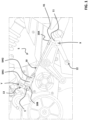
- Fig. 1 illustrates a drive mechanism control of the gearbox provided with quick-shifter in which the rod 10 includes a first end 10A hinged (axis X1) to the end of a transmission lever 11 that rotates around a rotation axis X together with the pedal lever 12 on which the pilot acts.
- a second end 10B of the rod 10 is rotatably connected (around an axis C) to a first end of a connection lever 13.
- the second end of the connection lever 13 is connected, typically through a connection with splines, to the selector drum of the gearbox.
- the mechanism described defines a standard shift configuration so that to upshift the control lever 12 is rotated in clockwise direction (upward) around the rotation axis X causing a traction state on the rod 10. This state is detected by the first microswitch SM1 associated with the rod 10. On the contrary, during downshifting (counter-clockwise rotation of the pedal lever 12), the rod 10 is in a compression state detected by the second microswitch SM2.
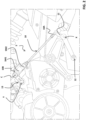
- connection lever 13 is disconnected from the selector drum, rotated by a predetermined angle and reconnected to the selector drum in a position with mirror-image symmetry (reversed) with respect to the position occupied in standard configuration, where this position is evaluated with respect to a reference plane passing through the axis X1 relating to the first end 10A and the rotation axis Y of the selector drum.
- the rod 10 is compressed each time the pedal lever 12 is pushed downward, i.e., each time upshifting is requested. On the contrary, during downshifting, the rod 10 is in a traction state.
- control unit In the case of an electronic gearbox, to allow correct operation of the engine the control unit must adapt the control strategy of the engine to the effective operative shift configuration (standard or reverse) of the drive mechanism so as to shut off the torque transmitted by the engine when the gear is effectively upshifted, or alternatively to transmit this torque in the case in which the gear is effectively downshifted. In other words, the control unit must correctly interpret the signals sent by the microswitches (SM1, SM2). If, in the case of a "reverse" configuration, the control unit were to consider the signals provided by the sensors SM1-SM2 in the same way as in the "standard” configuration, it would operate in a completely inappropriate way, shutting off the transmission of torque during downshifting or allowing this transmission during upshifting.
- the control unit In the case of an electronic gearbox, to allow correct operation of the engine the control unit must adapt the control strategy of the engine to the effective operative shift configuration (standard or reverse) of the drive mechanism so as to shut off the torque transmitted by the engine when the gear is effectively upshifted, or alternatively to
- a first object is to provide a method that can be implemented by a control unit of the motor vehicle, which allows at least two possible operative shift configurations (standard or reverse) of the drive mechanism to be determined, where this method does not rely on the human factor.
- Another object of the present invention is to provide a method that allows a control unit to determine the effective operative shift configuration (standard or reverse) of the gear shift mechanism and to set its operation autonomously.
- Another object of the present invention is to provide a method that is reliable and easily implemented at competitive costs.
- the Applicant has found that the aim and the objects indicated above can be achieved by means of a method that determines the effective operative shift configuration of the drive mechanism of the gearbox, between at least two possible configurations, based on a first signal, acquired during or following a gear shifting, characteristic of the tension state of the rod of the quick-shifter device and on a second signal useful to determine, directly or indirectly, the gear engaged or the direction of the gear shifting.
- the Applicant has found that said aim and said objects can be achieved through a method for determining an operative shift configuration of a drive mechanism of a gearbox of a saddle-ride type vehicle, wherein this drive mechanism includes a pedal shift lever and a quick-shifter device that connects, directly or indirectly, the pedal lever to the gearbox, wherein the quick-shifter device includes a rod and first sensor means that detect the variation of the tension state of the rod following a gear shifting.
- this drive mechanism includes a pedal shift lever and a quick-shifter device that connects, directly or indirectly, the pedal lever to the gearbox
- the quick-shifter device includes a rod and first sensor means that detect the variation of the tension state of the rod following a gear shifting.
- the method according to the invention includes the steps of:
- the first sensor means of said rod include a first sensor that detects a traction tension state and a second sensor that detects a compression state of the rod; in particular, the step B) includes the sub-steps of:
- the first sensor means include a sensor generating a signal that is indicative of the axial tension value to which said rod is subjected; in this case, a step B) includes the sub-steps of:
- the second sensor means detect the direction of rotation of the selector drum of the gearbox during a first gear shifting starting from a neutral condition, and said step D) includes the sub-steps of:
- step E) said standard operative shift configuration is determined:
- said step D) includes the sub-steps of:
- said standard operative shift configuration is determined when:
- the present invention also relates to a method of control of a saddle-ride type vehicle comprising an engine, a gearbox operated by means of a drive mechanism that comprises a lever shift pedal and a quick-shifter device that connects, directly or indirectly, said lever pedal to said gearbox, wherein said method comprises the steps of:
- said method includes the further step U6) of providing a signal indicative of the mismatch between the operative shift configuration determined in the step U3) and the operative shift configuration memorized in the step U1).
- the present invention relates to a method for determining the operative shift configuration of a drive mechanism of a gearbox of a saddle-ride type vehicle provided with quick-shifter device.
- the expression operative shift configuration in substance indicates the installation configuration of the mechanism.
- the method according to the invention has the purpose of determining the configuration between a "standard” and a "reverse" configuration as defined above.
- a first gear is engaged through a counter-clockwise rotation of the pedal lever, while a second and subsequent gears are engaged through a clockwise rotation of the pedal lever.
- the expression “saddle-ride type vehicle” is meant generically as any two-wheeled moped or motorcycle provided with a front wheel and a rear wheel.
- the vehicle 4 comprises an engine E connected to a gearbox G through a clutch F and a mechanical transmission that connects the output of the gearbox G to a driving wheel W (see the diagrams in Figs. 4 and 5 ).
- the vehicle 4 will also be indicated with the term motor vehicle 4 or motorcycle 4.
- the method according to the invention can be used to determine the operative shift configuration of a drive mechanism 1 comprising a pedal shift lever 12, that can be operated by the pilot and connected, directly or indirectly, to the gearbox G through a quick-shifter device 5, the operation and operating principle of which are widely known to those skilled in the art.
- the quick-shifter device 5 includes a rod 10 and first sensor means SM0, SM1-SM2 that detect the variation of the tension state of the rod 10 following a gear shifting controlled by the pilot of the motorcycle 1 through the pedal lever 12.
- the method according to the invention includes the steps of:
- the method according to the invention thus includes determining the operative shift configuration combining the information relating to the tension state of the rod 10 of the quick-shifter with the information relating to the gear engaged or to the direction of the gear shifting.
- both sets of information can be advantageously acquired through devices that are already present on the motor vehicle 1, such as the sensors belonging to the quick-shifter device.
- the expression “following a gear shifting” and/or the expression “following shifting” means both the transition (upshift or downshift) from a gear engaged to a different gear engaged, and the conditions between a condition of the gearbox in neutral (no gear engaged) to a condition of the gearbox not in neutral (i.e. having a gear engaged).
- the expression “direction of gear shifting” or “direction of shifting” means the direction of the transition, upshift or downshift, relating to the gear shifting.
- the method according to the invention is preferably implemented by the control unit 100 provided for controlling operation of the engine of the motor vehicle 4 (i.e. engine start/shutdown) according to known principles, indicated above.
- the control unit 100 is electrically connected to a first sensor SM1 and to a second sensor SM2 (as a whole defining the first sensor means) associated with the rod 10 of the quick-shifter device 5.
- the first sensor SM1 detects any traction state of the rod 10, while the second sensor SM2 detects any compression state thereof.
- the two sensors SM1, SM2 are configured as two microswitches, so that if the first microswitch (first sensor SM1) generates a signal indicative of a traction state of the rod 10, then the second microswitch (second sensor SM2) does not generate any signal, and vice versa.
- the signal sent by the two sensors SM1, SM2 is acquired by the control unit 100 which, preferably, determines the tension state (traction or compression) on the basis of the sensor SM1, SM2 that sends the signal to the control unit 100. Therefore, in the step B) indicated above, the control unit 100 determines that the rod 10 is in a traction state when the first signal S1 is sent by the first sensor SM1, while it determines that the rod 10 is in a compression state when the first signal S1 is sent by the second sensor SM2.
- the control unit 100 determines that the rod 10 is in a traction state when the first signal S1 is sent by the first sensor SM1, while it determines that the rod 10 is in a compression state when the first signal S1 is sent by the second sensor SM2.
- the first sensor means include a single sensor (indicated with SM0) associated with the rod 10 and configured to generate a single signal (indicated with S0) characteristic of the axial tension to which the rod is subjected.
- the control unit 100 determines the tension state (traction or compression) of the rod 10 based on the value of this signal S0 generated by the single sensor SM0.
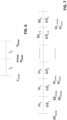
- control unit 100 determines that the rod 10 is in a compression tension state when the value of said signal S0 generated by the sensor SM0 falls within a first range of values I 1 , and determines that the rod is in a traction tension state when the value of said signal S0 falls within a second range of values I 2 .
- Each range I 1 , I 2 of values is defined between a minimum value V 1min , V 2min and a maximum value V 1max , V 2max .
- the second sensor means SM3 are configured to detect a signal indicative of the direction of rotation (clockwise or counter-clockwise) of the selector drum TS of the gearbox G to which the drive mechanism 1 is connected (see Figs. 3 and 4 ). The rotation of the selector drum TS is evidently determined following the action of the pilot on the pedal lever 12 of the drive mechanism 1.
- the second sensor means SM3 detect the rotation of the selector drum TS of the gearbox G starting from a neutral condition of the gearbox. Therefore, the second signal S2 is advantageously acquired following the "first shifting", i.e., following the first gear shifting.
- the direction of rotation of the selector drum TS depends on the operative shift configuration of the drive mechanism 1, as is evident by comparing Figs. 1 and 2 . In fact, the direction of rotation of the selector drum TS corresponds to that of the connection lever 13 of the drive mechanism 1.
- the second sensor means SM3 can comprise, for example, an encoder sensor or another functionally equivalent sensor.
- the control unit 100 establishes that a first gear has been engaged when the rotation detected of the selector drum TS is in a first direction (for example clockwise) and establishes that a second gear (different from the first) has been engaged when the rotation of the selector drum is in a second direction, opposite to the first direction (hence counter-clockwise, to continue the example).
- first direction for example clockwise
- second gear different from the first
- each direction of rotation is indicative of the engagement of a gear.
- first gear and second gear are meant to generically indicate two gears the engagement of which requires opposite directions of rotation of the selector drum TS, without these definitions intending to attribute a reference number to the gears effectively engaged of the gearbox G.
- the control unit 100 determines whether the drive mechanism 1 of the gearbox G has been installed in accordance with a first operative shift configuration, corresponding to the standard configuration defined above, or in accordance with a second operative shift configuration, corresponding to the reverse configuration, also defined above. In particular, the control unit 100 determines that the drive mechanism 1 of the gearbox G is in the first configuration (standard) when:
- the control unit 100 instead determines that the drive mechanism 1 of the gearbox G is in the second configuration (reverse) when one of the two following combinations occurs:
- the control unit 100 combines the information on the tension state of the rod (provided by the first sensor means SM0, SM1-SM2 associated with the rod 10) with the information relating to the direction of rotation of the selector drum SL (provided by the second sensor means SM3), which is strictly dependent on said operative shift configuration.
- both sets of information are provided, at least in part, by sensors that can be SM1-SM2, SM3, which are typically already present in a motor vehicle with an automatic gearbox.
- the direction of shifting is established based on a plurality of signals S2, S3, S4, S5 generated by related sensor means SM5, SM4, SM6, SM7 and acquired by the control unit 100.
- the direction of shifting is established based on a calculation carried out by the control unit 100, where said calculation is based on the relationship between the speed of the vehicle 4 and the number of revolutions of the engine E.
- step D) includes the sub-steps of:
- the "moving" condition of the vehicle 4 is determined based on signals sent by appropriate sensor means MS7 that detect the condition of the clutch (disengaged or engaged) and other sensor means MS6 that instead detect any neutral condition of the gearbox.
- sensors MS7, MS6 are normally present on motor vehicles equipped with automatic gearbox or are in any case easily installable.
- the gear engaged m 1 ---m n is determined only in the case in which the gearbox G is not in a neutral condition and in the case in which the clutch F is effectively engaged (i.e., is not in a disengaged condition).
- the method is based on calculating the parameter M expressed as product between a constant K and the relationship between the speed V of the vehicle and the number of revolutions rpm of the engine.
- the constant K depends on the transmission of the vehicle 1 and can be expressed, for example, as the product between the ratio between primary and secondary transmission and the final ratio between pinion and ring gear.
- the values of speed V and number of revolutions ( rpm ) represent information available to the control unit 100 as they can be detected easily through appropriate sensor means MS5 and MS4.
- the control unit 100 determines the gear engaged m 1 ---m n comparing the value of the parameter M, calculated in the sub-step d7), with a series of predefined intervals I rif1 - I rif2 ... I rifn wherein each of these is indicative of a gear engaged (sub-step d8)).
- each interval I rif1 - I rif2 ...- I rifn is defined between a maximum value and a minimum value, wherein the maximum value M n-max of an interval I rifn coincides with the minimum value M n+1-min of the following interval I rifn+1 .
- the control unit 100 establishes that the gear m 1 ---m n engaged corresponds to the one of the reference interval I rif into which the value of the parameter M calculated in accordance with the step d7) falls. Again with reference to Fig. 7 , if, for example, M falls into the second reference interval I rif2 established between the values M 2min and M 2max then the control unit 10 determines that the gear engaged is the second, indicated with m 2 .
- the control unit 100 determines the direction of the gear shifting (or direction of shifting), i.e., determines whether shifting is an upshift or downshift.
- the control unit 100 combines the information relating to the direction of the gear shifting, established with the sub-steps d7) -d10), with the information (traction or compression state) provided by the first sensor means SM0, SM1, SM2 associated with the rod 10 of the quick-shifter device 5 determining whether this combination is indicative of the standard or alternatively the reverse operative shift configuration.
- control unit 100 determines that the drive mechanism 1 of the gearbox G is in the first operative shift configuration (standard) when:
- the control unit 100 instead determines that the drive mechanism 1 of the gearbox G is in the second operative shift configuration (reverse) when one of the following two combinations occur:
- the control unit 100 thus combines the information on the direction of shifting (based on determination of the gear engaged) with the information relating to the tension state of the rod 10 (provided by the first sensor means SM0, SM1-SM2) generated following shifting.
- the first sensor means can be both of the type illustrated in Fig. 5 (i.e., comprising two sensors SM1-SM2) and of the type shown in Fig. 4 (i.e., with a single sensor SM0 generator of the signal S0 that indicates the value of the axial tension of the rod 10).
- the step e) is implemented after the sequence of sub-steps d7) -d10) has been repeated at least twice. This is in order to establish with greater certainty the effective gear engaged, above all in the case in which the values of the parameter M are close to a limit value (upper M n-max or lower M n+1-min ) of a predefined range of an interval I rifn .
- the present invention also relates to a method of control of a saddle-ride type vehicle comprising an engine E, a gearbox G operated by means of a drive mechanism 1 that includes a pedal shift lever 12 and a quick-shifter device 5 that connects, directly or indirectly, said pedal lever 12 to the gearbox G, wherein this method comprises the steps of:
- the control unit 100 after having implemented one of the two embodiments of the method to determine the operative shift configuration described above (in one of the embodiments described or in any other functionally equivalent embodiment and hence falling within the scope of the present invention), controls the engine E of the vehicle 4 based on the operative shift configuration (standard or reverse) of the drive mechanism 1 determined.
- the control unit 10 can correctly interpret the signals that are provided by the first sensor means MS0, MS1-MS2 associated with the rod 10 of the quick-shifter device 5. In this way, the control unit 10 is able to act correctly on the engine E and hence on the transmission of torque generated thereby.
- the method of control of a vehicle according to the invention also includes the steps of:
- step U1 comprises memorizing the operative shift configuration of the drive mechanism before the shutdown of the engine E to then use this configuration to control the engine E in order to once again redetermine the effective operative shift configuration (step U3)) by the method of determination described above. If this reconfirms the previous operative shift configuration, the control unit 100 maintains the same operating mode on the engine E adopted before the shutdown. Otherwise, i.e., when the mode of shifting has effectively changed, then the control unit 100 adapts its operating mode so as to match the effective operative shift configuration.
- the method of control of the engine E includes the further step U6) of providing a signal indicative of the mismatch between the configuration determined in the step U3) and the configuration memorized in the step U1).
- the purpose of this signal is to notify the pilot of the change made to the drive mechanism of the gearbox G, i.e., the different shifting mode adopted.
- the method according to the invention allows the aims and the objects to be fully achieved.
- the method allows the control unit to determine the operative shift configuration of the drive mechanism exploiting signals provided by sensors normally present on, or easily applicable to, motor vehicles provided with automatic gearbox based on the use of a quick-shifter device.
Landscapes
- Engineering & Computer Science (AREA)
- General Engineering & Computer Science (AREA)
- Mechanical Engineering (AREA)
- Chemical & Material Sciences (AREA)
- Combustion & Propulsion (AREA)
- Transportation (AREA)
- Control Of Transmission Device (AREA)
- Electric Propulsion And Braking For Vehicles (AREA)
Description
- The present invention falls within the field of the production of saddle-ride type motorcycles provided with automatic gearbox operated by a mechanism comprising a quick-shifter device. More precisely, the present invention refers to a method, which can be implemented by a control unit of the motor vehicle, to determine the operative shift configuration of the drive mechanism of the gearbox between a first configuration and a second possible configuration.
- In saddle-ride type vehicles engaging of the gear of the gearbox is controlled through a drive mechanism comprising a pedal lever on which the pilot acts with one foot. In accordance with a first installation configuration of this mechanism, defined "standard", the first gear is engaged through a downward rotation (typically counter-clockwise) of the pedal lever, while the second gear, and in general a higher gear "upshifting", is engaged through an upward rotation (typically clockwise), of the pedal lever. Downshifting takes place following a rotation (typically counter-clockwise) of the pedal lever.
- Pilots of sports motorcycles find it useful to reverse the direction of shifting by varying the installation configuration of the drive mechanism so as to reverse the shifting direction, so that the "upshift" gears are engaged through a downward rotation (preferably counter-clockwise) of the pedal lever, while downshifting takes place with an upward rotation of the lever. The usefulness of this second possible installation configuration, called "reverse", is appreciated above all when the motor vehicle is used on the racetrack, precisely when the pilot requires to shift up the gear in a condition with the motor vehicle at a high lean angle. With a standard configuration of the installation mechanism, to upshift the gear, the pilot acts on the pedal lever using the back of the foot. This is positioned between the pedal lever and the road surface. However, in a condition with a high lean angle, the foot could impact against the road surface with dangerous consequences. This risk is eliminated when the mechanism is installed according to the "reverse" configuration, which allows the pilot to shift to a higher gear (or upshift) using the sole of the foot, i.e., maintaining the foot in a safe position above the pedal lever and shifting the lever downward.
- The two installation configurations indicated are also respectively called "standard operative shift" configuration and "reverse operative shift" configuration.
- In a motor vehicle provided with a conventional gearbox, i.e., in which gear shifting requires the pilot to disengage the clutch and close the throttle, the reverse operative shift configuration is obtained by modifying the configuration of the linkages of the drive mechanism and that connect, indirectly, the pedal lever with the selector drum of the gearbox. In practice, the change of configuration is produced through a simple mechanical modification of the drive mechanism. However, this modification is not sufficient to allow operation of the vehicle when it is provided with an electronic gearbox (also called automatic) which, as is known, minimizes the shifting time, making both upshifting and downshifting faster. In particular, this gearbox uses a drive mechanism of the gearbox provided with a device commonly known with the term "quick-shifter", which allows the gear to be engaged without closing the accelerator, disengaging the clutch and thus without removing the hands from the handlebar (see
EP 3 343 074 A ). - In detail, the quick-shifter consists of a rod interposed between the pedal lever and the selector drum of the gearbox. Typically, this rod is associated with at least a first microswitch (SM1) that generates a signal each time the lever of the gearbox is operated to increase the gear (upshifting). This signal is sent to a control unit that acts on the engine, shutting off the delivery of torque necessary for the time required to engage the higher gear. Frequently, the rod of the quick-shifter is associated with a second microswitch (SM2) that generates a corresponding signal when the lever of the gearbox is operated to decrease the gear (downshifting). In this case, following the signal generated by the second microswitch, the control unit opens the throttle valve providing torque to the engine. To generate the corresponding signals, the microswitches detect the traction or compression state of the rod with which they are associated.
Fig. 1 illustrates a drive mechanism control of the gearbox provided with quick-shifter in which therod 10 includes afirst end 10A hinged (axis X1) to the end of atransmission lever 11 that rotates around a rotation axis X together with thepedal lever 12 on which the pilot acts. Asecond end 10B of therod 10 is rotatably connected (around an axis C) to a first end of aconnection lever 13. The second end of theconnection lever 13 is connected, typically through a connection with splines, to the selector drum of the gearbox. The mechanism described defines a standard shift configuration so that to upshift thecontrol lever 12 is rotated in clockwise direction (upward) around the rotation axis X causing a traction state on therod 10. This state is detected by the first microswitch SM1 associated with therod 10. On the contrary, during downshifting (counter-clockwise rotation of the pedal lever 12), therod 10 is in a compression state detected by the second microswitch SM2. - With reference to
Fig. 2 , to obtain the reverse shift configuration, theconnection lever 13 is disconnected from the selector drum, rotated by a predetermined angle and reconnected to the selector drum in a position with mirror-image symmetry (reversed) with respect to the position occupied in standard configuration, where this position is evaluated with respect to a reference plane passing through the axis X1 relating to thefirst end 10A and the rotation axis Y of the selector drum. Following this mechanical adjustment, therod 10 is compressed each time thepedal lever 12 is pushed downward, i.e., each time upshifting is requested. On the contrary, during downshifting, therod 10 is in a traction state. - In the case of an electronic gearbox, to allow correct operation of the engine the control unit must adapt the control strategy of the engine to the effective operative shift configuration (standard or reverse) of the drive mechanism so as to shut off the torque transmitted by the engine when the gear is effectively upshifted, or alternatively to transmit this torque in the case in which the gear is effectively downshifted. In other words, the control unit must correctly interpret the signals sent by the microswitches (SM1, SM2). If, in the case of a "reverse" configuration, the control unit were to consider the signals provided by the sensors SM1-SM2 in the same way as in the "standard" configuration, it would operate in a completely inappropriate way, shutting off the transmission of torque during downshifting or allowing this transmission during upshifting.
- Therefore, there is the need to set operation of the control unit based on the effective operative shift configuration (standard or reverse) of the drive mechanism of the gearbox. In the current state of the art, correct setting of the control unit, and thus of any change of the control strategy, is substantially delegated to the pilot or to an operator responsible for preparing the motor vehicle. In practice, after the mechanical modification has been made, i.e., the change of configuration from standard to reverse, the pilot, or person delegated with this task, must remember to intervene on the control unit, in order to make it aware of the change of configuration and ultimately set the correct control strategy of the engine. This solution seems clearly risky, as it depends entirely on the human component.
- The main aim of the present invention is to provide a solution that allows the problem set forth above to be solved. Within this aim, a first object is to provide a method that can be implemented by a control unit of the motor vehicle, which allows at least two possible operative shift configurations (standard or reverse) of the drive mechanism to be determined, where this method does not rely on the human factor. Another object of the present invention is to provide a method that allows a control unit to determine the effective operative shift configuration (standard or reverse) of the gear shift mechanism and to set its operation autonomously. Another object of the present invention is to provide a method that is reliable and easily implemented at competitive costs.
- The Applicant has found that the aim and the objects indicated above can be achieved by means of a method that determines the effective operative shift configuration of the drive mechanism of the gearbox, between at least two possible configurations, based on a first signal, acquired during or following a gear shifting, characteristic of the tension state of the rod of the quick-shifter device and on a second signal useful to determine, directly or indirectly, the gear engaged or the direction of the gear shifting.
- In particular, the Applicant has found that said aim and said objects can be achieved through a method for determining an operative shift configuration of a drive mechanism of a gearbox of a saddle-ride type vehicle, wherein this drive mechanism includes a pedal shift lever and a quick-shifter device that connects, directly or indirectly, the pedal lever to the gearbox, wherein the quick-shifter device includes a rod and first sensor means that detect the variation of the tension state of the rod following a gear shifting. In particular, the method according to the invention includes the steps of:
- A) acquiring a first signal generated by the first sensor means and indicative of the tension state of the rod following said gear shifting;
- B) determining, based on said first signal, whether said rod is in a traction tension state or in a compression tension state;
- C) acquiring at least a second signal generated by second sensor means following a gear shifting by means of said pedal shift lever;
- D) determining, based on said at least second signal, the gear engaged following said gear shifting and/or the direction of said gear shifting;
- E) determining an operative shift configuration of the drive mechanism of said gearbox selected from a standard operative shift configuration and a reverse operative shift configuration of said pedal shift lever, wherein said operative shift configuration is determined based on the combination between the tension state determined in the step B) and the gear determined or the direction of said gear shifting determined in the step D).
- In the standard operative shift configuration of the pedal shift lever a first gear is engaged through a counter-clockwise rotation of the pedal lever, while a second and subsequent gears are engaged through a clockwise rotation of the pedal lever; instead, in the reverse operative shift configuration of the pedal shift lever a first gear is engaged through a clockwise rotation of the pedal lever, while a second and subsequent gears are engaged through a counter-clockwise rotation of the pedal lever.
- In a first possible embodiment thereof, the first sensor means of said rod include a first sensor that detects a traction tension state and a second sensor that detects a compression state of the rod; in particular, the step B) includes the sub-steps of:
- determining that said rod is in a traction tension state when said first signal is sent by the first sensor;
- determining that said rod is in a compression tension state when said first signal is sent by the second sensor.
- In an alternative embodiment thereof, the first sensor means include a sensor generating a signal that is indicative of the axial tension value to which said rod is subjected; in this case, a step B) includes the sub-steps of:
- determining that the rod is in a traction tension state when said value of said signal generated by the sensor is included in a first range of values;
- determining that the rod is in a compression tension state when the signal indicator is included in a second range of values.
- In accordance with a first embodiment, the second sensor means detect the direction of rotation of the selector drum of the gearbox during a first gear shifting starting from a neutral condition, and said step D) includes the sub-steps of:
- determining that a first gear is engaged when said rotation of said selector drum is in a first direction and
- determining that a second gear is engaged when said rotation of said selector drum is in a second direction opposite to said first direction.
- Again with reference to this embodiment, preferably in said step E) said standard operative shift configuration is determined:
- when in said step B) said traction tension state is determined and in said step D) said first gear engaged is determined, or
- when in said step B) said compression tension state is determined and in said step D) said second gear engaged is determined, and
- when in said step B) said compression tension state is determined and in said step D) said first gear engaged is determined, or
- when in said step B) said traction tension state is determined and in said step D) said second gear engaged is determined.
- In accordance with an alternative embodiment of the method according to the invention, said step D) includes the sub-steps of:
- d1) acquiring a second signal indicative of the speed of said vehicle;
- d2) acquiring a third signal indicative of the speed of the engine of the vehicle,
- d3) acquiring a fourth signal indicative of the neutral condition of said gearbox;
- d4) acquiring a fifth signal indicative of the condition of the clutch of the vehicle;
- d5) determining, based on the fourth signal whether said gearbox is in a neutral condition or not in a neutral condition;
- d6) determining, based on said fifth signal, whether the clutch is in an engaged condition or in a disengaged condition,
wherein when in said sub-step d5) it is determined that said gearbox is not in a neutral condition and in said sub-step d6) it is determined that said clutch is in a disengaged condition, said step D) includes the further sub-steps di: - d7) calculating a reference parameter M based on the relationship:

- K is a constant depending on the vehicle transmission;
- V is the speed of the vehicle;
- rpm is the number of revolutions of the drive shaft of the engine of said vehicle;
- d8) defining a series of reference intervals for said parameter (M), wherein each reference interval is indicative of a gear engaged;
- d9) determining said gear engaged based on the reference interval into which said parameter (M) falls;
- d10) determining the direction of said gear shifting based on the comparison between said gear engaged determined in the step d9) and the gear engaged before said gear shifting.
- Preferably, in this second embodiment, in said step E) said standard operative shift configuration is determined when:
- in said step B) a traction tension state is determined and in said step D) an upshifting direction is determined; or when:
- in said step B) a compression tension state is determined and in said step D) a downshifting is determined,
- in said step B) a traction tension state is determined and in said step D) a downshifting direction is determined; or alternatively:
- in the step B) a compression tension state is determined and in said step D) an upshifting direction is determined.
- The present invention also relates to a method of control of a saddle-ride type vehicle comprising an engine, a gearbox operated by means of a drive mechanism that comprises a lever shift pedal and a quick-shifter device that connects, directly or indirectly, said lever pedal to said gearbox, wherein said method comprises the steps of:
- T1) determining the operative shift configuration of said drive mechanism by a method according to the invention;
- T2) controlling said motor based on the configuration of said drive mechanism determined in the step T1).
- U1) memorizing, before the shutdown of said engine, the operative shift configuration of said drive mechanism determined by a method according to the present invention;
- U2) controlling said engine, after its restart, on the basis of the operative shift configuration memorized in the step U1;
- U3) redetermining the operative shift configuration of said drive mechanism (1) by a method according to the present invention;
- U4) determining whether the operative shift configuration of said drive mechanism memorized in the step U1) corresponds to the one redetermined in the step U3);
- U5) changing, in case of mismatch between the operative shift configuration redetermined in the step U3) and the operative shift configuration memorized in the step U1), the control strategy of said engine on the basis of said operative shift configuration redetermined in the step U3).
- Preferably, said method includes the further step U6) of providing a signal indicative of the mismatch between the operative shift configuration determined in the step U3) and the operative shift configuration memorized in the step U1).
- Further features and advantages of the invention will be more evident from examination of the following detailed description of some preferred, but not exclusive, embodiments of the method according to the invention, illustrated by way of non-limiting example with the aid of the accompanying drawings, wherein:
-
Fig. 1 is a schematic view of a first operative shift configuration of a drive mechanism of known type of a gearbox of a saddle-ride type vehicle of known type according to the present invention; -
Fig. 2 is a schematic view of a second operative shift configuration of a drive mechanism of known type of a gearbox of a saddle-ride type vehicle; -
Figs. 3 ,4 and5 are diagrams relating respectively to a first, a second and a third possible embodiment of a method according to the invention; -
Figs. 6 and 7 are further explanatory diagrams of steps of the method according to the invention respectively in the embodiments ofFig. 4 andFig. 5 . - The same reference numbers and letters in the figures identify the same elements or components.
- The present invention relates to a method for determining the operative shift configuration of a drive mechanism of a gearbox of a saddle-ride type vehicle provided with quick-shifter device. The expression operative shift configuration in substance indicates the installation configuration of the mechanism. In particular, the method according to the invention has the purpose of determining the configuration between a "standard" and a "reverse" configuration as defined above.
- In particular, in a standard operative shift configuration a first gear is engaged through a counter-clockwise rotation of the pedal lever, while a second and subsequent gears are engaged through a clockwise rotation of the pedal lever.
- Instead, in a reverse operative shift configuration a first gear is engaged through a clockwise rotation of the pedal lever, while a second and subsequent gears are engaged through a counter-clockwise rotation of the pedal lever.
- For the purposes of the present invention, the expression "saddle-ride type vehicle" is meant generically as any two-wheeled moped or motorcycle provided with a front wheel and a rear wheel. In general, according to a widely known principle, the
vehicle 4 comprises an engine E connected to a gearbox G through a clutch F and a mechanical transmission that connects the output of the gearbox G to a driving wheel W (see the diagrams inFigs. 4 and5 ). Hereinafter in the description, thevehicle 4 will also be indicated with theterm motor vehicle 4 ormotorcycle 4. - In particular, the method according to the invention can be used to determine the operative shift configuration of a
drive mechanism 1 comprising apedal shift lever 12, that can be operated by the pilot and connected, directly or indirectly, to the gearbox G through a quick-shifter device 5, the operation and operating principle of which are widely known to those skilled in the art. The quick-shifter device 5 includes arod 10 and first sensor means SM0, SM1-SM2 that detect the variation of the tension state of therod 10 following a gear shifting controlled by the pilot of themotorcycle 1 through thepedal lever 12. - The method according to the invention includes the steps of:
- A) acquiring a first signal S0, S1, generated by first sensor means S0, SM1, SM2, and indicative of the tension state determined in the
rod 10 of the quick-shifter mechanism 5 following said gear shifting requested by the pilot; - B) determining, based on the first signal S0, S1, whether the
rod 10 of the quick-shifter mechanism 5 is in a traction or in a compression tension state; - C) acquiring at least a second signal S2 generated by second sensor means SM3;
- D) determining, based on said at least a second signal S2, the gear engaged following said gear shifting and/or the direction of said gear shifting;
- E) determining the operative shift configuration of the
drive mechanism 1 of the gearbox G based on the tension state determined in the step B) and the gear and/or the direction of said gear shifting determined in the step D). - The method according to the invention thus includes determining the operative shift configuration combining the information relating to the tension state of the
rod 10 of the quick-shifter with the information relating to the gear engaged or to the direction of the gear shifting. As will be apparent from the description below, both sets of information can be advantageously acquired through devices that are already present on themotor vehicle 1, such as the sensors belonging to the quick-shifter device. - For the purposes of the present invention, the expression "following a gear shifting" and/or the expression "following shifting" means both the transition (upshift or downshift) from a gear engaged to a different gear engaged, and the conditions between a condition of the gearbox in neutral (no gear engaged) to a condition of the gearbox not in neutral (i.e. having a gear engaged). The expression "direction of gear shifting" or "direction of shifting" means the direction of the transition, upshift or downshift, relating to the gear shifting.
- The method according to the invention is preferably implemented by the
control unit 100 provided for controlling operation of the engine of the motor vehicle 4 (i.e. engine start/shutdown) according to known principles, indicated above. With reference to the schematization ofFig. 3 , in accordance with a first embodiment, thecontrol unit 100 is electrically connected to a first sensor SM1 and to a second sensor SM2 (as a whole defining the first sensor means) associated with therod 10 of the quick-shifter device 5. The first sensor SM1 detects any traction state of therod 10, while the second sensor SM2 detects any compression state thereof. Preferably, the two sensors SM1, SM2 are configured as two microswitches, so that if the first microswitch (first sensor SM1) generates a signal indicative of a traction state of therod 10, then the second microswitch (second sensor SM2) does not generate any signal, and vice versa. - In accordance with the step A) indicated above, the signal sent by the two sensors SM1, SM2 is acquired by the
control unit 100 which, preferably, determines the tension state (traction or compression) on the basis of the sensor SM1, SM2 that sends the signal to thecontrol unit 100. Therefore, in the step B) indicated above, thecontrol unit 100 determines that therod 10 is in a traction state when the first signal S1 is sent by the first sensor SM1, while it determines that therod 10 is in a compression state when the first signal S1 is sent by the second sensor SM2. In accordance with an alternative embodiment schematized inFig. 4 , the first sensor means include a single sensor (indicated with SM0) associated with therod 10 and configured to generate a single signal (indicated with S0) characteristic of the axial tension to which the rod is subjected. In this embodiment, thecontrol unit 100 determines the tension state (traction or compression) of therod 10 based on the value of this signal S0 generated by the single sensor SM0. - With reference to the diagram of
Fig. 6 , specifically thecontrol unit 100 determines that therod 10 is in a compression tension state when the value of said signal S0 generated by the sensor SM0 falls within a first range of values I1, and determines that the rod is in a traction tension state when the value of said signal S0 falls within a second range of values I2. - Each range I1, I2 of values is defined between a minimum value V1min, V2min and a maximum value V1max, V2max. Preferably, the two ranges I1, I2 are consecutive so that the maximum value of the first range I1 coincides with the minimum value of the second range I2 (condition V1max=V2min).
- Therefore, with respect to the embodiment of
Fig. 3 , in this case determination of the tension state of therod 10 takes place through a single sensor SM0. Advantageously, the value of the signal S0 can be exploited by thecontrol unit 100 also to optimize control of the engine E. In fact, while driving, determining the gear shifting on the basis of the value of the tension, thecontrol unit 100 could be adjusted so as to anticipate or delay the intervention on the engine. In accordance with an embodiment of the invention, in the step B) the second sensor means SM3 are configured to detect a signal indicative of the direction of rotation (clockwise or counter-clockwise) of the selector drum TS of the gearbox G to which thedrive mechanism 1 is connected (seeFigs. 3 and4 ). The rotation of the selector drum TS is evidently determined following the action of the pilot on thepedal lever 12 of thedrive mechanism 1. - The second sensor means SM3 detect the rotation of the selector drum TS of the gearbox G starting from a neutral condition of the gearbox. Therefore, the second signal S2 is advantageously acquired following the "first shifting", i.e., following the first gear shifting.
- The direction of rotation of the selector drum TS depends on the operative shift configuration of the
drive mechanism 1, as is evident by comparingFigs. 1 and2 . In fact, the direction of rotation of the selector drum TS corresponds to that of theconnection lever 13 of thedrive mechanism 1. To detect the rotation of the selector drum TS, the second sensor means SM3 can comprise, for example, an encoder sensor or another functionally equivalent sensor. - In this embodiment, schematized in
Figs. 3 and4 , in accordance with the step D) of the method according to the invention, thecontrol unit 100 establishes that a first gear has been engaged when the rotation detected of the selector drum TS is in a first direction (for example clockwise) and establishes that a second gear (different from the first) has been engaged when the rotation of the selector drum is in a second direction, opposite to the first direction (hence counter-clockwise, to continue the example). In substance, each direction of rotation is indicative of the engagement of a gear. - In this regard, the expressions "first gear" and "second gear" are meant to generically indicate two gears the engagement of which requires opposite directions of rotation of the selector drum TS, without these definitions intending to attribute a reference number to the gears effectively engaged of the gearbox G.
- In this embodiment of the method according to the invention, based on the previous determinations on the tension state of the
rod 10 and on the gear engaged, thecontrol unit 100 determines whether thedrive mechanism 1 of the gearbox G has been installed in accordance with a first operative shift configuration, corresponding to the standard configuration defined above, or in accordance with a second operative shift configuration, corresponding to the reverse configuration, also defined above. In particular, thecontrol unit 100 determines that thedrive mechanism 1 of the gearbox G is in the first configuration (standard) when: - in the step B) a traction tension state is determined and in said step D) engagement of said second gear is determined (counter-clockwise rotation of the selector drum TS); or when:
- in the step B) a compression tension state is determined and in said step D) engagement of said first gear is determined (clockwise rotation of the selector drum TS).
- The
control unit 100 instead determines that thedrive mechanism 1 of the gearbox G is in the second configuration (reverse) when one of the two following combinations occurs: - in the step B) a traction tension state is determined and in said step D) engagement of said first gear is determined (clockwise rotation of the selector drum); or alternatively
- in the step B) a compression tension state is determined and in said step D) engagement of said second gear is determined (counter-clockwise rotation of the selector drum TS).
- Based on the above, in this embodiment, to determine the effective operative shift configuration of the
drive mechanism 1, thecontrol unit 100 combines the information on the tension state of the rod (provided by the first sensor means SM0, SM1-SM2 associated with the rod 10) with the information relating to the direction of rotation of the selector drum SL (provided by the second sensor means SM3), which is strictly dependent on said operative shift configuration. Advantageously, both sets of information are provided, at least in part, by sensors that can be SM1-SM2, SM3, which are typically already present in a motor vehicle with an automatic gearbox. - In a possible alternative embodiment, schematized in
Fig. 5 , in the step D) the direction of shifting is established based on a plurality of signals S2, S3, S4, S5 generated by related sensor means SM5, SM4, SM6, SM7 and acquired by thecontrol unit 100. Specifically, the direction of shifting is established based on a calculation carried out by thecontrol unit 100, where said calculation is based on the relationship between the speed of thevehicle 4 and the number of revolutions of the engine E. - More precisely, in this alternative embodiment, the step D) includes the sub-steps of:
- d1) acquiring a second signal S2' indicative of the speed of the
vehicle 4; - d2) acquiring a third signal S3 indicative of the speed of the engine E;
- d3) acquiring a fourth signal S4 indicative of the neutral condition of the gearbox G;
- d4) acquiring a fifth signal S5 indicative of the condition of the clutch F;
- d5) determining, based on said fourth signal S4, whether the gearbox G is in a neutral condition or a condition with the gear engaged;
- d6) determining, based on said fifth signal S5, whether the clutch F is in an engaged condition or in a disengaged condition;
- wherein when in the sub-step d5) it is determined that the gearbox G is not in a neutral condition and in the sub-step d6) it is determined that the clutch is in a disengaged condition, then the step D) includes the further sub-steps of:
- d7) calculating a reference parameter (M) based on the relationship:

- K is a constant depending on the
vehicle transmission 4; - V is the speed of the vehicle;
- rpm is the number of revolutions of the drive shaft of the engine E of said
vehicle 4;
- K is a constant depending on the
- d8) defining a series of reference intervals Irif1- Irif2 ... Irifn for the parameter M, wherein each reference interval Irif1- Irif2 ... Irifn is indicative of a gear engaged m1---mn;
- d9) determining said gear engaged m1---mn based on the reference interval Irif1- Irif2 ... Irifn into which said parameter M falls;
- d10) determining the direction of said gear shifting (upshifting or downshifting) based on the comparison between the gear determined in the step d9) and the gear engaged before said gear shifting.
- d7) calculating a reference parameter (M) based on the relationship:
- Differently from the first embodiment in which the information relating to the rotation of the selector drum TS is exploited, in this case determination of the operative shift configuration of the drive mechanism requires the vehicle to be moving, i.e., for it not to start from a neutral condition. Therefore, this determination takes place following a gear shifting subsequent to the first.
- In accordance with the sub-steps d5) and d6) indicated above, the "moving" condition of the
vehicle 4 is determined based on signals sent by appropriate sensor means MS7 that detect the condition of the clutch (disengaged or engaged) and other sensor means MS6 that instead detect any neutral condition of the gearbox. Advantageously, also these sensors MS7, MS6 are normally present on motor vehicles equipped with automatic gearbox or are in any case easily installable. - As indicated above, in this embodiment, the gear engaged m1---mn is determined only in the case in which the gearbox G is not in a neutral condition and in the case in which the clutch F is effectively engaged (i.e., is not in a disengaged condition). In accordance with the sub-step d7), the method is based on calculating the parameter M expressed as product between a constant K and the relationship between the speed V of the vehicle and the number of revolutions rpm of the engine.
- The constant K depends on the transmission of the
vehicle 1 and can be expressed, for example, as the product between the ratio between primary and secondary transmission and the final ratio between pinion and ring gear. The values of speed V and number of revolutions (rpm) represent information available to thecontrol unit 100 as they can be detected easily through appropriate sensor means MS5 and MS4. - In accordance with the sub-step d9), the
control unit 100 determines the gear engaged m1---mn comparing the value of the parameter M, calculated in the sub-step d7), with a series of predefined intervals Irif1- Irif2 ... Irifn wherein each of these is indicative of a gear engaged (sub-step d8)). With reference to the diagram ofFig. 7 , each interval Irif1- Irif2 ...- Irifn is defined between a maximum value and a minimum value, wherein the maximum value Mn-max of an interval Irifn coincides with the minimum value Mn+1-min of the following interval Irifn+1. - The
control unit 100 establishes that the gear m1---mn engaged corresponds to the one of the reference interval Irif into which the value of the parameter M calculated in accordance with the step d7) falls. Again with reference toFig. 7 , if, for example, M falls into the second reference interval Irif2 established between the values M2min and M2max then thecontrol unit 10 determines that the gear engaged is the second, indicated with m2. - In accordance with the step d10), based on comparison between the gear determined with the step d9) (i.e., the one determined following said gear shifting) and the gear engaged before the gear shifting, the
control unit 100 determines the direction of the gear shifting (or direction of shifting), i.e., determines whether shifting is an upshift or downshift. - In accordance with the step E) of the method according to the invention, the
control unit 100 combines the information relating to the direction of the gear shifting, established with the sub-steps d7) -d10), with the information (traction or compression state) provided by the first sensor means SM0, SM1, SM2 associated with therod 10 of the quick-shifter device 5 determining whether this combination is indicative of the standard or alternatively the reverse operative shift configuration. - In particular, the
control unit 100 determines that thedrive mechanism 1 of the gearbox G is in the first operative shift configuration (standard) when: - in the step B) a traction tension state is determined and in said step D) an upshifting direction is determined; or when:
- in the step B) a compression tension state is determined and in said step D) a downshifting direction is determined.
- The
control unit 100 instead determines that thedrive mechanism 1 of the gearbox G is in the second operative shift configuration (reverse) when one of the following two combinations occur: - in the step B) a traction tension state is determined and in said step D) a downshifting direction is determined; or alternatively:
- in the step B) a compression tension state is determined and in said step D) an upshifting direction is determined.
- As already indicated above, in this embodiment, the
control unit 100 thus combines the information on the direction of shifting (based on determination of the gear engaged) with the information relating to the tension state of the rod 10 (provided by the first sensor means SM0, SM1-SM2) generated following shifting. It is specified that the first sensor means can be both of the type illustrated inFig. 5 (i.e., comprising two sensors SM1-SM2) and of the type shown inFig. 4 (i.e., with a single sensor SM0 generator of the signal S0 that indicates the value of the axial tension of the rod 10). - Again with reference to this second embodiment of the method, preferably the step e) is implemented after the sequence of sub-steps d7) -d10) has been repeated at least twice. This is in order to establish with greater certainty the effective gear engaged, above all in the case in which the values of the parameter M are close to a limit value (upper Mn-max or lower Mn+1-min) of a predefined range of an interval Irifn. The present invention also relates to a method of control of a saddle-ride type vehicle comprising an engine E, a gearbox G operated by means of a
drive mechanism 1 that includes apedal shift lever 12 and a quick-shifter device 5 that connects, directly or indirectly, saidpedal lever 12 to the gearbox G, wherein this method comprises the steps of: - T1) determining the operative shift configuration of the
drive mechanism 1 by the method according to the present invention; - T2) controlling the engine E based on the configuration of the
drive mechanism 1 determined in the step T1). - Advantageously, the
control unit 100, after having implemented one of the two embodiments of the method to determine the operative shift configuration described above (in one of the embodiments described or in any other functionally equivalent embodiment and hence falling within the scope of the present invention), controls the engine E of thevehicle 4 based on the operative shift configuration (standard or reverse) of thedrive mechanism 1 determined. In other words, by knowing the operative shift configuration effectively adopted, thecontrol unit 10 can correctly interpret the signals that are provided by the first sensor means MS0, MS1-MS2 associated with therod 10 of the quick-shifter device 5. In this way, thecontrol unit 10 is able to act correctly on the engine E and hence on the transmission of torque generated thereby. In accordance with a possible embodiment, the method of control of a vehicle according to the invention also includes the steps of: - U1) memorizing, before the shutdown of the engine E, the operative shift configuration of the gearbox G determined by the method for determining the operative shift configuration according to the present invention;
- U2) controlling the engine E, after its restart, on the basis of the operative shift configuration of said drive mechanism memorized in the step U1;
- U3) redetermining the operative shift configuration of said
drive mechanism 1 of the gearbox G by the method for determining the operative shift configuration according to the present invention; - U4) determining whether the operative shift configuration of the
drive mechanism 1 of the gearbox G memorized in the step U1) corresponds to the one redetermined in the step U3); - U5) changing, in the case of mismatch between the operative shift configuration redetermined in the step U3) and the operative shift configuration memorized in the step U1), the control strategy of the engine E on the basis of the operative shift configuration redetermined in the step U3).
- The sequence of steps U1-U5 can be implemented regardless of the mode with which the method according to the invention to determine the operative shift configuration of the drive mechanism is implemented. However, it can be applied more widely when this determination is based on determination of the direction of shifting based on calculation of the parameter M. In substance, the step U1) comprises memorizing the operative shift configuration of the drive mechanism before the shutdown of the engine E to then use this configuration to control the engine E in order to once again redetermine the effective operative shift configuration (step U3)) by the method of determination described above. If this reconfirms the previous operative shift configuration, the
control unit 100 maintains the same operating mode on the engine E adopted before the shutdown. Otherwise, i.e., when the mode of shifting has effectively changed, then thecontrol unit 100 adapts its operating mode so as to match the effective operative shift configuration. - In accordance with a possible embodiment, the method of control of the engine E includes the further step U6) of providing a signal indicative of the mismatch between the configuration determined in the step U3) and the configuration memorized in the step U1). The purpose of this signal is to notify the pilot of the change made to the drive mechanism of the gearbox G, i.e., the different shifting mode adopted.
- The method according to the invention allows the aims and the objects to be fully achieved. In particular, the method allows the control unit to determine the operative shift configuration of the drive mechanism exploiting signals provided by sensors normally present on, or easily applicable to, motor vehicles provided with automatic gearbox based on the use of a quick-shifter device.
Claims (10)
- Method for determining an operative shift configuration of a drive mechanism (1) of a gearbox (G) of a saddle-ride type vehicle (4), wherein said drive mechanism (1) includes a pedal shift lever (12) and a quick-shifter device (5) that connects, directly or indirectly, said pedal shift lever (12) to said gearbox (G), wherein said quick-shifter device (5) includes a rod (10) and first sensor means (SM0, SM1-SM2) that detect the variation of the tension state of said rod (10) following a gear shifting, wherein said method includes the steps of:A) acquiring a first signal (S0, S1) generated by said first sensor means (SM0, SM1, SM2) and indicative of the tension state of said rod (10) determined following said gear shifting;B) determining, based on said first signal (S0, S1), whether said rod (10) is in a traction tension state or in a compression tension state;C) acquiring at least a second signal (S2, S2', S3, S4, S5) generated by second sensor means (SM3, SM5, SM4, SM6, SM7) following a gear shifting by means of said pedal shift lever (12);D) determining, based on said at least second signal (S2), the gear engaged following said gear shifting and/or the direction of said gear shifting;E) determining an operative shift configuration of said drive mechanism (1) of said gearbox (G) selected from a standard operative shift configuration and a reverse operative shift configuration of said pedal shift lever (12), wherein said operative shift configuration is determined based on the combination between the tension state determined in the step B) and the gear engaged and/or the direction of said gear shifting determined in the step D);wherein in said standard operative shift configuration of the pedal shift lever (12) a first gear is engaged through a counter-clockwise rotation of the pedal lever, while a second and subsequent gears are engaged through a clockwise rotation of the pedal lever, and wherein in said reverse operative shift configuration of the pedal shift lever (12) a first gear is engaged through a clockwise rotation of the pedal lever, while a second and subsequent gears are engaged through a counter-clockwise rotation of the pedal lever.
- Method according to claim 1, wherein said first sensor means include a first sensor (SM1) that detects a traction tension state and a second sensor (SM2) that detects a compression tension state of said rod (10), and wherein in said step B):- a traction tension state of said rod (10) is determined when said first signal (S1) is sent by said first sensor (SM1);- a compression tension of said rod (10) is determined when said first signal (S1) is sent by said second sensor (SM2).
- Method according to claim 1, wherein first sensor means include a sensor (SM0) generating a signal (S0) that is indicative of the axial tension value to which said rod (10) is subjected, and wherein in said step B):- said traction tension state of said rod (10) is determined when said value of said signal (S0) generated by said sensor (SM0) is included in a first range of values (I1);- said compression tension state of said rod (10) is determined when said value of said signal (S0) generated by said sensor (SM0) is included in a second range of values (I2).
- Method according to any of the claims from 1 to 3, wherein said second sensor means (SM3) detect the direction of rotation of a selector drum (TS) of said gearbox (G) during a first gear shifting starting from a neutral condition, and wherein in said step D):- a first gear is determined as engaged when said rotation of said selector drum (TS) is in a first direction and- a second gear is determined as engaged when said rotation of said selector (TS) drum is in a second direction opposite to said first direction.
- Method according to claim 4, wherein in said step E) said standard operative shift configuration is determined:- when in said step B) said traction tension state is determined and in said step D) said first gear is determined as engaged, or- when in said step B) said compression tension state is determined and in said step D) said second gear is determined as engaged,and wherein said reverse operative shift configuration is determined:- when in said step B) said compression tension state is determined and in said step D) said first gear is determined as engaged, or- when in said step B) said traction tension state is determined and in said step D) said second gear is determined as engaged.
- Method according to any of the claims from 1 to 3, wherein said step D) includes the sub-steps of:d1) acquiring a second signal (S2) indicative of the speed of said vehicle (4);d2) acquiring a third signal (S3) indicative of the speed of the engine (E) of said vehicle (4),d3) acquiring a fourth signal (S4) indicative of the neutral condition of said gearbox (G);d4) acquiring a fifth signal (S4) indicative of the condition of the clutch (F) of said vehicle (4);d5) determining, based on said fourth signal (S4), whether said gearbox (G) is in a neutral condition or not in a neutral condition;d6) determining, based on said fifth signal (S5), whether said clutch (F) is in an engaged condition or in a disengaged condition,wherein, when in said sub-step d5) it is determined that said gearbox (G) is not in a neutral condition and in said sub-step d6) it is determined that said clutch (F) is in a disengaged condition, then said step D) includes the further sub-steps of:d7) calculating a reference parameter (M) based on the relationship:
 - K is a constant depending on the vehicle transmission (4);- V is the speed of the vehicle (4);- rpm is the number of revolutions of the drive shaft of the engine (E) of said vehicle (4);d8) defining a series of reference intervals (Irif1- Irif2 ... Irifn) for said parameter (M), wherein each reference interval (Irif1- Irif2 ... Irifn) is indicative of a gear engaged (m1---mn);d9) determining said gear engaged (m1---mn) based on the reference interval (Irif1- Irif2 ... Irifn) into which said parameter (M) falls;d10) determining the direction of said gear shifting based on the comparison between said gear engaged determined in the step d9) and the gear engaged before said gear shifting.
 - Method according to the claim 6, wherein in said step E) said standard operative shift configuration is determined when:- in said step B) a traction tension state is determined and in said step D) an upshifting direction is determined; or when:- in said step B) a compression tension state is determined and in said step D) a downshifting direction is determined,and wherein said reverse operative shift configuration is determined when:- in said step B) a traction tension state is determined and in said step D) a downshifting direction is determined; or alternatively:- in the step B) a compression tension state is determined and in said step D) a upshifting direction is determined.
- Method of control of a saddle-ride type vehicle (4) comprising an engine (E), a gearbox (G) operated by means of a drive mechanism (1) that comprises a shift pedal lever (12) and a quick-shifter device (5) that connects, directly or indirectly, said lever (12) to said gearbox (G), wherein said method comprises the steps of:T1) determining the operative shift configuration of said drive mechanism (1) by a method according to any of the claims from 1 to 7;T2) controlling said engine (E) based on the operative shift configuration of said drive mechanism (1) determined in the step T1).
- Method according to claim 8, wherein said method includes the steps of:- U1) memorizing, before the shutdown of said engine (E), the operative shift configuration of said drive mechanism (1) determined by a method according to any of the claims 1 to 7;- U2) controlling said engine (E), after its restart, on the basis of the operative shift configuration of said drive mechanism (1) memorized in the step U1;- U3) redetermining the operative shift configuration of said drive mechanism (1) by a method according to any of the claims from 1 to 7;- U4) determining, whether the operative shift configuration of said drive mechanism (1) memorized in the step U1) corresponds to the one redetermined in the step U3);- U5) changing, in case of mismatch between said operative shift configuration redetermined in the step U3) and the operative shift configuration memorized in the step U1), the control strategy of said engine (E) on the basis of said operative shift configuration redetermined in the step U3).
- Method according to claim 9, wherein said method includes the further step U6) of providing a signal indicative of the mismatch between the operative shift configuration determined in the step U3) and the operative shift configuration memorized in the step U1).
Applications Claiming Priority (2)
| Application Number | Priority Date | Filing Date | Title |
|---|---|---|---|
| IT102020000021343A IT202000021343A1 (en) | 2020-09-09 | 2020-09-09 | Method for recognizing a shifting operating pattern of a shifter drive mechanism of a ride-on vehicle |
| PCT/IB2021/058193 WO2022053962A1 (en) | 2020-09-09 | 2021-09-09 | Method for determining an operative shift configuration of a drive mechanism of a gearbox of a saddle-ride type vehicle |
Publications (3)
| Publication Number | Publication Date |
|---|---|
| EP4211370A1 EP4211370A1 (en) | 2023-07-19 |
| EP4211370B1 true EP4211370B1 (en) | 2025-05-21 |
| EP4211370C0 EP4211370C0 (en) | 2025-05-21 |
Family
ID=73643167
Family Applications (1)
| Application Number | Title | Priority Date | Filing Date |
|---|---|---|---|
| EP21785979.2A Active EP4211370B1 (en) | 2020-09-09 | 2021-09-09 | Method for determining an operative shift configuration of a drive mechanism of a gearbox of a saddle-ride type vehicle |
Country Status (5)
| Country | Link |
|---|---|
| US (1) | US11904982B2 (en) |
| EP (1) | EP4211370B1 (en) |
| JP (1) | JP7704841B2 (en) |
| IT (1) | IT202000021343A1 (en) |
| WO (1) | WO2022053962A1 (en) |
Families Citing this family (1)
| Publication number | Priority date | Publication date | Assignee | Title |
|---|---|---|---|---|
| CN117916145A (en) * | 2021-09-13 | 2024-04-19 | 印度摩托车国际有限公司 | Vehicle with a vehicle body having a vehicle body support |
Family Cites Families (6)
| Publication number | Priority date | Publication date | Assignee | Title |
|---|---|---|---|---|
| JP5041974B2 (en) * | 2006-11-16 | 2012-10-03 | ヤマハ発動機株式会社 | Control system and vehicle |
| JP5911782B2 (en) * | 2012-09-28 | 2016-04-27 | 本田技研工業株式会社 | Gearbox type transmission |
| JP2018103928A (en) * | 2016-12-28 | 2018-07-05 | ヤマハ発動機株式会社 | Control system and vehicle |
| JP2019100307A (en) | 2017-12-07 | 2019-06-24 | ヤマハ発動機株式会社 | Saddle-riding type vehicle |
| JP6997691B2 (en) | 2017-12-28 | 2022-01-18 | 本田技研工業株式会社 | Transmission |
| EP3505795B1 (en) * | 2017-12-28 | 2020-12-02 | Honda Motor Co., Ltd. | Transmission apparatus |
-
2020
- 2020-09-09 IT IT102020000021343A patent/IT202000021343A1/en unknown
-
2021
- 2021-09-09 JP JP2023515870A patent/JP7704841B2/en active Active
- 2021-09-09 EP EP21785979.2A patent/EP4211370B1/en active Active
- 2021-09-09 WO PCT/IB2021/058193 patent/WO2022053962A1/en not_active Ceased
- 2021-09-09 US US18/025,415 patent/US11904982B2/en active Active
Also Published As
| Publication number | Publication date |
|---|---|
| JP7704841B2 (en) | 2025-07-08 |
| WO2022053962A1 (en) | 2022-03-17 |
| EP4211370C0 (en) | 2025-05-21 |
| JP2023540793A (en) | 2023-09-26 |
| US20230331344A1 (en) | 2023-10-19 |
| IT202000021343A1 (en) | 2022-03-09 |
| US11904982B2 (en) | 2024-02-20 |
| EP4211370A1 (en) | 2023-07-19 |
Similar Documents
| Publication | Publication Date | Title |
|---|---|---|
| US8177684B2 (en) | Gear change control device and method | |
| RU2455180C2 (en) | Method of power plant control | |
| KR910001040B1 (en) | Method for controlling amt system including speed sensor signal fault detection and tolerance | |
| JP4932901B2 (en) | System and method for matching engine speed to vehicle speed by manual transmission | |
| JP6413177B2 (en) | Vehicle clutch control system | |
| EP4211370B1 (en) | Method for determining an operative shift configuration of a drive mechanism of a gearbox of a saddle-ride type vehicle | |
| US8290669B2 (en) | System and method for controlling an engine | |
| CN1123459C (en) | Clutch misadjustment determination | |
| KR960001562A (en) | Control and Method of Splitter Section Engagement | |
| US6348023B1 (en) | Engine-gearbox assembly, in particular for motorcycles | |
| US8870714B2 (en) | Transmission with range engagement assurance | |
| EP3351416B1 (en) | Rotational speed display device | |
| AU2003242725B2 (en) | Method of detecting false neutral in an automated transmission system | |
| US9951863B2 (en) | Transmission | |
| US7222551B2 (en) | Automatic transmission | |
| CN116717591B (en) | A vehicle control method and device for AMT in commercial vehicles | |
| CN107636360B (en) | vehicle control device | |
| KR100556293B1 (en) | Shift control method of automatic transmission | |
| KR100461415B1 (en) | a device and the method for display of shift gears in manual transmission | |
| KR100793896B1 (en) | How to control clutch release learning of manual transmission | |
| KR100494896B1 (en) | Kick down change of speed control apparatus for automatic transmission and method thereof | |
| KR19990055631A (en) | Vehicle starting off phenomenon prevention device and control method | |
| JP6802285B2 (en) | Execution method and device for gear stage switching in automobile drive systems | |
| JP2024167495A (en) | Driving mode switching notification method and device | |
| KR101421372B1 (en) | Auto cruise mode control method |
Legal Events
| Date | Code | Title | Description |
|---|---|---|---|
| STAA | Information on the status of an ep patent application or granted ep patent |
Free format text: STATUS: UNKNOWN |
|
| STAA | Information on the status of an ep patent application or granted ep patent |
Free format text: STATUS: THE INTERNATIONAL PUBLICATION HAS BEEN MADE |
|
| PUAI | Public reference made under article 153(3) epc to a published international application that has entered the european phase |
Free format text: ORIGINAL CODE: 0009012 |
|
| STAA | Information on the status of an ep patent application or granted ep patent |
Free format text: STATUS: REQUEST FOR EXAMINATION WAS MADE |
|
| 17P | Request for examination filed |
Effective date: 20230403 |
|
| AK | Designated contracting states |
Kind code of ref document: A1 Designated state(s): AL AT BE BG CH CY CZ DE DK EE ES FI FR GB GR HR HU IE IS IT LI LT LU LV MC MK MT NL NO PL PT RO RS SE SI SK SM TR |
|
| DAV | Request for validation of the european patent (deleted) | ||
| DAX | Request for extension of the european patent (deleted) | ||
| GRAP | Despatch of communication of intention to grant a patent |
Free format text: ORIGINAL CODE: EPIDOSNIGR1 |
|
| STAA | Information on the status of an ep patent application or granted ep patent |
Free format text: STATUS: GRANT OF PATENT IS INTENDED |
|
| INTG | Intention to grant announced |
Effective date: 20241113 |
|
| GRAJ | Information related to disapproval of communication of intention to grant by the applicant or resumption of examination proceedings by the epo deleted |
Free format text: ORIGINAL CODE: EPIDOSDIGR1 |
|
| STAA | Information on the status of an ep patent application or granted ep patent |
Free format text: STATUS: REQUEST FOR EXAMINATION WAS MADE |
|
| GRAP | Despatch of communication of intention to grant a patent |
Free format text: ORIGINAL CODE: EPIDOSNIGR1 |
|
| STAA | Information on the status of an ep patent application or granted ep patent |
Free format text: STATUS: GRANT OF PATENT IS INTENDED |
|
| INTC | Intention to grant announced (deleted) | ||
| GRAS | Grant fee paid |
Free format text: ORIGINAL CODE: EPIDOSNIGR3 |
|
| GRAA | (expected) grant |
Free format text: ORIGINAL CODE: 0009210 |
|
| STAA | Information on the status of an ep patent application or granted ep patent |
Free format text: STATUS: THE PATENT HAS BEEN GRANTED |
|
| INTG | Intention to grant announced |
Effective date: 20250401 |
|
| AK | Designated contracting states |
Kind code of ref document: B1 Designated state(s): AL AT BE BG CH CY CZ DE DK EE ES FI FR GB GR HR HU IE IS IT LI LT LU LV MC MK MT NL NO PL PT RO RS SE SI SK SM TR |
|
| REG | Reference to a national code |
Ref country code: GB Ref legal event code: FG4D |
|
| REG | Reference to a national code |
Ref country code: CH Ref legal event code: EP |
|
| REG | Reference to a national code |
Ref country code: DE Ref legal event code: R096 Ref document number: 602021031196 Country of ref document: DE |
|
| REG | Reference to a national code |
Ref country code: IE Ref legal event code: FG4D |
|
| U01 | Request for unitary effect filed |
Effective date: 20250604 |
|
| U07 | Unitary effect registered |
Designated state(s): AT BE BG DE DK EE FI FR IT LT LU LV MT NL PT RO SE SI Effective date: 20250612 |
|
| PG25 | Lapsed in a contracting state [announced via postgrant information from national office to epo] |
Ref country code: ES Free format text: LAPSE BECAUSE OF FAILURE TO SUBMIT A TRANSLATION OF THE DESCRIPTION OR TO PAY THE FEE WITHIN THE PRESCRIBED TIME-LIMIT Effective date: 20250521 |
|
| PG25 | Lapsed in a contracting state [announced via postgrant information from national office to epo] |
Ref country code: NO Free format text: LAPSE BECAUSE OF FAILURE TO SUBMIT A TRANSLATION OF THE DESCRIPTION OR TO PAY THE FEE WITHIN THE PRESCRIBED TIME-LIMIT Effective date: 20250821 Ref country code: GR Free format text: LAPSE BECAUSE OF FAILURE TO SUBMIT A TRANSLATION OF THE DESCRIPTION OR TO PAY THE FEE WITHIN THE PRESCRIBED TIME-LIMIT Effective date: 20250822 |
|
| PG25 | Lapsed in a contracting state [announced via postgrant information from national office to epo] |
Ref country code: PL Free format text: LAPSE BECAUSE OF FAILURE TO SUBMIT A TRANSLATION OF THE DESCRIPTION OR TO PAY THE FEE WITHIN THE PRESCRIBED TIME-LIMIT Effective date: 20250521 |
|
| PG25 | Lapsed in a contracting state [announced via postgrant information from national office to epo] |
Ref country code: HR Free format text: LAPSE BECAUSE OF FAILURE TO SUBMIT A TRANSLATION OF THE DESCRIPTION OR TO PAY THE FEE WITHIN THE PRESCRIBED TIME-LIMIT Effective date: 20250521 |
|
| PG25 | Lapsed in a contracting state [announced via postgrant information from national office to epo] |
Ref country code: RS Free format text: LAPSE BECAUSE OF FAILURE TO SUBMIT A TRANSLATION OF THE DESCRIPTION OR TO PAY THE FEE WITHIN THE PRESCRIBED TIME-LIMIT Effective date: 20250821 |
|
| PG25 | Lapsed in a contracting state [announced via postgrant information from national office to epo] |
Ref country code: IS Free format text: LAPSE BECAUSE OF FAILURE TO SUBMIT A TRANSLATION OF THE DESCRIPTION OR TO PAY THE FEE WITHIN THE PRESCRIBED TIME-LIMIT Effective date: 20250921 |
|
| U20 | Renewal fee for the european patent with unitary effect paid |
Year of fee payment: 5 Effective date: 20250924 |
|
| PG25 | Lapsed in a contracting state [announced via postgrant information from national office to epo] |
Ref country code: SM Free format text: LAPSE BECAUSE OF FAILURE TO SUBMIT A TRANSLATION OF THE DESCRIPTION OR TO PAY THE FEE WITHIN THE PRESCRIBED TIME-LIMIT Effective date: 20250521 |
|
| PG25 | Lapsed in a contracting state [announced via postgrant information from national office to epo] |
Ref country code: CZ Free format text: LAPSE BECAUSE OF FAILURE TO SUBMIT A TRANSLATION OF THE DESCRIPTION OR TO PAY THE FEE WITHIN THE PRESCRIBED TIME-LIMIT Effective date: 20250521 |
|
| PG25 | Lapsed in a contracting state [announced via postgrant information from national office to epo] |
Ref country code: SK Free format text: LAPSE BECAUSE OF FAILURE TO SUBMIT A TRANSLATION OF THE DESCRIPTION OR TO PAY THE FEE WITHIN THE PRESCRIBED TIME-LIMIT Effective date: 20250521 |
|
| PLBE | No opposition filed within time limit |
Free format text: ORIGINAL CODE: 0009261 |
|
| STAA | Information on the status of an ep patent application or granted ep patent |
Free format text: STATUS: NO OPPOSITION FILED WITHIN TIME LIMIT |
|
| REG | Reference to a national code |
Ref country code: CH Ref legal event code: L10 Free format text: ST27 STATUS EVENT CODE: U-0-0-L10-L00 (AS PROVIDED BY THE NATIONAL OFFICE) Effective date: 20260402 |
|
| REG | Reference to a national code |
Ref country code: CH Ref legal event code: H13 Free format text: ST27 STATUS EVENT CODE: U-0-0-H10-H13 (AS PROVIDED BY THE NATIONAL OFFICE) Effective date: 20260425 |
|
| 26N | No opposition filed |
Effective date: 20260224 |