EP4210031A1 - Secure computation system, secure computation device, secure computation method, and program - Google Patents
Secure computation system, secure computation device, secure computation method, and program Download PDFInfo
- Publication number
- EP4210031A1 EP4210031A1 EP20957724.6A EP20957724A EP4210031A1 EP 4210031 A1 EP4210031 A1 EP 4210031A1 EP 20957724 A EP20957724 A EP 20957724A EP 4210031 A1 EP4210031 A1 EP 4210031A1
- Authority
- EP
- European Patent Office
- Prior art keywords
- share
- value
- secure computation
- sequence
- elements
- Prior art date
- Legal status (The legal status is an assumption and is not a legal conclusion. Google has not performed a legal analysis and makes no representation as to the accuracy of the status listed.)
- Granted
Links
Images

Classifications
-
- H—ELECTRICITY
- H04—ELECTRIC COMMUNICATION TECHNIQUE
- H04L—TRANSMISSION OF DIGITAL INFORMATION, e.g. TELEGRAPHIC COMMUNICATION
- H04L9/00—Cryptographic mechanisms or cryptographic arrangements for secret or secure communications; Network security protocols
- H04L9/08—Key distribution or management, e.g. generation, sharing or updating, of cryptographic keys or passwords
- H04L9/0816—Key establishment, i.e. cryptographic processes or cryptographic protocols whereby a shared secret becomes available to two or more parties, for subsequent use
- H04L9/085—Secret sharing or secret splitting, e.g. threshold schemes
-
- H—ELECTRICITY
- H04—ELECTRIC COMMUNICATION TECHNIQUE
- H04L—TRANSMISSION OF DIGITAL INFORMATION, e.g. TELEGRAPHIC COMMUNICATION
- H04L9/00—Cryptographic mechanisms or cryptographic arrangements for secret or secure communications; Network security protocols
- H04L9/08—Key distribution or management, e.g. generation, sharing or updating, of cryptographic keys or passwords
- H04L9/0861—Generation of secret information including derivation or calculation of cryptographic keys or passwords
- H04L9/0869—Generation of secret information including derivation or calculation of cryptographic keys or passwords involving random numbers or seeds
Definitions
- the present invention relates to a secure computation technique.
- secure computation for example, refer to NPL 1, 2, and the like
- a numerical value representing a position of an element having a specific value in a sequence of a plurality of elements For example, in secure computation, in order to shift the most significant bit (most significant bit: MSB) of a bit string to a specific position, it is necessary to share a numerical value representing a position of the most significant bit.
- MSB most significant bit
- the present invention was made in view of these points, and an object of the present invention is to obtain a numerical share representing a position of an element having a specific value while keeping the position of the element having the specific value hidden from the share of a sequence of a plurality of elements.
- the secure computation apparatus obtains the sequence pof obtained by rotating the elements f p-1 , ..., f 0 of the sequence f by p elements by secure computation using the share of the random number p and the share of the sequence f without obtaining the random number p and the sequence f, obtains the value b' ⁇ 0, ..., p-1 ⁇ representing the position of the element cf b' whose value is ⁇ among the elements cf p-1 , ..., cf 0 in the sequence pof, and obtains the share of the value b by secure computation using the share of the random number p and the value b'.
- p is an integer of 2 or more
- f is a sequence of p elements f p-1 , ..., f 0 , a value of one element f b among the elements f p-1 , ..., f 0 is ⁇
- a value of an element other than the element f b is other than ⁇
- a value representing a position of the element f b is bE ⁇ 0, ..., p-1 ⁇
- p is a random number represented by an integer.
- pof is a randomized position of the element f b and information b of the position of the element f b cannot be obtained from pof.
- a secure computation apparatus of the present invention from the share of a sequence of a plurality of elements, it is possible to obtain the share of a numerical value representing a position of an element having a specific value while keeping the position of the element having the specific value concealed in the sequence of the plurality of elements.
- n secure computation apparatuses PA(0), ..., PA(n-1) perform secure computation and each obtains a share of a numerical value representing a position of an element f b having a specific value ⁇ from a share (secret sharing value) of a sequence f of a plurality of (p) elements f p-1 , ..., f 0 while keeping the position of the element f b having the specific value ⁇ concealed among the sequences f of the plurality of elements f p-1 , ..., f 0 .
- n is an integer of 2 or more
- j 0, ..., n-1
- p is an integer of 2 or more.
- p is a prime number (for example, p is a Mersenne prime number such as 61).
- f is a sequence of p elements f p-1 , ..., f 0 , a value of one element f b among the elements f p-1 , ..., f 0 is ⁇ , a value of an element other than the element f b is other than ⁇ , and a value representing the position of the element f b is bE ⁇ 0, ..., P-1 ⁇ .
- all the values of the elements other than the element f b among the elements f p-1 , ..., f 0 are ⁇ , and ⁇ .
- each element f i (where i ⁇ 0, ..., p-1 ⁇ ) is binary (fiE ⁇ , ⁇ ).
- the sequence f is a bit string
- each element f i of the elements f p-1 , ..., f 0 is a bit
- p represents the number of bits of P.
- P is an integer of 1 or more, for example, P is a Mersenne number.
- Each secure computation apparatus PA(j) holds p as a parameter.
- the share sha( ⁇ ) j of ⁇ represents the share assigned to the secure computation apparatus PA(j) among the shares (secret sharing value) obtained by secret sharing ⁇ according to a predetermined secret sharing method.
- secret sharing method includes (k, n)-secret sharing methods such as (k, n)-replica secret sharing methods (for example, refer to Reference Literature 1) and (k, n)-Shamir secret sharing methods (for example, refer to Reference Literature 2) and (k, k)-additive secret sharing methods.
- k is an integer of 2 or more and n or less.
- the share of ⁇ is expressed as sha( ⁇ ) j regardless of the type of secret sharing method.
- the share sha( ⁇ 1 ) j of ⁇ 1 and the share ( ⁇ 2 ) j of ⁇ 2 may be based on the same secret sharing method or may be based on different secret sharing methods.
- Each secret calculator PA(j) generates a share sha( ⁇ ) j of a random number p represented by an integer.
- the random number p is a uniform random number, but the random number p does not have to be a uniform random number.
- a pseudo-random number which can be approximated to a uniform random number may be a random number p.
- the random number p may or may not be limited to an integer of 0 or more.
- Each secure computation apparatus PA(j) generates the share sha( ⁇ ) j without obtaining the value of the random number p itself. For example, at least a part of n secure computation apparatuses PA(0), ...
- PA(n-1) cooperate to generate the share sha( ⁇ ) 0 , ..., sha( ⁇ ) n-1 of the random number p.
- the share of the random number p sha( ⁇ ) 0 , ..., sha( ⁇ ) n-1 is, for example, a share obtained by secretly sharing the element ⁇ Z p (that is, if p is regarded as an integer, p mod p) of the quotient ring Z p modulo p.
- each secure computation apparatus PA(j) of the k secure computation apparatuses PA(0), ..., PA(k-1) may generate a random number ⁇ j and each random number ⁇ j may be sha( ⁇ ) j when the share sha( ⁇ ) j is based on the (k, k)-additive secret sharing method.
- each secure computation apparatus PA(j) of n secure computation apparatuses PA(0), ..., PA(n-1) may generate random numbers ⁇ j and a true subset (set of sub-shares) of random numbers ⁇ 0 , ..., ⁇ n-1 may be each share sha( ⁇ ) j when the share sha( ⁇ ) j conforms to the (k, n)-replica type secret sharing method.
- each secure computation apparatus PA(j) obtains a sequence pof which is a bit string obtained by bit-rotating the elements f p-1 , ..., f 0 of the sequence f which is a bit string by p bits.
- rotation is a sub-group of permutations, this process can be achieved, for example, by limiting the permutations to rotations by random permutations by secure computation (for example, Reference Literature 3).
- rotation is equivalent to multiplication or division on the quotient ring, it can also be realized by exponentiation, multiplication, division, or the like by secure computation.
- the quotient ring method is a Mersenne prime.
- Reference Literature 3 Hiroki HAMADA, Dai IGARASHI, Koji CHIDA, Katsumi TAKAHASHI, "Random Permutation Protocol for Three-Party Concealed Function Computation", CSS2010 (2010 ).
- the rotation of ⁇ by p elements may cyclically shift ⁇ to the left by p elements when p is positive, and cyclically shift ⁇ to the right by p elements when p is negative.
- ⁇ when p is positive, ⁇ may be cyclically shifted to the right by p elements, and when p is negative, ⁇ may be cyclically shifted to the left by p elements.
- the sequence pof is a restored value (public value), but each secure computation apparatus PA(j) does not know the random number p itself.
- each secure computation apparatus PA(j) cannot ascertain which of the elements f p-1 , ..., f 0 in the original sequence f has the value of ⁇ (it is not possible to ascertain what number the element with the value of ⁇ was).
- the share obtained by secret-sharing x ⁇ Z y (x mod y when x is regarded as an integer) according to the (k, n) -secret sharing method is expressed as [x] y
- the share obtained by secret-sharing x ⁇ Z y according to the (k, k)-additive secret-sharing method is expressed as ⁇ x> y
- the share obtained by secret-sharing x ⁇ Z y according to the (k, n)-duplicate secret-sharing method is expressed as ⁇ x>>y.
- [x] y assigned to the secure computation apparatus PA(j) is expressed as [x] j y
- ⁇ x> y assigned to the secure computation apparatus PA(j) is expressed as ⁇ x> j y
- ⁇ x>> y assigned to the secure computation apparatus PA(j) is expressed as ⁇ x>> j y .
- a secure computation system 1 of the embodiment has n secure computation apparatuses PA(0), ..., PA(n-1).
- the secure computation apparatuses PA(0), ..., PA(n-1) are configured so that data can be exchanged.
- the secure computation apparatuses PA(0), ..., PA(n-1) are configured to be capable of communication via a network and an example of exchanging data via a network will be described.
- this does not limit the present invention and the secure computation apparatuses PA(0), ..., PA(n-1) may be configured so that data can be exchanged via a portable recording medium and data may be exchanged via a portable recording medium.
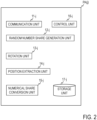
- the secure computation apparatus PA(j) of the embodiment has a communication unit 11-j, a random number share generation unit 12-j, a rotation unit 13-j, a position extraction unit 14-j, a numerical share conversion unit 15-j, a control unit 16-j, and a storage unit 17-j.
- the secure computation apparatus PA(j) performs each process under the control of the control unit 16-j.
- the data used in each process and the data obtained in each process are stored in the storage unit 17-j, read out as necessary, and used in each process.
- the bit number p of P is stored as a parameter in the storage unit 17-j.
- data is exchanged between the secure computation apparatuses PA(0), ..., PA(n-1) through each communication unit 11-j.
- the bit share vector [f] j 2 is, for example, a sequence of shares [f p-1 ] j 2 , ..., [f 0 ] j 2 of each element f p-1 , ..., f 0 (step S11-j).
- the random number share generation unit 12-j uses p read from the storage unit 17-j and generates and outputs a share ⁇ >> j p of a random number (for example, a uniform random number) p in cooperation with at least a part of the random number share generator 12-m of another secure computation apparatus PA m (where mE ⁇ 0, ..., n-1 ⁇ and m ⁇ j) (step S12-j).
- the sequence pof when p is positive is the sequence f cyclically shifted to the left by the p element, and when p is negative, the sequence pof is the sequence f cyclically shifted to the right by the p element.
- Step S13-j A specific example of this process will be described later.
- Step S13-j can be realized by using random permutation by secure computation (for example, refer to Reference Literature 3). A specific example of this process is shown below.
- Specific Example 2 is an example in which n and k are generalized.
- the set of n secure computation apparatuses PA(0), ..., PA(n-1) is expressed as PA and the set of k secure computation apparatuses PA(( ⁇ (i, 0)), ..., PA(( ⁇ (i, k-1)) selected from PA is referred to as SP(i).
- n C k represents the total number of combinations when selecting k different from each other from n different from each other.
- ⁇ ( ⁇ , ⁇ ) is a function value of ⁇ and ⁇ , and satisfies ⁇ (i, 0), ..., ⁇ (i, k-1) ⁇ 0, ..., n-1 ⁇ .
- SP(0), ..., SP(N-1) are different from each other, and SP(0), ..., SP(N-1) is configured as
- ⁇ c represents the complement of ⁇
- represents the number of elements of ⁇ . That is to say, the set SP(i') is a set in which only one secure computation apparatus is different from the set SP(i'+ 1).
- the share ⁇ f> (SP(i)) is k shares held by the set SP (i) according to the (k, k)-additive secret sharing method.
- the share ⁇ f> (SP(0)) is k shares ⁇ f> 0 p , ..., ⁇ f> k-1 p obtained by secret sharing f according to the (k, k)-additive secret sharing method.
- ⁇ f> (PA( ⁇ ) ⁇ SP(i)) is a share among the share ⁇ f> (SP(i)) held by the secure computation apparatus PA( ⁇ ) ⁇ SP (i) .
- the sub-share of the sub-shares ⁇ 0 , ..., ⁇ n-1 corresponding to the set SP(i) is expressed as ⁇ (SP(i)) .
- ⁇ (SP(i)) represents a sub-share included in the share ⁇ >> ( ⁇ (i, 0)) p , ..., ⁇ >> ( ⁇ (i, k-1)) p corresponding to k secure computation apparatuses PA( ⁇ (i, 0)), ..., PA( ⁇ (i, k-1)) belonging to the set SP(i).
- PA( ⁇ (i', 0)) represents a secure computation apparatus included in the set SP (i') and not included in the set SP(i'+ 1).
- PA((p(i'+ 1, k)) represents a secure computation apparatus not included in the set SP(i') but included in the set SP(i'+1).
- Rotation units 13- ⁇ (0,0), ..., 12- ⁇ (0, k-1)) of k secure computation apparatuses PA( ⁇ (0,0)), ..., PA( ⁇ (0, k-1)) belonging to the set SP(0) convert bit share vectors [f] ⁇ (0,0) , ..., [f] ⁇ (0, k-1) , which are the shares held by the set SP(0) into shares ⁇ f> 0 , ..., ⁇ f> k-1 obtained by secretly sharing f (share ⁇ f> (SP(0)) ) in accordance with the (k,k)-additive secret sharing method.
- the share ⁇ f> ⁇ is stored in a storage unit 17- ⁇ of the secure computation apparatus PA( ⁇ ) ( ⁇ (0, 0), ..., ⁇ (0, k-1) ⁇ ) belonging to the set SP (0) (Step S131).
- the control unit 16-j determines whether i ⁇ N-1 is satisfied (Step S134). When i ⁇ N-1 is satisfied, the process proceeds to Step S137, and when i ⁇ N-1 is satisfied, the process proceeds to Step S135.
- Step S135 first, the rotation unit 13- ⁇ (i, 0) of the secure computation apparatus PA( ⁇ (i, 0)) and the rotation unit 13- ⁇ (i, 1), ..., 13- ⁇ (i, k-1) of the secure computation apparatus PA( ⁇ (i, 1)), ..., PA( ⁇ (i, k-1)) share random numbers r(i, 1), ..., r(i, k-1)) ⁇ Z p .
- the rotation unit 13-(p(i, 0) of the secure computation unit PA( ⁇ (i, 0)) uses a share ⁇ f> (PA(0) ⁇ SP(i)) and random numbers r(i, 1), ..., r(i, k-1)) to obtain the share ⁇ f> (PA(k) ⁇ SP(i+1)) . That is to say, the secure computation apparatus PA(cp(i, 0)) obtains the share ⁇ f> (PA(k) ⁇ SP(i+1)) using the following Equation.
- ⁇ f ⁇ PA k ⁇ SP i + 1 ⁇ f ⁇ PA 0 ⁇ SP i ⁇ ⁇ 1 ⁇ j ′ ⁇ k r i , j ′
- each of the rotation units 13- ⁇ (i, j') of the secure computation apparatus PA(cp(i, j')) has a share ⁇ f> (PA(j') ⁇ SP(i+1)) using the following Equation (Step S135) .
- ⁇ f ⁇ PA j ′ ⁇ SP i + 1 ⁇ f ⁇ PA j ′ ⁇ SP i + r i , j ′
- the control unit 16-j of all the secure computation apparatuses PA(j) sets i+1 to a new i (Step S136) and the process proceeds to Step S133.
- Step S137 when i ⁇ N-1 is satisfied in Step S134, the rotation units 13- ⁇ (N-1, 0), ..., 13- ⁇ (N-1, k-1) of the secure computation apparatus PA( ⁇ (N-1, 0)), ..., PA( ⁇ (N-1, k-1)) belonging to the set SP(N-1) uses the share ⁇ f> (SP(N-1)) stored in the storage units 17- ⁇ (N-1, 0), ..., ⁇ (N-1, k-1) in Step S133 and obtains the restored value pof in cooperation thereof.
- the secure computation apparatus PA(j) in the embodiment is, for example, a device composed of a general-purpose or dedicated computer including a processor (hardware processor) such as a central processing unit (CPU) and a memory such as a random access memory (RAM) and a read only memory (ROM) and configured to execute a predetermined program.
- This computer may have one processor and one memory or may have a plurality of processors and a plurality of memories.
- This program may be installed in a computer or may be recorded in a ROM or the like in advance.
- a part or all of the processing units may be configured by using an electronic circuit which realizes a processing function independently, instead of an electronic circuit (circuitry) which realizes a function configuration by reading a program like a CPU.
- an electronic circuit constituting one device may include a plurality of CPUs.
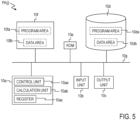
- Fig. 5 is a block diagram illustrating a hardware configuration of the secure computation apparatus PA(j) in the embodiment.
- the secure computation apparatus PA(j) of this example includes a central processing unit (CPU) 10a, an input unit 10b, an output unit 10c, a random access memory (RAM) 10d, a read only memory (ROM) 10e, an auxiliary storage device 10f, and a bus 10g.
- the CPU 10a of this example has a control unit 10aa, a calculation unit 10ab, and a register 10ac and executes various arithmetic processes in accordance with various programs read into the register 10ac.
- the input unit 10b is a communication device into which data is input, an input terminal, a keyboard, a mouse, a touch panel, or the like.
- the output unit 10c is a communication device from which data is output, an output terminal, a display, or the like.
- the RAM 10d is a static random access memory (SRAM), a dynamic random access memory (DRAM), or the like and has a program region 10da in which a predetermined program is stored and a data region 10db in which various data are stored.
- the auxiliary storage device 10f is, for example, a hard disk, a magneto-optical (MO) disc, a semiconductor memory, or the like and has a program region 10fa in which a predetermined program is stored and a data region 10fb in which various data are stored.
- the bus 10g connects the CPU 10a, the input unit 10b, the output unit 10c, the RAM 10d, the ROM 10e, and the auxiliary storage device 10f so that information can be exchanged.
- the CPU 10a writes the program stored in the program region 10fa of the auxiliary storage device 10f to the program region 10da of the RAM 10d in accordance with the read operating system (OS) program.
- OS read operating system
- the CPU 10a writes various data stored in the data region 10fb of the auxiliary storage device 10f to the data region 10db of the RAM 10d. Also, the address on the RAM 10d in which this program or data is written is stored in the register 10ac of the CPU 10a.
- the control unit 10aa of the CPU 10a sequentially reads out these addresses stored in the register 10ac, reads a program or data from the region on the RAM 10d indicated by the read address, and reads the program or data, causes the calculation unit 10ab to sequentially execute the operations indicated by the program, and stores the calculation result in the register 10ac.
- the above program can be recorded on a computer-readable recording medium.
- a computer-readable recording medium is a non-transitory recording medium. Examples of such recording media are magnetic recording devices, optical discs, optomagnetic recording media, semiconductor memories, and the like.
- the distribution of this program is performed, for example, by selling, transferring, renting, or the like a portable recording medium such as a DVD or a CD-ROM in which the program is recorded.
- the program may be stored in the storage device of the server computer and the program may be distributed by transferring the program from the server computer to another computer over a network.
- the computer which executes such a program first temporarily stores, for example, the program recorded on the portable recording medium or the program transferred from the server computer in its own storage device. Furthermore, when the process is performed, the computer reads the program stored in its own storage device and performs the process according to the read program.
- a computer may read the program directly from a portable recording medium and execute processing according to the program and the processing according to the received program may be executed sequentially every time the program is transferred from the server computer to this computer.
- the above-mentioned process may be performed by a so-called application service provider (ASP) type service which realizes the processing function only by the execution instruction and result acquisition without transferring the program from the server computer to this computer.
- ASP application service provider
- the program in this embodiment includes information to be used for processing by a computer and equivalent to the program (data which is not a direct command to the computer but has a property that regulates the processing of the computer and the like).
- the device is configured by executing a predetermined program on a computer in each embodiment, at least a part of these processing contents may be realized using hardware.
- the present invention can be used, for example, for secret calculations using shares.
- a secret calculation in order to shift the most significant bit of a bit string to a specific position, it may be necessary to share a numerical value representing the position of the most significant bit. It is possible to obtain a numerical share which represents the position of the element with that particular value while keeping the position of the element having the specific value secret from the share of the column of the plurality of elements having the specific value in the element at the most significant bit position by using the present invention.
Landscapes
- Engineering & Computer Science (AREA)
- Computer Security & Cryptography (AREA)
- Computer Networks & Wireless Communication (AREA)
- Signal Processing (AREA)
- Complex Calculations (AREA)
- Storage Device Security (AREA)
- Hardware Redundancy (AREA)
- Devices For Executing Special Programs (AREA)
Abstract
Description
- The present invention relates to a secure computation technique.
- In secure computation (for example, refer to
NPL 1, 2, and the like), it may be necessary to share a numerical value representing a position of an element having a specific value in a sequence of a plurality of elements. For example, in secure computation, in order to shift the most significant bit (most significant bit: MSB) of a bit string to a specific position, it is necessary to share a numerical value representing a position of the most significant bit. -
- [NPL 1] Takashi NISHIDE, Takuma AMADA, "Multiparty Computation for Floating Point Arithmetic with Less Communication over Small Fields", IPSJ Journal, Vol. Vol. 60 No. 9, pp. 1433 to 1447 (2019).
- [NPL 2] Randmets, J., "Programming Languages for Secure Multiparty Computation Application Development," PhD thesis. University of Tartu (2017).
- However, there is no known technique for obtaining a numerical share representing a position of an element having a specific value while the position of the element having the specific value in a sequence of a plurality elements is kept secret from the share of the sequence of the plurality of elements.
- The present invention was made in view of these points, and an object of the present invention is to obtain a numerical share representing a position of an element having a specific value while keeping the position of the element having the specific value hidden from the share of a sequence of a plurality of elements.
- The secure computation apparatus obtains the sequence pof obtained by rotating the elements fp-1, ..., f0 of the sequence f by p elements by secure computation using the share of the random number p and the share of the sequence f without obtaining the random number p and the sequence f, obtains the value b'∈{0, ..., p-1} representing the position of the element cfb' whose value is α among the elements cfp-1, ..., cf0 in the sequence pof, and obtains the share of the value b by secure computation using the share of the random number p and the value b'. Here, p is an integer of 2 or more, f is a sequence of p elements fp-1, ..., f0, a value of one element fb among the elements fp-1, ..., f0 is α, a value of an element other than the element fb is other than α, a value representing a position of the element fb is bE{0, ..., p-1}, and p is a random number represented by an integer. Here, since p is a random number, pof is a randomized position of the element fb and information b of the position of the element fb cannot be obtained from pof.
- Thus, in a secure computation apparatus of the present invention, from the share of a sequence of a plurality of elements, it is possible to obtain the share of a numerical value representing a position of an element having a specific value while keeping the position of the element having the specific value concealed in the sequence of the plurality of elements.
-
- [
Fig. 1] Fig. 1 is a conceptual diagram illustrating a configuration of a secure computation system of an embodiment. - [
Fig. 2] Fig. 2 is a block diagram illustrating a functional configuration of the secure computation apparatus of the embodiment. - [
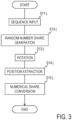
Fig. 3] Fig. 3 is a flowchart for exemplifying a secure computation method of the embodiment. - [
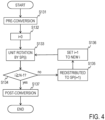
Fig. 4] Fig. 4 is a flowchart for explaining a specific example of a process of Step S13-j. - [
Fig. 5] Fig. 5 is a block diagram for exemplifying a hardware configuration of the secure computation apparatus of the embodiment. - An embodiment of the present invention will be described below with reference to the drawings.
- First, a principle of an embodiment will be described. In the embodiment, n secure computation apparatuses PA(0), ..., PA(n-1) perform secure computation and each obtains a share of a numerical value representing a position of an element fb having a specific value α from a share (secret sharing value) of a sequence f of a plurality of (p) elements fp-1, ..., f0 while keeping the position of the element fb having the specific value α concealed among the sequences f of the plurality of elements fp-1, ..., f0. Here, n is an integer of 2 or more, j=0, ..., n-1, and p is an integer of 2 or more. For example, p is a prime number (for example, p is a Mersenne prime number such as 61). Furthermore, f is a sequence of p elements fp-1, ..., f0, a value of one element fb among the elements fp-1, ..., f0 is α, a value of an element other than the element fb is other than α, and a value representing the position of the element fb is bE{0, ..., P-1}. Preferably, all the values of the elements other than the element fb among the elements fp-1, ..., f0 are β, and β≠α. That is to say, preferably, each element fi (where i∈{0, ..., p-1}) is binary (fiE{α, β}). For example, the sequence f is a bit string, each element fi of the elements fp-1, ..., f0 is a bit, and the value of each element fi of the elements fp-1, ..., f0 is 0 or 1. It may be (α, β) = (1,0) or (α, β) = (0,1). For example, the sequence f=(fp-1, ..., f0) represents a position b of a specific bit (for example, most significant bit) when an element A∈ZP (that is, if A is regarded as an integer, A mod P) of a quotient ring ZP modulo P represented by p bits is expressed in binary and the value of the element fb corresponding to the position b of the specific bit of the element A is α=1, and the value of the other elements is β=0. For example, p represents the number of bits of P. P is an integer of 1 or more, for example, P is a Mersenne number. An example of P is the Mersenne prime P=2p-1 (for example, 261-1). However, these do not limit the invention.
- Each secure computation apparatus PA(j) holds p as a parameter. The share sha(f)j of the sequence f=(fp-1, ..., f0) of the p elements fp-1, ..., f0 is input to each secure computation apparatus PA (j) For example, the share sha(f)j of f=(fp-1, ..., f0) is a sequence of shares sha(fp-1)j, ..., sha(f0)j of each element fp-1, ..., f0. However, this does not limit the invention. The share sha(χ)j of χ represents the share assigned to the secure computation apparatus PA(j) among the shares (secret sharing value) obtained by secret sharing χ according to a predetermined secret sharing method. There is no limit to the secret sharing method. Examples of the secret sharing method include (k, n)-secret sharing methods such as (k, n)-replica secret sharing methods (for example, refer to Reference Literature 1) and (k, n)-Shamir secret sharing methods (for example, refer to Reference Literature 2) and (k, k)-additive secret sharing methods. Here, k is an integer of 2 or more and n or less. A (k, n)-duplicate secret sharing method in the case of n=k is called a (k, k)-additive secret sharing method. Furthermore, the share of χ is expressed as sha(χ)j regardless of the type of secret sharing method. For example, the share sha(χ1)j of χ1 and the share (χ2)j of χ2 may be based on the same secret sharing method or may be based on different secret sharing methods.
- Reference Literature 1: Dai IGARASHI, Hiroki HAMADA, Ryo KIKUCHI, Koji CHIDA, "Improvement of Secure computation Radix Sort Aiming at Statistical Processing of .
- Reference Literature 2: A. Shamir, "How to share a secret," Communications of the ACM, Vol. 22, No. 11, pp. 612 to 613, 1979.
- Each secret calculator PA(j) generates a share sha(ρ)j of a random number p represented by an integer. Preferably, the random number p is a uniform random number, but the random number p does not have to be a uniform random number. For example, a pseudo-random number which can be approximated to a uniform random number may be a random number p. Furthermore, the random number p may or may not be limited to an integer of 0 or more. Each secure computation apparatus PA(j) generates the share sha(ρ)j without obtaining the value of the random number p itself. For example, at least a part of n secure computation apparatuses PA(0), ... PA(n-1) cooperate to generate the share sha(ρ)0, ..., sha(ρ)n-1 of the random number p. The share of the random number p sha(ρ)0, ..., sha(ρ)n-1 is, for example, a share obtained by secretly sharing the element ρ∈Zp (that is, if p is regarded as an integer, p mod p) of the quotient ring Zp modulo p. There is no limitation on the method of generating the shares sha(ρ)0, ..., Sha(ρ)n-1. For example, each secure computation apparatus PA(j) of the k secure computation apparatuses PA(0), ..., PA(k-1) may generate a random number ρj and each random number ρj may be sha(ρ)j when the share sha(ρ)j is based on the (k, k)-additive secret sharing method. In this case, ρ=ρ0+...+ρk-1∈Zp (that is, if p, ρ0, ..., ρn-1 are regarded as integers, ρ = ρ0 + ... + ρk-1 mod p) is satisfied.. For example, each secure computation apparatus PA(j) of n secure computation apparatuses PA(0), ..., PA(n-1) may generate random numbers ρj and a true subset (set of sub-shares) of random numbers ρ0, ..., ρn-1 may be each share sha(ρ)j when the share sha(ρ)j conforms to the (k, n)-replica type secret sharing method. In the case of (K, n)-duplicate secret sharing method, ρ=ρ0+...+ρn-1∈Zp is satisfied and all of random numbers ρ0, ..., ρn-1 can be obtained using any k shares of the shares sha(ρ)0, ..., sha(ρ)n-1. but no information on p can be obtained from shares less than k.
- Each secure computation apparatus PA(j) obtains a sequence pof=(cfp-1, ..., cf0) in which the elements fp-1, ..., f0 of the sequence f are rotated (circularly shifted) by p elements by secure computation using the share sha(ρ)j of the random number p and the share sha(f)j of the sequence without obtaining the random number p and the sequence f. For example, each secure computation apparatus PA(j) obtains a sequence pof which is a bit string obtained by bit-rotating the elements fp-1, ..., f0 of the sequence f which is a bit string by p bits. Since rotation is a sub-group of permutations, this process can be achieved, for example, by limiting the permutations to rotations by random permutations by secure computation (for example, Reference Literature 3). In addition, since rotation is equivalent to multiplication or division on the quotient ring, it can also be realized by exponentiation, multiplication, division, or the like by secure computation. In this case, the quotient ring method is a Mersenne prime. Reference Literature 3: Hiroki HAMADA, Dai IGARASHI, Koji CHIDA, Katsumi TAKAHASHI, "Random Permutation Protocol for Three-Party Concealed Function Computation", CSS2010 (2010). The rotation of χ by p elements may cyclically shift χ to the left by p elements when p is positive, and cyclically shift χ to the right by p elements when p is negative. On the other hand, when p is positive, χ may be cyclically shifted to the right by p elements, and when p is negative, χ may be cyclically shifted to the left by p elements. Here, the sequence pof is a restored value (public value), but each secure computation apparatus PA(j) does not know the random number p itself. Therefore, although it is possible to ascertain the position of the element cfb' (where b'E{0, ..., p-1}) whose value is α from the sequence pof=(cfp-1, ..., cf0), each secure computation apparatus PA(j) cannot ascertain which of the elements fp-1, ..., f0 in the original sequence f has the value of α (it is not possible to ascertain what number the element with the value of α was). Particularly, when the value of one element fb among the elements fp-1, ..., f0 is α, and the values of all the elements other than the element fb are β (β≠α), the information obtained from the sequence pof is indistinguishable from the information obtained from any random number. Therefore, higher safety can be ensured.
- Each secure computation apparatus PA (j) obtains a value b'∈{0, ..., p-1} representing the position of the element cfb' in which the value is α among the elements cfp-1, ..., cf0 in sequence pof. That is to say, each secure computation apparatus PA(j) obtains a value b' which satisfies cfb'=α among the elements cfp-1, ..., cf0. b', b, and p satisfy the relationship of b'=b+ρ∈Zp.
- Each secret calculator PA(j) obtains the share sha(b)j of the value b using the share sha(ρ)j of the random number p and the value b' on the basis of the relationship of b'=b+ρ∈Zp by secure computation. For example, when the share sha(ρ)j and the share sha(b)j are based on the (k, k)-additive secret sharing method or the (k, n)-replica secret sharing method, each secure computation apparatus PA(j) obtains sha(b)j=b'-sha(ρ)j∈Zp as the share sha(b)j of the value b.
- Next, a first embodiment of the present invention will be described below with reference to the drawings. The following example will be described in the first embodiment.
- · P is a prime number. For example, P is a Mersenne prime number (for example, P=261-1).
- · p is the number of bits of P. When P is a Mersenne prime number, p is also a prime number (for example, p=61).
- · The sequence f is a bit string of length p (p-dimensional vector (fp-1, ..., f0) ) having 0 or 1 bits in each element fp-1, ..., f0.
- · The value of one element fb among the elements fp-1, ..., f0 is α=1 and the values of all the elements other than the element fb are β=0.
- For example, the sequence f=(fp-1, ..., f0) represents the position of the most significant bit of A∈ZP represented by the p bit and the value of the element fb corresponding to the position b of the most significant bit is α=1 and the value of the other elements is β=0. Furthermore, in the embodiment, the share obtained by secret-sharing x∈Zy (x mod y when x is regarded as an integer) according to the (k, n) -secret sharing method is expressed as [x]y, the share obtained by secret-sharing x∈Zy according to the (k, k)-additive secret-sharing method is expressed as <x>y, and the share obtained by secret-sharing x∈Zy according to the (k, n)-duplicate secret-sharing method is expressed as <<x>>y. Furthermore, [x]y assigned to the secure computation apparatus PA(j) is expressed as [x]j y, <x>y assigned to the secure computation apparatus PA(j) is expressed as <x>j y, and <<x>>y assigned to the secure computation apparatus PA(j) is expressed as <<x>>j y.
- As illustrated in
Fig. 1 , asecure computation system 1 of the embodiment has n secure computation apparatuses PA(0), ..., PA(n-1). The secure computation apparatuses PA(0), ..., PA(n-1) are configured so that data can be exchanged. In this embodiment, the secure computation apparatuses PA(0), ..., PA(n-1) are configured to be capable of communication via a network and an example of exchanging data via a network will be described. However, this does not limit the present invention and the secure computation apparatuses PA(0), ..., PA(n-1) may be configured so that data can be exchanged via a portable recording medium and data may be exchanged via a portable recording medium. As illustrated inFig. 2 , the secure computation apparatus PA(j) of the embodiment has a communication unit 11-j, a random number share generation unit 12-j, a rotation unit 13-j, a position extraction unit 14-j, a numerical share conversion unit 15-j, a control unit 16-j, and a storage unit 17-j. The secure computation apparatus PA(j) performs each process under the control of the control unit 16-j. The data used in each process and the data obtained in each process are stored in the storage unit 17-j, read out as necessary, and used in each process. The bit number p of P is stored as a parameter in the storage unit 17-j. Furthermore, data is exchanged between the secure computation apparatuses PA(0), ..., PA(n-1) through each communication unit 11-j. - A process of each secure computation apparatus PA(j) will be described below with reference to
Fig. 3 . The bit share vector [f]j 2, which is the share of the sequence f=(fp-1, ..., f0), is input to the communication unit 11-j. The bit share vector [f]j 2 is, for example, a sequence of shares [fp-1]j 2, ..., [f0]j 2 of each element fp-1, ..., f0 (step S11-j). - The random number share generation unit 12-j uses p read from the storage unit 17-j and generates and outputs a share <<ρ>>j p of a random number (for example, a uniform random number) p in cooperation with at least a part of the random number share generator 12-m of another secure computation apparatus PAm (where mE{0, ..., n-1} and m≠j) (step S12-j).
- The rotation unit 13-j obtains and outputs the sequence pof= (cfp-1, . . . , cf0) obtained by rotating the elements fp-1, ..., f0 of the sequence f by p elements (bit rotation by p bits) by secure computation using the bit share vector [f]j 2 input in Step S11-j and the share <<ρ>>j p of the random number p obtained in Step S12-j without obtaining the random number p and the sequence f. For example, the sequence pof when p is positive is the sequence f cyclically shifted to the left by the p element, and when p is negative, the sequence pof is the sequence f cyclically shifted to the right by the p element. A specific example of this process will be described later (Step S13-j).
- The position extraction unit 14-j uses the sequence ρof=(cfp-1, ..., cf0) obtained in Step S13-j and obtains and outputs a value b'∈{0, ..., P-1} representing the position of the element cfb' whose value is α=1 (Step S14-j) among the elements cfp-1, ..., cf0 in sequence ρof.
- The numerical share conversion unit 15-j calculates <<p>>j p=b'-<<ρ>>jp∈Zp by secure computation using the p read from the storage unit 17-j, the share of random number p obtained in Step S12-j <<ρ>>j p, and the value b' obtained in Step S14-j and outputs the obtained share <<ρ>>j p (Step S15-j) .
- The process of Step S13-j can be realized by using random permutation by secure computation (for example, refer to Reference Literature 3). A specific example of this process is shown below.
- Specific example 1 is an example in the case of n=3 and k=2.
- 1: The rotation unit 13-0 of the secure computation apparatus PA(0) and the rotation unit 13-1 of the secure computation apparatus PA(1) cooperate with each other and the bit share vector [f]0 2 and the bit share vector [f]1 2 are converted into the share <f>0 2 and the share <f>1 2 according to the (2,2)-additive secret sharing method (for example, refer to Reference Literature 4 and the like). That is to say, f=<f>0 2+<f>1 2 is satisfied. The share <f>0 2 is assigned to the secure computation apparatus PA(0), and the share <f>1 2 is assigned to the secure computation apparatus PA(1). Reference Literature 4: Kikuchi, R., Ikarashi, D., Matsuda, T., Hamada, K. and Chida, K., "Efficient Bit-Decomposition and Modulus-Conversion Protocols with an Honest Majority," Information Security and Privacy -23rd Australasian Conference, ACISP 2018, Wollongong, NSW, Australia, July 11-13, 2018, Proceedings (Susilo, W. and Yang, G., eds.), Lecture Notes in Computer Science, Vol. 10946, Springer, pp. 64-82 (online), DOI: 10.1007/978-3-319-93638-3 5 (2018).
- 2: The rotation unit 13-0 of the secure computation apparatus PA(0) and the rotation unit 13-1 of the secure computation apparatus PA(1) shares the sequence r01= (r01, p-1, ... , r01, 0) of the random number elements r01, p-1, ..., r01, 0. For example, the rotation unit 13-0 may randomly generate the sequence r01 and send it to the rotation unit 13-1, the rotation units 13-0 and 13-1 may share the seed value in advance, and may share the same sequence r01 by a predetermined process using the seed value.
- 3: The rotation unit 13-0 of the secure computation apparatus PA(0) calculates B0=(ρ01)o<f>0 2-r01 using the share <<ρ>>0 p, the share <f>0 2, and the sequence r01 and transmit it to the rotation unit 13-2 of the secure computation apparatus PA2. Here, the following relationship is satisfied.
- <<ρ>>0 p=(ρ01, ρ20)
- <<ρ>>1 p= (ρ01, ρ12)
- <<ρ>>2 p= (ρ12, ρ20)

- p, ρ01, ρ20, and ρ12 are the elements of the quotient ring modulo p and the operation of p, ρ01, ρ20, and ρ12, and the operation of the share of p, ρ01, ρ20, and ρ12 are operations on the quotient ring Zp modulo p (operation on mod p) .
- 4: The rotation unit 13-1 of the secure computation apparatus PA(1) calculates B1=(ρ01) o<f>1 2+r01 using the share <<ρ>>1 p, the share <f>1 2, and the sequence r01 and transmits it to the rotation unit 13-2 of the secure computation apparatus PA2.
- 5: The rotation unit 13-2 of the secure computation apparatus PA2 calculates C= (ρ20) o ((ρ12) o (B0+B1) ) using the share <<ρ>>2 p, the share <f>2 2, B0, and B1. Here, the following holds.

- Specific Example 2 is an example in which n and k are generalized. In Specific Example 2, the set of n secure computation apparatuses PA(0), ..., PA(n-1) is expressed as PA and the set of k secure computation apparatuses PA((ϕ(i, 0)), ..., PA((ϕ(i, k-1)) selected from PA is referred to as SP(i). Here, n and k are integers of 2 or more, n>k, N=nCk, and i=0, ..., N-1. nCk represents the total number of combinations when selecting k different from each other from n different from each other. Furthermore, ϕ (α, β) is a function value of α and β, and satisfies {ϕ (i, 0), ..., ϕ (i, k-1)}⊂{0, ..., n-1}. SP(0), ..., SP(N-1) are different from each other, and SP(0), ..., SP(N-1) is configured as |SP (i')∩SP(I'+ 1)c|=1 about i'=0, ..., N-2. Here, αc represents the complement of α, and |α| represents the number of elements of α. That is to say, the set SP(i') is a set in which only one secure computation apparatus is different from the set SP(i'+ 1).
- The share <f> (SP(i)) is k shares held by the set SP (i) according to the (k, k)-additive secret sharing method. In addition, particularly, the share <f> (SP(0)) is k shares <f>0 p, ..., <f>k-1 p obtained by secret sharing f according to the (k, k)-additive secret sharing method. <f>(PA(θ)∈SP(i)) is a share among the share <f>(SP(i)) held by the secure computation apparatus PA(θ) ∈SP (i) .
- The sub-share of n shares <<ρ>>0 p, ... , <<ρ>>n-1 p obtained by secretly sharing p according to the (k, n)-duplicate secret sharing method is expressed as ρ0, ..., ρn-1∈Zp. That is to say, ρ=ρ0+ ... +ρn-1∈Zp (that is, p=po+ ... +ρn-1 mod p) is satisfied. The sub-share of the sub-shares ρ0, ..., ρn-1 corresponding to the set SP(i) is expressed as ρ(SP(i)). That is to say, ρ(SP(i)) represents a sub-share included in the share <<ρ>>(ϕ (i, 0)) p, ..., <<ρ>>(ϕ(i, k-1)) p corresponding to k secure computation apparatuses PA(ϕ (i, 0)), ..., PA(ϕ (i, k-1)) belonging to the set SP(i).
- As described above, for i'=0, ..., N-2, SP(0), ..., SP(N-1) is configured so that |SP(i')∩SP(i'+1)c|=1 is satisfied. Here, PA(ϕ(i', 0)) represents a secure computation apparatus included in the set SP (i') and not included in the set SP(i'+ 1). Furthermore, PA((p(
i'+ 1, k)) represents a secure computation apparatus not included in the set SP(i') but included in the set SP(i'+1). Furthermore, the PA(ϕ(i', j)) for j=1, ..., K-1 represents a secure computation apparatus included in both the set SP(i') and the set SP(i'+1). - Specific Example 2 of Step S13-j will be described with reference to
Fig. 4 . Rotation units 13-ϕ(0,0), ..., 12-ϕ(0, k-1)) of k secure computation apparatuses PA(ϕ(0,0)), ..., PA(ϕ(0, k-1)) belonging to the set SP(0) convert bit share vectors [f]ϕ(0,0), ..., [f]ϕ(0, k-1), which are the shares held by the set SP(0) into shares <f>0, ..., <f>k-1 obtained by secretly sharing f (share <f>(SP(0))) in accordance with the (k,k)-additive secret sharing method. The share <f>θ is stored in a storage unit 17-θ of the secure computation apparatus PA(θ) (θ∈{ϕ(0, 0), ..., ϕ(0, k-1)}) belonging to the set SP (0) (Step S131). - The control units 16-j of all the secure computation apparatuses PA(j) are set to i=0 (Step S132).
- Rotational units 13-ϕ(i, 0), ..., PA(ϕ(i, k-1)) of k secure computation apparatuses PA(ϕ(i, 0)), ..., PA(ϕ(i, k-1)) belonging to the set SP(i) calculates (performs unit rotation on ) ρ(SP(i))o<f>(SP(i))∈ZP and stores a value obtained thereby as a new share <f>(SP(i)) in the storage unit 17-ϕ(i, 0), ..., ϕ(i, k-1) (Step S133).
- The control unit 16-j determines whether i≥N-1 is satisfied (Step S134). When i≥N-1 is satisfied, the process proceeds to Step S137, and when i≥N-1 is satisfied, the process proceeds to Step S135.
- In Step S135, first, the rotation unit 13-ϕ(i, 0) of the secure computation apparatus PA(ϕ (i, 0)) and the rotation unit 13-ϕ(i, 1), ..., 13-ϕ(i, k-1) of the secure computation apparatus PA(ϕ (i, 1)), ..., PA(ϕ (i, k-1)) share random numbers r(i, 1), ..., r(i, k-1))∈Zp. Furthermore, the rotation unit 13-(p(i, 0) of the secure computation unit PA(ϕ (i, 0)) uses a share <f> (PA(0)∈SP(i)) and random numbers r(i, 1), ..., r(i, k-1)) to obtain the share <f> (PA(k)∈SP(i+1)). That is to say, the secure computation apparatus PA(cp(i, 0)) obtains the share <f>(PA(k)∈SP(i+1)) using the following Equation.

- The secure computation apparatus PA((ϕ(i, 0)) transmits the share <f>(PA(k)∈SP(i+1)) obtained as described above to the secure computation apparatus PA(ϕ(i+1, k)). Furthermore, the rotation unit 13-(p(i, j') of the secure computation apparatus PA(cp(i, j')) obtains the share <f>(PA(j')∈SP(i+1)) using the share <f>(PA(j')∈SP (i)) and the random number r(i, j') for j'=1, ..., k-1. That is to say, each of the rotation units 13-ϕ(i, j') of the secure computation apparatus PA(cp(i, j')) has a share <f>(PA(j')∈SP(i+1)) using the following Equation (Step S135) .

- The control unit 16-j of all the secure computation apparatuses PA(j) sets i+1 to a new i (Step S136) and the process proceeds to Step S133.
- In Step S137 (when i≥N-1 is satisfied in Step S134), the rotation units 13-ϕ(N-1, 0), ..., 13-ϕ(N-1, k-1) of the secure computation apparatus PA(ϕ(N-1, 0)), ..., PA(ϕ(N-1, k-1)) belonging to the set SP(N-1) uses the share <f>(SP(N-1)) stored in the storage units 17-ϕ(N-1, 0), ..., ϕ(N-1, k-1) in Step S133 and obtains the restored value pof in cooperation thereof.
- The secure computation apparatus PA(j) in the embodiment is, for example, a device composed of a general-purpose or dedicated computer including a processor (hardware processor) such as a central processing unit (CPU) and a memory such as a random access memory (RAM) and a read only memory (ROM) and configured to execute a predetermined program. This computer may have one processor and one memory or may have a plurality of processors and a plurality of memories. This program may be installed in a computer or may be recorded in a ROM or the like in advance. Furthermore, a part or all of the processing units may be configured by using an electronic circuit which realizes a processing function independently, instead of an electronic circuit (circuitry) which realizes a function configuration by reading a program like a CPU. Furthermore, an electronic circuit constituting one device may include a plurality of CPUs.
-
Fig. 5 is a block diagram illustrating a hardware configuration of the secure computation apparatus PA(j) in the embodiment. As illustrated inFig. 5 , the secure computation apparatus PA(j) of this example includes a central processing unit (CPU) 10a, aninput unit 10b, anoutput unit 10c, a random access memory (RAM) 10d, a read only memory (ROM) 10e, anauxiliary storage device 10f, and abus 10g. TheCPU 10a of this example has a control unit 10aa, a calculation unit 10ab, and a register 10ac and executes various arithmetic processes in accordance with various programs read into the register 10ac. Furthermore, theinput unit 10b is a communication device into which data is input, an input terminal, a keyboard, a mouse, a touch panel, or the like. Furthermore, theoutput unit 10c is a communication device from which data is output, an output terminal, a display, or the like. In addition, theRAM 10d is a static random access memory (SRAM), a dynamic random access memory (DRAM), or the like and has a program region 10da in which a predetermined program is stored and a data region 10db in which various data are stored. Moreover, theauxiliary storage device 10f is, for example, a hard disk, a magneto-optical (MO) disc, a semiconductor memory, or the like and has a program region 10fa in which a predetermined program is stored and a data region 10fb in which various data are stored. Furthermore, thebus 10g connects theCPU 10a, theinput unit 10b, theoutput unit 10c, theRAM 10d, theROM 10e, and theauxiliary storage device 10f so that information can be exchanged. TheCPU 10a writes the program stored in the program region 10fa of theauxiliary storage device 10f to the program region 10da of theRAM 10d in accordance with the read operating system (OS) program. Similarly, theCPU 10a writes various data stored in the data region 10fb of theauxiliary storage device 10f to the data region 10db of theRAM 10d. Also, the address on theRAM 10d in which this program or data is written is stored in the register 10ac of theCPU 10a. The control unit 10aa of theCPU 10a sequentially reads out these addresses stored in the register 10ac, reads a program or data from the region on theRAM 10d indicated by the read address, and reads the program or data, causes the calculation unit 10ab to sequentially execute the operations indicated by the program, and stores the calculation result in the register 10ac. With such a configuration, the functional configuration of the secure computation apparatus PA(j) is realized. - The above program can be recorded on a computer-readable recording medium. An example of a computer-readable recording medium is a non-transitory recording medium. Examples of such recording media are magnetic recording devices, optical discs, optomagnetic recording media, semiconductor memories, and the like.
- The distribution of this program is performed, for example, by selling, transferring, renting, or the like a portable recording medium such as a DVD or a CD-ROM in which the program is recorded. Furthermore, the program may be stored in the storage device of the server computer and the program may be distributed by transferring the program from the server computer to another computer over a network. As described above, the computer which executes such a program first temporarily stores, for example, the program recorded on the portable recording medium or the program transferred from the server computer in its own storage device. Furthermore, when the process is performed, the computer reads the program stored in its own storage device and performs the process according to the read program. Furthermore, as another execution form of this program, a computer may read the program directly from a portable recording medium and execute processing according to the program and the processing according to the received program may be executed sequentially every time the program is transferred from the server computer to this computer. In addition, the above-mentioned process may be performed by a so-called application service provider (ASP) type service which realizes the processing function only by the execution instruction and result acquisition without transferring the program from the server computer to this computer. Note that the program in this embodiment includes information to be used for processing by a computer and equivalent to the program (data which is not a direct command to the computer but has a property that regulates the processing of the computer and the like).
- Although the device is configured by executing a predetermined program on a computer in each embodiment, at least a part of these processing contents may be realized using hardware.
- Note that the present invention is not limited to the above-described embodiment. For example, the various processes described above may not only be executed in chronological order according to the description, but may also be executed in parallel or individually as required by the processing capacity of the device that executes the processes. In addition, it goes without saying that changes can be made as appropriate without departing from the spirit of the present invention.
- The present invention can be used, for example, for secret calculations using shares. For example, in a secret calculation, in order to shift the most significant bit of a bit string to a specific position, it may be necessary to share a numerical value representing the position of the most significant bit. It is possible to obtain a numerical share which represents the position of the element with that particular value while keeping the position of the element having the specific value secret from the share of the column of the plurality of elements having the specific value in the element at the most significant bit position by using the present invention.
-
- 1 Secure computation system
- PA(j) Secure computation apparatus
- 12-j Random number share generation unit
- 13-j Rotation unit
- 14-j Position extraction unit
- 15-j Numerical share conversion unit
Claims (7)
- A secure computation system in which n is an integer of 2 or more, j=0, ..., n-1, p is an integer of 2 or more, f is a sequence of p elements fp-1, ..., f0, a value of one element fb among elements fp-1, ..., f0 is α, a value of an element other than the element fb is other than α, a value representing a position of the element fb is bE{0, ..., p-1}, p is a random number represented by an integer, the system comprising:n secure computation apparatuses PA(0), ..., PA(n-1), wherein the secure computation apparatus PA(j) includesa rotation unit which obtains a sequence pof by rotating the elements fp-1, ..., f0 of the sequence f by p elements by secure computation using a share of the random number p and a share of the sequence f without obtaining the random number p and the sequence f,a position extraction unit which obtains a value b'E{0, ..., p-1} representing a position of an element cfb' whose value is α among the elements cfp-1, ..., cf0 in the sequence pof, anda numerical share conversion unit which obtains the share of the value b by secure computation using the share of the random number p and the value b'.
- A secure computation apparatus in which p is an integer of 2 or more, f is a sequence of p elements fp-1, ..., f0, a value of one element fb among elements fp-1, ..., f0 is α, a value of an element other than the element fb is a value other than α, a value representing a position of the element fb is bE{0, ..., p-1}, p is a random number represented by an integer, the secure computation apparatus comprising:a rotation unit which obtains the sequence pof by rotating the elements fp-1, ..., f0 in the sequence f by p elements by secure computation using share of the random number p and share of the sequence f without obtaining the random number p and the sequence f,a position extraction unit which obtains a value b'E{0, ..., p-1} representing a position of an element cfb' in which the value is α among the elements cfp-1, ..., Cf0 in the sequence pof, anda numerical share conversion unit which obtains the share of the value b by secure computation using the share of the random number p and the value b'.
- The secure computation apparatus according to claim 2, wherein
all values of the elements fp-1, ..., f0 other than the element fb are β and β≠α is satisfied. - The secure computation apparatus according to claim 3, whereiniE{0, ..., p-1} is satisfied, a sequence f is a bit string, a value of each element fi of the elements fp-1, ..., f0 is 0 or 1, (α, β)=(1,0) or (α, β)=(0,1) is satisfied, the random number p is an element of a quotient ring Zp modulo p, the share of the random number p is a share sha(ρ)j obtained by secretly sharing ρ∈Zp,the rotation unit obtains the sequence pof, which is a bit string obtained by bit-rotating the elements fp-1, ..., f0 in the sequence f by p bits,the sha(ρ)j and the sha(b)j are shares obtained by secret sharing according to an additive secret sharing method or a duplicate secret sharing method, andthe numerical share conversion unit obtains b'-sha(ρ)j∈Zp as the share sha(b)j of the value b.
- The secure computation apparatus according to any one of claims 2 to 4, wherein the random number p is a uniform random number.
- A secure computation method, in which p is an integer of 2 or more, f is a sequence of p elements fp-1, ..., f0, a value of one element fb among elements fp-1, ..., f0 is α, a value of an element other than the element fb is a value other than α, a value representing a position of the element fb is bE{0, ..., p-1}, p is a random number represented by an integer, the secure computation method comprising:a rotation step of obtaining a sequence pof by rotating the elements fp-1, ..., f0 in the sequence f by p elements in a rotation unit by secure computation using share of the random number p and share of the sequence f without obtaining the random number p and the sequence f;a position extraction step of obtaining a value b'∈{0, ..., p-1} representing a position of an element cfb' whose value is α among the elements cfp-1, ..., cf0 in the sequence pof in a position extraction unit; anda numerical share conversion step of obtaining the share of the value b by secure computation using the share of the random number p and the value b' in a numerical share conversion unit.
- A program for operating a computer as the secure computation apparatus according to any one of claims 2 to 5.
Applications Claiming Priority (1)
| Application Number | Priority Date | Filing Date | Title |
|---|---|---|---|
| PCT/JP2020/039082 WO2022079895A1 (en) | 2020-10-16 | 2020-10-16 | Secure computation system, secure computation device, secure computation method, and program |
Publications (3)
| Publication Number | Publication Date |
|---|---|
| EP4210031A1 true EP4210031A1 (en) | 2023-07-12 |
| EP4210031A4 EP4210031A4 (en) | 2024-05-22 |
| EP4210031B1 EP4210031B1 (en) | 2025-12-24 |
Family
ID=81208983
Family Applications (1)
| Application Number | Title | Priority Date | Filing Date |
|---|---|---|---|
| EP20957724.6A Active EP4210031B1 (en) | 2020-10-16 | 2020-10-16 | Secure computation system, secure computation device, secure computation method, and program |
Country Status (6)
| Country | Link |
|---|---|
| US (1) | US20230370251A1 (en) |
| EP (1) | EP4210031B1 (en) |
| JP (1) | JP7468687B2 (en) |
| CN (1) | CN116324937B (en) |
| AU (1) | AU2020472388B2 (en) |
| WO (1) | WO2022079895A1 (en) |
Families Citing this family (2)
| Publication number | Priority date | Publication date | Assignee | Title |
|---|---|---|---|---|
| NL2025515B1 (en) * | 2020-05-06 | 2021-11-23 | Microsoft Technology Licensing Llc | Access authentication using obfuscated biometrics |
| US20230016859A1 (en) * | 2020-07-13 | 2023-01-19 | Inpher, Inc. | Multi-Pivot Partial Quicksort and Oblivious Comparisons of Secret Shared Arithmetic Values in a Multi-Party Computing Setting |
Family Cites Families (15)
| Publication number | Priority date | Publication date | Assignee | Title |
|---|---|---|---|---|
| WO2005076518A1 (en) * | 2004-02-10 | 2005-08-18 | Ntt Communications Corporation | Secret information management scheme based on secret sharing scheme |
| US7995750B2 (en) * | 2006-07-06 | 2011-08-09 | Sap Ag | Privacy-preserving concatenation of strings |
| JP4304215B2 (en) * | 2007-03-23 | 2009-07-29 | 株式会社東芝 | Secret sharing apparatus, method and program |
| JP4334582B2 (en) * | 2007-06-26 | 2009-09-30 | 株式会社東芝 | Secret sharing apparatus, method and program |
| CN103178965B (en) * | 2008-01-07 | 2016-08-31 | 安全第一公司 | Multifactor or key formula is used to disperse the system and method that data are protected |
| WO2012046692A1 (en) * | 2010-10-06 | 2012-04-12 | 日本電信電話株式会社 | Secret distribution system, secret distribution device, secret distribution method, secret sorting method, secret distribution program |
| US8839410B2 (en) * | 2012-11-20 | 2014-09-16 | Sap Ag | Type-system for mixed protocol secure computation |
| CN105900165B (en) * | 2014-01-17 | 2019-03-08 | 日本电信电话株式会社 | Secret computing method, secret computing system, random permutation device, and recording medium |
| US10536269B2 (en) * | 2015-02-25 | 2020-01-14 | Secret Double Octopus Ltd | Method and system for authentication and preserving the integrity of communication, secured by secret sharing |
| JP6006842B1 (en) * | 2015-07-22 | 2016-10-12 | 日本電信電話株式会社 | Secret computing device, method and program |
| US10791123B2 (en) * | 2015-11-25 | 2020-09-29 | Yaron Gvili | Selectivity in privacy and verification with applications |
| CN107404411B (en) * | 2017-09-11 | 2020-12-25 | 哈尔滨工程大学 | Parallel network topology discovery method |
| EP3474484A1 (en) * | 2017-10-17 | 2019-04-24 | Koninklijke Philips N.V. | Cryptographic device with updatable shared matrix |
| US10140612B1 (en) * | 2017-12-15 | 2018-11-27 | Clover Network, Inc. | POS system with white box encryption key sharing |
| EP4210030B1 (en) * | 2020-10-16 | 2025-06-04 | Nippon Telegraph And Telephone Corporation | Secure computation system, secure computation apparatus, secure computation method, and program |
-
2020
- 2020-10-16 JP JP2022556807A patent/JP7468687B2/en active Active
- 2020-10-16 WO PCT/JP2020/039082 patent/WO2022079895A1/en not_active Ceased
- 2020-10-16 US US18/030,276 patent/US20230370251A1/en active Pending
- 2020-10-16 CN CN202080106129.4A patent/CN116324937B/en active Active
- 2020-10-16 AU AU2020472388A patent/AU2020472388B2/en active Active
- 2020-10-16 EP EP20957724.6A patent/EP4210031B1/en active Active
Also Published As
| Publication number | Publication date |
|---|---|
| EP4210031B1 (en) | 2025-12-24 |
| US20230370251A1 (en) | 2023-11-16 |
| JPWO2022079895A1 (en) | 2022-04-21 |
| EP4210031A4 (en) | 2024-05-22 |
| AU2020472388B2 (en) | 2024-02-15 |
| AU2020472388A1 (en) | 2023-05-25 |
| AU2020472388A9 (en) | 2025-03-13 |
| WO2022079895A1 (en) | 2022-04-21 |
| CN116324937B (en) | 2025-02-25 |
| JP7468687B2 (en) | 2024-04-16 |
| CN116324937A (en) | 2023-06-23 |
Similar Documents
| Publication | Publication Date | Title |
|---|---|---|
| JP5411994B2 (en) | Secret sharing system, secret sharing apparatus, secret sharing method, secret sorting method, secret sharing program | |
| EP3096309B1 (en) | Secret calculation method, secret calculation system, sorting device, and program | |
| EP4210031B1 (en) | Secure computation system, secure computation device, secure computation method, and program | |
| CN112385176A (en) | Anonymous distribution and majority voting in a compromised environment | |
| Rawat et al. | A novel accelerated implementation of RSA using parallel processing | |
| JP6777816B2 (en) | Secret tampering detection system, secret tampering detection device, secret tampering detection method, and program | |
| EP4080488B1 (en) | Secret random number generation system, secret calculation device, secret random number generation method, and program | |
| EP4080489B1 (en) | Secure random number generating system, secure computing device, secure random number generating method, and program | |
| WO2022079891A1 (en) | Confidential msb normalization system, distributed processing device, confidential msb normalization method, and program | |
| EP4210030B1 (en) | Secure computation system, secure computation apparatus, secure computation method, and program | |
| Hosseini | Secure aggregation in federated learning using multiparty homomorphic encryption | |
| CN115189887A (en) | Optimized asynchronous Byzantine fault-tolerant (ABFT) consensus method | |
| JP6781397B2 (en) | Secret sharing system | |
| US20250322032A1 (en) | Secure attribute selection system, secure attribute selection apparatus, secure attribute selection method, and program | |
| JP4676873B2 (en) | Parameter generating device, encryption key generating device, method and program thereof | |
| Otero et al. | Noise robustness of a multiparty quantum summation protocol | |
| Bouroubi et al. | Rotating Disk Cryptosystem: RDC | |
| EP4213135A1 (en) | Secret exponent part unifying system, secret exponent part unifying device, secret exponent part unifying method, secret sum calculation system, secret product sum calculation system, and program | |
| JP2023184198A (en) | Federated learning system and method | |
| WO2024241395A1 (en) | Secure aggregate value calculation system, device, method, and program | |
| HK40102533A (en) | Homomorphic encryption method and associated devices and system | |
| JP2021081591A (en) | Safety evaluation device, safety evaluation method, and safety evaluation program |
Legal Events
| Date | Code | Title | Description |
|---|---|---|---|
| STAA | Information on the status of an ep patent application or granted ep patent |
Free format text: STATUS: THE INTERNATIONAL PUBLICATION HAS BEEN MADE |
|
| PUAI | Public reference made under article 153(3) epc to a published international application that has entered the european phase |
Free format text: ORIGINAL CODE: 0009012 |
|
| STAA | Information on the status of an ep patent application or granted ep patent |
Free format text: STATUS: REQUEST FOR EXAMINATION WAS MADE |
|
| 17P | Request for examination filed |
Effective date: 20230406 |
|
| AK | Designated contracting states |
Kind code of ref document: A1 Designated state(s): AL AT BE BG CH CY CZ DE DK EE ES FI FR GB GR HR HU IE IS IT LI LT LU LV MC MK MT NL NO PL PT RO RS SE SI SK SM TR |
|
| DAV | Request for validation of the european patent (deleted) | ||
| DAX | Request for extension of the european patent (deleted) | ||
| REG | Reference to a national code |
Ref legal event code: R079 Ipc: H04L0009080000 Ref country code: DE Ref document number: 602020064596 Country of ref document: DE Free format text: PREVIOUS MAIN CLASS: G09C0001000000 |
|
| A4 | Supplementary search report drawn up and despatched |
Effective date: 20240422 |
|
| RIC1 | Information provided on ipc code assigned before grant |
Ipc: G09C 1/00 20060101ALI20240417BHEP Ipc: H04L 9/08 20060101AFI20240417BHEP |
|
| STAA | Information on the status of an ep patent application or granted ep patent |
Free format text: STATUS: EXAMINATION IS IN PROGRESS |
|
| 17Q | First examination report despatched |
Effective date: 20250219 |
|
| GRAP | Despatch of communication of intention to grant a patent |
Free format text: ORIGINAL CODE: EPIDOSNIGR1 |
|
| STAA | Information on the status of an ep patent application or granted ep patent |
Free format text: STATUS: GRANT OF PATENT IS INTENDED |
|
| INTG | Intention to grant announced |
Effective date: 20250818 |
|
| RAP3 | Party data changed (applicant data changed or rights of an application transferred) |
Owner name: NTT, INC. |
|
| GRAS | Grant fee paid |
Free format text: ORIGINAL CODE: EPIDOSNIGR3 |
|
| GRAA | (expected) grant |
Free format text: ORIGINAL CODE: 0009210 |
|
| STAA | Information on the status of an ep patent application or granted ep patent |
Free format text: STATUS: THE PATENT HAS BEEN GRANTED |
|
| AK | Designated contracting states |
Kind code of ref document: B1 Designated state(s): AL AT BE BG CH CY CZ DE DK EE ES FI FR GB GR HR HU IE IS IT LI LT LU LV MC MK MT NL NO PL PT RO RS SE SI SK SM TR |
|
| REG | Reference to a national code |
Ref country code: CH Ref legal event code: F10 Free format text: ST27 STATUS EVENT CODE: U-0-0-F10-F00 (AS PROVIDED BY THE NATIONAL OFFICE) Effective date: 20251224 Ref country code: GB Ref legal event code: FG4D |
|
| REG | Reference to a national code |
Ref country code: DE Ref legal event code: R096 Ref document number: 602020064596 Country of ref document: DE |
|
| REG | Reference to a national code |
Ref country code: LT Ref legal event code: MG9D |
|
| PG25 | Lapsed in a contracting state [announced via postgrant information from national office to epo] |
Ref country code: NO Free format text: LAPSE BECAUSE OF FAILURE TO SUBMIT A TRANSLATION OF THE DESCRIPTION OR TO PAY THE FEE WITHIN THE PRESCRIBED TIME-LIMIT Effective date: 20260324 |
|
| PG25 | Lapsed in a contracting state [announced via postgrant information from national office to epo] |
Ref country code: FI Free format text: LAPSE BECAUSE OF FAILURE TO SUBMIT A TRANSLATION OF THE DESCRIPTION OR TO PAY THE FEE WITHIN THE PRESCRIBED TIME-LIMIT Effective date: 20251224 Ref country code: HR Free format text: LAPSE BECAUSE OF FAILURE TO SUBMIT A TRANSLATION OF THE DESCRIPTION OR TO PAY THE FEE WITHIN THE PRESCRIBED TIME-LIMIT Effective date: 20251224 |
|
| PG25 | Lapsed in a contracting state [announced via postgrant information from national office to epo] |
Ref country code: RS Free format text: LAPSE BECAUSE OF FAILURE TO SUBMIT A TRANSLATION OF THE DESCRIPTION OR TO PAY THE FEE WITHIN THE PRESCRIBED TIME-LIMIT Effective date: 20260324 |
|
| PG25 | Lapsed in a contracting state [announced via postgrant information from national office to epo] |
Ref country code: LV Free format text: LAPSE BECAUSE OF FAILURE TO SUBMIT A TRANSLATION OF THE DESCRIPTION OR TO PAY THE FEE WITHIN THE PRESCRIBED TIME-LIMIT Effective date: 20251224 |
|
| REG | Reference to a national code |
Ref country code: NL Ref legal event code: MP Effective date: 20251224 |
|
| PG25 | Lapsed in a contracting state [announced via postgrant information from national office to epo] |
Ref country code: BG Free format text: LAPSE BECAUSE OF FAILURE TO SUBMIT A TRANSLATION OF THE DESCRIPTION OR TO PAY THE FEE WITHIN THE PRESCRIBED TIME-LIMIT Effective date: 20251224 |