EP4210030A1 - Secure computing system, secure computing device, secure computing method, and program - Google Patents
Secure computing system, secure computing device, secure computing method, and program Download PDFInfo
- Publication number
- EP4210030A1 EP4210030A1 EP20957722.0A EP20957722A EP4210030A1 EP 4210030 A1 EP4210030 A1 EP 4210030A1 EP 20957722 A EP20957722 A EP 20957722A EP 4210030 A1 EP4210030 A1 EP 4210030A1
- Authority
- EP
- European Patent Office
- Prior art keywords
- secure computation
- share
- secret sharing
- apparatuses
- shares
- Prior art date
- Legal status (The legal status is an assumption and is not a legal conclusion. Google has not performed a legal analysis and makes no representation as to the accuracy of the status listed.)
- Granted
Links
Images



Classifications
-
- G—PHYSICS
- G06—COMPUTING OR CALCULATING; COUNTING
- G06F—ELECTRIC DIGITAL DATA PROCESSING
- G06F21/00—Security arrangements for protecting computers, components thereof, programs or data against unauthorised activity
- G06F21/50—Monitoring users, programs or devices to maintain the integrity of platforms, e.g. of processors, firmware or operating systems
- G06F21/57—Certifying or maintaining trusted computer platforms, e.g. secure boots or power-downs, version controls, system software checks, secure updates or assessing vulnerabilities
-
- H—ELECTRICITY
- H04—ELECTRIC COMMUNICATION TECHNIQUE
- H04L—TRANSMISSION OF DIGITAL INFORMATION, e.g. TELEGRAPHIC COMMUNICATION
- H04L9/00—Cryptographic mechanisms or cryptographic arrangements for secret or secure communications; Network security protocols
- H04L9/08—Key distribution or management, e.g. generation, sharing or updating, of cryptographic keys or passwords
- H04L9/0816—Key establishment, i.e. cryptographic processes or cryptographic protocols whereby a shared secret becomes available to two or more parties, for subsequent use
- H04L9/085—Secret sharing or secret splitting, e.g. threshold schemes
Definitions
- the present invention relates to a secure computation technique, and particularly to a rotation technique.
- the rotation is one of the very basic processes in the computer.
- a secure computation see, for example, NPL 1, NPL 2, and the like
- the rotation can be performed while the value is still concealed.
- the present invention has been made in consideration of such points, and an object of the present invention is to provide a technique for efficiently rotating by secure computation.
- the multiplication of a power number of 2 corresponds to the rotation of the bit string. For example, multiplying a power of 2 by a residue class ring having a p-bit Mersenne prime as an order (number of elements) is equivalent to rotating a bit string of length p. In this embodiment, rotation is realized by multiplying a power number of 2 on the secure computation. This rotation is called a multiplicative rotation.
- the point of the multiplicative rotation in this embodiment is as follows.
- Step I A set SP(i) of k secure computation apparatuses selected from a set PA of n secure computation apparatuses performs a unit rotation, which multiplies a share, according to an additive secret sharing scheme, by power-of-2 number 2 ⁇ (SP(i)) with the share p(SP(i)) as an exponent, the the share p(SP(i)) being obtained by secret sharing of p according to a replicative secret sharing scheme.
- Step II The value obtained in step I is redistributed into the set SP(i+1) of k secure computation apparatuses selected from the set PA of n secure computation apparatuses.
- Step III Repeat steps I and II for all sets. However, the redispersion will not be performed in the final round. Thus, the share of the multiplicative rotation result is obtained.
- the secure computation system of the present embodiment has n secure computation apparatuses PA(0), ..., PA(n-1).
- the set of n secure computation apparatuses PA(0), ..., PA(n-1) is represented as PA
- the set of k secure computation apparatuses PA( ⁇ (i, 0)), ..., PA( ⁇ (i, k-1)) selected from PA is represented as SP(i).
- the set SP(i) executes the i-th unit rotation.
- n C k represents the total number of combinations when selecting k different from each other from n different from each other.
- ⁇ ( ⁇ , ⁇ ) is a function value of ⁇ and ⁇ , and satisfies ⁇ (i, 0), ..., ⁇ (i, k-1) ⁇ ⁇ ⁇ 0, ..., n-1 ⁇ .
- SP(0), ..., SP(N-1) are different from each other, and SP(0), ..., SP(N-1) hold
- ⁇ c represents a complement set of ⁇
- represents the number of elements of ⁇ . That is, the set SP(i'), which executes the i'-th unit rotation, is a set that differs from the set SP(i'+1) for executing the i'+1st unit rotation only by one secure computation apparatus.
- a value a which is a subject of multiplicative rotation, is an element of a residue class ring Z P modulo P.
- P is an integer of 1 or more, and p is the number of bits of the integer P.
- P 2 p - 1 is established and p is the number of bits of P.
- the shares ⁇ a> (SP(i)) are k shares ⁇ a> 0 , ..., ⁇ a> k-1 , which are k shares held by a set SP(i) according to (k, k)-additive secret sharing scheme, and a share ⁇ a> (SP(0)) is especially obtained by secret sharing of a according to (k, k)-additive secret sharing scheme.
- ⁇ a> (PA( ⁇ ) ⁇ SP(i)) is a share held by the secure computation apparatus PA( ⁇ ) 6 SP(i) of shares ⁇ a> (SP(i)) .
- An exponent (power exponent) p in the multiplicative rotation is an element of the residue class ring Z p modulo p.
- a share ⁇ >> w is a proper subset of the sub-shares ⁇ 0 , ..., ⁇ N-1 ( ⁇ >> w ⁇ ⁇ p0, ..., pN-1 ⁇ ), and arbitrary k shares selected from ⁇ >> 0 , ..., ⁇ >> N-1 include all sub-shares po, ..., ⁇ N-1 .
- information of p cannot be obtained from shares less than k.
- the sub-share corresponding to the set SP(i) is represented as ⁇ (SP(i)) .
- ⁇ (SP(i)) corresponds to k secure computation apparatuses PA( ⁇ (i, 0)), ..., PA( ⁇ (i, k-1)) belonging to the set SP(i) are represented a sub-share included in a share ⁇ >> ( ⁇ (i, 0)) , ..., ⁇ >> ( ⁇ (i, k-1 )).
- PA( ⁇ (i', 0)) represents a secure computation apparatus included in the set SP(i') and not included in the set Sp(i'+1).
- PA( ⁇ (i'+1, k)) represents a secure computation apparatus not included in the set SP(i') but included in the set SP(i'+1).
- the i'-th redistribution is performed.
- the redistribution is not performed after the N-1-th unit rotation.
- the secure computation apparatus PA( ⁇ (i', 0)) shares each secure computation apparatus PA( ⁇ (i', 1)), ..., PAcp(i', k-1)), and random numbers r(i', 1), ..., r(i', k-1)) 6 Z P .
- the secure computation apparatus PA((p(i', 0)) generates random numbers r(i', 1), ..., R(i', k-1)), and these may be transmitted to the secure computation apparatus PA( ⁇ (i', 1)), ..., PA( ⁇ (i', k-1)).
- each of the secure computation apparatuses PA( ⁇ (i', 1)), ..., PA( ⁇ (i', k-1)) generates random numbers r(i', 1), ..., R(i', k-1), and may transmit to a secure computation apparatus PA( ⁇ (i', 0)).
- a seed is shared between the secure computation apparatus PA((p(i', 0)) and the secure computation apparatus PA( ⁇ (i', 1)), ..., PA( ⁇ (i', k-1)), and random numbers r(i', 1), ..., R(i', k-1)) may be generated by a predetermined processing using the seed.
- the secure computation apparatus PA(cp(i', 0)) obtains a share ⁇ a> (PA(k) ⁇ SP(i'+1)) by using a share ⁇ a> (PA(0) ⁇ SP(i')) and random numbers r(i', 1), ..., r(i', k-1)). That is, the secure computation apparatus PA((p(i', 0)) obtains the share ⁇ a> (PA(k) ⁇ SP(i'+1)) by the following equation.
- ⁇ a ⁇ PA k ⁇ SP i ′ + 1 ⁇ a ⁇ PA 0 ⁇ SP i ′ ⁇ ⁇ 1 ⁇ j ⁇ k r i ′ , j
- the secure computation apparatus PA( ⁇ (i', 0)) transmits the share ⁇ a> (PA(k) ⁇ SP(i'+1)) obtained as described above to the secure computation apparatus PA( ⁇ (i'+1, k)).
- ⁇ a ⁇ PA j ⁇ SP i ′ + 1 ⁇ a ⁇ PA j ⁇ SP i ′ + r i ′ , j
- unit rotation and redistribution can be parallelized with respect to communication. Because the secure computation apparatus PA( ⁇ (i'+1, k)) waiting for the redistributed data is not included in the set SP(i') that executes the i'-th redistribution, the other secure computation apparatus of the set SP(i'+1) that executes the redistribution of the i'+1 time can execute only the offline processing and move to the next unit rotation processing without waiting for the reception of the redistributed data. Since the number of shares according to the (k, k)-additive secret sharing scheme is k, if the order of the set SP(0), ..., SP(N-1) is set appropriately, unit rotation of the maximum k times can be performed in one stage. As a result, the number of communication stages can be reduced to (N - 1) / k stages.
- the secure computation system 1 of the present embodiment has n secure computation apparatuses PA(0), ..., PA(n-1).
- Secure computation apparatus PA(0), ..., PA(n-1) are configured so that data can be exchanged.
- the secure computation apparatus PA(0), ..., PA(n-1) is configured to be capable of communication via a network, and an example of exchanging data via a network will be described.
- the secure computation apparatus PA(0), ..., PA(n-1) may be configured so that data can be exchanged via a portable recording medium, and data may be exchanged via a portable recording medium.
- the secure computation apparatus PA(j) executes each process under the control of the control unit 16-j, and the data obtained by each process is stored in the storage unit 17-j , and is read out and used according to the needs. Further, data is exchanged between the secure computation apparatuses PA(0), ..., PA(n-1) through each communication unit 11-j.
- the (k, n)-secret sharing scheme is not limited, and may be, for example, (k, n)-replicative secret sharing scheme, or (k, n)-Shamir secret sharing scheme (see, for example, reference 2 and the like).
- Pre-conversion units 12- ⁇ (0, 0), ..., 12- ⁇ (0, k-1) of k secure computation apparatuses PA( ⁇ (0, 0)), ..., PA( ⁇ (0, k-1)) belonging to the set SP(0) convert the share [a] ⁇ (0, 0) , ..., [a] ⁇ (0, k-1) held in the set SP(0) or the published value a to shares ⁇ a> 0 , ..., ⁇ a> k-1 (share ⁇ a> (SP(0)) ) obtained by secret sharing of a according to (k, k)-additive secret sharing scheme.
- Share ⁇ a>e is stored in the storage unit 17- ⁇ of the secure computation apparatus PA( ⁇ ) ( ⁇ C ⁇ (0, 0), ..., ⁇ (0, k-1) ⁇ ) belonging to the set SP(0) (step S11).
- the control unit 16-j determines whether or not i ⁇ N-1 (step S14). If i ⁇ N-1, the process proceeds to step S17, and if not i ⁇ N-1, the process proceeds to step S15.
- step S15 first, the redistribution unit 14-cp(i, 0) of the secure computation apparatus PA( ⁇ (i, 0)) shares each redistribution unit 14-cp(i, 1), ..., 14- ⁇ (i, k-1) of the secure computation apparatus PA( ⁇ (i, 1)), ..., PA( ⁇ (i, k-1)), and random numbers r(i, 1), ..., r(i, k-1) 6 Z P .
- the redistribution unit 14-(p(i, 0) of the secure computation apparatus PA( ⁇ (i, 0)) obtains the share ⁇ a> (PA(k) ⁇ SP(i+1)) using a share ⁇ a> (PA(0) ⁇ SP(i)) and random numbers r (i, 1), ..., r (i, k-1)). That is, the secure computation apparatus PA(cp(i, 0)) obtains the share ⁇ a> (PA(k) ⁇ SP(i+1)) by the following equation.
- ⁇ a ⁇ PA k ⁇ SP i + 1 ⁇ a ⁇ PA 0 ⁇ SP i ⁇ ⁇ 1 ⁇ j ⁇ k r i j
- the secure computation apparatus PA( ⁇ (i, 0)) transmits to the secure computation apparatus PA( ⁇ (i+1, k)) obtained as described above.
- ⁇ a ⁇ PA j ⁇ SP i + 1 ⁇ a ⁇ PA j ⁇ SP i + r i j
- control unit 16-w of all the secure computation apparatuses PA(w) sets i + 1 to a new i (step S16), and the process proceeds to step S13.
- step S17 which is executed when i ⁇ N-1 in step S14, post-conversion units 15- ⁇ (N-1, 0), ..., 15- ⁇ (N-1, k-1) of the secure computation apparatus PA ( ⁇ (N-1, 0)) , ..., PA( ⁇ (N-1, k-1)) belonging to the set SP(N-1) convert share ⁇ a> (SP(N-1)) stored in storage unit 17- ⁇ (N-1, 0) , ..., ⁇ (N-1, k-1) into desired data in step S13.
- the post-conversion unit 15- ⁇ (N-1, 0), ..., 15- ⁇ (N-1, k-1) may convert and output share ⁇ a> (SP(N-1)) to share [a] (SP(N-1)) according to (k, n)-secret sharing scheme (see, for example, reference 3 and the like), or convert (reconstruct) a restored value (2Pa 6 Z P ), and output.
- Reference 3 Kikuchi, R., Ikarashi, D., Matsuuda T., Hamada, K.
- the number of communication stages can be reduced by parallelizing the unit rotation and redistribution as follows.
- the storage unit 17-0 of the secure computation apparatus PA(0) stores a 0
- the storage unit 17-1 of the secure computation apparatus PA(1) stores a 1 .
- ⁇ c> 0 and ⁇ c> 2 have a share of 2 ⁇ a ⁇ Z P according to the (2,2)-additive secret sharing scheme.
- the secure computation apparatus PA(j) in the embodiment is a device configured by executing a predetermined program by a general-purpose or dedicated computer including a processor (a hardware processor) such as a CPU (central processing unit), memory such as a RAM (random-access memory), a ROM (read-only memory), and the like.
- the computer may include one processor or memory, or may include a plurality of processors or memories.
- This program may be installed in a computer or may be recorded in a ROM or the like in advance.
- a part or all of the processing unit may be constituted by using an electronic circuit which realizes a processing function independently, instead of an electronic circuit which realizes a functional configuration by reading a program like a CPU.
- an electronic circuit constituting one apparatus may include a plurality of CPUs.
- Fig. 4 is a block diagram illustrating a hardware configuration of the secure computation apparatus PA(j) according to the embodiment.
- the secure computation apparatus PA(j) of this example includes a CPU (Central Processing Unit) 10a, an input unit 10b, an output unit 10c, a RAM (Random Access Memory) 10d, a ROM (Read Only Memory) 10e, an auxiliary storage device 10f, and a bus 10g.
- the CPU 10a of this example has a control unit 10aa, a calculation unit 10ab and a register 10ac and executes various calculation processing according to various programs read in the register 10ac.
- the input unit 10b is provided with a communication device to which data are input, an input terminal, a keyboard, a mouse, a touch panel or the like.
- the output unit 10c is a communication device, an output terminal, a display or the like for outputting data.
- the RAM 10d is an SRAM (Static Random Access Memory), a DRAM (Dynamic Random Access Memory) or the like, and has a program area 10da for storing a prescribed program and a data area 10db for storing various data.
- the auxiliary storage device 10f includes, for example, a hard disk, a MO (Magneto-Optical disk), a semiconductor memory or the like has a program area 10fa in which a predetermined program is stored and a data area 10fb in which various data are stored.
- the bus 10g also includes a CPU 10a, an input unit 10b, an output unit 10c, the RAM 10d, the ROM 10e and the auxiliary storage device 10f are connected so as to exchange information.
- the CPU 10 a writes a program stored in a program area 10fa of an auxiliary storage device 10f in a program area 10da of a RAM 10d according to the read OS (Operating System) program.
- OS Operating System
- the CPU 10a writes various data stored in a data area 10fb of the auxiliary storage device 10f in a data area 10db of the RAM 10d. Then, an address on the RAM 10d in which the program and data are written is stored in a register 10ac of the CPU 10a.
- a control unit 10aa of the CPU 10a sequentially reads the addresses stored in the register 10ac, reads the program and data from an area on the RAM 10d indicated by the read address, makes a calculation unit 10ab sequentially execute the calculation indicated by the program, and stores the calculation result in the register 10ac.
- the above program can be recorded on a computer-readable recording medium.
- An example of computer-readable recording medium is non-transitory (non-transitory) recording medium.
- Examples of such recording media are magnetic recording devices, optical disks, magneto-optical recording media, semiconductor memory, and the like.
- the distribution of the program is performed by, for example, selling, transferring and transferring a portable recording medium such as a DVD or CD-ROM recording the program, lending or the like.
- the program may be stored in the storage device of the server computer and transferred from the server computer to another computer via the network to distribute the program.
- a computer executing such a program is configured to execute, for example, a program recorded on a portable recording medium or a program transferred from a server computer, and the data are once stored in its own storage device.
- the computer reads the program stored in its own storage device, and executes the processing according to the read program.
- the computer may directly read the program from the portable recording medium and execute processing according to the program, each time a program is transferred from the server computer to the computer, processing according to the received program may be executed sequentially.
- ASP Application Service Provider
- ASP Application Service Provider
- the above-mentioned processing may be executed.
- the program in this embodiment includes information that is used for processing by a computer and is equivalent to a program (e.g., data that is not a direct command to a computer but has the nature of defining the processing of a computer).
- the present apparatus is configured by executing a predetermined program on a computer.
- a predetermined program on a computer.
- at least a part of these processing contents may be realized by hardware.
- the present invention is not limited to the above-described embodiment.
- the redistribution of the above embodiments can be further generalized as follows.
- the share ⁇ a> (PA(0) ⁇ SP(i)) of the above-described embodiment is generalized to the share sha(a), and the share ⁇ a> (PA(k) ⁇ SP(i+1)) is generalized to the share of k secure computation apparatuses arbitrarily selected, among the shares [a(i)] according to the (k, n)-secret sharing scheme.
- SP(0), ..., SP(N-1) hold
- the (k, k)-secret sharing scheme is not limited, and may be an additive secret sharing scheme or another secret sharing scheme such as the Shamir secret sharing scheme.
- the various kinds of processing described above are not necessarily sequentially executed according to the description, and may also be executed in parallel or individually depending on the processing capabilities of the device that executes the processing or according to the need.
Landscapes
- Engineering & Computer Science (AREA)
- Computer Security & Cryptography (AREA)
- Theoretical Computer Science (AREA)
- Computer Hardware Design (AREA)
- General Engineering & Computer Science (AREA)
- Software Systems (AREA)
- Physics & Mathematics (AREA)
- General Physics & Mathematics (AREA)
- Signal Processing (AREA)
- Computer Networks & Wireless Communication (AREA)
- Complex Calculations (AREA)
- Storage Device Security (AREA)
- Hardware Redundancy (AREA)
- Advance Control (AREA)
Abstract
Description
- The present invention relates to a secure computation technique, and particularly to a rotation technique.
- The rotation (cyclic shift) is one of the very basic processes in the computer. In a secure computation (see, for example,
NPL 1, NPL 2, and the like) the rotation can be performed while the value is still concealed. -
- [NPL 1] Takashi Nishide, Takuma Amada, "Multiparty Computation for Floating Point Arithmetic with Less Communication over Small Fields", IPSJ Journal, Vol. Vol. 60 No. 9, pp. 1433-1447 (2019).
- [NPL 2] Randmets, J., "Programming Languages for Secure Multiparty Computation Application Development," PhD thesis. University of Tartu (2017).
- However, the conventional rotation on secure computation has a problem of poor efficiency.
- The present invention has been made in consideration of such points, and an object of the present invention is to provide a technique for efficiently rotating by secure computation.
- A secure computation apparatus PA(ϕ(i, 0)) obtains a share <a> (PA(k)∈SP(i+1)) using random numbers r(i, 1), ..., r(i, k-1)) that are shared by a share <a> (PA(0)∈SP (i)), a secure computation apparatus PA(ϕ(i, 0)), and a secure computation apparatuses PA(ϕ(i, 1)) ..., PA (ϕ (i, k-1)), and then transmits to a secure computation apparatus PA(ϕ(i, k)), each of secure computation apparatuses PA(ϕ(i, j)) performs redistribution to obtain a share <a>(PA(j)∈SP(i+1)) using a share <a>(PA(j)∈SP(i)) for j = 1, ..., k-1, and a random number r(i, j). Here, n and k are integers of 2 or more; n > k; N = nCk; PA is a set of n secure computation apparatuses PA(0), ..., PA(n-1); SP(i) is a set of k secure computation apparatuses PA(ϕ(i, 0)), ..., PA(ϕ(i, k-1)) selected from PA; i = 0, ..., N-1; i'= 0, ..., N-2; P is an integer of 1 or more; p is the number of bits of an integer P; a is an element of a residue class ring ZP modulo P; share <a> (SP(i)) is k shares held by the set SP(i), obtained by secret sharing of a according to secret sharing scheme; <a>(PA(θ)∈SP(i)) is a share held by a secure computation apparatus PA(θ) E SP(i) among the share <a> (SP(i)); p is an element of a residue class ring Zp modulo p; sub-shares of n shares <<ρ>>0, ..., <<ρ>>n-1 obtained by the secret sharing of p according to a replicated secret sharing scheme are ρ0, ..., ρN-1 E Zp; and ρ(SP(i)) is a sub-share corresponding to the set SP(i) among the sub-shares po, ..., ρN-1.
- Thus, rotation can be efficiently performed by secure computation.
-
- [
Fig. 1] Fig. 1 is a conceptual diagram illustrating the configuration of the secure computation system of the embodiment. - [
Fig. 2] Fig. 2 is a block diagram illustrating the functional configuration of the secure computation apparatus of the embodiment. - [
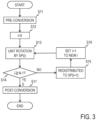
Fig. 3] Fig. 3 is a flow chart for exemplifying the secure computation method of the embodiment. - [
Fig. 4] Fig. 4 is a block diagram for exemplifying the hardware configuration of the secure computation apparatus of the embodiment. - Hereinafter, embodiments of the present invention will be described with reference to the drawings.
- First, the principle of the embodiment will be described.
- The multiplication of a power number of 2 corresponds to the rotation of the bit string. For example, multiplying a power of 2 by a residue class ring having a p-bit Mersenne prime as an order (number of elements) is equivalent to rotating a bit string of length p. In this embodiment, rotation is realized by multiplying a power number of 2 on the secure computation. This rotation is called a multiplicative rotation.
- The point of the multiplicative rotation in this embodiment is as follows.
- Step I: A set SP(i) of k secure computation apparatuses selected from a set PA of n secure computation apparatuses performs a unit rotation, which multiplies a share, according to an additive secret sharing scheme, by power-of-2 number 2ρ(SP(i)) with the share p(SP(i)) as an exponent, the the share p(SP(i)) being obtained by secret sharing of p according to a replicative secret sharing scheme.
- Step II: The value obtained in step I is redistributed into the set SP(i+1) of k secure computation apparatuses selected from the set PA of n secure computation apparatuses.
- Step III: Repeat steps I and II for all sets. However, the redispersion will not be performed in the final round. Thus, the share of the multiplicative rotation result is obtained.
- A more detailed description will be given. The secure computation system of the present embodiment has n secure computation apparatuses PA(0), ..., PA(n-1). Here, the set of n secure computation apparatuses PA(0), ..., PA(n-1) is represented as PA, and the set of k secure computation apparatuses PA(ϕ(i, 0)), ..., PA(ϕ(i, k-1)) selected from PA is represented as SP(i). The set SP(i) executes the i-th unit rotation. Here, n and k are integers of 2 or more, n > k, N = nCk, and i = 0, ..., N-1. nCk represents the total number of combinations when selecting k different from each other from n different from each other.
- Further, ϕ(α, β) is a function value of α and β, and satisfies {ϕ(i, 0), ..., ϕ(i, k-1)} ⊂ {0, ..., n-1}. SP(0), ..., SP(N-1) are different from each other, and SP(0), ..., SP(N-1) hold |SP(i') ∩ SP(i'+1)c| = 1 for i' = 0, ..., N-2. Here, αc represents a complement set of α, and |α| represents the number of elements of α. That is, the set SP(i'), which executes the i'-th unit rotation, is a set that differs from the set SP(i'+1) for executing the i'+1st unit rotation only by one secure computation apparatus.
- A value a, which is a subject of multiplicative rotation, is an element of a residue class ring ZP modulo P. Here, P is an integer of 1 or more, and p is the number of bits of the integer P. For example, when P is the Mersenne number P, P = 2p - 1 is established and p is the number of bits of P. An example of P is a prime number, for example P is a Mersenne prime number, k shares obtained by secret sharing of a according to the (k, k)-additive secret sharing scheme are represented as <a>0, ..., <a>k-1. That is, a = <a>0 + ... + <a>k-1 6 ZP (that is, a = <a>0 + ... + <a>k-1 mod P) is satisfied. (k, k)-additive secret sharing scheme is a (k, n)-replicative secret sharing scheme (see, for example,
reference 1 and the like) in the case of n = k. - [NPL 1] Dai Igarashi, Koki Hamada, Ryo Kikuchi, Koji Chida, "Improvement of Secure Computation Radix Sort Aiming at Statistical Processing of .
- The shares <a> (SP(i)) are k shares <a>0, ..., <a>k-1, which are k shares held by a set SP(i) according to (k, k)-additive secret sharing scheme, and a share <a> (SP(0)) is especially obtained by secret sharing of a according to (k, k)-additive secret sharing scheme. <a> (PA(θ)∈SP(i)) is a share held by the secure computation apparatus PA(θ) 6 SP(i) of shares <a> (SP(i)).
- An exponent (power exponent) p in the multiplicative rotation is an element of the residue class ring Zp modulo p. Sub-shares of n shares <<ρ>>0, ..., <<ρ>>n-1 obtained by secret sharing p according to the (k, n)-replicative secret sharing scheme are represented as ρ0, ..., ρN-1 E Zp. That is, p = po + ... + ρN-1 E Zp (that is, p = ρ0 + ... + ρN-1 mod p) is satisfied. For w = 0, ..., n-1, a share <<ρ>>w is a proper subset of the sub-shares ρ0, ..., ρN-1 (<<ρ>>w⊂ {p0, ..., pN-1}), and arbitrary k shares selected from <<ρ>>0, ..., <<ρ>>N-1 include all sub-shares po, ..., ρN-1. Here, information of p cannot be obtained from shares less than k. Here, among the sub-shares ρ0, ..., ρN-1, the sub-share corresponding to the set SP(i) is represented as ρ(SP(i)). That is, ρ(SP(i)) corresponds to k secure computation apparatuses PA(ϕ(i, 0)), ..., PA(ϕ(i, k-1)) belonging to the set SP(i) are represented a sub-share included in a share <<ρ>>(ϕ(i, 0)), ..., <<ρ>>(ϕ(i, k-1)).
- The important point is that SP(0), ..., SP(N-1) hold |SP(i' ) ∩ SP(i'+1)c| = 1 for i' = 0, ..., N-2. Here, PA(ϕ(i', 0)) represents a secure computation apparatus included in the set SP(i') and not included in the set Sp(i'+1). Further, PA(ϕ(
i'+ 1, k)) represents a secure computation apparatus not included in the set SP(i') but included in the set SP(i'+1). Further, the PA(ϕ(i', j)) for j = 1, ..., k-1 represents a secure computation apparatus included in both the set SP (i') and the set SP(i'+1). - The secure computation apparatus PA(ϕ(i,0)), ..., PA(ϕ(i, k-1)) performs calculation of 2ρ(SP(i))<a>(SP(i)) 6 ZP (that is, 2ρ(SP(i))<a>(SP(i)) mod P) at unit rotation of the i-th time (i = 0, ..., N-1) by using 2ρ(SP(i)) and <a> (SP(i)) , and then the obtained value is set as a new share <a> (SP(i).
- Every time the unit rotation of the i'-th (i'= 0, ..., N-2) is executed, the i'-th redistribution is performed. The redistribution is not performed after the N-1-th unit rotation.
- In the i'-th redistribution, first, the secure computation apparatus PA(ϕ(i', 0)) shares each secure computation apparatus PA(ϕ(i', 1)), ..., PAcp(i', k-1)), and random numbers r(i', 1), ..., r(i', k-1)) 6 ZP. There is no limitation on the method of sharing the random numbers r(i', 1), ..., R(i', k-1)). For example, the secure computation apparatus PA((p(i', 0)) generates random numbers r(i', 1), ..., R(i', k-1)), and these may be transmitted to the secure computation apparatus PA(ϕ(i', 1)), ..., PA(ϕ(i', k-1)). Alternatively, each of the secure computation apparatuses PA(ϕ(i', 1)), ..., PA(ϕ (i', k-1)) generates random numbers r(i', 1), ..., R(i', k-1), and may transmit to a secure computation apparatus PA(ϕ(i', 0)). Alternatively, a seed is shared between the secure computation apparatus PA((p(i', 0)) and the secure computation apparatus PA(ϕ(i', 1)), ..., PA(ϕ(i', k-1)), and random numbers r(i', 1), ..., R(i', k-1)) may be generated by a predetermined processing using the seed.
- Further, at the i'-th redistribution, the secure computation apparatus PA(cp(i', 0)) obtains a share <a> (PA(k)∈SP(i'+1)) by using a share <a> (PA(0)∈SP(i')) and random numbers r(i', 1), ..., r(i', k-1)). That is, the secure computation apparatus PA((p(i', 0)) obtains the share <a> (PA(k)∈SP(i'+1)) by the following equation.
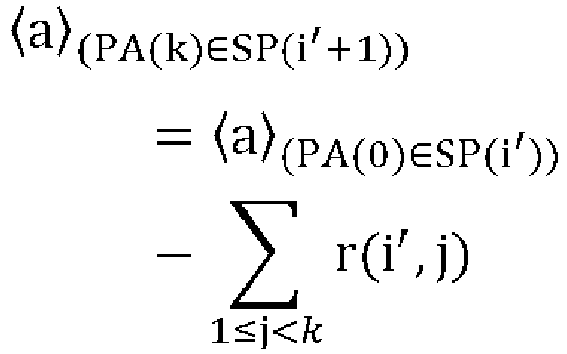
- The secure computation apparatus PA(ϕ(i', 0)) transmits the share <a> (PA(k)∈SP(i'+1)) obtained as described above to the secure computation apparatus PA(ϕ(
i'+ 1, k)). - In the i'-th redistribution, each of the secure computation apparatuses PA(ϕ(i',j)) obtains the share <a> (PA(j)∈SP(i'+1)) using shares <a> (PA(j)∈SP(i')) for j = 1, ..., k-1, and the random number r(i', j). That is, each of the secure computation apparatuses PA(cp(i', j)) obtains the share <a> (PA(j)∈SP(i'+1)) by the following equation.
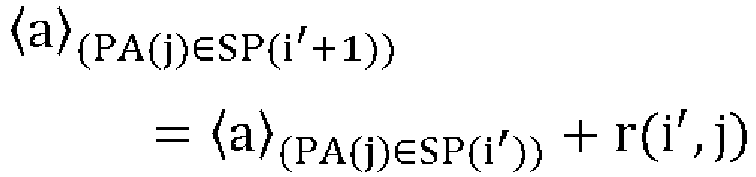
- As described above, the set SP(i) executes unit rotation followed by redistribution for each of i = 0 to i = N-2, and executes unit rotation for i = N-1. That is, this iterative process is a repetition of unit rotation → redistribution → unit rotation → redistribution → ... → unit rotation, and unit rotation is executed N times and redistribution is executed N-1 times. If this is simply done, the number of communication stages is the number of redistributes as it is, and becomes N-1 stage.
- However, unit rotation and redistribution can be parallelized with respect to communication. Because the secure computation apparatus PA(ϕ(
i'+ 1, k)) waiting for the redistributed data is not included in the set SP(i') that executes the i'-th redistribution, the other secure computation apparatus of the set SP(i'+1) that executes the redistribution of thei'+ 1 time can execute only the offline processing and move to the next unit rotation processing without waiting for the reception of the redistributed data. Since the number of shares according to the (k, k)-additive secret sharing scheme is k, if the order of the set SP(0), ..., SP(N-1) is set appropriately, unit rotation of the maximum k times can be performed in one stage. As a result, the number of communication stages can be reduced to (N - 1) / k stages. - Next, a first embodiment of the present invention will be described.
- As illustrated in
Fig. 1 , thesecure computation system 1 of the present embodiment has n secure computation apparatuses PA(0), ..., PA(n-1). Secure computation apparatus PA(0), ..., PA(n-1) are configured so that data can be exchanged. - In this embodiment, the secure computation apparatus PA(0), ..., PA(n-1) is configured to be capable of communication via a network, and an example of exchanging data via a network will be described. However, this does not limit the present invention, and the secure computation apparatus PA(0), ..., PA(n-1) may be configured so that data can be exchanged via a portable recording medium, and data may be exchanged via a portable recording medium.
- As illustrated in
Fig. 2 , the secure computation apparatus PA(j) (where j = 0, ..., N-1) includes a communication unit 11-j, a pre-conversion unit 12-j, a unit rotation unit 13-j, a redistribution unit 14-j, and a post-conversion unit 15-j, a control unit 16-j, and a storage unit 17-j. Unless otherwise specified, the secure computation apparatus PA(j) executes each process under the control of the control unit 16-j, and the data obtained by each process is stored in the storage unit 17-j , and is read out and used according to the needs. Further, data is exchanged between the secure computation apparatuses PA(0), ..., PA(n-1) through each communication unit 11-j. - Next, the processing of this embodiment will be described.
- As a premise, each share [a] of n shares [a]0, ..., [a]n-1 obtained by secret sharing of the value a according to (k, n)-secret sharing scheme (where w E {0, ..., n-1}) or public value a, and n shares obtained by secret sharing of p according to the (k, n)-replicative secret sharing scheme each share <<ρ>>w of <<ρ>>0, ..., <<ρ>>n-1 is stored in the storage unit 17-j of each secure computation apparatus Pa(w). The (k, n)-secret sharing scheme is not limited, and may be, for example, (k, n)-replicative secret sharing scheme, or (k, n)-Shamir secret sharing scheme (see, for example, reference 2 and the like).
- [Reference Literature 2] A. Shamir, "How to share a secret," Communications of the ACM, Vol. 22, No. 11, pp. 612-613, - 613.1979.
- The processing of the present embodiment will be described with reference to
Fig. 3 . - Pre-conversion units 12-ϕ(0, 0), ..., 12-ϕ(0, k-1) of k secure computation apparatuses PA(ϕ(0, 0)), ..., PA(ϕ(0, k-1)) belonging to the set SP(0) convert the share [a]ϕ(0, 0), ..., [a]ϕ(0, k-1) held in the set SP(0) or the published value a to shares <a>0, ..., <a>k-1 (share <a> (SP(0))) obtained by secret sharing of a according to (k, k)-additive secret sharing scheme. Share <a>e is stored in the storage unit 17-θ of the secure computation apparatus PA(θ) (θ C {ϕ(0, 0), ..., ϕ(0, k-1)}) belonging to the set SP(0) (step S11).
- The control units 16-w of all the secure computation apparatuses PA(w) are set to i = 0 (step S12).
- Unit rotation unit 13-(p(i, 0) , ..., ϕ(i, k-1) of k secure computation apparatuses PA(cp(i, 0)), ..., PA(ϕ(i, k-1)) belonging to the set SP(i) performs calculation of 2ρ(SP(i))<a>(SP(i)) 6 ZP respectively, and stores the value obtained by this as a new share <a>(SP(i)) in the storage unit 17-ϕ(i, 0), ..., (p(i, k-1) (step S13).
- The control unit 16-j determines whether or not i ≧ N-1 (step S14). If i ≧ N-1, the process proceeds to step S17, and if not i ≧ N-1, the process proceeds to step S15.
- In step S15, first, the redistribution unit 14-cp(i, 0) of the secure computation apparatus PA(ϕ(i, 0)) shares each redistribution unit 14-cp(i, 1), ..., 14-ϕ(i, k-1) of the secure computation apparatus PA(ϕ(i, 1)), ..., PA(ϕ(i, k-1)), and random numbers r(i, 1), ..., r(i, k-1) 6 ZP. Further, the redistribution unit 14-(p(i, 0) of the secure computation apparatus PA(ϕ(i, 0)) obtains the share <a>(PA(k)∈SP(i+1)) using a share <a>(PA(0)∈SP(i)) and random numbers r (i, 1), ..., r (i, k-1)). That is, the secure computation apparatus PA(cp(i, 0)) obtains the share <a>(PA(k)∈SP(i+1)) by the following equation.

- The secure computation apparatus PA(ϕ(i, 0)) transmits to the secure computation apparatus PA(ϕ(i+1, k)) obtained as described above.
- Further, each of the redistribution unit 14-(p(i, j) of the secure computation apparatus PA(ϕ(i, j)) obtains the share <a>(PA(j)∈SP(i+1)) using share <a>(PA(j)∈SP(i)) for j = 1, ..., k-1, and random number r(i, j). That is, each of the redistribution unit 14-(p(i, j) of the secure computation apparatus PA(cp(i, j)) obtains a share <a>(PA(j∈SP(i+1)) by the following equation (step S15).

- The control unit 16-w of all the secure computation apparatuses PA(w) sets i + 1 to a new i (step S16), and the process proceeds to step S13.
- In step S17, which is executed when i ≧ N-1 in step S14, post-conversion units 15-ϕ(N-1, 0), ..., 15-ϕ(N-1, k-1) of the secure computation apparatus PA(ϕ(N-1, 0)), ..., PA(ϕ(N-1, k-1)) belonging to the set SP(N-1) convert share <a>(SP(N-1)) stored in storage unit 17-ϕ(N-1, 0) , ..., ϕ(N-1, k-1) into desired data in step S13. For example, the post-conversion unit 15-ϕ(N-1, 0), ..., 15-ϕ(N-1, k-1) may convert and output share <a>(SP(N-1)) to share [a] (SP(N-1)) according to (k, n)-secret sharing scheme (see, for example, reference 3 and the like), or convert (reconstruct) a restored value (2Pa 6 ZP), and output. Reference 3: Kikuchi, R., Ikarashi, D., Matsuuda T., Hamada, K. and Chida, K.: Efficient Bit-Decomposition and Model - Conversion Protocol with an Honest Maiory, Information Security and Privacy - 23rd Australasian Conference, ACISP 2018, Wall, and Along, SWA, and Wall July 11-13, 2018, Proceedings (Susilo, W. and Yang, G., eds.), Lecture Notes in computer Sciences, Vol. 10946, Spring, PP. 64-82 (online), DOI 10.1007/978-3-319-93638-35 (2018).
- In the second embodiment, a specific example of the first embodiment will be described.
- In the present embodiment, a specific example in the case of k = 2 and n = 3 will be described.
- In this case, N = 3 and i = 0, 1, 2. Further, in the present embodiment, SP(0) = (PA(0), PA(1)), SP(1) = (PA(1), PA(2)), SP(2) = (PA(0), PA(2)). Share <a>(SP(0)) is a0 and a1, a = a0 + a1 E ZP, ρ = ρ01 + ρ12 + ρ20 ∈ Zp, ρ(SP(0)) = ρ(SP(1)) = ρ(SP(1)) = ρ01, ρ12, ρ20. Further, PA(ϕ(0, 0)) = PA(0), PA(ϕ(1, 2)) = PA(2), PA(ϕ(0, 1)) = PA(1), and PA(ϕ(1, 0)) = PA(1), PA(ϕ(2, 2)) = PA(0), PA(ϕ(1, 1)) = PA(2), and r (0, 1) = r01, r(1, 1) = r12.
- In this case, the number of communication stages can be reduced by parallelizing the unit rotation and redistribution as follows.
- In step S11, the pre-conversion units 12-0 and 12-1 of the two secure computation apparatuses PA(0) and PA(1) belonging to the set SP(0) convert shares [a]0, ..., [a]1 held in set SP(0) or a public value to shares <a>0 = a0, <a>1 = a1 (share <a>(SP(0))) obtained by secret sharing of a according to (2,2)-additive secret sharing scheme. The storage unit 17-0 of the secure computation apparatus PA(0) stores a0, and the storage unit 17-1 of the secure computation apparatus PA(1) stores a1.
- The unit rotation unit 13-0 and the redistribution unit 14-0 of the secure computation apparatus PA(0) obtain

- Further, the unit rotation unit 13-1 and the redistribution unit 14-1 of the secure computation apparatus PA(1) obtain


- The unit rotation unit 13-2 and the redistribution unit 14-2 of the secure computation unit PA(2) obtain

- As shown below, <c>0 and <c>2 have a share of 2ρa∈ZP according to the (2,2)-additive secret sharing scheme.

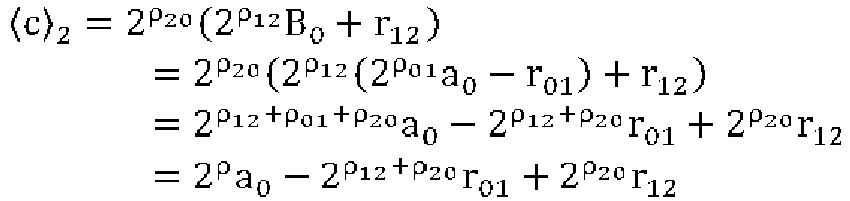
- Therefore, <c>o + <c>2 = 2ρ(a0 + a1) = 2ρa ∈ ZP holds.
-
Modification 1 of the second embodiment is a specific example in the case of k = 3, n = 5. In this case, N = 10, i = 0, 1, ..., 9. - Further, in this modification, SP(0) = (PA(0), PA(1), PA(2)), SP(1) = (PA(1), PA(2), PA(3)), SP(2) = (PA(2), PA(3), PA(4)), SP(3) = (PA(0), PA(3), PA(4)), SP(4) = (PA(0), PA(1), PA(4)), SP(5) = (PA(1), PA(3), PA(4)), SP(6) = (PA(0), PA(1), PA(3)), SP(7) = (PA(0), PA(2), PA(3)), SP(8) = (PA(0), PA(2), PA(4)), SP(9) = (PA(1), PA(2), PA(4)). Thereby, as in the second embodiment, unit rotation and redistribution can be parallelized, and the number of communication stages can be reduced.
- The secure computation apparatus PA(j) in the embodiment is a device configured by executing a predetermined program by a general-purpose or dedicated computer including a processor (a hardware processor) such as a CPU (central processing unit), memory such as a RAM (random-access memory), a ROM (read-only memory), and the like. The computer may include one processor or memory, or may include a plurality of processors or memories. This program may be installed in a computer or may be recorded in a ROM or the like in advance. In addition, a part or all of the processing unit may be constituted by using an electronic circuit which realizes a processing function independently, instead of an electronic circuit which realizes a functional configuration by reading a program like a CPU. Further, an electronic circuit constituting one apparatus may include a plurality of CPUs.
-
Fig. 4 is a block diagram illustrating a hardware configuration of the secure computation apparatus PA(j) according to the embodiment. As illustrated inFig. 4 , the secure computation apparatus PA(j) of this example includes a CPU (Central Processing Unit) 10a, aninput unit 10b, anoutput unit 10c, a RAM (Random Access Memory) 10d, a ROM (Read Only Memory) 10e, anauxiliary storage device 10f, and abus 10g. TheCPU 10a of this example has a control unit 10aa, a calculation unit 10ab and a register 10ac and executes various calculation processing according to various programs read in the register 10ac. Theinput unit 10b is provided with a communication device to which data are input, an input terminal, a keyboard, a mouse, a touch panel or the like. Theoutput unit 10c is a communication device, an output terminal, a display or the like for outputting data. TheRAM 10d is an SRAM (Static Random Access Memory), a DRAM (Dynamic Random Access Memory) or the like, and has a program area 10da for storing a prescribed program and a data area 10db for storing various data. Further, theauxiliary storage device 10f includes, for example, a hard disk, a MO (Magneto-Optical disk), a semiconductor memory or the like has a program area 10fa in which a predetermined program is stored and a data area 10fb in which various data are stored. Thebus 10g also includes aCPU 10a, aninput unit 10b, anoutput unit 10c, theRAM 10d, theROM 10e and theauxiliary storage device 10f are connected so as to exchange information. TheCPU 10 a writes a program stored in a program area 10fa of anauxiliary storage device 10f in a program area 10da of aRAM 10d according to the read OS (Operating System) program. Similarly, theCPU 10a writes various data stored in a data area 10fb of theauxiliary storage device 10f in a data area 10db of theRAM 10d. Then, an address on theRAM 10d in which the program and data are written is stored in a register 10ac of theCPU 10a. A control unit 10aa of theCPU 10a sequentially reads the addresses stored in the register 10ac, reads the program and data from an area on theRAM 10d indicated by the read address, makes a calculation unit 10ab sequentially execute the calculation indicated by the program, and stores the calculation result in the register 10ac. With such a configuration, a functional configuration of the secure computation apparatus PA(j) is realized. - The above program can be recorded on a computer-readable recording medium. An example of computer-readable recording medium is non-transitory (non-transitory) recording medium. Examples of such recording media are magnetic recording devices, optical disks, magneto-optical recording media, semiconductor memory, and the like.
- The distribution of the program is performed by, for example, selling, transferring and transferring a portable recording medium such as a DVD or CD-ROM recording the program, lending or the like. Further, the program may be stored in the storage device of the server computer and transferred from the server computer to another computer via the network to distribute the program. As described above, a computer executing such a program is configured to execute, for example, a program recorded on a portable recording medium or a program transferred from a server computer, and the data are once stored in its own storage device. When executing the processing, the computer reads the program stored in its own storage device, and executes the processing according to the read program. As another execution form of the program, the computer may directly read the program from the portable recording medium and execute processing according to the program, each time a program is transferred from the server computer to the computer, processing according to the received program may be executed sequentially. In addition, by a so-called ASP (Application Service Provider) type service which does not transfer a program from the server computer to the computer and realizes a processing function only by the execution instruction and the result acquisition, The above-mentioned processing may be executed. It is assumed that the program in this embodiment includes information that is used for processing by a computer and is equivalent to a program (e.g., data that is not a direct command to a computer but has the nature of defining the processing of a computer).
- In each embodiment, the present apparatus is configured by executing a predetermined program on a computer. However, at least a part of these processing contents may be realized by hardware.
- The present invention is not limited to the above-described embodiment. For example, the redistribution of the above embodiments can be further generalized as follows.
- Input: Share sha (a, i) of a according to the (k, k)-secret sharing scheme, which is restorable by linear combination calculation. Here, k secure computation apparatuses PA(ϕ(i, 0)), ..., PA(ϕ(i, k-1)) have a share sha(a, i).
- Output: share [a(i)] according to (k, n)-secret sharing scheme having additive homomorphism
- Processing:
- 1. The secure computation apparatus PA(ϕ(i, i')) (where i'= 0, ..., k-1) having the share sha(a, i) performs secret sharing of the share [sha(a, i)_cp(i, i')] according to the (k, n)-secret sharing scheme of own share sha(a, i). As a result, the share [sha(a, i)_cp(i, i')] is shared by k secure computation apparatuses PA (cp (i, 0)), ..., PA(ϕ(i, k-1)). This is a share in which a is doubly performed secret sharing, that is, a share of share of a.
- 2. Each secure computation apparatus PA(ϕ(i, i')) restores the sha(a, i) component inherent in each share by adding and multiplying the public value of the secure computation and performing linear combination for a share [sha(a, i)_ϕ(i, 0)], ..., [sha(a, i)_ϕ(i, k-1)]. As a result, each secure computation apparatus PA(ϕ(i, i')) obtains a share [a(i)] according to the (k, n)-secret sharing scheme.
- In this process, the share <a> (PA(0)∈SP(i)) of the above-described embodiment is generalized to the share sha(a), and the share <a> (PA(k)∈SP(i+1)) is generalized to the share of k secure computation apparatuses arbitrarily selected, among the shares [a(i)] according to the (k, n)-secret sharing scheme. In the embodiment, SP(0), ..., SP(N-1) hold |SP(i') ∩ SP (i'+1)c| = 1 for i'= 0, ..., N-2, however, it does not have to be configured in this way. Further, the (k, k)-secret sharing scheme is not limited, and may be an additive secret sharing scheme or another secret sharing scheme such as the Shamir secret sharing scheme. The various kinds of processing described above are not necessarily sequentially executed according to the description, and may also be executed in parallel or individually depending on the processing capabilities of the device that executes the processing or according to the need. In addition, as a matter of course, it is possible to variously modify the present invention as appropriate without departing from the spirit of the present invention.
-
- 1
- Secure computation system
- PA(j)
- Secure computation apparatus
- 13-j
- Unit rotation unit
- 14-j
- Redistribution unit
Claims (10)
- A secure computation system comprising n secure computation apparatuses PA(0), ..., PA(n-1), whereinn and k are integers of 2 or more; n > k; N = nCk; PA is a set of the n secure computation apparatuses PA(0), ..., PA(n-1); SP(i) is a set of k secure computation apparatuses PA(ϕ(i, 0)), ..., PA(ϕ(i, k-1)) selected from PA; i = 0, ..., N-1; SP(0), ..., SP(N-1) hold |SP(i') ∩ SP(i'+1)c| = 1 for i'= 0, ..., N-2;P is an integer of 1 or more; p is the number of bits of the integer P; a is an element of a residue class ring ZP modulo P; share <a>(SP(i)) is k shares, according to additive secret sharing scheme, held by the set SP(i); share <a>(SP(0)) is a share obtained by secret sharing of a according to additive secret sharing scheme; <a>(PA(θ)∈SP(i)) is a share held by the secure computation apparatus PA(θ) E SP(i) among the share <a> (SP(i)) ;p is an element of a residue class ring Zp modulo p; sub-shares of n shares <<ρ>>0, ... , <<ρ>>n-1 obtained by the secret sharing of p according to a replicated secret sharing scheme are ρ0, ..., ρN-1 6 Zp; ρ(SP(i)) is a sub-share corresponding to the set SP(i) among the sub-shares ρ0, ..., ρN-1;PA(ϕ(i', 0)) is a secure computation apparatus, which is included in the set SP(i') but not included in the set SP(i'+1); PA(ϕ(i'+1, k)) is a secure computation apparatus, which is not included in the set SP(i') but included in the set SP(i'+1); PA(ϕ(i', j)) for j = 1, ..., k-1 is a secure computation apparatus, which is included in both the set SP(i') and the set SP(i'+1);secure computation apparatuses PA(ϕ(i, 0)), ..., PA(ϕ(i, k-1)) execute unit rotation calculating 2ρ(SP(i))<a>(SP(i)) 6 ZP to obtain a new share <a>(SP(i)); andthe secure computation apparatus PA((p(i', 0)) obtains a share <a>(PA(k)∈SP(i'+1)) using a share <a> (PA(0)∈SP(i')) and random numbers r(i', 1), ..., r(i', k-1)), the random numbers r(i', 1), ..., r(i', k-1)) being shared by the secure computation apparatus PA(ϕ(i', 0)) and the secure computation apparatuses PA(ϕ(i', 1)) ..., PA(ϕ(i',k-1)), and then transmits the share <a>(PA(k)∈SP(i'+1)) to the secure computation apparatus PA(ϕ(i'+1, k)), each of the secure computation apparatuses PA(ϕ(i', j)) performs redistribution to obtain a share <a>(PA(j)∈SP(i'+1)) using a share <a>(PA(j)∈SP(i')) and the random number r(i', j) for j = 1, ..., k-1.
- The secure computation system according to claim 1, wherein
in the redistribution,the secure computation apparatus PA(ϕ(i', 0)) obtains the share <a>(PA(k)∈SP(i'+1)) according to the following equation the each secure computation apparatus PA(ϕ(i', j)) obtains the share <a>(PA(j)∈SP(i'+1)) by the following equation
- The secure computation system according to claim 1 or 2, whereinSP(0), ..., SP(N-1) are different from each other; andthe set SP(i) executes the redistribution for i = 0 to i = N - 2, respectively followed by the unit rotation, and the set SP(i) executes the unit rotation for i = N - 1.
- The secure computation system according to any one of claims 1 to 3, wherein
 SP(0) = (PA(0), PA(1)), SP(1) = (PA(1), PA(2)), SP(2) = (PA(0), PA(2)),share <a>(SP(0)) is a0 and a1, a = a0 + a1 ∈ ZP,ρ = ρ01 + ρ12 + ρ20 E Zp, ρ(SP(0)) = ρ(SP(1)) = ρ(SP(1)) = ρ01, ρ12, ρ20,PA(ϕ(0, 0)) = PA(0), PA(ϕ(1, 2)) = PA(2), PA(ϕ(0, 1)) = PA(1),PA(ϕ(1, 0)) = PA(1), PA(ϕ(2, 2)) = PA(0), PA(ϕ(1, 1)) = PA(2),
 a secure computation apparatus PA(0) obtains
 a secure computation apparatus PA(1) obtains
 the secure computation apparatus PA(0) obtains
 the secure computation apparatus PA(2) obtains
- The secure computation system according to any of claims 1 to 3, wherein

- A secure computation system comprising n secure computation apparatuses PA(0), ..., PA(n-1), whereinN and k are integers of 2 or more; n > k; N = nCk; PA is a set of the n secure computation apparatuses PA(0), ..., PA(n-1); SP(i) is a set of k secure computation apparatuses PA(cp(i, 0)), ..., PA(cp(i, k-1)) selected from PA; i = 0, ..., N-1, i'= 0, ..., N-2;P is an integer of 1 or more; p is the number of bits of the integer P; a is an element of a residue class ring ZP modulo P; share <a>(SP(i)) is k shares, according to additive secret sharing scheme, held by the set SP(i); share <a>(SP(0)) is a share obtained by secret sharing of a according to additive secret sharing scheme; <a>(PA(θ)∈SP(i)) is a share held by the secure computation apparatus PA(θ) E SP(i) among the share <a>(SP(i)) ;p is an element of a residue class ring Zp modulo p; sub-shares of n shares <<ρ>>0, ... , <<ρ>>n-1 obtained by the secret sharing of p according to a replicated secret sharing scheme are ρ0, ..., ρN-1 6 Zp; ρ(SP(i)) is a sub-share corresponding to the set SP(i) among the sub-shares ρ0, ..., ρN-1;secure computation apparatuses PA(ϕ(i, 0)), ..., PA(ϕ(i, k-1)) execute unit rotation calculating 2ρ(SP(i)))<a>(SP(i)) ∈ ZP to obtain a new share <a>(SP(i)) ;the secure computation apparatus PA(ϕ(i', 0)) obtains a share <a>(PA(k)∈SP(i'+1)) using a share <a>(PA(0)∈SP(i')), and then transmits the share <a>(PA(k)∈sP(i'+1)) to the secure computation apparatus PA(ϕ(i'+1, k)), each of the secure computation apparatuses PA(ϕ(i', j)) performs redistribution to obtain a share <a>(PA(j)∈SP(i'+1)) using a share <a>(PA(j)∈SP(i')) for j = 1, ..., k-1.
- A secure computation apparatus of the secure computation system according to any one of claims 1 to 6.
- A secure computation method, wherein N and k are integers of 2 or more; n > k; N = nCk; PA is a set of the n secure computation apparatuses PA(0), ..., PA(n-1); SP(i) is a set of k secure computation apparatuses PA(ϕ(i, 0)), ..., PA(ϕ(i, k-1)) selected from PA; i = 0, ..., N-1; SP(0), ..., SP(N-1) hold |SP(i') ∩ SP(i'+1)c| = 1 for i'= 0, ..., N-2;P is an integer of 1 or more; p is the number of bits of the integer P; a is an element of a residue class ring ZP modulo P; share <a>(SP(i)) is k shares, according to additive secret sharing scheme, held by the set SP(i); share <a>(SP(0)) is a share obtained by secret sharing of a according to additive secret sharing scheme; <a>(PA(θ)∈SP(i)) is a share held by the secure computation apparatus PA(θ) E SP(i) among the share <a>(SP(i)) ;p is an element of a residue class ring Zp modulo p; sub-shares of n shares <<ρ>>0, ..., <<ρ>>n-1 obtained by the secret sharing of p according to a replicated secret sharing scheme are ρ0, ..., ρN-1 6 Zp; ρ(SP(i)) is a sub-share corresponding to the set SP(i) among the sub-shares ρ0, ..., ρN-1;PA(ϕ(i', 0)) is a secure computation apparatus, which is included in the set SP(i') but not included in the set SP(i'+1); PA(ϕ(i'+1, k)) is a secure computation apparatus, which is not included in the set SP(i') but included in the set SP(i'+1); PA(ϕ(i', j)) for j = 1, ..., k-1 is a secure computation apparatus, which is included in both the set SP(i') and the set SP(i'+1);the secure computation method comprises:an unit rotation step of calculating 2ρ(SP(i))<a>(SP(i)) ∈ ZP to obtain a new share <a>(SP(i)) by secure computation apparatuses PA(ϕ(i, 0)), ..., PA(ϕ(i, k-1)); anda redistribution step of obtaining a share <a>(PA(k)∈SP(i'+1)) using a share <a>(PA(0)∈SP(i')) and random numbers r(i', 1), ..., r(i', k-1)) by the secure computation apparatus PA(ϕ(i', 0)), the random numbers r(i', 1), ..., r(i', k-1) being shared by the secure computation apparatus PA(ϕ(i', 0)) and the secure computation apparatuses PA(ϕ(i', 1)) ..., PA(ϕ(i',k-1)), then transmitting the share <a>(PA(k)∈SP(i'+1)) to the secure computation apparatus PA(ϕ(i'+1, k)), and obtaining a share <a>(PA(i)∈SP(i'+1)) using a share <a> (PA(j)∈SP(i')) and the random number r(i', j) by each of the secure computation apparatuses PA(ϕ(i', j)) for j = 1, ..., k-1.
- A secure computation method, wherein a secure computation system includes n secure computation apparatuses PA(0), ..., PA(n-1); N and k are integers of 2 or more; n > k; N = nCk; PA is a set of the n secure computation apparatuses PA(0), ..., PA(n-1);SP(i) is a set of k secure computation apparatuses PA(ϕ(i, 0)), ..., PA(ϕ(i, k-1)) selected from PA; i = 0, ..., N-1; i'= 0, ..., N-2;P is an integer of 1 or more; p is the number of bits of the integer P; a is an element of a residue class ring ZP modulo P; share <a>(SP(i)) is k shares, according to additive secret sharing scheme, held by the set SP(i);
share <a>(SP(0)) is a share obtained by secret sharing of a according to additive secret sharing scheme; <a>(PA(θ)∈SP(i)) is a share held by the secure computation apparatus PA(θ) E SP(i) among the share <a>(SP(i)) ;p is an element of a residue class ring Zp modulo p, sub-shares of n shares <<ρ>>0, ... , <<ρ>>n-1 obtained by the secret sharing of p according to a replicated secret sharing scheme are ρ0, ..., ρN-1 6 Zp;
ρ(SP(i)) is a sub-share corresponding to the set SP(i) among the sub-shares ρ0, ..., ρN-1;the secure computation method compries:executing unit rotation calculating 2ρ(SP(i))<a>(SP(i)) ∈ ZP to obtain a new share <a>(SP(i)) by secure computation apparatuses PA(ϕ(i, 0)), ..., PA(ϕ(i, k-1)); andobtaining a share <a>(PA(k)∈SP(i'+1)) using a share <a>(PA(0)∈ SP(i')) by the secure computation apparatus PA(ϕ(i', 0)), and then transmitting the share <a> (PA(k)∈SP(i'+1)) to the secure computation apparatus PA(ϕ(i'+1, k)), performing redistribution to obtain a share <a>(PA(j)∈SP(i'+1)) using a share <a>(PA(j)∈SP(i')) by each of the secure computation apparatuses PA(ϕ(i', j)) for j = 1, ..., k-1. - A program for causing a computer to function as the secure computation apparatus according to claim 7.
Applications Claiming Priority (1)
| Application Number | Priority Date | Filing Date | Title |
|---|---|---|---|
| PCT/JP2020/039080 WO2022079893A1 (en) | 2020-10-16 | 2020-10-16 | Secure computing system, secure computing device, secure computing method, and program |
Publications (3)
| Publication Number | Publication Date |
|---|---|
| EP4210030A1 true EP4210030A1 (en) | 2023-07-12 |
| EP4210030A4 EP4210030A4 (en) | 2024-05-22 |
| EP4210030B1 EP4210030B1 (en) | 2025-06-04 |
Family
ID=81208986
Family Applications (1)
| Application Number | Title | Priority Date | Filing Date |
|---|---|---|---|
| EP20957722.0A Active EP4210030B1 (en) | 2020-10-16 | 2020-10-16 | Secure computation system, secure computation apparatus, secure computation method, and program |
Country Status (6)
| Country | Link |
|---|---|
| US (1) | US12353554B2 (en) |
| EP (1) | EP4210030B1 (en) |
| JP (1) | JP7494931B2 (en) |
| CN (1) | CN116324936B (en) |
| AU (1) | AU2020472678B2 (en) |
| WO (1) | WO2022079893A1 (en) |
Families Citing this family (1)
| Publication number | Priority date | Publication date | Assignee | Title |
|---|---|---|---|---|
| JP7468687B2 (en) * | 2020-10-16 | 2024-04-16 | 日本電信電話株式会社 | Secure computation system, secure computation device, secure computation method, and program |
Family Cites Families (10)
| Publication number | Priority date | Publication date | Assignee | Title |
|---|---|---|---|---|
| JP4555859B2 (en) * | 2005-07-13 | 2010-10-06 | 日本電信電話株式会社 | Authentication system, authentication method, certification device, verification device, program and recording medium thereof |
| US20090158299A1 (en) * | 2007-10-31 | 2009-06-18 | Carter Ernst B | System for and method of uniform synchronization between multiple kernels running on single computer systems with multiple CPUs installed |
| CN104917780A (en) * | 2009-11-25 | 2015-09-16 | 安全第一公司 | Systems and methods for securing data in motion |
| EP2858297B1 (en) * | 2012-07-05 | 2017-03-01 | Nippon Telegraph And Telephone Corporation | Secret sharing system, data distribution apparatus, distributed data transform apparatus, secret sharing method and program |
| CN103135946B (en) * | 2013-03-25 | 2014-11-26 | 中国人民解放军国防科学技术大学 | Solid state drive(SSD)-based file layout method in large-scale storage system |
| CN105900165B (en) * | 2014-01-17 | 2019-03-08 | 日本电信电话株式会社 | Secret computing method, secret computing system, random permutation device, and recording medium |
| JP6766182B2 (en) * | 2017-01-20 | 2020-10-07 | 日本電信電話株式会社 | Secret calculation system, secret calculation device, secret calculation method, program |
| US11314506B2 (en) * | 2017-05-18 | 2022-04-26 | Nec Corporation | Secure computation device, comparison method, comparison program recording medium, and secure computation system |
| CN108599933B (en) * | 2018-04-16 | 2020-10-27 | 河北大学 | A method for comparing two-party quantum information based on bell basis |
| US20210167946A1 (en) * | 2018-04-17 | 2021-06-03 | B. G. Negev Technologies & Applications Ltd., At Ben-Gurion | One-Round Secure Multiparty Computation of Arithmetic Streams and Evaluation of Functions |
-
2020
- 2020-10-16 EP EP20957722.0A patent/EP4210030B1/en active Active
- 2020-10-16 JP JP2022556805A patent/JP7494931B2/en active Active
- 2020-10-16 US US18/031,884 patent/US12353554B2/en active Active
- 2020-10-16 CN CN202080106126.0A patent/CN116324936B/en active Active
- 2020-10-16 WO PCT/JP2020/039080 patent/WO2022079893A1/en not_active Ceased
- 2020-10-16 AU AU2020472678A patent/AU2020472678B2/en active Active
Also Published As
| Publication number | Publication date |
|---|---|
| US20230367879A1 (en) | 2023-11-16 |
| US12353554B2 (en) | 2025-07-08 |
| EP4210030B1 (en) | 2025-06-04 |
| WO2022079893A1 (en) | 2022-04-21 |
| JP7494931B2 (en) | 2024-06-04 |
| EP4210030A4 (en) | 2024-05-22 |
| AU2020472678B2 (en) | 2024-02-08 |
| JPWO2022079893A1 (en) | 2022-04-21 |
| AU2020472678A1 (en) | 2023-05-25 |
| CN116324936B (en) | 2025-06-27 |
| CN116324936A (en) | 2023-06-23 |
| AU2020472678A9 (en) | 2024-02-08 |
Similar Documents
| Publication | Publication Date | Title |
|---|---|---|
| US11050558B2 (en) | Arithmetic for secure multi-party computation with modular integers | |
| US20180212758A1 (en) | Secure Probabilistic Analytics Using an Encrypted Analytics Matrix | |
| US20220045840A1 (en) | Methods and systems for somewhat homomorphic encryption and key updates based on geometric algebra for distributed ledger/blockchain technology | |
| EP4210030B1 (en) | Secure computation system, secure computation apparatus, secure computation method, and program | |
| EP4210031B1 (en) | Secure computation system, secure computation device, secure computation method, and program | |
| CN111712816B (en) | Using cryptographic masking for efficient use of Montgomery multiplications | |
| Franzese et al. | Secure noise sampling for differentially private collaborative learning | |
| CN114830211B (en) | Secret random number generation system, secret computing device, secret random number generation method and computer program product | |
| EP4095832B1 (en) | Secure computation device, secure computation method, and program | |
| EP4210028B1 (en) | Secure shift system, secure shift apparatus, secure shift method, and program | |
| CN116681138A (en) | Processing method, device, storage medium and electronic device for data size comparison task | |
| JP7318743B2 (en) | Secure computing device, secure computing method, and program | |
| CN111931202A (en) | Encrypted storage method, terminal device and storage medium for distributed system | |
| Abdennebi et al. | A lattice-based publish-subscribe communication protocol using accelerated homomorphic encryption primitives | |
| Kleinjung et al. | Using a grid platform for solving large sparse linear systems over GF (2) | |
| EP4213135A1 (en) | Secret exponent part unifying system, secret exponent part unifying device, secret exponent part unifying method, secret sum calculation system, secret product sum calculation system, and program | |
| JP4676873B2 (en) | Parameter generating device, encryption key generating device, method and program thereof | |
| EP4095830A1 (en) | Secure computation device, secure computation method, and program | |
| WO2024224490A1 (en) | Secure computation device, secure computation method, and program | |
| CN116455618A (en) | Data intersection method and device based on block chain | |
| Algorille et al. | Using a grid platform for solving large sparse linear systems over GF (2) | |
| JP2021026429A (en) | Information processing device |
Legal Events
| Date | Code | Title | Description |
|---|---|---|---|
| STAA | Information on the status of an ep patent application or granted ep patent |
Free format text: STATUS: THE INTERNATIONAL PUBLICATION HAS BEEN MADE |
|
| PUAI | Public reference made under article 153(3) epc to a published international application that has entered the european phase |
Free format text: ORIGINAL CODE: 0009012 |
|
| STAA | Information on the status of an ep patent application or granted ep patent |
Free format text: STATUS: REQUEST FOR EXAMINATION WAS MADE |
|
| 17P | Request for examination filed |
Effective date: 20230406 |
|
| AK | Designated contracting states |
Kind code of ref document: A1 Designated state(s): AL AT BE BG CH CY CZ DE DK EE ES FI FR GB GR HR HU IE IS IT LI LT LU LV MC MK MT NL NO PL PT RO RS SE SI SK SM TR |
|
| DAV | Request for validation of the european patent (deleted) | ||
| DAX | Request for extension of the european patent (deleted) | ||
| REG | Reference to a national code |
Free format text: PREVIOUS MAIN CLASS: G09C0001000000 Ipc: H04L0009080000 Ref country code: DE Ref legal event code: R079 Ref document number: 602020052504 Country of ref document: DE |
|
| A4 | Supplementary search report drawn up and despatched |
Effective date: 20240424 |
|
| RIC1 | Information provided on ipc code assigned before grant |
Ipc: G09C 1/00 20060101ALI20240418BHEP Ipc: H04L 9/08 20060101AFI20240418BHEP |
|
| GRAP | Despatch of communication of intention to grant a patent |
Free format text: ORIGINAL CODE: EPIDOSNIGR1 |
|
| STAA | Information on the status of an ep patent application or granted ep patent |
Free format text: STATUS: GRANT OF PATENT IS INTENDED |
|
| INTG | Intention to grant announced |
Effective date: 20250227 |
|
| GRAS | Grant fee paid |
Free format text: ORIGINAL CODE: EPIDOSNIGR3 |
|
| GRAA | (expected) grant |
Free format text: ORIGINAL CODE: 0009210 |
|
| STAA | Information on the status of an ep patent application or granted ep patent |
Free format text: STATUS: THE PATENT HAS BEEN GRANTED |
|
| AK | Designated contracting states |
Kind code of ref document: B1 Designated state(s): AL AT BE BG CH CY CZ DE DK EE ES FI FR GB GR HR HU IE IS IT LI LT LU LV MC MK MT NL NO PL PT RO RS SE SI SK SM TR |
|
| REG | Reference to a national code |
Ref country code: GB Ref legal event code: FG4D |
|
| REG | Reference to a national code |
Ref country code: CH Ref legal event code: EP |
|
| REG | Reference to a national code |
Ref country code: DE Ref legal event code: R096 Ref document number: 602020052504 Country of ref document: DE |
|
| REG | Reference to a national code |
Ref country code: IE Ref legal event code: FG4D |
|
| RAP4 | Party data changed (patent owner data changed or rights of a patent transferred) |
Owner name: NTT, INC. |
|
| REG | Reference to a national code |
Ref country code: NL Ref legal event code: MP Effective date: 20250604 |
|
| PG25 | Lapsed in a contracting state [announced via postgrant information from national office to epo] |
Ref country code: ES Free format text: LAPSE BECAUSE OF FAILURE TO SUBMIT A TRANSLATION OF THE DESCRIPTION OR TO PAY THE FEE WITHIN THE PRESCRIBED TIME-LIMIT Effective date: 20250604 Ref country code: FI Free format text: LAPSE BECAUSE OF FAILURE TO SUBMIT A TRANSLATION OF THE DESCRIPTION OR TO PAY THE FEE WITHIN THE PRESCRIBED TIME-LIMIT Effective date: 20250604 |
|
| REG | Reference to a national code |
Ref country code: LT Ref legal event code: MG9D |
|
| PG25 | Lapsed in a contracting state [announced via postgrant information from national office to epo] |
Ref country code: GR Free format text: LAPSE BECAUSE OF FAILURE TO SUBMIT A TRANSLATION OF THE DESCRIPTION OR TO PAY THE FEE WITHIN THE PRESCRIBED TIME-LIMIT Effective date: 20250905 Ref country code: NO Free format text: LAPSE BECAUSE OF FAILURE TO SUBMIT A TRANSLATION OF THE DESCRIPTION OR TO PAY THE FEE WITHIN THE PRESCRIBED TIME-LIMIT Effective date: 20250904 |
|
| PG25 | Lapsed in a contracting state [announced via postgrant information from national office to epo] |
Ref country code: PL Free format text: LAPSE BECAUSE OF FAILURE TO SUBMIT A TRANSLATION OF THE DESCRIPTION OR TO PAY THE FEE WITHIN THE PRESCRIBED TIME-LIMIT Effective date: 20250604 |
|
| PGFP | Annual fee paid to national office [announced via postgrant information from national office to epo] |
Ref country code: IT Payment date: 20250711 Year of fee payment: 6 |
|
| PG25 | Lapsed in a contracting state [announced via postgrant information from national office to epo] |
Ref country code: BG Free format text: LAPSE BECAUSE OF FAILURE TO SUBMIT A TRANSLATION OF THE DESCRIPTION OR TO PAY THE FEE WITHIN THE PRESCRIBED TIME-LIMIT Effective date: 20250604 |
|
| PGFP | Annual fee paid to national office [announced via postgrant information from national office to epo] |
Ref country code: GB Payment date: 20250917 Year of fee payment: 6 |
|
| PG25 | Lapsed in a contracting state [announced via postgrant information from national office to epo] |
Ref country code: HR Free format text: LAPSE BECAUSE OF FAILURE TO SUBMIT A TRANSLATION OF THE DESCRIPTION OR TO PAY THE FEE WITHIN THE PRESCRIBED TIME-LIMIT Effective date: 20250604 |
|
| PG25 | Lapsed in a contracting state [announced via postgrant information from national office to epo] |
Ref country code: RS Free format text: LAPSE BECAUSE OF FAILURE TO SUBMIT A TRANSLATION OF THE DESCRIPTION OR TO PAY THE FEE WITHIN THE PRESCRIBED TIME-LIMIT Effective date: 20250904 |
|
| PG25 | Lapsed in a contracting state [announced via postgrant information from national office to epo] |
Ref country code: LV Free format text: LAPSE BECAUSE OF FAILURE TO SUBMIT A TRANSLATION OF THE DESCRIPTION OR TO PAY THE FEE WITHIN THE PRESCRIBED TIME-LIMIT Effective date: 20250604 |
|
| PG25 | Lapsed in a contracting state [announced via postgrant information from national office to epo] |
Ref country code: NL Free format text: LAPSE BECAUSE OF FAILURE TO SUBMIT A TRANSLATION OF THE DESCRIPTION OR TO PAY THE FEE WITHIN THE PRESCRIBED TIME-LIMIT Effective date: 20250604 |
|
| PG25 | Lapsed in a contracting state [announced via postgrant information from national office to epo] |
Ref country code: PT Free format text: LAPSE BECAUSE OF FAILURE TO SUBMIT A TRANSLATION OF THE DESCRIPTION OR TO PAY THE FEE WITHIN THE PRESCRIBED TIME-LIMIT Effective date: 20251006 |
|
| REG | Reference to a national code |
Ref country code: AT Ref legal event code: MK05 Ref document number: 1801425 Country of ref document: AT Kind code of ref document: T Effective date: 20250604 |
|
| PG25 | Lapsed in a contracting state [announced via postgrant information from national office to epo] |
Ref country code: IS Free format text: LAPSE BECAUSE OF FAILURE TO SUBMIT A TRANSLATION OF THE DESCRIPTION OR TO PAY THE FEE WITHIN THE PRESCRIBED TIME-LIMIT Effective date: 20251004 |
|
| PGFP | Annual fee paid to national office [announced via postgrant information from national office to epo] |
Ref country code: DE Payment date: 20251031 Year of fee payment: 6 |
|
| PG25 | Lapsed in a contracting state [announced via postgrant information from national office to epo] |
Ref country code: AT Free format text: LAPSE BECAUSE OF FAILURE TO SUBMIT A TRANSLATION OF THE DESCRIPTION OR TO PAY THE FEE WITHIN THE PRESCRIBED TIME-LIMIT Effective date: 20250604 Ref country code: SM Free format text: LAPSE BECAUSE OF FAILURE TO SUBMIT A TRANSLATION OF THE DESCRIPTION OR TO PAY THE FEE WITHIN THE PRESCRIBED TIME-LIMIT Effective date: 20250604 |
|
| PGFP | Annual fee paid to national office [announced via postgrant information from national office to epo] |
Ref country code: FR Payment date: 20251024 Year of fee payment: 6 |
|
| PG25 | Lapsed in a contracting state [announced via postgrant information from national office to epo] |
Ref country code: CZ Free format text: LAPSE BECAUSE OF FAILURE TO SUBMIT A TRANSLATION OF THE DESCRIPTION OR TO PAY THE FEE WITHIN THE PRESCRIBED TIME-LIMIT Effective date: 20250604 |
|
| PG25 | Lapsed in a contracting state [announced via postgrant information from national office to epo] |
Ref country code: EE Free format text: LAPSE BECAUSE OF FAILURE TO SUBMIT A TRANSLATION OF THE DESCRIPTION OR TO PAY THE FEE WITHIN THE PRESCRIBED TIME-LIMIT Effective date: 20250604 |
|
| PG25 | Lapsed in a contracting state [announced via postgrant information from national office to epo] |
Ref country code: SK Free format text: LAPSE BECAUSE OF FAILURE TO SUBMIT A TRANSLATION OF THE DESCRIPTION OR TO PAY THE FEE WITHIN THE PRESCRIBED TIME-LIMIT Effective date: 20250604 |
|
| REG | Reference to a national code |
Ref country code: DE Ref legal event code: R097 Ref document number: 602020052504 Country of ref document: DE |
|
| PG25 | Lapsed in a contracting state [announced via postgrant information from national office to epo] |
Ref country code: RO Free format text: LAPSE BECAUSE OF FAILURE TO SUBMIT A TRANSLATION OF THE DESCRIPTION OR TO PAY THE FEE WITHIN THE PRESCRIBED TIME-LIMIT Effective date: 20250604 |
|
| REG | Reference to a national code |
Ref country code: DE Ref legal event code: R081 Ref document number: 602020052504 Country of ref document: DE Owner name: NTT, INC., JP Free format text: FORMER OWNER: NIPPON TELEGRAPH AND TELEPHONE CORPORATION, TOKYO, JP Ref country code: DE Ref legal event code: R082 Ref document number: 602020052504 Country of ref document: DE Representative=s name: DENNEMEYER & ASSOCIATES RECHTSANWALTSGESELLSCH, DE |
|
| PLBE | No opposition filed within time limit |
Free format text: ORIGINAL CODE: 0009261 |
|
| STAA | Information on the status of an ep patent application or granted ep patent |
Free format text: STATUS: NO OPPOSITION FILED WITHIN TIME LIMIT |
|
| PG25 | Lapsed in a contracting state [announced via postgrant information from national office to epo] |
Ref country code: DK Free format text: LAPSE BECAUSE OF FAILURE TO SUBMIT A TRANSLATION OF THE DESCRIPTION OR TO PAY THE FEE WITHIN THE PRESCRIBED TIME-LIMIT Effective date: 20250604 |
|
| REG | Reference to a national code |
Ref country code: CH Ref legal event code: L10 Free format text: ST27 STATUS EVENT CODE: U-0-0-L10-L00 (AS PROVIDED BY THE NATIONAL OFFICE) Effective date: 20260416 |
|
| 26N | No opposition filed |
Effective date: 20260305 |