EP4209968A1 - System and method for generating mixed variable type multivariate temporal synthetic data - Google Patents

System and method for generating mixed variable type multivariate temporal synthetic data Download PDF

Info

Publication number
EP4209968A1
EP4209968A1 EP22208966.6A EP22208966A EP4209968A1 EP 4209968 A1 EP4209968 A1 EP 4209968A1 EP 22208966 A EP22208966 A EP 22208966A EP 4209968 A1 EP4209968 A1 EP 4209968A1
Authority
EP
European Patent Office
Prior art keywords
neural network
temporal
synthetic
embeddings
latent
Prior art date
Legal status (The legal status is an assumption and is not a legal conclusion. Google has not performed a legal analysis and makes no representation as to the accuracy of the status listed.)
Pending
Application number
EP22208966.6A
Other languages
German (de)
French (fr)
Inventor
Sagar Srinivas SAKHINANA
Venkataramana Runkana
Rajat Kumar SARKAR
Current Assignee (The listed assignees may be inaccurate. Google has not performed a legal analysis and makes no representation or warranty as to the accuracy of the list.)
Tata Consultancy Services Ltd
Original Assignee
Tata Consultancy Services Ltd
Priority date (The priority date is an assumption and is not a legal conclusion. Google has not performed a legal analysis and makes no representation as to the accuracy of the date listed.)
Filing date
Publication date
Application filed by Tata Consultancy Services Ltd filed Critical Tata Consultancy Services Ltd
Publication of EP4209968A1 publication Critical patent/EP4209968A1/en
Pending legal-status Critical Current

Links

Images

Classifications

    • GPHYSICS
    • G06COMPUTING OR CALCULATING; COUNTING
    • G06NCOMPUTING ARRANGEMENTS BASED ON SPECIFIC COMPUTATIONAL MODELS
    • G06N3/00Computing arrangements based on biological models
    • G06N3/02Neural networks
    • G06N3/08Learning methods
    • G06N3/094Adversarial learning
    • GPHYSICS
    • G06COMPUTING OR CALCULATING; COUNTING
    • G06NCOMPUTING ARRANGEMENTS BASED ON SPECIFIC COMPUTATIONAL MODELS
    • G06N3/00Computing arrangements based on biological models
    • G06N3/02Neural networks
    • G06N3/04Architecture, e.g. interconnection topology
    • G06N3/0475Generative networks
    • GPHYSICS
    • G06COMPUTING OR CALCULATING; COUNTING
    • G06NCOMPUTING ARRANGEMENTS BASED ON SPECIFIC COMPUTATIONAL MODELS
    • G06N3/00Computing arrangements based on biological models
    • G06N3/02Neural networks
    • G06N3/04Architecture, e.g. interconnection topology
    • G06N3/045Combinations of networks
    • G06N3/0455Auto-encoder networks; Encoder-decoder networks
    • GPHYSICS
    • G06COMPUTING OR CALCULATING; COUNTING
    • G06NCOMPUTING ARRANGEMENTS BASED ON SPECIFIC COMPUTATIONAL MODELS
    • G06N3/00Computing arrangements based on biological models
    • G06N3/02Neural networks
    • G06N3/04Architecture, e.g. interconnection topology
    • G06N3/047Probabilistic or stochastic networks
    • GPHYSICS
    • G06COMPUTING OR CALCULATING; COUNTING
    • G06NCOMPUTING ARRANGEMENTS BASED ON SPECIFIC COMPUTATIONAL MODELS
    • G06N3/00Computing arrangements based on biological models
    • G06N3/02Neural networks
    • G06N3/08Learning methods
    • G06N3/088Non-supervised learning, e.g. competitive learning
    • GPHYSICS
    • G06COMPUTING OR CALCULATING; COUNTING
    • G06NCOMPUTING ARRANGEMENTS BASED ON SPECIFIC COMPUTATIONAL MODELS
    • G06N3/00Computing arrangements based on biological models
    • G06N3/02Neural networks
    • G06N3/08Learning methods
    • G06N3/09Supervised learning

Definitions

  • the disclosure herein generally relates to the field of synthetic data generation, and, more particularly, to a method and system for generating mixed variable type multivariate temporal synthetic data.
  • Health monitoring of complex industrial assets remains the most critical task for avoiding downtimes, improving system reliability, safety and maximize utilization.
  • the industrial assets rely on large amount of data for functioning and operation.
  • AI artificial intelligence
  • One of the activity is designing and operating the process twins of various industrial assets.
  • Deep learning algorithms in the recent times have been extensively leveraged in modeling complex phenomena in diverse time dependent data fields but not limited to financial, medical, weather, process-plants for classification, anomaly detection challenge, etc. Data abundance and quality of the data substantially impedes performance of deep learning models.
  • Deep learning-driven generative models encapsulate the operational behavior from adversarial losses through adversarial training of complex large-scale industrial-plants or asset multivariate time series data.
  • the generative information helps to study the industrial plant performance, and life-cycle operation conditions of industrial assets to aid in prognostics, optimization, and predictive maintenance.
  • a system for generating mixed variable type multivariate temporal synthetic data comprises an input/output interface, one or more hardware processors and a memory.
  • the memory is in communication with the one or more hardware processors, wherein the one or more first hardware processors are configured to execute programmed instructions stored in the one or more first memories, to: provide mixed variable type multivariate temporal real time data as an input data, wherein the mixed variable type comprises continuous variables and discrete variables; pre-process the input data by scaling to a fixed range for both the continuous variables and the discrete variables; split the pre-processed data into a training dataset, a validation dataset and a test dataset; train a joint neural network of an autoencoding-decoding component of a Constraint-Condition-Generative Adversarial Network (ccGAN), a supervisor neural network and a critic neural network utilizing the training dataset, wherein the autoencoding-decoding component comprises an embedding neural network and a recovery neural network, the training comprises: providing the training dataset as an input to the embedding neural network to generate high dimensional real latent temporal embeddings, providing the high dimensional real latent temporal embeddings as an input to the recovery
  • a method for generating mixed variable type multivariate temporal synthetic data is provided. Initially, mixed variable type multivariate temporal real time data is provided as an input data, wherein the mixed variable type comprises continuous variables and discrete variables. Further, the input data is preprocessed by scaling to a fixed range for both the continuous variables and the discrete variables. In the next step, the pre-processed data is split into a training dataset, a validation dataset and a test dataset.
  • the training dataset is then trained on a joint neural network of an autoencoding-decoding component of a Constraint-Condition-Generative Adversarial Network (ccGAN), a supervisor neural network and a critic neural network, wherein the autoencoding-decoding component comprises an embedding neural network and a recovery neural network.
  • ccGAN Constraint-Condition-Generative Adversarial Network
  • the autoencoding-decoding component comprises an embedding neural network and a recovery neural network.
  • the training comprises: providing the training dataset as an input to the embedding neural network to generate high dimensional real latent temporal embeddings, providing the high dimensional real latent temporal embeddings as an input to the recovery neural network to get a reconstructed input training dataset, wherein the embedding and the recovery neural network is jointly trained using a supervised learning approach for reconstructing the training dataset, providing the high dimensional real latent temporal embeddings as an input to the supervisor neural network to generate a single-step-ahead high dimensional real latent temporal embeddings, wherein the supervisor neural network is trained using the supervised learning approach, and providing the high dimensional real latent temporal embeddings as an input to the critic neural network to predict a target variable, wherein the critic neural network is trained using the supervised learning approach.
  • a cluster label dependent random noise is determined by transforming Gaussian random noise with a fixed predetermined cluster labels, wherein the Gaussian random noise is part of the input data. Further, a conditioned knowledge vector is computed corresponding to a pre-determined label value for each discrete variable. In the next step, the cluster label dependent random noise is concatenated with the conditioned knowledge vector to generate a condition aware synthetic noise.
  • Neural networks of the Constraint-Condition aware Generative Adversarial Network (ccGAN), a sequence generator neural network, a sequence discriminator neural network, the supervisor neural network and the critic neural network are then jointly trained utilizing the condition aware synthetic noise.
  • the training comprises: providing the condition aware synthetic noise as an input to the sequence generator neural network to get high dimensional synthetic latent temporal embeddings, providing the high dimensional synthetic latent temporal embeddings to the trained supervisor neural network to predict single-step ahead synthetic temporal latent embeddings, providing the high dimensional synthetic latent temporal embeddings to the trained critic neural network to predict the synthetic target variable, and providing the predicted single-step ahead synthetic temporal latent embeddings as an input to the recovery neural network to generate the mixed variable type multivariate temporal synthetic data.
  • the high dimensional real latent temporal embeddings and the high dimensional synthetic latent temporal embeddings are provided as an input to the sequence discriminator neural network to classify them as one of a real or a fake, and predict the cluster labels for synthetic data.
  • a real world condition aware synthetic noise is provided as an input to the trained sequence generator neural network to get real world high dimensional synthetic latent temporal embeddings.
  • the real world high dimensional synthetic latent temporal embeddings are provided to the trained supervisor neural network to predict real world single-step ahead synthetic temporal latent embeddings.
  • the real world predicted single-step ahead synthetic temporal latent embeddings are provided as an input to the trained recovery neural network to generate the mixed variable type multivariate temporal synthetic data.
  • one or more non-transitory machine-readable information storage mediums comprising one or more instructions which when executed by one or more hardware processors cause generating mixed variable type multivariate temporal synthetic data.
  • mixed variable type multivariate temporal real time data is provided as an input data, wherein the mixed variable type comprises continuous variables and discrete variables.
  • the input data is preprocessed by scaling to a fixed range for both the continuous variables and the discrete variables.
  • the pre-processed data is split into a training dataset, a validation dataset and a test dataset.
  • the training dataset is then trained on a joint neural network of an autoencoding-decoding component of a Constraint-Condition-Generative Adversarial Network (ccGAN), a supervisor neural network and a critic neural network, wherein the autoencoding-decoding component comprises an embedding neural network and a recovery neural network.
  • ccGAN Constraint-Condition-Generative Adversarial Network
  • the autoencoding-decoding component comprises an embedding neural network and a recovery neural network.
  • the training comprises: providing the training dataset as an input to the embedding neural network to generate high dimensional real latent temporal embeddings, providing the high dimensional real latent temporal embeddings as an input to the recovery neural network to get a reconstructed input training dataset, wherein the embedding and the recovery neural network is jointly trained using a supervised learning approach for reconstructing the training dataset, providing the high dimensional real latent temporal embeddings as an input to the supervisor neural network to generate a single-step-ahead high dimensional real latent temporal embeddings, wherein the supervisor neural network is trained using the supervised learning approach, and providing the high dimensional real latent temporal embeddings as an input to the critic neural network to predict a target variable, wherein the critic neural network is trained using the supervised learning approach.
  • a cluster label dependent random noise is determined by transforming Gaussian random noise with a fixed predetermined cluster labels, wherein the Gaussian random noise is part of the input data. Further, a conditioned knowledge vector is computed corresponding to a pre-determined label value for each discrete variable. In the next step, the cluster label dependent random noise is concatenated with the conditioned knowledge vector to generate a condition aware synthetic noise.
  • Neural networks of the Constraint-Condition aware Generative Adversarial Network (ccGAN), a sequence generator neural network, a sequence discriminator neural network, the supervisor neural network and the critic neural network are then jointly trained utilizing the condition aware synthetic noise.
  • the training comprises: providing the condition aware synthetic noise as an input to the sequence generator neural network to get high dimensional synthetic latent temporal embeddings, providing the high dimensional synthetic latent temporal embeddings to the trained supervisor neural network to predict single-step ahead synthetic temporal latent embeddings, providing the high dimensional synthetic latent temporal embeddings to the trained critic neural network to predict the synthetic target variable, and providing the predicted single-step ahead synthetic temporal latent embeddings as an input to the recovery neural network to generate the mixed variable type multivariate temporal synthetic data.
  • the high dimensional real latent temporal embeddings and the high dimensional synthetic latent temporal embeddings are provided as an input to the sequence discriminator neural network to classify them as one of a real or a fake and predict the cluster labels for synthetic data.
  • a real world condition aware synthetic noise is provided as an input to the trained sequence generator neural network to get real world high dimensional synthetic latent temporal embeddings.
  • the real world high dimensional synthetic latent temporal embeddings are provided to the trained supervisor neural network to predict real world single-step ahead synthetic temporal latent embeddings.
  • the real world predicted single-step ahead synthetic temporal latent embeddings are provided as an input to the trained recovery neural network to generate the mixed variable type multivariate temporal synthetic data.
  • the present disclosure provides a method and system for generating mixed variable type multivariate temporal synthetic data.
  • the system provides a framework for condition and constraint knowledge-driven synthetic data generation of real-world industrial mixed-data type multivariate time-series data.
  • the framework consists of a generative time-series model, which is trained adversarially (the adversarial loss is described by a continuously trained generative network player to generate samples that have a low probability of being unrealistic in contrast to the discriminator loss, as determined by the discriminator player which is trained to classify both the true data and the synthetic data from the generator player) and jointly through a learned latent embedding space with both supervised and unsupervised losses.
  • the key challenges are encapsulating the distributions of mixed-data types variables and correlations within each timestamp as well as the temporal dependencies of those variables across time frames.
  • the present disclosure addresses the key desideratum in diverse time dependent data fields where data availability, data accuracy, precision, timeliness, and completeness are of prior importance in improving the performance of the deep learning models.
  • FIG. 1 through FIG. 9 where similar reference characters denote corresponding features consistently throughout the figures, there are shown preferred embodiments and these embodiments are described in the context of the following exemplary system and/or method.
  • FIG. 1 illustrates a block diagram of a system 100 for generating mixed variable type multivariate temporal synthetic data.
  • the system 100 comprises a generative model through an adversarial training process between generator and discriminator network player is a unified algorithmic approach from autoregressive models for sequence prediction, Generative Adversarial Networks (GAN) based methods for sequence generation, and for time-series representation learning.
  • GAN Generative Adversarial Networks
  • the system 100 comprises one or more computing devices 102, such as a laptop computer, a desktop computer, a notebook, a workstation, a cloud-based computing environment and the like. It will be understood that the system 100 may be accessed through one or more input/output interfaces 104, collectively referred to as I/O interface 104 or user interface 104. Examples of the I/O interface 104 may include, but are not limited to, a user interface, a portable computer, a personal digital assistant, a handheld device, a smartphone, a tablet computer, a workstation and the like. The I/O interface 104 are communicatively coupled to the system 100 through a network 106.
  • the network 106 may be a wireless or a wired network, or a combination thereof.
  • the network 106 can be implemented as a computer network, as one of the different types of networks, such as virtual private network (VPN), intranet, local area network (LAN), wide area network (WAN), the internet, and such.
  • the network 106 may either be a dedicated network or a shared network, which represents an association of the different types of networks that use a variety of protocols, for example, Hypertext Transfer Protocol (HTTP), Transmission Control Protocol/Internet Protocol (TCP/IP), and Wireless Application Protocol (WAP), to communicate with each other.
  • the network 106 may include a variety of network devices, including routers, bridges, servers, computing devices, storage devices. The network devices within the network 106 may interact with the system 100 through communication links.
  • the system 100 may be implemented in a workstation, a mainframe computer, a server, and a network server.
  • the computing device 102 further comprises one or more hardware processors 108, one or more memory 110, hereinafter referred as a memory 110 and a data repository 112, for example, a repository 112.
  • the memory 110 is in communication with the one or more hardware processors 108, wherein the one or more hardware processors 108 are configured to execute programmed instructions stored in the memory 110, to perform various functions as explained in the later part of the disclosure.
  • the repository 112 may store data processed, received, and generated by the system 100.
  • the memory 110 further comprises a plurality of modules for performing various functions.
  • the plurality of modules comprises an embedding and recovery module 114, a generator module 116, a discriminator module 118, a critic module 120, and a supervisor module 122.
  • the system 100 supports various connectivity options such as BLUETOOTH ® , USB, ZigBee and other cellular services.
  • the network environment enables connection of various components of the system 100 using any communication link including Internet, WAN, MAN, and so on.
  • the system 100 is implemented to operate as a stand-alone device.
  • the system 100 may be implemented to work as a loosely coupled device to a smart computing environment. The components and functionalities of the system 100 are described further in detail.
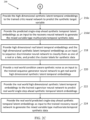
  • FIG. 2A through 2C illustrates an example flow chart of a method 200 for analyzing a plurality of data streams in real time, in accordance with an example embodiment of the present disclosure.
  • the method 200 depicted in the flow chart may be executed by a system, for example, the system 100 of FIG. 1 .
  • the system 100 may be embodied in the computing device.
  • Operations of the flowchart, and combinations of operations in the flowchart may be implemented by various means, such as hardware, firmware, processor, circuitry and/or other device associated with execution of software including one or more computer program instructions.
  • one or more of the procedures described in various embodiments may be embodied by computer program instructions.
  • the computer program instructions, which embody the procedures, described in various embodiments may be stored by at least one memory device of a system and executed by at least one processor in the system. Any such computer program instructions may be loaded onto a computer or other programmable system (for example, hardware) to produce a machine, such that the resulting computer or other programmable system embody means for implementing the operations specified in the flowchart.
  • the operations of the method 200 are described with help of system 100. However, the operations of the method 200 can be described and/or practiced by using any other system.
  • mixed variable type multivariate temporal real time data is provided as an input data.
  • the mixed variable type comprises continuous variables and discrete variables.
  • the input data is preprocessed by scaling to a fixed range for both the continuous variables and the discrete variables.
  • the data pre-processing involves encoding the continuous independent & dependent feature variables by scaling to the fixed-range, [0; 1] by applying the min-max scaling technique.
  • the discrete categorical featre attributes are represented as binary vectors through the one-hot encoding technique.
  • the pre-processed data is split into a training dataset, a validation dataset and a test dataset.
  • the training dataset is used to train multiple neural networks.
  • the validation dataset is used to tune a set of hyperparameters.
  • a joint neural network of an autoencoding-decoding component of a Constraint-Condition-Generative Adversarial Network (ccGAN), a supervisor neural network and a critic neural network is trained utilizing the training dataset.
  • the autoencoding-decoding component comprises an embedding neural network and a recovery neural network.
  • the training comprises the learning of optimum learnable parameters of the embedding neural network, the recovery neural network, the supervisor neural network and the critic neural network.
  • the training dataset is provided as an input to the embedding neural network to generate high dimensional real latent temporal embeddings.
  • the high dimensional real latent temporal embeddings are provided as an input to the recovery neural network to get a reconstructed input training dataset.
  • the embedding and the recovery neural network are jointly trained using a supervised learning approach for reconstructing the training dataset.
  • the high dimensional real latent temporal embeddings are provided as an input to the supervisor neural network to generate a single-step-ahead high dimensional real latent temporal embeddings.
  • the supervisor neural network is trained using the supervised learning approach.
  • the high dimensional real latent temporal embeddings are provided as an input to the critic neural network to predict a target variable.
  • the critic neural network is trained using the supervised learning approach.
  • a cluster label dependent random noise is determined by transforming Gaussian random noise with fixed predetermined cluster labels, wherein the Gaussian random noise is part of the input data.
  • a conditioned knowledge vector is computed corresponding to a pre-determined label value for each discrete variable.
  • the cluster label dependent random noise is concatenated with the conditioned knowledge vector to generate a condition aware synthetic noise.
  • step 216 of the method 200 following neural networks of the Constraint-Condition aware Generative Adversarial Network (ccGAN), a sequence generator neural network, a sequence discriminator neural network, the supervisor neural network and the critic neural network are jointly trained utilizing the condition aware synthetic noise.
  • the training comprises: initially at step 216a, the condition aware synthetic noise is provided as an input to the sequence generator neural network to get high dimensional synthetic latent temporal embeddings.
  • step 216b the high dimensional synthetic latent temporal embeddings are provided to the trained supervisor neural network to predict single-step ahead synthetic temporal latent embeddings.
  • step 216c the high dimensional synthetic latent temporal embeddings are provided to the trained critic neural network to predict the synthetic target variable.
  • the predicted single-step ahead synthetic temporal latent embeddings are provided as an input to the recovery neural network to generate the mixed variable type multivariate temporal synthetic data.
  • the high dimensional real latent temporal embeddings and the high dimensional synthetic latent temporal embeddings are provided as an input to the sequence discriminator neural network to classify them as one of a real or a fake and predict the cluster labels for synthetic data.
  • the validation dataset is utilized as an input to the trained ccGAN to tune a set of hyperparameters.
  • real world condition aware synthetic noise is provided as an input to the trained sequence generator neural network to get real world high dimensional synthetic latent temporal embeddings.
  • real world high dimensional synthetic latent temporal embeddings are provided to the trained supervisor neural network to predict real world single-step ahead synthetic temporal latent embeddings.
  • the real world predicted single-step ahead synthetic temporal latent embeddings are provided as an input to the trained recovery neural network to generate the mixed variable type multivariate temporal synthetic data.
  • the system 100 can be explained with the help of a problem-solution approach.
  • D is observed over T n ⁇ 2N timepoints.
  • D is described by ( D (1) , D ( 2) , ..., D ( T n ⁇ 2N ) ) and observed in timepoints, t E ⁇ 1,2, ..., T n ⁇ 2N ⁇ .
  • D t j ⁇ j ⁇ ⁇ 1,2, ..., f ⁇ denotes the observation value of j-th feature-variable of D t .
  • the observed dataset, D comprises of c-continuous random variables, ⁇ 1, ..., c ⁇ ⁇ f and d-categorical stochastic variables, ⁇ ( c + 1), ..., d ⁇ ⁇ f.
  • the synthetic data generative neural network function, G n is learned by modeling the mixed-feature multivariate time series data, D joint distribution, P(D(l:c;c+l:d)) to generate synthetic data, D ⁇ which is modeled by P ⁇ D ⁇ 1 : c , c + 1 : d .
  • D ⁇ is determined by solving a two machine players, mini-max optimization schema through adversarial training in a competitive game setting. It is expressed as below, min G n max D n E D ⁇ P log D n D + E D ⁇ ⁇ P ⁇ log 1 ⁇ D n D ⁇ D n denotes the sequence discriminator neural network. After training fi n on D.
  • D ⁇ is determined independently by sampling sequences using G n .
  • the drawbacks include to retain the joint distributions of handling mixedfeature type real data, temporal dynamics of the real data, preserve the relationship between the independent feature variables and the target variable in the real data and incorporate a condition and constraint prior knowledge for sampling synthetic data.
  • the sampled, D ⁇ suffer from lack-luster utility for application in downstream tasks.
  • ccGAN algorithmic architecture by operating on rearranged multivariate mixed-feature dataset, D n , 1 : T n the short-comings are addressd by incorporating the condition and constraint knowledge into the generative algorithm and preseve the characteristics of the observed mixedfeature data in the synthetic data.
  • the observed dataset, D is rearranged as, D n , 1 : T n , ⁇ n ⁇ 1 , ... , 2 N
  • T 2 ⁇ D T 2 ⁇ f is an array of arrays, which consists of observations of D t at time points, t ⁇ ⁇ ( T 1 + 1), ..., ( T 1 + T 2 ) ⁇ .
  • the finitelength, T n of each sequence, ⁇ n ⁇ ⁇ 1,...,2N ⁇ is a stochastic variable.
  • T n is constant value across the sequences, ⁇ n ⁇ ⁇ 1, ...,2N ⁇ . It is a hyper-parameter of the hybridlearning algorithm.
  • D n , 1 : T n be the continuous observed multivariate time series of length, T n of the mixed-feature variables, f for a given sequence, n.
  • D n , t D n , t 1 , D n , t 2 , ... , D n , t f .
  • D n , t ⁇ D f is the n-th data sequence observation values of the feature variables, f at the t -th time point, t ⁇ 1: T n .
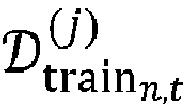
  • the real dataset, D n , 1 : T n of cardinality 2N is split into training data set, D train n , 1 : T n , and test data set, D test n , 1 : T n of cardinality N respectively without random shuffling of D n , 1 : T n .
  • D train n , 1 : T n is modeled with an unknown joint distribution, P D train n , 1 : T n 1 : c , c + 1 : d .
  • the synthetic dataset generated by the ccGAN neural-network architecture is denoted by D ⁇ n , 1 : T n , ⁇ n ⁇ ⁇ 1, ..., N ⁇ .
  • D ⁇ n , 1 : T n The size of D ⁇ n , 1 : T n is N.
  • D ⁇ n , 1 : T n is modeled by distribution, P ⁇ D ⁇ n , 1 : T n 1 : c , c + 1 : d .
  • mixed-feature training data, D train n , 1 : T n learn a density P ⁇ D ⁇ n , 1 : T n 1 : c , c + 1 : d that best approximates P D train n , 1 : T n 1 : c , c + 1 : d .
  • the intent is to precisely represent the conditional distribution P D 1 , t
  • the desideratum of the disclosed framework is also to preserve the temporal dynamics of real data.
  • the synthetic data generative neural network architecture should also preserve the relationship between the independent feature variables, f c ⁇ f and target variable, f T E f of the temporal real data and it is described by, min P ⁇ KL P D train n , t f T
  • Constraint-Conditional Generative Adversarial Network comprises following neural network modules or neural networks, embedding neural network, recovery neural network, sequence generator neural network, critic neural network, and a sequence discriminator neura network as mentinoed above.
  • an embedding and recovery module is configured to train the embedding neural network and the recovery neural network.
  • D j , H j denotes the real j-th variable feature space & the realj-th variable latent embedding space.
  • e rnn is an autoregressive neural-net model. It is realized with an unidirectional recurrent neural network with extended memory. e f is parameterized by a feed-forward neural network.
  • the recovery function transforms the high dimensional temporal latent variables to their corresponding low-level feature representations, R ccGAN : H n , 1 : T n ⁇ ⁇ D n , 1 : T n ⁇ , M n , 1 : T n ⁇ .
  • M n , 1 : T n ⁇ is the binary-valued sparse dataset.
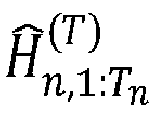
  • the superscript, * denotes for real variables, D train n , 1 : T n , H train n , 1 : T n , M ⁇ train n , 1 : T n , or for synthetic variables, D ⁇ n , 1 : T n , H ⁇ train n , 1 : T n , M ⁇ n , 1 : T n , respectively.
  • r rnn is an autoregressive, casual-ordering driven neural-net model. It is realized with an unidirectional recurrent neural network with extended memory. r f c and r f d are implemented by a feed-forward neural networks. (E) denotes the concatenation operator
  • the intermediate layers of the recovery module applies a sigmoid function, S and the softmax function, S m to output values for continuous feature variables and for the discrete feature variables respectively.
  • S and the softmax function S m to output values for continuous feature variables and for the discrete feature variables respectively.
  • the d-categorical feature variables were transformed, ⁇ (c + 1), ..., d ⁇ ⁇ f to a set of one-hot numeric arrays.
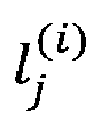
  • l j represents the set of discrete labels associated with the j-th categorical feature variable, j ⁇ ⁇ ( c + 1), ... , d ⁇ ⁇ f .
  • ⁇ ( j ) denotes the one-hot vector corresponding to j-th categorical feature variable.
  • v ⁇ i j is the scalar value of ⁇ ( j ) .
  • l j i denotes the i-th element of the set, l j .
  • the one-hot vector of the discrete feature variable, j ⁇ ⁇ ( c + 1), ..., d ⁇ at each timepoint, t is concatenated to obtain the sparsevector, M n , t for a data sequence, n, ⁇ n ⁇ ⁇ 1, ..., N ⁇ refer to step-8 of the algorithm [2].
  • the objective of the embedding and recovery modules are to minimize the discrepancy between the input mixed-feature real data, D train n , 1 : T n and the reconstructed data, D ⁇ train n , 1 : T n from its corresponding high dimensional latent representations, H train n , 1 : T n as shown in FIG. 3 .
  • M n , t k * 1
  • the supercript, * denotes real, M train n , 1 : T n , the sparse conditional vector c v or synthetic, M ⁇ train n , 1 : T n , M ⁇ n , 1 : T n .
  • M train n , 1 : T n is the ground-truth one-hot encoded sparse matrix determined for discrete feature variables, D train n , 1 : T n c + 1 : d by applying the one hot encoding technique.
  • M ⁇ train n , 1 : T n denotes the reconstructed binary sparse matrix.
  • is a hyper parameter.
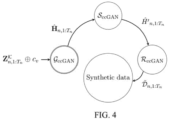
  • the unsupervised loss is minimized, L US through by joint adversarial training of the generator, supervisor and the recovery modules in the unsupervised learning approach as shown in FIG. 4 .
  • the unsupervised learning approach extracts the relationships in the real data through by matching the first and second-order moments of the real, D train n , 1 : T n and the synthetic data, D ⁇ n , 1 : T n .
  • the joint adversarial generative moment-matching network comprising of the generator, supervisor, recovery modules aid in unsupervised inference by enforcing the similarity of two distributions, P D train n , 1 : T n 1 : c , c + 1 : d , P D ⁇ train n , 1 : T n 1 : c , c + 1 : d by minimizing the first,
  • and second order moments, ⁇ ⁇ 1 2 ⁇ ⁇ ⁇ 2 2 differences between the real and the synthetic data as described below, L US D ⁇ 1 ⁇ D ⁇ 2 + ⁇ ⁇ 1 2 ⁇ ⁇ ⁇ 2 2
  • a constraint and condition-aware generator module is configured to incorporate the condition & constraint sampling mechanism into the synthetic data generative neural net.
  • ⁇ ( c + 1, ..., d ) ⁇ ⁇ f, k be the categorical label value for j -th discrete feature variable in the training dataset, D train n , t j at t -th timepoint corresponding to n-th data sequence.
  • the condition-conscious generator neural net, G ccGAN is presented as a sampler for mixed-feature synthetic data, D ⁇ n , t j with a prior knowledge given k -label value for j -th discrete feature attribute at t -th timepoint corresponding to the data sequence, n.
  • the condition-aware generated samples, G ccGAN satisfy the conditional distribution criteria, P ⁇ D ⁇ n , t 1 : c , c + 1 : d
  • G ccGAN learns the real mixed feature datasetjoint conditional probability distribution as expressed below, P ⁇ D ⁇ n , t 1 : c , c + 1 : d
  • D train n , t j k
  • c v The context-free condition embedded vector, c v is presented as a mathematical method for incorporating the condition prior knowledge into the Constraint-Conditional Generative Adversarial Network(ccGAN) framework.
  • m ( j ) is the mask vector corresponding to j-th categorical feature variable.
  • l j is the cardinality of the set of possible categorical label values, l j for the j-th discrete feature variable.
  • l j i j denotes the i -th element of the set, l j .
  • the conditional vector, c v is determined by, m 1 ⁇ ... ⁇ m d
  • c v is derived to operate only on the discrete feature variables for condition-aware synthetic data generation.
  • the sparse conditional vector, c v during the adversarial training penalizes the generator to output appropriate synthetic latent embeddings.
  • the supervisor neural-net operates on the condition embedded synthetic latent embeddings and predicts one-step ahead synthetic temporal latent embeddings. These high dimensional representations are utilized by the recovery function to output the synthetic data, D ⁇ n , 1 : T n * and the sparse dataset, M ⁇ n , 1 : T n * refer to steps 6, 8 & 11 of the algorithm [2].
  • Z n , 1 T n ⁇ R T n ⁇ f be an f-dimensional uniformly distributed random variable of length, T n for a sequence, n with values in the half-open interval [0; 1) sampled from an uniform noise, .
  • the synthetic noise is refined, Z n ,1: T n , ⁇ n ⁇ ⁇ 1, ..., N ⁇ based on the cluster labels, C train n , 1 : T n ⁇ R T n , ⁇ n ⁇ ⁇ 1,2, ..., N ⁇ .
  • the labels are determined by an iterative centroid-based clustering algorithm for assigning a cluster membership to each observation in the unlabeled dataset, D train n , t , ⁇ n ⁇ ⁇ 1, ..., N ⁇ , t ⁇ 1: T n .
  • the labels are computed by partitioning, as belonging to one of the K ⁇ fixed apriori non-overlapping clusters.
  • the adversarial ground-truth labels, C train n , 1 : T n of the mixed-feature dataset, D train n , 1 : T n are obtained through the unsupervised learning technique.
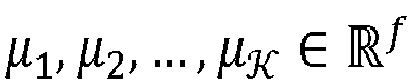
  • the label embedding, e c ⁇ R f ′ , ⁇ c ⁇ K are obtained from the adversarial label embedding matrix, W ⁇ R K ⁇ f ′ based on the corresponding labels, C train n , 1 : T n to support effective learning.
  • the label embedding matrix, W incorporates the similarities of observations across the feature variables to other observations from the same cluster membership.
  • f' is the characteristic dimension of the embedding matrix, W.
  • the label embedding vectors, e c corresponding to the labels, C train n , 1 : T n which incorporate the semantics of the real train dataset are concatenated to obtain the label matrix, L n , 1 : T n c
  • the matrix-matrix product of the cluster-independent noise, Z n , 1 : T n and L n , 1 : T n c is performed to obtain the cluster-dependent noise, Z n , 1 : T n K . .
  • the generative neural net function refer to the algorithm [3], G cpGAN : Z n , 1 : T n K ⁇ c v ⁇ H ⁇ n , 1 : T n takes as an input the realizations of the cluster-dependent noise, Z n , 1 : T n K concatenated with the conditional vector, c v and outputs the synthetic latent variables, H ⁇ n , 1 : T n as shown in FIG. 5 .
  • g ⁇ rnm ⁇ is an autoregressive neural-net model and it is implemented with an unidirectional recurrent neural network with extended memory.
  • g f is implemented by a feed-forward neural network.
  • a discriminator module is configured to train the discriminator neural network.
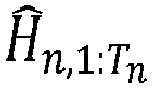
  • the objective of the discriminator network, D ccGAN DccGan in ccGAN architecture is to distinguish the observed and imputed values in H n , 1 : T n * as shown in FIG. 6 .
  • the discriminator net, D ccGAN : H n , 1 : T n * ⁇ p n , 1 : T n , m * , p n , 1 : T n * , P H n , 1 : T n * refer to the algorithm [4] takes as an input the realizations of H n , 1 : T n * and outputs the predicted probability of cluster labels, p n , 1 : T n , m * the predicted probability of adversarial ground-truth, i.e real/synthetic, p n , 1 : T n * the estimated mixed feature joint probability distributions, P H n , 1 : T n 1 : c , c + 1 : d * as described below, p n , 1 : T n , m * , p n , 1 : T n * , P H n , 1 : T n 1 :
  • the supercript, * corresponds to real, p train n , 1 : T n , m , p train n , 1 : T n , P H train n , 1 : T n 1 : c , c + 1 : d or synthetic, p ⁇ n , 1 : T n , m , p ⁇ n , 1 : T n , P ⁇ H ⁇ n , 1 : T n 1 : c , c + 1 : d .
  • the G ccGAN of the ccGAN framework produces synthetic outputs, H ⁇ n , 1 : T n by operating on the random noise, Z n , 1 : T n K , , and the discriminator neural net, D ccGAN by operating on the adversarial learning latent space, , tries to distinguish latent temporal embeddings, H train n , 1 : T n and H ⁇ n , 1 : T n .
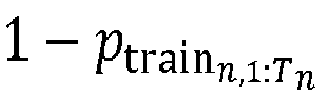
  • T n is the predicted probability of class real and 1 ⁇ p train n , 1 : T n and 1 - p ⁇ n ,1: T n is the predicted probability of class synthetic.
  • D ccGAN tries to minimize, L U .
  • the G ccGAN tries to maximize, L U which helps to learn P ⁇ D ⁇ n , 1 : T n 1 : c , c + 1 : d that best approximates P D train n , 1 : T n 1 : c , c + 1 : d .
  • the prediction of cluster-membership, C n , 1 : T n * ⁇ K is a multinomial classification task.
  • the * ⁇ R T n refers to real or synthetic.
  • a separate loss is computed for each cluster label per latent sequence, n and at timepoint t ( t ⁇ 1: T n . Summation operation of the output over the cluster labels & latent sequences is then performed.
  • y n , 1 : T n c (ground-truth) denotes the binary value of 1 or 0 if cluster-membership, m is the correct label or incorrect label at timepoint t ( t ⁇ 1: T n ) corresponding to latent sequence, n.
  • p train n , 1 : T n , m is the predicted probability for real observation at timepoint, t of data sequence, n belongs to cluster, m.
  • p ⁇ n ,1: T n ,m is the predicted probability for synthetic latent observation at timepoint t of temporal sequence, n belongs to cluster, m.
  • the cluster-membership is determined by,
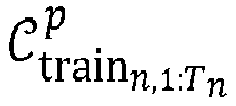
  • C train n , 1 : T n p denote the predicted cluster labels for real data, D train n , 1 : T n by the discriminator neural-network architecture in comparison with the ground-truth, C train n , 1 : T n .
  • C ⁇ n , 1 : T n denote the predicted cluster-membership labels for the synthetic temporal data, D ⁇ n , 1 : T n .
  • L W W P H train n , 1 : T n 1 : c , c + 1 : d , P ⁇ H ⁇ n , 1 : T n 1 : c , c + 1 : d
  • L W inf ⁇ ⁇ ⁇ P P ⁇ E H train n , 1 : T n H ⁇ n , 1 : T n ⁇ ⁇ ⁇ P H train n , 1 : T n 1 : c , c + 1 : d ⁇ P ⁇ H ⁇ n , 1 : T n 1 : c , c + 1 : d ⁇ ⁇ ⁇ ⁇ P H train n , 1 : T n 1 : c , c + 1 : d ⁇ ⁇ ⁇ ⁇ P H train n , 1 : T n 1 : c , c + 1 : d ⁇ ⁇ ⁇ ⁇ P
  • the D cpGAN tries to maximize, L W where as G cpGAN tries to minimize, L W .
  • d rnn is an autoregressive neural-net model and it is implemented with an unidirectional recurrent neural network with extended memory.
  • d f , d f c are implemented by a feed-forward neural network.
  • the critic Module is configured to train the critic neural network.
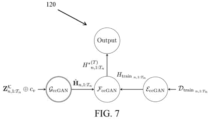
  • the critic module, F ccGAN : H n , 1 : T n * ⁇ R is a neural network model for determining the target variable in predictive analytics task as shown in FIG. 7 .
  • refers to H train n , 1 : T n 1 : f ⁇ 1 or H ⁇ n , 1 : T n 1 : f ⁇ 1 .
  • the critic neural network function takes as an input the realizations of H train n , 1 : T n 1 : f ⁇ 1 or H ⁇ n , 1 : T n 1 : f ⁇ 1 and outputs, H train n , 1 : T n T or H ⁇ n , 1 : T n T .
  • the features selection includes ⁇ (1, ..., f - 1) ⁇ ⁇ f as input independent variables to the model.
  • the last feature column in, H n , 1 : T n T * denoted by the supersript, T ⁇ f denotes the target variable to predict.
  • the G ccGAN tries to minimize, L F to preserve the relationship between independent feature variables and the target variable in the real dataset during the adversarial training to output the synthetic data, D ⁇ n , 1 : T n .
  • c rnn is an autoregressive neural-net model and it is implemented with an unidirectional recurrent neural network with extended memory.
  • c f is implemented by a feed-forward neural network.
  • a supervisor module is configured to train the supervisor neural network.
  • the supervisor neural network function is leveraged to retain the conditional temporal dynamics of the original data in the generated synthetic dataset, D ⁇ n , 1 : T n .
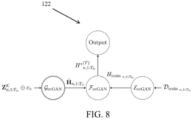
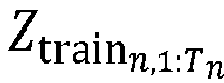
  • Z train n , 1 : T n K is obtained by transforming random noise sampled from multivariate normal distribution, Z train n , 1 : T n based on the cluster labels, C train n , 1 : T n as shown in FIG. 8 .
  • the G ccGAN neural-net of the ccGAN framework takes as input a cluster-membership dependent random noise, Z train n , 1 : T n K and the condition vector, c v to generate the synthetic latent variables, H ⁇ n , 1 : T n .
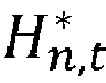
  • the auto-regressive sequence module, H n , t * , ⁇ n ⁇ ⁇ 1, ..., N ⁇ , t ⁇ 1: T n takes as input H n , 1 : t ⁇ 1 * and outputs the single-step ahead prediction of the temporal latent variable, H n , t * conditioned on the past latent sequences.
  • the G ccGAN during the adversarial training in the closed-loop receives as input the ground-truth, H train n , 1 : T n from ⁇ ccGAN & minimizes L S by forcing the H ⁇ n , 1 : T n ′ assessed by the inaccurate adversary D ccGAN to preserve the single-step transitions of the H train n , 1 : T n .
  • s rnn is an autoregressive neural-net model and it is implemented with an unidirectional recurrent neural network with extended memory.
  • s f is implemented by a feed-forward neural network.
  • the ccGAN algorithm is trained as follows as shown in FIG. 9 .
  • the embedding neural network ⁇ ccGAN and the recovery network R ccGAN are trained jointly on the reconstruction of the real temporal data, D train n , 1 : T n with an objective to learn a higher-dimensional representation (feature encoding) from the lower-dimensional mixed-feature dataset, D train n , 1 : T n .
  • the supervisor network is trained in the supervisedlearning approach on the single-step ahead prediction task of the real latent variable, H train n , 1 : T n by operating in the latent space, .
  • the critic network F ccGAN is trained initially on the real data to map the independent feature variables to the target variable by minimizing the prediction loss, L F .
  • the objective is to minimize, min ⁇ e , ⁇ r , ⁇ s , ⁇ c L R + ⁇ L M + L S + L F D train n , 1 : T n in supervised learning approach by operating on the lower-dimensional mixedfeature dataset, D train n , 1 : T n to extract characteristics of the real data.
  • ⁇ e , ⁇ r , ⁇ s , ⁇ c denote the learnable-parameters of the embedding, the recovery, the supervisor and the critic modules respectively.
  • ⁇ g , ⁇ d denote the learnable parameters of the G ccGAN , D ccGAN neural network functions.
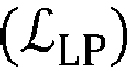
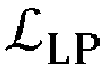
  • G ccGAN is trained by seven distinct loss functions L US , L U , L W , L M , L S , L F and L LP .
  • ⁇ ⁇ R + 100
  • 10.
  • D ccGAN is trained by three distinct loss functions L U , L W , and L LP .
  • the system 100 is also explained with the help of experimental data. Two datasets were taken for testing,
  • the ETT dataset is composed of continuous variables.
  • the ccGAN algorithmic architecture is trained by the real training dataset.
  • the validation dataset is utilized for hyperparameter tuning and for tuned model selection.
  • the synthetic data is sampled from the ccGAN framework.
  • the LSTM neural-network architecture acts as a baseline model trained by the real training dataset for target oil temperature (°C) prediction.
  • the LSTM* is a target prediction model trained jointly with the real training and the sampled synthetic dataset. The performance of both the models were evaluated on the real Holdout or the test dataset. It is report, in Table 2 a 25.66% & 13.06% drop in prediction error(RMSE) on ETTh 1 and ETTh 2 test datasets respectively.
  • the ccGAN algorithmic architecture is trained by leveraging the corresponding training datasets.
  • the validation dataset is utilized for hyper-parameter tuning & drives the model selection to avoid over-fitting of the ccGAN architecture.
  • the GRU neural-net architecture is trained jointly with the real training dataset and the sampled multivariate, mixed data type synthetic dataset for the prediction of remaining useful life (RUL) of turbofan engines.
  • the performance of the model is evaluated on the real Holdout dataset for comparison with the literature. It was observed that the RUL prediction model outperformed all other baseline models across all the datasets.
  • the synthetic dataset has learned key-dominant patterns across the real training dataset. It is well-generalized and resulted in better performance of the prediction model on the real Holdout set.
  • the embodiments of present disclosure herein address unresolved problem of synthetic data generation with accuracy and multiple variables.
  • the embodiment thus provides a method and a system for generating mixed variable type multivariate temporal synthetic data.
  • a data augmentation framework is provided to generate condition and constraint knowledge-conscious mixed-data type multivariate time-series synthetic industrial data to aid in downstream target prediction tasks.
  • the condition & constraint incorporated synthetic data generation of industrial-plant or equipment-level sensory information by the conservation laws guided generative adversarial neural network architectures could better serve as virtual simulations of capturing process or equipment level data underneath probability distributions and aid in prognostics and health management of industrial assets.
  • the hardware device can be any kind of device which can be programmed including e.g. any kind of computer like a server or a personal computer, or the like, or any combination thereof.
  • the device may also include means which could be e.g. hardware means like e.g. an applicationspecific integrated circuit (ASIC), a field-programmable gate array (FPGA), or a combination of hardware and software means, e.g.
  • ASIC applicationspecific integrated circuit
  • FPGA field-programmable gate array
  • the means can include both hardware means and software means.
  • the method embodiments described herein could be implemented in hardware and software.
  • the device may also include software means.
  • the embodiments may be implemented on different hardware devices, e.g. using a plurality of CPUs.
  • the embodiments herein can comprise hardware and software elements.
  • the embodiments that are implemented in software include but are not limited to, firmware, resident software, microcode, etc.
  • the functions performed by various components described herein may be implemented in other components or combinations of other components.
  • a computerusable or computer readable medium can be any apparatus that can comprise, store, communicate, propagate, or transport the program for use by or in connection with the instruction execution system, apparatus, or device.
  • a computer-readable storage medium refers to any type of physical memory on which information or data readable by a processor may be stored.
  • a computer-readable storage medium may store instructions for execution by one or more processors, including instructions for causing the processor(s) to perform steps or stages consistent with the embodiments described herein.
  • the term "computer-readable medium” should be understood to include tangible items and exclude carrier waves and transient signals, i.e., be non-transitory. Examples include random access memory (RAM), read-only memory (ROM), volatile memory, nonvolatile memory, hard drives, CD ROMs, DVDs, flash drives, disks, and any other known physical storage media.

Landscapes

  • Engineering & Computer Science (AREA)
  • Physics & Mathematics (AREA)
  • Theoretical Computer Science (AREA)
  • General Health & Medical Sciences (AREA)
  • Computing Systems (AREA)
  • Biomedical Technology (AREA)
  • Biophysics (AREA)
  • Computational Linguistics (AREA)
  • Data Mining & Analysis (AREA)
  • Evolutionary Computation (AREA)
  • Life Sciences & Earth Sciences (AREA)
  • Molecular Biology (AREA)
  • Artificial Intelligence (AREA)
  • General Engineering & Computer Science (AREA)
  • General Physics & Mathematics (AREA)
  • Mathematical Physics (AREA)
  • Software Systems (AREA)
  • Health & Medical Sciences (AREA)
  • Probability & Statistics with Applications (AREA)
  • Management, Administration, Business Operations System, And Electronic Commerce (AREA)

Abstract

Health monitoring of complex industrial assets remains the most critical task for avoiding downtimes, improving system reliability, safety and maximizing utilization. Recent advances in time-series synthetic data generation have several inherent limitations for realistic applications. A method and system have been provided for generating mixed variable type multivariate temporal synthetic data. The system provides a framework for condition and constraint knowledge-driven synthetic data generation of real-world industrial mixed-data type multivariate time-series data. The framework consists of a generative time-series model, which is trained adversarially and jointly through a learned latent embedding space with both supervised and unsupervised losses. The system addresses the key desideratum in diverse time dependent data fields where data availability, data accuracy, precision, timeliness, and completeness are of prior importance in improving the performance of the deep learning models.

Description

    CROSS-REFERENCE TO RELATED APPLICATIONS AND PRIORITY
  • The present application claims priority to Indian application no. 202221000662, filed on 05 January 2022 .
  • TECHNICAL FIELD
  • The disclosure herein generally relates to the field of synthetic data generation, and, more particularly, to a method and system for generating mixed variable type multivariate temporal synthetic data.
  • BACKGROUND
  • Health monitoring of complex industrial assets remains the most critical task for avoiding downtimes, improving system reliability, safety and maximize utilization. The industrial assets rely on large amount of data for functioning and operation. There is a rising emphasis in the industry to leverage ad hoc artificial intelligence (AI) driven technology landscape for various activities. One of the activity is designing and operating the process twins of various industrial assets. Deep learning algorithms in the recent times have been extensively leveraged in modeling complex phenomena in diverse time dependent data fields but not limited to financial, medical, weather, process-plants for classification, anomaly detection challenge, etc. Data abundance and quality of the data substantially impedes performance of deep learning models.
  • Deep learning-driven generative models encapsulate the operational behavior from adversarial losses through adversarial training of complex large-scale industrial-plants or asset multivariate time series data. The generative information helps to study the industrial plant performance, and life-cycle operation conditions of industrial assets to aid in prognostics, optimization, and predictive maintenance.
  • Recent works in time-series synthetic data generation include but have several inherent limitations for realistic applications. The existing tools for multivariate data synthesis do not utilize a unified approach.
  • SUMMARY
  • Embodiments of the present disclosure present technological improvements as solutions to one or more of the above-mentioned technical problems recognized by the inventors in conventional systems. For example, in one embodiment, a system for generating mixed variable type multivariate temporal synthetic data is provided. The system comprises an input/output interface, one or more hardware processors and a memory. The memory is in communication with the one or more hardware processors, wherein the one or more first hardware processors are configured to execute programmed instructions stored in the one or more first memories, to: provide mixed variable type multivariate temporal real time data as an input data, wherein the mixed variable type comprises continuous variables and discrete variables; pre-process the input data by scaling to a fixed range for both the continuous variables and the discrete variables; split the pre-processed data into a training dataset, a validation dataset and a test dataset; train a joint neural network of an autoencoding-decoding component of a Constraint-Condition-Generative Adversarial Network (ccGAN), a supervisor neural network and a critic neural network utilizing the training dataset, wherein the autoencoding-decoding component comprises an embedding neural network and a recovery neural network, the training comprises: providing the training dataset as an input to the embedding neural network to generate high dimensional real latent temporal embeddings, providing the high dimensional real latent temporal embeddings as an input to the recovery neural network to get a reconstructed input training dataset, wherein the embedding and the recovery neural network is jointly trained using a supervised learning approach for reconstructing the training dataset, providing the high dimensional real latent temporal embeddings as an input to the supervisor neural network to generate a single-step-ahead high dimensional real latent temporal embeddings, wherein the supervisor neural network is trained using the supervised learning approach, and providing the high dimensional real latent temporal embeddings as an input to the critic neural network to predict a target variable, wherein the critic neural network is trained using the supervised learning approach; determine a cluster label dependent random noise by transforming Gaussian random noise with a fixed predetermined cluster labels, wherein the Gaussian random noise is part of the input data; compute a conditioned knowledge vector corresponding to a predetermined label value for each discrete variable; concatenate the cluster label dependent random noise with the conditioned knowledge vector to generate a condition aware synthetic noise; jointly train adversarial neural networks of the Constraint-Condition aware Generative Adversarial Network (ccGAN), a sequence generator neural network, a sequence discriminator neural network, the supervisor neural network and the critic neural network utilizing the condition aware synthetic noise, wherein the training comprises: providing the condition aware synthetic noise as an input to the sequence generator neural network to get high dimensional synthetic latent temporal embeddings, providing the high dimensional synthetic latent temporal embeddings to the trained supervisor neural network to predict single-step ahead synthetic temporal latent embeddings, providing the high dimensional synthetic latent temporal embeddings to the trained critic neural network to predict the synthetic target variable, and providing the predicted single-step ahead synthetic temporal latent embeddings as an input to the recovery neural network to generate the mixed variable type multivariate temporal synthetic data; provide the high dimensional real latent temporal embeddings and the high dimensional synthetic latent temporal embeddings as an input to the sequence discriminator neural network to classify them as one of a real or a fake, and predict the cluster labels for synthetic data; provide a real world condition aware synthetic noise as an input to the trained sequence generator neural network to get real world high dimensional synthetic latent temporal embeddings; provide the real world high dimensional synthetic latent temporal embeddings to the trained supervisor neural network to predict real world single-step ahead synthetic temporal latent embeddings; and provide the real world predicted single-step ahead synthetic temporal latent embeddings as an input to the trained recovery neural network to generate the mixed variable type multivariate temporal synthetic data.
  • In another aspect, a method for generating mixed variable type multivariate temporal synthetic data is provided. Initially, mixed variable type multivariate temporal real time data is provided as an input data, wherein the mixed variable type comprises continuous variables and discrete variables. Further, the input data is preprocessed by scaling to a fixed range for both the continuous variables and the discrete variables. In the next step, the pre-processed data is split into a training dataset, a validation dataset and a test dataset. The training dataset is then trained on a joint neural network of an autoencoding-decoding component of a Constraint-Condition-Generative Adversarial Network (ccGAN), a supervisor neural network and a critic neural network, wherein the autoencoding-decoding component comprises an embedding neural network and a recovery neural network. The training comprises: providing the training dataset as an input to the embedding neural network to generate high dimensional real latent temporal embeddings, providing the high dimensional real latent temporal embeddings as an input to the recovery neural network to get a reconstructed input training dataset, wherein the embedding and the recovery neural network is jointly trained using a supervised learning approach for reconstructing the training dataset, providing the high dimensional real latent temporal embeddings as an input to the supervisor neural network to generate a single-step-ahead high dimensional real latent temporal embeddings, wherein the supervisor neural network is trained using the supervised learning approach, and providing the high dimensional real latent temporal embeddings as an input to the critic neural network to predict a target variable, wherein the critic neural network is trained using the supervised learning approach. In the next step, a cluster label dependent random noise is determined by transforming Gaussian random noise with a fixed predetermined cluster labels, wherein the Gaussian random noise is part of the input data. Further, a conditioned knowledge vector is computed corresponding to a pre-determined label value for each discrete variable. In the next step, the cluster label dependent random noise is concatenated with the conditioned knowledge vector to generate a condition aware synthetic noise. Neural networks of the Constraint-Condition aware Generative Adversarial Network (ccGAN), a sequence generator neural network, a sequence discriminator neural network, the supervisor neural network and the critic neural network are then jointly trained utilizing the condition aware synthetic noise. The training comprises: providing the condition aware synthetic noise as an input to the sequence generator neural network to get high dimensional synthetic latent temporal embeddings, providing the high dimensional synthetic latent temporal embeddings to the trained supervisor neural network to predict single-step ahead synthetic temporal latent embeddings, providing the high dimensional synthetic latent temporal embeddings to the trained critic neural network to predict the synthetic target variable, and providing the predicted single-step ahead synthetic temporal latent embeddings as an input to the recovery neural network to generate the mixed variable type multivariate temporal synthetic data. Further, the high dimensional real latent temporal embeddings and the high dimensional synthetic latent temporal embeddings are provided as an input to the sequence discriminator neural network to classify them as one of a real or a fake, and predict the cluster labels for synthetic data. In the next step, a real world condition aware synthetic noise is provided as an input to the trained sequence generator neural network to get real world high dimensional synthetic latent temporal embeddings. Further, the real world high dimensional synthetic latent temporal embeddings are provided to the trained supervisor neural network to predict real world single-step ahead synthetic temporal latent embeddings. And finally, the real world predicted single-step ahead synthetic temporal latent embeddings are provided as an input to the trained recovery neural network to generate the mixed variable type multivariate temporal synthetic data.
  • In yet another aspect, one or more non-transitory machine-readable information storage mediums comprising one or more instructions which when executed by one or more hardware processors cause generating mixed variable type multivariate temporal synthetic data is provided. Initially, mixed variable type multivariate temporal real time data is provided as an input data, wherein the mixed variable type comprises continuous variables and discrete variables. Further, the input data is preprocessed by scaling to a fixed range for both the continuous variables and the discrete variables. In the next step, the pre-processed data is split into a training dataset, a validation dataset and a test dataset. The training dataset is then trained on a joint neural network of an autoencoding-decoding component of a Constraint-Condition-Generative Adversarial Network (ccGAN), a supervisor neural network and a critic neural network, wherein the autoencoding-decoding component comprises an embedding neural network and a recovery neural network. The training comprises: providing the training dataset as an input to the embedding neural network to generate high dimensional real latent temporal embeddings, providing the high dimensional real latent temporal embeddings as an input to the recovery neural network to get a reconstructed input training dataset, wherein the embedding and the recovery neural network is jointly trained using a supervised learning approach for reconstructing the training dataset, providing the high dimensional real latent temporal embeddings as an input to the supervisor neural network to generate a single-step-ahead high dimensional real latent temporal embeddings, wherein the supervisor neural network is trained using the supervised learning approach, and providing the high dimensional real latent temporal embeddings as an input to the critic neural network to predict a target variable, wherein the critic neural network is trained using the supervised learning approach. In the next step, a cluster label dependent random noise is determined by transforming Gaussian random noise with a fixed predetermined cluster labels, wherein the Gaussian random noise is part of the input data. Further, a conditioned knowledge vector is computed corresponding to a pre-determined label value for each discrete variable. In the next step, the cluster label dependent random noise is concatenated with the conditioned knowledge vector to generate a condition aware synthetic noise. Neural networks of the Constraint-Condition aware Generative Adversarial Network (ccGAN), a sequence generator neural network, a sequence discriminator neural network, the supervisor neural network and the critic neural network are then jointly trained utilizing the condition aware synthetic noise. The training comprises: providing the condition aware synthetic noise as an input to the sequence generator neural network to get high dimensional synthetic latent temporal embeddings, providing the high dimensional synthetic latent temporal embeddings to the trained supervisor neural network to predict single-step ahead synthetic temporal latent embeddings, providing the high dimensional synthetic latent temporal embeddings to the trained critic neural network to predict the synthetic target variable, and providing the predicted single-step ahead synthetic temporal latent embeddings as an input to the recovery neural network to generate the mixed variable type multivariate temporal synthetic data. Further, the high dimensional real latent temporal embeddings and the high dimensional synthetic latent temporal embeddings are provided as an input to the sequence discriminator neural network to classify them as one of a real or a fake and predict the cluster labels for synthetic data. In the next step, a real world condition aware synthetic noise is provided as an input to the trained sequence generator neural network to get real world high dimensional synthetic latent temporal embeddings. Further, the real world high dimensional synthetic latent temporal embeddings are provided to the trained supervisor neural network to predict real world single-step ahead synthetic temporal latent embeddings. And finally, the real world predicted single-step ahead synthetic temporal latent embeddings are provided as an input to the trained recovery neural network to generate the mixed variable type multivariate temporal synthetic data.
  • It is to be understood that both the foregoing general description and the following detailed description are exemplary and explanatory only and are not restrictive of the invention, as claimed.
  • BRIEF DESCRIPTION OF THE DRAWINGS
  • The accompanying drawings, which are incorporated in and constitute a part of this disclosure, illustrate exemplary embodiments and, together with the description, serve to explain the disclosed principles:
    • FIG. 1 illustrates a block diagram of a system for generating mixed variable type multivariate temporal synthetic data according to some embodiments of the present disclosure.
    • FIG. 2A through FIG. 2C is a flowchart illustrating steps involved in generating mixed variable type multivariate temporal synthetic data according to some embodiments of the present disclosure.
    • FIG. 3 is a block diagram of an embedding and recovery module according to some embodiments of the present disclosure.
    • FIG. 4 is a block diagram showing unsupervised learning of the generator neural network, the supervisor neural network and the recovery neural network according to some embodiments of the present disclosure.
    • FIG. 5 is a block diagram of a generator module according to some embodiments of the present disclosure.
    • FIG. 6 is a block diagram of a discriminator module according to some embodiments of the present disclosure.
    • FIG. 7 is a block diagram of a critic module according to some embodiments of the present disclosure.
    • FIG. 8 is a block diagram of a supervisor module according to some embodiments of the present disclosure.
    • FIG. 9 is a block diagram showing training of the joint network in supervised-learning approach according to some embodiments of the present disclosure.
    DETAILED DESCRIPTION OF EMBODIMENTS
  • Exemplary embodiments are described with reference to the accompanying drawings. In the figures, the left-most digit(s) of a reference number identifies the figure in which the reference number first appears. Wherever convenient, the same reference numbers are used throughout the drawings to refer to the same or like parts. While examples and features of disclosed principles are described herein, modifications, adaptations, and other implementations are possible without departing from the scope of the disclosed embodiments.
  • Health monitoring of complex industrial assets remains the most critical task for avoiding downtimes, improving system reliability, safety and maximizing utilization. Deep learning-driven generative models encapsulate the operational behavior from adversarial losses through adversarial training of the complex large-scale industrial-plant or asset multivariate time series data. Recent advances in time-series synthetic data generation have several inherent limitations for realistic applications. The existing solutions do not provide a unified approach and do not generate the realistic data which can be used in the industrial processes. Further, the existing solution is not able to incorporate condition and constraint prior knowledge while sampling the synthetic data.
  • The present disclosure provides a method and system for generating mixed variable type multivariate temporal synthetic data. The system provides a framework for condition and constraint knowledge-driven synthetic data generation of real-world industrial mixed-data type multivariate time-series data. The framework consists of a generative time-series model, which is trained adversarially (the adversarial loss is described by a continuously trained generative network player to generate samples that have a low probability of being unrealistic in contrast to the discriminator loss, as determined by the discriminator player which is trained to classify both the true data and the synthetic data from the generator player) and jointly through a learned latent embedding space with both supervised and unsupervised losses. The key challenges are encapsulating the distributions of mixed-data types variables and correlations within each timestamp as well as the temporal dependencies of those variables across time frames.
  • The present disclosure addresses the key desideratum in diverse time dependent data fields where data availability, data accuracy, precision, timeliness, and completeness are of prior importance in improving the performance of the deep learning models.
  • Referring now to the drawings, and more particularly to FIG. 1 through FIG. 9, where similar reference characters denote corresponding features consistently throughout the figures, there are shown preferred embodiments and these embodiments are described in the context of the following exemplary system and/or method.
  • According to an embodiment of the disclosure, FIG. 1 illustrates a block diagram of a system 100 for generating mixed variable type multivariate temporal synthetic data. The system 100 comprises a generative model through an adversarial training process between generator and discriminator network player is a unified algorithmic approach from autoregressive models for sequence prediction, Generative Adversarial Networks (GAN) based methods for sequence generation, and for time-series representation learning.
  • It may be understood that the system 100 comprises one or more computing devices 102, such as a laptop computer, a desktop computer, a notebook, a workstation, a cloud-based computing environment and the like. It will be understood that the system 100 may be accessed through one or more input/output interfaces 104, collectively referred to as I/O interface 104 or user interface 104. Examples of the I/O interface 104 may include, but are not limited to, a user interface, a portable computer, a personal digital assistant, a handheld device, a smartphone, a tablet computer, a workstation and the like. The I/O interface 104 are communicatively coupled to the system 100 through a network 106.
  • In an embodiment, the network 106 may be a wireless or a wired network, or a combination thereof. In an example, the network 106 can be implemented as a computer network, as one of the different types of networks, such as virtual private network (VPN), intranet, local area network (LAN), wide area network (WAN), the internet, and such. The network 106 may either be a dedicated network or a shared network, which represents an association of the different types of networks that use a variety of protocols, for example, Hypertext Transfer Protocol (HTTP), Transmission Control Protocol/Internet Protocol (TCP/IP), and Wireless Application Protocol (WAP), to communicate with each other. Further, the network 106 may include a variety of network devices, including routers, bridges, servers, computing devices, storage devices. The network devices within the network 106 may interact with the system 100 through communication links.
  • The system 100 may be implemented in a workstation, a mainframe computer, a server, and a network server. In an embodiment, the computing device 102 further comprises one or more hardware processors 108, one or more memory 110, hereinafter referred as a memory 110 and a data repository 112, for example, a repository 112. The memory 110 is in communication with the one or more hardware processors 108, wherein the one or more hardware processors 108 are configured to execute programmed instructions stored in the memory 110, to perform various functions as explained in the later part of the disclosure. The repository 112 may store data processed, received, and generated by the system 100. The memory 110 further comprises a plurality of modules for performing various functions. The plurality of modules comprises an embedding and recovery module 114, a generator module 116, a discriminator module 118, a critic module 120, and a supervisor module 122.
  • The system 100 supports various connectivity options such as BLUETOOTH®, USB, ZigBee and other cellular services. The network environment enables connection of various components of the system 100 using any communication link including Internet, WAN, MAN, and so on. In an exemplary embodiment, the system 100 is implemented to operate as a stand-alone device. In another embodiment, the system 100 may be implemented to work as a loosely coupled device to a smart computing environment. The components and functionalities of the system 100 are described further in detail.
  • FIG. 2A through 2C illustrates an example flow chart of a method 200 for analyzing a plurality of data streams in real time, in accordance with an example embodiment of the present disclosure. The method 200 depicted in the flow chart may be executed by a system, for example, the system 100 of FIG. 1. In an example embodiment, the system 100 may be embodied in the computing device.
  • Operations of the flowchart, and combinations of operations in the flowchart, may be implemented by various means, such as hardware, firmware, processor, circuitry and/or other device associated with execution of software including one or more computer program instructions. For example, one or more of the procedures described in various embodiments may be embodied by computer program instructions. In an example embodiment, the computer program instructions, which embody the procedures, described in various embodiments may be stored by at least one memory device of a system and executed by at least one processor in the system. Any such computer program instructions may be loaded onto a computer or other programmable system (for example, hardware) to produce a machine, such that the resulting computer or other programmable system embody means for implementing the operations specified in the flowchart. It will be noted herein that the operations of the method 200 are described with help of system 100. However, the operations of the method 200 can be described and/or practiced by using any other system.
  • Initially at step 202 of the method 200, mixed variable type multivariate temporal real time data is provided as an input data. The mixed variable type comprises continuous variables and discrete variables.
  • Further at step 204, the input data is preprocessed by scaling to a fixed range for both the continuous variables and the discrete variables. The data pre-processing involves encoding the continuous independent & dependent feature variables by scaling to the fixed-range, [0; 1] by applying the min-max scaling technique. The discrete categorical featre attributes are represented as binary vectors through the one-hot encoding technique. At step 206, the pre-processed data is split into a training dataset, a validation dataset and a test dataset. The training dataset is used to train multiple neural networks. The validation dataset is used to tune a set of hyperparameters.
  • Further at step 208 of the method 200, a joint neural network of an autoencoding-decoding component of a Constraint-Condition-Generative Adversarial Network (ccGAN), a supervisor neural network and a critic neural network is trained utilizing the training dataset. The autoencoding-decoding component comprises an embedding neural network and a recovery neural network. The training comprises the learning of optimum learnable parameters of the embedding neural network, the recovery neural network, the supervisor neural network and the critic neural network.
  • At step 208a, the training dataset is provided as an input to the embedding neural network to generate high dimensional real latent temporal embeddings. At step 208b, the high dimensional real latent temporal embeddings are provided as an input to the recovery neural network to get a reconstructed input training dataset. The embedding and the recovery neural network are jointly trained using a supervised learning approach for reconstructing the training dataset. At step 208c, the high dimensional real latent temporal embeddings are provided as an input to the supervisor neural network to generate a single-step-ahead high dimensional real latent temporal embeddings. The supervisor neural network is trained using the supervised learning approach. And at step 208d, the high dimensional real latent temporal embeddings are provided as an input to the critic neural network to predict a target variable. The critic neural network is trained using the supervised learning approach.
  • Further at step 210 of the method 200, a cluster label dependent random noise is determined by transforming Gaussian random noise with fixed predetermined cluster labels, wherein the Gaussian random noise is part of the input data. At step 212, a conditioned knowledge vector is computed corresponding to a pre-determined label value for each discrete variable. At step 214 the cluster label dependent random noise is concatenated with the conditioned knowledge vector to generate a condition aware synthetic noise.
  • Further at step 216 of the method 200, following neural networks of the Constraint-Condition aware Generative Adversarial Network (ccGAN), a sequence generator neural network, a sequence discriminator neural network, the supervisor neural network and the critic neural network are jointly trained utilizing the condition aware synthetic noise. The training comprises: initially at step 216a, the condition aware synthetic noise is provided as an input to the sequence generator neural network to get high dimensional synthetic latent temporal embeddings. At step 216b, the high dimensional synthetic latent temporal embeddings are provided to the trained supervisor neural network to predict single-step ahead synthetic temporal latent embeddings. At step 216c, the high dimensional synthetic latent temporal embeddings are provided to the trained critic neural network to predict the synthetic target variable. And at step 216d, the predicted single-step ahead synthetic temporal latent embeddings are provided as an input to the recovery neural network to generate the mixed variable type multivariate temporal synthetic data.
  • Further, at step 218 of the method 200, the high dimensional real latent temporal embeddings and the high dimensional synthetic latent temporal embeddings are provided as an input to the sequence discriminator neural network to classify them as one of a real or a fake and predict the cluster labels for synthetic data. It should be appreciated that the validation dataset is utilized as an input to the trained ccGAN to tune a set of hyperparameters.
  • Further at step 220 of the method 200, real world condition aware synthetic noise is provided as an input to the trained sequence generator neural network to get real world high dimensional synthetic latent temporal embeddings. At step 222, real world high dimensional synthetic latent temporal embeddings are provided to the trained supervisor neural network to predict real world single-step ahead synthetic temporal latent embeddings. And finally, at step 224, the real world predicted single-step ahead synthetic temporal latent embeddings are provided as an input to the trained recovery neural network to generate the mixed variable type multivariate temporal synthetic data.
  • According to an embodiment of the disclosure, the system 100 can be explained with the help of a problem-solution approach. To formulate the problem, it is considered that the mixed-feature f-dimensional time series dataset, D is observed over Tn × 2N timepoints. D is described by (D (1), D(2), ..., D (Tn ×2N)) and observed in timepoints, t E {1,2, ..., Tn × 2N}. The observations of the f-stochastic variables at t - th timepoint is given by D t = D t 1 , , D t f D f . D t j
    Figure imgb0001
    , ∀ j ∈ {1,2, ..., f} denotes the observation value of j-th feature-variable of Dt. The observed dataset, D comprises of c-continuous random variables, {1, ..., c} ⊂ f and d-categorical stochastic variables, {(c + 1), ..., d} ⊂ f. f(=c=d) denotes the total number of feature variables in the real dataset, D. The mixed-feature f-dimensional space is denoted by
    Figure imgb0002
    .
    Figure imgb0003
    is given by, j = 1 f D j
    Figure imgb0004
    . In general, the synthetic data generative neural network function, G n
    Figure imgb0005
    is learned by modeling the mixed-feature multivariate time series data, D joint distribution, P(D(l:c;c+l:d)) to generate synthetic data, which is modeled by ^ D ˜ 1 : c , c + 1 : d
    Figure imgb0006
    . is determined by solving a two machine players, mini-max optimization schema through adversarial training in a competitive game setting. It is expressed as below, min G n max D n E D log D n D + E D ˜ ^ log 1 D n D ˜
    Figure imgb0007
    D n
    Figure imgb0008
    denotes the sequence discriminator neural network. After training fin on D. is determined independently by sampling sequences using G n
    Figure imgb0009
    . The drawbacks of the traditional synthetic data generative algorithms solved through, refer equation[1]. The drawbacks include to retain the joint distributions of handling mixedfeature type real data, temporal dynamics of the real data, preserve the relationship between the independent feature variables and the target variable in the real data and incorporate a condition and constraint prior knowledge for sampling synthetic data. The sampled, suffer from lack-luster utility for application in downstream tasks. In the present disclosure, ccGAN algorithmic architecture by operating on rearranged multivariate mixed-feature dataset, D n , 1 : T n
    Figure imgb0010
    the short-comings are adressed by incorporating the condition and constraint knowledge into the generative algorithm and preseve the characteristics of the observed mixedfeature data in the synthetic data. The observed dataset, D is rearranged as, D n , 1 : T n , n 1 , , 2 N
    Figure imgb0011
  • The cardinality of the real dataset, D n , 1 : T n T n × f
    Figure imgb0012
    , ∀ n ∈ {1,...,2N} is 2N. Lets consider for n = 1, D 1,1 : T 1 D T 1 × f
    Figure imgb0013
    . T1 denotes the finite length of the sequence, n = 1. J 1,1 : T 1
    Figure imgb0014
    consists of observations of Dt at time points, t ∈ {1,2, ..., T1}. In the same way for the sequence, n = 2. J 2,1 : T 2 D T 2 × f
    Figure imgb0015
    is an array of arrays, which consists of observations of Dt at time points, t ∈ {(T 1 + 1), ..., (T 1 + T 2)}. The finitelength, Tn of each sequence, ∀ n ∈ {1,...,2N} is a stochastic variable. Tn is constant value across the sequences, ∀ n ∈ {1, ...,2N}. It is a hyper-parameter of the hybridlearning algorithm. D n , 1 : T n
    Figure imgb0016
    be the continuous observed multivariate time series of length, Tn of the mixed-feature variables, f for a given sequence, n. D n , t =
    Figure imgb0017
    D n , t 1 , D n , t 2 , , D n , t f
    Figure imgb0018
    . D n , t D f
    Figure imgb0019
    is the n-th data sequence observation values of the feature variables, f at the t-th time point, t ∈ 1:Tn . D n , t j D j
    Figure imgb0020
    , t ∈ 1:Tn denotes the observed value of the j-th feature variable in D n , t D f
    Figure imgb0021
    . The real dataset, D n , 1 : T n
    Figure imgb0022
    of cardinality 2N is split into training data set, D train n , 1 : T n
    Figure imgb0023
    , and test data set, D test n , 1 : T n
    Figure imgb0024
    of cardinality N respectively without random shuffling of D n , 1 : T n
    Figure imgb0025
    . D train n , 1 : T n
    Figure imgb0026
    is modeled with an unknown joint distribution, D train n , 1 : T n 1 : c , c + 1 : d
    Figure imgb0027
    . The synthetic dataset generated by the ccGAN neural-network architecture is denoted by D ˜ n , 1 : T n
    Figure imgb0028
    , ∀ n ∈ {1, ..., N}. The size of D ˜ n , 1 : T n
    Figure imgb0029
    is N. Lets say, D ˜ n , 1 : T n
    Figure imgb0030
    is modeled by distribution, ˜ D ˜ n , 1 : T n 1 : c , c + 1 : d
    Figure imgb0031
    . In the present disclosure, mixed-feature training data, D train n , 1 : T n
    Figure imgb0032
    learn a density ˜ D ˜ n , 1 : T n 1 : c , c + 1 : d
    Figure imgb0033
    that best approximates D train n , 1 : T n 1 : c , c + 1 : d
    Figure imgb0034
    . It is mathematically described as by minimizing the weighted sum of the Kullback-Leibler(KL) divergence and the Wasserstein distance function(R) of order-1 defined between the original data observations, D train n , 1 : T n
    Figure imgb0035
    and the synthetic data, D ˜ n , 1 : T n
    Figure imgb0036
    continuous probability distributions. The mathematical description is as follows, min ^ KL ( D train n , t 1 : c , c + 1 : d ^ D ˜ n , t 1 : c , c + 1 : d ) + γW ( D train n , t c 1 : c c , d 1 : d d ^ D ˜ n , t 1 : c , c + 1 : d
    Figure imgb0037
  • In modeling mixed-data type multivariate temporal data, for convenience n = 1, D 1,1 : T 1 = D 1 , , D T 1 D T 1 × f
    Figure imgb0038
    . The intent is to precisely represent the conditional distribution D 1 , t | D 1,1 : t 1
    Figure imgb0039
    , t ∈ 1: T 1 in the synthetic data generated. The desideratum of the disclosed framework is also to preserve the temporal dynamics of real data. It is obtained by matching the conditionals and the mathematical description is as follows, min ^ KL D train n , t 1 : c , c + 1 : d | D train n , 1 : t 1 1 : c , c + 1 : d ^ D ˜ n , t 1 : c , c + 1 : d | D ˜ n , 1 : t 1 1 : c , c + 1 : d ) + γW ( D train n , t 1 : c , c + 1 : d | D train n , 1 : t 1 1 : c , c + 1 : d ^ D ˜ n , t 1 : c , c + 1 : d | D ˜ n , 1 : t 1 1 : c , c + 1 : d , t 1 : T n
    Figure imgb0040
  • The synthetic data generative neural network architecture should also preserve the relationship between the independent feature variables, fc f and target variable, f T E f of the temporal real data and it is described by, min ^ KL D train n , t f T | D train n , t f c ^ D ˜ n , t f T | D ˜ n , t f c + γW ( D train n , t f T | D train n , t f c ^ D ˜ n , t f T | D ˜ n , t f c ] , t 1 : T n
    Figure imgb0041
  • According to an embodiment of the disclosure Constraint-Conditional Generative Adversarial Network (ccGAN) comprises following neural network modules or neural networks, embedding neural network, recovery neural network, sequence generator neural network, critic neural network, and a sequence discriminator neura network as mentinoed above.
  • According to an embodiment of the disclosure, an embedding and recovery module is configured to train the embedding neural network and the recovery neural network. The embedding module performs feature embedding by mapping the low dimensional temporal sequences to their corresponding high dimensional latent variables, ε ccGAN : D train n , 1 : T n t j = 1 f D j H train n , 1 : T n t j = 1 f j
    Figure imgb0042
    , ∀ n ∈ {1, ..., N}. D j , j
    Figure imgb0043
    , denotes the real j-th variable feature space & the realj-th variable latent embedding space. Refer to the algorithm [1] for the computation of the high dimensional latent variables from the low-dimensional feature representations. S, Sm denote the sigmoid & softmax activation-function respectively. e rnn is an autoregressive neural-net model. It is realized with an unidirectional recurrent neural network with extended memory. ef is parameterized by a feed-forward neural network. The recovery function transforms the high dimensional temporal latent variables to their corresponding low-level feature representations, R ccGAN : H n , 1 : T n
    Figure imgb0044
    D n , 1 : T n , M n , 1 : T n
    Figure imgb0045
    . M n , 1 : T n
    Figure imgb0046
    is the binary-valued sparse dataset. The superscript, * denotes for real variables, D train n , 1 : T n , H train n , 1 : T n , M ˜ train n , 1 : T n
    Figure imgb0047
    , or for synthetic variables, D ˜ n , 1 : T n , H ^ train n , 1 : T n , M ˜ n , 1 : T n
    Figure imgb0048
    , respectively. H n , 1 : T n t j = 1 f j , D n , 1 : T n
    Figure imgb0049
    t j = 1 f D j
    Figure imgb0050
    and M n , 1 : T n 0,1 T n f M
    Figure imgb0051
    . f M = j = 1 f l j
    Figure imgb0052
    . Refer to the algorithm [2] for the computation of the low-dimensional feature representations from the high dimensional latent variables. r rnn is an autoregressive, casual-ordering driven neural-net model. It is realized with an unidirectional recurrent neural network with extended memory. r f c
    Figure imgb0053
    and r f d
    Figure imgb0054
    are implemented by a feed-forward neural networks. (E) denotes the concatenation operator
    Figure imgb0055
  • The intermediate layers of the recovery module applies a sigmoid function, S and the softmax function, Sm to output values for continuous feature variables and for the discrete feature variables respectively. Please refer to steps-4,-5 of the algorithm [2]. The d-categorical feature variables were transformed, {(c + 1), ..., d} ⊂ f to a set of one-hot numeric arrays. Please refer to step-7 of the algorithm [2]. v ˜ 1 , , v ˜ d
    Figure imgb0056
  • Assume, lj represents the set of discrete labels associated with the j-th categorical feature variable, j ∈ {(c + 1), ... , d} ⊂ f. |lj | denotes the size of the set, lj. (j) is described by: v ˜ j 0,1 l j : i = 1 l j v ˜ i j = 1 , j f
    Figure imgb0057
  • (j) denotes the one-hot vector corresponding to j-th categorical feature variable. v ˜ i j
    Figure imgb0058
    is the scalar value of (j). v ˜ i j
    Figure imgb0059
    i takes the value of 1, when i =
    Figure imgb0060
    argmax i l j i = k , k l j
    Figure imgb0061
    condition is satisfied and the rest is filled with zeros. l j i
    Figure imgb0062
    denotes the i-th element of the set, lj. The one-hot vector of the discrete feature variable, j ∈ {(c + 1), ..., d} at each timepoint, t is concatenated to obtain the sparsevector, M n , t
    Figure imgb0063
    for a data sequence, n,n ∈ {1, ..., N} refer to step-8 of the algorithm [2]. The objective of the embedding and recovery modules are to minimize the discrepancy between the input mixed-feature real data, D train n , 1 : T n
    Figure imgb0064
    and the reconstructed data, D ˜ train n , 1 : T n
    Figure imgb0065
    from its corresponding high dimensional latent representations, H train n , 1 : T n
    Figure imgb0066
    as shown in FIG. 3. It is realized by joint training of the embedding and recovery modules through by minimizing supervised loss as described below, L R = n = 1 N D train n , 1 : T n D ˜ train n , 1 : T n 2
    Figure imgb0067
  • The cross-entropy loss in binary classification for predicting the input sparse one-hot encoded matrix is described below, L M = 1 N n = 1 N M n , 1 : T n * log M ˜ n , 1 : T n * + 1 M n , 1 : T n * log 1 M ˜ n , 1 : T n * | M n , t k * = 1
    Figure imgb0068
  • The loss, Lm is evaluated for sparse matrix values, M n , t k * = 1 , k
    Figure imgb0069
    1 , , f M M * or M ˜ * 0,1 T n f M , f M = j = 1 f l j
    Figure imgb0070
    , ∀n ∈ {1, ..., N}. The supercript, * denotes real, M train n , 1 : T n
    Figure imgb0071
    , the sparse conditional vector cv or synthetic, M ˜ train n , 1 : T n
    Figure imgb0072
    , M ˜ n , 1 : T n
    Figure imgb0073
    . M train n , 1 : T n
    Figure imgb0074
    is the ground-truth one-hot encoded sparse matrix determined for discrete feature variables, D train n , 1 : T n c + 1 : d
    Figure imgb0075
    by applying the one hot encoding technique. M ˜ train n , 1 : T n
    Figure imgb0076
    denotes the reconstructed binary sparse matrix. β is a hyper parameter.
    Figure imgb0077
  • The unsupervised loss is minimized, L US
    Figure imgb0078
    through by joint adversarial training of the generator, supervisor and the recovery modules in the unsupervised learning approach as shown in FIG. 4. In absence of pre-assigned labels(ground-truth) as in contrast to supervised learning. The unsupervised learning approach extracts the relationships in the real data through by matching the first and second-order moments of the real, D train n , 1 : T n
    Figure imgb0079
    and the synthetic data, D ˜ n , 1 : T n
    Figure imgb0080
    . Lets say, D 1 =
    Figure imgb0081
    1 N j = 1 f n = 1 N D train n , 1 : T n j
    Figure imgb0082
    and D 2 = 1 N j = 1 f n = 1 N D ˜ n , 1 : T n j
    Figure imgb0083
    denote the sample means of the real and the synthetic data respectively. Lets assume, 01 2 = 1 N j = 1 f n = 1 N D train n , 1 : T n j D 1 2
    Figure imgb0084
    and σ ^ 2 2 = 1 N j = 1 f n = 1 N D ˜ n , 1 : T n j D 2 2
    Figure imgb0085
    denote the sample variances of the real and the synthetic data respectively. The joint adversarial generative moment-matching network comprising of the generator, supervisor, recovery modules aid in unsupervised inference by enforcing the similarity of two distributions, D train n , 1 : T n 1 : c , c + 1 : d , D ˜ train n , 1 : T n 1 : c , c + 1 : d
    Figure imgb0086
    by minimizing the first, | D 1 - D 2| and second order moments, σ ^ 1 2 σ ^ 2 2
    Figure imgb0087
    differences between the real and the synthetic data as described below, L US = D 1 D 2 + σ ^ 1 2 σ ^ 2 2
    Figure imgb0088
  • According to an embodiment of the present disclosure, a constraint and condition-aware generator module is configured to incorporate the condition & constraint sampling mechanism into the synthetic data generative neural net. For a finite set of categorical feature variables, {(c + 1, ..., d)} ⊂ f, k be the categorical label value for j-th discrete feature variable in the training dataset, D train n , t j
    Figure imgb0089
    at t-th timepoint corresponding to n-th data sequence. The condition-conscious generator neural net, G ccGAN
    Figure imgb0090
    is presented as a sampler for mixed-feature synthetic data, D ˜ n , t j
    Figure imgb0091
    with a prior knowledge given k-label value for j-th discrete feature attribute at t-th timepoint corresponding to the data sequence, n. The condition-aware generated samples, G ccGAN
    Figure imgb0092
    satisfy the conditional distribution criteria, ^ D ˜ n , t 1 : c , c + 1 : d | D ˜ n , t j = = k
    Figure imgb0093
    , j ∈ {(c + 1, ..., d)}, t ∈ 1: Tn &n ∈ {1, ..., N}. G ccGAN
    Figure imgb0094
    learns the real mixed feature datasetjoint conditional probability distribution as expressed below, ^ D ˜ n , t 1 : c , c + 1 : d | D ˜ n , t j = k = D train n , t 1 : c , c + 1 : d | D train n , t j = k
    Figure imgb0095
  • The real temporal data distribution can be described as: D train n , t 1 : c , c + 1 : d = k l j ^ D ˜ n , t 1 : c , c + 1 : d | D ˜ n , t j = k D train n , t j = k
    Figure imgb0096
  • The context-free condition embedded vector, cv is presented as a mathematical method for incorporating the condition prior knowledge into the Constraint-Conditional Generative Adversarial Network(ccGAN) framework.
  • Lets assume, m(j) is the mask vector corresponding to j-th categorical feature variable. Note: |lj | is the cardinality of the set of possible categorical label values, lj for the j-th discrete feature variable. m j 0,1 l j : i = 1 l j m i j = 1
    Figure imgb0097
    m i j
    Figure imgb0098
    denotes the scalar value of 1 in the matching scenario of i = argmax i [ l j i =
    Figure imgb0099
    k], klj and the rest is filled with zeros. Note: l j i
    Figure imgb0100
    j denotes the i-th element of the set, lj . The conditional vector, cv is determined by, m 1 m d
    Figure imgb0101
  • cv is derived to operate only on the discrete feature variables for condition-aware synthetic data generation. The sparse conditional vector, cv during the adversarial training penalizes the generator to output appropriate synthetic latent embeddings. The supervisor neural-net operates on the condition embedded synthetic latent embeddings and predicts one-step ahead synthetic temporal latent embeddings. These high dimensional representations are utilized by the recovery function to output the synthetic data, D ˜ n , 1 : T n *
    Figure imgb0102
    and the sparse dataset, M ˜ n , 1 : T n *
    Figure imgb0103
    refer to steps 6, 8 & 11 of the algorithm [2].
  • Lets assume, Z n , 1 : T n R T n × f
    Figure imgb0104
    be an f-dimensional uniformly distributed random variable of length, Tn for a sequence, n with values in the half-open interval [0; 1) sampled from an uniform noise,
    Figure imgb0105
    . The synthetic noise is refined, Z n,1:Tn , ∀n ∈ {1, ..., N} based on the cluster labels, C train n , 1 : T n T n
    Figure imgb0106
    , ∀n ∈ {1,2, ..., N}. The labels are determined by an iterative centroid-based clustering algorithm for assigning a cluster membership to each observation in the unlabeled dataset, D train n , t
    Figure imgb0107
    , ∀n ∈ {1, ..., N}, t ∈ 1: Tn. The labels are computed by partitioning, as belonging to one of the K fixed
    Figure imgb0108
    apriori non-overlapping clusters. The adversarial ground-truth labels, C train n , 1 : T n
    Figure imgb0109
    of the mixed-feature dataset, D train n , 1 : T n
    Figure imgb0110
    are obtained through the unsupervised learning technique.
  • It is determined by the K-means clustering algorithm as follows:
    1. 1. Initialize the cluster centroids randomly, μ 1 , μ 2 , , μ K f
      Figure imgb0111
      .
    2. 2. Repeat until convergence so as to minimize the within-cluster sum of pairwise squared deviations:
      Figure imgb0112
      Figure imgb0113
  • The label embedding, e c R f , c K
    Figure imgb0114
    , are obtained from the adversarial label embedding matrix, W R K × f
    Figure imgb0115
    based on the corresponding labels, C train n , 1 : T n
    Figure imgb0116
    to support effective learning. The label embedding matrix, W incorporates the similarities of observations across the feature variables to other observations from the same cluster membership. f' is the characteristic dimension of the embedding matrix, W. The label embedding vectors, ec corresponding to the labels, C train n , 1 : T n
    Figure imgb0117
    which incorporate the semantics of the real train dataset are concatenated to obtain the label matrix, L n , 1 : T n c
    Figure imgb0118
    The matrix-matrix product of the cluster-independent noise, Z n , 1 : T n
    Figure imgb0119
    and L n , 1 : T n c
    Figure imgb0120
    is performed to obtain the cluster-dependent noise, Z n , 1 : T n K .
    Figure imgb0121
    . The generative neural net function refer to the algorithm [3], G cpGAN : Z n , 1 : T n K c v
    Figure imgb0122
    H ^ n , 1 : T n
    Figure imgb0123
    takes as an input the realizations of the cluster-dependent noise, Z n , 1 : T n K
    Figure imgb0124
    concatenated with the conditional vector, cv and outputs the synthetic latent variables, H ^ n , 1 : T n
    Figure imgb0125
    as shown in FIG. 5. g rnm
    Figure imgb0126
    is an autoregressive neural-net model and it is implemented with an unidirectional recurrent neural network with extended memory. gf is implemented by a feed-forward neural network.
    Figure imgb0127
  • According to an embodiment of the disclosure, a discriminator module is configured to train the discriminator neural network. The objective of the discriminator network, D ccGAN
    Figure imgb0128
    DccGan in ccGAN architecture is to distinguish the observed and imputed values in H n , 1 : T n *
    Figure imgb0129
    as shown in FIG. 6. The discriminator net, D ccGAN : H n , 1 : T n * p n , 1 : T n , m * , p n , 1 : T n * , H n , 1 : T n *
    Figure imgb0130
    refer to the algorithm [4] takes as an input the realizations of H n , 1 : T n *
    Figure imgb0131
    and outputs the predicted probability of cluster labels, p n , 1 : T n , m *
    Figure imgb0132
    the predicted probability of adversarial ground-truth, i.e real/synthetic, p n , 1 : T n *
    Figure imgb0133
    the estimated mixed feature joint probability distributions, H n , 1 : T n 1 : c , c + 1 : d *
    Figure imgb0134
    as described below, p n , 1 : T n , m * , p n , 1 : T n * , H n , 1 : T n 1 : c , c + 1 : d * = D ccGAN H n , 1 : T n *
    Figure imgb0135
  • The supercript, * corresponds to real, p train n , 1 : T n , m , p train n , 1 : T n , H train n , 1 : T n 1 : c , c + 1 : d
    Figure imgb0136
    or synthetic, p ^ n , 1 : T n , m , p ^ n , 1 : T n , ^ H ^ n , 1 : T n 1 : c , c + 1 : d
    Figure imgb0137
    . The G ccGAN
    Figure imgb0138
    of the ccGAN framework produces synthetic outputs, H ^ n , 1 : T n
    Figure imgb0139
    by operating on the random noise, Z n , 1 : T n K ,
    Figure imgb0140
    , and the discriminator neural net, DccGAN by operating on the adversarial learning latent space,
    Figure imgb0141
    , tries to distinguish latent temporal embeddings, H train n , 1 : T n
    Figure imgb0142
    and H ^ n , 1 : T n
    Figure imgb0143
    . The binary cross entropy loss for classification of the latent sequences as real or synthetic is described by, L U = 1 N n = 1 N y n , 1 : T n log p train n , 1 : T n + 1 y n , 1 : T n log 1 p train n , 1 : T n + y n , 1 : T n log p ^ n , 1 : T n + 1 y n , 1 : T n log 1 p ^ n , 1 : T n
    Figure imgb0144
    y n , 1 : T n 0,1 T n
    Figure imgb0145
    is the adversarial ground-truth, real or synthetic data. p train n , 1 : T n , p ^ n , 1 : T n 0,1 T n
    Figure imgb0146
    is the predicted probability of class real and 1 p train n , 1 : T n
    Figure imgb0147
    and 1 - n,1:Tn is the predicted probability of class synthetic. D ccGAN
    Figure imgb0148
    tries to minimize, L U
    Figure imgb0149
    . The G ccGAN
    Figure imgb0150
    tries to maximize, L U
    Figure imgb0151
    which helps to learn ^ D ˜ n , 1 : T n 1 : c , c + 1 : d
    Figure imgb0152
    that best approximates D train n , 1 : T n 1 : c , c + 1 : d
    Figure imgb0153
    . The prediction of cluster-membership, C n , 1 : T n * K
    Figure imgb0154
    is a multinomial classification task. The * T n
    Figure imgb0155
    refers to real or synthetic. For multinomial classification task of cluster-membership prediction, a separate loss is computed for each cluster label per latent sequence, n and at timepoint t(t ∈ 1:Tn . Summation operation of the output over the cluster labels & latent sequences is then performed. L LP = 1 N m = 1 K n = 1 N y n , 1 : T n c log p train n , 1 : T n , m + m = 1 K n = 1 N y n , 1 : T n c log p ^ n , 1 : T n , m
    Figure imgb0156
    Figure imgb0157
    denotes the number of predetermined cluster labels. y n , 1 : T n c
    Figure imgb0158
    (ground-truth) denotes the binary value of 1 or 0 if cluster-membership, m is the correct label or incorrect label at timepoint t(t ∈ 1: Tn ) corresponding to latent sequence, n. p train n , 1 : T n , m
    Figure imgb0159
    is the predicted probability for real observation at timepoint, t of data sequence, n belongs to cluster, m. p̂ n,1:Tn,m is the predicted probability for synthetic latent observation at timepoint t of temporal sequence, n belongs to cluster, m. The cluster-membership is determined by,
    Figure imgb0160
    Figure imgb0161
  • The D ccGAN
    Figure imgb0162
    tries to minimize, L LP
    Figure imgb0163
    where as G ccGAN
    Figure imgb0164
    tries to maximize, L LP
    Figure imgb0165
    . C train n , 1 : T n p
    Figure imgb0166
    denote the predicted cluster labels for real data, D train n , 1 : T n
    Figure imgb0167
    by the discriminator neural-network architecture in comparison with the ground-truth, C train n , 1 : T n
    Figure imgb0168
    . C ˜ n , 1 : T n
    Figure imgb0169
    denote the predicted cluster-membership labels for the synthetic temporal data, D ˜ n , 1 : T n
    Figure imgb0170
    . The Wasserstein distance between the estimates of two probability distributions H train n , 1 : T n 1 : c , c + 1 : d
    Figure imgb0171
    and ^ H ^ n , 1 : T n 1 : c , c + 1 : d
    Figure imgb0172
    is also minimized. The Wasserstein loss, L W
    Figure imgb0173
    is computed and it is described by, L W = W H train n , 1 : T n 1 : c , c + 1 : d , ^ H ^ n , 1 : T n 1 : c , c + 1 : d
    Figure imgb0174
    L W = inf γ P P ^ E H train n , 1 : T n H ^ n , 1 : T n γ H train n , 1 : T n 1 : c , c + 1 : d ^ H ^ n , 1 : T n 1 : c , c + 1 : d
    Figure imgb0175
    γ H train n , 1 : T n 1 : c , c + 1 : d , ^ H ^ n , 1 : T n 1 : c , c + 1 : d
    Figure imgb0176
    is the set of all possible joint probability distributions between H train n , 1 : T n 1 : c , c + 1 : d
    Figure imgb0177
    and P ^ H ^ n , 1 : T n 1 : c , c + 1 : d
    Figure imgb0178
    . The D cpGAN
    Figure imgb0179
    tries to maximize, L W
    Figure imgb0180
    where as G cpGAN
    Figure imgb0181
    tries to minimize, L W
    Figure imgb0182
    . d rnn is an autoregressive neural-net model and it is implemented with an unidirectional recurrent neural network with extended memory. df, d f c
    Figure imgb0183
    are implemented by a feed-forward neural network.
    Figure imgb0184
  • According to an embodiment of the disclosure, the critic Module is configured to train the critic neural network. The critic module, F ccGAN : H n , 1 : T n *
    Figure imgb0185
    , is a neural network model for determining the target variable in predictive analytics task as shown in FIG. 7. Here, refers to H train n , 1 : T n 1 : f 1
    Figure imgb0186
    or H ^ n , 1 : T n 1 : f 1
    Figure imgb0187
    . The critic neural network function takes as an input the realizations of H train n , 1 : T n 1 : f 1
    Figure imgb0188
    or H ^ n , 1 : T n 1 : f 1
    Figure imgb0189
    and outputs, H train n , 1 : T n T
    Figure imgb0190
    or H ^ n , 1 : T n T
    Figure imgb0191
    . The features selection includes {(1, ..., f - 1)} ⊂ f as input independent variables to the model. The last feature column in, H n , 1 : T n T *
    Figure imgb0192
    denoted by the supersript, Tf denotes the target variable to predict. The loss function for the target variable prediction is as follows, L F H train n , 1 : T n H ^ n , 1 : T n = n = 1 N F ccGAN H train n , 1 : T n 1 : f 1 F ccGAN H n , 1 : T n 1 : f 1 2
    Figure imgb0193
  • The G ccGAN
    Figure imgb0194
    tries to minimize, L F
    Figure imgb0195
    to preserve the relationship between independent feature variables and the target variable in the real dataset during the adversarial training to output the synthetic data, D ˜ n , 1 : T n
    Figure imgb0196
    . c rnn is an autoregressive neural-net model and it is implemented with an unidirectional recurrent neural network with extended memory. cf is implemented by a feed-forward neural network.
    Figure imgb0197
  • According to ane embodiment of the disclosure, a supervisor module is configured to train the supervisor neural network. The supervisor neural network function,
    Figure imgb0198
    is leveraged to retain the conditional temporal dynamics of the original data in the generated synthetic dataset, D ˜ n , 1 : T n
    Figure imgb0199
    . Z train n , 1 : T n K
    Figure imgb0200
    is obtained by transforming random noise sampled from multivariate normal distribution, Z train n , 1 : T n
    Figure imgb0201
    based on the cluster labels, C train n , 1 : T n
    Figure imgb0202
    as shown in FIG. 8. The G ccGAN
    Figure imgb0203
    neural-net of the ccGAN framework takes as input a cluster-membership dependent random noise, Z train n , 1 : T n K
    Figure imgb0204
    and the condition vector, cv to generate the synthetic latent variables, H ^ n , 1 : T n
    Figure imgb0205
    . The auto-regressive sequence module,
    Figure imgb0206
    H n , t *
    Figure imgb0207
    ,n ∈ {1, ..., N}, t ∈ 1: Tn takes as input H n , 1 : t 1 *
    Figure imgb0208
    and outputs the single-step ahead prediction of the temporal latent variable, H n , t *
    Figure imgb0209
    conditioned on the past latent sequences. It can be represented as S cpGAN : H n , 1 : T n * t j = 1 f j H n , 1 : T n * t j = 1 f j
    Figure imgb0210
    . The ccGAN framework effectively captures the temporal dynamics of the true data by minimizing the supervised loss, L S = n = 1 N t H train n , t S ccGAN H n , 1 : t 1 * 2
    Figure imgb0211
  • The G ccGAN
    Figure imgb0212
    during the adversarial training in the closed-loop receives as input the ground-truth, H train n , 1 : T n
    Figure imgb0213
    from ε ccGAN
    Figure imgb0214
    & minimizes L S
    Figure imgb0215
    by forcing the H ^ n , 1 : T n
    Figure imgb0216
    assessed by the inaccurate adversary D ccGAN
    Figure imgb0217
    to preserve the single-step transitions of the H train n , 1 : T n
    Figure imgb0218
    . s rnn is an autoregressive neural-net model and it is implemented with an unidirectional recurrent neural network with extended memory. sf is implemented by a feed-forward neural network.
    Figure imgb0219
  • According to an embodiment of the disclosure, the ccGAN algorithm is trained as follows as shown in FIG. 9. At first, the embedding neural network ε ccGAN
    Figure imgb0220
    and the recovery network R ccGAN
    Figure imgb0221
    are trained jointly on the reconstruction of the real temporal data, D train n , 1 : T n
    Figure imgb0222
    with an objective to learn a higher-dimensional representation (feature encoding) from the lower-dimensional mixed-feature dataset, D train n , 1 : T n
    Figure imgb0223
    . In the beginning, the supervisor network
    Figure imgb0224
    is trained in the supervisedlearning approach on the single-step ahead prediction task of the real latent variable, H train n , 1 : T n
    Figure imgb0225
    by operating in the latent space,
    Figure imgb0226
    . The critic network F ccGAN
    Figure imgb0227
    is trained initially on the real data to map the independent feature variables to the target variable by minimizing the prediction loss, L F
    Figure imgb0228
    . Here, the objective is to minimize, min Φ e , Φ r , Φ s , Φ c L R + βL M + L S + L F D train n , 1 : T n
    Figure imgb0229
    in supervised learning approach by operating on the lower-dimensional mixedfeature dataset, D train n , 1 : T n
    Figure imgb0230
    to extract characteristics of the real data. β is the hyper-parameter of the learning algorithm. In the present disclosure, β = 100. Φ e , Φ r , Φ s , Φ c denote the learnable-parameters of the embedding, the recovery, the supervisor and the critic modules respectively. Let θg, θd denote the learnable parameters of the G ccGAN , D ccGAN
    Figure imgb0231
    neural network functions. G ccGAN
    Figure imgb0232
    is trained by seven distinct loss functions L US , L U , L W , L M , L S , L F
    Figure imgb0233
    and L LP
    Figure imgb0234
    . G ccGAN
    Figure imgb0235
    is trained adversarially to minimize the weighted sum of the above loss functions, L G = min θ g α L U + γ L W + L LP + L US + βL M + L S + L F
    Figure imgb0236
    Here, α +
    Figure imgb0237
    . In an example, α = 100 and γ = 10. D ccGAN
    Figure imgb0238
    is trained by three distinct loss functions L U , L W
    Figure imgb0239
    , and L LP
    Figure imgb0240
    . D ccGAN
    Figure imgb0241
    is trained to minimize the weighted sum of the loss functions, L D = min θ d α L U + γ L W + L LP
    Figure imgb0242
    G ccGAN , D ccGAN
    Figure imgb0243
    are trained adversarially by deceptive input as follows, min G ccGAN max D ccGAN L G ccGAN , D ccGAN
    Figure imgb0244
    . It can be expressed as, min θ g α L U + γ L W + L LP + L US + βL M + L S + L F + max θ d α L U + γ L W + L LP
    Figure imgb0245
  • After training G n
    Figure imgb0246
    of the ccGAN architecture on D train n , 1 : T n
    Figure imgb0247
    . The performance of the algorithm is evaluated and reported on D test n , 1 : T n
    Figure imgb0248
    . D ˜ n , 1 : T n
    Figure imgb0249
    is determined independently by sampling sequences using G n
    Figure imgb0250
    .
  • According to an embodiment of the disclosure, the system 100 is also explained with the help of experimental data. Two datasets were taken for testing,
    • ETT (Electricity Transformer Temperature): The ETT datasets contain hourlyrecorded 2-year data from two separate stations (ETTh1, ETTh2)[25]. Each dataset contains 2 years * 365 days * 24 hours = 17,520 data points and each datapoint consist of six power load 145 features in KW and a target value oil temperature (°C). The train/validation/test splits are (60/20/20%).
    • C-MAPS S RUL: It is a NASA aircraft turbofan engine dataset (FD001-FD004) for Remaining Useful Life (RUL) prediction, generated from C-MAPSS engine simulation. It contains a historical time series data of 24 features (21 sensors and three operating conditions). The dataset has a pre-defined train and test split. The training dataset is further split into 80/20% for train/validation.
    Target Variable Prediction on Multivariate Time Series Industrial Data
  • Here, the benefits of synthetic data are demonstrated. The ETT dataset is composed of continuous variables. The ccGAN algorithmic architecture is trained by the real training dataset. The validation dataset is utilized for hyperparameter tuning and for tuned model selection. The synthetic data is sampled from the ccGAN framework. The LSTM neural-network architecture acts as a baseline model trained by the real training dataset for target oil temperature (°C) prediction. The LSTM* is a target prediction model trained jointly with the real training and the sampled synthetic dataset. The performance of both the models were evaluated on the real Holdout or the test dataset. It is report, in Table 2 a 25.66% & 13.06% drop in prediction error(RMSE) on ETTh1 and ETTh2 test datasets respectively.
  • Target Variable Prediction on Multivariate, Mixed Data Type Industrial Data
  • Across all the NASA aircraft turbofan engine datasets, FD001-FD004. The ccGAN algorithmic architecture is trained by leveraging the corresponding training datasets. The validation dataset is utilized for hyper-parameter tuning & drives the model selection to avoid over-fitting of the ccGAN architecture. The GRU neural-net architecture is trained jointly with the real training dataset and the sampled multivariate, mixed data type synthetic dataset for the prediction of remaining useful life (RUL) of turbofan engines. The performance of the model is evaluated on the real Holdout dataset for comparison with the literature. It was observed that the RUL prediction model outperformed all other baseline models across all the datasets. The synthetic dataset has learned key-dominant patterns across the real training dataset. It is well-generalized and resulted in better performance of the prediction model on the real Holdout set.
  • The written description describes the subject matter herein to enable any person skilled in the art to make and use the embodiments. The scope of the subject matter embodiments is defined by the claims and may include other modifications that occur to those skilled in the art. Such other modifications are intended to be within the scope of the claims if they have similar elements that do not differ from the literal language of the claims or if they include equivalent elements with insubstantial differences from the literal language of the claims.
  • The embodiments of present disclosure herein address unresolved problem of synthetic data generation with accuracy and multiple variables. The embodiment thus provides a method and a system for generating mixed variable type multivariate temporal synthetic data. A data augmentation framework is provided to generate condition and constraint knowledge-conscious mixed-data type multivariate time-series synthetic industrial data to aid in downstream target prediction tasks. In general, the condition & constraint incorporated synthetic data generation of industrial-plant or equipment-level sensory information by the conservation laws guided generative adversarial neural network architectures could better serve as virtual simulations of capturing process or equipment level data underneath probability distributions and aid in prognostics and health management of industrial assets.
  • It is to be understood that the scope of the protection is extended to such a program and in addition to a computer-readable means having a message therein; such computer-readable storage means contain program-code means for implementation of one or more steps of the method, when the program runs on a server or mobile device or any suitable programmable device. The hardware device can be any kind of device which can be programmed including e.g. any kind of computer like a server or a personal computer, or the like, or any combination thereof. The device may also include means which could be e.g. hardware means like e.g. an applicationspecific integrated circuit (ASIC), a field-programmable gate array (FPGA), or a combination of hardware and software means, e.g. an ASIC and an FPGA, or at least one microprocessor and at least one memory with software processing components located therein. Thus, the means can include both hardware means and software means. The method embodiments described herein could be implemented in hardware and software. The device may also include software means. Alternatively, the embodiments may be implemented on different hardware devices, e.g. using a plurality of CPUs.
  • The embodiments herein can comprise hardware and software elements. The embodiments that are implemented in software include but are not limited to, firmware, resident software, microcode, etc. The functions performed by various components described herein may be implemented in other components or combinations of other components. For the purposes of this description, a computerusable or computer readable medium can be any apparatus that can comprise, store, communicate, propagate, or transport the program for use by or in connection with the instruction execution system, apparatus, or device.
  • The illustrated steps are set out to explain the exemplary embodiments shown, and it should be anticipated that ongoing technological development will change the manner in which particular functions are performed. These examples are presented herein for purposes of illustration, and not limitation. Further, the boundaries of the functional building blocks have been arbitrarily defined herein for the convenience of the description. Alternative boundaries can be defined so long as the specified functions and relationships thereof are appropriately performed. Alternatives (including equivalents, extensions, variations, deviations, etc., of those described herein) will be apparent to persons skilled in the relevant art(s) based on the teachings contained herein. Such alternatives fall within the scope of the disclosed embodiments. Also, the words "comprising," "having," "containing," and "including," and other similar forms are intended to be equivalent in meaning and be open ended in that an item or items following any one of these words is not meant to be an exhaustive listing of such item or items, or meant to be limited to only the listed item or items. It must also be noted that as used herein and in the appended claims, the singular forms "a," "an," and "the" include plural references unless the context clearly dictates otherwise.
  • Furthermore, one or more computer-readable storage media may be utilized in implementing embodiments consistent with the present disclosure. A computer-readable storage medium refers to any type of physical memory on which information or data readable by a processor may be stored. Thus, a computer-readable storage medium may store instructions for execution by one or more processors, including instructions for causing the processor(s) to perform steps or stages consistent with the embodiments described herein. The term "computer-readable medium" should be understood to include tangible items and exclude carrier waves and transient signals, i.e., be non-transitory. Examples include random access memory (RAM), read-only memory (ROM), volatile memory, nonvolatile memory, hard drives, CD ROMs, DVDs, flash drives, disks, and any other known physical storage media.
  • It is intended that the disclosure and examples be considered as exemplary only, with a true scope of disclosed embodiments being indicated by the following claims.
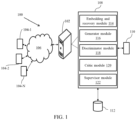
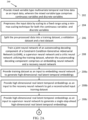
Claims (9)

  1. A processor implemented method for generating mixed variable type multivariate temporal synthetic data, the method comprising:
    providing, via one or more hardware processors, mixed variable type multivariate temporal real time data as an input data, wherein the mixed variable type comprises continuous variables and discrete variables (202);
    pre-processing, via the one or more hardware processors, the input data by scaling to a fixed range for both the continuous variables and the discrete variables (204);
    splitting, via the one or more hardware processors, the pre-processed data into a training dataset, a validation dataset and a test dataset (206);
    training, via the one or more hardware processors, a joint neural network of an autoencoding-decoding component of a Constraint-Condition-Generative Adversarial Network (ccGAN), a supervisor neural network and a critic neural network utilizing the training dataset, wherein the autoencoding-decoding component comprises an embedding neural network and a recovery neural network (208), the training comprises:
    providing the training dataset as an input to the embedding neural network to generate high dimensional real latent temporal embeddings (208a),
    providing the high dimensional real latent temporal embeddings as an input to the recovery neural network to get a reconstructed input training dataset, wherein the embedding and the recovery neural network is jointly trained using a supervised learning approach for reconstructing the training dataset (208b),
    providing the high dimensional real latent temporal embeddings as an input to the supervisor neural network to generate a single-step-ahead high dimensional real latent temporal embeddings, wherein the supervisor neural network is trained using the supervised learning approach (208c), and
    providing the high dimensional real latent temporal embeddings as an input to the critic neural network to predict a target variable, wherein the critic neural network is trained using the supervised learning approach (208d);
    determining, via the one or more hardware processors, a cluster label dependent random noise by transforming a Gaussian random noise with fixed predetermined cluster labels, wherein the Gaussian random noise is part of the input data (210);
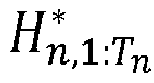
    computing, via the one or more hardware processors, a conditioned knowledge vector corresponding to a pre-determined label value for each discrete variable (212);
    concatenating, via the one or more hardware processors, the cluster label dependent random noise with the conditioned knowledge vector to generate a condition aware synthetic noise (214);
    jointly training, via the one or more hardware processors, adversarial neural networks of the Constraint-Condition aware Generative Adversarial Network (ccGAN), a sequence generator neural network, a sequence discriminator neural network, the supervisor neural network and the critic neural network utilizing the condition aware synthetic noise (216), wherein the training comprises:
    providing a condition aware synthetic noise as an input to the sequence generator neural network to get high dimensional synthetic latent temporal embeddings (216a),
    providing the high dimensional synthetic latent temporal embeddings to the trained supervisor neural network to predict single-step ahead synthetic temporal latent embeddings (216b),
    providing the high dimensional synthetic latent temporal embeddings to the trained critic neural network to predict the synthetic target variable (216c), and
    providing the predicted single-step ahead synthetic temporal latent embeddings as an input to the recovery neural network to generate the mixed variable type multivariate temporal synthetic data (216d);
    providing, via the one or more hardware processors, the high dimensional real latent temporal embeddings and the high dimensional synthetic latent temporal embeddings as an input to the sequence discriminator neural network to classify them as one of a real or a fake, and predict cluster labels for synthetic data (218);
    providing, via the one or more hardware processors, a real world condition aware synthetic noise as an input to the trained sequence generator neural network to get real world high dimensional synthetic latent temporal embeddings (220);
    providing, via the one or more hardware processors, the real world high dimensional synthetic latent temporal embeddings to the trained supervisor neural network to predict real world single-step ahead synthetic temporal latent embeddings (222); and
    providing, via the one or more hardware processors, the real world predicted single-step ahead synthetic temporal latent embeddings as an input to the trained recovery neural network to generate the mixed variable type multivariate temporal synthetic data (224).
  2. The processor implemented method of claim 1 further configured to minimize the discrepancy between the real input temporal data and the mixed variable type multivariate temporal synthetic data using the embedding neural network and the recovery neural network modules.
  3. The processor implemented method of claim 1, wherein a conditioned knowledge vector is configured to incorporate the condition into the Constraint-Conditional Generative Adversarial Network (ccGAN) framework.
  4. The processor implemented method of claim 1 further comprising providing the validation dataset as an input to the trained ccGAN to tune a set of hyperparameters.
  5. A system (100) for generating mixed variable type multivariate temporal synthetic data, the system comprises:
    an input/output interface (104);
    one or more hardware processors (108); and
    a memory (110) in communication with the one or more hardware processors, wherein the one or more first hardware processors are configured to execute programmed instructions stored in the one or more first memories, to:
    provide mixed variable type multivariate temporal real time data as an input data, wherein the mixed variable type comprises continuous variables and discrete variables;
    pre-process the input data by scaling to a fixed range for both the continuous variables and the discrete variables;
    split the pre-processed data into a training dataset, a validation dataset and a test dataset;
    train a joint neural network of an autoencoding-decoding component of a Constraint-Condition-Generative Adversarial Network (ccGAN), a supervisor neural network and a critic neural network utilizing the training dataset, wherein the autoencoding-decoding component comprises an embedding neural network and a recovery neural network, the training comprises:
    providing the training dataset as an input to the embedding neural network to generate high dimensional real latent temporal embeddings,
    providing the high dimensional real latent temporal embeddings as an input to the recovery neural network to get a reconstructed input training dataset, wherein the embedding and the recovery neural network is jointly trained using a supervised learning approach for reconstructing the training dataset,
    providing the high dimensional real latent temporal embeddings as an input to the supervisor neural network to generate a single-step-ahead high dimensional real latent temporal embeddings, wherein the supervisor neural network is trained using the supervised learning approach, and
    providing the high dimensional real latent temporal embeddings as an input to the critic neural network to predict a target variable, wherein the critic neural network is trained using the supervised learning approach;
    determine a cluster label dependent random noise by transforming Gaussian random noise with a fixed predetermined cluster labels, wherein the Gaussian random noise is part of the input data;
    compute a conditioned knowledge vector corresponding to a pre-determined label value for each discrete variable;
    concatenate the cluster label dependent random noise with the conditioned knowledge vector to generate a condition aware synthetic noise;
    jointly train adversarial neural networks of the Constraint-Condition aware Generative Adversarial Network (ccGAN), a sequence generator neural network, a sequence discriminator neural network, the supervisor neural network and the critic neural network utilizing the condition aware synthetic noise, wherein the training comprises:
    providing the condition aware synthetic noise as an input to the sequence generator neural network to get high dimensional synthetic latent temporal embeddings,
    providing the high dimensional synthetic latent temporal embeddings to the trained supervisor neural network to predict single-step ahead synthetic temporal latent embeddings,
    providing the high dimensional synthetic latent temporal embeddings to the trained critic neural network to predict the synthetic target variable, and
    providing the predicted single-step ahead synthetic temporal latent embeddings as an input to the recovery neural network to generate the mixed variable type multivariate temporal synthetic data;
    provide the high dimensional real latent temporal embeddings and the high dimensional synthetic latent temporal embeddings as input to the sequence discriminator neural network to classify them as one of a real or a fake, and predict the cluster labels for synthetic data;
    provide a real world condition aware synthetic noise as an input to the trained sequence generator neural network to get real world high dimensional synthetic latent temporal embeddings;
    provide the real world high dimensional synthetic latent temporal embeddings to the trained supervisor neural network to predict real world single-step ahead synthetic temporal latent embeddings; and
    provide the real world predicted single-step ahead synthetic temporal latent embeddings as an input to the trained recovery neural network to generate the mixed variable type multivariate temporal synthetic data.
  6. The system of claim 1 further configured to minimize the discrepancy between the real input temporal data and the mixed variable type multivariate temporal synthetic data using the embedding neural network and the recovery neural network modules.
  7. The system of claim 1, wherein a conditioned knowledge vector is configured to incorporate the condition into the Constraint-Conditional Generative Adversarial Network (ccGAN) framework.
  8. The system of claim 1 further comprising providing the validation dataset as an input to the trained ccGAN to tune a set of hyperparameters.
  9. One or more non-transitory machine-readable information storage mediums comprising one or more instructions which when executed by one or more hardware processors cause:
    providing, mixed variable type multivariate temporal real time data as an input data, wherein the mixed variable type comprises continuous variables and discrete variables;
    pre-processing, via the one or more hardware processors, the input data by scaling to a fixed range for both the continuous variables and the discrete variables;
    splitting, via the one or more hardware processors, the pre-processed data into a training dataset, a validation dataset and a test dataset;
    training, via the one or more hardware processors, a joint neural network of an autoencoding-decoding component of a Constraint-Condition-Generative Adversarial Network (ccGAN), a supervisor neural network and a critic neural network utilizing the training dataset, wherein the autoencoding-decoding component comprises an embedding neural network and a recovery neural network, the training comprises:
    providing the training dataset as an input to the embedding neural network to generate high dimensional real latent temporal embeddings,
    providing the high dimensional real latent temporal embeddings as an input to the recovery neural network to get a reconstructed input training dataset, wherein the embedding and the recovery neural network is jointly trained using a supervised learning approach for reconstructing the training dataset,
    providing the high dimensional real latent temporal embeddings as an input to the supervisor neural network to generate a single-step-ahead high dimensional real latent temporal embeddings, wherein the supervisor neural network is trained using the supervised learning approach, and
    providing the high dimensional real latent temporal embeddings as an input to the critic neural network to predict a target variable, wherein the critic neural network is trained using the supervised learning approach;
    determining, via the one or more hardware processors, a cluster label dependent random noise by transforming a Gaussian random noise with fixed predetermined cluster labels, wherein the Gaussian random noise is part of the input data;
    computing, via the one or more hardware processors, a conditioned knowledge vector corresponding to a pre-determined label value for each discrete variable;
    concatenating, via the one or more hardware processors, the cluster label dependent random noise with the conditioned knowledge vector to generate a condition aware synthetic noise;
    jointly training, via the one or more hardware processors, adversarial neural networks of the Constraint-Condition aware Generative Adversarial Network (ccGAN), a sequence generator neural network, a sequence discriminator neural network, the supervisor neural network and the critic neural network utilizing the condition aware synthetic noise, wherein the training comprises:
    providing a condition aware synthetic noise as an input to the sequence generator neural network to get high dimensional synthetic latent temporal embeddings,
    providing the high dimensional synthetic latent temporal embeddings to the trained supervisor neural network to predict single-step ahead synthetic temporal latent embeddings,
    providing the high dimensional synthetic latent temporal embeddings to the trained critic neural network to predict the synthetic target variable, and
    providing the predicted single-step ahead synthetic temporal latent embeddings as an input to the recovery neural network to generate the mixed variable type multivariate temporal synthetic data;
    providing, via the one or more hardware processors, the high dimensional real latent temporal embeddings and the high dimensional synthetic latent temporal embeddings as an input to the sequence discriminator neural network to classify them as one of a real or a fake, and predict cluster labels for synthetic data;
    providing, via the one or more hardware processors, a real world condition aware synthetic noise as an input to the trained sequence generator neural network to get real world high dimensional synthetic latent temporal embeddings;
    providing, via the one or more hardware processors, the real world high dimensional synthetic latent temporal embeddings to the trained supervisor neural network to predict real world single-step ahead synthetic temporal latent embeddings; and
    providing, via the one or more hardware processors, the real world predicted single-step ahead synthetic temporal latent embeddings as an input to the trained recovery neural network to generate the mixed variable type multivariate temporal synthetic data.
EP22208966.6A 2022-01-05 2022-11-23 System and method for generating mixed variable type multivariate temporal synthetic data Pending EP4209968A1 (en)

Applications Claiming Priority (1)

Application Number Priority Date Filing Date Title
IN202221000662 2022-01-05

Publications (1)

Publication Number Publication Date
EP4209968A1 true EP4209968A1 (en) 2023-07-12

Family

ID=84361400

Family Applications (1)

Application Number Title Priority Date Filing Date
EP22208966.6A Pending EP4209968A1 (en) 2022-01-05 2022-11-23 System and method for generating mixed variable type multivariate temporal synthetic data

Country Status (2)

Country Link
US (1) US20230351202A1 (en)
EP (1) EP4209968A1 (en)

Cited By (2)

* Cited by examiner, † Cited by third party
Publication number Priority date Publication date Assignee Title
CN117354058A (en) * 2023-12-04 2024-01-05 武汉安域信息安全技术有限公司 Industrial control network APT attack detection system and method based on time series prediction
WO2025096552A1 (en) * 2023-10-30 2025-05-08 Genentech, Inc. Generative deformable transformer for longitudinal clinical assessment

Families Citing this family (5)

* Cited by examiner, † Cited by third party
Publication number Priority date Publication date Assignee Title
KR102593137B1 (en) * 2023-04-14 2023-10-24 고려대학교산학협력단 Apparatus and method for classifying immoral images using deep learning technology
WO2024158443A1 (en) * 2023-01-25 2024-08-02 Dexcom, Inc. Private synthetic time series data generation
US20250103947A1 (en) * 2023-09-26 2025-03-27 Rolos AG Data-driven method for discovering conservation principles in physical systems
US12353432B2 (en) * 2023-11-19 2025-07-08 International Business Machines Corporation Data generation process for multi-variable data
CN119094402B (en) * 2024-09-03 2025-07-08 中南大学 User mobile cellular network data synthesis method and system based on deep generation countermeasure network

Non-Patent Citations (2)

* Cited by examiner, † Cited by third party
Title
AMIRSINA TORFI ET AL: "Differentially Private Synthetic Medical Data Generation using Convolutional GANs", ARXIV.ORG, CORNELL UNIVERSITY LIBRARY, 201 OLIN LIBRARY CORNELL UNIVERSITY ITHACA, NY 14853, 22 December 2020 (2020-12-22), XP091000555, DOI: 10.1016/J.INS.2021.12.018 *
LEI XU ET AL: "Synthesizing Tabular Data using Generative Adversarial Networks", ARXIV.ORG, CORNELL UNIVERSITY LIBRARY, 201 OLIN LIBRARY CORNELL UNIVERSITY ITHACA, NY 14853, 27 November 2018 (2018-11-27), XP081041863 *

Cited By (2)

* Cited by examiner, † Cited by third party
Publication number Priority date Publication date Assignee Title
WO2025096552A1 (en) * 2023-10-30 2025-05-08 Genentech, Inc. Generative deformable transformer for longitudinal clinical assessment
CN117354058A (en) * 2023-12-04 2024-01-05 武汉安域信息安全技术有限公司 Industrial control network APT attack detection system and method based on time series prediction

Also Published As

Publication number Publication date
US20230351202A1 (en) 2023-11-02

Similar Documents

Publication Publication Date Title
EP4209968A1 (en) System and method for generating mixed variable type multivariate temporal synthetic data
US20220383126A1 (en) Low-Rank Adaptation of Neural Network Models
Khodayar et al. Rough deep neural architecture for short-term wind speed forecasting
US20210004677A1 (en) Data compression using jointly trained encoder, decoder, and prior neural networks
Pan et al. Memen: Multi-layer embedding with memory networks for machine comprehension
Wang et al. Neural machine-based forecasting of chaotic dynamics
CN119204677A (en) Operational business risk analysis method, device, equipment and storage medium
US11922294B2 (en) Neural network execution block using fully connected layers
US20230281427A1 (en) Privacy preserving generative mechanism for industrial time-series data disclosure
CN119313962A (en) A trajectory prediction method and device based on spatiotemporal graph neural network learning model
US12494004B2 (en) Systems and methods for feedback based instructional visual editing
US20250036949A1 (en) Ai-based pattern identification transformer
Sharma et al. Applications of Machine Learning to Optimizing Polyolefin Manufacturing
EP4239527A1 (en) Congeniality-preserving generative adversarial networks for imputing low-dimensional multivariate time-series data
Zhou Linear models
Liu et al. AutoDC: Automated data-centric processing
Jamali Quantum-accelerated neural imputation with large language models (llms)
Sagodi et al. Dynamical archetype analysis: Autonomous computation
CN114582518A (en) Medical data set optimization method and equipment
US12568237B2 (en) Neural network mask generation based on temporal windows
Gowgi et al. Spatiotemporal memories for missing samples reconstruction
Xu et al. Remaining useful life prediction of control moment gyro in orbiting spacecraft based on variational autoencoder
US12608604B2 (en) Method and apparatus for training artificial intelligence based on episode memory
Nguyen et al. An active learning framework for set inversion
Lafler et al. Developing Artificial and Convolutional Neural Networks with Python’s Keras API for TensorFlow

Legal Events

Date Code Title Description
PUAI Public reference made under article 153(3) epc to a published international application that has entered the european phase

Free format text: ORIGINAL CODE: 0009012

STAA Information on the status of an ep patent application or granted ep patent

Free format text: STATUS: THE APPLICATION HAS BEEN PUBLISHED

AK Designated contracting states

Kind code of ref document: A1

Designated state(s): AL AT BE BG CH CY CZ DE DK EE ES FI FR GB GR HR HU IE IS IT LI LT LU LV MC ME MK MT NL NO PL PT RO RS SE SI SK SM TR

STAA Information on the status of an ep patent application or granted ep patent

Free format text: STATUS: REQUEST FOR EXAMINATION WAS MADE

17P Request for examination filed

Effective date: 20230914

RBV Designated contracting states (corrected)

Designated state(s): AL AT BE BG CH CY CZ DE DK EE ES FI FR GB GR HR HU IE IS IT LI LT LU LV MC ME MK MT NL NO PL PT RO RS SE SI SK SM TR

STAA Information on the status of an ep patent application or granted ep patent

Free format text: STATUS: EXAMINATION IS IN PROGRESS

17Q First examination report despatched

Effective date: 20260313