EP4209939A1 - Structural obfuscation for protecting deep learning models on edge devices - Google Patents
Structural obfuscation for protecting deep learning models on edge devices Download PDFInfo
- Publication number
- EP4209939A1 EP4209939A1 EP23150397.0A EP23150397A EP4209939A1 EP 4209939 A1 EP4209939 A1 EP 4209939A1 EP 23150397 A EP23150397 A EP 23150397A EP 4209939 A1 EP4209939 A1 EP 4209939A1
- Authority
- EP
- European Patent Office
- Prior art keywords
- model
- layers
- obfuscated
- obfuscating
- compiler
- Prior art date
- Legal status (The legal status is an assumption and is not a legal conclusion. Google has not performed a legal analysis and makes no representation as to the accuracy of the status listed.)
- Pending
Links
Images



Classifications
-
- G—PHYSICS
- G06—COMPUTING OR CALCULATING; COUNTING
- G06N—COMPUTING ARRANGEMENTS BASED ON SPECIFIC COMPUTATIONAL MODELS
- G06N3/00—Computing arrangements based on biological models
- G06N3/02—Neural networks
- G06N3/08—Learning methods
- G06N3/082—Learning methods modifying the architecture, e.g. adding, deleting or silencing nodes or connections
-
- G—PHYSICS
- G06—COMPUTING OR CALCULATING; COUNTING
- G06F—ELECTRIC DIGITAL DATA PROCESSING
- G06F21/00—Security arrangements for protecting computers, components thereof, programs or data against unauthorised activity
- G06F21/10—Protecting distributed programs or content, e.g. vending or licensing of copyrighted material ; Digital rights management [DRM]
- G06F21/12—Protecting executable software
- G06F21/14—Protecting executable software against software analysis or reverse engineering, e.g. by obfuscation
-
- G—PHYSICS
- G06—COMPUTING OR CALCULATING; COUNTING
- G06F—ELECTRIC DIGITAL DATA PROCESSING
- G06F9/00—Arrangements for program control, e.g. control units
- G06F9/06—Arrangements for program control, e.g. control units using stored programs, i.e. using an internal store of processing equipment to receive or retain programs
- G06F9/46—Multiprogramming arrangements
- G06F9/54—Interprogram communication
-
- G—PHYSICS
- G06—COMPUTING OR CALCULATING; COUNTING
- G06N—COMPUTING ARRANGEMENTS BASED ON SPECIFIC COMPUTATIONAL MODELS
- G06N3/00—Computing arrangements based on biological models
- G06N3/02—Neural networks
- G06N3/10—Interfaces, programming languages or software development kits, e.g. for simulating neural networks
Definitions
- Embodiments of the invention relate to the use of obfuscation to protect deep learning models.
- the manufacturer of an artificial intelligence (AI) processor provides a software development kit (SDK) to the developers of AI applications that include DL models.
- SDK software development kit
- the developers use the SDK to convert the AI applications to a proprietary format or native machine instructions, which are non-portable to different AI processors.
- the developers may want the AI applications to run on different AI processors while protecting the intellectual property in the DL models.
- a method for obfuscating deep learning (DL) models comprises training a DL model to obtain weights of operation (OP) layers in the trained DL model.
- the DL model includes an interface to a public application programming interface (API) that provides access to a compiler of an artificial intelligence (AI) processor.
- the method further comprises obfuscating the DL model by changing a structure of the OP layers to produce an obfuscated DL model, and publishing the obfuscated DL model for access by devices.
- the obfuscated DL model is executable by the AI processor after compilation by the compiler on an edge device.
- a system is provided to obfuscate DL models.
- the system comprises processing hardware; and memory to store an obfuscator and a DL model that includes OP layers.
- the processing hardware is operative to train the DL model to obtain weights of the OP layers.
- the DL model includes an interface to a public API that provides access to a compiler of an AI processor.
- the processing hardware is further operative to obfuscate the DL model using the obfuscator by changing a structure of the OP layers to produce an obfuscated DL model, and publish the obfuscated DL model for access by devices.
- the obfuscated DL model is executable by the AI processor after compilation by the compiler on an edge device.
- Embodiments of the invention protect deep learning (DL) models executed on edge devices by obfuscation.
- a manufacturer of an AI accelerator may provide an obfuscator to developers of DL models that run on the AI accelerator of an edge device.
- the obfuscator can obfuscate a DL model to hide and protect proprietary information in the DL model.
- the obfuscation makes it more difficult to understand, modify, and reverse-engineer the DL model.
- the obfuscated DL model includes an interface to a public application programming interface (API), also known as an open API, which is based on an open standard and available for use by the public.
- API application programming interface
- An edge device may provide a compiler for the AI accelerator, which can be accessed by the obfuscated DL model through the public API.
- the compiler compiles the obfuscated DL model into a compiled DL model to run on the AI accelerator.
- the compiler can optimize the obfuscated DL model, as the compiler and the obfuscator may both be provided by the manufacturer of the AI accelerator.
- DL model refers to a neural network (NN) model of multiple operation (OP) layers.
- DL model and “NN model” may be used interchangeably.
- AI accelerator and “AI processor” may be used interchangeably.
- Non-limiting of a public API include TensorFlow TM Lite, Android TM Neural Network API, Web Neural Network API, etc.
- the obfuscated DL model and the original DL model may produce the same or substantially the same inference results.
- the inference results from these two DL models can be (in particular are allowed to be) not exactly the same, as long as the accuracy of the obfuscated DL model is within a predetermined tolerance (i.e., both models have substantially the same accuracy).
- aggressive obfuscations may be performed on a DL model, such as execution sequence reordering for floating point operations. A number of obfuscation examples will be described below.
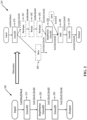
- FIG. 1 is a block diagram illustrating an environment in which DL model obfuscation may be practiced according to one embodiment.
- blocks with rounded corners indicate input/output.
- a system 100 uses an obfuscator 120 to perform obfuscation on a DL model 110.
- the obfuscator 120 receives the DL model 110 as input and generates an obfuscated DL model 115 as output.
- the DL model 110 is a trained neural network with multiple operation (OP) layers.
- the obfuscator 120 may change, among others, the structure (e.g., OP layers), the weights, and/or the execution order of the DL model 110.
- the obfuscated DL model 115 does not need to be retrained.
- the DL model 110 and the obfuscated DL model 115 are described in the same model language.
- Non-limiting examples of a model language include TensorFlow Lite, Open Neural Network Exchange (ONNX TM ), Neural Network Exchange Format (NNEF), etc.
- the obfuscator 120 may be implemented in hardware, in software executed on the hardware, or a combination of hardware and software.
- the obfuscated DL model 115 may be downloaded to a device 170; e.g., an edge device, to be compiled and executed.
- system 100 may publish the obfuscated DL model 115 to make it accessible over a network 180 such as the Internet.
- system 100 may publish a software application (e.g., an app) containing the code of the obfuscated DL model 115.
- a user of device 170 may download the app from an online marketplace of apps.
- the obfuscated DL model 115 runs on top of a public API 130, which provides an interface to a compiler 140.
- the compiler 140 compiles the obfuscated DL model 115 into a compiled DL model 145 executable by an AI accelerator 150.
- the AI accelerator 150 executes the compiled DL model 145 to generate an inference output 155.
- the compiler 140 may optimize the obfuscated DL model 115 during compile time. Alternatively preferably, the optimization of the obfuscated DL model may take place at a different time, such as runtime.
- the compiler 140 may generate the compiled DL model 145 every time the DL model is executed. Alternatively preferably, the compiler 140 may compile the obfuscated DL model 115 once and store the compiled DL model 145 in a compilation cache 160 (as shown by the dotted block). Thus, the compiler 140 does not need to re-compile the same obfuscated DL model 115 every time it is executed.
- the compiled DL model 145 in the compilation cache 160 may be in a proprietary format or machine instructions executable by the AI accelerator 150.
- both the obfuscator 120 and the compiler 140 may be provided by the manufacturer of the AI accelerator 150.
- proprietary information regarding the obfuscation may be made available to programmers of the compiler 140, such that the compiler 140 can more effectively optimize the obfuscated DL model 115 during the compilation process.
- the optimization may restore at least a portion of the obfuscated structure and/or weights of the DL model 110.
- the obfuscated DL model 115 may be compiled and executed without optimization. Even without the optimization, the obfuscated DL model 115 and the DL model 110 after compilation when executed by the AI accelerator 150 may generate the same or substantially the same inference results with substantially the same accuracy.
- FIG. 2 - FIG. 5 provide a number of obfuscation examples performed by the obfuscator 120.
- FIG. 2 illustrates an example of adding redundant OP layers according to one embodiment.
- a DL model 200 before obfuscation is shown on the left.
- the DL model 200 includes a first two-dimensional (2D) convolution layer (Conv2D 210), a depth-wise 2D convolution layer (depthwise Conv2D 220), followed by a second 2D convolution layer (Conv2D 230).
- the obfuscator 120 ( FIG. 1 ) obfuscates the DL model 200 by adding redundant OP layers to produce an obfuscated DL model 201 on the right.
- a dashed-line, straight-corner block indicates a redundant OP layer and a dashed-line, round-corner block indicates a redundant operand.
- the obfuscated DL model 201 includes three reshape layers (241, 242, and 243) after Conv2D 210. As shown in FIG. 2 , the dimensions at the input of reshape layer 241 is the same as the dimensions at the output of reshape layer 243. Thus, reshape layers 241, 242, and 243 are redundant layers.
- the obfuscated DL model 201 also includes a slice layer 250 after Conv2D 210. However, the output of slice layer 250 is unused. Thus, slice layer 250 is redundant.
- the obfuscated DL model 201 further includes an add layer 260 to add zeros to the output of depthwise Conv2D 220. Adding zeros is a redundant operation; thus, add layer 260 is redundant.
- FIG. 3 illustrates an example of adding redundant OP layers and weights according to one embodiment.
- a DL model 300 before obfuscation is shown on the left.
- the DL model 300 includes a first Conv2D 310, a depthwise Conv2D 320, and a second Conv2D 330, with weights W1, W2, and W3, respectively.
- the obfuscator 120 FIG. 1
- the obfuscator 120 FIG. 1
- the weight (W3) of Conv2D 340 can be any value because the output of Conv2D 340 is unused.
- the weight (W4) of depthwise Conv2D 350 has dimensions 1 ⁇ 1 ⁇ 1 ⁇ 32 (where 32 is the input channel size) and the weight values are all 1s. With the weight values equal to all 1s, depthwise Conv2D 350 is redundant because its output is equal to its input.
- FIG. 4 illustrates an example of changing the execution order of a DL model according to one embodiment.
- a DL model 400 before obfuscation is shown at the top.
- the obfuscator 120 FIG. 1
- the obfuscator 120 FIG. 1
- the obfuscator 120 FIG. 1
- the obfuscator 120 FIG. 1
- the obfuscator 120 FIG. 1
- the obfuscator 120 FIG. 1
- the obfuscator 120 FIG. 1
- the obfuscator 120 FIG. 1
- the obfuscator 120 FIG. 1
- the obfuscator 120 FIG. 1
- the obfuscator 120 FIG. 1
- the obfuscator 120 FIG. 1
- the obfuscator 120 FIG. 1
- the obfuscator 120 FIG. 1
- the obfuscator 120 FIG. 1
- the DL model 400 receives four input operands A1, A2, A3, and A4; e.g., four floating-point numbers or another data format.
- Each input operand may be multidimensional; e.g., a 384 ⁇ 384 matrix.
- a pack layer 410 packs the four input operands into a four-element array (A1, A2, A3, A4), which is fed into an OP layers sequence 420 to produce an output N.
- each input operand is individually operated by an OP layers sequence 430 and the results from all four OP layers sequences 430 are concatenated together to produce the output N.
- the pack operation in the DL model 400 is changed to the concatenate operation at a different location in the DL model 401.
- the connection among the OP layers is changed by the obfuscation.
- the OP layers sequences 420 and 430 they may have the same operations but different dimensions.
- An example of the DL model 400 is shown in FIG. 5 .
- FIG. 5 shows that the OP layers sequence 420 include a quantize layer, a reshape layer, two multiply layers, an add layer, a minimum layer, and another quantize layer.
- M1 and M2 represent operands of a multiply operation and an add operation, respectively.
- the OP layers sequence 420 may be split into four smaller OP layers sequences such as OP layers sequences 430 in the obfuscated DL model 401.
- Each OP layers sequence 430 includes a corresponding one of the quantize layer, the reshape layer, the two multiply layers, the add layer, the minimum layer, and the other quantize layer, with each layer having a quarter of the original dimensions.
- an operand of 4 ⁇ 384 ⁇ 384 in the OP layers sequence 420 may be replaced by an operand of 384 ⁇ 384 in each OP layers sequence 430, and 1 ⁇ 4 ⁇ 384 ⁇ 384 in the OP layers sequence 420 may be replaced by an operand of 1 ⁇ 1 ⁇ 384 ⁇ 384 in each OP layers sequence 430.
- the four OP layers sequences 430 may be interconnected with each other; e.g., they may share one or more operands of a multiply operation, an add operation, etc. Preferably, some or all of the OP layers sequences 430 may be further obfuscated in the same or different ways. As a result, the resulting four OP layers sequences may be different from one another.
- the obfuscator 120 may change the structure of a DL model, such as the number of OP layers, the connection among the OP layers, the operations performed by the OP layers, the order of the OP layers, etc.
- the obfuscator 120 may also change the parameters of the OP layers (e.g., by adding unused or redundant weights) and/or re-arrange the dimensions of the OP layers.
- the obfuscator 120 can further add a watermark or a signature to the obfuscated DL model 115 to protect against piracy.
- FIG. 6 is a flow diagram illustrating a method 600 for performing DL model obfuscation according to one embodiment.
- Method 600 may be performed by a system such as system 100 in FIG. 1 . It is understood that the embodiment of FIG. 1 is for illustrative purposes only; other devices or systems with neural computing capabilities may perform method 600.
- Method 600 begins at step 610 when a system trains a DL model to obtain weights of the OP layers in the DL model.
- the DL model includes an interface to a public API that provides access to a compiler of an AI processor.
- the system at step 620 obfuscates the DL model by changing the structure of the OP layers in the trained DL model to produce an obfuscated DL model.
- the system at step 630 publishes (e.g., makes it available for online access) the obfuscated DL model for access by devices.
- the obfuscated DL model is executable by the AI processor after compilation by the compiler on an edge device.
- the system may obfuscate the DL model by one or more of the following: re-ordering an execution sequence of the OP layers, adding redundant OP layers to the DL model, adding redundant weights to the OP layers in the DL model, changing connections among the OP layers in the DL model, changing one or more operations in the OP layers in the DL model, and/or reshaping dimensions of the OP layers in the DL model.
- the system may change the structure of the DL model without re-training the DL model.
- the DL model and the obfuscated DL model are in the same model language.
- the DL model and the obfuscated DL model produce inference results with substantially the same accuracy.
- FIG. 7 is a flow diagram illustrating a method 700 for executing an obfuscated DL model according to one embodiment.
- Method 700 may be performed by an edge device such as device 170 in FIG. 1 . It is understood that the embodiment of FIG. 1 is for illustrative purposes only; other devices or systems with neural computing capabilities may perform method 700.
- Method 700 begins at step 710 when a device receives an obfuscated DL model that uses a public API to access a compiler of an AI processor.
- the device at step 720 compiles the obfuscated DL model to output a compiled DL model.
- the device at step 730 executes the compiled DL model on the AI processor.
- the compiler optimizes the obfuscated DL model by restoring at least a portion of a structure and/or weights of the original DL model.
- the optimization of the compiled DL model may be performed at runtime.
- FIG. 8 is a block diagram illustrating a system 800 performing DL model obfuscation and a device 870 executing the obfuscated DL model according to one embodiment.
- System 800 and device 870 may be an example of system 100 and device 170 in FIG. 1 , respectively.
- System 800 may be a computer system capable of performing neural computing.
- Device 870 may be an edge device, such as a smartphone, a computing device, a network-connected device, a gaming device, an entertainment device, an Internet-of-things (IoT) device, or any device capable of performing neural computing.
- IoT Internet-of-things
- System 800 includes processing hardware 810, a memory 820, and a network interface 830.
- Device 870 includes processing hardware 840, a memory 850, and a network interface 860.
- processing hardware 810 and/or 840 may include one or more processors such as: a central processing unit (CPU), a GPU, a digital processing unit (DSP), an AI processor, a multimedia processor, other general-purpose and/or special-purpose processing circuitry.
- processing hardware 840 may include an AI processor 842, which is an example of the AI accelerator 150 in FIG. 1 .
- memory 820 and/or 850 may include memory devices such as dynamic random access memory (DRAM), SRAM, flash memory, other non-transitory machine-readable storage media; e.g., volatile or non-volatile memory devices.
- Memory 820 and/or 850 may further include storage devices, for example, any type of solid-state or magnetic storage device.
- memory 820 and/or 850 may store instructions which, when executed by the respective processing hardware, cause the respective processing hardware to perform the aforementioned method 600 ( FIG. 6 ) and/or method 700 ( FIG. 7 ).
- memory 820 of the system 800 may store the obfuscator 120 ( FIG. 1 ) and DL models 825.
- the obfuscator 120 may obfuscate a DL model to generate an obfuscated DL model.
- memory 850 of device 870 may store the public API 130 and the compiler 140 ( FIG. 1 ), as well as DL models such as the obfuscated DL model received from system 800.
- device 870 may include the compilation cache 160 ( FIG. 1 ) to store the compiled DL model generated by the compiler 140.
- system 800 and device 870 may also include network interfaces 830 and 860, respectively to connect to a wired and/or wireless network (e.g., the Internet) for transmitting and/or receiving an obfuscated DL model.
- a wired and/or wireless network e.g., the Internet
- FIG. 8 is simplified for illustration purposes. Additional hardware components may be included.
- FIG. 6 and FIG. 7 have been described with reference to the exemplary embodiments of FIG. 1 and FIG. 8 .
- the operations of the flow diagrams of FIG. 6 and FIG. 7 can be performed by embodiments of the invention other than the embodiments of FIG. 1 and FIG. 8 , and the embodiments of FIG. 1 and FIG. 8 can perform operations different than those discussed with reference to the flow diagrams.
- the flow diagrams of FIG. 6 and FIG. 7 show a particular order of operations performed by certain embodiments of the invention, it should be understood that such order is exemplary (e.g., alternative embodiments may perform the operations in a different order, combine certain operations, overlap certain operations, etc.).
- circuits either dedicated circuits or general-purpose circuits, which operate under the control of one or more processors and coded instructions
- the functional blocks will typically comprise transistors that are configured in such a way as to control the operation of the circuity in accordance with the functions and operations described herein.
Landscapes
- Engineering & Computer Science (AREA)
- Theoretical Computer Science (AREA)
- Software Systems (AREA)
- Physics & Mathematics (AREA)
- General Engineering & Computer Science (AREA)
- General Physics & Mathematics (AREA)
- Computing Systems (AREA)
- Computational Linguistics (AREA)
- Biophysics (AREA)
- Mathematical Physics (AREA)
- Health & Medical Sciences (AREA)
- Life Sciences & Earth Sciences (AREA)
- Artificial Intelligence (AREA)
- Biomedical Technology (AREA)
- Molecular Biology (AREA)
- General Health & Medical Sciences (AREA)
- Data Mining & Analysis (AREA)
- Evolutionary Computation (AREA)
- Technology Law (AREA)
- Computer Security & Cryptography (AREA)
- Multimedia (AREA)
- Computer Hardware Design (AREA)
- Stored Programmes (AREA)
Abstract
Description
- This application claims the benefit of
U.S. Provisional Application No. 63/296,899 filed on January 6, 2022 - Embodiments of the invention relate to the use of obfuscation to protect deep learning models.
- Designing and training a well-performing deep learning (DL) model is generally expensive and time-consuming. Malicious users can easily acquire DL models on edge devices, especially on mobile phones, if the models use public formats or public application programming interfaces (APIs).
- Typically, the manufacturer of an artificial intelligence (AI) processor provides a software development kit (SDK) to the developers of AI applications that include DL models. The developers use the SDK to convert the AI applications to a proprietary format or native machine instructions, which are non-portable to different AI processors. The developers may want the AI applications to run on different AI processors while protecting the intellectual property in the DL models.
- Thus, there is a need for protecting trained DL models against piracy on edge devices without sacrificing the accuracy of the DL models.
- A method and a system according to the invention are defined in the independent claims. The dependent claims define preferred embodiments thereof. In one embodiment, a method is provided for obfuscating deep learning (DL) models. The method comprises training a DL model to obtain weights of operation (OP) layers in the trained DL model. The DL model includes an interface to a public application programming interface (API) that provides access to a compiler of an artificial intelligence (AI) processor. The method further comprises obfuscating the DL model by changing a structure of the OP layers to produce an obfuscated DL model, and publishing the obfuscated DL model for access by devices. The obfuscated DL model is executable by the AI processor after compilation by the compiler on an edge device.
- In another embodiment, a system is provided to obfuscate DL models. The system comprises processing hardware; and memory to store an obfuscator and a DL model that includes OP layers. The processing hardware is operative to train the DL model to obtain weights of the OP layers. The DL model includes an interface to a public API that provides access to a compiler of an AI processor. The processing hardware is further operative to obfuscate the DL model using the obfuscator by changing a structure of the OP layers to produce an obfuscated DL model, and publish the obfuscated DL model for access by devices. The obfuscated DL model is executable by the AI processor after compilation by the compiler on an edge device.
- Other aspects and features will become apparent to those ordinarily skilled in the art upon review of the following description of specific embodiments in conjunction with the accompanying figures.
- The present invention is illustrated by way of example, and not by way of limitation, in the figures of the accompanying drawings in which like references indicate similar elements. It should be noted that different references to "an" or "one" embodiment in this disclosure are not necessarily to the same embodiment, and such references mean at least one. Further, when a particular feature, structure, or characteristic is described in connection with an embodiment, it is submitted that it is within the knowledge of one skilled in the art to effect such feature, structure, or characteristic in connection with other embodiments whether or not explicitly described.
-
FIG. 1 is a block diagram illustrating an environment in which DL model obfuscation may be practiced according to one embodiment. -
FIG. 2 illustrates an example of adding redundant operation (OP) layers according to one embodiment. -
FIG. 3 illustrates an example of adding redundant OP layers and weights according to one embodiment. -
FIG. 4 illustrates an example of changing the execution order of a DL model according to one embodiment. -
FIG. 5 illustrates an example of the DL model inFIG. 4 . -
FIG. 6 is a flow diagram illustrating a method for performing DL model obfuscation according to one embodiment. -
FIG. 7 is a flow diagram illustrating a method for executing an obfuscated DL model according to one embodiment. -
FIG. 8 is a block diagram illustrating a system performing DL model obfuscation and a device executing the obfuscated DL model according to one embodiment. - In the following description, numerous specific details are set forth. However, it is understood that embodiments of the invention may be practiced without these specific details. In other instances, well-known circuits, structures, and techniques have not been shown in detail in order not to obscure the understanding of this description. It will be appreciated, however, by one skilled in the art, that the invention may be practiced without such specific details. Those of ordinary skill in the art, with the included descriptions, will be able to implement appropriate functionality without undue experimentation.
- Embodiments of the invention protect deep learning (DL) models executed on edge devices by obfuscation. A manufacturer of an AI accelerator may provide an obfuscator to developers of DL models that run on the AI accelerator of an edge device. The obfuscator can obfuscate a DL model to hide and protect proprietary information in the DL model. The obfuscation makes it more difficult to understand, modify, and reverse-engineer the DL model. The obfuscated DL model includes an interface to a public application programming interface (API), also known as an open API, which is based on an open standard and available for use by the public. An edge device may provide a compiler for the AI accelerator, which can be accessed by the obfuscated DL model through the public API. The compiler compiles the obfuscated DL model into a compiled DL model to run on the AI accelerator. Preferably, the compiler can optimize the obfuscated DL model, as the compiler and the obfuscator may both be provided by the manufacturer of the AI accelerator.
- The term "DL model" as used herein refers to a neural network (NN) model of multiple operation (OP) layers. The terms "DL model" and "NN model" may be used interchangeably. Furthermore, the terms "AI accelerator" and "AI processor" may be used interchangeably. Non-limiting of a public API include TensorFlow™ Lite, Android™ Neural Network API, Web Neural Network API, etc.
- The obfuscated DL model and the original DL model (i.e., the DL model before obfuscation) may produce the same or substantially the same inference results. Preferably, the inference results from these two DL models can be (in particular are allowed to be) not exactly the same, as long as the accuracy of the obfuscated DL model is within a predetermined tolerance (i.e., both models have substantially the same accuracy). Thus, aggressive obfuscations may be performed on a DL model, such as execution sequence reordering for floating point operations. A number of obfuscation examples will be described below.
-
FIG. 1 is a block diagram illustrating an environment in which DL model obfuscation may be practiced according to one embodiment. InFIG. 1 , blocks with rounded corners indicate input/output. Asystem 100 uses an obfuscator 120 to perform obfuscation on aDL model 110. The obfuscator 120 receives theDL model 110 as input and generates an obfuscated DL model 115 as output. TheDL model 110 is a trained neural network with multiple operation (OP) layers. The obfuscator 120 may change, among others, the structure (e.g., OP layers), the weights, and/or the execution order of theDL model 110. The obfuscated DL model 115 does not need to be retrained. TheDL model 110 and the obfuscated DL model 115 are described in the same model language. Non-limiting examples of a model language include TensorFlow Lite, Open Neural Network Exchange (ONNX™), Neural Network Exchange Format (NNEF), etc. - The obfuscator 120 may be implemented in hardware, in software executed on the hardware, or a combination of hardware and software. The obfuscated DL model 115 may be downloaded to a
device 170; e.g., an edge device, to be compiled and executed. - Preferably,
system 100 may publish the obfuscated DL model 115 to make it accessible over anetwork 180 such as the Internet. For example,system 100 may publish a software application (e.g., an app) containing the code of the obfuscated DL model 115. A user ofdevice 170 may download the app from an online marketplace of apps. Ondevice 170, the obfuscated DL model 115 runs on top of apublic API 130, which provides an interface to acompiler 140. Thecompiler 140 compiles the obfuscated DL model 115 into a compiledDL model 145 executable by anAI accelerator 150. At runtime, theAI accelerator 150 executes the compiledDL model 145 to generate aninference output 155. Preferably, thecompiler 140 may optimize the obfuscated DL model 115 during compile time. Alternatively preferably, the optimization of the obfuscated DL model may take place at a different time, such as runtime. - Preferably, the
compiler 140 may generate the compiledDL model 145 every time the DL model is executed. Alternatively preferably, thecompiler 140 may compile the obfuscated DL model 115 once and store the compiledDL model 145 in a compilation cache 160 (as shown by the dotted block). Thus, thecompiler 140 does not need to re-compile the same obfuscated DL model 115 every time it is executed. The compiledDL model 145 in thecompilation cache 160 may be in a proprietary format or machine instructions executable by theAI accelerator 150. - Preferably, both the obfuscator 120 and the
compiler 140 may be provided by the manufacturer of theAI accelerator 150. Thus, proprietary information regarding the obfuscation may be made available to programmers of thecompiler 140, such that thecompiler 140 can more effectively optimize the obfuscated DL model 115 during the compilation process. The optimization may restore at least a portion of the obfuscated structure and/or weights of theDL model 110. - Preferably, the obfuscated DL model 115 may be compiled and executed without optimization. Even without the optimization, the obfuscated DL model 115 and the
DL model 110 after compilation when executed by theAI accelerator 150 may generate the same or substantially the same inference results with substantially the same accuracy. -
FIG. 2 - FIG. 5 provide a number of obfuscation examples performed by the obfuscator 120.FIG. 2 illustrates an example of adding redundant OP layers according to one embodiment. ADL model 200 before obfuscation is shown on the left. TheDL model 200 includes a first two-dimensional (2D) convolution layer (Conv2D 210), a depth-wise 2D convolution layer (depthwise Conv2D 220), followed by a second 2D convolution layer (Conv2D 230). In this example, the obfuscator 120 (FIG. 1 ) obfuscates theDL model 200 by adding redundant OP layers to produce an obfuscatedDL model 201 on the right. A dashed-line, straight-corner block indicates a redundant OP layer and a dashed-line, round-corner block indicates a redundant operand. - The obfuscated
DL model 201 includes three reshape layers (241, 242, and 243) afterConv2D 210. As shown inFIG. 2 , the dimensions at the input of reshape layer 241 is the same as the dimensions at the output of reshapelayer 243. Thus, reshapelayers DL model 201 also includes aslice layer 250 afterConv2D 210. However, the output ofslice layer 250 is unused. Thus,slice layer 250 is redundant. The obfuscatedDL model 201 further includes anadd layer 260 to add zeros to the output ofdepthwise Conv2D 220. Adding zeros is a redundant operation; thus, addlayer 260 is redundant. -
FIG. 3 illustrates an example of adding redundant OP layers and weights according to one embodiment. ADL model 300 before obfuscation is shown on the left. TheDL model 300 includes afirst Conv2D 310, adepthwise Conv2D 320, and asecond Conv2D 330, with weights W1, W2, and W3, respectively. In this example, the obfuscator 120 (FIG. 1 ) generates an obfuscated DL model 301 (shown on the right) from theDL model 300 by adding aredundant Conv2D 340 and aredundant depthwise Conv2D 350. The weight (W3) ofConv2D 340 can be any value because the output ofConv2D 340 is unused. The weight (W4) ofdepthwise Conv2D 350 has dimensions 1×1×1×32 (where 32 is the input channel size) and the weight values are all 1s. With the weight values equal to all 1s,depthwise Conv2D 350 is redundant because its output is equal to its input. -
FIG. 4 illustrates an example of changing the execution order of a DL model according to one embodiment. ADL model 400 before obfuscation is shown at the top. In this example, the obfuscator 120 (FIG. 1 ) generates an obfuscated DL model 401 (shown at the bottom) from theDL model 400 by re-ordering OP layers without changing the input and output of theDL model 400. Thus, the obfuscation in this example changes the execution order of theDL model 400. - In this example, the
DL model 400 receives four input operands A1, A2, A3, and A4; e.g., four floating-point numbers or another data format. Each input operand may be multidimensional; e.g., a 384×384 matrix. Apack layer 410 packs the four input operands into a four-element array (A1, A2, A3, A4), which is fed into an OP layerssequence 420 to produce an output N. - In the obfuscated
DL model 401, each input operand is individually operated by an OP layerssequence 430 and the results from all fourOP layers sequences 430 are concatenated together to produce the output N. Thus, the pack operation in theDL model 400 is changed to the concatenate operation at a different location in theDL model 401. As a result, the connection among the OP layers is changed by the obfuscation. With respect to the OP layerssequences DL model 400 is shown inFIG. 5 . -
FIG. 5 shows that the OP layerssequence 420 include a quantize layer, a reshape layer, two multiply layers, an add layer, a minimum layer, and another quantize layer. M1 and M2 represent operands of a multiply operation and an add operation, respectively. Preferably, the OP layerssequence 420 may be split into four smaller OP layers sequences such asOP layers sequences 430 in the obfuscatedDL model 401. Each OP layerssequence 430 includes a corresponding one of the quantize layer, the reshape layer, the two multiply layers, the add layer, the minimum layer, and the other quantize layer, with each layer having a quarter of the original dimensions. Thus, an operand of 4×384×384 in the OP layerssequence 420 may be replaced by an operand of 384×384 in each OP layerssequence 430, and 1×4×384×384 in the OP layerssequence 420 may be replaced by an operand of 1×1×384×384 in each OP layerssequence 430. - The four
OP layers sequences 430 may be interconnected with each other; e.g., they may share one or more operands of a multiply operation, an add operation, etc. Preferably, some or all of the OP layerssequences 430 may be further obfuscated in the same or different ways. As a result, the resulting four OP layers sequences may be different from one another. - As shown in the above examples, the obfuscator 120 (
FIG. 1 ) may change the structure of a DL model, such as the number of OP layers, the connection among the OP layers, the operations performed by the OP layers, the order of the OP layers, etc. The obfuscator 120 may also change the parameters of the OP layers (e.g., by adding unused or redundant weights) and/or re-arrange the dimensions of the OP layers. Preferably, the obfuscator 120 can further add a watermark or a signature to the obfuscated DL model 115 to protect against piracy. -
FIG. 6 is a flow diagram illustrating amethod 600 for performing DL model obfuscation according to one embodiment.Method 600 may be performed by a system such assystem 100 inFIG. 1 . It is understood that the embodiment ofFIG. 1 is for illustrative purposes only; other devices or systems with neural computing capabilities may performmethod 600. -
Method 600 begins atstep 610 when a system trains a DL model to obtain weights of the OP layers in the DL model. The DL model includes an interface to a public API that provides access to a compiler of an AI processor. The system at step 620 obfuscates the DL model by changing the structure of the OP layers in the trained DL model to produce an obfuscated DL model. The system atstep 630 publishes (e.g., makes it available for online access) the obfuscated DL model for access by devices. The obfuscated DL model is executable by the AI processor after compilation by the compiler on an edge device. - Preferably, the system may obfuscate the DL model by one or more of the following: re-ordering an execution sequence of the OP layers, adding redundant OP layers to the DL model, adding redundant weights to the OP layers in the DL model, changing connections among the OP layers in the DL model, changing one or more operations in the OP layers in the DL model, and/or reshaping dimensions of the OP layers in the DL model. The system may change the structure of the DL model without re-training the DL model. Preferably, the DL model and the obfuscated DL model are in the same model language. Preferably, the DL model and the obfuscated DL model produce inference results with substantially the same accuracy.
-
FIG. 7 is a flow diagram illustrating amethod 700 for executing an obfuscated DL model according to one embodiment.Method 700 may be performed by an edge device such asdevice 170 inFIG. 1 . It is understood that the embodiment ofFIG. 1 is for illustrative purposes only; other devices or systems with neural computing capabilities may performmethod 700. -
Method 700 begins atstep 710 when a device receives an obfuscated DL model that uses a public API to access a compiler of an AI processor. The device atstep 720 compiles the obfuscated DL model to output a compiled DL model. The device atstep 730 executes the compiled DL model on the AI processor. Preferably, the compiler optimizes the obfuscated DL model by restoring at least a portion of a structure and/or weights of the original DL model. Alternatively or additionally preferably, the optimization of the compiled DL model may be performed at runtime. -
FIG. 8 is a block diagram illustrating asystem 800 performing DL model obfuscation and adevice 870 executing the obfuscated DL model according to one embodiment.System 800 anddevice 870 may be an example ofsystem 100 anddevice 170 inFIG. 1 , respectively.System 800 may be a computer system capable of performing neural computing.Device 870 may be an edge device, such as a smartphone, a computing device, a network-connected device, a gaming device, an entertainment device, an Internet-of-things (IoT) device, or any device capable of performing neural computing. -
System 800 includesprocessing hardware 810, amemory 820, and anetwork interface 830.Device 870 includesprocessing hardware 840, amemory 850, and anetwork interface 860. Preferably,processing hardware 810 and/or 840 may include one or more processors such as: a central processing unit (CPU), a GPU, a digital processing unit (DSP), an AI processor, a multimedia processor, other general-purpose and/or special-purpose processing circuitry. Preferably,processing hardware 840 may include anAI processor 842, which is an example of theAI accelerator 150 inFIG. 1 . - Preferably,
memory 820 and/or 850 may include memory devices such as dynamic random access memory (DRAM), SRAM, flash memory, other non-transitory machine-readable storage media; e.g., volatile or non-volatile memory devices.Memory 820 and/or 850 may further include storage devices, for example, any type of solid-state or magnetic storage device. Preferably,memory 820 and/or 850 may store instructions which, when executed by the respective processing hardware, cause the respective processing hardware to perform the aforementioned method 600 (FIG. 6 ) and/or method 700 (FIG. 7 ). Preferably,memory 820 of thesystem 800 may store the obfuscator 120 (FIG. 1 ) andDL models 825. The obfuscator 120 may obfuscate a DL model to generate an obfuscated DL model. Preferably,memory 850 ofdevice 870 may store thepublic API 130 and the compiler 140 (FIG. 1 ), as well as DL models such as the obfuscated DL model received fromsystem 800. Preferably,device 870 may include the compilation cache 160 (FIG. 1 ) to store the compiled DL model generated by thecompiler 140. - Preferably,
system 800 anddevice 870 may also includenetwork interfaces FIG. 8 is simplified for illustration purposes. Additional hardware components may be included. - The operations of the flow diagrams of
FIG. 6 andFIG. 7 have been described with reference to the exemplary embodiments ofFIG. 1 andFIG. 8 . However, it should be understood that the operations of the flow diagrams ofFIG. 6 andFIG. 7 can be performed by embodiments of the invention other than the embodiments ofFIG. 1 andFIG. 8 , and the embodiments ofFIG. 1 andFIG. 8 can perform operations different than those discussed with reference to the flow diagrams. While the flow diagrams ofFIG. 6 andFIG. 7 show a particular order of operations performed by certain embodiments of the invention, it should be understood that such order is exemplary (e.g., alternative embodiments may perform the operations in a different order, combine certain operations, overlap certain operations, etc.). - Various functional components or blocks have been described herein. As will be appreciated by persons skilled in the art, the functional blocks will preferably be implemented through circuits (either dedicated circuits or general-purpose circuits, which operate under the control of one or more processors and coded instructions), which will typically comprise transistors that are configured in such a way as to control the operation of the circuity in accordance with the functions and operations described herein.
- While the invention has been described in terms of several embodiments, those skilled in the art will recognize that the invention is not limited to the embodiments described, and can be practiced with modification and alteration within the scope of the appended claims. The description is thus to be regarded as illustrative instead of limiting.
Claims (15)
- A method for obfuscating deep learning, in the following also referred to as DL, models, comprising:training a DL model to obtain weights of operation, in the following also referred to as OP, layers in the trained DL model, the DL model including an interface to a public application programming interface, in the following also referred to as API, that provides access to a compiler of an artificial intelligence, in the following also referred to as AI, processor (610);obfuscating the DL model by changing a structure of the OP layers to produce an obfuscated DL model (620); andpublishing the obfuscated DL model for access by devices, wherein the obfuscated DL model is executable by the AI processor after compilation by the compiler on an edge device (630).
- The method of claim 1, wherein obfuscating the DL model further comprises:
re-ordering an execution sequence of the OP layers. - The method of claim 1 or 2, wherein obfuscating the DL model further comprises:
adding redundant OP layers to the DL model. - The method of any one of claims 1 to 3, wherein obfuscating the DL model further comprises:
adding redundant weights to the OP layers in the DL model. - The method of any one of claims 1 to 4, wherein obfuscating the DL model further comprises:
changing connections among the OP layers in the DL model. - The method of any one of claims 1 to 5, wherein obfuscating the DL model further comprises:
changing one or more operations in the OP layers in the DL model. - The method of any one of claims 1 to 6, wherein obfuscating the DL model further comprises:
reshaping dimensions of the OP layers in the DL model. - The method of any one of claims 1 to 7, wherein obfuscating the DL model further comprises:
changing the structure of the DL model without re-training the DL model. - The method of any one of claims 1 to 8, wherein the DL model and the obfuscated DL model are in a same model language.
- The method of any one of claims 1 to 9, wherein the DL model and the obfuscated DL model produce inference results with substantially the same accuracy.
- A system (800) operative to obfuscate deep learning, in the following also referred to as DL, models, comprising:processing hardware (810); andmemory (820) to store an obfuscator (120) and a DL model that includes a plurality of operation, in the following also referred to as OP, layers, wherein the processing hardware (810) is operative to:train the DL model to obtain weights of the OP layers, the DL model including an interface to a public application programming interface, in the following also referred to as API, that provides access to a compiler of an artificial intelligence, in the following also referred to as AI, processor;obfuscate the DL model using the obfuscator by changing a structure of the OP layers to produce an obfuscated DL model; andpublish the obfuscated DL model for access by devices, wherein the obfuscated DL model is executable by the AI processor after compilation by the compiler on an edge device.
- The system of claim 11, wherein the processing hardware (810) is further operative to:obfuscate the DL model by re-ordering an execution sequence of the OP layers; and/orobfuscate the DL model by adding redundant OP layers to the DL model; and/orobfuscate the DL model by adding redundant weights to the OP layers in the DL model; and/orobfuscate the DL model by changing connections among the OP layers in the DL model; and/orobfuscate the DL model by changing one or more operations in the OP layers in the DL model; and/orobfuscate the DL model by reshaping dimensions of the OP layers in the DL model.
- The system of claim 11 or 12, wherein the processing hardware (810) is further operative to:
change the structure of the DL model without re-training the DL model. - The system of any one of claims 11 to 13, wherein the DL model and the obfuscated DL model are in a same model language.
- The system of any one of claims 11 to 14, wherein the DL model and the obfuscated DL model produce inference results with substantially the same accuracy.
Applications Claiming Priority (2)
| Application Number | Priority Date | Filing Date | Title |
|---|---|---|---|
| US202263296899P | 2022-01-06 | 2022-01-06 | |
| US18/086,781 US12626133B2 (en) | 2022-01-06 | 2022-12-22 | Structural obfuscation for protecting deep learning models on edge devices |
Publications (1)
| Publication Number | Publication Date |
|---|---|
| EP4209939A1 true EP4209939A1 (en) | 2023-07-12 |
Family
ID=84829549
Family Applications (1)
| Application Number | Title | Priority Date | Filing Date |
|---|---|---|---|
| EP23150397.0A Pending EP4209939A1 (en) | 2022-01-06 | 2023-01-05 | Structural obfuscation for protecting deep learning models on edge devices |
Country Status (4)
| Country | Link |
|---|---|
| US (1) | US12626133B2 (en) |
| EP (1) | EP4209939A1 (en) |
| CN (1) | CN116432150A (en) |
| TW (1) | TWI846261B (en) |
Citations (1)
| Publication number | Priority date | Publication date | Assignee | Title |
|---|---|---|---|---|
| US20210350264A1 (en) * | 2020-05-07 | 2021-11-11 | Baidu Usa Llc | Method for obfuscated ai model training for data processing accelerators |
Family Cites Families (9)
| Publication number | Priority date | Publication date | Assignee | Title |
|---|---|---|---|---|
| EP3329412B1 (en) * | 2015-07-31 | 2026-02-11 | BluVector, Inc. | System and method for in-situ supervised machine learning classifier retraining for malware-identification |
| US20180285567A1 (en) * | 2017-03-31 | 2018-10-04 | Qualcomm Incorporated | Methods and Systems for Malware Analysis and Gating Logic |
| US11023593B2 (en) * | 2017-09-25 | 2021-06-01 | International Business Machines Corporation | Protecting cognitive systems from model stealing attacks |
| US11095618B2 (en) * | 2018-03-30 | 2021-08-17 | Intel Corporation | AI model and data transforming techniques for cloud edge |
| US10289816B1 (en) * | 2018-06-08 | 2019-05-14 | Gsfm Llc | Methods, systems, and devices for an encrypted and obfuscated algorithm in a computing environment |
| US11763157B2 (en) * | 2019-11-03 | 2023-09-19 | Microsoft Technology Licensing, Llc | Protecting deep learned models |
| US20230196155A1 (en) * | 2021-12-20 | 2023-06-22 | International Business Machines Corporation | Obfuscation of quantum circuits |
| US20230401422A1 (en) * | 2022-06-09 | 2023-12-14 | Arizona Board Of Regents On Behalf Of Arizona State University | Systems and methods for a full-stack obfuscation framework to mitigate neural network architecture theft |
| EP4439397A1 (en) * | 2023-03-31 | 2024-10-02 | Irdeto B.V. | System and method for creating and executing secured neural networks |
-
2022
- 2022-12-22 US US18/086,781 patent/US12626133B2/en active Active
-
2023
- 2023-01-04 CN CN202310009088.2A patent/CN116432150A/en active Pending
- 2023-01-05 TW TW112100348A patent/TWI846261B/en active
- 2023-01-05 EP EP23150397.0A patent/EP4209939A1/en active Pending
Patent Citations (1)
| Publication number | Priority date | Publication date | Assignee | Title |
|---|---|---|---|---|
| US20210350264A1 (en) * | 2020-05-07 | 2021-11-11 | Baidu Usa Llc | Method for obfuscated ai model training for data processing accelerators |
Non-Patent Citations (2)
| Title |
|---|
| HUI XU ET AL: "DeepObfuscation: Securing the Structure of Convolutional Neural Networks via Knowledge Distillation", ARXIV.ORG, CORNELL UNIVERSITY LIBRARY, 201 OLIN LIBRARY CORNELL UNIVERSITY ITHACA, NY 14853, 27 June 2018 (2018-06-27), XP080894997 * |
| LI JINGTAO ET AL: "NeurObfuscator: A Full-stack Obfuscation Tool to Mitigate Neural Architecture Stealing", 2021 IEEE INTERNATIONAL SYMPOSIUM ON HARDWARE ORIENTED SECURITY AND TRUST (HOST), 12 December 2021 (2021-12-12), pages 248 - 258, XP093019240, ISBN: 978-1-6654-1357-2, Retrieved from the Internet <URL:https://ieeexplore.ieee.org/stampPDF/getPDF.jsp?tp=&arnumber=9702279&ref=aHR0cHM6Ly9pZWVleHBsb3JlLmllZWUub3JnL2Fic3RyYWN0L2RvY3VtZW50Lzk3MDIyNzk=> [retrieved on 20230131], DOI: 10.1109/HOST49136.2021.9702279 * |
Also Published As
| Publication number | Publication date |
|---|---|
| TWI846261B (en) | 2024-06-21 |
| US12626133B2 (en) | 2026-05-12 |
| TW202328999A (en) | 2023-07-16 |
| CN116432150A (en) | 2023-07-14 |
| US20230214658A1 (en) | 2023-07-06 |
Similar Documents
| Publication | Publication Date | Title |
|---|---|---|
| EP4147125B1 (en) | Machine learning model compiler | |
| KR102107872B1 (en) | Compiler based obfuscation | |
| US8429637B2 (en) | System and method for conditional expansion obfuscation | |
| JP7242675B2 (en) | Compilation device and method | |
| CN110598855B (en) | Deep learning model generation method, device, equipment and storage medium | |
| WO2021108122A1 (en) | Hierarchical partitioning of operators | |
| EP3552093B1 (en) | Application piracy prevention with secure enclave protection of automatically modularized functions | |
| Andrysco et al. | Towards verified, constant-time floating point operations | |
| CN115525287A (en) | Multi-stage compiler architecture | |
| WO2012143760A1 (en) | Method and apparatus for generating resource efficient computer program code | |
| JP7732729B2 (en) | Antifragile software systems | |
| CN101937356A (en) | A method and device for compiling a WebKit browser | |
| US12626133B2 (en) | Structural obfuscation for protecting deep learning models on edge devices | |
| Schoolderman | Verifying branch-free assembly code in Why3 | |
| CN111198688A (en) | Software-based radar computing middleware construction method, system and medium | |
| CN117591087B (en) | An efficient formal code construction method for complex data processing requirements | |
| CN111971655B (en) | Native runtime technology for Hypertext Markup Language graphics content | |
| US12536441B2 (en) | Method and system for changing structure of deep learning model based on change in input resolution | |
| Dramko et al. | Quantifying and Mitigating the Impact of Obfuscations on Machine-Learning-Based Decompilation Improvement | |
| Barbosa et al. | Compiling CAO: from cryptographic specifications to C implementations | |
| KR20250036848A (en) | Modifying machine learning models to obfuscate their characteristics. | |
| Mood et al. | PAL: A pseudo assembly language for optimizing secure function evaluation in mobile devices | |
| CN114830135B (en) | Hierarchical partitioning of operators | |
| CN119538268A (en) | Program code protection method, optimization method, device, storage medium and product | |
| CN118466964A (en) | Intelligent compiling method and device supporting JAVA language design application program under LINUX operating system |
Legal Events
| Date | Code | Title | Description |
|---|---|---|---|
| PUAI | Public reference made under article 153(3) epc to a published international application that has entered the european phase |
Free format text: ORIGINAL CODE: 0009012 |
|
| STAA | Information on the status of an ep patent application or granted ep patent |
Free format text: STATUS: THE APPLICATION HAS BEEN PUBLISHED |
|
| AK | Designated contracting states |
Kind code of ref document: A1 Designated state(s): AL AT BE BG CH CY CZ DE DK EE ES FI FR GB GR HR HU IE IS IT LI LT LU LV MC ME MK MT NL NO PL PT RO RS SE SI SK SM TR |
|
| STAA | Information on the status of an ep patent application or granted ep patent |
Free format text: STATUS: REQUEST FOR EXAMINATION WAS MADE |
|
| 17P | Request for examination filed |
Effective date: 20240108 |
|
| RBV | Designated contracting states (corrected) |
Designated state(s): AL AT BE BG CH CY CZ DE DK EE ES FI FR GB GR HR HU IE IS IT LI LT LU LV MC ME MK MT NL NO PL PT RO RS SE SI SK SM TR |