EP4209684B1 - Hydraulic active suspension flow control system - Google Patents
Hydraulic active suspension flow control system Download PDFInfo
- Publication number
- EP4209684B1 EP4209684B1 EP22779137.3A EP22779137A EP4209684B1 EP 4209684 B1 EP4209684 B1 EP 4209684B1 EP 22779137 A EP22779137 A EP 22779137A EP 4209684 B1 EP4209684 B1 EP 4209684B1
- Authority
- EP
- European Patent Office
- Prior art keywords
- variable displacement
- displacement pump
- average
- vehicle speed
- adjustment quantity
- Prior art date
- Legal status (The legal status is an assumption and is not a legal conclusion. Google has not performed a legal analysis and makes no representation as to the accuracy of the status listed.)
- Active
Links
Images



Classifications
-
- B—PERFORMING OPERATIONS; TRANSPORTING
- B60—VEHICLES IN GENERAL
- B60G—VEHICLE SUSPENSION ARRANGEMENTS
- B60G17/00—Resilient suspensions having means for adjusting the spring or vibration-damper characteristics, for regulating the distance between a supporting surface and a sprung part of vehicle or for locking suspension during use to meet varying vehicular or surface conditions, e.g. due to speed or load
- B60G17/015—Resilient suspensions having means for adjusting the spring or vibration-damper characteristics, for regulating the distance between a supporting surface and a sprung part of vehicle or for locking suspension during use to meet varying vehicular or surface conditions, e.g. due to speed or load the regulating means comprising electric or electronic elements
- B60G17/018—Resilient suspensions having means for adjusting the spring or vibration-damper characteristics, for regulating the distance between a supporting surface and a sprung part of vehicle or for locking suspension during use to meet varying vehicular or surface conditions, e.g. due to speed or load the regulating means comprising electric or electronic elements characterised by the use of a specific signal treatment or control method
-
- B—PERFORMING OPERATIONS; TRANSPORTING
- B60—VEHICLES IN GENERAL
- B60G—VEHICLE SUSPENSION ARRANGEMENTS
- B60G17/00—Resilient suspensions having means for adjusting the spring or vibration-damper characteristics, for regulating the distance between a supporting surface and a sprung part of vehicle or for locking suspension during use to meet varying vehicular or surface conditions, e.g. due to speed or load
- B60G17/06—Characteristics of dampers, e.g. mechanical dampers
- B60G17/08—Characteristics of fluid dampers
-
- B—PERFORMING OPERATIONS; TRANSPORTING
- B60—VEHICLES IN GENERAL
- B60G—VEHICLE SUSPENSION ARRANGEMENTS
- B60G17/00—Resilient suspensions having means for adjusting the spring or vibration-damper characteristics, for regulating the distance between a supporting surface and a sprung part of vehicle or for locking suspension during use to meet varying vehicular or surface conditions, e.g. due to speed or load
- B60G17/015—Resilient suspensions having means for adjusting the spring or vibration-damper characteristics, for regulating the distance between a supporting surface and a sprung part of vehicle or for locking suspension during use to meet varying vehicular or surface conditions, e.g. due to speed or load the regulating means comprising electric or electronic elements
- B60G17/0152—Resilient suspensions having means for adjusting the spring or vibration-damper characteristics, for regulating the distance between a supporting surface and a sprung part of vehicle or for locking suspension during use to meet varying vehicular or surface conditions, e.g. due to speed or load the regulating means comprising electric or electronic elements characterised by the action on a particular type of suspension unit
-
- B—PERFORMING OPERATIONS; TRANSPORTING
- B60—VEHICLES IN GENERAL
- B60G—VEHICLE SUSPENSION ARRANGEMENTS
- B60G17/00—Resilient suspensions having means for adjusting the spring or vibration-damper characteristics, for regulating the distance between a supporting surface and a sprung part of vehicle or for locking suspension during use to meet varying vehicular or surface conditions, e.g. due to speed or load
- B60G17/015—Resilient suspensions having means for adjusting the spring or vibration-damper characteristics, for regulating the distance between a supporting surface and a sprung part of vehicle or for locking suspension during use to meet varying vehicular or surface conditions, e.g. due to speed or load the regulating means comprising electric or electronic elements
- B60G17/019—Resilient suspensions having means for adjusting the spring or vibration-damper characteristics, for regulating the distance between a supporting surface and a sprung part of vehicle or for locking suspension during use to meet varying vehicular or surface conditions, e.g. due to speed or load the regulating means comprising electric or electronic elements characterised by the type of sensor or the arrangement thereof
-
- B—PERFORMING OPERATIONS; TRANSPORTING
- B60—VEHICLES IN GENERAL
- B60G—VEHICLE SUSPENSION ARRANGEMENTS
- B60G17/00—Resilient suspensions having means for adjusting the spring or vibration-damper characteristics, for regulating the distance between a supporting surface and a sprung part of vehicle or for locking suspension during use to meet varying vehicular or surface conditions, e.g. due to speed or load
- B60G17/015—Resilient suspensions having means for adjusting the spring or vibration-damper characteristics, for regulating the distance between a supporting surface and a sprung part of vehicle or for locking suspension during use to meet varying vehicular or surface conditions, e.g. due to speed or load the regulating means comprising electric or electronic elements
- B60G17/019—Resilient suspensions having means for adjusting the spring or vibration-damper characteristics, for regulating the distance between a supporting surface and a sprung part of vehicle or for locking suspension during use to meet varying vehicular or surface conditions, e.g. due to speed or load the regulating means comprising electric or electronic elements characterised by the type of sensor or the arrangement thereof
- B60G17/01933—Velocity, e.g. relative velocity-displacement sensors
-
- F—MECHANICAL ENGINEERING; LIGHTING; HEATING; WEAPONS; BLASTING
- F15—FLUID-PRESSURE ACTUATORS; HYDRAULICS OR PNEUMATICS IN GENERAL
- F15B—SYSTEMS ACTING BY MEANS OF FLUIDS IN GENERAL; FLUID-PRESSURE ACTUATORS, e.g. SERVOMOTORS; DETAILS OF FLUID-PRESSURE SYSTEMS, NOT OTHERWISE PROVIDED FOR
- F15B1/00—Installations or systems with accumulators; Supply reservoir or sump assemblies
- F15B1/02—Installations or systems with accumulators
- F15B1/024—Installations or systems with accumulators used as a supplementary power source, e.g. to store energy in idle periods to balance pump load
-
- F—MECHANICAL ENGINEERING; LIGHTING; HEATING; WEAPONS; BLASTING
- F15—FLUID-PRESSURE ACTUATORS; HYDRAULICS OR PNEUMATICS IN GENERAL
- F15B—SYSTEMS ACTING BY MEANS OF FLUIDS IN GENERAL; FLUID-PRESSURE ACTUATORS, e.g. SERVOMOTORS; DETAILS OF FLUID-PRESSURE SYSTEMS, NOT OTHERWISE PROVIDED FOR
- F15B11/00—Servomotor systems without provision for follow-up action; Circuits therefor
- F15B11/16—Servomotor systems without provision for follow-up action; Circuits therefor with two or more servomotors
- F15B11/161—Servomotor systems without provision for follow-up action; Circuits therefor with two or more servomotors with sensing of servomotor demand or load
- F15B11/165—Servomotor systems without provision for follow-up action; Circuits therefor with two or more servomotors with sensing of servomotor demand or load for adjusting the pump output or bypass in response to demand
-
- F—MECHANICAL ENGINEERING; LIGHTING; HEATING; WEAPONS; BLASTING
- F15—FLUID-PRESSURE ACTUATORS; HYDRAULICS OR PNEUMATICS IN GENERAL
- F15B—SYSTEMS ACTING BY MEANS OF FLUIDS IN GENERAL; FLUID-PRESSURE ACTUATORS, e.g. SERVOMOTORS; DETAILS OF FLUID-PRESSURE SYSTEMS, NOT OTHERWISE PROVIDED FOR
- F15B11/00—Servomotor systems without provision for follow-up action; Circuits therefor
- F15B11/16—Servomotor systems without provision for follow-up action; Circuits therefor with two or more servomotors
- F15B11/17—Servomotor systems without provision for follow-up action; Circuits therefor with two or more servomotors using two or more pumps
-
- F—MECHANICAL ENGINEERING; LIGHTING; HEATING; WEAPONS; BLASTING
- F15—FLUID-PRESSURE ACTUATORS; HYDRAULICS OR PNEUMATICS IN GENERAL
- F15B—SYSTEMS ACTING BY MEANS OF FLUIDS IN GENERAL; FLUID-PRESSURE ACTUATORS, e.g. SERVOMOTORS; DETAILS OF FLUID-PRESSURE SYSTEMS, NOT OTHERWISE PROVIDED FOR
- F15B13/00—Details of servomotor systems ; Valves for servomotor systems
- F15B13/02—Fluid distribution or supply devices characterised by their adaptation to the control of servomotors
- F15B13/024—Pressure relief valves
-
- F—MECHANICAL ENGINEERING; LIGHTING; HEATING; WEAPONS; BLASTING
- F15—FLUID-PRESSURE ACTUATORS; HYDRAULICS OR PNEUMATICS IN GENERAL
- F15B—SYSTEMS ACTING BY MEANS OF FLUIDS IN GENERAL; FLUID-PRESSURE ACTUATORS, e.g. SERVOMOTORS; DETAILS OF FLUID-PRESSURE SYSTEMS, NOT OTHERWISE PROVIDED FOR
- F15B19/00—Testing; Calibrating; Fault detection or monitoring; Simulation or modelling of fluid-pressure systems or apparatus not otherwise provided for
-
- B—PERFORMING OPERATIONS; TRANSPORTING
- B60—VEHICLES IN GENERAL
- B60G—VEHICLE SUSPENSION ARRANGEMENTS
- B60G2202/00—Indexing codes relating to the type of spring, damper or actuator
- B60G2202/40—Type of actuator
- B60G2202/41—Fluid actuator
- B60G2202/413—Hydraulic actuator
-
- B—PERFORMING OPERATIONS; TRANSPORTING
- B60—VEHICLES IN GENERAL
- B60G—VEHICLE SUSPENSION ARRANGEMENTS
- B60G2202/00—Indexing codes relating to the type of spring, damper or actuator
- B60G2202/40—Type of actuator
- B60G2202/41—Fluid actuator
- B60G2202/416—Fluid actuator using a pump, e.g. in the line connecting the lower chamber to the upper chamber of the actuator
-
- B—PERFORMING OPERATIONS; TRANSPORTING
- B60—VEHICLES IN GENERAL
- B60G—VEHICLE SUSPENSION ARRANGEMENTS
- B60G2400/00—Indexing codes relating to detected, measured or calculated conditions or factors
- B60G2400/20—Speed
- B60G2400/204—Vehicle speed
-
- B—PERFORMING OPERATIONS; TRANSPORTING
- B60—VEHICLES IN GENERAL
- B60G—VEHICLE SUSPENSION ARRANGEMENTS
- B60G2400/00—Indexing codes relating to detected, measured or calculated conditions or factors
- B60G2400/30—Propulsion unit conditions
- B60G2400/38—Speed of engine rotation
-
- B—PERFORMING OPERATIONS; TRANSPORTING
- B60—VEHICLES IN GENERAL
- B60G—VEHICLE SUSPENSION ARRANGEMENTS
- B60G2400/00—Indexing codes relating to detected, measured or calculated conditions or factors
- B60G2400/50—Pressure
- B60G2400/51—Pressure in suspension unit
-
- B—PERFORMING OPERATIONS; TRANSPORTING
- B60—VEHICLES IN GENERAL
- B60G—VEHICLE SUSPENSION ARRANGEMENTS
- B60G2400/00—Indexing codes relating to detected, measured or calculated conditions or factors
- B60G2400/90—Other conditions or factors
-
- B—PERFORMING OPERATIONS; TRANSPORTING
- B60—VEHICLES IN GENERAL
- B60G—VEHICLE SUSPENSION ARRANGEMENTS
- B60G2600/00—Indexing codes relating to particular elements, systems or processes used on suspension systems or suspension control systems
- B60G2600/02—Retarders, delaying means, dead zones, threshold values, cut-off frequency, timer interruption
-
- B—PERFORMING OPERATIONS; TRANSPORTING
- B60—VEHICLES IN GENERAL
- B60Y—INDEXING SCHEME RELATING TO ASPECTS CROSS-CUTTING VEHICLE TECHNOLOGY
- B60Y2400/00—Special features of vehicle units
- B60Y2400/86—Suspension systems
-
- F—MECHANICAL ENGINEERING; LIGHTING; HEATING; WEAPONS; BLASTING
- F15—FLUID-PRESSURE ACTUATORS; HYDRAULICS OR PNEUMATICS IN GENERAL
- F15B—SYSTEMS ACTING BY MEANS OF FLUIDS IN GENERAL; FLUID-PRESSURE ACTUATORS, e.g. SERVOMOTORS; DETAILS OF FLUID-PRESSURE SYSTEMS, NOT OTHERWISE PROVIDED FOR
- F15B2211/00—Circuits for servomotor systems
- F15B2211/20—Fluid pressure source, e.g. accumulator or variable axial piston pump
- F15B2211/205—Systems with pumps
- F15B2211/20507—Type of prime mover
- F15B2211/20523—Internal combustion engine
-
- F—MECHANICAL ENGINEERING; LIGHTING; HEATING; WEAPONS; BLASTING
- F15—FLUID-PRESSURE ACTUATORS; HYDRAULICS OR PNEUMATICS IN GENERAL
- F15B—SYSTEMS ACTING BY MEANS OF FLUIDS IN GENERAL; FLUID-PRESSURE ACTUATORS, e.g. SERVOMOTORS; DETAILS OF FLUID-PRESSURE SYSTEMS, NOT OTHERWISE PROVIDED FOR
- F15B2211/00—Circuits for servomotor systems
- F15B2211/20—Fluid pressure source, e.g. accumulator or variable axial piston pump
- F15B2211/205—Systems with pumps
- F15B2211/2053—Type of pump
- F15B2211/20546—Type of pump variable capacity
-
- F—MECHANICAL ENGINEERING; LIGHTING; HEATING; WEAPONS; BLASTING
- F15—FLUID-PRESSURE ACTUATORS; HYDRAULICS OR PNEUMATICS IN GENERAL
- F15B—SYSTEMS ACTING BY MEANS OF FLUIDS IN GENERAL; FLUID-PRESSURE ACTUATORS, e.g. SERVOMOTORS; DETAILS OF FLUID-PRESSURE SYSTEMS, NOT OTHERWISE PROVIDED FOR
- F15B2211/00—Circuits for servomotor systems
- F15B2211/20—Fluid pressure source, e.g. accumulator or variable axial piston pump
- F15B2211/205—Systems with pumps
- F15B2211/2053—Type of pump
- F15B2211/20546—Type of pump variable capacity
- F15B2211/20553—Type of pump variable capacity with pilot circuit, e.g. for controlling a swash plate
-
- F—MECHANICAL ENGINEERING; LIGHTING; HEATING; WEAPONS; BLASTING
- F15—FLUID-PRESSURE ACTUATORS; HYDRAULICS OR PNEUMATICS IN GENERAL
- F15B—SYSTEMS ACTING BY MEANS OF FLUIDS IN GENERAL; FLUID-PRESSURE ACTUATORS, e.g. SERVOMOTORS; DETAILS OF FLUID-PRESSURE SYSTEMS, NOT OTHERWISE PROVIDED FOR
- F15B2211/00—Circuits for servomotor systems
- F15B2211/20—Fluid pressure source, e.g. accumulator or variable axial piston pump
- F15B2211/205—Systems with pumps
- F15B2211/20576—Systems with pumps with multiple pumps
-
- F—MECHANICAL ENGINEERING; LIGHTING; HEATING; WEAPONS; BLASTING
- F15—FLUID-PRESSURE ACTUATORS; HYDRAULICS OR PNEUMATICS IN GENERAL
- F15B—SYSTEMS ACTING BY MEANS OF FLUIDS IN GENERAL; FLUID-PRESSURE ACTUATORS, e.g. SERVOMOTORS; DETAILS OF FLUID-PRESSURE SYSTEMS, NOT OTHERWISE PROVIDED FOR
- F15B2211/00—Circuits for servomotor systems
- F15B2211/20—Fluid pressure source, e.g. accumulator or variable axial piston pump
- F15B2211/255—Flow control functions
-
- F—MECHANICAL ENGINEERING; LIGHTING; HEATING; WEAPONS; BLASTING
- F15—FLUID-PRESSURE ACTUATORS; HYDRAULICS OR PNEUMATICS IN GENERAL
- F15B—SYSTEMS ACTING BY MEANS OF FLUIDS IN GENERAL; FLUID-PRESSURE ACTUATORS, e.g. SERVOMOTORS; DETAILS OF FLUID-PRESSURE SYSTEMS, NOT OTHERWISE PROVIDED FOR
- F15B2211/00—Circuits for servomotor systems
- F15B2211/40—Flow control
- F15B2211/405—Flow control characterised by the type of flow control means or valve
-
- F—MECHANICAL ENGINEERING; LIGHTING; HEATING; WEAPONS; BLASTING
- F15—FLUID-PRESSURE ACTUATORS; HYDRAULICS OR PNEUMATICS IN GENERAL
- F15B—SYSTEMS ACTING BY MEANS OF FLUIDS IN GENERAL; FLUID-PRESSURE ACTUATORS, e.g. SERVOMOTORS; DETAILS OF FLUID-PRESSURE SYSTEMS, NOT OTHERWISE PROVIDED FOR
- F15B2211/00—Circuits for servomotor systems
- F15B2211/80—Other types of control related to particular problems or conditions
- F15B2211/865—Prevention of failures
Definitions
- the present disclosure belongs to the technical field of automotive control, in particular to a hydraulic active suspension flow control system.
- a suspension system is an important part of a vehicle chassis, and performance thereof determines the handling stability and ride comfort of a vehicle.
- Active suspension has excellent active adjustment functions, which may minimize the impact of the road on a vehicle body.
- Hydraulic active suspension is favored by manufacturers because of the strong bearing capacity and flexible adjustment methods thereof.
- the output component of a hydraulic suspension system is a hydraulic cylinder, and the system may automatically adjust the expansion of the suspension hydraulic cylinder based on road conditions.
- Each tire is correspondingly provided with a suspension cylinder to regulate the grounding characteristics of the tire and the body position, which may improve the ride comfort and handling stability of the vehicle.
- An active suspension system requires energy input for operation.
- power sources an electric motor or an engine.
- an electric motor is used as a power source.
- This application requires two energy conversions, resulting in energy waste.
- the engine directly drives a variable displacement pump, which may reduce the energy loss in the process of energy conversion and improve the utilization rate of energy, and is conducive to energy saving and environmental protection.
- the engine speed and the amount of hydraulic oil consumed by the movement of the suspension cylinder in the traveling process change with the vehicle speed, road conditions and other factors, and operating parameters of the engine and the suspension system may not be precisely matched.
- the displacement of the variable displacement pump is generally adjusted to a range higher than that required by the system.
- the whole system is kept in a high pressure state when oil provided by the variable displacement pump exceeds the regulating capacity of an accumulator, and when the system pressure exceeds the relief pressure of a relief valve, a large amount of high pressure oil flows back to a tank via the relief valve.
- the engine power reserve is insufficient, and when the power consumed by the suspension system fluctuates greatly, the engine may jitter or even stall. Too much engine power is consumed by the suspension system, which reduces the traveling power of the vehicle and seriously affects the traveling performance of the vehicle.
- Document EP 3 378 684 A1 discloses a further example of a hydraulic active suspension flow control system.
- the present disclosure provides a hydraulic active suspension flow control system, such that the active suspension system of a vehicle operates stably and continuously, the engine power consumed by the active suspension system is reduced, the engine power is reasonably utilized, and engine jitter and stalling are effectively prevented.
- a hydraulic active suspension flow control system includes a hydraulic oil tank, a variable displacement pump with an oil suction port communicating with the hydraulic oil tank, and a check valve, a servo valve and a suspension cylinder connected to an oil outlet of the variable displacement pump in sequence, the suspension cylinder being controlled by the servo valve, the variable displacement pump being connected to an engine through a clutch, an accumulator being connected between the servo valve and the check valve.
- the hydraulic active suspension flow control system further includes an engine revolution speed sensor configured to detect an engine revolution speed, a vehicle speed sensor configured to detect a vehicle speed, an oil pressure sensor configured to detect an accumulator outlet pressure, and a flow controller configured to control displacement of the variable displacement pump by receiving data from the engine revolution speed sensor, the vehicle speed sensor and the oil pressure sensor, a relief valve connected to the check valve in parallel being further provided at the oil outlet of the variable displacement pump.
- an outlet of the check valve is connected to the accumulator and a port P of the servo valve; a port A and a port B of the servo valve are connected to a rodless cavity and a rod cavity of the suspension cylinder respectively; a port T of the servo valve and an oil outlet of the relief valve are connected to the hydraulic oil tank; the oil pressure sensor is disposed at an outlet of the accumulator; and an output end of the flow controller is connected to a control end of the variable displacement pump to control the displacement of the variable displacement pump.
- the flow controller achieves closed-loop control over the active suspension hydraulic system based on the accumulator outlet pressure, the vehicle speed and the engine revolution speed by the following method:
- one or more groups of servo valves and suspension cylinders controlled by the servo valves are provided.
- the present disclosure provides a hydraulic active suspension flow control system.
- the system mainly includes an oil tank 1, a variable displacement pump 2, a servo valve 8, and a suspension cylinder 7.
- the suspension cylinder 7 is an executive element of the system.
- the action of the suspension cylinder 7 is controlled by the servo valve 8.
- the servo valve is generally a three-position four-way solenoid valve.
- FIG. 1 when a right side of an electromagnet of the servo valve 8 is powered, the suspension cylinder 7 controlled by the servo valve extends; when a left side of the electromagnet is powered, the suspension cylinder 7 retracts; and when neither side is powered, the suspension cylinder 7 is in a rigid locked state. According to this embodiment, FIG.
- each group of servo valve and suspension cylinder controlled by the servo valve is connected in parallel.
- High pressure power oil of this system is provided by the variable displacement pump 2.
- a check valve 4 is disposed at an outlet of the variable displacement pump to prevent backflow of oil.
- An outlet of the check valve 4 is connected to the accumulator 6 and a port P of the servo valve 8 through a pipeline.
- An oil pressure sensor 5 is disposed at an outlet of the accumulator 6.
- the check valve 4, the servo valve 8 and the suspension cylinder 7 are connected to the oil outlet of the variable displacement pump 2 in series in sequence, the accumulator 6 is located between the servo valve 8 and the check valve 4, and the oil pressure sensor 5 is located between the accumulator 6 and the check valve 4.
- a relief valve is disposed at the outlet of the variable displacement pump 2, and is opened for overflow when a system pressure exceeds a set value, in order to ensure the system safety.
- variable displacement pump 2 A main shaft of the variable displacement pump 2 according to the present disclosure is connected to an engine 9 through a clutch 12, and the variable displacement pump 2 is driven by the engine 9 to operate.
- the variable displacement pump 2 may be an electric proportional variable displacement hydraulic pump to facilitate displacement adjustment.
- Detection components of the system include an engine revolution speed sensor 10 configured to detect an engine revolution speed, a vehicle speed sensor 11 configured to detect a vehicle speed, and the oil pressure sensor 5 configured to detect an accumulator outlet pressure.
- the engine revolution speed sensor 10, the vehicle speed sensor 11 and the oil pressure sensor 5 are connected to a flow controller 13, and transmit data of the collected engine revolution speed, vehicle speed and accumulator outlet pressure to the flow controller 13 respectively.
- An output end of the flow controller 13 is connected to a control end of the variable displacement pump 2.
- the flow controller 13 performs calculation based on the engine revolution speed, the vehicle speed and the accumulator outlet pressure, and outputs a current value to change the displacement of the variable displacement pump 2.
- the high pressure oil in the system is consumed during the movement of the suspension cylinder 7.
- a flow provided by the variable displacement pump 2 is not equal to a consumed flow
- a flow difference is supplemented by the accumulator 6.
- the outlet pressure of the accumulator 6 is detected by the oil pressure sensor 5 and transmitted to the flow controller 13.
- ⁇ v 1 is used for adjusting the displacement of the hydraulic pump to ensure that the system pressure is not lower than the pressure threshold.
- the pressure threshold is the minimum pressure required for normal operation of the system.
- the flow controller changes the displacement of the variable displacement pump in real time by collecting the parameters such as the engine revolution speed and the vehicle speed.
- a specific method is as follows:
- q average denotes an average flow consumed by the suspension system within t 0 seconds, which includes a system leakage flow and a flow consumed during movement of the suspension cylinder
- k 2 denotes a proportionality coefficient
- u average denotes the average vehicle speed within t 0 seconds
- v t denotes instantaneous displacement of the variable displacement pump at a moment t .
- u u average indicates to adjust ⁇ v 2 based on a current vehicle speed change.
- the traveling speed of the suspension cylinder changes with the vehicle speed when a vehicle travels on the same road, the vehicle speed is an important factor that affects the flow consumed by the suspension system, and the formula fully takes into account the vehicle speed change.
- the variable q average changes with consumption of high pressure oil of the vehicle within t 0 seconds, further fully taking into account the vehicle speed, the road condition, system leakage and other important factors that lead to changes in the flow consumed by the suspension system. With the variable q average , the system may achieve adaptive adjustment with changes of the traveling status of the vehicle.
- the flow controller outputs the current to the variable displacement pump to change the displacement of the variable displacement pump, thus achieving flow control.
- N variable displacement pumps 2 may be connected in series to jointly supply high pressure oil.
- the final displacement adjustment quantity ⁇ v is the sum of displacement adjustment quantities of the N variable displacement pumps, and the final displacement adjustment quantity is allocated based on rated displacement of each variable displacement pump to obtain a displacement adjustment quantity of a single variable displacement pump.
- the operating principle of the system is as shown in FIG. 2 .
- variable displacement pump In the system, the variable displacement pump is driven by the engine to convey high pressure oil to each servo valve through the check valve. Each servo valve controls the suspension cylinder connected to the servo valve to extend and retract.
- the oil consumption of the system may not be calculated accurately, such that the displacement of the variable displacement pump may not be controlled directly through the flow control method.
- the flow supplied by the variable displacement pump is not equal to the flow consumed by the suspension system, if the variable displacement pump supplies too much high pressure oil, the accumulator stores the oil, and if the variable displacement pump supplies too little high pressure oil, the accumulator releases oil, so as to ensure the stable operation of the system.
- the accumulator outlet pressure is controlled. This control method may not only ensure that the oil pressure is not lower than the required pressure of the system, but also ensure that a certain amount of high pressure oil is stored in the accumulator. Due to the limited oil storage capacity of the accumulator, the accumulator may merely play a role in flow compensation when the flow fluctuates in a small range.
- the system pressure change needs to be detected first for pressure control, adjustment time exists in the feedback control process, and when the engine revolution speed changes a lot, it is too late for pressure feedback control to respond, which may also cause fluctuations of the system pressure. Therefore, by detecting the engine revolution speed, the vehicle speed and other parameters, the preset flow is adjusted based on the traveling status of the vehicle, which is suitable for the actual traveling conditions of the vehicle on different roads.
- the inventor conducted comparison tests of the control effects in a vehicle equipped with the novel hydraulic active suspension flow control system and a vehicle equipped with an original active suspension flow control system.
- the entire vehicles were propped up using outriggers and the suspension cylinders were allowed to make sinusoidal movements to simulate the flow consumption of the active suspension system in the traveling process of the vehicles.
- a throttle pedal was momentarily pressed to the maximum extent, and was released when the engine revolution speed increased from 550 r/min to about 1400 r/min.
- FIG. 3 illustrates comparison curves of engine revolution speed changes.
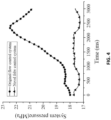
- FIG. 4 illustrates comparison curves of accumulator outlet pressures of the two systems.
- the accumulator outlet pressure of the original control system rose from 18 MPa to 22.4 MPa, while the accumulator outlet pressure of the novel flow control system may be stabilized at a preset level of 17.8 MPa.
- FIG. 5 illustrates comparison curves of instantaneous power consumed by the two systems.
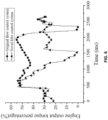
- FIG. 6 illustrates comparison curves of engine torque percentages of the two control systems.
- an average engine torque percentage decreased from 48.7% to 29.4%, that is, a decrease of 39.6%.
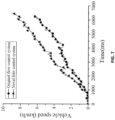
- FIG. 7 illustrates comparison curves of vehicle speeds during vehicle acceleration. The curves show that at the same acceleration time, a final vehicle speed of the original system reached 6.46 km/h while a final vehicle speed of the vehicle with the novel flow control system reached 8.99 km/h.
- the novel flow control system can achieve adaptive adjustment of the displacement of the hydraulic pump in the case of changes of the engine revolution speed and the flow consumed by the suspension system, such that the accumulator outlet pressure can be well stabilized, at the same time, the power consumed by the system can be reduced, and the engine load can be lowered.
- the engine can provide more power to a traveling system, and the acceleration performance of the vehicle is significantly improved.
- the engine power can be utilized more reasonably while stable and continuous operation of the active suspension system is ensured.
Landscapes
- Engineering & Computer Science (AREA)
- Mechanical Engineering (AREA)
- Physics & Mathematics (AREA)
- Fluid Mechanics (AREA)
- General Engineering & Computer Science (AREA)
- Vehicle Body Suspensions (AREA)
Description
- The present disclosure belongs to the technical field of automotive control, in particular to a hydraulic active suspension flow control system.
- A suspension system is an important part of a vehicle chassis, and performance thereof determines the handling stability and ride comfort of a vehicle. Active suspension has excellent active adjustment functions, which may minimize the impact of the road on a vehicle body. Hydraulic active suspension is favored by manufacturers because of the strong bearing capacity and flexible adjustment methods thereof. The output component of a hydraulic suspension system is a hydraulic cylinder, and the system may automatically adjust the expansion of the suspension hydraulic cylinder based on road conditions. Each tire is correspondingly provided with a suspension cylinder to regulate the grounding characteristics of the tire and the body position, which may improve the ride comfort and handling stability of the vehicle.
- An active suspension system requires energy input for operation. Currently, there are two types of power sources: an electric motor or an engine. For example, in the patent document with the publication number "
CN108025614A ", an electric motor is used as a power source. This application requires two energy conversions, resulting in energy waste. The engine directly drives a variable displacement pump, which may reduce the energy loss in the process of energy conversion and improve the utilization rate of energy, and is conducive to energy saving and environmental protection. However, the engine speed and the amount of hydraulic oil consumed by the movement of the suspension cylinder in the traveling process change with the vehicle speed, road conditions and other factors, and operating parameters of the engine and the suspension system may not be precisely matched. - In order to ensure the normal operation of the suspension system, the displacement of the variable displacement pump is generally adjusted to a range higher than that required by the system. Operating under such conditions, the whole system is kept in a high pressure state when oil provided by the variable displacement pump exceeds the regulating capacity of an accumulator, and when the system pressure exceeds the relief pressure of a relief valve, a large amount of high pressure oil flows back to a tank via the relief valve. When the vehicle operates in this condition for a long time, the engine power reserve is insufficient, and when the power consumed by the suspension system fluctuates greatly, the engine may jitter or even stall. Too much engine power is consumed by the suspension system, which reduces the traveling power of the vehicle and seriously affects the traveling performance of the vehicle.
-
Document EP 3 378 684 A1 discloses a further example of a hydraulic active suspension flow control system. - The present disclosure provides a hydraulic active suspension flow control system, such that the active suspension system of a vehicle operates stably and continuously, the engine power consumed by the active suspension system is reduced, the engine power is reasonably utilized, and engine jitter and stalling are effectively prevented.
- In order to solve the above-mentioned technical problems, the present disclosure adopts the following technical solutions:
- A hydraulic active suspension flow control system includes a hydraulic oil tank, a variable displacement pump with an oil suction port communicating with the hydraulic oil tank, and a check valve, a servo valve and a suspension cylinder connected to an oil outlet of the variable displacement pump in sequence, the suspension cylinder being controlled by the servo valve, the variable displacement pump being connected to an engine through a clutch, an accumulator being connected between the servo valve and the check valve. The hydraulic active suspension flow control system further includes an engine revolution speed sensor configured to detect an engine revolution speed, a vehicle speed sensor configured to detect a vehicle speed, an oil pressure sensor configured to detect an accumulator outlet pressure, and a flow controller configured to control displacement of the variable displacement pump by receiving data from the engine revolution speed sensor, the vehicle speed sensor and the oil pressure sensor, a relief valve connected to the check valve in parallel being further provided at the oil outlet of the variable displacement pump.
- According to a further improvement of the technical solutions of the present disclosure, an outlet of the check valve is connected to the accumulator and a port P of the servo valve; a port A and a port B of the servo valve are connected to a rodless cavity and a rod cavity of the suspension cylinder respectively; a port T of the servo valve and an oil outlet of the relief valve are connected to the hydraulic oil tank; the oil pressure sensor is disposed at an outlet of the accumulator; and an output end of the flow controller is connected to a control end of the variable displacement pump to control the displacement of the variable displacement pump.
- According to a further improvement of the technical solutions of the present disclosure, the flow controller achieves closed-loop control over the active suspension hydraulic system based on the accumulator outlet pressure, the vehicle speed and the engine revolution speed by the following method:
- firstly, calculating, based on changes of the accumulator outlet pressure, a first displacement adjustment quantity of the variable displacement pump:

- where p 0 denotes a preset pressure threshold, p 1 denotes the accumulator outlet pressure, and k 1 denotes a proportionality coefficient;
- secondly, calculating, based on the vehicle speed and engine revolution speed detected in real time, a second displacement adjustment quantity of the variable displacement pump by the following method:
- (1) calculating an average flow provided by the variable displacement pump and an average vehicle speed within t 0 seconds before a current moment:


where qaverage denotes the average flow provided by the variable displacement pump within t 0 seconds, uaverage denotes the average vehicle speed of a vehicle within t 0 seconds, vt , nt and ut denote instantaneous displacement of the variable displacement pump, an instantaneous engine revolution speed and an instantaneous vehicle speed at a moment t respectively, and tc denotes sampling time; and - (2) calculating, based on the average flow provided by the variable displacement pump, a current vehicle speed and the engine revolution speed, the second displacement adjustment quantity of the variable displacement pump:

- (1) calculating an average flow provided by the variable displacement pump and an average vehicle speed within t 0 seconds before a current moment:
- where nt and nt-1 denote engine revolution speeds at the current moment and a previous moment respectively, k2 denotes a proportionality coefficient, and u denotes the current vehicle speed; and
- finally, obtaining a total displacement adjustment quantity by adding the first adjustment quantity and the second adjustment quantity, that is, Δv = Δv 1 + Δv 2, obtaining a relationship between the total displacement adjustment quantity Δv and a control current Δi based on characteristic of the variable displacement pump, that is, Δi = k·Δv, calculating and outputting the control current, and adjusting the displacement of the variable displacement pump, where k is a conversion coefficient between Δi and Δv, with a specific value determined by the characteristics of the variable displacement pump.
- According to a further improvement of the technical solution of the present disclosure, N variable displacement pumps are connected in series; the total displacement adjustment quantity Δv is the sum of displacement adjustment quantities of all variable displacement pumps; and the final displacement adjustment quantity is allocated based on rated displacement of each variable displacement pump to obtain a displacement adjustment quantity of a single variable displacement pump, that is, an adjustment quantity of an i th variable displacement pump is:

where vi denotes the rated displacement of the i th variable displacement pump, and i = 1, 2, ..., N. - According to a further improvement of the technical solution of the present disclosure, one or more groups of servo valves and suspension cylinders controlled by the servo valves are provided.
- By means of the above technical solutions, the present disclosure has the following technical progresses:
- 1. By means of the system, adaptive adjustment of the displacement of the variable displacement pump can be achieved, such that the operating status of the variable displacement pump changes with conditions of roads over which a vehicle travels, and there is no need to manually adjust system parameters when the vehicle travels on different roads.
- 2. By means of the system, the fluctuation of the outlet flow of the variable displacement pump and the pressure caused by rapid changes of the engine revolution speed and the flow consumed by the suspension system is reduced while the continuous operation of the active suspension system is ensured, the response is sensitive, and the system operates more stably.
- 3. By means of the system, matching between the suspension system and the engine of the vehicle is achieved, the active suspension system can utilize the engine power more reasonably, and stalling caused when the engine load is too high is effectively prevented.
- 4. In this system, the displacement adjustment quantity of the variable displacement pump is calculated by calculating the average flow consumed by the suspension system within a period of time before the current moment, which not only includes the flow consumed by suspension movement but also includes the leakage flow of the hydraulic system, such that the calculation is more accurate, and the accuracy of the final displacement adjustment quantity of the variable displacement pump is ensured.
-
-
FIG. 1 illustrates a schematic diagram of a hydraulic active suspension flow control system according to the present disclosure; -
FIG. 2 illustrates a block diagram of hydraulic active suspension flow control according to the present disclosure; -
FIG. 3 illustrates comparison curves of engine revolution speed changes; -
FIG. 4 illustrates comparison curves of accumulator outlet pressures; -
FIG. 5 illustrates comparison curves of instantaneous power consumed by systems; -
FIG. 6 illustrates comparison curves of engine output torque percentages; and -
FIG. 7 illustrates comparison curves of vehicle speeds during vehicle acceleration. - 1. Hydraulic oil tank, 2. Variable displacement pump, 3. Relief valve, 4. Check valve, 5. Oil pressure sensor, 6. Accumulator, 7. Suspension cylinder, 8. Servo valve, 9. Engine, 10. Engine revolution speed sensor, 11. Vehicle speed sensor, 12. Clutch, and 13. Flow controller.
- The technical solutions according to the embodiments of the present disclosure will be clearly and completely described below with reference to the accompanying drawings according to the embodiments of the present disclosure. The described embodiments are only a part of the embodiments of the present disclosure, rather than all the embodiments. Based on the embodiments of the present disclosure, all other embodiments obtained by a person of ordinary skill in the art without inventive effort fall within the scope of the present disclosure.
- On the basis of the problems in the prior art, the present disclosure provides a hydraulic active suspension flow control system. As shown in
FIG. 1 , the system mainly includes anoil tank 1, avariable displacement pump 2, aservo valve 8, and asuspension cylinder 7. - The
suspension cylinder 7 is an executive element of the system. The action of thesuspension cylinder 7 is controlled by theservo valve 8. The servo valve is generally a three-position four-way solenoid valve. InFIG. 1 , when a right side of an electromagnet of theservo valve 8 is powered, thesuspension cylinder 7 controlled by the servo valve extends; when a left side of the electromagnet is powered, thesuspension cylinder 7 retracts; and when neither side is powered, thesuspension cylinder 7 is in a rigid locked state. According to this embodiment,FIG. 1 merely illustrates two groups of servo valves and suspension cylinders controlled by the servo valves, and one or more groups of servo valves and suspension cylinders controlled by the servo valves may be provided based on actual conditions. When a plurality of groups of servo valves and suspension cylinders controlled by the servo valves are provided, each group of servo valve and suspension cylinder controlled by the servo valve are connected in parallel. - High pressure power oil of this system is provided by the
variable displacement pump 2. Acheck valve 4 is disposed at an outlet of the variable displacement pump to prevent backflow of oil. An outlet of thecheck valve 4 is connected to theaccumulator 6 and a port P of theservo valve 8 through a pipeline. Anoil pressure sensor 5 is disposed at an outlet of theaccumulator 6. As shown inFIG. 1 , thecheck valve 4, theservo valve 8 and thesuspension cylinder 7 are connected to the oil outlet of thevariable displacement pump 2 in series in sequence, theaccumulator 6 is located between theservo valve 8 and thecheck valve 4, and theoil pressure sensor 5 is located between theaccumulator 6 and thecheck valve 4. A relief valve is disposed at the outlet of thevariable displacement pump 2, and is opened for overflow when a system pressure exceeds a set value, in order to ensure the system safety. - A main shaft of the
variable displacement pump 2 according to the present disclosure is connected to anengine 9 through a clutch 12, and thevariable displacement pump 2 is driven by theengine 9 to operate. Thevariable displacement pump 2 may be an electric proportional variable displacement hydraulic pump to facilitate displacement adjustment. - Detection components of the system include an engine
revolution speed sensor 10 configured to detect an engine revolution speed, avehicle speed sensor 11 configured to detect a vehicle speed, and theoil pressure sensor 5 configured to detect an accumulator outlet pressure. The enginerevolution speed sensor 10, thevehicle speed sensor 11 and theoil pressure sensor 5 are connected to aflow controller 13, and transmit data of the collected engine revolution speed, vehicle speed and accumulator outlet pressure to theflow controller 13 respectively. An output end of theflow controller 13 is connected to a control end of thevariable displacement pump 2. Theflow controller 13 performs calculation based on the engine revolution speed, the vehicle speed and the accumulator outlet pressure, and outputs a current value to change the displacement of thevariable displacement pump 2. - The operating process of the present disclosure is as follows:
- The high pressure oil in the system is consumed during the movement of the
suspension cylinder 7. When a flow provided by thevariable displacement pump 2 is not equal to a consumed flow, a flow difference is supplemented by theaccumulator 6. In this case, the outlet pressure of theaccumulator 6 is detected by theoil pressure sensor 5 and transmitted to theflow controller 13. Theflow controller 13 calculates a first displacement adjustment quantity Δv 1 = k 1Δp of the variable displacement pump based on the difference between the detected outlet pressure p 1 of theaccumulator 6 and a preset pressure threshold p 0, that is, Δp = p 0 - p 1 . Δv 1 is used for adjusting the displacement of the hydraulic pump to ensure that the system pressure is not lower than the pressure threshold. The pressure threshold is the minimum pressure required for normal operation of the system. - At the same time, in order to reduce the sudden change of the outlet flow of the variable displacement pump and the pressure caused by the change of the engine revolution speed or the flow consumed by the suspension system, the flow controller changes the displacement of the variable displacement pump in real time by collecting the parameters such as the engine revolution speed and the vehicle speed. A specific method is as follows:
- The engine revolution speed nt and the vehicle speed ut are detected by the engine
revolution speed sensor 10 and thevehicle speed sensor 11 respectively and transmitted to theflow controller 13, and theflow controller 13 calculates an average flow and an average vehicle speed within the time t 0 respectively based on stored data:

- A second displacement adjustment quantity of the pump is then further calculated as:

where qaverage denotes an average flow consumed by the suspension system within t 0 seconds, which includes a system leakage flow and a flow consumed during movement of the suspension cylinder, k 2 denotes a proportionality coefficient, uaverage denotes the average vehicle speed within t 0 seconds, and vt denotes instantaneous displacement of the variable displacement pump at a moment t.
- A total displacement adjustment quantity includes the first adjustment quantity and the second adjustment quantity, that is, Δv = Δv 1 + Δv 2. A relationship between the total displacement adjustment quantity Δv and a control current Δi is obtained based on the characteristics of the variable displacement pump, that is, Δi = k·Δv. The control current is calculated as: it = i t-1 + Δi, and output, where i t-1 is a control current of the previous moment. The flow controller outputs the current to the variable displacement pump to change the displacement of the variable displacement pump, thus achieving flow control.
- In the specific implementation, N
variable displacement pumps 2 may be connected in series to jointly supply high pressure oil. In this case, the final displacement adjustment quantity Δv is the sum of displacement adjustment quantities of the N variable displacement pumps, and the final displacement adjustment quantity is allocated based on rated displacement of each variable displacement pump to obtain a displacement adjustment quantity of a single variable displacement pump. The displacement adjustment quantity of an i th variable displacement pump is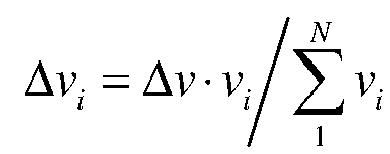
where vi denotes the rated displacement of the i th variable displacement pump, and i = 1, 2, ..., N. The operating principle of the system is as shown inFIG. 2 . - In the system, the variable displacement pump is driven by the engine to convey high pressure oil to each servo valve through the check valve. Each servo valve controls the suspension cylinder connected to the servo valve to extend and retract. In the traveling process of the vehicle, due to the complex action process of the suspension system, the oil consumption of the system may not be calculated accurately, such that the displacement of the variable displacement pump may not be controlled directly through the flow control method. When the flow supplied by the variable displacement pump is not equal to the flow consumed by the suspension system, if the variable displacement pump supplies too much high pressure oil, the accumulator stores the oil, and if the variable displacement pump supplies too little high pressure oil, the accumulator releases oil, so as to ensure the stable operation of the system. As the oil storage capacity of the accumulator is related to the outlet pressure, the accumulator outlet pressure is controlled. This control method may not only ensure that the oil pressure is not lower than the required pressure of the system, but also ensure that a certain amount of high pressure oil is stored in the accumulator. Due to the limited oil storage capacity of the accumulator, the accumulator may merely play a role in flow compensation when the flow fluctuates in a small range. In addition, since the system pressure change needs to be detected first for pressure control, adjustment time exists in the feedback control process, and when the engine revolution speed changes a lot, it is too late for pressure feedback control to respond, which may also cause fluctuations of the system pressure. Therefore, by detecting the engine revolution speed, the vehicle speed and other parameters, the preset flow is adjusted based on the traveling status of the vehicle, which is suitable for the actual traveling conditions of the vehicle on different roads.
- During the development of the present disclosure, the inventor conducted comparison tests of the control effects in a vehicle equipped with the novel hydraulic active suspension flow control system and a vehicle equipped with an original active suspension flow control system. During the tests, the entire vehicles were propped up using outriggers and the suspension cylinders were allowed to make sinusoidal movements to simulate the flow consumption of the active suspension system in the traveling process of the vehicles. When the suspension cylinders moved at the frequency of 0.5 Hz and follow a control target steadily, a throttle pedal was momentarily pressed to the maximum extent, and was released when the engine revolution speed increased from 550 r/min to about 1400 r/min.
FIG. 3 illustrates comparison curves of engine revolution speed changes. In the figure, the time t2 required to increase the engine revolution speed in the original flow control system from 550 r/min to 1400 r/min was 1.65 seconds, while the time t1 of the novel flow control system was 0.96 seconds, which is a 41.8% reduction in acceleration time, indicating that the torque borne by the engine during acceleration is reduced by means of the novel flow control system.FIG. 4 illustrates comparison curves of accumulator outlet pressures of the two systems. In the figure, the accumulator outlet pressure of the original control system rose from 18 MPa to 22.4 MPa, while the accumulator outlet pressure of the novel flow control system may be stabilized at a preset level of 17.8 MPa.FIG. 5 illustrates comparison curves of instantaneous power consumed by the two systems. In the figure, the engine power consumed by the original active suspension control system gradually increased with the change of the engine revolution speed and the system pressure, where the average power was 22.7 kw and the peak power reached 32.8 kw, while in the novel flow control system, the power tended to be stable, where the average power was 13.2 kw and the peak power was 17.3 kw, which were reduced by 42% and 47% respectively.FIG. 6 illustrates comparison curves of engine torque percentages of the two control systems. In the figure, an average engine torque percentage decreased from 48.7% to 29.4%, that is, a decrease of 39.6%. - To further verify the effects of this system, a comparison test was conducted for the acceleration performance of the vehicles. In both tests, the vehicles were in the same starting position, the accelerator pedal of the engine was pressed to the maximum extent during the starting phase, and traveling speed data of the vehicles was collected.
FIG. 7 illustrates comparison curves of vehicle speeds during vehicle acceleration. The curves show that at the same acceleration time, a final vehicle speed of the original system reached 6.46 km/h while a final vehicle speed of the vehicle with the novel flow control system reached 8.99 km/h. - The above experimental results show that the novel flow control system can achieve adaptive adjustment of the displacement of the hydraulic pump in the case of changes of the engine revolution speed and the flow consumed by the suspension system, such that the accumulator outlet pressure can be well stabilized, at the same time, the power consumed by the system can be reduced, and the engine load can be lowered. The engine can provide more power to a traveling system, and the acceleration performance of the vehicle is significantly improved. The engine power can be utilized more reasonably while stable and continuous operation of the active suspension system is ensured.
Claims (4)
- A hydraulic active suspension flow control system, comprising a hydraulic oil tank (1), a variable displacement pump (2) with an oil suction port communicating with the hydraulic oil tank (1), and a check valve (4), a servo valve (8) and a suspension cylinder (7) connected to an oil outlet of the variable displacement pump (2) in sequence, the suspension cylinder (7) being controlled by the servo valve (8), the variable displacement pump (2) being connected to an engine (9) through a clutch (12), an accumulator (6) being connected between the servo valve (8) and the check valve (4), and further comprising an engine revolution speed sensor (10) configured to detect an engine revolution speed, a vehicle speed sensor (11) configured to detect a vehicle speed, an oil pressure sensor (5) configured to detect an accumulator (6) outlet pressure, and a flow controller (13) configured to control displacement of the variable displacement pump (2) by receiving data from the engine revolution speed sensor (10), the vehicle speed sensor (11) and the oil pressure sensor (5), a relief valve (3) connected to the check valve (4) in parallel being further provided at the oil outlet of the variable displacement pump (2),
the flow controller (13) achieving closed-loop control over the active suspension hydraulic system based on the accumulator (6) outlet pressure, the vehicle speed and the engine revolution speed by the following method:firstly, calculating, based on changes of the accumulator (6) outlet pressure, a first displacement adjustment quantity of the variable displacement pump: wherein p 0 denotes a preset pressure threshold, p 1 denotes the accumulator outlet pressure, and k 1 denotes a proportionality coefficient;secondly, calculating, based on the vehicle speed and engine revolution speed detected in real time, a second displacement adjustment quantity of the variable displacement pump by the following method:(1) calculating an average flow provided by the variable displacement pump and an average vehicle speed within t 0 seconds before a current moment:
 (2) calculating, based on the average flow provided by the variable displacement pump, a current vehicle speed and the engine revolution speed, the second displacement adjustment quantity of the variable displacement pump:
 wherein nt and nt-1 denote engine revolution speeds at the current moment and a previous moment respectively, k2 denotes a proportionality coefficient, and u denotes the current vehicle speed; andfinally, obtaining a total displacement adjustment quantity by adding the first adjustment quantity and the second adjustment quantity, that is, Δv = Δv 1 + Δv 2, obtaining a relationship between the total displacement adjustment quantity Δv and a control current Δi based on characteristic of the variable displacement pump, that is, Δi = k·Δv, calculating and outputting the control current, and adjusting the displacement of the variable displacement pump.
 - The hydraulic active suspension flow control system according to claim 1, wherein an outlet of the check valve (4) is connected to the accumulator (6) and a port P of the servo valve (8); a port A and a port B of the servo valve (8) are connected to a rodless cavity and a rod cavity of the suspension cylinder respectively (7); a port T of the servo valve (8) and an oil outlet of the relief valve (3) are connected to the hydraulic oil tank (1); the oil pressure sensor (5) is disposed at an outlet of the accumulator (6); and an output end of the flow controller (13) is connected to a control end of the variable displacement pump (2) to control the displacement of the variable displacement pump (2).
- The hydraulic active suspension flow control system according to claim 1, wherein N variable displacement pumps are connected in series; the total displacement adjustment quantity Δv is the sum of displacement adjustment quantities of all variable displacement pumps; and a final displacement adjustment quantity is allocated based on rated displacement of each variable displacement pump to obtain a displacement adjustment quantity of a single variable displacement pump, that is, an adjustment quantity of an i th variable displacement pump is:

- The hydraulic active suspension flow control system according to claim 1, wherein one or more groups of servo valves (8) and suspension cylinders (7) controlled by the servo valves (8) are provided.
Applications Claiming Priority (2)
| Application Number | Priority Date | Filing Date | Title |
|---|---|---|---|
| CN202110361524.3A CN113236617B (en) | 2021-04-02 | 2021-04-02 | A hydraulic active suspension flow control system |
| PCT/CN2022/084822 WO2022206957A1 (en) | 2021-04-02 | 2022-04-01 | Hydraulic active suspension flow control system |
Publications (4)
| Publication Number | Publication Date |
|---|---|
| EP4209684A1 EP4209684A1 (en) | 2023-07-12 |
| EP4209684A4 EP4209684A4 (en) | 2024-02-07 |
| EP4209684C0 EP4209684C0 (en) | 2024-11-06 |
| EP4209684B1 true EP4209684B1 (en) | 2024-11-06 |
Family
ID=77131052
Family Applications (1)
| Application Number | Title | Priority Date | Filing Date |
|---|---|---|---|
| EP22779137.3A Active EP4209684B1 (en) | 2021-04-02 | 2022-04-01 | Hydraulic active suspension flow control system |
Country Status (9)
| Country | Link |
|---|---|
| US (1) | US11813914B2 (en) |
| EP (1) | EP4209684B1 (en) |
| JP (1) | JP7456695B2 (en) |
| KR (1) | KR102736447B1 (en) |
| CN (1) | CN113236617B (en) |
| AU (1) | AU2022251335B9 (en) |
| CA (1) | CA3190312A1 (en) |
| ES (1) | ES3003915T3 (en) |
| WO (1) | WO2022206957A1 (en) |
Families Citing this family (2)
| Publication number | Priority date | Publication date | Assignee | Title |
|---|---|---|---|---|
| CN113236617B (en) | 2021-04-02 | 2022-02-11 | 燕山大学 | A hydraulic active suspension flow control system |
| GB2606391B (en) * | 2021-05-06 | 2024-12-18 | Domin Fluid Power Ltd | A suspension system for an automotive vehicle |
Family Cites Families (32)
| Publication number | Priority date | Publication date | Assignee | Title |
|---|---|---|---|---|
| JPH01249506A (en) | 1988-03-31 | 1989-10-04 | Nissan Motor Co Ltd | Active type suspension device |
| JP3023558B2 (en) * | 1988-09-20 | 2000-03-21 | トキコ株式会社 | Suspension device |
| JP2506436B2 (en) * | 1989-03-30 | 1996-06-12 | 日産自動車株式会社 | Vehicle fluid pressure supply device |
| JPH02283516A (en) * | 1989-04-21 | 1990-11-21 | Toyota Motor Corp | Pressure oil supply device for active suspension |
| JP2699630B2 (en) * | 1990-09-12 | 1998-01-19 | 日産自動車株式会社 | Fluid supply device for vehicles |
| JPH04271910A (en) * | 1991-02-27 | 1992-09-28 | Nissan Motor Co Ltd | Discharge capacity control device of working pressure supply device for vehicle |
| JP2628947B2 (en) | 1991-08-06 | 1997-07-09 | 本田技研工業株式会社 | Hydraulic control device for active suspension |
| WO1995011813A1 (en) * | 1993-10-26 | 1995-05-04 | Kinetic Limited | Vehicle suspension system |
| US6467748B1 (en) | 2000-09-05 | 2002-10-22 | Deere & Company | Hydraulic circuit for active suspension system |
| JP2003291621A (en) * | 2002-03-29 | 2003-10-15 | Tokico Ltd | Suspension control device |
| US8191874B2 (en) * | 2006-03-22 | 2012-06-05 | Toyota Jidosha Kabushiki Kaisha | Vehicle suspension system |
| EP2156970A1 (en) * | 2008-08-12 | 2010-02-24 | Nederlandse Organisatie voor toegepast- natuurwetenschappelijk onderzoek TNO | Multi-point hydraulic suspension system for a land vehicle |
| CN201281052Y (en) * | 2008-09-27 | 2009-07-29 | 三一重型装备有限公司 | Proportional displacement controlling device for variable displacement pump |
| CN101691878B (en) * | 2009-10-13 | 2012-05-23 | 太原理工大学 | Hydraulic pump flow regulating device |
| DE102010020132A1 (en) * | 2010-05-11 | 2011-11-17 | Hydac Electronic Gmbh | Drive system with at least one hydraulic actuator |
| CN102278334A (en) * | 2011-07-22 | 2011-12-14 | 中国人民解放军装甲兵工程学院 | Hydraulic power system for robot |
| KR101276568B1 (en) * | 2011-09-02 | 2013-06-18 | 계명대학교 산학협력단 | hydraulic Active Roll Stabilization system |
| WO2013125638A1 (en) * | 2012-02-23 | 2013-08-29 | 株式会社Ihi | Active damper |
| CN103057374B (en) * | 2012-12-27 | 2016-12-28 | 三一汽车起重机械有限公司 | Hydro-pneumatic suspension system and engineering truck |
| CN103397678B (en) * | 2013-08-13 | 2015-07-01 | 南京工业大学 | Power matching energy-saving system and method for engine and hydraulic pump |
| CN105275044B (en) * | 2015-09-28 | 2017-11-07 | 北华航天工业学院 | A kind of excavator hydraulic energy-saving control system and method |
| JP6714336B2 (en) | 2015-09-30 | 2020-06-24 | Kyb株式会社 | Suspension device |
| JP6700735B2 (en) * | 2015-11-19 | 2020-05-27 | Kyb株式会社 | Suspension device |
| CN106870481A (en) * | 2015-12-14 | 2017-06-20 | 田佳聪 | A kind of vehicle active suspension hydraulic servo control system |
| CN205423353U (en) * | 2016-03-07 | 2016-08-03 | 四川万冠液压技术股份有限公司 | Novel hydraulic hitch system all |
| CN110497760B (en) * | 2019-08-07 | 2020-09-18 | 燕山大学 | Active-passive dual-mode switchable vehicle suspension system and switching method thereof |
| CN110645231A (en) * | 2019-11-07 | 2020-01-03 | 无锡红旗船厂有限公司 | Vehicle electronically controlled hydraulic drive test bench system for accumulator-assisted drive and recovery |
| CN111573545B (en) * | 2020-05-21 | 2021-02-09 | 山东大学 | Distributed energy-saving active and passive composite heave compensation system and working method thereof |
| CN111775648B (en) * | 2020-07-22 | 2023-08-29 | 徐州徐工矿业机械有限公司 | Semi-active hydro-pneumatic suspension control system and control method for mining dump truck |
| CN112193237B (en) * | 2020-09-17 | 2021-07-30 | 燕山大学 | Control system and method for engine idle speed and hydraulic pump flow of active suspension vehicle |
| CN113236617B (en) * | 2021-04-02 | 2022-02-11 | 燕山大学 | A hydraulic active suspension flow control system |
| US11697319B2 (en) * | 2021-10-12 | 2023-07-11 | DRiV Automotive Inc. | Suspension system with comfort valve integration |
-
2021
- 2021-04-02 CN CN202110361524.3A patent/CN113236617B/en active Active
-
2022
- 2022-04-01 JP JP2023517720A patent/JP7456695B2/en active Active
- 2022-04-01 EP EP22779137.3A patent/EP4209684B1/en active Active
- 2022-04-01 WO PCT/CN2022/084822 patent/WO2022206957A1/en not_active Ceased
- 2022-04-01 KR KR1020237010304A patent/KR102736447B1/en active Active
- 2022-04-01 ES ES22779137T patent/ES3003915T3/en active Active
- 2022-04-01 CA CA3190312A patent/CA3190312A1/en active Pending
- 2022-04-01 AU AU2022251335A patent/AU2022251335B9/en active Active
-
2023
- 2023-05-06 US US18/313,317 patent/US11813914B2/en active Active
Also Published As
| Publication number | Publication date |
|---|---|
| AU2022251335B2 (en) | 2024-03-14 |
| EP4209684C0 (en) | 2024-11-06 |
| JP2023550865A (en) | 2023-12-06 |
| CN113236617B (en) | 2022-02-11 |
| KR102736447B1 (en) | 2024-11-28 |
| KR20230054726A (en) | 2023-04-25 |
| JP7456695B2 (en) | 2024-03-27 |
| US11813914B2 (en) | 2023-11-14 |
| AU2022251335A1 (en) | 2023-05-04 |
| ES3003915T3 (en) | 2025-03-11 |
| EP4209684A1 (en) | 2023-07-12 |
| WO2022206957A1 (en) | 2022-10-06 |
| CA3190312A1 (en) | 2022-10-06 |
| EP4209684A4 (en) | 2024-02-07 |
| NZ798270A (en) | 2025-08-29 |
| US20230278385A1 (en) | 2023-09-07 |
| CN113236617A (en) | 2021-08-10 |
| AU2022251335B9 (en) | 2024-04-18 |
Similar Documents
| Publication | Publication Date | Title |
|---|---|---|
| US11813914B2 (en) | Hydraulic active suspension flow control system | |
| US9487932B2 (en) | Hybrid construction machine | |
| CN109950580B (en) | Low-cost fuel cell stack anode working pressure rapid regulating system | |
| US11035462B2 (en) | Work vehicle and control method for work vehicle | |
| CN101169078A (en) | Hydraulic chassis engineering machinery walking control method and control system | |
| CN108678045B (en) | A loader pump-controlled hybrid hydraulic system and its control method | |
| CN105711581A (en) | Stepless speed change tractor control system and control method thereof | |
| CN114941711A (en) | Speed regulation control method of double-flow transmission speed change system based on volumetric efficiency compensation | |
| CN116658495B (en) | Control method and control system for gradient utilization of recovered energy of forklift hydraulic system | |
| NL2040325A (en) | Speed and displacement bivariate control method and device for motor-driven pump | |
| US8839897B2 (en) | Hybrid hydraulic vehicle drive system | |
| CN115649273A (en) | Vehicle steering control system and method and working machine | |
| CN219570479U (en) | Electrohydraulic oil supplementing system and engineering machinery | |
| US12018460B2 (en) | Excavator | |
| CN111706563B (en) | Three-way speed regulating valve based on hydraulic motor-generator pressure compensator | |
| CN205225901U (en) | Laser leveling machine hydraulic drive control system | |
| CN118911230B (en) | Hydraulic excavator movable arm energy recovery system and control strategy | |
| CN202579390U (en) | Asphalt proportional solenoid valve for asphalt distribution truck | |
| CN120573170A (en) | All-wheel steering hydraulic decoupling energy-saving control system for multi-pump linkage special transport vehicles | |
| CN116331202A (en) | A steering control strategy for hydraulically driven vehicles | |
| CN120622351A (en) | Mine hoist hydraulic braking system and method for preventing braking force from being insufficient | |
| CN118025099A (en) | Tram hydraulic braking antiskid control system | |
| CN117212298A (en) | Excavator motor assembly test system and control method thereof | |
| CN119825790A (en) | Hydraulic control system and method and aerial work platform | |
| CN102320297A (en) | Method for comprehensive control of water transmission and fan transmission and system thereof |
Legal Events
| Date | Code | Title | Description |
|---|---|---|---|
| STAA | Information on the status of an ep patent application or granted ep patent |
Free format text: STATUS: THE INTERNATIONAL PUBLICATION HAS BEEN MADE |
|
| PUAI | Public reference made under article 153(3) epc to a published international application that has entered the european phase |
Free format text: ORIGINAL CODE: 0009012 |
|
| STAA | Information on the status of an ep patent application or granted ep patent |
Free format text: STATUS: REQUEST FOR EXAMINATION WAS MADE |
|
| 17P | Request for examination filed |
Effective date: 20230331 |
|
| AK | Designated contracting states |
Kind code of ref document: A1 Designated state(s): AL AT BE BG CH CY CZ DE DK EE ES FI FR GB GR HR HU IE IS IT LI LT LU LV MC MK MT NL NO PL PT RO RS SE SI SK SM TR |
|
| A4 | Supplementary search report drawn up and despatched |
Effective date: 20240109 |
|
| RIC1 | Information provided on ipc code assigned before grant |
Ipc: B60W 10/22 20060101ALI20240103BHEP Ipc: B60G 17/015 20060101ALI20240103BHEP Ipc: B60G 17/019 20060101ALI20240103BHEP Ipc: F15B 1/02 20060101ALI20240103BHEP Ipc: F15B 19/00 20060101ALI20240103BHEP Ipc: F15B 11/17 20060101AFI20240103BHEP |
|
| GRAP | Despatch of communication of intention to grant a patent |
Free format text: ORIGINAL CODE: EPIDOSNIGR1 |
|
| STAA | Information on the status of an ep patent application or granted ep patent |
Free format text: STATUS: GRANT OF PATENT IS INTENDED |
|
| INTG | Intention to grant announced |
Effective date: 20240524 |
|
| DAV | Request for validation of the european patent (deleted) | ||
| DAX | Request for extension of the european patent (deleted) | ||
| GRAS | Grant fee paid |
Free format text: ORIGINAL CODE: EPIDOSNIGR3 |
|
| GRAA | (expected) grant |
Free format text: ORIGINAL CODE: 0009210 |
|
| STAA | Information on the status of an ep patent application or granted ep patent |
Free format text: STATUS: THE PATENT HAS BEEN GRANTED |
|
| AK | Designated contracting states |
Kind code of ref document: B1 Designated state(s): AL AT BE BG CH CY CZ DE DK EE ES FI FR GB GR HR HU IE IS IT LI LT LU LV MC MK MT NL NO PL PT RO RS SE SI SK SM TR |
|
| REG | Reference to a national code |
Ref country code: GB Ref legal event code: FG4D |
|
| REG | Reference to a national code |
Ref country code: CH Ref legal event code: EP |
|
| REG | Reference to a national code |
Ref country code: DE Ref legal event code: R096 Ref document number: 602022007561 Country of ref document: DE |
|
| REG | Reference to a national code |
Ref country code: IE Ref legal event code: FG4D |
|
| U01 | Request for unitary effect filed |
Effective date: 20241202 |
|
| U07 | Unitary effect registered |
Designated state(s): AT BE BG DE DK EE FI FR IT LT LU LV MT NL PT RO SE SI Effective date: 20241212 |
|
| REG | Reference to a national code |
Ref country code: ES Ref legal event code: FG2A Ref document number: 3003915 Country of ref document: ES Kind code of ref document: T3 Effective date: 20250311 |
|
| PG25 | Lapsed in a contracting state [announced via postgrant information from national office to epo] |
Ref country code: HR Free format text: LAPSE BECAUSE OF FAILURE TO SUBMIT A TRANSLATION OF THE DESCRIPTION OR TO PAY THE FEE WITHIN THE PRESCRIBED TIME-LIMIT Effective date: 20241106 Ref country code: IS Free format text: LAPSE BECAUSE OF FAILURE TO SUBMIT A TRANSLATION OF THE DESCRIPTION OR TO PAY THE FEE WITHIN THE PRESCRIBED TIME-LIMIT Effective date: 20250306 |
|
| PG25 | Lapsed in a contracting state [announced via postgrant information from national office to epo] |
Ref country code: NO Free format text: LAPSE BECAUSE OF FAILURE TO SUBMIT A TRANSLATION OF THE DESCRIPTION OR TO PAY THE FEE WITHIN THE PRESCRIBED TIME-LIMIT Effective date: 20250206 |
|
| PG25 | Lapsed in a contracting state [announced via postgrant information from national office to epo] |
Ref country code: GR Free format text: LAPSE BECAUSE OF FAILURE TO SUBMIT A TRANSLATION OF THE DESCRIPTION OR TO PAY THE FEE WITHIN THE PRESCRIBED TIME-LIMIT Effective date: 20250207 |
|
| PG25 | Lapsed in a contracting state [announced via postgrant information from national office to epo] |
Ref country code: PL Free format text: LAPSE BECAUSE OF FAILURE TO SUBMIT A TRANSLATION OF THE DESCRIPTION OR TO PAY THE FEE WITHIN THE PRESCRIBED TIME-LIMIT Effective date: 20241106 |
|
| PG25 | Lapsed in a contracting state [announced via postgrant information from national office to epo] |
Ref country code: RS Free format text: LAPSE BECAUSE OF FAILURE TO SUBMIT A TRANSLATION OF THE DESCRIPTION OR TO PAY THE FEE WITHIN THE PRESCRIBED TIME-LIMIT Effective date: 20250206 |
|
| U20 | Renewal fee for the european patent with unitary effect paid |
Year of fee payment: 4 Effective date: 20250430 |
|
| PG25 | Lapsed in a contracting state [announced via postgrant information from national office to epo] |
Ref country code: SM Free format text: LAPSE BECAUSE OF FAILURE TO SUBMIT A TRANSLATION OF THE DESCRIPTION OR TO PAY THE FEE WITHIN THE PRESCRIBED TIME-LIMIT Effective date: 20241106 |
|
| PGFP | Annual fee paid to national office [announced via postgrant information from national office to epo] |
Ref country code: ES Payment date: 20250530 Year of fee payment: 4 |
|
| PG25 | Lapsed in a contracting state [announced via postgrant information from national office to epo] |
Ref country code: SK Free format text: LAPSE BECAUSE OF FAILURE TO SUBMIT A TRANSLATION OF THE DESCRIPTION OR TO PAY THE FEE WITHIN THE PRESCRIBED TIME-LIMIT Effective date: 20241106 |
|
| PG25 | Lapsed in a contracting state [announced via postgrant information from national office to epo] |
Ref country code: CZ Free format text: LAPSE BECAUSE OF FAILURE TO SUBMIT A TRANSLATION OF THE DESCRIPTION OR TO PAY THE FEE WITHIN THE PRESCRIBED TIME-LIMIT Effective date: 20241106 |
|
| PLBE | No opposition filed within time limit |
Free format text: ORIGINAL CODE: 0009261 |
|
| STAA | Information on the status of an ep patent application or granted ep patent |
Free format text: STATUS: NO OPPOSITION FILED WITHIN TIME LIMIT |
|
| 26N | No opposition filed |
Effective date: 20250807 |
|
| REG | Reference to a national code |
Ref country code: CH Ref legal event code: H13 Free format text: ST27 STATUS EVENT CODE: U-0-0-H10-H13 (AS PROVIDED BY THE NATIONAL OFFICE) Effective date: 20251125 |
|
| PG25 | Lapsed in a contracting state [announced via postgrant information from national office to epo] |
Ref country code: MC Free format text: LAPSE BECAUSE OF FAILURE TO SUBMIT A TRANSLATION OF THE DESCRIPTION OR TO PAY THE FEE WITHIN THE PRESCRIBED TIME-LIMIT Effective date: 20241106 |
|
| PG25 | Lapsed in a contracting state [announced via postgrant information from national office to epo] |
Ref country code: CH Free format text: LAPSE BECAUSE OF NON-PAYMENT OF DUE FEES Effective date: 20250430 |
|
| PG25 | Lapsed in a contracting state [announced via postgrant information from national office to epo] |
Ref country code: IE Free format text: LAPSE BECAUSE OF NON-PAYMENT OF DUE FEES Effective date: 20250401 |