EP4206094A1 - Picking assistance robot and picking assistance system - Google Patents
Picking assistance robot and picking assistance system Download PDFInfo
- Publication number
- EP4206094A1 EP4206094A1 EP21861005.3A EP21861005A EP4206094A1 EP 4206094 A1 EP4206094 A1 EP 4206094A1 EP 21861005 A EP21861005 A EP 21861005A EP 4206094 A1 EP4206094 A1 EP 4206094A1
- Authority
- EP
- European Patent Office
- Prior art keywords
- picking
- product
- instruction
- housing
- worker
- Prior art date
- Legal status (The legal status is an assumption and is not a legal conclusion. Google has not performed a legal analysis and makes no representation as to the accuracy of the status listed.)
- Pending
Links
Images





Classifications
-
- B—PERFORMING OPERATIONS; TRANSPORTING
- B65—CONVEYING; PACKING; STORING; HANDLING THIN OR FILAMENTARY MATERIAL
- B65G—TRANSPORT OR STORAGE DEVICES, e.g. CONVEYORS FOR LOADING OR TIPPING, SHOP CONVEYOR SYSTEMS OR PNEUMATIC TUBE CONVEYORS
- B65G1/00—Storing articles, individually or in orderly arrangement, in warehouses or magazines
- B65G1/02—Storage devices
- B65G1/04—Storage devices mechanical
- B65G1/0492—Storage devices mechanical with cars adapted to travel in storage aisles
-
- B—PERFORMING OPERATIONS; TRANSPORTING
- B65—CONVEYING; PACKING; STORING; HANDLING THIN OR FILAMENTARY MATERIAL
- B65G—TRANSPORT OR STORAGE DEVICES, e.g. CONVEYORS FOR LOADING OR TIPPING, SHOP CONVEYOR SYSTEMS OR PNEUMATIC TUBE CONVEYORS
- B65G1/00—Storing articles, individually or in orderly arrangement, in warehouses or magazines
- B65G1/02—Storage devices
- B65G1/04—Storage devices mechanical
- B65G1/137—Storage devices mechanical with arrangements or automatic control means for selecting which articles are to be removed
- B65G1/1371—Storage devices mechanical with arrangements or automatic control means for selecting which articles are to be removed with data records
-
- B—PERFORMING OPERATIONS; TRANSPORTING
- B65—CONVEYING; PACKING; STORING; HANDLING THIN OR FILAMENTARY MATERIAL
- B65G—TRANSPORT OR STORAGE DEVICES, e.g. CONVEYORS FOR LOADING OR TIPPING, SHOP CONVEYOR SYSTEMS OR PNEUMATIC TUBE CONVEYORS
- B65G1/00—Storing articles, individually or in orderly arrangement, in warehouses or magazines
- B65G1/02—Storage devices
- B65G1/04—Storage devices mechanical
- B65G1/137—Storage devices mechanical with arrangements or automatic control means for selecting which articles are to be removed
- B65G1/1373—Storage devices mechanical with arrangements or automatic control means for selecting which articles are to be removed for fulfilling orders in warehouses
- B65G1/1375—Storage devices mechanical with arrangements or automatic control means for selecting which articles are to be removed for fulfilling orders in warehouses the orders being assembled on a commissioning stacker-crane or truck
-
- G—PHYSICS
- G06—COMPUTING OR CALCULATING; COUNTING
- G06K—GRAPHICAL DATA READING; PRESENTATION OF DATA; RECORD CARRIERS; HANDLING RECORD CARRIERS
- G06K7/00—Methods or arrangements for sensing record carriers, e.g. for reading patterns
- G06K7/10—Methods or arrangements for sensing record carriers, e.g. for reading patterns by electromagnetic radiation, e.g. optical sensing; by corpuscular radiation
- G06K7/10009—Methods or arrangements for sensing record carriers, e.g. for reading patterns by electromagnetic radiation, e.g. optical sensing; by corpuscular radiation sensing by radiation using wavelengths larger than 0.1 mm, e.g. radio-waves or microwaves
- G06K7/10297—Methods or arrangements for sensing record carriers, e.g. for reading patterns by electromagnetic radiation, e.g. optical sensing; by corpuscular radiation sensing by radiation using wavelengths larger than 0.1 mm, e.g. radio-waves or microwaves arrangements for handling protocols designed for non-contact record carriers such as RFIDs NFCs, e.g. ISO/IEC 14443 and 18092
-
- G—PHYSICS
- G06—COMPUTING OR CALCULATING; COUNTING
- G06Q—INFORMATION AND COMMUNICATION TECHNOLOGY [ICT] SPECIALLY ADAPTED FOR ADMINISTRATIVE, COMMERCIAL, FINANCIAL, MANAGERIAL OR SUPERVISORY PURPOSES; SYSTEMS OR METHODS SPECIALLY ADAPTED FOR ADMINISTRATIVE, COMMERCIAL, FINANCIAL, MANAGERIAL OR SUPERVISORY PURPOSES, NOT OTHERWISE PROVIDED FOR
- G06Q10/00—Administration; Management
- G06Q10/08—Logistics, e.g. warehousing, loading or distribution; Inventory or stock management
-
- G—PHYSICS
- G06—COMPUTING OR CALCULATING; COUNTING
- G06Q—INFORMATION AND COMMUNICATION TECHNOLOGY [ICT] SPECIALLY ADAPTED FOR ADMINISTRATIVE, COMMERCIAL, FINANCIAL, MANAGERIAL OR SUPERVISORY PURPOSES; SYSTEMS OR METHODS SPECIALLY ADAPTED FOR ADMINISTRATIVE, COMMERCIAL, FINANCIAL, MANAGERIAL OR SUPERVISORY PURPOSES, NOT OTHERWISE PROVIDED FOR
- G06Q10/00—Administration; Management
- G06Q10/08—Logistics, e.g. warehousing, loading or distribution; Inventory or stock management
- G06Q10/087—Inventory or stock management, e.g. order filling, procurement or balancing against orders
-
- G—PHYSICS
- G06—COMPUTING OR CALCULATING; COUNTING
- G06Q—INFORMATION AND COMMUNICATION TECHNOLOGY [ICT] SPECIALLY ADAPTED FOR ADMINISTRATIVE, COMMERCIAL, FINANCIAL, MANAGERIAL OR SUPERVISORY PURPOSES; SYSTEMS OR METHODS SPECIALLY ADAPTED FOR ADMINISTRATIVE, COMMERCIAL, FINANCIAL, MANAGERIAL OR SUPERVISORY PURPOSES, NOT OTHERWISE PROVIDED FOR
- G06Q10/00—Administration; Management
- G06Q10/08—Logistics, e.g. warehousing, loading or distribution; Inventory or stock management
- G06Q10/087—Inventory or stock management, e.g. order filling, procurement or balancing against orders
- G06Q10/0874—Inventory fulfillment
- G06Q10/08741—Inventory fulfillment by picking of items from inventory for fulfillment
-
- G—PHYSICS
- G06—COMPUTING OR CALCULATING; COUNTING
- G06Q—INFORMATION AND COMMUNICATION TECHNOLOGY [ICT] SPECIALLY ADAPTED FOR ADMINISTRATIVE, COMMERCIAL, FINANCIAL, MANAGERIAL OR SUPERVISORY PURPOSES; SYSTEMS OR METHODS SPECIALLY ADAPTED FOR ADMINISTRATIVE, COMMERCIAL, FINANCIAL, MANAGERIAL OR SUPERVISORY PURPOSES, NOT OTHERWISE PROVIDED FOR
- G06Q10/00—Administration; Management
- G06Q10/08—Logistics, e.g. warehousing, loading or distribution; Inventory or stock management
- G06Q10/087—Inventory or stock management, e.g. order filling, procurement or balancing against orders
- G06Q10/0877—Inventory or stock management, e.g. order filling, procurement or balancing against orders by inventory control or reporting using inventory tracking or counting
Definitions
- the present disclosure relates to a picking assistance robot and a picking assistance system.
- Patent Document 1 discloses that a worker looks at a picking order displayed on a display provided on a picking trolley for picking.
- Patent Document 1 Japanese Unexamined Utility Model Application Publication No.1995-15622
- a picking assistance robot includes a housing for housing a product to which an RFID tag is attached, an RFID reader including an antenna disposed at a position capable of reading the RFID tag when the product is housed in the housing, a terminal configured to receive a picking instruction, and a mobile body containing the housing and the RFID reader and configured to move to a location where the product is arranged based on location information of the product included in the picking instruction.
- the worker can concentrate on the picking operation of the product because the product is moved to the shelf on which the product included in the picking instruction is arranged.
- a picking assistance robot capable of assisting the worker in efficiently picking products.
- ⁇ Clause 2> In the picking assistance robot according to Clause 1, wherein the terminal, upon recognizing that the RFID tag is read by the RFID reader when the product is housed in the housing, may output a response tone indicating that the RFID tag is recognized or may display a response indication indicating that the RFID tag is recognized.
- the worker can check that the RFID tag has been read by the RFID reader by means of a response tone or a response indicator, and can proceed to the next step, resulting in improved work efficiency.
- the picking assistance robot according to Clause 2 may further include an authenticator that performs an authentication of a worker when the terminal recognizes that the RFID tag is read by the RFID reader when the product is housed in the housing.
- the worker who put the product into the housing can be identified, the work amount and the work efficiency of the worker can be grasped.
- the picking assistance robot does not move until the worker has completed the operation, but can move when the worker has completed the operation. Therefore, the work can be improved by moving the picking assistance robot 100 according to the worker's intention.
- the picking assistance robot can be moved when the worker has completed the operation, the work efficiency can be improved by moving the picking assistance robot 100 according to the worker's intention.
- the picking assistance robot can be moved to the shelf where the next product to be housed is arranged upon completion of the operation by the worker, the work efficiency can be improved by moving the picking assistance robot 100 according to the worker's intention.
- a location included in the moving instruction may be a location where the product housed in the housing is to be taken out.
- the picking assistance robot can be moved to a location where the product housed in the housing is to be taken out when the worker has completed the operation. Accordingly, if another worker performs a taking out operation at the location where the product housed in the housing is to be taken out, the picking assistance robot can be moved between the worker who performs housing and the worker who performs taking out, and thus the work efficiency can be improved.
- the picking assistance can be continuously performed and the work efficiency can be improved.
- the RFID tag attached to the product can be read reliably at the inlet of the housing, the probability of not being able to read the RFID tag can be reduced and the work efficiency can be improved by improving the reading accuracy.
- the RFID tag attached to the product can be read more reliably at the antenna above the inlet of the housing, the probability of not being able to read the RFID tag can be further reduced and the work efficiency can be further improved by further improving the reading accuracy.
- duplicate reading can be prevented between multiple housings, and multiple housings that can house more products can be used to significantly improve the work efficiency.
- the picking assistance system includes a picking instruction management unit configured to transmit a picking instruction, an ID information receiving unit configured to receive ID information written on an RFID tag attached to a product read by an RFID reader, a count unit configured to count a number of products housed in a housing based on the ID information, and a picking status management unit configured to transmit a picking status based on the number of the counted products.
- the worker can concentrate on the picking operation of the product because the product is moved to the shelf on which the product included in the picking instruction is arranged.
- a picking assistance system including a picking assistance robot capable of assisting the worker in efficiently picking products.
- ⁇ Clause 13> The picking assistance system according to Clause 12, wherein the count unit determines whether or not a number housed in the housing is excessive or insufficient with respect to a number instructed by the picking instruction, and the picking status management unit displays on a terminal one message, from among the following: the product is insufficient, picking is completed, and the product is excessive.
- the worker can easily distinguish between the product being insufficient, the picking being completed, and the product being excessive.
- a picking assistance robot and a picking assistance system can be provided to enable the worker to pick products efficiently.
- FIG. 1 is a side view illustrating a picking assistance robot 100 of an embodiment.
- the picking assistance robot 100 includes a conveyor vehicle 110, a frame 120, boxes 130A and 130B, a Radio Frequency Identifier (RFID) reader 140, a tablet computer 150, a face authenticator 160, and a shield 170.
- RFID Radio Frequency Identifier
- the picking assistance robot 100 is used in a building such as a shop, a distribution center, or a warehouse, and is a robot (apparatus) that assists a worker in picking a product (selecting and picking out a product) while automatically traveling as a self-propelled conveyor vehicle 110.
- the left side indicated by an arrow in FIG. 1 is a front side of the picking assistance robot 100 and the right side in FIG. 1 is a rear side of the picking assistance robot 100.
- the front and rear directions in the traveling direction of the picking assistance robot 100 will be referred to as a front-rear direction.
- the conveyor vehicle 110 can travel forward, right front, and left front.
- the product may be various products or the like arranged on shelves or the like in a building, such as a store, a distribution center, a warehouse or the like, and may be various products or the like, such as clothes and daily necessities. Further, the product may also be a drug such as a swallowing drug, an injection drug, or an external therapeutic drug, a mask, or other medical clothing or equipment.
- the conveyor vehicle 110 is an example of a mobile body and is realized by a so-called Automatic Guided Vehicle (AGV) as an example.
- the conveyor vehicle 110 includes a controller composed of a computer.
- the controller of the conveyor vehicle 110 can perform data communication with the tablet computer 150 via wired or wireless communication.
- the controller of the conveyor vehicle 110 moves the conveyor vehicle 110 to a predetermined location represented by location information transmitted from the tablet computer 150 according to an electronic map created for a path or the like between shelves or the like disposed in the building.
- the controller of the conveyor vehicle 110 transmits an arrival notification indicating arrival at the predetermined location to the tablet computer 150 upon completion of movement to the predetermined location represented by the location information.
- the conveyor vehicle 110 may include a wireless communication function that enables direct wireless communication with the management server, and the location information may be obtained directly from the management server by wireless communication.
- the frame 120 is mounted on the conveyor vehicle 110 and holds the boxes 130A and 130B, the RFID reader 140, the tablet computer 150, and the face authenticator 160.
- the frame 120 has a frame body 121 and stays 122A and 122B.
- the frame body 121 is, for example, an aluminum rod-shaped member, and iron stays 122A and 122B are attached as an example.
- the stay 122A is attached to the upper end of the frame body 121 and extends to the rear.
- the stay 122A holds a main body 141 and an antenna 142A of the RFID reader 140, the tablet computer 150, and the face authenticator 160. More specifically, the main body 141 of the RFID reader 140 is attached to the top surface of the front end of the stay 122A, the antenna 142 is attached to the bottom surface of the center in the front-rear direction of the stay 122A, and the tablet computer 150 and face authenticator 160 are attached to the rear end of the stay 122A.
- the tablet computer 150 and the face authenticator 160 are attached toward the rear. This is to ensure the safety of workers using the picking assistance robot 100 because the picking assistance robot 100 does not travel backward. If the safety of the workers can be ensured with certainty, the picking assistance robot 100 may travel backward automatically or manually.
- the stay 122B is attached in proximity to the middle of the frame body 121 in a vertical direction. Therefore, the stay 122B is located below the stay 122A.
- the box 130A is attached to the upper surface of the stay 122B and an antenna 142B of the RFID reader 140 is attached to the lower surface of the stay 122B.
- the boxes 130A and 130B are an example of a housing in which a product picked by the worker is to be housed.
- the boxes 130A and 130B are, by way of example, rectangular boxes including inlets 131A and 131B having an open top surface.
- the inlets 131A and 131B are where the product always passes when the product is put into the boxes 130A and 130B.
- the inlets 131A and 131B are the openings used as the inlets and outlets.
- the boxes 130A and 130B may have a dedicated outlet that is used only for ejection.
- the box 130A is attached to the top surface of the stay 122B as described above, and the box 130B is attached to the top surface of the conveyor vehicle 110.
- the box 130A is located in the upper row and the box 130B is located in the lower row.
- a mode in which the box 130A is attached to the frame body 121 via the stay 122A and the box 130B is attached to the upper surface of the conveyor vehicle 110 will be described.
- the box 130A is only required to be located above the box 130B, and the boxes 130A and 130B may be attached in any form.
- the mode in which the picking assistance robot 100 includes two boxes 130A and 130B is described here, the number of boxes may be one, three, or more.
- the RFID reader 140 has a main body 141 and antennas 142A and 142B.
- the antennas 142A and 142B have downward directivity.
- the main body 141 is connected to the antennas 142A and 142B and radiates radio waves from the antennas 142A and 142B at a frequency for reading an RFID tag and receives radio waves sent back by the RFID tag.
- the RFID tag for example, is passive and does not include a battery.
- a unique product identifier (ID) is stored in a memory of an Integrated Circuit (IC) of each RFID tag.
- IC Integrated Circuit
- the antenna 142A is located directly above the inlet 131A of the box 130A and is disposed at a position where the RFID tag attached to the product housed in the box 130A through the inlet 131A can be reliably read.
- the antenna 142B is located directly above the inlet 131B of the box 130B and is disposed at a position where the RFID tag attached to the product housed in the box 130B through the inlet 131B can be reliably read.
- the barcode when a barcode is attached to the product and read by a barcode reader, the barcode is read one by one, and multiple barcodes cannot be read simultaneously.
- the RFID tag when the RFID tag is attached to the product, multiple RFID tags can be read simultaneously. Therefore, the multiple RFID tags attached to the multiple products can be collectively read by each of the antennas 142A and 142B. Accordingly, the worker can efficiently and quickly perform the picking operation in a short time.
- the product has a metal package such as an aluminum film
- reading radio waves radiated by the antennas 142A and 142B are blocked by the metal package of the product already housed in the boxes 130A and 130B.
- the antennas 142A and 142B are provided below the boxes 130A and 130B, there is a possibility that the RFID tag of the product passing through the inlets 131A and 131B of the boxes 130A and 130B cannot be read.
- the product contains a liquid, a radiation distribution of the reading radio waves radiated by the antennas 142A and 142B changes due to the liquid of the product already housed in the boxes 130A and 130B. In this case, if the antennas 142A and 142B are provided below the boxes 130A and 130B, there is a possibility that the RFID tag of the product passing through the inlets 131A and 131B of the boxes 130A and 130B cannot be read.
- the antennas 142A and 142B are located directly above the boxes 130A and 130B, respectively, so that the RFID tag of the product being put into the boxes 130A and 130B through the inlets 131A and 131B can be reliably read, even if the product has a metal package or the product contains a liquid. Further, an occurrence of the reading omission can be prevented.
- the tablet computer 150 includes a display and a touch panel.
- the tablet computer 150 is a terminal that is operable by touching an image, such as a Graphic User Interface (GUI) displayed on the display.
- GUI Graphic User Interface
- the tablet computer 150 receives the picking instruction and a picking status from the management server to display on the display and to transmit location information of the product included in the picking instruction to the controller of the conveyor vehicle 110.
- the tablet computer 150 may use application software to display the picking instruction and to transmit the location information to the controller of the conveyor vehicle 110.
- the tablet computer 150 receives, from the RFID reader 140, product ID information read from the RFID tag by the RFID reader 140.
- the tablet computer 150 transmits the product ID information received from the RFID reader 140 to the management server.
- the tablet computer 150 transmits information for identifying the worker obtained by the face authenticator 160 to the management server in association with the product ID information read from the RFID tag attached to the product housed in the boxes 130A and 130B. This is to grasp the work efficiency of each worker by enabling the management server to manage which worker has housed which product.
- any computer terminal such as a smartphone or a laptop personal computer may be used.
- the face authenticator 160 obtains worker ID information for identifying the worker by performing the face authentication of the worker.
- a mode in which the picking assistance robot 100 includes the face authenticator 160 for grasping the work efficiency of each worker by the management server is described.
- an authenticator that identifies a body part of the worker by other methods may be used, or a reading device for reading an ID card or the like assigned to each worker may be used.
- the picking assistance robot 100 is not required to include an authenticator for identifying a worker such as a face authenticator 160 or the like.
- the information for identifying the worker obtained by the face authenticator 160 may be managed at the server, without being associated with the product ID information read from the RFID tag attached to the product housed in the boxes 130A and 130B.
- a shield 170 is a conductor material that shields radio waves.
- the shield 170 is provided between the box 130A and the antenna 142B to prevent the antenna 142A from reading the RFID tag attached to the product housed in the box 130B.
- the shield 170 may shield the antenna 142B so as not to read the RFID tag located on the upper side.
- FIG. 2 is a schematic view of an entire configuration of a picking assistance system 1 according to an embodiment.
- the picking assistance system 1 includes the management server 10 and the picking assistance robot 100.
- the tablet computer 150 is enlarged to illustrate a controller 151.
- the controller 151 performs entire controls of the operation of the tablet computer 150 and includes a central processing unit (CPU) and a memory.
- CPU central processing unit
- a worker who performs a picking operation puts a product 40 arranged on a shelf or the like in front of the picking assistance robot 100 into the box 130A or the box 130B, in a building, such as a store, a distribution center, a warehouse, or the like. Since each product 40 is provided with one RFID tag 41, when the product 40 is being put into the boxes 130A and 130B, a product ID of the RFID tag 41 attached to the product 40 is read by the antennas 142A and 142B.
- the management server 10 transmits a picking instruction to the tablet computer 150.
- the picking instructions may include information on the location where the picking assistance robot 100 is to move, the product 40 to be put into the box 130A or the box 130B by the worker, and the number of the products 40 to be put into the box 130A or the box 130B by the worker.
- the location where the picking assistance robot 100 is to move is the location at which the product 40 is arranged or stored.
- the management server 10 transmits a picking status to the tablet computer 150.
- the picking status may include information related to the number of products 40 already in the box 130A or the box 130B. Specifically, the management server 10 counts the number of products 40 in the box 130A or the box 130B based on the product ID information read from the RFID tag 41 by the RFID reader 140.
- the management server 10 is comprised of one or more computers.
- the management server 10 may transmit and receive data to and from the tablet computer 150 via any network 50. Details of the management server 10 will be described below.
- the tablet computer 150 receives the picking instruction and the picking status from the management server 10, displays the picking instruction and the picking status on the display, and transmits the location information included in the picking instruction to the controller of the conveyor vehicle 110.
- the conveyor vehicle 110 moves to a location represented by the location information.
- the tablet computer 150 may use application software to display the picking instruction and to transmit the location information included in the picking instruction to the controller of the conveyor vehicle 110.
- the worker walks to the location where the picking assistance robot 100 is located, checks the type of the product 40, the location of the shelf, or the like displayed on the tablet computer 150, and picks the product 40 to put into the boxes 130A and 130B.
- the RFID reader 140 reads the product ID information written to the RFID tag 41.
- the RFID reader 140 transmits the product ID information read from the RFID tag 41 to the tablet computer 150.
- the tablet computer 150 receives the product ID information from the RFID reader 140.
- the tablet computer 150 transmits the product ID information received from the RFID reader 140 to the management server 10.
- the tablet computer 150 receives the product ID information and outputs a response sound indicating that the product 40 is a correct product 40 upon determining the product 40 to be the correct product 40 according to the picking instruction.
- the tablet computer 150 receives the product ID information and outputs a response sound indicating that the product 40 is not the correct product 40 if the tablet computer determines that the product 40 is not the correct product 40 according to the picking instruction.
- the worker can check whether the picking operation he/she is performing is correct by the response sound.
- the tablet computer 150 may display, instead of or in addition to the response sound, a response indication representing whether the product is the correct product 40 or is not the correct product 40.
- the picking assistance robot 100 includes the tablet computer 150 and the RFID reader 140.
- the picking assistance robot 100 includes two boxes 130A and 130B
- the RFID reader 140 includes two antennas 142A and 142B
- the antennas 142A and 142B are disposed in the boxes 130A and 130B, respectively.
- the worker may put the picked product 40 into either of the two boxes 130A and 130B.
- the worker may put the picked product into either of the two boxes 130A and 130B depending on the shipping destination or the like.
- the two boxes 130A and 130B may be used separately for the two shipping destinations.
- the product 40 is various products or the like arranged on shelves or the like in a building, such as a store, a distribution center, a warehouse, or the like.
- the RFID tag 41 is attached to the product 40.
- the RFID tag 41 includes an IC chip that includes a memory in which the product ID information is written.
- One RFID tag 41 is attached to each product 40. Attaching the RFID tag 41 to the product 40 means attaching the RFID tag 41 to the product 40, e.g., the RFID tag 41 is attached to the product 40, sewn, or fixed with a strap or the like.
- the management server 10 manages the product ID information written on the RFID tag 41 and the information of the product 40 to which the RFID tag 41 is attached in association with each other. Further, the management server 10 manages information indicating which of the boxes 130A and 130B of the picking assistance robot 100 is the box housing the RFID reader 140.
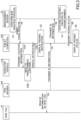
- FIG. 3 is a sequence diagram illustrating the entire process of the picking assistance system 1 of the embodiment.
- the management server 10 creates a map for guiding the picking assistance robot 100 (step S1).
- the management server 10 transmits data of the picking instruction to the tablet computer 150 (step S2).
- the picking instructions may include information on the location where the picking assistance robot 100 is to move (the location at which the product 40 is stored), the product 40 to be put into the box 130A or the box 130B by the worker at that location, and the number of the products 40 to be put into the box 130A or the box 130B by the worker.
- the tablet computer 150 transmits the location information included in the picking instruction received from the management server 10 to the controller of the conveyor vehicle 110 (step S2A).
- the conveyor vehicle 110 moves to a predetermined location included in the picking instruction (step S2B).
- the predetermined location indicates a location of the shelf or the like in which the product 40 included in the picking instruction is arranged.
- the picking assistance robot 100 moves in front of the shelf or the like in which the product 40 included in the picking instruction is arranged.
- the controller of the conveyor vehicle 110 notifies the tablet computer 150 that the picking assistance robot 100 has arrived at the predetermined location (step S2C).
- the picking assistance robot 100 waits at the predetermined location until a next instruction for movement is received. That is, the picking assistance robot 100 will wait in front of the shelf or the like in which the product 40 included in the picking instruction is arranged until the worker's picking operation is completed. The worker can recognize that the place where the picking assistance robot 100 is waiting around the worker is the place where the picking operation is to be performed.
- the tablet computer 150 When the tablet computer 150 receives the notification from the controller of the conveyor vehicle 110 in step S2C indicating that the picking assistance robot 100 has arrived at the predetermined location, the tablet computer 150 displays the picking instruction received from the management server 10 in step S2 on the display (step S3). The worker can walk to the place where the picking assistance robot 100 is waiting and perform the picking operation while looking at the picking instruction displayed on the tablet computer 150 of the picking assistance robot 100.
- the RFID reader 140 reads the product ID information written on the RFID tag 41 on each product 40 put into the box 130A or the box 130B by the worker (step S4).
- the RFID reader 140 reads the RFID tag 41 attached to the product 40 passing through the inlets 131A and 131B of the boxes 130A and 130B by using the antennas 142A and 142B.
- the process of step S4 allows the worker to obtain the product ID of the RFID tag 41 attached to the product 40 placed in the boxes 130A and 130B.
- the RFID reader 140 transmits the product ID information read in step S4 and the information for identifying the RFID reader 140 to the tablet computer 150 (step S5).
- the tablet computer 150 transmits the product ID information and the information for identifying the RFID reader 140 received in step S5 to the management server 10 (step S6) .
- the management server 10 counts the number of each product 40 included in the box 130A or the box 130B based on the product ID information received in step S6 (step S7) .
- the management server 10 transmits the data of the picking status to the tablet computer 150 based on the number of each product 40 counted in step S7 (step S8).
- the picking status may include information on the number of products 40 already included in the box 130A or the box 130B.
- the tablet computer 150 displays the picking status received in step S8 on the display (step S9).
- the worker can determine whether a product 40 should be further housed in the boxes 130A and 130B while looking at the picking status as described above.
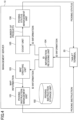
- FIG. 4 is a functional block diagram of the management server 10.
- the management server 10 may include a picking instruction management unit 101, a picking instruction storage unit 102, a map creating unit 103, an ID information receiving unit 104, a count unit 105, and a picking status management unit 106.
- the management server 10 can function as the picking instruction management unit 101, the map creating unit 103, the ID information receiving unit 104, the count unit 105, and the picking status management unit 106 by executing a program. Each of them will be described below.
- the tablet computer 150 may have a part of or all of the functions of the management server 10.
- the tablet computer 150 may include a means for receiving a picking instruction (also referred to as a picking instruction receiving unit), the ID information receiving unit 104, the count unit 105, and the picking status management unit 106.
- the picking instruction management unit 101 transmits the data of the picking instruction to the tablet computer 150. For example, in response to a worker tapping a screen for starting the picking operation displayed on the tablet computer 150, the picking instruction management unit 101 starts transmitting the data of the picking instruction.
- the picking instruction may include information of the location where the picking assistance robot 100 is to move (the location at which the product 40 is stored), the product 40 to be put into the box 130A or the box 130B by the worker at that location, and the number of the products 40 to be put into the box 130A or the box 130B by the worker.
- the picking instruction management unit 101 stores the data of the picking instruction in the picking instruction storage unit 102.
- the picking instruction storage unit 102 stores the data of the picking instruction transmitted to the tablet computer 150.
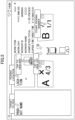
- FIG. 5 is an example of a display screen of the embodiment.
- the boxes 130A and 130B are designated A and B.
- the location where the picking assistance robot 100 is to move also referred to as the "picking location” or the location of shelves or the like at which the product 40 is stored
- the picking instruction a name or an image of the product 40 to be put into the box 130A or the box 130B (to be picked) at that location by the worker (for example, an image of the product 40 when stored at the distribution center or the like) may be displayed.
- the worker for example, an image of the product 40 when stored at the distribution center or the like
- the number of the products 40 to be put into the box 130A or the box 130B by the worker may be displayed.
- the date on which the picking operation is performed i.e., the work day
- the identifier for the worker i.e., the worker ID
- the name of the worker i.e., the worker name
- the number of the total number of the products 40 to be picked i.e., the number of completed items/the total number of items
- the elapsed time of the target time to complete picking i.e., the elapsed time/the target time
- the like may be displayed.
- the worker can grasp how many products 40 are required to be picked at which place by looking at the screen as illustrated in FIG. 5 .
- the worker can immediately grasp misplacement in the box 130A or the box 130B that is different from the instruction by looking at the screen as illustrated in FIG. 5 .
- each box 130A and 130B a list representing one or more products 40 that the worker should put into the boxes 130A and 130B, and a list representing the number of each product 40 that the worker should put into the boxes 130A and 130B may be displayed.
- a screen illustrating the picking instructions for each box 130A and 130B displayed on the tablet computer 150 will be described with reference to FIG. 6 .
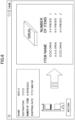
- FIG. 6 is an example of a display screen of the tablet computer 150.
- FIG. 6 illustrates a display for the product 40 to be put into the box 130A.
- transition may be made to the screen of FIG. 6 .
- one or more products 40 to be put into the box 130A by the worker may be displayed.
- the number of each product 40 to be put into the box 130A by the worker may be displayed.
- the destination to which the product 40 is shipped shipment destination
- the total number of the products 40 to be put into the box 130A number of items
- date of shipment or the like may be displayed.
- the worker can grasp how many products 40 are required to be picked for each of the boxes 130A and 130B by looking at the screen as illustrated in FIG. 6 .
- the ID information receiving unit 104 receives from the tablet computer 150 the product ID information read from the RFID tag 41 and the information for identifying the RFID reader 140.
- the ID information receiving unit 104 notifies the map creating unit 103 and the count unit 105.
- the map creating unit 103 performs a map creation process. Specifically, the map creating unit 103 creates a map for guiding the picking assistance robot 100.
- the map creation at the start of the picking operation and the map creation during the picking operation will be described separately.
- the map creating unit 103 generates a shortest distance route (path) through all the places where the product 40 instructed to be put into the box 130A or the box 130B is stored.
- the map creating unit 103 creates a map that clearly represents the generated route, the next picking location (that is, the picking location where the picking assistance robot 100 is to be directed next), and all of the picking locations on the layout diagram of the shelves in the distribution center.
- the picking assistance robot 100 moves to each picking location according to the location information included in the picking instruction received from the management server 10 by the tablet computer 150 and the map created by the map creating unit 103.
- the map creating unit 103 creates a map that clearly represents the route generated at the start of the picking operation, the next picking location (that is, the next picking location from the picking location where the picking has been completed), and all of the picking locations on the layout diagram of the shelves in the distribution center.
- the map creating unit 103 may regenerate a new route without using the route generated at the start of the picking operation.
- the map creating unit 103 may generate a route so that the plurality of picking assistance robots 100 do not collide (for example, the plurality of picking assistance robots 100 do not go through the same path in the same direction or in the opposite direction simultaneously or within a predetermined time) based on the picking status of the plurality of picking assistance robots 100. Further, the present location or route (path) of the plurality of picking assistance robots 100 may be clearly represented on the map.
- the map creating unit 103 can generate a route (path) that avoids a shelve being crowded by other picking assistance robots 100.
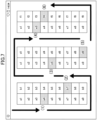
- FIG. 7 is an example of a display screen of the embodiment. For example, when the screen of FIG. 5 is tapped, transition may be made to the screen of FIG. 7 . As illustrated in FIG. 7 , a map that clearly represents a route, a next picking location, and all picking locations may be displayed on the layout diagram of the shelves in the distribution center or the like.
- the count unit 105 performs a picking number counting process. Specifically, the count unit 105 identifies the number of each product 40 instructed to the worker to be put into the box 130A or the box 130B with reference to the picking instruction stored in the picking instruction storage unit 102. The count unit 105 counts the number of each product 40 stored in the box 130A or the box 130B based on the product ID information received from the ID information receiving unit 104. Specifically, when the count unit 105 receives the product ID information from the ID information receiving unit 104, the count unit 105 determines that the product 40 with the RFID tag 41 in which the product ID information is written is put into the box 130A or the box 130B.
- the count unit 105 determines whether or not the number of each product 40 already in the box 130A or the box 130B is excessive or insufficient with respect to the number of each product 40 instructed to the worker to be put into the box 130A or the box 130B based on the instructed number and the counted number. Specifically, the count unit 105 determines that the product 40 is insufficient when the instructed number is larger than the counted number. The count unit 105 determines that the picking is completed when the instructed number is same as the counted number. The count unit 105 determines that the product 40 is excessive when the instructed number is smaller than the counted number.
- the count unit 105 can determine whether the product 40 is stored in the box 130A or the box 130B based on the product ID information, the information for identifying the RFID reader 140, and information indicating whether the RFID reader 140 has read the product ID information with the antenna 142A or the antenna 142B.
- the picking status management unit 106 transmits the picking status data to the tablet computer 150 based on the number of each product 40 counted by the count unit 105.
- the picking status may include information on the number of products 40 already in the box 130A or the box 130B.
- a display of the picking status on the screen illustrating the picking instruction will be described with reference to FIG. 5 and FIG. 6 .
- the number of products 40 to be put into the box 130A or the box 130B by the worker may be displayed (see the denominator of the fractions).
- the number of products 40 already put into the box 130A or the box 130B by the worker may be displayed, together with the number of products 40 to be put into the box 130A or the box 130B.
- whether or not the number already in the box 130A or the box 130B is excessive or insufficient with respect to the number instructed to the worker to be put into the box 130A or the box 130B may be displayed.
- the worker can easily recognize that the product 40 is insufficient, the picking is complete, or the product 40 is excessive.
- no mark may be displayed
- when the picking is complete a check mark may be displayed, and when the product 40 is excessive, an "X" mark may be displayed.
- the number of one or more products 40 to be put into the box 130A by the worker may be displayed.
- the number of each product 40 already put into the box 130A or the box 130B by the worker may be displayed, together with the number of products 40 to be put into the box 130A or the box 130B.
- whether or not the number already in the box 130A is excessive or insufficient with respect to the number instructed to the worker to be put into the box 130A may be displayed.
- the worker can easily recognize that the product 40 is insufficient, the picking is complete or the product 40 is excessive.
- no mark may be displayed
- when the picking is complete a check mark may be displayed
- an "X" mark may be displayed. It should be noted that such a display can be similarly displayed for the box 130B.
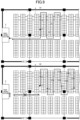
- FIG. 8 is a diagram illustrating a work efficiency of the picking assistance robot 100.
- the worker searches a shelf 6 on which the products 40 of (1) to (4) are arranged while pushing the cart.
- FIG. 8 illustrates how three picking assistance robots 100A to 100C are used to pick products 40 of (1A) to (4A) with a picking assistance robot 100A, pick products 40 of (1B) to (4B) with a picking assistance robot 100B, and pick products 40 of (1C) to (4C) with a picking assistance robot 100C.
- the picking assistance robots 100A to 100C are the same as the picking assistance robot 100 illustrated in FIG. 1 .
- the picking assistance robots 100A to 100C are located on the same path. Since the picking assistance robots 100A to 100C are waiting in a location in front of the shelf represented by the location information included in the picking instruction, the worker may walk to the location of the picking assistance robots 100A to 100C and pick products 40 included in the picking instruction while looking at the display of the tablet computer 150. Since the picking assistance robot (either 100A to 100C) for which the completion operation was performed automatically moves according to the following picking instruction and waits in front of the shelf, the worker may approach to the moved picking assistance robot (either 100A to 100C) and perform the picking operation. Therefore, if the picking assistance robot 100 is used, the efficiency of the picking operation can be significantly improved. In particular, if a plurality of picking assistance robots 100 are used, the work efficiency can be further improved.
- FIG. 9 is a diagram illustrating a work efficiency of the picking assistance robot 100.
- picking is performed using a hand-push type cart as illustrated in (A) of FIG. 9 , the worker goes around the area where the shelf 6 is located while pushing the cart from a packaging station 5 to perform picking.
- the worker will return to the packaging station 5 whenever the cart is full of products 40.
- the packaging station 5 is where the product 40 is taken out of the cart.
- the picking assistance robot 100 is configured to automatically go and return between the packaging station 5 and the area where the shelf 6 is located, the worker can concentrate on the picking operation in the area where the shelf 6 is located and is not required to return to the packaging station 5. If a person who takes out the product 40 from the picking assistance robot 100 is assigned to the packaging station 5, the picking assistance robot 100 can return to the area where the shelve 6 is located with the boxes 130A and 130B empty and can wait in the location included in the picking instruction. This significantly improves the work efficiency.
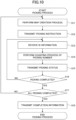
- FIG. 10 is a flowchart of a picking process in the management server 10.
- the map creating unit 103 performs the map creation process (step S11). At the start of the picking operation, the map creating unit 103 generates a shortest distance route (path) through all the places where the product 40 instructed to the worker to be put into the box 130A or the box 130B is stored. Next, the map creating unit 103 creates a map that clearly represents the generated route, the next picking location (that is, the picking location where the worker is to be directed toward first), and all of the picking locations on the layout diagram of the shelves in the distribution center.
- the map creating unit 103 creates a map that clearly represents the generated route, the next picking location (that is, the picking location where the worker is to be directed toward first), and all of the picking locations on the layout diagram of the shelves in the distribution center.
- the picking instruction management unit 101 transmits the data of the picking instruction to the tablet computer 150 (step S12).
- the picking instruction may include information on the location where the picking assistance robot 100 is to move (that is, the picking location where the picking assistance robot 100 is to move), the product 40 to be put into the box 130A or the box 130B by the worker at that location, and the number of the products 40 to be put into in the box 130A or the box 130B by the worker.
- the tablet computer 150 displays the picking instruction transmitted by the picking instruction management unit 101 in S12 on the display. Further, the conveyor vehicle 110 moves to a predetermined location according to the location information included in the picking instruction. The worker may perform the picking operation while looking at the display of the tablet computer 150 of the picking assistance robot 100 moved to the predetermined location. The worker can switch from the screen indicating the picking instruction to the map of S11.
- the ID information receiving unit 104 receives the product ID information and the information for identifying the RFID reader 140 from the tablet computer 150 (step S13). Specifically, the ID information receiving unit 104 receives the product ID information written on the RFID tag 41 attached to each product 40 put into the box 130A or the box 130B by the worker.
- the count unit 105 performs a picking number counting process based on the product ID information and the information for identifying the RFID reader 140 received in S13 (step S14). Details will be described with reference to FIG. 11 .
- the picking status management unit 106 transmits the picking status data to the tablet computer 150 based on the picking number counting process performed in S14 (step S15).
- the picking status management unit 106 determines whether all of products 40 to be put into the box 130A or the box 130B at the current picking location are housed in the box 130A or the box 130B. If all of products 40 are housed, the process proceeds to step S17. If all of products 40 are not housed, the process returns to step S13.
- the ID information receiving unit 104 waits for the product ID information from the tablet computer 150.
- step S17 the picking status management unit 106 determines whether all of products 40 to be put into the box 130A or the box 130B (that is, all of products 40 to be put into the box 130A or the box 130B at all picking locations) are housed in the box 130A or the box 130B (step S17). If all of products 40 are housed, the process proceeds to step S18. If all of products 40 are not housed, the process returns to step S11.
- the map creating unit 103 creates a map in which the picking assistance robot 100 specifies the picking location to be directed next. Specifically, the map creating unit 103 creates a map that clearly represents the route generated at the start of picking (or newly regenerated route), the next picking location (that is, the picking location where the picking assistance robot 100 is to be directed toward the next), and all of the picking locations on the layout diagram of the shelves in the distribution center. Subsequently, in step S12, the picking instruction management unit 101 transmits the data of the picking instruction to the tablet computer 150.
- the picking instruction may include information on the location where the picking assistance robot 100 is to move (i.e., the picking location where the picking assistance robot 100 is to move next), the product 40 to be put into the box 130A or the box 130B by the worker at that location, and the number of the products 40 to be put into in the box 130A or the box 130B by the worker.
- step S18 the picking status management unit 106 notifies the tablet computer 150 that the picking operation is completed (step S18).
- FIG. 11 is a flowchart of the picking number counting process (S14 in FIG. 10 ).
- the count unit 105 specifies the number of each product 40 instructed to the worker to be put into the box 130A or the box 130B with reference to the picking instruction stored in the picking instruction storage unit 102 (step S21).
- the count unit 105 counts the number of each product 40 housed in the boxes 130A and 130B based on the product ID information received from the ID information receiving unit 104 (step S22). Specifically, when the product ID information is received from the ID information receiving unit 104, the count unit 105 determines that the product 40 including the RFID tag 41 in which the product ID information is written is housed in the box 130A or the box 130B.
- the count unit 105 determines whether or not the number of each product 40 already in the box 130A or the box 130B is excessive or insufficient with respect to the number of each product 40 instructed to the worker to be put into the box 130A or the box 130B based on the number specified in step S21 and the number counted in step S22 (step S23). Specifically, the count unit 105 determines that the product 40 is insufficient when the instructed number specified in step S21 is larger than the counted number in step S22. The count unit 105 determines that the picking is completed when the instructed number specified in step S21 is the same as the counted number in step S22. The count unit 105 determines that the product 40 is excessive when the instructed number specified in step S21 is smaller than the counted number in step S22.
- FIG. 12 is a flowchart of a map creation process (S11 in FIG. 10 ) of the embodiment.
- the map creating unit 103 generates a shortest distance route (path) through all the places where the product 40 instructed to the worker to be put into the box 130A or the box 130B is stored (step S31).
- the map creating unit 103 specifies the next picking location (step S32).
- the map creating unit 103 creates a map that clearly represents the route generated in S31, the next picking location specified in S32, and all of the picking locations on the layout diagram of the shelves in the distribution center.
- FIG. 13 is a flowchart of a process performed by a controller 151 of the tablet computer 150.
- the tablet computer 150 is assumed to receive the picking instruction from the management server 10 and store the picking instruction in the memory.
- the controller 151 transmits the location information included in the picking instruction to the controller of the conveyor vehicle 110 (step S41). This causes the picking assistance robot 100 to move to the predetermined location represented by the location information.
- the controller 151 determines whether an arrival notification is received (step S42). When the arrival notification is determined to be not received, the controller 151 repeatedly executes the process in step S42.
- step S43 When the controller 151 determines that an arrival notification is received (S42: YES), the type or the number of the products 40 included in the picking instruction are displayed on the display (step S43).
- the controller 151 determines whether the product ID information is received from the RFID reader 140 (step S44). When the product ID information is determined to be not received, the controller 151 repeatedly executes the process of step S44.
- the controller 151 determines that the product ID information is received (S44: YES)
- the controller 151 compares the received product ID information with the type of the product 40 included in the picking instruction to determine whether the product 40 is the correct product 40 to be picked (step S45).
- step S46A When the controller 151 determines that the product 40 is a correct product (S45: YES), the controller 151 outputs a response tone indicating that the product 40 is a correct product (step S46A).
- the controller 151 determines that the product 40 is not a correct product (S45: NO)
- the controller 151 outputs a response tone indicating that the product 40 is not the correct product.
- the response tone output in step S46B is different from the response tone output in step S46A. Therefore, the worker can check the determination result with the response tone.
- the controller 151 determines whether a completion operation is performed (step S47).
- the completion operation is performed by operating the tablet computer 150 when the worker looks at the display of the tablet computer 150 and checks that all products 40 to be picked have been picked at the picking location.
- the completion operation is, for example, an operation of pressing the OK button.
- the determination in step S47 is a process of determining whether the completion operation is performed within a predetermined time after the process in step S46A or step S46B is completed.
- the predetermined time is, for example, five seconds.
- the controller 151 determines whether a face authentication is performed by the face authenticator 160 and the worker ID information is acquired (step S48). The controller 151 repeatedly performs the process in step S48 until the worker ID information is acquired.
- the controller 151 transmits the product ID information related to the product 40 that is determined to be the correct product 40 to the management server 10 in association with the worker ID information for identifying the worker that is authenticated in Step S48 (step S49). Since the product ID information related to the product 40 is associated with the worker ID information and transmitted to the management server 10, the amount of work and the work efficiency of each worker can be grasped in the management sever 10.
- the controller 151 ends a series of processes (END).
- the controller 151 repeatedly executes the process illustrated in FIG. 13 .
- the controller 151 executes the process of step S41 again and reads the picking instruction, the picking assistance robot 100 moves to the next picking location.
- the arrival notification is received in step S42, the type and number of the products 40 are displayed on the display in step S43 and the picking assistance robot 100 waits.
- the picking assistance robot 100 waits in front of the shelf without moving until the completion operation is performed and the worker ID information is acquired by the face authentication. Further, the picking assistance robot 100 moves when the completion operation is performed and the worker ID information is acquired by the face authentication.
- step S47 the controller 151 returns the flow to step S44. This is for receiving the product ID information related to another product 40 because the picking operation has not been completed.
- the controller 151 may perform error processing.
- the error processing includes an output of the sound indicating an error and stopping the process illustrated in FIG. 13 .
- a picking assistance robot 100 and a picking assistance system 1 can be provided which can assist the worker in efficiently picking the product 40.
- the antennas 142A and 142B of the RFID reader 140 can collectively read multiple RFID tags 41, the worker can efficiently and quickly perform the picking operation in a short time.
- the collective reading greatly improves work efficiency.
- An example of such a product 40 is a drug such as a swallowing drug, an injection drug, or an external therapeutic drug, a mask, or other medical clothing or equipment.
- the product 40 when the product 40 is put into the box 130A or the box 130B, it is possible to grasp whether the product 40 is a correct product 40 by the response tone. Therefore, the worker can accurately pick the product 40 and improve the work efficiency.
- the face authenticator 160 because the worker is authenticated by the face authenticator 160, the amount of work and the work efficiency for each worker can be grasped.
- the picking assistance robot 100 waits in front of the shelf without moving until the completion operation is performed and the worker ID information is acquired by the face authentication, the picking assistance robot 100 can improve the work efficiency by moving according to the worker's intention.
- the picking assistance robot 100 moves when the completed operation is performed and the worker ID information is acquired by the face authentication, the work efficiency can be improved by moving the robot according to the worker's intention.
- the picking assistance robot 100 moves in front of the shelf or the like in which the product 40 is located according to the picking instruction with respect to the product 40 at a location different from the present location, the work efficiency can be improved by moving according to the worker's intention.
- the picking assistance robot 100 is configured to automatically go and return between the packaging station 5 and the area where the shelf 6 is located, the worker can concentrate on the picking operation in the area where the shelf 6 is located and is not required to return to the packaging station 5, thereby significantly improving the work efficiency.
- the picking assistance robot 100 moves to the location included in the picking instruction and waits. Accordingly, the worker can concentrate on the picking operation and is not required to return to the packaging station 5 for taking out the products 40 from the boxes 130A and 130B, thereby significantly improving the work efficiency.
- the antennas 142A and 142B are located directly above the boxes 130A and 130B, respectively, so that the RFID tag of the product housed in the boxes 130A and 131B through the inlets 131A and 131B can be reliably read, even if the product has a metal package or the product contains a liquid. Further, an occurrence of the reading omission can be prevented.
- the antennas 142A and 142B are provided at the inlets 131A and 131B of the boxes 130A and 130B, the product 40 for which the RFID tag 41 is read is put into the box 130A or the box 130B. Accordingly, it is not necessary to confirm that the product 40 is put into the box 130A or the box 130B, and the work efficiency can be improved. Further, by reading the RFID tag 41 from the upper side of the boxes 130A and 130B, the RFID tag 41 of the product 40 to be put into the box 130A or the box 130B is read even when a number of other products 40 are housed in the boxes 130A and 130B.
- the antenna 142A can be prevented from reading the RFID tag attached to the product housed in the box 130B.
- the product 40 put into the box 130A or the box 130B can be accurately read by the antennas 142A and 142B, and a reading error can be prevented.
- FIG. 14 is a diagram illustrating a hardware configuration of the management server 10 and the tablet computer 150 of the embodiment.
- the management server 10 and the tablet computer 150 include a Central Processing Unit (CPU) 1001, a Read Only Memory (ROM) 1002, and a Random Access Memory (RAM) 1003.
- the CPU 1001, the ROM 1002, and the RAM 1003 form a so-called computer.
- the management server 10 and the tablet computer 150 include an auxiliary storage device 1004, a display device 1005, an operation device 1006, an interface (I/F) device 1007, and a drive device 1008.
- the hardware of the management server 10 and the tablet computer 150 is interconnected via the bus 1009.
- the CPU 1001 is an arithmetic device that executes various programs installed in the auxiliary storage device 1004.
- the ROM 1002 is a non-volatile memory.
- the ROM 1002 functions as a main storage device for storing various programs and data necessary for executing various programs installed in the auxiliary storage device 1004 by the CPU 1001.
- the ROM 1002 functions as a main storage device for storing boot programs such as a Basic Input/Output System (BIOS) and an Extensible Firmware Interface (EFI).
- BIOS Basic Input/Output System
- EFI Extensible Firmware Interface
- the RAM 1003 is a volatile memory such as a Dynamic Random Access Memory (DRAM) or a Static Random Access Memory (SRAM).
- the RAM 1003 functions as a main storage device that provides a workspace deployed when various programs installed in the auxiliary storage device 1004 are executed by the CPU 1001.
- the auxiliary storage device 1004 is an auxiliary storage device that stores various programs and information to be used when various programs are executed.
- the display device 1005 is a display device for displaying the internal state or the like of the management server 10 and the tablet computer 150.
- the operation device 1006 is an input device in which an administrator of the management server 10 and the tablet computer 150 inputs various instructions to the management server 10 and the tablet computer 150.
- the I/F device 1007 is a communication device for connecting to the network 50 and communicating with the management server 10 and the tablet computer 150.
- the drive device 1008 is a device for setting a storage medium 1010.
- the storage medium 1010 includes a medium that optically, electrically, or magnetically records information, such as a CD-ROM, a flexible disk, a magneto-optical disk, or the like.
- the storage medium 1010 may also include a semiconductor memory or the like that electrically records information, such as an Erasable Programmable Read Only Memory (EPROM), a flash memory, or the like.
- EPROM Erasable Programmable Read Only Memory
- various programs to be installed in the auxiliary storage device 1004 are installed when the distributed storage medium 1010 is set in the drive device 1008 and various programs recorded in the storage medium 1010 are read out by the drive device 1008.
- various programs to be installed in the auxiliary storage device 1004 may be installed by being downloaded from another network different from the network 50 via the I/F device 1007.
Landscapes
- Engineering & Computer Science (AREA)
- Business, Economics & Management (AREA)
- Economics (AREA)
- Physics & Mathematics (AREA)
- Theoretical Computer Science (AREA)
- General Physics & Mathematics (AREA)
- Mechanical Engineering (AREA)
- Tourism & Hospitality (AREA)
- Marketing (AREA)
- Operations Research (AREA)
- Quality & Reliability (AREA)
- Strategic Management (AREA)
- Human Resources & Organizations (AREA)
- Entrepreneurship & Innovation (AREA)
- General Business, Economics & Management (AREA)
- Development Economics (AREA)
- Toxicology (AREA)
- Health & Medical Sciences (AREA)
- Finance (AREA)
- Accounting & Taxation (AREA)
- Computer Networks & Wireless Communication (AREA)
- Computer Security & Cryptography (AREA)
- Electromagnetism (AREA)
- General Health & Medical Sciences (AREA)
- Artificial Intelligence (AREA)
- Computer Vision & Pattern Recognition (AREA)
- Warehouses Or Storage Devices (AREA)
Abstract
Description
- The present disclosure relates to a picking assistance robot and a picking assistance system.
- Conventionally, when shipping products stored in a distribution center or the like according to an order, a picking operation in which a person selects and takes out the products to be shipped from among the products in the distribution center or the like is known. For example,
Patent Document 1 discloses that a worker looks at a picking order displayed on a display provided on a picking trolley for picking. - Patent Document 1:
Japanese Unexamined Utility Model Application Publication No.1995-15622 - However, since the conventional picking trolleys are not self-propelled, the picking trolleys are required to be moved by the worker to the place where the work is desired to be performed. Therefore, the work cannot be performed efficiently.
- Accordingly, it is an object of one embodiment of the present disclosure to provide a picking assistance robot and a picking assistance system capable of assisting a worker in efficiently picking products.
- <
Clause 1> A picking assistance robot according to one aspect of an embodiment of the present disclosure includes a housing for housing a product to which an RFID tag is attached, an RFID reader including an antenna disposed at a position capable of reading the RFID tag when the product is housed in the housing, a terminal configured to receive a picking instruction, and a mobile body containing the housing and the RFID reader and configured to move to a location where the product is arranged based on location information of the product included in the picking instruction. - According to this aspect, the worker can concentrate on the picking operation of the product because the product is moved to the shelf on which the product included in the picking instruction is arranged. Thus, it is possible to provide a picking assistance robot capable of assisting the worker in efficiently picking products.
- <
Clause 2> In the picking assistance robot according toClause 1, wherein the terminal, upon recognizing that the RFID tag is read by the RFID reader when the product is housed in the housing, may output a response tone indicating that the RFID tag is recognized or may display a response indication indicating that the RFID tag is recognized. - According to this aspect, the worker can check that the RFID tag has been read by the RFID reader by means of a response tone or a response indicator, and can proceed to the next step, resulting in improved work efficiency.
- <
Clause 3> The picking assistance robot according toClause 2 may further include an authenticator that performs an authentication of a worker when the terminal recognizes that the RFID tag is read by the RFID reader when the product is housed in the housing. - According to this aspect, because the worker who put the product into the housing can be identified, the work amount and the work efficiency of the worker can be grasped.
- <
Clause 4> The picking assistance robot according to any one ofClauses 1 to 3, wherein the mobile body may wait without moving until an operation representing a completion of work with respect to the terminal is performed by a worker, after the RFID tag is read by the RFID reader when the product is housed in the housing. - According to this aspect, the picking assistance robot does not move until the worker has completed the operation, but can move when the worker has completed the operation. Therefore, the work can be improved by moving the picking
assistance robot 100 according to the worker's intention. - <
Clause 5> The picking assistance robot according to any one ofClauses 1 to 4, wherein the mobile body may move to a location, based on location information included in a moving instruction, when an operation representing a completion of work with respect to the terminal is performed by a worker after the RFID tag is read by the RFID reader when the product is housed in the housing. - According to this aspect, because the picking assistance robot can be moved when the worker has completed the operation, the work efficiency can be improved by moving the picking
assistance robot 100 according to the worker's intention. - <
Clause 6> The picking assistance robot according toClause 5, wherein the moving instruction is an instruction of picking with respect to a product different from the product included in the picking instruction, and wherein the mobile body moves to a location where said product different from the product included in the picking instruction is arranged based on location information of said product. - According to this aspect, because the picking assistance robot can be moved to the shelf where the next product to be housed is arranged upon completion of the operation by the worker, the work efficiency can be improved by moving the picking
assistance robot 100 according to the worker's intention. - <Clause 7> The picking assistance robot according to
Clause 5, wherein a location included in the moving instruction may be a location where the product housed in the housing is to be taken out. - According to this aspect, the picking assistance robot can be moved to a location where the product housed in the housing is to be taken out when the worker has completed the operation. Accordingly, if another worker performs a taking out operation at the location where the product housed in the housing is to be taken out, the picking assistance robot can be moved between the worker who performs housing and the worker who performs taking out, and thus the work efficiency can be improved.
- <Clause 8> The picking assistance robot according to Clause 7, wherein the mobile body moves to a location where the product is arranged, based on location information of the product included in another picking instruction, when the terminal reads the another picking instruction after the mobile body moves to the location where the product housed in the housing is taken out according to the moving instruction.
- According to this aspect, because the product housed in the housing is taken out and then movement is to the location of the product included in another picking instruction, the picking assistance can be continuously performed and the work efficiency can be improved.
- <
Clause 9> The picking assistance robot according to any one ofClauses 1 to 8, wherein the antenna may be provided at an inlet of the housing. - According to this aspect, because the RFID tag attached to the product can be read reliably at the inlet of the housing, the probability of not being able to read the RFID tag can be reduced and the work efficiency can be improved by improving the reading accuracy.
- <
Clause 10> The picking assistance robot according toClause 9, wherein the inlet of the housing may be located above the housing, and the antenna may be provided above the inlet. - According to this aspect, because the RFID tag attached to the product can be read more reliably at the antenna above the inlet of the housing, the probability of not being able to read the RFID tag can be further reduced and the work efficiency can be further improved by further improving the reading accuracy.
- <
Clause 11> The picking assistance robot according to any one ofClauses 1 to 10, wherein the housing is provided as a plurality of housings, the antenna is provided in each of the plurality of housings as a plurality of antennas, and the picking assistance robot further includes a shield between the plurality of housings such that regions capable of being read by the plurality of antennas are not overlapped. - According to this aspect, duplicate reading can be prevented between multiple housings, and multiple housings that can house more products can be used to significantly improve the work efficiency.
- <Clause 12> In a picking assistance system that includes a server and the picking assistance robot as claimed in any one of
Clauses 1 to 11, the picking assistance system according to one aspect of an embodiment of the present disclosure includes a picking instruction management unit configured to transmit a picking instruction, an ID information receiving unit configured to receive ID information written on an RFID tag attached to a product read by an RFID reader, a count unit configured to count a number of products housed in a housing based on the ID information, and a picking status management unit configured to transmit a picking status based on the number of the counted products. - According to this aspect, the worker can concentrate on the picking operation of the product because the product is moved to the shelf on which the product included in the picking instruction is arranged. Thus, it is possible to provide a picking assistance system including a picking assistance robot capable of assisting the worker in efficiently picking products.
- <Clause 13> The picking assistance system according to Clause 12, wherein the count unit determines whether or not a number housed in the housing is excessive or insufficient with respect to a number instructed by the picking instruction, and the picking status management unit displays on a terminal one message, from among the following: the product is insufficient, picking is completed, and the product is excessive.
- According to this aspect, the worker can easily distinguish between the product being insufficient, the picking being completed, and the product being excessive.
- According to an embodiment of the present disclosure, a picking assistance robot and a picking assistance system can be provided to enable the worker to pick products efficiently.
-
-
FIG. 1 is a side view illustrating a pickingassistance robot 100 of an embodiment; -
FIG. 2 is a schematic view of an entire configuration of thepicking assistance system 1 according to an embodiment; -
FIG. 3 is a sequence diagram illustrating an entire process of thepicking assistance system 1 according to an embodiment; -
FIG. 4 is a functional block diagram of amanagement server 10; -
FIG. 5 is an example of a display screen of an embodiment; -
FIG. 6 is an example of a display screen of atablet computer 150; -
FIG. 7 is an example of a display screen of an embodiment; -
FIG. 8 is a diagram illustrating a work efficiency of the pickingassistance robot 100; -
FIG. 9 is a diagram illustrating a work efficiency of the pickingassistance robot 100; -
FIG. 10 is a flowchart of a picking process in themanagement server 10; -
FIG. 11 is a flowchart of a picking number counting process (S14 inFIG. 10 ); -
FIG. 12 is a flowchart of a map creation process of an embodiment (S11 inFIG. 10 ); -
FIG. 13 is a flowchart of a process performed by acontroller 151 of thetablet computer 150; and -
FIG. 14 is a diagram illustrating hardware configuration of themanagement server 10 and thetablet computer 150 according to an embodiment. - Hereinafter, embodiments of a picking assistance robot and the picking assistance system of the present disclosure will be described.
-
FIG. 1 is a side view illustrating a pickingassistance robot 100 of an embodiment. Thepicking assistance robot 100 includes aconveyor vehicle 110, aframe 120,boxes reader 140, atablet computer 150, aface authenticator 160, and ashield 170. - As an example, the
picking assistance robot 100 is used in a building such as a shop, a distribution center, or a warehouse, and is a robot (apparatus) that assists a worker in picking a product (selecting and picking out a product) while automatically traveling as a self-propelledconveyor vehicle 110. The left side indicated by an arrow inFIG. 1 is a front side of thepicking assistance robot 100 and the right side inFIG. 1 is a rear side of thepicking assistance robot 100. Hereinafter, the front and rear directions in the traveling direction of the pickingassistance robot 100 will be referred to as a front-rear direction. Theconveyor vehicle 110 can travel forward, right front, and left front. - Herein, the product may be various products or the like arranged on shelves or the like in a building, such as a store, a distribution center, a warehouse or the like, and may be various products or the like, such as clothes and daily necessities. Further, the product may also be a drug such as a swallowing drug, an injection drug, or an external therapeutic drug, a mask, or other medical clothing or equipment.
- The
conveyor vehicle 110 is an example of a mobile body and is realized by a so-called Automatic Guided Vehicle (AGV) as an example. Theconveyor vehicle 110 includes a controller composed of a computer. The controller of theconveyor vehicle 110 can perform data communication with thetablet computer 150 via wired or wireless communication. The controller of theconveyor vehicle 110 moves theconveyor vehicle 110 to a predetermined location represented by location information transmitted from thetablet computer 150 according to an electronic map created for a path or the like between shelves or the like disposed in the building. The controller of theconveyor vehicle 110 transmits an arrival notification indicating arrival at the predetermined location to thetablet computer 150 upon completion of movement to the predetermined location represented by the location information. Hereinafter, a mode in which theconveyor vehicle 110 moves using the location information included in a picking instruction received from the management server by thetablet computer 150 will be described. However, theconveyor vehicle 110 may include a wireless communication function that enables direct wireless communication with the management server, and the location information may be obtained directly from the management server by wireless communication. - The
frame 120 is mounted on theconveyor vehicle 110 and holds theboxes RFID reader 140, thetablet computer 150, and theface authenticator 160. Theframe 120 has aframe body 121 and stays 122A and 122B. Theframe body 121 is, for example, an aluminum rod-shaped member, and iron stays 122A and 122B are attached as an example. - The
stay 122A is attached to the upper end of theframe body 121 and extends to the rear. Thestay 122A holds amain body 141 and anantenna 142A of theRFID reader 140, thetablet computer 150, and theface authenticator 160. More specifically, themain body 141 of theRFID reader 140 is attached to the top surface of the front end of thestay 122A, the antenna 142 is attached to the bottom surface of the center in the front-rear direction of thestay 122A, and thetablet computer 150 and faceauthenticator 160 are attached to the rear end of thestay 122A. Thetablet computer 150 and theface authenticator 160 are attached toward the rear. This is to ensure the safety of workers using the pickingassistance robot 100 because the pickingassistance robot 100 does not travel backward. If the safety of the workers can be ensured with certainty, the pickingassistance robot 100 may travel backward automatically or manually. - The
stay 122B is attached in proximity to the middle of theframe body 121 in a vertical direction. Therefore, thestay 122B is located below thestay 122A. Thebox 130A is attached to the upper surface of thestay 122B and anantenna 142B of theRFID reader 140 is attached to the lower surface of thestay 122B. - The
boxes boxes boxes including inlets inlets boxes boxes inlets inlets boxes - The
box 130A is attached to the top surface of thestay 122B as described above, and thebox 130B is attached to the top surface of theconveyor vehicle 110. Thebox 130A is located in the upper row and thebox 130B is located in the lower row. Here, a mode in which thebox 130A is attached to theframe body 121 via thestay 122A and thebox 130B is attached to the upper surface of theconveyor vehicle 110 will be described. However, thebox 130A is only required to be located above thebox 130B, and theboxes assistance robot 100 includes twoboxes - The
RFID reader 140 has amain body 141 andantennas antennas main body 141 is connected to theantennas antennas RFID reader 140, the RFID tag is activated by the power of the received radio waves and radiates a signal including the unique product ID. Themain body 141 reads the product ID included in the radio waves received by theantennas - The
antenna 142A is located directly above theinlet 131A of thebox 130A and is disposed at a position where the RFID tag attached to the product housed in thebox 130A through theinlet 131A can be reliably read. Theantenna 142B is located directly above theinlet 131B of thebox 130B and is disposed at a position where the RFID tag attached to the product housed in thebox 130B through theinlet 131B can be reliably read. By disposing theantennas boxes - Further, for example, when a barcode is attached to the product and read by a barcode reader, the barcode is read one by one, and multiple barcodes cannot be read simultaneously. On the other hand, when the RFID tag is attached to the product, multiple RFID tags can be read simultaneously. Therefore, the multiple RFID tags attached to the multiple products can be collectively read by each of the
antennas - Further, when the product has a metal package such as an aluminum film, reading radio waves radiated by the
antennas boxes antennas boxes inlets boxes antennas boxes antennas boxes inlets boxes - On the other hand, in the present embodiment, the
antennas boxes boxes inlets - The
tablet computer 150 includes a display and a touch panel. Thetablet computer 150 is a terminal that is operable by touching an image, such as a Graphic User Interface (GUI) displayed on the display. Thetablet computer 150 receives the picking instruction and a picking status from the management server to display on the display and to transmit location information of the product included in the picking instruction to the controller of theconveyor vehicle 110. For example, thetablet computer 150 may use application software to display the picking instruction and to transmit the location information to the controller of theconveyor vehicle 110. - Further, the
tablet computer 150 receives, from theRFID reader 140, product ID information read from the RFID tag by theRFID reader 140. Thetablet computer 150 transmits the product ID information received from theRFID reader 140 to the management server. Further, thetablet computer 150 transmits information for identifying the worker obtained by theface authenticator 160 to the management server in association with the product ID information read from the RFID tag attached to the product housed in theboxes - Although a mode in which the picking
assistance robot 100 includes thetablet computer 150 is described here, any computer terminal such as a smartphone or a laptop personal computer may be used. - The
face authenticator 160 obtains worker ID information for identifying the worker by performing the face authentication of the worker. As an example, a mode in which the pickingassistance robot 100 includes theface authenticator 160 for grasping the work efficiency of each worker by the management server is described. However, instead of theface authenticator 160, an authenticator that identifies a body part of the worker by other methods may be used, or a reading device for reading an ID card or the like assigned to each worker may be used. Further, when the work efficiency or the like is not specifically managed, the pickingassistance robot 100 is not required to include an authenticator for identifying a worker such as aface authenticator 160 or the like. Further, for example, even when only the picking assistance robot is touched, the information for identifying the worker obtained by theface authenticator 160 may be managed at the server, without being associated with the product ID information read from the RFID tag attached to the product housed in theboxes - A
shield 170 is a conductor material that shields radio waves. Theshield 170 is provided between thebox 130A and theantenna 142B to prevent theantenna 142A from reading the RFID tag attached to the product housed in thebox 130B. When theantenna 142B also has an upward directionality, theshield 170 may shield theantenna 142B so as not to read the RFID tag located on the upper side. -
FIG. 2 is a schematic view of an entire configuration of a pickingassistance system 1 according to an embodiment. As illustrated inFIG. 2 , the pickingassistance system 1 includes themanagement server 10 and the pickingassistance robot 100. InFIG. 2 , only the main components of the pickingassistance robot 100 are illustrated, and thetablet computer 150 is enlarged to illustrate acontroller 151. Thecontroller 151 performs entire controls of the operation of thetablet computer 150 and includes a central processing unit (CPU) and a memory. - As an example, a worker who performs a picking operation puts a
product 40 arranged on a shelf or the like in front of the pickingassistance robot 100 into thebox 130A or thebox 130B, in a building, such as a store, a distribution center, a warehouse, or the like. Since eachproduct 40 is provided with oneRFID tag 41, when theproduct 40 is being put into theboxes RFID tag 41 attached to theproduct 40 is read by theantennas - The
management server 10 transmits a picking instruction to thetablet computer 150. The picking instructions may include information on the location where the pickingassistance robot 100 is to move, theproduct 40 to be put into thebox 130A or thebox 130B by the worker, and the number of theproducts 40 to be put into thebox 130A or thebox 130B by the worker. The location where the pickingassistance robot 100 is to move is the location at which theproduct 40 is arranged or stored. Themanagement server 10 transmits a picking status to thetablet computer 150. The picking status may include information related to the number ofproducts 40 already in thebox 130A or thebox 130B. Specifically, themanagement server 10 counts the number ofproducts 40 in thebox 130A or thebox 130B based on the product ID information read from theRFID tag 41 by theRFID reader 140. - The
management server 10 is comprised of one or more computers. Themanagement server 10 may transmit and receive data to and from thetablet computer 150 via anynetwork 50. Details of themanagement server 10 will be described below. - The
tablet computer 150 receives the picking instruction and the picking status from themanagement server 10, displays the picking instruction and the picking status on the display, and transmits the location information included in the picking instruction to the controller of theconveyor vehicle 110. Theconveyor vehicle 110 moves to a location represented by the location information. For example, thetablet computer 150 may use application software to display the picking instruction and to transmit the location information included in the picking instruction to the controller of theconveyor vehicle 110. The worker walks to the location where the pickingassistance robot 100 is located, checks the type of theproduct 40, the location of the shelf, or the like displayed on thetablet computer 150, and picks theproduct 40 to put into theboxes - The
RFID reader 140 reads the product ID information written to theRFID tag 41. TheRFID reader 140 transmits the product ID information read from theRFID tag 41 to thetablet computer 150. - Further, the
tablet computer 150 receives the product ID information from theRFID reader 140. Thetablet computer 150 transmits the product ID information received from theRFID reader 140 to themanagement server 10. Further, thetablet computer 150 receives the product ID information and outputs a response sound indicating that theproduct 40 is acorrect product 40 upon determining theproduct 40 to be thecorrect product 40 according to the picking instruction. On the other hand, thetablet computer 150 receives the product ID information and outputs a response sound indicating that theproduct 40 is not thecorrect product 40 if the tablet computer determines that theproduct 40 is not thecorrect product 40 according to the picking instruction. The worker can check whether the picking operation he/she is performing is correct by the response sound. Note that thetablet computer 150 may display, instead of or in addition to the response sound, a response indication representing whether the product is thecorrect product 40 or is not thecorrect product 40. - The picking
assistance robot 100 includes thetablet computer 150 and theRFID reader 140. Here, an example in which, the pickingassistance robot 100 includes twoboxes RFID reader 140 includes twoantennas antennas boxes product 40 into either of the twoboxes boxes boxes - As described above, the
product 40 is various products or the like arranged on shelves or the like in a building, such as a store, a distribution center, a warehouse, or the like. TheRFID tag 41 is attached to theproduct 40. TheRFID tag 41 includes an IC chip that includes a memory in which the product ID information is written. OneRFID tag 41 is attached to eachproduct 40. Attaching theRFID tag 41 to theproduct 40 means attaching theRFID tag 41 to theproduct 40, e.g., theRFID tag 41 is attached to theproduct 40, sewn, or fixed with a strap or the like. - When the
product 40 arrives at the distribution center or the like, themanagement server 10 manages the product ID information written on theRFID tag 41 and the information of theproduct 40 to which theRFID tag 41 is attached in association with each other. Further, themanagement server 10 manages information indicating which of theboxes assistance robot 100 is the box housing theRFID reader 140. -
FIG. 3 is a sequence diagram illustrating the entire process of the pickingassistance system 1 of the embodiment. - The
management server 10 creates a map for guiding the picking assistance robot 100 (step S1). - The
management server 10 transmits data of the picking instruction to the tablet computer 150 (step S2). As described above, the picking instructions may include information on the location where the pickingassistance robot 100 is to move (the location at which theproduct 40 is stored), theproduct 40 to be put into thebox 130A or thebox 130B by the worker at that location, and the number of theproducts 40 to be put into thebox 130A or thebox 130B by the worker. - The
tablet computer 150 transmits the location information included in the picking instruction received from themanagement server 10 to the controller of the conveyor vehicle 110 (step S2A). - The
conveyor vehicle 110 moves to a predetermined location included in the picking instruction (step S2B). The predetermined location indicates a location of the shelf or the like in which theproduct 40 included in the picking instruction is arranged. Upon processing of step S2B, the pickingassistance robot 100 moves in front of the shelf or the like in which theproduct 40 included in the picking instruction is arranged. - When the movement to the predetermined location included in the picking instruction is completed, the controller of the
conveyor vehicle 110 notifies thetablet computer 150 that the pickingassistance robot 100 has arrived at the predetermined location (step S2C). The pickingassistance robot 100 waits at the predetermined location until a next instruction for movement is received. That is, the pickingassistance robot 100 will wait in front of the shelf or the like in which theproduct 40 included in the picking instruction is arranged until the worker's picking operation is completed. The worker can recognize that the place where the pickingassistance robot 100 is waiting around the worker is the place where the picking operation is to be performed. - When the
tablet computer 150 receives the notification from the controller of theconveyor vehicle 110 in step S2C indicating that the pickingassistance robot 100 has arrived at the predetermined location, thetablet computer 150 displays the picking instruction received from themanagement server 10 in step S2 on the display (step S3). The worker can walk to the place where the pickingassistance robot 100 is waiting and perform the picking operation while looking at the picking instruction displayed on thetablet computer 150 of the pickingassistance robot 100. - The
RFID reader 140 reads the product ID information written on theRFID tag 41 on eachproduct 40 put into thebox 130A or thebox 130B by the worker (step S4). TheRFID reader 140 reads theRFID tag 41 attached to theproduct 40 passing through theinlets boxes antennas RFID tag 41 attached to theproduct 40 placed in theboxes - The
RFID reader 140 transmits the product ID information read in step S4 and the information for identifying theRFID reader 140 to the tablet computer 150 (step S5). - The
tablet computer 150 transmits the product ID information and the information for identifying theRFID reader 140 received in step S5 to the management server 10 (step S6) . - The
management server 10 counts the number of eachproduct 40 included in thebox 130A or thebox 130B based on the product ID information received in step S6 (step S7) . - The
management server 10 transmits the data of the picking status to thetablet computer 150 based on the number of eachproduct 40 counted in step S7 (step S8). As described above, the picking status may include information on the number ofproducts 40 already included in thebox 130A or thebox 130B. - The
tablet computer 150 displays the picking status received in step S8 on the display (step S9). The worker can determine whether aproduct 40 should be further housed in theboxes -
FIG. 4 is a functional block diagram of themanagement server 10. As illustrated inFIG. 4 , themanagement server 10 may include a pickinginstruction management unit 101, a pickinginstruction storage unit 102, amap creating unit 103, an IDinformation receiving unit 104, acount unit 105, and a pickingstatus management unit 106. Themanagement server 10 can function as the pickinginstruction management unit 101, themap creating unit 103, the IDinformation receiving unit 104, thecount unit 105, and the pickingstatus management unit 106 by executing a program. Each of them will be described below. - The
tablet computer 150 may have a part of or all of the functions of themanagement server 10. For example, thetablet computer 150 may include a means for receiving a picking instruction (also referred to as a picking instruction receiving unit), the IDinformation receiving unit 104, thecount unit 105, and the pickingstatus management unit 106. - The picking
instruction management unit 101 transmits the data of the picking instruction to thetablet computer 150. For example, in response to a worker tapping a screen for starting the picking operation displayed on thetablet computer 150, the pickinginstruction management unit 101 starts transmitting the data of the picking instruction. As described above, the picking instruction may include information of the location where the pickingassistance robot 100 is to move (the location at which theproduct 40 is stored), theproduct 40 to be put into thebox 130A or thebox 130B by the worker at that location, and the number of theproducts 40 to be put into thebox 130A or thebox 130B by the worker. The pickinginstruction management unit 101 stores the data of the picking instruction in the pickinginstruction storage unit 102. - The picking
instruction storage unit 102 stores the data of the picking instruction transmitted to thetablet computer 150. - Hereinafter, a screen illustrating the picking instruction displayed on the
tablet computer 150 will be described with reference toFIG. 5 . -
FIG. 5 is an example of a display screen of the embodiment. In the screen illustrated inFIG. 5 , theboxes FIG. 5 , the location where the pickingassistance robot 100 is to move (also referred to as the "picking location" or the location of shelves or the like at which theproduct 40 is stored) may be displayed. Further, as illustrated inFIG. 5 , as the picking instruction, a name or an image of theproduct 40 to be put into thebox 130A or thebox 130B (to be picked) at that location by the worker (for example, an image of theproduct 40 when stored at the distribution center or the like) may be displayed. Further, as illustrated inFIG. 5 , as the picking instruction, the number of theproducts 40 to be put into thebox 130A or thebox 130B by the worker (in the example ofFIG. 5 , the numbers to be put into theboxes FIG. 5 , the date on which the picking operation is performed (i.e., the work day), the identifier for the worker (i.e., the worker ID), the name of the worker (i.e., the worker name), the number of the total number of theproducts 40 to be picked (i.e., the number of completed items/the total number of items), the elapsed time of the target time to complete picking (i.e., the elapsed time/the target time), and the like may be displayed. The worker can grasp howmany products 40 are required to be picked at which place by looking at the screen as illustrated inFIG. 5 . When it is specified whether theproduct 40 should be put into thebox 130A or thebox 130B depending on theproduct 40, the worker can immediately grasp misplacement in thebox 130A or thebox 130B that is different from the instruction by looking at the screen as illustrated inFIG. 5 . - With respect to each
box more products 40 that the worker should put into theboxes product 40 that the worker should put into theboxes box tablet computer 150 will be described with reference toFIG. 6 . -
FIG. 6 is an example of a display screen of thetablet computer 150. As an example,FIG. 6 illustrates a display for theproduct 40 to be put into thebox 130A. For example, when the screen ofFIG. 5 is tapped, transition may be made to the screen ofFIG. 6 . As illustrated inFIG. 6 , one ormore products 40 to be put into thebox 130A by the worker may be displayed. Further, as illustrated inFIG. 6 , the number of eachproduct 40 to be put into thebox 130A by the worker may be displayed. Further, as illustrated inFIG. 6 , the destination to which theproduct 40 is shipped (shipping destination), the total number of theproducts 40 to be put into thebox 130A (number of items), date of shipment, or the like may be displayed. The worker can grasp howmany products 40 are required to be picked for each of theboxes FIG. 6 . - Returning to
FIG. 4 , the IDinformation receiving unit 104 receives from thetablet computer 150 the product ID information read from theRFID tag 41 and the information for identifying theRFID reader 140. When the IDinformation receiving unit 104 receives the product ID information and the information for identifying theRFID reader 140, the IDinformation receiving unit 104 notifies themap creating unit 103 and thecount unit 105. - The
map creating unit 103 performs a map creation process. Specifically, themap creating unit 103 creates a map for guiding the pickingassistance robot 100. Hereinafter, the map creation at the start of the picking operation and the map creation during the picking operation will be described separately. - The
map creating unit 103 generates a shortest distance route (path) through all the places where theproduct 40 instructed to be put into thebox 130A or thebox 130B is stored. Themap creating unit 103 creates a map that clearly represents the generated route, the next picking location (that is, the picking location where the pickingassistance robot 100 is to be directed next), and all of the picking locations on the layout diagram of the shelves in the distribution center. The pickingassistance robot 100 moves to each picking location according to the location information included in the picking instruction received from themanagement server 10 by thetablet computer 150 and the map created by themap creating unit 103. - The
map creating unit 103 creates a map that clearly represents the route generated at the start of the picking operation, the next picking location (that is, the next picking location from the picking location where the picking has been completed), and all of the picking locations on the layout diagram of the shelves in the distribution center. Themap creating unit 103 may regenerate a new route without using the route generated at the start of the picking operation. - If a plurality of picking
assistance robots 100 are provided, both at the start of the picking operation and during the picking operation, themap creating unit 103 may generate a route so that the plurality of pickingassistance robots 100 do not collide (for example, the plurality of pickingassistance robots 100 do not go through the same path in the same direction or in the opposite direction simultaneously or within a predetermined time) based on the picking status of the plurality of pickingassistance robots 100. Further, the present location or route (path) of the plurality of pickingassistance robots 100 may be clearly represented on the map. Themap creating unit 103 can generate a route (path) that avoids a shelve being crowded by other pickingassistance robots 100. - Hereinafter, a screen illustrating a map displayed on the
tablet computer 150 will be described with reference toFIG. 7 . -
FIG. 7 is an example of a display screen of the embodiment. For example, when the screen ofFIG. 5 is tapped, transition may be made to the screen ofFIG. 7 . As illustrated inFIG. 7 , a map that clearly represents a route, a next picking location, and all picking locations may be displayed on the layout diagram of the shelves in the distribution center or the like. - Returning to
FIG. 4 , thecount unit 105 performs a picking number counting process. Specifically, thecount unit 105 identifies the number of eachproduct 40 instructed to the worker to be put into thebox 130A or thebox 130B with reference to the picking instruction stored in the pickinginstruction storage unit 102. Thecount unit 105 counts the number of eachproduct 40 stored in thebox 130A or thebox 130B based on the product ID information received from the IDinformation receiving unit 104. Specifically, when thecount unit 105 receives the product ID information from the IDinformation receiving unit 104, thecount unit 105 determines that theproduct 40 with theRFID tag 41 in which the product ID information is written is put into thebox 130A or thebox 130B. Further, thecount unit 105 determines whether or not the number of eachproduct 40 already in thebox 130A or thebox 130B is excessive or insufficient with respect to the number of eachproduct 40 instructed to the worker to be put into thebox 130A or thebox 130B based on the instructed number and the counted number. Specifically, thecount unit 105 determines that theproduct 40 is insufficient when the instructed number is larger than the counted number. Thecount unit 105 determines that the picking is completed when the instructed number is same as the counted number. Thecount unit 105 determines that theproduct 40 is excessive when the instructed number is smaller than the counted number. - The
count unit 105 can determine whether theproduct 40 is stored in thebox 130A or thebox 130B based on the product ID information, the information for identifying theRFID reader 140, and information indicating whether theRFID reader 140 has read the product ID information with theantenna 142A or theantenna 142B. - The picking
status management unit 106 transmits the picking status data to thetablet computer 150 based on the number of eachproduct 40 counted by thecount unit 105. As described above, the picking status may include information on the number ofproducts 40 already in thebox 130A or thebox 130B. Hereinafter, a display of the picking status on the screen illustrating the picking instruction will be described with reference toFIG. 5 andFIG. 6 . - As illustrated in
FIG. 5 , as a picking instruction, the number ofproducts 40 to be put into thebox 130A or thebox 130B by the worker may be displayed (see the denominator of the fractions). The number ofproducts 40 already put into thebox 130A or thebox 130B by the worker (see the numerator of the fractions) may be displayed, together with the number ofproducts 40 to be put into thebox 130A or thebox 130B. Further, whether or not the number already in thebox 130A or thebox 130B is excessive or insufficient with respect to the number instructed to the worker to be put into thebox 130A or thebox 130B may be displayed. For example, the worker can easily recognize that theproduct 40 is insufficient, the picking is complete, or theproduct 40 is excessive. For example, when theproduct 40 is insufficient, no mark may be displayed, when the picking is complete, a check mark may be displayed, and when theproduct 40 is excessive, an "X" mark may be displayed. - As illustrated in
FIG. 6 , the number of one ormore products 40 to be put into thebox 130A by the worker may be displayed. The number of eachproduct 40 already put into thebox 130A or thebox 130B by the worker may be displayed, together with the number ofproducts 40 to be put into thebox 130A or thebox 130B. Further, whether or not the number already in thebox 130A is excessive or insufficient with respect to the number instructed to the worker to be put into thebox 130A may be displayed. For example, the worker can easily recognize that theproduct 40 is insufficient, the picking is complete or theproduct 40 is excessive. For example, when theproduct 40 is insufficient, no mark may be displayed, when the picking is complete, a check mark may be displayed, and when theproduct 40 is excessive, an "X" mark may be displayed. It should be noted that such a display can be similarly displayed for thebox 130B. -
FIG. 8 is a diagram illustrating a work efficiency of the pickingassistance robot 100. For example, when picking is performed using a hand-push type cart as illustrated in (A) ofFIG. 8 , the worker searches ashelf 6 on which theproducts 40 of (1) to (4) are arranged while pushing the cart. - On the other hand, (B) of
FIG. 8 illustrates how three pickingassistance robots 100A to 100C are used to pickproducts 40 of (1A) to (4A) with a pickingassistance robot 100A, pickproducts 40 of (1B) to (4B) with a pickingassistance robot 100B, and pickproducts 40 of (1C) to (4C) with a pickingassistance robot 100C. The pickingassistance robots 100A to 100C are the same as the pickingassistance robot 100 illustrated inFIG. 1 . - As an example, the picking
assistance robots 100A to 100C are located on the same path. Since the pickingassistance robots 100A to 100C are waiting in a location in front of the shelf represented by the location information included in the picking instruction, the worker may walk to the location of the pickingassistance robots 100A to 100C and pickproducts 40 included in the picking instruction while looking at the display of thetablet computer 150. Since the picking assistance robot (either 100A to 100C) for which the completion operation was performed automatically moves according to the following picking instruction and waits in front of the shelf, the worker may approach to the moved picking assistance robot (either 100A to 100C) and perform the picking operation. Therefore, if the pickingassistance robot 100 is used, the efficiency of the picking operation can be significantly improved. In particular, if a plurality of pickingassistance robots 100 are used, the work efficiency can be further improved. -
FIG. 9 is a diagram illustrating a work efficiency of the pickingassistance robot 100. When picking is performed using a hand-push type cart as illustrated in (A) ofFIG. 9 , the worker goes around the area where theshelf 6 is located while pushing the cart from apackaging station 5 to perform picking. - The worker will return to the
packaging station 5 whenever the cart is full ofproducts 40. Thepackaging station 5 is where theproduct 40 is taken out of the cart. - On the other hand, as illustrated in (B) of
FIG. 9 , if the pickingassistance robot 100 is configured to automatically go and return between thepackaging station 5 and the area where theshelf 6 is located, the worker can concentrate on the picking operation in the area where theshelf 6 is located and is not required to return to thepackaging station 5. If a person who takes out theproduct 40 from the pickingassistance robot 100 is assigned to thepackaging station 5, the pickingassistance robot 100 can return to the area where theshelve 6 is located with theboxes -
FIG. 10 is a flowchart of a picking process in themanagement server 10. - The
map creating unit 103 performs the map creation process (step S11). At the start of the picking operation, themap creating unit 103 generates a shortest distance route (path) through all the places where theproduct 40 instructed to the worker to be put into thebox 130A or thebox 130B is stored. Next, themap creating unit 103 creates a map that clearly represents the generated route, the next picking location (that is, the picking location where the worker is to be directed toward first), and all of the picking locations on the layout diagram of the shelves in the distribution center. - The picking
instruction management unit 101 transmits the data of the picking instruction to the tablet computer 150 (step S12). As described above, the picking instruction may include information on the location where the pickingassistance robot 100 is to move (that is, the picking location where the pickingassistance robot 100 is to move), theproduct 40 to be put into thebox 130A or thebox 130B by the worker at that location, and the number of theproducts 40 to be put into in thebox 130A or thebox 130B by the worker. - The
tablet computer 150 displays the picking instruction transmitted by the pickinginstruction management unit 101 in S12 on the display. Further, theconveyor vehicle 110 moves to a predetermined location according to the location information included in the picking instruction. The worker may perform the picking operation while looking at the display of thetablet computer 150 of the pickingassistance robot 100 moved to the predetermined location. The worker can switch from the screen indicating the picking instruction to the map of S11. - The ID
information receiving unit 104 receives the product ID information and the information for identifying theRFID reader 140 from the tablet computer 150 (step S13). Specifically, the IDinformation receiving unit 104 receives the product ID information written on theRFID tag 41 attached to eachproduct 40 put into thebox 130A or thebox 130B by the worker. - The
count unit 105 performs a picking number counting process based on the product ID information and the information for identifying theRFID reader 140 received in S13 (step S14). Details will be described with reference toFIG. 11 . - The picking
status management unit 106 transmits the picking status data to thetablet computer 150 based on the picking number counting process performed in S14 (step S15). - The picking
status management unit 106 determines whether all ofproducts 40 to be put into thebox 130A or thebox 130B at the current picking location are housed in thebox 130A or thebox 130B. If all ofproducts 40 are housed, the process proceeds to step S17. If all ofproducts 40 are not housed, the process returns to step S13. - Returning to step S13, the ID
information receiving unit 104 waits for the product ID information from thetablet computer 150. - In step S17, the picking
status management unit 106 determines whether all ofproducts 40 to be put into thebox 130A or thebox 130B (that is, all ofproducts 40 to be put into thebox 130A or thebox 130B at all picking locations) are housed in thebox 130A or thebox 130B (step S17). If all ofproducts 40 are housed, the process proceeds to step S18. If all ofproducts 40 are not housed, the process returns to step S11. - Returning to step S11, the
map creating unit 103 creates a map in which the pickingassistance robot 100 specifies the picking location to be directed next. Specifically, themap creating unit 103 creates a map that clearly represents the route generated at the start of picking (or newly regenerated route), the next picking location (that is, the picking location where the pickingassistance robot 100 is to be directed toward the next), and all of the picking locations on the layout diagram of the shelves in the distribution center. Subsequently, in step S12, the pickinginstruction management unit 101 transmits the data of the picking instruction to thetablet computer 150. The picking instruction may include information on the location where the pickingassistance robot 100 is to move (i.e., the picking location where the pickingassistance robot 100 is to move next), theproduct 40 to be put into thebox 130A or thebox 130B by the worker at that location, and the number of theproducts 40 to be put into in thebox 130A or thebox 130B by the worker. - In step S18, the picking
status management unit 106 notifies thetablet computer 150 that the picking operation is completed (step S18). -
FIG. 11 is a flowchart of the picking number counting process (S14 inFIG. 10 ). - The
count unit 105 specifies the number of eachproduct 40 instructed to the worker to be put into thebox 130A or thebox 130B with reference to the picking instruction stored in the picking instruction storage unit 102 (step S21). - The
count unit 105 counts the number of eachproduct 40 housed in theboxes information receiving unit 104, thecount unit 105 determines that theproduct 40 including theRFID tag 41 in which the product ID information is written is housed in thebox 130A or thebox 130B. - The
count unit 105 determines whether or not the number of eachproduct 40 already in thebox 130A or thebox 130B is excessive or insufficient with respect to the number of eachproduct 40 instructed to the worker to be put into thebox 130A or thebox 130B based on the number specified in step S21 and the number counted in step S22 (step S23). Specifically, thecount unit 105 determines that theproduct 40 is insufficient when the instructed number specified in step S21 is larger than the counted number in step S22. Thecount unit 105 determines that the picking is completed when the instructed number specified in step S21 is the same as the counted number in step S22. Thecount unit 105 determines that theproduct 40 is excessive when the instructed number specified in step S21 is smaller than the counted number in step S22. -
FIG. 12 is a flowchart of a map creation process (S11 inFIG. 10 ) of the embodiment. - The
map creating unit 103 generates a shortest distance route (path) through all the places where theproduct 40 instructed to the worker to be put into thebox 130A or thebox 130B is stored (step S31). - The
map creating unit 103 specifies the next picking location (step S32). - The
map creating unit 103 creates a map that clearly represents the route generated in S31, the next picking location specified in S32, and all of the picking locations on the layout diagram of the shelves in the distribution center. -
FIG. 13 is a flowchart of a process performed by acontroller 151 of thetablet computer 150. - As a prerequisite, the
tablet computer 150 is assumed to receive the picking instruction from themanagement server 10 and store the picking instruction in the memory. - The
controller 151 transmits the location information included in the picking instruction to the controller of the conveyor vehicle 110 (step S41). This causes the pickingassistance robot 100 to move to the predetermined location represented by the location information. - The
controller 151 determines whether an arrival notification is received (step S42). When the arrival notification is determined to be not received, thecontroller 151 repeatedly executes the process in step S42. - When the
controller 151 determines that an arrival notification is received (S42: YES), the type or the number of theproducts 40 included in the picking instruction are displayed on the display (step S43). - The
controller 151 determines whether the product ID information is received from the RFID reader 140 (step S44). When the product ID information is determined to be not received, thecontroller 151 repeatedly executes the process of step S44. - When the
controller 151 determines that the product ID information is received (S44: YES), thecontroller 151 compares the received product ID information with the type of theproduct 40 included in the picking instruction to determine whether theproduct 40 is thecorrect product 40 to be picked (step S45). - When the
controller 151 determines that theproduct 40 is a correct product (S45: YES), thecontroller 151 outputs a response tone indicating that theproduct 40 is a correct product (step S46A). - When the
controller 151 determines that theproduct 40 is not a correct product (S45: NO), thecontroller 151 outputs a response tone indicating that theproduct 40 is not the correct product. The response tone output in step S46B is different from the response tone output in step S46A. Therefore, the worker can check the determination result with the response tone. - The
controller 151 determines whether a completion operation is performed (step S47). The completion operation is performed by operating thetablet computer 150 when the worker looks at the display of thetablet computer 150 and checks that allproducts 40 to be picked have been picked at the picking location. The completion operation is, for example, an operation of pressing the OK button. Further, the determination in step S47 is a process of determining whether the completion operation is performed within a predetermined time after the process in step S46A or step S46B is completed. The predetermined time is, for example, five seconds. - When the completion operation is determined to be performed (S47: YES), the
controller 151 determines whether a face authentication is performed by theface authenticator 160 and the worker ID information is acquired (step S48). Thecontroller 151 repeatedly performs the process in step S48 until the worker ID information is acquired. - When the worker ID information is determined to be acquired (S48: YES), the
controller 151 transmits the product ID information related to theproduct 40 that is determined to be thecorrect product 40 to themanagement server 10 in association with the worker ID information for identifying the worker that is authenticated in Step S48 (step S49). Since the product ID information related to theproduct 40 is associated with the worker ID information and transmitted to themanagement server 10, the amount of work and the work efficiency of each worker can be grasped in the management sever 10. - When the process in step S49 is completed, the
controller 151 ends a series of processes (END). Thecontroller 151 repeatedly executes the process illustrated inFIG. 13 . When thecontroller 151 executes the process of step S41 again and reads the picking instruction, the pickingassistance robot 100 moves to the next picking location. Then, when the arrival notification is received in step S42, the type and number of theproducts 40 are displayed on the display in step S43 and the pickingassistance robot 100 waits. In other words, the pickingassistance robot 100 waits in front of the shelf without moving until the completion operation is performed and the worker ID information is acquired by the face authentication. Further, the pickingassistance robot 100 moves when the completion operation is performed and the worker ID information is acquired by the face authentication. - When the completion operation is determined to be not performed in step S47 (S47: NO), the
controller 151 returns the flow to step S44.
This is for receiving the product ID information related to anotherproduct 40 because the picking operation has not been completed. - Further, when NO is determined in the process of steps S42, S44, and S48 and the number of times repeating the process of steps S42, S44, and S48 reaches a predetermined number of times (for example, 5 times), the
controller 151 may perform error processing. The error processing includes an output of the sound indicating an error and stopping the process illustrated inFIG. 13 . - As described above, the worker can walk to the location where the picking
assistance robot 100 is waiting and complete the picking operation at that location by putting theproduct 40 into thebox 130A or thebox 130B while looking at the picking instruction displayed on thetablet computer 150. Accordingly, a pickingassistance robot 100 and a pickingassistance system 1 can be provided which can assist the worker in efficiently picking theproduct 40. - Further, since the
antennas RFID reader 140 can collectively read multiple RFID tags 41, the worker can efficiently and quickly perform the picking operation in a short time. In particular, when the number ofproducts 40 of the same type is large, the collective reading greatly improves work efficiency. An example of such aproduct 40 is a drug such as a swallowing drug, an injection drug, or an external therapeutic drug, a mask, or other medical clothing or equipment. - Further, when the
product 40 is put into thebox 130A or thebox 130B, it is possible to grasp whether theproduct 40 is acorrect product 40 by the response tone. Therefore, the worker can accurately pick theproduct 40 and improve the work efficiency. - Further, because the worker is authenticated by the
face authenticator 160, the amount of work and the work efficiency for each worker can be grasped. - Further, because the picking
assistance robot 100 waits in front of the shelf without moving until the completion operation is performed and the worker ID information is acquired by the face authentication, the pickingassistance robot 100 can improve the work efficiency by moving according to the worker's intention. - Further, because the picking
assistance robot 100 moves when the completed operation is performed and the worker ID information is acquired by the face authentication, the work efficiency can be improved by moving the robot according to the worker's intention. - Further, because the picking
assistance robot 100 moves in front of the shelf or the like in which theproduct 40 is located according to the picking instruction with respect to theproduct 40 at a location different from the present location, the work efficiency can be improved by moving according to the worker's intention. - Further, if the picking
assistance robot 100 is configured to automatically go and return between thepackaging station 5 and the area where theshelf 6 is located, the worker can concentrate on the picking operation in the area where theshelf 6 is located and is not required to return to thepackaging station 5, thereby significantly improving the work efficiency. - Further, after the
product 40 is taken out from theboxes assistance robot 100 at thepackaging station 5, the pickingassistance robot 100 moves to the location included in the picking instruction and waits. Accordingly, the worker can concentrate on the picking operation and is not required to return to thepackaging station 5 for taking out theproducts 40 from theboxes - Further, the
antennas boxes boxes inlets - Further, since the
antennas inlets boxes product 40 for which theRFID tag 41 is read is put into thebox 130A or thebox 130B. Accordingly, it is not necessary to confirm that theproduct 40 is put into thebox 130A or thebox 130B, and the work efficiency can be improved. Further, by reading theRFID tag 41 from the upper side of theboxes RFID tag 41 of theproduct 40 to be put into thebox 130A or thebox 130B is read even when a number ofother products 40 are housed in theboxes - Further, as the
shield 170 is provided between thebox 130A and theantenna 142B, theantenna 142A can be prevented from reading the RFID tag attached to the product housed in thebox 130B. In other words, theproduct 40 put into thebox 130A or thebox 130B can be accurately read by theantennas -
FIG. 14 is a diagram illustrating a hardware configuration of themanagement server 10 and thetablet computer 150 of the embodiment. Themanagement server 10 and thetablet computer 150 include a Central Processing Unit (CPU) 1001, a Read Only Memory (ROM) 1002, and a Random Access Memory (RAM) 1003. TheCPU 1001, theROM 1002, and theRAM 1003 form a so-called computer. - The
management server 10 and thetablet computer 150 include anauxiliary storage device 1004, adisplay device 1005, anoperation device 1006, an interface (I/F)device 1007, and adrive device 1008. The hardware of themanagement server 10 and thetablet computer 150 is interconnected via thebus 1009. - The
CPU 1001 is an arithmetic device that executes various programs installed in theauxiliary storage device 1004. - The
ROM 1002 is a non-volatile memory. TheROM 1002 functions as a main storage device for storing various programs and data necessary for executing various programs installed in theauxiliary storage device 1004 by theCPU 1001. Specifically, theROM 1002 functions as a main storage device for storing boot programs such as a Basic Input/Output System (BIOS) and an Extensible Firmware Interface (EFI). - The
RAM 1003 is a volatile memory such as a Dynamic Random Access Memory (DRAM) or a Static Random Access Memory (SRAM). TheRAM 1003 functions as a main storage device that provides a workspace deployed when various programs installed in theauxiliary storage device 1004 are executed by theCPU 1001. - The
auxiliary storage device 1004 is an auxiliary storage device that stores various programs and information to be used when various programs are executed. - The
display device 1005 is a display device for displaying the internal state or the like of themanagement server 10 and thetablet computer 150. - The
operation device 1006 is an input device in which an administrator of themanagement server 10 and thetablet computer 150 inputs various instructions to themanagement server 10 and thetablet computer 150. - The I/
F device 1007 is a communication device for connecting to thenetwork 50 and communicating with themanagement server 10 and thetablet computer 150. - The
drive device 1008 is a device for setting astorage medium 1010. Herein, thestorage medium 1010 includes a medium that optically, electrically, or magnetically records information, such as a CD-ROM, a flexible disk, a magneto-optical disk, or the like. Further, thestorage medium 1010 may also include a semiconductor memory or the like that electrically records information, such as an Erasable Programmable Read Only Memory (EPROM), a flash memory, or the like. - For example, various programs to be installed in the
auxiliary storage device 1004 are installed when the distributedstorage medium 1010 is set in thedrive device 1008 and various programs recorded in thestorage medium 1010 are read out by thedrive device 1008. Alternatively, various programs to be installed in theauxiliary storage device 1004 may be installed by being downloaded from another network different from thenetwork 50 via the I/F device 1007. - Although the picking assistance robot and the picking
assistance system 1 of the exemplary embodiment of the present disclosure have been described above, the present disclosure is not limited to specifically disclosed embodiments, and various modifications and variations can be made without departing from the scope of the claims. - This international application claims priority based on the
Japanese patent application 2020-143905 filed on August 27, 2020 -
- 1
- picking assistance system
- 10
- management server
- 40
- product
- 41
- RFID tag
- 50
- network
- 100, 100A, 100B, 100C
- picking assistance robot
- 101
- picking instruction management unit
- 102
- picking instruction storage unit
- 103
- map creating unit
- 104
- ID information receiving unit
- 105
- count unit
- 106
- picking status management unit
- 110
- conveyor vehicle
- 120
- frame
- 130A and 130B
- box
- 140
- RFID reader
- 141
- main body
- 142A, 142B
- antenna
- 150
- tablet computer
- 160
- face authenticator
- 170
- shield
- 1001
- CPU
- 1002
- ROM
- 1003
- RAM
- 1004
- auxiliary storage device
- 1005
- display device
- 1006
- operation device
- 1007
- I/F device
- 1008
- drive device
- 1009
- bus
- 1010
- storage medium
Claims (13)
- A picking assistance robot comprising:a housing for housing a product to which an RFID tag is attached;an RFID reader including an antenna disposed at a position capable of reading the RFID tag when the product is housed in the housing;a terminal configured to receive a picking instruction; anda mobile body containing the housing and the RFID reader and configured to move to a location where the product is arranged based on location information of the product included in the picking instruction.
- The picking assistance robot according to claim 1, wherein the terminal, upon recognizing that the RFID tag is read by the RFID reader when the product is housed in the housing, outputs a response tone indicating that the RFID tag is recognized or displays a response indication indicating that the RFID tag is recognized.
- The picking assistance robot according to claim 2, further comprising an authenticator that performs an authentication of a worker when the terminal recognizes that the RFID tag is read by the RFID reader when the product is housed in the housing.
- The picking assistance robot according to any one of claims 1 to 3, wherein the mobile body waits without moving until an operation representing completion of work with respect to the terminal is performed by a worker, after the RFID tag is read by the RFID reader when the product is housed in the housing.
- The picking assistance robot according to claim 1, wherein the mobile body moves to a location, based on location information included in a moving instruction, when an operation representing completion of work with respect to the terminal is performed by a worker after the RFID tag is read by the RFID reader when the product is housed in the housing.
- The picking assistance robot according to claim 5, wherein the moving instruction is an instruction of picking with respect to a product different from the product included in the picking instruction, and
wherein the mobile body moves to a location where said product different from the product included in the picking instruction is arranged based on location information of said product. - The picking assistance robot according to claim 5, wherein a location included in the moving instruction is a location where the product housed in the housing is to be taken out.
- The picking assistance robot according to claim 7, wherein the mobile body moves to a location where the product is arranged, based on location information of the product included in another picking instruction, when the terminal reads the another picking instruction after the mobile body moves to the location where the product housed in the housing is taken out according to the moving instruction.
- The picking assistance robot according to claim 1, wherein the antenna is provided at an inlet of the housing.
- The picking assistance robot according to claim 9, wherein the inlet of the housing is located above the housing, and the antenna is provided above the inlet.
- The picking assistance robot according to claim 1, wherein the housing is provided as a plurality of housings, the antenna is provided in each of the plurality of housings as a plurality of antennas, and
the picking assistance robot further includes a shield between the plurality of housings such that regions capable of being read by the plurality of antennas are not overlapped. - A picking assistance system that includes a server and the picking assistance robot as claimed in claim 1, the picking assistance system comprising:a picking instruction management unit configured to transmit a picking instruction;an ID information receiving unit configured to receive ID information written on an RFID tag attached to a product read by an RFID reader;a count unit configured to count a number of products housed in a housing based on the ID information; anda picking status management unit configured to transmit a picking status based on the number of the counted products.
- The picking assistance system according to claim 12, wherein the count unit determines whether or not a number housed in the housing is excessive or insufficient with respect to a number instructed by the picking instruction, and
the picking status management unit displays on a terminal one message, from among the following: the product is insufficient, picking is completed, and the product is excessive.
Applications Claiming Priority (2)
| Application Number | Priority Date | Filing Date | Title |
|---|---|---|---|
| JP2020143905A JP7018101B1 (en) | 2020-08-27 | 2020-08-27 | Picking assistance robot and picking assistance system |
| PCT/JP2021/026078 WO2022044575A1 (en) | 2020-08-27 | 2021-07-12 | Picking assistance robot and picking assistance system |
Publications (2)
| Publication Number | Publication Date |
|---|---|
| EP4206094A1 true EP4206094A1 (en) | 2023-07-05 |
| EP4206094A4 EP4206094A4 (en) | 2024-02-28 |
Family
ID=80353129
Family Applications (1)
| Application Number | Title | Priority Date | Filing Date |
|---|---|---|---|
| EP21861005.3A Pending EP4206094A4 (en) | 2020-08-27 | 2021-07-12 | REMOVAL ASSISTANCE ROBOT AND REMOVAL ASSISTANCE SYSTEM |
Country Status (6)
| Country | Link |
|---|---|
| US (1) | US12559317B2 (en) |
| EP (1) | EP4206094A4 (en) |
| JP (2) | JP7018101B1 (en) |
| CN (1) | CN115087610A (en) |
| TW (1) | TWI911264B (en) |
| WO (1) | WO2022044575A1 (en) |
Families Citing this family (1)
| Publication number | Priority date | Publication date | Assignee | Title |
|---|---|---|---|---|
| US12639543B2 (en) * | 2023-06-07 | 2026-05-26 | Toshiba Global Commerce Solutions, Inc. | Selective radio frequency identification shielding |
Family Cites Families (40)
| Publication number | Priority date | Publication date | Assignee | Title |
|---|---|---|---|---|
| JPH0715622U (en) | 1993-08-26 | 1995-03-17 | 石川島播磨重工業株式会社 | Picking trolley |
| JP3581791B2 (en) | 1998-10-05 | 2004-10-27 | 東芝情報システム株式会社 | Article management system, wireless tag, article management shelf |
| JP2000142928A (en) | 1998-11-10 | 2000-05-23 | Ishida Co Ltd | Product sorting system |
| JP2002128230A (en) * | 2000-10-23 | 2002-05-09 | Toshiba It & Control Systems Corp | Picking system |
| JP2002284317A (en) * | 2001-03-27 | 2002-10-03 | Toshiba Corp | Product picking device |
| JP2005078099A (en) | 2003-08-29 | 2005-03-24 | Hitachi Ltd | Data terminal device and communication system thereof |
| JP4606098B2 (en) * | 2004-09-08 | 2011-01-05 | 株式会社岡村製作所 | Picking system |
| JP2006264942A (en) | 2005-03-25 | 2006-10-05 | Dainippon Printing Co Ltd | Inventory management system using IC tags |
| WO2006124763A2 (en) * | 2005-05-13 | 2006-11-23 | Ems Technologies, Inc. | Systems and methods for order-picking |
| JP2007015775A (en) | 2005-07-05 | 2007-01-25 | Dainippon Printing Co Ltd | Picking cart |
| US7336177B2 (en) * | 2005-08-25 | 2008-02-26 | Kimberly-Clark Worldwide, Inc. | RFID system and method for tracking individual articles |
| JP2007153490A (en) | 2005-12-01 | 2007-06-21 | Murata Mach Ltd | Picking system |
| JP5034585B2 (en) | 2006-03-29 | 2012-09-26 | 富士通株式会社 | Delivery management program, delivery management apparatus and delivery management method |
| US7504949B1 (en) * | 2006-05-24 | 2009-03-17 | Amazon Technologies, Inc. | Method and apparatus for indirect asset tracking with RFID |
| JP4842712B2 (en) * | 2006-06-06 | 2011-12-21 | 日本発條株式会社 | Management system and storage container |
| DE102007013237A1 (en) * | 2007-03-15 | 2008-09-18 | Joint Analytical Systems Gmbh | storage system |
| CN101585443A (en) | 2008-05-23 | 2009-11-25 | 上海科识通信息科技有限公司 | Intelligent commodity shelf system and method for operation thereof |
| CA2816752C (en) * | 2012-05-28 | 2022-07-05 | Well.Ca Inc. | Order processing systems using picking robots |
| US10860976B2 (en) * | 2013-05-24 | 2020-12-08 | Amazon Technologies, Inc. | Inventory tracking |
| US9785911B2 (en) | 2013-07-25 | 2017-10-10 | I AM Robotics, LLC | System and method for piece-picking or put-away with a mobile manipulation robot |
| US9550624B2 (en) | 2013-09-09 | 2017-01-24 | Dematic Corp. | Autonomous mobile picking |
| JP6112069B2 (en) * | 2014-06-13 | 2017-04-12 | 株式会社ダイフク | Information reading apparatus mounting tool and sorting equipment using the same |
| US9694977B2 (en) | 2014-10-14 | 2017-07-04 | Nextshift Robotics, Inc. | Storage material handling system |
| JP6295178B2 (en) * | 2014-10-22 | 2018-03-14 | 東芝テック株式会社 | Article management apparatus, tag reading apparatus, and program |
| US10762309B2 (en) | 2014-12-19 | 2020-09-01 | Avery Dennison Retail Information Services, Llc | RFID mobile workstation device |
| JP5991396B2 (en) * | 2015-03-19 | 2016-09-14 | カシオ計算機株式会社 | Luggage storage device and program |
| CN104933381B (en) * | 2015-06-18 | 2019-05-07 | 潘杰 | A kind of intelligent mobile Picking System and method based on RFID |
| CN105522583B (en) * | 2016-01-25 | 2017-10-31 | 南京大学 | A kind of self-action books based on RFID technique are intelligently made an inventory restocking robot |
| SG10201606948XA (en) * | 2016-08-19 | 2018-03-28 | Mastercard Asia Pacific Pte Ltd | Item delivery management systems and methods |
| EP3330908A1 (en) * | 2016-12-02 | 2018-06-06 | Starship Technologies OÜ | System and method for securely delivering packages to different delivery recipients with a single vehicle |
| JP2019043712A (en) * | 2017-08-31 | 2019-03-22 | シャープ株式会社 | Picking system |
| JP7006511B2 (en) | 2017-10-02 | 2022-01-24 | 株式会社デンソーウェーブ | Information reader |
| WO2019236040A2 (en) * | 2018-03-14 | 2019-12-12 | Teknopalas Yuksek Teknoloji Sistemleri Anonim Sirketi | Mobile product collection and placement platform and product collection and placement methods applied with the platform |
| JP2019210117A (en) | 2018-06-06 | 2019-12-12 | 株式会社ダイフク | Article conveying vehicle |
| US10787316B2 (en) * | 2018-06-26 | 2020-09-29 | Sunrise R&D Holdings, Llc | Stocking assistant robot |
| JP6844588B2 (en) | 2018-06-26 | 2021-03-17 | 株式会社ダイフク | Goods carrier |
| CA3126446C (en) * | 2019-01-11 | 2022-05-31 | St Engineering Aethon, Inc. | Autonomous mobile delivery robot and chain of custody system |
| JP6966497B2 (en) | 2019-03-04 | 2021-11-17 | 株式会社日立ビルシステム | Bearing diagnostic equipment, bearing diagnostic method, and escalator |
| CN110033061A (en) | 2019-03-28 | 2019-07-19 | 炬星科技(深圳)有限公司 | Picking task processing method, electronic equipment, robot and storage medium |
| JP7345444B2 (en) * | 2020-08-27 | 2023-09-15 | 大王製紙株式会社 | Replenishment assistance robot and replenishment assistance system |
-
2020
- 2020-08-27 JP JP2020143905A patent/JP7018101B1/en active Active
-
2021
- 2021-07-12 WO PCT/JP2021/026078 patent/WO2022044575A1/en not_active Ceased
- 2021-07-12 CN CN202180013972.2A patent/CN115087610A/en active Pending
- 2021-07-12 EP EP21861005.3A patent/EP4206094A4/en active Pending
- 2021-07-12 US US17/997,387 patent/US12559317B2/en active Active
- 2021-08-18 TW TW110130447A patent/TWI911264B/en active
-
2022
- 2022-01-28 JP JP2022011741A patent/JP7498201B2/en active Active
Also Published As
| Publication number | Publication date |
|---|---|
| US12559317B2 (en) | 2026-02-24 |
| JP2022044798A (en) | 2022-03-17 |
| TWI911264B (en) | 2026-01-11 |
| TW202208258A (en) | 2022-03-01 |
| EP4206094A4 (en) | 2024-02-28 |
| WO2022044575A1 (en) | 2022-03-03 |
| US20230264898A1 (en) | 2023-08-24 |
| JP7498201B2 (en) | 2024-06-11 |
| JP2022039080A (en) | 2022-03-10 |
| CN115087610A (en) | 2022-09-20 |
| JP7018101B1 (en) | 2022-02-09 |
Similar Documents
| Publication | Publication Date | Title |
|---|---|---|
| US12570472B2 (en) | Replenishment assistance robot and replenishment assistance system | |
| EP3082018A1 (en) | Holographic picking system and method for picking products utilizing a holographic picking system | |
| KR102213057B1 (en) | Method, apparatus and computer readable medium of stock control based on augmented reality | |
| AU2022328832A1 (en) | Supplies inventory method and apparatus, and device and storage medium | |
| US12602975B2 (en) | Gate apparatus, control method for gate apparatus, program, and gate system | |
| CN108602620A (en) | Go out to be put in storage operation auxiliary system, go out to be put in storage operation householder method and program | |
| US12559317B2 (en) | Picking assistance robot and picking assistance system | |
| EP3832563B1 (en) | Information processing device and method for a shopping cart system | |
| WO2023026495A1 (en) | Gate apparatus | |
| JP7490624B2 (en) | Picking assistance robot and picking assistance system | |
| JP6901254B2 (en) | Management system and programs | |
| JP7777953B2 (en) | Picking assistance system and picking assistance robot | |
| CN113343733B (en) | Article monitoring method and related equipment of transport robot | |
| JP7775550B2 (en) | Replenishment Support System | |
| JP2023050445A (en) | Picking assistance system | |
| JP7739664B2 (en) | Picking assistance robot and picking assistance system | |
| JP7743967B2 (en) | Picking assistance robot and picking assistance system | |
| JP7743968B2 (en) | Picking assistance robot and picking assistance system | |
| WO2023026498A1 (en) | Information processing device, method for controlling information processing device, and program | |
| WO2023119389A1 (en) | Work management system, work management device, work management method, and non-transitory computer-readable medium | |
| WO2023119388A1 (en) | Task management system, task management device, task management method, and non-transitory computer-readable medium | |
| EP3901877A1 (en) | Commodity sales processing system | |
| WO2023026500A1 (en) | Information processing device, method for controlling information processing device, and program | |
| WO2025084143A1 (en) | Information processing system |
Legal Events
| Date | Code | Title | Description |
|---|---|---|---|
| STAA | Information on the status of an ep patent application or granted ep patent |
Free format text: STATUS: THE INTERNATIONAL PUBLICATION HAS BEEN MADE |
|
| PUAI | Public reference made under article 153(3) epc to a published international application that has entered the european phase |
Free format text: ORIGINAL CODE: 0009012 |
|
| STAA | Information on the status of an ep patent application or granted ep patent |
Free format text: STATUS: REQUEST FOR EXAMINATION WAS MADE |
|
| 17P | Request for examination filed |
Effective date: 20221109 |
|
| AK | Designated contracting states |
Kind code of ref document: A1 Designated state(s): AL AT BE BG CH CY CZ DE DK EE ES FI FR GB GR HR HU IE IS IT LI LT LU LV MC MK MT NL NO PL PT RO RS SE SI SK SM TR |
|
| DAV | Request for validation of the european patent (deleted) | ||
| DAX | Request for extension of the european patent (deleted) | ||
| A4 | Supplementary search report drawn up and despatched |
Effective date: 20240131 |
|
| RIC1 | Information provided on ipc code assigned before grant |
Ipc: G05B 19/00 20060101ALI20240125BHEP Ipc: B25J 5/00 20060101ALI20240125BHEP Ipc: B65G 1/137 20060101ALI20240125BHEP Ipc: B65G 1/00 20060101AFI20240125BHEP |
|
| STAA | Information on the status of an ep patent application or granted ep patent |
Free format text: STATUS: EXAMINATION IS IN PROGRESS |
|
| 17Q | First examination report despatched |
Effective date: 20250923 |