EP4205897A1 - Laser processing device - Google Patents
Laser processing device Download PDFInfo
- Publication number
- EP4205897A1 EP4205897A1 EP21894517.8A EP21894517A EP4205897A1 EP 4205897 A1 EP4205897 A1 EP 4205897A1 EP 21894517 A EP21894517 A EP 21894517A EP 4205897 A1 EP4205897 A1 EP 4205897A1
- Authority
- EP
- European Patent Office
- Prior art keywords
- strip electrode
- path
- conveyance direction
- laser beam
- guide plate
- Prior art date
- Legal status (The legal status is an assumption and is not a legal conclusion. Google has not performed a legal analysis and makes no representation as to the accuracy of the status listed.)
- Withdrawn
Links
Images




Classifications
-
- B—PERFORMING OPERATIONS; TRANSPORTING
- B23—MACHINE TOOLS; METAL-WORKING NOT OTHERWISE PROVIDED FOR
- B23K—SOLDERING OR UNSOLDERING; WELDING; CLADDING OR PLATING BY SOLDERING OR WELDING; CUTTING BY APPLYING HEAT LOCALLY, e.g. FLAME CUTTING; WORKING BY LASER BEAM
- B23K26/00—Working by laser beam, e.g. welding, cutting or boring
- B23K26/36—Removing material
- B23K26/38—Removing material by boring or cutting
-
- B—PERFORMING OPERATIONS; TRANSPORTING
- B23—MACHINE TOOLS; METAL-WORKING NOT OTHERWISE PROVIDED FOR
- B23K—SOLDERING OR UNSOLDERING; WELDING; CLADDING OR PLATING BY SOLDERING OR WELDING; CUTTING BY APPLYING HEAT LOCALLY, e.g. FLAME CUTTING; WORKING BY LASER BEAM
- B23K26/00—Working by laser beam, e.g. welding, cutting or boring
- B23K26/08—Devices involving relative movement between laser beam and workpiece
- B23K26/082—Scanning systems, i.e. devices involving movement of the laser beam relative to the laser head
-
- B—PERFORMING OPERATIONS; TRANSPORTING
- B23—MACHINE TOOLS; METAL-WORKING NOT OTHERWISE PROVIDED FOR
- B23K—SOLDERING OR UNSOLDERING; WELDING; CLADDING OR PLATING BY SOLDERING OR WELDING; CUTTING BY APPLYING HEAT LOCALLY, e.g. FLAME CUTTING; WORKING BY LASER BEAM
- B23K26/00—Working by laser beam, e.g. welding, cutting or boring
- B23K26/08—Devices involving relative movement between laser beam and workpiece
- B23K26/083—Devices involving movement of the workpiece in at least one axial direction
-
- B—PERFORMING OPERATIONS; TRANSPORTING
- B23—MACHINE TOOLS; METAL-WORKING NOT OTHERWISE PROVIDED FOR
- B23K—SOLDERING OR UNSOLDERING; WELDING; CLADDING OR PLATING BY SOLDERING OR WELDING; CUTTING BY APPLYING HEAT LOCALLY, e.g. FLAME CUTTING; WORKING BY LASER BEAM
- B23K26/00—Working by laser beam, e.g. welding, cutting or boring
- B23K26/08—Devices involving relative movement between laser beam and workpiece
- B23K26/083—Devices involving movement of the workpiece in at least one axial direction
- B23K26/0838—Devices involving movement of the workpiece in at least one axial direction by using an endless conveyor belt
- B23K26/0846—Devices involving movement of the workpiece in at least one axial direction by using an endless conveyor belt for moving elongated workpieces longitudinally, e.g. wire or strip material
-
- B—PERFORMING OPERATIONS; TRANSPORTING
- B23—MACHINE TOOLS; METAL-WORKING NOT OTHERWISE PROVIDED FOR
- B23K—SOLDERING OR UNSOLDERING; WELDING; CLADDING OR PLATING BY SOLDERING OR WELDING; CUTTING BY APPLYING HEAT LOCALLY, e.g. FLAME CUTTING; WORKING BY LASER BEAM
- B23K26/00—Working by laser beam, e.g. welding, cutting or boring
- B23K26/08—Devices involving relative movement between laser beam and workpiece
- B23K26/0869—Devices involving movement of the laser head in at least one axial direction
-
- B—PERFORMING OPERATIONS; TRANSPORTING
- B23—MACHINE TOOLS; METAL-WORKING NOT OTHERWISE PROVIDED FOR
- B23K—SOLDERING OR UNSOLDERING; WELDING; CLADDING OR PLATING BY SOLDERING OR WELDING; CUTTING BY APPLYING HEAT LOCALLY, e.g. FLAME CUTTING; WORKING BY LASER BEAM
- B23K26/00—Working by laser beam, e.g. welding, cutting or boring
- B23K26/16—Removal of by-products, e.g. particles or vapours produced during treatment of a workpiece
-
- B—PERFORMING OPERATIONS; TRANSPORTING
- B23—MACHINE TOOLS; METAL-WORKING NOT OTHERWISE PROVIDED FOR
- B23K—SOLDERING OR UNSOLDERING; WELDING; CLADDING OR PLATING BY SOLDERING OR WELDING; CUTTING BY APPLYING HEAT LOCALLY, e.g. FLAME CUTTING; WORKING BY LASER BEAM
- B23K37/00—Auxiliary devices or processes, not specially adapted for a procedure covered by only one of the other main groups of this subclass
- B23K37/04—Auxiliary devices or processes, not specially adapted for a procedure covered by only one of the other main groups of this subclass for holding or positioning work
- B23K37/047—Auxiliary devices or processes, not specially adapted for a procedure covered by only one of the other main groups of this subclass for holding or positioning work moving work to adjust its position between soldering, welding or cutting steps
-
- H—ELECTRICITY
- H01—ELECTRIC ELEMENTS
- H01M—PROCESSES OR MEANS, e.g. BATTERIES, FOR THE DIRECT CONVERSION OF CHEMICAL ENERGY INTO ELECTRICAL ENERGY
- H01M4/00—Electrodes
- H01M4/02—Electrodes composed of, or comprising, active material
- H01M4/04—Processes of manufacture in general
-
- H—ELECTRICITY
- H01—ELECTRIC ELEMENTS
- H01M—PROCESSES OR MEANS, e.g. BATTERIES, FOR THE DIRECT CONVERSION OF CHEMICAL ENERGY INTO ELECTRICAL ENERGY
- H01M50/00—Constructional details or processes of manufacture of the non-active parts of electrochemical cells other than fuel cells, e.g. hybrid cells
- H01M50/50—Current conducting connections for cells or batteries
- H01M50/531—Electrode connections inside a battery casing
-
- B—PERFORMING OPERATIONS; TRANSPORTING
- B23—MACHINE TOOLS; METAL-WORKING NOT OTHERWISE PROVIDED FOR
- B23K—SOLDERING OR UNSOLDERING; WELDING; CLADDING OR PLATING BY SOLDERING OR WELDING; CUTTING BY APPLYING HEAT LOCALLY, e.g. FLAME CUTTING; WORKING BY LASER BEAM
- B23K2101/00—Articles made by soldering, welding or cutting
- B23K2101/36—Electric or electronic devices
-
- Y—GENERAL TAGGING OF NEW TECHNOLOGICAL DEVELOPMENTS; GENERAL TAGGING OF CROSS-SECTIONAL TECHNOLOGIES SPANNING OVER SEVERAL SECTIONS OF THE IPC; TECHNICAL SUBJECTS COVERED BY FORMER USPC CROSS-REFERENCE ART COLLECTIONS [XRACs] AND DIGESTS
- Y02—TECHNOLOGIES OR APPLICATIONS FOR MITIGATION OR ADAPTATION AGAINST CLIMATE CHANGE
- Y02E—REDUCTION OF GREENHOUSE GAS [GHG] EMISSIONS, RELATED TO ENERGY GENERATION, TRANSMISSION OR DISTRIBUTION
- Y02E60/00—Enabling technologies; Technologies with a potential or indirect contribution to GHG emissions mitigation
- Y02E60/10—Energy storage using batteries
Definitions
- the present invention relates to a laser processing device.
- Strip electrodes are used in secondary batteries such as lithium ion batteries.
- a strip electrode includes a metal foil and an active material layer.
- the metal foil has a sheet-like shape.
- the active material layer is provided to a surface of the metal foil.
- An uncoated section that is not covered by the active material layer is provided along an edge of the metal foil in the strip electrode.
- Patent Document No. 1 discloses a laser processing device that cuts the uncoated section into a desired shape using a laser beam.
- the uncoated section is cut in a tab shape by changing the direction of the laser beam irradiated from a head.
- a laser processing device causes a laser beam to move over a strip electrode 300 following a triangular loopshaped path 301.
- the path 301 has three vertices X1, X2, amd X3, and three sides Y1, Y2, and Y3.
- the vertex X2 is positioned, with respect to the vertex X1, in a direction opposite the conveyance direction Z1 of the strip electrode 300.
- the vertex X3 is positioned to the outside in the width direction of the strip electrode with respect to the vertices X1 and X2.
- the vertex X3 is positioned between the vertex X1 and the vertex X2 in the conveyance direction.
- the side Y1 is a line segment that links the vertex X1 and the vertex X2.
- the side Y2 is a line segment that links the vertex X2 and the vertex X3.
- the side Y3 is a line segment that links the vertex X3 and the vertex X1.
- the laser processing device causes the laser beam to move over the strip electrode 300 in order from the vertex X1 through the side Y1, the vertex X2, the side Y2, the vertex X3, and the side Y3, so as to return to the vertex X1. Consequently, the strip electrode 300 is cut into a tab shape.
- Patent Document No. 1 Japanese Patent Laid-open No. 2014-210277
- a tab of various shapes or sizes can be formed in the strip electrode by changing the path of the laser beam in the laser processing device. For example, by adjusting the time that the laser beam is positioned at the vertex X3, the length of the tab can be changed in the conveyance direction. By adjusting the time that the laser beam is positioned at the vertex X1, on the side Y1, or at the vertex X2, the gaps between the tabs can be changed. However, when changing the length of the tab in the width direction of the strip electrode, the position of the vertex X3 is changed in the width direction. For example, as illustrated in FIG. 10 , the position of the vertex X3 is changed to X3'.
- An object of the present invention is to change the length of a tab in the width direction of a strip electrode without changing the inclination angle of the path of a laser beam in a laser processing device.
- a laser processing device includes a conveyance device, a laser irradiating unit, and a controller.
- the conveyance device conveys a strip electrode in a conveyance direction.
- the laser irradiating unit irradiates the strip electrode with a laser beam and is configured to change the irradiating direction of the laser beam.
- the controller controls the laser irradiating unit by moving the laser beam over the strip electrode along a predetermined path thereby cutting the strip electrode into a tab shape.
- the predetermined path includes a first path, a second path, and a third path.
- the first path extends from a first position to a second position.
- the second position is positioned further outside in the width direction and in the conveyance direction than the first position.
- the second path extends from the second position to a third position.
- the third position is positioned in a direction opposite the conveyance direction with respect to the second position.
- the third path extends from the third position to a fourth position.
- the fourth position is positioned further inside in the width direction and in the conveyance direction than the third position.
- the controller causes the laser beam to move from the first position to the second position following the first path.
- the controller causes the laser beam to move from the second position to the third position following the second path.
- the controller causes the laser beam to move from the third position to the fourth position following the third path.
- the laser beam moves along the first path whereby one side of the tab shape is formed in the laser processing device according to the present aspect.
- the top side of the tab shape is formed by the laser beam moving along the second path.
- One more side of the tab shape is formed by the laser beam moving along the third path.
- the length of the tab shape in the width direction of the strip electrode can be changed without changing the inclination angles of the first path and the third path.
- the fourth position may be the same position as the first position. In this case, the movement distance of the laser beam can be reduced.
- the laser processing device may further include a guide that holds the strip electrode.
- the guide may include a notch.
- the notch may have a first edge section that follows the first path and a second edge section that follows the second path.
- the first edge section may be inclined with respect to the width direction toward the outside of the strip electrode in the width direction and toward the conveyance direction.
- the second edge section may be positioned in the direction opposite the conveyance direction with respect to the first edge section, and may be inclined with respect to the width direction toward the outside of the strip electrode in the width direction and toward the direction opposite the conveyance direction.
- a common guide can be used for processing different lengths of the first path and the second path. That is, a common guide can be used for processing different lengths of tabs.
- the guide may also include a first upper guide plate and a first lower guide plate.
- the first upper guide plate may be disposed in the conveyance direction with respect to the notch.
- the first upper guide plate may be disposed above an end material that is cut off from the strip electrode.
- the first lower guide plate may be disposed in the conveyance direction with respect to the notch.
- the first lower guide plate may be disposed below the end material.
- At least one of the first upper guide plate and the first lower guide plate may have a tapered shape that faces the notch. In this case, the end material that is cut off from the strip electrode is able to easily enter between the first upper guide plate and the first lower guide plate due to the tapered shape. Consequently, rattling of the strip electrode is more effectively suppressed.
- the laser irradiating unit may be disposed above the guide.
- the guide may also include a first upper guide plate and a second upper guide plate.
- the first upper guide plate may be disposed in the conveyance direction with respect to the notch.
- the first upper guide plate may be disposed above an end material that is cut off from the strip electrode.
- the second upper guide plate may be disposed in the direction opposite the conveyance direction with respect to the notch.
- the second upper guide plate may be disposed above the strip electrode.
- At least one of the first upper guide plate and the second upper guide plate may have a tapered shape that faces upward. In this case, the first upper guide plate and/or the second upper guide plate are prevented from interfering with the laser beam due to the tapered shape.
- the guide can be disposed closer to the path of the laser beam. Consequently, rattling of the strip electrode is more effectively suppressed.
- the laser processing device may further include a suction roller.
- the suction roller may be disposed in the conveyance direction with respect to the guide.
- the suction roller may suction the end material cut off from the strip electrode. In this case, the end material is easily recovered.
- a method according to another aspect of the present invention is a method for controlling the laser processing device in order to cut a strip electrode in a tab shape by causing a laser beam to move over the strip electrode.
- the method according to the present aspect includes the following processes.
- a first process involves conveying the strip electrode in the conveyance direction.
- a second process involves irradiating a laser beam onto the strip electrode.
- a third process involves causing the laser beam to move from a first position to a second position following a first path that extends from the first position to the second position. The second position is positioned further outside in the width direction and in the conveyance direction than the first position.
- a fourth process involves causing the laser beam to move from the second position to a third position following a second path that extends from the second position to the third position.
- the third position is positioned in a direction opposite the conveyance direction with respect to the second position.
- a fifth process involves causing the laser beam to move from the third position to a fourth position following a third path that extends from the third position to the fourth position.
- the fourth position is positioned further inside in the width direction and in the conveyance direction than the third position.
- the laser beam moves along the first path whereby one side of the tab shape is formed in the method according to the present embodiment.
- the top side of the tab shape is formed by the laser beam moving along the second path.
- One more side of the tab shape is formed by the laser beam moving along the third path.
- the length of the tab shape in the width direction of the strip electrode can be changed without changing the inclination angles of the first path and the third path.
- the length of a tab can be changed in the width direction of a strip electrode without changing the inclination angle of the path of a laser beam in a laser processing device.
- FIG. 1 is a schematic side view illustrating a configuration of a laser processing device 1 according to the embodiment.
- Arrow A1 in the drawing represents the conveyance direction of a strip electrode 100.
- FIG. 2 is a view illustrating an example of the strip electrode 100.
- the strip electrode 100 includes an edge 101.
- the edge 101 is one edge in the width direction of the strip electrode 100.
- the width direction of the strip electrode 100 is a direction perpendicular to the longitudinal direction of the strip electrode 100.
- the width direction of the strip electrode 100 is a direction perpendicular to the conveyance direction A1 of the strip electrode 100 in the laser processing device 1.
- the strip electrode 101 includes a metal foil 105 and an active material layer 106.
- the active material layer 106 is applied to at least one surface of the metal foil 105.
- the strip electrode 100 includes a coated section 102 and an uncoated section 103.
- the active material layer 106 is provided to the coated section 102.
- the uncoated section 103 is provided along the edge 101.
- the uncoated section 103 is a portion to which the active material layer 106 is not provided.
- the metal foil 105 is exposed in the uncoated section 103.
- the laser processing device 1 forms a tab 200 in the strip electrode 100 by cutting the uncoated section 103 with a laser beam L1.
- the laser processing device 1 includes a winding out shaft 2, a winding shaft 3, a conveyance device 4, a plurality of rollers 5a to 5n, and a laser irradiating unit 6.
- the strip electrode 100 (referred to below as “electrode roll 110") wound into a roll is assembled onto the winding out shaft 2.
- the winding shaft 3 winds up the processed strip electrode 100 into a roll.
- the conveyance device 4 causes the strip electrode 100 to move from the winding out shaft 2 to the winding shaft 3.
- the conveyance device 4 includes a first driving motor 11 and a second driving motor 12.
- the first driving motor 11 is connected to the winding out shaft 2.
- the first driving motor 11 causes the winding out shaft 2 to rotate.
- the second driving motor 12 is connected to the winding shaft 3.
- the second driving motor 12 causes the winding shaft 3 to rotate.
- the plurality of rollers 5a to 5n are provided so as to be able to rotate about the centers of the rollers 5a to 5n.
- the plurality of rollers 5a to 5n include a first dancer roller 5a, a nip roller 5b, a second dancer roller 5c, and a plurality of guide rollers 5d to 5n.
- the first dancer roller 5a is disposed between the winding out shaft 2 and the nip roller 5b.
- the first dancer roller 5a applies a predetermined tension to the strip electrode 100 let out from the winding out shaft 2.
- the nip roller 5b is disposed between the first dancer roller 5a and the second dancer roller 5c.
- the nip roller 5b includes a first roller 5p and a second roller 5q.
- the nip roller 5b presses the strip electrode 100 between the first roller 5p and the second roller 5q.
- the second dancer roller 5c is disposed between the winding shaft 3 and the nip roller 5b.
- the second dancer roller 5c imparts a predetermined tension to the strip electrode 100 wound up by the winding shaft 3.
- the laser irradiating unit 6 cuts the strip electrode 100 by irradiating the laser beam L1 onto the strip electrode 100.
- the laser irradiating unit 6 is a so-called galvanoscanner-type laser device.
- the laser irradiating unit 6 includes a laser oscillator 13 and a head 14.
- the laser oscillator 13 generates the laser beam L1.
- the head 14 is connected to the laser oscillator 13 by means of a fiber cable 15.
- the head 14 is disposed between the winding out shaft 2 and the winding shaft 3.
- the head 14 includes a mirror 16.
- the mirror 16 is disposed so as to be able to rotate.
- FIG. 3 is a block diagram of a control system of the laser processing device 1.
- the mirror 16 is connected to a laser actuator 17 illustrated in FIG. 3 .
- the laser actuator 17 is, for example, an electric motor.
- the rotation angle of the mirror 16 is changed by the laser actuator 17.
- the laser irradiating unit 6 causes the irradiation direction of the laser from the head 14 to change by changing the rotation angle of the mirror 16. Consequently, the strip electrode 100 is cut into a desired shape.
- FIG. 4 is a perspective view illustrating a portion of the laser processing device 1.
- the head 14 is disposed above the strip electrode 100.
- the strip electrode 100 is conveyed in the horizontal direction below the head 14.
- the laser processing device 1 includes a first air blow device 18 and a second air blow device 19.
- the first air blow device 18 and the second air blow device 19 are disposed between the head 14 and the strip electrode 100.
- the first air blow device 18 blows air toward positions (referred to below as "laser processing positions") where the strip electrode 100 receives the laser beam L1. Consequently, fumes generated by the processing by the laser beam L1 are blown away.
- the second air blow device 19 blows air so that the fumes do not adhere to the mirror 16.
- the laser processing device 1 includes a guide 20.
- the guide 20 is disposed below the head 14.
- the guide 20 holds the strip electrode 100 around the laser processing positions.
- the guide 20 includes a workpiece guide 21 and a foil guide 22.
- the workpiece guide 21 holds the coated section 102.
- the workpiece guide 21 includes an upper plate 23 and a lower plate 24.
- the upper plate 23 is disposed above the coated section 102.
- the lower plate 24 is disposed below the coated section 102.
- the coated section 102 is sandwiched between the upper plate 23 and the lower plate 24.
- the coated section 102 is conveyed between the upper plate 23 and the lower plate 24.
- the foil guide 22 holds the uncoated section 103. A detailed explanation of the foil guide 22 is provided below.
- the laser processing device 1 includes a recovery device 25.
- the recovery device 25 recovers the metal foil 105 (referred to below as "end material 107") cut off from the strip electrode 100.
- the recovery device 25 includes a suction roller 26, a first nip roller 27, a second nip roller 28, and a recovery duct 29.
- the suction roller 26 is positioned in the conveyance direction A1 with respect to the foil guide 22.
- the suction roller 26 suctions the end material 107. For example, a plurality of pores are provided to the surface of the suction roller 26.
- the inside of the suction roller 26 is set to a negative pressure by a suction device 30 illustrated in FIG. 3 .
- the suction device 30 is, for example, a pump or a fan.
- the suction roller 26 rotates by means of a third driving motor 31 illustrated in FIG. 3 .
- the first nip roller 27 and the second nip roller 28 face the suction roller 26.
- the first nip roller 27 is disposed above the suction roller 26.
- the first nip roller 27 is disposed in the conveyance direction A1 with respect to the suction roller 26. Due to the rotation of the suction roller 26, the end material 107 passes between the suction roller 26 and the first nip roller 27 and is fed to the recovery duct 29.
- the laser processing device 1 includes a controller 32.
- the controller 32 includes a processor such as a CPU and a memory such as a RAM or a ROM.
- the controller 32 controls the first driving motor 11 and the second driving motor 12 thereby letting out the strip electrode 100 from the electrode roll 110, causing the strip electrode 100 to move over the plurality of rollers 5a to 5n, and winding the strip electrode 100 in a roll shape on the winding shaft 3.
- the controller 32 controls the laser oscillator 13 thereby causing the laser beam to be irradiated from the head 14.
- the controller 32 controls the laser actuator 17 thereby changing the irradiation direction of the laser beam L1 from the head 14.
- the controller 32 causes the laser beam L1 from the head 14 to move along a predetermined path on the strip electrode 100 thereby cutting the edge 101 of the strip electrode 100 into a shape having a tab 200 and a bottom side 201 as illustrated in FIG. 2 .
- the bottom side 201 extends in the conveyance direction A1.
- the tab 200 includes a first side 202, a second side 203, and a top side 204.
- the first side 202 and the second side 203 extend in the width direction from the bottom side 201.
- the top side 204 extends in the conveyance direction A1.
- the predetermined path of the laser beam L1 is explained below.
- FIG. 5A is a top view illustrating a laser processing position of the strip electrode 100.
- the controller 32 causes the laser beam L1 to move over the strip electrode 100 following a predetermined path 40 illustrated in FIG. 5A .
- the predetermined path 40 includes a first path 42, a second path 42, and a third path 43.
- the first path 41 is inclined with respect to the width direction.
- the first path 41 extends from a first position P1 to a second position P2.
- the first position P1 is separated from the edge 101 of the strip electrode 100 toward the inside in the width direction.
- the second position P2 is positioned further to the outside in the width direction and further in the conveyance direction A1 than the first position P1.
- the second path 42 is parallel to the conveyance direction A1.
- the second path 42 extends from the second position P2 to a third position P3.
- the third position P3 is positioned in a direction opposite the conveyance direction A1 with respect to the second position P2.
- the third path 43 is inclined with respect to the width direction in the opposite direction from the first path 41.
- the third path 43 extends from the third position P3 to a fourth position P4.
- the fourth position P4 is positioned further inside in the width direction and in the conveyance direction A1 than the third position P3.
- the fourth position P4 is the same as the first position P1. Therefore, the predetermined path 40 has a triangular loop shape with the first position P1, the second position P2, and the third position P3 as the vertices.
- the controller 32 maintains the laser beam L1 at the first position P1. Consequently, the strip electrode 100 is cut along the bottom side 201 as illustrated in FIG. 5B .
- the laser beam L1 is moved from the first position P1 to the second position P2 along the first path 41. Consequently, the strip electrode 100 is cut along the first side 201 as illustrated in FIG. 5B .
- the controller 32 causes the laser beam L1 to move from the second position P2 to the third position P3 along the second path 42. Consequently, the strip electrode 100 is cut along the top side 204 as illustrated in FIG. 5B .
- the controller 32 causes the laser beam L1 to move from the third position P3 to the first position P1 along the third path 43.
- the strip electrode 100 is cut along the second side 203 as illustrated in FIG. 5B .
- the controller 32 maintains the laser beam L1 at the first position P1. Consequently, the strip electrode 100 is cut again along the bottom side 201.
- a plurality of tabs 200 are formed with gaps therebetween in the strip electrode 100.
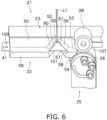
- FIG. 6 is a perspective view illustrating the laser processing positions on the strip electrode 100.
- the foil guide 22 includes a notch 50.
- the notch 50 has a shape that follows the predetermined path 40.
- the notch 50 includes a first edge section 51 and a second edge section 52.
- the first edge section 51 has a shape that follows the first path 41.
- the first edge section 51 is inclined with respect to the width direction toward the outside of the strip electrode 100 in the width direction and toward the conveyance direction A1.
- the second edge section 52 is positioned in the opposite direction in the conveyance direction A1 with respect to the second edge section 52.
- the second edge section 52 has a shape that follows the third path 43.
- the second edge section 52 is inclined with respect to the width direction toward the outside of the strip electrode 100 in the width direction and toward the direction opposite the conveyance direction A1.
- the foil guide 22 includes a first upper guide plate 53, a first lower guide plate 54, a second upper guide plate 55, and a second lower guide plate 56.
- the first upper guide plate 53 is disposed in the conveyance direction A1 with respect to the notch 50.
- the first upper guide plate 53 is disposed above the end material 107 that is cut off from the strip electrode 100.
- the first lower guide plate 54 is disposed in the conveyance direction A1 with respect to the notch 50.
- the first lower guide plate 54 is disposed below the end material 107.
- the abovementioned suction roller 26 is disposed in the conveyance direction A1 with respect to the first upper guide plate 53 and the first lower guide plate 54.
- the inlet of the gap between the first upper guide plate 53 and the first lower guide plate 54 has a tapered shape that faces the notch 50.
- the first upper guide plate 53 includes a first inlet tapered face 57.
- the first lower guide plate 54 includes a second inlet tapered face 58.
- the first inlet tapered face 57 and the second inlet tapered face 58 are inclined so that the gap between the first inlet tapered face 57 and the second inlet tapered face 58 narrows toward the conveyance direction A1.
- the end material 107 passes through the inlet between the first inlet tapered face 57 and the second inlet tapered face 58 and enters the gap between the first upper guide plate 53 and the first lower guide plate 54. Consequently, the end material 107 enters easily into the gap between the first upper guide plate 53 and the first lower guide plate 54.
- the second upper guide plate 55 is disposed opposite the conveyance direction A1 with respect to the notch 50.
- the second upper guide plate 55 is disposed above the strip electrode 100.
- the second upper guide plate 55 is disposed opposite the conveyance direction A1 with respect to the notch 50.
- the second lower guide plate 56 is disposed below the strip electrode 100.
- the first upper guide plate 53 and the second upper guide plate 55 have tapered shapes that face upward.
- the first upper guide plate 53 includes a first upper tapered face 59.
- the second upper guide plate 55 includes a second upper tapered face 60.
- the first upper tapered face 59 and the second upper tapered face 60 are inclined so that the distance between the first upper tapered face 59 and the second upper tapered face 60 widens upward. Consequently, the first upper guide plate 53 and the second upper guide plate 55 are less likely to interfere with the laser beam L1.
- the tab 200 is formed in the strip electrode 100 by moving the laser beam along the predetermined path 40.
- the length of the tab 200 in the width direction of the strip electrode 100 is changed by changing the lengths of the first path 41 and the third path 43.
- the length of the first path 41 is extended along the inclination direction of the first path 41. Consequently, the second position P2 is changed to P2'.
- the length of the third path 43 is extended along the inclination direction of the third path 43. Consequently, the third position P3 is changed to P3'. In this way, the length of the tab 200 in the width direction of the strip electrode 100 can be changed without changing the inclination angles of the first path 41 and the third path 43.
- the strip electrode 100 is held by the guide 20.
- the laser beam L1 passes through the notch 50 of the guide 20 and is irradiated onto the strip electrode 100, whereby the tab 200 is formed in the strip electrode 100.
- the notch 50 has a shape that follows the predetermined path 40 of the laser beam L1 whereby rattling of the strip electrode 100 is effectively suppressed. Consequently, the strip electrode 100 can be cut with high precision.
- the length of the tab 200 is changed in the width direction of the strip electrode 100 by changing the lengths of the first path 41 and the third path 43 without changing the inclination angles of the first path 41 and the third path 43.
- a common guide 20 can be used even when forming tabs 200 of different lengths.
- the present invention is not limited to the above embodiment and various modifications may be made within the scope of the invention.
- the configuration of the laser processing device 1 is not limited to the configuration of the above embodiment and may be modified.
- the structures or dispositions of the winding out shaft 2, the winding shaft 3, the conveyance device 4, the plurality of rollers 5a to 5n, or the laser irradiating unit 6 are not limited to those of the above embodiment and may be changed.
- the laser irradiating unit 6 is not limited to a galvanoscanner type and may be another type.
- the structure or disposition of the suction roller 26 is not limited to the above embodiment and may be changed.
- the structure or disposition of the foil guide 22 is not limited to the above embodiment and may be changed. Only one of the first upper guide plate 53 and the first lower guide plate 54 may have a tapered shape that faces the notch. Only one of the first upper guide plate 53 and the second upper guide plate 55 may have a tapered shape that faces upward. Alternatively, the foil guide 22 may be omitted.
- FIG. 8 illustrates a predetermined path 40 according to a first modified example.
- the fourth position P4 may be a position different from the first position P1.
- the predetermined path 40 may include a fourth path 44.
- the fourth path 44 may extend from the fourth position P4 to the first position P1.
- the controller 32 may cause the laser beam L1 to move along the fourth path 44 from the fourth position P4 to the first position P1. Consequently, the strip electrode 100 may be cut along the bottom side 201.
- the notch 50 of the foil guide 22 may be changed to match the shape of the predetermined path 40 according to the first modified example.
- the length of a tab can be changed in the width direction of a strip electrode without changing the inclination angle of the path of a laser beam in a laser processing device.
Landscapes
- Engineering & Computer Science (AREA)
- Physics & Mathematics (AREA)
- Optics & Photonics (AREA)
- Mechanical Engineering (AREA)
- Plasma & Fusion (AREA)
- Chemical & Material Sciences (AREA)
- Chemical Kinetics & Catalysis (AREA)
- Electrochemistry (AREA)
- General Chemical & Material Sciences (AREA)
- Manufacturing & Machinery (AREA)
- Laser Beam Processing (AREA)
Abstract
Description
- The present invention relates to a laser processing device.
- Strip electrodes are used in secondary batteries such as lithium ion batteries. A strip electrode includes a metal foil and an active material layer. The metal foil has a sheet-like shape. The active material layer is provided to a surface of the metal foil. An uncoated section that is not covered by the active material layer is provided along an edge of the metal foil in the strip electrode.
- Conventionally, a laser processing device is used for processing the uncoated section of the strip electrode. For example, Patent Document No. 1 discloses a laser processing device that cuts the uncoated section into a desired shape using a laser beam. In this laser processing device, the uncoated section is cut in a tab shape by changing the direction of the laser beam irradiated from a head.
- Specifically, as illustrated in
FIG. 9 , a laser processing device causes a laser beam to move over astrip electrode 300 following a triangularloopshaped path 301. Thepath 301 has three vertices X1, X2, amd X3, and three sides Y1, Y2, and Y3. The vertex X2 is positioned, with respect to the vertex X1, in a direction opposite the conveyance direction Z1 of thestrip electrode 300. The vertex X3 is positioned to the outside in the width direction of the strip electrode with respect to the vertices X1 and X2. The vertex X3 is positioned between the vertex X1 and the vertex X2 in the conveyance direction. The side Y1 is a line segment that links the vertex X1 and the vertex X2. The side Y2 is a line segment that links the vertex X2 and the vertex X3. The side Y3 is a line segment that links the vertex X3 and the vertex X1. The laser processing device causes the laser beam to move over thestrip electrode 300 in order from the vertex X1 through the side Y1, the vertex X2, the side Y2, the vertex X3, and the side Y3, so as to return to the vertex X1. Consequently, thestrip electrode 300 is cut into a tab shape. - Patent Document No. 1:
Japanese Patent Laid-open No. 2014-210277 - A tab of various shapes or sizes can be formed in the strip electrode by changing the path of the laser beam in the laser processing device. For example, by adjusting the time that the laser beam is positioned at the vertex X3, the length of the tab can be changed in the conveyance direction. By adjusting the time that the laser beam is positioned at the vertex X1, on the side Y1, or at the vertex X2, the gaps between the tabs can be changed. However, when changing the length of the tab in the width direction of the strip electrode, the position of the vertex X3 is changed in the width direction. For example, as illustrated in
FIG. 10 , the position of the vertex X3 is changed to X3'. As a result, in order to change the length of the tab in the width direction, the inclination angles of the side Y2 and the side Y3 need to be changed. An object of the present invention is to change the length of a tab in the width direction of a strip electrode without changing the inclination angle of the path of a laser beam in a laser processing device. - A laser processing device according to first aspect of the present invention includes a conveyance device, a laser irradiating unit, and a controller. The conveyance device conveys a strip electrode in a conveyance direction. The laser irradiating unit irradiates the strip electrode with a laser beam and is configured to change the irradiating direction of the laser beam. The controller controls the laser irradiating unit by moving the laser beam over the strip electrode along a predetermined path thereby cutting the strip electrode into a tab shape. The predetermined path includes a first path, a second path, and a third path. The first path extends from a first position to a second position. The second position is positioned further outside in the width direction and in the conveyance direction than the first position. The second path extends from the second position to a third position. The third position is positioned in a direction opposite the conveyance direction with respect to the second position. The third path extends from the third position to a fourth position. The fourth position is positioned further inside in the width direction and in the conveyance direction than the third position. The controller causes the laser beam to move from the first position to the second position following the first path. The controller causes the laser beam to move from the second position to the third position following the second path. The controller causes the laser beam to move from the third position to the fourth position following the third path.
- The laser beam moves along the first path whereby one side of the tab shape is formed in the laser processing device according to the present aspect. The top side of the tab shape is formed by the laser beam moving along the second path. One more side of the tab shape is formed by the laser beam moving along the third path. In addition, by changing the length of the first path and the third path, the length of the tab shape in the width direction of the strip electrode can be changed without changing the inclination angles of the first path and the third path.
- The fourth position may be the same position as the first position. In this case, the movement distance of the laser beam can be reduced.
- The laser processing device may further include a guide that holds the strip electrode. The guide may include a notch. The notch may have a first edge section that follows the first path and a second edge section that follows the second path. The first edge section may be inclined with respect to the width direction toward the outside of the strip electrode in the width direction and toward the conveyance direction. The second edge section may be positioned in the direction opposite the conveyance direction with respect to the first edge section, and may be inclined with respect to the width direction toward the outside of the strip electrode in the width direction and toward the direction opposite the conveyance direction.
- In this case, rattling of the strip electrode can be suppressed by the guide. Consequently, the quality of processing is improved. In addition, a common guide can be used for processing different lengths of the first path and the second path. That is, a common guide can be used for processing different lengths of tabs.
- The guide may also include a first upper guide plate and a first lower guide plate. The first upper guide plate may be disposed in the conveyance direction with respect to the notch. The first upper guide plate may be disposed above an end material that is cut off from the strip electrode. The first lower guide plate may be disposed in the conveyance direction with respect to the notch. The first lower guide plate may be disposed below the end material. At least one of the first upper guide plate and the first lower guide plate may have a tapered shape that faces the notch. In this case, the end material that is cut off from the strip electrode is able to easily enter between the first upper guide plate and the first lower guide plate due to the tapered shape. Consequently, rattling of the strip electrode is more effectively suppressed.
- The laser irradiating unit may be disposed above the guide. The guide may also include a first upper guide plate and a second upper guide plate. The first upper guide plate may be disposed in the conveyance direction with respect to the notch. The first upper guide plate may be disposed above an end material that is cut off from the strip electrode. The second upper guide plate may be disposed in the direction opposite the conveyance direction with respect to the notch. The second upper guide plate may be disposed above the strip electrode. At least one of the first upper guide plate and the second upper guide plate may have a tapered shape that faces upward. In this case, the first upper guide plate and/or the second upper guide plate are prevented from interfering with the laser beam due to the tapered shape. As a result, the guide can be disposed closer to the path of the laser beam. Consequently, rattling of the strip electrode is more effectively suppressed.
- The laser processing device may further include a suction roller. The suction roller may be disposed in the conveyance direction with respect to the guide. The suction roller may suction the end material cut off from the strip electrode. In this case, the end material is easily recovered.
- A method according to another aspect of the present invention is a method for controlling the laser processing device in order to cut a strip electrode in a tab shape by causing a laser beam to move over the strip electrode. The method according to the present aspect includes the following processes. A first process involves conveying the strip electrode in the conveyance direction. A second process involves irradiating a laser beam onto the strip electrode. A third process involves causing the laser beam to move from a first position to a second position following a first path that extends from the first position to the second position. The second position is positioned further outside in the width direction and in the conveyance direction than the first position. A fourth process involves causing the laser beam to move from the second position to a third position following a second path that extends from the second position to the third position. The third position is positioned in a direction opposite the conveyance direction with respect to the second position. A fifth process involves causing the laser beam to move from the third position to a fourth position following a third path that extends from the third position to the fourth position. The fourth position is positioned further inside in the width direction and in the conveyance direction than the third position. The order of the execution of the processes is not limited to the abovementioned order and may be changed.
- The laser beam moves along the first path whereby one side of the tab shape is formed in the method according to the present embodiment. The top side of the tab shape is formed by the laser beam moving along the second path. One more side of the tab shape is formed by the laser beam moving along the third path. In addition, by changing the length of the first path and the third path, the length of the tab shape in the width direction of the strip electrode can be changed without changing the inclination angles of the first path and the third path.
- According to the present invention, the length of a tab can be changed in the width direction of a strip electrode without changing the inclination angle of the path of a laser beam in a laser processing device.
-
-
FIG. 1 is a schematic view illustrating a configuration of a laser processing device according to an embodiment. -
FIG. 2 is a perspective view illustrating an example of a strip electrode. -
FIG. 3 is a block diagram of a control system of the laser processing device. -
FIG. 4 is a perspective view illustrating a portion of the laser processing device. -
FIG. 5A is a top view illustrating a predetermined path of a laser beam. -
FIG. 5B is a top view illustrating an example of a tab shape of the strip electrode processed by the laser processing device. -
FIG. 6 is a perspective view illustrating laser processing positions of the strip electrode. -
FIG. 7 is a view illustrating a change of the predetermined path when the length of the tab is changed. -
FIG. 8 is a view illustrating a predetermined path and the shape of a notch of a guide according to a first modified example. -
FIG. 9 is a view illustrating the path of a laser beam according to the prior art. -
FIG. 10 is a view illustrating the path of a laser beam according to the prior art. - A laser processing device for processing a strip electrode according to an embodiment will be explained below with reference to the drawings.
FIG. 1 is a schematic side view illustrating a configuration of alaser processing device 1 according to the embodiment. Arrow A1 in the drawing represents the conveyance direction of astrip electrode 100. -
FIG. 2 is a view illustrating an example of thestrip electrode 100. As illustrated inFIG. 2 , thestrip electrode 100 includes anedge 101. Theedge 101 is one edge in the width direction of thestrip electrode 100. The width direction of thestrip electrode 100 is a direction perpendicular to the longitudinal direction of thestrip electrode 100. The width direction of thestrip electrode 100 is a direction perpendicular to the conveyance direction A1 of thestrip electrode 100 in thelaser processing device 1. - The
strip electrode 101 includes a metal foil 105 and anactive material layer 106. Theactive material layer 106 is applied to at least one surface of the metal foil 105. Thestrip electrode 100 includes acoated section 102 and anuncoated section 103. Theactive material layer 106 is provided to thecoated section 102. Theuncoated section 103 is provided along theedge 101. Theuncoated section 103 is a portion to which theactive material layer 106 is not provided. The metal foil 105 is exposed in theuncoated section 103. Thelaser processing device 1 forms atab 200 in thestrip electrode 100 by cutting theuncoated section 103 with a laser beam L1. - As illustrated in
FIG. 1 , thelaser processing device 1 includes a winding outshaft 2, a winding shaft 3, aconveyance device 4, a plurality ofrollers 5a to 5n, and alaser irradiating unit 6. The strip electrode 100 (referred to below as "electrode roll 110") wound into a roll is assembled onto the winding outshaft 2. The winding shaft 3 winds up the processedstrip electrode 100 into a roll. - The
conveyance device 4 causes thestrip electrode 100 to move from the winding outshaft 2 to the winding shaft 3. Theconveyance device 4 includes afirst driving motor 11 and asecond driving motor 12. Thefirst driving motor 11 is connected to the winding outshaft 2. Thefirst driving motor 11 causes the winding outshaft 2 to rotate. Thesecond driving motor 12 is connected to the winding shaft 3. Thesecond driving motor 12 causes the winding shaft 3 to rotate. - The plurality of
rollers 5a to 5n are provided so as to be able to rotate about the centers of therollers 5a to 5n. The plurality ofrollers 5a to 5n include afirst dancer roller 5a, anip roller 5b, asecond dancer roller 5c, and a plurality ofguide rollers 5d to 5n. Thefirst dancer roller 5a is disposed between the winding outshaft 2 and thenip roller 5b. Thefirst dancer roller 5a applies a predetermined tension to thestrip electrode 100 let out from the winding outshaft 2. Thenip roller 5b is disposed between thefirst dancer roller 5a and thesecond dancer roller 5c. Thenip roller 5b includes afirst roller 5p and asecond roller 5q. Thenip roller 5b presses thestrip electrode 100 between thefirst roller 5p and thesecond roller 5q. Thesecond dancer roller 5c is disposed between the winding shaft 3 and thenip roller 5b. Thesecond dancer roller 5c imparts a predetermined tension to thestrip electrode 100 wound up by the winding shaft 3. - The
laser irradiating unit 6 cuts thestrip electrode 100 by irradiating the laser beam L1 onto thestrip electrode 100. Thelaser irradiating unit 6 is a so-called galvanoscanner-type laser device. Thelaser irradiating unit 6 includes alaser oscillator 13 and ahead 14. Thelaser oscillator 13 generates the laser beam L1. Thehead 14 is connected to thelaser oscillator 13 by means of afiber cable 15. Thehead 14 is disposed between the winding outshaft 2 and the winding shaft 3. - As illustrated in
FIG. 1 , thehead 14 includes amirror 16. Themirror 16 is disposed so as to be able to rotate.FIG. 3 is a block diagram of a control system of thelaser processing device 1. Themirror 16 is connected to alaser actuator 17 illustrated inFIG. 3 . Thelaser actuator 17 is, for example, an electric motor. The rotation angle of themirror 16 is changed by thelaser actuator 17. Thelaser irradiating unit 6 causes the irradiation direction of the laser from thehead 14 to change by changing the rotation angle of themirror 16. Consequently, thestrip electrode 100 is cut into a desired shape. -
FIG. 4 is a perspective view illustrating a portion of thelaser processing device 1. As illustrated inFIG. 4 , thehead 14 is disposed above thestrip electrode 100. Thestrip electrode 100 is conveyed in the horizontal direction below thehead 14. Thelaser processing device 1 includes a firstair blow device 18 and a secondair blow device 19. The firstair blow device 18 and the secondair blow device 19 are disposed between thehead 14 and thestrip electrode 100. The firstair blow device 18 blows air toward positions (referred to below as "laser processing positions") where thestrip electrode 100 receives the laser beam L1. Consequently, fumes generated by the processing by the laser beam L1 are blown away. The secondair blow device 19 blows air so that the fumes do not adhere to themirror 16. - The
laser processing device 1 includes aguide 20. Theguide 20 is disposed below thehead 14. Theguide 20 holds thestrip electrode 100 around the laser processing positions. Theguide 20 includes aworkpiece guide 21 and afoil guide 22. Theworkpiece guide 21 holds thecoated section 102. Theworkpiece guide 21 includes anupper plate 23 and alower plate 24. Theupper plate 23 is disposed above thecoated section 102. Thelower plate 24 is disposed below thecoated section 102. Thecoated section 102 is sandwiched between theupper plate 23 and thelower plate 24. Thecoated section 102 is conveyed between theupper plate 23 and thelower plate 24. Thefoil guide 22 holds theuncoated section 103. A detailed explanation of thefoil guide 22 is provided below. - The
laser processing device 1 includes arecovery device 25. Therecovery device 25 recovers the metal foil 105 (referred to below as "end material 107") cut off from thestrip electrode 100. Therecovery device 25 includes asuction roller 26, afirst nip roller 27, asecond nip roller 28, and arecovery duct 29. Thesuction roller 26 is positioned in the conveyance direction A1 with respect to thefoil guide 22. Thesuction roller 26 suctions theend material 107. For example, a plurality of pores are provided to the surface of thesuction roller 26. The inside of thesuction roller 26 is set to a negative pressure by asuction device 30 illustrated inFIG. 3 . Thesuction device 30 is, for example, a pump or a fan. Thesuction roller 26 rotates by means of a third driving motor 31 illustrated inFIG. 3 . Thefirst nip roller 27 and thesecond nip roller 28 face thesuction roller 26. Thefirst nip roller 27 is disposed above thesuction roller 26. Thefirst nip roller 27 is disposed in the conveyance direction A1 with respect to thesuction roller 26. Due to the rotation of thesuction roller 26, theend material 107 passes between thesuction roller 26 and thefirst nip roller 27 and is fed to therecovery duct 29. - As illustrated in
FIG. 3 , thelaser processing device 1 includes acontroller 32. Thecontroller 32 includes a processor such as a CPU and a memory such as a RAM or a ROM. Thecontroller 32 controls thefirst driving motor 11 and thesecond driving motor 12 thereby letting out thestrip electrode 100 from theelectrode roll 110, causing thestrip electrode 100 to move over the plurality ofrollers 5a to 5n, and winding thestrip electrode 100 in a roll shape on the winding shaft 3. - The
controller 32 controls thelaser oscillator 13 thereby causing the laser beam to be irradiated from thehead 14. Thecontroller 32 controls thelaser actuator 17 thereby changing the irradiation direction of the laser beam L1 from thehead 14. Thecontroller 32 causes the laser beam L1 from thehead 14 to move along a predetermined path on thestrip electrode 100 thereby cutting theedge 101 of thestrip electrode 100 into a shape having atab 200 and abottom side 201 as illustrated inFIG. 2 . As illustrated inFIG. 2 , thebottom side 201 extends in the conveyance direction A1. Thetab 200 includes afirst side 202, asecond side 203, and atop side 204. Thefirst side 202 and thesecond side 203 extend in the width direction from thebottom side 201. Thetop side 204 extends in the conveyance direction A1. The predetermined path of the laser beam L1 is explained below. -
FIG. 5A is a top view illustrating a laser processing position of thestrip electrode 100. Thecontroller 32 causes the laser beam L1 to move over thestrip electrode 100 following apredetermined path 40 illustrated inFIG. 5A . Thepredetermined path 40 includes afirst path 42, asecond path 42, and athird path 43. Thefirst path 41 is inclined with respect to the width direction. Thefirst path 41 extends from a first position P1 to a second position P2. The first position P1 is separated from theedge 101 of thestrip electrode 100 toward the inside in the width direction. The second position P2 is positioned further to the outside in the width direction and further in the conveyance direction A1 than the first position P1. - The
second path 42 is parallel to the conveyance direction A1. Thesecond path 42 extends from the second position P2 to a third position P3. The third position P3 is positioned in a direction opposite the conveyance direction A1 with respect to the second position P2. Thethird path 43 is inclined with respect to the width direction in the opposite direction from thefirst path 41. Thethird path 43 extends from the third position P3 to a fourth position P4. The fourth position P4 is positioned further inside in the width direction and in the conveyance direction A1 than the third position P3. In the present embodiment, the fourth position P4 is the same as the first position P1. Therefore, thepredetermined path 40 has a triangular loop shape with the first position P1, the second position P2, and the third position P3 as the vertices. - The
controller 32 maintains the laser beam L1 at the first position P1. Consequently, thestrip electrode 100 is cut along thebottom side 201 as illustrated inFIG. 5B . Next, the laser beam L1 is moved from the first position P1 to the second position P2 along thefirst path 41. Consequently, thestrip electrode 100 is cut along thefirst side 201 as illustrated inFIG. 5B . Next, thecontroller 32 causes the laser beam L1 to move from the second position P2 to the third position P3 along thesecond path 42. Consequently, thestrip electrode 100 is cut along thetop side 204 as illustrated inFIG. 5B . Next, thecontroller 32 causes the laser beam L1 to move from the third position P3 to the first position P1 along thethird path 43. Consequently, thestrip electrode 100 is cut along thesecond side 203 as illustrated inFIG. 5B . Thecontroller 32 maintains the laser beam L1 at the first position P1. Consequently, thestrip electrode 100 is cut again along thebottom side 201. By repeating the above processing, a plurality oftabs 200 are formed with gaps therebetween in thestrip electrode 100. - The
foil guide 22 will be discussed next.FIG. 6 is a perspective view illustrating the laser processing positions on thestrip electrode 100. As illustrated inFIG. 5A and6 , thefoil guide 22 includes anotch 50. Thenotch 50 has a shape that follows thepredetermined path 40. Specifically, thenotch 50 includes afirst edge section 51 and asecond edge section 52. Thefirst edge section 51 has a shape that follows thefirst path 41. Thefirst edge section 51 is inclined with respect to the width direction toward the outside of thestrip electrode 100 in the width direction and toward the conveyance direction A1. - The
second edge section 52 is positioned in the opposite direction in the conveyance direction A1 with respect to thesecond edge section 52. Thesecond edge section 52 has a shape that follows thethird path 43. Thesecond edge section 52 is inclined with respect to the width direction toward the outside of thestrip electrode 100 in the width direction and toward the direction opposite the conveyance direction A1. - As illustrated in
FIG. 6 , thefoil guide 22 includes a firstupper guide plate 53, a firstlower guide plate 54, a secondupper guide plate 55, and a secondlower guide plate 56. The firstupper guide plate 53 is disposed in the conveyance direction A1 with respect to thenotch 50. The firstupper guide plate 53 is disposed above theend material 107 that is cut off from thestrip electrode 100. The firstlower guide plate 54 is disposed in the conveyance direction A1 with respect to thenotch 50. The firstlower guide plate 54 is disposed below theend material 107. Theabovementioned suction roller 26 is disposed in the conveyance direction A1 with respect to the firstupper guide plate 53 and the firstlower guide plate 54. - The inlet of the gap between the first
upper guide plate 53 and the firstlower guide plate 54 has a tapered shape that faces thenotch 50. Specifically the firstupper guide plate 53 includes a first inlet taperedface 57. The firstlower guide plate 54 includes a second inlet taperedface 58. The first inlet taperedface 57 and the second inlet taperedface 58 are inclined so that the gap between the first inlet taperedface 57 and the second inlet taperedface 58 narrows toward the conveyance direction A1. Theend material 107 passes through the inlet between the first inlet taperedface 57 and the second inlet taperedface 58 and enters the gap between the firstupper guide plate 53 and the firstlower guide plate 54. Consequently, theend material 107 enters easily into the gap between the firstupper guide plate 53 and the firstlower guide plate 54. - The second
upper guide plate 55 is disposed opposite the conveyance direction A1 with respect to thenotch 50. The secondupper guide plate 55 is disposed above thestrip electrode 100. The secondupper guide plate 55 is disposed opposite the conveyance direction A1 with respect to thenotch 50. The secondlower guide plate 56 is disposed below thestrip electrode 100. The firstupper guide plate 53 and the secondupper guide plate 55 have tapered shapes that face upward. Specifically the firstupper guide plate 53 includes a first upper taperedface 59. The secondupper guide plate 55 includes a second upper taperedface 60. The first upper taperedface 59 and the second upper taperedface 60 are inclined so that the distance between the first upper taperedface 59 and the second upper taperedface 60 widens upward. Consequently, the firstupper guide plate 53 and the secondupper guide plate 55 are less likely to interfere with the laser beam L1. - In the
laser processing device 1 according to the previously discussed present embodiment, thetab 200 is formed in thestrip electrode 100 by moving the laser beam along thepredetermined path 40. In addition, as illustrated inFIG. 7 , the length of thetab 200 in the width direction of thestrip electrode 100 is changed by changing the lengths of thefirst path 41 and thethird path 43. InFIG. 7 , the length of thefirst path 41 is extended along the inclination direction of thefirst path 41. Consequently, the second position P2 is changed to P2'. The length of thethird path 43 is extended along the inclination direction of thethird path 43. Consequently, the third position P3 is changed to P3'. In this way, the length of thetab 200 in the width direction of thestrip electrode 100 can be changed without changing the inclination angles of thefirst path 41 and thethird path 43. - The
strip electrode 100 is held by theguide 20. The laser beam L1 passes through thenotch 50 of theguide 20 and is irradiated onto thestrip electrode 100, whereby thetab 200 is formed in thestrip electrode 100. Thenotch 50 has a shape that follows thepredetermined path 40 of the laser beam L1 whereby rattling of thestrip electrode 100 is effectively suppressed. Consequently, thestrip electrode 100 can be cut with high precision. - In addition, the length of the
tab 200 is changed in the width direction of thestrip electrode 100 by changing the lengths of thefirst path 41 and thethird path 43 without changing the inclination angles of thefirst path 41 and thethird path 43. As a result, acommon guide 20 can be used even when formingtabs 200 of different lengths. - Although an embodiment of the present invention has been described so far, the present invention is not limited to the above embodiment and various modifications may be made within the scope of the invention. The configuration of the
laser processing device 1 is not limited to the configuration of the above embodiment and may be modified. - The structures or dispositions of the winding out
shaft 2, the winding shaft 3, theconveyance device 4, the plurality ofrollers 5a to 5n, or thelaser irradiating unit 6 are not limited to those of the above embodiment and may be changed. For example, thelaser irradiating unit 6 is not limited to a galvanoscanner type and may be another type. The structure or disposition of thesuction roller 26 is not limited to the above embodiment and may be changed. - The structure or disposition of the
foil guide 22 is not limited to the above embodiment and may be changed. Only one of the firstupper guide plate 53 and the firstlower guide plate 54 may have a tapered shape that faces the notch. Only one of the firstupper guide plate 53 and the secondupper guide plate 55 may have a tapered shape that faces upward. Alternatively, thefoil guide 22 may be omitted. - The
predetermined path 40 is not limited to the above embodiment and may be changed. For example,FIG. 8 illustrates apredetermined path 40 according to a first modified example. As illustrated inFIG. 8 , the fourth position P4 may be a position different from the first position P1. Thepredetermined path 40 may include afourth path 44. Thefourth path 44 may extend from the fourth position P4 to the first position P1. Thecontroller 32 may cause the laser beam L1 to move along thefourth path 44 from the fourth position P4 to the first position P1. Consequently, thestrip electrode 100 may be cut along thebottom side 201. In addition, thenotch 50 of thefoil guide 22 may be changed to match the shape of thepredetermined path 40 according to the first modified example. - According to the present invention, the length of a tab can be changed in the width direction of a strip electrode without changing the inclination angle of the path of a laser beam in a laser processing device.
-
- 4:
- Conveyance device
- 6:
- Laser irradiating unit
- 20:
- Guide
- 26:
- Suction roller
- 32:
- Controller
- 50:
- Notch
- 51:
- First edge section
- 52:
- Second edge section
- 53:
- First upper guide plate
- 54:
- First lower guide plate
- 55:
- Second upper guide plate
- 71:
- First path
- 73:
- Third path
- 100:
- Strip electrode
- A1:
- Conveyance direction
- P1:
- First position
- P2:
- Second position
- P3:
- Third position
- P4:
- Fourth position
Claims (8)
- A laser processing device for processing a strip electrode, the laser processing device comprising:a conveyance device that conveys the strip electrode in a conveyance direction;a laser irradiating unit that irradiates the strip electrode with a laser beam and is configured to change the irradiating direction of the laser beam;a controller that controls the laser irradiating unit so as to cut the strip electrode into a tab shape by causing the laser beam to move along a predetermined path on the strip electrode, whereinthe predetermined path includesa first path extending from a first position to a second position positioned further outside in a width direction perpendicular to the conveyance direction and in the conveyance direction than the first position, anda second path extending from the second position to a third position positioned in a direction opposite the conveyance direction with respect to the second position, anda third path extending from the third position to a fourth position positioned further inside in the width direction and in the conveyance direction than the third position, andthe controller is configured tocause the laser beam to move from the first position to the second position along the first path,cause the laser beam to move from the second position to the third position along the second path, andcause the laser beam to move from the third position to the fourth position along the third path.
- The laser processing device according to claim 1, wherein
the fourth position is a same position as the first position. - The laser processing device according to claim 1 or 2, further comprising:a guide that holds the strip electrode, whereinthe guide includes a notch having a first edge section that follows the first path and a second edge section that follows the second path,the first edge section is inclined with respect to the width direction toward the outside of the strip electrode in the width direction and toward the conveyance direction, andthe second edge section is positioned in the direction opposite the conveyance direction with respect to the first edge section, and is inclined with respect to the width direction toward the outside of the strip electrode in the width direction and toward the direction opposite the conveyance direction.
- The laser processing device according to claim 3, whereinthe guide includesa first upper guide plate disposed in the conveyance direction with respect to the notch and disposed above an end material cut off from the strip electrode, anda first lower guide plate disposed in the conveyance direction with respect to the notch and disposed below the end material, andat least one of the first upper guide plate and the first lower guide plate has a tapered shape that faces the notch.
- The laser processing device according to claim 3, whereinthe laser irradiating unit is disposed above the guide, andthe guide includesa first upper guide plate disposed in the conveyance direction with respect to the notch and disposed above an end material cut off from the strip electrode, anda second upper guide plate disposed in the direction opposite the conveyance direction with respect to the notch and disposed above the strip electrode, andat least one of the first upper guide plate and the second upper guide plate has a tapered shape that faces upward.
- The laser processing device according to any one of claims 1 to 5, further comprising:
a suction roller disposed in the conveyance direction with respect to the guide and configured to suction the end material cut off from the strip electrode. - A method for controlling a laser processing device in order to cut a strip electrode into a tab shape by causing a laser beam to move over the strip electrode, the method comprising:conveying the strip electrode in a conveyance direction;irradiating the laser beam onto the strip electrode;causing the laser beam to move from a first position to a second position along a first path extending from the first position to the second position positioned further outside in a width direction perpendicular to the conveyance direction and in the conveyance direction than the first position;causing the laser beam to move from the second position to a third position along a second path extending from the second position to the third position positioned in a direction opposite the conveyance direction with respect to the second position; andcausing the laser beam to move from the third position to a fourth position along a third path extending from the third position to the fourth position positioned further inside in the width direction and in the conveyance direction than the third position.
- The method according to claim 7, wherein
the fourth position is a same position as the first position.
Applications Claiming Priority (2)
| Application Number | Priority Date | Filing Date | Title |
|---|---|---|---|
| JP2020193337A JP7515377B2 (en) | 2020-11-20 | 2020-11-20 | Laser processing equipment |
| PCT/JP2021/041157 WO2022107643A1 (en) | 2020-11-20 | 2021-11-09 | Laser processing device |
Publications (2)
| Publication Number | Publication Date |
|---|---|
| EP4205897A1 true EP4205897A1 (en) | 2023-07-05 |
| EP4205897A4 EP4205897A4 (en) | 2024-10-23 |
Family
ID=81708835
Family Applications (1)
| Application Number | Title | Priority Date | Filing Date |
|---|---|---|---|
| EP21894517.8A Withdrawn EP4205897A4 (en) | 2020-11-20 | 2021-11-09 | LASER PROCESSING DEVICE |
Country Status (6)
| Country | Link |
|---|---|
| US (1) | US20240009767A1 (en) |
| EP (1) | EP4205897A4 (en) |
| JP (1) | JP7515377B2 (en) |
| KR (1) | KR20230048559A (en) |
| CN (1) | CN116323074A (en) |
| WO (1) | WO2022107643A1 (en) |
Families Citing this family (1)
| Publication number | Priority date | Publication date | Assignee | Title |
|---|---|---|---|---|
| US11978271B1 (en) | 2023-10-27 | 2024-05-07 | Google Llc | Instance level scene recognition with a vision language model |
Family Cites Families (7)
| Publication number | Priority date | Publication date | Assignee | Title |
|---|---|---|---|---|
| JPS6221491A (en) * | 1985-07-23 | 1987-01-29 | Mitsubishi Electric Corp | Laser beam cutting and processing machine |
| JP6053598B2 (en) | 2013-04-18 | 2016-12-27 | 株式会社アマダミヤチ | Laser cutting method, laser emitting unit and laser cutting device |
| JP2015072834A (en) * | 2013-10-03 | 2015-04-16 | 日産自動車株式会社 | Cutting apparatus and cutting method |
| JP6297073B2 (en) | 2015-11-12 | 2018-03-20 | オー・エム・シー株式会社 | Tab forming method and apparatus |
| KR102156012B1 (en) * | 2016-01-06 | 2020-09-16 | 오.엠.씨. 가부시키가이샤 | Manufacturing method and apparatus for electrode sheet with tab |
| JP6717159B2 (en) * | 2016-10-18 | 2020-07-01 | 株式会社豊田自動織機 | Electrode manufacturing equipment |
| KR102309536B1 (en) | 2018-03-07 | 2021-10-07 | 주식회사 엘지에너지솔루션 | Electrode notching apparatus and method |
-
2020
- 2020-11-20 JP JP2020193337A patent/JP7515377B2/en active Active
-
2021
- 2021-11-09 WO PCT/JP2021/041157 patent/WO2022107643A1/en not_active Ceased
- 2021-11-09 CN CN202180067565.XA patent/CN116323074A/en active Pending
- 2021-11-09 US US18/248,437 patent/US20240009767A1/en active Pending
- 2021-11-09 EP EP21894517.8A patent/EP4205897A4/en not_active Withdrawn
- 2021-11-09 KR KR1020237009403A patent/KR20230048559A/en not_active Ceased
Also Published As
| Publication number | Publication date |
|---|---|
| CN116323074A (en) | 2023-06-23 |
| EP4205897A4 (en) | 2024-10-23 |
| JP7515377B2 (en) | 2024-07-12 |
| KR20230048559A (en) | 2023-04-11 |
| US20240009767A1 (en) | 2024-01-11 |
| JP2022082036A (en) | 2022-06-01 |
| WO2022107643A1 (en) | 2022-05-27 |
Similar Documents
| Publication | Publication Date | Title |
|---|---|---|
| EP4207332A1 (en) | Laser processing apparatus | |
| EP3758104B1 (en) | Method for producing battery electrodes | |
| AU699003B2 (en) | Laser processing of discrete sheets of material | |
| KR102713214B1 (en) | electrode sheet notching apparatus and notching method | |
| CN112955275B (en) | Method of cutting continuous battery electrode material to make battery electrodes and battery electrodes | |
| JP2018022554A (en) | Raw fabric processing method, device, and tub drawing processing method using device | |
| JP2017084691A (en) | Electrode sheet manufacturing method and electrode sheet | |
| EP4060778A1 (en) | Device for manufacturing electrode | |
| EP4205897A1 (en) | Laser processing device | |
| US20160083898A1 (en) | Process and system for laser-cutting a shape in a moving web | |
| JP2021146358A (en) | Laser processing device | |
| JP7272041B2 (en) | LASER CUTTING METHOD AND LASER CUTTING DEVICE | |
| US20230216018A1 (en) | Method and system for manufacturing electrode | |
| JPH10230321A (en) | Band cutting machine | |
| KR102693038B1 (en) | Electrode notching apparatus of secondary battery using laser and control method thereof | |
| KR102693036B1 (en) | Electrode notching apparatus and method of secondary battery using laser | |
| JP3629161B2 (en) | Continuous welding method in the longitudinal direction of strip steel plate and its welding equipment | |
| US20250128357A1 (en) | Electrode plate manufacturing apparatus, electrode plate manufactured using the same, and method thereof | |
| EP4545242A1 (en) | NOTCHING SYSTEM AND NOTCHING PROCESS | |
| JP2025518928A (en) | Laser etching apparatus, laser etching system, electrode etched using a laser, and method for manufacturing the electrode | |
| KR20260011090A (en) | Wobble laser machining apparatus and method | |
| TW202545672A (en) | Laser irradiation device, laser processing device including the same, and laser processing method | |
| JP2014012289A (en) | Perforating apparatus | |
| KR20250177444A (en) | Electrode manufacturing equipment for secondary batteries, electrodes for secondary batteries and secondary batteries manufactured therefrom | |
| CN121988894A (en) | Substrate processing apparatus and substrate processing method |
Legal Events
| Date | Code | Title | Description |
|---|---|---|---|
| STAA | Information on the status of an ep patent application or granted ep patent |
Free format text: STATUS: THE INTERNATIONAL PUBLICATION HAS BEEN MADE |
|
| PUAI | Public reference made under article 153(3) epc to a published international application that has entered the european phase |
Free format text: ORIGINAL CODE: 0009012 |
|
| STAA | Information on the status of an ep patent application or granted ep patent |
Free format text: STATUS: REQUEST FOR EXAMINATION WAS MADE |
|
| 17P | Request for examination filed |
Effective date: 20230327 |
|
| AK | Designated contracting states |
Kind code of ref document: A1 Designated state(s): AL AT BE BG CH CY CZ DE DK EE ES FI FR GB GR HR HU IE IS IT LI LT LU LV MC MK MT NL NO PL PT RO RS SE SI SK SM TR |
|
| DAV | Request for validation of the european patent (deleted) | ||
| DAX | Request for extension of the european patent (deleted) | ||
| A4 | Supplementary search report drawn up and despatched |
Effective date: 20240924 |
|
| RIC1 | Information provided on ipc code assigned before grant |
Ipc: B23K 26/08 20140101ALI20240918BHEP Ipc: B23K 26/082 20140101ALI20240918BHEP Ipc: B23K 26/38 20140101AFI20240918BHEP |
|
| STAA | Information on the status of an ep patent application or granted ep patent |
Free format text: STATUS: THE APPLICATION IS DEEMED TO BE WITHDRAWN |
|
| 18D | Application deemed to be withdrawn |
Effective date: 20250412 |