EP4203101A1 - Composite negative electrode material and preparation method therefor, negative electrode material and lithium ion battery - Google Patents
Composite negative electrode material and preparation method therefor, negative electrode material and lithium ion battery Download PDFInfo
- Publication number
- EP4203101A1 EP4203101A1 EP21941656.7A EP21941656A EP4203101A1 EP 4203101 A1 EP4203101 A1 EP 4203101A1 EP 21941656 A EP21941656 A EP 21941656A EP 4203101 A1 EP4203101 A1 EP 4203101A1
- Authority
- EP
- European Patent Office
- Prior art keywords
- anode electrode
- electrode material
- defect
- transition metal
- metal oxide
- Prior art date
- Legal status (The legal status is an assumption and is not a legal conclusion. Google has not performed a legal analysis and makes no representation as to the accuracy of the status listed.)
- Pending
Links
- 239000002131 composite material Substances 0.000 title claims abstract description 80
- HBBGRARXTFLTSG-UHFFFAOYSA-N Lithium ion Chemical compound [Li+] HBBGRARXTFLTSG-UHFFFAOYSA-N 0.000 title claims abstract description 36
- 229910001416 lithium ion Inorganic materials 0.000 title claims abstract description 36
- 238000002360 preparation method Methods 0.000 title claims abstract description 16
- 239000007773 negative electrode material Substances 0.000 title 2
- 239000007772 electrode material Substances 0.000 claims abstract description 106
- 229910000314 transition metal oxide Inorganic materials 0.000 claims abstract description 79
- WHXSMMKQMYFTQS-UHFFFAOYSA-N Lithium Chemical compound [Li] WHXSMMKQMYFTQS-UHFFFAOYSA-N 0.000 claims abstract description 48
- 229910052744 lithium Inorganic materials 0.000 claims abstract description 48
- RTAQQCXQSZGOHL-UHFFFAOYSA-N Titanium Chemical compound [Ti] RTAQQCXQSZGOHL-UHFFFAOYSA-N 0.000 claims abstract description 47
- 239000011163 secondary particle Substances 0.000 claims abstract description 18
- 238000000034 method Methods 0.000 claims abstract description 9
- 230000008569 process Effects 0.000 claims abstract description 9
- WFKWXMTUELFFGS-UHFFFAOYSA-N tungsten Chemical compound [W] WFKWXMTUELFFGS-UHFFFAOYSA-N 0.000 claims abstract description 8
- 229910052721 tungsten Inorganic materials 0.000 claims abstract description 7
- 239000010937 tungsten Substances 0.000 claims abstract description 7
- ATJFFYVFTNAWJD-UHFFFAOYSA-N Tin Chemical compound [Sn] ATJFFYVFTNAWJD-UHFFFAOYSA-N 0.000 claims abstract description 4
- 239000011248 coating agent Substances 0.000 claims abstract description 4
- 238000000576 coating method Methods 0.000 claims abstract description 4
- 229910052718 tin Inorganic materials 0.000 claims abstract description 4
- 229910052723 transition metal Inorganic materials 0.000 claims abstract description 4
- 229910052727 yttrium Inorganic materials 0.000 claims abstract description 4
- VWQVUPCCIRVNHF-UHFFFAOYSA-N yttrium atom Chemical compound [Y] VWQVUPCCIRVNHF-UHFFFAOYSA-N 0.000 claims abstract description 4
- 239000002245 particle Substances 0.000 claims description 31
- QGLKJKCYBOYXKC-UHFFFAOYSA-N nonaoxidotritungsten Chemical compound O=[W]1(=O)O[W](=O)(=O)O[W](=O)(=O)O1 QGLKJKCYBOYXKC-UHFFFAOYSA-N 0.000 claims description 24
- 229910001930 tungsten oxide Inorganic materials 0.000 claims description 24
- 238000003756 stirring Methods 0.000 claims description 13
- 239000011164 primary particle Substances 0.000 claims description 10
- 238000007580 dry-mixing Methods 0.000 claims description 7
- 238000005054 agglomeration Methods 0.000 claims description 3
- 230000002776 aggregation Effects 0.000 claims description 3
- SIWVEOZUMHYXCS-UHFFFAOYSA-N oxo(oxoyttriooxy)yttrium Chemical compound O=[Y]O[Y]=O SIWVEOZUMHYXCS-UHFFFAOYSA-N 0.000 claims description 3
- XOLBLPGZBRYERU-UHFFFAOYSA-N tin dioxide Chemical compound O=[Sn]=O XOLBLPGZBRYERU-UHFFFAOYSA-N 0.000 claims description 3
- 229910001887 tin oxide Inorganic materials 0.000 claims description 3
- 239000003792 electrolyte Substances 0.000 abstract description 17
- 230000000694 effects Effects 0.000 abstract description 15
- 230000001351 cycling effect Effects 0.000 abstract description 12
- 230000014759 maintenance of location Effects 0.000 abstract description 12
- 238000007086 side reaction Methods 0.000 abstract description 11
- 238000009831 deintercalation Methods 0.000 abstract description 8
- 238000010586 diagram Methods 0.000 description 11
- 239000000126 substance Substances 0.000 description 6
- 229910002986 Li4Ti5O12 Inorganic materials 0.000 description 5
- 239000013078 crystal Substances 0.000 description 4
- 238000005516 engineering process Methods 0.000 description 4
- 230000006872 improvement Effects 0.000 description 4
- 238000010183 spectrum analysis Methods 0.000 description 4
- QGZKDVFQNNGYKY-UHFFFAOYSA-N Ammonia Chemical compound N QGZKDVFQNNGYKY-UHFFFAOYSA-N 0.000 description 3
- OKTJSMMVPCPJKN-UHFFFAOYSA-N Carbon Chemical compound [C] OKTJSMMVPCPJKN-UHFFFAOYSA-N 0.000 description 3
- 239000002253 acid Substances 0.000 description 3
- QGZKDVFQNNGYKY-UHFFFAOYSA-O Ammonium Chemical compound [NH4+] QGZKDVFQNNGYKY-UHFFFAOYSA-O 0.000 description 2
- 230000009286 beneficial effect Effects 0.000 description 2
- 238000006243 chemical reaction Methods 0.000 description 2
- 238000010438 heat treatment Methods 0.000 description 2
- 239000000463 material Substances 0.000 description 2
- 238000012986 modification Methods 0.000 description 2
- 230000004048 modification Effects 0.000 description 2
- 239000002994 raw material Substances 0.000 description 2
- 230000002195 synergetic effect Effects 0.000 description 2
- RYGMFSIKBFXOCR-UHFFFAOYSA-N Copper Chemical compound [Cu] RYGMFSIKBFXOCR-UHFFFAOYSA-N 0.000 description 1
- 239000006230 acetylene black Substances 0.000 description 1
- 239000011230 binding agent Substances 0.000 description 1
- 239000003575 carbonaceous material Substances 0.000 description 1
- 230000008602 contraction Effects 0.000 description 1
- 239000011889 copper foil Substances 0.000 description 1
- XAYGUHUYDMLJJV-UHFFFAOYSA-Z decaazanium;dioxido(dioxo)tungsten;hydron;trioxotungsten Chemical compound [H+].[H+].[NH4+].[NH4+].[NH4+].[NH4+].[NH4+].[NH4+].[NH4+].[NH4+].[NH4+].[NH4+].O=[W](=O)=O.O=[W](=O)=O.O=[W](=O)=O.O=[W](=O)=O.O=[W](=O)=O.O=[W](=O)=O.[O-][W]([O-])(=O)=O.[O-][W]([O-])(=O)=O.[O-][W]([O-])(=O)=O.[O-][W]([O-])(=O)=O.[O-][W]([O-])(=O)=O.[O-][W]([O-])(=O)=O XAYGUHUYDMLJJV-UHFFFAOYSA-Z 0.000 description 1
- 239000000839 emulsion Substances 0.000 description 1
- 239000003292 glue Substances 0.000 description 1
- 229910002804 graphite Inorganic materials 0.000 description 1
- 239000010439 graphite Substances 0.000 description 1
- 239000007770 graphite material Substances 0.000 description 1
- 229910021385 hard carbon Inorganic materials 0.000 description 1
- 238000009830 intercalation Methods 0.000 description 1
- 230000002687 intercalation Effects 0.000 description 1
- 238000005342 ion exchange Methods 0.000 description 1
- 238000002156 mixing Methods 0.000 description 1
- 239000000203 mixture Substances 0.000 description 1
- 239000003960 organic solvent Substances 0.000 description 1
- 238000010298 pulverizing process Methods 0.000 description 1
- 238000007873 sieving Methods 0.000 description 1
- 239000002210 silicon-based material Substances 0.000 description 1
- 239000002002 slurry Substances 0.000 description 1
- 229910021384 soft carbon Inorganic materials 0.000 description 1
- 239000007787 solid Substances 0.000 description 1
Images


Classifications
-
- H—ELECTRICITY
- H01—ELECTRIC ELEMENTS
- H01M—PROCESSES OR MEANS, e.g. BATTERIES, FOR THE DIRECT CONVERSION OF CHEMICAL ENERGY INTO ELECTRICAL ENERGY
- H01M4/00—Electrodes
- H01M4/02—Electrodes composed of, or comprising, active material
- H01M4/36—Selection of substances as active materials, active masses, active liquids
- H01M4/362—Composites
-
- H—ELECTRICITY
- H01—ELECTRIC ELEMENTS
- H01M—PROCESSES OR MEANS, e.g. BATTERIES, FOR THE DIRECT CONVERSION OF CHEMICAL ENERGY INTO ELECTRICAL ENERGY
- H01M10/00—Secondary cells; Manufacture thereof
- H01M10/05—Accumulators with non-aqueous electrolyte
- H01M10/052—Li-accumulators
- H01M10/0525—Rocking-chair batteries, i.e. batteries with lithium insertion or intercalation in both electrodes; Lithium-ion batteries
-
- H—ELECTRICITY
- H01—ELECTRIC ELEMENTS
- H01M—PROCESSES OR MEANS, e.g. BATTERIES, FOR THE DIRECT CONVERSION OF CHEMICAL ENERGY INTO ELECTRICAL ENERGY
- H01M4/00—Electrodes
- H01M4/02—Electrodes composed of, or comprising, active material
- H01M4/04—Processes of manufacture in general
-
- H—ELECTRICITY
- H01—ELECTRIC ELEMENTS
- H01M—PROCESSES OR MEANS, e.g. BATTERIES, FOR THE DIRECT CONVERSION OF CHEMICAL ENERGY INTO ELECTRICAL ENERGY
- H01M4/00—Electrodes
- H01M4/02—Electrodes composed of, or comprising, active material
- H01M4/13—Electrodes for accumulators with non-aqueous electrolyte, e.g. for lithium-accumulators; Processes of manufacture thereof
- H01M4/131—Electrodes based on mixed oxides or hydroxides, or on mixtures of oxides or hydroxides, e.g. LiCoOx
-
- H—ELECTRICITY
- H01—ELECTRIC ELEMENTS
- H01M—PROCESSES OR MEANS, e.g. BATTERIES, FOR THE DIRECT CONVERSION OF CHEMICAL ENERGY INTO ELECTRICAL ENERGY
- H01M4/00—Electrodes
- H01M4/02—Electrodes composed of, or comprising, active material
- H01M4/13—Electrodes for accumulators with non-aqueous electrolyte, e.g. for lithium-accumulators; Processes of manufacture thereof
- H01M4/139—Processes of manufacture
- H01M4/1391—Processes of manufacture of electrodes based on mixed oxides or hydroxides, or on mixtures of oxides or hydroxides, e.g. LiCoOx
-
- H—ELECTRICITY
- H01—ELECTRIC ELEMENTS
- H01M—PROCESSES OR MEANS, e.g. BATTERIES, FOR THE DIRECT CONVERSION OF CHEMICAL ENERGY INTO ELECTRICAL ENERGY
- H01M4/00—Electrodes
- H01M4/02—Electrodes composed of, or comprising, active material
- H01M4/36—Selection of substances as active materials, active masses, active liquids
-
- H—ELECTRICITY
- H01—ELECTRIC ELEMENTS
- H01M—PROCESSES OR MEANS, e.g. BATTERIES, FOR THE DIRECT CONVERSION OF CHEMICAL ENERGY INTO ELECTRICAL ENERGY
- H01M4/00—Electrodes
- H01M4/02—Electrodes composed of, or comprising, active material
- H01M4/36—Selection of substances as active materials, active masses, active liquids
- H01M4/362—Composites
- H01M4/364—Composites as mixtures
-
- H—ELECTRICITY
- H01—ELECTRIC ELEMENTS
- H01M—PROCESSES OR MEANS, e.g. BATTERIES, FOR THE DIRECT CONVERSION OF CHEMICAL ENERGY INTO ELECTRICAL ENERGY
- H01M4/00—Electrodes
- H01M4/02—Electrodes composed of, or comprising, active material
- H01M4/36—Selection of substances as active materials, active masses, active liquids
- H01M4/362—Composites
- H01M4/366—Composites as layered products
-
- H—ELECTRICITY
- H01—ELECTRIC ELEMENTS
- H01M—PROCESSES OR MEANS, e.g. BATTERIES, FOR THE DIRECT CONVERSION OF CHEMICAL ENERGY INTO ELECTRICAL ENERGY
- H01M4/00—Electrodes
- H01M4/02—Electrodes composed of, or comprising, active material
- H01M4/36—Selection of substances as active materials, active masses, active liquids
- H01M4/48—Selection of substances as active materials, active masses, active liquids of inorganic oxides or hydroxides
-
- H—ELECTRICITY
- H01—ELECTRIC ELEMENTS
- H01M—PROCESSES OR MEANS, e.g. BATTERIES, FOR THE DIRECT CONVERSION OF CHEMICAL ENERGY INTO ELECTRICAL ENERGY
- H01M4/00—Electrodes
- H01M4/02—Electrodes composed of, or comprising, active material
- H01M4/36—Selection of substances as active materials, active masses, active liquids
- H01M4/48—Selection of substances as active materials, active masses, active liquids of inorganic oxides or hydroxides
- H01M4/485—Selection of substances as active materials, active masses, active liquids of inorganic oxides or hydroxides of mixed oxides or hydroxides for inserting or intercalating light metals, e.g. LiTi2O4 or LiTi2OxFy
-
- H—ELECTRICITY
- H01—ELECTRIC ELEMENTS
- H01M—PROCESSES OR MEANS, e.g. BATTERIES, FOR THE DIRECT CONVERSION OF CHEMICAL ENERGY INTO ELECTRICAL ENERGY
- H01M4/00—Electrodes
- H01M4/02—Electrodes composed of, or comprising, active material
- H01M4/36—Selection of substances as active materials, active masses, active liquids
- H01M4/48—Selection of substances as active materials, active masses, active liquids of inorganic oxides or hydroxides
- H01M4/50—Selection of substances as active materials, active masses, active liquids of inorganic oxides or hydroxides of manganese
- H01M4/505—Selection of substances as active materials, active masses, active liquids of inorganic oxides or hydroxides of manganese of mixed oxides or hydroxides containing manganese for inserting or intercalating light metals, e.g. LiMn2O4 or LiMn2OxFy
-
- H—ELECTRICITY
- H01—ELECTRIC ELEMENTS
- H01M—PROCESSES OR MEANS, e.g. BATTERIES, FOR THE DIRECT CONVERSION OF CHEMICAL ENERGY INTO ELECTRICAL ENERGY
- H01M4/00—Electrodes
- H01M4/02—Electrodes composed of, or comprising, active material
- H01M4/36—Selection of substances as active materials, active masses, active liquids
- H01M4/48—Selection of substances as active materials, active masses, active liquids of inorganic oxides or hydroxides
- H01M4/52—Selection of substances as active materials, active masses, active liquids of inorganic oxides or hydroxides of nickel, cobalt or iron
- H01M4/525—Selection of substances as active materials, active masses, active liquids of inorganic oxides or hydroxides of nickel, cobalt or iron of mixed oxides or hydroxides containing iron, cobalt or nickel for inserting or intercalating light metals, e.g. LiNiO2, LiCoO2 or LiCoOxFy
-
- H—ELECTRICITY
- H01—ELECTRIC ELEMENTS
- H01M—PROCESSES OR MEANS, e.g. BATTERIES, FOR THE DIRECT CONVERSION OF CHEMICAL ENERGY INTO ELECTRICAL ENERGY
- H01M4/00—Electrodes
- H01M4/02—Electrodes composed of, or comprising, active material
- H01M2004/021—Physical characteristics, e.g. porosity, surface area
-
- H—ELECTRICITY
- H01—ELECTRIC ELEMENTS
- H01M—PROCESSES OR MEANS, e.g. BATTERIES, FOR THE DIRECT CONVERSION OF CHEMICAL ENERGY INTO ELECTRICAL ENERGY
- H01M4/00—Electrodes
- H01M4/02—Electrodes composed of, or comprising, active material
- H01M2004/026—Electrodes composed of, or comprising, active material characterised by the polarity
- H01M2004/027—Negative electrodes
-
- Y—GENERAL TAGGING OF NEW TECHNOLOGICAL DEVELOPMENTS; GENERAL TAGGING OF CROSS-SECTIONAL TECHNOLOGIES SPANNING OVER SEVERAL SECTIONS OF THE IPC; TECHNICAL SUBJECTS COVERED BY FORMER USPC CROSS-REFERENCE ART COLLECTIONS [XRACs] AND DIGESTS
- Y02—TECHNOLOGIES OR APPLICATIONS FOR MITIGATION OR ADAPTATION AGAINST CLIMATE CHANGE
- Y02E—REDUCTION OF GREENHOUSE GAS [GHG] EMISSIONS, RELATED TO ENERGY GENERATION, TRANSMISSION OR DISTRIBUTION
- Y02E60/00—Enabling technologies; Technologies with a potential or indirect contribution to GHG emissions mitigation
- Y02E60/10—Energy storage using batteries
Definitions
- the present disclosure relates to the technical field of lithium ion batteries, in particular to a composite anode electrode material and a preparation method thereof, an anode electrode material and a lithium ion battery.
- Lithium ion batteries have high energy density and excellent cycle performance, and are widely used in the fields of automotive, electronic industry and the like.
- lithium ions move back and forth between a positive electrode and an anode electrode, and in order to achieve an electrochemical balance, an external circuit generates a current.
- the positive electrode and the anode electrode play the role of intercalation and deintercalation of the lithium ions. Therefore, the accommodating effect of the anode electrode on the lithium ions determines the performance of the lithium ion battery.
- anode electrode materials that are already commercialized are generally carbon materials (graphite, soft carbon, hard carbon and the like).
- the graphite material just has the theoretical capacity of 372 mAh/g, the low ability to accommodate the lithium ions, and the poor compatibility with organic solvents.
- the theoretical capacity of a silicon-based material is as high as 4200 mAh/g, but the volume expansion and contraction in the process of lithium ion deintercalation are relatively serious, thus it is easy to cause damage to a material structure and mechanical pulverization, thereby it shows the poorer cycle performance.
- transition metal oxides have the advantages of the better theoretical capacity and abundant sources, there is also a problem of poorer conductivity.
- defect-type transition metal oxides are used to improve the conductivity of the transition metal oxides in an existing technology, the improvement of conductivity is limited, and due to the improved activity of the defect-type transition metal oxides, it is prone to generate other side reactions in the electrolyte, so that the overall electrical performance of the lithium ion battery is relatively poor.
- a main purpose of the present disclosure is to provide a composite anode electrode material and a preparation method thereof, an anode electrode material and a lithium ion battery, as to solve a problem in an existing technology that a lithium ion battery using a transition metal oxide as an anode electrode material is relatively poor in capacity retention rate after cycling.
- a composite anode electrode material includes a defect-type transition metal oxide and a lithium titanate, wherein the lithium titanate is compounded with the defect-type transition metal oxide in the manner of coating and/or doping, the defect-type transition metal oxide is a secondary particle, and a transition metal element in the defect-type transition metal oxide is selected from any one of tungsten, yttrium and tin.
- the mass ratio of the above defect-type transition metal oxide to the lithium titanate is 1 :0.005-1:0.03.
- the above defect-type transition metal oxide is selected from any one of a defect-type tungsten oxide, a defect-type yttrium oxide, and a defect-type tin oxide.
- a chemical formula of the defect-type tungsten oxide is selected from any one or more of WO 2.72 , WO 2.9 , Y 2 O 3.12 , and SnO 2.14 .
- the average particle size of the above composite anode electrode material is 2.0-5.0 ⁇ m.
- the specific surface area of the composite anode electrode material is 15.0-50.0 m 2 /g.
- the average particle size of the above secondary particles is 2.0-5.0 ⁇ m, and the secondary particle of the defect-type transition metal oxide is formed by agglomeration of primary particles.
- the average particle size of the primary particles is 200-500 nm.
- the average particle size of the above lithium titanate is 100-300 nm.
- a preparation method for the above composite anode electrode material includes: dry-mixing a defect-type transition metal oxide and a lithium titanate, to obtain the composite anode electrode material, wherein the defect-type transition metal oxide is a secondary particle.
- stirring is performed in the process of dry-mixing, and the stirring rotation speed is 2000-3000 r/min.
- stirring time is 10-20 min.
- an anode electrode material is provided, and the anode electrode material includes the above composite anode electrode material.
- a lithium ion battery includes an anode electrode piece, wherein the anode electrode piece includes the above anode electrode material.
- the electrical conductivity of the defect-type transition metal oxide is improved compared with the corresponding conventional transition metal oxide, but it also has the higher chemical activity at the same time due to the crystal distortion of the defect-type transition metal oxide, thereby it is easy to perform a side reaction with an electrolyte so that the electrical performance of the lithium ion battery is affected.
- the present application uses the lithium titanate to coat and dope the defect-type transition metal oxide so that the structure of the defect-type transition metal oxide is more stable, and the coated lithium titanate reduces the area of the defect-type transition metal oxide that is in direct contact with the electrolyte, thereby the probability of a side reaction between the defect-type transition metal oxide and the electrolyte is greatly reduced.
- the "zero strain" of the lithium titanate greatly reduces the volume expansion effect of an anode electrode of a battery in the process of deintercalating lithium ions, thereby the stability of the composite anode electrode material is further improved, and the lithium ion battery including the composite anode electrode material has a higher capacity retention rate after cycling.
- the present disclosure provides a composite anode electrode material and a preparation method thereof, an anode electrode material and a lithium ion battery.
- a composite anode electrode material in a typical embodiment of the present application, includes a defect-type transition metal oxide and a lithium titanate, wherein the lithium titanate is compounded with the defect-type transition metal oxide in the manner of coating and/or doping, the defect-type transition metal oxide is a secondary particle, and a transition metal element in the defect-type transition metal oxide is selected from any one of tungsten, yttrium and tin.
- the electrical conductivity of the defect-type transition metal oxide is improved compared with the corresponding conventional transition metal oxide, but it also has the higher chemical activity at the same time due to the crystal distortion of the defect-type transition metal oxide, thereby it is easy to perform a side reaction with an electrolyte so that the electrical performance of the lithium ion battery is affected.
- the present application uses the lithium titanate to coat and dope the defect-type transition metal oxide so that the structure of the defect-type transition metal oxide is more stable, and the coated lithium titanate reduces the area of the defect-type transition metal oxide that is in direct contact with the electrolyte, thereby the probability of a side reaction between the defect-type transition metal oxide and the electrolyte is greatly reduced.
- the "zero strain" of the lithium titanate greatly reduces the volume expansion effect of an anode electrode of a battery in the process of deintercalating lithium ions, thereby the stability of the composite anode electrode material is further improved, and the lithium ion battery including the composite anode electrode material has a higher capacity retention rate after cycling.
- the mass ratio of the above defect-type transition metal oxide to the lithium titanate is 1:0.005-1:0.03.
- the addition amount of the lithium titanate is too much, so that the electrical conductivity of the composite anode electrode material too poor, and the addition amount of the lithium titanate is too less, so that the improvement of electrical properties such as the cycle stability of the composite anode electrode material is too small.
- the defect-type transition metal oxide and the lithium titanate are preferably in the above ratio, so that the two may have the more sufficient synergistic effect, as to obtain the anode electrode material with the optimized comprehensive performance.
- the above defect-type transition metal oxide is selected from any one of a defect-type tungsten oxide, a defect-type yttrium oxide, and a defect-type tin oxide.
- the above defect-type transition metal oxides may adopt a currently existing commercial defect-type transition metal oxide or each defect-type transition metal oxide prepared by a preparation method disclosed in a technical document.
- a chemical formula of the defect-type tungsten oxide used is selected from any one or more of WO 2.72 , WO 2.9 , Y 2 O 3.12 and SnO 2.14 .
- a preparation method thereof is preferably as follows: in a rotary furnace, a tungsten source of a ammonium paratungstic acid (the feeding speed is 50-100 g/min) is used as a raw material, and NH 3 (2-10 L/min) is fed to generate H 2 at a temperature of 750-810°C (the heating rate is 2-5 °C/min) so that the paratungstic acid may be reduced to a defect-type purple tungsten oxide (WO 2.72 ), herein the tungsten source is selected from any one of an ammonium metatungstate, an ammonium paratungstate, and an ammonium tungstate, and the rotation speed of a furnace tube is 2 rpm.
- a tungsten source of a ammonium paratungstic acid the feeding speed is 50-100 g/min
- NH 3 (2-10 L/min
- the tungsten source is selected from any one of an ammonium metatungstate, an ammonium paratungstate, and an ammonium tungstate
- the average particle size of the above composite anode electrode material is 2.0-5.0 ⁇ m, and preferably the specific surface area of the composite anode electrode material is 15.0-50.0 m 2 /g.
- the average particle size and the specific surface area of the composite anode electrode material may affect the contact area between the composite anode electrode material and the electrolyte.
- the surface area of the composite anode electrode material is larger, and its reaction activity is better. Therefore, the specific surface area of the composite anode electrode material is larger, and the probability of the side reaction caused possibly is higher, but the specific surface area of the composite anode electrode material is smaller, the ion exchange between the composite anode electrode material and the electrolyte may be affected to a certain extent.
- the composite anode electrode material is in the above parameter range so that the composite anode electrode material may have the more suitable reaction activity.
- the average particle size of the lithium titanate is preferably 2.0-5.0 ⁇ m
- the secondary particle of the defect-type transition metal oxide is formed by agglomeration of primary particles
- the average particle size of the primary particles is preferably 200-500 nm.
- the average particle size of the above lithium titanate is 100-300 nm.
- the lithium titanate in the above average particle size range is more beneficial to interact with the defect-type transition metal oxide, as to coat and dope the defect-type transition metal oxide, so that it is modified.
- a preparation method for a composite anode electrode material includes: dry-mixing a defect-type transition metal oxide and a lithium titanate, to obtain a composite anode electrode material, herein the defect-type transition metal oxide is a secondary particle.
- the electrical conductivity of the defect-type transition metal oxide is improved compared with the corresponding conventional transition metal oxide, but it also has the higher chemical activity at the same time due to the crystal distortion of the defect-type transition metal oxide, thereby it is easy to perform a side reaction with an electrolyte so that the electrical performance of the lithium ion battery is affected.
- the defect-type transition metal oxide is coated and doped with the lithium titanate.
- the present application uses the lithium titanate to coat and dope the defect-type transition metal oxide so that the structure of the defect-type transition metal oxide is more stable, and the coated lithium titanate reduces the area of the defect-type transition metal oxide that is in direct contact with the electrolyte, thereby the probability of a side reaction between the defect-type transition metal oxide and the electrolyte is greatly reduced.
- the "zero strain" of the lithium titanate greatly reduces the volume expansion effect of an anode electrode of a battery in the process of deintercalating lithium ions, thereby the stability of the composite anode electrode material is further improved, and the lithium ion battery including the composite anode electrode material has a higher capacity retention rate after cycling.
- stirring is preferably performed in the above process of dry-mixing, the stirring rotation speed is 2000-3000 r/min, and the stirring time is preferably 10-20 min.
- an anode electrode material is provided, and the anode electrode material includes the above composite anode electrode material.
- the above composite anode electrode material is used as an anode electrode material of a battery, so that the battery has the better electrical properties.
- a lithium ion battery in another typical embodiment of the present application, includes an anode electrode piece, and the above anode electrode piece includes the above anode electrode material.
- the lithium ion battery including the above anode electrode material has the better electrical properties.
- the defect-type purple tungsten oxide WO 2.72 and Li 4 Ti 5 O 12 were mixed in a high-speed mixer, the rotation speed was 2000 r/min, the mixing time was 10 min, and finally a composite anode electrode material of lithium titanate (the average particle size was 100 nm) and purple tungsten was obtained, wherein the mass ratio of the defect-type purple tungsten oxide WO 2.72 to Li 4 Ti 5 O 12 was 1:0.01.
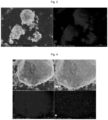
- an SEM diagram of WO 2.72 was shown in Fig. 1 ; an SEM diagram of the composite anode electrode material was shown in Fig. 2 ; an energy spectrum analysis diagram of WO 2.72 was shown in Fig. 3 ; an energy spectrum analysis diagram of the composite anode electrode material was shown in Fig. 4 ; and a diagram of a capacity retention rate after cycling of the composite anode electrode material was shown in Fig. 5 .
- Embodiment 2 The difference between Embodiment 2 and Embodiment 1 was that: Defect-type purple tungsten oxide WO 2.72 (secondary particle) and Li 4 Ti 5 O 12 were mixed in a high-speed mixer, and the rotation speed was 3000 r/min, to finally obtained a composite anode electrode material.
- Embodiment 3 The difference between Embodiment 3 and Embodiment 1 was that: Defect-type purple tungsten oxide WO 2.72 (secondary particle) and Li 4 Ti 5 O 12 were mixed in a high-speed mixer, and the rotation speed was 2500 r/min, to finally obtained a composite anode electrode material.
- Embodiment 4 was that: Defect-type purple tungsten oxide WO 2.72 (secondary particle) and Li 4 Ti 5 O 12 were mixed in a high-speed mixer, and the rotation speed was 1000 r/min, to finally obtained a composite anode electrode material.
- Embodiment 5 The difference between Embodiment 5 and Embodiment 1 was that: The average particle size of the primary particles was 300 nm, and the average particle size of the defect-type purple tungsten oxide WO 2.72 was 3.5 ⁇ m, to finally obtained a composite anode electrode material.
- Embodiment 6 The difference between Embodiment 6 and Embodiment 1 was that: The average particle size of the primary particles was 500 nm, and the average particle size of the defect-type purple tungsten oxide WO 2.72 was 5 ⁇ m, to finally obtained a composite anode electrode material.
- Embodiment 7 The difference between Embodiment 7 and Embodiment 1 was that: The average particle size of the primary particles was 100 nm, and the average particle size of the defect-type purple tungsten oxide WO 2.72 was 0.1 ⁇ m, to finally obtained a composite anode electrode material.
- Embodiment 8 The difference between Embodiment 8 and Embodiment 1 was that:
- the average particle size of the lithium titanate was 200 nm, to finally obtained a composite anode electrode material.
- Embodiment 9 The difference between Embodiment 9 and Embodiment 1 was that:
- the average particle size of the lithium titanate was 300 nm, to finally obtained a composite anode electrode material.
- Embodiment 10 The difference between Embodiment 10 and Embodiment 1 was that:
- the average particle size of the lithium titanate was 400 nm, to finally obtained a composite anode electrode material.
- Embodiment 11 The difference between Embodiment 11 and Embodiment 1 was that: The stirring time was 20 min, to finally obtained a composite anode electrode material.
- Embodiment 12 The difference between Embodiment 12 and Embodiment 1 was that: The stirring time was 8 min, to finally obtained a composite anode electrode material.
- Embodiment 13 The difference between Embodiment 13 and Embodiment 1 was that: The mass ratio of the defect-type purple tungsten oxide WO 2.72 to the lithium titanate was 1:0.005, to finally obtained a composite anode electrode material.
- Embodiment 14 The difference between Embodiment 14 and Embodiment 1 was that: The mass ratio of the defect-type purple tungsten oxide WO 2.72 to the lithium titanate was 1:0.03, to finally obtained a composite anode electrode material.
- Embodiment 15 The difference between Embodiment 15 and Embodiment 1 was that: The mass ratio of the defect-type purple tungsten oxide WO 2.72 to the lithium titanate was 1:0.004, to finally obtained a composite anode electrode material.
- Embodiment 16 The difference between Embodiment 16 and Embodiment 1 was that: The mass ratio of the defect-type purple tungsten oxide WO 2.72 to the lithium titanate was 1:0.035, to finally obtained a composite anode electrode material.
- Embodiment 17 was that: Y 2 O 3.12 (the average particle size of the secondary particles was 2.0 ⁇ m) was used to replace the defect-type purple tungsten oxide WO 2.72 , to finally obtained a composite anode electrode material.
- Conparative example 1 was that the defect-type purple tungsten oxide WO 2.72 was directly used as an anode electrode material, and a diagram of a capacity retention rate after cycling of the anode electrode material was shown in Fig. 5 .
- Embodiment/ Conparative example Average particle size of anode electrode material/ ⁇ m Specific surface area of anode electrode material /m 2 /g Embodiment 1 2.0 30.0 Embodiment 2 2.2 30.2 Embodiment 3 2.1 30.5 Embodiment 4 2.6 26.2 Embodiment 5 3.5 23.1 Embodiment 6 5.0 15.0 Embodiment 7 0.1 50.0 Embodiment 8 2.1 30.0 Embodiment 9 2.3 29.3 Embodiment 10 2.4 27.3 Embodiment 11 2.1 30.1 Embodiment 12 2.3 27.2 Embodiment 13 2.0 30.1 Embodiment 14 2.1 30.2 Embodiment 15 2.0 29.3 Embodiment 16 2.2 31.1 Embodiment 17 2.0 30.1 Conparative example 1 2.0 25.1
- a slurry material obtained finally was uniformly coated on a copper foil, and dried at 80 °C.
- a dried electrode piece was cutted into a circular piece with a diameter of 14 mm, and a lithium piece was used as an anode electrode.
- a button battery with a model type of 2032 was assembled in a glove box, the discharge capacity and the capacity retention rate after cycling of each button battery at 0.1 C were tested under 2.0 V, and test results were listed in Table 2.
- the electrical conductivity of the defect-type transition metal oxide is improved compared with the corresponding conventional transition metal oxide, but it also has the higher chemical activity at the same time due to the crystal distortion of the defect-type transition metal oxide, thereby it is easy to perform a side reaction with an electrolyte so that the electrical performance of the lithium ion battery is affected.
- the present application uses the lithium titanate to coat and dope the defect-type transition metal oxide so that the structure of the defect-type transition metal oxide is more stable, and the coated lithium titanate reduces the area of the defect-type transition metal oxide that is in direct contact with the electrolyte, thereby the probability of a side reaction between the defect-type transition metal oxide and the electrolyte is greatly reduced.
- the "zero strain" of the lithium titanate greatly reduces the volume expansion effect of an anode electrode of a battery in the process of deintercalating lithium ions, thereby the stability of the composite anode electrode material is further improved, and the lithium ion battery including the composite anode electrode material has a higher capacity retention rate after cycling.
Landscapes
- Chemical & Material Sciences (AREA)
- Chemical Kinetics & Catalysis (AREA)
- Electrochemistry (AREA)
- General Chemical & Material Sciences (AREA)
- Engineering & Computer Science (AREA)
- Composite Materials (AREA)
- Inorganic Chemistry (AREA)
- Manufacturing & Machinery (AREA)
- Materials Engineering (AREA)
- Battery Electrode And Active Subsutance (AREA)
- Inorganic Compounds Of Heavy Metals (AREA)
Abstract
Description
- The present disclosure relates to the technical field of lithium ion batteries, in particular to a composite anode electrode material and a preparation method thereof, an anode electrode material and a lithium ion battery.
- Lithium ion batteries have high energy density and excellent cycle performance, and are widely used in the fields of automotive, electronic industry and the like. During the operation of a lithium ion battery, lithium ions move back and forth between a positive electrode and an anode electrode, and in order to achieve an electrochemical balance, an external circuit generates a current. Wherein, the positive electrode and the anode electrode play the role of intercalation and deintercalation of the lithium ions. Therefore, the accommodating effect of the anode electrode on the lithium ions determines the performance of the lithium ion battery.
- At present, anode electrode materials that are already commercialized are generally carbon materials (graphite, soft carbon, hard carbon and the like). However, as a common anode electrode material, the graphite material just has the theoretical capacity of 372 mAh/g, the low ability to accommodate the lithium ions, and the poor compatibility with organic solvents. Thus, it is easy to react with an electrolyte so as to reduce the deintercalation ability of the lithium ions. The theoretical capacity of a silicon-based material is as high as 4200 mAh/g, but the volume expansion and contraction in the process of lithium ion deintercalation are relatively serious, thus it is easy to cause damage to a material structure and mechanical pulverization, thereby it shows the poorer cycle performance. Although transition metal oxides have the advantages of the better theoretical capacity and abundant sources, there is also a problem of poorer conductivity. Although defect-type transition metal oxides are used to improve the conductivity of the transition metal oxides in an existing technology, the improvement of conductivity is limited, and due to the improved activity of the defect-type transition metal oxides, it is prone to generate other side reactions in the electrolyte, so that the overall electrical performance of the lithium ion battery is relatively poor.
- A main purpose of the present disclosure is to provide a composite anode electrode material and a preparation method thereof, an anode electrode material and a lithium ion battery, as to solve a problem in an existing technology that a lithium ion battery using a transition metal oxide as an anode electrode material is relatively poor in capacity retention rate after cycling.
- In order to achieve the above purpose, according to one aspect of the present disclosure, a composite anode electrode material is provided, and the composite anode electrode material includes a defect-type transition metal oxide and a lithium titanate, wherein the lithium titanate is compounded with the defect-type transition metal oxide in the manner of coating and/or doping, the defect-type transition metal oxide is a secondary particle, and a transition metal element in the defect-type transition metal oxide is selected from any one of tungsten, yttrium and tin.
- Further, the mass ratio of the above defect-type transition metal oxide to the lithium titanate is 1 :0.005-1:0.03.
- Further, the above defect-type transition metal oxide is selected from any one of a defect-type tungsten oxide, a defect-type yttrium oxide, and a defect-type tin oxide.
- Further, a chemical formula of the defect-type tungsten oxide is selected from any one or more of WO2.72, WO2.9, Y2O3.12, and SnO2.14.
- Further, the average particle size of the above composite anode electrode material is 2.0-5.0 µm.
- Further, the specific surface area of the composite anode electrode material is 15.0-50.0 m2/g.
- Further, the average particle size of the above secondary particles is 2.0-5.0 µm, and the secondary particle of the defect-type transition metal oxide is formed by agglomeration of primary particles.
- Further, the average particle size of the primary particles is 200-500 nm.
- Further, the average particle size of the above lithium titanate is 100-300 nm.
- According to one aspect of the present disclosure, a preparation method for the above composite anode electrode material is provided, and the preparation method includes: dry-mixing a defect-type transition metal oxide and a lithium titanate, to obtain the composite anode electrode material, wherein the defect-type transition metal oxide is a secondary particle.
- Further, stirring is performed in the process of dry-mixing, and the stirring rotation speed is 2000-3000 r/min.
- Further, the stirring time is 10-20 min.
- According to another aspect of the present disclosure, an anode electrode material is provided, and the anode electrode material includes the above composite anode electrode material.
- According to another aspect of the present disclosure, a lithium ion battery is provided, and includes an anode electrode piece, wherein the anode electrode piece includes the above anode electrode material.
- A technical scheme of the present disclosure is applied, the electrical conductivity of the defect-type transition metal oxide is improved compared with the corresponding conventional transition metal oxide, but it also has the higher chemical activity at the same time due to the crystal distortion of the defect-type transition metal oxide, thereby it is easy to perform a side reaction with an electrolyte so that the electrical performance of the lithium ion battery is affected. On the one hand, the present application uses the lithium titanate to coat and dope the defect-type transition metal oxide so that the structure of the defect-type transition metal oxide is more stable, and the coated lithium titanate reduces the area of the defect-type transition metal oxide that is in direct contact with the electrolyte, thereby the probability of a side reaction between the defect-type transition metal oxide and the electrolyte is greatly reduced. On the other hand, the "zero strain" of the lithium titanate greatly reduces the volume expansion effect of an anode electrode of a battery in the process of deintercalating lithium ions, thereby the stability of the composite anode electrode material is further improved, and the lithium ion battery including the composite anode electrode material has a higher capacity retention rate after cycling.
- Drawings constituting a part of the present application are used to provide further understanding of the present disclosure, and exemplary embodiments of the present disclosure and descriptions thereof are used to explain the present disclosure, and do not constitute improper limitation to the present disclosure. In the drawings:
-
Fig. 1 shows a scanning electron microscope (SEM) diagram of WO2.72 provided inEmbodiment 1 of the present application. -
Fig. 2 shows an SEM diagram of a composite anode electrode material provided inEmbodiment 1 of the present application. -
Fig. 3 shows an energy spectrum analysis diagram of WO2.72 provided inEmbodiment 1 of the present application. -
Fig. 4 shows an energy spectrum analysis diagram of the composite anode electrode material provided inEmbodiment 1 of the present application. -
Fig. 5 shows a diagram of a capacity retention rate after cycling of the composite anode electrode material inEmbodiment 1 of the present application and an anode electrode material provided in Conparative example 1. - It should be noted that embodiments in the present application and features of the embodiments may be combined with each other in the case without conflicting. The present disclosure is described in detail below with reference to the drawings and in combination with the embodiments.
- As analyzed in the background, there is a problem in an existing technology that a lithium ion battery using a transition metal oxide as an anode electrode material is relatively poor in capacity retention rate after cycling. In order to solve this problem, the present disclosure provides a composite anode electrode material and a preparation method thereof, an anode electrode material and a lithium ion battery.
- In a typical embodiment of the present application, a composite anode electrode material is provided, and the composite anode electrode material includes a defect-type transition metal oxide and a lithium titanate, wherein the lithium titanate is compounded with the defect-type transition metal oxide in the manner of coating and/or doping, the defect-type transition metal oxide is a secondary particle, and a transition metal element in the defect-type transition metal oxide is selected from any one of tungsten, yttrium and tin.
- The electrical conductivity of the defect-type transition metal oxide is improved compared with the corresponding conventional transition metal oxide, but it also has the higher chemical activity at the same time due to the crystal distortion of the defect-type transition metal oxide, thereby it is easy to perform a side reaction with an electrolyte so that the electrical performance of the lithium ion battery is affected. On the one hand, the present application uses the lithium titanate to coat and dope the defect-type transition metal oxide so that the structure of the defect-type transition metal oxide is more stable, and the coated lithium titanate reduces the area of the defect-type transition metal oxide that is in direct contact with the electrolyte, thereby the probability of a side reaction between the defect-type transition metal oxide and the electrolyte is greatly reduced. On the other hand, the "zero strain" of the lithium titanate greatly reduces the volume expansion effect of an anode electrode of a battery in the process of deintercalating lithium ions, thereby the stability of the composite anode electrode material is further improved, and the lithium ion battery including the composite anode electrode material has a higher capacity retention rate after cycling.
- In an embodiment of the present application, the mass ratio of the above defect-type transition metal oxide to the lithium titanate is 1:0.005-1:0.03.
- The addition amount of the lithium titanate is too much, so that the electrical conductivity of the composite anode electrode material too poor, and the addition amount of the lithium titanate is too less, so that the improvement of electrical properties such as the cycle stability of the composite anode electrode material is too small. The defect-type transition metal oxide and the lithium titanate are preferably in the above ratio, so that the two may have the more sufficient synergistic effect, as to obtain the anode electrode material with the optimized comprehensive performance.
- In order to further improve the synergistic effect between the defect-type transition metal oxide and the lithium titanate, and obtain the more diverse composite anode electrode material, preferably the above defect-type transition metal oxide is selected from any one of a defect-type tungsten oxide, a defect-type yttrium oxide, and a defect-type tin oxide. The above defect-type transition metal oxides may adopt a currently existing commercial defect-type transition metal oxide or each defect-type transition metal oxide prepared by a preparation method disclosed in a technical document. In some embodiments of the present application, a chemical formula of the defect-type tungsten oxide used is selected from any one or more of WO2.72, WO2.9, Y2O3.12 and SnO2.14.
- Herein, in order to improve the preparation efficiency of the defect-type tungsten oxide WO2.72, a preparation method thereof is preferably as follows: in a rotary furnace, a tungsten source of a ammonium paratungstic acid (the feeding speed is 50-100 g/min) is used as a raw material, and NH3 (2-10 L/min) is fed to generate H2 at a temperature of 750-810°C (the heating rate is 2-5 °C/min) so that the paratungstic acid may be reduced to a defect-type purple tungsten oxide (WO2.72), herein the tungsten source is selected from any one of an ammonium metatungstate, an ammonium paratungstate, and an ammonium tungstate, and the rotation speed of a furnace tube is 2 rpm. Certainly, those skilled in the art may also prepare WO2.72 with reference to other preparation methods in the existing technology, and it is not repeatedly described here.
- In an embodiment of the present application, the average particle size of the above composite anode electrode material is 2.0-5.0 µm, and preferably the specific surface area of the composite anode electrode material is 15.0-50.0 m2/g.
- The average particle size and the specific surface area of the composite anode electrode material may affect the contact area between the composite anode electrode material and the electrolyte. The surface area of the composite anode electrode material is larger, and its reaction activity is better. Therefore, the specific surface area of the composite anode electrode material is larger, and the probability of the side reaction caused possibly is higher, but the specific surface area of the composite anode electrode material is smaller, the ion exchange between the composite anode electrode material and the electrolyte may be affected to a certain extent. Preferably, the composite anode electrode material is in the above parameter range so that the composite anode electrode material may have the more suitable reaction activity.
- In order to make the average particle size of the lithium titanate better match the particle size of the defect-type transition metal oxide, and make it coat and dope the defect-type transition metal oxide as much as possible, as to improve the improvement effect on the defect-type transition metal oxide, the average particle size of the above secondary particles is preferably 2.0-5.0 µm, the secondary particle of the defect-type transition metal oxide is formed by agglomeration of primary particles, and the average particle size of the primary particles is preferably 200-500 nm.
- In an embodiment of the present application, the average particle size of the above lithium titanate is 100-300 nm.
- The lithium titanate in the above average particle size range is more beneficial to interact with the defect-type transition metal oxide, as to coat and dope the defect-type transition metal oxide, so that it is modified.
- In another typical embodiment of the present application, a preparation method for a composite anode electrode material is provided, and the preparation method includes: dry-mixing a defect-type transition metal oxide and a lithium titanate, to obtain a composite anode electrode material, herein the defect-type transition metal oxide is a secondary particle.
- The electrical conductivity of the defect-type transition metal oxide is improved compared with the corresponding conventional transition metal oxide, but it also has the higher chemical activity at the same time due to the crystal distortion of the defect-type transition metal oxide, thereby it is easy to perform a side reaction with an electrolyte so that the electrical performance of the lithium ion battery is affected. By dry-mixing, the defect-type transition metal oxide is coated and doped with the lithium titanate. Thus on the one hand, the present application uses the lithium titanate to coat and dope the defect-type transition metal oxide so that the structure of the defect-type transition metal oxide is more stable, and the coated lithium titanate reduces the area of the defect-type transition metal oxide that is in direct contact with the electrolyte, thereby the probability of a side reaction between the defect-type transition metal oxide and the electrolyte is greatly reduced. On the other hand, the "zero strain" of the lithium titanate greatly reduces the volume expansion effect of an anode electrode of a battery in the process of deintercalating lithium ions, thereby the stability of the composite anode electrode material is further improved, and the lithium ion battery including the composite anode electrode material has a higher capacity retention rate after cycling.
- In order to make the defect-type transition metal oxide and the lithium titanate mix more uniformly, stirring is preferably performed in the above process of dry-mixing, the stirring rotation speed is 2000-3000 r/min, and the stirring time is preferably 10-20 min.
- In another typical embodiment of the present application, an anode electrode material is provided, and the anode electrode material includes the above composite anode electrode material.
- The above composite anode electrode material is used as an anode electrode material of a battery, so that the battery has the better electrical properties.
- In another typical embodiment of the present application, a lithium ion battery is provided, and includes an anode electrode piece, and the above anode electrode piece includes the above anode electrode material.
- The lithium ion battery including the above anode electrode material has the better electrical properties.
- The beneficial effects of the present application are described below in combination with specific embodiments and Conparative examples.
- In a rotary furnace (the rotation speed of a furnace tube was 2 r/min), 5(NH4)2O•12WO3•5H2O (the feeding speed was 50 g/min) was used as a raw material, and NH3 (5 L/min) was fed to generate H2 at 800°C (the heating rate was 5°C /min) so that a paratungstic acid was reduced to a defect-type purple tungsten oxide (WO2.72), the defect-type purple tungsten oxide was sieved (a sieving screen was 100 meshes), the average particle size of primary particles was 200 nm, and the average particle size of the obtained defect-type purple tungsten oxide WO2.72 (secondary particle) was 2.0 µm.
- The defect-type purple tungsten oxide WO2.72 and Li4Ti5O12 were mixed in a high-speed mixer, the rotation speed was 2000 r/min, the mixing time was 10 min, and finally a composite anode electrode material of lithium titanate (the average particle size was 100 nm) and purple tungsten was obtained, wherein the mass ratio of the defect-type purple tungsten oxide WO2.72 to Li4Ti5O12 was 1:0.01. Herein, an SEM diagram of WO2.72 was shown in
Fig. 1 ; an SEM diagram of the composite anode electrode material was shown inFig. 2 ; an energy spectrum analysis diagram of WO2.72 was shown inFig. 3 ; an energy spectrum analysis diagram of the composite anode electrode material was shown inFig. 4 ; and a diagram of a capacity retention rate after cycling of the composite anode electrode material was shown inFig. 5 . - The difference between
Embodiment 2 andEmbodiment 1 was that:
Defect-type purple tungsten oxide WO2.72 (secondary particle) and Li4Ti5O12 were mixed in a high-speed mixer, and the rotation speed was 3000 r/min, to finally obtained a composite anode electrode material. - The difference between Embodiment 3 and
Embodiment 1 was that:
Defect-type purple tungsten oxide WO2.72 (secondary particle) and Li4Ti5O12 were mixed in a high-speed mixer, and the rotation speed was 2500 r/min, to finally obtained a composite anode electrode material. - The difference between
Embodiment 4 andEmbodiment 1 was that:
Defect-type purple tungsten oxide WO2.72 (secondary particle) and Li4Ti5O12 were mixed in a high-speed mixer, and the rotation speed was 1000 r/min, to finally obtained a composite anode electrode material. - The difference between Embodiment 5 and
Embodiment 1 was that:
The average particle size of the primary particles was 300 nm, and the average particle size of the defect-type purple tungsten oxide WO2.72 was 3.5 µm, to finally obtained a composite anode electrode material. - The difference between
Embodiment 6 andEmbodiment 1 was that:
The average particle size of the primary particles was 500 nm, and the average particle size of the defect-type purple tungsten oxide WO2.72 was 5 µm, to finally obtained a composite anode electrode material. - The difference between Embodiment 7 and
Embodiment 1 was that:
The average particle size of the primary particles was 100 nm, and the average particle size of the defect-type purple tungsten oxide WO2.72 was 0.1 µm, to finally obtained a composite anode electrode material. - The difference between
Embodiment 8 andEmbodiment 1 was that:
The average particle size of the lithium titanate was 200 nm, to finally obtained a composite anode electrode material. - The difference between Embodiment 9 and
Embodiment 1 was that:
The average particle size of the lithium titanate was 300 nm, to finally obtained a composite anode electrode material. - The difference between
Embodiment 10 andEmbodiment 1 was that:
The average particle size of the lithium titanate was 400 nm, to finally obtained a composite anode electrode material. - The difference between Embodiment 11 and
Embodiment 1 was that:
The stirring time was 20 min, to finally obtained a composite anode electrode material. - The difference between
Embodiment 12 andEmbodiment 1 was that:
The stirring time was 8 min, to finally obtained a composite anode electrode material. - The difference between Embodiment 13 and
Embodiment 1 was that:
The mass ratio of the defect-type purple tungsten oxide WO2.72 to the lithium titanate was 1:0.005, to finally obtained a composite anode electrode material. - The difference between
Embodiment 14 andEmbodiment 1 was that:
The mass ratio of the defect-type purple tungsten oxide WO2.72 to the lithium titanate was 1:0.03, to finally obtained a composite anode electrode material. - The difference between Embodiment 15 and
Embodiment 1 was that:
The mass ratio of the defect-type purple tungsten oxide WO2.72 to the lithium titanate was 1:0.004, to finally obtained a composite anode electrode material. - The difference between
Embodiment 16 andEmbodiment 1 was that:
The mass ratio of the defect-type purple tungsten oxide WO2.72 to the lithium titanate was 1:0.035, to finally obtained a composite anode electrode material. - The difference between Embodiment 17 and
Embodiment 1 was that:
Y2O3.12 (the average particle size of the secondary particles was 2.0 µm) was used to replace the defect-type purple tungsten oxide WO2.72, to finally obtained a composite anode electrode material. - The difference between Conparative example 1 and
Embodiment 1 was that the defect-type purple tungsten oxide WO2.72 was directly used as an anode electrode material, and a diagram of a capacity retention rate after cycling of the anode electrode material was shown inFig. 5 . - Please list the average particle sizes and the specific surface areas of the composite anode electrode materials in
Embodiments 1 to 17 and the anode electrode material obtained in Conparative example 1 in Table 1 respectively.Table 1 Embodiment/ Conparative example Average particle size of anode electrode material/µm Specific surface area of anode electrode material /m2/ g Embodiment 1 2.0 30.0 Embodiment 22.2 30.2 Embodiment 3 2.1 30.5 Embodiment 42.6 26.2 Embodiment 5 3.5 23.1 Embodiment 65.0 15.0 Embodiment 7 0.1 50.0 Embodiment 82.1 30.0 Embodiment 9 2.3 29.3 Embodiment 102.4 27.3 Embodiment 11 2.1 30.1 Embodiment 122.3 27.2 Embodiment 13 2.0 30.1 Embodiment 142.1 30.2 Embodiment 15 2.0 29.3 Embodiment 162.2 31.1 Embodiment 17 2.0 30.1 Conparative example 1 2.0 25.1 - 10.0 g of the composite anode electrode materials prepareded in
Embodiments 1 to 17 and the anode electrode material obtained in Conparative example 1 were respectively weighed, stirred and mixed with 0.1579 g of an acetylene black (SP) for 3 min at a stirring speed of 800 r/min in a defoaming machine; then 15.79 g of CMC glue with a solid content of 1% was added, and mixed at 2000 r/min for 10min; and 0.4386 g of binder emulsion with a model type of SN307 was added, and stirred and mixed for 3 min at a stirring speed of 2000 r/min in the defoaming machine. A slurry material obtained finally was uniformly coated on a copper foil, and dried at 80 °C. A dried electrode piece was cutted into a circular piece with a diameter of 14 mm, and a lithium piece was used as an anode electrode. A button battery with a model type of 2032 was assembled in a glove box, the discharge capacity and the capacity retention rate after cycling of each button battery at 0.1 C were tested under 2.0 V, and test results were listed in Table 2.Table 2 Embodiment/Conparative example Discharge capacity/mAh/g Capacity retention rate after cycling/ % Embodiment 1 766 82.0 Embodiment 2780 83.1 Embodiment 3 768 83.4 Embodiment 4740 78.1 Embodiment 5 769 85.9 Embodiment 6796 85.4 Embodiment 7 734 78.1 Embodiment 8772 83.2 Embodiment 9 765 82.1 Embodiment 10732 78.3 Embodiment 11 768 83.1 Embodiment 12743 78.1 Embodiment 13 801 85.1 Embodiment 14740 83.4 Embodiment 15 811 77.9 Embodiment 16730 78.0 Embodiment 17 721 85.0 Conparative example 1 830 67.0 - From the above descriptions, it may be seen that the above embodiments of the present disclosure achieve the following technical effects.
- The electrical conductivity of the defect-type transition metal oxide is improved compared with the corresponding conventional transition metal oxide, but it also has the higher chemical activity at the same time due to the crystal distortion of the defect-type transition metal oxide, thereby it is easy to perform a side reaction with an electrolyte so that the electrical performance of the lithium ion battery is affected. On the one hand, the present application uses the lithium titanate to coat and dope the defect-type transition metal oxide so that the structure of the defect-type transition metal oxide is more stable, and the coated lithium titanate reduces the area of the defect-type transition metal oxide that is in direct contact with the electrolyte, thereby the probability of a side reaction between the defect-type transition metal oxide and the electrolyte is greatly reduced. On the other hand, the "zero strain" of the lithium titanate greatly reduces the volume expansion effect of an anode electrode of a battery in the process of deintercalating lithium ions, thereby the stability of the composite anode electrode material is further improved, and the lithium ion battery including the composite anode electrode material has a higher capacity retention rate after cycling.
- The above are only preferred embodiments of the present disclosure, and are not intended to limit the present disclosure. For those skilled in the art, the present disclosure may have various modifications and changes. Any modifications, equivalent replacements, improvements and the like made within the spirit and principle of the present disclosure shall be included within a scope of protection of the present disclosure.
Claims (10)
- A composite anode electrode material, wherein the composite anode electrode material comprises a defect-type transition metal oxide and a lithium titanate, wherein the lithium titanate is compounded with the defect-type transition metal oxide in the manner of coating and/or doping, the defect-type transition metal oxide is a secondary particle, and a transition metal element in the defect-type transition metal oxide is selected from any one of tungsten, yttrium and tin.
- The composite anode electrode material according to claim 1, wherein the mass ratio of the defect-type transition metal oxide to the lithium titanate is 1:0.005-1:0.03.
- The composite anode electrode material according to claim 1 or 2, wherein the defect-type transition metal oxide is selected from any one of a defect-type tungsten oxide, a defect-type yttrium oxide, and a defect-type tin oxide.
- The composite anode electrode material according to claim 1 or 2, wherein the average particle size of the composite anode electrode material is 2.0-5.0 µm, and the specific surface area of the composite anode electrode material is 15.0-50.0 m2/g.
- The composite anode electrode material according to claim 1, wherein the average particle size of the secondary particles is 2.0-5.0 µm, the secondary particle of the defect-type transition metal oxide is formed by agglomeration of primary particles, and the average particle size of the primary particles is 200-500 nm.
- The composite anode electrode material according to claim 1, wherein the average particle size of the lithium titanate is 100-300 nm.
- A preparation method for the composite anode electrode material according to any one of claims 1 to 6, wherein the preparation method comprises: dry-mixing a defect-type transition metal oxide and a lithium titanate, to obtain the composite anode electrode material, wherein the defect-type transition metal oxide is a secondary particle.
- The preparation method for the composite anode electrode material according to claim 7, wherein stirring is performed in the process of dry-mixing, the stirring rotation speed is 2000-3000 r/min, and the stirring time is 10-20 min.
- An anode electrode material, wherein the anode electrode material comprises the composite anode electrode material according to any one of claims 1 to 6.
- A lithium ion battery, comprising an anode electrode piece, wherein the anode electrode piece comprises the anode electrode material according to claim 9.
Applications Claiming Priority (2)
| Application Number | Priority Date | Filing Date | Title |
|---|---|---|---|
| CN202110520487.6A CN112952075B (en) | 2021-05-13 | 2021-05-13 | Composite negative electrode material, preparation method thereof, negative electrode material and lithium ion battery |
| PCT/CN2021/127974 WO2022237091A1 (en) | 2021-05-13 | 2021-11-01 | Composite negative electrode material and preparation method therefor, negative electrode material and lithium ion battery |
Publications (2)
| Publication Number | Publication Date |
|---|---|
| EP4203101A1 true EP4203101A1 (en) | 2023-06-28 |
| EP4203101A4 EP4203101A4 (en) | 2024-10-16 |
Family
ID=76233811
Family Applications (1)
| Application Number | Title | Priority Date | Filing Date |
|---|---|---|---|
| EP21941656.7A Pending EP4203101A4 (en) | 2021-05-13 | 2021-11-01 | COMPOSITE NEGATIVE ELECTRODE MATERIAL AND MANUFACTURING METHOD THEREOF, NEGATIVE ELECTRODE MATERIAL AND LITHIUM-ION BATTERY |
Country Status (5)
| Country | Link |
|---|---|
| US (1) | US20240072250A1 (en) |
| EP (1) | EP4203101A4 (en) |
| JP (1) | JP7416965B2 (en) |
| CN (1) | CN112952075B (en) |
| WO (1) | WO2022237091A1 (en) |
Families Citing this family (3)
| Publication number | Priority date | Publication date | Assignee | Title |
|---|---|---|---|---|
| CN112952075B (en) * | 2021-05-13 | 2021-10-12 | 蜂巢能源科技有限公司 | Composite negative electrode material, preparation method thereof, negative electrode material and lithium ion battery |
| CN115818796B (en) * | 2023-01-10 | 2024-05-24 | 东莞理工学院 | Preparation and use method of Zr metal atom-doped Ti4O7 composite electrode |
| CN119833538A (en) * | 2023-12-20 | 2025-04-15 | 重庆弗迪电池研究院有限公司 | Positive electrode material, preparation method thereof, positive electrode, secondary battery and electric equipment |
Family Cites Families (12)
| Publication number | Priority date | Publication date | Assignee | Title |
|---|---|---|---|---|
| CN100530780C (en) * | 2006-12-29 | 2009-08-19 | 深圳市贝特瑞电子材料有限公司 | Composite lithium titanate electrode material and preparation method thereof |
| KR101761441B1 (en) | 2010-04-28 | 2017-07-25 | 이시하라 산교 가부시끼가이샤 | Novel lithium titanate, method for producing same, electrode active material containing the lithium titanate, and electricity storage device using the electrode active material |
| US20130071754A1 (en) | 2010-04-30 | 2013-03-21 | Toyota Jidosha Kabushiki Kaisha | Electrode body and secondary battery using same |
| CN102891303A (en) * | 2011-07-20 | 2013-01-23 | 上海纳米技术及应用国家工程研究中心有限公司 | Lithium ion secondary battery cathode material yttrium-doped lithium titanate and its preparation method and use |
| CN102569771B (en) * | 2012-03-12 | 2014-02-12 | 深圳华粤宝电池有限公司 | SnO2-Li4Ti5O12 composite electrode material and preparation method thereof |
| CN105051950A (en) * | 2013-03-15 | 2015-11-11 | 株式会社东芝 | Battery electrode materials and battery substrates using them, storage batteries, dye-sensitized solar cells, capacitors, Li-ion secondary batteries |
| CN103151510B (en) * | 2013-03-19 | 2016-04-13 | 上海电力学院 | A kind of lithium ion battery cathode material and its preparation method |
| CN104425808B (en) * | 2013-08-26 | 2018-12-14 | 华为技术有限公司 | A kind of compound negative electrode material of lithium ion battery and preparation method thereof and lithium ion battery |
| KR101580843B1 (en) * | 2014-06-10 | 2015-12-31 | 동국대학교 산학협력단 | Dual structured negative active material of lithium secondary batteries |
| JP6438249B2 (en) | 2014-09-16 | 2018-12-12 | 株式会社東芝 | Electrode material, electrode layer using the same, battery, and electrochromic device |
| EP3761411B1 (en) * | 2018-02-26 | 2024-03-13 | Kabushiki Kaisha Toshiba | Electrode material, electrode layer and electricity storage device using same, and manufacturing method for electrode material |
| CN112952075B (en) * | 2021-05-13 | 2021-10-12 | 蜂巢能源科技有限公司 | Composite negative electrode material, preparation method thereof, negative electrode material and lithium ion battery |
-
2021
- 2021-05-13 CN CN202110520487.6A patent/CN112952075B/en active Active
- 2021-11-01 US US18/025,179 patent/US20240072250A1/en active Pending
- 2021-11-01 EP EP21941656.7A patent/EP4203101A4/en active Pending
- 2021-11-01 JP JP2022546389A patent/JP7416965B2/en active Active
- 2021-11-01 WO PCT/CN2021/127974 patent/WO2022237091A1/en not_active Ceased
Also Published As
| Publication number | Publication date |
|---|---|
| JP2023528708A (en) | 2023-07-06 |
| CN112952075B (en) | 2021-10-12 |
| WO2022237091A1 (en) | 2022-11-17 |
| JP7416965B2 (en) | 2024-01-17 |
| CN112952075A (en) | 2021-06-11 |
| US20240072250A1 (en) | 2024-02-29 |
| EP4203101A4 (en) | 2024-10-16 |
Similar Documents
| Publication | Publication Date | Title |
|---|---|---|
| JP7392132B2 (en) | Cobalt-free cathode material and its preparation method | |
| CN115020696B (en) | Positive electrode active material, electrochemical device and electronic device | |
| EP4439710A1 (en) | Lithium-rich composite material, and preparation method therefor and use thereof | |
| EP4043403A1 (en) | Cobalt-free positive electrode material for lithium ion battery, preparation method therefor, and lithium ion battery | |
| CN112447968A (en) | Positive electrode active material, positive electrode plate and lithium ion secondary battery | |
| EP3975291A1 (en) | Cobalt-free layered positive electrode material, preparation method therefor, and lithium ion battery | |
| US8591773B2 (en) | Heterojunction nano material, negative pole piece of lithium ion battery, and lithium ion battery | |
| US20240072250A1 (en) | A composite anode electrode material and a preparation method thereof, an anode electrode material and a lithium ion battery | |
| JPH11204110A (en) | Manufacture of anode material for lithium ion battery | |
| CN114122402A (en) | Lithium ion battery positive electrode lithium supplement additive, positive plate, preparation method and application thereof | |
| CN117199350A (en) | Lithium iron manganese phosphate positive electrode material, and preparation method and application thereof | |
| CN113896240A (en) | Compound for pre-sodium treatment and preparation method thereof, positive electrode pre-sodium treatment material and preparation method thereof, and sodium ion battery | |
| CN108735996B (en) | A class of large particle sodium ion battery cathode material and method for increasing the particle size of the material | |
| CN114597372B (en) | Ultra-high nickel anode material and preparation method and application thereof | |
| CN117712372A (en) | Lithium iron manganese phosphate composite material and preparation method thereof | |
| CN113582254B (en) | A layered cathode material and its preparation method and use | |
| CN115084481A (en) | Cathode material, preparation method thereof, secondary battery and electric equipment | |
| CN116895751A (en) | Sodium ion cathode material and preparation method thereof and sodium ion battery | |
| EP4203102A1 (en) | Boron oxide-coated quaternary positive electrode material, and preparation method therefor and application thereof | |
| CN110676455A (en) | Homogenizing process for nickel cobalt lithium manganate positive electrode material | |
| US9130213B2 (en) | Compositions and methods for manufacturing a cathode for a secondary battery | |
| CN114784248A (en) | Coating modified high-nickel ternary cathode material, preparation method thereof and lithium ion battery | |
| CN117976889A (en) | Acidic ammonium salt coated ternary positive electrode material and preparation method thereof, and lithium ion battery | |
| CN117038927A (en) | Lithium iron phosphate positive electrode material, preparation method thereof and lithium ion battery | |
| CN117790773A (en) | Lithium-rich manganese-based positive electrode material, preparation method thereof, positive electrode plate, battery and electronic equipment |
Legal Events
| Date | Code | Title | Description |
|---|---|---|---|
| STAA | Information on the status of an ep patent application or granted ep patent |
Free format text: STATUS: THE INTERNATIONAL PUBLICATION HAS BEEN MADE |
|
| PUAI | Public reference made under article 153(3) epc to a published international application that has entered the european phase |
Free format text: ORIGINAL CODE: 0009012 |
|
| STAA | Information on the status of an ep patent application or granted ep patent |
Free format text: STATUS: REQUEST FOR EXAMINATION WAS MADE |
|
| 17P | Request for examination filed |
Effective date: 20230308 |
|
| AK | Designated contracting states |
Kind code of ref document: A1 Designated state(s): AL AT BE BG CH CY CZ DE DK EE ES FI FR GB GR HR HU IE IS IT LI LT LU LV MC MK MT NL NO PL PT RO RS SE SI SK SM TR |
|
| RIN1 | Information on inventor provided before grant (corrected) |
Inventor name: SHI, ZETAO Inventor name: WANG, PENGFEI Inventor name: ZHENG, XIAOXING Inventor name: CHEN, SIXIAN Inventor name: JIANG, WEIJUN Inventor name: XU, XINPEI |
|
| DAV | Request for validation of the european patent (deleted) | ||
| DAX | Request for extension of the european patent (deleted) | ||
| A4 | Supplementary search report drawn up and despatched |
Effective date: 20240918 |
|
| RIC1 | Information provided on ipc code assigned before grant |
Ipc: H01M 4/1391 20100101ALI20240912BHEP Ipc: H01M 4/131 20100101ALI20240912BHEP Ipc: H01M 10/0525 20100101ALI20240912BHEP Ipc: H01M 4/485 20100101ALI20240912BHEP Ipc: H01M 4/48 20100101ALI20240912BHEP Ipc: H01M 4/36 20060101AFI20240912BHEP |