EP4202741B1 - System and method of synthesizing potential malware for predicting a cyberattack - Google Patents
System and method of synthesizing potential malware for predicting a cyberattack Download PDFInfo
- Publication number
- EP4202741B1 EP4202741B1 EP22020579.3A EP22020579A EP4202741B1 EP 4202741 B1 EP4202741 B1 EP 4202741B1 EP 22020579 A EP22020579 A EP 22020579A EP 4202741 B1 EP4202741 B1 EP 4202741B1
- Authority
- EP
- European Patent Office
- Prior art keywords
- malware
- feature
- dataset
- features
- synthetic
- Prior art date
- Legal status (The legal status is an assumption and is not a legal conclusion. Google has not performed a legal analysis and makes no representation as to the accuracy of the status listed.)
- Active
Links
Images





Classifications
-
- G—PHYSICS
- G06—COMPUTING OR CALCULATING; COUNTING
- G06F—ELECTRIC DIGITAL DATA PROCESSING
- G06F21/00—Security arrangements for protecting computers, components thereof, programs or data against unauthorised activity
- G06F21/50—Monitoring users, programs or devices to maintain the integrity of platforms, e.g. of processors, firmware or operating systems
- G06F21/55—Detecting local intrusion or implementing counter-measures
- G06F21/56—Computer malware detection or handling, e.g. anti-virus arrangements
-
- G—PHYSICS
- G06—COMPUTING OR CALCULATING; COUNTING
- G06F—ELECTRIC DIGITAL DATA PROCESSING
- G06F21/00—Security arrangements for protecting computers, components thereof, programs or data against unauthorised activity
- G06F21/50—Monitoring users, programs or devices to maintain the integrity of platforms, e.g. of processors, firmware or operating systems
- G06F21/55—Detecting local intrusion or implementing counter-measures
- G06F21/56—Computer malware detection or handling, e.g. anti-virus arrangements
- G06F21/561—Virus type analysis
-
- G—PHYSICS
- G06—COMPUTING OR CALCULATING; COUNTING
- G06F—ELECTRIC DIGITAL DATA PROCESSING
- G06F21/00—Security arrangements for protecting computers, components thereof, programs or data against unauthorised activity
- G06F21/50—Monitoring users, programs or devices to maintain the integrity of platforms, e.g. of processors, firmware or operating systems
- G06F21/55—Detecting local intrusion or implementing counter-measures
- G06F21/56—Computer malware detection or handling, e.g. anti-virus arrangements
- G06F21/562—Static detection
-
- G—PHYSICS
- G06—COMPUTING OR CALCULATING; COUNTING
- G06F—ELECTRIC DIGITAL DATA PROCESSING
- G06F21/00—Security arrangements for protecting computers, components thereof, programs or data against unauthorised activity
- G06F21/50—Monitoring users, programs or devices to maintain the integrity of platforms, e.g. of processors, firmware or operating systems
- G06F21/55—Detecting local intrusion or implementing counter-measures
- G06F21/56—Computer malware detection or handling, e.g. anti-virus arrangements
- G06F21/566—Dynamic detection, i.e. detection performed at run-time, e.g. emulation, suspicious activities
-
- G—PHYSICS
- G06—COMPUTING OR CALCULATING; COUNTING
- G06N—COMPUTING ARRANGEMENTS BASED ON SPECIFIC COMPUTATIONAL MODELS
- G06N20/00—Machine learning
-
- G—PHYSICS
- G06—COMPUTING OR CALCULATING; COUNTING
- G06V—IMAGE OR VIDEO RECOGNITION OR UNDERSTANDING
- G06V30/00—Character recognition; Recognising digital ink; Document-oriented image-based pattern recognition
- G06V30/10—Character recognition
- G06V30/19—Recognition using electronic means
- G06V30/191—Design or setup of recognition systems or techniques; Extraction of features in feature space; Clustering techniques; Blind source separation
- G06V30/19147—Obtaining sets of training patterns; Bootstrap methods, e.g. bagging or boosting
-
- G—PHYSICS
- G06—COMPUTING OR CALCULATING; COUNTING
- G06V—IMAGE OR VIDEO RECOGNITION OR UNDERSTANDING
- G06V30/00—Character recognition; Recognising digital ink; Document-oriented image-based pattern recognition
- G06V30/10—Character recognition
- G06V30/19—Recognition using electronic means
- G06V30/191—Design or setup of recognition systems or techniques; Extraction of features in feature space; Clustering techniques; Blind source separation
- G06V30/19173—Classification techniques
Definitions
- the invention pertains to the field of computer security, in particular the analysis and prediction of malicious behavior by computer programs and files
- Machine learning models for malware detection are often trained using known samples.
- the known samples comprise datasets with labels. These samples are taken from different sources.
- the sample datasets describe the objects that contain the threat, but do not include metadata that could be useful.
- metadata could reveal how the malicious file got into the affected computer system.
- the malicious file might be only a derivative of some other pro- gram or file. Or the malicious file could be a part of a broad distributed attack system.
- malware may use different command centers for communication. Or the malware may exploit unusual ways of hiding in the system. Hence, malicious files, web pages, network packets and other system objects that carry the same malicious functionality can be missed by the protection system. This is be- cause these objects will have a different set of attributes than what a machine learning model would predict based on known malware.
- Patent application US9992211B1 computer-implemented method for improving the classification accuracy of trustworthiness classifiers and system, enhancing detection quality using classifier training on selected training data.
- Selected subset of training data upon determining that subset of training data includes only data that captures and/or represents a certain characteristic that leads to improved classification accuracy in trustworthiness classifiers for the specific organization.
- the security software vendor may analyze the accuracy of trustworthiness classifiers trained using certain vectors of training data.
- Examples of such vectors include, without limitation, training data related to organizations of a certain size, training data that originates from or was encountered by particular organizations, training data related to organizations of a certain industry, training data related to organizations headquartered in and/or operating primarily in a certain geographic region, variations of one or more of the same, combinations of one or more of the same, or any other suitable vectors of training data.
- Document US9992211B1 does not teach to enhance detection in general for any types of the customer - to improve detection of known threats and unknown threats, based on given datasets of known objects collections and synthesized datasets.
- an apparatus for verifying a malicious code machine learning classification model which includes: a main feature processing subsystem performing feature extracting and processing functions in an input file; and a multi-layer cyclic verification subsystem performing multi-layer verification in order to determine whether the file is normal or malicious based on the extracted and processed features to verify a machine learning model that classifies malicious codes, thereby ensuring reliability of a prediction result for a machine learning model.
- Randomly synthesized data may correspond to legitimate software and its resources. For example, all the attributes corresponding to the known samples of ransomware may be taken and the data synthesized by filling the sets of attributes with random data or data that, in principle, can occur in real systems. In this case, some of the records in the dataset will correspond to legitimate software. Examples of such software include an agent file system encryption, DLP agents, and file synchronization agents.
- Implementation of a method embodying the invention comprises collecting known malware samples.
- the dynamic (behavioral) characteristics and static characteristics are described separately for each file. Both types of parameters are combined into a single table.
- Machine learning algorithms are then used to create synthetic models for the potential malware.
- These tables and models comprise a kind of virtual sample, which are used to train a model that will more accurately classify real malicious objects found in the wilds
- a feature of the invention is data synthesis. Synthesized datasets improve a machine learning model's accuracy in the detection of new threats. Synthesis in this context means combining the attributes of known threats with logic that creates new feature vectors that will better correspond to unknown samples. At the same time, the synthesized datasets are more likely to correspond to the threat model for certain classes of threats and while reducing noise that increases false positives.
- the attributes of known threats can be synthesized while filtering out vectors derived from datasets of known safe objects.
- a second method builds a sample of vectors corresponding to a certain class of malicious objects and mixes attributes in this sample in various ways. For example, the class and the selection are formed according to the key attributes of static analysis and all the attributes of this se- lection are mixed, including dynamic attributes. Or the class and the selection are formed according to behavioral logs, which record types of behavior. All the attributes of this selection are mixed, including attributes.
- a third method combines synthesizing attributes and filtering out known safe vectors for a specific class and sample.
- the invention comprises a system and method for training and using machine learning malware classification models.
- Synthetic datasets are created and used for training a machine learning malware classifier. These synthetic datasets improve the ability of machine learning models to accurately detect and classify malware. These synthetic datasets act as virtual samples that allow ma- chine learning classifiers to be trained to detect previously unknown malware.
- the invention improves machine learning malware classifiers by increasing classification accuracy and reducing false positives. Increased accuracy by a malware classifier improves the efficiency of a computer system by protecting them from new malware threats while reducing false positives ensures the use- fulness of the computer system for its intended tasks.
- the improved malware classifier can also be used for penetration testing. Synthetic malware datasets can be used to create hypothetical "new" malware objects for testing purposes. These new objects can be used to test the detection capabilities of existing computer security systems to rate.
- a feature is an input variable used in making predictions or classifications in machine learning.
- Feature engineering is the process of determining which features might be useful in training a machine learning model, and then converting raw data from log files and other sources into those features.
- Feature extraction aims to reduce the number of features in a dataset by creating new features from the existing ones (and then discarding the original features).
- Dynamic analysis also called “behavior analysis” focuses on how an untrusted file or process acts.
- Static analysis is concerned with what can be known about an untrusted file or process before runtime.
- Figure 1 shows how the machine learning classification model is trained by extracting static and dynamic features from a malware collection and a clean objects collection.
- the system 100 comprises malware collection 102 and clean objects collection 104. These collections 102, 104 communicate with static analysis feature ex- tractor 106 and dynamic analysis feature extractor 108. In turn, static analysis feature extractor 106 and dynamic analysis feature extractor 108 pass extracted dataset features to malware feature dataset 110 and clean ob- jects feature dataset 112. These datasets 110, 112 interact with malware classification machine learning module 114.
- Module 114 comprises a file with functions for training malware classification machine learning model 116.
- module 114 contains variables of different types, such as arrays, dictionaries, objects, and is saved in a file with the .py extention.
- Machine learning model 116 is a file that has been trained to recognize certain types of patterns in a given dataset. Pattern recognition is achieved by way of functions and algorithms provided by module 114.
- System 200 comprises malware collection 202 and clean objects collection 204. These collections communicate with static analysis and dynamic analysis feature extractors 206, 208.
- Feature synthesis is accomplished through the interaction of malware feature dataset 210, synthesized feature dataset 212, feature synthesizing unit 214, and clean objects feature dataset 216.
- the extractors 206, 208 pass extracted dataset features to both malware feature dataset 210 and clean objects feature dataset 216.
- Feature synthesizing unit 214 is passed feature data from malware feature dataset 210 and clean objects feature dataset 216.
- Feature synthesizing unit 214 mixes features from datasets 210 and 216 and passes the resulting mixed features to synthesized feature dataset 212.
- Malware classification machine learning module 218 comprises a file with functions for training mal- ware classification machine learning model 220.
- module 218 contains variables of different types, such as arrays, dictionaries, objects, and is saved in a file with the .py extension.
- Machine learning model 220 is a file that has been trained to recognize certain types of patterns in a given dataset. Pattern recognition is achieved by way of functions and algorithms provided by module 218. In this configuration, module 218 is passed a synthesized feature dataset 212 and a clean objects feature dataset. Thus, model 220 is trained from "virtual" malware data rather than from known malware samples.
- Figure 3 shows system 300 for static and dynamic analysis of an object collection 302 comprising object samples 304.
- Threat analysis server 306 is con- figured for dynamic analysis of sample 304 by way of running the sample as application 308.
- Activity monitor 310 records information about the activity of application 308 during runtime.
- Monitor 310 passes features identified during runtime to dynamic feature extractor 312.
- Object sample 304 is also passed to static feature extractor 314 for static feature extraction.
- the static and dynamic feature extractors 312, 314 pass extracted features to feature extractors 312, 314 pass extracted features to malware feature dataset 316, synthesized feature data- set318, and clean objects feature dataset 320. Extracted static and dynamic features are passed to malware feature dataset 316 or clean objects feature dataset 320 depending on the nature of object collection 302 from which sample 304 was obtained.
- Activity monitor 310 also passes features identified during runtime to sample execution log 322.
- Log data from execution log 322 is then passed to feature synthesizing unit 324.
- Feature synthesizing unit 324 interacts with the malware, synthesized, and clean objects feature datasets 316, 318, and 320.
- the mixing of features among various feature datasets, such as malware, synthesized, and clean objects feature datasets 316, 318, and 320, is shown in detail in Figures 4 and 5 .
- malware classification machine learning training unit 326 trains malware classification ma- chine learning model 328.
- malware classification machine learning model 328 passes threat detection updates 330 to protected computer systems 332.
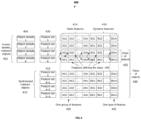
- Figure 4 shows example 400 of building syn- thetic feature vectors corresponding to a certain class of malicious objects where the attributes of the sample are mixed.
- a feature vector is the list of feature values representing a row of a dataset.
- Known labeled malware objects 402 include object samples 1, 2, 3, K (404). These object samples include feature sets 1, 2, 3, K (406) and the feature sets are used to create synthesized malware objects 410 comprising feature sets x, x+1, x+2, and x+3 (412).
- Static features 414 are represented by the prefix A and Dynamic features 416 are represented by the prefix B.
- feature set 1 (406) comprises a given number of static features All, A12, .
- Feature set 2 (406) likewise comprises static features A21, A22, A2n and dynamic features B21, B22, . B2m.
- Feature sets 3 through K (406) follow this pattern, where the last static feature is represented by n and the last dynamic feature is represented by m.
- Synthesized feature sets x, x+1, x+2, and x+3 (412) comprises mixed static and dynamic features taken from the static features 414 and dynamic features 416 from feature sets 3 and K.
- feature set x (412) comprises static features AK1, A32, ... A3n and dynamic features B31, B32, . B3m.
- Static features 414 and dynamic features 416 are divided into one group of features 420 and one type of feature 422.
- a group of features comprises, for example, stack traces, API calls sequences, operations with files, or operations with a register or network. Or group features may include file modifications or reading files.
- Feature sets 3 and K (406) and features sets x through x+3 (412) comprise an object class 430 of features from known labeled malware objects and synthesized mal- ware objects.
- the static features and dynamic features found in the known labeled malware objects 402 in feature sets 3 and K (432) comprise object class 432.
- Class- defining features 440 are the features in object class 432 that are mixed and used to populate the static and dynamic features for synthetic feature sets x, x+1, x+2, and x+3.
- Figure 5 shows example 500 of using known labeled malware objects and known labeled clean objects to create synthesized malware objects.
- Known mal- ware objects 502 include object samples 1-K (504) with corresponding feature sets 1-K (406).
- Synthesized malware objects 510 with corresponding feature sets x, x+1, x+2, and x+3 (512).
- Feature sets 506 and 512 comprise static features 514 and dynamic features 516.
- the static and dynamic features 514, 516 in feature sets 1-K (506) and feature sets 512 are grouped into a first feature group 520 and a second feature group 522. These groups 520, 522 are used as parameters for feature substitution.
- first group 520 and second group 522 are substituted for other static and dynamic features in the same group.
- the substituted static features are All with AK2 and AK1 with A12.
- the substituted dynamic features are B11 with BK2 and BK1 with B12. These substitutions take place between features sets 1 and K (512).
- a filtered feature set 524 corresponding to fea- ture set x+2 (512) is defined in relation to known labeled clean objects 530. These known labeled clean objects 530 have corresponding feature sets 1, 2, 3, . L (534).
- Features sets 1-L comprise static features 536 and dy- namic features 538.
- Static features 536 are labeled C11, C12, . C1n and D11, D12, . D1m for feature set 1.
- the static features are C21, C22, C2n and the dynamic features are D21, D22, . D2m.
- Feature set 3 has static features All, AK2, . AKn and dynamic features BK1, B12, . B3m. This feature set-All, AK2, AKn and BK1, B12, ... B3m-also appears in synthesized malware objects feature set x+2 where it is identified as filtered feature set 524.
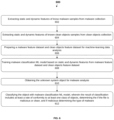
- FIG. 35 shows a method 600 for training a mal- ware classification machine learning model and classifying malware by synthesizing feature sets from malware and clean collections.
- static and dynamic features are extracted from known malware samples from a malware collection.
- static and dynamic features are extracted from known clean object samples from a clean objects collection.
- a malware feature dataset and a clean objects feature dataset are prepared for machine learning analysis.
- a mal- ware classification machine learning model is trained at step 608 based on static and dynamic features from the malware feature dataset and the clean objects feature dataset.
- An unknown system object for malware analysis is obtained at step 610.
- the object is then classified with the malware classification machine learning model at step 612.
- the result of the classification includes one or more of the following: determining a rate of conformity to at least one class of objects, determining if the file is malicious or clean, and determining malware type if malicious.
- FIG. 7 shows a method 700 of training a mal- ware classification machine learning model and classifying malware by creating a synthesized dataset from static and dynamic features.
- a malware feature dataset and a clean objects feature data set are loaded for ma- chine-learning data analysis at step 702.
- the loaded datasets include static and dynamic feature sets.
- the features in these datasets are grouped by feature type.
- new feature sets are synthesized in a malware feature dataset at step 706.
- Each new feature set is a combination of the loaded feature set related to a first known malware sample and a result of substitution of at least one feature related to the first known malware sample with at least one feature related to a second malware sample.
- the substitution is preferably performed for features from the same group.
- the training of a mal- ware machine learning model takes place at step 708.
- Static and dynamic features from the malware feature dataset extended with new, synthesized feature sets and the clean objects dataset.
- an unknown system object is obtained for malware analysis.
- the object is classified with the trained malware classification ma- chine learning model at step 712.
- the result of classification includes at least one of the following: determining a rate of conformity to at least one class of objects, determining if the file is malicious or clean, and determining the type of malware if the file is malicious.
- FIG. 8 shows a method 800 of training a mal- ware classification machine learning model and classifying malware by creating a synthesized dataset from selected features related to malware samples of one class of objects.
- a malware feature dataset and a clean objects feature data set are loaded for machine-learning data analysis at step 802.
- the loaded datasets include static and dynamic feature sets.
- the features in these datasets are grouped by feature type.
- Feature sets are selected related to malware samples of one class of objects at step 806.
- the class of objects is defined using at least one of static analysis, dynamic analysis, sample execution log analysis, and malware classification based on static and dynamic analysis. Then new feature sets are synthesized in a malware feature dataset at step 810.
- Each new feature set is a combination of the selected feature set related to a first known malware sample and a result of substitution of at least one feature related to the first known malware sample with at least one feature related to a second malware sample.
- the substitution is preferably performed for features from the same group.
- the training of a malware machine learning model takes place at step 812. Static and dynamic features from the malware feature dataset extended with new feature sets and the clean objects dataset.
- an unknown system object is obtained for malware analysis.
- the object is classified with the trained malware classification machine learning model at step 816.
- the result of classification includes at least one of the following: determining a rate of conformity to at least one class of objects, determining if the file is malicious or clean, and determining the type of malware if the file is malicious.
Landscapes
- Engineering & Computer Science (AREA)
- Theoretical Computer Science (AREA)
- Computer Security & Cryptography (AREA)
- Software Systems (AREA)
- General Engineering & Computer Science (AREA)
- Computer Hardware Design (AREA)
- General Physics & Mathematics (AREA)
- Physics & Mathematics (AREA)
- Health & Medical Sciences (AREA)
- Virology (AREA)
- General Health & Medical Sciences (AREA)
- Computer Vision & Pattern Recognition (AREA)
- Multimedia (AREA)
- Mathematical Physics (AREA)
- Data Mining & Analysis (AREA)
- Evolutionary Computation (AREA)
- Artificial Intelligence (AREA)
- Medical Informatics (AREA)
- Computing Systems (AREA)
- Information Retrieval, Db Structures And Fs Structures Therefor (AREA)
Description
- 1. The invention pertains to the field of computer security, in particular the analysis and prediction of malicious behavior by computer programs and files
- 2. Machine learning models for malware detection are often trained using known samples. For example, the known samples comprise datasets with labels. These samples are taken from different sources. As a result, the sample datasets describe the objects that contain the threat, but do not include metadata that could be useful. For example, where the dataset comprises malicious files, such metadata could reveal how the malicious file got into the affected computer system. Moreover, the malicious file might be only a derivative of some other pro- gram or file. Or the malicious file could be a part of a broad distributed attack system.
- 3. When training a machine learning model using the features obtained from a typical dataset, there are cases where the model cannot correctly classify an object by its attributes. Even though the object contains a threat, the object will not be classified correctly because there is not enough data in the dataset that characterizes such objects.
- 4. Another problem comes from attackers who automate the process of creating malware and combine various modules for encryption, obfuscation, and exploitation of vulnerabilities. Such malware may use different command centers for communication. Or the malware may exploit unusual ways of hiding in the system. Hence, malicious files, web pages, network packets and other system objects that carry the same malicious functionality can be missed by the protection system. This is be- cause these objects will have a different set of attributes than what a machine learning model would predict based on known malware.
- 5. Patent application
US9992211B1 - 6. Document
US9992211B1 - 7. Another point of view is described in Patent publication
US20190034632A1 where a method and system for static behavior-predictive malware detection. The method and system use a transfer learning model from behavior prediction to malware detection based on static features. In accordance with an embodiment of the invention, machine learning is used to capture the relations between static features, behavior features, and other context information. Synthesized behavior-related static features are generated by projecting the original static features to the behavior features. - 8. Document
US20190034632A1 does not teach to synthesize static and dynamic features based on mixing and substitution. Also does not teach to synthesize features by classes of files or threats and by types of features.US20190034632A1 generates synthetic static features only based on predictive behavior features, based on correlation of given behavior and static features of known samples. - 9. Another example is describes in patent application
US2019190956 (A1 ) where an apparatus for verifying a malicious code machine learning classification model, which includes: a main feature processing subsystem performing feature extracting and processing functions in an input file; and a multi-layer cyclic verification subsystem performing multi-layer verification in order to determine whether the file is normal or malicious based on the extracted and processed features to verify a machine learning model that classifies malicious codes, thereby ensuring reliability of a prediction result for a machine learning model. - 10. Current methods for working with combined data for machine learning and deep learning models aim at improving the quality of object classification. But these methods may not be effective for detecting malicious objects, including unknown malicious objects. The combined data remains a random set of attributes even though it has been derived from the data available in the dataset. This approach will improve the quality of training a machine learning model to identify malware. But at the same time, it will introduce an increase in false positives. Randomly synthesized data may correspond to legitimate software and its resources. For example, all the attributes corresponding to the known samples of ransomware may be taken and the data synthesized by filling the sets of attributes with random data or data that, in principle, can occur in real systems. In this case, some of the records in the dataset will correspond to legitimate software. Examples of such software include an agent file system encryption, DLP agents, and file synchronization agents.
- 11. Known technologies do not effectively predict the emergence of new threats. They focus instead on improving the accuracy of the machine learning model for a specific class of objects. Searching for universal rules for detecting new instances of malicious files and programs risks increasing false positives. New systems and methods are needed to prevent increasingly sophisticated malware attacks while at the same time avoiding these false positives.
- 12. To overcome the problems found in the state of the art, where the main advantage of the present invention in comparison with prior art is that potential malware files, programs, and modules are predicted in advance by machine learning classification. Classification is achieved by analyzing the parameters an behavior of known malicious programs. The present invention predicts the appearance of new, previously unknown threats and increases the level of detection while reducing the level of false positives. This result is achieved by synthesizing new records in the machine learning dataset. These new, synthetic records improve the quality of model training and improve the model's ability to determine the class of malware and detect previously unknown threats more accurately.
- 13. Implementation of a method embodying the invention comprises collecting known malware samples. The dynamic (behavioral) characteristics and static characteristics are described separately for each file. Both types of parameters are combined into a single table. Machine learning algorithms are then used to create synthetic models for the potential malware. These tables and models comprise a kind of virtual sample, which are used to train a model that will more accurately classify real malicious objects found in the wilds
- 14. A feature of the invention is data synthesis. Synthesized datasets improve a machine learning model's accuracy in the detection of new threats. Synthesis in this context means combining the attributes of known threats with logic that creates new feature vectors that will better correspond to unknown samples. At the same time, the synthesized datasets are more likely to correspond to the threat model for certain classes of threats and while reducing noise that increases false positives.
- 15. Several embodiments of the invention can be used to implement this approach. First, the attributes of known threats can be synthesized while filtering out vectors derived from datasets of known safe objects. A second method builds a sample of vectors corresponding to a certain class of malicious objects and mixes attributes in this sample in various ways. For example, the class and the selection are formed according to the key attributes of static analysis and all the attributes of this se- lection are mixed, including dynamic attributes. Or the class and the selection are formed according to behavioral logs, which record types of behavior. All the attributes of this selection are mixed, including attributes. A third method combines synthesizing attributes and filtering out known safe vectors for a specific class and sample.
-
- 16.
Figure 1 shows a system for training a machine learn- ing malware classification model. -
Figure 2 shows the system for training a machine learning malware classification model likeFigure 1 but with additional details related to feature synthesis. -
Figure 3 shows a system for static and dynamic anal- ysis of object samples. -
Figure 4 shows an example of building a sample of vectors corresponding to a certain class of malicious objects where the attributes of the sample are mixed. -
Figure 5 shows an example of building a sample of vectors including a filtered feature set and feature substitution. -
Figure 6 shows a method of training a malware classification machine learning model and classifying malware by synthesizing feature sets from malware and clean collections. -
Figure 7 shows a method of training a malware classification machine learning model and classifying malware by creating a synthesized dataset from static and dynamic features, where the features in the datasets are grouped by feature type. -
Figure 8 shows a method of training a malware classification machine learning model and classifying malware by creating a synthesized dataset from selected features related to malware samples of one class of objects. - 17. The invention comprises a system and method for training and using machine learning malware classification models. Synthetic datasets are created and used for training a machine learning malware classifier. These synthetic datasets improve the ability of machine learning models to accurately detect and classify malware. These synthetic datasets act as virtual samples that allow ma- chine learning classifiers to be trained to detect previously unknown malware. The invention improves machine learning malware classifiers by increasing classification accuracy and reducing false positives. Increased accuracy by a malware classifier improves the efficiency of a computer system by protecting them from new malware threats while reducing false positives ensures the use- fulness of the computer system for its intended tasks. The improved malware classifier can also be used for penetration testing. Synthetic malware datasets can be used to create hypothetical "new" malware objects for testing purposes. These new objects can be used to test the detection capabilities of existing computer security systems to rate.
- 18. In the context of machine learning, a feature is an input variable used in making predictions or classifications in machine learning. Feature engineering is the process of determining which features might be useful in training a machine learning model, and then converting raw data from log files and other sources into those features. Feature extraction aims to reduce the number of features in a dataset by creating new features from the existing ones (and then discarding the original features).
- 19. Malicious processes in computer systems can be detected using dynamic analysis and static analysis. Dynamic analysis, also called "behavior analysis," focuses on how an untrusted file or process acts. Static analysis, on the other hand, is concerned with what can be known about an untrusted file or process before runtime.
- 20.
Figure 1 shows how the machine learning classification model is trained by extracting static and dynamic features from a malware collection and a clean objects collection. Thesystem 100 comprisesmalware collection 102 andclean objects collection 104. Thesecollections tractor 106 and dynamicanalysis feature extractor 108. In turn, staticanalysis feature extractor 106 and dynamicanalysis feature extractor 108 pass extracted dataset features tomalware feature dataset 110 and clean ob-jects feature dataset 112. Thesedatasets machine learning module 114. - 21.
Module 114 comprises a file with functions for training malware classificationmachine learning model 116. For example, in a Python environment,module 114 contains variables of different types, such as arrays, dictionaries, objects, and is saved in a file with the .py extention. - 22.
Machine learning model 116 is a file that has been trained to recognize certain types of patterns in a given dataset. Pattern recognition is achieved by way of functions and algorithms provided bymodule 114. - 23. The system of
Figure 2 resemblesFigure 1 but shows additional details related to feature synthesis, including a feature synthesizing unit and a synthesized feature dataset.System 200 comprisesmalware collection 202 andclean objects collection 204. These collections communicate with static analysis and dynamicanalysis feature extractors - 24. Feature synthesis is accomplished through the interaction of
malware feature dataset 210, synthesizedfeature dataset 212,feature synthesizing unit 214, and clean objects featuredataset 216. Theextractors malware feature dataset 210 and clean objects featuredataset 216.Feature synthesizing unit 214 is passed feature data frommalware feature dataset 210 and clean objects featuredataset 216.Feature synthesizing unit 214 mixes features fromdatasets synthesized feature dataset 212. - 25. Malware classification
machine learning module 218 comprises a file with functions for training mal- ware classificationmachine learning model 220. For ex- ample, in a Python environment,module 218 contains variables of different types, such as arrays, dictionaries, objects, and is saved in a file with the .py extension. - 26.
Machine learning model 220 is a file that has been trained to recognize certain types of patterns in a given dataset. Pattern recognition is achieved by way of functions and algorithms provided bymodule 218. In this configuration,module 218 is passed asynthesized feature dataset 212 and a clean objects feature dataset. Thus,model 220 is trained from "virtual" malware data rather than from known malware samples. - 27.
Figure 3 showssystem 300 for static and dynamic analysis of anobject collection 302 comprisingobject samples 304.Threat analysis server 306 is con- figured for dynamic analysis ofsample 304 by way of running the sample asapplication 308. Activity monitor 310 records information about the activity ofapplication 308 during runtime. Monitor 310 passes features identified during runtime to dynamic feature extractor 312.Object sample 304 is also passed tostatic feature extractor 314 for static feature extraction. The static anddynamic feature extractors 312, 314 pass extracted features to featureextractors 312, 314 pass extracted features tomalware feature dataset 316, synthesized feature data- set318, and clean objects featuredataset 320. Extracted static and dynamic features are passed tomalware feature dataset 316 or clean objects featuredataset 320 depending on the nature ofobject collection 302 from whichsample 304 was obtained. - 28. Activity monitor 310 also passes features identified during runtime to sample
execution log 322. Log data fromexecution log 322 is then passed to feature synthesizingunit 324.Feature synthesizing unit 324 interacts with the malware, synthesized, and clean objects featuredatasets datasets Figures 4 and5 . - 29. The output of the
mixed datasets learning training unit 326, which trains malware classification ma-chine learning model 328. In an embodiment, malware classificationmachine learning model 328 passesthreat detection updates 330 to protectedcomputer systems 332. - 30.
Figure 4 shows example 400 of building syn- thetic feature vectors corresponding to a certain class of malicious objects where the attributes of the sample are mixed. A feature vector is the list of feature values representing a row of a dataset. Known labeled malware objects 402 includeobject samples - 31. Synthesized feature sets x, x+1, x+2, and x+3 (412) comprises mixed static and dynamic features taken from the
static features 414 anddynamic features 416 from feature sets 3 and K. For example, feature set x (412) comprises static features AK1, A32, ... A3n and dynamic features B31, B32, . B3m. - 32. Static features 414 and
dynamic features 416 are divided into one group offeatures 420 and one type offeature 422. A group of features comprises, for example, stack traces, API calls sequences, operations with files, or operations with a register or network. Or group features may include file modifications or reading files. Feature sets 3 and K (406) and features sets x through x+3 (412) comprise anobject class 430 of features from known labeled malware objects and synthesized mal- ware objects. The static features and dynamic features found in the known labeled malware objects 402 in feature sets 3 and K (432) compriseobject class 432. Class- definingfeatures 440 are the features inobject class 432 that are mixed and used to populate the static and dynamic features for synthetic feature sets x, x+1, x+2, and x+3. - 33.
Figure 5 shows example 500 of using known labeled malware objects and known labeled clean objects to create synthesized malware objects. Known mal-ware objects 502 include object samples 1-K (504) with corresponding feature sets 1-K (406). Synthesized malware objects 510 with corresponding feature sets x, x+1, x+2, and x+3 (512). Feature sets 506 and 512 comprisestatic features 514 anddynamic features 516. The static anddynamic features first feature group 520 and asecond feature group 522. Thesegroups first group 520 andsecond group 522 are substituted for other static and dynamic features in the same group. In the example shown inFigure 5 , the substituted static features are All with AK2 and AK1 with A12. The substituted dynamic features are B11 with BK2 and BK1 with B12. These substitutions take place between features sets 1 and K (512). - 34. A filtered feature set 524 corresponding to fea- ture set x+2 (512) is defined in relation to known labeled
clean objects 530. These known labeledclean objects 530 have corresponding feature sets 1, 2, 3, . L (534). Features sets 1-L comprisestatic features 536 and dy- namic features 538. Static features 536 are labeled C11, C12, . C1n and D11, D12, . D1m forfeature set 1. For feature set 2, the static features are C21, C22, C2n and the dynamic features are D21, D22, . D2m. Feature set 3 has static features All, AK2, . AKn and dynamic features BK1, B12, . B3m. This feature set-All, AK2, AKn and BK1, B12, ... B3m-also appears in synthesized malware objects feature set x+2 where it is identified as filteredfeature set 524. - 35.
Figure 6 shows amethod 600 for training a mal- ware classification machine learning model and classifying malware by synthesizing feature sets from malware and clean collections. Atstep 602 static and dynamic features are extracted from known malware samples from a malware collection. Then atstep 604 static and dynamic features are extracted from known clean object samples from a clean objects collection. Atstep 606, a malware feature dataset and a clean objects feature dataset are prepared for machine learning analysis. A mal- ware classification machine learning model is trained atstep 608 based on static and dynamic features from the malware feature dataset and the clean objects feature dataset. An unknown system object for malware analysis is obtained atstep 610. The object is then classified with the malware classification machine learning model atstep 612. The result of the classification includes one or more of the following: determining a rate of conformity to at least one class of objects, determining if the file is malicious or clean, and determining malware type if malicious. - 36.
Figure 7 shows amethod 700 of training a mal- ware classification machine learning model and classifying malware by creating a synthesized dataset from static and dynamic features. A malware feature dataset and a clean objects feature data set are loaded for ma- chine-learning data analysis atstep 702. The loaded datasets include static and dynamic feature sets. Atstep 704, the features in these datasets are grouped by feature type. Then new feature sets are synthesized in a malware feature dataset atstep 706. Each new feature set is a combination of the loaded feature set related to a first known malware sample and a result of substitution of at least one feature related to the first known malware sample with at least one feature related to a second malware sample. The substitution is preferably performed for features from the same group. The training of a mal- ware machine learning model takes place atstep 708. Static and dynamic features from the malware feature dataset extended with new, synthesized feature sets and the clean objects dataset. Atstep 710 an unknown system object is obtained for malware analysis. The object is classified with the trained malware classification ma- chine learning model atstep 712. The result of classification includes at least one of the following: determining a rate of conformity to at least one class of objects, determining if the file is malicious or clean, and determining the type of malware if the file is malicious. - 37.
Figure 8 shows amethod 800 of training a mal- ware classification machine learning model and classifying malware by creating a synthesized dataset from selected features related to malware samples of one class of objects. A malware feature dataset and a clean objects feature data set are loaded for machine-learning data analysis atstep 802. The loaded datasets include static and dynamic feature sets. Atstep 804, the features in these datasets are grouped by feature type. Feature sets are selected related to malware samples of one class of objects atstep 806. The class of objects is defined using at least one of static analysis, dynamic analysis, sample execution log analysis, and malware classification based on static and dynamic analysis. Then new feature sets are synthesized in a malware feature dataset atstep 810. - 38. Each new feature set is a combination of the selected feature set related to a first known malware sample and a result of substitution of at least one feature related to the first known malware sample with at least one feature related to a second malware sample. The substitution is preferably performed for features from the same group. The training of a malware machine learning model takes place at
step 812. Static and dynamic features from the malware feature dataset extended with new feature sets and the clean objects dataset. Atstep 814 an unknown system object is obtained for malware analysis. The object is classified with the trained malware classification machine learning model atstep 816. The result of classification includes at least one of the following: determining a rate of conformity to at least one class of objects, determining if the file is malicious or clean, and determining the type of malware if the file is malicious.
Claims (14)
- A method for malware detection in a computer system comprising the following steps:a. extracting (602) static and dynamic features of at least two known malware samples;b. extracting (604) static and dynamic features of a known clean object sample;c. preparing (606) a synthetic malware feature dataset and a clean objects feature dataset, wherein the synthetic malware feature dataset comprises extracted feature sets of known malware samples and synthetic malware feature sets, generated by substitution of static and dynamic features corresponding to different known malware samples;d. training (608) a malware classification machine learning model based on the synthetic malware feature dataset and the clean objects feature dataset;e. obtaining (610) an unknown system object for malware analysis; andf. classifying (612) the unknown system object, wherein the result of classification includes one or more of the following: a rate of conformity with at least one class of objects, a determination if the file is malicious or not, and a determination of malware type.
- The method of claim 1, wherein the step of preparing a synthetic malware feature dataset and clean objects feature dataset further comprises grouping features in datasets by the type of feature.
- The method of claim 1, wherein generated feature set in the synthetic malware feature dataset is a combination of the extracted features related to a first known malware sample and the result of a substitution of at least one feature related to a first known malware sample with a least one feature related to a second known malware sample.
- The method of claim 2, wherein the substitution of least one feature is performed for features from the same group.
- The method of claim 1, wherein the step of preparing a synthetic malware feature dataset further comprises the step of selecting feature sets related to malware samples of one class of malware and generating new feature sets in the synthetic malware feature dataset based on the selected feature sets.
- The method of claim 5, wherein the one class of malware is defined using at least one of static analysis, dynamic analysis, sample execution log analysis, and malware classification based on static and dynamic analysis.
- The method of claim 1, wherein the step of generating new feature sets in the synthetic malware feature dataset further comprises filtering out at least one feature corresponding to at least one known clean object sample.
- A system (100) for malware detection in a networked computer system comprisinga. static and dynamic feature extractors, configured to:i. identify features of a known malware sample; andii. identify features of a known clean object sample;b. a feature synthesizing unit configured to prepare synthetic malware feature dataset and a clean objects feature dataset from the extracted features, wherein the synthetic malware feature dataset comprises extracted feature sets of known malware samples and synthetic malware feature sets, generated by substitution of static and dynamic features corresponding to different known malware samples; andc. a malware classification machine learning model trained on the synthetic malware feature dataset and the clean objects feature dataset and configured to classify the unknown system object, wherein the result of classification includes one or more of the following: a rate of conformity with at least one class of objects, a determination if the file is malicious or not, and a determination of malware type.
- The system of claim 8, wherein the synthetic malware feature dataset and clean objects feature dataset includes grouped features in datasets by the type of feature.
- The system of claim 8, wherein generated feature set in the synthetic malware feature dataset is a combination of the extracted feature sets related to a first known malware sample and the result of a substitution of at least one feature related to a first known malware sample with a least one feature related to a second known malware sample.
- The system of claim 9, wherein the substitution of at least one feature is performed for features from the same group.
- The system of claim 8, wherein the feature synthesizing unit is further configured to select feature sets related to malware samples of one class of malware and generate new feature sets in the synthetic malware feature dataset based on the selected feature sets.
- The system of claim 12, wherein the one class of malware is defined using at least one of static analysis, dynamic analysis, sample execution log analysis, and malware classification based on static and dynamic analysis.
- The system of claim 12, wherein the feature synthesizing unit is further configured to filter out from the generated synthetic malware feature sets at least one feature corresponding to at least one known clean object sample.
Applications Claiming Priority (1)
| Application Number | Priority Date | Filing Date | Title |
|---|---|---|---|
| US17/646,127 US12124574B2 (en) | 2021-12-27 | 2021-12-27 | System and method of synthesizing potential malware for predicting a cyberattack |
Publications (3)
| Publication Number | Publication Date |
|---|---|
| EP4202741A1 EP4202741A1 (en) | 2023-06-28 |
| EP4202741C0 EP4202741C0 (en) | 2025-06-18 |
| EP4202741B1 true EP4202741B1 (en) | 2025-06-18 |
Family
ID=84363816
Family Applications (1)
| Application Number | Title | Priority Date | Filing Date |
|---|---|---|---|
| EP22020579.3A Active EP4202741B1 (en) | 2021-12-27 | 2022-11-25 | System and method of synthesizing potential malware for predicting a cyberattack |
Country Status (4)
| Country | Link |
|---|---|
| US (1) | US12124574B2 (en) |
| EP (1) | EP4202741B1 (en) |
| JP (1) | JP2023097361A (en) |
| CH (1) | CH719322B1 (en) |
Families Citing this family (10)
| Publication number | Priority date | Publication date | Assignee | Title |
|---|---|---|---|---|
| US12153664B2 (en) * | 2021-02-03 | 2024-11-26 | Cloudhedge Technologies Private Limited | System and method for detection of patterns in application for application transformation and applying those patterns for automated application transformation |
| US12518008B2 (en) * | 2022-10-21 | 2026-01-06 | Uab 360 It | Method and apparatus for creating a dataset using file creation dates |
| US12395529B2 (en) * | 2023-02-16 | 2025-08-19 | Capital One Services, Llc | Layered cybersecurity using spurious data samples |
| US12306938B2 (en) | 2023-02-16 | 2025-05-20 | Capital One Services, Llc | Spurious-data-based detection related to malicious activity |
| US12393681B2 (en) | 2023-02-16 | 2025-08-19 | Capital One Services, Llc | Generation of effective spurious data for model degradation |
| US12566875B2 (en) * | 2023-03-23 | 2026-03-03 | Crowdstrike, Inc. | Adversarial attacks common interface |
| US12468809B2 (en) * | 2023-04-07 | 2025-11-11 | Crowdstrike, Inc. | Applying diffusion models in adversarial purification and adversarial sample generation in cybersecurity |
| US12464020B2 (en) | 2024-03-28 | 2025-11-04 | Acronis International Gmbh | AI-generated virtual file honeypots for computing systems behavior-based protection against ransomware attacks |
| KR102763464B1 (en) * | 2024-08-06 | 2025-02-04 | 주식회사 안랩 | Operation method of electronic apparatus for performing large language model based analysis inference for malicious script action |
| US20260099597A1 (en) * | 2024-10-04 | 2026-04-09 | International Business Machines Corporation | Creating and extracting training data from storage systems to train machine learning models for ransomware detection |
Family Cites Families (14)
| Publication number | Priority date | Publication date | Assignee | Title |
|---|---|---|---|---|
| US8756693B2 (en) * | 2011-04-05 | 2014-06-17 | The United States Of America As Represented By The Secretary Of The Air Force | Malware target recognition |
| US10599844B2 (en) * | 2015-05-12 | 2020-03-24 | Webroot, Inc. | Automatic threat detection of executable files based on static data analysis |
| US9992211B1 (en) | 2015-08-27 | 2018-06-05 | Symantec Corporation | Systems and methods for improving the classification accuracy of trustworthiness classifiers |
| US10176321B2 (en) | 2015-09-22 | 2019-01-08 | Fireeye, Inc. | Leveraging behavior-based rules for malware family classification |
| US11481492B2 (en) | 2017-07-25 | 2022-10-25 | Trend Micro Incorporated | Method and system for static behavior-predictive malware detection |
| US10917435B2 (en) | 2017-08-17 | 2021-02-09 | Acronis International Gmbh | Cloud AI engine for malware analysis and attack prediction |
| US10841333B2 (en) | 2018-01-08 | 2020-11-17 | Sophos Limited | Malware detection using machine learning |
| US10917421B2 (en) | 2018-02-19 | 2021-02-09 | Cisco Technology, Inc. | Refining synthetic malicious samples with unlabeled data |
| CN108304721A (en) | 2018-03-21 | 2018-07-20 | 河北师范大学 | A kind of malicious code detection system |
| US11055411B2 (en) | 2018-05-10 | 2021-07-06 | Acronis International Gmbh | System and method for protection against ransomware attacks |
| US10692019B2 (en) | 2018-07-06 | 2020-06-23 | Capital One Services, Llc | Failure feedback system for enhancing machine learning accuracy by synthetic data generation |
| KR102010468B1 (en) | 2018-09-06 | 2019-08-14 | 주식회사 윈스 | Apparatus and method for verifying malicious code machine learning classification model |
| CN112560034B (en) | 2020-12-11 | 2024-03-29 | 宿迁学院 | Malicious code sample synthesis method and device based on feedback type deep countermeasure network |
| US11968220B2 (en) | 2020-12-17 | 2024-04-23 | Acronis International Gmbh | Systems and methods for performing failover during a cyberattack |
-
2021
- 2021-12-27 US US17/646,127 patent/US12124574B2/en active Active
-
2022
- 2022-11-04 CH CH001311/2022A patent/CH719322B1/en unknown
- 2022-11-18 JP JP2022184813A patent/JP2023097361A/en active Pending
- 2022-11-25 EP EP22020579.3A patent/EP4202741B1/en active Active
Also Published As
| Publication number | Publication date |
|---|---|
| EP4202741C0 (en) | 2025-06-18 |
| CH719322A2 (en) | 2023-07-14 |
| JP2023097361A (en) | 2023-07-07 |
| US12124574B2 (en) | 2024-10-22 |
| EP4202741A1 (en) | 2023-06-28 |
| US20230205877A1 (en) | 2023-06-29 |
| CH719322B1 (en) | 2026-05-15 |
Similar Documents
| Publication | Publication Date | Title |
|---|---|---|
| US12124574B2 (en) | System and method of synthesizing potential malware for predicting a cyberattack | |
| Aslan et al. | A new malware classification framework based on deep learning algorithms | |
| Zhu et al. | Android malware detection based on multi-head squeeze-and-excitation residual network | |
| Mosli et al. | Automated malware detection using artifacts in forensic memory images | |
| Daku et al. | Behavioral-based classification and identification of ransomware variants using machine learning | |
| Islam et al. | Classification of malware based on string and function feature selection | |
| Shibahara et al. | Efficient dynamic malware analysis based on network behavior using deep learning | |
| Maiorca et al. | A pattern recognition system for malicious pdf files detection | |
| Medhat et al. | A new static-based framework for ransomware detection | |
| CN112287345B (en) | Trusted edge computing system based on intelligent risk detection | |
| Casolare et al. | Dynamic Mobile Malware Detection through System Call-based Image representation. | |
| CN107247902A (en) | Malware categorizing system and method | |
| US20250021654A1 (en) | Rootkit detection based on system dump files analysis | |
| Alshamrani | Design and analysis of machine learning based technique for malware identification and classification of portable document format files | |
| CN114662111A (en) | Malicious code software gene homology analysis method | |
| AliAhmad et al. | Malware detection issues, future trends and challenges: A survey | |
| Ayeni | A supervised machine learning algorithm for detecting malware | |
| Kalyan et al. | Detection of malware using CNN | |
| Zhang et al. | A new semantics-based android malware detection | |
| Ali et al. | AEDGAN: A Semi-Supervised Deep Learning Model for Zero-Day Malware Detection | |
| Ajwani et al. | ExFAURL scanner: a framework for malware detection in binary files and urls using machine learning techniques | |
| Abdallah et al. | Survey of malicious PDF detection systems: methods, challenges, and advances | |
| Mohaisen et al. | Chatter: Exploring classification of malware based on the order of events | |
| Zhang et al. | Profiling and Discriminating of Containerized ML Applications in Digital Data Marketplaces (DDM). | |
| Wu | A malicious code detection strategy based on feature fusion |
Legal Events
| Date | Code | Title | Description |
|---|---|---|---|
| PUAI | Public reference made under article 153(3) epc to a published international application that has entered the european phase |
Free format text: ORIGINAL CODE: 0009012 |
|
| STAA | Information on the status of an ep patent application or granted ep patent |
Free format text: STATUS: REQUEST FOR EXAMINATION WAS MADE |
|
| 17P | Request for examination filed |
Effective date: 20221128 |
|
| AK | Designated contracting states |
Kind code of ref document: A1 Designated state(s): AL AT BE BG CH CY CZ DE DK EE ES FI FR GB GR HR HU IE IS IT LI LT LU LV MC ME MK MT NL NO PL PT RO RS SE SI SK SM TR |
|
| GRAP | Despatch of communication of intention to grant a patent |
Free format text: ORIGINAL CODE: EPIDOSNIGR1 |
|
| STAA | Information on the status of an ep patent application or granted ep patent |
Free format text: STATUS: GRANT OF PATENT IS INTENDED |
|
| RIC1 | Information provided on ipc code assigned before grant |
Ipc: G06N 20/00 20190101ALI20250213BHEP Ipc: G06F 21/56 20130101AFI20250213BHEP |
|
| INTG | Intention to grant announced |
Effective date: 20250225 |
|
| GRAS | Grant fee paid |
Free format text: ORIGINAL CODE: EPIDOSNIGR3 |
|
| GRAA | (expected) grant |
Free format text: ORIGINAL CODE: 0009210 |
|
| STAA | Information on the status of an ep patent application or granted ep patent |
Free format text: STATUS: THE PATENT HAS BEEN GRANTED |
|
| AK | Designated contracting states |
Kind code of ref document: B1 Designated state(s): AL AT BE BG CH CY CZ DE DK EE ES FI FR GB GR HR HU IE IS IT LI LT LU LV MC ME MK MT NL NO PL PT RO RS SE SI SK SM TR |
|
| REG | Reference to a national code |
Ref country code: GB Ref legal event code: FG4D |
|
| REG | Reference to a national code |
Ref country code: CH Ref legal event code: EP |
|
| REG | Reference to a national code |
Ref country code: DE Ref legal event code: R096 Ref document number: 602022015945 Country of ref document: DE |
|
| REG | Reference to a national code |
Ref country code: CH Ref legal event code: EP |
|
| REG | Reference to a national code |
Ref country code: IE Ref legal event code: FG4D |
|
| U01 | Request for unitary effect filed |
Effective date: 20250626 |
|
| U07 | Unitary effect registered |
Designated state(s): AT BE BG DE DK EE FI FR IT LT LU LV MT NL PT RO SE SI Effective date: 20250703 |
|
| PG25 | Lapsed in a contracting state [announced via postgrant information from national office to epo] |
Ref country code: NO Free format text: LAPSE BECAUSE OF FAILURE TO SUBMIT A TRANSLATION OF THE DESCRIPTION OR TO PAY THE FEE WITHIN THE PRESCRIBED TIME-LIMIT Effective date: 20250918 Ref country code: GR Free format text: LAPSE BECAUSE OF FAILURE TO SUBMIT A TRANSLATION OF THE DESCRIPTION OR TO PAY THE FEE WITHIN THE PRESCRIBED TIME-LIMIT Effective date: 20250919 |
|
| PG25 | Lapsed in a contracting state [announced via postgrant information from national office to epo] |
Ref country code: HR Free format text: LAPSE BECAUSE OF FAILURE TO SUBMIT A TRANSLATION OF THE DESCRIPTION OR TO PAY THE FEE WITHIN THE PRESCRIBED TIME-LIMIT Effective date: 20250618 |
|
| PG25 | Lapsed in a contracting state [announced via postgrant information from national office to epo] |
Ref country code: RS Free format text: LAPSE BECAUSE OF FAILURE TO SUBMIT A TRANSLATION OF THE DESCRIPTION OR TO PAY THE FEE WITHIN THE PRESCRIBED TIME-LIMIT Effective date: 20250918 |
|
| PG25 | Lapsed in a contracting state [announced via postgrant information from national office to epo] |
Ref country code: IS Free format text: LAPSE BECAUSE OF FAILURE TO SUBMIT A TRANSLATION OF THE DESCRIPTION OR TO PAY THE FEE WITHIN THE PRESCRIBED TIME-LIMIT Effective date: 20251018 |
|
| PG25 | Lapsed in a contracting state [announced via postgrant information from national office to epo] |
Ref country code: SM Free format text: LAPSE BECAUSE OF FAILURE TO SUBMIT A TRANSLATION OF THE DESCRIPTION OR TO PAY THE FEE WITHIN THE PRESCRIBED TIME-LIMIT Effective date: 20250618 |
|
| PG25 | Lapsed in a contracting state [announced via postgrant information from national office to epo] |
Ref country code: CZ Free format text: LAPSE BECAUSE OF FAILURE TO SUBMIT A TRANSLATION OF THE DESCRIPTION OR TO PAY THE FEE WITHIN THE PRESCRIBED TIME-LIMIT Effective date: 20250618 |
|
| PG25 | Lapsed in a contracting state [announced via postgrant information from national office to epo] |
Ref country code: PL Free format text: LAPSE BECAUSE OF FAILURE TO SUBMIT A TRANSLATION OF THE DESCRIPTION OR TO PAY THE FEE WITHIN THE PRESCRIBED TIME-LIMIT Effective date: 20250618 |
|
| PG25 | Lapsed in a contracting state [announced via postgrant information from national office to epo] |
Ref country code: SK Free format text: LAPSE BECAUSE OF FAILURE TO SUBMIT A TRANSLATION OF THE DESCRIPTION OR TO PAY THE FEE WITHIN THE PRESCRIBED TIME-LIMIT Effective date: 20250618 |
|
| PG25 | Lapsed in a contracting state [announced via postgrant information from national office to epo] |
Ref country code: ES Free format text: LAPSE BECAUSE OF FAILURE TO SUBMIT A TRANSLATION OF THE DESCRIPTION OR TO PAY THE FEE WITHIN THE PRESCRIBED TIME-LIMIT Effective date: 20250618 |
|
| U21 | Renewal fee for the european patent with unitary effect paid with additional fee |
Year of fee payment: 4 Effective date: 20260310 |
|
| PLBE | No opposition filed within time limit |
Free format text: ORIGINAL CODE: 0009261 |
|
| STAA | Information on the status of an ep patent application or granted ep patent |
Free format text: STATUS: NO OPPOSITION FILED WITHIN TIME LIMIT |
|
| REG | Reference to a national code |
Ref country code: CH Ref legal event code: L10 Free format text: ST27 STATUS EVENT CODE: U-0-0-L10-L00 (AS PROVIDED BY THE NATIONAL OFFICE) Effective date: 20260430 |
|
| 26N | No opposition filed |
Effective date: 20260319 |
|
| REG | Reference to a national code |
Ref country code: CH Ref legal event code: H13 Free format text: ST27 STATUS EVENT CODE: U-0-0-H10-H13 (AS PROVIDED BY THE NATIONAL OFFICE) Effective date: 20260623 |
|
| PG25 | Lapsed in a contracting state [announced via postgrant information from national office to epo] |
Ref country code: MC Free format text: LAPSE BECAUSE OF FAILURE TO SUBMIT A TRANSLATION OF THE DESCRIPTION OR TO PAY THE FEE WITHIN THE PRESCRIBED TIME-LIMIT Effective date: 20250618 |
|
| PG25 | Lapsed in a contracting state [announced via postgrant information from national office to epo] |
Ref country code: CH Free format text: LAPSE BECAUSE OF NON-PAYMENT OF DUE FEES Effective date: 20251130 |