EP4202459A1 - Method for predicting lifetime characteristics of lithium secondary battery - Google Patents
Method for predicting lifetime characteristics of lithium secondary battery Download PDFInfo
- Publication number
- EP4202459A1 EP4202459A1 EP22807611.3A EP22807611A EP4202459A1 EP 4202459 A1 EP4202459 A1 EP 4202459A1 EP 22807611 A EP22807611 A EP 22807611A EP 4202459 A1 EP4202459 A1 EP 4202459A1
- Authority
- EP
- European Patent Office
- Prior art keywords
- lithium secondary
- secondary battery
- data
- cycle
- impedance
- Prior art date
- Legal status (The legal status is an assumption and is not a legal conclusion. Google has not performed a legal analysis and makes no representation as to the accuracy of the status listed.)
- Granted
Links
Images


Classifications
-
- G—PHYSICS
- G01—MEASURING; TESTING
- G01R—MEASURING ELECTRIC VARIABLES; MEASURING MAGNETIC VARIABLES
- G01R31/00—Arrangements for testing electric properties; Arrangements for locating electric faults; Arrangements for electrical testing characterised by what is being tested not provided for elsewhere
- G01R31/36—Arrangements for testing, measuring or monitoring the electrical condition of accumulators or electric batteries, e.g. capacity or state of charge [SoC]
- G01R31/392—Determining battery ageing or deterioration, e.g. state of health
-
- G—PHYSICS
- G01—MEASURING; TESTING
- G01R—MEASURING ELECTRIC VARIABLES; MEASURING MAGNETIC VARIABLES
- G01R31/00—Arrangements for testing electric properties; Arrangements for locating electric faults; Arrangements for electrical testing characterised by what is being tested not provided for elsewhere
- G01R31/36—Arrangements for testing, measuring or monitoring the electrical condition of accumulators or electric batteries, e.g. capacity or state of charge [SoC]
- G01R31/3644—Constructional arrangements
- G01R31/3648—Constructional arrangements comprising digital calculation means, e.g. for performing an algorithm
-
- G—PHYSICS
- G01—MEASURING; TESTING
- G01R—MEASURING ELECTRIC VARIABLES; MEASURING MAGNETIC VARIABLES
- G01R31/00—Arrangements for testing electric properties; Arrangements for locating electric faults; Arrangements for electrical testing characterised by what is being tested not provided for elsewhere
- G01R31/36—Arrangements for testing, measuring or monitoring the electrical condition of accumulators or electric batteries, e.g. capacity or state of charge [SoC]
- G01R31/367—Software therefor, e.g. for battery testing using modelling or look-up tables
-
- G—PHYSICS
- G01—MEASURING; TESTING
- G01R—MEASURING ELECTRIC VARIABLES; MEASURING MAGNETIC VARIABLES
- G01R31/00—Arrangements for testing electric properties; Arrangements for locating electric faults; Arrangements for electrical testing characterised by what is being tested not provided for elsewhere
- G01R31/36—Arrangements for testing, measuring or monitoring the electrical condition of accumulators or electric batteries, e.g. capacity or state of charge [SoC]
- G01R31/378—Arrangements for testing, measuring or monitoring the electrical condition of accumulators or electric batteries, e.g. capacity or state of charge [SoC] specially adapted for the type of battery or accumulator
-
- G—PHYSICS
- G01—MEASURING; TESTING
- G01R—MEASURING ELECTRIC VARIABLES; MEASURING MAGNETIC VARIABLES
- G01R31/00—Arrangements for testing electric properties; Arrangements for locating electric faults; Arrangements for electrical testing characterised by what is being tested not provided for elsewhere
- G01R31/36—Arrangements for testing, measuring or monitoring the electrical condition of accumulators or electric batteries, e.g. capacity or state of charge [SoC]
- G01R31/385—Arrangements for measuring battery or accumulator variables
-
- G—PHYSICS
- G01—MEASURING; TESTING
- G01R—MEASURING ELECTRIC VARIABLES; MEASURING MAGNETIC VARIABLES
- G01R31/00—Arrangements for testing electric properties; Arrangements for locating electric faults; Arrangements for electrical testing characterised by what is being tested not provided for elsewhere
- G01R31/36—Arrangements for testing, measuring or monitoring the electrical condition of accumulators or electric batteries, e.g. capacity or state of charge [SoC]
- G01R31/389—Measuring internal impedance, internal conductance or related variables
-
- G—PHYSICS
- G06—COMPUTING OR CALCULATING; COUNTING
- G06N—COMPUTING ARRANGEMENTS BASED ON SPECIFIC COMPUTATIONAL MODELS
- G06N20/00—Machine learning
-
- G—PHYSICS
- G06—COMPUTING OR CALCULATING; COUNTING
- G06N—COMPUTING ARRANGEMENTS BASED ON SPECIFIC COMPUTATIONAL MODELS
- G06N3/00—Computing arrangements based on biological models
- G06N3/02—Neural networks
- G06N3/04—Architecture, e.g. interconnection topology
- G06N3/0499—Feedforward networks
-
- G—PHYSICS
- G06—COMPUTING OR CALCULATING; COUNTING
- G06N—COMPUTING ARRANGEMENTS BASED ON SPECIFIC COMPUTATIONAL MODELS
- G06N3/00—Computing arrangements based on biological models
- G06N3/02—Neural networks
- G06N3/08—Learning methods
-
- G—PHYSICS
- G06—COMPUTING OR CALCULATING; COUNTING
- G06N—COMPUTING ARRANGEMENTS BASED ON SPECIFIC COMPUTATIONAL MODELS
- G06N3/00—Computing arrangements based on biological models
- G06N3/02—Neural networks
- G06N3/08—Learning methods
- G06N3/09—Supervised learning
-
- H—ELECTRICITY
- H01—ELECTRIC ELEMENTS
- H01M—PROCESSES OR MEANS, e.g. BATTERIES, FOR THE DIRECT CONVERSION OF CHEMICAL ENERGY INTO ELECTRICAL ENERGY
- H01M10/00—Secondary cells; Manufacture thereof
- H01M10/05—Accumulators with non-aqueous electrolyte
- H01M10/052—Li-accumulators
-
- H—ELECTRICITY
- H01—ELECTRIC ELEMENTS
- H01M—PROCESSES OR MEANS, e.g. BATTERIES, FOR THE DIRECT CONVERSION OF CHEMICAL ENERGY INTO ELECTRICAL ENERGY
- H01M10/00—Secondary cells; Manufacture thereof
- H01M10/42—Methods or arrangements for servicing or maintenance of secondary cells or secondary half-cells
-
- H—ELECTRICITY
- H01—ELECTRIC ELEMENTS
- H01M—PROCESSES OR MEANS, e.g. BATTERIES, FOR THE DIRECT CONVERSION OF CHEMICAL ENERGY INTO ELECTRICAL ENERGY
- H01M10/00—Secondary cells; Manufacture thereof
- H01M10/42—Methods or arrangements for servicing or maintenance of secondary cells or secondary half-cells
- H01M10/4285—Testing apparatus
-
- H—ELECTRICITY
- H01—ELECTRIC ELEMENTS
- H01M—PROCESSES OR MEANS, e.g. BATTERIES, FOR THE DIRECT CONVERSION OF CHEMICAL ENERGY INTO ELECTRICAL ENERGY
- H01M10/00—Secondary cells; Manufacture thereof
- H01M10/42—Methods or arrangements for servicing or maintenance of secondary cells or secondary half-cells
- H01M10/44—Methods for charging or discharging
-
- H—ELECTRICITY
- H01—ELECTRIC ELEMENTS
- H01M—PROCESSES OR MEANS, e.g. BATTERIES, FOR THE DIRECT CONVERSION OF CHEMICAL ENERGY INTO ELECTRICAL ENERGY
- H01M10/00—Secondary cells; Manufacture thereof
- H01M10/42—Methods or arrangements for servicing or maintenance of secondary cells or secondary half-cells
- H01M10/48—Accumulators combined with arrangements for measuring, testing or indicating the condition of cells, e.g. the level or density of the electrolyte
-
- H—ELECTRICITY
- H01—ELECTRIC ELEMENTS
- H01M—PROCESSES OR MEANS, e.g. BATTERIES, FOR THE DIRECT CONVERSION OF CHEMICAL ENERGY INTO ELECTRICAL ENERGY
- H01M10/00—Secondary cells; Manufacture thereof
- H01M10/05—Accumulators with non-aqueous electrolyte
- H01M10/052—Li-accumulators
- H01M10/0525—Rocking-chair batteries, i.e. batteries with lithium insertion or intercalation in both electrodes; Lithium-ion batteries
-
- H—ELECTRICITY
- H01—ELECTRIC ELEMENTS
- H01M—PROCESSES OR MEANS, e.g. BATTERIES, FOR THE DIRECT CONVERSION OF CHEMICAL ENERGY INTO ELECTRICAL ENERGY
- H01M10/00—Secondary cells; Manufacture thereof
- H01M10/42—Methods or arrangements for servicing or maintenance of secondary cells or secondary half-cells
- H01M10/425—Structural combination with electronic components, e.g. electronic circuits integrated to the outside of the casing
- H01M2010/4271—Battery management systems including electronic circuits, e.g. control of current or voltage to keep battery in healthy state, cell balancing
-
- Y—GENERAL TAGGING OF NEW TECHNOLOGICAL DEVELOPMENTS; GENERAL TAGGING OF CROSS-SECTIONAL TECHNOLOGIES SPANNING OVER SEVERAL SECTIONS OF THE IPC; TECHNICAL SUBJECTS COVERED BY FORMER USPC CROSS-REFERENCE ART COLLECTIONS [XRACs] AND DIGESTS
- Y02—TECHNOLOGIES OR APPLICATIONS FOR MITIGATION OR ADAPTATION AGAINST CLIMATE CHANGE
- Y02E—REDUCTION OF GREENHOUSE GAS [GHG] EMISSIONS, RELATED TO ENERGY GENERATION, TRANSMISSION OR DISTRIBUTION
- Y02E60/00—Enabling technologies; Technologies with a potential or indirect contribution to GHG emissions mitigation
- Y02E60/10—Energy storage using batteries
Definitions
- the present disclosure relates to a method for predicting lifespan characteristics of a lithium secondary battery that can reliably predict the lifespan characteristics of a lithium secondary battery, specifically, the change pattern of capacity for each cycle in advance.
- lithium secondary batteries such as lithium ion batteries having a high energy density relative to weight has attracted the most attention as a representative energy storage technology.
- a method for predicting lifespan characteristics of a lithium secondary battery comprising:
- a system for predicting lifespan characteristics of a lithium secondary battery comprising:
- a method for predicting lifespan characteristics of a lithium secondary battery comprising:
- the prediction method of one embodiment may further include a fifth step of performing artificial neural network learning based on the impedance spectroscopic analysis result to correct a prediction expression of the fourth step, and then, may further comprise a sixth step of predicting capacity characteristics for each cycle of the lithium secondary battery to be measured, based on the prediction expression of the fourth step or the corrected prediction expression of the fifth step.
- the present inventors have continued research to develop a method for reliably predicting the lifespan characteristics of a lithium secondary battery in the process of basic research and development. Based on the result of this research, the inventors have performed impedance spectroscopic analysis for a lithium secondary battery in a form of a blocking cell that reflects basic battery elements such as electrode materials and structures and electrolyte materials, and as a result, found that by utilizing the data, it is possible to reliably predict the lifespan characteristics of the lithium secondary battery to be manufactured, and more specifically, the change pattern of capacity for each cycle, and completed the invention. Furthermore, by further correcting the prediction expression of the lifespan characteristics through artificial neural network learning, the lifespan characteristics of the lithium secondary battery can be more reliably predicted in advance.
- the present inventors have noted to the fact that the diffusion and mobility of lithium ions occurring on each electrode via the electrolyte inside the lithium secondary battery fundamentally affect the performance of the lithium secondary battery, particularly the lifespan characteristic. Thereby, an attempt was performed to predict lifespan characteristics of a lithium secondary battery in advance by applying a battery in a form a blocking cell that can selectively check and analyze the degree of diffusion and adsorption of lithium ions on the electrode.
- electrochemical impedance spectroscopy is an analysis technique that can analyze various electrochemical reactions for each frequency by applying an alternating current to the battery, and various electrochemical properties of cells can be evaluated over a wide frequency range and a wide range of time. Furthermore, since this impedance spectroscopy utilizes an alternating current signal with a relatively small amplitude (e.g., about 5 to 10 mV), it is known that not only it can evaluate various electrochemical characteristics of a battery while reducing damage to the electrode, but also it is less affected by noise and thus the electrochemical characteristics of the battery can be evaluated with high precision.
- a relatively small amplitude e.g., about 5 to 10 mV
- the present inventors have confirmed that from the electrochemical data obtained by performing impedance spectroscopic analysis of the lithium secondary battery in a form of a blocking cell in this way, it is possible to obtain relation data of capacitance (F/cm 2 ) for each frequency (Hz), specifically, relation data of the imaginary capacitance for each frequency, which are closely related to the amount of lithium ions stored along the electrode surface, and can evaluate the degree of diffusion/adsorption of lithium ions.
- the charge amount (F/cm 2 ) of the lithium secondary battery in a form of a blocking cell can be calculated by utilizing the relation data of the imaginary capacitance for each frequency, and the charge amount data for each cycle of the lithium secondary battery can be calculated by repeating this process while performing the electrochemical reaction cycle of the lithium secondary battery.
- the capacity data for each cycle separately measured for a general lithium secondary battery, that is, a lithium secondary battery in a form of a non-blocking cell was made to correspond to the charge amount data for each cycle to thereby infer the change pattern of the electrode structure and the degree of cell degradation for each cycle, while it is possible to obtain prediction data on how the capacity changes for each cycle in an actual lithium secondary battery.
- a relation expression of the capacity y for each x cycle can be derived, which can be used as a prediction expression of the capacity of each cycle of the lithium secondary battery.
- the prediction expression of the capacity for each cycle may be corrected and the reliability thereof can be further improved.
- the lifespan characteristics, particularly, the change pattern of the capacity for each cycle for the actual lithium secondary battery comprising the same kind of electrolyte and/or electrode as the battery in a form of a blocking cell can be predicted in advance with very high reliability.
- the long-term lifespan characteristics of the lithium secondary battery can be predicted in advance with very high reliability by utilizing the basic battery design elements, without actually manufacturing a lithium secondary battery and performing long-term lifespan characteristic testing.
- many trials and errors can be reduced in the research and development process of the lithium secondary battery, and the research and development process of the battery can be greatly shortened.
- the lithium secondary battery in a form of a blocking cell is subjected to an impedance spectroscopic analysis under application of multiple frequencies (first step).
- the lithium secondary battery in a form of a blocking cell to be analyzed not only includes an electrode (e.g., cathode and/or anode) facing each other similarly to an actual battery, and a separator and an electrolyte therebetween, but refers to a battery form in which an electrochemical reaction between electrodes, such as oxidation or reduction reaction or lithium intercalation/deintercalation reaction, which is referred to as a faradaic reaction, does not occur inside the battery.
- an electrochemical reaction between electrodes such as oxidation or reduction reaction or lithium intercalation/deintercalation reaction, which is referred to as a faradaic reaction
- the lithium secondary battery in a form of a blocking cell includes electrodes with the same polarity as electrodes facing each other (e.g., including only cathodes that face each other) in order to prevent an electrochemical reaction between the electrodes, or such an electrode includes a blocking electrode, or can be manufactured in a form including a blocking electrolyte.
- the blocking electrode may be in the form of a pristine electrode in which electrochemical activation is not performed, or an electrode in which the SOC is controlled to 0 or 100%, so as to prevent the progress of lithium intercalation/deintercalation reaction between electrodes after battery manufacture.
- the battery in a form of block cell can be manufactured so as to include a blocking electrolyte such as non-intercalation salt as the electrolyte.
- the non-intercalation salt refers to a salt form in which the size of the cation contained therein is larger than the interlayer distance of the electrode active material (e.g., lithium transition metal oxide or graphite, etc.), which can thus suppress the electrochemical reaction between the electrodes such as lithium intercalation/deintercalation reaction between the electrodes.
- the electrode active material e.g., lithium transition metal oxide or graphite, etc.
- non-intercalation salt may include tetrabutylammonium perchlorate, tetrabutylammonium fluoride, tetrabutylammonium hydrogen sulfate, malondialdehyde tetrabutylammonium, or the like, and additionally, various salts having large cations can be used.
- the lithium secondary battery in a form of a blocking cell can be manufactured using the same materials and methods as a general battery except for including the above-mentioned blocking electrode or electrolyte, and can reflect the same kind of electrode material, electrode structure and/or electrolyte material as the battery to be actually researched and developed.
- the lithium secondary battery in a form of a blocking cell can be analyzed using general impedance spectroscopy device that has been used for electrochemical characterization of batteries before, and for example, impedance spectroscopic analysis can be performed under the application of an alternating current signal having an amplitude of about 5 to 10 mV and a frequency of 10 6 to 10 -4 Hz.
- the reliability of lifespan prediction of a lithium secondary battery can be significantly improved.
- the impedance spectroscopic analysis is performed under the application of a frequency of 10 6 to 10 -4 Hz.
- the capacitance extracted in this analysis process is divided into a leakage current and an absorbed charge, so that the charge stored along the electrode surface inside the lithium secondary battery in a form of a blocking cell can be reliably analyzed and confirmed.
- the charge amount and capacity characteristics for each cycle of the battery are reliably calculated, so that the accuracy and reliability of the prediction method of the one embodiment can be significantly improved.
- a Nyquist plot of the lithium secondary battery can be derived as a direct result thereof, and from this, data related to various electrochemical properties of the lithium secondary battery, such as real capacitance data, imaginary capacitance data, time constant data, capacitance relation graph for each frequency and its peak distribution data can be further calculated.
- Fig. 2 an example of a Nyquist plot directly derived as a result of the impedance spectroscopic analysis is shown.
- the Nyquist plot can be derived as relation data of a real impedance (x-axis, ⁇ *cm 2 ) and an imaginary impedance (y-axis, ⁇ *cm 2 ) for each frequency (Hz) applied during the impedance spectroscopic analysis.
- the Nyquist plot of a lithium secondary battery in a form of a blocking cell appears in a form different from that of a general lithium secondary battery (non-blocking cell).
- a relationship of capacitance (F/cm 2 ) for each frequency (Hz) is derived from the impedance spectroscopic analysis result, and the charge amount (F/cm 2 ) of the lithium secondary battery can be calculated therefrom (second step).
- the real impedance ( ⁇ *cm 2 ), imaginary impedance ( ⁇ *cm 2 ) and complex impedance ( ⁇ *cm 2 ) for each frequency (Hz) derived from the Nyquist plot are substituted into the following Equation 1, and a real capacitance (F/cm 2 ) and an imaginary capacitance (F/cm 2 ) for each frequency can be derived, respectively.
- a real capacitance (F/cm 2 ) and an imaginary capacitance (F/cm 2 ) for each frequency can be derived, respectively.
- the method of deriving real and imaginary capacitances for each frequency from the Nyquist plot are specifically described in " P.L.Taberna et al., Journal of The Electrochemical Society, 150 (3) A292-A300 (2003 )” or " Nobuhiro Ogihara et al., J. Phys.
- C ′ ⁇ Z " ⁇ ⁇ Z ⁇ 2
- C " ⁇ Z ′ ⁇ ⁇ Z ⁇ 2 in the above Equation 1
- C' represents the real capacitance (F/cm 2 ) of the lithium secondary battery
- C" represents the imaginary capacitance (F/cm 2 )
- w represents the angular velocity defined as 2*rr*frequency
- z'(w) represents the real impedance ( ⁇ *cm 2 ) for each angular velocity
- z"(w) represents the imaginary impedance ( ⁇ *cm 2 ) for each angular velocity
- z(w) represents the total complex impedance ( ⁇ *cm 2 ) calculated from the real impedance and the imaginary impedance.
- the relation graph of the imaginary capacitance (F/cm 2 ) for each frequency (Hz) of the lithium secondary battery can be derived in the form of a single distribution curve having a single peak, as exemplarily shown in Fig. 3b .
- the relation graph of the imaginary capacitance for each frequency can represent the amount of energy lost during the irreversible process, and can correspond to the amount of lithium ions stored along the electrode surface in the battery in a form of a blocking cell. Therefore, the charge amount of the lithium secondary battery can be calculated from the relation graph of the imaginary capacitance for each frequency.
- the time constant and output of the lithium secondary battery can be calculated by taking the frequency value of the x-axis corresponding to the peak point as the reciprocal.
- charge amount data for each x cycle can be collected for the lithium secondary battery in a form of a blocking cell.
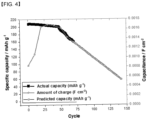
- the capacity data for each cycle separately measured for a general lithium secondary battery in a form of a non-blocking cell that is, a lithium secondary battery in a form of a non-blocking cell is made to correspond to the collected charge amount data for each cycle (see Fig. 4 ).
- the change pattern of the electrode structure e.g., the electrochemical active area of the electrode, etc.
- the degree of degradation of the cell are inferred, while it is possible to secure/collect prediction data on how the capacity y (mAh/g) changes for each x cycle in the lithium secondary battery.
- the prediction expression of the capacity for each cycle can be derived from a relation expression of the capacity y for each x cycle after the electrochemical reaction proceeded for 30 cycles or more, for example, 30 to 200 cycles, or 40 to 100 cycles for the lithium secondary battery in a form of a blocking cell.
- the initial 30 cycles are the stabilization cycles of the battery, and it was confirmed that the capacity calculated from the data of these initial 30 cycles reflects not only the result of the electrochemical reaction on the electrode (storage according to lithium ion diffusion and adsorption) but also the capacity generated during formation of solid-electrolyte interface (SEI). Therefore, it was confirmed that as the prediction expression of the capacity for each cycle is derived based on the data after 30 cycles, the lifespan characteristics of the lithium secondary battery can be predicted more reliably.
- SEI solid-electrolyte interface
- the lifespan characteristics of a lithium secondary battery can be predicted by utilizing the prediction expression of the capacity for each cycle derived through the above process, but an additional correction step may be further performed to further improve its reliability.
- the method of one embodiment may further include a fifth step of correcting the prediction expression of the capacity for each cycle derived in the fourth step by performing the artificial neural network learning, based on the results of impedance spectroscopic analysis performed in the same manner as described above for a plurality of lithium secondary batteries in the form of block cells that are identical or equivalent to the batteries that have undergone the first to third steps.
- the step of deriving the prediction expression by data correspondence of the fourth step and the artificial neural network learning step of the fifth step can be sequentially performed, but each of these steps may be performed simultaneously or within the same system. Furthermore, the calculation of the prediction expression of the capacity for each cycle and the correction by artificial neural network learning can be simultaneously performed in the same system.
- the artificial neural network learning process can be performed by a method of feedback based on data, including electrochemical property data derived from the impedance spectroscopic analysis result, for example, real and imaginary capacitance data of a battery, time constant data, peak distribution data of a capacitance relation graph for each frequency.
- data including electrochemical property data derived from the impedance spectroscopic analysis result, for example, real and imaginary capacitance data of a battery, time constant data, peak distribution data of a capacitance relation graph for each frequency.
- the type and structure of the artificial neural network system that can be applied in the process of learning and correction are not particularly limited, and any artificial neural network system that has been previously applied for evaluating and predicting battery characteristics can be applied.
- Examples of such artificial neural network systems are readily known to those skilled in the art through " Li Y, Dong B, Zerrin T, et al. State-of-health prediction for lithium-ion batteries via electrochemical impedance spectroscopy and artificial neural networks. Energy Storage. 2020; e186 " and “ Soon-Jong Kwon et al, Journal of Electroanalytical Chemistry 858 (2020) 113729 “, etc.
- the lifespan characteristics of a lithium secondary battery can be evaluated through various characteristics such as, for example, the residual capacity per cycle or rate-limiting characteristics. And it is known that these characteristics are affected by changes in the electrode structure due to the formation of the SEI layer on the electrode surface, chemical changes of the electrode active material, and the like.
- the rate-limiting characteristic corresponds to the time constant data of the battery that can be derived from the above-mentioned impedance spectroscopic analysis result, which is related to the charging speed of the battery.
- the rate-limiting characteristic corresponds to the time constant data of the battery that can be derived from the above-mentioned impedance spectroscopic analysis result, which is related to the charging speed of the battery.
- the patterns of rate-limiting characteristics of each battery, changes in the electrode structure resulting therefrom, and lifespan characteristics can be predicted by utilizing the time constant data for a plurality of batteries in the form of blocking cells.
- the rate-limiting characteristic and electrode structure change according to the cycle and the change in capacity are predicted and fed back, and based on the feedback result, the prediction expression of the capacity for each cycle derived in the fourth step can be corrected.
- the peak distribution ( ⁇ ) of the relation graph of the capacitance for each frequency that can be derived from the above-mentioned impedance spectroscopic analysis process is related to the uniformity of the electrode structure, for example, the pore structure in the electrode.
- the change pattern in the electrode pore structure and electrode structure uniformity for each cycle is predicted and fed back, and based on the feedback result, the prediction expression of the capacity for each cycle derived in the fourth step can be corrected.
- the graph of the calculation result of the charge amount for each cycle (Amount of charge) and the prediction expression graph of the capacity for each cycle (Predicted capacity) for the battery in a form of a blocking cell derived from the prediction method of one embodiment described above, and the graph of actual lithium secondary battery capacity for each cycle (Actual capacity) are shown together in Fig. 4 . Referring to Fig. 4 , it is confirmed that the prediction expression of the capacity for each cycle derived from the prediction method of one embodiment can predict the actual measurement result with very high reliability.
- the prediction system of such other embodiments may include, for example, a first measurement unit including an impedance spectroscopic analysis device; a second measurement unit that measures the capacity for each cycle while performing an electrochemical reaction on a lithium secondary battery in the form of a non-block cell; a data processing unit that calculates a charge amount (F/cm 2 ) and a charge amount for each cycle from the impedance spectroscopic analysis result data of the lithium secondary battery in the form of a blocking cell derived from the first measurement unit; and a calculation unit that derives a capacity prediction expression for each cycle of a lithium secondary battery, from the capacity data for each cycle of the lithium secondary battery in a form of a non-blocking cell that is inputted from the second measurement unit and the charge amount data for each cycle of the lithium secondary battery in a form of a blocking cell that is inputted from the data processing unit.
- the data processing unit may calculate the charge amount for each cycle, from the relation data of the imaginary capacitance (F/cm 2 ) for each frequency (Hz) included in the impedance spectroscopic analysis result data.
- a part of the first step of subjecting the lithium secondary battery in a form of a blocking cell to an impedance spectroscopic analysis under the application of multiple frequencies and the third step of repeatedly performing the above impedance spectroscopic analysis for each cycle can be performed.
- a part of the second step and the third step of deriving the relationship of the capacitance (F/cm 2 ) for each frequency (Hz) from the impedance spectroscopic analysis result data, calculating the charge amount (F/cm 2 ) of the lithium secondary battery therefrom and repeatedly performing this process for each cycle to calculate the charge amount for each cycle can be performed.
- the capacity for each cycle can be measured while performing an electrochemical reaction for the lithium secondary battery in a form of a non-blocking cell.
- the fourth step of deriving the prediction expression of the capacity for each cycle of the lithium secondary battery by mutually corresponding the capacity data for each cycle of the lithium secondary battery in a form of a non-blocking cell that is inputted from the second measurement unit and the charge amount data for each cycle of the lithium secondary battery in a form of a blocking cell that is inputted from the data processing unit can be performed.
- the prediction system of the other embodiment may further include an artificial neural network learning unit that performs artificial neural network learning based on the impedance spectroscopic analysis result data that is inputted from the first measurement unit, and corrects the capacity prediction expression for each cycle derived from the calculation unit.
- the artificial neural network learning unit may be separated, or integrated with the calculating unit.
- the process of deriving the prediction expression of the fourth step and the process of correcting the prediction expression by artificial neural network learning of the fifth step may be performed simultaneously.
- the method of predicting lifespan characteristics of the lithium secondary battery of one embodiment can be performed, whereby lifespan characteristics including change pattern of the capacity for each cycle of the lithium secondary battery can be reliably predicted.
- the first and second measurement units included in the prediction system of another embodiment may have a configuration of a general impedance spectroscopy device and a capacity measurement device of a lithium secondary battery, and the data processing unit and the calculating unit (artificial neural network learning unit) may also have a configuration of a general artificial neural network learning system.
- the long-term lifespan characteristics of the lithium secondary battery specifically, the change pattern of the capacity for each cycle can be predicted in advance with very high reliability by utilizing basic battery design elements, without actually manufacturing a lithium secondary battery and performing its long-term lifespan testing,
- a lithium secondary battery in the form of a non-blocking cell was prepared by the following method.
- LiNi 0.8 Co 0.1 Mn 0.1 O 2 was used as a cathode active material. 90 wt% of this LiNi 0.8 Co 0.1 Mn 0.1 O 2 cathode active material, 5 wt% of Super C65 conductive material and 5 wt% of PVdF as a binder was added to NMP as a solvent, and mixed to prepare a cathode slurry. The cathode slurry was applied to an aluminum foil having a thickness of 20 ⁇ m, and then rolled and dried to produce an active material layer and a cathode.
- the electrochemical reactions for each cycle of 10, 20, 30, 40, 50, 60, and 70 cycles were performed, and then the lithium secondary battery in a form of a non-blocking cell was completely discharged to control the SOC to 0%. Then, the lithium secondary battery in a form of a non-blocking cell was disassembled, two identical cathodes were faced each other instead of the anodes, the same separator was interposed therebetween, the same electrolyte solution was injected to produce a lithium secondary battery in a form of a blocking cell corresponding to each cycle.
- Example Derivation of a prediction expression of capacity for each cycle of a lithium secondary battery and evaluation of its reliability
- a Nyquist plot for a battery in the form of a blocking cell for each cycle of Preparation Example was derived, which was shown in Fig. 2 .
- the real impedance ( ⁇ *cm 2 ), imaginary impedance ( ⁇ *cm 2 ), and complex impedance ( ⁇ *cm 2 ) for each frequency (Hz) were derived from the Nyquist plot, respectively, which were then substituted into the following Equation 1, and real capacitance (F/cm 2 ) and imaginary capacitance (F/cm 2 ) for each frequency were derived, respectively.
- C' represents the real capacitance (F/cm 2 ) of the lithium secondary battery,
- C" represents the imaginary capacitance (F/cm 2 ),
- w represents the angular velocity defined as 2*rr*frequency,
- z'(w) represents the real impedance ( ⁇ *cm 2 ) for each angular velocity,
- z"(w) represents the imaginary impedance ( ⁇ *cm 2 ) for each angular velocity,
- z(w) represents the total complex impedance ( ⁇ *cm 2 ) calculated from the real impedance and the imaginary impedance.
- the frequency value of the x-axis corresponding to the peak point was taken as the reciprocal, the time constant and output data of the battery were separately calculated.
- the peak distribution ( ⁇ ) data of the relation graph of capacitance for each frequency were calculated together.
- the lithium secondary battery in a form of a non-blocking cell produced in Preparation Example was subjected to a charge/discharge process of 75 cycles.
- the capacity (mAh/g) for each cycle was measured, and shown as a black graph in Fig. 4 .
- the charge amount data for each cycle for the battery in a form of a blocking cell and the capacity data for each cycle for the battery in a form of a non-blocking cell were made to correspond with each other.
- the prediction data for predicting the change pattern of capacity y for each x cycle were collected.
- the prediction expression for capacity per cycle was derived.
- the time constant of the battery and the peak distribution ( ⁇ ) data of the relation graph of the capacitance for each frequency described above artificial neural network learning was performed, which was fed back to correct the prediction expression for capacity for each cycle derived above.
Landscapes
- Engineering & Computer Science (AREA)
- Physics & Mathematics (AREA)
- General Physics & Mathematics (AREA)
- Chemical & Material Sciences (AREA)
- Theoretical Computer Science (AREA)
- Electrochemistry (AREA)
- General Chemical & Material Sciences (AREA)
- Chemical Kinetics & Catalysis (AREA)
- Manufacturing & Machinery (AREA)
- Software Systems (AREA)
- Data Mining & Analysis (AREA)
- Evolutionary Computation (AREA)
- Computing Systems (AREA)
- General Engineering & Computer Science (AREA)
- Artificial Intelligence (AREA)
- Mathematical Physics (AREA)
- Molecular Biology (AREA)
- Biomedical Technology (AREA)
- Biophysics (AREA)
- Life Sciences & Earth Sciences (AREA)
- General Health & Medical Sciences (AREA)
- Health & Medical Sciences (AREA)
- Computational Linguistics (AREA)
- Materials Engineering (AREA)
- Computer Vision & Pattern Recognition (AREA)
- Medical Informatics (AREA)
- Secondary Cells (AREA)
- Battery Electrode And Active Subsutance (AREA)
Abstract
Description
- Cross Citation with Related Application(s)
- This application claims the benefit of
Korean Patent Application No. 10-2021-0061180 filed on May 12, 2021 - The present disclosure relates to a method for predicting lifespan characteristics of a lithium secondary battery that can reliably predict the lifespan characteristics of a lithium secondary battery, specifically, the change pattern of capacity for each cycle in advance.
- Recently, in order to deal with air pollution or greenhouse gas generation, and global warming, interest in the utilization of new renewable energy has increased significantly. For the smooth utilization of such new renewable energy, the development of efficient energy storage technology must be preceded, and lithium secondary batteries such as lithium ion batteries having a high energy density relative to weight has attracted the most attention as a representative energy storage technology.
- Particularly, in the automobile industry, there are high expectations for the reduction of carbon dioxide emissions due to the introduction of electric vehicles (EV) and hybrid electric vehicles (HEV). For their practical utilization, the development and commercialization of medium or large-sized lithium secondary batteries has actively proceeded.
- For these medium or large-sized lithium secondary batteries, lifespan characteristics that maintain excellent capacity over long periods of time are essentially required along with high capacity, energy density, and output characteristics. Accordingly, in the development process of the lithium secondary battery, research has essentially proceeded to improve the capacity characteristics and lifespan characteristics through research and design of various electrode materials and structures, selection of electrolytes, and battery structures.
- By the way, in the case of the lifespan characteristics of the lithium secondary battery, these are affected by vary various factors, including the material and structure of the electrode, the type of electrolyte, and the overall battery structure and material combination, and there is a disadvantage in that it is difficult to grasp in advance the extent to which each element affects the lifespan characteristics.
- Therefore, in the conventional research and development process for lithium secondary batteries, there is a disadvantage in that it is difficult to predict lifespan characteristics of the battery without actually manufacturing the battery. As a result, there is a disadvantage in that there is no choice but to go through many trials and errors, including actual battery production and long-term testing, in order to develop a battery having long lifespan characteristics.
- Due to these disadvantages, in order to further shorten the research and development process of lithium secondary batteries having excellent lifespan characteristics, there has been a continuous demand for the development of a method that can reliably and easily predict lifespan characteristics of lithium secondary batteries in advance, even through basic information about the battery.
- It is an object of the present disclosure to provide a method for predicting lifespan characteristics of a lithium secondary battery that can reliably predict its lifespan characteristics, specifically, the change pattern of capacity for each cycle in advance, even through basic design information about the lithium secondary battery.
- According to one aspect of the present disclosure, there is provided a method for predicting lifespan characteristics of a lithium secondary battery, the method comprising:
- a first step of subjecting a lithium secondary battery in a form of a blocking cell to an impedance spectroscopic analysis under application of multiple frequencies;
- a second step of deriving a relationship of capacitance (F/cm2) for each frequency (Hz) from the impedance spectroscopic analysis result, and calculating the charge amount (F/cm2) of the lithium secondary battery therefrom;
- a third step of repeatedly performing the first and second steps while repeatedly performing the electrochemical reaction for the lithium secondary battery for x cycles, to thereby collect charge amount (F/cm2) data of the lithium secondary battery for each x cycle; and
- a fourth step of measuring the capacity y (mAh/g) for each x cycle for a lithium secondary battery in a form of a non-blocking cell, and allowing it to correspond to the charge amount (F/cm2) data for each x cycle collected in the third step, to thereby derive a prediction expression of the capacity for each cycle of the lithium secondary battery.
- According to another aspect of the present disclosure, there is provided a system for predicting lifespan characteristics of a lithium secondary battery, the system comprising:
- a first measurement unit including an impedance spectroscopic analysis device;
- a second measurement unit that measures the capacity for each cycle while subjecting a lithium secondary battery in a form of a non-block cell to an electrochemical reaction;
- a data processing unit that calculates a charge amount (F/cm2) and a charge amount for each cycle from the impedance spectroscopic analysis result data of the lithium secondary battery in a form of a blocking cell derived from the first measurement unit; and
- a calculation unit that derives a prediction expression of the capacity for each cycle of a lithium secondary battery, from the capacity data for each cycle of the lithium secondary battery in a form of non-blocking cell that is inputted from the second measurement unit and the charge amount data for each cycle of the lithium secondary battery in a form of blocking cell that is inputted from the data processing unit.
- Now, the method and system for predicting lifespan characteristics of a lithium secondary battery according to an embodiment of the present disclosure will be described in more detail.
- According to one embodiment of the disclosure, there is provided a method for predicting lifespan characteristics of a lithium secondary battery, the method comprising:
- a first step of subjecting a lithium secondary battery in a form of a blocking cell to an impedance spectroscopic analysis under application of multiple frequencies;
- a second step of deriving a relationship of capacitance (F/cm2) for each frequency (Hz) from the impedance spectroscopic analysis result, and calculating the charge amount (F/cm2) of the lithium secondary battery therefrom;
- a third step of repeatedly performing the first and second steps while repeatedly performing the electrochemical reaction for the lithium secondary battery for x cycles, to thereby collect charge amount (F/cm2) data of the lithium secondary battery for each x cycle; and
- a fourth step of measuring the capacity y (mAh/g) for each x cycle for a lithium secondary battery in a form of a non-blocking cell, and allowing it to correspond to the charge amount (F/cm2) data for each x cycle collected in the third step, to thereby derive a prediction expression of the capacity for each cycle of the lithium secondary battery.
- The prediction method of one embodiment may further include a fifth step of performing artificial neural network learning based on the impedance spectroscopic analysis result to correct a prediction expression of the fourth step, and then, may further comprise a sixth step of predicting capacity characteristics for each cycle of the lithium secondary battery to be measured, based on the prediction expression of the fourth step or the corrected prediction expression of the fifth step.
- The present inventors have continued research to develop a method for reliably predicting the lifespan characteristics of a lithium secondary battery in the process of basic research and development. Based on the result of this research, the inventors have performed impedance spectroscopic analysis for a lithium secondary battery in a form of a blocking cell that reflects basic battery elements such as electrode materials and structures and electrolyte materials, and as a result, found that by utilizing the data, it is possible to reliably predict the lifespan characteristics of the lithium secondary battery to be manufactured, and more specifically, the change pattern of capacity for each cycle, and completed the invention. Furthermore, by further correcting the prediction expression of the lifespan characteristics through artificial neural network learning, the lifespan characteristics of the lithium secondary battery can be more reliably predicted in advance.
- More specifically, the present inventors have noted to the fact that the diffusion and mobility of lithium ions occurring on each electrode via the electrolyte inside the lithium secondary battery fundamentally affect the performance of the lithium secondary battery, particularly the lifespan characteristic. Thereby, an attempt was performed to predict lifespan characteristics of a lithium secondary battery in advance by applying a battery in a form a blocking cell that can selectively check and analyze the degree of diffusion and adsorption of lithium ions on the electrode.
- Meanwhile, electrochemical impedance spectroscopy(EIS) is an analysis technique that can analyze various electrochemical reactions for each frequency by applying an alternating current to the battery, and various electrochemical properties of cells can be evaluated over a wide frequency range and a wide range of time. Furthermore, since this impedance spectroscopy utilizes an alternating current signal with a relatively small amplitude (e.g., about 5 to 10 mV), it is known that not only it can evaluate various electrochemical characteristics of a battery while reducing damage to the electrode, but also it is less affected by noise and thus the electrochemical characteristics of the battery can be evaluated with high precision.
- When the electrochemical characteristics of the lithium secondary battery in a form of a blocking cell are analyzed by such impedance spectroscopy, it is possible to obtain data related to various resistance components of the battery depending on the type and structure of the electrolyte and electrode, such as various resistance components including real and imaginary impedance for each frequency, and various electrochemical characteristics such as imaginary and real capacity data for each frequency.
- The present inventors have confirmed that from the electrochemical data obtained by performing impedance spectroscopic analysis of the lithium secondary battery in a form of a blocking cell in this way, it is possible to obtain relation data of capacitance (F/cm2) for each frequency (Hz), specifically, relation data of the imaginary capacitance for each frequency, which are closely related to the amount of lithium ions stored along the electrode surface, and can evaluate the degree of diffusion/adsorption of lithium ions.
- The charge amount (F/cm2) of the lithium secondary battery in a form of a blocking cell can be calculated by utilizing the relation data of the imaginary capacitance for each frequency, and the charge amount data for each cycle of the lithium secondary battery can be calculated by repeating this process while performing the electrochemical reaction cycle of the lithium secondary battery. Separately from this, the capacity data for each cycle separately measured for a general lithium secondary battery, that is, a lithium secondary battery in a form of a non-blocking cell, was made to correspond to the charge amount data for each cycle to thereby infer the change pattern of the electrode structure and the degree of cell degradation for each cycle, while it is possible to obtain prediction data on how the capacity changes for each cycle in an actual lithium secondary battery.
- By utilizing the predicted data of the capacity for each cycle, a relation expression of the capacity y for each x cycle can be derived, which can be used as a prediction expression of the capacity of each cycle of the lithium secondary battery. In addition, as the artificial neural network learning is performed by feeding back additional electrochemical data obtained as the impedance spectroscopic analysis result, the prediction expression of the capacity for each cycle may be corrected and the reliability thereof can be further improved.
- As a result, it was confirmed that by applying the prediction expression of the capacity for each cycle derived through this process, the lifespan characteristics, particularly, the change pattern of the capacity for each cycle for the actual lithium secondary battery comprising the same kind of electrolyte and/or electrode as the battery in a form of a blocking cell can be predicted in advance with very high reliability.
- Therefore, if the prediction method of one embodiment is utilized, the long-term lifespan characteristics of the lithium secondary battery can be predicted in advance with very high reliability by utilizing the basic battery design elements, without actually manufacturing a lithium secondary battery and performing long-term lifespan characteristic testing. As a result, many trials and errors can be reduced in the research and development process of the lithium secondary battery, and the research and development process of the battery can be greatly shortened.
- The prediction method of such one embodiment will be described in more detail for each step.
- In the method of one embodiment, first, the lithium secondary battery in a form of a blocking cell is subjected to an impedance spectroscopic analysis under application of multiple frequencies (first step).
- At this time, the lithium secondary battery in a form of a blocking cell to be analyzed not only includes an electrode (e.g., cathode and/or anode) facing each other similarly to an actual battery, and a separator and an electrolyte therebetween, but refers to a battery form in which an electrochemical reaction between electrodes, such as oxidation or reduction reaction or lithium intercalation/deintercalation reaction, which is referred to as a faradaic reaction, does not occur inside the battery.
- When the lithium secondary battery in a form of a blocking cell is subjected to an impedance spectroscopic analysis under the application of a low-frequency AC signal, only diffusion and adsorption reactions of lithium ions occur along the electrode surface in the inside of the battery in the form of a blocking cell as shown in
Fig. 1 , such lithium ions are stored along the electrode surface. Therefore, by the impedance spectroscopic analysis of the lithium secondary battery in a form of a blocking cell, capacitance is measured for each cycle, the charge amount characteristic is analyzed more reliably, and the lifespan characteristics of the lithium secondary battery can be predicted with very high reliability. - The lithium secondary battery in a form of a blocking cell includes electrodes with the same polarity as electrodes facing each other (e.g., including only cathodes that face each other) in order to prevent an electrochemical reaction between the electrodes, or such an electrode includes a blocking electrode, or can be manufactured in a form including a blocking electrolyte.
- In a specific example, the blocking electrode may be in the form of a pristine electrode in which electrochemical activation is not performed, or an electrode in which the SOC is controlled to 0 or 100%, so as to prevent the progress of lithium intercalation/deintercalation reaction between electrodes after battery manufacture.
- Further, another example of the battery in a form of block cell can be manufactured so as to include a blocking electrolyte such as non-intercalation salt as the electrolyte. The non-intercalation salt refers to a salt form in which the size of the cation contained therein is larger than the interlayer distance of the electrode active material (e.g., lithium transition metal oxide or graphite, etc.), which can thus suppress the electrochemical reaction between the electrodes such as lithium intercalation/deintercalation reaction between the electrodes. More specific examples of such non-intercalation salt may include tetrabutylammonium perchlorate, tetrabutylammonium fluoride, tetrabutylammonium hydrogen sulfate, malondialdehyde tetrabutylammonium, or the like, and additionally, various salts having large cations can be used.
- Meanwhile, the lithium secondary battery in a form of a blocking cell can be manufactured using the same materials and methods as a general battery except for including the above-mentioned blocking electrode or electrolyte, and can reflect the same kind of electrode material, electrode structure and/or electrolyte material as the battery to be actually researched and developed.
- The lithium secondary battery in a form of a blocking cell can be analyzed using general impedance spectroscopy device that has been used for electrochemical characterization of batteries before, and for example, impedance spectroscopic analysis can be performed under the application of an alternating current signal having an amplitude of about 5 to 10 mV and a frequency of 106 to 10-4 Hz.
- Particularly, in the prediction method of one embodiment, as the impedance spectroscopic analysis proceeds under a low frequency of 106 to 10-4 Hz, the reliability of lifespan prediction of a lithium secondary battery can be significantly improved.
- When a general lithium secondary battery is subjected to an impedance spectroscopic analysis in the low frequency region, electrochemical reactions such as intercalation/deintercalation of lithium ions between electrodes occur within the battery. However, if the battery in a form of a blocking cell is subjected to an impedance spectroscopic analysis in the low frequency region, diffusion and adsorption of lithium ions mainly occur on the electrode as described above, and the corresponding lithium ions can be stored along the electrode surface. That is, As a result of impedance spectroscopic analysis under low frequency for the blocking cell type battery, the amount of charge stored along the surface of the electrode can be calculated. Thus, in consideration of this point, a prediction expression of the charge amount data for each cycle and the capacity for each cycle is derived, and the lifespan characteristics of lithium secondary batteries can be predicted with high reliability.
- By the way, during the impedance spectroscopic analysis, diffusion and adsorption of lithium ions occur in the low frequency region, and in the ultra-low frequency range, which is lower than this, side reactions between the electrodes and the electrolyte may occur, which results in the generation of leakage current. By the way, depending on the reactivity of the electrode, a frequency region in which diffusion and adsorption of lithium ions occur may partially overlap with a frequency region in which leakage current occurs. In this case, the amount of charge stored on the electrode surface cannot be properly analyzed and calculated, or a side reaction may occur on the electrode surface to damage the electrode contained in the battery in a form of a blocking cell. As a result, from the impedance spectroscopic analysis result, the charge amount and capacity characteristics for each cycle of the battery cannot be reliably calculated, so that the reliability of the prediction method according to the one embodiment can be significantly reduced.
- Unlike the same, in one embodiment method, the impedance spectroscopic analysis is performed under the application of a frequency of 106 to 10-4 Hz. The capacitance extracted in this analysis process is divided into a leakage current and an absorbed charge, so that the charge stored along the electrode surface inside the lithium secondary battery in a form of a blocking cell can be reliably analyzed and confirmed. As a result, the charge amount and capacity characteristics for each cycle of the battery are reliably calculated, so that the accuracy and reliability of the prediction method of the one embodiment can be significantly improved.
- Meanwhile, as described above, when impedance spectroscopic analysis is performed for a lithium secondary battery in a form of a blocking cell, a Nyquist plot of the lithium secondary battery can be derived as a direct result thereof, and from this, data related to various electrochemical properties of the lithium secondary battery, such as real capacitance data, imaginary capacitance data, time constant data, capacitance relation graph for each frequency and its peak distribution data can be further calculated.
- For reference, in
Fig. 2 , an example of a Nyquist plot directly derived as a result of the impedance spectroscopic analysis is shown. As shown inFig. 2 , the Nyquist plot can be derived as relation data of a real impedance (x-axis, Ω*cm2) and an imaginary impedance (y-axis, Ω*cm2) for each frequency (Hz) applied during the impedance spectroscopic analysis. Further, due to the difference in the occurrence of electrochemical reactions such as intercalation/deintercalation of lithium between electrodes, the Nyquist plot of a lithium secondary battery in a form of a blocking cell appears in a form different from that of a general lithium secondary battery (non-blocking cell). - From the Nyquist plot for the battery in a form of a blocking cell, real impedance (Ω*cm2) and imaginary impedance (Ω*cm2) for each frequency (Hz) can be derived, respectively, and the total complex impedance can be calculated from the real and imaginary impedances.
- Therefore, in the prediction method of one embodiment, a relationship of capacitance (F/cm2) for each frequency (Hz) is derived from the impedance spectroscopic analysis result, and the charge amount (F/cm2) of the lithium secondary battery can be calculated therefrom (second step).
- More specifically, the real impedance (Ω*cm2), imaginary impedance (Ω*cm2) and complex impedance (Ω*cm2) for each frequency (Hz) derived from the Nyquist plot are substituted into the following Equation 1, and a real capacitance (F/cm2) and an imaginary capacitance (F/cm2) for each frequency can be derived, respectively. For reference, the method of deriving real and imaginary capacitances for each frequency from the Nyquist plot are specifically described in "P.L.Taberna et al., Journal of The Electrochemical Society, 150 (3) A292-A300 (2003)" or "Nobuhiro Ogihara et al., J. Phys. Chem. Lett. 2019, 10, 5013-5018", and the like.

in the above Equation 1, C' represents the real capacitance (F/cm2) of the lithium secondary battery, C" represents the imaginary capacitance (F/cm2), w represents the angular velocity defined as 2*rr*frequency, z'(w) represents the real impedance (Ω*cm2) for each angular velocity, z"(w) represents the imaginary impedance (Ω*cm2) for each angular velocity, and z(w) represents the total complex impedance (Ω*cm2) calculated from the real impedance and the imaginary impedance. - That is, the Nyquist plot derived from the above-mentioned impedance spectroscopic analysis, the result of derivation of imaginary impedance, real impedance and complex impedance for each frequency, the relationship of the capacitance for each frequency of the lithium secondary battery from Equation 1, more specifically, a relation graph between real and imaginary capacitances (F/cm2) for each frequency (Hz) can be derived, respectively, and one example of these are shown in
Figs. 3a and 3b , respectively. - Among them, the relation graph of the imaginary capacitance (F/cm2) for each frequency (Hz) of the lithium secondary battery can be derived in the form of a single distribution curve having a single peak, as exemplarily shown in
Fig. 3b . The relation graph of the imaginary capacitance for each frequency can represent the amount of energy lost during the irreversible process, and can correspond to the amount of lithium ions stored along the electrode surface in the battery in a form of a blocking cell. Therefore, the charge amount of the lithium secondary battery can be calculated from the relation graph of the imaginary capacitance for each frequency. - Specifically, as shown in
Fig. 3b , if a baseline (bottom line of area A inFig. 3b ) is set in the graph of the single distribution curve form, and then the area under the peak (A) of this single distribution curve is integrated, the charge amount (F/cm2) of the lithium secondary battery can be calculated from the well-known relation expression between area and charge, specifically, area (A) = 0.682 * charge amount Co (see "Jong Hyun Jang et al, Journal of the Korean Electrochemical Society, 13, 4, 2010, 223-234"), and the structural characteristics within the electrode, such as the electrochemically active area of the electrode, can be predicted from the calculated value of the amount of charge. - In addition to the charge amount of the battery, in the relation graph of the imaginary capacitance for each frequency in the form of a single distribution curve, the time constant and output of the lithium secondary battery can be calculated by taking the frequency value of the x-axis corresponding to the peak point as the reciprocal. In addition, it is possible to calculate the peak distribution (σ) of the relation graph of the imaginary capacitance for each frequency, which can reflect the structural uniformity of the electrode.
- Meanwhile, as shown in
Figs. 2 ,3a and 3b , in the prediction method of one embodiment, while repeating the electrochemical reaction for x cycles of the lithium secondary battery in the form of a blocking cell to be analyzed, the process of the above-mentioned impedance spectroscopic analysis for each regular cycle, the calculation of the amount of charge (F/cm2) of the battery, and deriving various electrochemical characteristic data such as the peak distribution of the relation graph of the capacitance by time constant, output, and frequency of other batteries can be repeatedly performed (third step). - Through such repetitively performing processes, charge amount data for each x cycle can be collected for the lithium secondary battery in a form of a blocking cell. In addition, separately from the charge amount data for each cycle, the capacity data for each cycle separately measured for a general lithium secondary battery in a form of a non-blocking cell, that is, a lithium secondary battery in a form of a non-blocking cell is made to correspond to the collected charge amount data for each cycle (see
Fig. 4 ). From the result of the correspondence between these data, the change pattern of the electrode structure (e.g., the electrochemical active area of the electrode, etc.) for each cycle and the degree of degradation of the cell are inferred, while it is possible to secure/collect prediction data on how the capacity y (mAh/g) changes for each x cycle in the lithium secondary battery. - When linear regression is performed on the prediction data of capacity y for each x cycle collected by such a method, the prediction expression of the capacity for each cycle of the lithium secondary battery may be derived in the form of, for example, y= ax+b (a and b are constants determined by linear regression) (fourth step).
- In such a linear regression process, the prediction expression of the capacity for each cycle can be derived from a relation expression of the capacity y for each x cycle after the electrochemical reaction proceeded for 30 cycles or more, for example, 30 to 200 cycles, or 40 to 100 cycles for the lithium secondary battery in a form of a blocking cell.
- For reference, the initial 30 cycles are the stabilization cycles of the battery, and it was confirmed that the capacity calculated from the data of these initial 30 cycles reflects not only the result of the electrochemical reaction on the electrode (storage according to lithium ion diffusion and adsorption) but also the capacity generated during formation of solid-electrolyte interface (SEI). Therefore, it was confirmed that as the prediction expression of the capacity for each cycle is derived based on the data after 30 cycles, the lifespan characteristics of the lithium secondary battery can be predicted more reliably.
- Meanwhile, in the method of one embodiment, the lifespan characteristics of a lithium secondary battery can be predicted by utilizing the prediction expression of the capacity for each cycle derived through the above process, but an additional correction step may be further performed to further improve its reliability. For this purpose, the method of one embodiment may further include a fifth step of correcting the prediction expression of the capacity for each cycle derived in the fourth step by performing the artificial neural network learning, based on the results of impedance spectroscopic analysis performed in the same manner as described above for a plurality of lithium secondary batteries in the form of block cells that are identical or equivalent to the batteries that have undergone the first to third steps.
- At this time, the step of deriving the prediction expression by data correspondence of the fourth step and the artificial neural network learning step of the fifth step can be sequentially performed, but each of these steps may be performed simultaneously or within the same system. Furthermore, the calculation of the prediction expression of the capacity for each cycle and the correction by artificial neural network learning can be simultaneously performed in the same system.
- Meanwhile, the artificial neural network learning process can be performed by a method of feedback based on data, including electrochemical property data derived from the impedance spectroscopic analysis result, for example, real and imaginary capacitance data of a battery, time constant data, peak distribution data of a capacitance relation graph for each frequency. Through this, the reliability can be improved by correcting the prediction expression of the capacity for each cycle in the fourth step.
- The type and structure of the artificial neural network system that can be applied in the process of learning and correction are not particularly limited, and any artificial neural network system that has been previously applied for evaluating and predicting battery characteristics can be applied. Examples of such artificial neural network systems are readily known to those skilled in the art through "Li Y, Dong B, Zerrin T, et al. State-of-health prediction for lithium-ion batteries via electrochemical impedance spectroscopy and artificial neural networks. Energy Storage. 2020; e186" and "Soon-Jong Kwon et al, Journal of Electroanalytical Chemistry 858 (2020) 113729", etc.
- Meanwhile, specific examples of advancing the artificial neural network learning will be described as follows.
- It is known that the lifespan characteristics of a lithium secondary battery can be evaluated through various characteristics such as, for example, the residual capacity per cycle or rate-limiting characteristics. And it is known that these characteristics are affected by changes in the electrode structure due to the formation of the SEI layer on the electrode surface, chemical changes of the electrode active material, and the like.
- Among them, the rate-limiting characteristic corresponds to the time constant data of the battery that can be derived from the above-mentioned impedance spectroscopic analysis result, which is related to the charging speed of the battery. For example, in the case of a battery with a short time constant and good rate-limiting characteristics, sufficient capacity can be expressed under the same conditions of charging, and conversely, in the case of a battery with a long time constant and poor rate-limiting characteristics, it may be difficult to exhibit a sufficient capacity under the same conditions of charging.
- Therefore, in the artificial neural network learning process according to one embodiment, the patterns of rate-limiting characteristics of each battery, changes in the electrode structure resulting therefrom, and lifespan characteristics (capacity characteristics for each cycle) can be predicted by utilizing the time constant data for a plurality of batteries in the form of blocking cells.
- In other words, by utilizing the time constant data derived from the impedance spectroscopic analysis result as described above, the rate-limiting characteristic and electrode structure change according to the cycle and the change in capacity are predicted and fed back, and based on the feedback result, the prediction expression of the capacity for each cycle derived in the fourth step can be corrected.
- In addition, it is known that the peak distribution (σ) of the relation graph of the capacitance for each frequency that can be derived from the above-mentioned impedance spectroscopic analysis process is related to the uniformity of the electrode structure, for example, the pore structure in the electrode.
- Therefore, in the artificial neural network learning process according to another embodiment, by utilizing the peak distribution data of the relation graph of capacitance for each frequency, the change pattern in the electrode pore structure and electrode structure uniformity for each cycle is predicted and fed back, and based on the feedback result, the prediction expression of the capacity for each cycle derived in the fourth step can be corrected.
- In this manner, when various electrochemical characteristic data derived from the impedance spectroscopic analysis process, for example, data related to the change pattern of the electrode structure for each cycle, are fed back and subjected to artificial neural network learning, the data according to the change mode of the electrode structure are considered together in the prediction expression of the capacity for each cycle from the result of charge amount calculation for each cycle, and can be finally derived in a state in which the reliability is greatly improved.
- By utilizing the prediction expression of the capacity for each cycle finally derived as described above, it is possible to predict the cycle capacity characteristics of the measurement target lithium secondary battery to be actually manufactured (sixth step). For example, if the above-mentioned prediction expression in the form of a linear function is used, it is possible to predict with great certainty what capacity an actual lithium secondary battery containing electrodes and/or electrolytes of the same kind as a battery in the form of blocked cells exhibits for each cycle.
- The graph of the calculation result of the charge amount for each cycle (Amount of charge) and the prediction expression graph of the capacity for each cycle (Predicted capacity) for the battery in a form of a blocking cell derived from the prediction method of one embodiment described above, and the graph of actual lithium secondary battery capacity for each cycle (Actual capacity) are shown together in
Fig. 4 . Referring toFig. 4 , it is confirmed that the prediction expression of the capacity for each cycle derived from the prediction method of one embodiment can predict the actual measurement result with very high reliability. - Meanwhile, according to another embodiment of the present disclosure, there is provided a system for predicting lifespan characteristics of a lithium secondary battery that performs the prediction method of one embodiment described above. The prediction system of such other embodiments may include, for example, a first measurement unit including an impedance spectroscopic analysis device; a second measurement unit that measures the capacity for each cycle while performing an electrochemical reaction on a lithium secondary battery in the form of a non-block cell; a data processing unit that calculates a charge amount (F/cm2) and a charge amount for each cycle from the impedance spectroscopic analysis result data of the lithium secondary battery in the form of a blocking cell derived from the first measurement unit; and a calculation unit that derives a capacity prediction expression for each cycle of a lithium secondary battery, from the capacity data for each cycle of the lithium secondary battery in a form of a non-blocking cell that is inputted from the second measurement unit and the charge amount data for each cycle of the lithium secondary battery in a form of a blocking cell that is inputted from the data processing unit.
- In the prediction system of the other embodiment, the data processing unit may calculate the charge amount for each cycle, from the relation data of the imaginary capacitance (F/cm2) for each frequency (Hz) included in the impedance spectroscopic analysis result data.
- In the prediction system of such other embodiment, in the first measurement unit, a part of the first step of subjecting the lithium secondary battery in a form of a blocking cell to an impedance spectroscopic analysis under the application of multiple frequencies and the third step of repeatedly performing the above impedance spectroscopic analysis for each cycle can be performed.
- In addition, in the data processing unit, a part of the second step and the third step of deriving the relationship of the capacitance (F/cm2) for each frequency (Hz) from the impedance spectroscopic analysis result data, calculating the charge amount (F/cm2) of the lithium secondary battery therefrom and repeatedly performing this process for each cycle to calculate the charge amount for each cycle can be performed.
- Further, in the second measurement unit, the capacity for each cycle can be measured while performing an electrochemical reaction for the lithium secondary battery in a form of a non-blocking cell.
- And, in the calculation unit, the fourth step of deriving the prediction expression of the capacity for each cycle of the lithium secondary battery by mutually corresponding the capacity data for each cycle of the lithium secondary battery in a form of a non-blocking cell that is inputted from the second measurement unit and the charge amount data for each cycle of the lithium secondary battery in a form of a blocking cell that is inputted from the data processing unit can be performed.
- In addition, the prediction system of the other embodiment may further include an artificial neural network learning unit that performs artificial neural network learning based on the impedance spectroscopic analysis result data that is inputted from the first measurement unit, and corrects the capacity prediction expression for each cycle derived from the calculation unit. The artificial neural network learning unit may be separated, or integrated with the calculating unit. When the artificial neural network learning unit and the calculating unit are integrated into a single system, the process of deriving the prediction expression of the fourth step and the process of correcting the prediction expression by artificial neural network learning of the fifth step may be performed simultaneously.
- As described above, by utilizing the prediction system of another embodiment, the method of predicting lifespan characteristics of the lithium secondary battery of one embodiment can be performed, whereby lifespan characteristics including change pattern of the capacity for each cycle of the lithium secondary battery can be reliably predicted.
- However, the first and second measurement units included in the prediction system of another embodiment may have a configuration of a general impedance spectroscopy device and a capacity measurement device of a lithium secondary battery, and the data processing unit and the calculating unit (artificial neural network learning unit) may also have a configuration of a general artificial neural network learning system.
- In addition, with respect to the specific method of the first to fifth steps carried out in each part of the prediction system, since the method of one embodiment has already been described above, a further description thereof will be omitted.
- As described above, according to the present disclosure, the long-term lifespan characteristics of the lithium secondary battery, specifically, the change pattern of the capacity for each cycle can be predicted in advance with very high reliability by utilizing basic battery design elements, without actually manufacturing a lithium secondary battery and performing its long-term lifespan testing,
- Therefore, when applying the prediction method and prediction system of the present disclosure, it is possible to reduce many trials and errors in the research and development process of lithium secondary batteries, and significantly shorten the research and development process of batteries.
-
-
Fig. 1 is a diagram schematically showing diffusion and adsorption reactions of lithium ions that occur during impedance spectroscopic analysis inside a lithium secondary battery in a form of a blocking cell used in a prediction method according to an embodiment of the present disclosure. -
Fig. 2 is a diagram showing an example of a Nyquist plot derived as a result of impedance spectroscopy in a prediction method according to an embodiment of the present disclosure, -
Fig. 3a is a diagram showing an example of a relation graph of real capacitance (F/cm2) for each frequency (Hz) derived from a Nyquist plot in a prediction method according to an embodiment of the present disclosure,Fig. 3b is a diagram showing an example of a relation graph of an imaginary capacitance (F/cm2) for each frequency (Hz) derived from the Nyquist plot. -
Fig. 4 is a diagram showing a comparison of the graph of the calculation result of the amount of charge for each cycle (Amount of charge) and the prediction expression graph of the capacity per cycle (Predicted capacity) for a lithium secondary battery in a form of a blocking cell derived from the prediction method according to an embodiment of the disclosure, and the measured graph of the capacities for each cycle (Actual capacity) for an actual lithium secondary battery in a form of a non-blocking cell. - Hereinafter, preferred embodiments are described to help the understanding of the present disclosure. However, the following examples are for illustrative purposes only and the present disclosure is not intended thereby.
- First, a lithium secondary battery in the form of a non-blocking cell was prepared by the following method.
- LiNi0.8Co0.1Mn0.1O2 was used as a cathode active material. 90 wt% of this LiNi0.8Co0.1Mn0.1O2 cathode active material, 5 wt% of Super C65 conductive material and 5 wt% of PVdF as a binder was added to NMP as a solvent, and mixed to prepare a cathode slurry. The cathode slurry was applied to an aluminum foil having a thickness of 20 µm, and then rolled and dried to produce an active material layer and a cathode.
- Meanwhile, 1 mm lithium metal was used as the anode active material.
- The anode and cathode respectively produced above were cut, a porous polyethylene separator was interposed between the cathode and the anode, and then an electrolyte solution in which 1M of LiPF6 was dissolved in a mixed solvent of EC: DEC = 1:1 (volume ratio) was injected to produce a lithium secondary battery in a form of a non-blocking cell. For such a lithium secondary battery in a form of a non-blocking cell, a total of 75 cycles of electrochemical reaction (charge/discharge) proceeded at voltage range of 3.0 to 4.2V under the conditions of charge CC (0.5 C), CV (0.05 C) and discharge CC (0.5 C), CV (0.05 C).
- In the process of proceeding the electrochemical reaction of the 75 cycles, the electrochemical reactions for each cycle of 10, 20, 30, 40, 50, 60, and 70 cycles were performed, and then the lithium secondary battery in a form of a non-blocking cell was completely discharged to control the SOC to 0%. Then, the lithium secondary battery in a form of a non-blocking cell was disassembled, two identical cathodes were faced each other instead of the anodes, the same separator was interposed therebetween, the same electrolyte solution was injected to produce a lithium secondary battery in a form of a blocking cell corresponding to each cycle.
- In the Preparation Example, after the electrochemical reaction of 10, 20, 30, 40, 50, 60 and 70 cycles, impedance spectroscopic analysis was performed for the lithium secondary batteries in the form of blocking cells respectively manufactured by the following method.
- This analysis was performed using impedance spectroscopy device (manufacturer: Biologic; product name: SP-300), and proceeded under the application of an AC signal having an amplitude of 10 mV and a frequency of 106 to 10 -4 Hz.
- From these impedance spectroscopic analysis results, a Nyquist plot for a battery in the form of a blocking cell for each cycle of Preparation Example was derived, which was shown in
Fig. 2 . Then, the real impedance (Ω*cm2), imaginary impedance (Ω*cm2), and complex impedance (Ω*cm2) for each frequency (Hz) were derived from the Nyquist plot, respectively, which were then substituted into the following Equation 1, and real capacitance (F/cm2) and imaginary capacitance (F/cm2) for each frequency were derived, respectively.

in the above Equation 1, C' represents the real capacitance (F/cm2) of the lithium secondary battery, C" represents the imaginary capacitance (F/cm2), w represents the angular velocity defined as 2*rr*frequency, z'(w) represents the real impedance (Ω*cm2) for each angular velocity, z"(w) represents the imaginary impedance (Ω*cm2) for each angular velocity, and z(w) represents the total complex impedance (Ω*cm2) calculated from the real impedance and the imaginary impedance. - From the above derivation results, a relation graph of real and imaginary capacitances (F/cm2) for each frequency (Hz) for the battery in a form of a blocking cell for each cycle was derived, and shown in
Figs. 3a and 3b , respectively. In addition, as shown inFig. 3b , in the relation graph of the number of imaginary capacitances for each frequency, the baseline of the single distribution curve (bottom line of area A inFig. 3b ) was set and then the area under the peak (A) of this single distribution curve was integrated, and substituted into the relation expression of area (A) = 0.682 * charge amount Co. Thereby, the charge amount (F/cm2) for each cycle of the blocking cell type battery was calculated, respectively. The data of the charge amount for each cycle calculated and collected through this process is shown in the graph of Amount of charge inFig. 4 . - Separately from this, in the relation graph of the imaginary capacitance for each frequency, the frequency value of the x-axis corresponding to the peak point was taken as the reciprocal, the time constant and output data of the battery were separately calculated. In addition, the peak distribution (σ) data of the relation graph of capacitance for each frequency were calculated together.
- Meanwhile, separately from the above process, the lithium secondary battery in a form of a non-blocking cell produced in Preparation Example was subjected to a charge/discharge process of 75 cycles. The capacity (mAh/g) for each cycle was measured, and shown as a black graph in
Fig. 4 . - Then, the charge amount data for each cycle for the battery in a form of a blocking cell and the capacity data for each cycle for the battery in a form of a non-blocking cell were made to correspond with each other. Thus, the prediction data for predicting the change pattern of capacity y for each x cycle were collected. Among these data, by linear regression of the predicted data of capacity y for each x cycle collected at 30 or more cycles, the prediction expression for capacity per cycle was derived. On the other hand, by using the time constant of the battery and the peak distribution (σ) data of the relation graph of the capacitance for each frequency described above, artificial neural network learning was performed, which was fed back to correct the prediction expression for capacity for each cycle derived above.
- Through the process described above, a graph (blue in
Fig. 4 ; y=-1.40184x+64.2) of the final corrected capacity for each cycle was derived, respectively, and shown inFig. 4 . Comparing this with the actual graph of the capacity (mAh/g) for each cycle shown in the black graph ofFig. 4 , it is confirmed that the prediction expression of the capacity for each cycle derived in Examples reflects the actual measurement results with very high reliability.
Claims (14)
- A method for predicting lifespan characteristics of a lithium secondary battery, the method comprising:a first step of subjecting a lithium secondary battery in a form of a blocking cell to an impedance spectroscopic analysis under application of multiple frequencies;a second step of deriving a relationship of capacitance (F/cm2) for each frequency (Hz) from the impedance spectroscopic analysis result, and calculating the charge amount (F/cm2) of the lithium secondary battery therefrom;a third step of repeatedly performing the first and second steps while repeatedly performing the electrochemical reaction for the lithium secondary battery for x cycles, to thereby collect charge amount (F/cm2) data of the lithium secondary battery for each x cycle; anda fourth step of measuring the capacity y (mAh/g) for each x cycle for a lithium secondary battery in a form of a non-blocking cell, and allowing it to correspond to the charge amount (F/cm2) data for each x cycle collected in the third step, to thereby derive a prediction expression of the capacity for each cycle of the lithium secondary battery.
- The method for predicting lifespan characteristics of a lithium secondary battery according to claim 1, whereinthe blocking cell type lithium secondary battery includes an electrode, a separator, and an electrolyte facing each other, andthe facing electrode includes an electrode of the same polarity or a pristine electrode, or the electrolyte includes a non-intercalation salt.
- The method for predicting lifespan characteristics of a lithium secondary battery according to claim 1, wherein the impedance spectroscopic analysis of the first step is performed under the application of a frequency of 106 to 10 -4 Hz.
- The method for predicting lifespan characteristics of a lithium secondary battery according to claim 1, wherein as a result of the impedance spectroscopic analysis, the result data including Nyquist plot of the lithium secondary battery, real capacitance data, imaginary capacitance data, time constant data, capacitance relation graph for each frequency and its peak distribution data are derived.
- The method for predicting lifespan characteristics of a lithium secondary battery according to claim 4, wherein the second step comprises,deriving a relation graph of the imaginary capacitance (F/cm2) for each frequency (Hz) of the lithium secondary battery; andcalculating the charge amount (F/cm2) of the lithium secondary battery from the integral value of the relation graph.
- The method for predicting lifespan characteristics of a lithium secondary battery according to claim 5, wherein the step of deriving a relation graph of the imaginary capacitance for each frequency comprises,deriving a Nyquist plot of the lithium secondary battery from the results of the impedance spectroscopic analysis; andsubstituting the real impedance (Ω*cm2), imaginary impedance (Ω*cm2) and complex impedance (Ω*cm2) for each frequency (Hz) derived from the Nyquist plot into the following Equation 1, and deriving a real capacitance (F/cm2) and an imaginary capacitance (F/cm2) for each frequency, respectively:
 in the above Equation 1, C' represents the real capacitance (F/cm2) of the lithium secondary battery, C" represents the imaginary capacitance (F/cm2), w represents the angular velocity defined as 2*π*frequency, z'(w) represents the real impedance (Ω*cm2) for each angular velocity, z"(w) represents the imaginary impedance (Ω*cm2) for each angular velocity, and z(w) represents the total complex impedance (Ω*cm2) calculated from the real impedance and the imaginary impedance.
 - The method for predicting lifespan characteristics of a lithium secondary battery according to claim 1, further comprising a fifth step of correcting the prediction expression of the fourth step by performing artificial neural network learning based on the impedance spectroscopic analysis result.
- The method for predicting lifespan characteristics of a lithium secondary battery according to claim 1, wherein the prediction expression for the capacity for each cycle in the fourth step is derived from the relational expression of the capacity y for each x cycle after 30 or more cycles of electrochemical reactions are performed for the lithium secondary battery.
- The method for predicting lifespan characteristics of a lithium secondary battery according to claim 7, wherein the data correspondence step of the fourth step and the artificial neural network learning step of the fifth step are performed simultaneously or within the same system, so that a prediction expression for the capacity for each cycle of the lithium secondary battery is derived.
- The method for predicting lifespan characteristics of a lithium secondary battery according to claim 7, wherein:as a result of the impedance spectroscopic analysis, the result data including Nyquist plot of the lithium secondary battery, real capacitance data, imaginary capacitance data, time constant data, capacitance relation graph for each frequency and its peak distribution data are derived, andin the fifth step, artificial neural network learning is performed based on the data including real capacitance data, imaginary capacitance data, time constant data, and peak distribution data of a capacitance relation graph for each frequency derived from the impedance spectroscopic analysis result.
- The method for predicting lifespan characteristics of a lithium secondary battery according to claim 1 or 7, further comprising a sixth step of predicting the capacity characteristics for each cycle of the lithium secondary battery to be measured, based on the prediction expression of the fourth step or the corrected prediction expression of the fifth step.
- A system for predicting lifespan characteristics of a lithium secondary battery, the system comprising:a first measurement unit including an impedance spectroscopic analysis device;a second measurement unit that measures the capacity for each cycle while subjecting a lithium secondary battery in a form of a non-block cell to an electrochemical reaction;a data processing unit that calculates a charge amount (F/cm2) and a charge amount for each cycle from the impedance spectroscopic analysis result data of the lithium secondary battery in a form of a blocking cell derived from the first measurement unit; anda calculation unit that derives an prediction expression of the capacity for each cycle of a lithium secondary battery, from the capacity data for each cycle of the lithium secondary battery in a form of non-blocking cell that is inputted from the second measurement unit and the charge amount data for each cycle of the lithium secondary battery in a form of blocking cell that is inputted from the data processing unit.
- The system for predicting lifespan characteristics of a lithium secondary battery according to claim 12, wherein the data processing unit calculates the charge amount for each cycle, from the relation data of the imaginary capacitance (F/cm2) for each frequency (Hz) included in the impedance spectroscopic analysis result data.
- The system for predicting lifespan characteristics of a lithium secondary battery according to claim 12, further comprising an artificial neural network learning unit that performs artificial neural network learning based on the impedance spectroscopic analysis result data that is inputted from the first measurement unit, and corrects the capacity prediction expression for each cycle derived from the calculation unit.
Applications Claiming Priority (3)
| Application Number | Priority Date | Filing Date | Title |
|---|---|---|---|
| KR20210061180 | 2021-05-12 | ||
| KR1020220037272A KR20220154013A (en) | 2021-05-12 | 2022-03-25 | Method for predicting long-term cycle property of lithium secondary battery |
| PCT/KR2022/004450 WO2022239963A1 (en) | 2021-05-12 | 2022-03-29 | Method for predicting lifetime characteristics of lithium secondary battery |
Publications (3)
| Publication Number | Publication Date |
|---|---|
| EP4202459A1 true EP4202459A1 (en) | 2023-06-28 |
| EP4202459A4 EP4202459A4 (en) | 2024-04-10 |
| EP4202459B1 EP4202459B1 (en) | 2024-08-07 |
Family
ID=84028580
Family Applications (1)
| Application Number | Title | Priority Date | Filing Date |
|---|---|---|---|
| EP22807611.3A Active EP4202459B1 (en) | 2021-05-12 | 2022-03-29 | Method for predicting lifetime characteristics of lithium secondary battery |
Country Status (7)
| Country | Link |
|---|---|
| US (1) | US12498424B2 (en) |
| EP (1) | EP4202459B1 (en) |
| CN (1) | CN116324447B (en) |
| ES (1) | ES2993004T3 (en) |
| HU (1) | HUE068522T2 (en) |
| PL (1) | PL4202459T3 (en) |
| WO (1) | WO2022239963A1 (en) |
Families Citing this family (1)
| Publication number | Priority date | Publication date | Assignee | Title |
|---|---|---|---|---|
| DE102022205892B4 (en) * | 2022-06-10 | 2024-09-19 | Volkswagen Aktiengesellschaft | Method for condition analysis of a traction battery and motor vehicle |
Family Cites Families (30)
| Publication number | Priority date | Publication date | Assignee | Title |
|---|---|---|---|---|
| KR100395516B1 (en) * | 1998-11-19 | 2003-12-18 | 금호석유화학 주식회사 | Method and apparatus for digitizing characteristic factor of power storage device using nonlinear equivalent circuit model |
| KR100388314B1 (en) * | 2001-09-03 | 2003-06-25 | 금호석유화학 주식회사 | method to group single cells of power sources to build optimal packs using parameters obtained by analysis of impedance spectrum |
| KR100911316B1 (en) | 2007-08-23 | 2009-08-11 | 주식회사 엘지화학 | Battery long-term prediction system and method |
| KR100936892B1 (en) | 2007-09-13 | 2010-01-14 | 주식회사 엘지화학 | Battery long-term prediction system and method |
| DE102009000337A1 (en) | 2009-01-21 | 2010-07-22 | Robert Bosch Gmbh | Method for determining an aging state of a battery cell by means of impedance spectroscopy |
| JP2012122817A (en) | 2010-12-07 | 2012-06-28 | Gs Yuasa Corp | Reversible capacity estimation method of nonaqueous electrolyte secondary battery, life prediction method, reversible capacity estimation method, life prediction device and power storage system |
| JP5896230B2 (en) | 2012-05-28 | 2016-03-30 | トヨタ自動車株式会社 | Electrode manufacturing method and active material evaluation method |
| JP2014044149A (en) | 2012-08-28 | 2014-03-13 | Suzuki Motor Corp | Method for estimating deterioration of lithium ion battery |
| US10386422B2 (en) * | 2014-07-25 | 2019-08-20 | Lithium Balance A/S | Electrochemical impedance spectroscopy in battery management systems |
| KR102156866B1 (en) | 2014-11-14 | 2020-09-17 | 한국전기연구원 | Apparatus for forecasting life cycle of battery based on AC impedance by using very low current |
| JP6577249B2 (en) * | 2015-06-01 | 2019-09-18 | ユニチカ株式会社 | Evaluation cell and evaluation method |
| KR20170107738A (en) | 2016-03-16 | 2017-09-26 | 주식회사 엘지화학 | System and method for evaluating cell |
| US10209314B2 (en) * | 2016-11-21 | 2019-02-19 | Battelle Energy Alliance, Llc | Systems and methods for estimation and prediction of battery health and performance |
| KR101792975B1 (en) | 2017-04-25 | 2017-11-02 | 한국기술교육대학교 산학협력단 | Method for Predicting State of Health of Battery Based on Numerical Simulation Data |
| CN108736057A (en) * | 2017-07-14 | 2018-11-02 | 苏州威星能源科技有限公司 | A kind of lithium battery solid electrolyte and preparation method, dielectric film and its application |
| CN107607880B (en) * | 2017-09-19 | 2020-04-24 | 哈尔滨工业大学 | Lithium ion battery internal health feature extraction method based on impedance spectrum |
| KR101949449B1 (en) | 2017-11-07 | 2019-02-18 | 주식회사 스마트이앤엠 | Method and apparatus for estimating battery life |
| KR101958306B1 (en) | 2017-12-28 | 2019-03-15 | 한국전력공사 | Apparatus for estimating battery state of health |
| KR102233953B1 (en) | 2018-06-28 | 2021-03-30 | 박미영 | Electrode for structural batteries, manufacturing method of the electrode, and structural batteries using the electrode |
| US12512505B2 (en) * | 2018-07-18 | 2025-12-30 | The Regents Of The University Of Michigan | System and method for atomic layer deposition of solid electrolytes |
| KR102106775B1 (en) | 2018-08-14 | 2020-05-06 | 오토시맨틱스 주식회사 | Diagnosis method of battery using Deep Learning |
| KR101982120B1 (en) | 2018-08-31 | 2019-05-24 | 주식회사 민테크 | Method for estimating state of health of energy storage device |
| CN109581240B (en) * | 2018-11-29 | 2020-05-29 | 北京航空航天大学 | Lithium ion battery failure analysis method based on alternating current impedance method |
| JP7157909B2 (en) | 2018-12-20 | 2022-10-21 | トヨタ自動車株式会社 | Battery capacity estimation method and battery capacity estimation device |
| KR20210137501A (en) | 2019-03-07 | 2021-11-17 | 유니버시티 오브 케이프 타운 | Characterization of Electricity Production Cells Using Broadband Impedance Spectroscopy |
| KR102354112B1 (en) | 2019-03-26 | 2022-01-24 | 서강대학교산학협력단 | Apparatus and method for estimating status of battery based on artificial intelligence |
| CN110320474A (en) * | 2019-05-28 | 2019-10-11 | 合肥国轩高科动力能源有限公司 | A Lifetime Prediction Method for Lithium-ion Battery Aging Model |
| CN110376525A (en) * | 2019-07-29 | 2019-10-25 | 国网河南省电力公司电力科学研究院 | A method of evaluating retired ferric phosphate lithium cell life time decay performance |
| CN111537904A (en) * | 2020-04-09 | 2020-08-14 | 苏州湛云科技有限公司 | Lithium ion battery life estimation method based on alternating current impedance imaginary part |
| CN111766527B (en) | 2020-07-03 | 2023-01-24 | 上海大学 | Method for predicting capacity of all-solid-state polymer electrolyte lithium battery in physical aging process |
-
2022
- 2022-03-29 WO PCT/KR2022/004450 patent/WO2022239963A1/en not_active Ceased
- 2022-03-29 HU HUE22807611A patent/HUE068522T2/en unknown
- 2022-03-29 ES ES22807611T patent/ES2993004T3/en active Active
- 2022-03-29 EP EP22807611.3A patent/EP4202459B1/en active Active
- 2022-03-29 US US18/028,134 patent/US12498424B2/en active Active
- 2022-03-29 PL PL22807611.3T patent/PL4202459T3/en unknown
- 2022-03-29 CN CN202280006782.2A patent/CN116324447B/en active Active
Also Published As
| Publication number | Publication date |
|---|---|
| US20230324469A1 (en) | 2023-10-12 |
| CN116324447A (en) | 2023-06-23 |
| HUE068522T2 (en) | 2024-12-28 |
| ES2993004T3 (en) | 2024-12-20 |
| EP4202459B1 (en) | 2024-08-07 |
| PL4202459T3 (en) | 2024-12-16 |
| US12498424B2 (en) | 2025-12-16 |
| EP4202459A4 (en) | 2024-04-10 |
| CN116324447B (en) | 2025-09-23 |
| WO2022239963A1 (en) | 2022-11-17 |
Similar Documents
| Publication | Publication Date | Title |
|---|---|---|
| Soni et al. | Lithium-sulfur battery diagnostics through distribution of relaxation times analysis | |
| JP7096973B2 (en) | Non-aqueous electrolyte secondary battery manufacturing method and manufacturing system | |
| JP5975274B2 (en) | Electrode inspection method and use thereof | |
| US10371753B1 (en) | Methods for online estimation of battery capacity and state of health | |
| Tang et al. | Systematic parameter acquisition method for electrochemical model of 4.35 V LiCoO2 batteries | |
| EP3657160A1 (en) | Electrode performance evaluation system and electrode performance evaluation method | |
| KR101847550B1 (en) | Non-aqueous electrolyte secondary battery and method for producing same | |
| Chae et al. | Redox equilibrium of a zwitterionic radical polymer in a non-aqueous electrolyte as a novel Li+ host material in a Li-ion battery | |
| Rashid et al. | Experimental assessment and model development of cycling behavior in Li-ion coin cells | |
| KR102255524B1 (en) | Establishing method for charging protocol for secondary battery and battery management system for secondary battery comprising the charging protocol established by the same | |
| EP4202459B1 (en) | Method for predicting lifetime characteristics of lithium secondary battery | |
| WO2022196114A1 (en) | Secondary battery system and program | |
| KR20190099998A (en) | Non-aqueous electrolyte for lithium secondary battery and lithium secondary battery having the same | |
| US20240105959A1 (en) | Coated Cathode | |
| KR20220154013A (en) | Method for predicting long-term cycle property of lithium secondary battery | |
| Tang et al. | Simulating the distribution of electrochemical characteristics: a case study of 4.35 V LiCoO2/graphite pouch cell | |
| KR20190100000A (en) | Non-aqueous electrolyte solutions for rechargeable battery, non-aqueous electrolyte rechargeable battery having the same | |
| EP4216249A1 (en) | Current separation method for nonaqueous lithium power storage element, prediction method, system and like | |
| Sun et al. | Electrochemical and impedance investigation of the effect of lithium malonate on the performance of natural graphite electrodes in lithium-ion batteries | |
| US10753978B2 (en) | Method for testing all solid state battery, method for producing all solid state battery, and method for producing battery pack | |
| Zhang et al. | Unravelling the failure mechanism of sodium ion pouch cell with layered cathode cycled under high voltage | |
| EP4106066A2 (en) | Nonaqueous electrolyte secondary battery, and method for fabricating nonaqueous electrolyte secondary battery | |
| De Sutter et al. | Incremental Pressure Curves to Assess Capacity Fade in Next-Generation Li-Ion Pouch Cells | |
| CN116583925B (en) | Current separation method, prediction method and system for non-aqueous lithium storage element | |
| Barnes et al. | Non-uniform cycling of Li metal batteries: Impacts to life and performance |
Legal Events
| Date | Code | Title | Description |
|---|---|---|---|
| STAA | Information on the status of an ep patent application or granted ep patent |
Free format text: STATUS: THE INTERNATIONAL PUBLICATION HAS BEEN MADE |
|
| PUAI | Public reference made under article 153(3) epc to a published international application that has entered the european phase |
Free format text: ORIGINAL CODE: 0009012 |
|
| STAA | Information on the status of an ep patent application or granted ep patent |
Free format text: STATUS: REQUEST FOR EXAMINATION WAS MADE |
|
| 17P | Request for examination filed |
Effective date: 20230315 |
|
| AK | Designated contracting states |
Kind code of ref document: A1 Designated state(s): AL AT BE BG CH CY CZ DE DK EE ES FI FR GB GR HR HU IE IS IT LI LT LU LV MC MK MT NL NO PL PT RO RS SE SI SK SM TR |
|
| A4 | Supplementary search report drawn up and despatched |
Effective date: 20240307 |
|
| RIC1 | Information provided on ipc code assigned before grant |
Ipc: H01M 10/48 20060101ALI20240301BHEP Ipc: H01M 10/0525 20100101ALI20240301BHEP Ipc: G06N 3/08 20060101ALI20240301BHEP Ipc: G06N 20/00 20190101ALI20240301BHEP Ipc: G01R 23/00 20060101ALI20240301BHEP Ipc: G01R 27/26 20060101ALI20240301BHEP Ipc: G01R 31/382 20190101ALI20240301BHEP Ipc: G01R 31/36 20200101ALI20240301BHEP Ipc: G01R 31/367 20190101AFI20240301BHEP |
|
| GRAP | Despatch of communication of intention to grant a patent |
Free format text: ORIGINAL CODE: EPIDOSNIGR1 |
|
| STAA | Information on the status of an ep patent application or granted ep patent |
Free format text: STATUS: GRANT OF PATENT IS INTENDED |
|
| INTG | Intention to grant announced |
Effective date: 20240521 |
|
| GRAS | Grant fee paid |
Free format text: ORIGINAL CODE: EPIDOSNIGR3 |
|
| GRAA | (expected) grant |
Free format text: ORIGINAL CODE: 0009210 |
|
| STAA | Information on the status of an ep patent application or granted ep patent |
Free format text: STATUS: THE PATENT HAS BEEN GRANTED |
|
| AK | Designated contracting states |
Kind code of ref document: B1 Designated state(s): AL AT BE BG CH CY CZ DE DK EE ES FI FR GB GR HR HU IE IS IT LI LT LU LV MC MK MT NL NO PL PT RO RS SE SI SK SM TR |
|
| DAV | Request for validation of the european patent (deleted) | ||
| DAX | Request for extension of the european patent (deleted) | ||
| REG | Reference to a national code |
Ref country code: GB Ref legal event code: FG4D |
|
| P01 | Opt-out of the competence of the unified patent court (upc) registered |
Free format text: CASE NUMBER: APP_40109/2024 Effective date: 20240705 |
|
| REG | Reference to a national code |
Ref country code: CH Ref legal event code: EP |
|
| REG | Reference to a national code |
Ref country code: DE Ref legal event code: R096 Ref document number: 602022005212 Country of ref document: DE |
|
| REG | Reference to a national code |
Ref country code: IE Ref legal event code: FG4D |
|
| P02 | Opt-out of the competence of the unified patent court (upc) changed |
Free format text: CASE NUMBER: APP_49942/2024 Effective date: 20240903 |
|
| REG | Reference to a national code |
Ref country code: SE Ref legal event code: TRGR |
|
| REG | Reference to a national code |
Ref country code: DE Ref legal event code: R081 Ref document number: 602022005212 Country of ref document: DE Owner name: LG ENERGY SOLUTION LTD., KR Free format text: FORMER OWNERS: GWANGJU INSTITUTE OF SCIENCE AND TECHNOLOGY, GWANGJU, KR; LG ELECTRONICS INC., SEOUL, KR Ref country code: DE Ref legal event code: R081 Ref document number: 602022005212 Country of ref document: DE Owner name: GWANGJU INSTITUTE OF SCIENCE AND TECHNOLOGY, KR Free format text: FORMER OWNERS: GWANGJU INSTITUTE OF SCIENCE AND TECHNOLOGY, GWANGJU, KR; LG ELECTRONICS INC., SEOUL, KR |
|
| REG | Reference to a national code |
Ref country code: LT Ref legal event code: MG9D |
|
| REG | Reference to a national code |
Ref country code: NL Ref legal event code: MP Effective date: 20240807 |
|
| REG | Reference to a national code |
Ref country code: ES Ref legal event code: FG2A Ref document number: 2993004 Country of ref document: ES Kind code of ref document: T3 Effective date: 20241220 |
|
| REG | Reference to a national code |
Ref country code: HU Ref legal event code: AG4A Ref document number: E068522 Country of ref document: HU |
|
| PG25 | Lapsed in a contracting state [announced via postgrant information from national office to epo] |
Ref country code: NO Free format text: LAPSE BECAUSE OF FAILURE TO SUBMIT A TRANSLATION OF THE DESCRIPTION OR TO PAY THE FEE WITHIN THE PRESCRIBED TIME-LIMIT Effective date: 20241107 |
|
| REG | Reference to a national code |
Ref country code: AT Ref legal event code: MK05 Ref document number: 1711522 Country of ref document: AT Kind code of ref document: T Effective date: 20240807 |
|
| PG25 | Lapsed in a contracting state [announced via postgrant information from national office to epo] |
Ref country code: GR Free format text: LAPSE BECAUSE OF FAILURE TO SUBMIT A TRANSLATION OF THE DESCRIPTION OR TO PAY THE FEE WITHIN THE PRESCRIBED TIME-LIMIT Effective date: 20241108 Ref country code: NL Free format text: LAPSE BECAUSE OF FAILURE TO SUBMIT A TRANSLATION OF THE DESCRIPTION OR TO PAY THE FEE WITHIN THE PRESCRIBED TIME-LIMIT Effective date: 20240807 Ref country code: PT Free format text: LAPSE BECAUSE OF FAILURE TO SUBMIT A TRANSLATION OF THE DESCRIPTION OR TO PAY THE FEE WITHIN THE PRESCRIBED TIME-LIMIT Effective date: 20241209 Ref country code: FI Free format text: LAPSE BECAUSE OF FAILURE TO SUBMIT A TRANSLATION OF THE DESCRIPTION OR TO PAY THE FEE WITHIN THE PRESCRIBED TIME-LIMIT Effective date: 20240807 |
|
| PG25 | Lapsed in a contracting state [announced via postgrant information from national office to epo] |
Ref country code: BG Free format text: LAPSE BECAUSE OF FAILURE TO SUBMIT A TRANSLATION OF THE DESCRIPTION OR TO PAY THE FEE WITHIN THE PRESCRIBED TIME-LIMIT Effective date: 20240807 |
|
| PG25 | Lapsed in a contracting state [announced via postgrant information from national office to epo] |
Ref country code: LV Free format text: LAPSE BECAUSE OF FAILURE TO SUBMIT A TRANSLATION OF THE DESCRIPTION OR TO PAY THE FEE WITHIN THE PRESCRIBED TIME-LIMIT Effective date: 20240807 |
|
| PG25 | Lapsed in a contracting state [announced via postgrant information from national office to epo] |
Ref country code: AT Free format text: LAPSE BECAUSE OF FAILURE TO SUBMIT A TRANSLATION OF THE DESCRIPTION OR TO PAY THE FEE WITHIN THE PRESCRIBED TIME-LIMIT Effective date: 20240807 Ref country code: IS Free format text: LAPSE BECAUSE OF FAILURE TO SUBMIT A TRANSLATION OF THE DESCRIPTION OR TO PAY THE FEE WITHIN THE PRESCRIBED TIME-LIMIT Effective date: 20241207 |
|
| PG25 | Lapsed in a contracting state [announced via postgrant information from national office to epo] |
Ref country code: HR Free format text: LAPSE BECAUSE OF FAILURE TO SUBMIT A TRANSLATION OF THE DESCRIPTION OR TO PAY THE FEE WITHIN THE PRESCRIBED TIME-LIMIT Effective date: 20240807 |
|
| PG25 | Lapsed in a contracting state [announced via postgrant information from national office to epo] |
Ref country code: RS Free format text: LAPSE BECAUSE OF FAILURE TO SUBMIT A TRANSLATION OF THE DESCRIPTION OR TO PAY THE FEE WITHIN THE PRESCRIBED TIME-LIMIT Effective date: 20241107 |
|
| PG25 | Lapsed in a contracting state [announced via postgrant information from national office to epo] |
Ref country code: RS Free format text: LAPSE BECAUSE OF FAILURE TO SUBMIT A TRANSLATION OF THE DESCRIPTION OR TO PAY THE FEE WITHIN THE PRESCRIBED TIME-LIMIT Effective date: 20241107 Ref country code: PT Free format text: LAPSE BECAUSE OF FAILURE TO SUBMIT A TRANSLATION OF THE DESCRIPTION OR TO PAY THE FEE WITHIN THE PRESCRIBED TIME-LIMIT Effective date: 20241209 Ref country code: NO Free format text: LAPSE BECAUSE OF FAILURE TO SUBMIT A TRANSLATION OF THE DESCRIPTION OR TO PAY THE FEE WITHIN THE PRESCRIBED TIME-LIMIT Effective date: 20241107 Ref country code: NL Free format text: LAPSE BECAUSE OF FAILURE TO SUBMIT A TRANSLATION OF THE DESCRIPTION OR TO PAY THE FEE WITHIN THE PRESCRIBED TIME-LIMIT Effective date: 20240807 Ref country code: LV Free format text: LAPSE BECAUSE OF FAILURE TO SUBMIT A TRANSLATION OF THE DESCRIPTION OR TO PAY THE FEE WITHIN THE PRESCRIBED TIME-LIMIT Effective date: 20240807 Ref country code: IS Free format text: LAPSE BECAUSE OF FAILURE TO SUBMIT A TRANSLATION OF THE DESCRIPTION OR TO PAY THE FEE WITHIN THE PRESCRIBED TIME-LIMIT Effective date: 20241207 Ref country code: HR Free format text: LAPSE BECAUSE OF FAILURE TO SUBMIT A TRANSLATION OF THE DESCRIPTION OR TO PAY THE FEE WITHIN THE PRESCRIBED TIME-LIMIT Effective date: 20240807 Ref country code: GR Free format text: LAPSE BECAUSE OF FAILURE TO SUBMIT A TRANSLATION OF THE DESCRIPTION OR TO PAY THE FEE WITHIN THE PRESCRIBED TIME-LIMIT Effective date: 20241108 Ref country code: FI Free format text: LAPSE BECAUSE OF FAILURE TO SUBMIT A TRANSLATION OF THE DESCRIPTION OR TO PAY THE FEE WITHIN THE PRESCRIBED TIME-LIMIT Effective date: 20240807 Ref country code: BG Free format text: LAPSE BECAUSE OF FAILURE TO SUBMIT A TRANSLATION OF THE DESCRIPTION OR TO PAY THE FEE WITHIN THE PRESCRIBED TIME-LIMIT Effective date: 20240807 Ref country code: AT Free format text: LAPSE BECAUSE OF FAILURE TO SUBMIT A TRANSLATION OF THE DESCRIPTION OR TO PAY THE FEE WITHIN THE PRESCRIBED TIME-LIMIT Effective date: 20240807 |
|
| PG25 | Lapsed in a contracting state [announced via postgrant information from national office to epo] |
Ref country code: SM Free format text: LAPSE BECAUSE OF FAILURE TO SUBMIT A TRANSLATION OF THE DESCRIPTION OR TO PAY THE FEE WITHIN THE PRESCRIBED TIME-LIMIT Effective date: 20240807 Ref country code: DK Free format text: LAPSE BECAUSE OF FAILURE TO SUBMIT A TRANSLATION OF THE DESCRIPTION OR TO PAY THE FEE WITHIN THE PRESCRIBED TIME-LIMIT Effective date: 20240807 |
|
| PG25 | Lapsed in a contracting state [announced via postgrant information from national office to epo] |
Ref country code: EE Free format text: LAPSE BECAUSE OF FAILURE TO SUBMIT A TRANSLATION OF THE DESCRIPTION OR TO PAY THE FEE WITHIN THE PRESCRIBED TIME-LIMIT Effective date: 20240807 |
|
| PG25 | Lapsed in a contracting state [announced via postgrant information from national office to epo] |
Ref country code: CZ Free format text: LAPSE BECAUSE OF FAILURE TO SUBMIT A TRANSLATION OF THE DESCRIPTION OR TO PAY THE FEE WITHIN THE PRESCRIBED TIME-LIMIT Effective date: 20240807 |
|
| PG25 | Lapsed in a contracting state [announced via postgrant information from national office to epo] |
Ref country code: SK Free format text: LAPSE BECAUSE OF FAILURE TO SUBMIT A TRANSLATION OF THE DESCRIPTION OR TO PAY THE FEE WITHIN THE PRESCRIBED TIME-LIMIT Effective date: 20240807 |
|
| REG | Reference to a national code |
Ref country code: DE Ref legal event code: R097 Ref document number: 602022005212 Country of ref document: DE |
|
| PLBE | No opposition filed within time limit |
Free format text: ORIGINAL CODE: 0009261 |
|
| STAA | Information on the status of an ep patent application or granted ep patent |
Free format text: STATUS: NO OPPOSITION FILED WITHIN TIME LIMIT |
|
| PGFP | Annual fee paid to national office [announced via postgrant information from national office to epo] |
Ref country code: ES Payment date: 20250408 Year of fee payment: 4 |
|
| 26N | No opposition filed |
Effective date: 20250508 |
|
| PG25 | Lapsed in a contracting state [announced via postgrant information from national office to epo] |
Ref country code: MC Free format text: LAPSE BECAUSE OF FAILURE TO SUBMIT A TRANSLATION OF THE DESCRIPTION OR TO PAY THE FEE WITHIN THE PRESCRIBED TIME-LIMIT Effective date: 20240807 |
|
| REG | Reference to a national code |
Ref country code: CH Ref legal event code: H13 Free format text: ST27 STATUS EVENT CODE: U-0-0-H10-H13 (AS PROVIDED BY THE NATIONAL OFFICE) Effective date: 20251024 |
|
| PG25 | Lapsed in a contracting state [announced via postgrant information from national office to epo] |
Ref country code: LU Free format text: LAPSE BECAUSE OF NON-PAYMENT OF DUE FEES Effective date: 20250329 |
|
| PG25 | Lapsed in a contracting state [announced via postgrant information from national office to epo] |
Ref country code: CH Free format text: LAPSE BECAUSE OF NON-PAYMENT OF DUE FEES Effective date: 20250331 |
|
| PG25 | Lapsed in a contracting state [announced via postgrant information from national office to epo] |
Ref country code: IE Free format text: LAPSE BECAUSE OF NON-PAYMENT OF DUE FEES Effective date: 20250329 |
|
| PG25 | Lapsed in a contracting state [announced via postgrant information from national office to epo] |
Ref country code: IT Free format text: LAPSE BECAUSE OF FAILURE TO SUBMIT A TRANSLATION OF THE DESCRIPTION OR TO PAY THE FEE WITHIN THE PRESCRIBED TIME-LIMIT Effective date: 20240807 |
|
| PGFP | Annual fee paid to national office [announced via postgrant information from national office to epo] |
Ref country code: SE Payment date: 20260223 Year of fee payment: 5 |
|
| PGFP | Annual fee paid to national office [announced via postgrant information from national office to epo] |
Ref country code: GB Payment date: 20260224 Year of fee payment: 5 |
|
| PGFP | Annual fee paid to national office [announced via postgrant information from national office to epo] |
Ref country code: DE Payment date: 20260220 Year of fee payment: 5 |
|
| PG25 | Lapsed in a contracting state [announced via postgrant information from national office to epo] |
Ref country code: RO Free format text: LAPSE BECAUSE OF FAILURE TO SUBMIT A TRANSLATION OF THE DESCRIPTION OR TO PAY THE FEE WITHIN THE PRESCRIBED TIME-LIMIT Effective date: 20240807 |
|
| PGFP | Annual fee paid to national office [announced via postgrant information from national office to epo] |
Ref country code: BE Payment date: 20260220 Year of fee payment: 5 |
|
| PGFP | Annual fee paid to national office [announced via postgrant information from national office to epo] |
Ref country code: HU Payment date: 20260310 Year of fee payment: 5 |
|
| PGFP | Annual fee paid to national office [announced via postgrant information from national office to epo] |
Ref country code: FR Payment date: 20260224 Year of fee payment: 5 |
|
| PGFP | Annual fee paid to national office [announced via postgrant information from national office to epo] |
Ref country code: PL Payment date: 20260223 Year of fee payment: 5 |