EP4201310A1 - Systems and methods for monitoring pilot biometrics - Google Patents
Systems and methods for monitoring pilot biometrics Download PDFInfo
- Publication number
- EP4201310A1 EP4201310A1 EP22211513.1A EP22211513A EP4201310A1 EP 4201310 A1 EP4201310 A1 EP 4201310A1 EP 22211513 A EP22211513 A EP 22211513A EP 4201310 A1 EP4201310 A1 EP 4201310A1
- Authority
- EP
- European Patent Office
- Prior art keywords
- biometrics
- aircraft
- measured
- predetermined condition
- pilot
- Prior art date
- Legal status (The legal status is an assumption and is not a legal conclusion. Google has not performed a legal analysis and makes no representation as to the accuracy of the status listed.)
- Granted
Links
Images


Classifications
-
- A—HUMAN NECESSITIES
- A61—MEDICAL OR VETERINARY SCIENCE; HYGIENE
- A61B—DIAGNOSIS; SURGERY; IDENTIFICATION
- A61B5/00—Measuring for diagnostic purposes; Identification of persons
- A61B5/16—Devices for psychotechnics; Testing reaction times ; Devices for evaluating the psychological state
- A61B5/18—Devices for psychotechnics; Testing reaction times ; Devices for evaluating the psychological state for vehicle drivers or machine operators
-
- A—HUMAN NECESSITIES
- A61—MEDICAL OR VETERINARY SCIENCE; HYGIENE
- A61B—DIAGNOSIS; SURGERY; IDENTIFICATION
- A61B5/00—Measuring for diagnostic purposes; Identification of persons
- A61B5/0002—Remote monitoring of patients using telemetry, e.g. transmission of vital signals via a communication network
- A61B5/0015—Remote monitoring of patients using telemetry, e.g. transmission of vital signals via a communication network characterised by features of the telemetry system
-
- A—HUMAN NECESSITIES
- A61—MEDICAL OR VETERINARY SCIENCE; HYGIENE
- A61B—DIAGNOSIS; SURGERY; IDENTIFICATION
- A61B5/00—Measuring for diagnostic purposes; Identification of persons
- A61B5/02—Detecting, measuring or recording for evaluating the cardiovascular system, e.g. pulse, heart rate, blood pressure or blood flow
- A61B5/024—Measuring pulse rate or heart rate
- A61B5/02416—Measuring pulse rate or heart rate using photoplethysmograph signals, e.g. generated by infrared radiation
-
- A—HUMAN NECESSITIES
- A61—MEDICAL OR VETERINARY SCIENCE; HYGIENE
- A61B—DIAGNOSIS; SURGERY; IDENTIFICATION
- A61B5/00—Measuring for diagnostic purposes; Identification of persons
- A61B5/145—Measuring characteristics of blood in vivo, e.g. gas concentration or pH-value ; Measuring characteristics of body fluids or tissues, e.g. interstitial fluid or cerebral tissue
- A61B5/1455—Measuring characteristics of blood in vivo, e.g. gas concentration or pH-value ; Measuring characteristics of body fluids or tissues, e.g. interstitial fluid or cerebral tissue using optical sensors, e.g. spectral photometrical oximeters
- A61B5/14551—Measuring characteristics of blood in vivo, e.g. gas concentration or pH-value ; Measuring characteristics of body fluids or tissues, e.g. interstitial fluid or cerebral tissue using optical sensors, e.g. spectral photometrical oximeters for measuring blood gases
-
- A—HUMAN NECESSITIES
- A61—MEDICAL OR VETERINARY SCIENCE; HYGIENE
- A61B—DIAGNOSIS; SURGERY; IDENTIFICATION
- A61B5/00—Measuring for diagnostic purposes; Identification of persons
- A61B5/68—Arrangements of detecting, measuring or recording means, e.g. sensors, in relation to patient
- A61B5/6887—Arrangements of detecting, measuring or recording means, e.g. sensors, in relation to patient mounted on external non-worn devices, e.g. non-medical devices
-
- A—HUMAN NECESSITIES
- A61—MEDICAL OR VETERINARY SCIENCE; HYGIENE
- A61B—DIAGNOSIS; SURGERY; IDENTIFICATION
- A61B2503/00—Evaluating a particular growth phase or type of persons or animals
- A61B2503/20—Workers
- A61B2503/22—Motor vehicles operators, e.g. drivers, pilots, captains
-
- A—HUMAN NECESSITIES
- A61—MEDICAL OR VETERINARY SCIENCE; HYGIENE
- A61B—DIAGNOSIS; SURGERY; IDENTIFICATION
- A61B5/00—Measuring for diagnostic purposes; Identification of persons
- A61B5/72—Signal processing specially adapted for physiological signals or for diagnostic purposes
- A61B5/7271—Specific aspects of physiological measurement analysis
- A61B5/7275—Determining trends in physiological measurement data; Predicting development of a medical condition based on physiological measurements, e.g. determining a risk factor
Definitions
- the present disclosure relates generally to safety improvements for aircraft, and more particularly, to systems and methods for monitoring pilot biometrics via a biometric device incorporated into a pilot seat belt assembly, the biometric device configured to communicate obtained biometrics to an aircraft interface device, which in turn is communicatively coupled to at least one of an aircraft communication system and an air traffic control system.
- the FAA mandates the required number of pilots present in the cockpit at all times during flight. While small aircraft can operate with a single pilot, the FAA mandates two-pilot operations for larger aircraft, and at least three-pilot operations for long-haul flights. Each pilot in the cockpit must be qualified and must undergo routine physical health examinations. While one pilot can typically fly the aircraft considering modern avionics, the at least one additional pilot provides redundancy of operations and typically shares the workload of the flying pilot by monitoring the instrumentation, communicating with air traffic control, etc.
- the monitoring pilot commonly referred to as the "copilot," is present in the cockpit in the event of an emergency of the aircraft or a medical emergency of the flying pilot.
- AEDs external defibrillators
- EKG monitors oxygen, resuscitative equipment
- various first aid kits some of which include basic cardiac drugs.
- procedure requires that the flying pilot, who may have assumed control of the aircraft, and/or flight crew communicate with air traffic control (ATC) and/or a physician-directed medical communications center to determine the course of action to be taken, which may include both medical instructions and flight instructions, for instance continuing to the destination, immediate landing, diversion, etc.
- ATC air traffic control
- physician-directed medical communications center may include both medical instructions and flight instructions, for instance continuing to the destination, immediate landing, diversion, etc.
- inventive aspects disclosed herein are broadly directed to systems and methods for monitoring pilot biometrics continuously to provide early notice of an escalating medical emergency so that appropriate steps can be taken regarding control of the aircraft and attention to the distressed pilot.
- the present disclosure provides a system for monitoring pilot biometrics continuously including a seat belt assembly comprising at least one over-shoulder strap, at least one biometric device carried by the at least one over-shoulder strap including a photoplethysmogram (PPG) sensor system configured to measure biometrics continuously, and an aircraft interface device communicatively coupled to the at least one biometric device.
- the at least one biometric device is configured to obtain and communicate the measured biometrics to the aircraft interface device.
- the aircraft interface device is configured to communicate with at least one of an aircraft communication system and an air traffic control system, and when the measured biometrics meet a predetermined condition, issue an alert to at least one of the aircraft communication system and the air traffic control system informing that the predetermined condition has been met.
- the at least one biometric device is embedded in webbing of the at least one over-shoulder strap.
- the at least one biometric device is carried in a sleeve slidably coupled to the at least one over-shoulder strap.
- the measured biometrics include at least one of heart rate, blood pressure and oxygen saturation.
- the predetermined condition is based on the measured biometrics exceeding a threshold biometrics value stored in a data storage of the aircraft interface device.
- the predetermined condition is based on trend activity of the measured biometrics.
- the at least one biometric device is communicatively coupled to the aircraft interface device via an interface module.
- the aircraft interface device is configured to communicate with at least one of the aircraft communication system and the air traffic control system, and when the measured biometrics approaches the predetermined condition, issue a warning to at least one of the aircraft communication system and the air traffic control system.
- the aircraft interface device is configured to communicate with a flight crew display panel and cause the flight crew display panel to display the warning when the measured biometrics approaches the predetermined condition, and cause the flight crew display panel to display the alarm when the measured biometrics meets the predetermined condition.
- the aircraft interface device is further configured to issue to the aircraft communication system, when the measured biometrics approaches the predetermined condition, a protocol stored in a data storage of the aircraft interface device indicating a first action to be taken by at least one of a pilot and the flight crew, and issue to the aircraft communication system, when the measured biometrics meets the predetermined condition, a protocol stored in the data storage of the aircraft interface device indicating a second action to be taken by at least one of the pilot and the flight crew.
- the present disclosure provides a seat belt assembly configured to measure biometrics continuously and including at least one over-shoulder strap, and at least one biometric device carried by the at least one over-shoulder strap, the at least one biometric device including a photoplethysmogram (PPG) sensor system configured to measure biometrics continuously, wherein the at least one biometric device is configured to obtain and communicate the measured biometrics to a remote system and issue an alert thereto when the measured biometrics meet a predetermined condition.
- PPG photoplethysmogram
- the at least one biometric device is embedded in webbing of the at least one over-shoulder strap.
- the at least one biometric device is carried in a sleeve slidably coupled to the at least one over-shoulder strap.
- the measured biometrics include at least one of heart rate, blood pressure and oxygen saturation.
- the predetermined condition is based on the measured biometrics exceeding a threshold biometrics value stored in a data storage of the remote system and/or trend activity of the measured biometrics.
- inventive concepts are not limited in their application to the details of construction and the arrangement of the components or steps or methodologies set forth in the following description or illustrated in the drawings.
- inventive concepts disclosed herein may be practiced without these specific details.
- well-known features may not be described in detail to avoid unnecessarily complicating the instant disclosure.
- inventive concepts disclosed herein are capable of other embodiments or of being practiced or carried out in various ways. Also, it is to be understood that the phraseology and terminology employed herein is for the purpose of description and should not be regarded as limiting.
- any reference to "one embodiment,” or “some embodiments” means that a particular element, feature, structure, or characteristic described in connection with the embodiment is included in at least one embodiment of the inventive concepts disclosed herein.
- the appearances of the phrase “in some embodiments” in various places in the specification are not necessarily all referring to the same embodiment, and embodiments of the inventive concepts disclosed may include one or more of the features expressly described or inherently present herein, or any combination of sub-combination of two or more such features, along with any other features which may not necessarily be expressly described or inherently present in the instant disclosure.
- embodiments of the inventive concepts disclosed herein are directed to systems and methods for monitoring, measuring and communicating pilot biometrics to an aircraft interface device communicatively coupled to at least one of air traffic control system and an aircraft communication system, such that air traffic control, additional pilots and flight crew can be kept apprised of an escalating medical emergency situation before the situation rises to a critical level.
- the biometrics monitoring system 100 includes at least one biometrics device 102 located in a seat belt assembly 104 of a pilot seat 106.
- the term "pilot” can also mean a copilot
- the term “pilot seat belt assembly” can also mean a copilot seat belt assembly
- the term “pilot seat” can also mean a copilot seat.
- the biometrics device 102 is configured to measure biometrics continuously.
- the biometrics device 102 includes sensors, at least one processing module, and a communications module such as a network interface module.
- the at least one biometrics device 102 is embedded within or carried by an over-shoulder strap of the seat belt assembly 104 such that the at least one biometrics device 102 is positioned proximate the chest of the pilot in use.
- the at least one biometrics device 102 includes a photoplethysmogram (PPG) sensor system.
- PPG is a method for measuring the amount of light absorbed or reflected by blood vessels in living tissue. Since the amount of optical absorption or reflection depends on the amount of blood that is present in the optical path, the PPG signal is responsive to changes in the volume of the blood, rather than the pressure of the blood vessels. In other words, PPG detects the change of blood volume by the photoelectric technique, whether transmissive or reflective, to record the volume of blood in the sensor coverage area to form a PPG signal.
- the pulsatile component of a PPG signal is related to changes in blood volume inside the arteries and is synchronous with the heartbeat, whereas the non-pulsating component is a function of the basic blood volume, respiration, the sympathetic nervous system, and thermoregulation.
- the optical absorption of hemoglobin is a function of oxygenation and optical wavelength
- the use of PPG at multiple wavelengths can also be used in pulse oximetry.
- PPG technology represents a convenient technology that can be applied to various aspects of cardiovascular monitoring, including the detection of blood oxygen saturation, heart rate, blood pressure, cardiac output and respiration, among others.
- PPG offers the added advantage that it can be measured continuously using the wearable optical electronic device.
- each pilot seat 106 is equipped with the seat belt assembly 104 including at least one of the biometric devices 102.
- a single biometric device 102 may be incorporated into each over-shoulder strap for redundancy, or for each device measuring a different biometric continuously.
- Each pilot seat 106 may be identified in the system, for instance by a 'pilot' or 'copilot' seat designation, by pilot name, 'first' or 'second' seat designation, etc. The seat identification may be communicated with the communicated measured biometrics, alarm or warning.
- the biometric devices 102 form a network of biometric devices.
- the biometric devices 102 communicate with the aircraft interface device 110, such as via a wireless connection.
- the aircraft interface device 110 in turn communicates with at least one of an aircraft communications system 112, via a wired or wireless communication, and an air traffic control system 114, via a wireless communication.
- Each biometric device 102 is configured to measure biometrics continuously and convey data associated with the measured biometrics to the aircraft interface device 110, for example via a network interface module of the biometrics device 102.
- the aircraft interface device 110 receives the information about the measured biometrics. Communicated and received information can include at least one of real-time biometrics data, warnings, alarms, etc.
- the aircraft interface device 110 may include a circuit having a processor and software for processing the received biometrics data.
- the biometric devices 102 or the aircraft interface device 110 generates waveforms from signals from the sensors and analyzes the signals or trends to provide early warnings and alarms, separately in some embodiments, to systems communicating with the aircraft interface device 110.
- the at least one biometrics device 102 and/or the aircraft interface device 110 includes biometric data stored in data storage of the device against which the measured biometrics are compared. Measured biometric data falling within a predetermined acceptable range of the stored biometric data is designated 'Normal' biometric data, whereas measured biometric data falling outside of the predetermined acceptable range is designated 'Abnormal' biometric data.
- a 'Normal' heart rate range may be 60-100 beats per minute (BPM), which is a normal resting heart rate for adults.
- any measured heart rate within that range would be considered 'Normal,' whereas any measured heart rate less than 60 BPM or more than 100 BPM would be considered 'Abnormal.
- Any measured heart rate qualifying as 'Abnormal' would be communicated as such, triggering at least one of a warning or alarm to the aircraft interface device 110 as discussed further below.
- oxygen saturation for example, a 'Normal' reading may be 90% or greater, or 95% or greater, whereas an 'Abnormal' reading may be less than 90%, or less than 95%, respectively.
- the predetermined 'Normal' stored data may be based on National averages or may be customized based on each individual pilot from historical data, for instance collected via a link with a medical provider.
- the seat belt assembly 104 includes two over-shoulder straps 116, two waist straps 118, and a single crotch or "submarine" strap 120, each of which attaches to a single quick release 122.
- the collection of straps and release form a five-point harness.
- the biometrics device 102 is embedded in or attached to the webbing of one of the over-shoulder straps 116 such that the device 102, is positioned proximate the chest.
- each biometrics device 102 includes a sensor 124 configured to emit light, and a detector 126 configured to detect reflected light, i.e., light reflected by blood vessels in living tissue.
- the biometrics device 102 further includes a network interface module for communicating the measured biometrics to the aircraft interface device.
- the biometrics device 102 analyze the signals.
- the over-shoulder strap 116 is positioned such that the sensor 124 and detector 126 are positioned facing the chest.
- the over-shoulder strap may include indicia designating a correct facing orientation and an incorrect facing orientation.
- the biometric device communicates with at least one of a seat occupancy system and a seat belt attachment system such that, when a seat occupant is detected and the over-shoulder strap is inserted in the quick release, the biometrics system begins looking for the measured biometric. In the event the biometrics system times out without detecting the measurable biometric, the system may inform the aircraft interface device to a fault condition, which may be a faulty system or incorrect placement/orientation of the biometrics device 102.
- the seat belt assembly 104 as shown again includes two over-shoulder straps 116, two waist straps 118, and a single crotch or "submarine" strap 120, each of which attaches to a single quick release 122.
- the collection of straps and release again forms a five-point harness.
- the harness can be a four-point harness without a crotch strap, a three-point harness lacking waist straps, or other harness configurations.
- the biometrics device 102 is incorporated into a sleeve 128 slidable along the length of its respective over-shoulder strap 116.
- each biometrics device 102 includes a sensor 124, a detector 126, and a network interface module.
- a method for measuring pilot biometrics is shown generally at 200.
- the biometrics system 100 interfaces with a seat occupancy system with seat belt buckling detection.
- the system 100 determines if the pilot seat is occupied and/or the seat belt assembly, at least the over-shoulder strap carrying the biometrics device, is buckled.
- the system 100 begins continuously measuring biometrics, for example heart rate and oxygen saturation.
- the biometrics are measured continuously and reported in real-time to the aircraft interface device regardless of whether the measured biometrics are 'Normal' or 'Abnormal.'
- the measured biometrics are compared against the stored ranges and values determined 'Normal.' When the measured biometrics are within the 'Normal' range, no biometric data may be reported to the aircraft interface device and the biometrics device continues to monitor the health parameters.
- a Step 208 when the measured biometrics fall outside of a 'Normal' range and thus are determined 'Abnormal' (e.g., oxygen saturation less than 90%, heart rate less than 60 BPM, heart rate greater than 100 BPM, etc.), the biometrics device reports the 'Abnormal' biometrics data to the aircraft interface device (AID), such as via the network interface module, where the data is gathered and in some cases computations performed in a Step 210.
- AID aircraft interface device
- 'Abnormal' biometrics data reporting may be in the form of the actual numerical data, a warning or an alarm, or a combination thereof.
- a warning communication may be triggered to issue when the biometric data approaches a limit of a 'Normal' range.
- a measured heart rate of 65 BPM or 95 BPM may cause the system to issue a warning to the aircraft interface device that a threshold value is approaching. Warning issuances may be based on trends, rate increases over predetermined time periods, etc. An alarm may be issued when the measured biometrics are 'Abnormal' and the normal range exceeded. For example, an oxygen saturation less than 90%.
- the first time the device reads an oxygen level drop the device may send an alert message to the aircraft communication system and the air traffic control system, and when the device detects an emergency reading continuously the device may send a warning message to the systems.
- the data may be validated to determine correctness of the measurement.
- the aircraft interface device communicates the 'Abnormal' biometric, in the form of numerical data, warning, alarm, etc., to at least one of the aircraft communication system and the air traffic control system ATS), for example, via the communications links of the system 300 shown in FIG. 6 .
- the aircraft communication system may be in communication with the additional pilots and/or flight crew.
- the aircraft communication system includes a display for indicating to the crew the pilot under distress and the specific physical distress, optionally with medical instructions, such that the crew can react quickly to attend to the medical emergency.
- the display may be a flight crew control panel or other cabin display which provides other cabin information. Additional communications to the crew may include, but are not limited to, other visual and audio communications. Warnings and alarms may continue until acknowledged by the flight crew.
- the same biometric data, warning and alarm information may be communicated to the air traffic control system.
- the air traffic controller or receiving party can acknowledge the communication, contact the aircraft, and in some cases communicate with a medical expert who then conveys medical expertise to the flight crew via the air traffic controller or directly.
- a cardiac arrest event of the flying pilot is measured by the biometrics device and is communicated to the aircraft interface device.
- the aircraft interface device in turn communicates the event to the aircraft communication system to notify the copilot and the crew, and the air traffic control system to notify the ground.
- the copilot receiving the communication can then react to assume control of the aircraft and the crew can react to lend medical assistance to the pilot.
- air traffic control is made aware of the event and can help implement a flight plan for the aircraft, such as continuation, immediate landing, diversion, etc.
- the biometrics measuring may continue during the event such that, in the event the measured biometric returns to 'Normal,' the warning and alarm may be cancelled.
Landscapes
- Health & Medical Sciences (AREA)
- Life Sciences & Earth Sciences (AREA)
- Engineering & Computer Science (AREA)
- Physics & Mathematics (AREA)
- Public Health (AREA)
- Veterinary Medicine (AREA)
- Pathology (AREA)
- Biomedical Technology (AREA)
- Heart & Thoracic Surgery (AREA)
- Medical Informatics (AREA)
- Molecular Biology (AREA)
- Surgery (AREA)
- Animal Behavior & Ethology (AREA)
- General Health & Medical Sciences (AREA)
- Biophysics (AREA)
- Cardiology (AREA)
- Developmental Disabilities (AREA)
- Physiology (AREA)
- Spectroscopy & Molecular Physics (AREA)
- Optics & Photonics (AREA)
- Child & Adolescent Psychology (AREA)
- Computer Networks & Wireless Communication (AREA)
- Educational Technology (AREA)
- Hospice & Palliative Care (AREA)
- Psychiatry (AREA)
- Psychology (AREA)
- Social Psychology (AREA)
- Alarm Systems (AREA)
Abstract
Description
- The present disclosure relates generally to safety improvements for aircraft, and more particularly, to systems and methods for monitoring pilot biometrics via a biometric device incorporated into a pilot seat belt assembly, the biometric device configured to communicate obtained biometrics to an aircraft interface device, which in turn is communicatively coupled to at least one of an aircraft communication system and an air traffic control system.
- The Federal Aviation Administration (FAA) and like international agencies determine safety requirements for aircraft. Regarding pilots, the FAA mandates the required number of pilots present in the cockpit at all times during flight. While small aircraft can operate with a single pilot, the FAA mandates two-pilot operations for larger aircraft, and at least three-pilot operations for long-haul flights. Each pilot in the cockpit must be qualified and must undergo routine physical health examinations. While one pilot can typically fly the aircraft considering modern avionics, the at least one additional pilot provides redundancy of operations and typically shares the workload of the flying pilot by monitoring the instrumentation, communicating with air traffic control, etc. The monitoring pilot, commonly referred to as the "copilot," is present in the cockpit in the event of an emergency of the aircraft or a medical emergency of the flying pilot.
- Medical emergencies can occur suddenly and without warning. In a single-pilot operation, a pilot medical emergency can be catastrophic. In a two-pilot operation, one pilot can assume control of the aircraft while the flight crew is available to assist the pilot suffering the medical emergency. To assist, cockpits are typically equipped with medical devices such as external defibrillators (AEDs) with EKG monitors, oxygen, resuscitative equipment, and various first aid kits, some of which include basic cardiac drugs. In the event of a medical emergency, procedure requires that the flying pilot, who may have assumed control of the aircraft, and/or flight crew communicate with air traffic control (ATC) and/or a physician-directed medical communications center to determine the course of action to be taken, which may include both medical instructions and flight instructions, for instance continuing to the destination, immediate landing, diversion, etc.
- Existing procedures and systems for handling pilot medical emergencies aboard aircraft do not anticipate pilot distress and require communication from the at least one additional pilot and/or flight crew to return a response from the ground. As such, the existing procedures and systems are initiated only when a medical emergency has reached a critical level, and therefore do not provide adequate time to assess the extent of the emergency and best course of action to be taken for the both the pilot and aircraft.
- Therefore, what is needed are systems and methods for monitoring pilot biometrics continuously to anticipate the need for medical care and automatically alert the ground, the additional pilot(s) and flight crew to the possible medical emergency before the emergency elevates to a critical level. Such systems and methods would provide adequate and necessary time to develop a comprehensive plan for both the aircraft and the distressed pilot, potentially preventing loss of life, among other advantages.
- To achieve the foregoing and other advantages, the inventive aspects disclosed herein are broadly directed to systems and methods for monitoring pilot biometrics continuously to provide early notice of an escalating medical emergency so that appropriate steps can be taken regarding control of the aircraft and attention to the distressed pilot.
- In a first aspect, the present disclosure provides a system for monitoring pilot biometrics continuously including a seat belt assembly comprising at least one over-shoulder strap, at least one biometric device carried by the at least one over-shoulder strap including a photoplethysmogram (PPG) sensor system configured to measure biometrics continuously, and an aircraft interface device communicatively coupled to the at least one biometric device. The at least one biometric device is configured to obtain and communicate the measured biometrics to the aircraft interface device. The aircraft interface device is configured to communicate with at least one of an aircraft communication system and an air traffic control system, and when the measured biometrics meet a predetermined condition, issue an alert to at least one of the aircraft communication system and the air traffic control system informing that the predetermined condition has been met.
- In some embodiments, the at least one biometric device is embedded in webbing of the at least one over-shoulder strap.
- In some embodiments, the at least one biometric device is carried in a sleeve slidably coupled to the at least one over-shoulder strap.
- In some embodiments, the measured biometrics include at least one of heart rate, blood pressure and oxygen saturation.
- In some embodiments, the predetermined condition is based on the measured biometrics exceeding a threshold biometrics value stored in a data storage of the aircraft interface device.
- In some embodiments, the predetermined condition is based on trend activity of the measured biometrics.
- In some embodiments, the at least one biometric device is communicatively coupled to the aircraft interface device via an interface module.
- In some embodiments, the aircraft interface device is configured to communicate with at least one of the aircraft communication system and the air traffic control system, and when the measured biometrics approaches the predetermined condition, issue a warning to at least one of the aircraft communication system and the air traffic control system.
- In some embodiments, the aircraft interface device is configured to communicate with a flight crew display panel and cause the flight crew display panel to display the warning when the measured biometrics approaches the predetermined condition, and cause the flight crew display panel to display the alarm when the measured biometrics meets the predetermined condition.
- In some embodiments, the aircraft interface device is further configured to issue to the aircraft communication system, when the measured biometrics approaches the predetermined condition, a protocol stored in a data storage of the aircraft interface device indicating a first action to be taken by at least one of a pilot and the flight crew, and issue to the aircraft communication system, when the measured biometrics meets the predetermined condition, a protocol stored in the data storage of the aircraft interface device indicating a second action to be taken by at least one of the pilot and the flight crew.
- In another aspect, the present disclosure provides a seat belt assembly configured to measure biometrics continuously and including at least one over-shoulder strap, and at least one biometric device carried by the at least one over-shoulder strap, the at least one biometric device including a photoplethysmogram (PPG) sensor system configured to measure biometrics continuously, wherein the at least one biometric device is configured to obtain and communicate the measured biometrics to a remote system and issue an alert thereto when the measured biometrics meet a predetermined condition.
- In some embodiments, the at least one biometric device is embedded in webbing of the at least one over-shoulder strap.
- In some embodiments, the at least one biometric device is carried in a sleeve slidably coupled to the at least one over-shoulder strap.
- In some embodiments, the measured biometrics include at least one of heart rate, blood pressure and oxygen saturation.
- In some embodiments, the predetermined condition is based on the measured biometrics exceeding a threshold biometrics value stored in a data storage of the remote system and/or trend activity of the measured biometrics.
- Implementations of the inventive concepts disclosed herein may be better understood when consideration is given to the following detailed description thereof. Such description makes reference to the included drawings, which are not necessarily to scale, and in which some features may be exaggerated, and some features may be omitted or may be represented schematically in the interest of clarity. Like reference numbers in the drawings may represent and refer to the same or similar element, feature, or function. In the drawings:
-
FIG. 1 is a schematic diagram showing a system for monitoring pilot biometrics according to an embodiment of the present disclosure; -
FIG. 2 is a schematic diagram showing a seat belt assembly including an embedded biometrics device for measuring pilot biometrics continuously according to an embodiment of the present disclosure; -
FIG. 3 is a schematic diagram showing a seat belt assembly including a sliding sleeve containing a biometrics device for measuring pilot biometrics continuously according to an embodiment of the present disclosure; -
FIG. 4 is a schematic diagram showing a PPG sensor system according to an embodiment of the present disclosure; -
FIG. 5 is a flowchart showing a method for monitoring and communicating measured biometrics according to an embodiment of the present disclosure; and -
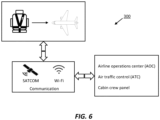
FIG. 6 is a system diagram showing communications from the at least one biometric device to the aircraft communication system and air traffic control. - Before explaining at least one embodiment of the inventive concepts disclosed herein in detail, it is to be understood that the inventive concepts are not limited in their application to the details of construction and the arrangement of the components or steps or methodologies set forth in the following description or illustrated in the drawings. In the following detailed description of embodiments of the instant inventive concepts, numerous specific details are set forth in order to provide a more thorough understanding of the inventive concepts. However, it will be apparent to one of ordinary skill in the art having the benefit of the instant disclosure that the inventive concepts disclosed herein may be practiced without these specific details. In other instances, well-known features may not be described in detail to avoid unnecessarily complicating the instant disclosure. The inventive concepts disclosed herein are capable of other embodiments or of being practiced or carried out in various ways. Also, it is to be understood that the phraseology and terminology employed herein is for the purpose of description and should not be regarded as limiting.
- Unless expressly stated to the contrary, "or" refers to an inclusive or and not to an exclusive or. For example, a condition A or B is satisfied by anyone of the following: A is true (or present) and B is false (or not present), A is false (or not present) and B is true (or present), and both A and B are true (or present).
- In addition, use of the "a" or "an" are employed to describe elements and components of embodiments of the instant inventive concepts. This is done merely for convenience and to give a general sense of the inventive concepts, and "a" and "an" are intended to include one or at least one and the singular also includes the plural unless it is obvious that it is meant otherwise.
- Finally, as used herein any reference to "one embodiment," or "some embodiments" means that a particular element, feature, structure, or characteristic described in connection with the embodiment is included in at least one embodiment of the inventive concepts disclosed herein. The appearances of the phrase "in some embodiments" in various places in the specification are not necessarily all referring to the same embodiment, and embodiments of the inventive concepts disclosed may include one or more of the features expressly described or inherently present herein, or any combination of sub-combination of two or more such features, along with any other features which may not necessarily be expressly described or inherently present in the instant disclosure.
- Broadly speaking, embodiments of the inventive concepts disclosed herein are directed to systems and methods for monitoring, measuring and communicating pilot biometrics to an aircraft interface device communicatively coupled to at least one of air traffic control system and an aircraft communication system, such that air traffic control, additional pilots and flight crew can be kept apprised of an escalating medical emergency situation before the situation rises to a critical level.
- Referring to
FIG. 1 , thebiometrics monitoring system 100 includes at least onebiometrics device 102 located in aseat belt assembly 104 of apilot seat 106. As used herein, the term "pilot" can also mean a copilot, the term "pilot seat belt assembly" can also mean a copilot seat belt assembly, and the term "pilot seat" can also mean a copilot seat. Thus, the systems and methods according to the present disclosure can be implemented for pilot and/or copilot seats in the cockpit. Thebiometrics device 102 is configured to measure biometrics continuously. Thebiometrics device 102 includes sensors, at least one processing module, and a communications module such as a network interface module. As shown, the at least onebiometrics device 102 is embedded within or carried by an over-shoulder strap of theseat belt assembly 104 such that the at least onebiometrics device 102 is positioned proximate the chest of the pilot in use. - In embodiments, the at least one
biometrics device 102 includes a photoplethysmogram (PPG) sensor system. Known to those skilled in the art, PPG is a method for measuring the amount of light absorbed or reflected by blood vessels in living tissue. Since the amount of optical absorption or reflection depends on the amount of blood that is present in the optical path, the PPG signal is responsive to changes in the volume of the blood, rather than the pressure of the blood vessels. In other words, PPG detects the change of blood volume by the photoelectric technique, whether transmissive or reflective, to record the volume of blood in the sensor coverage area to form a PPG signal. The pulsatile component of a PPG signal is related to changes in blood volume inside the arteries and is synchronous with the heartbeat, whereas the non-pulsating component is a function of the basic blood volume, respiration, the sympathetic nervous system, and thermoregulation. Given that the optical absorption of hemoglobin is a function of oxygenation and optical wavelength, the use of PPG at multiple wavelengths can also be used in pulse oximetry. PPG technology represents a convenient technology that can be applied to various aspects of cardiovascular monitoring, including the detection of blood oxygen saturation, heart rate, blood pressure, cardiac output and respiration, among others. PPG offers the added advantage that it can be measured continuously using the wearable optical electronic device. - In the
aircraft 108, eachpilot seat 106 is equipped with theseat belt assembly 104 including at least one of thebiometric devices 102. In some embodiments, a singlebiometric device 102 may be incorporated into each over-shoulder strap for redundancy, or for each device measuring a different biometric continuously. Eachpilot seat 106 may be identified in the system, for instance by a 'pilot' or 'copilot' seat designation, by pilot name, 'first' or 'second' seat designation, etc. The seat identification may be communicated with the communicated measured biometrics, alarm or warning. In some embodiments, thebiometric devices 102 form a network of biometric devices. - The
biometric devices 102 communicate with theaircraft interface device 110, such as via a wireless connection. Theaircraft interface device 110 in turn communicates with at least one of anaircraft communications system 112, via a wired or wireless communication, and an airtraffic control system 114, via a wireless communication. Eachbiometric device 102 is configured to measure biometrics continuously and convey data associated with the measured biometrics to theaircraft interface device 110, for example via a network interface module of thebiometrics device 102. Theaircraft interface device 110 receives the information about the measured biometrics. Communicated and received information can include at least one of real-time biometrics data, warnings, alarms, etc. Theaircraft interface device 110 may include a circuit having a processor and software for processing the received biometrics data. In embodiments, thebiometric devices 102 or theaircraft interface device 110 generates waveforms from signals from the sensors and analyzes the signals or trends to provide early warnings and alarms, separately in some embodiments, to systems communicating with theaircraft interface device 110. - The at least one
biometrics device 102 and/or theaircraft interface device 110 includes biometric data stored in data storage of the device against which the measured biometrics are compared. Measured biometric data falling within a predetermined acceptable range of the stored biometric data is designated 'Normal' biometric data, whereas measured biometric data falling outside of the predetermined acceptable range is designated 'Abnormal' biometric data. Regarding heart rate, for example, a 'Normal' heart rate range may be 60-100 beats per minute (BPM), which is a normal resting heart rate for adults. Considering that range, any measured heart rate within that range would be considered 'Normal,' whereas any measured heart rate less than 60 BPM or more than 100 BPM would be considered 'Abnormal.' Any measured heart rate qualifying as 'Abnormal' would be communicated as such, triggering at least one of a warning or alarm to theaircraft interface device 110 as discussed further below. Regarding oxygen saturation, for example, a 'Normal' reading may be 90% or greater, or 95% or greater, whereas an 'Abnormal' reading may be less than 90%, or less than 95%, respectively. As stated above, the predetermined 'Normal' stored data may be based on National averages or may be customized based on each individual pilot from historical data, for instance collected via a link with a medical provider. - Referring to
FIG. 2 , in one embodiment theseat belt assembly 104 includes twoover-shoulder straps 116, twowaist straps 118, and a single crotch or "submarine"strap 120, each of which attaches to a singlequick release 122. The collection of straps and release form a five-point harness. Thebiometrics device 102 is embedded in or attached to the webbing of one of theover-shoulder straps 116 such that thedevice 102, is positioned proximate the chest. Referring toFIG. 4 , eachbiometrics device 102 includes asensor 124 configured to emit light, and adetector 126 configured to detect reflected light, i.e., light reflected by blood vessels in living tissue. Thebiometrics device 102 further includes a network interface module for communicating the measured biometrics to the aircraft interface device. In some embodiments, thebiometrics device 102 analyze the signals. In use, theover-shoulder strap 116 is positioned such that thesensor 124 anddetector 126 are positioned facing the chest. The over-shoulder strap may include indicia designating a correct facing orientation and an incorrect facing orientation. In some embodiments, the biometric device communicates with at least one of a seat occupancy system and a seat belt attachment system such that, when a seat occupant is detected and the over-shoulder strap is inserted in the quick release, the biometrics system begins looking for the measured biometric. In the event the biometrics system times out without detecting the measurable biometric, the system may inform the aircraft interface device to a fault condition, which may be a faulty system or incorrect placement/orientation of thebiometrics device 102. - Referring to
FIG. 3 , in another embodiment theseat belt assembly 104 as shown again includes twoover-shoulder straps 116, twowaist straps 118, and a single crotch or "submarine"strap 120, each of which attaches to a singlequick release 122. The collection of straps and release again forms a five-point harness. In other embodiments the harness can be a four-point harness without a crotch strap, a three-point harness lacking waist straps, or other harness configurations. In the embodiment shown, thebiometrics device 102 is incorporated into asleeve 128 slidable along the length of its respectiveover-shoulder strap 116. In this configuration, thesleeve 128 is positionable along the length of the over-shoulder strap by sliding the sleeve to a comfortable worn position and/or for better biometrics readings. Referring again toFIG. 4 , eachbiometrics device 102 includes asensor 124, adetector 126, and a network interface module. - Referring to
FIG. 5 , a method for measuring pilot biometrics is shown generally at 200. As described above, thebiometrics system 100 interfaces with a seat occupancy system with seat belt buckling detection. In afirst Step 202, thesystem 100 determines if the pilot seat is occupied and/or the seat belt assembly, at least the over-shoulder strap carrying the biometrics device, is buckled. Upon confirmation that the pilot seat is occupied and the seat belt buckled, in aStep 204, thesystem 100 begins continuously measuring biometrics, for example heart rate and oxygen saturation. In some embodiments, the biometrics are measured continuously and reported in real-time to the aircraft interface device regardless of whether the measured biometrics are 'Normal' or 'Abnormal.' In aStep 206, the measured biometrics are compared against the stored ranges and values determined 'Normal.' When the measured biometrics are within the 'Normal' range, no biometric data may be reported to the aircraft interface device and the biometrics device continues to monitor the health parameters. - Continuing with the
method 200, in aStep 208, when the measured biometrics fall outside of a 'Normal' range and thus are determined 'Abnormal' (e.g., oxygen saturation less than 90%, heart rate less than 60 BPM, heart rate greater than 100 BPM, etc.), the biometrics device reports the 'Abnormal' biometrics data to the aircraft interface device (AID), such as via the network interface module, where the data is gathered and in some cases computations performed in aStep 210. 'Abnormal' biometrics data reporting may be in the form of the actual numerical data, a warning or an alarm, or a combination thereof. In some embodiments, a warning communication may be triggered to issue when the biometric data approaches a limit of a 'Normal' range. For example, a measured heart rate of 65 BPM or 95 BPM may cause the system to issue a warning to the aircraft interface device that a threshold value is approaching. Warning issuances may be based on trends, rate increases over predetermined time periods, etc. An alarm may be issued when the measured biometrics are 'Abnormal' and the normal range exceeded. For example, an oxygen saturation less than 90%. In some embodiments, the first time the device reads an oxygen level drop the device may send an alert message to the aircraft communication system and the air traffic control system, and when the device detects an emergency reading continuously the device may send a warning message to the systems. - Continuing with the
method 200, in aStep 212 the data may be validated to determine correctness of the measurement. Once validated, in aStep 214 the aircraft interface device communicates the 'Abnormal' biometric, in the form of numerical data, warning, alarm, etc., to at least one of the aircraft communication system and the air traffic control system ATS), for example, via the communications links of thesystem 300 shown inFIG. 6 . In some embodiments, the aircraft communication system may be in communication with the additional pilots and/or flight crew. In a particular embodiment, the aircraft communication system includes a display for indicating to the crew the pilot under distress and the specific physical distress, optionally with medical instructions, such that the crew can react quickly to attend to the medical emergency. The display may be a flight crew control panel or other cabin display which provides other cabin information. Additional communications to the crew may include, but are not limited to, other visual and audio communications. Warnings and alarms may continue until acknowledged by the flight crew. - The same biometric data, warning and alarm information may be communicated to the air traffic control system. In response, the air traffic controller or receiving party can acknowledge the communication, contact the aircraft, and in some cases communicate with a medical expert who then conveys medical expertise to the flight crew via the air traffic controller or directly. For example, assume a cardiac arrest event of the flying pilot is measured by the biometrics device and is communicated to the aircraft interface device. The aircraft interface device in turn communicates the event to the aircraft communication system to notify the copilot and the crew, and the air traffic control system to notify the ground. The copilot receiving the communication can then react to assume control of the aircraft and the crew can react to lend medical assistance to the pilot. At the same time, air traffic control is made aware of the event and can help implement a flight plan for the aircraft, such as continuation, immediate landing, diversion, etc. The biometrics measuring may continue during the event such that, in the event the measured biometric returns to 'Normal,' the warning and alarm may be cancelled.
- While the foregoing description provides embodiments of the invention by way of example only, it is envisioned that other embodiments may perform similar functions and/or achieve similar results. Any and all such equivalent embodiments and examples are within the scope of the present invention and are intended to be covered by the appended claims.
Claims (15)
- A system for monitoring pilot biometrics, comprising:a seat belt assembly (104) comprising at least one over-shoulder strap (116);at least one biometric device (102) carried by the at least one over-shoulder strap, the at least one biometric device including a photoplethysmogram, PPG, sensor system configured to measure biometrics continuously; andan aircraft interface device (110) communicatively coupled to the at least one biometric device;
wherein;the at least one biometric device is configured to obtain and communicate the measured biometrics to the aircraft interface device; andthe aircraft interface device is configured to communicate with at least one of an aircraft communication system and an air traffic control system, and when the measured biometrics meet a predetermined condition, issue an alert to at least one of the aircraft communication system and the air traffic control system informing that the predetermined condition has been met. - The system according to claim 1, wherein the at least one biometric device is embedded in webbing of the at least one over-shoulder strap.
- The system according to claim 1, wherein the at least one biometric device is carried in a sleeve slidably coupled to the at least one over-shoulder strap.
- The system according to any preceding claim, wherein the measured biometrics include at least one of heart rate, blood pressure and oxygen saturation.
- The system according to any preceding claim, wherein the predetermined condition is based on the measured biometrics exceeding a threshold biometrics value stored in a data storage of the aircraft interface device.
- The system according to any preceding claim, wherein the predetermined condition is based on trend activity of the measured biometrics.
- The system according to any preceding claim, wherein the at least one biometric device includes a network interface module.
- The system according to any preceding claim, wherein the aircraft interface device is configured to communicate with at least one of the aircraft communication system and the air traffic control system, and when the measured biometrics approaches the predetermined condition, issue a warning to at least one of the aircraft communication system and the air traffic control system.
- The system according to claim 8, wherein the aircraft interface device is configured to communicate with a flight crew display panel and cause the flight crew display panel to display the warning when the measured biometrics approaches the predetermined condition, and cause the flight crew display panel to display the alarm when the measured biometrics meets the predetermined condition.
- The system according to any preceding claim, wherein the aircraft interface device is further configured to:issue to the aircraft communication system, when the measured biometrics approaches the predetermined condition, a protocol stored in a data storage of the aircraft interface device indicating a first action to be taken by at least one of a pilot and the flight crew; andissue to the aircraft communication system, when the measured biometrics meets the predetermined condition, a protocol stored in the data storage of the aircraft interface device indicating a second action to be taken by at least one of the pilot and the flight crew.
- A seat belt assembly configured to measure biometrics continuously, comprising:at least one over-shoulder strap (116); andat least one biometric device (102) carried by the at least one over-shoulder strap, the at least one biometric device including a photoplethysmogram, PPG, sensor system configured to measure biometrics continuously;wherein the at least one biometric device is configured to obtain and communicate the measured biometrics to a remote system and issue an alert thereto when the measured biometrics meet a predetermined condition.
- The seat belt assembly according to claim 11, wherein the at least one biometric device is embedded in webbing of the at least one over-shoulder strap.
- The seat belt assembly according to claim 11, wherein the at least one biometric device is carried in a sleeve slidably coupled to the at least one over-shoulder strap.
- The seat belt assembly according to claim 11, 12 or 13, wherein the measured biometrics include at least one of heart rate, blood pressure and oxygen saturation.
- The seat belt assembly according to any of claims 11 to 14, wherein the predetermined condition is based on the measured biometrics exceeding a threshold biometrics value stored in a data storage of the remote system and/or trend activity of the measured biometrics.
Applications Claiming Priority (2)
| Application Number | Priority Date | Filing Date | Title |
|---|---|---|---|
| IN202111059680 | 2021-12-21 | ||
| US17/715,494 US20230190122A1 (en) | 2021-12-21 | 2022-04-07 | Systems and methods for monitoring pilot biometrics |
Publications (2)
| Publication Number | Publication Date |
|---|---|
| EP4201310A1 true EP4201310A1 (en) | 2023-06-28 |
| EP4201310B1 EP4201310B1 (en) | 2025-11-12 |
Family
ID=84389218
Family Applications (1)
| Application Number | Title | Priority Date | Filing Date |
|---|---|---|---|
| EP22211513.1A Active EP4201310B1 (en) | 2021-12-21 | 2022-12-05 | Systems for monitoring pilot biometrics |
Country Status (1)
| Country | Link |
|---|---|
| EP (1) | EP4201310B1 (en) |
Citations (6)
| Publication number | Priority date | Publication date | Assignee | Title |
|---|---|---|---|---|
| US20150314681A1 (en) * | 2014-05-05 | 2015-11-05 | State Farm Mutual Automobile Insurance Company | System and method to monitor and alert vehicle operator of impairment |
| US20160001781A1 (en) * | 2013-03-15 | 2016-01-07 | Honda Motor Co., Ltd. | System and method for responding to driver state |
| US20160345907A1 (en) * | 2013-04-06 | 2016-12-01 | Honda Motor Co., Ltd. | System and method for capturing and decontaminating photoplethysmopgraphy (ppg) signals in a vehicle |
| US20210034053A1 (en) * | 2019-07-30 | 2021-02-04 | The Boeing Company | Pilot Health and Alertness Monitoring, Communication and Safeguarding |
| WO2021105314A1 (en) * | 2019-11-27 | 2021-06-03 | Continental Automotive Gmbh | Method of determining fused sensor measurement and vehicle safety system using the fused sensor measurement |
| CN214929576U (en) * | 2021-07-14 | 2021-11-30 | 澳帕曼织带(昆山)有限公司 | Safety belt for monitoring body condition of driver |
-
2022
- 2022-12-05 EP EP22211513.1A patent/EP4201310B1/en active Active
Patent Citations (6)
| Publication number | Priority date | Publication date | Assignee | Title |
|---|---|---|---|---|
| US20160001781A1 (en) * | 2013-03-15 | 2016-01-07 | Honda Motor Co., Ltd. | System and method for responding to driver state |
| US20160345907A1 (en) * | 2013-04-06 | 2016-12-01 | Honda Motor Co., Ltd. | System and method for capturing and decontaminating photoplethysmopgraphy (ppg) signals in a vehicle |
| US20150314681A1 (en) * | 2014-05-05 | 2015-11-05 | State Farm Mutual Automobile Insurance Company | System and method to monitor and alert vehicle operator of impairment |
| US20210034053A1 (en) * | 2019-07-30 | 2021-02-04 | The Boeing Company | Pilot Health and Alertness Monitoring, Communication and Safeguarding |
| WO2021105314A1 (en) * | 2019-11-27 | 2021-06-03 | Continental Automotive Gmbh | Method of determining fused sensor measurement and vehicle safety system using the fused sensor measurement |
| CN214929576U (en) * | 2021-07-14 | 2021-11-30 | 澳帕曼织带(昆山)有限公司 | Safety belt for monitoring body condition of driver |
Also Published As
| Publication number | Publication date |
|---|---|
| EP4201310B1 (en) | 2025-11-12 |
Similar Documents
| Publication | Publication Date | Title |
|---|---|---|
| US9919712B1 (en) | Crew biometrics and aircraft data analysis with real-time and proactive actions | |
| US8164464B2 (en) | Method and system of aircraft pilot assessment | |
| US8289172B2 (en) | Method and system of aircraft pilot assessment and for remedial action upon pilot impairment | |
| US8548547B2 (en) | Aviation physiological health monitoring system and method | |
| EP0217918B1 (en) | Method and apparatus for detecting optical pulses | |
| USH1039H (en) | Intrusion-free physiological condition monitoring | |
| US20130345921A1 (en) | Physiological monitoring of moving vehicle operators | |
| JP4783925B2 (en) | Emergency call system | |
| US20240278789A1 (en) | Method and Device for Determining the Vital Functions of a Vehicle Occupant | |
| EP3422357A1 (en) | Aerial vehicle medical management system | |
| KR101708727B1 (en) | System for the early detection of life-threatening conditions of persons | |
| EP4201310B1 (en) | Systems for monitoring pilot biometrics | |
| US20230190122A1 (en) | Systems and methods for monitoring pilot biometrics | |
| GB2589337A (en) | Method of determining fused sensor measurement and vehicle safety system using the fused sensor measurement | |
| JPH0975310A (en) | Patient monitoring device | |
| JPH05124592A (en) | Detector of consciousness of aircraft pilot | |
| CN115227216A (en) | Intelligent bracelet for monitoring and early warning of physical health of plateau constructors and use method thereof | |
| CN120573052A (en) | A passenger health monitoring system and method for plateau transport buses | |
| CN208318394U (en) | A kind of rhythm of the heart fire helmet | |
| EP4104761B1 (en) | High design assurance low cost multi-modal pilot safety systems | |
| RU121141U1 (en) | TELEMETRIC SYSTEM FOR MONITORING THE WAKE-UP OF A HUMAN OPERATOR | |
| Fromm et al. | Inadequacy of visual alarms in helicopter air medical transport | |
| US10772562B2 (en) | Method for monitoring non-invasive arterial oxygen saturation, pulse rate and detection of carboxyhemoglobin | |
| US11690968B2 (en) | Breathing air supply system with contactless vital parameter sensor measuring | |
| KR102200202B1 (en) | Sticking type infants monitoring device and monitoring system |
Legal Events
| Date | Code | Title | Description |
|---|---|---|---|
| PUAI | Public reference made under article 153(3) epc to a published international application that has entered the european phase |
Free format text: ORIGINAL CODE: 0009012 |
|
| STAA | Information on the status of an ep patent application or granted ep patent |
Free format text: STATUS: THE APPLICATION HAS BEEN PUBLISHED |
|
| AK | Designated contracting states |
Kind code of ref document: A1 Designated state(s): AL AT BE BG CH CY CZ DE DK EE ES FI FR GB GR HR HU IE IS IT LI LT LU LV MC ME MK MT NL NO PL PT RO RS SE SI SK SM TR |
|
| STAA | Information on the status of an ep patent application or granted ep patent |
Free format text: STATUS: REQUEST FOR EXAMINATION WAS MADE |
|
| 17P | Request for examination filed |
Effective date: 20231228 |
|
| RBV | Designated contracting states (corrected) |
Designated state(s): AL AT BE BG CH CY CZ DE DK EE ES FI FR GB GR HR HU IE IS IT LI LT LU LV MC ME MK MT NL NO PL PT RO RS SE SI SK SM TR |
|
| GRAP | Despatch of communication of intention to grant a patent |
Free format text: ORIGINAL CODE: EPIDOSNIGR1 |
|
| STAA | Information on the status of an ep patent application or granted ep patent |
Free format text: STATUS: GRANT OF PATENT IS INTENDED |
|
| INTG | Intention to grant announced |
Effective date: 20250626 |
|
| GRAS | Grant fee paid |
Free format text: ORIGINAL CODE: EPIDOSNIGR3 |
|
| GRAA | (expected) grant |
Free format text: ORIGINAL CODE: 0009210 |
|
| STAA | Information on the status of an ep patent application or granted ep patent |
Free format text: STATUS: THE PATENT HAS BEEN GRANTED |
|
| AK | Designated contracting states |
Kind code of ref document: B1 Designated state(s): AL AT BE BG CH CY CZ DE DK EE ES FI FR GB GR HR HU IE IS IT LI LT LU LV MC ME MK MT NL NO PL PT RO RS SE SI SK SM TR |
|
| REG | Reference to a national code |
Ref country code: CH Ref legal event code: F10 Free format text: ST27 STATUS EVENT CODE: U-0-0-F10-F00 (AS PROVIDED BY THE NATIONAL OFFICE) Effective date: 20251112 Ref country code: GB Ref legal event code: FG4D |
|
| REG | Reference to a national code |
Ref country code: IE Ref legal event code: FG4D |
|
| REG | Reference to a national code |
Ref country code: DE Ref legal event code: R096 Ref document number: 602022024828 Country of ref document: DE |
|
| PGFP | Annual fee paid to national office [announced via postgrant information from national office to epo] |
Ref country code: DE Payment date: 20251126 Year of fee payment: 4 |
|
| PGFP | Annual fee paid to national office [announced via postgrant information from national office to epo] |
Ref country code: AT Payment date: 20260113 Year of fee payment: 4 |
|
| PGFP | Annual fee paid to national office [announced via postgrant information from national office to epo] |
Ref country code: FR Payment date: 20251217 Year of fee payment: 4 |
|
| REG | Reference to a national code |
Ref country code: NL Ref legal event code: MP Effective date: 20251112 |
|
| PG25 | Lapsed in a contracting state [announced via postgrant information from national office to epo] |
Ref country code: ES Free format text: LAPSE BECAUSE OF FAILURE TO SUBMIT A TRANSLATION OF THE DESCRIPTION OR TO PAY THE FEE WITHIN THE PRESCRIBED TIME-LIMIT Effective date: 20251112 |
|
| REG | Reference to a national code |
Ref country code: LT Ref legal event code: MG9D |
|
| PG25 | Lapsed in a contracting state [announced via postgrant information from national office to epo] |
Ref country code: NO Free format text: LAPSE BECAUSE OF FAILURE TO SUBMIT A TRANSLATION OF THE DESCRIPTION OR TO PAY THE FEE WITHIN THE PRESCRIBED TIME-LIMIT Effective date: 20260212 |
|
| PG25 | Lapsed in a contracting state [announced via postgrant information from national office to epo] |
Ref country code: FI Free format text: LAPSE BECAUSE OF FAILURE TO SUBMIT A TRANSLATION OF THE DESCRIPTION OR TO PAY THE FEE WITHIN THE PRESCRIBED TIME-LIMIT Effective date: 20251112 Ref country code: HR Free format text: LAPSE BECAUSE OF FAILURE TO SUBMIT A TRANSLATION OF THE DESCRIPTION OR TO PAY THE FEE WITHIN THE PRESCRIBED TIME-LIMIT Effective date: 20251112 Ref country code: AT Free format text: LAPSE BECAUSE OF FAILURE TO SUBMIT A TRANSLATION OF THE DESCRIPTION OR TO PAY THE FEE WITHIN THE PRESCRIBED TIME-LIMIT Effective date: 20251112 |
|
| REG | Reference to a national code |
Ref country code: AT Ref legal event code: MK05 Ref document number: 1856048 Country of ref document: AT Kind code of ref document: T Effective date: 20251112 |
|
| PG25 | Lapsed in a contracting state [announced via postgrant information from national office to epo] |
Ref country code: NL Free format text: LAPSE BECAUSE OF FAILURE TO SUBMIT A TRANSLATION OF THE DESCRIPTION OR TO PAY THE FEE WITHIN THE PRESCRIBED TIME-LIMIT Effective date: 20251112 |
|
| PG25 | Lapsed in a contracting state [announced via postgrant information from national office to epo] |
Ref country code: RS Free format text: LAPSE BECAUSE OF FAILURE TO SUBMIT A TRANSLATION OF THE DESCRIPTION OR TO PAY THE FEE WITHIN THE PRESCRIBED TIME-LIMIT Effective date: 20260212 |
|
| PG25 | Lapsed in a contracting state [announced via postgrant information from national office to epo] |
Ref country code: IS Free format text: LAPSE BECAUSE OF FAILURE TO SUBMIT A TRANSLATION OF THE DESCRIPTION OR TO PAY THE FEE WITHIN THE PRESCRIBED TIME-LIMIT Effective date: 20260312 |
|
| PG25 | Lapsed in a contracting state [announced via postgrant information from national office to epo] |
Ref country code: PT Free format text: LAPSE BECAUSE OF FAILURE TO SUBMIT A TRANSLATION OF THE DESCRIPTION OR TO PAY THE FEE WITHIN THE PRESCRIBED TIME-LIMIT Effective date: 20260312 |
|
| PG25 | Lapsed in a contracting state [announced via postgrant information from national office to epo] |
Ref country code: PL Free format text: LAPSE BECAUSE OF FAILURE TO SUBMIT A TRANSLATION OF THE DESCRIPTION OR TO PAY THE FEE WITHIN THE PRESCRIBED TIME-LIMIT Effective date: 20251112 |
|
| PG25 | Lapsed in a contracting state [announced via postgrant information from national office to epo] |
Ref country code: LV Free format text: LAPSE BECAUSE OF FAILURE TO SUBMIT A TRANSLATION OF THE DESCRIPTION OR TO PAY THE FEE WITHIN THE PRESCRIBED TIME-LIMIT Effective date: 20251112 |
|
| PG25 | Lapsed in a contracting state [announced via postgrant information from national office to epo] |
Ref country code: BG Free format text: LAPSE BECAUSE OF FAILURE TO SUBMIT A TRANSLATION OF THE DESCRIPTION OR TO PAY THE FEE WITHIN THE PRESCRIBED TIME-LIMIT Effective date: 20251112 |