EP4201194B1 - Automated tractor speed adjustment for avoidance of plugging a baler - Google Patents
Automated tractor speed adjustment for avoidance of plugging a baler Download PDFInfo
- Publication number
- EP4201194B1 EP4201194B1 EP23152282.2A EP23152282A EP4201194B1 EP 4201194 B1 EP4201194 B1 EP 4201194B1 EP 23152282 A EP23152282 A EP 23152282A EP 4201194 B1 EP4201194 B1 EP 4201194B1
- Authority
- EP
- European Patent Office
- Prior art keywords
- signal
- crop
- speed
- load
- pickup
- Prior art date
- Legal status (The legal status is an assumption and is not a legal conclusion. Google has not performed a legal analysis and makes no representation as to the accuracy of the status listed.)
- Active
Links
Images

Classifications
-
- B—PERFORMING OPERATIONS; TRANSPORTING
- B60—VEHICLES IN GENERAL
- B60W—CONJOINT CONTROL OF VEHICLE SUB-UNITS OF DIFFERENT TYPE OR DIFFERENT FUNCTION; CONTROL SYSTEMS SPECIALLY ADAPTED FOR HYBRID VEHICLES; ROAD VEHICLE DRIVE CONTROL SYSTEMS FOR PURPOSES NOT RELATED TO THE CONTROL OF A PARTICULAR SUB-UNIT
- B60W30/00—Purposes of road vehicle drive control systems not related to the control of a particular sub-unit, e.g. of systems using conjoint control of vehicle sub-units
- B60W30/14—Adaptive cruise control
- B60W30/143—Speed control
-
- A—HUMAN NECESSITIES
- A01—AGRICULTURE; FORESTRY; ANIMAL HUSBANDRY; HUNTING; TRAPPING; FISHING
- A01D—HARVESTING; MOWING
- A01D89/00—Pick-ups for loaders, chaff-cutters, balers, field-threshers, or the like, i.e. attachments for picking-up hay or the like field crops
- A01D89/001—Pick-up systems
-
- A—HUMAN NECESSITIES
- A01—AGRICULTURE; FORESTRY; ANIMAL HUSBANDRY; HUNTING; TRAPPING; FISHING
- A01F—PROCESSING OF HARVESTED PRODUCE; HAY OR STRAW PRESSES; DEVICES FOR STORING AGRICULTURAL OR HORTICULTURAL PRODUCE
- A01F15/00—Baling presses for straw, hay or the like
- A01F15/08—Details
-
- A—HUMAN NECESSITIES
- A01—AGRICULTURE; FORESTRY; ANIMAL HUSBANDRY; HUNTING; TRAPPING; FISHING
- A01F—PROCESSING OF HARVESTED PRODUCE; HAY OR STRAW PRESSES; DEVICES FOR STORING AGRICULTURAL OR HORTICULTURAL PRODUCE
- A01F15/00—Baling presses for straw, hay or the like
- A01F15/08—Details
- A01F15/0841—Drives for balers
-
- G—PHYSICS
- G01—MEASURING; TESTING
- G01F—MEASURING VOLUME, VOLUME FLOW, MASS FLOW OR LIQUID LEVEL; METERING BY VOLUME
- G01F1/00—Measuring the volume flow or mass flow of fluid or fluent solid material wherein the fluid passes through a meter in a continuous flow
- G01F1/704—Measuring the volume flow or mass flow of fluid or fluent solid material wherein the fluid passes through a meter in a continuous flow using marked regions or existing inhomogeneities within the fluid stream, e.g. statistically occurring variations in a fluid parameter
- G01F1/708—Measuring the time taken to traverse a fixed distance
- G01F1/7086—Measuring the time taken to traverse a fixed distance using optical detecting arrangements
-
- G—PHYSICS
- G01—MEASURING; TESTING
- G01S—RADIO DIRECTION-FINDING; RADIO NAVIGATION; DETERMINING DISTANCE OR VELOCITY BY USE OF RADIO WAVES; LOCATING OR PRESENCE-DETECTING BY USE OF THE REFLECTION OR RERADIATION OF RADIO WAVES; ANALOGOUS ARRANGEMENTS USING OTHER WAVES
- G01S13/00—Systems using the reflection or reradiation of radio waves, e.g. radar systems; Analogous systems using reflection or reradiation of waves whose nature or wavelength is irrelevant or unspecified
- G01S13/02—Systems using reflection of radio waves, e.g. primary radar systems; Analogous systems
- G01S13/50—Systems of measurement based on relative movement of target
- G01S13/58—Velocity or trajectory determination systems; Sense-of-movement determination systems
-
- G—PHYSICS
- G01—MEASURING; TESTING
- G01S—RADIO DIRECTION-FINDING; RADIO NAVIGATION; DETERMINING DISTANCE OR VELOCITY BY USE OF RADIO WAVES; LOCATING OR PRESENCE-DETECTING BY USE OF THE REFLECTION OR RERADIATION OF RADIO WAVES; ANALOGOUS ARRANGEMENTS USING OTHER WAVES
- G01S13/00—Systems using the reflection or reradiation of radio waves, e.g. radar systems; Analogous systems using reflection or reradiation of waves whose nature or wavelength is irrelevant or unspecified
- G01S13/88—Radar or analogous systems specially adapted for specific applications
-
- G—PHYSICS
- G01—MEASURING; TESTING
- G01S—RADIO DIRECTION-FINDING; RADIO NAVIGATION; DETERMINING DISTANCE OR VELOCITY BY USE OF RADIO WAVES; LOCATING OR PRESENCE-DETECTING BY USE OF THE REFLECTION OR RERADIATION OF RADIO WAVES; ANALOGOUS ARRANGEMENTS USING OTHER WAVES
- G01S17/00—Systems using the reflection or reradiation of electromagnetic waves other than radio waves, e.g. lidar systems
- G01S17/02—Systems using the reflection of electromagnetic waves other than radio waves
- G01S17/50—Systems of measurement based on relative movement of target
- G01S17/58—Velocity or trajectory determination systems; Sense-of-movement determination systems
-
- A—HUMAN NECESSITIES
- A01—AGRICULTURE; FORESTRY; ANIMAL HUSBANDRY; HUNTING; TRAPPING; FISHING
- A01B—SOIL WORKING IN AGRICULTURE OR FORESTRY; PARTS, DETAILS, OR ACCESSORIES OF AGRICULTURAL MACHINES OR IMPLEMENTS, IN GENERAL
- A01B69/00—Steering of agricultural machines or implements; Guiding agricultural machines or implements on a desired track
- A01B69/007—Steering or guiding of agricultural vehicles, e.g. steering of the tractor to keep the plough in the furrow
- A01B69/008—Steering or guiding of agricultural vehicles, e.g. steering of the tractor to keep the plough in the furrow automatic
-
- B—PERFORMING OPERATIONS; TRANSPORTING
- B60—VEHICLES IN GENERAL
- B60W—CONJOINT CONTROL OF VEHICLE SUB-UNITS OF DIFFERENT TYPE OR DIFFERENT FUNCTION; CONTROL SYSTEMS SPECIALLY ADAPTED FOR HYBRID VEHICLES; ROAD VEHICLE DRIVE CONTROL SYSTEMS FOR PURPOSES NOT RELATED TO THE CONTROL OF A PARTICULAR SUB-UNIT
- B60W2300/00—Indexing codes relating to the type of vehicle
- B60W2300/15—Agricultural vehicles
- B60W2300/152—Tractors
-
- B—PERFORMING OPERATIONS; TRANSPORTING
- B60—VEHICLES IN GENERAL
- B60W—CONJOINT CONTROL OF VEHICLE SUB-UNITS OF DIFFERENT TYPE OR DIFFERENT FUNCTION; CONTROL SYSTEMS SPECIALLY ADAPTED FOR HYBRID VEHICLES; ROAD VEHICLE DRIVE CONTROL SYSTEMS FOR PURPOSES NOT RELATED TO THE CONTROL OF A PARTICULAR SUB-UNIT
- B60W2420/00—Indexing codes relating to the type of sensors based on the principle of their operation
- B60W2420/40—Photo, light or radio wave sensitive means, e.g. infrared sensors
- B60W2420/403—Image sensing, e.g. optical camera
-
- B—PERFORMING OPERATIONS; TRANSPORTING
- B60—VEHICLES IN GENERAL
- B60W—CONJOINT CONTROL OF VEHICLE SUB-UNITS OF DIFFERENT TYPE OR DIFFERENT FUNCTION; CONTROL SYSTEMS SPECIALLY ADAPTED FOR HYBRID VEHICLES; ROAD VEHICLE DRIVE CONTROL SYSTEMS FOR PURPOSES NOT RELATED TO THE CONTROL OF A PARTICULAR SUB-UNIT
- B60W2420/00—Indexing codes relating to the type of sensors based on the principle of their operation
- B60W2420/40—Photo, light or radio wave sensitive means, e.g. infrared sensors
- B60W2420/408—Radar; Laser, e.g. lidar
-
- B—PERFORMING OPERATIONS; TRANSPORTING
- B60—VEHICLES IN GENERAL
- B60W—CONJOINT CONTROL OF VEHICLE SUB-UNITS OF DIFFERENT TYPE OR DIFFERENT FUNCTION; CONTROL SYSTEMS SPECIALLY ADAPTED FOR HYBRID VEHICLES; ROAD VEHICLE DRIVE CONTROL SYSTEMS FOR PURPOSES NOT RELATED TO THE CONTROL OF A PARTICULAR SUB-UNIT
- B60W2520/00—Input parameters relating to overall vehicle dynamics
-
- G—PHYSICS
- G01—MEASURING; TESTING
- G01F—MEASURING VOLUME, VOLUME FLOW, MASS FLOW OR LIQUID LEVEL; METERING BY VOLUME
- G01F1/00—Measuring the volume flow or mass flow of fluid or fluent solid material wherein the fluid passes through a meter in a continuous flow
- G01F1/05—Measuring the volume flow or mass flow of fluid or fluent solid material wherein the fluid passes through a meter in a continuous flow by using mechanical effects
-
- G—PHYSICS
- G01—MEASURING; TESTING
- G01F—MEASURING VOLUME, VOLUME FLOW, MASS FLOW OR LIQUID LEVEL; METERING BY VOLUME
- G01F1/00—Measuring the volume flow or mass flow of fluid or fluent solid material wherein the fluid passes through a meter in a continuous flow
- G01F1/66—Measuring the volume flow or mass flow of fluid or fluent solid material wherein the fluid passes through a meter in a continuous flow by measuring frequency, phase shift or propagation time of electromagnetic or other waves, e.g. using ultrasonic flowmeters
-
- G—PHYSICS
- G01—MEASURING; TESTING
- G01F—MEASURING VOLUME, VOLUME FLOW, MASS FLOW OR LIQUID LEVEL; METERING BY VOLUME
- G01F1/00—Measuring the volume flow or mass flow of fluid or fluent solid material wherein the fluid passes through a meter in a continuous flow
- G01F1/704—Measuring the volume flow or mass flow of fluid or fluent solid material wherein the fluid passes through a meter in a continuous flow using marked regions or existing inhomogeneities within the fluid stream, e.g. statistically occurring variations in a fluid parameter
-
- G—PHYSICS
- G01—MEASURING; TESTING
- G01F—MEASURING VOLUME, VOLUME FLOW, MASS FLOW OR LIQUID LEVEL; METERING BY VOLUME
- G01F1/00—Measuring the volume flow or mass flow of fluid or fluent solid material wherein the fluid passes through a meter in a continuous flow
- G01F1/76—Devices for measuring mass flow of a fluid or a fluent solid material
-
- G—PHYSICS
- G01—MEASURING; TESTING
- G01S—RADIO DIRECTION-FINDING; RADIO NAVIGATION; DETERMINING DISTANCE OR VELOCITY BY USE OF RADIO WAVES; LOCATING OR PRESENCE-DETECTING BY USE OF THE REFLECTION OR RERADIATION OF RADIO WAVES; ANALOGOUS ARRANGEMENTS USING OTHER WAVES
- G01S17/00—Systems using the reflection or reradiation of electromagnetic waves other than radio waves, e.g. lidar systems
- G01S17/88—Lidar systems specially adapted for specific applications
-
- G—PHYSICS
- G01—MEASURING; TESTING
- G01S—RADIO DIRECTION-FINDING; RADIO NAVIGATION; DETERMINING DISTANCE OR VELOCITY BY USE OF RADIO WAVES; LOCATING OR PRESENCE-DETECTING BY USE OF THE REFLECTION OR RERADIATION OF RADIO WAVES; ANALOGOUS ARRANGEMENTS USING OTHER WAVES
- G01S13/00—Systems using the reflection or reradiation of radio waves, e.g. radar systems; Analogous systems using reflection or reradiation of waves whose nature or wavelength is irrelevant or unspecified
- G01S13/88—Radar or analogous systems specially adapted for specific applications
- G01S13/93—Radar or analogous systems specially adapted for specific applications for anti-collision purposes
- G01S13/931—Radar or analogous systems specially adapted for specific applications for anti-collision purposes of land vehicles
- G01S2013/932—Radar or analogous systems specially adapted for specific applications for anti-collision purposes of land vehicles using own vehicle data, e.g. ground speed, steering wheel direction
-
- G—PHYSICS
- G01—MEASURING; TESTING
- G01S—RADIO DIRECTION-FINDING; RADIO NAVIGATION; DETERMINING DISTANCE OR VELOCITY BY USE OF RADIO WAVES; LOCATING OR PRESENCE-DETECTING BY USE OF THE REFLECTION OR RERADIATION OF RADIO WAVES; ANALOGOUS ARRANGEMENTS USING OTHER WAVES
- G01S13/00—Systems using the reflection or reradiation of radio waves, e.g. radar systems; Analogous systems using reflection or reradiation of waves whose nature or wavelength is irrelevant or unspecified
- G01S13/88—Radar or analogous systems specially adapted for specific applications
- G01S13/93—Radar or analogous systems specially adapted for specific applications for anti-collision purposes
- G01S13/931—Radar or analogous systems specially adapted for specific applications for anti-collision purposes of land vehicles
- G01S2013/9321—Velocity regulation, e.g. cruise control
Definitions
- Embodiments of the current invention relate to systems and methods for adjusting a speed of a tractor pulling a baler to avoid baler plugging.
- Balers or hay balers, are machines that gather and compress a cut fodder crop, such as hay, cotton, flax straw, salt marsh hay, or silage, into a compact and manageable bale. After the fodder crop is cut, and before it is baled, it is usually left on the ground in a field in a plurality of elongated, relatively narrow windrows. Balers typically include a pickup located at their front end which has rotors and tines or other components to gather up the crop and feed it to a compressor which compresses the cut crop before tying it and ejecting it.
- a cut fodder crop such as hay, cotton, flax straw, salt marsh hay, or silage
- the baler is pulled by a tractor which is driven by an operator. Adjusting the speed of the baler to avoid overloading the baler is a manual process performed by the tractor operator looking over his shoulder at the pickup of the baler. If the operator notices an increasing load in the pickup, he may slow down, and if he notices a decreasing load in the pickup, he may speed up. If the operator becomes distracted and does not slow down when the load in the pickup increases, the baler will become plugged or the crop will be pushed by the baler.
- Known systems for adjusting a tractor speed are disclosed in documents US 2001/042362 A1 and EP 3 398 420 A1 .
- Embodiments of the current invention solve the above-mentioned problems and provide a distinct advance in the art of balers.
- embodiments of the present invention may provide systems and methods for adjusting a tractor speed based on a performance of a pickup of a baler to avoid baler plugging.
- An embodiment of the system broadly comprises a load sensor, a windrow sensor, a processing element, and a tractor speed controller.
- the load sensor is configured to sense a load on a pickup of the baler and output a load signal with a level and/or data value that varies according to the load on the pickup.
- the windrow sensor is configured to monitor a ground area in front of the baler, determine a cross-sectional area of the windrow, and output a windrow signal with a level and/or data value that varies according to a cross-sectional area of the windrow.
- the processing element is configured or programmed to receive the load signal, receive the windrow signal, receive a crop moisture signal and/or data about a moisture level of a crop to be baled, and output a speed signal with a level and/or data value that varies according to values from the load signal, the windrow signal, and the crop moisture signal and/or data.
- the tractor speed controller is configured to receive the speed signal and adjust a speed of the tractor according to the level and/or data value of the speed signal.
- An embodiment of the method broadly comprises sensing a load on a pickup of the baler during operation; monitoring a ground area in front of the baler and determining a cross-sectional area of the windrow; receiving a signal and/or data regarding a moisture level of the crop; and adjusting a speed of the tractor according to the load of the pickup, the cross-sectional area of the crop, and the moisture level of the crop.
- baler to be pulled by a tractor while baling a crop.
- the baler broadly comprising a pickup, a load sensor, a windrow sensor, a processing element, and a tractor speed controller.
- the load sensor is configured to sense a load on the pickup and output a load signal with a level and/or data value that varies according to the load on the pickup.
- the windrow sensor is configured to monitor a ground area in front of the baler, determine a cross-sectional area of the windrow, and output a windrow signal with a level and/or data value that varies according to a cross-sectional area of the windrow.
- the processing element is configured or programmed to receive the load signal, receive the windrow signal, receive a crop moisture signal and/or data about a moisture level of a crop to be baled, and output a speed signal with a level and/or data value that varies according to values from the load signal, the windrow signal, and the crop moisture signal and/or data.
- the tractor speed controller is configured to receive the speed signal and adjust a speed of the tractor according to the level and/or data value of the speed signal.
- a baler 10 including a system 12, constructed in accordance with various embodiments of the current invention, for adjusting a tractor speed based on a performance of a pickup 14 of the baler 10 and to avoid a plugging event in the baler 10 is shown in Figs. 1 and 2 .
- the baler 10 is pulled by a tractor 16, driven by an operator, over a windrow 18 of a cut crop 20 while the baler 10 performs the process of baling the cut crop 20, i.e., collecting, compressing, and tying it.
- the cut crop 20 may include hay, cotton, flax straw, salt marsh hay, or silage.
- the baler 10 may be a "round" baler, which produces cylindrically shaped bales, or a large or small “square” baler, which produces rectangular bales such as the ones shown in Fig. 2 .
- the pickup 14 of the baler 10 may include a plurality of outwardextending tines attached to a rotating cylinder. The tines receive, contact, and grab the cut crop 20 from the windrow 18. The gathered crop 20 is then fed, or passed, from the pickup 14 to other components of the baler 10 which compress and tie the crop 20 into a bale.
- the system 12 broadly comprises a flow rate sensor 22, a load sensor 24, a windrow sensor 26, a processing element 28, and a tractor speed controller 30.
- the flow rate sensor 22 generally monitors a front end of the baler 10, that is, the feed point of the pickup 14, and determines or senses a flow rate, or feed rate, of the crop 20 into the pickup 14.
- the flow rate sensor 22 may include radio frequency transceivers such as radar transceivers, laser light transceivers such as lidar transceivers, video imaging or photograph imaging cameras, or contact devices, such as wheels or rotors that engage the crop 20, which can determine the flow rate of the crop 20 into the pickup 14.
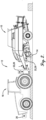
- the flow rate sensor 22 (indicated as a plurality of boxes with an "FR" in Fig. 2 ) may be positioned in at least one of the following locations: on the rear of the tractor 16 or on the front of the baler 10 such that the flow rate sensor 22 has an unobstructed view of the front of the baler 10.
- the flow rate sensor 22 outputs an electronic flow rate signal and/or data that includes a level and/or value that varies according to, is proportional to, or positively correlates to, the flow rate of the crop 20 into the pickup 14.
- the flow rate signal may have a greater level and/or value when the flow rate has a greater value.
- the flow rate signal may have a smaller level and/or value when the flow rate has a smaller value.
- the flow rate signal may represent the flow rate of the crop 20 into the pickup 14 as a speed, such as feet per second or meters per second. In other embodiments, the flow rate signal may represent the flow rate of the crop 20 into the pickup 14 as a volume rate, such as gallons per second or liters per second.
- the load sensor 24 generally senses or detects a load on the pickup 14 during operation and may include transducers or other devices to sense or detect electric voltage, electric current, fluid pressure, air pressure, or the like.
- An exemplary load sensor 24 includes a fluid pressure sensor to sense or detect hydraulic fluid pressure of the hydraulic fluid used in the pickup 14.
- a value of the hydraulic fluid pressure generally corresponds, or positively correlates, to a level of the load on the pickup 14. That is, a high value of the hydraulic fluid pressure corresponds to a large load on the pickup 14. And, a low value of the hydraulic fluid pressure corresponds to a small load on the pickup 14.
- the load sensor 24 outputs an electronic load signal and/or data that includes a level and/or value that varies according to, is proportional to, or positively correlates to, the load on the pickup 14.
- the windrow sensor 26 generally monitors a ground area in front of the baler 10 and determines or senses a cross-sectional area of the windrow 18. Typically, the windrow sensor 26 determines the cross-sectional area of the windrow 18 widthwise, or looking axially along the windrow 18, as opposed to lengthwise, or looking transverse at the windrow 18.
- the windrow sensor 26 may include radio frequency transceivers such as radar transceivers, laser light transceivers such as lidar transceivers, video imaging or photograph imaging cameras, or other non-contact devices, such as ultrasonic devices, that can determine the cross-sectional area of the windrow 18.
- the windrow sensor 26 (indicated as a plurality of boxes with a "W" in Fig.
- the windrow sensor 26 may be positioned in at least one of the following locations: on the front of the tractor 16, on the rear of the tractor 16, or on the front of the baler 10 such that the windrow sensor 26 has an unobstructed view of the ground in front of the baler 10.
- the windrow sensor 26 may further include signal or data processing components that process the radar, lidar, video, or photographic data and determine the cross-sectional area of the windrow 18.
- the windrow sensor 26 outputs an electronic windrow signal and/or data that includes a level and/or value that varies according to, is proportional to, or positively correlates to, the cross-sectional area of the windrow 18. For example, the windrow signal may have a greater value when the cross-sectional area of the windrow 18 has a greater value.
- the windrow signal may have a smaller value when the cross-sectional area of the windrow 18 has a smaller value.
- the windrow sensor 26 may output the windrow sensor signal and/or data that varies according to the ground area in front of the baler 10 and includes a radar, lidar, video, or photographic representation of the ground in front of the baler 10 without processing to determine the cross-sectional area of the windrow 18.
- the processing element 28 may comprise one or more processors.
- the processing element 28 may include electronic hardware components such as microprocessors (single-core or multi-core), microcontrollers, digital signal processors (DSPs), field-programmable gate arrays (FPGAs), analog and/or digital application-specific integrated circuits (ASICs), or the like, or combinations thereof.
- the processing element 28 may generally execute, process, or run instructions, code, code segments, code statements, software, firmware, programs, applications, apps, processes, services, daemons, or the like.
- the processing element 28 may also include hardware components such as registers, finite-state machines, sequential and combinational logic, configurable logic blocks, and other electronic circuits that can perform the functions necessary for the operation of the current invention.
- the processing element 28 may include multiple computational components and functional blocks that are packaged separately but function as a single unit.
- the processing element 28 may be in electronic communication with the other electronic components through serial or parallel links that include universal busses, address busses, data busses, control lines, and the like.
- the processing element 28 may further comprise or be in electronic communication with a memory element.
- the memory element may be embodied by devices or components that store data in general, and digital or binary data in particular, and may include exemplary electronic hardware data storage devices or components such as read-only memory (ROM), programmable ROM, erasable programmable ROM, random-access memory (RAM) such as static RAM (SRAM) or dynamic RAM (DRAM), cache memory, hard disks, floppy disks, optical disks, flash memory, thumb drives, universal serial bus (USB) drives, or the like, or combinations thereof.
- the memory element may be embedded in, or packaged in the same package as, the processing element 28.
- the memory element may include, or may constitute, a non-transitory "computer-readable medium".
- the memory element may store the instructions, code, code statements, code segments, software, firmware, programs, applications, apps, services, daemons, or the like that are executed by the processing element 28.
- the memory element may also store data that is received by the processing element 28 or the device in which the processing element 28 is implemented.
- the processing element 28 may further store data or intermediate results generated during processing, calculations, and/or computations as well as data or final results after processing, calculations, and/or computations.
- the memory element may store settings, data, documents, sound files, photographs, movies, images, databases, and the like.
- the processing element 28 may be operable, configured, or programmed to perform the following functions by utilizing hardware, software, firmware, or combinations thereof.
- the processing element 28 receives the flow rate signal from the flow rate sensor 22.
- the processing element 28 may also receive a speed signal and/or data regarding the speed, or ground speed, of the tractor 16 and/or baler 10.
- the speed signal and/or data may be received from the tractor 16 or speed sensors positioned on the baler 10.
- the processing element 28 compares the flow rate of the crop 20 into the pickup 14 with the speed of the baler 10 by comparing the flow rate signal with the speed signal and/or data, which generates a comparison result. (This assumes that the flow rate of the crop 20 into the pickup 14 from the flow rate signal is expressed as a speed, such feet per second or meters per second.
- the processing element 28 outputs an electronic speed signal that is received by the tractor speed controller 30.
- the level and/or data value of the speed signal determines the speed of the tractor 16, and hence the baler 10.
- the processing element 28 adjusts the level and/or data value of the speed signal according to, or based on, the comparison result, i.e., the comparison of the flow rate of the crop 20 into the pickup 14 with the speed of the baler 10. For example, if the flow rate is greater than the speed, then the processing element 28 adjusts the level and/or data value of the speed signal to increase the speed of the tractor 16.
- the processing element 28 adjusts the level and/or data value of the speed signal to decrease the speed of the tractor 16. If the flow rate is approximately equal to the speed, then the processing element 28 maintains the current level and/or data value of the speed signal. With the speed of the tractor 16 and the baler 10 set properly, the baler 10 can go slow enough to avoid overloading the pickup 14 while at the same time going fast enough to provide optimum performance.
- the processing element 28 receives the load signal from the load sensor 24, and the windrow signal from the windrow sensor 26. In addition, the processing element 28 has knowledge of, or receives a crop moisture signal and/or data regarding, a moisture level of the crop 20. For example, the tractor operator may enter information about the moisture level of the crop 20 into a user interface electronically coupled to the processing element 28. Or, the processing element 28 may receive a crop moisture signal and/or data about the moisture level of the crop 20 from one or more moisture/humidity sensors positioned on the baler 10 or the tractor 16. The processing element 28 outputs the speed signal and adjusts its level and/or data value according to, or based on, the load of the pickup 14, the cross-sectional area of the crop 20, and the moisture level of the crop 20.
- the processing element 28 may set the level and/or data value of the speed signal through the use of a dynamic lookup table that may be stored in the memory element associated with the processing element 28.
- the lookup table may include a plurality of columns, one column to hold values for each of the measured or known quantities including the load of the pickup 14, the cross-sectional area of the crop 20, and the moisture level of the crop 20.
- the table may also include a column for the level and/or data value of the speed signal.
- the lookup table would include a plurality of rows, each row including a different combination of values for the load of the pickup 14, the cross-sectional area of the crop 20, and the moisture level of the crop 20.
- Each row would also include the appropriate level and/or data value of the speed signal for the given combination of the load of the pickup 14, the cross-sectional area of the crop 20, and the moisture level of the crop 20.
- the processing element 28 would retrieve the level and/or data value of the speed signal stored in the lookup table in the row pointed to by the combination of the current values for the load of the pickup 14, the cross-sectional area of the crop 20, and the moisture level of the crop 20.
- the processing element 28 may apply an algorithm, including a sequence of steps, in order to set the level and/or data value of the speed signal given the values for the load of the pickup 14, the cross-sectional area of the crop 20, and the moisture level of the crop 20.
- the processing element 28 may determine the level and/or data value of the speed signal through the use of an equation that describes the relationship between the speed of the baler 10 and the load of the pickup 14, the cross-sectional area of the crop 20, and the moisture level of the crop 20.
- the specific expression for each variable in the equation may be predetermined empirically or using other techniques.
- the processing element 28 would simply plug the current values for the load of the pickup 14, the cross-sectional area of the crop 20, and the moisture level of the crop 20 into the equation.
- an increase in the cross-sectional area of the crop 20 will lead to an increase in the load on the pickup 14.
- the level and/or data value of the speed signal, and in turn the speed of the tractor 16 may be decreased to prevent the load on the pickup 14 exceeding a certain value.
- a decrease in the cross-sectional area of the crop 20 will lead to a decrease in the load on the pickup 14.
- the level and/or data value of the speed signal, and in turn the speed of the tractor 16 may be increased to maintain the load on the pickup 14 in a certain optimal range.
- an increase in the moisture level of the crop 20 may increase the load on the pickup 14, while a decrease in the moisture level of the crop 20 may decrease the load on the pickup 14.
- the level and/or data value of the speed signal may be decreased in response to an increase in the moisture level and may be increased in response to an decrease in the moisture level.
- the tractor speed controller 30 generally controls the speed of the tractor 16 and, in turn, the baler 10.
- the tractor speed controller 30 may include microprocessors, microcontrollers, FPGAs, or the like, or combinations thereof.
- the tractor speed controller 30 receives the speed signal from the processing element 28 through a controller area network (CAN) bus, an ISOBUS, or other communication standard architectures.
- the tractor speed controller 30 may output one or more electronic signals that are received by mechanical systems or mechanical control systems which provide propulsion or drive for the tractor 16.
- the electronic signals output by the tractor speed controller 30 set the speed of the tractor 16 to vary according to, or based on, the level and/or data value of the speed signal.
- the speed of the tractor 16 varies according to the comparison result from comparing the flow rate of the crop 20 into the pickup 14 with the speed of the tractor 16. In other embodiments, the speed of the tractor 16 varies according to the load of the pickup 14, the cross-sectional area of the crop 20, and the moisture level of the crop 20.
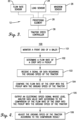
- Fig. 4 depicts a listing of at least a portion of the steps of an exemplary method 100 for adjusting a tractor speed based on a performance of the pickup 14 of the baler 10.
- the steps may be performed in the order shown in Fig. 4 , or they may be performed in a different order. Furthermore, some steps may be performed concurrently as opposed to sequentially. In addition, some steps may be optional or may not be performed.
- the flow rate sensor 22 generally monitors a front end of the baler 10 and determines or senses a flow rate, or feed rate, of the crop 20 into the pickup 14.
- the flow rate sensor 22 may include radio frequency transceivers such as radar transceivers, laser light transceivers such as lidar transceivers, video imaging or photograph imaging cameras, or contact devices, such as wheels or rotors that engage the crop 20.
- a flow rate of a crop 20 into the pickup 14 is determined or sensed.
- the flow rate is determined by the flow rate sensor 22, which outputs an electronic flow rate signal and/or data that includes a level and/or value that varies according to, is proportional to, or positively correlates to, the flow rate of the crop 20 into the pickup 14.
- the flow rate signal may have a greater level and/or value when the flow rate has a greater value.
- the flow rate signal may have a smaller level and/or value when the flow rate has a smaller value.
- the flow rate signal may represent the flow rate of the crop 20 into the pickup 14 as a speed, such as feet per second or meters per second.
- a signal and/or data regarding the speed, or ground speed, of the tractor 16 and/or baler 10 is received.
- the speed signal and/or data may be received from the tractor 16 or speed sensors positioned on the baler 10.
- the flow rate of the crop 20 into the pickup 14 is compared with the speed of the tractor 16 and/or baler 10.
- the processing element 28 receives both the flow rate signal (including flow rate data of the crop 20) and the speed signal and/or data, which generates a comparison result. (This assumes that the flow rate of the crop 20 into the pickup 14 is expressed as a speed, such feet per second or meters per second. If the flow rate of the crop 20 into the pickup 14 is expressed in other units or terms, then the flow rate is converted to a speed.)
- an electronic speed signal is output whose level and/or data value varies according to the comparison result, i.e., the comparison of the flow rate of the crop 20 into the pickup 14 with the speed of the tractor 16 and/or the baler 10.
- the speed signal is output by the processing element 28. If the flow rate is greater than the speed, then the processing element 28 adjusts the level and/or data value of the speed signal to increase the speed of the tractor 16. If the flow rate is less than the speed, then the processing element 28 adjusts the level and/or data value of the speed signal to decrease the speed of the tractor 16. If the flow rate is approximately equal to the speed, then the processing element 28 maintains the current level and/or data value of the speed signal.
- the tractor speed controller 30 generally controls the speed of the tractor 16 and, in turn, the baler 10.
- the tractor speed controller 30 may include microprocessors, microcontrollers, FPGAs, or the like, or combinations thereof.
- the speed signal is received by the tractor speed controller 30 which outputs one or more electronic signals that are received by mechanical systems or mechanical control systems which provide propulsion or drive for the tractor 16.
- the electronic signals output by the tractor speed controller 30 set the speed of the tractor 16 to vary according to, or based on, the level and/or data value of the speed signal.
- the speed of the tractor 16 is increased if the flow rate of the crop 20 into the pickup 14 is greater than the speed of the tractor 16.
- the speed of the tractor 16 is decreased if the flow rate of the crop 20 into the pickup 14 is less than the speed of the tractor 16.
- the speed of the tractor 16 is maintained if the flow rate of the crop 20 into the pickup 14 is approximately equal to the speed of the tractor 16. With the speed of the tractor 16 and the baler 10 set properly, the baler 10 can go slow enough to avoid overloading the pickup 14 while at the same time going fast enough to provide optimum performance.
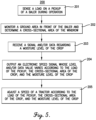
- Fig. 5 depicts a listing of at least a portion of the steps of an exemplary method 200 for adjusting a tractor speed to avoid a plugging event in the baler 10.
- the steps may be performed in the order shown in Fig. 5 , or they may be performed in a different order. Furthermore, some steps may be performed concurrently as opposed to sequentially. In addition, some steps may be optional or may not be performed.
- a load on the pickup 14 is sensed during operation.
- the load sensor 24 generally senses or detects a load on the pickup 14 during operation and may include transducers or other devices to sense or detect electric voltage, electric current, fluid pressure, air pressure, or the like.
- An exemplary load sensor 24 includes a fluid pressure sensor to sense or detect hydraulic fluid pressure of the hydraulic fluid used in the pickup 14.
- a value of the hydraulic fluid pressure generally corresponds, or positively correlates, to a level of the load on the pickup 14. That is, a high value of the hydraulic fluid pressure corresponds to a large load on the pickup 14. And, a low value of the hydraulic fluid pressure corresponds to a small load on the pickup 14.
- the load sensor 24 outputs an electronic load signal and/or data that includes a level and/or value that varies according to, is proportional to, or positively correlates to, the load on the pickup 14.
- a ground area in front of the baler 10 is monitored and a cross-sectional area of the windrow 18 is determined.
- the windrow sensor 26 generally monitors a ground area in front of the baler 10 and determines or senses a cross-sectional area of the windrow 18. Typically, the windrow sensor 26 determines the cross-sectional area of the windrow 18 widthwise, or looking axially along the windrow 18, as opposed to lengthwise, or looking transverse at the windrow 18.
- the windrow sensor 26 may include radio frequency transceivers such as radar transceivers, laser light transceivers such as lidar transceivers, video imaging or photograph imaging cameras, or other non-contact devices, such as ultrasonic devices, that can determine the cross-sectional area of the windrow 18.
- the windrow sensor 26 (indicated as a plurality of boxes with an "W" in Fig. 2 ) may be positioned in at least one of the following locations: on the front of the tractor 16, on the rear of the tractor 16, or on the front of the baler 10 such that the windrow sensor 26 has an unobstructed view of the ground in front of the baler 10.
- the windrow sensor 26 may further include signal or data processing components that process the radar, lidar, video, or photographic data and determine the cross-sectional area of the windrow 18.
- the windrow sensor 26 outputs an electronic windrow signal and/or data that includes a level and/or value that varies according to, is proportional to, or positively correlates to, the cross-sectional area of the windrow 18.
- the windrow signal may have a greater value when the cross-sectional area of the windrow 18 has a greater value.
- the windrow signal may have a smaller value when the cross-sectional area of the windrow 18 has a smaller value.
- a signal and/or data is received regarding a moisture level of the crop 20.
- the tractor operator may enter information about the moisture level of the crop 20 into a user interface electronically coupled to the processing element 28.
- the processing element 28 may receive a signal and/or data about the moisture level of the crop 20 from one or more moisture/humidity sensors positioned on the baler 10 or the tractor 16.
- a speed signal is output whose level and/or data value varies according to the load of the pickup 14, the cross-sectional area of the crop 20, and the moisture level of the crop 20.
- the processing element 28 receives the load signal, the windrow signal, and the signal and/or data about the moisture level of the crop 20 and outputs the speed signal.
- the processing element 28 may set the level and/or data value of the speed signal through the use of a dynamic lookup table that may be stored in the memory element associated with the processing element 28.
- the lookup table may include a plurality of columns, one column to hold values for each of the measured or known quantities including the load of the pickup 14, the cross-sectional area of the crop 20, and the moisture level of the crop 20.
- the table may also include a column for the level and/or data value of the speed signal.
- the lookup table would include a plurality of rows, each row including a different combination of values for the load of the pickup 14, the cross-sectional area of the crop 20, and the moisture level of the crop 20. Each row would also include the appropriate level and/or data value of the speed signal for the given combination of the load of the pickup 14, the cross-sectional area of the crop 20, and the moisture level of the crop 20.
- the processing element 28 would retrieve the level and/or data value of the speed signal stored in the lookup table in the row pointed to by the combination of the current values for the load of the pickup 14, the cross-sectional area of the crop 20, and the moisture level of the crop 20.
- the processing element 28 may apply an algorithm, including a sequence of steps, in order to set the level and/or data value of the speed signal given the values for the load of the pickup 14, the cross-sectional area of the crop 20, and the moisture level of the crop 20.
- the processing element 28 may determine the level and/or data value of the speed signal through the use of an equation that describes the relationship between the speed of the baler 10 and the load of the pickup 14, the cross-sectional area of the crop 20, and the moisture level of the crop 20.
- the specific expression for each variable in the equation may be predetermined empirically or using other techniques.
- the processing element 28 would simply plug the current values for the load of the pickup 14, the cross-sectional area of the crop 20, and the moisture level of the crop 20 into the equation.
- a speed of the tractor 16 is adjusted according to the load of the pickup 14, the cross-sectional area of the crop 20, and the moisture level of the crop 20.
- the tractor speed controller 30 generally controls the speed of the tractor 16 and, in turn, the baler 10.
- the tractor speed controller 30 may include microprocessors, microcontrollers, FPGAs, or the like, or combinations thereof.
- the tractor speed controller 30 receives the speed signal from the processing element 28. Given that the level and/or data value of the speed signal is adjusted according to the load of the pickup 14, the cross-sectional area of the crop 20, and the moisture level of the crop 20, so too is the speed of the tractor 16.
- an increase in the cross-sectional area of the crop 20 will lead to an increase in the load on the pickup 14.
- the speed of the tractor 16 may be decreased to prevent the load on the pickup 14 exceeding a certain value.
- a decrease in the cross-sectional area of the crop 20 will lead to a decrease in the load on the pickup 14.
- the speed of the tractor 16 may be increased to maintain the load on the pickup 14 in a certain optimal range.
- an increase in the moisture level of the crop 20 may increase the load on the pickup 14, while a decrease in the moisture level of the crop 20 may decrease the load on the pickup 14.
- the speed of the tractor 16 may be decreased in response to an increase in the moisture level and may be increased in response to an decrease in the moisture level.
- references to “one embodiment”, “an embodiment”, or “embodiments” mean that the feature or features being referred to are included in at least one embodiment of the technology.
- references to “one embodiment”, “an embodiment”, or “embodiments” in this description do not necessarily refer to the same embodiment and are also not mutually exclusive unless so stated and/or except as will be readily apparent to those skilled in the art from the description.
- a feature, structure, act, etc. described in one embodiment may also be included in other embodiments, but is not necessarily included.
- the current invention can include a variety of combinations and/or integrations of the embodiments described herein.
- routines, subroutines, applications, or instructions may constitute either software (e.g., code embodied on a machine-readable medium or in a transmission signal) or hardware.
- routines, etc. are tangible units capable of performing certain operations and may be configured or arranged in a certain manner.
- one or more computer systems e.g., a standalone, client or server computer system
- one or more hardware modules of a computer system e.g., a processor or a group of processors
- software e.g., an application or application portion
- computer hardware such as a processing element
- the processing element may comprise dedicated circuitry or logic that is permanently configured, such as an application-specific integrated circuit (ASIC), or indefinitely configured, such as an FPGA, to perform certain operations.
- ASIC application-specific integrated circuit
- FPGA field-programmable gate array
- the processing element may also comprise programmable logic or circuitry (e.g., as encompassed within a general-purpose processor or other programmable processor) that is temporarily configured by software to perform certain operations. It will be appreciated that the decision to implement the processing element as special purpose, in dedicated and permanently configured circuitry, or as general purpose (e.g., configured by software) may be driven by cost and time considerations.
- processing element or equivalents should be understood to encompass a tangible entity, be that an entity that is physically constructed, permanently configured (e.g., hardwired), or temporarily configured (e.g., programmed) to operate in a certain manner or to perform certain operations described herein.
- the processing element is temporarily configured (e.g., programmed)
- each of the processing elements need not be configured or instantiated at any one instance in time.
- the processing element comprises a general-purpose processor configured using software
- the general-purpose processor may be configured as respective different processing elements at different times.
- Software may accordingly configure the processing element to constitute a particular hardware configuration at one instance of time and to constitute a different hardware configuration at a different instance of time.
- Computer hardware components such as communication elements, memory elements, processing elements, and the like, may provide information to, and receive information from, other computer hardware components. Accordingly, the described computer hardware components may be regarded as being communicatively coupled. Where multiple of such computer hardware components exist contemporaneously, communications may be achieved through signal transmission (e.g., over appropriate circuits and buses) that connect the computer hardware components. In embodiments in which multiple computer hardware components are configured or instantiated at different times, communications between such computer hardware components may be achieved, for example, through the storage and retrieval of information in memory structures to which the multiple computer hardware components have access. For example, one computer hardware component may perform an operation and store the output of that operation in a memory device to which it is communicatively coupled. A further computer hardware component may then, at a later time, access the memory device to retrieve and process the stored output. Computer hardware components may also initiate communications with input or output devices, and may operate on a resource (e.g., a collection of information).
- a resource e.g., a collection of information
- processing elements may be temporarily configured (e.g., by software) or permanently configured to perform the relevant operations. Whether temporarily or permanently configured, such processing elements may constitute processing element-implemented modules that operate to perform one or more operations or functions.
- the modules referred to herein may, in some example embodiments, comprise processing element-implemented modules.
- the methods or routines described herein may be at least partially processing element-implemented. For example, at least some of the operations of a method may be performed by one or more processing elements or processing element-implemented hardware modules. The performance of certain of the operations may be distributed among the one or more processing elements, not only residing within a single machine, but deployed across a number of machines. In some example embodiments, the processing elements may be located in a single location (e.g., within a home environment, an office environment or as a server farm), while in other embodiments the processing elements may be distributed across a number of locations.
- the terms “comprises,” “comprising,” “includes,” “including,” “has,” “having” or any other variation thereof, are intended to cover a non-exclusive inclusion.
- a process, method, article, or apparatus that comprises a list of elements is not necessarily limited to only those elements but may include other elements not expressly listed or inherent to such process, method, article, or apparatus.
Landscapes
- Engineering & Computer Science (AREA)
- Physics & Mathematics (AREA)
- Remote Sensing (AREA)
- Radar, Positioning & Navigation (AREA)
- General Physics & Mathematics (AREA)
- Life Sciences & Earth Sciences (AREA)
- Environmental Sciences (AREA)
- Computer Networks & Wireless Communication (AREA)
- Electromagnetism (AREA)
- Automation & Control Theory (AREA)
- Transportation (AREA)
- Mechanical Engineering (AREA)
- Fluid Mechanics (AREA)
- Harvester Elements (AREA)
- Control Of Water Turbines (AREA)
Description
- Embodiments of the current invention relate to systems and methods for adjusting a speed of a tractor pulling a baler to avoid baler plugging.
- Balers, or hay balers, are machines that gather and compress a cut fodder crop, such as hay, cotton, flax straw, salt marsh hay, or silage, into a compact and manageable bale. After the fodder crop is cut, and before it is baled, it is usually left on the ground in a field in a plurality of elongated, relatively narrow windrows. Balers typically include a pickup located at their front end which has rotors and tines or other components to gather up the crop and feed it to a compressor which compresses the cut crop before tying it and ejecting it. Given the conditions of the crop and the throughput of the pickup, there is a maximum speed at which the baler can travel before the amount of the crop coming into the pickup exceeds its capacity and either the baler starts pushing the crop, instead of baling it, or the baler becomes plugged downstream from the pickup.
- Typically, the baler is pulled by a tractor which is driven by an operator. Adjusting the speed of the baler to avoid overloading the baler is a manual process performed by the tractor operator looking over his shoulder at the pickup of the baler. If the operator notices an increasing load in the pickup, he may slow down, and if he notices a decreasing load in the pickup, he may speed up. If the operator becomes distracted and does not slow down when the load in the pickup increases, the baler will become plugged or the crop will be pushed by the baler. Known systems for adjusting a tractor speed are disclosed in documents
US 2001/042362 A1 andEP 3 398 420 A1 . - Embodiments of the current invention solve the above-mentioned problems and provide a distinct advance in the art of balers. Specifically, embodiments of the present invention may provide systems and methods for adjusting a tractor speed based on a performance of a pickup of a baler to avoid baler plugging.
- An embodiment of the system broadly comprises a load sensor, a windrow sensor, a processing element, and a tractor speed controller. The load sensor is configured to sense a load on a pickup of the baler and output a load signal with a level and/or data value that varies according to the load on the pickup. The windrow sensor is configured to monitor a ground area in front of the baler, determine a cross-sectional area of the windrow, and output a windrow signal with a level and/or data value that varies according to a cross-sectional area of the windrow. The processing element is configured or programmed to receive the load signal, receive the windrow signal, receive a crop moisture signal and/or data about a moisture level of a crop to be baled, and output a speed signal with a level and/or data value that varies according to values from the load signal, the windrow signal, and the crop moisture signal and/or data. The tractor speed controller is configured to receive the speed signal and adjust a speed of the tractor according to the level and/or data value of the speed signal.
- An embodiment of the method broadly comprises sensing a load on a pickup of the baler during operation; monitoring a ground area in front of the baler and determining a cross-sectional area of the windrow; receiving a signal and/or data regarding a moisture level of the crop; and adjusting a speed of the tractor according to the load of the pickup, the cross-sectional area of the crop, and the moisture level of the crop.
- Another embodiment of the current invention provides a baler to be pulled by a tractor while baling a crop. The baler broadly comprising a pickup, a load sensor, a windrow sensor, a processing element, and a tractor speed controller. The load sensor is configured to sense a load on the pickup and output a load signal with a level and/or data value that varies according to the load on the pickup. The windrow sensor is configured to monitor a ground area in front of the baler, determine a cross-sectional area of the windrow, and output a windrow signal with a level and/or data value that varies according to a cross-sectional area of the windrow. The processing element is configured or programmed to receive the load signal, receive the windrow signal, receive a crop moisture signal and/or data about a moisture level of a crop to be baled, and output a speed signal with a level and/or data value that varies according to values from the load signal, the windrow signal, and the crop moisture signal and/or data. The tractor speed controller is configured to receive the speed signal and adjust a speed of the tractor according to the level and/or data value of the speed signal.
- This summary is provided to introduce a selection of concepts in a simplified form that are further described below in the detailed description. This summary is not intended to identify key features or essential features of the claimed subject matter, nor is it intended to be used to limit the scope of the claimed subject matter. Other aspects and advantages of the current invention will be apparent from the following detailed description of the embodiments and the accompanying drawing figures.
- Embodiments of the current invention are described in detail below with reference to the attached drawing figures, wherein:
-
Fig. 1 is an overhead environmental view of a field including a plurality of windrows where a tractor is pulling a baler including a system, constructed in accordance with various embodiments of the current invention, for adjusting a tractor speed based on a performance of a pickup of the baler and to avoid a plugging event in the baler; -
Fig. 2 is a side view of the tractor and the baler; -
Fig. 3 is a schematic block diagram of various electronic components of the system; -
Fig. 4 is a listing of at least a portion of the steps of a method for adjusting a tractor speed based on a performance of the pickup; and -
Fig. 5 is a listing of at least a portion of the steps of a method for adjusting a tractor speed to avoid a plugging event in the baler. - The drawing figures do not limit the current invention to the specific embodiments disclosed and described herein. The drawings are not necessarily to scale, emphasis instead being placed upon clearly illustrating the principles of the invention.
- The following detailed description of the technology references the accompanying drawings that illustrate specific embodiments in which the technology can be practiced. The embodiments are intended to describe aspects of the technology in sufficient detail to enable those skilled in the art to practice the technology. Other embodiments can be utilized and changes can be made without departing from the scope of the current invention. The following detailed description is, therefore, not to be taken in a limiting sense. The scope of the current invention is defined only by the appended claims.
- A
baler 10 including asystem 12, constructed in accordance with various embodiments of the current invention, for adjusting a tractor speed based on a performance of apickup 14 of thebaler 10 and to avoid a plugging event in thebaler 10 is shown inFigs. 1 and2 . Thebaler 10 is pulled by atractor 16, driven by an operator, over awindrow 18 of acut crop 20 while thebaler 10 performs the process of baling thecut crop 20, i.e., collecting, compressing, and tying it. The cutcrop 20 may include hay, cotton, flax straw, salt marsh hay, or silage. - The
baler 10 may be a "round" baler, which produces cylindrically shaped bales, or a large or small "square" baler, which produces rectangular bales such as the ones shown inFig. 2 . Thepickup 14 of thebaler 10 may include a plurality of outwardextending tines attached to a rotating cylinder. The tines receive, contact, and grab thecut crop 20 from thewindrow 18. The gatheredcrop 20 is then fed, or passed, from thepickup 14 to other components of thebaler 10 which compress and tie thecrop 20 into a bale. - The
system 12, as shown inFig. 3 , broadly comprises aflow rate sensor 22, aload sensor 24, awindrow sensor 26, aprocessing element 28, and atractor speed controller 30. Theflow rate sensor 22 generally monitors a front end of thebaler 10, that is, the feed point of thepickup 14, and determines or senses a flow rate, or feed rate, of thecrop 20 into thepickup 14. Theflow rate sensor 22 may include radio frequency transceivers such as radar transceivers, laser light transceivers such as lidar transceivers, video imaging or photograph imaging cameras, or contact devices, such as wheels or rotors that engage thecrop 20, which can determine the flow rate of thecrop 20 into thepickup 14. The flow rate sensor 22 (indicated as a plurality of boxes with an "FR" inFig. 2 ) may be positioned in at least one of the following locations: on the rear of thetractor 16 or on the front of thebaler 10 such that theflow rate sensor 22 has an unobstructed view of the front of thebaler 10. Theflow rate sensor 22 outputs an electronic flow rate signal and/or data that includes a level and/or value that varies according to, is proportional to, or positively correlates to, the flow rate of thecrop 20 into thepickup 14. For example, the flow rate signal may have a greater level and/or value when the flow rate has a greater value. The flow rate signal may have a smaller level and/or value when the flow rate has a smaller value. In some embodiments, the flow rate signal may represent the flow rate of thecrop 20 into thepickup 14 as a speed, such as feet per second or meters per second. In other embodiments, the flow rate signal may represent the flow rate of thecrop 20 into thepickup 14 as a volume rate, such as gallons per second or liters per second. - The
load sensor 24 generally senses or detects a load on thepickup 14 during operation and may include transducers or other devices to sense or detect electric voltage, electric current, fluid pressure, air pressure, or the like. Anexemplary load sensor 24 includes a fluid pressure sensor to sense or detect hydraulic fluid pressure of the hydraulic fluid used in thepickup 14. A value of the hydraulic fluid pressure generally corresponds, or positively correlates, to a level of the load on thepickup 14. That is, a high value of the hydraulic fluid pressure corresponds to a large load on thepickup 14. And, a low value of the hydraulic fluid pressure corresponds to a small load on thepickup 14. Theload sensor 24 outputs an electronic load signal and/or data that includes a level and/or value that varies according to, is proportional to, or positively correlates to, the load on thepickup 14. - The
windrow sensor 26 generally monitors a ground area in front of thebaler 10 and determines or senses a cross-sectional area of thewindrow 18. Typically, thewindrow sensor 26 determines the cross-sectional area of thewindrow 18 widthwise, or looking axially along thewindrow 18, as opposed to lengthwise, or looking transverse at thewindrow 18. Thewindrow sensor 26 may include radio frequency transceivers such as radar transceivers, laser light transceivers such as lidar transceivers, video imaging or photograph imaging cameras, or other non-contact devices, such as ultrasonic devices, that can determine the cross-sectional area of thewindrow 18. The windrow sensor 26 (indicated as a plurality of boxes with a "W" inFig. 2 ) may be positioned in at least one of the following locations: on the front of thetractor 16, on the rear of thetractor 16, or on the front of thebaler 10 such that thewindrow sensor 26 has an unobstructed view of the ground in front of thebaler 10. Thewindrow sensor 26 may further include signal or data processing components that process the radar, lidar, video, or photographic data and determine the cross-sectional area of thewindrow 18. Thewindrow sensor 26 outputs an electronic windrow signal and/or data that includes a level and/or value that varies according to, is proportional to, or positively correlates to, the cross-sectional area of thewindrow 18. For example, the windrow signal may have a greater value when the cross-sectional area of thewindrow 18 has a greater value. The windrow signal may have a smaller value when the cross-sectional area of thewindrow 18 has a smaller value. Alternatively, thewindrow sensor 26 may output the windrow sensor signal and/or data that varies according to the ground area in front of thebaler 10 and includes a radar, lidar, video, or photographic representation of the ground in front of thebaler 10 without processing to determine the cross-sectional area of thewindrow 18. - The
processing element 28 may comprise one or more processors. Theprocessing element 28 may include electronic hardware components such as microprocessors (single-core or multi-core), microcontrollers, digital signal processors (DSPs), field-programmable gate arrays (FPGAs), analog and/or digital application-specific integrated circuits (ASICs), or the like, or combinations thereof. Theprocessing element 28 may generally execute, process, or run instructions, code, code segments, code statements, software, firmware, programs, applications, apps, processes, services, daemons, or the like. Theprocessing element 28 may also include hardware components such as registers, finite-state machines, sequential and combinational logic, configurable logic blocks, and other electronic circuits that can perform the functions necessary for the operation of the current invention. In certain embodiments, theprocessing element 28 may include multiple computational components and functional blocks that are packaged separately but function as a single unit. Theprocessing element 28 may be in electronic communication with the other electronic components through serial or parallel links that include universal busses, address busses, data busses, control lines, and the like. - The
processing element 28 may further comprise or be in electronic communication with a memory element. The memory element may be embodied by devices or components that store data in general, and digital or binary data in particular, and may include exemplary electronic hardware data storage devices or components such as read-only memory (ROM), programmable ROM, erasable programmable ROM, random-access memory (RAM) such as static RAM (SRAM) or dynamic RAM (DRAM), cache memory, hard disks, floppy disks, optical disks, flash memory, thumb drives, universal serial bus (USB) drives, or the like, or combinations thereof. In some embodiments, the memory element may be embedded in, or packaged in the same package as, theprocessing element 28. The memory element may include, or may constitute, a non-transitory "computer-readable medium". The memory element may store the instructions, code, code statements, code segments, software, firmware, programs, applications, apps, services, daemons, or the like that are executed by theprocessing element 28. The memory element may also store data that is received by theprocessing element 28 or the device in which theprocessing element 28 is implemented. Theprocessing element 28 may further store data or intermediate results generated during processing, calculations, and/or computations as well as data or final results after processing, calculations, and/or computations. In addition, the memory element may store settings, data, documents, sound files, photographs, movies, images, databases, and the like. - The
processing element 28 may be operable, configured, or programmed to perform the following functions by utilizing hardware, software, firmware, or combinations thereof. Theprocessing element 28 receives the flow rate signal from theflow rate sensor 22. Theprocessing element 28 may also receive a speed signal and/or data regarding the speed, or ground speed, of thetractor 16 and/orbaler 10. The speed signal and/or data may be received from thetractor 16 or speed sensors positioned on thebaler 10. Theprocessing element 28 compares the flow rate of thecrop 20 into thepickup 14 with the speed of thebaler 10 by comparing the flow rate signal with the speed signal and/or data, which generates a comparison result. (This assumes that the flow rate of thecrop 20 into thepickup 14 from the flow rate signal is expressed as a speed, such feet per second or meters per second. If the flow rate of thecrop 20 into thepickup 14 is expressed in other units or terms, then the flow rate is converted to a speed.) Theprocessing element 28 outputs an electronic speed signal that is received by thetractor speed controller 30. The level and/or data value of the speed signal determines the speed of thetractor 16, and hence thebaler 10. Theprocessing element 28 adjusts the level and/or data value of the speed signal according to, or based on, the comparison result, i.e., the comparison of the flow rate of thecrop 20 into thepickup 14 with the speed of thebaler 10. For example, if the flow rate is greater than the speed, then theprocessing element 28 adjusts the level and/or data value of the speed signal to increase the speed of thetractor 16. If the flow rate is less than the speed, then theprocessing element 28 adjusts the level and/or data value of the speed signal to decrease the speed of thetractor 16. If the flow rate is approximately equal to the speed, then theprocessing element 28 maintains the current level and/or data value of the speed signal. With the speed of thetractor 16 and thebaler 10 set properly, thebaler 10 can go slow enough to avoid overloading thepickup 14 while at the same time going fast enough to provide optimum performance. - The
processing element 28 receives the load signal from theload sensor 24, and the windrow signal from thewindrow sensor 26. In addition, theprocessing element 28 has knowledge of, or receives a crop moisture signal and/or data regarding, a moisture level of thecrop 20. For example, the tractor operator may enter information about the moisture level of thecrop 20 into a user interface electronically coupled to theprocessing element 28. Or, theprocessing element 28 may receive a crop moisture signal and/or data about the moisture level of thecrop 20 from one or more moisture/humidity sensors positioned on thebaler 10 or thetractor 16. Theprocessing element 28 outputs the speed signal and adjusts its level and/or data value according to, or based on, the load of thepickup 14, the cross-sectional area of thecrop 20, and the moisture level of thecrop 20. In some embodiments, theprocessing element 28 may set the level and/or data value of the speed signal through the use of a dynamic lookup table that may be stored in the memory element associated with theprocessing element 28. For example, the lookup table may include a plurality of columns, one column to hold values for each of the measured or known quantities including the load of thepickup 14, the cross-sectional area of thecrop 20, and the moisture level of thecrop 20. The table may also include a column for the level and/or data value of the speed signal. The lookup table would include a plurality of rows, each row including a different combination of values for the load of thepickup 14, the cross-sectional area of thecrop 20, and the moisture level of thecrop 20. Each row would also include the appropriate level and/or data value of the speed signal for the given combination of the load of thepickup 14, the cross-sectional area of thecrop 20, and the moisture level of thecrop 20. Thus, to set the level and/or data value of the speed signal, theprocessing element 28 would retrieve the level and/or data value of the speed signal stored in the lookup table in the row pointed to by the combination of the current values for the load of thepickup 14, the cross-sectional area of thecrop 20, and the moisture level of thecrop 20. - In other embodiments, the
processing element 28 may apply an algorithm, including a sequence of steps, in order to set the level and/or data value of the speed signal given the values for the load of thepickup 14, the cross-sectional area of thecrop 20, and the moisture level of thecrop 20. - In still other embodiments, the
processing element 28 may determine the level and/or data value of the speed signal through the use of an equation that describes the relationship between the speed of thebaler 10 and the load of thepickup 14, the cross-sectional area of thecrop 20, and the moisture level of thecrop 20. The equation may have a form such as: SPEED = f(LOAD, CSA, MOISTURE), wherein LOAD is the load of thepickup 14, CSA is the cross-sectional area of thecrop 20, and MOISTURE is the moisture level of thecrop 20. The specific expression for each variable in the equation may be predetermined empirically or using other techniques. Thus, to set the level and/or data value of the speed signal, theprocessing element 28 would simply plug the current values for the load of thepickup 14, the cross-sectional area of thecrop 20, and the moisture level of thecrop 20 into the equation. - In general, an increase in the cross-sectional area of the
crop 20 will lead to an increase in the load on thepickup 14. Thus, the level and/or data value of the speed signal, and in turn the speed of thetractor 16, may be decreased to prevent the load on thepickup 14 exceeding a certain value. In addition, a decrease in the cross-sectional area of thecrop 20 will lead to a decrease in the load on thepickup 14. Thus, the level and/or data value of the speed signal, and in turn the speed of thetractor 16, may be increased to maintain the load on thepickup 14 in a certain optimal range. Furthermore, an increase in the moisture level of thecrop 20 may increase the load on thepickup 14, while a decrease in the moisture level of thecrop 20 may decrease the load on thepickup 14. Accordingly, the level and/or data value of the speed signal may be decreased in response to an increase in the moisture level and may be increased in response to an decrease in the moisture level. With the speed of thetractor 16 and thebaler 10 set properly, thebaler 10 can go slow enough to avoid a plugging event while at the same time going fast enough to provide optimum performance. - The
tractor speed controller 30 generally controls the speed of thetractor 16 and, in turn, thebaler 10. Thetractor speed controller 30 may include microprocessors, microcontrollers, FPGAs, or the like, or combinations thereof. Thetractor speed controller 30 receives the speed signal from theprocessing element 28 through a controller area network (CAN) bus, an ISOBUS, or other communication standard architectures. Thetractor speed controller 30 may output one or more electronic signals that are received by mechanical systems or mechanical control systems which provide propulsion or drive for thetractor 16. The electronic signals output by thetractor speed controller 30 set the speed of thetractor 16 to vary according to, or based on, the level and/or data value of the speed signal. In some embodiments, the speed of thetractor 16 varies according to the comparison result from comparing the flow rate of thecrop 20 into thepickup 14 with the speed of thetractor 16. In other embodiments, the speed of thetractor 16 varies according to the load of thepickup 14, the cross-sectional area of thecrop 20, and the moisture level of thecrop 20. -
Fig. 4 depicts a listing of at least a portion of the steps of anexemplary method 100 for adjusting a tractor speed based on a performance of thepickup 14 of thebaler 10. The steps may be performed in the order shown inFig. 4 , or they may be performed in a different order. Furthermore, some steps may be performed concurrently as opposed to sequentially. In addition, some steps may be optional or may not be performed. - Referring to step 101, a front end of the
baler 10 is monitored. Theflow rate sensor 22 generally monitors a front end of thebaler 10 and determines or senses a flow rate, or feed rate, of thecrop 20 into thepickup 14. Theflow rate sensor 22 may include radio frequency transceivers such as radar transceivers, laser light transceivers such as lidar transceivers, video imaging or photograph imaging cameras, or contact devices, such as wheels or rotors that engage thecrop 20. - Referring to step 102, a flow rate of a
crop 20 into thepickup 14 is determined or sensed. The flow rate is determined by theflow rate sensor 22, which outputs an electronic flow rate signal and/or data that includes a level and/or value that varies according to, is proportional to, or positively correlates to, the flow rate of thecrop 20 into thepickup 14. For example, the flow rate signal may have a greater level and/or value when the flow rate has a greater value. The flow rate signal may have a smaller level and/or value when the flow rate has a smaller value. In some embodiments, the flow rate signal may represent the flow rate of thecrop 20 into thepickup 14 as a speed, such as feet per second or meters per second. - Referring to step 103, a signal and/or data regarding the speed, or ground speed, of the
tractor 16 and/orbaler 10 is received. The speed signal and/or data may be received from thetractor 16 or speed sensors positioned on thebaler 10. - Referring to step 104, the flow rate of the
crop 20 into thepickup 14 is compared with the speed of thetractor 16 and/orbaler 10. Theprocessing element 28 receives both the flow rate signal (including flow rate data of the crop 20) and the speed signal and/or data, which generates a comparison result. (This assumes that the flow rate of thecrop 20 into thepickup 14 is expressed as a speed, such feet per second or meters per second. If the flow rate of thecrop 20 into thepickup 14 is expressed in other units or terms, then the flow rate is converted to a speed.) - Referring to step 105, an electronic speed signal is output whose level and/or data value varies according to the comparison result, i.e., the comparison of the flow rate of the
crop 20 into thepickup 14 with the speed of thetractor 16 and/or thebaler 10. The speed signal is output by theprocessing element 28. If the flow rate is greater than the speed, then theprocessing element 28 adjusts the level and/or data value of the speed signal to increase the speed of thetractor 16. If the flow rate is less than the speed, then theprocessing element 28 adjusts the level and/or data value of the speed signal to decrease the speed of thetractor 16. If the flow rate is approximately equal to the speed, then theprocessing element 28 maintains the current level and/or data value of the speed signal. - Referring to step 106, the speed of the
tractor 16 is adjusted according to the comparison result. Thetractor speed controller 30 generally controls the speed of thetractor 16 and, in turn, thebaler 10. Thetractor speed controller 30 may include microprocessors, microcontrollers, FPGAs, or the like, or combinations thereof. The speed signal is received by thetractor speed controller 30 which outputs one or more electronic signals that are received by mechanical systems or mechanical control systems which provide propulsion or drive for thetractor 16. The electronic signals output by thetractor speed controller 30 set the speed of thetractor 16 to vary according to, or based on, the level and/or data value of the speed signal. Thus, the speed of thetractor 16 is increased if the flow rate of thecrop 20 into thepickup 14 is greater than the speed of thetractor 16. The speed of thetractor 16 is decreased if the flow rate of thecrop 20 into thepickup 14 is less than the speed of thetractor 16. The speed of thetractor 16 is maintained if the flow rate of thecrop 20 into thepickup 14 is approximately equal to the speed of thetractor 16. With the speed of thetractor 16 and thebaler 10 set properly, thebaler 10 can go slow enough to avoid overloading thepickup 14 while at the same time going fast enough to provide optimum performance. -
Fig. 5 depicts a listing of at least a portion of the steps of anexemplary method 200 for adjusting a tractor speed to avoid a plugging event in thebaler 10. The steps may be performed in the order shown inFig. 5 , or they may be performed in a different order. Furthermore, some steps may be performed concurrently as opposed to sequentially. In addition, some steps may be optional or may not be performed. - Referring to step 201, a load on the
pickup 14 is sensed during operation. Theload sensor 24 generally senses or detects a load on thepickup 14 during operation and may include transducers or other devices to sense or detect electric voltage, electric current, fluid pressure, air pressure, or the like. Anexemplary load sensor 24 includes a fluid pressure sensor to sense or detect hydraulic fluid pressure of the hydraulic fluid used in thepickup 14. A value of the hydraulic fluid pressure generally corresponds, or positively correlates, to a level of the load on thepickup 14. That is, a high value of the hydraulic fluid pressure corresponds to a large load on thepickup 14. And, a low value of the hydraulic fluid pressure corresponds to a small load on thepickup 14. Theload sensor 24 outputs an electronic load signal and/or data that includes a level and/or value that varies according to, is proportional to, or positively correlates to, the load on thepickup 14. - Referring to step 202, a ground area in front of the
baler 10 is monitored and a cross-sectional area of thewindrow 18 is determined. Thewindrow sensor 26 generally monitors a ground area in front of thebaler 10 and determines or senses a cross-sectional area of thewindrow 18. Typically, thewindrow sensor 26 determines the cross-sectional area of thewindrow 18 widthwise, or looking axially along thewindrow 18, as opposed to lengthwise, or looking transverse at thewindrow 18. Thewindrow sensor 26 may include radio frequency transceivers such as radar transceivers, laser light transceivers such as lidar transceivers, video imaging or photograph imaging cameras, or other non-contact devices, such as ultrasonic devices, that can determine the cross-sectional area of thewindrow 18. The windrow sensor 26 (indicated as a plurality of boxes with an "W" inFig. 2 ) may be positioned in at least one of the following locations: on the front of thetractor 16, on the rear of thetractor 16, or on the front of thebaler 10 such that thewindrow sensor 26 has an unobstructed view of the ground in front of thebaler 10. Thewindrow sensor 26 may further include signal or data processing components that process the radar, lidar, video, or photographic data and determine the cross-sectional area of thewindrow 18. Thewindrow sensor 26 outputs an electronic windrow signal and/or data that includes a level and/or value that varies according to, is proportional to, or positively correlates to, the cross-sectional area of thewindrow 18. For example, the windrow signal may have a greater value when the cross-sectional area of thewindrow 18 has a greater value. The windrow signal may have a smaller value when the cross-sectional area of thewindrow 18 has a smaller value. - Referring to step 203, a signal and/or data is received regarding a moisture level of the
crop 20. The tractor operator may enter information about the moisture level of thecrop 20 into a user interface electronically coupled to theprocessing element 28. Or, theprocessing element 28 may receive a signal and/or data about the moisture level of thecrop 20 from one or more moisture/humidity sensors positioned on thebaler 10 or thetractor 16. - Referring to step 204, a speed signal is output whose level and/or data value varies according to the load of the
pickup 14, the cross-sectional area of thecrop 20, and the moisture level of thecrop 20. Theprocessing element 28 receives the load signal, the windrow signal, and the signal and/or data about the moisture level of thecrop 20 and outputs the speed signal. In some embodiments, theprocessing element 28 may set the level and/or data value of the speed signal through the use of a dynamic lookup table that may be stored in the memory element associated with theprocessing element 28. For example, the lookup table may include a plurality of columns, one column to hold values for each of the measured or known quantities including the load of thepickup 14, the cross-sectional area of thecrop 20, and the moisture level of thecrop 20. The table may also include a column for the level and/or data value of the speed signal. The lookup table would include a plurality of rows, each row including a different combination of values for the load of thepickup 14, the cross-sectional area of thecrop 20, and the moisture level of thecrop 20. Each row would also include the appropriate level and/or data value of the speed signal for the given combination of the load of thepickup 14, the cross-sectional area of thecrop 20, and the moisture level of thecrop 20. Thus, to set the level and/or data value of the speed signal, theprocessing element 28 would retrieve the level and/or data value of the speed signal stored in the lookup table in the row pointed to by the combination of the current values for the load of thepickup 14, the cross-sectional area of thecrop 20, and the moisture level of thecrop 20. - In other embodiments, the
processing element 28 may apply an algorithm, including a sequence of steps, in order to set the level and/or data value of the speed signal given the values for the load of thepickup 14, the cross-sectional area of thecrop 20, and the moisture level of thecrop 20. - In still other embodiments, the
processing element 28 may determine the level and/or data value of the speed signal through the use of an equation that describes the relationship between the speed of thebaler 10 and the load of thepickup 14, the cross-sectional area of thecrop 20, and the moisture level of thecrop 20. The equation may have a form such as: SPEED = f(LOAD, CSA, MOISTURE), wherein LOAD is the load of thepickup 14, CSA is the cross-sectional area of thecrop 20, and MOISTURE is the moisture level of thecrop 20. The specific expression for each variable in the equation may be predetermined empirically or using other techniques. Thus, to set the level and/or data value of the speed signal, theprocessing element 28 would simply plug the current values for the load of thepickup 14, the cross-sectional area of thecrop 20, and the moisture level of thecrop 20 into the equation. - Referring to step 205, a speed of the
tractor 16 is adjusted according to the load of thepickup 14, the cross-sectional area of thecrop 20, and the moisture level of thecrop 20. Thetractor speed controller 30 generally controls the speed of thetractor 16 and, in turn, thebaler 10. Thetractor speed controller 30 may include microprocessors, microcontrollers, FPGAs, or the like, or combinations thereof. Thetractor speed controller 30 receives the speed signal from theprocessing element 28. Given that the level and/or data value of the speed signal is adjusted according to the load of thepickup 14, the cross-sectional area of thecrop 20, and the moisture level of thecrop 20, so too is the speed of thetractor 16. - In general, an increase in the cross-sectional area of the
crop 20 will lead to an increase in the load on thepickup 14. Thus, the speed of thetractor 16 may be decreased to prevent the load on thepickup 14 exceeding a certain value. In addition, a decrease in the cross-sectional area of thecrop 20 will lead to a decrease in the load on thepickup 14. Thus, the speed of thetractor 16 may be increased to maintain the load on thepickup 14 in a certain optimal range. Furthermore, an increase in the moisture level of thecrop 20 may increase the load on thepickup 14, while a decrease in the moisture level of thecrop 20 may decrease the load on thepickup 14. Accordingly, the speed of thetractor 16 may be decreased in response to an increase in the moisture level and may be increased in response to an decrease in the moisture level. With the speed of thetractor 16 and thebaler 10 set properly, thebaler 10 can go slow enough to avoid a plugging event while at the same time going fast enough to provide optimum performance. - Throughout this specification, references to "one embodiment", "an embodiment", or "embodiments" mean that the feature or features being referred to are included in at least one embodiment of the technology. Separate references to "one embodiment", "an embodiment", or "embodiments" in this description do not necessarily refer to the same embodiment and are also not mutually exclusive unless so stated and/or except as will be readily apparent to those skilled in the art from the description. For example, a feature, structure, act, etc. described in one embodiment may also be included in other embodiments, but is not necessarily included. Thus, the current invention can include a variety of combinations and/or integrations of the embodiments described herein.
- Although the present application sets forth a detailed description of numerous different embodiments, it should be understood that the legal scope of the description is defined by the words of the claims set forth at the end of this patent and equivalents. The detailed description is to be construed as exemplary only and does not describe every possible embodiment since describing every possible embodiment would be impractical. Numerous alternative embodiments may be implemented, using either current technology or technology developed after the filing date of this patent, which would still fall within the scope of the claims.
- Throughout this specification, plural instances may implement components, operations, or structures described as a single instance. Although individual operations of one or more methods are illustrated and described as separate operations, one or more of the individual operations may be performed concurrently, and nothing requires that the operations be performed in the order illustrated. Structures and functionality presented as separate components in example configurations may be implemented as a combined structure or component. Similarly, structures and functionality presented as a single component may be implemented as separate components. These and other variations, modifications, additions, and improvements fall within the scope of the subject matter herein.
- Certain embodiments are described herein as including logic or a number of routines, subroutines, applications, or instructions. These may constitute either software (e.g., code embodied on a machine-readable medium or in a transmission signal) or hardware. In hardware, the routines, etc., are tangible units capable of performing certain operations and may be configured or arranged in a certain manner. In example embodiments, one or more computer systems (e.g., a standalone, client or server computer system) or one or more hardware modules of a computer system (e.g., a processor or a group of processors) may be configured by software (e.g., an application or application portion) as computer hardware that operates to perform certain operations as described herein.
- In various embodiments, computer hardware, such as a processing element, may be implemented as special purpose or as general purpose. For example, the processing element may comprise dedicated circuitry or logic that is permanently configured, such as an application-specific integrated circuit (ASIC), or indefinitely configured, such as an FPGA, to perform certain operations. The processing element may also comprise programmable logic or circuitry (e.g., as encompassed within a general-purpose processor or other programmable processor) that is temporarily configured by software to perform certain operations. It will be appreciated that the decision to implement the processing element as special purpose, in dedicated and permanently configured circuitry, or as general purpose (e.g., configured by software) may be driven by cost and time considerations.
- Accordingly, the term "processing element" or equivalents should be understood to encompass a tangible entity, be that an entity that is physically constructed, permanently configured (e.g., hardwired), or temporarily configured (e.g., programmed) to operate in a certain manner or to perform certain operations described herein. Considering embodiments in which the processing element is temporarily configured (e.g., programmed), each of the processing elements need not be configured or instantiated at any one instance in time. For example, where the processing element comprises a general-purpose processor configured using software, the general-purpose processor may be configured as respective different processing elements at different times. Software may accordingly configure the processing element to constitute a particular hardware configuration at one instance of time and to constitute a different hardware configuration at a different instance of time.
- Computer hardware components, such as communication elements, memory elements, processing elements, and the like, may provide information to, and receive information from, other computer hardware components. Accordingly, the described computer hardware components may be regarded as being communicatively coupled. Where multiple of such computer hardware components exist contemporaneously, communications may be achieved through signal transmission (e.g., over appropriate circuits and buses) that connect the computer hardware components. In embodiments in which multiple computer hardware components are configured or instantiated at different times, communications between such computer hardware components may be achieved, for example, through the storage and retrieval of information in memory structures to which the multiple computer hardware components have access. For example, one computer hardware component may perform an operation and store the output of that operation in a memory device to which it is communicatively coupled. A further computer hardware component may then, at a later time, access the memory device to retrieve and process the stored output. Computer hardware components may also initiate communications with input or output devices, and may operate on a resource (e.g., a collection of information).
- The various operations of example methods described herein may be performed, at least partially, by one or more processing elements that are temporarily configured (e.g., by software) or permanently configured to perform the relevant operations. Whether temporarily or permanently configured, such processing elements may constitute processing element-implemented modules that operate to perform one or more operations or functions. The modules referred to herein may, in some example embodiments, comprise processing element-implemented modules.
- Similarly, the methods or routines described herein may be at least partially processing element-implemented. For example, at least some of the operations of a method may be performed by one or more processing elements or processing element-implemented hardware modules. The performance of certain of the operations may be distributed among the one or more processing elements, not only residing within a single machine, but deployed across a number of machines. In some example embodiments, the processing elements may be located in a single location (e.g., within a home environment, an office environment or as a server farm), while in other embodiments the processing elements may be distributed across a number of locations.
- Unless specifically stated otherwise, discussions herein using words such as "processing," "computing," "calculating," "determining," "presenting," "displaying," or the like may refer to actions or processes of a machine (e.g., a computer with a processing element and other computer hardware components) that manipulates or transforms data represented as physical (e.g., electronic, magnetic, or optical) quantities within one or more memories (e.g., volatile memory, non-volatile memory, or a combination thereof), registers, or other machine components that receive, store, transmit, or display information.
- As used herein, the terms "comprises," "comprising," "includes," "including," "has," "having" or any other variation thereof, are intended to cover a non-exclusive inclusion. For example, a process, method, article, or apparatus that comprises a list of elements is not necessarily limited to only those elements but may include other elements not expressly listed or inherent to such process, method, article, or apparatus.
- The patent claims at the end of this patent application are not intended to be construed under 35 U.S.C. § 112(f) unless traditional means-plus-function language is expressly recited, such as "means for" or "step for" language being explicitly recited in the claim(s).
- Having thus described various embodiments of the technology, what is claimed as new and desired to be protected by Letters Patent includes the following:
Claims (6)
- A system (12) for adjusting a tractor speed to avoid a plugging event in a baler (10), the system (12) comprising:a load sensor (24) configured to sense a load on a pickup (14) of the baler (10) and output a load signal with a level and/or data value that varies according to the load on the pickup (14);a windrow sensor (26) configured to monitor a ground area in front of the baler (10), determine a cross-sectional area of a windrow (18), and output a windrow signal with a level and/or data value that varies according to a cross-sectional area of the windrow (18);a processing element (28) configured or programmed toreceive the load signal,receive the windrow signal,receive a crop moisture signal and/or data about a moisture level of a crop to be baled, andoutput a speed signal with a level and/or data value that varies according to values from the load signal, the windrow signal, and the crop moisture signal and/or data; anda tractor speed controller (30) configured to receive the speed signal and adjust a speed of the tractor (16) according to the level and/or data value of the speed signal.
- The system (12) of claim 1, wherein the load sensor (24) includes a sensor to measure a pressure of hydraulic fluid used in the pickup (14).
- The system (12) of claim 1, wherein the windrow sensor (26) includes a lidar transceiver, a radar transceiver, a video camera, or a photographic camera.
- A method for adjusting a tractor speed to avoid a plugging event in a baler (10), the method comprising:sensing a load on a pickup (14) of the baler (10) during operation;monitoring a ground area in front of the baler (10) and determining a cross-sectional area of a windrow (18);receiving a signal and/or data regarding a moisture level of the crop (20); andadjusting a speed of the tractor (16) according to the load of the pickup (14), the cross-sectional area of the crop (20), and the moisture level of the crop (20).
- The method of claim 4, wherein sensing the load on the pickup (14) includes measuring a pressure of hydraulic fluid used in the pickup (14).
- A baler (10) to be pulled by a tractor (16) while baling a crop (20), the baler (10) comprising:a pickup (14) configured to receive the crop;a load sensor (24) configured to sense a load on the pickup (14) and output a load signal with a level and/or data value that varies according to the load on the pickup (14);a windrow sensor (26) configured to monitor a ground area in front of the baler (10), determine a cross-sectional area of the windrow (18), and output a windrow signal with a level and/or data value that varies according to a cross-sectional area of the windrow (18);a processing element (28) configured or programmed toreceive the load signal,receive the windrow signal,receive a crop moisture signal and/or data about a moisture level of a crop to be baled, andoutput a speed signal with a level and/or data value that varies according to values from the load signal, the windrow signal, and the crop moisture signal and/or data; anda tractor speed controller (30) configured to receive the speed signal and adjust a speed of the tractor (16) according to the level and/or data value of the speed signal.
Applications Claiming Priority (2)
| Application Number | Priority Date | Filing Date | Title |
|---|---|---|---|
| US202063071108P | 2020-08-27 | 2020-08-27 | |
| EP21191140.9A EP3970474B1 (en) | 2020-08-27 | 2021-08-12 | Automated tractor speed adjustment for avoidance of plugging a baler |
Related Parent Applications (2)
| Application Number | Title | Priority Date | Filing Date |
|---|---|---|---|
| EP21191140.9A Division-Into EP3970474B1 (en) | 2020-08-27 | 2021-08-12 | Automated tractor speed adjustment for avoidance of plugging a baler |
| EP21191140.9A Division EP3970474B1 (en) | 2020-08-27 | 2021-08-12 | Automated tractor speed adjustment for avoidance of plugging a baler |
Publications (3)
| Publication Number | Publication Date |
|---|---|
| EP4201194A2 EP4201194A2 (en) | 2023-06-28 |
| EP4201194A3 EP4201194A3 (en) | 2023-11-15 |
| EP4201194B1 true EP4201194B1 (en) | 2025-05-14 |
Family
ID=77316953
Family Applications (2)
| Application Number | Title | Priority Date | Filing Date |
|---|---|---|---|
| EP21191140.9A Active EP3970474B1 (en) | 2020-08-27 | 2021-08-12 | Automated tractor speed adjustment for avoidance of plugging a baler |
| EP23152282.2A Active EP4201194B1 (en) | 2020-08-27 | 2021-08-12 | Automated tractor speed adjustment for avoidance of plugging a baler |
Family Applications Before (1)
| Application Number | Title | Priority Date | Filing Date |
|---|---|---|---|
| EP21191140.9A Active EP3970474B1 (en) | 2020-08-27 | 2021-08-12 | Automated tractor speed adjustment for avoidance of plugging a baler |
Country Status (3)
| Country | Link |
|---|---|
| US (1) | US20220063617A1 (en) |
| EP (2) | EP3970474B1 (en) |
| PL (1) | PL3970474T3 (en) |
Families Citing this family (7)
| Publication number | Priority date | Publication date | Assignee | Title |
|---|---|---|---|---|
| US12024862B2 (en) * | 2020-02-07 | 2024-07-02 | Caterpillar Inc. | System and method of autonomously clearing a windrow |
| US11980131B2 (en) * | 2020-12-29 | 2024-05-14 | Agco Corporation | Skid plate for sensor integration |
| GB202114623D0 (en) | 2021-10-13 | 2021-11-24 | Agco Int Gmbh | Baling apparatus |
| US12408592B2 (en) * | 2022-06-10 | 2025-09-09 | Cnh Industrial America Llc | Agricultural baler system with bale stall identification |
| US12469118B2 (en) * | 2022-07-11 | 2025-11-11 | Deere & Company | System and method for measuring leaf-to-stem ratio |
| EP4523517A1 (en) | 2023-09-18 | 2025-03-19 | Kverneland Group Ravenna S.r.l. | A method for automatic unblocking of a feed intake plug in a baler towed by a tractor and an agricultural system implementing the method |
| DE102024118936A1 (en) * | 2024-07-03 | 2026-01-08 | Claas Saulgau Gmbh | Agricultural machine with swath sensors |
Citations (9)
| Publication number | Priority date | Publication date | Assignee | Title |
|---|---|---|---|---|
| US20010042362A1 (en) | 2000-05-13 | 2001-11-22 | New Holland North America, Inc., A Delaware Corporation | Method and apparatus for controlling a tractor/baler combination |
| DE102005005556A1 (en) | 2005-02-07 | 2006-08-24 | Alois Pöttinger Maschinenfabrik Gmbh | Agricultural harvester e.g. load trolley, controlling device, has control unit providing control signal based on both detected geometry and/or density of swath and load of harvester that affect operating parameters of harvester |
| EP1935230A1 (en) | 2006-12-22 | 2008-06-25 | Alois Pöttinger Maschinenfabrik Ges. m.b.H. | Harvester |
| EP2759194A1 (en) | 2013-01-28 | 2014-07-30 | Usines CLAAS France | Combination of a tractor and an agricultural harvesting machine towed by it |
| EP2936969A1 (en) | 2014-04-25 | 2015-10-28 | Usines Claas France S.A.S | Combination of a towing vehicle and a harvesting machine pulled by it |
| US20150379785A1 (en) | 2013-02-07 | 2015-12-31 | Owen J. Brown, Jr. | Wireless monitor maintenance and control system |
| EP3001894A1 (en) | 2014-09-29 | 2016-04-06 | Deere & Company | Crop sensing system |
| EP3398420A1 (en) | 2017-05-02 | 2018-11-07 | Deere & Company | Method and assembly for controlling the speed a baler |
| WO2018206677A1 (en) | 2017-05-09 | 2018-11-15 | Cnh Industrial Belgium Nv | An agricultural system |
Family Cites Families (13)
| Publication number | Priority date | Publication date | Assignee | Title |
|---|---|---|---|---|
| US6067917A (en) * | 1998-05-29 | 2000-05-30 | Pgi International, Ltd. | Method and apparatus for flow control of NH3 |
| DE102005002880A1 (en) * | 2005-01-21 | 2006-08-17 | Deere & Company, Moline | Drive arrangement of an agricultural machine |
| DE102005029405B4 (en) * | 2005-06-24 | 2014-05-15 | Deere & Company | Combination of a farm machine and a baler |
| DE102011007914A1 (en) * | 2011-04-21 | 2012-10-25 | Deere & Company | Data communication interface for an agricultural utility vehicle |
| US20140137757A1 (en) * | 2012-11-19 | 2014-05-22 | Agco Corporation | Agricultural implement with power input having continuously variable transmission |
| US9043950B2 (en) * | 2013-01-02 | 2015-06-02 | Cnh Industrial America Llc | Seed delivery system |
| US9526212B2 (en) * | 2014-11-26 | 2016-12-27 | Cnh Industrial America Llc | Baler automatic stopping sequence |
| WO2016132085A1 (en) * | 2015-02-20 | 2016-08-25 | René Proharam | Device for spraying metered amounts of various aqueous solutions containing a plurality of additives |
| DE102016118187A1 (en) * | 2016-09-27 | 2018-03-29 | Claas Selbstfahrende Erntemaschinen Gmbh | Combine with driver assistance system |
| US10512217B2 (en) * | 2017-08-23 | 2019-12-24 | Deere & Company | Metering flow of grain to a cleaning device |
| US10440886B2 (en) * | 2017-09-27 | 2019-10-15 | Deere & Company | Feedrate control with slip compensation |
| US20190110394A1 (en) * | 2017-10-17 | 2019-04-18 | Kopper Kutter, LLC | Crop yield and obstruction detection system for a harvesting header |
| CA3159678A1 (en) * | 2019-12-04 | 2021-06-10 | Dennis HAPES | System to deliver a solution with a biological product in a planter assembly |
-
2021
- 2021-08-12 PL PL21191140.9T patent/PL3970474T3/en unknown
- 2021-08-12 EP EP21191140.9A patent/EP3970474B1/en active Active
- 2021-08-12 EP EP23152282.2A patent/EP4201194B1/en active Active
- 2021-08-25 US US17/445,923 patent/US20220063617A1/en not_active Abandoned
Patent Citations (10)
| Publication number | Priority date | Publication date | Assignee | Title |
|---|---|---|---|---|
| US20010042362A1 (en) | 2000-05-13 | 2001-11-22 | New Holland North America, Inc., A Delaware Corporation | Method and apparatus for controlling a tractor/baler combination |
| DE102005005556A1 (en) | 2005-02-07 | 2006-08-24 | Alois Pöttinger Maschinenfabrik Gmbh | Agricultural harvester e.g. load trolley, controlling device, has control unit providing control signal based on both detected geometry and/or density of swath and load of harvester that affect operating parameters of harvester |
| EP1935230A1 (en) | 2006-12-22 | 2008-06-25 | Alois Pöttinger Maschinenfabrik Ges. m.b.H. | Harvester |
| EP2759194A1 (en) | 2013-01-28 | 2014-07-30 | Usines CLAAS France | Combination of a tractor and an agricultural harvesting machine towed by it |
| US9357709B2 (en) | 2013-01-28 | 2016-06-07 | Usines Claas France S.A.S. | Combination of a towing vehicle and an agricultural harvesting machine drawn thereby including a control device for specifying a ground speed of the combination |
| US20150379785A1 (en) | 2013-02-07 | 2015-12-31 | Owen J. Brown, Jr. | Wireless monitor maintenance and control system |
| EP2936969A1 (en) | 2014-04-25 | 2015-10-28 | Usines Claas France S.A.S | Combination of a towing vehicle and a harvesting machine pulled by it |
| EP3001894A1 (en) | 2014-09-29 | 2016-04-06 | Deere & Company | Crop sensing system |
| EP3398420A1 (en) | 2017-05-02 | 2018-11-07 | Deere & Company | Method and assembly for controlling the speed a baler |
| WO2018206677A1 (en) | 2017-05-09 | 2018-11-15 | Cnh Industrial Belgium Nv | An agricultural system |
Also Published As
| Publication number | Publication date |
|---|---|
| EP3970474A2 (en) | 2022-03-23 |
| EP3970474A3 (en) | 2022-07-20 |
| PL3970474T3 (en) | 2024-10-07 |
| EP3970474B1 (en) | 2024-05-15 |
| US20220063617A1 (en) | 2022-03-03 |
| EP4201194A3 (en) | 2023-11-15 |
| EP4201194A2 (en) | 2023-06-28 |
Similar Documents
| Publication | Publication Date | Title |
|---|---|---|
| EP4201194B1 (en) | Automated tractor speed adjustment for avoidance of plugging a baler | |
| EP3959964B1 (en) | Automated baler pickup control based on windrow detection | |
| EP2825019B1 (en) | A method and system for determining the load on an element of the drive system of a plunger in a baler | |
| EP3031317A1 (en) | Adjusting bale density setting based on bale weight and/or moisture | |
| EP3811768B1 (en) | Systems and methods for monitoring bale composition | |
| FR2741236A1 (en) | METHOD AND DEVICE FOR DETERMINING THE WEIGHT OF HARVESTED PRODUCT FOR AGRICULTURAL MACHINES, IN PARTICULAR FOR BALE PRESSES | |
| EP2993971B1 (en) | A method and system for determining the plunger load of a baler | |
| US12582040B2 (en) | Method and apparatus for measuring crop throughput | |
| EP4193827A1 (en) | Bale wrapping system | |
| US9839181B2 (en) | Operation and control of bottom floor assembly | |
| EP3569055A1 (en) | A round baler | |
| EP3116298B1 (en) | System and method for determining knife usage | |
| US12372989B2 (en) | Baling apparatus | |
| EP3811769B1 (en) | Systems and methods for detecting knotter misties | |
| US20250054121A1 (en) | System and Method for Measuring and Reporting Windrow Moisture | |
| US20260000029A1 (en) | Monitoring Knife Condition in Baling Systems | |
| CN118489400B (en) | Control method and device for silage machine, silage machine and storage medium | |
| CN221631232U (en) | Baler bale density detection device, baler and pressure monitoring platform | |
| CN119498100A (en) | Crop yield monitoring method and crop yield monitoring system | |
| Coen et al. | WO/2014/180965-A method and system for determining the plunger load of a baler |
Legal Events
| Date | Code | Title | Description |
|---|---|---|---|
| PUAI | Public reference made under article 153(3) epc to a published international application that has entered the european phase |
Free format text: ORIGINAL CODE: 0009012 |
|
| STAA | Information on the status of an ep patent application or granted ep patent |
Free format text: STATUS: THE APPLICATION HAS BEEN PUBLISHED |
|
| AC | Divisional application: reference to earlier application |
Ref document number: 3970474 Country of ref document: EP Kind code of ref document: P |
|
| AK | Designated contracting states |
Kind code of ref document: A2 Designated state(s): AL AT BE BG CH CY CZ DE DK EE ES FI FR GB GR HR HU IE IS IT LI LT LU LV MC MK MT NL NO PL PT RO RS SE SI SK SM TR |
|
| PUAL | Search report despatched |
Free format text: ORIGINAL CODE: 0009013 |
|
| AK | Designated contracting states |
Kind code of ref document: A3 Designated state(s): AL AT BE BG CH CY CZ DE DK EE ES FI FR GB GR HR HU IE IS IT LI LT LU LV MC MK MT NL NO PL PT RO RS SE SI SK SM TR |
|
| RIC1 | Information provided on ipc code assigned before grant |
Ipc: A01B 69/04 20060101ALN20231006BHEP Ipc: G01F 1/76 20060101ALI20231006BHEP Ipc: G01F 1/05 20060101ALI20231006BHEP Ipc: G01S 13/931 20200101ALI20231006BHEP Ipc: G01S 17/88 20060101ALI20231006BHEP Ipc: G01S 13/88 20060101ALI20231006BHEP Ipc: G01F 1/704 20060101ALI20231006BHEP Ipc: G01F 1/66 20220101ALI20231006BHEP Ipc: A01F 15/08 20060101AFI20231006BHEP |
|
| STAA | Information on the status of an ep patent application or granted ep patent |
Free format text: STATUS: REQUEST FOR EXAMINATION WAS MADE |
|
| 17P | Request for examination filed |
Effective date: 20240515 |
|
| RBV | Designated contracting states (corrected) |
Designated state(s): AL AT BE BG CH CY CZ DE DK EE ES FI FR GB GR HR HU IE IS IT LI LT LU LV MC MK MT NL NO PL PT RO RS SE SI SK SM TR |
|
| GRAP | Despatch of communication of intention to grant a patent |
Free format text: ORIGINAL CODE: EPIDOSNIGR1 |
|
| STAA | Information on the status of an ep patent application or granted ep patent |
Free format text: STATUS: GRANT OF PATENT IS INTENDED |
|
| RIC1 | Information provided on ipc code assigned before grant |
Ipc: G01S 13/931 20200101ALN20241219BHEP Ipc: G01S 17/88 20060101ALN20241219BHEP Ipc: G01F 1/76 20060101ALN20241219BHEP Ipc: G01F 1/704 20060101ALN20241219BHEP Ipc: G01F 1/66 20220101ALN20241219BHEP Ipc: G01F 1/05 20060101ALN20241219BHEP Ipc: A01B 69/04 20060101ALN20241219BHEP Ipc: G01S 13/88 20060101ALI20241219BHEP Ipc: A01F 15/08 20060101AFI20241219BHEP |
|
| INTG | Intention to grant announced |
Effective date: 20250120 |
|
| GRAS | Grant fee paid |
Free format text: ORIGINAL CODE: EPIDOSNIGR3 |
|
| GRAA | (expected) grant |
Free format text: ORIGINAL CODE: 0009210 |
|
| STAA | Information on the status of an ep patent application or granted ep patent |
Free format text: STATUS: THE PATENT HAS BEEN GRANTED |
|
| AC | Divisional application: reference to earlier application |
Ref document number: 3970474 Country of ref document: EP Kind code of ref document: P |
|
| AK | Designated contracting states |
Kind code of ref document: B1 Designated state(s): AL AT BE BG CH CY CZ DE DK EE ES FI FR GB GR HR HU IE IS IT LI LT LU LV MC MK MT NL NO PL PT RO RS SE SI SK SM TR |
|
| REG | Reference to a national code |
Ref country code: GB Ref legal event code: FG4D |
|
| REG | Reference to a national code |
Ref country code: CH Ref legal event code: EP |
|
| REG | Reference to a national code |
Ref country code: DE Ref legal event code: R096 Ref document number: 602021030977 Country of ref document: DE |
|
| REG | Reference to a national code |
Ref country code: IE Ref legal event code: FG4D |
|
| REG | Reference to a national code |
Ref country code: NL Ref legal event code: MP Effective date: 20250514 |
|
| PG25 | Lapsed in a contracting state [announced via postgrant information from national office to epo] |
Ref country code: FI Free format text: LAPSE BECAUSE OF FAILURE TO SUBMIT A TRANSLATION OF THE DESCRIPTION OR TO PAY THE FEE WITHIN THE PRESCRIBED TIME-LIMIT Effective date: 20250514 Ref country code: PT Free format text: LAPSE BECAUSE OF FAILURE TO SUBMIT A TRANSLATION OF THE DESCRIPTION OR TO PAY THE FEE WITHIN THE PRESCRIBED TIME-LIMIT Effective date: 20250915 Ref country code: ES Free format text: LAPSE BECAUSE OF FAILURE TO SUBMIT A TRANSLATION OF THE DESCRIPTION OR TO PAY THE FEE WITHIN THE PRESCRIBED TIME-LIMIT Effective date: 20250514 |
|
| PGFP | Annual fee paid to national office [announced via postgrant information from national office to epo] |
Ref country code: DE Payment date: 20250820 Year of fee payment: 5 |
|
| REG | Reference to a national code |
Ref country code: LT Ref legal event code: MG9D |
|
| PG25 | Lapsed in a contracting state [announced via postgrant information from national office to epo] |
Ref country code: NO Free format text: LAPSE BECAUSE OF FAILURE TO SUBMIT A TRANSLATION OF THE DESCRIPTION OR TO PAY THE FEE WITHIN THE PRESCRIBED TIME-LIMIT Effective date: 20250814 Ref country code: GR Free format text: LAPSE BECAUSE OF FAILURE TO SUBMIT A TRANSLATION OF THE DESCRIPTION OR TO PAY THE FEE WITHIN THE PRESCRIBED TIME-LIMIT Effective date: 20250815 |
|
| PG25 | Lapsed in a contracting state [announced via postgrant information from national office to epo] |
Ref country code: NL Free format text: LAPSE BECAUSE OF FAILURE TO SUBMIT A TRANSLATION OF THE DESCRIPTION OR TO PAY THE FEE WITHIN THE PRESCRIBED TIME-LIMIT Effective date: 20250514 Ref country code: PL Free format text: LAPSE BECAUSE OF FAILURE TO SUBMIT A TRANSLATION OF THE DESCRIPTION OR TO PAY THE FEE WITHIN THE PRESCRIBED TIME-LIMIT Effective date: 20250514 |
|
| REG | Reference to a national code |
Ref country code: AT Ref legal event code: MK05 Ref document number: 1793976 Country of ref document: AT Kind code of ref document: T Effective date: 20250514 |
|
| PG25 | Lapsed in a contracting state [announced via postgrant information from national office to epo] |
Ref country code: BG Free format text: LAPSE BECAUSE OF FAILURE TO SUBMIT A TRANSLATION OF THE DESCRIPTION OR TO PAY THE FEE WITHIN THE PRESCRIBED TIME-LIMIT Effective date: 20250514 |
|
| PGFP | Annual fee paid to national office [announced via postgrant information from national office to epo] |
Ref country code: BE Payment date: 20250820 Year of fee payment: 5 |
|
| PG25 | Lapsed in a contracting state [announced via postgrant information from national office to epo] |
Ref country code: HR Free format text: LAPSE BECAUSE OF FAILURE TO SUBMIT A TRANSLATION OF THE DESCRIPTION OR TO PAY THE FEE WITHIN THE PRESCRIBED TIME-LIMIT Effective date: 20250514 |
|
| PG25 | Lapsed in a contracting state [announced via postgrant information from national office to epo] |
Ref country code: AT Free format text: LAPSE BECAUSE OF FAILURE TO SUBMIT A TRANSLATION OF THE DESCRIPTION OR TO PAY THE FEE WITHIN THE PRESCRIBED TIME-LIMIT Effective date: 20250514 |
|
| PGFP | Annual fee paid to national office [announced via postgrant information from national office to epo] |
Ref country code: FR Payment date: 20250828 Year of fee payment: 5 |
|
| PG25 | Lapsed in a contracting state [announced via postgrant information from national office to epo] |
Ref country code: RS Free format text: LAPSE BECAUSE OF FAILURE TO SUBMIT A TRANSLATION OF THE DESCRIPTION OR TO PAY THE FEE WITHIN THE PRESCRIBED TIME-LIMIT Effective date: 20250814 |
|
| PGFP | Annual fee paid to national office [announced via postgrant information from national office to epo] |
Ref country code: IE Payment date: 20250820 Year of fee payment: 5 |
|
| PG25 | Lapsed in a contracting state [announced via postgrant information from national office to epo] |
Ref country code: IS Free format text: LAPSE BECAUSE OF FAILURE TO SUBMIT A TRANSLATION OF THE DESCRIPTION OR TO PAY THE FEE WITHIN THE PRESCRIBED TIME-LIMIT Effective date: 20250914 |
|
| PG25 | Lapsed in a contracting state [announced via postgrant information from national office to epo] |
Ref country code: LV Free format text: LAPSE BECAUSE OF FAILURE TO SUBMIT A TRANSLATION OF THE DESCRIPTION OR TO PAY THE FEE WITHIN THE PRESCRIBED TIME-LIMIT Effective date: 20250514 |
|
| PG25 | Lapsed in a contracting state [announced via postgrant information from national office to epo] |
Ref country code: DK Free format text: LAPSE BECAUSE OF FAILURE TO SUBMIT A TRANSLATION OF THE DESCRIPTION OR TO PAY THE FEE WITHIN THE PRESCRIBED TIME-LIMIT Effective date: 20250514 Ref country code: SM Free format text: LAPSE BECAUSE OF FAILURE TO SUBMIT A TRANSLATION OF THE DESCRIPTION OR TO PAY THE FEE WITHIN THE PRESCRIBED TIME-LIMIT Effective date: 20250514 |
|
| PG25 | Lapsed in a contracting state [announced via postgrant information from national office to epo] |
Ref country code: CZ Free format text: LAPSE BECAUSE OF FAILURE TO SUBMIT A TRANSLATION OF THE DESCRIPTION OR TO PAY THE FEE WITHIN THE PRESCRIBED TIME-LIMIT Effective date: 20250514 |
|
| PG25 | Lapsed in a contracting state [announced via postgrant information from national office to epo] |
Ref country code: EE Free format text: LAPSE BECAUSE OF FAILURE TO SUBMIT A TRANSLATION OF THE DESCRIPTION OR TO PAY THE FEE WITHIN THE PRESCRIBED TIME-LIMIT Effective date: 20250514 |
|
| PG25 | Lapsed in a contracting state [announced via postgrant information from national office to epo] |
Ref country code: SK Free format text: LAPSE BECAUSE OF FAILURE TO SUBMIT A TRANSLATION OF THE DESCRIPTION OR TO PAY THE FEE WITHIN THE PRESCRIBED TIME-LIMIT Effective date: 20250514 |
|
| PG25 | Lapsed in a contracting state [announced via postgrant information from national office to epo] |
Ref country code: IT Free format text: LAPSE BECAUSE OF FAILURE TO SUBMIT A TRANSLATION OF THE DESCRIPTION OR TO PAY THE FEE WITHIN THE PRESCRIBED TIME-LIMIT Effective date: 20250514 |
|
| REG | Reference to a national code |
Ref country code: DE Ref legal event code: R026 Ref document number: 602021030977 Country of ref document: DE |
|
| PLBI | Opposition filed |
Free format text: ORIGINAL CODE: 0009260 |
|
| REG | Reference to a national code |
Ref country code: CH Ref legal event code: L10 Free format text: ST27 STATUS EVENT CODE: U-0-0-L10-L00 (AS PROVIDED BY THE NATIONAL OFFICE) Effective date: 20260204 |
|
| PLAX | Notice of opposition and request to file observation + time limit sent |
Free format text: ORIGINAL CODE: EPIDOSNOBS2 |
|
| 26 | Opposition filed |
Opponent name: DEERE & COMPANY/JOHN DEERE GMBH & CO KG Effective date: 20260128 |
|
| PG25 | Lapsed in a contracting state [announced via postgrant information from national office to epo] |
Ref country code: RO Free format text: LAPSE BECAUSE OF FAILURE TO SUBMIT A TRANSLATION OF THE DESCRIPTION OR TO PAY THE FEE WITHIN THE PRESCRIBED TIME-LIMIT Effective date: 20250514 |
|
| REG | Reference to a national code |
Ref country code: CH Ref legal event code: H13 Free format text: ST27 STATUS EVENT CODE: U-0-0-H10-H13 (AS PROVIDED BY THE NATIONAL OFFICE) Effective date: 20260324 |
|
| PG25 | Lapsed in a contracting state [announced via postgrant information from national office to epo] |
Ref country code: MC Free format text: LAPSE BECAUSE OF FAILURE TO SUBMIT A TRANSLATION OF THE DESCRIPTION OR TO PAY THE FEE WITHIN THE PRESCRIBED TIME-LIMIT Effective date: 20250514 |
|
| PG25 | Lapsed in a contracting state [announced via postgrant information from national office to epo] |
Ref country code: LU Free format text: LAPSE BECAUSE OF NON-PAYMENT OF DUE FEES Effective date: 20250812 |
|
| PG25 | Lapsed in a contracting state [announced via postgrant information from national office to epo] |
Ref country code: CH Free format text: LAPSE BECAUSE OF NON-PAYMENT OF DUE FEES Effective date: 20250831 |