EP4199155A1 - Conductive material dispersion - Google Patents
Conductive material dispersion Download PDFInfo
- Publication number
- EP4199155A1 EP4199155A1 EP22811652.1A EP22811652A EP4199155A1 EP 4199155 A1 EP4199155 A1 EP 4199155A1 EP 22811652 A EP22811652 A EP 22811652A EP 4199155 A1 EP4199155 A1 EP 4199155A1
- Authority
- EP
- European Patent Office
- Prior art keywords
- conductive material
- material dispersion
- carbon nanotubes
- formula
- walled carbon
- Prior art date
- Legal status (The legal status is an assumption and is not a legal conclusion. Google has not performed a legal analysis and makes no representation as to the accuracy of the status listed.)
- Granted
Links
Classifications
-
- C—CHEMISTRY; METALLURGY
- C09—DYES; PAINTS; POLISHES; NATURAL RESINS; ADHESIVES; COMPOSITIONS NOT OTHERWISE PROVIDED FOR; APPLICATIONS OF MATERIALS NOT OTHERWISE PROVIDED FOR
- C09D—COATING COMPOSITIONS, e.g. PAINTS, VARNISHES OR LACQUERS; FILLING PASTES; CHEMICAL PAINT OR INK REMOVERS; INKS; CORRECTING FLUIDS; WOODSTAINS; PASTES OR SOLIDS FOR COLOURING OR PRINTING; USE OF MATERIALS THEREFOR
- C09D5/00—Coating compositions, e.g. paints, varnishes or lacquers, characterised by their physical nature or the effects produced; Filling pastes
- C09D5/24—Electrically-conducting paints
-
- H—ELECTRICITY
- H01—ELECTRIC ELEMENTS
- H01M—PROCESSES OR MEANS, e.g. BATTERIES, FOR THE DIRECT CONVERSION OF CHEMICAL ENERGY INTO ELECTRICAL ENERGY
- H01M4/00—Electrodes
- H01M4/02—Electrodes composed of, or comprising, active material
- H01M4/62—Selection of inactive substances as ingredients for active masses, e.g. binders, fillers
- H01M4/624—Electric conductive fillers
- H01M4/625—Carbon or graphite
-
- C—CHEMISTRY; METALLURGY
- C01—INORGANIC CHEMISTRY
- C01B—NON-METALLIC ELEMENTS; COMPOUNDS THEREOF; METALLOIDS OR COMPOUNDS THEREOF NOT COVERED BY SUBCLASS C01C
- C01B32/00—Carbon; Compounds thereof
- C01B32/15—Nano-sized carbon materials
- C01B32/158—Carbon nanotubes
- C01B32/168—After-treatment
- C01B32/174—Derivatisation; Solubilisation; Dispersion in solvents
-
- C—CHEMISTRY; METALLURGY
- C09—DYES; PAINTS; POLISHES; NATURAL RESINS; ADHESIVES; COMPOSITIONS NOT OTHERWISE PROVIDED FOR; APPLICATIONS OF MATERIALS NOT OTHERWISE PROVIDED FOR
- C09D—COATING COMPOSITIONS, e.g. PAINTS, VARNISHES OR LACQUERS; FILLING PASTES; CHEMICAL PAINT OR INK REMOVERS; INKS; CORRECTING FLUIDS; WOODSTAINS; PASTES OR SOLIDS FOR COLOURING OR PRINTING; USE OF MATERIALS THEREFOR
- C09D115/00—Coating compositions based on rubber derivatives
- C09D115/005—Hydrogenated nitrile rubber
-
- C—CHEMISTRY; METALLURGY
- C09—DYES; PAINTS; POLISHES; NATURAL RESINS; ADHESIVES; COMPOSITIONS NOT OTHERWISE PROVIDED FOR; APPLICATIONS OF MATERIALS NOT OTHERWISE PROVIDED FOR
- C09D—COATING COMPOSITIONS, e.g. PAINTS, VARNISHES OR LACQUERS; FILLING PASTES; CHEMICAL PAINT OR INK REMOVERS; INKS; CORRECTING FLUIDS; WOODSTAINS; PASTES OR SOLIDS FOR COLOURING OR PRINTING; USE OF MATERIALS THEREFOR
- C09D131/00—Coating compositions based on homopolymers or copolymers of compounds having one or more unsaturated aliphatic radicals, each having only one carbon-to-carbon double bond, and at least one being terminated by an acyloxy radical of a saturated carboxylic acid, of carbonic acid, or of a haloformic acid; Coating compositions based on derivatives of such polymers
- C09D131/02—Homopolymers or copolymers of esters of monocarboxylic acids
- C09D131/04—Homopolymers or copolymers of vinyl acetate
-
- C—CHEMISTRY; METALLURGY
- C09—DYES; PAINTS; POLISHES; NATURAL RESINS; ADHESIVES; COMPOSITIONS NOT OTHERWISE PROVIDED FOR; APPLICATIONS OF MATERIALS NOT OTHERWISE PROVIDED FOR
- C09D—COATING COMPOSITIONS, e.g. PAINTS, VARNISHES OR LACQUERS; FILLING PASTES; CHEMICAL PAINT OR INK REMOVERS; INKS; CORRECTING FLUIDS; WOODSTAINS; PASTES OR SOLIDS FOR COLOURING OR PRINTING; USE OF MATERIALS THEREFOR
- C09D7/00—Features of coating compositions, not provided for in group C09D5/00; Processes for incorporating ingredients in coating compositions
- C09D7/40—Additives
- C09D7/45—Anti-settling agents
-
- C—CHEMISTRY; METALLURGY
- C09—DYES; PAINTS; POLISHES; NATURAL RESINS; ADHESIVES; COMPOSITIONS NOT OTHERWISE PROVIDED FOR; APPLICATIONS OF MATERIALS NOT OTHERWISE PROVIDED FOR
- C09D—COATING COMPOSITIONS, e.g. PAINTS, VARNISHES OR LACQUERS; FILLING PASTES; CHEMICAL PAINT OR INK REMOVERS; INKS; CORRECTING FLUIDS; WOODSTAINS; PASTES OR SOLIDS FOR COLOURING OR PRINTING; USE OF MATERIALS THEREFOR
- C09D7/00—Features of coating compositions, not provided for in group C09D5/00; Processes for incorporating ingredients in coating compositions
- C09D7/40—Additives
- C09D7/60—Additives non-macromolecular
- C09D7/61—Additives non-macromolecular inorganic
-
- C—CHEMISTRY; METALLURGY
- C09—DYES; PAINTS; POLISHES; NATURAL RESINS; ADHESIVES; COMPOSITIONS NOT OTHERWISE PROVIDED FOR; APPLICATIONS OF MATERIALS NOT OTHERWISE PROVIDED FOR
- C09D—COATING COMPOSITIONS, e.g. PAINTS, VARNISHES OR LACQUERS; FILLING PASTES; CHEMICAL PAINT OR INK REMOVERS; INKS; CORRECTING FLUIDS; WOODSTAINS; PASTES OR SOLIDS FOR COLOURING OR PRINTING; USE OF MATERIALS THEREFOR
- C09D7/00—Features of coating compositions, not provided for in group C09D5/00; Processes for incorporating ingredients in coating compositions
- C09D7/40—Additives
- C09D7/60—Additives non-macromolecular
- C09D7/63—Additives non-macromolecular organic
-
- C—CHEMISTRY; METALLURGY
- C09—DYES; PAINTS; POLISHES; NATURAL RESINS; ADHESIVES; COMPOSITIONS NOT OTHERWISE PROVIDED FOR; APPLICATIONS OF MATERIALS NOT OTHERWISE PROVIDED FOR
- C09D—COATING COMPOSITIONS, e.g. PAINTS, VARNISHES OR LACQUERS; FILLING PASTES; CHEMICAL PAINT OR INK REMOVERS; INKS; CORRECTING FLUIDS; WOODSTAINS; PASTES OR SOLIDS FOR COLOURING OR PRINTING; USE OF MATERIALS THEREFOR
- C09D7/00—Features of coating compositions, not provided for in group C09D5/00; Processes for incorporating ingredients in coating compositions
- C09D7/40—Additives
- C09D7/65—Additives macromolecular
-
- C—CHEMISTRY; METALLURGY
- C09—DYES; PAINTS; POLISHES; NATURAL RESINS; ADHESIVES; COMPOSITIONS NOT OTHERWISE PROVIDED FOR; APPLICATIONS OF MATERIALS NOT OTHERWISE PROVIDED FOR
- C09D—COATING COMPOSITIONS, e.g. PAINTS, VARNISHES OR LACQUERS; FILLING PASTES; CHEMICAL PAINT OR INK REMOVERS; INKS; CORRECTING FLUIDS; WOODSTAINS; PASTES OR SOLIDS FOR COLOURING OR PRINTING; USE OF MATERIALS THEREFOR
- C09D7/00—Features of coating compositions, not provided for in group C09D5/00; Processes for incorporating ingredients in coating compositions
- C09D7/40—Additives
- C09D7/70—Additives characterised by shape, e.g. fibres, flakes or microspheres
-
- H—ELECTRICITY
- H01—ELECTRIC ELEMENTS
- H01M—PROCESSES OR MEANS, e.g. BATTERIES, FOR THE DIRECT CONVERSION OF CHEMICAL ENERGY INTO ELECTRICAL ENERGY
- H01M4/00—Electrodes
- H01M4/02—Electrodes composed of, or comprising, active material
- H01M4/62—Selection of inactive substances as ingredients for active masses, e.g. binders, fillers
- H01M4/621—Binders
- H01M4/622—Binders being polymers
-
- C—CHEMISTRY; METALLURGY
- C01—INORGANIC CHEMISTRY
- C01B—NON-METALLIC ELEMENTS; COMPOUNDS THEREOF; METALLOIDS OR COMPOUNDS THEREOF NOT COVERED BY SUBCLASS C01C
- C01B2202/00—Structure or properties of carbon nanotubes
- C01B2202/02—Single-walled nanotubes
-
- H—ELECTRICITY
- H01—ELECTRIC ELEMENTS
- H01M—PROCESSES OR MEANS, e.g. BATTERIES, FOR THE DIRECT CONVERSION OF CHEMICAL ENERGY INTO ELECTRICAL ENERGY
- H01M4/00—Electrodes
- H01M4/02—Electrodes composed of, or comprising, active material
- H01M2004/026—Electrodes composed of, or comprising, active material characterised by the polarity
- H01M2004/028—Positive electrodes
-
- Y—GENERAL TAGGING OF NEW TECHNOLOGICAL DEVELOPMENTS; GENERAL TAGGING OF CROSS-SECTIONAL TECHNOLOGIES SPANNING OVER SEVERAL SECTIONS OF THE IPC; TECHNICAL SUBJECTS COVERED BY FORMER USPC CROSS-REFERENCE ART COLLECTIONS [XRACs] AND DIGESTS
- Y02—TECHNOLOGIES OR APPLICATIONS FOR MITIGATION OR ADAPTATION AGAINST CLIMATE CHANGE
- Y02E—REDUCTION OF GREENHOUSE GAS [GHG] EMISSIONS, RELATED TO ENERGY GENERATION, TRANSMISSION OR DISTRIBUTION
- Y02E60/00—Enabling technologies; Technologies with a potential or indirect contribution to GHG emissions mitigation
- Y02E60/10—Energy storage using batteries
Definitions
- the present invention relates to a conductive material dispersion including single-walled carbon nanotubes, a dispersant, a dispersion aid, and a dispersion medium, wherein the dispersant includes polyvinyl butyral and hydrogenated nitrile butadiene rubber, and the dispersion aid includes a specific compound.
- the positive electrode of a secondary battery includes a positive electrode active material, a conductive material, and a binder.
- carbon nanotubes could be used as the conductive material. If not multi-walled carbon nanotubes but single-walled carbon nanotubes are used as the carbon nanotubes, there are effects of even further reducing the resistance of an electrode.
- a conductive material dispersion in which single-walled carbon nanotubes are dispersed is formed first, and a positive electrode slurry is prepared using the conductive material dispersion during manufacturing a positive electrode.
- a high pressure homogenizer For preparing the conductive material dispersion, a high pressure homogenizer is used. Specifically, in the high pressure homogenizer, a pre-mixed solution including bundle-type single-walled carbon nanotubes, a dispersant, and a dispersion medium, passes through a nozzle with a diameter of 150 um by a high pressure of 1,500 bar, and by this, shear force is applied to the bundle-type single-walled carbon nanotubes to disperse the bundle-type single-walled carbon nanotubes.
- the bundle-type carbon nanotubes in the solution require effective de-bundling by the dispersant so that a dispersion process through the high pressure homogenizer is possible to finally prepare a conductive material dispersion in which the single-walled carbon nanotubes are uniformly dispersed.
- the viscosity of the conductive material dispersion having the same solid content is too high, the transfer of the conductive material dispersion may not be smooth, the flowability of a positive electrode slurry prepared from the conductive material dispersion may be reduced, and the manufacturing processability of a positive electrode may be degraded.
- a task to solve in the present invention is to provide a conductive material dispersion which could be applied to a dispersion process through a high pressure homogenizer and which has the low level of viscosity, among conductive material dispersions having the same solid content.
- a conductive material dispersion comprising single-walled carbon nanotubes, a dispersant, a dispersion aid, and a dispersion medium, wherein the dispersant comprises polyvinyl butyral and hydrogenated nitrile butadiene rubber, and the dispersion aid comprises a compound represented by Formula 1.
- the dispersant comprises polyvinyl butyral and hydrogenated nitrile butadiene rubber
- the dispersion aid comprises a compound represented by Formula 1.
- A is a structure having 16 to 50 carbon number and comprising four or more aromatic rings and nitrogen
- R is a structure comprising an anionic functional group
- n is an integer of 1 to 5.
- bundle-type single-walled carbon nanotubes may be effectively de-bundled after pre-mixing during preparing a conductive material dispersion, and a conductive material dispersion may be prepared through a high pressure homogenizer, and accordingly, single-walled carbon nanotubes may be effectively dispersed in the conductive material dispersion among conductive material dispersions having the same solid content.
- the dispersing may be possible though the solid content of the conductive material dispersion is a high level, and an electrode manufacturing yield may be improved by the high solid content of the conductive material dispersion.
- the viscosity of the conductive material dispersion may be a low level, and the transfer of the conductive material dispersion may become smooth, and the manufacturing processability of a positive electrode may be largely improved.
- D 50 may be defined as a particle diameter corresponding to 50% of a volume accumulation amount on a diameter distribution curve of particles.
- the D 50 may be measured by using, for example, a laser diffraction method. By the laser diffraction method, the diameter from a submicron region to a several mm level may be generally measured, and results with high reproduction and high resolution may be obtained.
- An apparatus used for the measurement was Mastersizer 3000 of Malvern Co., D 50 was measured three times, and an average value was regarded as final D 50 .
- viscosity was measured using a viscometer TV-22 of TOKI Co., under conditions of 25°C and 1 rpm.
- the conductive material dispersion comprises single-walled carbon nanotubes, a dispersant, a dispersion aid, and a dispersion medium, wherein the dispersant comprises polyvinyl butyral and hydrogenated nitrile butadiene rubber, and the dispersion aid comprises a compound represented by Formula 1.
- the dispersant comprises polyvinyl butyral and hydrogenated nitrile butadiene rubber
- the dispersion aid comprises a compound represented by Formula 1.
- A is a structure having 16 to 50 carbon number and comprising four or more aromatic rings and nitrogen
- R is a structure comprising an anionic functional group
- n is an integer of 1 to 5.
- the conductive material dispersion may correspond to a conductive material dispersion used for manufacturing the electrode of a secondary battery.
- the single-walled carbon nanotubes have a cylindrical fullerene series structure and mean a carbon structure having a film composed of one layer of carbon atoms as a wall and a long and hollow tube shape.
- D 50 of the single-walled carbon nanotubes may be 0.4 um to 100 um, particularly, 1 um to 50 ⁇ m, more particularly, 1 um to 30 ⁇ m, for example, 1 um to 10 um.
- the single-walled carbon nanotubes are dispersed uniformly among the conductive material dispersions having the same solid content.
- the single-walled carbon nanotubes may be included in the conductive material dispersion in 0.01 wt% to 5 wt%, particularly, 0.01 wt% to 1 wt%, more particularly, 0.05 wt% to 0.8 wt%, for example, 0.1 wt% to 0.6 wt%.
- the dispersant plays the role of dispersing the single-walled carbon nanotubes smoothly in the conductive material dispersion to have a preferred particle size, so that the single-walled carbon nanotubes are dispersed and present uniformly in the conductive material dispersion.
- the dispersant may be included in 10 parts by weight to 2,000 parts by weight, particularly, 10 parts by weight to 1,000 parts by weight, more particularly, 30 parts by weight to 500 parts by weight based on 100 parts by weight of the single-walled carbon nanotubes. If the above-described range is satisfied, the single-walled carbon nanotubes may be smoothly dispersed, the single-walled carbon nanotubes may have a value of a small particle size, and the viscosity of the conductive material dispersion may be controlled to a suitable level.
- the dispersant may include polyvinyl butyral and hydrogenated nitrile butadiene rubber.
- the polyvinyl butyral may play the role of effectively de-bundling the bundle-type single-walled carbon nanotubes and controlling the viscosity of the conductive material dispersion to a suitable level.
- the polyvinyl butyral may be a polymer including a vinyl butyral unit, a vinyl alcohol unit, and a vinyl acetate unit.
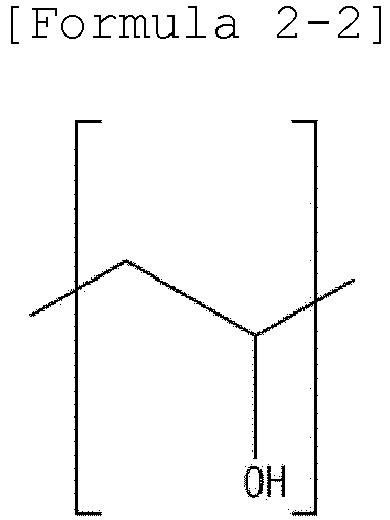
- the polyvinyl butyral may include a unit of Formula 2-1, a unit of Formula 2-2, and a unit of Formula 2-3, and the vinyl butyral unit may correspond to the unit of Formula 2-1, the vinyl alcohol unit may correspond to the unit of Formula 2-2, and the vinyl acetate unit may correspond to the unit of Formula 2-3.
- the vinyl alcohol unit may be included in the polyvinyl butyral in 22 wt% to 50 wt%, particularly, 23 wt% to 45 wt%, more particularly, 24 wt% to 40 wt%. If the above-described range is satisfied, the polyvinyl butyral may be easily adsorbed onto the single-walled carbon nanotubes included in the bundle-type single-walled carbon nanotubes during preparing the conductive material dispersion, and the application of a high pressure homogenizer is favorable, and a conductive material dispersion having lower viscosity than a conductive material dispersion having the same solid content may be prepared.
- the polyvinyl butyral may be easily dissolved in the dispersion medium, the polyvinyl butyral may be homogeneously adsorbed onto the bundle-type single-walled carbon nanotubes. Accordingly, the de-bundling of the bundle-type single-walled carbon nanotubes may be effectively achieved.
- the polyvinyl butyral may be included in the dispersant in 50 wt% to 85 wt%, particularly, 55 wt% to 80 wt%, more particularly, 65 wt% to 80 wt%. If the above-described range is satisfied, the de-bundling of the bundle-type single-walled carbon nanotubes may be effectively achieved, and the viscosity of the conductive material dispersion thus prepared may be a low level.
- the weight average molecular weight of the polyvinyl butyral may be 10,000 g/mol to 150,000 g/mol, particularly, 10,000 g/mol to 500,000 g/mol, more particularly, 10,000 g/mol to 300,000 g/mol, for example, 15,000 g/mol to 30,000 g/mol. If the above-described range is satisfied, the polyvinyl butyral may be easily dissolved in the dispersion medium, the de-bundling of the bundle-type carbon nanotubes may be easy, the preparation of the conductive material dispersion through a high pressure homogenizer may be more favorable, and the viscosity of the conductive material dispersion thus prepared may be a low level.
- the hydrogenated nitrile butadiene rubber plays the role of reducing the viscosity of the conductive material dispersion, and may be relatively easily dissolved in the dispersion medium to disperse the carbon nanotubes in the conductive material dispersion uniformly.
- the acrylonitrile unit may be included in the hydrogenated nitrile butadiene rubber in 5 wt% to 50 wt%, particularly, 10 wt% to 50 wt%, more particularly, 20 wt% to 45 wt%. If the above-described range is satisfied, the single-walled carbon nanotubes may favorably be dispersed in the conductive material dispersion, and the viscosity of the conductive material dispersion thus prepared may be a low level.
- the hydrogenated nitrile butadiene rubber may be included in the dispersant in 15 wt% to 50 wt%, particularly, 20 wt% to 45 wt%, more particularly, 20 wt% to 35 wt%. If the above-described range is satisfied, the particle size of the single-walled carbon nanotubes may be controlled to a low level, and compatibility with the dispersion medium may be excellent to reduce the viscosity of the conductive material dispersion.
- the weight average molecular weight of the hydrogenated nitrile butadiene rubber may be 10,000 g/mol to 700,000 g/mol, particularly, 50,000 g/mol to 600,000 g/mol, more particularly, 200,000 g/mol to 500,000 g/mol. If the above-described range is satisfied, the viscosity of the conductive material dispersion may be reduced, the hydrogenated nitrile butadiene rubber may be easily dissolved in the dispersion medium, and the bundle-type single-walled carbon nanotubes may be effectively dispersed to disperse the single-walled carbon nanotubes in the conductive material dispersion uniformly.
- the weight ratio of the polyvinyl butyral to the hydrogenated nitrile butadiene rubber may be 5:5 to 9.8:0.2, particularly, 5.5:4.5 to 9.5:0.5, more particularly, 6:4 to 9:1. If the above-described range is satisfied, the single-walled carbon nanotubes may be dispersed in the conductive material dispersion more uniformly, and the viscosity of the conductive material dispersion may be an even lower level. Accordingly, the resistance of a battery manufactured may be reduced, and processability may be improved.
- the dispersion aid is disposed on the surface of the single-walled carbon nanotubes in the bundle-type single-walled carbon nanotubes during preparing the conductive material dispersion to help the adsorption of the polyvinyl butyral and the hydrogenated nitrile butadiene rubber onto the single-walled carbon nanotubes. Accordingly, it is meaningful that the dispersion aid creates a smooth environment for dispersing the single-walled carbon nanotubes by the polyvinyl butyral and the hydrogenated nitrile butadiene rubber.
- the dispersion aid may include a compound represented by Formula 1. [Formula 1] A-(R) n
- A is a structure having 16 to 50 carbon number and including four or more aromatic rings and nitrogen
- R is a structure including an anionic functional group
- n is an integer of 1 to 5.
- the dispersion aid may favorably be positioned on the bundle-type carbon nanotubes by the ⁇ - ⁇ bonds between the dispersion aid and the bundle-type carbon nanotubes.
- A since A includes nitrogen, the compatibility between the dispersion aid and the dispersion medium may be excellent, and the hydrogenated nitrile butadiene may be easily attached onto the bundle-type carbon nanotubes.
- the aromatic ring may be a benzene ring. Otherwise, the aromatic rings may get close to each other to form a polycyclic ring.
- A may include any one selected from the group consisting of a pyrene group, a chrysene group, a perylene group, and a phthalocyanine group.
- the phthalocyanine group may include or exclude a metal.
- the metal may be at least one selected from the group consisting of copper, aluminum, and zinc.
- the polyvinyl butyral and the hydrogenated nitrile butadiene rubber may be effectively adsorbed onto the bundle-type carbon nanotubes by R that is a structure including an anionic functional group. Accordingly, during preparing the conductive material dispersion, the bundle-type single-walled carbon nanotubes may be effectively de-bundled after pre-mixing, and the conductive material dispersion may be prepared through a high pressure homogenizer. Accordingly, when comparing conductive material dispersions having the same solid content, the single-walled carbon nanotubes in the conductive material dispersion may effectively be dispersed.
- these effects may be achieved even though the solid content of the conductive material dispersion is a high level, and the manufacturing yield of an electrode may be improved by the high solid content of the conductive material dispersion. Further, the viscosity of the conductive material dispersion may be a low level, the transfer of the conductive material dispersion may be smooth, and the manufacturing processability of a positive electrode may be largely improved.
- R may be a structure including an anionic functional group, and the anionic functional group may particularly be at least one selected from the group consisting of -SO 3 - , - COO - , and -PO 4 - . If n is an integer of 2 or more, multiple R may be the same or different from each other.
- n may be an integer of 1 to 5, and may particularly be an integer of 1 to 3.
- the compound of Formula 1 may be at least any one selected among a compound of Formula 1-1 and a compound of Formula 1-2.
- R a and R b may be each independently a structure including an anionic functional group.
- the anionic functional group may include at least any one functional group structure selected from the group consisting of -SO 3 - , -COO - , and -PO 4 - in the functional group. If the dispersion aid satisfies the structure of Formula 1-1, the benzene structure connected from each other is similar to the surface of the single-walled carbon nanotubes, and they may be adsorbed to each other well, and accordingly, the conductive material dispersion may show an even lower level of viscosity.
- the viscosity of the conductive material dispersion may be an even lower level due to the effective adsorption of the phthalocyanine structure and the single-walled carbon nanotubes.
- the compound of Formula 1-1 may include at least any one among a compound of Formula 1-1A and a compound of Formula 1-1B.
- the compound of Formula 1-2 may particularly include at least any one among a compound of Formula 1-2A and a compound of Formula 1-2B.
- the dispersion aid may be included in 1 part by weight to 50 parts by weight, particularly, 5 parts by weight to 35 parts by weight, more particularly, 5 parts by weight to 30 parts by weight, based on 100 parts by weight of the single-walled carbon nanotubes. If the above-described range is satisfied, the polyvinyl butyral and the hydrogenated nitrile butadiene rubber may be easily attached to the single-walled carbon nanotubes, even with a suitable amount of the dispersion aid, and the single-walled carbon nanotubes may be effectively dispersed, and the control of the particle size of the single-walled carbon nanotubes and the viscosity of the conductive material dispersion may be easy.
- the weight ratio of the dispersant to the dispersion aid may be 1:0.03 to 1:0.18, particularly, 1:0.045 to 1:0.150. If the above-described range is satisfied, the particle size of the single-walled carbon nanotubes may be a low level, and the viscosity of the conductive agent dispersion may be low. At the same time, the dispersant may be adsorbed on the surface of the single-walled carbon nanotubes well, and the performance of a high pressure homogenizer process may be smooth. Particularly, if the weight ratio is 1:0.045 to 1:0.150, the viscosity of the conductive material dispersion may become an even lower level.
- the dispersion medium may be N-methyl-2-pyrrolidone (NMP).
- the solid content of the conductive material dispersion may be 0.01 wt% to 5 wt%, particularly, 0.05 wt% to 4 wt%, more particularly, 0.1 wt% to 3 wt%.
- the solid content of the conductive material dispersion may be 0.01 wt% to 5 wt%, particularly, 0.05 wt% to 4 wt%, more particularly, 0.1 wt% to 3 wt%.
- the viscosity of the conductive material dispersion may be controlled to a low level by using the dispersant of the present invention, and there are no problems in the preparation and use of the conductive material dispersion having the solid content.
- the viscosity of the conductive material dispersion without phase separation may be 50 Pa ⁇ s or less, particularly, 0.1 Pa ⁇ s to 40 Pa ⁇ s. Since the viscosity range is satisfied, the transfer of the conductive material dispersion may be smooth, and the manufacturing processability of a positive electrode may be largely improved.
- Bundle-type carbon nanotubes, a dispersant, and a dispersion aid were prepared as follows.
- Hydrogenated nitrile butadiene rubber having a weight average molecular weight of 30,000 g/mol and including 34 wt% of an acrylonitrile unit.
- the contents of the bundle-type carbon nanotubes, polyvinyl butyral, hydrogenated nitrile butadiene rubber, and dispersion aid were all based on the total weight of the conductive material dispersion, and the sum thereof corresponds to the solid content.
- the contents of the bundle-type carbon nanotubes, polyvinyl butyral, hydrogenated nitrile butadiene rubber, and dispersion aid were based on the total weight of the conductive material dispersion, and the sum thereof corresponds to the solid content.
- D 50 was measured three times using a particle size analyzer (Mastersizer 3000 of Malvern Co.), an average value was obtained, and the results are shown in Table 5 and Table 6.
- the low value of D 50 of the single-walled carbon nanotubes in the conductive material dispersion prepared means that the bundle-type single-walled carbon nanotubes are easily de-bundled and dispersed in the conductive material dispersion uniformly.
- the D 50 of Examples 1 to 7 was found smaller than the D 50 of Comparative Examples 1 to 3, 7 and 8, and accordingly, the bundle-type single-walled carbon nanotubes were dispersed effectively.
Landscapes
- Chemical & Material Sciences (AREA)
- Materials Engineering (AREA)
- Organic Chemistry (AREA)
- Engineering & Computer Science (AREA)
- Wood Science & Technology (AREA)
- Life Sciences & Earth Sciences (AREA)
- General Chemical & Material Sciences (AREA)
- Electrochemistry (AREA)
- Chemical Kinetics & Catalysis (AREA)
- Nanotechnology (AREA)
- Inorganic Chemistry (AREA)
- Compositions Of Macromolecular Compounds (AREA)
- Conductive Materials (AREA)
Abstract
Description
- The present invention relates to a conductive material dispersion including single-walled carbon nanotubes, a dispersant, a dispersion aid, and a dispersion medium, wherein the dispersant includes polyvinyl butyral and hydrogenated nitrile butadiene rubber, and the dispersion aid includes a specific compound.
- Due to the rapid increase in the use of fossil fuels, the requirement on the use of alternative energy or clean energy is increasing, and as a part of the requirement, the most actively studied field includes power generation and power storage fields using electrochemical reaction.
- Recently, as the typical examples of electrochemical devices using such electrochemical energy, secondary batteries may be included, and the area of the use thereof is gradually expanding. Recently, according to the increase of the technology development and demand on portable computers, mobile phones, cameras, or the like, the demand of secondary batteries as energy sources is rapidly increasing, and among such secondary batteries, studies on lithium secondary batteries having high energy density, i.e., high capacity, have been conducted a lot, and commercialized products of them are widely used.
- The positive electrode of a secondary battery includes a positive electrode active material, a conductive material, and a binder. To improve the conductivity of the positive electrode, carbon nanotubes could be used as the conductive material. If not multi-walled carbon nanotubes but single-walled carbon nanotubes are used as the carbon nanotubes, there are effects of even further reducing the resistance of an electrode. In order to uniformly distribute single-walled carbon nanotubes in a positive electrode, a conductive material dispersion in which single-walled carbon nanotubes are dispersed is formed first, and a positive electrode slurry is prepared using the conductive material dispersion during manufacturing a positive electrode.
- For preparing the conductive material dispersion, a high pressure homogenizer is used. Specifically, in the high pressure homogenizer, a pre-mixed solution including bundle-type single-walled carbon nanotubes, a dispersant, and a dispersion medium, passes through a nozzle with a diameter of 150 um by a high pressure of 1,500 bar, and by this, shear force is applied to the bundle-type single-walled carbon nanotubes to disperse the bundle-type single-walled carbon nanotubes.
- Meanwhile, in the pre-mixed state of the solution including the bundle-type single-walled carbon nanotubes, the dispersant, and the dispersion medium, the bundle-type carbon nanotubes in the solution require effective de-bundling by the dispersant so that a dispersion process through the high pressure homogenizer is possible to finally prepare a conductive material dispersion in which the single-walled carbon nanotubes are uniformly dispersed. On the contrary, if the de-bundling is not smooth during the pre-mixing, phase separation between the bundle-type carbon nanotubes and the dispersion medium occurs in the solution, and the nozzle of the high pressure homogenizer may be blocked by the bundle-type carbon nanotubes, and the dispersion process through the high pressure homogenizer may be impossible. In addition, to improve the manufacturing yield of the positive electrode, it is favorable to increase the solid content of the conductive material dispersion, but the problems of impossible use of the high pressure homogenizer may become more severe with the increase of the solid content of the conductive material dispersion.
- In addition, though the use of the high pressure homogenizer is available, if the viscosity of the conductive material dispersion having the same solid content is too high, the transfer of the conductive material dispersion may not be smooth, the flowability of a positive electrode slurry prepared from the conductive material dispersion may be reduced, and the manufacturing processability of a positive electrode may be degraded.
- In order to solve such problems, conventionally, a method including a dispersant such as hydrogenated nitrile butadiene rubber and polyvinylidene fluoride in a conductive material dispersion has been used. However, with the use of the conventional general dispersant, the improving effects of the de-bundling was insignificant, and specifically, if the solid content of the conductive material dispersion was high, it was not very useful.
- A task to solve in the present invention is to provide a conductive material dispersion which could be applied to a dispersion process through a high pressure homogenizer and which has the low level of viscosity, among conductive material dispersions having the same solid content.
- According to an embodiment of the present invention, there is provided in the present invention, a conductive material dispersion comprising single-walled carbon nanotubes, a dispersant, a dispersion aid, and a dispersion medium, wherein the dispersant comprises polyvinyl butyral and hydrogenated nitrile butadiene rubber, and the dispersion aid comprises a compound represented by Formula 1.
[Formula 1] A-(R)n
- In Formula 1, A is a structure having 16 to 50 carbon number and comprising four or more aromatic rings and nitrogen, R is a structure comprising an anionic functional group, and n is an integer of 1 to 5.
- According to the present invention, bundle-type single-walled carbon nanotubes may be effectively de-bundled after pre-mixing during preparing a conductive material dispersion, and a conductive material dispersion may be prepared through a high pressure homogenizer, and accordingly, single-walled carbon nanotubes may be effectively dispersed in the conductive material dispersion among conductive material dispersions having the same solid content. In addition, the dispersing may be possible though the solid content of the conductive material dispersion is a high level, and an electrode manufacturing yield may be improved by the high solid content of the conductive material dispersion. Further, the viscosity of the conductive material dispersion may be a low level, and the transfer of the conductive material dispersion may become smooth, and the manufacturing processability of a positive electrode may be largely improved.
- Hereinafter, the present invention will be explained in more detail to assist the understanding of the present invention.
- It will be understood that words or terms used in the specification and claims shall not be interpreted as the meaning defined in commonly used dictionaries. It will be further understood that the words or terms should be interpreted as having a meaning that is consistent with their meaning in the context of the relevant art and the technical idea of the invention, based on the principle that an inventor may properly define the meaning of the words or terms to best explain the invention.
- The terms used in the specification are used for only explaining example embodiment and do not intend to limit the present invention. The singular forms are intended to include the plural forms as well, unless the context clearly indicates otherwise.
- It will be further understood that the terms "comprises", "comprising", "having", or the like, used in this specification, specify the presence of stated features, numerals, steps, elements, or the combination thereof, but do not preclude the presence or addition of one or more other features, numerals, steps, elements, or the combination thereof.
- In the present specification, D50 may be defined as a particle diameter corresponding to 50% of a volume accumulation amount on a diameter distribution curve of particles. The D50 may be measured by using, for example, a laser diffraction method. By the laser diffraction method, the diameter from a submicron region to a several mm level may be generally measured, and results with high reproduction and high resolution may be obtained. An apparatus used for the measurement was Mastersizer 3000 of Malvern Co., D50 was measured three times, and an average value was regarded as final D50.
- In the present specification, viscosity was measured using a viscometer TV-22 of TOKI Co., under conditions of 25°C and 1 rpm.
- The conductive material dispersion according to an embodiment of the present invention comprises single-walled carbon nanotubes, a dispersant, a dispersion aid, and a dispersion medium, wherein the dispersant comprises polyvinyl butyral and hydrogenated nitrile butadiene rubber, and the dispersion aid comprises a compound represented by Formula 1.
[Formula 1] A-(R)n
- In Formula 1, A is a structure having 16 to 50 carbon number and comprising four or more aromatic rings and nitrogen, R is a structure comprising an anionic functional group, and n is an integer of 1 to 5. The conductive material dispersion may correspond to a conductive material dispersion used for manufacturing the electrode of a secondary battery.
- The single-walled carbon nanotubes have a cylindrical fullerene series structure and mean a carbon structure having a film composed of one layer of carbon atoms as a wall and a long and hollow tube shape.
- D50 of the single-walled carbon nanotubes may be 0.4 um to 100 um, particularly, 1 um to 50 µm, more particularly, 1 um to 30 µm, for example, 1 um to 10 um. The fact that D50 of the single-walled carbon nanotubes is 1 um to 100 um compared to the D50 of the bundle-type single-walled carbon nanotubes that are raw materials used for preparing a conductive material dispersion being at a level of 200 µm, means that the bundle-type carbon nanotubes are somewhat de-bundled, and the bundle-type single-walled carbon nanotubes are dispersed and present in the conductive material dispersion after applying a high pressure homogenizer. In addition, if the D50 is reduced, the single-walled carbon nanotubes are dispersed uniformly among the conductive material dispersions having the same solid content.
- The single-walled carbon nanotubes may be included in the conductive material dispersion in 0.01 wt% to 5 wt%, particularly, 0.01 wt% to 1 wt%, more particularly, 0.05 wt% to 0.8 wt%, for example, 0.1 wt% to 0.6 wt%.
- The dispersant plays the role of dispersing the single-walled carbon nanotubes smoothly in the conductive material dispersion to have a preferred particle size, so that the single-walled carbon nanotubes are dispersed and present uniformly in the conductive material dispersion.
- The dispersant may be included in 10 parts by weight to 2,000 parts by weight, particularly, 10 parts by weight to 1,000 parts by weight, more particularly, 30 parts by weight to 500 parts by weight based on 100 parts by weight of the single-walled carbon nanotubes. If the above-described range is satisfied, the single-walled carbon nanotubes may be smoothly dispersed, the single-walled carbon nanotubes may have a value of a small particle size, and the viscosity of the conductive material dispersion may be controlled to a suitable level.
- The dispersant may include polyvinyl butyral and hydrogenated nitrile butadiene rubber.
- The polyvinyl butyral may play the role of effectively de-bundling the bundle-type single-walled carbon nanotubes and controlling the viscosity of the conductive material dispersion to a suitable level.
- The polyvinyl butyral may be a polymer including a vinyl butyral unit, a vinyl alcohol unit, and a vinyl acetate unit. Particularly, the polyvinyl butyral may include a unit of Formula 2-1, a unit of Formula 2-2, and a unit of Formula 2-3, and the vinyl butyral unit may correspond to the unit of Formula 2-1, the vinyl alcohol unit may correspond to the unit of Formula 2-2, and the vinyl acetate unit may correspond to the unit of Formula 2-3.


- In the polyvinyl butyral, the vinyl alcohol unit may be included in the polyvinyl butyral in 22 wt% to 50 wt%, particularly, 23 wt% to 45 wt%, more particularly, 24 wt% to 40 wt%. If the above-described range is satisfied, the polyvinyl butyral may be easily adsorbed onto the single-walled carbon nanotubes included in the bundle-type single-walled carbon nanotubes during preparing the conductive material dispersion, and the application of a high pressure homogenizer is favorable, and a conductive material dispersion having lower viscosity than a conductive material dispersion having the same solid content may be prepared. In addition, since the polyvinyl butyral may be easily dissolved in the dispersion medium, the polyvinyl butyral may be homogeneously adsorbed onto the bundle-type single-walled carbon nanotubes. Accordingly, the de-bundling of the bundle-type single-walled carbon nanotubes may be effectively achieved.
- The polyvinyl butyral may be included in the dispersant in 50 wt% to 85 wt%, particularly, 55 wt% to 80 wt%, more particularly, 65 wt% to 80 wt%. If the above-described range is satisfied, the de-bundling of the bundle-type single-walled carbon nanotubes may be effectively achieved, and the viscosity of the conductive material dispersion thus prepared may be a low level.
- The weight average molecular weight of the polyvinyl butyral may be 10,000 g/mol to 150,000 g/mol, particularly, 10,000 g/mol to 500,000 g/mol, more particularly, 10,000 g/mol to 300,000 g/mol, for example, 15,000 g/mol to 30,000 g/mol. If the above-described range is satisfied, the polyvinyl butyral may be easily dissolved in the dispersion medium, the de-bundling of the bundle-type carbon nanotubes may be easy, the preparation of the conductive material dispersion through a high pressure homogenizer may be more favorable, and the viscosity of the conductive material dispersion thus prepared may be a low level.
- The hydrogenated nitrile butadiene rubber plays the role of reducing the viscosity of the conductive material dispersion, and may be relatively easily dissolved in the dispersion medium to disperse the carbon nanotubes in the conductive material dispersion uniformly.
- The acrylonitrile unit may be included in the hydrogenated nitrile butadiene rubber in 5 wt% to 50 wt%, particularly, 10 wt% to 50 wt%, more particularly, 20 wt% to 45 wt%. If the above-described range is satisfied, the single-walled carbon nanotubes may favorably be dispersed in the conductive material dispersion, and the viscosity of the conductive material dispersion thus prepared may be a low level.
- The hydrogenated nitrile butadiene rubber may be included in the dispersant in 15 wt% to 50 wt%, particularly, 20 wt% to 45 wt%, more particularly, 20 wt% to 35 wt%. If the above-described range is satisfied, the particle size of the single-walled carbon nanotubes may be controlled to a low level, and compatibility with the dispersion medium may be excellent to reduce the viscosity of the conductive material dispersion.
- The weight average molecular weight of the hydrogenated nitrile butadiene rubber may be 10,000 g/mol to 700,000 g/mol, particularly, 50,000 g/mol to 600,000 g/mol, more particularly, 200,000 g/mol to 500,000 g/mol. If the above-described range is satisfied, the viscosity of the conductive material dispersion may be reduced, the hydrogenated nitrile butadiene rubber may be easily dissolved in the dispersion medium, and the bundle-type single-walled carbon nanotubes may be effectively dispersed to disperse the single-walled carbon nanotubes in the conductive material dispersion uniformly.
- The weight ratio of the polyvinyl butyral to the hydrogenated nitrile butadiene rubber may be 5:5 to 9.8:0.2, particularly, 5.5:4.5 to 9.5:0.5, more particularly, 6:4 to 9:1. If the above-described range is satisfied, the single-walled carbon nanotubes may be dispersed in the conductive material dispersion more uniformly, and the viscosity of the conductive material dispersion may be an even lower level. Accordingly, the resistance of a battery manufactured may be reduced, and processability may be improved.
- The dispersion aid is disposed on the surface of the single-walled carbon nanotubes in the bundle-type single-walled carbon nanotubes during preparing the conductive material dispersion to help the adsorption of the polyvinyl butyral and the hydrogenated nitrile butadiene rubber onto the single-walled carbon nanotubes. Accordingly, it is meaningful that the dispersion aid creates a smooth environment for dispersing the single-walled carbon nanotubes by the polyvinyl butyral and the hydrogenated nitrile butadiene rubber.
- The dispersion aid may include a compound represented by Formula 1.
[Formula 1] A-(R)n
- In Formula 1, A is a structure having 16 to 50 carbon number and including four or more aromatic rings and nitrogen, R is a structure including an anionic functional group, and n is an integer of 1 to 5.
- In Formula 1, since A includes four or more aromatic rings, the dispersion aid may favorably be positioned on the bundle-type carbon nanotubes by the π-π bonds between the dispersion aid and the bundle-type carbon nanotubes. In addition, since A includes nitrogen, the compatibility between the dispersion aid and the dispersion medium may be excellent, and the hydrogenated nitrile butadiene may be easily attached onto the bundle-type carbon nanotubes.
- The aromatic ring may be a benzene ring. Otherwise, the aromatic rings may get close to each other to form a polycyclic ring. Particularly, A may include any one selected from the group consisting of a pyrene group, a chrysene group, a perylene group, and a phthalocyanine group. The phthalocyanine group may include or exclude a metal. The metal may be at least one selected from the group consisting of copper, aluminum, and zinc.
- Meanwhile, the polyvinyl butyral and the hydrogenated nitrile butadiene rubber may be effectively adsorbed onto the bundle-type carbon nanotubes by R that is a structure including an anionic functional group. Accordingly, during preparing the conductive material dispersion, the bundle-type single-walled carbon nanotubes may be effectively de-bundled after pre-mixing, and the conductive material dispersion may be prepared through a high pressure homogenizer. Accordingly, when comparing conductive material dispersions having the same solid content, the single-walled carbon nanotubes in the conductive material dispersion may effectively be dispersed. In addition, these effects may be achieved even though the solid content of the conductive material dispersion is a high level, and the manufacturing yield of an electrode may be improved by the high solid content of the conductive material dispersion. Further, the viscosity of the conductive material dispersion may be a low level, the transfer of the conductive material dispersion may be smooth, and the manufacturing processability of a positive electrode may be largely improved.
- R may be a structure including an anionic functional group, and the anionic functional group may particularly be at least one selected from the group consisting of -SO3 -, - COO-, and -PO4 -. If n is an integer of 2 or more, multiple R may be the same or different from each other.
- n may be an integer of 1 to 5, and may particularly be an integer of 1 to 3.
- Particularly, the compound of Formula 1 may be at least any one selected among a compound of Formula 1-1 and a compound of Formula 1-2.

- In Formula 1-1, Ra and Rb may be each independently a structure including an anionic functional group. Particularly, the anionic functional group may include at least any one functional group structure selected from the group consisting of -SO3 -, -COO-, and -PO4 - in the functional group. If the dispersion aid satisfies the structure of Formula 1-1, the benzene structure connected from each other is similar to the surface of the single-walled carbon nanotubes, and they may be adsorbed to each other well, and accordingly, the conductive material dispersion may show an even lower level of viscosity.


- In Formula 1-2,
- M may be at least one selected from the group consisting of copper, aluminum, and zinc.
- R1, R2, R3, and R4 may be each independently an anionic functional group, particularly, -SO3 -.
- a, b, c, and d may be each independently any one among integers of 0 to 4, and at least one among a, b, c, and d may be an integer of 1 to 4.
- If the dispersion aid satisfies the structure of Formula 1-2, the viscosity of the conductive material dispersion may be an even lower level due to the effective adsorption of the phthalocyanine structure and the single-walled carbon nanotubes.
- The compound of Formula 1-1 may include at least any one among a compound of Formula 1-1A and a compound of Formula 1-1B.


- The compound of Formula 1-2 may particularly include at least any one among a compound of Formula 1-2A and a compound of Formula 1-2B.


- The dispersion aid may be included in 1 part by weight to 50 parts by weight, particularly, 5 parts by weight to 35 parts by weight, more particularly, 5 parts by weight to 30 parts by weight, based on 100 parts by weight of the single-walled carbon nanotubes. If the above-described range is satisfied, the polyvinyl butyral and the hydrogenated nitrile butadiene rubber may be easily attached to the single-walled carbon nanotubes, even with a suitable amount of the dispersion aid, and the single-walled carbon nanotubes may be effectively dispersed, and the control of the particle size of the single-walled carbon nanotubes and the viscosity of the conductive material dispersion may be easy.
- The weight ratio of the dispersant to the dispersion aid may be 1:0.03 to 1:0.18, particularly, 1:0.045 to 1:0.150. If the above-described range is satisfied, the particle size of the single-walled carbon nanotubes may be a low level, and the viscosity of the conductive agent dispersion may be low. At the same time, the dispersant may be adsorbed on the surface of the single-walled carbon nanotubes well, and the performance of a high pressure homogenizer process may be smooth. Particularly, if the weight ratio is 1:0.045 to 1:0.150, the viscosity of the conductive material dispersion may become an even lower level.
- The dispersion medium may be N-methyl-2-pyrrolidone (NMP).
- The solid content of the conductive material dispersion may be 0.01 wt% to 5 wt%, particularly, 0.05 wt% to 4 wt%, more particularly, 0.1 wt% to 3 wt%. Generally, in order to derive the solid content range, there are problems of the excessive increase of the viscosity of the conductive material dispersion. In the present invention, though the single-walled carbon nanotubes are used, the viscosity of the conductive material dispersion may be controlled to a low level by using the dispersant of the present invention, and there are no problems in the preparation and use of the conductive material dispersion having the solid content.
- The viscosity of the conductive material dispersion without phase separation may be 50 Pa·s or less, particularly, 0.1 Pa·s to 40 Pa·s. Since the viscosity range is satisfied, the transfer of the conductive material dispersion may be smooth, and the manufacturing processability of a positive electrode may be largely improved.
- Hereinafter, preferred embodiments will be suggested to assist the understanding of the present invention. However, the embodiments are only for illustrating the present invention, and various changes and modifications may be possible within the scope and technical range of the present description. Such changes and modifications are of course possible within the claims attached herewith.
- Bundle-type carbon nanotubes, a dispersant, and a dispersion aid were prepared as follows.
① Bundle-type single-walled carbon nanotubes having a specific surface area of 1,160 m2/g
② Polyvinyl butyral (A-1 to A-3)[Table 1] Manufacturi ng company Product name Vinyl alcohol unit content (wt%) Weight average molecular weight (g/mol) A-1 Kuraray B60T 24 55,000 A-2 Sekisui BH-3 34 55,000 A-3 Sekisui BL-1 35 19,000
③ Hydrogenated nitrile butadiene rubber having a weight average molecular weight of 30,000 g/mol and including 34 wt% of an acrylonitrile unit.
④ A dispersion aid (B-1 to B-5)[Table 2] B-1 
B-2 
B-3 
B-4 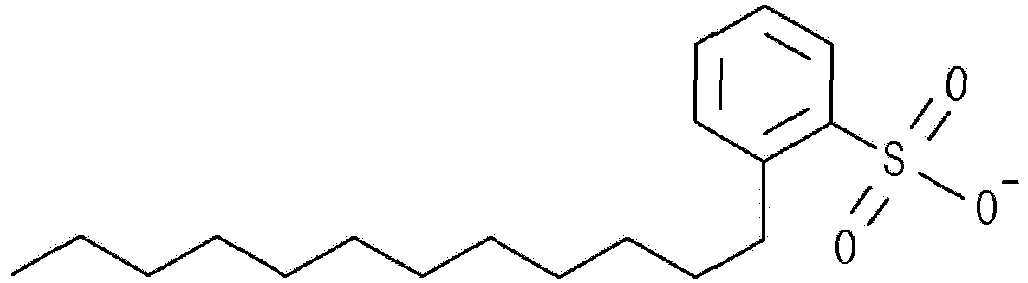
B-5 
- According to Table 3 below, bundle-type single-walled carbon nanotubes, a dispersant, and a dispersion aid were injected into N-methyl-2-pyrrolidone (NMP), and 1 kg of the solution was mixed for 30 minutes using a mechanical mixer under conditions of 2,000 rpm.
- After that, a dispersion process was performed six times using a PICOMAX apparatus (high pressure homogenizer) of Micronox Co., under pressure conditions of 1,500 bar. However, in Comparative Examples 4 to 6, phase separation occurred in the solution after the pre-mixing, and the blocking phenomenon of the nozzle of the high pressure homogenizer occurred by the bundle-type single-walled carbon nanotubes. Accordingly, the process of the high pressure homogenizer was impossible.
[Table 3] Bundle-type single-walled carbon nanotub es content (wt%) Dispersant Dispersion aid Disper sant:d ispers ion aid (weigh t ratio) Poly viny l buty ral type Polyvi nyl butyr al conte nt (wt%) Hydroge nated nitrile butadie ne rubber content (wt%) Disp ersi on aid type Disper sion aid conten t (wt%) Exampl e 1 0.4 A-1 0.84 0.24 B-3 0.12 1:0.11 1 Exampl e 2 0.4 A-1 0.84 0.24 B-1 0.12 1:0.11 1 Exampl e 3 0.4 A-1 0.84 0.24 B-2 0.12 1:0.11 1 Exampl e 4 0.4 A-3 0.84 0.24 B-3 0.12 1:0.11 1 Exampl e 5 0.4 A-2 0.84 0.24 B-3 0.12 1:0.11 1 Exampl e 6 0.4 A-1 0.54 0.54 B-3 0.12 1:0.11 1 Exampl e 7 0.4 A-1 0.24 0.84 B-3 0.12 1:0.11 1 Exampl e 8 0.8 A-3 1.68 0.48 B-3 0.24 1:0.11 1 Compar ative Exampl e 1 0.4 A-1 0.84 0.24 - 0 - Compar ative Exampl e 2 0.4 - 0 1.08 B-3 0.12 1:0.11 1 Compar ative Exampl e 3 0.4 A-1 1.08 0 B-3 0.12 1:0.11 1 Compar ative Exampl e 4 0.4 A-1 1.2 0 - 0 - Compar ative Exampl e 5 0.4 - 0 1.2 - 0 - Compar ative Exampl e 6 0.4 - 0 0 B-3 1.2 - Compar ative Exampl e 7 0.4 A-1 0.84 0.24 B-4 0.12 1:0.11 1 Compar ative Exampl e 8 0.4 A-1 0.84 0.24 B-5 0.12 1:0.11 1 - The contents of the bundle-type carbon nanotubes, polyvinyl butyral, hydrogenated nitrile butadiene rubber, and dispersion aid were all based on the total weight of the conductive material dispersion, and the sum thereof corresponds to the solid content.
- According to Table 4 below, bundle-type single-walled carbon nanotubes, a dispersant, and a dispersion aid were injected to N-methyl-2-pyrrolidone (NMP), and 1 kg of the solution was mixed for 30 minutes using a mechanical mixer under conditions of 2,000 rpm.
- After that, a dispersion process was performed six times using a PICOMAX apparatus (high pressure homogenizer) of Micronox Co., under pressure conditions of 1,500 bar.
[Table 4] Bundle-type single-walled carbon nanotub es content (wt%) Dispersant Dispersion aid Dispe rsant :disp ersio n aid (weig ht ratio ) Polyv inyl butyr al type Polyvi nyl butyra l conten t (wt%) Hydrogen ated nitrile butadien e rubber content (wt%) Disp ersi on aid type Dispe rsion aid conte nt (wt%) Exampl e 9 0.6 A-4 0.855 0.855 B-3 0.09 1:0.0 53 Exampl e 10 0.6 A-4 1.332 0.378 B-3 0.09 1:0.0 53 Exampl e 11 0.6 A-4 1.260 0.360 B-3 0.18 1:0.1 11 Exampl e 12 0.6 A-4 0.378 1.332 B-3 0.09 1:0.0 53 Exampl e 13 0.6 A-4 0.357 0.153 B-3 0.09 1:0.1 76 Exampl e 14 0.6 A-4 1.617 0.693 B-3 0.09 1:0.0 39 Compar ative Exampl e 9 0.6 - 0 1.71 B-3 0.09 1:0.0 53 Compar ative Exampl e 10 0.6 - 0 1.8 - 0 - - The contents of the bundle-type carbon nanotubes, polyvinyl butyral, hydrogenated nitrile butadiene rubber, and dispersion aid were based on the total weight of the conductive material dispersion, and the sum thereof corresponds to the solid content.
- With respect to the conductive material dispersions of the Examples and the Comparative Examples, D50 was measured three times using a particle size analyzer (Mastersizer 3000 of Malvern Co.), an average value was obtained, and the results are shown in Table 5 and Table 6.
- When preparing conductive material dispersions using the same bundle-type single-walled carbon nanotubes, the low value of D50 of the single-walled carbon nanotubes in the conductive material dispersion prepared, means that the bundle-type single-walled carbon nanotubes are easily de-bundled and dispersed in the conductive material dispersion uniformly.
- Referring to Table 5, in the cases of preparing conductive material dispersions using the same amount of the bundle-type carbon nanotubes, the D50 of Examples 1 to 7 was found smaller than the D50 of Comparative Examples 1 to 3, 7 and 8, and accordingly, the bundle-type single-walled carbon nanotubes were dispersed effectively.
- Also, referring to Table 6, in the cases of preparing conductive material dispersions using the same amount of the bundle-type carbon nanotubes, the D50 of Examples 9 to 14 was found smaller than the D50 of Comparative Examples 9 and 10, and accordingly, the bundle-type single-walled carbon nanotubes were dispersed effectively.
- With respect to the conductive material dispersions of the Examples and the Comparative Examples, viscosity was measured using a viscometer TV-22 of TOKI Co. under conditions of 25°C and 1 rpm, and the results are shown in Tables 5 and 6.
- When comparing the conductive material dispersions having the same solid content, it was confirmed that the viscosity of the conductive material dispersions of Examples 1 to 7 was lower than the viscosity of the conductive material dispersions of Comparative Examples 1 to 3, 7, and 8. That is, it could be found that the conductive material dispersion according to the present invention could have a low viscosity even though having the high solid content.
- Also, referring to Table 6, it could be confirmed that the cases of Examples 9 to 12, satisfying the weight ratio of the dispersant and the dispersion aid of 1:0.045 to 1:0.150, had low viscosity of the conductive material dispersions when compared to Examples 13 and 14, which deviated from the weight ratio.
[Table 5] D50 of single-walled carbon nanotubes (pm) Viscosity of conductive material dispersion (Pa ·s) Example 1 4.7 7.0 Example 2 5.1 7.2 Example 3 5.5 8.0 Example 4 6.4 4.7 Example 5 1.4 7.4 Example 6 1.9 6.2 Example 7 4.9 7.2 Example 8 9.5 31.8 Comparative Example 1 9.8 11.4 Comparative Example 2 15.9 14.5 Comparative Example 3 9.2 11.6 Comparative Example 4 High pressure homogenizer process impossible Comparative Example 5 High pressure homogenizer process impossible Comparative Example 6 High pressure homogenizer process impossible Comparative Example 7 10.1 10.5 Comparative Example 8 12.2 11.7 [Table 6] D50 of single-walled carbon nanotubes (pm) Viscosity of conductive material dispersion (Pa ·s) Example 9 0.52 11.9 Example 10 1.3 8.75 Example 11 3.3 8.09 Example 12 0.79 9.75 Example 13 7.6 14.05 Example 14 0.57 13.30 Comparative Example 9 104 22.9 Comparative Example 10 29 28.0
Claims (17)
- A conductive material dispersion comprising single-walled carbon nanotubes, a dispersant, a dispersion aid, and a dispersion medium,wherein the dispersant comprises polyvinyl butyral and hydrogenated nitrile butadiene rubber, andwherein the dispersion aid comprises a compound represented by the following Formula 1:
[Formula 1] A-(R)n
wherein in Formula 1, A is a structure having 16 to 50 carbon number and comprising four or more aromatic rings and nitrogen,R is a structure comprising an anionic functional group, andn is an integer of 1 to 5. - The conductive material dispersion according to claim 1, wherein a vinyl alcohol unit is comprised in 22 wt% to 50 wt% in the polyvinyl butyral.
- The conductive material dispersion according to claim 1, wherein the single-walled carbon nanotubes are comprised in 0.01 wt% to 5 wt% in the conductive material dispersion.
- The conductive material dispersion according to claim 1, wherein the dispersant is comprised in 10 parts by weight to 2,000 parts by weight based on 100 parts by weight of the single-walled carbon nanotubes.
- The conductive material dispersion according to claim 1, wherein a weight average molecular weight of the polyvinyl butyral is 10,000 g/mol to 150,000 g/mol.
- The conductive material dispersion according to claim 1, wherein the polyvinyl butyral is comprised in the dispersant in 50 wt% to 85 wt%.
- The conductive material dispersion according to claim 1, wherein a weight average molecular weight of the hydrogenated nitrile butadiene rubber is 10,000 g/mol to 700,000 g/mol.
- The conductive material dispersion according to claim 1, wherein the hydrogenated nitrile butadiene rubber is comprised in the dispersant in 15 wt% to 50 wt%.
- The conductive material dispersion according to claim 1, wherein a weight ratio of the polyvinyl butyral to the hydrogenated nitrile butadiene rubber is 5:5 to 9.8:0.2.
- The conductive material dispersion according to claim 1, wherein, in Formula 1, A comprises any one selected from the group consisting of a pyrene group, a chrysene group, a perylene group and a phthalocyanine group.
- The conductive material dispersion according to claim 1, wherein R is at least any one selected from the group consisting of -SO3 -, -COO-, and -PO4 -.
- The conductive material dispersion according to claim 1, wherein the compound of Formula 1 is at least one selected from the group consisting of a compound of the following Formula 1-1, a compound of the following Formula 1-2, and a compound of the following Formula 1-3:

 wherein in Formula 1-1, Ra and Rb are each independently a structure comprising an anionic functional group, andwherein in Formula 1-2, M is at least one selected from the group consisting of copper, aluminum, and zinc, R1, R2, R3 and R4 are each independently an anionic functional group, and a, b, c, and d are each independently any one among integers of 0 to 4.
 - The conductive material dispersion according to claim 12, wherein the compound of Formula 1-1 comprises at least any one among a compound of the following Formula 1-1A and a compound of the following Formula 1-1B:


- The conductive material dispersion according to claim 12, wherein the compound of Formula 1-2 comprises at least any one among a compound of the following Formula 1-2A and a compound of the following Formula 1-2B:


- The conductive material dispersion according to claim 1, wherein the dispersion aid is comprised in 1 part by weight to 50 parts by weight based on 100 parts by weight of the single-walled carbon nanotubes.
- The conductive material dispersion according to claim 1, wherein a weight ratio of the dispersant to the dispersion aid is 1:0.03 to 1:0.18.
- The conductive material dispersion according to claim 1, wherein a weight ratio of the dispersant to the dispersion aid is 1:0.045 to 1:0.150.
Applications Claiming Priority (2)
| Application Number | Priority Date | Filing Date | Title |
|---|---|---|---|
| KR20210069228 | 2021-05-28 | ||
| PCT/KR2022/007451 WO2022250461A1 (en) | 2021-05-28 | 2022-05-25 | Conductive material dispersion |
Publications (3)
| Publication Number | Publication Date |
|---|---|
| EP4199155A1 true EP4199155A1 (en) | 2023-06-21 |
| EP4199155A4 EP4199155A4 (en) | 2024-11-13 |
| EP4199155B1 EP4199155B1 (en) | 2025-12-17 |
Family
ID=84228888
Family Applications (1)
| Application Number | Title | Priority Date | Filing Date |
|---|---|---|---|
| EP22811652.1A Active EP4199155B1 (en) | 2021-05-28 | 2022-05-25 | Conductive material dispersion |
Country Status (6)
| Country | Link |
|---|---|
| US (1) | US12203005B2 (en) |
| EP (1) | EP4199155B1 (en) |
| KR (1) | KR102824106B1 (en) |
| CN (1) | CN116171261B (en) |
| ES (1) | ES3059144T3 (en) |
| WO (1) | WO2022250461A1 (en) |
Families Citing this family (1)
| Publication number | Priority date | Publication date | Assignee | Title |
|---|---|---|---|---|
| KR20260021351A (en) | 2024-08-06 | 2026-02-13 | 주식회사 엘지화학 | Carbon nanotube dispersed solution and method for preparing the same |
Family Cites Families (22)
| Publication number | Priority date | Publication date | Assignee | Title |
|---|---|---|---|---|
| KR100704795B1 (en) * | 2002-11-01 | 2007-04-09 | 미츠비시 레이온 가부시키가이샤 | Carbon nanotube-containing compositions, composites having a coating film comprising the same, and methods for producing the same |
| JP4398792B2 (en) * | 2004-05-27 | 2010-01-13 | 三菱レイヨン株式会社 | Carbon nanotube-containing composition, composite having coating film made thereof, and method for producing them |
| KR101195714B1 (en) * | 2004-09-09 | 2012-10-29 | 미츠비시 레이온 가부시키가이샤 | Nanosubstance-containing composition, process for producing the same, and composite made with the same |
| KR100773551B1 (en) | 2006-04-14 | 2007-11-07 | 삼성전자주식회사 | Carbon nanotube dispersion and its manufacturing method |
| US8414792B2 (en) | 2008-09-09 | 2013-04-09 | Sun Chemical Corporation | Carbon nanotube dispersions |
| KR101264147B1 (en) * | 2010-08-18 | 2013-05-14 | 한화케미칼 주식회사 | Preparation of Concentrated CNT Dispersion Solution Using the Treated CNT |
| CN104106162B (en) * | 2012-02-14 | 2017-09-01 | 三菱化学株式会社 | Active material for negative electrode of nonaqueous secondary battery, negative electrode using same, and nonaqueous secondary battery |
| KR101471044B1 (en) * | 2012-03-30 | 2014-12-09 | (주)파낙스이엠 | Method for Dispersing Carbon Nanotubes Using Carbon Nanotubes Dispersion |
| JP6135218B2 (en) * | 2013-03-18 | 2017-05-31 | 宇部興産株式会社 | Fine carbon fiber dispersion and method for producing the same |
| KR20150016852A (en) | 2013-08-05 | 2015-02-13 | 제일모직주식회사 | Carbon nanotube dispersed solution and method for preparing the same |
| KR101888749B1 (en) * | 2015-09-25 | 2018-08-16 | 주식회사 엘지화학 | Carbon nanotube dispersed solution and method for preparing the same |
| KR101999707B1 (en) * | 2015-09-25 | 2019-07-12 | 주식회사 엘지화학 | Carbon nanotube dispersed solution and method for preparing the same |
| PL3333946T3 (en) * | 2016-03-24 | 2021-07-19 | Lg Chem, Ltd. | Conductor dispersion and secondary battery manufactured using same |
| KR102125963B1 (en) | 2016-11-15 | 2020-06-23 | 주식회사 엘지화학 | Carbonnanotube dispersion and method of preparing the same |
| KR102377623B1 (en) | 2018-01-29 | 2022-03-24 | 주식회사 엘지화학 | Method for preparing carbon nanotube dispersion |
| JP7103011B2 (en) * | 2018-07-20 | 2022-07-20 | 東洋インキScホールディングス株式会社 | Carbon nanotube dispersion liquid and its use |
| KR102803819B1 (en) * | 2018-12-10 | 2025-05-08 | 주식회사 엘지에너지솔루션 | Negative electrode active material, negative electrode and lithium secondary battery comprising the same |
| WO2020129872A1 (en) | 2018-12-17 | 2020-06-25 | レジノカラー工業株式会社 | Carbon nanotube dispersion liquid and method for producing same |
| CN109850883A (en) * | 2018-12-19 | 2019-06-07 | 渤海大学 | A kind of preparation method of perylene quaternary ammonium salt modified graphene dispersion for supercapacitor |
| ES2942166T3 (en) | 2019-05-17 | 2023-05-30 | Lg Energy Solution Ltd | Dispersion of conductive material, and electrode and secondary lithium battery made using the same |
| JP2020189770A (en) | 2019-05-23 | 2020-11-26 | 東洋インキScホールディングス株式会社 | Carbon nanotube dispersion liquid and its use |
| KR102784050B1 (en) * | 2019-08-01 | 2025-03-21 | 주식회사 엘지에너지솔루션 | Negative electrode, secondary battery comprising the same, and method for preparing the negative electrode |
-
2022
- 2022-05-25 CN CN202280006389.3A patent/CN116171261B/en active Active
- 2022-05-25 ES ES22811652T patent/ES3059144T3/en active Active
- 2022-05-25 US US18/025,783 patent/US12203005B2/en active Active
- 2022-05-25 EP EP22811652.1A patent/EP4199155B1/en active Active
- 2022-05-25 KR KR1020220064341A patent/KR102824106B1/en active Active
- 2022-05-25 WO PCT/KR2022/007451 patent/WO2022250461A1/en not_active Ceased
Also Published As
| Publication number | Publication date |
|---|---|
| KR20220161195A (en) | 2022-12-06 |
| CN116171261B (en) | 2026-03-24 |
| US20230348734A1 (en) | 2023-11-02 |
| ES3059144T3 (en) | 2026-03-19 |
| CN116171261A (en) | 2023-05-26 |
| EP4199155A4 (en) | 2024-11-13 |
| EP4199155B1 (en) | 2025-12-17 |
| WO2022250461A1 (en) | 2022-12-01 |
| KR102824106B1 (en) | 2025-06-24 |
| US12203005B2 (en) | 2025-01-21 |
Similar Documents
| Publication | Publication Date | Title |
|---|---|---|
| KR102125963B1 (en) | Carbonnanotube dispersion and method of preparing the same | |
| DE112015004779B4 (en) | Polymer compound, intermediate composition, negative electrode, electric storage device, negative electrode slurry, process for producing a polymer compound, and process for producing a negative electrode | |
| US20240332488A1 (en) | Dry electrode manufacture with composite binder | |
| CN102195032B (en) | Preparation method of lithium ion battery pole piece | |
| KR102556947B1 (en) | Current collector and electrode using conductive paste containing carbon fiber for the secondary battery, and method for manufacturing the same | |
| KR102556946B1 (en) | Current collector and electrode for secondary battery coated with conductive paste containing non-oxidized carbon nanotube dispersion solution using mechanical impregnation, and manufacturing method thereof | |
| US20130062571A1 (en) | Method for preparing electrode active material slurry and electrochemical capacitor comprising electrode using electrode active material slurry prepared by the method | |
| JP7562089B2 (en) | Conductive material dispersion, positive electrode for lithium ion secondary battery using same, and method for producing lithium ion secondary battery | |
| US20150318550A1 (en) | Carbon nanotube dispersion and method for manufacturing dispersion | |
| EP4266428A1 (en) | Conductor pre-dispersion slurry for secondary battery electrode, preparation method therefor, electrode manufactured by applying conductor pre-dispersion slurry, and secondary battery comprising same electrode | |
| EP3329532A1 (en) | Lithium ion batteries | |
| EP4199155B1 (en) | Conductive material dispersion | |
| JP7704447B2 (en) | Method for manufacturing conductive paste | |
| JP2022181696A (en) | Electrical conduction material slurry | |
| CN116873903A (en) | A method for preparing highly dispersed carbon nanotube conductive liquid | |
| KR102942325B1 (en) | Dry electrode sheet | |
| CN114976022B (en) | Graphene composite dry powder conductive agent and preparation method and application thereof | |
| CN116805689A (en) | Carbon material conductive dispersion liquid applicable to lithium ion battery | |
| CN116420244A (en) | Carbonaceous material dispersion for all-solid lithium-ion secondary batteries and electrode slurry for all-solid lithium-ion secondary batteries | |
| KR20250134247A (en) | Carbon nanotube despersion, slurry composition for electrode comprising same, eletrode comprising same and secondary battery comprising same | |
| CN120280205A (en) | Organic system carbon nanotube conductive paste and preparation method thereof | |
| CN117154040A (en) | High-rate-performance lithium iron manganese phosphate composite battery and preparation method thereof | |
| KR20240022250A (en) | Carbon Nanotube Dispersion and Preparing Method Thereof | |
| CN119943865A (en) | Conductive paste and preparation method and application thereof | |
| KR20250131727A (en) | Carbon nanotube despersion, slurry composition for electrode comprising same, eletrode comprising same and secondary battery comprising same |
Legal Events
| Date | Code | Title | Description |
|---|---|---|---|
| STAA | Information on the status of an ep patent application or granted ep patent |
Free format text: STATUS: THE INTERNATIONAL PUBLICATION HAS BEEN MADE |
|
| PUAI | Public reference made under article 153(3) epc to a published international application that has entered the european phase |
Free format text: ORIGINAL CODE: 0009012 |
|
| STAA | Information on the status of an ep patent application or granted ep patent |
Free format text: STATUS: REQUEST FOR EXAMINATION WAS MADE |
|
| 17P | Request for examination filed |
Effective date: 20230316 |
|
| AK | Designated contracting states |
Kind code of ref document: A1 Designated state(s): AL AT BE BG CH CY CZ DE DK EE ES FI FR GB GR HR HU IE IS IT LI LT LU LV MC MK MT NL NO PL PT RO RS SE SI SK SM TR |
|
| DAV | Request for validation of the european patent (deleted) | ||
| DAX | Request for extension of the european patent (deleted) | ||
| A4 | Supplementary search report drawn up and despatched |
Effective date: 20241015 |
|
| RIC1 | Information provided on ipc code assigned before grant |
Ipc: C01B 32/174 20170101ALI20241009BHEP Ipc: H01M 4/62 20060101AFI20241009BHEP |
|
| STAA | Information on the status of an ep patent application or granted ep patent |
Free format text: STATUS: EXAMINATION IS IN PROGRESS |
|
| 17Q | First examination report despatched |
Effective date: 20250403 |
|
| GRAP | Despatch of communication of intention to grant a patent |
Free format text: ORIGINAL CODE: EPIDOSNIGR1 |
|
| STAA | Information on the status of an ep patent application or granted ep patent |
Free format text: STATUS: GRANT OF PATENT IS INTENDED |
|
| RIC1 | Information provided on ipc code assigned before grant |
Ipc: H01M 4/62 20060101AFI20250904BHEP Ipc: C01B 32/174 20170101ALI20250904BHEP Ipc: H01M 4/02 20060101ALN20250904BHEP |
|
| INTG | Intention to grant announced |
Effective date: 20250919 |
|
| RIC1 | Information provided on ipc code assigned before grant |
Ipc: H01M 4/62 20060101AFI20250916BHEP Ipc: C01B 32/174 20170101ALI20250916BHEP Ipc: H01M 4/02 20060101ALI20250916BHEP |
|
| GRAS | Grant fee paid |
Free format text: ORIGINAL CODE: EPIDOSNIGR3 |
|
| GRAA | (expected) grant |
Free format text: ORIGINAL CODE: 0009210 |
|
| STAA | Information on the status of an ep patent application or granted ep patent |
Free format text: STATUS: THE PATENT HAS BEEN GRANTED |
|
| P01 | Opt-out of the competence of the unified patent court (upc) registered |
Free format text: CASE NUMBER: UPC_APP_0010515_4199155/2025 Effective date: 20251021 |
|
| AK | Designated contracting states |
Kind code of ref document: B1 Designated state(s): AL AT BE BG CH CY CZ DE DK EE ES FI FR GB GR HR HU IE IS IT LI LT LU LV MC MK MT NL NO PL PT RO RS SE SI SK SM TR |
|
| REG | Reference to a national code |
Ref country code: CH Ref legal event code: F10 Free format text: ST27 STATUS EVENT CODE: U-0-0-F10-F00 (AS PROVIDED BY THE NATIONAL OFFICE) Effective date: 20251217 Ref country code: GB Ref legal event code: FG4D |
|
| REG | Reference to a national code |
Ref country code: DE Ref legal event code: R096 Ref document number: 602022027136 Country of ref document: DE |
|
| REG | Reference to a national code |
Ref country code: ES Ref legal event code: FG2A Ref document number: 3059144 Country of ref document: ES Kind code of ref document: T3 Effective date: 20260319 |
|
| PGFP | Annual fee paid to national office [announced via postgrant information from national office to epo] |
Ref country code: GB Payment date: 20260324 Year of fee payment: 5 |
|
| REG | Reference to a national code |
Ref country code: LT Ref legal event code: MG9D |
|
| PG25 | Lapsed in a contracting state [announced via postgrant information from national office to epo] |
Ref country code: NO Free format text: LAPSE BECAUSE OF FAILURE TO SUBMIT A TRANSLATION OF THE DESCRIPTION OR TO PAY THE FEE WITHIN THE PRESCRIBED TIME-LIMIT Effective date: 20260317 |
|
| PG25 | Lapsed in a contracting state [announced via postgrant information from national office to epo] |
Ref country code: FI Free format text: LAPSE BECAUSE OF FAILURE TO SUBMIT A TRANSLATION OF THE DESCRIPTION OR TO PAY THE FEE WITHIN THE PRESCRIBED TIME-LIMIT Effective date: 20251217 Ref country code: HR Free format text: LAPSE BECAUSE OF FAILURE TO SUBMIT A TRANSLATION OF THE DESCRIPTION OR TO PAY THE FEE WITHIN THE PRESCRIBED TIME-LIMIT Effective date: 20251217 |
|
| PG25 | Lapsed in a contracting state [announced via postgrant information from national office to epo] |
Ref country code: RS Free format text: LAPSE BECAUSE OF FAILURE TO SUBMIT A TRANSLATION OF THE DESCRIPTION OR TO PAY THE FEE WITHIN THE PRESCRIBED TIME-LIMIT Effective date: 20260317 |
|
| REG | Reference to a national code |
Ref country code: NL Ref legal event code: MP Effective date: 20251217 |
|
| PG25 | Lapsed in a contracting state [announced via postgrant information from national office to epo] |
Ref country code: LV Free format text: LAPSE BECAUSE OF FAILURE TO SUBMIT A TRANSLATION OF THE DESCRIPTION OR TO PAY THE FEE WITHIN THE PRESCRIBED TIME-LIMIT Effective date: 20251217 |