EP4198978A1 - Method, device and computer program for emotion recognition from a real-time audio signal - Google Patents
Method, device and computer program for emotion recognition from a real-time audio signal Download PDFInfo
- Publication number
- EP4198978A1 EP4198978A1 EP21306787.9A EP21306787A EP4198978A1 EP 4198978 A1 EP4198978 A1 EP 4198978A1 EP 21306787 A EP21306787 A EP 21306787A EP 4198978 A1 EP4198978 A1 EP 4198978A1
- Authority
- EP
- European Patent Office
- Prior art keywords
- emotion
- speech
- model
- vector
- audio signal
- Prior art date
- Legal status (The legal status is an assumption and is not a legal conclusion. Google has not performed a legal analysis and makes no representation as to the accuracy of the status listed.)
- Granted
Links
Images

Classifications
-
- G—PHYSICS
- G10—MUSICAL INSTRUMENTS; ACOUSTICS
- G10L—SPEECH ANALYSIS TECHNIQUES OR SPEECH SYNTHESIS; SPEECH RECOGNITION; SPEECH OR VOICE PROCESSING TECHNIQUES; SPEECH OR AUDIO CODING OR DECODING
- G10L25/00—Speech or voice analysis techniques not restricted to a single one of groups G10L15/00 - G10L21/00
- G10L25/48—Speech or voice analysis techniques not restricted to a single one of groups G10L15/00 - G10L21/00 specially adapted for particular use
- G10L25/51—Speech or voice analysis techniques not restricted to a single one of groups G10L15/00 - G10L21/00 specially adapted for particular use for comparison or discrimination
- G10L25/63—Speech or voice analysis techniques not restricted to a single one of groups G10L15/00 - G10L21/00 specially adapted for particular use for comparison or discrimination for estimating an emotional state
-
- G—PHYSICS
- G06—COMPUTING OR CALCULATING; COUNTING
- G06F—ELECTRIC DIGITAL DATA PROCESSING
- G06F40/00—Handling natural language data
- G06F40/30—Semantic analysis
-
- G—PHYSICS
- G10—MUSICAL INSTRUMENTS; ACOUSTICS
- G10L—SPEECH ANALYSIS TECHNIQUES OR SPEECH SYNTHESIS; SPEECH RECOGNITION; SPEECH OR VOICE PROCESSING TECHNIQUES; SPEECH OR AUDIO CODING OR DECODING
- G10L15/00—Speech recognition
- G10L15/06—Creation of reference templates; Training of speech recognition systems, e.g. adaptation to the characteristics of the speaker's voice
- G10L15/063—Training
-
- G—PHYSICS
- G10—MUSICAL INSTRUMENTS; ACOUSTICS
- G10L—SPEECH ANALYSIS TECHNIQUES OR SPEECH SYNTHESIS; SPEECH RECOGNITION; SPEECH OR VOICE PROCESSING TECHNIQUES; SPEECH OR AUDIO CODING OR DECODING
- G10L15/00—Speech recognition
- G10L15/08—Speech classification or search
-
- G—PHYSICS
- G10—MUSICAL INSTRUMENTS; ACOUSTICS
- G10L—SPEECH ANALYSIS TECHNIQUES OR SPEECH SYNTHESIS; SPEECH RECOGNITION; SPEECH OR VOICE PROCESSING TECHNIQUES; SPEECH OR AUDIO CODING OR DECODING
- G10L15/00—Speech recognition
- G10L15/22—Procedures used during a speech recognition process, e.g. man-machine dialogue
-
- G—PHYSICS
- G10—MUSICAL INSTRUMENTS; ACOUSTICS
- G10L—SPEECH ANALYSIS TECHNIQUES OR SPEECH SYNTHESIS; SPEECH RECOGNITION; SPEECH OR VOICE PROCESSING TECHNIQUES; SPEECH OR AUDIO CODING OR DECODING
- G10L15/00—Speech recognition
- G10L15/26—Speech to text systems
-
- G—PHYSICS
- G10—MUSICAL INSTRUMENTS; ACOUSTICS
- G10L—SPEECH ANALYSIS TECHNIQUES OR SPEECH SYNTHESIS; SPEECH RECOGNITION; SPEECH OR VOICE PROCESSING TECHNIQUES; SPEECH OR AUDIO CODING OR DECODING
- G10L25/00—Speech or voice analysis techniques not restricted to a single one of groups G10L15/00 - G10L21/00
- G10L25/27—Speech or voice analysis techniques not restricted to a single one of groups G10L15/00 - G10L21/00 characterised by the analysis technique
- G10L25/30—Speech or voice analysis techniques not restricted to a single one of groups G10L15/00 - G10L21/00 characterised by the analysis technique using neural networks
Definitions
- the present invention relates to a computer implemented method for emotion recognition from a real-time audio signal.
- the invention also relates to a computer program, and a device configured, to carry out such a method.
- the field of the invention is the field of digital solutions for emotion recognition from audio signals.
- HCI Human Computer Interaction
- Speech is the most natural way of interaction among humans, using speech as the primary mode of interaction has recently become more popular.
- Most current speech-based human-computer interaction applications today such as Apple's Siri or Amazon's Alexa are only focused on recognizing spoken words.
- non-verbal communication such as emotion plays an important role when communicating with humans.
- a purpose of the present invention is to overcome at least one of these drawbacks.
- Another purpose of the present invention is to provide a more efficient solution for emotion recognition, in particular in real life conditions.
- Another purpose of the present invention is to provide a more evolutionary solution for emotion recognition.
- the invention makes it possible to achieve at least one of these aims by a computer implemented method for emotion recognition from a real-time audio signal, said method comprising several iterations of an emotion detection phase comprising the following steps:
- the present invention proposes recognition of an emotion in a real-time audio signal according to a joint representation vector of the speech, said joint representation vector depending on both the speech signal, i.e. the audio signal of the speech, and the text of the speech, i.e. the textual content of speech.
- the present invention carries out a more comprehensive and complete recognition of the emotion of the person whom the speech utterance originates from.
- the present invention considers both the characteristics of the audio signal representing the speech utterance and the textual information of the speech utterance for recognizing the emotion conveyed with speech.
- the present invention makes it possible a more efficient recognition of emotion, in particular in real life conditions.
- the present invention proposes computing an emotion embedding vector, before representing the emotion in at least one emotional frame.
- the emotion embedding vector is a data that is not in the form of an emotion representation defined or understood by humans, yet. Such a data can then be used to map the emotion according to one or several emotional frame, as desired.
- the present invention allows a more complete and customizable representation of emotion.
- the automatic speech recognition model may be any ASR model.
- the ASR model may be the model described in the paper from Graves, Alex, and Navdeep Jaitly. "Towards end-to-end speech recognition with recurrent neural networks.”, international conference on machine learning. PMLR, 2014 .
- the ASR model transcribes audio speech into text.
- ASR modules are well known in the literature, a detailed description of the ASR model will not be given here for sake of brevity. Plus, the invention is not limited to a specific ASR model or to a specific technique to perform ASR.
- the speech representation model may be a pretrained artificial neural network (ANN).
- ANN artificial neural network
- the SRM may be the model described in the paper Evain, Solène, et al. "Task Agnostic and Task Specific Self-Supervised Learning from Speech with LeBenchmark.” Thirty-fifth Conference on Neural Information Processing Systems Datasets and Benchmarks Track (Round 2). 2021 .
- the speech representation model provides a joint representation vector, that may be an n-dimensional list of numerical values.
- speech data representation models are well known in the art, a detailed description of the speech data representation model will not be given here for sake of brevity. Plus, the invention is not limited to a specific SRM or to a specific technique to perform speech representation.
- the emotion prediction model may be a pretrained artificial neural network (ANN) that predicts specific emotion annotations from registered speech utterances.
- ANN artificial neural network
- the EPM may be the model described in the paper form Trigeorgis, George, et al. "Adieu features? end-to-end speech emotion recognition using a deep convolutional recurrent network.” 2016 IEEE international conference on acoustics, speech and signal processing (ICASSP). IEEE, 2016 .
- the emotion prediction model may also be a combination of a shared neural network model to predict a notion of emotion, which we call “emotion embedding” here, and separate models to map the so called emotion embedding to each representation of emotion, similar to Zhu, Zhi, and Yoshinao Sato. "Reconciliation of Multiple Corpora for Speech Emotion Recognition by Multiple Classifiers with an Adversarial Corpus Discriminator.” INTERSPEECH. 2020 .
- the training of both the shared model and specific models can be done either in separate steps or at the same time following a multi-task learning strategy, where in each epoch of training the neural networks, we train the shared model and the specific model of each task for all the considered tasks, similar to Zhang, Yue, et al.
- Multi-task deep neural network with shared hidden layers Breaking down the wall between emotion representations.
- the task in our case can be simply different datasets of emotion or different representations of emotion if two different datasets has considered the same annotation strategy of emotion.
- the emotion embedding vector may be an n-dimensional list of numerical values.
- emotion prediction models are well known in the literature, a detailed description of the emotion prediction model will not be given here for sake of brevity. Plus, the invention is not limited to a specific EPM or to a specific technique to perform emotion prediction.
- the method according to the invention may further comprise a novelty detection step for detecting novel expression(s) of emotion in the speech, by a novelty detection model, according to the joint representation vector.
- novel expression of emotion it is meant a novel emotional expression, whether the emotion itself is novel or just the way it is expressed, which has not been seen by the emotion prediction model.
- the novel expression of emotion is detected according to the joint representation vector.
- This novelty detection step may have different implications at different scales, from adapting to a specific person or a specific culture. This can mean making the models better at an individual level by adapting to how specifically an individual expresses emotion or more broadly, how a certain set of people (e.g., culturally) express certain emotions.
- the novelty detection model may be an artificial neural network (ANN) trained to rebuild the input in its output (I.e., an autoencoder) similar to Marchi, Erik, et al. "Deep recurrent neural network-based autoencoders for acoustic novelty detection.” Computational intelligence and neuroscience (2017 ). This way, when the model outputs a signal different from its input (indicated by an arbitrary threshold), it signifies that the input signal was more different than a certain threshold to the other existing signals already used to train the novelty detection model, which means that the data is novel for the existing model.
- ANN artificial neural network
- the method according to the invention may further comprise a step for training the emotion prediction model in case of novelty detection in the speech.
- This training may simply be retraining the emotion prediction model with the previous existing data plus data detected as novel by the novelty detection model or just fine-tuning the model (i.e., training the model further) using only the novel data.
- Such a training allows adapting the emotion prediction model to novel data.
- the prediction model may be personalized by adapting each model to each person by adding an extra layer to the model and training that layer using only samples from a specific person. This can be similar to the idea described in the paper from Rudovic, Ognjen, et al. "Personalized machine learning for robot perception of affect and engagement in autism therapy.” Science Robotics 3.19 (2018 ).
- the method according to the invention may further comprise a step for detecting voice activity in the real-time audio signal, the detection phase being carried out when a voice activity is detected.
- the emotion detection phase is not carried out, thus saving computing time and resources.
- the voice activity detection may be carried out by Voice Activity Detection (VAD) Module.
- VAD Voice Activity Detection
- the VAD module may constantly monitor, for example in a loop, the input Audio Signal and detect a speech utterance once a person has spoken.
- the VAD module may be a neural network trained for detection voice activity in an audio signal, i.e. for detecting the voice of a person in an audio signal. This is usually achieved by framing the audio signal into small chunks (each can be 100 ms as an example) and then assigning each chunk a +1 if there is voice and -1 if there is no speech. This way the neural network can be trained to predict voice activity from an audio signal.
- VAD modules are well known in the literature, a detailed description of the VAD module will not be given here for sake of brevity. Plus, the invention is not limited to a specific VAD, or to a specific technique for detecting voice activity.
- the method according to the invention may further comprise a step for extracting a speech signal from the audio signal, the detection phase being carried out for said speech signal.
- the audio signal may comprise an audio signal representing the speech of the person of interest, but also parasitic audio signals originating from other sources located in the environment of the said person of interest such as other persons, machines, cars, etc.
- the extraction of speech signal of the person of interest from the acquired real-time audio signal makes it possible to reduce, or even to eliminate, these parasitic audio signals, making the method according to the invention more accurate.
- the extraction of the speech from the audio signal may be carried out through different means such as a speech enhancement module, where we train a neural network to predict clean audio signals from the noisy ones similar to Hu, Yanxin, et al. "DCCRN: Deep complex convolution recurrent network for phase-aware speech enhancement.” arXiv preprint arXiv:2008.00264 (2020 ). or by training the speech representation model on noisy audio signals, in which we train a neural network to be robust against noise by training it on the noisy signals in the first place, similar to Yin, Shi, et al. "Noisy training for deep neural networks in speech recognition.” EURASIP Journal on Audio, Speech, and Music Processing 2015.1 (2015): 1-14 .
- a speech enhancement module where we train a neural network to predict clean audio signals from the noisy ones similar to Hu, Yanxin, et al. "DCCRN: Deep complex convolution recurrent network for phase-aware speech enhancement.” arXiv preprint arXiv:2008.00264 (2020 ). or by training the
- the method according to the invention may further comprise a step for computing, by a speech embedding model, a speech embedding vector as a function of the audio speech signal, said speech embedding vector being used as input data for computing the joint representation vector.
- the speech embedding vector may an n dimensional list of numerical values.
- the speech embedding model may be any known pretrained Self-Supervised Learning (SSL) algorithm, and in particular a pretrained Artificial Neural Network.
- SSL Self-Supervised Learning
- speech embedding models are well known, a detailed description of the speech embedding model will not be given here for sake of brevity. Plus, the invention is not limited to a specific speech embedding model, or to a specific technique for speech embedding.
- the method according to the invention may comprise a step of computing, by a textual embedding model, a textual embedding vector as a function of the text obtained at the transcription step, said text embedding vector being used as input data for computing the joint representation vector.
- the textual embedding vector may be an n dimensional list of numerical values.
- the textual embedding model may be any known pretrained Self-Supervised Learning (SSL) algorithm.
- the textual embedding model may be the BERT model.
- BERT model Detailed information regarding the BERT model may be found in the paper from Devlin, Jacob, et al. "Bert: Pre-training of deep bidirectional transformers for language understanding .”
- textual embedding models are well known by a person having ordinary skills in the art, a detailed description of the textual embedding model will not be given here for sake of brevity. Moreover, the invention is not limited to a specific textual embedding model, or to a specific technique for textual embedding.
- the joint representation model provides a joint representation vector that may be an n-dimensional list of numerical values.
- the joint representation model can be as simple as concatenating the embeddings obtained by speech and textual embedding models but also more complex as jointly learning or fine-tuning both the aforementioned models, where we train the self-supervised models for both speech and text at the same time, similar to Siriwardhana, Shamane, et al. "Jointly Fine-Tuning" BERT-like" Self Supervised Models to Improve Multimodal Speech Emotion Recognition .”
- the mapping step may comprise a step for classifying the emotion in one class among several emotion classes, by a categorical mapping model.
- the categorical mapping may be based on Ekman's psychological model of affect described in Ekman, Paul. "An argument for basic emotions.” Cognition & emotion 6.3-4 (1992): 169-200 .
- the categorical mapping model may be any known pretrained Self-Supervised Learning (SSL) algorithm, and in particular a pretrained Artificial Neural Network.
- SSL Self-Supervised Learning
- the emotion may be classed in one of the following classes: happy, sad, nervous, angry, neutral, etc.
- the categorical mapping model may take as input data the emotion embedding vector and output a class of the emotion among several classes previously defined.
- the invention is not limited to a specific categorical mapping model, or to a specific technique for categorical mapping.
- the mapping step may comprise a step for locating the emotion in a coordinate system comprising several dimensions, each dimension corresponding to an emotional dimension, by a dimensional mapping model.
- the dimensional representation of emotion may be based on Russell's circumplex model of affect described in Russell, James A. "A circumplex model of affect.” Journal of personality and social psychology 39.6 (1980): 1161 .
- At least one emotional dimension may be chosen among the following emotion:
- the coordinate system may comprise only two dimensions: a first dimension or axis corresponding to Arousal, and a second dimension or axis corresponding to Valence.
- the emotion may be located in this two dimensional system with a coordinate having two values, one for Arousal and one for Valence.
- the dimensional mapping model may be any known pretrained Self-Supervised Learning (SSL) algorithm, and in particular a pretrained Artificial Neural Network.
- SSL Self-Supervised Learning
- the dimensional mapping model may take as input data the emotion embedding vector and outputs a coordinate of the emotion in the predefined coordinate system.
- the invention is not limited to a specific dimensional mapping model, or to a specific technique for dimensional mapping.
- the computer program may be in any programming language such as C, C++, JAVA, Python, etc.
- the computer program may be in machine language.
- the computer program may be stored, in a non-transient memory, such as a USB stick, a flash memory, a hard-disc, a processor, a programmable electronic chop, etc.
- a non-transient memory such as a USB stick, a flash memory, a hard-disc, a processor, a programmable electronic chop, etc.
- the computer program may be stored in a computerized device such as a Smartphone, a tablet, a computer, a server, etc.
- the device may be a personal device such as a Smartphone, a tablet, a Smartwatch, a computer, any wearable electronic device, etc.
- the device according to the invention may execute one or several applications to carry out the method according to the invention.
- the device according to the invention may be loaded with, and configured to execute, the computer program according to the invention.
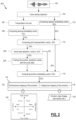
- FIGURE 1 is a diagrammatic representation of a first non-limitative example of a method according to the present invention for recognizing an emotion of a person from a real-time audio signal.
- the method 100 may be used for example for detecting the emotion of a person of interest, POI, during a telephone conversation, or a POI whom voice is detected for example by a surveillance apparatus such as a camera or a microphone, etc.
- At least one of the steps of the method may be executed locally or on a server distant form the person of interest.
- AI least one of the steps of the method may be executed locally or on a server distant form the location where the audio signal 102 is collected.
- the method 100 comprises a step 104 detecting voice activity in an audio signal. This step 104 triggers the execution of the other steps of the method 100 whenever a voice is detected in the audio signal. Conversely, when non voice is detected in the audio signal, the remaining steps of the method 100 are not executed.
- the voice activity detection may be realized by known models such as the one used in Eyben, Florian, et al. "Real-life voice activity detection with Istm recurrent neural networks and an application to hollywood movies.” 2013 IEEE International Conference on Acoustics, Speech and Signal Processing. IEEE, 2013 .
- the voice signal is extracted from the audio signal.
- the remaining steps of the method 100 are carried out on the voice signal extracted from the audio signal, upon detection of voice activity.
- the method 100 comprises a step 106 transcribing into text the speech in the voice signal.
- the transcription into text of the speech signal may be carried out according to any known ASR model, such as the model described in the paper from Graves, Alex, and Navdeep Jaitly. "Towards end-to-end speech recognition with recurrent neural networks.”, international conference on machine learning. PMLR, 2014 , without being limited to this model.
- Step 106 outputs the text of the speech contained in the voice signal.
- the method 100 comprises a step 108 computing a textual embedding vector as a function of the text provided by the step 106.
- the computing of the textual embedding vector may be carried out by any textual embedding model, such as a pretrained Self-Supervised Learning (SSL) algorithm, such as a pre-trained Neural Network.
- the textual embedding model may be the BERT model.
- Step 106 outputs a textual embedding vector TEV i that is an n dimensional list of numerical values.
- the method 100 comprises a step 110 computing a speech embedding vector as a function of the speech signal, i.e. the audio signal representing the speech, detected and extracted in step 104.
- the computing of the speech embedding vector may be carried out by any speech embedding model, such as a pretrained Self-Supervised Learning (SSL) algorithm, such as a pre-trained artificial neural network.
- SSL Self-Supervised Learning
- Step 110 outputs a speech embedding vector, noted SEV i , that is an n dimensional list of numerical values.
- the method 100 comprises a step 112 computing a joint representation vector of the speech as a function of the speech embedding vector SEV i and the textual embedding vector TEV i .
- the computing of the joint representation vector may be carried out by any pretrained artificial neural network (ANN).
- ANN artificial neural network
- the speech representation model may be the model described in the paper form Siriwardhana, Shamane, et al. "Jointly Fine-Tuning "BERT-like” Self Supervised Models to Improve Multimodal Speech Emotion Recognition .”
- Step 112 outputs a a joint representation vector, noted JRV i , that is an n dimensional list of numerical values
- the method 100 may then comprise a step 114 for computing, by an emotion prediction model, an emotion embedding vector, noted EEV i , as a function of the joint representation vector JRV i .
- the emotion prediction model may be a pretrained artificial neural network (ANN), which can be a model trained to predict specific annotations of emotion from speech signals similar to the model described in the paper form Trigeorgis, George, et al. "Adieu features? end-to-end speech emotion recognition using a deep convolutional recurrent network.” 2016 IEEE international conference on acoustics, speech and signal processing (ICASSP). IEEE, 2016 . Since we also consider predicting an emotion embedding first and then mapping to different representations of emotion. This can be achieved by considering a shared neural network model and separate models to map to each representation of emotion, similar to Zhu, Zhi, and Yoshinao Sato.
- ANN pretrained artificial neural network
- the emotion embedding vector EEV i is an n dimensional list of numerical values.
- the method 100 also comprises a step 116 for mapping the emotion in at least one emotional frame, as a function of the emotion embedding vector EEV i .
- step 116 may comprise a step 118 for classifying the emotion in one class among several emotion classes, by a categorical mapping model.
- the categorical mapping model may be any known pretrained Self-Supervised Learning (SSL) algorithm, and in particular a pretrained Artificial Neural Network (ANN).
- SSL Self-Supervised Learning
- ANN Artificial Neural Network
- the emotion may be classed in one of the following classes: happy, sad, nervous, angry, neutral, etc.
- the step 118 outputs a class 120 of the emotion.
- step 116 may comprise a step 122 for locating the emotion in a coordinate system 124 comprising several dimensions, each dimension corresponding to an emotional dimension, by a dimensional mapping model.
- the coordinate system comprises a first dimension corresponding to Valence and a second dimension corresponding to Arousal.
- the dimensional mapping model may be any known pretrained Self-Supervised Learning (SSL) algorithm, and in particular a pretrained Artificial Neural Network.
- SSL Self-Supervised Learning
- steps 104-116 may be reiterated continuously, or at a given frequency, in order to recognize emotion, or to refresh previously detected emotion, in the real-time audio signal 102.
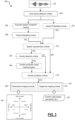
- FIGURE 2 is a diagrammatic representation of a second non-limitative example of a method according to the present invention for recognizing an emotion of a person from a real-time audio signal.
- the method 200 may be used for example for detecting the emotion of a person of interest, POI, during a telephone conversation, or a POI whom voice is detected for example by a surveillance apparatus such as a camera or a microphone, etc.
- the method 200 comprises all the steps of the method 10o of FIGURE 1 .
- the method 200 further comprises a step 202, carried out after the joint representation vector computing step 112, for detecting, by a novelty detection model, novel data in the speech.
- the novelty detection may be carried out as a function of the joint representation vector JRV i computed in step 112.
- the novelty detection model may be an artificial neural network (ANN) pretrained to detect novelty. More particularly, the novelty detection model may be an artificial neural network (ANN) trained to rebuild the input in its output, i.e., an autoencoder, for example similar to Marchi, Erik, et al. "Deep recurrent neural network-based autoencoders for acoustic novelty detection.” Computational intelligence and neuroscience (2017 ) . This way, when the model outputs a signal really different from its input (indicated by an arbitrary threshold), it signifies that the input signal was more different than a certain threshold to the other existing signal, which means that the data is novel.
- ANN artificial neural network
- step 202 When no novel data is detected at step 202, method 200 is continued with step 114 as described above with reference to FIGURE 1 .
- method 200 further comprises a step 204 is carried after step 202 for training the emotion prediction model used at step 116.
- the steps 202 and 204 does not have to be carried out while the model is performing in real time but rather at a later time, on the registered recordings to further improve computing emotion embedding vector in 114 for future use cases.
- Such a training allows adapting the emotion prediction model to novel data, thus personalizing said model.
- Such a training may be carried according to the training described in the paper from Rudovic, Ognjen, et al. "Personalized machine learning for robot perception of affect and engagement in autism therapy.” Science Robotics 3.19 (2018 ).
- step 114 is carried out with the updated emotion production model.
- FIGURE 3 is a diagrammatic representation of a non-limitative example of a device according to the present invention.
- the device 300 shown in FIGURE 3 , may be used to carry out a method for recognizing the emotion of person of interest in an audio signal, and in particular the method 100 of FIGURE 1 or the method 200 of FIGURE 2 .
- the device 300 comprises a voice activity detection module 304 for detecting voice activity in the audio signal 102, and extraction the speech signal from the audio signal 102.
- the voice activity detecting module may be, or may execute, any known model such as the one by Eyben, Florian, et al. "Real-life voice activity detection with Istm recurrent neural networks and an application to hollywood movies.” 2013 IEEE International Conference on Acoustics, Speech and Signal Processing. IEEE, 2013 .
- the device 300 comprise an automatic speech recognition module 206 for transcribing into text the speech in the speech signal extracted by the voice activity detection module.
- the module automatic speech recognition module 306 may be, or may execute, any known ASR model, such as the model described in the paper from Graves, Alex, and Navdeep Jaitly. "Towards end-to-end speech recognition with recurrent neural networks.”, international conference on machine learning. PMLR, 2014 , without being limited to this model.
- the device 300 comprises a textual embedding module 308 for computing a textual embedding vector as a function of the text provided by the module 306.
- the textual embedding module 308 may be, or may execute, any textual embedding model, such as a pretrained Self-Supervised Learning (SSL) algorithm, such as a pre-trained Neural Network.
- the textual embedding model may be the BERT model.
- the device 300 also comprises a speech embedding module 310 for computing a speech embedding vector as a function of the speech signal detected and extracted by the voice activity detection module 304.
- the speech embedding module 310 may be, or may execute, any known speech embedding model, such as a pretrained Self-Supervised Learning (SSL) algorithm, such as a pre-trained artificial neural network.
- SSL Self-Supervised Learning
- the device 300 further comprises a speech representation module 312 for computing a joint representation vector JRV i of the speech as a function of the speech embedding vector SEV i and the textual embedding vector TEV i .
- the speech representation module 312 may be, or may execute out, pretrained artificial neural network (ANN).
- ANN artificial neural network
- the speech representation model may be the model described in the paper form Siriwardhana, Shamane, et al. "Jointly Fine-Tuning "BERT-like” Self Supervised Models to Improve Multimodal Speech Emotion Recognition .”
- the device 300 also comprises an emotion prediction module 314 for computing an emotion embedding vector EEV i , as a function of the joint representation vector JRV i .
- the emotion prediction module 314 may be, or may execute, a pretrained artificial neural network (ANN).
- the device 300 comprises a mapping module 316 for mapping the emotion in at least one emotional frame, as a function of the emotion embedding vector EEV i .
- the mapping module 316 may comprise a categorical mapping module 316 for classifying the emotion in one class among several emotion classes.
- This module 316 may execute a categorical mapping model, such as any known pretrained Self-Supervised Learning (SSL) algorithm, and in particular a pretrained Artificial Neural Network.
- SSL Self-Supervised Learning
- the mapping module 316 may comprise a dimensional mapping module 322 for locating the emotion in a coordinate system 124 comprising several dimensions, each dimension corresponding to an emotional dimension.
- the dimensional mapping module 322 may be any known pretrained Self-Supervised Learning (SSL) algorithm, and in particular a pretrained Artificial Neural Network.
- the device 300 may optionally comprise a novelty detection module 342 for detecting novel data in the speech.
- the novelty detection module 342 may be, or may execute, an artificial neural network (ANN) pretrained to detect novelty.
- ANN artificial neural network
- the device 300 may comprise a training module 344 for training the emotion prediction model used in the emotion prediction module 314, with data.
- Such a training module 344 may carry out a training such as the training described in the paper from Rudovic, Ognjen, et al. "Personalized machine learning for robot perception of affect and engagement in autism therapy.” Science Robotics 3.19 (2018 ).
- At least one of the modules described above may be local or distant form the person of interest, or form the location where the audio signal 102 is collected.
- At least one of the modules may be an independent module separated from the other modules of the device 300.
- At least two of the modules may be integrated into a common module.
- At least one of the modules of the device 300 may be a computer program, or a software.
Landscapes
- Engineering & Computer Science (AREA)
- Health & Medical Sciences (AREA)
- Physics & Mathematics (AREA)
- Audiology, Speech & Language Pathology (AREA)
- Computational Linguistics (AREA)
- Multimedia (AREA)
- Human Computer Interaction (AREA)
- Acoustics & Sound (AREA)
- General Health & Medical Sciences (AREA)
- Child & Adolescent Psychology (AREA)
- Hospice & Palliative Care (AREA)
- Signal Processing (AREA)
- Psychiatry (AREA)
- Artificial Intelligence (AREA)
- Theoretical Computer Science (AREA)
- General Engineering & Computer Science (AREA)
- General Physics & Mathematics (AREA)
- Machine Translation (AREA)
- Measurement Of The Respiration, Hearing Ability, Form, And Blood Characteristics Of Living Organisms (AREA)
Abstract
Description
- The present invention relates to a computer implemented method for emotion recognition from a real-time audio signal. The invention also relates to a computer program, and a device configured, to carry out such a method.
- The field of the invention is the field of digital solutions for emotion recognition from audio signals.
- Human Computer Interaction (HCI), which focuses on the interfaces between people and computers, is today mainly based on touch based graphical interfaces. However, since speech is the most natural way of interaction among humans, using speech as the primary mode of interaction has recently become more popular. Most current speech-based human-computer interaction applications today such as Apple's Siri or Amazon's Alexa are only focused on recognizing spoken words. However, non-verbal communication such as emotion plays an important role when communicating with humans.
- There are known several computer implemented methods for emotion recognition from audio signals. These methods mostly rely on data-driven techniques to detect either different emotion categories such as happiness and sadness, or different emotion dimensions such as arousal and valence. Thus, known techniques carry out a partial emotion recognition based on part of the information pertaining to emotion and give a partial representation of said emotion.
- Moreover, aalthough known techniques can be successful, mainly under controlled environments, they do not work well in real life conditions, especially when emotion changes or new data is to be considered in order to recognize emotion.
- A purpose of the present invention is to overcome at least one of these drawbacks.
- Another purpose of the present invention is to provide a more efficient solution for emotion recognition, in particular in real life conditions.
- Another purpose of the present invention is to provide a more evolutionary solution for emotion recognition.
- The invention makes it possible to achieve at least one of these aims by a computer implemented method for emotion recognition from a real-time audio signal, said method comprising several iterations of an emotion detection phase comprising the following steps:
- transcription, into a text, an audio speech signal contained is said audio signal by an automatic speech recognition model;
- computing, by a speech representation model, a joint representation vector as a function of said speech signal and said text;
- computing, by an emotion prediction model, an emotion embedding vector as a function of said joint representation vector; and
- mapping said emotion in at least one emotional frame, according to said emotion embedding vector, by an emotion mapping model.
- The present invention proposes recognition of an emotion in a real-time audio signal according to a joint representation vector of the speech, said joint representation vector depending on both the speech signal, i.e. the audio signal of the speech, and the text of the speech, i.e. the textual content of speech. Thus, the present invention carries out a more comprehensive and complete recognition of the emotion of the person whom the speech utterance originates from. In other words, the present invention considers both the characteristics of the audio signal representing the speech utterance and the textual information of the speech utterance for recognizing the emotion conveyed with speech. Thus the present invention makes it possible a more efficient recognition of emotion, in particular in real life conditions.
- Plus, the present invention proposes computing an emotion embedding vector, before representing the emotion in at least one emotional frame. The emotion embedding vector is a data that is not in the form of an emotion representation defined or understood by humans, yet. Such a data can then be used to map the emotion according to one or several emotional frame, as desired. Thus, the present invention allows a more complete and customizable representation of emotion.
- The automatic speech recognition model, ASR, may be any ASR model. For example, the ASR model may be the model described in the paper from Graves, Alex, and Navdeep Jaitly. "Towards end-to-end speech recognition with recurrent neural networks.", international conference on machine learning. PMLR, 2014 .
- The ASR model transcribes audio speech into text.
- Since, ASR modules are well known in the literature, a detailed description of the ASR model will not be given here for sake of brevity. Plus, the invention is not limited to a specific ASR model or to a specific technique to perform ASR.
- The speech representation model, SRM, may be a pretrained artificial neural network (ANN). For example, the SRM may be the model described in the paper Evain, Solène, et al. "Task Agnostic and Task Specific Self-Supervised Learning from Speech with LeBenchmark." Thirty-fifth Conference on Neural Information Processing Systems Datasets and Benchmarks Track (Round 2). 2021 .
- The speech representation model provides a joint representation vector, that may be an n-dimensional list of numerical values.
- Since, speech data representation models are well known in the art, a detailed description of the speech data representation model will not be given here for sake of brevity. Plus, the invention is not limited to a specific SRM or to a specific technique to perform speech representation.
- The emotion prediction model, EPM, may be a pretrained artificial neural network (ANN) that predicts specific emotion annotations from registered speech utterances. For example, the EPM may be the model described in the paper form Trigeorgis, George, et al. "Adieu features? end-to-end speech emotion recognition using a deep convolutional recurrent network." 2016 IEEE international conference on acoustics, speech and signal processing (ICASSP). IEEE, 2016 .
- The emotion prediction model may also be a combination of a shared neural network model to predict a notion of emotion, which we call "emotion embedding" here, and separate models to map the so called emotion embedding to each representation of emotion, similar to Zhu, Zhi, and Yoshinao Sato. "Reconciliation of Multiple Corpora for Speech Emotion Recognition by Multiple Classifiers with an Adversarial Corpus Discriminator." INTERSPEECH. 2020 . The training of both the shared model and specific models can be done either in separate steps or at the same time following a multi-task learning strategy, where in each epoch of training the neural networks, we train the shared model and the specific model of each task for all the considered tasks, similar to Zhang, Yue, et al. "Multi-task deep neural network with shared hidden layers: Breaking down the wall between emotion representations." 2017 IEEE international conference on acoustics, speech and signal processing (ICASSP). IEEE, 2017 . The task in our case can be simply different datasets of emotion or different representations of emotion if two different datasets has considered the same annotation strategy of emotion.
- The emotion embedding vector may be an n-dimensional list of numerical values.
- Since, emotion prediction models are well known in the literature, a detailed description of the emotion prediction model will not be given here for sake of brevity. Plus, the invention is not limited to a specific EPM or to a specific technique to perform emotion prediction.
- In some non-limitative embodiments, the method according to the invention may further comprise a novelty detection step for detecting novel expression(s) of emotion in the speech, by a novelty detection model, according to the joint representation vector.
- By "novel expression of emotion" it is meant a novel emotional expression, whether the emotion itself is novel or just the way it is expressed, which has not been seen by the emotion prediction model. The novel expression of emotion is detected according to the joint representation vector.
- This novelty detection step may have different implications at different scales, from adapting to a specific person or a specific culture. This can mean making the models better at an individual level by adapting to how specifically an individual expresses emotion or more broadly, how a certain set of people (e.g., culturally) express certain emotions.
- The novelty detection model may be an artificial neural network (ANN) trained to rebuild the input in its output (I.e., an autoencoder) similar to Marchi, Erik, et al. "Deep recurrent neural network-based autoencoders for acoustic novelty detection." Computational intelligence and neuroscience (2017 ). This way, when the model outputs a signal different from its input (indicated by an arbitrary threshold), it signifies that the input signal was more different than a certain threshold to the other existing signals already used to train the novelty detection model, which means that the data is novel for the existing model.
- In some embodiments, the method according to the invention may further comprise a step for training the emotion prediction model in case of novelty detection in the speech.
- This training may simply be retraining the emotion prediction model with the previous existing data plus data detected as novel by the novelty detection model or just fine-tuning the model (i.e., training the model further) using only the novel data.
- Such a training allows adapting the emotion prediction model to novel data. For example, this way the prediction model may be personalized by adapting each model to each person by adding an extra layer to the model and training that layer using only samples from a specific person. This can be similar to the idea described in the paper from Rudovic, Ognjen, et al. "Personalized machine learning for robot perception of affect and engagement in autism therapy." Science Robotics 3.19 (2018 ).
- In some embodiments, the method according to the invention may further comprise a step for detecting voice activity in the real-time audio signal, the detection phase being carried out when a voice activity is detected.
- Indeed, if no speech is detected in the audio signal, the emotion detection phase is not carried out, thus saving computing time and resources.
- The voice activity detection may be carried out by Voice Activity Detection (VAD) Module. The VAD module may constantly monitor, for example in a loop, the input Audio Signal and detect a speech utterance once a person has spoken.
- The VAD module may be a neural network trained for detection voice activity in an audio signal, i.e. for detecting the voice of a person in an audio signal. This is usually achieved by framing the audio signal into small chunks (each can be 100 ms as an example) and then assigning each chunk a +1 if there is voice and -1 if there is no speech. This way the neural network can be trained to predict voice activity from an audio signal.
- Since, the VAD modules are well known in the literature, a detailed description of the VAD module will not be given here for sake of brevity. Plus, the invention is not limited to a specific VAD, or to a specific technique for detecting voice activity.
- In some embodiments, the method according to the invention may further comprise a step for extracting a speech signal from the audio signal, the detection phase being carried out for said speech signal.
- Indeed, the audio signal may comprise an audio signal representing the speech of the person of interest, but also parasitic audio signals originating from other sources located in the environment of the said person of interest such as other persons, machines, cars, etc. Thus, the extraction of speech signal of the person of interest from the acquired real-time audio signal makes it possible to reduce, or even to eliminate, these parasitic audio signals, making the method according to the invention more accurate.
- The extraction of the speech from the audio signal may be carried out through different means such as a speech enhancement module, where we train a neural network to predict clean audio signals from the noisy ones similar to Hu, Yanxin, et al. "DCCRN: Deep complex convolution recurrent network for phase-aware speech enhancement." arXiv preprint arXiv:2008.00264 (2020 ). or by training the speech representation model on noisy audio signals, in which we train a neural network to be robust against noise by training it on the noisy signals in the first place, similar to Yin, Shi, et al. "Noisy training for deep neural networks in speech recognition." EURASIP Journal on Audio, Speech, and Music Processing 2015.1 (2015): 1-14 .
- The method according to the invention may further comprise a step for computing, by a speech embedding model, a speech embedding vector as a function of the audio speech signal, said speech embedding vector being used as input data for computing the joint representation vector.
- The speech embedding vector may an n dimensional list of numerical values.
- The speech embedding model may be any known pretrained Self-Supervised Learning (SSL) algorithm, and in particular a pretrained Artificial Neural Network.
- Since, speech embedding models are well known, a detailed description of the speech embedding model will not be given here for sake of brevity. Plus, the invention is not limited to a specific speech embedding model, or to a specific technique for speech embedding.
- The method according to the invention may comprise a step of computing, by a textual embedding model, a textual embedding vector as a function of the text obtained at the transcription step, said text embedding vector being used as input data for computing the joint representation vector.
- The textual embedding vector may be an n dimensional list of numerical values.
- The textual embedding model may be any known pretrained Self-Supervised Learning (SSL) algorithm. For example, the textual embedding model may be the BERT model. Detailed information regarding the BERT model may be found in the paper from Devlin, Jacob, et al. "Bert: Pre-training of deep bidirectional transformers for language understanding ."
- Since, textual embedding models are well known by a person having ordinary skills in the art, a detailed description of the textual embedding model will not be given here for sake of brevity. Moreover, the invention is not limited to a specific textual embedding model, or to a specific technique for textual embedding.
- The joint representation model provides a joint representation vector that may be an n-dimensional list of numerical values.
- The joint representation model can be as simple as concatenating the embeddings obtained by speech and textual embedding models but also more complex as jointly learning or fine-tuning both the aforementioned models, where we train the self-supervised models for both speech and text at the same time, similar to Siriwardhana, Shamane, et al. "Jointly Fine-Tuning" BERT-like" Self Supervised Models to Improve Multimodal Speech Emotion Recognition."
- In some embodiments of the method according to the invention, the mapping step may comprise a step for classifying the emotion in one class among several emotion classes, by a categorical mapping model. The categorical mapping may be based on Ekman's psychological model of affect described in Ekman, Paul. "An argument for basic emotions." Cognition & emotion 6.3-4 (1992): 169-200 .
- The categorical mapping model may be any known pretrained Self-Supervised Learning (SSL) algorithm, and in particular a pretrained Artificial Neural Network.
- In some embodiments, the emotion may be classed in one of the following classes: happy, sad, nervous, angry, neutral, etc.
- For example, the categorical mapping model may take as input data the emotion embedding vector and output a class of the emotion among several classes previously defined. Moreover, the invention is not limited to a specific categorical mapping model, or to a specific technique for categorical mapping.
- In some embodiments of the method according to the invention, the mapping step may comprise a step for locating the emotion in a coordinate system comprising several dimensions, each dimension corresponding to an emotional dimension, by a dimensional mapping model. The dimensional representation of emotion may be based on Russell's circumplex model of affect described in Russell, James A. "A circumplex model of affect." Journal of personality and social psychology 39.6 (1980): 1161 .
- In some embodiments, at least one emotional dimension may be chosen among the following emotion:
- arousal,
- valence,
- etc.
- For example, the coordinate system may comprise only two dimensions: a first dimension or axis corresponding to Arousal, and a second dimension or axis corresponding to Valence. The emotion may be located in this two dimensional system with a coordinate having two values, one for Arousal and one for Valence.
- The dimensional mapping model may be any known pretrained Self-Supervised Learning (SSL) algorithm, and in particular a pretrained Artificial Neural Network.
- For example, the dimensional mapping model may take as input data the emotion embedding vector and outputs a coordinate of the emotion in the predefined coordinate system. Moreover, the invention is not limited to a specific dimensional mapping model, or to a specific technique for dimensional mapping.
- According to another aspect of the same invention, it is proposed a computer program comprising instructions, which when executed by a computer, cause the computer to carry out the steps of the method according to the invention.
- The computer program may be in any programming language such as C, C++, JAVA, Python, etc.
- The computer program may be in machine language.
- The computer program may be stored, in a non-transient memory, such as a USB stick, a flash memory, a hard-disc, a processor, a programmable electronic chop, etc.
- The computer program may be stored in a computerized device such as a Smartphone, a tablet, a computer, a server, etc.
- According to another aspect of the same invention, it is proposed a device configured to carry out the steps of the method according to the invention.
- The device may be a personal device such as a Smartphone, a tablet, a Smartwatch, a computer, any wearable electronic device, etc.
- The device according to the invention may execute one or several applications to carry out the method according to the invention.
- The device according to the invention may be loaded with, and configured to execute, the computer program according to the invention.
- Other advantages and characteristics will become apparent on examination of the detailed description of an embodiment which is in no way limitative, and the attached figures, where:
-
Figure 1 is a diagrammatic representation of a first non-limitative example of a method according to the invention; -
Figure 2 is a diagrammatic representation of a first non-limitative example of a method according to the invention; and -
Figure 3 is a diagrammatic representation of a non-limitative example of a device according to the present invention. - It is well understood that the embodiments that will be described below are in no way limitative. In particular, it is possible to imagine variants of the invention comprising only a selection of the characteristics described hereinafter, in isolation from the other characteristics described, if this selection of characteristics is sufficient to confer a technical advantage or to differentiate the invention with respect to the state of the prior art. Such a selection comprises at least one, preferably functional, characteristic without structural details, or with only a part of the structural details if this part alone is sufficient to confer a technical advantage or to differentiate the invention with respect to the prior art.
- In the FIGURES, elements common to several figures retain the same reference.
-
FIGURE 1 is a diagrammatic representation of a first non-limitative example of a method according to the present invention for recognizing an emotion of a person from a real-time audio signal. - The
method 100, shown inFIGURE 1 , may be used for example for detecting the emotion of a person of interest, POI, during a telephone conversation, or a POI whom voice is detected for example by a surveillance apparatus such as a camera or a microphone, etc. - At least one of the steps of the method may be executed locally or on a server distant form the person of interest. AI least one of the steps of the method may be executed locally or on a server distant form the location where the
audio signal 102 is collected. - The
method 100 comprises astep 104 detecting voice activity in an audio signal. Thisstep 104 triggers the execution of the other steps of themethod 100 whenever a voice is detected in the audio signal. Conversely, when non voice is detected in the audio signal, the remaining steps of themethod 100 are not executed. - The voice activity detection may be realized by known models such as the one used in Eyben, Florian, et al. "Real-life voice activity detection with Istm recurrent neural networks and an application to hollywood movies." 2013 IEEE International Conference on Acoustics, Speech and Signal Processing. IEEE, 2013 .
- When voice activity is detected, the voice signal is extracted from the audio signal. The remaining steps of the
method 100 are carried out on the voice signal extracted from the audio signal, upon detection of voice activity. - The
method 100 comprises astep 106 transcribing into text the speech in the voice signal. The transcription into text of the speech signal may be carried out according to any known ASR model, such as the model described in the paper from Graves, Alex, and Navdeep Jaitly. "Towards end-to-end speech recognition with recurrent neural networks.", international conference on machine learning. PMLR, 2014 , without being limited to this model. - Step 106 outputs the text of the speech contained in the voice signal.
- The
method 100 comprises astep 108 computing a textual embedding vector as a function of the text provided by thestep 106. - The computing of the textual embedding vector may be carried out by any textual embedding model, such as a pretrained Self-Supervised Learning (SSL) algorithm, such as a pre-trained Neural Network. For example, the textual embedding model may be the BERT model.
- Step 106 outputs a textual embedding vector TEVi that is an n dimensional list of numerical values.
- The
method 100 comprises astep 110 computing a speech embedding vector as a function of the speech signal, i.e. the audio signal representing the speech, detected and extracted instep 104. - The computing of the speech embedding vector may be carried out by any speech embedding model, such as a pretrained Self-Supervised Learning (SSL) algorithm, such as a pre-trained artificial neural network.
- Step 110 outputs a speech embedding vector, noted SEVi, that is an n dimensional list of numerical values.
- The
method 100 comprises astep 112 computing a joint representation vector of the speech as a function of the speech embedding vector SEVi and the textual embedding vector TEVi. - The computing of the joint representation vector may be carried out by any pretrained artificial neural network (ANN). For example, the speech representation model may be the model described in the paper form Siriwardhana, Shamane, et al. "Jointly Fine-Tuning "BERT-like" Self Supervised Models to Improve Multimodal Speech Emotion Recognition ."
- Step 112 outputs a a joint representation vector, noted JRVi, that is an n dimensional list of numerical values
- The
method 100 may then comprise astep 114 for computing, by an emotion prediction model, an emotion embedding vector, noted EEVi, as a function of the joint representation vector JRVi. - The emotion prediction model may be a pretrained artificial neural network (ANN), which can be a model trained to predict specific annotations of emotion from speech signals similar to the model described in the paper form Trigeorgis, George, et al. "Adieu features? end-to-end speech emotion recognition using a deep convolutional recurrent network." 2016 IEEE international conference on acoustics, speech and signal processing (ICASSP). IEEE, 2016 . Since we also consider predicting an emotion embedding first and then mapping to different representations of emotion. This can be achieved by considering a shared neural network model and separate models to map to each representation of emotion, similar to Zhu, Zhi, and Yoshinao Sato. "Reconciliation of Multiple Corpora for Speech Emotion Recognition by Multiple Classifiers with an Adversarial Corpus Discriminator." INTERSPEECH. 2020 . The training of both the shared model and specific models can be done in separate steps or jointly together at the same time following a multi-task learning strategy, where in each epoch of training the neural networks, we train the shared model and the specific model of each task for all the considered tasks, similar to Zhang, Yue, et al. "Multi-task deep neural network with shared hidden layers: Breaking down the wall between emotion representations." 2017 IEEE international conference on acoustics, speech and signal processing (ICASSP). IEEE, 2017. The task in our case can be simply different datasets of emotion or different representations of emotion if two different datasets has considered the same annotation strategy of emotion.
- The emotion embedding vector EEVi is an n dimensional list of numerical values.
- The
method 100 also comprises astep 116 for mapping the emotion in at least one emotional frame, as a function of the emotion embedding vector EEVi. - More particularly, step 116 may comprise a
step 118 for classifying the emotion in one class among several emotion classes, by a categorical mapping model. - The categorical mapping model may be any known pretrained Self-Supervised Learning (SSL) algorithm, and in particular a pretrained Artificial Neural Network (ANN).
- For example, the emotion may be classed in one of the following classes: happy, sad, nervous, angry, neutral, etc.
- The
step 118 outputs aclass 120 of the emotion. - Alternatively, or in addition,
step 116 may comprise astep 122 for locating the emotion in a coordinatesystem 124 comprising several dimensions, each dimension corresponding to an emotional dimension, by a dimensional mapping model. - In the example shown, the coordinate system comprises a first dimension corresponding to Valence and a second dimension corresponding to Arousal.
- The dimensional mapping model may be any known pretrained Self-Supervised Learning (SSL) algorithm, and in particular a pretrained Artificial Neural Network.
- It is noted that steps 104-116 may be reiterated continuously, or at a given frequency, in order to recognize emotion, or to refresh previously detected emotion, in the real-
time audio signal 102. -
FIGURE 2 is a diagrammatic representation of a second non-limitative example of a method according to the present invention for recognizing an emotion of a person from a real-time audio signal. - The
method 200, shown inFIGURE 2 , may be used for example for detecting the emotion of a person of interest, POI, during a telephone conversation, or a POI whom voice is detected for example by a surveillance apparatus such as a camera or a microphone, etc. - The
method 200 comprises all the steps of the method 10o ofFIGURE 1 . - The
method 200 further comprises astep 202, carried out after the joint representationvector computing step 112, for detecting, by a novelty detection model, novel data in the speech. - The novelty detection may be carried out as a function of the joint representation vector JRVi computed in
step 112. - The novelty detection model may be an artificial neural network (ANN) pretrained to detect novelty. More particularly, the novelty detection model may be an artificial neural network (ANN) trained to rebuild the input in its output, i.e., an autoencoder, for example similar to Marchi, Erik, et al. "Deep recurrent neural network-based autoencoders for acoustic novelty detection." Computational intelligence and neuroscience (2017 ). This way, when the model outputs a signal really different from its input (indicated by an arbitrary threshold), it signifies that the input signal was more different than a certain threshold to the other existing signal, which means that the data is novel.
- When no novel data is detected at
step 202,method 200 is continued withstep 114 as described above with reference toFIGURE 1 . - When novel data is detected at
step 202,method 200 further comprises astep 204 is carried afterstep 202 for training the emotion prediction model used atstep 116. Thesteps - Such a training allows adapting the emotion prediction model to novel data, thus personalizing said model. Such a training may be carried according to the training described in the paper from Rudovic, Ognjen, et al. "Personalized machine learning for robot perception of affect and engagement in autism therapy." Science Robotics 3.19 (2018 ).
- In case of novel data,
step 114 is carried out with the updated emotion production model. -
FIGURE 3 is a diagrammatic representation of a non-limitative example of a device according to the present invention. - The
device 300, shown inFIGURE 3 , may be used to carry out a method for recognizing the emotion of person of interest in an audio signal, and in particular themethod 100 ofFIGURE 1 or themethod 200 ofFIGURE 2 . - The
device 300 comprises a voiceactivity detection module 304 for detecting voice activity in theaudio signal 102, and extraction the speech signal from theaudio signal 102. - The voice activity detecting module may be, or may execute, any known model such as the one by Eyben, Florian, et al. "Real-life voice activity detection with Istm recurrent neural networks and an application to hollywood movies." 2013 IEEE International Conference on Acoustics, Speech and Signal Processing. IEEE, 2013 .
- The
device 300 comprise an automatic speech recognition module 206 for transcribing into text the speech in the speech signal extracted by the voice activity detection module. - The module automatic
speech recognition module 306 may be, or may execute, any known ASR model, such as the model described in the paper from Graves, Alex, and Navdeep Jaitly. "Towards end-to-end speech recognition with recurrent neural networks.", international conference on machine learning. PMLR, 2014 , without being limited to this model. - The
device 300 comprises a textual embeddingmodule 308 for computing a textual embedding vector as a function of the text provided by themodule 306. - The textual embedding
module 308 may be, or may execute, any textual embedding model, such as a pretrained Self-Supervised Learning (SSL) algorithm, such as a pre-trained Neural Network. For example, the textual embedding model may be the BERT model. - The
device 300 also comprises aspeech embedding module 310 for computing a speech embedding vector as a function of the speech signal detected and extracted by the voiceactivity detection module 304. - The
speech embedding module 310 may be, or may execute, any known speech embedding model, such as a pretrained Self-Supervised Learning (SSL) algorithm, such as a pre-trained artificial neural network. - The
device 300 further comprises aspeech representation module 312 for computing a joint representation vector JRVi of the speech as a function of the speech embedding vector SEVi and the textual embedding vector TEVi. - The
speech representation module 312 may be, or may execute out, pretrained artificial neural network (ANN). For example, the speech representation model may be the model described in the paper form Siriwardhana, Shamane, et al. "Jointly Fine-Tuning "BERT-like" Self Supervised Models to Improve Multimodal Speech Emotion Recognition ." - The
device 300 also comprises anemotion prediction module 314 for computing an emotion embedding vector EEVi, as a function of the joint representation vector JRVi. Theemotion prediction module 314 may be, or may execute, a pretrained artificial neural network (ANN). - The
device 300 comprises amapping module 316 for mapping the emotion in at least one emotional frame, as a function of the emotion embedding vector EEVi. - More particularly, the
mapping module 316 may comprise acategorical mapping module 316 for classifying the emotion in one class among several emotion classes. Thismodule 316 may execute a categorical mapping model, such as any known pretrained Self-Supervised Learning (SSL) algorithm, and in particular a pretrained Artificial Neural Network. - Alternatively, or in addition, the
mapping module 316 may comprise adimensional mapping module 322 for locating the emotion in a coordinatesystem 124 comprising several dimensions, each dimension corresponding to an emotional dimension. Thedimensional mapping module 322 may be any known pretrained Self-Supervised Learning (SSL) algorithm, and in particular a pretrained Artificial Neural Network. - The
device 300 may optionally comprise anovelty detection module 342 for detecting novel data in the speech. - The
novelty detection module 342 may be, or may execute, an artificial neural network (ANN) pretrained to detect novelty. - The
device 300 may comprise atraining module 344 for training the emotion prediction model used in theemotion prediction module 314, with data. - Such a
training module 344 may carry out a training such as the training described in the paper from Rudovic, Ognjen, et al. "Personalized machine learning for robot perception of affect and engagement in autism therapy." Science Robotics 3.19 (2018 ). - At least one of the modules described above may be local or distant form the person of interest, or form the location where the
audio signal 102 is collected. - At least one of the modules may be an independent module separated from the other modules of the
device 300. - At least two of the modules may be integrated into a common module.
- At least one of the modules of the
device 300 may be a computer program, or a software. - Of course, the invention is not limited to the examples detailed above.
Claims (11)
- A computer implemented method (100;200) for emotion recognition from a real-time audio signal (102), said method (100;200) comprising several iterations of an emotion detection phase comprising the following steps:- transcription (106), into text, an audio speech signal contained is said audio signal (102) by an automatic speech recognition model;- computing (112), by a speech representation model, a joint representation vector (JRVi) as a function of said speech signal and said text;- computing (114), by an emotion prediction model, an emotion embedding vector (EEVi), as a function of said joint representation vector (JRVi); and- mapping (116) said emotion in at least one emotional frame (120;124), according to said emotion embedding vector (EEVi), by an emotion mapping model.
- The method (200) according to the preceding claim, further comprising a novelty detection step (202) for detecting novel expression(s) of emotion in the speech, by a novelty detection model, according to the joint representation vector (JRVi).
- The method (200) according to the preceding claim, further comprising a step (204) for training the emotion prediction model in case of novelty detection in the speech.
- The method (100;200) according to any one of the preceding claims, further comprising a step (104) for detecting voice activity in the real time audio signal (102), the detection phase being carried out when a voice activity is detected.
- The method (100;200) according to any one of the preceding claims, further comprising a step (104) for extracting a speech signal from the audio signal (102), the detection phase being carried out for said speech signal.
- The method (100;200) according to any one of the preceding claims, further comprising a step (110) for computing, by a speech embedding model, a speech embedding vector (SEVi) as a function of the audio speech signal, said speech embedding vector (SEVi) being used as input data for computing the joint representation vector (JRVi).
- The method (100;200) according to any one of the preceding claims, further comprising a step (108) of computing, by a textual embedding model, a textual embedding vector (TEVi) as a function of the text obtained at the transcription step (106), said textual embedding vector (TEVi) being used as input data for computing the joint representation vector (JRVi).
- The method (100;200) according to any one of the preceding claims, wherein the mapping step (116) comprises a step (118) for classifying the emotion in one class among several emotion classes, by a categorical mapping model.
- The method (100;200) according to any one of the preceding claims, wherein the mapping step (116) comprises a step (122) for locating the emotion in a coordinate system (124) comprising several dimensions, each dimension corresponding to an emotional dimension, by a dimensional mapping model.
- Computer program comprising instructions, which when executed by a computer, cause the computer to carry out the steps of the method of any one of the preceding claims.
- Device (300) for real-time emotion recognition from a real-time audio signal comprising means (304-318,322,342,344) configured to carry out the steps of the method (100;200) of any one of the claims 1 to 9.
Priority Applications (2)
| Application Number | Priority Date | Filing Date | Title |
|---|---|---|---|
| EP21306787.9A EP4198978B1 (en) | 2021-12-16 | 2021-12-16 | Method, device and computer program for emotion recognition from a real-time audio signal |
| US18/082,131 US12694891B2 (en) | 2021-12-16 | 2022-12-15 | Method, device and computer program for emotion recognition from a real-time audio signal |
Applications Claiming Priority (1)
| Application Number | Priority Date | Filing Date | Title |
|---|---|---|---|
| EP21306787.9A EP4198978B1 (en) | 2021-12-16 | 2021-12-16 | Method, device and computer program for emotion recognition from a real-time audio signal |
Publications (2)
| Publication Number | Publication Date |
|---|---|
| EP4198978A1 true EP4198978A1 (en) | 2023-06-21 |
| EP4198978B1 EP4198978B1 (en) | 2026-02-11 |
Family
ID=79316863
Family Applications (1)
| Application Number | Title | Priority Date | Filing Date |
|---|---|---|---|
| EP21306787.9A Active EP4198978B1 (en) | 2021-12-16 | 2021-12-16 | Method, device and computer program for emotion recognition from a real-time audio signal |
Country Status (2)
| Country | Link |
|---|---|
| US (1) | US12694891B2 (en) |
| EP (1) | EP4198978B1 (en) |
Families Citing this family (4)
| Publication number | Priority date | Publication date | Assignee | Title |
|---|---|---|---|---|
| US11893464B1 (en) * | 2023-03-16 | 2024-02-06 | edYou | Apparatus and methods for training an educational machine-learning model |
| WO2025187866A1 (en) * | 2024-03-08 | 2025-09-12 | 주식회사 엠마헬스케어 | Emotion estimation device using multi-modal model and learning method thereof |
| US20250292026A1 (en) * | 2024-03-12 | 2025-09-18 | International Business Machines Corporation | A generative artificial intelligence commentary |
| JP2026056459A (en) * | 2024-09-19 | 2026-04-01 | トヨタ自動車株式会社 | Emotion estimation method, information processing device, and program |
Citations (1)
| Publication number | Priority date | Publication date | Assignee | Title |
|---|---|---|---|---|
| US20210050033A1 (en) * | 2019-08-16 | 2021-02-18 | Adobe Inc. | Utilizing bi-directional recurrent encoders with multi-hop attention for speech emotion recognition |
Family Cites Families (39)
| Publication number | Priority date | Publication date | Assignee | Title |
|---|---|---|---|---|
| US8788270B2 (en) * | 2009-06-16 | 2014-07-22 | University Of Florida Research Foundation, Inc. | Apparatus and method for determining an emotion state of a speaker |
| US20210118323A1 (en) * | 2010-06-02 | 2021-04-22 | The Vista Group Llc | Method and apparatus for interactive monitoring of emotion during teletherapy |
| US10628985B2 (en) * | 2017-12-01 | 2020-04-21 | Affectiva, Inc. | Avatar image animation using translation vectors |
| CN102385858B (en) * | 2010-08-31 | 2013-06-05 | 国际商业机器公司 | Emotional voice synthesis method and system |
| US20160372116A1 (en) * | 2012-01-24 | 2016-12-22 | Auraya Pty Ltd | Voice authentication and speech recognition system and method |
| US20150302866A1 (en) * | 2012-10-16 | 2015-10-22 | Tal SOBOL SHIKLER | Speech affect analyzing and training |
| US9471883B2 (en) * | 2013-05-09 | 2016-10-18 | Moodwire, Inc. | Hybrid human machine learning system and method |
| US20170011029A1 (en) * | 2013-05-09 | 2017-01-12 | Moodwire, Inc. | Hybrid human machine learning system and method |
| US9978362B2 (en) * | 2014-09-02 | 2018-05-22 | Microsoft Technology Licensing, Llc | Facet recommendations from sentiment-bearing content |
| US20160086088A1 (en) * | 2014-09-24 | 2016-03-24 | Raanan Yonatan Yehezkel | Facilitating dynamic affect-based adaptive representation and reasoning of user behavior on computing devices |
| WO2017051425A1 (en) * | 2015-09-23 | 2017-03-30 | Devanathan Giridhari | A computer-implemented method and system for analyzing and evaluating user reviews |
| US10852813B2 (en) * | 2016-02-26 | 2020-12-01 | Sony Corporation | Information processing system, client terminal, information processing method, and recording medium |
| US11410682B2 (en) * | 2016-07-13 | 2022-08-09 | Sentio Solutions, Inc. | Method for detecting and recognizing an emotional state of a user |
| US20180160959A1 (en) * | 2016-12-12 | 2018-06-14 | Timothy James Wilde | Modular electronic lie and emotion detection systems, methods, and devices |
| JP6729424B2 (en) * | 2017-01-30 | 2020-07-22 | 富士通株式会社 | Equipment, output device, output method, and output program |
| CN107493501B (en) * | 2017-08-10 | 2020-07-10 | 人民网信息技术有限公司 | Audio and video content filtering system and method |
| US10372825B2 (en) * | 2017-12-18 | 2019-08-06 | International Business Machines Corporation | Emotion detection and expression integration in dialog systems |
| WO2019136394A1 (en) * | 2018-01-08 | 2019-07-11 | Chappell Arvel A | Social interactive applications for detection of neuro-physiological state |
| EP3739572B1 (en) * | 2018-01-11 | 2026-04-29 | Neosapience, Inc. | Text-to-speech synthesis method using machine learning and computer-readable storage medium |
| KR102448382B1 (en) * | 2018-01-22 | 2022-09-28 | 삼성전자주식회사 | Electronic device for providing an image associated with text and method for operating the same |
| US20210015417A1 (en) * | 2018-03-21 | 2021-01-21 | Limbic Limited | Emotion data training method and system |
| US20190384466A1 (en) * | 2018-06-13 | 2019-12-19 | International Business Machines Corporation | Linking comments to segments of a media presentation |
| EP3811245A4 (en) * | 2018-06-19 | 2022-03-09 | Ellipsis Health, Inc. | MENTAL HEALTH ASSESSMENT SYSTEMS AND METHODS |
| US10990759B1 (en) * | 2018-07-31 | 2021-04-27 | Amazon Technologies, Inc. | Deviation-based framework |
| US11037573B2 (en) * | 2018-09-05 | 2021-06-15 | Hitachi, Ltd. | Management and execution of equipment maintenance |
| US12002578B2 (en) * | 2018-12-10 | 2024-06-04 | Koninklijke Philips N.V. | Systems and methods for augmented reality-enhanced field services support |
| KR102888903B1 (en) * | 2019-03-22 | 2025-11-21 | 삼성전자주식회사 | Electronic device providing a response and method of operating the same |
| US11335347B2 (en) * | 2019-06-03 | 2022-05-17 | Amazon Technologies, Inc. | Multiple classifications of audio data |
| KR102630490B1 (en) * | 2019-09-06 | 2024-01-31 | 엘지전자 주식회사 | Method for synthesized speech generation using emotion information correction and apparatus |
| US20210090551A1 (en) * | 2019-09-23 | 2021-03-25 | Electronics And Telecommunications Research Institute | Emotional speech generating method and apparatus for controlling emotional intensity |
| US11854575B1 (en) * | 2019-09-30 | 2023-12-26 | Amazon Technologies, Inc. | System for presentation of sentiment data |
| US11019207B1 (en) * | 2019-11-07 | 2021-05-25 | Hithink Royalflush Information Network Co., Ltd. | Systems and methods for smart dialogue communication |
| US11386273B2 (en) * | 2019-11-18 | 2022-07-12 | International Business Machines Corporation | System and method for negation aware sentiment detection |
| US11250853B2 (en) * | 2020-04-30 | 2022-02-15 | Robert Bosch Gmbh | Sarcasm-sensitive spoken dialog system |
| US11232780B1 (en) * | 2020-08-24 | 2022-01-25 | Google Llc | Predicting parametric vocoder parameters from prosodic features |
| EP4002364B1 (en) * | 2020-11-13 | 2025-10-29 | Framvik Produktion AB | Assessing the emotional state of a user |
| US12340175B2 (en) * | 2021-01-29 | 2025-06-24 | Elaboration, Inc. | Automated classification of emotio-cogniton |
| US11563852B1 (en) * | 2021-08-13 | 2023-01-24 | Capital One Services, Llc | System and method for identifying complaints in interactive communications and providing feedback in real-time |
| KR20230043609A (en) * | 2021-09-24 | 2023-03-31 | 삼성전자주식회사 | Speech recognition apparatus and operaintg method thereof |
-
2021
- 2021-12-16 EP EP21306787.9A patent/EP4198978B1/en active Active
-
2022
- 2022-12-15 US US18/082,131 patent/US12694891B2/en active Active
Patent Citations (1)
| Publication number | Priority date | Publication date | Assignee | Title |
|---|---|---|---|---|
| US20210050033A1 (en) * | 2019-08-16 | 2021-02-18 | Adobe Inc. | Utilizing bi-directional recurrent encoders with multi-hop attention for speech emotion recognition |
Non-Patent Citations (19)
| Title |
|---|
| DEVLIN, JACOB ET AL., BERT: PRE-TRAINING OF DEEP BIDIRECTIONAL TRANSFORMERS FOR LANGUAGE UNDERSTANDING |
| EKMAN, PAUL: "An argument for basic emotions", COGNITION & EMOTION, vol. 3-4, 1992, pages 169 - 200 |
| EVAIN, SOLENE ET AL.: "Task Agnostic and Task Specific Self-Supervised Learning from Speech with LeBenchmark", THIRTY-FIFTH CONFERENCE ON NEURAL INFORMATION PROCESSING SYSTEMS DATASETS AND BENCHMARKS TRACK, 2021 |
| EVBEN, FLORIAN ET AL.: "2013 IEEE International Conference on Acoustics, Speech and Signal Processing", 2013, IEEE, article "Real-life voice activity detection with Istm recurrent neural networks and an application to hollvwood movies" |
| GRAVES, ALEXNAVDEEP JAITLV: "Towards end-to-end speech recognition with recurrent neural networks", INTERNATIONAL CONFERENCE ON MACHINE LEARNING, 2014 |
| GRAVES, ALEXNAVDEEP JAITLV: "Towards end-to-end speech recognition with recurrent neural networks", PMLR, 2014 |
| HU, YANXIN ET AL.: "DCCRN: Deep complex convolution recurrent network for phase-aware speech enhancement", ARXIV:2008.00264, 2020 |
| KIM EESUNG ET AL: "Affective Latent Representation of Acoustic and Lexical Features for Emotion Recognition", SENSORS, vol. 20, no. 9, 4 May 2020 (2020-05-04), pages 2614, XP055925581, DOI: 10.3390/s20092614 * |
| MARCHI ERIK ET AL: "Deep Recurrent Neural Network-Based Autoencoders for Acoustic Novelty Detection", vol. 2017, 1 January 2017 (2017-01-01), US, pages 1 - 14, XP055925594, ISSN: 1687-5265, Retrieved from the Internet <URL:https://downloads.hindawi.com/journals/cin/2017/4694860.pdf> DOI: 10.1155/2017/4694860 * |
| MARCHI, ERIK ET AL.: "Deep recurrent neural network-based autoencoders for acoustic novelty detection", COMPUTATIONAL INTELLIGENCE AND NEUROSCIENCE, 2017 |
| RUDOVIC, CANTON ET AL.: "Personalized machine learning for robot perception of affect and engagement in autism therapy", SCIENCE ROBOTICS, vol. 19, 2018 |
| RUSSELL, JAMES A: "A circumplex model of affect", JOURNAL OF PERSONALITY AND SOCIAL PSYCHOLOGY, vol. 6, 1980, pages 1161 |
| SIRIWARDHANA, SHAMANE ET AL., JOINTLY FINE-TUNING'' BERT-LIKE'' SELF SUPERVISED MODELS TO IMPROVE MULTIMODAL SPEECH EMOTION RECOGNITION |
| SIRIWARDHANA, SHAMANE ET AL., JOINTLY FINE-TUNING ''BERT-LIKE'' SELF SUPERVISED MODELS TO IMPROVE MULTIMODAL SPEECH EMOTION RECOGNITION |
| SUNDARARAJAN SRINIVASAN ET AL: "Representation learning through cross-modal conditional teacher-student training for speech emotion recognition", ARXIV.ORG, CORNELL UNIVERSITY LIBRARY, 201 OLIN LIBRARY CORNELL UNIVERSITY ITHACA, NY 14853, 30 November 2021 (2021-11-30), XP091129289 * |
| TRIAEORGIS, GEORGE ET AL.: "2016 IEEE international conference on acoustics, speech and signal processing (ICASSP)", 2016, IEEE, article "Adieu features? end-to-end speech emotion recognition using a deep convolutional recurrent network" |
| YIN, SHI ET AL.: "Noisy training for deep neural networks in speech recognition", EURASIP JOURNAL ON AUDIO, SPEECH, AND MUSIC PROCESSING, vol. 1, 2015, pages 1 - 14 |
| ZHANG, YUE ET AL.: "2017 IEEE international conference on acoustics, speech and signal processing (ICASSP)", 2017, IEEE, article "Multi-task deep neural network with shared hidden layers: Breaking down the wall between emotion representations" |
| ZHU, ZHIYOSHINAO SATO: "Reconciliation of Multiple Corpora for Speech Emotion Recognition bv Multiple Classifiers with an Adversarial Corpus Discriminator", INTERSPEECH, 2020 |
Also Published As
| Publication number | Publication date |
|---|---|
| EP4198978B1 (en) | 2026-02-11 |
| US12694891B2 (en) | 2026-07-28 |
| US20230197106A1 (en) | 2023-06-22 |
Similar Documents
| Publication | Publication Date | Title |
|---|---|---|
| EP4198978B1 (en) | Method, device and computer program for emotion recognition from a real-time audio signal | |
| US12033641B2 (en) | Voice shortcut detection with speaker verification | |
| Kakuba et al. | Deep learning approaches for bimodal speech emotion recognition: Advancements, challenges, and a multi-learning model | |
| CN112102850B (en) | Emotion recognition processing method and device, medium and electronic equipment | |
| Trigeorgis et al. | Adieu features? end-to-end speech emotion recognition using a deep convolutional recurrent network | |
| Heusser et al. | Bimodal speech emotion recognition using pre-trained language models | |
| US20220044687A1 (en) | Speaker separation based on real-time latent speaker state characterization | |
| Kshirsagar et al. | Task-specific speech enhancement and data augmentation for improved multimodal emotion recognition under noisy conditions | |
| JP2019020684A (en) | Emotion interaction model learning device, emotion recognition device, emotion interaction model learning method, emotion recognition method, and program | |
| Alam Monisha et al. | A Review of the Advancement in Speech Emotion Recognition for Indo‐Aryan and Dravidian Languages | |
| CN113724697A (en) | Model generation method, emotion recognition method, device, equipment and storage medium | |
| Badshah et al. | Divide-and-conquer based ensemble to spot emotions in speech using MFCC and random forest | |
| CN119744416A (en) | System and method for detecting wake-up command of voice assistant | |
| Yadav et al. | A review of feature extraction and classification techniques in speech recognition | |
| Sowmya et al. | Speech emotion recognition for Tamil language speakers | |
| CN118486333A (en) | Multi-mode emotion recognition method based on voiceprint and text | |
| JP2021005122A (en) | Program, device and method to build learning model that integrates different media data occurred in time series for the same event | |
| Hedeshy et al. | Cnvve: Dataset and benchmark for classifying non-verbal voice | |
| Cathy et al. | Enhancing Emotional Intelligence in LLM Responses Using Speech Emotion Recognition | |
| Qaisar et al. | Efficient isolated speech to sign conversion based on the adaptive rate processing | |
| Ivanko et al. | Improved Automatic Lip-Reading Based on The Evaluation of Intensity Level Of Speaker’s Emotion | |
| Deusi et al. | An investigation of the accuracy of real time speech emotion recognition | |
| Subramani et al. | CNN Approach for Live Speech Emotion Detection | |
| Gamboa et al. | Towards Speech Emotion Recognition Applied to Social Robots | |
| JP2023107552A (en) | Information processing device, speech recognition method, speech segment detection method, and program |
Legal Events
| Date | Code | Title | Description |
|---|---|---|---|
| PUAI | Public reference made under article 153(3) epc to a published international application that has entered the european phase |
Free format text: ORIGINAL CODE: 0009012 |
|
| STAA | Information on the status of an ep patent application or granted ep patent |
Free format text: STATUS: THE APPLICATION HAS BEEN PUBLISHED |
|
| AK | Designated contracting states |
Kind code of ref document: A1 Designated state(s): AL AT BE BG CH CY CZ DE DK EE ES FI FR GB GR HR HU IE IS IT LI LT LU LV MC MK MT NL NO PL PT RO RS SE SI SK SM TR |
|
| STAA | Information on the status of an ep patent application or granted ep patent |
Free format text: STATUS: REQUEST FOR EXAMINATION WAS MADE |
|
| 17P | Request for examination filed |
Effective date: 20231221 |
|
| RAP1 | Party data changed (applicant data changed or rights of an application transferred) |
Owner name: CENTRE NATIONAL DE LA RECHERCHE SCIENTIFIQUE Owner name: INSTITUT POLYTECHNIQUE DE GRENOBLE Owner name: UNIVERSITE GRENOBLE ALPES Owner name: ATOS FRANCE |
|
| RBV | Designated contracting states (corrected) |
Designated state(s): AL AT BE BG CH CY CZ DE DK EE ES FI FR GB GR HR HU IE IS IT LI LT LU LV MC MK MT NL NO PL PT RO RS SE SI SK SM TR |
|
| STAA | Information on the status of an ep patent application or granted ep patent |
Free format text: STATUS: EXAMINATION IS IN PROGRESS |
|
| 17Q | First examination report despatched |
Effective date: 20240807 |
|
| P01 | Opt-out of the competence of the unified patent court (upc) registered |
Free format text: CASE NUMBER: APP_22861/2025 Effective date: 20250514 |
|
| GRAP | Despatch of communication of intention to grant a patent |
Free format text: ORIGINAL CODE: EPIDOSNIGR1 |
|
| STAA | Information on the status of an ep patent application or granted ep patent |
Free format text: STATUS: GRANT OF PATENT IS INTENDED |
|
| RIC1 | Information provided on ipc code assigned before grant |
Ipc: G10L 25/63 20130101AFI20250919BHEP Ipc: G06F 40/30 20200101ALI20250919BHEP Ipc: G10L 15/26 20060101ALN20250919BHEP Ipc: G10L 25/30 20130101ALN20250919BHEP |
|
| RIC1 | Information provided on ipc code assigned before grant |
Ipc: G10L 25/63 20130101AFI20250919BHEP Ipc: G06F 40/30 20200101ALI20250919BHEP Ipc: G10L 15/26 20060101ALN20250919BHEP Ipc: G10L 25/30 20130101ALN20250919BHEP |
|
| RIC1 | Information provided on ipc code assigned before grant |
Ipc: G10L 25/63 20130101AFI20250929BHEP Ipc: G06F 40/30 20200101ALI20250929BHEP Ipc: G10L 15/26 20060101ALN20250929BHEP Ipc: G10L 25/30 20130101ALN20250929BHEP |
|
| INTG | Intention to grant announced |
Effective date: 20251014 |
|
| GRAS | Grant fee paid |
Free format text: ORIGINAL CODE: EPIDOSNIGR3 |
|
| GRAA | (expected) grant |
Free format text: ORIGINAL CODE: 0009210 |
|
| STAA | Information on the status of an ep patent application or granted ep patent |
Free format text: STATUS: THE PATENT HAS BEEN GRANTED |
|
| AK | Designated contracting states |
Kind code of ref document: B1 Designated state(s): AL AT BE BG CH CY CZ DE DK EE ES FI FR GB GR HR HU IE IS IT LI LT LU LV MC MK MT NL NO PL PT RO RS SE SI SK SM TR |
|
| REG | Reference to a national code |
Ref country code: CH Ref legal event code: F10 Free format text: ST27 STATUS EVENT CODE: U-0-0-F10-F00 (AS PROVIDED BY THE NATIONAL OFFICE) Effective date: 20260211 Ref country code: GB Ref legal event code: FG4D |
|
| REG | Reference to a national code |
Ref country code: DE Ref legal event code: R096 Ref document number: 602021047667 Country of ref document: DE |
|
| REG | Reference to a national code |
Ref country code: IE Ref legal event code: FG4D |
|
| REG | Reference to a national code |
Ref country code: NL Ref legal event code: MP Effective date: 20260211 |
|
| PG25 | Lapsed in a contracting state [announced via postgrant information from national office to epo] |
Ref country code: RS Free format text: LAPSE BECAUSE OF FAILURE TO SUBMIT A TRANSLATION OF THE DESCRIPTION OR TO PAY THE FEE WITHIN THE PRESCRIBED TIME-LIMIT Effective date: 20260511 |
|
| PG25 | Lapsed in a contracting state [announced via postgrant information from national office to epo] |
Ref country code: ES Free format text: LAPSE BECAUSE OF FAILURE TO SUBMIT A TRANSLATION OF THE DESCRIPTION OR TO PAY THE FEE WITHIN THE PRESCRIBED TIME-LIMIT Effective date: 20260211 |
|
| PG25 | Lapsed in a contracting state [announced via postgrant information from national office to epo] |
Ref country code: PL Free format text: LAPSE BECAUSE OF FAILURE TO SUBMIT A TRANSLATION OF THE DESCRIPTION OR TO PAY THE FEE WITHIN THE PRESCRIBED TIME-LIMIT Effective date: 20260211 |
|
| PG25 | Lapsed in a contracting state [announced via postgrant information from national office to epo] |
Ref country code: GR Free format text: LAPSE BECAUSE OF FAILURE TO SUBMIT A TRANSLATION OF THE DESCRIPTION OR TO PAY THE FEE WITHIN THE PRESCRIBED TIME-LIMIT Effective date: 20260512 |
|
| REG | Reference to a national code |
Ref country code: LT Ref legal event code: MG9D |
|
| PG25 | Lapsed in a contracting state [announced via postgrant information from national office to epo] |
Ref country code: LT Free format text: LAPSE BECAUSE OF FAILURE TO SUBMIT A TRANSLATION OF THE DESCRIPTION OR TO PAY THE FEE WITHIN THE PRESCRIBED TIME-LIMIT Effective date: 20260211 |
|
| PG25 | Lapsed in a contracting state [announced via postgrant information from national office to epo] |
Ref country code: NO Free format text: LAPSE BECAUSE OF FAILURE TO SUBMIT A TRANSLATION OF THE DESCRIPTION OR TO PAY THE FEE WITHIN THE PRESCRIBED TIME-LIMIT Effective date: 20260511 |
|
| PG25 | Lapsed in a contracting state [announced via postgrant information from national office to epo] |
Ref country code: FI Free format text: LAPSE BECAUSE OF FAILURE TO SUBMIT A TRANSLATION OF THE DESCRIPTION OR TO PAY THE FEE WITHIN THE PRESCRIBED TIME-LIMIT Effective date: 20260211 Ref country code: SE Free format text: LAPSE BECAUSE OF FAILURE TO SUBMIT A TRANSLATION OF THE DESCRIPTION OR TO PAY THE FEE WITHIN THE PRESCRIBED TIME-LIMIT Effective date: 20260211 Ref country code: AT Free format text: LAPSE BECAUSE OF FAILURE TO SUBMIT A TRANSLATION OF THE DESCRIPTION OR TO PAY THE FEE WITHIN THE PRESCRIBED TIME-LIMIT Effective date: 20260211 |
|
| REG | Reference to a national code |
Ref country code: AT Ref legal event code: MK05 Ref document number: 1886471 Country of ref document: AT Kind code of ref document: T Effective date: 20260211 |
|
| PG25 | Lapsed in a contracting state [announced via postgrant information from national office to epo] |
Ref country code: HR Free format text: LAPSE BECAUSE OF FAILURE TO SUBMIT A TRANSLATION OF THE DESCRIPTION OR TO PAY THE FEE WITHIN THE PRESCRIBED TIME-LIMIT Effective date: 20260211 |
|
| PG25 | Lapsed in a contracting state [announced via postgrant information from national office to epo] |
Ref country code: IS Free format text: LAPSE BECAUSE OF FAILURE TO SUBMIT A TRANSLATION OF THE DESCRIPTION OR TO PAY THE FEE WITHIN THE PRESCRIBED TIME-LIMIT Effective date: 20260611 Ref country code: PT Free format text: LAPSE BECAUSE OF FAILURE TO SUBMIT A TRANSLATION OF THE DESCRIPTION OR TO PAY THE FEE WITHIN THE PRESCRIBED TIME-LIMIT Effective date: 20260611 |
|
| PG25 | Lapsed in a contracting state [announced via postgrant information from national office to epo] |
Ref country code: NL Free format text: LAPSE BECAUSE OF FAILURE TO SUBMIT A TRANSLATION OF THE DESCRIPTION OR TO PAY THE FEE WITHIN THE PRESCRIBED TIME-LIMIT Effective date: 20260211 |
|
| PG25 | Lapsed in a contracting state [announced via postgrant information from national office to epo] |
Ref country code: LV Free format text: LAPSE BECAUSE OF FAILURE TO SUBMIT A TRANSLATION OF THE DESCRIPTION OR TO PAY THE FEE WITHIN THE PRESCRIBED TIME-LIMIT Effective date: 20260211 |
|
| PG25 | Lapsed in a contracting state [announced via postgrant information from national office to epo] |
Ref country code: BG Free format text: LAPSE BECAUSE OF FAILURE TO SUBMIT A TRANSLATION OF THE DESCRIPTION OR TO PAY THE FEE WITHIN THE PRESCRIBED TIME-LIMIT Effective date: 20260211 |