EP4198324B1 - Translating retention clip - Google Patents
Translating retention clip Download PDFInfo
- Publication number
- EP4198324B1 EP4198324B1 EP22197978.4A EP22197978A EP4198324B1 EP 4198324 B1 EP4198324 B1 EP 4198324B1 EP 22197978 A EP22197978 A EP 22197978A EP 4198324 B1 EP4198324 B1 EP 4198324B1
- Authority
- EP
- European Patent Office
- Prior art keywords
- retention clip
- component
- mounting location
- deformation
- clip
- Prior art date
- Legal status (The legal status is an assumption and is not a legal conclusion. Google has not performed a legal analysis and makes no representation as to the accuracy of the status listed.)
- Active
Links
Images


Classifications
-
- F—MECHANICAL ENGINEERING; LIGHTING; HEATING; WEAPONS; BLASTING
- F16—ENGINEERING ELEMENTS AND UNITS; GENERAL MEASURES FOR PRODUCING AND MAINTAINING EFFECTIVE FUNCTIONING OF MACHINES OR INSTALLATIONS; THERMAL INSULATION IN GENERAL
- F16B—DEVICES FOR FASTENING OR SECURING CONSTRUCTIONAL ELEMENTS OR MACHINE PARTS TOGETHER, e.g. NAILS, BOLTS, CIRCLIPS, CLAMPS, CLIPS OR WEDGES; JOINTS OR JOINTING
- F16B5/00—Joining sheets or plates, e.g. panels, to one another or to strips or bars parallel to them
- F16B5/06—Joining sheets or plates, e.g. panels, to one another or to strips or bars parallel to them by means of clamps or clips
- F16B5/0607—Joining sheets or plates, e.g. panels, to one another or to strips or bars parallel to them by means of clamps or clips joining sheets or plates to each other
- F16B5/0621—Joining sheets or plates, e.g. panels, to one another or to strips or bars parallel to them by means of clamps or clips joining sheets or plates to each other in parallel relationship
-
- F—MECHANICAL ENGINEERING; LIGHTING; HEATING; WEAPONS; BLASTING
- F16—ENGINEERING ELEMENTS AND UNITS; GENERAL MEASURES FOR PRODUCING AND MAINTAINING EFFECTIVE FUNCTIONING OF MACHINES OR INSTALLATIONS; THERMAL INSULATION IN GENERAL
- F16B—DEVICES FOR FASTENING OR SECURING CONSTRUCTIONAL ELEMENTS OR MACHINE PARTS TOGETHER, e.g. NAILS, BOLTS, CIRCLIPS, CLAMPS, CLIPS OR WEDGES; JOINTS OR JOINTING
- F16B2/00—Friction-grip releasable fastenings
- F16B2/20—Clips, i.e. with gripping action effected solely by the inherent resistance to deformation of the material of the fastening
- F16B2/22—Clips, i.e. with gripping action effected solely by the inherent resistance to deformation of the material of the fastening of resilient material, e.g. rubbery material
- F16B2/24—Clips, i.e. with gripping action effected solely by the inherent resistance to deformation of the material of the fastening of resilient material, e.g. rubbery material of metal
- F16B2/241—Clips, i.e. with gripping action effected solely by the inherent resistance to deformation of the material of the fastening of resilient material, e.g. rubbery material of metal of sheet metal
- F16B2/243—Clips, i.e. with gripping action effected solely by the inherent resistance to deformation of the material of the fastening of resilient material, e.g. rubbery material of metal of sheet metal internal, i.e. with spreading action
-
- F—MECHANICAL ENGINEERING; LIGHTING; HEATING; WEAPONS; BLASTING
- F16—ENGINEERING ELEMENTS AND UNITS; GENERAL MEASURES FOR PRODUCING AND MAINTAINING EFFECTIVE FUNCTIONING OF MACHINES OR INSTALLATIONS; THERMAL INSULATION IN GENERAL
- F16B—DEVICES FOR FASTENING OR SECURING CONSTRUCTIONAL ELEMENTS OR MACHINE PARTS TOGETHER, e.g. NAILS, BOLTS, CIRCLIPS, CLAMPS, CLIPS OR WEDGES; JOINTS OR JOINTING
- F16B2/00—Friction-grip releasable fastenings
- F16B2/20—Clips, i.e. with gripping action effected solely by the inherent resistance to deformation of the material of the fastening
- F16B2/22—Clips, i.e. with gripping action effected solely by the inherent resistance to deformation of the material of the fastening of resilient material, e.g. rubbery material
- F16B2/24—Clips, i.e. with gripping action effected solely by the inherent resistance to deformation of the material of the fastening of resilient material, e.g. rubbery material of metal
- F16B2/241—Clips, i.e. with gripping action effected solely by the inherent resistance to deformation of the material of the fastening of resilient material, e.g. rubbery material of metal of sheet metal
-
- B—PERFORMING OPERATIONS; TRANSPORTING
- B60—VEHICLES IN GENERAL
- B60R—VEHICLES, VEHICLE FITTINGS, OR VEHICLE PARTS, NOT OTHERWISE PROVIDED FOR
- B60R13/00—Elements for body-finishing, identifying, or decorating; Arrangements or adaptations for advertising purposes
- B60R13/02—Internal Trim mouldings ; Internal Ledges; Wall liners for passenger compartments; Roof liners
- B60R13/0206—Arrangements of fasteners and clips specially adapted for attaching inner vehicle liners or mouldings
-
- F—MECHANICAL ENGINEERING; LIGHTING; HEATING; WEAPONS; BLASTING
- F16—ENGINEERING ELEMENTS AND UNITS; GENERAL MEASURES FOR PRODUCING AND MAINTAINING EFFECTIVE FUNCTIONING OF MACHINES OR INSTALLATIONS; THERMAL INSULATION IN GENERAL
- F16B—DEVICES FOR FASTENING OR SECURING CONSTRUCTIONAL ELEMENTS OR MACHINE PARTS TOGETHER, e.g. NAILS, BOLTS, CIRCLIPS, CLAMPS, CLIPS OR WEDGES; JOINTS OR JOINTING
- F16B37/00—Nuts or like thread-engaging members
- F16B37/04—Devices for fastening nuts to surfaces, e.g. sheets, plates
- F16B37/041—Releasable devices
- F16B37/043—Releasable devices with snap action
-
- F—MECHANICAL ENGINEERING; LIGHTING; HEATING; WEAPONS; BLASTING
- F16—ENGINEERING ELEMENTS AND UNITS; GENERAL MEASURES FOR PRODUCING AND MAINTAINING EFFECTIVE FUNCTIONING OF MACHINES OR INSTALLATIONS; THERMAL INSULATION IN GENERAL
- F16B—DEVICES FOR FASTENING OR SECURING CONSTRUCTIONAL ELEMENTS OR MACHINE PARTS TOGETHER, e.g. NAILS, BOLTS, CIRCLIPS, CLAMPS, CLIPS OR WEDGES; JOINTS OR JOINTING
- F16B5/00—Joining sheets or plates, e.g. panels, to one another or to strips or bars parallel to them
- F16B5/02—Joining sheets or plates, e.g. panels, to one another or to strips or bars parallel to them by means of fastening members using screw-thread
-
- Y—GENERAL TAGGING OF NEW TECHNOLOGICAL DEVELOPMENTS; GENERAL TAGGING OF CROSS-SECTIONAL TECHNOLOGIES SPANNING OVER SEVERAL SECTIONS OF THE IPC; TECHNICAL SUBJECTS COVERED BY FORMER USPC CROSS-REFERENCE ART COLLECTIONS [XRACs] AND DIGESTS
- Y10—TECHNICAL SUBJECTS COVERED BY FORMER USPC
- Y10T—TECHNICAL SUBJECTS COVERED BY FORMER US CLASSIFICATION
- Y10T24/00—Buckles, buttons, clasps, etc.
- Y10T24/30—Trim molding fastener
- Y10T24/304—Resilient metal type
- Y10T24/307—Sheet metal formed
Definitions
- components are attached to vehicles. Different types of fasteners and connections are used depending upon the specific requirements of the components and their mounting. To decrease difficulty of assembly and production times, components are often located (e.g., staged) in a first step prior to fastening them to the vehicles in a second step. Determining how to best accomplish both tasks effectively and efficiently can be difficult due to packaging constraints, vehicle constraints, component constraints, accessibility of features/hardware, and other factors.
- US 5 632 584 A discloses a blind snap mounted clip fastener for inserting into a mounting aperture and an anti-rotate aperture of a work piece to secure a component work piece to the fastener.
- US 2007/183864 A discloses a part mounting grommet that supports a part provided with a mounting member on a vehicle main body.
- FR 2 799 518 A1 discloses an elastic lock drive nut.
- the retention clip may be configured for a vehicle environment (e.g., to mount a component to a vehicle).
- the present invention provides a retention clip according to claim 1.
- the following discussion is provided for understanding the claims, but the scope of protection is only defined by the claims.
- Modern vehicles incorporate many components (e.g., body pieces, trim, modules, computers, or sensors such as cameras, radar, lidar, laser, and sonar sensors).
- components are often located (e.g., staged) prior to subsequent fastening.
- components often have retention clips to locate the components.
- Fasteners e.g., screws or bolts
- fasteners can then secure the components to the vehicles.
- fastening means are required (e.g., retention clips and separate screws).
- the components and the vehicles require attachment features for both types of hardware, thus, contributing to complexity and cost.
- a retention clip is described herein.
- the retention clip has a first portion configured to temporarily deform upon insertion into a slot of a mounting location and prevent the retention clip from retracting through the slot once inserted.
- the retention clip also has a second portion configured to attach the retention clip to a component via a first torque of a fastener interfacing with the second portion.
- the retention clip further has a third portion configured to abut against a surface of the component and deform under s second torque of the fastener such that the first portion and the second portion are translated along an attachment axis toward the component.
- the described retention clip allows for locating and securing the component with a single fastener via two stages. Accordingly, component mounting is generally cheaper, less complex, and quicker.
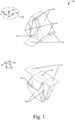
- Fig. 1 illustrates an example of a retention clip 100 in accordance with systems and techniques of this disclosure.
- Fig. 1 illustrates two views of the retention clip 100.
- the retention clip may be made of metal (e.g., formed of sheet metal, bent, and/or stamped) or plastic (e.g., molded, printed, formed).
- the retention clip 100 may be an assembly and/or made of a combination of materials (e.g., plastic and metal pieces).
- the retention clip 100 may vary in design, size, and/or shape compared to that illustrated without departing from the scope of this disclosure.
- the features described below may be implemented in other designs of the retention clip 100 without changing the operation of the retention clip 100.
- a coordinate system 102 is illustrated with an attachment axis 104, a left/right axis 106, and a front/back axis 108.
- the attachment axis 104 corresponds to an axis on which the retention clip 100 is inserted into a mounting location.
- the retention clip is symmetrical about two planes (e.g., a plane parallel to a plane formed by the attachment axis 104 and the left/right axis 106 and a plane parallel to a plane formed by the attachment axis 104 and the front/back axis 108).
- the retention clip 100 may be asymmetrical about either or both of those planes without departing from the scope of this disclosure.
- the left/right axis 106 and the front/back axis 108 may be switched without departing from the scope of this disclosure.
- the retention clip 100 contains a first portion 110, a second portion 112, and a third portion 114.
- the first portion 110 is configured to temporarily deform upon insertion of the retention clip 100 into an opening of the mounting location along the attachment axis 104.
- the first portion 110 may comprise front and back deformable wings that deform in the plane parallel to the attachment axis 104 and the front/back axis 108 upon insertion into a slot of the mounting location.
- the wings may have lead in surfaces that facilitate the deformation and may be connected to each other at an end opposite the third portion.
- the wings may be connected to each other at an end opposite the third portion 114.
- the first portion 110 may take shapes other than that illustrated without departing from the scope of this disclosure.
- the second portion 112 is configured to attach the retention clip 100 to a component to be mounted to the mounting location.
- the second portion 112 may comprise a threaded hole, a clip configured to receive a threaded fastener, a thru hole configured to receive a self-tapping/self-threading fastener, a threaded rod, or the like.
- the third portion 114 is configured to abut against the component in a first stage of the retention clip 100 and deform in a second stage of the retention clip 100 such that the first portion 110 and the second portion 112 are translated along the attachment axis 104 toward the component.
- the third portion 114 may comprise left and right deformable wings that deform in the plane parallel to the attachment axis 104 and the left/right axis 106. The deformation of the third portion 114 is described further below.
- the third portion 114 may take shapes other than that illustrated without departing from the scope of this disclosure.
- the first portion 110 contains one or more holding surfaces 116.
- the holding surfaces 116 are configured to abut against a backside surface of the mounting location and provide a supporting surface against the translation, thereby allowing the component and the mounting location to be drawn together as the third portion 114 is deformed.
- the retention clip 100 allows for locating and temporarily holding a component relative to a mounting location in a first stage and fastening the component to the mounting location in a second stage. In doing so, parts may be eliminated from an assembly, and fabrication of the component and mounting location may be simplified, thus improving cost, ease of assembly, and assembly times.
- Figs. 2-4 illustrate example phases the retention clip 100 may go through upon attachment of the component to the mounting location.
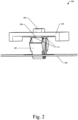
- Fig. 2 illustrates, at 200, the retention clip 100 attached to a component 202 to be attached to a mounting location 204.
- the component 202 may be a body piece, trim piece, module, computer, electrical component, fuse box, camera, radar sensor or radar module, lidar sensor or lidar module, sonar sensor or sonar module, laser sensor or laser module, other sensor or sensor module, or the like.
- the mounting location 204 may be a body panel, frame member, portion of a unibody, structural member, piece of sheet metal, another component, or the like.
- the retention clip 100 is attached to the component 202 via a first torque of a fastener 206.
- the fastener 206 interfaces with the second portion 112 of the retention clip 100.
- the first torque draws the retention clip 100 toward the component 202 such that the third portion 114 abuts against the component without substantially deflecting or deforming.
- An offset 208 or gap exists between the second portion 112 and the component 202 in this stage.
- the component 202 has an opening configured to receive the retention clip 100.
- the opening may be any shape or size depending on a configuration of the retention clip 100.
- the opening is a rectangular opening.
- the rectangular opening has a dimension that is smaller than a front/back width of the retention clip. The dimension causes edges of the opening to abut against the lead-in surfaces of the first portion 110, such that further insertion causes the first portion 110 to temporarily deform.
- Fig. 3 illustrates the retention clip 100 once it has been inserted through the opening.
- Fig. 3 illustrates, at 300, the retention clip 100 inserted into the mounting location 204 (while attached to the component 202).
- the insertion is not illustrated, however, one of ordinary skill can appreciate a deformation of the first portion 110 upon entry through the mounting location 204. Once inserted, the first portion 110 may stay partially deformed based on a lead-out surface. The partial deformation may cause a weak clamping force between the mounting location 204 and the component 202.
- the offset 208 may correspond to a maximum size of the gap 302.
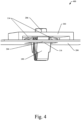
- Fig. 4 illustrates, at 400, the retention clip 100 after a second torque is applied to the fastener 206 (once inserted into the mounting location 204 per Fig. 3 ).
- the third portion 114 is configured to deform, thus allowing for the second portion 112 to be drawn up the fastener 206.
- the translation of the second portion 112 also causes the first portion 110 to be drawn up toward the mounting location 204.
- the first portion 110 may be drawn up toward the backside 304 of the mounting location 204 until the holding surfaces 116 are in contact with the backside 304. From there, building to the second torque causes the component 202 to be forced together with (e.g., clamped to) the mounting location 204.
- the retention clip 100 may allow for up to 1500N or more of clamping force between the mounting location 204 and the component 202.
- the retention clip 100 provides for a staging operation where the component 202 is located relative to the mounting location 204 and for a clamping operation that removes the gap 302 and secures the component 202 to the mounting location 204 with a high clamping force.
- a number of parts may be reduced (in type and/or number), thus allowing for reduced cost, complexity, and assembly time.
- designs of the component 202 and the mounting location 204 may be revised based on not requiring separate clips and fasteners.
- Fig. 5 illustrates an example method of assembly using a retention clip in accordance with this disclosure.
- a retention clip is attached to a component via a first torque of a fastener interfacing with a second portion of the retention clip.
- the retention clip 100 may be attached to the component 202 via the first torque of the fastener 206 interfacing with the second portion 112.
- the component is located relative to a mounting location via an insertion of the retention clip into the mounting location.
- the component 202 may be located relative to the mounting location 204 via an insertion of the retention clip 100 (that is attached to the component 202) into the mounting location 204 (e.g., the slot).
- the insertion may cause the first portion 110 to compress upon entry into the mounting location 204.
- the first portion 110 may exert a weak force that holds the component 202 to the mounting location 204.
- the weak force may be due to a spring action of the retention clip 100 trying to return to its uninserted shape.
- the component is secured to the mounting location via a second torque of the fastener.
- the second torque of the fastener causes a first portion of the retention clip to be translated such that a holding surface of the first portion abuts against a backside of the mounting location during the translation.
- the first portion may be partially pulled back through the mounting location until the holding surface of the first portion abuts against the backside of the mounting location.
- the second torque may then cause a clamping force between the mounting location and the component.
- the component 202 may be secured to the mounting location 204 via the second torque of the fastener 206.
- the second torque of the fastener 206 may cause the first portion 110 of the retention clip 100 to be translated such that the holding surfaces 116 of the first portion 110 abut against a backside 304 of the mounting location 204. The second torque may then cause a clamping force between the mounting location 204 and the component 202.
- "at least one of: a, b, or c” is intended to cover a, b, c, a-b, a-c, b-c, and a-b-c, as well as any combination with multiples of the same element (e.g., a-a, a-a-a, a-a-b, a-a-c, a-b-b, a-c-c, b-b, b-b-b, b-b-c, c-c, and c-c-c or any other ordering of a, b, and c).
Landscapes
- Engineering & Computer Science (AREA)
- General Engineering & Computer Science (AREA)
- Mechanical Engineering (AREA)
- Connection Of Plates (AREA)
- Insertion Pins And Rivets (AREA)
Description
- During vehicle production, many components are attached to vehicles. Different types of fasteners and connections are used depending upon the specific requirements of the components and their mounting. To decrease difficulty of assembly and production times, components are often located (e.g., staged) in a first step prior to fastening them to the vehicles in a second step. Determining how to best accomplish both tasks effectively and efficiently can be difficult due to packaging constraints, vehicle constraints, component constraints, accessibility of features/hardware, and other factors.
-
US 5 632 584 A discloses a blind snap mounted clip fastener for inserting into a mounting aperture and an anti-rotate aperture of a work piece to secure a component work piece to the fastener.US 2007/183864 A discloses a part mounting grommet that supports a part provided with a mounting member on a vehicle main body.FR 2 799 518 A1 - This document is directed to a translating retention clip (hereinafter referred to as a retention clip). The retention clip may be configured for a vehicle environment (e.g., to mount a component to a vehicle).
- The present invention provides a retention clip according to claim 1. The following discussion is provided for understanding the claims, but the scope of protection is only defined by the claims.
- A retention clip is described with reference to the following drawings that use some of the same numbers throughout to reference like or examples of like features and components.
-
Fig. 1 illustrates an example retention clip in accordance with this disclosure. -
Figs. 2-4 illustrate, in accordance with this disclosure, phases of assembly of a component to a mounting location using a retention clip in accordance with this disclosure. -
Fig. 5 illustrates an example method of assembly using a retention clip in accordance with this disclosure. - Modern vehicles incorporate many components (e.g., body pieces, trim, modules, computers, or sensors such as cameras, radar, lidar, laser, and sonar sensors). For efficient production, such components are often located (e.g., staged) prior to subsequent fastening. For example, components often have retention clips to locate the components. Fasteners (e.g., screws or bolts) can then secure the components to the vehicles. One problem with using such techniques is that multiple fastening means are required (e.g., retention clips and separate screws). Furthermore, the components and the vehicles require attachment features for both types of hardware, thus, contributing to complexity and cost.
- A retention clip is described herein. The retention clip has a first portion configured to temporarily deform upon insertion into a slot of a mounting location and prevent the retention clip from retracting through the slot once inserted. The retention clip also has a second portion configured to attach the retention clip to a component via a first torque of a fastener interfacing with the second portion. The retention clip further has a third portion configured to abut against a surface of the component and deform under s second torque of the fastener such that the first portion and the second portion are translated along an attachment axis toward the component. The described retention clip allows for locating and securing the component with a single fastener via two stages. Accordingly, component mounting is generally cheaper, less complex, and quicker.
-
Fig. 1 illustrates an example of aretention clip 100 in accordance with systems and techniques of this disclosure.Fig. 1 illustrates two views of theretention clip 100. The retention clip may be made of metal (e.g., formed of sheet metal, bent, and/or stamped) or plastic (e.g., molded, printed, formed). In some implementations, theretention clip 100 may be an assembly and/or made of a combination of materials (e.g., plastic and metal pieces). Theretention clip 100 may vary in design, size, and/or shape compared to that illustrated without departing from the scope of this disclosure. For example, the features described below may be implemented in other designs of theretention clip 100 without changing the operation of theretention clip 100. - A
coordinate system 102 is illustrated with anattachment axis 104, a left/right axis 106, and a front/back axis 108. Theattachment axis 104 corresponds to an axis on which theretention clip 100 is inserted into a mounting location. In the illustrated example, the retention clip is symmetrical about two planes (e.g., a plane parallel to a plane formed by theattachment axis 104 and the left/right axis 106 and a plane parallel to a plane formed by theattachment axis 104 and the front/back axis 108). Theretention clip 100 may be asymmetrical about either or both of those planes without departing from the scope of this disclosure. Furthermore, the left/right axis 106 and the front/back axis 108 may be switched without departing from the scope of this disclosure. - The
retention clip 100 contains afirst portion 110, asecond portion 112, and athird portion 114. Thefirst portion 110 is configured to temporarily deform upon insertion of theretention clip 100 into an opening of the mounting location along theattachment axis 104. For example, thefirst portion 110 may comprise front and back deformable wings that deform in the plane parallel to theattachment axis 104 and the front/back axis 108 upon insertion into a slot of the mounting location. The wings may have lead in surfaces that facilitate the deformation and may be connected to each other at an end opposite the third portion. Furthermore, the wings may be connected to each other at an end opposite thethird portion 114. Thefirst portion 110 may take shapes other than that illustrated without departing from the scope of this disclosure. - The
second portion 112 is configured to attach theretention clip 100 to a component to be mounted to the mounting location. Thesecond portion 112 may comprise a threaded hole, a clip configured to receive a threaded fastener, a thru hole configured to receive a self-tapping/self-threading fastener, a threaded rod, or the like. - The
third portion 114 is configured to abut against the component in a first stage of theretention clip 100 and deform in a second stage of theretention clip 100 such that thefirst portion 110 and thesecond portion 112 are translated along theattachment axis 104 toward the component. Thethird portion 114 may comprise left and right deformable wings that deform in the plane parallel to theattachment axis 104 and the left/right axis 106. The deformation of thethird portion 114 is described further below. Thethird portion 114 may take shapes other than that illustrated without departing from the scope of this disclosure. - To keep the retention clip 100 (and thus, the component) from pulling through mounting location upon translation, the
first portion 110 contains one ormore holding surfaces 116. Theholding surfaces 116 are configured to abut against a backside surface of the mounting location and provide a supporting surface against the translation, thereby allowing the component and the mounting location to be drawn together as thethird portion 114 is deformed. - Accordingly, the
retention clip 100 allows for locating and temporarily holding a component relative to a mounting location in a first stage and fastening the component to the mounting location in a second stage. In doing so, parts may be eliminated from an assembly, and fabrication of the component and mounting location may be simplified, thus improving cost, ease of assembly, and assembly times. -
Figs. 2-4 illustrate example phases theretention clip 100 may go through upon attachment of the component to the mounting location.Fig. 2 illustrates, at 200, theretention clip 100 attached to acomponent 202 to be attached to amounting location 204. Although this disclosure is directed towards automotive applications, thecomponent 202 and themounting location 204 may be in any application or environment without departing from the scope of this disclosure. Thecomponent 202 may be a body piece, trim piece, module, computer, electrical component, fuse box, camera, radar sensor or radar module, lidar sensor or lidar module, sonar sensor or sonar module, laser sensor or laser module, other sensor or sensor module, or the like. Themounting location 204 may be a body panel, frame member, portion of a unibody, structural member, piece of sheet metal, another component, or the like. - The
retention clip 100 is attached to thecomponent 202 via a first torque of afastener 206. Thefastener 206 interfaces with thesecond portion 112 of theretention clip 100. The first torque draws theretention clip 100 toward thecomponent 202 such that thethird portion 114 abuts against the component without substantially deflecting or deforming. An offset 208 or gap exists between thesecond portion 112 and thecomponent 202 in this stage. - The
component 202 has an opening configured to receive theretention clip 100. The opening may be any shape or size depending on a configuration of theretention clip 100. In the illustrated example, the opening is a rectangular opening. The rectangular opening has a dimension that is smaller than a front/back width of the retention clip. The dimension causes edges of the opening to abut against the lead-in surfaces of thefirst portion 110, such that further insertion causes thefirst portion 110 to temporarily deform.Fig. 3 illustrates theretention clip 100 once it has been inserted through the opening. -
Fig. 3 illustrates, at 300, theretention clip 100 inserted into the mounting location 204 (while attached to the component 202). The insertion is not illustrated, however, one of ordinary skill can appreciate a deformation of thefirst portion 110 upon entry through the mountinglocation 204. Once inserted, thefirst portion 110 may stay partially deformed based on a lead-out surface. The partial deformation may cause a weak clamping force between the mountinglocation 204 and thecomponent 202. When inserted, there exists agap 302 between the holdingsurfaces 116 and abackside 304 of the mountinglocation 204. The offset 208 may correspond to a maximum size of thegap 302. -
Fig. 4 illustrates, at 400, theretention clip 100 after a second torque is applied to the fastener 206 (once inserted into the mountinglocation 204 perFig. 3 ). Thethird portion 114 is configured to deform, thus allowing for thesecond portion 112 to be drawn up thefastener 206. Because thefirst portion 110 is connected to thesecond portion 112, the translation of thesecond portion 112 also causes thefirst portion 110 to be drawn up toward the mountinglocation 204. Thefirst portion 110 may be drawn up toward thebackside 304 of the mountinglocation 204 until the holdingsurfaces 116 are in contact with thebackside 304. From there, building to the second torque causes thecomponent 202 to be forced together with (e.g., clamped to) the mountinglocation 204. Theretention clip 100 may allow for up to 1500N or more of clamping force between the mountinglocation 204 and thecomponent 202. - Accordingly, the
retention clip 100 provides for a staging operation where thecomponent 202 is located relative to the mountinglocation 204 and for a clamping operation that removes thegap 302 and secures thecomponent 202 to the mountinglocation 204 with a high clamping force. In doing so, a number of parts may be reduced (in type and/or number), thus allowing for reduced cost, complexity, and assembly time. Furthermore, designs of thecomponent 202 and the mountinglocation 204 may be revised based on not requiring separate clips and fasteners. -
Fig. 5 illustrates an example method of assembly using a retention clip in accordance with this disclosure. At 502, a retention clip is attached to a component via a first torque of a fastener interfacing with a second portion of the retention clip. For example, theretention clip 100 may be attached to thecomponent 202 via the first torque of thefastener 206 interfacing with thesecond portion 112. - At 504, the component is located relative to a mounting location via an insertion of the retention clip into the mounting location. For example, the
component 202 may be located relative to the mountinglocation 204 via an insertion of the retention clip 100 (that is attached to the component 202) into the mounting location 204 (e.g., the slot). The insertion may cause thefirst portion 110 to compress upon entry into the mountinglocation 204. After insertion, thefirst portion 110 may exert a weak force that holds thecomponent 202 to the mountinglocation 204. The weak force may be due to a spring action of theretention clip 100 trying to return to its uninserted shape. - At 506, the component is secured to the mounting location via a second torque of the fastener. The second torque of the fastener causes a first portion of the retention clip to be translated such that a holding surface of the first portion abuts against a backside of the mounting location during the translation. As part of the operation, the first portion may be partially pulled back through the mounting location until the holding surface of the first portion abuts against the backside of the mounting location. Once the holding surface is abutted against the backside of the mounting location, the second torque may then cause a clamping force between the mounting location and the component. For example, the
component 202 may be secured to the mountinglocation 204 via the second torque of thefastener 206. The second torque of thefastener 206 may cause thefirst portion 110 of theretention clip 100 to be translated such that the holdingsurfaces 116 of thefirst portion 110 abut against abackside 304 of the mountinglocation 204. The second torque may then cause a clamping force between the mountinglocation 204 and thecomponent 202. - While various embodiments of the disclosure are described in the foregoing description and shown in the drawings, it is to be understood that this disclosure is not limited thereto but may be variously embodied to practice within the scope of the following claims. From the foregoing description, it will be apparent that various changes may be made without departing from the scope of the disclosure as defined by the following claims.
- The use of "or" and grammatically related terms indicates non-exclusive alternatives without limitation unless the context clearly dictates otherwise. As used herein, a phrase referring to "at least one of" a list of items refers to any combination of those items, including single members. As an example, "at least one of: a, b, or c" is intended to cover a, b, c, a-b, a-c, b-c, and a-b-c, as well as any combination with multiples of the same element (e.g., a-a, a-a-a, a-a-b, a-a-c, a-b-b, a-c-c, b-b, b-b-b, b-b-c, c-c, and c-c-c or any other ordering of a, b, and c).
Claims (14)
- A retention clip (100) comprising:a first portion (110) configured to temporarily deform upon insertion into a slot of a mounting location (204) and prevent the retention clip (100) from retracting through the slot once inserted;a second portion (112) configured to attach the retention clip (100) to a component (202); anda third portion (114) configured to:abut against a surface of the component (202); anddeform such that the first portion (110) and the second portion (112) are translated along an attachment axis (104) toward the component (202), the attachment axis (104) being approximately perpendicular to the surface of the component (202), wherein the translation of the first portion (110) along the attachment axis can cause a holding surface (116) of the first portion (110) to abut against a surface of the mounting location (204) that is opposite the component (202), wherein the holding surface (116) spans a width of the second portion (112).
- The retention clip (100) of claim 1, wherein the second portion (112) is configured to mate with a threaded component (202).
- The retention clip (100) of claim 2, wherein the retention clip (100) is configured to:attach to the component (202) via a first torque of the threaded component (202) without deforming the third portion (114); anddeform the third portion (114) via a second torque of the threaded component while the retention clip (100) is attached to the component (202).
- The retention clip (100) of any preceding claim, wherein the third portion (114) comprises the second portion (112).
- The retention clip (100) of any preceding claim, wherein the third portion (114) comprises a plate-like structure with deformation wings on proximal ends.
- The retention clip (100) of claim 5, wherein the deformation wings extend substantially along an axis that is perpendicular to a direction of temporary deformation of the first portion (110).
- The retention clip (100) of claim 5 or 6, wherein the deformation wings are initially bent such that the second portion (112) is offset from the surface of the component (202) when the retention clip (100) is attached to the component (202).
- The retention clip (100) of claim 7, wherein the deformation of the third portion (114) comprises the deformation wings bending towards flush with the surface of the component (202).
- The retention clip (100) of claim 8, wherein an amount of the offset corresponds to an amount of travel of the first portion (110) along the attachment axis (104).
- The retention clip (100) of claim 1, wherein the holding surface (116) is a ledge.
- The retention clip (100) of claim 10, wherein the amount of travel corresponds to a maximum gap between the holding surface (116) of the first portion (110) and the surface of the mounting location (204) opposite the component (202) when the component (202) is attached to the mounting location (204).
- The retention clip (100) of any preceding claim, wherein the deformation of the third portion (114) does not cause a deformation of the first portion (110).
- The retention clip (100) of any preceding claim, wherein the first portion (110) is attached to the third portion (114) and extends along the attachment axis (104).
- The retention clip (100) of any preceding claim, wherein the retention clip (100) is configured to provide a clamping force of at least 1500 Newtons between the mounting location (204) and the component (202) along the attachment axis (104).
Applications Claiming Priority (2)
| Application Number | Priority Date | Filing Date | Title |
|---|---|---|---|
| US202163265500P | 2021-12-16 | 2021-12-16 | |
| US17/654,330 US12006959B2 (en) | 2021-12-16 | 2022-03-10 | Translating retention clip |
Publications (2)
| Publication Number | Publication Date |
|---|---|
| EP4198324A1 EP4198324A1 (en) | 2023-06-21 |
| EP4198324B1 true EP4198324B1 (en) | 2025-03-26 |
Family
ID=83505922
Family Applications (1)
| Application Number | Title | Priority Date | Filing Date |
|---|---|---|---|
| EP22197978.4A Active EP4198324B1 (en) | 2021-12-16 | 2022-09-27 | Translating retention clip |
Country Status (3)
| Country | Link |
|---|---|
| US (1) | US12006959B2 (en) |
| EP (1) | EP4198324B1 (en) |
| CN (1) | CN116265766A (en) |
Families Citing this family (1)
| Publication number | Priority date | Publication date | Assignee | Title |
|---|---|---|---|---|
| IT202300022719A1 (en) * | 2023-10-30 | 2025-04-30 | Sapa S P A | ANTI-TORSION RESTRAINT SYSTEM |
Family Cites Families (7)
| Publication number | Priority date | Publication date | Assignee | Title |
|---|---|---|---|---|
| US5632584A (en) * | 1996-04-05 | 1997-05-27 | Acevedo; Martin | Blind snap mounted clip fastener |
| FR2799518B1 (en) | 1999-10-11 | 2002-01-18 | Krieg & Zivy Ind | ELASTIC NUT FOR COOPERATION WITH THE THREADED ROD OF A SCREW, AND BOLT CONSISTING OF A SCREW EQUIPPED WITH SUCH A NUT |
| US8950042B2 (en) * | 2001-06-25 | 2015-02-10 | Termax Corporation | Continuously adaptive fastener clip |
| US7086125B2 (en) * | 2004-04-23 | 2006-08-08 | Newfrey Llc | Multiple stage assembly assist fastener |
| JP4264905B2 (en) | 2006-01-23 | 2009-05-20 | 株式会社ホンダアクセス | Grommet for mounting components |
| US7874775B2 (en) * | 2006-04-26 | 2011-01-25 | A. Raymond Et Cie | Fastening device |
| US20110163562A1 (en) * | 2010-01-03 | 2011-07-07 | Michael Walter Smith | Continously adaptive fastener clip |
-
2022
- 2022-03-10 US US17/654,330 patent/US12006959B2/en active Active
- 2022-09-27 EP EP22197978.4A patent/EP4198324B1/en active Active
- 2022-10-21 CN CN202211294551.4A patent/CN116265766A/en active Pending
Also Published As
| Publication number | Publication date |
|---|---|
| US12006959B2 (en) | 2024-06-11 |
| US20230193933A1 (en) | 2023-06-22 |
| CN116265766A (en) | 2023-06-20 |
| EP4198324A1 (en) | 2023-06-21 |
Similar Documents
| Publication | Publication Date | Title |
|---|---|---|
| US3621732A (en) | Fastening for motor vehicle-safety steering columns | |
| CN103403369B (en) | With the bracket of nut | |
| EP0719952A1 (en) | Sliding two-piece fastener | |
| EP4198324B1 (en) | Translating retention clip | |
| US20180029551A1 (en) | Releasable Fastening Assembly for Fastening a Bumper to a Side Panel and/or a Fender of a Motor Vehicle | |
| US10700479B1 (en) | Cable adapter panel retention clip | |
| JP2016153292A (en) | Load transmission member | |
| US7654864B2 (en) | Mounting bracket structure | |
| US9945407B2 (en) | System composed of a sill panel and a fastening clip | |
| WO2020055624A1 (en) | Mounting system for box profile | |
| US20220136539A1 (en) | System and method for fastening and locating one vehicle component relative to another vehicle component without using mechanical fasteners | |
| US12264701B2 (en) | Attachment portion, device for vehicle, and attachment method | |
| KR20240079394A (en) | Module clip for vehicles | |
| EP3502490B1 (en) | Linear latching systems | |
| EP2161181A2 (en) | Tolerance adjusting attachment | |
| US20230417270A1 (en) | Quarter Turn Retainer | |
| GB2323822A (en) | An add-on part of a motor vehicle | |
| JPH0711991U (en) | Storage panel mounting structure | |
| WO2022189635A1 (en) | Snap-in fastener, metal housing and electronic device | |
| CN116201802A (en) | device for compensating for tolerances between two components to be joined | |
| CN217653626U (en) | Fixing assembly for fixing display device and display device | |
| JP2017031988A (en) | Bracket mounting structure | |
| EP4253157A1 (en) | Cover assembly for fixing a cover member to a dashboard of a vehicle | |
| GB2559980B (en) | Motor vehicle lamp fender alignement assembly | |
| CN109070944B (en) | Arrangement of a bumper of a motor vehicle and a body element, in particular a body element made of sheet metal |
Legal Events
| Date | Code | Title | Description |
|---|---|---|---|
| PUAI | Public reference made under article 153(3) epc to a published international application that has entered the european phase |
Free format text: ORIGINAL CODE: 0009012 |
|
| STAA | Information on the status of an ep patent application or granted ep patent |
Free format text: STATUS: THE APPLICATION HAS BEEN PUBLISHED |
|
| AK | Designated contracting states |
Kind code of ref document: A1 Designated state(s): AL AT BE BG CH CY CZ DE DK EE ES FI FR GB GR HR HU IE IS IT LI LT LU LV MC MK MT NL NO PL PT RO RS SE SI SK SM TR |
|
| STAA | Information on the status of an ep patent application or granted ep patent |
Free format text: STATUS: REQUEST FOR EXAMINATION WAS MADE |
|
| 17P | Request for examination filed |
Effective date: 20231005 |
|
| RBV | Designated contracting states (corrected) |
Designated state(s): AL AT BE BG CH CY CZ DE DK EE ES FI FR GB GR HR HU IE IS IT LI LT LU LV MC MK MT NL NO PL PT RO RS SE SI SK SM TR |
|
| RAP1 | Party data changed (applicant data changed or rights of an application transferred) |
Owner name: APTIV TECHNOLOGIES AG |
|
| RAP3 | Party data changed (applicant data changed or rights of an application transferred) |
Owner name: APTIV TECHNOLOGIES AG |
|
| GRAP | Despatch of communication of intention to grant a patent |
Free format text: ORIGINAL CODE: EPIDOSNIGR1 |
|
| STAA | Information on the status of an ep patent application or granted ep patent |
Free format text: STATUS: GRANT OF PATENT IS INTENDED |
|
| RIC1 | Information provided on ipc code assigned before grant |
Ipc: F16B 5/02 20060101ALN20241017BHEP Ipc: F16B 2/24 20060101ALI20241017BHEP Ipc: F16B 37/04 20060101AFI20241017BHEP |
|
| INTG | Intention to grant announced |
Effective date: 20241025 |
|
| GRAS | Grant fee paid |
Free format text: ORIGINAL CODE: EPIDOSNIGR3 |
|
| GRAA | (expected) grant |
Free format text: ORIGINAL CODE: 0009210 |
|
| STAA | Information on the status of an ep patent application or granted ep patent |
Free format text: STATUS: THE PATENT HAS BEEN GRANTED |
|
| P01 | Opt-out of the competence of the unified patent court (upc) registered |
Free format text: CASE NUMBER: APP_3863/2025 Effective date: 20250123 |
|
| AK | Designated contracting states |
Kind code of ref document: B1 Designated state(s): AL AT BE BG CH CY CZ DE DK EE ES FI FR GB GR HR HU IE IS IT LI LT LU LV MC MK MT NL NO PL PT RO RS SE SI SK SM TR |
|
| REG | Reference to a national code |
Ref country code: GB Ref legal event code: FG4D |
|
| REG | Reference to a national code |
Ref country code: CH Ref legal event code: EP |
|
| REG | Reference to a national code |
Ref country code: DE Ref legal event code: R096 Ref document number: 602022012201 Country of ref document: DE |
|
| REG | Reference to a national code |
Ref country code: IE Ref legal event code: FG4D |
|
| PG25 | Lapsed in a contracting state [announced via postgrant information from national office to epo] |
Ref country code: RS Free format text: LAPSE BECAUSE OF FAILURE TO SUBMIT A TRANSLATION OF THE DESCRIPTION OR TO PAY THE FEE WITHIN THE PRESCRIBED TIME-LIMIT Effective date: 20250626 |
|
| PG25 | Lapsed in a contracting state [announced via postgrant information from national office to epo] |
Ref country code: FI Free format text: LAPSE BECAUSE OF FAILURE TO SUBMIT A TRANSLATION OF THE DESCRIPTION OR TO PAY THE FEE WITHIN THE PRESCRIBED TIME-LIMIT Effective date: 20250326 |
|
| REG | Reference to a national code |
Ref country code: LT Ref legal event code: MG9D |
|
| PG25 | Lapsed in a contracting state [announced via postgrant information from national office to epo] |
Ref country code: NO Free format text: LAPSE BECAUSE OF FAILURE TO SUBMIT A TRANSLATION OF THE DESCRIPTION OR TO PAY THE FEE WITHIN THE PRESCRIBED TIME-LIMIT Effective date: 20250626 |
|
| PG25 | Lapsed in a contracting state [announced via postgrant information from national office to epo] |
Ref country code: HR Free format text: LAPSE BECAUSE OF FAILURE TO SUBMIT A TRANSLATION OF THE DESCRIPTION OR TO PAY THE FEE WITHIN THE PRESCRIBED TIME-LIMIT Effective date: 20250326 |
|
| PG25 | Lapsed in a contracting state [announced via postgrant information from national office to epo] |
Ref country code: LV Free format text: LAPSE BECAUSE OF FAILURE TO SUBMIT A TRANSLATION OF THE DESCRIPTION OR TO PAY THE FEE WITHIN THE PRESCRIBED TIME-LIMIT Effective date: 20250326 |
|
| PG25 | Lapsed in a contracting state [announced via postgrant information from national office to epo] |
Ref country code: BG Free format text: LAPSE BECAUSE OF FAILURE TO SUBMIT A TRANSLATION OF THE DESCRIPTION OR TO PAY THE FEE WITHIN THE PRESCRIBED TIME-LIMIT Effective date: 20250326 Ref country code: GR Free format text: LAPSE BECAUSE OF FAILURE TO SUBMIT A TRANSLATION OF THE DESCRIPTION OR TO PAY THE FEE WITHIN THE PRESCRIBED TIME-LIMIT Effective date: 20250627 |
|
| REG | Reference to a national code |
Ref country code: NL Ref legal event code: MP Effective date: 20250326 |
|
| PG25 | Lapsed in a contracting state [announced via postgrant information from national office to epo] |
Ref country code: NL Free format text: LAPSE BECAUSE OF FAILURE TO SUBMIT A TRANSLATION OF THE DESCRIPTION OR TO PAY THE FEE WITHIN THE PRESCRIBED TIME-LIMIT Effective date: 20250326 |
|
| PG25 | Lapsed in a contracting state [announced via postgrant information from national office to epo] |
Ref country code: SE Free format text: LAPSE BECAUSE OF FAILURE TO SUBMIT A TRANSLATION OF THE DESCRIPTION OR TO PAY THE FEE WITHIN THE PRESCRIBED TIME-LIMIT Effective date: 20250326 |
|
| REG | Reference to a national code |
Ref country code: AT Ref legal event code: MK05 Ref document number: 1779237 Country of ref document: AT Kind code of ref document: T Effective date: 20250326 |
|
| PG25 | Lapsed in a contracting state [announced via postgrant information from national office to epo] |
Ref country code: SM Free format text: LAPSE BECAUSE OF FAILURE TO SUBMIT A TRANSLATION OF THE DESCRIPTION OR TO PAY THE FEE WITHIN THE PRESCRIBED TIME-LIMIT Effective date: 20250326 |
|
| PG25 | Lapsed in a contracting state [announced via postgrant information from national office to epo] |
Ref country code: ES Free format text: LAPSE BECAUSE OF FAILURE TO SUBMIT A TRANSLATION OF THE DESCRIPTION OR TO PAY THE FEE WITHIN THE PRESCRIBED TIME-LIMIT Effective date: 20250326 Ref country code: PT Free format text: LAPSE BECAUSE OF FAILURE TO SUBMIT A TRANSLATION OF THE DESCRIPTION OR TO PAY THE FEE WITHIN THE PRESCRIBED TIME-LIMIT Effective date: 20250728 |
|
| PGFP | Annual fee paid to national office [announced via postgrant information from national office to epo] |
Ref country code: DE Payment date: 20250814 Year of fee payment: 4 |
|
| PG25 | Lapsed in a contracting state [announced via postgrant information from national office to epo] |
Ref country code: PL Free format text: LAPSE BECAUSE OF FAILURE TO SUBMIT A TRANSLATION OF THE DESCRIPTION OR TO PAY THE FEE WITHIN THE PRESCRIBED TIME-LIMIT Effective date: 20250326 Ref country code: IT Free format text: LAPSE BECAUSE OF FAILURE TO SUBMIT A TRANSLATION OF THE DESCRIPTION OR TO PAY THE FEE WITHIN THE PRESCRIBED TIME-LIMIT Effective date: 20250326 |
|
| PG25 | Lapsed in a contracting state [announced via postgrant information from national office to epo] |
Ref country code: AT Free format text: LAPSE BECAUSE OF FAILURE TO SUBMIT A TRANSLATION OF THE DESCRIPTION OR TO PAY THE FEE WITHIN THE PRESCRIBED TIME-LIMIT Effective date: 20250326 |
|
| PGFP | Annual fee paid to national office [announced via postgrant information from national office to epo] |
Ref country code: FR Payment date: 20250908 Year of fee payment: 4 |
|
| PG25 | Lapsed in a contracting state [announced via postgrant information from national office to epo] |
Ref country code: EE Free format text: LAPSE BECAUSE OF FAILURE TO SUBMIT A TRANSLATION OF THE DESCRIPTION OR TO PAY THE FEE WITHIN THE PRESCRIBED TIME-LIMIT Effective date: 20250326 |
|
| PG25 | Lapsed in a contracting state [announced via postgrant information from national office to epo] |
Ref country code: RO Free format text: LAPSE BECAUSE OF FAILURE TO SUBMIT A TRANSLATION OF THE DESCRIPTION OR TO PAY THE FEE WITHIN THE PRESCRIBED TIME-LIMIT Effective date: 20250326 |
|
| PG25 | Lapsed in a contracting state [announced via postgrant information from national office to epo] |
Ref country code: SK Free format text: LAPSE BECAUSE OF FAILURE TO SUBMIT A TRANSLATION OF THE DESCRIPTION OR TO PAY THE FEE WITHIN THE PRESCRIBED TIME-LIMIT Effective date: 20250326 |
|
| PG25 | Lapsed in a contracting state [announced via postgrant information from national office to epo] |
Ref country code: IS Free format text: LAPSE BECAUSE OF FAILURE TO SUBMIT A TRANSLATION OF THE DESCRIPTION OR TO PAY THE FEE WITHIN THE PRESCRIBED TIME-LIMIT Effective date: 20250726 |
|
| REG | Reference to a national code |
Ref country code: DE Ref legal event code: R097 Ref document number: 602022012201 Country of ref document: DE |
|
| PG25 | Lapsed in a contracting state [announced via postgrant information from national office to epo] |
Ref country code: DK Free format text: LAPSE BECAUSE OF FAILURE TO SUBMIT A TRANSLATION OF THE DESCRIPTION OR TO PAY THE FEE WITHIN THE PRESCRIBED TIME-LIMIT Effective date: 20250326 |
|
| PG25 | Lapsed in a contracting state [announced via postgrant information from national office to epo] |
Ref country code: CZ Free format text: LAPSE BECAUSE OF FAILURE TO SUBMIT A TRANSLATION OF THE DESCRIPTION OR TO PAY THE FEE WITHIN THE PRESCRIBED TIME-LIMIT Effective date: 20250326 |
|
| PLBE | No opposition filed within time limit |
Free format text: ORIGINAL CODE: 0009261 |
|
| STAA | Information on the status of an ep patent application or granted ep patent |
Free format text: STATUS: NO OPPOSITION FILED WITHIN TIME LIMIT |
|
| REG | Reference to a national code |
Ref country code: CH Ref legal event code: L10 Free format text: ST27 STATUS EVENT CODE: U-0-0-L10-L00 (AS PROVIDED BY THE NATIONAL OFFICE) Effective date: 20260211 |
|
| 26N | No opposition filed |
Effective date: 20260105 |
|
| REG | Reference to a national code |
Ref country code: CH Ref legal event code: H13 Free format text: ST27 STATUS EVENT CODE: U-0-0-H10-H13 (AS PROVIDED BY THE NATIONAL OFFICE) Effective date: 20260425 |