EP4198163A1 - Metal patterning material, amine compound, electronic device, and method for forming metal pattern - Google Patents
Metal patterning material, amine compound, electronic device, and method for forming metal pattern Download PDFInfo
- Publication number
- EP4198163A1 EP4198163A1 EP21855986.2A EP21855986A EP4198163A1 EP 4198163 A1 EP4198163 A1 EP 4198163A1 EP 21855986 A EP21855986 A EP 21855986A EP 4198163 A1 EP4198163 A1 EP 4198163A1
- Authority
- EP
- European Patent Office
- Prior art keywords
- group
- substituted
- tetrayl
- carbon atoms
- fluorine atom
- Prior art date
- Legal status (The legal status is an assumption and is not a legal conclusion. Google has not performed a legal analysis and makes no representation as to the accuracy of the status listed.)
- Pending
Links
Images


Classifications
-
- C—CHEMISTRY; METALLURGY
- C23—COATING METALLIC MATERIAL; COATING MATERIAL WITH METALLIC MATERIAL; CHEMICAL SURFACE TREATMENT; DIFFUSION TREATMENT OF METALLIC MATERIAL; COATING BY VACUUM EVAPORATION, BY SPUTTERING, BY ION IMPLANTATION OR BY CHEMICAL VAPOUR DEPOSITION, IN GENERAL; INHIBITING CORROSION OF METALLIC MATERIAL OR INCRUSTATION IN GENERAL
- C23C—COATING METALLIC MATERIAL; COATING MATERIAL WITH METALLIC MATERIAL; SURFACE TREATMENT OF METALLIC MATERIAL BY DIFFUSION INTO THE SURFACE, BY CHEMICAL CONVERSION OR SUBSTITUTION; COATING BY VACUUM EVAPORATION, BY SPUTTERING, BY ION IMPLANTATION OR BY CHEMICAL VAPOUR DEPOSITION, IN GENERAL
- C23C14/00—Coating by vacuum evaporation, by sputtering or by ion implantation of the coating forming material
- C23C14/06—Coating by vacuum evaporation, by sputtering or by ion implantation of the coating forming material characterised by the coating material
- C23C14/12—Organic material
-
- C—CHEMISTRY; METALLURGY
- C07—ORGANIC CHEMISTRY
- C07C—ACYCLIC OR CARBOCYCLIC COMPOUNDS
- C07C211/00—Compounds containing amino groups bound to a carbon skeleton
- C07C211/43—Compounds containing amino groups bound to a carbon skeleton having amino groups bound to carbon atoms of six-membered aromatic rings of the carbon skeleton
- C07C211/54—Compounds containing amino groups bound to a carbon skeleton having amino groups bound to carbon atoms of six-membered aromatic rings of the carbon skeleton having amino groups bound to two or three six-membered aromatic rings
- C07C211/56—Compounds containing amino groups bound to a carbon skeleton having amino groups bound to carbon atoms of six-membered aromatic rings of the carbon skeleton having amino groups bound to two or three six-membered aromatic rings the carbon skeleton being further substituted by halogen atoms or by nitro or nitroso groups
-
- C—CHEMISTRY; METALLURGY
- C07—ORGANIC CHEMISTRY
- C07C—ACYCLIC OR CARBOCYCLIC COMPOUNDS
- C07C211/00—Compounds containing amino groups bound to a carbon skeleton
- C07C211/43—Compounds containing amino groups bound to a carbon skeleton having amino groups bound to carbon atoms of six-membered aromatic rings of the carbon skeleton
- C07C211/44—Compounds containing amino groups bound to a carbon skeleton having amino groups bound to carbon atoms of six-membered aromatic rings of the carbon skeleton having amino groups bound to only one six-membered aromatic ring
- C07C211/52—Compounds containing amino groups bound to a carbon skeleton having amino groups bound to carbon atoms of six-membered aromatic rings of the carbon skeleton having amino groups bound to only one six-membered aromatic ring the carbon skeleton being further substituted by halogen atoms or by nitro or nitroso groups
-
- C—CHEMISTRY; METALLURGY
- C07—ORGANIC CHEMISTRY
- C07D—HETEROCYCLIC COMPOUNDS
- C07D239/00—Heterocyclic compounds containing 1,3-diazine or hydrogenated 1,3-diazine rings
- C07D239/02—Heterocyclic compounds containing 1,3-diazine or hydrogenated 1,3-diazine rings not condensed with other rings
- C07D239/24—Heterocyclic compounds containing 1,3-diazine or hydrogenated 1,3-diazine rings not condensed with other rings having three or more double bonds between ring members or between ring members and non-ring members
- C07D239/28—Heterocyclic compounds containing 1,3-diazine or hydrogenated 1,3-diazine rings not condensed with other rings having three or more double bonds between ring members or between ring members and non-ring members with hetero atoms or with carbon atoms having three bonds to hetero atoms with at the most one bond to halogen, directly attached to ring carbon atoms
- C07D239/46—Two or more oxygen, sulphur or nitrogen atoms
- C07D239/50—Three nitrogen atoms
-
- C—CHEMISTRY; METALLURGY
- C07—ORGANIC CHEMISTRY
- C07D—HETEROCYCLIC COMPOUNDS
- C07D307/00—Heterocyclic compounds containing five-membered rings having one oxygen atom as the only ring hetero atom
- C07D307/77—Heterocyclic compounds containing five-membered rings having one oxygen atom as the only ring hetero atom ortho- or peri-condensed with carbocyclic rings or ring systems
- C07D307/91—Dibenzofurans; Hydrogenated dibenzofurans
-
- C—CHEMISTRY; METALLURGY
- C07—ORGANIC CHEMISTRY
- C07D—HETEROCYCLIC COMPOUNDS
- C07D333/00—Heterocyclic compounds containing five-membered rings having one sulfur atom as the only ring hetero atom
- C07D333/50—Heterocyclic compounds containing five-membered rings having one sulfur atom as the only ring hetero atom condensed with carbocyclic rings or ring systems
- C07D333/76—Dibenzothiophenes
-
- C—CHEMISTRY; METALLURGY
- C07—ORGANIC CHEMISTRY
- C07D—HETEROCYCLIC COMPOUNDS
- C07D487/00—Heterocyclic compounds containing nitrogen atoms as the only ring hetero atoms in the condensed system, not provided for by groups C07D451/00 - C07D477/00
- C07D487/22—Heterocyclic compounds containing nitrogen atoms as the only ring hetero atoms in the condensed system, not provided for by groups C07D451/00 - C07D477/00 in which the condensed system contains four or more hetero rings
-
- C—CHEMISTRY; METALLURGY
- C23—COATING METALLIC MATERIAL; COATING MATERIAL WITH METALLIC MATERIAL; CHEMICAL SURFACE TREATMENT; DIFFUSION TREATMENT OF METALLIC MATERIAL; COATING BY VACUUM EVAPORATION, BY SPUTTERING, BY ION IMPLANTATION OR BY CHEMICAL VAPOUR DEPOSITION, IN GENERAL; INHIBITING CORROSION OF METALLIC MATERIAL OR INCRUSTATION IN GENERAL
- C23C—COATING METALLIC MATERIAL; COATING MATERIAL WITH METALLIC MATERIAL; SURFACE TREATMENT OF METALLIC MATERIAL BY DIFFUSION INTO THE SURFACE, BY CHEMICAL CONVERSION OR SUBSTITUTION; COATING BY VACUUM EVAPORATION, BY SPUTTERING, BY ION IMPLANTATION OR BY CHEMICAL VAPOUR DEPOSITION, IN GENERAL
- C23C14/00—Coating by vacuum evaporation, by sputtering or by ion implantation of the coating forming material
- C23C14/04—Coating on selected surface areas, e.g. using masks
-
- H—ELECTRICITY
- H01—ELECTRIC ELEMENTS
- H01H—ELECTRIC SWITCHES; RELAYS; SELECTORS; EMERGENCY PROTECTIVE DEVICES
- H01H9/00—Details of switching devices, not covered by groups H01H1/00 - H01H7/00
- H01H9/20—Interlocking, locking, or latching mechanisms
-
- H—ELECTRICITY
- H05—ELECTRIC TECHNIQUES NOT OTHERWISE PROVIDED FOR
- H05B—ELECTRIC HEATING; ELECTRIC LIGHT SOURCES NOT OTHERWISE PROVIDED FOR; CIRCUIT ARRANGEMENTS FOR ELECTRIC LIGHT SOURCES, IN GENERAL
- H05B33/00—Electroluminescent light sources
- H05B33/12—Light sources with substantially two-dimensional [2D] radiating surfaces
- H05B33/26—Light sources with substantially two-dimensional [2D] radiating surfaces characterised by the composition or arrangement of the conductive material used as an electrode
-
- H—ELECTRICITY
- H10—SEMICONDUCTOR DEVICES; ELECTRIC SOLID-STATE DEVICES NOT OTHERWISE PROVIDED FOR
- H10K—ORGANIC ELECTRIC SOLID-STATE DEVICES
- H10K50/00—Organic light-emitting devices
- H10K50/10—OLEDs or polymer light-emitting diodes [PLED]
-
- H—ELECTRICITY
- H10—SEMICONDUCTOR DEVICES; ELECTRIC SOLID-STATE DEVICES NOT OTHERWISE PROVIDED FOR
- H10K—ORGANIC ELECTRIC SOLID-STATE DEVICES
- H10K71/00—Manufacture or treatment specially adapted for the organic devices covered by this subclass
- H10K71/10—Deposition of organic active material
- H10K71/16—Deposition of organic active material using physical vapour deposition [PVD], e.g. vacuum deposition or sputtering
- H10K71/164—Deposition of organic active material using physical vapour deposition [PVD], e.g. vacuum deposition or sputtering using vacuum deposition
-
- H—ELECTRICITY
- H10—SEMICONDUCTOR DEVICES; ELECTRIC SOLID-STATE DEVICES NOT OTHERWISE PROVIDED FOR
- H10K—ORGANIC ELECTRIC SOLID-STATE DEVICES
- H10K71/00—Manufacture or treatment specially adapted for the organic devices covered by this subclass
- H10K71/10—Deposition of organic active material
- H10K71/16—Deposition of organic active material using physical vapour deposition [PVD], e.g. vacuum deposition or sputtering
- H10K71/166—Deposition of organic active material using physical vapour deposition [PVD], e.g. vacuum deposition or sputtering using selective deposition, e.g. using a mask
-
- H—ELECTRICITY
- H10—SEMICONDUCTOR DEVICES; ELECTRIC SOLID-STATE DEVICES NOT OTHERWISE PROVIDED FOR
- H10K—ORGANIC ELECTRIC SOLID-STATE DEVICES
- H10K71/00—Manufacture or treatment specially adapted for the organic devices covered by this subclass
- H10K71/621—Providing a shape to conductive layers, e.g. patterning or selective deposition
-
- H—ELECTRICITY
- H10—SEMICONDUCTOR DEVICES; ELECTRIC SOLID-STATE DEVICES NOT OTHERWISE PROVIDED FOR
- H10K—ORGANIC ELECTRIC SOLID-STATE DEVICES
- H10K85/00—Organic materials used in the body or electrodes of devices covered by this subclass
- H10K85/40—Organosilicon compounds, e.g. TIPS pentacene
-
- H—ELECTRICITY
- H10—SEMICONDUCTOR DEVICES; ELECTRIC SOLID-STATE DEVICES NOT OTHERWISE PROVIDED FOR
- H10K—ORGANIC ELECTRIC SOLID-STATE DEVICES
- H10K85/00—Organic materials used in the body or electrodes of devices covered by this subclass
- H10K85/60—Organic compounds having low molecular weight
- H10K85/615—Polycyclic condensed aromatic hydrocarbons, e.g. anthracene
- H10K85/622—Polycyclic condensed aromatic hydrocarbons, e.g. anthracene containing four rings, e.g. pyrene
-
- H—ELECTRICITY
- H10—SEMICONDUCTOR DEVICES; ELECTRIC SOLID-STATE DEVICES NOT OTHERWISE PROVIDED FOR
- H10K—ORGANIC ELECTRIC SOLID-STATE DEVICES
- H10K85/00—Organic materials used in the body or electrodes of devices covered by this subclass
- H10K85/60—Organic compounds having low molecular weight
- H10K85/631—Amine compounds having at least two aryl rest on at least one amine-nitrogen atom, e.g. triphenylamine
-
- H—ELECTRICITY
- H10—SEMICONDUCTOR DEVICES; ELECTRIC SOLID-STATE DEVICES NOT OTHERWISE PROVIDED FOR
- H10K—ORGANIC ELECTRIC SOLID-STATE DEVICES
- H10K85/00—Organic materials used in the body or electrodes of devices covered by this subclass
- H10K85/60—Organic compounds having low molecular weight
- H10K85/631—Amine compounds having at least two aryl rest on at least one amine-nitrogen atom, e.g. triphenylamine
- H10K85/633—Amine compounds having at least two aryl rest on at least one amine-nitrogen atom, e.g. triphenylamine comprising polycyclic condensed aromatic hydrocarbons as substituents on the nitrogen atom
-
- H—ELECTRICITY
- H10—SEMICONDUCTOR DEVICES; ELECTRIC SOLID-STATE DEVICES NOT OTHERWISE PROVIDED FOR
- H10K—ORGANIC ELECTRIC SOLID-STATE DEVICES
- H10K85/00—Organic materials used in the body or electrodes of devices covered by this subclass
- H10K85/60—Organic compounds having low molecular weight
- H10K85/631—Amine compounds having at least two aryl rest on at least one amine-nitrogen atom, e.g. triphenylamine
- H10K85/636—Amine compounds having at least two aryl rest on at least one amine-nitrogen atom, e.g. triphenylamine comprising heteroaromatic hydrocarbons as substituents on the nitrogen atom
-
- H—ELECTRICITY
- H10—SEMICONDUCTOR DEVICES; ELECTRIC SOLID-STATE DEVICES NOT OTHERWISE PROVIDED FOR
- H10K—ORGANIC ELECTRIC SOLID-STATE DEVICES
- H10K85/00—Organic materials used in the body or electrodes of devices covered by this subclass
- H10K85/60—Organic compounds having low molecular weight
- H10K85/649—Aromatic compounds comprising a hetero atom
- H10K85/654—Aromatic compounds comprising a hetero atom comprising only nitrogen as heteroatom
-
- H—ELECTRICITY
- H10—SEMICONDUCTOR DEVICES; ELECTRIC SOLID-STATE DEVICES NOT OTHERWISE PROVIDED FOR
- H10K—ORGANIC ELECTRIC SOLID-STATE DEVICES
- H10K85/00—Organic materials used in the body or electrodes of devices covered by this subclass
- H10K85/60—Organic compounds having low molecular weight
- H10K85/649—Aromatic compounds comprising a hetero atom
- H10K85/657—Polycyclic condensed heteroaromatic hydrocarbons
- H10K85/6572—Polycyclic condensed heteroaromatic hydrocarbons comprising only nitrogen in the heteroaromatic polycondensed ring system, e.g. phenanthroline or carbazole
-
- H—ELECTRICITY
- H10—SEMICONDUCTOR DEVICES; ELECTRIC SOLID-STATE DEVICES NOT OTHERWISE PROVIDED FOR
- H10K—ORGANIC ELECTRIC SOLID-STATE DEVICES
- H10K85/00—Organic materials used in the body or electrodes of devices covered by this subclass
- H10K85/60—Organic compounds having low molecular weight
- H10K85/649—Aromatic compounds comprising a hetero atom
- H10K85/657—Polycyclic condensed heteroaromatic hydrocarbons
- H10K85/6574—Polycyclic condensed heteroaromatic hydrocarbons comprising only oxygen in the heteroaromatic polycondensed ring system, e.g. cumarine dyes
-
- H—ELECTRICITY
- H10—SEMICONDUCTOR DEVICES; ELECTRIC SOLID-STATE DEVICES NOT OTHERWISE PROVIDED FOR
- H10K—ORGANIC ELECTRIC SOLID-STATE DEVICES
- H10K85/00—Organic materials used in the body or electrodes of devices covered by this subclass
- H10K85/60—Organic compounds having low molecular weight
- H10K85/649—Aromatic compounds comprising a hetero atom
- H10K85/657—Polycyclic condensed heteroaromatic hydrocarbons
- H10K85/6576—Polycyclic condensed heteroaromatic hydrocarbons comprising only sulfur in the heteroaromatic polycondensed ring system, e.g. benzothiophene
-
- C—CHEMISTRY; METALLURGY
- C07—ORGANIC CHEMISTRY
- C07C—ACYCLIC OR CARBOCYCLIC COMPOUNDS
- C07C2603/00—Systems containing at least three condensed rings
- C07C2603/02—Ortho- or ortho- and peri-condensed systems
- C07C2603/04—Ortho- or ortho- and peri-condensed systems containing three rings
- C07C2603/06—Ortho- or ortho- and peri-condensed systems containing three rings containing at least one ring with less than six ring members
- C07C2603/10—Ortho- or ortho- and peri-condensed systems containing three rings containing at least one ring with less than six ring members containing five-membered rings
- C07C2603/12—Ortho- or ortho- and peri-condensed systems containing three rings containing at least one ring with less than six ring members containing five-membered rings only one five-membered ring
- C07C2603/18—Fluorenes; Hydrogenated fluorenes
-
- C—CHEMISTRY; METALLURGY
- C07—ORGANIC CHEMISTRY
- C07C—ACYCLIC OR CARBOCYCLIC COMPOUNDS
- C07C2603/00—Systems containing at least three condensed rings
- C07C2603/02—Ortho- or ortho- and peri-condensed systems
- C07C2603/04—Ortho- or ortho- and peri-condensed systems containing three rings
- C07C2603/22—Ortho- or ortho- and peri-condensed systems containing three rings containing only six-membered rings
- C07C2603/24—Anthracenes; Hydrogenated anthracenes
-
- C—CHEMISTRY; METALLURGY
- C07—ORGANIC CHEMISTRY
- C07C—ACYCLIC OR CARBOCYCLIC COMPOUNDS
- C07C2603/00—Systems containing at least three condensed rings
- C07C2603/02—Ortho- or ortho- and peri-condensed systems
- C07C2603/04—Ortho- or ortho- and peri-condensed systems containing three rings
- C07C2603/22—Ortho- or ortho- and peri-condensed systems containing three rings containing only six-membered rings
- C07C2603/26—Phenanthrenes; Hydrogenated phenanthrenes
-
- C—CHEMISTRY; METALLURGY
- C07—ORGANIC CHEMISTRY
- C07C—ACYCLIC OR CARBOCYCLIC COMPOUNDS
- C07C2603/00—Systems containing at least three condensed rings
- C07C2603/02—Ortho- or ortho- and peri-condensed systems
- C07C2603/40—Ortho- or ortho- and peri-condensed systems containing four condensed rings
-
- C—CHEMISTRY; METALLURGY
- C07—ORGANIC CHEMISTRY
- C07C—ACYCLIC OR CARBOCYCLIC COMPOUNDS
- C07C2603/00—Systems containing at least three condensed rings
- C07C2603/02—Ortho- or ortho- and peri-condensed systems
- C07C2603/40—Ortho- or ortho- and peri-condensed systems containing four condensed rings
- C07C2603/42—Ortho- or ortho- and peri-condensed systems containing four condensed rings containing only six-membered rings
-
- C—CHEMISTRY; METALLURGY
- C07—ORGANIC CHEMISTRY
- C07C—ACYCLIC OR CARBOCYCLIC COMPOUNDS
- C07C2603/00—Systems containing at least three condensed rings
- C07C2603/02—Ortho- or ortho- and peri-condensed systems
- C07C2603/40—Ortho- or ortho- and peri-condensed systems containing four condensed rings
- C07C2603/42—Ortho- or ortho- and peri-condensed systems containing four condensed rings containing only six-membered rings
- C07C2603/50—Pyrenes; Hydrogenated pyrenes
-
- C—CHEMISTRY; METALLURGY
- C07—ORGANIC CHEMISTRY
- C07C—ACYCLIC OR CARBOCYCLIC COMPOUNDS
- C07C2603/00—Systems containing at least three condensed rings
- C07C2603/56—Ring systems containing bridged rings
- C07C2603/58—Ring systems containing bridged rings containing three rings
- C07C2603/70—Ring systems containing bridged rings containing three rings containing only six-membered rings
- C07C2603/74—Adamantanes
-
- H—ELECTRICITY
- H10—SEMICONDUCTOR DEVICES; ELECTRIC SOLID-STATE DEVICES NOT OTHERWISE PROVIDED FOR
- H10K—ORGANIC ELECTRIC SOLID-STATE DEVICES
- H10K50/00—Organic light-emitting devices
- H10K50/80—Constructional details
- H10K50/805—Electrodes
- H10K50/82—Cathodes
-
- Y—GENERAL TAGGING OF NEW TECHNOLOGICAL DEVELOPMENTS; GENERAL TAGGING OF CROSS-SECTIONAL TECHNOLOGIES SPANNING OVER SEVERAL SECTIONS OF THE IPC; TECHNICAL SUBJECTS COVERED BY FORMER USPC CROSS-REFERENCE ART COLLECTIONS [XRACs] AND DIGESTS
- Y02—TECHNOLOGIES OR APPLICATIONS FOR MITIGATION OR ADAPTATION AGAINST CLIMATE CHANGE
- Y02E—REDUCTION OF GREENHOUSE GAS [GHG] EMISSIONS, RELATED TO ENERGY GENERATION, TRANSMISSION OR DISTRIBUTION
- Y02E10/00—Energy generation through renewable energy sources
- Y02E10/50—Photovoltaic [PV] energy
- Y02E10/549—Organic PV cells
Definitions
- the present disclosure relates to a metal patterning material, amine compound, electronic device, and a method for forming metal patterns.
- organic electronic devices such as organic electroluminescence (EL) elements, organic thin film solar cell, organic transistors, organic sensors have widely developed.
- organic electronic devices use metal thin films as the electrodes; however, it is necessary to pattern the metal thin film into the desired shapes.
- the patterning method of metal electrodes As the patterning method of metal electrodes, a method has been known which patterning forms the metal patterning material for which attachment of metal is suppressed as the base layer, and deposits the metal on this base layer. With this method, since the metal film is selectively formed on a portion on which the metal patterning material is not formed, it is possible to form a metal electrode patterned into the desired shape.
- Patent Document 1 discloses 1,2-diarylethene derivatives. According to Patent Document 1, the method using 1,2-diarylethene derivatives can form metal patterns in free shapes and high precision. In addition, as the metal patterning material, Non-Patent Document 1 discloses 1H,1H,2H,2H-perfluorooctyltricholorosilane (hereinafter abbreviated as FTS) .
- FTS 1H,1H,2H,2H-perfluorooctyltricholorosilane
- an aspect of the present disclosure is directed at providing a metal patterning material having excellent heat resistance and suppressing the formation of a metal thin film on a film surface, an amine compound, a metal patterning thin film using these materials, an organic electroluminescence element, a method for forming a metal pattern, and an electronic device.
- An aspect of the present disclosure provide a metal patterning material containing a compound having, in a molecule,
- Another aspect of the present disclosure provides an amine compound represented by Formula (7) or (8), in which
- Ar 15 to Ar 20 each independently represent
- Another aspect of the present disclosure provides an amine compound represented by Formula (9) or (10), in which a 7 represents an integer of 1 or 2;
- Another aspect of the present disclosure provides a metal patterning material containing a compound having:
- Another aspect of the present disclosure provides a thin film for metal patterning containing a metal patterning material, and capable of patterning a metal film or a metal laminated film, in which
- Another aspect of the present disclosure provides an organic electroluminescence element including a negative electrode, in which
- Another aspect of the present disclosure provides a method for forming a metal pattern, including:
- Another aspect of the present disclosure provides an electronic device containing the metal patterning material, or the amine compound.
- a metal patterning material having excellent heat resistance and suppressing the formation of a metal thin film on a film surface, an amine compound, a metal patterning thin film using these materials, an organic electroluminescence element, a method for forming a metal pattern, and an electronic device.
- metal patterning material amine compound and electronic device, as well as metal patterning thin film, organic electro-luminescence element and method for forming a metal pattern using these will be explained in detail.
- the metal patterning material according to an aspect of the present disclosure contains a compound having, in the molecule, an aromatic ring and/or heteroaromatic ring, a fluorine atom, and at least one tertiary amine,
- the aromatic ring is at least one type selected from the group consisting of a monocyclic aromatic ring, and condensed aromatic ring having 6 to 15 carbons.
- the carbon number of the monocyclic aromatic ring and linked aromatic ring is preferably 6 to 25.
- the carbon number of the condensed aromatic ring is preferably 6 to 14, and more preferably 6 to 13.
- the metal patterning material has an aromatic group derived from the above-mentioned aromatic ring.
- aromatic group derived from the aromatic ring for example, a phenyl group, a biphenylyl group, a terphenylyl group, a naphthyl group, a fluorenyl group, a spirobiflurenyl group, a benzofluorenyl group, a dibenzofluorenyl group, a phenanthryl group, a fluoranthenyl group, an anthoryl group, and a group in which one or more selected from the group consisting of benzene, naphthalene, and phenanthrene are condensed in these groups can be exemplified.
- the heteroaromatic ring is preferably a monocyclic heteroaromatic ring, a linked heteroaromatic ring, or a condensed heteroaromatic ring having 3 to 25 carbon atoms.
- the metal patterning material has a heteroaromatic group derived from the heteroaromatic ring.
- heteroaromatic group derived from the heteroaromatic ring for example, a pyrrolyl group, a thienyl group, a furyl group, an imidazolyl group, a thiazolyl group, an isothiazolyl group, an oxazolyl group, an isoxazolyl group, a pyridyl group, a pyrazyl group, a pyrazyl group, an indolyl group, a benzothienyl group, a benzofuranyl group, a benzoimidazolyl group, an indazolyl group, a benzothiazolyl group, a benzoisothiazolyl group, a 2,1,3-benzothiadiazolyl group, a benzoxazolyl group, a benzoisoxazolyl group, a 2,1,3-benzoxadiazolyl group, an isoquinolyl group, a
- the metal patterning material lacks a condensed aromatic ring having 16 or more carbon atoms. In the case of the metal patterning material having such a condensed aromatic ring, it is not possible to effectively suppress the formation of a metal film on the film surface.
- a group derived from the condensed aromatic ring having 16 or more carbon atoms for example, a triphenylenyl group, a pyrenyl group, a tetracenyl group, a crisenyl group, a perylenyl group, and a pentacenyl group can be exemplified.
- the substituent bonded to the nitrogen atom forming the tertiary amine may be any of an aliphatic hydrocarbon group, an aromatic group, or a heteroaromatic group.
- an aromatic group and a heteroaromatic group are preferable from the point of being able to effectively suppress the formation of a metal film on the surface of the film.
- an aromatic tertiary amine in which any one of the above aromatic groups and heteroaromatic groups is bonded to three bonds of a nitrogen atom is more preferable.
- the aromatic group and the heteroaromatic group have the same meaning as the aromatic group and the heteroaromatic group shown in the above (aromatic ring) and (heteroaromatic ring).
- the proportion of the number of carbon atoms directly bonding with a fluorine atom is at least 10%. This proportion is more preferable in the order of at least 15%, at least 20%, at least 25%, at least 30%, at least 35% and at least 40%.
- the metal patterning material has a glass transition temperature of at least 60°C.
- the glass transition temperature is more preferably at least 65°C, at least 70°C, at least 75°C, at least 80°C, at least 85°C, at least 90°C, at least 95°C and at least 100°C.
- the metal patterning has a molecular weight no more than 3000.
- the molecular weight is more preferably no more than 2800, no more than 2500, no more than 2300, no more than 2100, no more than 2000, no more than 1900, no more than 1800 and no more than 1700.
- the metal patterning material has a molecular weight of at least 500.
- the molecular weight is preferably at least 500 and no more than 2000.
- the metal patterning material is preferably a compound represented by Formula (1), (2) or (3).
- the carbon number of the condensed aromatic hydrocarbon group in Formulas (1) to (3) may be at least 6 to no more than 15. More specifically, it may from 6 to 15, may be from 6 to 14, or may be from 6 to 13.
- Ar 1 to Ar 14 are substituted aromatic hydrocarbon groups or substituted heteroaromatic groups, these groups are each independently preferably substituted by at least one group selected from the group consisting of:
- Examples thereof include a benzoxazolyl group, a benzoxazolyl group, a 2,1,3-benzoxadiazolyl group, a quinolyl group, an isoquinolyl group, a carbazolyl group, a dibenzothienyl group, a dibenzofuranyl group, a phenoxazinyl group, a phenothiazinyl group, a phenazinyl group, and a thianthrenyl group, as well as a group in which at least one selected from the group consisting of benzene, naphthalene and phenanthrene are condensed in these groups can be exemplified.
- a phenylene group for example, a phenylene group, a biphenylylene group, a terphenylylene group, a naphthylene group, a fluorenylene group, a phenanthrenediyl group, a triphenylenediyl group, an anthracenediyl group, and a pyrenediyl group can be exemplified.
- linear, branched, or cyclic divalent alkyl group having 1 to 10 carbon atoms for example, a methylene group, an ethylene group, a propanediyl group, a butanediyl group, a pentanediyl group, a hexanediyl group, a cyclohexanediyl group, and an adamantanediyl group can be exemplified.
- a phenyltriyl group As the monocyclic, linked, or condensed trivalent aromatic hydrocarbon group having 6 to 25 carbon atoms, a phenyltriyl group, a biphenyltriyl group, a terphenyltriyl group, a naphthylylyl group, a fluorenetriyl group, a spirobifluorenetriyl group, a benzofluorenetriyl group, a dibenzofluorenetriyl group, a phenanthrenetriyl group, a fluoranthenetriyl group, a triphenylenetriyl group, a pyrenetriyl group, an anthracenetriyl group.
- Examples thereof include a tetracenetriyl group, a crycenetriyl group, a perylenetriyl group, a pentacenetriyl group, as well as a group in which at least one selected from the group consisting of benzene, naphthalene and phenanthrene are condensed in these groups can be exemplified.
- linear, branched, or cyclic trivalent alkyl group having 1 to 10 carbon atoms for example, a methyltriyl group, an ethyltriyl group, a propanetriyl group, a butanetriyl group, a pentanetriyl group, a hexanetriyl group, a cyclohexanetriyl group, and an adamantanetriyl group can be exemplified.
- a phenyl tetrayl group for example, a phenyl tetrayl group, a biphenyl tetrayl group, a terphenyl tetrayl group, a naphthyl tetrayl group, a fluorene tetrayl group, a spirobifluorene tetrayl group, a benzofluorene tetrayl group, a dibenzofluorene tetrayl group, a phenanthrene tetrayl group, a fluoranthene tetrayl group, a triphenylene tetrayl group, a pyrene tetrayl group, an anthracene tetrayl group, a tetracene tetrayl group, a chrysene te
- linear, branched, or cyclic tetravalent alkyl group having 1 to 10 carbon atoms for example, a methyl tetrayl group, an ethyl tetrayl group, a propane tetrayl group, a butane tetrayl group, a pentane tetrayl group, a hexane tetrayl group, a cyclohexane tetrayl group, and an adamantane tetrayl group can be exemplified.
- the monocyclic, linked, or condensed aromatic hydrocarbon group having 6 to 25 carbon atoms; monocyclic, linked, or condensed heteroaromatic group having 3 to 25 carbon atoms; di- to tetravalent aromatic hydrocarbon group having 6 to 25 carbon atoms and having a monocyclic, linked, or condensed ring; dito tetravalent heteroaromatic group of a monocyclic, linked, or condensed ring having 3 to 25 carbon atoms; and linear, branched, or cyclic be- to tetravalent alkyl group having 1 to 10 carbon atoms may have a substituent.
- each independently is substituted by at least one group selected from the group consisting of: a linear, branched, or cyclic alkyl group having 1 to 18 carbon atoms which may be substituted with a fluorine atom, a linear, branched, or cyclic alkoxy group having 1 to 18 carbon atoms which may be substituted with a fluorine atom, an aromatic hydrocarbon group having 6 to 20 carbon atoms which may be substituted with a fluorine atom, a heteroaromatic group having 3 to 20 carbon atoms which may be substituted with a fluorine atom, a cyano group, a fluorine atom, or a deuterium atom.
- the number of substituents is not particularly limited.
- linear, branched, or cyclic alkyl group having 1 to 18 carbon atoms which may be substituted with a fluorine atom, for example, a methyl group, a propyl group, an isopropyl group, a butyl group, a sec-butyl group, a tert-butyl group, a pentyl group, a hexyl group, a heptyl group, an octyl group, a stearyl group, a cyclopentyl group, a cyclohexyl group, a difluoromethyl group, a trifluoromethyl group, a 2,2,2-trifluoroethyl group, a pentafluoroethyl group, a heptafluoropropyl group, a heptafluoroisopropyl group, a nonafluorobutyl group, a perfluoropentyl group, a perflu
- linear, branched, or cyclic alkoxy group having 1 to 18 carbon atoms which may be substituted with a fluorine atom
- aromatic hydrocarbon group having 6 to 20 carbon atoms which may be substituted with a fluorine atom for example, a phenyl group, monofluorophenyl group, difluorophenyl group, trifluorophenyl group, tetrafluorophenyl group, perfluorophenyl group, perfluorotrile group, perfluorodimethylphenyl group, perfluorotrimethylphenyl group, perfluoroisopropylphenyl group, perfluorotert-butylphenyl group, biphenylyl group, monofluorobiphenylyl group, difluorobiphenylyl group, trifluorobiphenylyl group, tetrafluorobiphenylyl group, pentafluorobiphenylyl group, hexafluorobiphenylyl group, heptafluorobiphenylyl group, octafluorobiphenylyl group, perfluorobiphenylyl group
- heteroaromatic group having 3 to 20 carbon atoms which may be substituted with a fluorine atom
- a fluorine atom for example, a pyrrolidyl group, thienyl group, perfluorothienyl group, furyl group, perfluorofuryl group, imidazolyl group, thiazolyl group, isothiazolyl group, oxazolyl group, isoxazolyl group, isoxazolyl group, pyridyl group, monofluoropyridyl group, difluoropyridyl group, trifluoropyridyl group, perfluoropyridyl group, pyrazyl group, indolyl group, benzothienyl group, benzofuranyl group, benzimidazolyl group, indazolyl group, benzothiazolyl group, enzoisothiazolyl group, 2,1,3-benzothiadiazolyl group, benzooxazo
- Ar 1 to Ar 14 include a 4-methylphenyl group, a 3-methylphenyl group, 2-methylphenyl group, 2,4-dimethylphenyl group, 2,5-dimethylphenyl group, 3,4-dimethylphenyl group, 3,5-dimethylphenyl group, 2,6-dimethylphenyl group, 2,3,5-trimethylphenyl group, 2,3,6-trimethylphenyl group, 3,4,5-trimethylphenyl group, a 4-biphenyl group, 3-biphenyl group, 2-biphenyl group, 2-methyl-1,1'-biphenyl-4-yl group, 3-methyl-1,1'-biphenyl -4-yl group, 2'-methyl-1,1'-biphenyl-4-yl group, 3'-methyl -1,1'-biphenyl-4-yl group, 4'-methyl-1,1'-biphenyl-4-yl group, 2,6-dimethyl-1,1'--y
- 5-isoxazolyl group 2-pyridyl group, 3-methyl -2-pyridyl group, 4-methyl-2-pyridyl group, 5-methyl-2-pyridyl group, 6-methyl-2-pyridyl group, 3-pyridyl group, 4-methyl-3-pyridyl group, 4-pyridyl group, 2-pyrimidyl group, 2,2'-bipyridine-3-yl group, 2,2'-bipyridine-4-yl group, 2,2'-bipyridine-5-yl group, 2,3'-bipyridine-3-yl group, 2,3'-bipyridine-4-yl group, 2,3'-bipyridine-5-yl group, 5-pyrimidyl group, pyrazyl group, 1,3,5-triazyl group, 4,6-diphenyl-1,3,5-triazine-2-yl group, 1-benzoimidazolyl group, 2-methyl-1-benzoimidazolyl group, 2-phenyl
- Ar 1 to Ar 14 each independently preferably represent
- Ar 1 to Ar 14 more preferably has the following substituents. It should be noted that F represents a fluorine atom, v represents an integer of 0 to 5, w represents an integer of 0 to 4, x represents an integer of 0 to 3, y represents an integer of 0 to 2, and z represents an integer of 0 to 1.
- Ar 1 to Ar 14 each independently more preferably represent
- Ar 1 to Ar 14 each particularly preferably independently represent a phenyl group, a phenyl group having at least one fluorine atom, a phenyl group having at least one trifluoromethyl group, a biphenylyl group, a biphenylyl group having at least one fluorine atom, a biphenylyl group having at least one trifluoromethyl group, a terfenylyl group, a terfenylyl group having at least one fluorine atom, a terfenylyl group having at least one trifluoromethyl group, a naphthyl group, a 9,9-dimethylfluorenyl group, a 9,9-diphenylfluorenyl group, a spirobiflurenyl group, a phenanthryl group, a carbazol-9-yl group, a 9-phen
- L 1 to L 18 include a 1,4-phenylene group, 1,3-phenylene group, 1,2-phenylene group, monofluoro -1,4-phenylene group, difluoro-1,4-phenylene group, trifluoro-1,4-phenylene group, tetrafluoro-1,4-phenylene group, monofluoro-1,4-phenylene group, monofluoro-1,3-phenylene group, difluoro -1,3-phenylene group, trifluoro-1,3-phenylene group, tetrafluoro-1,3-phenylene group, monofluoro-1,2-phenylene group, difluoro-1,2-phenylene group, trifluoro-1,2-phenylene group, tetrafluoro-1,2-phenylene group; 3-trifluoromethyl-1,2-phenylene group, 4-trifluoromethyl-1,2-phenylene group, 2-trifluoromethyl-1,3-
- L 1 to L 18 each preferably independently represent
- L 1 to L 18 more preferably has the following substituents. It should be noted that F represents a fluorine atom, v represents an integer of 0 to 5, w represents an integer of 0 to 4, x represents an integer of 0 to 3, y represents an integer of 0 to 2, and z represents an integer of 0 to 1.
- L 1 to L 18 each more preferably independently represent:
- L 1 to L 18 have a high glass transition temperature and can suppress formation of a metal film on the film surface, each independently represent a phenylene group, a phenylene group having at least one fluorine atom, a phenylene group having at least one trifluoromethyl group, a biphenylylene group, a biphenylylene group having at least one fluorine atom, a biphenylylene group having at least one trifluoromethyl group, a terphenylylene group, a terphenylylene group having at least one fluorine atom, a terphenylylene group having at least one trifluoromethyl group, a naphthylene group, or a single bond.
- the specific examples of the divalent X include: a 1,4-phenylene group, 1,3-phenylene group, 1,2-phenylene group, monofluoro-1,4-phenylene group, difluoro-1,4-phenylene group, trifluoro-1,4-phenylene group, tetrafluoro-1,4-phenylene group, monofluoro-1,3-phenylene group, difluoro-1,3-phenylene group, trifluoro-1,3-phenylene group, tetrafluoro-1,3-phenylene group, monofluoro-1,2-phenylene group, difluoro-1,2-phenylene group, trifluoro-1,2-phenylene group, tetrafluoro-1,2-phenylene group, 4,4'-biphenylylene group, 4,3'-biphenylylene group, 4,2'-biphenylylene group, 3,3'-biphenylylene group, 3,2'
- the specific examples of the trivalent X are not particularly limited, they can include: a phenyl-1,2,3-triyl group, monofluoro-phenyl-1,2,3-triyl group, difluoro-phenyl-1,2,3-triyl group, trifluoro-phenyl-1,2,3-triyl group, pheny - 1,2,4-triyl group, monofluorophenyl-1,2,4-triyl group, difluorophenyl-1,2,4-triyl group, trifluorophenyl-1,2,4-triyl group, phenyl-1,3,5-triyl group, monofluorophenyl-1,3,5-triyl group, difluorophenyl-1,3,5-triyl group, trifluorophenyl-1,3,5-triyl group, biphenyl-2,3,4-triyl group, monofluoro-biphenyl-2,3,4-triyl group, diflu
- Trifluoro-p-terphenyltriyl group Trifluoro-p-terphenyltriyl group, tetrafluoro-p-terphenyltriyl group, pentafluoro-p-terphenyltriyl group, hexafluoro-p-terphenyltriyl group, heptafluoro-p-terphenyltriyl group, octafluoro-p-terphenyltriyl group, nonafluoro-p-terphenyltriyl group, decafluoro-p-terphenyltriyl group, perfluoro-p-terphenyltriyl group, naphthalene-1,2,8-triyl group, monofluoro-naphthalene-1,2,8-triyl group, difluoro-naphthalene-1,2,8-triyl group, trifluoro-naphthalene-1,2,8-triyl group, t
- tetravalent X can include a phenyl-1,2,3,4-tetrayl group, monofluoro-phenyl-1,2,3,4-tetrayl group, difluoro-phenyl-1,2,3,4-tetrayl group, difluoro-phenyl-1,2,3,4-tetrayl group, phenyl-1,2,3,5-tetrayl group, monofluoro-phenyl-1,2,3,5-tetrayl group, difluorophenyl-1,2,3,5-tetrayl group, phenyl-1,2,4,5-tetrayl group, monofluoro-phenyl-1,2,4,5-tetrayl group, difluoro-phenyl-1,2,4,5-tetrayl group, 5-trifluoromethyl-phenyl-1,2,3,4-tetrayl group, 5-trifluoromethyl-6-fluoro-phenyl -1
- X preferably represents:
- X more preferably has the following substituents. It should be noted that F represents a fluorine atom, v represents an integer of 0 to 5, w represents an integer of 0 to 4, x represents an integer of 0 to 3, y represents an integer of 0 to 2, and z represents an integer of 0 to 1.
- X even more preferably represents
- X is particularly preferably a phenylene group, a phenylene group having at least one fluorine atom, a phenylene group having at least one trifluoromethyl group, a biphenylene group, a biphenylene group having at least one fluorine atom, a biphenylene group having at least one trifluoromethyl group, a terphenylylene group, a terphenylylene group having at least one fluorine atom, a terphenylylene group having at least one fluorine atom, a terphenylylene group having at least one fluorine atom, a terphenylylene group, a naphthylene group, fluorenylene group, a spirobifluorenylene group, a benzofluorenylene group, a phenanthrene group, a fluoranthenylene group, a triphenylenylene group, an anthrac
- the metal patterning material preferably has one or more groups selected from the group consisting of a perfluorophenyl group, a perfluorotolyl group, a perfluorodimethylphenyl group, and a perfluorobiphenylyl group in the molecule.
- the metal patterning material preferably has the proportion of the number of fluorine atoms to carbon atoms in the molecular structure of the metal patterning material larger than 1:4, more preferably larger than 1:3, and still more preferably larger than 1:2. From the viewpoint of the glass transition temperature and the sublimation temperature, the proportion is more preferable in the order of from 1:2 to 2:1, from 1:2 to 1.9:1, from 1:2 to 1.8:1, from 1:2 to 1.7:1, from 1:2 to 1.6 :1, and from 1:2 to 1.5:1.
- the metal patterning material is preferably a compound represented by Formula (4), (5) or (6).
- a 1 to A 14 are substituted aromatic hydrocarbon groups, substituted heteroaromatic groups, or substituted cyclic alkyl groups, each of these groups preferably is independently substituted with one or more groups selected from the group consisting of substituted by:
- condensed cyclic alkyl group having 3 to 25 carbon atoms for example, a cyclobutyl group, a cyclopentyl group, a cyclohexyl group, a cycloheptyl group, a cyclooctyl group, an adamantyl group, a noradamantyl group, a norbornyl group, a diamantyl group, and a decahydronaphthalene group can be exemplified.
- the condensed cyclic alkyl group having 3 to 25 carbon atoms may have a substituent.
- substituents it is preferably substituted by one or more groups selected from the group consisting of a linear, branched, or cyclic alkyl group having 1 to 18 carbon atoms which may be substituted with a fluorine atom, a linear, branched, or cyclic alkoxy group having 1 to 18 carbon atoms which may be substituted with a fluorine atom, an aromatic hydrocarbon group having 6 to 20 carbon atoms which may be substituted with a fluorine atom, a heteroaromatic group having 3 to 20 carbon atoms which may be substituted with a fluorine atom, a cyano group, a fluorine atom or a deuterium atom.
- the number of substituents is not particularly limited.
- the number of carbon atoms in the condensed aromatic hydrocarbon group in Formulas (4) to (6) is preferably 6 to 15. Specifically, it is preferably from 6 to 15, more preferably from 6 to 14, and still more preferably from 6 to 13.
- a 1 to A 14 having a high glass transition temperature and being able to suppress the formation of a metal film on the film surface, they even more preferably each independently represent a phenyl group, a phenyl group having at least one fluorine atom, a phenyl group having at least one trifluoromethyl group, a biphenylyl group, a biphenylyl group having at least one fluorine atom, a biphenylyl group having at least one trifluoromethyl group, a terfenylyl group, a terfenylyl group having at least one fluorine atom, a terfenyl group having at least one trifluoromethyl group, a naphthyl group, a 9,9-dimethylfluorenyl group, a 9,9-diphenylfluorenyl group, a spirobiflurenyl group, a phenanthryl group, a carbazol-9-yl group, a 9
- L 101 to L 118 having a high glass transition temperature and being able to suppress the formation of a metal film on the film surface, they more preferably each independently represent
- L 101 to L 118 having a high glass transition temperature and being able to suppress the formation of a metal film on the film surface, they even more preferably are each independently: a phenylene group, a phenylene group having at least one fluorine atom, a phenylene group having at least one trifluoromethyl group, a biphenylylene group, a biphenylylene group having at least one fluorine atom, a biphenylylene group having at least one trifluoromethyl group, a terphenylylene group, a terphenylylene group having at least one fluorine atom, a terphenylylene group having at least one trifluoromethyl group, a naphthylene group, or a single bond.
- B preferably represents
- B Due to having a high glass transition temperature and being able to suppress the formation of a metal film on the film surface, B more preferably represents
- B is even more preferably: a phenylene group, a phenylene group having at least one fluorine atom, a phenylene group having at least one trifluoromethyl group, a biphenylene group, a biphenylene group having at least one fluorine atom, a biphenylene group having at least one trifluoromethyl group, a terphenylylene group, a terphenylylene group having at least one fluorine atom, a terphenylylene group having at least one fluorine atom, a terphenylylene group having at least one fluorine atom, a terphenylylene group, a naphthylene group, a fluorenylene group, a spirobifluorenylene group, a benzofluorenylene group, a phenanthrene group, a fluoranthenylene group, a triphenylenylene group, an anthracened
- the metal patterning material preferably has one or more groups selected from the group consisting of a perfluorophenyl group, a perfluorotolyl group, a perfluorodimethylphenyl group, and a perfluorobiphenylyl group in the molecule.
- the metal patterning material more preferably has a proportion of the number of fluorine atoms to carbon atoms in the molecular structure of the metal patterning material larger than 1:4, more preferably larger than 1:3, and still more preferably larger than 1:2. From the viewpoint of the glass transition temperature and the sublimation temperature, the proportion is more preferable in the order of from 1:2 to 2:1, from 1:2 to 1.9:1, from 1:2 to 1.8:1, from 1:2 to 1.7:1, from 1:2 to 1.6:1, and from 1:2 to 1.5:1.
- An amine compound according to one embodiment of the present disclosure is represented by Formula (7) or (8):
- Ar 15 to Ar 20 are substituted aromatic hydrocarbon groups or substituted heteroaromatic groups, each of these groups preferably is independently substituted with one or more groups selected from the group consisting of:
- the number of carbon atoms of the condensed aromatic hydrocarbon group in Formulas (7) and (8) is preferably 6 or more and 15 or less. Specifically, it is preferably from 6 to 15, more preferably from 6 to 14, and still more preferably from 6 to 13.
- the number of nitrogen atoms contained in the heteroaromatic group is preferably three or less.
- Ar 15 to Ar 20 preferably each independently represent
- Ar 15 to Ar 20 more preferably each independently represent:
- Ar 15 to Ar 20 more preferably each independently represent a phenyl group, a phenyl group having at least one fluorine atom, a phenyl group having at least one trifluoromethyl group, a biphenylyl group, a biphenylyl group having at least one fluorine atom, a biphenylyl group having at least one trifluoromethyl group, a terphenylyl group, a terfenylyl group having at least one fluorine atom, a terphenylyl group having at least one trifluoromethyl group, a naphthyl group, a 9,9-dimethylfluorenyl group, a 9,9-diphenylfluorenyl group, a spirobiflurenyl group, a phenanthryl group, a carbazol-9-yl group, a 9-pheny
- L 19 to L 28 preferably each independently represent:
- L 19 to L 28 more preferably each independently represent:
- L 19 to L 28 more preferably each independently represent a phenylene group, a phenylene group having at least one fluorine atom, a phenylene group having at least one trifluoromethyl group, a biphenylylene group, a biphenylylene group having at least one fluorine atom, a biphenylylene group having at least one trifluoromethyl group, a terphenylylene group, a terphenylylene group having at least one fluorine atom, a terphenylylene group having at least one trifluoromethyl group, a naphthylene group, or a single bond.
- Y preferably represents:
- Y more preferably represents:
- Y still more preferably represents: a phenylene group, a phenylene group having at least one fluorine atom, a phenylene group having at least one trifluoromethyl group, a biphenylene group, a biphenylene group having at least one fluorine atom, a biphenylene group having at least one trifluoromethyl group, a terphenylylene group, a terphenylylene group having at least one fluorine atom, a terphenylylene group having at least one fluorine atom, a terphenylylene group having at least one fluorine atom, a terphenylylene group, a naphthylene group, a fluorenylene group, a spirobifluorenylene group, a benzofluorenylene group, a phenanthrene group, a fluoranthenylene group, a triphenylenylene group, an anthrac
- n represents an integer of 1 to 18. Due to having a high glass temperature and ease of raw material availability, n is preferably an integer of 1 to 8, more preferably an integer of 1 to 4, and still more preferably 1.
- Alk is a substituted cyclic alkyl group, it is substituted by one or more groups selected from the group consisting of:
- linear, branched, or cyclic monovalent alkyl group having 1 to 10 carbon atoms include a cyclobutyl group, for example, a cyclopentyl group, a cyclohexyl group, a cycloheptyl group, a cyclooctyl group, an adamantyl group, a noradamantyl group, a norbornyl group, and a decahydronaphthalene group can be exemplified.
- the condensed cyclic alkyl group having 3 to 25 carbon atoms may have a substituent.
- substituents it is preferably substituted by one or more groups selected from the group consisting of: a linear, branched, or cyclic alkyl group having 1 to 18 carbon atoms which may be substituted with a fluorine atom, a linear, branched, or cyclic alkoxy group having 1 to 18 carbon atoms which may be substituted with a fluorine atom, an aromatic hydrocarbon group having 6 to 20 carbon atoms which may be substituted with a fluorine atom, a heteroaromatic group having 3 to 20 carbon atoms which may be substituted with a fluorine atom, a cyano group, a fluorine atom, or a deuterium atom.
- the number of substituents is not particularly limited.
- the number of carbon atoms of the condensed aromatic hydrocarbon group in Formulas (9) and (10) is preferably from 6 to 15. Specifically, it is preferably from 6 to 15, more preferably from 6 to 14, and still more preferably from 6 to 13.
- a monovalent aromatic hydrocarbon group having 6 to 25 carbon atoms; a monocyclic, linked, or condensed monovalent heteroaromatic group having 3 to 25 carbon atoms; an aromatic hydrocarbon group having 6 to 25 carbon atoms; and a monocyclic, linked, or condensed heteroaromatic group having 3 to 25 carbon atoms shown in the above Formulas (1) to (3) are synonymous.
- the condensed cyclic alkyl group having 3 to 25 carbon atoms is synonymous with the condensed cyclic alkyl group having 3 to 25 carbon atoms represented by the above Formulas (4) to (6).
- Alk preferably represents
- Alk even more preferably represents a cyclohexyl group, a cyclohexyl group having at least one fluorine atom, a cyclohexyl group having at least one trifluoromethyl group, a cyclohexyl group having at least one trifluoromethyl group, an adamantyl group, an adamantyl group having at least one fluorine atom, and an adamantyl group having at least one trifluoromethyl group.
- a 15 to A 19 preferably each independently represent:
- a 15 to A 19 more preferably each independently represent:
- a 15 to A 19 even more preferably each independently represent: a phenyl group, a phenyl group having at least one fluorine atom, a phenyl group having at least one trifluoromethyl group, a biphenylyl group, a biphenylyl group having at least one fluorine atom, a biphenylyl group having at least one trifluoromethyl group, a terfenylyl group, a terfenylyl group having at least one fluorine atom, a terfenyl group having at least one trifluoromethyl group, a naphthyl group, 9,9-dimethylfluorenyl group, a 9,9-diphenylfluorenyl group, a spirobiflurenyl group, phenanthryl group, a carbazol-9-yl group, a 9-phen
- L 119 to L 128 preferably each independently represent:
- L 119 to L 128 more preferably each independently represent:
- L 119 to L 128 even more preferably each independently represent: a phenylene group, a phenylene group having at least one fluorine atom, a phenylene group having at least one trifluoromethyl group, a biphenylylene group, a biphenylylene group having at least one fluorine atom, a biphenylylene group having at least one trifluoromethyl group, a terphenylylene group, a terphenylylene group having at least one fluorine atom, a terphenylylene group having at least one trifluoromethyl group, a naphthylene group, or a single bond.
- D due to having a high glass transition temperature and being able to suppress the formation of a metal film on the surface of the film, D preferably represents:
- D Due to having a high glass transition temperature and being able to suppress the formation of a metal film on the surface of the film, D more preferably represents:
- D even more preferably represents:
- the amine compound according to one embodiment of the present disclosure described above can be used as a metal patterning material or a material for metal patterning.
- the metal patterning material according to one embodiment of the present disclosure and the amine compound according to one embodiment of the present disclosure are exemplified by compounds (A1) to (A769) below; however, the present disclosure is not to be limited to these compounds.
- a metal patterning material contains, in the molecule, a compound having an aromatic ring and/or a heteroaromatic ring, and a fluorine atom, in which
- the aromatic ring is preferably a monocyclic aromatic rings, a linked aromatic ring, or a condensed aromatic ring having 6 to 25 carbon atom.
- the metal patterning material has an aromatic group derived from the aromatic ring.
- the aromatic group derived from the aromatic ring for example, a phenyl group, a biphenylyl group, a terfenylyl group, a naphthyl group, a fluorenyl group, a spirobifluorenyl group, a benzofluorenyl group, a dibenzofluorenyl group, a phenanthryl group, a fluoranthenyl group, a triphenylenyl group, a pyrenyl group, an an anthryl group, a tetracenyl group, a crisenyl group, a perylenyl group, and a pentacenyl group, as well as a group in which one or more groups selected from
- the heteroaromatic ring is preferably a monocyclic heteroaromatic ring, a linked heteroaromatic ring, or a condensed heteroaromatic ring having 3 to 25 carbon atoms.
- the metal patterning material has a heteroaromatic group derived from the heteroaromatic ring.
- heteroaromatic group derived from the heteroaromatic ring for example, a pyrrolyl group, a thienyl group, a furyl group, an imidazolyl group, a thiazolyl group, an isothiazolyl group, an oxazolyl group, an isoxazolyl group, a pyridyl group, a pyrazyl group, a pyrazyl group, an indolyl group, a benzothienyl group, a benzofuranyl group, a benzoimidazolyl group, an indazolyl group, a benzothiazolyl group, a benzoisothiazolyl group, a 2,1,3-benzothiadiazolyl group, a benzoxazolyl group, a benzoisoxazolyl group, a 2,1,3-benzoxadiazolyl group, an isoquinolyl group, a
- the metal patterning material Due to being able to suppress the formation of the metal film on the film surface, the metal patterning material has a proportion of the number of carbon atoms directly bonded to the fluorine atom to the number of carbon atoms forming the aromatic ring and the number of carbon atoms forming the heteroaromatic ring of 10% or more.
- the proportion is more preferable in the order of 15% or more, 20% or more, 25% or more, 30% or more, 35% or more, or 40% or more.
- the metal patterning material has a proportion of the number of fluorine atoms to the number of carbon atoms in the molecule of 50% or more.
- the proportion is more preferable in the order of 55% or more, 60% or more, 65% or more, 70% or more, 75% or more, 80% or more.
- the metal patterning material has a glass transition temperature of 60°C or higher.
- the glass transition temperature is more preferably 65°C or higher, 70°C or higher, 75°C or higher, 80°C or higher, 85°C or higher, 90°C or higher, 95°C or higher, or 100°C or higher.
- the metal patterning material has a molecular weight of 3000 or less, due to being able to lower the heating temperature in vapor deposition and being able to suppress thermal decomposition of the material in the vapor deposition process for forming the thin film.
- the molecular weight is more preferably 2800 or less, 2500 or less, 2300 or less, 2100 or less, 2000 or less, 1900 or less, 1800 or less, or 1700 or less.
- the metal patterning material has a molecular weight of 500 or more.
- the molecular weight is preferably 500 to 2000.
- the metal patterning material is preferably a compound represented by Formula (11).
- each of these groups is independently substituted with one or more groups selected from the group consisting of:
- the monocyclic, linked, or condensed pentavalent aromatic hydrocarbon group having 6 to 25 carbon atoms for example, a phenylpentayl group, a biphenylpentayl group, a terphenylpentayl group, a naphthylpentayl group, a fluorenepentayl group, a spirobifluorenepentayl group, a benzofluorenepile group, a dibenzofluorenepentayl group, a phenanthrenepentayl group, a fluoranthenepentayl group, a triphenylenepentayl group, a pyrenepentayl group, an anthracene pentayl group, a tetracene pentayl group, a chrysene pentayl group, a perylene pentayl group, and
- the monocyclic, linked, or condensed pentavalent heteroaromatic group having 3 to 25 carbon atoms for example, a pyridine pentayl group, an indole pentayl group, a benzothiophene pentayl group, a benzofuran pentayl group, a benzimidazole pentayl group, an indazole pentayl group, a benzothiazole pentayl group, a benzoisothiazole pentayl group, a benzoxazole pentayl group, a benzoisoxazole pentayl group, a benzoisoxazole pentayl group, a benzoisoxazole pentayl group, a quinoline pentayl group, an isoquinoline pentayl group, a carbazole pentayl group, a dibenzothiophene pentayl group,
- linear, branched, or cyclic pentavalent alkyl group having 1 to 10 carbon atoms for example, an ethyl pentayl group, a propane pentayl group, a butane pentayl group, a pentane pentayl group, a hexane pentayl group, a cyclohexane pentayl group, and an adamantane pentayl group can be exemplified.
- hexavalent aromatic hydrocarbon group having 6 to 25 carbon atoms for example, a phenylhexayl group, a biphenylhexayl group, a terphenylhexayl group, a naphthylhexayl group, a fluorenehexayl group, a spirobifluorenehexayl group, a benzofluorenehexayl group, a dibenzofluorenehexayl group, a phenanthrenehexayl group, a fluoranthenehexayl group, a triphenylenehexayl group, a pyrenehexayl group, an anthracenehexayl group, a tetracenehexayl group, a chrysenehexayl group, a perylenehexayl
- the monocyclic, linked, or condensed heterocyclic heteroaromatic group having 3 to 25 carbon atoms for example, a pyridinehexayl group, an indolehexayl group, a benzothiophenehexayl group, a benzofuranhexayl group, a benzoimidazolehexayl group, an indazolehexayl group, a benzoisothiazolehexayl group, a benzooxazolehexayl group, a benzoxazolehexayl group, a benzoisoxazolehexayl group, a quinolinehexayl group, an isoquinolinehexayl group, a carbazolehexayl group, a dibenzothiophenehexayl group, a dibenzofuranhexayl group, a phenoxazinehexayl group, a
- linear, branched or cyclic hexavalent alkyl group having 1 to 10 carbon atoms for example, an ethylhexayl group, a propanehexayl group, a butanehexayl group, a pentanehexayl group, a hexanehexayl group, a cyclohexanehexayl group, and an adamantanehexayl group can be exemplified.
- the monocyclic, linked or condensed penta- to hexavalent aromatic hydrocarbon group having 6 to 25 carbon atoms; the monocyclic, linked, or condensed penta- to hexavalent heteroaromatic group having 3 to 25 carbon atoms; and the linear, branched, or cyclic penta- to hexavalent alkyl group having 1 to 10 carbon atoms may have a substituent.
- each is preferably independently substituted by one or more groups selected from the group consisting of: a linear, branched, or cyclic alkyl group having 1 to 18 carbon atoms which may be substituted with a fluorine atom, a linear, branched, or cyclic alkoxy group having 1 to 18 carbon atoms which may be substituted with a fluorine atom, an aromatic hydrocarbon group having 6 to 20 carbon atoms which may be substituted with a fluorine atom, a heteroaromatic group having 3 to 20 carbon atoms which may be substituted with a fluorine atom, a cyano group, a fluorine atom, or a deuterium atom.
- the number of substituents is not particularly limited.
- the number of carbon atoms of the condensed aromatic hydrocarbon group in Formula (11) is preferably 6 or more and 15 or less. Specifically, it is preferably from 6 to 15, more preferably from 6 to 14, and still more preferably from 6 to 13.
- Ar 21 to Ar 23 preferably each independently represent:
- Ar 21 to Ar 23 more preferably each independently represent:
- Ar 21 to Ar 23 still more preferably each independently represent: a phenyl group, a phenyl group having at least one fluorine atom, a phenyl group having at least one trifluoromethyl group, a biphenylyl group, a biphenylyl group having at least one fluorine atom, a biphenylyl group having at least one trifluoromethyl group, a terphenylyl group, a terfenylyl group having at least one fluorine atom, a terphenylyl group having at least one trifluoromethyl group, a naphthyl group, a 9,9-dimethylfluorenyl group, a 9,9-diphenylfluorenyl group, a spirobiflurenyl group, a phenanthryl group, a carbazol-9-yl group, a 9-
- L 29 to L 31 preferably each independently represent:
- L 29 to L 31 more preferably each independently represent:
- L 29 to L 31 still more preferably each independently represent: a phenylene group, a phenylene group having at least one fluorine atom, a phenylene group having at least one trifluoromethyl group, a biphenylylene group, a biphenylylene group having at least one fluorine atom, a biphenylylene group having at least one trifluoromethyl group, a terphenylylene group, a terphenylylene group having at least one fluorine atom, a terphenylylene group having at least one trifluoromethyl group, a naphthylene group, or a single bond.
- Z preferably represents:
- Z still more preferably represents: a phenylene group, a phenylene group having at least one fluorine atom, a phenylene group having at least one trifluoromethyl group, a phenyltriyl group, a phenyltriyl group having at least one fluorine atom, a phenyltriyl group having at least one trifluoromethyl group, a phenyl tetrayl group, a phenyl tetrayl group having at least one fluorine atom, a phenyl tetrayl group having at least one trifluoromethyl group, a phenyltopentayl group, a phenylpentayl group having at least one fluorine atom, a phenylpentayl group having at least one trifluoromethyl group, a
- the metal patterning material preferably has one or more groups selected from the group consisting of a perfluorophenyl group, a perfluorotolyl group, a perfluorodimethylphenyl group, and a perfluorobiphenylyl group in the molecule.
- the metal patterning material preferably has a proportion of the number of fluorine atoms to carbon atoms in the molecular structure of the metal patterning material larger than 1:4, more preferably larger than 1:3, and still more preferably larger than 1:2. From the viewpoint of the glass transition temperature and the sublimation temperature, the proportion is more preferably in the order of from 1:2 to 2 :1, from 1:2 to 1.9:1, from 1:2 to 1.8:1, from 1:2 to 1.7:1, from 1:2 to 1.6:1, and from 1:2 to 1.5:1.
- the metal patterning material according to one embodiment of the present disclosure is exemplified by compounds (B1) to (B114) below; however, the present disclosure is not to be limited to these compounds.
- the metal patterning material (amine compound) is used by forming a film at a location where it is desired to suppress adhesion of a metal.
- a location where it is desired to suppress adhesion of the metal material corresponds to a formation region of the organic material pattern.
- Locations other than the location where it is desired to suppress adhesion of the metal material corresponds to a non-formation region of the organic material pattern.
- the non-formation region of the organic material pattern is a region that promotes adhesion of the metal material, and is a location where it is desired to form the metal pattern.
- the method of forming the organic material pattern is not particularly limited, and known methods can be adopted such as a vacuum vapor deposition method, a spin coating method, a casting method, a dip coating method, a die coating method, a bar code method, an offset method, a spray coating method, an ink jet method, a screen method, an offset method, a flexo method, a gravure method, and a micro contact method. Further, after the film formation, the film may be annealed under a temperature environment higher than room temperature.
- the film thickness of the organic material pattern is not particularly limited.
- organic molecular material a polymer, or the like may be optionally added to the metal patterning material as long as the formation of a metal film on the surface of the film can be suppressed.
- the base on which forming the organic material pattern may be metal or nonmetal, and examples thereof include an organic film, a metal film, an oxide film, and an inorganic film, without particular limitation.
- the material of the substrate is not particularly limited, and glass, plastic, metal, ceramic, and any other materials can be used.
- the type of the metal material for forming the metal pattern using the metal patterning material is not particularly limited; however, an alkali metal, alkaline earth metal, transition metal, group 13 metal of the periodic table, or the like is preferable, and can be exemplified by lithium, sodium, potassium, rubidium, cesium, beryllium, magnesium, calcium, strontium, barium, aluminum, scandium, vanadium, zinc, yttrium, indium, cerium, samarium, europium, terbium, ytterbium, gold, silver, platinum, copper, iron, palladium, molybdenum, manganese, titanium, cobalt, nickel, tungsten, tin, and chromium, as well as alloys containing one or more of these metals.
- an alkali metal, alkaline earth metal, transition metal, group 13 metal of the periodic table, or the like is preferable, and can be exemplified by lithium, sodium, potassium, rubidium, cesium, be
- magnesium-silver alloys for example, magnesium-silver alloys, magnesium-indium alloys, magnesium-aluminum alloys, indium-silver alloys, lithium-aluminum alloys, lithiummagnesium alloys, lithium-indium alloys, and calcium-aluminum alloys can be exemplified.
- the method of forming the metal pattern is not particularly limited, and a dry process such as a vacuum vapor deposition method or a sputtering method; an ink jet method using metal nano ink and the like can be exemplified.
- the thickness of the metal pattern is not particularly limited.
- metal patterning material amine compound and method for forming a metal pattern according to an aspect of the present disclosure, it is possible to form patterning of a metal electrode of a solar cell, optical sensor, image sensor, organic electro-luminescence (EL) element, organic solar cell, organic sensor, organic transistor or the like, and metal wiring on a circuit board.
- EL organic electro-luminescence
- the metal patterning material according to an aspect of the present disclosure can form a film having high glass transition temperature and superior in heat resistance, and thus is applicable also to deposition processes.
- the FTS according to Non-Patent Document 1 is a material for a coating process, and has limitations in the applicable processes such as not being able to form a film by a vacuum deposition process.
- the metal patterning material according to an embodiment of the present disclosure has at least a certain fluorine atom in the molecule, and thus formation of a metal thin film on the film surface is suppressed.
- the metal patterning material according to an aspect of the present disclosure can suppress adhesion of metal to a high degree, without heating the film containing the metal patterning material upon patterning a metal thin film.
- the electronic device includes the above-mentioned metal patterning material, or the above-mentioned amine compound.
- the electronic device according to an aspect of the present disclosure includes the organic material pattern containing the metal patterning material or amine compound, along with the metal pattern.
- a solar cell, optical sensor, image sensor, organic EL element, organic solar cell, organic sensor, organic transistor and the like can be exemplified. These electronic devices include patterning of a metal electrode, or metal wiring on a circuit board.
- Measurement device DSC7020 manufactured by Hitachi High-tech Science Corp. Measurement method: 5 mg of sample placed on sample pan made of aluminum, and measured at heating condition of 10°C/min
- Example 1 Metal adhesion evaluation of compound (A177) Boiling washing was performed with isopropyl alcohol on the glass substrate, and after further washing by UV/ozone, it was placed in the vapor deposition equipment, and evacuated to no more than 1.0 ⁇ 10 -4 Pa by a vacuum pump.
- the compound (A177) was deposited to 100 nm at 0.2 nm/sec on a glass substrate on which a metal mask having a 20 mm ⁇ 10 mm opening was arranged. Subsequently, the metal mask was removed, and silver was vacuum deposited to 20 nm at a deposition rate of 0.2 nm/sec. Silver did not form a film on a portion where compound (A177) is deposited, and a 20 mm ⁇ 10 mm transparent area was formed.
- Example 2 Metal adhesion evaluation of compound (A206) Boiling washing was performed with isopropyl alcohol on the glass substrate, and after further washing by UV/ozone, it was placed in the vapor deposition equipment, and evacuated to no more than 1.0 ⁇ 10 -4 Pa by a vacuum pump.
- the compound (A206) was deposited to 100 nm at 0.2 nm/sec on a glass substrate on which a metal mask having a 20 mm ⁇ 10 mm opening was arranged. Subsequently, the metal mask was removed, and magnesium was vacuum deposited to 30 nm at a deposition rate of 0.2 nm/sec. Magnesium did not form a film on a portion where compound (A206) is deposited, and a 20 mm ⁇ 10 mm transparent area was formed.
- Example 3 Metal adhesion evaluation of compound (A236) Boiling washing was performed with isopropyl alcohol on the glass substrate, and after further washing by UV/ozone, it was placed in the vapor deposition equipment, and evacuated to no more than 1.0 ⁇ 10 -4 Pa by a vacuum pump.
- the compound (A236) was deposited to 100 nm at 0.2 nm/sec on a glass substrate on which a metal mask having a 20 mm ⁇ 10 mm opening was arranged. Subsequently, the metal mask was removed, and silver was vacuum deposited to 10 nm at a deposition rate of 0.2 nm/sec. Silver did not form a film on a portion where compound (A236) is deposited, and a 20 mm ⁇ 10 mm transparent area was formed.
- tris (4-bromophenyl)amine (1.69 g, 3.5 mmol), pentafluorophenyl boronic acid (2.67, 12.6 mmol), cesium fluoride (3.19 g, 21.0 mmol), silver oxide (I) (2.92 g, 12.6 mmol), and N,N-dimethylformamide (35 ml) were added, and the mixture was stirred for 60 minutes.
- Tris (dibenzylideneacetone)palladium (0) (160.2 mg, 0.18 mmol) and tri (tert-butyl)phosphine (85 mg, 0.42 mmol) were added to the resulting slurry mixture, followed by stirring at 100°C for 6 hours.
- Example 4 Metal adhesion evaluation of compound (A1) Boiling washing was performed with isopropyl alcohol on the glass substrate, and after further washing by UV/ozone, it was placed in the vapor deposition equipment, and evacuated to no more than 1.0 ⁇ 10 -4 Pa by a vacuum pump.
- the compound (A1) was deposited to 100 nm at 0.2 nm/sec on a glass substrate on which a metal mask having a 20 mm ⁇ 10 mm opening was arranged. Subsequently, the metal mask was removed, and magnesium was vacuum deposited to 10 nm at a deposition rate of 0.2 nm/sec. Magnesium did not form a film on a portion where compound (A1) is deposited, and a 20 mm ⁇ 10 mm transparent area was formed.
- Example 5 Metal adhesion evaluation of compound (A512) Boiling washing was performed with isopropyl alcohol on the glass substrate, and after further washing by UV/ozone, it was placed in the vapor deposition equipment, and evacuated to no more than 1.0 ⁇ 10 -4 Pa by a vacuum pump.
- the compound (A512) was deposited to 20 nm at 0.1 nm/sec on a glass substrate on which a metal mask having a 20 mm ⁇ 10 mm opening was arranged. Subsequently, the metal mask was removed, and gold was vacuum deposited to 12 nm at a deposition rate of 0.1 nm/sec. Gold did not form a film on a portion where compound (A512) is deposited, and a 20 mm ⁇ 10 mm transparent area was formed.
- Example 6 Metal adhesion evaluation of compound (A553) Boiling washing was performed with isopropyl alcohol on the glass substrate, and after further washing by UV/ozone, it was placed in the vapor deposition equipment, and evacuated to no more than 1.0 ⁇ 10 -4 Pa by a vacuum pump.
- the compound (A553) was deposited to 50 nm at 0.2 nm/sec on a glass substrate on which a metal mask having a 20 mm ⁇ 10 mm opening was arranged. Subsequently, the metal mask was removed, and magnesium was vacuum deposited to 12 nm at a deposition rate of 0.1 nm/sec. Magnesium did not form a film on a portion where compound (A553) is deposited, and a 20 mm ⁇ 10 mm transparent area was formed.
- Example 7 Metal adhesion evaluation of compound (A559) Boiling washing was performed with isopropyl alcohol on the glass substrate, and after further washing by UV/ozone, it was placed in the vapor deposition equipment, and evacuated to no more than 1.0 ⁇ 10 -4 Pa by a vacuum pump.
- the compound (A59) was deposited to 20 nm at 0.2 nm/sec on a glass substrate on which a metal mask having a 20 mm ⁇ 10 mm opening was arranged. Subsequently, the metal mask was removed, and silver and magnesium (9/1) were vacuum deposited to 20 nm at a deposition rate of 0.1 nm/sec. An alloy of silver and magnesium did not form a film on a portion where compound (A559) is deposited, and a 20 mm ⁇ 10 mm transparent area was formed.
- Example 8 Metal adhesion evaluation of compound (A173) Boiling washing was performed with isopropyl alcohol on the glass substrate, and after further washing by UV/ozone, it was placed in the vapor deposition equipment, and evacuated to no more than 1.0 ⁇ 10 -4 Pa by a vacuum pump.
- the compound (A173) was deposited to 30 nm at 0.2 nm/sec on a glass substrate on which a metal mask having a 20 mm ⁇ 10 mm opening was arranged. Subsequently, the metal mask was removed, and aluminum was vacuum deposited to 10 nm at a deposition rate of 0.1 nm/sec. Aluminum did not form a film on a portion where compound (A173) is deposited, and a 20 mm ⁇ 10 mm transparent area was formed.
- Example 9 Metal adhesion evaluation of compound (A433) Boiling washing was performed with isopropyl alcohol on the glass substrate, and after further washing by UV/ozone, it was placed in the vapor deposition equipment, and evacuated to no more than 1.0 ⁇ 10 -4 Pa by a vacuum pump.
- the compound (A433) was deposited to 50 nm at 0.2 nm/sec on a glass substrate on which a metal mask having a 20 mm ⁇ 10 mm opening was arranged. Subsequently, the metal mask was removed, and magnesium was vacuum deposited to 12 nm at a deposition rate of 0.2 nm/sec. Magnesium did not form a film on a portion where compound (A433) is deposited, and a 20 mm ⁇ 10 mm transparent area was formed.
- Boiling washing was performed with isopropyl alcohol on the glass substrate, and after further washing by UV/ozone, it was placed in the vapor deposition equipment, and evacuated to no more than 1.0 ⁇ 10 -4 Pa by a vacuum pump.
- the compound (A569) was deposited to 100 nm at 0.2 nm/sec on a glass substrate on which a metal mask having a 20 mm ⁇ 10 mm opening was arranged. Subsequently, the metal mask was removed, and silver was vacuum deposited to 20 nm at a deposition rate of 0.1 nm/sec. Silver did not form a film on a portion where compound (A569) is deposited, and a 20 mm ⁇ 10 mm transparent area was formed.
- Boiling washing was performed with isopropyl alcohol on the glass substrate, and after further washing by UV/ozone, it was placed in the vapor deposition equipment, and evacuated to no more than 1.0 ⁇ 10 -4 Pa by a vacuum pump.
- the compound (A305) was deposited to 20 nm at 0.2 nm/sec on a glass substrate on which a metal mask having a 20 mm ⁇ 10 mm opening was arranged. Subsequently, the metal mask was removed, and ytterbium was vacuum deposited to 1 nm at a deposition rate of 0.01 nm/sec, and subsequently, silver was vacuum deposited to 12 nm at a deposition rate of 0.1 nm/sec. Silver did not form a film on a portion where compound (A305) is deposited, and a 20 mm ⁇ 10 mm transparent area was formed.
- Boiling washing was performed with isopropyl alcohol on the glass substrate, and after further washing by UV/ozone, it was placed in the vapor deposition equipment, and evacuated to no more than 1.0 ⁇ 10 -4 Pa by a vacuum pump.
- the compound (A176) was deposited to 20 nm at 0.1 nm/sec on a glass substrate on which a metal mask having a 20 mm ⁇ 10 mm opening was arranged. Subsequently, the metal mask was removed, and silver was vacuum deposited to 30 nm at a deposition rate of 0.1 nm/sec. Silver did not form a film on a portion where compound (A176) is deposited, and a 20 mm ⁇ 10 mm transparent area was formed.
- Boiling washing was performed with isopropyl alcohol on the glass substrate, and after further washing by UV/ozone, it was placed in the vapor deposition equipment, and evacuated to no more than 1.0 ⁇ 10 -4 Pa by a vacuum pump.
- the compound (A574) was deposited to 50 nm at 0.1 nm/sec on a glass substrate on which a metal mask having a 20 mm ⁇ 10 mm opening was arranged. Subsequently, the metal mask was removed, and indium was vacuum deposited to 15 nm at a deposition rate of 0.1 nm/sec. Indium did not form a film on a portion where compound (A574) is deposited, and a 20 mm ⁇ 10 mm transparent area was formed.
- the glass transition temperature of compound (A580) was 66°C.
- 19 F-NMR (376.4 MHz, THF-d8) ⁇ (ppm): -55.6 (t, J 22.6 Hz, 6F), -132.6 (s, 1F), -138.7- -138.8 (m, 2F), -139.4- -139.6 (m, 8F), -147.6- -147.7 (m, 8F), -159.7- -159.8 (m, 1F)
- Boiling washing was performed with isopropyl alcohol on the glass substrate, and after further washing by UV/ozone, it was placed in the vapor deposition equipment, and evacuated to no more than 1.0 ⁇ 10 -4 Pa by a vacuum pump.
- the compound (A580) was deposited to 30 nm at 0.1 nm/sec on a glass substrate on which a metal mask having a 20 mm ⁇ 10 mm opening was arranged. Subsequently, the metal mask was removed, and ytterbium was vacuum deposited to 2 nm at a deposition rate of 0.01 nm/sec, and subsequently, silver and magnesium (9/1) were vacuum deposited to 15 nm at a deposition rate of 0.1 nm/sec. Silver did not form a film on a portion where compound (A580) is deposited, and a 20 mm ⁇ 10 mm transparent area was formed.
- Boiling washing was performed with isopropyl alcohol on the glass substrate, and after further washing by UV/ozone, it was placed in the vapor deposition equipment, and evacuated to no more than 1.0 ⁇ 10 -4 Pa by a vacuum pump.
- the compound (A581) was deposited to 10 nm at 0.2 nm/sec on a glass substrate on which a metal mask having a 20 mm ⁇ 10 mm opening was arranged. Subsequently, the metal mask was removed, and silver was vacuum deposited to 20 nm at a deposition rate of 0.2 nm/sec. Silver did not form a film on a portion where compound (A581) is deposited, and a 20 mm ⁇ 10 mm transparent area was formed.
- Boiling washing was performed with isopropyl alcohol on the glass substrate, and after further washing by UV/ozone, it was placed in the vapor deposition equipment, and evacuated to no more than 1.0 ⁇ 10 -4 Pa by a vacuum pump.
- the compound (A582) was deposited to 50 nm at 0.1 nm/sec on a glass substrate on which a metal mask having a 20 mm ⁇ 10 mm opening was arranged. Subsequently, the metal mask was removed, and ytterbium was vacuum deposited to 5 nm at a deposition rate of 0.01 nm/sec, and subsequently, silver was vacuum deposited to 12 nm at a deposition rate of 0.1 nm/sec. Ytterbium and silver did not form a film on a portion where compound (A582) is deposited, and a 20 mm ⁇ 10 mm transparent area was formed.
- Boiling washing was performed with isopropyl alcohol on the glass substrate, and after further washing by UV/ozone, it was placed in the vapor deposition equipment, and evacuated to no more than 1.0 ⁇ 10 -4 Pa by a vacuum pump.
- the compound (A584) was deposited to 100 nm at 0.2 nm/sec on a glass substrate on which a metal mask having a 20 mm ⁇ 10 mm opening was arranged. Subsequently, the metal mask was removed, and silver was vacuum deposited to 30 nm at a deposition rate of 0.2 nm/sec. Silver did not form a film on a portion where compound (A584) is deposited, and a 20 mm ⁇ 10 mm transparent area was formed.
- Boiling washing was performed with isopropyl alcohol on the glass substrate, and after further washing by UV/ozone, it was placed in the vapor deposition equipment, and evacuated to no more than 1.0 ⁇ 10 -4 Pa by a vacuum pump.
- the compound (A526) was deposited to 50 nm at 0.2 nm/sec on a glass substrate on which a metal mask having a 20 mm ⁇ 10 mm opening was arranged. Subsequently, the metal mask was removed, and bismuth was vacuum deposited to 20 nm at a deposition rate of 0.1 nm/sec. Bismuth did not form a film on a portion where compound (A526) is deposited, and a 20 mm ⁇ 10 mm transparent area was formed.
- 1,3-diaminoadamantane (665 mg, 4.0 mmol), perfluorobiphenyl (2.74 g, 8.2 mmol) and tripotassium phosphate (4.25 g, 20.0 mmol) were suspended in dimethylsulfoxide (40 mL) and cyclopentylmethyl ether (10 mL), and stirred at 100°C for 24 hours. After cooling to room temperature, the mixture was separated using pure water and chloroform, and the organic layer was further washed with saturated aqueous sodium chloride solution.
- Boiling washing was performed with isopropyl alcohol on the glass substrate, and after further washing by UV/ozone, it was placed in the vapor deposition equipment, and evacuated to no more than 1.0 ⁇ 10 -4 Pa by a vacuum pump.
- the compound (A591) was deposited to 50 nm at 0.1 nm/sec on a glass substrate on which a metal mask having a 20 mm ⁇ 10 mm opening was arranged. Subsequently, the metal mask was removed, and lead was vacuum deposited to 20 nm at a deposition rate of 0.2 nm/sec. Lead did not form a film on a portion where compound (A591) is deposited, and a 20 mm ⁇ 10 mm transparent area was formed.
- Boiling washing was performed with isopropyl alcohol on the glass substrate, and after further washing by UV/ozone, it was placed in the vapor deposition equipment, and evacuated to no more than 1.0 ⁇ 10 -4 Pa by a vacuum pump.
- the compound (A589) was deposited to 50 nm at 0.2 nm/sec on a glass substrate on which a metal mask having a 20 mm ⁇ 10 mm opening was arranged. Subsequently, the metal mask was removed, and ytterbium was vacuum deposited to 20 nm at a deposition rate of 0.1 nm/sec. Silver did not form a film on a portion where compound (A589) is deposited, and a 20 mm ⁇ 10 mm transparent area was formed.
- Boiling washing was performed with isopropyl alcohol on the glass substrate, and after further washing by UV/ozone, it was placed in the vapor deposition equipment, and evacuated to no more than 1.0 ⁇ 10 -4 Pa by a vacuum pump.
- the compound (B51) was deposited to 20 nm at 0.1 nm/sec on a glass substrate on which a metal mask having a 20 mm ⁇ 10 mm opening was arranged. Subsequently, the metal mask was removed, and silver was vacuum deposited to 20 nm at a deposition rate of 0.1 nm/sec. Silver did not form a film on a portion where compound (B51) is deposited, and a 20 mm ⁇ 10 mm transparent area was formed.
- Boiling washing was performed with isopropyl alcohol on the glass substrate, and after further washing by UV/ozone, it was placed in the vapor deposition equipment, and evacuated to no more than 1.0 ⁇ 10 -4 Pa by a vacuum pump.
- the compound (A565) was deposited to 30 nm at 0.2 nm/sec on a glass substrate on which a metal mask having a 20 mm ⁇ 10 mm opening was arranged. Subsequently, the metal mask was removed, and copper was vacuum deposited to 30 nm at a deposition rate of 0.1 nm/sec. Silver did not form a film on a portion where compound (A565) is deposited, and a 20 mm ⁇ 10 mm transparent area was formed.
- Boiling washing was performed with isopropyl alcohol on the glass substrate, and after further washing by UV/ozone, it was placed in the vapor deposition equipment, and evacuated to no more than 1.0 ⁇ 10 -4 Pa by a vacuum pump.
- the compound (A568) was deposited to 30 nm at 0.2 nm/sec on a glass substrate on which a metal mask having a 20 mm ⁇ 10 mm opening was arranged. Subsequently, the metal mask was removed, and silver was vacuum deposited to 30 nm at a deposition rate of 0.1 nm/sec. Silver did not form a film on a portion where compound (A568) is deposited, and a 20 mm ⁇ 10 mm transparent area was formed.
- Boiling washing was performed with isopropyl alcohol on the glass substrate, and after further washing by UV/ozone, it was placed in the vapor deposition equipment, and evacuated to no more than 1.0 ⁇ 10 -4 Pa by a vacuum pump.
- the compound (A390) was deposited to 50 nm at 0.2 nm/sec on a glass substrate on which a metal mask having a 20 mm ⁇ 10 mm opening was arranged. Subsequently, the metal mask was removed, and magnesium was vacuum deposited to 30 nm at a deposition rate of 0.1 nm/sec. Magnesium did not form a film on a portion where compound (A390) is deposited, and a 20 mm ⁇ 10 mm transparent area was formed.
- Boiling washing was performed with isopropyl alcohol on the glass substrate, and after further washing by UV/ozone, it was placed in the vapor deposition equipment, and evacuated to no more than 1.0 ⁇ 10 -4 Pa by a vacuum pump.
- the compound (A600) was deposited to 50 nm at 0.2 nm/sec on a glass substrate on which a metal mask having a 20 mm ⁇ 10 mm opening was arranged. Subsequently, the metal mask was removed, ytterbium was vacuum deposited to 2 nm at a deposition rate of 0.01 nm/sec, and subsequently, magnesium was vacuum deposited to 12 nm at a deposition rate of 0.1 nm/sec. Ytterbium and magnesium did not form a film on a portion where compound (A600) is deposited, and a 20 mm ⁇ 10 mm transparent area was formed.
- 2-amino-9,9-dimethylfluorene (2.09 g, 10.0 mmol), AA2 (6.15 g, 10.0 mmol) and tripotassium phosphate (2.23 g, 10.5 mmol) were suspended in dimethylsulfoxide (50 mL), and stirred at 100°C for 24 hours. After cooling to room temperature, the mixture was separated using pure water and chloroform, and the organic layer was further washed with saturated aqueous sodium chloride solution.
- Boiling washing was performed with isopropyl alcohol on the glass substrate, and after further washing by UV/ozone, it was placed in the vapor deposition equipment, and evacuated to no more than 10 ⁇ 10 -4 Pa by a vacuum pump.
- the compound (A601) was deposited to 50 nm at 0.2 nm/sec on a glass substrate on which a metal mask having a 20 mm ⁇ 10 mm opening was arranged. Subsequently, the metal mask was removed, and magnesium was vacuum deposited to 20 nm at a deposition rate of 0.1 nm/sec. Magnesium did not form a film on a portion where compound (A601) is deposited, and a 20 mm ⁇ 10 mm transparent area was formed.
- a 300 mL three-neck flask was charged with AA11 (7.55 g, 14.6 mmol), and tetrahydrofuran (75 mL), and stirred at 60°C for 10 min. Further, N-bromosuccinimide was added every 10 minutes for four times (total addition amount: 5.72 g, 32.3 mmol). After cooling to room temperature, the mixture was separated using an aqueous sodium thiosulfate solution and toluene, and the organic layer was further washed with a saturated aqueous sodium chloride solution.
- AA12 (2.98 g, 5.0 mmol), aniline (0.61 g, 6.5 mmol), sodium-tert-butoxide (0.72 g, 7.5 mmol), o-xylene (25 mL), palladium acetate (0.112 mg, 0.05 mmol), and 4,5-bis (diphenylphosphino)-9,9-dimethylxanthene (86.8 mg, 0.15 mmol) were added to a 100 mL three-neck flask, and the mixture was stirred at 140°C for 5 hours.
- Boiling washing was performed with isopropyl alcohol on the glass substrate, and after further washing by UV/ozone, it was placed in the vapor deposition equipment, and evacuated to no more than 10 ⁇ 10 -4 Pa by a vacuum pump.
- the compound (A608) was deposited to 50 nm at 0.2 nm/sec on a glass substrate on which a metal mask having a 20 mm ⁇ 10 mm opening was arranged. Subsequently, the metal mask was removed, and silver was vacuum deposited to 10 nm at a deposition rate of 0.1 nm/sec. Silver did not form a film on a portion where compound (A608) is deposited, and a 20 mm ⁇ 10 mm transparent area was formed.
- Boiling washing was performed with isopropyl alcohol on the glass substrate, and after further washing by UV/ozone, it was placed in the vapor deposition equipment, and evacuated to no more than 10 ⁇ 10 -4 Pa by a vacuum pump.
- the compound (B11) was deposited to 20 nm at 0.1 nm/sec on a glass substrate on which a metal mask having a 20 mm ⁇ 10 mm opening was arranged. Subsequently, the metal mask was removed, and silver was vacuum deposited to 10 nm at a deposition rate of 0.1 nm/sec. Silver did not form a film on a portion where compound (B11) is deposited, and a 20 mm ⁇ 10 mm transparent area was formed.
- Boiling washing was performed with isopropyl alcohol on the glass substrate, and after further washing by UV/ozone, it was placed in the vapor deposition equipment, and evacuated to no more than 10 ⁇ 10 -4 Pa by a vacuum pump.
- the compound (B78) was deposited to 20 nm at 0.1 nm/sec on a glass substrate on which a metal mask having a 20 mm ⁇ 10 mm opening was arranged. Subsequently, the metal mask was removed, and magnesium was vacuum deposited to 10 nm at a deposition rate of 0.1 nm/sec. Magnesium did not form a film on a portion where compound (B78) is deposited, and a 20 mm ⁇ 10 mm transparent area was formed.
- Boiling washing was performed with isopropyl alcohol on the glass substrate, and after further washing by UV/ozone, it was placed in the vapor deposition equipment, and evacuated to no more than 1.0 ⁇ 10 -4 Pa by a vacuum pump.
- the compound (B70) was deposited to 20 nm at 0.1 nm/sec on a glass substrate on which a metal mask having a 20 mm ⁇ 10 mm opening was arranged. Subsequently, the metal mask was removed, and silver was vacuum deposited to 10 nm at a deposition rate of 0.1 nm/sec. Silver did not form a film on a portion where compound (B70) is deposited, and a 20 mm ⁇ 10 mm transparent area was formed.
- Boiling washing was performed with isopropyl alcohol on the glass substrate, and after further washing by UV/ozone, it was placed in the vapor deposition equipment, and evacuated to no more than 1.0 ⁇ 10 -4 Pa by a vacuum pump.
- the compound (B26) was deposited to 20 nm at 0.1 nm/sec on a glass substrate on which a metal mask having a 20 mm ⁇ 10 mm opening was arranged. Subsequently, the metal mask was removed, and silver was vacuum deposited to 10 nm at a deposition rate of 0.1 nm/sec. Silver did not form a film on a portion where compound (B26) is deposited, and a 20 mm ⁇ 10 mm transparent area was formed.
- Boiling washing was performed with isopropyl alcohol on the glass substrate, and after further washing by UV/ozone, it was placed in the vapor deposition equipment, and evacuated to no more than 1.0 ⁇ 10 -4 Pa by a vacuum pump.
- the compound (B104) was deposited to 20 nm at 0.1 nm/sec on a glass substrate on which a metal mask having a 20 mm ⁇ 10 mm opening was arranged. Subsequently, the metal mask was removed, and silver was vacuum deposited to 10 nm at a deposition rate of 0.1 nm/sec. Silver did not form a film on a portion where compound (B104) is deposited, and a 20 mm ⁇ 10 mm transparent area was formed.
- Boiling washing was performed with isopropyl alcohol on the glass substrate, and after further washing by UV/ozone, it was placed in the vapor deposition equipment, and evacuated to no more than 1.0 ⁇ 10 -4 Pa by a vacuum pump.
- the compound (B111) was deposited to 20 nm at 0.1 nm/sec on a glass substrate on which a metal mask having a 20 mm ⁇ 10 mm opening was arranged. Subsequently, the metal mask was removed, and silver was vacuum deposited to 10 nm at a deposition rate of 0.1 nm/sec. Silver did not form a film on a portion where compound (Bill) is deposited, and a 20 mm ⁇ 10 mm transparent area was formed.
- Boiling washing was performed with isopropyl alcohol on the glass substrate, and after further washing by UV/ozone, it was placed in the vapor deposition equipment, and evacuated to no more than 1.0 ⁇ 10 -4 Pa by a vacuum pump.
- the compound (A597) was deposited to 50 nm at 0.1 nm/sec on a glass substrate on which a metal mask having a 20 mm ⁇ 10 mm opening was arranged. Subsequently, the metal mask was removed, and silver was vacuum deposited to 5 nm at a deposition rate of 0.1 nm/sec. Silver did not form a film on a portion where compound (A597) is deposited, and a 20 mm ⁇ 10 mm transparent area was formed.
- Boiling washing was performed with isopropyl alcohol on the glass substrate, and after further washing by UV/ozone, it was placed in the vapor deposition equipment, and evacuated to no more than 1.0 ⁇ 10 -4 Pa by a vacuum pump.
- the compound (A657) was deposited to 50 nm at 0.2 nm/sec on a glass substrate on which a metal mask having a 20 mm ⁇ 10 mm opening was arranged. Subsequently, the metal mask was removed, and silver was vacuum deposited to 10 nm at a deposition rate of 0.1 nm/sec. Silver did not form a film on a portion where compound (A657) is deposited, and a 20 mm ⁇ 10 mm transparent area was formed.
- Boiling washing was performed with isopropyl alcohol on the glass substrate, and after further washing by UV/ozone, it was placed in the vapor deposition equipment, and evacuated to no more than 1.0 ⁇ 10 -4 Pa by a vacuum pump.
- the compound (A663) was deposited to 50 nm at 0.2 nm/sec on a glass substrate on which a metal mask having a 20 mm ⁇ 10 mm opening was arranged. Subsequently, the metal mask was removed, ytterbium was vacuum deposited to 1 nm at a deposition rate of 0.01 nm/sec, and subsequently, silver and magnesium (1/9) were vacuum deposited to 15 nm at a deposition rate of 0.1 nm/sec. Ytterbium, and an alloy of silver and magnesium did not form a film on a portion where compound (A663) is deposited, and a 20 mm ⁇ 10 mm transparent area was formed.
- Boiling washing was performed with isopropyl alcohol on the glass substrate, and after further washing by UV/ozone, it was placed in the vapor deposition equipment, and evacuated to no more than 1.0 ⁇ 10 -4 Pa by a vacuum pump.
- the compound (A665) was deposited to 50 nm at 0.2 nm/sec on a glass substrate on which a metal mask having a 20 mm ⁇ 10 mm opening was arranged. Subsequently, the metal mask was removed, ytterbium was vacuum deposited to 1 nm at a deposition rate of 0.01 nm/sec, and subsequently, bismuth was vacuum deposited to 10 nm at a deposition rate of 0.1 nm/sec. Ytterbium and bismuth did not form a film on a portion where compound (A665) is deposited, and a 20 mm ⁇ 10 mm transparent area was formed.
- Boiling washing was performed with isopropyl alcohol on the glass substrate, and after further washing by UV/ozone, it was placed in the vapor deposition equipment, and evacuated to no more than 1.0 ⁇ 10 -4 Pa by a vacuum pump.
- the compound (A668) was deposited to 50 nm at 0.2 nm/sec on a glass substrate on which a metal mask having a 20 mm ⁇ 10 mm opening was arranged. Subsequently, the metal mask was removed, and magnesium was vacuum deposited to 15 nm at a deposition rate of 0.1 nm/sec. Magnesium did not form a film on a portion where compound (A668) is deposited, and a 20 mm ⁇ 10 mm transparent area was formed.
- Boiling washing was performed with isopropyl alcohol on the glass substrate, and after further washing by UV/ozone, it was placed in the vapor deposition equipment, and evacuated to no more than 1.0 ⁇ 10 -4 Pa by a vacuum pump.
- the compound (A669) was deposited to 50 nm at 0.2 nm/sec on a glass substrate on which a metal mask having a 20 mm ⁇ 10 mm opening was arranged. Subsequently, the metal mask was removed, and magnesium was vacuum deposited to 15 nm at a deposition rate of 0.1 nm/sec. Magnesium did not form a film on a portion where compound (A669) is deposited, and a 20 mm ⁇ 10 mm transparent area was formed.
- Boiling washing was performed with isopropyl alcohol on the glass substrate, and after further washing by UV/ozone, it was placed in the vapor deposition equipment, and evacuated to no more than 1.0 ⁇ 10 -4 Pa by a vacuum pump.
- the compound (A670) was deposited to 50 nm at 0.2 nm/sec on a glass substrate on which a metal mask having a 20 mm ⁇ 10 mm opening was arranged. Subsequently, the metal mask was removed, and ytterbium was vacuum deposited to 15 nm at a deposition rate of 0.1 nm/sec. Ytterbium did not form a film on a portion where compound (A670) is deposited, and a 20 mm ⁇ 10 mm transparent area was formed.
- Boiling washing was performed with isopropyl alcohol on the glass substrate, and after further washing by UV/ozone, it was placed in the vapor deposition equipment, and evacuated to no more than 1.0 ⁇ 10 -4 Pa by a vacuum pump.
- the compound (A671) was deposited to 50 nm at 0.2 nm/sec on a glass substrate on which a metal mask having a 20 mm ⁇ 10 mm opening was arranged. Subsequently, the metal mask was removed, and magnesium was vacuum deposited to 15 nm at a deposition rate of 0.1 nm/sec. Magnesium did not form a film on a portion where compound (A671) is deposited, and a 20 mm ⁇ 10 mm transparent area was formed.
- Boiling washing was performed with isopropyl alcohol on the glass substrate, and after further washing by UV/ozone, it was placed in the vapor deposition equipment, and evacuated to no more than 1.0 ⁇ 10 -4 Pa by a vacuum pump.
- the compound (A674) was deposited to 50 nm at 0.2 nm/sec on a glass substrate on which a metal mask having a 20 mm ⁇ 10 mm opening was arranged. Subsequently, the metal mask was removed, and silver was vacuum deposited to 8 nm at a deposition rate of 0.1 nm/sec. Silver did not form a film on a portion where compound (A674) is deposited, and a 20 mm ⁇ 10 mm transparent area was formed.
- Boiling washing was performed with isopropyl alcohol on the glass substrate, and after further washing by UV/ozone, it was placed in the vapor deposition equipment, and evacuated to no more than 1.0 ⁇ 10 -4 Pa by a vacuum pump.
- the compound (A679) was deposited to 50 nm at 0.2 nm/sec on a glass substrate on which a metal mask having a 20 mm ⁇ 10 mm opening was arranged. Subsequently, the metal mask was removed, and magnesium was vacuum deposited to 15 nm at a deposition rate of 0.1 nm/sec. Magnesium did not form a film on a portion where compound (A679) is deposited, and a 20 mm ⁇ 10 mm transparent area was formed.
- Boiling washing was performed with isopropyl alcohol on the glass substrate, and after further washing by UV/ozone, it was placed in the vapor deposition equipment, and evacuated to no more than 1.0 ⁇ 10 -4 Pa by a vacuum pump.
- the compound (A689) was deposited to 50 nm at 0.2 nm/sec on a glass substrate on which a metal mask having a 20 mm ⁇ 10 mm opening was arranged. Subsequently, the metal mask was removed, ytterbium was vacuum deposited to 1 nm at a deposition rate of 0.01 nm/sec, and subsequently, magnesium was vacuum deposited to 10 nm at a deposition rate of 0.1 nm/sec. Ytterbium and magnesium did not form a film on a portion where compound (A665) is deposited, and a 20 mm ⁇ 10 mm transparent area was formed.
- Boiling washing was performed with isopropyl alcohol on the glass substrate, and after further washing by UV/ozone, it was placed in the vapor deposition equipment, and evacuated to no more than 1.0 ⁇ 10 -4 Pa by a vacuum pump.
- the compound (A602) was deposited to 50 nm at 0.2 nm/sec on a glass substrate on which a metal mask having a 20 mm ⁇ 10 mm opening was arranged. Subsequently, the metal mask was removed, and magnesium was vacuum deposited to 15 nm at a deposition rate of 0.1 nm/sec. Magnesium did not form a film on a portion where compound (A602) is deposited, and a 20 mm ⁇ 10 mm transparent area was formed.
- 4-aminononafluorobiphenyl (3.31 g, 10.0 mmol), 1-pentafluorophenyladamantane (3.02 g, 10.0 mmol) and tripotassium phosphate (2.33 g, 11.0 mmol) were suspended in dimethylsulfoxide (50 mL), and then stirred at 100°C for 24 hours. After cooling to room temperature, the mixture was separated using pure water and chloroform, and the organic layer was further washed with saturated aqueous sodium chloride solution.
- Boiling washing was performed with isopropyl alcohol on the glass substrate, and after further washing by UV/ozone, it was placed in the vapor deposition equipment, and evacuated to no more than 1.0 ⁇ 10 -4 Pa by a vacuum pump.
- the compound (A699) was deposited to 50 nm at 0.2 nm/sec on a glass substrate on which a metal mask having a 20 mm ⁇ 10 mm opening was arranged. Subsequently, the metal mask was removed, and silver was vacuum deposited to 15 nm at a deposition rate of 0.1 nm/sec. Silver did not form a film on a portion where compound (A699) is deposited, and a 20 mm ⁇ 10 mm transparent area was formed.
- Boiling washing was performed with isopropyl alcohol on the glass substrate, and after further washing by UV/ozone, it was placed in the vapor deposition equipment, and evacuated to no more than 1.0 ⁇ 10 -4 Pa by a vacuum pump.
- the compound (A420) was deposited to 50 nm at 0.2 nm/sec on a glass substrate on which a metal mask having a 20 mm ⁇ 10 mm opening was arranged. Subsequently, the metal mask was removed, and silver and magnesium (1/9) were vacuum deposited to 15 nm at a deposition rate of 0.1 nm/sec. An alloy of silver and magnesium did not form a film on a portion where compound (A420) is deposited, and a 20 mm ⁇ 10 mm transparent area was formed.
- Boiling washing was performed with isopropyl alcohol on the glass substrate, and after further washing by UV/ozone, it was placed in the vapor deposition equipment, and evacuated to no more than 1.0 ⁇ 10 -4 Pa by a vacuum pump.
- the compound (A721) was deposited to 50 nm at 0.2 nm/sec on a glass substrate on which a metal mask having a 20 mm ⁇ 10 mm opening was arranged. Subsequently, the metal mask was removed, ytterbium was vacuum deposited to 1 nm at a deposition rate of 0.01 nm/sec, and subsequently, silver and magnesium (1/1) were vacuum deposited to 15 nm at a deposition rate of 0.1 nm/sec. Ytterbium, and an alloy of silver and magnesium did not form a film on a portion where compound (A721) is deposited, and a 20 mm ⁇ 10 mm transparent area was formed.
- Boiling washing was performed with isopropyl alcohol on the glass substrate, and after further washing by UV/ozone, it was placed in the vapor deposition equipment, and evacuated to no more than 1.0 ⁇ 10 -4 Pa by a vacuum pump.
- the compound (A703) was deposited to 50 nm at 0.2 nm/sec on a glass substrate on which a metal mask having a 20 mm ⁇ 10 mm opening was arranged. Subsequently, the metal mask was removed, and magnesium was vacuum deposited to 15 nm at a deposition rate of 0.1 nm/sec. Magnesium did not form a film on a portion where compound (A703) is deposited, and a 20 mm ⁇ 10 mm transparent area was formed.
- Boiling washing was performed with isopropyl alcohol on the glass substrate, and after further washing by UV/ozone, it was placed in the vapor deposition equipment, and evacuated to no more than 1.0 ⁇ 10 -4 Pa by a vacuum pump.
- the compound (A710) was deposited to 50 nm at 0.2 nm/sec on a glass substrate on which a metal mask having a 20 mm ⁇ 10 mm opening was arranged. Subsequently, the metal mask was removed, and silver and magnesium (1/9) were vacuum deposited to 12 nm at a deposition rate of 0.1 nm/sec. An alloy of silver and magnesium did not form a film on a portion where compound (A710) is deposited, and a 20 mm ⁇ 10 mm transparent area was formed.
- Boiling washing was performed with isopropyl alcohol on the glass substrate, and after further washing by UV/ozone, it was placed in the vapor deposition equipment, and evacuated to no more than 1.0 ⁇ 10 -4 Pa by a vacuum pump.
- the compound (A716) was deposited to 50 nm at 0.2 nm/sec on a glass substrate on which a metal mask having a 20 mm ⁇ 10 mm opening was arranged. Subsequently, the metal mask was removed, and silver and magnesium (1/9) were vacuum deposited to 12 nm at a deposition rate of 0.1 nm/sec. An alloy of silver and magnesium did not form a film on a portion where compound (A716) is deposited, and a 20 mm ⁇ 10 mm transparent area was formed.
- 1,1-bis (4-aminophenyl)cyclohexane (1.33 g, 5.0 mmol), perfluorotoluene (9.44 g, 40 mmol) and tripotassium phosphate (10 .6 g, 50 mmol) were suspended in dimethylsulfoxide (50 mL), and then stirred at 100°C for 24 hours. After cooling to room temperature, the mixture was separated using pure water and toluene, and the organic layer was further washed with a saturated aqueous sodium chloride solution.
- Boiling washing was performed with isopropyl alcohol on the glass substrate, and after further washing by UV/ozone, it was placed in the vapor deposition equipment, and evacuated to no more than 1.0 ⁇ 10 -4 Pa by a vacuum pump.
- the compound (A426) was deposited to 50 nm at 0.2 nm/sec on a glass substrate on which a metal mask having a 20 mm ⁇ 10 mm opening was arranged. Subsequently, the metal mask was removed, and magnesium was vacuum deposited to 15 nm at a deposition rate of 0.1 nm/sec. Magnesium did not form a film on a portion where compound (A426) is deposited, and a 20 mm ⁇ 10 mm transparent area was formed.
- BB1 (2.58 g, 3.5 mmol), pentafluorophenyl boronic acid (1.78, 8.4 mmol), cesium fluoride (2.13 g, 14.0 mmol), silver oxide (I) (1.95 g, 8.4 mmol), and N,N-dimethylformamide (35 ml) were added, and then stirred for 60 minutes.
- Tris (dibenzylideneacetone)palladium (0) (160.2 mg, 0.18 mmol) and tri (tert-butyl)phosphine (85 mg, 0.42 mmol) were added to the resulting slurry mixture, followed by stirring at 100°C for 6 hours.
- Example 79' Metal adhesion evaluation of compound (B90) Boiling washing was performed with isopropyl alcohol on the glass substrate, and after further washing by UV/ozone, it was placed in the vapor deposition equipment, and evacuated to no more than 1.0 ⁇ 10 -4 Pa by a vacuum pump.
- the compound (B90) was deposited to 50 nm at 0.2 nm/sec on a glass substrate on which a metal mask having a 20 mm ⁇ 10 mm opening was arranged. Subsequently, the metal mask was removed, and silver was vacuum deposited to 10 nm at a deposition rate of 0.1 nm/sec. Silver did not form a film on a portion where compound (B90) is deposited, and a 20 mm ⁇ 10 mm transparent area was formed.
- Boiling washing was performed with isopropyl alcohol on the glass substrate, and after further washing by UV/ozone, it was placed in the vapor deposition equipment, and evacuated to no more than 1.0 ⁇ 10 -4 Pa by a vacuum pump.
- the compound (A504) was deposited to 20 nm at 0.1 nm/sec on a glass substrate on which a metal mask having a 20 mm ⁇ 10 mm opening was arranged. Subsequently, the metal mask was removed, and silver was vacuum deposited to 30 nm at a deposition rate of 0.1 nm/sec. Silver did not form a film on a portion where compound (A504) is deposited, and a 20 mm ⁇ 10 mm transparent area was formed.
- Example 2 By a method similar to Example 1', the adhesion of metal to compound (X1) was evaluated. Silver formed a film on the film of compound (X1), and a transparent area was not formed.
- AA12 (2.98 g, 5.0 mmol), 4-amino-p-terphenyl (1.60 g, 6.5 mmol), sodium-tert-butoxide (0.72 g, 7.5 mmol), o-xylene (25 mL), palladium acetate (11 .2 mg, 0.05 mmol), and 4,5-bis (diphenylphosphino)-9,9-dimethylxanthene (86.8 mg, 0.15 mmol) were added to a 100 mL three-neck flask, and then stirred at 140°C for 5 hours.
- Example 2 By a method similar to Example 1', the adhesion of metal to compound (X3) was evaluated. Silver formed a film on the film of compound (X3), and a transparent area was not formed.
- Example 4 By a method similar to Example 1', the adhesion of metal to compound (X4) was evaluated. Silver formed a film on the film of Comparative Example (X4), and a transparent area was not formed.
- Example 2 By a method similar to Example 1', the adhesion of metal to compound (X5) was evaluated. Silver formed a film on the film of compound (X5), and a transparent area was not formed.
- Example 2 By a method similar to Example 1', the adhesion of metal to compound (X6) was evaluated. Silver formed a film on the film of compound (X6), and a transparent area was not formed.
- Example 2 By a method similar to Example 1', the adhesion of metal to compound (X7) was evaluated. Silver formed a film on the film of compound (X7), and a transparent area was not formed.
- Example 29' By a method similar to Example 29', the adhesion of metal to compound (Y1) was evaluated. Silver formed a film on the film of compound (Y1), and a transparent area was not formed.
- Example 29' By a method similar to Example 29', the adhesion of metal to compound (Y2) was evaluated. Silver formed a film on the film of compound (Y2), and a transparent area was not formed.
- Example 29' By a method similar to Example 29', the adhesion of metal to compound (Y3) was evaluated. Silver formed a film on the film of compound (Y3), and a transparent area was not formed.
- Example 1 Transmittance measurement of compound (A177) Boiling washing was performed with isopropyl alcohol on the glass substrate, and after further washing by UV/ozone, it was placed in the vapor deposition equipment, and evacuated to no more than 1.0 ⁇ 10 -4 Pa by a vacuum pump.
- the results of transmittance measurement are shown in FIG. 1A .
- Silver was further deposited to 10 nm at a deposition rate of 0.1 nm/sec on a thin film of A177.
- the results of transmittance measurement are shown in FIG. 1B .
- Example 9 Transmittance measurement of compound (A433)
- the transmittance of compound (A433) was measured.
- the results of transmittance measurement before metal deposition and after metal deposition are respectively shown in FIGS. 2A and 2B .
- the transmittance of 550 to 800 nm after metal deposition was " ⁇ 50%", and the formation of a metal film was suppressed.
- Example 2 By a method similar to Example 1", the transmittance of compound (X1) was measured. The results of transmittance measurement before metal deposition and after metal deposition are respectively shown in FIGS. 3A and 3B . In FIG. 3B , the transmittance of 550 to 800 nm after metal deposition was " ⁇ 30%", and the formation of a metal film was suppressed.
Landscapes
- Chemical & Material Sciences (AREA)
- Organic Chemistry (AREA)
- Engineering & Computer Science (AREA)
- Materials Engineering (AREA)
- Physics & Mathematics (AREA)
- Spectroscopy & Molecular Physics (AREA)
- Chemical Kinetics & Catalysis (AREA)
- Mechanical Engineering (AREA)
- Metallurgy (AREA)
- Manufacturing & Machinery (AREA)
- Optics & Photonics (AREA)
- Electroluminescent Light Sources (AREA)
Abstract
Description
- The present disclosure relates to a metal patterning material, amine compound, electronic device, and a method for forming metal patterns.
- In recent years, organic electronic devices such as organic electroluminescence (EL) elements, organic thin film solar cell, organic transistors, organic sensors have widely developed. With organic electronic devices use metal thin films as the electrodes; however, it is necessary to pattern the metal thin film into the desired shapes.
- As the patterning method of metal electrodes, a method has been known which patterning forms the metal patterning material for which attachment of metal is suppressed as the base layer, and deposits the metal on this base layer. With this method, since the metal film is selectively formed on a portion on which the metal patterning material is not formed, it is possible to form a metal electrode patterned into the desired shape.
- As the metal patterning material, Patent Document 1 discloses 1,2-diarylethene derivatives. According to Patent Document 1, the method using 1,2-diarylethene derivatives can form metal patterns in free shapes and high precision. In addition, as the metal patterning material, Non-Patent Document 1 discloses 1H,1H,2H,2H-perfluorooctyltricholorosilane (hereinafter abbreviated as FTS) .
- Patent Document 1:
Japanese Unexamined Patent Application, Publication No.2007-188854 - Non-Patent Document 1: Materials Horizons, 2020, Vol. 7, p. 143
- However, in the case of the 1,2-diarylethene derivative according to Patent Document 1, the adhesive property of metal to 1,2-diarylethene derivative depends on the glass transition temperature of the material. Therefore, in order to suppress metal adhesion using 1,2-diarylethene derivative, it is necessary to use a material of low glass transition temperature. However, a material having low glass transition temperature cannot be used in applications in which heat resistance is demanded due to problems of liquefaction or crystallization of the organic material thin film. In addition, FTS according to Non-Patent Document 1 has a boiling point in the 80°C range, and low glass transition temperature.
- Therefore, an aspect of the present disclosure is directed at providing a metal patterning material having excellent heat resistance and suppressing the formation of a metal thin film on a film surface, an amine compound, a metal patterning thin film using these materials, an organic electroluminescence element, a method for forming a metal pattern, and an electronic device.
- An aspect of the present disclosure provide a metal patterning material containing a compound having, in a molecule,
- an aromatic ring and/or heteroaromatic ring, a fluorine atom, and at least one tertiary amine,
- in which the aromatic ring is at least one selected from the group consisting of a monocyclic aromatic ring, a linked aromatic ring, and a condensed aromatic ring having 6 or more and 15 or less carbon atoms,
- and is free of condensed aromatic rings having 16 or more carbon atoms,
- a proportion of carbon atom number directly binding with the fluorine atom among a carbon atom number forming the aromatic ring and a carbon atom number forming the heteroaromatic ring is at least 10%,
- molecular weight is at least 500 and no more than 3,000, and a glass transition temperature is 60°C or higher.
- Another aspect of the present disclosure provides an amine compound represented by Formula (7) or (8), in which


- Ar15 to Ar20 each independently represent
- a monocyclic, linked or condensed aromatic hydrocarbon group having 6 to 25 carbon atoms which may be substituted, or
- a monocyclic, linked or condensed heteroaromatic group having 3 to 25 carbon atoms which may be substituted;
- L19 to L28 each independently represent
- a monocyclic, linked or condensed divalent aromatic hydrocarbon group having 6 to 25 carbon atoms which may be substituted,
- a monocyclic, linked or condensed divalent heteroaromatic group having 3 to 25 carbon atoms which may be substituted, or
- a single bond;
- Y represents
- a monocyclic, linked or condensed divalent to tetravalent aromatic hydrocarbon group having 6 to 25 carbon atoms which may be substituted,
- a monocyclic, linked or condensed divalent to tetravalent heteroaromatic group having 3 to 25 carbon atoms which may be substituted,
- a linear, branched or cyclic divalent to tetravalent alkyl group having 1 to 10 carbon atoms which may be substituted, or
- a divalent to tetravalent silicon atom which may be substituted;
- n represents an integer of 1 to 18;
- g and h each independently represents an integer of 1 or 2; and
- i represents an integer of 0 or 1.
- Another aspect of the present disclosure provides an amine compound represented by Formula (9) or (10), in which


- a8 represents an integer of 0 to 2;
- a9 represents an integer of 0 or 1;
- Alk represents a cyclic alkyl group having 3 to 25 carbon atoms which may be substituted;
- A15 to A19 each independently represent
- a monocyclic, linked or condensed aromatic hydrocarbon group having 6 to 25 carbon atoms which may be substituted,
- a monocyclic, linked or condensed heteroaromatic group having 3 to 25 carbon atoms which may be substituted, or
- a cyclic alkyl group having 3 to 25 carbon atoms which may be substituted;
- provided that
- when a9 is 0, at least one of A16 to A18 are each independently a cyclic alkyl group having 3 to 25 carbon atoms which may be substituted, and
- when a9 is 1, at least one of A16 to A19 are each independently a cyclic alkyl group having 3 to 25 carbon atoms which may be substituted;
- L119 to L128 each independently represent:
- a monocyclic, linked or condensed divalent aromatic hydrocarbon group having 6 to 25 carbon atoms which may be substituted,
- a monocyclic, linked or condensed divalent heteroaromatic group having 3 to 25 carbon atoms which may be substituted, or
- a single bond;
- D represents
- a monocyclic, linked or condensed monovalent to tetravalent aromatic hydrocarbon group having 6 to 25 carbon atoms which may be substituted,
- a monocyclic, linked or condensed monovalent to tetravalent aromatic hydrocarbon group having 3 to 25 carbon atoms which may be substituted,
- a monocyclic, linked or condensed monovalent to alkyl group having 1 to 10 carbon atoms which may be substituted, or
- a monovalent to tetravalent silicon atom which may be substituted;
- E1 to E5 each independently represent
- a fluorine atom, or
- a linear, branched or cyclic alkyl group having 1 to 18 carbon atoms which may be substituted by a fluorine atom.
- Another aspect of the present disclosure provides a metal patterning material containing a compound having:
- an aromatic ring and/or heteroaromatic ring, and a fluorine atom, in which
- a proportion of carbon atom number directly binding with the fluorine atom among carbon atom number forming the aromatic ring and carbon atom number forming the heteroaromatic ring is at least 10%,
- a proportion of fluorine atoms relative to carbon atoms in the molecule is at least 50%,
- molecular weight is at least 500 and no more than 3000, and
- glass transition temperature is at least 60°C.
- Another aspect of the present disclosure provides a thin film for metal patterning containing a metal patterning material, and capable of patterning a metal film or a metal laminated film, in which
- the metal patterning material has
- an aromatic ring substituted by at least one fluorine atom, and/or heteroaromatic ring,
- the molecular weight being at least 500 and no more than 3000, the glass transition temperature is at least 60°C,
- the metal film or metal laminated film contains at least one selected from the group consisting of ytterbium, magnesium, silver, aluminum and an alloy of magnesium and silver.
- Another aspect of the present disclosure provides an organic electroluminescence element including a negative electrode, in which
- the negative electrode contains
- at least one selected from the group consisting of ytterbium, magnesium, silver, aluminum, and an alloy or magnesium and silver, and
- being patterned by a metal patterning material,
- in which the metal patterning material has, in a molecule,
- an aromatic ring substituted by at least one fluorine atom, and/or heteroaromatic ring,
- the molecular weight being at least 500 and no more than 3000, and
- the glass transition temperature is at least 60°C.
- Another aspect of the present disclosure provides a method for forming a metal pattern, including:
- forming an organic material pattern including the metal patterning material, or the amine compound; and
- applying a metal material on a formation region of the organic material pattern and a non-formation region of the organic material pattern to form a metal pattern on the non-formation region.
- Another aspect of the present disclosure provides an electronic device containing the metal patterning material, or the amine compound.
- According to one aspect of the present disclosure, it is possible to provide a metal patterning material having excellent heat resistance and suppressing the formation of a metal thin film on a film surface, an amine compound, a metal patterning thin film using these materials, an organic electroluminescence element, a method for forming a metal pattern, and an electronic device.
-
-
FIG. 1 is a view showing the result of transmittance measurement prior to metal vapor deposition for compound (A177); -
FIG. 1B is a view showing the result of transmittance measurement after metal vapor deposition for compound (A177); -
FIG. 2A is a view showing the result of transmittance measurement prior to metal vapor deposition for compound (A433); -
FIG. 2B is a view showing the result of transmittance measurement after metal vapor deposition for compound (A433); -
FIG. 3A is a view showing the result of transmittance measurement prior to metal vapor deposition for compound (X1); -
FIG. 3B is a view showing the result of transmittance measurement after metal vapor deposition for compound (X1); -
FIG. 4A is a view showing the result of transmittance measurement prior to metal vapor deposition for compound (X4); and -
FIG. 4B is a view showing the result of transmittance measurement after metal vapor deposition for compound (X4). - Hereinafter, a metal patterning material, amine compound and electronic device, as well as metal patterning thin film, organic electro-luminescence element and method for forming a metal pattern using these will be explained in detail.
- The metal patterning material according to an aspect of the present disclosure contains a compound having, in the molecule, an aromatic ring and/or heteroaromatic ring, a fluorine atom, and at least one tertiary amine,
- in which the aromatic ring is at least one selected from the group consisting of a monocyclic aromatic ring, a linked aromatic ring, and a condensed aromatic ring having from 6 to 15 carbon atoms,
- and is free of condensed aromatic rings having 16 or more carbon atoms,
- in which a proportion of carbon atom number directly binding with the fluorine atom among a carbon atom number forming the aromatic ring and a carbon atom number forming the heteroaromatic ring is at least 10%,
- molecular weight is at least 500 and no more than 3,000, and a glass transition temperature is 60°C or higher. More specifically, the above-mentioned compound can be used as a metal patterning material.
- The aromatic ring is at least one type selected from the group consisting of a monocyclic aromatic ring, and condensed aromatic ring having 6 to 15 carbons. The carbon number of the monocyclic aromatic ring and linked aromatic ring is preferably 6 to 25. The carbon number of the condensed aromatic ring is preferably 6 to 14, and more preferably 6 to 13. The metal patterning material has an aromatic group derived from the above-mentioned aromatic ring. As the above-mentioned aromatic group derived from the aromatic ring, for example, a phenyl group, a biphenylyl group, a terphenylyl group, a naphthyl group, a fluorenyl group, a spirobiflurenyl group, a benzofluorenyl group, a dibenzofluorenyl group, a phenanthryl group, a fluoranthenyl group, an anthoryl group, and a group in which one or more selected from the group consisting of benzene, naphthalene, and phenanthrene are condensed in these groups can be exemplified.
- The heteroaromatic ring is preferably a monocyclic heteroaromatic ring, a linked heteroaromatic ring, or a condensed heteroaromatic ring having 3 to 25 carbon atoms. The metal patterning material has a heteroaromatic group derived from the heteroaromatic ring. As the heteroaromatic group derived from the heteroaromatic ring, for example, a pyrrolyl group, a thienyl group, a furyl group, an imidazolyl group, a thiazolyl group, an isothiazolyl group, an oxazolyl group, an isoxazolyl group, a pyridyl group, a pyrazyl group, a pyrazyl group, an indolyl group, a benzothienyl group, a benzofuranyl group, a benzoimidazolyl group, an indazolyl group, a benzothiazolyl group, a benzoisothiazolyl group, a 2,1,3-benzothiadiazolyl group, a benzoxazolyl group, a benzoisoxazolyl group, a 2,1,3-benzoxadiazolyl group, a quinolyl group, an isoquinolyl group, a carbazolyl group, a dibenzothienyl group, a dibenzofuranyl group, a phenoxazinyl group, a phenothiazinyl group, a phenazinyl group, and a thianthrenyl group, and a group in which one or more selected from the group consisting of benzene, naphthalene, and phenanthrene are condensed in these groups can be exemplified.
- The metal patterning material lacks a condensed aromatic ring having 16 or more carbon atoms. In the case of the metal patterning material having such a condensed aromatic ring, it is not possible to effectively suppress the formation of a metal film on the film surface. As the group derived from the condensed aromatic ring having 16 or more carbon atoms, for example, a triphenylenyl group, a pyrenyl group, a tetracenyl group, a crisenyl group, a perylenyl group, and a pentacenyl group can be exemplified.
- As the substituent bonded to the nitrogen atom forming the tertiary amine, it may be any of an aliphatic hydrocarbon group, an aromatic group, or a heteroaromatic group. Among these substituents, an aromatic group and a heteroaromatic group are preferable from the point of being able to effectively suppress the formation of a metal film on the surface of the film. As the tertiary amine, an aromatic tertiary amine in which any one of the above aromatic groups and heteroaromatic groups is bonded to three bonds of a nitrogen atom is more preferable. The aromatic group and the heteroaromatic group have the same meaning as the aromatic group and the heteroaromatic group shown in the above (aromatic ring) and (heteroaromatic ring).
- In the metal patterning material, due to being able to suppress the formation of metal film on the film surface, among the number of carbon atoms forming the aromatic ring and number of carbon atoms forming the heteroaromatic ring, the proportion of the number of carbon atoms directly bonding with a fluorine atom is at least 10%. This proportion is more preferable in the order of at least 15%, at least 20%, at least 25%, at least 30%, at least 35% and at least 40%.
- Due to being able to maintain a stable thin film even under high-temperature conditions, the metal patterning material has a glass transition temperature of at least 60°C. The glass transition temperature is more preferably at least 65°C, at least 70°C, at least 75°C, at least 80°C, at least 85°C, at least 90°C, at least 95°C and at least 100°C.
- Due to being able to lower the heating temperature during deposition, and being able to suppress thermal decomposition of material in the deposition process forming the thin film thereof, the metal patterning has a molecular weight no more than 3000. The molecular weight is more preferably no more than 2800, no more than 2500, no more than 2300, no more than 2100, no more than 2000, no more than 1900, no more than 1800 and no more than 1700. In addition, the metal patterning material has a molecular weight of at least 500. The molecular weight is preferably at least 500 and no more than 2000.
- The metal patterning material is preferably a compound represented by Formula (1), (2) or (3).


- In the formula,
- Ar1 to Ar14 each independently represent
- an optionally substituted monocyclic, linked or condensed aromatic hydrocarbon group having 6 to 25 carbon atoms, or an optionally substituted monocyclic, linked, or condensed heteroaromatic groups of 3 to 25 carbon atoms;
- L1 to L18 each independently represent
- an optionally substituted monocyclic, linked, or condensed monocyclic divalent aromatic hydrocarbon group having 6 to 25 carbon atoms,
- an optionally substituted monocyclic, linked or condensed ring divalent heteroaromatic group having of 3 to 25 carbon atoms, or
- a single bond;
- X represents
- an optionally substituted monocyclic, linked or condensed ring di- to tetravalent aromatic hydrocarbon group having 6 to 25 carbon atoms,
- an optionally substituted monocyclic, linked or condensed ring di- to tetravalent heteroaromatic group having of 3 to 25 carbon atoms,
- an optionally substituted linear, branched or cyclic di- to tetravalent alkyl group having 1 to 10 carbon atoms, or an optionally substituted di- to tetravalent silicon atom;
- a, b and c each independently represent an integer of 1 to 3; d and e each independently represent an integer of 1 or 2; and f represents an integer of 0 or 1.
- Due to being able to suppress formation of metal film on the film surface, the carbon number of the condensed aromatic hydrocarbon group in Formulas (1) to (3) may be at least 6 to no more than 15. More specifically, it may from 6 to 15, may be from 6 to 14, or may be from 6 to 13. Herein, when Ar1 to Ar14 are substituted aromatic hydrocarbon groups or substituted heteroaromatic groups, these groups are each independently preferably substituted by at least one group selected from the group consisting of:
- a linear, branched, or cyclic alkyl group having 1 to 18 carbon atoms which may be substituted with a fluorine atom;
- a linear, branched, or cyclic alkoxy group having 1 to 18 carbon atoms which may be substituted with a fluorine atom;
- an aromatic hydrocarbon group having 6 to 20 carbon atoms which may be substituted with a fluorine atom;
- a heteroaromatic group having 3 to 20 carbon atoms which may be substituted with a fluorine atom;
- a cyano group;
- a fluorine atom; and
- a deuterium atom;
- when L1 to L18 are substituted divalent aromatic hydrocarbon groups or substituted divalent heteroaromatic groups, these groups are each independently preferably substituted by at least one group selected from the group consisting of:
- a linear, branched, or cyclic alkyl group having 1 to 18 carbon atoms which may be substituted with a fluorine atom;
- a linear, branched, or cyclic alkoxy group having 1 to 18 carbon atoms which may be substituted with a fluorine atom;
- an aromatic hydrocarbon group having 6 to 20 carbon atoms which may be substituted with a fluorine atom;
- a heteroaromatic group having 3 to 20 carbon atoms which may be substituted with a fluorine atom;
- a cyano group,
- a fluorine atom; and
- a deuterium atom;
- when X is a substituted divalent to tetravalent aromatic hydrocarbon group, substituted divalent to tetravalent heteroaromatic group, substituted divalent to tetravalent alkyl group or substituted divalent to tetravalent silicon atom, these groups are each independently preferably substituted by at least one group selected from the group consisting of:
- a linear, branched, or cyclic alkyl group having 1 to 18 carbon atoms which may be substituted with a fluorine atom;
- a linear, branched, or cyclic alkoxy group having 1 to 18 carbon atoms which may be substituted with a fluorine atom;
- an aromatic hydrocarbon group having 6 to 20 carbon atoms which may be substituted with a fluorine atom;
- a heteroaromatic group having 3 to 20 carbon atoms which may be substituted with a fluorine atom;
- cyano group,
- fluorine atom, and
- a deuterium atom.
- As the monocyclic, linked, or condensed aromatic hydrocarbon group having 6 to 25 carbon atoms, a phenyl group, a biphenylyl group, a terphenylyl group, a naphthyl group, a fluorenyl group, a spirobifluorenyl group, a benzofluorenyl group, a dibenzofluorenyl group, a phenanthryl group, a fluoranthenyl group, a triphenylenyl group, a pyrenyl group, an an anthoryl group, a tetracenyl group, a cisenyl group, a perylenyl group, and a pentacenyl group, as well as a group in which at least one selected from the group consisting of benzene, naphthalene and phenanthrene are condensed in these groups can be exemplified.
- As the monocyclic, linked, or condensed heteroaromatic group having 3 to 25 carbon atoms, a pyrrolidyl group, a thienyl group, a furyl group, an imidazolyl group, a thiazolyl group, an isothiazolyl group, an oxazolyl group, an isoxazolyl group, a pyridyl group, a pyrazyl group, an indolyl group, a benzothienyl group, a benzofuranyl group, a benzoimidazolyl group, a benzoimidazolyl group, an indazolyl group, a benzothiazolyl group, a benzoisothiazolyl group, a 2,1,3-benzothiadiazolyl group. Examples thereof include a benzoxazolyl group, a benzoxazolyl group, a 2,1,3-benzoxadiazolyl group, a quinolyl group, an isoquinolyl group, a carbazolyl group, a dibenzothienyl group, a dibenzofuranyl group, a phenoxazinyl group, a phenothiazinyl group, a phenazinyl group, and a thianthrenyl group, as well as a group in which at least one selected from the group consisting of benzene, naphthalene and phenanthrene are condensed in these groups can be exemplified.
- As the monocyclic, linked, or condensed divalent aromatic hydrocarbon group having 6 to 25 carbon atoms, for example, a phenylene group, a biphenylylene group, a terphenylylene group, a naphthylene group, a fluorenylene group, a phenanthrenediyl group, a triphenylenediyl group, an anthracenediyl group, and a pyrenediyl group can be exemplified.
- As the monocyclic, linked, or condensed divalent heteroaromatic group having 3 to 25 carbon atom, for example, a thiophenediyl group, a furanyl group, a dibenzothiophenediyl group, a dibenzofuranyl group, a pyridinediyl group, a pyrimidinediyl group, a triazinediyl group, a quinolinediyl group, a carbazolediyl group, a phenoxazinediyl group, a phenothiazinediyl group, and a xanthenediyl group can be exemplified.
- As the linear, branched, or cyclic divalent alkyl group having 1 to 10 carbon atoms, for example, a methylene group, an ethylene group, a propanediyl group, a butanediyl group, a pentanediyl group, a hexanediyl group, a cyclohexanediyl group, and an adamantanediyl group can be exemplified.
- As the monocyclic, linked, or condensed trivalent aromatic hydrocarbon group having 6 to 25 carbon atoms, a phenyltriyl group, a biphenyltriyl group, a terphenyltriyl group, a naphthylylyl group, a fluorenetriyl group, a spirobifluorenetriyl group, a benzofluorenetriyl group, a dibenzofluorenetriyl group, a phenanthrenetriyl group, a fluoranthenetriyl group, a triphenylenetriyl group, a pyrenetriyl group, an an anthracenetriyl group. Examples thereof include a tetracenetriyl group, a crycenetriyl group, a perylenetriyl group, a pentacenetriyl group, as well as a group in which at least one selected from the group consisting of benzene, naphthalene and phenanthrene are condensed in these groups can be exemplified.
- As the monocyclic, linked, or condensed trivalent heteroaromatic group having 3 to 25 carbon atoms, for example, a pyrroletriyl group, thiophenetriyl group, furantriyl group, imidazoletriyl group, thiazoletriyl group, isothiazoletriyl group, oxazoletriyl group, isoxazoletriyl group, pyridinetriyl group, pyrazinetriyl group, indoletriyl group, benzothiophenetriyl group, benzofurantriyl group, benzoimidazole triyl group, indazole triyl group, benzothiazole triyl group, benzoisothiazole triyl group, 2,1,3-benzothiadiazole triyl group, benzooxazole triyl group, benzoisoxazole triyl group, 2,1,3-benzooxadiazole triyl group, quinoline triyl group, isoquinoline triyl group, carbazole triyl group, dibenzothiophene triyl group, dibenzofuran triyl group a phenoxazine triyl group, a phenothiazine triyl group, a phenazine triyl group, and a thianthrene triyl group, as well as a group in which at least one selected from the group consisting of benzene, naphthalene and phenanthrene are condensed in these groups can be exemplified.
- As the linear, branched, or cyclic trivalent alkyl group having 1 to 10 carbon atoms, for example, a methyltriyl group, an ethyltriyl group, a propanetriyl group, a butanetriyl group, a pentanetriyl group, a hexanetriyl group, a cyclohexanetriyl group, and an adamantanetriyl group can be exemplified.
- As the monocyclic, linked, or condensed tetravalent aromatic hydrocarbon group having 6 to 25 carbon atoms, for example, a phenyl tetrayl group, a biphenyl tetrayl group, a terphenyl tetrayl group, a naphthyl tetrayl group, a fluorene tetrayl group, a spirobifluorene tetrayl group, a benzofluorene tetrayl group, a dibenzofluorene tetrayl group, a phenanthrene tetrayl group, a fluoranthene tetrayl group, a triphenylene tetrayl group, a pyrene tetrayl group, an anthracene tetrayl group, a tetracene tetrayl group, a chrysene tetrayl group, a perylene tetrayl group, and a pentacene tetrayl group, as well as a group in which at least one selected from the group consisting of benzene, naphthalene and phenanthrene are condensed in these groups can be exemplified.
- As the monocyclic, linked, or condensed tetravalent heteroaromatic group having 3 to 25 carbon atoms, for example, a pyrrole tetrayl group, thiophene tetrayl group, furan tetrayl group, imidazole tetrayl group, thiazole tetrayl group, isothiazole tetrayl group, oxazole tetrayl group, isoxazole tetrayl group, pyridine tetrayl group, pyrazine tetrayl group, indole tetrayl group, benzothiophene tetrayl group, benzofuran tetrayl group, benzimidazole tetrayl group, indazole tetrayl group, benzothiazole tetrayl group, benzoisothiazole tetrayl group, 2,1,3-benzothiadiazole tetrayl group, benzooxazole tetrayl group, benzoisoxazole tetrayl group, 2,1,3-benzooxadiazole tetrayl group, quinoline tetrayl group, isoquinoline tetrayl group, carbazole tetrayl group, a dibenzothiophene tetrayl group, a dibenzofuran tetrayl group, a phenoxazine tetrayl group, a phenothiazine tetrayl group, a phenazine tetrayl group, and a thianthrene tetrayl group, as well as a group in which at least one selected from the group consisting of benzene, naphthalene and phenanthrene are condensed in these groups can be exemplified.
- As the linear, branched, or cyclic tetravalent alkyl group having 1 to 10 carbon atoms, for example, a methyl tetrayl group, an ethyl tetrayl group, a propane tetrayl group, a butane tetrayl group, a pentane tetrayl group, a hexane tetrayl group, a cyclohexane tetrayl group, and an adamantane tetrayl group can be exemplified.
- It should be noted that, as described above, the monocyclic, linked, or condensed aromatic hydrocarbon group having 6 to 25 carbon atoms; monocyclic, linked, or condensed heteroaromatic group having 3 to 25 carbon atoms; di- to tetravalent aromatic hydrocarbon group having 6 to 25 carbon atoms and having a monocyclic, linked, or condensed ring; dito tetravalent heteroaromatic group of a monocyclic, linked, or condensed ring having 3 to 25 carbon atoms; and linear, branched, or cyclic be- to tetravalent alkyl group having 1 to 10 carbon atoms may have a substituent. In the case of these having a substituent, each independently is substituted by at least one group selected from the group consisting of: a linear, branched, or cyclic alkyl group having 1 to 18 carbon atoms which may be substituted with a fluorine atom, a linear, branched, or cyclic alkoxy group having 1 to 18 carbon atoms which may be substituted with a fluorine atom, an aromatic hydrocarbon group having 6 to 20 carbon atoms which may be substituted with a fluorine atom, a heteroaromatic group having 3 to 20 carbon atoms which may be substituted with a fluorine atom, a cyano group, a fluorine atom, or a deuterium atom. In this case, the number of substituents is not particularly limited.
- As the linear, branched, or cyclic alkyl group having 1 to 18 carbon atoms which may be substituted with a fluorine atom, for example, a methyl group, a propyl group, an isopropyl group, a butyl group, a sec-butyl group, a tert-butyl group, a pentyl group, a hexyl group, a heptyl group, an octyl group, a stearyl group, a cyclopentyl group, a cyclohexyl group, a difluoromethyl group, a trifluoromethyl group, a 2,2,2-trifluoroethyl group, a pentafluoroethyl group, a heptafluoropropyl group, a heptafluoroisopropyl group, a nonafluorobutyl group, a perfluoropentyl group, a perfluorohexyl group, a perfluoroheptyl group, a perfluorooctyl group, and a perfluorocyclohexyl group can be exemplified.
- As the linear, branched, or cyclic alkoxy group having 1 to 18 carbon atoms which may be substituted with a fluorine atom, for example, a propoxy group, an isopropoxy group, an n-butoxy group, a sec-butoxy group, a tert-butoxy group, a pentyloxy group, a hexyloxy group, a stearyloxy group, a difluoromethoxy group, a trifluoromethoxy group, a 2,2,2-trifluoroethoxy group, a pentafluoroethoxy group, a heptafluoropropoxy group, a nonafluorobutoxy group, a perfluoropentyloxy group, a perfluorohexyloxy group, a perfluoroheptyloxy group, and a perfluorooctyloxy group can be exemplified.
- As the aromatic hydrocarbon group having 6 to 20 carbon atoms which may be substituted with a fluorine atom, for example, a phenyl group, monofluorophenyl group, difluorophenyl group, trifluorophenyl group, tetrafluorophenyl group, perfluorophenyl group, perfluorotrile group, perfluorodimethylphenyl group, perfluorotrimethylphenyl group, perfluoroisopropylphenyl group, perfluorotert-butylphenyl group, biphenylyl group, monofluorobiphenylyl group, difluorobiphenylyl group, trifluorobiphenylyl group, tetrafluorobiphenylyl group, pentafluorobiphenylyl group, hexafluorobiphenylyl group, heptafluorobiphenylyl group, octafluorobiphenylyl group, perfluorobiphenylyl group, terphenylyl group, monofluoroterfenyl group, difluoroterfenyl group, trifluoroterfenyl groups, tetrafluoroterfenyl group, pentafluoroterfenilyl group, hexafluoroterfenilyl group, heptafluoroterfenilyl group, octafluoroterfenilyl group, nonafluoroterfenilyl group, decafluoroterfenilyl group, undecafluoroterfenilyl group, dodecafluoroterfenilyl group, perfluoroterfenilyl group, naphthyl group, monofluoronaphthyl group, difluoronaphthyl group, trifluoronaphthyl group, tetrafluoronaphthyl group, pentafluoronaphthyl group, hexafluoronaphthyl group, heptafluoronaphthyl group, fluorenyl group, monofluorofluorenyl group, difluorofluorenyl group, trifluorofluorenyl group, tetrafluorofluorenyl group, pentafluorofluorenyl group, hexafluorofluorenyl group, heptafluorofluorenyl group, spirobiflurenyl group, benzofluorenyl group, dibenzofluorenyl group, phenanthryl group, perfluorophenanthryl group, triphenylenyl group, perfluorotriphenylenyl group, pyrenyl group, perfluoropyrenyl group, anthryl group, and perfluoroanthryl group can be exemplified.
- As the heteroaromatic group having 3 to 20 carbon atoms which may be substituted with a fluorine atom, for example, a pyrrolidyl group, thienyl group, perfluorothienyl group, furyl group, perfluorofuryl group, imidazolyl group, thiazolyl group, isothiazolyl group, oxazolyl group, isoxazolyl group, isoxazolyl group, pyridyl group, monofluoropyridyl group, difluoropyridyl group, trifluoropyridyl group, perfluoropyridyl group, pyrazyl group, indolyl group, benzothienyl group, benzofuranyl group, benzimidazolyl group, indazolyl group, benzothiazolyl group, enzoisothiazolyl group, 2,1,3-benzothiadiazolyl group, benzooxazolyl group, benzoisoxazolyl group, 2,1,3-benzooxadiazolyl group, quinolyl group, isoquinolyl group, carbazolyl group, dibenzothienyl group, dibenzofuranyl group, phenoxazinyl group, phenothiazinyl group, phenazinyl group, phenazinyl group, and thianthrenyl group can be exemplified.
- Specific examples of Ar1 to Ar14 include a 4-methylphenyl group, a 3-methylphenyl group, 2-methylphenyl group, 2,4-dimethylphenyl group, 2,5-dimethylphenyl group, 3,4-dimethylphenyl group, 3,5-dimethylphenyl group, 2,6-dimethylphenyl group, 2,3,5-trimethylphenyl group, 2,3,6-trimethylphenyl group, 3,4,5-trimethylphenyl group, a 4-biphenyl group, 3-biphenyl group, 2-biphenyl group, 2-methyl-1,1'-biphenyl-4-yl group, 3-methyl-1,1'-biphenyl -4-yl group, 2'-methyl-1,1'-biphenyl-4-yl group, 3'-methyl -1,1'-biphenyl-4-yl group, 4'-methyl-1,1'-biphenyl-4-yl group, 2,6-dimethyl-1,1'-biphenyl-4-yl group, 2,2'-dimethyl-1,1'-biphenyl-4-yl group, 2,3'-dimethyl-1,1'-biphenyl-4-yl group, 2,4'-dimethyl-1,1'-biphenyl-4-yl group, 3,2'-dimethyl-1,1'-biphenyl-4-yl group, 2',3'-dimethyl-1,1'-biphenyl-4-yl group, 2',4'-dimethyl-1,1'-biphenyl-4-yl group, 2',5'-dimethyl-1,1'-biphenyl-4-yl group, 2',6'-dimethyl-1,1'-biphenyl-4-yl group, p-terphenyl-2-yl group; P-terphenyl-3-yl group, p-terphenyl-4-yl group, p-terphenyl-2'-yl group, m-terphenyl-2-yl group, m-terphenyl-3-yl group, m-terpheny-4-yl group, m-terphenyl-2'-yl group, m-terphenyl-4'-yl group, m-terphenyl-5'-yl group, o-terphenyl-2-yl group, o-terphenyl-3-yl group, o-terphenyl-4-yl group, o-terphenyl-3-yl group, o-erphenyl-3'-yl group; o-terphenyl-4'-yl group, 1-naphthyl group, 2-naphthyl group, 2-methylnaphthalene-1-yl group, 4-methylnaphthalene-1-yl group, 6-methylnaphthalene-2-yl group, 4-(1-naphthyl)phenyl group, 4-(2-naphthyl)phenyl group, 3-(1-naphthyl)phenyl group, 3-(2-naphthyl)phenyl group, 3-methyl-4-(1-naphthyl)phenyl group, 3-methyl-4-(2-naphthyl)phenyl group; 4-(1-naphthyl)biphenyl group, 4-(2-naphthyl)biphenyl group, 3-(1-naphthyl)biphenyl group, 3-(2-naphthyl)biphenyl group, 4-(2-methylnaphthalene-1-yl)phenyl group, 3-(2-methylnaphthalene-1-yl)phenyl group, 4-phenylnaphthalene-1-yl group, 4-(2-methylphenyl)naphthalene-1-yl group; 4-(3-methylphenyl)naphthalene-1-yl group, 4-(4-methylphenyl)naphthalene-1-yl group, 6-phenylnaphthalene-2-yl group, 4-(2-methylphenyl)naphthalene-2-yl group, 4-(3-methylphenyl)naphthalene-2-yl group, 4-(4-methylphenyl)naphthalene-2-yl group, tetraphenylsilane-4-yl group, tetraphenylsilane-3-yl group, 2-fluorenyl group, 9,9-dimethyl-2-fluorenyl group, 9,9-diphenyl -2-fluorenyl group, 9,9-diphenyl-4-fluorenyl group, 9,9'-spirobifluorene-2-yl group, 9,9'-spirobifluorene-4-yl group, 4-(9,9'-spirobifluorene-4-yl)phenyl group, 3-(9,9'-spirobifluorene-4-yl)phenyl group, 4-(9,9'-spirobifluorene-4-yl)biphenyl group; 3-(9,9'-Spirobifluorene-4-yl)biphenyl group, 4-(9,9'-diphenylfluorene-4-yl)phenyl group, 3-(9,9'-diphenylfluorene-4-yl)phenyl group, 4-(9,9'-diphenylfluorene-4-yl)biphenyl group, 3-(9,9'-diphenylfluorene-4-yl)biphenyl group, 3-(1-triphenylenyl)biphenyl group, 9-phenanthryl group, 2-phenanthryl group, 4-(9-phenanthryl)phenyl group, 3-(9-phenanthryl)phenyl group, 4-(9-phenanthryl)biphenyl group, 3-(1-naphthyl)biphenyl group, 3-(9-phenanthryl)biphenyl group, 1-triphenylenyl group, 2-triphenylenyl group, 3-triphenylenyl group, 4-triphenylenyl group, 4-(1-triphenylenyl)phenyl group, 3-(1-triphenylenyl)phenyl group; 4-(1-triphenylrenyl)biphenyl group, 3-(1-triphenylrenyl)biphenyl group, 3-(1-triphenylrenyl)biphenyl group, 11,11'-dimethylbenzo [a ]fluorene-9-yl group, 11,11'-dimethylbenzo [a]fluorene-3-yl group, 11,11'-dimethylbenzo [b]fluorene-9-yl group, 11,11'-dimethylbenzo [b]fluorene-3-yl group, 11,11'-dimethylbenzo [c]fluorene-9-yl group, 11,11'-dimethylbenzo [c]fluorene-2-yl group, 3-fluoranthenyl group, 8-fluoranthenyl group, monofluorophenyl group, difluorophenyl group, trifluorophenyl group, tetrafluorophenyl group, pentafluorophenyl group, monofluorobiphenylyl group, difluorobiphenylyl group, trifluorobiphenylyl groups, tetrafluorobiphenylyl group, pentafluorobiphenylyl group, hexafluorobiphenylyl group, heptafluorobiphenylyl group, octafluorobiphenylyl group, nonafluorobiphenyl group, Monofluoroterfenylyl group, difluoroterfenylyl group, trifluoroterfenylyl group, tetrafluoroterfenylyl group, pentafluoroterfenylyl group, hexafluoroterfenyl group, heptafluoroterfenyl group, octafluoroterfenyl group, nonafluoroterfenyl group, decafluoroterfenyl group, undecafluoroterfenyl group, dodecafluoroterfenyl group, tridecafluoroterfenyl group, monofluoronaphthyl group, difluoronaphthyl group, trifluoronaphthyl group, tetrafluoronaphthyl group, pentafluoronaphthyl group, hexafluoronaphthyl group, heptafluoronaphthyl group, monofluorofluorenyl group, difluorofluorenyl group, trifluorofluorenyl group, tetrafluorofluorenyl group, pentafluorofluorenyl group, hexafluorofluorenyl group, heptafluorofluorenyl group, 1-imidazolyl group, 2-phenyl-1-imidazolyl group, 2-henyl-3,4-dimethyl-1-imidazolyl group, 2,3,4-triphenyl-1-imidazolyl group, 2-(2-naphthyl)-3,4-dimethyl-1-imidazolyl group, 2-(2-naphthyl)-3,4-diphenyl-1-imidazolyl group, 1-methyl-2-imidazolyl group, 1-ethyl-2-imidazolyl group, 1-phenyl-2-imidazolyl group; 1-methyl-4-phenyl-2-imidazolyl group, 1-methyl-4,5-dimethyl-2-imidazolyl group, 1-methyl-4,5-diphenyl-2-imidazolyl group, 1-phenyl-4,5-dimethyl-2-imidazolyl group, 1-phenyl-4,5-diphenyl-2-imidazolyl group, 1-phenyl-4,5-dibiphenylyl-2-imidazolyl group, 1-methyl-3-pyrazolyl group; 1-phenyl-3-pyrazolyl group, 1-methyl -4-pyrazolyl group, 1-phenyl-4-pyrazolyl group, 1-methyl-5-pyrazolyl group, 1-phenyl-5-pyrazolyl group, 2-thiazolyl group, 4-hiazolyl group, 5-thiazolyl group, 3-sothiazolyl group, 4-isothiazolyl group, 5-sothiazolyl group, 2-oxazolyl group, 4-xazolyl group, 5-oxazolyl group, 3-isoxazolyl group, 4-isoxazolyl group. 5-isoxazolyl group, 2-pyridyl group, 3-methyl -2-pyridyl group, 4-methyl-2-pyridyl group, 5-methyl-2-pyridyl group, 6-methyl-2-pyridyl group, 3-pyridyl group, 4-methyl-3-pyridyl group, 4-pyridyl group, 2-pyrimidyl group, 2,2'-bipyridine-3-yl group, 2,2'-bipyridine-4-yl group, 2,2'-bipyridine-5-yl group, 2,3'-bipyridine-3-yl group, 2,3'-bipyridine-4-yl group, 2,3'-bipyridine-5-yl group, 5-pyrimidyl group, pyrazyl group, 1,3,5-triazyl group, 4,6-diphenyl-1,3,5-triazine-2-yl group, 1-benzoimidazolyl group, 2-methyl-1-benzoimidazolyl group, 2-phenyl-1-benzoimidazolyl group, 1-methyl-2-benzoimidazolyl group, 1-phenyl-2-benzoimidazolyl group, 1-methyl-5-benzoimidazolyl group; 1,2-dimethyl-5-benzimidazolyl group, 1-methyl -2-phenyl-5-benzimidazolyl group, 1-phenyl-5-benzimidazolyl group, 1,2-diphenyl-5-benzimidazolyl group, 1-methyl-6-benzimidazolyl group, 1,2-dimethyl-6-benzimidazolyl group, 1-methyl-2-phenyl -6-benzimidazolyl group, 1-phenyl-6-benzimidazolyl group, 1,2-diphenyl-6-benzimidazolyl group, 1-methyl-3-indazolyl group, 1-phenyl-3-indazolyl group, 2-benzothiazolyl group, 4-benzothiazolyl group, 5-benzothiazolyl group; 6- benzothiazolyl group, 7-benzothiazolyl group, 3-benzoisothiazolyl group, 4-benzoisothiazolyl group, 5-benzoisothiazolyl group, 6-benzoisothiazolyl group, 7-benzoisothiazolyl group, 2,1,3-benzothiadiazole-4-yl group, 2,1,3-benzothiadiazole-5-yl group, 2-benzoxazolyl group, 4-benzoxazolyl group, 5-benzoxazolyl group, 6-benzoxazolyl group, 7-benzoxazolyl group, 3-benzoisoxazolyl group, 4-benzoisoxazolyl group, 5-benzoisoxazolyl group, 6-benzoisoxazolyl group, 7-benzoisoxazolyl group, 2,1,3-benzooxadiazolyl-4-yl group, 2,1,3-benzooxadiazolyl-5-yl group, 2-quinolyl group, 3-quinolyl group, 5-quinolyl group, 6-quinolyl group, 1-isoquinolyl group, 4-isoquinolyl group, 5-isoquinolyl group, 2-acridinyl, 9-acridinyl, 1,10-phenanthroline-3-yl, 1,10-phenanthroline-5-yl, 2-thienyl, 3-thienyl, 2-benzothienyl, 3-benzothienyl, 2-dibenzothienyl, 4-dibenzothienyl, 2-furanyl, 3-furanyl, 2-benzofuranyl, 3-benzofuranyl, 3-benzofuranyl, 3-benzofuranyl, 2-dibenzofuranyl, 4-dibenzofuranyl, carbazol-9-yl, 9-methylcarbazole-2-yl group, 9-methylcarbazole-3-yl group, 9-methylcarbazole-4-yl group, 9-phenylcarbazole-2-yl group, 9-phenylcarbazole-3-yl group, 9-phenylcarbazole-4-yl group, 9-biphenylcarbazole-2-yl group, 9-biphenylcarbazole-3-yl group, 9-biphenylcarbazole-4-yl group, 2-(9-carbazolyl)phenyl group; 3-(9-carbazolyl)phenyl group, 4-(9-carbazolyl)phenyl group, 2-(9-carbazolyl)biphenyl group, 3-(9-carbazolyl)biphenyl group, 4-(9-carbazolyl)biphenyl group; 2-(9-phenylcarbazol-3-yl)phenyl group, 3-(9-phenylcarbazol-3-yl)phenyl group, 4-(9-phenylcarbazol-3-yl)phenyl group, 2-thianthryl group, 10-phenylphenothiazine-3-yl group, 10-phenylphenothiazine-2-yl group, 10-phenylphenoxazine-3-yl group, 10-phenylphenoxazine-2-yl group, 1-methylindole-2-yl group; 1-phenylindole-2-yl group, 1-methylindole-2-yl group, 1-phenylindole-2-yl group, 4-(2-pyridyl)phenyl group, 4-(3-pyridyl)phenyl group, 4-(4-pyridyl)phenyl group, 3-(2-pyridyl)phenyl group, 3-(3-pyridyl)phenyl group, 3-(4-pyridyl)phenyl group, 4-(2-phenylimidazol-1-yl)phenyl group; 4-(1-phenylimidazol-2-yl)phenyl group, 4-(2,3,4-triphenylimidazol-1-yl)phenyl group, 4-(1-methyl-4,5-diphenylimidazol-2-yl)phenyl group, 4-(2-methylbenzoimidazol-1-yl)phenyl group, 4-(2-phenylbenzoimidazol-1-yl)phenyl group, 4-(1-methylbenzoimidazol-2-yl)phenyl group; 4-(2-phenylbenzimidazol-1-yl)phenyl group, 3-(2-methylbenzimidazol-1-yl)phenyl group, 3-(2-phenylbenzimidazol-1-yl)phenyl group, 3-(1-methylbenzimidazol-2-yl)phenyl group, 3-(2-phenylbenzimidazol-1-yl)phenyl group, 4-(3,5-diphenyltriazine-1-yl)phenyl group, 4-(2-thienyl)phenyl group; 4-(2-furanyl)phenyl group, 5-phenylthiophene-2-yl group, 5-phenylfuran-2-yl group, 4-(5-phenylthiophene-2-yl)phenyl group, 4-(5-phenylfuran-2-yl)phenyl group, 3-(5-phenylthiophene -2-yl)phenyl group; 3-(5-phenylfuran-2-yl)phenyl group, 4-(2-benzothienyl)phenyl group, 4-(3-benzothienyl)phenyl group, 3-(2-benzothienyl)phenyl group, 3-(3-benzothienyl)phenyl group, 4-(2-dibenzothienyl)phenyl group, 4-(4-dibenzothienyl)phenyl group, 3-(2-dibenzothienyl)phenyl group, 3-(4-dibenzothienyl)phenyl group, 4-(2-dibenzothienyl)phenyl group; 4-(4-Dibenzofuranyl)phenyl group, 3-(2-dibenzofuranyl)phenyl group, 3-(2-dibenzofuranyl)phenyl group, 3-(4-dibenzofuranyl)phenyl group, 4-(2-benzothienyl)phenyl group, 4-(3-benzothienyl)phenyl group, 3-(2-benzothienyl)biphenyl group, 3-(3-benzothienyl)biphenyl group, 4-(2-dibenzothienyl)biphenyl group, 4-(4-dibenzothienyl)biphenyl group, 3-(2-dibenzothienyl)biphenyl group, 3-(4-dibenzothienyl)biphenyl group, 4-(2-dibenzofuranyl)biphenyl group, 4-(4-dibenzofuranyl)biphenyl group, 3-(2-dibenzofuranyl)biphenyl group, 3-(4-dibenzofuranyl)biphenyl group, 5-phenylpyridine-2-yl group, 4-phenylpyridine-2-yl group, and 5-phenylpyridine - 3-yl group.
- In Formulas (1) to (3), due to having a high glass transition temperature and being able to suppress formation of a metal film on the film surface, Ar1 to Ar14 each independently preferably represent
- (i) a phenyl group, a biphenylyl group, a terphenylyl group, a naphthyl group, a fluorenyl group, a spirobifluorenyl group, a benzofluorenyl group, a phenanthryl group, a fluoranthenyl group, a triphenylenyl group, an anthryl group, a pyrenyl group, a pyridyl group, a carbazolyl group, a benzofuranyl group, a benzothienyl group, a dibenzofuranyl group, or a dibenzothienyl group; or
- (ii) a group in which the group represented by (i) is substituted with one or more groups selected from the group consisting of: a methyl group, an ethyl group, a methoxy group, an ethoxy group, a trifluoromethyl group, a trifluoromethoxy group, a perfluoroalkyl group having 2 to 10 carbon atoms, a perfluoroalkoxy group having 2 to 10 carbon atoms, a cyano group, a deuterium atom, a fluorine atom, a phenyl group optionally substituted with a fluorine atom, a biphenylyl group optionally substituted with a fluorine atom, a naphthyl group optionally substituted with a fluorine atom, a phenanthryl group which may be substituted with a fluorine atom, a pyridyl group which may be substituted with a fluorine atom, a carbazolyl group which may be substituted with a fluorine atom, a dibenzothienyl group which may be substituted with a fluorine atom, and a dibenzofuranyl group which may be substituted with a fluorine atom.
- Due to having a high glass transition temperature and being able to suppress formation of a metal film on the film surface, Ar1 to Ar14 more preferably has the following substituents. It should be noted that F represents a fluorine atom, v represents an integer of 0 to 5, w represents an integer of 0 to 4, x represents an integer of 0 to 3, y represents an integer of 0 to 2, and z represents an integer of 0 to 1.


- Due to having a high glass transition temperature and being able to suppress formation of a metal film on the film surface, Ar1 to Ar14 each independently more preferably represent
- (i') a phenyl group, a biphenylyl group, a terphenylyl group, a naphthyl group, a fluorenyl group, a spirobifluorenyl group, a phenanthryl group, a fluoranthenyl group, a triphenylenyl group, an anthryl group, a pyrenyl group, a pyridyl group, a carbazolyl group, a dibenzofuranyl group, or a dibenzothienyl group; or
- (ii') a group in which the group represented by (i') is substituted with one or more groups selected from the group consisting of a methyl group, a trifluoromethyl group, a perfluoroalkyl group having 2 to 10 carbon atoms, a fluorine atom, and a phenyl group optionally substituted with a fluorine atom.
- Due to having a high glass transition temperature and being able to suppress formation of a metal film on the film surface, Ar1 to Ar14 each particularly preferably independently represent
a phenyl group, a phenyl group having at least one fluorine atom, a phenyl group having at least one trifluoromethyl group, a biphenylyl group, a biphenylyl group having at least one fluorine atom, a biphenylyl group having at least one trifluoromethyl group, a terfenylyl group, a terfenylyl group having at least one fluorine atom, a terfenylyl group having at least one trifluoromethyl group, a naphthyl group, a 9,9-dimethylfluorenyl group, a 9,9-diphenylfluorenyl group, a spirobiflurenyl group, a phenanthryl group, a carbazol-9-yl group, a 9-phenylcarbazolyl group, a dibenzofuranyl group, or a dibenzothienyl group. - Although specific examples of L1 to L18 are not particularly limited, they include a 1,4-phenylene group, 1,3-phenylene group, 1,2-phenylene group, monofluoro -1,4-phenylene group, difluoro-1,4-phenylene group, trifluoro-1,4-phenylene group, tetrafluoro-1,4-phenylene group, monofluoro-1,4-phenylene group, monofluoro-1,3-phenylene group, difluoro -1,3-phenylene group, trifluoro-1,3-phenylene group, tetrafluoro-1,3-phenylene group, monofluoro-1,2-phenylene group, difluoro-1,2-phenylene group, trifluoro-1,2-phenylene group, tetrafluoro-1,2-phenylene group; 3-trifluoromethyl-1,2-phenylene group, 4-trifluoromethyl-1,2-phenylene group, 2-trifluoromethyl-1,3-phenylene group, 4-trifluoromethyl-1,3-phenylene group, 5-trifluoromethyl-1,3-phenylene group, 2-trifluoromethyl-1,4-phenylene group, 4,4'-biphenylene group, 4,3'-biphenylene group, 4,2'-biphenylene group, 3,3'-biphenylene group; 3,2'-biphenylylene group, 2,2'-biphenylylene group, monofluoro-4,4'-biphenylylene group, difluoro-4,4'-biphenylylene group, trifluoro-4,4'-biphenylylene group, tetrafluoro-4,4'-biphenylylene group, pentafluoro-4,4'-biphenylylene group, hexafluoro-4,4'-biphenylylene group; heptafluoro-4,4'-biphenylylene group, octafluoro-4,4'-biphenylylene group, monofluoro-4,3'-biphenylylene group, difluoro-4,3'-biphenylylene group, trifluoro-4,3'-biphenylylene group, tetrafluoro-4,3'-biphenylylene group, pentafluoro-4,3'-biphenylylene group, hexafluoro-4,3'-biphenylylene group, heptafluoro-4,3'-biphenylylene group; octafluoro-4,3'-biphenylylene group, monofluoro-4,2'-biphenylylene group, difluoro-4,2'-biphenylylene group, trifluoro-4,2'-biphenylylene group, tetrafluoro-4,2'-biphenylylene group, pentafluoro-4,2'-biphenylylene group, hexafluoro-4,2'-biphenylylene group, heptafluoro-4,2'-biphenylylene group, octafluoro-4,2'-biphenylylene group; monofluoro-3,3'-biphenylylene group, difluoro-3,3'-biphenylylene group, trifluoro-3,3'-biphenylylene group, tetrafluoro-3,3'-biphenylylene group, pentafluoro-3,3'-biphenylylene group, hexafluoro-3,3'-biphenylylene group; heptafluoro-3,3'-biphenylylene group, octafluoro-3,3'-biphenylylene group, monofluoro-3,2'-biphenylylene group, difluoro-3,2'-biphenylylene group, trifluoro-3,2'-biphenylylene group, tetrafluoro-3,2'-biphenylylene group, pentafluoro-3,2'-biphenylylene group, hexafluoro-3,2'-biphenylylene group, heptafluoro-3,2'-biphenylylene group; octafluoro-3,2'-biphenylylene group, monofluoro-2,2'-biphenylylene group, difluoro-2,2'-biphenylylene group, trifluoro-2,2'-biphenylylene group, tetrafluoro-2,2'-biphenylylene group, pentafluoro-2,2'-biphenylylene group, hexafluoro-2,2'-biphenylylene group, heptafluoro-2,2'-biphenylylene group, octafluoro-2,2'-biphenylylene group; 2,2'-dimethyl-4,4'-biphenylene group, 2,2'-di (trifluoromethyl) -4,4'-biphenylene group 4,4"-p-terphenylene group, perfluoro-4,4"-p-terphenylene group, 4,3"-p-terphenylene group, perfluoro-4,3"-p-terphenylene group, 4,2"-p-terphenylene group, perfluoro-4,2"-p-terphenylene group, 3,3"-p-terphenylene group; perfluoro-3,3"-p-terphenylene group, 3,2"-p-terphenylene group, perfluoro-3,2"-p-terphenylene group, 2,2"-p-terphenylene group, perfluoro-2,2"-p-terphenylene group, 4,2'-p-terphenylene group, perfluoro-4,2'-p-terphenylene group, 4,3'-p-terphenylene group, perfluoro-4,3'-p-terphenylene group, 3,2'-p-terphenylene group; perfluoro-3,2'-p-terphenylene group, 3,3'-p-terphenylene group, perfluoro-3,3'-p-terphenylene group, 2,3'-p-terphenylene group, perfluoro-2,3'-p-terphenylene group; 2,2'- P-terphenylene group, perfluoro-2,2'-p-terphenylene group, 4,4"-m-terphenylene group, 4,3"-m-terphenylene group, 4,2"-m-terphenylene group, 3,3"-m-terphenylene group, 3,2"-m-terphenylene group, 2,2‴-m-terphenylene group, 2,2"-m-terphenylene group, 4,2'-m-terphenylene group, 4,4'-m-terphenylene group, 4,5'-m-terphenylene group, 4,6'-m-terphenylene group; 3,2'-m-terphenylene group, 3,4'-m-terphenylene group, 3,5'-m-terphenylene group, 3,6'-m-terphenylene group, 2,2'-m-terphenylene group, 2,4'-m-terphenylene group, 2,5'-m-terphenylene group, 2,6'-m-terphenylene group, perfluoro - 4,4"-m-terphenylene group, perfluoro-4,3"-m-terphenylene group, perfluoro-4,2"-m-terphenylene group; perfluoro-3,3"-m-terphenylene group, perfluoro-3,2"-m-terphenylene group, perfluoro-2,2"-m-terphenylene group, perfluoro-4,2'-m-terphenylene group, perfluoro-4,4'-m-terphenylene group, perfluoro-4,5'-m-terphenylene group, perfluoro-4,6'-m-terphenylene group, perfluoro-3,2'-m-terphenylene group; perfluoro-3,4'-m-terphenylene group, perfluoro-3,5'-m-terphenylene group, perfluoro-3,6'-m-terphenylene group, perfluoro-2,2'-m-terphenylene group, perfluoro-2,4'-m-terphenylene group, perfluoro-2,5'-m-terphenylene group, perfluoro-2,6'-m-terphenylene group, 4,4"-o-terphenylene group, 4,3"-o-terphenylene group, 4,2"-o-terphenylene group, 3,3"-o-terphenylene group, 3,3"-o-terphenylene group, 2,2"-o-terphenylene group, 2,2' ''-o-terphenylene group, 4,3'-o-terphenylene group, 4,4'-o-terphenylene group, 4,5'-o-terphenylene group, 4,6'-o-terphenylene group, 3,3'-o-terphenylene group, 3,4'-o-terphenylene group, 3,5'-o-terphenylene group, 3,6'-o-terphenylene group, 3,6'-o-terphenylene group, 2,3'-o-terphenylene group, 2,4'-o-terphenylene group, 2,5'-o-terphenylene group, 2,6'-o-terphenylene group, perfluoro -4,4"-o-terphenylene group, perfluoro-4,3"-o-terphenylene group, perfluoro-4,2"-o-terphenylene group, perfluoro-3,3"-o-terphenylene group, perfluoro-3,2"-o-terphenylene group, perfluoro-2,2"-o-terphenylene group; perfluoro-4,3'-o-terphenylene group, perfluoro-4,4'-o-terphenylene group, perfluoro-4,5'-o-terphenylene group, perfluoro-4,6'-o-terphenylene group, perfluoro-3,3'-o-terphenylene group, perfluoro-3,4'-o-terphenylene group, perfluoro-3,5'-o-terphenylene group, perfluoro-3,6'-o-terphenylene group; perfluoro-2,3'-o-terphenylene group, perfluoro-2,4'-o-terphenylene group, perfluoro-2,5'-o-terphenylene group, perfluoro-2,6'-o-terphenylene group, 1,2-naphthylene group, 1,3-naphthylene group, 1,4-naphthylene group, monofluoro-1,4-naphthylene group, difluoro-1,4-naphthylene group, trifluoro-,4-naphthylene group, tetrafluoro-1,4-naphthylene group; hexafluoro-1,4-naphthylene group, 1,5-naphthylene group, 1,6-naphthylene group, 1,7-naphthylene group, 1,8-naphthylene group, 2,3-naphthylene group, 2,4-naphthylene group, 2,5-naphthylene group, 2,6-naphthylene group, monofluoro-2,6-naphthylene group, difluoro-2,6-naphthylene group, trifluoro-2,6-naphthylene group, tetrafluoro-2,6-naphthylene group, pentafluoro-2,6-naphthylene group; hexafluoro-2,6-naphthylene group, 2,7-naphthylene group, 2,8-naphthylene group, 9,9-dimethyl-fluorene-2,7-diyl group, 9,9-di (trifluoromethyl)-fluorene-2,7-diyl group, 9,9-di (pentafluoroethyl)-fluorene-2,7-diyl group, 9,9-di (heptafluoropropyl)-fluorene-2,7-diyl group, 9,9-di (nonafluorobutyl)-fluorene-2,7-diyl group, 9,9-di (perfluoropentyl)-fluorene-2,7-diyl group, and 9,9-di (perfluorohexyl)-fluorene-2,7-diyl group, 9,9-di (perfluoroheptyl)-fluorene-2,7-diyl group, 9,9-di (perfluorooctyl)-fluorene-2,7-diyl group, 9,9-dimethyl-fluorene-2,8-diyl group, 9,9-dimethyl-fluorene-2,4-diyl group, 9,9-dimethyl-fluorene-2,5-diyl group, 9,9-dimethyl-fluorene-2,6-diyl group; 9,9-dimethyl-fluorene-3,6-diyl group, 9,9-diphenyl-fluorene-2,7-diyl group, 9,9-di (pentafluorophenyl)-fluorene-2,7-diyl group, 9,9-diphenyl-fluorene-2,8-diyl group, 9,9-diphenyl-fluorene-2,4-diyl group, 9,9-diphenyl-fluorene-2,5-diyl group, 9,9-diphenyl-fluorene-2,6-diyl group; 9,9-diphenyl-fluorene-3,6-diyl group, spirobifluorene-2,7-diyl group, perfluorospirobifluorene-2,7-diyl group, spirobifluorene-2,8-diyl group, spirobifluorene-2,4-diyl group, spirobifluorene-2,5-diyl group, spirobifluorene-2,6-diyl group, spirobifluorene-3,6-diyl group, spirobifluorene-3,6-diyl group, phenanthrene-9,10-diyl group, phenanthrene-2,9-diyl group; phenanthrene-2,10-diyl group, phenanthrene-2,8-diyl group, phenanthrene-2,7-diyl group, phenanthrene-2,6-diyl group, phenanthrene-2,5-diyl group, phenanthrene-2,14-diyl group, phenanthrene-2,3-diyl group, phenanthrene-9,10-diyl group; phenanthrene-3,10-diyl group, phenanthrene-3,9-diyl group, phenanthrene-3,8-diyl group, phenanthrene-3,7-diyl group, phenanthrene-3,6-diyl group, phenanthrene-3,5-diyl group, phenanthrene-4,10-diyl group, phenanthrene-4,9-diyl group, phenanthrene-4,8-diyl group, phenanthrene-4,7-diyl group, phenanthrene-4,6-diyl group; triphenylene-1,3-diyl group, triphenylene-1,4-diyl group, triphenylene-1,5-diyl group, triphenylene-1,5-diyl group, triphenylene-1,6-diyl group, triphenylene-1,7-diyl group, triphenylene-1,8-diyl group, triphenylene-2,3-diyl group, triphenylene-2,4-diyl group, triphenylene-2,5-diyl group, triphenylene-2,6-diyl group, triphenylene-2,7-diyl group, triphenylene-3,5-diyl group, triphenylene-3,6-diyl group, triphenylene-4,6-diyl group, triphenylene-4,6-diyl group, pyrene-1,3-diyl group, pyrene-1,6-diyl group, pyrene-1,8-diyl group, pyrene-2,7-diyl group, anthracene-2,6-diyl group, anthracene-9,10-diyl group, perfluoroanthracene-9,10-diyl group, 9,10-diphenylanthracenediyl group, pyridine-2,3-diyl group; pyridine-2,4-diyl group, pyridine-2,5-diyl group, pyridine-2,6-diyl group, pyridine-2,6-diyl group, pyridine-3,4-diyl group, pyridine-3,5-diyl group, perfluoropyridine-2,3-diyl group, perfluoropyridine-2,4-diyl group, perfluoropyridine-2,5-diyl group, perfluoropyridine-2,6-diyl group, perfluoropyridine-3,4-diyl group, perfluoropyridine-3,5-diyl group, a dibenzofuran-2,7-diyl group, a dibenzofuran-4,5-diyl group, a dibenzothiophene-2,7-diyl group, a dibenzothiophene-4,5-diyl group, and a 9-phenylcarbazole-2,7-diyl group.
- In Formulas (1) to (3), due to having a high glass transition temperature and being able to suppress the formation of a metal film on the surface of the film, L1 to L18 each preferably independently represent
- (iii) a phenylene group, biphenylylene group, terphenylene group, naphthylene group, pyridylene group, or fluorenylene group;
- (iv) the group represented by (iii) is a methyl group, an ethyl group, a methoxy group, an ethoxy group, a trifluoromethyl group, a trifluoromethoxy group, a perfluoroalkyl group having 2 to 10 carbon atoms, a perfluoroalkoxy group having 2 to 10 carbon atoms, a cyano group, a deuterium atom, a fluorine atom, a phenyl group optionally substituted with a fluorine atom, a biphenylyl group optionally substituted with a fluorine atom, a naphthyl group optionally substituted with a fluorine atom, a phenanthryl group optionally substituted with a fluorine atom, a pyridyl group optionally substituted with a fluorine atom, a carbazolyl group optionally substituted with a fluorine atom, a dibenzothienyl group optionally substituted with a fluorine atom, and a dibenzofuranyl group optionally substituted with a fluorine atom; or
- (v) a single bond.
- Due to having a high glass transition temperature and being able to suppress formation of a metal film on the film surface, L1 to L18 more preferably has the following substituents. It should be noted that F represents a fluorine atom, v represents an integer of 0 to 5, w represents an integer of 0 to 4, x represents an integer of 0 to 3, y represents an integer of 0 to 2, and z represents an integer of 0 to 1.


- In Formulas (1) to (3), due to having a high glass transition temperature and being able to suppress the formation of a metal film on the surface of the film, L1 to L18 each more preferably independently represent:
- (iii') a phenylene group, a biphenylylene group, a terphenylylene group, a naphthylene group, a pyridylene group, or a fluorenylene group;
- (iv') a group in which the group represented by (iii) is substituted with one or more groups selected from the group consisting of a methyl group, a trifluoromethyl group, a fluorine atom and a phenyl group optionally substituted with a fluorine atom; or
- (v') a single bond.
- In Formulas (1) to (3), since L1 to L18 have a high glass transition temperature and can suppress formation of a metal film on the film surface, each independently represent a phenylene group, a phenylene group having at least one fluorine atom, a phenylene group having at least one trifluoromethyl group, a biphenylylene group, a biphenylylene group having at least one fluorine atom, a biphenylylene group having at least one trifluoromethyl group, a terphenylylene group, a terphenylylene group having at least one fluorine atom, a terphenylylene group having at least one trifluoromethyl group, a naphthylene group, or a single bond.
- Although the specific examples of the divalent X are not particularly limited, they include: a 1,4-phenylene group, 1,3-phenylene group, 1,2-phenylene group, monofluoro-1,4-phenylene group, difluoro-1,4-phenylene group, trifluoro-1,4-phenylene group, tetrafluoro-1,4-phenylene group, monofluoro-1,3-phenylene group, difluoro-1,3-phenylene group, trifluoro-1,3-phenylene group, tetrafluoro-1,3-phenylene group, monofluoro-1,2-phenylene group, difluoro-1,2-phenylene group, trifluoro-1,2-phenylene group, tetrafluoro-1,2-phenylene group, 4,4'-biphenylylene group, 4,3'-biphenylylene group, 4,2'-biphenylylene group, 3,3'-biphenylylene group, 3,2'-biphenylylene group, 2,2'-biphenylylene group, monofluoro-4,4'-biphenylylene group, difluoro-4,4'-biphenylylene group, trifluoro-4,4'-biphenylylene group, tetrafluoro-4,4'-biphenylylene group, pentafluoro-4,4'-biphenylylene group, hexafluoro-4,4'-biphenylylene group, heptafluoro-4,4'-biphenylylene group, octafluoro-4,4'-biphenylylene group, monofluoro-4,3'-biphenylylene group; difluoro-4,3'-biphenylylene group, trifluoro-4,3'-biphenylylene group, tetrafluoro-4,3'-biphenylylene group, pentafluoro-4,3'-biphenylylene group, hexafluoro-4,3'-biphenylylene group, heptafluoro-4,3'-biphenylylene group, octafluoro-4,3'-biphenylylene group, monofluoro-4,2'-biphenylylene group, difluoro-4,2'-biphenylylene group; trifluoro-4,2'-biphenylylene group, tetrafluoro-4,2'-biphenylylene group, pentafluoro-4,2'-biphenylylene group, hexafluoro-4,2'-biphenylylene group, heptafluoro-4,2'-biphenylylene group, octafluoro-4,2'-biphenylylene group, monofluoro-3,3'-biphenylylene group, difluoro-3,3'-biphenylylene group, trifluoro-3,3'-biphenylylene group; tetrafluoro-3,3'-biphenylylene group, pentafluoro-3,3'-biphenylylene group, hexafluoro-3,3'-biphenylylene group, heptafluoro-3,3'-biphenylylene group, octafluoro-3,3'-biphenylylene group, monofluoro-3,2'-biphenylylene group, difluoro-3,2'-biphenylylene group, trifluoro-3,2'-biphenylylene group, tetrafluoro-3,2'-biphenylylene group; pentafluoro-3,2'-biphenylylene group, hexafluoro-3,2'-biphenylylene group, heptafluoro-3,2'-biphenylylene group, octafluoro-3,2'-biphenylylene group, monofluoro-2,2'-biphenylylene group, difluoro-2,2'-biphenylylene group, trifluoro-2,2'-biphenylylene group, tetrafluoro-2,2'-biphenylylene group, pentafluoro-2,2'-biphenylylene group; hexafluoro-2,2'-biphenylylene group, heptafluoro-2,2'-biphenylylene group, octafluoro-2,2'-biphenylylene group, 2,2'-dimethyl-4,4'-biphenylylene group, 2,2'-di (trifluoromethyl)-4,4'-biphenylylene group 4,4"-p-terphenylene group, perfluoro-4,4"-p-terphenylene group, 4,3"-p-terphenylene group, perfluoro-4,3"-p-terphenylene group, 4,2"-p-terphenylene group, perfluoro-4,2"-p-terphenylene group, 3,3"-p-terphenylene group, perfluoro-3,3"-p-terphenylene group, 3,2"-p-terphenylene group, perfluoro-3,2"-p-terphenylene group, 2,2"-p-terphenylene group, perfluoro-2,2"-p-terphenylene group; and 4,2'-p-terphenylene group, perfluoro-4,2'-p-terphenylene group, 4,3'-p-terphenylene group, perfluoro-4,3'-p-terphenylene group, 3,2'-p-terphenylene group, perfluoro-3,2'-p-terphenylene group, 3,3'-p-terphenylene group, 3,3'-p-terphenylene group, perfluoro-3,3'-p-terphenylene group, 2,3'-p-terphenylene group, perfluoro-2,3'-p-terphenylene group; 2,2'-p-terphenylene group, perfluoro-2,2'-p-terphenylene group, 4,4"-m-terphenylene group; 4,3"-m-terphenylene group, 4,2"-m-terphenylene group, 3,3"-m-terphenylene group, 3,2"-m-terphenylene group, 2,2"-m-terphenylene group, 2,2"-m-terphenylene group, 4,2'-m-terphenylene group, 4,4'-m-terphenylene group, 4,5'-m-terphenylene group, 4,6'-m-terphenylene group, 3,2'-m-terphenylene group, 3,4'-m-terphenylene group, 3,5'-m-terphenylene group; 3,6'-m-terphenylene group, 2,2'-m-terphenylene group, 2,2'-m-terphenylene group, 2,4'-m-terphenylene group, 2,5'-m-terphenylene group, 2,6'-m-terphenylene group, perfluoro - 4,4"-m-terphenylene group, perfluoro-4,3"-m-terphenylene group, perfluoro-4,2"-m-terphenylene group, perfluoro-3,3"-m-terphenylene group, perfluoro-3,2''-m-terphenylene group, perfluoro-3,2"-m-terphenylene group; perfluoro-2,2"-m-terphenylene group, perfluoro-4,2'-m-terphenylene group, perfluoro-4,4'-m-terphenylene group, perfluoro-4,5'-m-terphenylene group, perfluoro-4,6'-m-terphenylene group, perfluoro-3,2'-m-terphenylene group, perfluoro-3,4'-m-terphenylene group, perfluoro-3,5'-m-terphenylene group; perfluoro-3,6'-m-terphenylene group, perfluoro-2,2'-m-terphenylene group, perfluoro-2,4'-m-terphenylene group, perfluoro-2,5'-m-terphenylene group, perfluoro-2,6'-m-terphenylene group, 4,4"-o-terphenylene group, 4,3"-o-terphenylene group, 4,2"-o-terphenylene group, 3,3"-o-terphenylene group, 3,2"-o-terphenylene group, and 3,2"-o-terphenylene group, 2,2"-o-terphenylene group, 4,3'-o-terphenylene group, 4,4'-o-terphenylene group, 4,5'-o-terphenylene group, 4,6'-o-terphenylene group, 3,3'-o-terphenylene group, 3,4'-o-terphenylene group, 3,5'-o-terphenylene group, 3,6'-o-terphenylene group, 2,3'-o-terphenylene group, 2,4'-o-terphenylene group, 2,5'-o-terphenylene group; 2,6'-o-terphenylene group, perfluoro-4,4"-o-terphenylene group, perfluoro-4,3"-o-terphenylene group, perfluoro-4,2"-o-terphenylene group, perfluoro-3,3"-o-terphenylene group, perfluoro-3,2"-o-terphenylene group, perfluoro-2,2"-o-terphenylene group, perfluoro-4,3'-o-terphenylene group; Perfluoro-4,4'-o-terphenylene group, perfluoro-4,5'-o-terphenylene group, perfluoro-4,6'-o-terphenylene group, perfluoro-3,3'-o-terphenylene group, perfluoro-3,4'-o-terphenylene group, perfluoro-3,5'-o-terphenylene group, perfluoro-3,6'-o-terphenylene group, perfluoro-2,3'-o-terphenylene group; perfluoro-2,4'-o-terphenylene group, perfluoro-2,5'-o-terphenylene group, perfluoro-2,6'-o-terphenylene group, 1,2-naphthylene group, 1,3-naphthylene group, 1,4-naphthylene group, monofluoro-1,4-naphthylene group, difluoro-1,4-naphthylene group, trifluoro-1,4-naphthylene group, tetrafluoro-1,4-naphthylene group, hexafluoro-1,4-naphthylene group; 1,5-naphthylene group, 1,6-naphthylene group, 1,7-naphthylene group, 1,8-naphthylene group, 2,3-naphthylene group, 2,4-naphthylene group, 2,5-naphthylene group, 2,6-naphthylene group, monofluoro-2,6-naphthylene group, difluoro-2,6-naphthylene group, trifluoro - 2,6-naphthylene group, tetrafluoro-2,6-naphthylene group, pentafluoro-2,6-naphthylene group, hexafluoro-2,6-naphthylene group; 2,7-naphthylene group, 2,8-naphthylene group, 9,9-dimethyl-fluorene-2,7-diyl group, 9,9-di (trifluoromethyl)-fluorene-2,7-diyl group, 9,9-di (pentafluoroethyl)-fluorene-2,7-diyl group, 9,9-di (heptafluoropropyl)-fluorene-2,7-diyl group, 9,9-di (nonafluorobutyl)-fluorene-2,7-diyl group, 9,9-di (perfluoropentyl)-fluorene-2,7-diyl, 9,9-di (perfluorohexyl)-fluorene-2,7-diyl, 9,9-di (perfluoroheptyl)-fluorene-2,7-diyl, 9,9-di (perfluorooctyl)-fluorene-2,7-diyl, 9,9-dimethyl-fluorene-2,8-diyl, 9,9-dimethyl-fluorene-2,4-diyl, 9,9-dimethyl-fluorene-2,5-diyl group, 9,9-dimethyl-fluorene -2,6-diyl group, 9,9-dimethyl-fluorene-3,6-diyl group, 9,9-diphenyl-fluorene-2,7-diyl group, 9,9-di (pentafluorophenyl)-fluorene-2,7-diyl group, 9,9-diphenyl-fluorene-2,8-diyl group, 9,9-diphenyl-fluorene-2,4-diyl group; 9,9-diphenyl-fluorene-2,5-diyl group, 9,9-diphenyl-fluorene-2,6-diyl group, 9,9-diphenyl-fluorene-3,6-diyl group, spirobifluorene-2,7-diyl group, perfluorospirobifluorene-2,7-diyl group, spirobifluorene-2,8-diyl group, spirobifluorene-2,4-diyl group, spirobifluorene-2,5-diyl group, spirobifluorene-2,6-diyl group; Spirobifluorene-3,6-diyl group, phenanthrene-9,10-diyl group, phenanthrene-2,9-diyl group, phenanthrene-2,10-diyl group, phenanthrene-2,8-diyl group, phenanthrene-2,7-diyl group, phenanthrene-2,6-diyl group, phenanthrene-2,5-diyl group, phenanthrene-2,14-diyl group, phenanthrene-2,3-diyl group; phenanthrene-9,10-diyl group, phenanthrene-3,10-diyl group, phenanthrene-3,9-diyl group, phenanthrene-3,9-diyl group, phenanthrene-3,8-diyl group, phenanthrene-3,7-diyl group, phenanthrene-3,6-diyl group, phenanthrene-3,5-diyl group, phenanthrene-4,10-diyl group, phenanthrene-4,9-diyl group, phenanthrene-4,8-diyl group, phenanthrene-4,7-diyl group, phenanthrene-4,6-diyl group, triphenylene-1,3-diyl group, triphenylene-1,4-diyl group, triphenylene-1,4-diyl group, triphenylene-1,5-diyl group, triphenylene-1,6-diyl group, triphenylene-1,7-diyl group, triphenylene-1,8-diyl group, triphenylene-2,3-diyl group, triphenylene-2,4-diyl group, triphenylene-2,5-diyl group, triphenylene-2,6-diyl group, triphenylene-2,7-diyl group, triphenylene-3,5-diyl group, triphenylene-3,6-diyl group, triphenylene-3,6-diyl group, triphenylene-4,6-diyl group, pyrene-1,3-diyl group, pyrene-1,6-diyl group, pyrene-1,8-diyl group, pyrene-2,7-diyl group, anthracene-2,6-diyl group, anthracene-9,10-diyl group, perfluoroanthracene-9,10-diyl group, 9,10-diphenylanthracenediyl group; pyridine-2,3-diyl group, pyridine-2,4-diyl group, pyridine-2,5-diyl group, pyridine-2,6-diyl group, pyridine-3,4-diyl group, pyridine-3,5-diyl group, perfluoropyridin-2,3-diyl group, perfluoropyridin-2,4-diyl group, perfluoropyridin-2,5-diyl group, perfluoropyridin-2,6-diyl group, perfluoropyridin-3,4-diyl group; perfluoropyridine-3,5-diyl, dibenzofuran-2,7-diyl, dibenzofuran-4,5-diyl, dibenzothiophene-2,7-diyl, dibenzothiophene-4,5-diyl, 9-phenylcarbazol-2,7-diyl, pyrimidine-2,4-diyl, pyrimidine-2,5-diyl, pyrimidine-4,6-diyl, pyrimidine-4,5-diyl, triazine-2,4-diyl, an adamantane-1,3-diyl group, an adamantane-2,2-diyl group, a methanediyl group, a silanediyl group, a cyclohexane-1,1-diyl group, a cyclohexane-1,2-diyl group, a cyclohexane-1,3-diyl group, and a cyclohexane-1,4-diyl group.
- Although the specific examples of the trivalent X are not particularly limited, they can include: a phenyl-1,2,3-triyl group, monofluoro-phenyl-1,2,3-triyl group, difluoro-phenyl-1,2,3-triyl group, trifluoro-phenyl-1,2,3-triyl group, pheny - 1,2,4-triyl group, monofluorophenyl-1,2,4-triyl group, difluorophenyl-1,2,4-triyl group, trifluorophenyl-1,2,4-triyl group, phenyl-1,3,5-triyl group, monofluorophenyl-1,3,5-triyl group, difluorophenyl-1,3,5-triyl group, trifluorophenyl-1,3,5-triyl group, biphenyl-2,3,4-triyl group, monofluoro-biphenyl-2,3,4-triyl group, difluoro-biphenyl-2,3,4-triyl group, trifluoro-biphenyl-2,3,4-triyl group, tetrafluoro-biphenyl-2,3,4-triyl group, pentafluoro-biphenyl-2,3,4-triyl group, hexafluoro-biphenyl-2,3,4-triyl group, heptafluoro-biphenyl-2,3,4-triyl group, monofluoro-biphenyl-2,3,5-triyl group, difluoro-biphenyl-2,3,5-triyl group, trifluoro-biphenyl-2,3,5-triyl group, tetrafluoro-biphenyl-2,3,5-triyl group; Pentafluoro-biphenyl-2,3,5-triyl group, hexafluoro-biphenyl-2,3,5-triyl group, heptafluoro-biphenyl-2,3,5-triyl group, monofluoro-biphenyl-2,3,6-triyl group, difluoro-biphenyl-2,3,6-triyl group, trifluoro-biphenyl-2,3,6-triyl group, tetrafluoro-biphenyl-2,3,6-triyl group, pentafluoro-biphenyl-2,3,6-triyl group; hexafluoro-biphenyl-2,3,6-triyl group, heptafluoro-biphenyl-2,3,6-triyl group, monofluoro-biphenyl-2,3,2'-triyl group, difluoro-biphenyl-2,3,2'-triyl group, trifluoro-biphenyl-2,3,2'-triyl group, tetrafluoro-biphenyl-2,3,2'-triyl group, pentafluoro-biphenyl-2,3,2'-triyl group, hexafluoro-biphenyl-2,3,2'-triyl group, heptafluoro-biphenyl-2,3,2'-triyl group, monofluoro-biphenyl-2,3,3'-triyl group, difluoro-biphenyl-2,3,3'-triyl group, trifluoro-biphenyl-2,3,3'-triyl group, tetrafluoro-biphenyl-2,3,3'-triyl group, pentafluoro-biphenyl-2,3,3'-triyl group, hexafluoro-biphenyl-2,3,3'-triyl group, heptafluoro-biphenyl-2,3,3'-triyl group, monofluoro-biphenyl-2,3,4'-triyl group, difluoro-biphenyl-2,3,4'-triyl group, trifluoro-biphenyl-2,3,4'-triyl group, tetrafluoro-biphenyl-2,3,4'-triyl group, pentafluoro-biphenyl-2,3,4'-triyl group; Hexafluoro-biphenyl-2,3,4'-triyl group, heptafluoro-biphenyl-2,3,4'-triyl group, monofluoro-biphenyl-2,3,5-triyl group, difluoro-biphenyl-2,3,5-triyl group, trifluoro-biphenyl-2,3,5-triyl group, tetrafluoro-biphenyl-2,3,5-triyl group, pentafluoro-biphenyl-2,3,5-triyl group, hexafluoro-biphenyl-2,3,5-triyl group, heptafluoro-biphenyl-2,3,5-triyl group, monofluoro-biphenyl-2,3,6-triyl group, difluoro-biphenyl-2,3,6-triyl group, trifluoro-biphenyl-2,3,6-triyl group, tetrafluoro-biphenyl-2,3,6-triyl group, pentafluoro-biphenyl-2,3,6-triyl group, hexafluoro-biphenyl-2,3,6-triyl group, heptafluoro-biphenyl-2,3,6-triyl group, monofluoro-biphenyl-2,3,2'-triyl group, difluoro-biphenyl-2,3,2'-triyl group, trifluoro-biphenyl-2,3,2'-triyl group, tetrafluoro-biphenyl-2,3,2'-triyl group, pentafluoro-biphenyl-2,3,2'-triyl group, hexafluoro-biphenyl-2,3,2'-triyl group, heptafluoro-biphenyl-2,3,2'-triyl group, monofluoro-biphenyl-2,3,3'-triyl group, difluoro-biphenyl-2,3,3'-triyl group, trifluoro-biphenyl-2,3,3'-triyl group, tetrafluoro-biphenyl-2,3,3'-triyl group, pentafluoro-biphenyl-2,3,3'-triyl group, hexafluoro-biphenyl-2,3,3'-triyl group, heptafluoro-biphenyl-2,3,3'-triyl group, monofluoro-biphenyl-2,3,4'-triyl group, difluoro-biphenyl-2,3,4'-triyl group, trifluoro-biphenyl-2,3,4'-triyl group, tetrafluoro-biphenyl-2,3,4'-triyl group, pentafluoro-biphenyl-2,3,4'-triyl group, hexafluoro-biphenyl-2,3,4'-triyl group, heptafluoro-biphenyl-2,3,4'-triyl group; monofluoro-biphenyl-2,5,2'-triyl group, difluoro-biphenyl-2,5,2'-triyl group, trifluoro-biphenyl-2,5,2'-triyl group, tetrafluoro-biphenyl-2,5,2'-triyl group, pentafluoro-biphenyl-2,5,2'-triyl group, hexafluoro-biphenyl-2,5,2'-triyl group, heptafluoro-biphenyl-2,5,2'-triyl group; Monofluoro-biphenyl-2,5,3'-triyl group, difluoro-biphenyl-2,5,3'-triyl group, trifluoro-biphenyl-2,5,3'-triyl group, tetrafluoro-biphenyl-2,5,3'-triyl group, pentafluoro-biphenyl-2,5,3'-triyl group, hexafluoro-biphenyl-2,5,3'-triyl group, heptafluoro-biphenyl-2,5,3'-triyl group, monofluoro-biphenyl-2,5,4'-triyl group, difluoro-biphenyl-2,5,4'-triyl group, trifluoro-biphenyl-2,5,4'-triyl group, tetrafluoro-biphenyl-2,5,4'-triyl group, pentafluoro-biphenyl-2,5,4'-triyl group, hexafluoro-biphenyl-2,5,4'-triyl group, heptafluoro-biphenyl-2,5,4'-triyl group; Monofluoro-biphenyl-2,6,2'-triyl group, difluoro-biphenyl-2,6,2'-triyl group, trifluoro-biphenyl-2,6,2'-triyl group, tetrafluoro-biphenyl-2,6,2'-triyl group, pentafluoro-biphenyl-2,6,2'-triyl group, hexafluoro-biphenyl-2,6,2'-triyl group, heptafluoro-biphenyl-2,6,2'-triyl group, monofluoro-biphenyl-2,6,3'-triyl group, difluoro-biphenyl-2,6,3'-triyl group, trifluoro-biphenyl-2,6,3'-triyl group, tetrafluoro-biphenyl-2,6,3'-triyl group, pentafluoro-biphenyl-2,6,3'-triyl group, hexafluoro-biphenyl-2,6,3'-triyl group, heptafluoro-biphenyl-2,6,3'-triyl group, monofluoro-biphenyl-2,6,4'-triyl group, difluoro-biphenyl-2,6,4'-triyl group, trifluoro-biphenyl-2,6,4'-triyl group, tetrafluoro-biphenyl-2,6,4'-triyl group, pentafluoro-biphenyl-2,6,4'-triyl group, hexafluoro-biphenyl-2,6,4'-triyl group, heptafluoro-biphenyl-2,6,4'-triyl group; monofluoro-biphenyl-3,4,5-triyl group, difluoro-biphenyl-3,4,5-triyl group, trifluoro-biphenyl-3,4,5-triyl group, tetrafluoro-biphenyl-3,4,5-triyl group, pentafluoro-biphenyl-3,4,5-triyl group, hexafluoro-biphenyl-3,4,5-triyl group, heptafluoro-biphenyl-3,4,5-triyl group, monofluoro-biphenyl-3,4,2'-triyl group, difluoro-biphenyl-3,4,2'-triyl group, trifluoro-biphenyl-3,4,2'-triyl group, tetrafluoro-biphenyl-3,4,2'-triyl group, pentafluoro-biphenyl-3,4,2'-triyl group, hexafluoro-biphenyl-3,4,2'-triyl group, heptafluoro-biphenyl-3,4,2'-triyl group, monofluoro-biphenyl-3,4,3'-triyl group, difluoro-biphenyl-3,4,3'-triyl group, trifluoro-biphenyl-3,4,3'-triyl group, tetrafluoro-biphenyl-3,4,3'-triyl group, pentafluoro-biphenyl-3,4,3'-triyl group, hexafluoro-biphenyl-3,4,3'-triyl group, heptafluoro-biphenyl-3,4,3'-triyl group, monofluoro-biphenyl-3,4,4'-triyl group, difluoro-biphenyl-3,4,4'-triyl group, trifluoro-biphenyl-3,4,4'-triyl group, tetrafluoro-biphenyl-3,4,4'-triyl group, pentafluoro-biphenyl-3,4,4'-triyl group, hexafluoro-biphenyl-3,4,4'-triyl group, heptafluoro-biphenyl-3,4,4'-triyl group, monofluoro-biphenyl-3,5,2'-triyl group, difluoro-biphenyl-3,5,2'-triyl group, trifluoro-biphenyl-3,5,2'-triyl group, tetrafluoro-biphenyl-3,5,2'-triyl group, pentafluoro-biphenyl-3,5,2'-triyl group, hexafluoro-biphenyl-3,5,2'-triyl group, heptafluoro-biphenyl-3,5,2'-triyl group, monofluoro-biphenyl-3,5,3'-triyl group, difluoro-biphenyl-3,5,3'-triyl group, trifluoro-biphenyl-3,5,3'-triyl group, tetrafluoro-biphenyl-3,5,3'-triyl group, pentafluoro-biphenyl-3,5,3'-triyl group, hexafluoro-biphenyl-3,5,3'-triyl group, heptafluoro-biphenyl-3,5,3'-triyl group, monofluoro-biphenyl-3,5,4'-triyl group, difluoro-biphenyl-3,5,4'-triyl group, trifluoro-biphenyl-3,5,4'-triyl group, tetrafluoro-biphenyl-3,5,4'-triyl group, pentafluoro-biphenyl-3,5,4'-triyl group, hexafluoro-biphenyl-3,5,4'-triyl group, heptafluoro-biphenyl-3,5,4'-triyl group; o-terphenyltriyl group, monofluoro-o-terphenyltriyl group, difluoro-o-terphenyltriyl group, trifluoro-o-terphenyltriyl group, tetrafluoro-o-terphenyltriyl group, pentafluoro-o-terphenyltriyl group, hexafluoro-o-terphenyltriyl group, heptafluoro-o-terphenyltriyl group, octafluoro-o-terphenyltriyl group, nonafluoro-o-terphenyltriyl group, decafluoro-o-terphenyltriyl group, perfluoro-o-terphenyltriyl group, m-terphenyltriyl group, monofluoro-m-terphenyltriyl group, difluoro-m-terphenyltriyl group, trifluoro-m-terphenyltriyl group, tetrafluoro-m-terphenyltriyl group, pentafluoro-m-terphenyltriyl group, hexafluoro-m-terphenyltriyl groups, heptafluoro-m-terphenyltriyl groups, octafluoro-m-terphenyltriyl groups, nonafluoro-m-terphenyltriyl groups, decafluoro-m-terphenyltriyl groups, perfluoro-m-terphenyltriyl groups, p-terphenyltriyl groups, monofluoro-p-terphenyltriyl groups, difluoro-p-terphenyltriyl groups. Trifluoro-p-terphenyltriyl group, tetrafluoro-p-terphenyltriyl group, pentafluoro-p-terphenyltriyl group, hexafluoro-p-terphenyltriyl group, heptafluoro-p-terphenyltriyl group, octafluoro-p-terphenyltriyl group, nonafluoro-p-terphenyltriyl group, decafluoro-p-terphenyltriyl group, perfluoro-p-terphenyltriyl group, naphthalene-1,2,8-triyl group, monofluoro-naphthalene-1,2,8-triyl group, difluoro-naphthalene-1,2,8-triyl group, trifluoro-naphthalene-1,2,8-triyl group, tetrafluoro-naphthalene-1,2,8-triyl group, pentafluoro-naphthalene-1,2,8-triyl group, naphthalene-1,3,8-triyl group, monofluoro-naphthalene-1,3,8-triyl group, difluoro-naphthalene-1,3,8-triyl, trifluoro-naphthalene-1,3,8-triyl, tetrafluoro-naphthalene-1,3,8-triyl, pentafluoro-naphthalene-1,3,8-triyl, naphthalene-1,4,8-triyl, monofluoro-naphthalene-1,4,8-triyl, difluoro-naphthalene-1,4,8-triyl, trifluoro-naphthalene-1,4,8-triyl, tetrafluoro-naphthalene-1,4,8-triyl group, pentafluoro-naphthalene-1,4,8-triyl group, naphthalene-1,2,3-triyl group, monofluoro-naphthalene-1,2,3-triyl group, difluoro-naphthalene-1,2,3-triyl group, trifluoro-naphthalene-1,2,3-triyl group, tetrafluoro-naphthalene-1,2,3-triyl group; pentafluoro-naphthalene-1,2,3-triyl group, naphthalene-1,2,4-triyl group, monofluoro-naphthalene-1,2,4-triyl group, difluoro-naphthalene-1,2,4-triyl group, trifluoro-naphthalene-1,2,4-triyl group, tetrafluoro-naphthalene-1,2,4-triyl group, pentafluoro-naphthalene-1,2,4-triyl group, naphthalene-1,2,5-triyl group, monofluoro-naphthalene-1,2,5-triyl group, difluoro-naphthalene-1,2,5-triyl group, trifluoro-naphthalene-1,2,5-triyl group, tetrafluoro-naphthalene-1,2,5-triyl group, pentafluoro-naphthalene-1,2,5-triyl group, naphthalene-1,2,6-triyl group, monofluoro-naphthalene-1,2,6-triyl group, difluoro-naphthalene-1,2,6-triyl group, trifluoro-naphthalene-1,2,6-triyl group, tetrafluoro-naphthalene-1,2,6-triyl group, pentafluoro-naphthalene-1,2,6-triyl group, naphthalene-1,2,7-triyl group, monofluoro-naphthalene-1,2,7-triyl group, difluoro-naphthalene-1,2,7-triyl group, trifluoro-naphthalene-1,2,7-triyl group, tetrafluoro-naphthalene-1,2,7-triyl group, pentafluoro-naphthalene-1,2,7-triyl group, naphthalene-2,3,6-triyl group, monofluoro-naphthalene-2,3,6-triyl group, difluoro-naphthalene-2,3,6-triyl group, trifluoro-naphthalene-2,3,6-triyl group, tetrafluoro-naphthalene-2,3,6-triyl group, pentafluoro-naphthalene-2,3,6-triyl group, naphthalene-2,3,5-triyl group, monofluoro-naphthalene-2,3,5-triyl group, difluoro-naphthalene-2,3,5-triyl group, trifluoro-naphthalene-2,3,5-triyl group, tetrafluoro-naphthalene-2,3,5-triyl group, pentafluoro-naphthalene-2,3,5-triyl group, naphthalene-1,3,5-triyl group, monofluoro-naphthalene-1,3,5-triyl group, difluoro-naphthalene-1,3,5-triyl group, trifluoro-naphthalene-1,3,5-triyl group; tetrafluoro-naphthalene-1,3,5-triyl group, pentafluoro-naphthalene-1,3,5-triyl group, naphthalene-1,3,6-triyl group, monofluoro-naphthalene-1,3,6-triyl group, difluoro-naphthalene-1,3,6-triyl group, trifluoro-naphthalene-1,3,6-triyl group, tetrafluoro-naphthalene-1,3,6-triyl group, pentafluoro-naphthalene-1,3,6-triyl group, naphthalene-1,4,6-triyl group, monofluoro-naphthalene-1,4,6-triyl group, difluoro-naphthalene-1,4,6-triyl group, trifluoro-naphthalene-1,4,6-triyl group, tetrafluoro-naphthalene-1,4,6-triyl group, pentafluoro-naphthalene-1,4,6-triyl group, 9,9-dimethyl-fluorene-triyl group, 9,9-di (trifluoromethyl)-fluorene-triyl group, 9,9-di (pentafluoroethyl)-fluorene-triyl group, 9,9-di (heptafluoropropyl)-fluorene-triyl group, 9,9-di (nonafluorobutyl)-fluorene-triyl group, 9,9-di (perfluoropentyl)-fluorene-triyl group, 9,9-di (perfluorohexyl)-fluorene-triyl group, 9,9-di (perfluoroheptyl)-fluorene-triyl group, 9,9-di (perfluorooctyl)-fluorene-triyl group, 9,9-diphenyl-fluorenetriyl group, 9,9-di (pentafluorophenyl)-fluorene-triyl group, spirobifluorene-triyl group, perfluorospirobifluorene-triyl group, spirobifluorene-triyl group, phenanthrene-triyl group, monofluoro-phenanthrene-triyl group, difluoro-phenanthrene-triyl group, trifluoro-phenanthrene-triyl group, tetrafluoro-phenanthrene-triyl group, pentafluoro-phenanthrene-triyl group, hexasulfuro-phenanthrene-triyl group, triphenylenetriyl group, anthracene-triyl group, perfluoroanthracene-triyl group, 9,10-diphenylanthracene-triyl group, pyridine-2,3,4-triyl group, monofluoropyridine-2,3,4-triyl group, difluoropyridine-2,3,4-triyl group, pyridine-2,3,5-triyl group, monofluoropyridin-2,3,5-triyl group, difluoropyridin-2,3,5-triyl group, pyridine-2,3,6-triyl group, monofluoropyridin-2,3,6-triyl group, difluoropyridin-2,3,6-triyl group, pyridine-3,4,5-triyl group, monofluoropyridin-3,4,5-triyl group, difluoropyridine-3,4,5-triyl group, dibenzofuran-triyl group, dibenzothiophene-triyl group, dibenzothiophene-triyl group, 9-phenylcarbazole-triyl group, pyrimidine-2,4,6-triyl group, pyrimidine-4,5,6-triyl group, pyrimidine-2,4,5-triyl group, triazine-2,4,6-triyl group, adamantane-1,3,5-triyl group, methanetriyl group, silane triyl group, and cyclohexane-1,3,5-triyl group.
- Although the specific examples of tetravalent X not particularly limited, they can include a phenyl-1,2,3,4-tetrayl group, monofluoro-phenyl-1,2,3,4-tetrayl group, difluoro-phenyl-1,2,3,4-tetrayl group, difluoro-phenyl-1,2,3,4-tetrayl group, phenyl-1,2,3,5-tetrayl group, monofluoro-phenyl-1,2,3,5-tetrayl group, difluorophenyl-1,2,3,5-tetrayl group, phenyl-1,2,4,5-tetrayl group, monofluoro-phenyl-1,2,4,5-tetrayl group, difluoro-phenyl-1,2,4,5-tetrayl group, 5-trifluoromethyl-phenyl-1,2,3,4-tetrayl group, 5-trifluoromethyl-6-fluoro-phenyl -1,2,3,4-tetrayl group, 5,6-ditrifluoromethyl-phenyl-1,2,3,4-tetrayl group, 4-trifluoromethyl-phenyl-1,2,3,5-tetrayl group, 4-trifluoromethyl-6-fluoro-phenyl-1,2,3,5-tetrayl group, 4,6-ditrifluoromethyl-phenyl-1,2,3,5-tetrayl group; 3-trifluoromethyl-phenyl-1,2,4,5-tetrayl group, 3-trifluoromethyl-6-fluoro-phenyl-1,2,4,5-tetrayl group, 3,6-ditrifluoromethyl-phenyl-1,2,4,5-tetrayl group, biphenyl-2,3,4,3'-tetrayl group, monofluoro-biphenyl -2,3,4,3'-tetrayl group, difluoro-biphenyl -2,3,4,3'-tetrayl group, trifluoro-biphenyl -2,3,4,3'-tetrayl group, tetrafluoro-biphenyl - 2,3,4,3'-tetrayl group, pentafluoro-biphenyl -2,3,4,3'-tetrayl group, hexafluoro-biphenyl -2,3,4,3'-tetrayl group, biphenyl-2,3,5,3'-tetrayl group, monofluoro-biphenyl-2,3,5,3'-tetrayl group, difluoro-biphenyl-2,3,5,3'-tetrayl group, trifluoro-biphenyl-2,3,5,3'-tetrayl group; tetrafluoro-biphenyl-2,3,5,3'-tetrayl group, pentafluoro-biphenyl-2,3,5,3'-tetrayl group, hexafluoro-biphenyl-2,3,5,3'-tetrayl group, biphenyl-2,4,5,3'-tetrayl group, monofluoro-biphenyl-2,4,5,3'-tetrayl group, difluoro-biphenyl-2,4,5,3'-tetrayl group, trifluoro-biphenyl-2,4,5,3'-tetrayl group, tetrafluoro-biphenyl-2,4,5,3'-tetrayl group, pentafluoro-biphenyl-2,4,5,3'-tetrayl group, hexafluoro-biphenyl-2,4,5,3'-tetrayl group, biphenyl-3,4,5,3'-tetrayl group, monofluoro-biphenyl-3,4,5,3'-tetrayl group, difluoro-biphenyl-3,4,5,3'-tetrayl group, trifluoro-biphenyl-3,4,5,3'-tetrayl group, tetrafluoro-biphenyl-3,4,5,3'-tetrayl group, pentafluoro-biphenyl-3,4,5,3'-tetrayl group, hexafluoro-biphenyl-3,4,5,3'-tetrayl group, biphenyl-2,3,4,5-tetrayl group, monofluoro-biphenyl-2,3,4,5-tetrayl group, difluoro-biphenyl-2,3,4,5-tetrayl group, trifluoro-biphenyl-2,3,4,5-tetrayl group; tetrafluoro-biphenyl-2,3,4,5-tetrayl group, pentafluoro-biphenyl-2,3,4,5-tetrayl group, hexafluoro-biphenyl-2,3,4,5-tetrayl group, biphenyl-2,3,6,3'-tetrayl group, monofluoro-biphenyl-2,3,6,3'-tetrayl group, difluoro-biphenyl-2,3,6,3'-tetrayl group, trifluoro-biphenyl-2,3,6,3'-tetrayl group; Tetrafluoro-biphenyl-2,3,6,3'-tetrayl group, pentafluoro-biphenyl-2,3,6,3'-tetrayl group, hexafluoro-biphenyl-2,3,6,3'-tetrayl group, biphenyl-2,4,6,3'-tetrayl group, monofluoro-biphenyl-2,4,6,3'-tetrayl group, difluoro-biphenyl-2,4,6,3'-tetrayl group, trifluoro-biphenyl-2,4,6,3'-tetrayl group, tetrafluoro-biphenyl-2,4,6,3'-tetrayl group, pentafluoro-biphenyl-2,4,6,3'-tetrayl group, hexafluoro-biphenyl-2,4,6,3'-tetrayl group, biphenyl-2,3,4,6-tetrayl group, monofluoro-biphenyl-2,3,4,6-tetrayl group, difluoro-biphenyl-2,3,4,6-tetrayl group, trifluoro-biphenyl-2,3,4,6-tetrayl group, tetrafluoro-biphenyl-2,3,4,6-tetrayl group, pentafluoro-biphenyl-2,3,4,6-tetrayl group, hexafluoro-biphenyl-2,3,4,6-tetrayl group, biphenyl-2,3,5,6-tetrayl group, monofluoro-biphenyl-2,3,5,6-tetrayl group, difluoro-biphenyl-2,3,5,6-tetrayl group, trifluoro-biphenyl-2,3,5,6-tetrayl group, tetrafluoro-biphenyl-2,3,5,6-tetrayl group, pentafluoro-biphenyl-2,3,5,6-tetrayl group, hexafluoro-biphenyl-2,3,5,6-tetrayl group, biphenyl-2,5,2',3'-tetrayl group, monofluoro-biphenyl-2,5,2',3'-tetrayl group, difluoro-biphenyl-2,5,2',3'-tetrayl group, trifluoro-biphenyl-2,5,2',3'-tetrayl group, 3'-tetrayl group, tetrafluoro-biphenyl-2,5,2',3'-tetrayl group, pentafluoro-biphenyl-2,5,2',3'-tetrayl group, hexafluoro-biphenyl-2,5,2',3'-tetrayl group, biphenyl-2,4,2',5'-tetrayl group, monofluoro-biphenyl-2,4,2',5'-tetrayl group, difluoro-biphenyl-2,4,2',5'-tetrayl group, trifluoro-biphenyl-2,4,2',5'-tetrayl group, tetrafluoro-biphenyl-2,4,2',5'-tetrayl group, pentafluoro-biphenyl-2,4,2',5'-tetrayl group, hexafluoro-biphenyl-2,4,2',5'-tetrayl group, 5'-tetrayl group, biphenyl-2,5,3',4'-tetrayl group, monofluoro-biphenyl-2,5,3',4'-tetrayl group, difluoro-biphenyl-2,5,3',4'-tetrayl group, trifluoro-biphenyl-2,5,3',4'-tetrayl group, tetrafluoro-biphenyl-2,5,3',4'-tetrayl group, pentafluoro-biphenyl-2,5,3',4'-tetrayl group, 4'-tetrayl group, hexafluoro-biphenyl-2,5,3',4'-tetrayl group, biphenyl-2,3,4,2'-tetrayl group, monofluoro-biphenyl-2,3,4,2'-tetrayl group, difluoro-biphenyl-2,3,4,2'-tetrayl group, trifluoro-biphenyl-2,3,4,2'-tetrayl group, tetrafluoro-biphenyl-2,3,4,2'-tetrayl group, pentafluoro-biphenyl-2,3,4,2'-tetrayl group; Hexafluoro-biphenyl-2,3,4,2'-tetrayl group, biphenyl-2,5,2',5'-tetrayl group, monofluoro-biphenyl-2,5,2',5'-tetrayl group, difluoro-biphenyl-2,5,2',5'-tetrayl group, trifluoro-biphenyl-2,5,2',5'-tetrayl group, tetrafluoro-biphenyl-2,5,2',5'-tetrayl group, pentafluoro-biphenyl-2,5,2',5'-tetrayl group, 5'-tetrayl group, hexafluoro-biphenyl-2,5,2',5'-tetrayl group, biphenyl-2,5,3',5'-tetrayl group, monofluoro-biphenyl-2,5,3',5'-tetrayl group, difluoro-biphenyl-2,5,3',5'-tetrayl group, trifluoro-biphenyl-2,5,3',5'-tetrayl group, tetrafluoro-biphenyl-2,5,3',5'-tetrayl group, 5'-tetrayl group, pentafluoro-biphenyl-2,5,3',5'-tetrayl group, hexafluoro-biphenyl-2,5,3',5'-tetrayl group, biphenyl-2,3,5,2'-tetrayl group, monofluoro-biphenyl-2,3,5,2'-tetrayl group, difluoro-biphenyl-2,3,5,2'-tetrayl group, trifluoro-biphenyl-2,3,5,2'-tetrayl group, tetrafluoro-biphenyl-2,3,5,2'-tetrayl group, pentafluoro-biphenyl-2,3,5,2'-tetrayl group, hexafluoro-biphenyl-2,3,5,2'-tetrayl group, biphenyl-2,4,5,2'-tetrayl group, monofluoro-biphenyl -2,4,5,2'-tetrayl group, difluoro-biphenyl-2,4,5,2'-tetrayl group, trifluoro-biphenyl-2,4,5,2'-tetrayl group, tetrafluoro-biphenyl-2,4,5,2'-tetrayl group, pentafluoro-biphenyl-2,4,5,2'-tetrayl group, hexafluoro-biphenyl-2,4,5,2'-tetrayl group, biphenyl-3,4,5,2'-tetrayl group, monofluoro-biphenyl-3,4,5,2'-tetrayl group, difluoro-biphenyl-3,4,5,2'-tetrayl group, trifluoro-biphenyl-3,4,5,2'-tetrayl group, tetrafluoro-bipheny -3,4,5,2'-tetrayl group, pentafluoro-biphenyl-3,4,5,2'-tetrayl group, hexafluoro-biphenyl-3,4,5,2'-tetrayl group, biphenyl-2,5,2',6'-tetrayl group, monofluoro-biphenyl-2,5,2',6'-tetrayl group, difluoro-biphenyl-2,5,2',6'-tetrayl group, 6'-tetrayl group, trifluoro-biphenyl-2,5,2',6'-tetrayl group, tetrafluoro-biphenyl-2,5,2',6'-tetrayl group, pentafluoro-biphenyl-2,5,2',6'-tetrayl group, hexafluoro-bipheny -2,5,2',6'-tetrayl group, biphenyl-2,3,6,2'-tetrayl group, monofluoro-biphenyl-2,3,6,2'-tetrayl group, difluoro-biphenyl-2,3,6,2'-tetrayl group, trifluoro-biphenyl-2,3,6,2'-tetrayl group, tetrafluoro-biphenyl-2,3,6,2'-tetrayl group, pentafluoro-biphenyl-2,3,6,2'-tetrayl group, hexafluoro-biphenyl-2,3,6,2'-tetrayl group, biphenyl-2,4,6,2'-tetrayl group, monofluoro-biphenyl-2,4,6,2'-tetrayl group, difluoro-biphenyl-2,4,6,2'-tetrayl group, trifluoro-biphenyl-2,4,6,2'-tetrayl group, tetrafluoro-biphenyl-2,4,6,2'-tetrayl group, pentafluoro-biphenyl-2,4,6,2'-tetrayl group, hexafluoro-biphenyl-2,4,6,2'-tetrayl group, biphenyl-2,3,3',4'-tetrayl group, monofluoro-biphenyl-2,3,3',4'-tetrayl group, difluoro-biphenyl-2,3,3',4'-tetrayl group, trifluoro-biphenyl-2,3,3',4'-tetrayl group, tetrafluoro-biphenyl-2,3,3',4'-tetrayl group, pentafluoro-biphenyl-2,3,3',4'-tetrayl group, hexafluoro-biphenyl-2,3,3',4'-tetrayl group, 4'-tetrayl group, biphenyl-2,4,3',4'-tetrayl group, monofluoro-biphenyl-2,4,3',4'-tetrayl group, difluoro-biphenyl-2,4,3',4'-tetrayl group, trifluoro-biphenyl-2,4,3',4'-tetrayl group, tetrafluoro-biphenyl-2,4,3',4'-tetrayl group, pentafluoro-biphenyl-2,4,3',4'-tetrayl group, 4'-tetrayl group, hexafluoro-biphenyl-2,4,3',4'-tetrayl group, biphenyl-3,4,3',4'-tetrayl group, monofluoro-biphenyl-3,4,3',4'-tetrayl group, difluoro-biphenyl-3,4,3',4'-tetrayl group, trifluoro-biphenyl-3,4,3',4'-tetrayl group, tetrafluoro-biphenyl-3,4,3',4'-tetrayl group, 4'-tetrayl group, pentafluoro-biphenyl-3,4,3',4'-tetrayl group, hexafluoro-biphenyl-3,4,3',4'-tetrayl group, biphenyl-2,3,4,4'-tetrayl group, monofluoro-biphenyl-2,3,4,4'-tetrayl group, difluoro-biphenyl-2,3,4,4'-tetrayl group, trifluoro-biphenyl-2,3,4,4'-tetrayl group, tetrafluoro-biphenyl-2,3,4,4'-tetrayl group, pentafluoro-biphenyl-2,3,4,4'-tetrayl group, hexafluoro-biphenyl-2,3,4,4'-tetrayl group, biphenyl-3,4,3',5'-tetrayl group, monofluoro-biphenyl-3,4,3',5'-tetrayl group, difluoro-biphenyl-3,4,3',5'-tetrayl group, trifluoro-biphenyl-3,4,3',5'-tetrayl group, tetrafluoro-biphenyl-3,4,3',5'-tetrayl group, pentafluoro-biphenyl-3,4,3',5'-tetrayl group, 5'-tetrayl group, hexafluoro-biphenyl-3,4,3',5'-tetrayl group, biphenyl-2,3,5,4'-tetrayl group, monofluoro-biphenyl-2,3,5,4'-tetrayl group, difluoro-biphenyl-2,3,5,4'-tetrayl group, trifluoro-biphenyl-2,3,5,4'-tetrayl group, tetrafluoro-biphenyl-2,3,5,4'-tetrayl group, pentafluoro-biphenyl-2,3,5,4'-tetrayl group, hexafluoro-biphenyl-2,3,5,4'-tetrayl group, biphenyl-2,4,5,4'-tetrayl group, monofluoro-biphenyl-2,4,5,4'-tetrayl group, difluoro-biphenyl-2,4,5,4'-tetrayl group, trifluoro-biphenyl-2,4,5,4'-tetrayl group, tetrafluoro-biphenyl-2,4,5,4'-tetrayl group, pentafluoro-biphenyl-2,4,5,4'-tetrayl group, hexafluoro-biphenyl-2,4,5,4'-tetrayl group, biphenyl-3,4,5,4'-tetrayl group, monofluoro-biphenyl-3,4,5,4'-tetrayl group, difluoro-biphenyl-3,4,5,4'-tetrayl group, trifluoro-biphenyl-3,4,5,4'-tetrayl group, tetrafluoro-biphenyl-3,4,5,4'-tetrayl group, pentafluoro-biphenyl-3,4,5,4'-tetrayl group, hexafluoro-biphenyl-3,4,5,4'-tetrayl group, biphenyl-2,6,3',4'-tetrayl group, monofluoro-biphenyl-2,6,3',4'-tetrayl group, difluoro-biphenyl-2,6,3',4'-tetrayl group, trifluoro-biphenyl-2,6,3',4'-tetrayl group, tetrafluoro-biphenyl-2,6,3',4'-tetrayl group, pentafluoro-biphenyl-2,6,3',4'-tetrayl group, hexafluoro-biphenyl-2,6,3',4'-tetrayl group, 4'-tetrayl group, biphenyl-2,3,6,4'-tetrayl group, monofluoro-biphenyl-2,3,6,4-tetrayl group, difluoro-biphenyl-2,3,6,4-tetrayl group, trifluoro-biphenyl-2,3,6,4-tetrayl group, tetrafluoro-biphenyl-2,3,6,4-tetrayl group, pentafluoro-biphenyl-2,3,6,4-tetrayl group, hexafluoro-biphenyl-2,3,6,4-tetrayl group, biphenyl-2,4,6,4'-tetrayl group, monofluoro-biphenyl-2,4,6,4-tetrayl group, difluoro-biphenyl-2,4,6,4-tetrayl group, trifluoro-biphenyl-2,4,6,4-tetrayl group, tetrafluoro-biphenyl-2,4,6,4-tetrayl group, pentafluoro-biphenyl-2,4,6,4-tetrayl group; Hexafluoro-biphenyl-2,4,6,4-tetrayl group, biphenyl-2,3,2',4'-tetrayl group, monofluoro-biphenyl-2,3,2',4'-tetrayl group, difluoro-biphenyl-2,3,2',4'-tetrayl group, trifluoro-biphenyl-2,3,2',4'-tetrayl group; tetrafluoro-biphenyl-2,3,2',4'-tetrayl group, pentafluoro-biphenyl-2,3,2',4'-tetrayl group, hexafluoro-biphenyl-2,3,2',4'-tetrayl group, biphenyl-2,4,2',4'-tetrayl group, monofluoro-biphenyl-2,4,2',4'-tetrayl group, difluoro-biphenyl-2,4,2',4'-tetrayl group, trifluoro-biphenyl-2,4,2',4'-tetrayl group, 4'-tetrayl group, tetrafluoro-biphenyl-2,4,2',4'-tetrayl group, pentafluoro-biphenyl-2,4,2',4'-tetrayl group, hexafluoro-biphenyl-2,4,2',4'-tetrayl group, biphenyl-3,5,2',4'-tetrayl group, monofluoro-biphenyl-3,5,2',4'-tetrayl group, difluoro-biphenyl-3,5,2',4'-tetrayl group, 4'-tetrayl group, trifluoro-biphenyl-3,5,2',4'-tetrayl group, tetrafluoro-biphenyl-3,5,2',4'-tetrayl group, pentafluoro-biphenyl-3,5,2',4'-tetrayl group, hexafluoro-biphenyl-3,5,2',4'-tetrayl group, biphenyl-2,4,2',6'-tetrayl group, monofluoro-biphenyl-2,4,2',6-tetrayl group, difluoro-biphenyl-2,4,2',6-tetrayl group, trifluoro-biphenyl-2,4,2',6-tetrayl group, tetrafluoro-biphenyl-2,4,2',6-tetrayl group, pentafluoro-biphenyl-2,4,2',6-tetrayl group, hexafluoro-biphenyl-2,4,2',6-tetrayl group, biphenyl-2,3,2',3'-tetrayl group, monofluoro-biphenyl-2,3,2',3'-tetrayl group, difluoro-biphenyl-2,3,2',3'-tetrayl group, trifluoro-biphenyl-2,3,2',3'-tetrayl group, tetrafluoro-biphenyl-2,3,2',3'-tetrayl group, pentafluoro-biphenyl-2,3,2',3'-tetrayl group, hexafluoro-biphenyl-2,3,2',3'-tetrayl group, biphenyl-2,3,3',5'-tetrayl group, monofluoro-biphenyl-2,3,3',5'-tetrayl group, difluoro-biphenyl-2,3,3',5'-tetrayl group, trifluoro-biphenyl-2,3,3',5'-tetrayl group, tetrafluoro-biphenyl-2,3,3',5'-tetrayl group, pentafluoro-biphenyl-2,3,3',5'-tetrayl group, hexafluoro-biphenyl-2,3,3',5'-tetrayl group; biphenyl-2,3,2',6'-tetrayl group, monofluoro-biphenyl-2,3,2',6'-tetrayl group, difluoro-biphenyl-2,3,2',6'-tetrayl group, trifluoro-biphenyl-2,3,2',6'-tetrayl group, tetrafluoro-biphenyl-2,3,2',6'-tetrayl group, pentafluoro-biphenyl-2,3,2',6'-tetrayl group, hexafluoro-biphenyl-2,3,2',6'-tetrayl group, 6'-tetrayl group, biphenyl - 3,5,2',6'-tetrayl group, monofluoro-biphenyl-3,5,2',6'-tetrayl group, difluoro-biphenyl-3,5,2',6'-tetrayl group, trifluoro-biphenyl-3,5,2',6'-tetrayl group, tetrafluoro-biphenyl-3,5,2',6'-tetrayl group, pentafluoro-biphenyl-3,5,2',6'-tetrayl group, 6'-tetrayl group, hexafluoro-biphenyl-3,5,2',6'-tetrayl group, biphenyl-2,6,2',6'-tetrayl group, monofluoro-biphenyl-2,6,2',6'-tetrayl group, difluoro-biphenyl-2,6,2',6'-tetrayl group, trifluoro-biphenyl-2,6,2',6'-tetrayl group, tetrafluoro-biphenyl-2,6,2',2',6'-tetrayl group, pentafluoro-biphenyl-2,6,2',6'-tetrayl group, hexafluoro-biphenyl-2,6,2',6'-tetrayl group, biphenyl-3,5,3',5'-tetrayl group, monofluoro-biphenyl-3,5,3',5'-tetrayl group, difluoro-biphenyl-3,5,3',5'-tetrayl group, trifluoro-biphenyl-3,5,3',trifluoro-biphenyl-3,5,3',5'-tetrayl group, tetrafluoro-biphenyl-3,5,3',5'-tetrayl group, pentafluoro-biphenyl-3,5,3',5'-tetrayl group, hexafluoro-biphenyl-3,5,3',5'-tetrayl group, o-terphenyl tetrayl group, monofluoro-o-terphenyl tetrayl group, difluoro-o-terphenyl tetrayl group, trifluoro-o-terphenyl tetrayl group, tetrafluoro-o-terphenyl tetrayl group, pentafluoro-o-terphenyl tetrayl group, hexafluoro-o-terphenyl tetrayl group, heptafluoro-o-terphenyl tetrayl group, octafluoro-o-terphenyl tetrayl group, nonafluoro-o-terphenyl tetrayl group, decafluoro-o-terphenyl tetrayl group, m-terphenyl tetrayl group, monofluoro-m-terphenyl tetrayl group, difluoro-m-terphenyl tetrayl group, trifluoro-m-terphenyl tetrayl group, tetrafluoro-m-terphenyl tetrayl group, pentafluoro-m-terphenyl tetrayl group, hexafluoro-m-terphenyl tetrayl group, heptafluoro-m-terphenyl tetrayl group, octafluoro-m-terphenyl tetrayl group, nonafluoro-m-terphenyl tetrayl group, decafluoro-m-terphenyl tetrayl group, perfluoro-m-terphenyl tetrayl group, p-terphenyl tetrayl group, monofluoro-p-terphenyl tetrayl group, difluoro-p-terphenyl tetrayl group, difluoro-p-terphenyl tetrayl group, trifluoro-p-terphenyl tetrayl group, tetrafluoro-p-terphenyl tetrayl group, pentafluoro-p-terphenyl tetrayl group, hexafluoro-p-terphenyl tetrayl group, heptafluoro-p-terphenyl tetrayl group, octafluoro-p-terphenyl tetrayl group, nonafluoro-p-terphenyl tetrayl group, decafluoro-p-terphenyl tetrayl group, perfluoro-p-terphenyl tetrayl group, naphthalene-1,4,5,8-tetrayl group, monofluoro-naphthalene-1,4,5,8-tetrayl group, difluoro-naphthalene-1,4,5,8-tetrayl group, trifluoro-naphthalene-1,4,5,8-tetrayl group, tetrafluoro-1,4,5,8-naphthalene-tetrayl group, naphthalene-2,3,6,7-tetrayl group, monofluoro-naphthalene-2,3,6,7-tetrayl group, difluoro-naphthalene-2,3,6,7-tetrayl group, trifluoro-naphthalene-2,3,6,7-tetrayl group, tetrafluoro-2,3,6,7-naphthalene-tetrayl group, 9,9-dimethyl-fluorene-tetrayl group, 9,9-di (trifluoromethyl)-fluorene-tetrayl group, 9,9-di (pentafluoroethyl)-fluorene-tetrayl group, 9,9-di (heptafluoropropyl)-fluorene-tetrayl, 9,9-di (nonafluorobutyl)-fluorene-tetrayl, 9,9-di (perfluoropentyl)-fluorene-tetrayl, 9,9-di (perfluorohexyl)-fluorene-tetrayl, 9,9-di (perfluoroheptyl)-fluorene-tetrayl, 9,9-di (perfluoroheptyl)-fluorene-tetrayl, 9,9-di (perfluorooctyl)-fluorene-tetrayl. 9,9-diphenyl-fluorene-tetrayl group, 9,9-di (pentafluorophenyl)-fluorene-tetrayl group, spirobifluorene-tetrayl group, perfluorospirobifluorene-tetrayl group, spirobifluorene-tetrayl group, phenanthrene-tetrayl group, monofluoro-phenanthrene-tetrayl group, difluoro-phenanthrene-tetrayl group, trifluoro-phenanthrene-tetrayl group, tetrafluoro-phenanthrene-tetrayl group, pentafluoro-phenanthrene-tetrayl group, triphenylene-tetrayl group, anthracene-tetrayl group, perfluoroanthracene-tetrayl group, 9,10-diphenylanthracene-tetrayl group, pyridine-2,3,4,5-tetrayl group, monofluoropyridine-2,3,4,5-tetrayl group, pyridine-2,3,4,6-tetrayl group, monofluoropyridine-2,3,4,6 tetrayl group, pyridine-2,3,5,6 tetrayl group, monofluoropyridine-2,3,5,6 tetrayl group, pyrimidine-2,4,5,6 tetrayl group, pyrimidine-2,4,5,6-triyl group, dibenzofuran-tetrayl group, dibenzothiophene-tetrayl group, 9-phenylcarbazole-tetrayl group, adamantane-1,3,5,7-tetrayl group, methanetetrayl group, silane tetrayl group, and cyclohexane-1,1,4,4-tetrayl groups.
- In Formulas (1) to (3), due to having a high glass transition temperature and being able to suppress the formation of a metal film on the surface of the film, X preferably represents:
- (vi) a phenylene group, biphenylene group, terphenylylene group, naphthylene group, fluorenylene group, spirobifluorenylene group, benzofluorenylene group, phenanthrene group, fluoranthenylene group, triphenylenylene group, anthracenediyl group, pyridylene group, pyrimidinediyl group, triazinediyl group, carbazoldiyl group, benzoflanyl group, benzothiophenediyl group, dibenzofuryl group, adamantanediyl group, methylene group, silanediyl group, cyclohexylene groups, phenyltriyl group, biphenyltriyl groups, terphenyltriyl group, naphthylyl groups, fluorenetriyl group, spirobiflurenetriyl group, benzofluorenetriyl groups, phenanthrenetriyl group, fluoranthenetriyl group, triphenylenetriyl groups, anthracenetriyl group, pyrenetriyl groups, pyridinetriyl group, pyrimidinetriyl groups, triazinetriyl grous, arbazole triyl group, benzofuran triyl group, benzothiophene triyl group, dibenzofuran triyl group, adamantane triyl group, methane triyl group, silane triyl group, cyclohexane triyl group, phenyl tetrayl group, biphenyl tetrayl group, terphenyl tetrayl group, naphthyl tetrayl group, fluorene tetrayl group, spirobifluorene tetrayl group, benzofluorene tetrayl group, phenanthrene tetrayl group, fluoranthene tetrayl group, triphenylene tetrayl group, anthracene tetrayl group, pyrene tetrayl group, pyridine tetrayl group, pyrimidine tetrayl group, carbazole tetrayl group, benzofuran tetrayl group, benzothiophene tetrayl group, dibenzofuran tetrayl group, adamantane tetrayl group, methane tetrayl group, silane tetrayl group, or cyclohexane tetrayl group; or
- (vii) a group in which the group represented by (vi) is substituted with one or more groups selected from the group consisting of a methyl group, an ethyl group, a methoxy group, an ethoxy group, a trifluoromethyl group, a trifluoromethoxy group, a perfluoroalkyl group having 2 to 10 carbon atoms, a perfluoroalkoxy group having 2 to 10 carbon atoms, a cyano group, a deuterium atom, a fluorine atom, a phenyl group optionally substituted with a fluorine atom, a biphenylyl group optionally substituted with a fluorine atom, a naphthyl group optionally substituted with a fluorine atom, a phenanthryl group which may be substituted with a fluorine atom, a pyridyl group which may be substituted with a fluorine atom, a carbazolyl group which may be substituted with a fluorine atom, a dibenzothienyl group which may be substituted with a fluorine atom, and a dibenzofuranyl group which may be substituted with a fluorine atom.
- Due to having a high glass transition temperature and being able to suppress formation of a metal film on the film surface, X more preferably has the following substituents. It should be noted that F represents a fluorine atom, v represents an integer of 0 to 5, w represents an integer of 0 to 4, x represents an integer of 0 to 3, y represents an integer of 0 to 2, and z represents an integer of 0 to 1.


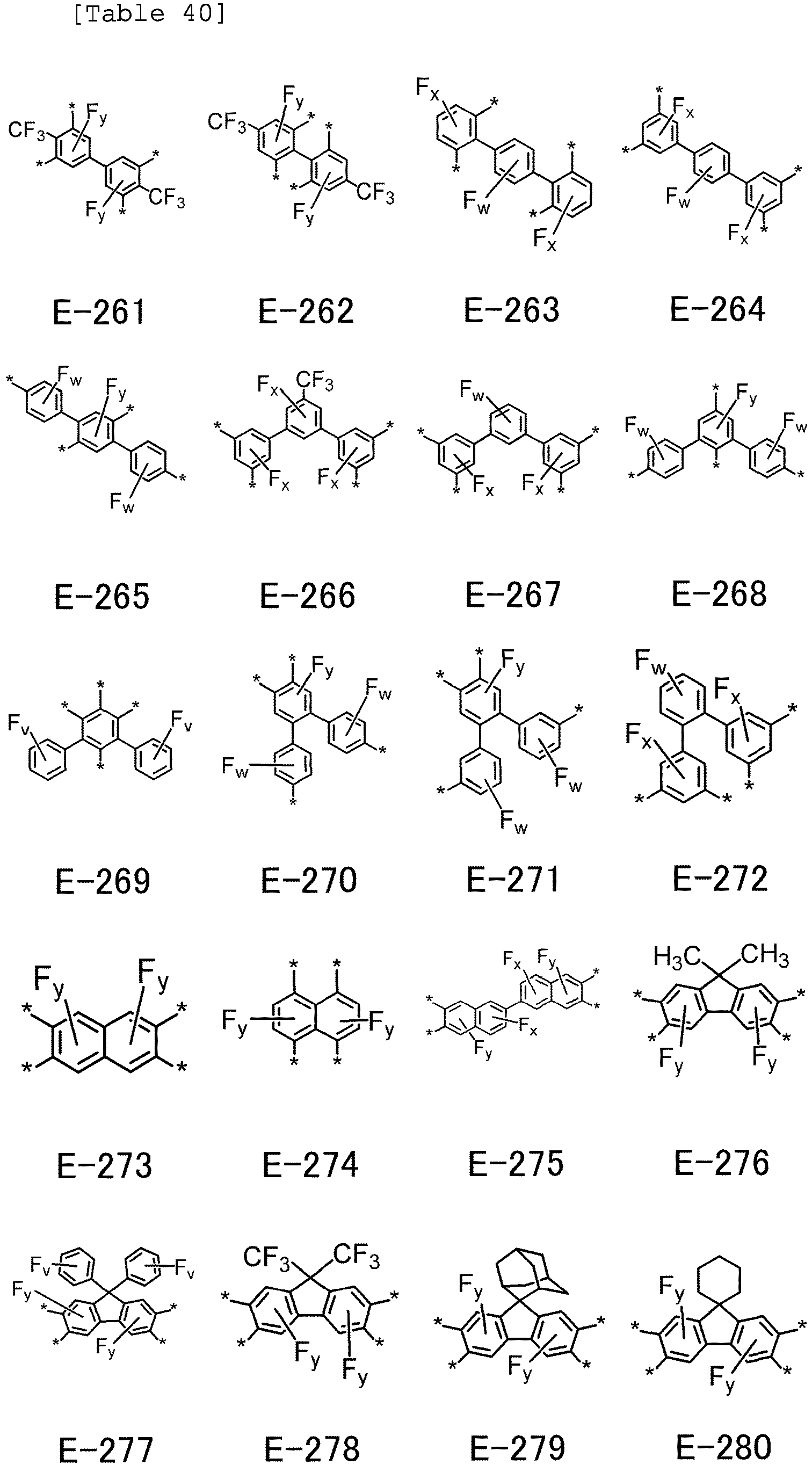

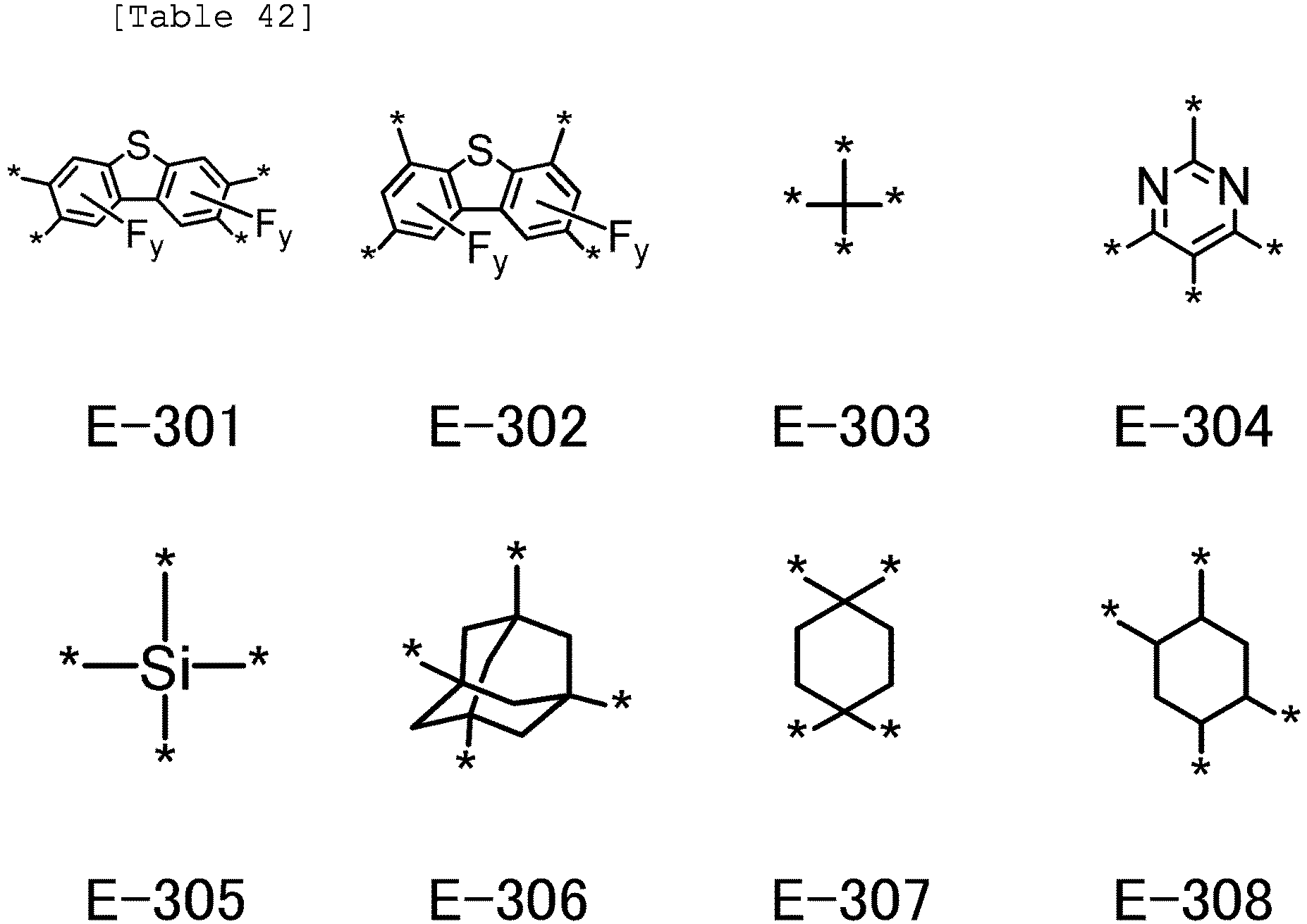
- Due to having a high glass transition temperature and being able to suppress the formation of a metal film on the surface of the film, X even more preferably represents
- (vi') a phenylene group, biphenylene group, terphenylylene group, naphthylene group, fluorenylene group, spirobifluorenylene group, benzofluorenylene group, phenanthrene group, fluoranthenylene group, triphenylenylene group, anthracenediyl group, pyridylene group, pyrimidinediyl group, triazinediyl group, carbazolediyl group, benzofuryl group, benzothiophenediyl group, dibenzofuryl group, adamantanediyl group, methylene group, silanediyl group, cyclohexylene group, phenyltriyl group, biphenyltriyl group, terphenyltriyl group, naphthylyl group, fluorenetriyl group, spirobifluorenetriyl group, benzofluorenetriyl group, phenanthrenetriyl group, fluoranthenetriyl group, triphenylenetriyl group, anthracenetriyl group, pyrenetriyl group, pyridinetriyl group, pyrimidinetriyl group, triazinetriyl group, carbazole triyl group, benzofuran triyl group, benzothiophene triyl group, dibenzofuran triyl group, adamantane triyl group, methane triyl group, silane triyl group, cyclohexane triyl group, phenyl tetrayl group, biphenyl tetrayl group, terphenyl tetrayl group, naphthyl tetrayl group, fluorene tetrayl group, spirobifluorene tetrayl group, benzofluorene tetrayl group, phenanthrene tetrayl group, fluoranthene tetrayl group, triphenylene tetrayl group, anthracene tetrayl group, pyrene tetrayl group, pyridine tetrayl group, pyrimidine tetrayl group, carbazole tetrayl group, benzofuran tetrayl group, benzothiophene tetrayl group, dibenzofuran tetrayl group, adamantane tetrayl group, methane tetrayl group, silane tetrayl group, or cyclohexane tetrayl group; or
- (vii') a group in which the group represented by (vi ') is substituted with one or more groups selected from the group consisting of a methyl group, a trifluoromethyl group, a perfluoroalkyl group having 2 to 10 carbon atoms, a fluorine atom, and a phenyl group optionally substituted with a fluorine atom.
- Due to having a high glass transition temperature is high and being able to suppress the formation of a metal thin film on a film surface, X is particularly preferably a phenylene group, a phenylene group having at least one fluorine atom, a phenylene group having at least one trifluoromethyl group, a biphenylene group, a biphenylene group having at least one fluorine atom, a biphenylene group having at least one trifluoromethyl group, a terphenylylene group, a terphenylylene group having at least one fluorine atom, a terphenylylene group having at least one fluorine atom, a terphenylylene group, a naphthylene group, fluorenylene group, a spirobifluorenylene group, a benzofluorenylene group, a phenanthrene group, a fluoranthenylene group, a triphenylenylene group, an anthracenediyl group, a pyridylene group, a pyrimidinediyl group, a triazinediyl group, a carbazolediyl group, a benzofuryl group, a benzothiophenediyl group, a dibenzofuryl group, an adamantanediyl group, a methylene group, a silanediyl group, a cyclohexylene group; a phenyltriyl group, a phenyltriyl group having at least one fluorine atom, a phenyltriyl group having at least one trifluoromethyl group, a biphenyltriyl group, a biphenyltriyl group having at least one fluorine atom, a biphenyltriyl group having at least one trifluoromethyl group, a terphenyltriyl group, a terphenyltriyl group having at least one fluorine atom, a terphenyltriyl group having at least one trifluoromethyl group, a naphthylyl group, a fluorenetriyl group, a spirobifluorenetriyl group, a benzofluorenetriyl group, a phenanthrenetriyl group, a fluoranthenetriyl group, a triphenylenetriyl group, an anthracenetriyl group, a pyrenetriyl group, a pyridinetriyl group, a pyrimidinetriyl group, a triazinetriyl group, a carbazoletriyl group, benzofurantriyl group, a benzothiophenetriyl group, a dibenzofurantriyl group, an adamantanetriyl group, a methanetriyl group, a silanetriyl group, a cyclohexanetriyl group;
a phenyl tetrayl group, a phenyl tetrayl group having at least one fluorine atom, a phenyl tetrayl group having at least one trifluoromethyl group, a biphenyl tetrayl group, a biphenyl tetrayl group having at least one fluorine atom, a biphenyl tetrayl group having at least one trifluoromethyl group, a terphenyl tetrayl group, a terphenyl tetrayl group having at least one fluorine atom, a terphenyl tetrayl group, a naphthyl tetrayl group, a fluorene tetrayl group, a spirobiflurene tetrayl group, a benzofluorene tetrayl group, a phenanthrene tetrayl group, a fluoranthene tetrayl group, a triphenylene tetrayl group, an anthracene tetrayl group, a pyrene tetrayl group, a pyridine tetrayl group, a pyrimidine tetrayl group, a carbazole tetrayl group having at least one trifluoromethyl group, a benzofuran tetrayl group, a benzothiophene tetrayl group, a dibenzofuran tetrayl group, an adamantane tetrayl group, a methane tetrayl group, a silane tetrayl group, or a cyclohexane tetrayl group. - Due to being able to suppress the formation of a metal film on the surface of the film, the metal patterning material preferably has one or more groups selected from the group consisting of a perfluorophenyl group, a perfluorotolyl group, a perfluorodimethylphenyl group, and a perfluorobiphenylyl group in the molecule.
- Due to being able to suppress the formation of a metal film on the film surface, the metal patterning material preferably has the proportion of the number of fluorine atoms to carbon atoms in the molecular structure of the metal patterning material larger than 1:4, more preferably larger than 1:3, and still more preferably larger than 1:2. From the viewpoint of the glass transition temperature and the sublimation temperature, the proportion is more preferable in the order of from 1:2 to 2:1, from 1:2 to 1.9:1, from 1:2 to 1.8:1, from 1:2 to 1.7:1, from 1:2 to 1.6 :1, and from 1:2 to 1.5:1.
- In addition, the metal patterning material is preferably a compound represented by Formula (4), (5) or (6).


- In the formula,
- a1, a2 and a3 each independently represent an integer of 1 to 3;
- a4 and a5 each independently represent an integer of 1 or 2;
- a6 represents an integer of 0 or 1;
- A1 to A14 each independently represent
- an optionally substituted monocyclic, linked or condensed aromatic hydrocarbon group having 6 to 25 carbon atoms;
- an optionally substituted monocyclic, linked, or condensed heterocyclic heteroaromatic group having 3 to 25 carbon atoms; or
- optionally substituted cyclic alkyl group having 3 to 25 carbon atoms;
- provided that
- at least one of A1 to A3 is independently an optionally substituted cyclic alkyl group having 3 to 25 carbon atoms;
- at least one of A4 to A7 is independently an optionally substituted cyclic alkyl group having 3 to 25 carbon atoms;
- when a6 is 0, at least one of A8 to A11 is independently an optionally substituted cyclic alkyl group having 3 to 25 carbon atoms;
- when a6 is 1, at least one of A8 to A14 is independently an optionally substituted cyclic alkyl group having 3 to 25 carbon atoms;
- L101 to L118 each independently represent
- an optionally substituted monocyclic, linked, or condensed divalent aromatic hydrocarbon group having 6 to 25 carbon atoms;
- an optionally substituted monocyclic, linked or condensed divalent heteroaromatic group having of 3 to 25 carbon atoms;
or - a single bond;
- B represents
- an optionally substituted monocyclic, linked or condensed di-to tetravalent aromatic hydrocarbon group having ring of 6 to 25 carbon atoms;
- an optionally substituted monocyclic, linked or condensed di-to tetravalent heteroaromatic group having ring of 3 to 25 carbon atoms;
- an optionally substituted linear, branched or cyclic di- to tetravalent alkyl group having 1 to 10 carbon atoms; or
- an optionally substituted di- to tetravalent silicon atom.
- When A1 to A14 are substituted aromatic hydrocarbon groups, substituted heteroaromatic groups, or substituted cyclic alkyl groups, each of these groups preferably is independently substituted with one or more groups selected from the group consisting of substituted by:
- a linear, branched or cyclic alkyl group having 1 to 18 carbon atoms which may be substituted with a fluorine atom,
- a linear, branched, or cyclic alkoxy group having 1 to 18 carbon atoms which may be substituted with a fluorine atom,
- an aromatic hydrocarbon group having 6 to 20 carbon atoms which may be substituted with a fluorine atom;
- a heteroaromatic group having 3 to 20 carbon atoms which may be substituted with a fluorine atom;
- a cyano group,
- a fluorine atom and
- a deuterium atom;
- when L101 to L118 are substituted divalent aromatic hydrocarbon groups or substituted divalent heteroaromatic groups, each of these groups preferably is independently substituted with one or more groups selected from the group consisting of:
- a linear, branched, or cyclic alkyl group having 1 to 18 carbon atoms which may be substituted with a fluorine atom;
- a linear, branched, or cyclic alkoxy group having 1 to 18 carbon atoms which may be substituted with a fluorine atom;
- an aromatic hydrocarbon group having 6 to 20 carbon atoms which may be substituted with a fluorine atom;
- a heteroaromatic group having 3 to 20 carbon atoms which may be substituted with a fluorine atom;
- a cyano group,
- a fluorine atom, and
- a deuterium atom;
- when B is a substituted di- to tetravalent aromatic hydrocarbon group, a substituted di- to tetravalent heteroaromatic group, a substituted di- to tetravalent alkyl group, or a substituted di- to tetravalent silicon atom, each of these groups preferably is independently substituted by one or more groups selected from the group consisting of:
- a linear, branched, or cyclic alkyl group having 1 to 18 carbon atoms which may be substituted with a fluorine atom;
- a linear, branched, or cyclic alkoxy group having 1 to 18 carbon atoms which may be substituted with a fluorine atom;
- an aromatic hydrocarbon group having 6 to 20 carbon atoms which may be substituted with a fluorine atom;
- a heteroaromatic group having 3 to 20 carbon atoms which may be substituted with a fluorine atom;
- a cyano group,
- a fluorine atoms and
- a deuterium atom.
- As the condensed cyclic alkyl group having 3 to 25 carbon atoms, for example, a cyclobutyl group, a cyclopentyl group, a cyclohexyl group, a cycloheptyl group, a cyclooctyl group, an adamantyl group, a noradamantyl group, a norbornyl group, a diamantyl group, and a decahydronaphthalene group can be exemplified.
- It should be noted that, as described above, the condensed cyclic alkyl group having 3 to 25 carbon atoms may have a substituent. When they have a substituent, it is preferably substituted by one or more groups selected from the group consisting of a linear, branched, or cyclic alkyl group having 1 to 18 carbon atoms which may be substituted with a fluorine atom, a linear, branched, or cyclic alkoxy group having 1 to 18 carbon atoms which may be substituted with a fluorine atom, an aromatic hydrocarbon group having 6 to 20 carbon atoms which may be substituted with a fluorine atom, a heteroaromatic group having 3 to 20 carbon atoms which may be substituted with a fluorine atom, a cyano group, a fluorine atom or a deuterium atom. In this case, the number of substituents is not particularly limited.
- In Formula (4), (5) or (6), a monocyclic, linked, or condensed aromatic hydrocarbon group having 6 to 25 carbon atoms; a monocyclic, linked, or condensed heteroaromatic group having 3 to 25 carbon atoms; a monocyclic, linked, or condensed aromatic hydrocarbon group having 6 to 25 carbon atoms; a monocyclic, linked or condensed divalent heteroaromatic group having 3 to 25 carbon atoms; a monocyclic, linked, or condensed di- to tetravalent aromatic hydrocarbon group having 6 to 25 carbon atoms; a monocyclic, linked, or condensed di- to tetravalent heteroaromatic group having 3 to 25 carbon atoms; a linear, branched or cyclic di-to tetravalent alkyl group having 1 to 10 carbon atoms; a linear, branched, or cyclic alkyl group having 1 to 18 carbon atoms which may be substituted with a fluorine atom; a linear, branched, or cyclic alkoxy group having 1 to 18 carbon atoms which may be substituted with a fluorine atom; an aromatic hydrocarbon group having 6 to 20 carbon atoms which may be substituted with a fluorine atom; a heteroaromatic group having 3 to 20 carbon atoms which may be substituted with a fluorine atom; an aromatic hydrocarbon group having 6 to 25 carbon atoms; a monocyclic, linked, or condensed heteroaromatic group having 3 to 25 carbon atoms; a monocyclic, linked, or condensed aromatic hydrocarbon group having 6 to 25 carbon atoms; a monocyclic, linked or condensed divalent heteroaromatic group having 3 to 25 carbon atoms; a monocyclic, linked, or condensed di- to tetravalent aromatic hydrocarbon group having 6 to 25 carbon atoms; a monocyclic, linked, or condensed di- to tetravalent heteroaromatic group having 3 to 25 carbon atoms; a linear, branched or cyclic di-to tetravalent alkyl groups having 1 to 10 carbon atoms; a linear, branched, or cyclic alkyl group having 1 to 18 carbon atoms which may be substituted with a fluorine atom; a linear, branched, or cyclic alkoxy group having 1 to 18 carbon atoms which may be substituted with a fluorine atom; an aromatic hydrocarbon group having 6 to 20 carbon atoms which may be substituted with a fluorine atom; a heteroaromatic group having 3 to 20 carbon atoms which may be substituted with a fluorine atom; are synonymous. From the viewpoint of being able to suppress the formation of the metal film on the surface of the film, the number of carbon atoms in the condensed aromatic hydrocarbon group in Formulas (4) to (6) is preferably 6 to 15. Specifically, it is preferably from 6 to 15, more preferably from 6 to 14, and still more preferably from 6 to 13.
- In Formulas (4) to (6), due A1 to A14 having a high glass transition temperature and being able to suppress the formation of a metal film on the film surface, they preferably each independently represent:
- (viii) a phenyl group, biphenylyl group, terphenylyl group, naphthyl group, fluorenyl group, spirobifluorenyl group, benzofluorenyl group, phenanthryl group, fluoranthyl group, fluoranthenyl group, triphenylenyl group, anthryl group, pyrenyl group, pyridyl group, carbazolyl group, benzofuranyl group, benzothienyl group, dibenzofuranyl group, dibenzofuranyl group, dibenzothienyl group, cyclopentyl group, cyclohexyl group, diamantyl group, adamantyl group, noradamantyl group, norbornyl group or decahydronaphthalene group; or
- (ix) a group in which the group represented by (viii) is substituted with one or more groups selected from the group consisting of: a methyl group, an ethyl group, a methoxy group, an ethoxy group, a trifluoromethyl group, a trifluoromethoxy group, a perfluoroalkyl group having 2 to 10 carbon atoms, a perfluoroalkoxy group having 2 to 10 carbon atoms, a cyano group, a deuterium atom, a fluorine atom, a phenyl group optionally substituted with a fluorine atom, a biphenylyl group optionally substituted with a fluorine atom, a naphthyl group optionally substituted with a fluorine atom, a phenanthryl group which may be substituted with a fluorine atom, a pyridyl group which may be substituted with a fluorine atom, a carbazolyl group which may be substituted with a fluorine atom, a dibenzothienyl group which may be substituted with a fluorine atom, and a dibenzofuranyl group which may be substituted with a fluorine atom.
- In Formulas (4) to (6), due A1 to A14 having a high glass transition temperature and being able to suppress the formation of a metal film on the film surface, they more preferably each independently represent
- (viii') a phenyl group, a biphenylyl group, a terphenylyl group, a naphthyl group, a fluorenyl group, a spirobifluorenyl group, a phenanthryl group, a fluoranthenyl group, a triphenylenyl group, an anthryl group, a pyrenyl group, a pyridyl group, a carbazolyl group, a dibenzofuranyl group, a dibenzothienyl group, a cyclopentyl group, a cyclohexyl group, a diamantyl group, an adamantyl group, a noradamantyl group, a norbornyl group, or a decahydronaphthalene group; or
- (ix') a group in which the group represented by (viii ') is substituted with one or more groups selected from the group consisting of a methyl group, a trifluoromethyl group, a perfluoroalkyl group having 2 to 10 carbon atoms, a fluorine atom, and a phenyl group optionally substituted with a fluorine atom.
- Due to A1 to A14 having a high glass transition temperature and being able to suppress the formation of a metal film on the film surface, they even more preferably each independently represent
a phenyl group, a phenyl group having at least one fluorine atom, a phenyl group having at least one trifluoromethyl group, a biphenylyl group, a biphenylyl group having at least one fluorine atom, a biphenylyl group having at least one trifluoromethyl group, a terfenylyl group, a terfenylyl group having at least one fluorine atom, a terfenyl group having at least one trifluoromethyl group, a naphthyl group, a 9,9-dimethylfluorenyl group, a 9,9-diphenylfluorenyl group, a spirobiflurenyl group, a phenanthryl group, a carbazol-9-yl group, a 9-phenylcarbazolyl group, a dibenzofuranyl group, a dibenzothienyl group, a cyclohexyl group, a cyclohexyl group having at least one fluorine atom, a cyclohexyl group having at least one trifluoromethyl group, an adamantyl group, an adamantyl group having at least one fluorine atom, or an adamantyl group having at least one trifluoromethyl group. - In Formulas (4) to (6), due to L101 to L118 having a high glass transition temperature and being able to suppress the formation of a metal film on the film surface, they preferably each independently represent
- (x) a phenylene group, biphenylylene group, terphenylene group, naphthylene group, pyridylene group, or fluorenylene group;
- (xi) a group in which the group represented by (x) is substituted with one or more groups selected from the group consisting of a methyl group, an ethyl group, a methoxy group, an ethoxy group, a trifluoromethyl group, a trifluoromethoxy group, a perfluoroalkyl group having 2 to 10 carbon atoms, a perfluoroalkoxy group having 2 to 10 carbon atoms, a cyano group, a deuterium atom, a fluorine atom, a phenyl group optionally substituted with a fluorine atom, a biphenylyl group optionally substituted with a fluorine atom, a naphthyl group optionally substituted with a fluorine atom, a phenanthryl group optionally substituted with a fluorine atom, a pyridyl group optionally substituted with a fluorine atom, a carbazolyl group optionally substituted with a fluorine atom, a dibenzothienyl group optionally substituted with a fluorine atom, and a dibenzofuranyl group optionally substituted with a fluorine atom; or
- (xii) a single bond.
- Due to L101 to L118 having a high glass transition temperature and being able to suppress the formation of a metal film on the film surface, they more preferably each independently represent
- (x') a phenylene group, a biphenylylene group, a terphenylylene group, a naphthylene group, a pyridylene group, or a fluorenylene group;
- (xi') a group in which the group represented by (x') is substituted with one or more groups selected from the group consisting of a methyl group, a trifluoromethyl group, a fluorine atom, and a phenyl group optionally substituted with a fluorine atom; or
- (xii') a single bond.
- Due to L101 to L118 having a high glass transition temperature and being able to suppress the formation of a metal film on the film surface, they even more preferably are each independently: a phenylene group, a phenylene group having at least one fluorine atom, a phenylene group having at least one trifluoromethyl group, a biphenylylene group, a biphenylylene group having at least one fluorine atom, a biphenylylene group having at least one trifluoromethyl group, a terphenylylene group, a terphenylylene group having at least one fluorine atom, a terphenylylene group having at least one trifluoromethyl group, a naphthylene group, or a single bond.
- In Formulas (4) to (6), due to having a high glass transition temperature and being able to suppress the formation of a metal film on the film surface, B preferably represents
- (xiii) a phenylene group, biphenylene group, terphenylylene group, naphthylene group, fluorenylene group, spirobifluorenylene group, benzofluorenylene group, phenanthrene group, fluoranthenylene group, triphenylenylene group, anthracenediyl group, pyridylene group, pyrimidinediyl group, triazinediyl group, carbazoldiyl group, benzoflanyl group, benzothiophenediyl group, dibenzofuryl group, adamantanediyl group, methylene group, silanediyl group, cyclohexylene group, phenyltriyl group, biphenyltriyl group, terphenyltriyl group, naphthylyl group, fluorenetriyl group, spirobiflurenetriyl group, benzofluorenetriyl group, phenanthrenetriyl group, fluoranthenetriyl group, triphenylenetriyl group, anthracenetriyl group, pyrenetriyl group, pyridinetriyl group, pyrimidinetriyl group, triazinetriyl group, carbazole triyl group, benzofuran triyl group, benzothiophene triyl group, dibenzofuran triyl group, adamantane triyl group, methane triyl group, silane triyl group, cyclohexane triyl group, phenyl tetrayl group, biphenyl tetrayl group, terphenyl tetrayl group, naphthyl tetrayl group, fluorene tetrayl group, spirobifluorene tetrayl group, benzofluorene tetrayl group, phenanthrene tetrayl group, fluoranthene tetrayl group, triphenylene tetrayl group, anthracene tetrayl group, pyrene tetrayl group, pyridine tetrayl group, pyrimidine tetrayl group, carbazole tetrayl group, benzofuran tetrayl group, benzothiophene tetrayl group, dibenzofuran tetrayl group, adamantane tetrayl group, methane tetrayl group, silane tetrayl group, or cyclohexane tetrayl group; or
- (xiv) a group in which the group represented by (xiii) is substituted with one or more groups selected from the group consisting of: a methyl group, an ethyl group, a methoxy group, an ethoxy group, a trifluoromethyl group, a trifluoromethoxy group, a perfluoroalkyl group having 2 to 10 carbon atoms, a perfluoroalkoxy group having 2 to 10 carbon atoms, a cyano group, a deuterium atom, a fluorine atom, a phenyl group optionally substituted with a fluorine atom, a biphenylyl group optionally substituted with a fluorine atom, a naphthyl group optionally substituted with a fluorine atom, a phenanthryl group which may be substituted with a fluorine atom, a pyridyl group which may be substituted with a fluorine atom, a carbazolyl group which may be substituted with a fluorine atom, a dibenzothienyl group which may be substituted with a fluorine atom, and a dibenzofuranyl group which may be substituted with a fluorine atom.
- Due to having a high glass transition temperature and being able to suppress the formation of a metal film on the film surface, B more preferably represents
- (xii') a phenylene group, a biphenylene group, a terphenylylene group, a naphthylene group, a fluorenylene group, a spirobifluorenylene group, a benzofluorenylene group, a phenanthrene group, a fluoranthenylene group, a triphenylenylene group, an anthracenediyl group, a pyridylene group, a pyrimidinediyl group, a triazinediyl group, a carbazolediyl group, a benzofuryl group, a benzothiophenediyl group, a dibenzofuryl group, an adamantanediyl group, a methylene group, a silanediyl group, cyclohexylene group, a phenyltriyl group, biphenyltriyl group, a terphenyltriyl group, naphthylyl group, a fluorenetriyl group, a spirobifluorenetriyl group, a benzofluorenetriyl group, a phenanthrenetriyl group, a fluoranthenetriyl group, a triphenylenetriyl group, an anthracenetriyl group, a pyrenetriyl group, a pyridinetriyl group, a pyrimidinetriyl group, a triazinetriyl group, a carbazole triyl group, a benzofuran triyl group, a benzothiophene triyl group, a dibenzofuran triyl group, an adamantane triyl group, a methane triyl group, a silane triyl group, a cyclohexane triyl group, a phenyl tetrayl group, a biphenyl tetrayl group, a terphenyl tetrayl group, a naphthyl tetrayl group, a fluorene tetrayl group, a spirobifluorene tetrayl group, a benzofluorene tetrayl group, a phenanthrene tetrayl group, a fluoranthene tetrayl group, a triphenylene tetrayl group, an anthracene tetrayl group, a pyrene tetrayl group, a pyridine tetrayl group, a pyrimidine tetrayl group, a carbazole tetrayl group, a benzofuran tetrayl group, a benzothiophene tetrayl group, a dibenzofuran tetrayl group, an adamantane tetrayl group, a methane tetrayl group, a silane tetrayl group, or a cyclohexane tetrayl group; or
- (xiv') a group in which the group represented by (xiii') is substituted with one or more groups selected from the group consisting of: a methyl group, a trifluoromethyl group, a perfluoroalkyl group having 2 to 10 carbon atoms, a fluorine atom, and a phenyl group optionally substituted with a fluorine atom.
- Due to having a high glass transition temperature and being able to suppress the formation of a metal film on the film surface, B is even more preferably: a phenylene group, a phenylene group having at least one fluorine atom, a phenylene group having at least one trifluoromethyl group, a biphenylene group, a biphenylene group having at least one fluorine atom, a biphenylene group having at least one trifluoromethyl group, a terphenylylene group, a terphenylylene group having at least one fluorine atom, a terphenylylene group having at least one fluorine atom, a terphenylylene group, a naphthylene group, a fluorenylene group, a spirobifluorenylene group, a benzofluorenylene group, a phenanthrene group, a fluoranthenylene group, a triphenylenylene group, an anthracenediyl group, a pyridylene group, a pyrimidinediyl group, a triazinediyl group, a carbazolediyl group, a benzofuryl group, a benzothiophenediyl group, a dibenzofuryl group, an adamantanediyl group, a methylene group, a silanediyl group, or a cyclohexylene group;
- a phenyltriyl group, phenyltriyl group having at least one fluorine atom, phenyltriyl group having at least one trifluoromethyl group, biphenyltriyl group, biphenyltriyl group having at least one fluorine atom, biphenyltriyl group having at least one trifluoromethyl group, terphenyltriyl group, terphenyltriyl group having at least one fluorine atom, terphenyltriyl group having at least one trifluoromethyl group, naphthylyl group, fluorenetriyl group, spirobifluorenetriyl group, benzofluorenetriyl group, phenanthrenetriyl group, fluoranthenetriyl group, triphenylenetriyl group, anthracenetriyl group, pyrenetriyl group, pyridinetriyl group, pyrimidinetriyl group, triazinetriyl group, carbazoletriyl group, benzofurantriyl group, benzothiophenetriyl group, dibenzofurantriyl group, adamantanetriyl group, methanetriyl group, silanetriyl group, or cyclohexanetriyl group; or
- a phenyl tetrayl group, phenyl tetrayl group having at least one fluorine atom, phenyl tetrayl group having at least one trifluoromethyl group, biphenyl tetrayl group, biphenyl tetrayl group having at least one fluorine atom, biphenyl tetrayl group having at least one trifluoromethyl group, terphenyl tetrayl group, terphenyl tetrayl group having at least one fluorine atom, terphenyl tetrayl group, naphthyl tetrayl group, fluorene tetrayl group, spirobiflurene tetrayl group, benzofluorene tetrayl group, phenanthrene tetrayl group, fluoranthene tetrayl group, triphenylene tetrayl group, anthracene tetrayl group, pyrene tetrayl group, pyridine tetrayl group, pyrimidine tetrayl group, carbazole tetrayl group having at least one trifluoromethyl group, benzofuran tetrayl group, benzothiophene tetrayl group, dibenzofuran tetrayl group, adamantane tetrayl group, methane tetrayl group, silane tetrayl group, or cyclohexane tetrayl group.
- Due to being able to suppress the formation of a metal film on the surface of the film, the metal patterning material preferably has one or more groups selected from the group consisting of a perfluorophenyl group, a perfluorotolyl group, a perfluorodimethylphenyl group, and a perfluorobiphenylyl group in the molecule.
- Due to being able to suppress the formation of a metal film on the film surface, the metal patterning material more preferably has a proportion of the number of fluorine atoms to carbon atoms in the molecular structure of the metal patterning material larger than 1:4, more preferably larger than 1:3, and still more preferably larger than 1:2. From the viewpoint of the glass transition temperature and the sublimation temperature, the proportion is more preferable in the order of from 1:2 to 2:1, from 1:2 to 1.9:1, from 1:2 to 1.8:1, from 1:2 to 1.7:1, from 1:2 to 1.6:1, and from 1:2 to 1.5:1.
- An amine compound according to one embodiment of the present disclosure is represented by Formula (7) or (8):


- In the Formula,
- Ar15 to Ar20 each independently represent
- an optionally substituted monocyclic, linked or condensed aromatic hydrocarbon group having 6 to 25 carbon atoms, or an optionally substituted monocyclic, linked, or condensed heteroaromatic group of 3 to 25 carbon atoms;
- L19 to L28 each independently represent
- an optionally substituted monocyclic, linked, or condensed monocyclic divalent aromatic hydrocarbon group having 6 to 25 carbon atoms,
- a monocyclic, linked or condensed divalent heteroaromatic group having an optionally substituted ring having 3 to 25 carbon atoms, or
- a single bond;
- Y represents
- an optionally substituted monocyclic, linked or condensed di-to tetravalent aromatic hydrocarbon group having 6 to 25 carbon atoms,
- an optionally substituted monocyclic, linked or condensed di-to tetravalent heteroaromatic group having 3 to 25 carbon atoms,
- an optionally substituted linear, branched or cyclic di- to tetravalent alkyl groups of 1 to 10 carbon atoms, or
- an optionally substituted di- to tetravalent silicon atom;
- n represents an integer of 1 to 18;
- g and h each independently represent an integer of 1 or 2; and i represents an integer of 0 or 1.
- When Ar15 to Ar20 are substituted aromatic hydrocarbon groups or substituted heteroaromatic groups, each of these groups preferably is independently substituted with one or more groups selected from the group consisting of:
- a linear, branched, or cyclic alkyl group having 1 to 18 carbon atoms which may be substituted with a fluorine atom,
- a linear, branched, or cyclic alkoxy group having 1 to 18 carbon atoms which may be substituted with a fluorine atom,
- an aromatic hydrocarbon group having 6 to 20 carbon atoms which may be substituted with a fluorine atom,
- a heteroaromatic group having 3 to 20 carbon atoms which may be substituted with a fluorine atom,
- a cyano group,
- a fluorine atom, and
- a deuterium atom;
- when L19 to L28 are substituted divalent aromatic hydrocarbon groups or substituted divalent heteroaromatic groups, each of these groups preferably is independently substituted with one or more groups selected from the group consisting of:
- a linear, branched, or cyclic alkyl group having 1 to 18 carbon atoms which may be substituted with a fluorine atom,
- a linear, branched, or cyclic alkoxy group having 1 to 18 carbon atoms which may be substituted with a fluorine atom, an aromatic hydrocarbon group having 6 to 20 carbon atoms which may be substituted with a fluorine atom,
- a heteroaromatic group having 3 to 20 carbon atoms which may be substituted with a fluorine atom,
- a cyano group,
- a fluorine atom, and
- a deuterium atoms;
- when Y is a substituted di- to tetravalent aromatic hydrocarbon group, a substituted di- to tetravalent heteroaromatic group, a substituted di- to tetravalent alkyl group, or a substituted di- to tetravalent silicon atom, each of these groups preferably is independently substituted with one or more groups selected from the group consisting of:
- a linear, branched, or cyclic alkyl group having 1 to 18 carbon atoms which may be substituted with a fluorine atom,
- a linear, branched, or cyclic alkoxy group having 1 to 18 carbon atoms which may be substituted with a fluorine atom,
- an aromatic hydrocarbon group having 6 to 20 carbon atoms which may be substituted with a fluorine atom,
- a heteroaromatic group having 3 to 20 carbon atoms which may be substituted with a fluorine atom,
- a cyano group,
- a fluorine atom, and
- a deuterium atom.
- In Formulas (7) and (8), a monocyclic, linked, or condensed aromatic hydrocarbon group having 6 to 25 carbon atoms; a monocyclic, linked, or condensed heteroaromatic group having 3 to 25 carbon atoms; a monocyclic, linked, or condensed di- to tetravalent aromatic hydrocarbon group having 6 to 25 carbon atoms; a monocyclic, linked, or condensed di-to tetravalent heteroaromatic group having 3 to 25 carbon atoms; a linear, branched or cyclic 2 to tetravalent alkyl groups having 1 to 10 carbon atoms; a linear, branched, or cyclic alkyl group having 1 to 18 carbon atoms which may be substituted with a fluorine atom; a linear, branched, or cyclic alkoxy group having 1 to 18 carbon atoms which may be substituted with a fluorine atom; an aromatic hydrocarbon group having 6 to 20 carbon atoms which may be substituted with a fluorine atom; a heteroaromatic group having 3 to 20 carbon atoms which may be substituted with a fluorine atom; an aromatic hydrocarbon group having 6 to 25 carbon atoms; a monocyclic, linked, or condensed heteroaromatic group having 3 to 25 carbon atoms; a monocyclic, linked, or condensed di- to tetravalent aromatic hydrocarbon group having 6 to 25 carbon atoms; a monocyclic, linked, or condensed di- to tetravalent heteroaromatic group having 3 to 25 carbon atoms; a linear, branched or cyclic di- to tetravalent alkyl groups having 1 to 10 carbon atoms; a linear, branched, or cyclic alkyl group having 1 to 18 carbon atoms which may be substituted with a fluorine atom; a linear, branched, or cyclic alkoxy group having 1 to 18 carbon atoms which may be substituted with a fluorine atom; an aromatic hydrocarbon group having 6 to 20 carbon atoms which may be substituted with a fluorine atom; and a heteroaromatic group having 3 to 20 carbon atoms which may be substituted with a fluorine atom are synonymous. From the viewpoint of suppressing the formation of the metal film on the surface of the film, the number of carbon atoms of the condensed aromatic hydrocarbon group in Formulas (7) and (8) is preferably 6 or more and 15 or less. Specifically, it is preferably from 6 to 15, more preferably from 6 to 14, and still more preferably from 6 to 13. In Formula (7) and Formula (8), the number of nitrogen atoms contained in the heteroaromatic group (monocyclic, linked, or condensed heteroaromatic group having 3 to 25 carbon atoms; monocyclic, linked, or condensed di- to tetravalent heteroaromatic group having 3 to 25 carbon atoms; heteroaromatic group having 3 to 20 carbon atoms optionally substituted with a fluorine atom) is preferably three or less.
- In Formulas (7) and (8), due to having a high glass transition temperature and being able to suppress the formation of a metal film on the surface of the film, Ar15 to Ar20 preferably each independently represent
- (xv) a phenyl group, a biphenylyl group, a terphenylyl group, a naphthyl group, a fluorenyl group, a spirobifluorenyl group, a benzofluorenyl group, a phenanthryl group, a fluoranthenyl group, a triphenylenyl group, an anthryl group, a pyrenyl group, a pyridyl group, a carbazolyl group, a benzofuranyl group, a benzothienyl group, a dibenzofuranyl group, or a dibenzothienyl group; or
- (xvi) a group in which the group represented by (xv) is substituted with one or more groups selected from the group consisting of: a methyl group, an ethyl group, a methoxy group, an ethoxy group, a trifluoromethyl group, a trifluoromethoxy group, a perfluoroalkyl group having 2 to 10 carbon atoms, a perfluoroalkoxy group having 2 to 10 carbon atoms, a cyano group, a deuterium atom, a fluorine atom, a phenyl group optionally substituted with a fluorine atom, a biphenylyl group optionally substituted with a fluorine atom, a naphthyl group optionally substituted with a fluorine atom, a group a phenanthryl group which may be substituted with a fluorine atom, a pyridyl group which may be substituted with a fluorine atom, a carbazolyl group which may be substituted with a fluorine atom, a dibenzothienyl group which may be substituted with a fluorine atom, and a dibenzofuranyl group which may be substituted with a fluorine atom.
- Due to having high glass transition temperature and being able to suppress the formation of a metal film on the surface of the film, Ar15 to Ar20 more preferably each independently represent:
- (xv') a phenyl group, biphenylyl group, terphenylyl group, naphthyl group, fluorenyl group, spirobifluorenyl group, phenanthryl group, fluoranthenyl group, triphenylenyl group, anthryl group, pyrenyl group, pyridyl group, carbazolyl group, dibenzofuranyl group, or dibenzothienyl group; or
- (xvi ') a group in which the group represented by (xv') is substituted with one or more groups selected from the group consisting of: a methyl group, a trifluoromethyl group, a perfluoroalkyl group having 2 to 10 carbon atoms, a fluorine atom, and a phenyl group optionally substituted with a fluorine atom.
- Due to having a high glass transition temperature and being able to suppress formation of a metal film on a film surface, Ar15 to Ar20 more preferably each independently represent a phenyl group, a phenyl group having at least one fluorine atom, a phenyl group having at least one trifluoromethyl group, a biphenylyl group, a biphenylyl group having at least one fluorine atom, a biphenylyl group having at least one trifluoromethyl group, a terphenylyl group, a terfenylyl group having at least one fluorine atom, a terphenylyl group having at least one trifluoromethyl group, a naphthyl group, a 9,9-dimethylfluorenyl group, a 9,9-diphenylfluorenyl group, a spirobiflurenyl group, a phenanthryl group, a carbazol-9-yl group, a 9-phenylcarbazolyl group, a dibenzofuranyl group, or a dibenzothienyl group.
- In Formulas (7) and (8), due to having a high glass transition temperature and being able to suppress the formation of a metal film on the film surface, L19 to L28 preferably each independently represent:
- (xvii) a phenylene group, biphenylylene group, terphenylene group, naphthylene group, pyridylene group, or fluorenylene group;
- (xviii) a group in which the group represented by (xvii) is substituted with one or more groups selected from the group consisting of: a methyl group, an ethyl group, a methoxy group, an ethoxy group, a trifluoromethyl group, a trifluoromethoxy group, a perfluoroalkyl group having 2 to 10 carbon atoms, a perfluoroalkoxy group having 2 to 10 carbon atoms, a cyano group, a deuterium atom, a fluorine atom, a phenyl group optionally substituted with a fluorine atom, a biphenylyl group optionally substituted with a fluorine atom, a naphthyl group optionally substituted with a fluorine atom, a phenanthryl group optionally substituted with a fluorine atom, a pyridyl group optionally substituted with a fluorine atom, a carbazolyl group optionally substituted with a fluorine atom, a dibenzothienyl group optionally substituted with a fluorine atom, and a dibenzofuranyl group optionally substituted with a fluorine atom; or
- (xix) a single bond.
- Due to having a high glass transition temperature and being able to suppress the formation of a metal film on the film surface, L19 to L28 more preferably each independently represent:
- (xvii') a phenylene group, a biphenylylene group, a terphenylylene group, a naphthylene group, a pyridylene group or a fluorenylene group;
- (xviii') a group in which the group represented by (xvii ') is substituted with one or more groups selected from the group consisting of a methyl group, a trifluoromethyl group, a fluorine atom and a phenyl group optionally substituted with a fluorine atom; or
- (xix') a single bond.
- Due to having a high glass transition temperature and being able to suppress the formation of a metal film on the film surface, L19 to L28 more preferably each independently represent a phenylene group, a phenylene group having at least one fluorine atom, a phenylene group having at least one trifluoromethyl group, a biphenylylene group, a biphenylylene group having at least one fluorine atom, a biphenylylene group having at least one trifluoromethyl group, a terphenylylene group, a terphenylylene group having at least one fluorine atom, a terphenylylene group having at least one trifluoromethyl group, a naphthylene group, or a single bond.
- In Formula (7), due to having a high glass transition temperature and being able to suppress the formation of a metal film on the film surface, Y preferably represents:
- (xx) a phenylene group, biphenylene group, terphenylylene group, naphthylene group, fluorenylene group, spirobifluorenylene group, benzofluorenylene group, phenanthrene group, fluoranthenylene group, triphenylenylene group, anthracenediyl group, pyridylene group, pyrimidinediyl group, triazinediyl group, carbazoldiyl group, benzoflanyl group, benzothiophenediyl group, dibenzofuryl group, adamantanediyl group, methylene group, silanediyl group, cyclohexylene group, phenyltriyl group, biphenyltriyl group, terphenyltriyl group, naphthylyl group, fluorenetriyl group, spirobiflurenetriyl group, benzofluorenetriyl groups, phenanthrenetriyl group, fluoranthenetriyl group, triphenylenetriyl group, anthracenetriyl group, pyrenetriyl group, pyridinetriyl group, pyrimidinetriyl group, triazinetriyl group, carbazole triyl group, benzofuran triyl group, benzothiophene triyl group, dibenzofuran triyl group, adamantane triyl group, methane triyl group, silane triyl group, cyclohexane triyl group, phenyl tetrayl group, biphenyl tetrayl group, terphenyl tetrayl group, naphthyl tetrayl group, fluorene tetrayl group, spirobifluorene tetrayl group, benzofluorene tetrayl group, phenanthrene tetrayl group, fluoranthene tetrayl group, triphenylene tetrayl group, anthracene tetrayl group, pyrene tetrayl group, pyridine tetrayl group, pyrimidine tetrayl group, carbazole tetrayl group, benzofuran tetrayl group, benzothiophene tetrayl group, dibenzofuran tetrayl group, adamantane tetrayl group, methane tetrayl group, silane tetrayl group, or cyclohexane tetrayl group; or
- (xxi) a group in which the group represented by (xx) is substituted with one or more groups selected from the group consisting of: a methyl group, an ethyl group, a methoxy group, an ethoxy group, a trifluoromethyl group, a trifluoromethoxy group, a perfluoroalkyl group having 2 to 10 carbon atoms, a perfluoroalkoxy group having 2 to 10 carbon atoms, a cyano group, a deuterium atom, a fluorine atom, a phenyl group optionally substituted with a fluorine atom, a biphenylyl group optionally substituted with a fluorine atom, a naphthyl group optionally substituted with a fluorine atom, a phenanthryl group which may be substituted with a fluorine atom, a pyridyl group which may be substituted with a fluorine atom, a carbazolyl group which may be substituted with a fluorine atom, a dibenzothienyl group which may be substituted with a fluorine atom, and a dibenzofuranyl group which may be substituted with a fluorine atom.
- Due to having a high glass transition temperature and being able to suppress the formation of a metal film on the film surface, Y more preferably represents:
- (xx') a phenylene group, a biphenylene group, a terphenylylene group, a naphthylene group, a fluorenylene group, a spirobifluorenylene group, a benzofluorenylene group, a phenanthrene group, a fluoranthenylene group, a triphenylenylene group, an anthracenediyl group, a pyridylene group, a pyrimidinediyl group, a triazinediyl group, a carbazolediyl group, a benzofuryl group, a benzothiophenediyl group, a dibenzofuryl group, an adamantanediyl group, a methylene group, a silanediyl group, a cyclohexylene group, a phenyltriyl group, a biphenyltriyl group, a terphenyltriyl group, a naphthylyl group, a fluorenetriyl group, a spirobifluorenetriyl group, a benzofluorenetriyl group, a phenanthrenetriyl group, a fluoranthenetriyl group, a triphenylenetriyl group, an anthracenetriyl group, a pyrenetriyl group, a pyridinetriyl group, a pyrimidinetriyl group, a triazinetriyl group, a carbazole triyl group, a benzofuran triyl group, a benzothiophene triyl group, a dibenzofuran triyl group, an adamantane triyl group, a methane triyl group, a silane triyl group, a cyclohexane triyl group, a phenyl tetrayl group, a biphenyl tetrayl group, a terphenyl tetrayl group, a naphthyl tetrayl group, a fluorene tetrayl group, a spirobifluorene tetrayl group, a benzofluorene tetrayl group, a phenanthrene tetrayl group, a fluoranthene tetrayl group, a triphenylene tetrayl group, an anthracene tetrayl group, a pyrene tetrayl group, a pyridine tetrayl group, a pyrimidine tetrayl group, a carbazole tetrayl group, a benzofuran tetrayl group, a benzothiophene tetrayl group, a dibenzofuran tetrayl group, an adamantane tetrayl group, a methane tetrayl group, a silane tetrayl group, or a cyclohexane tetrayl group; or
- (xxi') a group in which the group represented by (xx') is substituted with one or more groups selected from the group consisting of a methyl group, a trifluoromethyl group, a perfluoroalkyl group having 2 to 10 carbon atoms, a fluorine atom, and a phenyl group optionally substituted with a fluorine atom.
- Due to having a high glass transition temperature and being able to suppress the formation of a metal film on the film surface, Y still more preferably represents: a phenylene group, a phenylene group having at least one fluorine atom, a phenylene group having at least one trifluoromethyl group, a biphenylene group, a biphenylene group having at least one fluorine atom, a biphenylene group having at least one trifluoromethyl group, a terphenylylene group, a terphenylylene group having at least one fluorine atom, a terphenylylene group having at least one fluorine atom, a terphenylylene group, a naphthylene group, a fluorenylene group, a spirobifluorenylene group, a benzofluorenylene group, a phenanthrene group, a fluoranthenylene group, a triphenylenylene group, an anthracenediyl group, a pyridylene group, a pyrimidinediyl group, a triazinediyl group, a carbazolediyl group, a benzofuryl group, a benzothiophenediyl group, a dibenzofuryl group, an adamantanediyl group, a methylene group, a silanediyl group, a cyclohexylene group;
- a phenyltriyl group, a phenyltriyl group having at least one fluorine atom, a phenyltriyl group having at least one trifluoromethyl group, a biphenyltriyl group, a biphenyltriyl group having at least one fluorine atom, a biphenyltriyl group having at least one trifluoromethyl group, a terphenyltriyl group, a terphenyltriyl group having at least one fluorine atom, a terphenyltriyl group having at least one trifluoromethyl group, a naphthylyl group, a fluorenetriyl group, a spirobifluorenetriyl group, a benzofluorenetriyl group, a phenanthrenetriyl group, a fluoranthenetriyl group, a triphenylenetriyl group, an anthracenetriyl group, a pyrenetriyl group, a pyridinetriyl group, a pyrimidinetriyl group, a triazinetriyl group, a carbazoletriyl group, a benzofurantriyl group, a benzothiophenetriyl group, a dibenzofurantriyl group, an adamantanetriyl group, a methanetriyl group, a silanetriyl group, a cyclohexanetriyl group; or
- a phenyl tetrayl group, a phenyl tetrayl group having at least one fluorine atom, a phenyl tetrayl group having at least one trifluoromethyl group, a biphenyl tetrayl group, a biphenyl tetrayl group having at least one fluorine atom, a biphenyl tetrayl group having at least one trifluoromethyl group, a terphenyl tetrayl group, a terphenyl tetrayl group having at least one fluorine atom, a terphenyl tetrayl group, a naphthyl tetrayl group, a fluorene tetrayl group, a spirobiflurene tetrayl group, a benzofluorene tetrayl group, a phenanthrene tetrayl group, a fluoranthene tetrayl group, a triphenylene tetrayl group, an anthracene tetrayl group, a pyrene tetrayl group, a pyridine tetrayl group, a pyrimidine tetrayl group, a carbazole tetrayl group having at least one trifluoromethyl group, a benzofuran tetrayl group, a benzothiophene tetrayl group, a dibenzofuran tetrayl group, an adamantane tetrayl group, a methane tetrayl group, a silane tetrayl group, or a cyclohexane tetrayl group.
- In Formulas (7) and (8), n represents an integer of 1 to 18. Due to having a high glass temperature and ease of raw material availability, n is preferably an integer of 1 to 8, more preferably an integer of 1 to 4, and still more preferably 1.
- In addition, the amine compound according to one embodiment of the present disclosure is represented by Formula (9) or (10):


- In the formula,
- a7 represents an integer of 1 or 2;
- a8 represents an integer of 0 to 2;
- a9 represents an integer of 0 or 1; and
- Alk represents an optionally substituted cyclic alkyl group having 3 to 25 carbon atoms. A15 to A19 each independently represent
- an optionally substituted monocyclic, linked or condensed aromatic hydrocarbon group having 6 to 25 carbon atoms,
- an optionally substituted monocyclic, linked, or condensed heterocyclic heteroaromatic group having 3 to 25 carbon atoms, or
- an optionally substituted cyclic alkyl group having 3 to 25 carbon atoms;
- provided that
- when a9 is 0, at least one of A16 to A18 is independently an optionally substituted cyclic alkyl group having 3 to 25 carbon atoms;
- when a9 is 1, at least one of A16 to A19 is independently an optionally substituted cyclic alkyl group having 3 to 25 carbon atoms;
- L119 to L128 each independently represent
- an optionally substituted monocyclic, linked, or condensed monocyclic divalent aromatic hydrocarbon group having 6 to 25 carbon atoms,
- an optionally substituted monocyclic, linked or condensed divalent heteroaromatic group having 3 to 25 carbon atoms, or a single bond;
- D represents
- an optionally substituted monocyclic, linked or condensed monocyclic 1 to tetravalent aromatic hydrocarbon group having 6 to 25 carbon atoms,
- an optionally substituted monocyclic, linked or condensed monocyclic mono- to tetravalent heteroaromatic groups of 3 to 25 carbon atoms,
- an optionally substituted linear, branched or cyclic mono- to tetravalent alkyl group having 1 to 10 carbon atoms, or
- an optionally substituted 1 to tetravalent silicon atom; and each of E1 to E5 independently represents
- a fluorine atom or
- a linear, branched or cyclic alkyl group having 1 to 18 carbon atoms which may be substituted with a fluorine atom.
- When Alk is a substituted cyclic alkyl group, it is substituted by one or more groups selected from the group consisting of:
- a linear, branched, or cyclic alkyl group having 1 to 18 carbon atoms which may be substituted with a fluorine atom;
- a fluorine atom, and
- a deuterium atom;
- when A15 to A19 are substituted aromatic hydrocarbon groups, substituted heteroaromatic groups or substituted cyclic alkyl groups, each of these groups preferably is independently substituted with one or more groups selected from the group consisting of:
- a linear, branched, or cyclic alkyl group having 1 to 18 carbon atoms which may be substituted with a fluorine atom,
- a linear, branched, or cyclic alkoxy group having 1 to 18 carbon atoms which may be substituted with a fluorine atom,
- an aromatic hydrocarbon group having 6 to 20 carbon atoms which may be substituted with a fluorine atom,
- a heteroaromatic group having 3 to 20 carbon atoms which may be substituted with a fluorine atom,
- a cyano group,
- a fluorine atoms, and
- a deuterium atom;
- when L119 to L128 are substituted divalent aromatic hydrocarbon groups or substituted divalent heteroaromatic groups, each of these groups preferably is independently substituted with one or more groups selected from the group consisting of:
- a linear, branched, or cyclic alkyl group having 1 to 18 carbon atoms which may be substituted with a fluorine atom,
- a linear, branched, or cyclic alkoxy group having 1 to 18 carbon atoms which may be substituted with a fluorine atom,
- an aromatic hydrocarbon group having 6 to 20 carbon atoms which may be substituted with a fluorine atom,
- a heteroaromatic group having 3 to 20 carbon atoms which may be substituted with a fluorine atom;
- a cyano group,
- a fluorine atoms, and
- a deuterium atom;
- when D is a substituted mono- to tetravalent aromatic hydrocarbon group, a substituted mono- to tetravalent heteroaromatic group, a substituted mono- to tetravalent alkyl group, or a substituted mono- to tetravalent silicon atom, each of these groups preferably is independently substituted by one or more groups selected from the group consisting of:
- a linear, branched, or cyclic alkyl group having 1 to 18 carbon atoms which may be substituted with a fluorine atom,
- a linear, branched, or cyclic alkoxy group having 1 to 18 carbon atoms which may be substituted with a fluorine atom,
- an aromatic hydrocarbon group having 6 to 20 carbon atoms which may be substituted with a fluorine atom,
- a heteroaromatic group having 3 to 20 carbon atoms which may be substituted with a fluorine atom,
- a cyano group,
- a fluorine atoms, and
- a deuterium atom.
- As the linear, branched, or cyclic monovalent alkyl group having 1 to 10 carbon atoms include a cyclobutyl group, for example, a cyclopentyl group, a cyclohexyl group, a cycloheptyl group, a cyclooctyl group, an adamantyl group, a noradamantyl group, a norbornyl group, and a decahydronaphthalene group can be exemplified.
- It should be noted that, as described above, the condensed cyclic alkyl group having 3 to 25 carbon atoms may have a substituent. When they have a substituent, it is preferably substituted by one or more groups selected from the group consisting of: a linear, branched, or cyclic alkyl group having 1 to 18 carbon atoms which may be substituted with a fluorine atom, a linear, branched, or cyclic alkoxy group having 1 to 18 carbon atoms which may be substituted with a fluorine atom, an aromatic hydrocarbon group having 6 to 20 carbon atoms which may be substituted with a fluorine atom, a heteroaromatic group having 3 to 20 carbon atoms which may be substituted with a fluorine atom, a cyano group, a fluorine atom, or a deuterium atom. In this case, the number of substituents is not particularly limited.
- In Formulas (9) and (10), a monocyclic, linked, or condensed aromatic hydrocarbon group having 6 to 25 carbon atoms; a monocyclic, linked, or condensed heteroaromatic group having 3 to 25 carbon atoms; a monocyclic, linked, or condensed di- to tetravalent aromatic hydrocarbon group having 6 to 25 carbon atoms; a monocyclic, linked, or condensed di-to tetravalent heteroaromatic group having 3 to 25 carbon atoms; a linear, branched or cyclic di- to tetravalent alkyl groups having 1 to 10 carbon atoms; a linear, branched, or cyclic alkyl group having 1 to 18 carbon atoms which may be substituted with a fluorine atom; a linear, branched, or cyclic alkoxy group having 1 to 18 carbon atoms which may be substituted with a fluorine atom; an aromatic hydrocarbon group having 6 to 20 carbon atoms which may be substituted with a fluorine atom; a heteroaromatic group having 3 to 20 carbon atoms which may be substituted with a fluorine atom; an aromatic hydrocarbon group having 6 to 25 carbon atoms; a monocyclic, linked, or condensed heteroaromatic group having 3 to 25 carbon atoms; a monocyclic, linked, or condensed di- to tetravalent aromatic hydrocarbon group having 6 to 25 carbon atoms; a monocyclic, linked, or condensed di- to tetravalent heteroaromatic group having 3 to 25 carbon atoms; a linear, branched or cyclic di- to tetravalent alkyl groups having 1 to 10 carbon atoms; a linear, branched, or cyclic alkyl group having 1 to 18 carbon atoms which may be substituted with a fluorine atom; a linear, branched, or cyclic alkoxy group having 1 to 18 carbon atoms which may be substituted with a fluorine atom; an aromatic hydrocarbon group having 6 to 20 carbon atoms which may be substituted with a fluorine atom; a heteroaromatic group having 3 to 20 carbon atoms which may be substituted with a fluorine atom are synonymous. From the viewpoint of being able to suppress the formation of the metal film on the surface of the film, the number of carbon atoms of the condensed aromatic hydrocarbon group in Formulas (9) and (10) is preferably from 6 to 15. Specifically, it is preferably from 6 to 15, more preferably from 6 to 14, and still more preferably from 6 to 13.
- In Formulas (9) and (10), a monovalent aromatic hydrocarbon group having 6 to 25 carbon atoms; a monocyclic, linked, or condensed monovalent heteroaromatic group having 3 to 25 carbon atoms; an aromatic hydrocarbon group having 6 to 25 carbon atoms; and a monocyclic, linked, or condensed heteroaromatic group having 3 to 25 carbon atoms shown in the above Formulas (1) to (3) are synonymous.
- In Formulas (9) and (10), the condensed cyclic alkyl group having 3 to 25 carbon atoms is synonymous with the condensed cyclic alkyl group having 3 to 25 carbon atoms represented by the above Formulas (4) to (6).
- In Formulas (9) and (10), due to having a high glass transition temperature and being able to suppress the formation of a metal film on the film surface, Alk preferably represents
- (xxii) a cyclopentyl group, cyclohexyl group, diamantyl group, adamantyl group, noradamantyl group, norbornyl group, or decahydronaphthalene group; or
- (xxiii) a group in which the group represented by (xxii) is substituted with one or more groups selected from the group consisting of a methyl group, a trifluoromethyl group, a perfluoroalkyl group having 2 to 10 carbon atoms, a fluorine atom, and a phenyl group optionally substituted with a fluorine atom. Due to having a high glass transition temperature and being able to suppress the formation of a metal film on the film surface, Alk more preferably represents (xxii') a cyclohexyl group, an adamantyl group, a norbornyl group, or a decahydronaphthalene group; or
- (xxii') a group in which the group represented by (xxii') is substituted with one or more groups selected from the group consisting of a methyl group, a trifluoromethyl group, a perfluoroalkyl group having 2 to 10 carbon atoms, a fluorine atom, and a phenyl group optionally substituted with a fluorine atom.
- Due to having a high glass transition temperature and being able to suppress the formation of a metal film on the film surface, Alk even more preferably represents a cyclohexyl group, a cyclohexyl group having at least one fluorine atom, a cyclohexyl group having at least one trifluoromethyl group, a cyclohexyl group having at least one trifluoromethyl group, an adamantyl group, an adamantyl group having at least one fluorine atom, and an adamantyl group having at least one trifluoromethyl group.
- In Formulas (9) and (10), due to having high glass transition temperatures and being able to suppress formation of a metal film on the surface of the film, A15 to A19 preferably each independently represent:
- (xxiv) a phenyl group, biphenylyl group, terphenylyl group, naphthyl group, fluorenyl group, spirobifluorenyl group, benzofluorenyl group, phenanthryl group, fluoranthyl group, fluoranthenyl group, triphenylenyl group, anthryl group, pyrenyl group, pyridyl group, carbazolyl group, benzofuranyl group, benzothienyl group, dibenzofuranyl group, dibenzofuranyl group, dibenzothienyl group, cyclopentyl group, cyclohexyl group, diamantyl group, adamantyl group, noradamantyl group, a norbornyl group or a decahydronaphthalene group; or
- (xxv) a group in which the group represented by (xxiv) is substituted with one or more groups selected from the group consisting of a methyl group, an ethyl group, a methoxy group, an ethoxy group, a trifluoromethyl group, a trifluoromethoxy group, a perfluoroalkyl group having 2 to 10 carbon atoms, a perfluoroalkoxy group having 2 to 10 carbon atoms, a cyano group, a deuterium atom, a fluorine atom, a phenyl group optionally substituted with a fluorine atom, a biphenylyl group optionally substituted with a fluorine atom, a naphthyl group optionally substituted with a fluorine atom, a phenanthryl group which may be substituted with a fluorine atom, a pyridyl group which may be substituted with a fluorine atom, a carbazolyl group which may be substituted with a fluorine atom, a dibenzothienyl group which may be substituted with a fluorine atom, and a dibenzofuranyl group which may be substituted with a fluorine atom.
- Due to having a high glass transition temperature and being able to suppress the formation of a metal film on the surface of the film, A15 to A19 more preferably each independently represent:
- (xxiv') a phenyl group, biphenylyl group, terphenylyl group, naphthyl group, fluorenyl group, spirobifluorenyl group, phenanthryl group, fluoranthenyl group, triphenylenyl group, anthryl group, pyrenyl group, pyridyl group, carbazolyl group, dibenzofuranyl group, dibenzothienyl group, cyclopentyl group, cyclohexyl group, diamantyl group, adamantyl group, noradamantyl group, norbornyl group, or decahydronaphthalene group; or
- (xxiv') a group in which the group represented by (xxv') is substituted with one or more groups selected from the group consisting of a methyl group, a trifluoromethyl group, a perfluoroalkyl group having 2 to 10 carbon atoms, a fluorine atom, and a phenyl group optionally substituted with a fluorine atom.
- Due to having a high glass transition temperature and being able to suppress the formation of a metal film on the surface of the film, A15 to A19 even more preferably each independently represent:
a phenyl group, a phenyl group having at least one fluorine atom, a phenyl group having at least one trifluoromethyl group, a biphenylyl group, a biphenylyl group having at least one fluorine atom, a biphenylyl group having at least one trifluoromethyl group, a terfenylyl group, a terfenylyl group having at least one fluorine atom, a terfenyl group having at least one trifluoromethyl group, a naphthyl group, 9,9-dimethylfluorenyl group, a 9,9-diphenylfluorenyl group, a spirobiflurenyl group, phenanthryl group, a carbazol-9-yl group, a 9-phenylcarbazolyl group, a dibenzofuranyl group, a dibenzothienyl group, a cyclohexyl group, a cyclohexyl group having at least one fluorine atom, a cyclohexyl group having at least one trifluoromethyl group, an adamantyl group, an adamantyl group having at least one fluorine atom, or an adamantyl group having at least one trifluoromethyl group. - In Formulas (9) and (10), due to having a high glass transition temperature and being able to suppress the formation of a metal film on the surface of the film, L119 to L128 preferably each independently represent:
- (xxvi) a phenylene group, biphenylylene group, terphenylene group, naphthylene group, pyridylene group, or fluorenylene group;
- (xxvii) a group in which the group represented by (xxvi) is substituted with one or more groups selected from the group consisting of a methyl group, an ethyl group, a methoxy group, an ethoxy group, a trifluoromethyl group, a trifluoromethoxy group, a perfluoroalkyl group having 2 to 10 carbon atoms, a perfluoroalkoxy group having 2 to 10 carbon atoms, a cyano group, a deuterium atom, a fluorine atom, a phenyl group optionally substituted with a fluorine atom, a biphenylyl group optionally substituted with a fluorine atom, a naphthyl group optionally substituted with a fluorine atom, a phenanthryl group optionally substituted with a fluorine atom, a pyridyl group optionally substituted with a fluorine atom, a carbazolyl group optionally substituted with a fluorine atom, a dibenzothienyl group optionally substituted with a fluorine atom, and a dibenzofuranyl group optionally substituted with a fluorine atom; or
- (xxviii) a single bond.
- Due to having a high glass transition temperature and being able to suppress the formation of a metal film on the surface of the film, L119 to L128 more preferably each independently represent:
- (xxvi') a phenylene group, a biphenylylene group, a terphenylylene group, a naphthylene group, a pyridylene group, or a fluorenylene group;
- (xxvii') a group in which the group represented by (xxvi') is substituted with one or more groups selected from the group consisting of a methyl group, a trifluoromethyl group, a fluorine atom, and a phenyl group optionally substituted with a fluorine atom; or
- (xxviii') a single bond.
- Due to having a high glass transition temperature and being able to suppress the formation of a metal film on the surface of the film, L119 to L128 even more preferably each independently represent: a phenylene group, a phenylene group having at least one fluorine atom, a phenylene group having at least one trifluoromethyl group, a biphenylylene group, a biphenylylene group having at least one fluorine atom, a biphenylylene group having at least one trifluoromethyl group, a terphenylylene group, a terphenylylene group having at least one fluorine atom, a terphenylylene group having at least one trifluoromethyl group, a naphthylene group, or a single bond.
- In Formula (9), due to having a high glass transition temperature and being able to suppress the formation of a metal film on the surface of the film, D preferably represents:
- (xxix) a phenyl group, a biphenyl group, a terphenylyl group, a naphthyl group, a fluorenyl group, a spirobifluorenyl group, a benzofluorenyl group, a phenanthryl group, a fluoranthenyl group, a triphenylyl group, an anthryl group, a pyridyl group, a pyrimidyl group, a triazine group, a carbazolyl group, a benzofuranyl group, a benzothionyl group, a dibenzofuranyl group, an adamantyl group, a methyl group, a silyl group, a cyclohexyl group, a phenylene group, a biphenylene group, a biphenylene group, a terphenylylene group, a naphthylene group, a fluorenylene group, a spirobifluorenylene group, a benzofluorenylene group, a phenanthrene group, a fluoranternylene group, a triphenylenylene group, an anthracenediyl group, a pyridylene group, a pyrimidinediyl group, a triazinediyl group, a carbazoldiyl group, a benzofuranyl group, a benzothiophenediyl group, a dibenzofuranyl group, an adamantanediyl group, a methylene group, a silanediyl group, a cyclohexylene group, a phenyltriyl group, a biphenyltriyl group, a terphenyltriyl group, a naphthylyl group, a fluorenetriyl group, a spirobifluorenetriyl group, a benzofluorenetriyl group, a phenanthrenetriyl group, a fluoranthenetriyl group, a triphenylenetriyl group, an anthracenetriyl group, a pyrenetriyl group, a pyridinetriyl group, a pyrimidinetriyl group, a triazinetriyl group, a carbazoletriyl group, a benzofuran triyl group, a benzothiophene triyl group, a dibenzofuran triyl group, an adamantane triyl group, a methane triyl group, a silane triyl group, a cyclohexane triyl group, a phenyl tetrayl group, a biphenyl tetrayl group, a terphenyl tetrayl group, a naphthyl tetrayl group, a fluorene tetrayl group, a spirobifluorene tetrayl group, a benzofluorene tetrayl group, a phenanthrene tetrayl group, a fluoranthene tetrayl group, a triphenylene tetrayl group, an anthracene tetrayl group, a pyrene tetrayl group, a pyridine tetrayl group, a pyrimidine tetrayl group, a carbazole tetrayl group, a benzofuran tetrayl group, a benzothiophene tetrayl group, a dibenzofuran tetrayl group, an adamantane tetrayl group, a methane tetrayl group, a silane tetrayl group, or a cyclohexane tetrayl group; or
- (xxx) a group in which the group represented by (xxix) is substituted with one or more groups selected from the group consisting of: a methyl group, an ethyl group, a methoxy group, an ethoxy group, a trifluoromethyl group, a trifluoromethoxy group, a perfluoroalkyl group having 2 to 10 carbon atoms, a perfluoroalkoxy group having 2 to 10 carbon atoms, a cyano group, a deuterium atom, a fluorine atom, a phenyl group optionally substituted with a fluorine atom, a biphenylyl group optionally substituted with a fluorine atom, a naphthyl group optionally substituted with a fluorine atom, a phenanthryl group which may be substituted with a fluorine atom, a pyridyl group which may be substituted with a fluorine atom, a carbazolyl group which may be substituted with a fluorine atom, a dibenzothienyl group which may be substituted with a fluorine atom, and a dibenzofuranyl group which may be substituted with a fluorine atom.
- Due to having a high glass transition temperature and being able to suppress the formation of a metal film on the surface of the film, D more preferably represents:
- (xxix') a phenyl group, a biphenyl group, a terphenylyl group, a naphthyl group, a fluorenyl group, a spirobifluorenyl group, a benzofluorenyl group, a phenanthryl group, a fluoranthenyl group, a triphenylyl group, an anthryl group, a pyridyl group, a pyrimidyl group, a triazine group, a carbazolyl group, a benzofuranyl group, a benzothionyl group, a dibenzofuranyl group, a adamantyl group, a methyl group, a silyl group, a cyclohexyl group, a phenylene group, a biphenylene group, a terphenylylene group, a naphthylene group, a fluorenylene group, a spirobifluorenylene group, a benzofluorenylene group, a phenanthrene group, a fluoranternylene group, a triphenylenylene group, an anthracenediyl group, a pyridylene group, a pyrimidinediyl group, a triazinediyl group, a carbazoldiyl group, a benzofuranyl group, a benzothiophenediyl group, a dibenzofuranyl group, an adamantanediyl group, a methylene group, a silanediyl group, a cyclohexylene group, a phenyltriyl group, a biphenyltriyl group, a terphenyltriyl group, a naphthylyl group, a fluorenetriyl group, a spirobifluorenetriyl group, a benzofluorenetriyl group, a phenanthrenetriyl group, a fluoranthenetriyl group, a triphenylenetriyl group, an anthracenetriyl group, a pyrenetriyl group, a pyridinetriyl group, a pyrimidinetriyl group, a triazinetriyl group, a carbazoletriyl group, a benzofuran triyl group, a benzothiophene triyl group, a dibenzofuran triyl group, an adamantane triyl group, a methane triyl group, a silane triyl group, a cyclohexane triyl group, a phenyl tetrayl group, a biphenyl tetrayl group, a terphenyl tetrayl group, a naphthyl tetrayl group, a fluorene tetrayl group, a spirobifluorene tetrayl group, a benzofluorene tetrayl group, a phenanthrene tetrayl group, a fluoranthene tetrayl group, a triphenylene tetrayl group, an anthracene tetrayl group, a pyrene tetrayl group, a pyridine tetrayl group, a pyrimidine tetrayl group, a carbazole tetrayl group, a benzofuran tetrayl group, a benzothiophene tetrayl group, a dibenzofuran tetrayl group, an adamantane tetrayl group, a methane tetrayl group, a silane tetrayl group, or a cyclohexane tetrayl group; or
- (xxx') a group in which the group represented by (xxix') is substituted with one or more groups selected from the group consisting of a methyl group, a trifluoromethyl group, a perfluoroalkyl group having 2 to 10 carbon atoms, a fluorine atom, and a phenyl group optionally substituted with a fluorine atom.
- Due to having a high glass transition temperature and being able to suppress the formation of a metal film on the surface of the film, D even more preferably represents:
- a phenyl group, a phenyl group having at least one fluorine atom, a phenyl group having at least one trifluoromethyl group, a biphenyl group, a biphenyl group having at least one fluorine atom, a biphenyl group having at least one trifluoromethyl group, a terphenylyl group, a terphenylyl group having at least one fluorine atom, a terphenylyl group having at least one trifluoromethyl group, a naphthyl group, a fluorenyl group, a spirobifluorenyl group, a benzofluorenyl group, a phenanthryl group, a fluoranthenyl group, a triphenylyl group, an anthryl group, a pyridyl group, a pyrimidyl group, a triazine group, a carbazolyl group, a benzofuranyl group, a benzothionyl group, a dibenzofuranyl group, an adamantyl group, a methyl group, a silyl group, or a cyclohexyl group;
- a phenylene group, a phenylene group having at least one fluorine atom, a phenylene group having at least one trifluoromethyl group, a biphenylene group, a biphenylene group having at least one fluorine atom, a biphenylene group having at least one trifluoromethyl group, a terphenylylene group, a terphenylylene group having at least one fluorine atom, a terphenylylene group having at least one trifluoromethyl group, a naphthylene group, a fluorenylene group, a spirobiflurenylene group, a benzofluorenylene group, a phenanthrene group, a fluoranthenylene group, a triphenylenylene group, an anthracenediyl group, a pyridylene group, a pyrimidinediyl group, a triazinediyl group, a carbazoldiyl group, a benzofunyl group, a benzothiophenediyl group, a dibenzofuryl group, an adamantanediyl group, a methylene group, a silanediyl group, or a cyclohexylene group; a phenyltriyl group, a phenyltriyl group having at least one fluorine atom, a phenyltriyl group having at least one trifluoromethyl group, a biphenyltriyl group, a biphenyltriyl group having at least one fluorine atom, a biphenyltriyl group having at least one trifluoromethyl group, a terphenyltriyl group, a terphenyltriyl group having at least one fluorine atom, a terphenyltriyl group having at least one trifluoromethyl group, a naphthylyl group, a fluorenetriyl group, a spirobifluorenetriyl group, a benzofluorenetriyl group, a phenanthrenetriyl group, a fluoranthenetriyl group, a triphenylenetriyl group, an anthracenetriyl group, a pyrenetriyl group, a pyridinetriyl group, a pyrimidinetriyl group, a triazinetriyl group, a carbazoletriyl group, a benzofurantriyl group, a benzothiophenetriyl group, a dibenzofurantriyl group, a adamantanetriyl group, a methanetriyl group, a silanetriyl group, or a cyclohexanetriyl group; or
- a phenyl tetrayl group, a phenyl tetrayl group having at least one fluorine atom, a phenyl tetrayl group having at least one trifluoromethyl group, a biphenyl tetrayl group, a biphenyl tetrayl group having at least one fluorine atom, a biphenyl tetrayl group having at least one trifluoromethyl group, a terphenyl tetrayl group, a terphenyl tetrayl group having at least one fluorine atom, a terphenyl tetrayl group, a naphthyl tetrayl group, a fluorene tetrayl group, a spirobiflurene tetrayl group, a benzofluorene tetrayl group, a phenanthrene tetrayl group, a fluoranthene tetrayl group, a triphenylene tetrayl group, an anthracene tetrayl group, a pyrene tetrayl group, a pyridine tetrayl group, a pyrimidine tetrayl group, a carbazole tetrayl group having at least one trifluoromethyl group, a benzofuran tetrayl group, a benzothiophene tetrayl group, a dibenzofuran tetrayl group, an adamantane tetrayl group, a methane tetrayl group, a silane tetrayl group, or a cyclohexane tetrayl group.
- The amine compound according to one embodiment of the present disclosure described above can be used as a metal patterning material or a material for metal patterning.
- The metal patterning material according to one embodiment of the present disclosure and the amine compound according to one embodiment of the present disclosure are exemplified by compounds (A1) to (A769) below; however, the present disclosure is not to be limited to these compounds.


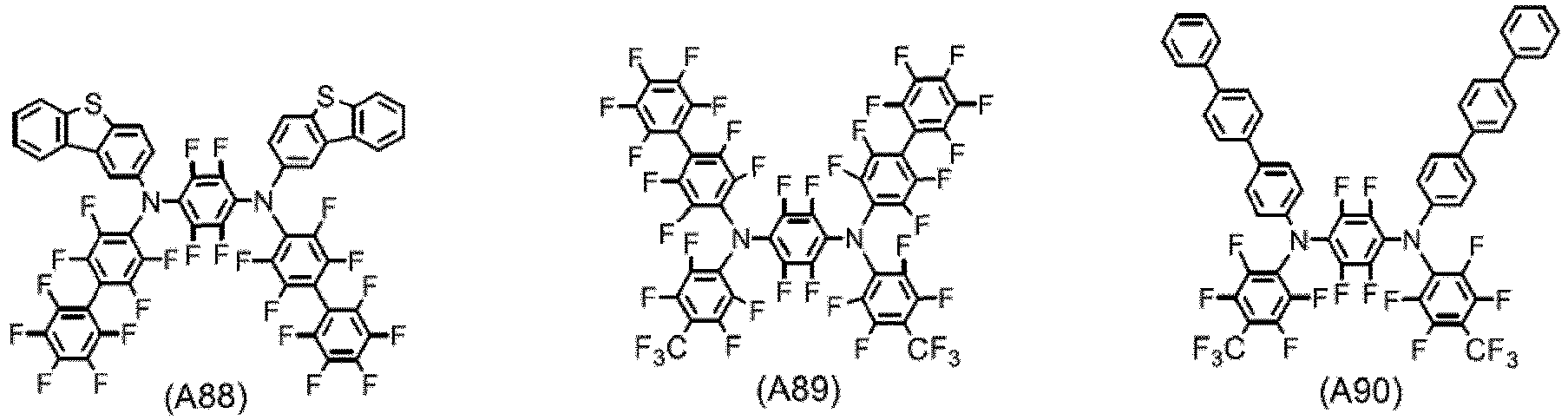


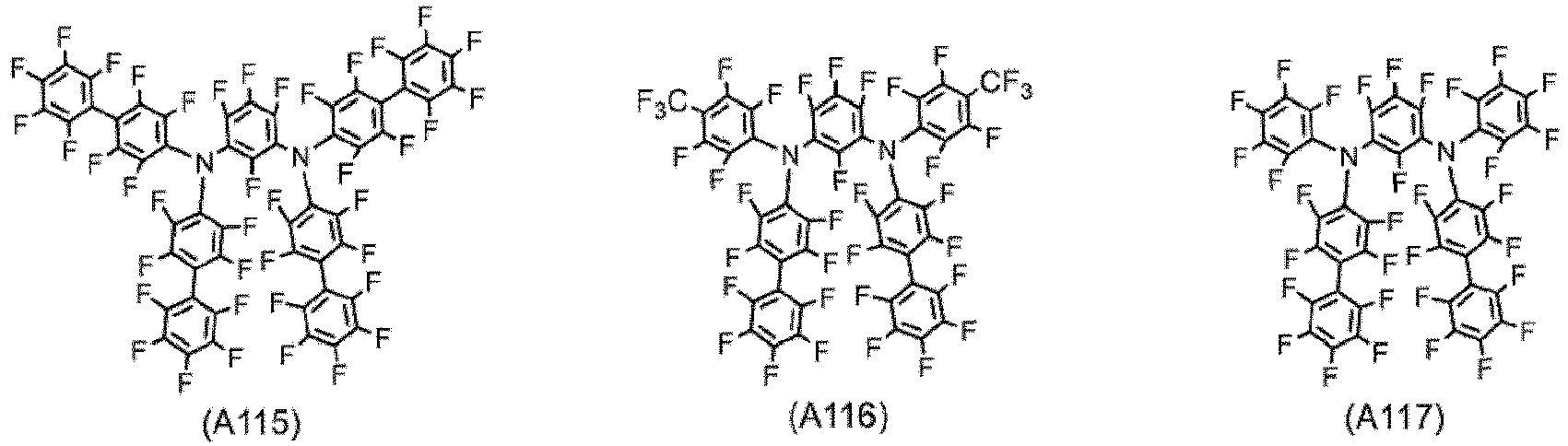

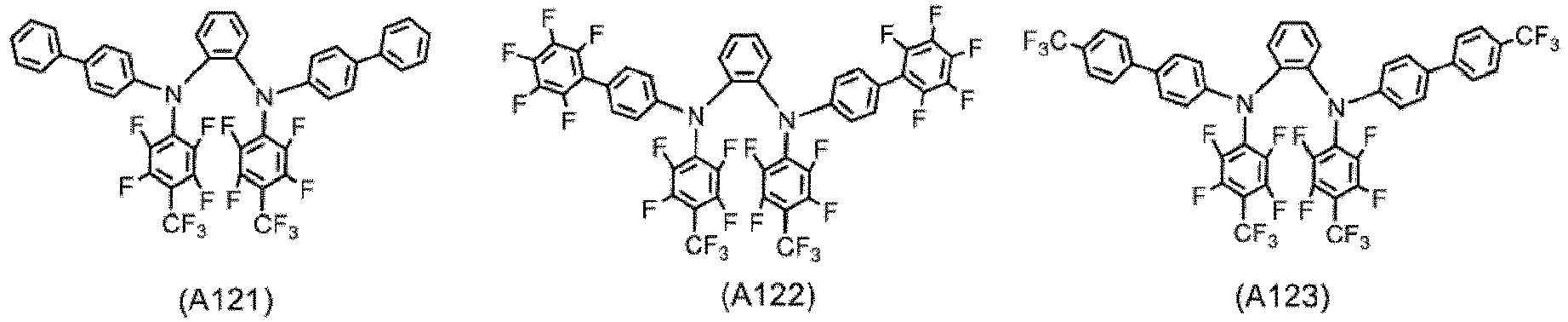

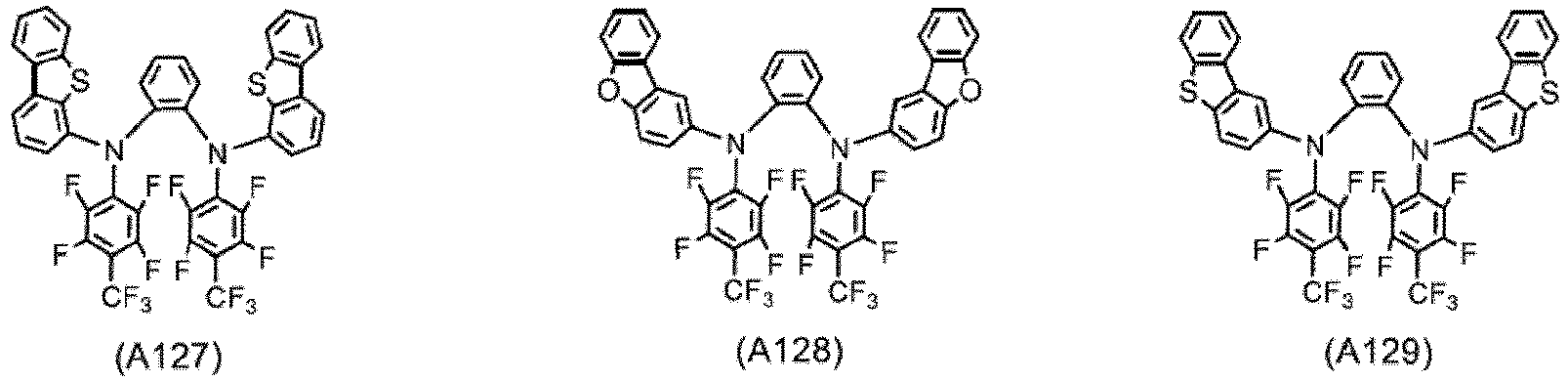
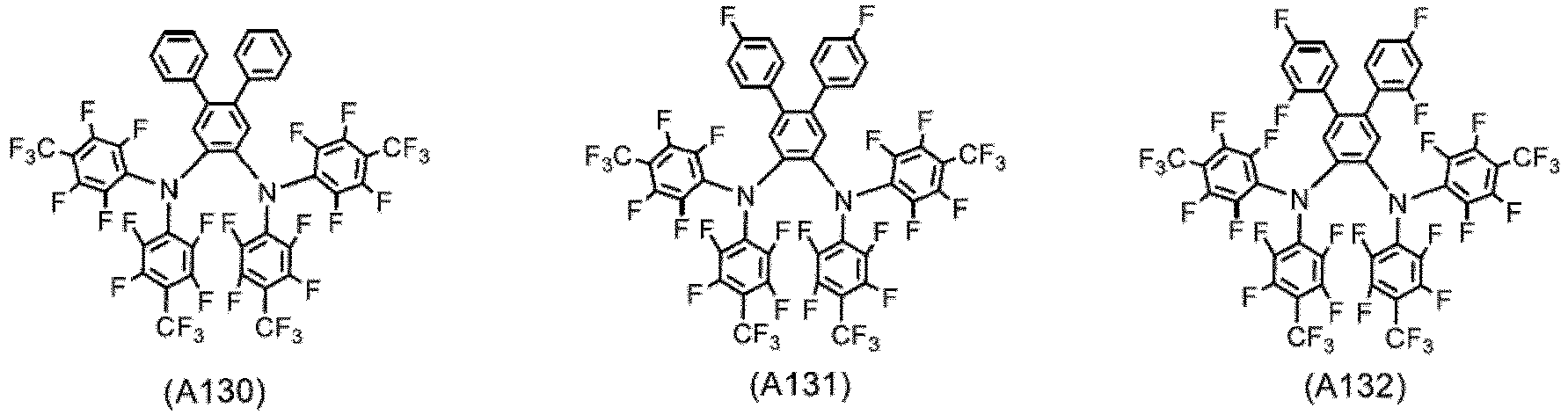

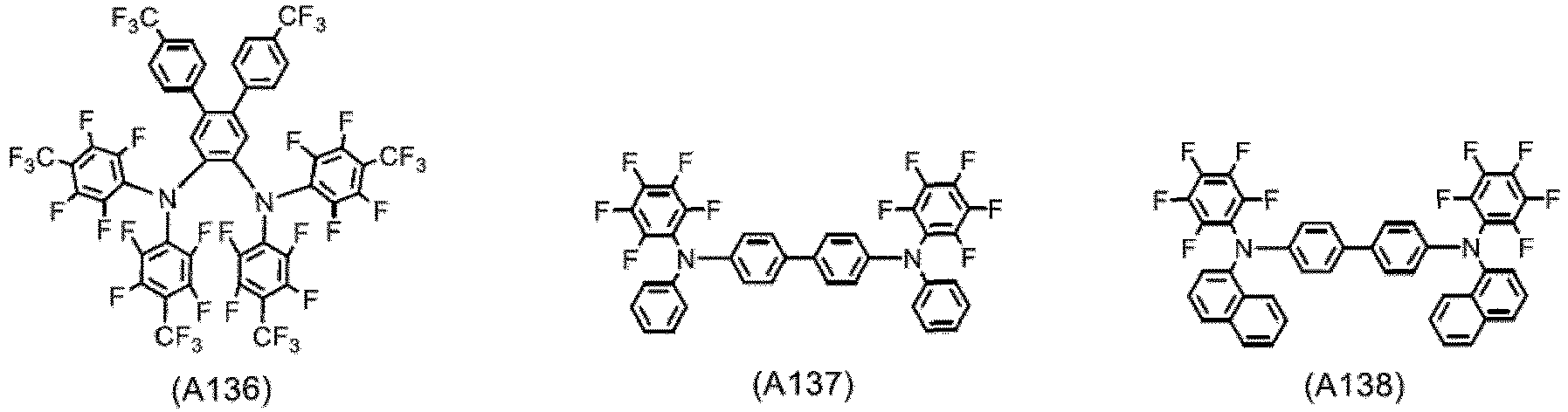


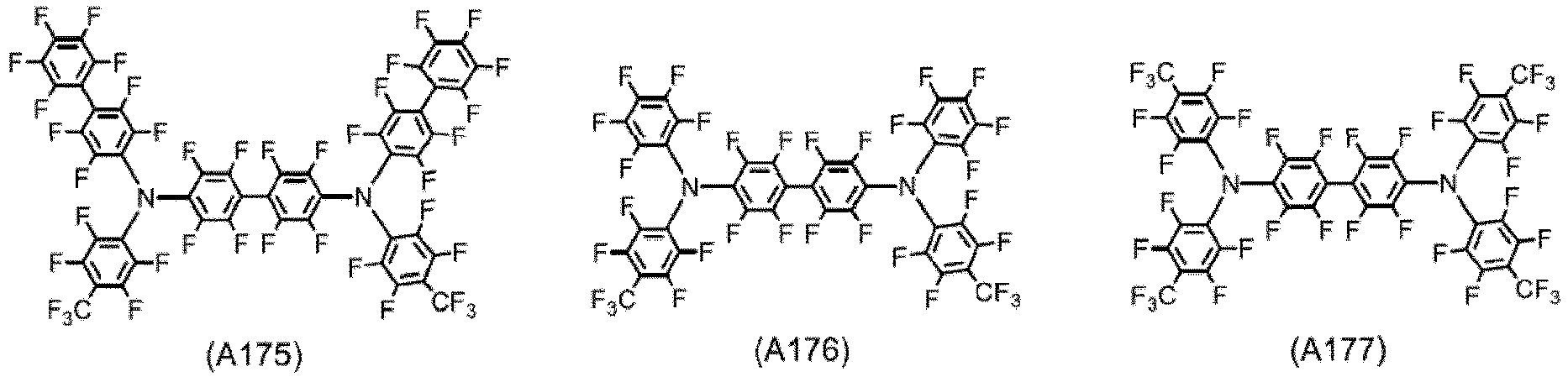


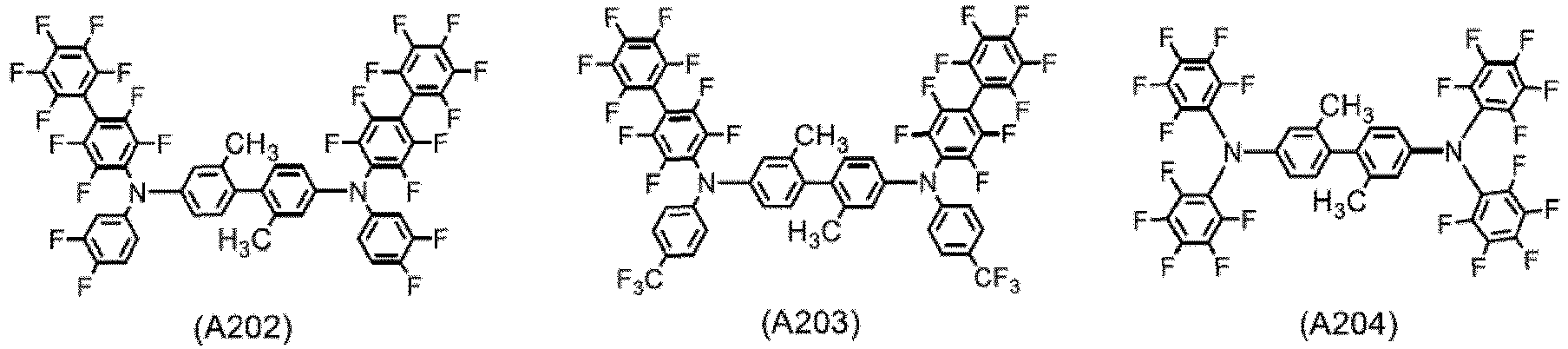


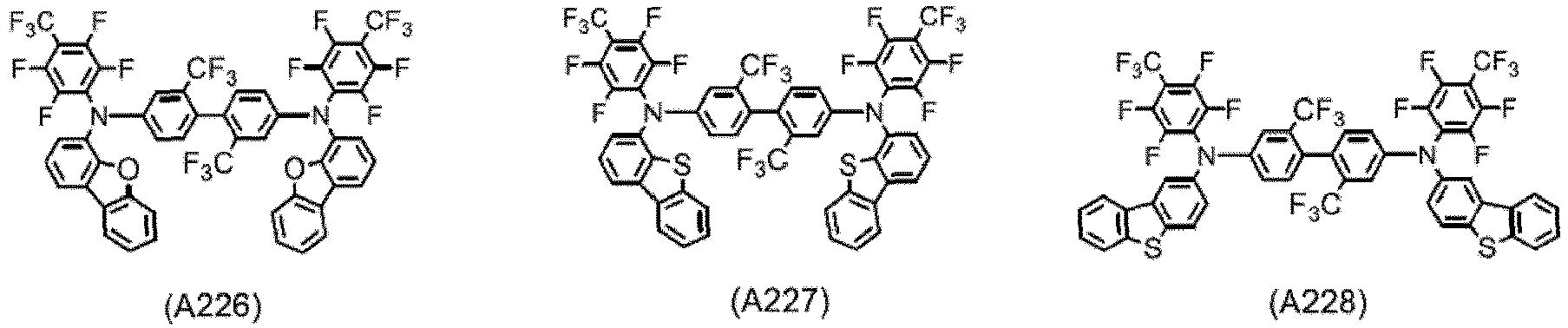


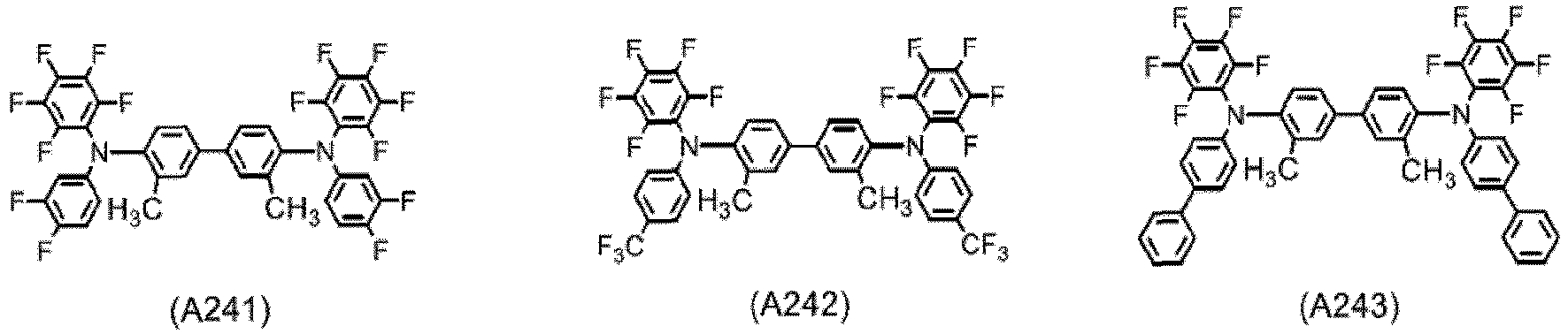


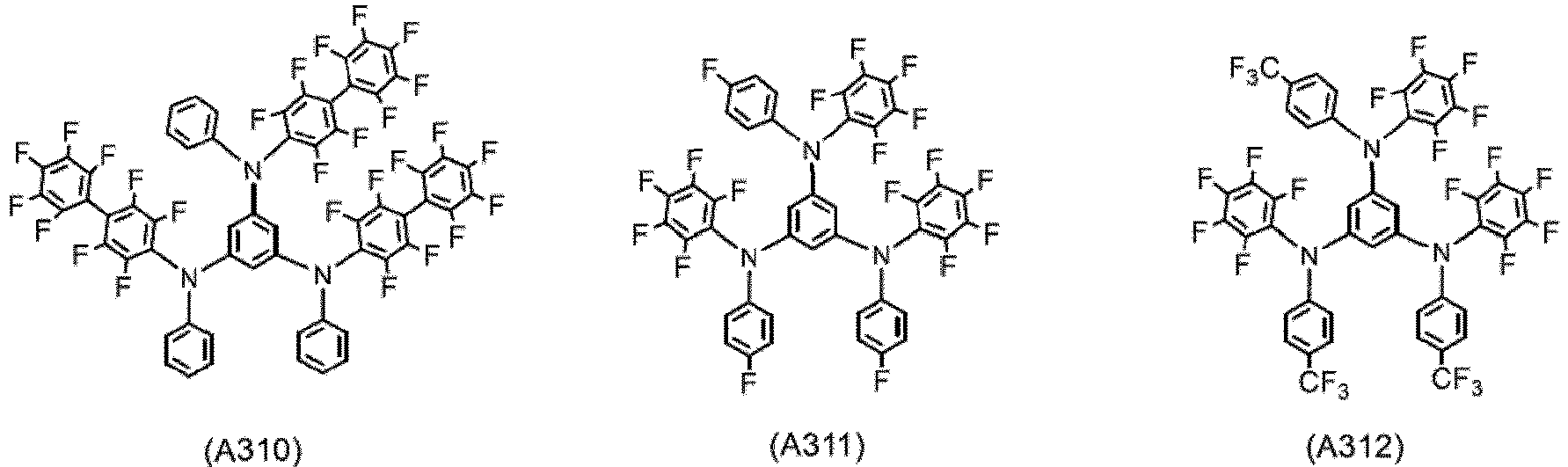


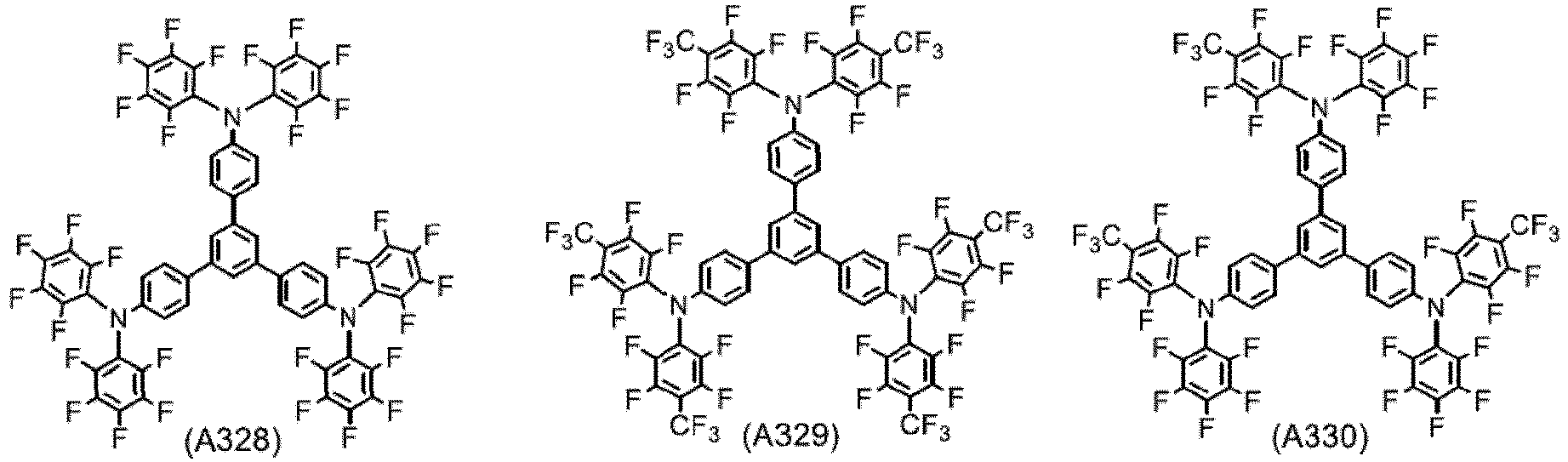

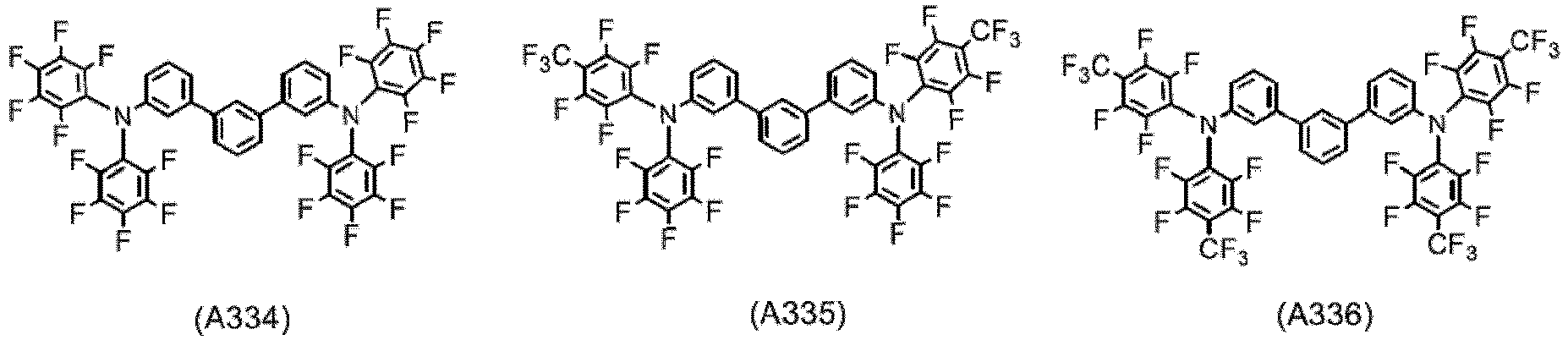


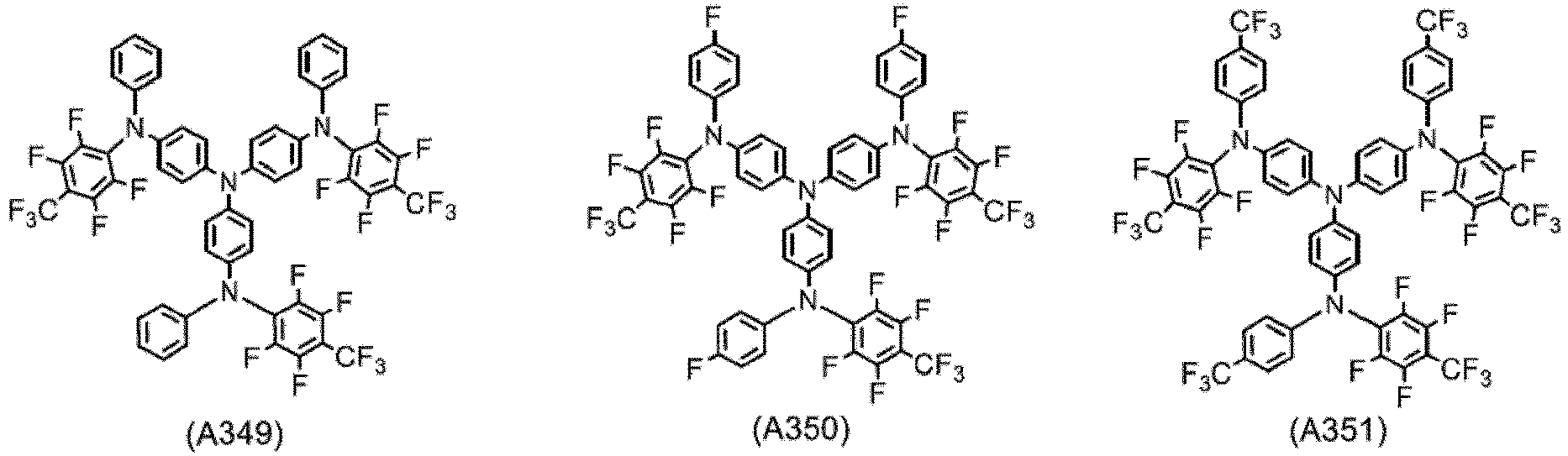
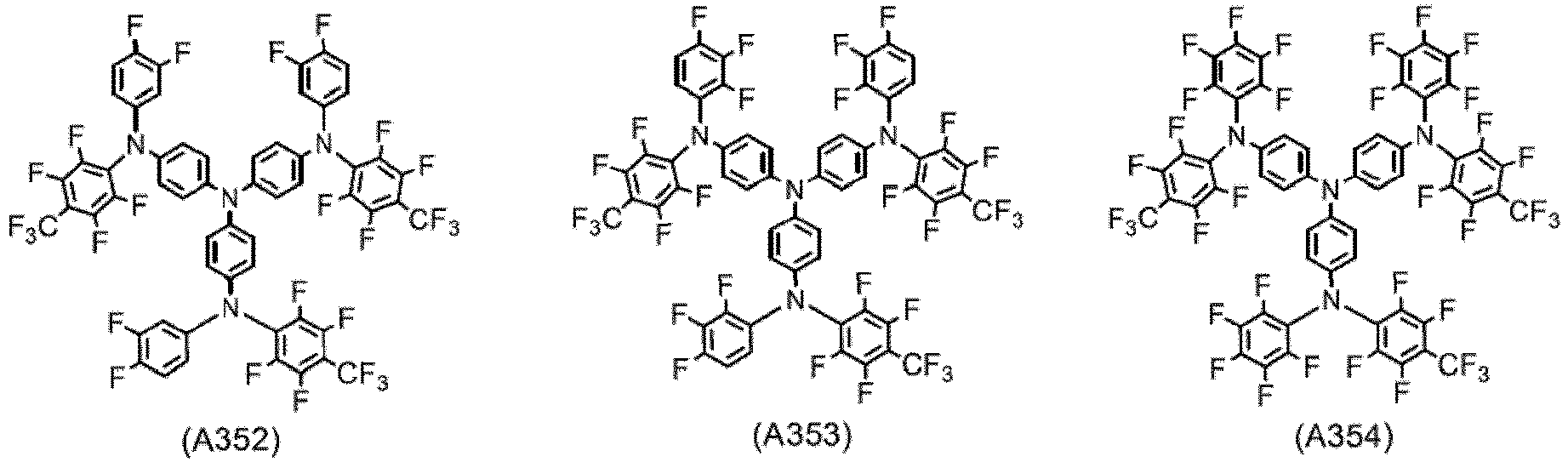


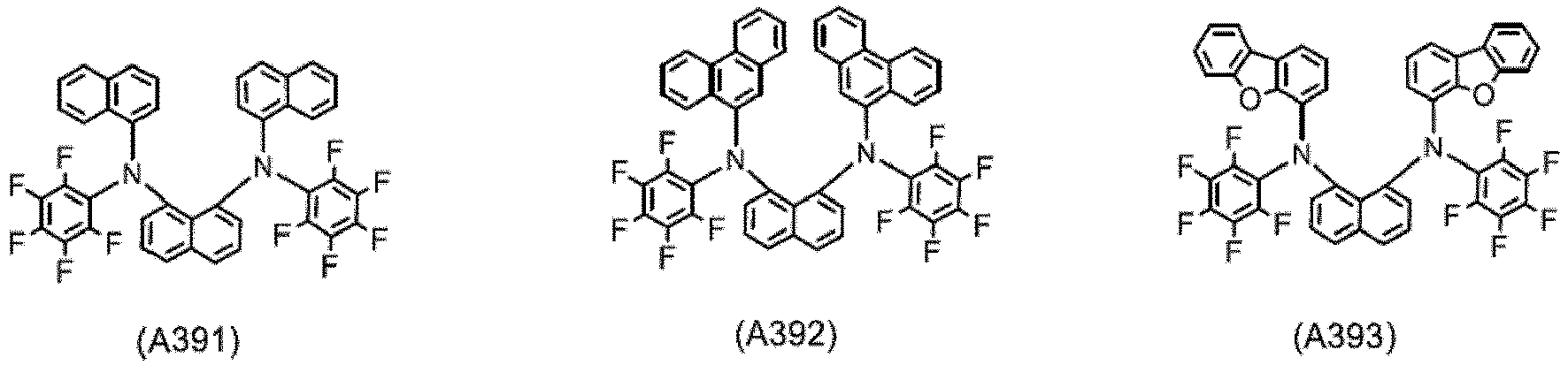

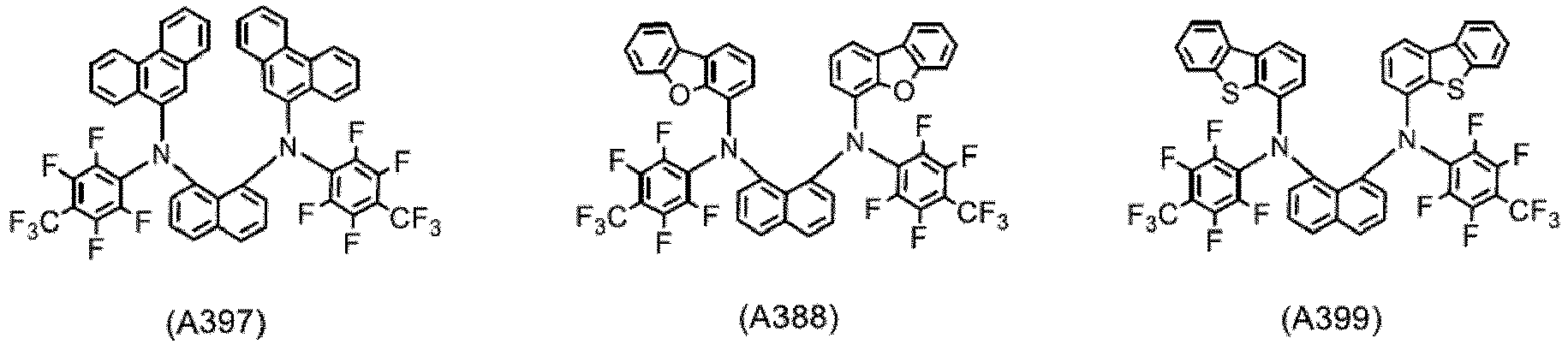


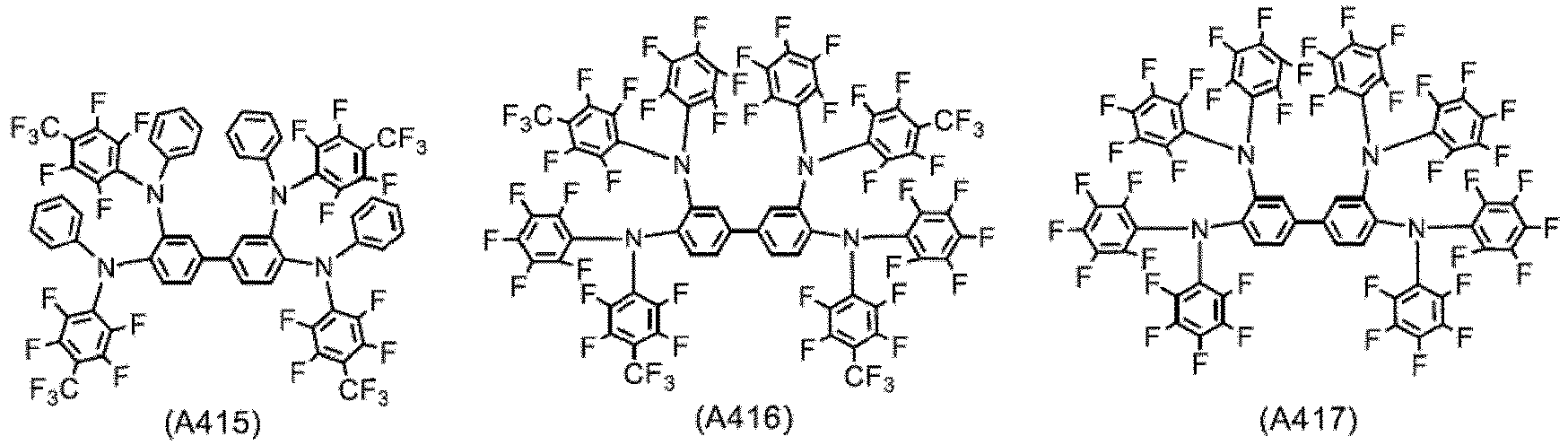


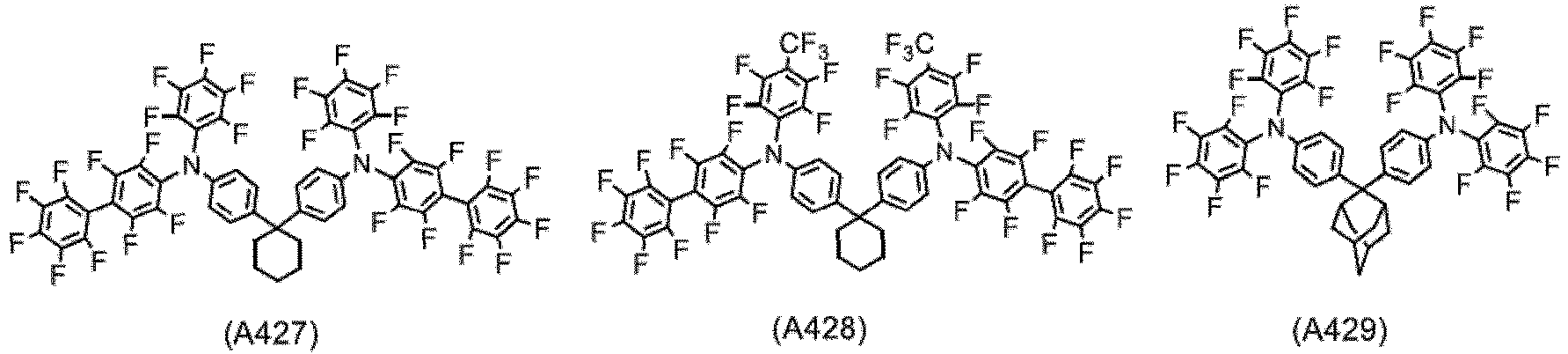


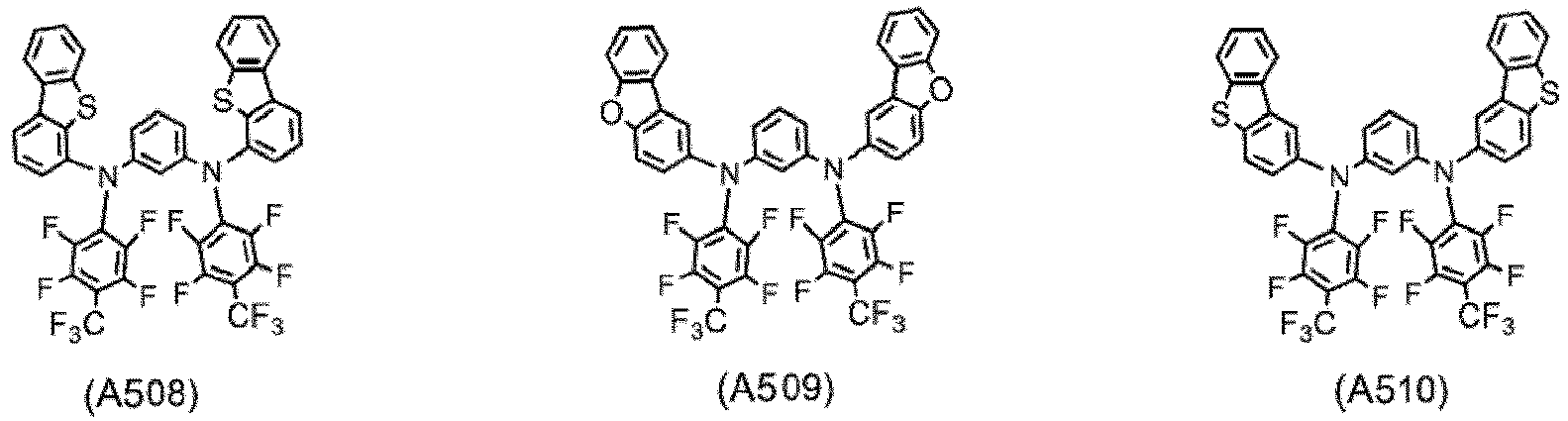


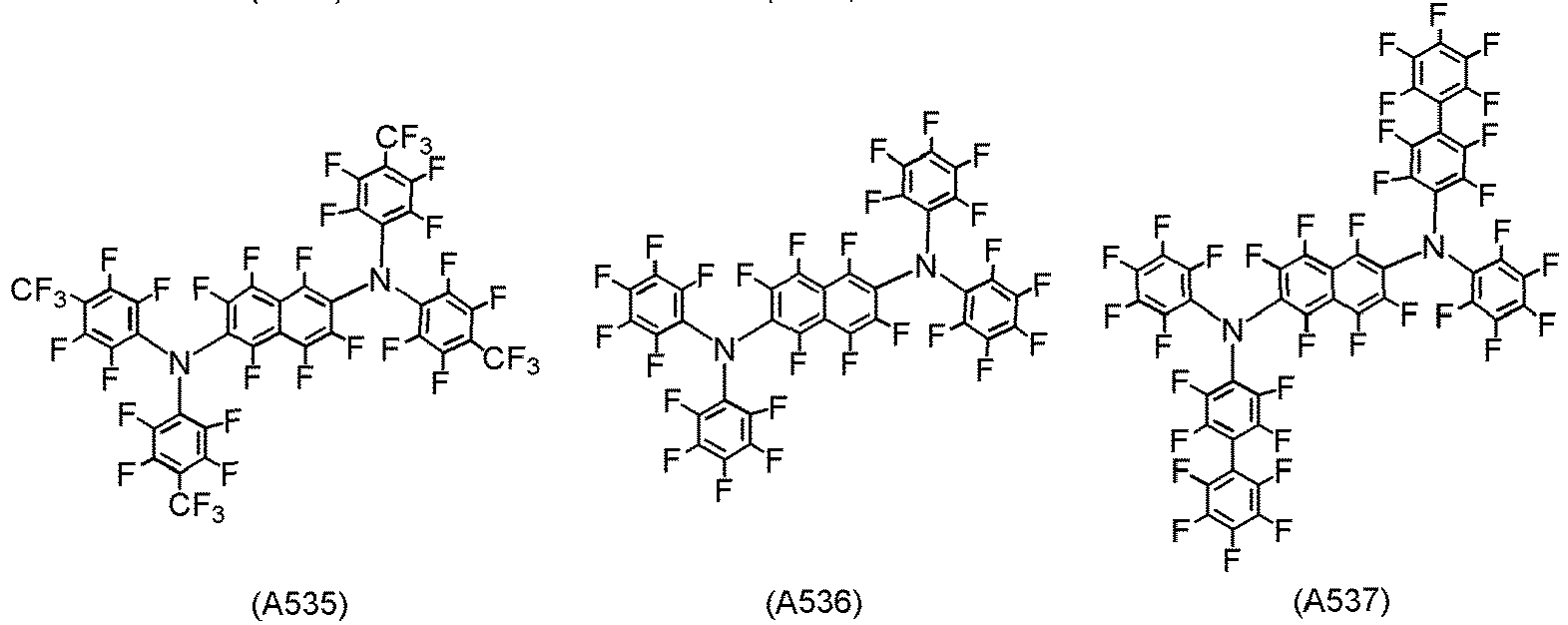


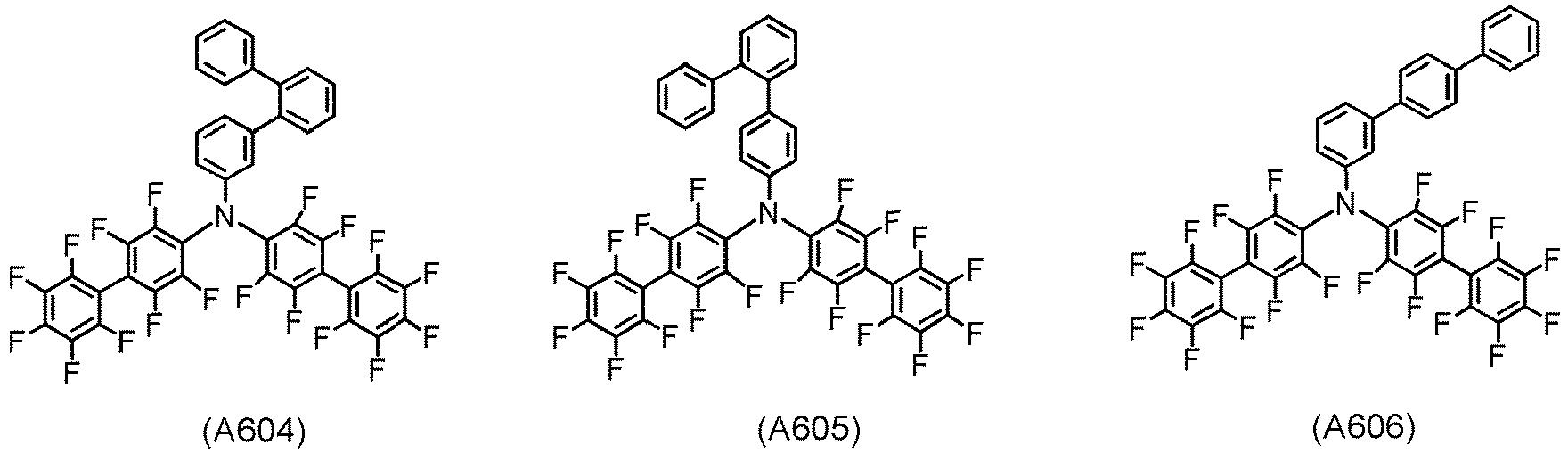


- A metal patterning material according to an embodiment of the present disclosure contains, in the molecule, a compound having an aromatic ring and/or a heteroaromatic ring, and a fluorine atom, in which
- the proportion of the number of carbon atoms directly bonded to a fluorine atom among the number of carbon atoms forming the aromatic ring and the number of carbon atoms forming the heteroaromatic ring is 10% or more,
- the proportion of the number of fluorine atoms relative to the number of carbon atoms in the molecule is 50% or more,
- the molecular weight is 500 to 3000, and
- has a glass transition temperature of 60°C or higher. The metal patterning material does not have nitrogen atoms forming amines in the molecule. In other words, the above-mentioned compound can be used as a metal patterning material.
- The aromatic ring is preferably a monocyclic aromatic rings, a linked aromatic ring, or a condensed aromatic ring having 6 to 25 carbon atom. The metal patterning material has an aromatic group derived from the aromatic ring. As the aromatic group derived from the aromatic ring, for example, a phenyl group, a biphenylyl group, a terfenylyl group, a naphthyl group, a fluorenyl group, a spirobifluorenyl group, a benzofluorenyl group, a dibenzofluorenyl group, a phenanthryl group, a fluoranthenyl group, a triphenylenyl group, a pyrenyl group, an an anthryl group, a tetracenyl group, a crisenyl group, a perylenyl group, and a pentacenyl group, as well as a group in which one or more groups selected from the group consisting of a benzene, a naphthalene, and phenanthrenes are condensed in these groups can be exemplified.
- The heteroaromatic ring is preferably a monocyclic heteroaromatic ring, a linked heteroaromatic ring, or a condensed heteroaromatic ring having 3 to 25 carbon atoms. The metal patterning material has a heteroaromatic group derived from the heteroaromatic ring. As the heteroaromatic group derived from the heteroaromatic ring, for example, a pyrrolyl group, a thienyl group, a furyl group, an imidazolyl group, a thiazolyl group, an isothiazolyl group, an oxazolyl group, an isoxazolyl group, a pyridyl group, a pyrazyl group, a pyrazyl group, an indolyl group, a benzothienyl group, a benzofuranyl group, a benzoimidazolyl group, an indazolyl group, a benzothiazolyl group, a benzoisothiazolyl group, a 2,1,3-benzothiadiazolyl group, a benzoxazolyl group, a benzoisoxazolyl group, a 2,1,3-benzoxadiazolyl group, a quinolyl group, an isoquinolyl group, a carbazolyl group, a dibenzothienyl group, a dibenzofuranyl group, a phenoxazinyl group, a phenothiazinyl group, a phenazinyl group, and a thianthrenyl group, as well as a group in which one or more selected from group consisting of benzene, naphthalene and phenanthrene are condensed in these groups can be exemplified.
- Due to being able to suppress the formation of the metal film on the film surface, the metal patterning material has a proportion of the number of carbon atoms directly bonded to the fluorine atom to the number of carbon atoms forming the aromatic ring and the number of carbon atoms forming the heteroaromatic ring of 10% or more. The proportion is more preferable in the order of 15% or more, 20% or more, 25% or more, 30% or more, 35% or more, or 40% or more.
- Due to being able to suppress the formation of the metal film on the film surface, the metal patterning material has a proportion of the number of fluorine atoms to the number of carbon atoms in the molecule of 50% or more. The proportion is more preferable in the order of 55% or more, 60% or more, 65% or more, 70% or more, 75% or more, 80% or more.
- Due to being able to maintain a stable thin film even under high temperature conditions, the metal patterning material has a glass transition temperature of 60°C or higher. The glass transition temperature is more preferably 65°C or higher, 70°C or higher, 75°C or higher, 80°C or higher, 85°C or higher, 90°C or higher, 95°C or higher, or 100°C or higher.
- The metal patterning material has a molecular weight of 3000 or less, due to being able to lower the heating temperature in vapor deposition and being able to suppress thermal decomposition of the material in the vapor deposition process for forming the thin film. The molecular weight is more preferably 2800 or less, 2500 or less, 2300 or less, 2100 or less, 2000 or less, 1900 or less, 1800 or less, or 1700 or less. The metal patterning material has a molecular weight of 500 or more. The molecular weight is preferably 500 to 2000.
- The metal patterning material is preferably a compound represented by Formula (11).

- In Formula (11),
- Ar21, Ar22, and Ar23 each independently represent
- an optionally substituted monocyclic, linked or condensed aromatic hydrocarbon group having 6 to 25 carbon atoms, or an optionally substituted monocyclic, linked, or condensed heteroaromatic groups of 3 to 25 carbon atoms;
- L29, L30, and L31 each independently represent
- an optionally substituted monocyclic, linked, or condensed monocyclic divalent aromatic hydrocarbon group having 6 to 25 carbon atoms,
- an optionally substituted monocyclic, linked or condensed divalent heteroaromatic group having 3 to 25 carbon atoms,
- an optionally substituted linear, branched or cyclic divalent alkyl group having 1 to 10 carbon atoms, or
- a single bond;
- j, k and 1 each independently represent an integer of 0 to 6; (j+k+l) is 2 or more and 6 or less;
- Z represents
- an optionally substituted monocyclic, linked, or condensed aromatic hydrocarbon group having 6 to 25 carbon atoms,
- an optionally substituted monocyclic, linked or condensed dito hexavalent heteroaromatic group having 3 to 25 carbon atoms,
- an optionally substituted linear, branched or cyclic di- to hexavalent alkyl groups having 1 to 10 carbon atoms, and a di- to tetravalent silicon atom.
- When Ar21 to Ar23 are substituted aromatic hydrocarbon groups or substituted heteroaromatic groups, each of these groups is independently substituted with one or more groups selected from the group consisting of:
- a linear, branched, or cyclic alkyl group having 1 to 18 carbon atoms which may be substituted with a fluorine atom, a linear, branched, or cyclic alkoxy group having 1 to 18 carbon atoms which may be substituted with a fluorine atom, an aromatic hydrocarbon group having 6 to 20 carbon atoms which may be substituted with a fluorine atom,
- a heteroaromatic group having 3 to 20 carbon atoms which may be substituted with a fluorine atom,
- a cyano group,
- a fluorine atom, or
- a deuterium atom;
- when L29 to L31 are substituted divalent aromatic hydrocarbon groups or substituted divalent heteroaromatic groups, each of these groups preferably is independently substituted with one or more groups selected from the group consisting of:
- a linear, branched, or cyclic alkyl group having 1 to 18 carbon atoms which may be substituted with a fluorine atom;
- a linear, branched, or cyclic alkoxy group having 1 to 18 carbon atoms which may be substituted with a fluorine atom;
- an aromatic hydrocarbon group having 6 to 20 carbon atoms which may be substituted with a fluorine atom;
- a heteroaromatic group having 3 to 20 carbon atoms which may be substituted with a fluorine atom;
- a cyano group,
- a fluorine atom, or
- a deuterium atom;
- when Z is a substituted di- to hexavalent aromatic hydrocarbon group, a substituted di- to hexavalent heteroaromatic group, a substituted di- to hexavalent alkyl group, or a di- to tetravalent silicon atom, each of these groups preferably is independently substituted with one or more groups selected from the group consisting of:
- a linear, branched, or cyclic alkyl group having 1 to 18 carbon atoms which may be substituted with a fluorine atom;
- a linear, branched, or cyclic alkoxy group having 1 to 18 carbon atoms which may be substituted with a fluorine atom;
- an aromatic hydrocarbon group having 6 to 20 carbon atoms which may be substituted with a fluorine atom;
- a heteroaromatic group having 3 to 20 carbon atoms which may be substituted with a fluorine atom;
- a cyano group,
- a fluorine atom, or
- a deuterium atom.
- As the monocyclic, linked, or condensed pentavalent aromatic hydrocarbon group having 6 to 25 carbon atoms, for example, a phenylpentayl group, a biphenylpentayl group, a terphenylpentayl group, a naphthylpentayl group, a fluorenepentayl group, a spirobifluorenepentayl group, a benzofluorenepile group, a dibenzofluorenepentayl group, a phenanthrenepentayl group, a fluoranthenepentayl group, a triphenylenepentayl group, a pyrenepentayl group, an anthracene pentayl group, a tetracene pentayl group, a chrysene pentayl group, a perylene pentayl group, and a pentacene pentayl group, as well as a group in which one or more rings selected from the group consisting of benzene, naphthalene, and phenanthrene are condensed in these groups can be exemplified.
- As the monocyclic, linked, or condensed pentavalent heteroaromatic group having 3 to 25 carbon atoms, for example, a pyridine pentayl group, an indole pentayl group, a benzothiophene pentayl group, a benzofuran pentayl group, a benzimidazole pentayl group, an indazole pentayl group, a benzothiazole pentayl group, a benzoisothiazole pentayl group, a benzoxazole pentayl group, a benzoisoxazole pentayl group, a benzoisoxazole pentayl group, a quinoline pentayl group, an isoquinoline pentayl group, a carbazole pentayl group, a dibenzothiophene pentayl group, a dibenzofuran pentayl group, a phenoxazine pentayl group, a phenothiazine pentayl group, a phenazine pentayl group, and a thianthrene pentayl group, as well as a group in which one or more selected from the group consisting of benzene, naphthalene, and phenanthrene are condensed in these groups can be exemplified.
- As the linear, branched, or cyclic pentavalent alkyl group having 1 to 10 carbon atoms, for example, an ethyl pentayl group, a propane pentayl group, a butane pentayl group, a pentane pentayl group, a hexane pentayl group, a cyclohexane pentayl group, and an adamantane pentayl group can be exemplified.
- As the monocyclic, linked, or condensed hexavalent aromatic hydrocarbon group having 6 to 25 carbon atoms, for example, a phenylhexayl group, a biphenylhexayl group, a terphenylhexayl group, a naphthylhexayl group, a fluorenehexayl group, a spirobifluorenehexayl group, a benzofluorenehexayl group, a dibenzofluorenehexayl group, a phenanthrenehexayl group, a fluoranthenehexayl group, a triphenylenehexayl group, a pyrenehexayl group, an anthracenehexayl group, a tetracenehexayl group, a chrysenehexayl group, a perylenehexayl group, a pentacenehexayl group, and a group in which one or more selected from the group consisting of benzene, naphthalene, and phenanthrene are condensed in these groups can be exemplified.
- As the monocyclic, linked, or condensed heterocyclic heteroaromatic group having 3 to 25 carbon atoms, for example, a pyridinehexayl group, an indolehexayl group, a benzothiophenehexayl group, a benzofuranhexayl group, a benzoimidazolehexayl group, an indazolehexayl group, a benzoisothiazolehexayl group, a benzooxazolehexayl group, a benzoxazolehexayl group, a benzoisoxazolehexayl group, a quinolinehexayl group, an isoquinolinehexayl group, a carbazolehexayl group, a dibenzothiophenehexayl group, a dibenzofuranhexayl group, a phenoxazinehexayl group, a phenothiazinehexayl group, a phenazinehexayl group, and a thianthrenehexayl group, as well as a group in which one or more groups selected from the group consisting of benzene, naphthalene, and phenanthrene are condensed in these groups can be exemplified.
- As the linear, branched or cyclic hexavalent alkyl group having 1 to 10 carbon atoms, for example, an ethylhexayl group, a propanehexayl group, a butanehexayl group, a pentanehexayl group, a hexanehexayl group, a cyclohexanehexayl group, and an adamantanehexayl group can be exemplified.
- It should be noted that, as described above, the monocyclic, linked or condensed penta- to hexavalent aromatic hydrocarbon group having 6 to 25 carbon atoms; the monocyclic, linked, or condensed penta- to hexavalent heteroaromatic group having 3 to 25 carbon atoms; and the linear, branched, or cyclic penta- to hexavalent alkyl group having 1 to 10 carbon atoms may have a substituent. When these have a substituent, each is preferably independently substituted by one or more groups selected from the group consisting of: a linear, branched, or cyclic alkyl group having 1 to 18 carbon atoms which may be substituted with a fluorine atom, a linear, branched, or cyclic alkoxy group having 1 to 18 carbon atoms which may be substituted with a fluorine atom, an aromatic hydrocarbon group having 6 to 20 carbon atoms which may be substituted with a fluorine atom, a heteroaromatic group having 3 to 20 carbon atoms which may be substituted with a fluorine atom, a cyano group, a fluorine atom, or a deuterium atom. In this case, the number of substituents is not particularly limited.
- In Formula (11), the monocyclic, linked, or condensed aromatic hydrocarbon group having 6 to 25 carbon atoms; monocyclic, linked, or condensed heteroaromatic group having 3 to 25 carbon atoms; monocyclic, linked, or condensed aromatic hydrocarbon group having 6 to 25 carbon atoms; a monocyclic, linked or condensed divalent heteroaromatic group having 3 to 25 carbon atoms; linear, branched or cyclic divalent alkyl group having 1 to 10 carbon atoms; monocyclic, linked, or condensed trivalent aromatic hydrocarbon group having 6 to 25 carbon atoms; monocyclic, linked or condensed trivalent heteroaromatic group having 3 to 25 carbon atoms; linear, branched or cyclic trivalent alkyl group having 1 to 10 carbon atoms; monocyclic, linked, or condensed tetravalent aromatic hydrocarbon group having 6 to 25 carbon atoms; monocyclic, linked or condensed tetravalent heteroaromatic group having 3 to 25 carbon atoms; linear, branched or cyclic tetravalent alkyl groups having 1 to 10 carbon atoms; linear, branched, or cyclic alkyl group having 1 to 18 carbon atoms which may be substituted with a fluorine atom; linear, branched, or cyclic alkoxy group having 1 to 18 carbon atoms which may be substituted with a fluorine atom; aromatic hydrocarbon group having 6 to 20 carbon atoms which may be substituted with a fluorine atom; heteroaromatic group having 3 to 20 carbon atoms which may be substituted with a fluorine atom; aromatic hydrocarbon group having 6 to 25 carbon atoms; monocyclic, linked, or condensed heteroaromatic group having 3 to 25 carbon atoms; monocyclic, linked, or condensed aromatic hydrocarbon group having 6 to 25 carbon atoms; monocyclic, linked or condensed divalent heteroaromatic group having 3 to 25 carbon atoms; linear, branched or cyclic divalent alkyl group having 1 to 10 carbon atoms; monocyclic, linked, or condensed trivalent aromatic hydrocarbon group having 6 to 25 carbon atoms; monocyclic, linked or condensed trivalent heteroaromatic group having 3 to 25 carbon atoms; linear, branched or cyclic trivalent alkyl group having 1 to 10 carbon atoms; monocyclic, linked, or condensed tetravalent aromatic hydrocarbon group having 6 to 25 carbon atoms; monocyclic, linked or condensed tetravalent heteroaromatic group having 3 to 25 carbon atoms; linear, branched or cyclic tetravalent alkyl groups having 1 to 10 carbon atoms; linear, branched, or cyclic alkyl group having 1 to 18 carbon atoms which may be substituted with a fluorine atom; linear, branched, or cyclic alkoxy group having 1 to 18 carbon atoms which may be substituted with a fluorine atom; aromatic hydrocarbon group having 6 to 20 carbon atoms which may be substituted with a fluorine atom; heteroaromatic group having 3 to 20 carbon atoms which may be substituted with a fluorine atom are synonymous. It should be noted that, due to being able to suppress the formation of the metal film on the surface of the film, the number of carbon atoms of the condensed aromatic hydrocarbon group in Formula (11) is preferably 6 or more and 15 or less. Specifically, it is preferably from 6 to 15, more preferably from 6 to 14, and still more preferably from 6 to 13.
- In Formula (11), due to having a high glass transition temperature and being able to suppress the formation of a metal film on the film surface, Ar21 to Ar23 preferably each independently represent:
- (xxxi) a phenyl group, a biphenylyl group, a terphenylyl group, a naphthyl group, a fluorenyl group, a spirobifluorenyl group, a benzofluorenyl group, a phenanthryl group, a fluoranthenyl group, a triphenylenyl group, an anthryl group, a pyrenyl group, a pyridyl group, a carbazolyl group, a benzofuranyl group, a benzothienyl group, a dibenzofuranyl group, or a dibenzothienyl group; or
- (xxxii) a group in which the group represented by (xxxi) is substituted with one or more groups selected from the group consisting of: a methyl group, an ethyl group, a methoxy group, an ethoxy group, a trifluoromethyl group, a trifluoromethoxy group, an adamantyl group, a cyclohexyl group, a perfluoroalkyl group having 2 to 10 carbon atoms, a perfluoroalkoxy group having 2 to 10 carbon atoms, a cyano group, a deuterium atom, a phenyl group optionally substituted with a fluorine atom, a biphenyl group optionally substituted with a fluorine atom, a naphthyl group optionally substituted with a fluorine atom, a phenanthryl group which may be substituted with a fluorine atom, a pyridyl group which may be substituted with a fluorine atom, a carbazolyl group which may be substituted with a fluorine atom, a dibenzothienyl group which may be substituted with a fluorine atom, and a dibenzofuranyl group which may be substituted with a fluorine atom.
- Due to having a high glass transition temperature and being able to suppress the formation of a metal film on the film surface, Ar21 to Ar23 more preferably each independently represent:
- (xxxi') a phenyl group, a biphenylyl group, a terphenylyl group, a naphthyl group, a fluorenyl group, a spirobifluorenyl group, a phenanthryl group, a fluoranthenyl group, a triphenylenyl group, an anthryl group, a pyrenyl group, a pyridyl group, a carbazolyl group, a dibenzofuranyl group, or a dibenzothienyl group; or
- (xxxii') a group in which the group represented by (xxxi') is substituted with one or more groups selected from the group consisting of a methyl group, a trifluoromethyl group, a perfluoroalkyl group having 2 to 10 carbon atoms, a fluorine atom, and a phenyl group optionally substituted with a fluorine atom.
- Due to having a high glass transition temperature and being able to suppress the formation of a metal film on the film surface, Ar21 to Ar23 still more preferably each independently represent: a phenyl group, a phenyl group having at least one fluorine atom, a phenyl group having at least one trifluoromethyl group, a biphenylyl group, a biphenylyl group having at least one fluorine atom, a biphenylyl group having at least one trifluoromethyl group, a terphenylyl group, a terfenylyl group having at least one fluorine atom, a terphenylyl group having at least one trifluoromethyl group, a naphthyl group, a 9,9-dimethylfluorenyl group, a 9,9-diphenylfluorenyl group, a spirobiflurenyl group, a phenanthryl group, a carbazol-9-yl group, a 9-phenylcarbazolyl group, a dibenzofuranyl group, or a dibenzothienyl group.
- In Formula (11), due to having a high glass transition temperature and being able to suppress the formation of a metal film on the film surface, L29 to L31 preferably each independently represent:
- (xxxiii) a phenylene group, a biphenylylene group, a terphenylene group, a naphthylene group, a pyridylene group, or a fluorenylene group;
- (xxxix) a group in which the group represented by (xxxiii) is substituted with one or more groups selected from the group consisting of: a methyl group, an ethyl group, a methoxy group, an ethoxy group, a trifluoromethyl group, a trifluoromethoxy group, a perfluoroalkyl group having 2 to 10 carbon atoms, a perfluoroalkoxy group having 2 to 10 carbon atoms, a cyano group, a deuterium atom, a fluorine atom, a phenyl group optionally substituted with a fluorine atom, a biphenylyl group optionally substituted with a fluorine atom, a naphthyl group optionally substituted with a fluorine atom, a phenanthryl group optionally substituted with a fluorine atom, a pyridyl group optionally substituted with a fluorine atom, a carbazolyl group optionally substituted with a fluorine atom, a dibenzothienyl group optionally substituted with a fluorine atom, and a dibenzofuranyl group optionally substituted with a fluorine atom; or
- (xxxv) a single bond.
- In Formula (11), due to having a high glass transition temperature and being able to suppress the formation of a metal film on the film surface, L29 to L31 more preferably each independently represent:
- (xxxiii') a phenylene group, a biphenylylene group, a terphenylylene group, a naphthylene group, a pyridylene group, or a fluorenylene group;
- (xxxiv') a group in which the group represented by the above (xxxiii') is substituted with one or more groups selected from the group consisting of a methyl group, a trifluoromethyl group, a fluorine atom and a phenyl group optionally substituted with a fluorine atom; or
- (xxxv') a single bond.
- In Formula (11), due to having a high glass transition temperature and being able to suppress the formation of a metal film on the film surface, L29 to L31 still more preferably each independently represent: a phenylene group, a phenylene group having at least one fluorine atom, a phenylene group having at least one trifluoromethyl group, a biphenylylene group, a biphenylylene group having at least one fluorine atom, a biphenylylene group having at least one trifluoromethyl group, a terphenylylene group, a terphenylylene group having at least one fluorine atom, a terphenylylene group having at least one trifluoromethyl group, a naphthylene group, or a single bond.
- In Formula (11), due to having a high glass transition temperature and being able to suppress the formation of a metal film on the film surface, Z preferably represents:
- (xxxvi) a monovalent phenyl group, a biphenylyl group, a terphenylyl group, naphthyl group, a fluorenyl group, a spirobifluorenyl group, a benzofluorenyl group, a phenanthryl group, a fluoranthenyl group, a triphenylenyl group, a anthryl group, a pyrenyl group, a pyridyl group, a pyridyl group, a carbazolyl group, a benzofuranyl group, a benzothienyl group, a dibenzofuranyl group, a dibenzothienyl group, a cyclohexyl group, an adamantyl group, a methyl group, or a silyl group;
- (xxxvii) a divalent phenylene group, a biphenylene group, a terphenylene group, a naphthylene group, a fluorenylene group, a spirobifluorenylene group, a benzofluorenylene group, a phenanetriene group, a fluoranthenylene group, a triphenylenylene group, an anthrylene group, a pyrenylene group, a pyridylene group, a carbazolylene group, a benzofuranylene group, a benzothienylene group, a dibenzofuranylene group, a dibenzothienylene group, a cyclohexylene group, an adamantylene group, a methylene group, or a silanediyl group;
- (xxxviii) a trivalent phenyltriyl group, a biphenyltriyl group, a terphenyltriyl group, a naphthylyl group, a fluorenetriyl group, a spirobiflurenetriyl group, a benzofluorenetriyl group, a phenanthrenetriyl group, a fluoranthenetriyl group, a triphenylenetriyl group, an anthracenetriyl group, a pyrenetriyl group, a pyridinetriyl group, a carbazoletriyl group, a benzofurantriyl group, a benzothiophenetriyl group, a dibenzofurantriyl group, a dibenzothiophenetriyl group, a cyclohexanetriyl group, an adamantanetriyl group, a methanetriyl group, or a silanetriyl group;
- (xxxiv) a tetravalent phenyl tetrayl group, a biphenyl tetrayl group, a terphenyl tetrayl group, a naphthyl tetrayl group, a fluorene tetrayl group, a spirobifluorene tetrayl group, a benzofluorene tetrayl group, a phenanthrene tetrayl group, a fluoranthene tetrayl group, a triphenylene tetrayl group, an anthracene tetrayl group, a pyrene tetrayl group, a pyridine tetrayl group, a carbazole tetrayl group, a benzofuran tetrayl group, a benzothiophene tetrayl group, a dibenzofuran tetrayl group, a dibenzothiophene tetrayl group, a cyclohexane tetrayl group, an adamantane tetrayl group, a methane tetrayl group, or a silane tetrayl group; or
- (xxxx) a pentavalent phenylpentayl group, a biphenyl pentayl group, a terphenyl pentayl group, a naphthyl pentayl group, a fluorene pentayl group, a spirobifluorene pentayl group, a benzofluorene pentayl group, a phenanthrene pentayl group, a fluoranthene pentayl group, a triphenylene pentayl group, an anthracene pentayl group, a pyrene pentayl group, a pyridine pentayl group, a carbazole pentayl group, a benzofuran pentayl group, a benzothiophenepentayl group, a dibenzofuranepentayl group, a dibenzothiophenepentayl group, a cyclohexanepentayl group, or an adamantanepentayl group; or
- (xxxxi) a hexavalent phenylhexayl group, a biphenylhexayl group, a terphenylhexayl group, a naphthylhexayl group, a fluorenehexayl group, a spirobifluorenehexayl group, a benzofluorenehexayl group, a phenanthrenehexayl group, a fluoranthenehexayl group, a triphenylenehexayl group, an anthracenehexayl group, a pyrenehexayl group, a pyridinehexayl group, a carbazolehexayl group, a benzofuranhexayl group, a benzothiophenehexayl group, a dibenzofuranhexayl group, a dibenzothiophenehexayl group, a cyclohexanehexayl group, or an adamantanehexayl group; or
- (xxxxii) a group in which the group represented by (xxxvi) to (xxxxi) is substituted with one or more groups selected from the group consisting of: a methyl group, an ethyl group, a methoxy group, an ethoxy group, a trifluoromethyl group, a trifluoromethoxy group, an adamantyl group, a cyclohexyl group, a perfluoroalkyl group having 2 to 10 carbon atoms, a perfluoroalkoxy group having 2 to 10 carbon atoms, a cyano group, a deuterium atom, a fluorine atom, a phenyl group optionally substituted with a fluorine atom, a biphenyl group optionally substituted with a fluorine atom, a naphthyl group which may be substituted with a fluorine atom, a phenanthryl group which may be substituted with a fluorine atom, a pyridyl group which may be substituted with a fluorine atom, a carbazolyl group which may be substituted with a fluorine atom, a dibenzothienyl group which may be substituted with a fluorine atom, and a dibenzofuranyl group which may be substituted with a fluorine atom.
- It more preferably represents: (xxxvi') a monovalent phenyl group, a biphenylyl group, a terphenylyl group, a naphthyl group, a fluorenyl group, a pyridyl group, a cyclohexyl group, an adamantyl group, a methyl group, or a silyl group;
- (xxxvii') a divalent phenylene group, a biphenylene group, a terphenylene group, a naphthylene group, a fluorenylene group, a pyridylene group, a cyclohexylene group, an adamantylene group, a methylene group, or a silanediyl group;
- (xxxviiii') a trivalent phenyltriyl group, a biphenyltriyl group, a terphenyltriyl group, a naphthyltriyl group, a fluorenetriyl group, a pyridinetriyl group, a cyclohexanetriyl group, an adamantanetriyl group, a methanetriyl group, or a silanetriyl group;
- (xxxix') a tetravalent phenyl tetrayl group, a biphenyl tetrayl group, a terphenyl tetrayl group, a naphthyl tetrayl group, a fluorene tetrayl group, a pyridine tetrayl group, a cyclohexane tetrayl group, an adamantane tetrayl group, a methane tetrayl group, or a silane tetrayl group; or
- (xxxx') a pentavalent phenylpentayl group, a biphenylpentayl group, a terphenylpentayl group, a naphthylpentayl group, a fluorenepentayl group, a pyridinepentayl group, a cyclohexanepentayl group, or a adamantanepentayl group; or (xxxxi') a hexavalent phenylhexayl group, a biphenylhexayl group, a terphenylhexayl group, a naphthylhexayl group, a fluorenehexayl group, a cyclohexanehexayl group, or an adamantanehexayl group; or
- (xxxxii') a group in which the group represented by any one of (xxxvi') to (xxxxii') is substituted with one or more groups selected from the group consisting of a methyl group, a trifluoromethyl group, a perfluoroalkyl group having 2 to 10 carbon atoms, a fluorine atom, and a phenyl group optionally substituted with a fluorine atom.
- In Formula (11), due to having a high glass transition temperature and being able to suppress the formation of a metal film on the film surface, Z still more preferably represents:
a phenylene group, a phenylene group having at least one fluorine atom, a phenylene group having at least one trifluoromethyl group, a phenyltriyl group, a phenyltriyl group having at least one fluorine atom, a phenyltriyl group having at least one trifluoromethyl group, a phenyl tetrayl group, a phenyl tetrayl group having at least one fluorine atom, a phenyl tetrayl group having at least one trifluoromethyl group, a phenyltopentayl group, a phenylpentayl group having at least one fluorine atom, a phenylpentayl group having at least one trifluoromethyl group, a phenylhexayl group, phenylhexayl group having at least one fluorine atom, a phenylhexayl group having at least one trifluoromethyl group, a biphenylylene group, a biphenylylene group having at least one fluorine atom, a biphenyltriyl group having at least one trifluoromethyl group, a biphenylylene group having at least one methyl group, a biphenyltriyl group, a biphenyltriyl group having at least one fluorine atom, a biphenyltriyl group having at least one trifluoromethyl group, a biphenyltriyl group having at least one methyl group, a biphenyl tetrayl group, a biphenyl tetrayl group having at least one fluorine atom, a biphenyl tetrayl group having at least one trifluoromethyl group, a biphenyl tetrayl group having at least one methyl group, a biphenyl pentayl group, a biphenyl pentayl group having at least one fluorine atom, a biphenyl pentayl group having at least one trifluoromethyl group, a biphenyl pentayl group having at least one methyl group, a biphenylhexayl group, a biphenylhexayl group having at least one fluorine atom, a biphenylhexayl group having at least one trifluoromethyl group, a biphenylhexayl group having at least one methyl group, a terphenylylene group, a terphenylylene group having at least one fluorine atom, a terphenylylene group having at least one trifluoromethyl group, a terphenyltriyl group, a terphenyltriyl group having at least one fluorine atom, and a terphenyltriyl group having at least one trifluoromethyl group, a terphenyl tetrayl group, a terphenyl tetrayl group having at least one fluorine atom, a terphenyl tetrayl group having at least one trifluoromethyl group, a terphenyl pentayl group, a terphenyl pentayl group having at least one fluorine atom, a terphenyl pentayl group having at least one trifluoromethyl group, a terphenylhexayl group, a terphenylhexayl group having at least one fluorine atom, a terphenylhexayl group having at least one trifluoromethyl group, a naphthylene group, a naphthylyl group, a naphthyltetrayl group, a naphthylpentayl group, a naphthylhexayl group, a pyridinediyl group, a pyridinediyl group having at least one fluorine atom, a pyridinediyl group having at least one trifluoromethyl group, a pyridinetriyl group, a pyridinetriyl group having at least one fluorine atom, a pyridinetriyl group having at least one trifluoromethyl group, a pyridine tetrayl group, a pyridine tetrayl group having at least one fluorine atom, a pyridine tetrayl group having at least one trifluoromethyl group, a pyridine pentayl group, a pyridine pentayl group having at least one fluorine atom, a pyridine pentayl group having at least one trifluoromethyl group, a pyridine pentayl group having at least one trifluoromethyl group, a pyridine hexayl group, a pyridinehexayl group having at least one fluorine atom, a pyridinehexayl group having at least one trifluoromethyl group, a fluorene-9,9-diyl group, a cyclohexane -1,1-diyl group, an adamantyl group, an adamantane -2,2-diyl group, an adamantane -1,3-diyl group, an adamantane -1,3,5-triyl group, or an adamantane -1,3,5,7-tetrayl group. - Due to being able to suppress the formation of a metal film on the surface of the film, the metal patterning material preferably has one or more groups selected from the group consisting of a perfluorophenyl group, a perfluorotolyl group, a perfluorodimethylphenyl group, and a perfluorobiphenylyl group in the molecule.
- Due to being able to suppress the formation of a metal film on the surface of the film, the metal patterning material preferably has a proportion of the number of fluorine atoms to carbon atoms in the molecular structure of the metal patterning material larger than 1:4, more preferably larger than 1:3, and still more preferably larger than 1:2. From the viewpoint of the glass transition temperature and the sublimation temperature, the proportion is more preferably in the order of from 1:2 to 2 :1, from 1:2 to 1.9:1, from 1:2 to 1.8:1, from 1:2 to 1.7:1, from 1:2 to 1.6:1, and from 1:2 to 1.5:1.
- The metal patterning material according to one embodiment of the present disclosure is exemplified by compounds (B1) to (B114) below; however, the present disclosure is not to be limited to these compounds.


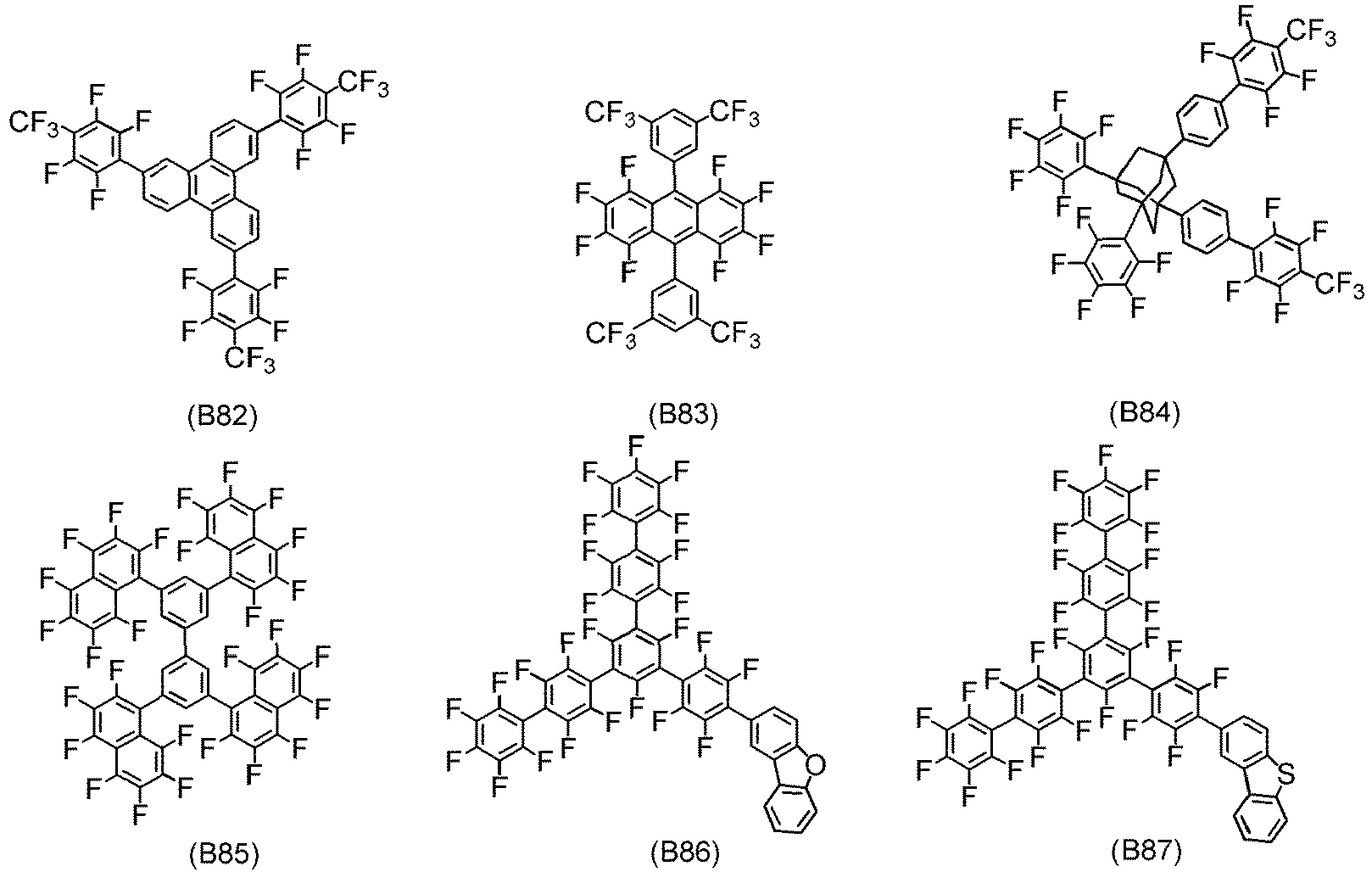


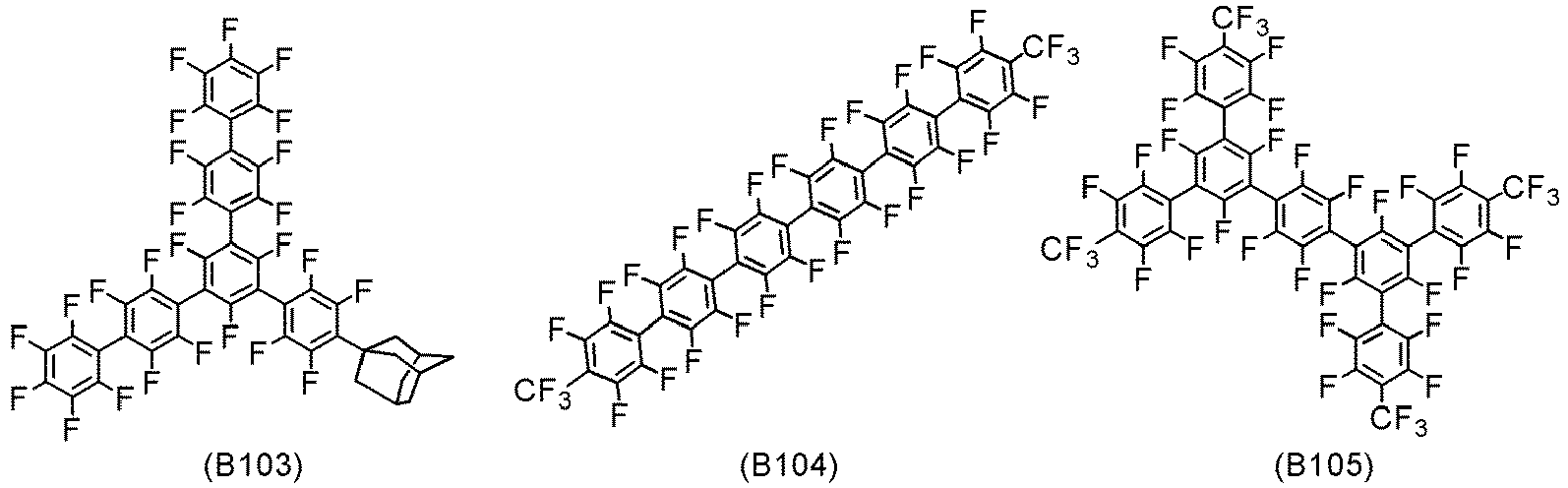
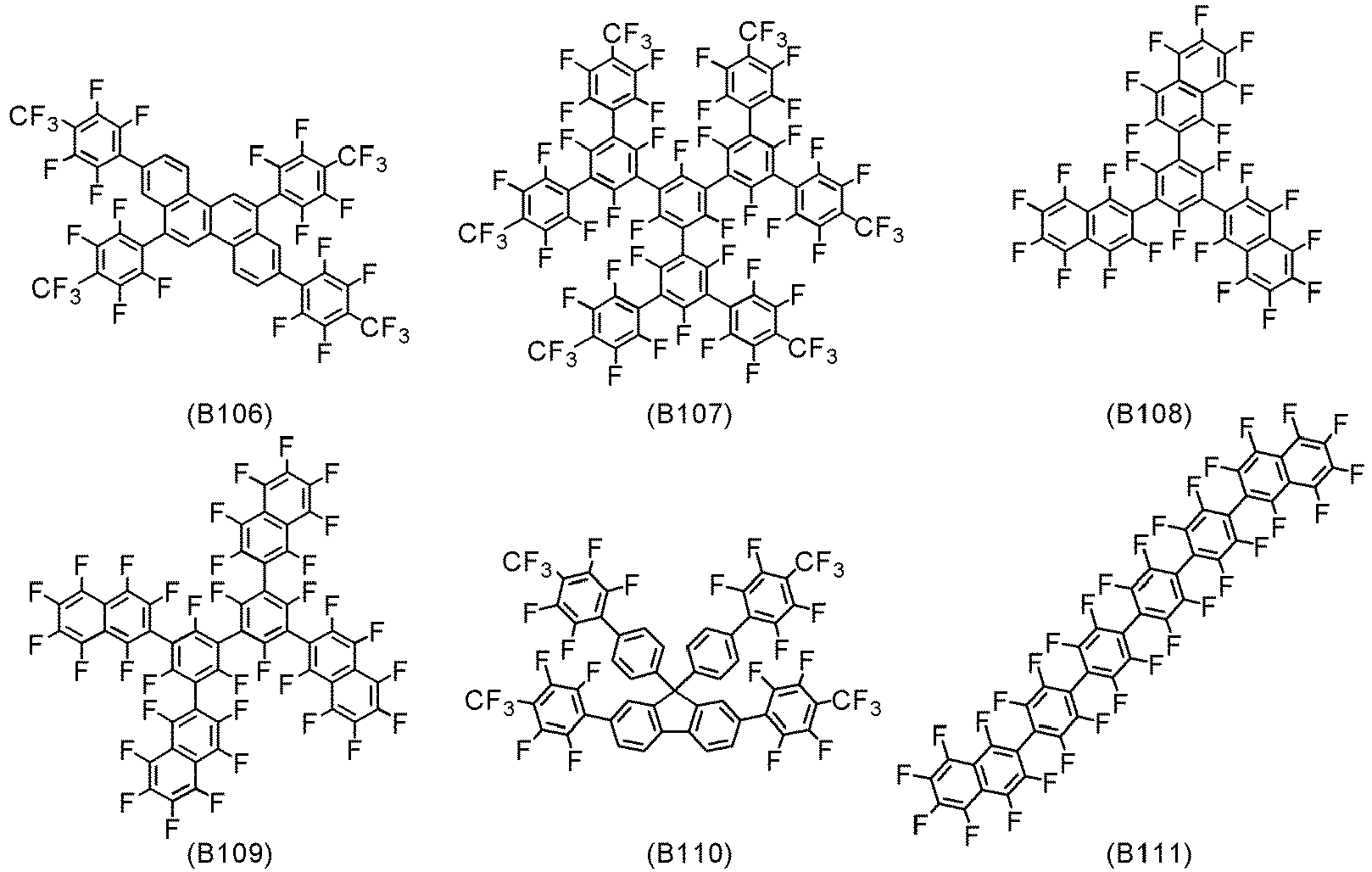

- A method of forming a metal pattern according to an embodiment of the present disclosure includes:
- forming the above-mentioned metal patterning material or an organic material pattern containing the above-mentioned amine compound; and
- applying a metal material to a formation region of the organic material pattern and a non-formation region of the organic material pattern to form a metal pattern in the non-formation region.
- The metal patterning material (amine compound) is used by forming a film at a location where it is desired to suppress adhesion of a metal. Here, a location where it is desired to suppress adhesion of the metal material corresponds to a formation region of the organic material pattern. Locations other than the location where it is desired to suppress adhesion of the metal material corresponds to a non-formation region of the organic material pattern. The non-formation region of the organic material pattern is a region that promotes adhesion of the metal material, and is a location where it is desired to form the metal pattern.
- The method of forming the organic material pattern (film forming method) is not particularly limited, and known methods can be adopted such as a vacuum vapor deposition method, a spin coating method, a casting method, a dip coating method, a die coating method, a bar code method, an offset method, a spray coating method, an ink jet method, a screen method, an offset method, a flexo method, a gravure method, and a micro contact method. Further, after the film formation, the film may be annealed under a temperature environment higher than room temperature. The film thickness of the organic material pattern is not particularly limited.
- In addition, another organic molecular material, a polymer, or the like may be optionally added to the metal patterning material as long as the formation of a metal film on the surface of the film can be suppressed.
- The base on which forming the organic material pattern may be metal or nonmetal, and examples thereof include an organic film, a metal film, an oxide film, and an inorganic film, without particular limitation. The material of the substrate is not particularly limited, and glass, plastic, metal, ceramic, and any other materials can be used.
- As the type of the metal material for forming the metal pattern using the metal patterning material is not particularly limited; however, an alkali metal, alkaline earth metal, transition metal, group 13 metal of the periodic table, or the like is preferable, and can be exemplified by lithium, sodium, potassium, rubidium, cesium, beryllium, magnesium, calcium, strontium, barium, aluminum, scandium, vanadium, zinc, yttrium, indium, cerium, samarium, europium, terbium, ytterbium, gold, silver, platinum, copper, iron, palladium, molybdenum, manganese, titanium, cobalt, nickel, tungsten, tin, and chromium, as well as alloys containing one or more of these metals. As the alloy, for example, magnesium-silver alloys, magnesium-indium alloys, magnesium-aluminum alloys, indium-silver alloys, lithium-aluminum alloys, lithiummagnesium alloys, lithium-indium alloys, and calcium-aluminum alloys can be exemplified.
- The method of forming the metal pattern is not particularly limited, and a dry process such as a vacuum vapor deposition method or a sputtering method; an ink jet method using metal nano ink and the like can be exemplified. The thickness of the metal pattern is not particularly limited.
- By applying the metal material to the formation region of the organic material pattern and the non-formation region of the organic material pattern, a film containing the metal material is momentarily formed in both regions; however, since adhesion of the metal is suppressed in the formation region of the organic material pattern, the metal pattern is naturally formed only in the non-formation region of the organic material pattern.
- As a more specific method of the method for forming the metal pattern, for example, the following method indicated by 1) to 2) can be exemplified.
- 1) The above-mentioned metal patterning material is vapor deposited to form a film in a desired pattern using a metal mask or the like.
- 2) Subsequently, by vapor depositing the metal, an electrode is formed only on a portion where the metal patterning material is not formed as a film. In other words, a negativetype metal electrode is formed on the film forming pattern of the metal patterning material. It should be noted that the area and line width of the patterned metal electrode can be adjusted arbitrarily in the patterning shape of the metal patterning material.
- According to the metal patterning material, amine compound and method for forming a metal pattern according to an aspect of the present disclosure, it is possible to form patterning of a metal electrode of a solar cell, optical sensor, image sensor, organic electro-luminescence (EL) element, organic solar cell, organic sensor, organic transistor or the like, and metal wiring on a circuit board.
- The metal patterning material according to an aspect of the present disclosure can form a film having high glass transition temperature and superior in heat resistance, and thus is applicable also to deposition processes. On the other hand, the FTS according to Non-Patent Document 1 is a material for a coating process, and has limitations in the applicable processes such as not being able to form a film by a vacuum deposition process. In addition, the metal patterning material according to an embodiment of the present disclosure has at least a certain fluorine atom in the molecule, and thus formation of a metal thin film on the film surface is suppressed. Furthermore, the metal patterning material according to an aspect of the present disclosure can suppress adhesion of metal to a high degree, without heating the film containing the metal patterning material upon patterning a metal thin film. On the other hand, in the case of the method using 1,2- diarylethene derivatives according to Patent Document 1, there have also been cases where the film is heated to the glass transition temperature or higher in order to suppress adhesion of metals. Therefore, according to the present disclosure, it is possible to provide a metal patterning material superior in heat resistance, and capable of patterning a metal electrode by a simple process.
- The electronic device according to an embodiment of the present disclosures includes the above-mentioned metal patterning material, or the above-mentioned amine compound. As mentioned above, upon forming a metal pattern, since an organic material pattern containing the metal patterning material or amine compound is formed, an organic material pattern is formed together with the metal pattern. Therefore, the electronic device according to an aspect of the present disclosure includes the organic material pattern containing the metal patterning material or amine compound, along with the metal pattern. As the electronic device, for example, a solar cell, optical sensor, image sensor, organic EL element, organic solar cell, organic sensor, organic transistor and the like can be exemplified. These electronic devices include patterning of a metal electrode, or metal wiring on a circuit board. In other words, so long as being an electronic device including patterning of a metal electrode, or metal wiring on a circuit board, it is possible to obtain the electrode device according to the present aspect, using a formation method of the aforementioned metal pattern. This electronic device has a high precision metal pattern.
- Hereinafter, the present invention will be explained in further detail based on examples; however, the present invention is not to be interpreted as limited in any way to these examples. It should be noted that the analytical equipment used in the present examples are listed below.
- Measurement device: DSC7020 manufactured by Hitachi High-tech Science Corp. Measurement method: 5 mg of sample placed on sample pan made of aluminum, and measured at heating condition of 10°C/min
-
- Measurement device: V-750 manufactured by Jasco Corp.
- Measurement range: 550 to 800 nm
-

- Under a nitrogen atmosphere, 4,4 '-diaminooctafluorobiphenyl (1.64 g, 5.0 mmol), perfluorotoluene (14 ml, 100 mmol), and potassium carbonate (3.46 g, 25 mmol) were suspended in dimethylsulfoxide (50 mL), and stirred at 100°C for 12 hours
After cooling to room temperature, water (100 ml), toluene (20 ml) and methanol (30 ml) were added to the reaction solution, and was stirred for 30 minutes at room temperature. The precipitated solid was collected by filtration to obtain compound (A177), which is the target substance of a white solid (yield: 5.12 g, 86%). The glass transition temperature of compound (A177) was 102°C.
19F- NMR (376.4 MHz, CDCl3)δ (ppm):-57.3 (t, J=17.3 Hz, 12F), -136.6 (s,4F),-139.5 (s,8F), -148.1 (d, J=17.3 Hz, 8F), -148.5 (s,4F) - Example 1' (Metal adhesion evaluation of compound (A177)) Boiling washing was performed with isopropyl alcohol on the glass substrate, and after further washing by UV/ozone, it was placed in the vapor deposition equipment, and evacuated to no more than 1.0×10⁻⁴ Pa by a vacuum pump. The compound (A177) was deposited to 100 nm at 0.2 nm/sec on a glass substrate on which a metal mask having a 20 mm × 10 mm opening was arranged. Subsequently, the metal mask was removed, and silver was vacuum deposited to 20 nm at a deposition rate of 0.2 nm/sec. Silver did not form a film on a portion where compound (A177) is deposited, and a 20 mm × 10 mm transparent area was formed.
-

- Under a nitrogen atmosphere, 4,4 '-diamino -2,2 '-dimethylbiphenyl (1.06 g, 5.0 mmol), perfluorotoluene (14 ml, 100 mmol), and potassium carbonate (3.46 g, 25 mmol) were suspended in dimethylsulfoxide (50 mL), and stirred at 100°C for 12 hours. After cooling to room temperature, water (100 ml), toluene (20 ml) and methanol (30 ml) were added to the reaction solution, and was stirred for 30 minutes at room temperature. The precipitated solid was collected by filtration to obtain compound (A206), which is the target substance of a white solid (yield: 4.16 g, 77%).
- 1H-NMR (400MHz, CDCl3); 2.02 (s,6H), 6.80-6.83 (m, 4H), 7.09 (d,J=8.0,2H)
- 19F-NMR(376.4 MHz, CDCl3)δ(ppm) : -57.2 (t,J=22.6Hz, 12F), - 140.7~-140.7(m, 8F), -145.9~-146.0 (m, 8F)
- Example 2' (Metal adhesion evaluation of compound (A206)) Boiling washing was performed with isopropyl alcohol on the glass substrate, and after further washing by UV/ozone, it was placed in the vapor deposition equipment, and evacuated to no more than 1.0×10⁻⁴ Pa by a vacuum pump. The compound (A206) was deposited to 100 nm at 0.2 nm/sec on a glass substrate on which a metal mask having a 20 mm × 10 mm opening was arranged. Subsequently, the metal mask was removed, and magnesium was vacuum deposited to 30 nm at a deposition rate of 0.2 nm/sec. Magnesium did not form a film on a portion where compound (A206) is deposited, and a 20 mm × 10 mm transparent area was formed.
-

- Under a nitrogen atmosphere, 4,4'-diamino-2,2'-bis (trifluoromethyl)biphenyl (0.96 g, 3.0 mmol), perfluorotoluene (14.2 g, 60 mmol), and potassium carbonate (3.18 g, 15 mmol) were suspended in dimethylsulfoxide (30 mL), and stirred at 100°C for 24 hours. After cooling to room temperature, liquid was separated using pure water and chloroform, and the organic layer was further washed with a saturated aqueous sodium chloride solution. After the organic layer was dried with anhydrous magnesium sulfate, column chromatography was performed with a small amount of silica gel to remove the highly polar component. Next, the solvent was removed under reduced pressure. Methanol (40 ml) and hexane (10 ml) were added to the obtained solid, and then stirred for 30 minutes at room temperature. The precipitated solid was collected by filtration to obtain compound (A236), which is the target substance of a white solid (yield: 3.11 g, 89%).
- 1H-NMR (400 MHz, THF-d8); 7.32 (d, J=4.0, 2H), 7.62 (dd, J=4.0, 2.0, 2H), 7.92 (d, J=2.0, 2H)
- 19F- NMR (376.4 MHz, THF-d8) δ (ppm): -57.2 (t, J=22.6Hz, 12F), -64.0 (s,6F), -140.4--140.5 (m, 8F), -147.2~-147.3 (m, 8F)
- Example 3' (Metal adhesion evaluation of compound (A236)) Boiling washing was performed with isopropyl alcohol on the glass substrate, and after further washing by UV/ozone, it was placed in the vapor deposition equipment, and evacuated to no more than 1.0×10⁻⁴ Pa by a vacuum pump. The compound (A236) was deposited to 100 nm at 0.2 nm/sec on a glass substrate on which a metal mask having a 20 mm × 10 mm opening was arranged. Subsequently, the metal mask was removed, and silver was vacuum deposited to 10 nm at a deposition rate of 0.2 nm/sec. Silver did not form a film on a portion where compound (A236) is deposited, and a 20 mm × 10 mm transparent area was formed.
-

- Under a nitrogen atmosphere, tris (4-bromophenyl)amine (1.69 g, 3.5 mmol), pentafluorophenyl boronic acid (2.67, 12.6 mmol), cesium fluoride (3.19 g, 21.0 mmol), silver oxide (I) (2.92 g, 12.6 mmol), and N,N-dimethylformamide (35 ml) were added, and the mixture was stirred for 60 minutes. Tris (dibenzylideneacetone)palladium (0) (160.2 mg, 0.18 mmol) and tri (tert-butyl)phosphine (85 mg, 0.42 mmol) were added to the resulting slurry mixture, followed by stirring at 100°C for 6 hours. After cooling to room temperature, silver oxide (I) was removed by filtration, and the filtrate was concentrated. Hexane was added to the residue, and was purified by silica gel column chromatography (hexane), thereby obtaining compound (A1), which is the target substance as a white solid (yield: 1.21 g, 47 %). FDMS:743
1H-NMR (400 MHz, CDCl3); 7.39-7.37 (m, 6H), 7.31-7.28 (m, 6H) 19F- NMR (376.4 MHz, CDCl3) δ (ppm) :-144.62 (dd, J=30.1, 7.5, 6F), -157.0 (t, J=22.6, 3F), -163.4-163.5 (m, 6F) - Example 4' (Metal adhesion evaluation of compound (A1)) Boiling washing was performed with isopropyl alcohol on the glass substrate, and after further washing by UV/ozone, it was placed in the vapor deposition equipment, and evacuated to no more than 1.0×10⁻⁴ Pa by a vacuum pump. The compound (A1) was deposited to 100 nm at 0.2 nm/sec on a glass substrate on which a metal mask having a 20 mm × 10 mm opening was arranged. Subsequently, the metal mask was removed, and magnesium was vacuum deposited to 10 nm at a deposition rate of 0.2 nm/sec. Magnesium did not form a film on a portion where compound (A1) is deposited, and a 20 mm × 10 mm transparent area was formed.
-

- Under a nitrogen atmosphere, 1,3-diaminoadamantane (1.30 g, 7.8 mmol), perfluorotoluene (14.8 g, 62 .5 mmol), 18 crown 6 ether (103 mg, 0.40 mmol) and tripotassium phosphate (16.6 g, 78 .2 mmol) were suspended in dimethylsulfoxide (40 ml) and stirred at 100°C for 24 hours. After cooling to room temperature, water (50 ml) and methanol (50 ml) were added to the reaction solution, and were stirred at room temperature for 30 minutes. The precipitated solid was collected by filtration to obtain compound (A512), which is the target substance as a white solid (yield: 6.90 g, 86%). The glass transition temperature of the compound (A512) was 70°C.
- 1H-NMR (400 MHz, CDCl3); 2.34 (s, 2H), 2.01 (s, 2H), 1.91 (d, J=12.0, 4H), 1.72 (d, J=12.0, 4H), 1.58 (s, 2H)
- 19F- NMR (376.4 MHz, CDCl3) δ (ppm): -57.5--57.7 (m, 12F), - 138.1 (s, 8F), -141.3 (d, J=23.7 Hz, 8F)
- Example 5' (Metal adhesion evaluation of compound (A512)) Boiling washing was performed with isopropyl alcohol on the glass substrate, and after further washing by UV/ozone, it was placed in the vapor deposition equipment, and evacuated to no more than 1.0×10⁻⁴ Pa by a vacuum pump. The compound (A512) was deposited to 20 nm at 0.1 nm/sec on a glass substrate on which a metal mask having a 20 mm × 10 mm opening was arranged. Subsequently, the metal mask was removed, and gold was vacuum deposited to 12 nm at a deposition rate of 0.1 nm/sec. Gold did not form a film on a portion where compound (A512) is deposited, and a 20 mm × 10 mm transparent area was formed.
-

- Under a nitrogen atmosphere, 2,2 '-diamino -4,4 '-bithiazole (0.59 g, 3.0 mmol), perfluorotoluene (14 g, 60 mmol) and tripotassium phosphate (3.2 g, 15 mmol) were suspended in dimethylsulfoxide (30 mL) and stirred at 100°C for 24 hours. After cooling to room temperature, water (30 ml) and methanol (30 ml) were added to the reaction solution, and were stirred at room temperature for 30 minutes. The precipitated solid was collected by filtration to obtain compound (A553), which is a target substance as a white solid (yield: 2.26 g, 71%).
- 1H-NMR (400 MHz, CDCl3); 7.22 (s, 2H),
- 19F- NMR (376.4 MHz, CDCl3) δ(ppm) : -57.4 (t, J=22.6 Hz, 12F), -139.5~-139.7 (m, 8F), -143.1~-143.2 (m, 8F)
- Example 6' (Metal adhesion evaluation of compound (A553)) Boiling washing was performed with isopropyl alcohol on the glass substrate, and after further washing by UV/ozone, it was placed in the vapor deposition equipment, and evacuated to no more than 1.0×10⁻⁴ Pa by a vacuum pump. The compound (A553) was deposited to 50 nm at 0.2 nm/sec on a glass substrate on which a metal mask having a 20 mm × 10 mm opening was arranged. Subsequently, the metal mask was removed, and magnesium was vacuum deposited to 12 nm at a deposition rate of 0.1 nm/sec. Magnesium did not form a film on a portion where compound (A553) is deposited, and a 20 mm × 10 mm transparent area was formed.
-

- Under a nitrogen atmosphere, 2,4,6-triamino -1,3,5-triazine (0.25 g, 2.0 mmol), perfluorotoluene (14 g, 59 mmol), 18 crown 6 ether (26 mg, 0.1 mmol) and tripotassium phosphate (6.3 g, 30 mmol) were suspended in dimethylsulfoxide (30 mL), and stirred at 100°C for 24 hours. After cooling to room temperature, water (30 ml) and methanol (30 ml) were added to the reaction solution, and were stirred at room temperature for 30 minutes. The precipitated solid was collected by filtration to obtain compound (A559), which is a target substance as a white solid (yield: 2.26 g, 80%).
19F- NMR (376.4 MHz, THF-d8) δ (ppm): -55.9 (t, J=22.6 Hz, 18F), -139.8--140.0 (m, 24F) - Example 7' (Metal adhesion evaluation of compound (A559)) Boiling washing was performed with isopropyl alcohol on the glass substrate, and after further washing by UV/ozone, it was placed in the vapor deposition equipment, and evacuated to no more than 1.0×10⁻⁴ Pa by a vacuum pump. The compound (A59) was deposited to 20 nm at 0.2 nm/sec on a glass substrate on which a metal mask having a 20 mm × 10 mm opening was arranged. Subsequently, the metal mask was removed, and silver and magnesium (9/1) were vacuum deposited to 20 nm at a deposition rate of 0.1 nm/sec. An alloy of silver and magnesium did not form a film on a portion where compound (A559) is deposited, and a 20 mm × 10 mm transparent area was formed.
-

- Under a nitrogen atmosphere, 4,4 '-diaminooctafluorobiphenyl (0.66 g, 2.0 mmol), perfluorobiphenyl (6.72 g, 20.1 mmol) and tripotassium phosphate (2.13 g, 10.1 mmol) were suspended in dimethylsulfoxide (15 mL) and cyclopentylmethyl ether (15 mL), and stirred at 100°C for 24 hours. After cooling to room temperature, the liquid was separated using pure water and chloroform, and the organic layer was further washed with saturated aqueous sodium chloride solution. The organic layer was dried over anhydrous magnesium sulfate, and column chromatography was performed on a small amount of silica gel to remove highly polar components. Then, the solvent was distilled off under reduced pressure. Methanol (40 ml) and hexane (10 ml) were added to the obtained solid, and were stirred at room temperature for 30 minutes. The precipitated solid was collected by filtration to obtain compound (A173), which is that target substance as a white solid (yield: 2.41 g, 77%).
19F-NMR (376.4 MHz, THF-d8) δ (ppm): -137.0 (m, 4F), -137.3 (m, 8F), -138.0 (m, 8F), -147.4 (m, 12F), -150.5 (m, 4F), -161.1 (m, 8F) - Example 8' (Metal adhesion evaluation of compound (A173)) Boiling washing was performed with isopropyl alcohol on the glass substrate, and after further washing by UV/ozone, it was placed in the vapor deposition equipment, and evacuated to no more than 1.0×10⁻⁴ Pa by a vacuum pump. The compound (A173) was deposited to 30 nm at 0.2 nm/sec on a glass substrate on which a metal mask having a 20 mm × 10 mm opening was arranged. Subsequently, the metal mask was removed, and aluminum was vacuum deposited to 10 nm at a deposition rate of 0.1 nm/sec. Aluminum did not form a film on a portion where compound (A173) is deposited, and a 20 mm × 10 mm transparent area was formed.
-

- Under a nitrogen atmosphere, tetrakis (4-aminophenyl)methane (1.90 g, 4.99 mmol), perfluorotoluene (47.1 g, 200 mmol) and tripotassium phosphate (10.6 g, 49 .9 mmol) were suspended in dimethylsulfoxide (50 mL), and stirred at 100°C for 24 hours. After cooling to room temperature, water (60 ml) and methanol (60 ml) were added to the reaction solution, and were stirred at room temperature for 30 minutes. The precipitated solid was collected by filtration to obtain compound (A433), which was a target substance as a white solid (yield: 9.76 g, 93%).
- 1H-NMR (400 MHz, THF-d8); 7.03-7.10 (m, 16H)
- 19F- NMR (376.4 MHz, THF-d8) δ (ppm): -55.5 (t, J=22.6 Hz, 24F), -140.3-140.4 (m, 16F), -144.4- -144.5 (m, 16F)
- Example 9' (Metal adhesion evaluation of compound (A433)) Boiling washing was performed with isopropyl alcohol on the glass substrate, and after further washing by UV/ozone, it was placed in the vapor deposition equipment, and evacuated to no more than 1.0×10⁻⁴ Pa by a vacuum pump. The compound (A433) was deposited to 50 nm at 0.2 nm/sec on a glass substrate on which a metal mask having a 20 mm × 10 mm opening was arranged. Subsequently, the metal mask was removed, and magnesium was vacuum deposited to 12 nm at a deposition rate of 0.2 nm/sec. Magnesium did not form a film on a portion where compound (A433) is deposited, and a 20 mm × 10 mm transparent area was formed.
-

- Under a nitrogen atmosphere, 2,4,6-triaminopyrimidine (0.50 mg, 4.00 mmol), perfluorotoluene (28.3 g, 120 mmol), 18 crown 6 ether (52.9 mg, 0.20 mmol), tripotassium phosphate (12.7 g, 60.0 mmol) were suspended in dimethylsulfoxide (40 mL), and stirred at 100°C for 24 hours. After cooling to room temperature, water (60 ml) and methanol (60 ml) were added to the reaction solution, and were stirred at room temperature for 30 minutes. The precipitated solid was collected by filtration to obtain compound (A569), which is the target substance as a white solid (yield: 5.69 g, 82%).
- 1H-NMR (400 MHz, THF-d8); 5.96 (s, 1H)
- 19F-NMR (376.4 MHz, THF-d8) δ (ppm): -55.7~ -55.9 (m, 18F), - 140.3~ -141.1 (m, 24F)
- Boiling washing was performed with isopropyl alcohol on the glass substrate, and after further washing by UV/ozone, it was placed in the vapor deposition equipment, and evacuated to no more than 1.0×10⁻⁴ Pa by a vacuum pump. The compound (A569) was deposited to 100 nm at 0.2 nm/sec on a glass substrate on which a metal mask having a 20 mm × 10 mm opening was arranged. Subsequently, the metal mask was removed, and silver was vacuum deposited to 20 nm at a deposition rate of 0.1 nm/sec. Silver did not form a film on a portion where compound (A569) is deposited, and a 20 mm × 10 mm transparent area was formed.
-

- Under a nitrogen atmosphere, 1,3,5-triaminobenzene (1.73 g, 14 mmol), perfluorotoluene (40 g, 170 mmol), tripotassium phosphate (74 g, 340 mol), 18 crown 6 ether (103 mg, 0.40 mmol) were suspended in dimethylsulfoxide (200 mL), and stirred at 100°C for 24 hours. After cooling to room temperature, the reaction solution was added to a mixed solution of water (200 ml) and methanol (200 ml), and were stirred at room temperature for 30 minutes. The precipitated solid was collected by filtration to obtain compound (A305), which is the target substance of a white solid (yield: 2.54 g, 13%) .
19F-NMR (376.4 MHz, THF-d8) δ (ppm): -55.6 (t, J=22.6 Hz, 12F), -139.9- -140.0 (m, 12F), -144.0~ -144.1 (m, 12F) - Boiling washing was performed with isopropyl alcohol on the glass substrate, and after further washing by UV/ozone, it was placed in the vapor deposition equipment, and evacuated to no more than 1.0×10⁻⁴ Pa by a vacuum pump. The compound (A305) was deposited to 20 nm at 0.2 nm/sec on a glass substrate on which a metal mask having a 20 mm × 10 mm opening was arranged. Subsequently, the metal mask was removed, and ytterbium was vacuum deposited to 1 nm at a deposition rate of 0.01 nm/sec, and subsequently, silver was vacuum deposited to 12 nm at a deposition rate of 0.1 nm/sec. Silver did not form a film on a portion where compound (A305) is deposited, and a 20 mm × 10 mm transparent area was formed.
-

- Under nitrogen atmosphere, 4,4'-diaminooctafluorobiphenyl (3.28 g, 10.0 mmol), perfluorobenzene (18.6 g, 100.0 mmol) and were suspended in tetrahydrofuran (100 mL), stirred at 100°C, and sodium tert-butoxide (9.61 g, 100.0 mmol) was added in 1 g increments each hour. After completion of the addition, the mixture was stirred at 100°C for 6 hours. After cooling to room temperature, the liquid was separated using pure water and chloroform, and the organic layer was further washed with saturated aqueous sodium chloride solution. The organic layer was dried over anhydrous magnesium sulfate and purified by silica gel column chromatography, thereby obtaining an intermediate (AA1), which is the target substance as a white solid (yield: 4.56 g, 69%). Compound identification was performed by FDMS measurement. FDMS: 660
-

- Under a nitrogen atmosphere, AAl (2.64 g, 4.0 mmol), perfluorotoluene (9.44 g, 40.0 mmol), tripotassium phosphate (2.12 g, 10.0 mmol) were suspended in dimethylsulfoxide (40 mL), and stirred at 100°C for 24 hours. After cooling to room temperature, water (40 ml) and methanol (40 ml) were added to the reaction solution, and were stirred at room temperature for 30 minutes. The precipitated solid was collected by filtration to obtain compound (A176), which is the target substance as a white solid (yield: 3.57 g, 82%). The glass transition temperature of the compound (A176) was 87°C.
19F-NMR (376.4 MHz, THF-d8) δ (ppm): -55.6 (t, J=22.6 Hz, 6F), -136.9- -137.0 (m, 4F), -139.7- -139.9 (m, 4F), -147.6- -147.7 (m, 12F), -154.6- -154.7 (m, 2F), -161.5- -161.6 (m, 4F) - Boiling washing was performed with isopropyl alcohol on the glass substrate, and after further washing by UV/ozone, it was placed in the vapor deposition equipment, and evacuated to no more than 1.0×10⁻⁴ Pa by a vacuum pump. The compound (A176) was deposited to 20 nm at 0.1 nm/sec on a glass substrate on which a metal mask having a 20 mm × 10 mm opening was arranged. Subsequently, the metal mask was removed, and silver was vacuum deposited to 30 nm at a deposition rate of 0.1 nm/sec. Silver did not form a film on a portion where compound (A176) is deposited, and a 20 mm × 10 mm transparent area was formed.
-

- Under a nitrogen atmosphere, 5-trifluoromethyl-1,3-phenylenediamine (1.0 g, 5.7 mmol), perfluorotoluene (10.7 g, 45 mmol), tripotassium phosphate (12.3 g, 58 mmol), 18 crown 6 ether (103 mg, 0.40 mmol) were suspended in dimethylsulfoxide (60 mL), and stirred at 100°C for 24 hours. After cooling to room temperature, water (100 ml) and methanol (50 ml) were added to the reaction solution, and were stirred at room temperature for 30 minutes. The precipitated solid was collected by filtration to obtain compound (A574), which is the target substance as a white solid (yield: 3.21 g, 54%). 1H-NMR (400 MHz, THF-d8); 7.26 (d, J=4.00, 2H), 7.02 (s, 1H) 19F-NMR (376.4 MHz, CDCl3) δ (ppm): -55.6 (t, J=22.6 Hz, 12F), -62.2 (s, 3F), -139.7- -139.9 (m, 8F), -143.7- -143.8 (m, 8F), -142.2- -142.4 (m, 4F)
- Boiling washing was performed with isopropyl alcohol on the glass substrate, and after further washing by UV/ozone, it was placed in the vapor deposition equipment, and evacuated to no more than 1.0×10⁻⁴ Pa by a vacuum pump. The compound (A574) was deposited to 50 nm at 0.1 nm/sec on a glass substrate on which a metal mask having a 20 mm × 10 mm opening was arranged. Subsequently, the metal mask was removed, and indium was vacuum deposited to 15 nm at a deposition rate of 0.1 nm/sec. Indium did not form a film on a portion where compound (A574) is deposited, and a 20 mm × 10 mm transparent area was formed.
-

- Under a nitrogen atmosphere, 1,3-diamino -2,4,5,6-tetrafluorobenzene (1.80 g, 10.0 mmol), perfluorotoluene (19.2 g, 81 mmol), and tripotassium phosphate (21.2 g, 100.0 mmol) were suspended in dimethylsulfoxide (50 mL), and stirred at 100°C for 24 hours. After cooling to room temperature, water (60 ml) and methanol (60 ml) were added to the reaction solution, and were stirred at room temperature for 30 minutes. The precipitated solid was collected by filtration to obtain compound (A580), which is the target substance as a white solid (yield: 3.94 g, 380). The glass transition temperature of compound (A580) was 66°C.
19F-NMR (376.4 MHz, THF-d8) δ (ppm): -55.6 (t, J=22.6 Hz, 6F), -132.6 (s, 1F), -138.7- -138.8 (m, 2F), -139.4- -139.6 (m, 8F), -147.6- -147.7 (m, 8F), -159.7- -159.8 (m, 1F) - Boiling washing was performed with isopropyl alcohol on the glass substrate, and after further washing by UV/ozone, it was placed in the vapor deposition equipment, and evacuated to no more than 1.0×10⁻⁴ Pa by a vacuum pump. The compound (A580) was deposited to 30 nm at 0.1 nm/sec on a glass substrate on which a metal mask having a 20 mm × 10 mm opening was arranged. Subsequently, the metal mask was removed, and ytterbium was vacuum deposited to 2 nm at a deposition rate of 0.01 nm/sec, and subsequently, silver and magnesium (9/1) were vacuum deposited to 15 nm at a deposition rate of 0.1 nm/sec. Silver did not form a film on a portion where compound (A580) is deposited, and a 20 mm × 10 mm transparent area was formed.
-

- Under a nitrogen atmosphere, pentafluoroaniline (5.10 g, 27.8 mmol), perfluorotoluene (26.3 ml, 111.3 mmol), and tripotassium phosphate (29.77 g, 140 mmol) were suspended in dimethylsulfoxide (80 mL), and stirred at 100°C for 24 hours. After cooling to room temperature, the mixture was separated using pure water and chloroform, and the organic layer was further washed with saturated aqueous sodium chloride solution. The organic layer was dried over anhydrous magnesium sulfate and purified by silica gel column chromatography to obtain intermediate (AA2), which is the target substance as a white solid (yield: 14.82 g, 87%).
19F-NMR (376.4 MHz, CDCl3) δ (ppm): -57.3 (t, J=22.6 Hz, 6F), - 139.8- -139.9 (m, 4F), -148.6~ -148.7 (m, 6F), -153.6~ -153.8 (m, 1F), -160.9- -161.0 (m, 2F) -

- Under a nitrogen atmosphere, 1,3-diaminoadamantane (0.66 g, 4.0 mmol), AA2 (5.01 g, 8.1 mmol), and tripotassium phosphate (2.11 g, 10.0 mmol) were suspended in dimethylsulfoxide (40 mL), and stirred at 100°C for 24 hours. After cooling to room temperature, the mixture was separated using pure water and chloroform, and the organic layer was further washed with saturated aqueous sodium chloride solution. The organic layer was dried over anhydrous magnesium sulfate and purified by silica gel column chromatography to obtain intermediate (AA3), which is the target substance as a white solid (yield: 4.21 g, 78%).
- 1H-NMR (400 MHz, CDCl3); 3.48 (s, 2H), 2.34 (s, 2H), 1.90 (s, 2H), 1.78 (s, 8H), 1.59 (s, 2H)
- 19F-NMR (376.4 MHz, CDCl3) δ (ppm): -57.3 (t, J=22.6 Hz, 12F), -140.5- -140.6 (m, 8F), -149.0~ -149.1 (m, 8F), -150.8~ -150.9 (m, 4F), -151.2~ -151.3 (m, 4F)
-

- Under a nitrogen atmosphere, AA3 (4.07 g, 3.0 mmol), perfluorobenzene (2.12 g, 9.0 mmol), 18 crown 6 ether (39 .6 mg, 0.15 mmol) and tripotassium phosphate (3.18 g, 15.0 mmol) were suspended in dimethylsulfoxide (40 mL), and stirred at 100°C for 24 hours. After cooling to room temperature, water (40 ml) and methanol (40 ml) were added to the reaction solution, and were stirred at room temperature for 30 minutes. The precipitated solid was collected by filtration to obtain compound (A581), which is the target substance as a white solid (yield: 3.85 g, 72%). The glass transition temperature of the compound (A581) was 127°C.
- 1H-NMR (400 MHz, THF-d8); 2.21 (s, 2H), 1.93 (s, 2H), 1.81-1.68 (m, 8H), 1.45 (s, 2H)
- 19F-NMR (376.4 MHz, THF-d8) δ (ppm): -55.6- -55.9 (m, 18F), - 136.8- -137.0 (m, 4F), -137.4~ -137.6 (m, 4F), -139.3~ -139.6 (m, 8F), -141.2~ -141.4 (m, 4F), -146.9~ -147.0 (m, 8F), - 148.8- -149.0 (m, 4F)
- Boiling washing was performed with isopropyl alcohol on the glass substrate, and after further washing by UV/ozone, it was placed in the vapor deposition equipment, and evacuated to no more than 1.0×10⁻⁴ Pa by a vacuum pump. The compound (A581) was deposited to 10 nm at 0.2 nm/sec on a glass substrate on which a metal mask having a 20 mm × 10 mm opening was arranged. Subsequently, the metal mask was removed, and silver was vacuum deposited to 20 nm at a deposition rate of 0.2 nm/sec. Silver did not form a film on a portion where compound (A581) is deposited, and a 20 mm × 10 mm transparent area was formed.
-

- Under a nitrogen atmosphere, 1-aminoadamantane (1.51 g, 10.0 mmol), AA2 (6.15 g, 10.0 mmol) and tripotassium phosphate (2.23 g, 10.5 mmol) were suspended in dimethylsulfoxide (50 mL), and stirred at 100°C for 24 hours. After cooling to room temperature, the mixture was separated using pure water and chloroform, and the organic layer was further washed with saturated aqueous sodium chloride solution. The organic layer was dried over anhydrous magnesium sulfate and purified by silica gel column chromatography (hexane) to obtain intermediate (AA4), which is the target substance as a white solid (yield: 5.86 g, 79%). Compound identification was performed by FDMS measurement. FDMS: 746
-

- Under a nitrogen atmosphere, AA4 (2.99 g, 4.0 mmol), perfluorotoluene (2.83 g, 12.0 mmol), 18 crown 6 ether (52 .9 mg, 0.2 mmol) and tripotassium phosphate (4.25 g, 20.0 mmol) were suspended in dimethylsulfoxide (40 mL), and stirred at 100°C for 24 hours. After cooling to room temperature, water (40 ml) and methanol (40 ml) were added to the reaction solution, and the mixture was stirred at room temperature for 30 minutes. The precipitated solid was collected by filtration to obtain compound (A582), which is the target substance as a white solid (yield: 2.51 g, 65%).
- 1H-NMR (400 MHz, CDCl3); 2.16 (s, 3H), 1.88 (s, 6H), 1.70- 1.61 (m, 6H)
- 19F-NMR (376.4 MHz, CDCl3) δ (ppm): -57.3- -57.5 (m, 9F), - 138.0- -138.2 (m, 4F) ,-139.7- -140.0 (m, 4F), -142.1- -142.3 (m, 2F), -148.2~ -148.3 (m, 4F), -150.3- -150.4 (m, 2F)
- Boiling washing was performed with isopropyl alcohol on the glass substrate, and after further washing by UV/ozone, it was placed in the vapor deposition equipment, and evacuated to no more than 1.0×10⁻⁴ Pa by a vacuum pump. The compound (A582) was deposited to 50 nm at 0.1 nm/sec on a glass substrate on which a metal mask having a 20 mm × 10 mm opening was arranged. Subsequently, the metal mask was removed, and ytterbium was vacuum deposited to 5 nm at a deposition rate of 0.01 nm/sec, and subsequently, silver was vacuum deposited to 12 nm at a deposition rate of 0.1 nm/sec. Ytterbium and silver did not form a film on a portion where compound (A582) is deposited, and a 20 mm × 10 mm transparent area was formed.
-

- Under a nitrogen atmosphere, 2,2-bis (4-aminophenyl)hexafluoropropane (2.00 g, 6.0 mmol), perfluorotoluene (11.4 g, 48.0 mmol), tripotassium phosphate (12.8 g, 60.0 mmol), and 18 crown 6 ether (103 mg, 0.40 mmol) were suspended in dimethylsulfoxide (60 mL), and stirred at 100°C for 24 hours. After cooling to room temperature, water (120 ml) and methanol (50 ml) were added to the reaction solution, and were stirred at room temperature for 30 minutes. The precipitated solid was collected by filtration to obtain compound (A584), which is the target substance as a white solid (yield: 4.06 g, 57%). The glass transition temperature of compound (A584) was 88°C.
- 1H-NMR (400 MHz, CDCl3); 7.36(d, J=4.00, 4H), 6.92 (d, J=4.00, 4H)
- 19F- NMR (376.4 MHz, CDCl3) δ(ppm) : -57.3 (t, J=22.6 Hz, 12F), -65.2 (s, 6F), -139.9- -140.1 (m, 8F), -144.9- -145.0 (m,8F)
- Boiling washing was performed with isopropyl alcohol on the glass substrate, and after further washing by UV/ozone, it was placed in the vapor deposition equipment, and evacuated to no more than 1.0×10⁻⁴ Pa by a vacuum pump. The compound (A584) was deposited to 100 nm at 0.2 nm/sec on a glass substrate on which a metal mask having a 20 mm × 10 mm opening was arranged. Subsequently, the metal mask was removed, and silver was vacuum deposited to 30 nm at a deposition rate of 0.2 nm/sec. Silver did not form a film on a portion where compound (A584) is deposited, and a 20 mm × 10 mm transparent area was formed.
-

- Under a nitrogen atmosphere, perfluorobiphenyl (3.34 g, 10.0 mmol), 1-aminoadamantane (3.03 g, 20.0 mmol) and tripotassium phosphate (5.31 g, 25.0 mmol) were suspended in dimethylsulfoxide (40 mL) and cyclopentylmethyl ether (10 mL), and stirred at 100°C for 24 hours. After cooling to room temperature, water (60 ml) and methanol (40 ml) were added to the reaction solution, and were stirred at room temperature for 30 minutes. The precipitated solid was collected by filtration to obtain intermediate (AA5), which is the target substance as a white solid (yield: 5.08 g, yield: 85%). 1H-NMR (400 MHz, CDCl3) ; 3.48 (s, 2H), 2.14 (s, 6H), 1.87 (s, 12H), 1.72- 1.64 (m, 12H)
19F- NMR (376.4 MHz, CDCl3) δ (ppm): -142.0~ -142.1 (m, 4F), - 151.8~ -151.9 (m, 4F) -

- Under a nitrogen atmosphere, AA5 (2.98 g, 5.0 mmol), perfluorotoluene (5.90 g, 25.0 mmol), 18 crown 6 ether (66.1 mg, 0.25 mmol) and tripotassium phosphate (5.31 g, 25.0 mmol) were suspended in dimethylsulfoxide (50 mL), and stirred at 100°C for 24 hours. After cooling to room temperature, water (60 ml) and methanol (18 ml) were added to the reaction solution, and were stirred at room temperature for 30 minutes. The precipitated solid was collected by filtration to obtain compound (A526), which is the target substance as a white solid (yield: 4.08 g, 79%). The glass transition temperature of the compound (A526) was 130°C.
- 1H-NMR (400 MHz, CDCl3); 2.18 (s, 6H), 1.94 (s, 12H), 1.71-1.63 (m, 12H)
- 19F- NMR (376.4 MHz, CDCl3) δ (ppm): -57.4 (t, J=22.6 Hz, 6F), -137.8- -137.93 (m, 4F), -138.9~ -139.0 (m, 4F), -139.5~ - 139.5 (m, 4F), -142.2- -142.4 (m, 4F)
- Boiling washing was performed with isopropyl alcohol on the glass substrate, and after further washing by UV/ozone, it was placed in the vapor deposition equipment, and evacuated to no more than 1.0×10⁻⁴ Pa by a vacuum pump. The compound (A526) was deposited to 50 nm at 0.2 nm/sec on a glass substrate on which a metal mask having a 20 mm × 10 mm opening was arranged. Subsequently, the metal mask was removed, and bismuth was vacuum deposited to 20 nm at a deposition rate of 0.1 nm/sec. Bismuth did not form a film on a portion where compound (A526) is deposited, and a 20 mm × 10 mm transparent area was formed.
-

- Under a nitrogen atmosphere, 1,3-diaminoadamantane (665 mg, 4.0 mmol), perfluorobiphenyl (2.74 g, 8.2 mmol) and tripotassium phosphate (4.25 g, 20.0 mmol) were suspended in dimethylsulfoxide (40 mL) and cyclopentylmethyl ether (10 mL), and stirred at 100°C for 24 hours. After cooling to room temperature, the mixture was separated using pure water and chloroform, and the organic layer was further washed with saturated aqueous sodium chloride solution. The organic layer was dried over anhydrous magnesium sulfate and purified by silica gel column chromatography (hexanes) to obtain intermediate (AA6), which is the target substance as a white solid (yield: 2.36 g, 74%). Compound identification was performed by FDMS measurement. FDMS: 794
-

- Under a nitrogen atmosphere, AA6 (2.38 g, 3.0 mmol) perfluorotoluene (2.12 g, 9.0 mmol), 18 crown 6 ether (793 mg, 3.0 mmol) and tripotassium phosphate (3.18 g, 15.0 mmol) were suspended in dimethylsulfoxide (30 mL), and stirred at 100°C for 24 hours. After cooling to room temperature, water (30 ml) and methanol (30 ml) were added to the reaction solution, and were stirred at room temperature for 30 minutes. The precipitated solid was collected by filtration to obtain compound (A591), which is the target substance as a white solid (yield: 3.02 g, 82%). The glass transition temperature of the compound (A591) was 93°C.
- 1H-NMR (400 MHz, THF-d8); 2.36 (s, 2H), 2.18 (s, 2H), 2.01-1.86 (m, 8H), 1.62 (s, 2H)
- 19F- NMR (376.4 MHz, THF-d8) δ (ppm): -57.8 (t, J=22.6 Hz, 6F), -136.6- -136.7 (m, 4F), -137.3~ -137.5 (m, 4F), -138.0~ - 138.1 (m, 4F), -138.6- -138.7 (m, 4F), -141.3- -141.5 (m, 4F), -150.8- -150.9 (m, 2F), -161.2- -161.3 (m, 4F)
- Boiling washing was performed with isopropyl alcohol on the glass substrate, and after further washing by UV/ozone, it was placed in the vapor deposition equipment, and evacuated to no more than 1.0×10⁻⁴ Pa by a vacuum pump. The compound (A591) was deposited to 50 nm at 0.1 nm/sec on a glass substrate on which a metal mask having a 20 mm × 10 mm opening was arranged. Subsequently, the metal mask was removed, and lead was vacuum deposited to 20 nm at a deposition rate of 0.2 nm/sec. Lead did not form a film on a portion where compound (A591) is deposited, and a 20 mm × 10 mm transparent area was formed.
-

- Under a nitrogen atmosphere, bis (pentafluorophenyl)amine (6.98 g, 20.0 mmol), perfluorotoluene (11.8 g, 50.0 mmol), 18 crown 6 ether (5.29 g, 20.0 mmol) and tripotassium phosphate (8.49 g, 40.0 mmol) were suspended in dimethylsulfoxide (80 mL), and stirred at 100°C for 24 hours. After cooling to room temperature, the mixture was separated using pure water and chloroform, and the organic layer was further washed with saturated aqueous sodium chloride solution. The organic layer was dried over anhydrous magnesium sulfate and purified by silica gel column chromatography to obtain compound (AA7), which is the target substance as a white solid (yield 8.65 g, 70%). Compound identification was performed by FDMS measurement. FDMS: 565
-

- Under a nitrogen atmosphere, 1-aminoadamantane (1.24 g, 8.2 mmol), AA7 (2.26 g, 4.0 mmol), and tripotassium phosphate (2.55 g, 12.0 mmol) were suspended in dimethylsulfoxide (40 mL), and stirred at 100°C for 24 hours. After cooling to room temperature, the mixture was separated using pure water and chloroform, and the organic layer was further washed with saturated aqueous sodium chloride solution. The organic layer was dried over anhydrous magnesium sulfate and purified by silica gel column chromatography to obtain intermediate (AA8), which is the target substance as a white solid (yield: 2.89 g, 87%). Compound identification was performed by FDMS measurement. FDMS: 827
-

- Under a nitrogen atmosphere, AA8 (2.07 g, 2.5 mmol), perfluorotoluene (1.77 g, 7.5 mmol), 18 crown 6 ether (33.0 mg, 0.13 mmol) and tripotassium phosphate (2.65 g, 12.5 mmol) were suspended in dimethylsulfoxide (50 mL), and stirred at 100°C for 24 hours. After cooling to room temperature, water (50 ml) and methanol (50 ml) were added to the reaction solution, and were stirred at room temperature for 30 minutes. The precipitated solid was collected by filtration to obtain compound (A589), which is the target substance as a white solid (yield: 2.46 g, 78%). The glass transition temperature of compound (A526) was 138°C.
- 1H-NMR (400 MHz, CDCl3); 2.15 (s, 6H), 1.87 (s, 12H), 1.69-1.60 (m, 12H)
- 19F- NMR (376.4 MHz, CDCl3) δ (ppm): -57.2- -57.5 (m, 9F), - 138.0~ -138.2 (m, 4F), -138.7- -138.8 (m, 4F), -140.3- -140.4 (m, 2F), -142.1- -142.4 (m, 4F), -148.5- -148.6 (m, 2F), - 150.6~ -150.7 (m, 4F)
- Boiling washing was performed with isopropyl alcohol on the glass substrate, and after further washing by UV/ozone, it was placed in the vapor deposition equipment, and evacuated to no more than 1.0×10⁻⁴ Pa by a vacuum pump. The compound (A589) was deposited to 50 nm at 0.2 nm/sec on a glass substrate on which a metal mask having a 20 mm × 10 mm opening was arranged. Subsequently, the metal mask was removed, and ytterbium was vacuum deposited to 20 nm at a deposition rate of 0.1 nm/sec. Silver did not form a film on a portion where compound (A589) is deposited, and a 20 mm × 10 mm transparent area was formed.
-

- Boiling washing was performed with isopropyl alcohol on the glass substrate, and after further washing by UV/ozone, it was placed in the vapor deposition equipment, and evacuated to no more than 1.0×10⁻⁴ Pa by a vacuum pump. The compound (B51) was deposited to 20 nm at 0.1 nm/sec on a glass substrate on which a metal mask having a 20 mm × 10 mm opening was arranged. Subsequently, the metal mask was removed, and silver was vacuum deposited to 20 nm at a deposition rate of 0.1 nm/sec. Silver did not form a film on a portion where compound (B51) is deposited, and a 20 mm × 10 mm transparent area was formed.
-

- Under a nitrogen atmosphere, 1,3,5-triaminoadamantane (0.91 g, 5.0 mmol), perfluorotoluene (14.2 g, 60 mmol), 18 crown 6 ether (66.1 mg, 0.25 mmol) and tripotassium phosphate (15.9 g, 75 mmol) were suspended in dimethylsulfoxide (50 mL), and stirred at 100°C for 24 hours. After cooling to room temperature, water (50 ml) and methanol (50 ml) were added to the reaction solution, and were stirred at room temperature for 30 minutes. The precipitated solid was collected by filtration to obtain compound (A565), which is the target substance as a white solid (yield: 5.68 g, 77%). Compound identification was performed by FDMS measurement. FDMS: 1477
- Boiling washing was performed with isopropyl alcohol on the glass substrate, and after further washing by UV/ozone, it was placed in the vapor deposition equipment, and evacuated to no more than 1.0×10⁻⁴ Pa by a vacuum pump. The compound (A565) was deposited to 30 nm at 0.2 nm/sec on a glass substrate on which a metal mask having a 20 mm × 10 mm opening was arranged. Subsequently, the metal mask was removed, and copper was vacuum deposited to 30 nm at a deposition rate of 0.1 nm/sec. Silver did not form a film on a portion where compound (A565) is deposited, and a 20 mm × 10 mm transparent area was formed.
-

- Under a nitrogen atmosphere, 1,3,5,7-tetraaminoadamantane (0.98 g, 5.0 mmol), perfluorotoluene (18.9 g, 80 mmol), 18 crown 6 ether (66.1 mg, 0.25 mmol), and tripotassium phosphate (21.2 g, 100 mmol) were suspended in dimethylsulfoxide (50 mL), and stirred at 100°C for 24 hours. After cooling to room temperature, water (50 ml) and methanol (50 ml) were added to the reaction solution, and were stirred at room temperature for 30 minutes. The precipitated solid was collected by filtration to obtain compound (A568), which is the target substance as a white solid (yield: 6.58 g, 68%). Compound identification was performed by FDMS measurement. FDMS: 1924
- Boiling washing was performed with isopropyl alcohol on the glass substrate, and after further washing by UV/ozone, it was placed in the vapor deposition equipment, and evacuated to no more than 1.0×10⁻⁴ Pa by a vacuum pump. The compound (A568) was deposited to 30 nm at 0.2 nm/sec on a glass substrate on which a metal mask having a 20 mm × 10 mm opening was arranged. Subsequently, the metal mask was removed, and silver was vacuum deposited to 30 nm at a deposition rate of 0.1 nm/sec. Silver did not form a film on a portion where compound (A568) is deposited, and a 20 mm × 10 mm transparent area was formed.
-

- Under a nitrogen atmosphere, 1,5-diaminonaphthalene (0.791 g, 5.0 mmol), perfluorotoluene (9.44 g, 40 mmol) and tripotassium phosphate (10 .6 g, 50 mmol) were suspended in dimethylsulfoxide (50 mL), and stirred at 100°C for 24 hours. After cooling to room temperature, water (50 ml) and methanol (50 ml) were added to the reaction solution, and were stirred at room temperature for 30 minutes. The precipitated solid was collected by filtration to obtain compound (A390), which is the target substance as a white solid (yield 4.09 g, 80%). Compound identification was performed by FDMS measurement. FDMS: 1022
- Boiling washing was performed with isopropyl alcohol on the glass substrate, and after further washing by UV/ozone, it was placed in the vapor deposition equipment, and evacuated to no more than 1.0×10⁻⁴ Pa by a vacuum pump. The compound (A390) was deposited to 50 nm at 0.2 nm/sec on a glass substrate on which a metal mask having a 20 mm × 10 mm opening was arranged. Subsequently, the metal mask was removed, and magnesium was vacuum deposited to 30 nm at a deposition rate of 0.1 nm/sec. Magnesium did not form a film on a portion where compound (A390) is deposited, and a 20 mm × 10 mm transparent area was formed.
-

- Under a nitrogen atmosphere, 2-aminodibenzofuran (1.47 g, 10.0 mmol), AA2 (6.15 g, 10.0 mmol) and tripotassium phosphate (2.23 g, 10.5 mmol) were suspended in dimethylsulfoxide (50 mL), and stirred at 100°C for 24 hours. After cooling to room temperature, the mixture was separated using pure water and chloroform, and the organic layer was further washed with saturated aqueous sodium chloride solution. The organic layer was dried over anhydrous magnesium sulfate and purified by silica gel column chromatography (hexane) to obtain intermediate (AA9), which is the target substance as a white solid (yield: 5.16 g, 66%). Compound identification was performed by FDMS measurement. FDMS: 778
-

- Under a nitrogen atmosphere, AA9 (3.11 g, 4.0 mmol), perfluorotoluene (2.83 g, 12 mmol) and tripotassium phosphate (4.25 g, 20 mmol) were suspended in dimethylsulfoxide (50 mL), and stirred at 100°C for 24 hours. After cooling to room temperature, water (50 ml) and methanol (50 ml) were added to the reaction solution, and were stirred at room temperature for 30 minutes. The precipitated solid was collected by filtration to obtain compound (A600), which is the target substance as a white solid (yield: 2.57 g, 65%). Compound identification was performed by FDMS measurement. FDMS: 994
- Boiling washing was performed with isopropyl alcohol on the glass substrate, and after further washing by UV/ozone, it was placed in the vapor deposition equipment, and evacuated to no more than 1.0×10⁻⁴ Pa by a vacuum pump. The compound (A600) was deposited to 50 nm at 0.2 nm/sec on a glass substrate on which a metal mask having a 20 mm × 10 mm opening was arranged. Subsequently, the metal mask was removed, ytterbium was vacuum deposited to 2 nm at a deposition rate of 0.01 nm/sec, and subsequently, magnesium was vacuum deposited to 12 nm at a deposition rate of 0.1 nm/sec. Ytterbium and magnesium did not form a film on a portion where compound (A600) is deposited, and a 20 mm × 10 mm transparent area was formed.
-

- Under a nitrogen atmosphere, 2-amino-9,9-dimethylfluorene (2.09 g, 10.0 mmol), AA2 (6.15 g, 10.0 mmol) and tripotassium phosphate (2.23 g, 10.5 mmol) were suspended in dimethylsulfoxide (50 mL), and stirred at 100°C for 24 hours. After cooling to room temperature, the mixture was separated using pure water and chloroform, and the organic layer was further washed with saturated aqueous sodium chloride solution. The organic layer was dried over anhydrous magnesium sulfate and purified by silica gel column chromatography (hexane) to obtain intermediate (AA10), which is the target substance as a white solid (yield: 6.21 g, 77%). Compound identification was performed by FDMS measurement. FDMS: 804
-

- Under a nitrogen atmosphere, AA10 (3.22 g, 4.0 mmol), perfluorotoluene (2.83 g, 12 mmol), and tripotassium phosphate (4.25 g, 20 mmol) were suspended in dimethylsulfoxide (50 mL), and stirred at 100°C for 24 hours. After cooling to room temperature, water (50 ml) and methanol (50 ml) were added to the reaction solution, and were stirred at room temperature for 30 minutes. The precipitated solid was collected by filtration to obtain compound (A601), which is the target substance as a white solid (yield: 2.89 g, 71%). Compound identification was performed by FDMS measurement. FDMS: 1020
- Boiling washing was performed with isopropyl alcohol on the glass substrate, and after further washing by UV/ozone, it was placed in the vapor deposition equipment, and evacuated to no more than 10×10-4 Pa by a vacuum pump. The compound (A601) was deposited to 50 nm at 0.2 nm/sec on a glass substrate on which a metal mask having a 20 mm × 10 mm opening was arranged. Subsequently, the metal mask was removed, and magnesium was vacuum deposited to 20 nm at a deposition rate of 0.1 nm/sec. Magnesium did not form a film on a portion where compound (A601) is deposited, and a 20 mm × 10 mm transparent area was formed.
-

- Under a nitrogen stream, a 300 mL three-necked flask was charged with 3,5-bis (trifluoromethyl)bromobenzene (14.7 g, 50.0 mmol), aniline (1.86 g, 20.0 mmol), sodium-tert-butoxide (5.77 g, 60.0 mmol), o-xylene (100 mL), palladium acetate 225 mg (1.0 mmol), and a 25 wt% toluene solution (1.62 g, 2.0 mmol) of tri (tert-butyl)phosphine, and were stirred at 140°C for 3 hours. After cooling to room temperature, the mixture was separated using pure water and toluene, and the organic layer was further washed with a saturated aqueous sodium chloride solution. The organic layer was dried over anhydrous magnesium sulfate and purified by silica gel column chromatography to obtain intermediate (AA11), which is the target substance as a white solid (yield: 7.66 g, 74%). Compound identification was performed by FDMS measurement. FDMS: 517
-

- A 300 mL three-neck flask was charged with AA11 (7.55 g, 14.6 mmol), and tetrahydrofuran (75 mL), and stirred at 60°C for 10 min. Further, N-bromosuccinimide was added every 10 minutes for four times (total addition amount: 5.72 g, 32.3 mmol). After cooling to room temperature, the mixture was separated using an aqueous sodium thiosulfate solution and toluene, and the organic layer was further washed with a saturated aqueous sodium chloride solution. The organic layer was dried over anhydrous magnesium sulfate and purified by silica gel column chromatography to obtain an intermediate (AA12), which is the target substance as a white solid (yield: 6.23 g, 72%). Compound identification was performed by FDMS measurement. FDMS: 595
-

- Under a nitrogen stream, AA12 (2.98 g, 5.0 mmol), aniline (0.61 g, 6.5 mmol), sodium-tert-butoxide (0.72 g, 7.5 mmol), o-xylene (25 mL), palladium acetate (0.112 mg, 0.05 mmol), and 4,5-bis (diphenylphosphino)-9,9-dimethylxanthene (86.8 mg, 0.15 mmol) were added to a 100 mL three-neck flask, and the mixture was stirred at 140°C for 5 hours. After cooling to room temperature, the mixture was separated using pure water and toluene, and the organic layer was further washed with a saturated aqueous sodium chloride solution. The organic layer was dried over anhydrous magnesium sulfate and purified by silica gel column chromatography to obtain intermediate (AA13), which is the target substance as a white solid (yield: 2.42 g, 80%). Compound identification was performed by FDMS measurement. FDMS: 608
-

- Under a nitrogen atmosphere, AA13 (2.13 g, 3.5 mmol), perfluorotoluene (3.30 g, 14 mmol), and tripotassium phosphate (3.71 g, 18 mmol) were suspended in dimethylsulfoxide (50 mL), and stirred at 100°C for 24 hours. After cooling to room temperature, the mixture was separated using pure water and chloroform, and the organic layer was further washed with saturated aqueous sodium chloride solution. The organic layer was dried over anhydrous magnesium sulfate and purified by silica gel column chromatography to obtain compound (A608), which is the target substance as a white solid (yield: 2.20 g, 85%). Compound identification was performed by FDMS measurement. FDMS: 824
- Boiling washing was performed with isopropyl alcohol on the glass substrate, and after further washing by UV/ozone, it was placed in the vapor deposition equipment, and evacuated to no more than 10×10-4 Pa by a vacuum pump. The compound (A608) was deposited to 50 nm at 0.2 nm/sec on a glass substrate on which a metal mask having a 20 mm × 10 mm opening was arranged. Subsequently, the metal mask was removed, and silver was vacuum deposited to 10 nm at a deposition rate of 0.1 nm/sec. Silver did not form a film on a portion where compound (A608) is deposited, and a 20 mm × 10 mm transparent area was formed.
-

- Boiling washing was performed with isopropyl alcohol on the glass substrate, and after further washing by UV/ozone, it was placed in the vapor deposition equipment, and evacuated to no more than 10×10-4 Pa by a vacuum pump. The compound (B11) was deposited to 20 nm at 0.1 nm/sec on a glass substrate on which a metal mask having a 20 mm × 10 mm opening was arranged. Subsequently, the metal mask was removed, and silver was vacuum deposited to 10 nm at a deposition rate of 0.1 nm/sec. Silver did not form a film on a portion where compound (B11) is deposited, and a 20 mm × 10 mm transparent area was formed.
-

- Boiling washing was performed with isopropyl alcohol on the glass substrate, and after further washing by UV/ozone, it was placed in the vapor deposition equipment, and evacuated to no more than 10×10-4 Pa by a vacuum pump. The compound (B78) was deposited to 20 nm at 0.1 nm/sec on a glass substrate on which a metal mask having a 20 mm × 10 mm opening was arranged. Subsequently, the metal mask was removed, and magnesium was vacuum deposited to 10 nm at a deposition rate of 0.1 nm/sec. Magnesium did not form a film on a portion where compound (B78) is deposited, and a 20 mm × 10 mm transparent area was formed.
-

- Boiling washing was performed with isopropyl alcohol on the glass substrate, and after further washing by UV/ozone, it was placed in the vapor deposition equipment, and evacuated to no more than 1.0×10⁻⁴ Pa by a vacuum pump. The compound (B70) was deposited to 20 nm at 0.1 nm/sec on a glass substrate on which a metal mask having a 20 mm × 10 mm opening was arranged. Subsequently, the metal mask was removed, and silver was vacuum deposited to 10 nm at a deposition rate of 0.1 nm/sec. Silver did not form a film on a portion where compound (B70) is deposited, and a 20 mm × 10 mm transparent area was formed.
-

- Boiling washing was performed with isopropyl alcohol on the glass substrate, and after further washing by UV/ozone, it was placed in the vapor deposition equipment, and evacuated to no more than 1.0×10⁻⁴ Pa by a vacuum pump. The compound (B26) was deposited to 20 nm at 0.1 nm/sec on a glass substrate on which a metal mask having a 20 mm × 10 mm opening was arranged. Subsequently, the metal mask was removed, and silver was vacuum deposited to 10 nm at a deposition rate of 0.1 nm/sec. Silver did not form a film on a portion where compound (B26) is deposited, and a 20 mm × 10 mm transparent area was formed.
-

- Boiling washing was performed with isopropyl alcohol on the glass substrate, and after further washing by UV/ozone, it was placed in the vapor deposition equipment, and evacuated to no more than 1.0×10⁻⁴ Pa by a vacuum pump. The compound (B104) was deposited to 20 nm at 0.1 nm/sec on a glass substrate on which a metal mask having a 20 mm × 10 mm opening was arranged. Subsequently, the metal mask was removed, and silver was vacuum deposited to 10 nm at a deposition rate of 0.1 nm/sec. Silver did not form a film on a portion where compound (B104) is deposited, and a 20 mm × 10 mm transparent area was formed.
-

- Boiling washing was performed with isopropyl alcohol on the glass substrate, and after further washing by UV/ozone, it was placed in the vapor deposition equipment, and evacuated to no more than 1.0×10⁻⁴ Pa by a vacuum pump. The compound (B111) was deposited to 20 nm at 0.1 nm/sec on a glass substrate on which a metal mask having a 20 mm × 10 mm opening was arranged. Subsequently, the metal mask was removed, and silver was vacuum deposited to 10 nm at a deposition rate of 0.1 nm/sec. Silver did not form a film on a portion where compound (Bill) is deposited, and a 20 mm × 10 mm transparent area was formed.
-

- Under a nitrogen atmosphere, 1,6-diaminopyrene (1.16 g, 5.0 mmol), perfluorotoluene (9.44 g, 40 mmol) and tripotassium phosphate (10 .6 g, 50 mmol) were suspended in dimethylsulfoxide (50 mL), and stirred at 100°C for 24 hours. After cooling to room temperature, water (50 ml) and methanol (50 ml) were added to the reaction solution, and were stirred at room temperature for 30 minutes. The precipitated solid was collected by filtration to obtain compound (A597), which is the target substance as a white solid (yield: 4.39 g, 80%). Compound identification was performed by FDMS measurement. FDMS: 1096
- Boiling washing was performed with isopropyl alcohol on the glass substrate, and after further washing by UV/ozone, it was placed in the vapor deposition equipment, and evacuated to no more than 1.0×10⁻⁴ Pa by a vacuum pump. The compound (A597) was deposited to 50 nm at 0.1 nm/sec on a glass substrate on which a metal mask having a 20 mm × 10 mm opening was arranged. Subsequently, the metal mask was removed, and silver was vacuum deposited to 5 nm at a deposition rate of 0.1 nm/sec. Silver did not form a film on a portion where compound (A597) is deposited, and a 20 mm × 10 mm transparent area was formed.
-

- Under a nitrogen atmosphere, aniline (0.76 g, 8.2 mmol), AA7 (2.26 g, 4.0 mmol) and tripotassium phosphate (2.55 g, 12.0 mmol) were suspended in dimethylsulfoxide (40 mL), and stirred at 100°C for 24 hours. After cooling to room temperature, the mixture was separated using pure water and chloroform, and the organic layer was further washed with saturated aqueous sodium chloride solution. The organic layer was dried over anhydrous magnesium sulfate and purified by silica gel column chromatography to obtain intermediate (AA14), which is the target substance as a white solid (yield: 2.28 g, 80%). Compound identification was performed by FDMS measurement. FDMS: 711
-

- Under a nitrogen atmosphere, AA14 (1.78 g, 2.5 mmol), perfluorotoluene (1.77 g, 7.5 mmol), 18 crown 6 ether (33.0 mg, 0.13 mmol) and tripotassium phosphate (2.65 g, 12.5 mmol) were suspended in dimethylsulfoxide (50 mL), and stirred at 100°C for 24 hours. After cooling to room temperature, water (50 ml) and methanol (50 ml) were added to the reaction solution, and were stirred at room temperature for 30 minutes. The precipitated solid was collected by filtration to obtain compound (A657), which is the target substance as a white solid (yield: 2.29 g, 80%). Compound identification was performed by FDMS measurement. FDMS: 1143
- Boiling washing was performed with isopropyl alcohol on the glass substrate, and after further washing by UV/ozone, it was placed in the vapor deposition equipment, and evacuated to no more than 1.0×10⁻⁴ Pa by a vacuum pump. The compound (A657) was deposited to 50 nm at 0.2 nm/sec on a glass substrate on which a metal mask having a 20 mm × 10 mm opening was arranged. Subsequently, the metal mask was removed, and silver was vacuum deposited to 10 nm at a deposition rate of 0.1 nm/sec. Silver did not form a film on a portion where compound (A657) is deposited, and a 20 mm × 10 mm transparent area was formed.
-

- Under a nitrogen atmosphere, 1-naphthylamine (1.43 g, 10.0 mmol), AA2 (6.15 g, 10.0 mmol) and tripotassium phosphate (2.23 g, 10.5 mmol) were suspended in dimethylsulfoxide (50 mL), and stirred at 100°C for 24 hours. After cooling to room temperature, the mixture was separated using pure water and chloroform, and the organic layer was further washed with saturated aqueous sodium chloride solution. The organic layer was dried over anhydrous magnesium sulfate and purified by silica gel column chromatography to obtain intermediate (AA15), which is the target substance as a white solid (yield: 5.71 g, 73%). Compound identification was performed by FDMS measurement. FDMS: 738
-

- Under a nitrogen atmosphere, AA15 (2.95 g, 4.0 mmol), perfluorotoluene (2.83 g, 12 mmol), and tripotassium phosphate (4.25 g, 20 mmol) were suspended in dimethylsulfoxide (50 mL), and stirred at 100°C for 24 hours. After cooling to room temperature, the mixture was separated using pure water and chloroform, and the organic layer was further washed with saturated aqueous sodium chloride solution. The organic layer was dried over anhydrous magnesium sulfate and purified by silica gel column chromatography to obtain compound (A663), which is the target substance as a white solid (yield: 3.25 g, 85%). Compound identification was performed by FDMS measurement. FDMS: 954
- Boiling washing was performed with isopropyl alcohol on the glass substrate, and after further washing by UV/ozone, it was placed in the vapor deposition equipment, and evacuated to no more than 1.0×10⁻⁴ Pa by a vacuum pump. The compound (A663) was deposited to 50 nm at 0.2 nm/sec on a glass substrate on which a metal mask having a 20 mm × 10 mm opening was arranged. Subsequently, the metal mask was removed, ytterbium was vacuum deposited to 1 nm at a deposition rate of 0.01 nm/sec, and subsequently, silver and magnesium (1/9) were vacuum deposited to 15 nm at a deposition rate of 0.1 nm/sec. Ytterbium, and an alloy of silver and magnesium did not form a film on a portion where compound (A663) is deposited, and a 20 mm × 10 mm transparent area was formed.
-

- Under a nitrogen atmosphere, 9-aminophenanthrene (1.93 g, 10.0 mmol), AA2 (6.15 g, 10.0 mmol), and tripotassium phosphate (2.23 g, 10.5 mmol) were suspended in dimethylsulfoxide (50 mL), and stirred at 100°C for 24 hours. After cooling to room temperature, the mixture was separated using pure water and chloroform, and the organic layer was further washed with saturated aqueous sodium chloride solution. The organic layer was dried over anhydrous magnesium sulfate and purified by silica gel column chromatography to obtain intermediate (AA16), which is the target substance as a white solid (yield: 6.43 g, 82%). Compound identification was performed by FDMS measurement. FDMS: 788
-

- Under a nitrogen atmosphere, AA16 (3.15 g, 4.0 mmol), perfluorotoluene (2.83 g, 12 mmol), and tripotassium phosphate (4.25 g, 20 mmol) were suspended in dimethylsulfoxide (50 mL), and stirred at 100°C for 24 hours. After cooling to room temperature, the mixture was separated using pure water and chloroform, and the organic layer was further washed with saturated aqueous sodium chloride solution. The organic layer was dried over anhydrous magnesium sulfate and purified by silica gel column chromatography to obtain compound (A665), which is the target substance as a white solid (yield: 3.18 g, 79%). Compound identification was performed by FDMS measurement. FDMS: 1004
- Boiling washing was performed with isopropyl alcohol on the glass substrate, and after further washing by UV/ozone, it was placed in the vapor deposition equipment, and evacuated to no more than 1.0×10⁻⁴ Pa by a vacuum pump. The compound (A665) was deposited to 50 nm at 0.2 nm/sec on a glass substrate on which a metal mask having a 20 mm × 10 mm opening was arranged. Subsequently, the metal mask was removed, ytterbium was vacuum deposited to 1 nm at a deposition rate of 0.01 nm/sec, and subsequently, bismuth was vacuum deposited to 10 nm at a deposition rate of 0.1 nm/sec. Ytterbium and bismuth did not form a film on a portion where compound (A665) is deposited, and a 20 mm × 10 mm transparent area was formed.
-

- Under a nitrogen atmosphere, 3-aminofluoranthene (2.17 g, 10.0 mmol), AA2 (6.15 g, 10.0 mmol) and tripotassium phosphate (2.23 g, 10.5 mmol) were suspended in dimethylsulfoxide (50 mL), and stirred at 100°C for 24 hours. After cooling to room temperature, the mixture was separated using pure water and chloroform, and the organic layer was further washed with saturated aqueous sodium chloride solution. The organic layer was dried over anhydrous magnesium sulfate and purified by silica gel column chromatography to obtain intermediate (AA17), which is the target substance as a white solid (yield: 6.13 g, 76%). Compound identification was performed by FDMS measurement. FDMS: 812
-

- Under a nitrogen atmosphere, AA17 (3.25 g, 4.0 mmol), perfluorotoluene (2.83 g, 12 mmol), and tripotassium phosphate (4.25 g, 20 mmol) were suspended in dimethylsulfoxide (50 mL), and stirred at 100°C for 24 hours. After cooling to room temperature, the mixture was separated using pure water and chloroform, and the organic layer was further washed with saturated aqueous sodium chloride solution. The organic layer was dried over anhydrous magnesium sulfate and purified by silica gel column chromatography to obtain compound (A668), which is the target substance as a white solid (yield: 2.98 g, 73%). Compound identification was performed by FDMS measurement. FDMS: 1028
- Boiling washing was performed with isopropyl alcohol on the glass substrate, and after further washing by UV/ozone, it was placed in the vapor deposition equipment, and evacuated to no more than 1.0×10⁻⁴ Pa by a vacuum pump. The compound (A668) was deposited to 50 nm at 0.2 nm/sec on a glass substrate on which a metal mask having a 20 mm × 10 mm opening was arranged. Subsequently, the metal mask was removed, and magnesium was vacuum deposited to 15 nm at a deposition rate of 0.1 nm/sec. Magnesium did not form a film on a portion where compound (A668) is deposited, and a 20 mm × 10 mm transparent area was formed.
-

- Under a nitrogen atmosphere, 2-aminotriphenylene (2.43 g, 10.0 mmol), AA2 (6.15 g, 10.0 mmol) and tripotassium phosphate (2.23 g, 10.5 mmol) were suspended in dimethylsulfoxide (50 mL), and stirred at 100°C for 24 hours. After cooling to room temperature, the mixture was separated using pure water and chloroform, and the organic layer was further washed with saturated aqueous sodium chloride solution. The organic layer was dried over anhydrous magnesium sulfate and purified by silica gel column chromatography to obtain intermediate (AA18), which is the target substance as a white solid (yield: 7.15 g, 85%). Compound identification was performed by FDMS measurement. FDMS: 838
-

- Under a nitrogen atmosphere, AA18 (3.35 g, 4.0 mmol), perfluorotoluene (2.83 g, 12 mmol), and tripotassium phosphate (4.25 g, 20 mmol) were suspended in dimethylsulfoxide (50 mL), and stirred at 100°C for 24 hours. After cooling to room temperature, the mixture was separated using pure water and chloroform, and the organic layer was further washed with saturated aqueous sodium chloride solution. The organic layer was dried over anhydrous magnesium sulfate and purified by silica gel column chromatography to obtain compound (A669), which is the target substance as a white solid (yield: 2.75 g, 65%). Compound identification was performed by FDMS measurement. FDMS: 1054
- Boiling washing was performed with isopropyl alcohol on the glass substrate, and after further washing by UV/ozone, it was placed in the vapor deposition equipment, and evacuated to no more than 1.0×10⁻⁴ Pa by a vacuum pump. The compound (A669) was deposited to 50 nm at 0.2 nm/sec on a glass substrate on which a metal mask having a 20 mm × 10 mm opening was arranged. Subsequently, the metal mask was removed, and magnesium was vacuum deposited to 15 nm at a deposition rate of 0.1 nm/sec. Magnesium did not form a film on a portion where compound (A669) is deposited, and a 20 mm × 10 mm transparent area was formed.
-

- Under a nitrogen atmosphere, 9-amino-10 phenylanthracene (2.69 g, 10.0 mmol), AA2 (6.15 g, 10.0 mmol) and tripotassium phosphate (2.23 g, 10.5 mmol) were suspended in dimethylsulfoxide (50 mL), and stirred at 100°C for 24 hours. After cooling to room temperature, the mixture was separated using pure water and chloroform, and the organic layer was further washed with saturated aqueous sodium chloride solution. The organic layer was dried over anhydrous magnesium sulfate and purified by silica gel column chromatography to obtain intermediate (AA19), which is the target substance as a white solid (yield: 6.13 g, 71%). Compound identification was performed by FDMS measurement. FDMS: 864
-

- Under a nitrogen atmosphere, AA19 (3.46 g, 4.0 mmol), perfluorotoluene (2.83 g, 12 mmol), and tripotassium phosphate (4.25 g, 20 mmol) were suspended in dimethylsulfoxide (50 mL), and then stirred at 100°C for 24 hours. After cooling to room temperature, the mixture was separated using pure water and chloroform, and the organic layer was further washed with a saturated aqueous sodium chloride solution. The organic layer was dried over anhydrous magnesium sulfate and purified by silica gel column chromatography to obtain compound (A670), which is the target substance as a white solid (yield: 2.64 g, 610). Compound identification was performed by FDMS measurement. FDMS: 1080
- Boiling washing was performed with isopropyl alcohol on the glass substrate, and after further washing by UV/ozone, it was placed in the vapor deposition equipment, and evacuated to no more than 1.0×10⁻⁴ Pa by a vacuum pump. The compound (A670) was deposited to 50 nm at 0.2 nm/sec on a glass substrate on which a metal mask having a 20 mm × 10 mm opening was arranged. Subsequently, the metal mask was removed, and ytterbium was vacuum deposited to 15 nm at a deposition rate of 0.1 nm/sec. Ytterbium did not form a film on a portion where compound (A670) is deposited, and a 20 mm × 10 mm transparent area was formed.
-

- Under a nitrogen atmosphere, 1-aminopyrene (2.19 g, 10.0 mmol), AA2 (6.15 g, 10.0 mmol) and tripotassium phosphate (2.23 g, 10.5 mmol) were suspended in dimethylsulfoxide (50 mL), and then stirred at 100°C for 24 hours. After cooling to room temperature, the mixture was separated using pure water and chloroform, and the organic layer was further washed with a saturated aqueous sodium chloride solution. The organic layer was dried over anhydrous magnesium sulfate and purified by silica gel column chromatography to obtain intermediate (AA20), which is the target substance as a white solid (yield: 5.92 g, 73%). Compound identification was performed by FDMS measurement. FDMS: 812
-

- Under a nitrogen atmosphere, AA20 (3.25 g, 4.0 mmol), perfluorotoluene (2.83 g, 12 mmol), and tripotassium phosphate (4.25 g, 20 mmol) were suspended in dimethylsulfoxide (50 mL), and then stirred at 100°C for 24 hours. After cooling to room temperature, the mixture was separated using pure water and chloroform, and the organic layer was further washed with saturated aqueous sodium chloride solution. The organic layer was dried over anhydrous magnesium sulfate and purified by silica gel column chromatography to obtain compound (A671), which is the target substance as a white solid (yield: 3.12 g, 76%). Compound identification was performed by FDMS measurement. FDMS: 1028
- Boiling washing was performed with isopropyl alcohol on the glass substrate, and after further washing by UV/ozone, it was placed in the vapor deposition equipment, and evacuated to no more than 1.0×10⁻⁴ Pa by a vacuum pump. The compound (A671) was deposited to 50 nm at 0.2 nm/sec on a glass substrate on which a metal mask having a 20 mm × 10 mm opening was arranged. Subsequently, the metal mask was removed, and magnesium was vacuum deposited to 15 nm at a deposition rate of 0.1 nm/sec. Magnesium did not form a film on a portion where compound (A671) is deposited, and a 20 mm × 10 mm transparent area was formed.
-

- Under a nitrogen atmosphere, 4-amino -2,6-dimethylpyridine (1.22 g, 10.0 mmol), AA2 (6.15 g, 10.0 mmol) and tripotassium phosphate (2.23 g, 10.5 mmol) were suspended in dimethylsulfoxide (50 mL), and the stirred at 100°C for 24 hours. After cooling to room temperature, the mixture was separated using pure water and chloroform, and the organic layer was further washed with saturated aqueous sodium chloride solution. The organic layer was dried over anhydrous magnesium sulfate and purified by silica gel column chromatography to obtain intermediate (AA21), which is the target substance as a white solid (yield: 3.29 g, 46%). Compound identification was performed by FDMS measurement. FDMS: 717
-

- Under a nitrogen atmosphere, AA21 (2.87 g, 4.0 mmol), perfluorotoluene (2.83 g, 12 mmol), and tripotassium phosphate (4.25 g, 20 mmol) were suspended in dimethylsulfoxide (50 mL), and then stirred at 100°C for 24 hours. After cooling to room temperature, the mixture was separated using pure water and chloroform, and the organic layer was further washed with saturated aqueous sodium chloride solution. The organic layer was dried over anhydrous magnesium sulfate and purified by silica gel column chromatography to obtain compound (A674), which is the target substance as a white solid (yield: 2.17 g, 58%). Compound identification was performed by FDMS measurement. FDMS: 933
- Boiling washing was performed with isopropyl alcohol on the glass substrate, and after further washing by UV/ozone, it was placed in the vapor deposition equipment, and evacuated to no more than 1.0×10⁻⁴ Pa by a vacuum pump. The compound (A674) was deposited to 50 nm at 0.2 nm/sec on a glass substrate on which a metal mask having a 20 mm × 10 mm opening was arranged. Subsequently, the metal mask was removed, and silver was vacuum deposited to 8 nm at a deposition rate of 0.1 nm/sec. Silver did not form a film on a portion where compound (A674) is deposited, and a 20 mm × 10 mm transparent area was formed.
-

- Under a nitrogen atmosphere, 4-amino-p-terphenyl (2.54 g, 10.0 mmol), AA2 (6.15 g, 10.0 mmol), and otassium phosphate (2.23 g, 10.5 mmol) were suspended in dimethylsulfoxide (50 mL), and then stirred at 100°C for 24 hours. After cooling to room temperature, the mixture was separated using pure water and chloroform, and the organic layer was further washed with saturated aqueous sodium chloride solution. The organic layer was dried over anhydrous magnesium sulfate and purified by silica gel column chromatography to obtain intermediate (AA22), which is the target substance as a white solid (yield: 6.60 g, 79%). Compound identification was performed by FDMS measurement. FDMS: 840
-

- Under a nitrogen atmosphere, AA22 (3.36 g, 4.0 mmol), perfluorotoluene (2.83 g, 12 mmol), and tripotassium phosphate (4.25 g, 20 mmol) were suspended in dimethylsulfoxide (50 mL), and then stirred at 100°C for 24 hours. After cooling to room temperature, the mixture was separated using pure water and chloroform, and the organic layer was further washed with saturated aqueous sodium chloride solution. The organic layer was dried over anhydrous magnesium sulfate and purified by silica gel column chromatography to obtain compound (A679), which is the target substance as a white solid (yield: 3.09 g, 73%). Compound identification was performed by FDMS measurement. FDMS: 1056
- Boiling washing was performed with isopropyl alcohol on the glass substrate, and after further washing by UV/ozone, it was placed in the vapor deposition equipment, and evacuated to no more than 1.0×10⁻⁴ Pa by a vacuum pump. The compound (A679) was deposited to 50 nm at 0.2 nm/sec on a glass substrate on which a metal mask having a 20 mm × 10 mm opening was arranged. Subsequently, the metal mask was removed, and magnesium was vacuum deposited to 15 nm at a deposition rate of 0.1 nm/sec. Magnesium did not form a film on a portion where compound (A679) is deposited, and a 20 mm × 10 mm transparent area was formed.
-

- Under a nitrogen atmosphere, 3-amino-9-phenylcarbazole (2.58 g, 10.0 mmol), AA2 (6.15 g, 10.0 mmol) and tripotassium phosphate (2.23 g, 10.5 mmol) were suspended in dimethylsulfoxide (50 mL), and then stirred at 100°C for 24 hours. After cooling to room temperature, the mixture was separated using pure water and chloroform, and the organic layer was further washed with saturated aqueous sodium chloride solution. The organic layer was dried over anhydrous magnesium sulfate and purified by silica gel column chromatography to obtain intermediate (AA23), which is the target substance as a white solid (yield: 6.34 g, 74%). Compound identification was performed by FDMS measurement. FDMS: 853
-

- Under a nitrogen atmosphere, AA23 (3.41 g, 4.0 mmol), perfluorotoluene (2.83 g, 12 mmol) and tripotassium phosphate (4.25 g, 20 mmol) were suspended in dimethylsulfoxide (50 mL), and then stirred at 100°C for 24 hours. After cooling to room temperature, the mixture was separated using pure water and chloroform, and the organic layer was further washed with saturated aqueous sodium chloride solution. The organic layer was dried over anhydrous magnesium sulfate and purified by silica gel column chromatography to obtain compound (A689), which is the target substance as a white solid (yield: 3.27 g, 77%). Compound identification was performed by FDMS measurement. FDMS: 1069
- Boiling washing was performed with isopropyl alcohol on the glass substrate, and after further washing by UV/ozone, it was placed in the vapor deposition equipment, and evacuated to no more than 1.0×10⁻⁴ Pa by a vacuum pump. The compound (A689) was deposited to 50 nm at 0.2 nm/sec on a glass substrate on which a metal mask having a 20 mm × 10 mm opening was arranged. Subsequently, the metal mask was removed, ytterbium was vacuum deposited to 1 nm at a deposition rate of 0.01 nm/sec, and subsequently, magnesium was vacuum deposited to 10 nm at a deposition rate of 0.1 nm/sec. Ytterbium and magnesium did not form a film on a portion where compound (A665) is deposited, and a 20 mm × 10 mm transparent area was formed.
-

- Under a nitrogen atmosphere, 2-aminobenzothiophene (1.99 g, 10.0 mmol), AA2 (6.15 g, 10.0 mmol) and tripotassium phosphate (2.23 g, 10.5 mmol) were suspended in dimethylsulfoxide (50 mL), and then stirred at 100°C for 24 hours. After cooling to room temperature, the mixture was separated using pure water and chloroform, and the organic layer was further washed with saturated aqueous sodium chloride solution. The organic layer was dried over anhydrous magnesium sulfate and purified by silica gel column chromatography to obtain intermediate (AA24), which is the target substance as a white solid (yield: 5.44 g, 69%). Compound identification was performed by FDMS measurement. FDMS: 794
-

- Under a nitrogen atmosphere, AA24 (3.18 g, 4.0 mmol), perfluorotoluene (2.83 g, 12 mmol), and tripotassium phosphate (4.25 g, 20 mmol) were suspended in dimethylsulfoxide (50 mL), and then stirred at 100°C for 24 hours. After cooling to room temperature, the mixture was separated using pure water and chloroform, and the organic layer was further washed with saturated aqueous sodium chloride solution. The organic layer was dried over anhydrous magnesium sulfate and purified by silica gel column chromatography to obtain compound (A602), which is the target substance as a white solid (yield: 2.69 g, 67%). Compound identification was performed by FDMS measurement. FDMS: 1010
- Boiling washing was performed with isopropyl alcohol on the glass substrate, and after further washing by UV/ozone, it was placed in the vapor deposition equipment, and evacuated to no more than 1.0×10⁻⁴ Pa by a vacuum pump. The compound (A602) was deposited to 50 nm at 0.2 nm/sec on a glass substrate on which a metal mask having a 20 mm × 10 mm opening was arranged. Subsequently, the metal mask was removed, and magnesium was vacuum deposited to 15 nm at a deposition rate of 0.1 nm/sec. Magnesium did not form a film on a portion where compound (A602) is deposited, and a 20 mm × 10 mm transparent area was formed.
-

- Under a nitrogen atmosphere, 4-aminononafluorobiphenyl (3.31 g, 10.0 mmol), 1-pentafluorophenyladamantane (3.02 g, 10.0 mmol) and tripotassium phosphate (2.33 g, 11.0 mmol) were suspended in dimethylsulfoxide (50 mL), and then stirred at 100°C for 24 hours. After cooling to room temperature, the mixture was separated using pure water and chloroform, and the organic layer was further washed with saturated aqueous sodium chloride solution. The organic layer was dried over anhydrous magnesium sulfate and purified by silica gel column chromatography to obtain intermediate (AA25), which is the target substance as a white solid (yield: 4.45 g, 73%). Compound identification was performed by FDMS measurement. FDMS: 613
-

- Under a nitrogen atmosphere, AA25 (2.45 g, 4.0 mmol), perfluorotoluene (2.83 g, 12 mmol), and tripotassium phosphate (4.25 g, 20 mmol) were suspended in dimethylsulfoxide (50 mL), and then stirred at 100°C for 24 hours. After cooling to room temperature, the mixture was separated using pure water and chloroform, and the organic layer was further washed with saturated aqueous sodium chloride solution. The organic layer was dried over anhydrous magnesium sulfate and purified by silica gel column chromatography to obtain compound (A699), which is the target substance as a white solid (yield: 2.51 g, 76%). Compound identification was performed by FDMS measurement. FDMS: 829
- Boiling washing was performed with isopropyl alcohol on the glass substrate, and after further washing by UV/ozone, it was placed in the vapor deposition equipment, and evacuated to no more than 1.0×10⁻⁴ Pa by a vacuum pump. The compound (A699) was deposited to 50 nm at 0.2 nm/sec on a glass substrate on which a metal mask having a 20 mm × 10 mm opening was arranged. Subsequently, the metal mask was removed, and silver was vacuum deposited to 15 nm at a deposition rate of 0.1 nm/sec. Silver did not form a film on a portion where compound (A699) is deposited, and a 20 mm × 10 mm transparent area was formed.
-

- Under a nitrogen atmosphere, 2,7-diamino-9,9-dimethylfluorene (0.977 g, 5.0 mmol), perfluorotoluene (9.44 g, 40 mmol) and tripotassium phosphate (10 .6 g, 50 mmol) were suspended in dimethylsulfoxide (50 mL), and then stirred at 100°C for 24 hours. After cooling to room temperature, water (50 ml) and methanol (50 ml) were added to the reaction solution, and the mixture was stirred at room temperature for 30 minutes. The precipitated solid was collected by filtration to obtain compound (A420), which is the target substance as a white solid (yield: 3.95 g, 73%). Compound identification was performed by FDMS measurement. FDMS: 1088
- Boiling washing was performed with isopropyl alcohol on the glass substrate, and after further washing by UV/ozone, it was placed in the vapor deposition equipment, and evacuated to no more than 1.0×10⁻⁴ Pa by a vacuum pump. The compound (A420) was deposited to 50 nm at 0.2 nm/sec on a glass substrate on which a metal mask having a 20 mm × 10 mm opening was arranged. Subsequently, the metal mask was removed, and silver and magnesium (1/9) were vacuum deposited to 15 nm at a deposition rate of 0.1 nm/sec. An alloy of silver and magnesium did not form a film on a portion where compound (A420) is deposited, and a 20 mm × 10 mm transparent area was formed.
-

- Under a nitrogen atmosphere, 9,9-bis (4-aminophenyl)-9H-fluorene -2,7-diamine (1.89 g, 5.0 mmol), perfluorotoluene (18 .8 g, 80 mmol), and tripotassium phosphate (12 .7 g, 60 mmol) were suspended in dimethylsulfoxide (50 mL), and then stirred at 100°C for 24 hours. After cooling to room temperature, water (50 ml) and methanol (50 ml) were added to the reaction solution, and the mixture was stirred at room temperature for 30 minutes. The precipitated solid was collected by filtration to obtain compound (A721), which is the target substance as a white solid (yield: 6.73 g, 63%). Compound identification was performed by FDMS measurement. FDMS: 2138
- Boiling washing was performed with isopropyl alcohol on the glass substrate, and after further washing by UV/ozone, it was placed in the vapor deposition equipment, and evacuated to no more than 1.0×10⁻⁴ Pa by a vacuum pump. The compound (A721) was deposited to 50 nm at 0.2 nm/sec on a glass substrate on which a metal mask having a 20 mm × 10 mm opening was arranged. Subsequently, the metal mask was removed, ytterbium was vacuum deposited to 1 nm at a deposition rate of 0.01 nm/sec, and subsequently, silver and magnesium (1/1) were vacuum deposited to 15 nm at a deposition rate of 0.1 nm/sec. Ytterbium, and an alloy of silver and magnesium did not form a film on a portion where compound (A721) is deposited, and a 20 mm × 10 mm transparent area was formed.
-

- Under a nitrogen atmosphere, 2,7-diaminophenanthrene (1.04 g, 5.0 mmol), perfluorotoluene (9.44 g, 40 mmol) and tripotassium phosphate (10 .6 g, 50 mmol) were suspended in dimethylsulfoxide (50 mL), and then stirred at 100°C for 24 hours. After cooling to room temperature, water (50 ml) and methanol (50 ml) were added to the reaction solution, and the mixture was stirred at room temperature for 30 minutes. The precipitated solid was collected by filtration to obtain compound (A703), which is the target substance as a white solid (yield: 3.97 g, 74%). Compound identification was performed by FDMS measurement. FDMS: 1072
- Boiling washing was performed with isopropyl alcohol on the glass substrate, and after further washing by UV/ozone, it was placed in the vapor deposition equipment, and evacuated to no more than 1.0×10⁻⁴ Pa by a vacuum pump. The compound (A703) was deposited to 50 nm at 0.2 nm/sec on a glass substrate on which a metal mask having a 20 mm × 10 mm opening was arranged. Subsequently, the metal mask was removed, and magnesium was vacuum deposited to 15 nm at a deposition rate of 0.1 nm/sec. Magnesium did not form a film on a portion where compound (A703) is deposited, and a 20 mm × 10 mm transparent area was formed.
-

- Under a nitrogen atmosphere, 2,8-diaminodibenzofuran (0.991 g, 5.0 mmol), perfluorotoluene (9.44 g, 40 mmol) and tripotassium phosphate (10.6 g, 50 mmol) were suspended in dimethylsulfoxide (50 mL), and then stirred at 100°C for 24 hours. After cooling to room temperature, water (50 ml) and methanol (50 ml) were added to the reaction solution, and the mixture was stirred at room temperature for 30 minutes. The precipitated solid was collected by filtration to obtain compound (A710), which is the target substance as a white solid (yield: 4.15 g, 78%). Compound identification was performed by FDMS measurement. FDMS: 1062
- Boiling washing was performed with isopropyl alcohol on the glass substrate, and after further washing by UV/ozone, it was placed in the vapor deposition equipment, and evacuated to no more than 1.0×10⁻⁴ Pa by a vacuum pump. The compound (A710) was deposited to 50 nm at 0.2 nm/sec on a glass substrate on which a metal mask having a 20 mm × 10 mm opening was arranged. Subsequently, the metal mask was removed, and silver and magnesium (1/9) were vacuum deposited to 12 nm at a deposition rate of 0.1 nm/sec. An alloy of silver and magnesium did not form a film on a portion where compound (A710) is deposited, and a 20 mm × 10 mm transparent area was formed.
-

- Under a nitrogen atmosphere, 2,8-diaminodibenzothiophene (1.07 g, 5.0 mmol), perfluorotoluene (9.44 g, 40 mmol) and tripotassium phosphate (10 .6 g, 50 mmol) were suspended in dimethylsulfoxide (50 mL), and then stirred at 100°C for 24 hours. After cooling to room temperature, water (50 ml) and methanol (50 ml) were added to the reaction solution, and the mixture was stirred at room temperature for 30 minutes. The precipitated solid was collected by filtration to obtain compound (A716), which is the target substance as a white solid (yield: 4.06 g, 75%). Compound identification was performed by FDMS measurement. FDMS: 1078
- Boiling washing was performed with isopropyl alcohol on the glass substrate, and after further washing by UV/ozone, it was placed in the vapor deposition equipment, and evacuated to no more than 1.0×10⁻⁴ Pa by a vacuum pump. The compound (A716) was deposited to 50 nm at 0.2 nm/sec on a glass substrate on which a metal mask having a 20 mm × 10 mm opening was arranged. Subsequently, the metal mask was removed, and silver and magnesium (1/9) were vacuum deposited to 12 nm at a deposition rate of 0.1 nm/sec. An alloy of silver and magnesium did not form a film on a portion where compound (A716) is deposited, and a 20 mm × 10 mm transparent area was formed.
-

- Under a nitrogen atmosphere, 1,1-bis (4-aminophenyl)cyclohexane (1.33 g, 5.0 mmol), perfluorotoluene (9.44 g, 40 mmol) and tripotassium phosphate (10 .6 g, 50 mmol) were suspended in dimethylsulfoxide (50 mL), and then stirred at 100°C for 24 hours. After cooling to room temperature, the mixture was separated using pure water and toluene, and the organic layer was further washed with a saturated aqueous sodium chloride solution. The organic layer was dried over anhydrous magnesium sulfate and purified by silica gel column chromatography to obtain compound (A426), which is the target substance as a white solid (yield: 3.70 g, 65%). Compound identification was performed by FDMS measurement. FDMS: 1078
- Boiling washing was performed with isopropyl alcohol on the glass substrate, and after further washing by UV/ozone, it was placed in the vapor deposition equipment, and evacuated to no more than 1.0×10⁻⁴ Pa by a vacuum pump. The compound (A426) was deposited to 50 nm at 0.2 nm/sec on a glass substrate on which a metal mask having a 20 mm × 10 mm opening was arranged. Subsequently, the metal mask was removed, and magnesium was vacuum deposited to 15 nm at a deposition rate of 0.1 nm/sec. Magnesium did not form a film on a portion where compound (A426) is deposited, and a 20 mm × 10 mm transparent area was formed.
-

- 2- [3,5-Di (3 ',5 '-ditrifluoromethylbenzene -2-yl)] - 4,4,5,5-tetramethyl -1,3,2-dioxaborolan (6.28 g, 10.0 mmol), 1,3,5 tribromobenzene (9.44 g, 30.0 mmol), palladium acetate (22 .5 mg, 0.1 mmol), tri-o-trilphosphine (121.7 mg, 0.3 mmol), toluene (100 mL), and a 2M aqueous potassium carbonate solution were added, and then stirred at 100° C for 24 hours. After cooling to room temperature, the mixture was separated using pure water and toluene, and the organic layer was further washed with a saturated aqueous sodium chloride solution. The organic layer was dried over anhydrous magnesium sulfate and purified by silica gel column chromatography to obtain compound (BB1), which is the target substance as a white solid (yield: 5.23 g, 71%). Compound identification was performed by FDMS measurement. FDMS: 734
-

- Under a nitrogen atmosphere, BB1 (2.58 g, 3.5 mmol), pentafluorophenyl boronic acid (1.78, 8.4 mmol), cesium fluoride (2.13 g, 14.0 mmol), silver oxide (I) (1.95 g, 8.4 mmol), and N,N-dimethylformamide (35 ml) were added, and then stirred for 60 minutes. Tris (dibenzylideneacetone)palladium (0) (160.2 mg, 0.18 mmol) and tri (tert-butyl)phosphine (85 mg, 0.42 mmol) were added to the resulting slurry mixture, followed by stirring at 100°C for 6 hours. After cooling to room temperature, silver oxide (I) was removed by a filter, and the filtrate was concentrated. Hexane was added to the residue and the residue was purified by silica gel column chromatography to obtain compound (B90), which is the target substance as a white solid (yield: 1.37 g, 43%). Compound identification was performed by FDMS measurement. FDMS: 910
- Example 79' (Metal adhesion evaluation of compound (B90)) Boiling washing was performed with isopropyl alcohol on the glass substrate, and after further washing by UV/ozone, it was placed in the vapor deposition equipment, and evacuated to no more than 1.0×10⁻⁴ Pa by a vacuum pump. The compound (B90) was deposited to 50 nm at 0.2 nm/sec on a glass substrate on which a metal mask having a 20 mm × 10 mm opening was arranged. Subsequently, the metal mask was removed, and silver was vacuum deposited to 10 nm at a deposition rate of 0.1 nm/sec. Silver did not form a film on a portion where compound (B90) is deposited, and a 20 mm × 10 mm transparent area was formed.
-

- Under a nitrogen atmosphere, 4,4 '-diamino -2,2 '-bis (trifluoromethyl)biphenyl (0.96 g, 3.0 mmol), perfluorooctylbenzene (14 .1 g, 24 mmol), 18 crown 6 ether (103 mg, 0.40 mmol) and tripotassium phosphate (10 .2 g, 48 mmol) were suspended in dimethylsulfoxide (60 ml), and then stirred at 100°C for 24 hours. After cooling to room temperature, water (50 ml) and methanol (50 ml) were added to the reaction solution, and the mixture was stirred at room temperature for 30 minutes. The precipitated solid was collected by filtration to obtain compound (A504), which is the target substance as a white solid (yield: 4.2 g, 54%). Compound identification was performed by FDMS measurement. FDMS: 2592
- Boiling washing was performed with isopropyl alcohol on the glass substrate, and after further washing by UV/ozone, it was placed in the vapor deposition equipment, and evacuated to no more than 1.0×10⁻⁴ Pa by a vacuum pump. The compound (A504) was deposited to 20 nm at 0.1 nm/sec on a glass substrate on which a metal mask having a 20 mm × 10 mm opening was arranged. Subsequently, the metal mask was removed, and silver was vacuum deposited to 30 nm at a deposition rate of 0.1 nm/sec. Silver did not form a film on a portion where compound (A504) is deposited, and a 20 mm × 10 mm transparent area was formed.
-

- By a method similar to Example 1', the adhesion of metal to compound (X1) was evaluated. Silver formed a film on the film of compound (X1), and a transparent area was not formed.
- By a method similar to Example 1', the adhesion of metal to compound (X2) was evaluated. Silver formed a film on the film of 4,4 '-bis [N- (1-naphthyl)-N-phenyl]bipheny (compound (X2), and a transparent area was not formed.
-

- Under a nitrogen stream, AA12 (2.98 g, 5.0 mmol), 4-amino-p-terphenyl (1.60 g, 6.5 mmol), sodium-tert-butoxide (0.72 g, 7.5 mmol), o-xylene (25 mL), palladium acetate (11 .2 mg, 0.05 mmol), and 4,5-bis (diphenylphosphino)-9,9-dimethylxanthene (86.8 mg, 0.15 mmol) were added to a 100 mL three-neck flask, and then stirred at 140°C for 5 hours. After cooling to room temperature, the mixture was separated using pure water and toluene, and the organic layer was further washed with a saturated aqueous sodium chloride solution. The organic layer was dried over anhydrous magnesium sulfate and purified by silica gel column chromatography to obtain intermediate (XX1), which is the target substance as a white solid (yield: 3.35 g, 88%). Compound identification was performed by FDMS measurement. FDMS: 760
-

- Under a nitrogen atmosphere, XX1 (2.66 g, 3.5 mmol), perfluorotoluene (3.30 g, 14 mmol) and tripotassium phosphate (3.71 g, 18 mmol) were suspended in dimethylsulfoxide (50 mL), and then stirred at 100°C for 24 hours. After cooling to room temperature, water (50 ml) and methanol (50 ml) were added to the reaction solution, and the mixture was stirred at room temperature for 30 minutes. The precipitated solid was collected by filtration to obtain compound (X3), which is the target substance as a white solid (yield: 2.85 g, 83%). Compound identification was performed by FDMS measurement. FDMS: 976
- By a method similar to Example 1', the adhesion of metal to compound (X3) was evaluated. Silver formed a film on the film of compound (X3), and a transparent area was not formed.
-

- Under a nitrogen atmosphere, [1,1 '-biphenyl] -4,4 '-diamine, N4 '- [1,1 '-biphenyl] -4-yl-N4,N4-biphenyl- (2.20 g, 4.5 mmol), and perfluorotoluene (2.67 g, 11 mmol), tripotassium phosphate (2.40 g, 11 mmol) were suspended in dimethylsulfoxide (45 mL), and then stirred at 100°C for 24 hours. After cooling to room temperature, water (50 ml) and methanol (50 ml) were added to the reaction solution, and the mixture was stirred at room temperature for 30 minutes. The precipitated solid was collected by filtration to obtain compound (X4), which is the target substance as a white solid (yield: 2.43 g, 76.3%). Compound identification was performed by FDMS measurement. FDMS: 704
- By a method similar to Example 1', the adhesion of metal to compound (X4) was evaluated. Silver formed a film on the film of Comparative Example (X4), and a transparent area was not formed.
-

- Under a nitrogen stream, 1-bromopyrene (2.82 g, 10 mmol), 4-amino-p-terphenyl (3.20 g, 13 mmol), sodium-tert-butoxide (1.44 g, 15 mmol), o-xylene (50 mL), palladium acetate (22.4 mg, 0.05 mmol), and 4,5-bis (diphenylphosphino)-9,9-dimethylxanthene (173 mg, 0.3 mmol) were added to a 100-mL three-neck flask, and then stirred at 140°C for 12 hours. After cooling to room temperature, the mixture was separated using pure water and toluene, and the organic layer was further washed with a saturated aqueous sodium chloride solution. The organic layer was dried over anhydrous magnesium sulfate and purified by silica gel column chromatography to obtain an intermediate (XX2), which is the target substance as a white solid (yield: 3.26 g, 73%). Compound identification was performed by FDMS measurement. FDMS: 445
-

- Under a nitrogen atmosphere, XX2 (2.22 g, 5.0 mmol), perfluorotoluene (4.7 g, 20 mmol) and tripotassium phosphate (5.15 g, 25 mmol) were suspended in dimethylsulfoxide (50 mL), and then stirred at 100°C for 24 hours. After cooling to room temperature, water (50 ml) and methanol (50 ml) were added to the reaction solution, and the mixture was stirred at room temperature for 30 minutes. The precipitated solid was collected by filtration to obtain compound (X5), which is the target substance as a white solid (yield: 2.74 g, 83%). Compound identification was performed by FDMS measurement. FDMS: 661
- By a method similar to Example 1', the adhesion of metal to compound (X5) was evaluated. Silver formed a film on the film of compound (X5), and a transparent area was not formed.
-

- By a method similar to Example 1', the adhesion of metal to compound (X6) was evaluated. Silver formed a film on the film of compound (X6), and a transparent area was not formed.
-

- By a method similar to Example 1', the adhesion of metal to compound (X7) was evaluated. Silver formed a film on the film of compound (X7), and a transparent area was not formed.
-

- By a method similar to Example 29', the adhesion of metal to compound (Y1) was evaluated. Silver formed a film on the film of compound (Y1), and a transparent area was not formed.
-
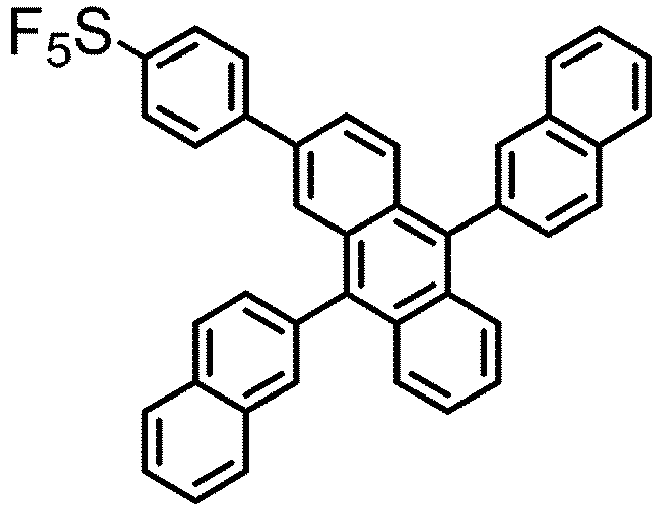
- By a method similar to Example 29', the adhesion of metal to compound (Y2) was evaluated. Silver formed a film on the film of compound (Y2), and a transparent area was not formed.
-

- By a method similar to Example 29', the adhesion of metal to compound (Y3) was evaluated. Silver formed a film on the film of compound (Y3), and a transparent area was not formed.
- Evaluation of the metal adhesion is possible by transmittance measurement, and the transmittance declines when metal adheres. In addition, when the adhered amount increased, the transmittance decreases in correlation thereto.
- Example 1": Transmittance measurement of compound (A177) Boiling washing was performed with isopropyl alcohol on the glass substrate, and after further washing by UV/ozone, it was placed in the vapor deposition equipment, and evacuated to no more than 1.0×10⁻⁴ Pa by a vacuum pump. The compound (A177), which is the metal patterning material, was deposited to 20 nm at 0.1 nm/sec on a glass substrate. The results of transmittance measurement are shown in
FIG. 1A . Silver was further deposited to 10 nm at a deposition rate of 0.1 nm/sec on a thin film of A177. The results of transmittance measurement are shown inFIG. 1B . InFIG. 1B , the transmittance of 550 to 800 nm after metal deposition was "= 80%", and the formation of a metal film was suppressed. - Example 9": Transmittance measurement of compound (A433) By a method similar to Example 1", the transmittance of compound (A433) was measured. The results of transmittance measurement before metal deposition and after metal deposition are respectively shown in
FIGS. 2A and 2B . InFIG. 2B , the transmittance of 550 to 800 nm after metal deposition was "≧ 50%", and the formation of a metal film was suppressed. - By a method similar to Example 1", the transmittance of compound (X1) was measured. The results of transmittance measurement before metal deposition and after metal deposition are respectively shown in
FIGS. 3A and 3B . InFIG. 3B , the transmittance of 550 to 800 nm after metal deposition was "≧ 30%", and the formation of a metal film was suppressed. - By a method similar to Example 1", the transmittance of compound (X4) was measured. The results of transmittance measurement before metal deposition and after metal deposition are respectively shown in
FIGS. 4A and 4B . InFIG. 4B , the transmittance of 550 to 800 nm after metal deposition was "= 40%", and the formation of a metal film was suppressed. - By a method similar to Example 1", transmittance measurement was conducted on compounds A206, A236, A512, A559, A173, A569, A305, A176, A574, A580, A581, A582, A584, A526, A591, A390, A608, A663, A597, X3 and X5. The results thereof are shown in Table 1. Among the carbon atom number forming the aromatic ring, and the carbon atom number forming the heteroaromatic ring, the proportions of carbon atom number directly bonding with fluorine atom (abbreviated as CAr-F) are shown in Table 43.
[Table 43] Compound number CAr-F Transmittance after metal vapor deposition Example1" A177 66.7% ≥80 % Example2" A206 44.4% ≥50% Example3" A236 44.4% ≥60% Example5" A512 66.70 ≥80% Example7" A559 61.5% ≥80% Example8" A173 73.3% ≥80% Example9" A433 44.4% ≥50% Example10" A569 60.0% ≥80% Example11" A305 57.1% ≥80% Example13" A176 72.2% ≥80% Example14" A574 53.3% ≥80% Example15" A580 66.7% ≥80% Example18" A581 66.7% ≥80% Example20" A582 66.7% ≥80% Example21" A584 44.4% ≥80% Example23" A526 66.7% ≥60% Example25" A591 72.2% ≥80% Example32" A390 47.1% ≥80% Example40" A608 13.3% ≥50% Example51" A663 47.1% ≥60% Reference Example47" A597 40.0% ≥40% Comparative Example1" X1 0.0% ≥30% Comparative Example4" X3 9.5% ≥40% Comparative Example5" X4 9.5% ≥40% Comparative Example7" X5 10.0% ≥30% - By a method similar to Example 1", transmittance measurement was conducted on compounds B51, B26, B104, B90, Y1, Y2 and Y3. The results thereof are shown in Table 44. Among the carbon atom number forming the aromatic ring, and the carbon atom number forming the heteroaromatic ring, the proportions of carbon atom number directly bonding with fluorine atom (abbreviated as CAr-F) are noted in Table 44. The proportions of fluorine atom (abbreviated as CA11-F) relative to carbon atom number in a molecule are noted in Table 44.
[Table 44] Compound number CAr-F CAll-F Transmittance after metal vapor deposition Example29" B51 70.0% 70.0% ≥80% Example44" B26 50.0% 50.0% ≥80% Example45" B104 66.7% 78.9% ≥60% Example79" B90 27.8% 55.0% ≥50% Comparative Example10" Y1 10.0% 10.0% ≥30% Comparative Example11" Y2 0.0% 13.0% ≥30% Comparative Example12" Y3 22.2% 22.2% ≥40% - Although the present invention has been explained in detail by referencing specific embodiments, it is clear to those skilled in the art that it is possible to apply various modifications and improvements without departing from the gist and scope of the present invention.
- It should be noted that the disclosures, claims, drawings and entire contents of abstracts of
Japanese Patent Application No. 2020-136094 filed on August 12, 2020 Japanese Patent Application No. 2021-021921 filed on February 15, 2021 Japanese Patent Application No. 2021-112394 filed on July 6, 2021
Claims (19)
- A metal patterning material, comprising a compound having, in a molecule: an aromatic ring and/or heteroaromatic ring, a fluorine atom, and at least one tertiary amine,wherein the aromatic ring is at least one selected from the group consisting of a monocyclic aromatic ring, a linked aromatic ring, and a condensed aromatic ring having from 6 to 15 carbon atoms,and is free of condensed aromatic rings having 16 or more carbon atoms,wherein a proportion of carbon atom number directly binding with the fluorine atom among a carbon atom number forming the aromatic ring and a carbon atom number forming the heteroaromatic ring is at least 10%,wherein molecular weight is at least 500 and no more than 3,000, andwherein a glass transition temperature is 60°C or higher.
- The metal patterning material according to claim 1, wherein the tertiary amine is an aromatic tertiary amine, and
wherein a molecular weight is at least 500 and no more than 2,000. - The metal patterning material according to claim 1 or 2 represented by Formula (1), (2) or (3):


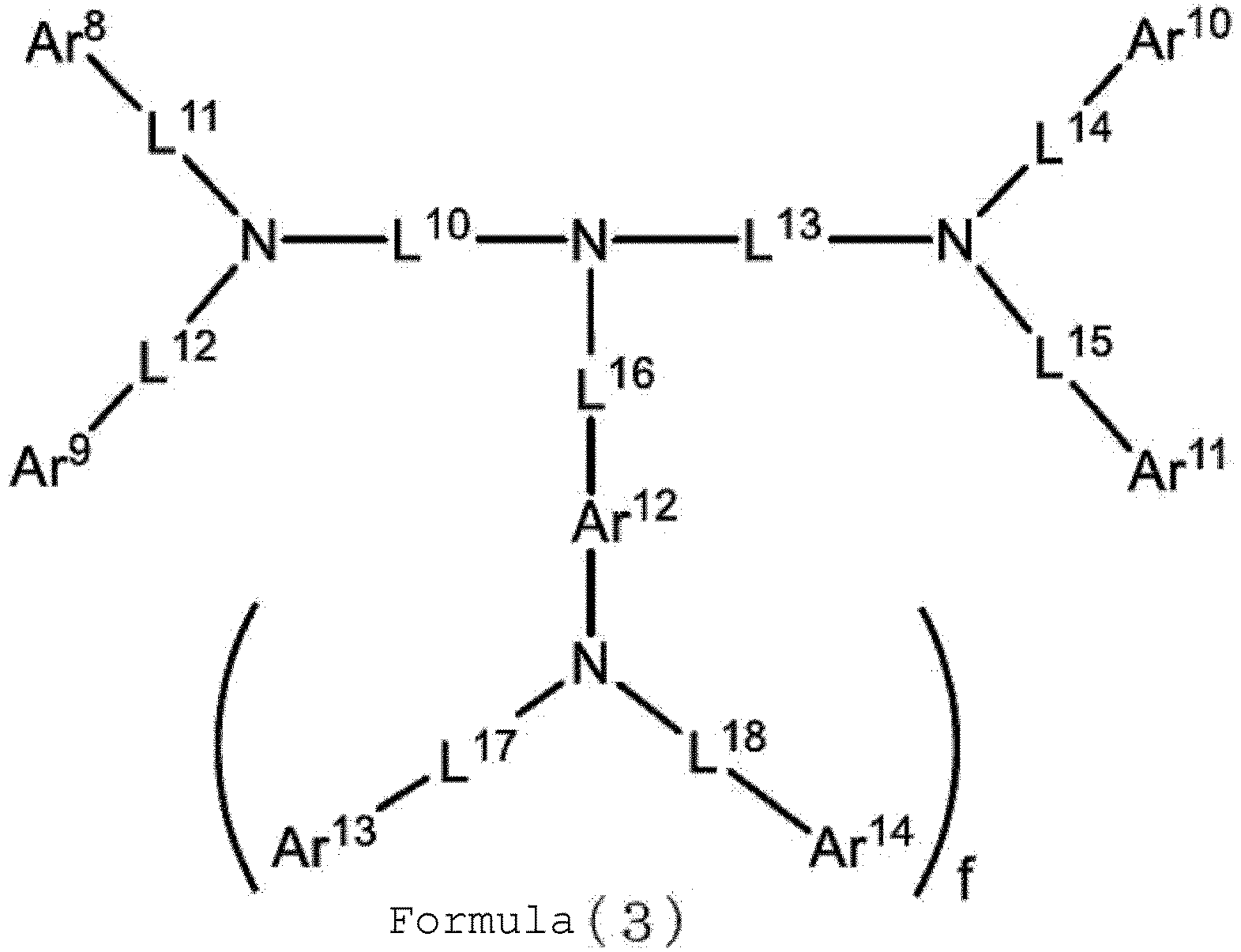 Ar1 to Ar14 each independently representa monocyclic, linked or condensed aromatic hydrocarbon group having 6 to 25 carbon atoms which may be substituted, ora monocyclic, linked or condensed heteroaromatic group having 3 to 25 carbon atoms which may be substituted;L1 to L18 each independently representa monocyclic, linked or condensed divalent aromatic hydrocarbon group having 6 to 25 carbon atoms which may be substituted,a monocyclic, linked or condensed divalent heteroaromatic group having 3 to 25 carbon atoms which may be substituted, ora single bond;X representsa monocyclic, linked or condensed divalent to tetravalent aromatic hydrocarbon group having 6 to 25 carbon atoms which may be substituted,a monocyclic, linked or condensed divalent to tetravalent heteroaromatic group having 3 to 25 carbon atoms which may be substituted,a linear, branched or cyclic divalent to tetravalent alkyl group having 1 to 10 carbon atoms which may be substituted, ora divalent to tetravalent silicon atom which may be substituted;a, b and c each independently represent an integer of 1 to 3;d and e each independently represent an integer of 1 or 2; andf represents an integer of 0 or 1.
 - The metal patterning material according to claim 3,
wherein, when Ar1 to Ar14 are substituted aromatic hydrocarbon groups or substituted heteroaromatic groups, these groups are each independently substituted by at least one selected from the group consisting of:a linear, branched or cyclic alkyl group having 1 to 18 carbon atoms which may be substituted by a fluorine atom,a linear, branched or cyclic alkoxy group having 1 to 18 carbon atoms which may be substituted by a fluorine atom,an aromatic hydrocarbon group having 6 to 20 carbon atoms which may be substituted by a fluorine atom,a heteroaromatic group having 3 to 20 carbon atoms which may be substituted by a fluorine atom,a cyano group,a fluorine atom, anda deuterium atom;when L1 to L18 are a substituted divalent aromatic hydrocarbon group or substituted divalent heteroaromatic group, these groups are each independentlya linear, branched or cyclic alkyl group having 1 to 18 carbon atoms which may be substituted by a fluorine atom,a linear, branched or cyclic alkoxy group having 1 to 18 carbon atoms which may be substituted by a fluorine atom,an aromatic hydrocarbon group having 6 to 20 carbon atoms which may be substituted by a fluorine atom,a heteroaromatic group having 3 to 20 carbon atoms which may be substituted by a fluorine atom,a cyano group,a fluorine atom, anda deuterium atom; andwhen X is a substituted divalent to tetravalent aromatic hydrocarbon group, substituted divalent to tetravalent heteroaromatic group, substituted divalent to tetravalent alkyl group, or substituted divalent to tetravalent silicon atom, these groups are each independently represented by at least one selected from the group consisting of:a linear, branched or cyclic alkyl group having 1 to 18 carbon atoms which may be substituted by a fluorine atom,a linear, branched or cyclic alkoxy group having 1 to 18 carbon atoms which may be substituted by a fluorine atom,an aromatic hydrocarbon group having 6 to 20 carbon atoms which may be substituted by a fluorine atom,a heteroaromatic group having 3 to 20 carbon atoms which may be substituted by a fluorine atom,a cyano group,a fluorine atom, anda deuterium atom. - The metal patterning material according to claim 1 or 2 represented by Formula (4), (5) or (6),


 a1, a2 and a3 each independently represent an integer of 1 to 3;a4 and a5 each independently represent an integer of 1 or 2;a6 represents an integer of 0 or 1;A1 to A14 each independently representa monocyclic, linked or condensed aromatic hydrocarbon group having 6 to 25 carbon atoms which may be substituted,a monocyclic, linked or condensed heteroaromatic group having 3 to 25 carbon atoms which may be substituted, ora cyclic alkyl group having 3 to 25 carbon atoms which may be substituted;provided thatat least one of A1 to A3 is each independently a cyclic alkyl group having 3 to 25 carbon atoms which may be substituted,at least one of A4 to A7 is each independently a cyclic alkyl group having 3 to 25 carbon atoms which may be substituted;when a6 is 0, at least one of A8 to A11 is each independently a cyclic alkyl group having 3 to 25 carbon atoms which may be substituted;when a6 is 1, at least one of A8 to A14 is each independently a cyclic alkyl group having 3 to 25 carbon atoms which may be substituted;L101 to L118 each independently representa monocyclic, linked or condensed divalent aromatic hydrocarbon group having 6 to 25 carbon atoms which may be substituted,a monocyclic, linked or condensed divalent heteroaromatic group having 3 to 25 carbon atoms which may be substituted, ora single bond; andB representsa monocyclic, linked or condensed divalent to tetravalent aromatic hydrocarbon group having 6 to 25 carbon atoms which may be substituted,a monocyclic, linked or condensed divalent to tetravalent heteroaromatic group having 3 to 25 carbon atoms which may be substituted,a linear, branched or cyclic divalent to tetravalent alkyl group having 1 to 10 carbon atoms which may be substituted, ora divalent to tetravalent silicon atom which may be substituted.
 - An amine compound represented by Formula (7) or (8),

 Ar15 to Ar20 each independently representa monocyclic, linked or condensed aromatic hydrocarbon group having 6 to 25 carbon atoms which may be substituted, ora monocyclic, linked or condensed heteroaromatic group having 3 to 25 carbon atoms which may be substituted;L19 to L28 each independently representa monocyclic, linked or condensed divalent aromatic hydrocarbon group having 6 to 25 carbon atoms which may be substituted,a monocyclic, linked or condensed divalent heteroaromatic group having 3 to 25 carbon atoms which may be substituted, ora single bond;Y representsa monocyclic, linked or condensed divalent to tetravalent aromatic hydrocarbon group having 6 to 25 carbon atoms which may be substituted,a monocyclic, linked or condensed divalent to tetravalent heteroaromatic group having 3 to 25 carbon atoms which may be substituted,a linear, branched or cyclic divalent to tetravalent alkyl group having 1 to 10 carbon atoms which may be substituted, ora divalent to tetravalent silicon atom which may be substituted;n represents an integer of 1 to 18;g and h each independently represents an integer of 1 or 2; andi represents an integer of 0 or 1.
 - The amine compound according to claim 6, wherein
when Ar15 to Ar20 are substituted aromatic hydrocarbon groups, or substituted heteroaromatic groups, these groups are each independently substituted by at least one selected from the group consisting of:a linear, branched or cyclic alkyl group having 1 to 18 carbon atoms which may be substituted by a fluorine atom,a linear, branched or cyclic alkoxy group having 1 to 18 carbon atoms which may be substituted by a fluorine atom,an aromatic hydrocarbon group having 6 to 20 carbon atoms which may be substituted by a fluorine atom,a heteroaromatic group having 3 to 20 carbon atoms which may be substituted by a fluorine atom,a cyano group,a fluorine atom, anda deuterium atom;when L19 to L28 are substituted divalent aromatic hydrocarbon groups, or substituted divalent heteroaromatic groups, these groups are each independently substituted by at least one selected from the group consisting of:a linear, branched or cyclic alkyl group having 1 to 18 carbon atoms which may be substituted by a fluorine atom,a linear, branched or cyclic alkoxy group having 1 to 18 carbon atoms which may be substituted by a fluorine atom,an aromatic hydrocarbon group having 6 to 20 carbon atoms which may be substituted by a fluorine atom,a heteroaromatic group having 3 to 20 carbon atoms which may be substituted by a fluorine atom,a cyano group,a fluorine atom, anda deuterium atom;when Y is a substituted divalent to tetravalent aromatic hydrocarbon group, substituted divalent to tetravalent heteroaromatic group, substituted divalent to tetravalent alkyl group, or substituted divalent to tetravalent silicon atom, these groups are each independently substituted by at least one selected from the group consisting of:a linear, branched or cyclic alkyl group having 1 to 18 carbon atoms which may be substituted by a fluorine atom,a linear, branched or cyclic alkoxy group having 1 to 18 carbon atoms which may be substituted by a fluorine atom,an aromatic hydrocarbon group having 6 to 20 carbon atoms which may be substituted by a fluorine atom,a heteroaromatic group having 3 to 20 carbon atoms which may be substituted by a fluorine atom,a cyano group,a fluorine atom, anda deuterium atom. - The amine compound according to claim 6 or 7, wherein Y represents:(xx) a phenylene group, biphenylene group, terphenylylene group, naphthylene group, fluorenylene group, spirobifluorenylene group, benzofluorenylene group, phenanthrene group, fluoranthenylene group, triphenylenylene group, anthracenediyl group, pyridylene group, pyrenediyl group, pyrimidinediyl group, triazinediyl group, carbazolediyl group, benzofuryl group, benzothiophenediyl group, dibenzofuryl group, dibenzothiophenediyl group, adamantanediyl group, methylene group, silanediyl group, cyclohexylene group,phenyltriyl group, biphenyltriyl group, terphenyltriyl group, naphthylyl group, fluorenetriyl group, spirobifluorenetriyl group, benzofluorenetriyl group, phenanthrenetriyl group, fluoranthenetriyl group, triphenylenetriyl group, anthracenetriyl group, pyrenetriyl group, pyridinetriyl group, pyrimidinetriyl group, triazinetriyl group, carbazoletriyl group, benzofurantriyl group, benzothiophenetriyl group, dibenzofurantriyl group, dibenzothiophenetriyl group, adamantanetriyl group, methanetriyl group, silanetriyl group, cyclohexanetriyl group,phenyl tetrayl group, biphenyl tetrayl group, terphenyl tetrayl group, naphthyl tetrayl group, fluorene tetrayl group, spirobiflurene tetrayl group, benzofluorene tetrayl group, phenanthrene tetrayl group, fluoranthene tetrayl group, triphenylene tetrayl group, anthracene tetrayl group, pyrene tetrayl group, pyridine tetrayl group, pyrimidine tetrayl group, carbazole tetrayl group, benzofuran tetrayl group, benzothiophene tetrayl group, dibenzofuran tetrayl group, dibenzothiophene tetrayl group, adamantane tetrayl group, methane tetrayl group, silane tetrayl group, or cyclohexane tetrayl group; or(xxi) a group in which the group represented by (xx) is substituted with one or more groups selected from the group consisting of: a methyl group, an ethyl group, a methoxy group, an ethoxy group, a trifluoromethyl group, a trifluoromethoxy group, a perfluoroalkyl group having 2 to 10 carbon atoms, a perfluoroalkoxy group having 2 to 10 carbon atoms, a cyano group, a deuterium atom, a fluorine atom, a phenyl group optionally substituted with a fluorine atom, a biphenylyl group optionally substituted with a fluorine atom, a naphthyl group optionally substituted with a fluorine atom, a phenanthryl group optionally substituted with a fluorine atom, a pyridyl group optionally substituted with a fluorine atom, a carbazolyl group optionally substituted with a fluorine atom, a dibenzothienyl group optionally substituted with a fluorine atom, and a dibenzofuranyl group optionally substituted with a fluorine atom.
- The amine compound according to any one of claims 6 to 8, wherein n is 1.
- An amine compound represented by Formula (9) or (10),

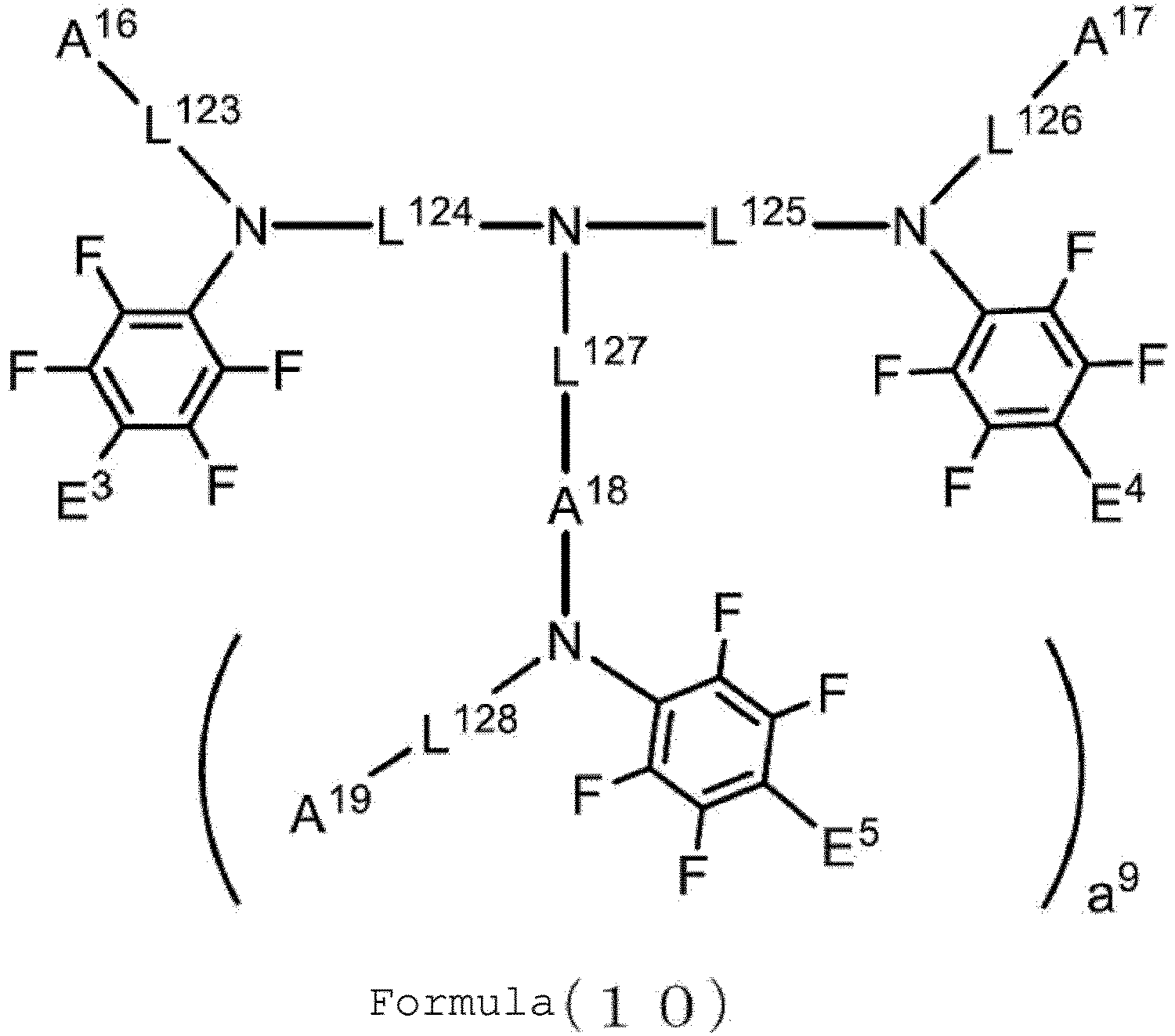 a7 represents an integer of 1 or 2;a8 represents an integer of 0 to 2;a9 represents an integer of 0 or 1;Alk represents a cyclic alkyl group having 3 to 25 carbon atoms which may be substituted;A15 to A19 each independently representa monocyclic, linked or condensed aromatic hydrocarbon group having 6 to 25 carbon atoms which may be substituted,a monocyclic, linked or condensed heteroaromatic group having 3 to 25 carbon atoms which may be substituted, ora cyclic alkyl group having 3 to 25 carbon atoms which may be substituted;provided thatwhen a9 is 0, at least one of A16 to A18 are each independently a cyclic alkyl group having 3 to 25 carbon atoms which may be substituted, andwhen a9 is 1, at least one of A16 to A19 are each independently a cyclic alkyl group having 3 to 25 carbon atoms which may be substitutedL119 to L128 each independently represent:a monocyclic, linked or condensed divalent aromatic hydrocarbon group having 6 to 25 carbon atoms which may be substituted,a monocyclic, linked or condensed divalent heteroaromatic group having 3 to 25 carbon atoms which may be substituted, ora single bond;D representsa monocyclic, linked or condensed monovalent to tetravalent aromatic hydrocarbon group having 6 to 25 carbon atoms which may be substituted,a monocyclic, linked or condensed monovalent to tetravalent aromatic hydrocarbon group having 3 to 25 carbon atoms which may be substituted,a monocyclic, linked or condensed monovalent to alkyl group having 1 to 10 carbon atoms which may be substituted, ora monovalent to tetravalent silicon atom which may be substituted;E1 to E5 each independently representa fluorine atom, ora linear, branched or cyclic alkyl group having 1 to 18 carbon atoms which may be substituted by a fluorine atom.
 - A metal patterning material comprising a compound having, in a molecule, an aromatic ring and/or heteroaromatic ring, and a fluorine atom,wherein a proportion of carbon atom number directly binding with the fluorine atom among carbon atom number forming the aromatic ring and carbon atom number forming the heteroaromatic ring is at least 10%,wherein a proportion of fluorine atoms relative to carbon atoms in the molecule is at least 50%,wherein molecular weight is at least 500 and no more than 3000, andwherein glass transition temperature is at least 60°C.
- The metal patterning material according to claim 11 represented by Formula (11)
 Ar21, Ar22 and Ar23 each independently representa monocyclic, linked or condensed aromatic hydrocarbon group having 6 to 25 carbon atoms which may be substituted, ora monocyclic, linked or condensed heteroaromatic group having 3 to 25 carbon atoms which may be substituted;L29, L30 and L31 each independently representa monocyclic, linked or condensed divalent aromatic hydrocarbon group having 6 to 25 carbon atoms which may be substituted,a monocyclic, linked or condensed divalent heteroaromatic group having 3 to 25 carbon atoms which may be substituted, ora single bond; andj, k and 1 each independently represent an integer of 0 to 6;
(j+k+l) is at least 2 and no more than 6; andZ representsa monocyclic, linked or condensed divalent to hexavalent aromatic hydrocarbon group having 6 to 25 carbon atoms which may be substituted,a monocyclic, linked or condensed divalent to hexavalent heteroaromatic group having 3 to 25 carbon atoms which may be substituted,a monocyclic, linked or condensed divalent to hexavalent alkyl group having 1 to 10 carbon atoms which may be substituted, ora divalent to tetravalent silicon atom. - The metal patterning material according to claim 12, wherein,
when Ar21 to Ar23 are a substituted aromatic hydrocarbon groups or substituted heteroaromatic groups, these groups are each independently substituted by at least one selected from the group consisting of:a linear, branched or cyclic alkyl group having 1 to 18 carbon atoms which may be substituted by a fluorine atom,a linear, branched or cyclic alkoxy group having 1 to 18 carbon atoms which may be substituted by a fluorine atom,an aromatic hydrocarbon group having 6 to 20 carbon atoms which may be substituted by a fluorine atom,a heteroaromatic group having 3 to 20 carbon atoms which may be substituted by a fluorine atom,a cyano group,a fluorine atom, anda deuterium atom;when L29 to L31 are substituted divalent aromatic hydrocarbon groups, or substituted divalent heteroaromatic groups, these groups are each independently represented bya linear, branched or cyclic alkyl group having 1 to 18 carbon atoms which may be substituted by a fluorine atom,a linear, branched or cyclic alkoxy group having 1 to 18 carbon atoms which may be substituted by a fluorine atom,an aromatic hydrocarbon group having 6 to 20 carbon atoms which may be substituted by a fluorine atom,a heteroaromatic group having 3 to 20 carbon atoms which may be substituted by a fluorine atom,a cyano group,a fluorine atom, anda deuterium atom;when Z is a substituted divalent to hexavalent aromatic hydrocarbon group, a substituted divalent to hexavalent heteroaromatic group, a substituted divalent to hexavalent alkyl group or a divalent to tetravalent silicon atom, these groups are each independently substituted by at least one selected from the group consisting of:a linear, branched or cyclic alkyl group having 1 to 18 carbon atoms which may be substituted by a fluorine atom,a linear, branched or cyclic alkoxy group having 1 to 18 carbon atoms which may be substituted by a fluorine atom,an aromatic hydrocarbon group having 6 to 20 carbon atoms which may be substituted by a fluorine atom,a heteroaromatic group having 3 to 20 carbon atoms which may be substituted by a fluorine atom,a cyano group,a fluorine atom, anda deuterium atom. - The metal patterning material according to claim 12 or 13, wherein Ar21, Ar22 and Ar23(xxxi) a phenyl group, a biphenylyl group, a terphenylyl group, a naphthyl group, a fluorenyl group, a spirobifluorenyl group, a benzofluorenyl group, a phenanthryl group, a fluoranthenyl group, a triphenylenyl group, an anthryl group, a pyrenyl group, a pyridyl group, a carbazolyl group, a benzofuranyl group, a benzothienyl group, a dibenzofuranyl group, or a dibenzothienyl group; or(xxxii) a group in which the group represented by (xxxi) is substituted with one or more groups selected from the group consisting of: a methyl group, an ethyl group, a methoxy group, an ethoxy group, a trifluoromethyl group, a trifluoromethoxy group, an adamantyl group, a cyclohexyl group, a perfluoroalkyl group having 2 to 10 carbon atoms, a perfluoroalkoxy group having 2 to 10 carbon atoms, a cyano group, a deuterium atom, a phenyl group optionally substituted with a fluorine atom, a biphenyl group optionally substituted with a fluorine atom, a naphthyl group optionally substituted with a fluorine atom, a phenanthryl group optionally substituted with a fluorine atom, a pyridyl group optionally substituted with a fluorine atom, a carbazolyl group optionally substituted with a fluorine atom, a dibenzothienyl group optionally substituted with a fluorine atom, and a dibenzofuranyl group optionally substituted with a fluorine atom.
- The metal patterning material according to any one of claims 12 to 14, wherein L29, L30 and L31 are each independently(xxxiii) a phenylene group, a biphenylylene group, a terphenylene group, a naphthylene group, a pyridylene group, or a fluorenylene group;(xxxiv) a group in which the group represented by (xxxiii) is substituted with one or more groups selected from the group consisting of: a methyl group, an ethyl group, a methoxy group, an ethoxy group, a trifluoromethyl group, a trifluoromethoxy group, a perfluoroalkyl group having 2 to 10 carbon atoms, a perfluoroalkoxy group having 2 to 10 carbon atoms, a cyano group, a deuterium atom, a fluorine atom, a phenyl group optionally substituted with a fluorine atom, a biphenylyl group optionally substituted with a fluorine atom, a naphthyl group optionally substituted with a fluorine atom, a phenanthryl group optionally substituted with a fluorine atom, a pyridyl group optionally substituted with a fluorine atom, a carbazolyl group optionally substituted with a fluorine atom, a dibenzothienyl group optionally substituted with a fluorine atom, and a dibenzofuranyl group optionally substituted with a fluorine atom; or(xxxv) a single bond.
- The metal patterning material according to any one of claims 12 to 15, wherein Z is(xxxvi) a monovalent phenyl group, a biphenylyl group, a terphenylyl group, a naphthyl group, a fluorenyl group, a spirobifluorenyl group, a benzofluorenyl group, a phenanthryl group, a fluoranthenyl group, a triphenylenyl group, an anthryl group, a pyrenyl group, a pyridyl group, a carbazolyl group, a benzofuranyl group, a benzothienyl group, a dibenzofuranyl group, a dibenzothienyl group, a cyclohexyl group, an adamantyl group, a methyl group, or a silyl group;(xxxvii) a divalent phenylene group, a biphenylene group, a terphenylene group, a naphthylene group, a fluorenylene group, a spirobifluorenylene group, a benzofluorenylene group, a phenanetriene group, a fluoranthenylene group, a triphenylenylene group, an anthrylene group, a pyrenylene group, a pyridylene group, a carbazolylene group, a benzofuranylene group, a benzothienylene group, a dibenzofuranylene group, a dibenzothienylene group, a cyclohexylene group, an adamantylene group, a methylene group, or a silanediyl group,(xxxviii) a trivalent phenyltriyl group, a biphenyltriyl group, a terphenyltriyl group, a naphthylyl group, a fluorenetriyl group, a spirobiflurenetriyl group, a benzofluorenetriyl group, a phenanthrenetriyl group, a fluoranthenetriyl group, a triphenylenetriyl group, an anthracenetriyl group, a pyrenetriyl group, a pyridinetriyl group, a carbazoletriyl group, a benzofurantriyl group, a benzothiophenetriyl group, a dibenzofurantriyl group, a dibenzothiophenetriyl group, a cyclohexanetriyl group, an adamantanetriyl group, a methanetriyl group, or a silanetriyl group;(xxxix) a tetravalent phenyl tetrayl group, a biphenyl tetrayl group, a terphenyl tetrayl group, a naphthyl tetrayl group, a fluorene tetrayl group, a spirobifluorene tetrayl group, a benzofluorene tetrayl group, a phenanthrene tetrayl group, a fluoranthene tetrayl group, a triphenylene tetrayl group, anthracene tetrayl group, a pyrene tetrayl group, a pyridine tetrayl group, a carbazole tetrayl group, a benzofuran tetrayl group, a benzothiophene tetrayl group, a dibenzofuran tetrayl group, a dibenzothiophene tetrayl group, a cyclohexane tetrayl group, an adamantane tetrayl group, a methane tetrayl group, or a silane tetrayl group; or(xxxx) a pentavalent phenylpentayl group, a biphenyl pentayl group, a terphenyl pentayl group, a naphthyl pentayl group, a fluorene pentayl group, spirobifluorene pentayl group, a benzofluorene pentayl group, a phenanthrene pentayl groups, a fluoranthene pentayl group, a triphenylene pentayl group, an anthracene pentayl group, a pyrene pentayl group, a pyridine pentayl group, a carbazole pentayl group, a benzofuran pentayl group, a benzothiophenepentayl group, a dibenzofuranepentayl group, a dibenzothiophenepentayl group, a cyclohexanepentayl group, or an adamantanepentayl group; or(xxxxi) a hexavalent phenylhexayl group, a biphenylhexayl group, a terphenylhexayl group, a naphthylhexayl group, a fluorenehexayl group, a spirobifluorenehexayl group, a benzofluorenehexayl group, a phenanthrenehexayl group, a fluoranthenehexayl group, a triphenylenehexayl group, an anthracenehexayl group, a pyrenehexayl group, a pyridinehexayl group, a carbazolehexayl group, a benzofuranhexayl group, benzothiophenehexayl group, a dibenzofuranhexayl group, a dibenzothiophenehexayl group, a cyclohexanehexayl group, or an adamantanehexayl group; or(xxxxii) a group in which the group represented by (xxxvi) to (xxxxi) is substituted with one or more groups selected from the group consisting of: a methyl group, an ethyl group, a methoxy group, an ethoxy group, a trifluoromethyl group, a trifluoromethoxy group, an adamantyl group, a cyclohexyl group, a perfluoroalkyl group having 2 to 10 carbon atoms, a perfluoroalkoxy group having 2 to 10 carbon atoms, a cyano group, a deuterium atom, a fluorine atom, a phenyl group optionally substituted with a fluorine atom, a biphenyl group optionally substituted with a fluorine atom, a naphthyl group optionally substituted with a fluorine atom, a phenanthryl group optionally substituted with a fluorine atom, a pyridyl group optionally substituted with a fluorine atom, a carbazolyl group optionally substituted with a fluorine atom, a dibenzothienyl group optionally substituted with a fluorine atom, and a dibenzofuranyl group optionally substituted with a fluorine atom.
- The metal patterning material according to any one of claims 12 to 16, comprising in a molecule at least one perfluorophenyl group, perfluorotolyl group, perfluorodimethyl phenyl group or perfluorobiphenylyl group.
- A method for forming a metal pattern, comprising:forming an organic material pattern including the metal patterning material according to any one of claims 1 to 5 and 11 to 17, or the amine compound according to any one of claims 6 to 10; andapplying a metal material on a formation region of the organic material pattern and a non-formation region of the organic material pattern to form a metal pattern on the non-formation region.
- An electronic device comprising the metal patterning material according to any one of claims 1 to 5 and 11 to 17, or the amine compound according to any one of claims 6 to 10.
Applications Claiming Priority (4)
| Application Number | Priority Date | Filing Date | Title |
|---|---|---|---|
| JP2020136094 | 2020-08-12 | ||
| JP2021021921 | 2021-02-15 | ||
| JP2021112394 | 2021-07-06 | ||
| PCT/JP2021/029689 WO2022034907A1 (en) | 2020-08-12 | 2021-08-11 | Metal patterning material, amine compound, electronic device, and method for forming metal pattern |
Publications (2)
| Publication Number | Publication Date |
|---|---|
| EP4198163A1 true EP4198163A1 (en) | 2023-06-21 |
| EP4198163A4 EP4198163A4 (en) | 2024-12-11 |
Family
ID=80248009
Family Applications (1)
| Application Number | Title | Priority Date | Filing Date |
|---|---|---|---|
| EP21855986.2A Pending EP4198163A4 (en) | 2020-08-12 | 2021-08-11 | Metal patterning material, amine compound, electronic device, and method for forming metal pattern |
Country Status (6)
| Country | Link |
|---|---|
| US (1) | US20240122065A1 (en) |
| EP (1) | EP4198163A4 (en) |
| JP (1) | JPWO2022034907A1 (en) |
| KR (2) | KR20230050386A (en) |
| CN (1) | CN116157382A (en) |
| WO (1) | WO2022034907A1 (en) |
Families Citing this family (2)
| Publication number | Priority date | Publication date | Assignee | Title |
|---|---|---|---|---|
| WO2023153482A1 (en) * | 2022-02-09 | 2023-08-17 | 東ソー株式会社 | Material for metal patterning, heterocyclic compound, thin film for metal patterning, organic electroluminescent device, electronic device, and method for forming metal pattern |
| CN115141106B (en) * | 2022-06-30 | 2024-03-22 | 山东钥熠材料科技有限公司 | Compound, organic material and organic photoelectric device |
Family Cites Families (9)
| Publication number | Priority date | Publication date | Assignee | Title |
|---|---|---|---|---|
| JP2003313547A (en) * | 2002-04-19 | 2003-11-06 | Idemitsu Kosan Co Ltd | Organic electroluminescent device material and organic electroluminescent device using the same |
| JP2005044791A (en) * | 2003-07-08 | 2005-02-17 | Konica Minolta Holdings Inc | Organic electroluminescence element, lighting device and display device |
| EP1651013A4 (en) * | 2003-07-08 | 2008-07-23 | Konica Minolta Holdings Inc | ORGANIC ELECTROLUMINESCENT DEVICE, ILLUMINATION AND DISPLAY DEVICE |
| JP4989881B2 (en) * | 2004-12-28 | 2012-08-01 | 富士フイルム株式会社 | Organic electroluminescence device |
| JP5233074B2 (en) | 2005-03-02 | 2013-07-10 | 三菱レイヨン株式会社 | Metal pattern, organic electronic device and manufacturing method thereof |
| JP2007176921A (en) * | 2005-07-01 | 2007-07-12 | Nippon Shokubai Co Ltd | Benzonitrile compound, its manufacturing method and use |
| WO2007097912A2 (en) * | 2006-02-17 | 2007-08-30 | 3M Innovative Properties Company | Rechargeable lithium-ion cell with triphenylamine redox shuttle |
| JP2017157633A (en) * | 2016-02-29 | 2017-09-07 | 出光興産株式会社 | Composition, method for manufacturing the same, metal nano material composition, method for manufacturing conducting circuit, and electronic device |
| KR102675085B1 (en) * | 2018-06-20 | 2024-06-13 | (주)피엔에이치테크 | An electroluminescent compound and an electroluminescent device comprising the same |
-
2021
- 2021-08-11 CN CN202180055336.6A patent/CN116157382A/en active Pending
- 2021-08-11 KR KR1020237008111A patent/KR20230050386A/en active Pending
- 2021-08-11 US US18/020,652 patent/US20240122065A1/en active Pending
- 2021-08-11 EP EP21855986.2A patent/EP4198163A4/en active Pending
- 2021-08-11 KR KR1020267006709A patent/KR20260036404A/en active Pending
- 2021-08-11 WO PCT/JP2021/029689 patent/WO2022034907A1/en not_active Ceased
- 2021-08-11 JP JP2022542872A patent/JPWO2022034907A1/ja active Pending
Also Published As
| Publication number | Publication date |
|---|---|
| EP4198163A4 (en) | 2024-12-11 |
| US20240122065A1 (en) | 2024-04-11 |
| KR20230050386A (en) | 2023-04-14 |
| JPWO2022034907A1 (en) | 2022-02-17 |
| CN116157382A (en) | 2023-05-23 |
| KR20260036404A (en) | 2026-03-16 |
| WO2022034907A1 (en) | 2022-02-17 |
Similar Documents
| Publication | Publication Date | Title |
|---|---|---|
| EP3792989A1 (en) | Organic light emitting diode including boron compounds | |
| CN113348172A (en) | Compound and organic light emitting device including the same | |
| EP3015527B1 (en) | Organic compound for optoelectric device and composition for optoelectric device and organic optoelectric device and display device | |
| EP3514139A1 (en) | Fluorine-based compound, organic light-emitting device using same and method for preparing same | |
| KR102805898B1 (en) | Method for preparing deuterated compound | |
| EP3477719A1 (en) | Organic light emitting device | |
| EP3266779B1 (en) | Heterocyclic compound and organic light emitting element comprising same | |
| EP3620449A1 (en) | Novel compound and organic light-emitting element using same | |
| EP4194460A1 (en) | Organic light-emitting device including organic compound | |
| EP3336077B1 (en) | Amine-based compound and organic light-emitting element comprising same | |
| CN115160272B (en) | Nitrogen-containing compound, and electronic element and electronic device using same | |
| EP3415585A1 (en) | Organic light-emitting element | |
| KR20260036404A (en) | Metal patterning material, amine compound, electronic device, and method for forming metal pattern | |
| JP2020508295A (en) | Compound, coating composition containing the same, organic light emitting device using the same, and method of manufacturing the same | |
| WO2023013697A1 (en) | Material for metal patterning, fluoro compound, thin film for metal patterning, organic electroluminescence device, electronic device, and method for forming metal pattern | |
| CN114933571B (en) | Organic compound, electronic component, and electronic device | |
| JP2018184393A (en) | Fused ring compound and process for producing the same | |
| CN116023374A (en) | A kind of heterocyclic compound and its application | |
| CN109686870B (en) | Isotopic composition and organic electroluminescence device | |
| CN117430594B (en) | Organic compounds, electronic components and electronic devices | |
| WO2025057775A1 (en) | Material for photoelectric conversion element for imaging element, and imaging element | |
| US20250101024A1 (en) | Nitrogen-containing compound, organic electroluminescent device, and electronic apparatus | |
| EP3313843B1 (en) | Imidazopyrazine derived compounds for electronic devices | |
| EP3242867A1 (en) | Organic compounds and electronic device comprising organic layer comprising organic compounds | |
| JP2025022838A (en) | Amine compound, material for metal patterning, thin film for metal patterning, organic electroluminescence element, electronic device, and method for forming metal pattern |
Legal Events
| Date | Code | Title | Description |
|---|---|---|---|
| STAA | Information on the status of an ep patent application or granted ep patent |
Free format text: STATUS: THE INTERNATIONAL PUBLICATION HAS BEEN MADE |
|
| PUAI | Public reference made under article 153(3) epc to a published international application that has entered the european phase |
Free format text: ORIGINAL CODE: 0009012 |
|
| STAA | Information on the status of an ep patent application or granted ep patent |
Free format text: STATUS: REQUEST FOR EXAMINATION WAS MADE |
|
| 17P | Request for examination filed |
Effective date: 20230227 |
|
| AK | Designated contracting states |
Kind code of ref document: A1 Designated state(s): AL AT BE BG CH CY CZ DE DK EE ES FI FR GB GR HR HU IE IS IT LI LT LU LV MC MK MT NL NO PL PT RO RS SE SI SK SM TR |
|
| DAV | Request for validation of the european patent (deleted) | ||
| DAX | Request for extension of the european patent (deleted) | ||
| A4 | Supplementary search report drawn up and despatched |
Effective date: 20241113 |
|
| RIC1 | Information provided on ipc code assigned before grant |
Ipc: H10K 50/82 20230101ALN20241107BHEP Ipc: H10K 85/60 20230101ALI20241107BHEP Ipc: H10K 71/60 20230101ALI20241107BHEP Ipc: H05B 33/26 20060101ALI20241107BHEP Ipc: H01G 9/20 20060101ALI20241107BHEP Ipc: C23C 14/04 20060101ALI20241107BHEP Ipc: C07C 211/56 20060101ALI20241107BHEP Ipc: C23C 14/12 20060101AFI20241107BHEP |