EP4197634A1 - Method for converting unsaturated light hydrocarbons to unsaturated heavy hydrocarbons, metal organic framework composition to be used as catalyst, and method or preparing a metal organic framework - Google Patents
Method for converting unsaturated light hydrocarbons to unsaturated heavy hydrocarbons, metal organic framework composition to be used as catalyst, and method or preparing a metal organic framework Download PDFInfo
- Publication number
- EP4197634A1 EP4197634A1 EP21215706.9A EP21215706A EP4197634A1 EP 4197634 A1 EP4197634 A1 EP 4197634A1 EP 21215706 A EP21215706 A EP 21215706A EP 4197634 A1 EP4197634 A1 EP 4197634A1
- Authority
- EP
- European Patent Office
- Prior art keywords
- group
- mof
- composition
- hydrocarbon
- lattice
- Prior art date
- Legal status (The legal status is an assumption and is not a legal conclusion. Google has not performed a legal analysis and makes no representation as to the accuracy of the status listed.)
- Pending
Links
- 239000012621 metal-organic framework Substances 0.000 title claims abstract description 126
- 239000000203 mixture Substances 0.000 title claims abstract description 101
- 229930195733 hydrocarbon Natural products 0.000 title claims abstract description 92
- 150000002430 hydrocarbons Chemical class 0.000 title claims abstract description 92
- 238000000034 method Methods 0.000 title claims abstract description 47
- 239000003054 catalyst Substances 0.000 title claims description 35
- 239000004215 Carbon black (E152) Substances 0.000 claims abstract description 68
- 239000012918 MOF catalyst Substances 0.000 claims abstract description 12
- 125000004432 carbon atom Chemical group C* 0.000 claims description 32
- -1 phosphino group Chemical group 0.000 claims description 19
- IJGRMHOSHXDMSA-UHFFFAOYSA-N Atomic nitrogen Chemical compound N#N IJGRMHOSHXDMSA-UHFFFAOYSA-N 0.000 claims description 16
- 229910052757 nitrogen Inorganic materials 0.000 claims description 14
- 229930195735 unsaturated hydrocarbon Natural products 0.000 claims description 12
- OKTJSMMVPCPJKN-UHFFFAOYSA-N Carbon Chemical group [C] OKTJSMMVPCPJKN-UHFFFAOYSA-N 0.000 claims description 11
- 125000003277 amino group Chemical group 0.000 claims description 11
- 229910052799 carbon Inorganic materials 0.000 claims description 11
- 239000011949 solid catalyst Substances 0.000 claims description 11
- 229910052760 oxygen Inorganic materials 0.000 claims description 10
- 150000007942 carboxylates Chemical group 0.000 claims description 9
- 229910052759 nickel Inorganic materials 0.000 claims description 9
- ABLZXFCXXLZCGV-UHFFFAOYSA-N Phosphorous acid Chemical group OP(O)=O ABLZXFCXXLZCGV-UHFFFAOYSA-N 0.000 claims description 8
- 125000003118 aryl group Chemical group 0.000 claims description 8
- 125000000524 functional group Chemical group 0.000 claims description 8
- 229910052751 metal Inorganic materials 0.000 claims description 8
- 239000002184 metal Substances 0.000 claims description 8
- 125000001273 sulfonato group Chemical group [O-]S(*)(=O)=O 0.000 claims description 8
- 125000000217 alkyl group Chemical group 0.000 claims description 7
- 125000000879 imine group Chemical group 0.000 claims description 7
- 238000005470 impregnation Methods 0.000 claims description 7
- 125000002560 nitrile group Chemical group 0.000 claims description 7
- RAXXELZNTBOGNW-UHFFFAOYSA-N 1H-imidazole Chemical group C1=CNC=N1 RAXXELZNTBOGNW-UHFFFAOYSA-N 0.000 claims description 6
- JUJWROOIHBZHMG-UHFFFAOYSA-N Pyridine Chemical group C1=CC=NC=C1 JUJWROOIHBZHMG-UHFFFAOYSA-N 0.000 claims description 6
- 125000004185 ester group Chemical group 0.000 claims description 6
- 125000005842 heteroatom Chemical group 0.000 claims description 6
- 125000002883 imidazolyl group Chemical group 0.000 claims description 6
- 125000000962 organic group Chemical group 0.000 claims description 6
- 229910052698 phosphorus Inorganic materials 0.000 claims description 6
- 125000000542 sulfonic acid group Chemical group 0.000 claims description 6
- 229910052717 sulfur Inorganic materials 0.000 claims description 6
- 150000003852 triazoles Chemical group 0.000 claims description 6
- 125000003158 alcohol group Chemical group 0.000 claims description 5
- 125000003368 amide group Chemical group 0.000 claims description 5
- 229910052794 bromium Inorganic materials 0.000 claims description 5
- 229910052723 transition metal Inorganic materials 0.000 claims description 5
- 150000003624 transition metals Chemical class 0.000 claims description 5
- 229910052783 alkali metal Inorganic materials 0.000 claims description 4
- 150000001340 alkali metals Chemical class 0.000 claims description 4
- 150000001336 alkenes Chemical class 0.000 claims description 4
- QGZKDVFQNNGYKY-UHFFFAOYSA-O ammonium group Chemical group [NH4+] QGZKDVFQNNGYKY-UHFFFAOYSA-O 0.000 claims description 4
- QVGXLLKOCUKJST-UHFFFAOYSA-N atomic oxygen Chemical compound [O] QVGXLLKOCUKJST-UHFFFAOYSA-N 0.000 claims description 4
- 125000005620 boronic acid group Chemical group 0.000 claims description 4
- 125000002915 carbonyl group Chemical group [*:2]C([*:1])=O 0.000 claims description 4
- 125000002843 carboxylic acid group Chemical group 0.000 claims description 4
- 239000013256 coordination polymer Substances 0.000 claims description 4
- 125000005843 halogen group Chemical group 0.000 claims description 4
- 125000002887 hydroxy group Chemical group [H]O* 0.000 claims description 4
- 150000002460 imidazoles Chemical class 0.000 claims description 4
- 239000001301 oxygen Substances 0.000 claims description 4
- 125000002467 phosphate group Chemical group [H]OP(=O)(O[H])O[*] 0.000 claims description 4
- 125000005496 phosphonium group Chemical group 0.000 claims description 4
- 150000003222 pyridines Chemical class 0.000 claims description 4
- 150000003536 tetrazoles Chemical group 0.000 claims description 4
- 125000005595 acetylacetonate group Chemical group 0.000 claims description 3
- 125000004429 atom Chemical group 0.000 claims description 3
- 150000002367 halogens Chemical class 0.000 claims description 3
- 229910052739 hydrogen Inorganic materials 0.000 claims description 3
- 229910052740 iodine Inorganic materials 0.000 claims description 3
- 229910052742 iron Inorganic materials 0.000 claims description 3
- 239000003446 ligand Substances 0.000 claims description 3
- JRZJOMJEPLMPRA-UHFFFAOYSA-N olefin Natural products CCCCCCCC=C JRZJOMJEPLMPRA-UHFFFAOYSA-N 0.000 claims description 3
- DGEZNRSVGBDHLK-UHFFFAOYSA-N [1,10]phenanthroline Chemical group C1=CN=C2C3=NC=CC=C3C=CC2=C1 DGEZNRSVGBDHLK-UHFFFAOYSA-N 0.000 claims description 2
- 125000003172 aldehyde group Chemical group 0.000 claims description 2
- 125000001931 aliphatic group Chemical group 0.000 claims description 2
- 229910052785 arsenic Inorganic materials 0.000 claims description 2
- 229910052797 bismuth Inorganic materials 0.000 claims description 2
- 229910002091 carbon monoxide Inorganic materials 0.000 claims description 2
- 125000005587 carbonate group Chemical group 0.000 claims description 2
- 125000004093 cyano group Chemical group *C#N 0.000 claims description 2
- 125000001033 ether group Chemical group 0.000 claims description 2
- 229910052736 halogen Inorganic materials 0.000 claims description 2
- 229910052741 iridium Inorganic materials 0.000 claims description 2
- 125000000449 nitro group Chemical group [O-][N+](*)=O 0.000 claims description 2
- MPQXHAGKBWFSNV-UHFFFAOYSA-N oxidophosphanium Chemical class [PH3]=O MPQXHAGKBWFSNV-UHFFFAOYSA-N 0.000 claims description 2
- 229910052763 palladium Inorganic materials 0.000 claims description 2
- 150000003003 phosphines Chemical class 0.000 claims description 2
- 229910052697 platinum Inorganic materials 0.000 claims description 2
- 229910052703 rhodium Inorganic materials 0.000 claims description 2
- 229910052707 ruthenium Inorganic materials 0.000 claims description 2
- 125000000101 thioether group Chemical group 0.000 claims description 2
- UMGDCJDMYOKAJW-UHFFFAOYSA-N thiourea group Chemical group NC(=S)N UMGDCJDMYOKAJW-UHFFFAOYSA-N 0.000 claims description 2
- XSQUKJJJFZCRTK-UHFFFAOYSA-N urea group Chemical group NC(=O)N XSQUKJJJFZCRTK-UHFFFAOYSA-N 0.000 claims description 2
- 125000005647 linker group Chemical group 0.000 description 50
- PXHVJJICTQNCMI-UHFFFAOYSA-N nickel Substances [Ni] PXHVJJICTQNCMI-UHFFFAOYSA-N 0.000 description 33
- OKKJLVBELUTLKV-UHFFFAOYSA-N Methanol Chemical compound OC OKKJLVBELUTLKV-UHFFFAOYSA-N 0.000 description 27
- 229910002092 carbon dioxide Inorganic materials 0.000 description 25
- CURLTUGMZLYLDI-UHFFFAOYSA-N Carbon dioxide Chemical compound O=C=O CURLTUGMZLYLDI-UHFFFAOYSA-N 0.000 description 24
- 239000000243 solution Substances 0.000 description 20
- 239000011148 porous material Substances 0.000 description 16
- 238000006243 chemical reaction Methods 0.000 description 13
- 229910001868 water Inorganic materials 0.000 description 13
- YXFVVABEGXRONW-UHFFFAOYSA-N Toluene Chemical compound CC1=CC=CC=C1 YXFVVABEGXRONW-UHFFFAOYSA-N 0.000 description 9
- 239000000446 fuel Substances 0.000 description 9
- 239000007787 solid Substances 0.000 description 9
- WYURNTSHIVDZCO-UHFFFAOYSA-N Tetrahydrofuran Chemical group C1CCOC1 WYURNTSHIVDZCO-UHFFFAOYSA-N 0.000 description 7
- 239000000460 chlorine Substances 0.000 description 7
- 230000008569 process Effects 0.000 description 7
- VGGSQFUCUMXWEO-UHFFFAOYSA-N Ethene Chemical compound C=C VGGSQFUCUMXWEO-UHFFFAOYSA-N 0.000 description 6
- 239000005977 Ethylene Substances 0.000 description 6
- 230000015572 biosynthetic process Effects 0.000 description 6
- 238000003786 synthesis reaction Methods 0.000 description 6
- 230000008901 benefit Effects 0.000 description 5
- 238000009792 diffusion process Methods 0.000 description 5
- 239000012071 phase Substances 0.000 description 5
- 238000000634 powder X-ray diffraction Methods 0.000 description 5
- 239000002243 precursor Substances 0.000 description 5
- 229910021536 Zeolite Inorganic materials 0.000 description 4
- 229910052801 chlorine Inorganic materials 0.000 description 4
- HNPSIPDUKPIQMN-UHFFFAOYSA-N dioxosilane;oxo(oxoalumanyloxy)alumane Chemical compound O=[Si]=O.O=[Al]O[Al]=O HNPSIPDUKPIQMN-UHFFFAOYSA-N 0.000 description 4
- 238000004375 physisorption Methods 0.000 description 4
- 229920006395 saturated elastomer Polymers 0.000 description 4
- 239000000126 substance Substances 0.000 description 4
- 239000010457 zeolite Substances 0.000 description 4
- VXNZUUAINFGPBY-UHFFFAOYSA-N 1-Butene Chemical compound CCC=C VXNZUUAINFGPBY-UHFFFAOYSA-N 0.000 description 3
- WEVYAHXRMPXWCK-UHFFFAOYSA-N Acetonitrile Chemical compound CC#N WEVYAHXRMPXWCK-UHFFFAOYSA-N 0.000 description 3
- ZAMOUSCENKQFHK-UHFFFAOYSA-N Chlorine atom Chemical compound [Cl] ZAMOUSCENKQFHK-UHFFFAOYSA-N 0.000 description 3
- 239000011959 amorphous silica alumina Substances 0.000 description 3
- 238000006555 catalytic reaction Methods 0.000 description 3
- 239000007789 gas Substances 0.000 description 3
- 239000007788 liquid Substances 0.000 description 3
- 238000011068 loading method Methods 0.000 description 3
- 238000006384 oligomerization reaction Methods 0.000 description 3
- 239000000376 reactant Substances 0.000 description 3
- 229930195734 saturated hydrocarbon Natural products 0.000 description 3
- 238000001179 sorption measurement Methods 0.000 description 3
- 239000000725 suspension Substances 0.000 description 3
- 229910052725 zinc Inorganic materials 0.000 description 3
- BKOOMYPCSUNDGP-UHFFFAOYSA-N 2-methylbut-2-ene Chemical compound CC=C(C)C BKOOMYPCSUNDGP-UHFFFAOYSA-N 0.000 description 2
- RTZKZFJDLAIYFH-UHFFFAOYSA-N Diethyl ether Chemical compound CCOCC RTZKZFJDLAIYFH-UHFFFAOYSA-N 0.000 description 2
- QQONPFPTGQHPMA-UHFFFAOYSA-N Propene Chemical compound CC=C QQONPFPTGQHPMA-UHFFFAOYSA-N 0.000 description 2
- KKEYFWRCBNTPAC-UHFFFAOYSA-N Terephthalic acid Chemical compound OC(=O)C1=CC=C(C(O)=O)C=C1 KKEYFWRCBNTPAC-UHFFFAOYSA-N 0.000 description 2
- 230000009471 action Effects 0.000 description 2
- 125000003545 alkoxy group Chemical group 0.000 description 2
- 238000013459 approach Methods 0.000 description 2
- 229910052804 chromium Inorganic materials 0.000 description 2
- 150000001875 compounds Chemical class 0.000 description 2
- 229910052802 copper Inorganic materials 0.000 description 2
- 238000003795 desorption Methods 0.000 description 2
- 238000002474 experimental method Methods 0.000 description 2
- 238000010438 heat treatment Methods 0.000 description 2
- 238000007210 heterogeneous catalysis Methods 0.000 description 2
- 239000007791 liquid phase Substances 0.000 description 2
- 238000004519 manufacturing process Methods 0.000 description 2
- 239000000463 material Substances 0.000 description 2
- 229910021645 metal ion Inorganic materials 0.000 description 2
- BMGNSKKZFQMGDH-FDGPNNRMSA-L nickel(2+);(z)-4-oxopent-2-en-2-olate Chemical compound [Ni+2].C\C([O-])=C\C(C)=O.C\C([O-])=C\C(C)=O BMGNSKKZFQMGDH-FDGPNNRMSA-L 0.000 description 2
- 239000013110 organic ligand Substances 0.000 description 2
- YWAKXRMUMFPDSH-UHFFFAOYSA-N pentene Chemical compound CCCC=C YWAKXRMUMFPDSH-UHFFFAOYSA-N 0.000 description 2
- QMMOXUPEWRXHJS-UHFFFAOYSA-N pentene-2 Natural products CCC=CC QMMOXUPEWRXHJS-UHFFFAOYSA-N 0.000 description 2
- 238000002360 preparation method Methods 0.000 description 2
- 239000002904 solvent Substances 0.000 description 2
- 238000001946 ultra-performance liquid chromatography-mass spectrometry Methods 0.000 description 2
- 239000003643 water by type Substances 0.000 description 2
- 125000005919 1,2,2-trimethylpropyl group Chemical group 0.000 description 1
- 125000005918 1,2-dimethylbutyl group Chemical group 0.000 description 1
- 125000006218 1-ethylbutyl group Chemical group [H]C([H])([H])C([H])([H])C([H])([H])C([H])(*)C([H])([H])C([H])([H])[H] 0.000 description 1
- UYRPRYSDOVYCOU-UHFFFAOYSA-N 2-diphenylphosphanylbenzoic acid Chemical compound OC(=O)C1=CC=CC=C1P(C=1C=CC=CC=1)C1=CC=CC=C1 UYRPRYSDOVYCOU-UHFFFAOYSA-N 0.000 description 1
- 125000006176 2-ethylbutyl group Chemical group [H]C([H])([H])C([H])([H])C([H])(C([H])([H])*)C([H])([H])C([H])([H])[H] 0.000 description 1
- MHNNAWXXUZQSNM-UHFFFAOYSA-N 2-methylbut-1-ene Chemical compound CCC(C)=C MHNNAWXXUZQSNM-UHFFFAOYSA-N 0.000 description 1
- 125000004493 2-methylbut-1-yl group Chemical group CC(C*)CC 0.000 description 1
- 125000005916 2-methylpentyl group Chemical group 0.000 description 1
- YHQXBTXEYZIYOV-UHFFFAOYSA-N 3-methylbut-1-ene Chemical compound CC(C)C=C YHQXBTXEYZIYOV-UHFFFAOYSA-N 0.000 description 1
- 125000005917 3-methylpentyl group Chemical group 0.000 description 1
- HVCDAMXLLUJLQZ-UHFFFAOYSA-N 4-[3,6,8-tris(4-carboxyphenyl)pyren-1-yl]benzoic acid Chemical compound C1=CC(C(=O)O)=CC=C1C(C1=CC=C23)=CC(C=4C=CC(=CC=4)C(O)=O)=C(C=C4)C1=C2C4=C(C=1C=CC(=CC=1)C(O)=O)C=C3C1=CC=C(C(O)=O)C=C1 HVCDAMXLLUJLQZ-UHFFFAOYSA-N 0.000 description 1
- GXMHDTPYKRTARV-UHFFFAOYSA-N 4-diphenylphosphanylbenzoic acid Chemical compound C1=CC(C(=O)O)=CC=C1P(C=1C=CC=CC=1)C1=CC=CC=C1 GXMHDTPYKRTARV-UHFFFAOYSA-N 0.000 description 1
- ZCYVEMRRCGMTRW-UHFFFAOYSA-N 7553-56-2 Chemical compound [I] ZCYVEMRRCGMTRW-UHFFFAOYSA-N 0.000 description 1
- 229910018626 Al(OH) Inorganic materials 0.000 description 1
- 239000002028 Biomass Substances 0.000 description 1
- WKBOTKDWSSQWDR-UHFFFAOYSA-N Bromine atom Chemical compound [Br] WKBOTKDWSSQWDR-UHFFFAOYSA-N 0.000 description 1
- LFQSCWFLJHTTHZ-UHFFFAOYSA-N Ethanol Chemical compound CCO LFQSCWFLJHTTHZ-UHFFFAOYSA-N 0.000 description 1
- PXGOKWXKJXAPGV-UHFFFAOYSA-N Fluorine Chemical compound FF PXGOKWXKJXAPGV-UHFFFAOYSA-N 0.000 description 1
- UFHFLCQGNIYNRP-UHFFFAOYSA-N Hydrogen Chemical compound [H][H] UFHFLCQGNIYNRP-UHFFFAOYSA-N 0.000 description 1
- VQTUBCCKSQIDNK-UHFFFAOYSA-N Isobutene Chemical group CC(C)=C VQTUBCCKSQIDNK-UHFFFAOYSA-N 0.000 description 1
- 239000002841 Lewis acid Substances 0.000 description 1
- 239000002879 Lewis base Substances 0.000 description 1
- 239000012922 MOF pore Substances 0.000 description 1
- 229910018830 PO3H Inorganic materials 0.000 description 1
- 229910052768 actinide Inorganic materials 0.000 description 1
- 150000001255 actinides Chemical class 0.000 description 1
- 230000003213 activating effect Effects 0.000 description 1
- 150000001335 aliphatic alkanes Chemical class 0.000 description 1
- 239000007864 aqueous solution Substances 0.000 description 1
- 229910052789 astatine Inorganic materials 0.000 description 1
- RYXHOMYVWAEKHL-UHFFFAOYSA-N astatine atom Chemical compound [At] RYXHOMYVWAEKHL-UHFFFAOYSA-N 0.000 description 1
- GDTBXPJZTBHREO-UHFFFAOYSA-N bromine Substances BrBr GDTBXPJZTBHREO-UHFFFAOYSA-N 0.000 description 1
- IAQRGUVFOMOMEM-UHFFFAOYSA-N butene Natural products CC=CC IAQRGUVFOMOMEM-UHFFFAOYSA-N 0.000 description 1
- 229910052793 cadmium Inorganic materials 0.000 description 1
- 239000001569 carbon dioxide Substances 0.000 description 1
- 125000003178 carboxy group Chemical group [H]OC(*)=O 0.000 description 1
- 230000008859 change Effects 0.000 description 1
- 238000012512 characterization method Methods 0.000 description 1
- 239000003795 chemical substances by application Substances 0.000 description 1
- 125000001309 chloro group Chemical group Cl* 0.000 description 1
- IAQRGUVFOMOMEM-ARJAWSKDSA-N cis-but-2-ene Chemical compound C\C=C/C IAQRGUVFOMOMEM-ARJAWSKDSA-N 0.000 description 1
- 229920001795 coordination polymer Polymers 0.000 description 1
- 239000002178 crystalline material Substances 0.000 description 1
- 125000004122 cyclic group Chemical group 0.000 description 1
- 125000000753 cycloalkyl group Chemical group 0.000 description 1
- 125000000113 cyclohexyl group Chemical group [H]C1([H])C([H])([H])C([H])([H])C([H])(*)C([H])([H])C1([H])[H] 0.000 description 1
- 125000001511 cyclopentyl group Chemical group [H]C1([H])C([H])([H])C([H])([H])C([H])(*)C1([H])[H] 0.000 description 1
- 238000000151 deposition Methods 0.000 description 1
- 230000029087 digestion Effects 0.000 description 1
- 238000001035 drying Methods 0.000 description 1
- 230000000694 effects Effects 0.000 description 1
- 238000002330 electrospray ionisation mass spectrometry Methods 0.000 description 1
- 125000001495 ethyl group Chemical group [H]C([H])([H])C([H])([H])* 0.000 description 1
- 229910052731 fluorine Inorganic materials 0.000 description 1
- 239000011737 fluorine Substances 0.000 description 1
- 239000012634 fragment Substances 0.000 description 1
- 239000003574 free electron Substances 0.000 description 1
- 229910052733 gallium Inorganic materials 0.000 description 1
- 238000000769 gas chromatography-flame ionisation detection Methods 0.000 description 1
- 239000002638 heterogeneous catalyst Substances 0.000 description 1
- 238000007172 homogeneous catalysis Methods 0.000 description 1
- 239000001257 hydrogen Substances 0.000 description 1
- 239000012535 impurity Substances 0.000 description 1
- 229910052738 indium Inorganic materials 0.000 description 1
- 239000011630 iodine Substances 0.000 description 1
- 150000002500 ions Chemical class 0.000 description 1
- 125000004491 isohexyl group Chemical group C(CCC(C)C)* 0.000 description 1
- 125000001972 isopentyl group Chemical group [H]C([H])([H])C([H])(C([H])([H])[H])C([H])([H])C([H])([H])* 0.000 description 1
- 125000001449 isopropyl group Chemical group [H]C([H])([H])C([H])(*)C([H])([H])[H] 0.000 description 1
- 229910052747 lanthanoid Inorganic materials 0.000 description 1
- 150000002602 lanthanoids Chemical class 0.000 description 1
- 150000007517 lewis acids Chemical class 0.000 description 1
- 150000007527 lewis bases Chemical class 0.000 description 1
- 229910052748 manganese Inorganic materials 0.000 description 1
- 238000005259 measurement Methods 0.000 description 1
- 230000001404 mediated effect Effects 0.000 description 1
- 125000002496 methyl group Chemical group [H]C([H])([H])* 0.000 description 1
- 229910052750 molybdenum Inorganic materials 0.000 description 1
- 125000004108 n-butyl group Chemical group [H]C([H])([H])C([H])([H])C([H])([H])C([H])([H])* 0.000 description 1
- 125000001280 n-hexyl group Chemical group C(CCCCC)* 0.000 description 1
- 125000000740 n-pentyl group Chemical group [H]C([H])([H])C([H])([H])C([H])([H])C([H])([H])C([H])([H])* 0.000 description 1
- 125000004123 n-propyl group Chemical group [H]C([H])([H])C([H])([H])C([H])([H])* 0.000 description 1
- 125000001971 neopentyl group Chemical group [H]C([*])([H])C(C([H])([H])[H])(C([H])([H])[H])C([H])([H])[H] 0.000 description 1
- 125000004433 nitrogen atom Chemical group N* 0.000 description 1
- 238000002429 nitrogen sorption measurement Methods 0.000 description 1
- 239000003960 organic solvent Substances 0.000 description 1
- 125000004430 oxygen atom Chemical group O* 0.000 description 1
- 125000003538 pentan-3-yl group Chemical group [H]C([H])([H])C([H])([H])C([H])(*)C([H])([H])C([H])([H])[H] 0.000 description 1
- 230000000737 periodic effect Effects 0.000 description 1
- 230000010399 physical interaction Effects 0.000 description 1
- 239000000047 product Substances 0.000 description 1
- 125000005581 pyrene group Chemical group 0.000 description 1
- 230000005855 radiation Effects 0.000 description 1
- 125000002914 sec-butyl group Chemical group [H]C([H])([H])C([H])([H])C([H])(*)C([H])([H])[H] 0.000 description 1
- 125000003548 sec-pentyl group Chemical group [H]C([H])([H])C([H])([H])C([H])([H])C([H])(*)C([H])([H])[H] 0.000 description 1
- 238000001338 self-assembly Methods 0.000 description 1
- 238000000926 separation method Methods 0.000 description 1
- 239000011734 sodium Substances 0.000 description 1
- 239000012279 sodium borohydride Substances 0.000 description 1
- 229910000033 sodium borohydride Inorganic materials 0.000 description 1
- NTUROZDXWLPVHB-UHFFFAOYSA-M sodium;3-diphenylphosphanylbenzenesulfonate Chemical compound [Na+].[O-]S(=O)(=O)C1=CC=CC(P(C=2C=CC=CC=2)C=2C=CC=CC=2)=C1 NTUROZDXWLPVHB-UHFFFAOYSA-M 0.000 description 1
- 239000007790 solid phase Substances 0.000 description 1
- 238000003860 storage Methods 0.000 description 1
- 125000000999 tert-butyl group Chemical group [H]C([H])([H])C(*)(C([H])([H])[H])C([H])([H])[H] 0.000 description 1
- 125000001973 tert-pentyl group Chemical group [H]C([H])([H])C([H])([H])C(*)(C([H])([H])[H])C([H])([H])[H] 0.000 description 1
- YLQBMQCUIZJEEH-UHFFFAOYSA-N tetrahydrofuran Natural products C=1C=COC=1 YLQBMQCUIZJEEH-UHFFFAOYSA-N 0.000 description 1
- 125000000383 tetramethylene group Chemical group [H]C([H])([*:1])C([H])([H])C([H])([H])C([H])([H])[*:2] 0.000 description 1
- IAQRGUVFOMOMEM-ONEGZZNKSA-N trans-but-2-ene Chemical compound C\C=C\C IAQRGUVFOMOMEM-ONEGZZNKSA-N 0.000 description 1
- 238000012546 transfer Methods 0.000 description 1
- 230000007704 transition Effects 0.000 description 1
- 238000004704 ultra performance liquid chromatography Methods 0.000 description 1
- XLYOFNOQVPJJNP-UHFFFAOYSA-N water Substances O XLYOFNOQVPJJNP-UHFFFAOYSA-N 0.000 description 1
Images


Classifications
-
- B—PERFORMING OPERATIONS; TRANSPORTING
- B01—PHYSICAL OR CHEMICAL PROCESSES OR APPARATUS IN GENERAL
- B01J—CHEMICAL OR PHYSICAL PROCESSES, e.g. CATALYSIS OR COLLOID CHEMISTRY; THEIR RELEVANT APPARATUS
- B01J31/00—Catalysts comprising hydrides, coordination complexes or organic compounds
- B01J31/16—Catalysts comprising hydrides, coordination complexes or organic compounds containing coordination complexes
- B01J31/1691—Coordination polymers, e.g. metal-organic frameworks [MOF]
-
- B—PERFORMING OPERATIONS; TRANSPORTING
- B01—PHYSICAL OR CHEMICAL PROCESSES OR APPARATUS IN GENERAL
- B01J—CHEMICAL OR PHYSICAL PROCESSES, e.g. CATALYSIS OR COLLOID CHEMISTRY; THEIR RELEVANT APPARATUS
- B01J31/00—Catalysts comprising hydrides, coordination complexes or organic compounds
- B01J31/16—Catalysts comprising hydrides, coordination complexes or organic compounds containing coordination complexes
- B01J31/22—Organic complexes
- B01J31/2204—Organic complexes the ligands containing oxygen or sulfur as complexing atoms
- B01J31/2208—Oxygen, e.g. acetylacetonates
- B01J31/2226—Anionic ligands, i.e. the overall ligand carries at least one formal negative charge
- B01J31/223—At least two oxygen atoms present in one at least bidentate or bridging ligand
- B01J31/2239—Bridging ligands, e.g. OAc in Cr2(OAc)4, Pt4(OAc)8 or dicarboxylate ligands
-
- B—PERFORMING OPERATIONS; TRANSPORTING
- B01—PHYSICAL OR CHEMICAL PROCESSES OR APPARATUS IN GENERAL
- B01J—CHEMICAL OR PHYSICAL PROCESSES, e.g. CATALYSIS OR COLLOID CHEMISTRY; THEIR RELEVANT APPARATUS
- B01J31/00—Catalysts comprising hydrides, coordination complexes or organic compounds
- B01J31/16—Catalysts comprising hydrides, coordination complexes or organic compounds containing coordination complexes
- B01J31/24—Phosphines, i.e. phosphorus bonded to only carbon atoms, or to both carbon and hydrogen atoms, including e.g. sp2-hybridised phosphorus compounds such as phosphabenzene, phosphole or anionic phospholide ligands
- B01J31/2404—Cyclic ligands, including e.g. non-condensed polycyclic ligands, the phosphine-P atom being a ring member or a substituent on the ring
-
- B—PERFORMING OPERATIONS; TRANSPORTING
- B01—PHYSICAL OR CHEMICAL PROCESSES OR APPARATUS IN GENERAL
- B01J—CHEMICAL OR PHYSICAL PROCESSES, e.g. CATALYSIS OR COLLOID CHEMISTRY; THEIR RELEVANT APPARATUS
- B01J37/00—Processes, in general, for preparing catalysts; Processes, in general, for activation of catalysts
- B01J37/02—Impregnation, coating or precipitation
- B01J37/0201—Impregnation
- B01J37/0203—Impregnation the impregnation liquid containing organic compounds
-
- C—CHEMISTRY; METALLURGY
- C10—PETROLEUM, GAS OR COKE INDUSTRIES; TECHNICAL GASES CONTAINING CARBON MONOXIDE; FUELS; LUBRICANTS; PEAT
- C10G—CRACKING HYDROCARBON OILS; PRODUCTION OF LIQUID HYDROCARBON MIXTURES, e.g. BY DESTRUCTIVE HYDROGENATION, OLIGOMERISATION, POLYMERISATION; RECOVERY OF HYDROCARBON OILS FROM OIL-SHALE, OIL-SAND, OR GASES; REFINING MIXTURES MAINLY CONSISTING OF HYDROCARBONS; REFORMING OF NAPHTHA; MINERAL WAXES
- C10G50/00—Production of liquid hydrocarbon mixtures from lower carbon number hydrocarbons, e.g. by oligomerisation
-
- B—PERFORMING OPERATIONS; TRANSPORTING
- B01—PHYSICAL OR CHEMICAL PROCESSES OR APPARATUS IN GENERAL
- B01J—CHEMICAL OR PHYSICAL PROCESSES, e.g. CATALYSIS OR COLLOID CHEMISTRY; THEIR RELEVANT APPARATUS
- B01J2231/00—Catalytic reactions performed with catalysts classified in B01J31/00
- B01J2231/20—Olefin oligomerisation or telomerisation
-
- B—PERFORMING OPERATIONS; TRANSPORTING
- B01—PHYSICAL OR CHEMICAL PROCESSES OR APPARATUS IN GENERAL
- B01J—CHEMICAL OR PHYSICAL PROCESSES, e.g. CATALYSIS OR COLLOID CHEMISTRY; THEIR RELEVANT APPARATUS
- B01J2531/00—Additional information regarding catalytic systems classified in B01J31/00
- B01J2531/02—Compositional aspects of complexes used, e.g. polynuclearity
- B01J2531/0213—Complexes without C-metal linkages
- B01J2531/0216—Bi- or polynuclear complexes, i.e. comprising two or more metal coordination centres, without metal-metal bonds, e.g. Cp(Lx)Zr-imidazole-Zr(Lx)Cp
-
- B—PERFORMING OPERATIONS; TRANSPORTING
- B01—PHYSICAL OR CHEMICAL PROCESSES OR APPARATUS IN GENERAL
- B01J—CHEMICAL OR PHYSICAL PROCESSES, e.g. CATALYSIS OR COLLOID CHEMISTRY; THEIR RELEVANT APPARATUS
- B01J2531/00—Additional information regarding catalytic systems classified in B01J31/00
- B01J2531/40—Complexes comprising metals of Group IV (IVA or IVB) as the central metal
- B01J2531/48—Zirconium
-
- B—PERFORMING OPERATIONS; TRANSPORTING
- B01—PHYSICAL OR CHEMICAL PROCESSES OR APPARATUS IN GENERAL
- B01J—CHEMICAL OR PHYSICAL PROCESSES, e.g. CATALYSIS OR COLLOID CHEMISTRY; THEIR RELEVANT APPARATUS
- B01J2531/00—Additional information regarding catalytic systems classified in B01J31/00
- B01J2531/80—Complexes comprising metals of Group VIII as the central metal
- B01J2531/82—Metals of the platinum group
- B01J2531/824—Palladium
-
- B—PERFORMING OPERATIONS; TRANSPORTING
- B01—PHYSICAL OR CHEMICAL PROCESSES OR APPARATUS IN GENERAL
- B01J—CHEMICAL OR PHYSICAL PROCESSES, e.g. CATALYSIS OR COLLOID CHEMISTRY; THEIR RELEVANT APPARATUS
- B01J2531/00—Additional information regarding catalytic systems classified in B01J31/00
- B01J2531/80—Complexes comprising metals of Group VIII as the central metal
- B01J2531/84—Metals of the iron group
- B01J2531/847—Nickel
Definitions
- the present invention relates to a method for converting a first hydrocarbon composition to a second hydrocarbon composition. Furthermore, the invention relates to a metal organic framework (MOF) composition configured to be used as MOF catalyst in a method for converting a first hydrocarbon composition to a second hydrocarbon composition. Finally, the invention relates to a method of preparing said MOF composition.
- MOF metal organic framework
- the object of the present invention is therefore to provide an improved method of converting a first hydrocarbon-composition to a second hydrocarbon-composition, yielding hydrocarbons comprising 9 - 18 carbon atoms, preferably 10 - 16 carbon atoms.
- a further object of the present invention is to provide a metal organic framework (MOF) composition being suitable to catalyse reactions associated with converting a first hydrocarbon-composition to a second hydrocarbon-composition, yielding hydrocarbons comprising 9 - 18 carbon atoms, preferably 10 - 16 carbon atoms.
- MOF metal organic framework
- a method for converting a first hydrocarbon-composition to a second hydrocarbon composition comprising contacting the first hydrocarbon composition with a solid catalyst yielding the second hydrocarbon-composition
- the terms “comprise” or “comprising” refer to a meaning that a given subject-matter comprises a given feature (e.g. feature A). However, the terms “comprise” or “comprising” do not express that the given subject-matter solely consists of the given feature (e.g. feature A). Much more, the terms “comprise” or “comprising” are associated with a meaning that the given subject-matter may - in addition to the given feature (e.g. feature A) - comprise further features (e.g. features B and C).
- a hydrocarbon “composition” may comprise one or more hydrocarbons, so in other words a hydrocarbon “composition” may comprise a mixture of several hydrocarbons, the hydrocarbons varying in their number of carbon atoms per molecule (carbon count) or in their chemical structure (e.g. regioisomers, stereoisomers).
- the hydrocarbon compositions (the first and/or second hydrocarbon composition) may - besides hydrocarbons - comprise other agents as well, e.g. impurities.
- the hydrocarbon compositions (the first and/or second hydrocarbon composition) may - in addition to the one or more unsaturated hydrocarbons - comprise one or more saturated hydrocarbons (e.g. alkanes).
- the hydrocarbon compositions may comprise branched or unbranched saturated/unsaturated hydrocarbons.
- the hydrocarbon compositions may also comprise cyclic saturated/unsaturated hydrocarbons.
- the hydrocarbon compositions may each independently be present in a gaseous or liquid state. Both the gaseous and liquid state enable movement (flow) of the molecules comprised in the hydrocarbon compositions.
- the hydrocarbon compositions may be dissolved in solvents or carrier media.
- Contacting the first hydrocarbon composition with a solid catalyst may be understood in a way, that either hydrocarbons are brought into contact (flow) with a stationary catalyst or that both the first hydrocarbon composition (so the hydrocarbon molecules of the first hydrocarbon composition) and the catalyst move with respect to each other.
- the "contacting” is carried-out in a suitable reactor.
- the hydrocarbon(s) comprised by the first hydrocarbon composition each independently comprise 2 - 8 carbon atoms.
- the first hydrocarbon composition may comprise ethylene, propene, 1-butene (butylene), cis-2-butene, trans-2-butene, isobutylene, trans-buta-1,3-diene, cis-buta-1,3-diene, 1-pentene, 2-pentene, 2-methyl-1-butene, 2-methyl-2-butene, 3-methyl-1-butene etc.
- an “unsaturated” hydrocarbon refers to a hydrocarbon having one or more double/triple bonds between adjacent carbon atoms.
- a “saturated” hydrocarbon refers to a hydrocarbon having only single bonds between adjacent carbon atoms.
- the first hydrocarbon composition comprises hydrocarbons each independently having 2 - 8 carbon atoms and each having one or more double and/or triple bonds.
- the hydrocarbons may be linear, branched or may be cyclic hydrocarbons.
- the hydrocarbon(s) comprised by the second hydrocarbon composition each independently comprise 9 - 18, preferably 10 - 16 carbon atoms.
- the unsaturated one or more hydrocarbon(s) of the second hydrocarbon composition (so the hydrocarbon composition after conversion) comprises one or more hydrocarbon(s) with a higher carbon count (number of carbon atoms per molecule).
- employing the method according to the invention is suitable to convert molecules (hydrocarbons) of a lower carbon count to molecules of a higher carbon count.
- the second hydrocarbon composition may also comprise hydrocarbons with a lower or higher number of carbon atoms.
- the solid catalyst activates and/or catalyses the conversion/oligomerization.
- the solid catalyst is employed in process of heterogeneous catalysis, which means that the catalyst phase differs from the reactant or product phase. This process can be distinguished from homogeneous catalysis where reactants, products and catalyst are present in the same phase (e. g. a liquid phase).
- Typical phases may be solid, liquid, gaseous, but also immiscible mixtures (such as oil and water) may be form different "phases".
- heterogeneous catalysis refers to a solid phase catalyst, wherein the reactants and/or products are present in a gas- or liquid phase.
- the contacting comprises a streamwise contacting of the first hydrocarbon-composition with the solid catalyst or wherein the contacting comprises a batchwise contacting of the first hydrocarbon-composition with the solid catalyst.
- Streamwise contacting may refer to a contacting of the catalyst by a flow (stream) of the first hydrocarbon composition flowing (streaming) across the catalyst.
- the catalyst may be stationary or move.
- Streamwise contacting may also refer to a continuous flow of a first hydrocarbon composition, which means that a flow of the first hydrocarbon composition (into a reactor with catalyst loading) is carried out continuously for a given amount of time. During said given amount of time the flow rate may be fixed or varied.
- Batchwise contacting may refer to a loading of a reactor with catalyst and the first hydrocarbon composition, then subsequently carrying out a reaction, and finally unloading of the reactor.
- the invention also relates to a metal organic framework (MOF) composition configured to be used as MOF catalyst in a method according to claim 1 or 2, the MOF composition comprising a MOF lattice and a catalytically active site hosted in the MOF lattice, wherein the MOF lattice comprises a number of nodes and a number of linkers interconnecting the nodes.
- MOF metal organic framework
- metal organic frameworks define porous and crystalline materials, that gained significant scientific and economic interest in the current years. These materials offer practical implementations in different sectors, such as hydrogen and carbon dioxide storage, catalysis and separation due to their superior porosity, huge surface area and versatile framework.
- Metal organic frameworks refer to one-, two- or three-dimensional porous networks, comprising metal ions or clusters coordinated to organic ligands. They may be referred to as a subclass of coordination polymers.
- the organic ligands may be referred to as linkers.
- the metal ions or clusters may be referred to as nodes.
- the MOF lattice may be understood as MOF, preferably as three-dimensional porous MOF lattice.
- the MOF lattice has to be tailored in a way that said catalytically active site can be hosted in pores or cavities of the MOF lattice. The size of the pores or cavities may for example be varied by tailoring the linkers.
- the catalytically active site hosted in the MOF lattice forms - in combination with the MOF lattice - a MOF composition.
- the MOF composition may - besides the MOF lattice and the catalytically active site - comprise other components.
- the catalytically active site may be bound or coordinated to the MOF lattice. Binding the catalytically active site to the MOF lattice may be associated with one or more chemical bonds (including coordinative bonds) between the catalytically active site and the MOF lattice or may be associated with other chemical or physical interactions between the catalytically active site and the MOF lattice. Also, the catalytically active site may be trapped or physically enclosed within the MOF lattice.
- the catalytically active site may be part of one or more of the nodes or one or more of the linkers. In such a case one or more of the nodes or one or more of the linkers may directly form the catalytically active site.
- the MOF lattice has to be tailored in a way that hydrocarbons to be converted may reach the catalytically active sites.
- the pore-sizes or the size of cavities within the MOF have to be tailored in a way that at least parts of the hydrocarbon molecules to be converted may reach (contact) the catalytically active sites.
- the MOF lattice may comprise repeating units (building blocks), that form a self-assembling porous network.
- the MOF composition comprises a well-defined pore structure (tailored for the present use-case), and allows diffusion of hydrocarbons of the first and second hydrocarbon composition (so the feed and the products).
- the catalytically active site comprises a structure of formula (1): wherein in the structure of formula (1):
- aryl group refers to an aromatic moiety.
- An "alkyl” group in the context of the present invention refers to a linear or branched hydrocarbon which is saturated, it comprises only single bonds between adjacent carbon atoms.
- an alkyl group according to the present invention may be selected from methyl, ethyl, n-propyl, isopropyl, n-butyl, sec-butyl, tert-butyl, n-pentyl, 1-methylbutyl, 2-methylbutyl, 3-methylbutyl, neopentyl, 1-ethylpropyl, cyclohexyl, cyclopentyl, n-hexyl, 1,1-dimethylpropyl, 1-methylpentyl, 2-methylpentyl, 3-methylpentyl, 4-methylpentyl, 1,1-dimethylbutyl, 1,2-dimethylbutyl, 1,3-dimethylbutyl, 2,2-dimethylbutyl, 2,3-dimethylbutyl, 3,3-dimethylbutyl, 1-ethylbutyl, 2-ethylbutyl, 1,1,2-trimethylpropyl, 1,2,2-trimethyl
- an "alcoholate” group may refer to an alkoxy group, which may according to the invention be selected from methoxy, ethoxy, n-propoxy, isopropoxy, n-butoxy, sec-butoxy, tert-butoxy, n-pentoxy, 1-methylbutoxy, 2-methylbutoxy, 3-methylbutoxy, neopentoxy, 1-ethylpropoxy, cyclohexoxy, cyclopentoxy, n-hexoxy, 1,1-dimethylpropoxy, 1-methylpentoxy, 2-methylpentoxy, 3-methylpentoxy, 4-methylpentoxy, 1,1-dimethylbutoxy, 1,2-dimethylbutoxy, 1,3-dimethylbutoxy, 2,2-dimethylbutoxy, 2,3-dimethylbutoxy, 3,3-dimethylbutoxy, 1-ethylbutoxy, 2-ethylbutoxy, 1,1,2-trimethylpropoxy, 1,2,2-trimethylpropoxy, 1-ethyl-1-methylpropoxy, 1-ethyl
- olefin refers to unsaturated hydrocarbons, comprising one or more double or triple bonds between adjacent carbon atoms.
- a "halogen” atom in the context of the invention if not mentioned differently, refers to fluorine (F), chlorine (CI), bromine (Br), iodine (I), or astatine (At).
- formula (1) does not comprise L 1 and/or L 2 , this is independent from other structural parts of formula (1). So, if L 1 and/or L 2 are not present in formula (1), the latter may still comprise R 1 , R 2 , A, M 1 , E, C n , D and X 1 . The same applies to R 1 and X 1 .
- the catalytically active site is bound or coordinated to the MOF lattice, wherein the catalytically active site is preferably bound or coordinated to the MOF lattice via X 1 .
- a chemical bonding is provided between parts of the catalytically active site and the MOF, e. g. a single-bond, double-bond, triple-bond.
- the "coordination" refers to a coordinate covalent bond, which is synonymously known as dative bond, dipolar bond or coordinate bond.
- Such a bond may be formed in the case that in an electron pair bond, the bonding electrons originate from only one of the two bonding partners.
- the catalytically active site may be bound or coordinated to the node.
- Transition metals are to be understood as elements of groups 4 - 11 of the periodic table of elements. In current praxis also f-block elements (lanthanide and actinide) series) are considered as “transition metals”, in particular as “inner transition metals”.
- M 1 is selected from Ni, Pd, Pt, Co, Fe, Ru, Rh, Ir, Os, W wherein M 1 preferably is Ni. Nickel is of advantage due to its relatively low price when compared to other transition materials. Nickel is also of advantage in terms of the achievable catalytical activity (with respect to the mentioned conversion of the first hydrocarbon composition to the second hydrocarbon composition).
- All the mentioned components selected from THF (tetrahydrofuran; 1,4-Epoxybutane), the alcohol group, the alcoholate (alkoxy) and acetylacetonate group may comprise one or more oxygen atoms, which may each act as binding/coordination partner with M 1 .
- All the mentioned components selected from an amine group, an imine group, an amide group or a nitrile group may comprise one or more nitrogen atoms, which may each act as binding/coordination partner with M 1 .
- A preferably is a carboxylate or an alcoholate.
- Said carboxylate or alcoholate representing A may comprise one or more carboxylate- or alcoholate groups.
- C n is C 2 .
- an alkyl chain of two carbon atoms forms C n .
- the nodes are independently defined by a structure of M 2 w L 3 z , wherein
- M 2 w L 3 z one or more ligands L 3 of the same or different type (structure) may be present.
- nodes of the MOF lattice have a structure M 2 w L 3 z as given above.
- the linkers are independently defined by a structure of R 3 x X 2 y , wherein
- linkers of the MOF lattice have a structure R 3 x X 2 y as given above.
- the linkers may be - according to an embodiment of the invention - selected from one of the following linkers:
- the linkers may be - according to an embodiment of the invention - selected from one of the following linkers:
- the linkers may be - according to an embodiment of the invention - selected from one of the following linkers:
- the linkers may be - according to an embodiment of the invention - selected from one of the following linkers:
- the linkers may be - according to an embodiment of the invention - selected from one of the following linkers:
- the linkers may be - according to an embodiment of the invention - selected from one of the following linkers:
- the linkers may be - according to an embodiment of the invention - selected from one of the following linkers:
- the linkers may be - according to an embodiment of the invention - selected from one of the following linkers:
- the linkers may be - according to an embodiment of the invention - selected from one of the following linkers:
- the linkers may be - according to an embodiment of the invention - selected from one of the following linkers:
- the linkers may be - according to an embodiment of the invention - selected from one of the following linkers:
- the linkers may be - according to an embodiment of the invention - selected from one of the following linkers:
- the linkers may be - according to an embodiment of the invention - selected from one of the following linkers:
- the linkers may be - according to an embodiment of the invention - selected from one of the following linkers:
- the linkers may be - according to an embodiment of the invention - selected from one of the following linkers:
- the number of nodes and the number of linkers define a three-dimensional porous network, wherein each linker independently interconnects two or more nodes.
- the MOF lattice according the invention is provided by a NU-1000 metal organic framework.
- the NU-1000 MOF comprises 1,3,6,8-Tetra (4-carboxylphenyl) pyrene as linkers and [Zr 6 ( ⁇ 3 -O) 4 ( ⁇ 3 -OH) 4 (OH) 4 (H 2 O) 4 ] 8+ as nodes.
- the catalytically active site may bind or coordinate to the linker (e.g. to the pyrene fragment or carboxyl groups of the linker.
- the catalytically active site may bind or coordinate to the Zr metal or any fragment of the [Zr 6 ( ⁇ 3 -O) 4 ( ⁇ 3 -OH) 4 (OH) 4 (H 2 O) 4 ] 8+ node.
- the invention also relates to method of preparing a MOF composition according to the invention, wherein the MOF composition is configured to be used as MOF catalyst in a method according to the invention, wherein preparing the MOF composition comprises the steps of:
- step a) comprises interconnecting a number of nodes with a number of linkers to form the MOF lattice.
- Interconnecting the nodes and the linkers is preferably carried-out via chemical reaction(s).
- the interconnection between nodes and linkers may be carried out by way of a self-assembly reaction or by providing parts of the desired MOF lattice and connecting these parts at desired positions.
- a full synthesis comprising a number of steps to form the MOF lattice may be understood as "providing" the MOF lattice.
- providing the MOF lattice may also be understood as “purchasing a commercially available MOF lattice from a manufacturer” or as “placing a component comprising the MOF lattice inside a reactor or reaction flask”. Providing a MOF lattice may also be understood in a sense of dissolving/suspending the MOF lattice in a suitable solvent.
- Introducing a catalytically active site into the MOF lattice may be understood as trapping one or more catalytically active sites in pores and/or cavities of the MOF lattice. Introducing a catalytically active site into the MOF lattice may also be understood as binding and/or coordinating one or more catalytically active sites to nodes and/or linkers of the MOF lattice. It may be the case, that a catalytically active site may both bind and coordinate to a node and/or linker of the MOF lattice via different components (atoms, functional groups) of the catalytically active site.
- the catalytically active site may be introduced into the MOF lattice in a one- or more (e. g.
- the two step procedure for example via first introducing a precursor into the MOF lattice (the precursor may bind or coordinate to one or more of the nodes/linkers of the MOF lattice) and second introducing an additional catalytically active compound, which binds/coordinates or otherwise interacts with the precursor.
- step b) is carried out by an impregnation technique, preferably via an incipient wetness technique.
- Incipient wetness techniques also called capillary impregnation or dry impregnation, is a commonly used technique for the synthesis of heterogeneous catalysts.
- the active metal precursor (of the catalytically active site) is dissolved in an aqueous solution or an organic solvent.
- the metal-containing solution is added to a catalyst support (e. g. the MOF lattice), which preferably contains the same pore volume as the volume of the solution that was added. Capillary action draws the solution into the pores.
- Solution added in excess to the support pore volume causes the solution transport to change from a capillary action process to a diffusion process, which is much slower.
- the formed MOF catalyst can then be dried and calcined to drive off the volatile components within the solution, depositing the metal on the catalyst surface.
- the maximum loading is limited by the solubility of the precursor in the solution.
- the concentration profile of the impregnated compound depends on the mass transfer conditions within the pores during impregnation and drying.
- Embodiments, features and advantages of the method according to the invention correspond to embodiments, features and advantages of the MOF composition and/or the method of preparing a MOF composition according to the invention and vice versa.
- Figures 2 a) - c) illustrating a schematic flow of hydrocarbons through a channel 100 (representing a reactor) comprising a) a Ni zeolite catalyst, b) a Ni amorphous silica alumina catalyst and c) a Ni MOF that may be used as MOF catalyst according to the invention.
- An educt feed stream E of a first hydrocarbon composition enters the respective channel 100, the hydrocarbons flow along diffusion paths 111, 112, 113 and exit the channel 100 as a product stream P.
- the Ni amorphous silica alumina catalyst illustrated in Fig. 2b provides an ill-defined pore-structure (caused by building blocks 116) with a large range of pore sizes (e.g. 15 - 100 Angstrom).
- Such catalysts generally do not provide sufficient yield in the preferred range of hydrocarbons with a carbon count of 9 - 18, preferably 10 - 16 carbon atoms.
- Ni MOFs (which may be a MOF catalyst according to the invention) provide a well-defined pore structure with pore sizes of e. g. 30 Angstrom. Molecules may easily penetrate (diffuse) through the building blocks 117 of the catalyst. Such a catalyst has shown to be efficient for forming hydrocarbons with a carbon count of 9 - 18, preferably 10 - 16 carbon atoms.
- P'O-TA-NU-1000 (120.3 mg) was activated by heating at 120 °C under vacuum for 4 h.
- a 0.1 M Ni solution was prepared dissolving Ni(acac) 2 (133.9 mg) in toluene (5 mL) yielding a green solution.
- the Ni solution (0.5 mL) was added through incipient wetness impregnation to P'O-TA-NU-1000.
- the solid was dried in vacuum at room temperature to give Ni@(P'O-TA)-NU-1000.
- NU-1000 (120.3 mg) was activated by heating at 120 °C under vacuum for 4 h.
- a 0.1 M Ni solution was prepared dissolving 2-(diphenylphosphino)benzoic acid (307 mg) and Ni(acac) 2 (269 mg) in toluene (10 mL) yielding a green solution.
- the Ni solution (0.5 mL) was added through incipient wetness impregnation to P'O-TA-NU-1000.
- the solid was dried in vacuum at room temperature to give Ni(PO)@ NU-1000.
- Ni@(P'O-TA)-NU-1000 (76 mg) was placed in a 60 mL high pressure autoclave and flushed with Ar and then shortly with ethylene gas. The reactor was then pressurized with 10 bar ethylene at room temperature for 1 h. A 0.5 M solution of NaBH 4 solution in anhydrous MeCN (0.5 mL) was added via syringe thereto. The reactor was closed, shortly flushed with ethylene gas, pressurized to 40 bar ethylene, and then heated to 80 °C for 2.5 h. The reactor was cooled down to room temperature and the pressure released. Toluene (1.3 mL) was added and the solution was transferred into a vial and analyzed by GC-FID.
- Powder X-ray diffraction (PXRD) measurements were conducted on a Bruker D8 Advance diffractometer working in Bragg-Brentano geometry, with Cu K ⁇ 1 radiation wavelength of 1.541 ⁇ . Diffraction was measured in the 2 ⁇ range between 2° and 25°.
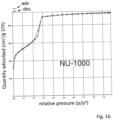
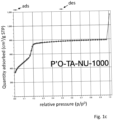
- Nitrogen sorption measurements were conducted on a Micromeritics 3Flex Physisorption instrument at 77 K, after activating at 120 °C under vacuum for 16-20 hours.
- the specific surface area was determined according to the Brunauer-Emmett-Teller (BET) method by fitting the isotherms in the 0.01 to 0.1 p/po range to meet the consistency criteria.
- BET Brunauer-Emmett-Teller
- UPLC-MS experiments were performed on a Waters Acquity UPLC H-Class system equipped with a Waters BEH C18 (1.7 ⁇ m) column, Acquity PDA UV/VIS and Acquity QDa ESI-MS detectors.
Landscapes
- Chemical & Material Sciences (AREA)
- Engineering & Computer Science (AREA)
- Organic Chemistry (AREA)
- Chemical Kinetics & Catalysis (AREA)
- Materials Engineering (AREA)
- Inorganic Chemistry (AREA)
- Oil, Petroleum & Natural Gas (AREA)
- General Chemical & Material Sciences (AREA)
- Organic Low-Molecular-Weight Compounds And Preparation Thereof (AREA)
- Catalysts (AREA)
Abstract
Description
- The present invention relates to a method for converting a first hydrocarbon composition to a second hydrocarbon composition. Furthermore, the invention relates to a metal organic framework (MOF) composition configured to be used as MOF catalyst in a method for converting a first hydrocarbon composition to a second hydrocarbon composition. Finally, the invention relates to a method of preparing said MOF composition.
- The industries in the transportation sector are faced with increasing requirements to deploy sustainable fuels. With respect to the aviation industry, these are called sustainable aviation fuels (SAF). In order to meet the respective targets, new solutions are needed.
- One of the fundamental approaches to improve sustainability and to achieve SAFs, is the conversion route from an alcohol or an ether to a transport fuel. An example for such an approach is the conversion of methanol to jet fuel. The paper "Methanol to High-Octane Gasoline within a Market-Responsive Biorefinery Concept Enabled by Catalysis" by Ruddy et al. describes the production of gasoline and jet fuel from methanol as an intermediate, which methanol is synthesized from synthesis gas which in turn is obtained from biomass. However, the catalysts used for such processes result in a relatively low hydrocarbon yield in the C9-C18 range, which is of particular interest for transport fuels and in particular for jet fuel. While converting methanol to olefins (e. g. ethylene, propylene) is well known from prior art (MTO process), processes and catalysts for the conversion of methanol to longer hydrocarbons have been limited to the production of gasoline. Conventional zeolite-based catalysts have proven to be ineffective for the synthesis of jet fuel comprising hydrocarbons predominantly in the C9-C18 range. Also these catalysts are accompanied with constraints in the pore structures, small pore sizes and diffusion restrictions for molecules entering the catalyst's porous network.
- Catalyst-mediated oligomerization of unsaturated hydrocarbons to yield unsaturated hydrocarbons with enhanced carbon count (number of carbon atoms within a hydrocarbon molecule) is known from prior art. For instance,
US 10,493,441 - The object of the present invention is therefore to provide an improved method of converting a first hydrocarbon-composition to a second hydrocarbon-composition, yielding hydrocarbons comprising 9 - 18 carbon atoms, preferably 10 - 16 carbon atoms.
- Said object is solved by a method according to
claim 1. - A further object of the present invention is to provide a metal organic framework (MOF) composition being suitable to catalyse reactions associated with converting a first hydrocarbon-composition to a second hydrocarbon-composition, yielding hydrocarbons comprising 9 - 18 carbon atoms, preferably 10 - 16 carbon atoms.
- Said object is solved by a MOF composition according to claim 3.
- Furthermore, it is an object of the present invention to provide an improved method of preparing a MOF composition that is configured to be used as MOF catalyst in a method of converting a first hydrocarbon-composition to a second hydrocarbon-composition according to the invention.
- Said object is solved by a method of preparing a MOF composition according to claim 13.
- According to the present invention, a method for converting a first hydrocarbon-composition to a second hydrocarbon composition is provided, the method comprising contacting the first hydrocarbon composition with a solid catalyst yielding the second hydrocarbon-composition,
- wherein the first hydrocarbon composition comprises one or more unsaturated hydrocarbon(s), each independently having a number CE of carbon atoms, wherein E = 2 - 8;
- wherein the second hydrocarbon composition comprises one or more unsaturated hydrocarbon(s), each independently having a number CP of carbon atoms, wherein P = 9 - 18, preferably P = 10 - 16;
- and wherein the solid catalyst is a metal organic framework (MOF) catalyst.
- In the context of the present invention the terms "comprise" or "comprising" refer to a meaning that a given subject-matter comprises a given feature (e.g. feature A). However, the terms "comprise" or "comprising" do not express that the given subject-matter solely consists of the given feature (e.g. feature A). Much more, the terms "comprise" or "comprising" are associated with a meaning that the given subject-matter may - in addition to the given feature (e.g. feature A) - comprise further features (e.g. features B and C).
- According to the above, a hydrocarbon "composition" may comprise one or more hydrocarbons, so in other words a hydrocarbon "composition" may comprise a mixture of several hydrocarbons, the hydrocarbons varying in their number of carbon atoms per molecule (carbon count) or in their chemical structure (e.g. regioisomers, stereoisomers). The hydrocarbon compositions (the first and/or second hydrocarbon composition) may - besides hydrocarbons - comprise other agents as well, e.g. impurities. Also, the hydrocarbon compositions (the first and/or second hydrocarbon composition) may - in addition to the one or more unsaturated hydrocarbons - comprise one or more saturated hydrocarbons (e.g. alkanes). The hydrocarbon compositions (the first and/or second hydrocarbon composition) may comprise branched or unbranched saturated/unsaturated hydrocarbons. The hydrocarbon compositions (the first and/or second hydrocarbon composition) may also comprise cyclic saturated/unsaturated hydrocarbons.
- The hydrocarbon compositions, so the first and/or second hydrocarbon composition, may each independently be present in a gaseous or liquid state. Both the gaseous and liquid state enable movement (flow) of the molecules comprised in the hydrocarbon compositions. The hydrocarbon compositions may be dissolved in solvents or carrier media.
- "Contacting" the first hydrocarbon composition with a solid catalyst may be understood in a way, that either hydrocarbons are brought into contact (flow) with a stationary catalyst or that both the first hydrocarbon composition (so the hydrocarbon molecules of the first hydrocarbon composition) and the catalyst move with respect to each other. The "contacting" is carried-out in a suitable reactor.
- As mentioned above, the first hydrocarbon composition comprises one or more unsaturated hydrocarbon(s), each independently having a number CE of carbon atoms, wherein E = 2 - 8. The hydrocarbon(s) comprised by the first hydrocarbon composition each independently comprise 2 - 8 carbon atoms. For instance (but not exclusively) the first hydrocarbon composition may comprise ethylene, propene, 1-butene (butylene), cis-2-butene, trans-2-butene, isobutylene, trans-buta-1,3-diene, cis-buta-1,3-diene, 1-pentene, 2-pentene, 2-methyl-1-butene, 2-methyl-2-butene, 3-methyl-1-butene etc.
- An "unsaturated" hydrocarbon refers to a hydrocarbon having one or more double/triple bonds between adjacent carbon atoms. A "saturated" hydrocarbon refers to a hydrocarbon having only single bonds between adjacent carbon atoms. In particular, the first hydrocarbon composition comprises hydrocarbons each independently having 2 - 8 carbon atoms and each having one or more double and/or triple bonds. The hydrocarbons may be linear, branched or may be cyclic hydrocarbons.
- As mentioned above, the second hydrocarbon composition comprises one or more unsaturated hydrocarbon(s), each independently having a number CP of carbon atoms, wherein P = 9 - 18, preferably P = 10 - 16. The hydrocarbon(s) comprised by the second hydrocarbon composition each independently comprise 9 - 18, preferably 10 - 16 carbon atoms. Apparently the unsaturated one or more hydrocarbon(s) of the second hydrocarbon composition (so the hydrocarbon composition after conversion) comprises one or more hydrocarbon(s) with a higher carbon count (number of carbon atoms per molecule). In other words, employing the method according to the invention is suitable to convert molecules (hydrocarbons) of a lower carbon count to molecules of a higher carbon count. Such an enhancement of the carbon count (number of carbon atoms per molecule) may occur via oligomerization. Besides hydrocarbons having 9 - 18, preferably 10 - 16 carbon atoms, the second hydrocarbon composition may also comprise hydrocarbons with a lower or higher number of carbon atoms. The solid catalyst activates and/or catalyses the conversion/oligomerization. In the present case, the solid catalyst is employed in process of heterogeneous catalysis, which means that the catalyst phase differs from the reactant or product phase. This process can be distinguished from homogeneous catalysis where reactants, products and catalyst are present in the same phase (e. g. a liquid phase). Typical phases may be solid, liquid, gaseous, but also immiscible mixtures (such as oil and water) may be form different "phases". In context of the present invention, the term "heterogeneous catalysis" refers to a solid phase catalyst, wherein the reactants and/or products are present in a gas- or liquid phase.
- According to an embodiment of the invention, the contacting comprises a streamwise contacting of the first hydrocarbon-composition with the solid catalyst or wherein the contacting comprises a batchwise contacting of the first hydrocarbon-composition with the solid catalyst. Streamwise contacting may refer to a contacting of the catalyst by a flow (stream) of the first hydrocarbon composition flowing (streaming) across the catalyst. The catalyst may be stationary or move. Streamwise contacting may also refer to a continuous flow of a first hydrocarbon composition, which means that a flow of the first hydrocarbon composition (into a reactor with catalyst loading) is carried out continuously for a given amount of time. During said given amount of time the flow rate may be fixed or varied. Batchwise contacting may refer to a loading of a reactor with catalyst and the first hydrocarbon composition, then subsequently carrying out a reaction, and finally unloading of the reactor.
- As mentioned above, the invention also relates to a metal organic framework (MOF) composition configured to be used as MOF catalyst in a method according to
claim - Metal organic frameworks (MOFs) refer to one-, two- or three-dimensional porous networks, comprising metal ions or clusters coordinated to organic ligands. They may be referred to as a subclass of coordination polymers. The organic ligands may be referred to as linkers. The metal ions or clusters may be referred to as nodes. In the present context, the MOF lattice may be understood as MOF, preferably as three-dimensional porous MOF lattice. The MOF lattice has to be tailored in a way that said catalytically active site can be hosted in pores or cavities of the MOF lattice. The size of the pores or cavities may for example be varied by tailoring the linkers. The catalytically active site hosted in the MOF lattice forms - in combination with the MOF lattice - a MOF composition. The MOF composition may - besides the MOF lattice and the catalytically active site - comprise other components. The catalytically active site may be bound or coordinated to the MOF lattice. Binding the catalytically active site to the MOF lattice may be associated with one or more chemical bonds (including coordinative bonds) between the catalytically active site and the MOF lattice or may be associated with other chemical or physical interactions between the catalytically active site and the MOF lattice. Also, the catalytically active site may be trapped or physically enclosed within the MOF lattice. Alternatively, the catalytically active site may be part of one or more of the nodes or one or more of the linkers. In such a case one or more of the nodes or one or more of the linkers may directly form the catalytically active site. The MOF lattice has to be tailored in a way that hydrocarbons to be converted may reach the catalytically active sites. In particular, the pore-sizes or the size of cavities within the MOF have to be tailored in a way that at least parts of the hydrocarbon molecules to be converted may reach (contact) the catalytically active sites. The MOF lattice may comprise repeating units (building blocks), that form a self-assembling porous network. Besides hosting one or more catalytically active sites within the MOF lattice additional functional groups may be added to one or more of the nodes and/or to one or more of the linkers, the additional functional groups also take part of the catalytical process. Preferably the MOF composition comprises a well-defined pore structure (tailored for the present use-case), and allows diffusion of hydrocarbons of the first and second hydrocarbon composition (so the feed and the products).
- According to a further embodiment of a MOF according to the present invention, the catalytically active site comprises a structure of formula (1):

- M1 is a transition metal;
- L1 and/or L2 are independently selected from: H, an alkyl group, an aryl group, an olefin, an organic group comprising a hetero-atom such as oxygen or nitrogen, CO, NO, NO2, CO2, a halogen atom, or wherein formula (1) does not comprise L1 and/or L2;
- E is selected from P, N, As, O, S, Bi;
- R1 is selected from H, P, an alkyl group, an aryl group, or wherein formula (1) does not comprise R1;
- R2 is selected from R1;
- A is selected from O, N, S, a carboxylate group, an alcoholate group, a sulfide group, a sulfonate group, a phosphate group, an ester group, an amine group, an imine group, a pyridine group, ER1R2, or L1;
- Cn relates to a carbon chain with a number of n carbon atoms, wherein n = 1 - 5;
- D is an aliphatic group or aryl group, wherein D is bound to one or more of the carbon atoms of Cn;
- X1 is selected from a carboxylic acid group, sulfonic acid group, a carboxylate group, a sulfonate group, a carbonyl group, a hydroxyl group, a hydroxylate group, an amino group, an ammonium group, a phosphino group, a phosphonium group, a pyridine group, a pyridine derivative, an imidazole group, an imidazole derivative, an imidazolate group, a phosphonate group, a phosphonate derivative, a nitrile group, a boronic acid group, a boronic acid ester group, a triazole group, a triazolate group, a tetrazole group, a tetrazolate group or wherein formula (1) does not comprise X1.
- All mentioned groups may also refer to derivates of said groups, each comprising additional functional groups.
- The term "aryl group" refers to an aromatic moiety. An "alkyl" group in the context of the present invention, for example and if not mentioned differently, refers to a linear or branched hydrocarbon which is saturated, it comprises only single bonds between adjacent carbon atoms. Preferably, an alkyl group according to the present invention may be selected from methyl, ethyl, n-propyl, isopropyl, n-butyl, sec-butyl, tert-butyl, n-pentyl, 1-methylbutyl, 2-methylbutyl, 3-methylbutyl, neopentyl, 1-ethylpropyl, cyclohexyl, cyclopentyl, n-hexyl, 1,1-dimethylpropyl, 1-methylpentyl, 2-methylpentyl, 3-methylpentyl, 4-methylpentyl, 1,1-dimethylbutyl, 1,2-dimethylbutyl, 1,3-dimethylbutyl, 2,2-dimethylbutyl, 2,3-dimethylbutyl, 3,3-dimethylbutyl, 1-ethylbutyl, 2-ethylbutyl, 1,1,2-trimethylpropyl, 1,2,2-trimethylpropyl, 1-ethyl-1-methylpropyl, 1-ethyl-2-methylpropyl or 1-methyl-2-ethylpropyl.
- An "alcoholate" group may refer to an alkoxy group, which may according to the invention be selected from methoxy, ethoxy, n-propoxy, isopropoxy, n-butoxy, sec-butoxy, tert-butoxy, n-pentoxy, 1-methylbutoxy, 2-methylbutoxy, 3-methylbutoxy, neopentoxy, 1-ethylpropoxy, cyclohexoxy, cyclopentoxy, n-hexoxy, 1,1-dimethylpropoxy, 1-methylpentoxy, 2-methylpentoxy, 3-methylpentoxy, 4-methylpentoxy, 1,1-dimethylbutoxy, 1,2-dimethylbutoxy, 1,3-dimethylbutoxy, 2,2-dimethylbutoxy, 2,3-dimethylbutoxy, 3,3-dimethylbutoxy, 1-ethylbutoxy, 2-ethylbutoxy, 1,1,2-trimethylpropoxy, 1,2,2-trimethylpropoxy, 1-ethyl-1-methylpropoxy, 1-ethyl-2-methylpropoxy or 1-methyl-2-ethylpropoxy.
- The term "olefin" refers to unsaturated hydrocarbons, comprising one or more double or triple bonds between adjacent carbon atoms. A "halogen" atom in the context of the invention, if not mentioned differently, refers to fluorine (F), chlorine (CI), bromine (Br), iodine (I), or astatine (At). In case that formula (1) does not comprise L1 and/or L2, this is independent from other structural parts of formula (1). So, if L1 and/or L2 are not present in formula (1), the latter may still comprise R1, R2, A, M1, E, Cn, D and X1. The same applies to R1 and X1.
- According to a further embodiment of a MOF according to the present invention, the catalytically active site is bound or coordinated to the MOF lattice, wherein the catalytically active site is preferably bound or coordinated to the MOF lattice via X1. In case that the catalytically active site is "bound" to the MOF lattice, a chemical bonding is provided between parts of the catalytically active site and the MOF, e. g. a single-bond, double-bond, triple-bond. In case that the catalytically active site is coordinated to the MOF lattice, the "coordination" refers to a coordinate covalent bond, which is synonymously known as dative bond, dipolar bond or coordinate bond. Such a bond may be formed in the case that in an electron pair bond, the bonding electrons originate from only one of the two bonding partners. A molecule or ion with a lack of electrons is called acceptor (= Lewis acid), the one with free electrons is called donor (= Lewis base). Alternatively, the catalytically active site may be bound or coordinated to the node.
- Transition metals are to be understood as elements of groups 4 - 11 of the periodic table of elements. In current praxis also f-block elements (lanthanide and actinide) series) are considered as "transition metals", in particular as "inner transition metals". According to a further embodiment of a MOF according to the present invention, M1 is selected from Ni, Pd, Pt, Co, Fe, Ru, Rh, Ir, Os, W wherein M1 preferably is Ni. Nickel is of advantage due to its relatively low price when compared to other transition materials. Nickel is also of advantage in terms of the achievable catalytical activity (with respect to the mentioned conversion of the first hydrocarbon composition to the second hydrocarbon composition).
- According to a further embodiment of a MOF according to the present invention, regarding L1 and/or L2,
- the organic group comprising oxygen as hetero-atom is selected from THF, an alcohol group, an alcoholate group or an acetylacetonate group,
- the organic group comprising a nitrogen as hetero-atom is selected from an amine group, an imine group, an amide group or a nitrile group,
- the halogen atom is CI, Br, or I.
- All the mentioned components selected from THF (tetrahydrofuran; 1,4-Epoxybutane), the alcohol group, the alcoholate (alkoxy) and acetylacetonate group may comprise one or more oxygen atoms, which may each act as binding/coordination partner with M1. All the mentioned components selected from an amine group, an imine group, an amide group or a nitrile group may comprise one or more nitrogen atoms, which may each act as binding/coordination partner with M1. According to a further embodiment of a MOF according to the present invention, A preferably is a carboxylate or an alcoholate. Said carboxylate or alcoholate representing A, may comprise one or more carboxylate- or alcoholate groups.
- According to a further embodiment of a MOF according to the present invention, Cn is C2. In this case an alkyl chain of two carbon atoms forms Cn. Also, higher numbers of n may be suitable, for instance n = 1, 2, 3, 4, 5, 6, 7, 8, 9, 10.
- According to a further embodiment of a MOF according to the present invention, the nodes are independently defined by a structure of M2 wL3 z, wherein
- M2 refers to one or more atoms of an element, wherein the element preferably is a metal, a semi-metal, an alkali metal, or an earth alkali metal,
- w = 1 - 24,
- L3 refers to a ligand binding or coordinating to M2 via O, N, S, P, C, CI, Br, I,
- z = 0 - 24.
- In the structure M2 wL3 z one or more ligands L3 of the same or different type (structure) may be present. For example, M2 wL3 z may be selected from: Zn4(CO2)6; M3O(CO2)6 with M = Zn, Cr, In or Ga; M2(CO2)4 with M = Cu, Zn, Fe, Mo, Cr, Co, or Ru; Zr6O4(OH)4-(CO2)12; Zr6O8(CO2)8; Zn3(H2O)3(CO2)6; Zn4O(CO2)8; Zn7(OH)2-(CO2)12;Co2(OH)(CO2)5-(C5H5N)3; Al(OH)(CO2)2: VO(CO2)2; Mn(CO2)2; M3O3(CO2)3 with M = Zn, Mg, Co, Ni, Mn, or Fe; Mn3(CO2)8; Zn(C3H3N2)4; Ag3(OH)(H2O)2(C3H3N2)6; Fe(C2O2)2(H2O)2; Zn(C2O2)3; In(C5HO4N2)4; Cu(CO2)2(C4H4N2)-(C6H2O4N2); Ni(C8H20N4)O2; Cd2Cl6(C5H5N)4; Mn4Cl(CHN4)8; Cu4Cl(C2H2N3)8; M(C5H5N)4 with M = Cu or Cd; Zn(CO2)4(NH2)2; Na(OH)2(SO3)3; La(PO3)4(PO3H)(H2O)3; Cu2(CNS)4; CuS3; Zn3(CO2)6(C5H5N)2; Ni4(C3H3N2)8; Zr6(µ3-O)4(µ3-OH)4(CO2)12; Zr6(µ3-O)4(µ3-OH)4(CO2)10(AcO)2; Zr6(µ3-OH)8(OH)4(CO2)8; Zr6(µ3-O)4(µ3-OH)4(OH)4(H2O)4(CO2)8; Zr6(µ3-O)4(µ3-OH)4(OH)6(H2O)6(CO2)6; Zr6(µ3-OH)8(-OH)8(CO2)8; [Zr6(µ3-O)4(µ3-OH)4(OH)4(H2O)4]8+.
- Preferably all or some of the nodes of the MOF lattice have a structure M2 wL3 z as given above.
- According to a further embodiment of a MOF according to the present invention, the linkers are independently defined by a structure of R3 xX2 y, wherein
- R3 refers to a structure comprising a number of m = 2 - 50 C atoms, wherein the structure comprises one or more functional groups selected from an amino group, an imido group, an amido group, a cyano group, a nitro group, an aldehyde group, a urea group, a thiourea group, an ester group, a carbonate group, an alcohol group, an ether group, a halogen, a phosphine derivative, a phosphine oxide derivative, an imidazolium group, a pyridino group, a triazole group, an imidazole group, a phosphate group, a sulfonic acid group, a sulfonate group, an enolate group, an imine group, a phenantroline group or combinations thereof, or wherein the structure does not comprise any of said functional groups,
- X2 is selected from a carboxylic acid group, a sulfonic acid group, a carboxylate group, a sulfonate group, a carbonyl group, a hydroxyl group, a hydroxylate group, an amino group, an ammonium group, a phosphino group, a phosphonium group, a pyridine group, a pyridine derivative, an imidazole group, an imidazole derivative, an imidazolate group, a phosphonate group, a phosphonate derivative, a nitrile group, a boronic acid group, an ester group, a triazole group, a triazolate group, a tetrazole group, a tetrazolate group,
- x = 1 - 8;
- y = 1 - 8.
- Preferably all or some of the linkers of the MOF lattice have a structure R3 xX2 y as given above.
- According to an exemplary first selection, the linkers may be - according to an embodiment of the invention - selected from one of the following linkers:

- According to an exemplary second selection, the linkers may be - according to an embodiment of the invention - selected from one of the following linkers:

- According to an exemplary further selection, the linkers may be - according to an embodiment of the invention - selected from one of the following linkers:

- According to an exemplary further selection, the linkers may be - according to an embodiment of the invention - selected from one of the following linkers:


- According to an exemplary further selection, the linkers may be - according to an embodiment of the invention - selected from one of the following linkers:

- According to an exemplary further selection, the linkers may be - according to an embodiment of the invention - selected from one of the following linkers:

- According to an exemplary further selection, the linkers may be - according to an embodiment of the invention - selected from one of the following linkers:

- According to an exemplary further selection, the linkers may be - according to an embodiment of the invention - selected from one of the following linkers:

- According to an exemplary further selection, the linkers may be - according to an embodiment of the invention - selected from one of the following linkers:

- According to an exemplary further selection, the linkers may be - according to an embodiment of the invention - selected from one of the following linkers:

- According to an exemplary further selection, the linkers may be - according to an embodiment of the invention - selected from one of the following linkers:
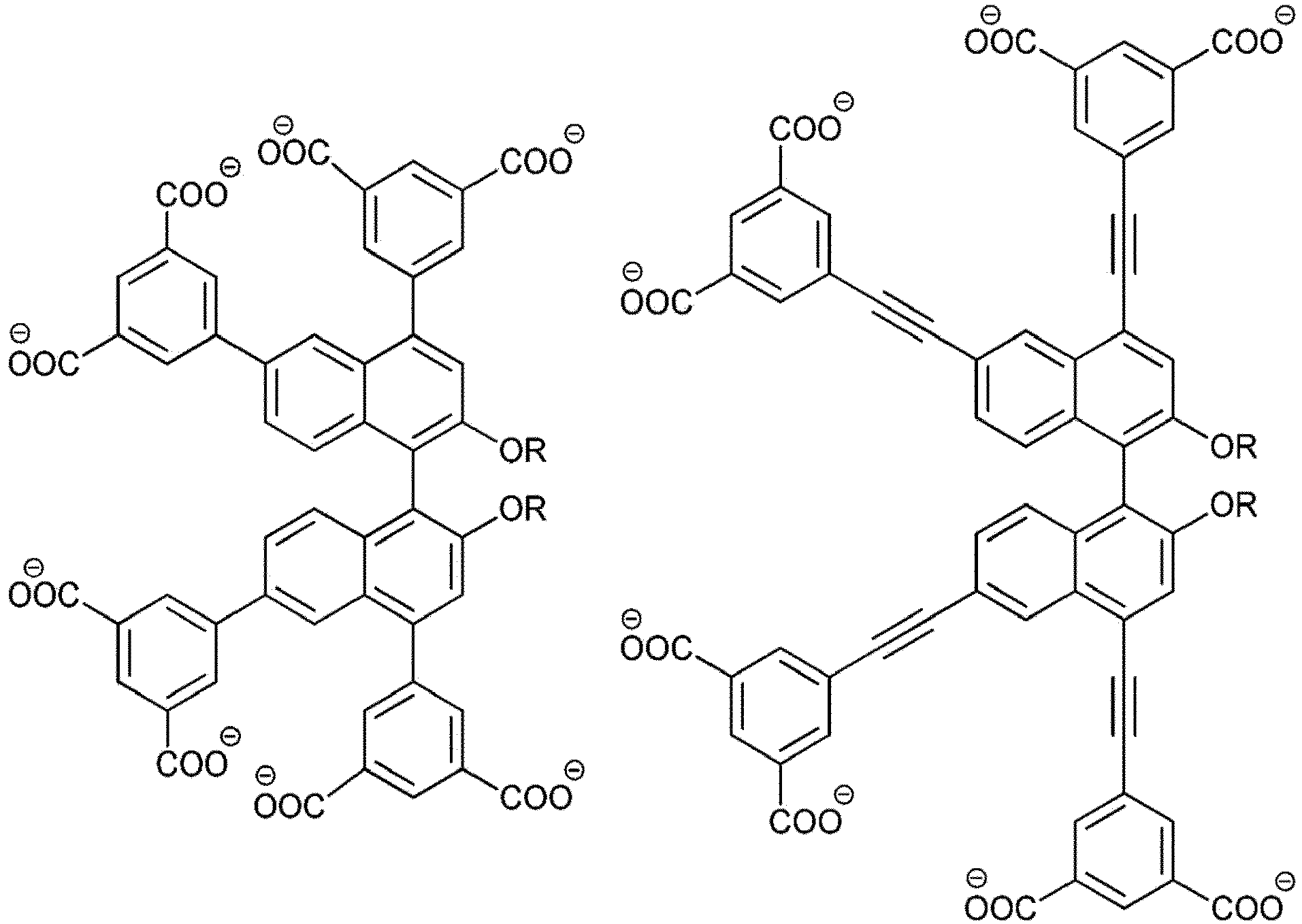
- According to an exemplary further selection, the linkers may be - according to an embodiment of the invention - selected from one of the following linkers:

- According to an exemplary further selection, the linkers may be - according to an embodiment of the invention - selected from one of the following linkers:

- According to an exemplary further selection, the linkers may be - according to an embodiment of the invention - selected from one of the following linkers:


- According to an exemplary further selection, the linkers may be - according to an embodiment of the invention - selected from one of the following linkers:

- According to a further embodiment of a MOF according to the present invention, the number of nodes and the number of linkers define a three-dimensional porous network, wherein each linker independently interconnects two or more nodes. By varying the structure of the linkers and/or the nodes, the porosity, pore-sizes and structure of the MOF lattice - and thus also the take-up capabilities for catalytically active sites and/or reaction educts/products - may be tailored.
- In a preferred embodiment, the MOF lattice according the invention is provided by a NU-1000 metal organic framework. The NU-1000 MOF comprises 1,3,6,8-Tetra (4-carboxylphenyl) pyrene as linkers and [Zr6(µ3-O)4(µ3-OH)4(OH)4(H2O)4]8+ as nodes. The catalytically active site may bind or coordinate to the linker (e.g. to the pyrene fragment or carboxyl groups of the linker. Alternatively, the catalytically active site may bind or coordinate to the Zr metal or any fragment of the [Zr6(µ3-O)4(µ3-OH)4(OH)4(H2O)4]8+ node.
- As mentioned above, the invention also relates to method of preparing a MOF composition according to the invention, wherein the MOF composition is configured to be used as MOF catalyst in a method according to the invention, wherein preparing the MOF composition comprises the steps of:
- a) Providing a MOF lattice
- b) Introducing a catalytically active site into the MOF lattice.
- According to an embodiment of a method of preparing a MOF composition according to the present invention, step a) comprises interconnecting a number of nodes with a number of linkers to form the MOF lattice. Interconnecting the nodes and the linkers is preferably carried-out via chemical reaction(s). The interconnection between nodes and linkers may be carried out by way of a self-assembly reaction or by providing parts of the desired MOF lattice and connecting these parts at desired positions. Also, a full synthesis comprising a number of steps to form the MOF lattice may be understood as "providing" the MOF lattice. It should be noted that according to the invention, "providing the MOF lattice" may also be understood as "purchasing a commercially available MOF lattice from a manufacturer" or as "placing a component comprising the MOF lattice inside a reactor or reaction flask". Providing a MOF lattice may also be understood in a sense of dissolving/suspending the MOF lattice in a suitable solvent.
- Introducing a catalytically active site into the MOF lattice may be understood as trapping one or more catalytically active sites in pores and/or cavities of the MOF lattice. Introducing a catalytically active site into the MOF lattice may also be understood as binding and/or coordinating one or more catalytically active sites to nodes and/or linkers of the MOF lattice. It may be the case, that a catalytically active site may both bind and coordinate to a node and/or linker of the MOF lattice via different components (atoms, functional groups) of the catalytically active site. The catalytically active site may be introduced into the MOF lattice in a one- or more (e. g. two) step procedure, for example via first introducing a precursor into the MOF lattice (the precursor may bind or coordinate to one or more of the nodes/linkers of the MOF lattice) and second introducing an additional catalytically active compound, which binds/coordinates or otherwise interacts with the precursor.
- According to a further embodiment of a method of preparing a MOF composition according to the present invention, step b) is carried out by an impregnation technique, preferably via an incipient wetness technique. Incipient wetness techniques, also called capillary impregnation or dry impregnation, is a commonly used technique for the synthesis of heterogeneous catalysts. Typically, the active metal precursor (of the catalytically active site) is dissolved in an aqueous solution or an organic solvent. Then the metal-containing solution is added to a catalyst support (e. g. the MOF lattice), which preferably contains the same pore volume as the volume of the solution that was added. Capillary action draws the solution into the pores. Solution added in excess to the support pore volume causes the solution transport to change from a capillary action process to a diffusion process, which is much slower. The formed MOF catalyst can then be dried and calcined to drive off the volatile components within the solution, depositing the metal on the catalyst surface. The maximum loading is limited by the solubility of the precursor in the solution. The concentration profile of the impregnated compound depends on the mass transfer conditions within the pores during impregnation and drying.
- Embodiments, features and advantages of the method according to the invention, correspond to embodiments, features and advantages of the MOF composition and/or the method of preparing a MOF composition according to the invention and vice versa.
- Further details, features, aims and advantages of the present invention are shown in the following, with reference to
figures 1 and2 . The figures show - Figure 1
- a) PXRD of NU-1000 (curve 1) and of P'O-TA-NU-1000 (curve 2); b) Nitrogen physisorption isotherm for NU-1000, wherein both the adsorption curve (ads) and desorption curve (des) are illustrated c) Nitrogen physisorption isotherm for P'O-TA-NU-1000, wherein both the adsorption curve (ads) and desorption curve (des) are illustrated;
- Figure 2a-c
- schematic representations regarding a flow of hydrocarbons through a channel comprising a) a Ni zeolite catalyst, b) a Ni amorphous silica alumina catalyst and c) a Ni MOF that may be used as MOF catalyst according to the invention.
- Wherein the results given in
Figure 1 a) - c) are self-explaining, it is now referred toFigures 2 a) - c) , illustrating a schematic flow of hydrocarbons through a channel 100 (representing a reactor) comprising a) a Ni zeolite catalyst, b) a Ni amorphous silica alumina catalyst and c) a Ni MOF that may be used as MOF catalyst according to the invention. An educt feed stream E of a first hydrocarbon composition enters therespective channel 100, the hydrocarbons flow alongdiffusion paths channel 100 as a product stream P. The Ni zeolite catalyst illustrated inFig. 2a provides a well-defined pore structure, see thebuilding blocks 115 of the catalyst. The building blocks comprise catalytically active Ni centers 120. The relatively small pore size (e. g. 12 Angstrom) restricts the length of the hydrocarbon conversion. The diffusion of molecules flowing through thechannel 100 is restricted by the structure (building blocks 115) of the catalyst, which may also cause trapping of longer molecules. The Ni amorphous silica alumina catalyst illustrated inFig. 2b provides an ill-defined pore-structure (caused by building blocks 116) with a large range of pore sizes (e.g. 15 - 100 Angstrom). Such catalysts generally do not provide sufficient yield in the preferred range of hydrocarbons with a carbon count of 9 - 18, preferably 10 - 16 carbon atoms. Ni MOFs (which may be a MOF catalyst according to the invention) provide a well-defined pore structure with pore sizes of e. g. 30 Angstrom. Molecules may easily penetrate (diffuse) through thebuilding blocks 117 of the catalyst. Such a catalyst has shown to be efficient for forming hydrocarbons with a carbon count of 9 - 18, preferably 10 - 16 carbon atoms. - The following examples are used to describe the invention. Based on the examples, the person skilled in the art can easily conclude that and how to vary certain parameters or structures as given in the above description.
- A 0.1 M solution of 2-(diphenylphopshino)terephthalic acid in DMF (6.2 mL) was added to solid NU-1000 (502 mg) three-necked, round-bottomed flask under inert atmosphere. The suspension was stirred at 60 °C overnight. The solid was filtered off and washed with DMF and methanol and afterwards dried in high vacuum at 60 °C overnight to give P'O-TA-NU-1000.
- A 0.1 M solution of 4-(diphenylphosphino)benzoic acid in MeCN (6.9 mL) was added to solid NU-1000 (503 mg) three-necked, round-bottomed flask under inert atmosphere. The suspension was stirred at 60 °C overnight. The solid was filtered off and washed with MeCN and methanol and afterwards dried in high vacuum at 60 °C overnight to give P-NU-1000.
- A 0.1 M solution of sodium diphenylphosphinobenzene-3-sulfonate in H2O (6.9 mL) was added to solid NU-1000 (503 mg) three-necked, round-bottomed flask under inert atmosphere. The suspension was stirred at 60 °C overnight. The solid was filtered off and washed with H2O and methanol and afterwards dried in high vacuum at 60 °C overnight to give PS-NU-1000.
- P'O-TA-NU-1000 (120.3 mg) was activated by heating at 120 °C under vacuum for 4 h. A 0.1 M Ni solution was prepared dissolving Ni(acac)2(133.9 mg) in toluene (5 mL) yielding a green solution. The Ni solution (0.5 mL) was added through incipient wetness impregnation to P'O-TA-NU-1000. The solid was dried in vacuum at room temperature to give Ni@(P'O-TA)-NU-1000.
- NU-1000 (120.3 mg) was activated by heating at 120 °C under vacuum for 4 h. A 0.1 M Ni solution was prepared dissolving 2-(diphenylphosphino)benzoic acid (307 mg) and Ni(acac)2 (269 mg) in toluene (10 mL) yielding a green solution. The Ni solution (0.5 mL) was added through incipient wetness impregnation to P'O-TA-NU-1000. The solid was dried in vacuum at room temperature to give Ni(PO)@ NU-1000.
- Ni@(P'O-TA)-NU-1000 (76 mg) was placed in a 60 mL high pressure autoclave and flushed with Ar and then shortly with ethylene gas. The reactor was then pressurized with 10 bar ethylene at room temperature for 1 h. A 0.5 M solution of NaBH4 solution in anhydrous MeCN (0.5 mL) was added via syringe thereto. The reactor was closed, shortly flushed with ethylene gas, pressurized to 40 bar ethylene, and then heated to 80 °C for 2.5 h. The reactor was cooled down to room temperature and the pressure released. Toluene (1.3 mL) was added and the solution was transferred into a vial and analyzed by GC-FID.
- Powder X-ray diffraction (PXRD) measurements were conducted on a Bruker D8 Advance diffractometer working in Bragg-Brentano geometry, with Cu Kα1 radiation wavelength of 1.541 Å. Diffraction was measured in the 2θ range between 2° and 25°.
- Nitrogen sorption measurements were conducted on a Micromeritics 3Flex Physisorption instrument at 77 K, after activating at 120 °C under vacuum for 16-20 hours. The specific surface area was determined according to the Brunauer-Emmett-Teller (BET) method by fitting the isotherms in the 0.01 to 0.1 p/po range to meet the consistency criteria.
- UPLC-MS experiments were performed on a Waters Acquity UPLC H-Class system equipped with a Waters BEH C18 (1.7 µm) column, Acquity PDA UV/VIS and Acquity QDa ESI-MS detectors.
- All MOFs were characterized by Powder X-ray diffraction and nitrogen physisorption.
Figure 1a shows the PXRD andFigures 1b ,1c the nitrogen adsorption isotherms, respectively, of NU-1000 and of P'O-TA-NU-1000. The functional MOFs and Nickel functional MOFs were characterized and the function and nickel quantified by UPLC- UV and UPLC-MS after digestion of the MOF under basic conditions.
Claims (15)
- A method for converting a first hydrocarbon composition to a second hydrocarbon composition, the method comprising contacting the first hydrocarbon composition with a solid catalyst yielding the second hydrocarbon composition,- wherein the first hydrocarbon composition comprises one or more unsaturated hydrocarbon(s), each independently having a number CE of carbon atoms, wherein E = 2 - 8;- wherein the second hydrocarbon composition comprises one or more unsaturated hydrocarbon(s), each independently having a number CP of carbon atoms, wherein P = 9 - 18, preferably P = 10 - 16;- and wherein the solid catalyst is a metal organic framework (MOF) catalyst.
- Method according to claim 1, wherein the contacting comprises a streamwise contacting of the first hydrocarbon composition with the solid catalyst or wherein the contacting comprises a batchwise contacting of the first hydrocarbon composition with the solid catalyst.
- A metal organic framework (MOF) composition configured to be used as MOF catalyst in a method according to claim 1 or 2, the MOF composition comprising a MOF lattice and a catalytically active site hosted in the MOF lattice, wherein the MOF lattice comprises a number of nodes and a number of linkers interconnecting the nodes.
- MOF composition according to claim 3, wherein the catalytically active site comprises a structure of formula (1):
 - M1 is a transition metal;- L1 and/or L2 are independently selected from: H, an alkyl group, an aryl group, an olefin, an organic group comprising a hetero-atom such as oxygen or nitrogen, CO, NO, NO2, CO2, a halogen atom, or wherein formula (1) does not comprise L1 and/or L2;- E is selected from P, N, As, O, S, Bi;- R1 is selected from H, P, an alkyl group, an aryl group, or wherein formula (1) does not comprise R1;- R2 is selected from R1;- A is selected from O, N, S, a carboxylate group, an alcoholate group, a sulfide group, a sulfonate group, a phosphate group, an ester group, an amine group, an imine group, a pyridine group, ER1R2, or L1;- Cn relates to a carbon chain with a number of n carbon atoms, wherein n = 1 - 5;- D is an aliphatic group or aryl group, wherein D is bound to one or more of the carbon atoms of Cn;- X1 is selected from a carboxylic acid group, sulfonic acid group, a carboxylate group, a sulfonate group, a carbonyl group, a hydroxyl group, a hydroxylate group, an amino group, an ammonium group, a phosphino group, a phosphonium group, a pyridine group, a pyridine derivative, an imidazole group, an imidazole derivative, an imidazolate group, a phosphonate group, a phosphonate derivative, a nitrile group, a boronic acid group, a boronic acid ester group, a triazole group, a triazolate group, a tetrazole group, a tetrazolate group or wherein formula (1) does not comprise X1.
 - MOF composition according to claim 4, wherein the catalytically active site is bound or coordinated to the MOF lattice, wherein the catalytically active site is preferably bound or coordinated to the MOF lattice via X1.
- MOF composition according to claim 4, wherein M1 is selected from Ni, Pd, Pt, Co, Fe, Ru, Rh, Ir, Os, W wherein M1 preferably is Ni.
- MOF composition according to claim 4, wherein regarding L1 and/or L2,- the organic group comprising oxygen as hetero-atom is selected from THF, an alcohol group, an alcoholate group or an acetylacetonate group,- the organic group comprising a nitrogen as hetero-atom is selected from an amine group, an imine group, an amide group or a nitrile group,- the halogen atom is CI, Br, or I.
- MOF composition according to claim 4, wherein A preferably is a carboxylate or an alcoholate.
- MOF composition according to claim 4, wherein Cn is C2.
- MOF composition according to claim 3, wherein the nodes are independently defined by a structure of M2 wL3 z, wherein- M2 refers to one or more atoms of an element, wherein the element preferably is a metal, a semi-metal, an alkali metal, or an earth alkali metal,- w = 1 - 24,- L3 refers to a ligand binding or coordinating to M2 via O, N, S, P, C, CI, Br, I,- z = 0 - 24.
- MOF composition according to claim 3, wherein the linkers are independently defined by a structure of R3 xX2 y, wherein- R3 refers to a structure comprising a number of m = 2 - 50 C atoms, wherein the structure comprises one or more functional groups selected from an amino group, an imido group, an amido group, a cyano group, a nitro group, an aldehyde group, an urea group, a thiourea group, an ester group, a carbonate group, an alcohol group, an ether group, a halogen, a phosphine derivative, a phosphine oxide derivative, an imidazolium group, a pyridino group, a triazole group, an imidazole group, a phosphate group, a sulfonic acid group, a sulfonate group, an enolate group, an imine group, a phenantroline group or combinations thereof, or wherein the structure does not comprise any of said functional groups,- X2 is selected from a carboxylic acid group, a sulfonic acid group, a carboxylate group, a sulfonate group, a carbonyl group, a hydroxyl group, a hydroxylate group, an amino group, an ammonium group, a phosphino group, a phosphonium group, a pyridine group, a pyridine derivative, an imidazole group, an imidazole derivative, an imidazolate group, a phosphonate group, a phosphonate derivative, a nitrile group, a boronic acid group, an ester group, a triazole group, a triazolate group, a tetrazole group, a tetrazolate group,- x = 1 - 8;- y = 1 - 8.
- MOF composition according to one of claims 3 - 11, wherein the number of nodes and the number of linkers define a three-dimensional porous network, wherein each linker independently interconnects two or more nodes.
- Method of preparing a MOF composition according to one of claims 3 - 12, wherein the MOF composition is configured to be used as MOF catalyst in a method according to claim 1 or 2, wherein preparing the MOF composition comprises the steps of:c) Providing a MOF latticed) Introducing a catalytically active site into the MOF lattice.
- Method according to claim 13, wherein step a) comprises interconnecting a number of nodes with a number of linkers to form the MOF lattice;
- Method according to claim 13, wherein step b) is carried out by an impregnation technique, preferably via an incipient wetness technique.
Priority Applications (5)
| Application Number | Priority Date | Filing Date | Title |
|---|---|---|---|
| EP21215706.9A EP4197634A1 (en) | 2021-12-17 | 2021-12-17 | Method for converting unsaturated light hydrocarbons to unsaturated heavy hydrocarbons, metal organic framework composition to be used as catalyst, and method or preparing a metal organic framework |
| AU2022413627A AU2022413627A1 (en) | 2021-12-17 | 2022-12-16 | Metal organic framework composition and method for preparing a metal organic framework |
| US18/719,450 US20250058306A1 (en) | 2021-12-17 | 2022-12-16 | Metal organic framework composition and method for preparing a metal organic framework |
| PCT/EP2022/086375 WO2023111277A2 (en) | 2021-12-17 | 2022-12-16 | Metal organic framework composition and method for preparing a metal organic framework |
| EP22840061.0A EP4472771A2 (en) | 2021-12-17 | 2022-12-16 | Metal organic framework composition as catalyst for converting unsaturated light hydrocarbons to unsaturated heavy hydrocarbons and method for its preparation |
Applications Claiming Priority (1)
| Application Number | Priority Date | Filing Date | Title |
|---|---|---|---|
| EP21215706.9A EP4197634A1 (en) | 2021-12-17 | 2021-12-17 | Method for converting unsaturated light hydrocarbons to unsaturated heavy hydrocarbons, metal organic framework composition to be used as catalyst, and method or preparing a metal organic framework |
Publications (1)
| Publication Number | Publication Date |
|---|---|
| EP4197634A1 true EP4197634A1 (en) | 2023-06-21 |
Family
ID=79927198
Family Applications (2)
| Application Number | Title | Priority Date | Filing Date |
|---|---|---|---|
| EP21215706.9A Pending EP4197634A1 (en) | 2021-12-17 | 2021-12-17 | Method for converting unsaturated light hydrocarbons to unsaturated heavy hydrocarbons, metal organic framework composition to be used as catalyst, and method or preparing a metal organic framework |
| EP22840061.0A Pending EP4472771A2 (en) | 2021-12-17 | 2022-12-16 | Metal organic framework composition as catalyst for converting unsaturated light hydrocarbons to unsaturated heavy hydrocarbons and method for its preparation |
Family Applications After (1)
| Application Number | Title | Priority Date | Filing Date |
|---|---|---|---|
| EP22840061.0A Pending EP4472771A2 (en) | 2021-12-17 | 2022-12-16 | Metal organic framework composition as catalyst for converting unsaturated light hydrocarbons to unsaturated heavy hydrocarbons and method for its preparation |
Country Status (4)
| Country | Link |
|---|---|
| US (1) | US20250058306A1 (en) |
| EP (2) | EP4197634A1 (en) |
| AU (1) | AU2022413627A1 (en) |
| WO (1) | WO2023111277A2 (en) |
Cited By (1)
| Publication number | Priority date | Publication date | Assignee | Title |
|---|---|---|---|---|
| CN116832811A (en) * | 2023-08-30 | 2023-10-03 | 太原理工大学 | Low-crystalline iron-based SCR catalyst and preparation method thereof |
Citations (2)
| Publication number | Priority date | Publication date | Assignee | Title |
|---|---|---|---|---|
| DE19612989A1 (en) * | 1996-03-22 | 1997-09-25 | Inst Angewandte Chemie Berlin | Transition metal catalysts based on inorganic-organic polymers, their production and use |
| US10493441B2 (en) | 2015-09-14 | 2019-12-03 | Massachusetts Institute Of Technology | Compositions and methods for selective olefin oligomerization comprising metal organic frameworks |
-
2021
- 2021-12-17 EP EP21215706.9A patent/EP4197634A1/en active Pending
-
2022
- 2022-12-16 AU AU2022413627A patent/AU2022413627A1/en active Pending
- 2022-12-16 WO PCT/EP2022/086375 patent/WO2023111277A2/en not_active Ceased
- 2022-12-16 EP EP22840061.0A patent/EP4472771A2/en active Pending
- 2022-12-16 US US18/719,450 patent/US20250058306A1/en active Pending
Patent Citations (2)
| Publication number | Priority date | Publication date | Assignee | Title |
|---|---|---|---|---|
| DE19612989A1 (en) * | 1996-03-22 | 1997-09-25 | Inst Angewandte Chemie Berlin | Transition metal catalysts based on inorganic-organic polymers, their production and use |
| US10493441B2 (en) | 2015-09-14 | 2019-12-03 | Massachusetts Institute Of Technology | Compositions and methods for selective olefin oligomerization comprising metal organic frameworks |
Non-Patent Citations (11)
| Title |
|---|
| DERIA PRAVAS ET AL: "Versatile functionalization of the NU-1000 platform by solvent-assisted ligand incorporation", CHEMICAL COMMUNICATIONS, vol. 50, no. 16, 9 January 2014 (2014-01-09), UK, pages 1965, XP055913146, ISSN: 1359-7345, DOI: 10.1039/c3cc48562e * |
| DRONSKOWSKI, RICHARD ET AL (EDS): "Handbook of Solid State Chemistry", part Chapter 8 9 August 2017, WILEY-VCH, Weinheim, Germany, ISBN: 9783527325870, article MONDLOCH, JOSEPH E ET AL: "Metal-Organic Frameworks: An Emerging Class of Solid-State Materials", pages: 165 - 193, XP009537175, DOI: 10.1002/9783527691036.hsscvol4016 * |
| FLAVIEN L. MOREL ET AL: "Synthesis and Characterization of Phosphine-Functionalized Metal–Organic Frameworks Based on MOF-5 and MIL-101 Topologies", INDUSTRIAL & ENGINEERING CHEMISTRY RESEARCH, vol. 53, no. 22, 4 June 2014 (2014-06-04), pages 9120 - 9127, XP055309075, ISSN: 0888-5885, DOI: 10.1021/ie403549v * |
| GOETJEN TIMOTHY A. ET AL: "Metal-Organic Framework Supported Single Site Chromium(III) Catalyst for Ethylene Oligomerization at Low Pressure and Temperature", ACS SUSTAINABLE CHEMISTRY & ENGINEERING, vol. 7, no. 2, 8 January 2019 (2019-01-08), US, pages 2553 - 2557, XP055934104, ISSN: 2168-0485, Retrieved from the Internet <URL:https://pubs.acs.org/doi/pdf/10.1021/acssuschemeng.8b05524> DOI: 10.1021/acssuschemeng.8b05524 * |
| LI ZHANYONG ET AL: "Sintering-Resistant Single-Site Nickel Catalyst Supported by Metal-Organic Framework", JOURNAL OF THE AMERICAN CHEMICAL SOCIETY, vol. 138, no. 6, 2 February 2016 (2016-02-02), pages 1977 - 1982, XP055975905, ISSN: 0002-7863, DOI: 10.1021/jacs.5b12515 * |
| LIU JIAN ET AL: "Beyond the Active Site: Tuning the Activity and Selectivity of a Metal-Organic Framework-Supported Ni Catalyst for Ethylene Dimerization", JOURNAL OF THE AMERICAN CHEMICAL SOCIETY, vol. 140, no. 36, 24 August 2018 (2018-08-24), pages 11174 - 11178, XP055938330, ISSN: 0002-7863, DOI: 10.1021/jacs.8b06006 * |
| MLINAR ANTON N. ET AL: "Selective Propene Oligomerization with Nickel(II)-Based Metal-Organic Frameworks", ACS CATALYSIS, vol. 4, no. 3, 7 March 2014 (2014-03-07), US, pages 717 - 721, XP055924493, ISSN: 2155-5435, Retrieved from the Internet <URL:http://alchemy.cchem.berkeley.edu/static/pdf/papers/paper191.pdf> DOI: 10.1021/cs401189a * |
| PRAVAS DERIA ET AL: "MOF Functionalization via Solvent-Assisted Ligand Incorporation: Phosphonates vs Carboxylates", INORGANIC CHEMISTRY, vol. 54, no. 5, 9 February 2015 (2015-02-09), Easton , US, pages 2185 - 2192, XP055486535, ISSN: 0020-1669, DOI: 10.1021/ic502639v * |
| RUDDY ET AL., METHANOL TO HIGH-OCTANE GASOLINE WITHIN A MARKET-RESPONSIVE BIOREFINERY CONCEPT ENABLED BY CATALYSIS |
| SHERZOD T. MADRAHIMOV ET AL: "Gas-Phase Dimerization of Ethylene under Mild Conditions Catalyzed by MOF Materials Containing (bpy)Ni II Complexes", ACS CATALYSIS, vol. 5, no. 11, 12 October 2015 (2015-10-12), US, pages 6713 - 6718, XP055681712, ISSN: 2155-5435, DOI: 10.1021/acscatal.5b01604 * |
| WANG TIMOTHY C ET AL: "Scalable synthesis and post-modification of a mesoporous metal-organic framework called NU-1000", NATURE PROTOCOLS, vol. 11, no. 1, 17 December 2015 (2015-12-17), GB, pages 149 - 162, XP055938329, ISSN: 1754-2189, Retrieved from the Internet <URL:https://www.nature.com/articles/nprot.2016.001.pdf> DOI: 10.1038/nprot.2016.001 * |
Cited By (2)
| Publication number | Priority date | Publication date | Assignee | Title |
|---|---|---|---|---|
| CN116832811A (en) * | 2023-08-30 | 2023-10-03 | 太原理工大学 | Low-crystalline iron-based SCR catalyst and preparation method thereof |
| CN116832811B (en) * | 2023-08-30 | 2023-11-10 | 太原理工大学 | A low crystalline iron-based SCR catalyst and its preparation method |
Also Published As
| Publication number | Publication date |
|---|---|
| AU2022413627A1 (en) | 2024-06-13 |
| WO2023111277A3 (en) | 2023-09-28 |
| WO2023111277A2 (en) | 2023-06-22 |
| EP4472771A2 (en) | 2024-12-11 |
| US20250058306A1 (en) | 2025-02-20 |
Similar Documents
| Publication | Publication Date | Title |
|---|---|---|
| Zhang et al. | Gold (III)–metal organic framework bridges the gap between homogeneous and heterogeneous gold catalysts | |
| Henschel et al. | Catalytic properties of MIL-101 | |
| He et al. | Multifunctional gold nanoparticles@ imidazolium-based cationic covalent triazine frameworks for efficient tandem reactions | |
| Bhunia et al. | Tethering of nickel (II) Schiff-base complex onto mesoporous silica: An efficient heterogeneous catalyst for epoxidation of olefins | |
| Chughtai et al. | Metal–organic frameworks: versatile heterogeneous catalysts for efficient catalytic organic transformations | |
| Granadeiro et al. | Monovacant polyoxometalates incorporated into MIL-101 (Cr): Novel heterogeneous catalysts for liquid phase oxidation | |
| Dhakshinamoorthy et al. | Iron (III) metal–organic frameworks as solid Lewis acids for the isomerization of α-pinene oxide | |
| Gotthardt et al. | Post-synthetic immobilization of palladium complexes on metal–organic frameworks–a new concept for the design of heterogeneous catalysts for Heck reactions | |
| US10058855B2 (en) | Redox-active metal-organic frameworks for the catalytic oxidation of hydrocarbons | |
| Moreno et al. | Synthesis of 2D and 3D MOFs with tuneable Lewis acidity from preformed 1D hybrid sub-domains | |
| Saedi et al. | Dative and covalent-dative postsynthetic modification of a two-fold interpenetration pillared-layer MOF for heterogeneous catalysis: A comparison of catalytic activities and reusability | |
| WO2017048787A1 (en) | Compositions and methods for selective oligomerization comprising metal organic frameworks | |
| Abdelsayed et al. | Catalytic conversion of CO2 to propylene carbonate over Pt-decorated Mg-substituted metal organic framework | |
| Oseghale et al. | In-Situ generation of surface-active HCo (CO) y like intermediate from gold supported on ion-promoted Co3O4 for induced hydroformylation-hydrogenation of alkenes to alcohols | |
| Wu et al. | Synergistic Lewis acid and Pd active sites of metal–organic frameworks for highly efficient carbonylation of methyl nitrite to dimethyl carbonate | |
| Hems et al. | Asymmetric hydrogenation using chiral Rh complexes immobilised with a new ion-exchange strategy | |
| Sun et al. | Influence of the framework on the catalytic performance of Rh-supported Zr-MOFs in the hydroformylation of n-alkenes | |
| Liu et al. | Graphdiyne anchored ultrafine Ag nanoparticles for highly efficient and solvent-free catalysis of CO 2 cycloaddition | |
| EP4197634A1 (en) | Method for converting unsaturated light hydrocarbons to unsaturated heavy hydrocarbons, metal organic framework composition to be used as catalyst, and method or preparing a metal organic framework | |
| Rahiman et al. | Catalytic oxidation of alkenes by manganese (III) porphyrin-encapsulated Al, V, Si-mesoporous molecular sieves | |
| Jurado et al. | Carbonylation Reactions Using Single‐Atom Catalysts | |
| Angelescu et al. | Epoxidation of cyclohexene with O2 and isobutyraldehyde catalysed by cobalt modified hydrotalcites | |
| Chen et al. | Electron-metal support interactions enhanced by WO-Zr interface in Pd-UiO-66 catalyst for efficient HDO of lignin derivatives at room temperature | |
| Zheng et al. | Modulating confinement space in metal–organic frameworks enables highly selective indole C3-formylation | |
| Ravi et al. | Bifunctional Rh/Al-SBA-15 catalysed cascade hydroformylation and hydroxyalkylation of alkenes to fuel precursors |
Legal Events
| Date | Code | Title | Description |
|---|---|---|---|
| PUAI | Public reference made under article 153(3) epc to a published international application that has entered the european phase |
Free format text: ORIGINAL CODE: 0009012 |
|
| STAA | Information on the status of an ep patent application or granted ep patent |
Free format text: STATUS: THE APPLICATION HAS BEEN PUBLISHED |
|
| AK | Designated contracting states |
Kind code of ref document: A1 Designated state(s): AL AT BE BG CH CY CZ DE DK EE ES FI FR GB GR HR HU IE IS IT LI LT LU LV MC MK MT NL NO PL PT RO RS SE SI SK SM TR |
|
| STAA | Information on the status of an ep patent application or granted ep patent |
Free format text: STATUS: REQUEST FOR EXAMINATION WAS MADE |
|
| 17P | Request for examination filed |
Effective date: 20231123 |
|
| RBV | Designated contracting states (corrected) |
Designated state(s): AL AT BE BG CH CY CZ DE DK EE ES FI FR GB GR HR HU IE IS IT LI LT LU LV MC MK MT NL NO PL PT RO RS SE SI SK SM TR |