EP4196444B1 - Process for precipitating a mixed hydroxide - Google Patents
Process for precipitating a mixed hydroxide Download PDFInfo
- Publication number
- EP4196444B1 EP4196444B1 EP21758623.9A EP21758623A EP4196444B1 EP 4196444 B1 EP4196444 B1 EP 4196444B1 EP 21758623 A EP21758623 A EP 21758623A EP 4196444 B1 EP4196444 B1 EP 4196444B1
- Authority
- EP
- European Patent Office
- Prior art keywords
- aqueous solution
- transition metal
- ammonia
- range
- hydroxide
- Prior art date
- Legal status (The legal status is an assumption and is not a legal conclusion. Google has not performed a legal analysis and makes no representation as to the accuracy of the status listed.)
- Active
Links
Images

Classifications
-
- C—CHEMISTRY; METALLURGY
- C01—INORGANIC CHEMISTRY
- C01G—COMPOUNDS CONTAINING METALS NOT COVERED BY SUBCLASSES C01D OR C01F
- C01G53/00—Compounds of nickel
- C01G53/80—Compounds containing nickel, with or without oxygen or hydrogen, and containing one or more other elements
- C01G53/82—Compounds containing nickel, with or without oxygen or hydrogen, and containing two or more other elements
-
- C—CHEMISTRY; METALLURGY
- C01—INORGANIC CHEMISTRY
- C01G—COMPOUNDS CONTAINING METALS NOT COVERED BY SUBCLASSES C01D OR C01F
- C01G53/00—Compounds of nickel
- C01G53/04—Oxides
-
- C—CHEMISTRY; METALLURGY
- C01—INORGANIC CHEMISTRY
- C01G—COMPOUNDS CONTAINING METALS NOT COVERED BY SUBCLASSES C01D OR C01F
- C01G53/00—Compounds of nickel
- C01G53/40—Complex oxides containing nickel and at least one other metal element
- C01G53/42—Complex oxides containing nickel and at least one other metal element containing alkali metals, e.g. LiNiO2
-
- C—CHEMISTRY; METALLURGY
- C01—INORGANIC CHEMISTRY
- C01G—COMPOUNDS CONTAINING METALS NOT COVERED BY SUBCLASSES C01D OR C01F
- C01G53/00—Compounds of nickel
- C01G53/40—Complex oxides containing nickel and at least one other metal element
- C01G53/42—Complex oxides containing nickel and at least one other metal element containing alkali metals, e.g. LiNiO2
- C01G53/44—Complex oxides containing nickel and at least one other metal element containing alkali metals, e.g. LiNiO2 containing manganese
- C01G53/50—Complex oxides containing nickel and at least one other metal element containing alkali metals, e.g. LiNiO2 containing manganese of the type (MnO2)n-, e.g. Li(NixMn1-x)O2 or Li(MyNixMn1-x-y)O2
-
- H—ELECTRICITY
- H01—ELECTRIC ELEMENTS
- H01M—PROCESSES OR MEANS, e.g. BATTERIES, FOR THE DIRECT CONVERSION OF CHEMICAL ENERGY INTO ELECTRICAL ENERGY
- H01M4/00—Electrodes
- H01M4/02—Electrodes composed of, or comprising, active material
- H01M4/36—Selection of substances as active materials, active masses, active liquids
- H01M4/48—Selection of substances as active materials, active masses, active liquids of inorganic oxides or hydroxides
- H01M4/52—Selection of substances as active materials, active masses, active liquids of inorganic oxides or hydroxides of nickel, cobalt or iron
- H01M4/525—Selection of substances as active materials, active masses, active liquids of inorganic oxides or hydroxides of nickel, cobalt or iron of mixed oxides or hydroxides containing iron, cobalt or nickel for inserting or intercalating light metals, e.g. LiNiO2, LiCoO2 or LiCoOxFy
-
- C—CHEMISTRY; METALLURGY
- C01—INORGANIC CHEMISTRY
- C01P—INDEXING SCHEME RELATING TO STRUCTURAL AND PHYSICAL ASPECTS OF SOLID INORGANIC COMPOUNDS
- C01P2002/00—Crystal-structural characteristics
- C01P2002/50—Solid solutions
- C01P2002/52—Solid solutions containing elements as dopants
-
- C—CHEMISTRY; METALLURGY
- C01—INORGANIC CHEMISTRY
- C01P—INDEXING SCHEME RELATING TO STRUCTURAL AND PHYSICAL ASPECTS OF SOLID INORGANIC COMPOUNDS
- C01P2002/00—Crystal-structural characteristics
- C01P2002/60—Compounds characterised by their crystallite size
-
- C—CHEMISTRY; METALLURGY
- C01—INORGANIC CHEMISTRY
- C01P—INDEXING SCHEME RELATING TO STRUCTURAL AND PHYSICAL ASPECTS OF SOLID INORGANIC COMPOUNDS
- C01P2002/00—Crystal-structural characteristics
- C01P2002/70—Crystal-structural characteristics defined by measured X-ray, neutron or electron diffraction data
- C01P2002/72—Crystal-structural characteristics defined by measured X-ray, neutron or electron diffraction data by d-values or two theta-values, e.g. as X-ray diagram
-
- C—CHEMISTRY; METALLURGY
- C01—INORGANIC CHEMISTRY
- C01P—INDEXING SCHEME RELATING TO STRUCTURAL AND PHYSICAL ASPECTS OF SOLID INORGANIC COMPOUNDS
- C01P2004/00—Particle morphology
- C01P2004/50—Agglomerated particles
-
- C—CHEMISTRY; METALLURGY
- C01—INORGANIC CHEMISTRY
- C01P—INDEXING SCHEME RELATING TO STRUCTURAL AND PHYSICAL ASPECTS OF SOLID INORGANIC COMPOUNDS
- C01P2004/00—Particle morphology
- C01P2004/51—Particles with a specific particle size distribution
-
- C—CHEMISTRY; METALLURGY
- C01—INORGANIC CHEMISTRY
- C01P—INDEXING SCHEME RELATING TO STRUCTURAL AND PHYSICAL ASPECTS OF SOLID INORGANIC COMPOUNDS
- C01P2004/00—Particle morphology
- C01P2004/60—Particles characterised by their size
- C01P2004/61—Micrometer sized, i.e. from 1-100 micrometer
-
- C—CHEMISTRY; METALLURGY
- C01—INORGANIC CHEMISTRY
- C01P—INDEXING SCHEME RELATING TO STRUCTURAL AND PHYSICAL ASPECTS OF SOLID INORGANIC COMPOUNDS
- C01P2006/00—Physical properties of inorganic compounds
- C01P2006/11—Powder tap density
-
- C—CHEMISTRY; METALLURGY
- C01—INORGANIC CHEMISTRY
- C01P—INDEXING SCHEME RELATING TO STRUCTURAL AND PHYSICAL ASPECTS OF SOLID INORGANIC COMPOUNDS
- C01P2006/00—Physical properties of inorganic compounds
- C01P2006/12—Surface area
-
- C—CHEMISTRY; METALLURGY
- C01—INORGANIC CHEMISTRY
- C01P—INDEXING SCHEME RELATING TO STRUCTURAL AND PHYSICAL ASPECTS OF SOLID INORGANIC COMPOUNDS
- C01P2006/00—Physical properties of inorganic compounds
- C01P2006/14—Pore volume
-
- C—CHEMISTRY; METALLURGY
- C01—INORGANIC CHEMISTRY
- C01P—INDEXING SCHEME RELATING TO STRUCTURAL AND PHYSICAL ASPECTS OF SOLID INORGANIC COMPOUNDS
- C01P2006/00—Physical properties of inorganic compounds
- C01P2006/16—Pore diameter
-
- C—CHEMISTRY; METALLURGY
- C01—INORGANIC CHEMISTRY
- C01P—INDEXING SCHEME RELATING TO STRUCTURAL AND PHYSICAL ASPECTS OF SOLID INORGANIC COMPOUNDS
- C01P2006/00—Physical properties of inorganic compounds
- C01P2006/40—Electric properties
-
- Y—GENERAL TAGGING OF NEW TECHNOLOGICAL DEVELOPMENTS; GENERAL TAGGING OF CROSS-SECTIONAL TECHNOLOGIES SPANNING OVER SEVERAL SECTIONS OF THE IPC; TECHNICAL SUBJECTS COVERED BY FORMER USPC CROSS-REFERENCE ART COLLECTIONS [XRACs] AND DIGESTS
- Y02—TECHNOLOGIES OR APPLICATIONS FOR MITIGATION OR ADAPTATION AGAINST CLIMATE CHANGE
- Y02E—REDUCTION OF GREENHOUSE GAS [GHG] EMISSIONS, RELATED TO ENERGY GENERATION, TRANSMISSION OR DISTRIBUTION
- Y02E60/00—Enabling technologies; Technologies with a potential or indirect contribution to GHG emissions mitigation
- Y02E60/10—Energy storage using batteries
Definitions
- the present invention relates to a process for precipitating a mixed hydroxide of TM wherein TM comprises Ni and at least one of Co and Mn and, optionally, Al, Mg, Zr or Ti from an aqueous solution of salts of such transition metals or of Al or of Mg, wherein such process is carried out in a stirred vessel and comprises the step of introducing a 1 to 40% by weight aqueous solution of ammonia and an aqueous solution of transition metal salts through at least two inlets into said stirred vessel wherein an aqueous solution of alkali metal hydroxide is added separately from the at least two inlets, and wherein at least two inlets are designed as a coaxial mixer that comprises two coaxially arranged pipes through which an aqueous solution of ammonia and an aqueous solution of transition metal salts are introduced into said stirred vessel.
- Lithium ion secondary batteries are modern devices for storing energy. Many application fields have been and are contemplated, from small devices such as mobile phones and laptop computers through car batteries and other batteries for e-mobility. Various components of the batteries have a decisive role with respect to the performance of the battery such as the electrolyte, the electrode materials, and the separator. Particular attention has been paid to the cathode materials. Several materials have been suggested, such as lithium iron phosphates, lithium cobalt oxides, and lithium nickel cobalt manganese oxides. Although extensive research has been performed the solutions found so far still leave room for improvement.
- the electrode material is of crucial importance for the properties of a lithium ion battery.
- Lithium-containing mixed transition metal oxides have gained particular significance, for example spinels and mixed oxides of layered structure, especially lithium-containing mixed oxides of nickel, manganese and cobalt; see, for example, EP 1 189 296 .
- spinels and mixed oxides of layered structure especially lithium-containing mixed oxides of nickel, manganese and cobalt; see, for example, EP 1 189 296 .
- not only the stoichiometry of the electrode material is important, but also other properties such as morphology and surface properties.
- lithium-containing mixed transition metal oxides are prepared using a two-stage process.
- a sparingly soluble salt of the transition metal(s) is prepared by precipitating it from a solution, for example a carbonate or a hydroxide.
- This sparingly soluble salt is in many cases also referred to as a precursor.
- the precipitated salt of the transition metal(s) is mixed with a lithium compound, for example Li 2 CO 3 , LiOH or Li 2 O, and calcined at high temperatures, for example at 600 to 1100°C.
- the cathode material should have a high specific capacity. It is also advantageous when the cathode material can be processed in a simple manner to give electrode layers of thickness from 20 ⁇ m to 200 ⁇ m, which should have a high density in order to achieve a maximum energy density (per unit volume), and a high cycling stability.
- WO 2012/095381 and WO 2013/117508 processes for the precipitation of hydroxides or carbonates are disclosed wherein vessels with compartments are used. A lot of energy is introduced in the respective compartment(s). Carrying out said process on commercial scale is difficult, though.
- a process for precipitating a mixed hydroxide of TM wherein TM comprises Ni, Co and Mn from an aqueous solution of salts of such transition metals is disclosed also in WO 2019/185433 .
- the lithiation process is depending on the particle diameter, porosity, specific surface area, primary crystal size and number of stacking faults in crystal latter of a precursor. It was an objective of the present invention to provide a process for making precursors which can be lithiated in a very efficient way. More particularly, it was therefore an objective of the present invention to provide starting materials for batteries which can be lithiated in a very efficient way. It was also an objective of the present innovation that the lithiation process becomes less sensitive, for example by a comparable low impact of calcination temperature on electrochemical properties such as the 1 st discharge capacity. This can be obtained by an improved precursor obtained by the innovative process.
- inventive process may be carried out as a batch process or as a continuous or semi-continuous process. Preferred are continuous processes.
- the inventive process is a process for precipitating a mixed hydroxide of TM.
- mixed hydroxides refer to hydroxides and do not only include stoichiometrically pure hydroxides but especially also compounds which, as well as transition metal cations and hydroxide ions, also have anions other than hydroxide ions, for example oxide ions and carbonate ions, or anions stemming from the transition metal starting material, for example acetate or nitrate and especially sulfate.
- mixed hydroxides may have 0.01 to 45 mole-% and preferably 0.1 to 40 mole-% of anions other than hydroxide ions, based on the total number of anions of said mixed hydroxide.
- Sulfate may also be present as an impurity in embodiments in which a sulfate was used as starting material, for example in a percentage of 0.001 to 1 mole%, preferably 0.01 to 0.5 mole-%.
- TM comprises Ni and at least one of Co and Mn and, optionally, Al, Mg, Zr or Ti.
- TM is selected from the group consisting of Ni and at least one of Co and Mn and, optionally, Al, Mg, Zr or Ti.
- Al and Mg are not transition metals, in the context of the present invention, solutions of salts of TM are hereinafter also referred to as solutions of transition metals.
- TM contains metals according to the general formula (I) Ni a M 1 b Mn c (I)
- M 1 is of Co and at least one element selected from Ti, Zr, Al and Mg, it is preferred that at least 95 mole-% up to 99.9 mole-% of M 1 is Co.
- the inventive process is a process for precipitating a mixed hydroxide with an average particle diameter (D50) in the range of from 2 to 20 ⁇ m, preferably 2 to 20 ⁇ m, more preferably 4 to 16 ⁇ m, determined by LASER diffraction.
- D50 average particle diameter
- Said stirred vessel may be a stirred tank reactor or a continuous stirred tank reactor.
- Said continuous stirred tank reactor may be selected from stirred tank reactors that constitute a part of a cascade of stirred tank reactors, for example a cascade of two or more stirred tank reactors, particularly two or three stirred tank reactors.
- an aqueous solution of alkali metal hydroxide and an aqueous solution of transition metals is introduced into said stirred vessel.
- aqueous solution of nickel and one of manganese and cobalt and - optionally - at least one more cation such as Al 3+ or Mg 2+ is also referred to as aqueous solution of transition metals salts for short.
- Aqueous solution transition of metal salts comprises a nickel salt and a cobalt salt and/or a manganese salt.
- nickel salts are especially water-soluble nickel salts, i.e. nickel salts which have a solubility of at least 25 g/l and preferably 50 g/l, in distilled water, determined at 20°C.
- Preferred salts of nickel, cobalt and manganese are in each case, for example, salts of carboxylic salts, especially acetates, and also sulfates, nitrates, halides, especially bromides or chlorides, of nickel, cobalt and manganese, the nickel being present as Ni +2 , the cobalt being present as Co +2 , and the manganese being present as Mn +2 .
- Ti and/or Zr are present in an oxidation state of +4.
- Aluminum is present in the oxidation sate of +3, and it may be introduced, e.g., as sodium aluminate or as acetate or sulfate of aluminum.
- Aqueous solution of transition metal salts may comprise at least one further transition metal salt, preferably two or three further transition metal salts, especially salts of two or three transition metals or of cobalt and aluminum.
- Suitable transition metal salts are especially water-soluble salts of transition metal(s), i.e. salts which have a solubility of at least 25 g/l, preferably 50 g/l in distilled water, determined at room 20°C.
- Preferred transition metal salts are, for example, carboxylic acid salts, especially acetates, and also sulfates, nitrates, halides, especially bromides or chlorides, of transition metal, the transition metal(s) preferably being present in the +2 oxidation state.
- Such a solution preferably has a pH value in the range from 1 to 5, more preferably in the range from 2 to 4.
- aqueous solution of transition metal salts which comprises, as well as water, one or more organic solvents, for example ethanol, methanol or isopropanol, for example up to 15% by volume, based on water.
- organic solvents for example ethanol, methanol or isopropanol, for example up to 15% by volume, based on water.
- Another embodiment of the present invention proceeds from an aqueous solution of transition metal salts comprising less than 0.1% by weight, based on water, or preferably no organic solvent.
- said aqueous solution of transition metal salts used in the inventive process comprises ammonia, ammonium salt or one or more organic amines, for example methylamine or ethylene diamine.
- Aqueous solution of transition metal salts preferably comprises less than 10 mol% of ammonia or organic amine, based on transition metal M.
- aqueous solution of transition metal salts does not comprise measurable proportions of either of ammonia or of organic amine.
- Preferred ammonium salts may, for example, be ammonium sulfate and ammonium sulfite.
- Aqueous solution of transition metal salts may, for example, have an overall concentration of transition metal(s) in the range from 0.01 to 4 mol/l of solution, preferably 1 to 3 mol/l of solution.
- the molar ratio of transition metals in aqueous solution of transition metal salts is adjusted to the desired stoichiometry in the cathode material or mixed transition metal oxide to be used as precursor. It may be necessary to take into account the fact that the solubility of different transition metal hydroxides can be different.
- Aqueous solution of transition metal salts may comprise, as well as the counterions of the transition metal salts, one or more further salts. These are preferably those salts which do not form sparingly soluble salts with M, or bicarbonates of, for example, sodium, potassium, magnesium or calcium, which can cause precipitation of carbonates in the event of pH alteration.
- One example of such salts is ammonium sulfate.
- aqueous solution of transition metal salts does not comprise any further salts.
- aqueous solution of transition metal salts may comprise one or more additives which may be selected from biocides, complexing agents, for example ammonia, chelating agents, surfactants, reducing agents, carboxylic acids and buffers. In another embodiment of the present invention, aqueous solution of transition metal salts does not comprise any additives.
- Suitable reducing agents which may be in aqueous solution of transition metal salts are sulfites, especially sodium sulfite, sodium bisulfite (NaHSO 3 ), potassium sulfite, potassium bisulfite, ammonium sulfite, and also hydrazine and salts of hydrazine, for example the hydrogen sulfate of hydrazine, and also water-soluble organic reducing agents, for example ascorbic acid or aldehydes.
- sulfites especially sodium sulfite, sodium bisulfite (NaHSO 3 ), potassium sulfite, potassium bisulfite, ammonium sulfite, and also hydrazine and salts of hydrazine, for example the hydrogen sulfate of hydrazine, and also water-soluble organic reducing agents, for example ascorbic acid or aldehydes.
- an aqueous solution of ammonia is introduced into the stirred tank reactor, hereinafter also referred to as "ammonia solution” or "aqueous ammonia solution”.
- ammonia solution contains 1 to 40 % by of ammonia, referring to the weight of said ammonia solution, preferably 10 to 25 % by weight.
- Said ammonia solution may comprise other compounds than water and ammonia, for example traces of carbonate due to aging, or of alkali metal hydroxide, for example 0.01 to 5 mol-%, referring to ammonia.
- said ammonia solution does not contain significant amounts of compounds other than ammonia.
- the inventive process is carried out in a stirred vessel and includes carrying out the inventive process in a stirred tank reactor or in a continuous stirred tank reactor or in a cascade of at least two continuous stirred tank reactors, for example in a cascade of 2 to 4 continuous stirred tank reactors. It is preferred to carry out the inventive process in a continuous stirred tank reactor.
- Continuous stirred tank reactors contain at least one overflow system that allows to continuously - or within intervals - withdraw slurry from said continuous stirred tank reactor.
- the inventive process comprises the step of introducing an aqueous solution of ammonia and an aqueous solution of transition metal salts through at least two inlets into said stirred vessel wherein at least two inlets are designed as a coaxial mixer that comprises two coaxially arranged pipes through which an aqueous solution of ammonia and an aqueous solution of transition metal salts are introduced into said stirred vessel.
- This step is also referred to as "introduction step".
- the aqueous solution of alkali metal hydroxide is introduced separately from the at least two inlets.
- the alkali metal hydroxide further required is added separately from the at least two inlets.
- the at least two inlets are designed as a coaxial mixer that comprises two coaxially arranged pipes through which an aqueous solution of ammonia and an aqueous solution of transition metal salts are introduced into a stirred vessel.
- the introduction step is carried out by using two or more coaxially arranged pipes through which an aqueous solution of ammonia and an aqueous solution of transition metal salts are introduced into said stirred vessel.
- the introduction step is carried out by using exactly one system of coaxially arranged pipes through which an aqueous solution of ammonia and an aqueous solution of transition metal salts are introduced into said stirred vessel.
- the aqueous solution of ammonia and the aqueous solution of transition metal salts are introduced through two inlets into said stirred vessel wherein said two inlets are designed as a coaxial mixer.
- a molar NH 3 : transition metal ratio of 0.01 to 0.9 and more preferably of 0.05 to 0.65 can be established.
- aqueous solution of ammonia and of aqueous solution of transition metal salts are introduced at different locations as well, for example up to 30% of aqueous solution of alkali metal hydroxide and up to 30% of aqueous solution of transition metal salts, it is preferred that all aqueous solution of ammonia and of aqueous solution of transition metal salts are introduced through the above arrangement of pipes.
- the locations of the introduction of the aqueous solutions of transition metal salts and of ammonia are below the level of liquid in the stirred vessel. In another embodiment of the present invention, the locations of the introduction of the aqueous solutions of transition metal salts and of ammonia are above the level of liquid in the stirred vessel.
- said aqueous solution of ammonia may be introduced through one pipe of a coaxially mixer and said solution of transition metal salts is introduced through the other pipe of said coaxially arranged pipes.
- the velocity for introducing aqueous solution of ammonia and aqueous solution of transition metal salts is in the range of from 0.01 to 10 m/s.
- velocities of 0.5 to 5 m/s are preferred.
- the aqueous solution of transition metal salts is introduced through the inner pipe of a coaxial mixer and the aqueous solution of ammonia is introduced through the outer pipe, this will lead to a minor degree of incrustations.
- the aqueous solution of transition metal salts is introduced through the outer pipe of a coaxial mixer and the aqueous solution of ammonia is introduced through the inner pipe, this will give access to different particle morphologies and particle sizes, especially (D50).
- the inner pipe of said coaxial mixer has an inner diameter in the range of from 0.5 mm to 120 mm, preferred in the range from 5 mm to 50 mm, depending on the vessel size. The bigger the vessel, the bigger is the diameter of the inlet tip in order to establish a constant flow velocity.
- the outer pipe of the coaxial mixer has an inner diameter in the range of from 1.2 to 10 times the inner diameter of the inner pipe, preferred 1.5 to 6 times.
- Said pipes preferably have a circular profile.
- the walls of the pipes have a thickness in the range of from 1 to 10 mm.
- Said pipes may be made from PTFE (polytetrafluoroethylene), FEP (fluorinated ethylenepropylene copolymer), PFA (perfluoroalkoxy polymer), steel, stainless steel, or from steel or stainless steel coated with PTFE, FEP, or PFA (perfluoroalkoxy polymer), preference being given to stainless steel and stainless steel coated with PFA.
- PTFE polytetrafluoroethylene
- FEP fluorinated ethylenepropylene copolymer
- PFA perfluoroalkoxy polymer
- the pipes of the coaxial mixer are bent. In a preferred embodiment of the present invention, the pipes of the coaxial mixer are non-bent.
- Said coaxial mixer may serve as coaxial nozzle.
- locations of the introduction of the aqueous solutions of transition metal salts and of ammonia are above the level of liquid, for example by 3 to 50 cm. In a preferred embodiment of the present invention, the locations of the introduction of the aqueous solutions of transition metal salts and of ammonia are below the level of liquid, for example by 5 to 150 cm, preferably larger than 20 cm up to 120 cm.
- the pH value at the point of the outlet of said at least two inlets is in the range of from 11 to 15, preferably from 12 to 14, determined at 23°C.
- the tips of said at least two inlets are outside of a vortex caused by the stirring in the stirred vessel.
- the tips of said at least two inlets are located above a stirrer element in a way that the flow around the outlets has a merely vertical flow direction from top to bottom.
- the at least two inlets and preferably the coaxial mixer is flushed with water to physically remove transition metal (oxy)hydroxide incrustations.
- Said intervals may occur, for example, every 2 minutes up to every other hour, and said flushing period may last in the range of from 1 second to five minutes, preferably 1 to 30 seconds. Flushing intervals as short as possible are preferred in order to avoid unnecessary dilution of the reaction medium.
- said water may contain ammonia to maintain the pH value above 7.
- an aqueous solution of alkali metal hydroxide is added.
- Alkali metal hydroxides may be selected from hydroxides of lithium, rubidium, cesium, potassium and sodium and combinations of at least two of the foregoing, preferred are potassium and sodium and combinations of the foregoing, and more preferred is sodium.
- Aqueous solution of alkali metal hydroxide may have a concentration of hydroxide in the range from 0.1 to 12 mol/l, preferably 6 to 10 mol/l.
- aqueous solution of alkali metal hydroxide may comprise ammonia or one or more organic amines, for example methylamine. It is preferred that no measurable amounts of organic amine are present. It is more preferred that the aqueous solution of alkali metal hydroxide contains neither organic amines nor ammonia.
- aqueous solution of alkali metal hydroxide may comprise some carbonate or hydrogen carbonate.
- Technical grade potassium hydroxide usually contains some potassium (bi)carbonate
- technical grade of sodium hydroxide usually contains some sodium (bi)carbonate.
- alkali metal hydroxide is referred to as alkali metal hydroxide for short.
- Said aqueous solution of alkali metal hydroxide is introduced separately from the at least two inlets, for example in a distance from the point of introduction of the solution of the transition metal salts and of the ammonia that is at least 12 times the hydraulic diameter of the tip of the feed with the largest diameter.
- the stirred vessel described above may additionally include one or more pumps, inserts, mixing units, baffles, wet grinders, homogenizers and stirred tanks working as a further compartment in which the precipitation takes place and preferably having a much smaller volume than the vessel described at the outset.
- pumps include one or more pumps, inserts, mixing units, baffles, wet grinders, homogenizers and stirred tanks working as a further compartment in which the precipitation takes place and preferably having a much smaller volume than the vessel described at the outset.
- particularly suitable pumps are centrifugal pumps and peripheral wheel pumps.
- stirred vessel is void of any separate compartments, external loops or additional pumps.
- the process according to the invention can be performed at a temperature in the range from 20 to 90°C, preferably 30 to 80°C and more preferably 35 to 75°C.
- the temperature is determined in the stirred vessel.
- the process according to the invention can be performed under air, under inert gas atmosphere, for example under noble gas or nitrogen atmosphere, or under a defined mixture of air and inert gas, such as mixtures of from 2 to 40 vol% air in N 2 , or under reducing gas atmosphere.
- reducing gases include, for example, CO and SO 2 . Preference is given to working under inert gas atmosphere.
- aqueous solution of transition metals and aqueous solution of alkali metal hydroxide have a temperature in the range of 10 to 75°C before they are contacted in stirred vessel.
- the stirred vessel comprises a stirrer.
- Suitable stirrers may be selected from pitch blade turbines, rushton turbines, cross-arm stirrers, dissolver blades and propeller stirrers. Stirrers may be operated at rotation speeds that lead to an average energy input in the range from 0.1 to 10W/I, preferably in the range from 1 to 7W/I.
- stirred vessel is a continuous stirred tank reactor or a cascade of at least two stirred tank reactors
- the respective stirred tank reactor(s) have an overflow system.
- mother liquor comprises water-soluble salts and optionally further additives present in solution.
- water-soluble salts include alkali metal salts of the counterions of transition metal, for example sodium acetate, potassium acetate, sodium sulfate, potassium sulfate, sodium nitrate, potassium nitrate, sodium halide, potassium halide, including the corresponding ammonium salts, for example ammonium nitrate, ammonium sulfate and/or ammonium halide.
- Mother liquor most preferably comprises sodium sulfate and ammonium sulfate and ammonia.
- the inventive process is performed in a vessel that is equipped with a clarifier.
- a clarifier mother liquor is separated from precipitated mixed metal hydroxide of TM and the mother liquor is withdrawn.
- an aqueous slurry is formed.
- a particulate mixed hydroxide may be obtained by solid-liquid separation steps, for example filtering, spray-drying, drying under inert gas or air, or the like. If dried under air, a partial oxidation may take place, and a mixed oxyhydroxide of TM is obtained.
- Precursors obtained according to the inventive process are excellent starting materials for cathode active materials which are suitable for producing batteries with a maximum volumetric energy density.
- Precursors made according to the inventive process are particulate transition metal (oxy)hydroxides according to general formula (II) Ni a M 1 b Mn c O x (OH) y (CO 3 ) t (II)
- At least 60 vol-% of the secondary particles of inventive (oxy)hydroxide are agglomerated from primary particles that are essentially radially oriented, and said particulate transition metal (oxy)hydroxide has a form factor in the range of from 0.85 to 1 and an axis ratio of the bounding box in the range of from 1.00 to 1.20.
- the smallest possible, rectangular bounding box is set around the top view SEM image of a particle.
- variables in formula (II) are defined as follows:
- variables in formula (II) are defined as follows:
- variables in formula (II) are defined as follows:
- variables in formula (I) are defined as follows:
- the primary particles may be needle-shaped or platelets or a mixture of both.
- radially oriented then refers to the length in case of needle-shaped or length or breadth in case of platelets being oriented in the direction of the radius of the respective secondary particle.
- the portion of radially oriented primary particles may be determined, e.g., by SEM (Scanning Electron Microscopy) of a cross-section of at least 5 secondary particles.
- the X-ray diffraction pattern of said (oxy)hydroxide displays a Brucite type structure having C19 stacking faults with a transition probability P x in the range of from 0 to 0.25% and 3R stacking faults with a transition probability P y in the range of from 0 to 0.15%
- Essentially radially oriented does not require a perfect radial orientation but includes that in an SEM analysis, a deviation to a perfectly radial orientation is at most 11 degrees, preferably at most 5 degrees.
- At least 60% of the secondary particle volume is filled with radially oriented primary particles.
- only a minor inner part, for example at most 40%, preferably at most 20%, of the volume of those particles is filled with non-radially oriented primary particles, for example, in random orientation.
- Inventive particulate transition metal (oxy)hydroxides have a form factor in the range of from 0.85 to 1 and an axis ratio of the bounding box in the range of from 1.00 to 1.20.
- the lateral crystallite size of precursor made according to the inventive process is at least 16 nm, preferably in the range of from 16 nm to 200 nm, more preferably from 30 to 150 nm.
- particulate transition metal (oxy)hydroxide made according to the inventive process has a total pore/intrusion volume in the range of from 0.033 to 0.1 ml/g, preferably 0.035 to 0.07 ml/g in the pore size range from 20 to 600 ⁇ , determined by N 2 adsorption, determined in accordance with DIN 66134 (1998), when the sample preparation for the N 2 adsorption measurement is done by degassing at 120°C for 60 minutes.
- the average pore size of the particulate transition metal (oxy)hydroxide made according to the inventive process is in the range of from 100 to 250 ⁇ , determined by N 2 adsorption.
- particulate transition metal (oxy)hydroxide made according to the inventive process has an average secondary particle diameter D50 in the range of from 2 to 20 ⁇ m, preferably 4 to 16 ⁇ m and even more preferably 10 to 16 ⁇ m.
- precursors made according to the inventive process have a specific surface according to BET (hereinafter also “BET-Surface”) in the range of from 2 to 70 m 2 /g, preferably from 4 to 50m 2 /g.
- BET-Surface a specific surface according to BET (hereinafter also “BET-Surface”) in the range of from 2 to 70 m 2 /g, preferably from 4 to 50m 2 /g.
- the BET surface may be determined by nitrogen adsorption after outgassing of the sample at 200°C for 30 minutes or more and beyond this accordance with DIN ISO 9277:2010.
- precursors made according to the inventive process have a particle size distribution [(D90) - (D10)] divided by (D50) is in the range of from 0.5 to 2, preferably from 0.5 to 1.5.
- precursors made according to the inventive process have an interstratification of water or carbon dioxide molecules into the brucite-type host structure with a transition probability P car in the range of from 0 to 0.20% determined from the X-ray diffraction pattern.
- Precursors obtained according to the inventive process are excellent starting materials for cathode active materials which are suitable for producing batteries with a high volumetric energy density and excellent cycling stability.
- Such cathode active materials are made by mixing with a source of lithium, e.g., Li 2 O or LiOH or Li 2 CO 3 , each water-free or as hydrates, and calcination, for example at a temperature in the range of from 600 to 1000°C.
- a process for the manufacture of cathode active material for lithium ion batteries is disclosed - hereinafter also referred to as calcination - wherein said process comprises the steps of mixing a precursor made according to the inventive process with a source of lithium and thermally treating said mixture at a temperature in the range of from 600 to 1000°C.
- the ratio of precursor and source of lithium in such process is selected that the molar ratio of Li and TM is in the range of from 0.95:1 to 1.2:1.
- calcinations include heat treatment at a temperature in the range of from 600 to 990°C, preferably 650 to 850°C.
- the terms "treating thermally” and “heat treatment” are used interchangeably in the context of the present invention.
- the mixture obtained for the calcination is heated to 600 to 900 °C with a heating rate of 0.1 to 10 °C/min.
- the temperature is ramped up before reaching the desired temperature of from 600 to 900°C, preferably 650 to 800°C.
- the mixture obtained from step (d) is heated to a temperature to 350 to 550°C and then held constant for a time of 10 min to 4 hours, and then it is raised to 650°C up to 800°C and then held at 650 to 800 for 10 minutes to 10 hours.
- the calcination is performed in a roller hearth kiln, a pusher kiln or a rotary kiln or a combination of at least two of the foregoing.
- Rotary kilns have the advantage of a very good homogenization of the material made therein.
- roller hearth kilns and in pusher kilns different reaction conditions with respect to different steps may be set quite easily.
- box-type and tubular furnaces and split tube furnaces are feasible as well.
- the calcination is performed in an oxygen-containing atmosphere, for example in a nitrogen-air mixture, in a rare gas-oxygen mixture, in air, in oxygen or in oxygen-enriched air.
- the atmosphere in step (d) is selected from air, oxygen and oxygen-enriched air.
- Oxygen-enriched air may be, for example, a 50:50 by volume mix of air and oxygen.
- Other options are 1:2 by volume mixtures of air and oxygen, 1:3 by volume mixtures of air and oxygen, 2:1 by volume mixtures of air and oxygen, and 3:1 by volume mixtures of air and oxygen.
- the calcination is performed under a stream of gas, for example air, oxygen and oxygen-enriched air.
- a stream of gas may be termed a forced gas flow.
- Such stream of gas may have a specific flow rate in the range of from 0.5 to 15 m 3 /h ⁇ kg material according to general formula Li 1+x TM 1-x O 2 .
- the volume is determined under normal conditions: 298 Kelvin and 1 atmosphere.
- Said stream of gas is useful for removal of gaseous cleavage products such as water and carbon dioxide.
- the calcination has a duration in the range of from one hour to 30 hours. Preferred are 10 to 24 hours. The time at a temperature above 600°C is counted, heating and holding but the cooling time is neglected in this context.
- the nickel concentrations of precursors were analyzed by inductively coupled plasma optical emission spectrometry (ICP-OES) after dissolving the samples in concentrated hydrochloric acid.
- ICP-OES inductively coupled plasma optical emission spectrometry
- both properties were first determined for at least 50 individual particles of each sample and then averaged.
- Form factor 4 ⁇ ⁇ area / perimeter 2
- the smallest possible, rectangular bounding box is set around the top view SEM image of a particle.
- the lateral crystallite size as well as the transition probability P x of C19 stacking faults, the transition probability P y of 3R stacking faults and the transition probability P car of interstratification of water or carbon dioxide were determined on the basis of X-ray diffraction.
- the diffracted peak width was fitted by using DIFFRAC.TOPAS V6 software (Bruker AXS GmbH. Instrumental broadening was considered during the peak fitting, leading to a separation of the instrumental from the sample broadening.
- Vessel 1 had a constant nitrogen overflow during all reactions.
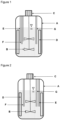
- the coaxial mixer as well as the separate dosing tube for NaOH were located in the vessel so that the outlets were approximately 5 cm below the liquid level.
- the coaxial mixer consisted of two coaxially arranged pipes made of stainless steel.
- the inner and outer diameter of the inner circular pipe was 1.1 mm and 1.6 mm, respectively.
- the inner and outer diameter of the outer circular pipe was 2 mm and 4 mm, respectively.
- the separate dosing tube had an outer diameter of 6 mm, an inner diameter of 2 mm.
- Vessel 1 was charged with 2 I of deionized water and the temperature of the vessel was set to 55°C.
- the stirrer element was activated and constantly operated at 1000 rpm (average input -4.5 W/I).
- An aqueous solution of NiSO 4 , CoSO 4 and MnSO 4 (molar ratio 91:4.5:4.5, total transition metal concentration: 1.65 mol/kg), aqueous sodium hydroxide (25wt% NaOH) and aqueous ammonia solution (25wt% ammonia) were simultaneously introduced into the vessel.
- the aqueous transition metal solution was introduced via the inner pipe of the coaxial mixer while the aqueous ammonia solution was introduced via the outer pipe of the coaxial mixer.
- the aqueous sodium hydroxide solution was introduced through the separate dosing tube t 1 .
- the distance between the outlets of the two coaxially arranged pipes was in the range of 5mm.
- the molar ratio between ammonia and transition metal was adjusted to 0.25.
- the sum of volume flows was set to adjust the mean residence time to 5 hours.
- the flow rate of the NaOH solution was adjusted by a pH regulation circuit to keep the pH value in the stirred vessel at a constant value of 12.0.
- the apparatus was operated continuously keeping the liquid level in the vessel constant.
- a mixed hydroxide of Ni, Co and Mn was collected via free overflow from the vessel.
- the resulting slurry contained about 120g/l mixed hydroxide of Ni, Co and Mn.
- TM-OH.1 had an average particle diameter (D50) of 12.0 ⁇ m, a value of (D90-D10)/D50 of 1.40, a tap density of 1.76 g/l and a BET surface of 26.4 m2/g.
- the example was carried out in a 2.4L stirred vessel equipped with baffles and a cross-arm stirrer, and three dosing tubes, one for an aqueous solution of NaOH, one for ammonia solution and one for the metal sulfate solution, see Figure 2 .
- the feed for the metal sulfate solution was separated from both other tubes by 8 cm each, while the tube for ammonia was separated by 2.5 cm from the tube for the NaOH solution. All tubes had an outer diameter of 6 mm, an inner diameter of 2 mm and were located in the vessel so that the corresponding outlet was approximately 5 cm below the liquid level. In the context of said working examples this vessel is also referred to as "vessel 2". Vessel 2 had a constant nitrogen overflow during all reactions.
- Vessel 2 was charged with 2 I of deionized water and the temperature of the vessel was set to 55°C.
- the stirrer element was activated and constantly operated at 1000 rpm (average input -4.5 W/I).
- An aqueous solution of NiSO 4 , CoSO 4 and MnSO 4 (molar ratio 91:4.5:4.5, total transition metal concentration: 1.65 mol/kg), aqueous sodium hydroxide (25wt% NaOH) and aqueous ammonia solution (25wt% ammonia) were simultaneously introduced into the vessel by the corresponding tube.
- the molar ratio between ammonia and transition metal was adjusted to 0.25.
- the sum of volume flows was set to adjust the mean residence time to 5 hours.
- the flow rate of the NaOH solution was adjusted by a pH regulation circuit to keep the pH value in the stirred vessel at a constant value of 12.1.
- the apparatus was operated continuously keeping the liquid level in the vessel constant.
- a mixed hydroxide of Ni, Co and Mn was collected via free overflow from the vessel.
- the resulting slurry contained about 120g/l mixed hydroxide of Ni, Co and Mn.
- C-TM-OH.2 had an average particle diameter (D50) of 10.6 ⁇ m, a value of (D90-D10)/D50 of 1.35, a tap density of 1.92 g/l and a BET surface of 30.7 m 2 /g.
- Powder X-ray Diffraction (PXRD) data was collected using a laboratory diffractometer (D8 Discover, Bruker AXS GmbH, Düsseldorf). The instrument was set up with a Molybdenum X-ray tube. The characteristic K-alpha radiation was monochromatized using a bent Germanium Johansson type primary monochromator. Data was collected in the Bragg-Brentano reflection geometry in a 2 ⁇ range from 5.0 to 50°, applying a step size of 0.019°. A LYNXEYE area detector was utilized to collect the scattered X-ray signal.
- the precursors were ground using an IKA Tube Mill and an MT40.100 disposable grinding chamber.
- the powder was placed in a sample holder and flattened using a glass plate.
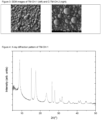
- XRD patterns of TM-OH.1 and C-TM-OH.2 are disclosed in Figure 5 and 5 . It should be noted that, e.g., the reflections at 2 ⁇ of about 15 and 17.5 ° are different in height.
- Table 1 Overview over the different precursor properties precursor Form factor Axis ratio BB P x [%] P y [%] P car [%] Lateral crystallite size [nm] TM-OH.1 0.88 1.26 0.11 0.07 0.08 62 C-TM-OH.2 0.88 1.27 0.12 0.06 0.10 14
- Form factor and axis ratio were determined from the top view images of the particles shown in Figure 3 .
- the transition probabilities P x , P y and P car and the lateral crystallite size were determined from the corresponding X-ray diffraction patterns shown in Figure 4 and Figure 5 .
- the respective precursors were mixed with LiOH ⁇ H 2 O, Al 2 O 3 and Zr(OH) 4 in molar ratio of Li:(Ni+Co+Mn) of 1.01:1, Al Li:(Ni+Co+Mn) of 0.02:1, Zr Li:(Ni+Co+Mn) of 0.0025:1, poured into a alumina crucible and heated at 350°C for 4 hours and 720°C for 6 hours under oxygen atmosphere (10 exchanges/h) using a heating rate of 3 °C/min.
- the resultant material was cooled to ambient temperature at a cooling rate of 10 °C / min and subsequently sieved using a mesh size of 30 ⁇ m to obtain the inventive cathode active material CAM.1 from precursor TM-OH.1 and the comparative cathode active material C-CAM.2 from the comparative precursor C-TM-OH.2.
- Electrodes contained 94% CAM, 3% carbon black (Super C65) and 3% binder (polyvinylidene fluoride, Solef 5130). Slurries were mixed in N-methyl-2-pyrrolidone and cast onto aluminum foil by doctor blade. After drying of the electrodes for 6 h at 105 °C in vacuo, circular electrodes were punched, weighed and dried at 120 °C under vacuum for 12 hours before entering in an Ar filled glove box.
- Coin-type electrochemical cells were assembled in an argon-filled glovebox.
- the positive 14 mm diameter (loading 8.0 ⁇ 0.5 mg cm -2 ) electrode was separated from the 0.58 mm thick Li foil by a glass fiber separator (Whatman GF/D).
- EC ethylene carbonate
- EMC ethylmethyl carbonate
- Cells were galvanostatically cycled at a Maccor 4000 battery cycler between 3.1 and 4.3 V at room temperature by applying the following C-rates: Table 2: Electrochemical test procedure of the coin half cells.
- CAM DC 1 st cycle [mA ⁇ h/g] CE 1 st cycle DC 5 th cycle [mA ⁇ h/g] DC 25 th cycle [mA ⁇ h/g] DC 50 th cycle [m ⁇ Ah/g] CAM.1 209 91.0 % 199 175 162 C-CAM.2 199 88.3 % 190 170 159
Landscapes
- Chemical & Material Sciences (AREA)
- Organic Chemistry (AREA)
- Inorganic Chemistry (AREA)
- Chemical Kinetics & Catalysis (AREA)
- Electrochemistry (AREA)
- General Chemical & Material Sciences (AREA)
- Inorganic Compounds Of Heavy Metals (AREA)
- Battery Electrode And Active Subsutance (AREA)
- Compositions Of Oxide Ceramics (AREA)
- Compounds Of Alkaline-Earth Elements, Aluminum Or Rare-Earth Metals (AREA)
Description
- The present invention relates to a process for precipitating a mixed hydroxide of TM wherein TM comprises Ni and at least one of Co and Mn and, optionally, Al, Mg, Zr or Ti from an aqueous solution of salts of such transition metals or of Al or of Mg, wherein such process is carried out in a stirred vessel and comprises the step of introducing a 1 to 40% by weight aqueous solution of ammonia and an aqueous solution of transition metal salts through at least two inlets into said stirred vessel wherein an aqueous solution of alkali metal hydroxide is added separately from the at least two inlets, and wherein at least two inlets are designed as a coaxial mixer that comprises two coaxially arranged pipes through which an aqueous solution of ammonia and an aqueous solution of transition metal salts are introduced into said stirred vessel.
- Lithium ion secondary batteries are modern devices for storing energy. Many application fields have been and are contemplated, from small devices such as mobile phones and laptop computers through car batteries and other batteries for e-mobility. Various components of the batteries have a decisive role with respect to the performance of the battery such as the electrolyte, the electrode materials, and the separator. Particular attention has been paid to the cathode materials. Several materials have been suggested, such as lithium iron phosphates, lithium cobalt oxides, and lithium nickel cobalt manganese oxides. Although extensive research has been performed the solutions found so far still leave room for improvement.
- The electrode material is of crucial importance for the properties of a lithium ion battery. Lithium-containing mixed transition metal oxides have gained particular significance, for example spinels and mixed oxides of layered structure, especially lithium-containing mixed oxides of nickel, manganese and cobalt; see, for example,
EP 1 189 296 . However, not only the stoichiometry of the electrode material is important, but also other properties such as morphology and surface properties. - Generally, lithium-containing mixed transition metal oxides are prepared using a two-stage process. In a first stage, a sparingly soluble salt of the transition metal(s) is prepared by precipitating it from a solution, for example a carbonate or a hydroxide. This sparingly soluble salt is in many cases also referred to as a precursor. In a second stage, the precipitated salt of the transition metal(s) is mixed with a lithium compound, for example Li2CO3, LiOH or Li2O, and calcined at high temperatures, for example at 600 to 1100°C.
- Existing lithium ion batteries still have potential for improvement, especially with regard to the energy density. For this purpose, the cathode material should have a high specific capacity. It is also advantageous when the cathode material can be processed in a simple manner to give electrode layers of thickness from 20 µm to 200 µm, which should have a high density in order to achieve a maximum energy density (per unit volume), and a high cycling stability.
- In
WO 2012/095381 andWO 2013/117508 , processes for the precipitation of hydroxides or carbonates are disclosed wherein vessels with compartments are used. A lot of energy is introduced in the respective compartment(s). Carrying out said process on commercial scale is difficult, though. A process for precipitating a mixed hydroxide of TM wherein TM comprises Ni, Co and Mn from an aqueous solution of salts of such transition metals is disclosed also inWO 2019/185433 . - It was an objective of the present invention to provide a process for making precursors of cathode active materials for lithium ion batteries which have a high volumetric energy density and excellent cycling stability. More particularly, it was therefore an objective of the present invention to provide starting materials for batteries which are suitable for producing lithium ion batteries with a high volumetric energy density and excellent cycling stability. It was a further objective of the present invention to provide a process by which suitable starting materials for lithium ion batteries can be prepared.
- Without wishing to be bound to any theory, it can be assumed that the lithiation process is depending on the particle diameter, porosity, specific surface area, primary crystal size and number of stacking faults in crystal latter of a precursor. It was an objective of the present invention to provide a process for making precursors which can be lithiated in a very efficient way. More particularly, it was therefore an objective of the present invention to provide starting materials for batteries which can be lithiated in a very efficient way. It was also an objective of the present innovation that the lithiation process becomes less sensitive, for example by a comparable low impact of calcination temperature on electrochemical properties such as the 1st discharge capacity. This can be obtained by an improved precursor obtained by the innovative process. Accordingly, the process defined at the outset has been found, hereinafter also referred to as inventive process or process according to the (present) invention. The inventive process may be carried out as a batch process or as a continuous or semi-continuous process. Preferred are continuous processes.
- The inventive process is a process for precipitating a mixed hydroxide of TM. In the context of the present invention, "mixed hydroxides" refer to hydroxides and do not only include stoichiometrically pure hydroxides but especially also compounds which, as well as transition metal cations and hydroxide ions, also have anions other than hydroxide ions, for example oxide ions and carbonate ions, or anions stemming from the transition metal starting material, for example acetate or nitrate and especially sulfate.
- In one embodiment of the present invention, mixed hydroxides may have 0.01 to 45 mole-% and preferably 0.1 to 40 mole-% of anions other than hydroxide ions, based on the total number of anions of said mixed hydroxide. Sulfate may also be present as an impurity in embodiments in which a sulfate was used as starting material, for example in a percentage of 0.001 to 1 mole%, preferably 0.01 to 0.5 mole-%.
- In the context of the present invention, TM comprises Ni and at least one of Co and Mn and, optionally, Al, Mg, Zr or Ti. Preferably, TM is selected from the group consisting of Ni and at least one of Co and Mn and, optionally, Al, Mg, Zr or Ti. Although Al and Mg are not transition metals, in the context of the present invention, solutions of salts of TM are hereinafter also referred to as solutions of transition metals.
- In one embodiment of the present invention, TM contains metals according to the general formula (I)
NiaM1 bMnc (I)
- where the variables are each defined as follows:
- M1
- is Co or combinations of Co and at least one element selected from Ti, Zr, Al and Mg,
- a
- is in the range from 0.15 to 0.95, preferably 0.5 to 0.92,
- b
- is in the range from zero to 0.35, preferably 0.03 to 0.2,
- c
- is in the range from zero to 0.8, preferably 0.05 to 0.65,
- where a + b + c = 1.0, and at least one of b and c is greater than zero.
- In embodiments wherein M1 is of Co and at least one element selected from Ti, Zr, Al and Mg, it is preferred that at least 95 mole-% up to 99.9 mole-% of M1 is Co.
- In one embodiment of the present invention, the variables in formula (I) are defined as follows:
- a
- is in the range of from 0.8 to 0.95,
- M1
- is a combination of Co and at least one element selected from Ti, Zr, Al and Mg, with 95 mole-% up to 99.9 mole-% of M1 being Co,
- b
- is in the range of from 0.03 to 0.2,
- c
- is zero,
- In another embodiment of the present invention, the variables in formula (I) are defined as follows:
- a
- is in the range of from 0.6 to 0.93,
- M1
- is Co or a combination of Co and at least one element selected from Ti, Zr, Al and Mg, with 95 mole-% up to 99.9 mole-% of M1 being Co,
- b
- is in the range of from 0.02 to 0.2,
- c
- is in the range of from 0.05 to 0.2,
- In another embodiment of the present invention, the variables in formula (I) are defined as follows:
- a
- is in the range of from 0.15 to 0.5,
- b
- is zero to 0.05,
- c
- is in the range of from 0.55 to 0.8,
- In yet another embodiment of the present invention, the variables in formula (I) are defined as follows:
- a
- is in the range of from 0.6 to 0.95,
- b
- is zero,
- c
- is in the range of from 0.4 to 0.05,
- Many elements are ubiquitous. For example, sodium, copper and chloride are detectable in certain very small proportions in virtually all inorganic materials. In the context of the present invention, proportions of less than 0.02 mole % of cations or anions are disregarded. Any mixed hydroxide obtained according to the inventive process which comprises less than 0.02 mole % of sodium is thus considered to be sodium-free in the context of the present invention.
- In one embodiment of the present invention the inventive process is a process for precipitating a mixed hydroxide with an average particle diameter (D50) in the range of from 2 to 20 µm, preferably 2 to 20 µm, more preferably 4 to 16 µm, determined by LASER diffraction.
- The inventive process is carried out in a stirred vessel. Said stirred vessel may be a stirred tank reactor or a continuous stirred tank reactor. Said continuous stirred tank reactor may be selected from stirred tank reactors that constitute a part of a cascade of stirred tank reactors, for example a cascade of two or more stirred tank reactors, particularly two or three stirred tank reactors.
- In the course of the inventive process, an aqueous solution of alkali metal hydroxide and an aqueous solution of transition metals is introduced into said stirred vessel.
- In the context of the present invention, aqueous solution of nickel and one of manganese and cobalt and - optionally - at least one more cation such as Al3+ or Mg2+ is also referred to as aqueous solution of transition metals salts for short.
- Aqueous solution transition of metal salts comprises a nickel salt and a cobalt salt and/or a manganese salt. Preferred examples of nickel salts are especially water-soluble nickel salts, i.e. nickel salts which have a solubility of at least 25 g/l and preferably 50 g/l, in distilled water, determined at 20°C. Preferred salts of nickel, cobalt and manganese are in each case, for example, salts of carboxylic salts, especially acetates, and also sulfates, nitrates, halides, especially bromides or chlorides, of nickel, cobalt and manganese, the nickel being present as Ni+2, the cobalt being present as Co+2, and the manganese being present as Mn+2. However, Ti and/or Zr, if applicable, are present in an oxidation state of +4. Aluminum is present in the oxidation sate of +3, and it may be introduced, e.g., as sodium aluminate or as acetate or sulfate of aluminum.
- Aqueous solution of transition metal salts may comprise at least one further transition metal salt, preferably two or three further transition metal salts, especially salts of two or three transition metals or of cobalt and aluminum. Suitable transition metal salts are especially water-soluble salts of transition metal(s), i.e. salts which have a solubility of at least 25 g/l, preferably 50 g/l in distilled water, determined at
room 20°C. Preferred transition metal salts, especially salts of cobalt and manganese, are, for example, carboxylic acid salts, especially acetates, and also sulfates, nitrates, halides, especially bromides or chlorides, of transition metal, the transition metal(s) preferably being present in the +2 oxidation state. Such a solution preferably has a pH value in the range from 1 to 5, more preferably in the range from 2 to 4. - In one embodiment of the present invention, it is possible to proceed from an aqueous solution of transition metal salts which comprises, as well as water, one or more organic solvents, for example ethanol, methanol or isopropanol, for example up to 15% by volume, based on water. Another embodiment of the present invention proceeds from an aqueous solution of transition metal salts comprising less than 0.1% by weight, based on water, or preferably no organic solvent.
- In one embodiment of the present invention, said aqueous solution of transition metal salts used in the inventive process comprises ammonia, ammonium salt or one or more organic amines, for example methylamine or ethylene diamine. Aqueous solution of transition metal salts preferably comprises less than 10 mol% of ammonia or organic amine, based on transition metal M. In a particularly preferred embodiment of the present invention, aqueous solution of transition metal salts does not comprise measurable proportions of either of ammonia or of organic amine.
- Preferred ammonium salts may, for example, be ammonium sulfate and ammonium sulfite.
- Aqueous solution of transition metal salts may, for example, have an overall concentration of transition metal(s) in the range from 0.01 to 4 mol/l of solution, preferably 1 to 3 mol/l of solution.
- In one embodiment of the present invention, the molar ratio of transition metals in aqueous solution of transition metal salts is adjusted to the desired stoichiometry in the cathode material or mixed transition metal oxide to be used as precursor. It may be necessary to take into account the fact that the solubility of different transition metal hydroxides can be different.
- Aqueous solution of transition metal salts may comprise, as well as the counterions of the transition metal salts, one or more further salts. These are preferably those salts which do not form sparingly soluble salts with M, or bicarbonates of, for example, sodium, potassium, magnesium or calcium, which can cause precipitation of carbonates in the event of pH alteration. One example of such salts is ammonium sulfate.
- In another embodiment of the present invention, aqueous solution of transition metal salts does not comprise any further salts.
- In one embodiment of the present invention, aqueous solution of transition metal salts may comprise one or more additives which may be selected from biocides, complexing agents, for example ammonia, chelating agents, surfactants, reducing agents, carboxylic acids and buffers. In another embodiment of the present invention, aqueous solution of transition metal salts does not comprise any additives.
- Examples of suitable reducing agents which may be in aqueous solution of transition metal salts are sulfites, especially sodium sulfite, sodium bisulfite (NaHSO3), potassium sulfite, potassium bisulfite, ammonium sulfite, and also hydrazine and salts of hydrazine, for example the hydrogen sulfate of hydrazine, and also water-soluble organic reducing agents, for example ascorbic acid or aldehydes.
- Furthermore, an aqueous solution of ammonia is introduced into the stirred tank reactor, hereinafter also referred to as "ammonia solution" or "aqueous ammonia solution". Said ammonia solution contains 1 to 40 % by of ammonia, referring to the weight of said ammonia solution, preferably 10 to 25 % by weight.
- Said ammonia solution may comprise other compounds than water and ammonia, for example traces of carbonate due to aging, or of alkali metal hydroxide, for example 0.01 to 5 mol-%, referring to ammonia. Preferably, said ammonia solution does not contain significant amounts of compounds other than ammonia.
- The inventive process is carried out in a stirred vessel and includes carrying out the inventive process in a stirred tank reactor or in a continuous stirred tank reactor or in a cascade of at least two continuous stirred tank reactors, for example in a cascade of 2 to 4 continuous stirred tank reactors. It is preferred to carry out the inventive process in a continuous stirred tank reactor. Continuous stirred tank reactors contain at least one overflow system that allows to continuously - or within intervals - withdraw slurry from said continuous stirred tank reactor.
- The inventive process comprises the step of introducing an aqueous solution of ammonia and an aqueous solution of transition metal salts through at least two inlets into said stirred vessel wherein at least two inlets are designed as a coaxial mixer that comprises two coaxially arranged pipes through which an aqueous solution of ammonia and an aqueous solution of transition metal salts are introduced into said stirred vessel. This step is also referred to as "introduction step". The aqueous solution of alkali metal hydroxide is introduced separately from the at least two inlets.
- The alkali metal hydroxide further required is added separately from the at least two inlets.
- The at least two inlets are designed as a coaxial mixer that comprises two coaxially arranged pipes through which an aqueous solution of ammonia and an aqueous solution of transition metal salts are introduced into a stirred vessel. In one embodiment of the present invention, the introduction step is carried out by using two or more coaxially arranged pipes through which an aqueous solution of ammonia and an aqueous solution of transition metal salts are introduced into said stirred vessel. In another embodiment of the present invention, the introduction step is carried out by using exactly one system of coaxially arranged pipes through which an aqueous solution of ammonia and an aqueous solution of transition metal salts are introduced into said stirred vessel.
- Even more preferably, the aqueous solution of ammonia and the aqueous solution of transition metal salts are introduced through two inlets into said stirred vessel wherein said two inlets are designed as a coaxial mixer.
- In one embodiment, a molar NH3: transition metal ratio of 0.01 to 0.9 and more preferably of 0.05 to 0.65 can be established.
- Although it is possible that some shares of aqueous solution of ammonia and of aqueous solution of transition metal salts are introduced at different locations as well, for example up to 30% of aqueous solution of alkali metal hydroxide and up to 30% of aqueous solution of transition metal salts, it is preferred that all aqueous solution of ammonia and of aqueous solution of transition metal salts are introduced through the above arrangement of pipes.
- In one embodiment of the present invention, the locations of the introduction of the aqueous solutions of transition metal salts and of ammonia are below the level of liquid in the stirred vessel. In another embodiment of the present invention, the locations of the introduction of the aqueous solutions of transition metal salts and of ammonia are above the level of liquid in the stirred vessel.
- In the course of said preferred embodiment of the introduction step, said aqueous solution of ammonia may be introduced through one pipe of a coaxially mixer and said solution of transition metal salts is introduced through the other pipe of said coaxially arranged pipes.
- In one embodiment of the present invention, the velocity for introducing aqueous solution of ammonia and aqueous solution of transition metal salts is in the range of from 0.01 to 10 m/s. On large scale, for example in a stirred vessel of 10 m3 or more, velocities of 0.5 to 5 m/s are preferred.
- In a preferred embodiment of the present invention, the aqueous solution of transition metal salts is introduced through the inner pipe of a coaxial mixer and the aqueous solution of ammonia is introduced through the outer pipe, this will lead to a minor degree of incrustations.
- In one embodiment of the present invention, the aqueous solution of transition metal salts is introduced through the outer pipe of a coaxial mixer and the aqueous solution of ammonia is introduced through the inner pipe, this will give access to different particle morphologies and particle sizes, especially (D50).
- In one embodiment of the present invention, the inner pipe of said coaxial mixer has an inner diameter in the range of from 0.5 mm to 120 mm, preferred in the range from 5 mm to 50 mm, depending on the vessel size. The bigger the vessel, the bigger is the diameter of the inlet tip in order to establish a constant flow velocity.
- In one embodiment of the present invention, the outer pipe of the coaxial mixer has an inner diameter in the range of from 1.2 to 10 times the inner diameter of the inner pipe, preferred 1.5 to 6 times.
- Said pipes preferably have a circular profile.
- In one embodiment of the present invention, the walls of the pipes have a thickness in the range of from 1 to 10 mm.
- Said pipes may be made from PTFE (polytetrafluoroethylene), FEP (fluorinated ethylenepropylene copolymer), PFA (perfluoroalkoxy polymer), steel, stainless steel, or from steel or stainless steel coated with PTFE, FEP, or PFA (perfluoroalkoxy polymer), preference being given to stainless steel and stainless steel coated with PFA.
- In one embodiment of the present invention, the pipes of the coaxial mixer are bent. In a preferred embodiment of the present invention, the pipes of the coaxial mixer are non-bent.
- Said coaxial mixer may serve as coaxial nozzle.
- In one embodiment of the present invention locations of the introduction of the aqueous solutions of transition metal salts and of ammonia are above the level of liquid, for example by 3 to 50 cm. In a preferred embodiment of the present invention, the locations of the introduction of the aqueous solutions of transition metal salts and of ammonia are below the level of liquid, for example by 5 to 150 cm, preferably larger than 20 cm up to 120 cm.
- In one embodiment of the present invention the pH value at the point of the outlet of said at least two inlets is in the range of from 11 to 15, preferably from 12 to 14, determined at 23°C.
- In one embodiment of the present invention the tips of said at least two inlets are outside of a vortex caused by the stirring in the stirred vessel.
- In one embodiment of the present invention the tips of said at least two inlets are located above a stirrer element in a way that the flow around the outlets has a merely vertical flow direction from top to bottom.
- In various embodiments, especially when the turbulence at the outlet of the at least two inlets is too low, precipitates of mixed metal (oxy)hydroxide form at the outlet of a coaxial mixer, and they may form incrustations. In a preferred embodiment of the present invention, in certain time intervals, the at least two inlets and preferably the coaxial mixer is flushed with water to physically remove transition metal (oxy)hydroxide incrustations. Said intervals may occur, for example, every 2 minutes up to every other hour, and said flushing period may last in the range of from 1 second to five minutes, preferably 1 to 30 seconds. Flushing intervals as short as possible are preferred in order to avoid unnecessary dilution of the reaction medium. In one embodiment of the present invention, said water may contain ammonia to maintain the pH value above 7.
- Separately from the above at least two inlets, an aqueous solution of alkali metal hydroxide is added.
- Alkali metal hydroxides may be selected from hydroxides of lithium, rubidium, cesium, potassium and sodium and combinations of at least two of the foregoing, preferred are potassium and sodium and combinations of the foregoing, and more preferred is sodium.
- Aqueous solution of alkali metal hydroxide may have a concentration of hydroxide in the range from 0.1 to 12 mol/l, preferably 6 to 10 mol/l.
- In one embodiment of the present invention, aqueous solution of alkali metal hydroxide may comprise ammonia or one or more organic amines, for example methylamine. It is preferred that no measurable amounts of organic amine are present. It is more preferred that the aqueous solution of alkali metal hydroxide contains neither organic amines nor ammonia.
- In one embodiment of the present invention, aqueous solution of alkali metal hydroxide may comprise some carbonate or hydrogen carbonate. Technical grade potassium hydroxide usually contains some potassium (bi)carbonate, and technical grade of sodium hydroxide usually contains some sodium (bi)carbonate. Despite such content of alkali metal (bi)carbonate, in the context of the present invention the respective technical grade alkali metal hydroxide is referred to as alkali metal hydroxide for short.
- Said aqueous solution of alkali metal hydroxide is introduced separately from the at least two inlets, for example in a distance from the point of introduction of the solution of the transition metal salts and of the ammonia that is at least 12 times the hydraulic diameter of the tip of the feed with the largest diameter.
- The stirred vessel described above may additionally include one or more pumps, inserts, mixing units, baffles, wet grinders, homogenizers and stirred tanks working as a further compartment in which the precipitation takes place and preferably having a much smaller volume than the vessel described at the outset. Examples of particularly suitable pumps are centrifugal pumps and peripheral wheel pumps.
- In a preferred embodiment of the present invention, though, such stirred vessel is void of any separate compartments, external loops or additional pumps.
- In one embodiment of the present invention, the process according to the invention can be performed at a temperature in the range from 20 to 90°C, preferably 30 to 80°C and more preferably 35 to 75°C. The temperature is determined in the stirred vessel.
- The process according to the invention can be performed under air, under inert gas atmosphere, for example under noble gas or nitrogen atmosphere, or under a defined mixture of air and inert gas, such as mixtures of from 2 to 40 vol% air in N2, or under reducing gas atmosphere. Examples of reducing gases include, for example, CO and SO2. Preference is given to working under inert gas atmosphere.
- In one embodiment of the present invention, aqueous solution of transition metals and aqueous solution of alkali metal hydroxide have a temperature in the range of 10 to 75°C before they are contacted in stirred vessel.
- The stirred vessel comprises a stirrer. Suitable stirrers may be selected from pitch blade turbines, rushton turbines, cross-arm stirrers, dissolver blades and propeller stirrers. Stirrers may be operated at rotation speeds that lead to an average energy input in the range from 0.1 to 10W/I, preferably in the range from 1 to 7W/I.
- In embodiments wherein the stirred vessel is a continuous stirred tank reactor or a cascade of at least two stirred tank reactors, the respective stirred tank reactor(s) have an overflow system. Slurry containing precipitated mixed metal hydroxide of TM and a mother liquor. In the context of the present invention, mother liquor comprises water-soluble salts and optionally further additives present in solution. Examples of possible water-soluble salts include alkali metal salts of the counterions of transition metal, for example sodium acetate, potassium acetate, sodium sulfate, potassium sulfate, sodium nitrate, potassium nitrate, sodium halide, potassium halide, including the corresponding ammonium salts, for example ammonium nitrate, ammonium sulfate and/or ammonium halide. Mother liquor most preferably comprises sodium sulfate and ammonium sulfate and ammonia.
- In one embodiment of the present invention, the inventive process is performed in a vessel that is equipped with a clarifier. In a clarifier, mother liquor is separated from precipitated mixed metal hydroxide of TM and the mother liquor is withdrawn.
- By performing the inventive process, an aqueous slurry is formed. From said aqueous slurry, a particulate mixed hydroxide may be obtained by solid-liquid separation steps, for example filtering, spray-drying, drying under inert gas or air, or the like. If dried under air, a partial oxidation may take place, and a mixed oxyhydroxide of TM is obtained.
- Precursors obtained according to the inventive process are excellent starting materials for cathode active materials which are suitable for producing batteries with a maximum volumetric energy density.
- We have observed that by performing the inventive process it is possible to run the coprecipitation at nickel and manganese concentrations in the bulk which lead to an accumulation of Ni simultaneously in larger secondary particles as well as in the cores of secondary particles independent of their size, preferably at the expense of Mn. This feature remains in the cathode active material made from precursors made according to the present invention even after calcination. Without wishing to be bound by any theory, we assume that the above features provide excellent cycling stability.
- By performing the inventive process, precursors for lithium ion batteries are obtained. Precursors made according to the inventive process are particulate transition metal (oxy)hydroxides according to general formula (II)
NiaM1 bMncOx(OH)y(CO3)t (II)
- where the variables are each defined as follows:
- M1
- is Co or a combination of Co and at least one metal selected from Ti, Zr, Al and Mg,
- a
- is in the range from 0.15 to 0.95, preferably 0.5 to 0.9,
- b
- is in the range from zero to 0.35, preferably 0.03 to 0.2,
- c
- is in the range from zero to 0.8, preferably 0.05 to 0.65,
- where a + b + c = 1.0 and at least one of b and c is greater than zero,

- and said precursors have a Brucite type structure whose X-ray diffraction pattern displays C19 stacking faults with a transition probability Px in the range of from 0 to 0.25% and 3R stacking faults with a transition probability Py in the range of from 0 to 0.15%. The C19 stacking faults refer to CdCl2 type stacking (faults) within the Brucite type structure and the 3R stacking faults refer to CrOOH type stacking (faults) within the Brucite type structure. A detailed description of stacking faults and the determination of the transition probabilities can be found in "S. Bette, B. Hinrichsen, D. Pfister, R. Dinnebier, J. Appl. Cryst. 2020, 53.
- In one embodiment of the present invention at least 60 vol-% of the secondary particles of inventive (oxy)hydroxide are agglomerated from primary particles that are essentially radially oriented, and said particulate transition metal (oxy)hydroxide has a form factor in the range of from 0.85 to 1 and an axis ratio of the bounding box in the range of from 1.00 to 1.20.
- To determine the axis ratio of the bounding box of a single particle, the smallest possible, rectangular bounding box is set around the top view SEM image of a particle. The axis ratio is calculated from the length of the two sides a1 and a2 (with a1 ≥ a2) by: axis ratio of the bounding box = a1/a2.
- While, a perfect sphere would possess an axis ratio of the bounding box of 1.0, all deviations from perfect sphericity lead to an axis ratio > 1.0.
- In one embodiment, the variables in formula (II) are defined as follows:
- a
- is in the range of from 0.8 to 0.95,
- M1
- is a combination of Co and at least one element selected from Ti, Zr, Al and Mg, with 95 mole-% up to 99.9 mole-% of M1 being Co,
- b
- is in the range of from 0.03 to 0.2,
- c
- is zero,
- In another embodiment, the variables in formula (II) are defined as follows:
- a
- is in the range of from 0.6 to 0.95,
- M1
- is Co or a combination of Co and at least one element selected from Ti, Zr, Al and Mg, with 95 mole-% up to 99.9 mole-% of M1 being Co,
- b
- is in the range of from 0.03 to 0.2,
- c
- is in the range of from 0.05 to 0.2,
- In another embodiment, the variables in formula (II) are defined as follows:
- a
- is in the range of from 0.15 to 0.5,
- b
- is from zero to 0.05,
- c
- is in the range of from 0.55 to 0.8,
- In yet another embodiment, the variables in formula (I) are defined as follows:
- a
- is in the range of from 0.6 to 0.95,
- b
- is zero,
- c
- is in the range of from 0.4 to 0.05,
- The primary particles may be needle-shaped or platelets or a mixture of both. The term "radially oriented" then refers to the length in case of needle-shaped or length or breadth in case of platelets being oriented in the direction of the radius of the respective secondary particle.
- The portion of radially oriented primary particles may be determined, e.g., by SEM (Scanning Electron Microscopy) of a cross-section of at least 5 secondary particles.
- The X-ray diffraction pattern of said (oxy)hydroxide displays a Brucite type structure having C19 stacking faults with a transition probability Px in the range of from 0 to 0.25% and 3R stacking faults with a transition probability Py in the range of from 0 to 0.15%
- "Essentially radially oriented" does not require a perfect radial orientation but includes that in an SEM analysis, a deviation to a perfectly radial orientation is at most 11 degrees, preferably at most 5 degrees.
- Preferably, at least 60% of the secondary particle volume is filled with radially oriented primary particles. Preferably, only a minor inner part, for example at most 40%, preferably at most 20%, of the volume of those particles is filled with non-radially oriented primary particles, for example, in random orientation.
- Inventive particulate transition metal (oxy)hydroxides have a form factor in the range of from 0.85 to 1 and an axis ratio of the bounding box in the range of from 1.00 to 1.20.
- In one embodiment, the lateral crystallite size of precursor made according to the inventive process is at least 16 nm, preferably in the range of from 16 nm to 200 nm, more preferably from 30 to 150 nm. The lateral crystallite size is determined by X-ray diffraction using Mo-radiation and fitting the diffracted reflection width at about d = 2.69 Å (33.3° 2θ). This reflects the crystallite size along the basal plane of the Brucite structure (space group number 164) with the Miller index of (1 0 0).
- In one embodiment, particulate transition metal (oxy)hydroxide made according to the inventive process has a total pore/intrusion volume in the range of from 0.033 to 0.1 ml/g, preferably 0.035 to 0.07 ml/g in the pore size range from 20 to 600 Å, determined by N2 adsorption, determined in accordance with DIN 66134 (1998), when the sample preparation for the N2 adsorption measurement is done by degassing at 120°C for 60 minutes.
- In a preferred embodiment, the average pore size of the particulate transition metal (oxy)hydroxide made according to the inventive process is in the range of from 100 to 250 Å, determined by N2 adsorption.
- In one embodiment, particulate transition metal (oxy)hydroxide made according to the inventive process has an average secondary particle diameter D50 in the range of from 2 to 20 µm, preferably 4 to 16 µm and even more preferably 10 to 16 µm.
- In one embodiment, precursors made according to the inventive process have a specific surface according to BET (hereinafter also "BET-Surface") in the range of from 2 to 70 m2/g, preferably from 4 to 50m2/g. The BET surface may be determined by nitrogen adsorption after outgassing of the sample at 200°C for 30 minutes or more and beyond this accordance with DIN ISO 9277:2010.
- In one embodiment, precursors made according to the inventive process have a particle size distribution [(D90) - (D10)] divided by (D50) is in the range of from 0.5 to 2, preferably from 0.5 to 1.5.
- In one embodiment, precursors made according to the inventive process have an interstratification of water or carbon dioxide molecules into the brucite-type host structure with a transition probability Pcar in the range of from 0 to 0.20% determined from the X-ray diffraction pattern.
- Precursors obtained according to the inventive process are excellent starting materials for cathode active materials which are suitable for producing batteries with a high volumetric energy density and excellent cycling stability. Such cathode active materials are made by mixing with a source of lithium, e.g., Li2O or LiOH or Li2CO3, each water-free or as hydrates, and calcination, for example at a temperature in the range of from 600 to 1000°C. Further disclosed is thus the use of precursors made according to the inventive process for the manufacture of cathode active materials for lithium ion batteries, and furthermore, a process for the manufacture of cathode active material for lithium ion batteries is disclosed - hereinafter also referred to as calcination - wherein said process comprises the steps of mixing a precursor made according to the inventive process with a source of lithium and thermally treating said mixture at a temperature in the range of from 600 to 1000°C. Preferably, the ratio of precursor and source of lithium in such process is selected that the molar ratio of Li and TM is in the range of from 0.95:1 to 1.2:1.
- Examples of calcinations include heat treatment at a temperature in the range of from 600 to 990°C, preferably 650 to 850°C. The terms "treating thermally" and "heat treatment" are used interchangeably in the context of the present invention.
- In one embodiment, the mixture obtained for the calcination is heated to 600 to 900 °C with a heating rate of 0.1 to 10 °C/min.
- In one embodiment, the temperature is ramped up before reaching the desired temperature of from 600 to 900°C, preferably 650 to 800°C. For example, first the mixture obtained from step (d) is heated to a temperature to 350 to 550°C and then held constant for a time of 10 min to 4 hours, and then it is raised to 650°C up to 800°C and then held at 650 to 800 for 10 minutes to 10 hours.
- In one embodiment, the calcination is performed in a roller hearth kiln, a pusher kiln or a rotary kiln or a combination of at least two of the foregoing. Rotary kilns have the advantage of a very good homogenization of the material made therein. In roller hearth kilns and in pusher kilns, different reaction conditions with respect to different steps may be set quite easily. In lab scale trials, box-type and tubular furnaces and split tube furnaces are feasible as well.
- In one embodiment, the calcination is performed in an oxygen-containing atmosphere, for example in a nitrogen-air mixture, in a rare gas-oxygen mixture, in air, in oxygen or in oxygen-enriched air. In a preferred embodiment, the atmosphere in step (d) is selected from air, oxygen and oxygen-enriched air. Oxygen-enriched air may be, for example, a 50:50 by volume mix of air and oxygen. Other options are 1:2 by volume mixtures of air and oxygen, 1:3 by volume mixtures of air and oxygen, 2:1 by volume mixtures of air and oxygen, and 3:1 by volume mixtures of air and oxygen.
- In one embodiment, the calcination is performed under a stream of gas, for example air, oxygen and oxygen-enriched air. Such stream of gas may be termed a forced gas flow. Such stream of gas may have a specific flow rate in the range of from 0.5 to 15 m3/h·kg material according to general formula Li1+xTM1-xO2. The volume is determined under normal conditions: 298 Kelvin and 1 atmosphere. Said stream of gas is useful for removal of gaseous cleavage products such as water and carbon dioxide.
- In one embodiment, the calcination has a duration in the range of from one hour to 30 hours. Preferred are 10 to 24 hours. The time at a temperature above 600°C is counted, heating and holding but the cooling time is neglected in this context.
- The present invention is further illustrated by two drawings and by working examples as well as further diagrams.
-
- A: Stirred vessel
- B: Stirrer
- C: Engine for stirrer
- D: Baffles
- E: Wall of outer pipe of coaxial nozzle containing NH3 solution
- F: Wall of inner pipe of coaxial nozzle containing metal sulfate solution
- G: Wall of pipe for NaOH solution
-
- A: Stirred vessel
- B: Stirrer
- C: Engine for stirrer
- D: Baffles
- E: Wall of pipe for NH3 solution
- F: Wall of pipe metal sulfate solution
- G: Wall of pipe for NaOH solution
- The nickel concentrations of precursors were analyzed by inductively coupled plasma optical emission spectrometry (ICP-OES) after dissolving the samples in concentrated hydrochloric acid.
- To determine form factor and axis ratio of samples, both properties were first determined for at least 50 individual particles of each sample and then averaged.
- The form factor of the individual particles was calculated from the perimeter and area determined from top view SEM images:

- While, a perfect sphere would possess a form factor of 1.0, any deviation from perfect sphericity lead to form factors < 1.0
- To determine the axis ratio of the bounding box of a single particle, the smallest possible, rectangular bounding box is set around the top view SEM image of a particle. The axis ratio is calculated from the length of the two sides a1 and a2 (with a1 ≥ a2) by: axis ratio of the bounding box = a1/a2.
- While, a perfect sphere would possess an axis ratio of the bounding box of 1.0, all deviations from perfect sphericity lead to an axis ratio > 1.0.
- The lateral crystallite size as well as the transition probability Px of C19 stacking faults, the transition probability Py of 3R stacking faults and the transition probability Pcar of interstratification of water or carbon dioxide were determined on the basis of X-ray diffraction. The diffracted peak width was fitted by using DIFFRAC.TOPAS V6 software (Bruker AXS GmbH. Instrumental broadening was considered during the peak fitting, leading to a separation of the instrumental from the sample broadening. The sample contribution is determined by using a single Lorentzian profile function that is defined by the following equation:

- The example was carried out in a 2.4L stirred vessel equipped with baffles and a cross-arm stirrer, with a coaxial mixer and a separate dosing tube for NaOH separated by 4 cm, see
Figure 1 , in the context of the working examples also referred to as "Vessel 1". Vessel 1 had a constant nitrogen overflow during all reactions. The coaxial mixer as well as the separate dosing tube for NaOH were located in the vessel so that the outlets were approximately 5 cm below the liquid level. The coaxial mixer consisted of two coaxially arranged pipes made of stainless steel. The inner and outer diameter of the inner circular pipe was 1.1 mm and 1.6 mm, respectively. The inner and outer diameter of the outer circular pipe was 2 mm and 4 mm, respectively. The separate dosing tube had an outer diameter of 6 mm, an inner diameter of 2 mm. - Vessel 1 was charged with 2 I of deionized water and the temperature of the vessel was set to 55°C. The stirrer element was activated and constantly operated at 1000 rpm (average input -4.5 W/I). An aqueous solution of NiSO4, CoSO4 and MnSO4 (molar ratio 91:4.5:4.5, total transition metal concentration: 1.65 mol/kg), aqueous sodium hydroxide (25wt% NaOH) and aqueous ammonia solution (25wt% ammonia) were simultaneously introduced into the vessel. The aqueous transition metal solution was introduced via the inner pipe of the coaxial mixer while the aqueous ammonia solution was introduced via the outer pipe of the coaxial mixer. The aqueous sodium hydroxide solution was introduced through the separate dosing tube t1. The distance between the outlets of the two coaxially arranged pipes was in the range of 5mm.
- The molar ratio between ammonia and transition metal was adjusted to 0.25. The sum of volume flows was set to adjust the mean residence time to 5 hours. The flow rate of the NaOH solution was adjusted by a pH regulation circuit to keep the pH value in the stirred vessel at a constant value of 12.0. The apparatus was operated continuously keeping the liquid level in the vessel constant. A mixed hydroxide of Ni, Co and Mn was collected via free overflow from the vessel. The resulting slurry contained about 120g/l mixed hydroxide of Ni, Co and Mn. The slurry was washed with deionized water and an aqueous solution of sodium hydroxide (1kg of 25 wt% aqueous sodium hydroxide solution per kg of solid hydroxide), filtered and dried at 120 °C overnight to obtain the precursor TM-OH.1. TM-OH.1 had an average particle diameter (D50) of 12.0 µm, a value of (D90-D10)/D50 of 1.40, a tap density of 1.76 g/l and a BET surface of 26.4 m2/g.
- The example was carried out in a 2.4L stirred vessel equipped with baffles and a cross-arm stirrer, and three dosing tubes, one for an aqueous solution of NaOH, one for ammonia solution and one for the metal sulfate solution, see
Figure 2 . The feed for the metal sulfate solution was separated from both other tubes by 8 cm each, while the tube for ammonia was separated by 2.5 cm from the tube for the NaOH solution. All tubes had an outer diameter of 6 mm, an inner diameter of 2 mm and were located in the vessel so that the corresponding outlet was approximately 5 cm below the liquid level. In the context of said working examples this vessel is also referred to as "vessel 2". Vessel 2 had a constant nitrogen overflow during all reactions. - Vessel 2 was charged with 2 I of deionized water and the temperature of the vessel was set to 55°C. The stirrer element was activated and constantly operated at 1000 rpm (average input -4.5 W/I). An aqueous solution of NiSO4, CoSO4 and MnSO4 (molar ratio 91:4.5:4.5, total transition metal concentration: 1.65 mol/kg), aqueous sodium hydroxide (25wt% NaOH) and aqueous ammonia solution (25wt% ammonia) were simultaneously introduced into the vessel by the corresponding tube.
- The molar ratio between ammonia and transition metal was adjusted to 0.25. The sum of volume flows was set to adjust the mean residence time to 5 hours. The flow rate of the NaOH solution was adjusted by a pH regulation circuit to keep the pH value in the stirred vessel at a constant value of 12.1. The apparatus was operated continuously keeping the liquid level in the vessel constant. A mixed hydroxide of Ni, Co and Mn was collected via free overflow from the vessel. The resulting slurry contained about 120g/l mixed hydroxide of Ni, Co and Mn. The slurry was washed with deionized water and an aqueous solution of sodium hydroxide (1kg of 25 wt% aqueous sodium hydroxide solution per kg of solid hydroxide), filtered and dried at 120 °C overnight to obtain the comparative precursor C-TM-OH.2. C-TM-OH.2 had an average particle diameter (D50) of 10.6 µm, a value of (D90-D10)/D50 of 1.35, a tap density of 1.92 g/l and a BET surface of 30.7 m2/g.
- SEM images of TM-OH.1 and C-TM.OH.2 are disclosed in
Figure 3 . - Powder X-ray Diffraction (PXRD) data was collected using a laboratory diffractometer (D8 Discover, Bruker AXS GmbH, Karlsruhe). The instrument was set up with a Molybdenum X-ray tube. The characteristic K-alpha radiation was monochromatized using a bent Germanium Johansson type primary monochromator. Data was collected in the Bragg-Brentano reflection geometry in a 2θ range from 5.0 to 50°, applying a step size of 0.019°. A LYNXEYE area detector was utilized to collect the scattered X-ray signal.
- ForXRD measurements, the precursors were ground using an IKA Tube Mill and an MT40.100 disposable grinding chamber. The powder was placed in a sample holder and flattened using a glass plate.
- Rietveld refinement analyses of the microstructures of the precursor materials were performed using DIFFRAC.TOPAS V6 software (Bruker AXS GmbH).
- XRD patterns of TM-OH.1 and C-TM-OH.2 are disclosed in
Figure 5 and 5 . It should be noted that, e.g., the reflections at 2Θ of about 15 and 17.5 ° are different in height.Table 1: Overview over the different precursor properties precursor Form factor Axis ratio BB Px [%] Py [%] Pcar [%] Lateral crystallite size [nm] TM-OH.1 0.88 1.26 0.11 0.07 0.08 62 C-TM-OH.2 0.88 1.27 0.12 0.06 0.10 14 - Form factor and axis ratio were determined from the top view images of the particles shown in
Figure 3 . The transition probabilities Px, Py and Pcar and the lateral crystallite size were determined from the corresponding X-ray diffraction patterns shown inFigure 4 andFigure 5 . - To obtain cathode active materials, the respective precursors were mixed with LiOH·H2O, Al2O3 and Zr(OH)4 in molar ratio of Li:(Ni+Co+Mn) of 1.01:1, Al Li:(Ni+Co+Mn) of 0.02:1, Zr Li:(Ni+Co+Mn) of 0.0025:1, poured into a alumina crucible and heated at 350°C for 4 hours and 720°C for 6 hours under oxygen atmosphere (10 exchanges/h) using a heating rate of 3 °C/min. The resultant material was cooled to ambient temperature at a cooling rate of 10 °C / min and subsequently sieved using a mesh size of 30 µm to obtain the inventive cathode active material CAM.1 from precursor TM-OH.1 and the comparative cathode active material C-CAM.2 from the comparative precursor C-TM-OH.2.
- Electrode manufacture and Half-Cell Electrochemical measurements:
Electrodes contained 94% CAM, 3% carbon black (Super C65) and 3% binder (polyvinylidene fluoride, Solef 5130). Slurries were mixed in N-methyl-2-pyrrolidone and cast onto aluminum foil by doctor blade. After drying of the electrodes for 6 h at 105 °C in vacuo, circular electrodes were punched, weighed and dried at 120 °C under vacuum for 12 hours before entering in an Ar filled glove box. - Coin-type electrochemical cells, were assembled in an argon-filled glovebox. The positive 14 mm diameter (loading 8.0±0.5 mg cm-2) electrode was separated from the 0.58 mm thick Li foil by a glass fiber separator (Whatman GF/D). An amount of 95 µl of 1 M LiPF6 in ethylene carbonate (EC): ethylmethyl carbonate (EMC), 3:7 by weight, was used as the electrolyte. Cells were galvanostatically cycled at a Maccor 4000 battery cycler between 3.1 and 4.3 V at room temperature by applying the following C-rates:
Table 2: Electrochemical test procedure of the coin half cells. Charge Discharge Cycle 1 0.1 C 0.1 C Cycle 2-6 0.2 C+ CV* 0.2 C Cycle 7 & 8 0.5 C + CV* 0.5 C Cycle 9 & 10 0.5 C + CV* 2.0 C Cycle 11 & 12 0.5 C + CV* 3.0 C Cycle 13 & 14 0.5 C + CV* 0.5 C Cycle 15 Resistance measurement Cycle 16 - 40 0.5 C + CV* 1.0 C Cycle 41 + 42 0.5 C + CV* 0.5 C Cycle 43 Resistance measurement Cycle 44 - 68 0.5 C + CV* 1.0 C - After charging at the listed C-rates, all charging steps except the first were finished by a constant voltage step (CV*) for 1 hour, or until the current reached 0.02C.
- During the resistance measurement (conducted every 25 cycles at 25 °C), the cell was charged at 0.2 C to reach 50% state of charge, relative to the previous discharge capacity. To equilibrate the cell, a 30 min open circuit step followed. Finally, a 2.5 C discharge current was applied for 30 s to measure the resistance. At the end of the current pulse, the cell was again equilibrated for 30 min in open circuit and further discharged at 0.2 C to 3 .0 V.
Table 3: Discharge capacity (DC) and coulombic efficiency (CE) of comparative cathode active material C-CAM.2 and inventive cathode active materials CAM.1. CAM DC 1st cycle [mA·h/g] CE 1st cycle DC 5th cycle [mA·h/g] DC 25th cycle [mA·h/g] DC 50th cycle [m·Ah/g]CAM.1 209 91.0 % 199 175 162 C-CAM.2 199 88.3 % 190 170 159


Claims (9)
- Process for precipitating a mixed hydroxide of TM wherein TM comprises Ni and at least one of Co and Mn and, optionally, Al, Mg, Zr or Ti from an aqueous solution of salts of such transition metals or of Al or of Mg, wherein such process is carried out in a stirred vessel and comprises the step of introducing a 1 to 40% by weight aqueous solution of ammonia and an aqueous solution of transition metal salts through at least two inlets into said stirred vessel wherein an aqueous solution of alkali metal hydroxide is introduced separately from the at least two inlets, and wherein at least two inlets are designed as a coaxial mixer that comprises two coaxially arranged pipes through which an aqueous solution of ammonia and an aqueous solution of transition metal salts are introduced into said stirred vessel.
- Process according to claim 1 wherein the locations of the introduction of the aqueous solutions of transition metal salts and of ammonia are below the level of liquid in the stirred vessel.
- Process according to claim 1 wherein the locations of the introduction of the aqueous solutions of transition metal salts and of ammonia are above the level of liquid in the stirred vessel.
- Process according to any of the preceding claims wherein the solution of transition metal salts is introduced through the inner pipe of the coaxial mixer and the solution of ammonia is introduced through the outer pipe.
- Process according to any of the preceding claims wherein said aqueous solution of ammonia contains alkali metal hydroxide in a molar ratio to the metal ions that is lower than 1.8.
- Process according to any of the preceding claims wherein the stirred vessel is a continuous stirred tank reactor.
- Process according to any of the preceding claims wherein in certain intervals, the coaxial mixer is flushed with water to physically remove transition metal (oxy)hydroxide incrustations.
- Process according to any of the preceding claims wherein the velocity for introducing aqueous solution of ammonia and aqueous solution of transition metal salts is in the range of from 0.01 to 10 m/s.
- Process according to any of the preceding claims wherein TM contains metals according to formula (I)
NiaM1 bMnc (I)
where the variables are each defined as follows:M1 is Co or a combination of Co and at least one metal selected from Ti, Zr, Al and Mg,a is in the range from 0.15 to 0.95,b is in the range from zero to 0.35,c is in the range from zero to 0.8,and a + b + c = 1.0 and at least one of b and c is greater than zero.
Applications Claiming Priority (2)
| Application Number | Priority Date | Filing Date | Title |
|---|---|---|---|
| EP20190970 | 2020-08-13 | ||
| PCT/EP2021/071654 WO2022033924A1 (en) | 2020-08-13 | 2021-08-03 | Process for precipitating a mixed hydroxide |
Publications (2)
| Publication Number | Publication Date |
|---|---|
| EP4196444A1 EP4196444A1 (en) | 2023-06-21 |
| EP4196444B1 true EP4196444B1 (en) | 2024-07-24 |
Family
ID=72147888
Family Applications (1)
| Application Number | Title | Priority Date | Filing Date |
|---|---|---|---|
| EP21758623.9A Active EP4196444B1 (en) | 2020-08-13 | 2021-08-03 | Process for precipitating a mixed hydroxide |
Country Status (10)
| Country | Link |
|---|---|
| US (1) | US20230312367A1 (en) |
| EP (1) | EP4196444B1 (en) |
| JP (1) | JP2023548264A (en) |
| KR (1) | KR20230051180A (en) |
| CN (1) | CN115427357A (en) |
| CA (1) | CA3188536A1 (en) |
| ES (1) | ES2988556T3 (en) |
| FI (1) | FI4196444T3 (en) |
| PL (1) | PL4196444T3 (en) |
| WO (1) | WO2022033924A1 (en) |
Families Citing this family (4)
| Publication number | Priority date | Publication date | Assignee | Title |
|---|---|---|---|---|
| KR20240122350A (en) * | 2023-02-03 | 2024-08-12 | 주식회사 엘지화학 | Transition metal hydroxide, method for preparing thereof and method for preparing positive electrode active material by using the same |
| WO2025016808A1 (en) * | 2023-07-14 | 2025-01-23 | Basf Se | Process for making precursors of cathode active materials, and precursors |
| JP2025037196A (en) * | 2023-09-05 | 2025-03-17 | ビーエーエスエフ ソシエタス・ヨーロピア | Method for producing nickel-containing hydroxide powder and lithium nickel composite oxide |
| CN118598218B (en) * | 2024-08-07 | 2024-12-03 | 四川新能源汽车创新中心有限公司 | Lithium-rich manganese-based precursor, positive electrode material, preparation method and application |
Family Cites Families (8)
| Publication number | Priority date | Publication date | Assignee | Title |
|---|---|---|---|---|
| US6660432B2 (en) | 2000-09-14 | 2003-12-09 | Ilion Technology Corporation | Lithiated oxide materials and methods of manufacture |
| DE10132895A1 (en) * | 2001-07-06 | 2003-01-16 | Starck H C Gmbh | Nickel hydroxide and process for its production |
| US6576205B2 (en) * | 2001-09-04 | 2003-06-10 | Inco Limited | Method for reducing the crystallinity of nickel hydroxide powders |
| KR101172867B1 (en) * | 2010-09-15 | 2012-08-09 | 경희대학교 산학협력단 | Method for fabricating precursor of cathode active material used in lithium secondary battery |
| WO2012095381A2 (en) | 2011-01-10 | 2012-07-19 | Basf Se | Method for producing transition metal hydroxides |
| WO2013117508A1 (en) | 2012-02-08 | 2013-08-15 | Basf Se | Method for producing mixed carbonates which can contain hydroxide(s) |
| WO2019185433A1 (en) * | 2018-03-27 | 2019-10-03 | Basf Se | Process for precipitating a carbonate or (oxy)hydroxide |
| EP3953305A1 (en) * | 2019-04-10 | 2022-02-16 | Basf Se | Process for precipitating a mixed hydroxide, and cathode active materials made from such hydroxide |
-
2021
- 2021-08-03 KR KR1020237004494A patent/KR20230051180A/en not_active Withdrawn
- 2021-08-03 US US18/041,254 patent/US20230312367A1/en not_active Abandoned
- 2021-08-03 JP JP2023510349A patent/JP2023548264A/en not_active Withdrawn
- 2021-08-03 CA CA3188536A patent/CA3188536A1/en active Pending
- 2021-08-03 CN CN202180030159.6A patent/CN115427357A/en active Pending
- 2021-08-03 FI FIEP21758623.9T patent/FI4196444T3/en active
- 2021-08-03 ES ES21758623T patent/ES2988556T3/en active Active
- 2021-08-03 EP EP21758623.9A patent/EP4196444B1/en active Active
- 2021-08-03 PL PL21758623.9T patent/PL4196444T3/en unknown
- 2021-08-03 WO PCT/EP2021/071654 patent/WO2022033924A1/en not_active Ceased
Also Published As
| Publication number | Publication date |
|---|---|
| CN115427357A (en) | 2022-12-02 |
| EP4196444A1 (en) | 2023-06-21 |
| FI4196444T3 (en) | 2024-10-28 |
| PL4196444T3 (en) | 2024-11-25 |
| WO2022033924A1 (en) | 2022-02-17 |
| US20230312367A1 (en) | 2023-10-05 |
| JP2023548264A (en) | 2023-11-16 |
| KR20230051180A (en) | 2023-04-17 |
| ES2988556T3 (en) | 2024-11-21 |
| CA3188536A1 (en) | 2022-02-17 |
Similar Documents
| Publication | Publication Date | Title |
|---|---|---|
| US20220194814A1 (en) | Process for precipitating a mixed hydroxide, and cathode active materials made from such hydroxide | |
| US20230312367A1 (en) | Process For Precipitating A Mixed Hydroxide | |
| EP2492243B1 (en) | Nickel-cobalt-manganese compound particle powder and method for producing same, lithium composite oxide particle powder and method for producing same, and nonaqueous electrolyte secondary battery | |
| EP2693535B1 (en) | Positive electrode active material granular powder and method for producing same, and nonaqueous electrolyte secondary battery | |
| JP5938614B2 (en) | Lithium cobalt oxide material | |
| EP2541653A1 (en) | Positive electrode active material precursor particulate powder and positive electrode active material particulate powder, and non-aqueous electrolyte secondary battery | |
| EP4466741B1 (en) | Method of making particulate (oxy)hydroxides, and particulate (oxy)hydroxides | |
| EP4229008B1 (en) | Process for making a particulate (oxy)hydroxide, and particulate (oxy)hydroxide and its use | |
| EP3774018B1 (en) | Process for precipitating a carbonate or (oxy)hydroxide | |
| EP4370471B1 (en) | Method for making precursors of cathode active materials for lithium ion batteries | |
| US20240132372A1 (en) | Process for making a particulate (oxy)hydroxide or oxide | |
| KR20250026814A (en) | Method for producing precursor and positive electrode active material for lithium secondary battery | |
| WO2025051567A1 (en) | Nickel-containing hydroxyde powder and method for producing lithium-nickel composite oxide |
Legal Events
| Date | Code | Title | Description |
|---|---|---|---|
| STAA | Information on the status of an ep patent application or granted ep patent |
Free format text: STATUS: UNKNOWN |
|
| STAA | Information on the status of an ep patent application or granted ep patent |
Free format text: STATUS: THE INTERNATIONAL PUBLICATION HAS BEEN MADE |
|
| PUAI | Public reference made under article 153(3) epc to a published international application that has entered the european phase |
Free format text: ORIGINAL CODE: 0009012 |
|
| STAA | Information on the status of an ep patent application or granted ep patent |
Free format text: STATUS: REQUEST FOR EXAMINATION WAS MADE |
|
| 17P | Request for examination filed |
Effective date: 20230313 |
|
| AK | Designated contracting states |
Kind code of ref document: A1 Designated state(s): AL AT BE BG CH CY CZ DE DK EE ES FI FR GB GR HR HU IE IS IT LI LT LU LV MC MK MT NL NO PL PT RO RS SE SI SK SM TR |
|
| DAV | Request for validation of the european patent (deleted) | ||
| DAX | Request for extension of the european patent (deleted) | ||
| GRAP | Despatch of communication of intention to grant a patent |
Free format text: ORIGINAL CODE: EPIDOSNIGR1 |
|
| STAA | Information on the status of an ep patent application or granted ep patent |
Free format text: STATUS: GRANT OF PATENT IS INTENDED |
|
| INTG | Intention to grant announced |
Effective date: 20240313 |
|
| GRAS | Grant fee paid |
Free format text: ORIGINAL CODE: EPIDOSNIGR3 |
|
| GRAA | (expected) grant |
Free format text: ORIGINAL CODE: 0009210 |
|
| STAA | Information on the status of an ep patent application or granted ep patent |
Free format text: STATUS: THE PATENT HAS BEEN GRANTED |
|
| AK | Designated contracting states |
Kind code of ref document: B1 Designated state(s): AL AT BE BG CH CY CZ DE DK EE ES FI FR GB GR HR HU IE IS IT LI LT LU LV MC MK MT NL NO PL PT RO RS SE SI SK SM TR |
|
| REG | Reference to a national code |
Ref country code: GB Ref legal event code: FG4D |
|
| REG | Reference to a national code |
Ref country code: CH Ref legal event code: EP |
|
| REG | Reference to a national code |
Ref country code: DE Ref legal event code: R096 Ref document number: 602021016208 Country of ref document: DE |
|
| REG | Reference to a national code |
Ref country code: IE Ref legal event code: FG4D |
|
| PGFP | Annual fee paid to national office [announced via postgrant information from national office to epo] |
Ref country code: FI Payment date: 20240826 Year of fee payment: 4 Ref country code: DE Payment date: 20240828 Year of fee payment: 4 |
|
| PGFP | Annual fee paid to national office [announced via postgrant information from national office to epo] |
Ref country code: FR Payment date: 20240826 Year of fee payment: 4 |
|
| PGFP | Annual fee paid to national office [announced via postgrant information from national office to epo] |
Ref country code: ES Payment date: 20240918 Year of fee payment: 4 |
|
| REG | Reference to a national code |
Ref country code: FI Ref legal event code: FGE |
|
| REG | Reference to a national code |
Ref country code: LT Ref legal event code: MG9D |
|
| REG | Reference to a national code |
Ref country code: ES Ref legal event code: FG2A Ref document number: 2988556 Country of ref document: ES Kind code of ref document: T3 Effective date: 20241121 |
|
| REG | Reference to a national code |
Ref country code: NL Ref legal event code: MP Effective date: 20240724 |
|
| PG25 | Lapsed in a contracting state [announced via postgrant information from national office to epo] |
Ref country code: PT Free format text: LAPSE BECAUSE OF FAILURE TO SUBMIT A TRANSLATION OF THE DESCRIPTION OR TO PAY THE FEE WITHIN THE PRESCRIBED TIME-LIMIT Effective date: 20241125 |
|
| REG | Reference to a national code |
Ref country code: AT Ref legal event code: MK05 Ref document number: 1706178 Country of ref document: AT Kind code of ref document: T Effective date: 20240724 |
|
| PG25 | Lapsed in a contracting state [announced via postgrant information from national office to epo] |
Ref country code: NL Free format text: LAPSE BECAUSE OF FAILURE TO SUBMIT A TRANSLATION OF THE DESCRIPTION OR TO PAY THE FEE WITHIN THE PRESCRIBED TIME-LIMIT Effective date: 20240724 |
|
| PG25 | Lapsed in a contracting state [announced via postgrant information from national office to epo] |
Ref country code: PT Free format text: LAPSE BECAUSE OF FAILURE TO SUBMIT A TRANSLATION OF THE DESCRIPTION OR TO PAY THE FEE WITHIN THE PRESCRIBED TIME-LIMIT Effective date: 20241125 Ref country code: NL Free format text: LAPSE BECAUSE OF FAILURE TO SUBMIT A TRANSLATION OF THE DESCRIPTION OR TO PAY THE FEE WITHIN THE PRESCRIBED TIME-LIMIT Effective date: 20240724 |
|
| PG25 | Lapsed in a contracting state [announced via postgrant information from national office to epo] |
Ref country code: NO Free format text: LAPSE BECAUSE OF FAILURE TO SUBMIT A TRANSLATION OF THE DESCRIPTION OR TO PAY THE FEE WITHIN THE PRESCRIBED TIME-LIMIT Effective date: 20241024 |
|
| PG25 | Lapsed in a contracting state [announced via postgrant information from national office to epo] |
Ref country code: GR Free format text: LAPSE BECAUSE OF FAILURE TO SUBMIT A TRANSLATION OF THE DESCRIPTION OR TO PAY THE FEE WITHIN THE PRESCRIBED TIME-LIMIT Effective date: 20241025 |
|
| PGFP | Annual fee paid to national office [announced via postgrant information from national office to epo] |
Ref country code: PL Payment date: 20240724 Year of fee payment: 4 |
|
| PG25 | Lapsed in a contracting state [announced via postgrant information from national office to epo] |
Ref country code: BG Free format text: LAPSE BECAUSE OF FAILURE TO SUBMIT A TRANSLATION OF THE DESCRIPTION OR TO PAY THE FEE WITHIN THE PRESCRIBED TIME-LIMIT Effective date: 20240724 |
|
| PG25 | Lapsed in a contracting state [announced via postgrant information from national office to epo] |
Ref country code: LV Free format text: LAPSE BECAUSE OF FAILURE TO SUBMIT A TRANSLATION OF THE DESCRIPTION OR TO PAY THE FEE WITHIN THE PRESCRIBED TIME-LIMIT Effective date: 20240724 |
|
| PG25 | Lapsed in a contracting state [announced via postgrant information from national office to epo] |
Ref country code: IS Free format text: LAPSE BECAUSE OF FAILURE TO SUBMIT A TRANSLATION OF THE DESCRIPTION OR TO PAY THE FEE WITHIN THE PRESCRIBED TIME-LIMIT Effective date: 20241124 Ref country code: AT Free format text: LAPSE BECAUSE OF FAILURE TO SUBMIT A TRANSLATION OF THE DESCRIPTION OR TO PAY THE FEE WITHIN THE PRESCRIBED TIME-LIMIT Effective date: 20240724 |
|
| PG25 | Lapsed in a contracting state [announced via postgrant information from national office to epo] |
Ref country code: HR Free format text: LAPSE BECAUSE OF FAILURE TO SUBMIT A TRANSLATION OF THE DESCRIPTION OR TO PAY THE FEE WITHIN THE PRESCRIBED TIME-LIMIT Effective date: 20240724 |
|
| PG25 | Lapsed in a contracting state [announced via postgrant information from national office to epo] |
Ref country code: RS Free format text: LAPSE BECAUSE OF FAILURE TO SUBMIT A TRANSLATION OF THE DESCRIPTION OR TO PAY THE FEE WITHIN THE PRESCRIBED TIME-LIMIT Effective date: 20241024 |
|
| PG25 | Lapsed in a contracting state [announced via postgrant information from national office to epo] |
Ref country code: RS Free format text: LAPSE BECAUSE OF FAILURE TO SUBMIT A TRANSLATION OF THE DESCRIPTION OR TO PAY THE FEE WITHIN THE PRESCRIBED TIME-LIMIT Effective date: 20241024 Ref country code: NO Free format text: LAPSE BECAUSE OF FAILURE TO SUBMIT A TRANSLATION OF THE DESCRIPTION OR TO PAY THE FEE WITHIN THE PRESCRIBED TIME-LIMIT Effective date: 20241024 Ref country code: LV Free format text: LAPSE BECAUSE OF FAILURE TO SUBMIT A TRANSLATION OF THE DESCRIPTION OR TO PAY THE FEE WITHIN THE PRESCRIBED TIME-LIMIT Effective date: 20240724 Ref country code: IS Free format text: LAPSE BECAUSE OF FAILURE TO SUBMIT A TRANSLATION OF THE DESCRIPTION OR TO PAY THE FEE WITHIN THE PRESCRIBED TIME-LIMIT Effective date: 20241124 Ref country code: HR Free format text: LAPSE BECAUSE OF FAILURE TO SUBMIT A TRANSLATION OF THE DESCRIPTION OR TO PAY THE FEE WITHIN THE PRESCRIBED TIME-LIMIT Effective date: 20240724 Ref country code: GR Free format text: LAPSE BECAUSE OF FAILURE TO SUBMIT A TRANSLATION OF THE DESCRIPTION OR TO PAY THE FEE WITHIN THE PRESCRIBED TIME-LIMIT Effective date: 20241025 Ref country code: BG Free format text: LAPSE BECAUSE OF FAILURE TO SUBMIT A TRANSLATION OF THE DESCRIPTION OR TO PAY THE FEE WITHIN THE PRESCRIBED TIME-LIMIT Effective date: 20240724 Ref country code: AT Free format text: LAPSE BECAUSE OF FAILURE TO SUBMIT A TRANSLATION OF THE DESCRIPTION OR TO PAY THE FEE WITHIN THE PRESCRIBED TIME-LIMIT Effective date: 20240724 |
|
| REG | Reference to a national code |
Ref country code: CH Ref legal event code: PL |
|
| PG25 | Lapsed in a contracting state [announced via postgrant information from national office to epo] |
Ref country code: RO Free format text: LAPSE BECAUSE OF FAILURE TO SUBMIT A TRANSLATION OF THE DESCRIPTION OR TO PAY THE FEE WITHIN THE PRESCRIBED TIME-LIMIT Effective date: 20240724 Ref country code: SM Free format text: LAPSE BECAUSE OF FAILURE TO SUBMIT A TRANSLATION OF THE DESCRIPTION OR TO PAY THE FEE WITHIN THE PRESCRIBED TIME-LIMIT Effective date: 20240724 Ref country code: DK Free format text: LAPSE BECAUSE OF FAILURE TO SUBMIT A TRANSLATION OF THE DESCRIPTION OR TO PAY THE FEE WITHIN THE PRESCRIBED TIME-LIMIT Effective date: 20240724 |
|
| PG25 | Lapsed in a contracting state [announced via postgrant information from national office to epo] |
Ref country code: LU Free format text: LAPSE BECAUSE OF NON-PAYMENT OF DUE FEES Effective date: 20240803 |
|
| PG25 | Lapsed in a contracting state [announced via postgrant information from national office to epo] |
Ref country code: MC Free format text: LAPSE BECAUSE OF FAILURE TO SUBMIT A TRANSLATION OF THE DESCRIPTION OR TO PAY THE FEE WITHIN THE PRESCRIBED TIME-LIMIT Effective date: 20240724 Ref country code: CH Free format text: LAPSE BECAUSE OF NON-PAYMENT OF DUE FEES Effective date: 20240831 Ref country code: EE Free format text: LAPSE BECAUSE OF FAILURE TO SUBMIT A TRANSLATION OF THE DESCRIPTION OR TO PAY THE FEE WITHIN THE PRESCRIBED TIME-LIMIT Effective date: 20240724 |
|
| PG25 | Lapsed in a contracting state [announced via postgrant information from national office to epo] |
Ref country code: CZ Free format text: LAPSE BECAUSE OF FAILURE TO SUBMIT A TRANSLATION OF THE DESCRIPTION OR TO PAY THE FEE WITHIN THE PRESCRIBED TIME-LIMIT Effective date: 20240724 |
|
| REG | Reference to a national code |
Ref country code: DE Ref legal event code: R097 Ref document number: 602021016208 Country of ref document: DE |
|
| PG25 | Lapsed in a contracting state [announced via postgrant information from national office to epo] |
Ref country code: IT Free format text: LAPSE BECAUSE OF FAILURE TO SUBMIT A TRANSLATION OF THE DESCRIPTION OR TO PAY THE FEE WITHIN THE PRESCRIBED TIME-LIMIT Effective date: 20240724 Ref country code: SK Free format text: LAPSE BECAUSE OF FAILURE TO SUBMIT A TRANSLATION OF THE DESCRIPTION OR TO PAY THE FEE WITHIN THE PRESCRIBED TIME-LIMIT Effective date: 20240724 |
|
| PLBE | No opposition filed within time limit |
Free format text: ORIGINAL CODE: 0009261 |
|
| STAA | Information on the status of an ep patent application or granted ep patent |
Free format text: STATUS: NO OPPOSITION FILED WITHIN TIME LIMIT |
|
| REG | Reference to a national code |
Ref country code: BE Ref legal event code: MM Effective date: 20240831 |
|
| 26N | No opposition filed |
Effective date: 20250425 |
|
| PG25 | Lapsed in a contracting state [announced via postgrant information from national office to epo] |
Ref country code: BE Free format text: LAPSE BECAUSE OF NON-PAYMENT OF DUE FEES Effective date: 20240831 |
|
| PG25 | Lapsed in a contracting state [announced via postgrant information from national office to epo] |
Ref country code: IE Free format text: LAPSE BECAUSE OF NON-PAYMENT OF DUE FEES Effective date: 20240803 |
|
| PG25 | Lapsed in a contracting state [announced via postgrant information from national office to epo] |
Ref country code: SE Free format text: LAPSE BECAUSE OF FAILURE TO SUBMIT A TRANSLATION OF THE DESCRIPTION OR TO PAY THE FEE WITHIN THE PRESCRIBED TIME-LIMIT Effective date: 20240724 |
|
| PG25 | Lapsed in a contracting state [announced via postgrant information from national office to epo] |
Ref country code: CY Free format text: LAPSE BECAUSE OF FAILURE TO SUBMIT A TRANSLATION OF THE DESCRIPTION OR TO PAY THE FEE WITHIN THE PRESCRIBED TIME-LIMIT; INVALID AB INITIO Effective date: 20210803 |
|
| REG | Reference to a national code |
Ref country code: DE Ref legal event code: R119 Ref document number: 602021016208 Country of ref document: DE |
|
| PG25 | Lapsed in a contracting state [announced via postgrant information from national office to epo] |
Ref country code: HU Free format text: LAPSE BECAUSE OF FAILURE TO SUBMIT A TRANSLATION OF THE DESCRIPTION OR TO PAY THE FEE WITHIN THE PRESCRIBED TIME-LIMIT; INVALID AB INITIO Effective date: 20210803 |
|
| PG25 | Lapsed in a contracting state [announced via postgrant information from national office to epo] |
Ref country code: FI Free format text: LAPSE BECAUSE OF NON-PAYMENT OF DUE FEES Effective date: 20250803 |
|
| GBPC | Gb: european patent ceased through non-payment of renewal fee |
Effective date: 20250803 |