EP4195633A1 - Electronic apparatus and mode control program - Google Patents
Electronic apparatus and mode control program Download PDFInfo
- Publication number
- EP4195633A1 EP4195633A1 EP21869272.1A EP21869272A EP4195633A1 EP 4195633 A1 EP4195633 A1 EP 4195633A1 EP 21869272 A EP21869272 A EP 21869272A EP 4195633 A1 EP4195633 A1 EP 4195633A1
- Authority
- EP
- European Patent Office
- Prior art keywords
- mode
- electronic apparatus
- temperature
- endurance
- upper limit
- Prior art date
- Legal status (The legal status is an assumption and is not a legal conclusion. Google has not performed a legal analysis and makes no representation as to the accuracy of the status listed.)
- Pending
Links
Images




Classifications
-
- G—PHYSICS
- G06—COMPUTING OR CALCULATING; COUNTING
- G06F—ELECTRIC DIGITAL DATA PROCESSING
- G06F3/00—Input arrangements for transferring data to be processed into a form capable of being handled by the computer; Output arrangements for transferring data from processing unit to output unit, e.g. interface arrangements
- G06F3/01—Input arrangements or combined input and output arrangements for interaction between user and computer
- G06F3/048—Interaction techniques based on graphical user interfaces [GUI]
- G06F3/0484—Interaction techniques based on graphical user interfaces [GUI] for the control of specific functions or operations, e.g. selecting or manipulating an object, an image or a displayed text element, setting a parameter value or selecting a range
- G06F3/04847—Interaction techniques to control parameter settings, e.g. interaction with sliders or dials
-
- G—PHYSICS
- G06—COMPUTING OR CALCULATING; COUNTING
- G06F—ELECTRIC DIGITAL DATA PROCESSING
- G06F3/00—Input arrangements for transferring data to be processed into a form capable of being handled by the computer; Output arrangements for transferring data from processing unit to output unit, e.g. interface arrangements
- G06F3/01—Input arrangements or combined input and output arrangements for interaction between user and computer
- G06F3/011—Arrangements for interaction with the human body, e.g. for user immersion in virtual reality
-
- G—PHYSICS
- G01—MEASURING; TESTING
- G01K—MEASURING TEMPERATURE; MEASURING QUANTITY OF HEAT; THERMALLY-SENSITIVE ELEMENTS NOT OTHERWISE PROVIDED FOR
- G01K13/00—Thermometers specially adapted for specific purposes
- G01K13/20—Clinical contact thermometers for use with humans or animals
- G01K13/223—Infrared clinical thermometers, e.g. tympanic
-
- G—PHYSICS
- G06—COMPUTING OR CALCULATING; COUNTING
- G06F—ELECTRIC DIGITAL DATA PROCESSING
- G06F1/00—Details not covered by groups G06F3/00 - G06F13/00 and G06F21/00
- G06F1/16—Constructional details or arrangements
- G06F1/20—Cooling means
- G06F1/203—Cooling means for portable computers, e.g. for laptops
-
- G—PHYSICS
- G06—COMPUTING OR CALCULATING; COUNTING
- G06F—ELECTRIC DIGITAL DATA PROCESSING
- G06F1/00—Details not covered by groups G06F3/00 - G06F13/00 and G06F21/00
- G06F1/16—Constructional details or arrangements
- G06F1/20—Cooling means
- G06F1/206—Cooling means comprising thermal management
-
- G—PHYSICS
- G06—COMPUTING OR CALCULATING; COUNTING
- G06F—ELECTRIC DIGITAL DATA PROCESSING
- G06F1/00—Details not covered by groups G06F3/00 - G06F13/00 and G06F21/00
- G06F1/26—Power supply means, e.g. regulation thereof
- G06F1/32—Means for saving power
- G06F1/3203—Power management, i.e. event-based initiation of a power-saving mode
- G06F1/3206—Monitoring of events, devices or parameters that trigger a change in power modality
- G06F1/3215—Monitoring of peripheral devices
-
- G—PHYSICS
- G06—COMPUTING OR CALCULATING; COUNTING
- G06F—ELECTRIC DIGITAL DATA PROCESSING
- G06F1/00—Details not covered by groups G06F3/00 - G06F13/00 and G06F21/00
- G06F1/26—Power supply means, e.g. regulation thereof
- G06F1/32—Means for saving power
- G06F1/3203—Power management, i.e. event-based initiation of a power-saving mode
- G06F1/3206—Monitoring of events, devices or parameters that trigger a change in power modality
- G06F1/3231—Monitoring the presence, absence or movement of users
-
- G—PHYSICS
- G06—COMPUTING OR CALCULATING; COUNTING
- G06F—ELECTRIC DIGITAL DATA PROCESSING
- G06F1/00—Details not covered by groups G06F3/00 - G06F13/00 and G06F21/00
- G06F1/26—Power supply means, e.g. regulation thereof
- G06F1/32—Means for saving power
- G06F1/3203—Power management, i.e. event-based initiation of a power-saving mode
- G06F1/3234—Power saving characterised by the action undertaken
- G06F1/324—Power saving characterised by the action undertaken by lowering clock frequency
-
- G—PHYSICS
- G06—COMPUTING OR CALCULATING; COUNTING
- G06F—ELECTRIC DIGITAL DATA PROCESSING
- G06F1/00—Details not covered by groups G06F3/00 - G06F13/00 and G06F21/00
- G06F1/26—Power supply means, e.g. regulation thereof
- G06F1/32—Means for saving power
- G06F1/3203—Power management, i.e. event-based initiation of a power-saving mode
- G06F1/3234—Power saving characterised by the action undertaken
- G06F1/3296—Power saving characterised by the action undertaken by lowering the supply or operating voltage
-
- G—PHYSICS
- G06—COMPUTING OR CALCULATING; COUNTING
- G06F—ELECTRIC DIGITAL DATA PROCESSING
- G06F3/00—Input arrangements for transferring data to be processed into a form capable of being handled by the computer; Output arrangements for transferring data from processing unit to output unit, e.g. interface arrangements
- G06F3/01—Input arrangements or combined input and output arrangements for interaction between user and computer
- G06F3/048—Interaction techniques based on graphical user interfaces [GUI]
- G06F3/0481—Interaction techniques based on graphical user interfaces [GUI] based on specific properties of the displayed interaction object or a metaphor-based environment, e.g. interaction with desktop elements like windows or icons, or assisted by a cursor's changing behaviour or appearance
- G06F3/0482—Interaction with lists of selectable items, e.g. menus
-
- G—PHYSICS
- G06—COMPUTING OR CALCULATING; COUNTING
- G06F—ELECTRIC DIGITAL DATA PROCESSING
- G06F1/00—Details not covered by groups G06F3/00 - G06F13/00 and G06F21/00
- G06F1/16—Constructional details or arrangements
- G06F1/1613—Constructional details or arrangements for portable computers
- G06F1/1626—Constructional details or arrangements for portable computers with a single-body enclosure integrating a flat display, e.g. Personal Digital Assistants [PDAs]
-
- H—ELECTRICITY
- H04—ELECTRIC COMMUNICATION TECHNIQUE
- H04M—TELEPHONIC COMMUNICATION
- H04M1/00—Substation equipment, e.g. for use by subscribers
- H04M1/72—Mobile telephones; Cordless telephones, i.e. devices for establishing wireless links to base stations without route selection
- H04M1/724—User interfaces specially adapted for cordless or mobile telephones
- H04M1/72403—User interfaces specially adapted for cordless or mobile telephones with means for local support of applications that increase the functionality
-
- H—ELECTRICITY
- H04—ELECTRIC COMMUNICATION TECHNIQUE
- H04M—TELEPHONIC COMMUNICATION
- H04M2250/00—Details of telephonic subscriber devices
- H04M2250/12—Details of telephonic subscriber devices including a sensor for measuring a physical value, e.g. temperature or motion
Definitions
- the present disclosure relates to an electronic apparatus such as a mobile device, and a mode control program that is executed by the electronic apparatus.
- Electronic apparatuses such as mobile devices including smartphones and tablet computers have exhibited a higher performance and have been used for various purposes. This may cause an increase in surface temperatures of the electronic apparatuses.
- a surface temperature of the electronic apparatus may be increased to a temperature that could burn a user.
- control an upper limit of the surface temperature of the electronic apparatus to the extent that a user is unlikely to get burned, in order to ensure the safety of the user.
- the performance of the electronic apparatus is reduced to perform control (relaxing) such that the surface temperature of the electronic apparatus does not exceed the upper limit.
- the present embodiment permits the surface temperature of the electronic apparatus to be increased to a temperature in (or an upper limit of) a temperature range of low-temperature burn (the endurance mode) when the electronic apparatus is used out of contact with a human body. This results in maintaining (not reducing) a level of performance of the electronic apparatus. This makes it possible to achieve the high performance of the electronic apparatus and ensure the safety of a user at the same time.
- the electronic apparatus further includes a cable interface, and when a cable is inserted into the cable interface, the mode controller determines that the electronic apparatus is going to be used out of contact with a human body.
- the surface temperature may be increased to a temperature that is higher than normal.
- a function include 5G communication that is performed through a USB cable using tethering, and real-time display of a high-quality moving image that is received through an HDMI (registered trademark) cable.
- the electronic apparatus may be used out of contact with a human body.
- the endurance mode is turned on. This makes it possible to achieve the high performance of the electronic apparatus and ensure the safety of a user at the same time.
- the mode controller In response to turning on the endurance mode, the mode controller outputs a start inquiry message that is a message used to inquire whether to consent to start the endurance mode,
- a consent of a user is obtained at a timing of turning on the endurance mode, and this makes it possible to ensure the safety of the user more certainly.
- the mode controller When the surface temperature exceeds the first upper limit in a state in which the endurance mode is on, the mode controller outputs a maintenance inquiry message that is a message used to inquire whether to consent to maintain the endurance mode,
- a consent of a user is obtained at a timing at which the surface temperature has reached a lower limit of the temperature range of low-temperature burn, and this makes it possible to ensure the safety of the user more certainly.
- the endurance mode is turned off when the consent is not input (including the case of a time-out), and this makes it possible to ensure the safety of the user. This makes it possible to prevent the user from getting burned by touching the electronic apparatus without being aware that the surface temperature is increased to be in the temperature range of low-temperature burn before the user becomes aware of the maintenance inquiry message.
- the mode controller When the surface temperature has reached, before the consent is input, a specific temperature greater than the first upper limit in the state in which the endurance mode is on, the mode controller turns off the endurance mode.
- a state in which the surface temperature has reached the specific temperature refers to a state in which the surface temperature has actually been increased to a temperature that could suddenly cause a low-temperature burn for a short contact time, even though a user still believes that the electronic apparatus has a safe surface temperature. It is dangerous to touch the electronic apparatus without being aware of such an increase in the surface temperature.
- the endurance mode is turned off when the surface temperature has reached the specific temperature, and this makes it possible to ensure the safety of the user.
- the mode controller When the mode controller maintains the endurance mode in response to the consent being input, the mode controller periodically outputs the maintenance inquiry message while the surface temperature is greater than the first upper limit and is equal to or less than the second upper limit,
- the electronic apparatus further includes a cable interface
- the mode controller keeps outputting an alert icon, and outputs an alert message when the alert icon is operated.
- the mode controller hides the alert icon.
- the alert icon keeps being displayed on a home screen while the surface temperature is in the temperature range of low-temperature burn. This results in further often causing dangers to be well known and taught to a user at effective timings, and thus in ensuring the safety of the user more certainly.
- the mode controller keeps outputting an explanation message until the surface temperature falls to or below the first upper limit, the explanation message being a message that explains about the endurance mode.
- the mode controller restarts the electronic apparatus and turns off the endurance mode.
- the electronic apparatus is a mobile device.
- Mobile devices are general-purpose devices used by a very large number of end users. Most of the users are not aware that a surface temperature of the electronic apparatus could be increased to a temperature that causes a low-temperature burn. In other words, most of the users are not aware of potential dangers of the electronic apparatus. Thus, in the present embodiment, dangers are often caused to be well known and taught to a user and a consent of the user is obtained at effective timings when the surface temperature is increased to a temperature in the temperature range of low-temperature burn. This results in ensuring the safety of the user more certainly.
- a mode control program operates a control circuit of an electronic apparatus as a mode controller
- the present disclosure makes it possible to achieve the high performance of an electronic apparatus and ensure the safety of a user at the same time.
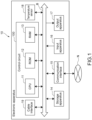
- Fig. 1 illustrates a hardware configuration of an electronic apparatus according to a first embodiment of the present disclosure.
- an electronic apparatus 10 is a mobile device such as a smartphone or a tablet computer. More specifically, the electronic apparatus 10 is a device that is expected to be used in contact with a human body (including a state of being in contact with a human body through clothes). For example, the electronic apparatus 10 is used by being held by a user with his/her hand, or is used by being put in a pocket of clothes worn by a user (for example, when a tethering function is performed).
- the electronic apparatus 10 includes a control circuit 100, a storage apparatus 14, a communication interface 15, an input apparatus 16, an output apparatus 17, a temperature sensor 18, a cable interface 19, and a bus B through which these components are connected to each other.
- the control circuit 100 is a system on a chip (SoC) that includes a central processing unit (CPU) 11, a read only memory (ROM) 12, and a random access memory (RAM) 13.
- the CPU 11 loads, into the RAM 13, an information processing program stored in the ROM 12, and executes the program.
- the ROM 12 fixedly stores therein, for example, a program executed by the CPU 11 and data.
- the ROM 12 is an example of a non-transitory computer-readable recording medium.
- the control circuit 100 further includes, for example, a dedicated hardware circuit and a graphics processing unit (GPU) (not illustrated).
- GPU graphics processing unit
- the storage apparatus 14 includes a largecapacity nonvolatile recording medium such as (a solidstate drive).
- the input apparatus 16 includes, for example, a touch panel and various switches.
- the input apparatus 16 detects an operation performed by a user and outputs the detected operation to the CPU 11.
- the input apparatus 16 may further include a sound input apparatus such as a microphone.
- the output apparatus 17 includes, for example, an LCD or an organic EL display that is integrated with the touch panel.
- the output apparatus 17 performs computation processing on the basis of information received from the control circuit 100, and displays a generated image signal on a screen.
- the output apparatus 17 may further include a sound output apparatus such as a speaker.
- the communication interface 15 is an interface used to establish connection with a network N such as the Internet.
- the temperature sensor 18 detects a temperature of a specified portion of the electronic apparatus 10. Typically, the temperature sensor 18 detects a temperature of a portion of which the temperature is becomes high. For example, the temperature sensor 18 detects a temperature of the control circuit 100. A single temperature sensor 18 or a plurality of temperature sensors 18 may be provided.
- a USB cable is inserted into the cable interface 19, or an HDMI (registered trademark) cable, an optical cable, a LAN cable, and a DVI cable are inserted into the cable interface 19.
- a USB cable is inserted into the cable interface 19, and the electronic apparatus 10 is connected to a personal computer (not illustrated).
- the electronic apparatus 10 connects the personal computer to the network N through, for example, 5G communication using tethering, the personal computer being connected through the USB cable.
- an HDMI (registered trademark) cable, an optical cable, a LAN cable, and a DVI cable are inserted into the cable interface 19, and the electronic apparatus 10 is connected to a video camera (not illustrated).
- the electronic apparatus 10 keeps displaying a moving image captured by the video camera on the output apparatus 17 (a display) in real time.
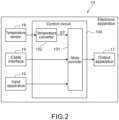
- Fig. 2 illustrates a functional configuration of the electronic apparatus.
- the control circuit 100 executes a mode control program to operate as a mode controller 101.
- the control circuit 100 further operates as a temperature converter 102.
- the temperature converter 102 periodically (for example, every few seconds) acquires a temperature of a specified portion (for example, the control circuit 100) of the electronic apparatus 10, the temperature of the specified portion being detected by the temperature sensor 18.
- the temperature converter 102 periodically calculates a surface temperature ST on the basis of the acquired temperature of the specified portion (that is, the temperature converter 102 periodically converts the temperature of the specified portion into the surface temperature ST).
- the temperature converter 102 periodically outputs the calculated surface temperature ST (that is, an estimated surface temperature ST) to the mode controller 101.
- the mode controller 101 performs the following operation flow ( Fig. 3 ) to turn on and off the endurance mode.
- the "endurance mode" is a mode that permits the surface temperature ST of the electronic apparatus 10 to be increased to a temperature in (or an upper limit Tmax of) a temperature range of low-temperature burn.
- a state in which the endurance mode is on refers to a state in which (the control circuit 100 of) the electronic apparatus 10 is controlled (relaxing is performed) such that an upper limit of the surface temperature ST of the electronic apparatus 10 is equal to or less than the upper limit Tmax of the temperature range of low-temperature burn.
- the endurance mode if the endurance mode is off, the surface temperature ST will not exceed in principle the upper limit Tmax of the temperature range of low-temperature burn.
- the surface temperature ST of the electronic apparatus 10 is classified into three temperature ranges (a safe temperature range, the temperature range of low-temperature burn, and a temperature range of high-temperature burn), and the three temperature ranges are used in the following description.
- the temperature range of low-temperature burn is a range of a temperature that causes a low-temperature burn.
- the safe temperature range is a range of a temperature that is equal to or less than an upper limit Tmin of the safe temperature range (a first upper limit), and is a range of a temperature that will be unlikely to cause the low-temperature burn even if a human body remains in contact with the surface of the electronic apparatus 10 for a long time.
- the temperature range of low-temperature burn is a range of a temperature that is greater than the upper limit Tmin of the safe temperature range (the first upper limit) and is equal to or less than the upper limit Tmax (a second upper limit).
- the temperature range of low-temperature burn is a range of a temperature that could cause the low-temperature burn if a human body remains in contact with the surface of the electronic apparatus 10 for about five to ten minutes.
- the temperature range of high-temperature burn is a range of a temperature that is greater than the upper limit Tmax of the temperature range of low-temperature burn (the second upper limit) (Tmim ⁇ Tmax), and is a range of a temperature that could cause a burn at a high temperature if a human body remains in contact with the surface of the electronic apparatus 10 for about less than a minute.
- the upper limit Tmin of the safe temperature range (the first upper limit) is defined in a range of a safe temperature (for example, from 45°C to 51°C) that will be unlikely to cause the low-temperature burn even if a human body remains in contact with the surface of the electronic apparatus 10 for about five to ten minutes.
- the upper limit Tmax of the temperature range of low-temperature burn (the second upper limit) is defined in a range of a temperature (for example, from 55°C to 61°C) that could cause a burn at a high temperature if a human body remains in contact with the surface of the electronic apparatus 10 for about less than a minute and is not acceptable in light of safety.
- the temperature range of low-temperature burn is defined according to, for example, a material of the surface of the electronic apparatus 10 and a time of contact of a human body with the surface of the electronic apparatus 10, on the basis of, for example, ISO 13732-1 "Ergonomics of the thermal environment - Methods for the assessment of human responses to contact with surfaces".
- the surface temperature ST may be increased to a temperature that is higher than normal.
- a function include 5G communication that is performed through a USB cable using tethering, and real-time display of a high-quality moving image that is received through an HDMI (registered trademark) cable, an optical cable, a LAN cable, a DVI cable (only the "HDMI (registered trademark) cable” may be hereinafter simply described representatively).
- HDMI registered trademark
- the electronic apparatus 10 connects a personal computer to the network N through, for example, 5G communication using tethering, the personal computer being connected to the electronic apparatus 10 through a USB cable that is inserted into the cable interface 19.
- the electronic apparatus 10 keeps displaying a moving image captured by a video camera on the output apparatus 17 (a display) in real time, the video camera being connected to the electronic apparatus 10 through an HDMI (registered trademark) cable, an optical cable, a LAN cable, and a DVI cable that are inserted into the cable interface 19.
- HDMI registered trademark
- the video camera being connected to the electronic apparatus 10 through an HDMI (registered trademark) cable, an optical cable, a LAN cable, and a DVI cable that are inserted into the cable interface 19.
- the electronic apparatus 10 may be used out of contact with a human body.
- a user operates a personal computer, and thus the user is out of contact with the electronic apparatus 10.
- the electronic apparatus 10 is placed in a holder that is fixed to a video camera, and a display of the electronic apparatus 10 is used as a monitor.
- mobile devices such as smartphones or tablet computers may be connected to a high-performance video camera for professional use, and may be used as monitors respectively used by a large number of staff members to check a captured moving image.
- electronic apparatuses that are mobile devices such as smartphones or tablet computers are general-purpose devices used by a very large number of end users.
- the mobile device is expected to be used in contact with a human body (including a state of being in contact with a human body through clothes).
- the mobile device is used by being held by a user with his/her hand, or is used by being put in a pocket of clothes worn by a user (for example, when a tethering function is performed).
- a surface temperature of the electronic apparatus could be increased to a temperature that causes a low-temperature burn. In other words, most of the users are not aware of potential dangers of the electronic apparatus.
- a sticker could be attached to the electronic apparatus in order to cause the dangers to be well known and taught.
- an upper limit of the surface temperature of the electronic apparatus is controlled (relaxed) to the extent that a user is unlikely to get burned (corresponding to a safe temperature range of the present embodiment), in order to ensure the safety of all users.
- the performance of the electronic apparatus is reduced (for example, an upper limit of a clock of the control circuit is lowered) to perform control (relaxing) such that the surface temperature of the electronic apparatus does not exceed the upper limit. This may result in the specifications necessary for the electronic apparatus not being satisfied.
- the mode controller 101 permits the surface temperature ST of the electronic apparatus 10 to be increased to a temperature in (or an upper limit of) the temperature range of low-temperature burn (the endurance mode) when the electronic apparatus 10 is used out of contact with a human body. This results in maintaining (not reducing) a level of performance of the electronic apparatus 10.
- the dangers are often caused to be well known and taught to a user and a consent of the user is obtained at effective timings when the surface temperature ST is increased to a temperature in the temperature range of low-temperature burn. This results in ensuring the safety of the user more certainly.
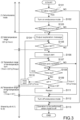
- Fig. 3 illustrates a flow of an operation of the mode controller.
- Figs. 4 and 5 each illustrate an example of a screen used to turn on the endurance mode.
- the endurance mode is off.
- the surface temperature ST of the electronic apparatus 10 is in the safe temperature range.
- a user tries to turn on the endurance mode by operating a touch panel.
- the user selects an "endurance mode" menu 201 on a system setting screen 200 ( Fig. 4 ).
- an endurance mode setting screen 210 is displayed.
- a message 211 that indicates a definition of the endurance mode, a message 212 that indicates that the endurance mode can be used only during USB tethering or while HDMI (registered trademark) and the like are connected, and a slide button 213 are displayed on the endurance mode setting screen 210 ( Fig. 5 ).
- the user operates the slide button 213 in order to turn on the endurance mode ( Fig. 5 ).
- the mode controller 101 determines whether a USB cable or an HDMI (registered trademark) cable is inserted into the cable interface 19 (Step S101). When the USB cable or the HDMI (registered trademark) cable is not inserted (Step S101, NO), the mode controller 101 determines that there is a possibility that the electronic apparatus 10 will be used in contact with a human body, and does not permit the endurance mode to be turned on. In this case, the mode controller 101 performs a flow of an operation that is to be performed when the endurance mode is off (described later) (Step S113) .
- the mode controller 101 determines that the electronic apparatus 10 is going to be used out of contact with a human body, and turns on the endurance mode (Step S102) .
- the mode controller 101 may omit the determination (Step S101) of whether the USB cable or the HDMI (registered trademark) cable is inserted. In this case, when the mode controller 101 detects that a user has performed operation to turn on the slide button 213 ( Fig. 5 ), the mode controller 101 turns on the endurance mode (Step S102) .
- Fig. 6 illustrates an example of a screen having a start inquiry message.
- the mode controller 101 In response to turning on the endurance mode (Step S102), the mode controller 101 outputs a start inquiry message 214 to the endurance mode setting screen 210 (Step S103).
- the "start inquiry message” is a message used to inquire whether to consent to start the endurance mode. The user selects "Consent and turn on” 215 to input his/her consent, or selects "Not consent” 216.
- Step S103 When the consent is not input (selection of "Not consent” 216, or a time-out) (Step S103, NO), the mode controller 101 turns off the endurance mode (Step S112), and performs the flow of the operation that is to be performed when the endurance mode is off (described later) (Step S113) .
- Step S103 when the consent is input (Step S103, YES), the mode controller 101 starts the endurance mode. At this point, the surface temperature ST of the electronic apparatus 10 is in the safe temperature range.
- Fig. 7 illustrates an example of a screen having an explanation message.
- the mode controller 101 outputs an explanation message 301 to a home screen 300 (Step S104).
- the "explanation message” is a message that indicates that the endurance mode is on and explains about the endurance mode.
- the "explanation message” is a message that indicates that there is a possibility that the surface temperature ST of the electronic apparatus 10 will be increased to a temperature in the temperature range of low-temperature burn.
- the mode controller 101 keeps periodically (for example, every few seconds) determining whether the surface temperature ST remains in the safe temperature range or has been changed to a temperature in the temperature range of low-temperature burn (Step S105).
- the mode controller 101 keeps outputting the explanation message 301 to the home screen 300 (Step S104) until the surface temperature ST exceeds the upper limit Tmin of the safe temperature range.
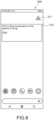
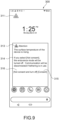
- Fig. 8 illustrates an example of a screen having an alert icon and an alert message.
- the mode controller 101 outputs an alert icon 311 to the home screen 300 (Step S106).
- the mode controller 101 outputs an alert message 312.
- the "alert message” is a message that alerts the user that the surface temperature ST of the electronic apparatus 10 has been increased to a temperature in the temperature range of low-temperature burn. Note that the mode controller 101 keeps displaying the alert icon 311 on the home screen 300 while the surface temperature ST is in the temperature range of low-temperature burn.
- Fig. 9 illustrates an example of a screen having the alert message and a maintenance inquiry message.
- the mode controller 101 When the surface temperature ST exceeds the upper limit Tmin of the safe temperature range (Step S105, YES), the mode controller 101 further outputs an alert message 313 (that is similar to the alert message 312) and a maintenance inquiry message 314 to the home screen 300 (Step S107).
- the "maintenance inquiry message” is a message used to inquire whether to consent to maintain the endurance mode. The user selects "Consent” 315 to input his/her consent, or selects "Not consent and turn off” 316.
- the mode controller 101 turns off the endurance mode (Step S112), and performs the flow of the operation that is to be performed when the endurance mode is off (described later) (Step S113).
- the mode controller 101 terminates a function (such as 5G communication using USB tethering or display of a high-quality moving image using HDMI (registered trademark)) that could increase the surface temperature to a temperature that is higher than normal.
- the time length of a time-out is set to be a time (for example, for about one to five minutes) for which the low-temperature burn will be unlikely to be caused even if a human body remains in contact with the surface of the electronic apparatus 10.
- exceptional specifications with which no time-out occurs when the electronic apparatus 10 performs a function (such as USB tethering) with which the electronic apparatus 10 is expected to be used by a user without being put in a pocket, may be adopted.
- the mode controller 101 when the surface temperature ST has reached a specific temperature greater than the upper limit Tmin of the safe temperature range before the consent is input, the mode controller 101 also turns off the endurance mode (Step S112) and performs the flow of the operation that is to be performed when the endurance mode is off (described later) (Step S113).
- the mode controller 101 terminates a function (such as 5G communication using tethering or display of a high-quality moving image using HDMI (registered trademark)) that could increase the surface temperature to a temperature that is higher than normal.
- the "specific temperature” is a temperature that could cause a low-temperature burn for a contact time that is shorter than a contact time for which a low-temperature burn is caused when a human body remains in contact with the electronic apparatus 10 having a temperature that corresponds to the lower limit Tmin.
- the "specific temperature” is a temperature that is about 3°C higher than the upper limit Tmin of the safe temperature range.
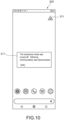
- Figs. 10 and 11 illustrate examples of a screen having an endurance mode terminating message.
- Step S112 When the mode controller 101 turns off the endurance mode (Step S112), the mode controller 101 outputs an endurance mode terminating message 317, 318 to the home screen 300.
- the "endurance mode terminating message” indicates that the endurance mode terminating message is turned off to be terminated.
- the mode controller 101 terminates tethering communication through a USB cable, the mode controller 101 outputs the endurance mode terminating message 317 indicating this matter ( Fig. 10 ).
- the alert icon 311 continues to be displayed when the mode controller 101 turns off the endurance mode, since the surface temperature ST remains greater than the upper limit Tmin of the safe temperature range.
- the mode controller 101 maintains the endurance mode. At this point, the surface temperature ST of the electronic apparatus 10 is in the temperature range of low-temperature burn.
- the mode controller 101 periodically (Step S108, YES) outputs the maintenance inquiry message 314 (Step S107) while the surface temperature ST is in the temperature range of low-temperature burn (Tmin ⁇ ST ⁇ Tmax) (on the right in Step S109).
- the mode controller 101 maintains the endurance mode when the consent is input, and turns off the endurance mode when the consent is not input.
- the interval at which the maintenance inquiry message 314 is periodically output is set to be a time (for example, for about one to five minutes) (Step S107) for which the low-temperature burn will be unlikely to be caused even if a human body remains in contact with the surface of the electronic apparatus 10.
- Step S107 the interval at which the maintenance inquiry message 314 is periodically output is set to be a time (for example, for about one to five minutes) (Step S107) for which the low-temperature burn will be unlikely to be caused even if a human body remains in contact with the surface of the electronic apparatus 10.
- the mode controller 101 keeps periodically (for example, every few seconds) determining whether the surface temperature ST has been changed to a temperature in the safe temperature range, or remains in the temperature range of low-temperature burn, or has been changed to a temperature in the temperature range of high-temperature burn (Step S109, which is similar to Step S105).
- Step S109 which is similar to Step S105.
- the mode controller 101 hides (turns off) the alert icon 311 on the home screen 300 (Step S110).
- the mode controller 101 repeats the operation (of and after Step S105), which is to be performed when the surface temperature ST is in the safe temperature range.
- Step S111 When by any chance the surface temperature ST of the electronic apparatus 10 exceeds the upper limit Tmax of the temperature range of low-temperature burn (Tmax ⁇ ST), this indicates that the surface temperature ST has been changed from a temperature in the temperature range of low-temperature burn to a temperature in the temperature range of high-temperature burn (in a middle portion in Step S109). Then, the mode controller 101 restarts the electronic apparatus 10 (Step S111), turns off the endurance mode (Step S112), and performs the flow of the operation that is to be performed when the endurance mode is off (described later) (Step S113).
- Fig. 12 illustrates an example of an ambient screen having an alert icon and an alert message.
- a display may be turned off when the surface temperature ST of the electronic apparatus 10 is in the temperature range of low-temperature burn.
- the mode controller 101 constantly displays an alert icon 411 and an alert message 412 (that are similar to the alert icon 311 and the alert message 312) on an ambient screen 400 (a black background).
- Fig. 13 illustrates the flow of the operation of the mode controller, which is to be performed when the endurance mode is off.
- the mode controller 101 turns off the endurance mode (Step S201, which is similar to Step S112).
- a state in which the endurance mode is off refers to a state in which (the control circuit 100 of) the electronic apparatus 10 is controlled (relaxing is performed) such that the upper limit of the surface temperature ST of the electronic apparatus 10 is equal to or less than the upper limit Tmin of the safe temperature range (the first upper limit). In other words, if the endurance mode is off, the surface temperature ST will not exceed in principle the upper limit Tmin of the safe temperature range.
- the mode controller 101 keeps periodically (for example, every few seconds) determining whether the surface temperature ST is in the safe temperature range, in the temperature range of low-temperature burn, or in the temperature range of high-temperature burn (Step S202, which is similar to Step S109). When the surface temperature ST is in the safe temperature range, the mode controller 101 does not perform special processing (on the left in Step S202).
- the mode controller 101 When by any chance the surface temperature ST of the electronic apparatus 10 exceeds the upper limit Tmin of the safe temperature range (in a middle portion in Step S202), the mode controller 101 outputs the alert icon 311 to the home screen 300 (Step S203). Further, when the surface temperature ST exceeds the upper limit Tmax of the temperature range of low-temperature burn (that is, the surface temperature ST is in the temperature range of high-temperature burn) (on the right in Step S202), the mode controller 101 restarts the electronic apparatus (Step S204).
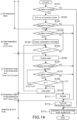
- Fig. 14 illustrates the flow of the operation of the mode controller according to a second embodiment.
- Steps S101 to S103 are similar to those in the first embodiments (Steps S101 to S103 in Fig. 3 ).
- the mode controller 101 When the content to start the endurance mode is input (Step S103, YES), the mode controller 101 periodically determines, while the surface temperature ST is in the safe temperature range (Step S105, NO), whether a USB cable or an HDMI (registered trademark) cable is inserted into the cable interface 19 (Step S115). When the USB cable or the HDMI (registered trademark) cable is inserted, the mode controller 101 determines that the electronic apparatus 10 is going to be used out of contact with a human body, and starts the endurance mode (Step S115, YES).
- the mode controller 101 determines that there is a possibility that the electronic apparatus 10 will be used in contact with a human body, and turns off the endurance mode (Step S112). Then, the mode controller 101 performs the flow of the operation that is to be performed when the endurance mode is off (Step S113) .
- Steps S104 to S107 are similar to those in the first embodiments (Steps S104 to S107 in Fig. 3 ).
- the mode controller 101 When the mode controller 101 maintains the endurance mode in response to the consent to maintain the endurance mode being input (Step S107, YES), the mode controller 101 periodically determines, while the surface temperature ST is in the temperature range of low-temperature burn (on the left in Step S109), whether the USB cable or the HDMI (registered trademark) cable is inserted into the cable interface 19 (Step S114). When the USB cable or the HDMI (registered trademark) cable is inserted, the mode controller 101 determines that the electronic apparatus 10 is going to be used out of contact with a human body, and maintains the endurance mode (Step S114, YES).
- Step S114 NO
- the mode controller 101 determines that there is a possibility that the electronic apparatus 10 will be used in contact with a human body, and turns off the endurance mode (Step S112). Then, the mode controller 101 performs the flow of the operation that is to be performed when the endurance mode is off (Step S113) .
- the second embodiment results in there being no need to periodically (Step S108, YES) output the maintenance inquiry message 314 (Step S107), as in the first embodiment. Instead, it is determined whether a USB cable or an HDMI (registered trademark) cable is inserted into the cable interface 19 (Steps S115 and S114). When the USB cable or the HDMI (registered trademark) cable is not inserted, the endurance mode is turned off (Step S112).
- the second embodiment results in providing the userfriendliness without the hassle of a user periodically consenting multiple times, and in maintaining the endurance mode only when there is a good possibility that the electronic apparatus 10 will be used out of contact with a human body. This results in achieving a high degree of safety.
- the mode controller 101 turns off the endurance mode (Step S112), and terminates a function (such as 5G communication using USB tethering or display of a high-quality moving image using HDMI (registered trademark)) that could increase the surface temperature to a temperature that is higher than normal.
- a function such as 5G communication using USB tethering or display of a high-quality moving image using HDMI (registered trademark)
- the mode controller 101 maintains the endurance mode without user's content when tethering communication is performed through a USB cable.
- the endurance mode is maintained only when there is a good possibility that the electronic apparatus 10 will be used out of contact with a human body. This results in achieving a high degree of safety.
- Electronic apparatuses that are mobile devices such as smartphones or tablet computers are general-purpose devices used by a very large number of end users. Thus, most of the users are not aware that a surface temperature of the electronic apparatus could be increased to a temperature that causes a low-temperature burn. In other words, most of the users are not aware of potential dangers of the electronic apparatus. It is also conceivable that a sticker could be attached to the electronic apparatus in order to cause the dangers to be well known and taught. However, it is difficult to sufficiently teach all users the dangers using a sticker.
- an upper limit of the surface temperature of the electronic apparatus is controlled (relaxed) to the extent that a user is unlikely to get burned (corresponding to a safe temperature range of the present embodiment), in order to ensure the safety of all users.
- the performance of the electronic apparatus is reduced (for example, an upper limit of a clock of the control circuit is lowered) to perform control (relaxing) such that the surface temperature of the electronic apparatus does not exceed the upper limit. This may result in the specifications necessary for the electronic apparatus not being satisfied.
- the present embodiment permits the surface temperature ST of the electronic apparatus 10 to be increased to a temperature in (or an upper limit of) the temperature range of low-temperature burn (the endurance mode) when the electronic apparatus 10 is used out of contact with a human body. This results in maintaining (not reducing) a level of performance of the electronic apparatus 10. This makes it possible to achieve the high performance of the electronic apparatus 10 and ensure the safety of a user at the same time.
- the electronic apparatus 10 further includes the cable interface 19, and when a USB cable or an HDMI (registered trademark) cable is inserted into the cable interface 19, the mode controller 101 determines that the electronic apparatus 10 is going to be used out of contact with a human body (Step S101, YES) .
- the surface temperature ST may be increased to a temperature that is higher than normal.
- a function include 5G communication that is performed through a USB cable using tethering, and real-time display of a high-quality moving image that is received through an HDMI (registered trademark) cable.
- the electronic apparatus 10 may be used out of contact with a human body.
- the tethering function a user operates a personal computer, and thus the user is out of contact with the electronic apparatus 10.
- the display of a high-quality moving image the electronic apparatus 10 is placed in a holder that is fixed to a video camera, and a display of the electronic apparatus 10 is used as a monitor.
- the endurance mode is turned on. This makes it possible to achieve the high performance of the electronic apparatus 10 and ensure the safety of a user at the same time.
- Step S102 In response to turning on the endurance mode (Step S102), the mode controller 101 outputs the start inquiry message 214 (Step S103), where the start inquiry message 214 is a message used to inquire whether to consent to start the endurance mode.
- the mode controller 101 starts the endurance mode (Step S103, YES), and when the consent is not input (Step S103, NO), the mode controller 101 turns off the endurance mode (Step S112).
- a consent of a user is obtained at a timing of turning on the endurance mode, and this makes it possible to ensure the safety of the user more certainly.
- Step S107 When the surface temperature ST exceeds the upper limit Tmin of the safe temperature range (Step S105, YES) in a state in which the endurance mode is on, the mode controller 101 outputs the maintenance inquiry message 314 (Step S107), where the maintenance inquiry message 314 is a message used to inquire whether to consent to maintain the endurance mode.
- the mode controller 101 maintains the endurance mode (Step S107, YES), and when the consent is not input (Step S107, NO), the mode controller 101 turns off the endurance mode (Step S112).
- a consent of a user is obtained at a timing at which the surface temperature ST exceeds the upper limit Tmin of the safe temperature range, and this makes it possible to ensure the safety of the user more certainly.
- the endurance mode is turned off when the consent is not input (including the case of a time-out), and this makes it possible to ensure the safety of the user. Note that it is sufficient if the time length of a time-out is set to be a time (for example, for about one to five minutes) for which the low-temperature burn will be unlikely to be caused even if a human body remains in contact with the surface of the electronic apparatus 10.
- the "specific temperature” is a temperature that could cause a low-temperature burn for a contact time that is shorter than a contact time for which a low-temperature burn is caused when a human body remains in contact with the electronic apparatus 10 having a temperature that corresponds to the lower limit Tmin.
- a state in which the surface temperature ST has reached the specific temperature refers to a state in which the surface temperature ST has actually been increased to a temperature that could suddenly cause a low-temperature burn for a short contact time, even though a user still believes that the electronic apparatus 10 has a safe surface temperature. It is dangerous to touch the electronic apparatus 10 without being aware of such an increase in the surface temperature ST.
- the endurance mode is turned off when the surface temperature ST has reached the specific temperature, and this makes it possible to ensure the safety of the user.
- Step S108, YES When the mode controller 101 maintains the endurance mode in response to the consent being input, the mode controller 101 periodically (Step S108, YES) outputs the maintenance inquiry message 314 (Step S107) while the surface temperature ST is in the temperature range of low-temperature burn.
- the mode controller 101 maintains the endurance mode (Step S107, YES), and when the consent is not input (Step S107, NO), the mode controller 101 turns off the endurance mode (Step S112).
- the electronic apparatus 10 further includes the cable interface 19.
- the mode controller 101 maintains the endurance mode in response to the consent being input, the mode controller 101 periodically determines, while the surface temperature ST is in the temperature range of low-temperature burn, whether a USB cable or an HDMI (registered trademark) cable is inserted into the cable interface 19 (Step S114).
- the mode controller 101 maintains the endurance mode (Step S114, YES), and when the USB cable or the HDMI (registered trademark) cable is not inserted (Step S114, NO), the mode controller 101 turns off the endurance mode (Step S112).
- Step S105 When the surface temperature ST exceeds the upper limit Tmin of the safe temperature range (Step S105, YES) in a state in which the endurance mode is on, the mode controller 101 keeps outputting the alert icon 311 (Step S106), and outputs the alert message 312 when the alert icon 311 is operated.
- the mode controller 101 keeps displaying the alert icon 311 on the home screen 300 while the surface temperature ST is in the temperature range of low-temperature burn. This results in further often causing dangers to be well known and taught to a user at effective timings, and thus in ensuring the safety of the user more certainly.
- the mode controller 101 keeps outputting the explanation message 301 (Step S104) until the surface temperature ST exceeds the upper limit Tmin of the safe temperature range, where the explanation message 301 is a message that explains about the endurance mode.
- Step S111 When the surface temperature ST exceeds a temperature in the temperature range of low-temperature burn in a state in which the endurance mode is on, the mode controller 101 restarts the electronic apparatus 10 (Step S111), and turns off the endurance mode (Step S112) .
- the electronic apparatus 10 is a mobile device.
- the electronic apparatus 10 that is a mobile device such as a smartphone or a tablet computer is a general-purpose device used by a very large number of end users. Thus, most of the users are not aware that a surface temperature of the electronic apparatus 10 could be increased to a temperature that causes a low-temperature burn. In other words, most of the users are not aware of potential dangers of the electronic apparatus 10.
- the dangers are often caused to be well known and taught to a user and a consent of the user is obtained at effective timings when the surface temperature ST is increased to a temperature in the temperature range of low-temperature burn. This results in ensuring the safety of the user more certainly.
Landscapes
- Engineering & Computer Science (AREA)
- Theoretical Computer Science (AREA)
- General Engineering & Computer Science (AREA)
- Physics & Mathematics (AREA)
- General Physics & Mathematics (AREA)
- Human Computer Interaction (AREA)
- Computer Hardware Design (AREA)
- User Interface Of Digital Computer (AREA)
- Telephone Function (AREA)
- Power Sources (AREA)
Abstract
Description
- The present disclosure relates to an electronic apparatus such as a mobile device, and a mode control program that is executed by the electronic apparatus.
- Electronic apparatuses such as mobile devices including smartphones and tablet computers have exhibited a higher performance and have been used for various purposes. This may cause an increase in surface temperatures of the electronic apparatuses.
-
- Patent Literature 1:
Japanese Patent Application Laid-open No. 2007-43422 - Patent Literature 2:
Japanese Patent Application Laid-open No. 2007-74095 - Patent Literature 3:
Japanese Patent Application Laid-open No. 2009-89039 - Patent Literature 4:
Japanese Patent Application Laid-open No. 2014-212594 - Depending on the function performed by an electronic apparatus, a surface temperature of the electronic apparatus may be increased to a temperature that could burn a user. Thus, there is a need to control (relax) an upper limit of the surface temperature of the electronic apparatus to the extent that a user is unlikely to get burned, in order to ensure the safety of the user. Typically, the performance of the electronic apparatus is reduced to perform control (relaxing) such that the surface temperature of the electronic apparatus does not exceed the upper limit.
- In view of the circumstances described above, it is an object of the present disclosure to achieve the high performance of an electronic apparatus and ensure the safety of a user at the same time.
- An electronic apparatus according to an embodiment of the present disclosure includes
- a temperature sensor that detects a temperature of a specified portion of the electronic apparatus; and
- a mode controller that turns on an endurance mode that is a mode that permits a surface temperature of the electronic apparatus to be increased to a second upper limit when the electronic apparatus is used out of contact with a human body, the surface temperature being calculated on the basis of the temperature detected by the temperature sensor, the second upper limit being higher than a first upper limit that is an upper limit of a temperature in a normal mode.
- The present embodiment permits the surface temperature of the electronic apparatus to be increased to a temperature in (or an upper limit of) a temperature range of low-temperature burn (the endurance mode) when the electronic apparatus is used out of contact with a human body. This results in maintaining (not reducing) a level of performance of the electronic apparatus. This makes it possible to achieve the high performance of the electronic apparatus and ensure the safety of a user at the same time.
- The electronic apparatus further includes a cable interface, and
when a cable is inserted into the cable interface, the mode controller determines that the electronic apparatus is going to be used out of contact with a human body. - Depending on the function performed by the electronic apparatus, the surface temperature may be increased to a temperature that is higher than normal. Specific examples of such a function include 5G communication that is performed through a USB cable using tethering, and real-time display of a high-quality moving image that is received through an HDMI (registered trademark) cable. In the use of these functions, the electronic apparatus may be used out of contact with a human body. When a function that could increase the surface temperature to a temperature that is higher than normal is performed in a state in which the electronic apparatus is used out of contact with a human body, the endurance mode is turned on. This makes it possible to achieve the high performance of the electronic apparatus and ensure the safety of a user at the same time.
- In response to turning on the endurance mode, the mode controller outputs a start inquiry message that is a message used to inquire whether to consent to start the endurance mode,
- when the consent is input, the mode controller starts the endurance mode, and
- when the consent is not input, the mode controller turns off the endurance mode.
- A consent of a user is obtained at a timing of turning on the endurance mode, and this makes it possible to ensure the safety of the user more certainly.
- When the surface temperature exceeds the first upper limit in a state in which the endurance mode is on, the mode controller outputs a maintenance inquiry message that is a message used to inquire whether to consent to maintain the endurance mode,
- when the consent is input, the mode controller maintains the endurance mode, and
- when the consent is not input, the mode controller turns off the endurance mode.
- A consent of a user is obtained at a timing at which the surface temperature has reached a lower limit of the temperature range of low-temperature burn, and this makes it possible to ensure the safety of the user more certainly. Further, the endurance mode is turned off when the consent is not input (including the case of a time-out), and this makes it possible to ensure the safety of the user. This makes it possible to prevent the user from getting burned by touching the electronic apparatus without being aware that the surface temperature is increased to be in the temperature range of low-temperature burn before the user becomes aware of the maintenance inquiry message.
- When the surface temperature has reached, before the consent is input, a specific temperature greater than the first upper limit in the state in which the endurance mode is on, the mode controller turns off the endurance mode.
- A state in which the surface temperature has reached the specific temperature refers to a state in which the surface temperature has actually been increased to a temperature that could suddenly cause a low-temperature burn for a short contact time, even though a user still believes that the electronic apparatus has a safe surface temperature. It is dangerous to touch the electronic apparatus without being aware of such an increase in the surface temperature. Thus, the endurance mode is turned off when the surface temperature has reached the specific temperature, and this makes it possible to ensure the safety of the user.
- When the mode controller maintains the endurance mode in response to the consent being input, the mode controller periodically outputs the maintenance inquiry message while the surface temperature is greater than the first upper limit and is equal to or less than the second upper limit,
- when the consent is input, the mode controller maintains the endurance mode, and
- when the consent is not input, the mode controller turns off the endurance mode.
- While the surface temperature is in the temperature range of low-temperature burn, dangers are often caused to be well known and taught to a user and a consent of the user is obtained at effective timings. This results in ensuring the safety of the user more certainly.
- The electronic apparatus further includes a cable interface,
- when the mode controller maintains the endurance mode in response to the consent being input, the mode controller periodically determines, while the surface temperature is greater than the first upper limit and is equal to or less than the second upper limit, whether a cable is inserted into the cable interface,
- when the cable is inserted, the mode controller maintains the endurance mode, and
- when the cable is not inserted, the mode controller turns off the endurance mode.
- This results in providing the userfriendliness without the hassle of a user periodically consenting multiple times, and in maintaining the endurance mode only when there is a good possibility that the electronic apparatus will be used out of contact with a human body. This results in achieving a high degree of safety.
- When the surface temperature exceeds the first upper limit in a state in which the endurance mode is on, the mode controller keeps outputting an alert icon, and outputs an alert message when the alert icon is operated.
- This results in often causing dangers to be well known and taught to a user at effective timings, and thus in ensuring the safety of the user more certainly.
- When the surface temperature falls to or below the first upper limit in the state in which the endurance mode is on, the mode controller hides the alert icon.
- Consequently, the alert icon keeps being displayed on a home screen while the surface temperature is in the temperature range of low-temperature burn. This results in further often causing dangers to be well known and taught to a user at effective timings, and thus in ensuring the safety of the user more certainly.
- In a state in which the endurance mode is on, the mode controller keeps outputting an explanation message until the surface temperature falls to or below the first upper limit, the explanation message being a message that explains about the endurance mode.
- This results in causing potential dangers to be well known and taught to a user, and thus in ensuring the safety of the user more certainly, without the surface temperature reaching the lower limit of the temperature range of low-temperature burn.
- When the surface temperature exceeds the second upper limit in a state in which the endurance mode is on, the mode controller restarts the electronic apparatus and turns off the endurance mode.
- This makes it possible to ensure the safety of a user more certainly.
- The electronic apparatus is a mobile device.
- Mobile devices are general-purpose devices used by a very large number of end users. Most of the users are not aware that a surface temperature of the electronic apparatus could be increased to a temperature that causes a low-temperature burn. In other words, most of the users are not aware of potential dangers of the electronic apparatus. Thus, in the present embodiment, dangers are often caused to be well known and taught to a user and a consent of the user is obtained at effective timings when the surface temperature is increased to a temperature in the temperature range of low-temperature burn. This results in ensuring the safety of the user more certainly.
- A mode control program according to an embodiment of the present disclosure operates a control circuit of an electronic apparatus as a mode controller,
- the electronic apparatus including a temperature sensor that detects a temperature of a specified portion of the electronic apparatus,
- the mode controller turning on an endurance mode that is a mode that permits a surface temperature of the electronic apparatus to be increased to a second upper limit when the electronic apparatus is used out of contact with a human body, the surface temperature being calculated on the basis of the temperature detected by the temperature sensor, the second upper limit being higher than a first upper limit that is an upper limit of a temperature in a normal mode. Advantageous Effects of Invention
- The present disclosure makes it possible to achieve the high performance of an electronic apparatus and ensure the safety of a user at the same time.
- Note that the effect described here is not necessarily limitative, and any of the effects described in the present disclosure may be provided.
-
- [
Fig. 1] Fig. 1 illustrates a hardware configuration of an electronic apparatus according to a first embodiment of the present disclosure. - [
Fig. 2] Fig. 2 illustrates a functional configuration of the electronic apparatus. - [
Fig. 3] Fig. 3 illustrates a flow of an operation of a mode controller. - [
Fig. 4] Fig. 4 illustrates an example of a screen used to turn on an endurance mode. - [
Fig. 5] Fig. 5 illustrates an example of a screen used to turn on the endurance mode. - [
Fig. 6] Fig. 6 illustrates an example of a screen having a start inquiry message. - [
Fig. 7] Fig. 7 illustrates an example of a screen having an explanation message. - [
Fig. 8] Fig. 8 illustrates an example of a screen having an alert icon and an alert message. - [
Fig. 9] Fig. 9 illustrates an example of a screen having the alert message and a maintenance inquiry message. - [
Fig. 10] Fig. 10 illustrates an example of a screen having an endurance mode terminating message. - [
Fig. 11] Fig. 11 illustrates an example of the screen having the endurance mode terminating message. - [
Fig. 12] Fig. 12 illustrates an example of an ambient screen having an alert icon and an alert message. - [
Fig. 13] Fig. 13 illustrates the flow of the operation of the mode controller, which is to be performed when the endurance mode is off. - [
Fig. 14] Fig. 14 illustrates the flow of the operation of the mode controller according to a second embodiment. Mode(s) for Carrying Out the Invention - Embodiments according to the present disclosure will now be described below with reference to the drawings.
-
Fig. 1 illustrates a hardware configuration of an electronic apparatus according to a first embodiment of the present disclosure. - Typically, an
electronic apparatus 10 is a mobile device such as a smartphone or a tablet computer. More specifically, theelectronic apparatus 10 is a device that is expected to be used in contact with a human body (including a state of being in contact with a human body through clothes). For example, theelectronic apparatus 10 is used by being held by a user with his/her hand, or is used by being put in a pocket of clothes worn by a user (for example, when a tethering function is performed). - The
electronic apparatus 10 includes acontrol circuit 100, astorage apparatus 14, acommunication interface 15, aninput apparatus 16, anoutput apparatus 17, atemperature sensor 18, acable interface 19, and a bus B through which these components are connected to each other. - The
control circuit 100 is a system on a chip (SoC) that includes a central processing unit (CPU) 11, a read only memory (ROM) 12, and a random access memory (RAM) 13. TheCPU 11 loads, into theRAM 13, an information processing program stored in theROM 12, and executes the program. TheROM 12 fixedly stores therein, for example, a program executed by theCPU 11 and data. TheROM 12 is an example of a non-transitory computer-readable recording medium. Thecontrol circuit 100 further includes, for example, a dedicated hardware circuit and a graphics processing unit (GPU) (not illustrated). - The
storage apparatus 14 includes a largecapacity nonvolatile recording medium such as (a solidstate drive). - The
input apparatus 16 includes, for example, a touch panel and various switches. Theinput apparatus 16 detects an operation performed by a user and outputs the detected operation to theCPU 11. Theinput apparatus 16 may further include a sound input apparatus such as a microphone. - The
output apparatus 17 includes, for example, an LCD or an organic EL display that is integrated with the touch panel. Theoutput apparatus 17 performs computation processing on the basis of information received from thecontrol circuit 100, and displays a generated image signal on a screen. Theoutput apparatus 17 may further include a sound output apparatus such as a speaker. - The
communication interface 15 is an interface used to establish connection with a network N such as the Internet. - The
temperature sensor 18 detects a temperature of a specified portion of theelectronic apparatus 10. Typically, thetemperature sensor 18 detects a temperature of a portion of which the temperature is becomes high. For example, thetemperature sensor 18 detects a temperature of thecontrol circuit 100. Asingle temperature sensor 18 or a plurality oftemperature sensors 18 may be provided. - A USB cable is inserted into the
cable interface 19, or an HDMI (registered trademark) cable, an optical cable, a LAN cable, and a DVI cable are inserted into thecable interface 19. For example, a USB cable is inserted into thecable interface 19, and theelectronic apparatus 10 is connected to a personal computer (not illustrated). Theelectronic apparatus 10 connects the personal computer to the network N through, for example, 5G communication using tethering, the personal computer being connected through the USB cable. Further, an HDMI (registered trademark) cable, an optical cable, a LAN cable, and a DVI cable are inserted into thecable interface 19, and theelectronic apparatus 10 is connected to a video camera (not illustrated). Theelectronic apparatus 10 keeps displaying a moving image captured by the video camera on the output apparatus 17 (a display) in real time. -
Fig. 2 illustrates a functional configuration of the electronic apparatus. - The
control circuit 100 executes a mode control program to operate as amode controller 101. Thecontrol circuit 100 further operates as atemperature converter 102. - During the operation of the
electronic apparatus 10, thetemperature converter 102 periodically (for example, every few seconds) acquires a temperature of a specified portion (for example, the control circuit 100) of theelectronic apparatus 10, the temperature of the specified portion being detected by thetemperature sensor 18. Thetemperature converter 102 periodically calculates a surface temperature ST on the basis of the acquired temperature of the specified portion (that is, thetemperature converter 102 periodically converts the temperature of the specified portion into the surface temperature ST). Thetemperature converter 102 periodically outputs the calculated surface temperature ST (that is, an estimated surface temperature ST) to themode controller 101. - The
mode controller 101 performs the following operation flow (Fig. 3 ) to turn on and off the endurance mode. The "endurance mode" is a mode that permits the surface temperature ST of theelectronic apparatus 10 to be increased to a temperature in (or an upper limit Tmax of) a temperature range of low-temperature burn. Specifically, a state in which the endurance mode is on refers to a state in which (thecontrol circuit 100 of) theelectronic apparatus 10 is controlled (relaxing is performed) such that an upper limit of the surface temperature ST of theelectronic apparatus 10 is equal to or less than the upper limit Tmax of the temperature range of low-temperature burn. In other words, if the endurance mode is off, the surface temperature ST will not exceed in principle the upper limit Tmax of the temperature range of low-temperature burn. - The surface temperature ST of the
electronic apparatus 10 is classified into three temperature ranges (a safe temperature range, the temperature range of low-temperature burn, and a temperature range of high-temperature burn), and the three temperature ranges are used in the following description. The temperature range of low-temperature burn is a range of a temperature that causes a low-temperature burn. The safe temperature range is a range of a temperature that is equal to or less than an upper limit Tmin of the safe temperature range (a first upper limit), and is a range of a temperature that will be unlikely to cause the low-temperature burn even if a human body remains in contact with the surface of theelectronic apparatus 10 for a long time. The temperature range of low-temperature burn is a range of a temperature that is greater than the upper limit Tmin of the safe temperature range (the first upper limit) and is equal to or less than the upper limit Tmax (a second upper limit). The temperature range of low-temperature burn is a range of a temperature that could cause the low-temperature burn if a human body remains in contact with the surface of theelectronic apparatus 10 for about five to ten minutes. The temperature range of high-temperature burn is a range of a temperature that is greater than the upper limit Tmax of the temperature range of low-temperature burn (the second upper limit) (Tmim < Tmax), and is a range of a temperature that could cause a burn at a high temperature if a human body remains in contact with the surface of theelectronic apparatus 10 for about less than a minute. - For example, it is sufficient if the upper limit Tmin of the safe temperature range (the first upper limit) is defined in a range of a safe temperature (for example, from 45°C to 51°C) that will be unlikely to cause the low-temperature burn even if a human body remains in contact with the surface of the
electronic apparatus 10 for about five to ten minutes. It is sufficient if the upper limit Tmax of the temperature range of low-temperature burn (the second upper limit) is defined in a range of a temperature (for example, from 55°C to 61°C) that could cause a burn at a high temperature if a human body remains in contact with the surface of theelectronic apparatus 10 for about less than a minute and is not acceptable in light of safety. It is sufficient if the temperature range of low-temperature burn is defined according to, for example, a material of the surface of theelectronic apparatus 10 and a time of contact of a human body with the surface of theelectronic apparatus 10, on the basis of, for example, ISO 13732-1 "Ergonomics of the thermal environment - Methods for the assessment of human responses to contact with surfaces". - Depending on the function performed by the
electronic apparatus 10, the surface temperature ST may be increased to a temperature that is higher than normal. Specific examples of such a function include 5G communication that is performed through a USB cable using tethering, and real-time display of a high-quality moving image that is received through an HDMI (registered trademark) cable, an optical cable, a LAN cable, a DVI cable (only the "HDMI (registered trademark) cable" may be hereinafter simply described representatively). As an example of a function of 5G communication using tethering, theelectronic apparatus 10 connects a personal computer to the network N through, for example, 5G communication using tethering, the personal computer being connected to theelectronic apparatus 10 through a USB cable that is inserted into thecable interface 19. As an example of a function of receiving and displaying a high-quality moving image, theelectronic apparatus 10 keeps displaying a moving image captured by a video camera on the output apparatus 17 (a display) in real time, the video camera being connected to theelectronic apparatus 10 through an HDMI (registered trademark) cable, an optical cable, a LAN cable, and a DVI cable that are inserted into thecable interface 19. - In the use of these functions, the
electronic apparatus 10 may be used out of contact with a human body. For example, in the case of the tethering function, a user operates a personal computer, and thus the user is out of contact with theelectronic apparatus 10. Further, in the case of the display of a high-quality moving image, theelectronic apparatus 10 is placed in a holder that is fixed to a video camera, and a display of theelectronic apparatus 10 is used as a monitor. Especially in video creation, mobile devices (the electronic apparatuses 10) such as smartphones or tablet computers may be connected to a high-performance video camera for professional use, and may be used as monitors respectively used by a large number of staff members to check a captured moving image. - On the other hand, electronic apparatuses that are mobile devices such as smartphones or tablet computers are general-purpose devices used by a very large number of end users. Further, the mobile device is expected to be used in contact with a human body (including a state of being in contact with a human body through clothes). For example, the mobile device is used by being held by a user with his/her hand, or is used by being put in a pocket of clothes worn by a user (for example, when a tethering function is performed). Thus, most of the users are not aware that a surface temperature of the electronic apparatus could be increased to a temperature that causes a low-temperature burn. In other words, most of the users are not aware of potential dangers of the electronic apparatus. It is also conceivable that a sticker could be attached to the electronic apparatus in order to cause the dangers to be well known and taught. However, it is difficult to sufficiently teach all users the dangers using a sticker. Thus, typically, when the electronic apparatus performs a function that could increase the surface temperature of the electronic apparatus to a temperature that is higher than normal, as described above, an upper limit of the surface temperature of the electronic apparatus is controlled (relaxed) to the extent that a user is unlikely to get burned (corresponding to a safe temperature range of the present embodiment), in order to ensure the safety of all users. Typically, the performance of the electronic apparatus is reduced (for example, an upper limit of a clock of the control circuit is lowered) to perform control (relaxing) such that the surface temperature of the electronic apparatus does not exceed the upper limit. This may result in the specifications necessary for the electronic apparatus not being satisfied.
- In view of the circumstances described above, according to the present embodiment, the
mode controller 101 permits the surface temperature ST of theelectronic apparatus 10 to be increased to a temperature in (or an upper limit of) the temperature range of low-temperature burn (the endurance mode) when theelectronic apparatus 10 is used out of contact with a human body. This results in maintaining (not reducing) a level of performance of theelectronic apparatus 10. In addition, in order to respond to the possibility that theelectronic apparatuses 10 will be used by a larger number of staff members and to respond to a difference between users in a level of awareness of dangers, the dangers are often caused to be well known and taught to a user and a consent of the user is obtained at effective timings when the surface temperature ST is increased to a temperature in the temperature range of low-temperature burn. This results in ensuring the safety of the user more certainly. -
Fig. 3 illustrates a flow of an operation of the mode controller.Figs. 4 and5 each illustrate an example of a screen used to turn on the endurance mode. - As a precondition for the operation, the endurance mode is off. Thus, the surface temperature ST of the
electronic apparatus 10 is in the safe temperature range. A user tries to turn on the endurance mode by operating a touch panel. First, in order to turn on the endurance mode, the user selects an "endurance mode"menu 201 on a system setting screen 200 (Fig. 4 ). Then, an endurancemode setting screen 210 is displayed. Amessage 211 that indicates a definition of the endurance mode, amessage 212 that indicates that the endurance mode can be used only during USB tethering or while HDMI (registered trademark) and the like are connected, and aslide button 213 are displayed on the endurance mode setting screen 210 (Fig. 5 ). The user operates theslide button 213 in order to turn on the endurance mode (Fig. 5 ). - The
mode controller 101 determines whether a USB cable or an HDMI (registered trademark) cable is inserted into the cable interface 19 (Step S101). When the USB cable or the HDMI (registered trademark) cable is not inserted (Step S101, NO), themode controller 101 determines that there is a possibility that theelectronic apparatus 10 will be used in contact with a human body, and does not permit the endurance mode to be turned on. In this case, themode controller 101 performs a flow of an operation that is to be performed when the endurance mode is off (described later) (Step S113) . - On the other hand, when the USB cable or the HDMI (registered trademark) cable is inserted (Step S101, YES), the
mode controller 101 determines that theelectronic apparatus 10 is going to be used out of contact with a human body, and turns on the endurance mode (Step S102) . - Note that, as a modification, the
mode controller 101 may omit the determination (Step S101) of whether the USB cable or the HDMI (registered trademark) cable is inserted. In this case, when themode controller 101 detects that a user has performed operation to turn on the slide button 213 (Fig. 5 ), themode controller 101 turns on the endurance mode (Step S102) . -
Fig. 6 illustrates an example of a screen having a start inquiry message. - In response to turning on the endurance mode (Step S102), the
mode controller 101 outputs astart inquiry message 214 to the endurance mode setting screen 210 (Step S103). The "start inquiry message" is a message used to inquire whether to consent to start the endurance mode. The user selects "Consent and turn on" 215 to input his/her consent, or selects "Not consent" 216. - When the consent is not input (selection of "Not consent" 216, or a time-out) (Step S103, NO), the
mode controller 101 turns off the endurance mode (Step S112), and performs the flow of the operation that is to be performed when the endurance mode is off (described later) (Step S113) . - On the other hand, when the consent is input (Step S103, YES), the
mode controller 101 starts the endurance mode. At this point, the surface temperature ST of theelectronic apparatus 10 is in the safe temperature range. -
Fig. 7 illustrates an example of a screen having an explanation message. - The
mode controller 101 outputs anexplanation message 301 to a home screen 300 (Step S104). The "explanation message" is a message that indicates that the endurance mode is on and explains about the endurance mode. In other words, the "explanation message" is a message that indicates that there is a possibility that the surface temperature ST of theelectronic apparatus 10 will be increased to a temperature in the temperature range of low-temperature burn. - The
mode controller 101 keeps periodically (for example, every few seconds) determining whether the surface temperature ST remains in the safe temperature range or has been changed to a temperature in the temperature range of low-temperature burn (Step S105). When the surface temperature ST is equal to or less than the upper limit Tmin of the safe temperature range (that is, when the surface temperature ST is in the safe temperature range) (Step S105, NO), themode controller 101 keeps outputting theexplanation message 301 to the home screen 300 (Step S104) until the surface temperature ST exceeds the upper limit Tmin of the safe temperature range. -
Fig. 8 illustrates an example of a screen having an alert icon and an alert message. - On the other hand, when the surface temperature ST exceeds the upper limit Tmin of the safe temperature range (Step S105, YES), the
mode controller 101 outputs analert icon 311 to the home screen 300 (Step S106). When the user operates thealert icon 311, themode controller 101 outputs analert message 312. The "alert message" is a message that alerts the user that the surface temperature ST of theelectronic apparatus 10 has been increased to a temperature in the temperature range of low-temperature burn. Note that themode controller 101 keeps displaying thealert icon 311 on thehome screen 300 while the surface temperature ST is in the temperature range of low-temperature burn. -
Fig. 9 illustrates an example of a screen having the alert message and a maintenance inquiry message. - When the surface temperature ST exceeds the upper limit Tmin of the safe temperature range (Step S105, YES), the
mode controller 101 further outputs an alert message 313 (that is similar to the alert message 312) and amaintenance inquiry message 314 to the home screen 300 (Step S107). The "maintenance inquiry message" is a message used to inquire whether to consent to maintain the endurance mode. The user selects "Consent" 315 to input his/her consent, or selects "Not consent and turn off" 316. - When the consent is not input (selection of "Not consent and turn off" 316, or a time-out) (Step S107, NO), the
mode controller 101 turns off the endurance mode (Step S112), and performs the flow of the operation that is to be performed when the endurance mode is off (described later) (Step S113). Themode controller 101 terminates a function (such as 5G communication using USB tethering or display of a high-quality moving image using HDMI (registered trademark)) that could increase the surface temperature to a temperature that is higher than normal. Note that it is sufficient if the time length of a time-out is set to be a time (for example, for about one to five minutes) for which the low-temperature burn will be unlikely to be caused even if a human body remains in contact with the surface of theelectronic apparatus 10. Note that exceptional specifications with which no time-out occurs when theelectronic apparatus 10 performs a function (such as USB tethering) with which theelectronic apparatus 10 is expected to be used by a user without being put in a pocket, may be adopted. - In addition, when the surface temperature ST has reached a specific temperature greater than the upper limit Tmin of the safe temperature range before the consent is input, the
mode controller 101 also turns off the endurance mode (Step S112) and performs the flow of the operation that is to be performed when the endurance mode is off (described later) (Step S113). Themode controller 101 terminates a function (such as 5G communication using tethering or display of a high-quality moving image using HDMI (registered trademark)) that could increase the surface temperature to a temperature that is higher than normal. The "specific temperature" is a temperature that could cause a low-temperature burn for a contact time that is shorter than a contact time for which a low-temperature burn is caused when a human body remains in contact with theelectronic apparatus 10 having a temperature that corresponds to the lower limit Tmin. For example, the "specific temperature" is a temperature that is about 3°C higher than the upper limit Tmin of the safe temperature range. -
Figs. 10 and11 illustrate examples of a screen having an endurance mode terminating message. - When the
mode controller 101 turns off the endurance mode (Step S112), themode controller 101 outputs an endurancemode terminating message home screen 300. The "endurance mode terminating message" indicates that the endurance mode terminating message is turned off to be terminated. When themode controller 101 terminates tethering communication through a USB cable, themode controller 101 outputs the endurancemode terminating message 317 indicating this matter (Fig. 10 ). Thealert icon 311 continues to be displayed when themode controller 101 turns off the endurance mode, since the surface temperature ST remains greater than the upper limit Tmin of the safe temperature range. - On the other hand, when the consent is input (Step S107, YES), the
mode controller 101 maintains the endurance mode. At this point, the surface temperature ST of theelectronic apparatus 10 is in the temperature range of low-temperature burn. When themode controller 101 maintains the endurance mode in response to the consent being input, themode controller 101 periodically (Step S108, YES) outputs the maintenance inquiry message 314 (Step S107) while the surface temperature ST is in the temperature range of low-temperature burn (Tmin < ST ≤ Tmax) (on the right in Step S109). Themode controller 101 maintains the endurance mode when the consent is input, and turns off the endurance mode when the consent is not input. Note that it is sufficient if the interval at which themaintenance inquiry message 314 is periodically output is set to be a time (for example, for about one to five minutes) (Step S107) for which the low-temperature burn will be unlikely to be caused even if a human body remains in contact with the surface of theelectronic apparatus 10. The reason is that, when the consent to themaintenance inquiry message 314 has been once input (Step S107, YES), this ensures for the present that a user is safely using the electronic apparatus 10 (is out of contact with the electronic apparatus 10), and thus there is a lesser need to frequently obtain the consent. - The
mode controller 101 keeps periodically (for example, every few seconds) determining whether the surface temperature ST has been changed to a temperature in the safe temperature range, or remains in the temperature range of low-temperature burn, or has been changed to a temperature in the temperature range of high-temperature burn (Step S109, which is similar to Step S105). When the surface temperature ST falls to or below the upper limit Tmin of the safe temperature range (ST ≤ Tmin), this indicates that the surface temperature ST has been changed from a temperature in the temperature range of low-temperature burn to a temperature in the safe temperature range (on the left in Step S109). Then, themode controller 101 hides (turns off) thealert icon 311 on the home screen 300 (Step S110). Themode controller 101 repeats the operation (of and after Step S105), which is to be performed when the surface temperature ST is in the safe temperature range. - When by any chance the surface temperature ST of the
electronic apparatus 10 exceeds the upper limit Tmax of the temperature range of low-temperature burn (Tmax < ST), this indicates that the surface temperature ST has been changed from a temperature in the temperature range of low-temperature burn to a temperature in the temperature range of high-temperature burn (in a middle portion in Step S109). Then, themode controller 101 restarts the electronic apparatus 10 (Step S111), turns off the endurance mode (Step S112), and performs the flow of the operation that is to be performed when the endurance mode is off (described later) (Step S113). -
Fig. 12 illustrates an example of an ambient screen having an alert icon and an alert message. - Especially during tethering communication, a display may be turned off when the surface temperature ST of the
electronic apparatus 10 is in the temperature range of low-temperature burn. In this case, themode controller 101 constantly displays analert icon 411 and an alert message 412 (that are similar to thealert icon 311 and the alert message 312) on an ambient screen 400 (a black background). -
Fig. 13 illustrates the flow of the operation of the mode controller, which is to be performed when the endurance mode is off. - The
mode controller 101 turns off the endurance mode (Step S201, which is similar to Step S112). A state in which the endurance mode is off refers to a state in which (thecontrol circuit 100 of) theelectronic apparatus 10 is controlled (relaxing is performed) such that the upper limit of the surface temperature ST of theelectronic apparatus 10 is equal to or less than the upper limit Tmin of the safe temperature range (the first upper limit). In other words, if the endurance mode is off, the surface temperature ST will not exceed in principle the upper limit Tmin of the safe temperature range. - The
mode controller 101 keeps periodically (for example, every few seconds) determining whether the surface temperature ST is in the safe temperature range, in the temperature range of low-temperature burn, or in the temperature range of high-temperature burn (Step S202, which is similar to Step S109). When the surface temperature ST is in the safe temperature range, themode controller 101 does not perform special processing (on the left in Step S202). - When by any chance the surface temperature ST of the
electronic apparatus 10 exceeds the upper limit Tmin of the safe temperature range (in a middle portion in Step S202), themode controller 101 outputs thealert icon 311 to the home screen 300 (Step S203). Further, when the surface temperature ST exceeds the upper limit Tmax of the temperature range of low-temperature burn (that is, the surface temperature ST is in the temperature range of high-temperature burn) (on the right in Step S202), themode controller 101 restarts the electronic apparatus (Step S204). - Hereinafter, descriptions and illustrations of a component and an operation that are similar to the component and operation described above are omitted, and the description and the illustration are given focused on a point different from that described above.
-
Fig. 14 illustrates the flow of the operation of the mode controller according to a second embodiment. - Operations of Steps S101 to S103 are similar to those in the first embodiments (Steps S101 to S103 in
Fig. 3 ). - When the content to start the endurance mode is input (Step S103, YES), the
mode controller 101 periodically determines, while the surface temperature ST is in the safe temperature range (Step S105, NO), whether a USB cable or an HDMI (registered trademark) cable is inserted into the cable interface 19 (Step S115). When the USB cable or the HDMI (registered trademark) cable is inserted, themode controller 101 determines that theelectronic apparatus 10 is going to be used out of contact with a human body, and starts the endurance mode (Step S115, YES). - On the other hand, when the USB cable or the HDMI (registered trademark) cable is not inserted (Step S115, NO), the
mode controller 101 determines that there is a possibility that theelectronic apparatus 10 will be used in contact with a human body, and turns off the endurance mode (Step S112). Then, themode controller 101 performs the flow of the operation that is to be performed when the endurance mode is off (Step S113) . - Operations of Steps S104 to S107 are similar to those in the first embodiments (Steps S104 to S107 in
Fig. 3 ). - When the
mode controller 101 maintains the endurance mode in response to the consent to maintain the endurance mode being input (Step S107, YES), themode controller 101 periodically determines, while the surface temperature ST is in the temperature range of low-temperature burn (on the left in Step S109),
whether the USB cable or the HDMI (registered trademark) cable is inserted into the cable interface 19 (Step S114). When the USB cable or the HDMI (registered trademark) cable is inserted, themode controller 101 determines that theelectronic apparatus 10 is going to be used out of contact with a human body, and maintains the endurance mode (Step S114, YES). - On the other hand, when the USB cable or the HDMI (registered trademark) cable is not inserted (Step S114, NO), the
mode controller 101 determines that there is a possibility that theelectronic apparatus 10 will be used in contact with a human body, and turns off the endurance mode (Step S112). Then, themode controller 101 performs the flow of the operation that is to be performed when the endurance mode is off (Step S113) . - As described above, the second embodiment results in there being no need to periodically (Step S108, YES) output the maintenance inquiry message 314 (Step S107), as in the first embodiment. Instead, it is determined whether a USB cable or an HDMI (registered trademark) cable is inserted into the cable interface 19 (Steps S115 and S114). When the USB cable or the HDMI (registered trademark) cable is not inserted, the endurance mode is turned off (Step S112). Thus, the second embodiment results in providing the userfriendliness without the hassle of a user periodically consenting multiple times, and in maintaining the endurance mode only when there is a good possibility that the
electronic apparatus 10 will be used out of contact with a human body. This results in achieving a high degree of safety. - In the first embodiment, when the consent to the
maintenance inquiry message 314 is not input (selection of "Not consent and turn off" 316, or a time-out) (Step S107, NO), themode controller 101 turns off the endurance mode (Step S112), and terminates a function (such as 5G communication using USB tethering or display of a high-quality moving image using HDMI (registered trademark)) that could increase the surface temperature to a temperature that is higher than normal. - On the other hand, according to a third embodiment, in the case of a time-out for the
maintenance inquiry message 314, themode controller 101 maintains the endurance mode without user's content when tethering communication is performed through a USB cable. - As described above, according to the third embodiment, in the case of a time-out for the
maintenance inquiry message 314, the endurance mode is maintained only when there is a good possibility that theelectronic apparatus 10 will be used out of contact with a human body. This results in achieving a high degree of safety. - Electronic apparatuses that are mobile devices such as smartphones or tablet computers are general-purpose devices used by a very large number of end users. Thus, most of the users are not aware that a surface temperature of the electronic apparatus could be increased to a temperature that causes a low-temperature burn. In other words, most of the users are not aware of potential dangers of the electronic apparatus. It is also conceivable that a sticker could be attached to the electronic apparatus in order to cause the dangers to be well known and taught. However, it is difficult to sufficiently teach all users the dangers using a sticker. Thus, typically, when the electronic apparatus performs a function that could increase the surface temperature of the electronic apparatus to a temperature that is higher than normal, as described above, an upper limit of the surface temperature of the electronic apparatus is controlled (relaxed) to the extent that a user is unlikely to get burned (corresponding to a safe temperature range of the present embodiment), in order to ensure the safety of all users. Typically, the performance of the electronic apparatus is reduced (for example, an upper limit of a clock of the control circuit is lowered) to perform control (relaxing) such that the surface temperature of the electronic apparatus does not exceed the upper limit. This may result in the specifications necessary for the electronic apparatus not being satisfied.
- (1) On the other hand, the
electronic apparatus 10 according to the present embodiment includes thetemperature sensor 18 detecting a temperature of a specified portion of theelectronic apparatus 10, and themode controller 101 turning on an endurance mode that is a mode that permits the surface temperature ST of theelectronic apparatus 10 to be increased to a temperature in the temperature range of low-temperature burn when theelectronic apparatus 10 is used out of contact with a human body, the surface temperature ST being calculated on the basis of the temperature detected by thetemperature sensor 18, the temperature range of low-temperature burn being a range of a temperature that causes a low-temperature burn. - The present embodiment permits the surface temperature ST of the
electronic apparatus 10 to be increased to a temperature in (or an upper limit of) the temperature range of low-temperature burn (the endurance mode) when theelectronic apparatus 10 is used out of contact with a human body. This results in maintaining (not reducing) a level of performance of theelectronic apparatus 10. This makes it possible to achieve the high performance of theelectronic apparatus 10 and ensure the safety of a user at the same time. - (2) The
electronic apparatus 10 further includes thecable interface 19, and when a USB cable or an HDMI (registered trademark) cable is inserted into thecable interface 19, themode controller 101 determines that theelectronic apparatus 10 is going to be used out of contact with a human body (Step S101, YES) . - Depending on the function performed by the
electronic apparatus 10, the surface temperature ST may be increased to a temperature that is higher than normal. Specific examples of such a function include 5G communication that is performed through a USB cable using tethering, and real-time display of a high-quality moving image that is received through an HDMI (registered trademark) cable. In the use of these functions, theelectronic apparatus 10 may be used out of contact with a human body. For example, in the case of the tethering function, a user operates a personal computer, and thus the user is out of contact with theelectronic apparatus 10. Further, in the case of the display of a high-quality moving image, theelectronic apparatus 10 is placed in a holder that is fixed to a video camera, and a display of theelectronic apparatus 10 is used as a monitor. As described above, when a function that could increase the surface temperature ST to a temperature that is higher than normal is performed in a state in which theelectronic apparatus 10 is used out of contact with a human body, the endurance mode is turned on. This makes it possible to achieve the high performance of theelectronic apparatus 10 and ensure the safety of a user at the same time. - (3) In response to turning on the endurance mode (Step S102), the
mode controller 101 outputs the start inquiry message 214 (Step S103), where thestart inquiry message 214 is a message used to inquire whether to consent to start the endurance mode. When the consent is input, themode controller 101 starts the endurance mode (Step S103, YES), and when the consent is not input (Step S103, NO), themode controller 101 turns off the endurance mode (Step S112). - A consent of a user is obtained at a timing of turning on the endurance mode, and this makes it possible to ensure the safety of the user more certainly.
- (4) When the surface temperature ST exceeds the upper limit Tmin of the safe temperature range (Step S105, YES) in a state in which the endurance mode is on, the
mode controller 101 outputs the maintenance inquiry message 314 (Step S107), where themaintenance inquiry message 314 is a message used to inquire whether to consent to maintain the endurance mode. When the consent is input, themode controller 101 maintains the endurance mode (Step S107, YES), and when the consent is not input (Step S107, NO), themode controller 101 turns off the endurance mode (Step S112). - A consent of a user is obtained at a timing at which the surface temperature ST exceeds the upper limit Tmin of the safe temperature range, and this makes it possible to ensure the safety of the user more certainly. Further, the endurance mode is turned off when the consent is not input (including the case of a time-out), and this makes it possible to ensure the safety of the user. Note that it is sufficient if the time length of a time-out is set to be a time (for example, for about one to five minutes) for which the low-temperature burn will be unlikely to be caused even if a human body remains in contact with the surface of the
electronic apparatus 10. This makes it possible to prevent the user from getting burned by touching theelectronic apparatus 10 without being aware that the surface temperature ST is increased to be in the temperature range of low-temperature burn before the user becomes aware of themaintenance inquiry message 314. For example, this prevents a low-temperature burn from being caused due to a user falling asleep (that is, falling asleep while doing something) during communication using USB tethering and keeping touching theelectronic apparatus 10 for a long time in the same pose. - (5) When the surface temperature ST has reached, before the consent is input, a specific temperature greater than the upper limit Tmin of the safe temperature range (Step S107, NO) in a state in which the endurance mode is on, the
mode controller 101 turns off the endurance mode (Step S112). - The "specific temperature" is a temperature that could cause a low-temperature burn for a contact time that is shorter than a contact time for which a low-temperature burn is caused when a human body remains in contact with the
electronic apparatus 10 having a temperature that corresponds to the lower limit Tmin. A state in which the surface temperature ST has reached the specific temperature refers to a state in which the surface temperature ST has actually been increased to a temperature that could suddenly cause a low-temperature burn for a short contact time, even though a user still believes that theelectronic apparatus 10 has a safe surface temperature. It is dangerous to touch theelectronic apparatus 10 without being aware of such an increase in the surface temperature ST. Thus, the endurance mode is turned off when the surface temperature ST has reached the specific temperature, and this makes it possible to ensure the safety of the user. - (6) When the
mode controller 101 maintains the endurance mode in response to the consent being input, themode controller 101 periodically (Step S108, YES) outputs the maintenance inquiry message 314 (Step S107) while the surface temperature ST is in the temperature range of low-temperature burn. When the consent is input, themode controller 101 maintains the endurance mode (Step S107, YES), and when the consent is not input (Step S107, NO), themode controller 101 turns off the endurance mode (Step S112). - While the surface temperature ST is in the temperature range of low-temperature burn, dangers are often caused to be well known and taught to a user and a consent of the user is obtained at effective timings. This results in ensuring the safety of the user more certainly.
- (7) The
electronic apparatus 10 further includes thecable interface 19. When themode controller 101 maintains the endurance mode in response to the consent being input, themode controller 101 periodically determines, while the surface temperature ST is in the temperature range of low-temperature burn, whether a USB cable or an HDMI (registered trademark) cable is inserted into the cable interface 19 (Step S114). When the USB cable or the HDMI (registered trademark) cable is inserted, themode controller 101 maintains the endurance mode (Step S114, YES), and when the USB cable or the HDMI (registered trademark) cable is not inserted (Step S114, NO), themode controller 101 turns off the endurance mode (Step S112). - This results in providing the userfriendliness without the hassle of a user periodically consenting multiple times, and in maintaining the endurance mode only when there is a good possibility that the
electronic apparatus 10 will be used out of contact with a human body. This results in achieving a high degree of safety. - (8) When the surface temperature ST exceeds the upper limit Tmin of the safe temperature range (Step S105, YES) in a state in which the endurance mode is on, the
mode controller 101 keeps outputting the alert icon 311 (Step S106), and outputs thealert message 312 when thealert icon 311 is operated. - This results in often causing dangers to be well known and taught to a user at effective timings, and thus in ensuring the safety of the user more certainly.
- (9) When the surface temperature ST falls to or below the upper limit Tmin of the safe temperature range in a state in which the endurance mode is on, the
mode controller 101 hides the alert icon. - Consequently, the
mode controller 101 keeps displaying thealert icon 311 on thehome screen 300 while the surface temperature ST is in the temperature range of low-temperature burn. This results in further often causing dangers to be well known and taught to a user at effective timings, and thus in ensuring the safety of the user more certainly. - (10) In a state in which the endurance mode is on, the
mode controller 101 keeps outputting the explanation message 301 (Step S104) until the surface temperature ST exceeds the upper limit Tmin of the safe temperature range, where theexplanation message 301 is a message that explains about the endurance mode. - This results in keeping outputting a message that explains about the endurance mode, that is, a message that indicates that there is a possibility that the surface temperature ST of the
electronic apparatus 10 will be increased to a temperature in the temperature range of low-temperature burn. This results in causing potential dangers to be well known and taught to a user, and thus in ensuring the safety of the user more certainly, without the surface temperature ST exceeding the upper limit Tmin of the safe temperature range. - (11) When the surface temperature ST exceeds a temperature in the temperature range of low-temperature burn in a state in which the endurance mode is on, the
mode controller 101 restarts the electronic apparatus 10 (Step S111), and turns off the endurance mode (Step S112) . - This makes it possible to ensure the safety of a user more certainly.
- (12) The
electronic apparatus 10 is a mobile device. - The
electronic apparatus 10 that is a mobile device such as a smartphone or a tablet computer is a general-purpose device used by a very large number of end users. Thus, most of the users are not aware that a surface temperature of theelectronic apparatus 10 could be increased to a temperature that causes a low-temperature burn. In other words, most of the users are not aware of potential dangers of theelectronic apparatus 10. Thus, in the present embodiment, in order to respond to the possibility that theelectronic apparatuses 10 will be used by a larger number of staff members and to respond to a difference between users in a level of awareness of dangers, the dangers are often caused to be well known and taught to a user and a consent of the user is obtained at effective timings when the surface temperature ST is increased to a temperature in the temperature range of low-temperature burn. This results in ensuring the safety of the user more certainly. - Note that the embodiments according to the present disclosure may take the following configurations.
- (1) An electronic apparatus, including:
- a temperature sensor that detects a temperature of a specified portion of the electronic apparatus; and
- a mode controller that turns on an endurance mode that is a mode that permits a surface temperature of the electronic apparatus to be increased to a second upper limit when the electronic apparatus is used out of contact with a human body, the surface temperature being calculated on the basis of the temperature detected by the temperature sensor, the second upper limit being higher than a first upper limit that is an upper limit of a temperature in a normal mode.
- (2) The electronic apparatus according to (1), further including a cable interface, in which
when a cable is inserted into the cable interface, the mode controller determines that the electronic apparatus is going to be used out of contact with a human body. - (3) The electronic apparatus according to (1) or (2), in which
- in response to turning on the endurance mode, the mode controller outputs a start inquiry message that is a message used to inquire whether to consent to start the endurance mode,
- when the consent is input, the mode controller starts the endurance mode, and
- when the consent is not input, the mode controller turns off the endurance mode.
- (4) The electronic apparatus according to any one of (1) to (3), in which
- when the surface temperature exceeds the first upper limit in a state in which the endurance mode is on, the mode controller outputs a maintenance inquiry message that is a message used to inquire whether to consent to maintain the endurance mode,
- when the consent is input, the mode controller maintains the endurance mode, and
- when the consent is not input, the mode controller turns off the endurance mode.
- (5) The electronic apparatus according to (4), in which
when the surface temperature has reached, before the consent is input, a specific temperature greater than the first upper limit in the state in which the endurance mode is on, the mode controller turns off the endurance mode. - (6) The electronic apparatus according to (4) or (5), in which
- when the mode controller maintains the endurance mode in response to the consent being input, the mode controller periodically outputs the maintenance inquiry message while the surface temperature is greater than the first upper limit and is equal to or less than the second upper limit,
- when the consent is input, the mode controller maintains the endurance mode, and
- when the consent is not input, the mode controller turns off the endurance mode.
- (7) The electronic apparatus according to any one of (4) to (6), further including a cable interface, in which
- when the mode controller maintains the endurance mode in response to the consent being input, the mode controller periodically determines, while the surface temperature is greater than the first upper limit and is equal to or less than the second upper limit, whether a cable is inserted into the cable interface,
- when the cable is inserted, the mode controller maintains the endurance mode, and
- when the cable is not inserted, the mode controller turns off the endurance mode.
- (8) The electronic apparatus according to any one of (1) to (7), in which
when the surface temperature exceeds the first upper limit in a state in which the endurance mode is on, the mode controller keeps outputting an alert icon, and outputs an alert message when the alert icon is operated. - (9) The electronic apparatus according to (8), in which
when the surface temperature falls to or below the first upper limit in the state in which the endurance mode is on, the mode controller hides the alert icon. - (10) The electronic apparatus according to any one of (1) to (9), in which
in a state in which the endurance mode is on, the mode controller keeps outputting an explanation message until the surface temperature falls to or below the first upper limit, the explanation message being a message that explains about the endurance mode. - (11) The electronic apparatus according to any one of (1) to (10), in which
when the surface temperature exceeds the second upper limit in a state in which the endurance mode is on, the mode controller restarts the electronic apparatus and turns off the endurance mode. - (12) The electronic apparatus according to any one of (1) to (11), in which
the electronic apparatus is a mobile device. - (13) A mode control program that operates a control circuit of an electronic apparatus as a mode controller,
- the electronic apparatus including a temperature sensor that detects a temperature of a specified portion of the electronic apparatus,
- the mode controller turning on an endurance mode that is a mode that permits a surface temperature of the electronic apparatus to be increased to a second upper limit when the electronic apparatus is used out of contact with a human body, the surface temperature being calculated on the basis of the temperature detected by the temperature sensor, the second upper limit being higher than a first upper limit that is an upper limit of a temperature in a normal mode.
- (14) A non-transitory computer-readable recording medium that has stored therein a mode control program that operates a control circuit of an electronic apparatus as a mode controller,
- the electronic apparatus including a temperature sensor that detects a temperature of a specified portion of the electronic apparatus,
- the mode controller turning on an endurance mode that is a mode that permits a surface temperature of the electronic apparatus to be increased to a second upper limit when the electronic apparatus is used out of contact with a human body, the surface temperature being calculated on the basis of the temperature detected by the temperature sensor, the second upper limit being higher than a first upper limit that is an upper limit of a temperature in a normal mode.
- The embodiments and the modifications of the present technology have been described above. Of course the present technology is not limited to the embodiments described above, and various modifications may be made thereto without departing from the scope of the present technology.
-
- 10
- electronic apparatus
- 11
- CPU
- 12
- ROM
- 13
- RAM
- 14
- storage apparatus
- 15
- communication interface
- 16
- input apparatus
- 17
- output apparatus
- 18
- temperature sensor
- 19
- cable interface
- 100
- control circuit
- 101
- mode controller
- 102
- temperature converter
- 200
- system setting screen
- 201
- menu
- 210
- endurance mode setting screen
- 211
- message
- 212
- message
- 213
- slide button
- 214
- start inquiry message
- 300
- home screen
- 301
- explanation message
- 311
- alert icon
- 312
- alert message
- 313
- alert message
- 314
- maintenance inquiry message
- 317
- endurance mode terminating message
- 400
- ambient screen
- 411
- alert icon
- 412
- alert message
Claims (13)
- An electronic apparatus, comprising:a temperature sensor that detects a temperature of a specified portion of the electronic apparatus; anda mode controller that turns on an endurance mode that is a mode that permits a surface temperature of the electronic apparatus to be increased to a second upper limit when the electronic apparatus is used out of contact with a human body, the surface temperature being calculated on a basis of the temperature detected by the temperature sensor, the second upper limit being higher than a first upper limit that is an upper limit of a temperature in a normal mode.
- The electronic apparatus according to claim 1, further comprising a cable interface, wherein
when a cable is inserted into the cable interface, the mode controller determines that the electronic apparatus is going to be used out of contact with a human body. - The electronic apparatus according to claim 1, whereinin response to turning on the endurance mode, the mode controller outputs a start inquiry message that is a message used to inquire whether to consent to start the endurance mode,when the consent is input, the mode controller starts the endurance mode, andwhen the consent is not input, the mode controller turns off the endurance mode.
- The electronic apparatus according to claim 1, whereinwhen the surface temperature exceeds the first upper limit in a state in which the endurance mode is on, the mode controller outputs a maintenance inquiry message that is a message used to inquire whether to consent to maintain the endurance mode,when the consent is input, the mode controller maintains the endurance mode, andwhen the consent is not input, the mode controller turns off the endurance mode.
- The electronic apparatus according to claim 4, wherein
when the surface temperature has reached, before the consent is input, a specific temperature greater than the first upper limit in the state in which the endurance mode is on, the mode controller turns off the endurance mode. - The electronic apparatus according to claim 5, wherein
when the mode controller maintains the endurance mode in response to the consent being input, the mode controller periodically outputs the maintenance inquiry message while the surface temperature is greater than the first upper limit and is equal to or less than the second upper limit,when the consent is input, the mode controller maintains the endurance mode, andwhen the consent is not input, the mode controller turns off the endurance mode. - The electronic apparatus according to claim 6, further comprising a cable interface, whereinwhen the mode controller maintains the endurance mode in response to the consent being input, the mode controller periodically determines, while the surface temperature is greater than the first upper limit and is equal to or less than the second upper limit, whether a cable is inserted into the cable interface,when the cable is inserted, the mode controller maintains the endurance mode, andwhen the cable is not inserted, the mode controller turns off the endurance mode.
- The electronic apparatus according to claim 1, wherein
when the surface temperature exceeds the first upper limit in a state in which the endurance mode is on, the mode controller keeps outputting an alert icon, and outputs an alert message when the alert icon is operated. - The electronic apparatus according to claim 8, wherein
when the surface temperature falls to or below the first upper limit in the state in which the endurance mode is on, the mode controller hides the alert icon. - The electronic apparatus according to claim 1, wherein
in a state in which the endurance mode is on, the mode controller keeps outputting an explanation message until the surface temperature falls to or below the first upper limit, the explanation message being a message that explains about the endurance mode. - The electronic apparatus according to claim 1, wherein
when the surface temperature exceeds the second upper limit in a state in which the endurance mode is on, the mode controller restarts the electronic apparatus and turns off the endurance mode. - The electronic apparatus according to claim 1, wherein
the electronic apparatus is a mobile device. - A mode control program that operates a control circuit of an electronic apparatus as a mode controller,the electronic apparatus including a temperature sensor that detects a temperature of a specified portion of the electronic apparatus,the mode controller turning on an endurance mode that is a mode that permits a surface temperature of the electronic apparatus to be increased to a second upper limit when the electronic apparatus is used out of contact with a human body, the surface temperature being calculated on a basis of the temperature detected by the temperature sensor, the second upper limit being higher than a first upper limit that is an upper limit of a temperature in a normal mode.
Applications Claiming Priority (2)
| Application Number | Priority Date | Filing Date | Title |
|---|---|---|---|
| JP2020156904 | 2020-09-18 | ||
| PCT/JP2021/033110 WO2022059585A1 (en) | 2020-09-18 | 2021-09-09 | Electronic apparatus and mode control program |
Publications (2)
| Publication Number | Publication Date |
|---|---|
| EP4195633A1 true EP4195633A1 (en) | 2023-06-14 |
| EP4195633A4 EP4195633A4 (en) | 2024-01-24 |
Family
ID=80776046
Family Applications (1)
| Application Number | Title | Priority Date | Filing Date |
|---|---|---|---|
| EP21869272.1A Pending EP4195633A4 (en) | 2020-09-18 | 2021-09-09 | ELECTRONIC DEVICE AND MODE CONTROL PROGRAM |
Country Status (5)
| Country | Link |
|---|---|
| US (1) | US12086303B2 (en) |
| EP (1) | EP4195633A4 (en) |
| JP (1) | JP7718420B2 (en) |
| CN (1) | CN116097640B (en) |
| WO (1) | WO2022059585A1 (en) |
Family Cites Families (27)
| Publication number | Priority date | Publication date | Assignee | Title |
|---|---|---|---|---|
| JP2002300050A (en) | 2001-03-29 | 2002-10-11 | Nec Access Technica Ltd | Mobile terminal |
| JP2007043422A (en) | 2005-08-02 | 2007-02-15 | Toshiba Corp | Mobile communication terminal |
| JP4476907B2 (en) | 2005-09-05 | 2010-06-09 | 富士フイルム株式会社 | Portable device |
| JP4635858B2 (en) | 2005-12-16 | 2011-02-23 | 日本電気株式会社 | Mobile phone and mobile phone control method |
| JP2009089039A (en) | 2007-09-28 | 2009-04-23 | Fujifilm Corp | Portable electronic device and burn prevention method |
| TW200943037A (en) * | 2008-04-14 | 2009-10-16 | Asustek Comp Inc | Fan speed control method and computer system |
| JP5245751B2 (en) * | 2008-11-19 | 2013-07-24 | 日本電気株式会社 | Electronic device, temperature rise control method, program, and recording medium |
| US9753508B2 (en) * | 2008-12-15 | 2017-09-05 | Hewlett-Packard Development Company, L.P. | Temperature threshold adjustment based on human detection |
| US8989792B1 (en) * | 2010-01-22 | 2015-03-24 | Amazon Technologies, Inc. | Using inertial sensors to trigger transmit power management |
| JP5639622B2 (en) * | 2012-08-22 | 2014-12-10 | キヤノン株式会社 | Display control device, display control method, program, and storage medium |
| US9632550B2 (en) * | 2012-12-17 | 2017-04-25 | Hewlett-Packard Development Company, L.P. | Controlling the operating temperature of a portable device by decreasing the temperature threshold of a component upon detecting an event |
| US9703336B2 (en) * | 2013-02-21 | 2017-07-11 | Qualcomm Incorporated | System and method for thermal management in a multi-functional portable computing device |
| JP2014212594A (en) | 2013-04-17 | 2014-11-13 | Necプラットフォームズ株式会社 | Portable terminal device, portable terminal device charge control method and program |
| KR102253091B1 (en) * | 2014-01-07 | 2021-05-17 | 삼성전자주식회사 | Method for controlling function and electronic device thereof |
| JP6264127B2 (en) * | 2014-03-20 | 2018-01-24 | 富士通株式会社 | Electronic device, temperature monitoring control method and program |
| JP6396680B2 (en) * | 2014-05-28 | 2018-09-26 | Necプラットフォームズ株式会社 | Communication terminal |
| KR102318763B1 (en) * | 2014-08-28 | 2021-10-28 | 삼성전자주식회사 | Processing Method of a function and Electronic device supporting the same |
| KR102377760B1 (en) * | 2014-10-28 | 2022-03-23 | 삼성전자 주식회사 | Method for controlling an operation and Electronic device using the same |
| JP6443280B2 (en) | 2015-09-16 | 2018-12-26 | 株式会社Soken | Electronic equipment |
| CN105807873B (en) * | 2016-03-08 | 2019-03-08 | 北京小米移动软件有限公司 | Temprature control method and device |
| KR20180074377A (en) * | 2016-12-23 | 2018-07-03 | 삼성전자주식회사 | Electronic device and method for controlling heat based on temperature of battery |
| EP3961341B1 (en) * | 2016-12-27 | 2023-08-16 | Huawei Technologies Co., Ltd. | Method for controlling temperature of terminal, and terminal |
| US10290190B2 (en) * | 2017-07-31 | 2019-05-14 | Facebook, Inc. | Providing temperature sensation to a user based on content presented to the user |
| US10712805B2 (en) * | 2018-03-05 | 2020-07-14 | Dell Products L.P. | System and method of thermal management of information handling systems |
| US20210255746A1 (en) * | 2018-07-20 | 2021-08-19 | Huawei Technologies Co., Ltd. | Application control method and electronic device |
| EP4309374A1 (en) * | 2021-04-19 | 2024-01-24 | Meta Platforms Technologies, Llc | Wrist-wearable device for automatically switching between video and other calling modes based on sensor data at the wrist-wearable device, head-worn wearable devices for use therewith and for coordinated video capturing with the wrist-wearable device, and methods of use thereof |
| US12334232B2 (en) * | 2021-07-20 | 2025-06-17 | Intel Corporation | External cooling solution for mobile computing devices |
-
2021
- 2021-09-09 CN CN202180062157.5A patent/CN116097640B/en active Active
- 2021-09-09 WO PCT/JP2021/033110 patent/WO2022059585A1/en not_active Ceased
- 2021-09-09 JP JP2022550506A patent/JP7718420B2/en active Active
- 2021-09-09 EP EP21869272.1A patent/EP4195633A4/en active Pending
- 2021-09-09 US US18/044,576 patent/US12086303B2/en active Active
Also Published As
| Publication number | Publication date |
|---|---|
| WO2022059585A1 (en) | 2022-03-24 |
| US12086303B2 (en) | 2024-09-10 |
| CN116097640A (en) | 2023-05-09 |
| CN116097640B (en) | 2026-03-24 |
| EP4195633A4 (en) | 2024-01-24 |
| US20230376105A1 (en) | 2023-11-23 |
| JP7718420B2 (en) | 2025-08-05 |
| JPWO2022059585A1 (en) | 2022-03-24 |
Similar Documents
| Publication | Publication Date | Title |
|---|---|---|
| CN107357385B (en) | Method for controlling temperature based on frequency, terminal and computer readable storage medium | |
| CN103257708B (en) | Method for waking up mobile terminal screen and mobile terminal | |
| US20160061600A1 (en) | Adaptive detection of user proximity | |
| KR102521194B1 (en) | Electronic device for providing notification message | |
| CN108346394B (en) | Method, electronic device and computer-readable storage medium for controlling opening of eye protection mode | |
| US20140185177A1 (en) | Dampness protective apparatus and electronic device using same | |
| CN105005387A (en) | Application event prompting method for smart watch and smart watch | |
| CN105676984A (en) | Portable electronic device and power control method thereof | |
| KR20170057038A (en) | Device for analyzing sleep step and operating method thereof | |
| US12086628B2 (en) | Electronic apparatus and control method | |
| CN105387945A (en) | Method and system for setting state of wearable device | |
| CN106210310A (en) | A kind of early warning control method, early warning control device and flexible display device | |
| KR20190045562A (en) | Method for controlling notification and electronic device thereof | |
| US20150070266A1 (en) | Gesture determination method and electronic device thereof | |
| CN105744034A (en) | A screen brightness output method and device | |
| TWI719026B (en) | Method and system for controlling usage of electronic device and electronic device | |
| EP4195633A1 (en) | Electronic apparatus and mode control program | |
| JP2014033441A (en) | Electronic facility and monitoring method thereof | |
| CN105120095A (en) | Airplane mode control method and control device, and mobile terminal | |
| CN106791170A (en) | network processing method, device and terminal | |
| CN107343100B (en) | Information prompting method, device, storage medium and electronic device | |
| KR20150081851A (en) | Method for controlling function and electronic device thereof | |
| TWI329827B (en) | ||
| JP5927092B2 (en) | CONTROL DEVICE, CONTROL DEVICE CONTROL METHOD, ELECTRONIC DEVICE, CONTROL PROGRAM, AND RECORDING MEDIUM | |
| CN113655851A (en) | Control method of electronic equipment, control device of electronic equipment, and electronic equipment |
Legal Events
| Date | Code | Title | Description |
|---|---|---|---|
| STAA | Information on the status of an ep patent application or granted ep patent |
Free format text: STATUS: THE INTERNATIONAL PUBLICATION HAS BEEN MADE |
|
| PUAI | Public reference made under article 153(3) epc to a published international application that has entered the european phase |
Free format text: ORIGINAL CODE: 0009012 |
|
| STAA | Information on the status of an ep patent application or granted ep patent |
Free format text: STATUS: REQUEST FOR EXAMINATION WAS MADE |
|
| 17P | Request for examination filed |
Effective date: 20230304 |
|
| AK | Designated contracting states |
Kind code of ref document: A1 Designated state(s): AL AT BE BG CH CY CZ DE DK EE ES FI FR GB GR HR HU IE IS IT LI LT LU LV MC MK MT NL NO PL PT RO RS SE SI SK SM TR |
|
| REG | Reference to a national code |
Ref country code: DE Ref legal event code: R079 Free format text: PREVIOUS MAIN CLASS: H04M0001720000 Ipc: G06F0001200000 |
|
| DAV | Request for validation of the european patent (deleted) | ||
| DAX | Request for extension of the european patent (deleted) | ||
| A4 | Supplementary search report drawn up and despatched |
Effective date: 20240102 |
|
| RIC1 | Information provided on ipc code assigned before grant |
Ipc: G06F 1/16 20060101ALN20231219BHEP Ipc: G06F 1/3296 20190101ALI20231219BHEP Ipc: G06F 1/324 20190101ALI20231219BHEP Ipc: G06F 1/3231 20190101ALI20231219BHEP Ipc: G06F 3/04847 20220101ALI20231219BHEP Ipc: G06F 3/0482 20130101ALI20231219BHEP Ipc: H04M 1/72 20210101ALI20231219BHEP Ipc: G06F 1/3215 20190101ALI20231219BHEP Ipc: G06F 1/20 20060101AFI20231219BHEP |
|
| STAA | Information on the status of an ep patent application or granted ep patent |
Free format text: STATUS: EXAMINATION IS IN PROGRESS |
|
| 17Q | First examination report despatched |
Effective date: 20251110 |