EP4195441A1 - Power distribution device and method using droop control - Google Patents
Power distribution device and method using droop control Download PDFInfo
- Publication number
- EP4195441A1 EP4195441A1 EP22828617.5A EP22828617A EP4195441A1 EP 4195441 A1 EP4195441 A1 EP 4195441A1 EP 22828617 A EP22828617 A EP 22828617A EP 4195441 A1 EP4195441 A1 EP 4195441A1
- Authority
- EP
- European Patent Office
- Prior art keywords
- converter
- battery
- output
- power
- pcs
- Prior art date
- Legal status (The legal status is an assumption and is not a legal conclusion. Google has not performed a legal analysis and makes no representation as to the accuracy of the status listed.)
- Pending
Links
Images




Classifications
-
- H—ELECTRICITY
- H02—GENERATION; CONVERSION OR DISTRIBUTION OF ELECTRIC POWER
- H02J—ELECTRIC POWER NETWORKS; CIRCUIT ARRANGEMENTS OR SYSTEMS FOR SUPPLYING OR DISTRIBUTING ELECTRIC POWER; SYSTEMS FOR STORING ELECTRIC ENERGY
- H02J3/00—Circuit arrangements for AC mains or AC distribution networks
- H02J3/28—Arrangements for balancing of the load in networks by storage of energy
- H02J3/32—Arrangements for balancing of the load in networks by storage of energy using batteries or super capacitors with converting means
-
- H—ELECTRICITY
- H02—GENERATION; CONVERSION OR DISTRIBUTION OF ELECTRIC POWER
- H02J—ELECTRIC POWER NETWORKS; CIRCUIT ARRANGEMENTS OR SYSTEMS FOR SUPPLYING OR DISTRIBUTING ELECTRIC POWER; SYSTEMS FOR STORING ELECTRIC ENERGY
- H02J7/00—Circuit arrangements for charging or discharging batteries or for supplying loads from batteries
- H02J7/50—Circuit arrangements for charging or discharging batteries or for supplying loads from batteries acting upon multiple batteries simultaneously or sequentially
-
- H—ELECTRICITY
- H02—GENERATION; CONVERSION OR DISTRIBUTION OF ELECTRIC POWER
- H02J—ELECTRIC POWER NETWORKS; CIRCUIT ARRANGEMENTS OR SYSTEMS FOR SUPPLYING OR DISTRIBUTING ELECTRIC POWER; SYSTEMS FOR STORING ELECTRIC ENERGY
- H02J3/00—Circuit arrangements for AC mains or AC distribution networks
- H02J3/12—Arrangements for adjusting voltage in AC networks by changing a characteristic of the network load
-
- H—ELECTRICITY
- H02—GENERATION; CONVERSION OR DISTRIBUTION OF ELECTRIC POWER
- H02J—ELECTRIC POWER NETWORKS; CIRCUIT ARRANGEMENTS OR SYSTEMS FOR SUPPLYING OR DISTRIBUTING ELECTRIC POWER; SYSTEMS FOR STORING ELECTRIC ENERGY
- H02J7/00—Circuit arrangements for charging or discharging batteries or for supplying loads from batteries
- H02J7/50—Circuit arrangements for charging or discharging batteries or for supplying loads from batteries acting upon multiple batteries simultaneously or sequentially
- H02J7/52—Circuit arrangements for charging or discharging batteries or for supplying loads from batteries acting upon multiple batteries simultaneously or sequentially for charge balancing, e.g. equalisation of charge between batteries
- H02J7/56—Active balancing, e.g. using capacitor-based, inductor-based or DC-DC converters
-
- H—ELECTRICITY
- H02—GENERATION; CONVERSION OR DISTRIBUTION OF ELECTRIC POWER
- H02J—ELECTRIC POWER NETWORKS; CIRCUIT ARRANGEMENTS OR SYSTEMS FOR SUPPLYING OR DISTRIBUTING ELECTRIC POWER; SYSTEMS FOR STORING ELECTRIC ENERGY
- H02J7/00—Circuit arrangements for charging or discharging batteries or for supplying loads from batteries
- H02J7/80—Circuit arrangements for charging or discharging batteries or for supplying loads from batteries including monitoring or indicating arrangements
- H02J7/82—Control of state of charge [SOC]
-
- H—ELECTRICITY
- H02—GENERATION; CONVERSION OR DISTRIBUTION OF ELECTRIC POWER
- H02J—ELECTRIC POWER NETWORKS; CIRCUIT ARRANGEMENTS OR SYSTEMS FOR SUPPLYING OR DISTRIBUTING ELECTRIC POWER; SYSTEMS FOR STORING ELECTRIC ENERGY
- H02J7/00—Circuit arrangements for charging or discharging batteries or for supplying loads from batteries
- H02J7/90—Regulation of charging or discharging current or voltage
- H02J7/933—Regulation of charging or discharging current or voltage the cycle being controlled or terminated in response to electric parameters
-
- H—ELECTRICITY
- H02—GENERATION; CONVERSION OR DISTRIBUTION OF ELECTRIC POWER
- H02J—ELECTRIC POWER NETWORKS; CIRCUIT ARRANGEMENTS OR SYSTEMS FOR SUPPLYING OR DISTRIBUTING ELECTRIC POWER; SYSTEMS FOR STORING ELECTRIC ENERGY
- H02J7/00—Circuit arrangements for charging or discharging batteries or for supplying loads from batteries
- H02J7/90—Regulation of charging or discharging current or voltage
- H02J7/96—Regulation of charging or discharging current or voltage in response to battery voltage
-
- H—ELECTRICITY
- H02—GENERATION; CONVERSION OR DISTRIBUTION OF ELECTRIC POWER
- H02M—APPARATUS FOR CONVERSION BETWEEN AC AND AC, BETWEEN AC AND DC, OR BETWEEN DC AND DC, AND FOR USE WITH MAINS OR SIMILAR POWER SUPPLY SYSTEMS; CONVERSION OF DC OR AC INPUT POWER INTO SURGE OUTPUT POWER; CONTROL OR REGULATION THEREOF
- H02M1/00—Details of apparatus for conversion
- H02M1/0003—Details of control, feedback or regulation circuits
-
- H—ELECTRICITY
- H02—GENERATION; CONVERSION OR DISTRIBUTION OF ELECTRIC POWER
- H02M—APPARATUS FOR CONVERSION BETWEEN AC AND AC, BETWEEN AC AND DC, OR BETWEEN DC AND DC, AND FOR USE WITH MAINS OR SIMILAR POWER SUPPLY SYSTEMS; CONVERSION OF DC OR AC INPUT POWER INTO SURGE OUTPUT POWER; CONTROL OR REGULATION THEREOF
- H02M3/00—Conversion of DC power input into DC power output
- H02M3/02—Conversion of DC power input into DC power output without intermediate conversion into AC
- H02M3/04—Conversion of DC power input into DC power output without intermediate conversion into AC by static converters
- H02M3/10—Conversion of DC power input into DC power output without intermediate conversion into AC by static converters using discharge tubes with control electrode or semiconductor devices with control electrode
- H02M3/145—Conversion of DC power input into DC power output without intermediate conversion into AC by static converters using discharge tubes with control electrode or semiconductor devices with control electrode using devices of a triode or transistor type requiring continuous application of a control signal
- H02M3/155—Conversion of DC power input into DC power output without intermediate conversion into AC by static converters using discharge tubes with control electrode or semiconductor devices with control electrode using devices of a triode or transistor type requiring continuous application of a control signal using semiconductor devices only
- H02M3/156—Conversion of DC power input into DC power output without intermediate conversion into AC by static converters using discharge tubes with control electrode or semiconductor devices with control electrode using devices of a triode or transistor type requiring continuous application of a control signal using semiconductor devices only with automatic control of output voltage or current, e.g. switching regulators
- H02M3/158—Conversion of DC power input into DC power output without intermediate conversion into AC by static converters using discharge tubes with control electrode or semiconductor devices with control electrode using devices of a triode or transistor type requiring continuous application of a control signal using semiconductor devices only with automatic control of output voltage or current, e.g. switching regulators including plural semiconductor devices as final control devices for a single load
-
- H—ELECTRICITY
- H02—GENERATION; CONVERSION OR DISTRIBUTION OF ELECTRIC POWER
- H02M—APPARATUS FOR CONVERSION BETWEEN AC AND AC, BETWEEN AC AND DC, OR BETWEEN DC AND DC, AND FOR USE WITH MAINS OR SIMILAR POWER SUPPLY SYSTEMS; CONVERSION OF DC OR AC INPUT POWER INTO SURGE OUTPUT POWER; CONTROL OR REGULATION THEREOF
- H02M3/00—Conversion of DC power input into DC power output
- H02M3/02—Conversion of DC power input into DC power output without intermediate conversion into AC
- H02M3/04—Conversion of DC power input into DC power output without intermediate conversion into AC by static converters
- H02M3/10—Conversion of DC power input into DC power output without intermediate conversion into AC by static converters using discharge tubes with control electrode or semiconductor devices with control electrode
- H02M3/145—Conversion of DC power input into DC power output without intermediate conversion into AC by static converters using discharge tubes with control electrode or semiconductor devices with control electrode using devices of a triode or transistor type requiring continuous application of a control signal
- H02M3/155—Conversion of DC power input into DC power output without intermediate conversion into AC by static converters using discharge tubes with control electrode or semiconductor devices with control electrode using devices of a triode or transistor type requiring continuous application of a control signal using semiconductor devices only
- H02M3/156—Conversion of DC power input into DC power output without intermediate conversion into AC by static converters using discharge tubes with control electrode or semiconductor devices with control electrode using devices of a triode or transistor type requiring continuous application of a control signal using semiconductor devices only with automatic control of output voltage or current, e.g. switching regulators
- H02M3/158—Conversion of DC power input into DC power output without intermediate conversion into AC by static converters using discharge tubes with control electrode or semiconductor devices with control electrode using devices of a triode or transistor type requiring continuous application of a control signal using semiconductor devices only with automatic control of output voltage or current, e.g. switching regulators including plural semiconductor devices as final control devices for a single load
- H02M3/1584—Conversion of DC power input into DC power output without intermediate conversion into AC by static converters using discharge tubes with control electrode or semiconductor devices with control electrode using devices of a triode or transistor type requiring continuous application of a control signal using semiconductor devices only with automatic control of output voltage or current, e.g. switching regulators including plural semiconductor devices as final control devices for a single load with a plurality of power processing stages connected in parallel
Definitions
- the present invention relates to an apparatus and a method for power distribution, and more particularly, to a power distribution apparatus and method for controlling an output of a DC-DC converter using a droop curve.
- An energy storage system relates to renewable energy, a battery that stores electric power, and grid power. Recently, as the spread of smart grid and renewable energy is expanding and the efficiency and the stability of the power system are emphasized, a demand for energy storage systems for power supply and demand control and power quality improvement is increasing. Depending on a purpose of use, energy storage systems may have different output and capacity. In order to configure a large-capacity energy storage system, a plurality of battery systems may be connected.
- An energy storage system may include a battery section with a plurality of batteries, a battery management system (BMS), a power conversion system (PCS), an energy management system (EMS), and a DC-DC converter, etc. Meanwhile, in an energy storage system with a plurality of DC-DC converters for a plurality of batteries, it is necessary to control outputs of the DC-DC converters in consideration of each battery state.
- BMS battery management system
- PCS power conversion system
- EMS energy management system
- DC-DC converter etc.
- an object of the present disclosure is to provide a power distribution apparatus including a DC-DC converter for controlling an output using a droop curve and a controller for setting and providing the droop curve.
- Another object of the present disclosure is to provide a power distribution method performed by the above power distribution apparatus.
- Yet another object of the present disclosure provide a DC-DC converter for controlling an output using a preset and stored droop curve.
- a power distribution apparatus may comprise a converter configured to perform DC-DC conversion between a battery and a power conversion system; and a controller configured to set a droop curve for controlling an output of the converter based on a state of each battery, wherein the converter is configured to receive and store information on the droop curve set by the controller, detect a voltage change in a DC link between the power conversion system and the converter, the voltage change being caused by a start of a charging or a discharging operation, and control the output of the converter based on a detected DC link voltage and the droop curve.
- the droop curve may indicate a relationship between the voltage of the DC link and the output power of the converter.
- the converter may be configured to derive an output power matching the detected DC link voltage in the droop curve and set the derived output power as an output reference of the converter.
- the droop curve may include a dead band in which neither charging nor discharging is performed for a certain range of DC link voltages.
- charging or discharging may be completed at a DC link voltage in which a sum of outputs of the plurality of converters connected to the PCS matches the power of the PCS, thereby maintaining balance.
- a slope of the droop curve for each battery may be set based on a state of the battery and the droop curve includes information on max charge power and max discharge power.
- a power distribution method in a converter configured to perform DC-DC conversion between a battery and a power conversion system may comprise receiving information on a droop curve for controlling an output of the converter from a controller that manages states of a plurality of batteries and storing the information on a droop curve; detecting a voltage change at a DC link between the power conversion system and the converter; and controlling an output of the converter according to a detected DC link voltage and the droop curve to discharge or charge the plurality of batteries.
- the droop curve may indicate a relationship between the voltage of the DC link and the output power of the converter.
- an output power matching the detected DC link voltage in the droop curve may be set as an output reference of the converter.
- the droop curve may include a dead band in which neither charging nor discharging is performed for a certain range of DC link voltages.
- charging or discharging may be completed at a DC link voltage in which a sum of outputs of the plurality of converters connected to the PCS matches the power of the PCS, thereby maintaining balance.
- a slope of the droop curve for each battery may be set based on a state of the battery and the droop curve includes information on max charge power and max discharge power.
- the controlling the output of the converter may comprise calculating an output reference from the droop curve using the DC link voltage; controlling the output of the converter based on the output reference; and terminating the charging or discharging when the DC link voltage reached a balance.
- a converter may be configured to perform DC-DC conversion between a battery and a power conversion system, the converter comprise a memory configured to store information on a droop curve for controlling an output of the converter; and a processor configured to detect a voltage change at a DC link between the power conversion system and the converter and control an output of the converter according to a detected DC link voltage and information on the droop curve.
- the droop curve may indicate a relationship between the voltage of the DC link and the output power of the converter.
- the converter may be configured to derive an output power matching the detected DC link voltage in the droop curve and set the derived output power as an output reference of the converter.
- the droop curve may include a dead band in which neither charging nor discharging is performed for a certain range of DC link voltages.
- charging or discharging may be completed at a DC link voltage in which a sum of outputs of the plurality of converters connected to the PCS matches the power of the PCS, thereby maintaining balance.
- a slope of the droop curve for each battery may be set based on a state of the battery and the droop curve includes information on max charge power and max discharge power.
- a DC-DC converter can quickly calculate an output reference value using a pre-stored droop curve, thereby enabling a stable operation of the energy storage system.
- first, second, A, B, and the like may be used herein to describe various elements, these elements should not be limited by these terms. These terms are only used to distinguish one element from another. For example, a first element could be termed a second element, and, similarly, a second element could be termed a first element, without departing from the scope of the present invention.
- the term "and/or" includes combinations of a plurality of associated listed items or any of the plurality of associated listed items.
- FIG. 1 is a block diagram of an energy storage system to which the present invention may be applied.
- ESS energy storage system
- multiple battery modules may form a battery rack and multiple battery racks form a battery bank.
- a battery rack may be referred to as a battery pack.
- Battery #1, battery #2, ... , and battery #N shown in FIG. 1 may be a battery pack or a battery rack.
- a battery management system (BMS) 100 may be installed for each battery.
- the BMS 100 may monitor a current, a voltage and a temperature of each battery pack (or rack) to be managed, calculate a State Of Charge (SOC) of the battery based on a monitoring result to control charging and discharging.
- SOC State Of Charge
- a battery section controller (BSC) 200 may be located in each battery section which includes a plurality of batteries, peripheral circuits, and devices to monitor and control objects such as a voltage, a current, a temperature, and a circuit breaker.
- a power conversion system (PCS) 400 installed in each battery section may control power supplied from the outside and power supplied from the battery section to the outside, therby controlling charging and discharging of the battery.
- the power convertion system may include a DC/AC inverter.
- the output of the DC-DC converter 500 may be connected to the PCS 400 and the PCS 400 may be connected to the power grid 600.
- the PCS 400 typically operates in a constant power mode.
- a power management system (PMS) 300 connected to the PCS may control the output of the PCS based on the monitoring and control results of the battery management system or the battery section controller.
- battery #1 is connected to DC-DC converter #1
- battery #2 is connected to DC-DC converter #2
- battery #N is connected to DC-DC #N.
- the output of the DC-DC converter corresponding to each battery is connected to the PCS 400 through a DC link.
- the DC-DC converter may be a bidirectional converter, wherein when conversion is performed from the battery to the load direction, the input of the DC-DC converter is connected to a battery (a battery unit, a battery rack or a battery pack) and the output of the DC-DC converter may be connected to a load.
- a battery a battery unit, a battery rack or a battery pack
- various types of converters such as a full-bridge converter, a half-bridge converter, and a flyback converter may be used.
- communication among the BMS 100 , the BSC 200, the PMS 300, and the PCS 400 may be implemented through a controller area network (CAN) or Ethernet (indicated by a dotted line in FIG. 1 ).
- CAN controller area network
- Ethernet indicated by a dotted line in FIG. 1 ).
- a voltage fluctuation at the DC link may occur due to a time delay from calculation by the BSC to an actual output by the DC-DC converter.
- a method of operating the PCS in a fixed voltage range or a method of adding a large-capacity capacitor or battery to the DC link to ensure safe operation of the system may be used.
- the method of operating the PCS in a fixed voltage range has a disadvantage in that it requires modification of a PCS firmware since a general-purpose PCS operates in a fixed power mode.
- the method of adding a large-capacity capacitor or battery to the DC link has a problem of causing additional cost increase.
- the BSC 200 which is configured to manage overall control of the battery section may set a droop curve of each DC-DC converter based on a state of each battery and provide it to each DC-DC converter before operating the system.
- the state of each battery may include information such as a state of charge (SOC), a state of health (SOH), a voltage, and a temperature of each battery.
- the BSC 200 may provide information such as limit power (P_battery_limit) and real power (P_battery_real) of each battery to the power management system 300.
- the power management system 300 in charge of controlling the entire ESS system msy issues a charge command or a discharge command (via P_pcs_reference) to the power conversion system 400 during system operation.
- each DC-DC converter may sense the DC link voltage being shaken and calculate a DC-DC output reference by referring to a droop curve preset for the DC-DC converter itself.
- the DC-DC converter may use the calculated output reference to perform output control to follow the output reference in real time.
- a DC-DC converter may include a memory for storing droop curve information related to output control of the converter and a processor configured to detect a voltage change at the DC link between the PCS and the converter and to control an output of the converter according to the detected DC link voltage and the droop curve.
- the DC-DC converter may further include an input switching set, a primary coil, a secondary coil, an output switching set, a capacitor, etc.
- the converter 500 and the battery section controller (BSC) 200 shown in FIG. 1 may constitute a power distribution apparatus according to embodiments of the present invention. More specifically, a power distribution apparatus according to embodiments of the present invention may include a converter for performing DC-DC conversion between a battery and a power conversion system (PCS) and a controller for determining a droop curve related to output control of the converter according to the state of each battery.
- the controller may be a battery section controller.
- the converter may be configured to receive and store information related to the droop curve set by the controller, detect a voltage change in a DC link between the power conversion system and the converter, the voltage change being caused by a start of a charging or a discharging operation, and control output of the converter based on the detected DC link voltage and the droop curve.
- an output reference of the battery is not received during operation of the energy storage system from a central controller.
- the DC-DC converter may quickly calculate an output reference value by itself according to a preset droop curve before actual operation of the energy storage system and control its output, which leads to stable operation of the system.
- FIG. 2A is a graph illustrating a concept of a slope control in a droop curve used for output control of a DC-DC converter according to embodiments of the present invention.
- the horizontal axis represents a voltage (Vdc) of the DC link
- the vertical axis represents an output power (Pbat_n) of each battery.
- the BSC may control the output of each battery using slope control as shown in FIG. 2A based on a state of each battery.
- FIG. 2B is a graph illustrating a dead band concept in a droop curve used for output control of a DC-DC converter according to embodiments of the present invention.
- the horizontal axis represents the voltage (Vdc) of the DC link
- the vertical axis represents the output power (Pbat_n) of each battery.
- curve point control is used as well as droop curve slope control.
- the curve point may include an upper limit point and a lower limit point of the dead band region. That is, according to the embodiment of the present invention, a dead band in which neither charging nor discharging is performed is placed in the droop curve and the DC-DC converter output can be controlled based on the droop curve, in order to prevent a frequent charging and discharging that may occur due to a DC link voltage sensing error among a plurality of DC-DC converters. As shown in Fig. 2b , a range of the dead band can be adjusted according to a situation in the system.
- FIG. 3 is a graph illustrating in more detail a droop curve used for output control of a DC-DC converter according to embodiments of the present invention.
- the horizontal axis represents a voltage (V_DC link) of the DC link
- the vertical axis represents an output power (P_DCDC) of the DC-DC converter corresponding to each battery.
- the battery section controller may control the output power of the DC-DC converter corresponding to each battery by controlling the slope of the droop curve in consideration of the state of each battery.
- the battery section controller may set a charge/discharge operation range by setting a Max Charge Power and a Max Discharge Power.
- the dead band in which charging and discharging are not performed may be defined by the Dead Band Upper Limit and the Dead Band Lower Limit. Further, in the droop curve of FIG. 3 , a Maximum charge voltage at which charging is stopped because charging to the maximum has performed and a Minimum discharge voltage at which discharging is stopped.
- the droop curve control is for maintaining the voltage of the DC link constant and the dead-band is for preventing frequent charging/discharging due to noise and sensing errors in a standby state.
- the dead band may be set, for example, in a range of 850-900V, which is a voltage range of the DC link in a standby state.
- FIG. 4A is a graph illustrating a plurality of droop curves applied to a plurality of DC-DC converters according to embodiments of the present invention.
- the horizontal axis represents a voltage (Vdc) of the DC link
- the vertical axis represents output powers of the battery 1, battery 2, and battery 3.
- the slope of the droop curve for each battery is set differently, which means that the outputs between the battery packs/racks can be set differently depending on state of each battery(for example, SOC).
- FIG. 4B illustrates charging flows for respective batteries when different droop curves are applied to a plurality of DC-DC converters according to embodiments of the present invention. That is, FIG. 4B shows an example of a power distribution method using droop curves for batteries having same capacity but different initial SOC values.
- the droop curve with the largest slope is set for battery rack #1 having the lowest SOC of 40%, and accordingly, DC-DC converter #1 outputs the largest power.
- FIG. 5 is a conceptual diagram illustrating flows of charging and discharging between a battery and a power grid according to the present invention.
- FIG. 5 shows a charge flow from the grid 600 to the PCS, and to the battery 110 through the DC-DC converters 500 using droop curves which are stored in the DC-DC converters for respective batteries.
- a discharge process may be performed from the battery 110 through the DC-DC converter 500 and the PCS 400 to the grid 600.
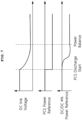
- FIG. 6 shows graphs of a DC link voltage, power references of PCS and DC-DC converter in a charge process according to embodiments of the present invention.
- the PMS 300 may transmit a charge command to the PCS 400.
- the PCS 400 may start operating (at PCS charge start in FIG. 6 ) and supply power to the DC link.
- the voltage of the DC link may start to rise accordingly.
- the DC-DC converter may sense the rising DC link voltage, refer to its droop curve, and output power corresponding to the DC link voltage value to charge the battery.
- the PCS output power matches the sum of the outputs of the plurality of DC-DC converters, therby reaching power balance at a corresponding DC link voltage and the charge operation to the battery is stopped.
- FIG. 7 shows graphs of a DC link voltage, power references of PCS and DC-DC converter in a discharge process according to embodiments of the present invention.
- the PCS 400 may receive a discharge command from the PMS 300 and start operating (at PCS discharge start in FIG. 7 ) to supply power to the grid. As the power drains, the voltage on the DC link begins to drop.
- the DC-DC converter may sense the falling DC link voltage and discharge the battery by outputting power corresponding to the DC link voltage based on the droop curve set therein to the PCS.
- the PCS output power matches the sum of the outputs of the plurality of DC-DC converters, therby reaching power balance at a corresponding DC link voltage and the discharge operation from the battery is stopped.
- FIG. 8 is a graph showing an output reference calculation process of a plurality of DC-DC converters in a charge process according to the present invention.
- FIG. 9 is a graph showing an output reference calculation process of a plurality of DC-DC converters in a discharge process according to the present invention.
- each curve represents a droop curve of each DC-DC converter.
- the power references in a section in which the DC link voltage is constant indicates a Max Charge Power and a Max Discharge Power.
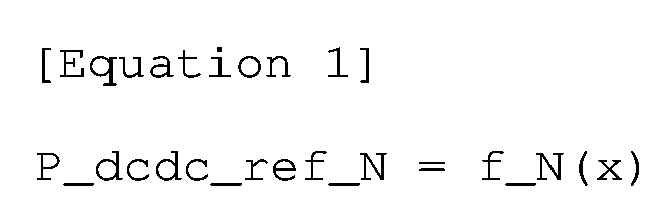
- Equation 1 shows a function for each droop curve.
- Equation 1 P_dcdc_ref indicates an output reference of each DC-DC converter, and f_N(x) indicates a droop curve function of DC-DC converter N.
- x represents the DC link voltage Vdc which becomes Vdc_charge during charging and Vdc_discharge during discharging.
- Equation 1 presents that the DC-DC converter performs output control according to a value defined by the droop curve function.
- Equation 2 indicates the sum of the outputs of droop curve functions corresponding to the output power of the PCS during charging, and is balanced at the Vdc_charge shown in FIG. 8 .
- P _ pcs _ charge _ ref f _ 1 Vdc _ charge + f _ 2 Vdc _ charge ⁇ f _ N Vdc _ charge
- Equation 3 indicates the sum of the outputs of droop curve functions corresponding to the output power of the PCS during discharge, and is balanced at the Vdc_discharge.
- P _ pcs _ discharge _ ref f _ 1 Vdc _ charge + f _ 2 Vdc _ discharge ... + f _ N Vdc _ discharge
- Equations 2 and 3 P_pcs_ref represents the output reference of the PCS, Vdc_charge represents the balanced voltage of the DC link during charging, and Vdc_discharge represents the balanced voltage of the DC link during discharging.
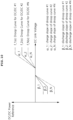
- FIG. 10 is a graph showing a concept of calculating slopes of droop curves of a plurality of DC-DC converters in a charge/discharge process according to the present invention.
- the graph of FIG. 10 shows the slopes of the droop curves of the plurality of DC-DC converters, and the slopes of the curves are different from each other.
- the slope of the droop curve for each DC-DC converter may be determined based on a battery capacity (Cap_N) and a SOC value, and additionally a SOH. Accordingly, the charge slope ratio ( ⁇ _1: ⁇ _2: ...: ⁇ _N) according to the droop curve for each battery may be defined as in Equation 4 below.
- ⁇ _ 1 : ⁇ _ 2 : ... : ⁇ _ N Cap_ 1 X 1 ⁇ SOC_1 : Cap_ 2 X 1 ⁇ SOC _ 2 ... : Cap_N X 1 ⁇ SOC_N
- Equation 4 It is clarified from Equation 4 that a charge slope of each battery is proportional to an empty space area (1-SOC_N) of the battery capable of storing additional energy and the capacity of each battery (Cap_N).
- the discharge slope ratio ( ⁇ _1: ⁇ _2: ...: ⁇ _N) according to the droop curve for each battery may be defined as in Equation 5 below.
- ⁇ _ 1 : ⁇ _ 2 : ... : ⁇ _ N Cap_ 1 X SOC_1 : Cap_ 2 X SOC _ 2 ... : Cap_N X SOC_N
- Cap_N indicates a capacity [Wh] of battery N
- SOC_N indicates a SOC of battery N.
- the discharge slope of each battery is related to how much energy stored in the battery to be extracted, the discharge slope is proportional to the SOC and the battery capacity (Cap_N) of each battery.
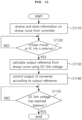
- FIG. 11 is a process flow chart of a power distribution method according to embodiments of the present invention.
- the power distribution method according to embodiments of the present invention may be performed by a converter that performs DC-DC conversion between a battery and a power conversion system (PCS).
- PCS power conversion system
- the converter may receive information on a droop curve related to output control of the converter from a controller that manages states of a plurality of batteries, and store the information (S1110).
- the controller may be, for example, a battery section controller.
- the converter may calculate an output reference from the stored droop curve information using the detected DC link voltage value (S1130).
- the converter may control its output according to the calculated output reference (S1140) .
- the converter may determine whether the DC link voltage has reached a balance (S1150). When the DC link voltage has reached the balance (Yes in S1150), the converter may terminate the charge or discharge procedure.
- the embodiments of the present disclosure may be implemented as program instructions executable by a variety of computers and recorded on a computer readable medium.
- the computer readable medium may include a program instruction, a data file, a data structure, or a combination thereof.
- the program instructions recorded on the computer readable medium may be designed and configured specifically for the present disclosure or can be publicly known and available to those who are skilled in the field of computer software.
- Examples of the computer readable medium may include a hardware device such as ROM, RAM, and flash memory, which are specifically configured to store and execute the program instructions.
- Examples of the program instructions include machine codes made by, for example, a compiler, as well as high-level language codes executable by a computer, using an interpreter.
- the above example hardware device can be configured to operate as at least one software module in order to perform the embodiments of the present disclosure, and vice versa.
- blocks or the device corresponds to operations of the method or characteristics of the operations of the method.
- aspects of the present invention described above in the context of a method may be described using blocks or items corresponding thereto or characteristics of a device corresponding thereto.
- Some or all of the operations of the method may be performed, for example, by (or using) a hardware device such as a microprocessor, a programmable computer or an electronic circuit. In some embodiments, one or more of most important operations of the method may be performed by such a device.
Landscapes
- Engineering & Computer Science (AREA)
- Power Engineering (AREA)
- Charge And Discharge Circuits For Batteries Or The Like (AREA)
- Dc-Dc Converters (AREA)
Abstract
Description
- This application claims priority to and the benefit of
Korean Patent Application No.10-2021-0081702 filed in the Korean Intellectual Property Office on June 23, 2021 - The present invention relates to an apparatus and a method for power distribution, and more particularly, to a power distribution apparatus and method for controlling an output of a DC-DC converter using a droop curve.
- An energy storage system relates to renewable energy, a battery that stores electric power, and grid power. Recently, as the spread of smart grid and renewable energy is expanding and the efficiency and the stability of the power system are emphasized, a demand for energy storage systems for power supply and demand control and power quality improvement is increasing. Depending on a purpose of use, energy storage systems may have different output and capacity. In order to configure a large-capacity energy storage system, a plurality of battery systems may be connected.
- An energy storage system may include a battery section with a plurality of batteries, a battery management system (BMS), a power conversion system (PCS), an energy management system (EMS), and a DC-DC converter, etc. Meanwhile, in an energy storage system with a plurality of DC-DC converters for a plurality of batteries, it is necessary to control outputs of the DC-DC converters in consideration of each battery state.
- To obviate one or more problems like those described above, an object of the present disclosure is to provide a power distribution apparatus including a DC-DC converter for controlling an output using a droop curve and a controller for setting and providing the droop curve.
- Another object of the present disclosure is to provide a power distribution method performed by the above power distribution apparatus.
- Yet another object of the present disclosure provide a DC-DC converter for controlling an output using a preset and stored droop curve.
- In order to achieve the objective of the present disclosure, a power distribution apparatus may comprise a converter configured to perform DC-DC conversion between a battery and a power conversion system; and a controller configured to set a droop curve for controlling an output of the converter based on a state of each battery, wherein the converter is configured to receive and store information on the droop curve set by the controller, detect a voltage change in a DC link between the power conversion system and the converter, the voltage change being caused by a start of a charging or a discharging operation, and control the output of the converter based on a detected DC link voltage and the droop curve.
- In the embodiment, the droop curve may indicate a relationship between the voltage of the DC link and the output power of the converter.
- The converter may be configured to derive an output power matching the detected DC link voltage in the droop curve and set the derived output power as an output reference of the converter.
- In addition, the droop curve may include a dead band in which neither charging nor discharging is performed for a certain range of DC link voltages.
- In the embodiment, charging or discharging may be completed at a DC link voltage in which a sum of outputs of the plurality of converters connected to the PCS matches the power of the PCS, thereby maintaining balance.
- Furthermore, a slope of the droop curve for each battery may be set based on a state of the battery and the droop curve includes information on max charge power and max discharge power.
- According to another embodiment of the present disclosure, a power distribution method in a converter configured to perform DC-DC conversion between a battery and a power conversion system may comprise receiving information on a droop curve for controlling an output of the converter from a controller that manages states of a plurality of batteries and storing the information on a droop curve; detecting a voltage change at a DC link between the power conversion system and the converter; and controlling an output of the converter according to a detected DC link voltage and the droop curve to discharge or charge the plurality of batteries.
- In the embodiment, the droop curve may indicate a relationship between the voltage of the DC link and the output power of the converter.
- In the embodiment, an output power matching the detected DC link voltage in the droop curve may be set as an output reference of the converter.
- In addition, the droop curve may include a dead band in which neither charging nor discharging is performed for a certain range of DC link voltages.
- In the embodiment, charging or discharging may be completed at a DC link voltage in which a sum of outputs of the plurality of converters connected to the PCS matches the power of the PCS, thereby maintaining balance.
- Furthermore, a slope of the droop curve for each battery may be set based on a state of the battery and the droop curve includes information on max charge power and max discharge power.
- The controlling the output of the converter may comprise calculating an output reference from the droop curve using the DC link voltage; controlling the output of the converter based on the output reference; and terminating the charging or discharging when the DC link voltage reached a balance.
- According to another embodiment of the present disclosure, a converter may be configured to perform DC-DC conversion between a battery and a power conversion system, the converter comprise a memory configured to store information on a droop curve for controlling an output of the converter; and a processor configured to detect a voltage change at a DC link between the power conversion system and the converter and control an output of the converter according to a detected DC link voltage and information on the droop curve.
- The droop curve may indicate a relationship between the voltage of the DC link and the output power of the converter.
- The converter may be configured to derive an output power matching the detected DC link voltage in the droop curve and set the derived output power as an output reference of the converter.
- The droop curve may include a dead band in which neither charging nor discharging is performed for a certain range of DC link voltages.
- In the embodiment, charging or discharging may be completed at a DC link voltage in which a sum of outputs of the plurality of converters connected to the PCS matches the power of the PCS, thereby maintaining balance.
- Furthermore, a slope of the droop curve for each battery may be set based on a state of the battery and the droop curve includes information on max charge power and max discharge power.
- According to embodiments of the present disclosure, even with a general-purpose power conversion system (and an inverter), a DC-DC converter can quickly calculate an output reference value using a pre-stored droop curve, thereby enabling a stable operation of the energy storage system.
- In addition, it is possible to efficiently operate batteries according to a state of an individual battery.
-
-
FIG. 1 is a block diagram of an energy storage system to which the present invention may be applied. -
FIG. 2A is a graph illustrating a concept of a slope control in a droop curve used for output control of a DC-DC converter according to embodiments of the present invention. -
FIG. 2B is a graph illustrating a dead band in a droop curve used for output control of a DC-DC converter according to embodiments of the present invention. -
FIG. 3 is a graph illustrating in more detail a droop curve used for output control of a DC-DC converter according to embodiments of the present invention. -
FIG. 4A is a graph illustrating a plurality of droop curves applied to a plurality of DC-DC converters according to embodiments of the present invention. -
FIG. 4B illustrates charging flows for respective batteries when different droop curves are applied to a plurality of DC-DC converters according to embodiments of the present invention. -
FIG. 5 is a conceptual diagram illustrating flows of charging and discharging between a battery and a grid according to the present invention. -
FIG. 6 shows graphs of a DC link voltage, power references of PCS and DC-DC converter in a charge process according to embodiments of the present invention. -
FIG. 7 shows graphs of a DC link voltage, power references of PCS and DC-DC converter in a discharge process according to embodiments of the present invention. -
FIG. 8 is a graph showing an output reference calculation process of a plurality of DC-DC converters in a charge process according to the present invention. -
FIG. 9 is a graph showing an output reference calculation process of a plurality of DC-DC converters in a discharge process according to the present invention. -
FIG. 10 is a graph showing a concept of calculating slopes of droop curves of a plurality of DC-DC converters in a charge/discharge process according to the present invention. -
FIG. 11 is a process flow chart of a power distribution method according to embodiments of the present invention. - The present invention may be modified in various forms and have various embodiments, and specific embodiments thereof are shown by way of example in the drawings and will be described in detail below. It should be understood, however, that there is no intent to limit the present invention to the specific embodiments, but on the contrary, the present invention is to cover all modifications, equivalents, and alternatives falling within the spirit and technical scope of the present invention. Like reference numerals refer to like elements throughout the description of the figures.
- It will be understood that, although the terms such as first, second, A, B, and the like may be used herein to describe various elements, these elements should not be limited by these terms. These terms are only used to distinguish one element from another. For example, a first element could be termed a second element, and, similarly, a second element could be termed a first element, without departing from the scope of the present invention. As used herein, the term "and/or" includes combinations of a plurality of associated listed items or any of the plurality of associated listed items.
- It will be understood that when an element is referred to as being "connected" or "coupled" to another element, it can be directly connected or coupled to the other element or intervening elements may be present. In contrast, when an element is referred to as being "directly connected" or "directly coupled" to another element, there are no intervening elements present. Other words used to describe the relationship between elements should be interpreted in a like fashion (i.e., "between" versus "directly between", "adjacent" versus "directly adjacent", etc.).
- The terminology used herein is for the purpose of describing particular embodiments only and is not intended to be limiting of the invention. As used herein, the singular forms "a", "an" and "the" are intended to include the plural forms as well, unless the context clearly indicates otherwise. It will be further understood that the terms "comprises", "comprising,", "includes" and/or "including", when used herein, specify the presence of stated features, integers, steps, operations, elements, and/or components, but do not preclude the presence or addition of one or more other features, integers, steps, operations, elements, components, and/or groups thereof.
- Unless otherwise defined, all terms (including technical and scientific terms) used herein have the same meaning as commonly understood by one of ordinary skill in the art to which this invention belongs. It will be further understood that terms, such as those defined in commonly used dictionaries, should be interpreted as having a meaning that is consistent with their meaning in the context of the relevant art and will not be interpreted in an idealized or overly formal sense unless expressly so defined herein.
- Hereinafter, example embodiments of the present invention will be described in detail with reference to the accompanying drawings.
-
FIG. 1 is a block diagram of an energy storage system to which the present invention may be applied. - In an energy storage system (ESS), a battery is used for storing energy or power. Typycally, multiple battery modules may form a battery rack and multiple battery racks form a battery bank. Here, depending on a device or a system in which the battery is used, a battery rack may be referred to as a battery pack.
Battery # 1,battery # 2, ... , and battery #N shown inFIG. 1 may be a battery pack or a battery rack. - Referring to
FIG. 1 , a battery management system (BMS) 100 may be installed for each battery. TheBMS 100 may monitor a current, a voltage and a temperature of each battery pack (or rack) to be managed, calculate a State Of Charge (SOC) of the battery based on a monitoring result to control charging and discharging. - A battery section controller (BSC) 200 may be located in each battery section which includes a plurality of batteries, peripheral circuits, and devices to monitor and control objects such as a voltage, a current, a temperature, and a circuit breaker.
- A power conversion system (PCS) 400 installed in each battery section may control power supplied from the outside and power supplied from the battery section to the outside, therby controlling charging and discharging of the battery. The power convertion system may include a DC/AC inverter. The output of the DC-
DC converter 500 may be connected to thePCS 400 and thePCS 400 may be connected to thepower grid 600. Here, thePCS 400 typically operates in a constant power mode. A power management system (PMS) 300 connected to the PCS may control the output of the PCS based on the monitoring and control results of the battery management system or the battery section controller. - In the energy storage system of
FIG. 1 ,battery # 1 is connected to DC-DC converter # 1,battery # 2 is connected to DC-DC converter # 2, and battery #N is connected to DC-DC #N. The output of the DC-DC converter corresponding to each battery is connected to thePCS 400 through a DC link. - The DC-DC converter may be a bidirectional converter, wherein when conversion is performed from the battery to the load direction, the input of the DC-DC converter is connected to a battery (a battery unit, a battery rack or a battery pack) and the output of the DC-DC converter may be connected to a load. As examples of the DC-DC converter, various types of converters such as a full-bridge converter, a half-bridge converter, and a flyback converter may be used.
- Meanwhile, communication among the
BMS 100 , theBSC 200, thePMS 300, and thePCS 400 may be implemented through a controller area network (CAN) or Ethernet (indicated by a dotted line inFIG. 1 ). - In such an energy storage system, when the output control of the DC-DC converter is performed by a central controller (for example, the BSC) each time, a voltage fluctuation at the DC link may occur due to a time delay from calculation by the BSC to an actual output by the DC-DC converter. To solve this problem, a method of operating the PCS in a fixed voltage range, or a method of adding a large-capacity capacitor or battery to the DC link to ensure safe operation of the system may be used. However, the method of operating the PCS in a fixed voltage range has a disadvantage in that it requires modification of a PCS firmware since a general-purpose PCS operates in a fixed power mode. In addition, the method of adding a large-capacity capacitor or battery to the DC link has a problem of causing additional cost increase.
- The present invention is proposed to solve this problem, and according to embodiments of the present invention shown in
FIG. 1 , theBSC 200 which is configured to manage overall control of the battery section may set a droop curve of each DC-DC converter based on a state of each battery and provide it to each DC-DC converter before operating the system. - Here, the state of each battery may include information such as a state of charge (SOC), a state of health (SOH), a voltage, and a temperature of each battery. The
BSC 200 may provide information such as limit power (P_battery_limit) and real power (P_battery_real) of each battery to thepower management system 300. Thepower management system 300 in charge of controlling the entire ESS system msy issues a charge command or a discharge command (via P_pcs_reference) to thepower conversion system 400 during system operation. - At this time, the DC link voltage where outputs of the DC-
DC converters 500 and the input of thePCS 400 encounter may be shaken by an operation of thePCS 400 that has received the charge or discharge command. Here, each DC-DC converter may sense the DC link voltage being shaken and calculate a DC-DC output reference by referring to a droop curve preset for the DC-DC converter itself. The DC-DC converter may use the calculated output reference to perform output control to follow the output reference in real time. - For this, a DC-DC converter according to embodiments of the present invention may include a memory for storing droop curve information related to output control of the converter and a processor configured to detect a voltage change at the DC link between the PCS and the converter and to control an output of the converter according to the detected DC link voltage and the droop curve.
- The DC-DC converter may further include an input switching set, a primary coil, a secondary coil, an output switching set, a capacitor, etc.
- The
converter 500 and the battery section controller (BSC) 200 shown inFIG. 1 may constitute a power distribution apparatus according to embodiments of the present invention. More specifically, a power distribution apparatus according to embodiments of the present invention may include a converter for performing DC-DC conversion between a battery and a power conversion system (PCS) and a controller for determining a droop curve related to output control of the converter according to the state of each battery. Here, the controller may be a battery section controller. - The converter may be configured to receive and store information related to the droop curve set by the controller, detect a voltage change in a DC link between the power conversion system and the converter, the voltage change being caused by a start of a charging or a discharging operation, and control output of the converter based on the detected DC link voltage and the droop curve.
- As such, in the present invention, an output reference of the battery is not received during operation of the energy storage system from a central controller. Insated, the DC-DC converter may quickly calculate an output reference value by itself according to a preset droop curve before actual operation of the energy storage system and control its output, which leads to stable operation of the system.
-
FIG. 2A is a graph illustrating a concept of a slope control in a droop curve used for output control of a DC-DC converter according to embodiments of the present invention. - In the graph of
FIG. 2A , the horizontal axis represents a voltage (Vdc) of the DC link, and the vertical axis represents an output power (Pbat_n) of each battery. The BSC may control the output of each battery using slope control as shown inFIG. 2A based on a state of each battery. -
FIG. 2B is a graph illustrating a dead band concept in a droop curve used for output control of a DC-DC converter according to embodiments of the present invention. - In the graph of
FIG. 2B , the horizontal axis represents the voltage (Vdc) of the DC link, and the vertical axis represents the output power (Pbat_n) of each battery. In the present invention, curve point control is used as well as droop curve slope control. Here, the curve point may include an upper limit point and a lower limit point of the dead band region. That is, according to the embodiment of the present invention, a dead band in which neither charging nor discharging is performed is placed in the droop curve and the DC-DC converter output can be controlled based on the droop curve, in order to prevent a frequent charging and discharging that may occur due to a DC link voltage sensing error among a plurality of DC-DC converters. As shown inFig. 2b , a range of the dead band can be adjusted according to a situation in the system. -
FIG. 3 is a graph illustrating in more detail a droop curve used for output control of a DC-DC converter according to embodiments of the present invention. - In the graph of
FIG. 3 , the horizontal axis represents a voltage (V_DC link) of the DC link, and the vertical axis represents an output power (P_DCDC) of the DC-DC converter corresponding to each battery. - The battery section controller may control the output power of the DC-DC converter corresponding to each battery by controlling the slope of the droop curve in consideration of the state of each battery. In addition, the battery section controller may set a charge/discharge operation range by setting a Max Charge Power and a Max Discharge Power.
- In the droop curve shown in
FIG. 3 , the dead band in which charging and discharging are not performed may be defined by the Dead Band Upper Limit and the Dead Band Lower Limit. Further, in the droop curve ofFIG. 3 , a Maximum charge voltage at which charging is stopped because charging to the maximum has performed and a Minimum discharge voltage at which discharging is stopped. - As described above, in the present invention, the droop curve control is for maintaining the voltage of the DC link constant and the dead-band is for preventing frequent charging/discharging due to noise and sensing errors in a standby state. The dead band may be set, for example, in a range of 850-900V, which is a voltage range of the DC link in a standby state.
-
FIG. 4A is a graph illustrating a plurality of droop curves applied to a plurality of DC-DC converters according to embodiments of the present invention. - In the graph of
FIG. 4A , the horizontal axis represents a voltage (Vdc) of the DC link, and the vertical axis represents output powers of thebattery 1,battery 2, andbattery 3. In the graph ofFIG. 4A , the slope of the droop curve for each battery is set differently, which means that the outputs between the battery packs/racks can be set differently depending on state of each battery(for example, SOC). -
FIG. 4B illustrates charging flows for respective batteries when different droop curves are applied to a plurality of DC-DC converters according to embodiments of the present invention. That is,FIG. 4B shows an example of a power distribution method using droop curves for batteries having same capacity but different initial SOC values. - For example, in
FIG. 4B , the droop curve with the largest slope is set forbattery rack # 1 having the lowest SOC of 40%, and accordingly, DC-DC converter # 1 outputs the largest power. - When the power conversion system connected to the plurality of DC-DC converters commands a start of charging operation in a constant power mode, the DC link voltage rises in short time and each DC-DC converter refers to the increased DC link voltage and a droop curve for each battery to determine amount of charge for each battery. Then, each DC-DC converter may perform charging to maintain a balance at a Vdc voltage balancing with Pdc = Pdc_1 + Pdc_2 + Pdc_3.
-
FIG. 5 is a conceptual diagram illustrating flows of charging and discharging between a battery and a power grid according to the present invention. -
FIG. 5 shows a charge flow from thegrid 600 to the PCS, and to thebattery 110 through the DC-DC converters 500 using droop curves which are stored in the DC-DC converters for respective batteries. - In addition, according to a discharge control using the droop curves stored in the DC-DC converters for respective battery, a discharge process may be performed from the
battery 110 through the DC-DC converter 500 and thePCS 400 to thegrid 600. -
FIG. 6 shows graphs of a DC link voltage, power references of PCS and DC-DC converter in a charge process according to embodiments of the present invention. - When a charge process is performed in an energy storage system to which the present invention is applied, the
PMS 300 may transmit a charge command to thePCS 400. Upon receiving the charge command, thePCS 400 may start operating (at PCS charge start inFIG. 6 ) and supply power to the DC link. Thus, the voltage of the DC link may start to rise accordingly. - The DC-DC converter may sense the rising DC link voltage, refer to its droop curve, and output power corresponding to the DC link voltage value to charge the battery. When the PCS output power matches the sum of the outputs of the plurality of DC-DC converters, therby reaching power balance at a corresponding DC link voltage and the charge operation to the battery is stopped.
-
FIG. 7 shows graphs of a DC link voltage, power references of PCS and DC-DC converter in a discharge process according to embodiments of the present invention. - When a discharge process is performed in an energy storage system to which the present invention is applied, the
PCS 400 may receive a discharge command from thePMS 300 and start operating (at PCS discharge start inFIG. 7 ) to supply power to the grid. As the power drains, the voltage on the DC link begins to drop. - The DC-DC converter may sense the falling DC link voltage and discharge the battery by outputting power corresponding to the DC link voltage based on the droop curve set therein to the PCS. When the PCS output power matches the sum of the outputs of the plurality of DC-DC converters, therby reaching power balance at a corresponding DC link voltage and the discharge operation from the battery is stopped.
-
FIG. 8 is a graph showing an output reference calculation process of a plurality of DC-DC converters in a charge process according to the present invention.FIG. 9 is a graph showing an output reference calculation process of a plurality of DC-DC converters in a discharge process according to the present invention. - In
FIGs. 8 and9 , each curve represents a droop curve of each DC-DC converter. InFIGS. 8 and9 , the power references in a section in which the DC link voltage is constant indicates a Max Charge Power and a Max Discharge Power. -
Equation 1 below shows a function for each droop curve.
- In
Equation 1, P_dcdc_ref indicates an output reference of each DC-DC converter, and f_N(x) indicates a droop curve function of DC-DC converter N. In addition, x represents the DC link voltage Vdc which becomes Vdc_charge during charging and Vdc_discharge during discharging. - That is,
Equation 1 presents that the DC-DC converter performs output control according to a value defined by the droop curve function. -
Equation 2 below indicates the sum of the outputs of droop curve functions corresponding to the output power of the PCS during charging, and is balanced at the Vdc_charge shown inFIG. 8 .
- In addition,
Equation 3 below indicates the sum of the outputs of droop curve functions corresponding to the output power of the PCS during discharge, and is balanced at the Vdc_discharge.
- In
Equations -
FIG. 10 is a graph showing a concept of calculating slopes of droop curves of a plurality of DC-DC converters in a charge/discharge process according to the present invention. - The graph of
FIG. 10 shows the slopes of the droop curves of the plurality of DC-DC converters, and the slopes of the curves are different from each other. - In the present invention, the slope of the droop curve for each DC-DC converter may be determined based on a battery capacity (Cap_N) and a SOC value, and additionally a SOH. Accordingly, the charge slope ratio (α_1: α_2: ...:α_N) according to the droop curve for each battery may be defined as in Equation 4 below.

- It is clarified from Equation 4 that a charge slope of each battery is proportional to an empty space area (1-SOC_N) of the battery capable of storing additional energy and the capacity of each battery (Cap_N).
- Furthermore, the discharge slope ratio (β_1: β_2: ...: β_N) according to the droop curve for each battery may be defined as in Equation 5 below.

- Here, Cap_N indicates a capacity [Wh] of battery N, and SOC_N indicates a SOC of battery N.
- Since the discharge slope of each battery is related to how much energy stored in the battery to be extracted, the discharge slope is proportional to the SOC and the battery capacity (Cap_N) of each battery.
-
FIG. 11 is a process flow chart of a power distribution method according to embodiments of the present invention. - The power distribution method according to embodiments of the present invention may be performed by a converter that performs DC-DC conversion between a battery and a power conversion system (PCS).
- The converter may receive information on a droop curve related to output control of the converter from a controller that manages states of a plurality of batteries, and store the information (S1110). Here, the controller may be, for example, a battery section controller.
- Then, when the converter, during charging or discharging, detects a voltage change at the DC link between the PCS and the converter (YES in S1120), the converter may calculate an output reference from the stored droop curve information using the detected DC link voltage value (S1130). The converter may control its output according to the calculated output reference (S1140) .
- Then, the converter may determine whether the DC link voltage has reached a balance (S1150). When the DC link voltage has reached the balance (Yes in S1150), the converter may terminate the charge or discharge procedure.
- The embodiments of the present disclosure may be implemented as program instructions executable by a variety of computers and recorded on a computer readable medium. The computer readable medium may include a program instruction, a data file, a data structure, or a combination thereof. The program instructions recorded on the computer readable medium may be designed and configured specifically for the present disclosure or can be publicly known and available to those who are skilled in the field of computer software.
- Examples of the computer readable medium may include a hardware device such as ROM, RAM, and flash memory, which are specifically configured to store and execute the program instructions. Examples of the program instructions include machine codes made by, for example, a compiler, as well as high-level language codes executable by a computer, using an interpreter. The above example hardware device can be configured to operate as at least one software module in order to perform the embodiments of the present disclosure, and vice versa.
- Some aspects of the present invention have been described above in the context of a device but may be described using a method corresponding thereto. Here, blocks or the device corresponds to operations of the method or characteristics of the operations of the method. Similarly, aspects of the present invention described above in the context of a method may be described using blocks or items corresponding thereto or characteristics of a device corresponding thereto. Some or all of the operations of the method may be performed, for example, by (or using) a hardware device such as a microprocessor, a programmable computer or an electronic circuit. In some embodiments, one or more of most important operations of the method may be performed by such a device.
- While the example embodiments of the present invention and their advantages have been described in detail, it should be understood that various changes, substitutions and alterations may be made herein without departing from the scope of the invention.
Claims (20)
- A power distribution apparatus comprising:a converter configured to perform DC-DC conversion between a battery and a power conversion system(PCS); anda controller configured to set a droop curve for controlling an output of the converter based on a state of the battery,wherein the converter is configured to :receive and store information on the droop curve set by the controller,detect a voltage change in a DC link between the PCS and the converter, the voltage change being caused by a start of a charging or a discharging operation, andcontrol the output of the converter based on a detected DC link voltage and the droop curve.
- The power distribution apparatus of claim 1, wherein the droop curve indicates a relationship between the voltage of an DC link and the output power of the converter.
- The power distribution apparatus of claim 1, wherein the converter is further configured to :
derive an output power matching the detected DC link voltage in the droop curve, set the derived output power as an output reference of the converter, and control the output of the converter based on the output reference. - The power distribution apparatus of claim 1, wherein the droop curve includes a dead band in which neither charging nor discharging is performed for a predetermined range of DC link voltages.
- The power distribution apparatus of claim 1, wherein the PCS is connected to a plurality of converters including the converter, the plurality of converters being configured to perform DC-DC conversion respectively between the PCS and a plurality of batteries including the battery, and
wherein charging or discharging is completed at a DC link voltage at which a sum of outputs of the plurality of converters connected to the PCS matches a power of the PCS, thereby maintaining balance. - The power distribution apparatus of claim 1, wherein a slope of the droop curve for the battery is set based on the state of the battery, and the droop curve includes information on a maximum charge power and a maximum discharge power.
- A power distribution method in a converter configured to perform DC-DC conversion between a battery among a plurality of batteries and a power conversion system (PCS), the method comprising:receiving information on a droop curve for controlling an output of the converter from a controller configured to manage states of the plurality of batteries and storing the received information on a droop curve;detecting a voltage change at a DC link between the PCS and the converter; andcontrolling an output of the converter according to a detected DC link voltage and the droop curve to discharge or charge the battery among the plurality of batteries.
- The power distribution method of claim 7, wherein the droop curve indicates a relationship between the voltage of the DC link and an output power of the converter.
- The power distribution method of claim 7, wherein the controlling of the output of the converter includes:setting an output power matching the detected DC link voltage in the droop curve as an output reference of the converter; andcontrolling the output of the converter based on the output reference.
- The power distribution method of claim 7, wherein the droop curve includes a dead band in which neither charging nor discharging is performed for a predetermined range of DC link voltages.
- The power distribution method of claim 7, wherein the PCS is connected to a plurality of converters including the converter, the plurality of converters being configured to perform DC-DC conversion respectively between the PCS and the plurality of batteries, and
wherein charging or discharging is completed at a DC link voltage at which a sum of outputs of the plurality of converters connected to the PCS matches a power of the PCS, thereby maintaining balance. - The power distribution method of claim 7, wherein a slope of the droop curve for the battery is set based on a state of the battery, and the droop curve includes information on a maximum charge power and a maximum discharge power.
- The power distribution method of claim 7, wherein the controlling of the output of the converter comprises:calculating an output reference from the droop curve using the detected DC link voltage;controlling the output of the converter based on the output reference; andterminating the charging or discharging if the DC link voltage has reached a balance.
- A converter configured to perform DC-DC conversion between a battery and a power conversion system(PCS), the converter comprising:a memory configured to store information on a droop curve for controlling an output of the converter; anda processor configured to :detect a voltage change at a DC link between the PCS and the converter; andcontrol an output of the converter according to a detected DC link voltage and the stored information on the droop curve.
- The converter of claim 14, wherein the droop curve indicates a relationship between an voltage of the DC link and the output power of the converter.
- The converter of claim 14, wherein the processor is further configured to :derive an output power matching the detected DC link voltage in the droop curve;set the derived output power as an output reference of the converter; andcontrol the output of the converter based on the output reference of the converter.
- The converter of claim 14, wherein the droop curve includes a dead band in which neither charging nor discharging is performed for a predetermined range of DC link voltages.
- The converter of claim 14, wherein the PCS is connected to a plurality of converters including the converter, the plurality of converters being configured to perform DC-DC conversion respectively between the PCS and the plurality of batteries including the battery, and
wherein charging or discharging is completed at a DC link voltage at which a sum of the outputs of the plurality of converters connected to the PCS matches a power of the PCS, thereby maintaining balance. - The converter of claim 14, wherein a slope of the droop curve for the battery is set based on a state of the battery and the droop curve includes information on a maximum charge power and a maximum discharge power.
- An energy storage system comprising:a plurality of battery racks;a plurality of converters each configured to perform DC-DC conversion for a corresponding one of the plurality of battery racks;a power conversion system connected between the plurality of converters and a power grid; anda battery section controller configured to determine droop curves for controlling outputs of the converters according to states of the battery racks, respectively,wherein each converter among the plurality of converters is configured to :receive and store information on a corresponding one of the droop curves determined by the battery section controller,detect a voltage change in a DC link between the power conversion system and the converter, the voltage change being caused by a start of a charging or a discharging operation, andcontrol an output of the converter based on a detected DC link voltage and the corresponding droop curve.
Applications Claiming Priority (2)
| Application Number | Priority Date | Filing Date | Title |
|---|---|---|---|
| KR1020210081702A KR102765477B1 (en) | 2021-06-23 | 2021-06-23 | Apparatus and method for power distribution using droop control |
| PCT/KR2022/007166 WO2022270769A1 (en) | 2021-06-23 | 2022-05-19 | Power distribution device and method using droop control |
Publications (2)
| Publication Number | Publication Date |
|---|---|
| EP4195441A1 true EP4195441A1 (en) | 2023-06-14 |
| EP4195441A4 EP4195441A4 (en) | 2024-11-06 |
Family
ID=84538644
Family Applications (1)
| Application Number | Title | Priority Date | Filing Date |
|---|---|---|---|
| EP22828617.5A Pending EP4195441A4 (en) | 2021-06-23 | 2022-05-19 | POWER DISTRIBUTION DEVICE AND METHOD USING SAG CONTROL |
Country Status (6)
| Country | Link |
|---|---|
| US (2) | US12316120B2 (en) |
| EP (1) | EP4195441A4 (en) |
| JP (1) | JP7562215B2 (en) |
| KR (1) | KR102765477B1 (en) |
| CN (1) | CN116114138A (en) |
| WO (1) | WO2022270769A1 (en) |
Families Citing this family (3)
| Publication number | Priority date | Publication date | Assignee | Title |
|---|---|---|---|---|
| KR102678879B1 (en) * | 2021-09-08 | 2024-06-28 | 주식회사 엘지에너지솔루션 | Energy storage system including newly installed battery racks and method controlling the same |
| JP7840291B2 (en) * | 2023-03-31 | 2026-04-03 | 三菱重工業株式会社 | Control device for an energy storage system, energy storage system, method for controlling an energy storage system, and program |
| JP2025027518A (en) * | 2023-08-15 | 2025-02-28 | 三菱重工業株式会社 | Battery Storage System |
Family Cites Families (27)
| Publication number | Priority date | Publication date | Assignee | Title |
|---|---|---|---|---|
| KR101277904B1 (en) * | 2011-10-31 | 2013-06-21 | 주식회사 포스코아이씨티 | System and method for managementing electric power |
| KR101431047B1 (en) | 2013-01-31 | 2014-08-21 | 명지대학교 산학협력단 | Coordinated Droop Control Apparatus and the Method for Stand-alone DC Micro-grid |
| KR101809784B1 (en) | 2014-01-27 | 2018-01-18 | 엘에스산전 주식회사 | method for controlling charging and discharging of battery energy storage system and the same |
| JP6393559B2 (en) | 2014-08-29 | 2018-09-19 | 三洋電機株式会社 | Power storage system, management device, and DC / DC converter |
| KR102332337B1 (en) | 2015-01-30 | 2021-11-29 | 삼성에스디아이 주식회사 | Battery system and energy storage system including the same |
| KR101844443B1 (en) | 2015-02-26 | 2018-05-14 | 연세대학교 산학협력단 | Energy Storage System and control device and method thereof |
| KR101696999B1 (en) | 2015-03-10 | 2017-01-16 | 엘에스산전 주식회사 | Method for controlling an energy storage device and system for managing a power |
| KR101809787B1 (en) * | 2015-03-10 | 2017-12-15 | 엘에스산전 주식회사 | Electricity providing system including battery energy storage system |
| KR20170013772A (en) | 2015-07-28 | 2017-02-07 | 엘에스산전 주식회사 | Energy storge system and metoh for operating thereof |
| KR101785825B1 (en) | 2016-02-04 | 2017-10-16 | 명지대학교 산학협력단 | State of charge based droop control method and apparatus for the reliable operation of a stand alone dc microgrid |
| US20180131268A1 (en) | 2016-10-19 | 2018-05-10 | Dynapower Company Llc | Power system and method of starting multiple power converters in grid forming mode |
| US10707679B2 (en) | 2017-06-15 | 2020-07-07 | The Governing Council Of The University Of Toronto | Battery energy storage system |
| JP6946100B2 (en) | 2017-07-28 | 2021-10-06 | 住友電気工業株式会社 | Storage battery system and its discharge control method |
| KR102067830B1 (en) | 2017-09-25 | 2020-01-17 | 효성중공업 주식회사 | ESS Output Control Method |
| KR102459472B1 (en) * | 2018-01-25 | 2022-10-26 | 엘지이노텍 주식회사 | Dc-dc converter and control method of the same |
| EP3731394A4 (en) * | 2017-12-22 | 2021-08-25 | LG Innotek Co., Ltd. | POWER SUPPLY SYSTEM INCLUDING A CONTINUOUS-CONTINUOUS CONVERTER AND ITS CONTROL PROCESS |
| CN108565887B (en) * | 2018-01-31 | 2021-07-06 | 湖北工业大学 | Dynamic droop control method for maintaining microgrid bus voltage partition curve in energy storage link |
| JP6458891B1 (en) | 2018-02-19 | 2019-01-30 | サンケン電気株式会社 | Power storage system and power storage device |
| KR102078453B1 (en) | 2018-04-10 | 2020-02-19 | 한국전력공사 | Power sharing method in dc microgrids system |
| KR102238153B1 (en) * | 2018-05-14 | 2021-04-09 | 엘에스일렉트릭(주) | Power Management System |
| AU2020350671B2 (en) * | 2019-09-17 | 2025-09-11 | Span.IO, Inc. | Systems and methods for managing electrical loads |
| KR102341329B1 (en) | 2019-10-02 | 2021-12-21 | 한국에너지기술연구원 | Charge/discharge control apparatus and method of energy storage system,and energy charge/discharge control system and method |
| JP7617851B2 (en) | 2019-12-03 | 2025-01-20 | 古河電気工業株式会社 | Electricity networks and how to change them |
| KR20210081702A (en) | 2019-12-24 | 2021-07-02 | (주)휴온스 | Tablet Comprising Quisqualis Indica Extract as an Active Ingredient |
| KR102180880B1 (en) | 2020-03-06 | 2020-11-20 | 유림티에스 주식회사 | Photovoltaic power generation system in which power converters are distributed |
| EP4118786B1 (en) * | 2020-03-27 | 2026-03-04 | Sharp Kabushiki Kaisha | User equipment and method for multicast/broadcast service |
| CN112104024A (en) * | 2020-09-04 | 2020-12-18 | 易事特集团股份有限公司 | Self-adaptive droop control method and system for energy storage converter |
-
2021
- 2021-06-23 KR KR1020210081702A patent/KR102765477B1/en active Active
-
2022
- 2022-05-19 JP JP2023518864A patent/JP7562215B2/en active Active
- 2022-05-19 US US18/024,192 patent/US12316120B2/en active Active
- 2022-05-19 EP EP22828617.5A patent/EP4195441A4/en active Pending
- 2022-05-19 CN CN202280005893.1A patent/CN116114138A/en active Pending
- 2022-05-19 WO PCT/KR2022/007166 patent/WO2022270769A1/en not_active Ceased
-
2025
- 2025-04-29 US US19/192,617 patent/US20250266687A1/en active Pending
Also Published As
| Publication number | Publication date |
|---|---|
| WO2022270769A1 (en) | 2022-12-29 |
| US20250266687A1 (en) | 2025-08-21 |
| EP4195441A4 (en) | 2024-11-06 |
| CN116114138A (en) | 2023-05-12 |
| JP2023543223A (en) | 2023-10-13 |
| US20230275437A1 (en) | 2023-08-31 |
| KR102765477B1 (en) | 2025-02-07 |
| JP7562215B2 (en) | 2024-10-07 |
| KR20220170626A (en) | 2022-12-30 |
| US12316120B2 (en) | 2025-05-27 |
Similar Documents
| Publication | Publication Date | Title |
|---|---|---|
| US20250266687A1 (en) | Power Distribution Device and Method Using Droop Control | |
| JP7570530B2 (en) | Energy storage system connected to a solar power system and method for controlling the energy storage system | |
| KR102941181B1 (en) | Apparatus for cotnrolling charging and discharing power, energy storage system and operating method thereof | |
| US20260081446A1 (en) | Energy storage system including newly installed battery racks and method for controlling the same | |
| US20230268754A1 (en) | Energy storage system and control method of energy storage system | |
| EP4333247A1 (en) | Power conversion device for performing dc-dc conversion, and energy storage system including same | |
| US12609623B2 (en) | Converter for performing DC-DC conversion and method for controlling same | |
| KR102133558B1 (en) | Cell balancing apparatus and method using fan | |
| KR20240082311A (en) | Energy storage system including newly installed battery racks and method controlling the same | |
| KR20230073473A (en) | Energy storage system including reused battery and operating method thereof |
Legal Events
| Date | Code | Title | Description |
|---|---|---|---|
| STAA | Information on the status of an ep patent application or granted ep patent |
Free format text: STATUS: THE INTERNATIONAL PUBLICATION HAS BEEN MADE |
|
| PUAI | Public reference made under article 153(3) epc to a published international application that has entered the european phase |
Free format text: ORIGINAL CODE: 0009012 |
|
| STAA | Information on the status of an ep patent application or granted ep patent |
Free format text: STATUS: REQUEST FOR EXAMINATION WAS MADE |
|
| 17P | Request for examination filed |
Effective date: 20230309 |
|
| AK | Designated contracting states |
Kind code of ref document: A1 Designated state(s): AL AT BE BG CH CY CZ DE DK EE ES FI FR GB GR HR HU IE IS IT LI LT LU LV MC MK MT NL NO PL PT RO RS SE SI SK SM TR |
|
| DAV | Request for validation of the european patent (deleted) | ||
| DAX | Request for extension of the european patent (deleted) | ||
| A4 | Supplementary search report drawn up and despatched |
Effective date: 20241008 |
|
| RIC1 | Information provided on ipc code assigned before grant |
Ipc: H02M 1/00 20060101ALI20241001BHEP Ipc: H02M 3/158 20060101ALI20241001BHEP Ipc: H02J 7/00 20060101ALI20241001BHEP Ipc: H02J 3/32 20060101AFI20241001BHEP |
|
| STAA | Information on the status of an ep patent application or granted ep patent |
Free format text: STATUS: EXAMINATION IS IN PROGRESS |
|
| 17Q | First examination report despatched |
Effective date: 20250612 |