EP4195131A1 - Method and system for federated learning based identification of non-malicious classification models - Google Patents
Method and system for federated learning based identification of non-malicious classification models Download PDFInfo
- Publication number
- EP4195131A1 EP4195131A1 EP22202898.7A EP22202898A EP4195131A1 EP 4195131 A1 EP4195131 A1 EP 4195131A1 EP 22202898 A EP22202898 A EP 22202898A EP 4195131 A1 EP4195131 A1 EP 4195131A1
- Authority
- EP
- European Patent Office
- Prior art keywords
- models
- cluster
- clients
- active
- malicious
- Prior art date
- Legal status (The legal status is an assumption and is not a legal conclusion. Google has not performed a legal analysis and makes no representation as to the accuracy of the status listed.)
- Granted
Links
Images




Classifications
-
- G—PHYSICS
- G06—COMPUTING OR CALCULATING; COUNTING
- G06Q—INFORMATION AND COMMUNICATION TECHNOLOGY [ICT] SPECIALLY ADAPTED FOR ADMINISTRATIVE, COMMERCIAL, FINANCIAL, MANAGERIAL OR SUPERVISORY PURPOSES; SYSTEMS OR METHODS SPECIALLY ADAPTED FOR ADMINISTRATIVE, COMMERCIAL, FINANCIAL, MANAGERIAL OR SUPERVISORY PURPOSES, NOT OTHERWISE PROVIDED FOR
- G06Q20/00—Payment architectures, schemes or protocols
- G06Q20/38—Payment protocols; Details thereof
- G06Q20/40—Authorisation, e.g. identification of payer or payee, verification of customer or shop credentials; Review and approval of payers, e.g. check credit lines or negative lists
- G06Q20/401—Transaction verification
- G06Q20/4016—Transaction verification involving fraud or risk level assessment in transaction processing
-
- G—PHYSICS
- G06—COMPUTING OR CALCULATING; COUNTING
- G06N—COMPUTING ARRANGEMENTS BASED ON SPECIFIC COMPUTATIONAL MODELS
- G06N20/00—Machine learning
-
- G—PHYSICS
- G06—COMPUTING OR CALCULATING; COUNTING
- G06N—COMPUTING ARRANGEMENTS BASED ON SPECIFIC COMPUTATIONAL MODELS
- G06N3/00—Computing arrangements based on biological models
- G06N3/02—Neural networks
- G06N3/04—Architecture, e.g. interconnection topology
- G06N3/048—Activation functions
-
- G—PHYSICS
- G06—COMPUTING OR CALCULATING; COUNTING
- G06N—COMPUTING ARRANGEMENTS BASED ON SPECIFIC COMPUTATIONAL MODELS
- G06N3/00—Computing arrangements based on biological models
- G06N3/02—Neural networks
- G06N3/08—Learning methods
- G06N3/098—Distributed learning, e.g. federated learning
-
- G—PHYSICS
- G06—COMPUTING OR CALCULATING; COUNTING
- G06N—COMPUTING ARRANGEMENTS BASED ON SPECIFIC COMPUTATIONAL MODELS
- G06N3/00—Computing arrangements based on biological models
- G06N3/02—Neural networks
- G06N3/08—Learning methods
- G06N3/0985—Hyperparameter optimisation; Meta-learning; Learning-to-learn
-
- H—ELECTRICITY
- H04—ELECTRIC COMMUNICATION TECHNIQUE
- H04L—TRANSMISSION OF DIGITAL INFORMATION, e.g. TELEGRAPHIC COMMUNICATION
- H04L63/00—Network architectures or network communication protocols for network security
- H04L63/04—Network architectures or network communication protocols for network security for providing a confidential data exchange among entities communicating through data packet networks
- H04L63/0428—Network architectures or network communication protocols for network security for providing a confidential data exchange among entities communicating through data packet networks wherein the data content is protected, e.g. by encrypting or encapsulating the payload
-
- G—PHYSICS
- G06—COMPUTING OR CALCULATING; COUNTING
- G06N—COMPUTING ARRANGEMENTS BASED ON SPECIFIC COMPUTATIONAL MODELS
- G06N3/00—Computing arrangements based on biological models
- G06N3/02—Neural networks
- G06N3/04—Architecture, e.g. interconnection topology
- G06N3/0464—Convolutional networks [CNN, ConvNet]
Definitions
- the disclosure herein generally relates to the field of machine learning and, more particular, to a method and system for federated learning based identification of non-malicious classification models.
- Fraudulent transaction detection is an important problem in the banking domain since it causes huge monetary loss.
- Contemporary data driven fraudulent transaction detection strategies generally use transactions dataset of a bank to train a model and then the trained model is used to classify whether a new transaction is fraudulent or not in real time.
- a unique limitation of this particular problem is that, even if labelled data is readily available, the ratio of fraudulent to genuine transactions is highly skewed. For example, there is a possibility that in a set of thousand transactions, only one may be fraudulent. Hence it is important for banks to learn up on the different types of fraudulent transactions that occur across different banks so that one bank will be aware of a new fraudulent transaction that occurred on another bank comes its way.
- a model of a bank should be generalized across all types of fraudulent transactions which can only be done by collaboration between banks through Federated Learning (FL)
- the challenges includes (i) the distribution of the datasets held by each of the participating banks are different from each other which impacts the robustness of the federated learning model and (ii) providing malicious model updates (model poisoning) to the server by the clients. Further the conventional methods suffer from false positives tagged by malicious clients. These two challenges are solved by the conventional methods in a mutually exclusive manner. Thus, a holistic FL based method to address the said challenges is not available.
- a method for federated learning based identification of non-malicious classification models includes receiving, by one or more hardware processors, a local classification model from each of a plurality of clients.
- the local classification model is pretrained to classify a plurality of transactions corresponding to each of the plurality of clients as one of, a plurality of malicious transaction and a plurality of non-malicious transaction.
- the method includes obtaining, by the one or more hardware processors, a set of one dimensional array based on a plurality of local classification models associated with the plurality of clients using a flattening technique. Furthermore, the method includes obtaining, by the one or more hardware processors, a major cluster and a minor cluster by clustering the set of one-dimensional arrays using a clustering technique.
- the method includes selecting, by the one or more hardware processors, a plurality of active classification models based on the major cluster and the minor cluster using an epsilon cluster selection technique by: (i) computing a Silhouette coefficient for the clustering technique, wherein the Silhouette coefficient indicates the efficiency of the clustering technique (ii) computing an epsilon probability value based on the Silhouette coefficient and a plurality of global parameters, wherein the plurality of global parameters are obtained based on a plurality of hyperparameters using a pretrained model, and wherein the plurality of hyperparameters characterize a precise filtering of the plurality of active classification models and (iii) selecting the plurality of active models from the plurality of local classification models based on the epsilon probability value and a random number.
- the method includes selecting, by the one or more hardware processors, a global classification model from the plurality of active models using a random selection technique. Finally, the method includes transmitting, by one or more hardware processors, the selected global classification model to each of the plurality of clients.
- a system for federated learning based identification of non-malicious classification models includes a plurality of clients connected to a server, wherein the server comprises at least one memory storing programmed instructions, one or more Input /Output (I/O) interfaces, and one or more hardware processors operatively coupled to the at least one memory, wherein the one or more hardware processors of the server are configured by the programmed instructions to receive a local classification model from each of a plurality of clients.
- the local classification model is pretrained to classify a plurality of transactions corresponding to each of the plurality of clients as one of, a plurality of malicious transaction and a plurality of non-malicious transaction.
- the one or more hardware processors of the server are configured by the programmed instructions to obtain a set of one dimensional arrays based on a plurality of local classification models associated with the plurality of clients using a flattening technique. Furthermore, the one or more hardware processors of the server are configured by the programmed instructions to obtain a major cluster and a minor cluster by clustering the set of one-dimensional arrays using a clustering technique.
- the one or more hardware processors of the server are configured by the programmed instructions to select a plurality of active classification models based on the major cluster and the minor cluster using an epsilon cluster selection technique by: (i) computing a Silhouette coefficient for the clustering technique, wherein the Silhouette coefficient indicates the efficiency of the clustering technique (ii) computing an epsilon probability value based on the Silhouette coefficient and a plurality of global parameters, wherein the plurality of global parameters are obtained based on a plurality of hyperparameters using a pretrained model, and wherein the plurality of hyperparameters characterize a precise filtering of the plurality of active classification models and (iii) selecting the plurality of active models from the plurality of local classification models based on the epsilon probability value and a random number.
- the one or more hardware processors of the server are configured by the programmed instructions to select a global classification model from the plurality of active models using a random selection technique.
- the one or more hardware processors of the server are configured by the programmed instructions to transmit the selected global classification model to each of the plurality of clients.
- a computer program product including a non-transitory computer-readable medium having embodied therein a computer program for federated learning based identification of non-malicious classification models.
- the computer readable program when executed on a computing device, causes the computing device to receive a local classification model from each of a plurality of clients.
- the local classification model is pretrained to classify a plurality of transactions corresponding to each of the plurality of clients as one of, a plurality of malicious transaction and a plurality of non-malicious transaction.
- computer readable program when executed on a computing device, causes the computing device to obtain a set of one dimensional arrays based on a plurality of local classification models associated with the plurality of clients using a flattening technique.
- computer readable program when executed on a computing device, causes the computing device to obtain a major cluster and a minor cluster by clustering the set of one-dimensional arrays using a clustering technique. Furthermore, computer readable program, when executed on a computing device, causes the computing device to select a plurality of active classification models based on the major cluster and the minor cluster using an epsilon cluster selection technique by: (i) computing a Silhouette coefficient for the clustering technique, wherein the Silhouette coefficient indicates the efficiency of the clustering technique (ii) computing an epsilon probability value based on the Silhouette coefficient and a plurality of global parameters, wherein the plurality of global parameters are obtained based on a plurality of hyperparameters using a pretrained model, and wherein the plurality of hyperparameters characterize a precise filtering of the plurality of active classification models and (iii) selecting the plurality of active models from the plurality of local classification models based on the epsilon probability value and a random number
- computer readable program when executed on a computing device, causes the computing device to select a global classification model from the plurality of active models using a random selection technique.
- computer readable program when executed on a computing device, causes the computing device to transmit the selected global classification model to each of the plurality of clients.
- Embodiments herein provide a method and system for federated learning based identification of non-malicious classification models.
- the system receives a local classification model from each of a plurality of clients.
- the local classification model is pretrained to classify a plurality of transactions corresponding to each of the plurality of clients as one of, a plurality of malicious transaction and a plurality of non-malicious transaction.
- a set of one-dimensional arrays are obtained based on a plurality of local classification models associated with the plurality of clients using a flattening technique.
- a major cluster and a minor cluster are obtained by clustering the set of one-dimensional arrays using a clustering technique.
- a plurality of active classification models are selected based on the major cluster and the minor cluster using an epsilon cluster selection technique. Further, a global classification model is selected from the plurality of active models using a random selection technique. Finally, the selected global classification model is transmitted to each of the plurality of clients.
- FIGS. 1 through 5D where similar reference characters denote corresponding features consistently throughout the figures, there are shown preferred embodiments and these embodiments are described in the context of the following exemplary system and/or method.
- FIG. 1 is a client server architecture for a system 100 for federated learning based identification of non-malicious classification models, in accordance with some embodiments of the present disclosure.
- the architecture 100 includes a plurality of clients 102A, 102B, Vietnamese, 102N, a server 104 and a plurality of network connections 106A, 106B...106N.
- Each of the plurality of network connections 106A to 106N connects each of the corresponding plurality of clients to the server 104.
- the client 102A is connected to the server 104 through the network connection 106A.
- other clients are connected to the server using the corresponding network connection.
- the plurality of clients 102A, 102B, Vietnamese, 102N are not connected to each other.
- each of the plurality of network connections 106A through 106N is a wired communication network or a wireless communication network.
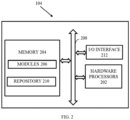
- FIG. 2 is a functional block diagram 200 of a server 104 and a plurality of clients of the system for federated learning based identification of non-malicious classification models, implemented by the architecture of FIG. 1 , in accordance with some embodiments of the present disclosure.
- the system 200 includes or is otherwise in communication with hardware processors 202, at least one memory such as a memory 204, an I/O interface 212.
- the hardware processors 202, memory 204, and the Input /Output (I/O) interface 212 may be coupled by a system bus such as a system bus 208 or a similar mechanism.
- the hardware processors 202 can be one or more hardware processors.
- the I/O interface 212 may include a variety of software and hardware interfaces, for example, a web interface, a graphical user interface, and the like.
- the I/O interface 212 may include a variety of software and hardware interfaces, for example, interfaces for peripheral device(s), such as a keyboard, a mouse, an external memory, a printer and the like. Further, the I/O interface 212 may enable the system 200 to communicate with other devices, such as web servers, and external databases.
- the I/O interface 212 can facilitate multiple communications within a wide variety of networks and protocol types, including wired networks, for example, local area network (LAN), cable, etc., and wireless networks, such as Wireless LAN (WLAN), cellular, or satellite.
- the I/O interface 212 may include one or more ports for connecting several computing systems with one another or to another server computer.
- the I/O interface 212 may include one or more ports for connecting several devices to one another or to another server.
- the one or more hardware processors 202 may be implemented as one or more microprocessors, microcomputers, microcontrollers, digital signal processors, central processing units, node machines, logic circuitries, and/or any devices that manipulate signals based on operational instructions.
- the one or more hardware processors 202 is configured to fetch and execute computer-readable instructions stored in the memory 204.
- the memory 204 may include any computer-readable medium known in the art including, for example, volatile memory, such as static random access memory (SRAM) and dynamic random access memory (DRAM), and/or non-volatile memory, such as read only memory (ROM), erasable programmable ROM, flash memories, hard disks, optical disks, and magnetic tapes.
- volatile memory such as static random access memory (SRAM) and dynamic random access memory (DRAM)
- non-volatile memory such as read only memory (ROM), erasable programmable ROM, flash memories, hard disks, optical disks, and magnetic tapes.
- the memory 204 includes a plurality of modules 206.
- the memory 204 also includes a data repository (or repository) 210 for storing data processed, received, and generated by the plurality of modules 206.
- the plurality of modules 206 include programs or coded instructions that supplement applications or functions performed by the system 200 for federated learning based identification of non-malicious classification models.
- the plurality of modules 206 can include routines, programs, objects, components, and data structures, which performs particular tasks or implement particular abstract data types.
- the plurality of modules 206 may also be used as, signal processor(s), node machine(s), logic circuitries, and/or any other device or component that manipulates signals based on operational instructions.
- the plurality of modules 206 can be used by hardware, by computer-readable instructions executed by the one or more hardware processors 202, or by a combination thereof.
- the plurality of modules 206 can include various sub-modules (not shown).
- the plurality of modules 206 may include computer-readable instructions that supplement applications or functions performed by the system 200 for federated learning based identification of non-malicious classification models.
- the plurality of modules 206 include a receiving module (shown in FIG. 4 ), a flattening module (shown in FIG. 4 ), a clustering module (shown in FIG. 4 ), an active models selection module (shown in FIG. 4 ), a global model selection module (shown in FIG. 4 ) and a transmission module (shown in FIG. 4 ).
- the data repository (or repository) 210 may include a plurality of abstracted piece of code for refinement and data that is processed, received, or generated as a result of the execution of the plurality of modules in the module(s) 206.
- the data repository 210 is shown internal to the system 200, it will be noted that, in alternate embodiments, the data repository 210 can also be implemented external to the system 200, where the data repository 210 may be stored within a database (repository 210) communicatively coupled to the system 200.
- the data contained within such external database may be periodically updated. For example, new data may be added into the database (not shown in FIG. 2 ) and/or existing data may be modified and/or non-useful data may be deleted from the database.
- the data may be stored in an external system, such as a Lightweight Directory Access Protocol (LDAP) directory and a Relational Database Management System (RDBMS).
- LDAP Lightweight Directory Access Protocol
- RDBMS Relational Database Management System
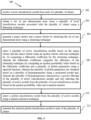
- FIG. 3 is an exemplary flow diagram illustrating the processor implemented method 300 for federated learning based identification of non-malicious classification models implemented by the server of FIG. 1 , in accordance with some embodiments of the present disclosure.
- the system 200 includes one or more data storage devices or the memory 204 operatively coupled to the one or more hardware processor(s) 202 and is configured to store instructions for execution of steps of the method 300 by the one or more hardware processors 202.
- the steps of the method 300 of the present disclosure will now be explained with reference to the components or blocks of the system 100 and the system 200 as depicted in FIGS. 1 and 2 and the steps of flow diagram as depicted in FIG. 3 .
- the method 300 may be described in the general context of computer executable instructions.
- computer executable instructions can include routines, programs, objects, components, data structures, procedures, modules, functions, etc., that perform particular functions or implement particular abstract data types.
- the method 300 may also be practiced in a distributed computing environment where functions are performed by remote processing devices that are linked through a communication network.
- the order in which the method 300 is described is not intended to be construed as a limitation, and any number of the described method blocks can be combined in any order to implement the method 300, or an alternative method.
- the method 300 can be implemented in any suitable hardware, software, firmware, or combination thereof.
- the one or more hardware processors 102 are configured by the programmed instructions to receive a local classification model from each of a plurality of clients.
- the plurality of clients represents a plurality of banks.
- the local classification model is pretrained to classify a plurality of transactions corresponding to each of the plurality of clients as one of, a plurality of malicious transaction and a plurality of non-malicious transaction.
- the one or more hardware processors 102 are configured by the programmed instructions to obtain a set of one dimensional array from a plurality of local classification models associated with the plurality of clients using a flattening technique.
- the flattening technique used here is Principal Component Analysis (PCA). Similar other techniques are also used for flattening.
- the one-dimensional array includes the vector representation of each of the plurality of local classification models.
- the set of one dimensional array is represented as [ ⁇ v 1 ⁇ , ⁇ v 2 ⁇ , ⁇ v 3 ⁇ ... ... .. ⁇ v n ⁇ ].
- the v 1 is the flattened vector corresponding to the local classification model associated with the client 1.
- v n is the flattened vector corresponding to the local classification model associated with the client n .
- the server Initializes a model M and is passed on to all the 10 banks.
- the banks will use this model M as the initial model and train their own local copies M 1 , M 2 , ... . M 10 based on the corresponding datasets D 1 , D 2 ... ... D 10 .
- the banks will send these models M 1 , M 2 , ... . M 10 to the server.
- Server collects it and store it in set W called the (entire) model set.
- the server flattens these models into 1D vectors as v 1 , v 2 ... ... ... v 10 .
- the one or more hardware processors 102 are configured by the programmed instructions to generate a major cluster and a minor cluster by clustering the set of one dimensional array using a clustering technique.
- the k-means clustering technique is used for clustering.
- the one or more hardware processors 102 are configured by the programmed instructions to select a plurality of active classification models based on the major cluster and the minor cluster using an epsilon cluster selection technique.
- the epsilon cluster selection technique includes the following steps. Initially, a Silhouette coefficient is computed for the clustering technique. The Silhouette coefficient indicates the efficiency of the clustering technique. Further, an epsilon probability value is computed based on the Silhouette coefficient and a plurality of global parameters using a sigmoid function. The plurality of global parameters is obtained based on a plurality of hyperparameters using a pretrained model.
- the plurality of hyperparameters characterizes a precise filtering of the plurality of active classification models.
- the plurality of active models are selected from the plurality of local classification models based on the corresponding epsilon probability value and a random number between 0.0 and 1.0.
- the random number is generated by a pseudo random number generation technique.
- a set of local classification models associated with the major cluster is selected as the plurality of active models if the random number is less than the epsilon probability.
- the plurality of local classification models are selected as the plurality of active models if the random number is greater than the epsilon probability.
- the Silhouette coefficient is alternatively referred as Silhouette score.
- the Silhouette score is used to evaluate the quality of clusters created using clustering algorithms such as K-Means in terms of how well samples are clustered with other samples that are similar to each other.
- the Silhouette score is calculated for each sample of different clusters.
- ' s ' is the Silhouette score
- ' a ' is a mean distance between an observation data point and all other data points in the same cluster. This distance is also called as mean intra-cluster distance.
- 'b' is a mean distance between the observation data point and all other data points of the next nearest cluster. This distance is also called as mean nearest cluster distance.
- the value of the Silhouette score varies from -1 to 1. If the score is 1, the cluster is dense and well-separated than other clusters. A value near 0 represents overlapping clusters with samples very close to the decision boundary of the neighboring clusters. A negative score [-1, 0] indicates that the samples might have got assigned to the wrong clusters.
- the clustering performed by the clustering technique is evaluated using the metric Silhouette score to get s.
- the goal is to select an active set A.
- L L U S ( U stands for set operation Union)
- W the entire model set.
- the Silhouette-score s is transformed into probability epsilon using the silhouette to epsilon logic as given in equation (2).
- ⁇ ⁇ W ⁇ ⁇ x + b ⁇
- one of L or W is selected as the active set as follows:
- a classification model is selected from A at random to get global model M for the next federated round.
- weight W ⁇ and bias b ⁇ are utilized. These are computed once per federated learning process. This is done when server is launched and initialized. The user chooses two hyperparameters p and q , from the range of silhouette-score.
- p is the Silhouette coefficient value that should ideally transform into a probability 0.5.
- q is a Silhouette coefficient value that should ideally transform into a probability 0.9.
- the sigmoid function is computed with the data using equation (2), wherein x is the vector that represents Silhouette coefficient inputs [0,1, p , q ] and y is the vector representing their ideal epsilon values [0,1, 0.5, 0.9].
- the method of obtaining the plurality of global parameters by the pretrained includes the following steps. Initially, a plurality of hyperparameters are initialized based on the Silhouette coefficient. For example, the initialized values of the plurality of hyperparameters are in the range of Silhouette coefficient. Further, a plurality of parameters associated with a sigmoid activation function are optimized based on the plurality of hyperparameters until a minimum loss is obtained. The plurality of parameters associated with the sigmoid activation function comprises a weight parameter and a bias parameter. Finally, the plurality of parameters associated with the sigmoid activation with minimum loss are selected as the plurality of global parameters.
- the Silhouette score is used to generate a probability ⁇ (epsilon probability) which enabled the chance of choosing the largest cluster over the entire active set.
- ⁇ epsilon probability
- a linear scaling of Silhouette-score to ⁇ is done.
- a sigmoid function is used later to fit using two pivot-points taken from Silhouette-score's range.
- the first pivot point p may provide an ⁇ value of 0.5 (equal probability) and the second point q may lead to an ⁇ value of 0.9 (high probability to choose largest cluster).
- the pivot points p and q are hyper-parameters defined to be manually tuned to vary the strictness of the filtering process done against malicious nodes detected in the minority cluster.
- the one or more hardware processors 102 are configured by the programmed instructions to select a global classification model from the plurality of active models using a random selection technique.
- a global classification model is selected at random from the plurality of active models.
- the plurality of active models are aggregated to generate an aggregated model and the aggregated model is considered as the global classification model.
- the one or more hardware processors 102 are configured by the programmed instructions to transmit the selected global classification model to each of the plurality of clients.
- FIG. 4 is an example functional architecture 400 for the processor implemented method for federated learning based identification of non-malicious classification models implemented by the server of FIG. 1 , in accordance with some embodiments of the present disclosure.
- the functional architecture 400 includes a receiving module 402, a flattening module 404, a clustering module 406, an active models selection module 408, a global model selection module 416 and a transmission module 418.
- the active models selection module 408 further includes a Silhouette coefficient computation module 410, an epsilon probability computation module 412 and a threshold based active models selection module 414.
- the receiving module 402 receives the local classification model from each of the plurality of clients.
- the flattening module 404 obtains the set of one-dimensional array from the plurality of local classification models associated with the plurality of clients using the flattening technique.
- the clustering module 406 generates the major cluster and the minor cluster by clustering the set of one-dimensional array using the clustering technique.
- the active models selection module 408 initially computes the Silhouette coefficient for the clustering technique by the Silhouette coefficient computation module 410.
- the Silhouette coefficient computes the efficiency of the clustering technique.
- the active models selection module 408 further computes the epsilon probability value based on the Silhouette coefficient and a plurality of global parameters using a sigmoid function by the epsilon probability computation module 412.
- the plurality of global parameters are obtained based on a plurality of hyperparameters using the pretrained model.
- the plurality of hyperparameters characterizes the precise filtering of the plurality of active classification models.
- the active models selection module 408 selects the plurality of active models from the plurality of local classification models based on the corresponding epsilon probability value and the random number using the threshold based active models selection module 414.
- the global classification model is selected from the plurality of active models using a random selection technique by the global model selection module 416 and the selected global classification models are further transmitted to each of the plurality of clients by the transmission module 418.
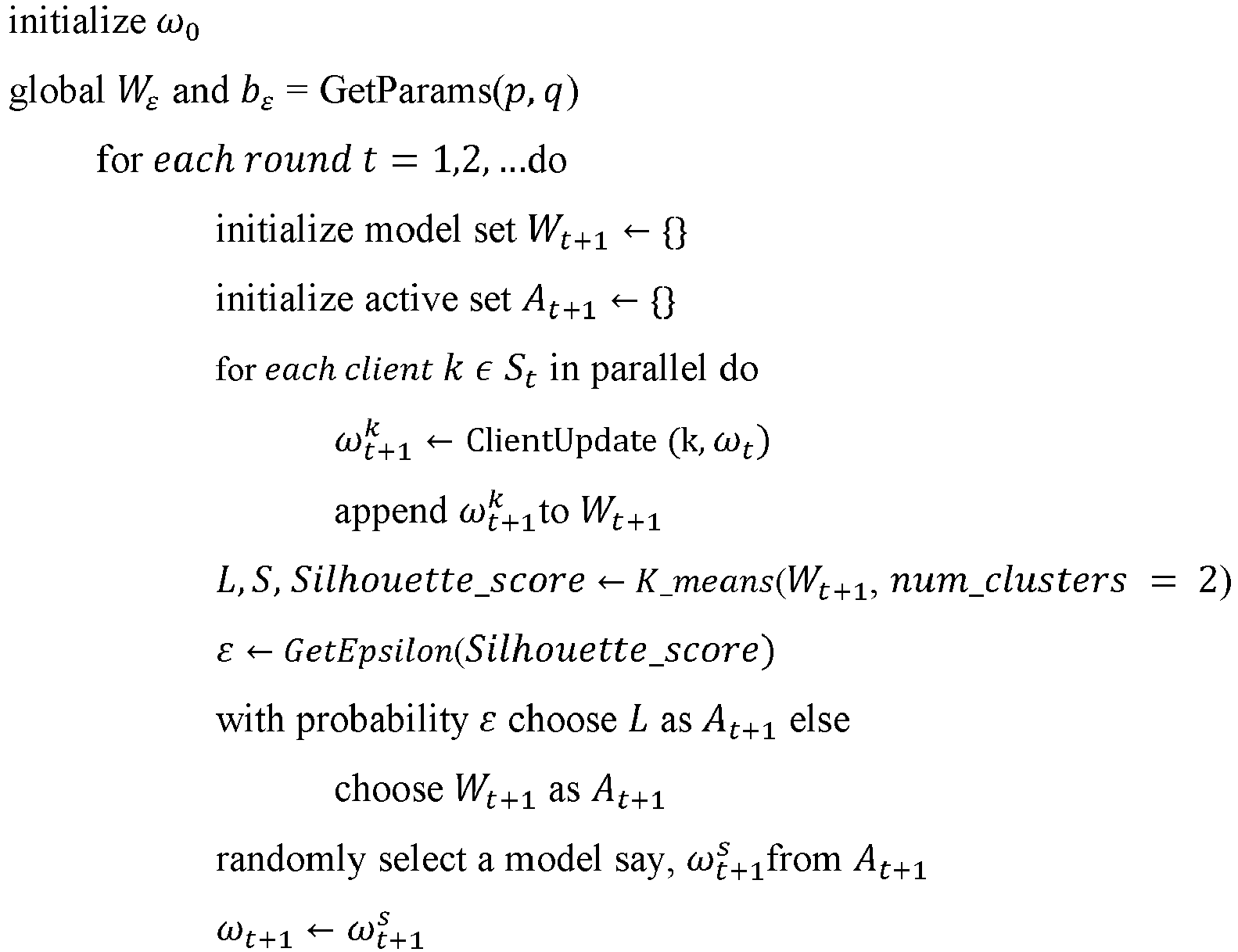
- a pseudocode for the processor implemented method for federated learning based identification of non-malicious classification models is given below.
- S t is the plurality of clients.
- Set L and set S are the largest and smallest clusters respectively resulted from clustering.
- D k is the dataset held by client k.
- W ⁇ and b ⁇ are maintained in global scope on the server, p and q are the pivot points where p is the silhouette-score that should produce ⁇ value of 0.5 and q should produce 0.9.
- ⁇ is the probability with which the largest cluster of models is chosen as active set A t +1 as opposed to the whole model set W t +1 .
- the function ClientUpdate ( k , w ) is executed by each of the plurality of clients.
- each client/bank trains a model using its own dataset for a specific number of epochs or batches within an epoch.
- the function GetParams ( p, q ) is executed by the server after initialization of the FL process to find the values of weight parameter W ⁇ and bias parameter b ⁇ .
- the input to this is the user defined hyperparameters p and q .
- the output of thus function is the updated weight W ⁇ and bias b ⁇ which are later used to transform silhouette score to epsilon probability.
- the function GetEpsilon ( Silhouette_score ) is a transformation function that converts a given silhouette score to an epsilon probability in the range of 0 to 1. This is a nonlinear transformation using the sigmoid curve.
- the present disclosure is experimented as follows:
- the present disclosure is implemented using Syft (a federated learning library).
- Syft a federated learning library
- the experimental setup includes a server and ten clients defined using the VirtualWorker abstraction of Syft. None of the clients were allowed to communicate with each other.
- the server had direct links to each of the clients.
- the server follows synchronous aggregation strategy, where the server will wait for all the clients to update their respective models to the server during a federated round. Once the server receives all the local models, it will perform aggregation or selection.
- a neural architecture is designed with ten layers and residual (skip) connections between the layers.
- the network was initialized by the server using Glorot initialization.
- the local model is trained for five epochs as a larger number of local epochs led to over-fitting as federated training progressed.
- the local models are trained sequentially. Once the local models are trained, they are sent to the server. This is done one after the other. In practice, local models are trained and retrieved in parallel. Experiments were executed in an nVidia Tesla V100 GPU on DGX- 1 system.
- Procuring real world banking transaction datasets proved to be difficult.
- the present disclosure utilized synthetic dataset called Paysim.
- the dataset is highly skewed with the proportion of positive points in the dataset being 0.001.
- the dataset is split into ten different partitions in two ways.
- the two ways include an IID (Independent and Identically Distributed) split for benchmark and a non-IID split for experimentation. These ten partitions are considered to represent the datasets of ten banks during experimentation.
- federated learning is used to train a generalized model using data from multiple silos or devices with different distributions.
- datasets with the same feature space from multiple banks that operate differently are needed. It is difficult to acquire such real world datasets, especially from banks and hence such a setting was simulated using an available fraudulent transaction detection dataset.
- these ten clusters are assigned as ten cross-silo non-IID datasets assumed to be from ten banks which could challenge our federated aggregation algorithm.
- IID a random split of the dataset into 10 silos.
- out of ten banks we set a total number of 0, 1, 2 and 3 banks as malicious.
- a model is said to be malicious if it is trained from a client's data set whose one or more data labels are flipped.
- a label field of a transaction is flipped from '0' to '1' or from '1' to '0'.
- the label field for a genuine transaction is set to ' 1' and for fraudulent transaction, the label field is set to '0'.
- the label flipping alters the genuine transaction as the fraudulent transaction and vice versa.
- f 1 - score is used as metric.
- the f 1 - score is defined as the harmonic mean of precision and recall. The average of f 1 - scores of all the banks which are detected as non-malicious by the algorithm.
- the experiment is repeated four times with respect to the number of malicious banks.
- the malicious bank is simulated by training the bank with the flipped dataset (fraudulent). Initially, no malicious banks were set. Then one, two and three banks as malicious for the subsequent experiments for that IID or non-IID setting. For comparison, trained centralized models on the data are used for an equivalent number of epochs and the centralized benchmarks are shown in Table I. Table I Sl.No Percentage of malicious data in the data set f1_score 1 0% 0.77 2 10% 0.75 3 20% 0.45 4 30% 0.45
- the present disclosure was also able to correctly identify the malicious banks despite the high model variance. This helps the server to flag banks which are acting suspicious during training. As part of experimentation, to demonstrate the detection of malicious banks by the present disclosure, the banks 9, 2 and 1 are simulated as malicious (since they had the highest imbalance ratio).
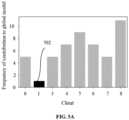
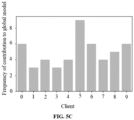
- FIGS. 5A to 5D illustrates experimental details for the processor implemented method for federated learning based identification of non-malicious classification models implemented by the system of FIG. 1 , in accordance with some embodiments of the present disclosure.
- x-axis indicates banks and the y-axis indicates a number of times a bank is selected as the global model in a federated round. It is evident from FIG. 5A that out of all three malicious banks, only one bank 502, ie bank 1 is selected, that too, only once out of a total of 50 federated rounds. This implies that the present disclosure works to detect and prevent malicious models from contributing to global model with high probability.
- the present disclosure is able to identify and limit the contribution of malicious models by the server as shown in FIG. 5B .
- the malicious bank 2 504 contributed the least to the model while the malicious banks 1 and 9 did not contribute during the run.
- the presence of Silhouette-score-to-epsilon logic in the present disclosure made sure that no bank will be left out in the case that there are no malicious banks in the non-IID setting as shown in FIG. 5C .
- FIG. 5C it is evident that all banks from Bank 0 to Bank 9 is contributing in the non IID setting. This is achieved because the Silhouette-scores of clustering in the presence of malicious models are higher than the score with all the models set as non-malicious.
- FIG. 5D shows the silhouette score obtained in each federated round for all four settings.
- the four settings include (i) zero poisoning (ii) poisoning with one malicious bank (iii) poisoning with 2 malicious banks and (iv) poisoning with 3 malicious banks.
- the zero poisoning is shown in the line graph 512
- the poisoning with one malicious bank is shown in the line graph 514
- the poisoning with two malicious banks is shown in the line graph 516
- the poisoning with three malicious banks is shown in the line graph 518.
- the silhouette score obtained is less compared to malicious settings.
- the lines parallel to x axis 520 and 522 denotes the hyperparameters p and q .
- the embodiments of present disclosure herein address the unresolved problem of developing a robust federated learning technique for detecting fraudulent transactions in banks with dissimilar dataset distributions and under malicious banks setting.
- an epsilon probability and a random number based selection technique is used for selecting a cluster of models as active models to avoid bias due to cluster size.
- the present disclosure helps to identify malicious clients or banks with maximum probability.
- the hardware device can be any kind of device which can be programmed including e.g. any kind of computer like a server or a personal computer, or the like, or any combination thereof.
- the device may also include means which could be e.g. hardware means like e.g. an application-specific integrated circuit (ASIC), a field-programmable gate array (FPGA), or a combination of hardware and software means, e.g.
- ASIC application-specific integrated circuit
- FPGA field-programmable gate array
- the means can include both hardware means and software means.
- the method embodiments described herein could be implemented in hardware and software.
- the device may also include software means.
- the embodiments may be implemented on different hardware devices, e.g. using a plurality of CPUs, GPUs and edge computing devices.
- the embodiments herein can comprise hardware and software elements.
- the embodiments that are implemented in software include but are not limited to, firmware, resident software, microcode, etc.
- the functions performed by various modules described herein may be implemented in other modules or combinations of other modules.
- a computer-usable or computer readable medium can be any apparatus that can comprise, store, communicate, propagate, or transport the program for use by or in connection with the instruction execution system, apparatus, or device.
- the illustrated steps are set out to explain the exemplary embodiments shown, and it should be anticipated that ongoing technological development will change the manner in which particular functions are performed. These examples are presented herein for purposes of illustration, and not limitation. Further, the boundaries of the functional building blocks have been arbitrarily defined herein for the convenience of the description.
- a computer-readable storage medium refers to any type of physical memory on which information or data readable by a processor may be stored.
- a computer-readable storage medium may store instructions for execution by one or more processors, including instructions for causing the processor(s) to perform steps or stages consistent with the embodiments described herein.
- the term "computer-readable medium” should be understood to include tangible items and exclude carrier waves and transient signals, i.e. non-transitory. Examples include random access memory (RAM), read-only memory (ROM), volatile memory, nonvolatile memory, hard drives, CD ROMs, DVDs, flash drives, disks, and any other known physical storage media.
Landscapes
- Engineering & Computer Science (AREA)
- Theoretical Computer Science (AREA)
- Physics & Mathematics (AREA)
- Software Systems (AREA)
- Computing Systems (AREA)
- General Physics & Mathematics (AREA)
- General Engineering & Computer Science (AREA)
- Artificial Intelligence (AREA)
- Mathematical Physics (AREA)
- Data Mining & Analysis (AREA)
- Evolutionary Computation (AREA)
- Computational Linguistics (AREA)
- Business, Economics & Management (AREA)
- General Health & Medical Sciences (AREA)
- Biophysics (AREA)
- Biomedical Technology (AREA)
- Life Sciences & Earth Sciences (AREA)
- Health & Medical Sciences (AREA)
- Computer Security & Cryptography (AREA)
- Molecular Biology (AREA)
- Accounting & Taxation (AREA)
- Computer Vision & Pattern Recognition (AREA)
- Medical Informatics (AREA)
- Computer Networks & Wireless Communication (AREA)
- Signal Processing (AREA)
- Computer Hardware Design (AREA)
- Finance (AREA)
- Strategic Management (AREA)
- General Business, Economics & Management (AREA)
- Information Retrieval, Db Structures And Fs Structures Therefor (AREA)
Abstract
Description
- The present application claims priority to
Indian application no. 202121057062, filed on December 8, 2021 - The disclosure herein generally relates to the field of machine learning and, more particular, to a method and system for federated learning based identification of non-malicious classification models.
- Fraudulent transaction detection is an important problem in the banking domain since it causes huge monetary loss. Contemporary data driven fraudulent transaction detection strategies generally use transactions dataset of a bank to train a model and then the trained model is used to classify whether a new transaction is fraudulent or not in real time. A unique limitation of this particular problem is that, even if labelled data is readily available, the ratio of fraudulent to genuine transactions is highly skewed. For example, there is a possibility that in a set of thousand transactions, only one may be fraudulent. Hence it is important for banks to learn up on the different types of fraudulent transactions that occur across different banks so that one bank will be aware of a new fraudulent transaction that occurred on another bank comes its way. Hence, a model of a bank should be generalized across all types of fraudulent transactions which can only be done by collaboration between banks through Federated Learning (FL)
- Conventional methods are facing two major challenges to build federated fraudulent transaction detection model. The challenges includes (i) the distribution of the datasets held by each of the participating banks are different from each other which impacts the robustness of the federated learning model and (ii) providing malicious model updates (model poisoning) to the server by the clients. Further the conventional methods suffer from false positives tagged by malicious clients. These two challenges are solved by the conventional methods in a mutually exclusive manner. Thus, a holistic FL based method to address the said challenges is not available.
- Embodiments of the present disclosure present technological improvements as solutions to one or more of the above-mentioned technical problems recognized by the inventors in conventional systems. For example, in one embodiment, a method for federated learning based identification of non-malicious classification models is provided. The method includes receiving, by one or more hardware processors, a local classification model from each of a plurality of clients. The local classification model is pretrained to classify a plurality of transactions corresponding to each of the plurality of clients as one of, a plurality of malicious transaction and a plurality of non-malicious transaction. Further, the method includes obtaining, by the one or more hardware processors, a set of one dimensional array based on a plurality of local classification models associated with the plurality of clients using a flattening technique. Furthermore, the method includes obtaining, by the one or more hardware processors, a major cluster and a minor cluster by clustering the set of one-dimensional arrays using a clustering technique. Furthermore, the method includes selecting, by the one or more hardware processors, a plurality of active classification models based on the major cluster and the minor cluster using an epsilon cluster selection technique by: (i) computing a Silhouette coefficient for the clustering technique, wherein the Silhouette coefficient indicates the efficiency of the clustering technique (ii) computing an epsilon probability value based on the Silhouette coefficient and a plurality of global parameters, wherein the plurality of global parameters are obtained based on a plurality of hyperparameters using a pretrained model, and wherein the plurality of hyperparameters characterize a precise filtering of the plurality of active classification models and (iii) selecting the plurality of active models from the plurality of local classification models based on the epsilon probability value and a random number. Furthermore, the method includes selecting, by the one or more hardware processors, a global classification model from the plurality of active models using a random selection technique. Finally, the method includes transmitting, by one or more hardware processors, the selected global classification model to each of the plurality of clients.
- In another aspect, a system for federated learning based identification of non-malicious classification models is provided. The system includes a plurality of clients connected to a server, wherein the server comprises at least one memory storing programmed instructions, one or more Input /Output (I/O) interfaces, and one or more hardware processors operatively coupled to the at least one memory, wherein the one or more hardware processors of the server are configured by the programmed instructions to receive a local classification model from each of a plurality of clients. The local classification model is pretrained to classify a plurality of transactions corresponding to each of the plurality of clients as one of, a plurality of malicious transaction and a plurality of non-malicious transaction. Further, the one or more hardware processors of the server are configured by the programmed instructions to obtain a set of one dimensional arrays based on a plurality of local classification models associated with the plurality of clients using a flattening technique. Furthermore, the one or more hardware processors of the server are configured by the programmed instructions to obtain a major cluster and a minor cluster by clustering the set of one-dimensional arrays using a clustering technique. Furthermore, the one or more hardware processors of the server are configured by the programmed instructions to select a plurality of active classification models based on the major cluster and the minor cluster using an epsilon cluster selection technique by: (i) computing a Silhouette coefficient for the clustering technique, wherein the Silhouette coefficient indicates the efficiency of the clustering technique (ii) computing an epsilon probability value based on the Silhouette coefficient and a plurality of global parameters, wherein the plurality of global parameters are obtained based on a plurality of hyperparameters using a pretrained model, and wherein the plurality of hyperparameters characterize a precise filtering of the plurality of active classification models and (iii) selecting the plurality of active models from the plurality of local classification models based on the epsilon probability value and a random number. Furthermore, the one or more hardware processors of the server are configured by the programmed instructions to select a global classification model from the plurality of active models using a random selection technique. Finally, the one or more hardware processors of the server are configured by the programmed instructions to transmit the selected global classification model to each of the plurality of clients.
- In yet another aspect, a computer program product including a non-transitory computer-readable medium having embodied therein a computer program for federated learning based identification of non-malicious classification models is provided. The computer readable program, when executed on a computing device, causes the computing device to receive a local classification model from each of a plurality of clients. The local classification model is pretrained to classify a plurality of transactions corresponding to each of the plurality of clients as one of, a plurality of malicious transaction and a plurality of non-malicious transaction. Further, computer readable program, when executed on a computing device, causes the computing device to obtain a set of one dimensional arrays based on a plurality of local classification models associated with the plurality of clients using a flattening technique. Furthermore, computer readable program, when executed on a computing device, causes the computing device to obtain a major cluster and a minor cluster by clustering the set of one-dimensional arrays using a clustering technique. Furthermore, computer readable program, when executed on a computing device, causes the computing device to select a plurality of active classification models based on the major cluster and the minor cluster using an epsilon cluster selection technique by: (i) computing a Silhouette coefficient for the clustering technique, wherein the Silhouette coefficient indicates the efficiency of the clustering technique (ii) computing an epsilon probability value based on the Silhouette coefficient and a plurality of global parameters, wherein the plurality of global parameters are obtained based on a plurality of hyperparameters using a pretrained model, and wherein the plurality of hyperparameters characterize a precise filtering of the plurality of active classification models and (iii) selecting the plurality of active models from the plurality of local classification models based on the epsilon probability value and a random number. Furthermore, computer readable program, when executed on a computing device, causes the computing device to select a global classification model from the plurality of active models using a random selection technique. Finally, computer readable program, when executed on a computing device, causes the computing device to transmit the selected global classification model to each of the plurality of clients.
- It is to be understood that both the foregoing general description and the following detailed description are exemplary and explanatory only and are not restrictive of the invention, as claimed.
- The accompanying drawings, which are incorporated in and constitute a part of this disclosure, illustrate exemplary embodiments and, together with the description, serve to explain the disclosed principles:
-
FIG. 1 is a client server architecture for a system for federated learning based identification of non-malicious classification models, in accordance with some embodiments of the present disclosure. -
FIG. 2 is a functional block diagram of a server and a plurality of clients of the system of federated learning based identification of non-malicious classification models, implemented by the system ofFIG. 1 , in accordance with some embodiments of the present disclosure. -
FIG. 3 is an exemplary flow diagram illustrating the processor implemented method for federated learning based identification of non-malicious classification models implemented by the server ofFIG. 1 , in accordance with some embodiments of the present disclosure. -
FIG. 4 is an example functional architecture for the processor implemented method for federated learning based identification of non-malicious classification models implemented by the server ofFIG. 1 , in accordance with some embodiments of the present disclosure. -
FIGS. 5A through 5D illustrates experimental details for the processor implemented method for federated learning based identification of non-malicious classification models implemented by the system ofFIG. 1 , in accordance with some embodiments of the present disclosure. - Exemplary embodiments are described with reference to the accompanying drawings. In the figures, the left-most digit(s) of a reference number identifies the figure in which the reference number first appears. Wherever convenient, the same reference numbers are used throughout the drawings to refer to the same or like parts. While examples and features of disclosed principles are described herein, modifications, adaptations, and other implementations are possible without departing from the scope of the disclosed embodiments.
- Embodiments herein provide a method and system for federated learning based identification of non-malicious classification models. Initially, the system receives a local classification model from each of a plurality of clients. The local classification model is pretrained to classify a plurality of transactions corresponding to each of the plurality of clients as one of, a plurality of malicious transaction and a plurality of non-malicious transaction. Further, a set of one-dimensional arrays are obtained based on a plurality of local classification models associated with the plurality of clients using a flattening technique. Further, a major cluster and a minor cluster are obtained by clustering the set of one-dimensional arrays using a clustering technique. After clustering, a plurality of active classification models are selected based on the major cluster and the minor cluster using an epsilon cluster selection technique. Further, a global classification model is selected from the plurality of active models using a random selection technique. Finally, the selected global classification model is transmitted to each of the plurality of clients.
- Referring now to the drawings, and more particularly to
FIGS. 1 through 5D , where similar reference characters denote corresponding features consistently throughout the figures, there are shown preferred embodiments and these embodiments are described in the context of the following exemplary system and/or method. -
FIG. 1 is a client server architecture for asystem 100 for federated learning based identification of non-malicious classification models, in accordance with some embodiments of the present disclosure. Thearchitecture 100 includes a plurality of clients 102A, 102B, ....., 102N, aserver 104 and a plurality ofnetwork connections network connections 106A to 106N connects each of the corresponding plurality of clients to theserver 104. For example, the client 102A is connected to theserver 104 through thenetwork connection 106A. Similarly, other clients are connected to the server using the corresponding network connection. The plurality of clients 102A, 102B, ....., 102N are not connected to each other. In an embodiment, each of the plurality ofnetwork connections 106A through 106N is a wired communication network or a wireless communication network. -
FIG. 2 is a functional block diagram 200 of aserver 104 and a plurality of clients of the system for federated learning based identification of non-malicious classification models, implemented by the architecture ofFIG. 1 , in accordance with some embodiments of the present disclosure. The system 200 includes or is otherwise in communication withhardware processors 202, at least one memory such as amemory 204, an I/O interface 212. Thehardware processors 202,memory 204, and the Input /Output (I/O)interface 212 may be coupled by a system bus such as asystem bus 208 or a similar mechanism. In an embodiment, thehardware processors 202 can be one or more hardware processors. - The I/
O interface 212 may include a variety of software and hardware interfaces, for example, a web interface, a graphical user interface, and the like. The I/O interface 212 may include a variety of software and hardware interfaces, for example, interfaces for peripheral device(s), such as a keyboard, a mouse, an external memory, a printer and the like. Further, the I/O interface 212 may enable the system 200 to communicate with other devices, such as web servers, and external databases. - The I/
O interface 212 can facilitate multiple communications within a wide variety of networks and protocol types, including wired networks, for example, local area network (LAN), cable, etc., and wireless networks, such as Wireless LAN (WLAN), cellular, or satellite. For the purpose, the I/O interface 212 may include one or more ports for connecting several computing systems with one another or to another server computer. The I/O interface 212 may include one or more ports for connecting several devices to one another or to another server. - The one or
more hardware processors 202 may be implemented as one or more microprocessors, microcomputers, microcontrollers, digital signal processors, central processing units, node machines, logic circuitries, and/or any devices that manipulate signals based on operational instructions. Among other capabilities, the one ormore hardware processors 202 is configured to fetch and execute computer-readable instructions stored in thememory 204. - The
memory 204 may include any computer-readable medium known in the art including, for example, volatile memory, such as static random access memory (SRAM) and dynamic random access memory (DRAM), and/or non-volatile memory, such as read only memory (ROM), erasable programmable ROM, flash memories, hard disks, optical disks, and magnetic tapes. In an embodiment, thememory 204 includes a plurality ofmodules 206. Thememory 204 also includes a data repository (or repository) 210 for storing data processed, received, and generated by the plurality ofmodules 206. - The plurality of
modules 206 include programs or coded instructions that supplement applications or functions performed by the system 200 for federated learning based identification of non-malicious classification models. The plurality ofmodules 206, amongst other things, can include routines, programs, objects, components, and data structures, which performs particular tasks or implement particular abstract data types. The plurality ofmodules 206 may also be used as, signal processor(s), node machine(s), logic circuitries, and/or any other device or component that manipulates signals based on operational instructions. Further, the plurality ofmodules 206 can be used by hardware, by computer-readable instructions executed by the one ormore hardware processors 202, or by a combination thereof. The plurality ofmodules 206 can include various sub-modules (not shown). The plurality ofmodules 206 may include computer-readable instructions that supplement applications or functions performed by the system 200 for federated learning based identification of non-malicious classification models. In an embodiment, the plurality ofmodules 206 include a receiving module (shown inFIG. 4 ), a flattening module (shown inFIG. 4 ), a clustering module (shown inFIG. 4 ), an active models selection module (shown inFIG. 4 ), a global model selection module (shown inFIG. 4 ) and a transmission module (shown inFIG. 4 ). - The data repository (or repository) 210 may include a plurality of abstracted piece of code for refinement and data that is processed, received, or generated as a result of the execution of the plurality of modules in the module(s) 206.
- Although the
data repository 210 is shown internal to the system 200, it will be noted that, in alternate embodiments, thedata repository 210 can also be implemented external to the system 200, where thedata repository 210 may be stored within a database (repository 210) communicatively coupled to the system 200. The data contained within such external database may be periodically updated. For example, new data may be added into the database (not shown inFIG. 2 ) and/or existing data may be modified and/or non-useful data may be deleted from the database. In one example, the data may be stored in an external system, such as a Lightweight Directory Access Protocol (LDAP) directory and a Relational Database Management System (RDBMS). -
FIG. 3 is an exemplary flow diagram illustrating the processor implementedmethod 300 for federated learning based identification of non-malicious classification models implemented by the server ofFIG. 1 , in accordance with some embodiments of the present disclosure. - In an embodiment, the system 200 includes one or more data storage devices or the
memory 204 operatively coupled to the one or more hardware processor(s) 202 and is configured to store instructions for execution of steps of themethod 300 by the one ormore hardware processors 202. The steps of themethod 300 of the present disclosure will now be explained with reference to the components or blocks of thesystem 100 and the system 200 as depicted inFIGS. 1 and2 and the steps of flow diagram as depicted inFIG. 3 . Themethod 300 may be described in the general context of computer executable instructions. Generally, computer executable instructions can include routines, programs, objects, components, data structures, procedures, modules, functions, etc., that perform particular functions or implement particular abstract data types. Themethod 300 may also be practiced in a distributed computing environment where functions are performed by remote processing devices that are linked through a communication network. The order in which themethod 300 is described is not intended to be construed as a limitation, and any number of the described method blocks can be combined in any order to implement themethod 300, or an alternative method. Furthermore, themethod 300 can be implemented in any suitable hardware, software, firmware, or combination thereof. - At
step 302 of themethod 300, the one ormore hardware processors 102 are configured by the programmed instructions to receive a local classification model from each of a plurality of clients. In an embodiment, the plurality of clients represents a plurality of banks. The local classification model is pretrained to classify a plurality of transactions corresponding to each of the plurality of clients as one of, a plurality of malicious transaction and a plurality of non-malicious transaction. - At
step 304 of themethod 300, the one ormore hardware processors 102 are configured by the programmed instructions to obtain a set of one dimensional array from a plurality of local classification models associated with the plurality of clients using a flattening technique. In an embodiment, the flattening technique used here is Principal Component Analysis (PCA). Similar other techniques are also used for flattening. In an embodiment, the one-dimensional array includes the vector representation of each of the plurality of local classification models. For example, the set of one dimensional array is represented as [{v 1}, {v 2}, {v 3} ... ... .. {vn }]. Here, the v 1 is the flattened vector corresponding to the local classification model associated with theclient 1. Similarly, vn is the flattened vector corresponding to the local classification model associated with the client n. - For example, considering the number of participating banks as 10 and are represented as B 1, B 2, ... . B 10. The server Initializes a model M and is passed on to all the 10 banks. The banks will use this model M as the initial model and train their own local copies M 1, M2 , ... . M 10 based on the corresponding datasets D 1, D 2 ... ... D 10. Now the banks will send these models M 1, M 2 , ... . M 10 to the server. Server collects it and store it in set W called the (entire) model set. The server flattens these models into 1D vectors as v 1 , v 2 ... ... ... v 10.
- At
step 306 of themethod 300, the one ormore hardware processors 102 are configured by the programmed instructions to generate a major cluster and a minor cluster by clustering the set of one dimensional array using a clustering technique. In an embodiment, the k-means clustering technique is used for clustering. For example, the vectors [{v 1}, {v 2}, {v 3} ... ... .. {v 10}] are clustered with num_clusters = 2 which results in two clusters L and S, the larger and Smaller cluster respectively. - At
step 308 of themethod 300, the one ormore hardware processors 102 are configured by the programmed instructions to select a plurality of active classification models based on the major cluster and the minor cluster using an epsilon cluster selection technique. The epsilon cluster selection technique includes the following steps. Initially, a Silhouette coefficient is computed for the clustering technique. The Silhouette coefficient indicates the efficiency of the clustering technique. Further, an epsilon probability value is computed based on the Silhouette coefficient and a plurality of global parameters using a sigmoid function. The plurality of global parameters is obtained based on a plurality of hyperparameters using a pretrained model. The plurality of hyperparameters characterizes a precise filtering of the plurality of active classification models. Finally, the plurality of active models are selected from the plurality of local classification models based on the corresponding epsilon probability value and a random number between 0.0 and 1.0. The random number is generated by a pseudo random number generation technique. A set of local classification models associated with the major cluster is selected as the plurality of active models if the random number is less than the epsilon probability. The plurality of local classification models are selected as the plurality of active models if the random number is greater than the epsilon probability. The Silhouette coefficient is alternatively referred as Silhouette score. - In an embodiment, the Silhouette score is used to evaluate the quality of clusters created using clustering algorithms such as K-Means in terms of how well samples are clustered with other samples that are similar to each other. The Silhouette score is calculated for each sample of different clusters. The Silhouette score is computed using the formula given in equation (1).

- Now referring to equation (1), 's' is the Silhouette score, 'a' is a mean distance between an observation data point and all other data points in the same cluster. This distance is also called as mean intra-cluster distance. 'b' is a mean distance between the observation data point and all other data points of the next nearest cluster. This distance is also called as mean nearest cluster distance. The value of the Silhouette score varies from -1 to 1. If the score is 1, the cluster is dense and well-separated than other clusters. A value near 0 represents overlapping clusters with samples very close to the decision boundary of the neighboring clusters. A negative score [-1, 0] indicates that the samples might have got assigned to the wrong clusters. For example, the clustering performed by the clustering technique is evaluated using the metric Silhouette score to get s. The goal is to select an active set A. There are two possibilities either to select L as A or select W as A, where W is the entire model set. (Also W = L U S (U stands for set operation Union)). For choosing from either of these possibilities, the Silhouette-score s is transformed into probability epsilon using the silhouette to epsilon logic as given in equation (2).

- Further, based on epsilon probability ε, one of L or W is selected as the active set as follows:
      Generate random number r between 0.0 and 1.0
      If r < ε:
             choose L as A
    Else:
             choose W as A

| Sl.No | Percentage of malicious data in the data set | f1_score |
| 1 | 0% | 0.77 |
| 2 | 10% | 0.75 |
| 3 | 20% | 0.45 |
| 4 | 30% | 0.45 |
| Sl.No | Setting | Number of malicious banks out of 10 banks | f1 (conventional method) | f1(present disclosure) |
| 1 | | 0 | 0.65 | 0.59 |
| 2 | 1 | 0.59 | 0.59 | |
| 3 | 2 | 0.58 | 0.59 | |
| 4 | 3 | 0.49 | 0.62 | |
| 1 | | 0 | 0.56 | 0.58 |
| 2 | 1 | 0.53 | 0.53 | |
| 3 | 2 | 0.42 | 0.58 | |
| 4 | 3 | 0.39 | 0.65 |
Claims (15)
- A processor implemented method (300), the method comprising:receiving (302), by one or more hardware processors, a local classification model from each of a plurality of clients, wherein the local classification model is pretrained to classify a plurality of transactions corresponding to each of the plurality of clients as one of, a plurality of malicious transaction and a plurality of non-malicious transaction;obtaining (304), by the one or more hardware processors, a set of one dimensional arrays based on a plurality of local classification models associated with the plurality of clients using a flattening technique;obtaining (306), by the one or more hardware processors, a major cluster and a minor cluster by clustering the set of one-dimensional arrays using a clustering technique;selecting (308), by the one or more hardware processors, a plurality of active classification models based on the major cluster and the minor cluster using an epsilon cluster selection technique by:computing a Silhouette coefficient for the clustering technique, wherein the Silhouette coefficient indicates the efficiency of the clustering technique;computing an epsilon probability value based on the Silhouette coefficient and a plurality of global parameters, wherein the plurality of global parameters are obtained based on a plurality of hyperparameters using a pretrained model, and wherein the plurality of hyperparameters characterize a precise filtering of the plurality of active classification models; andselecting the plurality of active models from the plurality of local classification models based on the epsilon probability value and a random number;selecting (310), by the one or more hardware processors, a global classification model from the plurality of active models using a random selection technique; andtransmitting (312), by one or more hardware processors, the selected global classification model to each of the plurality of clients.
- The method of claim 1, wherein a set of local classification models associated with the major cluster is selected as the plurality of active models if the random number is less than the epsilon probability.
- The method of claim 1, wherein the plurality of local classification models are selected as the plurality of active models if the random number is greater than the epsilon probability.
- The method of claim 1, wherein the server is directly connected to each of the plurality of clients and, wherein each of the plurality of clients are communicating with each other via the server.
- The method of claim 1, wherein the method of obtaining the plurality of global parameters by the pretrained model comprises:initializing a plurality of hyperparameters, wherein the plurality of hyperparameters are initialized based on the Silhouette coefficient;optimizing a plurality of parameters associated with a sigmoid activation function based on the plurality of hyperparameters until a minimum loss is obtained, wherein the plurality of parameters associated with the sigmoid activation function comprises a weight parameter and a bias parameter; andselecting the plurality of parameters, associated with the sigmoid activation with minimum loss, as the plurality of global parameters.
- The method of claim 1, further comprising identifying a plurality of malicious classification models by the server based on the major cluster and the minor cluster, wherein the plurality of classification models associated with the minor cluster are suspected to be malicious with high probability.
- A system (100) comprising:
a plurality of clients connected to a server, wherein the server comprises at least one memory (204) storing programmed instructions; one or more Input /Output (I/O) interfaces (212); and one or more hardware processors (202) operatively coupled to the at least one memory (204), wherein the one or more hardware processors (202) are configured by the programmed instructions to:receive a local classification model from each of a plurality of clients, wherein the local classification model is pretrained to classify a plurality of transactions corresponding to each of the plurality of clients as one of, a plurality of malicious transaction and a plurality of non-malicious transaction;obtain a set of one dimensional arrays based on a plurality of local classification models associated with the plurality of clients using a flattening technique;obtain, a major cluster and a minor cluster by clustering the set of one-dimensional arrays using a clustering technique;select a plurality of active classification models based on the major cluster and the minor cluster using an epsilon cluster selection technique by:computing a Silhouette coefficient for the clustering technique, wherein the Silhouette coefficient indicates the efficiency of the clustering technique;computing an epsilon probability value based on the Silhouette coefficient and a plurality of global parameters, wherein the plurality of global parameters are obtained based on a plurality of hyperparameters using a pretrained model, and wherein the plurality of hyperparameters characterize a precise filtering of the plurality of active classification models; andselecting the plurality of active models from the plurality of local classification models based on the epsilon probability value and a random number;select a global classification model from the plurality of active models using a random selection technique; andtransmit the selected global classification model to each of the plurality of clients. - The system of claim 7, wherein a set of local classification models associated with the major cluster is selected as the plurality of active models if the random number is less than the epsilon probability.
- The system of claim 7, wherein the plurality of local classification models are selected as the plurality of active models if the random number is greater than the epsilon probability.
- The system of claim 7, wherein the server is directly connected to each of the plurality of clients and, wherein each of the plurality of clients are communicating with each other via the server.
- The system of claim 7, the method of obtaining the plurality of global parameters by the pretrained model comprises:initializing a plurality of hyperparameters, wherein the plurality of hyperparameters are initialized based on the Silhouette coefficient;optimizing a plurality of parameters associated with a sigmoid activation function based on the plurality of hyperparameters until a minimum loss is obtained, wherein the plurality of parameters associated with the sigmoid activation function comprises a weight parameter and a bias parameter; andselecting the plurality of parameters, associated with the sigmoid activation with minimum loss, as the plurality of global parameters.
- The system of claim 7, further comprising identifying a plurality of malicious classification models by the server based on the major cluster and the minor cluster, wherein the plurality of classification models associated with the minor cluster are suspected to be malicious with high probability.
- One or more non-transitory machine-readable information storage mediums comprising one or more instructions which when executed by one or more hardware processors cause:receiving a local classification model from each of a plurality of clients, wherein the local classification model is pretrained to classify a plurality of transactions corresponding to each of the plurality of clients as one of, a plurality of malicious transaction and a plurality of non-malicious transaction;obtaining a set of one dimensional arrays based on a plurality of local classification models associated with the plurality of clients using a flattening technique;obtaining a major cluster and a minor cluster by clustering the set of one-dimensional arrays using a clustering technique;selecting a plurality of active classification models based on the major cluster and the minor cluster using an epsilon cluster selection technique by:computing a Silhouette coefficient for the clustering technique, wherein the Silhouette coefficient indicates the efficiency of the clustering technique;computing an epsilon probability value based on the Silhouette coefficient and a plurality of global parameters, wherein the plurality of global parameters are obtained based on a plurality of hyperparameters using a pretrained model, and wherein the plurality of hyperparameters characterize a precise filtering of the plurality of active classification models; andselecting the plurality of active models from the plurality of local classification models based on the epsilon probability value and a random number;selecting a global classification model from the plurality of active models using a random selection technique; andtransmitting the selected global classification model to each of the plurality of clients.
- The one or more non-transitory machine-readable information storage mediums of claim 13, wherein a set of local classification models associated with the major cluster is selected as the plurality of active models if the random number is less than the epsilon probability.
- The one or more non-transitory machine-readable information storage mediums of claim 13, wherein the plurality of local classification models are selected as the plurality of active models if the random number is greater than the epsilon probability.
Applications Claiming Priority (1)
| Application Number | Priority Date | Filing Date | Title |
|---|---|---|---|
| IN202121057062 | 2021-12-08 |
Publications (3)
| Publication Number | Publication Date |
|---|---|
| EP4195131A1 true EP4195131A1 (en) | 2023-06-14 |
| EP4195131B1 EP4195131B1 (en) | 2024-10-16 |
| EP4195131C0 EP4195131C0 (en) | 2024-10-16 |
Family
ID=84044650
Family Applications (1)
| Application Number | Title | Priority Date | Filing Date |
|---|---|---|---|
| EP22202898.7A Active EP4195131B1 (en) | 2021-12-08 | 2022-10-21 | Method and system for federated learning based identification of non-malicious classification models |
Country Status (2)
| Country | Link |
|---|---|
| US (1) | US12541715B2 (en) |
| EP (1) | EP4195131B1 (en) |
Cited By (1)
| Publication number | Priority date | Publication date | Assignee | Title |
|---|---|---|---|---|
| CN117834297A (en) * | 2024-02-29 | 2024-04-05 | 浪潮电子信息产业股份有限公司 | Attack detection method, device, system, electronic device and readable storage medium |
Families Citing this family (1)
| Publication number | Priority date | Publication date | Assignee | Title |
|---|---|---|---|---|
| WO2021193815A1 (en) * | 2020-03-27 | 2021-09-30 | 富士フイルム株式会社 | Machine learning system and method, integration server, information processing device, program, and inference model preparation method |
Citations (2)
| Publication number | Priority date | Publication date | Assignee | Title |
|---|---|---|---|---|
| US20200195663A1 (en) * | 2018-12-18 | 2020-06-18 | EMC IP Holding Company LLC | Combining static and dynamic models for classifying transactions |
| US20210051169A1 (en) * | 2019-08-15 | 2021-02-18 | NEC Laboratories Europe GmbH | Thwarting model poisoning in federated learning |
Family Cites Families (8)
| Publication number | Priority date | Publication date | Assignee | Title |
|---|---|---|---|---|
| NZ759818A (en) * | 2017-10-16 | 2022-04-29 | Illumina Inc | Semi-supervised learning for training an ensemble of deep convolutional neural networks |
| US20190294990A1 (en) | 2018-03-22 | 2019-09-26 | Marcos LOPEZ DE PRADO | Detecting false positives in statistical models |
| JP7622046B2 (en) * | 2019-09-23 | 2025-01-27 | プレサーゲン プロプライアトリー リミテッド | Decentralized artificial intelligence (AI)/machine learning training system |
| US11588830B1 (en) * | 2020-06-30 | 2023-02-21 | Sequoia Benefits and Insurance Services, LLC | Using machine learning to detect malicious upload activity |
| US20210406782A1 (en) * | 2020-06-30 | 2021-12-30 | TieSet, Inc. | System and method for decentralized federated learning |
| US12147879B2 (en) * | 2021-02-22 | 2024-11-19 | International Business Machines Corporation | Federated learning with dataset sketch commitment based malicious participant identification |
| US20220351069A1 (en) * | 2021-04-30 | 2022-11-03 | International Business Machines Corporation | Federated training of machine learning models |
| US11886467B2 (en) * | 2021-11-03 | 2024-01-30 | Informatica Llc | Method, apparatus, and computer-readable medium for efficiently classifying a data object of unknown type |
-
2022
- 2022-10-21 EP EP22202898.7A patent/EP4195131B1/en active Active
- 2022-10-25 US US18/049,503 patent/US12541715B2/en active Active
Patent Citations (2)
| Publication number | Priority date | Publication date | Assignee | Title |
|---|---|---|---|---|
| US20200195663A1 (en) * | 2018-12-18 | 2020-06-18 | EMC IP Holding Company LLC | Combining static and dynamic models for classifying transactions |
| US20210051169A1 (en) * | 2019-08-15 | 2021-02-18 | NEC Laboratories Europe GmbH | Thwarting model poisoning in federated learning |
Non-Patent Citations (2)
| Title |
|---|
| BRYANT CHEN ET AL: "Detecting Backdoor Attacks on Deep Neural Networks by Activation Clustering", ARXIV.ORG, CORNELL UNIVERSITY LIBRARY, 201 OLIN LIBRARY CORNELL UNIVERSITY ITHACA, NY 14853, 9 November 2018 (2018-11-09), XP081048058 * |
| MYALIL DELTON ET AL: "Robust Collaborative Fraudulent Transaction Detection using Federated Learning", 2021 20TH IEEE INTERNATIONAL CONFERENCE ON MACHINE LEARNING AND APPLICATIONS (ICMLA), IEEE, 13 December 2021 (2021-12-13), pages 373 - 378, XP034045787, DOI: 10.1109/ICMLA52953.2021.00064 * |
Cited By (2)
| Publication number | Priority date | Publication date | Assignee | Title |
|---|---|---|---|---|
| CN117834297A (en) * | 2024-02-29 | 2024-04-05 | 浪潮电子信息产业股份有限公司 | Attack detection method, device, system, electronic device and readable storage medium |
| CN117834297B (en) * | 2024-02-29 | 2024-05-28 | 浪潮电子信息产业股份有限公司 | Attack detection method, device, system, electronic equipment and readable storage medium |
Also Published As
| Publication number | Publication date |
|---|---|
| US20230186159A1 (en) | 2023-06-15 |
| EP4195131B1 (en) | 2024-10-16 |
| EP4195131C0 (en) | 2024-10-16 |
| US12541715B2 (en) | 2026-02-03 |
Similar Documents
| Publication | Publication Date | Title |
|---|---|---|
| US11263644B2 (en) | Systems and methods for detecting unauthorized or suspicious financial activity | |
| US11645528B2 (en) | Continuous learning neural network system using rolling window | |
| De Roux et al. | Tax fraud detection for under-reporting declarations using an unsupervised machine learning approach | |
| Cleofas-Sánchez et al. | Financial distress prediction using the hybrid associative memory with translation | |
| US12099573B2 (en) | Data classification method using quantum computer, quantum computer system, and classifier training method of quantum computer system | |
| US20190122111A1 (en) | Adaptive Convolutional Neural Knowledge Graph Learning System Leveraging Entity Descriptions | |
| EP3640855A1 (en) | Systems and methods for conversational based ticket logging | |
| EP4195131B1 (en) | Method and system for federated learning based identification of non-malicious classification models | |
| Jiang et al. | A Density Peak Clustering Algorithm Based on the K‐Nearest Shannon Entropy and Tissue‐Like P System | |
| KR102783710B1 (en) | Method to detect object | |
| Xiao et al. | Explainable fraud detection for few labeled time series data | |
| US20220180465A1 (en) | Systems and methods for tracking disaster footprints with social streaming data | |
| Zatsarenko et al. | Trust-based anomaly detection in federated edge learning | |
| US11531830B2 (en) | Synthetic rare class generation by preserving morphological identity | |
| CN115345727B (en) | Method and device for identifying fraudulent loan application | |
| EP3961510B1 (en) | Method and system for matched and balanced causal inference for multiple treatments | |
| Raman et al. | Multigraph attention network for analyzing company relations | |
| Sukruth et al. | Comparative study on GANs and VAEs in credit card fraud detection | |
| US20230029312A1 (en) | Similarity-based search for fraud prevention | |
| Mihoub | Predictive Analytics for Startups Success: Acquisition Prediction based on Machine Learning Techniques | |
| US20230401428A1 (en) | Method and system for multi-sensor fusion in the presence of missing and noisy labels | |
| CN116340793B (en) | Data processing method, device, equipment and readable storage medium | |
| Jeong et al. | Deep Distance Sensitivity Oracles | |
| EP4734003A1 (en) | Method and system for constructing classical equivalent model of trained quantum machine learning model | |
| Saravanan | Optimizing Network Security: Performance Analysis of Neural Network Models for Intrusion Detection |
Legal Events
| Date | Code | Title | Description |
|---|---|---|---|
| PUAI | Public reference made under article 153(3) epc to a published international application that has entered the european phase |
Free format text: ORIGINAL CODE: 0009012 |
|
| STAA | Information on the status of an ep patent application or granted ep patent |
Free format text: STATUS: THE APPLICATION HAS BEEN PUBLISHED |
|
| AK | Designated contracting states |
Kind code of ref document: A1 Designated state(s): AL AT BE BG CH CY CZ DE DK EE ES FI FR GB GR HR HU IE IS IT LI LT LU LV MC ME MK MT NL NO PL PT RO RS SE SI SK SM TR |
|
| STAA | Information on the status of an ep patent application or granted ep patent |
Free format text: STATUS: REQUEST FOR EXAMINATION WAS MADE |
|
| 17P | Request for examination filed |
Effective date: 20230907 |
|
| RBV | Designated contracting states (corrected) |
Designated state(s): AL AT BE BG CH CY CZ DE DK EE ES FI FR GB GR HR HU IE IS IT LI LT LU LV MC ME MK MT NL NO PL PT RO RS SE SI SK SM TR |
|
| GRAP | Despatch of communication of intention to grant a patent |
Free format text: ORIGINAL CODE: EPIDOSNIGR1 |
|
| STAA | Information on the status of an ep patent application or granted ep patent |
Free format text: STATUS: GRANT OF PATENT IS INTENDED |
|
| INTG | Intention to grant announced |
Effective date: 20240718 |
|
| RAP3 | Party data changed (applicant data changed or rights of an application transferred) |
Owner name: TATA CONSULTANCY SERVICES LIMITED |
|
| RIN1 | Information on inventor provided before grant (corrected) |
Inventor name: SACHIN PREMSUKH, LODHA Inventor name: MANOJ MADHAV, APTE Inventor name: RAJAN MINDIGAL ALASINGARA, BHATTACHAR Inventor name: DELTON MYALIL, ANTONY |
|
| GRAS | Grant fee paid |
Free format text: ORIGINAL CODE: EPIDOSNIGR3 |
|
| GRAA | (expected) grant |
Free format text: ORIGINAL CODE: 0009210 |
|
| STAA | Information on the status of an ep patent application or granted ep patent |
Free format text: STATUS: THE PATENT HAS BEEN GRANTED |
|
| AK | Designated contracting states |
Kind code of ref document: B1 Designated state(s): AL AT BE BG CH CY CZ DE DK EE ES FI FR GB GR HR HU IE IS IT LI LT LU LV MC ME MK MT NL NO PL PT RO RS SE SI SK SM TR |
|
| REG | Reference to a national code |
Ref country code: GB Ref legal event code: FG4D |
|
| REG | Reference to a national code |
Ref country code: CH Ref legal event code: EP |
|
| REG | Reference to a national code |
Ref country code: IE Ref legal event code: FG4D |
|
| REG | Reference to a national code |
Ref country code: DE Ref legal event code: R096 Ref document number: 602022006830 Country of ref document: DE |
|
| U01 | Request for unitary effect filed |
Effective date: 20241016 |
|
| U07 | Unitary effect registered |
Designated state(s): AT BE BG DE DK EE FI FR IT LT LU LV MT NL PT RO SE SI Effective date: 20241024 |
|
| U20 | Renewal fee for the european patent with unitary effect paid |
Year of fee payment: 3 Effective date: 20241025 |
|
| PG25 | Lapsed in a contracting state [announced via postgrant information from national office to epo] |
Ref country code: HR Free format text: LAPSE BECAUSE OF FAILURE TO SUBMIT A TRANSLATION OF THE DESCRIPTION OR TO PAY THE FEE WITHIN THE PRESCRIBED TIME-LIMIT Effective date: 20241016 Ref country code: IS Free format text: LAPSE BECAUSE OF FAILURE TO SUBMIT A TRANSLATION OF THE DESCRIPTION OR TO PAY THE FEE WITHIN THE PRESCRIBED TIME-LIMIT Effective date: 20250216 |
|
| PG25 | Lapsed in a contracting state [announced via postgrant information from national office to epo] |
Ref country code: ES Free format text: LAPSE BECAUSE OF FAILURE TO SUBMIT A TRANSLATION OF THE DESCRIPTION OR TO PAY THE FEE WITHIN THE PRESCRIBED TIME-LIMIT Effective date: 20241016 |
|
| PG25 | Lapsed in a contracting state [announced via postgrant information from national office to epo] |
Ref country code: NO Free format text: LAPSE BECAUSE OF FAILURE TO SUBMIT A TRANSLATION OF THE DESCRIPTION OR TO PAY THE FEE WITHIN THE PRESCRIBED TIME-LIMIT Effective date: 20250116 |
|
| PG25 | Lapsed in a contracting state [announced via postgrant information from national office to epo] |
Ref country code: GR Free format text: LAPSE BECAUSE OF FAILURE TO SUBMIT A TRANSLATION OF THE DESCRIPTION OR TO PAY THE FEE WITHIN THE PRESCRIBED TIME-LIMIT Effective date: 20250117 |
|
| PG25 | Lapsed in a contracting state [announced via postgrant information from national office to epo] |
Ref country code: PL Free format text: LAPSE BECAUSE OF FAILURE TO SUBMIT A TRANSLATION OF THE DESCRIPTION OR TO PAY THE FEE WITHIN THE PRESCRIBED TIME-LIMIT Effective date: 20241016 |
|
| PG25 | Lapsed in a contracting state [announced via postgrant information from national office to epo] |
Ref country code: RS Free format text: LAPSE BECAUSE OF FAILURE TO SUBMIT A TRANSLATION OF THE DESCRIPTION OR TO PAY THE FEE WITHIN THE PRESCRIBED TIME-LIMIT Effective date: 20250116 |
|
| PG25 | Lapsed in a contracting state [announced via postgrant information from national office to epo] |
Ref country code: SM Free format text: LAPSE BECAUSE OF FAILURE TO SUBMIT A TRANSLATION OF THE DESCRIPTION OR TO PAY THE FEE WITHIN THE PRESCRIBED TIME-LIMIT Effective date: 20241016 |
|
| PG25 | Lapsed in a contracting state [announced via postgrant information from national office to epo] |
Ref country code: MC Free format text: LAPSE BECAUSE OF FAILURE TO SUBMIT A TRANSLATION OF THE DESCRIPTION OR TO PAY THE FEE WITHIN THE PRESCRIBED TIME-LIMIT Effective date: 20241016 |
|
| PG25 | Lapsed in a contracting state [announced via postgrant information from national office to epo] |
Ref country code: SK Free format text: LAPSE BECAUSE OF FAILURE TO SUBMIT A TRANSLATION OF THE DESCRIPTION OR TO PAY THE FEE WITHIN THE PRESCRIBED TIME-LIMIT Effective date: 20241016 |
|
| PG25 | Lapsed in a contracting state [announced via postgrant information from national office to epo] |
Ref country code: CZ Free format text: LAPSE BECAUSE OF FAILURE TO SUBMIT A TRANSLATION OF THE DESCRIPTION OR TO PAY THE FEE WITHIN THE PRESCRIBED TIME-LIMIT Effective date: 20241016 |
|
| PLBE | No opposition filed within time limit |
Free format text: ORIGINAL CODE: 0009261 |
|
| STAA | Information on the status of an ep patent application or granted ep patent |
Free format text: STATUS: NO OPPOSITION FILED WITHIN TIME LIMIT |
|
| 26N | No opposition filed |
Effective date: 20250717 |
|
| PG25 | Lapsed in a contracting state [announced via postgrant information from national office to epo] |
Ref country code: IE Free format text: LAPSE BECAUSE OF NON-PAYMENT OF DUE FEES Effective date: 20241021 |
|
| REG | Reference to a national code |
Ref country code: CH Ref legal event code: U11 Free format text: ST27 STATUS EVENT CODE: U-0-0-U10-U11 (AS PROVIDED BY THE NATIONAL OFFICE) Effective date: 20251101 |
|
| U20 | Renewal fee for the european patent with unitary effect paid |
Year of fee payment: 4 Effective date: 20251027 |
|
| PGFP | Annual fee paid to national office [announced via postgrant information from national office to epo] |
Ref country code: CH Payment date: 20251101 Year of fee payment: 4 |
|
| PG25 | Lapsed in a contracting state [announced via postgrant information from national office to epo] |
Ref country code: CY Free format text: LAPSE BECAUSE OF FAILURE TO SUBMIT A TRANSLATION OF THE DESCRIPTION OR TO PAY THE FEE WITHIN THE PRESCRIBED TIME-LIMIT; INVALID AB INITIO Effective date: 20221021 |
|
| PG25 | Lapsed in a contracting state [announced via postgrant information from national office to epo] |
Ref country code: HU Free format text: LAPSE BECAUSE OF FAILURE TO SUBMIT A TRANSLATION OF THE DESCRIPTION OR TO PAY THE FEE WITHIN THE PRESCRIBED TIME-LIMIT; INVALID AB INITIO Effective date: 20221021 |