EP4194092A1 - Synthesis and characterization of metathesis catalysts - Google Patents
Synthesis and characterization of metathesis catalysts Download PDFInfo
- Publication number
- EP4194092A1 EP4194092A1 EP22210130.5A EP22210130A EP4194092A1 EP 4194092 A1 EP4194092 A1 EP 4194092A1 EP 22210130 A EP22210130 A EP 22210130A EP 4194092 A1 EP4194092 A1 EP 4194092A1
- Authority
- EP
- European Patent Office
- Prior art keywords
- substituted
- unsubstituted
- aryl
- hydrocarbyl
- phenyl
- Prior art date
- Legal status (The legal status is an assumption and is not a legal conclusion. Google has not performed a legal analysis and makes no representation as to the accuracy of the status listed.)
- Granted
Links
Images


Classifications
-
- B—PERFORMING OPERATIONS; TRANSPORTING
- B01—PHYSICAL OR CHEMICAL PROCESSES OR APPARATUS IN GENERAL
- B01J—CHEMICAL OR PHYSICAL PROCESSES, e.g. CATALYSIS OR COLLOID CHEMISTRY; THEIR RELEVANT APPARATUS
- B01J31/00—Catalysts comprising hydrides, coordination complexes or organic compounds
- B01J31/16—Catalysts comprising hydrides, coordination complexes or organic compounds containing coordination complexes
- B01J31/22—Organic complexes
- B01J31/2265—Carbenes or carbynes, i.e.(image)
- B01J31/2278—Complexes comprising two carbene ligands differing from each other, e.g. Grubbs second generation catalysts
-
- B—PERFORMING OPERATIONS; TRANSPORTING
- B01—PHYSICAL OR CHEMICAL PROCESSES OR APPARATUS IN GENERAL
- B01J—CHEMICAL OR PHYSICAL PROCESSES, e.g. CATALYSIS OR COLLOID CHEMISTRY; THEIR RELEVANT APPARATUS
- B01J31/00—Catalysts comprising hydrides, coordination complexes or organic compounds
- B01J31/16—Catalysts comprising hydrides, coordination complexes or organic compounds containing coordination complexes
- B01J31/18—Catalysts comprising hydrides, coordination complexes or organic compounds containing coordination complexes containing nitrogen, phosphorus, arsenic or antimony as complexing atoms, e.g. in pyridine ligands, or in resonance therewith, e.g. in isocyanide ligands C=N-R or as complexed central atoms
- B01J31/1805—Catalysts comprising hydrides, coordination complexes or organic compounds containing coordination complexes containing nitrogen, phosphorus, arsenic or antimony as complexing atoms, e.g. in pyridine ligands, or in resonance therewith, e.g. in isocyanide ligands C=N-R or as complexed central atoms the ligands containing nitrogen
- B01J31/181—Cyclic ligands, including e.g. non-condensed polycyclic ligands, comprising at least one complexing nitrogen atom as ring member, e.g. pyridine
-
- B—PERFORMING OPERATIONS; TRANSPORTING
- B01—PHYSICAL OR CHEMICAL PROCESSES OR APPARATUS IN GENERAL
- B01J—CHEMICAL OR PHYSICAL PROCESSES, e.g. CATALYSIS OR COLLOID CHEMISTRY; THEIR RELEVANT APPARATUS
- B01J31/00—Catalysts comprising hydrides, coordination complexes or organic compounds
- B01J31/16—Catalysts comprising hydrides, coordination complexes or organic compounds containing coordination complexes
- B01J31/18—Catalysts comprising hydrides, coordination complexes or organic compounds containing coordination complexes containing nitrogen, phosphorus, arsenic or antimony as complexing atoms, e.g. in pyridine ligands, or in resonance therewith, e.g. in isocyanide ligands C=N-R or as complexed central atoms
- B01J31/1845—Catalysts comprising hydrides, coordination complexes or organic compounds containing coordination complexes containing nitrogen, phosphorus, arsenic or antimony as complexing atoms, e.g. in pyridine ligands, or in resonance therewith, e.g. in isocyanide ligands C=N-R or as complexed central atoms the ligands containing phosphorus
- B01J31/1875—Phosphinites (R2P(OR), their isomeric phosphine oxides (R3P=O) and RO-substitution derivatives thereof)
-
- B—PERFORMING OPERATIONS; TRANSPORTING
- B01—PHYSICAL OR CHEMICAL PROCESSES OR APPARATUS IN GENERAL
- B01J—CHEMICAL OR PHYSICAL PROCESSES, e.g. CATALYSIS OR COLLOID CHEMISTRY; THEIR RELEVANT APPARATUS
- B01J31/00—Catalysts comprising hydrides, coordination complexes or organic compounds
- B01J31/16—Catalysts comprising hydrides, coordination complexes or organic compounds containing coordination complexes
- B01J31/22—Organic complexes
- B01J31/2204—Organic complexes the ligands containing oxygen or sulfur as complexing atoms
- B01J31/2208—Oxygen, e.g. acetylacetonates
-
- B—PERFORMING OPERATIONS; TRANSPORTING
- B01—PHYSICAL OR CHEMICAL PROCESSES OR APPARATUS IN GENERAL
- B01J—CHEMICAL OR PHYSICAL PROCESSES, e.g. CATALYSIS OR COLLOID CHEMISTRY; THEIR RELEVANT APPARATUS
- B01J31/00—Catalysts comprising hydrides, coordination complexes or organic compounds
- B01J31/16—Catalysts comprising hydrides, coordination complexes or organic compounds containing coordination complexes
- B01J31/22—Organic complexes
- B01J31/2204—Organic complexes the ligands containing oxygen or sulfur as complexing atoms
- B01J31/226—Sulfur, e.g. thiocarbamates
-
- B—PERFORMING OPERATIONS; TRANSPORTING
- B01—PHYSICAL OR CHEMICAL PROCESSES OR APPARATUS IN GENERAL
- B01J—CHEMICAL OR PHYSICAL PROCESSES, e.g. CATALYSIS OR COLLOID CHEMISTRY; THEIR RELEVANT APPARATUS
- B01J31/00—Catalysts comprising hydrides, coordination complexes or organic compounds
- B01J31/16—Catalysts comprising hydrides, coordination complexes or organic compounds containing coordination complexes
- B01J31/22—Organic complexes
- B01J31/2265—Carbenes or carbynes, i.e.(image)
- B01J31/2269—Heterocyclic carbenes
- B01J31/2273—Heterocyclic carbenes with only nitrogen as heteroatomic ring members, e.g. 1,3-diarylimidazoline-2-ylidenes
-
- B—PERFORMING OPERATIONS; TRANSPORTING
- B01—PHYSICAL OR CHEMICAL PROCESSES OR APPARATUS IN GENERAL
- B01J—CHEMICAL OR PHYSICAL PROCESSES, e.g. CATALYSIS OR COLLOID CHEMISTRY; THEIR RELEVANT APPARATUS
- B01J31/00—Catalysts comprising hydrides, coordination complexes or organic compounds
- B01J31/16—Catalysts comprising hydrides, coordination complexes or organic compounds containing coordination complexes
- B01J31/24—Phosphines, i.e. phosphorus bonded to only carbon atoms, or to both carbon and hydrogen atoms, including e.g. sp2-hybridised phosphorus compounds such as phosphabenzene, phosphole or anionic phospholide ligands
- B01J31/2404—Cyclic ligands, including e.g. non-condensed polycyclic ligands, the phosphine-P atom being a ring member or a substituent on the ring
-
- C—CHEMISTRY; METALLURGY
- C07—ORGANIC CHEMISTRY
- C07F—ACYCLIC, CARBOCYCLIC OR HETEROCYCLIC COMPOUNDS CONTAINING ELEMENTS OTHER THAN CARBON, HYDROGEN, HALOGEN, OXYGEN, NITROGEN, SULFUR, SELENIUM OR TELLURIUM
- C07F15/00—Compounds containing elements of Groups 8, 9, 10 or 18 of the Periodic Table
- C07F15/0006—Compounds containing elements of Groups 8, 9, 10 or 18 of the Periodic Table compounds of the platinum group
- C07F15/0046—Ruthenium compounds
-
- B—PERFORMING OPERATIONS; TRANSPORTING
- B01—PHYSICAL OR CHEMICAL PROCESSES OR APPARATUS IN GENERAL
- B01J—CHEMICAL OR PHYSICAL PROCESSES, e.g. CATALYSIS OR COLLOID CHEMISTRY; THEIR RELEVANT APPARATUS
- B01J2231/00—Catalytic reactions performed with catalysts classified in B01J31/00
- B01J2231/10—Polymerisation reactions involving at least dual use catalysts, e.g. for both oligomerisation and polymerisation
- B01J2231/14—Other (co) polymerisation, e.g. of lactides or epoxides
-
- B—PERFORMING OPERATIONS; TRANSPORTING
- B01—PHYSICAL OR CHEMICAL PROCESSES OR APPARATUS IN GENERAL
- B01J—CHEMICAL OR PHYSICAL PROCESSES, e.g. CATALYSIS OR COLLOID CHEMISTRY; THEIR RELEVANT APPARATUS
- B01J2231/00—Catalytic reactions performed with catalysts classified in B01J31/00
- B01J2231/50—Redistribution or isomerisation reactions of C-C, C=C or C-C triple bonds
- B01J2231/54—Metathesis reactions, e.g. olefin metathesis
- B01J2231/543—Metathesis reactions, e.g. olefin metathesis alkene metathesis
-
- B—PERFORMING OPERATIONS; TRANSPORTING
- B01—PHYSICAL OR CHEMICAL PROCESSES OR APPARATUS IN GENERAL
- B01J—CHEMICAL OR PHYSICAL PROCESSES, e.g. CATALYSIS OR COLLOID CHEMISTRY; THEIR RELEVANT APPARATUS
- B01J2531/00—Additional information regarding catalytic systems classified in B01J31/00
- B01J2531/80—Complexes comprising metals of Group VIII as the central metal
- B01J2531/82—Metals of the platinum group
- B01J2531/821—Ruthenium
-
- B—PERFORMING OPERATIONS; TRANSPORTING
- B01—PHYSICAL OR CHEMICAL PROCESSES OR APPARATUS IN GENERAL
- B01J—CHEMICAL OR PHYSICAL PROCESSES, e.g. CATALYSIS OR COLLOID CHEMISTRY; THEIR RELEVANT APPARATUS
- B01J2540/00—Compositional aspects of coordination complexes or ligands in catalyst systems
- B01J2540/30—Non-coordinating groups comprising sulfur
Definitions
- This invention relates generally to olefin metathesis catalysts, to the preparation of such compounds, compositions comprising such compounds, methods of using such compounds, and the use of such compounds in the metathesis of olefins and in the synthesis of related olefin metathesis catalysts.
- the invention has utility in the fields of catalysis, organic synthesis, polymer chemistry, and in industrial applications such as oil and gas, fine chemicals and pharmaceuticals.
- ruthenium metathesis catalysts have enabled the development of several research platforms including: ring opening metathesis polymerization (ROMP), ring opening cross metathesis (ROCM), cross metathesis (CM), ring closing metathesis (RCM).
- ROMP ring opening metathesis polymerization
- CCM cross metathesis
- RCM ring closing metathesis
- the inventors have discovered novel ruthenium olefin metathesis catalysts, bearing a sulfoxide ligand as described herein.
- the ruthenium olefin metathesis catalysts bearing sulfoxide labile ligands exhibit high stability and allow the ready synthesis of various Second Generation Grubbs ruthenium olefin metathesis catalysts in higher yield and with higher purity, compared to the existing procedures.
- the invention provides an olefin metathesis catalyst, represented by the structure of Formula (I) wherein:
- the invention provides a method of synthesizing the olefin metathesis catalysts of the invention.
- the invention provides a method of using the olefin metathesis catalysts of the invention in metathesis reactions.
- the invention provides a method of synthesizing a Second Generation Grubbs catalyst, using an olefin metathesis catalyst of the invention.
- an olefin includes a single olefin as well as a combination or mixture of two or more olefins
- reference to "a substituent” encompasses a single substituent as well as two or more substituents, and the like.
- alkyl refers to a linear, branched, or cyclic saturated hydrocarbon group typically although not necessarily containing 1 to 30 carbon atoms, generally containing 1 to 24 carbon atoms, typically 1 to 12 carbon atoms, such as methyl, ethyl, n -propyl, iso- propyl, n -butyl, iso- butyl, t -butyl, octyl, decyl, and the like, as well as cycloalkyl groups such as cyclopentyl, cyclohexyl and the like.
- lower alkyl intends an alkyl group of 1 to 6 carbon atoms
- cycloalkyl intends a cyclic alkyl group, typically having 4 to 8, preferably 5 to 7, carbon atoms.
- substituted alkyl refers to alkyl substituted with one or more substituent groups
- heteroatom-containing alkyl and “heteroalkyl” refer to alkyl in which at least one carbon atom is replaced with a heteroatom. If not otherwise indicated, the terms “alkyl” and “lower alkyl” include linear, branched, cyclic, unsubstituted, substituted, and/or heteroatom-containing alkyl and lower alkyl, respectively.
- alkylene refers to a divalent linear, branched, or cyclic alkyl group, where "alkyl” is as defined herein.
- alkenyl refers to a linear, branched, or cyclic hydrocarbon group of 2 to 30 carbon atoms containing at least one double bond, such as ethenyl, n -propenyl, iso- propenyl, n -butenyl, iso -butenyl, octenyl, decenyl, tetradecenyl, hexadecenyl, eicosenyl, tetracosenyl, and the like.
- alkenyl groups herein contain 2 to 24 carbon atoms, typically “alkenyl” groups herein contain 2 to 12 carbon atoms.
- lower alkenyl intends an "alkenyl” group of 2 to 6 carbon atoms
- cycloalkenyl intends a cyclic “alkenyl” group, typically having 5 to 8 carbon atoms.
- substituted alkenyl refers to "alkenyl” substituted with one or more substituent groups
- heteroatom-containing alkenyl and heteroalkenyl refer to "alkenyl” in which at least one carbon atom is replaced with a heteroatom.
- alkenyl and lower alkenyl include linear, branched, cyclic, unsubstituted, substituted, and/or heteroatom-containing “alkenyl” and lower “alkenyl”, respectively.
- alkenyl is used interchangeably with the term “olefin” herein.
- alkenylene refers to a divalent linear, branched, or cyclic alkenyl group, where "alkenyl” is as defined herein.
- alkynyl refers to a linear or branched hydrocarbon group of 2 to 30 carbon atoms containing at least one triple bond, such as ethynyl, n -propynyl, and the like. Generally “alkynyl” groups herein contain 2 to 24 carbon atoms; typical “alkynyl” groups described herein contain 2 to 12 carbon atoms. The term “lower alkynyl” intends an "alkynyl” group of 2 to 6 carbon atoms.
- substituted alkynyl refers to “alkynyl” substituted with one or more substituent groups
- heteroatom-containing alkynyl and “heteroalkynyl” refer to “alkynyl” in which at least one carbon atom is replaced with a heteroatom. If not otherwise indicated, the terms “alkynyl” and “lower alkynyl” include linear, branched, unsubstituted, substituted, and/or heteroatom-containing “alkynyl” and lower “alkynyl” respectively.
- alkoxy intends an alkyl group bound through a single, terminal ether linkage; that is, an "alkoxy” group can be represented as -O-alkyl where alkyl is as defined herein.
- a "lower alkoxy” group intends an alkoxy group containing 1 to 6 carbon atoms.
- alkenyloxy and lower alkenyloxy respectively refer to an alkenyl and lower alkenyl group bound through a single, terminal ether linkage
- alkynyloxy and “lower alkynyloxy” respectively refer to an alkynyl and lower alkynyl group bound through a single, terminal ether linkage.
- aryl refers to an aromatic substituent containing a single aromatic ring or multiple aromatic rings that are fused together, directly linked, or indirectly linked (such that the different aromatic rings are bound to a common group such as a methylene or ethylene moiety).
- Aryl contain 5 to 30 carbon atoms, generally "aryl” groups contain 5 to 20 carbon atoms; and typically “aryl” groups contain 5 to 14 carbon atoms.
- Exemplary "aryl” groups contain one aromatic ring or two fused or linked aromatic rings, e.g., phenyl, naphthyl, biphenyl, diphenylether, diphenylamine, benzophenone, and the like.
- Substituted aryl refers to an aryl moiety substituted with one or more substituent groups; for example 2,4,6-trimethylphenyl (i.e., mesityl or Mes), 2-methyl-phenyl, 2,6-di -iso- propylphenyl (i.e., DIPP or DiPP), 2-isopropyl-phenyl (i.e., IPP, Ipp or ipp), 2- iso- propyl-6-methylphenyl (i.e., MIPP or Mipp or MiPP).
- substituent groups for example 2,4,6-trimethylphenyl (i.e., mesityl or Mes), 2-methyl-phenyl, 2,6-di -iso- propylphenyl (i.e., DIPP or DiPP), 2-isopropyl-phenyl (i.e., IPP, Ipp or ipp), 2- iso- propyl-6-methylphenyl (i.e., MIPP or Mipp
- aryloxy refers to an aryl group bound through a single, terminal ether linkage, wherein “aryl” is as defined herein.
- An "aryloxy” group can be represented as -O-aryl where aryl is as defined herein.
- Preferred “aryloxy” groups contain 5 to 24 carbon atoms, and particularly preferred “aryloxy” groups contain 5 to 14 carbon atoms.
- aryloxy groups include, without limitation, phenoxy, o -halo-phenoxy, m-halo-phenoxy, p -halo-phenoxy, o -methoxy-phenoxy, m -methoxy-phenoxy, p -methoxy-phenoxy, 2,4-dimethoxy-phenoxy, 3,4,5-trimethoxy-phenoxy, and the like.
- alkaryl refers to an aryl group with an alkyl substituent
- aralkyl refers to an alkyl group with an aryl substituent, wherein “aryl” and “alkyl” are as defined herein.
- Alkaryl and “aralkyl” groups contain 6 to 30 carbon atoms; generally “alkaryl” and “aralkyl” groups contain 6 to 20 carbon atoms; and typically “alkaryl” and “aralkyl” groups contain 6 to 16 carbon atoms.
- Alkaryl groups include, for example, p -methylphenyl, 2,4-dimethylphenyl, p -cyclohexylphenyl, 2,7-dimethylnaphthyl, 7-cyclooctylnaphthyl, 3-ethyl-cyclopenta-1,4-diene, and the like.
- aralkyl groups include, without limitation, benzyl, 2-phenyl-ethyl, 3-phenyl-propyl, 4-phenyl-butyl, 5-phenyl-pentyl, 4-phenylcyclohexyl, 4-benzylcyclohexyl, 4-phenylcyclohexylmethyl, 4-benzylcyclohexylmethyl, and the like.
- alkaryloxy and aralkyloxy refer to substituents of the formula -OR wherein R is “alkaryl” or “aralkyl”, respectively, as defined herein.
- acyl refers to substituents having the formula -(CO)-alkyl, -(CO)-aryl, or -(CO)-aralkyl
- acyloxy refers to substituents having the formula -O(CO)-alkyl, -O(CO)-aryl, or -O(CO)-aralkyl, wherein "alkyl,” “aryl, and “aralkyl” are as defined herein.
- cyclic and ring refer to alicyclic or aromatic groups that may or may not be substituted and/or heteroatom containing, and that can be monocyclic, bicyclic, or polycyclic.
- alicyclic is used in the conventional sense to refer to an aliphatic cyclic moiety, as opposed to an aromatic cyclic moiety, and can be monocyclic, bicyclic, or polycyclic.
- halo halogen
- halide halogen
- hydrocarbyl refers to univalent “hydrocarbyl” moieties containing 1 to 30 carbon atoms, typically containing 1 to 24 carbon atoms, specifically containing 1 to 12 carbon atoms, including linear, branched, cyclic, saturated, and unsaturated species, such as alkyl groups, alkenyl groups, aryl groups, and the like.
- lower hydrocarbyl intends a “hydrocarbyl” group of 1 to 6 carbon atoms, typically 1 to 4 carbon atoms
- hydrocarbylene intends a divalent “hydrocarbyl” moiety containing 1 to 30 carbon atoms, typically 1 to 24 carbon atoms, specifically 1 to 12 carbon atoms, including linear, branched, cyclic, saturated and unsaturated species.
- lower hydrocarbylene intends a "hydrocarbylene” group of 1 to 6 carbon atoms.
- Substituted hydrocarbyl refers to “hydrocarbyl” substituted with one or more substituent groups, and the terms “heteroatom-containing hydrocarbyl” and “heterohydrocarbyl” refer to hydrocarbyl in which at least one carbon atom is replaced with a heteroatom.
- substituted hydrocarbylene refers to "hydrocarbylene” substituted with one or more substituent groups, and the terms “heteroatom-containing hydrocarbylene” and heterohydrocarbylene” refer to “hydrocarbylene” in which at least one carbon atom is replaced with a heteroatom.
- the term “hydrocarbyl” and “hydrocarbylene” are to be interpreted as including substituted and/or heteroatom-containing “hydrocarbyl” and “hydrocarbylene” moieties, respectively.
- heteroatom-containing refers to a hydrocarbon molecule or a hydrocarbyl molecular fragment in which one or more carbon atoms is replaced with an atom other than carbon, e.g., nitrogen, oxygen, sulfur, phosphorus or silicon, typically nitrogen, oxygen or sulfur.
- heteroalkyl refers to an alkyl substituent that is heteroatom-containing
- heterocyclic refers to a cyclic substituent that is heteroatom-containing
- heteroaryl and heteroaromatic respectively refer to "aryl” and “aromatic” substituents that are heteroatom-containing, and the like.
- heterocyclic group or compound may or may not be aromatic, and further that “heterocycles” can be monocyclic, bicyclic, or polycyclic as described herein with respect to the term "aryl.”
- heteroalkyl groups include alkoxyaryl, alkylsulfanyl-substituted alkyl, N-alkylated amino alkyl, and the like.
- heteroaryl substituents include pyrrolyl, pyrrolidinyl, pyridinyl, quinolinyl, indolyl, pyrimidinyl, imidazolyl, 1,2,4-triazolyl, tetrazolyl, etc.
- substituted as in “substituted hydrocarbyl,” “substituted alkyl,” “substituted aryl,” and the like, as alluded to in some of the aforementioned definitions, is meant that in the hydrocarbyl, alkyl, aryl, or other moiety, at least one hydrogen atom bound to a carbon (or other) atom is replaced with one or more non-hydrogen substituents.
- substituents include, without limitation: functional groups referred to herein as "Fn,” such as halo, hydroxyl, sulfhydryl, C 1 -C 24 alkoxy, C 2 -C 24 alkenyloxy, C 2 -C 24 alkynyloxy, C 5 -C 24 aryloxy, C 6 -C 24 aralkyloxy, C 6 -C 24 alkaryloxy, acyl (including C 2 -C 24 alkylcarbonyl (-CO-alkyl) and C 6 -C 24 arylcarbonyl (-CO-aryl)), acyloxy (-O-acyl, including C 2 -C 24 alkylcarbonyloxy (-O-CO-alkyl) and C 6 -C 24 arylcarbonyloxy (-O-CO-aryl)), C 2 -C 24 alkoxycarbonyl (-(CO)-O-alkyl), C 6 -C 24 aryloxycarbonyl (--C
- Grubbs-Hoveyda ligands benzylidene ligands having a chelating alkyloxy group attached to the benzene ring at the ortho position.
- sulfoxide group is meant -[S(O)]-.
- “functionalized” as in “functionalized hydrocarbyl,” “functionalized alkyl,” “functionalized olefin,” “functionalized cyclic olefin,” and the like, is meant that in the hydrocarbyl, alkyl, olefin, cyclic olefin, or other moiety, at least one hydrogen atom bound to a carbon (or other) atom is replaced with one or more functional groups such as those described herein.
- the term “functional group” is meant to include any functional species that is suitable for the uses described herein. In particular, as used herein, a functional group would necessarily possess the ability to react with or bond to corresponding functional groups on a substrate surface.
- the aforementioned functional groups may, if a particular group permits, be further substituted with one or more additional functional groups or with one or more hydrocarbyl moieties such as those specifically enumerated herein.
- the herein-mentioned hydrocarbyl moieties can be further substituted with one or more functional groups or additional hydrocarbyl moieties such as those specifically enumerated.
- Optional or “optionally” means that the subsequently described circumstance can or cannot occur, so that the description includes instances where the circumstance occurs and instances where it does not.
- the phrase “optionally substituted” means that a non-hydrogen substituent can or cannot be present on a given atom, and, thus, the description includes structures wherein a non-hydrogen substituent is present and structures wherein a non-hydrogen substituent is not present.
- the invention provides an olefin metathesis catalyst, represented by the structure of Formula (I): wherein
- the invention provides an olefin metathesis catalyst, represented by the structure of Formula (I), wherein:
- the invention provides an olefin metathesis catalyst, represented by the structure of Formula (II): wherein:
- the invention provides an olefin metathesis catalyst, represented by the structure of Formula (II), wherein:
- the invention provides an olefin metathesis catalyst, represented by the structure of Formula (III), wherein:
- the invention provides an olefin metathesis catalyst, represented by the structure of Formula (III), wherein:
- the invention provides an olefin metathesis catalyst, represented by the structure of Formula (IV): wherein:
- any two or more of X 1 , X 2 , L 2 , R 1 , and R 2 are optionally linked together to form a cyclic group, including bidentate or multidentate ligands; or any one or more of X 1 , X 2 , L 2 , R 1 , and R 2 is/are optionally attached to a support.
- the invention provides an olefin metathesis catalyst, represented by the structure of Formula (IV):
- the invention provides an olefin metathesis catalyst, represented by the structure of Formula (IV), wherein:
- the invention provides an olefin metathesis catalyst, represented by the structure of Formula (IV), wherein:
- the olefin metathesis catalyst of Formula (IV) can be represented by the structure of Formula (V) wherein:
- the invention provides an olefin metathesis catalyst represented by the structure of Formula (V), wherein:
- the invention provides an olefin metathesis catalyst represented by the structure of Formula (V), wherein:
- the invention provides an olefin metathesis catalyst represented by the structure of Formula (V), wherein:
- the invention provides an olefin metathesis catalyst represented by the structure of Formula (V), wherein:
- the invention provides an olefin metathesis catalyst represented by the structure of Formula (V), wherein:
- the invention provides an olefin metathesis catalyst represented by the structure of Formula (V), wherein:
- Non-limiting examples of olefin metathesis catalysts represented by the structure of Formula (V) are described in Table (1), wherein X 1 is Cl and X 2 is Cl.
- Table (1) Catalyst R 1 R 2 R 3 R 4 R a R b 1 H Ph 2-Me-C 6 H 5 2-Me-C 6 H 5 Me Me 2 H Ph Mes Mes Me Me 3 H Ph Mipp Mipp Me Me 4 H Ph adamantyl Mes Me Me 5 H Ph DIPP DIPP Me Me Me 6 H Ph IPP IPP Me Me Me 7 H 2-Me-C 6 H 5 2-Me-C 6 H 5 Me Me Me 8 H Mes Mes Me Me 9 H Mipp Mipp Me Me Me 10 H adamantyl Mes Me Me Me 11 H DIPP DIPP Me Me Me 12 H IPP IPP Me Me Me 13 H 2-Me-C 6 H 5 2-Me-C 6 H 5 Me Me Me 14 H Mes Mes Me Me 15 H Mipp Mipp Me Me 16 H adamantyl Mes Me Me 17 H DIPP DIPP Me
- the invention provides an olefin metathesis catalyst represented by the structure of Formula (IV), wherein:
- the olefin metathesis catalyst of Formula (IV) can be represented by the structure of Formula (VI) wherein:
- the invention provides an olefin metathesis catalyst represented by the structure of Formula (VI), wherein:
- the invention provides an olefin metathesis catalyst represented by the structure of Formula (VI), wherein:
- Non-limiting examples of olefin metathesis catalysts represented by the structure of Formula (VI) are described in Table (2), wherein X 1 is Cl and X 2 is Cl.
- Table (2) Catalyst R 1 R 2 R 3 R 4 R a R b 73 H Ph 2-Me-C 6 H 5 2-Me-C 6 H 5 Me Me Me 74 H Ph Mes Mes Me Me 75 H Ph Mipp Mipp Me Me Me 76 H Ph adamantyl Mes Me Me Me 77 H Ph DIPP DIPP Me Me Me Me 78 H Ph IPP IPP Me Me Me Me 79 H 2-Me-C 6 H 5 2-Me-C 6 H 5 Me Me Me 80 H Mes Mes Me Me Me 81 H Mipp Mipp Me Me Me 82 H adamantyl Mes Me Me Me Me 83 H DIPP DIPP Me Me Me Me Me Me 84 H IPP IPP Me Me Me 85 H 2-Me-C 6 H 5 2-Me-C 6 H 5 Me Me Me Me 86 H Mes Mes Me Me Me 87 H
- the invention provides an olefin metathesis catalyst represented by the structure of Formula (IV), wherein:
- the olefin metathesis catalyst of Formula (IV) can be represented by the structure of Formula (VII) wherein:
- the invention provides an olefin metathesis catalyst represented by the structure of Formula (VII), wherein:
- Non-limiting examples of olefin metathesis catalysts represented by the structure of Formula (VII) are described in Table (3), wherein X 1 is Cl, X 2 is Cl, R 11 is methyl, R 12 is methyl, R 13 is hydrogen and R 14 is hydrogen.
- the invention provides an olefin metathesis catalyst wherein:
- the invention provides an olefin metathesis catalyst wherein:
- the olefin metathesis catalyst of Formula (IV) can be represented by the structure of Formula (VIII) wherein:
- the invention provides an olefin metathesis catalyst represented by the structure of Formula (VIII), wherein:
- Non-limiting examples of olefin metathesis catalysts represented by the structure of Formula (VIII) are described in Table (4), wherein R a is methyl, R b is methyl, R 11 is hydrogen, R 12 is hydrogen, R 13 is hydrogen, R 14 is hydrogen, R y is hydrogen and R w is hydrogen.
- the present invention also concerns processes for synthesizing the olefin metathesis catalysts of the invention.
- the olefin metathesis catalysts according to the invention can be prepared analogously to conventional methods as understood by the person skilled in the art of synthetic organic chemistry.
- synthetic Scheme 1, set forth below, illustrates how the compounds according to the invention can be made.
- an olefin metathesis catalyst of general Formula (A) is reacted at room temperature with tosyl chloride (TsCl) and an excess of sulfoxide derivative (R a R b SO) to produce an olefin metathesis catalyst of general Formula (V), wherein:
- the invention concerns methods of using the olefin metathesis catalysts of the invention, in the synthesis of related olefin metathesis catalysts.
- the ruthenium olefin metathesis catalysts bearing sulfoxide labile ligands of the invention are excellent precursors for various Second Generation Grubbs ruthenium olefin metathesis catalysts.
- the Second Generation Grubbs ruthenium olefin metathesis catalysts synthesized during these procedures are obtained in higher yield and with higher purity, which presents an advantage compared to the existing synthetic procedures.
- the sulfoxide ligand of the olefin metathesis catalyst represented by Formula (IV) can be exchanged with "L" ligand, which is a neutral electron donor.
- R 1 , R 2 , R 3 , R 4 , R, X 1 , X 2 , M, Q, n, m, R a , R b and L 2 are as defined herein.
- L is selected from the group consisting of sulphonated phosphine, phosphite, phosphinite, phosphonite, ether, amine, carbonyl, nitrosyl, pyridine, thioether, Grubbs-Hoveyda ligands, trimethylphosphine (PMe 3 ), triethylphosphine (PEt 3 ), tri- n -butylphosphine (PBu 3 ), tri(orthotolyl)phosphine (P- o -tolyl 3 ), tri- tert -butylphosphine (P- tert -Bu 3 ), tricyclopentylphosphine (PCp 3 ), tricyclohexylphosphine (PCy 3 ), triisopropylphosphine (P- i -Pr 3 ), trioctylphosphine (POct 3 ), triisobutylphosphin
- thiophene 1,2-dithiole, 1,3-dithiole, thiepine, benzo(b)thiophene, benzo(c)thiophene, thionaphthene, dibenzothiophene, 2H-thiopyran, 4H-thiopyran, thioanthrene), oxygen-containing heterocycles (e.g.
- the ligand exchange reactions are carried out under inert atmosphere (under nitrogen or argon).
- the reactions generally are carried out at room temperature or at temperatures from 15°C to 25°C or from 25°C to 60°C, or from 35°C to 50°C, or from 20°C to 25°C, or from 30°C to 40°C, or from 25°C to 45°C.
- the reaction times vary from several minutes to several hours 12 hours, 24 hours or 48 hours.
- reaction take place in solvents such as tetrahydrofuran (THF), benzene, toluene, xylene, diethyl ether, dioxane, alcohols, methyl-tetrahydrofuran, acetone, ethyl acetate, methyl tert -butyl ether (MTBE), dimethylformamide (DMF), and dichloromethane.
- solvents such as tetrahydrofuran (THF), benzene, toluene, xylene, diethyl ether, dioxane, alcohols, methyl-tetrahydrofuran, acetone, ethyl acetate, methyl tert -butyl ether (MTBE), dimethylformamide (DMF), and dichloromethane.
- solvents such as tetrahydrofuran (THF), benzene, toluene, xylene, diethyl ether, di
- the invention concerns also processes for synthesizing olefin metathesis catalysts of Formula (B) starting with an olefin metathesis catalyst of Formula (V).
- the invention concerns also processes for synthesizing olefin metathesis catalysts of Formula (C) starting with an olefin metathesis catalyst of Formula (V).
- the sulfoxide ligand of the olefin metathesis catalyst represented by Formula (V) can be exchanged with a PR g OR h OR i ligand at room temperature in an inert solvent, such as dichloromethane or toluene, wherein:
- the invention concerns also processes for synthesizing olefin metathesis catalysts of Formula (D) starting with an olefin metathesis catalyst of Formula (V).
- the invention concerns also processes for synthesizing olefin metathesis catalysts of Formula (E) starting with an olefin metathesis catalyst of Formula (V).
- the sulfoxide ligand of the olefin metathesis catalyst represented by Formula (V) can be exchanged with a P(R q ) 3 ligand at room temperature in an inert solvent, such as dichloromethane or toluene, wherein:
- the metal carbene olefin metathesis catalysts can be utilized in olefin metathesis reactions according to techniques known in the art.
- the metal carbene olefin metathesis catalysts are typically added to a resin composition as a solid, a solution, or as a suspension.
- the metal carbene olefin metathesis catalysts When the metal carbene olefin metathesis catalysts are added to a resin composition as a suspension, the metal carbene olefin metathesis catalysts are suspended in a dispersing carrier such as mineral oil, paraffin oil, soybean oil, tri-iso-propylbenzene, or any hydrophobic liquid which has a sufficiently high viscosity so as to permit effective dispersion of the catalyst(s), and which is sufficiently inert and which has a sufficiently high boiling point so that is does not act as a low-boiling impurity in the olefin metathesis reaction.
- a dispersing carrier such as mineral oil, paraffin oil, soybean oil, tri-iso-propylbenzene, or any hydrophobic liquid which has a sufficiently high viscosity so as to permit effective dispersion of the catalyst(s), and which is sufficiently inert and which has a sufficiently high boiling point so that is does not act as a low-boiling im
- the amount of catalyst that is used i.e., the "catalyst loading" in the reaction is dependent upon a variety of factors such as the identity of the reactants and the reaction conditions that are employed. It is therefore understood that catalyst loading can be optimally and independently chosen for each reaction. In general, however, the catalyst will be present in an amount that ranges from a low of about 0.1 ppm, 1 ppm, or 5 ppm, to a high of about 10 ppm, 15 ppm, 25 ppm, 50 ppm, 100 ppm, 200 ppm, 500 ppm, or 1000 ppm relative to the amount of an olefinic substrate (e.g., cyclic olefins).
- an olefinic substrate e.g., cyclic olefins
- Resin compositions that may be used with the present invention disclosed herein comprise one or more cyclic olefins.
- Such cyclic olefins may be optionally substituted, optionally heteroatom-containing, mono-unsaturated, di-unsaturated, or poly-unsaturated C 5 to C 24 hydrocarbons that may be mono-, di-, or poly-cyclic.
- the cyclic olefin may generally be any strained or unstrained cyclic olefin, provided the cyclic olefin is able to participate in a ROMP reaction either individually or as part of a ROMP cyclic olefin composition.
- bicyclic and polycyclic olefins thus include, without limitation, dicyclopentadiene (DCPD); trimer and other higher order oligomers of cyclopentadiene including without limitation tricyclopentadiene (cyclopentadiene trimer), cyclopentadiene tetramer, and cyclopentadiene pentamer; ethylidenenorbornene; dicyclohexadiene; norbornene; C 2 -C 12 hydrocarbyl substituted norbornenes; 5-butyl-2-norbornene; 5-hexyl-2-norbornene; 5-octyl-2-norbornene; 5-decyl-2-norbornene; 5-dodecyl-2-norbornene; 5-vinyl-2-norbornene; 5-ethylidene-2-norbornene; 5-isopropenyl-2-norbornene; 5-propenyl-2-n
- Ultrene ® 99 dicyclopentadiene was obtained from Cymetech Corporation.
- a modified DCPD base resin containing 20-25% tricyclopentadiene (and small amounts of higher cyclopentadiene homologs) (DCPD-HT) was prepared by heat treatment of Ultrene ® 99 DCPD generally as described in U.S. Pat. No. 4,899,005 .
- Catalysts C931, C933, C793, C827, C705, C727, C748 and C848 were prepared using known methods.
- GC Method 1 Column: DB-225, 30m ⁇ 0.25mm (ID) ⁇ 0.25 ⁇ m film thickness. Manufacturer: Agilent; GC and column conditions: Injector temperature: 220 °C, Detector temperature: 220 °C; Oven temperature: Starting temperature: 35 °C, hold time: 0.5 minutes.
- Carrier gas Helium. Mean gas velocity: 25 cm/sec. Split ratio: 20: 1.
- the catalytic activity of the complexes according to the invention was evaluated in ROMP reactions as follows.
- a 250 mL beaker was filled with 100 g of DCPD-HT monomer and 50 ppm of CHP.
- the monomer was equilibrated to the desired temperature in an oil bath (30 °C +/- 0.5 °C).
- a J-Type thermocouple was suspended directly into the center of the monomer.
- the catalyst under study was dissolved in solvent (either toluene or CH 2 Cl 2 ) to form a catalyst solution and the catalyst solution was then added to the monomer at a molar ratio of 45,000:1 (monomer: catalyst) to form a ROMP composition.
- ROMP composition Addition of the catalyst to the monomer to form the ROMP composition denoted the start of the ROMP reaction and hence, this was time point zero. Temperature readings were recorded using the thermocouple. The exotherm time was determined by measuring the amount of time that passed (i.e., the time difference) between time point zero and the time point that a propagating interface of the ROMP composition was first visually observed as the ROMP composition transitioned from a liquid state or gel state to a cured polymer state. ROMP reactions were stopped 2 hours after addition of the catalyst solution to the monomer. Time to exotherm is expressed by: slow > 120 minutes; moderate 30 - 120 minutes; medium 1 - ⁇ 30 minutes; fast ⁇ 1 minute and peak exotherm temperature.
- Table (5) Catalyst DCPD-HT Monomer Temperature (°C) Peak Exotherm Temperature (°C) Time to Exotherm C647 m 30 186 medium C861 30 190 medium C865 30 188 medium C773 30 188 medium C673 30 188 medium C625 30 190 fast C651 30 192 moderate C731 30 171 slow C591 30 167 moderate
Landscapes
- Chemical & Material Sciences (AREA)
- Organic Chemistry (AREA)
- Inorganic Chemistry (AREA)
- Engineering & Computer Science (AREA)
- Materials Engineering (AREA)
- Chemical Kinetics & Catalysis (AREA)
- Catalysts (AREA)
- Organic Low-Molecular-Weight Compounds And Preparation Thereof (AREA)
Abstract
Description
- This application claims the benefit of
U.S. Provisional Patent Application No. 62/378,791, filed August 24, 2016 - This invention relates generally to olefin metathesis catalysts, to the preparation of such compounds, compositions comprising such compounds, methods of using such compounds, and the use of such compounds in the metathesis of olefins and in the synthesis of related olefin metathesis catalysts. The invention has utility in the fields of catalysis, organic synthesis, polymer chemistry, and in industrial applications such as oil and gas, fine chemicals and pharmaceuticals.
- Since its discovery in the 1950s, olefin metathesis has emerged as a valuable synthetic method for the formation of carbon-carbon double bonds. Recent advances in applications to organic syntheses and polymer syntheses mostly rely on developments of well-defined olefin metathesis catalysts.
- The technology of ruthenium metathesis catalysts has enabled the development of several research platforms including: ring opening metathesis polymerization (ROMP), ring opening cross metathesis (ROCM), cross metathesis (CM), ring closing metathesis (RCM).
- First Generation Grubbs ruthenium olefin metathesis catalysts, such as: (PCy3)2(Cl)2Ru=CHPh, have been largely used in organic synthesis.
- The incorporation of certain types of N-Heterocyclic Carbene (NHC) ligands played an essential role in the development of ruthenium metathesis catalysts, giving rise to the Second Generation Grubbs ruthenium olefin metathesis catalysts, such as: (IMesH2)(PCy3) (Cl)2Ru=CHPh, where IMesH2 is 1,3-dimesityl-4,5-dihydroimidazol-2-ylidene.
- In order to exchange the phosphine on the Second Generation Grubbs ruthenium olefin metathesis catalysts, the Grubbs group reported in 2001 ( Organometallics 2001, 20, 5314-5318) a method involving a precursor bearing two pyridine ligands: (IMesH2)(Cl)2(C5H5N)2Ru =CHPh. The labile pyridine ligands have allowed the preparation of diverse ruthenium olefin metathesis catalysts. However, the preparation of pyridine complexes, requires large quantities of expensive and malodorous reagents (pyridine), and difficult reaction conditions (negative °C temperatures) especially for industrial scale-up.
- Therefore there is an ongoing need for efficient, high yield, high purity and ease in scaling up procedures for the synthesis of olefin metathesis catalysts, particularly Second Generation Grubbs ruthenium olefin metathesis catalysts.
- To meet this need the inventors have discovered novel ruthenium olefin metathesis catalysts, bearing a sulfoxide ligand as described herein. The ruthenium olefin metathesis catalysts bearing sulfoxide labile ligands exhibit high stability and allow the ready synthesis of various Second Generation Grubbs ruthenium olefin metathesis catalysts in higher yield and with higher purity, compared to the existing procedures.
- In one embodiment, the invention provides an olefin metathesis catalyst, represented by the structure of Formula (I)

- M is a Group 8 transition metal; generally M is ruthenium or osmium; typically M is ruthenium;
- L1 and L2 are independently neutral electron donor ligands;
- n is 0 or 1; typically n is 0;
- m is 0, 1 or 2; typically m is 0;
- Ra is hydrogen, unsubstituted hydrocarbyl, substituted hydrocarbyl, unsubstituted heteroatom-containing hydrocarbyl, or substituted heteroatom-containing hydrocarbyl; generally Ra is unsubstituted C1-C10 alkyl, substituted C1-C10 alkyl, unsubstituted C3-C10 cycloalkyl, substituted C3-C10 cycloalkyl, unsubstituted C5-C24 aryl or substituted C5-C24 aryl; typically Ra is methyl, ethyl, n-propyl, iso-propyl, n-butyl, tert-butyl, cyclohexyl or phenyl;
- Rb is hydrogen, unsubstituted hydrocarbyl, substituted hydrocarbyl, unsubstituted heteroatom-containing hydrocarbyl, or substituted heteroatom-containing hydrocarbyl; generally Rb is unsubstituted C1-C10 alkyl, substituted C1-C10 alkyl, unsubstituted C3-C10 cycloalkyl, substituted C3-C10 cycloalkyl, unsubstituted C5-C24 aryl or substituted C5-C24 aryl; typically Rb is methyl, ethyl, n-propyl, iso-propyl, n-butyl, tert-butyl, cyclohexyl or phenyl; or Ra and Rb are linked together to form a five or a six heterocyclic membered ring with the sulfoxide group [-S(O)-];
- X1 and X2 are independently anionic ligands; generally, X1 and X2 are independently halogen, trifluoroacetate, per-fluorophenols or nitrate; typically, X1 and X2 are independently Cl, Br, I or F;
- R1 and R2 are independently hydrogen, unsubstituted hydrocarbyl, substituted hydrocarbyl, unsubstituted heteroatom-containing hydrocarbyl, or substituted heteroatom-containing hydrocarbyl; typically, R1 is hydrogen and R2 is unsubstituted phenyl, substituted phenyl or substituted 1-propenyl; or R1 and R2 are linked together to form an optionally substituted indenylidene.
- In one embodiment, the invention provides a method of synthesizing the olefin metathesis catalysts of the invention.
- In one embodiment, the invention provides a method of using the olefin metathesis catalysts of the invention in metathesis reactions.
- In one embodiment, the invention provides a method of synthesizing a Second Generation Grubbs catalyst, using an olefin metathesis catalyst of the invention.
- Other embodiments of the invention are described herein.
- These and other aspects of the present invention will be apparent to one of skill in the art, in light of the following detailed description and examples. Furthermore, it is to be understood that none of the embodiments or examples of the invention described herein are to be interpreted as being limiting.
-
- Figure 1.
- Oak Ridge Thermal Ellipsoid Plot (ORTEP) diagram of C747.
- Figure 2.
- Oak Ridge Thermal Ellipsoid Plot (ORTEP) diagram of C647m.
- Figure 3.
- Conversion of diethyl 2,2-diallylmalonate to 4,4-bis(ethoxy carbonyl)cyclopentene in the presence of an array of ruthenium catalysts.
- Unless otherwise indicated, the invention is not limited to specific reactants, substituents, catalysts, reaction conditions, or the like, as such may vary. It is also to be understood that the terminology used herein is for the purpose of describing particular embodiments only and is not to be interpreted as being limiting.
- As used in the specification and the appended claims, the singular forms "a," "an," and "the" include plural referents unless the context clearly dictates otherwise. Thus, for example, reference to "an olefin" includes a single olefin as well as a combination or mixture of two or more olefins, reference to "a substituent" encompasses a single substituent as well as two or more substituents, and the like.
- As used in the specification and the appended claims, the terms "for example", "for instance", "such as", or "including" are meant to introduce examples that further clarify more general subject matter. Unless otherwise specified, these examples are provided only as an aid for understanding the invention, and are not meant to be limiting in any fashion.
- In this specification and in the claims that follow, reference will be made to a number of terms, which shall be defined to have the following meanings:
- The term "alkyl" as used herein refers to a linear, branched, or cyclic saturated hydrocarbon group typically although not necessarily containing 1 to 30 carbon atoms, generally containing 1 to 24 carbon atoms, typically 1 to 12 carbon atoms, such as methyl, ethyl, n-propyl, iso-propyl, n-butyl, iso-butyl, t-butyl, octyl, decyl, and the like, as well as cycloalkyl groups such as cyclopentyl, cyclohexyl and the like. The term "lower alkyl" intends an alkyl group of 1 to 6 carbon atoms, and the specific term "cycloalkyl" intends a cyclic alkyl group, typically having 4 to 8, preferably 5 to 7, carbon atoms. The term "substituted alkyl" refers to alkyl substituted with one or more substituent groups, and the terms "heteroatom-containing alkyl" and "heteroalkyl" refer to alkyl in which at least one carbon atom is replaced with a heteroatom. If not otherwise indicated, the terms "alkyl" and "lower alkyl" include linear, branched, cyclic, unsubstituted, substituted, and/or heteroatom-containing alkyl and lower alkyl, respectively.
- The term "alkylene" as used herein refers to a divalent linear, branched, or cyclic alkyl group, where "alkyl" is as defined herein.
- The term "alkenyl" as used herein refers to a linear, branched, or cyclic hydrocarbon group of 2 to 30 carbon atoms containing at least one double bond, such as ethenyl, n-propenyl, iso-propenyl, n-butenyl, iso-butenyl, octenyl, decenyl, tetradecenyl, hexadecenyl, eicosenyl, tetracosenyl, and the like. Generally "alkenyl" groups herein contain 2 to 24 carbon atoms, typically "alkenyl" groups herein contain 2 to 12 carbon atoms. The term "lower alkenyl" intends an "alkenyl" group of 2 to 6 carbon atoms, and the specific term "cycloalkenyl" intends a cyclic "alkenyl" group, typically having 5 to 8 carbon atoms. The term "substituted alkenyl" refers to "alkenyl" substituted with one or more substituent groups, and the terms "heteroatom-containing alkenyl" and "heteroalkenyl" refer to "alkenyl" in which at least one carbon atom is replaced with a heteroatom. If not otherwise indicated, the terms "alkenyl" and "lower alkenyl" include linear, branched, cyclic, unsubstituted, substituted, and/or heteroatom-containing "alkenyl" and lower "alkenyl", respectively. The term "alkenyl" is used interchangeably with the term "olefin" herein.
- The term "alkenylene" as used herein refers to a divalent linear, branched, or cyclic alkenyl group, where "alkenyl" is as defined herein.
- The term "alkynyl" as used herein refers to a linear or branched hydrocarbon group of 2 to 30 carbon atoms containing at least one triple bond, such as ethynyl, n-propynyl, and the like. Generally "alkynyl" groups herein contain 2 to 24 carbon atoms; typical "alkynyl" groups described herein contain 2 to 12 carbon atoms. The term "lower alkynyl" intends an "alkynyl" group of 2 to 6 carbon atoms. The term "substituted alkynyl" refers to "alkynyl" substituted with one or more substituent groups, and the terms "heteroatom-containing alkynyl" and "heteroalkynyl" refer to "alkynyl" in which at least one carbon atom is replaced with a heteroatom. If not otherwise indicated, the terms "alkynyl" and "lower alkynyl" include linear, branched, unsubstituted, substituted, and/or heteroatom-containing "alkynyl" and lower "alkynyl" respectively.
- The term "alkoxy" as used herein intends an alkyl group bound through a single, terminal ether linkage; that is, an "alkoxy" group can be represented as -O-alkyl where alkyl is as defined herein. A "lower alkoxy" group intends an alkoxy group containing 1 to 6 carbon atoms. Analogously, "alkenyloxy" and "lower alkenyloxy" respectively refer to an alkenyl and lower alkenyl group bound through a single, terminal ether linkage, and "alkynyloxy" and "lower alkynyloxy" respectively refer to an alkynyl and lower alkynyl group bound through a single, terminal ether linkage.
- The term "aryl" as used herein, and unless otherwise specified, refers to an aromatic substituent containing a single aromatic ring or multiple aromatic rings that are fused together, directly linked, or indirectly linked (such that the different aromatic rings are bound to a common group such as a methylene or ethylene moiety). "Aryl" groups contain 5 to 30 carbon atoms, generally "aryl" groups contain 5 to 20 carbon atoms; and typically "aryl" groups contain 5 to 14 carbon atoms. Exemplary "aryl" groups contain one aromatic ring or two fused or linked aromatic rings, e.g., phenyl, naphthyl, biphenyl, diphenylether, diphenylamine, benzophenone, and the like. "Substituted aryl" refers to an aryl moiety substituted with one or more substituent groups; for example 2,4,6-trimethylphenyl (i.e., mesityl or Mes), 2-methyl-phenyl, 2,6-di-iso-propylphenyl (i.e., DIPP or DiPP), 2-isopropyl-phenyl (i.e., IPP, Ipp or ipp), 2-iso-propyl-6-methylphenyl (i.e., MIPP or Mipp or MiPP). The terms "heteroatom-containing aryl" and "heteroaryl" refer to "aryl" substituents in which at least one carbon atom is replaced with a heteroatom, as will be described in further detail infra.
- The term "aryloxy" as used herein refers to an aryl group bound through a single, terminal ether linkage, wherein "aryl" is as defined herein. An "aryloxy" group can be represented as -O-aryl where aryl is as defined herein. Preferred "aryloxy" groups contain 5 to 24 carbon atoms, and particularly preferred "aryloxy" groups contain 5 to 14 carbon atoms. Examples of "aryloxy" groups include, without limitation, phenoxy, o-halo-phenoxy, m-halo-phenoxy, p-halo-phenoxy, o-methoxy-phenoxy, m-methoxy-phenoxy, p-methoxy-phenoxy, 2,4-dimethoxy-phenoxy, 3,4,5-trimethoxy-phenoxy, and the like.
- The term "alkaryl" refers to an aryl group with an alkyl substituent, and the term "aralkyl" refers to an alkyl group with an aryl substituent, wherein "aryl" and "alkyl" are as defined herein. "Alkaryl" and "aralkyl" groups contain 6 to 30 carbon atoms; generally "alkaryl" and "aralkyl" groups contain 6 to 20 carbon atoms; and typically "alkaryl" and "aralkyl" groups contain 6 to 16 carbon atoms. "Alkaryl" groups include, for example, p-methylphenyl, 2,4-dimethylphenyl, p-cyclohexylphenyl, 2,7-dimethylnaphthyl, 7-cyclooctylnaphthyl, 3-ethyl-cyclopenta-1,4-diene, and the like. Examples of "aralkyl" groups include, without limitation, benzyl, 2-phenyl-ethyl, 3-phenyl-propyl, 4-phenyl-butyl, 5-phenyl-pentyl, 4-phenylcyclohexyl, 4-benzylcyclohexyl, 4-phenylcyclohexylmethyl, 4-benzylcyclohexylmethyl, and the like. The terms "alkaryloxy" and "aralkyloxy" refer to substituents of the formula -OR wherein R is "alkaryl" or "aralkyl", respectively, as defined herein.
- The term "acyl" refers to substituents having the formula -(CO)-alkyl, -(CO)-aryl, or -(CO)-aralkyl, and the term "acyloxy" refers to substituents having the formula -O(CO)-alkyl, -O(CO)-aryl, or -O(CO)-aralkyl, wherein "alkyl," "aryl, and "aralkyl" are as defined herein.
- The terms "cyclic" and "ring" refer to alicyclic or aromatic groups that may or may not be substituted and/or heteroatom containing, and that can be monocyclic, bicyclic, or polycyclic. The term "alicyclic" is used in the conventional sense to refer to an aliphatic cyclic moiety, as opposed to an aromatic cyclic moiety, and can be monocyclic, bicyclic, or polycyclic.
- The terms "halo", "halogen" and "halide" are used in the conventional sense to refer to a chloro, bromo, fluoro, or iodo substituent.
- The term "hydrocarbyl" refers to univalent "hydrocarbyl" moieties containing 1 to 30 carbon atoms, typically containing 1 to 24 carbon atoms, specifically containing 1 to 12 carbon atoms, including linear, branched, cyclic, saturated, and unsaturated species, such as alkyl groups, alkenyl groups, aryl groups, and the like. The term "lower hydrocarbyl" intends a "hydrocarbyl" group of 1 to 6 carbon atoms, typically 1 to 4 carbon atoms, and the term "hydrocarbylene" intends a divalent "hydrocarbyl" moiety containing 1 to 30 carbon atoms, typically 1 to 24 carbon atoms, specifically 1 to 12 carbon atoms, including linear, branched, cyclic, saturated and unsaturated species. The term "lower hydrocarbylene" intends a "hydrocarbylene" group of 1 to 6 carbon atoms. "Substituted hydrocarbyl" refers to "hydrocarbyl" substituted with one or more substituent groups, and the terms "heteroatom-containing hydrocarbyl" and "heterohydrocarbyl" refer to hydrocarbyl in which at least one carbon atom is replaced with a heteroatom. Similarly, "substituted hydrocarbylene" refers to "hydrocarbylene" substituted with one or more substituent groups, and the terms "heteroatom-containing hydrocarbylene" and heterohydrocarbylene" refer to "hydrocarbylene" in which at least one carbon atom is replaced with a heteroatom. Unless otherwise indicated, the term "hydrocarbyl" and "hydrocarbylene" are to be interpreted as including substituted and/or heteroatom-containing "hydrocarbyl" and "hydrocarbylene" moieties, respectively.
- The term "heteroatom-containing" as in a "heteroatom-containing hydrocarbyl group" refers to a hydrocarbon molecule or a hydrocarbyl molecular fragment in which one or more carbon atoms is replaced with an atom other than carbon, e.g., nitrogen, oxygen, sulfur, phosphorus or silicon, typically nitrogen, oxygen or sulfur. Similarly, the term "heteroalkyl" refers to an alkyl substituent that is heteroatom-containing, the term "heterocyclic" refers to a cyclic substituent that is heteroatom-containing, the terms "heteroaryl" and heteroaromatic" respectively refer to "aryl" and "aromatic" substituents that are heteroatom-containing, and the like. It should be noted that a "heterocyclic" group or compound may or may not be aromatic, and further that "heterocycles" can be monocyclic, bicyclic, or polycyclic as described herein with respect to the term "aryl." Examples of heteroalkyl groups include alkoxyaryl, alkylsulfanyl-substituted alkyl, N-alkylated amino alkyl, and the like. Examples of heteroaryl substituents include pyrrolyl, pyrrolidinyl, pyridinyl, quinolinyl, indolyl, pyrimidinyl, imidazolyl, 1,2,4-triazolyl, tetrazolyl, etc.
- By "substituted" as in "substituted hydrocarbyl," "substituted alkyl," "substituted aryl," and the like, as alluded to in some of the aforementioned definitions, is meant that in the hydrocarbyl, alkyl, aryl, or other moiety, at least one hydrogen atom bound to a carbon (or other) atom is replaced with one or more non-hydrogen substituents. Examples of such substituents include, without limitation: functional groups referred to herein as "Fn," such as halo, hydroxyl, sulfhydryl, C1-C24 alkoxy, C2-C24 alkenyloxy, C2-C24 alkynyloxy, C5-C24 aryloxy, C6-C24 aralkyloxy, C6-C24 alkaryloxy, acyl (including C2-C24 alkylcarbonyl (-CO-alkyl) and C6-C24 arylcarbonyl (-CO-aryl)), acyloxy (-O-acyl, including C2-C24 alkylcarbonyloxy (-O-CO-alkyl) and C6-C24 arylcarbonyloxy (-O-CO-aryl)), C2-C24 alkoxycarbonyl (-(CO)-O-alkyl), C6-C24 aryloxycarbonyl (-(CO)-O-aryl), halocarbonyl (-(CO)-X where X is halo), C2-C24 alkylcarbonato (-O-(CO)-O-alkyl), C6-C24 arylcarbonato (-O-(CO)-O-aryl), carboxyl (-COOH), carboxylato (-COO-), carbamoyl (-(CO)-NH2), mono-(C1-C24 alkyl)-substituted carbamoyl (-(CO)-NH(C1-C24 alkyl)), di-(C1-C24 alkyl)-substituted carbamoyl (-(CO)-N(C1-C24 alkyl)2), mono-(C5-C24 aryl)-substituted carbamoyl (-(CO)-NH-aryl), di-(C5-C24 aryl)-substituted carbamoyl (-(CO)-N(C5-C24 aryl)2), thiocarbamoyl (-(CS)-NH2), mono-(C1-C24 alkyl)-substituted thiocarbamoyl (-(CS)-NH(C1-C24 alkyl)), di-(C1-C24 alkyl)-substituted thiocarbamoyl (-(CS)-N(C1-C24 alkyl)2), mono-(C5-C24 aryl)-substituted thiocarbamoyl (-(CS)-NH-aryl), di-(C5-C24 aryl)-substituted thiocarbamoyl (-(CS)-N(C5-C24 aryl)2), carbamido (-NH-(CO)-NH2), cyano(-C≡N), cyanato (-O-C≡N), thiocyanato (-S-C≡N), formyl (-(CO)-H), thioformyl (-(CS)-H), amino (-NH2), mono-(C1-C24 alkyl)-substituted amino, di-(C1-C24 alkyl)-substituted amino, mono-(C5-C24 aryl)-substituted amino, di-(C5-C24 aryl)-substituted amino, (C1-C24 alkyl)(C5-C24 aryl)-substituted amino, (C2-C24 alkyl)-amido (-NH-(CO)-alkyl), (C6-C24 aryl)-amido (-NH-(CO)-aryl), imino (-CR=NH where R is hydrogen, C1-C24 alkyl, C5-C24 aryl, C6-C24 alkaryl, C6-C24 aralkyl, etc.), (C2-C20 alkyl)-imino (-CR=N(alkyl), where R is hydrogen, C1-C24 alkyl, C5-C24 aryl, C6-C24 alkaryl, C6-C24 aralkyl, etc.), arylimino (-CR=N(aryl), where R is hydrogen, C1-C20 alkyl, C5-C24 aryl, C6-C24 alkaryl, C6-C24 aralkyl, etc.), nitro (-NO2), nitroso (-NO), sulfo (-SO2-OH), sulfonato (-SO2-O-), (C1-C24 alkyl)-sulfanyl (-S-alkyl; also termed "alkylthio"), (C5-C24 aryl)-sulfanyl (-S-aryl; also termed "arylthio"), (C1-C24 alkyl)-sulfinyl (-(SO)-alkyl), (C5-C24 aryl)-sulfinyl (-(SO)-aryl), (C1-C24 alkyl)-sulfonyl (-SO2-alkyl),mono-( C1-C24 alkyl)-aminosulfonyl -SO2-N(H)alkyl), di-(C1-C24 alkyl)-aminosulfonyl -SO2-N(alkyl)2, (C5-C24 aryl)-sulfonyl (-SO2-aryl), boryl (-BH2), borono (-B(OH)2), boronato (-B(OR)2 where R is alkyl or other hydrocarbyl), phosphono (-P(O)(OH)2), phosphonato (-P(O)(O-)2), phosphinato (-P(O)(O-)), phospho (-PO2), and phosphine (-PH2); and the hydrocarbyl moieties C1-C24 alkyl (preferably C1-C12 alkyl, more preferably C1-C6 alkyl), C2-C24 alkenyl (preferably C2-C12 alkenyl, more preferably C2-C6 alkenyl), C2-C24 alkynyl (preferably C2-C12 alkynyl, more preferably C2-C6 alkynyl), C5-C24 aryl (preferably C5-C14 aryl), C6-C24 alkaryl (preferably C6-C16 alkaryl), and C6-C24 aralkyl (preferably C6-C16 aralkyl).
- By "Grubbs-Hoveyda ligands", is meant benzylidene ligands having a chelating alkyloxy group attached to the benzene ring at the ortho position.
- By "sulfoxide group" is meant -[S(O)]-.
- By "functionalized" as in "functionalized hydrocarbyl," "functionalized alkyl," "functionalized olefin," "functionalized cyclic olefin," and the like, is meant that in the hydrocarbyl, alkyl, olefin, cyclic olefin, or other moiety, at least one hydrogen atom bound to a carbon (or other) atom is replaced with one or more functional groups such as those described herein. The term "functional group" is meant to include any functional species that is suitable for the uses described herein. In particular, as used herein, a functional group would necessarily possess the ability to react with or bond to corresponding functional groups on a substrate surface.
- In addition, the aforementioned functional groups may, if a particular group permits, be further substituted with one or more additional functional groups or with one or more hydrocarbyl moieties such as those specifically enumerated herein. Analogously, the herein-mentioned hydrocarbyl moieties can be further substituted with one or more functional groups or additional hydrocarbyl moieties such as those specifically enumerated.
- "Optional" or "optionally" means that the subsequently described circumstance can or cannot occur, so that the description includes instances where the circumstance occurs and instances where it does not. For example, the phrase "optionally substituted" means that a non-hydrogen substituent can or cannot be present on a given atom, and, thus, the description includes structures wherein a non-hydrogen substituent is present and structures wherein a non-hydrogen substituent is not present.
- In one embodiment, the invention provides an olefin metathesis catalyst, represented by the structure of Formula (I):

- M is a Group 8 transition metal; generally M is ruthenium or osmium; typically M is ruthenium;
- L1 and L2 are independently neutral electron donor ligands;
- n is 0 or 1; typically n is 0;
- m is 0, 1 or 2; typically m is 0;
- Ra is hydrogen, unsubstituted hydrocarbyl, substituted hydrocarbyl, unsubstituted heteroatom-containing hydrocarbyl, or substituted heteroatom-containing hydrocarbyl; generally Ra is unsubstituted C1-C10 alkyl, substituted C1-C10 alkyl, unsubstituted C3-C10 cycloalkyl, substituted C3-C10 cycloalkyl, unsubstituted C5-C24 aryl or substituted C5-C24 aryl; typically Ra is methyl, ethyl, n-propyl, iso-propyl, n-butyl, tert-butyl, cyclohexyl or phenyl;
- Rb is hydrogen, unsubstituted hydrocarbyl, substituted hydrocarbyl, unsubstituted heteroatom-containing hydrocarbyl, or substituted heteroatom-containing hydrocarbyl; generally Rb is unsubstituted C1-C10 alkyl, substituted C1-C10 alkyl, unsubstituted C3-C10 cycloalkyl, substituted C3-C10 cycloalkyl, unsubstituted C5-C24 aryl or substituted C5-C24 aryl; typically Rb is methyl, ethyl, n-propyl, iso-propyl, n-butyl, tert-butyl, cyclohexyl or phenyl;
- X1 and X2 are independently anionic ligands; generally X1 and X2 are independently halogen, trifluoroacetate, per-fluorophenols or nitrate; typically X1 and X2 are independently Cl, Br, I or F;
- R1 and R2 are independently hydrogen, unsubstituted hydrocarbyl, substituted hydrocarbyl, unsubstituted heteroatom-containing hydrocarbyl, or substituted heteroatom-containing hydrocarbyl; typically, R1 is hydrogen and R2 is unsubstituted phenyl, substituted phenyl or substituted 1-propenyl; or R1 and R2 are linked together to form an optionally substituted indenylidene.
- In one embodiment, the invention provides an olefin metathesis catalyst, represented by the structure of Formula (I), wherein:
- M is a Group 8 transition metal; generally M is ruthenium or osmium; typically M is ruthenium;
- L1 and L2 are independently neutral electron donor ligands;
- n is 0 or 1; typically n is 0;
- m is 0, 1 or 2; typically m is 0;
- Ra and Rb are linked together to form a five or a six heterocyclic membered ring with the sulfoxide group;
- X1 and X2 are independently anionic ligands; generally X1 and X2 are independently halogen, trifluoroacetate, per-fluorophenols or nitrate; typically X1 and X2 are independently Cl, Br, I or F;
- R1 and R2 are independently hydrogen, unsubstituted hydrocarbyl, substituted hydrocarbyl, unsubstituted heteroatom-containing hydrocarbyl, or substituted heteroatom-containing hydrocarbyl; typically, R1 is hydrogen and R2 is unsubstituted phenyl, substituted phenyl or substituted 1-propenyl; or R1 and R2 are linked together to form an optionally substituted indenylidene.
- In one embodiment, the invention provides an olefin metathesis catalyst, represented by the structure of Formula (II):

- M is a Group 8 transition metal; generally M is ruthenium or osmium; typically M is ruthenium;
- L1 is a carbene;
- L2 is a neutral electron donor ligand;
- n is 0 or 1; typically n is 0;
- m is 0, 1 or 2; typically m is 0;
- Ra is hydrogen, unsubstituted hydrocarbyl, substituted hydrocarbyl, unsubstituted heteroatom-containing hydrocarbyl, or substituted heteroatom-containing hydrocarbyl; generally Ra is unsubstituted C1-C10 alkyl, substituted C1-C10 alkyl, unsubstituted C3-C10 cycloalkyl, substituted C3-C10 cycloalkyl, unsubstituted C5-C24 aryl or substituted C5-C24 aryl; typically Ra is methyl, ethyl, n-propyl, iso-propyl, n-butyl, tert-butyl, cyclohexyl or phenyl;
- Rb is hydrogen, unsubstituted hydrocarbyl, substituted hydrocarbyl, unsubstituted heteroatom-containing hydrocarbyl, or substituted heteroatom-containing hydrocarbyl; generally Rb is unsubstituted C1-C10 alkyl, substituted C1-C10 alkyl, unsubstituted C3-C10 cycloalkyl, substituted C3-C10 cycloalkyl, unsubstituted C5-C24 aryl or substituted C5-C24 aryl; typically Rb is methyl, ethyl, n-propyl, iso-propyl, n-butyl, tert-butyl, cyclohexyl or phenyl;
- R1 and R2 are independently hydrogen, unsubstituted hydrocarbyl, substituted hydrocarbyl, unsubstituted heteroatom-containing hydrocarbyl, or substituted heteroatom-containing hydrocarbyl; typically, R1 is hydrogen and R2 is unsubstituted phenyl, substituted phenyl or substituted 1-propenyl; or R1 and R2 are linked together to form an optionally substituted indenylidene;
- X3 and X4 are independently O or S; and
- Rx, Ry, Rw and Rz are independently hydrogen, halogen, unsubstituted hydrocarbyl, substituted hydrocarbyl, unsubstituted heteroatom-containing hydrocarbyl, or substituted heteroatom-containing hydrocarbyl; generally Rx, Ry, Rw and Rz are independently hydrogen, halogen, unsubstituted C1-C10 alkyl, substituted C1-C10 alkyl, unsubstituted C3-C10 cycloalkyl, substituted C3-C10 cycloalkyl, unsubstituted C5-C24 aryl or substituted C5-C24 aryl; typically Rx, Ry, Rw and Rz are independently C1-C6 alkyl, hydrogen, unsubstituted phenyl, substituted phenyl or halogen; or Rx and Ry are linked together to form an unsubstituted bicyclic or polycyclic aryl or a substituted bicyclic or polycyclic aryl; or Rw and Rz are linked together to form an unsubstituted bicyclic or polycyclic aryl or a substituted bicyclic or polycyclic aryl; or Ry and Rw are linked together to form an unsubstituted bicyclic or polycyclic aryl or a substituted bicyclic or polycyclic aryl.
- In one embodiment, the invention provides an olefin metathesis catalyst, represented by the structure of Formula (II), wherein:
- M is Ru;
- L1 is a carbene;
- n is 0;
- m is 0;
- Ra is methyl, ethyl, n-propyl, iso-propyl, n-butyl, tert-butyl, cyclohexyl or phenyl;
- Rb is methyl, ethyl, n-propyl, iso-propyl, n-butyl, tert-butyl, cyclohexyl or phenyl; or
- Ra and Rb are linked together to form a five or a six heterocyclic membered ring with the sulfoxide group;
- R1 is hydrogen and R2 is unsubstituted phenyl, substituted phenyl or substituted 1-propenyl; or R1 and R2 are linked together to form an optionally substituted indenylidene;
- X3 and X4 are independently S; and
- Rx, Ry, Rw and Rz are independently hydrogen, halogen, unsubstituted C1-C10 alkyl, substituted C1-C10 alkyl, unsubstituted C3-C10 cycloalkyl, substituted C3-C10 cycloalkyl, unsubstituted C5-C24 aryl or substituted C5-C24 aryl; typically Rx, Ry, Rw and Rz are independently C1-C6 alkyl, hydrogen, unsubstituted phenyl, substituted phenyl or halogen; or Rx and Ry are linked together to form an unsubstituted bicyclic or polycyclic aryl or a substituted bicyclic or polycyclic aryl; or Rw and Rz are linked together to form an unsubstituted bicyclic or polycyclic aryl or a substituted bicyclic or polycyclic aryl; or Ry and Rw are linked together to form an unsubstituted bicyclic or polycyclic aryl or a substituted bicyclic or polycyclic aryl.
- In one embodiment, the invention provides an olefin metathesis catalyst, represented by the structure of Formula (III),

- M is a Group 8 transition metal; generally M is ruthenium or osmium; typically M is ruthenium;
- L2 is a neutral electron donor ligand;
- n is 0 or 1; typically n is 0;
- m is 0, 1 or 2; typically m is 0;
- Ra is hydrogen, unsubstituted hydrocarbyl, substituted hydrocarbyl, unsubstituted heteroatom-containing hydrocarbyl, or substituted heteroatom-containing hydrocarbyl; generally Ra is unsubstituted C1-C10 alkyl, substituted C1-C10 alkyl, unsubstituted C3-C10 cycloalkyl, substituted C3-C10 cycloalkyl, unsubstituted C5-C24 aryl or substituted C5-C24 aryl; typically Ra is methyl, ethyl, n-propyl, iso-propyl, n-butyl, tert-butyl, cyclohexyl or phenyl;
- Rb is hydrogen, unsubstituted hydrocarbyl, substituted hydrocarbyl, unsubstituted heteroatom-containing hydrocarbyl, or substituted heteroatom-containing hydrocarbyl; generally Rb is unsubstituted C1-C10 alkyl, substituted C1-C10 alkyl, unsubstituted C3-C10 cycloalkyl, substituted C3-C10 cycloalkyl, unsubstituted C5-C24 aryl or substituted C5-C24 aryl; typically Rb is methyl, ethyl, n-propyl, iso-propyl, n-butyl, tert-butyl, cyclohexyl or phenyl;
- X1 and X2 are independently anionic ligands; generally X1 and X2 are independently halogen, trifluoroacetate, per-fluorophenols or nitrate; typically X1 and X2 are independently Cl, Br, I or F; and
- R1 and R2 are independently hydrogen, unsubstituted hydrocarbyl, substituted hydrocarbyl, unsubstituted heteroatom-containing hydrocarbyl, or substituted heteroatom-containing hydrocarbyl; typically, R1 is hydrogen and R2 is unsubstituted phenyl, substituted phenyl or substituted 1-propenyl; or R1 and R2 are linked together to form an optionally substituted indenylidene;
- X and Y are independently C, CR3a, N, O, S, or P; only one of X or Y can be C or CR3a; typically X and Y are independently N;
- Q1, Q2, R3, R3a and R4 are independently hydrogen, unsubstituted hydrocarbyl, substituted hydrocarbyl, unsubstituted heteroatom-containing hydrocarbyl, or substituted heteroatom-containing hydrocarbyl; generally, Q1, Q2, R3, R3a and R4 are optionally linked to X or Y via a linker such as unsubstituted hydrocarbylene, substituted hydrocarbylene, unsubstituted heteroatom-containing hydrocarbylene, substituted heteroatom-containing hydrocarbylene, or - (CO)-; typically Q1, Q2, R3, R3a and R4 are directly linked to X or Y; and
- p is 0 when X is O or S, p is 1 when X is N, P or CR3a, and p is 2 when X is C; q is 0 when Y is O or S, q is 1 when Y is N, P or CR3a, and q is 2 when X is C.
- In one embodiment, the invention provides an olefin metathesis catalyst, represented by the structure of Formula (III), wherein:
- M is a Group 8 transition metal; generally M is ruthenium or osmium; typically M is ruthenium;
- L2 is a neutral electron donor ligand;
- n is 0 or 1; typically n is 0;
- m is 0, 1 or 2; typically m is 0;
- Ra and Rb are linked together to form a five or a six heterocyclic membered ring with the sulfoxide group;
- X1 and X2 are independently anionic ligands; generally X1 and X2 are independently halogen, trifluoroacetate, per-fluorophenols or nitrate; typically X1 and X2 are independently Cl, Br, I or F; and
- R1 and R2 are independently hydrogen, unsubstituted hydrocarbyl, substituted hydrocarbyl, unsubstituted heteroatom-containing hydrocarbyl, or substituted heteroatom-containing hydrocarbyl; typically, R1 is hydrogen and R2 is unsubstituted phenyl, substituted phenyl or substituted 1-propenyl; or R1 and R2 are linked together to form an optionally substituted indenylidene;
- X and Y are independently C, CR3a, N, O, S, or P; only one of X or Y can be C or CR3a; typically X and Y are independently N;
- Q1, Q2, R3, R3a and R4 are independently hydrogen, unsubstituted hydrocarbyl, substituted hydrocarbyl, unsubstituted heteroatom-containing hydrocarbyl, or substituted heteroatom-containing hydrocarbyl; generally, Q1, Q2, R3, R3a and R4 are optionally linked to X or Y via a linker such as unsubstituted hydrocarbylene, substituted hydrocarbylene, unsubstituted heteroatom-containing hydrocarbylene, substituted heteroatom-containing hydrocarbylene, or - (CO)-; typically Q1, Q2, R3, R3a and R4 are directly linked to X or Y; and
- p is 0 when X is O or S, p is 1 when X is N, P or CR3a, and p is 2 when X is C; q is 0 when Y is O or S, q is 1 when Y is N, P or CR3a, and q is 2 when X is C.
- In one embodiment, the invention provides an olefin metathesis catalyst, represented by the structure of Formula (IV):

- M is a Group 8 transition metal;
- L2 is a neutral electron donor ligand;
- n is 0 or 1;
- m is 0, 1 or 2;
- Ra is hydrogen, unsubstituted hydrocarbyl, substituted hydrocarbyl, unsubstituted heteroatom-containing hydrocarbyl, or substituted heteroatom-containing hydrocarbyl;
- Rb is hydrogen, unsubstituted hydrocarbyl, substituted hydrocarbyl, unsubstituted heteroatom-containing hydrocarbyl, or substituted heteroatom-containing hydrocarbyl; or Ra and Rb are linked together to form a five or a six heterocyclic membered ring with the sulfoxide group;
- X1 and X2 are independently anionic ligands;
- R1 and R2 are independently hydrogen, unsubstituted hydrocarbyl, substituted hydrocarbyl, unsubstituted heteroatom-containing hydrocarbyl, or substituted heteroatom-containing hydrocarbyl; or R1 and R2 are linked together to form an optionally substituted indenylidene;
- X and Y are independently C, CR3a or N; and only one of X or Y can be C or CR3a;
- R3a is hydrogen, unsubstituted hydrocarbyl, substituted hydrocarbyl, unsubstituted heteroatom-containing hydrocarbyl, or substituted heteroatom-containing hydrocarbyl;
- Q is a two-atom linkage having the structure -[CR11R12]s-[CR13R14]t- or -[CR11=CR13]-;
- R11, R12, R13, and R14 are independently hydrogen, unsubstituted hydrocarbyl, substituted hydrocarbyl, unsubstituted heteroatom-containing hydrocarbyl, or substituted heteroatom-containing hydrocarbyl;
- "s" and "t" are independently 1 or 2;
- R3 is unsubstituted hydrocarbyl, substituted hydrocarbyl, unsubstituted heteroatom-containing hydrocarbyl, or substituted heteroatom-containing hydrocarbyl; and
- R4 is unsubstituted hydrocarbyl, substituted hydrocarbyl, unsubstituted heteroatom-containing hydrocarbyl, or substituted heteroatom-containing hydrocarbyl.
- In one embodiment of Formula (IV), any two or more of X1, X2, L2, R1, and R2 are optionally linked together to form a cyclic group, including bidentate or multidentate ligands; or any one or more of X1, X2, L2, R1, and R2 is/are optionally attached to a support.
- In one embodiment, the invention provides an olefin metathesis catalyst, represented by the structure of Formula (IV):
- M is a Group 8 transition metal; generally M is ruthenium or osmium; typically M is ruthenium;
- L2 is a neutral electron donor ligand;
- n is 0 or 1; typically n is 0;
- m is 0, 1 or 2; typically m is 0;
- Ra is hydrogen, unsubstituted hydrocarbyl, substituted hydrocarbyl, unsubstituted heteroatom-containing hydrocarbyl, or substituted heteroatom-containing hydrocarbyl; generally Ra is unsubstituted C1-C10 alkyl, substituted C1-C10 alkyl, unsubstituted C3-C10 cycloalkyl, substituted C3-C10 cycloalkyl, unsubstituted C5-C24 aryl or substituted C5-C24 aryl; typically Ra is methyl, ethyl, n-propyl, iso-propyl, n-butyl, tert-butyl, cyclohexyl or phenyl;
- Rb is hydrogen, unsubstituted hydrocarbyl, substituted hydrocarbyl, unsubstituted heteroatom-containing hydrocarbyl, or substituted heteroatom-containing hydrocarbyl; generally Rb is unsubstituted C1-C10 alkyl, substituted C1-C10 alkyl, unsubstituted C3-C10 cycloalkyl, substituted C3-C10 cycloalkyl, unsubstituted C5-C24 aryl or substituted C5-C24 aryl; typically Rb is methyl, ethyl, n-propyl, iso-propyl, n-butyl, tert-butyl, cyclohexyl or phenyl;
- X1 and X2 are independently anionic ligands; generally X1 and X2 are independently halogen, trifluoroacetate, per-fluorophenols or nitrate; typically X1 and X2 are independently Cl, Br, I or F;
- R1 and R2 are independently hydrogen, unsubstituted hydrocarbyl, substituted hydrocarbyl, unsubstituted heteroatom-containing hydrocarbyl, or substituted heteroatom-containing hydrocarbyl; typically, R1 is hydrogen and R2 is unsubstituted phenyl, substituted phenyl or substituted 1-propenyl; or R1 and R2 are linked together to form an optionally substituted indenylidene;
- X and Y are independently C, CR3a, or N; only one of X or Y can be C or CR3a; typically X and Y are independently N;
- R3a is hydrogen, unsubstituted hydrocarbyl, substituted hydrocarbyl, unsubstituted heteroatom-containing hydrocarbyl, or substituted heteroatom-containing hydrocarbyl;
- Q is a linker, typically unsubstituted hydrocarbylene, substituted hydrocarbylene, unsubstituted heteroatom-containing hydrocarbylene, or substituted heteroatom-containing hydrocarbylene; generally Q is a two-atom linkage having the structure -[CR11R12]s-[CR13R14]t- or -[CR11=CR13]-; typically Q is -[CR11R12]s-[CR13R14]t-, wherein R11, R12, R13, and R14 are independently hydrogen, unsubstituted hydrocarbyl, substituted hydrocarbyl, unsubstituted heteroatom-containing hydrocarbyl, or substituted heteroatom-containing hydrocarbyl; typically R11, R12, R13 and R14 are independently hydrogen, unsubstituted C1-C12 alkyl, substituted C1-C12 alkyl, unsubstituted C1-C12 heteroalkyl, substituted C1-C12 heteroalkyl, unsubstituted C5-C14 aryl, or substituted C5-C14 aryl; "s" and "t" are independently 1 or 2; typically "s" and "t" are independently 1; or any two of R11, R12, R13, and R14 are optionally linked together to form a substituted or unsubstituted, saturated or unsaturated ring structure;
- R3 is unsubstituted hydrocarbyl, substituted hydrocarbyl, unsubstituted heteroatom-containing hydrocarbyl, or substituted heteroatom-containing hydrocarbyl; generally, R3 is unsubstituted C3-C10 cycloalkyl, substituted C3-C10 cycloalkyl, unsubstituted (C5-C24 aryl), (C5-C24 aryl) substituted with up to three substituents selected from unsubstituted C1-C20 alkyl, substituted C1-C20 alkyl, unsubstituted C1-C20 heteroalkyl, substituted C1-C20 heteroalkyl, unsubstituted C5-C24 aryl, substituted C5-C24 aryl, unsubstituted C5-C24 heteroaryl, substituted C5-C24 heteroaryl, unsubstituted C6-C24 aralkyl, substituted C6-C24 aralkyl, unsubstituted C6-C24 alkaryl, substituted C6-C24 alkaryl and halide; typically, R3 is adamantyl, 2,4,6-trimethylphenyl, 2,6-di-iso-propylphenyl, 2-methyl-6-tert-butylphenyl, 2-iso-propyl-6-methylphenyl, 2-iso-propyl-phenyl, 2,6-di-ethylphenyl, 2-ethyl-6-methylphenyl, 2,4,6-trifluorophenyl, 3,5-di-tert-butylphenyl, 2,4-dimethylphenyl, 2,6-difluorophenyl, 2-fluoro-6-methylphenyl or 2-methyl-phenyl; and
- R4 is unsubstituted hydrocarbyl, substituted hydrocarbyl, unsubstituted heteroatom-containing hydrocarbyl, or substituted heteroatom-containing hydrocarbyl; generally, R4 is unsubstituted C3-C10 cycloalkyl, substituted C3-C10 cycloalkyl, unsubstituted (C5-C24 aryl), or (C5-C24 aryl) substituted with up to three substituents selected from unsubstituted C1-C20 alkyl, substituted C1-C20 alkyl, unsubstituted C1-C20 heteroalkyl, substituted C1-C20 heteroalkyl, unsubstituted C5-C24 aryl, substituted C5-C24 aryl, unsubstituted C5-C24 heteroaryl, substituted C5-C24 heteroaryl, unsubstituted C6-C24 aralkyl, substituted C6-C24 aralkyl, unsubstituted C6-C24 alkaryl, substituted C6-C24 alkaryl and halide; typically, R4 is , 2,4,6-trimethylphenyl, 2,6-di-iso-propylphenyl, 2-methyl-6-tert-butylphenyl, 2-iso-propyl-6-methylphenyl, 2-iso-propyl-phenyl, 2,6-di-ethylphenyl, 2-ethyl-6-methylphenyl, 2,4,6-trifluorophenyl, 3,5-di-tert-butylphenyl, 2,4-dimethylphenyl, 2,6-difluorophenyl, 2-fluoro-6-methylphenyl or 2-methyl-phenyl; or when X is CR3a, then R3a and R4 can from together a five to ten membered cycloalkyl or heterocyclic ring, with the carbon atom to which they are attached.
- In one embodiment, the invention provides an olefin metathesis catalyst, represented by the structure of Formula (IV), wherein:
- M is a Group 8 transition metal; generally M is ruthenium or osmium; typically M is ruthenium;
- L2 is a neutral electron donor ligand;
- n is 0 or 1; typically n is 0;
- m is 0, 1 or 2; typically m is 0;
- Ra and Rb are linked together to form a five or a six heterocyclic membered ring with the sulfoxide group;
- X1 and X2 are independently anionic ligands; generally X1 and X2 are independently halogen, trifluoroacetate, per-fluorophenols or nitrate; typically X1 and X2 are independently Cl, Br, I or F;
- R1 and R2 are independently hydrogen, unsubstituted hydrocarbyl, substituted hydrocarbyl, unsubstituted heteroatom-containing hydrocarbyl, or substituted heteroatom-containing hydrocarbyl; typically, R1 is hydrogen and R2 is unsubstituted phenyl, substituted phenyl or substituted 1-propenyl; or R1 and R2 are linked together to form an optionally substituted indenylidene;
- X and Y are independently C, CR3a, or N; only one of X or Y can be C or CR3a; typically X and Y are independently N;
- R3a is hydrogen, unsubstituted hydrocarbyl, substituted hydrocarbyl, unsubstituted heteroatom-containing hydrocarbyl, or substituted heteroatom-containing hydrocarbyl;
- Q is a linker, typically unsubstituted hydrocarbylene, substituted hydrocarbylene, unsubstituted heteroatom-containing hydrocarbylene, or substituted heteroatom-containing hydrocarbylene; generally Q is a two-atom linkage having the structure -[CR11R12]s-[CR13R14]t-or -[CR11=CR13]-; typically Q is -[CR11R12]s-[CR13R14]t-, wherein R11, R12, R13, and R14 are independently hydrogen, unsubstituted hydrocarbyl, substituted hydrocarbyl, unsubstituted heteroatom-containing hydrocarbyl, or substituted heteroatom-containing hydrocarbyl; typically R11, R12, R13 and R14 are independently hydrogen, unsubstituted C1-C12 alkyl, substituted C1-C12 alkyl, unsubstituted C1-C12 heteroalkyl, substituted C1-C12 heteroalkyl, unsubstituted C5-C14 aryl, or substituted C5-C14 aryl; "s" and "t" are independently 1 or 2; typically "s" and "t" are independently 1; or any two of R11, R12, R13, and R14 are optionally linked together to form a substituted or unsubstituted, saturated or unsaturated ring structure;
- R3 is unsubstituted hydrocarbyl, substituted hydrocarbyl, unsubstituted heteroatom-containing hydrocarbyl, or substituted heteroatom-containing hydrocarbyl; generally, R3 is unsubstituted C3-C10 cycloalkyl, substituted C3-C10 cycloalkyl, unsubstituted (C5-C24 aryl), (C5-C24 aryl) substituted with up to three substituents selected from unsubstituted C1-C20 alkyl, substituted C1-C20 alkyl, unsubstituted C1-C20 heteroalkyl, substituted C1-C20 heteroalkyl, unsubstituted C5-C24 aryl, substituted C5-C24 aryl, unsubstituted C5-C24 heteroaryl, substituted C5-C24 heteroaryl, unsubstituted C6-C24 aralkyl, substituted C6-C24 aralkyl, unsubstituted C6-C24 alkaryl, substituted C6-C24 alkaryl and halide; typically, R3 is adamantyl, 2-iso-propyl-phenyl, 2,4,6-trimethylphenyl, 2,6-di-iso-propylphenyl, 2-iso-propyl-6-methylphenyl or 2-methyl-phenyl; and
- R4 is unsubstituted hydrocarbyl, substituted hydrocarbyl, unsubstituted heteroatom-containing hydrocarbyl, or substituted heteroatom-containing hydrocarbyl; generally, R4 is unsubstituted C3-C10 cycloalkyl, substituted C3-C10 cycloalkyl, unsubstituted (C5-C24 aryl), or (C5-C24 aryl) substituted with up to three substituents selected from unsubstituted C1-C20 alkyl, substituted C1-C20 alkyl, unsubstituted C1-C20 heteroalkyl, substituted C1-C20 heteroalkyl, unsubstituted C5-C24 aryl, substituted C5-C24 aryl, unsubstituted C5-C24 heteroaryl, substituted C5-C24 heteroaryl, unsubstituted C6-C24 aralkyl, substituted C6-C24 aralkyl, unsubstituted C6-C24 alkaryl, substituted C6-C24 alkaryl and halide; typically, R4 is 2,4,6-trimethylphenyl, 2-iso-propyl-phenyl, 2,6-di-iso-propylphenyl , 2-iso-propyl-6-methylphenyl, or 2-methyl-phenyl.
- In one embodiment, the invention provides an olefin metathesis catalyst, represented by the structure of Formula (IV), wherein:
- M is Ru;
- n is 0;
- m is 0;
- Ra is hydrogen, unsubstituted hydrocarbyl, substituted hydrocarbyl, unsubstituted heteroatom-containing hydrocarbyl, or substituted heteroatom-containing hydrocarbyl; Ra is unsubstituted C1-C10 alkyl, substituted C1-C10 alkyl, unsubstituted C3-C10 cycloalkyl, substituted C3-C10 cycloalkyl, unsubstituted C5-C24 aryl or substituted C5-C24 aryl;
- Rb is hydrogen, unsubstituted hydrocarbyl, substituted hydrocarbyl, unsubstituted heteroatom-containing hydrocarbyl, or substituted heteroatom-containing hydrocarbyl; Rb is unsubstituted C1-C10 alkyl, substituted C1-C10 alkyl, unsubstituted C3-C10 cycloalkyl, substituted C3-C10 cycloalkyl, unsubstituted C5-C24 aryl or substituted C5-C24 aryl; or Ra and Rb are linked together to form a five or a six heterocyclic membered ring with the sulfoxide group;
- X1 and X2 are independently halogen, trifluoroacetate, per-fluorophenols or nitrate; generally X1 and X2 are independently Cl, Br, I or F;
- R1 is hydrogen;
- R2 is unsubstituted hydrocarbyl, substituted hydrocarbyl, unsubstituted heteroatom-containing hydrocarbyl, or substituted heteroatom-containing hydrocarbyl; or R1 and R2 are linked together to form an optionally substituted indenylidene;
- X and Y are independently N;
- Q is a two-atom linkage having the structure -[CR11R12]s-[CR13R14]t; R11, R12, R13, and R14 are independently hydrogen; "s" and "t" are independently 1; therefore, Q is -(CH2-CH2)-;
- R3 is unsubstituted hydrocarbyl, substituted hydrocarbyl, unsubstituted heteroatom-containing hydrocarbyl, or substituted heteroatom-containing hydrocarbyl; generally R3 is unsubstituted C3-C10 cycloalkyl, substituted C3-C10 cycloalkyl, unsubstituted C5-C24 aryl, or C5-C24 aryl substituted with up to three substituents selected from: unsubstituted C1-C20 alkyl, substituted C1-C20 alkyl, unsubstituted C1-C20 heteroalkyl, substituted C1-C20 heteroalkyl, unsubstituted C5-C24 aryl, substituted C5-C24 aryl, unsubstituted C5-C24 heteroaryl, substituted C5-C24 heteroaryl, unsubstituted C6-C24 aralkyl, substituted C6-C24 aralkyl, unsubstituted C6-C24 alkaryl, substituted C6-C24 alkaryl and halide; and
- R4 is unsubstituted hydrocarbyl, substituted hydrocarbyl, unsubstituted heteroatom-containing hydrocarbyl, or substituted heteroatom-containing hydrocarbyl; generally R4 is unsubstituted C3-C10 cycloalkyl, substituted C3-C10 cycloalkyl, unsubstituted C5-C24 aryl, or C5-C24 aryl substituted with up to three substituents selected from: unsubstituted C1-C20 alkyl, substituted C1-C20 alkyl, unsubstituted C1-C20 heteroalkyl, substituted C1-C20 heteroalkyl, unsubstituted C5-C24 aryl, substituted C5-C24 aryl, unsubstituted C5-C24 heteroaryl, substituted C5-C24 heteroaryl, unsubstituted C6-C24 aralkyl, substituted C6-C24 aralkyl, unsubstituted C6-C24 alkaryl, substituted C6-C24 alkaryl and halide.
- Therefore, the olefin metathesis catalyst of Formula (IV), can be represented by the structure of Formula (V)

- R1 is hydrogen;
- R2 is unsubstituted hydrocarbyl, substituted hydrocarbyl, unsubstituted heteroatom-containing hydrocarbyl, or substituted heteroatom-containing hydrocarbyl; typically R2 is unsubstituted phenyl, substituted phenyl or substituted 1-propenyl; or R1 and R2 are linked together to form an optionally substituted indenylidene;
- Ra is hydrogen, unsubstituted hydrocarbyl, substituted hydrocarbyl, unsubstituted heteroatom-containing hydrocarbyl, or substituted heteroatom-containing hydrocarbyl; generally Ra is unsubstituted C1-C10 alkyl, substituted C1-C10 alkyl, unsubstituted C3-C10 cycloalkyl, substituted C3-C10 cycloalkyl, unsubstituted C5-C24 aryl or substituted C5-C24 aryl; typically Ra is methyl, ethyl, n-propyl, iso-propyl, n-butyl, tert-butyl, cyclohexyl or phenyl;
- Rb is hydrogen, unsubstituted hydrocarbyl, substituted hydrocarbyl, unsubstituted heteroatom-containing hydrocarbyl, or substituted heteroatom-containing hydrocarbyl; generally Rb is unsubstituted C1-C10 alkyl, substituted C1-C10 alkyl, unsubstituted C3-C10 cycloalkyl, substituted C3-C10 cycloalkyl, unsubstituted C5-C24 aryl or substituted C5-C24 aryl; typically Rb is methyl, ethyl, n-propyl, iso-propyl, n-butyl, tert-butyl, cyclohexyl or phenyl;
- X1 and X2 are independently halogen, trifluoroacetate, per-fluorophenols or nitrate; generally X1 and X2 are independently Cl, Br, I or F; typically X1 and X2 are independently Cl;
- R3 is unsubstituted hydrocarbyl, substituted hydrocarbyl, unsubstituted heteroatom-containing hydrocarbyl, or substituted heteroatom-containing hydrocarbyl; generally, R3 is unsubstituted C3-C10 cycloalkyl, substituted C3-C10 cycloalkyl, unsubstituted C5-C24 aryl, C5-C24 aryl substituted with up to three substituents selected from unsubstituted C1-C20 alkyl, substituted C1-C20 alkyl, unsubstituted C1-C20 heteroalkyl, substituted C1-C20 heteroalkyl, unsubstituted C5-C24 aryl, substituted C5-C24 aryl, unsubstituted C5-C24 heteroaryl, substituted C5-C24 heteroaryl, unsubstituted C6-C24 aralkyl, substituted C6-C24 aralkyl, unsubstituted C6-C24 alkaryl, substituted C6-C24 alkaryl and halide; typically, R3 is adamantyl, 2,4,6-trimethylphenyl, 2,6-di-iso-propylphenyl, 2-iso-propyl-6-methylphenyl, 2-iso-propyl-phenyl or 2-methyl-phenyl; and
- R4 is unsubstituted hydrocarbyl, substituted hydrocarbyl, unsubstituted heteroatom-containing hydrocarbyl, or substituted heteroatom-containing hydrocarbyl; generally, R4 is unsubstituted C3-C10 cycloalkyl, substituted C3-C10 cycloalkyl, unsubstituted C5-C24 aryl, or C5-C24 aryl substituted with up to three substituents selected from unsubstituted C1-C20 alkyl, substituted C1-C20 alkyl, unsubstituted C1-C20 heteroalkyl, substituted C1-C20 heteroalkyl, unsubstituted C5-C24 aryl, substituted C5-C24 aryl, unsubstituted C5-C24 heteroaryl, substituted C5-C24 heteroaryl, unsubstituted C6-C24 aralkyl, substituted C6-C24 aralkyl, unsubstituted C6-C24 alkaryl, substituted C6-C24 alkaryl and halide; typically, R4 is 2,4,6-trimethylphenyl, 2-iso-propyl-phenyl, 2,6-di-iso-propylphenyl, 2-iso-propyl-6-methylphenyl or 2-methyl-phenyl.
- In one embodiment, the invention provides an olefin metathesis catalyst represented by the structure of Formula (V), wherein:
- R1 is hydrogen;
- R2 is unsubstituted hydrocarbyl, substituted hydrocarbyl, unsubstituted heteroatom-containing hydrocarbyl, or substituted heteroatom-containing hydrocarbyl; typically R2 is unsubstituted phenyl, substituted phenyl or substituted 1-propenyl; or R1 and R2 are linked together to form an optionally substituted indenylidene;
- Ra and Rb are linked together to form a five or a six heterocyclic membered ring with the sulfoxide group; typically, Ra and Rb are linked together to form a tetrahydrothiophene oxide;
- X1 and X2 are independently halogen, trifluoroacetate, per-fluorophenols or nitrate; generally X1 and X2 are independently Cl, Br, I or F; typically X1 and X2 are independently Cl;
- R3 is unsubstituted hydrocarbyl, substituted hydrocarbyl, unsubstituted heteroatom-containing hydrocarbyl, or substituted heteroatom-containing hydrocarbyl; generally, R3 is unsubstituted C3-C10 cycloalkyl, substituted C3-C10 cycloalkyl, unsubstituted C5-C24 aryl, C5-C24 aryl substituted with up to three substituents selected from unsubstituted C1-C20 alkyl, substituted C1-C20 alkyl, unsubstituted C1-C20 heteroalkyl, substituted C1-C20 heteroalkyl, unsubstituted C5-C24 aryl, substituted C5-C24 aryl, unsubstituted C5-C24 heteroaryl, substituted C5-C24 heteroaryl, unsubstituted C6-C24 aralkyl, substituted C6-C24 aralkyl, unsubstituted C6-C24 alkaryl, substituted C6-C24 alkaryl and halide; typically, R3 is adamantyl, 2,4,6-trimethylphenyl, 2,6-di-iso-propylphenyl, 2-iso-propyl-6-methylphenyl, 2-iso-propyl-phenyl or 2-methyl-phenyl; and
- R4 is unsubstituted hydrocarbyl, substituted hydrocarbyl, unsubstituted heteroatom-containing hydrocarbyl, or substituted heteroatom-containing hydrocarbyl; generally, R4 is unsubstituted C3-C10 cycloalkyl, substituted C3-C10 cycloalkyl, unsubstituted C5-C24 aryl, or C5-C24 aryl substituted with up to three substituents selected from unsubstituted C1-C20 alkyl, substituted C1-C20 alkyl, unsubstituted C1-C20 heteroalkyl, substituted C1-C20 heteroalkyl, unsubstituted C5-C24 aryl, substituted C5-C24 aryl, unsubstituted C5-C24 heteroaryl, substituted C5-C24 heteroaryl, unsubstituted C6-C24 aralkyl, substituted C6-C24 aralkyl, unsubstituted C6-C24 alkaryl, substituted C6-C24 alkaryl and halide; typically, R4 is 2,4,6-trimethylphenyl, 2-iso-propyl-phenyl, 2,6-di-iso-propylphenyl, 2-iso-propyl-6-methylphenyl or 2-methyl-phenyl.
- In one embodiment, the invention provides an olefin metathesis catalyst represented by the structure of Formula (V), wherein:
- R1 is hydrogen;
- R2 is unsubstituted hydrocarbyl, substituted hydrocarbyl, unsubstituted heteroatom-containing hydrocarbyl, or substituted heteroatom-containing hydrocarbyl; or R1 and R2 are linked together to form an optionally substituted indenylidene;
- Ra is unsubstituted C1-C10 alkyl, substituted C1-C10 alkyl, unsubstituted C3-C10 cycloalkyl, substituted C3-C10 cycloalkyl, unsubstituted C5-C24 aryl or substituted C5-C24 aryl;
- Rb is unsubstituted C1-C10 alkyl, substituted C1-C10 alkyl, unsubstituted C3-C10 cycloalkyl, substituted C3-C10 cycloalkyl, unsubstituted C5-C24 aryl or substituted C5-C24 aryl; or Ra and Rb are linked together to form a five or a six heterocyclic membered ring with the sulfoxide group;
- X1 and X2 are independently halogen;
- R3 is unsubstituted C3-C10 cycloalkyl, substituted C3-C10 cycloalkyl, unsubstituted C5-C24 aryl, C5-C24 aryl substituted with up to three substituents selected from C1-C20 alkyl, substituted unsubstituted C1-C20 alkyl, substituted C1-C20 alkyl, unsubstituted C1-C20 heteroalkyl, substituted C1-C20 heteroalkyl, unsubstituted C5-C24 aryl, substituted C5-C24 aryl, unsubstituted C5-C24 heteroaryl, substituted C5-C24 heteroaryl, unsubstituted C6-C24 aralkyl, substituted C6-C24 aralkyl, unsubstituted C6-C24 alkaryl, substituted C6-C24 alkaryl and halide; and
- R4 is unsubstituted C3-C10 cycloalkyl, substituted C3-C10 cycloalkyl, unsubstituted C5-C24 aryl, or C5-C24 aryl substituted with up to three substituents selected unsubstituted C1-C20 alkyl, substituted C1-C20 alkyl, unsubstituted C1-C20 heteroalkyl, substituted C1-C20 heteroalkyl, unsubstituted C5-C24 aryl, substituted C5-C24 aryl, unsubstituted C5-C24 heteroaryl, substituted C5-C24 heteroaryl, unsubstituted C6-C24 aralkyl, substituted C6-C24 aralkyl, unsubstituted C6-C24 alkaryl, substituted C6-C24 alkaryl and halide.
- In one embodiment, the invention provides an olefin metathesis catalyst represented by the structure of Formula (V), wherein:
- R1 is hydrogen;
- R2 is unsubstituted phenyl, substituted phenyl or substituted 1-propenyl;
- Ra is methyl, ethyl, n-propyl, iso-propyl, n-butyl, tert-butyl, or phenyl;
- Rb is methyl, ethyl, n-propyl, iso-propyl, n-butyl, tert-butyl, or phenyl; or Ra and Rb are linked together to form a tetrahydrothiophene oxide;
- X1 and X2 are independently Cl; and
- R3 is adamantyl, 2,4,6-trimethylphenyl, 2,6-di-iso-propylphenyl , 2-iso-propyl-6-methylphenyl, 2-iso-propyl-phenyl or 2-methyl-phenyl; and
- R4 is 2,4,6-trimethylphenyl , 2,6-di-iso-propylphenyl, 2-iso-propyl-6-methylphenyl, 2-iso-propyl-phenyl or 2-methyl-phenyl.
- In one embodiment, the invention provides an olefin metathesis catalyst represented by the structure of Formula (V), wherein:
- R1 is hydrogen; R2 is phenyl, 2-iso-propoxy-phenyl (i.e.


- Ra is hydrogen, methyl, ethyl, n-propyl, iso-propyl, n-butyl, tert-butyl, or phenyl;
- Rb is hydrogen, methyl, ethyl, n-propyl, iso-propyl, n-butyl, tert-butyl, or phenyl;
- X1 and X2 are independently Cl;
- R3 is phenyl, 2,4,6-trimethylphenyl, 2,6-di-iso-propylphenyl, adamantyl, 2-iso-propyl-phenyl, 2-methyl-phenyl or 2-isopropyl-6-methyl phenyl; and
- R4 is phenyl, 2,4,6-trimethylphenyl, 2,6-di-iso-propylphenyl, 2-iso-propyl-phenyl, 2-methyl-phenyl or 2-isopropyl-6-methyl phenyl.
- In one embodiment, the invention provides an olefin metathesis catalyst represented by the structure of Formula (V), wherein:
- R1 is hydrogen; R2 is phenyl, 2-iso-propoxy-phenyl, or 2-methyl-1-propenyl; or R1 and R2 are linked together to form 3-phenylinden-1-ylidene;
- Ra and Rb are linked together to form with the sulfoxide group a tetrahydrothiophene oxide;
- X1 and X2 are independently Cl;
- R3 is phenyl, 2,4,6-trimethylphenyl, 2,6-di-iso-propylphenyl, adamantyl, 2-iso-propyl-phenyl, 2-methyl-phenyl or 2-isopropyl-6-methyl phenyl; and
- R4 is phenyl, 2,4,6-trimethylphenyl, 2,6-di-iso-propylphenyl, 2-iso-propyl-phenyl, 2-methyl-phenyl or 2-isopropyl-6-methyl phenyl.
- In one embodiment, the invention provides an olefin metathesis catalyst represented by the structure of Formula (V), wherein:
- R1 and R2 are linked together to form 3-phenylinden-1-ylidene;
- Ra is methyl;
- Rb is methyl;
- X1 and X2 are independently Cl;
- R3 is 2,4,6-trimethylphenyl; and
- R4 is 2,4,6-trimethylphenyl.
- Non-limiting examples of olefin metathesis catalysts represented by the structure of Formula (V) are described in Table (1), wherein X1 is Cl and X2 is Cl.
Table (1) Catalyst R1 R2 R3 R4 Ra Rb 1 H Ph 2-Me-C6H5 2-Me-C6H5 Me Me 2 H Ph Mes Mes Me Me 3 H Ph Mipp Mipp Me Me 4 H Ph adamantyl Mes Me Me 5 H Ph DIPP DIPP Me Me 6 H Ph IPP IPP Me Me 7 H 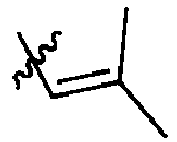
2-Me-C6H5 2-Me-C6H5 Me Me 8 H 
Mes Mes Me Me 9 H 
Mipp Mipp Me Me 10 H 
adamantyl Mes Me Me 11 H 
DIPP DIPP Me Me 12 H 
IPP IPP Me Me 13 H 
2-Me-C6H5 2-Me-C6H5 Me Me 14 H 
Mes Mes Me Me 15 H 
Mipp Mipp Me Me 16 H 
adamantyl Mes Me Me 17 H 
DIPP DIPP Me Me 18 H 
IPP IPP Me Me 19 
2-Me-C6H5 2-Me-C6H5 Me Me 20 
Mes Mes Me Me 21 
Mipp Mipp Me Me 22 
adamantyl Mes Me Me 23 
DIPP DIPP Me Me 24 
IPP IPP Me Me 25 H Ph 2-Me-C6H5 2-Me-C6H5 
26 H Ph Mes Mes 
27 H Ph Mipp Mipp 
28 H Ph adamantyl Mes 
29 H Ph DIPP DIPP 
30 H Ph IPP IPP 
31 H 
2-Me-C6H5 2-Me-C6H5 
32 H 
Mes Mes 
33 H 
Mipp Mipp 
34 H 
adamantyl Mes 
35 H 
DIPP DIPP 
36 H 
IPP IPP 
37 H 
2-Me-C6H5 2-Me-C6H5 
38 H 
Mes Mes 
39 H 
Mipp Mipp 
40 H 
adamantyl Mes 
41 H 
DIPP DIPP 
42 H 
IPP IPP 
43 
2-Me-C6H5 2-Me-C6H5 
44 
Mes Mes 
45 
Mipp Mipp 
46 
adamantyl Mes 
47 
DIPP DIPP 
48 
IPP IPP 
49 H Ph 2-Me-C6H5 2-Me-C6H5 n-Bu n-Bu 50 H Ph Mes Mes n-Bu n-Bu 51 H Ph Mipp Mipp n-Bu n-Bu 52 H Ph adamantyl Mes n-Bu n-Bu 53 H Ph DIPP DIPP n-Bu n-Bu 54 H Ph IPP IPP n-Bu n-Bu 55 H 
2-Me-C6H5 2-Me-C6H5 n-Bu n-Bu 56 H 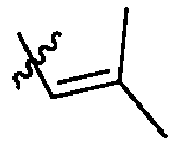
Mes Mes n-Bu n-Bu 57 H 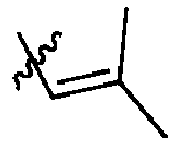
Mipp Mipp n-Bu n-Bu 58 H 
adamantyl Mes n-Bu n-Bu 59 H 
DIPP DIPP n-Bu n-Bu 60 H 
IPP IPP n-Bu n-Bu 61 H 
2-Me-C6H5 2-Me-C6H5 n-Bu n-Bu 62 H 
Mes Mes n-Bu n-Bu 63 H 
Mipp Mipp n-Bu n-Bu 64 H 
adamantyl Mes n-Bu n-Bu 65 H 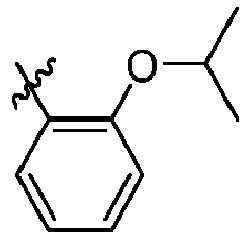
DIPP DIPP n-Bu n-Bu 66 H 
IPP IPP n-Bu n-Bu 67 
2-Me-C6H5 2-Me-C6H5 n-Bu n-Bu 68 
Mes Mes n-Bu n-Bu 69 
Mipp Mipp n-Bu n-Bu 70 
adamantyl Mes n-Bu n-Bu 71 
DIPP DIPP n-Bu n-Bu 72 
IPP IPP n-Bu n-Bu 


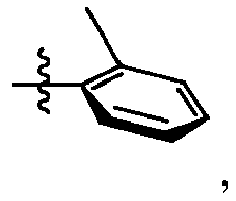

- In one embodiment, the invention provides an olefin metathesis catalyst represented by the structure of Formula (IV), wherein:
- M is Ru;
- n is 0;
- m is 0;
- Ra is hydrogen, unsubstituted hydrocarbyl, substituted hydrocarbyl, unsubstituted heteroatom-containing hydrocarbyl, or substituted heteroatom-containing hydrocarbyl; Ra is unsubstituted C1-C10 alkyl, substituted C1-C10 alkyl, unsubstituted C3-C10 cycloalkyl, substituted C3-C10 cycloalkyl, unsubstituted C5-C24 aryl or substituted C5-C24 aryl;
- Rb is hydrogen, unsubstituted hydrocarbyl, substituted hydrocarbyl, unsubstituted heteroatom-containing hydrocarbyl, or substituted heteroatom-containing hydrocarbyl; Rb is unsubstituted C1-C10 alkyl, substituted C1-C10 alkyl, unsubstituted C3-C10 cycloalkyl, substituted C3-C10 cycloalkyl, unsubstituted C5-C24 aryl or substituted C5-C24 aryl; or Ra and Rb are linked together to form a five or a six heterocyclic membered ring with the sulfoxide group;
- X1 and X2 are independently halogen, trifluoroacetate, per-fluorophenols or nitrate; generally X1 and X2 are independently Cl, Br, I or F;
- R1 is hydrogen;
- R2 is unsubstituted hydrocarbyl, substituted hydrocarbyl, unsubstituted heteroatom-containing hydrocarbyl, or substituted heteroatom-containing hydrocarbyl; or R1 and R2 are linked together to form an optionally substituted indenylidene;
- X and Y are independently N;
- Q is a two-atom linkage having the structure -[CR11= CR13]- ; R11 and R13 are hydrogen; therefore, Q is -(CH=CH)-;
- R3 is unsubstituted hydrocarbyl, substituted hydrocarbyl, unsubstituted heteroatom-containing hydrocarbyl, or substituted heteroatom-containing hydrocarbyl; generally R3 is unsubstituted C3-C10 cycloalkyl, substituted C3-C10 cycloalkyl, unsubstituted C5-C24 aryl, or C5-C24 aryl substituted with up to three substituents selected from: unsubstituted C1-C20 alkyl, substituted C1-C20 alkyl, unsubstituted C1-C20 heteroalkyl, substituted C1-C20 heteroalkyl, unsubstituted C5-C24 aryl, substituted C5-C24 aryl, unsubstituted C5-C24 heteroaryl, substituted C5-C24 heteroaryl, unsubstituted C6-C24 aralkyl, substituted C6-C24 aralkyl, unsubstituted C6-C24 alkaryl, substituted C6-C24 alkaryl and halide; and
- R4 is unsubstituted hydrocarbyl, substituted hydrocarbyl, unsubstituted heteroatom-containing hydrocarbyl, or substituted heteroatom-containing hydrocarbyl; generally R4 is unsubstituted C3-C10 cycloalkyl, substituted C3-C10 cycloalkyl, unsubstituted C5-C24 aryl, or C5-C24 aryl substituted with up to three substituents selected from: unsubstituted C1-C20 alkyl, substituted C1-C20 alkyl, unsubstituted C1-C20 heteroalkyl, substituted C1-C20 heteroalkyl, unsubstituted C5-C24 aryl, substituted C5-C24 aryl, unsubstituted C5-C24 heteroaryl, substituted C5-C24 heteroaryl, unsubstituted C6-C24 aralkyl, substituted C6-C24 aralkyl, unsubstituted C6-C24 alkaryl, substituted C6-C24 alkaryl and halide.
- Therefore, the olefin metathesis catalyst of Formula (IV), can be represented by the structure of Formula (VI)

- R1 is hydrogen;
- R2 is unsubstituted phenyl, substituted phenyl or substituted 1-propenyl; or R1 and R2 are linked together to form an optionally substituted indenylidene;
- Ra is hydrogen, unsubstituted hydrocarbyl, substituted hydrocarbyl, unsubstituted heteroatom-containing hydrocarbyl, or substituted heteroatom-containing hydrocarbyl; Ra is unsubstituted C1-C10 alkyl, substituted C1-C10 alkyl, unsubstituted C3-C10 cycloalkyl, substituted C3-C10 cycloalkyl, unsubstituted C5-C24 aryl or substituted C5-C24 aryl;
- Rb is hydrogen, unsubstituted hydrocarbyl, substituted hydrocarbyl, unsubstituted heteroatom-containing hydrocarbyl, or substituted heteroatom-containing hydrocarbyl; Rb is unsubstituted C1-C10 alkyl, substituted C1-C10 alkyl, unsubstituted C3-C10 cycloalkyl, substituted C3-C10 cycloalkyl, unsubstituted C5-C24 aryl or substituted C5-C24 aryl; or Ra and Rb are linked together to form a five or a six heterocyclic membered ring with the sulfoxide group;
- X1 and X2 are independently halogen, trifluoroacetate, per-fluorophenols or nitrate; X1 and X2 are independently Cl, Br, I or F; typically, X1 and X2 are independently Cl;
- R3 is unsubstituted hydrocarbyl, substituted hydrocarbyl, unsubstituted heteroatom-containing hydrocarbyl, or substituted heteroatom-containing hydrocarbyl; generally, R3 is unsubstituted C3-C10 cycloalkyl, substituted C3-C10 cycloalkyl, unsubstituted C5-C24 aryl, C5-C24 aryl substituted with up to three substituents selected from unsubstituted C1-C20 alkyl, substituted C1-C20 alkyl, unsubstituted C1-C20 heteroalkyl, substituted C1-C20 heteroalkyl, unsubstituted C5-C24 aryl, substituted C5-C24 aryl, unsubstituted C5-C24 heteroaryl, substituted C5-C24 heteroaryl, unsubstituted C6-C24 aralkyl, substituted C6-C24 aralkyl, unsubstituted C6-C24 alkaryl, substituted C6-C24 alkaryl and halide; typically, R3 is adamantyl, 2,4,6-trimethylphenyl, 2,6-di-iso-propylphenyl, 2-iso-propyl-6-methylphenyl, 2-iso-propyl-phenyl or 2-methyl-phenyl; and
- R4 is unsubstituted hydrocarbyl, substituted hydrocarbyl, unsubstituted heteroatom-containing hydrocarbyl, or substituted heteroatom-containing hydrocarbyl; generally, R4 is unsubstituted C3-C10 cycloalkyl, substituted C3-C10 cycloalkyl, unsubstituted C5-C24 aryl, or C5-C24 aryl substituted with up to three substituents selected from unsubstituted C1-C20 alkyl, substituted C1-C20 alkyl, unsubstituted C1-C20 heteroalkyl, substituted C1-C20 heteroalkyl, unsubstituted C5-C24 aryl, substituted C5-C24 aryl, unsubstituted C5-C24 heteroaryl, substituted C5-C24 heteroaryl, unsubstituted C6-C24 aralkyl, substituted C6-C24 aralkyl, unsubstituted C6-C24 alkaryl, substituted C6-C24 alkaryl and halide; typically, R4 is 2,4,6-trimethylphenyl, 2-iso-propyl-phenyl, 2,6-di-iso-propylphenyl, 2-iso-propyl-6-methylphenyl or 2-methyl-phenyl.
- In one embodiment, the invention provides an olefin metathesis catalyst represented by the structure of Formula (VI), wherein:
- R1 is hydrogen; R2 is phenyl, 2-iso-propoxy-phenyl, or 2-methyl-1-propenyl; or R1 and R2 are linked together to form 3-phenylinden-1-ylidene;
- Ra is hydrogen, methyl, ethyl, n-propyl, iso-propyl, n-butyl, tert-butyl, or phenyl;
- Rb is hydrogen, methyl, ethyl, n-propyl, iso-propyl, n-butyl, tert-butyl, or phenyl;
- X1 and X2 are independently Cl; and
- R3 is adamantyl, 2,4,6-trimethylphenyl, 2,6-di-iso-propylphenyl, 2-iso-propyl-6-methylphenyl or 2-methyl-phenyl; and
- R4 is 2,4,6-trimethylphenyl, 2,6-di-iso-propylphenyl, 2-iso-propyl-6-methylphenyl or 2-methyl-phenyl.
- In one embodiment, the invention provides an olefin metathesis catalyst represented by the structure of Formula (VI), wherein:
- R1 is hydrogen;
- R2 is unsubstituted phenyl, substituted phenyl or substituted 1-propenyl; or R1 and R2 are linked together to form an optionally substituted indenylidene;
- Ra and Rb are linked together to form a five or a six heterocyclic membered ring with the sulfoxide group;
- X1 and X2 are independently Cl, Br, I or F; X1 and X2 are independently Cl;
- R3 is adamantyl, 2,4,6-trimethylphenyl, 2,6-di-iso-propylphenyl, 2-iso-propyl-phenyl, 2-iso-propyl-6-methylphenyl or 2-methyl-phenyl; and
- R4 is 2,4,6-trimethylphenyl, 2,6-di-iso-propylphenyl, 2-iso-propyl-phenyl, 2-iso-propyl-6-methylphenyl or 2-methyl-phenyl.
- Non-limiting examples of olefin metathesis catalysts represented by the structure of Formula (VI) are described in Table (2), wherein X1 is Cl and X2 is Cl.
Table (2) Catalyst R1 R2 R3 R4 Ra Rb 73 H Ph 2-Me-C6H5 2-Me-C6H5 Me Me 74 H Ph Mes Mes Me Me 75 H Ph Mipp Mipp Me Me 76 H Ph adamantyl Mes Me Me 77 H Ph DIPP DIPP Me Me 78 H Ph IPP IPP Me Me 79 H 
2-Me-C6H5 2-Me-C6H5 Me Me 80 H 
Mes Mes Me Me 81 H 
Mipp Mipp Me Me 82 H 
adamantyl Mes Me Me 83 H 
DIPP DIPP Me Me 84 H 
IPP IPP Me Me 85 H 
2-Me-C6H5 2-Me-C6H5 Me Me 86 H 
Mes Mes Me Me 87 H 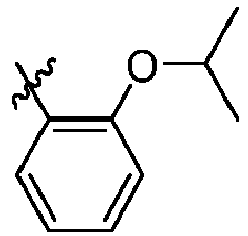
Mipp Mipp Me Me 88 H 
adamantyl Mes Me Me 89 H 
DIPP DIPP Me Me 90 H 
IPP IPP Me Me 91 
2-Me-C6H5 2-Me-C6H5 Me Me 92 
Mes Mes Me Me 93 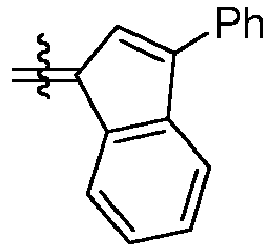
Mipp Mipp Me Me 94 
adamantyl Mes Me Me 95 
DIPP DIPP Me Me 96 
IPP IPP Me Me 97 H Ph 2-Me-C6H5 2-Me-C6H5 
98 H Ph Mes Mes 
99 H Ph Mipp Mipp 
100 H Ph adamantyl Mes 
101 H Ph DIPP DIPP 
102 H Ph IPP IPP 
103 H 
2-Me-C6H5 2-Me-C6H5 
104 H 
Mes Mes 
105 H 
Mipp Mipp 
106 H 
adamantyl Mes 
107 H 
DIPP DIPP 
108 H 
IPP IPP 
109 H 
2-Me-C6H5 2-Me-C6H5 
110 H 
Mes Mes 
111 H 
Mipp Mipp 
112 H 
adamantyl Mes 
113 H 
DIPP DIPP 
114 H 
IPP IPP 
115 
2-Me-C6H5 2-Me-C6H5 
116 
Mes Mes 
117 
Mipp Mipp 
118 
adamantyl Mes 
119 
DIPP DIPP 
120 
IPP IPP 
121 H Ph 2-Me-C6H5 2-Me-C6H5 n-Bu n-Bu 122 H Ph Mes Mes n-Bu n-Bu 123 H Ph Mipp Mipp n-Bu n-Bu 124 H Ph adamantyl Mes n-Bu n-Bu 125 H Ph DIPP DIPP n-Bu n-Bu 126 H Ph IPP IPP n-Bu n-Bu 127 H 
2-Me-C6H5 2-Me-C6H5 n-Bu n-Bu 128 H 
Mes Mes n-Bu n-Bu 129 H 
Mipp Mipp n-Bu n-Bu 130 H 
adamantyl Mes n-Bu n-Bu 131 H 
DIPP DIPP n-Bu n-Bu 132 H 
IPP IPP n-Bu n-Bu 133 H 
2-Me-C6H5 2-Me-C6H5 n-Bu n-Bu 134 H 
Mes Mes n-Bu n-Bu 135 H 
Mipp Mipp n-Bu n-Bu 136 H 
adamantyl Mes n-Bu n-Bu 137 H 
DIPP DIPP n-Bu n-Bu 138 H 
IPP IPP n-Bu n-Bu 139 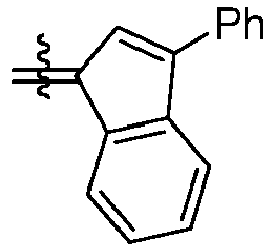
2-Me-C6H5 2-Me-C6H5 n-Bu n-Bu 140 
Mes Mes n-Bu n-Bu 141 
Mipp Mipp n-Bu n-Bu 142 
adamantyl Mes n-Bu n-Bu 143 
DIPP DIPP n-Bu n-Bu 144 
IPP IPP n-Bu n-Bu - In one embodiment, the invention provides an olefin metathesis catalyst represented by the structure of Formula (IV), wherein:
- M is Ru;
- n is 0;
- m is 0;
- Ra is hydrogen, unsubstituted hydrocarbyl, substituted hydrocarbyl, unsubstituted heteroatom-containing hydrocarbyl, or substituted heteroatom-containing hydrocarbyl; generally Ra is unsubstituted C1-C10 alkyl, substituted C1-C10 alkyl, unsubstituted C3-C10 cycloalkyl, substituted C3-C10 cycloalkyl, unsubstituted C5-C24 aryl or substituted C5-C24 aryl; typically Ra is methyl, ethyl, n-propyl, iso-propyl, n-butyl, tert-butyl, cyclohexyl or phenyl;
- Rb is hydrogen, unsubstituted hydrocarbyl, substituted hydrocarbyl, unsubstituted heteroatom-containing hydrocarbyl, or substituted heteroatom-containing hydrocarbyl; generally Rb is unsubstituted C1-C10 alkyl, substituted C1-C10 alkyl, unsubstituted C3-C10 cycloalkyl, substituted C3-C10 cycloalkyl, unsubstituted C5-C24 aryl or substituted C5-C24 aryl; typically Rb is methyl, ethyl, n-propyl, iso-propyl, n-butyl, tert-butyl, cyclohexyl or phenyl; or Ra and Rb are linked together to form a five or a six heterocyclic membered ring with the sulfoxide group;
- X1 and X2 are independently halogen, trifluoroacetate, per-fluorophenols or nitrate; typically X1 and X2 are independently Cl, Br, I or F;
- R1 is hydrogen;
- R2 is unsubstituted hydrocarbyl, substituted hydrocarbyl, unsubstituted heteroatom-containing hydrocarbyl, or substituted heteroatom-containing hydrocarbyl; typically, R1 is hydrogen and R2 is unsubstituted phenyl, substituted phenyl or substituted 1-propenyl; or R1 and R2 are linked together to form an optionally substituted indenylidene;
- YisN;
- X is CR3a;
- R3a is hydrogen, unsubstituted hydrocarbyl, substituted hydrocarbyl, unsubstituted heteroatom-containing hydrocarbyl, or substituted heteroatom-containing hydrocarbyl; or R3a and R4 can from together a five to ten membered cycloalkyl or heterocyclic ring, with the carbon atom to which they are attached;
- Q is a two-atom linkage having the structure -[CR11R12]s-[CR13R14]t-; wherein R11, R12, R13, and R14 are independently hydrogen, unsubstituted hydrocarbyl, substituted hydrocarbyl, unsubstituted heteroatom-containing hydrocarbyl, or substituted heteroatom-containing hydrocarbyl; typically R11, R12, R13 and R14 are independently hydrogen, unsubstituted C1-C12 alkyl, substituted C1-C12 alkyl, unsubstituted C1-C12 heteroalkyl, substituted C1-C12 heteroalkyl, unsubstituted C5-C14 aryl, or substituted C5-C14 aryl; "s" and "t" are independently 1;
- R3 is unsubstituted hydrocarbyl, substituted hydrocarbyl, unsubstituted heteroatom-containing hydrocarbyl, or substituted heteroatom-containing hydrocarbyl; generally, R3 is unsubstituted C3-C10 cycloalkyl, substituted C3-C10 cycloalkyl, unsubstituted (C5-C24 aryl), (C5-C24 aryl) substituted with up to three substituents selected from unsubstituted C1-C20 alkyl, substituted C1-C20 alkyl, unsubstituted C1-C20 heteroalkyl, substituted C1-C20 heteroalkyl, unsubstituted C5-C24 aryl, substituted C5-C24 aryl, unsubstituted C5-C24 heteroaryl, substituted C5-C24 heteroaryl, unsubstituted C6-C24 aralkyl, substituted C6-C24 aralkyl, unsubstituted C6-C24 alkaryl, substituted C6-C24 alkaryl and halide; and
- R4 is unsubstituted hydrocarbyl, substituted hydrocarbyl, unsubstituted heteroatom-containing hydrocarbyl, or substituted heteroatom-containing hydrocarbyl; generally, R4 is unsubstituted C3-C10 cycloalkyl, substituted C3-C10 cycloalkyl, unsubstituted (C5-C24 aryl), or (C5-C24 aryl) substituted with up to three substituents selected from unsubstituted C1-C20 alkyl, substituted C1-C20 alkyl, unsubstituted C1-C20 heteroalkyl, substituted C1-C20 heteroalkyl, unsubstituted C5-C24 aryl, substituted C5-C24 aryl, unsubstituted C5-C24 heteroaryl, substituted C5-C24 heteroaryl, unsubstituted C6-C24 aralkyl, substituted C6-C24 aralkyl, unsubstituted C6-C24 alkaryl, substituted C6-C24 alkaryl and halide; or R3a and R4 can from together a five to ten membered cycloalkyl or heterocyclic ring, with the carbon atom to which they are attached.
- Therefore, the olefin metathesis catalyst of Formula (IV), can be represented by the structure of Formula (VII)

- R1 is hydrogen;
- R2 is unsubstituted hydrocarbyl, substituted hydrocarbyl, unsubstituted heteroatom-containing hydrocarbyl, or substituted heteroatom-containing hydrocarbyl; generally, R2 is unsubstituted phenyl, substituted phenyl or substituted 1-propenyl; or R1 and R2 are linked together to form an optionally substituted indenylidene;
- Ra is hydrogen, unsubstituted hydrocarbyl, substituted hydrocarbyl, unsubstituted heteroatom-containing hydrocarbyl, or substituted heteroatom-containing hydrocarbyl; generally Ra is unsubstituted C1-C10 alkyl, substituted C1-C10 alkyl, unsubstituted C3-C10 cycloalkyl, substituted C3-C10 cycloalkyl, unsubstituted C5-C24 aryl or substituted C5-C24 aryl; typically Ra is methyl, ethyl, n-propyl, iso-propyl, n-butyl, tert-butyl, cyclohexyl or phenyl;
- Rb is hydrogen, unsubstituted hydrocarbyl, substituted hydrocarbyl, unsubstituted heteroatom-containing hydrocarbyl, or substituted heteroatom-containing hydrocarbyl; generally Rb is unsubstituted C1-C10 alkyl, substituted C1-C10 alkyl, unsubstituted C3-C10 cycloalkyl, substituted C3-C10 cycloalkyl, unsubstituted C5-C24 aryl or substituted C5-C24 aryl; typically Rb is methyl, ethyl, n-propyl, iso-propyl, n-butyl, tert-butyl, cyclohexyl or phenyl; or Ra and Rb are linked together to form a five or a six heterocyclic membered ring with the sulfoxide group;
- X1 and X2 are independently halogen, trifluoroacetate, per-fluorophenols or nitrate; generally X1 and X2 are independently Cl, Br, I or F; typically X1 and X2 are independently Cl;
- R3 is unsubstituted hydrocarbyl, substituted hydrocarbyl, unsubstituted heteroatom containing hydrocarbyl, or substituted heteroatom-containing hydrocarbyl; generally, R3 is unsubstituted C3-C10 cycloalkyl, substituted C3-C10 cycloalkyl, unsubstituted C5-C24 aryl, C5-C24 aryl substituted with up to three substituents selected from unsubstituted C1-C20 alkyl, substituted C1-C20 alkyl, unsubstituted C1-C20 heteroalkyl, substituted C1-C20 heteroalkyl, unsubstituted C5-C24 aryl, substituted C5-C24 aryl, unsubstituted C5-C24 heteroaryl, substituted C5-C24 heteroaryl, unsubstituted C6-C24 aralkyl, substituted C6-C24 aralkyl, unsubstituted C6-C24 alkaryl, substituted C6-C24 alkaryl and halide; typically, R3 is adamantyl, 2,4,6-trimethylphenyl, 2,6-di-iso-propylphenyl, 2-methyl-6-tert-butylphenyl, 2-iso-propyl-6-methylphenyl, 2-iso-propyl-phenyl, 2,6-di-ethylphenyl, 2-ethyl-6-methylphenyl or 2-methyl-phenyl;
- R11, R12, R13 and R14 are independently hydrogen, unsubstituted hydrocarbyl, substituted hydrocarbyl, unsubstituted heteroatom-containing hydrocarbyl, or substituted heteroatom-containing hydrocarbyl; generally, R11, R12, R13 and R14 are independently hydrogen, unsubstituted C1-C12 alkyl, substituted C1-C12 alkyl, unsubstituted C4-C12 cycloalkyl, substituted C4-C12 cycloalkyl, unsubstituted C5-C24 aryl, substituted C5-C24 aryl, unsubstituted C5-C24 heteroaryl, substituted C5-C24 heteroaryl, unsubstituted C6-C24 aralkyl, substituted C6-C24 aralkyl, unsubstituted C6-C24 heteroaralkyl or substituted C6-C24 heteroaralkyl; typically, R11 and R12 are independently methyl and R13 and R14 are independently hydrogen;
- R3a is hydrogen, unsubstituted hydrocarbyl, substituted hydrocarbyl, unsubstituted heteroatom-containing hydrocarbyl, or substituted heteroatom-containing hydrocarbyl; generally, R3a is unsubstituted C1-C12 alkyl, substituted C1-C12 alkyl, unsubstituted C4-C12 cycloalkyl, substituted C4-C12 cycloalkyl, unsubstituted C5-C24 aryl, substituted C5-C24 aryl, unsubstituted C5-C24 heteroaryl, substituted C5-C24 heteroaryl, unsubstituted C6-C24 aralkyl, substituted C6-C24 aralkyl, unsubstituted C6-C24 heteroaralkyl or substituted C6-C24 heteroaralkyl; typically R3a is methyl, ethyl, n-propyl, or phenyl; or together with R4 can form a five to ten membered cycloalkyl or heterocyclic ring, with the carbon atom to which they are attached; and
- R4 is hydrogen, unsubstituted hydrocarbyl, substituted hydrocarbyl, unsubstituted heteroatom-containing hydrocarbyl, or substituted heteroatom-containing hydrocarbyl; generally, R4 is unsubstituted C1-C12 alkyl, substituted C1-C12 alkyl, unsubstituted C4-C12 cycloalkyl, substituted C4-C12 cycloalkyl, unsubstituted C5-C24 aryl, substituted C5-C24 aryl, unsubstituted C5-C24 heteroaryl, substituted C5-C24 heteroaryl, unsubstituted C6-C24 aralkyl, substituted C6-C24 aralkyl, unsubstituted C6-C24 heteroaralkyl or substituted C6-C24 heteroaralkyl; typically R4 is methyl, ethyl, n-propyl, or phenyl; or together with R3a can form a five- to ten- membered cycloalkyl or heterocyclic ring, with the carbon atom to which they are attached.
- In one embodiment, the invention provides an olefin metathesis catalyst represented by the structure of Formula (VII), wherein:
- R1 is hydrogen; R2 is phenyl, 2-iso-propoxy-phenyl, or 2-methyl-1-propenyl; or R1 and R2 are linked together to form 3-phenylinden-1-ylidene;
- Ra is hydrogen, methyl, ethyl, n-propyl, iso-propyl, n-butyl, tert-butyl, or phenyl;
- Rb is hydrogen, methyl, ethyl, n-propyl, iso-propyl, n-butyl, tert-butyl, or phenyl;
- X1 and X2 are independently Cl; and
- R3 is 2,4,6-trimethylphenyl, 2,6-di-iso-propylphenyl, 2-iso-propyl-phenyl, 2-iso-propyl-6-methylphenyl, 2,6-di-ethylphenyl, 2-methyl-6-tert-butylphenyl, 2-ethyl-6-methylphenyl or 2-methyl-phenyl;
- R11 and R12 are independently methyl;
- R13 and R14 are independently hydrogen;
- R3a is methyl, ethyl, n-propyl, or phenyl; and
- R4 is methyl, ethyl, n-propyl, or phenyl; or R13a and R4 form together a five-, six-, or ten-membered cycloalkyl or heterocycle ring, with the carbon atom to which they are attached.
- Non-limiting examples of olefin metathesis catalysts represented by the structure of Formula (VII) are described in Table (3), wherein X1 is Cl, X2 is Cl, R11 is methyl, R12 is methyl, R13 is hydrogen and R14 is hydrogen.
Table (3) Catalyst R1 R2 Ra Rb R3 R3a R4 145 H Ph Me Me 2-Me-C6H5 Me Me 146 H Ph Me Me Mes Me Me 147 H Ph Me Me Mipp Me Me 148 H Ph Me Me EMP Me Me 149 H Ph Me Me DIPP Me Me 150 H Ph Me Me IPP Me Me 151 H 
Me Me 2-Me-C6H5 Me Me 152 H 
Me Me Mes Me Me 153 H 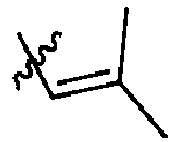
Me Me Mipp Me Me 154 H 
Me Me EMP Me Me 155 H 
Me Me DIPP Me Me 156 H 
Me Me IPP Me Me 157 H 
Me Me 2-Me-C6H5 Me Me 158 H 
Me Me Mes Me Me 159 H 
Me Me Mipp Me Me 160 H 
Me Me EMP Me Me 161 H 
Me Me DIPP Me Me 162 H 
Me Me IPP Me Me 163 
Me Me 2-Me-C6H5 Me Me 164 
Me Me Mes Me Me 165 
Me Me Mipp Me Me 166 
Me Me EMP Me Me 167 
Me Me DIPP Me Me 168 
Me Me IPP Me Me 169 H Ph 
2-Me-C6H5 Me Me 170 H Ph 
Mes Me Me 171 H Ph 
Mipp Me Me 172 H Ph 
EMP Me Me 173 H Ph 
DIPP Me Me 174 H Ph 
IPP Me Me 175 H 

2-Me-C6H5 Me Me 176 H 

Mes Me Me 177 H 

Mipp Me Me 178 H 

EMP Me Me 179 H 

DIPP Me Me 180 H 

IPP Me Me 181 H 

2-Me-C6H5 Me Me 182 H 

Mes Me Me 183 H 

Mipp Me Me 184 H 

EMP Me Me 185 H 

DIPP Me Me 186 H 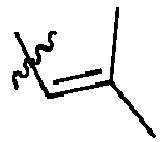

IPP Me Me 187 

2-Me-C6H5 Me Me 188 

Mes Me Me 189 

Mipp Me Me 190 

EMP Me Me 191 

DIPP Me Me 192 

IPP Me Me 193 H Ph n-Bu n-Bu 2-Me-C6H5 Me Me 194 H Ph n-Bu n-Bu Mes Me Me 195 H Ph n-Bu n-Bu Mipp Me Me 196 H Ph n-Bu n-Bu EMP Me Me 197 H Ph n-Bu n-Bu DIPP Me Me 198 H Ph n-Bu n-Bu IPP Me Me 199 H 
n-Bu n-Bu 2-Me-C6H5 Me Me 200 H 
n-Bu n-Bu Mes Me Me 201 H 
n-Bu n-Bu Mipp Me Me 202 H 
n-Bu n-Bu EMP Me Me 203 H 
n-Bu n-Bu DIPP Me Me 204 H 
n-Bu n-Bu IPP Me Me 205 H 
n-Bu n-Bu 2-Me-C6H5 Me Me 206 H 
n-Bu n-Bu Mes Me Me 207 H 
n-Bu n-Bu Mipp Me Me 208 H 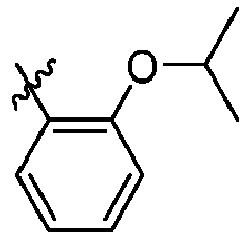
n-Bu n-Bu EMP Me Me 209 H 
n-Bu n-Bu DIPP Me Me 210 H 
n-Bu n-Bu IPP Me Me 211 
n-Bu n-Bu 2-Me-C6H5 Me Me 212 
n-Bu n-Bu Mes Me Me 213 
n-Bu n-Bu Mipp Me Me 214 
n-Bu n-Bu EMP Me Me 215 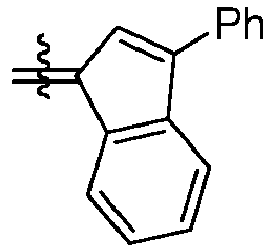
n-Bu n-Bu DIPP Me Me 216 
n-Bu n -BuIPP Me Me 
- In another embodiment of Formula (IV), the invention provides an olefin metathesis catalyst wherein:
- M is a Group 8 transition metal; generally M is ruthenium or osmium; typically M is ruthenium;
- L2 is a neutral electron donor ligand;
- n is 0 or 1; typically n is 0;
- m is 0, 1 or 2; typically m is 0;
- Ra is hydrogen, unsubstituted hydrocarbyl, substituted hydrocarbyl, unsubstituted heteroatom-containing hydrocarbyl, or substituted heteroatom-containing hydrocarbyl; generally Ra is unsubstituted C1-C10 alkyl, substituted C1-C10 alkyl, unsubstituted C3-C10 cycloalkyl, substituted C3-C10 cycloalkyl, unsubstituted C5-C24 aryl or substituted C5-C24 aryl; typically Ra is methyl, ethyl, n-propyl, iso-propyl, n-butyl, tert-butyl, cyclohexyl or phenyl;
- Rb is hydrogen, unsubstituted hydrocarbyl, substituted hydrocarbyl, unsubstituted heteroatom-containing hydrocarbyl, or substituted heteroatom-containing hydrocarbyl; generally Rb is unsubstituted C1-C10 alkyl, substituted C1-C10 alkyl, unsubstituted C3-C10 cycloalkyl, substituted C3-C10 cycloalkyl, unsubstituted C5-C24 aryl or substituted C5-C24 aryl; typically Rb is methyl, ethyl, n-propyl, iso-propyl, n-butyl, tert-butyl, cyclohexyl or phenyl; or Ra and Rb are linked together to form a five or a six heterocyclic membered ring with the sulfoxide group;
- X and Y are independently C, CR3a or N; and only one of X or Y can be C or CR3a;
- R3a is hydrogen, unsubstituted hydrocarbyl, substituted hydrocarbyl, unsubstituted heteroatom-containing hydrocarbyl, or substituted heteroatom-containing hydrocarbyl;
- Q is a two-atom linkage having the structure -[CR11R12]s-[CR13R14]t- or -[CR11=CR13]-;
- R11, R12, R13, and R14 are independently hydrogen, unsubstituted hydrocarbyl, substituted hydrocarbyl, unsubstituted heteroatom-containing hydrocarbyl, or substituted heteroatom-containing hydrocarbyl;
- "s" and "t" are independently 1 or 2;
- R3 is unsubstituted hydrocarbyl, substituted hydrocarbyl, unsubstituted heteroatom-containing hydrocarbyl, or substituted heteroatom-containing hydrocarbyl;
- R4 is unsubstituted hydrocarbyl, substituted hydrocarbyl, unsubstituted heteroatom-containing hydrocarbyl, or substituted heteroatom-containing hydrocarbyl;
- R1 and R2 are independently hydrogen, unsubstituted hydrocarbyl, substituted hydrocarbyl, unsubstituted heteroatom-containing hydrocarbyl, or substituted heteroatom-containing hydrocarbyl; or R1 and R2 are linked together to form an optionally substituted indenylidene;


- X3 and X4 are independently O or S; and
- Rx, Ry, Rw and Rz are independently hydrogen, halogen, unsubstituted hydrocarbyl, substituted hydrocarbyl, unsubstituted heteroatom-containing hydrocarbyl, or substituted heteroatom-containing hydrocarbyl; or Rx and Ry are linked together to form an unsubstituted bicyclic or polycyclic aryl or a substituted bicyclic or polycyclic aryl; or Rw and Rz are linked together to form an unsubstituted bicyclic or polycyclic aryl or a substituted bicyclic or polycyclic aryl; or Ry and Rw are linked together to form an unsubstituted bicyclic or polycyclic aryl or a substituted bicyclic or polycyclic aryl.
- In another embodiment of Formula (IV), the invention provides an olefin metathesis catalyst wherein:
- M is Ru;
- n is 0;
- m is 0;
- Ra is unsubstituted C1-C10 alkyl, substituted C1-C10 alkyl, unsubstituted C3-C10 cycloalkyl, substituted C3-C10 cycloalkyl, unsubstituted C5-C24 aryl or substituted C5-C24 aryl; typically Ra is methyl, ethyl, n-propyl, iso-propyl, n-butyl, tert-butyl, cyclohexyl or phenyl;
- Rb is unsubstituted C1-C10 alkyl, substituted C1-C10 alkyl, unsubstituted C3-C10 cycloalkyl, substituted C3-C10 cycloalkyl, unsubstituted C5-C24 aryl or substituted C5-C24 aryl; typically Rb is methyl, ethyl, n-propyl, iso-propyl, n-butyl, tert-butyl, cyclohexyl or phenyl; or Ra and Rb are linked together to form a five or a six heterocyclic membered ring with the sulfoxide group;
- X and Y are independently N;
- Q is a two-atom linkage having the structure -[CR11R12]s-[CR13R14]t-;
- R11, R12, R13, and R14 are independently C1-C6 alkyl, or hydrogen; generally R11 is hydrogen or methyl, R12 is hydrogen or methyl, R13 is hydrogen and R14 is hydrogen; typically R11, R12, R13, and R14 are independently hydrogen;
- "s" and "t" are independently 1;
- R3 is unsubstituted hydrocarbyl, substituted hydrocarbyl, unsubstituted heteroatom-containing hydrocarbyl, or substituted heteroatom-containing hydrocarbyl;
- R4 is unsubstituted hydrocarbyl, substituted hydrocarbyl, unsubstituted heteroatom-containing hydrocarbyl, or substituted heteroatom-containing hydrocarbyl;
- R1 is hydrogen and R2 is unsubstituted phenyl, substituted phenyl or substituted 1-propenyl; or R1 and R2 are linked together to form an optionally substituted indenylidene;


- X3 and X4 are independently S; and
- Rx, Ry, Rw and Rz are independently C1-C6 alkyl, hydrogen, halogen, unsubstituted phenyl or substituted phenyl; generally Rx is methyl, hydrogen or Cl, Ry is hydrogen, Rw is hydrogen, Rz is Cl, t-butyl, hydrogen or phenyl; or Rx and Ry are linked together to form an unsubstituted bicyclic or polycyclic aryl or a substituted bicyclic or polycyclic aryl; or Rw and Rz are linked together to form an unsubstituted bicyclic or polycyclic aryl or a substituted bicyclic or polycyclic aryl; or Ry and Rw are linked together to form an unsubstituted bicyclic or polycyclic aryl or a substituted bicyclic or polycyclic aryl.
- Therefore, the olefin metathesis catalyst of Formula (IV), can be represented by the structure of Formula (VIII)
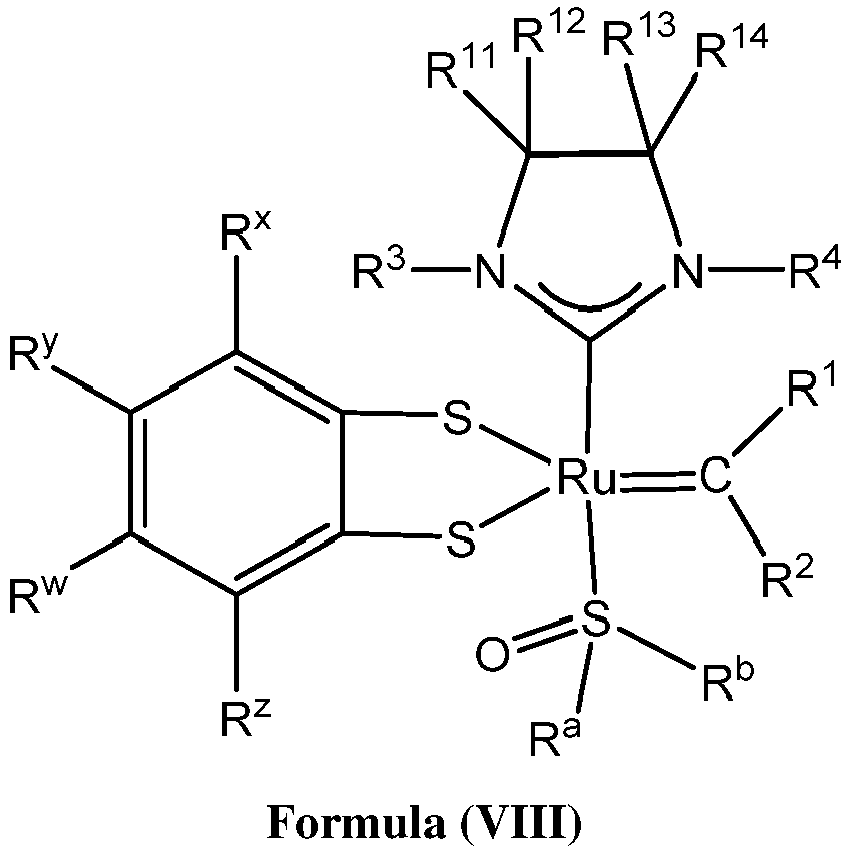
- Ra is unsubstituted C1-C10 alkyl, substituted C1-C10 alkyl, unsubstituted C3-C10 cycloalkyl, substituted C3-C10 cycloalkyl, unsubstituted C5-C24 aryl or substituted C5-C24 aryl; typically Ra is methyl, ethyl, n-propyl, iso-propyl, n-butyl, tert-butyl, cyclohexyl or phenyl;
- Rb is unsubstituted C1-C10 alkyl, substituted C1-C10 alkyl, unsubstituted C3-C10 cycloalkyl, substituted C3-C10 cycloalkyl, unsubstituted C5-C24 aryl or substituted C5-C24 aryl; typically Rb is methyl, ethyl, n-propyl, iso-propyl, n-butyl, tert-butyl, cyclohexyl or phenyl; or Ra and Rb are linked together to form a five or a six heterocyclic membered ring with the sulfoxide group;
- R3 is unsubstituted C3-C10 cycloalkyl, substituted C3-C10 cycloalkyl, unsubstituted C5-C24 aryl, C5-C24 aryl substituted with up to three substituents selected from unsubstituted C1-C20 alkyl, substituted C1-C20 alkyl, unsubstituted C1-C20 heteroalkyl, substituted C1-C20 heteroalkyl, unsubstituted C5-C24 aryl, substituted C5-C24 aryl, unsubstituted C5-C24 heteroaryl, substituted C5-C24 heteroaryl, unsubstituted C6-C24 aralkyl, substituted C6-C24 aralkyl, unsubstituted C6-C24 alkaryl, substituted C6-C24 alkaryl and halide; typically, R3 is adamantyl, 2,4,6-trimethylphenyl, 2,6-di-iso-propylphenyl, 2-methyl-6-tert-butylphenyl, 2-iso-propyl-6-methylphenyl, 2-iso-propyl-phenyl, 2,6-di-ethylphenyl, 2-ethyl-6-methylphenyl, 2,4,6-trifluorophenyl, 2,6-difluorophenyl, 3,5-di-tert-butylphenyl, 2,4-dimethylphenyl or 2-methyl-phenyl;
- R4 is unsubstituted C3-C10 cycloalkyl, substituted C3-C10 cycloalkyl, unsubstituted C5-C24 aryl, C5-C24 aryl substituted with up to three substituents selected from unsubstituted C1-C20 alkyl, substituted C1-C20 alkyl, unsubstituted C1-C20 heteroalkyl, substituted C1-C20 heteroalkyl, unsubstituted C5-C24 aryl, substituted C5-C24 aryl, unsubstituted C5-C24 heteroaryl, substituted C5-C24 heteroaryl, unsubstituted C6-C24 aralkyl, substituted C6-C24 aralkyl, unsubstituted C6-C24 alkaryl, substituted C6-C24 alkaryl and halide; typically, R4 is 2,4,6-trimethylphenyl, 2,6-di-iso-propylphenyl, 2-methyl-6-tert-butylphenyl, 2-iso-propyl-6-methylphenyl, 2-iso-propyl-phenyl, 2,6-di-ethylphenyl, 2-ethyl-6-methylphenyl, 2,4,6-trifluorophenyl, 2,6-difluorophenyl, 3,5-di-tert-butylphenyl, 2,4-dimethylphenyl or 2-methyl-phenyl;
- R1 is hydrogen and R2 is unsubstituted phenyl, substituted phenyl or substituted 1-propenyl; or R1 and R2 are linked together to form an optionally substituted indenylidene;
- R11, R12, R13, and R14 are independently C1-C6 alkyl, or hydrogen; generally R11 is hydrogen or methyl, R12 is hydrogen or methyl, R13 is hydrogen and R14 is hydrogen; typically R11, R12, R13, and R14 are independently hydrogen;
- Rx, Ry, Rw and Rz are independently C1-C6 alkyl, hydrogen, halogen, unsubstituted phenyl or substituted phenyl; generally Rx is methyl, hydrogen or Cl, Ry is hydrogen, Rw is hydrogen, Rz is Cl, t-butyl, hydrogen or phenyl; or Rx and Ry are linked together to form an unsubstituted bicyclic or polycyclic aryl or a substituted bicyclic or polycyclic aryl; or Rw and Rz are linked together to form an unsubstituted bicyclic or polycyclic aryl or a substituted bicyclic or polycyclic aryl; or Ry and Rw are linked together to form an unsubstituted bicyclic or polycyclic aryl or a substituted bicyclic or polycyclic aryl.
- In one embodiment, the invention provides an olefin metathesis catalyst represented by the structure of Formula (VIII), wherein:
- Ra is methyl, ethyl, n-propyl, iso-propyl, n-butyl, tert-butyl, cyclohexyl or phenyl;
- Rb is methyl, ethyl, n-propyl, iso-propyl, n-butyl, tert-butyl, cyclohexyl or phenyl; or Ra and Rb are linked together to form a five or a six heterocyclic membered ring with the sulfoxide group;
- R3 is adamantyl, 2,4,6-trimethylphenyl, 2,6-di-iso-propylphenyl, 2-methyl-6-tert-butylphenyl, 2-iso-propyl-6-methylphenyl, 2-iso-propyl-phenyl, 2,6-di-ethylphenyl, 2-ethyl-6-methylphenyl, 2,4,6-trifluorophenyl, 3,5-di-tert-butylphenyl, 2,4-dimethylphenyl, 2,6-difluorophenyl or 2-methyl-phenyl;
- R4 is 2,4,6-trimethylphenyl, 2,6-di-iso-propylphenyl, 2-methyl-6-tert-butylphenyl, 2-iso-propyl-6-methylphenyl, 2-iso-propyl-phenyl, 2,6-di-ethylphenyl, 2-ethyl-6-methylphenyl, 2,4,6-trifluorophenyl, 3,5-di-tert-butylphenyl, 2,4-dimethylphenyl, 2,6-difluorophenyl or 2-methyl-phenyl;
- R1 is hydrogen and R2 is unsubstituted phenyl, substituted phenyl or substituted 1-propenyl; or R1 and R2 are linked together to form an optionally substituted indenylidene;
- R11 is hydrogen or methyl, R12 is hydrogen or methyl, R13 is hydrogen and R14 is hydrogen; typically R11, R12, R13, and R14 are independently hydrogen;
- Rx is methyl, hydrogen or Cl, Ry is hydrogen, Rw is hydrogen, Rz is Cl, t-butyl, hydrogen or phenyl; or Rx and Ry are linked together to form an unsubstituted bicyclic or polycyclic aryl or a substituted bicyclic or polycyclic aryl; or Rw and Rz are linked together to form an unsubstituted bicyclic or polycyclic aryl or a substituted bicyclic or polycyclic aryl; or Ry and Rw are linked together to form an unsubstituted bicyclic or polycyclic aryl or a substituted bicyclic or polycyclic aryl.
- Non-limiting examples of olefin metathesis catalysts represented by the structure of Formula (VIII) are described in Table (4), wherein Ra is methyl, Rb is methyl, R11 is hydrogen, R12 is hydrogen, R13 is hydrogen, R14 is hydrogen, Ry is hydrogen and Rw is hydrogen.
Table (4) Catalyst R1 R2 R3 R4 Rx Rz 217 H Ph 2-Me-C6H5 2-Me-C6H5 Cl Cl 218 H Ph Mes Mes Cl Cl 219 H Ph Mipp Mipp Cl Cl 220 H Ph DIPP DIPP Cl Cl 221 H Ph IPP IPP Cl Cl 222 H 
2-Me-C6H5 2-Me-C6H5 Cl Cl 223 H 
Mes Mes Cl Cl 224 H 
Mipp Mipp Cl Cl 225 H 
DIPP DIPP Cl Cl 226 H 
IPP IPP Cl Cl 227 H 
2-Me-C6H5 2-Me-C6H5 Cl Cl 228 H 
Mes Mes Cl Cl 229 H 
Mipp Mipp Cl Cl 230 H 
DIPP DIPP Cl Cl 231 H 
2-Me-C6H5 2-Me-C6H5 Cl Cl 232 H 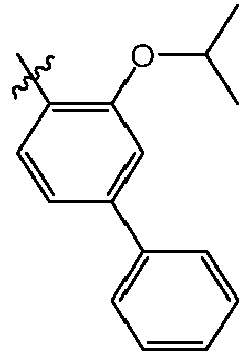
Mes Mes Cl Cl 233 H 
Mipp Mipp Cl Cl 234 H 
DIPP DIPP Cl Cl 235 H 
IPP IPP Cl Cl 236 H 
IPP IPP Cl Cl 237 
2-Me-C6H5 2-Me-C6H5 Cl Cl 238 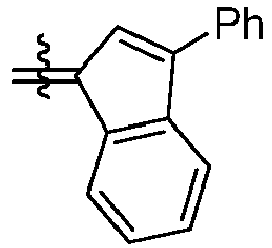
Mes Mes Cl Cl 239 
Mipp Me Cl Cl 240 
DIPP DIPP Cl Cl 241 
IPP Me Cl Cl 242 H Ph 2-Me-C6H5 2-Me-C6H5 H Ph 243 H Ph Mes Mes H Ph 244 H Ph Mipp Mipp H Ph 245 H Ph DIPP DIPP H Ph 246 H Ph IPP IPP H Ph 247 H 
2-Me-C6H5 2-Me-C6H5 H Ph 248 H 
Mes Mes H Ph 249 H 
Mipp Mipp H Ph 250 H 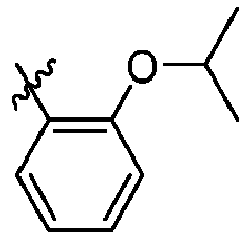
DIPP DIPP H Ph 251 H 
IPP IPP H Ph 252 H 
2-Me-C6H5 2-Me-C6H5 H Ph 253 H 
Mes Mes H Ph 254 H 
Mipp Mipp H Ph 255 H 
DIPP DIPP H Ph 256 H 
IPP IPP H Ph 257 
2-Me-C6H5 2-Me-C6H5 H Ph 258 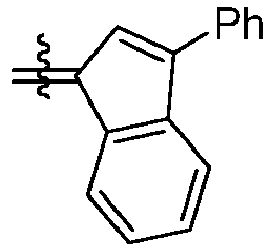
Mes Mes H Ph 259 
Mipp Mipp H Ph 260 
DIPP DIPP H Ph 261 
IPP IPP H Ph 262 H Ph 2-Me-C6H5 2-Me-C6H5 Me t-Bu 263 H Ph Mes Mes Me t-Bu 264 H Ph Mipp Mipp Me t-Bu 265 H Ph DIPP DIPP Me t-Bu 266 H Ph IPP IPP Me t-Bu 267 H 
2-Me-C6H5 2-Me-C6H5 Me t-Bu 268 H 
Mes Mes Me t-Bu 269 H 
Mipp Mipp Me t-Bu 270 H 
DIPP DIPP Me t-Bu 271 H 
IPP IPP Me t-Bu 272 H 
2-Me-C6H5 2-Me-C6H5 Me t-Bu 273 H 
Mes Mes Me t-Bu 274 H 
Mipp Mipp Me t-Bu 275 H 
DIPP DIPP Me t-Bu 276 H 
IPP IPP Me t-Bu 277 
2-Me-C6H5 2-Me-C6H5 Me t-Bu 278 
Mes Mes Me t-Bu 279 
Mipp Mipp Me t-Bu 280 
DIPP DIPP Me t-Bu 281 
IPP IPP Me t-Bu - The present invention also concerns processes for synthesizing the olefin metathesis catalysts of the invention. The olefin metathesis catalysts according to the invention can be prepared analogously to conventional methods as understood by the person skilled in the art of synthetic organic chemistry. For example, synthetic Scheme 1, set forth below, illustrates how the compounds according to the invention can be made.
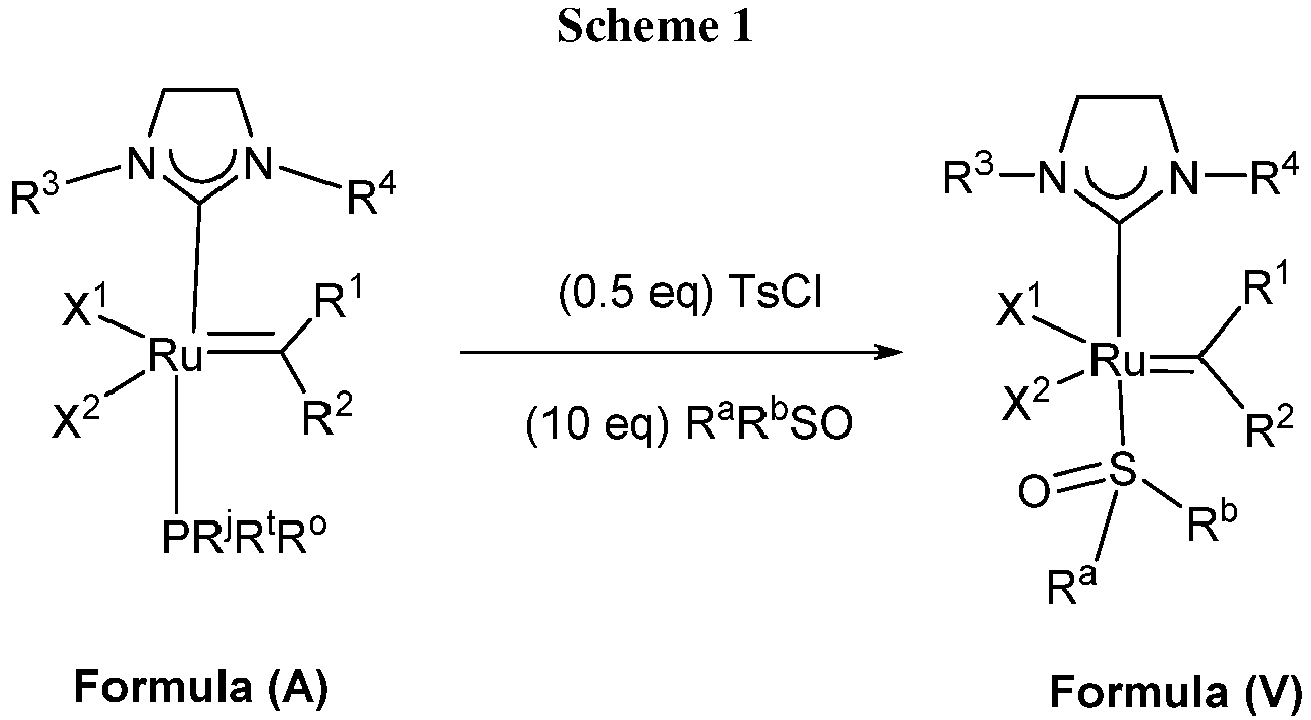
- In a typical procedure, an olefin metathesis catalyst of general Formula (A) is reacted at room temperature with tosyl chloride (TsCl) and an excess of sulfoxide derivative (RaRbSO) to produce an olefin metathesis catalyst of general Formula (V), wherein:
- R1 is hydrogen;
- R2 is unsubstituted hydrocarbyl, substituted hydrocarbyl, unsubstituted heteroatom-containing hydrocarbyl, or substituted heteroatom-containing hydrocarbyl; generally R2 is unsubstituted phenyl, substituted phenyl or substituted 1-propenyl; or R1 and R2 are linked together to form an optionally substituted indenylidene; typically R2 is phenyl, 2-iso-propoxy-phenyl or 2-methyl-1-propenyl; or R1 and R2 are linked together to form 3-phenyl-1-indenylidene;
- X1 and X2 are independently halogen, trifluoroacetate, per-fluorophenols or nitrate; generally X1 and X2 are independently Cl, Br, I or F; typically X1 and X2 are independently Cl;
- R3 is unsubstituted hydrocarbyl, substituted hydrocarbyl, unsubstituted heteroatom-containing hydrocarbyl, or substituted heteroatom-containing hydrocarbyl; generally, R3 is unsubstituted C3-C10 cycloalkyl, substituted C3-C10 cycloalkyl, unsubstituted C5-C24 aryl, or C5-C24 aryl substituted with up to three substituents selected from: unsubstituted C1-C20 alkyl, substituted C1-C20 alkyl, unsubstituted C1-C20 heteroalkyl, substituted C1-C20 heteroalkyl, unsubstituted C5-C24 aryl, substituted C5-C24 aryl, unsubstituted C5-C24 heteroaryl, substituted C5-C24 heteroaryl, unsubstituted C6-C24 aralkyl, substituted C6-C24 aralkyl, unsubstituted C6-C24 alkaryl, substituted C6-C24 alkaryl and halide; typically, R3 is adamantyl, 2,4,6-trimethylphenyl, 2,6-di-iso-propylphenyl, 2-iso-propyl-6-methylphenyl, 2-iso-propyl-phenyl or 2-methyl-phenyl;
- R4 is unsubstituted hydrocarbyl, substituted hydrocarbyl, unsubstituted heteroatom-containing hydrocarbyl, or substituted heteroatom-containing hydrocarbyl; generally, R4 is unsubstituted C3-C10 cycloalkyl, substituted C3-C10 cycloalkyl, unsubstituted C5-C24 aryl, or C5-C24 aryl substituted with up to three substituents selected from: unsubstituted C1-C20 alkyl, substituted C1-C20 alkyl, unsubstituted C1-C20 heteroalkyl, substituted C1-C20 heteroalkyl, unsubstituted C5-C24 aryl, substituted C5-C24 aryl, unsubstituted C5-C24 heteroaryl, substituted C5-C24 heteroaryl, unsubstituted C6-C24 aralkyl, substituted C6-C24 aralkyl, unsubstituted C6-C24 alkaryl, substituted C6-C24 alkaryl and halide; typically, R4 is 2,4,6-trimethylphenyl, 2,6-di-iso-propylphenyl, 2-iso-propyl-6-methylphenyl, 2-iso-propyl-phenyl or 2-methyl-phenyl;
- Ra is hydrogen, unsubstituted hydrocarbyl, substituted hydrocarbyl, unsubstituted heteroatom-containing hydrocarbyl, or substituted heteroatom-containing hydrocarbyl; generally Ra is unsubstituted C1-C10 alkyl, substituted C1-C10 alkyl, unsubstituted C3-C10 cycloalkyl, substituted C3-C10 cycloalkyl, unsubstituted C5-C24 aryl or substituted C5-C24 aryl; typically Ra is methyl, ethyl, n-propyl, iso-propyl, n-butyl, tert-butyl, cyclohexyl or phenyl;
- Rb is hydrogen, unsubstituted hydrocarbyl, substituted hydrocarbyl, unsubstituted heteroatom-containing hydrocarbyl, or substituted heteroatom-containing hydrocarbyl; generally Rb is unsubstituted C1-C10 alkyl, substituted C1-C10 alkyl, unsubstituted C3-C10 cycloalkyl, substituted C3-C10 cycloalkyl, unsubstituted C5-C24 aryl or substituted C5-C24 aryl; typically Rb is methyl, ethyl, n-propyl, iso-propyl, n-butyl, tert-butyl, cyclohexyl or phenyl; or Ra and Rb are linked together to form a five or a six heterocyclic membered ring with the sulfoxide group; and
- Rj, Rt, and Ro are each independently substituted C5-C24 aryl, unsubstituted C5-C24 aryl or substituted C1-C10 alkyl, unsubstituted C1-C10 alkyl; generally Rj, Rt, and Ro are each independently unsubstituted C5-C24 aryl; typically Rj, Rt, and Ro are each independently phenyl.
- In another embodiment, the invention concerns methods of using the olefin metathesis catalysts of the invention, in the synthesis of related olefin metathesis catalysts. The ruthenium olefin metathesis catalysts bearing sulfoxide labile ligands of the invention are excellent precursors for various Second Generation Grubbs ruthenium olefin metathesis catalysts. The Second Generation Grubbs ruthenium olefin metathesis catalysts synthesized during these procedures are obtained in higher yield and with higher purity, which presents an advantage compared to the existing synthetic procedures.
- For example, synthetic Scheme 2, set forth below, illustrates how olefin metathesis catalysts of Formula (F) can be synthesizing from an olefin metathesis catalyst of Formula (IV).

- In a typical procedure, as shown in Scheme 2, the sulfoxide ligand of the olefin metathesis catalyst represented by Formula (IV) can be exchanged with "L" ligand, which is a neutral electron donor. R1, R2, R3, R4, R, X1, X2, M, Q, n, m, Ra, Rb and L2 are as defined herein. "L" is selected from the group consisting of sulphonated phosphine, phosphite, phosphinite, phosphonite, ether, amine, carbonyl, nitrosyl, pyridine, thioether, Grubbs-Hoveyda ligands, trimethylphosphine (PMe3), triethylphosphine (PEt3), tri-n-butylphosphine (PBu3), tri(orthotolyl)phosphine (P-o-tolyl3), tri-tert-butylphosphine (P-tert-Bu3), tricyclopentylphosphine (PCp3), tricyclohexylphosphine (PCy3), triisopropylphosphine (P-i-Pr3), trioctylphosphine (POct3), triisobutylphosphine, (P-i-Bu3), triphenylphosphine (PPh3), tri(pentafluorophenyl)phosphine (P(C6F5)3), methyldiphenylphosphine (PMePh2), dimethylphenylphosphine (PMe2Ph), diethylphenylphosphine (PEt2Ph), phosphabicycloalkane (e.g., monosubstituted 9-phosphabicyclo-[3.3.1]nonane, monosubstituted 9-phosphabicyclo[4.2.1]nonane, cyclohexylphoban, isopropylphoban, ethylphoban, methylphoban, butylphoban, pentylphoban), pyridine, 3-bromopyridine, 4-bromopyridine, 3,5-dibromopyridine, 2,4,6-tribromopyridine, 2,6-dibromopyridine, 3-chloropyridine, 4-chloropyridine, 3,5-dichloropyridine, 2,4,6-trichloropyridine, 2,6-dichloropyridine, 4-iodopyridine, 3,5-diiodopyridine, 3,5-dibromo-4-methylpyridine, 3,5-dichloro-4-methylpyridine, 3,5-dimethyl-4-bromopyridine, 3,5-dimethylpyridine, 4-methylpyridine, 3,5-di-iso-propylpyridine, 2,4,6-trimethylpyridine, 2,4,6-triisopropylpyridine, 4-(tert-butyl)pyridine, 4-phenylpyridine, 3,5-diphenylpyridine, 3,5-dichloro-4-phenylpyridine, bipyridine, pyridazine, pyrimidine, bipyridamine, pyrazine, 1,3,5-triazine, 1,2,4-triazine, 1,2,3-triazine, pyrrole, 2H-pyrrole, 3H-pyrrole, pyrazole, 2H-imidazole, 1,2,3-triazole, 1,2,4-triazole, indole, 3H-indole, 1H-isoindole, cyclopenta(b)pyridine, indazole, quinoline, bisquinoline, isoquinoline, bisisoquinoline, cinnoline, quinazoline, naphthyridine, piperidine, piperazine, pyrrolidine, pyrazolidine, quinuclidine, imidazolidine, picolylimine, purine, benzimidazole, bisimidazole, phenazine, acridine, carbazole, sulfur-containing heterocycles (e.g. thiophene, 1,2-dithiole, 1,3-dithiole, thiepine, benzo(b)thiophene, benzo(c)thiophene, thionaphthene, dibenzothiophene, 2H-thiopyran, 4H-thiopyran, thioanthrene), oxygen-containing heterocycles (e.g. 2H-pyran, 4H-pyran, 2-pyrone, 4-pyrone, 1,2-dioxin, 1,3-dioxin, oxepin, furan, 2H-1-benzopyran, coumarin, coumarone, chromene, chroman-4-one, isochromen-1-one, isochromen-3-one, xanthene, tetrahydrofuran, 1,4-dioxan, dibenzofuran), mixed (e.g. isoxazole, oxazole, thiazole, isothiazole, 1,2,3-oxadiazole, 1,2,4-oxadiazole, 1,3,4-oxadiazole, 1,2,3,4-oxatriazole, 1,2,3,5-oxatriazole, 3H-1,2,3-dioxazole, 3H-1,2-oxathiole, 1,3-oxathiole, 4H-1,2-oxazine, 2H-1,3-oxazine, 1,4-oxazine, 1,2,5-oxathiazine, o-isooxazine, phenoxazine, phenothiazine, pyrano[3,4-b]pyrrole, indoxazine, benzoxazole, anthranil, and morpholine), aromatic nitrogen-containing and oxygen-containing heterocycles, monocyclic N-heteroaryl ligands that are optionally substituted with 1 to 3, preferably 1 or 2, substituents.
- The ligand exchange reactions are carried out under inert atmosphere (under nitrogen or argon). The reactions generally are carried out at room temperature or at temperatures from 15°C to 25°C or from 25°C to 60°C, or from 35°C to 50°C, or from 20°C to 25°C, or from 30°C to 40°C, or from 25°C to 45°C. The reaction times vary from several minutes to several hours 12 hours, 24 hours or 48 hours. Generally the reactions take place in solvents such as tetrahydrofuran (THF), benzene, toluene, xylene, diethyl ether, dioxane, alcohols, methyl-tetrahydrofuran, acetone, ethyl acetate, methyl tert-butyl ether (MTBE), dimethylformamide (DMF), and dichloromethane.
- In another embodiment, the invention concerns also processes for synthesizing olefin metathesis catalysts of Formula (B) starting with an olefin metathesis catalyst of Formula (V).

- In a typical procedure, as shown in Scheme 3, the sulfoxide ligand of the olefin metathesis catalyst represented by Formula (V) is exchanged with a PRdReORf ligand at room temperature in an inert solvent, such as dichloromethane or toluene, wherein:
- R1 is hydrogen;
- R2 is unsubstituted hydrocarbyl, substituted hydrocarbyl, unsubstituted heteroatom-containing hydrocarbyl, or substituted heteroatom-containing hydrocarbyl; generally R2 is unsubstituted phenyl, substituted phenyl or substituted 1-propenyl; or R1 and R2 are linked together to form an optionally substituted indenylidene; typically R2 is phenyl, 2-iso-propoxy-phenyl or 2-methyl-1-propenyl; or R1 and R2 are linked together to form 3-phenyl-1-indenylidene;
- X1 and X2 are independently halogen, trifluoroacetate, per-fluorophenols or nitrate; generally X1 and X2 are independently Cl, Br, I or F; typically X1 and X2 are independently Cl;
- Ra is hydrogen, unsubstituted hydrocarbyl, substituted hydrocarbyl, unsubstituted heteroatom-containing hydrocarbyl, or substituted heteroatom-containing hydrocarbyl; generally Ra is unsubstituted C1-C10 alkyl, substituted C1-C10 alkyl, unsubstituted C3-C10 cycloalkyl, substituted C3-C10 cycloalkyl, unsubstituted C5-C24 aryl or substituted C5-C24 aryl; typically Ra is methyl, ethyl, n-propyl, iso-propyl, n-butyl, tert-butyl, cyclohexyl or phenyl;
- Rb is hydrogen, unsubstituted hydrocarbyl, substituted hydrocarbyl, unsubstituted heteroatom-containing hydrocarbyl, or substituted heteroatom-containing hydrocarbyl; generally Rb is unsubstituted C1-C10 alkyl, substituted C1-C10 alkyl, unsubstituted C3-C10 cycloalkyl, substituted C3-C10 cycloalkyl, unsubstituted C5-C24 aryl or substituted C5-C24 aryl; typically Rb is methyl, ethyl, n-propyl, iso-propyl, n-butyl, tert-butyl, cyclohexyl or phenyl; or Ra and Rb are linked together to form a five or a six heterocyclic membered ring with the sulfoxide group; typically, Ra and Rb are linked together to form a tetrahydrothiophene oxide;
- R3 is unsubstituted hydrocarbyl, substituted hydrocarbyl, unsubstituted heteroatom-containing hydrocarbyl, or substituted heteroatom-containing hydrocarbyl; generally, R3 is unsubstituted C3-C10 cycloalkyl, substituted C3-C10 cycloalkyl, unsubstituted C5-C24 aryl, or C5-C24 aryl substituted with up to three substituents selected from: unsubstituted C1-C20 alkyl, substituted C1-C20 alkyl, unsubstituted C1-C20 heteroalkyl, substituted C1-C20 heteroalkyl, unsubstituted C5-C24 aryl, substituted C5-C24 aryl, unsubstituted C5-C24 heteroaryl, substituted C5-C24 heteroaryl, unsubstituted C6-C24 aralkyl, substituted C6-C24 aralkyl, unsubstituted C6-C24 alkaryl, substituted C6-C24 alkaryl and halide; typically, R3 is adamantyl, 2,4,6-trimethylphenyl, 2,6-di-iso-propylphenyl, 2-iso-propyl-6-methylphenyl, 2-iso-propyl-phenyl, or 2-methyl-phenyl;
- R4 is unsubstituted hydrocarbyl, substituted hydrocarbyl, unsubstituted heteroatom-containing hydrocarbyl, or substituted heteroatom-containing hydrocarbyl; generally, R4 is unsubstituted C3-C10 cycloalkyl, substituted C3-C10 cycloalkyl, unsubstituted C5-C24 aryl, or C5-C24 aryl substituted with up to three substituents selected from: unsubstituted C1-C20 alkyl, substituted C1-C20 alkyl, unsubstituted C1-C20 heteroalkyl, substituted C1-C20 heteroalkyl, unsubstituted C5-C24 aryl, substituted C5-C24 aryl, unsubstituted C5-C24 heteroaryl, substituted C5-C24 heteroaryl, unsubstituted C6-C24 aralkyl, substituted C6-C24 aralkyl, unsubstituted C6-C24 alkaryl, substituted C6-C24 alkaryl and halide; typically, R4 is 2,4,6-trimethylphenyl, 2,6-di-iso-propylphenyl, 2-iso-propyl-6-methylphenyl, 2-iso-propyl-phenyl or 2-methyl-phenyl;
- Rd is unsubstituted C1-C10 alkyl, substituted C1-C10 alkyl, substituted C6-C10 aryl, unsubstituted C6-C10 aryl, substituted C3-C8 cycloalkyl or unsubstituted C3-C8 cycloalkyl; generally Rd is unsubstituted C1-C10 alkyl or unsubstituted C6-C10 aryl; typically Rd is phenyl;
- Re is unsubstituted C1-C10 alkyl, substituted C1-C10 alkyl, substituted C6-C10 aryl, unsubstituted C6-C10 aryl, substituted C3-C8 cycloalkyl or unsubstituted C3-C8 cycloalkyl; generally Re is unsubstituted C1-C10 alkyl or unsubstituted C6-C10 aryl; typically Re is phenyl; and
- Rf is unsubstituted C1-C10 alkyl, substituted C1-C10 alkyl, substituted C6-C10 aryl, unsubstituted C6-C10 aryl, substituted C3-C8 cycloalkyl or unsubstituted C3-C8 cycloalkyl; generally Rf is unsubstituted C1-C10 alkyl, unsubstituted C6-C10 aryl or unsubstituted C6-C10 aryl; typically, Rf is phenyl, methyl, p-(OMe)phenyl, iso-propyl or ethyl.
- In another embodiment, the invention concerns also processes for synthesizing olefin metathesis catalysts of Formula (C) starting with an olefin metathesis catalyst of Formula (V).

- In a typical procedure, as shown in Scheme 4, the sulfoxide ligand of the olefin metathesis catalyst represented by Formula (V) can be exchanged with a PRgORhORi ligand at room temperature in an inert solvent, such as dichloromethane or toluene, wherein:
- R1 is hydrogen;
- R2 is unsubstituted hydrocarbyl, substituted hydrocarbyl, unsubstituted heteroatom-containing hydrocarbyl, or substituted heteroatom-containing hydrocarbyl; generally R2 is unsubstituted phenyl, substituted phenyl or substituted 1-propenyl; or R1 and R2 are linked together to form an optionally substituted indenylidene; typically R2 is phenyl, 2-iso-propoxy-phenyl or 2-methyl-1-propenyl; or R1 and R2 are linked together to form 3-phenyl-1-indenylidene;
- Ra is hydrogen, unsubstituted hydrocarbyl, substituted hydrocarbyl, unsubstituted heteroatom-containing hydrocarbyl, or substituted heteroatom-containing hydrocarbyl; generally Ra is unsubstituted C1-C10 alkyl, substituted C1-C10 alkyl, unsubstituted C3-C10 cycloalkyl, substituted C3-C10 cycloalkyl, unsubstituted C5-C24 aryl or substituted C5-C24 aryl; typically Ra is methyl, ethyl, n-propyl, iso-propyl, n-butyl, tert-butyl, cyclohexyl or phenyl;
- Rb is hydrogen, unsubstituted hydrocarbyl, substituted hydrocarbyl, unsubstituted heteroatom-containing hydrocarbyl, or substituted heteroatom-containing hydrocarbyl; generally Rb is unsubstituted C1-C10 alkyl, substituted C1-C10 alkyl, unsubstituted C3-C10 cycloalkyl, substituted C3-C10 cycloalkyl, unsubstituted C5-C24 aryl or substituted C5-C24 aryl; typically Rb is methyl, ethyl, n-propyl, iso-propyl, n-butyl, tert-butyl, cyclohexyl or phenyl; or Ra and Rb are linked together to form a five or a six heterocyclic membered ring with the sulfoxide group; typically, Ra and Rb are linked together to form a tetrahydrothiophene oxide;
- X1 and X2 are independently halogen, trifluoroacetate, per-fluorophenols or nitrate; generally X1 and X2 are independently Cl, Br, I or F; typically X1 and X2 are independently Cl;
- R3 is unsubstituted hydrocarbyl, substituted hydrocarbyl, unsubstituted heteroatom-containing hydrocarbyl, or substituted heteroatom-containing hydrocarbyl; generally, R3 is unsubstituted C3-C10 cycloalkyl, substituted C3-C10 cycloalkyl, unsubstituted C5-C24 aryl, or C5-C24 aryl substituted with up to three substituents selected from: unsubstituted C1-C20 alkyl, substituted C1-C20 alkyl, unsubstituted C1-C20 heteroalkyl, substituted C1-C20 heteroalkyl, unsubstituted C5-C24 aryl, substituted C5-C24 aryl, unsubstituted C5-C24 heteroaryl, substituted C5-C24 heteroaryl, unsubstituted C6-C24 aralkyl, substituted C6-C24 aralkyl, unsubstituted C6-C24 alkaryl, substituted C6-C24 alkaryl and halide; typically, R3 is adamantyl, 2,4,6-trimethylphenyl, 2,6-di-iso-propylphenyl, 2-iso-propyl-6-methylphenyl, 2-iso-propyl-phenyl or 2-methyl-phenyl;
- R4 is unsubstituted hydrocarbyl, substituted hydrocarbyl, unsubstituted heteroatom-containing hydrocarbyl, or substituted heteroatom-containing hydrocarbyl; generally, R4 is unsubstituted C3-C10 cycloalkyl, substituted C3-C10 cycloalkyl, unsubstituted C5-C24 aryl, or C5-C24 aryl substituted with up to three substituents selected from: unsubstituted C1-C20 alkyl, substituted C1-C20 alkyl, unsubstituted C1-C20 heteroalkyl, substituted C1-C20 heteroalkyl, unsubstituted C5-C24 aryl, substituted C5-C24 aryl, unsubstituted C5-C24 heteroaryl, substituted C5-C24 heteroaryl, unsubstituted C6-C24 aralkyl, substituted C6-C24 aralkyl, unsubstituted C6-C24 alkaryl, substituted C6-C24 alkaryl and halide; typically, R4 is 2,4,6-trimethylphenyl, 2,6-di-iso-propylphenyl, 2-iso-propyl-6-methylphenyl, 2-iso-propyl-phenyl or 2-methyl-phenyl;
- Rg is unsubstituted C1-C10 alkyl, substituted C1-C10 alkyl, substituted C6-C10 aryl, unsubstituted C6-C10 aryl, substituted C3-C8 cycloalkyl or unsubstituted C3-C8 cycloalkyl; generally Rg is unsubstituted C1-C10 alkyl or unsubstituted C6-C10 aryl; typically Rg is phenyl;
- Rh is unsubstituted C1-C10 alkyl, substituted C1-C10 alkyl, substituted C6-C10 aryl, unsubstituted C6-C10 aryl, substituted C3-C8 cycloalkyl or unsubstituted C3-C8 cycloalkyl; generally Rh is unsubstituted C1-C10 alkyl or unsubstituted C6-C10 aryl; typically Rh is phenyl or methyl; and
- Ri is unsubstituted C1-C10 alkyl, substituted C1-C10 alkyl, substituted C6-C10 aryl, unsubstituted C6-C10 aryl, substituted C3-C8 cycloalkyl or unsubstituted C3-C8 cycloalkyl; generally Ri is unsubstituted C1-C10 alkyl or unsubstituted C6-C10 aryl; typically Ri is phenyl or methyl.
- In another embodiment, the invention concerns also processes for synthesizing olefin metathesis catalysts of Formula (D) starting with an olefin metathesis catalyst of Formula (V).


- In a typical procedure as shown in
Scheme 5, the sulfoxide ligand of the olefin metathesis catalyst represented by Formula (V) is exchanged with a Grubbs-Hoveyda ligand at 60°C in ethyl acetate, wherein: - R1 is hydrogen;
- R2 is unsubstituted hydrocarbyl, substituted hydrocarbyl, unsubstituted heteroatom-containing hydrocarbyl, or substituted heteroatom-containing hydrocarbyl; generally R2 is unsubstituted phenyl, substituted phenyl or substituted 1-propenyl; or R1 and R2 are linked together to form an optionally substituted indenylidene; typically R2 is phenyl, 2-iso-propoxy-phenyl or 2-methyl-1-propenyl; or R1 and R2 are linked together to form 3-phenyl-1-indenylidene;
- Ra is hydrogen, unsubstituted hydrocarbyl, substituted hydrocarbyl, unsubstituted heteroatom-containing hydrocarbyl, or substituted heteroatom-containing hydrocarbyl; generally Ra is unsubstituted C1-C10 alkyl, substituted C1-C10 alkyl, unsubstituted C3-C10 cycloalkyl, substituted C3-C10 cycloalkyl, unsubstituted C5-C24 aryl or substituted C5-C24 aryl; typically Ra is methyl, ethyl, n-propyl, iso-propyl, n-butyl, tert-butyl, cyclohexyl or phenyl;
- Rb is hydrogen, unsubstituted hydrocarbyl, substituted hydrocarbyl, unsubstituted heteroatom-containing hydrocarbyl, or substituted heteroatom-containing hydrocarbyl; generally Rb is unsubstituted C1-C10 alkyl, substituted C1-C10 alkyl, unsubstituted C3-C10 cycloalkyl, substituted C3-C10 cycloalkyl, unsubstituted C5-C24 aryl or substituted C5-C24 aryl; typically Rb is methyl, ethyl, n-propyl, iso-propyl, n-butyl, tert-butyl, cyclohexyl or phenyl; or Ra and Rb are linked together to form a five or a six heterocyclic membered ring with the sulfoxide group; typically, Ra and Rb are linked together to form a tetrahydrothiophene oxide;
- X1 and X2 are independently halogen, trifluoroacetate, per-fluorophenols or nitrate; generally X1 and X2 are independently Cl, Br, I or F; typically, X1 and X2 are independently Cl;
- R3 is unsubstituted hydrocarbyl, substituted hydrocarbyl, unsubstituted heteroatom-containing hydrocarbyl, or substituted heteroatom-containing hydrocarbyl; generally, R3 is unsubstituted C3-C10 cycloalkyl, substituted C3-C10 cycloalkyl, unsubstituted C5-C24 aryl, or C5-C24 aryl substituted with up to three substituents selected from: unsubstituted C1-C20 alkyl, substituted C1-C20 alkyl, unsubstituted C1-C20 heteroalkyl, substituted C1-C20 heteroalkyl, unsubstituted C5-C24 aryl, substituted C5-C24 aryl, unsubstituted C5-C24 heteroaryl, substituted C5-C24 heteroaryl, C6-C24 aralkyl, substituted C6-C24 aralkyl, unsubstituted C6-C24 alkaryl, substituted C6-C24 alkaryl and halide; typically, R3 is adamantyl, 2,4,6-trimethylphenyl, 2,6-di-iso-propylphenyl, 2-iso-propyl-6-methylphenyl, 2-iso-propyl-phenyl or 2-methyl-phenyl;
- R4 is unsubstituted hydrocarbyl, substituted hydrocarbyl, unsubstituted heteroatom-containing hydrocarbyl, or substituted heteroatom-containing hydrocarbyl; generally, R4 is unsubstituted C3-C10 cycloalkyl, substituted C3-C10 cycloalkyl, unsubstituted C5-C24 aryl, or C5-C24 aryl substituted with up to three substituents selected from: unsubstituted C1-C20 alkyl, substituted C1-C20 alkyl, unsubstituted C1-C20 heteroalkyl, substituted C1-C20 heteroalkyl, unsubstituted C5-C24 aryl, substituted C5-C24 aryl, unsubstituted C5-C24 heteroaryl, substituted C5-C24 heteroaryl, unsubstituted C6-C24 aralkyl, substituted C6-C24 aralkyl, unsubstituted C6-C24 alkaryl, substituted C6-C24 alkaryl and halide; typically, R4 is 2,4,6-trimethylphenyl, 2,6-di-iso-propylphenyl, 2-iso-propyl-6-methylphenyl, 2-iso-propyl-phenyl or 2-methyl-phenyl;
- Rk is hydrogen, halogen, -NO2, -CN, -CF3, -SO2NRs 2, -NHC(O)CF3, -NHC(O)C6F5, - NHC(O)OtBu, unsubstituted hydrocarbyl, substituted hydrocarbyl, unsubstituted heteroatom-containing hydrocarbyl, or substituted heteroatom-containing hydrocarbyl; typically, Rk is hydrogen;
- R1 is hydrogen, halogen, -NO2, -CN, -CF3, -SO2NRs 2, -NHC(O)CF3, -NHC(O)C6F5, - NHC(O)OtBu, unsubstituted hydrocarbyl, substituted hydrocarbyl, unsubstituted heteroatom-containing hydrocarbyl, or substituted heteroatom-containing hydrocarbyl; typically, R1 is hydrogen;
- Rm is hydrogen, halogen, -NO2, -CN, -CF3, -SO2NRs 2, -NHC(O)CF3, -NHC(O)C6F5, - NHC(O)OtBu, unsubstituted hydrocarbyl, substituted hydrocarbyl, unsubstituted heteroatom-containing hydrocarbyl, or substituted heteroatom-containing hydrocarbyl; typically, Rm is hydrogen, -NO2, -CN, -CF3, -SO2NRs 2, -NHC(O)CF3, -NHC(O)C6F5, or -NHC(O)OtBu; specifically Rm is hydrogen;
- Rn is hydrogen, halogen, -NO2, -CN, -CF3, -SO2NRs 2, -NHC(O)CF3, -NHC(O)C6F5, - NHC(O)OtBu, unsubstituted hydrocarbyl, substituted hydrocarbyl, unsubstituted heteroatom-containing hydrocarbyl, or substituted heteroatom-containing hydrocarbyl; typically, Rn is hydrogen;
- Rs is hydrogen or C1-C6 alkyl; typically Rs is hydrogen, methyl, ethyl or n-propyl; and
- Rq is unsubstituted hydrocarbyl, substituted hydrocarbyl; generally, Rq is C1-C10 alkyl; typically, Rq is iso-propyl.
- In another embodiment, the invention concerns also processes for synthesizing olefin metathesis catalysts of Formula (E) starting with an olefin metathesis catalyst of Formula (V).

- In a typical procedure, as shown in Scheme 6, the sulfoxide ligand of the olefin metathesis catalyst represented by Formula (V) can be exchanged with a P(Rq)3 ligand at room temperature in an inert solvent, such as dichloromethane or toluene, wherein:
- R1 is hydrogen;
- R2 is unsubstituted hydrocarbyl, substituted hydrocarbyl, unsubstituted heteroatom-containing hydrocarbyl, or substituted heteroatom-containing hydrocarbyl; generally R2 is unsubstituted phenyl, substituted phenyl or substituted 1-propenyl; or R1 and R2 are linked together to form an optionally substituted indenylidene; typically R2 is phenyl, 2-iso-propoxyphenyl or 2-methyl-1-propenyl; or R1 and R2 are linked together to form 3-phenyl-1-indenylidene;
- Ra is hydrogen, unsubstituted hydrocarbyl, substituted hydrocarbyl, unsubstituted heteroatom-containing hydrocarbyl, or substituted heteroatom-containing hydrocarbyl; generally Ra is unsubstituted C1-C10 alkyl, substituted C1-C10 alkyl, unsubstituted C3-C10 cycloalkyl, substituted C3-C10 cycloalkyl, unsubstituted C5-C24 aryl or substituted C5-C24 aryl; typically Ra is methyl, ethyl, n-propyl, iso-propyl, n-butyl, tert-butyl, cyclohexyl or phenyl;
- Rb is hydrogen, unsubstituted hydrocarbyl, substituted hydrocarbyl, unsubstituted heteroatom-containing hydrocarbyl, or substituted heteroatom-containing hydrocarbyl; generally Rb is unsubstituted C1-C10 alkyl, substituted C1-C10 alkyl, unsubstituted C3-C10 cycloalkyl, substituted C3-C10 cycloalkyl, unsubstituted C5-C24 aryl or substituted C5-C24 aryl; typically Rb is methyl, ethyl, n-propyl, iso-propyl, n-butyl, tert-butyl, cyclohexyl or phenyl; or Ra and Rb are linked together to form a five or a six heterocyclic membered ring with the sulfoxide group; typically, Ra and Rb are linked together to form a tetrahydrothiophene oxide;
- X1 and X2 are independently halogen, trifluoroacetate, per-fluorophenols or nitrate; generally X1 and X2 are independently Cl, Br, I or F; typically X1 and X2 are independently Cl;
- R3 is unsubstituted hydrocarbyl, substituted hydrocarbyl, unsubstituted heteroatom-containing hydrocarbyl, or substituted heteroatom-containing hydrocarbyl; generally, R3 is unsubstituted C3-C10 cycloalkyl, substituted C3-C10 cycloalkyl, unsubstituted C5-C24 aryl, or C5-C24 aryl substituted with up to three substituents selected from: unsubstituted C1-C20 alkyl, substituted C1-C20 alkyl, unsubstituted C1-C20 heteroalkyl, substituted C1-C20 heteroalkyl, unsubstituted C5-C24 aryl, substituted C5-C24 aryl, unsubstituted C5-C24 heteroaryl, substituted C5-C24 heteroaryl, unsubstituted C6-C24 aralkyl, substituted C6-C24 aralkyl, unsubstituted C6-C24 alkaryl, substituted C6-C24 alkaryl and halide; typically, R3 is adamantyl, 2,4,6-trimethylphenyl, 2,6-di-iso-propylphenyl, 2-iso-propyl-6-methylphenyl, 2-iso-propyl-phenyl or 2-methyl-phenyl;
- R4 is unsubstituted hydrocarbyl, substituted hydrocarbyl, unsubstituted heteroatom-containing hydrocarbyl, or substituted heteroatom-containing hydrocarbyl; generally, R4 is unsubstituted C3-C10 cycloalkyl, substituted C3-C10 cycloalkyl, unsubstituted C5-C24 aryl, or C5-C24 aryl substituted with up to three substituents selected from: unsubstituted C1-C20 alkyl, substituted C1-C20 alkyl, unsubstituted C1-C20 heteroalkyl, substituted C1-C20 heteroalkyl, unsubstituted C5-C24 aryl, substituted C5-C24 aryl, unsubstituted C5-C24 heteroaryl, substituted C5-C24 heteroaryl, unsubstituted C6-C24 aralkyl, substituted C6-C24 aralkyl, unsubstituted C6-C24 alkaryl, substituted C6-C24 alkaryl and halide; typically, R4 is 2,4,6-trimethylphenyl, 2,6-di-iso-propylphenyl, 2-iso-propyl-6-methylphenyl, 2-iso-propyl-phenyl or 2-methyl-phenyl; and
- Rp is unsubstituted C1-C10 alkyl, substituted C1-C10 alkyl, substituted C6-C10 aryl, unsubstituted C6-C10 aryl, substituted C3-C8 cycloalkyl or unsubstituted C3-C8 cycloalkyl; generally Rp is substituted C6-C10 aryl, unsubstituted C6-C10 aryl, substituted C3-C8 cycloalkyl or unsubstituted C3-C8 cycloalkyl; typically Rp is phenyl, cyclohexyl, or cyclopentyl.
- At this stage, those skilled in the art will appreciate that many additional compounds that fall under the scope of the invention can be prepared by performing various common chemical reactions. Details of certain specific chemical transformations are provided in the examples.
- The metal carbene olefin metathesis catalysts can be utilized in olefin metathesis reactions according to techniques known in the art. For example, the metal carbene olefin metathesis catalysts are typically added to a resin composition as a solid, a solution, or as a suspension. When the metal carbene olefin metathesis catalysts are added to a resin composition as a suspension, the metal carbene olefin metathesis catalysts are suspended in a dispersing carrier such as mineral oil, paraffin oil, soybean oil, tri-iso-propylbenzene, or any hydrophobic liquid which has a sufficiently high viscosity so as to permit effective dispersion of the catalyst(s), and which is sufficiently inert and which has a sufficiently high boiling point so that is does not act as a low-boiling impurity in the olefin metathesis reaction. It will be appreciated that the amount of catalyst that is used (i.e., the "catalyst loading") in the reaction is dependent upon a variety of factors such as the identity of the reactants and the reaction conditions that are employed. It is therefore understood that catalyst loading can be optimally and independently chosen for each reaction. In general, however, the catalyst will be present in an amount that ranges from a low of about 0.1 ppm, 1 ppm, or 5 ppm, to a high of about 10 ppm, 15 ppm, 25 ppm, 50 ppm, 100 ppm, 200 ppm, 500 ppm, or 1000 ppm relative to the amount of an olefinic substrate (e.g., cyclic olefins).
- Resin compositions that may be used with the present invention disclosed herein comprise one or more cyclic olefins. Such cyclic olefins may be optionally substituted, optionally heteroatom-containing, mono-unsaturated, di-unsaturated, or poly-unsaturated C5 to C24 hydrocarbons that may be mono-, di-, or poly-cyclic. The cyclic olefin may generally be any strained or unstrained cyclic olefin, provided the cyclic olefin is able to participate in a ROMP reaction either individually or as part of a ROMP cyclic olefin composition.
- Examples of bicyclic and polycyclic olefins thus include, without limitation, dicyclopentadiene (DCPD); trimer and other higher order oligomers of cyclopentadiene including without limitation tricyclopentadiene (cyclopentadiene trimer), cyclopentadiene tetramer, and cyclopentadiene pentamer; ethylidenenorbornene; dicyclohexadiene; norbornene; C2-C12 hydrocarbyl substituted norbornenes; 5-butyl-2-norbornene; 5-hexyl-2-norbornene; 5-octyl-2-norbornene; 5-decyl-2-norbornene; 5-dodecyl-2-norbornene; 5-vinyl-2-norbornene; 5-ethylidene-2-norbornene; 5-isopropenyl-2-norbornene; 5-propenyl-2-norbornene; 5-butenyl-2-norbornene; 5-tolyl-norbornene; 5-methyl-2-norbornene; 5-ethyl-2-norbornene; 5-isobutyl-2-norbornene; 5,6-dimethyl-2-norbornene; 5-phenylnorbornene; 5-benzylnorbornene; 5-acetylnorbornene; 5-methoxycarbonylnorbornene; 5-ethyoxycarbonyl-1-norbornene; 5-methyl-5-methoxy-carbonylnorbornene; bicyclo[2.2.1]hept-2-ene-2-carboxylic acid, 2-ethylhexyl ester; 5-cyanonorbornene; 5,5,6-trimethyl-2-norbornene; cyclo-hexenylnorbornene; endo, exo-5,6-dimethoxynorbornene; endo, endo-5,6-dimethoxynorbornene; endo, exo-5,6-dimethoxy carbonylnorbornene; endo,endo-5,6-dimethoxycarbonylnorbornene; 2,3-dimethoxynorbornene; norbornadiene; tricycloundecene; tetracyclododecene; 8-methyl tetracyclododecene; 8-ethyltetracyclododecene; 8-methoxy carbonyltetracyclo dodecene; 8-methyl-8-tetra cyclododecene; 8-cyanotetracyclo dodecene; pentacyclopentadecene; pentacyclo hexadecene; bicyclo[2.2.1]hept-2-ene-5-phenoxymethyl; 2-ethylhexyl ester-bicyclo[2.2.1]hept-5-ene-2-carboxylic acid; 2-hydroxyethyl ester-bicyclo[2.2.1]hept-5-ene-2-carboxylic acid; bicyclo[2.2.1] hept-5-ene-2-methanol; bicyclo[2.2.1]hept-5-ene-2-heptanoic acid-methyl ester; bicyclo[2.2.1] hept-5-ene-2-hexanoic acid-methyl ester; 1,4:5,8-dimethanonaphthalene, 2-hexyl-1,2,3,4,4a,5,8, 8a-octahydro; bicyclo[2.2.1]hept-5-ene-2-octanoic acid-methyl ester; 1,4:5,8-dimethano naphthalene; 2-butyl-1,2,3,4,4a,5,8,8a-octahydro; ethylidenetetracyclododecene; 2-vinyl-1,2,3,4,4a,5,8,8a-octahydro-1,4:5,8-dimethano naphthalene; and the like, and their structural isomers, stereoisomers, and mixtures thereof.
- In the following examples, efforts have been made to ensure accuracy with respect to numbers used (e.g., amounts, temperature, etc.) but some experimental error and deviation should be accounted for. The examples are to be considered as not being limiting of the invention described herein. Surprisingly, the olefin metathesis catalysts of the invention were obtained only in the cis configuration, no traces of the trans stereoisomers were detected.
- All reactions involving metal complexes were conducted in oven-dried glassware under an argon or nitrogen atmosphere using standard Schlenk techniques. Chemicals and solvents were obtained from Sigma-Aldrich, Strem, Alfa Aesar, Nexeo, Brenntag, AG Layne and TCI. Commercially available reagents were used as received unless otherwise noted. Silica gel was purchased from Fisher (0.040-0.063 µm, EMD Millipore).
- The crystallographic measurements were performed at 100(2) K using a Bruker APEX-II CCD area detector diffractometer (Mo-K α radiation, λ = 0.71073 Å). In each case, a specimen of suitable size and quality was selected and mounted onto a nylon loop. The structures were solved by direct methods, which successfully located most of the non-hydrogen atoms. Semi-empirical absorption corrections were applied. Subsequent refinement on F 2 using the SHELXTL/PC package (version 6.1) allowed location of the remaining non-hydrogen atoms.
- Ultrene® 99 dicyclopentadiene (DCPD) was obtained from Cymetech Corporation. A modified DCPD base resin containing 20-25% tricyclopentadiene (and small amounts of higher cyclopentadiene homologs) (DCPD-HT) was prepared by heat treatment of Ultrene® 99 DCPD generally as described in
U.S. Pat. No. 4,899,005 . - Catalysts C931, C933, C793, C827, C705, C727, C748 and C848 were prepared using known methods.
- 1H and 13C NMR spectra were recorded on a Varian 400 MHz spectrometer. Chemical shifts are reported in ppm downfield from Me4Si by using the residual solvent peak as an internal standard (CDCl3 δ 7.24 ppm). Spectra were analyzed and processed using MestReNova software.
- General GC method conditions: injection temperature, 250 °C; detector temperature, 280 °C; oven temperature, starting temperature, 100 °C; hold time, 1 min. The ramp rate was 10°C/min to 250 °C, hold time 12 min; carrier gas helium.
- GC Method 1: Column: DB-225, 30m × 0.25mm (ID) × 0.25µm film thickness. Manufacturer: Agilent; GC and column conditions: Injector temperature: 220 °C, Detector temperature: 220 °C; Oven temperature: Starting temperature: 35 °C, hold time: 0.5 minutes.
-
Ramp rate 10 °C/min to 130 °C, hold time: 0 minutes.Ramp rate 20 °C/min to 220 °C, hold time: 5 minutes. Carrier gas: Helium. Mean gas velocity: 25 cm/sec. Split ratio: 20: 1. - The following abbreviations are used in the examples:
mL milliliter DCM/CH2Cl2 dichloromethane C6D6 deuterated benzene CDCl3 deuterated chloroform CD2Cl2 deuterated dichloromethane C931 
[1,3-bis-(2,4,6-trimethylphenyl)-2-imidazolidinylidene]dichloro (phenylindenylidene) (triphenylphosphine)ruthenium(II) [CAS 340810-50-6] C793 
[1,3-Bis(2-methylphenyl)-2-imidazolidinylidene]dichloro(benzylidene) (tricyclohexylphosphine)ruthenium(II) [CAS 927429-60-5] C827 
Dichloro[1,3-bis(2,4,6-trimethylphenyl)-2-imidazolidinylidene] (3 -methyl-2-butenylidene) (tricyclohexylphosphine)ruthenium(II) [CAS 253688-91-4] C933 
Dichloro[1,3-bis(2,6-di-iso-propylphenyl)-2-imidazolidinylidene](benzylidene)(tricyclohexylphosphine) ruthenium(II) [CAS 373640-75-6] C848 
Dichloro[1,3-bis(2,4,6-trimethylphenyl)-2-imidazolidinylidene](benzylidene)(tricyclohexylphosphine) ruthenium(II) [CAS 246047-72-3] C748 
[1,3-Bis(2,4,6-trimethylphenyl)-2-imidazolidinylidene] dichloro-(3-phenyl-1H-inden-1-ylidene)(pyridyl)ruthenium (II) [CAS 1031262-76-6] C727 
Dichloro[1,3-bis(2,4,6-trimethylphenyl)-2-imidazolidinylidene](benzylidene)(dipyridine) ruthenium(II) [CAS 357186-58-4] C705 
Dichloro[1,3-bis(2,4,6-trimethylphenyl)-2-imidazolidinylidene] (3 -methyl-2-butenylidene)(dipyridine)ruthenium(II) [CAS 507274-22-8] DMSO dimethylsulfoxide PCy3 tricyclohexylphosphine EtOAc ethylacetate MTBE methyl tert-butyl ether THF tetrahydrofuran CHP cumene hydroperoxide 5C14 5-tetradecene 5C10 5-decene 9C18 9-octadecene -

- To a 20 mL scintillation vial equipped with a magnetic stir bar were added C931 (0.500 g, 0.537 mmol), p-toluenesulfonyl chloride (0.051 g, 0.268 mmol), dimethyl sulfoxide (0.210 g, 2.68 mmol), and dichloromethane (4 mL). The reaction was stirred for one hour then filtered through a plug of celite and combined with diethyl ether (30 mL). The resulting black precipitate was isolated by filtration, washed with diethyl ether (2 × 10 mL) then dried in vacuum to afford C747 as a black powder (0.346 g, 86.3% yield). The X-ray structure of C747 is shown in
Figure 1 . - 1H NMR (400 MHz, CDCl3): δ 8.68 (d, J = 7.4 Hz, 1H), 7.71 (d, J = 7.6 Hz, 2H), 7.52 (t, J = 7.1 Hz, 1H), 7.42 (t, J = 7.5 Hz, 2H), 7.31 (t, J = 7.4 Hz, 1H), 7.25 (t, J = 7.1 Hz, 1H), 7.11 (d, J = 6.1 Hz, 2H), 7.04 (d, J = 7.0 Hz, 1H), 6.86 (s, 1H), 6.26 (d, J = 3.8 Hz, 2H), 4.13 - 3.99 (m, 1H), 3.99 - 3.80 (m, 2H), 3.80 - 3.69 (m, 1H), 2.82 (s, 3H), 2.69 (s, 3H), 2.68 (s, 3H), 2.41 (s, 3H), 2.35 (s, 3H), 2.11 (s, 3H), 2.05 (s, 3H), 1.77 (s, 3H).
-

- To a 40 mL scintillation vial equipped with a magnetic stir bar were added C848 (0.500 g, 0.589 mmol), p-toluenesulfonyl chloride (0.056 g, 0.30 mmol), dimethyl sulfoxide (0.230 g, 2.94 mmol), and dichloromethane (4 mL). The reaction was stirred at ambient temperature for one hour then filtered through a plug of celite and combined with diethyl ether (30 mL). The resulting purple precipitate was isolated by filtration, washed with diethyl ether (2 × 10 mL) then dried in vacuum to afford C647m as a purple crystalline solid (0.269 g, 70.7% yield). The X-ray structure of C647m is shown in
Figure 2 . - 1H NMR (400 MHz, C6D6) δ 16.03 (s, 1H), 8.15 (d, J = 25.0 Hz, 2H), 7.21 (t, J = 7.3 Hz, 1H), 7.00 (t, J = 7.8 Hz, 2H), 6.84 (s, 1H), 6.75 (s, 1H), 6.65 (s, 1H), 6.17 (s, 1H), 3.33 - 3.00 (m, 4H), 2.87 (s, 3H), 2.67 (s, 3H), 2.61 (s, 3H), 2.22 (s, 3H), 2.14 (s, 3H), 2.07 (s, 3H), 2.04 (s, 3H), 1.98 (s, 3H).
-

- To a 40 mL scintillation vial equipped with a magnetic stir bar were added C933 (0.500 g, 0.536 mmol), p-toluenesulfonyl chloride (0.051 g, 0.27 mmol), dimethyl sulfoxide (0.209 g, 2.68 mmol), and ethyl acetate (10 mL). The reaction was stirred at ambient temperature for three hours affording a fine blue-gray precipitate. The solid was isolated by filtration, washed with ethyl acetate (2 × 5 mL) then dried in vacuum to afford C731 as a blue-gray solid (0.148 g, 37.8% yield).
- 1H NMR (400 MHz, C6D6): δ 16.16 (s, 1H), 7.99 (s, 2H), 7.31 - 7.01 (m, 6H), 6.94 (t, J = 7.2 Hz, 2H), 6.65 (d, J = 7.2 Hz, 1H), 4.63 - 4.48 (m, 1H), 4.07 - 3.92 (m, 1H), 3.76 - 3.60 (m, 2H), 3.60 - 3.44 (m, 3H), 3.42 - 3.27 (m, 1H), 1.97 (s, 3H), 1.87 (d, J = 6.0 Hz, 3H), 1.72 (s, 3H), 1.67 (d, J = 6.7 Hz, 3H), 1.65 (d, J = 6.8 Hz, 3H), 1.20 (d, J = 6.3 Hz, 3H), 1.12 (d, J = 6.3 Hz, 3H), 1.04 (d, J= 6.1 Hz, 3H), 0.88 (d, J = 6.5 Hz, 3H), 0.77 (d, J = 5.7 Hz, 3H).
-

- To a 40 mL scintillation vial equipped with a magnetic stir bar were added C793 (0.500 g, 0.631 mmol), p-toluenesulfonyl chloride (0.060 g, 0.32 mmol), dimethyl sulfoxide (0.246 g, 3.15 mmol), and methyl tert-butyl ether (10 mL). The reaction was stirred at ambient temperature for four hours affording a purple precipitate. The solid was isolated by filtration then recrystallized from dichloromethane and diethyl ether. The resulting purple crystals were isolated by filtration, washed with diethyl ether (2 × 5 mL) then dried in vacuum to afford C591 as a purple crystalline solid (0.234 g, 62.7% yield). Two isomers [87:13], which are not stereoisomers, were observed in solution.
- 1H NMR (400 MHz, CD2Cl2, major isomer) δ 15.82 (s, 1H), 8.72 (d, J = 7.7 Hz, 1H), 7.78 (d, J = 7.5 Hz, 2H), 7.56 (dd, J = 16.6, 8.1 Hz, 2H), 7.52 - 7.39 (m, 2H), 7.24 (t, J = 7.9 Hz, 3H), 7.15 (d, J = 7.9 Hz, 1H), 6.96 (t, J = 7.5 Hz, 1H), 6.45 (t, J = 7.6 Hz, 1H), 4.59 - 4.47 (m, 1H), 4.22 (q, J = 10.1 Hz, 1H), 3.90 (q, J = 10.4 Hz, 1H), 3.83 - 3.72 (m, 1H), 2.67 (s, 3H), 2.59 (s, 3H), 2.29 (s, 3H), 1.90 (s, 3H).
- 1H NMR (400 MHz, CD2Cl2, minor isomer, selected resonances) δ 16.02 (s, 1H), 8.91 (d, J = 7.7 Hz, 1H), 7.73 (d, J = 7.6 Hz, 3H), 6.90 - 6.84 (m, 1H), 4.43 - 4.34 (m, 1H), 2.40 (s, 3H), 2.01 (s, 3H), 1.96 (s, 3H).
-
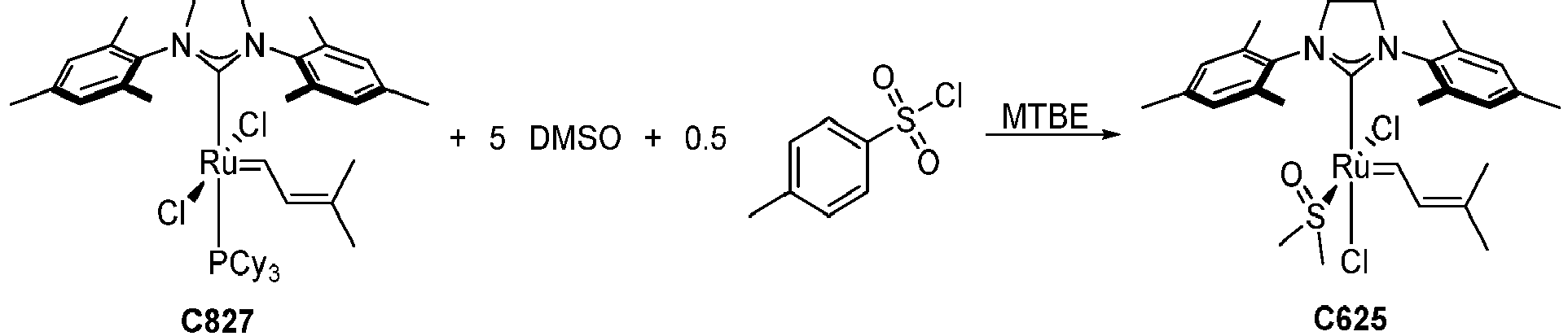
- To a 40 mL scintillation vial equipped with a magnetic stir bar were added C827 (0.500 g, 0.605 mmol), p-toluenesulfonyl chloride (0.058 g, 0.30 mmol), dimethyl sulfoxide (0.236 g, 3.02 mmol), and methyl tert-butyl ether (10 mL). The reaction was stirred at ambient temperature for twenty four hours and the resulting brown precipitate was isolated by filtration, washed with methyl tert-butyl ether (2 × 10 mL) then dried in vacuum to afford C625 as a light brown solid (0.298 g, 78.8% yield).
- 1H NMR (400 MHz, CDCl3) δ 16.10 (d, J = 11.3 Hz, 1H), 7.83 (d, J = 11.2 Hz, 1H), 7.08 (s, 1H), 7.05 (s, 1H), 6.82 (s, 1H), 6.73 (s, 1H), 4.13 - 4.00 (m, 1H), 4.00 - 3.78 (m, 3H), 2.73 (s, 6H), 2.55 (s, 3H), 2.54 (s, 3H), 2.38 (s, 3H), 2.32 (s, 3H), 2.22 (s, 6H), 1.33 (s, 3H), 1.27 (s, 3H).
-

- To a 40 mL scintillation vial equipped with a magnetic stir bar was added C931 (0.500 g, 0.537 mmol), p-toluenesulfonyl chloride (0.051 g, 0.27 mmol), tetrahydrothiophene 1-oxide (0.279 g, 2.68 mmol), and toluene (5 mL). The reaction was stirred at ambient temperature for two hours then diluted with diethyl ether (15 mL). The precipitate was isolated by filtration, washed with diethyl ether (2 × 20 mL) followed by hexanes (1 × 20 mL) then dried in vacuum to afford C865 (0.418 g, 90.0% yield).
- 1H NMR (400 MHz, CDCl3) δ 8.72 (d, J = 7.2 Hz, 1H), 7.71 (d, J = 7.7 Hz, 2H), 7.52 (t, J = 7.3 Hz, 1H), 7.42 (t, J = 7.5 Hz, 2H), 7.33 - 7.20 (m, 4H), 7.20 - 7.14 (m, 3H), 7.11 (d, J = 8.9 Hz, 2H), 7.04 (d, J = 7.0 Hz, 1H), 6.93 (s, 1H), 6.28 (s, 2H), 4.15 - 4.03 (m, 1H), 4.03 - 3.86 (m, 2H), 3.84 - 3.71 (m, 1H), 2.92 - 2.85 (m, 2H), 2.84 (s, 3H), 2.69 (s, 3H), 2.70 - 2.60 (m, 1H), 2.43 (s, 3H), 2.36 (s, 3H), 2.35 (s, 3H), 2.09 (s, 3H), 2.15 - 2.04 (m, 1H), 2.04 - 1.90 (m, 2H), 1.78 (s, 3H), 1.82-1.73 (m, 2H).
-

- To a 40 mL scintillation vial equipped with a magnetic stir bar was added C931 (0.500 g, 0.537 mmol), p-toluenesulfonyl chloride (0.051 g, 0.27 mmol), tetrahydrothiophene 1-oxide (0.279 g, 2.68 mmol), and ethyl acetate (5 mL). The reaction was stirred at ambient temperature for three hours then diluted with diethyl ether (25 mL). The precipitate was isolated by filtration, washed with diethyl ether (2 × 10 mL) followed by hexanes (1 × 20 mL) then dried in vacuum to afford C861 (0.386 g, 83.5% yield).
- 1H NMR (400 MHz, CDCl3) δ 8.71 (d, J = 7.2 Hz, 1H), 7.70 (d, J = 7.7 Hz, 2H), 7.51 (t, J = 7.2 Hz, 1H), 7.41 (t, J = 7.4 Hz, 2H), 7.33 - 7.19 (m, 2H), 7.11 (d, J = 8.1 Hz, 2H), 7.03 (d, J = 7.1 Hz, 1H), 6.92 (s, 1H), 6.27 (s, 2H), 4.11 (dd, J = 14.3, 7.1 Hz, 2H), 4.15 - 4.02 (m, 1H), 4.03 - 3.85 (m, 2H), 3.84 - 3.71 (m, 1H), 2.92 - 2.79 (m, 2H), 2.83 (s, 3H), 2.68 (s, 3H), 2.70 - 2.59 (m, 1H), 2.42 (s, 3H), 2.35 (s, 3H), 2.08 (s, 3H), 2.15 - 2.07 (m, 1H), 2.03 (s, 3H), 2.02 - 1.90 (m, 2H), 1.77 (s, 3H), 1.82-1.73 (m, 2H), 1.25 (t, J = 7.1 Hz, 3H).
-
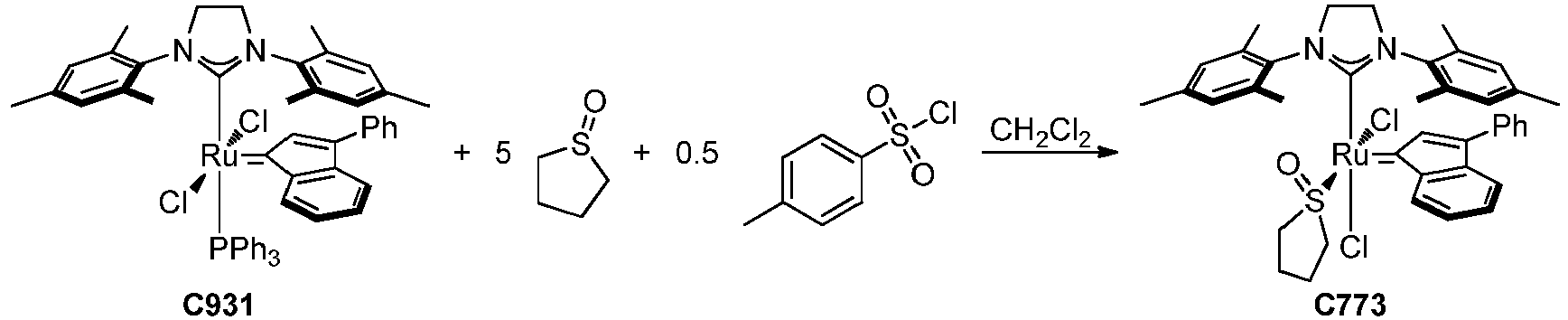
- To a 40 mL scintillation vial equipped with a magnetic stir bar was added C931 (0.500 g, 0.537 mmol), p-toluenesulfonyl chloride (0.051 g, 0.27 mmol), tetrahydrothiophene 1-oxide (0.279 g, 2.68 mmol), and dichloromethane (4 mL). The reaction was stirred at ambient temperature for three hours then diluted with diethyl ether (30 mL). The precipitate was isolated by filtration, washed with diethyl ether (2 × 10 mL) followed by hexanes (1 × 20 mL) then dried in vacuum to afford C773 (0.345 g, 83.0% yield).
- 1H NMR (400 MHz, CDCl3) δ 8.71 (d, J = 7.1 Hz, 1H), 7.71 (d, J = 7.6 Hz, 2H), 7.52 (t, J = 7.1 Hz, 1H), 7.42 (t, J = 7.4 Hz, 2H), 7.34 - 7.19 (m, 2H), 7.11 (d, J = 8.0 Hz, 2H), 7.03 (d, J = 7.0 Hz, 1H), 6.92 (s, 1H), 6.28 (s, 2H), 4.14 - 4.03 (m, 1H), 4.03 - 3.86 (m, 2H), 3.82 - 3.72 (m, 1H), 2.83 (s, 3H), 2.91 - 2.79 (m, 2H), 2.69 (s, 3H), 2.72 - 2.60 (m, 1H), 2.42 (s, 3H), 2.36 (s, 3H), 2.18 - 2.04 (m, 1H), 2.08 (s, 3H). 2.04 - 1.88 (m, 2H), 1.77 (s, 3H), 1.82-1.73 (m, 2H).
-

- To a 40 mL scintillation vial equipped with a magnetic stir bar was added C848 (0.500 g, 0.589 mmol), p-toluenesulfonyl chloride (0.056 g, 0.30 mmol), tetrahydrothiophene 1-oxide (0.307 g, 2.94 mmol), and dichloromethane (4 mL). The reaction was stirred at ambient temperature for one hour then diluted with diethyl ether (25 mL). The precipitate was isolated by filtration, washed with diethyl ether (2 × 10 mL) followed by hexanes (1 × 15 mL) then dried in vacuum to afford C673 (0.248 g, 62.6% yield).
- 1H NMR (400 MHz, CDCl3) δ 16.12 (s, 1H), 7.82 (d, J = 7.7 Hz, 2H), 7.55 (t, J = 7.2 Hz, 1H), 7.23 (t, J = 7.7 Hz, 2H), 7.11 (br s, 2H), 6.93 (s, 1H), 6.29 (s, 1H), 4.11 - 3.94 (m, 3H), 3.86 - 3.76 (m, 1H), 2.72 (s, 3H), 2.69 (s, 3H), 2.64 (s, 3H), 2.62 - 2.45 (m, 3H), 2.35 (s, 3H), 2.27 - 2.17 (m, 1H), 2.15 (s, 3H), 2.07 (s, 3H), 2.05 - 1.91 (m, 2H), 1.84 - 1.68 (m, 2H).
-

- To a 40 mL scintillation vial equipped with a magnetic stir bar was added C827 (0.500 g, 0.605 mmol), p-toluenesulfonyl chloride (0.058 g, 0.30 mmol), tetrahydrothiophene 1-oxide (0.315 g, 3.02 mmol), and ethyl acetate (5 mL). The reaction was stirred at ambient temperature for 16 hours. The precipitate was isolated by filtration and recrystallized from dichloromethane/methanol at - 30 °C. The resulting purple crystalline product was isolated by filtration, washed with dichloromethane/methanol (1:10, 2 × 5 mL) then dried in vacuum to afford C651 (0.141 g, 35.7% yield).
- 1H NMR (400 MHz, CDCl3) δ 16.73 (d, J = 11.3 Hz, 1H), 7.66 (d, J = 11.5 Hz, 1H), 7.09 (s,1H), 7.05 (s, 1H), 6.83 (s, 1H), 6.71 (s, 1H), 4.17 - 4.02 (m, 1H), 4.01 - 3.84 (m, 3H), 3.16 - 3.06 (m, 1H), 3.02 - 2.89 (m, 1H), 2.85 - 2.74 (m, 2H), 2.75 (s, 3H), 2.59 (s, 3H), 2.54 (s, 3H), 2.33 (s, 6H), 2.22 (s, 3H), 2.14 - 2.02 (m, 2H), 1.99 - 1.83 (m, 2H), 1.34 (s, 3H), 1.26 (s, 3H).
-

- To a 40 mL scintillation vial equipped with a magnetic stir bar was added C931 (0.500 g, 0.537 mmol), p-toluenesulfonyl chloride (0.051 g, 0.27 mmol), dibutyl sulfoxide (0.436 g, 2.69 mmol), and diethyl ether (10 mL). The reaction was stirred at ambient temperature for twelve hours. The precipitate was isolated by filtration, washed with diethyl ether (1 × 10 mL) followed by hexanes (1 × 20 mL) then dried in vacuum to afford C831m (0.195 g, 43.7% yield).
- 1H NMR (400 MHz, CD2Cl2) δ 8.68 - 8.60 (m, 1H), 7.77 - 7.69 (m, 2H), 7.57 - 7.50 (m, 1H), 7.44 (t, J = 7.5 Hz, 2H), 7.35 - 7.28 (m, 2H), 7.15 (s, 1H), 7.13 (dd, J = 5.6, 2.7 Hz, 1H), 7.07 (s, 1H), 6.77 (s, 1H), 6.36 (s, 1H), 6.21 (s, 1H), 4.06 - 3.95 (m, 1H), 3.94 - 3.81 (m, 2H), 3.78 - 3.65 (m, 1H), 2.94 (ddd, J = 14.5, 12.3, 5.6 Hz, 1H), 2.77 (s, 3H), 2.70 (s, 3H), 2.64 - 2.51 (m, 1H), 2.47 (s, 3H), 2.36 (s, 3H), 1.95 (s, 3H), 1.73 (s, 3H), 1.71 - 1.60 (m, 1H), 1.60 - 1.43 (m, 2H), 1.33 - 1.19 (m, 2H), 1.19 - 1.03 (m, 2H), 0.98 - 0.91 (m, 2H), 0.88 (t, J = 7.2 Hz, 3H), 0.83 - 0.70 (m, 1H), 0.48 (t, J = 7.3 Hz, 3H).
-

- To a 40 mL scintillation vial equipped with a magnetic stir bar was added C747 (0.590 g, 0.790 mmol), (3,6-dichlorobenzene-1,2-dithiolato)(ethylenediamine)zinc(II) (0.291 g, 0.869 mmol), and tetrahydrofuran (8 mL). The reaction was stirred at ambient temperature for one hour then concentrated to dryness. The resulting residue was extracted with dichloromethane (10 mL), filtered through a plug of celite, and then concentrated in vacuum to about 5 mL. Slow addition of hexanes (30 mL) with rapid stirring afforded a precipitate that was isolated by filtration, washed with hexanes (2 × 10 mL) then dried in vacuum to afford C885ss (0.604 g, 86.4% yield) as a dark purple powder.
- 1H NMR (400 MHz, CD2Cl2) δ 7.76 (d, J = 7.3 Hz, 2H), 7.55 - 7.40 (m, 3H), 7.31 (br s, 1H), 7.20 (br s, 1H), 7.12 (br s, 1H), 7.04 (t, J = 7.3 Hz, 2H), 6.97 (d, J = 6.7 Hz, 1H), 6.84 (br s, 1H), 6.74 (t, J = 7.2 Hz, 1H), 6.31 (d, J = 7.6 Hz, 2H), 6.19 (br s, 1H), 4.03 (br s, 1H), 3.92 (br s, 3H), 2.90 (br s, 3H), 2.64 (br s, 3H), 2.43 (br s, 6H), 2.26 (br s, 6H), 2.18 (br s, 3H), 1.78 (br s, 3H).
-

- To a 40 mL scintillation vial equipped with a magnetic stir bar was added C647 (0.300 g, 0.464 mmol), (3,6-dichlorobenzene-1,2-dithiolato)(ethylenediamine) zinc(II) (0.171 g, 0.510 mmol), and tetrahydrofuran (5 mL). The reaction was stirred at ambient temperature for thirty minutes then concentrated to dryness. The resulting residue was extracted with dichloromethane (20 mL), passed through a 0.2 µm syringe filter, and then concentrated in vacuum to ca. 4 mL. Diethyl ether (30 mL) was added slowly affording a green microcrystalline precipitate. The product was isolated by filtration, washed with diethyl ether (2 × 5 mL) and dried in vacuum to afford C785ss (0.283 g, 77.8% yield).
- 1H NMR (400 MHz, CD2Cl2) δ 14.77 (s, 1H), 7.28 (t, J = 7.3 Hz, 1H), 7.18 (d, J = 8.1 Hz, 1H), 7.10 (d, J = 8.2 Hz, 1H), 7.06 (s, 1H), 6.90 - 6.81 (m, 4H), 6.47 (d, J = 7.3 Hz, 2H), 6.23 (s, 1H), 4.10 - 3.90 (m, 4H), 2.71 (s, 3H), 2.68 (s, 3H), 2.66 (s, 3H), 2.35 (s, 3H), 2.30 (s, 3H), 2.28 (s, 3H), 2.21 (s, 3H), 2.02 (s, 3H).
-

- To a 20 mL scintillation vial equipped with a magnetic stir bar were added C747 (0.500 g, 0.670 mmol), (PhO)PPh2 ([CAS 13360-92-4] 0.196 g, 0.703 mmol), and dichloromethane (5 mL). The reaction was stirred at ambient temperature for one hour then concentrated to 1 mL under vacuum. Hexanes (14 mL) was added and the resulting precipitate was isolated by filtration, washed with hexanes (2 × 10 mL) then dried in vacuum to afford C947 as a red-brown powder (0.599 g, 94.5% yield). The 1H NMR data correspond to the data found in the literature.
-

- To a 20 mL scintillation vial equipped with a magnetic stir bar were added C747 (0.500 g, 0.670 mmol), 2-isopropoxy-β-methylstyrene (0.153 g, 0.870 mmol), heptanes (5 mL), and methanol (1 mL). The reaction was stirred at 60 °C for two hours then cooled to ambient temperature. The resulting precipitate was isolated by filtration, washed with methanol (2 × 5 mL) then dried in vacuum to afford C627 as a green solid (0.332 g, 79.1% yield). The 1H NMR data correspond to the data found in the literature.
-

- To a 20 mL scintillation vial equipped with a magnetic stir bar were added C647m (0.400 g, 0.619 mmol), 2-isopropoxy-β-methylstyrene (0.142 g, 0.804 mmol), heptanes (5 mL), and methanol (1 mL). The reaction was stirred at 60 °C for one hour then cooled to ambient temperature. The resulting precipitate was isolated by filtration, washed with methanol (2 × 5 mL) then dried in vacuum to afford C627 as a green solid (0.228 g, 58.9% yield). The 1H NMR data correspond to the data found in the literature.
-

- To a 20 mL scintillation vial was added C747 (0.300 g, 0.402 mmol), internal olefin [stilbene or β-methylstyrene] (3.6-10 equiv), and halogenated solvent (chloroform or dichloromethane, 4 mL). Reactions were heated at 40 or 60 °C with stirring until <5% C747 remained as determined by 1H NMR spectroscopy (2 to 24 hours). PCy3 (0.124 g, 0.442 mmol) was subsequently added and the reaction stirred for an additional 30 minutes. Yields of C848 ranged from 50-80% as judged by 1H and 31P NMR spectroscopy. The 1H NMR data correspond to the data found in the literature.
- The catalytic activity of the complexes according to the invention was evaluated in ROMP reactions as follows. A 250 mL beaker was filled with 100 g of DCPD-HT monomer and 50 ppm of CHP. The monomer was equilibrated to the desired temperature in an oil bath (30 °C +/- 0.5 °C). A J-Type thermocouple was suspended directly into the center of the monomer. The catalyst under study was dissolved in solvent (either toluene or CH2Cl2) to form a catalyst solution and the catalyst solution was then added to the monomer at a molar ratio of 45,000:1 (monomer: catalyst) to form a ROMP composition. Addition of the catalyst to the monomer to form the ROMP composition denoted the start of the ROMP reaction and hence, this was time point zero. Temperature readings were recorded using the thermocouple. The exotherm time was determined by measuring the amount of time that passed (i.e., the time difference) between time point zero and the time point that a propagating interface of the ROMP composition was first visually observed as the ROMP composition transitioned from a liquid state or gel state to a cured polymer state. ROMP reactions were stopped 2 hours after addition of the catalyst solution to the monomer. Time to exotherm is expressed by: slow > 120 minutes; moderate 30 - 120 minutes; medium 1 - < 30 minutes; fast < 1 minute and peak exotherm temperature. The results are shown in Table (5).
Table (5) Catalyst DCPD-HT Monomer Temperature (°C) Peak Exotherm Temperature (°C) Time to Exotherm C647 m 30 186 medium C861 30 190 medium C865 30 188 medium C773 30 188 medium C673 30 188 medium C625 30 190 fast C651 30 192 moderate C731 30 171 slow C591 30 167 moderate -

- Following the procedure outlined in Organometallics, 2006, 25, 5740-5745, inside an argon filled glovebox, a screwcap NMR tube fitted with a PTFE septum was charged with CD2Cl2 (0.75 mL or 0.775 mL) and catalyst stock solution (0.016 M, 50 µL, 0.80 µmol, 1.0 mol% or 0.016 M, 25 µL, 0.80 µmol, 0.5 mol%). Samples were equilibrated to 30 °C in a preheated NMR probe before diethyl 2,2-diallylmalonate (19.3 µL, 19.2 mg, 0.080 mmol, 0.1 M) was added via syringe. The ensuing reaction was monitored for 30 minutes using the Varian array function and the conversion to diethyl cyclopent-3-ene-1,1-dicarboxylate was determined by comparing the ratio of the integrals of the methylene protons in the starting material, δ 2.61 (dt), with those in the product, δ 2.98 (s).
Figure 3 shows the conversion of diethyl 2,2-diallylmalonate to 4,4-bis(ethoxy carbonyl)cyclopentene, wherein Catalyst is: C747, C748, C647, C773, C625, C727 or C705. -

- In an argon filled glovebox, a 4 mL scintillation vial equipped with a magnetic stir bar was charged with C785ss (0.0046 g, 0.0059 mmol) and tetrahydrofuran (0.5 mL). cis-5-Tetradecene (0.150 mL total, 0.588 mmol) was subsequently added, the vial was sealed and stirred at 40°C. The reaction was sampled at appropriate time intervals and yields /stereoselectivies were determined by gas chromatography (Method 1) as shown in Table (6).
Table (6) time (h) 5C14 yield (%) 5C10 yield (%) 9C18 yield (%) 9C18 (Z/E) 1 50 24 25 93/7 2 50 24 24 92/8
Claims (20)
- An olefin metathesis catalyst represented by the structure of Formula (IV):
 M is a Group 8 transition metal;L2 is a neutral electron donor ligand;n is 0 or 1;m is 0, 1 or 2;Ra is hydrogen, unsubstituted hydrocarbyl, substituted hydrocarbyl, unsubstituted heteroatom-containing hydrocarbyl, or substituted heteroatom-containing hydrocarbyl;Rb is hydrogen, unsubstituted hydrocarbyl, substituted hydrocarbyl, unsubstituted heteroatom-containing hydrocarbyl, or substituted heteroatom-containing hydrocarbyl; or Ra and Rb are linked together to form a five or a six heterocyclic membered ring with the sulfoxide group;X1 and X2 are independently anionic ligands;R1 and R2 are independently hydrogen, unsubstituted hydrocarbyl, substituted hydrocarbyl, unsubstituted heteroatom-containing hydrocarbyl, or substituted heteroatom-containing hydrocarbyl; or R1 and R2 are linked together to form an optionally substituted indenylidene;X and Y are independently C, CR3a or N; and only one of X or Y can be C or CR3a;R3a is hydrogen, unsubstituted hydrocarbyl, substituted hydrocarbyl, unsubstituted heteroatom-containing hydrocarbyl, or substituted heteroatom-containing hydrocarbyl;Q is a two-atom linkage having the structure -[CR11R12]s-[CR13R14]t- or -[CR11=CR13]-;R11, R12, R13, and R14 are independently hydrogen, unsubstituted hydrocarbyl, substituted hydrocarbyl, unsubstituted heteroatom-containing hydrocarbyl, or substituted heteroatom-containing hydrocarbyl;"s" and "t" are independently 1 or 2;R3 is unsubstituted hydrocarbyl, substituted hydrocarbyl, unsubstituted heteroatom-containing hydrocarbyl, or substituted heteroatom-containing hydrocarbyl; andR4 is unsubstituted hydrocarbyl, substituted hydrocarbyl, unsubstituted heteroatom-containing hydrocarbyl, or substituted heteroatom-containing hydrocarbyl.
 - The olefin metathesis catalyst according to claim 1, wherein:M is Ru;n is 0;m is 0;Ra is unsubstituted C1-C10 alkyl, substituted C1-C10 alkyl, unsubstituted C3-C10 cycloalkyl, substituted C3-C10 cycloalkyl, unsubstituted C5-C24 aryl or substituted C5-C24 aryl;Rb is unsubstituted C1-C10 alkyl, substituted C1-C10 alkyl, unsubstituted C3-C10 cycloalkyl, substituted C3-C10 cycloalkyl, unsubstituted C5-C24 aryl or substituted C5-C24 aryl; or Ra and Rb are linked together to form a five or a six heterocyclic membered ring with the sulfoxide group;X1 and X2 are independently halogen;R1 is hydrogen;R2 is unsubstituted phenyl, substituted phenyl or substituted 1-propenyl; or R1 and R2 are linked together to form an optionally substituted indenylidene;X and Y are independently N;Q is a two-atom linkage having the structure -[CR11R12]s-[CR13R14]t- ;R11, R12, R13, and R14 are independently hydrogen;"s" and "t" are independently 1;R3 is unsubstituted C3-C10 cycloalkyl, substituted C3-C10 cycloalkyl, unsubstituted C5-C24 aryl, or C5-C24 aryl substituted with up to three substituents selected from: unsubstituted C1-C20 alkyl, substituted C1-C20 alkyl, unsubstituted C1-C20 heteroalkyl, substituted C1-C20 heteroalkyl, unsubstituted C5-C24 aryl, substituted C5-C24 aryl, unsubstituted C5-C24 heteroaryl, substituted C5-C24 heteroaryl, unsubstituted C6-C24 aralkyl, substituted C6-C24 aralkyl, unsubstituted C6-C24 alkaryl, substituted C6-C24 alkaryl and halide; andR4 is unsubstituted C3-C10 cycloalkyl, substituted C3-C10 cycloalkyl, unsubstituted C5-C24 aryl, or C5-C24 aryl substituted with up to three substituents selected from: unsubstituted C1-C20 alkyl, substituted C1-C20 alkyl, unsubstituted C1-C20 heteroalkyl, substituted C1-C20 heteroalkyl, unsubstituted C5-C24 aryl, substituted C5-C24 aryl, unsubstituted C5-C24 heteroaryl, substituted C5-C24 heteroaryl, unsubstituted C6-C24 aralkyl, substituted C6-C24 aralkyl, unsubstituted C6-C24 alkaryl, substituted C6-C24 alkaryl and halide.
- The olefin metathesis catalyst according to claim 2, represented by the structure of Formula (V),
 R1 is hydrogen;R2 is unsubstituted phenyl, substituted phenyl or substituted 1-propenyl; or R1 and R2 are linked together to form an optionally substituted indenylidene;Ra is methyl, ethyl, n-propyl, iso-propyl, n-butyl, tert-butyl, or phenyl;Rb is methyl, ethyl, n-propyl, iso-propyl, n-butyl, tert-butyl, or phenyl; or Ra and Rb are linked together to form a tetrahydrothiophene oxide with the sulfoxide group;X1 and X2 are independently Cl, Br, F or I;R3 is adamantyl, 2,4,6-trimethylphenyl, 2,6-di-iso-propylphenyl, 2-iso-propyl-6-methylphenyl, 2-iso-propyl-phenyl or 2-methyl-phenyl; andR4 is 2,4,6-trimethylphenyl , 2,6-di-iso-propylphenyl, 2-iso-propyl-6-methylphenyl, 2-iso-propyl-phenyl or 2-methyl-phenyl.
 - The olefin metathesis catalyst according to claim 3, wherein:R2 is phenyl or 2-methyl-1-propenyl; or R1 and R2 are linked together to form 3-phenylinden-1-ylidene; andX1 and X2 are independently Cl.
- The olefin metathesis catalyst according to claim 4, wherein:Ra is methyl;Rb is methyl;R3 is 2,4,6-trimethylphenyl; andR4 is 2,4,6-trimethylphenyl.
- The olefin metathesis catalyst according to claim 5, wherein:
R1 and R2 are linked together to form 3-phenylinden-1-ylidene. - The olefin metathesis catalyst according to claim 3, wherein:Ra and Rb form a tetrahydrothiophene oxide; andX1 and X2 are independently Cl.
- The olefin metathesis catalyst according to claim 7, wherein:R2 is phenyl or 2-methyl-1-propenyl;R3 is 2,4,6-trimethylphenyl; andR4 is 2,4,6-trimethylphenyl.
- The olefin metathesis catalyst according to claim 7, wherein:R1 and R2 are linked together to form 3-phenylinden-1-ylidene;R3 is 2,4,6-trimethylphenyl; andR4 is 2,4,6-trimethylphenyl.
- The olefin metathesis catalyst according to claim 3, selected from:


- The olefin metathesis catalyst according to claim 1, wherein:M is Ru;n is 0;m is 0;Ra is unsubstituted C1-C10 alkyl, substituted C1-C10 alkyl, unsubstituted C3-C10 cycloalkyl, substituted C3-C10 cycloalkyl, unsubstituted C5-C24 aryl or substituted C5-C24 aryl;Rb is unsubstituted C1-C10 alkyl, substituted C1-C10 alkyl, unsubstituted C3-C10 cycloalkyl, substituted C3-C10 cycloalkyl, unsubstituted C5-C24 aryl or substituted C5-C24 aryl; or Ra and Rb are linked together to form a five or a six heterocyclic membered ring with the sulfoxide group;X1 and X2 are independently halogen;R1 is hydrogen;R2 is unsubstituted phenyl, substituted phenyl or substituted 1-propenyl; or R1 and R2 are linked together to form an optionally substituted indenylidene;X is CR3a;YisN;Q is a two-atom linkage having the structure -[CR11R12]s-[CR13R14]t- ;R11, R12, R13, and R14 are independently hydrogen, unsubstituted hydrocarbyl, substituted hydrocarbyl, unsubstituted heteroatom-containing hydrocarbyl, or substituted heteroatom-containing hydrocarbyl;"s" and "t" are independently 1;R3 is unsubstituted C3-C10 cycloalkyl, substituted C3-C10 cycloalkyl, unsubstituted C5-C24 aryl, or C5-C24 aryl substituted with up to three substituents selected from: unsubstituted C1-C20 alkyl, substituted C1-C20 alkyl, unsubstituted C1-C20 heteroalkyl, substituted C1-C20 heteroalkyl, unsubstituted C5-C24 aryl, substituted C5-C24 aryl, unsubstituted C5-C24 heteroaryl, substituted C5-C24 heteroaryl, unsubstituted C6-C24 aralkyl, substituted C6-C24 aralkyl, unsubstituted C6-C24 alkaryl, substituted C6-C24 alkaryl and halide; andR4 is unsubstituted C3-C10 cycloalkyl, substituted C3-C10 cycloalkyl, unsubstituted C5-C24 aryl, or C5-C24 aryl substituted with up to three substituents selected from: unsubstituted C1-C20 alkyl, substituted C1-C20 alkyl, unsubstituted C1-C20 heteroalkyl, substituted C1-C20 heteroalkyl, unsubstituted C5-C24 aryl, substituted C5-C24 aryl, unsubstituted C5-C24 heteroaryl, substituted C5-C24 heteroaryl, unsubstituted C6-C24 aralkyl, substituted C6-C24 aralkyl, unsubstituted C6-C24 alkaryl, substituted C6-C24 alkaryl and halide.
- The olefin metathesis catalyst according to claim 11, represented by the structure of Formula (VII)
 R1 is hydrogen;R2 is unsubstituted phenyl, substituted phenyl or substituted 1-propenyl; or R1 and R2 are linked together to form an optionally substituted indenylidene;Ra is methyl, ethyl, n-propyl, iso-propyl, n-butyl, tert-butyl, cyclohexyl or phenyl;Rb is methyl, ethyl, n-propyl, iso-propyl, n-butyl, tert-butyl, cyclohexyl or phenyl; or Ra and Rb are linked together to form a five or a six heterocyclic membered ring with the sulfoxide group;X1 and X2 are independently Cl, Br, I or F;R3 is adamantyl, 2,4,6-trimethylphenyl, 2,6-di-iso-propylphenyl, 2-methyl-6-tert-butylphenyl, 2-iso-propyl-6-methylphenyl, 2-iso-propyl-phenyl, 2,6-di-ethylphenyl, 2-ethyl-6-methylphenyl or 2-methyl-phenyl;R11, R12, R13 and R14 are independently hydrogen, unsubstituted C1-C12 alkyl, substituted C1-C12 alkyl, unsubstituted C4-C12 cycloalkyl, substituted C4-C12 cycloalkyl, unsubstituted C5-C24 aryl, substituted C5-C24 aryl, unsubstituted C5-C24 heteroaryl, substituted C5-C24 heteroaryl, unsubstituted C6-C24 aralkyl, substituted C6-C24 aralkyl, unsubstituted C6-C24 heteroaralkyl or substituted C6-C24 heteroaralkyl;R3a is methyl, ethyl, n-propyl, or phenyl; or together with R4 can form a five to ten membered cycloalkyl or heterocyclic ring, with the carbon atom to which they are attached; andR4 is methyl, ethyl, n-propyl, or phenyl; or together with R3a can form a five- to ten-membered cycloalkyl or heterocyclic ring, with the carbon atom to which they are attached.
 - The olefin metathesis catalyst according to claim 1, wherein:M is Ru;n is 0;m is 0;Ra is unsubstituted C1-C10 alkyl, substituted C1-C10 alkyl, unsubstituted C3-C10 cycloalkyl, substituted C3-C10 cycloalkyl, unsubstituted C5-C24 aryl or substituted C5-C24 aryl; typically Ra is methyl, ethyl, n-propyl, iso-propyl, n-butyl, tert-butyl, cyclohexyl or phenyl;Rb is unsubstituted C1-C10 alkyl, substituted C1-C10 alkyl, unsubstituted C3-C10 cycloalkyl, substituted C3-C10 cycloalkyl, unsubstituted C5-C24 aryl or substituted C5-C24 aryl; typically Rb is methyl, ethyl, n-propyl, iso-propyl, n-butyl, tert-butyl, cyclohexyl or phenyl; or Ra and Rb are linked together to form a five or a six heterocyclic membered ring with the sulfoxide group;X and Y are independently N;Q is a two-atom linkage having the structure -[CR11R12]s-[CR13R14]t-;R11, R12, R13, and R14 are independently hydrogen, unsubstituted hydrocarbyl, substituted hydrocarbyl, unsubstituted heteroatom-containing hydrocarbyl, or substituted heteroatom-containing hydrocarbyl;"s" and "t" are independently 1;R3 is unsubstituted hydrocarbyl, substituted hydrocarbyl, unsubstituted heteroatom-containing hydrocarbyl, or substituted heteroatom-containing hydrocarbyl;R4 is unsubstituted hydrocarbyl, substituted hydrocarbyl, unsubstituted heteroatom-containing hydrocarbyl, or substituted heteroatom-containing hydrocarbyl;R1 is hydrogen and R2 is unsubstituted phenyl, substituted phenyl or substituted 1-propenyl; or R1 and R2 are linked together to form an optionally substituted indenylidene;

 X3 and X4 are independently S; andRx, Ry, Rw and Rz are independently hydrogen, halogen, unsubstituted phenyl; or Rx and Ry are linked together to form an unsubstituted bicyclic or polycyclic aryl or a substituted bicyclic or polycyclic aryl; or Rw and Rz are linked together to form an unsubstituted bicyclic or polycyclic aryl or a substituted bicyclic or polycyclic aryl; or Ry and Rw are linked together to form an unsubstituted bicyclic or polycyclic aryl or a substituted bicyclic or polycyclic aryl.
 - The olefin metathesis catalyst of claim 13, represented by the structure of Formula (VIII)
 Ra is methyl, ethyl, n-propyl, iso-propyl, n-butyl, tert-butyl, cyclohexyl or phenyl;Rb is methyl, ethyl, n-propyl, iso-propyl, n-butyl, tert-butyl, cyclohexyl or phenyl; or Ra and Rb are linked together to form a five or a six heterocyclic membered ring with the sulfoxide group;R3 is adamantyl, 2,4,6-trimethylphenyl, 2,6-di-iso-propylphenyl, 2-methyl-6-tert-butylphenyl, 2-iso-propyl-6-methylphenyl, 2-iso-propyl-phenyl, 2,6-di-ethylphenyl, 2-ethyl-6-methylphenyl, 2,4,6-trifluorophenyl, 2,6-difluorophenyl, 3,5-di-tert-butylphenyl, 2,4-dimethylphenyl or 2-methyl-phenyl;R4 is 2,4,6-trimethylphenyl, 2,6-di-iso-propylphenyl, 2-methyl-6-tert-butylphenyl, 2-iso-propyl-6-methylphenyl, 2-iso-propyl-phenyl, 2,6-di-ethylphenyl, 2-ethyl-6-methylphenyl, 2,4,6-trifluorophenyl, 2,6-difluorophenyl, 3,5-di-tert-butylphenyl, 2,4-dimethylphenyl or 2-methyl-phenyl;R1 is hydrogen and R2 is unsubstituted phenyl, substituted phenyl or substituted 1-propenyl; or R1 and R2 are linked together to form an optionally substituted indenylidene;R11, R12, R13, and R14 are independently C1-C6 alkyl or hydrogen;Rx, Ry, Rw and Rz are independently hydrogen, halogen, unsubstituted phenyl; or Rx and Ry are linked together to form an unsubstituted bicyclic or polycyclic aryl or a substituted bicyclic or polycyclic aryl; or Rw and Rz are linked together to form an unsubstituted bicyclic or polycyclic aryl or a substituted bicyclic or polycyclic aryl; or Ry and Rw are linked together to form an unsubstituted bicyclic or polycyclic aryl or a substituted bicyclic or polycyclic aryl.
 - A method of synthesizing an olefin metathesis catalyst represented by the structure of Formula (B)

 R1 is hydrogen;R2 is phenyl or 2-methyl-1-propenyl; or R1 and R2 are linked together to form 3-pheny linden-1 -ylidene;R3 is 2,4,6-trimethylphenyl, 2,6-di-iso-propylphenyl, or 2-iso-propyl-6-methyl phenyl;R4 is 2,4,6-trimethylphenyl, 2,6-di-iso-propylphenyl, or 2-iso-propyl-6-methyl phenyl;X1 and X2 are independently Cl;Ra is unsubstituted C1-C10 alkyl, substituted C1-C10 alkyl, unsubstituted C3-C10 cycloalkyl, substituted C3-C10 cycloalkyl, unsubstituted C5-C24 aryl or substituted C5-C24 aryl;Rb is unsubstituted C1-C10 alkyl, substituted C1-C10 alkyl, unsubstituted C3-C10 cycloalkyl, substituted C3-C10 cycloalkyl, unsubstituted C5-C24 aryl or substituted C5-C24 aryl; or Ra and Rb are linked together to form a five or a six heterocyclic membered ring with the sulfoxide group;Rd is unsubstituted C1-C10 alkyl, substituted C1-C10 alkyl, substituted C6-C10 aryl, unsubstituted C6-C10 aryl, substituted C3-C8 cycloalkyl or unsubstituted C3-C8 cycloalkyl;Re is unsubstituted C1-C10 alkyl, substituted C1-C10 alkyl, substituted C6-C10 aryl, unsubstituted C6-C10 aryl, substituted C3-C8 cycloalkyl or unsubstituted C3-C8 cycloalkyl; andRf is unsubstituted C1-C10 alkyl, substituted C1-C10 alkyl, substituted C6-C10 aryl, unsubstituted C6-C10 aryl, substituted C3-C8 cycloalkyl or unsubstituted C3-C8 cycloalkyl.
 - The method according to claim 15, wherein:R1 is hydrogen and R2 is phenyl; or R1 and R2 are linked together to form 3-phenylinden-1-ylidene;R3 is 2,4,6-trimethylphenyl;R4 is 2,4,6-trimethylphenyl;Ra is methyl;Rb is methyl;Rd is phenyl;Re is phenyl; andRf is phenyl, methyl, p-(OMe)phenyl, iso-propyl or ethyl.
- The method according to claim 16, wherein:R1 and R2 are linked together to form 3-phenylinden-1-ylidene; andRf is phenyl.
- A method of synthesizing an olefin metathesis catalyst represented by the structure of Formula (D),

 with a ligand of formula
 R1 is hydrogen;R2 is phenyl or 2-methyl-1-propenyl; or R1 and R2 are linked together to form 3-pheny linden-1 -ylidene;R3 is 2,4,6-trimethylphenyl, 2,6-di-iso-propylphenyl, or 2-iso-propyl-6-methyl phenyl;R4 is 2,4,6-trimethylphenyl, 2,6-di-iso-propylphenyl, or 2-iso-propyl-6-methyl phenyl;X1 and X2 are independently Cl;Ra is unsubstituted C1-C10 alkyl, substituted C1-C10 alkyl, unsubstituted C3-C10 cycloalkyl, substituted C3-C10 cycloalkyl, unsubstituted C5-C24 aryl or substituted C5-C24 aryl;Rb is unsubstituted C1-C10 alkyl, substituted C1-C10 alkyl, unsubstituted C3-C10 cycloalkyl, substituted C3-C10 cycloalkyl, unsubstituted C5-C24 aryl or substituted C5-C24 aryl; or Ra and Rb are linked together to form a five or a six heterocyclic membered ring with the sulfoxide group;Rk is hydrogen, halogen, -NO2, -CN, -CF3, -SO2NRs 2, -NHC(O)CF3, -NHC(O)C6F5, - NHC(O)OtBu, hydrocarbyl, substituted hydrocarbyl, heteroatom-containing hydrocarbyl, or substituted heteroatom-containing hydrocarbyl;R1 is hydrogen, halogen, -NO2, -CN, -CF3, -SO2NRs 2, -NHC(O)CF3, -NHC(O)C6F5, - NHC(O)OtBu, hydrocarbyl, substituted hydrocarbyl, heteroatom-containing hydrocarbyl, or substituted heteroatom-containing hydrocarbyl;Rm is hydrogen, halogen, -NO2, -CN, -CF3, -SO2NRs 2, -NHC(O)CF3, -NHC(O)C6F5, - NHC(O)OtBu, hydrocarbyl, substituted hydrocarbyl, heteroatom-containing hydrocarbyl, or substituted heteroatom-containing hydrocarbyl;Rn is hydrogen, halogen, -NO2, -CN, -CF3, -SO2NRs 2, -NHC(O)CF3, -NHC(O)C6F5, - NHC(O)OtBu, hydrocarbyl, substituted hydrocarbyl, heteroatom-containing hydrocarbyl, or substituted heteroatom-containing hydrocarbyl;Rs is hydrogen or C1-C6 alkyl; andRq is C1-C10 alkyl.
 - The method according to claim 18, wherein:
R1 is hydrogen and R2 is phenyl; or R1 and R2 are linked together to form 3-phenylinden-1-ylidene;Ra is methyl;Rb is methyl;R3 is 2,4,6-trimethylphenyl;R4 is 2,4,6-trimethylphenyl;Rk is hydrogen;Rl is hydrogen;Rm is hydrogen;Rn is hydrogen; andRq is iso-propyl. - The method according to claim 19, wherein:
R1 and R2 are linked together to form 3-phenylinden-1-ylidene.
Applications Claiming Priority (3)
| Application Number | Priority Date | Filing Date | Title |
|---|---|---|---|
| US201662378791P | 2016-08-24 | 2016-08-24 | |
| PCT/US2017/046283 WO2018038928A1 (en) | 2016-08-24 | 2017-08-10 | Synthesis and characterization of metathesis catalysts |
| EP17844123.4A EP3503999B1 (en) | 2016-08-24 | 2017-08-10 | Synthesis and characterization of metathesis catalysts |
Related Parent Applications (1)
| Application Number | Title | Priority Date | Filing Date |
|---|---|---|---|
| EP17844123.4A Division EP3503999B1 (en) | 2016-08-24 | 2017-08-10 | Synthesis and characterization of metathesis catalysts |
Publications (2)
| Publication Number | Publication Date |
|---|---|
| EP4194092A1 true EP4194092A1 (en) | 2023-06-14 |
| EP4194092B1 EP4194092B1 (en) | 2025-10-22 |
Family
ID=61245180
Family Applications (2)
| Application Number | Title | Priority Date | Filing Date |
|---|---|---|---|
| EP17844123.4A Active EP3503999B1 (en) | 2016-08-24 | 2017-08-10 | Synthesis and characterization of metathesis catalysts |
| EP22210130.5A Active EP4194092B1 (en) | 2016-08-24 | 2017-08-10 | Synthesis and characterization of metathesis catalysts |
Family Applications Before (1)
| Application Number | Title | Priority Date | Filing Date |
|---|---|---|---|
| EP17844123.4A Active EP3503999B1 (en) | 2016-08-24 | 2017-08-10 | Synthesis and characterization of metathesis catalysts |
Country Status (8)
| Country | Link |
|---|---|
| US (2) | US11065609B2 (en) |
| EP (2) | EP3503999B1 (en) |
| JP (1) | JP7039565B2 (en) |
| CN (1) | CN109641198B (en) |
| ES (1) | ES2937742T3 (en) |
| HU (1) | HUE061150T2 (en) |
| PL (2) | PL4194092T3 (en) |
| WO (1) | WO2018038928A1 (en) |
Families Citing this family (5)
| Publication number | Priority date | Publication date | Assignee | Title |
|---|---|---|---|---|
| WO2018038928A1 (en) | 2016-08-24 | 2018-03-01 | Materia, Inc. | Synthesis and characterization of metathesis catalysts |
| CN111788189A (en) * | 2018-02-13 | 2020-10-16 | 优美科股份公司及两合公司 | Reaction of olefin derivatives in the presence of metathesis catalysts |
| US12049443B2 (en) | 2018-12-10 | 2024-07-30 | Provivi, Inc. | Synthesis of conjugated diene pheromones and related compounds |
| BR112022023772A2 (en) | 2020-06-01 | 2022-12-20 | Provivi Inc | SYNTHESIS OF PHEROMONE DERIVATIVES BY Z-SELECTIVE OLEFIN METATHESIS |
| CN113352659A (en) * | 2021-05-27 | 2021-09-07 | 江苏斯凯氟复合材料有限公司 | Preparation method of poly-tetra-ethylene composite membrane |
Citations (2)
| Publication number | Priority date | Publication date | Assignee | Title |
|---|---|---|---|---|
| US4899005A (en) | 1987-11-19 | 1990-02-06 | The B. F. Goodrich Company | Method for preparing cycloolefin copolymers with improved heat stability |
| WO2002000590A1 (en) * | 2000-06-23 | 2002-01-03 | California Institute Of Technology | Synthesis of functionalized and unfunctionalized olefins via cross and ring-closing metathesis |
Family Cites Families (17)
| Publication number | Priority date | Publication date | Assignee | Title |
|---|---|---|---|---|
| ATE228140T1 (en) * | 1996-11-01 | 2002-12-15 | Ciba Sc Holding Ag | METHOD FOR PRODUCING CATALYSTS |
| DE19815275B4 (en) | 1998-04-06 | 2009-06-25 | Evonik Degussa Gmbh | Alkylidene complexes of ruthenium with N-heterocyclic carbene ligands and their use as highly active, selective catalysts for olefin metathesis |
| CN1213032C (en) * | 1999-05-24 | 2005-08-03 | 加州理工学院 | Imidazolidine-based metal carbene metathesis catalysts |
| WO2002079126A1 (en) * | 2001-03-30 | 2002-10-10 | California Institute Of Technology | Cross-metathesis reaction of functionalized and substituted olefins using group 8 transition metal carbene complexes as metathesis catalysts |
| SE520961C2 (en) | 2001-06-12 | 2003-09-16 | Tomas Gunnarsson | Hydraulic system included in machine such as machining fixture |
| WO2003027079A1 (en) * | 2001-09-20 | 2003-04-03 | Zeon Corporation | Ruthenium complexes, process for preparation thereof, and processes for producing open-ring polymers of cycloolefins and hydrogenation products thereof by using the complexes as catalyst |
| CN102123979A (en) * | 2006-10-13 | 2011-07-13 | 埃莱文斯可更新科学公司 | Process for the synthesis of terminal olefins from internal olefins by olefin metathesis |
| GB201004732D0 (en) * | 2010-03-22 | 2010-05-05 | Univ Aberdeen | Ruthenium complexes for use in olefin metathesis |
| US8524930B2 (en) * | 2011-05-31 | 2013-09-03 | Exxonmobil Chemical Patents Inc. | Class of olefin metathesis catalysts, methods of preparation, and processes for the use thereof |
| IN2014DN00290A (en) * | 2011-06-17 | 2015-06-05 | Materia Inc | |
| US9249170B2 (en) | 2013-04-11 | 2016-02-02 | California Institute Of Technology | Cyclic alkyl amino carbene (CAAC) ruthenium complexes as improved catalysts for ethenolysis reactions |
| WO2014201300A1 (en) | 2013-06-12 | 2014-12-18 | Trustees Of Boston College | Catalysts for efficient z-selective metathesis |
| US9676676B2 (en) * | 2014-07-02 | 2017-06-13 | California Institute Of Technology | Selective olefin metathesis with cyclometalated ruthenium complexes |
| DE102014109816B4 (en) | 2014-07-14 | 2016-11-03 | Infineon Technologies Ag | Power semiconductor module and system with at least two power semiconductor modules |
| CN108368001B (en) | 2015-12-10 | 2021-07-23 | 优美科股份公司及两合公司 | Olefin Metathesis Catalyst |
| GB201604110D0 (en) | 2016-03-10 | 2016-04-20 | Givaudan Sa | Preparation of macrocyclic lactones |
| WO2018038928A1 (en) | 2016-08-24 | 2018-03-01 | Materia, Inc. | Synthesis and characterization of metathesis catalysts |
-
2017
- 2017-08-10 WO PCT/US2017/046283 patent/WO2018038928A1/en not_active Ceased
- 2017-08-10 US US16/327,566 patent/US11065609B2/en active Active
- 2017-08-10 PL PL22210130.5T patent/PL4194092T3/en unknown
- 2017-08-10 JP JP2019511381A patent/JP7039565B2/en active Active
- 2017-08-10 ES ES17844123T patent/ES2937742T3/en active Active
- 2017-08-10 CN CN201780051609.3A patent/CN109641198B/en active Active
- 2017-08-10 PL PL17844123.4T patent/PL3503999T3/en unknown
- 2017-08-10 EP EP17844123.4A patent/EP3503999B1/en active Active
- 2017-08-10 HU HUE17844123A patent/HUE061150T2/en unknown
- 2017-08-10 EP EP22210130.5A patent/EP4194092B1/en active Active
-
2021
- 2021-06-25 US US17/358,718 patent/US11794179B2/en active Active
Patent Citations (2)
| Publication number | Priority date | Publication date | Assignee | Title |
|---|---|---|---|---|
| US4899005A (en) | 1987-11-19 | 1990-02-06 | The B. F. Goodrich Company | Method for preparing cycloolefin copolymers with improved heat stability |
| WO2002000590A1 (en) * | 2000-06-23 | 2002-01-03 | California Institute Of Technology | Synthesis of functionalized and unfunctionalized olefins via cross and ring-closing metathesis |
Non-Patent Citations (4)
| Title |
|---|
| BUHL HANNES ET AL: "Investigations on the lability of CO in (NHC)Rh(CO)2Cl complexes", JOURNAL OF ORGANOMETALLIC CHEMISTRY, ELSEVIER, AMSTERDAM, NL, vol. 809, 2 March 2016 (2016-03-02), pages 74 - 78, XP029490488, ISSN: 0022-328X, DOI: 10.1016/J.JORGANCHEM.2016.02.034 * |
| MELANIE S. SANFORD ET AL: "A Versatile Precursor for the Synthesis of New Ruthenium Olefin Metathesis Catalysts", ORGANOMETALLICS, vol. 20, no. 25, 1 December 2001 (2001-12-01), US, pages 5314 - 5318, XP055681431, ISSN: 0276-7333, DOI: 10.1021/om010599r * |
| ORGANOMETALLICS, vol. 20, 2001, pages 5314 - 5318 |
| ORGANOMETALLICS, vol. 25, 2006, pages 5740 - 5745 |
Also Published As
| Publication number | Publication date |
|---|---|
| CN109641198A (en) | 2019-04-16 |
| ES2937742T3 (en) | 2023-03-30 |
| JP2019526439A (en) | 2019-09-19 |
| US11794179B2 (en) | 2023-10-24 |
| PL3503999T3 (en) | 2023-03-06 |
| EP4194092B1 (en) | 2025-10-22 |
| WO2018038928A1 (en) | 2018-03-01 |
| PL4194092T3 (en) | 2026-02-23 |
| EP3503999B1 (en) | 2022-12-07 |
| US20220379292A1 (en) | 2022-12-01 |
| EP3503999A4 (en) | 2020-05-27 |
| CN109641198B (en) | 2022-04-12 |
| EP3503999A1 (en) | 2019-07-03 |
| HUE061150T2 (en) | 2023-05-28 |
| JP7039565B2 (en) | 2022-03-22 |
| US11065609B2 (en) | 2021-07-20 |
| US20190184385A1 (en) | 2019-06-20 |
Similar Documents
| Publication | Publication Date | Title |
|---|---|---|
| US11794179B2 (en) | Synthesis and characterization of metathesis catalysts | |
| EP1735352B1 (en) | Latent, high-activity olefin metathesis catalysts containing an n-heterocyclic carbene ligand | |
| KR100333761B1 (en) | Usage of ruthenium and osmium metal carbene complexes of high decomposition activity | |
| EP1497299B1 (en) | Cross-metathesis of olefins directly substituted with an electron-withdrawing group using transition metal carbene catalysts | |
| US11173476B2 (en) | Metathesis catalysts | |
| EP2076484B1 (en) | Synthesis of terminal alkenes from internal alkenes via olefin metathesis | |
| US9108996B2 (en) | Ruthenium-based metathesis catalysts and precursors for their preparation | |
| WO2020109217A2 (en) | Metal organic compounds | |
| US9701704B2 (en) | Catalysts for (E)-selective olefin metathesis | |
| WO2018191373A1 (en) | Synthesis and characterization of metathesis catalysts | |
| CN109862963B (en) | Synthesis and characterization of Ru alkylidene complexes | |
| AU2011205218B2 (en) | Latent, high-activity olefin metathesis catalysts containing an N-heterocyclic carbene ligand | |
| Yu et al. | Latent ruthenium initiators containing fluoro aryloxide ligands |
Legal Events
| Date | Code | Title | Description |
|---|---|---|---|
| PUAI | Public reference made under article 153(3) epc to a published international application that has entered the european phase |
Free format text: ORIGINAL CODE: 0009012 |
|
| STAA | Information on the status of an ep patent application or granted ep patent |
Free format text: STATUS: THE APPLICATION HAS BEEN PUBLISHED |
|
| AC | Divisional application: reference to earlier application |
Ref document number: 3503999 Country of ref document: EP Kind code of ref document: P |
|
| AK | Designated contracting states |
Kind code of ref document: A1 Designated state(s): AL AT BE BG CH CY CZ DE DK EE ES FI FR GB GR HR HU IE IS IT LI LT LU LV MC MK MT NL NO PL PT RO RS SE SI SK SM TR |
|
| STAA | Information on the status of an ep patent application or granted ep patent |
Free format text: STATUS: REQUEST FOR EXAMINATION WAS MADE |
|
| 17P | Request for examination filed |
Effective date: 20231214 |
|
| RBV | Designated contracting states (corrected) |
Designated state(s): AL AT BE BG CH CY CZ DE DK EE ES FI FR GB GR HR HU IE IS IT LI LT LU LV MC MK MT NL NO PL PT RO RS SE SI SK SM TR |
|
| STAA | Information on the status of an ep patent application or granted ep patent |
Free format text: STATUS: EXAMINATION IS IN PROGRESS |
|
| 17Q | First examination report despatched |
Effective date: 20240424 |
|
| REG | Reference to a national code |
Ref country code: DE Ref legal event code: R079 Free format text: PREVIOUS MAIN CLASS: B01J0035100000 Ipc: C07F0007020000 Ref country code: DE Ref legal event code: R079 Ref document number: 602017092381 Country of ref document: DE Free format text: PREVIOUS MAIN CLASS: B01J0035100000 Ipc: C07F0007020000 |
|
| GRAP | Despatch of communication of intention to grant a patent |
Free format text: ORIGINAL CODE: EPIDOSNIGR1 |
|
| STAA | Information on the status of an ep patent application or granted ep patent |
Free format text: STATUS: GRANT OF PATENT IS INTENDED |
|
| RIC1 | Information provided on ipc code assigned before grant |
Ipc: B01J 21/08 20060101ALI20250514BHEP Ipc: C07F 7/02 20060101AFI20250514BHEP |
|
| INTG | Intention to grant announced |
Effective date: 20250604 |
|
| GRAS | Grant fee paid |
Free format text: ORIGINAL CODE: EPIDOSNIGR3 |
|
| GRAA | (expected) grant |
Free format text: ORIGINAL CODE: 0009210 |
|
| STAA | Information on the status of an ep patent application or granted ep patent |
Free format text: STATUS: THE PATENT HAS BEEN GRANTED |
|
| AC | Divisional application: reference to earlier application |
Ref document number: 3503999 Country of ref document: EP Kind code of ref document: P |
|
| AK | Designated contracting states |
Kind code of ref document: B1 Designated state(s): AL AT BE BG CH CY CZ DE DK EE ES FI FR GB GR HR HU IE IS IT LI LT LU LV MC MK MT NL NO PL PT RO RS SE SI SK SM TR |
|
| REG | Reference to a national code |
Ref country code: CH Ref legal event code: F10 Free format text: ST27 STATUS EVENT CODE: U-0-0-F10-F00 (AS PROVIDED BY THE NATIONAL OFFICE) Effective date: 20251022 Ref country code: GB Ref legal event code: FG4D |
|
| P01 | Opt-out of the competence of the unified patent court (upc) registered |
Free format text: CASE NUMBER: UPC_APP_8386_4194092/2025 Effective date: 20250930 |
|
| REG | Reference to a national code |
Ref country code: DE Ref legal event code: R096 Ref document number: 602017092381 Country of ref document: DE |
|
| REG | Reference to a national code |
Ref country code: IE Ref legal event code: FG4D |
|
| REG | Reference to a national code |
Ref country code: NL Ref legal event code: MP Effective date: 20251022 |
|
| PG25 | Lapsed in a contracting state [announced via postgrant information from national office to epo] |
Ref country code: NL Free format text: LAPSE BECAUSE OF FAILURE TO SUBMIT A TRANSLATION OF THE DESCRIPTION OR TO PAY THE FEE WITHIN THE PRESCRIBED TIME-LIMIT Effective date: 20251022 |
|
| PG25 | Lapsed in a contracting state [announced via postgrant information from national office to epo] |
Ref country code: ES Free format text: LAPSE BECAUSE OF FAILURE TO SUBMIT A TRANSLATION OF THE DESCRIPTION OR TO PAY THE FEE WITHIN THE PRESCRIBED TIME-LIMIT Effective date: 20251022 |
|
| REG | Reference to a national code |
Ref country code: LT Ref legal event code: MG9D |
|
| PG25 | Lapsed in a contracting state [announced via postgrant information from national office to epo] |
Ref country code: NO Free format text: LAPSE BECAUSE OF FAILURE TO SUBMIT A TRANSLATION OF THE DESCRIPTION OR TO PAY THE FEE WITHIN THE PRESCRIBED TIME-LIMIT Effective date: 20260122 |
|
| PG25 | Lapsed in a contracting state [announced via postgrant information from national office to epo] |
Ref country code: HR Free format text: LAPSE BECAUSE OF FAILURE TO SUBMIT A TRANSLATION OF THE DESCRIPTION OR TO PAY THE FEE WITHIN THE PRESCRIBED TIME-LIMIT Effective date: 20251022 Ref country code: FI Free format text: LAPSE BECAUSE OF FAILURE TO SUBMIT A TRANSLATION OF THE DESCRIPTION OR TO PAY THE FEE WITHIN THE PRESCRIBED TIME-LIMIT Effective date: 20251022 Ref country code: AT Free format text: LAPSE BECAUSE OF FAILURE TO SUBMIT A TRANSLATION OF THE DESCRIPTION OR TO PAY THE FEE WITHIN THE PRESCRIBED TIME-LIMIT Effective date: 20251022 |
|
| REG | Reference to a national code |
Ref country code: AT Ref legal event code: MK05 Ref document number: 1849058 Country of ref document: AT Kind code of ref document: T Effective date: 20251022 |
|
| PG25 | Lapsed in a contracting state [announced via postgrant information from national office to epo] |
Ref country code: RS Free format text: LAPSE BECAUSE OF FAILURE TO SUBMIT A TRANSLATION OF THE DESCRIPTION OR TO PAY THE FEE WITHIN THE PRESCRIBED TIME-LIMIT Effective date: 20260122 |
|
| PG25 | Lapsed in a contracting state [announced via postgrant information from national office to epo] |
Ref country code: IS Free format text: LAPSE BECAUSE OF FAILURE TO SUBMIT A TRANSLATION OF THE DESCRIPTION OR TO PAY THE FEE WITHIN THE PRESCRIBED TIME-LIMIT Effective date: 20260222 |
|
| PG25 | Lapsed in a contracting state [announced via postgrant information from national office to epo] |
Ref country code: PT Free format text: LAPSE BECAUSE OF FAILURE TO SUBMIT A TRANSLATION OF THE DESCRIPTION OR TO PAY THE FEE WITHIN THE PRESCRIBED TIME-LIMIT Effective date: 20260223 |
|
| PG25 | Lapsed in a contracting state [announced via postgrant information from national office to epo] |
Ref country code: LV Free format text: LAPSE BECAUSE OF FAILURE TO SUBMIT A TRANSLATION OF THE DESCRIPTION OR TO PAY THE FEE WITHIN THE PRESCRIBED TIME-LIMIT Effective date: 20251022 |
|
| PG25 | Lapsed in a contracting state [announced via postgrant information from national office to epo] |
Ref country code: BG Free format text: LAPSE BECAUSE OF FAILURE TO SUBMIT A TRANSLATION OF THE DESCRIPTION OR TO PAY THE FEE WITHIN THE PRESCRIBED TIME-LIMIT Effective date: 20251022 |