EP4194089A2 - Catalyst system for suzuki cross-coupling reactions comprising a photoredox component - Google Patents
Catalyst system for suzuki cross-coupling reactions comprising a photoredox component Download PDFInfo
- Publication number
- EP4194089A2 EP4194089A2 EP22178854.0A EP22178854A EP4194089A2 EP 4194089 A2 EP4194089 A2 EP 4194089A2 EP 22178854 A EP22178854 A EP 22178854A EP 4194089 A2 EP4194089 A2 EP 4194089A2
- Authority
- EP
- European Patent Office
- Prior art keywords
- alkyl
- group
- phenyl
- formula
- selected independently
- Prior art date
- Legal status (The legal status is an assumption and is not a legal conclusion. Google has not performed a legal analysis and makes no representation as to the accuracy of the status listed.)
- Withdrawn
Links
- 238000006243 chemical reaction Methods 0.000 title claims description 48
- 238000006069 Suzuki reaction reaction Methods 0.000 title claims description 32
- 239000003054 catalyst Substances 0.000 title description 29
- KDLHZDBZIXYQEI-UHFFFAOYSA-N Palladium Chemical compound [Pd] KDLHZDBZIXYQEI-UHFFFAOYSA-N 0.000 claims abstract description 182
- -1 polycyclic compound Chemical class 0.000 claims abstract description 155
- 239000000203 mixture Substances 0.000 claims abstract description 132
- 229910052763 palladium Inorganic materials 0.000 claims abstract description 86
- 150000002941 palladium compounds Chemical class 0.000 claims abstract description 26
- 150000002940 palladium Chemical class 0.000 claims abstract description 21
- 125000004169 (C1-C6) alkyl group Chemical group 0.000 claims description 227
- XYFCBTPGUUZFHI-UHFFFAOYSA-N Phosphine Chemical compound P XYFCBTPGUUZFHI-UHFFFAOYSA-N 0.000 claims description 157
- 125000001997 phenyl group Chemical group [H]C1=C([H])C([H])=C(*)C([H])=C1[H] 0.000 claims description 85
- 229910000073 phosphorus hydride Inorganic materials 0.000 claims description 85
- 125000001424 substituent group Chemical group 0.000 claims description 79
- 125000003118 aryl group Chemical group 0.000 claims description 78
- 229910052739 hydrogen Inorganic materials 0.000 claims description 65
- 239000001257 hydrogen Substances 0.000 claims description 65
- 239000003446 ligand Substances 0.000 claims description 65
- UFHFLCQGNIYNRP-UHFFFAOYSA-N Hydrogen Chemical compound [H][H] UFHFLCQGNIYNRP-UHFFFAOYSA-N 0.000 claims description 47
- 239000000376 reactant Substances 0.000 claims description 42
- 125000005843 halogen group Chemical group 0.000 claims description 37
- 125000004178 (C1-C4) alkyl group Chemical group 0.000 claims description 33
- VURFVHCLMJOLKN-UHFFFAOYSA-N diphosphane Chemical compound PP VURFVHCLMJOLKN-UHFFFAOYSA-N 0.000 claims description 30
- RAXXELZNTBOGNW-UHFFFAOYSA-N imidazole Natural products C1=CNC=N1 RAXXELZNTBOGNW-UHFFFAOYSA-N 0.000 claims description 30
- 125000001624 naphthyl group Chemical group 0.000 claims description 29
- 125000000171 (C1-C6) haloalkyl group Chemical group 0.000 claims description 28
- 125000006267 biphenyl group Chemical group 0.000 claims description 26
- 125000001072 heteroaryl group Chemical group 0.000 claims description 21
- ADLVDYMTBOSDFE-UHFFFAOYSA-N 5-chloro-6-nitroisoindole-1,3-dione Chemical compound C1=C(Cl)C([N+](=O)[O-])=CC2=C1C(=O)NC2=O ADLVDYMTBOSDFE-UHFFFAOYSA-N 0.000 claims description 20
- JUJWROOIHBZHMG-UHFFFAOYSA-N Pyridine Chemical compound C1=CC=NC=C1 JUJWROOIHBZHMG-UHFFFAOYSA-N 0.000 claims description 20
- KAESVJOAVNADME-UHFFFAOYSA-N Pyrrole Chemical compound C=1C=CNC=1 KAESVJOAVNADME-UHFFFAOYSA-N 0.000 claims description 20
- 150000002431 hydrogen Chemical class 0.000 claims description 18
- 229910052736 halogen Inorganic materials 0.000 claims description 15
- 125000004430 oxygen atom Chemical group O* 0.000 claims description 15
- 125000004432 carbon atom Chemical group C* 0.000 claims description 13
- 238000000034 method Methods 0.000 claims description 11
- YJVFFLUZDVXJQI-UHFFFAOYSA-L palladium(ii) acetate Chemical group [Pd+2].CC([O-])=O.CC([O-])=O YJVFFLUZDVXJQI-UHFFFAOYSA-L 0.000 claims description 11
- WTKZEGDFNFYCGP-UHFFFAOYSA-N Pyrazole Chemical compound C=1C=NNC=1 WTKZEGDFNFYCGP-UHFFFAOYSA-N 0.000 claims description 10
- CZPWVGJYEJSRLH-UHFFFAOYSA-N Pyrimidine Chemical compound C1=CN=CN=C1 CZPWVGJYEJSRLH-UHFFFAOYSA-N 0.000 claims description 10
- JKDRQYIYVJVOPF-FDGPNNRMSA-L palladium(ii) acetylacetonate Chemical compound [Pd+2].C\C([O-])=C\C(C)=O.C\C([O-])=C\C(C)=O JKDRQYIYVJVOPF-FDGPNNRMSA-L 0.000 claims description 10
- UMJSCPRVCHMLSP-UHFFFAOYSA-N pyridine Natural products COC1=CC=CN=C1 UMJSCPRVCHMLSP-UHFFFAOYSA-N 0.000 claims description 10
- 125000000129 anionic group Chemical group 0.000 claims description 9
- ROFVEXUMMXZLPA-UHFFFAOYSA-N Bipyridyl Chemical compound N1=CC=CC=C1C1=CC=CC=N1 ROFVEXUMMXZLPA-UHFFFAOYSA-N 0.000 claims description 8
- 229910052757 nitrogen Inorganic materials 0.000 claims description 7
- 125000000008 (C1-C10) alkyl group Chemical group 0.000 claims description 6
- 125000005647 linker group Chemical group 0.000 claims description 6
- 125000004433 nitrogen atom Chemical group N* 0.000 claims description 6
- 125000004765 (C1-C4) haloalkyl group Chemical group 0.000 claims description 5
- 125000000229 (C1-C4)alkoxy group Chemical group 0.000 claims description 5
- 125000002733 (C1-C6) fluoroalkyl group Chemical group 0.000 claims description 5
- 150000008052 alkyl sulfonates Chemical class 0.000 claims description 5
- 125000002947 alkylene group Chemical group 0.000 claims description 5
- 125000005228 aryl sulfonate group Chemical group 0.000 claims description 5
- BDHFUVZGWQCTTF-UHFFFAOYSA-M sulfonate Chemical compound [O-]S(=O)=O BDHFUVZGWQCTTF-UHFFFAOYSA-M 0.000 claims description 5
- ZADPBFCGQRWHPN-UHFFFAOYSA-N boronic acid Chemical compound OBO ZADPBFCGQRWHPN-UHFFFAOYSA-N 0.000 claims description 4
- 229910052799 carbon Inorganic materials 0.000 claims description 4
- 150000002367 halogens Chemical class 0.000 claims description 4
- 229910052760 oxygen Inorganic materials 0.000 claims description 4
- PIBWKRNGBLPSSY-UHFFFAOYSA-L palladium(II) chloride Chemical compound Cl[Pd]Cl PIBWKRNGBLPSSY-UHFFFAOYSA-L 0.000 claims description 4
- 125000002577 pseudohalo group Chemical group 0.000 claims description 4
- 125000004400 (C1-C12) alkyl group Chemical group 0.000 claims description 3
- 150000001412 amines Chemical class 0.000 claims description 3
- XMBWDFGMSWQBCA-UHFFFAOYSA-N hydrogen iodide Chemical compound I XMBWDFGMSWQBCA-UHFFFAOYSA-N 0.000 claims description 3
- INIOZDBICVTGEO-UHFFFAOYSA-L palladium(ii) bromide Chemical compound Br[Pd]Br INIOZDBICVTGEO-UHFFFAOYSA-L 0.000 claims description 3
- 125000000843 phenylene group Chemical group C1(=C(C=CC=C1)*)* 0.000 claims description 3
- 150000001875 compounds Chemical class 0.000 description 23
- 238000006880 cross-coupling reaction Methods 0.000 description 22
- 239000012041 precatalyst Substances 0.000 description 18
- WEVYAHXRMPXWCK-UHFFFAOYSA-N Acetonitrile Chemical compound CC#N WEVYAHXRMPXWCK-UHFFFAOYSA-N 0.000 description 15
- 239000012429 reaction media Substances 0.000 description 15
- 238000004293 19F NMR spectroscopy Methods 0.000 description 11
- 230000000052 comparative effect Effects 0.000 description 11
- ZMXDDKWLCZADIW-UHFFFAOYSA-N N,N-Dimethylformamide Chemical compound CN(C)C=O ZMXDDKWLCZADIW-UHFFFAOYSA-N 0.000 description 10
- 239000000047 product Substances 0.000 description 10
- UHOVQNZJYSORNB-UHFFFAOYSA-N Benzene Chemical compound C1=CC=CC=C1 UHOVQNZJYSORNB-UHFFFAOYSA-N 0.000 description 9
- 239000011203 carbon fibre reinforced carbon Substances 0.000 description 9
- YLQBEKUKMJWXMC-UHFFFAOYSA-N cyclopenta-1,3-diene cyclopenta-2,4-dien-1-ylphosphane iron(2+) Chemical compound [Fe++].c1cc[cH-]c1.P[c-]1cccc1 YLQBEKUKMJWXMC-UHFFFAOYSA-N 0.000 description 9
- 125000001637 1-naphthyl group Chemical group [H]C1=C([H])C([H])=C2C(*)=C([H])C([H])=C([H])C2=C1[H] 0.000 description 8
- CREMABGTGYGIQB-UHFFFAOYSA-N carbon carbon Chemical compound C.C CREMABGTGYGIQB-UHFFFAOYSA-N 0.000 description 8
- ZUOUZKKEUPVFJK-UHFFFAOYSA-N diphenyl Chemical group C1=CC=CC=C1C1=CC=CC=C1 ZUOUZKKEUPVFJK-UHFFFAOYSA-N 0.000 description 8
- RIOQSEWOXXDEQQ-UHFFFAOYSA-N triphenylphosphine Chemical compound C1=CC=CC=C1P(C=1C=CC=CC=1)C1=CC=CC=C1 RIOQSEWOXXDEQQ-UHFFFAOYSA-N 0.000 description 8
- 125000002496 methyl group Chemical group [H]C([H])([H])* 0.000 description 7
- GETTZEONDQJALK-UHFFFAOYSA-N (trifluoromethyl)benzene Chemical compound FC(F)(F)C1=CC=CC=C1 GETTZEONDQJALK-UHFFFAOYSA-N 0.000 description 6
- 125000001622 2-naphthyl group Chemical group [H]C1=C([H])C([H])=C2C([H])=C(*)C([H])=C([H])C2=C1[H] 0.000 description 6
- LYCAIKOWRPUZTN-UHFFFAOYSA-N Ethylene glycol Chemical compound OCCO LYCAIKOWRPUZTN-UHFFFAOYSA-N 0.000 description 6
- 150000001450 anions Chemical class 0.000 description 6
- 239000011521 glass Substances 0.000 description 6
- 238000012552 review Methods 0.000 description 6
- XLYOFNOQVPJJNP-UHFFFAOYSA-N water Substances O XLYOFNOQVPJJNP-UHFFFAOYSA-N 0.000 description 5
- PHEWANJFNRGKRP-UHFFFAOYSA-N 2,3-dimethylbutane-2,3-diol [4-(trifluoromethyl)phenyl]boronic acid Chemical compound CC(C)(O)C(C)(C)O.OB(O)C1=CC=C(C(F)(F)F)C=C1 PHEWANJFNRGKRP-UHFFFAOYSA-N 0.000 description 4
- PWRBCZZQRRPXAB-UHFFFAOYSA-N 3-chloropyridine Chemical compound ClC1=CC=CN=C1 PWRBCZZQRRPXAB-UHFFFAOYSA-N 0.000 description 4
- RTZKZFJDLAIYFH-UHFFFAOYSA-N Diethyl ether Chemical compound CCOCC RTZKZFJDLAIYFH-UHFFFAOYSA-N 0.000 description 4
- 150000001500 aryl chlorides Chemical class 0.000 description 4
- 235000010290 biphenyl Nutrition 0.000 description 4
- 239000004305 biphenyl Substances 0.000 description 4
- 125000000956 methoxy group Chemical group [H]C([H])([H])O* 0.000 description 4
- 238000010651 palladium-catalyzed cross coupling reaction Methods 0.000 description 4
- 239000002904 solvent Substances 0.000 description 4
- 238000003786 synthesis reaction Methods 0.000 description 4
- 125000006705 (C5-C7) cycloalkyl group Chemical group 0.000 description 3
- AFVFQIVMOAPDHO-UHFFFAOYSA-N Methanesulfonic acid Chemical compound CS(O)(=O)=O AFVFQIVMOAPDHO-UHFFFAOYSA-N 0.000 description 3
- 230000015572 biosynthetic process Effects 0.000 description 3
- 230000003197 catalytic effect Effects 0.000 description 3
- IBAHLNWTOIHLKE-UHFFFAOYSA-N cyano cyanate Chemical compound N#COC#N IBAHLNWTOIHLKE-UHFFFAOYSA-N 0.000 description 3
- 125000000113 cyclohexyl group Chemical group [H]C1([H])C([H])([H])C([H])([H])C([H])(*)C([H])([H])C1([H])[H] 0.000 description 3
- 230000007423 decrease Effects 0.000 description 3
- 125000005842 heteroatom Chemical group 0.000 description 3
- WGCNASOHLSPBMP-UHFFFAOYSA-N hydroxyacetaldehyde Natural products OCC=O WGCNASOHLSPBMP-UHFFFAOYSA-N 0.000 description 3
- 239000012948 isocyanate Substances 0.000 description 3
- 150000002513 isocyanates Chemical class 0.000 description 3
- MUJIDPITZJWBSW-UHFFFAOYSA-N palladium(2+) Chemical compound [Pd+2] MUJIDPITZJWBSW-UHFFFAOYSA-N 0.000 description 3
- 230000001699 photocatalysis Effects 0.000 description 3
- 125000004076 pyridyl group Chemical group 0.000 description 3
- 230000009257 reactivity Effects 0.000 description 3
- 239000007858 starting material Substances 0.000 description 3
- 238000003756 stirring Methods 0.000 description 3
- 239000000126 substance Substances 0.000 description 3
- 238000004809 thin layer chromatography Methods 0.000 description 3
- JOXIMZWYDAKGHI-UHFFFAOYSA-M toluene-4-sulfonate Chemical compound CC1=CC=C(S([O-])(=O)=O)C=C1 JOXIMZWYDAKGHI-UHFFFAOYSA-M 0.000 description 3
- 229910052723 transition metal Inorganic materials 0.000 description 3
- 150000003624 transition metals Chemical class 0.000 description 3
- LWIHDJKSTIGBAC-UHFFFAOYSA-K tripotassium phosphate Chemical compound [K+].[K+].[K+].[O-]P([O-])([O-])=O LWIHDJKSTIGBAC-UHFFFAOYSA-K 0.000 description 3
- 229910000404 tripotassium phosphate Inorganic materials 0.000 description 3
- 125000004191 (C1-C6) alkoxy group Chemical group 0.000 description 2
- 125000002030 1,2-phenylene group Chemical group [H]C1=C([H])C([*:1])=C([*:2])C([H])=C1[H] 0.000 description 2
- IJGRMHOSHXDMSA-UHFFFAOYSA-N Atomic nitrogen Chemical compound N#N IJGRMHOSHXDMSA-UHFFFAOYSA-N 0.000 description 2
- BVKZGUZCCUSVTD-UHFFFAOYSA-L Carbonate Chemical compound [O-]C([O-])=O BVKZGUZCCUSVTD-UHFFFAOYSA-L 0.000 description 2
- LFQSCWFLJHTTHZ-UHFFFAOYSA-N Ethanol Chemical compound CCO LFQSCWFLJHTTHZ-UHFFFAOYSA-N 0.000 description 2
- PXHVJJICTQNCMI-UHFFFAOYSA-N Nickel Chemical compound [Ni] PXHVJJICTQNCMI-UHFFFAOYSA-N 0.000 description 2
- 229910019142 PO4 Inorganic materials 0.000 description 2
- 238000006161 Suzuki-Miyaura coupling reaction Methods 0.000 description 2
- 229910052783 alkali metal Inorganic materials 0.000 description 2
- 229910000288 alkali metal carbonate Inorganic materials 0.000 description 2
- 150000008041 alkali metal carbonates Chemical class 0.000 description 2
- 150000008044 alkali metal hydroxides Chemical class 0.000 description 2
- 229910000318 alkali metal phosphate Inorganic materials 0.000 description 2
- 150000001340 alkali metals Chemical class 0.000 description 2
- 150000004703 alkoxides Chemical class 0.000 description 2
- 239000003849 aromatic solvent Substances 0.000 description 2
- 150000001502 aryl halides Chemical class 0.000 description 2
- 125000004429 atom Chemical group 0.000 description 2
- 239000002585 base Substances 0.000 description 2
- ZDZHCHYQNPQSGG-UHFFFAOYSA-N binaphthyl group Chemical group C1(=CC=CC2=CC=CC=C12)C1=CC=CC2=CC=CC=C12 ZDZHCHYQNPQSGG-UHFFFAOYSA-N 0.000 description 2
- 238000006555 catalytic reaction Methods 0.000 description 2
- 239000007795 chemical reaction product Substances 0.000 description 2
- 239000003153 chemical reaction reagent Substances 0.000 description 2
- 229910001914 chlorine tetroxide Inorganic materials 0.000 description 2
- MTHSVFCYNBDYFN-UHFFFAOYSA-N diethylene glycol Chemical compound OCCOCCO MTHSVFCYNBDYFN-UHFFFAOYSA-N 0.000 description 2
- 239000003814 drug Substances 0.000 description 2
- 230000000694 effects Effects 0.000 description 2
- 150000004820 halides Chemical group 0.000 description 2
- XLYOFNOQVPJJNP-UHFFFAOYSA-M hydroxide Chemical compound [OH-] XLYOFNOQVPJJNP-UHFFFAOYSA-M 0.000 description 2
- 238000011065 in-situ storage Methods 0.000 description 2
- YCWSUKQGVSGXJO-NTUHNPAUSA-N nifuroxazide Chemical group C1=CC(O)=CC=C1C(=O)N\N=C\C1=CC=C([N+]([O-])=O)O1 YCWSUKQGVSGXJO-NTUHNPAUSA-N 0.000 description 2
- 125000006574 non-aromatic ring group Chemical group 0.000 description 2
- VLTRZXGMWDSKGL-UHFFFAOYSA-M perchlorate Chemical compound [O-]Cl(=O)(=O)=O VLTRZXGMWDSKGL-UHFFFAOYSA-M 0.000 description 2
- NBIIXXVUZAFLBC-UHFFFAOYSA-K phosphate Chemical compound [O-]P([O-])([O-])=O NBIIXXVUZAFLBC-UHFFFAOYSA-K 0.000 description 2
- 239000010452 phosphate Substances 0.000 description 2
- 150000003003 phosphines Chemical class 0.000 description 2
- 238000007146 photocatalysis Methods 0.000 description 2
- 238000011913 photoredox catalysis Methods 0.000 description 2
- 238000002360 preparation method Methods 0.000 description 2
- 238000007342 radical addition reaction Methods 0.000 description 2
- 230000027756 respiratory electron transport chain Effects 0.000 description 2
- 150000003839 salts Chemical class 0.000 description 2
- 238000007086 side reaction Methods 0.000 description 2
- 238000001228 spectrum Methods 0.000 description 2
- 238000002211 ultraviolet spectrum Methods 0.000 description 2
- 238000001429 visible spectrum Methods 0.000 description 2
- XOVCXMKIBNFMAL-UHFFFAOYSA-N 1,1-dimethyl-2h-acridine Chemical class C1=CC=C2C=C3C(C)(C)CC=CC3=NC2=C1 XOVCXMKIBNFMAL-UHFFFAOYSA-N 0.000 description 1
- ZIZMDHZLHJBNSQ-UHFFFAOYSA-N 1,2-dihydrophenazine Chemical compound C1=CC=C2N=C(C=CCC3)C3=NC2=C1 ZIZMDHZLHJBNSQ-UHFFFAOYSA-N 0.000 description 1
- TZMSYXZUNZXBOL-UHFFFAOYSA-N 10H-phenoxazine Chemical compound C1=CC=C2NC3=CC=CC=C3OC2=C1 TZMSYXZUNZXBOL-UHFFFAOYSA-N 0.000 description 1
- HKOAFLAGUQUJQG-UHFFFAOYSA-N 2-pyrimidin-2-ylpyrimidine Chemical group N1=CC=CN=C1C1=NC=CC=N1 HKOAFLAGUQUJQG-UHFFFAOYSA-N 0.000 description 1
- NIXOWILDQLNWCW-UHFFFAOYSA-M Acrylate Chemical compound [O-]C(=O)C=C NIXOWILDQLNWCW-UHFFFAOYSA-M 0.000 description 1
- 238000006027 Birch reduction reaction Methods 0.000 description 1
- ZOXJGFHDIHLPTG-UHFFFAOYSA-N Boron Chemical compound [B] ZOXJGFHDIHLPTG-UHFFFAOYSA-N 0.000 description 1
- 239000012696 Pd precursors Substances 0.000 description 1
- 238000005700 Stille cross coupling reaction Methods 0.000 description 1
- NINIDFKCEFEMDL-UHFFFAOYSA-N Sulfur Chemical compound [S] NINIDFKCEFEMDL-UHFFFAOYSA-N 0.000 description 1
- 230000004913 activation Effects 0.000 description 1
- 230000002411 adverse Effects 0.000 description 1
- 230000029936 alkylation Effects 0.000 description 1
- 238000005804 alkylation reaction Methods 0.000 description 1
- 150000001499 aryl bromides Chemical class 0.000 description 1
- 150000001503 aryl iodides Chemical class 0.000 description 1
- 238000006254 arylation reaction Methods 0.000 description 1
- 238000010560 atom transfer radical polymerization reaction Methods 0.000 description 1
- QVGXLLKOCUKJST-UHFFFAOYSA-N atomic oxygen Chemical compound [O] QVGXLLKOCUKJST-UHFFFAOYSA-N 0.000 description 1
- JDPBLCQVGZLACA-UHFFFAOYSA-N benzo[a]perylene Chemical group C1=CC(C=2C3=CC=CC=C3C=C3C=2C2=CC=C3)=C3C2=CC=CC3=C1 JDPBLCQVGZLACA-UHFFFAOYSA-N 0.000 description 1
- 229910052796 boron Inorganic materials 0.000 description 1
- 238000010758 carbon-nitrogen bond forming reactions Methods 0.000 description 1
- 230000008878 coupling Effects 0.000 description 1
- 238000010168 coupling process Methods 0.000 description 1
- 238000005859 coupling reaction Methods 0.000 description 1
- 238000006352 cycloaddition reaction Methods 0.000 description 1
- 125000000753 cycloalkyl group Chemical group 0.000 description 1
- 238000005695 dehalogenation reaction Methods 0.000 description 1
- 238000013461 design Methods 0.000 description 1
- 238000011161 development Methods 0.000 description 1
- 238000006471 dimerization reaction Methods 0.000 description 1
- 229940079593 drug Drugs 0.000 description 1
- 238000009509 drug development Methods 0.000 description 1
- 238000007876 drug discovery Methods 0.000 description 1
- 239000012634 fragment Substances 0.000 description 1
- 150000008282 halocarbons Chemical class 0.000 description 1
- 230000000977 initiatory effect Effects 0.000 description 1
- 125000001786 isothiazolyl group Chemical group 0.000 description 1
- 125000000842 isoxazolyl group Chemical group 0.000 description 1
- 230000001404 mediated effect Effects 0.000 description 1
- 229910052751 metal Inorganic materials 0.000 description 1
- 239000002184 metal Substances 0.000 description 1
- 229910052752 metalloid Inorganic materials 0.000 description 1
- 150000002738 metalloids Chemical class 0.000 description 1
- VNWKTOKETHGBQD-UHFFFAOYSA-N methane Chemical compound C VNWKTOKETHGBQD-UHFFFAOYSA-N 0.000 description 1
- 239000000178 monomer Substances 0.000 description 1
- 239000002105 nanoparticle Substances 0.000 description 1
- 239000002073 nanorod Substances 0.000 description 1
- 229910052759 nickel Inorganic materials 0.000 description 1
- 125000002971 oxazolyl group Chemical group 0.000 description 1
- 230000003647 oxidation Effects 0.000 description 1
- 238000007254 oxidation reaction Methods 0.000 description 1
- 239000001301 oxygen Substances 0.000 description 1
- 238000006213 oxygenation reaction Methods 0.000 description 1
- WXHIJDCHNDBCNY-UHFFFAOYSA-N palladium dihydride Chemical compound [PdH2] WXHIJDCHNDBCNY-UHFFFAOYSA-N 0.000 description 1
- 239000012994 photoredox catalyst Substances 0.000 description 1
- 239000006069 physical mixture Substances 0.000 description 1
- 230000008569 process Effects 0.000 description 1
- 125000003373 pyrazinyl group Chemical group 0.000 description 1
- 125000002098 pyridazinyl group Chemical group 0.000 description 1
- 125000000714 pyrimidinyl group Chemical group 0.000 description 1
- 238000010526 radical polymerization reaction Methods 0.000 description 1
- 238000007348 radical reaction Methods 0.000 description 1
- 230000009467 reduction Effects 0.000 description 1
- 238000006722 reduction reaction Methods 0.000 description 1
- 238000007363 ring formation reaction Methods 0.000 description 1
- 238000007142 ring opening reaction Methods 0.000 description 1
- 239000004065 semiconductor Substances 0.000 description 1
- 230000006641 stabilisation Effects 0.000 description 1
- 238000011105 stabilization Methods 0.000 description 1
- 150000003871 sulfonates Chemical class 0.000 description 1
- 229910052717 sulfur Inorganic materials 0.000 description 1
- 239000011593 sulfur Substances 0.000 description 1
- 125000000335 thiazolyl group Chemical group 0.000 description 1
- 238000012546 transfer Methods 0.000 description 1
- 230000007704 transition Effects 0.000 description 1
- WLPUWLXVBWGYMZ-UHFFFAOYSA-N tricyclohexylphosphine Chemical compound C1CCCCC1P(C1CCCCC1)C1CCCCC1 WLPUWLXVBWGYMZ-UHFFFAOYSA-N 0.000 description 1
- ITMCEJHCFYSIIV-UHFFFAOYSA-M triflate Chemical compound [O-]S(=O)(=O)C(F)(F)F ITMCEJHCFYSIIV-UHFFFAOYSA-M 0.000 description 1
Classifications
-
- B—PERFORMING OPERATIONS; TRANSPORTING
- B01—PHYSICAL OR CHEMICAL PROCESSES OR APPARATUS IN GENERAL
- B01J—CHEMICAL OR PHYSICAL PROCESSES, e.g. CATALYSIS OR COLLOID CHEMISTRY; THEIR RELEVANT APPARATUS
- B01J31/00—Catalysts comprising hydrides, coordination complexes or organic compounds
- B01J31/16—Catalysts comprising hydrides, coordination complexes or organic compounds containing coordination complexes
- B01J31/18—Catalysts comprising hydrides, coordination complexes or organic compounds containing coordination complexes containing nitrogen, phosphorus, arsenic or antimony as complexing atoms, e.g. in pyridine ligands, or in resonance therewith, e.g. in isocyanide ligands C=N-R or as complexed central atoms
- B01J31/1805—Catalysts comprising hydrides, coordination complexes or organic compounds containing coordination complexes containing nitrogen, phosphorus, arsenic or antimony as complexing atoms, e.g. in pyridine ligands, or in resonance therewith, e.g. in isocyanide ligands C=N-R or as complexed central atoms the ligands containing nitrogen
- B01J31/181—Cyclic ligands, including e.g. non-condensed polycyclic ligands, comprising at least one complexing nitrogen atom as ring member, e.g. pyridine
- B01J31/1815—Cyclic ligands, including e.g. non-condensed polycyclic ligands, comprising at least one complexing nitrogen atom as ring member, e.g. pyridine with more than one complexing nitrogen atom, e.g. bipyridyl, 2-aminopyridine
-
- B—PERFORMING OPERATIONS; TRANSPORTING
- B01—PHYSICAL OR CHEMICAL PROCESSES OR APPARATUS IN GENERAL
- B01J—CHEMICAL OR PHYSICAL PROCESSES, e.g. CATALYSIS OR COLLOID CHEMISTRY; THEIR RELEVANT APPARATUS
- B01J31/00—Catalysts comprising hydrides, coordination complexes or organic compounds
- B01J31/006—Catalysts comprising hydrides, coordination complexes or organic compounds comprising organic radicals, e.g. TEMPO
-
- B—PERFORMING OPERATIONS; TRANSPORTING
- B01—PHYSICAL OR CHEMICAL PROCESSES OR APPARATUS IN GENERAL
- B01J—CHEMICAL OR PHYSICAL PROCESSES, e.g. CATALYSIS OR COLLOID CHEMISTRY; THEIR RELEVANT APPARATUS
- B01J31/00—Catalysts comprising hydrides, coordination complexes or organic compounds
- B01J31/02—Catalysts comprising hydrides, coordination complexes or organic compounds containing organic compounds or metal hydrides
- B01J31/0201—Oxygen-containing compounds
- B01J31/0204—Ethers
-
- B—PERFORMING OPERATIONS; TRANSPORTING
- B01—PHYSICAL OR CHEMICAL PROCESSES OR APPARATUS IN GENERAL
- B01J—CHEMICAL OR PHYSICAL PROCESSES, e.g. CATALYSIS OR COLLOID CHEMISTRY; THEIR RELEVANT APPARATUS
- B01J31/00—Catalysts comprising hydrides, coordination complexes or organic compounds
- B01J31/02—Catalysts comprising hydrides, coordination complexes or organic compounds containing organic compounds or metal hydrides
- B01J31/0231—Halogen-containing compounds
-
- B—PERFORMING OPERATIONS; TRANSPORTING
- B01—PHYSICAL OR CHEMICAL PROCESSES OR APPARATUS IN GENERAL
- B01J—CHEMICAL OR PHYSICAL PROCESSES, e.g. CATALYSIS OR COLLOID CHEMISTRY; THEIR RELEVANT APPARATUS
- B01J31/00—Catalysts comprising hydrides, coordination complexes or organic compounds
- B01J31/02—Catalysts comprising hydrides, coordination complexes or organic compounds containing organic compounds or metal hydrides
- B01J31/0234—Nitrogen-, phosphorus-, arsenic- or antimony-containing compounds
- B01J31/0235—Nitrogen containing compounds
- B01J31/0244—Nitrogen containing compounds with nitrogen contained as ring member in aromatic compounds or moieties, e.g. pyridine
-
- B—PERFORMING OPERATIONS; TRANSPORTING
- B01—PHYSICAL OR CHEMICAL PROCESSES OR APPARATUS IN GENERAL
- B01J—CHEMICAL OR PHYSICAL PROCESSES, e.g. CATALYSIS OR COLLOID CHEMISTRY; THEIR RELEVANT APPARATUS
- B01J31/00—Catalysts comprising hydrides, coordination complexes or organic compounds
- B01J31/02—Catalysts comprising hydrides, coordination complexes or organic compounds containing organic compounds or metal hydrides
- B01J31/0234—Nitrogen-, phosphorus-, arsenic- or antimony-containing compounds
- B01J31/0235—Nitrogen containing compounds
- B01J31/0245—Nitrogen containing compounds being derivatives of carboxylic or carbonic acids
- B01J31/0247—Imides, amides or imidates (R-C=NR(OR))
-
- B—PERFORMING OPERATIONS; TRANSPORTING
- B01—PHYSICAL OR CHEMICAL PROCESSES OR APPARATUS IN GENERAL
- B01J—CHEMICAL OR PHYSICAL PROCESSES, e.g. CATALYSIS OR COLLOID CHEMISTRY; THEIR RELEVANT APPARATUS
- B01J31/00—Catalysts comprising hydrides, coordination complexes or organic compounds
- B01J31/02—Catalysts comprising hydrides, coordination complexes or organic compounds containing organic compounds or metal hydrides
- B01J31/0234—Nitrogen-, phosphorus-, arsenic- or antimony-containing compounds
- B01J31/0271—Nitrogen-, phosphorus-, arsenic- or antimony-containing compounds also containing elements or functional groups covered by B01J31/0201 - B01J31/0231
-
- B—PERFORMING OPERATIONS; TRANSPORTING
- B01—PHYSICAL OR CHEMICAL PROCESSES OR APPARATUS IN GENERAL
- B01J—CHEMICAL OR PHYSICAL PROCESSES, e.g. CATALYSIS OR COLLOID CHEMISTRY; THEIR RELEVANT APPARATUS
- B01J31/00—Catalysts comprising hydrides, coordination complexes or organic compounds
- B01J31/16—Catalysts comprising hydrides, coordination complexes or organic compounds containing coordination complexes
- B01J31/18—Catalysts comprising hydrides, coordination complexes or organic compounds containing coordination complexes containing nitrogen, phosphorus, arsenic or antimony as complexing atoms, e.g. in pyridine ligands, or in resonance therewith, e.g. in isocyanide ligands C=N-R or as complexed central atoms
- B01J31/1805—Catalysts comprising hydrides, coordination complexes or organic compounds containing coordination complexes containing nitrogen, phosphorus, arsenic or antimony as complexing atoms, e.g. in pyridine ligands, or in resonance therewith, e.g. in isocyanide ligands C=N-R or as complexed central atoms the ligands containing nitrogen
- B01J31/181—Cyclic ligands, including e.g. non-condensed polycyclic ligands, comprising at least one complexing nitrogen atom as ring member, e.g. pyridine
-
- B—PERFORMING OPERATIONS; TRANSPORTING
- B01—PHYSICAL OR CHEMICAL PROCESSES OR APPARATUS IN GENERAL
- B01J—CHEMICAL OR PHYSICAL PROCESSES, e.g. CATALYSIS OR COLLOID CHEMISTRY; THEIR RELEVANT APPARATUS
- B01J31/00—Catalysts comprising hydrides, coordination complexes or organic compounds
- B01J31/16—Catalysts comprising hydrides, coordination complexes or organic compounds containing coordination complexes
- B01J31/22—Organic complexes
- B01J31/2265—Carbenes or carbynes, i.e.(image)
- B01J31/2269—Heterocyclic carbenes
- B01J31/2273—Heterocyclic carbenes with only nitrogen as heteroatomic ring members, e.g. 1,3-diarylimidazoline-2-ylidenes
-
- B—PERFORMING OPERATIONS; TRANSPORTING
- B01—PHYSICAL OR CHEMICAL PROCESSES OR APPARATUS IN GENERAL
- B01J—CHEMICAL OR PHYSICAL PROCESSES, e.g. CATALYSIS OR COLLOID CHEMISTRY; THEIR RELEVANT APPARATUS
- B01J37/00—Processes, in general, for preparing catalysts; Processes, in general, for activation of catalysts
- B01J37/34—Irradiation by, or application of, electric, magnetic or wave energy, e.g. ultrasonic waves ; Ionic sputtering; Flame or plasma spraying; Particle radiation
- B01J37/341—Irradiation by, or application of, electric, magnetic or wave energy, e.g. ultrasonic waves ; Ionic sputtering; Flame or plasma spraying; Particle radiation making use of electric or magnetic fields, wave energy or particle radiation
- B01J37/344—Irradiation by, or application of, electric, magnetic or wave energy, e.g. ultrasonic waves ; Ionic sputtering; Flame or plasma spraying; Particle radiation making use of electric or magnetic fields, wave energy or particle radiation of electromagnetic wave energy
-
- C—CHEMISTRY; METALLURGY
- C07—ORGANIC CHEMISTRY
- C07D—HETEROCYCLIC COMPOUNDS
- C07D209/00—Heterocyclic compounds containing five-membered rings, condensed with other rings, with one nitrogen atom as the only ring hetero atom
- C07D209/56—Ring systems containing three or more rings
- C07D209/58—[b]- or [c]-condensed
-
- C—CHEMISTRY; METALLURGY
- C07—ORGANIC CHEMISTRY
- C07D—HETEROCYCLIC COMPOUNDS
- C07D209/00—Heterocyclic compounds containing five-membered rings, condensed with other rings, with one nitrogen atom as the only ring hetero atom
- C07D209/56—Ring systems containing three or more rings
- C07D209/80—[b, c]- or [b, d]-condensed
- C07D209/82—Carbazoles; Hydrogenated carbazoles
- C07D209/86—Carbazoles; Hydrogenated carbazoles with only hydrogen atoms, hydrocarbon or substituted hydrocarbon radicals, directly attached to carbon atoms of the ring system
-
- C—CHEMISTRY; METALLURGY
- C07—ORGANIC CHEMISTRY
- C07D—HETEROCYCLIC COMPOUNDS
- C07D213/00—Heterocyclic compounds containing six-membered rings, not condensed with other rings, with one nitrogen atom as the only ring hetero atom and three or more double bonds between ring members or between ring members and non-ring members
- C07D213/02—Heterocyclic compounds containing six-membered rings, not condensed with other rings, with one nitrogen atom as the only ring hetero atom and three or more double bonds between ring members or between ring members and non-ring members having three double bonds between ring members or between ring members and non-ring members
- C07D213/04—Heterocyclic compounds containing six-membered rings, not condensed with other rings, with one nitrogen atom as the only ring hetero atom and three or more double bonds between ring members or between ring members and non-ring members having three double bonds between ring members or between ring members and non-ring members having no bond between the ring nitrogen atom and a non-ring member or having only hydrogen or carbon atoms directly attached to the ring nitrogen atom
- C07D213/24—Heterocyclic compounds containing six-membered rings, not condensed with other rings, with one nitrogen atom as the only ring hetero atom and three or more double bonds between ring members or between ring members and non-ring members having three double bonds between ring members or between ring members and non-ring members having no bond between the ring nitrogen atom and a non-ring member or having only hydrogen or carbon atoms directly attached to the ring nitrogen atom with substituted hydrocarbon radicals attached to ring carbon atoms
- C07D213/26—Radicals substituted by halogen atoms or nitro radicals
-
- C—CHEMISTRY; METALLURGY
- C07—ORGANIC CHEMISTRY
- C07D—HETEROCYCLIC COMPOUNDS
- C07D219/00—Heterocyclic compounds containing acridine or hydrogenated acridine ring systems
- C07D219/02—Heterocyclic compounds containing acridine or hydrogenated acridine ring systems with only hydrogen, hydrocarbon or substituted hydrocarbon radicals, directly attached to carbon atoms of the ring system
-
- C—CHEMISTRY; METALLURGY
- C07—ORGANIC CHEMISTRY
- C07D—HETEROCYCLIC COMPOUNDS
- C07D219/00—Heterocyclic compounds containing acridine or hydrogenated acridine ring systems
- C07D219/14—Heterocyclic compounds containing acridine or hydrogenated acridine ring systems with hydrocarbon radicals, substituted by nitrogen atoms, attached to the ring nitrogen atom
-
- C—CHEMISTRY; METALLURGY
- C07—ORGANIC CHEMISTRY
- C07D—HETEROCYCLIC COMPOUNDS
- C07D241/00—Heterocyclic compounds containing 1,4-diazine or hydrogenated 1,4-diazine rings
- C07D241/36—Heterocyclic compounds containing 1,4-diazine or hydrogenated 1,4-diazine rings condensed with carbocyclic rings or ring systems
- C07D241/38—Heterocyclic compounds containing 1,4-diazine or hydrogenated 1,4-diazine rings condensed with carbocyclic rings or ring systems with only hydrogen or carbon atoms directly attached to the ring nitrogen atoms
- C07D241/46—Phenazines
-
- C—CHEMISTRY; METALLURGY
- C07—ORGANIC CHEMISTRY
- C07D—HETEROCYCLIC COMPOUNDS
- C07D265/00—Heterocyclic compounds containing six-membered rings having one nitrogen atom and one oxygen atom as the only ring hetero atoms
- C07D265/28—1,4-Oxazines; Hydrogenated 1,4-oxazines
- C07D265/34—1,4-Oxazines; Hydrogenated 1,4-oxazines condensed with carbocyclic rings
- C07D265/38—[b, e]-condensed with two six-membered rings
-
- B—PERFORMING OPERATIONS; TRANSPORTING
- B01—PHYSICAL OR CHEMICAL PROCESSES OR APPARATUS IN GENERAL
- B01J—CHEMICAL OR PHYSICAL PROCESSES, e.g. CATALYSIS OR COLLOID CHEMISTRY; THEIR RELEVANT APPARATUS
- B01J2231/00—Catalytic reactions performed with catalysts classified in B01J31/00
- B01J2231/40—Substitution reactions at carbon centres, e.g. C-C or C-X, i.e. carbon-hetero atom, cross-coupling, C-H activation or ring-opening reactions
- B01J2231/42—Catalytic cross-coupling, i.e. connection of previously not connected C-atoms or C- and X-atoms without rearrangement
- B01J2231/4205—C-C cross-coupling, e.g. metal catalyzed or Friedel-Crafts type
- B01J2231/4211—Suzuki-type, i.e. RY + R'B(OR)2, in which R, R' are optionally substituted alkyl, alkenyl, aryl, acyl and Y is the leaving group
-
- B—PERFORMING OPERATIONS; TRANSPORTING
- B01—PHYSICAL OR CHEMICAL PROCESSES OR APPARATUS IN GENERAL
- B01J—CHEMICAL OR PHYSICAL PROCESSES, e.g. CATALYSIS OR COLLOID CHEMISTRY; THEIR RELEVANT APPARATUS
- B01J2231/00—Catalytic reactions performed with catalysts classified in B01J31/00
- B01J2231/40—Substitution reactions at carbon centres, e.g. C-C or C-X, i.e. carbon-hetero atom, cross-coupling, C-H activation or ring-opening reactions
- B01J2231/42—Catalytic cross-coupling, i.e. connection of previously not connected C-atoms or C- and X-atoms without rearrangement
- B01J2231/4205—C-C cross-coupling, e.g. metal catalyzed or Friedel-Crafts type
- B01J2231/4211—Suzuki-type, i.e. RY + R'B(OR)2, in which R, R' are optionally substituted alkyl, alkenyl, aryl, acyl and Y is the leaving group
- B01J2231/4227—Suzuki-type, i.e. RY + R'B(OR)2, in which R, R' are optionally substituted alkyl, alkenyl, aryl, acyl and Y is the leaving group with Y= Cl
-
- B—PERFORMING OPERATIONS; TRANSPORTING
- B01—PHYSICAL OR CHEMICAL PROCESSES OR APPARATUS IN GENERAL
- B01J—CHEMICAL OR PHYSICAL PROCESSES, e.g. CATALYSIS OR COLLOID CHEMISTRY; THEIR RELEVANT APPARATUS
- B01J2531/00—Additional information regarding catalytic systems classified in B01J31/00
- B01J2531/80—Complexes comprising metals of Group VIII as the central metal
- B01J2531/82—Metals of the platinum group
- B01J2531/824—Palladium
-
- B—PERFORMING OPERATIONS; TRANSPORTING
- B01—PHYSICAL OR CHEMICAL PROCESSES OR APPARATUS IN GENERAL
- B01J—CHEMICAL OR PHYSICAL PROCESSES, e.g. CATALYSIS OR COLLOID CHEMISTRY; THEIR RELEVANT APPARATUS
- B01J31/00—Catalysts comprising hydrides, coordination complexes or organic compounds
- B01J31/16—Catalysts comprising hydrides, coordination complexes or organic compounds containing coordination complexes
- B01J31/18—Catalysts comprising hydrides, coordination complexes or organic compounds containing coordination complexes containing nitrogen, phosphorus, arsenic or antimony as complexing atoms, e.g. in pyridine ligands, or in resonance therewith, e.g. in isocyanide ligands C=N-R or as complexed central atoms
- B01J31/1805—Catalysts comprising hydrides, coordination complexes or organic compounds containing coordination complexes containing nitrogen, phosphorus, arsenic or antimony as complexing atoms, e.g. in pyridine ligands, or in resonance therewith, e.g. in isocyanide ligands C=N-R or as complexed central atoms the ligands containing nitrogen
-
- Y—GENERAL TAGGING OF NEW TECHNOLOGICAL DEVELOPMENTS; GENERAL TAGGING OF CROSS-SECTIONAL TECHNOLOGIES SPANNING OVER SEVERAL SECTIONS OF THE IPC; TECHNICAL SUBJECTS COVERED BY FORMER USPC CROSS-REFERENCE ART COLLECTIONS [XRACs] AND DIGESTS
- Y02—TECHNOLOGIES OR APPLICATIONS FOR MITIGATION OR ADAPTATION AGAINST CLIMATE CHANGE
- Y02E—REDUCTION OF GREENHOUSE GAS [GHG] EMISSIONS, RELATED TO ENERGY GENERATION, TRANSMISSION OR DISTRIBUTION
- Y02E10/00—Energy generation through renewable energy sources
- Y02E10/50—Photovoltaic [PV] energy
- Y02E10/549—Organic PV cells
Definitions
- the invention relates to a catalyst system for light-assisted Suzuki cross-coupling reactions.
- Cross-coupling reactions are a frequently used and important synthetic tool in organic chemistry, both for joining two fragments via a carbon-carbon bond (carbon-carbon cross-coupling reactions) and a carbon-heteroatom bond (carbon-heteroatom cross-coupling reactions).
- Suzuki cross-coupling also known as Suzuki-Miyaura cross-coupling
- Heck cross-coupling Stille cross-coupling
- Negishi cross-coupling reactions are known.
- these cross-coupling reactions are catalyzed by palladium-containing catalysts.
- Nobel Prize in Chemistry was awarded jointly to R.F. Heck, E. Negishi and A. Suzuki for palladium-catalyzed cross-couplings in organic synthesis.
- an organoboron species is typically reacted with an organohalide or organopseudohalide in the presence of a palladium compound acting as a catalyst.
- a review on palladium-catalyzed Suzuki cross-coupling reactions of organoboron compounds is provided by A. Suzuki and N. Miyaura, Chem. Rev., 1995, pp. 2457-2483 .
- a variety of different organoboron reagents for use in Suzuki cross-coupling reactions have meanwhile been developed and are commercially available. See e.g. A.J. Lennox and G.C. Lloyd-Jones, "Selection of boron reagents for Suzuki-Miyaura coupling", Chem. Soc. Rev., 2014, pp. 412-443 .
- Palladium in the oxidation state 0 is considered to be the catalytically active species in Suzuki cross-coupling reactions, e.g. in the form of L-Pd(0) or L 2 Pd(0), wherein L is a ligand which binds to the Pd atom.
- the most active cross-coupling catalysts are Pd complexes with sterically demanding, electron-rich phosphine or N-heterocyclic carbene (NHC) ligands.
- the catalytically active species can be generated in situ in the reaction medium by bringing into contact a palladium salt (such as Pd(OAc) 2 ) and appropriate phosphine or N-heterocyclic carbene compounds.
- a palladium salt such as Pd(OAc) 2
- phosphine or N-heterocyclic carbene compounds are known to the skilled person and commercially available.
- kits containing a number of different phosphine or N-heterocyclic carbene compounds are offered by commercial suppliers for use in palladium-catalyzed cross-coupling reactions (such as Suzuki cross-coupling).
- Exemplary Pd precatalysts include palladacycle precatalysts (also known as Buchwald precatalysts) and PEPPSI ® precatalysts ("Pyridine-Enhanced Precatalyst Preparation Stabilization and Initiation").
- aryl chloride reactants would typically be preferred over aryl bromide and aryl iodide reactants.
- some heteroaryl halide reactants such as pyridyl chloride show low reactivity in Suzuki cross-coupling reactions. Unless no improved catalytic system is identified, low activity of the reactants is typically overcome by increasing reaction temperature which, however, may amplify side reactions and decrease product yield of the Pd-catalyzed Suzuki cross-coupling reaction.
- US 10,975,171 B2 discloses phenoxazine and dihydrophenazine photoredox catalysts which might be used in atom transfer radical addition/polymerization, dehalogenation, cycloaddition, cyclization, dimerization, coupling, reduction, ring-opening, alkylation, arylation, oxygenation and radical addition.
- the reaction medium is preferably free of a metal or metalloid.
- Dimethyl dihydroacridines as photoredox catalysts in atom transfer radical polymerization of acrylate monomers is described by C. Lim et al., Angew. Chem. Int. Ed. Engl., 2020, 59(8), pp. 3209-3217 .
- K. Mori et al., Chem. Comm., 2014, 50, pp. 14501-14503 describe a light-enhanced Suzuki cross-coupling reaction by cooperative photocatalysis with a Ru-Pd bimetallic complex.
- the Ru bipyridine moiety represents the photocatalytically active part
- the Pd bipyrimidine moiety represents the precatalyst part which is transformed into the active Pd(0) species. So, the photocatalytically active component and the palladium precatalyst component are present within the same molecule.
- synthesis of compounds which contain both the photocatalytically active component and the palladium precatalyst component within the same molecule might be challenging. Furthermore, as indicated in the publication of K.
- (hetero)aryl chlorides may show low reactivity in Suzuki cross-coupling reactions. Unless no improved catalytic system is identified, low activity of the reactants is typically overcome by increasing reaction temperature which, however, may amplify side reactions and decrease product yield of the Pd-catalyzed Suzuki cross-coupling reaction.
- an object of the present invention is to provide a catalyst system which efficiently catalyzes Suzuki cross-coupling reactions, in particular if (hetero)aryl chlorides are used as a reactant and/or the reaction is carried out at relatively low temperature.
- the invention provides a composition, comprising
- composition comprising a palladium compound and a polycyclic compound of Formula (I), (II) or (III) represents an efficient catalyst system for light-assisted Suzuki cross-coupling reactions.
- the present invention also provides a method of performing a Suzuki cross-coupling reaction, wherein a first reactant is reacted with a second reactant under irradiation of light in the presence of the composition according to the present invention, the first reactant comprising an aromatic or N-heteroaromatic ring to which a boronic acid or boronic acid ester group is attached, and the second reactant comprising an aromatic or N-heteroaromatic ring to which a halogen (CI, Br, I), a pseudohalogen (cyano, cyanate, isocyanate), or a sulfonate is attached.
- a halogen CI, Br, I
- a pseudohalogen cyano, cyanate, isocyanate
- sulfonates comprise hydrocarbyl sulfonate like, for example, aryl sulfonate and alkyl sulfonate. Such sulfonate may or may not be substituted with halogen, e.g. trifluoromethane sulfonate.
- under irradiation of light refers to light provided by an external light source (e.g. lamps such as UV or UV/VIS lamps, LEDs, laser, etc.).
- an external light source e.g. lamps such as UV or UV/VIS lamps, LEDs, laser, etc.
- the present invention also relates to the use of the composition outlined above and described below in further detail as a catalyst system for a light-assisted Suzuki carbon-carbon cross-coupling reaction.
- “light assisted” means that the reaction medium in which the Suzuki carbon-carbon cross-coupling reaction is carried out is irradiated by an external light source (e.g. lamps such as UV or UV/VIS lamps, LEDs, laser, etc.).
- composition of the present invention may comprise a polycyclic compound of Formula (I).
- residues R 1 to R 12 in Formula (I) are an aryl group, it can be a monoaryl group (e.g. a phenyl or naphthyl group) or a diaryl group (e.g. a biphenyl group).
- R 1 in Formula (I) is an aryl group, which can be a monoaryl group (e.g. a phenyl or naphthyl group) or a diaryl group (e.g. a biphenyl group).
- R 1 in Formula (I) is selected from a phenyl group, a naphthyl group and a biphenyl group, each of which is optionally substituted with one or more substituents R 13 , wherein R 13 has the same meaning as outlined above.
- the polycyclic compound has the following Formula (Ia): wherein R 1 to R 9 have the same meanings as outlined above in Formula (I).
- Exemplary compounds of Formula (Ia) are those of the following Formulas (I-1), (I-2), (I-3) and (I-4):
- the polycyclic compound has the following Formula (Ib): wherein R 1 , R 2 to R 9 and R 10 to R 11 have the same meanings as outlined above in Formula (I).
- Exemplary compounds of Formula (Ib) have the following Formulas (I-5.1) to (I-5.7):
- the polycyclic compound has the following Formula (Ic): wherein R 1 , R 2 to R 9 and R 12 have the same meanings as outlined above in Formula (I).
- Exemplary compounds of Formula (Ic) are those of the following Formulas (1-6) and (I-7):
- the polycyclic compound has the following Formula (Id): wherein R 1 and R 2 to R 9 have the same meanings as outlined above in Formula (I).
- An exemplary compound of Formula (Id) has the following Formula (I-8):
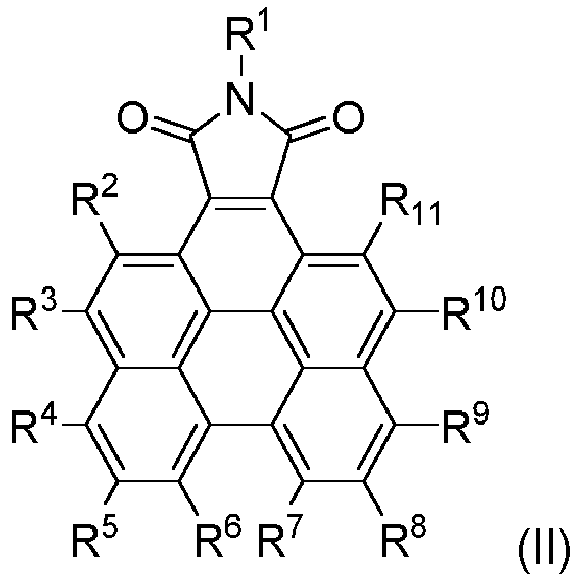
- composition of the present invention may comprise a polycyclic compound of Formula (II).
- one or more of the residues R 2 to R 11 in Formula (II) can be a heteroaryl group.
- the heteroaryl group preferably comprises or is a five- or six-membered aromatic ring containing one or more (preferably up to three) heteroatoms being selected from oxygen, nitrogen and sulfur.
- Exemplary heteroaryl groups are pyridinyl, pyridazinyl, pyrimidinyl, pyrazinyl, oxazolyl, thiazolyl, isoxazolyl, isothiazolyl and oxathiazolyl.
- Exemplary compounds of Formula (II) are those of the following Formulas (11-1), (II-2) and (II-3):
- the polycyclic compound can be a compound of Formula (III).
- the compound of Formula (III) might be associated with one or more charge-compensating anions, e.g. one or more weakly coordinating anions such as [BF 4 ] - , [ClO 4 ] - , [SbF 6 ] - and [PF 6 ] - .
- charge-compensating anions e.g. one or more weakly coordinating anions such as [BF 4 ] - , [ClO 4 ] - , [SbF 6 ] - and [PF 6 ] - .
- other anions might be present as well.
- An exemplary compound of Formula (III) has the following Formula (III-1):
- the composition of the present invention comprises a palladium compound which is selected from a palladium salt or a palladium complex or a mixture thereof.
- the palladium compound is a catalyst or precatalyst for a Suzuki cross-coupling reaction.
- Palladium compounds which may act as a catalyst or precatalyst for Suzuki cross-coupling reactions are known to the skilled person and are commercially available or can be prepared by commonly known preparation methods.
- the palladium compound is a salt, it is preferably a palladium acetate, a palladium acetylacetonate or a palladium halide (such as palladium chloride (PdCl 2 ), palladium bromide (PdBr 2 ), or palladium iodide (PdI 2 )), or any mixture thereof.
- a palladium acetate a palladium acetylacetonate
- a palladium halide such as palladium chloride (PdCl 2 ), palladium bromide (PdBr 2 ), or palladium iodide (PdI 2 )
- the composition may additionally comprise (iii) a phosphine or a bipyridine (in particular a 2,2'-bipyridine) compound, in particular if the palladium compound is a salt (such as a palladium acetate, a palladium acetylacetonate or a palladium halide).
- a phosphine or bipyridine compound and the palladium compound might be kept in separate containers and brought into contact when performing the Suzuki cross-coupling reaction, thereby forming in situ a palladium complex which comprises one or more phosphine ligands.
- the phosphine compound which is optionally present in the composition as component (iii) might be a tri-C 1-6 alkyl phosphine, a tri-C 5-7 cycloalkyl phosphine (preferably a tricyclohexyl phosphine), a triarylphosphine (in particular a triphenyl phosphine) wherein each of the aryl groups (which are preferably phenyl groups) is optionally substituted with one or more C 1-4 haloalkyl (e.g. -CF 3 ), C 1-4 alkyl (e.g. methyl) or C 1-4 alkoxy (e.g. methoxy).
- C 1-4 haloalkyl e.g. -CF 3
- C 1-4 alkyl e.g. methyl
- C 1-4 alkoxy e.g. methoxy
- Exemplary phosphine compounds are those of the following Formulas (XII-1), (XII-2), and (XII-3):
- the phosphine compound is of Formula (XIII): P(R 1 )(R 2 )(R 3 ) (XIII) wherein
- Exemplary phosphine compounds of Formula (XIII) may have one of the following Formulas (XIII-1) to (XIII-4):
- the phosphine compound is a ferrocenyl diphosphine or a xanthenyl diphosphine, which may have one of the following Formulas (XIV-1), (XIV-2) and (XV-1):
- the composition comprises (i) a palladium salt (such as a palladium acetate, a palladium acetylacetonate or a palladium halide); (ii) a polycyclic compound of Formula (Ia); and optionally (iii) a phosphine compound (such as a trialkyl phosphine, a triaryl phosphine, a phosphine of Formula XIII, a ferrocenyl diphosphine or a xanthenyl diphosphine).
- a palladium salt such as a palladium acetate, a palladium acetylacetonate or a palladium halide
- a polycyclic compound of Formula (Ia) such as a trialkyl phosphine, a triaryl phosphine, a phosphine of Formula XIII, a ferrocenyl diphosphine or a xanthen
- the composition comprises (i) a palladium salt (such as a palladium acetate, a palladium acetylacetonate or a palladium halide); (ii) a polycyclic compound of Formula (Ib); and optionally (iii) a phosphine compound (such as a trialkyl phosphine, a triaryl phosphine, a phosphine of Formula XIII, a ferrocenyl diphosphine or a xanthenyl diphosphine).
- a palladium salt such as a palladium acetate, a palladium acetylacetonate or a palladium halide
- a polycyclic compound of Formula (Ib) such as a trialkyl phosphine, a triaryl phosphine, a phosphine of Formula XIII, a ferrocenyl diphosphine or a xanthen
- the composition comprises (i) a palladium salt (such as a palladium acetate, a palladium acetylacetonate or a palladium halide); (ii) a polycyclic compound of Formula (Ic); and optionally (iii) a phosphine compound (such as a trialkyl phosphine, a triaryl phosphine, a phosphine of Formula XIII, a ferrocenyl diphosphine or a xanthenyl diphosphine).
- a palladium salt such as a palladium acetate, a palladium acetylacetonate or a palladium halide
- a polycyclic compound of Formula (Ic) such as a trialkyl phosphine, a triaryl phosphine, a phosphine of Formula XIII, a ferrocenyl diphosphine or a xanthen
- the composition comprises (i) a palladium salt (such as a palladium acetate, a palladium acetylacetonate or a palladium halide); (ii) a polycyclic compound of Formula (Id); and optionally (iii) a phosphine compound (such as a trialkyl phosphine, a triaryl phosphine, a phosphine of Formula XIII, a ferrocenyl diphosphine or a xanthenyl diphosphine).
- a palladium salt such as a palladium acetate, a palladium acetylacetonate or a palladium halide
- a polycyclic compound of Formula (Id) such as a trialkyl phosphine, a triaryl phosphine, a phosphine of Formula XIII, a ferrocenyl diphosphine or a xanthen
- the composition comprises (i) a palladium salt (such as a palladium acetate, a palladium acetylacetonate or a palladium halide); (ii) a polycyclic compound of Formula (II); and optionally (iii) a phosphine compound (such as a trialkyl phosphine, a triaryl phosphine, a phosphine of Formula XIII, a ferrocenyl diphosphine or a xanthenyl diphosphine).
- a palladium salt such as a palladium acetate, a palladium acetylacetonate or a palladium halide
- a polycyclic compound of Formula (II) such as a trialkyl phosphine, a triaryl phosphine, a phosphine of Formula XIII, a ferrocenyl diphosphine or a xanthen
- the composition comprises (i) a palladium salt (such as a palladium acetate, a palladium acetylacetonate or a palladium halide); (ii) a polycyclic compound of Formula (III); and optionally (iii) a phosphine compound (such as a trialkyl phosphine, a triaryl phosphine, a phosphine of Formula XIII, a ferrocenyl diphosphine or a xanthenyl diphosphine).
- a palladium salt such as a palladium acetate, a palladium acetylacetonate or a palladium halide
- a polycyclic compound of Formula (III) optionally
- a phosphine compound such as a trialkyl phosphine, a triaryl phosphine, a phosphine of Formula XIII, a ferrocenyl dip
- the palladium compound is a palladium complex, it preferably comprises one or more ligands which are selected from a phosphine, an N-heterocyclic carbene, an amine, or any combination thereof.
- the palladium complex may comprise other ligands as well.
- the palladium complex is of Formula (IV) wherein
- the compound of Formula (IV) might be associated with one or more charge-compensating anions, e.g. one or more weakly coordinating anions such as [BF 4 ] - , [ClO 4 ] - , [SbF 6 ] - and [PF 6 ] - .
- charge-compensating anions e.g. one or more weakly coordinating anions such as [BF 4 ] - , [ClO 4 ] - , [SbF 6 ] - and [PF 6 ] - .
- other anions might be present as well.
- ligand Lg 2 is an N-heterocyclic carbene; and/or ligand Lg 1 is a pyridine, a pyrrole, an imidazole, a pyrazole or a pyrimidine, each of which is optionally substituted with one or more halogens.
- N-heterocyclic carbene ligand Lg 2 can be of Formula (V) or Formula (VI): wherein in Formula (V)
- An exemplary palladium complex of Formula (IV) has the following Formula (IV-1):
- the composition comprises (i) a palladium complex of Formula (IV); and (ii) a polycyclic compound of Formula (Ia).
- ligand Lg 2 in Formula (IV) is a N-heterocyclic carbene (e.g. of Formula (V) or (VI)); and/or ligand Lg 1 is a pyridine, a pyrrole, an imidazole, a pyrazole or a pyrimidine, each of which is optionally substituted with one or more halogens.
- Preferred embodiments of the polycyclic compound t of Formula (Ia) have been described above.
- the composition comprises (i) a palladium complex of Formula (IV); and (ii) a polycyclic compound of Formula (Ib).
- ligand Lg 2 in Formula (IV) is a N-heterocyclic carbene (e.g. of Formula (V) or (VI)); and/or ligand Lg 1 is a pyridine, a pyrrole, an imidazole, a pyrazole or a pyrimidine, each of which is optionally substituted with one or more halogens.
- Preferred embodiments of the polycyclic compound of Formula (Ib) have been described above.
- the composition comprises (i) a palladium complex of Formula (IV); and (ii) a polycyclic compound of Formula (Ic).
- ligand Lg 2 in Formula (IV) is a N-heterocyclic carbene (e.g. of Formula (V) or (VI)); and/or ligand Lg 1 is a pyridine, a pyrrole, an imidazole, a pyrazole or a pyrimidine, each of which is optionally substituted with one or more halogens.
- Preferred embodiments of the polycyclic compound of Formula (Ic) have been described above.
- the composition comprises (i) a palladium complex of Formula (IV); and (ii) a polycyclic compound of Formula (Id).
- ligand Lg 2 in Formula (IV) is a N-heterocyclic carbene (e.g. of Formula (V) or (VI)); and/or ligand Lg 1 is a pyridine, a pyrrole, an imidazole, a pyrazole or a pyrimidine, each of which is optionally substituted with one or more halogens.
- Preferred embodiments of the polycyclic compound of Formula (Id) have been described above.
- the composition comprises (i) a palladium complex of Formula (IV); and (ii) a polycyclic compound of Formula (II).
- ligand Lg 2 in Formula (IV) is a N-heterocyclic carbene (e.g. of Formula (V) or (VI)); and/or ligand Lg 1 is a pyridine, a pyrrole, an imidazole, a pyrazole or a pyrimidine, each of which is optionally substituted with one or more halogens.
- Preferred embodiments of the polycyclic compound of Formula (II) have been described above.
- the composition comprises (i) a palladium complex of Formula (IV); and (ii) a polycyclic compound of Formula (III).
- ligand Lg 2 in Formula (IV) is a N-heterocyclic carbene (e.g. of Formula (V) or (VI)); and/or ligand Lg 1 is a pyridine, a pyrrole, an imidazole, a pyrazole or a pyrimidine, each of which is optionally substituted with one or more halogens.
- Preferred embodiments of the polycyclic compound of Formula (III) have been described above.
- the palladium complex being present in the composition of the present invention can be of Formula (VII) wherein
- the non-ionic ligand Lg 1 in Formula (VII) is a phosphine.
- the anionic ligand Lg 2 in Formula (VII) is a weakly or non-coordinating anionic ligand, such as an alkyl sulfonate (e.g. mesylate) or an aryl sulfonate (e.g. tosylate).
- an alkyl sulfonate e.g. mesylate
- an aryl sulfonate e.g. tosylate
- other anionic ligands might be used as well.
- the phosphine ligand Lg 1 in Formula (VII) can be phosphine of Formula (VIII): P(R 1 )(R 2 )(R 3 ) (VIII) wherein
- Exemplary palladium complexes of Formula (VII) can have one of the following Formulas (VII-1) to Formula (VII-7):
- the phosphine ligand Lg 1 in Formula (VII) is a ferrocenyl phosphine.
- Exemplary palladium complexes of Formula (VII) containing a ferrocenyl phosphine ligand are those of Formula (VII-8) or Formula (VII-9):
- the phosphine ligand Lg 1 in Formula (VII) is a trialkyl phosphine (e.g. P(C 1-6 alkyl) 3 ).
- An exemplary palladium complex of Formula (VII) containing a trialkyl phosphine ligand is the palladium complex of Formula (VII-10):
- exemplary palladium complexes of Formula (VII) containing a phosphine ligand Lg 1 are those of Formula (VII-11), (VII-12), or (VII-13):
- the composition comprises (i) a palladium complex of Formula (VII); and (ii) a polycyclic compound of Formula (Ia).
- the non-ionic ligand Lg 1 in Formula (VII) is a phosphine (e.g. a phosphine of Formula (VIII), a ferrocenyl phosphine or a phosphine in one of the Formulas (VII-11) to (VII-13)).
- Preferred embodiments of the polycyclic compound of Formula (Ia) have been described above.
- the composition comprises (i) a palladium complex of Formula (VII); and (ii) a polycyclic compound of Formula (Ib).
- the non-ionic ligand Lg 1 in Formula (VII) is a phosphine (e.g. a phosphine of Formula (VIII), a ferrocenyl phosphine or a phosphine in one of the Formulas (VII-11) to (VII-13)).
- Preferred embodiments of the polycyclic compound of Formula (Ib) have been described above.
- the composition comprises (i) a palladium complex of Formula (VII); and (ii) a polycyclic compound of Formula (Ic).
- non-ionic ligand Lg 1 in Formula (VII) is a phosphine (e.g. a phosphine of Formula (VIII), a ferrocenyl phosphine or a phosphine in one of the Formulas (VII-11) to (VII-13)).
- Preferred embodiments of the polycyclic compound of Formula (Ic) have been described above.
- the composition comprises (i) a palladium complex of Formula (VII); and (ii) a polycyclic compound of Formula (Id).
- the non-ionic ligand Lg 1 in Formula (VII) is a phosphine (e.g. a phosphine of Formula (VIII), a ferrocenyl phosphine or a phosphine in one of the Formulas (VII-11) to (VII-13)).
- Preferred embodiments of the polycyclic compound of Formula (Id) have been described above.
- the composition comprises (i) a palladium complex of Formula (VII); and (ii) a polycyclic compound of Formula (II).
- non-ionic ligand Lg 1 in Formula (VII) is a phosphine (e.g. a phosphine of Formula (VIII), a ferrocenyl phosphine or a phosphine in one of the Formulas (VII-11) to (VII-13)).
- Preferred embodiments of the polycyclic compound of Formula (II) have been described above.
- the composition comprises (i) a palladium complex of Formula (VII); and (ii) a polycyclic compound of Formula (III).
- non-ionic ligand Lg 1 in Formula (VII) is a phosphine (e.g. a phosphine of Formula (VIII), a ferrocenyl phosphine or a phosphine in one of the Formulas (VII-11) to (VII-13)).
- Preferred embodiments of the polycyclic compound of Formula (III) have been described above.
- the palladium complex being present in the composition of the present invention can be of Formula (IX): Pd(L) 3-4 (IX) wherein
- Exemplary palladium complexes of Formula (IX) are those of Formula (IX-1) or (IX-2):
- the composition comprises (i) a palladium complex of Formula (IX); and (ii) a polycyclic compound of Formula (Ia). Preferred embodiments of the polycyclic compound of Formula (Ia) have been described above.
- the composition comprises (i) a palladium complex of Formula (IX); and (ii) a polycyclic compound of Formula (Ib). Preferred embodiments of the polycyclic compound of Formula (Ib) have been described above.
- the composition comprises (i) a palladium complex of Formula (IX); and (ii) a polycyclic compound of Formula (Ic). Preferred embodiments of the polycyclic compound of Formula (Ic) have been described above.
- the composition comprises (i) a palladium complex of Formula (IX); and (ii) a polycyclic compound of Formula (Id). Preferred embodiments of the polycyclic compound of Formula (Id) have been described above.
- the composition comprises (i) a palladium complex of Formula (IX); and (ii) a polycyclic compound of Formula (II). Preferred embodiments of the polycyclic compound of Formula (II) have been described above.
- the composition comprises (i) a palladium complex of Formula (IX); and (ii) a polycyclic compound of Formula (III). Preferred embodiments of the polycyclic compound of Formula (III) have been described above.
- the palladium complex being present in the composition of the present invention can be of Formula (X): wherein
- Exemplary palladium complexes of Formula (X) are those of Formula (X-1) or (X-2):
- the composition comprises (i) a palladium complex of Formula (X); and (ii) a polycyclic compound of Formula (Ia). Preferred embodiments of the polycyclic compound of Formula (Ia) have been described above.
- the composition comprises (i) a palladium complex of Formula (X); and (ii) a polycyclic compound of Formula (Ib). Preferred embodiments of the polycyclic compound of Formula (Ib) have been described above.
- the composition comprises (i) a palladium complex of Formula (X); and (ii) a polycyclic compound of Formula (Ic). Preferred embodiments of the polycyclic compound of Formula (Ic) have been described above.
- the composition comprises (i) a palladium complex of Formula (X); and (ii) a polycyclic compound of Formula (Id). Preferred embodiments of the polycyclic compound of Formula (Id) have been described above.
- the composition comprises (i) a palladium complex of Formula (X); and (ii) a polycyclic compound of Formula (II). Preferred embodiments of the polycyclic compound of Formula (II) have been described above.
- the composition comprises (i) a palladium complex of Formula (X); and (ii) a polycyclic compound of Formula (III). Preferred embodiments of the polycyclic compound of Formula (III) have been described above.
- the composition may contain the palladium compound and the polycyclic compound of Formula (I), (II) or (III) in the form of a mixture.
- one or more additional components might be present in the mixture.
- the mixture may consist of the palladium compound and the polycyclic compound of Formula (I), (II) or (III).
- the molar ratio between the palladium compound and the polycyclic compound of Formula (I), (II) or (III) might be in the range of from 100/1 to 1/100, more preferably 10/1 to 1/10 or even more preferably 2/1 to 1/2.
- the composition can be a kit which provides the palladium compound and the polycyclic compound of Formula (I), (II) or (III) in separate containers.
- the present invention also relates to a method of performing a Suzuki cross-coupling reaction, wherein a first reactant is reacted with a second reactant under irradiation of light in the presence of the composition of the present invention, the first reactant comprising an aromatic or N-heteroaromatic ring to which a boronic acid or boronic acid ester group is attached, and the second reactant comprising an aromatic or N-heteroaromatic ring to which a halogen (CI, Br, I), a pseudohalogen (cyano, cyanate, isocyanate), or a sulfonate is attached.
- a halogen CI, Br, I
- a pseudohalogen cyano, cyanate, isocyanate
- Under irradiation of light refers to light provided by an external light source (e.g. lamps such as an UV lamp or an UV/VIS lamp, one or more LEDs, a laser, etc.).
- an external light source e.g. lamps such as an UV lamp or an UV/VIS lamp, one or more LEDs, a laser, etc.
- the light may have a wavelength in the range of from 254 nm to 800 nm, preferably 360 nm to 550 nm.
- the light can be a monochromatic light; or may cover a continuous wavelength spectrum (e.g. in the UV and/or visible spectrum).
- the light reaching the reaction medium may have an irradiance of 10 to 2000 milliwatts per square centimeter. However, lower or higher irradiance values can be used as well.
- the first and second reactants might be reacted in the presence of a base which is preferably selected from carbonate (e.g. an alkali metal carbonate), a hydroxide (e.g. an alkali metal hydroxide), a phosphate (e.g. an alkali metal phosphate), an alkoxide (e.g. an alkali metal alkoholate).
- a base which is preferably selected from carbonate (e.g. an alkali metal carbonate), a hydroxide (e.g. an alkali metal hydroxide), a phosphate (e.g. an alkali metal phosphate), an alkoxide (e.g. an alkali metal alkoholate).
- a base which is preferably selected from carbonate (e.g. an alkali metal carbonate), a hydroxide (e.g. an alkali metal hydroxide), a phosphate (e.g. an alkali metal phosphate), an alkoxide (e
- the present invention relates to the use of the composition described above as a catalyst system for a light-assisted Suzuki carbon-carbon cross-coupling reaction.
- “light assisted” means that the reaction medium in which the Suzuki carbon-carbon cross-coupling reaction is carried out is irradiated by an external light source (e.g. lamps such as UV or UV/VIS lamps, LEDs, laser, etc.).
- Comparative Example CE1 and Inventive Examples IE1-IE2 the same reactants (4-trifluoromethyl phenyl boronic acid pinacol ester ( CAS No. 214360-65-3 ), i.e. an organoboron compound, and 3-chloropyridine, i.e. a heteroaryl halide) were used. Furthermore, in CE1, IE1 and IE2, the same palladium complex was present in the reaction medium. However, in IE1 and IE2, the reaction medium additionally contained a polycyclic compound and was irradiated by light from an external light source.
- the palladium complex is commercially available (e.g. from Strem Chemicals).
- An amber vial was used to preclude light from coming in. Accordingly, no irradiation of the reaction medium took place.
- 19 ⁇ l of neat degassed 3-chloropyridine i.e. a heteroaryl halide
- 400 ⁇ l of a degassed aqueous 0.85 M solution of K 3 PO 4 was added to this vial, followed by 100 ⁇ l of degassed benzene was added.
- the total volume of this reaction was 2.4 ml (2.0 ml organic, and 400 ⁇ l aqueous), with 2 mol% palladium complex.
- the vial was placed in a glycol/ water bath which was set to 40 °C, and illuminated with 445 nm by an array of 96 LEDs, with stirring for 5 hours.
- an amber vial was used in Comparative Example CE1, thereby precluding essentially all the light from reaching the reaction medium.
- the total volume of this reaction was 2.4 ml (2.0 ml organic, and 400 ⁇ l aqueous), with 2 mol% palladium complex, and 1 mol% polycyclic compound.
- the clear-glass vial was placed in a glycol/ water bath which was set to 40 °C, and illuminated with 445 nm by an array of 96 LEDs, with stirring for 5 hours. After 5 hours, the clear-glass vial was allowed to cool to room temperature before being opened. Then 1 equivalent of trifluorotoluene was added as an internal 19 F-NMR standard, and a 20 ⁇ l sample was taken for TLC. A further 20 ⁇ l was taken from the vial for 19 F-NMR, to determine conversion of starting material to product.
- the total volume of this reaction was 2.4 ml (2.0 ml organic, and 400 ⁇ l aqueous), with 2 mol% palladium complex, and 1 mol% polycyclic compound.
- the vial was placed in a glycol/ water bath which was set to 40 °C, and illuminated with 445 nm by an array of 96 LEDs, with stirring for 5 hours. After 5 hours, the vial was allowed to cool to room temperature before being opened. Then 1 equivalent of trifluorotoluene was added as an internal 19 F-NMR standard, and a 20 ⁇ l sample was taken for TLC. A further 20 ⁇ l was taken for 19 F-NMR, to determine conversion of starting material to product.
- Suzuki cross-coupling product yields (determined by 19 F NMR) in Comparative Example CE1 and Inventive Examples E1-E2 are summarized below in Table 4.
- Table 4 Yield of Suzuki cross-coupling reaction product in CE1, IE1 and IE2 Reaction temperature [°C] Yield of Suzuki cross-coupling reaction product [%], determined by 19F NMR CE1 40 0 IE1 40 60 IE2 40 67
- an efficient light-assisted Suzuki cross-coupling reaction between an organoboron compound and a (hetero-)aryl halide is accomplished even at low reaction temperature if a combination of a palladium compound and a polycyclic compound of Formula (I), (II) or (III) is used as a catalyst system.
- the present invention relates to the following embodiments ⁇ 01 ⁇ to ⁇ 51 ⁇ :
Landscapes
- Chemical & Material Sciences (AREA)
- Organic Chemistry (AREA)
- Engineering & Computer Science (AREA)
- Materials Engineering (AREA)
- Chemical Kinetics & Catalysis (AREA)
- Inorganic Chemistry (AREA)
- Physics & Mathematics (AREA)
- Electromagnetism (AREA)
- Optics & Photonics (AREA)
- Health & Medical Sciences (AREA)
- Plasma & Fusion (AREA)
- Toxicology (AREA)
- Organic Low-Molecular-Weight Compounds And Preparation Thereof (AREA)
Abstract
- a palladium compound which is a palladium salt or a palladium complex or a mixture thereof, and
- a polycyclic compound of Formula (I), (II) or (III):

Description
- The invention relates to a catalyst system for light-assisted Suzuki cross-coupling reactions.
- Cross-coupling reactions are a frequently used and important synthetic tool in organic chemistry, both for joining two fragments via a carbon-carbon bond (carbon-carbon cross-coupling reactions) and a carbon-heteroatom bond (carbon-heteroatom cross-coupling reactions).
- Different types of cross-coupling reactions such as Suzuki cross-coupling (also known as Suzuki-Miyaura cross-coupling), Heck cross-coupling, Stille cross-coupling and Negishi cross-coupling reactions are known. Typically, these cross-coupling reactions are catalyzed by palladium-containing catalysts. In 2010, the Nobel Prize in Chemistry was awarded jointly to R.F. Heck, E. Negishi and A. Suzuki for palladium-catalyzed cross-couplings in organic synthesis.
- Cross-coupling reactions are frequently used in drug synthesis. Reviews on this topic are provided by H.C. Shen, "Selected Applications of Transition Metal-Catalyzed Carbon-Carbon Cross-Coupling Reactions in the Pharmaceutical Industry', pp. 25-96, in "Applications of Transition Metal Catalysis in Drug Discovery and Development: An Industrial Perspective", Ed.: M.L. Crawley and B.M. Trost, 2012, John Wiley & Sons; and Q. Gu et al., "Palladium catalyzed C-C and C-N bond forming reactions: An update on the synthesis of pharmaceuticals from 2015-2020", Org. Chem. Front., 2021, 8, pp. 384-414.
- In a Suzuki cross-coupling reaction, an organoboron species is typically reacted with an organohalide or organopseudohalide in the presence of a palladium compound acting as a catalyst. A review on palladium-catalyzed Suzuki cross-coupling reactions of organoboron compounds is provided by A. Suzuki and N. Miyaura, Chem. Rev., 1995, pp. 2457-2483. A variety of different organoboron reagents for use in Suzuki cross-coupling reactions have meanwhile been developed and are commercially available. See e.g. A.J. Lennox and G.C. Lloyd-Jones, "Selection of boron reagents for Suzuki-Miyaura coupling", Chem. Soc. Rev., 2014, pp. 412-443.
- Palladium in the oxidation state 0 (Pd(0)) is considered to be the catalytically active species in Suzuki cross-coupling reactions, e.g. in the form of L-Pd(0) or L2Pd(0), wherein L is a ligand which binds to the Pd atom.
- Typically, the most active cross-coupling catalysts are Pd complexes with sterically demanding, electron-rich phosphine or N-heterocyclic carbene (NHC) ligands. The catalytically active species can be generated in situ in the reaction medium by bringing into contact a palladium salt (such as Pd(OAc)2) and appropriate phosphine or N-heterocyclic carbene compounds. Such phosphine or N-heterocyclic carbene compounds are known to the skilled person and commercially available. Meanwhile, kits containing a number of different phosphine or N-heterocyclic carbene compounds are offered by commercial suppliers for use in palladium-catalyzed cross-coupling reactions (such as Suzuki cross-coupling).
- However, the costs of these specialized ligands are often quite high which is why the addition of excess ligand to a Pd precursor may adversely affect economic process efficiency. Furthermore, in many cross-coupling reactions, the optimal Pd to ligand ratio is 1:1, with the active species proposed to be monoligated Pd(0). Therefore, well-defined Pd(II) precatalysts containing one molar equivalent of ancillary ligand to facilitate cross-coupling reactions are meanwhile frequently used. Reviews on palladium compounds acting as precatalysts for cross-coupling reactions are provided by N. Hazari et al., "Well-defined nickel and palladium precatalysts for cross-coupling", Nature Reviews Chemistry, 1,0025 (2017), https://doi.org/10.1038/s41570-017-0025, and K.H. Shaughnessy, Israel Journal of Chemistry, Vol. 60, Issue 3-4, pp. 180-194. Exemplary Pd precatalysts include palladacycle precatalysts (also known as Buchwald precatalysts) and PEPPSI® precatalysts ("Pyridine-Enhanced Precatalyst Preparation Stabilization and Initiation"). Meanwhile, a wide variety of palladium precatalysts for use in cross-coupling reactions is commercially available, e.g. Buchwald palladacycle precatalyst kits from Strem Chemicals and Sigma-Aldrich. Further information about commercially available palladium precatalysts for cross-coupling reactions is provided by the Sigma-Aldrich brochure "Application Guide for Palladium Catalyzed Cross-Coupling Reactions" (available at https://www.sigmaaldrich.com/content/dam/sigma-aldrich/docs/Aldrich/Application_Notes/1/application-guide-for-palladium-catalyzed-cross-coupling.pdf) and the Strem Chemicals brochure "Buchwald Ligands and Precatalysts" (available at https://www.strem.com/uploads/resources/documents/buchwaldligprecat.pdf).
- In Suzuki cross-coupling reactions, reactivity of the aryl halide reactant decreases in the order of I > Br >> Cl. For cost efficiency reasons, aryl chloride reactants would typically be preferred over aryl bromide and aryl iodide reactants. Furthermore, some heteroaryl halide reactants such as pyridyl chloride show low reactivity in Suzuki cross-coupling reactions. Unless no improved catalytic system is identified, low activity of the reactants is typically overcome by increasing reaction temperature which, however, may amplify side reactions and decrease product yield of the Pd-catalyzed Suzuki cross-coupling reaction.
- Accordingly, there is still a need for improved catalyst systems which efficiently catalyze Suzuki cross-coupling reactions even if aryl chlorides or heteroaryl chlorides (such as pyridyl chlorides) are used as reactants.
- Recently, light-induced photoredox catalysis has become an important tool for the design and development of a variety of radical reactions under mild reaction conditions. A review on photoredox catalysis in organic chemistry is provided by M.H. Shaw et al., J. Org. Chem., 2016, 81, pp. 6898-6926.
-
US 10,975,171 B2 US 10,975,171 B2 - Dimethyl dihydroacridines as photoredox catalysts in atom transfer radical polymerization of acrylate monomers is described by C. Lim et al., Angew. Chem. Int. Ed. Engl., 2020, 59(8), pp. 3209-3217.
- C. Lim et al., Chemistry, 2017, 23(46), pp. 10962-10968, describe strongly reducing visible light organic photoredox catalysts (such as N-aryl phenoxazines and dihydrophenazines) as an alternative to iridium and ruthenium photoredox catalysts.
- C. Lim et al, J. Am. Chem. Soc., 2020, 142, 31, pp. 13573-13581, describe a light-induced Birch reduction in the presence of a benzoperylene monoimide acting as a photoredox catalyst.
- A combination of transition metal catalysts and photoredox catalysts is described by J. Twilton et al., "The merger of transition metal and photocatalysis", Nat Rev Chem, 1, 0052 (2017), https://doi.org/10.1038/s41570-017-0052.
- A review on cooperative photoredox and palladium catalysis is provided by N.D.P. Singh et al., Catal. Sci. Technol., 2021, 11, pp. 742-767.
- K. Mori et al., Chem. Comm., 2014, 50, pp. 14501-14503, describe a light-enhanced Suzuki cross-coupling reaction by cooperative photocatalysis with a Ru-Pd bimetallic complex. The Ru bipyridine moiety represents the photocatalytically active part, while the Pd bipyrimidine moiety represents the precatalyst part which is transformed into the active Pd(0) species. So, the photocatalytically active component and the palladium precatalyst component are present within the same molecule. However, synthesis of compounds which contain both the photocatalytically active component and the palladium precatalyst component within the same molecule might be challenging. Furthermore, as indicated in the publication of K. Mori et al., no enhancement of catalytic activity has been observed when using a physical mixture of the Pd-free Ru complex and the Ru-free Pd complex (i.e. a mixture of [(bpy)2Ru(bpm)](PF6)2 and (bpy)PdCl2). This suggests that the electron transfer from Ru to Pd moiety is crucial for attaining enhanced photocatalytic activity and requires the photocatalytically active component and the palladium precatalyst component to be present within the same molecule.
- X. Li et al., Scientific Reports, 3:1743, DOI: 10.1038/srep01743 describe a room-temperature Suzuki carbon-carbon cross-coupling reaction over heterogeneous Pd catalysts by light-mediated catalyst activation. A stimulated electron transfer at the metal-semiconductor interface from optically active mesoporous carbon nitride nanorods to Pd nanoparticles is employed.
- As mentioned above, (hetero)aryl chlorides may show low reactivity in Suzuki cross-coupling reactions. Unless no improved catalytic system is identified, low activity of the reactants is typically overcome by increasing reaction temperature which, however, may amplify side reactions and decrease product yield of the Pd-catalyzed Suzuki cross-coupling reaction.
- Accordingly, an object of the present invention is to provide a catalyst system which efficiently catalyzes Suzuki cross-coupling reactions, in particular if (hetero)aryl chlorides are used as a reactant and/or the reaction is carried out at relatively low temperature.
- The invention provides a composition, comprising
- (i) a palladium compound which is selected from a palladium salt or a palladium complex or a mixture thereof,
- (ii) a polycyclic compound of Formula (I), (II) or (III):

- n is 0 or 1,
- X is O, C(R10)(R11), or N(R12),
- R1 to R12 are selected independently from each other from hydrogen, an aryl group and a C1-10alkyl group, the aryl group and/or the C1-10alkyl group optionally being substituted with one or more substituents R13,
- wherein the one or more substituents R13, if present, are selected independently from each other from C1-6alkyl, C1-6haloalkyl, -OH, -O-(C1-6alkyl), -NO2, -CN, a halogen atom, -NH2, -NH(C1-6alkyl), -N(C1-6alkyl)2, -C(=O)OH, -C(=O)O-(C1-6alkyl), -C(=O)O-phenyl, -C(=O)(C1-6alkyl), -C(=O)-phenyl, -S(O)2NH2, -S(O)2NH(C1-6alkyl), -S(O)2N(C1-6alkyl)(C1-6alkyl), -S-(C1-6alkyl), -S(O)(C1-6alkyl), -S(O)2(C1-6alkyl), -S-(phenyl), -S(O)(phenyl), -S(O)2(phenyl), and a N-carbazolyl of Formula (1.1)


- wherein in Formula (II)
- R1 is selected from a C1-16alkyl group and an aryl group, the C1-16alkyl group and/or the aryl group optionally being substituted with one or more substituents R12, and/or the C1-16alkyl group optionally being interrupted by one or more oxygen atoms;
- R2 to R11 are selected independently from each other from hydrogen, a C1-16alkyl group, an aryl group, a heteroaryl group; the C1-16alkyl group, the aryl group and/or the heteroaryl group optionally being substituted with one or more substituents R12, and/or the C1-16alkyl group optionally being interrupted by one or more oxygen atoms; or
- at least two of the residues R2 to R11 which are adjacent to each other form together with the carbon atoms to which they are attached a five- or six-membered aromatic ring while the remaining residues (i.e. those of the residues R2 to R11 which do not form a ring) are selected independently from each other from hydrogen, a C1-16alkyl group, an aryl group and a heteroaryl group; the C1-16alkyl group, the aryl group and/or the heteroaryl group optionally being substituted with one or more substituents R12, and/or the C1-16alkyl group optionally being interrupted by one or more oxygen atoms;
- wherein the one or more substituents R12, if present, are selected independently from each other from C1-6alkyl, C1-6haloalkyl, -OH, -O-(C1-6alkyl), -NO2, -CN, a halogen atom, -NH2, -NH(C1-6alkyl), -N(C1-6alkyl)2, -C(=O)OH, -C(=O)O-(C1-6alkyl), -C(=O)O-phenyl, -C(=O)(C1-6alkyl), -C(=O)-phenyl, - S(O)2NH2, -S(O)2NH(C1-6alkyl), -S(O)2N(C1-6alkyl)(C1-6alkyl), -S-(C1-6alkyl), -S(O)(C1-6alkyl), -S(O)2(C1-6alkyl), -S-(phenyl), -S(O)(phenyl), and -S(O)2(phenyl),

- R1 is selected from a C1-16alkyl group and an aryl group, the C1-16alkyl group and/or the aryl group optionally being substituted with one or more substituents R11, and/or the C1-16alkyl group optionally being interrupted by one or more oxygen atoms;
- R2 to R9 are selected independently from each other from hydrogen, a C1-16alkyl group and an aryl group, the C1-16alkyl group and/or the aryl group optionally being substituted with one or more substituents R11, and/or the C1-16alkyl group optionally being interrupted by one or more oxygen atoms;
- R10 is an aryl group which is optionally substituted with one or more substituents R12, wherein the one or more substituents R11, if present, are selected independently from each other from C1-6alkyl, C1-6haloalkyl, -OH, -O-(C1-6alkyl), -NO2, -CN, a halogen atom, -NH2, -NH(C1-6alkyl), -N(C1-6alkyl)2, -C(=O)OH, -C(=O)O-(C1-6alkyl), -C(=O)O-phenyl, -C(=O)(C1-6alkyl), -C(=O)-phenyl, - S(O)2NH2, -S(O)2NH(C1-6alkyl), -S(O)2N(C1-6alkyl)(C1-6alkyl), -S-(C1-6alkyl), -S(O)(C1-6alkyl), -S(O)2(C1-6alkyl), -S-(phenyl), -S(O)(phenyl), and -S(O)2(phenyl),
- wherein the one or more substituents R12, if present, are selected independently from each other from a C1-6alkyl group and an aryl group (e.g. a phenyl group), wherein the aryl group is optionally substituted with one or more C1-6alkyl groups.
- In the present invention, it has been realized that the composition comprising a palladium compound and a polycyclic compound of Formula (I), (II) or (III) represents an efficient catalyst system for light-assisted Suzuki cross-coupling reactions.
- Accordingly, the present invention also provides a method of performing a Suzuki cross-coupling reaction, wherein a first reactant is reacted with a second reactant under irradiation of light in the presence of the composition according to the present invention, the first reactant comprising an aromatic or N-heteroaromatic ring to which a boronic acid or boronic acid ester group is attached, and the second reactant comprising an aromatic or N-heteroaromatic ring to which a halogen (CI, Br, I), a pseudohalogen (cyano, cyanate, isocyanate), or a sulfonate is attached. Examples of sulfonates comprise hydrocarbyl sulfonate like, for example, aryl sulfonate and alkyl sulfonate. Such sulfonate may or may not be substituted with halogen, e.g. trifluoromethane sulfonate.
- As discussed below in further detail, "under irradiation of light" refers to light provided by an external light source (e.g. lamps such as UV or UV/VIS lamps, LEDs, laser, etc.).
- The present invention also relates to the use of the composition outlined above and described below in further detail as a catalyst system for a light-assisted Suzuki carbon-carbon cross-coupling reaction. As known to the skilled person, "light assisted" means that the reaction medium in which the Suzuki carbon-carbon cross-coupling reaction is carried out is irradiated by an external light source (e.g. lamps such as UV or UV/VIS lamps, LEDs, laser, etc.).
- As outlined above, the composition of the present invention may comprise a polycyclic compound of Formula (I).
- If one or more of the residues R1 to R12 in Formula (I) are an aryl group, it can be a monoaryl group (e.g. a phenyl or naphthyl group) or a diaryl group (e.g. a biphenyl group).
- Preferably, R1 in Formula (I) is an aryl group, which can be a monoaryl group (e.g. a phenyl or naphthyl group) or a diaryl group (e.g. a biphenyl group).
- Preferably, R1 in Formula (I) is selected from a phenyl group, a naphthyl group and a biphenyl group, each of which is optionally substituted with one or more substituents R13, wherein R13 has the same meaning as outlined above. Accordingly, if present, the one or more substituents R13 are selected independently from each other from C1-6alkyl, C1-6haloalkyl, -OH, -O-(C1-6alkyl), -NO2, -CN, a halogen atom, -NH2, -NH(C1-6alkyl), -N(C1-6alkyl)2, -C(=O)OH, -C(=O)O-(C1-6alkyl), -C(=O)O-phenyl, -C(=O)(C1-6alkyl), -C(=O)-phenyl, -S(O)2NH2, -S(O)2NH(C1-6alkyl), -S(O)2N(C1-6alkyl)(C1-6alkyl), -S-(C1-6alkyl), -S(O)(C1-6alkyl), -S(O)2(C1-6alkyl), -S-(phenyl), -S(O)(phenyl), -S(O)2(phenyl), and N-carbazolyl of Formula (1.1)

- If in Formula (I) n is 1 and X is O, the polycyclic compound has the following Formula (Ia):

- In a preferred embodiment of Formula (Ia),
- R1 is a naphthyl group (preferably a 1-naphthyl group) which is optionally substituted with one or more substituents R13,
- R2, R3, R5, R6, R8 and R9 are selected independently from each other from hydrogen and a
- C1-6alkyl group,
- R4 and R7 are selected independently from each other from a phenyl group, a biphenyl group and a naphthyl group, each of which is optionally substituted with one or more substituents R13, wherein, if present, the one or more substituents R13 are selected independently from each other from C1-6alkyl, C1-6haloalkyl, -OH, -O-(C1-6alkyl), -NO2, -CN, a halogen atom, -NH2, -NH(C1-6alkyl), -N(C1-6alkyl)2, -C(=O)OH, -C(=O)O-(C1-6alkyl), -C(=O)O-phenyl, -C(=O)(C1-6alkyl), -C(=O)-phenyl, -S(O)2NH2, -S(O)2NH(C1-6alkyl), -S(O)2N(C1-6alkyl)(C1-6alkyl), -S-(C1-6alkyl), -S(O)(C1-6alkyl), -S(O)2(C1-6alkyl), -S-(phenyl), -S(O)(phenyl), and -S(O)2(phenyl).
- Exemplary compounds of Formula (Ia) are those of the following Formulas (I-1), (I-2), (I-3) and (I-4):


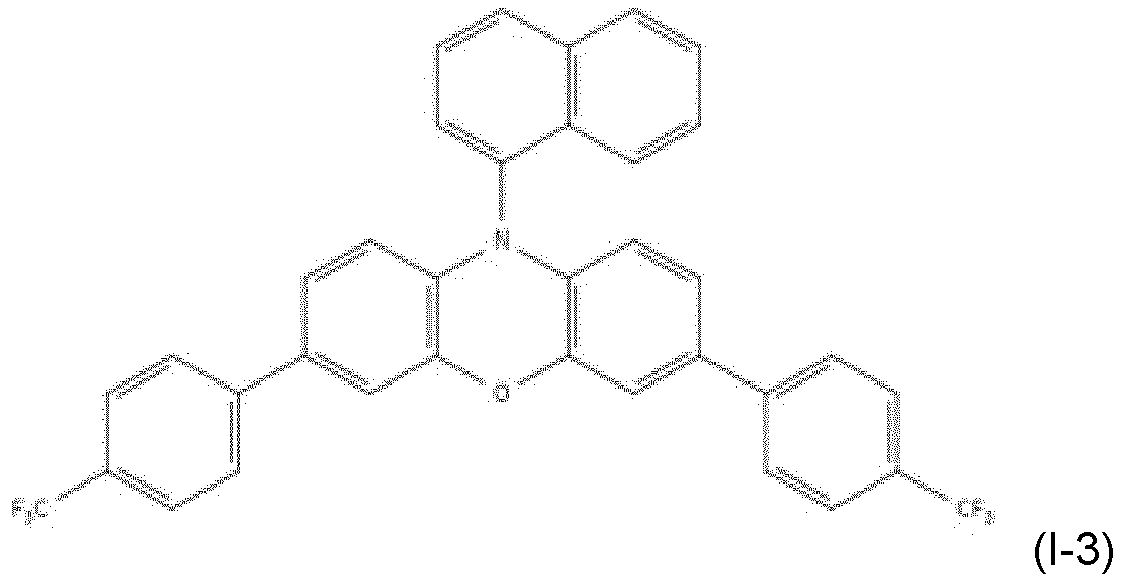

- If in Formula (I) n is 1 and X is C(R10)(R11), the polycyclic compound has the following Formula (Ib):

- In a preferred embodiment of Formula (Ib),
- R10 and R11 are selected independently from each other from hydrogen and a C1-6alkyl group,
- R1 is selected from a naphthyl group (preferably a 1-naphthyl or 2-naphthyl group), a phenyl group and a biphenyl group, each of which is optionally substituted with one or more substituents R13,
- R2, R3, R5, R6, R8 and R9 are selected independently from each other from hydrogen and a C1-6alkyl group,
- R4 and R7 are selected independently from each other from a phenyl group, a naphthyl group and a biphenyl group, each of which is optionally substituted with one or more substituents R13, wherein, if present, the one or more substituents R13 are selected independently from each other from C1-6alkyl, C1-6haloalkyl, -OH, -O-(C1-6alkyl), -NO2, -CN, a halogen atom, -NH2, -NH(C1-6alkyl), -N(C1-6alkyl)2, -C(=O)OH, -C(=O)O-(C1-6alkyl), -C(=O)O-phenyl, -C(=O)(C1-6alkyl), -C(=O)-phenyl, -S(O)2NH2, -S(O)2NH(C1-6alkyl), -S(O)2N(C1-6alkyl)(C1-6alkyl), -S-(C1-6alkyl), -S(O)(C1-6alkyl), -S(O)2(C1-6alkyl), -S-(phenyl), -S(O)(phenyl) and -S(O)2(phenyl).
- Exemplary compounds of Formula (Ib) have the following Formulas (I-5.1) to (I-5.7):


- If in Formula (I) n is 1 and X is N(R12), the polycyclic compound has the following Formula (Ic):

- In a preferred embodiment of Formula (Ic),
- R1 and R12 are selected independently from each other from a phenyl group, a naphthyl group (such as a 2-naphthyl group or a 1 naphthyl group) and a biphenyl group, each of which is optionally substituted with one or more substituents R13,
- R2 to R9 are selected independently from each other from hydrogen and a C1-6alkyl group, or at least two, preferably all of the residues R3, R4, R7, and R8 are a phenyl group which is optionally substituted with one or more substituents R13 and the residues R2, R5, R6 and R9 are selected independently from each other from hydrogen and a C1-6alkyl group,
- wherein, if present, the one or more substituents R13 are selected independently from each other from C1-6alkyl, C1-6haloalkyl, -OH, -O-(C1-6alkyl), -NO2, -CN, a halogen atom, -NH2, -NH(C1-6alkyl), -N(C1-6alkyl)2, -C(=O)OH, -C(=O)O-(C1-6alkyl), -C(=O)O-phenyl, -C(=O)(C1-6alkyl), -C(=O)-phenyl, -S(O)2NH2, -S(O)2NH(C1-6alkyl), -S(O)2N(C1-6alkyl)(C1-6alkyl), -S-(C1-6alkyl), -S(O)(C1-6alkyl), -S(O)2(C1-6alkyl), -S-(phenyl), -S(O)(phenyl), and -S(O)2(phenyl).
- Exemplary compounds of Formula (Ic) are those of the following Formulas (1-6) and (I-7):


- If in Formula (I) n is 0, the polycyclic compound has the following Formula (Id):

- In a preferred embodiment of Formula (Id),
- R1 is selected from a naphthyl (e.g. 1-naphthyl or 2-naphthyl) group, a phenyl group and a biphenyl group, each of which is optionally substituted with one or more R13,
- R2 to R9 are selected independently from each other from hydrogen, a C1-6alkyl group, a phenyl group, biphenyl group and a naphthyl group, the phenyl group, the biphenyl group and/or the naphthyl group optionally being substituted with one or more substituents R13,
- wherein, if present, the one or more substituents R13, are selected independently from each other from C1-6alkyl, C1-6haloalkyl, -OH, -O-(C1-6alkyl), -NO2, -CN, a halogen atom, -NH2, -NH(C1-6alkyl), -N(C1-6alkyl)2, -C(=O)OH, -C(=O)O-(C1-6alkyl), -C(=O)O-phenyl, -C(=O)(C1-6alkyl), -C(=O)-phenyl, -S(O)2NH2, -S(O)2NH(C1-6alkyl), -S(O)2N(C1-6alkyl)(C1-6alkyl), -S-(C1-6alkyl), -S(O)(C1-6alkyl), -S(O)2(C1-6alkyl), -S-(phenyl), -S(O)(phenyl), -S(O)2(phenyl), and a N-carbazolyl of Formula (1.1)

- An exemplary compound of Formula (Id) has the following Formula (I-8):

- As outlined above, the composition of the present invention may comprise a polycyclic compound of Formula (II).
- As mentioned above, one or more of the residues R2 to R11 in Formula (II) can be a heteroaryl group. If present, the heteroaryl group preferably comprises or is a five- or six-membered aromatic ring containing one or more (preferably up to three) heteroatoms being selected from oxygen, nitrogen and sulfur. Exemplary heteroaryl groups are pyridinyl, pyridazinyl, pyrimidinyl, pyrazinyl, oxazolyl, thiazolyl, isoxazolyl, isothiazolyl and oxathiazolyl.
- In a preferred embodiment of Formula (II),
- R1 is a C1-12alkyl group which is optionally substituted with one or more substituents being selected from -OH, a halogen atom (e.g. F, CI), -NH2, -NH(C1-6alkyl) and -N(C1-6alkyl)2,
- R4, R7, and R9 are selected independently from each other from hydrogen, an aryl group (e.g. phenyl), a heteroaryl group, C1-6alkyl and -O-(C1-6alkyl), the aryl group and/or the heteroaryl group optionally being substituted with one or more substituents which are selected independently from each other from C1-6alkyl, C1-6haloalkyl (e.g. C1-6fluoroalkyl) and -O-(C1-6alkyl),
- R2, R3, R5, R6, R8, R10, and R11 are selected independently from each other from hydrogen and a C1-6alkyl group.
- Exemplary compounds of Formula (II) are those of the following Formulas (11-1), (II-2) and (II-3):


- As outlined above, the polycyclic compound can be a compound of Formula (III).
- The compound of Formula (III) might be associated with one or more charge-compensating anions, e.g. one or more weakly coordinating anions such as [BF4]-, [ClO4]-, [SbF6]- and [PF6]-. However, other anions might be present as well.
- In a preferred embodiment of Formula (III),
- R1 is a C1-6alkyl group,
- R10 is a phenyl group which is optionally substituted with one or more substituents being selected independently from each other from C1-6alkyl, C1-6haloalkyl (e.g. C1-6fluoroalkyl) and -O-(C1-6alkyl),
- R2 to R9 are selected independently from each other from hydrogen and a C1-6alkyl group.
- An exemplary compound of Formula (III) has the following Formula (III-1):

- As already outlined above, in addition to the polycyclic compound of Formula (I), (II) or (III), the composition of the present invention comprises a palladium compound which is selected from a palladium salt or a palladium complex or a mixture thereof.
- Preferably, the palladium compound is a catalyst or precatalyst for a Suzuki cross-coupling reaction. Palladium compounds which may act as a catalyst or precatalyst for Suzuki cross-coupling reactions are known to the skilled person and are commercially available or can be prepared by commonly known preparation methods.
- If the palladium compound is a salt, it is preferably a palladium acetate, a palladium acetylacetonate or a palladium halide (such as palladium chloride (PdCl2), palladium bromide (PdBr2), or palladium iodide (PdI2)), or any mixture thereof.
- The composition may additionally comprise (iii) a phosphine or a bipyridine (in particular a 2,2'-bipyridine) compound, in particular if the palladium compound is a salt (such as a palladium acetate, a palladium acetylacetonate or a palladium halide). The phosphine or bipyridine compound and the palladium compound (in particular the palladium salt) might be kept in separate containers and brought into contact when performing the Suzuki cross-coupling reaction, thereby forming in situ a palladium complex which comprises one or more phosphine ligands.
- The phosphine compound which is optionally present in the composition as component (iii) might be a tri-C1-6alkyl phosphine, a tri-C5-7cycloalkyl phosphine (preferably a tricyclohexyl phosphine), a triarylphosphine (in particular a triphenyl phosphine) wherein each of the aryl groups (which are preferably phenyl groups) is optionally substituted with one or more C1-4haloalkyl (e.g. -CF3), C1-4alkyl (e.g. methyl) or C1-4alkoxy (e.g. methoxy).
- Exemplary phosphine compounds are those of the following Formulas (XII-1), (XII-2), and (XII-3):


- According to another exemplary embodiment, the phosphine compound is of Formula (XIII):
P(R1)(R2)(R3) (XIII)
wherein - R1 and R2 are, independently from each other, selected from C1-6alkyl and C5-7cycloalkyl (e.g. cyclohexyl),
- R3 is biphenyl which is optionally substituted with one or more R4,
- R4, if present, is C1-6alkyl, C1-6alkoxy, phenyl, or pyridyl.
- Exemplary phosphine compounds of Formula (XIII) may have one of the following Formulas (XIII-1) to (XIII-4):


- According to another exemplary embodiment, the phosphine compound is a ferrocenyl diphosphine or a xanthenyl diphosphine, which may have one of the following Formulas (XIV-1), (XIV-2) and (XV-1):


- According to an exemplary embodiment of the present invention, the composition comprises (i) a palladium salt (such as a palladium acetate, a palladium acetylacetonate or a palladium halide); (ii) a polycyclic compound of Formula (Ia); and optionally (iii) a phosphine compound (such as a trialkyl phosphine, a triaryl phosphine, a phosphine of Formula XIII, a ferrocenyl diphosphine or a xanthenyl diphosphine). Preferred embodiments of the polycyclic compound of Formula (Ia) have been described above.
- According to another exemplary embodiment of the present invention, the composition comprises (i) a palladium salt (such as a palladium acetate, a palladium acetylacetonate or a palladium halide); (ii) a polycyclic compound of Formula (Ib); and optionally (iii) a phosphine compound (such as a trialkyl phosphine, a triaryl phosphine, a phosphine of Formula XIII, a ferrocenyl diphosphine or a xanthenyl diphosphine). Preferred embodiments of the polycyclic compound of Formula (Ib) have been described above.
- According to another exemplary embodiment of the present invention, the composition comprises (i) a palladium salt (such as a palladium acetate, a palladium acetylacetonate or a palladium halide); (ii) a polycyclic compound of Formula (Ic); and optionally (iii) a phosphine compound (such as a trialkyl phosphine, a triaryl phosphine, a phosphine of Formula XIII, a ferrocenyl diphosphine or a xanthenyl diphosphine). Preferred embodiments of the polycyclic compound of Formula (Ic) have been described above.
- According to another exemplary embodiment of the present invention, the composition comprises (i) a palladium salt (such as a palladium acetate, a palladium acetylacetonate or a palladium halide); (ii) a polycyclic compound of Formula (Id); and optionally (iii) a phosphine compound (such as a trialkyl phosphine, a triaryl phosphine, a phosphine of Formula XIII, a ferrocenyl diphosphine or a xanthenyl diphosphine). Preferred embodiments of the polycyclic compound of Formula (Id) have been described above.
- According to another exemplary embodiment of the present invention, the composition comprises (i) a palladium salt (such as a palladium acetate, a palladium acetylacetonate or a palladium halide); (ii) a polycyclic compound of Formula (II); and optionally (iii) a phosphine compound (such as a trialkyl phosphine, a triaryl phosphine, a phosphine of Formula XIII, a ferrocenyl diphosphine or a xanthenyl diphosphine). Preferred embodiments of the polycyclic compound of Formula (II) have been described above.
- According to an exemplary embodiment of the present invention, the composition comprises (i) a palladium salt (such as a palladium acetate, a palladium acetylacetonate or a palladium halide); (ii) a polycyclic compound of Formula (III); and optionally (iii) a phosphine compound (such as a trialkyl phosphine, a triaryl phosphine, a phosphine of Formula XIII, a ferrocenyl diphosphine or a xanthenyl diphosphine). Preferred embodiments of the polycyclic compound of Formula (III) have been described above.
- If the palladium compound is a palladium complex, it preferably comprises one or more ligands which are selected from a phosphine, an N-heterocyclic carbene, an amine, or any combination thereof. In addition to these ligands, the palladium complex may comprise other ligands as well.
- In an exemplary embodiment of the present invention, the palladium complex is of Formula (IV)

- L1 is a bivalent linker,
- R1 and R2 are selected independently from each other from hydrogen and a C1-4alkyl group, or
- R1 and R2 together with the nitrogen atom to which they are attached form a five- or six-membered ring (which might be an aromatic or non-aromatic ring),
- R3, R4, R5, and R6 are selected independently from each other from hydrogen and C1-4alkyl; or at least two of the residues R3 to R6 which are adjacent to each other form together with the carbon atoms to which they are attached a five- or six-membered aromatic ring and the remaining residues (i.e. those of the residues R3 to R6 which do not form a ring) are selected independently from each other from hydrogen and C1-4alkyl;
- Lg1 and Lg2 are, independently from each other, a non-ionic ligand.
- The compound of Formula (IV) might be associated with one or more charge-compensating anions, e.g. one or more weakly coordinating anions such as [BF4]-, [ClO4]-, [SbF6]- and [PF6]-. However, other anions might be present as well.
- Preferably, ligand Lg2 is an N-heterocyclic carbene; and/or ligand Lg1 is a pyridine, a pyrrole, an imidazole, a pyrazole or a pyrimidine, each of which is optionally substituted with one or more halogens.
- According to an exemplary embodiment of Formula (IV),
- L1 is a C1-3 alkylene group (e.g. -CH2-; -CH2-CH2-; -CH2-CH2-CH2-),
- Lg1 is a pyridine, a pyrrole, an imidazole, a pyrazole or a pyrimidine, each of which is optionally substituted with one or more halogens,
- Lg2 is an N-heterocyclic carbene.
- The N-heterocyclic carbene ligand Lg2 can be of Formula (V) or Formula (VI):

- R3 to R16 are selected independently from each other from hydrogen and C1-4alkyl; or at least two of the residues R3 to R16 which are adjacent to each other form together with the carbon atoms to which they are attached a 5- or 6-membered ring while the remaining residues (i.e. those of the residues R3 to R16 not forming a ring) are selected independently from each other from hydrogen and C1-4alkyl;

- R3 to R14 are selected independently from each other from hydrogen and C1-4 alkyl; or at least two of the residues R3 to R14 which are adjacent to each other form together with the carbon atoms to which they are attached a 5- or 6-membered ring while the remaining residues (i.e. those of the residues R3 to R14 not forming a ring) are selected independently from each other from hydrogen and C1-4alkyl.
- An exemplary palladium complex of Formula (IV) has the following Formula (IV-1):

- According to an exemplary embodiment of the present invention, the composition comprises (i) a palladium complex of Formula (IV); and (ii) a polycyclic compound of Formula (Ia). Preferably, ligand Lg2 in Formula (IV) is a N-heterocyclic carbene (e.g. of Formula (V) or (VI)); and/or ligand Lg1 is a pyridine, a pyrrole, an imidazole, a pyrazole or a pyrimidine, each of which is optionally substituted with one or more halogens. Preferred embodiments of the polycyclic compound t of Formula (Ia) have been described above.
- According to another exemplary embodiment of the present invention, the composition comprises (i) a palladium complex of Formula (IV); and (ii) a polycyclic compound of Formula (Ib). Preferably, ligand Lg2 in Formula (IV) is a N-heterocyclic carbene (e.g. of Formula (V) or (VI)); and/or ligand Lg1 is a pyridine, a pyrrole, an imidazole, a pyrazole or a pyrimidine, each of which is optionally substituted with one or more halogens. Preferred embodiments of the polycyclic compound of Formula (Ib) have been described above.
- According to another exemplary embodiment of the present invention, the composition comprises (i) a palladium complex of Formula (IV); and (ii) a polycyclic compound of Formula (Ic). Preferably, ligand Lg2 in Formula (IV) is a N-heterocyclic carbene (e.g. of Formula (V) or (VI)); and/or ligand Lg1 is a pyridine, a pyrrole, an imidazole, a pyrazole or a pyrimidine, each of which is optionally substituted with one or more halogens. Preferred embodiments of the polycyclic compound of Formula (Ic) have been described above.
- According to another exemplary embodiment of the present invention, the composition comprises (i) a palladium complex of Formula (IV); and (ii) a polycyclic compound of Formula (Id). Preferably, ligand Lg2 in Formula (IV) is a N-heterocyclic carbene (e.g. of Formula (V) or (VI)); and/or ligand Lg1 is a pyridine, a pyrrole, an imidazole, a pyrazole or a pyrimidine, each of which is optionally substituted with one or more halogens. Preferred embodiments of the polycyclic compound of Formula (Id) have been described above.
- According to another exemplary embodiment of the present invention, the composition comprises (i) a palladium complex of Formula (IV); and (ii) a polycyclic compound of Formula (II). Preferably, ligand Lg2 in Formula (IV) is a N-heterocyclic carbene (e.g. of Formula (V) or (VI)); and/or ligand Lg1 is a pyridine, a pyrrole, an imidazole, a pyrazole or a pyrimidine, each of which is optionally substituted with one or more halogens. Preferred embodiments of the polycyclic compound of Formula (II) have been described above.
- According to another exemplary embodiment of the present invention, the composition comprises (i) a palladium complex of Formula (IV); and (ii) a polycyclic compound of Formula (III). Preferably, ligand Lg2 in Formula (IV) is a N-heterocyclic carbene (e.g. of Formula (V) or (VI)); and/or ligand Lg1 is a pyridine, a pyrrole, an imidazole, a pyrazole or a pyrimidine, each of which is optionally substituted with one or more halogens. Preferred embodiments of the polycyclic compound of Formula (III) have been described above.
- The palladium complex being present in the composition of the present invention can be of Formula (VII)

- L1 is a bivalent linker,
- R1 and R2 are selected independently from each other from hydrogen and a C1-4 alkyl group, or
- R1 and R2 together with the nitrogen atom to which they are attached form a five- or six-membered ring,
- R3, R4, R5, and R6 are selected independently from each other from hydrogen and C1-4 alkyl, or at least two of the residues R3 to R6 which are adjacent to each other form together with the carbon atoms to which they are attached a five- or six-membered aromatic ring and the remaining residues (i.e. those of the residues R3 to R6 which do not form a ring) are selected independently from each other from hydrogen and C1-4alkyl,
- Lg1 is a non-ionic ligand,
- Lg2 is an anionic ligand.
- Preferably, the non-ionic ligand Lg1 in Formula (VII) is a phosphine.
- Preferably, the anionic ligand Lg2 in Formula (VII) is a weakly or non-coordinating anionic ligand, such as an alkyl sulfonate (e.g. mesylate) or an aryl sulfonate (e.g. tosylate). However, other anionic ligands might be used as well.
- In an exemplary embodiment of Formula (VII),
- L1 is a phenylene (in particular a 1,2-phenylene) group or a C1-3alkylene group (e.g. -CH2-; - CH2-CH2-; - CH2-CH2-CH2-);
- the non-ionic ligand Lg1 is a phosphine,
- the anionic ligand Lg2 is an alkyl sulfonate (e.g. mesylate) or an aryl sulfonate (e.g. tosylate).
- The phosphine ligand Lg1 in Formula (VII) can be phosphine of Formula (VIII):
P(R1)(R2)(R3) (VIII)
wherein - R1 and R2 are selected independently from each other from C1-6alkyl, C5-7cycloalkyl (in particular cyclohexyl), and phenyl which is optionally substituted with one or more C1-4 alkyl groups,
- R3 is biphenyl or binaphthyl, each of which is optionally substituted with one or more R4,
- R4, if present, is C1-6alkyl, -NH2, -N(H)(C1-6alkyl), -N(C1-6alkyl)2, -P(Phenyl)2, or OC1-6alkyl.
- Exemplary palladium complexes of Formula (VII) can have one of the following Formulas (VII-1) to Formula (VII-7):


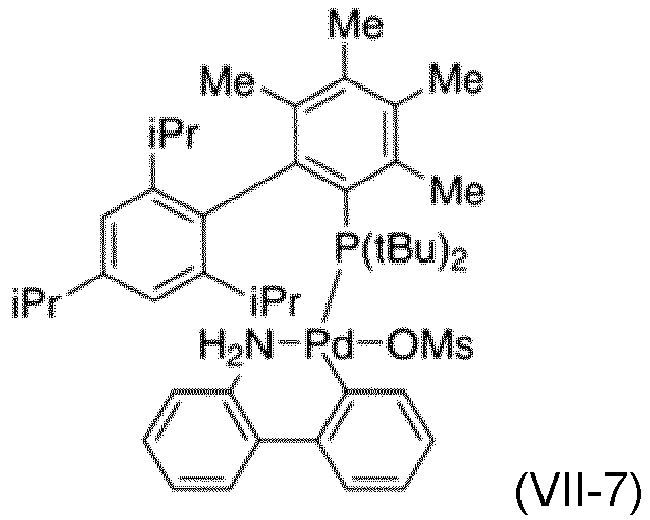
- According to another exemplary embodiment, the phosphine ligand Lg1 in Formula (VII) is a ferrocenyl phosphine.
- Exemplary palladium complexes of Formula (VII) containing a ferrocenyl phosphine ligand are those of Formula (VII-8) or Formula (VII-9):
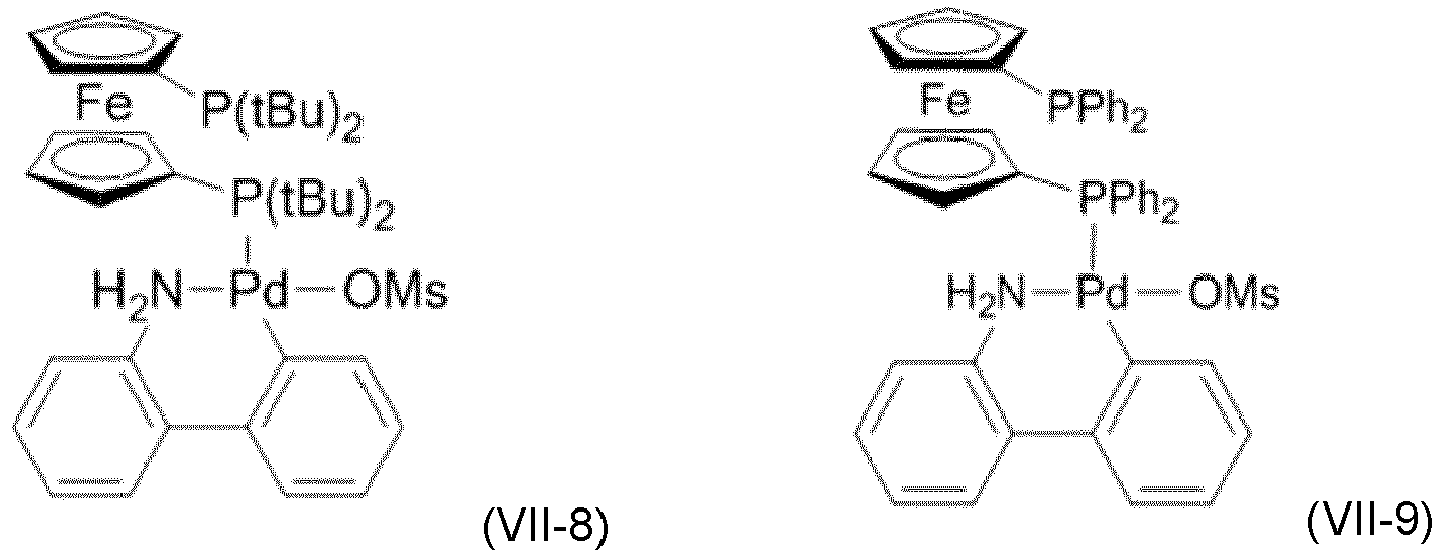
- According to another exemplary embodiment, the phosphine ligand Lg1 in Formula (VII) is a trialkyl phosphine (e.g. P(C1-6 alkyl)3). An exemplary palladium complex of Formula (VII) containing a trialkyl phosphine ligand is the palladium complex of Formula (VII-10):
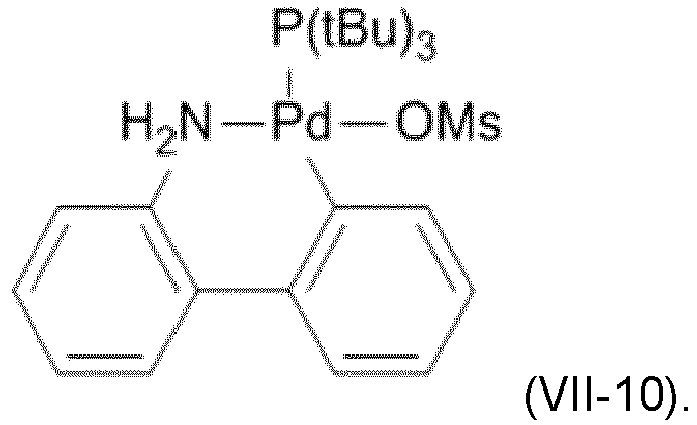
- Other exemplary palladium complexes of Formula (VII) containing a phosphine ligand Lg1 are those of Formula (VII-11), (VII-12), or (VII-13):


- According to an exemplary embodiment of the present invention, the composition comprises (i) a palladium complex of Formula (VII); and (ii) a polycyclic compound of Formula (Ia). Preferably, the non-ionic ligand Lg1 in Formula (VII) is a phosphine (e.g. a phosphine of Formula (VIII), a ferrocenyl phosphine or a phosphine in one of the Formulas (VII-11) to (VII-13)). Preferred embodiments of the polycyclic compound of Formula (Ia) have been described above.
- According to another exemplary embodiment of the present invention, the composition comprises (i) a palladium complex of Formula (VII); and (ii) a polycyclic compound of Formula (Ib). Preferably, the non-ionic ligand Lg1 in Formula (VII) is a phosphine (e.g. a phosphine of Formula (VIII), a ferrocenyl phosphine or a phosphine in one of the Formulas (VII-11) to (VII-13)). Preferred embodiments of the polycyclic compound of Formula (Ib) have been described above.
- According to another exemplary embodiment of the present invention, the composition comprises (i) a palladium complex of Formula (VII); and (ii) a polycyclic compound of Formula (Ic). Preferably, non-ionic ligand Lg1 in Formula (VII) is a phosphine (e.g. a phosphine of Formula (VIII), a ferrocenyl phosphine or a phosphine in one of the Formulas (VII-11) to (VII-13)). Preferred embodiments of the polycyclic compound of Formula (Ic) have been described above.
- According to another exemplary embodiment of the present invention, the composition comprises (i) a palladium complex of Formula (VII); and (ii) a polycyclic compound of Formula (Id). Preferably, the non-ionic ligand Lg1 in Formula (VII) is a phosphine (e.g. a phosphine of Formula (VIII), a ferrocenyl phosphine or a phosphine in one of the Formulas (VII-11) to (VII-13)). Preferred embodiments of the polycyclic compound of Formula (Id) have been described above.
- According to another exemplary embodiment of the present invention, the composition comprises (i) a palladium complex of Formula (VII); and (ii) a polycyclic compound of Formula (II). Preferably, non-ionic ligand Lg1 in Formula (VII) is a phosphine (e.g. a phosphine of Formula (VIII), a ferrocenyl phosphine or a phosphine in one of the Formulas (VII-11) to (VII-13)). Preferred embodiments of the polycyclic compound of Formula (II) have been described above.
- According to another exemplary embodiment of the present invention, the composition comprises (i) a palladium complex of Formula (VII); and (ii) a polycyclic compound of Formula (III). Preferably, non-ionic ligand Lg1 in Formula (VII) is a phosphine (e.g. a phosphine of Formula (VIII), a ferrocenyl phosphine or a phosphine in one of the Formulas (VII-11) to (VII-13)). Preferred embodiments of the polycyclic compound of Formula (III) have been described above.
- The palladium complex being present in the composition of the present invention can be of Formula (IX):
Pd(L)3-4 (IX)
wherein - the ligands L are, independently from each other, a triaryl phosphine (preferably a triphenyl phosphine), wherein each aryl group (which preferably is a phenyl group) is optionally substituted with one or more R1,
- R1, if present, is C1-4haloalkyl (e.g. -CF3), C1-4alkyl (e.g. methyl) or C1-4alkoxy (e.g. methoxy).
- Exemplary palladium complexes of Formula (IX) are those of Formula (IX-1) or (IX-2):

- According to an exemplary embodiment of the present invention, the composition comprises (i) a palladium complex of Formula (IX); and (ii) a polycyclic compound of Formula (Ia). Preferred embodiments of the polycyclic compound of Formula (Ia) have been described above.
- According to another exemplary embodiment of the present invention, the composition comprises (i) a palladium complex of Formula (IX); and (ii) a polycyclic compound of Formula (Ib). Preferred embodiments of the polycyclic compound of Formula (Ib) have been described above.
- According to another exemplary embodiment of the present invention, the composition comprises (i) a palladium complex of Formula (IX); and (ii) a polycyclic compound of Formula (Ic). Preferred embodiments of the polycyclic compound of Formula (Ic) have been described above.
- According to another exemplary embodiment of the present invention, the composition comprises (i) a palladium complex of Formula (IX); and (ii) a polycyclic compound of Formula (Id). Preferred embodiments of the polycyclic compound of Formula (Id) have been described above.
- According to another exemplary embodiment of the present invention, the composition comprises (i) a palladium complex of Formula (IX); and (ii) a polycyclic compound of Formula (II). Preferred embodiments of the polycyclic compound of Formula (II) have been described above.
- According to another exemplary embodiment of the present invention, the composition comprises (i) a palladium complex of Formula (IX); and (ii) a polycyclic compound of Formula (III). Preferred embodiments of the polycyclic compound of Formula (III) have been described above.
- The palladium complex being present in the composition of the present invention can be of Formula (X):

- Lg-Lg is a chelating ferrocenyl diphosphine ligand,
- X is a halide (e.g. CI).
- Exemplary palladium complexes of Formula (X) are those of Formula (X-1) or (X-2):
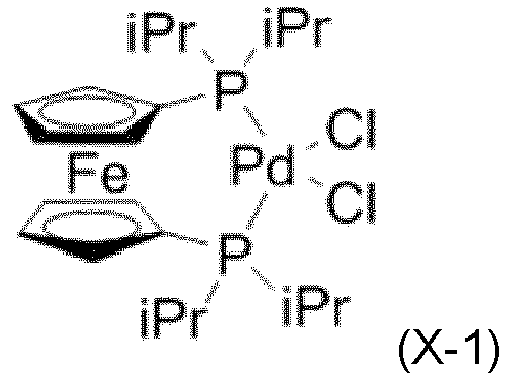

- According to an exemplary embodiment of the present invention, the composition comprises (i) a palladium complex of Formula (X); and (ii) a polycyclic compound of Formula (Ia). Preferred embodiments of the polycyclic compound of Formula (Ia) have been described above.
- According to another exemplary embodiment of the present invention, the composition comprises (i) a palladium complex of Formula (X); and (ii) a polycyclic compound of Formula (Ib). Preferred embodiments of the polycyclic compound of Formula (Ib) have been described above.
- According to another exemplary embodiment of the present invention, the composition comprises (i) a palladium complex of Formula (X); and (ii) a polycyclic compound of Formula (Ic). Preferred embodiments of the polycyclic compound of Formula (Ic) have been described above.
- According to another exemplary embodiment of the present invention, the composition comprises (i) a palladium complex of Formula (X); and (ii) a polycyclic compound of Formula (Id). Preferred embodiments of the polycyclic compound of Formula (Id) have been described above.
- According to another exemplary embodiment of the present invention, the composition comprises (i) a palladium complex of Formula (X); and (ii) a polycyclic compound of Formula (II). Preferred embodiments of the polycyclic compound of Formula (II) have been described above.
- According to another exemplary embodiment of the present invention, the composition comprises (i) a palladium complex of Formula (X); and (ii) a polycyclic compound of Formula (III). Preferred embodiments of the polycyclic compound of Formula (III) have been described above.
- The composition may contain the palladium compound and the polycyclic compound of Formula (I), (II) or (III) in the form of a mixture. Optionally, one or more additional components might be present in the mixture. Alternatively, the mixture may consist of the palladium compound and the polycyclic compound of Formula (I), (II) or (III).
- The molar ratio between the palladium compound and the polycyclic compound of Formula (I), (II) or (III) might be in the range of from 100/1 to 1/100, more preferably 10/1 to 1/10 or even more preferably 2/1 to 1/2.
- Instead of comprising a mixture of the palladium compound and the polycyclic compound of Formula (I), (II) or (III), the composition can be a kit which provides the palladium compound and the polycyclic compound of Formula (I), (II) or (III) in separate containers.
- The present invention also relates to a method of performing a Suzuki cross-coupling reaction, wherein a first reactant is reacted with a second reactant under irradiation of light in the presence of the composition of the present invention, the first reactant comprising an aromatic or N-heteroaromatic ring to which a boronic acid or boronic acid ester group is attached, and the second reactant comprising an aromatic or N-heteroaromatic ring to which a halogen (CI, Br, I), a pseudohalogen (cyano, cyanate, isocyanate), or a sulfonate is attached.
- "Under irradiation of light" refers to light provided by an external light source (e.g. lamps such as an UV lamp or an UV/VIS lamp, one or more LEDs, a laser, etc.).
- The light may have a wavelength in the range of from 254 nm to 800 nm, preferably 360 nm to 550 nm. The light can be a monochromatic light; or may cover a continuous wavelength spectrum (e.g. in the UV and/or visible spectrum). The light reaching the reaction medium may have an irradiance of 10 to 2000 milliwatts per square centimeter. However, lower or higher irradiance values can be used as well.
- The first and second reactants might be reacted in the presence of a base which is preferably selected from carbonate (e.g. an alkali metal carbonate), a hydroxide (e.g. an alkali metal hydroxide), a phosphate (e.g. an alkali metal phosphate), an alkoxide (e.g. an alkali metal alkoholate). Typically, the Suzuki cross-coupling reaction is carried out in a solvent which is preferably selected from water, an aromatic solvent, an ether, a glycol ether, dimethyl formamide, acetonitrile, an alcohol, or a mixture of two or more of these solvents. The reactants might be reacted at a temperature of from 20 °C to 70 °C.
- Furthermore, the present invention relates to the use of the composition described above as a catalyst system for a light-assisted Suzuki carbon-carbon cross-coupling reaction. As known to the skilled person, "light assisted" means that the reaction medium in which the Suzuki carbon-carbon cross-coupling reaction is carried out is irradiated by an external light source (e.g. lamps such as UV or UV/VIS lamps, LEDs, laser, etc.).
- The features disclosed in the claims, the specification, and the drawings maybe essential for different embodiments of the claimed invention, both separately and in any combination with each other.
- In Comparative Example CE1 and Inventive Examples IE1-IE2, the same reactants (4-trifluoromethyl phenyl boronic acid pinacol ester (CAS No. 214360-65-3), i.e. an organoboron compound, and 3-chloropyridine, i.e. a heteroaryl halide) were used. Furthermore, in CE1, IE1 and IE2, the same palladium complex was present in the reaction medium. However, in IE1 and IE2, the reaction medium additionally contained a polycyclic compound and was irradiated by light from an external light source.
- In the glovebox, 65.3 mg of 4-trifluoromethyl phenyl boronic acid pinacol ester (CAS No. 214360-65-3) was added to a vial and dissolved in 1280 µl of acetonitrile, followed by 100 µl of a 0.04 M solution of [1,3-bis(2,6-di-iso-propylphenyl)-4,5-dihydroimidazol-2-ylidene]{2-[(dimethylamino-kN)methyl]phenyl-kC}(pyridine)palladium(II) tetrafluoroborate palladacycle (i.e. a palladium complex) in DMF. The palladium complex is commercially available (e.g. from Strem Chemicals). An amber vial was used to preclude light from coming in. Accordingly, no irradiation of the reaction medium took place. In the glove box, 19 µl of neat degassed 3-chloropyridine (i.e. a heteroaryl halide) was added to the vial, followed by 400 µl of a degassed aqueous 0.85 M solution of K3PO4. Finally, to this vial (vial 1), 100 µl of degassed benzene was added.
- The reactants, the catalyst system and the reaction conditions used in Comparative Example CE1 are shown below in Table 1:
Table 1: Reactants, catalyst system and reaction conditions used in CE1 Reactants Organoboron compound Heteroaryl halide 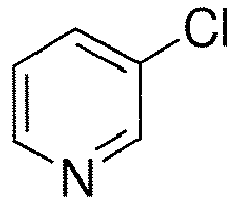
Catalyst system Pd complex 
Polycyclic compound of Formula (I), (II) or (III) No Reaction temperature 40°C Irradiation of reaction medium No - The total volume of this reaction was 2.4 ml (2.0 ml organic, and 400 µl aqueous), with 2 mol% palladium complex.
- The vial was placed in a glycol/ water bath which was set to 40 °C, and illuminated with 445 nm by an array of 96 LEDs, with stirring for 5 hours. However, as already mentioned above, an amber vial was used in Comparative Example CE1, thereby precluding essentially all the light from reaching the reaction medium.
- After 5 hours, the vial was allowed to cool to room temperature before being opened. Then 1 equivalent of trifluorotoluene was added as an internal 19F-NMR standard, and a 20 µl sample was taken for TLC (Thin Layer Chromatography). A further 20 µL was taken for 19F-NMR, to determine conversion of starting material to product.
- By 19F-NMR, 0% product conversion was obtained. No Suzuki cross-coupling product was obtained.
- In the glovebox, 65.3 mg of 4-trifluoromethyl phenyl boronic acid pinacol ester (CAS No. 214360-65-3), i.e. the same organoboron reactant as used in Comparative Example CE1, was added to a clear-glass vial and dissolved in 1280 µl of acetonitrile, followed by 100 µl of a 0.04 M solution of [1,3-Bis(2,6-di-i-propylphenyl)-4,5-dihydroimidazol-2-ylidene]{2-[(dimethylamino-kN)methyl]phenyl-kC}(pyridine)palladium(II) tetrafluoroborate palladacycle (i.e. the same Pd complex as used in Comparative Example CE1) in DMFIn the glove box, 19 µl of neat degassed 3-chloropyridine (i.e. the same heteroaryl halide reactant as used in Comparative Example CE1) was added to each clear-glass vial, followed by 400 µl of a degassed aqueous 0.85 M solution of K3PO4. Finally, to this clear-glass vial, 100 µl of a solution (0.02 M) of the polycyclic compound of Formula (I-2) in degassed benzene was added.
- The reactants, the catalyst system and the reaction conditions used in Inventive Example IE1 are shown below in Table 2:
Table 2: Reactants, catalyst system and reaction conditions used in IE1 Reactants Organoboron compound Heteroaryl halide 
Catalyst system Pd complex 
Polycyclic compound of Formula (I), (II) or (III) 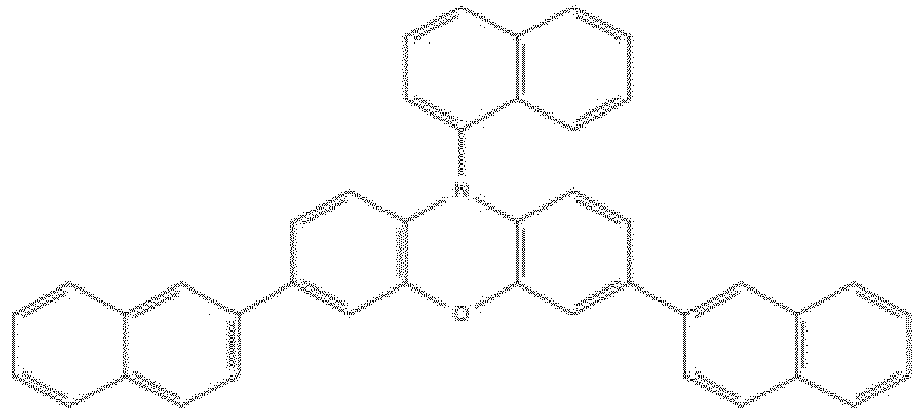
Reaction temperature 40°C Irradiation of reaction medium Yes (at 445 nm by an array of LEDs) - The total volume of this reaction was 2.4 ml (2.0 ml organic, and 400 µl aqueous), with 2 mol% palladium complex, and 1 mol% polycyclic compound.
- The clear-glass vial was placed in a glycol/ water bath which was set to 40 °C, and illuminated with 445 nm by an array of 96 LEDs, with stirring for 5 hours. After 5 hours, the clear-glass vial was allowed to cool to room temperature before being opened. Then 1 equivalent of trifluorotoluene was added as an internal 19F-NMR standard, and a 20 µl sample was taken for TLC. A further 20 µl was taken from the vial for 19F-NMR, to determine conversion of starting material to product.
- By 19F-NMR, 60% Suzuki coupling product conversion was observed.
- In the glovebox, 65.3 mg of the 4-trifluoromethyl phenyl boronic acid pinacol ester (CAS No. 214360-65-3), i.e. the same organoboron reactant as used in Comparative Example CE1, was added to a clear-glass vial and dissolved in 1280 µl of acetonitrile, followed by 100 µl of a 0.04 M solution of the [1,3-Bis(2,6-di-i-propylphenyl)-4,5-dihydroimidazol-2-ylidene]{2-[(dimethylamino-kN)methyl]phenyl-kC}(pyridine)palladium(II) tetrafluoroborate palladacycle (i.e. the same Pd complex as used in Comparative Example CE1) in DMF. In the glove box, 19 µl of neat degassed 3-chloropyridine (i.e. the same heteroaryl halide reactant as used in Comparative Example CE1) was added to each vial, followed by 400 µl of a degassed aqueous 0.85 M solution of K3PO4. Finally, to this vial, 100 µl of a solution (0.02 M) of polycyclic compound of Formula (I-3) in degassed benzene was added.
- The reactants, the catalyst system and the reaction conditions used in Inventive Example IE2 are shown below in Table 3:
Table 3: Reactants and catalyst system used in IE2 Reactants Organoboron compound Heteroaryl halide 
Catalyst system Pd complex 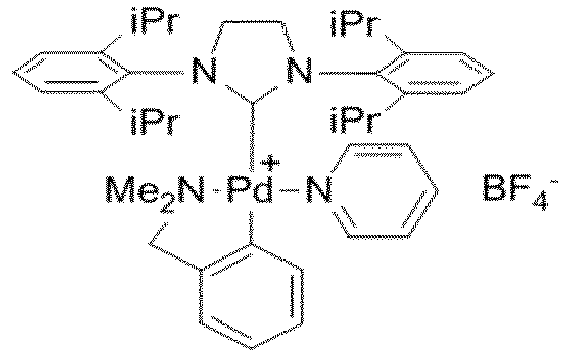
Polycyclic compound of Formula (I), (II) or (III) 
Reaction temperature 40°C Irradiation of reaction medium Yes (at 445 nm by an array of LEDs) - The total volume of this reaction was 2.4 ml (2.0 ml organic, and 400 µl aqueous), with 2 mol% palladium complex, and 1 mol% polycyclic compound.
- The vial was placed in a glycol/ water bath which was set to 40 °C, and illuminated with 445 nm by an array of 96 LEDs, with stirring for 5 hours. After 5 hours, the vial was allowed to cool to room temperature before being opened. Then 1 equivalent of trifluorotoluene was added as an internal 19F-NMR standard, and a 20 µl sample was taken for TLC. A further 20 µl was taken for 19F-NMR, to determine conversion of starting material to product.
- By 19F-NMR, 67% Suzuki coupling product conversion was observed.
- Suzuki cross-coupling product yields (determined by 19F NMR) in Comparative Example CE1 and Inventive Examples E1-E2 are summarized below in Table 4.
Table 4: Yield of Suzuki cross-coupling reaction product in CE1, IE1 and IE2 Reaction temperature [°C] Yield of Suzuki cross-coupling reaction product [%], determined by 19F NMR CE1 40 0 IE1 40 60 IE2 40 67 - As demonstrated by the examples, an efficient light-assisted Suzuki cross-coupling reaction between an organoboron compound and a (hetero-)aryl halide is accomplished even at low reaction temperature if a combination of a palladium compound and a polycyclic compound of Formula (I), (II) or (III) is used as a catalyst system.
- As described above, the present invention relates to the following embodiments {01} to {51}:
- Embodiment {01} relates to a composition, comprising
- (i) a palladium compound which is selected from a palladium salt or a palladium complex or a mixture thereof,
- (ii) a polycyclic compound of Formula (I), (II) or (III):
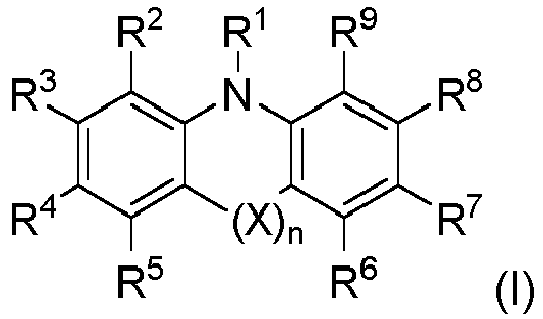
- n is 0 or 1,
- X is O, C(R10)(R11), or N(R12),
- R1 to R12 are selected independently from each other from hydrogen, an aryl group and a C1-10alkyl group, the aryl group and/or the C1-10alkyl group optionally being substituted with one or more substituents R13,
- wherein the one or more substituents R13, if present, are selected independently from each other from C1-6alkyl, C1-6haloalkyl, -OH, -O-(C1-6alkyl), -NO2, -CN, a halogen atom, -NH2, -NH(C1-6alkyl), -N(C1-6alkyl)2, -C(=O)OH, -C(=O)O-(C1-6alkyl), -C(=O)O-phenyl, -C(=O)(C1-6alkyl), -C(=O)-phenyl, -S(O)2NH2, -S(O)2NH(C1-6alkyl), -S(O)2N(C1-6alkyl)(C1-6alkyl), -S-(C1-6alkyl), -S(O)(C1-6alkyl), -S(O)2(C1-6alkyl), -S-(phenyl), -S(O)(phenyl), -S(O)2(phenyl), and a N-carbazolyl of Formula (1.1)


- R1 is selected from a C1-16alkyl group and an aryl group, the C1-16alkyl group and/or the aryl group optionally being substituted with one or more substituents R12, and/or the C1-16alkyl group optionally being interrupted by one or more oxygen atoms;
- R2 to R11 are selected independently from each other from hydrogen, a C1-16alkyl group, an aryl group, a heteroaryl group; the C1-16alkyl group, the aryl group and/or the heteroaryl group optionally being substituted with one or more substituents R12, and/or the C1-16alkyl group optionally being interrupted by one or more oxygen atoms; or
- at least two of the residues R2 to R11 which are adjacent to each other form together with the carbon atoms to which they are attached a five- or six-membered aromatic ring while the remaining residues (i.e. those of the residues R2 to R11 which do not form a ring) are selected independently from each other from hydrogen, a C1-16alkyl group, an aryl group and a heteroaryl group; the C1-16alkyl group, the aryl group and/or the heteroaryl group optionally being substituted with one or more substituents R12, and/or the C1-16alkyl group optionally being interrupted by one or more oxygen atoms;
- wherein the one or more substituents R12, if present, are selected independently from each other from C1-6alkyl, C1-6haloalkyl, -OH, -O-(C1-6alkyl), -NO2, -CN, a halogen atom, -NH2, -NH(C1-6alkyl), -N(C1-6alkyl)2, -C(=O)OH, -C(=O)O-(C1-6alkyl), -C(=O)O-phenyl, -C(=O)(C1-6alkyl), -C(=O)-phenyl, - S(O)2NH2, -S(O)2NH(C1-6alkyl), -S(O)2N(C1-6alkyl)(C1-6alkyl), -S-(C1-6alkyl), -S(O)(C1-6alkyl), -S(O)2(C1-6alkyl), -S-(phenyl), -S(O)(phenyl), and -S(O)2(phenyl),

- R1 is selected from a C1-16alkyl group and an aryl group, the C1-16alkyl group and/or the aryl group optionally being substituted with one or more substituents R11, and/or the C1-16alkyl group optionally being interrupted by one or more oxygen atoms;
- R2 to R9 are selected independently from each other from hydrogen, a C1-16alkyl group and an aryl group, the C1-16alkyl group and/or the aryl group optionally being substituted with one or more substituents R11, and/or the C1-16alkyl group optionally being interrupted by one or more oxygen atoms;
- R10 is an aryl group which is optionally substituted with one or more substituents R12, wherein the one or more substituents R11, if present, are selected independently from each other from C1-6alkyl, C1-6haloalkyl, -OH, -O-(C1-6alkyl), -NO2, -CN, a halogen atom, -NH2, -NH(C1-6alkyl), -N(C1-6alkyl)2, -C(=O)OH, -C(=O)O-(C1-6alkyl), -C(=O)O-phenyl, -C(=O)(C1-6alkyl), -C(=O)-phenyl, - S(O)2NH2, -S(O)2NH(C1-6alkyl), -S(O)2N(C1-6alkyl)(C1-6alkyl), -S-(C1-6alkyl), -S(O)(C1-6alkyl), -S(O)2(C1-6alkyl), -S-(phenyl), -S(O)(phenyl), and -S(O)2(phenyl),
- wherein the one or more substituents R12, if present, are selected independently from each other from a C1-6alkyl group and an aryl group (e.g. a phenyl group), wherein the aryl group is optionally substituted with one or more C1-6alkyl groups.
- Embodiment {02} relates to the composition according to Embodiment {01}, wherein R1 in Formula (I) is selected from a phenyl group, a naphthyl group and a biphenyl group, each of which is optionally substituted with one or more substituents R13, wherein R13 has the same meaning as in embodiment {01}.
- Embodiment {03} relates to the composition according to Embodiment {01} or {02}, wherein in Formula (I)
- n is 1,
- X is O,
- R1 is a naphthyl group (preferably a 1-naphthyl group) which is optionally substituted with one or more substituents R13,
- R2, R3, R5, R6, R8 and R9 are selected independently from each other from hydrogen and a C1-6alkyl group,
- R4 and R7 are selected independently from each other from a phenyl group, a biphenyl group and a naphthyl group, each of which is optionally substituted with one or more substituents R13, wherein, if present, the one or more substituents R13 are selected independently from each other from C1-6alkyl, C1-6haloalkyl, -OH, -O-(C1-6alkyl), -NO2, -CN, a halogen atom, -NH2, -NH(C1-6alkyl), -N(C1-6alkyl)2, -C(=O)OH, -C(=O)O-(C1-6alkyl), -C(=O)O-phenyl, -C(=O)(C1-6alkyl), -C(=O)-phenyl, -S(O)2NH2, -S(O)2NH(C1-6alkyl), -S(O)2N(C1-6alkyl)(C1-6alkyl), -S-(C1-6alkyl), -S(O)(C1-6alkyl), -S(O)2(C1-6alkyl), -S-(phenyl), -S(O)(phenyl), and -S(O)2(phenyl).
- Embodiment {04} relates to the composition according to embodiment {03}, wherein the polycyclic compound is a compound of Formula (I-1), (I-2), (I-3) or (I-4):


- Embodiment {05} relates to the composition according to embodiment {01} or {02}, wherein in Formula (I)
- n is 1,
- X is C(R10)(R11), wherein R10 and R11 are selected independently from each other from hydrogen and a C1-6alkyl group,
- R1 is selected from a naphthyl group (preferably a 1-naphthyl or 2-naphthyl group), a phenyl group and a biphenyl group, each of which is optionally substituted with one or more substituents R13,
- R2, R3, R5, R6, R8 and R9 are selected independently from each other from hydrogen and a C1-6alkyl group,
- R4 and R7 are selected independently from each other from a phenyl group, a naphthyl group and a biphenyl group, each of which is optionally substituted with one or more substituents R13, wherein, if present, the one or more substituents R13 are selected independently from each other from C1-6alkyl, C1-6haloalkyl, -OH, -O-(C1-6alkyl), -NO2, -CN, a halogen atom, -NH2, -NH(C1-6alkyl), -N(C1-6alkyl)2, -C(=O)OH, -C(=O)O-(C1-6alkyl), -C(=O)O-phenyl, -C(=O)(C1-6alkyl), -C(=O)-phenyl, -S(O)2NH2, -S(O)2NH(C1-6alkyl), -S(O)2N(C1-6alkyl)(C1-6alkyl), -S-(C1-6alkyl), -S(O)(C1-6alkyl), -S(O)2(C1-6alkyl), -S-(phenyl), -S(O)(phenyl) and -S(O)2(phenyl).
- Embodiment {06} relates to the composition according to embodiment {05}, wherein the polycyclic compound is a compound of one of the Formulas (I-5.1) to (I-5.7):


- Embodiment {07} relates to the composition according to embodiments {01} or {02}, wherein in Formula (I)
- n is 1,
- X is N(R12),
- R1 and R12 are selected independently from each other from a phenyl group, a naphthyl group (such as a 2-naphthyl group or a 1 naphthyl group) and a biphenyl group, each of which is optionally substituted with one or more substituents R13,
- R2 to R9 are selected independently from each other from hydrogen and a C1-6alkyl group, or at least two, preferably all of the residues R3, R4, R7, and R8 are a phenyl group which is optionally substituted with one or more substituents R13 and the residues R2, R5, R6 and R9 are selected independently from each other from hydrogen and a C1-6alkyl group,
- wherein, if present, the one or more substituents R13 are selected independently from each other from C1-6alkyl, C1-6haloalkyl, -OH, -O-(C1-6alkyl), -NO2, -CN, a halogen atom, -NH2, -NH(C1-6alkyl), -N(C1-6alkyl)2, -C(=O)OH, -C(=O)O-(C1-6alkyl), -C(=O)O-phenyl, -C(=O)(C1-6alkyl), -C(=O)-phenyl, -S(O)2NH2, -S(O)2NH(C1-6alkyl), -S(O)2N(C1-6alkyl)(C1-6alkyl), -S-(C1-6alkyl), -S(O)(C1-6alkyl), -S(O)2(C1-6alkyl), -S-(phenyl), -S(O)(phenyl), and -S(O)2(phenyl).
- Embodiment {08} relates to the composition according to embodiment {07}, wherein the polycyclic compound is a compound of Formula (I-6) or (I-7):


- Embodiment {09} relates to the composition according to embodiment {01} or {02}, wherein in Formula (I)
- n is 0,
- R1 is selected from a naphthyl (e.g. 1-naphthyl or 2-naphthyl) group, a phenyl group and a biphenyl group, each of which is optionally substituted with one or more R13,
- R2 to R9 are selected independently from each other from hydrogen, a C1-6alkyl group, a phenyl group, biphenyl group and a naphthyl group, the phenyl group, the biphenyl group and/or the naphthyl group optionally being substituted with one or more substituents R13,
- wherein, if present, the one or more substituents R13, are selected independently from each other from C1-6alkyl, C1-6haloalkyl, -OH, -O-(C1-6alkyl), -NO2, -CN, a halogen atom, -NH2, -NH(C1-6alkyl), -N(C1-6alkyl)2, -C(=O)OH, -C(=O)O-(C1-6alkyl), -C(=O)O-phenyl, -C(=O)(C1-6alkyl), -C(=O)-phenyl, -S(O)2NH2, -S(O)2NH(C1-6alkyl), -S(O)2N(C1-6alkyl)(C1-6alkyl), -S-(C1-6alkyl), -S(O)(C1-6alkyl), -S(O)2(C1-6alkyl), -S-(phenyl), -S(O)(phenyl), -S(O)2(phenyl), and a N-carbazolyl of Formula (1.1)
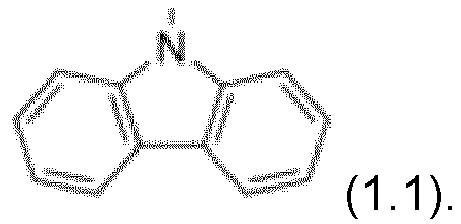
- Embodiment {10} relates to the composition according to embodiment {09}, wherein the polycyclic compound is a compound of Formula (I-8):
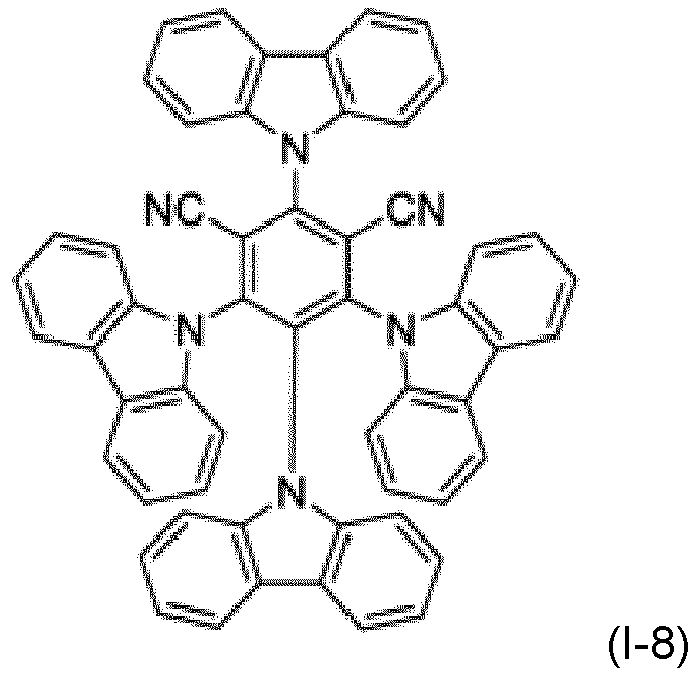
- Embodiment {11} relates to the composition according to embodiment {01} or {02}, wherein in Formula (II)
- R1 is a C1-12alkyl group which is optionally substituted with one or more substituents being selected from -OH, a halogen atom (e.g. F, CI), -NH2, -NH(C1-6alkyl) and -N(C1-6alkyl)2,
- R4, R7, and R9 are selected independently from each other from hydrogen, an aryl group (e.g. phenyl), a heteroaryl group, C1-6alkyl and -O-(C1-6alkyl), the aryl group and/or the heteroaryl group optionally being substituted with one or more substituents which are selected independently from each other from C1-6alkyl, C1-6haloalkyl (e.g. C1-6fluoroalkyl) and -O-(C1-6alkyl),
- R2, R3, R5, R6, R8, R10, and R11 are selected independently from each other from hydrogen and a C1-6alkyl group.
- Embodiment {12} relates to the composition according to embodiment {11}, wherein the polycyclic compound is a compound of Formula (11-1), (II-2) or (II-3):


- Embodiment {13} relates to the composition according to embodiment {01} or {02}, wherein in Formula (III)
- R1 is a C1-6alkyl group,
- R10 is a phenyl group which is optionally substituted with one or more substituents being selected independently from each other from C1-6alkyl, C1-6haloalkyl (e.g. C1-6fluoroalkyl) and -O-(C1-6alkyl),
- R2 to R9 are selected independently from each other from hydrogen and a C1-6alkyl group.
- Embodiment {14} relates to the composition according to embodiment {13}, wherein the polycyclic compound is a compound of Formula (III-1):

- Embodiment {15} relates to the composition according to one of the embodiments {01} to {14}, wherein the palladium salt is a palladium acetate, a palladium acetylacetonate or a palladium halide (such as palladium chloride (PdCl2), palladium bromide (PdBr2), or palladium iodide (Pdl2)), or any mixture thereof.
- Embodiment {16} relates to the composition according to one of the embodiments {01} to {14}, wherein the palladium complex comprises one or more ligands which are selected from a phosphine, an N-heterocyclic carbene, an amine, or any combination thereof.
- Embodiment {17} relates to the composition according to embodiment {16}, wherein the palladium complex is of Formula (IV)

- L1 is a bivalent linker,
- R1 and R2 are selected independently from each other from hydrogen and a C1-4alkyl group, or
- R1 and R2 together with the nitrogen atom to which they are attached form a five- or six-membered ring (which might be an aromatic or non-aromatic ring),
- R3, R4, R5, and R6 are selected independently from each other from hydrogen and C1-4alkyl; or at least two of the residues R3 to R6 which are adjacent to each other form together with the carbon atoms to which they are attached a five- or six-membered aromatic ring and the remaining residues (i.e. those of the residues R3 to R6 which do not form a ring) are selected independently from each other from hydrogen and C1-4alkyl;
- Lg1 and Lg2 are, independently from each other, a non-ionic ligand.
- Embodiment {18} relates to the composition according to embodiment {17}, wherein
- L1 is a C1-3 alkylene group (e.g. -CH2-; -CH2-CH2-; -CH2-CH2-CH2-),
- Lg1 is a pyridine, a pyrrole, an imidazole, a pyrazole or a pyrimidine, each of which is optionally substituted with one or more halogens,
- Lg2 is an N-heterocyclic carbene.
- Embodiment {19} relates to the composition according to embodiment {18}, wherein the N-heterocyclic carbene is of Formula (V) or Formula (VI):

- R3 to R16 are selected independently from each other from hydrogen and C1-4alkyl; or at least two of the residues R3 to R16 which are adjacent to each other form together with the carbon atoms to which they are attached a 5- or 6-membered ring while the remaining residues (i.e. those of the residues R3 to R16 not forming a ring) are selected independently from each other from hydrogen and C1-4alkyl;

- R3 to R14 are selected independently from each other from hydrogen and C1-4 alkyl; or at least two of the residues R3 to R14 which are adjacent to each other form together with the carbon atoms to which they are attached a 5- or 6-membered ring while the remaining residues (i.e. those of the residues R3 to R14 not forming a ring) are selected independently from each other from hydrogen and C1-4alkyl.
- R3 to R16 are selected independently from each other from hydrogen and C1-4alkyl; or at least two of the residues R3 to R16 which are adjacent to each other form together with the carbon atoms to which they are attached a 5- or 6-membered ring while the remaining residues (i.e. those of the residues R3 to R16 not forming a ring) are selected independently from each other from hydrogen and C1-4alkyl;
- Embodiment {20} relates to the composition according to one of the embodiments {17} to {19}, wherein the palladium complex is of Formula (IV-1):

- Embodiment {21} relates to the composition according to embodiment {16}, wherein the palladium complex is of Formula (VII)

- L1 is a bivalent linker,
- R1 and R2 are selected independently from each other from hydrogen and a C1-4 alkyl group, or
- R1 and R2 together with the nitrogen atom to which they are attached form a five- or six-membered ring,
- R3, R4, R5, and R6 are selected independently from each other from hydrogen and C1-4 alkyl, or at least two of the residues R3 to R6 which are adjacent to each other form together with the carbon atoms to which they are attached a five- or six-membered aromatic ring and the remaining residues (i.e. those of the residues R3 to R6 which do not form a ring) are selected independently from each other from hydrogen and C1-4alkyl,
- Lg1 is a non-ionic ligand,
- Lg2 is an anionic ligand.
- Embodiment {22} relates to the composition according to embodiment {21}, wherein
- L1 is a phenylene (in particular a 1,2-phenylene) group or a C1-3 alkylene group (e.g. -CH2-; - CH2-CH2-; - CH2-CH2-CH2-);
- the non-ionic ligand Lg1 is a phosphine,
- the anionic ligand Lg2 is an alkyl sulfonate (e.g. mesylate) or an aryl sulfonate (e.g. tosylate).
- Embodiment {23} relates to the composition according to embodiment {22}, wherein the phosphine is of Formula (VIII):
P(R1)(R2)(R3) (VIII)
wherein- R1 and R2 are selected independently from each other from C1-6 alkyl, cycloalkyl, and phenyl which is optionally substituted with one or more C1-4 alkyl groups,
- R3 is biphenyl or binaphthyl, each of which is optionally substituted with one or more R4,
- R4, if present, is C1-6 alkyl, -NH2, -N(H)(C1-6 alkyl), -N(C1-6 alkyl)2, -P(Phenyl)2, or O-C1-6alkyl.
- Embodiment {24} relates to the composition according to embodiment {23}, wherein the palladium complex is selected from Formulas (VII-1) to (VII-7):


- Embodiment {25} relates to the composition according to embodiment {22}, wherein the phosphine is a ferrocenyl phosphine.
- Embodiment {26} relates to the composition according to embodiment {25}, wherein the palladium complex is of Formula (VII-8) or Formula (VII-9):

- Embodiment {27} relates to the composition according to embodiment {22}, wherein the phosphine is a trialkyl phosphine (e.g. P(C1-6 alkyl)3).
- Embodiment {28} relates to the composition according to embodiment {27}, wherein the palladium complex is of Formula (VII-10):
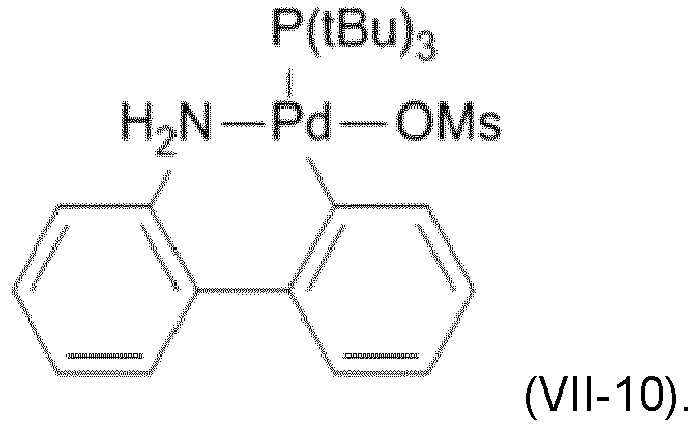
- Embodiment {29} relates to the composition according to embodiment {22}, wherein the palladium complex is of Formula (VII-11), (VII-12), or (VII-13):


- Embodiment {30} relates to the composition according to embodiment {16}, wherein the palladium complex is of Formula (IX):
Pd(L)3-4 (IX)
wherein- the ligands L, independently from each other, are a triaryl phosphine; preferably a triphenyl phosphine, wherein each aryl group is optionally substituted with one or more R1,
- R1, if present, is C1-4 haloalkyl (e.g. -CF3), C1-4 alkyl (e.g. methyl), C1-4 alkoxy (e.g. methoxy).
- Embodiment {31} relates to the composition according to embodiment {30}, wherein the palladium complex is of Formula (IX-1) or (IX-2):

- Embodiment {32} relates to the composition according to embodiment {16}, wherein the palladium complex is of Formula (X):

- Lg-Lg is a chelating ferrocenyl diphosphine ligand,
- X is a halide (e.g. CI).
- Embodiment {33} relates to the composition according to embodiment {32}, wherein the palladium complex is of Formula (X-1) or (X-2):


- Embodiment {34} relates to the composition according to one of the embodiments {01} to {15}, further comprising, in addition to the palladium salt, a phosphine or a bipyridine (in particular a 2,2'-bipyridine).
- Embodiment {35} relates to the composition according to embodiment {34}, wherein the phosphine is a tri-C1-6alkyl phosphine, tri-C5-7cycloalkyl phosphine, a triarylphosphine (in particular a triphenyl phosphine) wherein each of the aryl groups (which are preferably phenyl groups) is optionally substituted with one or more C1-4 haloalkyl (e.g. -CF3), C1-4 alkyl (e.g. methyl) or C1-4 alkoxy (e.g. methoxy).
- Embodiment {36} relates to the composition according to embodiment {35}, wherein the phosphine is of Formula (XII-1), (XII-2), or (XII-3):

- Embodiment {37} relates to the composition according to embodiment {34}, wherein the phosphine is of Formula (XIII):
P(R1)(R2)(R3) (XIII)
wherein- R1 and R2 are selected independently from each other from C1-6 alkyl and C5-7-cycloalkyl (e.g. cyclohexyl),
- R3 is biphenyl which is optionally substituted with one or more R4,
- R4, if present, is C1-6 alkyl, C1-6 alkoxy, phenyl, or pyridyl.
- Embodiment {38} relates to the composition according to embodiment {37}, wherein the phosphine is of one of the Formulas (XIII-1) to (XIII-4):


- Embodiment {39} relates to the composition according to embodiment {34}, wherein the phosphine is a ferrocenyl diphosphine or a xanthenyl diphosphine.
- Embodiment {40} relates to the composition according to embodiment {39}, wherein the phosphine is of one of the Formulas (XIV-1), (XIV-2) and (XV-1):


- Embodiment {41} relates to the composition according to one of the embodiments {01} to {40}, wherein the composition comprises or is a mixture of the palladium compound and the polycyclic compound.
- Embodiment {42} relates to the composition according to one of the preceding embodiments {01} to {41}, wherein the molar ratio between the palladium compound and the polycyclic compound is in the range of from 100/1 to 1/100, more preferably 10/1 to 1/10 or even more preferably 2/1 to 1/2
- Embodiment {43} relates to the composition according to one of the embodiments {01} to {40}, wherein the composition is a kit which provides the palladium compound and the polycyclic compound in separate containers.
- Embodiment {44} relates to a method of performing a Suzuki cross-coupling reaction, wherein a first reactant is reacted with a second reactant under irradiation of light in the presence of the composition according to one of the embodiments {01} to {42}, the first reactant comprising an aromatic or N-heteroaromatic ring to which a boronic acid or boronic acid ester group is attached, and the second reactant comprising an aromatic or N-heteroaromatic ring to which a halogen (CI, Br, I), a pseudohalogen (cyano, cyanate, isocyanate), or a sulfonate is attached.
- Embodiment {45} relates to the method according to embodiment {44}, wherein the light has a wavelength in the range of from 254 nm to 800 nm.
- Embodiment {46} relates to the method according to embodiment {44} or {45}, wherein the light is a monochromatic light; or the light covers a continuous wavelength spectrum (e.g. in the UV and/or visible spectrum).
- Embodiment {47} relates to the method according to one of the embodiments {44} to {46}, wherein the light reaching the reaction medium has an irradiance of 10 to 2000 milliwatts per square centimeter.
- Embodiment {48} relates to the method according to one of the embodiments {44} to {47}, wherein the first and second reactants are reacted in the presence of a base which is preferably selected from carbonate (e.g. an alkali metal carbonate), a hydroxide (e.g. an alkali metal hydroxide), a phosphate (e.g. an alkali metal phosphate), an alkoxide (e.g. an alkali metal alkoholate).
- Embodiment {49} relates to the method according to one of the embodiments {44} to {48}, wherein the reaction medium in which the reaction is carried out comprises a solvent which is preferably selected from water, an aromatic solvent, an ether, a glycol ether, dimethyl formamide, acetonitrile, an alcohol, or a mixture of two or more of these solvents.
- Embodiment {50} relates to the method according to one of the embodiments {44} to {49}, wherein the reactants are reacted at a temperature of from 20 °C to 70 °C.
- Embodiment {51} relates to the use of the composition according to one of the embodiments {01} to {43} as a catalyst system for a light-assisted Suzuki carbon-carbon cross-coupling reaction.
Claims (19)
- A composition, comprising(i) a palladium compound which is selected from a palladium salt, a palladium complex or a mixture thereof,(ii) a polycyclic compound of Formula (I), (II) or (III):
 n is 0 or 1,X is O, C(R10)(R11), or N(R12),R1 to R12 are selected independently from each other from hydrogen, an aryl group and a C1-10alkyl group, the aryl group and/or the C1-10alkyl group optionally being substituted with one or more substituents R13,wherein the one or more substituents R13, if present, are selected independently from each other from C1-6alkyl, C1-6haloalkyl, -OH, -O-(C1-6alkyl), -NO2, -CN, a halogen atom, -NH2, -NH(C1-6alkyl), -N(C1-6alkyl)2, -C(=O)OH, -C(=O)O-(C1-6alkyl), -C(=O)O-phenyl, -C(=O)(C1-6alkyl), -C(=O)-phenyl, -S(O)2NH2, -S(O)2NH(C1-6alkyl), -S(O)2N(C1-6alkyl)(C1-6alkyl), -S-(C1-6alkyl), -S(O)(C1-6alkyl), -S(O)2(C1-6alkyl), -S-(phenyl), -S(O)(phenyl), -S(O)2(phenyl), and a N-carbazolyl of Formula (1.1)
 R1 is selected from a C1-16alkyl group and an aryl group, the C1-16alkyl group and/or the aryl group optionally being substituted with one or more substituents R12, and/or the C1-16alkyl group optionally being interrupted by one or more oxygen atoms;R2 to R11 are selected independently from each other from hydrogen, a C1-16alkyl group, an aryl group, a heteroaryl group; the C1-16alkyl group, the aryl group and/or the heteroaryl group optionally being substituted with one or more substituents R12, and/or the C1-16alkyl group optionally being interrupted by one or more oxygen atoms; orat least two of the residues R2 to R11 which are adjacent to each other form together with the carbon atoms to which they are attached a five- or six-membered aromatic ring while those of the residues R2 to R11 which do not form a ring are selected independently from each other from hydrogen, a C1-16alkyl group, an aryl group and a heteroaryl group; the C1-16alkyl group, the aryl group and/or the heteroaryl group optionally being substituted with one or more substituents R12, and/or the C1-16alkyl group optionally being interrupted by one or more oxygen atoms;wherein the one or more substituents R12, if present, are selected independently from each other from C1-6alkyl, C1-6haloalkyl, -OH, -O-(C1-6alkyl), -NO2, -CN, a halogen atom, -NH2, -NH(C1-6alkyl), -N(C1-6alkyl)2, -C(=O)OH, -C(=O)O-(C1-6alkyl), -C(=O)O-phenyl, -C(=O)(C1-6alkyl), -C(=O)-phenyl, - S(O)2NH2, -S(O)2NH(C1-6alkyl),
 R1 is selected from a C1-16alkyl group and an aryl group, the C1-16alkyl group and/or the aryl group optionally being substituted with one or more substituents R11, and/or the C1-16alkyl group optionally being interrupted by one or more oxygen atoms;R2 to R9 are selected independently from each other from hydrogen, a C1-16alkyl group and an aryl group, the C1-16alkyl group and/or the aryl group optionally being substituted with one or more substituents R11, and/or the C1-16alkyl group optionally being interrupted by one or more oxygen atoms;R10 is an aryl group which is optionally substituted with one or more substituents R12, wherein the one or more substituents R11, if present, are selected independently from each other from C1-6alkyl, C1-6haloalkyl, -OH, -O-(C1-6alkyl), -NO2, -CN, a halogen atom, -NH2, -NH(C1-6alkyl), -N(C1-6alkyl)2, -C(=O)OH, -C(=O)O-(C1-6alkyl), -C(=O)O-phenyl, -C(=O)(C1-6alkyl), -C(=O)-phenyl, - S(O)2NH2, -S(O)2NH(C1-6alkyl), -S(O)2N(C1-6alkyl)(C1-6alkyl), -S-(C1-6alkyl), -S(O)(C1-6alkyl), -S(O)2(C1-6alkyl), -S-(phenyl), -S(O)(phenyl), and -S(O)2(phenyl),wherein the one or more substituents R12, if present, are selected independently from each other from a C1-6alkyl group and an aryl group, wherein the aryl group is optionally substituted with one or more C1-6alkyl groups.
 - The composition according to claim 1, wherein R1 in Formula (I) is selected from a phenyl group, a naphthyl group and a biphenyl group, each of which is optionally substituted with one or more substituents R13, wherein R13 has the same meaning as in claim 1.
- The composition according to claim 1 or 2, wherein in Formula (I)n is 1,X is O,R1 is a naphthyl group which is optionally substituted with one or more substituents R13, R2, R3, R5, R6, R8 and R9 are selected independently from each other from hydrogen and a C1-6alkyl group,R4 and R7 are selected independently from each other from a phenyl group, a biphenyl group and a naphthyl group, each of which is optionally substituted with one or more substituents R13,wherein, if present, the one or more substituents R13 are selected independently from each other from C1-6alkyl, C1-6haloalkyl, -OH, -O-(C1-6alkyl), -NO2, -CN, a halogen atom, -NH2, -NH(C1-6alkyl), -N(C1-6alkyl)2, -C(=O)OH, -C(=O)O-(C1-6alkyl), -C(=O)O-phenyl, -C(=O)(C1-6alkyl),-C(=O)-phenyl, -S(O)2NH2, -S(O)2NH(C1-6alkyl), -S(O)2N(C1-6alkyl)(C1-6alkyl), -S-(C1-6alkyl), -S(O)(C1-6alkyl), -S(O)2(C1-6alkyl), -S-(phenyl), -S(O)(phenyl), and -S(O)2(phenyl).
- The composition according to claim 1 or 2, wherein in Formula (I)n is 1,X is C(R10)(R11), wherein R10 and R11 are selected independently from each other from hydrogen and a C1-6alkyl group,R1 is selected from a naphthyl group, a phenyl group and a biphenyl group, each of which is optionally substituted with one or more substituents R13,R2, R3, R5, R6, R8 and R9 are selected independently from each other from hydrogen and a C1-6alkyl group,R4 and R7 are selected independently from each other from a phenyl group, a naphthyl group and a biphenyl group, each of which is optionally substituted with one or more substituents R13,wherein, if present, the one or more substituents R13 are selected independently from each other from C1-6alkyl, C1-6haloalkyl, -OH, -O-(C1-6alkyl), -NO2, -CN, a halogen atom, -NH2, -NH(C1-6alkyl), -N(C1-6alkyl)2, -C(=O)OH, -C(=O)O-(C1-6alkyl), -C(=O)O-phenyl, -C(=O)(C1-6alkyl), -C(=O)-phenyl, -S(O)2NH2, -S(O)2NH(C1-6alkyl), -S(O)2N(C1-6alkyl)(C1-6alkyl), -S-(C1-6alkyl), -S(O)(C1-6alkyl), -S(O)2(C1-6alkyl), -S-(phenyl), -S(O)(phenyl) and -S(O)2(phenyl).
- The composition according to claim 1 or 2, wherein in Formula (I)n is 1,X is N(R12),wherein
R1 and R12 are selected independently from each other from a phenyl group, a naphthyl group and a biphenyl group, each of which is optionally substituted with one or more substituents R13,R2 to R9 are selected independently from each other from hydrogen and a C1-6alkyl group, or at least two of the residues R3, R4, R7, and R8 are a phenyl group which is optionally substituted with one or more substituents R13 and the residues R2, R5, R6 and R9 are selected independently from each other from hydrogen and a C1-6alkyl group, wherein, if present, the one or more substituents R13 are selected independently from each other from C1-6alkyl, C1-6haloalkyl, -OH, -O-(C1-6alkyl), -NO2, -CN, a halogen atom, -NH2, -NH(C1-6alkyl), -N(C1-6alkyl)2, -C(=O)OH, -C(=O)O-(C1-6alkyl), -C(=O)O-phenyl, -C(=O)(C1-6alkyl), -C(=O)-phenyl, -S(O)2NH2, -S(O)2NH(C1-6alkyl), -S(O)2N(C1-6alkyl)(C1-6alkyl), -S-(C1-6alkyl), -S(O)(C1-6alkyl), -S(O)2(C1-6alkyl), -S-(phenyl), -S(O)(phenyl), and -S(O)2(phenyl). - The composition according to claim 1 or 2, wherein in Formula (I)n is 0,R1 is selected from a naphthyl group, a phenyl group and a biphenyl group, each of which is optionally substituted with one or more R13,R2 to R9 are selected independently from each other from hydrogen, a C1-6alkyl group, a phenyl group, biphenyl group and a naphthyl group, the phenyl group, the biphenyl group and/or the naphthyl group optionally being substituted with one or more substituents R13, wherein, if present, the one or more substituents R13, are selected independently from each other from C1-6alkyl, C1-6haloalkyl, -OH, -O-(C1-6alkyl), -NO2, -CN, a halogen atom, -NH2, -NH(C1-6alkyl), -N(C1-6alkyl)2, -C(=O)OH, -C(=O)O-(C1-6alkyl), -C(=O)O-phenyl, -C(=O)(C1-6alkyl), -C(=O)-phenyl, -S(O)2NH2, -S(O)2NH(C1-6alkyl), -S(O)2N(C1-6alkyl)(C1-6alkyl), -S-(C1-6alkyl), -S(O)(C1-6alkyl), -S(O)2(C1-6alkyl), -S-(phenyl), -S(O)(phenyl), -S(O)2(phenyl), and a N-carbazolyl of Formula (1.1)

- The composition according to claim 1 or 2, wherein in Formula (II)R1 is a C1-12alkyl group which is optionally substituted with one or more substituents being selected from -OH, a halogen atom (e.g. F, CI), -NH2, -NH(C1-6alkyl) and -N(C1-6alkyl)2, R4, R7, and R9 are selected independently from each other from hydrogen, an aryl group, a heteroaryl group, C1-6alkyl and -O-(C1-6alkyl), the aryl group and/or the heteroaryl group optionally being substituted with one or more substituents which are selected independently from each other from C1-6alkyl, C1-6haloalkyl (e.g. C1-6fluoroalkyl) and -O-(C1-6alkyl),R2, R3, R5, R6, R8, R10, and R11 are selected independently from each other from hydrogen and a C1-6alkyl group.
- The composition according to claim 1 or 2, wherein in Formula (III)R1 is a C1-6alkyl group,R10 is a phenyl group which is optionally substituted with one or more substituents being selected independently from each other from C1-6alkyl, C1-6haloalkyl and -O-(C1-6alkyl), R2 to R9 are selected independently from each other from hydrogen and a C1-6alkyl group.
- The composition according to one of the preceding claims, wherein the palladium salt is a palladium acetate, a palladium acetylacetonate or a palladium halide (such as palladium chloride (PdCl2), palladium bromide (PdBr2), or palladium iodide (PdI2)), or any mixture thereof.
- The composition according to one of the claims 1 to 8, wherein the palladium complex comprises one or more ligands which are selected from a phosphine, an N-heterocyclic carbene, an amine, or any combination thereof.
- The composition according to claim 10, wherein the palladium complex is of Formula (IV)
 L1 is a bivalent linker,R1 and R2 are selected independently from each other from hydrogen and a C1-4alkyl group, or R1 and R2 together with the nitrogen atom to which they are attached form a five- or six-membered ring,R3, R4, R5, and R6 are selected independently from each other from hydrogen and C1-4alkyl; or at least two of the residues R3 to R6 which are adjacent to each other form together with the carbon atoms to which they are attached a five- or six-membered aromatic ring and those of the residues R3 to R6 which do not form a ring are selected independently from each other from hydrogen and C1-4alkyl;Lg1 and Lg2 are, independently from each other, a non-ionic ligand.
 - The composition according to claim 11, whereinL1 is a C1-3 alkylene group,Lg1 is a pyridine, a pyrrol, an imidazole, a pyrazole or a pyrimidine, each of which is optionally substituted with one or more halogens,Lg2 is an N-heterocyclic carbene.
- The composition according to claim 10, wherein the palladium complex is of Formula (VII)
 L1 is a bivalent linker,R1 and R2 are selected independently from each other from hydrogen and a C1-4 alkyl group, or R1 and R2 together with the nitrogen atom to which they are attached form a five- or six-membered ring,R3, R4, R5, and R6 are selected independently from each other from hydrogen and C1-4alkyl, or at least two of the residues R3 to R6 which are adjacent to each other form together with the carbon atoms to which they are attached a five- or six-membered aromatic ring and those of the residues R3 to R6 which do not form a ring are selected independently from each other from hydrogen and C1-4alkyl,Lg1 is a non-ionic ligand,Lg2 is an anionic ligand.
 - The composition according to claim 13, whereinL1 is a phenylene group or a C1-3 alkylene group;the non-ionic ligand Lg1 is a phosphine,the anionic ligand Lg2 is an alkyl sulfonate or an aryl sulfonate.
- The composition according to claim 10, wherein the palladium complex is of Formula (IX) or (X):
Pd(L)3-4 (IX)
wherein in Formula (IX)the ligands L, independently from each other, are a triaryl phosphine, wherein each aryl group is optionally substituted with one or more R1,wherein, if present, the one or more R1 are selected independently from each other from C1-4 haloalkyl, C1-4alkyl and C1-4 alkoxy; Lg-Lg is a chelating ferrocenyl diphosphine ligand,X is a halide.
 - The composition according to one of the claims 1 to 9, further comprising, in addition to the palladium salt, a phosphine or a bipyridine.
- The composition according to one of the preceding claims, wherein the composition comprises or is a mixture of the palladium compound and the polycyclic compound, the molar ratio of the palladium compound and the polycyclic compound preferably being in the range of 100/1 to 1/100.
- The composition according to one of the claims 1 to 16, wherein the composition is a kit which provides the palladium compound and the polycyclic compound in separate containers.
- A method of performing a Suzuki cross-coupling reaction, wherein a first reactant is reacted with a second reactant under irradiation of light in the presence of the composition according to one of the claims 1 to 17, the first reactant comprising an aromatic or N-heteroaromatic ring to which a boronic acid or boronic acid ester group is attached, and the second reactant comprising an aromatic or N-heteroaromatic ring to which a halogen, a pseudohalogen or a sulfonate is attached.
Applications Claiming Priority (1)
| Application Number | Priority Date | Filing Date | Title |
|---|---|---|---|
| US202163203349P | 2021-07-19 | 2021-07-19 |
Publications (2)
| Publication Number | Publication Date |
|---|---|
| EP4194089A2 true EP4194089A2 (en) | 2023-06-14 |
| EP4194089A3 EP4194089A3 (en) | 2023-09-06 |
Family
ID=82058097
Family Applications (1)
| Application Number | Title | Priority Date | Filing Date |
|---|---|---|---|
| EP22178854.0A Withdrawn EP4194089A3 (en) | 2021-07-19 | 2022-06-14 | Catalyst system for suzuki cross-coupling reactions comprising a photoredox component |
Country Status (2)
| Country | Link |
|---|---|
| US (1) | US20230064451A1 (en) |
| EP (1) | EP4194089A3 (en) |
Cited By (1)
| Publication number | Priority date | Publication date | Assignee | Title |
|---|---|---|---|---|
| EP4296265A1 (en) * | 2022-06-21 | 2023-12-27 | Heraeus Deutschland GmbH & Co. KG | Use of a catalyst composition for biaryl synthesis by decarboxylative cross-coupling |
Citations (1)
| Publication number | Priority date | Publication date | Assignee | Title |
|---|---|---|---|---|
| US10975171B2 (en) | 2015-10-23 | 2021-04-13 | The Regents Of The University Of Colorado, A Body Corporate | Compositions and methods of promoting organic photocatalysis |
Family Cites Families (5)
| Publication number | Priority date | Publication date | Assignee | Title |
|---|---|---|---|---|
| CN102027001A (en) * | 2007-06-20 | 2011-04-20 | 新加坡科技研究局 | N-heterocyclic carbene metallocyclic catalysts and methods |
| CA2796447A1 (en) * | 2010-04-14 | 2011-10-20 | Kanata Chemical Technologies Inc. | Cationic palladium complexes comprising diamino carbene ligands and their use in catalysis |
| CN109661399B (en) * | 2016-08-23 | 2021-09-07 | 里科瑞尔姆Ip控股有限责任公司 | cross-coupling method |
| CN118834204A (en) * | 2018-12-18 | 2024-10-25 | 阿斯利康(瑞典)有限公司 | Pharmaceutical Processes and Intermediates |
| EP4087679A2 (en) * | 2020-01-09 | 2022-11-16 | Colorado State University Research Foundation | Benzoperylene imide photoredox catalysts and methods of using such catalysts |
-
2022
- 2022-06-14 EP EP22178854.0A patent/EP4194089A3/en not_active Withdrawn
- 2022-06-15 US US17/806,964 patent/US20230064451A1/en not_active Abandoned
Patent Citations (1)
| Publication number | Priority date | Publication date | Assignee | Title |
|---|---|---|---|---|
| US10975171B2 (en) | 2015-10-23 | 2021-04-13 | The Regents Of The University Of Colorado, A Body Corporate | Compositions and methods of promoting organic photocatalysis |
Non-Patent Citations (15)
| Title |
|---|
| A. SUZUKIN. MIYAURA, CHEM. REV., 1995, pages 2457 - 2483 |
| A.J. LENNOXG.C. LLOYD-JONES: "Selection of boron reagents for Suzuki-Miyaura coupling", CHEM. SOC. REV., 2014, pages 412 - 443 |
| C. LIM ET AL., ANGEW. CHEM. INT. ED. ENGL., vol. 59, no. 8, 2020, pages 3209 - 3217 |
| C. LIM ET AL., CHEMISTRY, vol. 23, no. 46, 2017, pages 10962 - 10968 |
| C. LIM ET AL., J. AM. CHEM. SOC., vol. 142, no. 31, 2020, pages 13573 - 13581 |
| CAS , no. 214360-65-3 |
| H.C. SHEN: "Applications of Transition Metal Catalysis in Drug Discovery and Development: An Industrial Perspective", 2012, JOHN WILEY & SONS, article "Selected Applications of Transition Metal-Catalyzed Carbon-Carbon Cross-Coupling Reactions in the Pharmaceutical Industry", pages: 25 - 96 |
| J. TWILTON ET AL.: "The merger of transition metal and photocatalysis", NAT REV CHEM, vol. 1, 2017, pages 0052, Retrieved from the Internet <URL:https://doi.org/10.1038/s41570-017-0052> |
| K. MORI ET AL., CHEM. COMM., vol. 50, 2014, pages 14501 - 14503 |
| K.H. SHAUGHNESSY, ISRAEL JOURNAL OF CHEMISTRY, vol. 60, pages 180 - 194 |
| M.H. SHAW ET AL., J. ORG. CHEM., vol. 81, 2016, pages 6898 - 6926 |
| N. HAZARI ET AL.: "Well-defined nickel and palladium precatalysts for cross-coupling", NATURE REVIEWS CHEMISTRY, vol. 1, 2017, pages 0025, Retrieved from the Internet <URL:https://doi.org/10.1038/s41570-017-0025> |
| N.D.P. SINGH ET AL., CATAL. SCI. TECHNOL., vol. 11, 2021, pages 742 - 767 |
| Q. GU ET AL.: "Palladium catalyzed C-C and C-N bond forming reactions: An update on the synthesis of pharmaceuticals from 2015-2020", ORG. CHEM. FRONT., vol. 8, 2021, pages 384 - 414 |
| X. LI ET AL., SCIENTIFIC REPORTS, vol. 3, pages 1743 |
Cited By (1)
| Publication number | Priority date | Publication date | Assignee | Title |
|---|---|---|---|---|
| EP4296265A1 (en) * | 2022-06-21 | 2023-12-27 | Heraeus Deutschland GmbH & Co. KG | Use of a catalyst composition for biaryl synthesis by decarboxylative cross-coupling |
Also Published As
| Publication number | Publication date |
|---|---|
| US20230064451A1 (en) | 2023-03-02 |
| EP4194089A3 (en) | 2023-09-06 |
Similar Documents
| Publication | Publication Date | Title |
|---|---|---|
| Sato et al. | Generation of alkyl radical through direct excitation of boracene-based alkylborate | |
| Dow et al. | Decarboxylative borylation and cross-coupling of (hetero) aryl acids enabled by copper charge transfer catalysis | |
| Dong et al. | Ligand acceleration in chiral Lewis acid catalysis | |
| Zhang et al. | Dehydroxymethylation of alcohols enabled by cerium photocatalysis | |
| Astakhov et al. | A new mode of operation of Pd-NHC systems studied in a catalytic Mizoroki–Heck reaction | |
| Gu et al. | Pincer complexes of palladium-and nickel-containing 3-butyl-1-(1, 10-phenanthrolin-2-yl) imidazolylidene as efficient aqueous Sonogashira and Kumada coupling reactions | |
| Meiries et al. | [Pd (IPr* OMe)(acac) Cl]: tuning the N-heterocyclic carbene in catalytic C–N bond formation | |
| Diebolt et al. | Mixed phosphite/N-heterocyclic carbene complexes: synthesis, characterization and catalytic studies | |
| Zhang et al. | Facile and efficient olefination of aryl halides catalyzed by a palladium complex containing a heteroarene-functionalized N-heterocyclic carbene | |
| Stylianides et al. | Cyclometalated and alkoxyphenyl-substituted palladium imidazolin-2-ylidene complexes. Synthetic, structural, and catalytic studies | |
| Liu et al. | Diaryl ether formation merging photoredox and nickel catalysis | |
| Chernyshev et al. | Discovery of the N–NHC coupling process under the conditions of Pd/NHC-and Ni/NHC-catalyzed buchwald–hartwig amination | |
| Guo et al. | Copper (I) heteroleptic bis (NHC) and mixed NHC/phosphine complexes: syntheses and catalytic activities in the one-pot sequential CuAAC reaction of aromatic amines | |
| Penafiel et al. | Preparation, hydrogen bonds, and catalytic activity in metal-promoted addition of arylboronic acids to enones of a rhodium complex containing an NHC ligand with an alcohol function | |
| Fraser et al. | Pd (η3-1-PhC3H4)(η5-C5H5), an Unusually Effective Catalyst Precursor for Suzuki–Miyaura Cross-Coupling Reactions Catalyzed by Bis-Phosphine Palladium (0) Compounds | |
| Fu et al. | Biscarbene palladium (II) complexes. Reactivity of saturated versus unsaturated N-heterocyclic carbenes | |
| Huang et al. | Synthesis of Axially Chiral 1, 2, 3-Triazol-5-ylidene–Au (I) Complex and Its Application in Enantioselective [2+ 2] Cycloaddition of Alleneamides with Alkenes | |
| Yang et al. | “Bulky-Yet-Flexible” α-Diimine Palladium-Catalyzed Reductive Heck Cross-Coupling: Highly Anti-Markovnikov-Selective Hydroarylation of Alkene in Air | |
| Cimino et al. | Novel yttrium and zirconium catalysts featuring reduced Ar-BIANH 2 ligands for olefin hydroamination (Ar-BIANH 2= bis-arylaminoacenaphthylene) | |
| Han et al. | Ag (I) and Pd (II) complexes of a 1, 3-dibenzhydryl substituted benzannulated N-heterocyclic carbene: Unexpected rearrangement, structures and catalytic studies | |
| Joe et al. | Enantioselective hydroformylation of aniline derivatives | |
| Fan et al. | Chromium-catalyzed selective cross-electrophile coupling between unactivated C (aryl)–F and C (aryl)–O bonds | |
| Patricio-Rangel et al. | Mercaptopyridine-functionalized MIC-Pd (II)-PEPPSI complexes: Synthesis and hemilability effect in catalytic applications | |
| Dible et al. | Remote substitution on N-heterocyclic carbenes heightens the catalytic reactivity of their palladium complexes | |
| JP6437187B2 (en) | Method for producing optically active secondary alcohol |
Legal Events
| Date | Code | Title | Description |
|---|---|---|---|
| PUAI | Public reference made under article 153(3) epc to a published international application that has entered the european phase |
Free format text: ORIGINAL CODE: 0009012 |
|
| STAA | Information on the status of an ep patent application or granted ep patent |
Free format text: STATUS: REQUEST FOR EXAMINATION WAS MADE |
|
| 17P | Request for examination filed |
Effective date: 20220614 |
|
| AK | Designated contracting states |
Kind code of ref document: A2 Designated state(s): AL AT BE BG CH CY CZ DE DK EE ES FI FR GB GR HR HU IE IS IT LI LT LU LV MC MK MT NL NO PL PT RO RS SE SI SK SM TR |
|
| PUAL | Search report despatched |
Free format text: ORIGINAL CODE: 0009013 |
|
| AK | Designated contracting states |
Kind code of ref document: A3 Designated state(s): AL AT BE BG CH CY CZ DE DK EE ES FI FR GB GR HR HU IE IS IT LI LT LU LV MC MK MT NL NO PL PT RO RS SE SI SK SM TR |
|
| RIC1 | Information provided on ipc code assigned before grant |
Ipc: C07B 37/04 20060101ALI20230802BHEP Ipc: C07D 265/38 20060101ALI20230802BHEP Ipc: C07D 219/14 20060101ALI20230802BHEP Ipc: C07D 209/58 20060101ALI20230802BHEP Ipc: B01J 37/34 20060101ALI20230802BHEP Ipc: B01J 31/22 20060101ALI20230802BHEP Ipc: B01J 31/18 20060101ALI20230802BHEP Ipc: B01J 31/02 20060101AFI20230802BHEP |
|
| STAA | Information on the status of an ep patent application or granted ep patent |
Free format text: STATUS: THE APPLICATION HAS BEEN WITHDRAWN |
|
| 18W | Application withdrawn |
Effective date: 20231212 |