EP4190792A1 - Boron-containing compound and electrolyte additive for secondary battery containing the same - Google Patents
Boron-containing compound and electrolyte additive for secondary battery containing the same Download PDFInfo
- Publication number
- EP4190792A1 EP4190792A1 EP22210830.0A EP22210830A EP4190792A1 EP 4190792 A1 EP4190792 A1 EP 4190792A1 EP 22210830 A EP22210830 A EP 22210830A EP 4190792 A1 EP4190792 A1 EP 4190792A1
- Authority
- EP
- European Patent Office
- Prior art keywords
- electrolyte
- secondary battery
- independently
- compound
- chemical formula
- Prior art date
- Legal status (The legal status is an assumption and is not a legal conclusion. Google has not performed a legal analysis and makes no representation as to the accuracy of the status listed.)
- Granted
Links
Images

Classifications
-
- C—CHEMISTRY; METALLURGY
- C07—ORGANIC CHEMISTRY
- C07F—ACYCLIC, CARBOCYCLIC OR HETEROCYCLIC COMPOUNDS CONTAINING ELEMENTS OTHER THAN CARBON, HYDROGEN, HALOGEN, OXYGEN, NITROGEN, SULFUR, SELENIUM OR TELLURIUM
- C07F5/00—Compounds containing elements of Groups 3 or 13 of the Periodic Table
- C07F5/02—Boron compounds
- C07F5/022—Boron compounds without C-boron linkages
-
- C—CHEMISTRY; METALLURGY
- C07—ORGANIC CHEMISTRY
- C07F—ACYCLIC, CARBOCYCLIC OR HETEROCYCLIC COMPOUNDS CONTAINING ELEMENTS OTHER THAN CARBON, HYDROGEN, HALOGEN, OXYGEN, NITROGEN, SULFUR, SELENIUM OR TELLURIUM
- C07F5/00—Compounds containing elements of Groups 3 or 13 of the Periodic Table
- C07F5/02—Boron compounds
- C07F5/04—Esters of boric acids
-
- H—ELECTRICITY
- H01—ELECTRIC ELEMENTS
- H01G—CAPACITORS; CAPACITORS, RECTIFIERS, DETECTORS, SWITCHING DEVICES, LIGHT-SENSITIVE OR TEMPERATURE-SENSITIVE DEVICES OF THE ELECTROLYTIC TYPE
- H01G11/00—Hybrid capacitors, i.e. capacitors having different positive and negative electrodes; Electric double-layer [EDL] capacitors; Processes for the manufacture thereof or of parts thereof
- H01G11/54—Electrolytes
- H01G11/58—Liquid electrolytes
- H01G11/64—Liquid electrolytes characterised by additives
-
- H—ELECTRICITY
- H01—ELECTRIC ELEMENTS
- H01M—PROCESSES OR MEANS, e.g. BATTERIES, FOR THE DIRECT CONVERSION OF CHEMICAL ENERGY INTO ELECTRICAL ENERGY
- H01M10/00—Secondary cells; Manufacture thereof
- H01M10/05—Accumulators with non-aqueous electrolyte
- H01M10/052—Li-accumulators
-
- H—ELECTRICITY
- H01—ELECTRIC ELEMENTS
- H01M—PROCESSES OR MEANS, e.g. BATTERIES, FOR THE DIRECT CONVERSION OF CHEMICAL ENERGY INTO ELECTRICAL ENERGY
- H01M10/00—Secondary cells; Manufacture thereof
- H01M10/05—Accumulators with non-aqueous electrolyte
- H01M10/052—Li-accumulators
- H01M10/0525—Rocking-chair batteries, i.e. batteries with lithium insertion or intercalation in both electrodes; Lithium-ion batteries
-
- H—ELECTRICITY
- H01—ELECTRIC ELEMENTS
- H01M—PROCESSES OR MEANS, e.g. BATTERIES, FOR THE DIRECT CONVERSION OF CHEMICAL ENERGY INTO ELECTRICAL ENERGY
- H01M10/00—Secondary cells; Manufacture thereof
- H01M10/05—Accumulators with non-aqueous electrolyte
- H01M10/056—Accumulators with non-aqueous electrolyte characterised by the materials used as electrolytes, e.g. mixed inorganic/organic electrolytes
- H01M10/0564—Accumulators with non-aqueous electrolyte characterised by the materials used as electrolytes, e.g. mixed inorganic/organic electrolytes the electrolyte being constituted of organic materials only
- H01M10/0566—Liquid materials
- H01M10/0567—Liquid materials characterised by the additives
-
- H—ELECTRICITY
- H01—ELECTRIC ELEMENTS
- H01G—CAPACITORS; CAPACITORS, RECTIFIERS, DETECTORS, SWITCHING DEVICES, LIGHT-SENSITIVE OR TEMPERATURE-SENSITIVE DEVICES OF THE ELECTROLYTIC TYPE
- H01G11/00—Hybrid capacitors, i.e. capacitors having different positive and negative electrodes; Electric double-layer [EDL] capacitors; Processes for the manufacture thereof or of parts thereof
- H01G11/04—Hybrid capacitors
- H01G11/06—Hybrid capacitors with one of the electrodes allowing ions to be reversibly doped thereinto, e.g. lithium ion capacitors [LIC]
-
- H—ELECTRICITY
- H01—ELECTRIC ELEMENTS
- H01M—PROCESSES OR MEANS, e.g. BATTERIES, FOR THE DIRECT CONVERSION OF CHEMICAL ENERGY INTO ELECTRICAL ENERGY
- H01M2300/00—Electrolytes
- H01M2300/0017—Non-aqueous electrolytes
- H01M2300/0025—Organic electrolyte
-
- Y—GENERAL TAGGING OF NEW TECHNOLOGICAL DEVELOPMENTS; GENERAL TAGGING OF CROSS-SECTIONAL TECHNOLOGIES SPANNING OVER SEVERAL SECTIONS OF THE IPC; TECHNICAL SUBJECTS COVERED BY FORMER USPC CROSS-REFERENCE ART COLLECTIONS [XRACs] AND DIGESTS
- Y02—TECHNOLOGIES OR APPLICATIONS FOR MITIGATION OR ADAPTATION AGAINST CLIMATE CHANGE
- Y02E—REDUCTION OF GREENHOUSE GAS [GHG] EMISSIONS, RELATED TO ENERGY GENERATION, TRANSMISSION OR DISTRIBUTION
- Y02E60/00—Enabling technologies; Technologies with a potential or indirect contribution to GHG emissions mitigation
- Y02E60/10—Energy storage using batteries
Definitions
- the following disclosure relates to a novel boron-containing compound and an electrolyte additive for a secondary battery containing the same.
- a lithium secondary battery has high potential for use as a power source for a portable electronic device or the like because it has a higher energy density than other batteries and may implement miniaturization and lightness.
- the lithium secondary battery may include a cathode, an anode, and an electrolyte.
- a lithium secondary battery including an electrolyte capable of suppressing a side reaction between an electrode and the electrolyte in a severe environment such as a high temperature environment, or securing high thermal and chemical stability to prevent ignition or explosion.
- An embodiment is directed to providing a novel boron-containing compound.
- Another embodiment is directed to providing an electrolyte additive for a secondary battery containing a boron-containing compound.
- Still another embodiment is directed to providing an electrolyte containing the electrolyte additive for a secondary battery, and a secondary battery including the same.
- an electrolyte additive for a secondary battery contains a compound represented by the following Chemical Formula 1:
- X 1 , X 2 , Y, and M may be as described above.
- an electrolyte for a secondary battery contains the electrolyte additive for a secondary battery.
- a secondary battery includes the electrolyte for a secondary battery.
- substitutions may be each independently performed with one or more of -OH, -CN, -NH 2 , -NO 2 , halogen, linear or branched C 1-20 alkyl, linear or branched C 1-20 alkylamino, linear or branched C 2-20 alkenyl, linear or branched C 1-20 alkoxy, linear or branched C 1-20 alkylcarbonyl, C 3-20 cycloalkyl, 3- to 10-membered heterocycloalkyl containing one or more heteroatoms selected from the group consisting of N, O, and S, C 5-20 aryl, and 5- to 10-membered heteroaryl containing one or more heteroatoms selected from N, O, and S, but are not limited thereto.
- X 1 and X 2 may be each independently a substituted or unsubstituted compound represented by Chemical Formula 2 or substituted or unsubstituted C 2-10 alkenyl;
- X 1 and X 2 may be each independently substituted or unsubstituted C 2-8 alkenyl, substituted or unsubstituted C 2-6 alkenyl, substituted or unsubstituted C 2-5 alkenyl, or substituted or unsubstituted C 2-3 alkenyl.
- the alkenyl may have a direct linkage with unsaturated carbon or a linkage with unsaturated carbon via alkylene.
- the unsaturated carbon may be present at the end of the chain.
- n and m may be each independently an integer of 0 to 8, an integer of 0 to 5, an integer of 0 to 3, an integer of 0 to 2, 0, 1, or 2.
- M may be lithium, sodium, potassium, or cesium.
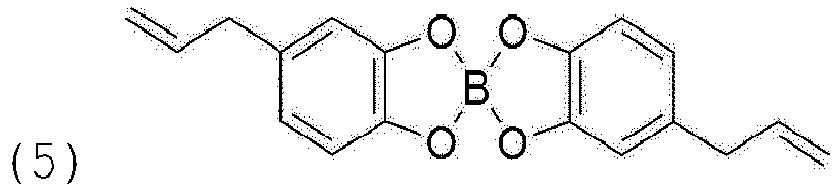
- the compound represented by Chemical Formula 1 may be any one selected from the group consisting of compounds represented by the following Chemical Formulas (1) to (7):
- X 1 , X 2 , Y, M, n, and m may be applied as described above.
- the electrolyte additive for a secondary battery may contain the compound represented by Chemical Formula 1 as a monomer, and may contain an oligomer or polymer prepared from the monomer, a polymerization initiator, a solvent, and the like.
- the oligomers may be bound through a polymerization reaction to form a network.
- a weight average molecular weight of the oligomer or polymer prepared from the monomer may be, for example, about 1,000 to 30,000, about 1,000 to 25,000, about 1,000 to 20,000, or about 5,000 to 20,000, but is not limited thereto.
- the compound represented by Chemical Formula 1 may be contained in an amount of 0.01 to 30 wt%, 0.01 to 20 wt%, 0.01 to 10 wt%, 0.05 to 20 wt%, 0.1 to 20 wt%, 0.1 to 15 wt%, 0.1 to 10 wt%, or 1 to 10 wt%, with respect to the total weight of the electrolyte additive for a secondary battery, but is not limited thereto.
- the polymerization initiator may be used to form a polymer by polymerizing the monomer or oligomer, and a general polymerization initiator known in the art may be used without limitation.
- a photo-polymerization initiator or a thermal polymerization initiator may be used.
- the photo-polymerization initiator include one or more selected from the group consisting of 2-hydroxy-2-methylpropiophenone (HMPP), 1-hydroxycyclohexyl phenyl ketone, benzophenone, 2-hydroxy-1-[4-(2-hydroxyethoxy)phenyl]-2-methyl-1-propanone, 2-[2-oxo-2-phenylacetoxyethoxy]ethyl oxyphenylacetate, 2-[2-hydroxyethoxy]ethyl oxyphenylacetate, alpha-dimethoxy-alphaphenylacetophenone, 2-benzyl-2-(dimethylamino)-1-[4-(4-morpholinyl)phenyl]-1-butanone, 2-methyl-1-[4-(methylthio)phenyl]-2-(4-morpholinyl)-1-propanone, diphenyl(2,4,6-trimethylbenzoyl)phosphine oxide, bis(2,4,6-trimethylbenzoyl)phenyl,
- thermal polymerization initiator include one or more selected from the group consisting of benzoyl peroxide, acetyl peroxide, dilauroyl peroxide, di-tert-butylperoxide, t-butyl peroxy-2-ethyl-hexanoate, cumyl hydroperoxide, hydrogen peroxide, 2,2'-azobis(2-cyanobutane), 2,2'-azobis(methylbutyronitrile), 2,2'-azobis(isobutyronitrile) (AIBN), and 2,2'-azobis(dimethylvaleronitrile) (AMVN).
- benzoyl peroxide acetyl peroxide
- dilauroyl peroxide di-tert-butylperoxide
- t-butyl peroxy-2-ethyl-hexanoate cumyl hydroperoxide
- hydrogen peroxide 2,2'-azobis(2-cyanobutane), 2,2'-azobis(
- the solvent is not particularly limited as long as it is an electrolyte solvent commonly used in a secondary battery.
- ethers, esters (acetates and propionates), amides, linear carbonates or cyclic carbonates, and nitriles (acetonitrile, SN, and the like) may be used alone or in combination of two or more thereof.
- ester compound methyl acetate, ethyl acetate, n-propyl acetate, dimethyl acetate, methyl propionate, ethyl propionate, ⁇ -butyrolactone, decanolide, valerolactone, mevalonolactone, caprolactone, methyl formate, or the like may be used.
- linear carbonate compound examples include diethyl carbonate (DEC), dimethyl carbonate (DMC), dipropyl carbonate (DPC), methylpropyl carbonate (MPC), ethylpropyl carbonate (EPC), ethylmethyl carbonate (EMC), and a combination thereof.
- cyclic carbonate compound examples include ethylene carbonate (EC), propylene carbonate (PC), butylene carbonate (BC), vinylethylene carbonate (VEC), and a combination thereof.
- an electrolyte for a secondary battery containing the electrolyte additive for a secondary battery.
- the electrolyte for a secondary battery may further contain other additives, inorganic particles, and the like known in the art to increase efficiency of the secondary battery and reduce resistance.
- the electrolyte for a secondary battery may further contain, as other additives, an oxalatophosphate-based compound, an oxalatoborate-based compound, a fluorine-substituted carbonate-based compound, a vinylidene carbonate-based compound, or a sulfinyl group-containing compound.
- the electrolyte for a secondary battery may further contain, for example, lithium tetrafluoro(oxalato)phosphate (LiTFOP), lithium difluorobis(oxalato)phosphate (LiDFOP), lithium difluoro(oxalato)borate (LiDFOB), lithium bis(oxalato)borate (LiB(C 2 O 4 ) 2 , LiBOB), fluoroethylene carbonate (FEC), vinylene carbonate (VC), vinylethylene carbonate (VEC), divinyl sulfone, ethylene sulfite, propylene sulfite, diallyl sulfonate, ethane sultone, propane sultone (PS), butane sultone, ethene sultone, butene sultone, or propene sultone (PRS).
- LiTFOP lithium tetrafluoro(oxalato)phosphate
- LiDFOP
- the oxalatoborate-based compound may be a compound represented by the following Chemical Formula 3 or lithium bisoxalatoborate (LiB(C 2 O 4 ) 2 , LiBOB).
- R 21 and R 22 may be each independently halogen or halo C 1-10 alkyl.
- Specific examples of the oxalatoborate-based compound include lithium difluoro(oxalato)borate (LiB(C 2 O 4 )F 2 , LiDFOB) and lithium bis(oxalato)borate (LiB(C 2 O 4 ) 2 , LiBOB).
- the oxalatophosphate-based compound may be a compound represented by the following Chemical Formula 4 or lithium difluorobis(oxalato)phosphate (LiDFOP).
- R 23 to R 26 may be each independently halogen or halo C 1-10 alkyl.
- Specific examples of the oxalatophosphate-based compound include lithium tetrafluoro(oxalato)phosphate (LiTFOP) and lithium difluorobis(oxalato)phosphate (LiDFOP).
- the fluorine-substituted carbonate-based compound may be fluoroethylene carbonate (FEC), difluoroethylene carbonate (DFEC), fluorodimethyl carbonate (FDMC), fluoroethylmethyl carbonate (FEMC), or a combination thereof.
- FEC fluoroethylene carbonate
- DFEC difluoroethylene carbonate
- FDMC fluorodimethyl carbonate
- FEMC fluoroethylmethyl carbonate
- the vinylidene carbonate-based compound may be vinylene carbonate (VC), vinyl ethylene carbonate (VEC), or a mixture thereof.
- the sulfone may be represented by the following Chemical Formula 5, and may be divinyl sulfone.
- the sulfite may be represented by the following Chemical Formula 6, and may be ethylene sulfite or propylene sulfite.
- the sulfonate may be represented by the following Chemical Formula 7, and may be diallyl sulfonate.
- non-limiting examples of the sultone include ethane sultone, propane sultone, butane sultone, ethene sultone, butene sultone, and propene sultone.
- R 27 and R 28 may be each independently hydrogen, halogen, C 1-10 alkyl, C 2-10 alkenyl, halo C 1-10 alkyl, or halo C 2-10 alkenyl.
- the inorganic particles may be formed of a single compound or a mixture of two or more compounds selected from the group consisting of BaTiO 3 , Pb(Zr,Ti)O 3 (PZT), Pb 1-a La a Zr 1-b TibO 3 (PLZT, where 0 ⁇ a ⁇ 1, 0 ⁇ b ⁇ 1), Pb(Mg 1/3 Nb 2/3 )O 3 -PbTiO 3 (PMN-PT), hafnia (HfO 2 ), SrTiO 3 , SnO 2 , CeO 2 , MgO, NiO, CaO, ZnO, ZrO 2 , Y 2 O 3 , Al 2 O 3 , TiO 2 , SiC, and a mixture thereof, or (LiAlTiP) a2 O b2 -based glass (0 ⁇ a2 ⁇ 4, 0 ⁇ b2 ⁇ 13) such as lithium phosphate (Li 3 PO 4 ), lithium
- the additives or the inorganic particles may be contained in an amount of 0.1 wt% to 20 wt% with respect to the total weight of the electrolyte, but are not limited thereto.
- the electrolyte may be prepared by polymerizing the compound according to a common method known in the art.
- the electrolyte may be prepared by performing in-situ polymerization or coating polymerization of a composition containing the compound as an additive.
- the electrolyte for a secondary battery provided in one embodiment may have excellent high-temperature stability and ion conductivity, and thus may be efficiently used in a secondary battery.
- the compound contained in the additive is formed on a surface of an electrode to prevent direct contact between the electrode and the electrolyte, such that it is possible to prevent a side reaction between the electrode and the electrolyte at a high temperature, and to suppress a crack of a solid electrolyte interphase (SEI) due to contraction and expansion of the electrode during charging and discharging, thereby improving a lifespan of the electrode. That is, since the compound according to one embodiment may form a thermally stable SEI on the surface of the electrode, a battery employing the electrolyte according to one embodiment may have excellent high-temperature storage characteristics and excellent thermal stability.
- SEI solid electrolyte interphase
- a protective layer for an electrode containing the compound or the electrolyte additive for a secondary battery containing the compound is not limited to use as an additive added to the electrolyte, and may be used for forming a protective layer in a secondary battery.
- the protective layer may be formed on a surface of an electrode or an electrode current collector to suppress further decomposition of the electrolyte or to improve a lifespan of the battery.
- the protective layer may be used as a layer for protecting dendrites in the battery, and in this case, the layer may be a gel-polymer layer. Therefore, it is possible to improve cycle characteristics of the electrode of the secondary battery to improve the performance and lifespan of the battery.
- a secondary battery including the electrolyte for a secondary battery.
- An anode included in the secondary battery includes an anode current collector and an anode active material layer formed on the anode current collector, and the anode active material layer contains an anode active material.
- the anode active material is not particularly limited as long as it is generally used in the art.
- the anode active material may be a silicon-based anode active material or a carbon-based anode active material.
- the anode active material may include crystalline carbon such as graphite, for example, natural graphite, artificial graphite, or expandable graphite, graphene, fullerene soot, a carbon nanotube, or a carbon fiber; and amorphous carbon such as soft carbon (low temperature-calcined carbon), hard carbon, coke, mesocarbon microbead (MCMB) calcined at 1,500°C or lower, or a mesophase pitch-based carbon fiber (MPCF).
- crystalline carbon such as graphite, for example, natural graphite, artificial graphite, or expandable graphite, graphene, fullerene soot, a carbon nanotube, or a carbon fiber
- amorphous carbon such as soft carbon (low temperature-calcined carbon), hard carbon, coke, mesocarbon microbead (MCMB) calcined at 1,500°C or lower, or a mesophase pitch-based carbon fiber (MPCF).
- the anode active material may include Si, SiO x (0 ⁇ x ⁇ 2), a Si-Z alloy (where Z is an alkali metal, an alkaline earth metal, a Group 13 element, a Group 14 element, a Group 15 element, a Group 16 element, a transition metal, a rare earth element, or a combination element thereof, and Si is excluded in Z), or a combination thereof.
- the element Z may be selected from the group consisting of Mg, Ca, Sr, Ba, Ra, Sc, Y, La, Ti, Zr, Hf, V, Nb, Ta, Cr, Mo, W, Tc, Re, Fe, Ru, Os, Co, Rh, Ir, Ni, Pd, Pt, Cu, Ag, Au, Zn, Cd, B, Ge, P, As, Sb, Bi, S, Se, Te, Po, and a combination thereof.
- a silicon-based anode active material such as Si, SiO x , or a Si-Z alloy may include a substantially crystalline form (including a single crystal form and a polycrystal form), an amorphous form, or a mixed form thereof.
- the anode may further contain a compound commonly used as an anode active material.
- a cathode included in the secondary battery includes a cathode current collector and a cathode active material layer formed on the cathode current collector, and the cathode active material layer contains a cathode active material.
- the cathode active material is not particularly limited as long as it is generally used in the art.
- the cathode active material may include a cathode active material capable of intercalating and deintercalating lithium ions, such a cathode active material is a lithium-containing metal oxide, and any cathode active material may be used without limitation as long as it is commonly used in the art.
- a composite metal oxide of lithium and a metal selected from cobalt, manganese, nickel, and a combination thereof may be used.
- cathode active material examples include compounds represented by any one of the following formulas: Li a A 1-b B b D 2 (where 0.90 ⁇ a ⁇ 1.8, 0 ⁇ b ⁇ 0.5); Li a E 1-b B b O 2-c D c (where 0.90 ⁇ a ⁇ 1.8, 0 ⁇ b ⁇ 0.5, 0 ⁇ c ⁇ 0.05); LiE 2-b B b O 4-c D c (where 0 ⁇ b ⁇ 0.5, 0 ⁇ c ⁇ 0.05); Li a Ni 1-b-c Co b B c D ⁇ (where 0.90 ⁇ a ⁇ 1.8, 0 ⁇ b ⁇ 0.5, 0 ⁇ c ⁇ 0.05, 0 ⁇ ⁇ ⁇ 2); Li a Ni 1-b-c CO b B c O 2- ⁇ F ⁇ (where 0.90 ⁇ a ⁇ 1.8, 0 ⁇ b ⁇ 0.5, 0 ⁇
- the cathode or the anode may be produced by dispersing an electrode active material, a binder, and a conductive material or a thickener in a solvent to prepare an electrode slurry composition, and applying the electrode slurry composition onto an electrode current collector.
- an electrode current collector aluminum, an aluminum alloy, or the like may be mainly used, and as the anode current collector, copper, a copper alloy, or the like may be mainly used.
- the cathode current collector and the anode current collector may be in a form of a foil or a mesh.
- the secondary battery provided in one embodiment contains the electrolyte for a secondary battery, such that the secondary battery may exhibit sufficient performance even at a high temperature, and may obtain an effect of suppressing an increase in battery thickness due to suppression of generation of volatile materials. In addition, it is possible to improve a low resistance characteristic of the electrode and increase the lifespan of the battery.
- the secondary battery according to one embodiment may be formed into various shapes such as a cylindrical shape and a pouch shape, in addition to an angular shape.
- the secondary battery may be used for applications requiring a high voltage, a high output, and high-temperature driving, such as an electric vehicle, in addition to the existing application in a mobile phone, a portable computer, or the like.
- the secondary battery may also be used for a hybrid vehicle by being coupled to the existing internal combustion engine, fuel cell, supercapacitor, or the like, and may be used for an electric bike, a power tool, and other applications requiring a high voltage, a high output, and high-temperature driving.
- LiPF 6 at a concentration of 1.0 M was dissolved in a solution in which ethylene carbonate (EC) and ethylmethyl carbonate (EMC) were mixed at a weight ratio of 3:7, and 1 wt% of the compound according to Example 1 was added, thereby preparing an electrolyte according to Example 2.
- EC ethylene carbonate
- EMC ethylmethyl carbonate
- Example 2 In order to measure a decomposition initiation voltage of the electrolyte according to Example 2 by linear sweep voltammetry (LSV) analysis, an experiment was conducted in the following manner, and for comparison, an electrolyte not containing the compound a of Example 1 was used as a reference electrolyte. Specifically, a platinum electrode was used as a working electrode, a lithium metal was used for a reference electrode and a counter electrode, and a measurement was performed at a scan rate of 0.1 mV/s in a voltage range of 3 V to 7 V. As an LSV measuring apparatus, Multi-Channel Potentiostat PMC-100 (manufactured by AMETEK, Inc.) was used. The results are illustrated in FIG. 1 .
- LSV linear sweep voltammetry
- the compound a according to Example 1 contained in the electrolyte of Example 2 is first decomposed near 3.4 V rather than the electrolyte solvent. Therefore, the compound a according to Example 1 is decomposed in the electrolyte before the electrolyte solvent, such that the compound a may protect the surface of the electrode, thereby improving the lifespan and high-temperature characteristics and reducing the resistance.
- the decomposition of the compound a according to Example 1 occurs first and a solid electrolyte interphase (SEI) is formed since the decomposition starts from 0.6 V before reaching an electrolyte decomposition voltage of 0.3 V.
- SEI solid electrolyte interphase
- a fact that a stable protective layer is formed may be confirmed through the smooth curves in the second and third cycles without further decomposition. Therefore, the compound a according to Example 1 is decomposed in the electrolyte before the electrolyte solvent to form a protective layer on the surface of the electrode, such that further decomposition of the electrolyte may be suppressed, thereby improving the low resistance characteristic of the electrode and increasing the lifespan of the battery.
- the present disclosure relates to a novel boron-containing compound and an electrolyte additive for a secondary battery containing the same.
- An electrolyte for a secondary battery provided in one embodiment contains the novel boron-containing compound, such that decomposition of the electrolyte may be suppressed, thereby improving a capacity and a lifespan of the battery.
Landscapes
- Chemical & Material Sciences (AREA)
- Organic Chemistry (AREA)
- Engineering & Computer Science (AREA)
- Electrochemistry (AREA)
- Chemical Kinetics & Catalysis (AREA)
- Manufacturing & Machinery (AREA)
- General Chemical & Material Sciences (AREA)
- General Physics & Mathematics (AREA)
- Inorganic Chemistry (AREA)
- Condensed Matter Physics & Semiconductors (AREA)
- Physics & Mathematics (AREA)
- Power Engineering (AREA)
- Microelectronics & Electronic Packaging (AREA)
- Materials Engineering (AREA)
- Secondary Cells (AREA)
Abstract
Description
- The following disclosure relates to a novel boron-containing compound and an electrolyte additive for a secondary battery containing the same.
- A lithium secondary battery has high potential for use as a power source for a portable electronic device or the like because it has a higher energy density than other batteries and may implement miniaturization and lightness. The lithium secondary battery may include a cathode, an anode, and an electrolyte.
- Recently, in accordance with an increase in demand for a secondary battery having a high output and a high capacity such as a secondary battery for an electric vehicle, there is a need for development of a lithium secondary battery including an electrolyte capable of suppressing a side reaction between an electrode and the electrolyte in a severe environment such as a high temperature environment, or securing high thermal and chemical stability to prevent ignition or explosion.
- An embodiment is directed to providing a novel boron-containing compound.
- Another embodiment is directed to providing an electrolyte additive for a secondary battery containing a boron-containing compound.
- Still another embodiment is directed to providing an electrolyte containing the electrolyte additive for a secondary battery, and a secondary battery including the same.
- In one general aspect, there is provided a compound represented by the following Chemical Formula 1:


- X1 and X2 are each independently a substituted or unsubstituted compound represented by Chemical Formula 2 or substituted or unsubstituted C2-15 alkenyl;
- n and m are each independently an integer of 0 to 15, and A is a bond or -C(=O)-;
- x is an integer of 0 to 4;
- y is an integer of 1 to 4;
- Y's are each independently a bond, -CH2-, or -CH2CH2-; and
- M is an alkali metal.
- In another general aspect, an electrolyte additive for a secondary battery contains a compound represented by the following Chemical Formula 1:
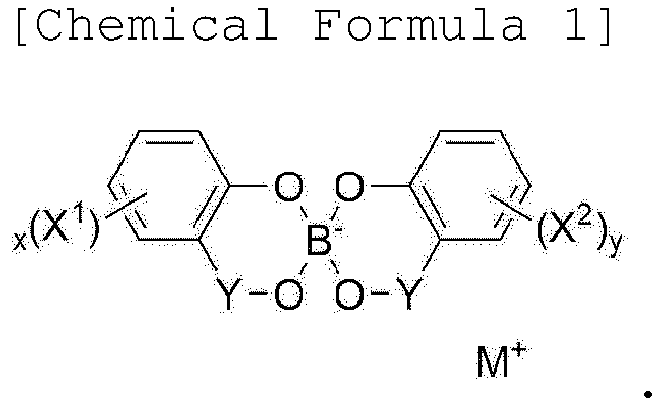
- In this case, X1, X2, Y, and M may be as described above.
- In still another general aspect, an electrolyte for a secondary battery contains the electrolyte additive for a secondary battery.
- In still another general aspect, a secondary battery includes the electrolyte for a secondary battery.
- Other features and aspects will be apparent from the following detailed description, the drawings, and the claims.
-
-
FIG. 1 is a view showing results of measuring a decomposition initiation voltage of an electrolyte according to Example 2 containing a compound according to Example 1 by linear sweep voltammetry analysis. -
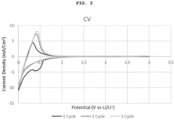
FIG. 2 is a view showing results of measuring a current-voltage curve of the electrolyte according to Example 2 containing the compound according to Example 1 by voltammetry analysis. - Exemplary embodiments of the present disclosure may be modified in many different forms and the scope of the present disclosure should not be limited to exemplary embodiments described below. In addition, the exemplary embodiments of the present disclosure are provided in order to further completely describe the present disclosure to those skilled in the art. Furthermore, in the entire specification, unless explicitly described otherwise, "comprising" any components will be understood to imply the inclusion of other components rather than the exclusion of any other components.
- In one embodiment, there is provided a compound represented by the following Chemical Formula 1:


- X1 and X2 are each independently a substituted or unsubstituted compound represented by Chemical Formula 2 or substituted or unsubstituted C2-15 alkenyl;
- n and m are each independently an integer of 0 to 15, and A is a bond or -C(=O)-;
- x is an integer of 0 to 4;
- y is an integer of 1 to 4;
- Y's are each independently a bond, -CH2-, or -CH2CH2-; and
- M is an alkali metal.
- In this case, the substitutions may be each independently performed with one or more of -OH, -CN, -NH2, -NO2, halogen, linear or branched C1-20 alkyl, linear or branched C1-20 alkylamino, linear or branched C2-20 alkenyl, linear or branched C1-20 alkoxy, linear or branched C1-20 alkylcarbonyl, C3-20 cycloalkyl, 3- to 10-membered heterocycloalkyl containing one or more heteroatoms selected from the group consisting of N, O, and S, C5-20 aryl, and 5- to 10-membered heteroaryl containing one or more heteroatoms selected from N, O, and S, but are not limited thereto.
- In one embodiment, X1 and X2 may be each independently a substituted or unsubstituted compound represented by Chemical Formula 2 or substituted or unsubstituted C2-10 alkenyl;
- n and m may be each independently an integer of 0 to 10, and A may be a bond;
- x and y may be each independently an integer of 1 to 3; and
- Y's may be each independently a bond or -CH2-.
- Alternatively, X1 and X2 may be each independently substituted or unsubstituted C2-8 alkenyl, substituted or unsubstituted C2-6 alkenyl, substituted or unsubstituted C2-5 alkenyl, or substituted or unsubstituted C2-3 alkenyl. In this case, the alkenyl may have a direct linkage with unsaturated carbon or a linkage with unsaturated carbon via alkylene. For example, the unsaturated carbon may be present at the end of the chain.
- n and m may be each independently an integer of 0 to 8, an integer of 0 to 5, an integer of 0 to 3, an integer of 0 to 2, 0, 1, or 2.
- M may be lithium, sodium, potassium, or cesium.
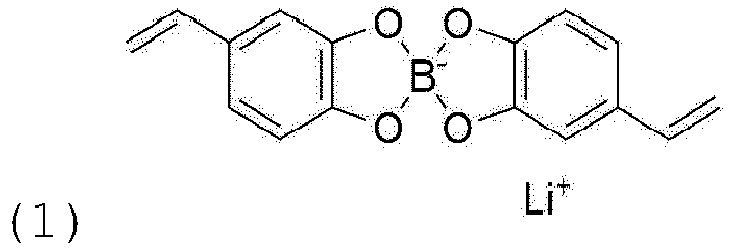
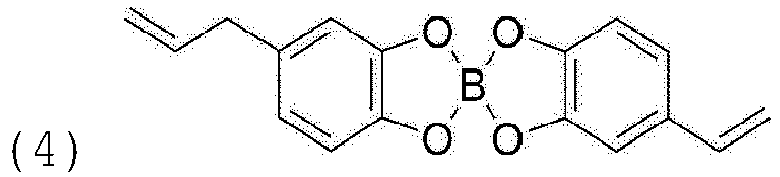
- The compound represented by Chemical Formula 1 may be any one selected from the group consisting of compounds represented by the following Chemical Formulas (1) to (7):




- In another embodiment, there is provided an electrolyte additive for a secondary battery containing a compound represented by the following Chemical Formula 1:


- X1 and X2 are each independently a substituted or unsubstituted compound represented by Chemical Formula 2 or substituted or unsubstituted C2-15 alkenyl;
- n and m are each independently an integer of 0 to 15, and A is a bond or -C(=O)-;
- x is an integer of 0 to 4;
- y is an integer of 1 to 4;
- Y's are each independently a bond, -CH2-, or -CH2CH2-; and
- M is an alkali metal.
- In this case, X1, X2, Y, M, n, and m may be applied as described above.
- The electrolyte additive for a secondary battery may contain the compound represented by Chemical Formula 1 as a monomer, and may contain an oligomer or polymer prepared from the monomer, a polymerization initiator, a solvent, and the like. The oligomers may be bound through a polymerization reaction to form a network.
- A weight average molecular weight of the oligomer or polymer prepared from the monomer may be, for example, about 1,000 to 30,000, about 1,000 to 25,000, about 1,000 to 20,000, or about 5,000 to 20,000, but is not limited thereto.
- The compound represented by Chemical Formula 1 may be contained in an amount of 0.01 to 30 wt%, 0.01 to 20 wt%, 0.01 to 10 wt%, 0.05 to 20 wt%, 0.1 to 20 wt%, 0.1 to 15 wt%, 0.1 to 10 wt%, or 1 to 10 wt%, with respect to the total weight of the electrolyte additive for a secondary battery, but is not limited thereto.
- The polymerization initiator may be used to form a polymer by polymerizing the monomer or oligomer, and a general polymerization initiator known in the art may be used without limitation. For example, depending on the type of polymerization, a photo-polymerization initiator or a thermal polymerization initiator may be used. Specific examples of the photo-polymerization initiator include one or more selected from the group consisting of 2-hydroxy-2-methylpropiophenone (HMPP), 1-hydroxycyclohexyl phenyl ketone, benzophenone, 2-hydroxy-1-[4-(2-hydroxyethoxy)phenyl]-2-methyl-1-propanone, 2-[2-oxo-2-phenylacetoxyethoxy]ethyl oxyphenylacetate, 2-[2-hydroxyethoxy]ethyl oxyphenylacetate, alpha-dimethoxy-alphaphenylacetophenone, 2-benzyl-2-(dimethylamino)-1-[4-(4-morpholinyl)phenyl]-1-butanone, 2-methyl-1-[4-(methylthio)phenyl]-2-(4-morpholinyl)-1-propanone, diphenyl(2,4,6-trimethylbenzoyl)phosphine oxide, bis(2,4,6-trimethylbenzoyl)phenyl phosphine oxide, bis(etha5-2,4-cyclopentadien-1-yl), bis[2,6-difluoro-3-(1H-pyrrol-1-yl)phenyl]titanium, 4-isobutylphenyl-4'-methylphenyliodonium hexafluorophosphate, and methyl benzoylformate. Representative examples of the thermal polymerization initiator include one or more selected from the group consisting of benzoyl peroxide, acetyl peroxide, dilauroyl peroxide, di-tert-butylperoxide, t-butyl peroxy-2-ethyl-hexanoate, cumyl hydroperoxide, hydrogen peroxide, 2,2'-azobis(2-cyanobutane), 2,2'-azobis(methylbutyronitrile), 2,2'-azobis(isobutyronitrile) (AIBN), and 2,2'-azobis(dimethylvaleronitrile) (AMVN).
- The solvent is not particularly limited as long as it is an electrolyte solvent commonly used in a secondary battery. For example, ethers, esters (acetates and propionates), amides, linear carbonates or cyclic carbonates, and nitriles (acetonitrile, SN, and the like) may be used alone or in combination of two or more thereof.
- As the ester compound, methyl acetate, ethyl acetate, n-propyl acetate, dimethyl acetate, methyl propionate, ethyl propionate, γ-butyrolactone, decanolide, valerolactone, mevalonolactone, caprolactone, methyl formate, or the like may be used.
- Examples of the linear carbonate compound include diethyl carbonate (DEC), dimethyl carbonate (DMC), dipropyl carbonate (DPC), methylpropyl carbonate (MPC), ethylpropyl carbonate (EPC), ethylmethyl carbonate (EMC), and a combination thereof. Examples of the cyclic carbonate compound include ethylene carbonate (EC), propylene carbonate (PC), butylene carbonate (BC), vinylethylene carbonate (VEC), and a combination thereof.
- In still another embodiment, there is provided an electrolyte for a secondary battery containing the electrolyte additive for a secondary battery.
- The electrolyte for a secondary battery may further contain other additives, inorganic particles, and the like known in the art to increase efficiency of the secondary battery and reduce resistance.
- For example, the electrolyte for a secondary battery may further contain, as other additives, an oxalatophosphate-based compound, an oxalatoborate-based compound, a fluorine-substituted carbonate-based compound, a vinylidene carbonate-based compound, or a sulfinyl group-containing compound. Alternatively, the electrolyte for a secondary battery may further contain, for example, lithium tetrafluoro(oxalato)phosphate (LiTFOP), lithium difluorobis(oxalato)phosphate (LiDFOP), lithium difluoro(oxalato)borate (LiDFOB), lithium bis(oxalato)borate (LiB(C2O4)2, LiBOB), fluoroethylene carbonate (FEC), vinylene carbonate (VC), vinylethylene carbonate (VEC), divinyl sulfone, ethylene sulfite, propylene sulfite, diallyl sulfonate, ethane sultone, propane sultone (PS), butane sultone, ethene sultone, butene sultone, or propene sultone (PRS). In one embodiment, the compound or the oligomer using the compound as a monomer may be further reacted with other additives in the electrolyte.
- The oxalatoborate-based compound may be a compound represented by the following
Chemical Formula 3 or lithium bisoxalatoborate (LiB(C2O4)2, LiBOB).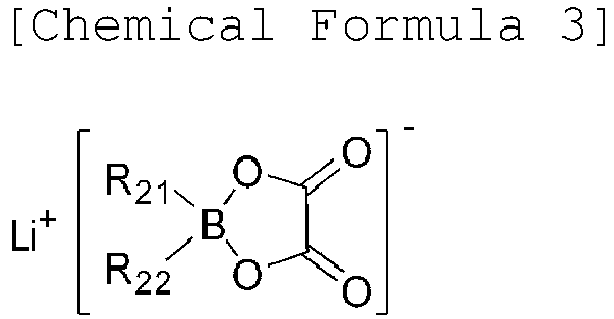
- In
Chemical Formula 3, R21 and R22 may be each independently halogen or halo C1-10 alkyl. Specific examples of the oxalatoborate-based compound include lithium difluoro(oxalato)borate (LiB(C2O4)F2, LiDFOB) and lithium bis(oxalato)borate (LiB(C2O4)2, LiBOB). - The oxalatophosphate-based compound may be a compound represented by the following Chemical Formula 4 or lithium difluorobis(oxalato)phosphate (LiDFOP).

- In Chemical Formula 4, R23 to R26 may be each independently halogen or halo C1-10 alkyl. Specific examples of the oxalatophosphate-based compound include lithium tetrafluoro(oxalato)phosphate (LiTFOP) and lithium difluorobis(oxalato)phosphate (LiDFOP).
- The fluorine-substituted carbonate-based compound may be fluoroethylene carbonate (FEC), difluoroethylene carbonate (DFEC), fluorodimethyl carbonate (FDMC), fluoroethylmethyl carbonate (FEMC), or a combination thereof.
- The vinylidene carbonate-based compound may be vinylene carbonate (VC), vinyl ethylene carbonate (VEC), or a mixture thereof.
- The sulfinyl group (S=O)-containing compound may be sulfone, sulfite, sulfonate, or sultone (cyclic sulfonate), and these compounds may be used alone or as a mixture. Specifically, the sulfone may be represented by the following Chemical Formula 5, and may be divinyl sulfone. The sulfite may be represented by the following Chemical Formula 6, and may be ethylene sulfite or propylene sulfite. The sulfonate may be represented by the following Chemical Formula 7, and may be diallyl sulfonate. In addition, non-limiting examples of the sultone include ethane sultone, propane sultone, butane sultone, ethene sultone, butene sultone, and propene sultone.

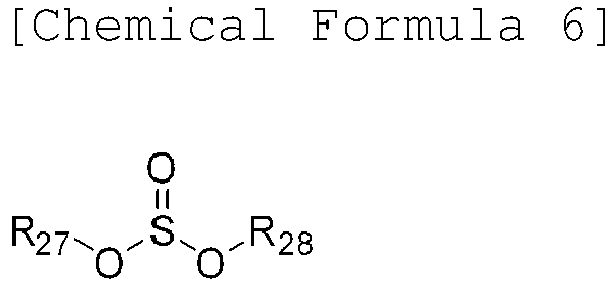
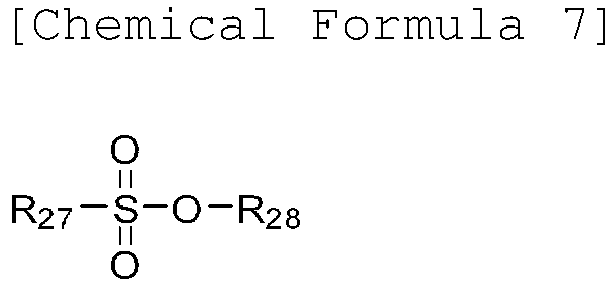
- In Chemical Formulas 5 to 7, R27 and R28 may be each independently hydrogen, halogen, C1-10 alkyl, C2-10 alkenyl, halo C1-10 alkyl, or halo C2-10 alkenyl.
- The inorganic particles may be formed of a single compound or a mixture of two or more compounds selected from the group consisting of BaTiO3, Pb(Zr,Ti)O3 (PZT), Pb1-aLaaZr1-bTibO3 (PLZT, where 0 < a < 1, 0 < b < 1), Pb(Mg1/3Nb2/3)O3-PbTiO3 (PMN-PT), hafnia (HfO2), SrTiO3, SnO2, CeO2, MgO, NiO, CaO, ZnO, ZrO2, Y2O3, Al2O3, TiO2, SiC, and a mixture thereof, or (LiAlTiP)a2Ob2-based glass (0 < a2 < 4, 0 < b2 < 13) such as lithium phosphate (Li3PO4), lithium titanium phosphate (LicTid(PO4)3, 0 < c < 2, 0 < d < 3), lithium aluminum titanium phosphate (Lia1Alb1Tic1 (PO4)3, 0 < a1 < 2, 0 < b1 < 1, 0 < c1 < 3), or 14Li2O-9Al2O3-38TiO2-39P2O5, SiS2-based glass (Lia6Sib6Sc3, 0 < a6 < 3, 0 < b6 < 2, 0 < c3 < 4) such as lithium lanthanum titanate (Lia3Lab3TiO3, 0 < a3 < 2, 0 < b3 < 3), lithium germanium thiophosphate (Lia4Geb4Pc2Sd, 0 < a4 < 4, 0 < b4 < 1, 0 < c2 < 1, 0 < d < 5) such as Li3.25Ge0.25P0.75S4, lithium nitride (Lia5Nb5, 0 < a5 < 4, 0 < b5 < 2) such as Li3N, or Li3PO4-Li2SSiS2, P2S5-based glass (Lia7Pb7Sc5, 0 < a7 < 3, 0 < b7 < 3, 0 < c5 < 7) such as LiI-Li2S-P2S5, or a mixture thereof.
- In one embodiment, the additives or the inorganic particles may be contained in an amount of 0.1 wt% to 20 wt% with respect to the total weight of the electrolyte, but are not limited thereto.
- The electrolyte may be prepared by polymerizing the compound according to a common method known in the art. For example, the electrolyte may be prepared by performing in-situ polymerization or coating polymerization of a composition containing the compound as an additive. The electrolyte for a secondary battery provided in one embodiment may have excellent high-temperature stability and ion conductivity, and thus may be efficiently used in a secondary battery.
- In one embodiment, the compound contained in the additive is formed on a surface of an electrode to prevent direct contact between the electrode and the electrolyte, such that it is possible to prevent a side reaction between the electrode and the electrolyte at a high temperature, and to suppress a crack of a solid electrolyte interphase (SEI) due to contraction and expansion of the electrode during charging and discharging, thereby improving a lifespan of the electrode. That is, since the compound according to one embodiment may form a thermally stable SEI on the surface of the electrode, a battery employing the electrolyte according to one embodiment may have excellent high-temperature storage characteristics and excellent thermal stability.
- In still another embodiment, there is provided a protective layer for an electrode containing the compound or the electrolyte additive for a secondary battery containing the compound. Accordingly, the compound according to one embodiment is not limited to use as an additive added to the electrolyte, and may be used for forming a protective layer in a secondary battery. The protective layer may be formed on a surface of an electrode or an electrode current collector to suppress further decomposition of the electrolyte or to improve a lifespan of the battery. For example, the protective layer may be used as a layer for protecting dendrites in the battery, and in this case, the layer may be a gel-polymer layer. Therefore, it is possible to improve cycle characteristics of the electrode of the secondary battery to improve the performance and lifespan of the battery.
- In still another embodiment, there is provided a secondary battery including the electrolyte for a secondary battery.
- An anode included in the secondary battery includes an anode current collector and an anode active material layer formed on the anode current collector, and the anode active material layer contains an anode active material. The anode active material is not particularly limited as long as it is generally used in the art. For example, the anode active material may be a silicon-based anode active material or a carbon-based anode active material. Specifically, the anode active material may include crystalline carbon such as graphite, for example, natural graphite, artificial graphite, or expandable graphite, graphene, fullerene soot, a carbon nanotube, or a carbon fiber; and amorphous carbon such as soft carbon (low temperature-calcined carbon), hard carbon, coke, mesocarbon microbead (MCMB) calcined at 1,500°C or lower, or a mesophase pitch-based carbon fiber (MPCF). Alternatively, the anode active material may include Si, SiOx (0 < x < 2), a Si-Z alloy (where Z is an alkali metal, an alkaline earth metal, a Group 13 element, a Group 14 element, a
Group 15 element, a Group 16 element, a transition metal, a rare earth element, or a combination element thereof, and Si is excluded in Z), or a combination thereof. The element Z may be selected from the group consisting of Mg, Ca, Sr, Ba, Ra, Sc, Y, La, Ti, Zr, Hf, V, Nb, Ta, Cr, Mo, W, Tc, Re, Fe, Ru, Os, Co, Rh, Ir, Ni, Pd, Pt, Cu, Ag, Au, Zn, Cd, B, Ge, P, As, Sb, Bi, S, Se, Te, Po, and a combination thereof. In addition, such a silicon-based anode active material such as Si, SiOx, or a Si-Z alloy may include a substantially crystalline form (including a single crystal form and a polycrystal form), an amorphous form, or a mixed form thereof. In addition, the anode may further contain a compound commonly used as an anode active material. - A cathode included in the secondary battery includes a cathode current collector and a cathode active material layer formed on the cathode current collector, and the cathode active material layer contains a cathode active material. The cathode active material is not particularly limited as long as it is generally used in the art. For example, the cathode active material may include a cathode active material capable of intercalating and deintercalating lithium ions, such a cathode active material is a lithium-containing metal oxide, and any cathode active material may be used without limitation as long as it is commonly used in the art. For example, a composite metal oxide of lithium and a metal selected from cobalt, manganese, nickel, and a combination thereof may be used.
- Specific examples of the cathode active material include compounds represented by any one of the following formulas: LiaA1-bBbD2 (where 0.90 ≤ a ≤ 1.8, 0 ≤ b ≤ 0.5); LiaE1-bBbO2-cDc (where 0.90 ≤ a ≤ 1.8, 0 ≤ b ≤ 0.5, 0 ≤ c ≤ 0.05); LiE2-bBbO4-cDc (where 0 ≤ b ≤ 0.5, 0 ≤ c ≤ 0.05); LiaNi1-b-cCobBcDα (where 0.90 ≤ a ≤ 1.8, 0 ≤ b ≤ 0.5, 0 ≤ c ≤ 0.05, 0 < α ≤ 2); LiaNi1-b-cCObBcO2-αFα (where 0.90 ≤ a ≤ 1.8, 0 ≤ b ≤ 0.5, 0 ≤ c ≤ 0.05, 0 < α < 2); LiaNi1-b-cCObBcO2-αF2 (where 0.90 ≤ a ≤ 1.8, 0 ≤ b ≤ 0.5, 0 ≤ c ≤ 0.05, 0 < α < 2); LiaNi1-b-cMnbBcDα (where 0.90 ≤ a ≤ 1.8, 0 ≤ b ≤ 0.5, 0 ≤ c ≤ 0.05, 0 < α ≤ 2); LiaNi1-b-cMnbBcO2-αFα (where 0.90 ≤ a ≤ 1.8, 0 ≤ b ≤ 0.5, 0 ≤ c ≤ 0.05, 0 < α < 2); LiaNi1-b-cMnbBcO2-αF2 (where 0.90 ≤ a ≤ 1.8, 0 ≤ b ≤ 0.5, 0 ≤ c ≤ 0.05, 0 < α < 2); LiaNibEcGdO2 (where 0.90 ≤ a ≤ 1.8, 0 ≤ b ≤ 0.9, 0 ≤ c ≤ 0.5, 0.001 ≤ d ≤ 0.1); LiaNibCocMndGeO2 (where 0.90 ≤ a ≤ 1.8, 0 ≤ b ≤ 0.9, 0 ≤ c ≤ 0.5, 0 ≤ d ≤ 0.5, 0.001 ≤ e ≤ 0.1); LiaNiGbO2 (where 0.90 ≤ a ≤ 1.8, 0.001 ≤ b ≤ 0.1); LiaCoGbO2 (where 0.90 ≤ a ≤ 1.8, 0.001 ≤ b ≤ 0.1); LiaMnGbO2 (where 0.90 ≤ a ≤ 1.8, 0.001 ≤ b ≤ 0.1); LiaMn2GbO4 (where 0.90 ≤ a ≤ 1.8, 0.001 ≤ b ≤ 0.1); QO2; QS2; LiQS2; V2O5; LiV2O5; LiIO2; LiNiVO4; Li(3-f)J2 (PO4)3 (0 ≤ f ≤ 2); Li(3-f)Fe2(PO4)3 (0 ≤ f ≤ 2); and LiFePO4.
- In the formulas, A may be Ni, Co, Mn, or a combination thereof; B may be Al, Ni, Co, Mn, Cr, Fe, Mg, Sr, V, a rare earth element, or a combination thereof; D may be O, F, S, P, or a combination thereof; E may be Co, Mn, or a combination thereof; F may be F, S, P, or a combination thereof; G may be Al, Cr, Mn, Fe, Mg, La, Ce, Sr, V, or a combination thereof; Q may be Ti, Mo, Mn, or a combination thereof; I may be Cr, V, Fe, Sc, Y, or a combination thereof; and J may be V, Cr, Mn, Co, Ni, Cu, or a combination thereof. Examples thereof include LiCoO2, LiMnxO2X (x = 1, 2), LiNi1-xMnxO2X (0 < x < 1), LiNi1-x-yCoxMnyO2 (0 ≤ x ≤ 0.5, 0 ≤ y ≤ 0.5), and FePO4.
- The cathode or the anode may be produced by dispersing an electrode active material, a binder, and a conductive material or a thickener in a solvent to prepare an electrode slurry composition, and applying the electrode slurry composition onto an electrode current collector. As the cathode current collector, aluminum, an aluminum alloy, or the like may be mainly used, and as the anode current collector, copper, a copper alloy, or the like may be mainly used. The cathode current collector and the anode current collector may be in a form of a foil or a mesh.
- The secondary battery provided in one embodiment contains the electrolyte for a secondary battery, such that the secondary battery may exhibit sufficient performance even at a high temperature, and may obtain an effect of suppressing an increase in battery thickness due to suppression of generation of volatile materials. In addition, it is possible to improve a low resistance characteristic of the electrode and increase the lifespan of the battery. The secondary battery according to one embodiment may be formed into various shapes such as a cylindrical shape and a pouch shape, in addition to an angular shape. The secondary battery may be used for applications requiring a high voltage, a high output, and high-temperature driving, such as an electric vehicle, in addition to the existing application in a mobile phone, a portable computer, or the like. In addition, the secondary battery may also be used for a hybrid vehicle by being coupled to the existing internal combustion engine, fuel cell, supercapacitor, or the like, and may be used for an electric bike, a power tool, and other applications requiring a high voltage, a high output, and high-temperature driving.
- Hereinafter, Examples and Experimental Examples will be described in detail below. However, Examples and Experimental Examples to be described below are merely illustrative of a part of the present disclosure, and the present disclosure is not limited thereto.
-


- Caffeic acid (5 g, 27.8 mmol), dimethylformamide (30 mL), and triethylamine (11.6 mL, 83.3 mmol) were added to a round-bottom flask, the temperature was raised to 90°C, and the mixture was stirred for 4 hours or longer. After completion of the reaction, the mixture was cooled to room temperature and dried in vacuo to remove triethylamine, a saturated NaCl aqueous solution (50 mL) and ethyl acetate (50 mL) were added, stirring was performed, an organic layer was separated, and then the solvent was removed under reduced pressure. Toluene (50 mL) was added, and then distillation was performed at 40°C and 60 mbar to remove residual DMF, thereby obtaining 2.2 g of a compound a-i as an intermediate (yield: 58%).
- 1H-NMR (500 MHz, DMSO) : 6.85 (1H, s), 6.68 (2H, s), 6.53 (1H, q), 5.49 (1H, d), 4.98 (1H, d).
- The compound a-i (2 g, 10.3 mmol) prepared in
Step 1, lithium hydroxide (0.12 g, 5.1 mmol), and boric acid (0.32 g, 5.1 mmol) were added to a round-bottom flask, methanol (10 mL) was added, and then the mixture was stirred at 70°C for 3 hours. After completion of the reaction, methanol was removed to obtain a compound a of Example 1 as a white solid specimen (yield: 61%). - 1H-NMR (500 MHz, DMSO): 6.69 (1H, s), 6.54 (1H, d), 6.52 (1H, d), 6.43 (1H, d), 5.47 (1H, d), 4.91 (1H, d).
- LiPF6 at a concentration of 1.0 M was dissolved in a solution in which ethylene carbonate (EC) and ethylmethyl carbonate (EMC) were mixed at a weight ratio of 3:7, and 1 wt% of the compound according to Example 1 was added, thereby preparing an electrolyte according to Example 2.
- In order to measure a decomposition initiation voltage of the electrolyte according to Example 2 by linear sweep voltammetry (LSV) analysis, an experiment was conducted in the following manner, and for comparison, an electrolyte not containing the compound a of Example 1 was used as a reference electrolyte. Specifically, a platinum electrode was used as a working electrode, a lithium metal was used for a reference electrode and a counter electrode, and a measurement was performed at a scan rate of 0.1 mV/s in a voltage range of 3 V to 7 V. As an LSV measuring apparatus, Multi-Channel Potentiostat PMC-100 (manufactured by AMETEK, Inc.) was used. The results are illustrated in
FIG. 1 . - As a result, as can be seen in
FIG. 1 , it may be confirmed that the compound a according to Example 1 contained in the electrolyte of Example 2 is first decomposed near 3.4 V rather than the electrolyte solvent. Therefore, the compound a according to Example 1 is decomposed in the electrolyte before the electrolyte solvent, such that the compound a may protect the surface of the electrode, thereby improving the lifespan and high-temperature characteristics and reducing the resistance. - In order to measure a current-voltage curve of the electrolyte according to Example 2 by cyclic voltammetry (CV) analysis, an experiment was conducted in the following manner. Specifically, graphite was used for a working electrode, and lithium was used for a counter electrode and a reference electrode, a CV measurement was performed for 3 cycles at a scan rate of 0.5 mV/s in a voltage range of 0 V to 3 V, and as a CV measuring apparatus, Multi-Channel Potentiostat PMC-100 (manufactured by AMETEK, Inc.) was used. The results are illustrated in
FIG. 2 . - As a result, as can be seen in
FIG. 2 , it may be confirmed that the decomposition of the compound a according to Example 1 occurs first and a solid electrolyte interphase (SEI) is formed since the decomposition starts from 0.6 V before reaching an electrolyte decomposition voltage of 0.3 V. In addition, a fact that a stable protective layer is formed may be confirmed through the smooth curves in the second and third cycles without further decomposition. Therefore, the compound a according to Example 1 is decomposed in the electrolyte before the electrolyte solvent to form a protective layer on the surface of the electrode, such that further decomposition of the electrolyte may be suppressed, thereby improving the low resistance characteristic of the electrode and increasing the lifespan of the battery. - The present disclosure relates to a novel boron-containing compound and an electrolyte additive for a secondary battery containing the same. An electrolyte for a secondary battery provided in one embodiment contains the novel boron-containing compound, such that decomposition of the electrolyte may be suppressed, thereby improving a capacity and a lifespan of the battery.
- Hereinabove, the present disclosure has been described in detail through preferred Examples and Experimental Examples, but the scope of the present disclosure is not limited to a specific Example, and should be interpreted according to the appended claims. In addition, those skilled in the art should understand that various modifications and alternations are possible without departing from the scope of the present disclosure.
Claims (13)
- A compound represented by the following Chemical Formula 1:

 X1 and X2 are each independently a substituted or unsubstituted compound represented by Chemical Formula 2 or substituted or unsubstituted C2-15 alkenyl;n and m are each independently an integer of 0 to 15, and A is a bond or -C(=O)-;x is an integer of 0 to 4;y is an integer of 1 to 4;Y's are each independently a bond, -CH2-, or -CH2CH2-; andM is an alkali metal.
 - The compound of claim 1, wherein X1 and X2 are each independently a substituted or unsubstituted compound represented by Chemical Formula 2 or substituted or unsubstituted C2-10 alkenyl;n and m are each independently an integer of 0 to 10, and A is a bond;x and y are each independently an integer of 1 to 3; andY's are each independently a bond or -CH2-.
- The compound of any one of claims 1 to 2, wherein X1 and X2 are each independently substituted or unsubstituted C2-5 alkenyl.
- The compound of any one of claims 1 to 3, wherein M is lithium, sodium, potassium, or cesium.
- The compound of any one of claims 1 to 4, wherein the compound represented by Chemical Formula 1 is any one selected from the group consisting of compounds represented by the following Chemical Formulas (1) to (7):


- An electrolyte additive for a secondary battery comprising a compound represented by the following Chemical Formula 1:

 X1 and X2 are each independently a substituted or unsubstituted compound represented by Chemical Formula 2 or substituted or unsubstituted C2-15 alkenyl;n and m are each independently an integer of 0 to 15, and A is a bond or -C(=O)-;x is an integer of 0 to 4;y is an integer of 1 to 4;Y's are each independently a bond, -CH2-, or -CH2CH2-; andM is an alkali metal.
 - The electrolyte additive of claim 6, wherein X1 and X2 are each independently a substituted or unsubstituted compound represented by Chemical Formula 2 or substituted or unsubstituted C2-10 alkenyl;n and m are each independently an integer of 0 to 10, and A is a bond;x and y are each independently an integer of 1 to 3; andY's are each independently a bond or -CH2-.
- The electrolyte additive of any one of claims 6 to 7, wherein X1 and X2 are each independently substituted or unsubstituted C2-5 alkenyl.
- The electrolyte additive of any one of claims 6 to 8, wherein M is lithium, sodium, potassium, or cesium.
- The electrolyte additive of any one of claims 6 to 9, wherein the compound represented by Chemical Formula 1 is any one selected from the group consisting of compounds represented by the following Chemical Formulas (1) to (7):


- An electrolyte for a secondary battery comprising the electrolyte additive for a secondary battery according to any one of claims 6 to 10.
- A protective layer for an electrode comprising the electrolyte additive for a secondary battery according to any one of claims 6 to 10.
- A secondary battery comprising the electrolyte for a secondary battery according to claim 11.
Applications Claiming Priority (1)
| Application Number | Priority Date | Filing Date | Title |
|---|---|---|---|
| KR1020210172810A KR20230084770A (en) | 2021-12-06 | 2021-12-06 | Novel boron-containing compound and electrolyte additive for secondary battery containing same |
Publications (2)
| Publication Number | Publication Date |
|---|---|
| EP4190792A1 true EP4190792A1 (en) | 2023-06-07 |
| EP4190792B1 EP4190792B1 (en) | 2025-07-02 |
Family
ID=84370555
Family Applications (1)
| Application Number | Title | Priority Date | Filing Date |
|---|---|---|---|
| EP22210830.0A Active EP4190792B1 (en) | 2021-12-06 | 2022-12-01 | Boron-containing compound and electrolyte additive for secondary battery containing the same |
Country Status (4)
| Country | Link |
|---|---|
| US (2) | US11851448B2 (en) |
| EP (1) | EP4190792B1 (en) |
| KR (1) | KR20230084770A (en) |
| CN (1) | CN116217597A (en) |
Cited By (1)
| Publication number | Priority date | Publication date | Assignee | Title |
|---|---|---|---|---|
| GB2626597A (en) * | 2023-01-27 | 2024-07-31 | Sumitomo Chemical Co | Battery |
Families Citing this family (3)
| Publication number | Priority date | Publication date | Assignee | Title |
|---|---|---|---|---|
| KR20230084770A (en) * | 2021-12-06 | 2023-06-13 | 에스케이온 주식회사 | Novel boron-containing compound and electrolyte additive for secondary battery containing same |
| KR20230087715A (en) * | 2021-12-10 | 2023-06-19 | 에스케이온 주식회사 | Novel boron-containing compound and electrolyte additive for secondary battery containing same |
| KR20230094455A (en) * | 2021-12-21 | 2023-06-28 | 에스케이온 주식회사 | Novel boron-containing compound and electrolyte additive for secondary battery containing same |
Citations (1)
| Publication number | Priority date | Publication date | Assignee | Title |
|---|---|---|---|---|
| JP2013068944A (en) * | 2011-09-09 | 2013-04-18 | Orient Chemical Industries Co Ltd | Charge control agent and manufacturing method thereof |
Family Cites Families (4)
| Publication number | Priority date | Publication date | Assignee | Title |
|---|---|---|---|---|
| US3267126A (en) * | 1962-11-08 | 1966-08-16 | Fmc Corp | Complex spirocyclic esters of boric acid |
| KR20230084770A (en) * | 2021-12-06 | 2023-06-13 | 에스케이온 주식회사 | Novel boron-containing compound and electrolyte additive for secondary battery containing same |
| KR20230087715A (en) * | 2021-12-10 | 2023-06-19 | 에스케이온 주식회사 | Novel boron-containing compound and electrolyte additive for secondary battery containing same |
| KR20230094455A (en) * | 2021-12-21 | 2023-06-28 | 에스케이온 주식회사 | Novel boron-containing compound and electrolyte additive for secondary battery containing same |
-
2021
- 2021-12-06 KR KR1020210172810A patent/KR20230084770A/en active Pending
-
2022
- 2022-12-01 EP EP22210830.0A patent/EP4190792B1/en active Active
- 2022-12-05 CN CN202211545287.7A patent/CN116217597A/en active Pending
- 2022-12-06 US US18/075,610 patent/US11851448B2/en active Active
-
2023
- 2023-11-08 US US18/504,164 patent/US12122796B2/en active Active
Patent Citations (1)
| Publication number | Priority date | Publication date | Assignee | Title |
|---|---|---|---|---|
| JP2013068944A (en) * | 2011-09-09 | 2013-04-18 | Orient Chemical Industries Co Ltd | Charge control agent and manufacturing method thereof |
Non-Patent Citations (1)
| Title |
|---|
| DATABASE CAPLUS [online] 1 January 2013 (2013-01-01), YASUMATSU M: "Charge controlling agents and manufacture of agents thereof - JP 2013068944 A", XP093032807, Database accession no. 2013:597941 * |
Cited By (1)
| Publication number | Priority date | Publication date | Assignee | Title |
|---|---|---|---|---|
| GB2626597A (en) * | 2023-01-27 | 2024-07-31 | Sumitomo Chemical Co | Battery |
Also Published As
| Publication number | Publication date |
|---|---|
| CN116217597A (en) | 2023-06-06 |
| US20230174557A1 (en) | 2023-06-08 |
| KR20230084770A (en) | 2023-06-13 |
| US11851448B2 (en) | 2023-12-26 |
| EP4190792B1 (en) | 2025-07-02 |
| US12122796B2 (en) | 2024-10-22 |
| US20240092806A1 (en) | 2024-03-21 |
Similar Documents
| Publication | Publication Date | Title |
|---|---|---|
| EP4190792B1 (en) | Boron-containing compound and electrolyte additive for secondary battery containing the same | |
| EP4201943A1 (en) | Boron-containing compound and electrolyte solution additive for secondary battery including the same | |
| KR101013650B1 (en) | Non-aqueous electrolyte lithium secondary battery | |
| EP4194461B1 (en) | Boron-containing compound and electrolyte solution additive for secondary battery including the same | |
| US10135094B2 (en) | Electrolyte for lithium secondary battery and lithium secondary battery containing the same | |
| US20190103634A1 (en) | Electrolyte for Lithium Secondary Battery and Lithium Secondary Battery Containing the Same | |
| KR102023678B1 (en) | Electrolyte for Secondary Battery and Secondary Battery Comprising the Same | |
| US10243235B2 (en) | Lithium secondary battery electrolyte and lithium secondary battery comprising same | |
| KR20150072239A (en) | Electrolyte for Lithium Secondary Battery and Lithium Secondary Battery Containing the Same | |
| KR20240067239A (en) | Non-aqueous electrolyte, non-aqueous electrolyte battery, compounds and additives for non-aqueous electrolyte | |
| KR20140065108A (en) | Electrolyte for secondary battery and lithium secondary battery containing the same | |
| US10587007B2 (en) | Lithium secondary battery electrolyte and lithium secondary battery comprising same | |
| KR101970725B1 (en) | Electrolyte for Secondary Battery and Lithium Secondary Battery Containing the Same | |
| US20150318573A1 (en) | Electrolyte for lithium secondary battery, and lithium secondary battery comprising same | |
| KR102308599B1 (en) | Electrolyte for Lithium Secondary Battery and Lithium Secondary Battery Containing the Same | |
| KR20230137315A (en) | Non-aqueous electrolyte, non-aqueous electrolyte battery and compound | |
| KR20140067242A (en) | Electrolyte for secondary battery and lithium secondary battery containing the same | |
| KR20140067244A (en) | Electrolyte for secondary battery and lithium secondary battery containing the same | |
| US20250273666A1 (en) | Lithium secondary battery | |
| KR20140065094A (en) | Electrolyte for secondary battery and lithium secondary battery containing the same | |
| KR20250019346A (en) | Electrolyte for lithium secondary battery and lithium secondary battery including the same |
Legal Events
| Date | Code | Title | Description |
|---|---|---|---|
| PUAI | Public reference made under article 153(3) epc to a published international application that has entered the european phase |
Free format text: ORIGINAL CODE: 0009012 |
|
| STAA | Information on the status of an ep patent application or granted ep patent |
Free format text: STATUS: REQUEST FOR EXAMINATION WAS MADE |
|
| 17P | Request for examination filed |
Effective date: 20221201 |
|
| AK | Designated contracting states |
Kind code of ref document: A1 Designated state(s): AL AT BE BG CH CY CZ DE DK EE ES FI FR GB GR HR HU IE IS IT LI LT LU LV MC ME MK MT NL NO PL PT RO RS SE SI SK SM TR |
|
| STAA | Information on the status of an ep patent application or granted ep patent |
Free format text: STATUS: EXAMINATION IS IN PROGRESS |
|
| 17Q | First examination report despatched |
Effective date: 20240409 |
|
| GRAP | Despatch of communication of intention to grant a patent |
Free format text: ORIGINAL CODE: EPIDOSNIGR1 |
|
| STAA | Information on the status of an ep patent application or granted ep patent |
Free format text: STATUS: GRANT OF PATENT IS INTENDED |
|
| RIC1 | Information provided on ipc code assigned before grant |
Ipc: H01M 10/0525 20100101ALI20250210BHEP Ipc: H01M 10/052 20100101ALI20250210BHEP Ipc: H01M 10/0567 20100101ALI20250210BHEP Ipc: H01G 11/64 20130101ALI20250210BHEP Ipc: C07F 5/02 20060101AFI20250210BHEP |
|
| INTG | Intention to grant announced |
Effective date: 20250225 |
|
| GRAS | Grant fee paid |
Free format text: ORIGINAL CODE: EPIDOSNIGR3 |
|
| GRAA | (expected) grant |
Free format text: ORIGINAL CODE: 0009210 |
|
| STAA | Information on the status of an ep patent application or granted ep patent |
Free format text: STATUS: THE PATENT HAS BEEN GRANTED |
|
| AK | Designated contracting states |
Kind code of ref document: B1 Designated state(s): AL AT BE BG CH CY CZ DE DK EE ES FI FR GB GR HR HU IE IS IT LI LT LU LV MC ME MK MT NL NO PL PT RO RS SE SI SK SM TR |
|
| REG | Reference to a national code |
Ref country code: GB Ref legal event code: FG4D |
|
| REG | Reference to a national code |
Ref country code: CH Ref legal event code: EP |
|
| REG | Reference to a national code |
Ref country code: DE Ref legal event code: R096 Ref document number: 602022016813 Country of ref document: DE |
|
| REG | Reference to a national code |
Ref country code: IE Ref legal event code: FG4D |
|
| PGFP | Annual fee paid to national office [announced via postgrant information from national office to epo] |
Ref country code: FR Payment date: 20250925 Year of fee payment: 4 |
|
| REG | Reference to a national code |
Ref country code: NL Ref legal event code: MP Effective date: 20250702 |
|
| PG25 | Lapsed in a contracting state [announced via postgrant information from national office to epo] |
Ref country code: PT Free format text: LAPSE BECAUSE OF FAILURE TO SUBMIT A TRANSLATION OF THE DESCRIPTION OR TO PAY THE FEE WITHIN THE PRESCRIBED TIME-LIMIT Effective date: 20251103 |
|
| PG25 | Lapsed in a contracting state [announced via postgrant information from national office to epo] |
Ref country code: NL Free format text: LAPSE BECAUSE OF FAILURE TO SUBMIT A TRANSLATION OF THE DESCRIPTION OR TO PAY THE FEE WITHIN THE PRESCRIBED TIME-LIMIT Effective date: 20250702 |
|
| REG | Reference to a national code |
Ref country code: AT Ref legal event code: MK05 Ref document number: 1809164 Country of ref document: AT Kind code of ref document: T Effective date: 20250702 |
|
| PG25 | Lapsed in a contracting state [announced via postgrant information from national office to epo] |
Ref country code: IS Free format text: LAPSE BECAUSE OF FAILURE TO SUBMIT A TRANSLATION OF THE DESCRIPTION OR TO PAY THE FEE WITHIN THE PRESCRIBED TIME-LIMIT Effective date: 20251102 |
|
| PGFP | Annual fee paid to national office [announced via postgrant information from national office to epo] |
Ref country code: DE Payment date: 20250922 Year of fee payment: 4 |
|
| PG25 | Lapsed in a contracting state [announced via postgrant information from national office to epo] |
Ref country code: NO Free format text: LAPSE BECAUSE OF FAILURE TO SUBMIT A TRANSLATION OF THE DESCRIPTION OR TO PAY THE FEE WITHIN THE PRESCRIBED TIME-LIMIT Effective date: 20251002 |
|
| REG | Reference to a national code |
Ref country code: LT Ref legal event code: MG9D |
|
| PG25 | Lapsed in a contracting state [announced via postgrant information from national office to epo] |
Ref country code: AT Free format text: LAPSE BECAUSE OF FAILURE TO SUBMIT A TRANSLATION OF THE DESCRIPTION OR TO PAY THE FEE WITHIN THE PRESCRIBED TIME-LIMIT Effective date: 20250702 |
|
| PG25 | Lapsed in a contracting state [announced via postgrant information from national office to epo] |
Ref country code: FI Free format text: LAPSE BECAUSE OF FAILURE TO SUBMIT A TRANSLATION OF THE DESCRIPTION OR TO PAY THE FEE WITHIN THE PRESCRIBED TIME-LIMIT Effective date: 20250702 |
|
| PG25 | Lapsed in a contracting state [announced via postgrant information from national office to epo] |
Ref country code: HR Free format text: LAPSE BECAUSE OF FAILURE TO SUBMIT A TRANSLATION OF THE DESCRIPTION OR TO PAY THE FEE WITHIN THE PRESCRIBED TIME-LIMIT Effective date: 20250702 |
|
| PG25 | Lapsed in a contracting state [announced via postgrant information from national office to epo] |
Ref country code: GR Free format text: LAPSE BECAUSE OF FAILURE TO SUBMIT A TRANSLATION OF THE DESCRIPTION OR TO PAY THE FEE WITHIN THE PRESCRIBED TIME-LIMIT Effective date: 20251003 |
|
| PG25 | Lapsed in a contracting state [announced via postgrant information from national office to epo] |
Ref country code: CZ Free format text: LAPSE BECAUSE OF FAILURE TO SUBMIT A TRANSLATION OF THE DESCRIPTION OR TO PAY THE FEE WITHIN THE PRESCRIBED TIME-LIMIT Effective date: 20250702 Ref country code: SE Free format text: LAPSE BECAUSE OF FAILURE TO SUBMIT A TRANSLATION OF THE DESCRIPTION OR TO PAY THE FEE WITHIN THE PRESCRIBED TIME-LIMIT Effective date: 20250702 |
|
| PG25 | Lapsed in a contracting state [announced via postgrant information from national office to epo] |
Ref country code: LV Free format text: LAPSE BECAUSE OF FAILURE TO SUBMIT A TRANSLATION OF THE DESCRIPTION OR TO PAY THE FEE WITHIN THE PRESCRIBED TIME-LIMIT Effective date: 20250702 |
|
| PG25 | Lapsed in a contracting state [announced via postgrant information from national office to epo] |
Ref country code: PL Free format text: LAPSE BECAUSE OF FAILURE TO SUBMIT A TRANSLATION OF THE DESCRIPTION OR TO PAY THE FEE WITHIN THE PRESCRIBED TIME-LIMIT Effective date: 20250702 Ref country code: BG Free format text: LAPSE BECAUSE OF FAILURE TO SUBMIT A TRANSLATION OF THE DESCRIPTION OR TO PAY THE FEE WITHIN THE PRESCRIBED TIME-LIMIT Effective date: 20250702 |
|
| PG25 | Lapsed in a contracting state [announced via postgrant information from national office to epo] |
Ref country code: RS Free format text: LAPSE BECAUSE OF FAILURE TO SUBMIT A TRANSLATION OF THE DESCRIPTION OR TO PAY THE FEE WITHIN THE PRESCRIBED TIME-LIMIT Effective date: 20251002 |
|
| PG25 | Lapsed in a contracting state [announced via postgrant information from national office to epo] |
Ref country code: ES Free format text: LAPSE BECAUSE OF FAILURE TO SUBMIT A TRANSLATION OF THE DESCRIPTION OR TO PAY THE FEE WITHIN THE PRESCRIBED TIME-LIMIT Effective date: 20250702 |
|
| PG25 | Lapsed in a contracting state [announced via postgrant information from national office to epo] |
Ref country code: RO Free format text: LAPSE BECAUSE OF FAILURE TO SUBMIT A TRANSLATION OF THE DESCRIPTION OR TO PAY THE FEE WITHIN THE PRESCRIBED TIME-LIMIT Effective date: 20250702 |
|
| PG25 | Lapsed in a contracting state [announced via postgrant information from national office to epo] |
Ref country code: SM Free format text: LAPSE BECAUSE OF FAILURE TO SUBMIT A TRANSLATION OF THE DESCRIPTION OR TO PAY THE FEE WITHIN THE PRESCRIBED TIME-LIMIT Effective date: 20250702 |
|
| PG25 | Lapsed in a contracting state [announced via postgrant information from national office to epo] |
Ref country code: DK Free format text: LAPSE BECAUSE OF FAILURE TO SUBMIT A TRANSLATION OF THE DESCRIPTION OR TO PAY THE FEE WITHIN THE PRESCRIBED TIME-LIMIT Effective date: 20250702 |
|
| PG25 | Lapsed in a contracting state [announced via postgrant information from national office to epo] |
Ref country code: IT Free format text: LAPSE BECAUSE OF FAILURE TO SUBMIT A TRANSLATION OF THE DESCRIPTION OR TO PAY THE FEE WITHIN THE PRESCRIBED TIME-LIMIT Effective date: 20250702 |
|
| PG25 | Lapsed in a contracting state [announced via postgrant information from national office to epo] |
Ref country code: SK Free format text: LAPSE BECAUSE OF FAILURE TO SUBMIT A TRANSLATION OF THE DESCRIPTION OR TO PAY THE FEE WITHIN THE PRESCRIBED TIME-LIMIT Effective date: 20250702 Ref country code: EE Free format text: LAPSE BECAUSE OF FAILURE TO SUBMIT A TRANSLATION OF THE DESCRIPTION OR TO PAY THE FEE WITHIN THE PRESCRIBED TIME-LIMIT Effective date: 20250702 |