EP4187842A1 - Method and system for user authentication - Google Patents
Method and system for user authentication Download PDFInfo
- Publication number
- EP4187842A1 EP4187842A1 EP21211517.4A EP21211517A EP4187842A1 EP 4187842 A1 EP4187842 A1 EP 4187842A1 EP 21211517 A EP21211517 A EP 21211517A EP 4187842 A1 EP4187842 A1 EP 4187842A1
- Authority
- EP
- European Patent Office
- Prior art keywords
- user
- authentication
- token
- authentication process
- contact data
- Prior art date
- Legal status (The legal status is an assumption and is not a legal conclusion. Google has not performed a legal analysis and makes no representation as to the accuracy of the status listed.)
- Granted
Links
Images

Classifications
-
- H—ELECTRICITY
- H04—ELECTRIC COMMUNICATION TECHNIQUE
- H04L—TRANSMISSION OF DIGITAL INFORMATION, e.g. TELEGRAPHIC COMMUNICATION
- H04L9/00—Cryptographic mechanisms or cryptographic arrangements for secret or secure communications; Network security protocols
- H04L9/32—Cryptographic mechanisms or cryptographic arrangements for secret or secure communications; Network security protocols including means for verifying the identity or authority of a user of the system or for message authentication, e.g. authorization, entity authentication, data integrity or data verification, non-repudiation, key authentication or verification of credentials
- H04L9/3271—Cryptographic mechanisms or cryptographic arrangements for secret or secure communications; Network security protocols including means for verifying the identity or authority of a user of the system or for message authentication, e.g. authorization, entity authentication, data integrity or data verification, non-repudiation, key authentication or verification of credentials using challenge-response
- H04L9/3273—Cryptographic mechanisms or cryptographic arrangements for secret or secure communications; Network security protocols including means for verifying the identity or authority of a user of the system or for message authentication, e.g. authorization, entity authentication, data integrity or data verification, non-repudiation, key authentication or verification of credentials using challenge-response for mutual authentication
-
- G—PHYSICS
- G06—COMPUTING OR CALCULATING; COUNTING
- G06F—ELECTRIC DIGITAL DATA PROCESSING
- G06F21/00—Security arrangements for protecting computers, components thereof, programs or data against unauthorised activity
- G06F21/30—Authentication, i.e. establishing the identity or authorisation of security principals
- G06F21/31—User authentication
- G06F21/33—User authentication using certificates
-
- H—ELECTRICITY
- H04—ELECTRIC COMMUNICATION TECHNIQUE
- H04L—TRANSMISSION OF DIGITAL INFORMATION, e.g. TELEGRAPHIC COMMUNICATION
- H04L51/00—User-to-user messaging in packet-switching networks, transmitted according to store-and-forward or real-time protocols, e.g. e-mail
- H04L51/04—Real-time or near real-time messaging, e.g. instant messaging [IM]
- H04L51/046—Interoperability with other network applications or services
-
- H—ELECTRICITY
- H04—ELECTRIC COMMUNICATION TECHNIQUE
- H04L—TRANSMISSION OF DIGITAL INFORMATION, e.g. TELEGRAPHIC COMMUNICATION
- H04L51/00—User-to-user messaging in packet-switching networks, transmitted according to store-and-forward or real-time protocols, e.g. e-mail
- H04L51/07—User-to-user messaging in packet-switching networks, transmitted according to store-and-forward or real-time protocols, e.g. e-mail characterised by the inclusion of specific contents
- H04L51/18—Commands or executable codes
-
- H—ELECTRICITY
- H04—ELECTRIC COMMUNICATION TECHNIQUE
- H04L—TRANSMISSION OF DIGITAL INFORMATION, e.g. TELEGRAPHIC COMMUNICATION
- H04L9/00—Cryptographic mechanisms or cryptographic arrangements for secret or secure communications; Network security protocols
- H04L9/32—Cryptographic mechanisms or cryptographic arrangements for secret or secure communications; Network security protocols including means for verifying the identity or authority of a user of the system or for message authentication, e.g. authorization, entity authentication, data integrity or data verification, non-repudiation, key authentication or verification of credentials
- H04L9/321—Cryptographic mechanisms or cryptographic arrangements for secret or secure communications; Network security protocols including means for verifying the identity or authority of a user of the system or for message authentication, e.g. authorization, entity authentication, data integrity or data verification, non-repudiation, key authentication or verification of credentials involving a third party or a trusted authority
- H04L9/3213—Cryptographic mechanisms or cryptographic arrangements for secret or secure communications; Network security protocols including means for verifying the identity or authority of a user of the system or for message authentication, e.g. authorization, entity authentication, data integrity or data verification, non-repudiation, key authentication or verification of credentials involving a third party or a trusted authority using tickets or tokens, e.g. Kerberos
Definitions
- the present invention relates to a method and system for user authentication and to a respective program element as well as a computer-readable medium.
- access is granted by a username and a password.
- this method may include some security issues when more and more digital services are used by customers. For their convenience, users try to simplify the access and users may choose passwords in a way that may allow exploring them by applying simple brute force algorithms. Also, social hacking is an issue. It has been shown that customers still may not be sensitive enough to not provide the username and password to a foreigner.
- two-factor authentication can be a security problem because such methods only protect the access to a service. Once a user has access to a system and/or service no further verification of the user's identity is made.
- the present invention is based on the object to provide a method and system for user authentication, a respective program element and computer-readable medium which may provide a more efficient authentication.
- a method for user authentication during a connection between a first user and a second user exists and/or is provided.
- the method comprises receiving an authentication request from the first user for authenticating the second user.
- the method further comprises executing an authentication process of the first user and receiving contact data of the second user from the first user.
- a Token is sent to the second user wherein the Token is based on and/or addressed by the contact data provided by the first user and executing an authentication process of the second user based on the Token is requested.
- the method may further comprise generating a result for the authentication process for the second user and providing the result of the authentication process of the second user to the first user and/or to the second user.
- This method may allow to increase the security level even for communication systems that only offer basic authentication mechanisms but can also be used to enhance the security level of systems that are on a higher security level e. g. by using two-factor authentication.
- a user-to-system authentication in order to get access to the system, further protection may be achieved.
- the access to a system e. g. a chat application
- the other party may not have the possibility to detect such a fraud as they assume after the grant of the access to the system the intended person is using the system.
- a connection between two parties may only have the user accounts as end points. In this way, once access to the user account is granted any communication may be possible.
- the proposed method could make it possible for the other user to trigger a re-authentication with a very high security standard, e. g. using biometric authentication so that both communicating users are authenticated to another and not only to the communication system and in particular to accounts of the communication system.
- a mechanism in addition to mechanisms for authenticating users against systems, a mechanism is established that allows for a user-to-user authentication.
- Typical mechanisms for authenticating users against systems are two-factor authentication mechanisms. Two-factor authentication mechanisms are used to increase the security of users logging on to systems, i. e. further to an authentication by simply using a username and/or password an additional second factor is requested, e. g. a code received via SMS needs to be provided in order to get access to system.
- the contact data comprises at least one contact data of the list of contact data consisting of an email, a mobile number, a telephone number, and a profile image.
- the contact data may also comprise a public key.
- the contact data thus may be any information usable to reach and/or address the second user. This information may ensure that the second user has access to contact data which is known to be controlled by the second user.
- contact data differs from account data for the account that is used for the connection between the first and the second user. Consequently, in case the second user can be reached via his or her contact data the reliability of the authenticity of the second user is increased.
- the contact data may be contacted during an existing and/or established connection such as a chat and/or a voice call and/or a data call. Thus, the second user may need to react very quickly to information sent via the contact data and the time for manipulating the access data may be short.
- the contact data may differ from information that is used for the two-factor authentication. In such a way, the contact data may allow to establish an additional channel for authentication and/or a further factor of authentication beyond the two-factor authentication that is used to access the account via which the connection with the first user is established.
- the contact data may be contact data allowing for a contact with a quick response time, i. e. the response time is shorter than the duration of the established connection. In other words, a written letter sent by post and a corresponding postal address may not be appropriate as contact data to be verified during the connection.
- the Token is at least one Token selected from the list of Tokens consisting of a unique link, a call from an Interactive Voice Response system (IVR), a code, a QR (Quick Response) Code, and a Hash Value.
- IVR Interactive Voice Response system
- code a code
- QR Quick Response Code
- the Token may be generated very quickly and exist only for a predetermined time range. In this way, the Token may be a temporary identification information that is generated independently from the user. The Token may ensure that the second user is not only reached by his or her contact data but also receives information via the contact data that is only available for a short time and may not be predictable.
- the method provides an additional security level as the second user may not predict which contact data the first user choose to authenticate the second user during the connection.
- the online authentication and/or user-to-user authentication may not provide the second user enough time to compromise the additional authentication request which may be difficult to predict.
- the Token is sent to the second user directly or via the first user.
- the actually established connection is used to transfer the Token in-band of the connection and/or communication.
- contact information is used that is known to be associated with the second user.
- the authentication process of the first user and/or the authentication process of the second user comprises using biometric data.
- Biometric data may provide an additional security level as it may be difficult to manipulate them within a short time frame like, for example, when requested during a communication connection.
- the biometric data is at least a biometric data selected from the group of biometric data consisting of a human pattern, a fingerprint, a face identifier and voiceprint.
- the biometric data may comprise body features of the user.
- providing the result of the authentication process comprises providing the Token and/or a requestlD.
- the provision of the Token and/or the requestlD may indicate a successful user-to-user authentication.
- the requestlD may be an identifier generated by the system.
- a system for user authentication during a connection between a first user and a second user exists.
- the system comprises an input/output device, an authentication device, wherein the input/output device is adapted for receiving an authentication request from the first user for authenticating the second user.
- the authentication device is adapted for executing an authentication process of the first user wherein the input/output device is further adapted for receiving contact data of the second user from the first user.
- the input/output device is adapted for sending a Token to the second user wherein the Token is based on and/or addressed by the contact data provided by the first user.
- the authentication device is further adapted for requesting the execution and/or executing an authentication process of the second user based on the Token and for generating a result for the authentication process for the second user.
- the input/output device is further adapted for providing the result of the authentication process of the second user to the first user and/or to the second user.
- a program element which when being executed by a processor is adapted to carry out the method for user authentication.
- a computer-readable medium comprising program code, which when being executed by a processor is adapted to carry out the method for user authentication
- a computer-readable medium may be a floppy disk, a hard disk, an USB (Universal Serial Bus) storage device, a RAM (Random Access Memory), a ROM (read only memory), RFID (Radio-Frequency Identification) card or an EPROM (Erasable Programmable Read Only Memory).
- a computer readable medium may also be a data communication network, e. g. the Internet, which may allow downloading a program code.
- Fig. 1 shows a block diagram of a system 100 for user authentication according to an exemplary embodiment of the present invention.
- the system 100 for user authentication during a connection between a first user A and a second user B exists and/or is established comprises an input/output device 101 and an authentication device 102, wherein the input/output device 101 is adapted for receiving an authentication request from the first user A for authenticating the second user B (the users are not shown in Fig. 1 ).
- the communication of the system 100 with the users A, B is made via the input/output interface 103 which may be connected to a voice and/or data network (not shown in Fig. 1 ), e. g. to the Internet.
- the authentication device 102 is adapted for executing an authentication process of the first user A wherein the input/output device 101 is further adapted for receiving contact data (not shown in Fig. 1 ) of the second user B from the first user A.
- the input/output device 101 is adapted for sending a Token (not shown in Fig. 1 ) to the second user wherein the Token is based on and/or addressed by the contact data provided by the first user A.
- the authentication device 102 is further adapted for requesting the execution and/or executing an authentication process of the second user B based on the Token 304 and for generating a result for the authentication process for the second user B.
- the input/output device 101 is further adapted for providing the result of the authentication process of the second user B to the first user A and/or to the second user B.
- Fig. 2 shows a flow chart for a method for user authentication during a connection between a first user A and a second user B exists and/or is established according to an exemplary embodiment of the present invention.
- the method starts in an idle state S200.
- state S201 an authentication request for authenticating the second user B is received from the first user A.
- state S202 an authentication process of the first user A is executed with the system 100 and contact data of the second user B is received by the system 100 from the first user A.
- a Token is sent to the second user B wherein the Token is based on and/or addressed by the contact data provided by the first user A and the execution of an authentication process of the second user B based on the Token is requested.
- the method comprises generating a result for the authentication process for the second user B and providing the result of the authentication process of the second user B to the first user A and/or to the second user B.
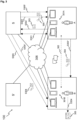
- Fig. 3 shows a structural message flow diagram according to an exemplary embodiment to the present invention.
- This diagram shows an example of how to provide an additional level of security between users by employing a user-to-user authentication.
- This user-to-user authentication helps to authenticate the users between another and in an example uses a two-factor authentication or a biometrical authentication.
- a user-to-user authentication and/or an "on-demand biometrical user-to-user mutual identification service" can be used in a way that users who are involved in an established communication can trigger or request such an authentication from the communication partner at any time.
- the mechanism of such an on-demand authentication is applicable to any communication and/or messaging solution.
- the on-demand user-to-user authentication may provide confidence that the communication partner's account that is used for the communication was not compromised and/or hacked. In other words, the on-demand user-to-user authentication verifies during an ongoing communication that the partner, who is using a specific account, does not only have access to that account at the time of logging in but also during the ongoing communication.
- the on-demand user-to-user authentication may be implemented as an on-demand user account verification.
- FIG. 3 shows a first user A and a second user B.
- the first user A uses first user devices 301A and the second user B uses second user devices 301B as an input/output device.
- first user A and second user B connection 302 of a chat app are established.
- the chat app may comprise an authentication interface (see Fig. 1 reference 103).
- the connection 302 is independent from the device type 301A, 301B that either party is using and may be via a mobile device (mobile phone, tablet, smartwatch, etc.) or the web.
- Fig. 3 without any limitation to the general concept of user-to-user authentication, it is assumed that the account of user B is hacked, or a hacker takes over the account of user B pretending to be user B.
- Each account to which the respective user is logged in is the logical endpoint of the connection 302.
- the first user A may employ an end-to-end mutual biometric authentication service S, for example offered by the operator of the chat platform or by a third-party operator.
- the operator of the on-demand user authentication service S may use the system 100 for user authentication.
- Service S is executed on the system 100. Further services S' may exist which offer similar authentication services.
- S and /or S' comprising an authentication device (such as shown in Fig. 1 with reference 102).
- the first user A authenticates himself or herself against or with the authentication service S, e. g. by using biometrical data.
- the first user A has an account at the authentication service provider.
- This authentication service account may be different to the account used for the communication connection 302.
- the system 100 receives an authentication request for authenticating the second user B from the first user A. This request may be implicitly comprised in an authentication message sent from the first user A to the authentication service S running on the system 100.
- the system 100 may execute an authentication process of the first user A in order to verify that the first user A is registered for the authentication service S.
- the first user A sends in state S302 a request to service S comprising contact data 303 of user B.
- the contact data 303 may comprise an email, a mobile telephone number, a public key, a telephone number and/or a profile image of user B.
- the contact data may be any publicly available contact information that confirms the identity of the real user B.
- This contact data 303 of the second user B provided from the first user A informs service S about the communication partner B with whom user A is supposing to communicate with and the contact data 303 is received in the system 100, e. g. in the input/output device, and forwarded to the authentication device (not shown in Fig. 3 ).
- the service S Upon receiving the authentication request from first user A, the service S sends in state S303, S303', S303" a Token 304 to the second user B wherein the Token 304 is based on and/or addressed by the contact data 303 provided by the first user A.
- the Token 304 is generated in the authentication device of system 100 and may comprise a unique link and/or a code identifying this particular authentication request (see Fig. 3 , 304 is linked to a link icon and QR code icon).
- the Token 304 is either directly sent to the second user B as indicated in state S303 or the Token 304 is indirectly sent via the first user A as indicated by states S303' and S303".
- the Token 304 is intended to be used for authentication of the second user and is returned to the first user A or is directly sent to user B by using the official contact data 303.
- the first user A forwards this Token 304, in particular a link and/or a code, in state S303" to user B.
- service S could also use any platform dependent service as, for example, an IVR service in order to contact the second user B.
- the service S is independent from platforms used by user A.
- the message that is used to send the Token 304 may also comprise a request for authentication. In this way, an authentication process of the second user B based on the Token 304 is invoked. In an alternative example the authentication process is invoked just by receiving the message substantially without any additional request.
- the second user B Upon receiving the Token 304 and/or a corresponding request, the second user B invokes in stage S304 the identification process by using the Token 304.
- the Token 304 comprise a link
- user B follows the received link and may receive a web page referred to by the link.
- the user B and/or a corresponding user device 301B reads the code and starts a corresponding application 305 in order to authenticate user B via the authentication application 305 and/or identification application 305 by using the received code.
- the application 305 may be executed locally on one of the devices 301B of user B.
- user B may receive as Token 304 an automated phone call which is associated with user B and which may ask for a passcode and or recognize a voiceprint of user B.
- the passcode may have been provided in an additional Token 304.
- the authentication process may comprise biometrical identification like fingerprint, face identifier (faceID), voiceprint for authenticating the user B against the service S.
- faceID face identifier
- voiceprint voiceprint
- the Token 304 may be individualized for user B either by providing a code and/or a link to user B which includes a temporally valid feature or by using the fact that user B is already known to service S, e. g. via fingerprint.
- the authentication process may also be provided by different locally distributed services S, S'.
- the result and/or outcome of the authentication process of the second user B is generated by the service S, S' and is provided to the first user A and/or to the second user B as indicated in stage S305' and S305".
- either service S generates the result of the authentication process where user B authenticates against service S, e. g. in case of IVR or a link to a web page.
- user B may use a local authentication application 305 in stage S304
- user B informs service S about the result.
- This result may be a calculated hash or signature that can only be verified by service S. If user B sends the result of a local application 305 running on a user device 301B, user B sends the result together with a requestID and/or a code that was provided by the service S in order to make an association between the request and the result.
- the requestID may be any identifier used to identify a specific Token 304.
- service S After service S has collected the result of the authentication process, service S informs in stage S305' user A about the result of the authentication process and user A can be certain about the identity of B. In addition, in stage S305", service S may also provide the result of the authentication process to user B.
Landscapes
- Engineering & Computer Science (AREA)
- Computer Security & Cryptography (AREA)
- Computer Networks & Wireless Communication (AREA)
- Signal Processing (AREA)
- Theoretical Computer Science (AREA)
- Computer Hardware Design (AREA)
- Software Systems (AREA)
- Physics & Mathematics (AREA)
- General Engineering & Computer Science (AREA)
- General Physics & Mathematics (AREA)
- Telephonic Communication Services (AREA)
Abstract
Description
- The present invention relates to a method and system for user authentication and to a respective program element as well as a computer-readable medium.
- Identity fraud and social hacking are an increasingly threatening security problem. User accounts get hacked or taken over and the communication channel is then used to get security or privacy sensitive data.
- In many cases, access is granted by a username and a password. However, it has been shown this method may include some security issues when more and more digital services are used by customers. For their convenience, users try to simplify the access and users may choose passwords in a way that may allow exploring them by applying simple brute force algorithms. Also, social hacking is an issue. It has been shown that customers still may not be sensitive enough to not provide the username and password to a foreigner.
- This simple way of authentication became a problem especially for online banking services. Thus, driven primarily by the banks, methods for two-factor authentication have been introduced in order to increase the security level.
- However, also two-factor authentication can be a security problem because such methods only protect the access to a service. Once a user has access to a system and/or service no further verification of the user's identity is made.
- The article "WhatsApp Adds Biometric Authentication To Web, Desktop Version", of Jan 28, 2021 and published under https://in.mashable.com/tech/19884/whatsapp-adds-biometric-authentication-to-web-desktop-version", shows how face and fingerprint can be used for unlocking.
- The present invention is based on the object to provide a method and system for user authentication, a respective program element and computer-readable medium which may provide a more efficient authentication.
- The subject-matter of the invention is defined in the independent claims. Further embodiments of the invention are defined in the dependent claims.
- According to an aspect of the present invention a method for user authentication during a connection between a first user and a second user exists and/or is provided. The method comprises receiving an authentication request from the first user for authenticating the second user. The method further comprises executing an authentication process of the first user and receiving contact data of the second user from the first user.
- Then, a Token is sent to the second user wherein the Token is based on and/or addressed by the contact data provided by the first user and executing an authentication process of the second user based on the Token is requested.
- Finally, the method may further comprise generating a result for the authentication process for the second user and providing the result of the authentication process of the second user to the first user and/or to the second user.
- This method may allow to increase the security level even for communication systems that only offer basic authentication mechanisms but can also be used to enhance the security level of systems that are on a higher security level e. g. by using two-factor authentication.
- In addition to a user-to-system authentication in order to get access to the system, further protection may be achieved. In an example, the access to a system, e. g. a chat application, is compromised and/or hacked. After such a successful attack to the system, the other party may not have the possibility to detect such a fraud as they assume after the grant of the access to the system the intended person is using the system. A connection between two parties may only have the user accounts as end points. In this way, once access to the user account is granted any communication may be possible.
- However, the proposed method could make it possible for the other user to trigger a re-authentication with a very high security standard, e. g. using biometric authentication so that both communicating users are authenticated to another and not only to the communication system and in particular to accounts of the communication system.
- In other words, in addition to mechanisms for authenticating users against systems, a mechanism is established that allows for a user-to-user authentication. Typical mechanisms for authenticating users against systems are two-factor authentication mechanisms. Two-factor authentication mechanisms are used to increase the security of users logging on to systems, i. e. further to an authentication by simply using a username and/or password an additional second factor is requested, e. g. a code received via SMS needs to be provided in order to get access to system.
- According to a further aspect of the present invention, the contact data comprises at least one contact data of the list of contact data consisting of an email, a mobile number, a telephone number, and a profile image. In a further example, the contact data may also comprise a public key.
- The contact data thus may be any information usable to reach and/or address the second user. This information may ensure that the second user has access to contact data which is known to be controlled by the second user. In an example contact data differs from account data for the account that is used for the connection between the first and the second user. Consequently, in case the second user can be reached via his or her contact data the reliability of the authenticity of the second user is increased. Particularly the contact data may be contacted during an existing and/or established connection such as a chat and/or a voice call and/or a data call. Thus, the second user may need to react very quickly to information sent via the contact data and the time for manipulating the access data may be short.
- The contact data may differ from information that is used for the two-factor authentication. In such a way, the contact data may allow to establish an additional channel for authentication and/or a further factor of authentication beyond the two-factor authentication that is used to access the account via which the connection with the first user is established. The contact data may be contact data allowing for a contact with a quick response time, i. e. the response time is shorter than the duration of the established connection. In other words, a written letter sent by post and a corresponding postal address may not be appropriate as contact data to be verified during the connection.
- According to another aspect of the present invention, the Token is at least one Token selected from the list of Tokens consisting of a unique link, a call from an Interactive Voice Response system (IVR), a code, a QR (Quick Response) Code, and a Hash Value.
- The Token may be generated very quickly and exist only for a predetermined time range. In this way, the Token may be a temporary identification information that is generated independently from the user. The Token may ensure that the second user is not only reached by his or her contact data but also receives information via the contact data that is only available for a short time and may not be predictable.
- By allowing the first user to choose the type of contact data to authenticate the second user during a connection, the method provides an additional security level as the second user may not predict which contact data the first user choose to authenticate the second user during the connection. In other words, whereas a person may be able to find out access information to compromise the access to the communication system, the online authentication and/or user-to-user authentication may not provide the second user enough time to compromise the additional authentication request which may be difficult to predict.
- According to yet another aspect of the present invention, the Token is sent to the second user directly or via the first user.
- In this way it is possible to ensure that the user-to-user authentication is sent to the second user who actually is in connection with the first user. In one case the actually established connection is used to transfer the Token in-band of the connection and/or communication. In the other case, contact information is used that is known to be associated with the second user.
- According to a further aspect of the present invention, the authentication process of the first user and/or the authentication process of the second user comprises using biometric data.
- Biometric data may provide an additional security level as it may be difficult to manipulate them within a short time frame like, for example, when requested during a communication connection.
- According to an aspect of the present invention, the biometric data is at least a biometric data selected from the group of biometric data consisting of a human pattern, a fingerprint, a face identifier and voiceprint. The biometric data may comprise body features of the user.
- According to a further aspect of the present invention, providing the result of the authentication process comprises providing the Token and/or a requestlD.
- The provision of the Token and/or the requestlD may indicate a successful user-to-user authentication. The requestlD may be an identifier generated by the system.
- According to another aspect of the present invention, a system for user authentication during a connection between a first user and a second user exists is provided. The system comprises an input/output device, an authentication device, wherein the input/output device is adapted for receiving an authentication request from the first user for authenticating the second user.
- The authentication device is adapted for executing an authentication process of the first user wherein the input/output device is further adapted for receiving contact data of the second user from the first user.
- The input/output device is adapted for sending a Token to the second user wherein the Token is based on and/or addressed by the contact data provided by the first user.
- The authentication device is further adapted for requesting the execution and/or executing an authentication process of the second user based on the Token and for generating a result for the authentication process for the second user.
- The input/output device is further adapted for providing the result of the authentication process of the second user to the first user and/or to the second user.
- According to yet another aspect of the present invention, a program element is provided, which when being executed by a processor is adapted to carry out the method for user authentication.
- According to another aspect of the present invention, a computer-readable medium comprising program code is provided, which when being executed by a processor is adapted to carry out the method for user authentication
- A computer-readable medium may be a floppy disk, a hard disk, an USB (Universal Serial Bus) storage device, a RAM (Random Access Memory), a ROM (read only memory), RFID (Radio-Frequency Identification) card or an EPROM (Erasable Programmable Read Only Memory). A computer readable medium may also be a data communication network, e. g. the Internet, which may allow downloading a program code.
- It has also to be noted that aspects of the invention have been described with reference to different subject-matters. In particular, some aspects have been described with reference to apparatus type claims whereas other aspects have been described with reference to method type claims. However, a person skilled in the art will gather from the above and the following description that, unless otherwise notified, in addition to any combination between features belonging to one type of subject-matter also any combination between features relating to different types of subject-matters is considered to be disclosed with this text. In particular combinations between features relating to the apparatus type claims and features relating to the method type claims are considered to be disclosed.
- The invention and embodiments thereof will be described below in further detail in connection with the drawings.
- Fig. 1
- shows a block diagram of a system for user authentication according to an exemplary embodiment of the present invention.
- Fig. 2
- shows a flow chart for a method for user authentication during a connection between a first user and a second user according to an exemplary embodiment of the present invention.
- Fig. 3
- shows a structural message flow diagram according to an exemplary embodiment to the present invention.
- The illustration in the drawings is schematic and may not be to scale. In different drawings, similar or identical elements are provided with the same reference numerals.
-
Fig. 1 shows a block diagram of asystem 100 for user authentication according to an exemplary embodiment of the present invention. - The
system 100 for user authentication during a connection between a first user A and a second user B exists and/or is established comprises an input/output device 101 and anauthentication device 102, wherein the input/output device 101 is adapted for receiving an authentication request from the first user A for authenticating the second user B (the users are not shown inFig. 1 ). The communication of thesystem 100 with the users A, B is made via the input/output interface 103 which may be connected to a voice and/or data network (not shown inFig. 1 ), e. g. to the Internet. - The
authentication device 102 is adapted for executing an authentication process of the first user A wherein the input/output device 101 is further adapted for receiving contact data (not shown inFig. 1 ) of the second user B from the first user A. - The input/
output device 101 is adapted for sending a Token (not shown inFig. 1 ) to the second user wherein the Token is based on and/or addressed by the contact data provided by the first user A. - The
authentication device 102 is further adapted for requesting the execution and/or executing an authentication process of the second user B based on the Token 304 and for generating a result for the authentication process for the second user B. - The input/
output device 101 is further adapted for providing the result of the authentication process of the second user B to the first user A and/or to the second user B. -
Fig. 2 shows a flow chart for a method for user authentication during a connection between a first user A and a second user B exists and/or is established according to an exemplary embodiment of the present invention. - The method starts in an idle state S200. In state S201 an authentication request for authenticating the second user B is received from the first user A.
- In state S202 an authentication process of the first user A is executed with the
system 100 and contact data of the second user B is received by thesystem 100 from the first user A. - In state S203 a Token is sent to the second user B wherein the Token is based on and/or addressed by the contact data provided by the first user A and the execution of an authentication process of the second user B based on the Token is requested.
- In state S204 the method comprises generating a result for the authentication process for the second user B and providing the result of the authentication process of the second user B to the first user A and/or to the second user B.
- In state S205 the method is finished.
-
Fig. 3 shows a structural message flow diagram according to an exemplary embodiment to the present invention. - This diagram shows an example of how to provide an additional level of security between users by employing a user-to-user authentication. This user-to-user authentication helps to authenticate the users between another and in an example uses a two-factor authentication or a biometrical authentication. Such a user-to-user authentication and/or an "on-demand biometrical user-to-user mutual identification service" can be used in a way that users who are involved in an established communication can trigger or request such an authentication from the communication partner at any time. The mechanism of such an on-demand authentication is applicable to any communication and/or messaging solution.
- The on-demand user-to-user authentication may provide confidence that the communication partner's account that is used for the communication was not compromised and/or hacked. In other words, the on-demand user-to-user authentication verifies during an ongoing communication that the partner, who is using a specific account, does not only have access to that account at the time of logging in but also during the ongoing communication. The on-demand user-to-user authentication may be implemented as an on-demand user account verification.
- For demonstrating an example of an "on-demand biometrical user-to-user mutual identification service",
Fig. 3 shows a first user A and a second user B. The first user A usesfirst user devices 301A and the second user B usessecond user devices 301B as an input/output device. - Between first user A and second
user B connection 302 of a chat app is established. Thereby, the chat app may comprise an authentication interface (seeFig. 1 reference 103). Theconnection 302 is independent from thedevice type - For
Fig. 3 without any limitation to the general concept of user-to-user authentication, it is assumed that the account of user B is hacked, or a hacker takes over the account of user B pretending to be user B. Each account to which the respective user is logged in is the logical endpoint of theconnection 302. - During the communication between user A and user B the fraudulent user B sends messages to user A asking for sensitive data. User A is suspicious and now wants to be sure that user B is really user B, i. e. the actual owner of the account which the second user B is using.
- For the verification of the authorization of the second user B and the identity of user B, the first user A may employ an end-to-end mutual biometric authentication service S, for example offered by the operator of the chat platform or by a third-party operator. The operator of the on-demand user authentication service S may use the
system 100 for user authentication. Service S is executed on thesystem 100. Further services S' may exist which offer similar authentication services. - Thus, S and /or S', comprising an authentication device (such as shown in
Fig. 1 with reference 102). - For invoking the on-demand user authentication in state S301 the first user A authenticates himself or herself against or with the authentication service S, e. g. by using biometrical data. In order to use this service, the first user A has an account at the authentication service provider. This authentication service account may be different to the account used for the
communication connection 302. Thesystem 100 receives an authentication request for authenticating the second user B from the first user A. This request may be implicitly comprised in an authentication message sent from the first user A to the authentication service S running on thesystem 100. Thesystem 100 may execute an authentication process of the first user A in order to verify that the first user A is registered for the authentication service S. - Together with the authentication request of user A to the service S or after such an authentication request, the first user A sends in state S302 a request to service S comprising
contact data 303 of user B. - Dependent on the used service S, the
contact data 303 may comprise an email, a mobile telephone number, a public key, a telephone number and/or a profile image of user B. The contact data may be any publicly available contact information that confirms the identity of the real user B. Thiscontact data 303 of the second user B provided from the first user A informs service S about the communication partner B with whom user A is supposing to communicate with and thecontact data 303 is received in thesystem 100, e. g. in the input/output device, and forwarded to the authentication device (not shown inFig. 3 ). - Upon receiving the authentication request from first user A, the service S sends in state S303, S303', S303" a Token 304 to the second user B wherein the Token 304 is based on and/or addressed by the
contact data 303 provided by the first user A. The Token 304 is generated in the authentication device ofsystem 100 and may comprise a unique link and/or a code identifying this particular authentication request (seeFig. 3 , 304 is linked to a link icon and QR code icon). - The Token 304 is either directly sent to the second user B as indicated in state S303 or the Token 304 is indirectly sent via the first user A as indicated by states S303' and S303". In other words, the Token 304 is intended to be used for authentication of the second user and is returned to the first user A or is directly sent to user B by using the
official contact data 303. - If the Token 304 is sent via first user A to second user B, the first user A forwards this Token 304, in particular a link and/or a code, in state S303" to user B.
- If the Token 304 is sent directly from service S to user B, service S could also use any platform dependent service as, for example, an IVR service in order to contact the second user B. Thus, the service S is independent from platforms used by user A.
- The message that is used to send the Token 304 may also comprise a request for authentication. In this way, an authentication process of the second user B based on the Token 304 is invoked. In an alternative example the authentication process is invoked just by receiving the message substantially without any additional request.
- Upon receiving the Token 304 and/or a corresponding request, the second user B invokes in stage S304 the identification process by using the
Token 304. In one example, where the Token 304 comprise a link, user B follows the received link and may receive a web page referred to by the link. - In another example where the Token 304 comprises a code, the user B and/or a
corresponding user device 301B reads the code and starts acorresponding application 305 in order to authenticate user B via theauthentication application 305 and/oridentification application 305 by using the received code. Theapplication 305 may be executed locally on one of thedevices 301B of user B. - In yet another example where an IVR system may be used, user B may receive as Token 304 an automated phone call which is associated with user B and which may ask for a passcode and or recognize a voiceprint of user B. The passcode may have been provided in an
additional Token 304. - In addition to or as an alternative to the previous examples, the authentication process may comprise biometrical identification like fingerprint, face identifier (faceID), voiceprint for authenticating the user B against the service S. Thereby, it is assumed that user B is already known to service S prior to executing the user-to-user authentication. I. e., user A and user B agree at one point that they are using the trusted service S for a potential authentication.
- In an example for the authentication process, the Token 304 may be individualized for user B either by providing a code and/or a link to user B which includes a temporally valid feature or by using the fact that user B is already known to service S, e. g. via fingerprint.
- The authentication process may also be provided by different locally distributed services S, S'.
- The result and/or outcome of the authentication process of the second user B is generated by the service S, S' and is provided to the first user A and/or to the second user B as indicated in stage S305' and S305".
- In other words, either service S generates the result of the authentication process where user B authenticates against service S, e. g. in case of IVR or a link to a web page.
- In another example, where user B may use a
local authentication application 305 in stage S304, user B informs service S about the result. This result may be a calculated hash or signature that can only be verified by service S. If user B sends the result of alocal application 305 running on auser device 301B, user B sends the result together with a requestID and/or a code that was provided by the service S in order to make an association between the request and the result. The requestID may be any identifier used to identify aspecific Token 304. - After service S has collected the result of the authentication process, service S informs in stage S305' user A about the result of the authentication process and user A can be certain about the identity of B. In addition, in stage S305", service S may also provide the result of the authentication process to user B.
- It should be noted that the term "comprising" does not exclude other elements or steps and the "a" or "an" does not exclude a plurality. Further, elements described in association with different embodiments may be combined.
- It should also be noted that reference signs in the claims shall not be construed as limiting the scope of the claims.
-
- 100
- system for user authentication
- 101
- input/output device
- 102
- authentication device
- 103
- input/output interface
- A
- user A
- B
- user B
- S, S'
- authentication service
- 301A
- user devices of user A
- 301B
- user devices of user B
- 302
- connection between user A and user B
- 303
- contact data of user B
- 304
- Token
- 305
- authentication application
- 306
- network
- S200 - S205
- States of a method
- S301 - S305"
- States of a method
Claims (10)
- A method for user authentication during a connection between a first user (A) and a second user (B) exists, wherein the method comprises:- receiving an authentication request from the first user (A) for authenticating the second user (B);- executing an authentication process of the first user (A);- receiving contact data of the second user (B) from the first user (A);- sending a Token (304) to the second user (B) wherein the Token (304) is based on and/or addressed by the contact data (303) provided by the first user (A);- requesting executing an authentication process of the second user (B) based on the Token (304);- generating a result for the authentication process for the second user (B);- providing the result of the authentication process of the second user (B) to the first user (A) and/or to the second user (B).
- The method of claim 1, wherein the contact data (303) comprises at least a contact data (303) of the list of contact data consisting of:- an email,- a mobile number,- a telephone number, and- a profile image.
- The method of claim 1 or 2, wherein the Token (304) is at least one Token selected from the list of Tokens (304) consisting of:- a unique link,- a call from an Interactive Voice Response system,- a code,- a QR Code, and- a Hash Value.
- The method of one of claims 1 to 3, wherein the Token (304) is sent to the second user (B) directly or via the first user (A).
- The method of one of claims 1 to 4, wherein the authentication process of the first user (A) and/or the authentication process of the second user (B) comprises using biometric data.
- The method of claim 5, wherein biometric data is at least a biometric data selected from the group of biometric data consisting of:- a human pattern,- a fingerprint,- a face identifier, and- voiceprint.
- The method of one of claims 1 to 6, wherein providing the result of the authentication process comprises providing the Token (304) and/or a requestlD.
- A system (100) for user authentication during a connection between a first user (A) and a second user (B) exists, comprising:- an input/output device (101);- an authentication device (102);wherein the input/output device (101) is adapted for receiving an authentication request from the first user (A) for authenticating the second user (B);wherein the authentication device is adapted for executing an authentication process of the first user (A);wherein the input/output device is further adapted for receiving contact data of the second user (B) from the first user (A); andwherein the input/output device is adapted for sending a Token (304) to the second user (B) wherein the Token (304) is based on and/or addressed by the contact data provided by the first user (A);wherein the authentication device is adapted for requesting executing an authentication process of the second user (B) based on the Token (304); andfor generating a result for the authentication process for the second user (B); wherein the input/output device is adapted for providing the result of the authentication process of the second user (B) to the first user (A) and/or to the second user (B).
- Program element, which when being executed by a processor is adapted to carry out the method for user authentication of one of claims 1 to 7.
- Computer-readable medium comprising program code, which when being executed by a processor is adapted to carry out the method for user authentication of one of claims 1 to 7.
Priority Applications (2)
| Application Number | Priority Date | Filing Date | Title |
|---|---|---|---|
| EP21211517.4A EP4187842B1 (en) | 2021-11-30 | 2021-11-30 | Method and system for user authentication |
| US17/966,955 US12488080B2 (en) | 2021-11-30 | 2022-10-17 | Method and system for user authentication |
Applications Claiming Priority (1)
| Application Number | Priority Date | Filing Date | Title |
|---|---|---|---|
| EP21211517.4A EP4187842B1 (en) | 2021-11-30 | 2021-11-30 | Method and system for user authentication |
Publications (2)
| Publication Number | Publication Date |
|---|---|
| EP4187842A1 true EP4187842A1 (en) | 2023-05-31 |
| EP4187842B1 EP4187842B1 (en) | 2026-03-04 |
Family
ID=78820145
Family Applications (1)
| Application Number | Title | Priority Date | Filing Date |
|---|---|---|---|
| EP21211517.4A Active EP4187842B1 (en) | 2021-11-30 | 2021-11-30 | Method and system for user authentication |
Country Status (2)
| Country | Link |
|---|---|
| US (1) | US12488080B2 (en) |
| EP (1) | EP4187842B1 (en) |
Families Citing this family (1)
| Publication number | Priority date | Publication date | Assignee | Title |
|---|---|---|---|---|
| US20260129439A1 (en) * | 2024-11-05 | 2026-05-07 | At&T Intellectual Property I, L.P. | Identity verification for call-based protected data transmission over network |
Citations (2)
| Publication number | Priority date | Publication date | Assignee | Title |
|---|---|---|---|---|
| US20140101453A1 (en) * | 2012-10-04 | 2014-04-10 | Msi Security, Ltd. | Real identity authentication |
| US20170346851A1 (en) * | 2016-05-30 | 2017-11-30 | Christopher Nathan Tyrwhitt Drake | Mutual authentication security system with detection and mitigation of active man-in-the-middle browser attacks, phishing, and malware and other security improvements. |
Family Cites Families (3)
| Publication number | Priority date | Publication date | Assignee | Title |
|---|---|---|---|---|
| US20150237045A1 (en) * | 2014-02-18 | 2015-08-20 | Werner Blessing | Method and system for enhanced biometric authentication |
| US20220329581A1 (en) * | 2021-04-12 | 2022-10-13 | Capital One Services, Llc | Authentication of an untrusted user device |
| US12299089B2 (en) * | 2021-06-30 | 2025-05-13 | Capital One Services, Llc | Enabling a function of an application based on a characteristic of a user device |
-
2021
- 2021-11-30 EP EP21211517.4A patent/EP4187842B1/en active Active
-
2022
- 2022-10-17 US US17/966,955 patent/US12488080B2/en active Active
Patent Citations (2)
| Publication number | Priority date | Publication date | Assignee | Title |
|---|---|---|---|---|
| US20140101453A1 (en) * | 2012-10-04 | 2014-04-10 | Msi Security, Ltd. | Real identity authentication |
| US20170346851A1 (en) * | 2016-05-30 | 2017-11-30 | Christopher Nathan Tyrwhitt Drake | Mutual authentication security system with detection and mitigation of active man-in-the-middle browser attacks, phishing, and malware and other security improvements. |
Non-Patent Citations (1)
| Title |
|---|
| WHATSAPP ADDS BIOMETRIC AUTHENTICATION TO WEB, DESKTOP VERSION, 28 January 2021 (2021-01-28), Retrieved from the Internet <URL:https://in.mashable.com/tech/19884/whatsapp-adds-biometric-authentication-to-web-desktop-version> |
Also Published As
| Publication number | Publication date |
|---|---|
| US20230169160A1 (en) | 2023-06-01 |
| US12488080B2 (en) | 2025-12-02 |
| EP4187842B1 (en) | 2026-03-04 |
Similar Documents
| Publication | Publication Date | Title |
|---|---|---|
| US8751801B2 (en) | System and method for authenticating users using two or more factors | |
| EP1829281B1 (en) | Authentication device and/or method | |
| EP2643787B1 (en) | Handling encoded information | |
| EP3138265B1 (en) | Enhanced security for registration of authentication devices | |
| US20190281028A1 (en) | System and method for decentralized authentication using a distributed transaction-based state machine | |
| US8869238B2 (en) | Authentication using a turing test to block automated attacks | |
| US9628460B2 (en) | Method of controlling access to an internet-based application | |
| CN103380592B (en) | Method, server and system for personal authentication | |
| EP2999189A1 (en) | Network authentication method for secure electronic transactions | |
| CN105959287A (en) | Biological feature based safety certification method and device | |
| US20200196143A1 (en) | Public key-based service authentication method and system | |
| US20100291899A1 (en) | Method and system for delivering a command to a mobile device | |
| CN103119975A (en) | User Account Recovery | |
| US20090220075A1 (en) | Multifactor authentication system and methodology | |
| TW201544983A (en) | Data communication method and system, client and server | |
| WO2010128451A2 (en) | Methods of robust multi-factor authentication and authorization and systems thereof | |
| EP4187842B1 (en) | Method and system for user authentication | |
| KR100868367B1 (en) | Fingerprint information based authentication method and authentication system | |
| WO2013118302A1 (en) | Authentication management system, authentication management method, and authentication management program | |
| US20160021102A1 (en) | Method and device for authenticating persons | |
| KR20140121222A (en) | User authentication system and providing method thereof | |
| KR20150013926A (en) | User authentication system and providing method thereof | |
| EP2860935B1 (en) | A computer implemented method to prevent attacks against authorization systems and computer programs products thereof | |
| KR20180037169A (en) | User authentication method and system using one time password | |
| Pulko et al. | USER AUTHENTICATION IN INFORMATION SYSTEMS |
Legal Events
| Date | Code | Title | Description |
|---|---|---|---|
| PUAI | Public reference made under article 153(3) epc to a published international application that has entered the european phase |
Free format text: ORIGINAL CODE: 0009012 |
|
| STAA | Information on the status of an ep patent application or granted ep patent |
Free format text: STATUS: THE APPLICATION HAS BEEN PUBLISHED |
|
| AK | Designated contracting states |
Kind code of ref document: A1 Designated state(s): AL AT BE BG CH CY CZ DE DK EE ES FI FR GB GR HR HU IE IS IT LI LT LU LV MC MK MT NL NO PL PT RO RS SE SI SK SM TR |
|
| STAA | Information on the status of an ep patent application or granted ep patent |
Free format text: STATUS: REQUEST FOR EXAMINATION WAS MADE |
|
| 17P | Request for examination filed |
Effective date: 20231013 |
|
| RBV | Designated contracting states (corrected) |
Designated state(s): AL AT BE BG CH CY CZ DE DK EE ES FI FR GB GR HR HU IE IS IT LI LT LU LV MC MK MT NL NO PL PT RO RS SE SI SK SM TR |
|
| RAP1 | Party data changed (applicant data changed or rights of an application transferred) |
Owner name: UNIFY BETEILIGUNGSVERWALTUNG GMBH & CO. KG |
|
| GRAP | Despatch of communication of intention to grant a patent |
Free format text: ORIGINAL CODE: EPIDOSNIGR1 |
|
| STAA | Information on the status of an ep patent application or granted ep patent |
Free format text: STATUS: GRANT OF PATENT IS INTENDED |
|
| RIC1 | Information provided on ipc code assigned before grant |
Ipc: H04L 9/32 20060101AFI20251110BHEP Ipc: H04L 51/18 20220101ALI20251110BHEP Ipc: H04L 51/046 20220101ALI20251110BHEP |
|
| INTG | Intention to grant announced |
Effective date: 20251125 |
|
| GRAS | Grant fee paid |
Free format text: ORIGINAL CODE: EPIDOSNIGR3 |
|
| GRAA | (expected) grant |
Free format text: ORIGINAL CODE: 0009210 |
|
| STAA | Information on the status of an ep patent application or granted ep patent |
Free format text: STATUS: THE PATENT HAS BEEN GRANTED |
|
| AK | Designated contracting states |
Kind code of ref document: B1 Designated state(s): AL AT BE BG CH CY CZ DE DK EE ES FI FR GB GR HR HU IE IS IT LI LT LU LV MC MK MT NL NO PL PT RO RS SE SI SK SM TR |
|
| REG | Reference to a national code |
Ref country code: CH Ref legal event code: F10 Free format text: ST27 STATUS EVENT CODE: U-0-0-F10-F00 (AS PROVIDED BY THE NATIONAL OFFICE) Effective date: 20260304 Ref country code: GB Ref legal event code: FG4D |
|
| REG | Reference to a national code |
Ref country code: DE Ref legal event code: R096 Ref document number: 602021049125 Country of ref document: DE |
|
| REG | Reference to a national code |
Ref country code: IE Ref legal event code: FG4D |
|
| PG25 | Lapsed in a contracting state [announced via postgrant information from national office to epo] |
Ref country code: RS Free format text: LAPSE BECAUSE OF FAILURE TO SUBMIT A TRANSLATION OF THE DESCRIPTION OR TO PAY THE FEE WITHIN THE PRESCRIBED TIME-LIMIT Effective date: 20260604 |
|
| PG25 | Lapsed in a contracting state [announced via postgrant information from national office to epo] |
Ref country code: ES Free format text: LAPSE BECAUSE OF FAILURE TO SUBMIT A TRANSLATION OF THE DESCRIPTION OR TO PAY THE FEE WITHIN THE PRESCRIBED TIME-LIMIT Effective date: 20260304 |
|
| REG | Reference to a national code |
Ref country code: NL Ref legal event code: MP Effective date: 20260304 |
|
| PG25 | Lapsed in a contracting state [announced via postgrant information from national office to epo] |
Ref country code: PL Free format text: LAPSE BECAUSE OF FAILURE TO SUBMIT A TRANSLATION OF THE DESCRIPTION OR TO PAY THE FEE WITHIN THE PRESCRIBED TIME-LIMIT Effective date: 20260304 |
|
| PG25 | Lapsed in a contracting state [announced via postgrant information from national office to epo] |
Ref country code: GR Free format text: LAPSE BECAUSE OF FAILURE TO SUBMIT A TRANSLATION OF THE DESCRIPTION OR TO PAY THE FEE WITHIN THE PRESCRIBED TIME-LIMIT Effective date: 20260605 |
|
| REG | Reference to a national code |
Ref country code: LT Ref legal event code: MG9D |
|
| PG25 | Lapsed in a contracting state [announced via postgrant information from national office to epo] |
Ref country code: LT Free format text: LAPSE BECAUSE OF FAILURE TO SUBMIT A TRANSLATION OF THE DESCRIPTION OR TO PAY THE FEE WITHIN THE PRESCRIBED TIME-LIMIT Effective date: 20260304 |
|
| PG25 | Lapsed in a contracting state [announced via postgrant information from national office to epo] |
Ref country code: NO Free format text: LAPSE BECAUSE OF FAILURE TO SUBMIT A TRANSLATION OF THE DESCRIPTION OR TO PAY THE FEE WITHIN THE PRESCRIBED TIME-LIMIT Effective date: 20260604 |
|
| PG25 | Lapsed in a contracting state [announced via postgrant information from national office to epo] |
Ref country code: SE Free format text: LAPSE BECAUSE OF FAILURE TO SUBMIT A TRANSLATION OF THE DESCRIPTION OR TO PAY THE FEE WITHIN THE PRESCRIBED TIME-LIMIT Effective date: 20260304 Ref country code: FI Free format text: LAPSE BECAUSE OF FAILURE TO SUBMIT A TRANSLATION OF THE DESCRIPTION OR TO PAY THE FEE WITHIN THE PRESCRIBED TIME-LIMIT Effective date: 20260304 |
|
| PG25 | Lapsed in a contracting state [announced via postgrant information from national office to epo] |
Ref country code: HR Free format text: LAPSE BECAUSE OF FAILURE TO SUBMIT A TRANSLATION OF THE DESCRIPTION OR TO PAY THE FEE WITHIN THE PRESCRIBED TIME-LIMIT Effective date: 20260304 |
|
| PG25 | Lapsed in a contracting state [announced via postgrant information from national office to epo] |
Ref country code: LV Free format text: LAPSE BECAUSE OF FAILURE TO SUBMIT A TRANSLATION OF THE DESCRIPTION OR TO PAY THE FEE WITHIN THE PRESCRIBED TIME-LIMIT Effective date: 20260304 |
|
| PG25 | Lapsed in a contracting state [announced via postgrant information from national office to epo] |
Ref country code: BG Free format text: LAPSE BECAUSE OF FAILURE TO SUBMIT A TRANSLATION OF THE DESCRIPTION OR TO PAY THE FEE WITHIN THE PRESCRIBED TIME-LIMIT Effective date: 20260304 |