EP4187669B1 - Secondary battery, battery module, battery pack, and power-consuming apparatus - Google Patents
Secondary battery, battery module, battery pack, and power-consuming apparatus Download PDFInfo
- Publication number
- EP4187669B1 EP4187669B1 EP21925088.3A EP21925088A EP4187669B1 EP 4187669 B1 EP4187669 B1 EP 4187669B1 EP 21925088 A EP21925088 A EP 21925088A EP 4187669 B1 EP4187669 B1 EP 4187669B1
- Authority
- EP
- European Patent Office
- Prior art keywords
- secondary battery
- positive electrode
- battery
- general formula
- electrolytic solution
- Prior art date
- Legal status (The legal status is an assumption and is not a legal conclusion. Google has not performed a legal analysis and makes no representation as to the accuracy of the status listed.)
- Active
Links
Images
Classifications
-
- H—ELECTRICITY
- H01—ELECTRIC ELEMENTS
- H01M—PROCESSES OR MEANS, e.g. BATTERIES, FOR THE DIRECT CONVERSION OF CHEMICAL ENERGY INTO ELECTRICAL ENERGY
- H01M10/00—Secondary cells; Manufacture thereof
- H01M10/05—Accumulators with non-aqueous electrolyte
- H01M10/052—Li-accumulators
-
- H—ELECTRICITY
- H01—ELECTRIC ELEMENTS
- H01M—PROCESSES OR MEANS, e.g. BATTERIES, FOR THE DIRECT CONVERSION OF CHEMICAL ENERGY INTO ELECTRICAL ENERGY
- H01M10/00—Secondary cells; Manufacture thereof
- H01M10/05—Accumulators with non-aqueous electrolyte
- H01M10/052—Li-accumulators
- H01M10/0525—Rocking-chair batteries, i.e. batteries with lithium insertion or intercalation in both electrodes; Lithium-ion batteries
-
- H—ELECTRICITY
- H01—ELECTRIC ELEMENTS
- H01M—PROCESSES OR MEANS, e.g. BATTERIES, FOR THE DIRECT CONVERSION OF CHEMICAL ENERGY INTO ELECTRICAL ENERGY
- H01M10/00—Secondary cells; Manufacture thereof
- H01M10/05—Accumulators with non-aqueous electrolyte
- H01M10/056—Accumulators with non-aqueous electrolyte characterised by the materials used as electrolytes, e.g. mixed inorganic/organic electrolytes
- H01M10/0564—Accumulators with non-aqueous electrolyte characterised by the materials used as electrolytes, e.g. mixed inorganic/organic electrolytes the electrolyte being constituted of organic materials only
- H01M10/0566—Liquid materials
- H01M10/0567—Liquid materials characterised by the additives
-
- H—ELECTRICITY
- H01—ELECTRIC ELEMENTS
- H01M—PROCESSES OR MEANS, e.g. BATTERIES, FOR THE DIRECT CONVERSION OF CHEMICAL ENERGY INTO ELECTRICAL ENERGY
- H01M10/00—Secondary cells; Manufacture thereof
- H01M10/05—Accumulators with non-aqueous electrolyte
- H01M10/056—Accumulators with non-aqueous electrolyte characterised by the materials used as electrolytes, e.g. mixed inorganic/organic electrolytes
- H01M10/0564—Accumulators with non-aqueous electrolyte characterised by the materials used as electrolytes, e.g. mixed inorganic/organic electrolytes the electrolyte being constituted of organic materials only
- H01M10/0566—Liquid materials
- H01M10/0568—Liquid materials characterised by the solutes
-
- H—ELECTRICITY
- H01—ELECTRIC ELEMENTS
- H01M—PROCESSES OR MEANS, e.g. BATTERIES, FOR THE DIRECT CONVERSION OF CHEMICAL ENERGY INTO ELECTRICAL ENERGY
- H01M4/00—Electrodes
- H01M4/02—Electrodes composed of, or comprising, active material
- H01M4/36—Selection of substances as active materials, active masses, active liquids
- H01M4/48—Selection of substances as active materials, active masses, active liquids of inorganic oxides or hydroxides
- H01M4/485—Selection of substances as active materials, active masses, active liquids of inorganic oxides or hydroxides of mixed oxides or hydroxides for inserting or intercalating light metals, e.g. LiTi2O4 or LiTi2OxFy
-
- H—ELECTRICITY
- H01—ELECTRIC ELEMENTS
- H01M—PROCESSES OR MEANS, e.g. BATTERIES, FOR THE DIRECT CONVERSION OF CHEMICAL ENERGY INTO ELECTRICAL ENERGY
- H01M4/00—Electrodes
- H01M4/02—Electrodes composed of, or comprising, active material
- H01M4/36—Selection of substances as active materials, active masses, active liquids
- H01M4/48—Selection of substances as active materials, active masses, active liquids of inorganic oxides or hydroxides
- H01M4/50—Selection of substances as active materials, active masses, active liquids of inorganic oxides or hydroxides of manganese
- H01M4/505—Selection of substances as active materials, active masses, active liquids of inorganic oxides or hydroxides of manganese of mixed oxides or hydroxides containing manganese for inserting or intercalating light metals, e.g. LiMn2O4 or LiMn2OxFy
-
- H—ELECTRICITY
- H01—ELECTRIC ELEMENTS
- H01M—PROCESSES OR MEANS, e.g. BATTERIES, FOR THE DIRECT CONVERSION OF CHEMICAL ENERGY INTO ELECTRICAL ENERGY
- H01M4/00—Electrodes
- H01M4/02—Electrodes composed of, or comprising, active material
- H01M4/36—Selection of substances as active materials, active masses, active liquids
- H01M4/48—Selection of substances as active materials, active masses, active liquids of inorganic oxides or hydroxides
- H01M4/52—Selection of substances as active materials, active masses, active liquids of inorganic oxides or hydroxides of nickel, cobalt or iron
- H01M4/525—Selection of substances as active materials, active masses, active liquids of inorganic oxides or hydroxides of nickel, cobalt or iron of mixed oxides or hydroxides containing iron, cobalt or nickel for inserting or intercalating light metals, e.g. LiNiO2, LiCoO2 or LiCoOxFy
-
- H—ELECTRICITY
- H01—ELECTRIC ELEMENTS
- H01M—PROCESSES OR MEANS, e.g. BATTERIES, FOR THE DIRECT CONVERSION OF CHEMICAL ENERGY INTO ELECTRICAL ENERGY
- H01M4/00—Electrodes
- H01M4/02—Electrodes composed of, or comprising, active material
- H01M2004/021—Physical characteristics, e.g. porosity, surface area
-
- H—ELECTRICITY
- H01—ELECTRIC ELEMENTS
- H01M—PROCESSES OR MEANS, e.g. BATTERIES, FOR THE DIRECT CONVERSION OF CHEMICAL ENERGY INTO ELECTRICAL ENERGY
- H01M4/00—Electrodes
- H01M4/02—Electrodes composed of, or comprising, active material
- H01M2004/026—Electrodes composed of, or comprising, active material characterised by the polarity
- H01M2004/028—Positive electrodes
-
- H—ELECTRICITY
- H01—ELECTRIC ELEMENTS
- H01M—PROCESSES OR MEANS, e.g. BATTERIES, FOR THE DIRECT CONVERSION OF CHEMICAL ENERGY INTO ELECTRICAL ENERGY
- H01M2220/00—Batteries for particular applications
- H01M2220/20—Batteries in motive systems, e.g. vehicle, ship, plane
-
- H—ELECTRICITY
- H01—ELECTRIC ELEMENTS
- H01M—PROCESSES OR MEANS, e.g. BATTERIES, FOR THE DIRECT CONVERSION OF CHEMICAL ENERGY INTO ELECTRICAL ENERGY
- H01M2300/00—Electrolytes
- H01M2300/0017—Non-aqueous electrolytes
- H01M2300/0025—Organic electrolyte
-
- Y—GENERAL TAGGING OF NEW TECHNOLOGICAL DEVELOPMENTS; GENERAL TAGGING OF CROSS-SECTIONAL TECHNOLOGIES SPANNING OVER SEVERAL SECTIONS OF THE IPC; TECHNICAL SUBJECTS COVERED BY FORMER USPC CROSS-REFERENCE ART COLLECTIONS [XRACs] AND DIGESTS
- Y02—TECHNOLOGIES OR APPLICATIONS FOR MITIGATION OR ADAPTATION AGAINST CLIMATE CHANGE
- Y02E—REDUCTION OF GREENHOUSE GAS [GHG] EMISSIONS, RELATED TO ENERGY GENERATION, TRANSMISSION OR DISTRIBUTION
- Y02E60/00—Enabling technologies; Technologies with a potential or indirect contribution to GHG emissions mitigation
- Y02E60/10—Energy storage using batteries
Definitions
- the present application relates to the field of secondary battery technologies, and in particular, to a secondary battery as specified in claims 1-10, a battery module as specified in claim 11, a battery pack as specified in claim 12, and a power consumption apparatus as specified in claim 13.
- the secondary batteries are widely applied to energy storage power systems, such as hydraulic power, thermal power, wind power and solar power plants, as well as many fields, such as electric tools, electric bicycles, electric motorcycles, electric vehicles, military equipment and aerospace. Due to the great development and demands of the secondary batteries, higher requirements are put forward for their energy density, cycle performance, safety performance and the like, and there are more expectations for the improvement of their cost performance.
- a positive electrode in a secondary battery, especially in a lithium-ion secondary battery, a positive electrode is in a high SOC during charging and storage, and interface oxidation activity between the positive electrode and a solvent is high.
- An oxidation decomposition reaction occurs after the solvent contacts a positive interface, which leads to an unstable structure of a positive electrode material and reduction of a lithiation/delithiation capability and speed, and further leads to continuous self-discharge in an interior of a battery cell of the secondary battery and acceleration of reduction of the secondary battery life.
- gas generated at the interface due to the reaction between the solvent and the positive interface also leads to an increase of impedance of the positive interface.
- CN111293357 A describes a non-aqueous electrolyte.
- the electrolyte comprises lithium salt, an organic solvent and an additive.
- EP3205655 A1 relates to an organic electrolytic solution, comprising: - a first lithium salt, - an organic solvent, and a tetraoxide-tetraoxa-dithiaspiroalkane derivative and lithium battery comprising such an electrolytic solution.
- CN110021785 A belongs to the technical field of lithium ion batteries, and particularly relates to a ternary high-voltage lithium ion battery non-aqueous electrolyte and a ternary high-voltage lithium-ion battery.
- EP2905836 A1 relates to a non-aqueous electrolyte secondary battery having a relatively low direct-current resistance after being charged and discharged repeatedly.
- CN112349958 A and US2022158242 A1 relate to an electrolyte and a preparation method thereof and a lithium ion battery.
- CN109273710 describes a preparation method of doped-coated monocrystalline ternary cathode material in the technical field of lithium ion batteries.
- EP3561920 A1 relates to a positive electrode active material, method for preparing the same, and lithium secondary battery comprising the same.
- CN104718658 A and EP2913880 A1 mention a nonaqueous electrolyte secondary battery which is suppressed in an increase of the direct-current resistance after being left under a relatively high temperature environment with low remaining battery power.
- CN110518232A and EP3951946 A1 state positive electrode active material, positive electrode pole, lithium ion secondary battery and apparatus thereof.
- CN112400249 A and US2022115695 A1 relate to electrolyte and electrochemical device comprising the same.
- CN105409049 A and EP3007263 A1 relate to non-aqueous electrolyte secondary battery and production method for non-aqueous electrolyte secondary battery.
- JP2015162289 A relates to non-aqueous electrolyte for batteries, and lithium secondary battery.
- an electrolytic solution and a positive interface are physically separated generally by performing doping or various coatings on a positive electrode material to obtain a stable positive structure.
- problems in these technologies since a coating layer is easily broken, interface reactions occur continuously once it is broken, self-discharge of a battery cell is serious, and the battery life is rapidly reduced; or due to a small amount of doping or coating substances added, the protection is insufficient, resulting in limited improvement of battery performance; or even if the amount of the doping or coating substances added is sufficient to form a stable interface protective film, interface impedance seriously deteriorates by the protective film. Therefore, the existing technology for processing positive electrode materials still needs to be improved.
- the claimed subject-matter is defined by the appended claims.
- the embodiments of the present disclosure are not to be regarded as necessarily defining claimed subject-matter unless they fall within the scope of the appended claims.
- Embodiments not falling within the terms of the claims are to be understood as background art or examples useful for understanding the claimed subject-matter.
- the present application is made in view of the foregoing technical problems, and the objective is to provide a secondary battery, which reduces the cost of the secondary battery, effectively reduces a self-discharge rate of a battery cell, and improves a storage impedance growth rate of the battery cell, and has good rate discharge capacity efficiency.
- the inventor of the present application has conducted an intensive study, and found that the foregoing technical problems can be solved by adjusting a specific metallic element in a positive electrode material of the second battery and cooperatively using a specific additive in an electrolytic solution.
- a secondary battery including: a positive electrode sheet, a negative electrode sheet, and an electrolytic solution,
- the cost of a positive electrode material can be reduced; by including Al in the positive active material and appropriately adjusting a content of Al, a degree of mixed arrangement of Li/Ni can be reduced due to the reduction of the content of Co, and structural stability and an ion-conducting capability of the positive electrode material can be improved; and further, by including a compound represented by the foregoing general formula (I) in an electrolytic solution, a chelate can be formed by the compound represented by the foregoing general formula (I) and Al to effectively stabilize an element Al on a surface of the positive electrode material and separate the electrolytic solution from a positive interface, reducing interfacial side reactions, so that a secondary battery, which reduces the cost of the secondary battery, effectively reduces a self-discharge rate of a battery cell, and improves a storage impedance growth rate of the battery cell, and improves rate discharge capacity efficiency, can be obtained.
- a mass percent content of the compound of the general formula (I) in the electrolytic solution is 0.01% ⁇ 15%, optionally 0.1% ⁇ 10%, and further optionally 0.5%-5%
- the reduction of the self-discharge rate of the secondary battery, the reduction of the storage impedance growth rate of the battery cell, and the improvement of the rate discharge capacity efficiency can be achieved in a balanced manner.
- a 1 ⁇ A 4 each are independently a single bond or an alkylene group with 1 ⁇ 3 carbon atom(s), further optionally a single bond or methylene.
- R 2 is or where R 3 is an alkylene group or alkyleneoxy group with 1 or 2 carbon atoms.
- a chelate can be formed by the compound represented by the foregoing general formula (I) and Al to effectively stabilize the surface of the positive electrode material and separate the electrolytic solution from the positive interface, thereby effectively reducing the self-discharge rate of the battery cell, improving the storage impedance growth rate of the battery cell, and improving the rate discharge capacity efficiency of the battery.
- the compound represented by the general formula (I) is selected from at least one of the following compounds 1-18,
- the surface of the positive electrode material can be further stabilized, the self-discharge rate of the battery cell can be reduced, the storage impedance growth rate of the battery cell can be improved, and the rate discharge capacity efficiency can be improved.
- the mass content of the element Al satisfies 1000ppm ⁇ Al ⁇ 10000ppm, further optionally 1000ppm ⁇ Al ⁇ 7000ppm.
- the self-discharge rate of the battery cell can be further reduced, the storage impedance growth rate of the battery cell can be improved, and the rate discharge capacity efficiency can be improved.
- the electrolytic solution further includes another additive selected from at least one of lithium tetrafluoroborate, lithium bis(oxalato)borate, lithium difluorooxalatoborate, and tris(trimethylsilyl)borate.
- another additive selected from at least one of lithium tetrafluoroborate, lithium bis(oxalato)borate, lithium difluorooxalatoborate, and tris(trimethylsilyl)borate.
- a mass percent content of a total amount of the another additive in the electrolytic solution is 0.2%-3%. Accordingly, the self-discharge rate of the battery cell can be further reduced, the storage impedance growth rate of the battery cell can be improved, and the rate discharge capacity efficiency can be improved.
- a specific surface area of the positive active material is 0.5 ⁇ 3m 2 /g, optionally 0.5 ⁇ 2.5m 2 /g. Accordingly, the needs for rapid transport of lithium ions and control of side reactions on the positive surface can be met in a balanced manner, and the need for high-rate charging and discharging of the battery cell can be met.
- a battery module is further provided, including the secondary battery according to the first aspect of the present application.
- a battery pack is further provided, including the battery module according to the second aspect of the present application.
- a power consumption apparatus including the secondary battery according to the first aspect, the battery module according to the second aspect or the battery pack according to the third aspect of the present application.
- the battery module, the battery pack, and the power consumption apparatus in the present application include the secondary battery according to the first aspect of the present application, and thus have at least the same or similar technical effects as the foregoing secondary battery.
- 1 battery pack 2 upper box body; 3 lower box body; 4 battery module; 5 secondary battery; 51 housing; 52 electrode assembly; 53 top cover assembly.
- a “range” disclosed herein is defined in the form of a lower limit and an upper limit.
- a given range is defined by selecting a lower limit and an upper limit, and the selected lower limit and upper limit define a boundary of a particular range.
- the range defined in this manner may or may not include end values, and may be combined arbitrarily, that is, any lower limit may be combined with any upper limit to form a range. For example, if ranges of 60-120 and 80-110 are listed for a particular parameter, it is understood that ranges of 60-110 and 80-120 are also contemplated.
- a numerical range "a-b" represents an abbreviated representation of any combination of real numbers between a and b, where both a and b are real numbers.
- a numerical range "0-5" means that all real numbers between "0-5" have been listed herein, and "0-5" is just an abbreviated representation of a combination of these numerical values.
- a certain parameter is expressed as an integer ⁇ 2, it is equivalent to disclosing that the parameter is, for example, an integer of 2, 3, 4, 5, 6, 7, 8, 9, 10, 11, 12, or the like.
- a method includes steps (a) and (b), which means that the method may include steps (a) and (b) performed sequentially, or steps (b) and (a) performed sequentially.
- the method mentioned may further include step (c), which means that step (c) may be added to the method in any order, for example, the method may include steps (a), (b) and (c), steps (a), (c) and (b), steps (c), (a) and (b), or the like.
- the term "or” is inclusive.
- the phrase “A or B” means “A, B or both A and B”. More particularly, a condition "A or B” is satisfied by any one of the following: A is true (or present) and B is false (or not present); A is false (or not present) and B is true (or present); or both A and B are true (or present).
- the present application provides a secondary battery, and as an example, the present application provides a lithium-ion secondary battery.
- a secondary battery of the present application includes: a positive electrode sheet, a negative electrode sheet, and an electrolytic solution, where the positive electrode sheet includes a positive active material; in the positive active material, a contained molar ratio of an element Co satisfies: Co ⁇ 0.09, and a mass content of an element Al satisfies: 500ppm ⁇ A1 ⁇ 10000ppm; and in addition, the electrolytic solution includes a compound represented by the following general formula (I); and in the general formula (I), A 1 ⁇ A 4 each are independently a single bond or an alkylene group with 1 ⁇ 5 carbon atom(s), R 1 and R 1 ' each are independently or and R 2 is or , where R 3 is an alkylene group or alkyleneoxy group with 1 ⁇ 3 carbon atom(s).
- a secondary battery which reduces the cost of the secondary battery, effectively reduces a self-discharge rate of a battery cell, improves a storage impedance growth rate of the battery cell, and has good rate discharge capacity efficiency, can be obtained by reducing a content of an element Co in a positive active material of the second battery, including an appropriate amount of an element Al, and further including a compound represented by the general formula (I) in an electrolytic solution.
- the cost of a positive electrode material is the highest in the composition of a secondary battery, for example, in a lithium-ion secondary battery, the price of an element cobalt in a ternary positive electrode is the highest and fluctuates greatly and the cobalt is scarce, the reduction of a content of the element cobalt can significantly reduce the cost of the secondary battery.
- the reduction of the content of the element cobalt may not only reduce an electron-conducting capacity of a ternary positive electrode material, but also increase a phenomenon of mixed arrangement of Li/Ni, restrict solid-state migration and diffusion of lithium ions, and reduce ion transport performance of the positive electrode material.
- the mixed arrangement of Li/Ni may lead to an irreversible phase transformation of the positive electrode material, aggravate breakage of positive particles and expose many fresh surfaces, so that side reactions between a positive active material and an electrolytic solution occur continuously at an interface between the positive electrode material and the electrolytic solution, which leads to continuous self-discharge in an interior of a battery cell and a significant increase in impedance.
- the compound represented by the foregoing general formula (I) in the electrolytic solution can be directionally bonded to Al on the positive surface to form a chelate structure during the first charging, and at the same time, double rings are ring-opened and bonded to each other into a three-dimensional network structure to cover surfaces of positive particles, which can effectively stabilize the element Al on the surface of the positive electrode material and separate the electrolytic solution from the positive interface.
- the cooperation relationship between the foregoing positive active material and electrolytic solution proposed in the present application is not only limited to being applicable to a battery structure, but also still applicable when an outer package of the battery, the shape of the battery, and the assembly method (such as lamination, winding) of electrode components are changed due to other needs.
- a positive electrode sheet includes a positive electrode current collector and a positive electrode material provided on at least one surface of the positive electrode current collector.
- the positive electrode current collector has two surfaces opposite in its own thickness direction, and the positive electrode material is provided on either or both of the two opposite surfaces of the positive electrode current collector.
- the positive electrode material of the present application includes a positive active material, and the positive active material is selected from materials capable of deintercalating and intercalating lithium ions.
- the positive active material may be selected from positive electrodes of a lithium nickel cobalt manganese oxide, a lithium nickel cobalt aluminum oxide and other cobalt-containing oxides, and composite positive electrodes composed of the above compounds and a lithium iron phosphate, a lithium manganese iron phosphate, a lithium cobalt oxide, a lithium nickel oxide, a lithium manganese oxide, a lithium nickel manganese oxide, and the like; and one or more of compounds obtained by adding other transition metal or non-transition metal to the foregoing components, but the present invention is not limited to these materials.
- a contained molar ratio of an element Co satisfies: Co ⁇ 0.09. Accordingly, a content of Co that is the most expensive in a ternary positive electrode material is reduced, the cost of the secondary battery can be reduced, and cost performance of the secondary battery is improved.
- the reduction of the element cobalt may lead to the reduction of an electron-conducting capability of the ternary positive electrode material, increase a phenomenon of mixed arrangement of Li/Ni, and reduce ion transport performance of the positive electrode material; and may lead to an irreversible phase transformation of the positive electrode material, aggravate breakage of positive particles and expose many fresh surfaces, so that side reactions between a positive active material and an electrolytic solution occur continuously at an interface between the positive electrode material and the electrolytic solution, which leads to continuous self-discharge in an interior of a battery cell and a significant increase in impedance.
- an elementAl is included, and a mass content of the element Al satisfies: 500ppm ⁇ Al ⁇ 10000ppm.
- Uniform distribution of the elementAl on a bulk phase and surface of the positive active material is realized by control, which not only effectively reduces a degree of mixed arrangement of Li/Ni due to the foregoing reduction of the element Co, improves structural stability and an ion-conducing capacity of the positive electrode material, but also promotes granulation morphology of the positive electrode material to be uniform, thereby being beneficial to the stress release in a structural change of the positive electrode material during lithiation/delithiation and further improving the structural stability of the positive electrode material.
- the elementAl on the surface of the positive active material may react with the compound represented by the foregoing general formula (I) included in the electrolytic solution during the first charging to form a chelate structure, so that the element Al on the surface of the positive active material is stabilized, and the formed chelate substance can separate the electrolytic solution from the interface of the positive electrode material, thereby further stabilizing the positive electrode material, reducing the interfacial side reactions, greatly reducing the self-discharge rate of the battery cell, reducing the storage impedance growth rate, and improving the cycle stability and the battery life.
- the mass content of the element Al satisfies 1000ppm ⁇ Al ⁇ 10000ppm, optionally 1000ppm ⁇ Al ⁇ 7000ppm. Accordingly, the structural stability of the positive electrode material can be further improved, the self-discharge rate of the battery cell can be reduced, the storage impedance growth rate can be reduced, and the cycle stability and the battery life can be improved.
- a specific surface area of the positive active material is 0.5-3m 2 /g, optionally 1 ⁇ 2.5m 2 /g.
- the specific surface area of the positive active material is small, and the insufficient reactive sites may lead to slow lithium ion transport on the surface.
- the large specific surface area may lead to an increase of side reactions and increase the distance of lithium ion transport on the interface, which is manifested as a significant increase of charge-transfer resistance (Rct).
- the amount of side reactions on the positive surface can be controlled to reduce the influence on the lithium ion transport path and interface impedance, and it can be ensured that there are sufficient active sites on the positive surface for the interface fast transport performance of lithium ions, meeting the need for high-rate charging and discharging of the battery cell.
- the positive electrode material further optionally includes a conductive agent.
- a conductive agent is not specifically limited, and persons skilled in the art can make choice according to actual needs.
- the conductive agent for the positive electrode material may be selected from one or more of superconducting carbon, acetylene black, carbon black, Ketjen black, carbon dots, carbon nanotubes, graphene, and carbon nanofibers.
- the positive electrode current collector may be metal foil or a composite current collector.
- the metal foil aluminum foil may be used.
- the composite current collector may include a polymer material base layer and a metal layer formed on at least one surface of the polymer material base.
- the composite current collector may be formed by synthesizing a metal material (aluminum, aluminum alloy, nickel, nickel alloy, titanium, titanium alloy, silver and silver alloy, or the like) on a polymer material substrate (such as a substrate of polypropylene (PP), polyethylene glycol terephthalate (PET), polybutylene terephthalate (PBT), polystyrene (PS), polyethylene (PE), or the like), but the present application is not limited to these materials.
- PP polypropylene
- PET polyethylene glycol terephthalate
- PBT polybutylene terephthalate
- PS polystyrene
- PE polyethylene
- the positive electrode sheet may be prepared according to methods known in the art.
- the positive electrode material, conductive agent and binder of the present application may be dispersed in a solvent (such as N-methylpyrrolidone (NMP)) to form a uniform positive electrode slurry; and the positive electrode slurry is coated on the positive electrode current collector, and after processes of drying, cold pressing, and the like, a positive electrode sheet is obtained.
- NMP N-methylpyrrolidone
- An electrolytic solution plays the role of conducting ions between the positive electrode sheet and the negative electrode sheet, and includes an organic solvent, lithium salt and an additive.
- the electrolytic solution includes a compound represented by the following general formula as an additive.
- a 1 ⁇ A 4 each are independently a single bond or an alkylene group with 1 ⁇ 5 carbon atom(s), optionally a single bond or an alkylene group with 1 ⁇ 3 carbon atom(s), optionally a single bond or methylene;
- R 1 and R 1 ' each are independently or and R 2 is or where R 3 is an alkylene group or alkyleneoxy group with 1 ⁇ 3 carbon atom(s), optionally an alkylene group or alkyleneoxy group with 1 or 2 carbon atoms.
- the compound By cooperatively using the compound represented by the foregoing general formula (I) in the electrolytic solution as an additive, the compound can be directionally bonded to Al on the positive surface to form a chelate structure during the first charging, and at the same time, double rings of the compound are ring-opened and bonded to each other into a three-dimensional network structure to cover surfaces of positive particles, which can effectively stabilize the element Al on the surface of the positive electrode material and separate the electrolytic solution from the positive interface, thereby not only improving the structural stability and ion-conducting capability of the positive surface, but also reducing the interfacial side reactions, greatly reducing the self-discharge rate of the battery cell, reducing the storage impedance growth rate, improving cycle stability of the battery, and improving the rate discharge capacity efficiency.
- the compound represented by the general formula (I) is selected from at least one of the following compounds 1 to 18,
- the structural stability of the positive surface can be further improved, the self-discharge rate of the battery cell can be reduced, the storage impedance growth rate can be improved, and the rate discharge capacity efficiency can be improved.
- a mass percent content of the compound represented by the general formula (I) in the electrolytic solution is 0.01% ⁇ 15%, preferably 0.1% ⁇ 10%, and further preferably 0.5%-5%.
- the chelation of the compound represented by the general formula (I) and Al can also promote the uniform distribution of the compound on the positive surface, and the compound itself is ring-opened and crossbonded to form a network structure, thereby further protecting the positive interface and reducing the interfacial side reactions.
- the type of the lithium salt included in the electrolytic solution of the present application is not specifically limited, and can be selected according to actual needs.
- the lithium salt may be selected from one or more of LiN(C x F 2x +1SO 2 )(C y F 2y +1SO 2 ), LiPF 6 , LiBF 4 , LiBOB, LiAsF 6 , Li(FSO 2 ) 2 N, LiCF 3 SO 3 and LiClO 4 , where x and y are natural numbers.
- the organic solvent included in the electrolytic solution of the present application may be selected according to actual needs, and specifically, it may include one or more of linear carbonates, cyclic carbonates, and carboxylic esters.
- the types of the linear carbonates, the cyclic carbonates, and the carboxylic esters are not specifically limited, and can be selected according to actual needs.
- the organic solvent in the electrolytic solution may include one or more of diethyl carbonate, dipropyl carbonate, ethyl methyl carbonate, methyl propyl carbonate, ethylene propyl carbonate, ethylene carbonate, propylene carbonate, butylene carbonate, ⁇ -butyrolactone, methyl formate, ethyl acetate, propyl acetate, methyl propionate, ethyl propionate, methyl propionate and tetrahydrofuran.
- the electrolytic solution of the present application may further include at least one selected from a cyclic carbonate compound containing an unsaturated bond, a halogen-substituted cyclic carbonate compound, a sulfite compound, a sultone compound, a disulfonic acid compound, a nitrile compound, an aromatic compound, an isocyanate compound, a phosphazene compound, a cyclic acid anhydride compound, a phosphite ester compound, a phosphate ester compound, a borate ester compound and a carboxylic ester compound, as another additive. Accordingly, the performance of the secondary battery can be further improved, for example, the self-discharge rate of the secondary battery is further reduced, the storage impedance growth rate is reduced, and the like.
- a negative electrode sheet may include a negative electrode current collector and a negative material layer disposed on the negative electrode current collector and including a negative active material, and the negative material layer may be disposed on either or both of surfaces of the negative electrode current collector.
- the type of the negative active material is not specifically limited, and can preferably be selected from one or more of graphite, soft carbon, hard carbon, meso-carbon microbeads, carbon fibers, carbon nanotubes, elemental silicon, silicon-oxygen compounds, silicon-carbon composites, and lithium titanate.
- the negative material layer in the present application may further include a conductive agent, a binder and another optional additive, where the types and contents of the conductive agent and the binder are not specifically limited, and may be selected according to actual needs.
- the negative material layer is usually formed by coating and drying a negative electrode slurry.
- the negative electrode slurry is usually formed by dispersing the negative active material, the optional conductive agent and the binder in a solvent and stirring uniformly.
- the solvent may be N-methylpyrrolidone (NMP) or deionized water.
- the conductive agent may be selected from one or more of superconducting carbon, acetylene black, carbon black, Ketjen black, carbon dots, carbon nanotubes, graphene, and carbon nanofibers.
- the binder may be selected from one or more of styrene-butadiene rubber (SBR), polyacrylic acid (PAA), polyacrylate sodium (PAAS), polyacrylamide (PAM), polyvinyl alcohol (PVA), sodium alginate (SA), polymethacrylic acid (PMAA), and carboxymethyl chitosan (CMCS).
- SBR styrene-butadiene rubber
- PAA polyacrylic acid
- PAAS polyacrylate sodium
- PAM polyacrylamide
- PVA polyvinyl alcohol
- SA sodium alginate
- PMAA polymethacrylic acid
- CMCS carboxymethyl chitosan
- the another optional additive is for example a thinkener (such as sodium carboxymethyl cellulose (CMC-Na), or the like.
- the type of the negative electrode current collector is not specifically limited, and can be selected according to actual needs.
- the negative electrode current collector may be metal foil or a composite current collector.
- the composite current collector may include a polymer material base layer and a metal layer formed on at least one surface of the polymer material substrate.
- the composite current collector may be formed by synthesizing a metal material (copper, copper alloy, nickel, nickel alloy, titanium, titanium alloy, silver and silver alloy, or the like) on a polymer material substrate (such as a substrate of polypropylene, polyethylene glycol terephthalate, polybutylene terephthalate, polystyrene, polyethylene, or the like).
- a secondary battery using an electrolytic solution and some secondary batteries using solid electrolytes further include a separator.
- the separator is disposed between a positive electrode sheet and a negative electrode sheet for separation.
- the type of the separator is not specifically disclosed in the present application, and any well-known porous-structure separator with good chemical stability and mechanical stability can be selected.
- the material of the separator may be selected from one or more of glass fiber, nonwoven fabric, polyethylene, polypropylene and polyvinylidene fluoride.
- the separator may be a single-layered thin film or a multi-layered composite thin film, which is not particularly limited. When the separator is a multi-layered composite thin film, the materials of each layer can be the same or different, which are not particularly limited.
- the positive electrode sheet, the negative electrode sheet and the separator may be subject to a winding process or a lamination process, to obtain an electrode assembly.
- the battery may include an outer package.
- the outer package may be used to package the foregoing electrode assembly and electrolytic solution.
- the outer package of the secondary battery may be a hard shell such as a hard plastic shell, an aluminum shell, or a steel shell.
- the outer package of the secondary battery may be a soft package, such as a bag-type soft package.
- a material of the soft package may be plastic, for example, polypropylene, polybutylene terephthalate, polybutylene succinate.
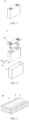
- FIG. 1 is a secondary battery 5 in a square structure as an example.
- the outer package may include a housing 51 and a top cover assembly 53.
- the housing 51 may include a bottom plate and side plates connected to the bottom plate. The bottom plate and the side plates are enclosed to form an accommodating cavity.
- the housing 51 has an opening that is in communication with the accommodating cavity, and the top cover assembly 53 can cover the opening to close the accommodating cavity.
- a positive electrode sheet, a negative electrode sheet, and a separator may be subject to a winding process or a lamination process to form an electrode assembly 52.
- the electrode assembly 52 is packaged in the accommodating cavity.
- the electrolytic solution is infiltrated in the electrode assembly 52.
- the number of electrode assemblies 52 included in the secondary battery 5 may be one or more, which can be selected by persons skilled in the art according to specific actual needs.
- secondary batteries may be assembled into a battery module, the number of secondary batteries included in the battery module may be one or more, and the specific number may be selected by persons skilled in the art according to application and capacity of the battery module.
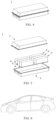
- FIG. 3 is a battery module 4 as an example.
- a plurality of secondary batteries 5 may be sequentially arranged along a length direction of the battery module 4. Certainly, they may be arranged in any other manner. Further, the plurality of secondary batteries 5 may be fixed with fasteners.
- the battery module 4 may further include a shell with an accommodating space, and the plurality of secondary batteries 5 are accommodated in the accommodating space.
- the foregoing battery modules may be further assembled into a battery pack, and the number of battery modules included in the battery pack may be selected by persons skilled in the art according to application and capacity of the battery pack.
- FIG. 4 and FIG. 5 are a battery pack 1 as an example.
- the battery pack 1 may include a battery box and a plurality of battery modules 4 disposed in the battery box.
- the battery box includes an upper box body 2 and a lower box body 3.
- the upper box body 2 can cover the lower box body 3 and form an enclosed space for accommodating the battery modules 4.
- the plurality of battery modules 4 may be arranged in the battery box in any manner.
- the present application further provides a power consumption apparatus including one or more of the secondary battery, the battery module, or the battery pack provided in the present application.
- the secondary battery, the battery module, or the battery pack provided in the present application can be used as a power source of the apparatus, or as an energy storage unit of the apparatus.
- the power consumption apparatus of the present application may be, but is not limited to, a mobile device (for example, a mobile phone or a notebook computer), an electric vehicle (for example, a full electric vehicle, a hybrid electric vehicle, a plug-in hybrid electric vehicle, an electric bicycle, an electric scooter, an electric golf cart, or an electric truck), an electric train, a ship and satellite, an energy storage system, and the like.
- a secondary battery, a battery module, or a battery pack may be selected according to usage requirements.
- FIG. 6 is an apparatus as an example.
- the apparatus is a full electric vehicle, a hybrid electric vehicle, a plug-in hybrid electric vehicle, or the like.
- a battery pack or a battery module may be used.
- the apparatus may be a mobile phone, a tablet computer, a notebook computer, or the like.
- the apparatus usually requires lightness and thinness, and a secondary battery may be used as a power source.
- Secondary batteries of embodiments 1 to 24 and comparative examples 1 to 6 are produced according to the following method.
- a positive active material a conductive agent of acetylene black, and a binder ofpolyvinylidene fluoride (PVDF) to a solvent of N-methylpyrrolidone (NMP) in a mass ratio of 94:3:3, mix them uniformly to obtain a positive electrode slurry, coat the positive electrode slurry on a positive electrode current collector of aluminum foil, and obtain a positive electrode sheet after processes of drying, cold pressing, slitting, and the like, where structural formulas and element contents of the positive active material are shown in Table 1.
- PVDF polyvinylidene fluoride
- Embodiment 1 With the comparison among Embodiment 1, Embodiment 4, and Comparative Example 1 (see Table 3), it can be seen that, by adding an appropriate amount of the element Al while reducing the element Co, and including the compound represented by the general formula (I) in the electrolytic solution, not only can the cost of the secondary battery be reduced due to the reduction of the content of the high-priced Co, but also the self-discharge rate of the secondary battery can be reduced, the storage impedance growth rate can be reduced, and the rate discharge capacity efficiency after storage can be improved.
- the compound represented by the foregoing general formula (I) in the electrolytic solution can be directionally bonded to Al on the positive surface to form a chelate structure during the first charging, and at the same time, double rings of the compound are ring-opened and bonded to each other into a three-dimensional network structure to cover surfaces of positive particles, which can effectively stabilize the element Al on the surface of the positive electrode material and separate the electrolytic solution from the positive interface, thereby not only improving the structural stability and ion-conducting capability of the positive surface, but also reducing the interfacial side reactions, greatly reducing the self-discharge rate of the battery cell, reducing the storage impedance growth rate, improving cycle stability of the battery, and improving the rate discharge capacity efficiency.
- the sufficient element Al can effectively reduce the mixed arrangement of Li/Ni due to the reduction of the content of Co, which stabilizes the bulk phase and surface structure of the positive electrode material; and by combining the stabilizing effect and the protection effect of the cross-bonding network of the compound additive represented by the general formula (I) contained in the electrolytic solution on the element Al, the various performance of the secondary battery is greatly improved and is superior to the performance of a secondary battery with a positive electrode system having a high content of Co. Secondary battery performance.
- the amount of Al added increases continuously to go beyond a certain range, many inactive sites are formed in the positive electrode material, which restricts the internal conduction and diffusion of lithium ions, worsens the ion-conducting capability of the positive electrode material, and leads to a drop of synthetic performance of the secondary battery.
- the amount of the element Al added is in a preferred range of 1000 ⁇ 7000, the self-discharge rate of the secondary battery is less than 150mV/h, the storage impedance growth rate is less than 70%, the rate discharge capacity efficiency is greater than 93%, and the synthetic performance is particularly excellent.
- Embodiments 4 and 7 ⁇ 11 illustrates the effect of adjusting the specific surface area of the positive electrode material on the performance of the secondary battery.
- the specific surface area of the positive electrode material gradually increases, the self-discharge rate tends to increase gradually, because the specific surface area directly affects the degree of interfacial side reactions.
- the impedance growth after storage and the rate discharge capacity efficiency show a trend of improvement first and then deterioration, because a certain degree of side reactions can play the role of separating the positive interface from the electrolytic solution, inhibiting the further occurrence of side reactions, thereby reducing the impedance growth and improving the rate performance.
- the specific surface area of the positive electrode material is in a preferred range of 0.5-2.5, the self-discharge rate of the secondary battery is less than 100mV/h, the storage impedance growth rate is less than 65%, and the rate discharge capacity efficiency is greater than 92%.
- Embodiments 4 and 12 ⁇ 24 the effects of different amounts or different types of the compound added and represented by the general formula (I) or addition together with another additive on the performance of the secondary battery are shown. From the results of the embodiments, as the amount of the compound added and represented by the general formula (I) gradually increases, the self-discharge rate of the secondary battery shows a trend of gradually decreasing, because the sufficient compounds of general formula (I) can act with the element Al to form a dense network structure on the positive surface, thereby completely separating the positive interface from the electrolytic solution. Therefore, the side reactions are reduced, and the self-discharge rate is also significantly reduced accordingly. However, the impedance growth after storage and the rate discharge capacity efficiency show a trend of first improvement and then deterioration.
- the compound of the formula (I) gradually increases within a certain range, the amount of the compound of the general formula (I) that can participate in stabilizing the element Al on the positive surface gradually increases, and combined with the protective effect of ring-opening, crossbonding and network forming of the compound of the formula (I) itself, the interfacial phase transformation and side reactions gradually reduces, and the impedance growth after storage and the rate discharge performance are effectively improved.
- the amount of the compound of the general formula (I) is excessive, not only is the chelating stabilization effect with Al affected, but also the impedance significantly increases due to excessive interface protection, the transport path of lithium ions is lengthened, the difficulty of lithium ion transport is increased, and thus the impedance growth and the rate discharge capacity are deteriorated.
- the amount of the compound of the general formula (I) added is in a preferred range of 0.1 ⁇ 10%, the self-discharge rate of the secondary battery is less than 120mV/h, the storage impedance growth rate is less than 75%, the rate discharge capacity efficiency is greater than 92%, and the overall performance are greatly improved.
- various compounds represented by the general formula (I) all can achieve the same degree of performance improvement effect.
- the compound represented by the general formula (I) with lithium difluorooxalateborate (LiODFB) or fluoroethylene carbonate (FEC), three-dimensional ion channels can be formed on the positive surface, and the interfacial side reactions at the negative electrode can be reduced, which has a better performance improvement effect.
- LiODFB lithium difluorooxalateborate
- FEC fluoroethylene carbonate
- Embodiments 4, 14, 19 and 20 the addition of an appropriate content of the compound of the general formula (I) can improve the high-temperature cycle capacity retention rate of the secondary battery.
- the main reason is that after the side reactions at the positive surface are reduced, it is beneficial to improvement of the long-range stability of the positive electrode material interface, thereby improving the cycle performance.
- LiODFB and FEC are further added, which can further improve the ion-conducting capability of the positive electrode material and the stability of the negative interface, thereby further improving the high-temperature cycle performance of the secondary battery.
Landscapes
- Chemical & Material Sciences (AREA)
- General Chemical & Material Sciences (AREA)
- Chemical Kinetics & Catalysis (AREA)
- Electrochemistry (AREA)
- Inorganic Chemistry (AREA)
- Engineering & Computer Science (AREA)
- Manufacturing & Machinery (AREA)
- General Physics & Mathematics (AREA)
- Condensed Matter Physics & Semiconductors (AREA)
- Physics & Mathematics (AREA)
- Materials Engineering (AREA)
- Secondary Cells (AREA)
- Battery Electrode And Active Subsutance (AREA)
Description
- The present application relates to the field of secondary battery technologies, and in particular, to a secondary battery as specified in claims 1-10, a battery module as specified in claim 11, a battery pack as specified in claim 12, and a power consumption apparatus as specified in claim 13.
- In recent years, with the wider application of secondary batteries, the secondary batteries are widely applied to energy storage power systems, such as hydraulic power, thermal power, wind power and solar power plants, as well as many fields, such as electric tools, electric bicycles, electric motorcycles, electric vehicles, military equipment and aerospace. Due to the great development and demands of the secondary batteries, higher requirements are put forward for their energy density, cycle performance, safety performance and the like, and there are more expectations for the improvement of their cost performance.
- In addition, in a secondary battery, especially in a lithium-ion secondary battery, a positive electrode is in a high SOC during charging and storage, and interface oxidation activity between the positive electrode and a solvent is high. An oxidation decomposition reaction occurs after the solvent contacts a positive interface, which leads to an unstable structure of a positive electrode material and reduction of a lithiation/delithiation capability and speed, and further leads to continuous self-discharge in an interior of a battery cell of the secondary battery and acceleration of reduction of the secondary battery life. In addition, gas generated at the interface due to the reaction between the solvent and the positive interface also leads to an increase of impedance of the positive interface.
CN111293357 A describes a non-aqueous electrolyte. The electrolyte comprises lithium salt, an organic solvent and an additive.
EP3205655 A1 relates to an organic electrolytic solution, comprising: - a first lithium salt, - an organic solvent, and a tetraoxide-tetraoxa-dithiaspiroalkane derivative and lithium battery comprising such an electrolytic solution.
CN110021785 A belongs to the technical field of lithium ion batteries, and particularly relates to a ternary high-voltage lithium ion battery non-aqueous electrolyte and a ternary high-voltage lithium-ion battery.
EP2905836 A1 relates to a non-aqueous electrolyte secondary battery having a relatively low direct-current resistance after being charged and discharged repeatedly.
CN112349958 A andUS2022158242 A1 relate to an electrolyte and a preparation method thereof and a lithium ion battery.
CN109273710 describes a preparation method of doped-coated monocrystalline ternary cathode material in the technical field of lithium ion batteries.
EP3561920 A1 relates to a positive electrode active material, method for preparing the same, and lithium secondary battery comprising the same.
CN104718658 A andEP2913880 A1 mention a nonaqueous electrolyte secondary battery which is suppressed in an increase of the direct-current resistance after being left under a relatively high temperature environment with low remaining battery power.
CN110518232A andEP3951946 A1 state positive electrode active material, positive electrode pole, lithium ion secondary battery and apparatus thereof.
CN112400249 A andUS2022115695 A1 relate to electrolyte and electrochemical device comprising the same.
CN105409049 A andEP3007263 A1 relate to non-aqueous electrolyte secondary battery and production method for non-aqueous electrolyte secondary battery.
JP2015162289 A - In the prior art, an electrolytic solution and a positive interface are physically separated generally by performing doping or various coatings on a positive electrode material to obtain a stable positive structure. However, there are still the following problems in these technologies: since a coating layer is easily broken, interface reactions occur continuously once it is broken, self-discharge of a battery cell is serious, and the battery life is rapidly reduced; or due to a small amount of doping or coating substances added, the protection is insufficient, resulting in limited improvement of battery performance; or even if the amount of the doping or coating substances added is sufficient to form a stable interface protective film, interface impedance seriously deteriorates by the protective film. Therefore, the existing technology for processing positive electrode materials still needs to be improved.
- The claimed subject-matter is defined by the appended claims. The embodiments of the present disclosure are not to be regarded as necessarily defining claimed subject-matter unless they fall within the scope of the appended claims. Embodiments not falling within the terms of the claims are to be understood as background art or examples useful for understanding the claimed subject-matter. The present application is made in view of the foregoing technical problems, and the objective is to provide a secondary battery, which reduces the cost of the secondary battery, effectively reduces a self-discharge rate of a battery cell, and improves a storage impedance growth rate of the battery cell, and has good rate discharge capacity efficiency.
- In order to achieve the foregoing objective, the inventor of the present application has conducted an intensive study, and found that the foregoing technical problems can be solved by adjusting a specific metallic element in a positive electrode material of the second battery and cooperatively using a specific additive in an electrolytic solution.
- According to a first aspect of the present application, a secondary battery is provided, including: a positive electrode sheet, a negative electrode sheet, and an electrolytic solution,
- where the positive electrode sheet includes a positive active material;
- in the positive active material, a contained molar ratio of an element Co satisfies: Co≤0.09, and a mass content of an element Al satisfies: 500ppm≤A1≤10000ppm;
- the electrolytic solution includes a compound represented by the following general formula (I); and

- in the general formula (I), A1~A4 each are independently a single bond or an alkylene group with 1~5 carbon atom(s), R1 and R1' each are independently


- Accordingly, in the present application for invention, by reducing a content of Co in a positive active material, the cost of a positive electrode material can be reduced; by including Al in the positive active material and appropriately adjusting a content of Al, a degree of mixed arrangement of Li/Ni can be reduced due to the reduction of the content of Co, and structural stability and an ion-conducting capability of the positive electrode material can be improved; and further, by including a compound represented by the foregoing general formula (I) in an electrolytic solution, a chelate can be formed by the compound represented by the foregoing general formula (I) and Al to effectively stabilize an element Al on a surface of the positive electrode material and separate the electrolytic solution from a positive interface, reducing interfacial side reactions, so that a secondary battery, which reduces the cost of the secondary battery, effectively reduces a self-discharge rate of a battery cell, and improves a storage impedance growth rate of the battery cell, and improves rate discharge capacity efficiency, can be obtained.
- In any embodiment, a mass percent content of the compound of the general formula (I) in the electrolytic solution is 0.01%~15%, optionally 0.1%~10%, and further optionally 0.5%-5%
- Accordingly, the reduction of the self-discharge rate of the secondary battery, the reduction of the storage impedance growth rate of the battery cell, and the improvement of the rate discharge capacity efficiency can be achieved in a balanced manner.
- In any embodiment, optionally, in the general formula (I), A1~A4 each are independently a single bond or an alkylene group with 1~3 carbon atom(s), further optionally a single bond or methylene. Optionally, R2 is


- Accordingly, a chelate can be formed by the compound represented by the foregoing general formula (I) and Al to effectively stabilize the surface of the positive electrode material and separate the electrolytic solution from the positive interface, thereby effectively reducing the self-discharge rate of the battery cell, improving the storage impedance growth rate of the battery cell, and improving the rate discharge capacity efficiency of the battery.
- In addition, in any embodiment, the compound represented by the general formula (I) is selected from at least one of the following compounds 1-18,


- Accordingly, the surface of the positive electrode material can be further stabilized, the self-discharge rate of the battery cell can be reduced, the storage impedance growth rate of the battery cell can be improved, and the rate discharge capacity efficiency can be improved.
- In any embodiment, optionally, the mass content of the element Al satisfies 1000ppm≤Al≤10000ppm, further optionally 1000ppm≤Al≤7000ppm.
- Accordingly, the self-discharge rate of the battery cell can be further reduced, the storage impedance growth rate of the battery cell can be improved, and the rate discharge capacity efficiency can be improved.
- In addition, in any embodiment, a general formula of the positive active material is: LiNizMnyCoxAlaO2, where x≤0.09, 0.0005<a<0.01, 0.5<z<1, 0<y<0.4, and x+y+z+a=1. Accordingly, both reduction of the cost of the secondary battery and improvement of the structural stability and the ion-conducting capability of the positive electrode material can be achieved.
- In any embodiment, optionally, the electrolytic solution further includes another additive selected from at least one of lithium tetrafluoroborate, lithium bis(oxalato)borate, lithium difluorooxalatoborate, and tris(trimethylsilyl)borate. Optionally, a mass percent content of a total amount of the another additive in the electrolytic solution is 0.2%-3%. Accordingly, the self-discharge rate of the battery cell can be further reduced, the storage impedance growth rate of the battery cell can be improved, and the rate discharge capacity efficiency can be improved.
- In any embodiment, optionally, a specific surface area of the positive active material is 0.5~3m2/g, optionally 0.5~2.5m2/g. Accordingly, the needs for rapid transport of lithium ions and control of side reactions on the positive surface can be met in a balanced manner, and the need for high-rate charging and discharging of the battery cell can be met.
- According to a second aspect of the present application, a battery module is further provided, including the secondary battery according to the first aspect of the present application.
- According to a third aspect of the present application, a battery pack is further provided, including the battery module according to the second aspect of the present application.
- According to a fourth aspect of the present application, a power consumption apparatus is further provided, including the secondary battery according to the first aspect, the battery module according to the second aspect or the battery pack according to the third aspect of the present application.
- The battery module, the battery pack, and the power consumption apparatus in the present application include the secondary battery according to the first aspect of the present application, and thus have at least the same or similar technical effects as the foregoing secondary battery.
-
-
FIG. 1 is a schematic diagram of a secondary battery according to an embodiment of the present application. -
FIG. 2 is an exploded view of a secondary battery according to the embodiment of the present application shown inFIG. 1 . -
FIG. 3 is a schematic diagram of a battery module according to an embodiment of the present application. -
FIG. 4 is a schematic diagram of a battery pack according to an embodiment of the present application. -
FIG. 5 is an exploded view of a battery pack according to the embodiment of the present application shown inFIG. 4 . -
FIG. 6 is a schematic diagram of a power consumption apparatus according to an embodiment of the present application. - 1 battery pack; 2 upper box body; 3 lower box body; 4 battery module; 5 secondary battery; 51 housing; 52 electrode assembly; 53 top cover assembly.
- Embodiments that specifically disclose a secondary battery, a battery module, a battery pack and an electrical apparatus of the present application will be described below in detail with reference to the accompanying drawings as appropriate. However, unnecessarily detailed descriptions may be omitted in some cases. For example, detailed description for a well-known matter and repeated description for a practically identical structures are omitted. This is done to avoid unnecessarily redundant descriptions for ease of understanding by persons skilled in the art. In addition, the drawings and the following description are provided for persons skilled in the art to fully appreciate the present application, and are not intended to limit the subject matters described in the claims.
- A "range" disclosed herein is defined in the form of a lower limit and an upper limit. A given range is defined by selecting a lower limit and an upper limit, and the selected lower limit and upper limit define a boundary of a particular range. The range defined in this manner may or may not include end values, and may be combined arbitrarily, that is, any lower limit may be combined with any upper limit to form a range. For example, if ranges of 60-120 and 80-110 are listed for a particular parameter, it is understood that ranges of 60-110 and 80-120 are also contemplated. In addition, if the minimum range values listed are 1 and 2, and the maximum range values listed are 3, 4 and 5, all the following ranges are contemplated: 1-3, 1-4, 1-5, 2-3, 2-4, and 2-5. In the present application, unless otherwise specified, a numerical range "a-b" represents an abbreviated representation of any combination of real numbers between a and b, where both a and b are real numbers. For example, a numerical range "0-5" means that all real numbers between "0-5" have been listed herein, and "0-5" is just an abbreviated representation of a combination of these numerical values. In addition, when a certain parameter is expressed as an integer ≥2, it is equivalent to disclosing that the parameter is, for example, an integer of 2, 3, 4, 5, 6, 7, 8, 9, 10, 11, 12, or the like.
- Unless otherwise specified, all embodiments and optional embodiments of the present application may be combined with each other to form a new technical solution.
- Unless otherwise specified, all technical features and optional technical features of the present application may be combined with each other to form a new technical solution.
- Unless otherwise specified, all steps of the present application may be performed sequentially or randomly, but preferably, performed sequentially. For example, a method includes steps (a) and (b), which means that the method may include steps (a) and (b) performed sequentially, or steps (b) and (a) performed sequentially. For example, the method mentioned may further include step (c), which means that step (c) may be added to the method in any order, for example, the method may include steps (a), (b) and (c), steps (a), (c) and (b), steps (c), (a) and (b), or the like.
- Unless otherwise specified, "comprising" and "containing" mentioned in the present application are open-ended or closed-ended. For example, the "comprising" and "containing" may mean that other components that are not listed may further be comprised or contained, or only listed components may be comprised or contained.
- In the present application, unless otherwise specified, the term "or" is inclusive. For example, the phrase "A or B" means "A, B or both A and B". More particularly, a condition "A or B" is satisfied by any one of the following: A is true (or present) and B is false (or not present); A is false (or not present) and B is true (or present); or both A and B are true (or present).
- In an embodiment of the present application, the present application provides a secondary battery, and as an example, the present application provides a lithium-ion secondary battery.
- A secondary battery of the present application includes: a positive electrode sheet, a negative electrode sheet, and an electrolytic solution, where the positive electrode sheet includes a positive active material; in the positive active material, a contained molar ratio of an element Co satisfies: Co≤0.09, and a mass content of an element Al satisfies: 500ppm≤A1≤10000ppm; and in addition, the electrolytic solution includes a compound represented by the following general formula (I); and


- The applicant surprisingly found that a secondary battery, which reduces the cost of the secondary battery, effectively reduces a self-discharge rate of a battery cell, improves a storage impedance growth rate of the battery cell, and has good rate discharge capacity efficiency, can be obtained by reducing a content of an element Co in a positive active material of the second battery, including an appropriate amount of an element Al, and further including a compound represented by the general formula (I) in an electrolytic solution.
- Although the mechanism is not clear yet, the applicant considers as follows.
- Since the cost of a positive electrode material is the highest in the composition of a secondary battery, for example, in a lithium-ion secondary battery, the price of an element cobalt in a ternary positive electrode is the highest and fluctuates greatly and the cobalt is scarce, the reduction of a content of the element cobalt can significantly reduce the cost of the secondary battery. However, on the other hand, the reduction of the content of the element cobalt may not only reduce an electron-conducting capacity of a ternary positive electrode material, but also increase a phenomenon of mixed arrangement of Li/Ni, restrict solid-state migration and diffusion of lithium ions, and reduce ion transport performance of the positive electrode material. Moreover, the mixed arrangement of Li/Ni may lead to an irreversible phase transformation of the positive electrode material, aggravate breakage of positive particles and expose many fresh surfaces, so that side reactions between a positive active material and an electrolytic solution occur continuously at an interface between the positive electrode material and the electrolytic solution, which leads to continuous self-discharge in an interior of a battery cell and a significant increase in impedance.
- For this reason, by introducing an element Al in the synthesis of the positive active material and realizing uniform distribution of the elementAl on a bulk phase and surface, not only is a degree of mixed arrangement of Li/Ni effectively reduced, structural stability and an ion-conducing capacity of the positive electrode material are improved, but also spherical morphology of the positive electrode material can be promoted to be uniform, which is beneficial to the stress release in a structural change of the positive electrode material during lithiation/delithiation and further improves the structural stability of the positive electrode material.
- However, since a bonding unsaturated structure of the surface of the positive electrode material is unstable, the element Al on the surface easily participates in the reactions during charging and discharging, so that the effect of stabilizing the surface of the material cannot be achieved. However, by cooperatively including the compound represented by the foregoing general formula (I) in the electrolytic solution as an additive, the compound can be directionally bonded to Al on the positive surface to form a chelate structure during the first charging, and at the same time, double rings are ring-opened and bonded to each other into a three-dimensional network structure to cover surfaces of positive particles, which can effectively stabilize the element Al on the surface of the positive electrode material and separate the electrolytic solution from the positive interface. This not only improves the structural stability and ion-conducting capability of the positive surface, but also reduces interfacial side reactions, greatly reduces the self-discharge rate of the battery cell, reduces the storage impedance growth rate, and stabilizes cycle performance.
- The cooperation relationship between the foregoing positive active material and electrolytic solution proposed in the present application is not only limited to being applicable to a battery structure, but also still applicable when an outer package of the battery, the shape of the battery, and the assembly method (such as lamination, winding) of electrode components are changed due to other needs.
- A positive electrode sheet includes a positive electrode current collector and a positive electrode material provided on at least one surface of the positive electrode current collector.
- As an example, the positive electrode current collector has two surfaces opposite in its own thickness direction, and the positive electrode material is provided on either or both of the two opposite surfaces of the positive electrode current collector.
- The positive electrode material of the present application includes a positive active material, and the positive active material is selected from materials capable of deintercalating and intercalating lithium ions. Specifically, the positive active material may be selected from positive electrodes of a lithium nickel cobalt manganese oxide, a lithium nickel cobalt aluminum oxide and other cobalt-containing oxides, and composite positive electrodes composed of the above compounds and a lithium iron phosphate, a lithium manganese iron phosphate, a lithium cobalt oxide, a lithium nickel oxide, a lithium manganese oxide, a lithium nickel manganese oxide, and the like; and one or more of compounds obtained by adding other transition metal or non-transition metal to the foregoing components, but the present invention is not limited to these materials.
- In the positive active material of the present application, a contained molar ratio of an element Co satisfies: Co≤0.09. Accordingly, a content of Co that is the most expensive in a ternary positive electrode material is reduced, the cost of the secondary battery can be reduced, and cost performance of the secondary battery is improved. However, the reduction of the element cobalt may lead to the reduction of an electron-conducting capability of the ternary positive electrode material, increase a phenomenon of mixed arrangement of Li/Ni, and reduce ion transport performance of the positive electrode material; and may lead to an irreversible phase transformation of the positive electrode material, aggravate breakage of positive particles and expose many fresh surfaces, so that side reactions between a positive active material and an electrolytic solution occur continuously at an interface between the positive electrode material and the electrolytic solution, which leads to continuous self-discharge in an interior of a battery cell and a significant increase in impedance.
- For this reason, in the positive active material of the present application, an elementAl is included, and a mass content of the element Al satisfies: 500ppm≤Al≤10000ppm. Uniform distribution of the elementAl on a bulk phase and surface of the positive active material is realized by control, which not only effectively reduces a degree of mixed arrangement of Li/Ni due to the foregoing reduction of the element Co, improves structural stability and an ion-conducing capacity of the positive electrode material, but also promotes granulation morphology of the positive electrode material to be uniform, thereby being beneficial to the stress release in a structural change of the positive electrode material during lithiation/delithiation and further improving the structural stability of the positive electrode material.
- Further, the elementAl on the surface of the positive active material may react with the compound represented by the foregoing general formula (I) included in the electrolytic solution during the first charging to form a chelate structure, so that the element Al on the surface of the positive active material is stabilized, and the formed chelate substance can separate the electrolytic solution from the interface of the positive electrode material, thereby further stabilizing the positive electrode material, reducing the interfacial side reactions, greatly reducing the self-discharge rate of the battery cell, reducing the storage impedance growth rate, and improving the cycle stability and the battery life.
- In some embodiments, in the positive active material, the mass content of the element Al satisfies 1000ppm≤Al≤10000ppm, optionally 1000ppm≤Al≤7000ppm. Accordingly, the structural stability of the positive electrode material can be further improved, the self-discharge rate of the battery cell can be reduced, the storage impedance growth rate can be reduced, and the cycle stability and the battery life can be improved.
- In some embodiments, a general formula of the positive active material is: LiNizMnyCoxAlaO2, where x≤0.09, 0.0005<a<0.01, 0.5<z<1, 0<y<0.4, and x+y+z+a=1. Accordingly, a positive active material with a stable structure can be obtained, the self-discharge rate of the battery cell can be reduced, the storage impedance growth rate can be reduced, and the cycle stability and the battery life can be improved.
- In some embodiments, a specific surface area of the positive active material is 0.5-3m2/g, optionally 1~2.5m2/g. The specific surface area of the positive active material is small, and the insufficient reactive sites may lead to slow lithium ion transport on the surface. The large specific surface area may lead to an increase of side reactions and increase the distance of lithium ion transport on the interface, which is manifested as a significant increase of charge-transfer resistance (Rct). By controlling the specific surface area of the positive active material at 0.5~3m2/g, the amount of side reactions on the positive surface can be controlled to reduce the influence on the lithium ion transport path and interface impedance, and it can be ensured that there are sufficient active sites on the positive surface for the interface fast transport performance of lithium ions, meeting the need for high-rate charging and discharging of the battery cell.
- In some embodiments, the positive electrode material further optionally includes a conductive agent. However, the types of the conductive agent are not specifically limited, and persons skilled in the art can make choice according to actual needs. As an example, the conductive agent for the positive electrode material may be selected from one or more of superconducting carbon, acetylene black, carbon black, Ketjen black, carbon dots, carbon nanotubes, graphene, and carbon nanofibers.
- In the secondary battery of the present application, the positive electrode current collector may be metal foil or a composite current collector. For example, as the metal foil, aluminum foil may be used. The composite current collector may include a polymer material base layer and a metal layer formed on at least one surface of the polymer material base. The composite current collector may be formed by synthesizing a metal material (aluminum, aluminum alloy, nickel, nickel alloy, titanium, titanium alloy, silver and silver alloy, or the like) on a polymer material substrate (such as a substrate of polypropylene (PP), polyethylene glycol terephthalate (PET), polybutylene terephthalate (PBT), polystyrene (PS), polyethylene (PE), or the like), but the present application is not limited to these materials.
- In the present application, the positive electrode sheet may be prepared according to methods known in the art. As an example, the positive electrode material, conductive agent and binder of the present application may be dispersed in a solvent (such as N-methylpyrrolidone (NMP)) to form a uniform positive electrode slurry; and the positive electrode slurry is coated on the positive electrode current collector, and after processes of drying, cold pressing, and the like, a positive electrode sheet is obtained.
- An electrolytic solution plays the role of conducting ions between the positive electrode sheet and the negative electrode sheet, and includes an organic solvent, lithium salt and an additive.
- In the present application, the electrolytic solution includes a compound represented by the following general formula as an additive.

- In the general formula (I), A1~A4 each are independently a single bond or an alkylene group with 1~5 carbon atom(s), optionally a single bond or an alkylene group with 1~3 carbon atom(s), optionally a single bond or methylene; R1 and R1' each are independently


- By cooperatively using the compound represented by the foregoing general formula (I) in the electrolytic solution as an additive, the compound can be directionally bonded to Al on the positive surface to form a chelate structure during the first charging, and at the same time, double rings of the compound are ring-opened and bonded to each other into a three-dimensional network structure to cover surfaces of positive particles, which can effectively stabilize the element Al on the surface of the positive electrode material and separate the electrolytic solution from the positive interface, thereby not only improving the structural stability and ion-conducting capability of the positive surface, but also reducing the interfacial side reactions, greatly reducing the self-discharge rate of the battery cell, reducing the storage impedance growth rate, improving cycle stability of the battery, and improving the rate discharge capacity efficiency.
- In some embodiments, the compound represented by the general formula (I) is selected from at least one of the following
compounds 1 to 18,


- Accordingly, the structural stability of the positive surface can be further improved, the self-discharge rate of the battery cell can be reduced, the storage impedance growth rate can be improved, and the rate discharge capacity efficiency can be improved.
- In any embodiment, a mass percent content of the compound represented by the general formula (I) in the electrolytic solution is 0.01%~15%, preferably 0.1%~10%, and further preferably 0.5%-5%. By controlling the range of the content of the compound represented by the general formula (I) within the foregoing ranges, the introduction of the compound represented by the general formula (I) can stabilize Al on the positive surface and ensure that Al plays the role of inhibiting the mixed arrangement of Li/Ni, stabilizing the structure of the positive electrode material and improving the ion-conducting capability. In addition, the chelation of the compound represented by the general formula (I) and Al can also promote the uniform distribution of the compound on the positive surface, and the compound itself is ring-opened and crossbonded to form a network structure, thereby further protecting the positive interface and reducing the interfacial side reactions.
- The type of the lithium salt included in the electrolytic solution of the present application is not specifically limited, and can be selected according to actual needs. Specifically, the lithium salt may be selected from one or more of LiN(CxF2x+1SO2)(CyF2y+1SO2), LiPF6, LiBF4, LiBOB, LiAsF6, Li(FSO2)2N, LiCF3SO3 and LiClO4, where x and y are natural numbers.
- The organic solvent included in the electrolytic solution of the present application may be selected according to actual needs, and specifically, it may include one or more of linear carbonates, cyclic carbonates, and carboxylic esters. The types of the linear carbonates, the cyclic carbonates, and the carboxylic esters are not specifically limited, and can be selected according to actual needs. Optionally, the organic solvent in the electrolytic solution may include one or more of diethyl carbonate, dipropyl carbonate, ethyl methyl carbonate, methyl propyl carbonate, ethylene propyl carbonate, ethylene carbonate, propylene carbonate, butylene carbonate, γ-butyrolactone, methyl formate, ethyl acetate, propyl acetate, methyl propionate, ethyl propionate, methyl propionate and tetrahydrofuran.
- In some embodiments, the electrolytic solution of the present application may further include at least one selected from a cyclic carbonate compound containing an unsaturated bond, a halogen-substituted cyclic carbonate compound, a sulfite compound, a sultone compound, a disulfonic acid compound, a nitrile compound, an aromatic compound, an isocyanate compound, a phosphazene compound, a cyclic acid anhydride compound, a phosphite ester compound, a phosphate ester compound, a borate ester compound and a carboxylic ester compound, as another additive. Accordingly, the performance of the secondary battery can be further improved, for example, the self-discharge rate of the secondary battery is further reduced, the storage impedance growth rate is reduced, and the like.
- In the secondary battery of the present application, a negative electrode sheet may include a negative electrode current collector and a negative material layer disposed on the negative electrode current collector and including a negative active material, and the negative material layer may be disposed on either or both of surfaces of the negative electrode current collector. The type of the negative active material is not specifically limited, and can preferably be selected from one or more of graphite, soft carbon, hard carbon, meso-carbon microbeads, carbon fibers, carbon nanotubes, elemental silicon, silicon-oxygen compounds, silicon-carbon composites, and lithium titanate.
- The negative material layer in the present application may further include a conductive agent, a binder and another optional additive, where the types and contents of the conductive agent and the binder are not specifically limited, and may be selected according to actual needs. The negative material layer is usually formed by coating and drying a negative electrode slurry. The negative electrode slurry is usually formed by dispersing the negative active material, the optional conductive agent and the binder in a solvent and stirring uniformly. The solvent may be N-methylpyrrolidone (NMP) or deionized water. As an example, the conductive agent may be selected from one or more of superconducting carbon, acetylene black, carbon black, Ketjen black, carbon dots, carbon nanotubes, graphene, and carbon nanofibers. As an example, the binder may be selected from one or more of styrene-butadiene rubber (SBR), polyacrylic acid (PAA), polyacrylate sodium (PAAS), polyacrylamide (PAM), polyvinyl alcohol (PVA), sodium alginate (SA), polymethacrylic acid (PMAA), and carboxymethyl chitosan (CMCS). The another optional additive is for example a thinkener (such as sodium carboxymethyl cellulose (CMC-Na), or the like.
- The type of the negative electrode current collector is not specifically limited, and can be selected according to actual needs. The negative electrode current collector may be metal foil or a composite current collector. For example, as the metal foil, aluminum foil may be used. The composite current collector may include a polymer material base layer and a metal layer formed on at least one surface of the polymer material substrate. The composite current collector may be formed by synthesizing a metal material (copper, copper alloy, nickel, nickel alloy, titanium, titanium alloy, silver and silver alloy, or the like) on a polymer material substrate (such as a substrate of polypropylene, polyethylene glycol terephthalate, polybutylene terephthalate, polystyrene, polyethylene, or the like).
- A secondary battery using an electrolytic solution and some secondary batteries using solid electrolytes, further include a separator. The separator is disposed between a positive electrode sheet and a negative electrode sheet for separation. The type of the separator is not specifically disclosed in the present application, and any well-known porous-structure separator with good chemical stability and mechanical stability can be selected. In some embodiments, the material of the separator may be selected from one or more of glass fiber, nonwoven fabric, polyethylene, polypropylene and polyvinylidene fluoride. The separator may be a single-layered thin film or a multi-layered composite thin film, which is not particularly limited. When the separator is a multi-layered composite thin film, the materials of each layer can be the same or different, which are not particularly limited.
- In some embodiments, the positive electrode sheet, the negative electrode sheet and the separator may be subject to a winding process or a lamination process, to obtain an electrode assembly.
- In some embodiments, the battery may include an outer package. The outer package may be used to package the foregoing electrode assembly and electrolytic solution.
- In some embodiments, the outer package of the secondary battery may be a hard shell such as a hard plastic shell, an aluminum shell, or a steel shell. In some embodiments, the outer package of the secondary battery may be a soft package, such as a bag-type soft package. A material of the soft package may be plastic, for example, polypropylene, polybutylene terephthalate, polybutylene succinate.
- The present application has no particular limitation on the shape of the secondary battery, which may be a cylinder, a square, or any other shape. For example,
FIG. 1 is asecondary battery 5 in a square structure as an example. - In some embodiments, with reference to
FIG. 2 , the outer package may include ahousing 51 and atop cover assembly 53. Thehousing 51 may include a bottom plate and side plates connected to the bottom plate. The bottom plate and the side plates are enclosed to form an accommodating cavity. Thehousing 51 has an opening that is in communication with the accommodating cavity, and thetop cover assembly 53 can cover the opening to close the accommodating cavity. A positive electrode sheet, a negative electrode sheet, and a separator may be subject to a winding process or a lamination process to form anelectrode assembly 52. Theelectrode assembly 52 is packaged in the accommodating cavity. The electrolytic solution is infiltrated in theelectrode assembly 52. The number ofelectrode assemblies 52 included in thesecondary battery 5 may be one or more, which can be selected by persons skilled in the art according to specific actual needs. - In addition, the secondary battery, the battery module, and the battery pack of the present application will be described below with reference to the accompanying drawings as appropriate.
- In some embodiments, secondary batteries may be assembled into a battery module, the number of secondary batteries included in the battery module may be one or more, and the specific number may be selected by persons skilled in the art according to application and capacity of the battery module.
-
FIG. 3 is abattery module 4 as an example. With reference toFIG. 3 , in thebattery module 4, a plurality ofsecondary batteries 5 may be sequentially arranged along a length direction of thebattery module 4. Certainly, they may be arranged in any other manner. Further, the plurality ofsecondary batteries 5 may be fixed with fasteners. - Optionally, the
battery module 4 may further include a shell with an accommodating space, and the plurality ofsecondary batteries 5 are accommodated in the accommodating space. - In some embodiments, the foregoing battery modules may be further assembled into a battery pack, and the number of battery modules included in the battery pack may be selected by persons skilled in the art according to application and capacity of the battery pack.
-
FIG. 4 and FIG. 5 are abattery pack 1 as an example. With reference toFIG. 4 and FIG. 5 , thebattery pack 1 may include a battery box and a plurality ofbattery modules 4 disposed in the battery box. The battery box includes anupper box body 2 and alower box body 3. Theupper box body 2 can cover thelower box body 3 and form an enclosed space for accommodating thebattery modules 4. The plurality ofbattery modules 4 may be arranged in the battery box in any manner. - In addition, the present application further provides a power consumption apparatus including one or more of the secondary battery, the battery module, or the battery pack provided in the present application. The secondary battery, the battery module, or the battery pack provided in the present application can be used as a power source of the apparatus, or as an energy storage unit of the apparatus. The power consumption apparatus of the present application may be, but is not limited to, a mobile device (for example, a mobile phone or a notebook computer), an electric vehicle (for example, a full electric vehicle, a hybrid electric vehicle, a plug-in hybrid electric vehicle, an electric bicycle, an electric scooter, an electric golf cart, or an electric truck), an electric train, a ship and satellite, an energy storage system, and the like.
- As the power consumption apparatus, a secondary battery, a battery module, or a battery pack may be selected according to usage requirements.
-
FIG. 6 is an apparatus as an example. The apparatus is a full electric vehicle, a hybrid electric vehicle, a plug-in hybrid electric vehicle, or the like. To meet a requirement of the apparatus for high power and high energy density of a secondary battery, a battery pack or a battery module may be used. - In another example, the apparatus may be a mobile phone, a tablet computer, a notebook computer, or the like. The apparatus usually requires lightness and thinness, and a secondary battery may be used as a power source.
- The present invention will be further described below with reference to embodiments. It should be understood that these embodiments are merely intended to illustrate the present invention but not to limit the scope of the present invention. Where specific techniques or conditions are not specified in the embodiments, they are performed according to techniques or conditions described in the literature in the art or according to product specifications. The reagents or instruments used without specifying the manufacturer are conventional products that can be obtained from the market.
- Examples 1 to 24 and Comparative Examples 1 to 6
- Secondary batteries of
embodiments 1 to 24 and comparative examples 1 to 6 are produced according to the following method. - Add a positive active material, a conductive agent of acetylene black, and a binder ofpolyvinylidene fluoride (PVDF) to a solvent of N-methylpyrrolidone (NMP) in a mass ratio of 94:3:3, mix them uniformly to obtain a positive electrode slurry, coat the positive electrode slurry on a positive electrode current collector of aluminum foil, and obtain a positive electrode sheet after processes of drying, cold pressing, slitting, and the like, where structural formulas and element contents of the positive active material are shown in Table 1.
- Add artificial graphite as a negative active substance, a conductive agent of acetylene black, a binder of styrene-butadiene rubber (SBR), and a thinkener of sodium carboxymethyl cellulose (CMC-Na) to a solvent of deionized water in a mass ratio of 95:2:2:1, mix them uniformly to obtain a negative electrode slurry, coat the negative electrode slurry on a negative electrode current collector of copper foil, and obtain a negative electrode sheet after processes of drying, cold pressing, slitting, and the like.
- Mix organic solvents of EC/EMC uniformly in an argon atmosphere glove box (H2O<0.1ppm, and O2<0.1ppm) in a volume ratio of 3/7, add LiPF6 lithium salt of 1mol/L to dissolve in the organic solvents, add the component represent by the general formula (I) or another additive with the type and quantity shown in Table 1, and stir them evenly to obtain an electrolytic solution.
- Use a polypropylene film as a separator.
- Stack a positive electrode sheet, a separator, and a negative electrode sheet in order, so that the separator is located between the positive electrode sheet and the negative electrode sheet, and then wind them to obtain an electrode assembly; and place the electrode assembly in a battery housing, inject an electrolytic solution after drying, and produce a secondary battery after processes of chemical conversion, standing, and the like.
- Take 2g of dried positive electrode material powder from a positive electrode sheet, dissolve completely with aqua regia (H2SO4:HNO3=1:1), and conduct a test with reference to the standard of EPA 6010D-2018, with reference to Table 1 for specific values.
- Scrape a positive electrode material from a positive electrode sheet with a scraper, and conduct a text with reference to the standard of
GB/T 19587-2004 - At 25°C, charge a secondary battery at a constant current of 0.33C until a voltage is 4.35V, then charge it at a constant voltage of 4.35V until a current is less than 0.05C, and perform discharging on it at a constant current of 0.33C until the voltage is 2.8V; after performing charging and discharging once, charge the secondary battery at the constant current of 0.33C until the voltage is 4.35V, and charge it at the constant voltage of 4.35V until the current is less than 0.05C; and after standing for 5 minutes, measure an initial voltage V1 (mV), place the secondary battery in an oven at 60°C for 48 hours, and measure a voltage of the secondary battery V2 (mV) after taking it out to ordinary temperature, where a self-discharge rate K of the secondary battery is calculated with a formula K=(V2-V1)/48 (the unit of mV/h).
- Charge a secondary battery at a constant current of 0.33C until a voltage is 4.35V and charge it at a constant voltage until a current is less than 0.05C; after standing for 5 minutes, measure an initial voltage V1, perform discharging on the secondary battery at a current of 4C for 15 seconds, and measure a voltage V3 after discharge, where initial impedance R1 of the secondary battery is calculated with a formula R1=(V3-V1)/4C (the unit of S2); place the secondary battery in an oven at 60°C for 1 month, and measure impedance R2 of the secondary battery after storage according to the test method of R1 after taking it out to ordinary temperature, where a storage impedance growth rate is ΔR=R2/R1×100%.
- Charge the secondary battery after storage in
test 2 at a constant current of 1C until a voltage is 4.35V, charge it at a constant voltage until a current is less than 0.05C, and then perform discharging on the secondary battery at the constant current of 1C until the voltage is 2.8V to obtain a discharge capacity Q1 at 1C; and charge the secondary battery at the constant current of 1C until the voltage is 4.35V, charged it at a constant voltage until the current is less than 0.05C, then perform discharging on the secondary battery at a constant current of 3C until the voltage is 2.8V to obtain a discharge capacity Q3 at 3C, and calculate rate discharge capacity efficiency with a formula Q3/Q1×100%. - At 45°C, charge a secondary battery at a constant current of 1C until a voltage is 4.35V, then charge it at a constant voltage of 4.35V until a current is less than 0.05C, and perform discharging on the secondary battery at the constant current of 1C until the voltage is 2.8V, which is a cycle of charge and discharge; and repeat the charge and discharge in this way, and calculate a capacity retention rate of the secondary battery after 1000 cycles.
- The capacity retention rate (%) of the secondary battery after 1000 cycles at 45°C=(a discharge capacity at the 1000th cycle/a discharge capacity at the first cycle)×100%.
[Table 1] Sequence number Positive electrode material Electrolytic solution Structural formula Conte nt of eleme nt Co % Conte nt of eleme nt Al ppm Specifi c surface area m2/g Type of compound represented by general formula (I) Contents of compoun d represente d by general formula (I) % Type of another additiv c Conte nt of anothe r additiv e % Embodiment 1 LiNi0.55Mn0.355Co0.09Al0.005 O2 9% 5000 1.3 Compound 11 1 / / Embodiment 2 LiNi0.55Mn0.3795Co0.07Al0.000 5O2 7% 500 1.3 Compound 11 1 / / Embodiment 3 LiNi0.55Mn0.379Co0.07Al0.001 O2 7% 1000 1.3 Compound 11 1 / / Embodiment 4 LiNi0.55Mn0.375Co0.07Al0.005 O2 7% 5000 1.3 Compound 11 1 / / Embodiment 5 LiNi0.55Mn0.373C00.07Al0.007 O2 7% 7000 1.3 Compound 11 1 / / Embodiment 6 LiNi0.55Mn0.37Co0.07Al0.01O2 7% 10000 1.3 Compound 11 1 / / Embodiment 7 LiNi0.55Mn0.375Co0.07Al0.005 O2 7% 5000 0.2 Compound 11 1 / / Embodiment 8 LiNi0.55Mn0.375Co0.07Al0.005 O2 7% 5000 0.5 Compound 11 1 / / Embodiment 9 LiNi0.55Mn0.375Co0.07Al0.005 O2 7% 5000 1 Compound 11 1 / / Embodiment 10 LiNi0.55Mn0.375Co0.07Al0.005 O2 7% 5000 2.5 Compound 11 1 / / Embodiment 11 LiNi0.55Mn0.375Co0.07Al0.005 O2 7% 5000 3 Compound 11 1 / / Embodiment 12 LiNi0.55Mn0.375Co0.07Al0.005 O2 7% 5000 1.3 Compound 11 0.01 / / Embodiment 13 LiNi0.55Mn0.375Co0.07Al0.005 O2 7% 5000 1.3 Compound 11 0.1 / / Embodiment 14 LiNi0.55Mn0.375Co0.07Al0.005 O2 7% 5000 1.3 Compound 11 0.5 / / Embodiment 15 LiNi0.55Mn0.375Co0.07Al0.005 O2 7% 5000 1.3 Compound 11 2 / / Embodiment 16 LiNi0.55Mn0.375Co0.07Al0.005 O2 7% 5000 1.3 Compound 11 5 / / Embodiment 17 LiNi0.55Mn0.375Co0.07Al0.005 O2 7% 5000 1.3 Compound 11 10 / / Embodiment 18 LiNi0.55Mn0.375Co0.07Al0.005 O2 7% 5000 1.3 Compound 11 15 / / Embodiment 19 LiNi0.55Mn0.375Co0.07Al0.005 O2 7% 5000 1.3 Compound 11 1 LiODF B 1 Embodiment 20 LiNi0.55Mn0.375Co0.07Al0.005 O2 7% 5000 1.3 Compound 11 1 FEC 1 Embodiment 21 LiNi0.55Mn0.375Co0.07Al0.005 O2 7% 5000 1.3 Compound 12 1 / / Embodiment 22 LiNi0.55Mn0.375Co0.07Al0.005 7% 5000 1.3 Compound 3 1 / / O2 Embodiment 23 LiNi0.55Mn0.375Co0.07Al0.005 O2 7% 5000 1.3 Compound 15 1 / / Embodiment 24 LiNi0.55Mn0.375Co0.07Al0.005 O2 7% 5000 1.3 Compound 18 1 / / Comparative Example 1 LiNi0.55Mn0.55Co0.12O2 12% 0 1.3 / / / / Comparative Example 2 LiNi0.55Mn0.38Co0.07O2 7% 0 1.3 / / / / Comparative Example 3 LiNi0.55NM0.38CO0.07O2 7% 5000 1.3 / / / / Comparative Example 4 LiNi0.55Mn0.5799Co0.07Al0.000 1O2 7% 100 1.3 Compound 11 1 / / Comparative Example 5 LiNi0.55Mn0.365CO0.07Al0.015 O2 7% 15000 1.3 Compound 11 1 / / Comparative Example 6 LiNi0.55Nn0.38CO0.07O2 7% 0 1.3 / / VC 1 [Table 2] Sequence number Self-discharge rate mV/h Storage impedance growth rate % Rate discharge capacity efficiency after storage % Embodiment 1 70 51% 96% Embodiment 2 190 75% 91% Embodiment 3 150 68% 93% Embodiment 4 90 53% 95% Embodiment 5 120 62% 94% Embodiment 6 150 70% 92% Embodiment 7 82 79% 87% Embodiment 8 80 62% 92% Embodiment 9 87 56% 94% Embodiment 10 95 63% 92% Embodiment 11 100 70% 90% Embodiment 12 170 78% 89% Embodiment 13 120 72% 92% Embodiment 14 95 56% 94% Embodiment 15 75 50% 96% Embodiment 16 70 60% 93% Embodiment 17 67 68% 92% Embodiment 18 72 80% 86% Embodiment 19 85 51% 95% Embodiment 20 83 50% 95% Embodiment 21 92 54% 94% Embodiment 22 94 55% 94% Embodiment 23 93 54% 94% Embodiment 24 95 55% 94% Comparative Example 1 200 80% 88% Comparative Example 2 300 100% 85% Comparative Example 3 280 81% 87% Comparative Example 4 280 83% 85% Comparative Example 5 230 82% 90% Comparative Example 6 250 87% 87% - The following can be found by analyzing the parameters in Table 1 and the results in Table 2.
- With the comparison among Comparative Examples 1, 2, and 6, it can be seen that, when only the content of the element Co is reduced to lower the cost of the positive electrode material and there is no the element Al in the positive electrode material, the self-discharge rate and the storage impedance growth rate of the secondary battery significantly increase, and even if an additive of vinylene carbonate (VC) that inhibits the reduction of the solvent in the electrolytic solution is added in the electrolytic solution, the performance of the secondary battery cannot be improved well. In addition, with the comparison between Comparative Example 2 and Comparative Example 3, it can be seen that, by including the elementAl in the positive electrode material in which the content of the element Co is reduced, the self-discharge rate and the storage impedance growth rate can be reduced to a certain extent, and the rate discharge capacity efficiency after storage can be improved. The reason is that the addition of the element Al can reduce the mixed arrangement of Li/Ni due to the reduction of the content of Co, which improves the structural stability of the positive electrode material, thereby improving the performance of the secondary battery to a certain extent. However, since a bonding unsaturated structure of the surface of the positive electrode material is unstable, the element Al on the surface easily participates in the reactions during charging and discharging, so that the effect of completely stabilizing the surface of the material cannot be achieved.
- With the comparison among
Embodiment 1,Embodiment 4, and Comparative Example 1 (see Table 3), it can be seen that, by adding an appropriate amount of the element Al while reducing the element Co, and including the compound represented by the general formula (I) in the electrolytic solution, not only can the cost of the secondary battery be reduced due to the reduction of the content of the high-priced Co, but also the self-discharge rate of the secondary battery can be reduced, the storage impedance growth rate can be reduced, and the rate discharge capacity efficiency after storage can be improved. The reason is that, by cooperatively using the compound represented by the foregoing general formula (I) in the electrolytic solution as an additive, the compound can be directionally bonded to Al on the positive surface to form a chelate structure during the first charging, and at the same time, double rings of the compound are ring-opened and bonded to each other into a three-dimensional network structure to cover surfaces of positive particles, which can effectively stabilize the element Al on the surface of the positive electrode material and separate the electrolytic solution from the positive interface, thereby not only improving the structural stability and ion-conducting capability of the positive surface, but also reducing the interfacial side reactions, greatly reducing the self-discharge rate of the battery cell, reducing the storage impedance growth rate, improving cycle stability of the battery, and improving the rate discharge capacity efficiency. - In addition, with the comparison among
Embodiments 2 to 6 and Comparative Examples 4 and 5, it can be seen that, if the element Al contained in the positive electrode is small, it is insufficient to compensate for the performance deterioration of the secondary battery due to the reduction of the content of Co. When the amount of the element Al added gradually increases, the sufficient element Al can effectively reduce the mixed arrangement of Li/Ni due to the reduction of the content of Co, which stabilizes the bulk phase and surface structure of the positive electrode material; and by combining the stabilizing effect and the protection effect of the cross-bonding network of the compound additive represented by the general formula (I) contained in the electrolytic solution on the element Al, the various performance of the secondary battery is greatly improved and is superior to the performance of a secondary battery with a positive electrode system having a high content of Co. Secondary battery performance. As the amount of Al added increases continuously to go beyond a certain range, many inactive sites are formed in the positive electrode material, which restricts the internal conduction and diffusion of lithium ions, worsens the ion-conducting capability of the positive electrode material, and leads to a drop of synthetic performance of the secondary battery. When the amount of the element Al added is in a preferred range of 1000~7000, the self-discharge rate of the secondary battery is less than 150mV/h, the storage impedance growth rate is less than 70%, the rate discharge capacity efficiency is greater than 93%, and the synthetic performance is particularly excellent. - The comparison among
Embodiments 4 and 7~11 illustrates the effect of adjusting the specific surface area of the positive electrode material on the performance of the secondary battery. As the specific surface area of the positive electrode material gradually increases, the self-discharge rate tends to increase gradually, because the specific surface area directly affects the degree of interfacial side reactions. The larger the specific surface area, the more side reactions, and the self-discharge rate increases accordingly. The impedance growth after storage and the rate discharge capacity efficiency show a trend of improvement first and then deterioration, because a certain degree of side reactions can play the role of separating the positive interface from the electrolytic solution, inhibiting the further occurrence of side reactions, thereby reducing the impedance growth and improving the rate performance. However, when the specific surface area is large, excessive side reactions bring about significant deterioration of the overall performance. When the specific surface area of the positive electrode material is in a preferred range of 0.5-2.5, the self-discharge rate of the secondary battery is less than 100mV/h, the storage impedance growth rate is less than 65%, and the rate discharge capacity efficiency is greater than 92%. - From
Embodiments 4 and 12~24, the effects of different amounts or different types of the compound added and represented by the general formula (I) or addition together with another additive on the performance of the secondary battery are shown. From the results of the embodiments, as the amount of the compound added and represented by the general formula (I) gradually increases, the self-discharge rate of the secondary battery shows a trend of gradually decreasing, because the sufficient compounds of general formula (I) can act with the element Al to form a dense network structure on the positive surface, thereby completely separating the positive interface from the electrolytic solution. Therefore, the side reactions are reduced, and the self-discharge rate is also significantly reduced accordingly. However, the impedance growth after storage and the rate discharge capacity efficiency show a trend of first improvement and then deterioration. The reason is that as the compound of the formula (I) gradually increases within a certain range, the amount of the compound of the general formula (I) that can participate in stabilizing the element Al on the positive surface gradually increases, and combined with the protective effect of ring-opening, crossbonding and network forming of the compound of the formula (I) itself, the interfacial phase transformation and side reactions gradually reduces, and the impedance growth after storage and the rate discharge performance are effectively improved. However, when the amount of the compound of the general formula (I) is excessive, not only is the chelating stabilization effect with Al affected, but also the impedance significantly increases due to excessive interface protection, the transport path of lithium ions is lengthened, the difficulty of lithium ion transport is increased, and thus the impedance growth and the rate discharge capacity are deteriorated. When the amount of the compound of the general formula (I) added is in a preferred range of 0.1~10%, the self-discharge rate of the secondary battery is less than 120mV/h, the storage impedance growth rate is less than 75%, the rate discharge capacity efficiency is greater than 92%, and the overall performance are greatly improved. - In addition, various compounds represented by the general formula (I) all can achieve the same degree of performance improvement effect. In addition, by using the compound represented by the general formula (I) with lithium difluorooxalateborate (LiODFB) or fluoroethylene carbonate (FEC), three-dimensional ion channels can be formed on the positive surface, and the interfacial side reactions at the negative electrode can be reduced, which has a better performance improvement effect.
[Table 3] Sequence number Positive electrode material Preparing an electrolytic solution Self-discharge rate mV/h Storage impedance growth rate % Rate discharge capacity efficiency after storage % Coast of battery cell material Structural formula Content of element Co % Content of element Al ppm Type of compound of general formula (I) Content of compound of general formula (I) Embodim ent 1 LiNi0.55Mn0.355Co0.09Al0.005O2 9% 5000 Compound 11 1 70 51% 96% 101% Embodim ent 4 LiNi0.55Mn0.375Co0.07Al0.005O2 7% 5000 Compound 11 1 90 53% 95% 100% Comparati ve Example 1 LiNi0.55Mn0.33Co0.12O2 12% 0 / / 200 80% 88% 105% [Table 4] Sequence number Structural formula Content of element Al ppm Specific surface area of positive electrode m2/g Content of compound 11 % Type of another additive Content of another additive % Self-discharge rate mV/h Storage impedance growth rate % Rate discharge capacity efficiency after storage % Cycle capacity retention rate at 45°C % Embodiment 4 LiNi0.55Mn0.375Co0.07Al0.005O2 5000 1.3 1 / / 90 53% 95% 80% Embodiment 14 LiNi0.55Mn0.375Co0.07Al0.005O2 5000 1.3 0.5 / / 95 56% 94% 78% Embodiment 19 LiNi0.55Mn0.375Co0.07Al0.005O2 5000 1.3 1 LiODFB 1 85 51% 95% 81% Embodiment 20 LiNi0.55Mn0.375Co0.07Al0.005O2 5000 1.3 1 FEC 1 83 50% 95% 82% - In addition, with reference to Table 4, it can be seen that, in
Embodiments 4, 14, 19 and 20, the addition of an appropriate content of the compound of the general formula (I) can improve the high-temperature cycle capacity retention rate of the secondary battery. The main reason is that after the side reactions at the positive surface are reduced, it is beneficial to improvement of the long-range stability of the positive electrode material interface, thereby improving the cycle performance. On this basis, LiODFB and FEC are further added, which can further improve the ion-conducting capability of the positive electrode material and the stability of the negative interface, thereby further improving the high-temperature cycle performance of the secondary battery.
Claims (13)
- A secondary battery, comprising:a positive electrode sheet, a negative electrode sheet, and an electrolytic solution;wherein the positive electrode sheet comprises a positive active material;in the positive active material, a contained molar ratio of an element Co satisfies: Co≤0.09, and a mass content of an element Al satisfies: 500ppm≤A1≤10000ppm;the electrolytic solution comprises a compound represented by the following general formula (I); and
 in the general formula (I), A1~A4 each are independently a single bond or an alkylene group with 1~5 carbon atom(s), R1 and R1' each are independently


- The secondary battery according to claim 1, wherein
a mass percent content of the compound of the general formula (I) in the electrolytic solution is 0.01%~15%, optionally 0.1%~10%, and further optionally 0.5%-5%. - The secondary battery according to claim 1 or 2, wherein
in the general formula (I), A1~A4 each are independently a single bond or an alkylene group with 1~3 carbon atom(s), optionally a single bond or methylene. - The secondary battery according to any one of claims 1 to 3, wherein
in the general formula (I), R2 is

- The secondary battery according to any one of claims 1 to 4, wherein
the compound of the general formula (I) is at least one selected from the following compounds 1~18,


- The secondary battery according to any one of claims 1 to 5, wherein
the mass content of the element Al satisfies 1000ppm≤Al≤10000ppm, optionally 1000ppm≤Al≤7000ppm. - The secondary battery according to any one of claims 1 to 6, wherein
a general formula of the positive active material is: LiNizMnyCoxAlaO2, wherein x≤0.09, 0.0005<a<0.01, 0.5<z<1, 0<y<0.4, and x+y+z+a=1. - The secondary battery according to any one of claims 1 to 7, wherein
the electrolytic solution further comprises another additive selected from at least one of lithium tetrafluoroborate, lithium bis(oxalato)borate, lithium difluorooxalatoborate, and tris(trimethylsilyl)borate. - The secondary battery according to claim 8, wherein
a mass percent content of a total amount of the another additive in the electrolytic solution is 0.2%-3%. - The secondary battery according to any one of claims 1 to 9, wherein
a specific surface area of the positive active material is 0.5~3m2/g, optionally 0.5~2.5m2/g, wherein the specific surface area is measured as described in the description. - A battery module, comprising the secondary battery according to any one of claims 1 to 10.
- A battery pack, comprising the battery module according to claim 11.
- A power consumption apparatus, comprising at least one selected from the secondary battery according to any one of claims 1 to 10, the battery module according to claim 11 or the battery pack according to claim 12.
Priority Applications (2)
| Application Number | Priority Date | Filing Date | Title |
|---|---|---|---|
| HUE21925088A HUE070485T2 (en) | 2021-09-27 | 2021-09-27 | Secondary battery, battery module, battery pack, and power-consuming apparatus |
| EP24204860.1A EP4539164A3 (en) | 2021-09-27 | 2021-09-27 | Secondary battery, battery module, battery pack, and power consumption apparatus |
Applications Claiming Priority (1)
| Application Number | Priority Date | Filing Date | Title |
|---|---|---|---|
| PCT/CN2021/121108 WO2023044934A1 (en) | 2021-09-27 | 2021-09-27 | Secondary battery, battery module, battery pack, and power-consuming apparatus |
Related Child Applications (2)
| Application Number | Title | Priority Date | Filing Date |
|---|---|---|---|
| EP24204860.1A Division-Into EP4539164A3 (en) | 2021-09-27 | 2021-09-27 | Secondary battery, battery module, battery pack, and power consumption apparatus |
| EP24204860.1A Division EP4539164A3 (en) | 2021-09-27 | 2021-09-27 | Secondary battery, battery module, battery pack, and power consumption apparatus |
Publications (3)
| Publication Number | Publication Date |
|---|---|
| EP4187669A1 EP4187669A1 (en) | 2023-05-31 |
| EP4187669A4 EP4187669A4 (en) | 2023-09-20 |
| EP4187669B1 true EP4187669B1 (en) | 2025-01-08 |
Family
ID=85719937
Family Applications (2)
| Application Number | Title | Priority Date | Filing Date |
|---|---|---|---|
| EP21925088.3A Active EP4187669B1 (en) | 2021-09-27 | 2021-09-27 | Secondary battery, battery module, battery pack, and power-consuming apparatus |
| EP24204860.1A Pending EP4539164A3 (en) | 2021-09-27 | 2021-09-27 | Secondary battery, battery module, battery pack, and power consumption apparatus |
Family Applications After (1)
| Application Number | Title | Priority Date | Filing Date |
|---|---|---|---|
| EP24204860.1A Pending EP4539164A3 (en) | 2021-09-27 | 2021-09-27 | Secondary battery, battery module, battery pack, and power consumption apparatus |
Country Status (7)
| Country | Link |
|---|---|
| US (1) | US20230104940A1 (en) |
| EP (2) | EP4187669B1 (en) |
| JP (1) | JP7569482B2 (en) |
| KR (1) | KR102849717B1 (en) |
| CN (1) | CN116648805A (en) |
| HU (1) | HUE070485T2 (en) |
| WO (1) | WO2023044934A1 (en) |
Families Citing this family (5)
| Publication number | Priority date | Publication date | Assignee | Title |
|---|---|---|---|---|
| CN120226184A (en) * | 2023-05-31 | 2025-06-27 | 宁德时代新能源科技股份有限公司 | Nonaqueous electrolyte, secondary battery, and electricity-using device |
| CN117219871A (en) * | 2023-11-09 | 2023-12-12 | 宁德时代新能源科技股份有限公司 | Electrolyte, sodium secondary battery and electricity utilization device |
| CN117219870B (en) * | 2023-11-09 | 2024-04-16 | 宁德时代新能源科技股份有限公司 | Electrolyte, sodium secondary battery and electricity utilization device |
| CN117976815B (en) * | 2024-03-27 | 2025-02-11 | 宁德新能源科技有限公司 | Secondary battery and electronic device |
| CN121748536A (en) * | 2024-09-27 | 2026-03-27 | 宁德时代新能源科技股份有限公司 | Secondary batteries and electrical appliances |
Family Cites Families (14)
| Publication number | Priority date | Publication date | Assignee | Title |
|---|---|---|---|---|
| CH600228A5 (en) * | 1976-10-13 | 1978-06-15 | Hobas Eng Ag | |
| EP2905836B1 (en) * | 2012-10-03 | 2020-06-10 | GS Yuasa International Ltd. | Nonaqueous electrolyte secondary battery and method for producing nonaqueous electrolyte secondary battery |
| CN104718658A (en) * | 2012-10-29 | 2015-06-17 | 株式会社杰士汤浅国际 | Nonaqueous electrolyte secondary battery and method for manufacturing nonaqueous electrolyte secondary battery |
| US20160133991A1 (en) * | 2013-06-06 | 2016-05-12 | Gs Yuasa International Ltd. | Non-aqueous electrolyte secondary battery and method for producing non-aqueous electrolyte secondary battery |
| JP6368501B2 (en) * | 2014-02-26 | 2018-08-01 | 三井化学株式会社 | Nonaqueous electrolyte for battery and lithium secondary battery |
| KR102152365B1 (en) * | 2016-02-12 | 2020-09-04 | 삼성에스디아이 주식회사 | Additive for electrolyte of lithium battery, organic electrolytic solution comprising the same and Lithium battery using the solution |
| KR102025190B1 (en) * | 2016-12-22 | 2019-09-25 | 주식회사 포스코 | A positive electrode active material, a manufacturing method thereof, and a lithium secondary battery including the same |
| CN109273710B (en) * | 2018-08-22 | 2020-10-13 | 中伟新材料股份有限公司 | A kind of preparation method of doped coating type single crystal ternary positive electrode material |
| CN111293357A (en) * | 2018-12-10 | 2020-06-16 | 张家港市国泰华荣化工新材料有限公司 | Non-aqueous electrolyte and application thereof |
| CN110021785A (en) * | 2019-04-15 | 2019-07-16 | 杉杉新材料(衢州)有限公司 | A kind of ternary high-voltage lithium-ion battery electrolyte and ternary high-voltage lithium ion batteries |
| CN112436134B (en) * | 2019-04-28 | 2022-03-08 | 宁德时代新能源科技股份有限公司 | Positive electrode active material, preparation method thereof, positive electrode plate, lithium ion secondary battery and electric vehicle |
| CN112349958B (en) * | 2019-08-06 | 2022-02-11 | 珠海冠宇电池股份有限公司 | Electrolyte, preparation method thereof and lithium ion battery |
| KR20210078797A (en) * | 2019-12-19 | 2021-06-29 | 동화일렉트로라이트 주식회사 | Additive of Electrolyte Solution for Secondary Battery and Electrolyte Solution for Secondary Battery Comprising the Same |
| CN112400249A (en) | 2020-03-24 | 2021-02-23 | 宁德新能源科技有限公司 | Electrolyte and electrochemical device |
-
2021
- 2021-09-27 EP EP21925088.3A patent/EP4187669B1/en active Active
- 2021-09-27 HU HUE21925088A patent/HUE070485T2/en unknown
- 2021-09-27 EP EP24204860.1A patent/EP4539164A3/en active Pending
- 2021-09-27 JP JP2022553657A patent/JP7569482B2/en active Active
- 2021-09-27 WO PCT/CN2021/121108 patent/WO2023044934A1/en not_active Ceased
- 2021-09-27 KR KR1020227030943A patent/KR102849717B1/en active Active
- 2021-09-27 CN CN202180087213.0A patent/CN116648805A/en active Pending
-
2022
- 2022-09-13 US US17/943,212 patent/US20230104940A1/en active Pending
Also Published As
| Publication number | Publication date |
|---|---|
| WO2023044934A1 (en) | 2023-03-30 |
| KR102849717B1 (en) | 2025-08-22 |
| JP7569482B2 (en) | 2024-10-18 |
| EP4539164A2 (en) | 2025-04-16 |
| JP2024504217A (en) | 2024-01-31 |
| EP4187669A4 (en) | 2023-09-20 |
| EP4539164A3 (en) | 2025-07-09 |
| HUE070485T2 (en) | 2025-06-28 |
| CN116648805A (en) | 2023-08-25 |
| EP4187669A1 (en) | 2023-05-31 |
| US20230104940A1 (en) | 2023-04-06 |
| KR20230046273A (en) | 2023-04-05 |
Similar Documents
| Publication | Publication Date | Title |
|---|---|---|
| KR102502618B1 (en) | Secondary battery, battery module including secondary battery, battery pack and device | |
| EP3800707B1 (en) | Secondary battery, and related battery module, battery pack and apparatus | |
| EP4187669B1 (en) | Secondary battery, battery module, battery pack, and power-consuming apparatus | |
| EP4333117A1 (en) | Positive electrode active material and preparation method therefor, lithium-ion battery comprising same, battery module, battery pack, and electric apparatus | |
| US11769900B2 (en) | Lithium ion battery and prelithiation method of anode | |
| KR102950959B1 (en) | Lithium-ion battery and method of manufacturing the same | |
| EP4231407A1 (en) | Electrolyte solution, secondary battery comprising same, and preparation method for secondary battery | |
| EP4407732A1 (en) | Secondary battery, battery module, battery pack and electrical device | |
| EP4246647A1 (en) | Electrolyte, secondary battery, and electric device | |
| CN115842090A (en) | Negative pole piece and preparation method thereof, secondary battery, battery module, battery pack and electric device | |
| US20230163357A1 (en) | Electrolyte, secondary battery, battery module, battery pack, and power consuming device | |
| CN113381072A (en) | Electrolyte and battery containing the same | |
| EP3890089B1 (en) | Lithium metal battery | |
| KR102797793B1 (en) | Electrolyte, secondary battery, battery module, battery pack and electrical device | |
| EP4207415A1 (en) | Secondary battery and lithium supplementing method therefor, battery module, battery pack, and electric device | |
| EP4546460A1 (en) | Secondary battery, battery module, battery pack, and electrical device | |
| US20250286138A1 (en) | Nonaqueous electrolyte solution, lithium secondary battery containing same, and electrical device | |
| EP4325616A1 (en) | Secondary battery, battery module, battery pack, and electric device | |
| EP4372832A2 (en) | Lithium secondary battery | |
| EP4654316A1 (en) | Secondary battery and preparation method therefor, and electric device | |
| EP4228079A1 (en) | Battery pack and electric device therefor | |
| EP4207389A1 (en) | Positive electrode slurry, positive electrode plate, lithium ion battery, battery module, battery pack, and electrical device | |
| CN117501502A (en) | Electrolyte, secondary battery, battery module, battery pack and electricity utilization device | |
| US12456722B2 (en) | Positive electrode active material composition, positive electrode plate, battery, and electric apparatus | |
| EP4510265A1 (en) | Electrolyte solution, secondary battery, battery module, battery pack, and electric device |
Legal Events
| Date | Code | Title | Description |
|---|---|---|---|
| STAA | Information on the status of an ep patent application or granted ep patent |
Free format text: STATUS: UNKNOWN |
|
| STAA | Information on the status of an ep patent application or granted ep patent |
Free format text: STATUS: THE INTERNATIONAL PUBLICATION HAS BEEN MADE |
|
| PUAI | Public reference made under article 153(3) epc to a published international application that has entered the european phase |
Free format text: ORIGINAL CODE: 0009012 |
|
| STAA | Information on the status of an ep patent application or granted ep patent |
Free format text: STATUS: REQUEST FOR EXAMINATION WAS MADE |
|
| 17P | Request for examination filed |
Effective date: 20220812 |
|
| AK | Designated contracting states |
Kind code of ref document: A1 Designated state(s): AL AT BE BG CH CY CZ DE DK EE ES FI FR GB GR HR HU IE IS IT LI LT LU LV MC MK MT NL NO PL PT RO RS SE SI SK SM TR |
|
| A4 | Supplementary search report drawn up and despatched |
Effective date: 20230823 |
|
| RIC1 | Information provided on ipc code assigned before grant |
Ipc: H01M 4/02 20060101ALN20230817BHEP Ipc: H01M 4/525 20100101ALI20230817BHEP Ipc: H01M 10/0525 20100101ALI20230817BHEP Ipc: H01M 10/0567 20100101AFI20230817BHEP |
|
| GRAP | Despatch of communication of intention to grant a patent |
Free format text: ORIGINAL CODE: EPIDOSNIGR1 |
|
| STAA | Information on the status of an ep patent application or granted ep patent |
Free format text: STATUS: GRANT OF PATENT IS INTENDED |
|
| RIC1 | Information provided on ipc code assigned before grant |
Ipc: H01M 4/02 20060101ALN20240429BHEP Ipc: H01M 4/525 20100101ALI20240429BHEP Ipc: H01M 10/0525 20100101ALI20240429BHEP Ipc: H01M 10/0567 20100101AFI20240429BHEP |
|
| DAV | Request for validation of the european patent (deleted) | ||
| DAX | Request for extension of the european patent (deleted) | ||
| INTG | Intention to grant announced |
Effective date: 20240515 |
|
| GRAJ | Information related to disapproval of communication of intention to grant by the applicant or resumption of examination proceedings by the epo deleted |
Free format text: ORIGINAL CODE: EPIDOSDIGR1 |
|
| STAA | Information on the status of an ep patent application or granted ep patent |
Free format text: STATUS: REQUEST FOR EXAMINATION WAS MADE |
|
| GRAP | Despatch of communication of intention to grant a patent |
Free format text: ORIGINAL CODE: EPIDOSNIGR1 |
|
| STAA | Information on the status of an ep patent application or granted ep patent |
Free format text: STATUS: GRANT OF PATENT IS INTENDED |
|
| RAP1 | Party data changed (applicant data changed or rights of an application transferred) |
Owner name: CONTEMPORARY AMPEREX TECHNOLOGY(HONG KONG) LIMITED |
|
| INTG | Intention to grant announced |
Effective date: 20240923 |
|
| RIC1 | Information provided on ipc code assigned before grant |
Ipc: H01M 4/02 20060101ALN20240916BHEP Ipc: H01M 4/525 20100101ALI20240916BHEP Ipc: H01M 10/0525 20100101ALI20240916BHEP Ipc: H01M 10/0567 20100101AFI20240916BHEP |
|
| GRAS | Grant fee paid |
Free format text: ORIGINAL CODE: EPIDOSNIGR3 |
|
| GRAA | (expected) grant |
Free format text: ORIGINAL CODE: 0009210 |
|
| STAA | Information on the status of an ep patent application or granted ep patent |
Free format text: STATUS: THE PATENT HAS BEEN GRANTED |
|
| AK | Designated contracting states |
Kind code of ref document: B1 Designated state(s): AL AT BE BG CH CY CZ DE DK EE ES FI FR GB GR HR HU IE IS IT LI LT LU LV MC MK MT NL NO PL PT RO RS SE SI SK SM TR |
|
| REG | Reference to a national code |
Ref country code: GB Ref legal event code: FG4D |
|
| REG | Reference to a national code |
Ref country code: CH Ref legal event code: EP |
|
| REG | Reference to a national code |
Ref country code: DE Ref legal event code: R096 Ref document number: 602021024842 Country of ref document: DE |
|
| REG | Reference to a national code |
Ref country code: IE Ref legal event code: FG4D |
|
| P01 | Opt-out of the competence of the unified patent court (upc) registered |
Free format text: CASE NUMBER: APP_1273/2025 Effective date: 20250109 |
|
| REG | Reference to a national code |
Ref country code: NL Ref legal event code: FP |
|
| REG | Reference to a national code |
Ref country code: LT Ref legal event code: MG9D |
|
| REG | Reference to a national code |
Ref country code: AT Ref legal event code: MK05 Ref document number: 1758939 Country of ref document: AT Kind code of ref document: T Effective date: 20250108 |
|
| REG | Reference to a national code |
Ref country code: HU Ref legal event code: AG4A Ref document number: E070485 Country of ref document: HU |
|
| PG25 | Lapsed in a contracting state [announced via postgrant information from national office to epo] |
Ref country code: RS Free format text: LAPSE BECAUSE OF FAILURE TO SUBMIT A TRANSLATION OF THE DESCRIPTION OR TO PAY THE FEE WITHIN THE PRESCRIBED TIME-LIMIT Effective date: 20250408 |
|
| PG25 | Lapsed in a contracting state [announced via postgrant information from national office to epo] |
Ref country code: FI Free format text: LAPSE BECAUSE OF FAILURE TO SUBMIT A TRANSLATION OF THE DESCRIPTION OR TO PAY THE FEE WITHIN THE PRESCRIBED TIME-LIMIT Effective date: 20250108 |
|
| PG25 | Lapsed in a contracting state [announced via postgrant information from national office to epo] |
Ref country code: PL Free format text: LAPSE BECAUSE OF FAILURE TO SUBMIT A TRANSLATION OF THE DESCRIPTION OR TO PAY THE FEE WITHIN THE PRESCRIBED TIME-LIMIT Effective date: 20250108 |
|
| PG25 | Lapsed in a contracting state [announced via postgrant information from national office to epo] |
Ref country code: ES Free format text: LAPSE BECAUSE OF FAILURE TO SUBMIT A TRANSLATION OF THE DESCRIPTION OR TO PAY THE FEE WITHIN THE PRESCRIBED TIME-LIMIT Effective date: 20250108 |
|
| PG25 | Lapsed in a contracting state [announced via postgrant information from national office to epo] |
Ref country code: NO Free format text: LAPSE BECAUSE OF FAILURE TO SUBMIT A TRANSLATION OF THE DESCRIPTION OR TO PAY THE FEE WITHIN THE PRESCRIBED TIME-LIMIT Effective date: 20250408 Ref country code: IS Free format text: LAPSE BECAUSE OF FAILURE TO SUBMIT A TRANSLATION OF THE DESCRIPTION OR TO PAY THE FEE WITHIN THE PRESCRIBED TIME-LIMIT Effective date: 20250508 |
|
| PG25 | Lapsed in a contracting state [announced via postgrant information from national office to epo] |
Ref country code: HR Free format text: LAPSE BECAUSE OF FAILURE TO SUBMIT A TRANSLATION OF THE DESCRIPTION OR TO PAY THE FEE WITHIN THE PRESCRIBED TIME-LIMIT Effective date: 20250108 |
|
| PG25 | Lapsed in a contracting state [announced via postgrant information from national office to epo] |
Ref country code: LV Free format text: LAPSE BECAUSE OF FAILURE TO SUBMIT A TRANSLATION OF THE DESCRIPTION OR TO PAY THE FEE WITHIN THE PRESCRIBED TIME-LIMIT Effective date: 20250108 Ref country code: PT Free format text: LAPSE BECAUSE OF FAILURE TO SUBMIT A TRANSLATION OF THE DESCRIPTION OR TO PAY THE FEE WITHIN THE PRESCRIBED TIME-LIMIT Effective date: 20250508 |
|
| PG25 | Lapsed in a contracting state [announced via postgrant information from national office to epo] |
Ref country code: BG Free format text: LAPSE BECAUSE OF FAILURE TO SUBMIT A TRANSLATION OF THE DESCRIPTION OR TO PAY THE FEE WITHIN THE PRESCRIBED TIME-LIMIT Effective date: 20250108 Ref country code: GR Free format text: LAPSE BECAUSE OF FAILURE TO SUBMIT A TRANSLATION OF THE DESCRIPTION OR TO PAY THE FEE WITHIN THE PRESCRIBED TIME-LIMIT Effective date: 20250409 |
|
| PG25 | Lapsed in a contracting state [announced via postgrant information from national office to epo] |
Ref country code: AT Free format text: LAPSE BECAUSE OF FAILURE TO SUBMIT A TRANSLATION OF THE DESCRIPTION OR TO PAY THE FEE WITHIN THE PRESCRIBED TIME-LIMIT Effective date: 20250108 |
|
| PG25 | Lapsed in a contracting state [announced via postgrant information from national office to epo] |
Ref country code: SE Free format text: LAPSE BECAUSE OF FAILURE TO SUBMIT A TRANSLATION OF THE DESCRIPTION OR TO PAY THE FEE WITHIN THE PRESCRIBED TIME-LIMIT Effective date: 20250108 |
|
| PG25 | Lapsed in a contracting state [announced via postgrant information from national office to epo] |
Ref country code: SM Free format text: LAPSE BECAUSE OF FAILURE TO SUBMIT A TRANSLATION OF THE DESCRIPTION OR TO PAY THE FEE WITHIN THE PRESCRIBED TIME-LIMIT Effective date: 20250108 |
|
| REG | Reference to a national code |
Ref country code: DE Ref legal event code: R097 Ref document number: 602021024842 Country of ref document: DE |
|
| PG25 | Lapsed in a contracting state [announced via postgrant information from national office to epo] |
Ref country code: DK Free format text: LAPSE BECAUSE OF FAILURE TO SUBMIT A TRANSLATION OF THE DESCRIPTION OR TO PAY THE FEE WITHIN THE PRESCRIBED TIME-LIMIT Effective date: 20250108 |
|
| PGFP | Annual fee paid to national office [announced via postgrant information from national office to epo] |
Ref country code: DE Payment date: 20250923 Year of fee payment: 5 |
|
| PGFP | Annual fee paid to national office [announced via postgrant information from national office to epo] |
Ref country code: NL Payment date: 20250916 Year of fee payment: 5 |
|
| PGFP | Annual fee paid to national office [announced via postgrant information from national office to epo] |
Ref country code: HU Payment date: 20250910 Year of fee payment: 5 Ref country code: GB Payment date: 20250916 Year of fee payment: 5 |
|
| PGFP | Annual fee paid to national office [announced via postgrant information from national office to epo] |
Ref country code: FR Payment date: 20250915 Year of fee payment: 5 |
|
| PG25 | Lapsed in a contracting state [announced via postgrant information from national office to epo] |
Ref country code: CZ Free format text: LAPSE BECAUSE OF FAILURE TO SUBMIT A TRANSLATION OF THE DESCRIPTION OR TO PAY THE FEE WITHIN THE PRESCRIBED TIME-LIMIT Effective date: 20250108 Ref country code: EE Free format text: LAPSE BECAUSE OF FAILURE TO SUBMIT A TRANSLATION OF THE DESCRIPTION OR TO PAY THE FEE WITHIN THE PRESCRIBED TIME-LIMIT Effective date: 20250108 |
|
| PG25 | Lapsed in a contracting state [announced via postgrant information from national office to epo] |
Ref country code: RO Free format text: LAPSE BECAUSE OF FAILURE TO SUBMIT A TRANSLATION OF THE DESCRIPTION OR TO PAY THE FEE WITHIN THE PRESCRIBED TIME-LIMIT Effective date: 20250108 |
|
| PG25 | Lapsed in a contracting state [announced via postgrant information from national office to epo] |
Ref country code: SK Free format text: LAPSE BECAUSE OF FAILURE TO SUBMIT A TRANSLATION OF THE DESCRIPTION OR TO PAY THE FEE WITHIN THE PRESCRIBED TIME-LIMIT Effective date: 20250108 |
|
| PLBE | No opposition filed within time limit |
Free format text: ORIGINAL CODE: 0009261 |
|
| STAA | Information on the status of an ep patent application or granted ep patent |
Free format text: STATUS: NO OPPOSITION FILED WITHIN TIME LIMIT |
|
| REG | Reference to a national code |
Ref country code: CH Ref legal event code: L10 Free format text: ST27 STATUS EVENT CODE: U-0-0-L10-L00 (AS PROVIDED BY THE NATIONAL OFFICE) Effective date: 20251119 |
|
| 26N | No opposition filed |
Effective date: 20251009 |
|
| PG25 | Lapsed in a contracting state [announced via postgrant information from national office to epo] |
Ref country code: IT Free format text: LAPSE BECAUSE OF FAILURE TO SUBMIT A TRANSLATION OF THE DESCRIPTION OR TO PAY THE FEE WITHIN THE PRESCRIBED TIME-LIMIT Effective date: 20250108 |
|
| REG | Reference to a national code |
Ref country code: CH Ref legal event code: H13 Free format text: ST27 STATUS EVENT CODE: U-0-0-H10-H13 (AS PROVIDED BY THE NATIONAL OFFICE) Effective date: 20260425 |