EP4187645A1 - Method for preparing anode active material, and secondary battery comprising anode active material - Google Patents
Method for preparing anode active material, and secondary battery comprising anode active material Download PDFInfo
- Publication number
- EP4187645A1 EP4187645A1 EP21845805.7A EP21845805A EP4187645A1 EP 4187645 A1 EP4187645 A1 EP 4187645A1 EP 21845805 A EP21845805 A EP 21845805A EP 4187645 A1 EP4187645 A1 EP 4187645A1
- Authority
- EP
- European Patent Office
- Prior art keywords
- particles
- graphite
- active material
- anode active
- preparing
- Prior art date
- Legal status (The legal status is an assumption and is not a legal conclusion. Google has not performed a legal analysis and makes no representation as to the accuracy of the status listed.)
- Pending
Links
Images

Classifications
-
- H—ELECTRICITY
- H01—ELECTRIC ELEMENTS
- H01M—PROCESSES OR MEANS, e.g. BATTERIES, FOR THE DIRECT CONVERSION OF CHEMICAL ENERGY INTO ELECTRICAL ENERGY
- H01M4/00—Electrodes
- H01M4/02—Electrodes composed of, or comprising, active material
- H01M4/36—Selection of substances as active materials, active masses, active liquids
- H01M4/58—Selection of substances as active materials, active masses, active liquids of inorganic compounds other than oxides or hydroxides, e.g. sulfides, selenides, tellurides, halogenides or LiCoFy; of polyanionic structures, e.g. phosphates, silicates or borates
- H01M4/583—Carbonaceous material, e.g. graphite-intercalation compounds or CFx
-
- C—CHEMISTRY; METALLURGY
- C01—INORGANIC CHEMISTRY
- C01B—NON-METALLIC ELEMENTS; COMPOUNDS THEREOF; METALLOIDS OR COMPOUNDS THEREOF NOT COVERED BY SUBCLASS C01C
- C01B32/00—Carbon; Compounds thereof
- C01B32/20—Graphite
- C01B32/21—After-treatment
-
- H—ELECTRICITY
- H01—ELECTRIC ELEMENTS
- H01M—PROCESSES OR MEANS, e.g. BATTERIES, FOR THE DIRECT CONVERSION OF CHEMICAL ENERGY INTO ELECTRICAL ENERGY
- H01M4/00—Electrodes
- H01M4/02—Electrodes composed of, or comprising, active material
- H01M4/36—Selection of substances as active materials, active masses, active liquids
- H01M4/362—Composites
- H01M4/366—Composites as layered products
-
- C—CHEMISTRY; METALLURGY
- C01—INORGANIC CHEMISTRY
- C01B—NON-METALLIC ELEMENTS; COMPOUNDS THEREOF; METALLOIDS OR COMPOUNDS THEREOF NOT COVERED BY SUBCLASS C01C
- C01B32/00—Carbon; Compounds thereof
- C01B32/05—Preparation or purification of carbon not covered by groups C01B32/15, C01B32/20, C01B32/25, C01B32/30
-
- C—CHEMISTRY; METALLURGY
- C01—INORGANIC CHEMISTRY
- C01B—NON-METALLIC ELEMENTS; COMPOUNDS THEREOF; METALLOIDS OR COMPOUNDS THEREOF NOT COVERED BY SUBCLASS C01C
- C01B33/00—Silicon; Compounds thereof
- C01B33/02—Silicon
-
- H—ELECTRICITY
- H01—ELECTRIC ELEMENTS
- H01M—PROCESSES OR MEANS, e.g. BATTERIES, FOR THE DIRECT CONVERSION OF CHEMICAL ENERGY INTO ELECTRICAL ENERGY
- H01M10/00—Secondary cells; Manufacture thereof
- H01M10/05—Accumulators with non-aqueous electrolyte
- H01M10/052—Li-accumulators
- H01M10/0525—Rocking-chair batteries, i.e. batteries with lithium insertion or intercalation in both electrodes; Lithium-ion batteries
-
- H—ELECTRICITY
- H01—ELECTRIC ELEMENTS
- H01M—PROCESSES OR MEANS, e.g. BATTERIES, FOR THE DIRECT CONVERSION OF CHEMICAL ENERGY INTO ELECTRICAL ENERGY
- H01M4/00—Electrodes
- H01M4/02—Electrodes composed of, or comprising, active material
- H01M4/13—Electrodes for accumulators with non-aqueous electrolyte, e.g. for lithium-accumulators; Processes of manufacture thereof
- H01M4/133—Electrodes based on carbonaceous material, e.g. graphite-intercalation compounds or CFx
-
- H—ELECTRICITY
- H01—ELECTRIC ELEMENTS
- H01M—PROCESSES OR MEANS, e.g. BATTERIES, FOR THE DIRECT CONVERSION OF CHEMICAL ENERGY INTO ELECTRICAL ENERGY
- H01M4/00—Electrodes
- H01M4/02—Electrodes composed of, or comprising, active material
- H01M4/13—Electrodes for accumulators with non-aqueous electrolyte, e.g. for lithium-accumulators; Processes of manufacture thereof
- H01M4/134—Electrodes based on metals, Si or alloys
-
- H—ELECTRICITY
- H01—ELECTRIC ELEMENTS
- H01M—PROCESSES OR MEANS, e.g. BATTERIES, FOR THE DIRECT CONVERSION OF CHEMICAL ENERGY INTO ELECTRICAL ENERGY
- H01M4/00—Electrodes
- H01M4/02—Electrodes composed of, or comprising, active material
- H01M4/13—Electrodes for accumulators with non-aqueous electrolyte, e.g. for lithium-accumulators; Processes of manufacture thereof
- H01M4/139—Processes of manufacture
- H01M4/1395—Processes of manufacture of electrodes based on metals, Si or alloys
-
- H—ELECTRICITY
- H01—ELECTRIC ELEMENTS
- H01M—PROCESSES OR MEANS, e.g. BATTERIES, FOR THE DIRECT CONVERSION OF CHEMICAL ENERGY INTO ELECTRICAL ENERGY
- H01M4/00—Electrodes
- H01M4/02—Electrodes composed of, or comprising, active material
- H01M4/36—Selection of substances as active materials, active masses, active liquids
-
- H—ELECTRICITY
- H01—ELECTRIC ELEMENTS
- H01M—PROCESSES OR MEANS, e.g. BATTERIES, FOR THE DIRECT CONVERSION OF CHEMICAL ENERGY INTO ELECTRICAL ENERGY
- H01M4/00—Electrodes
- H01M4/02—Electrodes composed of, or comprising, active material
- H01M4/36—Selection of substances as active materials, active masses, active liquids
- H01M4/362—Composites
- H01M4/364—Composites as mixtures
-
- H—ELECTRICITY
- H01—ELECTRIC ELEMENTS
- H01M—PROCESSES OR MEANS, e.g. BATTERIES, FOR THE DIRECT CONVERSION OF CHEMICAL ENERGY INTO ELECTRICAL ENERGY
- H01M4/00—Electrodes
- H01M4/02—Electrodes composed of, or comprising, active material
- H01M4/36—Selection of substances as active materials, active masses, active liquids
- H01M4/38—Selection of substances as active materials, active masses, active liquids of elements or alloys
-
- H—ELECTRICITY
- H01—ELECTRIC ELEMENTS
- H01M—PROCESSES OR MEANS, e.g. BATTERIES, FOR THE DIRECT CONVERSION OF CHEMICAL ENERGY INTO ELECTRICAL ENERGY
- H01M4/00—Electrodes
- H01M4/02—Electrodes composed of, or comprising, active material
- H01M4/36—Selection of substances as active materials, active masses, active liquids
- H01M4/38—Selection of substances as active materials, active masses, active liquids of elements or alloys
- H01M4/386—Silicon or alloys based on silicon
-
- H—ELECTRICITY
- H01—ELECTRIC ELEMENTS
- H01M—PROCESSES OR MEANS, e.g. BATTERIES, FOR THE DIRECT CONVERSION OF CHEMICAL ENERGY INTO ELECTRICAL ENERGY
- H01M4/00—Electrodes
- H01M4/02—Electrodes composed of, or comprising, active material
- H01M4/36—Selection of substances as active materials, active masses, active liquids
- H01M4/38—Selection of substances as active materials, active masses, active liquids of elements or alloys
- H01M4/387—Tin or alloys based on tin
-
- H—ELECTRICITY
- H01—ELECTRIC ELEMENTS
- H01M—PROCESSES OR MEANS, e.g. BATTERIES, FOR THE DIRECT CONVERSION OF CHEMICAL ENERGY INTO ELECTRICAL ENERGY
- H01M4/00—Electrodes
- H01M4/02—Electrodes composed of, or comprising, active material
- H01M4/36—Selection of substances as active materials, active masses, active liquids
- H01M4/48—Selection of substances as active materials, active masses, active liquids of inorganic oxides or hydroxides
- H01M4/485—Selection of substances as active materials, active masses, active liquids of inorganic oxides or hydroxides of mixed oxides or hydroxides for inserting or intercalating light metals, e.g. LiTi2O4 or LiTi2OxFy
-
- H—ELECTRICITY
- H01—ELECTRIC ELEMENTS
- H01M—PROCESSES OR MEANS, e.g. BATTERIES, FOR THE DIRECT CONVERSION OF CHEMICAL ENERGY INTO ELECTRICAL ENERGY
- H01M4/00—Electrodes
- H01M4/02—Electrodes composed of, or comprising, active material
- H01M4/36—Selection of substances as active materials, active masses, active liquids
- H01M4/58—Selection of substances as active materials, active masses, active liquids of inorganic compounds other than oxides or hydroxides, e.g. sulfides, selenides, tellurides, halogenides or LiCoFy; of polyanionic structures, e.g. phosphates, silicates or borates
- H01M4/583—Carbonaceous material, e.g. graphite-intercalation compounds or CFx
- H01M4/587—Carbonaceous material, e.g. graphite-intercalation compounds or CFx for inserting or intercalating light metals
-
- H—ELECTRICITY
- H01—ELECTRIC ELEMENTS
- H01M—PROCESSES OR MEANS, e.g. BATTERIES, FOR THE DIRECT CONVERSION OF CHEMICAL ENERGY INTO ELECTRICAL ENERGY
- H01M4/00—Electrodes
- H01M4/02—Electrodes composed of, or comprising, active material
- H01M4/62—Selection of inactive substances as ingredients for active masses, e.g. binders, fillers
- H01M4/624—Electric conductive fillers
- H01M4/625—Carbon or graphite
-
- H—ELECTRICITY
- H01—ELECTRIC ELEMENTS
- H01M—PROCESSES OR MEANS, e.g. BATTERIES, FOR THE DIRECT CONVERSION OF CHEMICAL ENERGY INTO ELECTRICAL ENERGY
- H01M50/00—Constructional details or processes of manufacture of the non-active parts of electrochemical cells other than fuel cells, e.g. hybrid cells
- H01M50/40—Separators; Membranes; Diaphragms; Spacing elements inside cells
- H01M50/46—Separators, membranes or diaphragms characterised by their combination with electrodes
-
- C—CHEMISTRY; METALLURGY
- C01—INORGANIC CHEMISTRY
- C01P—INDEXING SCHEME RELATING TO STRUCTURAL AND PHYSICAL ASPECTS OF SOLID INORGANIC COMPOUNDS
- C01P2002/00—Crystal-structural characteristics
- C01P2002/02—Amorphous compounds
-
- C—CHEMISTRY; METALLURGY
- C01—INORGANIC CHEMISTRY
- C01P—INDEXING SCHEME RELATING TO STRUCTURAL AND PHYSICAL ASPECTS OF SOLID INORGANIC COMPOUNDS
- C01P2004/00—Particle morphology
- C01P2004/80—Particles consisting of a mixture of two or more inorganic phases
-
- C—CHEMISTRY; METALLURGY
- C01—INORGANIC CHEMISTRY
- C01P—INDEXING SCHEME RELATING TO STRUCTURAL AND PHYSICAL ASPECTS OF SOLID INORGANIC COMPOUNDS
- C01P2006/00—Physical properties of inorganic compounds
- C01P2006/40—Electric properties
-
- H—ELECTRICITY
- H01—ELECTRIC ELEMENTS
- H01M—PROCESSES OR MEANS, e.g. BATTERIES, FOR THE DIRECT CONVERSION OF CHEMICAL ENERGY INTO ELECTRICAL ENERGY
- H01M10/00—Secondary cells; Manufacture thereof
- H01M10/05—Accumulators with non-aqueous electrolyte
- H01M10/052—Li-accumulators
-
- H—ELECTRICITY
- H01—ELECTRIC ELEMENTS
- H01M—PROCESSES OR MEANS, e.g. BATTERIES, FOR THE DIRECT CONVERSION OF CHEMICAL ENERGY INTO ELECTRICAL ENERGY
- H01M4/00—Electrodes
- H01M4/02—Electrodes composed of, or comprising, active material
- H01M2004/021—Physical characteristics, e.g. porosity, surface area
-
- H—ELECTRICITY
- H01—ELECTRIC ELEMENTS
- H01M—PROCESSES OR MEANS, e.g. BATTERIES, FOR THE DIRECT CONVERSION OF CHEMICAL ENERGY INTO ELECTRICAL ENERGY
- H01M4/00—Electrodes
- H01M4/02—Electrodes composed of, or comprising, active material
- H01M2004/026—Electrodes composed of, or comprising, active material characterised by the polarity
- H01M2004/027—Negative electrodes
-
- Y—GENERAL TAGGING OF NEW TECHNOLOGICAL DEVELOPMENTS; GENERAL TAGGING OF CROSS-SECTIONAL TECHNOLOGIES SPANNING OVER SEVERAL SECTIONS OF THE IPC; TECHNICAL SUBJECTS COVERED BY FORMER USPC CROSS-REFERENCE ART COLLECTIONS [XRACs] AND DIGESTS
- Y02—TECHNOLOGIES OR APPLICATIONS FOR MITIGATION OR ADAPTATION AGAINST CLIMATE CHANGE
- Y02E—REDUCTION OF GREENHOUSE GAS [GHG] EMISSIONS, RELATED TO ENERGY GENERATION, TRANSMISSION OR DISTRIBUTION
- Y02E60/00—Enabling technologies; Technologies with a potential or indirect contribution to GHG emissions mitigation
- Y02E60/10—Energy storage using batteries
Definitions
- the present invention relates to a method for preparing an anode active material and a secondary battery including the anode active material, and more specifically, to an anode active material including spherical graphite particles coated with amorphous carbon prepared by a mechanochemical reaction, a method for preparing the anode active material and a secondary battery including the anode active material.
- Crystalline graphite which is used as an anode active material for a lithium secondary battery, is obtained and used by preparing flaky graphite in spherical graphite particles through a granulating process. Since these spherical graphite particles are granulated without a gap between flaky graphite fragments on the surface of the particles, there is a limitation in contact with an electrolyte. Due to this, when applying these particles to the anode active material, there is a problem in that charge/discharge characteristics of the battery are reduced. This is because expansion and contraction of spherical graphite particles cannot be effectively controlled during charging and discharging processes in which lithium ions are repeatedly intercalated and deintercalated.
- Korean Patent Registration Nos. 10-1965773 and 10-1919470 by applying a technique in which spheroidized natural graphite particles are subjected to ultrasonic treatment to expand gaps between the flaky natural graphite fragment particles present on the surface and inside of the spheroidized natural graphite particles, and defects of a concave-convex structure are formed on the surface of the flaky natural graphite fragment particles present on the surface and inside of the spheroidized natural graphite particles, high-rate charge/discharge characteristics and cycle life-span characteristics of the secondary battery are improved.
- Korean Patent Registration Publication No. 10-1986680 by isotropically pressing granulated particles including crystalline natural graphite powder particles and soft carbon precursor, properties of the prepared particles are improved.
- an object of the present invention to provide a method for preparing an anode active material capable of improving high-rate charge/discharge characteristics and cycle life-span characteristics of the secondary battery by preparing spherical graphite particles through a mechanochemical reaction thus to form gaps between flaky graphite particles while improving stability thereof.
- another object of the present invention is to provide a method for preparing an anode active material through a mechanochemical reaction by utilizing a large amount of graphite byproduct particles obtained in a process of pulverizing flaky graphite.
- Another object of the present invention is to provide a secondary battery with improved charge/discharge characteristics by using the anode active material as an anode material.
- a method for preparing an anode active material including the steps of: obtaining graphite byproduct particles that have not been spheroidized in a step of pulverizing and spheroidizing flaky graphite particles; preparing coated particles by mixing the graphite byproduct particles with composite particles and performing a mechanochemical reaction thereon to coat the surface of the graphite byproduct particles with the composite particles; and spheroidizing the coated particles and coating the surface thereof with amorphous carbon to prepare spherical graphite.
- the composite particles may include any one of silicon (Si), tin (Sn), antimony (Sb), aluminum (Al), germanium (Ge), zinc (Zn), lead (Pb), or a mixture of two or more thereof, or an oxide thereof, or a mixture of two or more of the oxides.
- a secondary battery including: an anode including the anode active material prepared by the above preparation method; a cathode disposed to face the anode and including a cathode active material; a separator provided between the cathode and the anode; and an electrolyte provided to impregnate the separator.
- anode active material by utilizing a large amount of graphite byproduct particles obtained in a process of pulverizing flaky graphite.
- the anode active material according to the present invention uses spherical graphite particles as a main material, and is technically characterized in that the characteristics of the anode active material are improved by optimizing a process for preparing spherical graphite particles.
- flaky graphite particles have a particle size of 30 to 200 um, and when spheroidizing the particles by pulverizing, a yield thereof is only about 40%, and the remaining 60% remains as a graphite byproduct. That is, there is a problem in that only particles with abraded edges of the flaky graphite particles can be spheroidized, and the byproducts with sharp edges should be discarded since they are graphite fragments.
- Another technical characteristic of the present invention is to provide an improved process capable of utilizing the graphite byproduct particles in addition to a process for optimizing the preparation process of the spherical graphite particles.
- the anode active material according to the present invention may be prepared by a method including the steps of: obtaining graphite byproduct particles that have not been spheroidized in a step of pulverizing and spheroidizing flaky graphite particles; preparing coated particles by mixing the graphite byproduct particles with composite particles and performing a mechanochemical reaction thereon to coat the surface of the graphite byproduct particles with the composite particles; and spheroidizing the coated particles and coating the surface thereof with amorphous carbon to prepare spherical graphite.
- flaky graphite particles may be spheroidized by pulverizing through high-speed milling.
- the spheroidization is performed as the graphite particles collide during the high-speed milling process, the yield thereof is only about 40%, and there is a problem in that all graphite byproduct particles that have not been spheroidized should be discarded.
- spherical graphite when pulverizing and spheroidizing flaky graphite particles with a size of 30 to 200 um by high-speed milling, spherical graphite of 3 to 20 um are formed.
- an anode active material is prepared by performing a surface treatment to remove a rough surface by milling the spherical graphite at a low speed, and coating the surface thereof with amorphous carbon.
- a surface treatment to remove a rough surface by milling the spherical graphite at a low speed, and coating the surface thereof with amorphous carbon.
- the problems entailed in the conventional preparation method are solved through a preparation method capable of processing the graphite byproduct particles into spherical graphite particles using a mechanochemical reaction.
- mechanochemical reaction compression, shear and impact between particles can occur at once, such that chemical bonds between the particles are created by a mechanical energy.
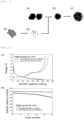
- the anode active material may be prepared through the processes of: obtaining graphite byproduct particles generated in a step of preparing spheroidized particles by pulverizing and spheroidizing flaky graphite particles ( FIG. 1 (a) ); preparing coated particles by mixing composite particles with the graphite byproduct particles and performing a mechanochemical reaction to coat the composite particles ( FIG. 1(b) ); and preparing spherical graphite by spheroidizing the coated particles and coating a surface thereof with amorphous carbon ( FIG. 1 (c) ).
- the graphite byproduct particles are byproducts remaining after the spheroidization process and have a size of 3 to 6 um.
- the graphite byproduct particles may include byproducts of natural graphite, kish graphite, or artificial graphite.
- the composite particles for mixing with the graphite byproduct particles may include any one of silicon (Si), tin (Sn), antimony (Sb), aluminum (Al), germanium (Ge), zinc (Zn), and lead (Pb), or a mixture of two or more of the above components.
- the composite particles may include any one selected from an oxide of the above components, or a mixture of two or more of the oxides.
- silicon particles are used as the composite particles.
- the silicon particles are adapted to have a particle size of 10 to 200 nm by pulverizing particles having a size of several um ( FIG. 1(d) ) obtained from waste silicon ( FIG. 1(e) ).
- the composite particles Since the composite particles have a significantly smaller size than the graphite byproduct particles, they react on the surface of the graphite byproduct particles through a mechanochemical reaction to form a bond therewith, and as a result, a surface coating layer is formed. In addition, when the surface of the composite particles is coated, an effect of forming curved graphite byproduct particles having sharp edge portions may be obtained. This is because the coating is performed while nanometer-sized composite particles penetrate into the edge portion.
- MSR Advances, 4, 155-162 discloses experimental results for preparing a composite by performing a mechanochemical reaction on the graphite particles and iron oxide nanoparticles.
- this document describes results of carbon atoms being incorporated into a crystal structure of iron oxide nanoparticles or forming a new crystal structure depending on mechanochemical reaction conditions.
- the above results suggest that a crystal structure unsuitable for the anode active material may be generated depending on the mechanochemical reaction conditions. Therefore, in the present invention, the mechanochemical reaction conditions are optimized and applied to prepare the composite by reflecting the results of the prior studies.
- the surface of the graphite byproduct particles is coated with the composite particles to prepare coated particles ( FIG. 1 (b) ), and the coated particles are spheroidized then the surface is coated with amorphous carbon, such that spherical graphite coated with amorphous carbon is prepared as shown in FIG. 1(c) .
- the spherical graphite coated with the amorphous carbon is used as a material for an anode active material.
- mesophase particles (the intermediate stage-spheroidized particles) having a size of 3 to 10 um are formed before the finally produced spherical graphite is spheroidized into particles having a size of 5 to 30 um.
- a spheroidizing operation is performed.
- the spherical graphite particles prepared as described above may be applied as an anode active material.
- the anode active material may be included in an anode to form a secondary battery.
- the secondary battery may include the anode, a cathode disposed to face the anode and including a cathode active material, a separator provided between the cathode and the anode, and an electrolyte provided to impregnate the separator.
- a cathode containing LNMO (LiNi0.5Mn1.504) and an anode to which spherical graphite (Si content of 13%) according to the present invention is applied as an anode active material were prepared, then a full cell was prepared using the cathode and anode, followed by measuring the discharge capacity retention characteristics according to the number of charging/discharging times (cycles).
- Super-P Li and PVDF binder were applied as a conductive agent, and a separation membrane of 15 um PE separation membrane of which both sides are coated with ceramic of 2 to 3 um was applied as a separation membrane (separator).
- a high-quality secondary battery could be prepared by achieving improvement in electrical conductivity and improvement in output characteristics through the improved electrical conductivity when the spherical graphite according to the present invention was applied as the anode active material.
Landscapes
- Chemical & Material Sciences (AREA)
- Chemical Kinetics & Catalysis (AREA)
- Electrochemistry (AREA)
- General Chemical & Material Sciences (AREA)
- Composite Materials (AREA)
- Inorganic Chemistry (AREA)
- Organic Chemistry (AREA)
- Engineering & Computer Science (AREA)
- Materials Engineering (AREA)
- Life Sciences & Earth Sciences (AREA)
- General Life Sciences & Earth Sciences (AREA)
- Geology (AREA)
- Manufacturing & Machinery (AREA)
- Battery Electrode And Active Subsutance (AREA)
Abstract
Description
- The present invention relates to a method for preparing an anode active material and a secondary battery including the anode active material, and more specifically, to an anode active material including spherical graphite particles coated with amorphous carbon prepared by a mechanochemical reaction, a method for preparing the anode active material and a secondary battery including the anode active material.
- Crystalline graphite, which is used as an anode active material for a lithium secondary battery, is obtained and used by preparing flaky graphite in spherical graphite particles through a granulating process. Since these spherical graphite particles are granulated without a gap between flaky graphite fragments on the surface of the particles, there is a limitation in contact with an electrolyte. Due to this, when applying these particles to the anode active material, there is a problem in that charge/discharge characteristics of the battery are reduced. This is because expansion and contraction of spherical graphite particles cannot be effectively controlled during charging and discharging processes in which lithium ions are repeatedly intercalated and deintercalated. Eventually, structures of the granulated particles become unstable as a bonding force of the flaky graphite fragments is decreased, and a reaction with the electrolyte penetrating into the particles is performed in an irreversible reaction due to repeated charging and discharging, such that an excessive solid-electrolyte interphase film is formed and a swelling phenomenon occurs.
- In order to solve these problems, research and development to improve properties of spherical graphite particles have been conducted.
- For example, in
Korean Patent Registration Nos. 10-1965773 10-1919470 - In addition, in
Korean Patent Registration Publication No. 10-1986680 - When applying the conventional preparation method known in the prior art, it is possible to form gaps between the spherical particles, such that the properties of the particles as an anode active material may be improved. However, it is not possible to completely solve the problem in that the process is complicated and the bonding force of the flaky graphite fragments is reduced, such that improvement thereof is required.
- In consideration of the above-mentioned circumstances, it is an object of the present invention to provide a method for preparing an anode active material capable of improving high-rate charge/discharge characteristics and cycle life-span characteristics of the secondary battery by preparing spherical graphite particles through a mechanochemical reaction thus to form gaps between flaky graphite particles while improving stability thereof.
- In particular, another object of the present invention is to provide a method for preparing an anode active material through a mechanochemical reaction by utilizing a large amount of graphite byproduct particles obtained in a process of pulverizing flaky graphite.
- Further, another object of the present invention is to provide a secondary battery with improved charge/discharge characteristics by using the anode active material as an anode material.
- To achieve the above objects, according to an aspect of the present invention, there is provided a method for preparing an anode active material including the steps of: obtaining graphite byproduct particles that have not been spheroidized in a step of pulverizing and spheroidizing flaky graphite particles; preparing coated particles by mixing the graphite byproduct particles with composite particles and performing a mechanochemical reaction thereon to coat the surface of the graphite byproduct particles with the composite particles; and spheroidizing the coated particles and coating the surface thereof with amorphous carbon to prepare spherical graphite.
- At this time, the composite particles may include any one of silicon (Si), tin (Sn), antimony (Sb), aluminum (Al), germanium (Ge), zinc (Zn), lead (Pb), or a mixture of two or more thereof, or an oxide thereof, or a mixture of two or more of the oxides.
- In addition, according to another aspect of the present invention, there is provided a secondary battery including: an anode including the anode active material prepared by the above preparation method; a cathode disposed to face the anode and including a cathode active material; a separator provided between the cathode and the anode; and an electrolyte provided to impregnate the separator.
- According to the method for preparing an anode active material of the present invention, there are effects as follows. First, it is possible to improve high-rate charge/discharge characteristics and cycle life-span characteristics of the secondary battery by preparing spherical graphite particles through a mechanochemical reaction thus to form gaps between flaky graphite particles while improving stability thereof.
- In particular, it is possible to prepare an anode active material by utilizing a large amount of graphite byproduct particles obtained in a process of pulverizing flaky graphite.
- Further, it is possible to improve charge/discharge characteristics of the secondary battery by using the anode active material as an anode material.
-
-
FIG. 1 is a view showing a concept of a process for preparing an anode active material according to the present invention. -
FIG. 2 is graphs showing test evaluation results for capacity (a) and cycle characteristics (b) of secondary batteries to which graphite including silicon deposited on a surface thereof by a conventional method and graphite including silicon bonded thereto by a mechanochemical reaction of the present invention are applied. -
FIG. 3 is graphs showing test evaluation results for capacity (a) and cycle characteristics (b) of secondary batteries to which artificial graphite and spherical graphite of the present invention are applied. - Hereinafter, the present invention will be described in detail. Prior to this, terms or words used in the specification and claims should not be construed as limited to a conventional or lexical meaning. Instead, based on a principle that an inventor may desirably define the concept of terms or words to describe his/her invention by means of the most preferable method, the terms or words should be construed as the meanings and concepts in compliance with technical ideas of the present invention.
- The anode active material according to the present invention uses spherical graphite particles as a main material, and is technically characterized in that the characteristics of the anode active material are improved by optimizing a process for preparing spherical graphite particles.
- In general, flaky graphite particles have a particle size of 30 to 200 um, and when spheroidizing the particles by pulverizing, a yield thereof is only about 40%, and the remaining 60% remains as a graphite byproduct. That is, there is a problem in that only particles with abraded edges of the flaky graphite particles can be spheroidized, and the byproducts with sharp edges should be discarded since they are graphite fragments.
- Another technical characteristic of the present invention is to provide an improved process capable of utilizing the graphite byproduct particles in addition to a process for optimizing the preparation process of the spherical graphite particles.
- To this end, the anode active material according to the present invention may be prepared by a method including the steps of: obtaining graphite byproduct particles that have not been spheroidized in a step of pulverizing and spheroidizing flaky graphite particles; preparing coated particles by mixing the graphite byproduct particles with composite particles and performing a mechanochemical reaction thereon to coat the surface of the graphite byproduct particles with the composite particles; and spheroidizing the coated particles and coating the surface thereof with amorphous carbon to prepare spherical graphite.
- In general, when preparing spherical graphite by a dry preparation process, flaky graphite particles may be spheroidized by pulverizing through high-speed milling. In this case, since the spheroidization is performed as the graphite particles collide during the high-speed milling process, the yield thereof is only about 40%, and there is a problem in that all graphite byproduct particles that have not been spheroidized should be discarded. For example, when pulverizing and spheroidizing flaky graphite particles with a size of 30 to 200 um by high-speed milling, spherical graphite of 3 to 20 um are formed. Then, an anode active material is prepared by performing a surface treatment to remove a rough surface by milling the spherical graphite at a low speed, and coating the surface thereof with amorphous carbon. In this regard, there are problems in that the yield of the spherical graphite particles prepared by the above-described process is too low, and gaps between the obtained spherical graphite particles are insufficient, thereby resulting in a decrease in the charge/discharge characteristics of the battery.
- Furthermore, recycling the graphite byproduct particles that have not been spheroidized causes more difficult problems in relation to the process, and even if preparing spherical graphite particles using the same, there is a very high possibility that the prepared products will be defective due to insufficient charge/discharge characteristics.
- In the present invention, the problems entailed in the conventional preparation method are solved through a preparation method capable of processing the graphite byproduct particles into spherical graphite particles using a mechanochemical reaction. In the mechanochemical reaction, compression, shear and impact between particles can occur at once, such that chemical bonds between the particles are created by a mechanical energy.
- Herein, a method for preparing an anode active material according to the present invention will be described with reference to
FIG. 1 . The anode active material may be prepared through the processes of: obtaining graphite byproduct particles generated in a step of preparing spheroidized particles by pulverizing and spheroidizing flaky graphite particles (FIG. 1 (a) ); preparing coated particles by mixing composite particles with the graphite byproduct particles and performing a mechanochemical reaction to coat the composite particles (FIG. 1(b) ); and preparing spherical graphite by spheroidizing the coated particles and coating a surface thereof with amorphous carbon (FIG. 1 (c) ). - The graphite byproduct particles are byproducts remaining after the spheroidization process and have a size of 3 to 6 um. The graphite byproduct particles may include byproducts of natural graphite, kish graphite, or artificial graphite.
- The composite particles for mixing with the graphite byproduct particles may include any one of silicon (Si), tin (Sn), antimony (Sb), aluminum (Al), germanium (Ge), zinc (Zn), and lead (Pb), or a mixture of two or more of the above components. In addition, the composite particles may include any one selected from an oxide of the above components, or a mixture of two or more of the oxides.
- Generally, silicon particles are used as the composite particles. The silicon particles are adapted to have a particle size of 10 to 200 nm by pulverizing particles having a size of several um (
FIG. 1(d) ) obtained from waste silicon (FIG. 1(e) ). - In the prior arts, during processing with the composite particles, composite of graphite particles and silicon particles are performed by a wet process. In this case, there are problems in that the yield is low, the stability of the prepared particles is insufficient, and the charge/discharge effects are also insufficient. In the present invention, these problems are solved by applying a mechanochemical reaction which is a dry preparation method.
- Since the composite particles have a significantly smaller size than the graphite byproduct particles, they react on the surface of the graphite byproduct particles through a mechanochemical reaction to form a bond therewith, and as a result, a surface coating layer is formed. In addition, when the surface of the composite particles is coated, an effect of forming curved graphite byproduct particles having sharp edge portions may be obtained. This is because the coating is performed while nanometer-sized composite particles penetrate into the edge portion.
- MSR Advances, 4, 155-162 (2019) discloses experimental results for preparing a composite by performing a mechanochemical reaction on the graphite particles and iron oxide nanoparticles. In this case, this document describes results of carbon atoms being incorporated into a crystal structure of iron oxide nanoparticles or forming a new crystal structure depending on mechanochemical reaction conditions. The above results suggest that a crystal structure unsuitable for the anode active material may be generated depending on the mechanochemical reaction conditions. Therefore, in the present invention, the mechanochemical reaction conditions are optimized and applied to prepare the composite by reflecting the results of the prior studies.
- In addition, it was shown that, prior to performing the mechanochemical reaction, when immersing the intermediate stage-spheroidized particles in hexane for 10 to 30 seconds followed by drying the same, and then performing a mechanochemical reaction by mixing the intermediate stage-spheroidized particles whose surface is subjected to surface treatment with hexane and the composite particles, the generation of undesirable crystal structures was inhibited. This is presumed to be because when carbon atoms penetrate into the structure of the composite particles by the mechanochemical reaction, carbon atoms are provided from hexane molecules adsorbed on the surface, such that the graphite particles themselves do not undergo modification.
- The surface of the graphite byproduct particles is coated with the composite particles to prepare coated particles (
FIG. 1 (b) ), and the coated particles are spheroidized then the surface is coated with amorphous carbon, such that spherical graphite coated with amorphous carbon is prepared as shown inFIG. 1(c) . The spherical graphite coated with the amorphous carbon is used as a material for an anode active material. - Therefore, in the preparation method of the present invention, mesophase particles (the intermediate stage-spheroidized particles) having a size of 3 to 10 um are formed before the finally produced spherical graphite is spheroidized into particles having a size of 5 to 30 um. After adding the pulverized composite particles having a size of 10 to 200 nm to the mesophase particles and coating the surface of the mesophase particles with the composite particles by the mechanochemical reaction under a dry condition, a spheroidizing operation is performed.
- The spherical graphite particles prepared as described above may be applied as an anode active material. The anode active material may be included in an anode to form a secondary battery. The secondary battery may include the anode, a cathode disposed to face the anode and including a cathode active material, a separator provided between the cathode and the anode, and an electrolyte provided to impregnate the separator.
- In order to confirm effects obtained when applying the anode active material of the present invention to a secondary battery, a cathode containing LNMO (LiNi0.5Mn1.504) and an anode to which spherical graphite (Si content of 13%) according to the present invention is applied as an anode active material were prepared, then a full cell was prepared using the cathode and anode, followed by measuring the discharge capacity retention characteristics according to the number of charging/discharging times (cycles). In the full cell, Super-P Li and PVDF binder were applied as a conductive agent, and a separation membrane of 15 um PE separation membrane of which both sides are coated with ceramic of 2 to 3 um was applied as a separation membrane (separator). As the electrolyte, 1M LiPF6 + EC:DEC:DMC (vol% 1:1:1) was used. In addition, for comparison, a test was conducted using conventional spherical graphite deposited with silicon prepared by a dry preparation process as an anode active material.
- As a result, as shown in
FIG. 2(a) , it could be found that when the spherical graphite according to the present invention was applied as the anode active material, higher charge/discharge efficiency was exhibited than the case of using the spherical graphite according to the conventional preparation method. In addition, also from the evaluation results of the cycle characteristics, it could be confirmed that when the spherical graphite according to the present invention was applied as the anode active material, stable capacity retention rate characteristics were exhibited at the time of repeated charging and discharging under the same condition. - It is considered that these characteristics of the secondary battery are caused by improvement in the characteristics of the anode active material, since a stable composite with graphite can be formed when preparing spherical graphite by applying a mechanochemical reaction in the present invention.
- In addition, charge/discharge characteristics and capacity retention rates of the full cell using artificial graphite as the anode active material and the full cell using the spherical graphite of the present invention as the anode active material were evaluated. As a result of the evaluation, as shown in
FIG. 3 , it was confirmed that improved characteristics of the secondary battery could be obtained when the spherical graphite according to the present invention was applied. - Therefore, it was confirmed that a high-quality secondary battery could be prepared by achieving improvement in electrical conductivity and improvement in output characteristics through the improved electrical conductivity when the spherical graphite according to the present invention was applied as the anode active material.
- While the present invention has been described with reference to the preferred embodiments as described above, it is not limited to the above-described embodiments, and various modifications and variations may be made by persons skilled in the art to which the present invention pertains without departing from spirit of the present invention. Such modifications and variations are duly included within the scope of the present invention and the appended claims.
Claims (3)
- A method for preparing an anode active material comprising the steps of:obtaining graphite byproduct particles that have not been spheroidized in a step of pulverizing and spheroidizing flaky graphite particles;preparing coated particles by mixing the graphite byproduct particles with composite particles and performing a mechanochemical reaction thereon to coat the surface of the graphite byproduct particles with the composite particles; andspheroidizing the coated particles and coating the surface thereof with amorphous carbon to prepare spherical graphite.
- The method for preparing an anode active material according to claim 1,
wherein the composite particles include any one of silicon (Si), tin (Sn), antimony (Sb), aluminum (Al), germanium (Ge), zinc (Zn), lead (Pb), or a mixture of two or more thereof, or an oxide of the above components, or a mixture of two or more of the oxides. - A secondary battery comprising: an anode comprising the anode active material prepared by the preparation method of claim 1; a cathode disposed to face the anode and comprising a cathode active material; a separator provided between the cathode and the anode; and an electrolyte provided to impregnate the separator.
Applications Claiming Priority (2)
| Application Number | Priority Date | Filing Date | Title |
|---|---|---|---|
| KR1020200092098A KR102156535B1 (en) | 2020-07-24 | 2020-07-24 | Manufacturing method of anode active material and secondary battery comprising the same |
| PCT/KR2021/008770 WO2022019544A1 (en) | 2020-07-24 | 2021-07-09 | Method for preparing anode active material, and secondary battery comprising anode active material |
Publications (2)
| Publication Number | Publication Date |
|---|---|
| EP4187645A1 true EP4187645A1 (en) | 2023-05-31 |
| EP4187645A4 EP4187645A4 (en) | 2024-10-23 |
Family
ID=72707105
Family Applications (1)
| Application Number | Title | Priority Date | Filing Date |
|---|---|---|---|
| EP21845805.7A Pending EP4187645A4 (en) | 2020-07-24 | 2021-07-09 | METHOD FOR PRODUCING AN ANODE ACTIVE MATERIAL AND SECONDARY BATTERY WITH ANODE ACTIVE MATERIAL |
Country Status (4)
| Country | Link |
|---|---|
| US (2) | US12555788B2 (en) |
| EP (1) | EP4187645A4 (en) |
| KR (1) | KR102156535B1 (en) |
| WO (1) | WO2022019544A1 (en) |
Family Cites Families (19)
| Publication number | Priority date | Publication date | Assignee | Title |
|---|---|---|---|---|
| KR100274233B1 (en) * | 1998-05-21 | 2001-02-01 | 김순택 | Anode active material for lithium ion secondary battery and manufacturing method thereof |
| KR100738054B1 (en) * | 2004-12-18 | 2007-07-12 | 삼성에스디아이 주식회사 | Anode active material, manufacturing method thereof, and anode and lithium battery using same |
| KR100981909B1 (en) | 2008-04-15 | 2010-09-13 | 애경유화 주식회사 | Anode active material for lithium secondary battery, manufacturing method thereof and lithium secondary battery comprising same |
| JP2013515349A (en) | 2009-12-21 | 2013-05-02 | エー123 システムズ, インコーポレイテッド | Anode material |
| KR101396521B1 (en) * | 2011-08-05 | 2014-05-22 | 강원대학교산학협력단 | Negative active material for rechargeable lithium battery, method of preparing the same, and negative electrode and rechargeable lithium battery including the same |
| KR101368474B1 (en) | 2012-03-23 | 2014-03-03 | 강원대학교산학협력단 | Negative active material for rechargeable lithium battery, method of preparing the same, and rechargeable lithium battery including the same |
| JP6221255B2 (en) | 2013-02-25 | 2017-11-01 | 三菱ケミカル株式会社 | Non-aqueous secondary battery negative electrode carbon material, non-aqueous secondary battery negative electrode and non-aqueous secondary battery |
| JP6251968B2 (en) * | 2013-03-25 | 2017-12-27 | 三菱ケミカル株式会社 | Non-aqueous secondary battery negative electrode carbon material, non-aqueous secondary battery negative electrode and non-aqueous secondary battery |
| KR101857981B1 (en) * | 2013-08-05 | 2018-05-15 | 쇼와 덴코 가부시키가이샤 | Negative electrode material for lithium ion batteries and use thereof |
| KR101639242B1 (en) | 2014-11-13 | 2016-07-13 | (주)포스코켐텍 | Negative electrode active material for rechargable lithium battery, method for manufacturing the same, and rechargable lithium battery including the same |
| CN106784640B (en) | 2015-11-25 | 2020-05-26 | 北京有色金属研究总院 | Silicon-based composite negative electrode material for lithium ion battery, preparation method of silicon-based composite negative electrode material and lithium ion battery negative electrode containing silicon-based composite negative electrode material |
| KR101786714B1 (en) * | 2015-12-07 | 2017-10-18 | 강원대학교산학협력단 | Negative active material for rechargeable lithium battery including core consisting of carbon, method of preparing the same, and rechargeable lithium battery including the same |
| KR102081397B1 (en) | 2016-12-12 | 2020-02-25 | 주식회사 엘지화학 | Method of preparing electrodes for lithium secondary battery |
| WO2018110263A1 (en) | 2016-12-12 | 2018-06-21 | 昭和電工株式会社 | Composite graphite particles, method for producing same, and use thereof |
| KR101919470B1 (en) * | 2017-02-16 | 2018-11-16 | 강원대학교산학협력단 | Negative active material for lithium secondary battery, method for preparing the same and lithium secondary battery comprising thereof |
| KR102487626B1 (en) | 2017-07-12 | 2023-01-12 | 삼성에스디아이 주식회사 | Negative active material for rechargeable lithium battery and rechargeable lithium battery including same |
| KR101986680B1 (en) | 2017-12-22 | 2019-06-07 | 강원대학교산학협력단 | Negative active material for lithium secondary battery, method for preparing the same and lithium secondary battery including the same |
| KR102078606B1 (en) * | 2018-02-22 | 2020-02-19 | 강원대학교산학협력단 | Negative active material for rechargeable lithium battery, method of preparing the same, and rechargeable lithium battery including the same |
| KR101965773B1 (en) | 2018-12-11 | 2019-04-04 | 강원대학교산학협력단 | Negative active material for lithium secondary battery, method for preparing the same and lithium secondary battery comprising thereof |
-
2020
- 2020-07-24 KR KR1020200092098A patent/KR102156535B1/en active Active
-
2021
- 2021-07-09 WO PCT/KR2021/008770 patent/WO2022019544A1/en not_active Ceased
- 2021-07-09 US US18/006,524 patent/US12555788B2/en active Active
- 2021-07-09 EP EP21845805.7A patent/EP4187645A4/en active Pending
-
2025
- 2025-10-14 US US19/358,315 patent/US20260038830A1/en active Pending
Also Published As
| Publication number | Publication date |
|---|---|
| WO2022019544A1 (en) | 2022-01-27 |
| US20260038830A1 (en) | 2026-02-05 |
| EP4187645A4 (en) | 2024-10-23 |
| US20230275225A1 (en) | 2023-08-31 |
| KR102156535B1 (en) | 2020-09-17 |
| US12555788B2 (en) | 2026-02-17 |
Similar Documents
| Publication | Publication Date | Title |
|---|---|---|
| EP4187644A1 (en) | Method for producing negative electrode active material, and secondary battery including negative electrode active material | |
| JP7028354B2 (en) | All-solid-state lithium-ion secondary battery | |
| KR102382277B1 (en) | Positive electrode for lithium ion secondary battery, graphene-positive electrode active material composite particle and method for manufacturing the same, and positive electrode paste for lithium ion secondary battery | |
| EP3621133B1 (en) | Anode for secondary battery, manufacturing method therefor, and lithium secondary battery manufactured using same | |
| US20170207451A1 (en) | Anodes for lithium-ion devices | |
| CN108987697B (en) | A kind of preparation method of high specific energy olivine-type lithium manganese phosphate lithium ion battery cathode material | |
| JP2016066579A (en) | Negative electrode active material for lithium ion secondary battery and method for producing the same | |
| TW201547090A (en) | Negative electrode active material for lithium ion secondary battery and method for producing same | |
| JP6927292B2 (en) | All-solid-state lithium-ion secondary battery | |
| Cao et al. | Mechanofusion-derived Si-alloy/graphite composite electrode materials for Li-ion batteries | |
| JP2004055505A (en) | Lithium secondary battery and negative electrode material therefor | |
| JPH11265716A (en) | Negative electrode active material for lithium secondary battery and method for producing the same | |
| JP2018181702A (en) | Method of manufacturing all solid lithium ion secondary battery | |
| JP6746906B2 (en) | Silicon-based particles, negative electrode active material for lithium-ion secondary battery containing the same, and methods for producing the same | |
| KR20030087986A (en) | Spherical carbonaceous material and method for preparation thereof | |
| CN114665148A (en) | All-solid-state battery and method for manufacturing same | |
| CN114600277B (en) | Negative electrode active material containing silicon composite formed by conductive fiber network, preparation method thereof, and lithium secondary battery containing the same | |
| JP2017183113A (en) | Composite active material for lithium ion secondary battery, and method for manufacturing the same | |
| US12603284B2 (en) | Manufacturing method of anode active material and secondary battery comprising the same | |
| EP4187646A1 (en) | Method for producing negative electrode active material, and secondary battery including negative electrode active material | |
| US12555788B2 (en) | Manufacturing method of anode active material and secondary battery comprising the same | |
| KR102221105B1 (en) | Method for manufacturing silicon graphite composite anode material for secondary battery | |
| JP2013219018A (en) | Composite active material for lithium secondary battery and production method therefor | |
| CN113066988B (en) | Negative pole piece and preparation method and application thereof | |
| JP2012113945A (en) | Negative electrode material for lithium ion battery and method for producing the same |
Legal Events
| Date | Code | Title | Description |
|---|---|---|---|
| STAA | Information on the status of an ep patent application or granted ep patent |
Free format text: STATUS: THE INTERNATIONAL PUBLICATION HAS BEEN MADE |
|
| PUAI | Public reference made under article 153(3) epc to a published international application that has entered the european phase |
Free format text: ORIGINAL CODE: 0009012 |
|
| STAA | Information on the status of an ep patent application or granted ep patent |
Free format text: STATUS: REQUEST FOR EXAMINATION WAS MADE |
|
| 17P | Request for examination filed |
Effective date: 20230213 |
|
| AK | Designated contracting states |
Kind code of ref document: A1 Designated state(s): AL AT BE BG CH CY CZ DE DK EE ES FI FR GB GR HR HU IE IS IT LI LT LU LV MC MK MT NL NO PL PT RO RS SE SI SK SM TR |
|
| DAV | Request for validation of the european patent (deleted) | ||
| DAX | Request for extension of the european patent (deleted) | ||
| A4 | Supplementary search report drawn up and despatched |
Effective date: 20240924 |
|
| RIC1 | Information provided on ipc code assigned before grant |
Ipc: H01M 10/052 20100101ALI20240917BHEP Ipc: C01B 33/02 20060101ALI20240917BHEP Ipc: C01B 32/05 20170101ALI20240917BHEP Ipc: C01B 32/21 20170101ALI20240917BHEP Ipc: H01M 4/62 20060101ALI20240917BHEP Ipc: H01M 4/38 20060101ALI20240917BHEP Ipc: H01M 4/587 20100101ALI20240917BHEP Ipc: H01M 4/36 20060101AFI20240917BHEP |