EP4187637A1 - Apparatus and method for continuously manufacturing electrode - Google Patents
Apparatus and method for continuously manufacturing electrode Download PDFInfo
- Publication number
- EP4187637A1 EP4187637A1 EP22767407.4A EP22767407A EP4187637A1 EP 4187637 A1 EP4187637 A1 EP 4187637A1 EP 22767407 A EP22767407 A EP 22767407A EP 4187637 A1 EP4187637 A1 EP 4187637A1
- Authority
- EP
- European Patent Office
- Prior art keywords
- electrode
- electrode plate
- taping
- continuously
- roll
- Prior art date
- Legal status (The legal status is an assumption and is not a legal conclusion. Google has not performed a legal analysis and makes no representation as to the accuracy of the status listed.)
- Granted
Links
Images

Classifications
-
- H—ELECTRICITY
- H01—ELECTRIC ELEMENTS
- H01M—PROCESSES OR MEANS, e.g. BATTERIES, FOR THE DIRECT CONVERSION OF CHEMICAL ENERGY INTO ELECTRICAL ENERGY
- H01M10/00—Secondary cells; Manufacture thereof
- H01M10/04—Construction or manufacture in general
- H01M10/0404—Machines for assembling batteries
-
- B—PERFORMING OPERATIONS; TRANSPORTING
- B65—CONVEYING; PACKING; STORING; HANDLING THIN OR FILAMENTARY MATERIAL
- B65H—HANDLING THIN OR FILAMENTARY MATERIAL, e.g. SHEETS, WEBS, CABLES
- B65H26/00—Warning or safety devices, e.g. automatic fault detectors, stop-motions, for web-advancing mechanisms
- B65H26/02—Warning or safety devices, e.g. automatic fault detectors, stop-motions, for web-advancing mechanisms responsive to presence of irregularities in running webs
-
- B—PERFORMING OPERATIONS; TRANSPORTING
- B65—CONVEYING; PACKING; STORING; HANDLING THIN OR FILAMENTARY MATERIAL
- B65H—HANDLING THIN OR FILAMENTARY MATERIAL, e.g. SHEETS, WEBS, CABLES
- B65H21/00—Apparatus for splicing webs
-
- B—PERFORMING OPERATIONS; TRANSPORTING
- B65—CONVEYING; PACKING; STORING; HANDLING THIN OR FILAMENTARY MATERIAL
- B65H—HANDLING THIN OR FILAMENTARY MATERIAL, e.g. SHEETS, WEBS, CABLES
- B65H27/00—Special constructions, e.g. surface features, of feed or guide rollers for webs
-
- H—ELECTRICITY
- H01—ELECTRIC ELEMENTS
- H01M—PROCESSES OR MEANS, e.g. BATTERIES, FOR THE DIRECT CONVERSION OF CHEMICAL ENERGY INTO ELECTRICAL ENERGY
- H01M10/00—Secondary cells; Manufacture thereof
- H01M10/04—Construction or manufacture in general
-
- H—ELECTRICITY
- H01—ELECTRIC ELEMENTS
- H01M—PROCESSES OR MEANS, e.g. BATTERIES, FOR THE DIRECT CONVERSION OF CHEMICAL ENERGY INTO ELECTRICAL ENERGY
- H01M10/00—Secondary cells; Manufacture thereof
- H01M10/04—Construction or manufacture in general
- H01M10/0404—Machines for assembling batteries
- H01M10/0409—Machines for assembling batteries for cells with wound electrodes
-
- H—ELECTRICITY
- H01—ELECTRIC ELEMENTS
- H01M—PROCESSES OR MEANS, e.g. BATTERIES, FOR THE DIRECT CONVERSION OF CHEMICAL ENERGY INTO ELECTRICAL ENERGY
- H01M10/00—Secondary cells; Manufacture thereof
- H01M10/04—Construction or manufacture in general
- H01M10/0431—Cells with wound or folded electrodes
-
- H—ELECTRICITY
- H01—ELECTRIC ELEMENTS
- H01M—PROCESSES OR MEANS, e.g. BATTERIES, FOR THE DIRECT CONVERSION OF CHEMICAL ENERGY INTO ELECTRICAL ENERGY
- H01M10/00—Secondary cells; Manufacture thereof
- H01M10/05—Accumulators with non-aqueous electrolyte
- H01M10/052—Li-accumulators
-
- H—ELECTRICITY
- H01—ELECTRIC ELEMENTS
- H01M—PROCESSES OR MEANS, e.g. BATTERIES, FOR THE DIRECT CONVERSION OF CHEMICAL ENERGY INTO ELECTRICAL ENERGY
- H01M10/00—Secondary cells; Manufacture thereof
- H01M10/05—Accumulators with non-aqueous electrolyte
- H01M10/052—Li-accumulators
- H01M10/0525—Rocking-chair batteries, i.e. batteries with lithium insertion or intercalation in both electrodes; Lithium-ion batteries
-
- H—ELECTRICITY
- H01—ELECTRIC ELEMENTS
- H01M—PROCESSES OR MEANS, e.g. BATTERIES, FOR THE DIRECT CONVERSION OF CHEMICAL ENERGY INTO ELECTRICAL ENERGY
- H01M10/00—Secondary cells; Manufacture thereof
- H01M10/05—Accumulators with non-aqueous electrolyte
- H01M10/058—Construction or manufacture
- H01M10/0587—Construction or manufacture of accumulators having only wound construction elements, i.e. wound positive electrodes, wound negative electrodes and wound separators
-
- H—ELECTRICITY
- H01—ELECTRIC ELEMENTS
- H01M—PROCESSES OR MEANS, e.g. BATTERIES, FOR THE DIRECT CONVERSION OF CHEMICAL ENERGY INTO ELECTRICAL ENERGY
- H01M4/00—Electrodes
- H01M4/02—Electrodes composed of, or comprising, active material
- H01M4/04—Processes of manufacture in general
-
- H—ELECTRICITY
- H01—ELECTRIC ELEMENTS
- H01M—PROCESSES OR MEANS, e.g. BATTERIES, FOR THE DIRECT CONVERSION OF CHEMICAL ENERGY INTO ELECTRICAL ENERGY
- H01M4/00—Electrodes
- H01M4/02—Electrodes composed of, or comprising, active material
- H01M4/04—Processes of manufacture in general
- H01M4/0402—Methods of deposition of the material
- H01M4/0404—Methods of deposition of the material by coating on electrode collectors
-
- H—ELECTRICITY
- H01—ELECTRIC ELEMENTS
- H01M—PROCESSES OR MEANS, e.g. BATTERIES, FOR THE DIRECT CONVERSION OF CHEMICAL ENERGY INTO ELECTRICAL ENERGY
- H01M4/00—Electrodes
- H01M4/02—Electrodes composed of, or comprising, active material
- H01M4/04—Processes of manufacture in general
- H01M4/043—Processes of manufacture in general involving compressing or compaction
- H01M4/0435—Rolling or calendering
-
- H—ELECTRICITY
- H01—ELECTRIC ELEMENTS
- H01M—PROCESSES OR MEANS, e.g. BATTERIES, FOR THE DIRECT CONVERSION OF CHEMICAL ENERGY INTO ELECTRICAL ENERGY
- H01M4/00—Electrodes
- H01M4/02—Electrodes composed of, or comprising, active material
- H01M4/13—Electrodes for accumulators with non-aqueous electrolyte, e.g. for lithium-accumulators; Processes of manufacture thereof
- H01M4/139—Processes of manufacture
-
- B—PERFORMING OPERATIONS; TRANSPORTING
- B65—CONVEYING; PACKING; STORING; HANDLING THIN OR FILAMENTARY MATERIAL
- B65H—HANDLING THIN OR FILAMENTARY MATERIAL, e.g. SHEETS, WEBS, CABLES
- B65H2301/00—Handling processes for sheets or webs
- B65H2301/40—Type of handling process
- B65H2301/46—Splicing
- B65H2301/4601—Splicing special splicing features or applications
- B65H2301/46011—Splicing special splicing features or applications in winding process
-
- B—PERFORMING OPERATIONS; TRANSPORTING
- B65—CONVEYING; PACKING; STORING; HANDLING THIN OR FILAMENTARY MATERIAL
- B65H—HANDLING THIN OR FILAMENTARY MATERIAL, e.g. SHEETS, WEBS, CABLES
- B65H2301/00—Handling processes for sheets or webs
- B65H2301/40—Type of handling process
- B65H2301/46—Splicing
- B65H2301/461—Processing webs in splicing process
- B65H2301/4615—Processing webs in splicing process after splicing
- B65H2301/4617—Processing webs in splicing process after splicing cutting webs in splicing process
- B65H2301/46178—Processing webs in splicing process after splicing cutting webs in splicing process cutting by transversally moving element
-
- B—PERFORMING OPERATIONS; TRANSPORTING
- B65—CONVEYING; PACKING; STORING; HANDLING THIN OR FILAMENTARY MATERIAL
- B65H—HANDLING THIN OR FILAMENTARY MATERIAL, e.g. SHEETS, WEBS, CABLES
- B65H2301/00—Handling processes for sheets or webs
- B65H2301/40—Type of handling process
- B65H2301/46—Splicing
- B65H2301/463—Splicing splicing means, i.e. means by which a web end is bound to another web end
- B65H2301/4631—Adhesive tape
-
- B—PERFORMING OPERATIONS; TRANSPORTING
- B65—CONVEYING; PACKING; STORING; HANDLING THIN OR FILAMENTARY MATERIAL
- B65H—HANDLING THIN OR FILAMENTARY MATERIAL, e.g. SHEETS, WEBS, CABLES
- B65H2701/00—Handled material; Storage means
- B65H2701/10—Handled articles or webs
- B65H2701/19—Specific article or web
-
- B—PERFORMING OPERATIONS; TRANSPORTING
- B65—CONVEYING; PACKING; STORING; HANDLING THIN OR FILAMENTARY MATERIAL
- B65H—HANDLING THIN OR FILAMENTARY MATERIAL, e.g. SHEETS, WEBS, CABLES
- B65H2801/00—Application field
- B65H2801/72—Fuel cell manufacture
-
- Y—GENERAL TAGGING OF NEW TECHNOLOGICAL DEVELOPMENTS; GENERAL TAGGING OF CROSS-SECTIONAL TECHNOLOGIES SPANNING OVER SEVERAL SECTIONS OF THE IPC; TECHNICAL SUBJECTS COVERED BY FORMER USPC CROSS-REFERENCE ART COLLECTIONS [XRACs] AND DIGESTS
- Y02—TECHNOLOGIES OR APPLICATIONS FOR MITIGATION OR ADAPTATION AGAINST CLIMATE CHANGE
- Y02E—REDUCTION OF GREENHOUSE GAS [GHG] EMISSIONS, RELATED TO ENERGY GENERATION, TRANSMISSION OR DISTRIBUTION
- Y02E60/00—Enabling technologies; Technologies with a potential or indirect contribution to GHG emissions mitigation
- Y02E60/10—Energy storage using batteries
Definitions
- the present disclosure relates to an apparatus and method for continuously manufacturing electrode that can improve the mass productivity of the continuous electrode manufacturing process by automatically and continuously removing the electrode plate in which a defect occurs, in an apparatus for transferring and rolling an electrode plate to continuously manufacture an electrode.
- the secondary battery can be formed by inserting an electrode assembly including electrode plates of a positive electrode plate and a negative electrode plate and a separator into a case, and then sealing the case.
- An electrode plate such as a positive electrode plate or a negative electrode plate is obtained by applying a composition containing an active material slurry to each electrode current collector to form a coating layer, and while such an electrode plate is continuously transported, it can be rolled with a roll press device or the like to manufacture each electrode.
- the rolling step is a step of improving the adhesive property between the coating layer and the electrode current collector, and increasing the capacity density of the active material.
- the rolled electrode plate can be dried and then cut to a predetermined size to finally continuously manufacture the electrodes contained in the secondary battery.
- an object of the present disclosure is to provide an electrode continuous manufacturing apparatus that can improve the mass productivity of the electrode continuous manufacturing process by automatically and continuously removing and taking out the electrode plate in which a defect occurs.
- Another object of the present disclosure is to provide a method capable of continuously manufacturing an electrode with high mass productivity by applying the apparatus for continuous manufacturing of the electrode.
- an apparatus for continuously manufacturing an electrode while transferring and rolling an electrode plate including a coating layer formed on an electrode current collector comprising:
- a method for continuously manufacturing an electrode using the apparatus for continuously manufacturing an electrode while transferring and rolling an electrode plate including a coating layer formed on an electrode current collector comprising the steps of:
- the electrode plate in which a defect occurs is continuously removed and taken out, while the remaining normal electrode plate can be connected to the normal electrode roll to continuously proceed the electrode manufacturing process including the subsequent rolling step.
- the defect rate of the electrode due to the defect occurrence of the electrode plate can also be greatly reduced.
- planar when referred to as “planar”, it means when a target portion is viewed from the upper side, and when referred to as “cross-sectional”, it means when a target portion is viewed from the side of a cross portion cut vertically.
- Fig. 1 is a cross-sectional view which schematically shows the continuous manufacturing apparatus of the electrode according to one embodiment of the present disclosure.
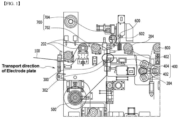
- Fig. 2 is a top view which schematically shows the continuous manufacturing apparatus of the electrode according to one embodiment of the present disclosure.
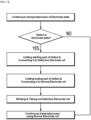
- Fig. 3 is a flowchart which schematically shows the continuous manufacturing method of the electrode by another embodiment of the present disclosure.
- an apparatus for continuously manufacturing an electrode while transferring and rolling an electrode plate 100 including a coating layer formed on an electrode current collector comprising:
- the electrode plate 100 in which a defect occurs is cut at the first cut part 300 and second cut part 600, respectively, and separated from the normal electrode plate 100.
- the starting part of the defect occurrence of the electrode plate 100 is connected to the defective electrode roll to which a defect electrode plate with a defect already occurred is connected in the first taping part 400, and the defective electrode roll including the defective electrode plate is continuously wound and taken out by the defective electrode winding part 500.
- the normal electrode plate 100 separated from the defective electrode plate 100 in the second cutting part 600 is connected to the normal electrode roll in the second taping part 700, so that the electrode manufacturing process including a subsequent rolling step or the like is continuously performed while continuously transferring the normal electrode roll.
- the defective electrode plate 100 is continuously removed and taken out from the normal electrode roll, while the remaining normal electrode plate 100 from which the defective electrode plate 100 has been removed is connected to the normal electrode roll, so that the electrode manufacturing process can be continuously performed.
- the electrodes can be continuously manufactured while being automatically removed during the continuous manufacturing process of the electrodes, without need to stop the electrode manufacturing equipment and manually remove the defective electrode plate 100. Therefore, it is possible to greatly improve the mass productivity for manufacturing electrodes of secondary batteries such as lithium secondary batteries, and the workload of the operator can be significantly reduced, and further, the defect rate of the electrodes due to the occurrence of defects in the electrode plate can be significantly reduced.
- the plurality of guide rollers 202 and 204 include a first guide roller 202 and a second guide roller 204, and the first cutting part 300 and the second cutting part 600 and the first taping part 400 and the second taping part 700 may be disposed between the first guide roller 202 and second guide roller 204.
- the electrode plate 100 is continuously transported through the first and second guide rollers 202 and 204, and the electrode plate 100 in which a defect occurs therebetween is effectively separated and removed, thereby connecting and taking out the defective electrode roll.
- the remaining normal electrode plate 100 is continuously connected with the normal electrode roll, so that the electrode manufacturing process can be continuously performed.
- the first cutting parts 300 and/or second cutting part 600 may include cutters 302 and 602 that cut the electrode plate 100 being continuously conveyed perpendicular to the transport direction, respectively.
- the cutters 302 provided in the first cutting part 300 and/or the cutters 602 provided in the second cutting part 600 can cut the electrode plate 100 at the starting part and ending part of the defect occurrence while moving perpendicularly to the transport direction of the electrode plate 100.
- the first taping part 400 connects the defective electrode plate 100 cut in the first cutting part 300 with the defective electrode roll to which the previous defective electrode plates are connected
- the second taping part 700 connects the normal electrode plate 100 cut in the second cutting part 600 with the normal electrode roll to which the previous normal electrode plates are connected.
- the first taping parts 400 and/or the second 700 may include suction plates 402 and 702 that suck the electrode plate 100 and the connection part of the electrode roll, respectively; and taping compression rollers 404 and 704 that tape while applying pressure to the connection between the electrode plate 100 and the electrode roll.
- the suction plate 702 and the taping compression roller 704 are provided in the second taping part 700
- the suction plate 402 and the taping compression roller 404 are provided in the first taping part 400.
- only one of the first and second taping parts 400 and 700 may be provided with the suction plates 402 and 702 and the taping compression rollers 404 and 704.
- the suction plates 402 and 702 may include a plurality of vacuum suction holes 706 that vacuum-suctions the electrode plates 100 to be connected to each other.
- the electrode plate 100 is fixed in position by the action of the vacuum suction hole 706, while a tape 708 for connection is added to one surface of these electrode plates 100.
- the tape 708 can be attached by applying pressure while the taping compression rollers 404 and 704 move along the connecting portion of the electrode plate 100, thereby connecting the electrode plate 100.
- FIG. 2 the process in which for example, the electrode plates 100 of the suction plate 702 and the taping compression roller 704 provided in the second taping part 700 are connected by taping is shown, but even in the first taping part 400, the electrode plates 100 can be interconnected through the same process.
- the first cutting part 300 and the first taping part 400 that cut the electrode plate 100 at the starting part of the defect occurrence and connect the defective electrode plate 100 with the defective electrode roll may be arranged adjacent to each other.
- a second cutting part 600 and a second taping part that cut the electrode plate 100 at the ending part of the defect occurrence and connect the normal electrode plate 100 separated from the defective electrode plate 100 with the normal electrode roll 700 may be arranged adjacent to each other. Due to this arrangement, the process of separating the defective electrode plate and connecting with the electrode roll can be made efficient.
- the second cutting part 600 and the second taping part 700 may be formed along the transport direction of the electrode plate 100, and the first cutting part 300 and the first taping part 400 for separating and taking out the defective electrode plate 100 can be arranged in the lower part of the continuous manufacturing apparatus, for example, in the lower part of the second cutting part 600 and the second taping part 700, in a direction perpendicular to the transport direction of the electrode plate 100.
- a third guide roller may be further provided to transport the defective electrode plate toward the first cutting part 300 and the first taping part 400 in a direction perpendicular to the transport direction of the normal electrode plate 100.
- the defective electrode plate 100 separated from the normal electrode plate and connected to the defective electrode roll is continuously wound and taken out by the defective electrode winding part 500, and the normal electrode plate 100 separated from the defective electrode plate 100 is connected to the normal electrode roll, while it is wound and continuously transferred by the normal electrode winding part 800.
- the normal electrode plate 100 wound by the normal electrode winding part 800 and continuously transported may be subjected to subsequent electrode manufacturing processes such as subsequent rolling, drying, and cutting.
- a rolling roll (not shown) for rolling the normal electrode plate 100 may be further provided.
- a pressure may be applied to the coating layer on the electrode plate 100 to proceed with the rolling process.
- the electrode plate 100 including the coating layer formed on the electrode current collector is continuously transferred to the plurality of guide rollers 202 and 204 to detect a defect in the electrode plate,
- an electrode manufacturing process such as a subsequent rolling process may be continuously performed under continuous transfer.
- the electrode can be continuously manufactured while automatically removing the defective electrode plate during the continuous manufacturing process of the electrode, without need to stop the continuous electrode manufacturing equipment and manually remove the defective electrode plate, whereby the mass productivity for the manufacture of electrodes of secondary batteries such as lithium secondary batteries can be greatly improved, and the load and defect rate of workers can be greatly improved.
Landscapes
- Engineering & Computer Science (AREA)
- Chemical & Material Sciences (AREA)
- Manufacturing & Machinery (AREA)
- Chemical Kinetics & Catalysis (AREA)
- Electrochemistry (AREA)
- General Chemical & Material Sciences (AREA)
- Materials Engineering (AREA)
- Battery Electrode And Active Subsutance (AREA)
Abstract
Description
- This application claims the benefit of
Korean Patent Application No. 10-2021-0030954 filed on March 9, 2021 Korean Patent Application No. 10-2022-0027640 filed on March 3, 2022 - The present disclosure relates to an apparatus and method for continuously manufacturing electrode that can improve the mass productivity of the continuous electrode manufacturing process by automatically and continuously removing the electrode plate in which a defect occurs, in an apparatus for transferring and rolling an electrode plate to continuously manufacture an electrode.
- The secondary battery can be formed by inserting an electrode assembly including electrode plates of a positive electrode plate and a negative electrode plate and a separator into a case, and then sealing the case. An electrode plate such as a positive electrode plate or a negative electrode plate is obtained by applying a composition containing an active material slurry to each electrode current collector to form a coating layer, and while such an electrode plate is continuously transported, it can be rolled with a roll press device or the like to manufacture each electrode.
- At this time, the rolling step is a step of improving the adhesive property between the coating layer and the electrode current collector, and increasing the capacity density of the active material. After this rolling step, the rolled electrode plate can be dried and then cut to a predetermined size to finally continuously manufacture the electrodes contained in the secondary battery.
- In such a continuous manufacturing process of an electrode, there are many cases in which defects occur in electrode plates that are put into a roll press device for rolling. For example, when an electrode plate in which a defect occurs is included inside a Jumbo roll on which the electrode plate is wound, it is necessary to remove and take out the electrode plate in which a defect occurs, in order to prevent a defect in the electrode.
- However, in the conventional continuous electrode manufacturing apparatus and process, when a defect occurs in a part of the electrode plate as described above, an operator has no choice but to stop the operation of the electrode manufacturing facility and manually separately remove and take out the electrode plate in which a defect occurs.
- As a result, not only a significant decrease in mass productivity occurs in the continuous manufacturing process of the electrode, but also a large workload is generated on the operator, which is due to one of the factors that a good electrode plate was mistakenly taken out as the defective electrode plate, or the defective electrode plate was not taken out which increased the defective rate of the electrode.
- Due to these drawbacks, in the process of transporting and rolling the electrode plate to continuously manufacture an electrode, there has been a continuous demand for the development of a system that can automatically remove electrode plates in which a defect occurs and improve the mass productivity in the continuous electrode manufacturing process.
- Therefore, in an apparatus for continuously manufacturing an electrode by transferring and rolling an electrode plate, an object of the present disclosure is to provide an electrode continuous manufacturing apparatus that can improve the mass productivity of the electrode continuous manufacturing process by automatically and continuously removing and taking out the electrode plate in which a defect occurs.
- Another object of the present disclosure is to provide a method capable of continuously manufacturing an electrode with high mass productivity by applying the apparatus for continuous manufacturing of the electrode.
- However, the technical problem to be solved by embodiments of the present disclosure is not limited to the above-described problems, and can be variously expanded within the scope of the technical idea included in the present disclosure.
- According to one aspect of the present disclosure, there is provided an apparatus for continuously manufacturing an electrode while transferring and rolling an electrode plate including a coating layer formed on an electrode current collector, the apparatus comprising:
- a plurality of guide rollers that continuously transports the electrode plate;
- a first cutting part that detects a defect in the electrode plate being continuously transferred and cuts the electrode plate at the starting part of the defect occurrence;
- a first taping part that connects the starting part of the defect occurrence of the cut electrode plate to the defective electrode roll;
- a defective electrode winding part that winds and takes out the defective electrode roll;
- a second cutting part that cuts the electrode plate at the ending part of the defect occurrence of the electrode plate;
- a second taping part that connects the normal electrode plate separated from the defective electrode plate in the second cutting part with the normal electrode roll; and
- a normal electrode winding part that winds and transports the normal electrode roll.
- According to another aspect of the present disclosure, there is provided a method for continuously manufacturing an electrode using the apparatus for continuously manufacturing an electrode while transferring and rolling an electrode plate including a coating layer formed on an electrode current collector according to an embodiment of the present disclosure, the method comprising the steps of:
- detecting defects in the electrode plate while continuously transferring the electrode plate including the coating layer formed on the electrode current collector to the plurality of guide rollers;
- cutting the electrode plate at the starting part of the defect occurrence of the electrode plate, and taping and connecting the cutting part with the defective electrode roll;
- cutting the electrode plate at the ending part of the defect occurrence of the electrode plate, and taping and connecting the cutting part with the normal electrode roll; and
- taking out the defective electrode roll and continuously transferring the electrode plate from the normal electrode roll to manufacture the electrode.
- According to the embodiments, when a defect occurs in a part of the electrode plate in the continuous process of the electrode, the electrode plate in which a defect occurs is continuously removed and taken out, while the remaining normal electrode plate can be connected to the normal electrode roll to continuously proceed the electrode manufacturing process including the subsequent rolling step.
- As a result, it is not necessary to stop the electrode manufacturing equipment and manually remove the electrode plate in which a defect occurs, and the electrode can be continuously manufactured while being automatically removed during the continuous manufacturing process of the electrode. Therefore, it is possible to greatly improve the mass productivity for the manufacture of electrodes of secondary batteries such as lithium secondary batteries, and it is possible to greatly reduce the work load of workers.
- Through this, in the electrode manufacturing process of the secondary battery, the defect rate of the electrode due to the defect occurrence of the electrode plate can also be greatly reduced.
-
-
Fig. 1 is a cross-sectional view which schematically shows the continuous manufacturing apparatus of the electrode according to one embodiment of the present disclosure; -
Fig. 2 is a top view which schematically shows the continuous manufacturing apparatus of the electrode according to one embodiment of the present disclosure; and -
Fig. 3 is a flowchart which schematically shows the continuous manufacturing method of the electrode by another embodiment of the present disclosure. - Hereinafter, various embodiments of the present disclosure will be described in detail with reference to the accompanying drawings so that those skilled in the art can easily carry out them. The present disclosure may be modified in various different ways, and is not limited to the embodiments set forth herein.
- A description of parts not related to the description will be omitted herein for clarity, and like reference numerals designate like elements throughout the description.
- Further, in the drawings, the size and thickness of each element are arbitrarily illustrated for convenience of description, and the present disclosure is not necessarily limited to those illustrated in the drawings. In the drawings, the thickness of layers, regions, etc. are exaggerated for clarity. In the drawings, for convenience of description, the thicknesses of some layers and regions are exaggerated.
- Further, throughout the description, when a portion is referred to as "including" or "comprising" a certain component, it means that the portion can further include other components, without excluding the other components, unless otherwise stated.
- Further, throughout the description, when referred to as "planar", it means when a target portion is viewed from the upper side, and when referred to as "cross-sectional", it means when a target portion is viewed from the side of a cross portion cut vertically.
- Meanwhile,
Fig. 1 is a cross-sectional view which schematically shows the continuous manufacturing apparatus of the electrode according to one embodiment of the present disclosure. -
Fig. 2 is a top view which schematically shows the continuous manufacturing apparatus of the electrode according to one embodiment of the present disclosure.Fig. 3 is a flowchart which schematically shows the continuous manufacturing method of the electrode by another embodiment of the present disclosure. - As shown in
Figs. 1 and2 , according to an embodiment of the present disclosure, there is provided an apparatus for continuously manufacturing an electrode while transferring and rolling anelectrode plate 100 including a coating layer formed on an electrode current collector, the apparatus comprising: - a plurality of
guide rollers electrode plate 100; - a
first cutting part 300 that detects a defect in theelectrode plate 100 being continuously transferred and cuts theelectrode plate 100 at the starting part of the defect occurrence; - a first taping part 400 that connects the starting part of the defect occurrence of the
cut electrode plate 100 to the defective electrode roll; - a defective
electrode winding part 500 that winds and takes out the defective electrode roll; - a second cutting
part 600 that cuts theelectrode plate 100 at the ending part of the defect occurrence of theelectrode plate 100; - a
second taping part 700 that connects the normal electrode plate separated from thedefective electrode plate 100 in thesecond cutting part 600 with the normal electrode roll; and - a normal
electrode winding part 800 that winds and transports the normal electrode roll. - In the case of applying such a continuous manufacturing apparatus of an electrode, when a defect occurs in a part of the
electrode plate 100 in the process of manufacturing the electrode while continuously transferring theelectrode plate 100 to theguide rollers electrode plate 100 in which a defect occurs is cut at thefirst cut part 300 and second cutpart 600, respectively, and separated from thenormal electrode plate 100. - Then, the starting part of the defect occurrence of the
electrode plate 100 is connected to the defective electrode roll to which a defect electrode plate with a defect already occurred is connected in the first taping part 400, and the defective electrode roll including the defective electrode plate is continuously wound and taken out by the defectiveelectrode winding part 500. - Further, the
normal electrode plate 100 separated from thedefective electrode plate 100 in thesecond cutting part 600 is connected to the normal electrode roll in thesecond taping part 700, so that the electrode manufacturing process including a subsequent rolling step or the like is continuously performed while continuously transferring the normal electrode roll. - Through this process, the
defective electrode plate 100 is continuously removed and taken out from the normal electrode roll, while the remainingnormal electrode plate 100 from which thedefective electrode plate 100 has been removed is connected to the normal electrode roll, so that the electrode manufacturing process can be continuously performed. - As a result, the electrodes can be continuously manufactured while being automatically removed during the continuous manufacturing process of the electrodes, without need to stop the electrode manufacturing equipment and manually remove the
defective electrode plate 100. Therefore, it is possible to greatly improve the mass productivity for manufacturing electrodes of secondary batteries such as lithium secondary batteries, and the workload of the operator can be significantly reduced, and further, the defect rate of the electrodes due to the occurrence of defects in the electrode plate can be significantly reduced. - Meanwhile, in the continuous manufacturing apparatus of the electrode according to the embodiment of the present disclosure, the plurality of
guide rollers first guide roller 202 and asecond guide roller 204, and thefirst cutting part 300 and thesecond cutting part 600 and the first taping part 400 and thesecond taping part 700 may be disposed between thefirst guide roller 202 andsecond guide roller 204. - Through such an arrangement, the
electrode plate 100 is continuously transported through the first andsecond guide rollers electrode plate 100 in which a defect occurs therebetween is effectively separated and removed, thereby connecting and taking out the defective electrode roll. The remainingnormal electrode plate 100 is continuously connected with the normal electrode roll, so that the electrode manufacturing process can be continuously performed. - Further, in the continuous manufacturing apparatus of the electrode, when the
first cutting part 300 detects and confirms the occurrence of a defect in theelectrode plate 100 being continuously transferred, theelectrode plate 100 is cut at the starting part of the defect occurrence, and thesecond cutting part 600 is cut at the ending part of the defect occurrence. In order to more effectively cut thedefective electrode plate 100 and separate it from thenormal electrode plate 100 in thefirst cutting part 300 and thesecond cutting part 600 in this manner, thefirst cutting parts 300 and/or second cuttingpart 600 may includecutters electrode plate 100 being continuously conveyed perpendicular to the transport direction, respectively. - Referring to the plan view of
Fig. 2 (however, inFig. 2 , the first cutting part and the first taping part installed on the lower part of the device are omitted), thecutters 302 provided in thefirst cutting part 300 and/or thecutters 602 provided in thesecond cutting part 600 can cut theelectrode plate 100 at the starting part and ending part of the defect occurrence while moving perpendicularly to the transport direction of theelectrode plate 100. - Meanwhile, in the continuous manufacturing apparatus of the electrode, the first taping part 400 connects the
defective electrode plate 100 cut in thefirst cutting part 300 with the defective electrode roll to which the previous defective electrode plates are connected, and thesecond taping part 700 connects thenormal electrode plate 100 cut in thesecond cutting part 600 with the normal electrode roll to which the previous normal electrode plates are connected. - For interconnection of these
electrode plates 100, the first taping parts 400 and/or the second 700 may includesuction plates electrode plate 100 and the connection part of the electrode roll, respectively; and tapingcompression rollers 404 and 704 that tape while applying pressure to the connection between theelectrode plate 100 and the electrode roll. For reference, in the continuous manufacturing apparatus ofFig. 1 , thesuction plate 702 and the tapingcompression roller 704 are provided in thesecond taping part 700, and thesuction plate 402 and the taping compression roller 404 are provided in the first taping part 400. Of course, only one of the first andsecond taping parts 400 and 700 may be provided with thesuction plates compression rollers 404 and 704. - Referring to the plan view of
Fig. 2 (however, inFig. 2 , the first cutting part and the first taping part installed on the lower part of the device are omitted), thesuction plates electrode plates 100 to be connected to each other. Theelectrode plate 100 is fixed in position by the action of thevacuum suction hole 706, while atape 708 for connection is added to one surface of theseelectrode plates 100. On thetape 708, the tape can be attached by applying pressure while the tapingcompression rollers 404 and 704 move along the connecting portion of theelectrode plate 100, thereby connecting theelectrode plate 100. - Meanwhile, in
Fig. 2 , the process in which for example, theelectrode plates 100 of thesuction plate 702 and the tapingcompression roller 704 provided in thesecond taping part 700 are connected by taping is shown, but even in the first taping part 400, theelectrode plates 100 can be interconnected through the same process. - In the continuous manufacturing apparatus of the electrode described above, the
first cutting part 300 and the first taping part 400 that cut theelectrode plate 100 at the starting part of the defect occurrence and connect thedefective electrode plate 100 with the defective electrode roll may be arranged adjacent to each other. Further, asecond cutting part 600 and a second taping part that cut theelectrode plate 100 at the ending part of the defect occurrence and connect thenormal electrode plate 100 separated from thedefective electrode plate 100 with thenormal electrode roll 700 may be arranged adjacent to each other. Due to this arrangement, the process of separating the defective electrode plate and connecting with the electrode roll can be made efficient. - Further, in order to enable effective removal and taking-out of the
defective electrode plate 100 without disturbing the continuous transfer of thenormal electrode plate 100 and the subsequent manufacturing process, thesecond cutting part 600 and thesecond taping part 700 may be formed along the transport direction of theelectrode plate 100, and thefirst cutting part 300 and the first taping part 400 for separating and taking out thedefective electrode plate 100 can be arranged in the lower part of the continuous manufacturing apparatus, for example, in the lower part of thesecond cutting part 600 and thesecond taping part 700, in a direction perpendicular to the transport direction of theelectrode plate 100. - Further, in the continuous manufacturing apparatus of the present embodiment, in order to effectively separate and take out the
electrode plate 100 in which the defect is detected from thefirst cutting part 300 and the first taping part 400 of the lower part of the device, a third guide roller may be further provided to transport the defective electrode plate toward thefirst cutting part 300 and the first taping part 400 in a direction perpendicular to the transport direction of thenormal electrode plate 100. - Meanwhile, in the continuous manufacturing apparatus of the electrode, the
defective electrode plate 100 separated from the normal electrode plate and connected to the defective electrode roll is continuously wound and taken out by the defectiveelectrode winding part 500, and thenormal electrode plate 100 separated from thedefective electrode plate 100 is connected to the normal electrode roll, while it is wound and continuously transferred by the normalelectrode winding part 800. - In this way, the
normal electrode plate 100 wound by the normalelectrode winding part 800 and continuously transported may be subjected to subsequent electrode manufacturing processes such as subsequent rolling, drying, and cutting. For this subsequent electrode manufacturing process, a rolling roll (not shown) for rolling thenormal electrode plate 100 may be further provided. In such a rolling roll, a pressure may be applied to the coating layer on theelectrode plate 100 to proceed with the rolling process. - When the continuous manufacturing apparatus of the electrode of the above-described embodiments is applied as shown in
Fig. 3 , theelectrode plate 100 including the coating layer formed on the electrode current collector is continuously transferred to the plurality ofguide rollers - the starting part of the defect occurrence of the
electrode plate 100 is cut in thefirst cutting part 300, while this cut part is taped/connected to the defective electrode roll in the first taping part 400, - the ending part of the defect occurrence of the
electrode plate 100 is cut in thesecond cutting part 600 to separate the defective electrode plate, while the cut part of the remainingnormal electrode plate 100 is taped/connected to the normal electrode roll in thesecond taping part 700, - the defective electrode roll including the defective electrode plate is continuously wound and taken out from the defective
electrode winding part 500, and the normal electrode roll including the normal electrode plate is continuously wound and transported by the normalelectrode winding part 800. - Further, with respect to the top electrode plate included in the top electrode roll, an electrode manufacturing process such as a subsequent rolling process may be continuously performed under continuous transfer.
- Through this process, the electrode can be continuously manufactured while automatically removing the defective electrode plate during the continuous manufacturing process of the electrode, without need to stop the continuous electrode manufacturing equipment and manually remove the defective electrode plate, whereby the mass productivity for the manufacture of electrodes of secondary batteries such as lithium secondary batteries can be greatly improved, and the load and defect rate of workers can be greatly improved.
- Although the invention has been shown and described above with reference to the preferred embodiments, the scope of the present disclosure is not limited thereto, and numerous other variations and modifications can be devised by those skilled in the art using the principles of the invention defined in the appended claims, which will also fall within the spirit and scope of the present disclosure.
-
- 100: electrode plate
- 202, 204: first and second guide rollers
- 300: first cutting part
- 400: first taping part
- 500: defective electrode winding part
- 600: second cutting part
- 302, 602: cutter
- 700: second taping part
- 402, 702: suction plate
- 404, 704: taping pressing roller
- 706: vacuum suction hole
- 708: tape
- 800: normal electrode winding part
Claims (11)
- An apparatus for continuously manufacturing an electrode while transferring and rolling an electrode plate including a coating layer formed on an electrode current collector, the apparatus comprising:a plurality of guide rollers that continuously transports the electrode plate;a first cutting part that detects a defect in the electrode plate being continuously transferred and cuts the electrode plate at the starting part of the defect occurrence;a first taping part that connects the starting part of the defect occurrence of the cut electrode plate to a defective electrode roll;a defective electrode winding part that winds and takes out the defective electrode roll;a second cutting part that cuts the electrode plate at the ending part of the defect occurrence of the electrode plate;a second taping part that connects a normal electrode plate separated from the defective electrode plate in the second cutting part with a normal electrode roll; anda normal electrode winding part that winds and transports the normal electrode roll.
- The apparatus for continuously manufacturing an electrode according to claim 1, wherein:the plurality of guide rollers comprises a first guide roller and a second guide roller, andthe first cutting part and the second cutting part and the first taping part and the second taping part are disposed between the first guide roller and the second guide roller.
- The apparatus for continuously manufacturing an electrode according to claim 1, wherein:
the first cutting part or the second cutting part comprises a cutter that cuts the electrode plate during continuous transport in a direction perpendicular to the transport direction. - The apparatus for continuously manufacturing an electrode according to claim 1, wherein:the first taping part or the second taping part comprises a suction plate that sucks a connection part between the electrode plate and the electrode roll, anda taping compression roller that tapes while applying pressure to a connection part between the electrode plate and the electrode roll.
- The apparatus for continuously manufacturing an electrode according to claim 1, wherein:
the first cutting part and the first taping part, and the second cutting part and the second taping part are formed adjacent to each other. - The apparatus for continuously manufacturing an electrode according to claim 1, wherein:the second cutting part and the second taping part are formed along the transport direction of the electrode plate, andthe first cutting part and the first taping part are formed under the second cutting part and the second taping part in a direction perpendicular to the transport direction of the electrode plate.
- The apparatus for continuously manufacturing an electrode according to claim 6,
which further comprises a third guide roller for transferring the electrode plate on which the defect is detected, to the first cutting part and the first taping part. - The apparatus for continuously manufacturing an electrode according to claim 1,
which further comprises a rolling roll that rolls the electrode plate while continuously transferring the electrode plate from the normal electrode roll. - A method for continuously manufacturing an electrode using the apparatus of claim 1, the method comprising the steps of:detecting defects in the electrode plate while continuously transferring the electrode plate including the coating layer formed on the electrode current collector to the plurality of guide rollers;cutting the electrode plate at the starting part of the defect occurrence of the electrode plate, and taping and connecting the cutting part with the defective electrode roll;cutting the electrode plate at the ending part of the defect occurrence of the electrode plate, and taping and connecting the cutting part with the normal electrode roll; andtaking out the defective electrode roll and continuously transferring the electrode plate from the normal electrode roll to manufacture the electrode.
- The method for continuously manufacturing an electrode according to claim 9, wherein:
the step of manufacturing the electrode is a step of rolling the electrode plate continuously transferred from the normal electrode roll. - The method for continuously manufacturing an electrode according to claim 9, wherein:
the electrode of a lithium secondary battery is continuously manufactured.
Applications Claiming Priority (3)
| Application Number | Priority Date | Filing Date | Title |
|---|---|---|---|
| KR20210030954 | 2021-03-09 | ||
| KR1020220027640A KR102754517B1 (en) | 2021-03-09 | 2022-03-03 | Apparatus and method for continuously manufacturing electrode |
| PCT/KR2022/003058 WO2022191511A1 (en) | 2021-03-09 | 2022-03-04 | Apparatus and method for continuously manufacturing electrode |
Publications (3)
| Publication Number | Publication Date |
|---|---|
| EP4187637A1 true EP4187637A1 (en) | 2023-05-31 |
| EP4187637A4 EP4187637A4 (en) | 2025-06-18 |
| EP4187637B1 EP4187637B1 (en) | 2025-12-10 |
Family
ID=83226882
Family Applications (1)
| Application Number | Title | Priority Date | Filing Date |
|---|---|---|---|
| EP22767407.4A Active EP4187637B1 (en) | 2021-03-09 | 2022-03-04 | Apparatus and method for continuously manufacturing electrode |
Country Status (6)
| Country | Link |
|---|---|
| US (1) | US12155028B2 (en) |
| EP (1) | EP4187637B1 (en) |
| JP (1) | JP2023538655A (en) |
| CN (1) | CN115997302A (en) |
| ES (1) | ES3058548T3 (en) |
| WO (1) | WO2022191511A1 (en) |
Families Citing this family (2)
| Publication number | Priority date | Publication date | Assignee | Title |
|---|---|---|---|---|
| CN115458791B (en) * | 2022-10-11 | 2025-04-29 | 三一技术装备有限公司 | A battery cell winding system |
| KR102661169B1 (en) * | 2023-12-07 | 2024-04-26 | 주식회사제이에스텍 | Faulty part removig apparatus for being used in manufacturing electrode of secondary battery |
Family Cites Families (21)
| Publication number | Priority date | Publication date | Assignee | Title |
|---|---|---|---|---|
| JP3720810B2 (en) * | 2003-02-17 | 2005-11-30 | 三原菱重エンジニアリング株式会社 | Roll base paper defective part removing apparatus and defective part removing method |
| WO2012023422A1 (en) | 2010-08-19 | 2012-02-23 | コマツNtc株式会社 | Electrode winding method and electrode winding device |
| KR101384954B1 (en) | 2010-08-19 | 2014-04-11 | 코마츠 엔티씨 가부시끼가이샤 | Defective electrode winding device |
| JP5659818B2 (en) | 2011-01-21 | 2015-01-28 | トヨタ自動車株式会社 | Electrode winding device and battery manufacturing method |
| KR101275815B1 (en) * | 2011-03-15 | 2013-06-18 | 삼성에스디아이 주식회사 | Apparatus for detecting defects in the electrode material for secondary battery and method for the same |
| KR101330880B1 (en) * | 2011-11-03 | 2013-11-18 | 조은미 | Removable label for identifying bad electlode of secondary cell |
| KR101479723B1 (en) * | 2012-07-06 | 2015-01-08 | 유일에너테크(주) | System for producing electrodes of battery and feeding apparatus used for the system |
| KR102235595B1 (en) | 2013-07-08 | 2021-04-05 | 삼성디스플레이 주식회사 | Composition for tin oxide semiconductor and method for formation of tin oxide semiconductor thin film |
| JP5480437B1 (en) | 2013-09-27 | 2014-04-23 | 株式会社日立パワーソリューションズ | Slitter equipment for electrode materials and production equipment for electrode materials |
| KR101764456B1 (en) * | 2013-11-29 | 2017-08-02 | 주식회사 엘지화학 | Electrode plate rolling device and Electrode plate Coating device the same |
| JP6318887B2 (en) * | 2014-06-10 | 2018-05-09 | 株式会社Gsユアサ | Electricity storage element |
| GB201609689D0 (en) * | 2016-06-02 | 2016-07-20 | Fernando Gerard | Composite sheet material |
| KR101835710B1 (en) * | 2016-08-25 | 2018-04-19 | (주)피토 | Apparatus for insrting pole plate of rechargeable battery |
| JP6525943B2 (en) | 2016-11-08 | 2019-06-05 | Ckd株式会社 | Winding device |
| JP2018085206A (en) * | 2016-11-22 | 2018-05-31 | 株式会社豊田自動織機 | Bonding device for electrode material and bonding method for electrode material |
| JP2018113110A (en) | 2017-01-09 | 2018-07-19 | トヨタ自動車株式会社 | Battery manufacturing method |
| KR102167118B1 (en) | 2017-04-26 | 2020-10-16 | 주식회사 엘지화학 | Lamination device for secondary battery |
| JP6804422B2 (en) * | 2017-10-10 | 2020-12-23 | Ckd株式会社 | Winding device |
| CN108258189A (en) | 2018-03-20 | 2018-07-06 | 上海力信能源科技有限责任公司 | The bad electrode removal device of lithium ion battery |
| JP6898652B2 (en) * | 2018-04-24 | 2021-07-07 | 大森機械工業株式会社 | Packaging machine and packaging system |
| CN210730197U (en) * | 2019-06-05 | 2020-06-12 | 合肥国轩高科动力能源有限公司 | Defective pole piece removing system for lithium battery |
-
2022
- 2022-03-04 US US18/022,934 patent/US12155028B2/en active Active
- 2022-03-04 JP JP2023512768A patent/JP2023538655A/en active Pending
- 2022-03-04 CN CN202280005791.XA patent/CN115997302A/en active Pending
- 2022-03-04 WO PCT/KR2022/003058 patent/WO2022191511A1/en not_active Ceased
- 2022-03-04 EP EP22767407.4A patent/EP4187637B1/en active Active
- 2022-03-04 ES ES22767407T patent/ES3058548T3/en active Active
Also Published As
| Publication number | Publication date |
|---|---|
| CN115997302A (en) | 2023-04-21 |
| JP2023538655A (en) | 2023-09-08 |
| EP4187637A4 (en) | 2025-06-18 |
| ES3058548T3 (en) | 2026-03-11 |
| EP4187637B1 (en) | 2025-12-10 |
| US20230318006A1 (en) | 2023-10-05 |
| WO2022191511A1 (en) | 2022-09-15 |
| US12155028B2 (en) | 2024-11-26 |
Similar Documents
| Publication | Publication Date | Title |
|---|---|---|
| KR102754517B1 (en) | Apparatus and method for continuously manufacturing electrode | |
| US8313606B2 (en) | Method and apparatus for manufacturing wound electrode assembly for battery | |
| EP4187637B1 (en) | Apparatus and method for continuously manufacturing electrode | |
| EP2879223B1 (en) | Stack apparatus and stack method of unit for secondary battery | |
| KR102931491B1 (en) | Apparatus for removing automatically error electrode and method for removing automatically error electrode | |
| CN104106171B (en) | Battery clearing apparatus and battery cleaning method | |
| KR102253132B1 (en) | Method For Manufacturing Unit Cell of Secondary Cell And The Apparatus And System Using the Same | |
| EP4120410A1 (en) | Unit cell manufacturing device and method | |
| CN111180780A (en) | Apparatus for making stacks of sheet electrodes | |
| CN116895818A (en) | All-solid-state battery manufacturing equipment | |
| KR20210124703A (en) | Apparatus for progressing web used in making electrode of secondary battery | |
| WO2025152410A1 (en) | Electrode sheet processing device, battery production line, and control method for electrode sheet processing device | |
| KR200493852Y1 (en) | Electrode Lamination Device Comprising Feeding Conveyor | |
| CN209526176U (en) | A laminated cell forming system | |
| US12294091B2 (en) | Method of providing a cleaned gas diffusion layer for electrochemical applications | |
| CN119627241A (en) | Solid-state battery cell manufacturing method and device based on single-sided rubber frame molding | |
| JP7070285B2 (en) | Electrode manufacturing equipment | |
| CN218632156U (en) | Battery cell manufacturing equipment | |
| EP4207337B1 (en) | Electrode manufacturing device and electrode manufacturing method using the same | |
| KR20220102118A (en) | Electrode manufacturing device and electrode manufacturing method using the same | |
| CN116864825A (en) | Method and system for manufacturing cathode continuous solid-state battery and solid-state battery | |
| WO2017197754A1 (en) | Split calendering and split combining lithium replenishment apparatus | |
| EP4550512A1 (en) | Method for manufacturing electrode assembly with improved processability, and electrode assembly manufactured using same | |
| JP7477077B2 (en) | Electrode forming device with notching pilot pin and method for forming electrodes using the same | |
| CN218414715U (en) | Pre-lithium laminated integrated equipment and lithium-ion batteries |
Legal Events
| Date | Code | Title | Description |
|---|---|---|---|
| STAA | Information on the status of an ep patent application or granted ep patent |
Free format text: STATUS: THE INTERNATIONAL PUBLICATION HAS BEEN MADE |
|
| PUAI | Public reference made under article 153(3) epc to a published international application that has entered the european phase |
Free format text: ORIGINAL CODE: 0009012 |
|
| STAA | Information on the status of an ep patent application or granted ep patent |
Free format text: STATUS: REQUEST FOR EXAMINATION WAS MADE |
|
| 17P | Request for examination filed |
Effective date: 20230221 |
|
| AK | Designated contracting states |
Kind code of ref document: A1 Designated state(s): AL AT BE BG CH CY CZ DE DK EE ES FI FR GB GR HR HU IE IS IT LI LT LU LV MC MK MT NL NO PL PT RO RS SE SI SK SM TR |
|
| DAV | Request for validation of the european patent (deleted) | ||
| DAX | Request for extension of the european patent (deleted) | ||
| A4 | Supplementary search report drawn up and despatched |
Effective date: 20250521 |
|
| RIC1 | Information provided on ipc code assigned before grant |
Ipc: B05C 9/12 20060101ALI20250515BHEP Ipc: B65H 43/04 20060101ALI20250515BHEP Ipc: B65H 21/00 20060101ALI20250515BHEP Ipc: B65H 35/00 20060101ALI20250515BHEP Ipc: B65H 23/26 20060101ALI20250515BHEP Ipc: B65H 26/02 20060101ALI20250515BHEP Ipc: H01M 10/0587 20100101ALI20250515BHEP Ipc: H01M 10/0525 20100101ALI20250515BHEP Ipc: H01M 10/04 20060101ALI20250515BHEP Ipc: H01M 10/052 20100101ALI20250515BHEP Ipc: H01M 4/139 20100101ALI20250515BHEP Ipc: H01M 4/04 20060101AFI20250515BHEP |
|
| GRAJ | Information related to disapproval of communication of intention to grant by the applicant or resumption of examination proceedings by the epo deleted |
Free format text: ORIGINAL CODE: EPIDOSDIGR1 |
|
| GRAP | Despatch of communication of intention to grant a patent |
Free format text: ORIGINAL CODE: EPIDOSNIGR1 |
|
| GRAP | Despatch of communication of intention to grant a patent |
Free format text: ORIGINAL CODE: EPIDOSNIGR1 |
|
| STAA | Information on the status of an ep patent application or granted ep patent |
Free format text: STATUS: GRANT OF PATENT IS INTENDED |
|
| INTG | Intention to grant announced |
Effective date: 20250909 |
|
| GRAS | Grant fee paid |
Free format text: ORIGINAL CODE: EPIDOSNIGR3 |
|
| GRAA | (expected) grant |
Free format text: ORIGINAL CODE: 0009210 |
|
| STAA | Information on the status of an ep patent application or granted ep patent |
Free format text: STATUS: THE PATENT HAS BEEN GRANTED |
|
| P01 | Opt-out of the competence of the unified patent court (upc) registered |
Free format text: CASE NUMBER: UPC_APP_8731_4187637/2025 Effective date: 20251002 |
|
| AK | Designated contracting states |
Kind code of ref document: B1 Designated state(s): AL AT BE BG CH CY CZ DE DK EE ES FI FR GB GR HR HU IE IS IT LI LT LU LV MC MK MT NL NO PL PT RO RS SE SI SK SM TR |
|
| REG | Reference to a national code |
Ref country code: CH Ref legal event code: F10 Free format text: ST27 STATUS EVENT CODE: U-0-0-F10-F00 (AS PROVIDED BY THE NATIONAL OFFICE) Effective date: 20251210 Ref country code: GB Ref legal event code: FG4D |
|
| REG | Reference to a national code |
Ref country code: DE Ref legal event code: R096 Ref document number: 602022026642 Country of ref document: DE |
|
| REG | Reference to a national code |
Ref country code: IE Ref legal event code: FG4D |
|
| REG | Reference to a national code |
Ref country code: ES Ref legal event code: FG2A Ref document number: 3058548 Country of ref document: ES Kind code of ref document: T3 Effective date: 20260311 |
|
| PGFP | Annual fee paid to national office [announced via postgrant information from national office to epo] |
Ref country code: GB Payment date: 20260224 Year of fee payment: 5 |
|
| REG | Reference to a national code |
Ref country code: LT Ref legal event code: MG9D |
|
| PG25 | Lapsed in a contracting state [announced via postgrant information from national office to epo] |
Ref country code: NO Free format text: LAPSE BECAUSE OF FAILURE TO SUBMIT A TRANSLATION OF THE DESCRIPTION OR TO PAY THE FEE WITHIN THE PRESCRIBED TIME-LIMIT Effective date: 20260310 |
|
| PGFP | Annual fee paid to national office [announced via postgrant information from national office to epo] |
Ref country code: DE Payment date: 20260220 Year of fee payment: 5 |
|
| PG25 | Lapsed in a contracting state [announced via postgrant information from national office to epo] |
Ref country code: FI Free format text: LAPSE BECAUSE OF FAILURE TO SUBMIT A TRANSLATION OF THE DESCRIPTION OR TO PAY THE FEE WITHIN THE PRESCRIBED TIME-LIMIT Effective date: 20251210 Ref country code: HR Free format text: LAPSE BECAUSE OF FAILURE TO SUBMIT A TRANSLATION OF THE DESCRIPTION OR TO PAY THE FEE WITHIN THE PRESCRIBED TIME-LIMIT Effective date: 20251210 |
|
| PGFP | Annual fee paid to national office [announced via postgrant information from national office to epo] |
Ref country code: AT Payment date: 20260301 Year of fee payment: 5 |
|
| PGFP | Annual fee paid to national office [announced via postgrant information from national office to epo] |
Ref country code: BE Payment date: 20260220 Year of fee payment: 5 |
|
| REG | Reference to a national code |
Ref country code: NL Ref legal event code: MP Effective date: 20251210 |
|
| PGFP | Annual fee paid to national office [announced via postgrant information from national office to epo] |
Ref country code: HU Payment date: 20260310 Year of fee payment: 5 |
|
| PG25 | Lapsed in a contracting state [announced via postgrant information from national office to epo] |
Ref country code: RS Free format text: LAPSE BECAUSE OF FAILURE TO SUBMIT A TRANSLATION OF THE DESCRIPTION OR TO PAY THE FEE WITHIN THE PRESCRIBED TIME-LIMIT Effective date: 20260310 |
|
| PGFP | Annual fee paid to national office [announced via postgrant information from national office to epo] |
Ref country code: FR Payment date: 20260224 Year of fee payment: 5 |
|
| PG25 | Lapsed in a contracting state [announced via postgrant information from national office to epo] |
Ref country code: LV Free format text: LAPSE BECAUSE OF FAILURE TO SUBMIT A TRANSLATION OF THE DESCRIPTION OR TO PAY THE FEE WITHIN THE PRESCRIBED TIME-LIMIT Effective date: 20251210 |