EP4187544A1 - Codon de-optimization or optimization using genetic architecture - Google Patents

Codon de-optimization or optimization using genetic architecture Download PDF

Info

Publication number
EP4187544A1
EP4187544A1 EP22209795.8A EP22209795A EP4187544A1 EP 4187544 A1 EP4187544 A1 EP 4187544A1 EP 22209795 A EP22209795 A EP 22209795A EP 4187544 A1 EP4187544 A1 EP 4187544A1
Authority
EP
European Patent Office
Prior art keywords
codon
segment
target
synonymous
replacement
Prior art date
Legal status (The legal status is an assumption and is not a legal conclusion. Google has not performed a legal analysis and makes no representation as to the accuracy of the status listed.)
Pending
Application number
EP22209795.8A
Other languages
German (de)
French (fr)
Inventor
Maggie Haitian WANG
Hong Zheng
Benny Chung-Ying ZEE
Current Assignee (The listed assignees may be inaccurate. Google has not performed a legal analysis and makes no representation or warranty as to the accuracy of the list.)
Chinese University of Hong Kong CUHK
Original Assignee
Chinese University of Hong Kong CUHK
Priority date (The priority date is an assumption and is not a legal conclusion. Google has not performed a legal analysis and makes no representation as to the accuracy of the date listed.)
Filing date
Publication date
Application filed by Chinese University of Hong Kong CUHK filed Critical Chinese University of Hong Kong CUHK
Publication of EP4187544A1 publication Critical patent/EP4187544A1/en
Pending legal-status Critical Current

Links

Images

Classifications

    • GPHYSICS
    • G16INFORMATION AND COMMUNICATION TECHNOLOGY [ICT] SPECIALLY ADAPTED FOR SPECIFIC APPLICATION FIELDS
    • G16BBIOINFORMATICS, i.e. INFORMATION AND COMMUNICATION TECHNOLOGY [ICT] SPECIALLY ADAPTED FOR GENETIC OR PROTEIN-RELATED DATA PROCESSING IN COMPUTATIONAL MOLECULAR BIOLOGY
    • G16B20/00ICT specially adapted for functional genomics or proteomics, e.g. genotype-phenotype associations
    • G16B20/50Mutagenesis
    • CCHEMISTRY; METALLURGY
    • C12BIOCHEMISTRY; BEER; SPIRITS; WINE; VINEGAR; MICROBIOLOGY; ENZYMOLOGY; MUTATION OR GENETIC ENGINEERING
    • C12NMICROORGANISMS OR ENZYMES; COMPOSITIONS THEREOF; PROPAGATING, PRESERVING, OR MAINTAINING MICROORGANISMS; MUTATION OR GENETIC ENGINEERING; CULTURE MEDIA
    • C12N15/00Mutation or genetic engineering; DNA or RNA concerning genetic engineering, vectors, e.g. plasmids, or their isolation, preparation or purification; Use of hosts therefor
    • C12N15/09Recombinant DNA-technology
    • C12N15/10Processes for the isolation, preparation or purification of DNA or RNA
    • GPHYSICS
    • G16INFORMATION AND COMMUNICATION TECHNOLOGY [ICT] SPECIALLY ADAPTED FOR SPECIFIC APPLICATION FIELDS
    • G16BBIOINFORMATICS, i.e. INFORMATION AND COMMUNICATION TECHNOLOGY [ICT] SPECIALLY ADAPTED FOR GENETIC OR PROTEIN-RELATED DATA PROCESSING IN COMPUTATIONAL MOLECULAR BIOLOGY
    • G16B40/00ICT specially adapted for biostatistics; ICT specially adapted for bioinformatics-related machine learning or data mining, e.g. knowledge discovery or pattern finding
    • G16B40/20Supervised data analysis
    • GPHYSICS
    • G16INFORMATION AND COMMUNICATION TECHNOLOGY [ICT] SPECIALLY ADAPTED FOR SPECIFIC APPLICATION FIELDS
    • G16BBIOINFORMATICS, i.e. INFORMATION AND COMMUNICATION TECHNOLOGY [ICT] SPECIALLY ADAPTED FOR GENETIC OR PROTEIN-RELATED DATA PROCESSING IN COMPUTATIONAL MOLECULAR BIOLOGY
    • G16B20/00ICT specially adapted for functional genomics or proteomics, e.g. genotype-phenotype associations
    • GPHYSICS
    • G16INFORMATION AND COMMUNICATION TECHNOLOGY [ICT] SPECIALLY ADAPTED FOR SPECIFIC APPLICATION FIELDS
    • G16BBIOINFORMATICS, i.e. INFORMATION AND COMMUNICATION TECHNOLOGY [ICT] SPECIALLY ADAPTED FOR GENETIC OR PROTEIN-RELATED DATA PROCESSING IN COMPUTATIONAL MOLECULAR BIOLOGY
    • G16B20/00ICT specially adapted for functional genomics or proteomics, e.g. genotype-phenotype associations
    • G16B20/40Population genetics; Linkage disequilibrium
    • GPHYSICS
    • G16INFORMATION AND COMMUNICATION TECHNOLOGY [ICT] SPECIALLY ADAPTED FOR SPECIFIC APPLICATION FIELDS
    • G16BBIOINFORMATICS, i.e. INFORMATION AND COMMUNICATION TECHNOLOGY [ICT] SPECIALLY ADAPTED FOR GENETIC OR PROTEIN-RELATED DATA PROCESSING IN COMPUTATIONAL MOLECULAR BIOLOGY
    • G16B25/00ICT specially adapted for hybridisation; ICT specially adapted for gene or protein expression
    • GPHYSICS
    • G16INFORMATION AND COMMUNICATION TECHNOLOGY [ICT] SPECIALLY ADAPTED FOR SPECIFIC APPLICATION FIELDS
    • G16BBIOINFORMATICS, i.e. INFORMATION AND COMMUNICATION TECHNOLOGY [ICT] SPECIALLY ADAPTED FOR GENETIC OR PROTEIN-RELATED DATA PROCESSING IN COMPUTATIONAL MOLECULAR BIOLOGY
    • G16B30/00ICT specially adapted for sequence analysis involving nucleotides or amino acids

Definitions

  • This disclosure relates generally to modification of genetic sequences and in particular to replacement of codons (or other nucleotide groups) with other codons (or other nucleotide groups).
  • a codon is a sequence of three nucleotides that encodes a specific amino acid residue in a polypeptide chain. Given four nucleotides (A, C, G, and T for DNA; A, C, G, and U for RNA), 64 codons are available. Three of the codons are stop codons, which indicate a termination of translation. The other 61 each encode one of 20 amino acid residues. Two amino acid residues (methionine and tryptophan) have a single corresponding codon, while each of the other 18 has at least two and as many as six synonymous codons.
  • Synonymous codons occur with different frequencies in a genome, and significant differences in the relative frequencies of synonymous codons have been observed between organisms. It is generally understood that replacement of a codon with a synonymous codon can affect RNA processing, gene expression, and protein folding, among other effects. Accordingly, different synonymous codons may affect replicative fitness of an organism, and synonymous recoding strategies (selectively replacing one or more codons with a synonymous codon) have been developed. Synonymous recoding strategies include codon optimization and codon de-optimization. Codon de-optimized sequences can be used, for example, to reduce replicative fitness of an organism for improved antigen degeneration and safety, which has application to production of live-attenuated vaccines.
  • codon optimized sequences can be used to increase replicative fitness of an organism to achieve higher efficiency of replication. Codon optimized sequences are frequently used to enhance the yield of antigens in the production of vaccines in selected organisms (cell lines, eggs, virus expression systems, and so on).
  • codon de-optimization strategies involve replacing a preferred (frequently occurring) codon with an un-preferred (rarely occurring) synonymous codon, where preferred and un-preferred codons are identified by analyzing frequency of codons across the genome of the pathogen or the host.
  • a related strategy involves replacing pairs of adjacent codons rather than single codons. This approach can adjust CpG or UpA dinucleotide content, which is known to affect gene expression.
  • Another related strategy involves directly increasing CpG and UpA content.
  • codon optimization generally involves replace un-preferred codons with preferred codons.
  • preferred and un-preferred codons are identified by analyzing frequency of codons across the genome of the pathogen or the host.
  • Certain embodiments of the present invention relate to techniques for selecting replacement codons based on genetic architecture of a genome. For example, a location-specific estimation of codon usage in a genetic sequence (e.g., a genome or a portion thereof) can be generated, and more-preferred or less-preferred codons for a particular location can be identified statistically. A codon at a particular location can be replaced by a more-preferred or less-preferred synonymous codon. This approach can more reliably result in a desired outcome such as increasing or decreasing the reproductive fitness of an organism such as a pathogen.
  • epistatic interactions can be considered, and codon pairs (which may be adjacent or non-adjacent codon pairs) that exhibit statistical correlations can be replaced as pairs.
  • techniques described herein can be extended to replacement of k -mers of arbitrary length k within a segment of length s, where s is at least equal to k.
  • Certain embodiments relate to methods of modifying a genome. Such methods can include: obtaining a plurality of samples of a genetic sequence of a target organism; determining, for each of a plurality of target locations in the genetic sequence, a location-specific probability score for each of a plurality of synonymous codons; and for each target location: selecting, based on the location-specific probability scores for the target location, a replacement codon; and replacing, in a genomic molecule, an existing codon at the target location with the replacement codon.
  • determining the probability score for a particular synonymous codon includes determining a fraction of the samples of the genetic sequence that include the particular synonymous codon at the target segment.
  • the replacement codon can be a codon having a highest probability score among the synonymous codons at the target segment.
  • the replacement codon can be a codon having lowest probability score among the synonymous codons at the target segment.
  • methods can also include: computing, for each of a plurality of pairs of locations in the genetic sequence, a linkage disequilibrium parameter; and selecting at least some of the target locations based on the linkage disequilibrium parameter. For example, the target locations can be selected such that each target location has a linkage disequilibrium with respect to at least one other target location that is above a threshold.
  • the target locations can include every location for which two or more synonymous codons exist, or any subset of the set of locations for which two or more synonymous codons exist.
  • the target organism can be a pathogen.
  • the target organism can be a virus and the location-specific probability scores can be determined based on samples of the virus genetic sequence obtained from host organisms belonging to a first species.
  • the method can also include determining a global probability score for each of a plurality of synonymous codons based on samples of the virus genetic sequence obtained from host organisms belonging to a second species, wherein the replacement codon is selected based in part on the location-specific probability scores and based in part on the global probability scores.
  • the method can further include: computing, for each of a plurality of pairs of locations in the genetic sequence, a linkage disequilibrium parameter; and selecting at least some of the target locations based on the linkage disequilibrium parameter.
  • Certain embodiments relate to methods of modifying a genome. Such methods can include: obtaining a plurality of samples of a genetic sequence of a target organism; determining, for each of a plurality of target segments in the genetic sequence, a probability score for each of a set of synonymous segments, wherein a synonymous segment is a segment obtained by replacing a k -mer in the target segment with a different k -mer without affecting a corresponding amino acid sequence, wherein each target segment has a length s and s ⁇ k ; and for each target segment: selecting, based on the probability scores for the target segment, a replacement segment from the set of synonymous segments; and replacing, in a genomic molecule, the target segment with the replacement segment.
  • determining the probability score for a synonymous segment can include determining a sum of available k -mers in the segment, weighted by the k- mer frequencies observed in the samples.
  • the replacement segment can be a segment that has a highest probability score among the synonymous segments at the target segment.
  • the replacement segment has a lowest probability score among the synonymous segments at the target segment.
  • various values of k can be chosen.
  • the value of k can be equal to 3, and each k -mer can correspond to a codon.
  • the value of k can be equal to 2
  • each k -mer can correspond to a dinucleotide.
  • the value of k can be equal to 6
  • each k- mer can correspond to a pair of adjacent codons.
  • the method can also include: computing, for each of a plurality of pairs of segments in the genetic sequence, a linkage disequilibrium parameter; and selecting at least some of the target segments based on the linkage disequilibrium parameter.
  • the target segments can be selected such that each target segment has a linkage disequilibrium with respect to at least one other target segment that is above a threshold.
  • the target segments include every segment for which two or more synonymous segments exist, or any subset of the set of segments for which two or more synonymous segments exist.
  • the target organism can be a pathogen.
  • Certain embodiments of the present invention relate to techniques for selecting replacement codons based on genetic architecture of a genome. For example, a location-specific estimation of codon usage in a genetic sequence (e.g., a genome or a portion thereof) can be generated, and more-preferred or less-preferred codons for a particular location can be identified statistically. A codon at a particular location can be replaced by a more-preferred or less-preferred synonymous codon. This approach can more reliably result in a desired outcome such as increasing or decreasing the reproductive fitness of an organism such as a pathogen.
  • epistatic interactions can be considered, and codon pairs (which may be adjacent or non-adjacent codon pairs) that exhibit statistical correlations can be replaced as pairs.
  • techniques described herein can be applied to codons, codon pairs, or more generally to k -mers (where a k -mer is a sequence of k nucleotides).
  • FIGs. 1A and 1B illustrate the concept of synonymous codons as used herein.
  • FIG. 1A shows a codon table for RNA that maps each codon to the corresponding amino acid residue
  • FIG. 1B shows the corresponding table for DNA.
  • the nucleotide bases are represented using the usual convention: adenine (A), cytosine (C), guanine (G), thymine (T), and uracil (U).
  • A adenine
  • C cytosine
  • G guanine
  • T thymine
  • U uracil
  • synonymous codons map to the same amino acid
  • different synonymous codons may have different effects in areas such as RNA processing, gene expression, and protein folding. Due to such effects, replacement of a particular codon in the genetic sequence of an organism with a synonymous codon may alter properties of the organism, including reproductive fitness.
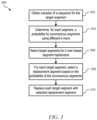
  • FIG. 2 shows a flow diagram of a process 200 for modifying a genome according to some embodiments.
  • Process 200 can be performed for a variety of organisms, including pathogens such as viruses.
  • samples of a genetic sequence for a target organism whose genome is to be modified are obtained.
  • the target organism can be, for example, a virus or other pathogen.
  • Genetic sequences for an organism can be obtained using conventional techniques for extracting and sequencing DNA or RNA, and the genetic sequence can include a portion or all of the genome of the target organism. Samples can be extracted from individual organisms and sequenced. For some organisms (e.g., various strains of influenza virus), genetic databases are available and can be used.
  • N a number of samples are obtained.
  • Samples are distinguished by a sample index i (where 1 ⁇ i ⁇ N ) .
  • Each sample has a codon sequence ⁇ X j i , 1 ⁇ j ⁇ J ⁇ , where index j represents a codon location (or codon position) within the sequence, J is a total number of codons in the sequence and X j i denotes the codon at the j th location in the ith sample.
  • a j 0 denotes the amino acid corresponding to the codon at the j th position in the target sequence.
  • a probability score (e.g., frequency of occurrence) can be determined for each synonymous codon.
  • a set of synonymous codons can be defined as ⁇ X j 0 r , 1 ⁇ r ⁇ R j ⁇ , where index r identifies a particular synonym (a codon that codes for amino acid A j 0 ) and R j denotes the number of synonyms for codon X j i .
  • the probability score in Eq. (1) can be the fraction of samples in which the codon X j 0 r is present at location j .
  • Other probability scores can also be defined.
  • a codon bias profile can be established for the organism, where the codon bias profile identifies more-preferred and less-preferred codons for each location.
  • a set of target locations to be modified can be selected.
  • the set of target locations can be represented as ⁇ , and the number of target locations can be represented as
  • every codon location can be selected as a target location, in which case
  • J .
  • the target locations can be a proper subset of the total number of codon locations, in which case
  • Selection of target locations can be random, or the selection can be based on prior biological information. For instance for some pathogens, information as to the effect of codon modifications at some locations may be available, and such information can be used to select target locations associated with a desired effect on the organism. Selection of target locations can also be based on statistical information.
  • the range of probability scores for the synonymous codons at a given location may be considered, on the theory that where all synonymous codons with equal probability, replacement with a synonymous codon is likely to have negligible effect, but where the probabilities of different codons deviate from chance, a particular codon at that position may be beneficial (or detrimental) to the organism.
  • a replacement codon is selected.
  • the replacement codon can be selected based on the probability scores and a desired effect of replacement.
  • a most-preferred codon X j 0 H for a particular location j can be defined as the codon for amino acid A j 0 that most frequently occurs at location j .
  • p j r ⁇ p j 0 , where p j 0 is determined according to Eq. (1) with X j 0 r X j 0 . It should be understood that X j 0 H ⁇ H .
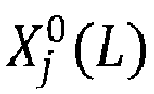
  • a least-preferred codon X j 0 L for a particular location j can be defined as the codon for amino acid A j 0 that least frequently occurs at location j .
  • p j r ⁇ p j 0 , where p j 0 is determined according to Eq. (1) with X j 0 r X j 0 . It should be understood that X j 0 L ⁇ L .
  • indexes H and L are position-specific, as are the sets and .
  • different synonymous codons for the same amino acid may be most preferred (or least preferred) at different positions in the sequence.
  • replacement codons for each location can be selected independently, e.g., based on the probability of different codons at that location. Thus, for example, if the target locations include two different locations that code for threonine, it is possible that ACG is selected as the replacement codon for the first location while ACC is selected as the replacement codon for the second location.
  • replacement of codons can be performed.
  • the existing codon can be replaced by the replacement codon selected for that location at block 208.
  • Replacement of codons can be performed using existing techniques, such as designing appropriate primers for PCR (polymerase chain reaction) or other amplification reactions.
  • any specific polynucleotide sequence (such as a modified sequence determined at block 208) can be chemically synthesized, especially if it is of a relatively shorter length.
  • process 200 can be applied to perform position-based codon de-optimization or codon optimization.
  • the selection of replacement codon can be based on a position-specific probability score (e.g., according to Eq. (1)).
  • the assumption that a higher position-specific probability score correlates with increased reproductive fitness, while a lower position-specific probability score correlates with decreased reproductive fitness, can be used to select replacement codons at specific positions.
  • is the number of target locations. For example, if ⁇ 0.8, then 80% of the residues in the target sequence would be selected.
  • the replacement X j 0 ⁇ X j 0 l is performed, where X j 0 l ⁇ L .
  • the original codon is replaced with a codon that is the same or less preferred.
  • An actual proportion of de-optimization ( ⁇ cd ) can be used to represent the proportion of synonymous replacement conducted for j ⁇ ⁇ using the replacement X j 0 ⁇ X j 0 l .
  • the amino acid at a selected target location may correspond to a unique codon, in which case no replacement occurs.
  • the replacement X j 0 ⁇ X j 0 h is performed, where , where X j 0 h ⁇ H .
  • the original codon is replaced with a codon that is the same or more preferred.
  • a proportion of optimization ( ⁇ co ) can be used to represent the proportion of synonymous replacement conducted for j ⁇ ⁇ using the replacement X j 0 ⁇ X j 0 h .
  • the amino acid at a selected target location may correspond to a unique codon, in which case no replacement occurs. (This may be the case, e.g., if target locations are selected randomly.)
  • process 200 can improve the likelihood that codon replacement will result in a desired effect on reproductive fitness.
  • the most preferred codon encoding threonine at locus 80 is ACG.
  • ACG is least preferred.
  • a conventional genome-based codon de-optimization method would replace other codons at locus 80 with ACG.
  • the conventional method may have the effect of optimizing rather than de-optimizing reproductive fitness of the organism.
  • process 200 can result in selecting a codon other than ACG for locus 80 of the G protein of RSVA, increasing the likelihood that de-optimization is achieved. Such effects may be more consequential for codon optimization, where accidental de-optimization of a few codons may defeat the optimization purpose.
  • Process 200 operates on codons, which correspond to 3 consecutive bases in a nucleotide sequence.
  • process 200 can be modified to perform k -mer segment-based codon replacement (kSCR), where a k -mer is a group of k consecutive monomers in a nucleotide sequence.
  • k -mers are considered synonymous if one k-mer can be replaced by another without altering the corresponding amino acid sequence.
  • UUCGAU which codes for the amino acid sequence "FD" (per FIG. 1A ).
  • the amino acid sequence UUCGAU can be synonymously coded to UUCG AC (replacing AU with AC), U UU GAU (replacing UC with UU), or UU UG AU (replacing CG with UG).
  • a synonymous recoding using k -mers of length k ⁇ s can change, at most, ( s - k + 1) k -mers.
  • k -mers can be replaced by more-frequently-occurring synonymous k -mers, while for codon de-optimization, k -mers can be replaced by less-frequently-occurring synonymous k -mers.
  • FIG. 3 shows a flow diagram of a process 300 for modifying a genome according to some embodiments.
  • Process 300 can be performed for a variety of organisms, including pathogens such as viruses.
  • Process 300 is similar to process 200, except that substitution is performed for k -mers of arbitrary length k .
  • samples of a genetic sequence for the target organism are obtained.
  • genetic sequences for an organism can be obtained using conventional techniques for extracting and sequencing DNA or RNA, and the genetic sequence can include a portion or all of the genome of the target organism.
  • Samples can be extracted from individual organisms and sequenced. For some organisms (e.g., various strains of influenza virus), genetic databases are available and can be used. It is assumed that a number N of samples are obtained. As before, samples are distinguished by a sample index i , where 1 ⁇ i ⁇ N, and the sequence has a length of J amino acids (or J codons).
  • the sequence is divided into a number ( B ) of non-overlapping segments of length k, and a segment index j can be defined such that 1 ⁇ j ⁇ B.
  • a probability score (e.g., frequency) can be determined for each k -mer.
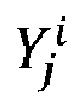
  • the k -mer at segment j of a target sequence can be denoted as Y j 0
  • the k -mer observed at segment j in the ith sample can be denoted as Y j i .
  • a set of observed k -mers for segment j can be defined as ⁇ W j ( r ) ⁇ , where index r identifies a particular k -mer at segment j , and R j denotes the number of k -mers for a particular segment (1 ⁇ r ⁇ R j ).
  • a global probability score for a target segment can also be computed.
  • Y j ( a ) can denote a segment of s nucleotides that is synonymous to Y j 0 , where index a distinguishes different segments of length s .
  • P j ( a ) is the sum of observed k -mers in the segment, weighted by the frequency observed for each k -mer.
  • a set of target segments to be modified can be selected.
  • the set of target segments can be represented as ⁇ , and the number of target segments can be represented as
  • every segment can be selected as a target segment, in which case
  • B.
  • the target segments can be a proper subset of the total number of segments, in which case
  • Selection of target segments can be random, or the selection can be based on prior biological information and/or statistical information, similarly to process 200.
  • a replacement segment is selected.
  • a replacement segment Y j ( a ) can be selected from the set of available segments ⁇ Y j ( r ), 1 ⁇ r ⁇ R j ⁇ .
  • the replacement segment can be selected based on the probability scores and a desired effect of replacement.
  • indexes H and L are segment-specific. As with process 200, selection of a replacement segment for each segment can be made independently, e.g., based on the probability scores of different segments at a given location within the genome, and different replacement segments can be selected for the same original segment at different locations within the genome. Selecting the most-preferred segment can result in codon optimization, while selecting the least-preferred segment can result in codon de-optimization.
  • replacement of segments can be performed.
  • the existing segment can be replaced by the replacement k -mer selected for that segment at block 308.
  • Y j ( b ) denotes the segment selected at block 308
  • the replacement Y j 0 ⁇ Y j 0 b is performed.
  • replacement of segments can be performed using existing techniques, such as designing appropriate primers for PCR (polymerase chain reaction) or other amplification reactions.
  • any specific polynucleotide sequence (such as a modified sequence determined at block 208) can be chemically synthesized, especially if it is of a relatively shorter length.
  • kSCR process 300 can capture CpG and UpA combinations, which are known to affect gene expression. Replacement at such sites can be performed according to objectives of optimization or de-optimization. For instance, a replacement that induces incrementing of the CG content is likely to result in reduced virus replication due to hyper-methylation.
  • selection of locations (or segments) where replacement occurs and selection of the replacement codon or k -mer can be made independently for each location (or segment).
  • interaction-based effects can be taken into account when selecting locations (or segments) for replacement and/or the replacement codon or k -mer.
  • genetic interaction is known to play a vital role in the evolution of a pathogen and in maintaining overall fitness. Mutations may appear in a concerted manner. For instance, it is often observed that the effective mutations underlying seasonal influenza epidemics appear in groups. Accordingly, sabotaging genetic interactions may help to reduce overall fitness of a virus or other pathogen.
  • two (or more) positions within the genome that exhibit statistical correlations, which suggest genetic interactions, can be targeted together for replacement with synonymous codons (or other k -mers).
  • a variety of metrics can be used to identify statistical correlations.
  • One example is linkage disequilibrium (LD), which evaluates non-randomness of a relationship between two loci.
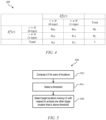
  • FIG. 4 shows an example of a contingency table 400 for two positions ( j and k ) in a genetic sequence.
  • X j 0 r denotes a codon at position j
  • X k 0 r denotes a codon at position k. Any two positions 1 ⁇ j, k ⁇ J, j ⁇ k) can be considered.
  • Joint probabilities are indicated as q 00 (both codons are most preferred at their respective locations), q 11 (neither codon is most preferred at its location); q 01 (codon X j 0 r is the most-preferred codon for location j and codon X k 0 r is not the most-preferred codon for location k ); and q 10 (codon X k 0 r is the most-preferred codon for location k and codon X j 0 r is not the most-preferred codon for location j ).
  • Other methods for computing LD can also be used.
  • LD can be employed to select some or all of the target locations to be modified in a process such as process 200.
  • FIG. 5 shows a flow diagram of a process 500 for selecting target locations according to some embodiments. Process 500 can be used, e.g., at block 206 of process 200.
  • linkage disequilibrium LD jk can be computed (e.g., according to Eq. (13)) for a number of different pairs of locations ( j, k ) .
  • LD jk is computed for every pair of locations ( j, k ) satisfying 1 ⁇ j,k ⁇ J, j ⁇ k.
  • a threshold ( d ) for a statistically significant LD can be selected.
  • the threshold can depend on how LD is defined; for Eq. (13), 0 ⁇ d ⁇ 1.
  • a set ( ⁇ ) of target locations can be selected such that each target location in the set ⁇ has LD above threshold d with respect to at least one other location.
  • the set ⁇ can be the set of target locations selected at block 206 of process 200. If desired, additional target locations can also be selected. Codon pair de-optimization (e.g., at blocks 208 and 210 of process 200) can be performed by replacing each codon of the pair with the least-preferred synonymous codon at that location. That is, for j ⁇ ⁇ , the replacement X j 0 ⁇ X j 0 L can be performed, where X j 0 L is the least-preferred codon at location j , as described above. A proportion of de-optimization ( ⁇ cpd ) can be used to represent the proportion of synonymous replacement conducted using codon-pair selection based on LD.
  • LD jk is computed for each codon pair ( j, k ) in a genetic sequence of the target organism.
  • Other techniques can be used to identify correlations on different scales, e.g., within a gene segment, a whole-genome, a specific viral strain or species, or the like. Further, while use of LD is described in the context of codon de-optimization, similar techniques can be applied to codon optimization.
  • high LD may be an indication that replacement of a codon at a particular location is not desirable.
  • LD-based selection of replacement locations can be applied to k -mers of any desired length k .
  • a position-based codon process such as process 200 can be used to modulate codon usage of a pathogen (e.g., a virus) in one host species ("host 1") toward the usage in a different host species ("host 2").
  • host 1 can be the species the vaccine is to be applied to (e.g., human beings) while host 2 is the organism used for culturing and replicating the virus (e.g., an insect expression system).
  • modulation can be accomplished by selecting a replacement codon that is more preferred, though not necessarily most preferred, in both species.
  • Position-based codon usage data for a given virus in host 2 may be unavailable due to sample limitations. Accordingly, genomic coding usage in the genome of host 2 can be considered.
  • the frequency of amino acid A j 0 of the target sequence in the genome of host 2 can be denoted as q j 0
  • the frequency of alternative codons for amino acid A j 0 in the genome of host 2 can be denoted as q j 0 r , where 1 ⁇ r ⁇ 6.
  • codon usage data is available in public databases.
  • a proportion of optimization ( ⁇ coh ) can be used to represent the proportion of synonymous replacement conducted for j ⁇ ⁇ using the replacement X j 0 ⁇ X j 0 e .
  • a target genetic sequence specifically the Hemagglutinin of A/Michigan/45/2015(H1N1) influenza strain, was used to compute codon usage and evaluate de-optimization efficacy.
  • codon de-optimization methods Five different codon de-optimization methods were applied, including: (1) an implementation of process 200 in which all codons are selected as target locations (referred to in this section as "Method A1"); (2) an implementation of process 200 with target locations selected according to process 500 (referred to in this section as “Method B”); (3) a conventional genome-based codon de-optimization technique ("Genome-based CD”); (4) a conventional genome-based codon pair de-optimization technique (“Genome-based CPD”); and (5) a conventional codon de-optimization technique that enhances CpG and UpA content.
  • Method A1 an implementation of process 200 in which all codons are selected as target locations
  • Method 500 referred to in this section as “Method B”
  • Gene-based CD a conventional genome-based codon de-optimization technique
  • Genome-based CPD a conventional genome-based codon pair de-optimization technique
  • FIG. 6 shows a table 600 illustrating differences in codon replacements using different methods.
  • an initial sequence is shown, including the amino acids and the preferred codon for each amino acid.
  • Rows 604, 606, and 608 show replacements made according to conventional methods: row 604 shows genome-based CD; row 606 shows genome-based CPD; and row 608 shows enhancement of CpG and UpA content. Replacements are circled as an aid to visualization. Rows 610 and 612 show replacements made using Method A1 and Method B.
  • Genome-based CD results in prevailing use of a particular codon for a given amino acid, such as UCG for serine (S) and UUA for lysine (L).
  • Genome-based CPD (row 606) preserves the frequency of codons but shuffles synonymous codons to change the codon-pair bias.
  • CpG and UpA enhancement increases the frequency of the CG and UA dinucleotides without changing the amino acid sequence.
  • Method A1 results in different substitutions from conventional genome-based CD.
  • the fourth position 622 has codon AUA, which codes for isoleucene (I).
  • Method A1 replaces codon AUA with codon AUU, which is the least-preferred codon at the fourth position 622, while conventional genome-based codon de-optimization (row 604) replaces codon AUA with codon AUC, which is the least-preferred codon across the genome.
  • sixth position 624 and seventh position 626 each have codons that code for valine (V).
  • Method A1 replaces the codon at sixth position 624 with GUU and the codon at seventh position 626 with GUA, based on which codon is least preferred at each position.
  • Method B (row 612) identifies non-adjacent codons with significant interactions (e.g., the codons at the third position 628 and the ninth position 630) and replaces each codon with the least-preferred codon at that position.
  • genome-based CPD (row 606) considers only adjacent codons.
  • FIG. 7 is a table 700 showing, for each of five different techniques, the maximum number (and percentage) of the 567 codons that can be replaced using that technique.
  • the upper limit for Genome-Based CD is much lower, at 73.7%, and other techniques have even lower proportion of de-optimization.
  • FIG. 8 is a table 800 illustrating Hamming distance between sequences generated from the target sequence (Hemagglutinin of influenza A/H1N1) according to different strategies at their respective maximum recoding settings.
  • the Hamming distance between two sequences is defined as the number of codons that are different between the two sequences.
  • the Hamming distance is shown in table 800 as a number and as a percentage of 567 total bases.
  • the last column of table 800 shows that more than half of the codons in the sequence resulting from Method A1 are different from the codons in the target sequence or in any of the other modified sequences. This shows that Method A1 can produce de-optimized sequences with features that are distinct from conventionally-generated de-optimized sequences.
  • location-specific probability scores for codons or other k -mers can be used to establish a position-dependent codon bias profile for a gene or genome.
  • the codon bias profile can be used as a database for performing codon optimization or de-optimization.
  • Profiling codon usage bias in the manner described herein may also facilitate a deeper understanding of the process of pathogen adaptation to a host and may provide insight into the evolutionary path of a pathogen, priority of mutation sites, mechanisms of pathogen-host interaction, and/or pathogen interaction with human or other animal genomes.
  • methods of the kind described herein can be used to generate de-optimized sequences for pathogens, e.g., as antigens in live-attenuated vaccines, with better safety and stability profiles as compared to conventional methods.
  • a codon-de-optimized virus for instance, can have a slower replication rate and a faster degeneration rate, resulting in a safer vaccine with fewer side effects.
  • a structurally and systematically de-optimized sequence as produced using techniques described herein would be genetically conserved, as compared to a sequence de-optimized at only a few codons, resulting in lower likelihood of vaccine-derived virus in the host.
  • Specific examples of vaccines where methods of the kind described herein may be useful include vaccines targeting influenza viruses and RSV.
  • methods of the kind described herein can be used to generate optimized sequences for pathogens, thereby increasing the replicative fitness of the pathogen in a target organism (e.g., avian cell, insect cell, or the like).
  • a target organism e.g., avian cell, insect cell, or the like.
  • a codon-optimized recombinant protein may have improved replicative fitness in the baculovirus expression vector system and may deliver better yield of antigens for vaccine manufacture.
  • Certain aspects of the methods described herein can be implemented using software programs executing on computer systems of conventional design or other computer systems. For example, computation of probability scores for synonymous codons (or k -mers) at particular locations can be automated, as can selection of replacement codons. Other aspects of the methods described herein, e.g., modification of genetic molecules such as RNA or DNA, involve manipulation of chemical structures rather than data bits.
  • Computer programs incorporating features of the present invention that can be implemented using program code may be encoded and stored on various computer readable storage media; suitable media include magnetic disk or tape, optical storage media such as compact disk (CD) or DVD (digital versatile disk), flash memory, and other non-transitory media. (It is understood that "storage" of data is distinct from propagation of data using transitory media such as carrier waves.)
  • Computer readable media encoded with the program code may include an internal storage medium of a compatible electronic device and/or external storage media readable by the electronic device that can execute the code. In some instances, program code can be supplied to the electronic device via Internet download or other transmission paths.

Landscapes

  • Life Sciences & Earth Sciences (AREA)
  • Health & Medical Sciences (AREA)
  • Engineering & Computer Science (AREA)
  • Physics & Mathematics (AREA)
  • Bioinformatics & Cheminformatics (AREA)
  • Biotechnology (AREA)
  • Genetics & Genomics (AREA)
  • Biophysics (AREA)
  • General Health & Medical Sciences (AREA)
  • Chemical & Material Sciences (AREA)
  • Medical Informatics (AREA)
  • Spectroscopy & Molecular Physics (AREA)
  • Theoretical Computer Science (AREA)
  • Evolutionary Biology (AREA)
  • Bioinformatics & Computational Biology (AREA)
  • Molecular Biology (AREA)
  • Proteomics, Peptides & Aminoacids (AREA)
  • Analytical Chemistry (AREA)
  • General Engineering & Computer Science (AREA)
  • Biomedical Technology (AREA)
  • Organic Chemistry (AREA)
  • Zoology (AREA)
  • Wood Science & Technology (AREA)
  • Data Mining & Analysis (AREA)
  • Bioethics (AREA)
  • Databases & Information Systems (AREA)
  • Crystallography & Structural Chemistry (AREA)
  • Microbiology (AREA)
  • Artificial Intelligence (AREA)
  • Biochemistry (AREA)
  • Computer Vision & Pattern Recognition (AREA)
  • Plant Pathology (AREA)
  • Epidemiology (AREA)
  • Evolutionary Computation (AREA)
  • Public Health (AREA)
  • Software Systems (AREA)
  • Ecology (AREA)
  • Physiology (AREA)
  • Measuring Or Testing Involving Enzymes Or Micro-Organisms (AREA)

Abstract

Replacement codons for modifying a genetic sequence are selected based on genetic architecture of a genome. For example, a location-specific estimation of codon usage can be generated, and preferred or un-preferred codons for a particular location can be identified statistically. A codon at a particular location can be replaced by a more-preferred or less-preferred synonymous codon. These techniques can be extended to replacement of k-mers of arbitrary length k within a segment of length s, where s is at least equal to k.

Description

    CROSS-REFERENCE TO RELATED APPLICATION
  • This application claims the benefit of U.S. Provisional Application No. 63/283,910, filed November 29, 2021 , the disclosure of which is incorporated herein by reference.
  • BACKGROUND
  • This disclosure relates generally to modification of genetic sequences and in particular to replacement of codons (or other nucleotide groups) with other codons (or other nucleotide groups).
  • A codon is a sequence of three nucleotides that encodes a specific amino acid residue in a polypeptide chain. Given four nucleotides (A, C, G, and T for DNA; A, C, G, and U for RNA), 64 codons are available. Three of the codons are stop codons, which indicate a termination of translation. The other 61 each encode one of 20 amino acid residues. Two amino acid residues (methionine and tryptophan) have a single corresponding codon, while each of the other 18 has at least two and as many as six synonymous codons.
  • Synonymous codons occur with different frequencies in a genome, and significant differences in the relative frequencies of synonymous codons have been observed between organisms. It is generally understood that replacement of a codon with a synonymous codon can affect RNA processing, gene expression, and protein folding, among other effects. Accordingly, different synonymous codons may affect replicative fitness of an organism, and synonymous recoding strategies (selectively replacing one or more codons with a synonymous codon) have been developed. Synonymous recoding strategies include codon optimization and codon de-optimization. Codon de-optimized sequences can be used, for example, to reduce replicative fitness of an organism for improved antigen degeneration and safety, which has application to production of live-attenuated vaccines. Conversely, codon optimized sequences can be used to increase replicative fitness of an organism to achieve higher efficiency of replication. Codon optimized sequences are frequently used to enhance the yield of antigens in the production of vaccines in selected organisms (cell lines, eggs, virus expression systems, and so on).
  • Existing codon de-optimization strategies involve replacing a preferred (frequently occurring) codon with an un-preferred (rarely occurring) synonymous codon, where preferred and un-preferred codons are identified by analyzing frequency of codons across the genome of the pathogen or the host. A related strategy involves replacing pairs of adjacent codons rather than single codons. This approach can adjust CpG or UpA dinucleotide content, which is known to affect gene expression. Another related strategy involves directly increasing CpG and UpA content. Conversely, codon optimization generally involves replace un-preferred codons with preferred codons. As with codon de-optimization, preferred and un-preferred codons are identified by analyzing frequency of codons across the genome of the pathogen or the host.
  • SUMMARY
  • Existing techniques to identify preferred and un-preferred codons have been based on a genome-wide analysis of the codon usage bias of the organism, e.g., counting the number of instances of each synonymous codon in the organism's genome without consideration of codon location with the genome or within a particular gene. However, synonymous codons may exhibit distinct usage or roles at different positions within a genome or even a gene, and epistatic interactions may occur among codons within and between genes. Consequently, an approach to codon replacement that does not consider the location of a codon within a genome may result in undesired effects, e.g., increasing rather than decreasing reproductive fitness (or vice versa).
  • Certain embodiments of the present invention relate to techniques for selecting replacement codons based on genetic architecture of a genome. For example, a location-specific estimation of codon usage in a genetic sequence (e.g., a genome or a portion thereof) can be generated, and more-preferred or less-preferred codons for a particular location can be identified statistically. A codon at a particular location can be replaced by a more-preferred or less-preferred synonymous codon. This approach can more reliably result in a desired outcome such as increasing or decreasing the reproductive fitness of an organism such as a pathogen. In some embodiments, epistatic interactions can be considered, and codon pairs (which may be adjacent or non-adjacent codon pairs) that exhibit statistical correlations can be replaced as pairs. In various embodiments, techniques described herein can be extended to replacement of k-mers of arbitrary length k within a segment of length s, where s is at least equal to k.
  • Certain embodiments relate to methods of modifying a genome. Such methods can include: obtaining a plurality of samples of a genetic sequence of a target organism; determining, for each of a plurality of target locations in the genetic sequence, a location-specific probability score for each of a plurality of synonymous codons; and for each target location: selecting, based on the location-specific probability scores for the target location, a replacement codon; and replacing, in a genomic molecule, an existing codon at the target location with the replacement codon.
  • In these and other embodiments, determining the probability score for a particular synonymous codon includes determining a fraction of the samples of the genetic sequence that include the particular synonymous codon at the target segment.
  • In these and other embodiments, the replacement codon can be a codon having a highest probability score among the synonymous codons at the target segment. Alternatively, the replacement codon can be a codon having lowest probability score among the synonymous codons at the target segment.
  • In these and other embodiments, methods can also include: computing, for each of a plurality of pairs of locations in the genetic sequence, a linkage disequilibrium parameter; and selecting at least some of the target locations based on the linkage disequilibrium parameter. For example, the target locations can be selected such that each target location has a linkage disequilibrium with respect to at least one other target location that is above a threshold.
  • In these and other embodiments, the target locations can include every location for which two or more synonymous codons exist, or any subset of the set of locations for which two or more synonymous codons exist.
  • In these and other embodiments, the target organism can be a pathogen.
  • In these and other embodiments, the target organism can be a virus and the location-specific probability scores can be determined based on samples of the virus genetic sequence obtained from host organisms belonging to a first species. For instance, the method can also include determining a global probability score for each of a plurality of synonymous codons based on samples of the virus genetic sequence obtained from host organisms belonging to a second species, wherein the replacement codon is selected based in part on the location-specific probability scores and based in part on the global probability scores. The method can further include: computing, for each of a plurality of pairs of locations in the genetic sequence, a linkage disequilibrium parameter; and selecting at least some of the target locations based on the linkage disequilibrium parameter.
  • Certain embodiments relate to methods of modifying a genome. Such methods can include: obtaining a plurality of samples of a genetic sequence of a target organism; determining, for each of a plurality of target segments in the genetic sequence, a probability score for each of a set of synonymous segments, wherein a synonymous segment is a segment obtained by replacing a k-mer in the target segment with a different k-mer without affecting a corresponding amino acid sequence, wherein each target segment has a length s and sk; and for each target segment: selecting, based on the probability scores for the target segment, a replacement segment from the set of synonymous segments; and replacing, in a genomic molecule, the target segment with the replacement segment.
  • In these and other embodiments, determining the probability score for a synonymous segment can include determining a sum of available k-mers in the segment, weighted by the k-mer frequencies observed in the samples.
  • In these and other embodiments, the replacement segment can be a segment that has a highest probability score among the synonymous segments at the target segment. Alternatively, the replacement segment has a lowest probability score among the synonymous segments at the target segment.
  • In these and other embodiments, various values of k can be chosen. In some embodiments, the value of k can be equal to 3, and each k-mer can correspond to a codon. In some alternative embodiments, the value of k can be equal to 2, and each k-mer can correspond to a dinucleotide. In some alternative embodiments, the value of k can be equal to 6, and each k-mer can correspond to a pair of adjacent codons.
  • In these and other embodiments, the method can also include: computing, for each of a plurality of pairs of segments in the genetic sequence, a linkage disequilibrium parameter; and selecting at least some of the target segments based on the linkage disequilibrium parameter.
  • In these and other embodiments, the target segments can be selected such that each target segment has a linkage disequilibrium with respect to at least one other target segment that is above a threshold.
  • In these and other embodiments, the target segments include every segment for which two or more synonymous segments exist, or any subset of the set of segments for which two or more synonymous segments exist.
  • In these and other embodiments, the target organism can be a pathogen.
  • The following detailed description, together with the accompanying drawings, will provide a better understanding of the nature and advantages of the claimed invention.
  • BRIEF DESCRIPTION OF THE DRAWINGS
    • FIGs. 1A and 1B illustrate the concept of synonymous codons as used herein.
    • FIG. 2 shows a flow diagram of a process for modifying a genome according to some embodiments.
    • FIG. 3 shows a flow diagram of a process for modifying a genome according to some embodiments.
    • FIG. 4 shows an example of a contingency table for two positions in a genetic sequence.
    • FIG. 5 shows a flow diagram of a process for selecting target locations for codon replacement according to some embodiments.
    • FIG. 6 shows a table illustrating differences in codon replacement using different methods.
    • FIG. 7 is a table showing, for each of five different codon replacement methods, a maximum number (and percentage) of codons that can be replaced using that method.
    • FIG. 8 is a table illustrating Hamming distance between sequences generated from a target sequence according to different codon replacement methods at their maximum recoding settings.
    DETAILED DESCRIPTION
  • The following description of exemplary embodiments of the invention is presented for the purpose of illustration and description. It is not intended to be exhaustive or to limit the claimed invention to the precise form described, and persons skilled in the art will appreciate that many modifications and variations are possible. The embodiments have been chosen and described in order to best explain the principles of the invention and its practical applications to thereby enable others skilled in the art to best make and use the invention in various embodiments and with various modifications as are suited to the particular use contemplated.
  • Certain embodiments of the present invention relate to techniques for selecting replacement codons based on genetic architecture of a genome. For example, a location-specific estimation of codon usage in a genetic sequence (e.g., a genome or a portion thereof) can be generated, and more-preferred or less-preferred codons for a particular location can be identified statistically. A codon at a particular location can be replaced by a more-preferred or less-preferred synonymous codon. This approach can more reliably result in a desired outcome such as increasing or decreasing the reproductive fitness of an organism such as a pathogen. In some embodiments, epistatic interactions can be considered, and codon pairs (which may be adjacent or non-adjacent codon pairs) that exhibit statistical correlations can be replaced as pairs. In various embodiments, techniques described herein can be applied to codons, codon pairs, or more generally to k-mers (where a k-mer is a sequence of k nucleotides).
  • FIGs. 1A and 1B illustrate the concept of synonymous codons as used herein. FIG. 1A shows a codon table for RNA that maps each codon to the corresponding amino acid residue, and FIG. 1B shows the corresponding table for DNA. The nucleotide bases are represented using the usual convention: adenine (A), cytosine (C), guanine (G), thymine (T), and uracil (U). As shown, there are 64 codons, including three stop codons, one codon for tryptophan, and one codon for methionine. All other amino acids have multiple corresponding codons, referred to herein as "synonymous" codons.
  • While synonymous codons map to the same amino acid, different synonymous codons may have different effects in areas such as RNA processing, gene expression, and protein folding. Due to such effects, replacement of a particular codon in the genetic sequence of an organism with a synonymous codon may alter properties of the organism, including reproductive fitness.
  • Position-Based Codon Replacement
  • Certain embodiments disclosed herein provide techniques for selecting replacement codons (or more generally replacement k-mers) in a manner that increases the probability of achieving a desired effect on reproductive fitness without altering the encoded amino acid sequence. FIG. 2 shows a flow diagram of a process 200 for modifying a genome according to some embodiments. Process 200 can be performed for a variety of organisms, including pathogens such as viruses.
  • At block 202, samples of a genetic sequence for a target organism whose genome is to be modified are obtained. The target organism can be, for example, a virus or other pathogen. Genetic sequences for an organism can be obtained using conventional techniques for extracting and sequencing DNA or RNA, and the genetic sequence can include a portion or all of the genome of the target organism. Samples can be extracted from individual organisms and sequenced. For some organisms (e.g., various strains of influenza virus), genetic databases are available and can be used.
  • In notation used herein, it is assumed that a number (N) of samples are obtained. Samples are distinguished by a sample index i (where 1 ≤ iN). Each sample has a codon sequence { X j i
    Figure imgb0001
    , 1 ≤ jJ}, where index j represents a codon location (or codon position) within the sequence, J is a total number of codons in the sequence and X j i
    Figure imgb0002
    denotes the codon at the jth location in the ith sample. A j 0
    Figure imgb0003
    denotes the amino acid corresponding to the codon at the jth position in the target sequence.
  • At block 204, for each codon location j, a probability score (e.g., frequency of occurrence) can be determined for each synonymous codon. In some embodiments, a set of synonymous codons can be defined as { X j 0 r
    Figure imgb0004
    , 1 ≤ rRj }, where index r identifies a particular synonym (a codon that codes for amino acid A j 0
    Figure imgb0005
    ) and Rj denotes the number of synonyms for codon X j i
    Figure imgb0006
    . (The number Rj of synonyms depends on the particular codon X j i
    Figure imgb0007
    . For instance, as shown in FIG. 1B, ATG is the only codon for methionine, yielding Rj = 1. On the other hand, codons TTA, TTG CTT, CTC, CTA, and CTG all code for leucine, yielding Rj = 6.
  • In some embodiments, a probability score pj (r) can be computed from the N samples according to: p j r = i = 1 N I X j 0 r = X j i / N ,
    Figure imgb0008
    where I(·) is an identity function that is equal to 1 if the condition (·) is satisfied, 0 otherwise. In other words, the probability score in Eq. (1) can be the fraction of samples in which the codon X j 0 r
    Figure imgb0009
    is present at location j. Other probability scores can also be defined. In this manner, a codon bias profile can be established for the organism, where the codon bias profile identifies more-preferred and less-preferred codons for each location.
  • At block 206, a set of target locations to be modified can be selected. The set of target locations can be represented as ϕ, and the number of target locations can be represented as |ϕ|. In some embodiments, every codon location can be selected as a target location, in which case |ϕ| = J. In other embodiments, the target locations can be a proper subset of the total number of codon locations, in which case |ϕ| < J. Selection of target locations can be random, or the selection can be based on prior biological information. For instance for some pathogens, information as to the effect of codon modifications at some locations may be available, and such information can be used to select target locations associated with a desired effect on the organism. Selection of target locations can also be based on statistical information. For instance, the range of probability scores for the synonymous codons at a given location may be considered, on the theory that where all synonymous codons with equal probability, replacement with a synonymous codon is likely to have negligible effect, but where the probabilities of different codons deviate from chance, a particular codon at that position may be beneficial (or detrimental) to the organism. As another example, codon locations where the amino acid has a unique codon (Rj = 1) and/or codon locations where a stop codon is present may be omitted from the set of target locations. Other considerations can also be applied.
  • At block 208, for each target location, a replacement codon is selected. In some embodiments, the replacement codon can be selected based on the probability scores and a desired effect of replacement. For example, a most-preferred codon X j 0 H
    Figure imgb0010
    for a particular location j can be defined as the codon for amino acid A j 0
    Figure imgb0011
    that most frequently occurs at location j. In some embodiments, the index H for the most-preferred synonymous codon can be determined according to: H = arg max r | p j r , 1 r R j .
    Figure imgb0012
  • Consistent with Eq. (1), the probability score for the most-preferred synonymous codon can be defined as: p j H = i = 1 N I X j 0 H = X j i / N .
    Figure imgb0013
  • For a given codon X j 0
    Figure imgb0014
    , the set (
    Figure imgb0015
    ) of codons that are no less preferred than X j 0
    Figure imgb0016
    for amino acid A j 0
    Figure imgb0017
    can be defined as: H = X j 0 r | p j r p j 0 ,
    Figure imgb0018
    where p j 0
    Figure imgb0019
    is determined according to Eq. (1) with X j 0 r = X j 0
    Figure imgb0020
    . It should be understood that X j 0 H H
    Figure imgb0021
    .
  • Similarly, a least-preferred codon X j 0 L
    Figure imgb0022
    for a particular location j can be defined as the codon for amino acid A j 0
    Figure imgb0023
    that least frequently occurs at location j. In some embodiments, the index L for the least-preferred synonymous codon can be determined according to: L = arg min r | p j r , 1 r R j .
    Figure imgb0024
  • Consistent with Eq. (1), the probability score for the least-preferred synonymous codon can be defined as: p j L = i = 1 N I X j 0 L = X j i / N .
    Figure imgb0025
  • For a given codon X j 0
    Figure imgb0026
    , the set (
    Figure imgb0027
    ) of codons that are no more preferred than X j 0
    Figure imgb0028
    for amino acid A j 0
    Figure imgb0029
    can be defined as: L = X j 0 r | p j r p j 0 ,
    Figure imgb0030
    where p j 0
    Figure imgb0031
    is determined according to Eq. (1) with X j 0 r = X j 0
    Figure imgb0032
    . It should be understood that X j 0 L L
    Figure imgb0033
    .
  • It should be noted that indexes H and L are position-specific, as are the sets
    Figure imgb0034
    and
    Figure imgb0035
    . In general, different synonymous codons for the same amino acid may be most preferred (or least preferred) at different positions in the sequence.
  • In some embodiments, codon optimization can be performed by selecting the most-preferred codon (e.g., the codon with r = H) for each target location. For example, on the assumption that the most-preferred codon correlates with reproductive fitness, the most-preferred codon for the target location can be selected in instances where enhancement of reproductive fitness is desired. In other embodiments, codon de-optimization can be performed by selecting the least-preferred codon (e.g., the codon with r = L) for each target location. For example, on the assumption that the least-preferred codon correlates with lack of reproductive fitness, the least-preferred codon can be selected in instances where reduction of reproductive fitness is desired. In still other embodiments, different selections can be made. As with the selection of target locations, prior biological information can be used in selecting replacement codons.
  • It should be noted that selection of a replacement codon is made for each location. In some embodiments, replacement codons for each location can be selected independently, e.g., based on the probability of different codons at that location. Thus, for example, if the target locations include two different locations that code for threonine, it is possible that ACG is selected as the replacement codon for the first location while ACC is selected as the replacement codon for the second location.
  • At block 210, for at least one instance of the organism, replacement of codons can be performed. In particular, at each target location, the existing codon can be replaced by the replacement codon selected for that location at block 208. Replacement of codons can be performed using existing techniques, such as designing appropriate primers for PCR (polymerase chain reaction) or other amplification reactions. In addition or instead, any specific polynucleotide sequence (such as a modified sequence determined at block 208) can be chemically synthesized, especially if it is of a relatively shorter length.
  • In various embodiments, process 200 can be applied to perform position-based codon de-optimization or codon optimization. In either case, the selection of replacement codon can be based on a position-specific probability score (e.g., according to Eq. (1)). The assumption that a higher position-specific probability score correlates with increased reproductive fitness, while a lower position-specific probability score correlates with decreased reproductive fitness, can be used to select replacement codons at specific positions.
  • For example, for codon de-optimization, a proportion of planned replacement (0 < π ≤ 1) can be selected, and a subset of codon positions can be chosen as the target locations ψ such that π = |ψ|/J, where |ψ| is the number of target locations. For example, if π = 0.8, then 80% of the residues in the target sequence would be selected. At each target location jψ, the replacement X j 0 X j 0 l
    Figure imgb0036
    is performed, where X j 0 l L
    Figure imgb0037
    . In other words, at each target location jψ, the original codon is replaced with a codon that is the same or less preferred. In some embodiments, l = L can be selected, which results in the replacement X j 0 X j 0 L
    Figure imgb0038
    at each target location. An actual proportion of de-optimization (ϕcd ) can be used to represent the proportion of synonymous replacement conducted for jψ using the replacement X j 0 X j 0 l
    Figure imgb0039
    . In some instances, the amino acid at a selected target location may correspond to a unique codon, in which case no replacement occurs. (This may be the case, e.g., if target locations are selected randomly.) Similarly, in some instances, the original codon at a particular position may already be the target codon (i.e., X j 0 = X j 0 l
    Figure imgb0040
    ), in which case no replacement occurs. Accordingly, it should be understood that, in a given application, ϕcd π.
  • Likewise, for codon optimization, a proportion of planned replacement (0 < π ≤ 1) can be selected, and a subset of codon positions can be chosen as the target locations ψ such that π = |ψ|/J. At each location j E ip, the replacement X j 0 X j 0 h
    Figure imgb0041
    is performed, where , where X j 0 h H
    Figure imgb0042
    . In other words, at each target location jψ, the original codon is replaced with a codon that is the same or more preferred. In some embodiments, h = H can be selected, which results in the replacement X j 0 X j 0 H
    Figure imgb0043
    at each target location. A proportion of optimization (ϕco ) can be used to represent the proportion of synonymous replacement conducted for jψ using the replacement X j 0 X j 0 h
    Figure imgb0044
    . As with codon de-optimization, in some instances, the amino acid at a selected target location may correspond to a unique codon, in which case no replacement occurs. (This may be the case, e.g., if target locations are selected randomly.) Similarly, in some instances, the original codon at a particular position may already be the target codon (i.e., X j 0 = X j 0 h )
    Figure imgb0045
    , in which case no replacement occurs. Accordingly, it should be understood that, in a given application, ϕco π.
  • Those skilled in the art with the benefit of this disclosure will appreciate that process 200 can improve the likelihood that codon replacement will result in a desired effect on reproductive fitness. For example, in the G protein of human respiratory syncytial virus A (RSVA), the most preferred codon encoding threonine at locus 80 is ACG. However, across the entire genome, ACG is least preferred. A conventional genome-based codon de-optimization method would replace other codons at locus 80 with ACG. However, because ACG is most preferred at locus 80, the conventional method may have the effect of optimizing rather than de-optimizing reproductive fitness of the organism. In contrast, process 200 can result in selecting a codon other than ACG for locus 80 of the G protein of RSVA, increasing the likelihood that de-optimization is achieved. Such effects may be more consequential for codon optimization, where accidental de-optimization of a few codons may defeat the optimization purpose.
  • k-mer Segment-Based Codon Replacement
  • Process 200 operates on codons, which correspond to 3 consecutive bases in a nucleotide sequence. In some embodiments, process 200 can be modified to perform k-mer segment-based codon replacement (kSCR), where a k-mer is a group of k consecutive monomers in a nucleotide sequence. The value of k can be chosen as desired (provided that k ≥ 1). For any given value of k, there are 4 k distinct k-mers. For example, if k = 2, the possible dinucleotides for DNA are {AA, AT, AC, AG, TA, TT, TC, TG, CA, CT, CC, CG, GA, GT, GC, GG}. If k = 3, each (non-overlapping) k-mer can be a codon. If k = 6, each k-mer can be a pair of adjacent codons.
  • In the kSCR approach, k-mers are considered synonymous if one k-mer can be replaced by another without altering the corresponding amino acid sequence. For example, consider the nucleotide sequence UUCGAU, which codes for the amino acid sequence "FD" (per FIG. 1A). Considering k-mers of length k = 3, the same amino acid sequence can be synonymously coded to UUCGAC (replacing GAU with GAC) or UUUGAU (replacing UUC with UUU). Considering k-mers of length k = 2, the amino acid sequence UUCGAU can be synonymously coded to UUCGAC (replacing AU with AC), UUUGAU (replacing UC with UU), or UUUGAU (replacing CG with UG). As the frequency of dinucleotides at a particular position may be different from the frequency of codons, the recoded result may be different between k = 2 and k = 3. Accordingly, the recoded sequence can depend on the length of the k-mer chosen to calculate frequencies (or probability scores). For a given segment of s nucleotides in a genetic sequence, a synonymous recoding using k-mers of length k < s can change, at most, (s - k + 1) k-mers. For codon optimization, k-mers can be replaced by more-frequently-occurring synonymous k-mers, while for codon de-optimization, k-mers can be replaced by less-frequently-occurring synonymous k-mers.
  • FIG. 3 shows a flow diagram of a process 300 for modifying a genome according to some embodiments. Process 300 can be performed for a variety of organisms, including pathogens such as viruses. Process 300 is similar to process 200, except that substitution is performed for k-mers of arbitrary length k.
  • At block 302, samples of a genetic sequence for the target organism are obtained. As in process 200, genetic sequences for an organism can be obtained using conventional techniques for extracting and sequencing DNA or RNA, and the genetic sequence can include a portion or all of the genome of the target organism. Samples can be extracted from individual organisms and sequenced. For some organisms (e.g., various strains of influenza virus), genetic databases are available and can be used. It is assumed that a number N of samples are obtained. As before, samples are distinguished by a sample index i, where 1 ≤ iN, and the sequence has a length of J amino acids (or J codons). In process 300, the sequence is divided into a number (B) of non-overlapping segments of length k, and a segment index j can be defined such that 1 ≤ jB.
  • At block 304, for each segment j, a probability score (e.g., frequency) can be determined for each k-mer. In some embodiments, the k-mer at segment j of a target sequence can be denoted as Y j 0
    Figure imgb0046
    , and the k-mer observed at segment j in the ith sample can be denoted as Y j i
    Figure imgb0047
    . A set of observed k-mers for segment j can be defined as {Wj (r)}, where index r identifies a particular k-mer at segment j, and Rj denotes the number of k-mers for a particular segment (1 ≤ rRj ). In general, not all 4 k possible k-mers are synonymous for a given segment, and 1 ≤ Rj ≤ 4 k. A segment-specific probability score for a particular k-mer (index r) at a particular segment j (1 ≤ jB) can be computed as: p j r = i = 1 N I W j r = Y j i / N .
    Figure imgb0048
  • A global probability score for a target segment can also be computed. For example, Yj (a) can denote a segment of s nucleotides that is synonymous to Y j 0
    Figure imgb0049
    , where index a distinguishes different segments of length s. A global frequency Pj (a) of a particular synonymous segment Yj (a) can be computed according to P j a = r = 1 R j I W j r = Y j a p j r .
    Figure imgb0050
  • That is, Pj (a) is the sum of observed k-mers in the segment, weighted by the frequency observed for each k-mer. Similarly, a global frequency for the target segment Y j 0
    Figure imgb0051
    can be computed according to P j = r = 1 R j I W j r = Y j 0 p j r .
    Figure imgb0052
    In this manner, a k-mer bias profile can be established for the organism.
  • At block 306, a set of target segments to be modified can be selected. The set of target segments can be represented as ψ, and the number of target segments can be represented as |ψ|. In some embodiments, every segment can be selected as a target segment, in which case |ψ| = B. In other embodiments, the target segments can be a proper subset of the total number of segments, in which case |ψ| < B. Selection of target segments can be random, or the selection can be based on prior biological information and/or statistical information, similarly to process 200.
  • At block 308, for each target segment, a replacement segment is selected. For example, a replacement segment Yj (a) can be selected from the set of available segments {Yj (r), 1 ≤ rRj }. In some embodiments, the replacement segment can be selected based on the probability scores and a desired effect of replacement. For instance, for codon optimization, the index H of the most preferred synonymous segment Yj (a) can be determined according to: H = arg max a | P j a .
    Figure imgb0053
    Similarly, for codon de-optimization the index L of the least preferred synonymous segment Yj (a) can be determined according to: L = arg min a | P j a .
    Figure imgb0054
    It should be noted that indexes H and L are segment-specific. As with process 200, selection of a replacement segment for each segment can be made independently, e.g., based on the probability scores of different segments at a given location within the genome, and different replacement segments can be selected for the same original segment at different locations within the genome. Selecting the most-preferred segment can result in codon optimization, while selecting the least-preferred segment can result in codon de-optimization.
  • At block 310, for at least one instance of the organism, replacement of segments can be performed. In particular, at each target segment, the existing segment can be replaced by the replacement k-mer selected for that segment at block 308. Thus, if Yj (b) denotes the segment selected at block 308, then for each target location jψ, the replacement Y j 0 Y j 0 b
    Figure imgb0055
    is performed. For codon optimization, b = H can be used, and for codon de-optimization, b = L can be used. As in process 200, replacement of segments can be performed using existing techniques, such as designing appropriate primers for PCR (polymerase chain reaction) or other amplification reactions. In addition or instead, any specific polynucleotide sequence (such as a modified sequence determined at block 208) can be chemically synthesized, especially if it is of a relatively shorter length.
  • It should be understood that in the case where k = 3 and B = J, process 300 can be the same as process 200 (Yj = Xj ).
  • In the case where k = 2, kSCR process 300 can capture CpG and UpA combinations, which are known to affect gene expression. Replacement at such sites can be performed according to objectives of optimization or de-optimization. For instance, a replacement that induces incrementing of the CG content is likely to result in reduced virus replication due to hyper-methylation.
  • Interaction-Based Selection of Codons for Replacement
  • In processes 200 and 300, selection of locations (or segments) where replacement occurs and selection of the replacement codon or k-mer can be made independently for each location (or segment). In some embodiments, interaction-based effects can be taken into account when selecting locations (or segments) for replacement and/or the replacement codon or k-mer. For example, genetic interaction is known to play a vital role in the evolution of a pathogen and in maintaining overall fitness. Mutations may appear in a concerted manner. For instance, it is often observed that the effective mutations underlying seasonal influenza epidemics appear in groups. Accordingly, sabotaging genetic interactions may help to reduce overall fitness of a virus or other pathogen.
  • For example, two (or more) positions within the genome that exhibit statistical correlations, which suggest genetic interactions, can be targeted together for replacement with synonymous codons (or other k-mers). A variety of metrics can be used to identify statistical correlations. One example is linkage disequilibrium (LD), which evaluates non-randomness of a relationship between two loci.
  • Linkage disequilibrium between two loci can be computed using a contingency table. FIG. 4 shows an example of a contingency table 400 for two positions (j and k) in a genetic sequence. X j 0 r
    Figure imgb0056
    denotes a codon at position j, and X k 0 r
    Figure imgb0057
    denotes a codon at position k. Any two positions 1 ≤ j, kJ, j ≠ k) can be considered. Probability q 0. indicates the probability that codon X j 0 r
    Figure imgb0058
    is the most-preferred codon (r = H) for locationj, and probability q 1. indicates the probability that codon X j 0 r
    Figure imgb0059
    is not the most-preferred codon (rH) for location j.
    Similarly, probability q -0 indicates the probability that codon X k 0 r
    Figure imgb0060
    is the most-preferred codon (r = H) for location k, and probability q -1 indicates the probability that codon X k 0 r
    Figure imgb0061
    is not the most-preferred codon (rH) for location k. Joint probabilities are indicated as q 00 (both codons are most preferred at their respective locations), q 11 (neither codon is most preferred at its location); q 01 (codon X j 0 r
    Figure imgb0062
    is the most-preferred codon for location j and codon X k 0 r
    Figure imgb0063
    is not the most-preferred codon for location k); and q 10 (codon X k 0 r
    Figure imgb0064
    is the most-preferred codon for location k and codon X j 0 r
    Figure imgb0065
    is not the most-preferred codon for location j). In some embodiments, linkage disequilibrium LD can be computed as: LD jk = r jk 2 = D jk 2 q 0 q 1 q 0 q 1 ,
    Figure imgb0066
    where D jk = q 00 q 0 q 0 = q 00 q 11 q 01 q 10 .
    Figure imgb0067
    Other methods for computing LD can also be used.
  • In some embodiments, LD can be employed to select some or all of the target locations to be modified in a process such as process 200. FIG. 5 shows a flow diagram of a process 500 for selecting target locations according to some embodiments. Process 500 can be used, e.g., at block 206 of process 200.
  • At block 502, linkage disequilibrium LDjk can be computed (e.g., according to Eq. (13)) for a number of different pairs of locations (j, k). In some embodiments, a comprehensive approach can be used where LDjk is computed for every pair of locations (j, k) satisfying 1 ≤ j,kJ, jk.
  • At block 504, a threshold (d) for a statistically significant LD can be selected. The threshold can depend on how LD is defined; for Eq. (13), 0 < d ≤ 1. In some embodiments, the threshold d can be selected based on considerations related to the nature of the genome of the target organism. For instance, in the genome of SARS-CoV-2, d = 0.1 can be selected; for respiratory syncytial virus (RSV), d = 0.2 can be selected.
  • At block 506, a set (τ) of target locations can be selected such that each target location in the set τ has LD above threshold d with respect to at least one other location. For example, the set of target locations can be defined as: τ = j | LD jk d , 1 j , k J , j k ,
    Figure imgb0068
    where LDjk is given by Eq. (13).
  • In some embodiments, the set τ can be the set of target locations selected at block 206 of process 200. If desired, additional target locations can also be selected. Codon pair de-optimization (e.g., at blocks 208 and 210 of process 200) can be performed by replacing each codon of the pair with the least-preferred synonymous codon at that location. That is, for j τ , the replacement X j 0 X j 0 L
    Figure imgb0069
    can be performed, where X j 0 L
    Figure imgb0070
    is the least-preferred codon at location j, as described above. A proportion of de-optimization (ϕcpd ) can be used to represent the proportion of synonymous replacement conducted using codon-pair selection based on LD.
  • In various embodiments, other measures of correlation between pairs codons can be used. Examples include chi-squared test, W-test, a co-mutation test, or any other quantity that reveals statistical correlations between pairs of codons at different positions. In the example described above, LDjk is computed for each codon pair (j, k) in a genetic sequence of the target organism. Other techniques can be used to identify correlations on different scales, e.g., within a gene segment, a whole-genome, a specific viral strain or species, or the like. Further, while use of LD is described in the context of codon de-optimization, similar techniques can be applied to codon optimization. (For instance, in the context of codon optimization, high LD may be an indication that replacement of a codon at a particular location is not desirable.) In some embodiments, LD-based selection of replacement locations can be applied to k-mers of any desired length k.
  • Position-Based Codon Optimization Toward Multiple Hosts
  • In some embodiments, a position-based codon process such as process 200 can be used to modulate codon usage of a pathogen (e.g., a virus) in one host species ("host 1") toward the usage in a different host species ("host 2"). For instance, in a vaccine manufacturing process, host 1 can be the species the vaccine is to be applied to (e.g., human beings) while host 2 is the organism used for culturing and replicating the virus (e.g., an insect expression system). Such modulation can be accomplished by selecting a replacement codon that is more preferred, though not necessarily most preferred, in both species. For example, the set of preferred codons ωj for amino acid A j 0
    Figure imgb0071
    in host 1 can be defined as: ω j = X j 0 r | p j r c ,
    Figure imgb0072
    where 0 < c ≤ 0.5.
  • Position-based codon usage data for a given virus in host 2 may be unavailable due to sample limitations. Accordingly, genomic coding usage in the genome of host 2 can be considered. The frequency of amino acid A j 0
    Figure imgb0073
    of the target sequence in the genome of host 2 can be denoted as q j 0
    Figure imgb0074
    , and the frequency of alternative codons for amino acid A j 0
    Figure imgb0075
    in the genome of host 2 can be denoted as q j 0 r
    Figure imgb0076
    , where 1 ≤ r ≤ 6. For some host organisms, codon usage data is available in public databases.
  • The set of synonymous codons more preferred than X j 0
    Figure imgb0077
    for amino acid A j 0
    Figure imgb0078
    in host 2 can be defined as θ j = X j 0 r | q j 0 r > q j 0 .
    Figure imgb0079
    If ωj θj ≠ ∅, then the preferred codons for amino acid A j 0
    Figure imgb0080
    in both hosts can be defined as X j 0 e ω j θ j .
    Figure imgb0081
  • Replacement can be performed in the manner described above. For example, a proportion of planned replacement (0 < π ≤ 1) can be selected, and a subset of codon positions can be chosen as the target locations δ such that π = |δ|/J. In some embodiments, some or all of the target locations δ can be loci with high genome interactions (e.g., elements of set τ as defined above). At each location j ∈ δ, the replacement X j 0 X j 0 e
    Figure imgb0082
    is performed. In other words, at each target location jδ, the original codon is replaced with a codon that is preferred in both hosts. A proportion of optimization (ϕcoh ) can be used to represent the proportion of synonymous replacement conducted for jδ using the replacement X j 0 X j 0 e
    Figure imgb0083
    .
  • The invention is summarized as follows:
    1. 1. A method of modifying a genome, the method comprising:
      • obtaining a plurality of samples of a genetic sequence of a target organism;
      • determining, for each of a plurality of target locations in the genetic sequence, a location-specific probability score for each of a plurality of synonymous codons; and
      • for each target location:
        • selecting, based on the location-specific probability scores for the target location, a replacement codon; and
        • replacing, in a genomic molecule, an existing codon at the target location with the replacement codon.
    2. 2. The method of item 1, wherein determining the probability score for a particular synonymous codon includes determining a fraction of the samples of the genetic sequence that include the particular synonymous codon at the target segment.
    3. 3. The method of item 1, wherein the replacement codon has a highest probability score among the synonymous codons at the target segment.
    4. 4. The method of item 1, wherein the replacement codon has a lowest probability score among the synonymous codons at the target segment.
    5. 5. The method of item 1 further comprising:
      • computing, for each of a plurality of pairs of locations in the genetic sequence, a linkage disequilibrium parameter; and
      • selecting at least some of the target locations based on the linkage disequilibrium parameter.
    6. 6. The method of item 5, wherein the target locations are selected such that each target location has a linkage disequilibrium with respect to at least one other target location that is above a threshold.
    7. 7. The method of item 1, wherein the target locations include every location for which two or more synonymous codons exist.
    8. 8. The method of item 1, wherein the target organism is a pathogen.
    9. 9. The method of item 1, wherein the target organism is a virus and the location-specific probability scores are determined based on samples of the virus genetic sequence obtained from host organisms belonging to a first species.
    10. 10. The method of item 9 further comprising:
      • determining a global probability score for each of a plurality of synonymous codons based on samples of the virus genetic sequence obtained from host organisms belonging to a second species,
      • wherein the replacement codon is selected based in part on the location-specific probability scores and based in part on the global probability scores.
    11. 11. The method of item 10 further comprising:
      • computing, for each of a plurality of pairs of locations in the genetic sequence, a linkage disequilibrium parameter; and
      • selecting at least some of the target locations based on the linkage disequilibrium parameter.
    12. 12. A method of modifying a genome, the method comprising:
      • obtaining a plurality of samples of a genetic sequence of a target organism;
        determining, for each of a plurality of target segments in the genetic sequence, a probability score for each of a set of synonymous segments, wherein a synonymous segment is a segment obtained by replacing a k-mer in the target segment with a different k-mer without affecting a corresponding amino acid sequence, wherein each target segment has a length s and sk; and
      • for each target segment:
        • selecting, based on the probability scores for the target segment, a replacement segment from the set of synonymous segments; and
        • replacing, in a genomic molecule, the target segment with the replacement segment.
    13. 13. The method of item 12, wherein determining the probability score for a synonymous segment includes determining a sum of available k-mers in the segment, weighted by the k-mer frequencies observed in the samples.
    14. 14. The method of item 12, wherein the replacement segment has a highest probability score among the synonymous segments at the target segment.
    15. 15. The method of item 12, wherein the replacement segment has a lowest probability score among the synonymous segments at the target segment.
    16. 16. The method of item 12, wherein k = 3 and each k-mer corresponds to a codon.
    17. 17. The method of item 12, wherein k = 2 and each k-mer corresponds to a dinucleotide.
    18. 18. The method of item 12, wherein k = 6.
    19. 19. The method of item 18, wherein each k-mer corresponds to a pair of adjacent codons.
    20. 20. The method of item 12 further comprising:
      • computing, for each of a plurality of pairs of segments in the genetic sequence, a linkage disequilibrium parameter; and
      • selecting at least some of the target segments based on the linkage disequilibrium parameter.
    21. 21. The method of item 12, wherein the target segments are selected such that each target segment has a linkage disequilibrium with respect to at least one other target segment that is above a threshold.
    22. 22. The method of item 12, wherein the target segments include every segment for which two or more synonymous segments exist.
    23. 23. The method of item 12, wherein the target organism is a pathogen.
    Examples
  • A target genetic sequence, specifically the Hemagglutinin of
    A/Michigan/45/2015(H1N1) influenza strain, was used to compute codon usage and evaluate de-optimization efficacy. A total of 19,747 sequences of the hemagglutinin of influenza virus from 2017 to 2019 were used to calculate codon usage. Five different codon de-optimization methods were applied, including: (1) an implementation of process 200 in which all codons are selected as target locations (referred to in this section as "Method A1"); (2) an implementation of process 200 with target locations selected according to process 500 (referred to in this section as "Method B"); (3) a conventional genome-based codon de-optimization technique ("Genome-based CD"); (4) a conventional genome-based codon pair de-optimization technique ("Genome-based CPD"); and (5) a conventional codon de-optimization technique that enhances CpG and UpA content.
  • FIG. 6 shows a table 600 illustrating differences in codon replacements using different methods. At row 602, an initial sequence is shown, including the amino acids and the preferred codon for each amino acid. Rows 604, 606, and 608 show replacements made according to conventional methods: row 604 shows genome-based CD; row 606 shows genome-based CPD; and row 608 shows enhancement of CpG and UpA content. Replacements are circled as an aid to visualization. Rows 610 and 612 show replacements made using Method A1 and Method B. Genome-based CD (row 604) results in prevailing use of a particular codon for a given amino acid, such as UCG for serine (S) and UUA for lysine (L). Genome-based CPD (row 606) preserves the frequency of codons but shuffles synonymous codons to change the codon-pair bias. CpG and UpA enhancement increases the frequency of the CG and UA dinucleotides without changing the amino acid sequence.
  • As shown in FIG. 6, Method A1 (row 610) results in different substitutions from conventional genome-based CD. For example, in the target sequence (row 602), the fourth position 622 has codon AUA, which codes for isoleucene (I). Method A1 replaces codon AUA with codon AUU, which is the least-preferred codon at the fourth position 622, while conventional genome-based codon de-optimization (row 604) replaces codon AUA with codon AUC, which is the least-preferred codon across the genome. As another example, sixth position 624 and seventh position 626 each have codons that code for valine (V). Conventional genome-based codon de-optimization (row 604) replaces both codons with GUA (which is least-preferred across the genome). In contrast, Method A1 replaces the codon at sixth position 624 with GUU and the codon at seventh position 626 with GUA, based on which codon is least preferred at each position.
  • As further shown in FIG. 6, Method B (row 612) identifies non-adjacent codons with significant interactions (e.g., the codons at the third position 628 and the ninth position 630) and replaces each codon with the least-preferred codon at that position. In contrast, genome-based CPD (row 606) considers only adjacent codons.
  • Additional demonstration of the differences between Method A1 and conventional codon de-optimization techniques is shown in FIGs. 7 and 8. There are a total of 567 codons in the Hemagglutinin of influenza A/H1N1. FIG. 7 is a table 700 showing, for each of five different techniques, the maximum number (and percentage) of the 567 codons that can be replaced using that technique. As shown, Method A1 can replace up to 541 codons (ϕA = 95.4%), the largest among the techniques considered. The upper limit for Genome-Based CD is much lower, at 73.7%, and other techniques have even lower proportion of de-optimization.
  • FIG. 8 is a table 800 illustrating Hamming distance between sequences generated from the target sequence (Hemagglutinin of influenza A/H1N1) according to different strategies at their respective maximum recoding settings. For table 800, the Hamming distance between two sequences is defined as the number of codons that are different between the two sequences. The Hamming distance is shown in table 800 as a number and as a percentage of 567 total bases. The last column of table 800 shows that more than half of the codons in the sequence resulting from Method A1 are different from the codons in the target sequence or in any of the other modified sequences. This shows that Method A1 can produce de-optimized sequences with features that are distinct from conventionally-generated de-optimized sequences.
  • Additional Embodiments
  • While the invention has been described with reference to specific embodiments, those skilled in the art will appreciate that variations and modifications are possible. A variety of techniques can be used to select target locations, and replacement codons at a particular location can be selected based on different criteria, including optimization or de-optimization of reproductive fitness.
  • Methods and systems of the kind described herein can be applied in a variety of contexts. For example, in some embodiments, location-specific probability scores for codons or other k-mers can be used to establish a position-dependent codon bias profile for a gene or genome. As described above, the codon bias profile can be used as a database for performing codon optimization or de-optimization. Profiling codon usage bias in the manner described herein may also facilitate a deeper understanding of the process of pathogen adaptation to a host and may provide insight into the evolutionary path of a pathogen, priority of mutation sites, mechanisms of pathogen-host interaction, and/or pathogen interaction with human or other animal genomes.
  • As another example, methods of the kind described herein can be used to generate de-optimized sequences for pathogens, e.g., as antigens in live-attenuated vaccines, with better safety and stability profiles as compared to conventional methods. A codon-de-optimized virus, for instance, can have a slower replication rate and a faster degeneration rate, resulting in a safer vaccine with fewer side effects. Further, a structurally and systematically de-optimized sequence as produced using techniques described herein would be genetically conserved, as compared to a sequence de-optimized at only a few codons, resulting in lower likelihood of vaccine-derived virus in the host. Specific examples of vaccines where methods of the kind described herein may be useful include vaccines targeting influenza viruses and RSV.
  • As yet another example, methods of the kind described herein can be used to generate optimized sequences for pathogens, thereby increasing the replicative fitness of the pathogen in a target organism (e.g., avian cell, insect cell, or the like). As one specific example, a codon-optimized recombinant protein may have improved replicative fitness in the baculovirus expression vector system and may deliver better yield of antigens for vaccine manufacture.
  • Certain aspects of the methods described herein can be implemented using software programs executing on computer systems of conventional design or other computer systems. For example, computation of probability scores for synonymous codons (or k-mers) at particular locations can be automated, as can selection of replacement codons. Other aspects of the methods described herein, e.g., modification of genetic molecules such as RNA or DNA, involve manipulation of chemical structures rather than data bits.
  • Computer programs incorporating features of the present invention that can be implemented using program code may be encoded and stored on various computer readable storage media; suitable media include magnetic disk or tape, optical storage media such as compact disk (CD) or DVD (digital versatile disk), flash memory, and other non-transitory media. (It is understood that "storage" of data is distinct from propagation of data using transitory media such as carrier waves.) Computer readable media encoded with the program code may include an internal storage medium of a compatible electronic device and/or external storage media readable by the electronic device that can execute the code. In some instances, program code can be supplied to the electronic device via Internet download or other transmission paths.
  • Accordingly, although the invention has been described with respect to specific embodiments, it will be appreciated that the invention is intended to cover all modifications and equivalents within the scope of the following claims.

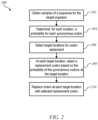
Claims (15)

  1. A method of modifying a genome, the method comprising:
    obtaining a plurality of samples of a genetic sequence of a target organism;
    determining, for each of a plurality of target segments in the genetic sequence, a probability score for each of a set of synonymous segments, wherein a synonymous segment is a segment obtained by replacing a k-mer in the target segment with a different k-mer without affecting a corresponding amino acid sequence, wherein each target segment has a length s and sk; and
    for each target segment:
    selecting, based on the probability scores for the target segment, a replacement segment from the set of synonymous segments; and
    replacing, in a genomic molecule, the target segment with the replacement segment.
  2. The method of claim 1, wherein determining the probability score for a synonymous segment includes determining a sum of observed k-mers in the segment, weighted by the k-mer frequencies observed in the samples.
  3. The method of claim 1, wherein determining the probability score for a particular synonymous segment includes determining a location-specific probability score based on a fraction of samples having the particular synonymous segment at a particular location in the genetic sequence.
  4. The method of claim 1, wherein the replacement segment has a highest probability score among the synonymous segments at the target segment.
  5. The method of claim 1, wherein the replacement segment has a lowest probability score among the synonymous segments at the target segment.
  6. The method of claim 1 further comprising:
    computing, for each of a plurality of pairs of segments in the genetic sequence, a linkage disequilibrium parameter; and
    selecting at least some of the target segments based on the linkage disequilibrium parameter.
  7. The method of claim 1, wherein the target segments are selected such that each target segment has a linkage disequilibrium with respect to at least one other target segment that is above a threshold.
  8. The method of claim 1, wherein the target segments include every segment for which two or more synonymous segments exist.
  9. The method of claim 1, wherein the target organism is a pathogen.
  10. The method of claim 1, wherein the target organism is a virus and the location-specific probability scores are determined based on samples of the virus genetic sequence obtained from host organisms belonging to a first species..
  11. The method of any one of claims 1 to 10, wherein k = 3 and each k-mer corresponds to a codon.
  12. The method of claim 11, wherein s = k and each segment also corresponds to a codon.
  13. The method of any one of claims 1 to 10, wherein k = 2 and each k-mer corresponds to a dinucleotide.
  14. The method of any one of claims 1 to 10, wherein k = 6.
  15. The method of claim 14, wherein each k-mer corresponds to a pair of adjacent codons.
EP22209795.8A 2021-11-29 2022-11-28 Codon de-optimization or optimization using genetic architecture Pending EP4187544A1 (en)

Applications Claiming Priority (1)

Application Number Priority Date Filing Date Title
US202163283910P 2021-11-29 2021-11-29

Publications (1)

Publication Number Publication Date
EP4187544A1 true EP4187544A1 (en) 2023-05-31

Family

ID=84520021

Family Applications (1)

Application Number Title Priority Date Filing Date
EP22209795.8A Pending EP4187544A1 (en) 2021-11-29 2022-11-28 Codon de-optimization or optimization using genetic architecture

Country Status (3)

Country Link
US (1) US20230274791A1 (en)
EP (1) EP4187544A1 (en)
CN (1) CN116179534A (en)

Citations (3)

* Cited by examiner, † Cited by third party
Publication number Priority date Publication date Assignee Title
US20170067030A1 (en) * 2007-03-30 2017-03-09 The Research Foundation For The State University Of New York Attenuated viruses useful for vaccines
WO2017218727A1 (en) * 2016-06-15 2017-12-21 President And Fellows Of Harvard College Methods for rule-based genome design
WO2018024749A1 (en) * 2016-08-01 2018-02-08 Consejo Superior De Investigaciones Científicas A method for tailoring a dna sequence to obtain species-specific nucleosome positioning

Family Cites Families (4)

* Cited by examiner, † Cited by third party
Publication number Priority date Publication date Assignee Title
CA2583716A1 (en) * 2007-04-18 2008-10-18 Nautilus Biotech Oral dosage formulations of protease resistant polypeptides
CN110423769A (en) * 2018-01-12 2019-11-08 内蒙古大学 It is a kind of improve target gene host's Level of Expression of Retinoic Acid codon optimization method
WO2019161459A1 (en) * 2018-02-26 2019-08-29 Children's Medical Research Institute Methods for codon optimization
CN110305880A (en) * 2019-06-06 2019-10-08 安子琛 A kind of gene order remodeling method based on codon same sense mutation and its application in vaccine preparation

Patent Citations (3)

* Cited by examiner, † Cited by third party
Publication number Priority date Publication date Assignee Title
US20170067030A1 (en) * 2007-03-30 2017-03-09 The Research Foundation For The State University Of New York Attenuated viruses useful for vaccines
WO2017218727A1 (en) * 2016-06-15 2017-12-21 President And Fellows Of Harvard College Methods for rule-based genome design
WO2018024749A1 (en) * 2016-08-01 2018-02-08 Consejo Superior De Investigaciones Científicas A method for tailoring a dna sequence to obtain species-specific nucleosome positioning

Non-Patent Citations (1)

* Cited by examiner, † Cited by third party
Title
GUPTA MANOJ KUMAR ET AL: "Next-generation development and application of codon model in evolution", FRONTIERS IN GENETICS, vol. 14, 1 January 2023 (2023-01-01), Switzerland, XP093030493, ISSN: 1664-8021, DOI: 10.3389/fgene.2023.1091575 *

Also Published As

Publication number Publication date
US20230274791A1 (en) 2023-08-31
CN116179534A (en) 2023-05-30

Similar Documents

Publication Publication Date Title
Tedersoo et al. Perspectives and benefits of high-throughput long-read sequencing in microbial ecology
Foll et al. Influenza virus drug resistance: a time-sampled population genetics perspective
Liu et al. Interrogating the “unsequenceable” genomic trinucleotide repeat disorders by long-read sequencing
Orton et al. Distinguishing low frequency mutations from RT-PCR and sequence errors in viral deep sequencing data
ES2928728T3 (en) Improvement of microbial strains through an HTP genomic engineering platform
EP3077539B1 (en) Method for evaluating minority variants in a sample
Boltz et al. Ultrasensitive single-genome sequencing: accurate, targeted, next generation sequencing of HIV-1 RNA
Utturkar et al. A case study into microbial genome assembly gap sequences and finishing strategies
CN111681711A (en) A Design and Screening Method of Degenerate Primers
EP4187544A1 (en) Codon de-optimization or optimization using genetic architecture
Mauroy et al. High-throughput sequencing analysis reveals the genetic diversity of different regions of the murine norovirus genome during in vitro replication
US20120244523A1 (en) System and Method for Detection of HIV Integrase Variants
US20220170007A1 (en) Methods and Uses of Introducing Mutations into Genetic Material for Genome Assembly
Hernandez et al. Genomic and phenotypic signatures of bacteriophage coevolution with the phytopathogen Pseudomonas syringae
Dynerman et al. Designing and implementing programmable depletion in sequencing libraries with DASHit
CN116964187A (en) Method for designing primer for analysis of amplicon methylation sequence, method for manufacturing primer for analysis of amplicon methylation sequence, design device, design program, and recording medium
Wee et al. Whole genome sequencing and phylogenomic analyses of a novel glufosinate-tolerant Pseudomonas species
Rabiei et al. Genome sequences of newly emerged Newcastle disease virus strains isolated from disease outbreaks in Indonesia
Decemson et al. Confirmation of Irawadi Forest Lizard, Calotes irawadi Zug, Brown, Schulte and Vindum 2006 (Squamata: Agamidae), from Manipur, Northeast India
Deka et al. DNA compositional dynamics and codon usage patterns of M1 and M2 matrix protein genes in influenza A virus
Fouad et al. Mutations of the monkeypox virus responsible for the 2022 outbreak
Yadav et al. Genome-wide characterization and identification of synonymous codon usage patterns in Plasmodium knowlesi
US20250191691A1 (en) Methods for the translated alignment of transcriptomic data at single-cell resolution
Kumar et al. Genome recoding: a review of basic concepts, current research and future prospects of virus attenuation for controlling plant viral diseases
Son et al. Codon Analysis

Legal Events

Date Code Title Description
PUAI Public reference made under article 153(3) epc to a published international application that has entered the european phase

Free format text: ORIGINAL CODE: 0009012

STAA Information on the status of an ep patent application or granted ep patent

Free format text: STATUS: THE APPLICATION HAS BEEN PUBLISHED

AK Designated contracting states

Kind code of ref document: A1

Designated state(s): AL AT BE BG CH CY CZ DE DK EE ES FI FR GB GR HR HU IE IS IT LI LT LU LV MC ME MK MT NL NO PL PT RO RS SE SI SK SM TR

STAA Information on the status of an ep patent application or granted ep patent

Free format text: STATUS: REQUEST FOR EXAMINATION WAS MADE

17P Request for examination filed

Effective date: 20231130

RBV Designated contracting states (corrected)

Designated state(s): AL AT BE BG CH CY CZ DE DK EE ES FI FR GB GR HR HU IE IS IT LI LT LU LV MC ME MK MT NL NO PL PT RO RS SE SI SK SM TR