EP4187438A1 - Object sample selection for training of neural networks - Google Patents
Object sample selection for training of neural networks Download PDFInfo
- Publication number
- EP4187438A1 EP4187438A1 EP21210516.7A EP21210516A EP4187438A1 EP 4187438 A1 EP4187438 A1 EP 4187438A1 EP 21210516 A EP21210516 A EP 21210516A EP 4187438 A1 EP4187438 A1 EP 4187438A1
- Authority
- EP
- European Patent Office
- Prior art keywords
- importance score
- samples
- neural network
- annotated
- class
- Prior art date
- Legal status (The legal status is an assumption and is not a legal conclusion. Google has not performed a legal analysis and makes no representation as to the accuracy of the status listed.)
- Pending
Links
Images



Classifications
-
- G—PHYSICS
- G06—COMPUTING OR CALCULATING; COUNTING
- G06V—IMAGE OR VIDEO RECOGNITION OR UNDERSTANDING
- G06V10/00—Arrangements for image or video recognition or understanding
- G06V10/70—Arrangements for image or video recognition or understanding using pattern recognition or machine learning
- G06V10/77—Processing image or video features in feature spaces; using data integration or data reduction, e.g. principal component analysis [PCA] or independent component analysis [ICA] or self-organising maps [SOM]; Blind source separation
- G06V10/774—Generating sets of training patterns; Bootstrap methods, e.g. bagging or boosting
-
- G—PHYSICS
- G06—COMPUTING OR CALCULATING; COUNTING
- G06N—COMPUTING ARRANGEMENTS BASED ON SPECIFIC COMPUTATIONAL MODELS
- G06N3/00—Computing arrangements based on biological models
- G06N3/02—Neural networks
- G06N3/08—Learning methods
-
- G—PHYSICS
- G06—COMPUTING OR CALCULATING; COUNTING
- G06F—ELECTRIC DIGITAL DATA PROCESSING
- G06F18/00—Pattern recognition
- G06F18/20—Analysing
- G06F18/21—Design or setup of recognition systems or techniques; Extraction of features in feature space; Blind source separation
- G06F18/214—Generating training patterns; Bootstrap methods, e.g. bagging or boosting
-
- G—PHYSICS
- G06—COMPUTING OR CALCULATING; COUNTING
- G06F—ELECTRIC DIGITAL DATA PROCESSING
- G06F18/00—Pattern recognition
- G06F18/20—Analysing
- G06F18/25—Fusion techniques
-
- G—PHYSICS
- G06—COMPUTING OR CALCULATING; COUNTING
- G06V—IMAGE OR VIDEO RECOGNITION OR UNDERSTANDING
- G06V10/00—Arrangements for image or video recognition or understanding
- G06V10/70—Arrangements for image or video recognition or understanding using pattern recognition or machine learning
- G06V10/77—Processing image or video features in feature spaces; using data integration or data reduction, e.g. principal component analysis [PCA] or independent component analysis [ICA] or self-organising maps [SOM]; Blind source separation
- G06V10/80—Fusion, i.e. combining data from various sources at the sensor level, preprocessing level, feature extraction level or classification level
-
- G—PHYSICS
- G06—COMPUTING OR CALCULATING; COUNTING
- G06V—IMAGE OR VIDEO RECOGNITION OR UNDERSTANDING
- G06V20/00—Scenes; Scene-specific elements
- G06V20/50—Context or environment of the image
- G06V20/52—Surveillance or monitoring of activities, e.g. for recognising suspicious objects
Definitions
- the present invention generally relates to the field of camera surveillance, and in particular to a method and control unit for selecting object samples used for training a neural network adapted for detecting objects in a scene.
- Neural networks have proven to be efficient in detecting and classifying objects in images and video streams.
- the accuracy in classifying objects depends largely on the underlying training of the neural network which is performed using suitable training data that preferably closely resemble the intended use case.
- the training data should represent different object classes, where an object class relates to a class or type of object that is targeted by the neural network.
- a neural network is represented by its architecture that shows how to transform from inputs to outputs.
- the neural network consists of multiple node layers.
- the nodes are connected and have been associated with weights and thresholds.
- the weights and thresholds are learned from training to produce a neural network model.
- the training data may include multiple data sets having different properties such as different view angles, different time of day, and different scenarios of a scene.
- the number of object samples from different datasets to be used in the training should be well controlled.
- the training data is often annotated according to the class that a specific object data sample belongs to. Variations in the number of object samples from different classes in the training data may cause class imbalance which has consequences related to poor performance of the neural network for object classes with fewer object samples.
- an object of the present invention to provide an improved method for selecting object samples that alleviates at least some of the drawbacks of prior art. More specifically, an object of the present invention is to provide a method for selecting object samples that can alleviate the class imbalance problem.
- a method for selecting object samples for training of a neural network from more than one dataset comprising annotated object samples of at least two object classes.
- the method comprises: determining an importance score for at least a portion of the annotated object samples; defining a set of importance score thresholds; and selecting a number of annotated object samples from each object class that fulfill a respective importance score threshold, and that provides the smallest variation of the number of object samples between the object classes, to be used for training of the neural network.
- the present invention is based upon the realization to adjust the number of samples from each object class based on objects from each class that fulfill the respective importance score threshold. In other words, balancing the number of object samples from each object class to be as equal as possible while fulfilling a respective object importance score requirement for each object class. In this way, a balance between object classes may be obtained.
- the importance score threshold as a condition for an object sample to be selected. Object samples that fulfill a specific importance score threshold is considered of sufficiently high quality and relevance for training of the neural network. Thus, the importance score threshold can advantageously be tailored to ensure that the quality and relevance of the selected object samples are acceptable, while still providing an improved balance between object classes.
- the result of training a neural network is a neural network model.
- the neural network model is thus trained for a specific task.
- the specific task comprises object detection and classification.
- the importance score reflects the quality and relevance of an object sample. Each object sample is weighted by its quality and relevance which is reflected in the importance score.
- the at least a portion of the annotated object samples is equally interpreted as an amount of the annotated object samples or a number of the annotated object samples and generally means that there may be annotated object samples in the at least one data set that for some reason are not included in the selection process.
- the object samples are selected from different object classes in such a way that the imbalance class problem is alleviated and the neural network model performance, after training, may be improved.
- the performance for object classes having few object samples is particularly improved.
- a dataset may be provided in the form of an image from which a plurality of object samples is extractable.
- An object sample is defined by its annotations of object class and location in an image. Consequently, the neural network is trained to predict the class and location of an object in an image.
- Other possible annotations are for example shape, so called polygonal segmentation, and semantic segmentation, and the center coordinate of an object.
- the method may comprise ignoring object samples excluded in the selection of object samples for training of the neural network. This advantageously provides for avoiding training on object samples that may lead to class imbalance or that are related to irrelevant data. Further, it provides for avoiding annotated object samples to be interpreted as background in the training of the neural network, so called negative samples.
- An object sample that is ignored is masked in the training images.
- a masked object sample may for example be pixelated or subject to bounding boxes masking.
- an ignored object sample is not selected and therefore not used, or not included, for training of the neural network. In other words, an ignored sample is excluded for training of the neural network.
- fulfilling the respective importance score threshold may be to exceed or be equal to the respective importance score threshold
- the step of selecting may further comprise: for a specified object class, selecting only object samples having an importance score that exceeds or is equal to a minimum importance score threshold that exceeds at least one of the importance score thresholds of the defined set of importance score thresholds.
- a minimum importance score threshold may be specifically defined for a specific object class in which is it desirable to guarantee that the object samples are of sufficiently high quality. The minimum importance score threshold is larger than at least one of the other importance score thresholds in the set.
- the step of ignoring may further comprise ignoring object samples in specified object class having an importance score below the minimum importance score threshold in the selection of object samples for training of the neural network.
- the step of defining may further comprise defining more than one set of importance score thresholds, where a first set of importance score thresholds for a first object class is different from a second set of importance score thresholds for a second object class.
- this allows for tailoring the importance score thresholds for a specific class.
- specifically defined sets of importance score thresholds can be used for ensuring the object samples belonging to a given object class are of sufficient quality.
- the method may comprise: for each object class and for each of the importance score thresholds, counting, a number of annotated object samples in the object class that fulfill each of the importance score thresholds, and calculating a standard deviation of the number of counted object samples for each object class and each importance score threshold and wherein the step of selecting may further comprise selecting a combination of object samples from each object class based on the minimum standard deviation among all possible combinations.
- the standard deviation as a measure of the variation of the number of object samples from each class is one efficient way to select a combination of samples from the different object classes with smallest variation between object classes. Instead of using the standard deviation, it is also conceivable to use the variance, being the square of the standard deviation, in an analogous way.
- the counted annotated object samples in each object class that fulfill each of the importance score thresholds may form a group of object samples, wherein calculating the standard deviation comprises calculating the standard deviation of the number of object samples in each group, wherein the combination of groups that provide the minimum standard deviation is selected for training of the neural network.
- a group may be considered a set, a subset, or a collection of counted annotated object samples in each object class that fulfill each of the importance score thresholds.
- the step of determining may comprise: for each of the annotated object samples, calculating the importance score based on an object sample confidence value and a relevance value, where the object sample confidence value is larger for manually annotated samples than for automatically annotated samples, and the relevance value is higher for a dataset considered more relevant for the use case the neural network is trained for than for datasets more remote from the use case.
- This advantageously provides for weighting of the object samples according to both relevance and confidence which provides for subsequent accurate selection of object samples.
- the object sample is manually annotated, its confidence value is 1, otherwise the confidence value is a value that indicates how confident a model is in the object classification/detection and is between 0 and 1.
- the relevance value may be e.g., 1 for the most relevant dataset, and smaller for less relevant data sets, for example 0.7 for a less relevant dataset, and 0.5 for an even less relevant dataset, etc.
- the confidence value of automatically annotated samples may be a confidence value obtained from a model or algorithm used for annotating the object samples.
- the model may be classification model.
- Another example of a model is an object detection model (a so-called object detector) detecting objects in an image.
- a further example of a model is a neural network model or a machine learning algorithm. The confidence value indicates how confident the model is in the object classification/detection.
- the model for automatically annotating samples is not the same model as the neural network for which object samples are selected. However, the model for automatically annotating samples may also be a neural network model.
- the model for automatically annotating samples may be an annotation neural network model which is trained from a small dataset, or a-traditional object detection algorithm, such as object detection based on the histogram of oriented gradients.
- calculating the importance score may include adjusting a tuning factor for adjusting the relative importance of the object sample confidence value and a relevance value when calculating the importance score.
- the tuning factor provides for balancing the weight between object sample confidence value and a relevance value accordingly.
- the number of importance score thresholds may depend on the specific implementation at hand and be tailored to the specific case. However, in embodiments, the set of importance score thresholds comprise at least 3 importance score thresholds. In other embodiments the set of importance score thresholds comprise at least 5 importance score thresholds. In other embodiments the set of importance score thresholds comprise at least 8 importance score thresholds.
- the neural network is a Convolutional Neural Network (CNN).
- CNN Convolutional Neural Network
- the method may comprise providing the selected object samples to the neural network and performing training of the neural network using the selected object samples.
- the result of training the neural network is a neural network model.
- a control unit for selecting object samples for training of a neural network from more than one dataset comprising annotated object samples of at least two object classes, the control unit being configured to: determine an importance score for at least a portion of the annotated object samples; acquire a set of importance score thresholds; and select a number of annotated object samples from each object class that fulfill a respective importance score threshold, and that provides the smallest variation of the number of object samples between the object classes, to be used for training of the neural network.
- That the control unit acquires the set of importance score thresholds includes that the control unit is configured to determine or define the set of importance score thresholds, or to obtain the set of importance score thresholds from e.g., a memory or a user interface.
- a system comprising an image capturing device for capturing images of a scene including objects, and a control unit configured to operate a neural network model for detecting objects in the scene, the neural network model having been trained on object samples selected according to the method of the first aspect and embodiments thereof.
- the image capturing device may be a camera, such as a surveillance camera.
- a scene 1 being monitored by an image capturing device 100, e.g., a camera or more specifically a surveillance camera.
- an image capturing device 100 e.g., a camera or more specifically a surveillance camera.
- objects 104a, 104b, 104c, and 104d that may be for example vehicles in a parking lot.
- the camera 100 is continuously monitoring the scene 1 by capturing a video stream or images of the scene 1 and the objects 104a-d therein.
- the camera 100 and a control unit 101 are part of a system 10, where the control unit 101 may either be a separate stand-alone control unit or be part of the camera 100. It is also conceivable that the control unit 101 is remotely located such as on a server and thus operates as a Can-based service.
- the control unit 101 is configured to operate a neural network model for detecting objects 104a-d in the scene 1.
- a neural network model for detecting objects 104a-d in the scene 1.
- the neural network model it is necessary that the neural network model has been trained for such detection on training data that represent each of a set of object classes. Poor selection of object samples for training of the neural network model for detection of objects from different classes may reduce the performance of the neural network model.
- the inventors propose a method for selecting object samples for training of a neural network that provides the smallest variation of the number of object samples between the object classes and which object samples fulfill a respective importance score threshold. This will be described in more detail herein.
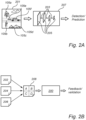
- Fig. 2A conceptually illustrates an overview of neural network prediction process.
- An image 201 acquired by a camera is input into a neural network model 207, here exemplified as a convolutional neural network (CNN) model.
- the image 201 includes image data indicative of a objects 105a-f belonging to different object classes, e.g., a vehicle 105f, a plant 105c-e, a tree 105a, and a person 105b.
- object classes e.g., a vehicle 105f, a plant 105c-e, a tree 105a, and a person 105b.
- a CNN model operates in ways known to the skilled person. Generally, convolutions of the input are used to compute the output. Connections 203 are formed such that parts of an input layer is connected to a node in the output. In each layer 205 of a convolutional neural network, filters or kernels are applied whereby the parameters of the filters or kernels are learned during training of the convolutional neural network. The operation of neural networks is considered known to the skilled person and will not be described in detail.
- the neural network model 207 Based on its training, the neural network model 207 provides a prediction of the objects detected in the image and their corresponding class.
- Fig. 2B conceptually illustrates an overview of neural network training.
- multiple data sets 202, 204, and 206 have been obtained from which object samples for training is to be selected.
- the data sets 202, 204, and 206 comprise annotated object samples 208 from at least two object classes, here object classes A, B, C, and D are included.
- the annotated object samples 208 from the different classes A, B, C, and D are provided to the neural network 200 which feeds back on its predictions and performs validation steps to improve its predictions. More specifically, the neural network 200 backpropagates on its gradient of a loss function to improve model accuracy performance.
- annotated object samples 208 from each of the at least two object classes are selected, and subsequently provided for training of the neural network 200.
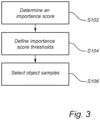
- Fig. 3 is a flow-chart of method steps according to embodiments of the invention and Fig. 6 conceptually illustrates object distributions of data sets 202, 204, 206 with object samples belonging to different object classes A, B, C, D and being manually annotated 202a, 204a, 206a or automatically annotated 202b, 204b, 206b.
- the method being for selecting object samples 208 for training of a neural network 200 from more than one dataset 202, 204, 206 comprising annotated object samples of at least two object classes A, B, C, D.
- step S102 an importance score is determined for at least a portion of the annotated object samples.
- the importance score may be determined in different ways.
- the importance score is calculated based on an object sample confidence value and a relevance value. Since a manually annotated object sample 202a is considered annotated with full confidence, e.g., with no uncertainty, the confidence value is larger for manually annotated samples 202a than for automatically annotated samples 202b annotated using a model or an algorithm for annotating the object samples. A higher confidence value generally results in a higher importance score.
- the confidence value may be a value between 0 and 1.
- the relevance value is higher for a dataset considered more relevant for the use case the neural network is trained for than for datasets more remote from the use case.
- a relatively large relevance value may be set, such as 1 or close to 1.
- a relevance value of about 0.7 or 0.6 may be set, whereas for an even less relevant data set a relevance value of about 0.4 or 0.5 may be set.
- the relevance values may be tuned for a specific implementation or application at hand.
- the relevance value may be a value between 0 and 1.
- the datasets collected for training of the neural network with surveillance views from indoor scenarios are regarded as the most relevant and thus provided the highest relevance value 1.0.
- Datasets from the outdoor scenarios with surveillance views could be provided the relevance value 0.5, and outdoor with other camera view angles could be provided the relevance value 0.3.
- the importance score may be adjusted to tune the relation between the confidence value and the relevance value.
- calculating the importance score includes adjusting a tuning factor, ⁇ , for adjusting the relative importance of the object sample confidence value and a relevance value when calculating the importance score.
- the confidence value obtained from a pretraining model or classification algorithms, could have different reliabilities. For example, in case the reliability of a confidence value is relatively low, it is advantageous to adjust the tuning factor ⁇ to change the weight of the confidence value to have less impact on the importance score.
- Adjusting the tuning factor ( ⁇ ) may be performed as an input from a user having knowledge of the use case and the reliability of the confidence values. It is also possible that the tuning factor may be adjusted automatically based on the reliability of the confidence values, i.e., if a low reliability of a confidence values is detected, the turning factor is increased.
- a set of importance score thresholds 210 are defined.
- the importance score thresholds may be set by a user depending on the use case and the amount of available data. Similarly, the number of importance score thresholds in a set is determined based on the specific application. Purely as an example, in the case of detecting special vehicles, such as ambulances, fire trucks, or other such vehicles, collecting such training object samples is more difficult compared to collecting training object samples for regular private cars. Then the importance score threshold for such object classes (special vehicles) may be set to a lower level, in order to get more training object samples selected for training of the neural network.
- the set of importance score thresholds comprise between 3 and 10 importance score thresholds.
- the set 210 includes 6 importance score thresholds: 0.5, 0.6, 0.7, 0.8, 0.9, and 1.
- step S106 a number of annotated object samples 208 is selected from each object class A B, C, D.
- the selected object samples 208 fulfill a respective importance score threshold and provide the smallest variation of the number of object samples between the object classes A B, C, D.
- the selected annotated object samples are to be used for training of the neural network 200.
- fig. 7 is a table that represents the number of object samples that fulfill each of the set of importance score thresholds 210.
- 1000 annotated objects samples fulfill the importance score threshold 0.5.
- 700 object samples of class B, 900 object samples of class C, and 300 object samples of class D fulfill the importance score threshold 0.5.
- 900 annotated objects of class A, 650 object samples of class B, 850 object samples of class C, and 290 object samples of class D fulfill the importance score threshold 0.6.
- Fulfilling the respective importance score threshold 210 is here to exceed or be equal to the respective importance score threshold.
- an object sample that exceed or is equal to the importance score threshold 1 will also be included in the object samples that fulfill an importance score threshold lower than 1.
- object samples are selected from each object class, A, B, C, D.
- the selected object samples fulfill a respective importance score threshold so that the variation of the number of samples from each object class A, B, C, D, is a small as possible.
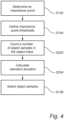
- step S202 in the flow-chart shown in fig. 4 it is advantageous to count, in step S202 in the flow-chart shown in fig. 4 , a number of annotated object samples in the object class that fulfill each of the importance score thresholds 210. For example, as described above with reference to the table in fig. 7 , count the number of object samples above each importance score threshold for each class from all datasets 202, 204, 206.
- step S204 a standard deviation is calculated of the number of counted object samples for each object class A B, C, D and each importance score threshold 210.
- the step S106 then includes selecting a combination of object samples from each object class based on the minimum standard deviation among all possible combinations. For example, one combination is the 1000 object samples 708a of object class A that fulfill the importance threshold 0.5, the 650 object samples 708b of object class B that fulfill the importance threshold 0.6, the 650 object samples 708c of object class C that fulfill the importance threshold 0.8, and the 200 object samples 708d of object class D that fulfill the importance threshold 0.8.
- the standard deviation is calculated for this combination, e.g., 1000, 650, 650, and 200.
- the standard deviation for all possible combinations including one number from each object class is calculated, whereas the one combination with the lowest standard deviation is selected.
- the object samples included in that selection are included in the training of the neural network 200.
- the smallest standard deviation is provided by the indicated object samples denoted 710a, 710b, 710c, and 710d.
- calculating the standard deviation in step S204 comprises calculating the standard deviation of the number of object samples in each group.
- the combination of groups that provide the minimum standard deviation is selected for training of the neural network.
- the object samples denoted 710a, 710ab, 710c, 710d may be considered a respective group 710a, 710b, 710c, 710d of object samples.
- a group may equally be considered a set, a subset, or a collection of object samples.
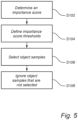
- step S108 object samples excluded in the selection of object samples for training of the neural network are ignored. Ignored object samples are not used for training of the neural network. In this ways, ambiguous object samples that are not selected, for example the object samples in the group 708a that are not also included in group 710a, are ignored so that they are not incorrectly interpreted as image background.
- Implementation of the ignoring may be performed by providing the object sample that is to be ignored by an attribute "ignore".
- the neural network does not include object samples with the "ignore" attribute in its training, neither as positive samples, i.e., annotated object samples, nor as negative samples considered to belong to the image background.
- the neural network employs so-called anchor boxes and detects an object with attribute "ignore"
- the neural network is instructed to not learn from the corresponding region of the image, i.e., the weights or parameters of the neural network will not change based on detections in these regions.
- step S106 further comprises, for a specified object class, selecting only object samples having an importance score that exceeds or is equal to a minimum importance score threshold that exceeds at least one of the importance score thresholds of the defined set of importance score thresholds.
- the importance score thresholds 710 may be defined for all the object classes. However, if for example Class B is of particular interest and importance, a minimum importance score of e.g., 0.7 may be set. This means that the object samples falling under the importance score threshold lower than 0.7 are not considered for selection.
- the object samples in specified object class having an importance score below the minimum importance score threshold may be ignored in step S108 in the selection of object samples for training of the neural network.
- an ignored object sample may not be used during training of the neural network.
- the step S104 further comprises defining more than one set of importance score thresholds.
- a first set of importance score thresholds is defined for a first object class, and this first set of importance score thresholds is different from a second set of importance score thresholds for a second object class. That the sets of importance score thresholds are different means that at least one of the importance score thresholds of the different sets is different, or that the number of importance score thresholds in the different sets are different.
- Fig. 8 conceptually illustrates a control unit 800 that is configured to select object samples according to anyone of the herein described embodiments. More specifically, the control unit 800 is configured to perform the steps of the method according to figs. 3-5 , and variants thereof discussed herein, generally indicated as algorithm ⁇ .
- control unit 800 is configured for selecting object samples 208 for training of a neural network 200 from more than one dataset 202, 204, 206 comprising annotated object samples of at least two object classes A, B, C, D.
- the control unit is configured to determine an importance score for at least a portion of the annotated object samples. This is further discussed above in relation to corresponding method steps.
- control unit 800 is configured to acquire a set of importance score thresholds.
- the control unit 800 may either define the set of importance score thresholds, or it may obtain or receive the set of importance score thresholds from a memory, or it may receive the set of importance score thresholds as an input from a user interface controllable by a user.
- a user interface includes input devices for a computer that allows a user to send instructions to the control unit 800.
- control unit 800 is configured to select a number of annotated object samples 208 from each object class that fulfill a respective importance score threshold, and that provides the smallest variation of the number of object samples between the object classes, to be used for training of the neural network 200.
- the control unit 800 illustrated and discussed in relation to fig. 8 may be control unit 800 specifically used for selecting the object samples to be used for the training of the neural network 200.
- the control unit 800 may also be configured to execute the training of the neural network 200, or the control unit 800 provides the selected object samples for training of the neural network elsewhere.
- the control unit 800 may equally well be the same control unit as the control unit 101 discussed in relation to fig. 1 , thus the control unit operative to run the trained neural network according to a use case.
- the neural network model is loaded to a memory accessible to the control unit 101 after training.
- the neural network discussed herein may be a deep neural network such as for example a CNN, although other deep neural networks may be applicable. CNNs are particularly suited for object detection and classification from images.
- the control unit includes a microprocessor, microcontrol unit, programmable digital signal processor or another programmable device.
- the control unit may also, or instead, include an application specific integrated circuit, a programmable gate array or programmable array logic, a programmable logic device, or a digital signal processor.
- the control unit includes a programmable device such as the microprocessor, microcontrol unit or programmable digital signal processor mentioned above, the processor may further include computer executable code that controls operation of the programmable device.
- control functionality of the present disclosure may be implemented using existing computer processors, or by a special purpose computer processor for an appropriate system, incorporated for this or another purpose, or by a hardwire system.
- Embodiments within the scope of the present disclosure include program products comprising machine-readable medium for carrying or having machine-executable instructions or data structures stored thereon.
- Such machine-readable media can be any available media that can be accessed by a general purpose or special purpose computer or other machine with a processor.
- machine-readable media can comprise RAM, ROM, EPROM, EEPROM, CD-ROM or other optical disk storage, magnetic disk storage or other magnetic storage devices, or any other medium which can be used to carry or store desired program code in the form of machine-executable instructions or data structures and which can be accessed by a general purpose or special purpose computer or other machine with a processor.
- a network or another communications connection either hardwired, wireless, or a combination of hardwired or wireless
- any such connection is properly termed a machine-readable medium.
- Machine-executable instructions include, for example, instructions and data which cause a general-purpose computer, special purpose computer, or special purpose processing machines to perform a certain function or group of functions.
Landscapes
- Engineering & Computer Science (AREA)
- Theoretical Computer Science (AREA)
- Physics & Mathematics (AREA)
- Evolutionary Computation (AREA)
- Data Mining & Analysis (AREA)
- Artificial Intelligence (AREA)
- General Physics & Mathematics (AREA)
- Software Systems (AREA)
- Computing Systems (AREA)
- General Engineering & Computer Science (AREA)
- Life Sciences & Earth Sciences (AREA)
- General Health & Medical Sciences (AREA)
- Health & Medical Sciences (AREA)
- Computer Vision & Pattern Recognition (AREA)
- Biomedical Technology (AREA)
- Biophysics (AREA)
- Computational Linguistics (AREA)
- Molecular Biology (AREA)
- Mathematical Physics (AREA)
- Databases & Information Systems (AREA)
- Bioinformatics & Cheminformatics (AREA)
- Medical Informatics (AREA)
- Bioinformatics & Computational Biology (AREA)
- Multimedia (AREA)
- Evolutionary Biology (AREA)
- Image Analysis (AREA)
Abstract
The present invention generally relates to method for selecting object samples (208) for training of a neural network (200) from more than one dataset (202, 204, 206) comprising annotated object samples of at least two object classes ("Class A-D"), the method comprising: determining (S102) an importance score for at least a portion of the annotated object samples; defining (S104) a set of importance score thresholds (210); and selecting (S106) a number of annotated object samples (208) from each object class that fulfill a respective importance score threshold, and that provides the smallest variation of the number of object samples between the object classes, to be used for training of the neural network (200).
Description
- The present invention generally relates to the field of camera surveillance, and in particular to a method and control unit for selecting object samples used for training a neural network adapted for detecting objects in a scene.
- Neural networks have proven to be efficient in detecting and classifying objects in images and video streams. The accuracy in classifying objects depends largely on the underlying training of the neural network which is performed using suitable training data that preferably closely resemble the intended use case.
- The training data should represent different object classes, where an object class relates to a class or type of object that is targeted by the neural network.
- Generally, a neural network is represented by its architecture that shows how to transform from inputs to outputs. The neural network consists of multiple node layers. The nodes are connected and have been associated with weights and thresholds. The weights and thresholds are learned from training to produce a neural network model.
- The training data may include multiple data sets having different properties such as different view angles, different time of day, and different scenarios of a scene. For optimal performance of the neural network for a specific use case, the number of object samples from different datasets to be used in the training should be well controlled.
- The training data is often annotated according to the class that a specific object data sample belongs to. Variations in the number of object samples from different classes in the training data may cause class imbalance which has consequences related to poor performance of the neural network for object classes with fewer object samples.
- Accordingly, there is room for improvements with regards to training of neural networks.
- In view of above-mentioned and other drawbacks of the prior art, it is an object of the present invention to provide an improved method for selecting object samples that alleviates at least some of the drawbacks of prior art. More specifically, an object of the present invention is to provide a method for selecting object samples that can alleviate the class imbalance problem.
- According to a first aspect of the present invention, it is therefore provided a method for selecting object samples for training of a neural network from more than one dataset comprising annotated object samples of at least two object classes. The method comprises: determining an importance score for at least a portion of the annotated object samples; defining a set of importance score thresholds; and selecting a number of annotated object samples from each object class that fulfill a respective importance score threshold, and that provides the smallest variation of the number of object samples between the object classes, to be used for training of the neural network.
- The present invention is based upon the realization to adjust the number of samples from each object class based on objects from each class that fulfill the respective importance score threshold. In other words, balancing the number of object samples from each object class to be as equal as possible while fulfilling a respective object importance score requirement for each object class. In this way, a balance between object classes may be obtained.
- It was further realized to introduce the importance score threshold as a condition for an object sample to be selected. Object samples that fulfill a specific importance score threshold is considered of sufficiently high quality and relevance for training of the neural network. Thus, the importance score threshold can advantageously be tailored to ensure that the quality and relevance of the selected object samples are acceptable, while still providing an improved balance between object classes.
- It can be considered that the result of training a neural network is a neural network model. The neural network model is thus trained for a specific task. Herein the specific task comprises object detection and classification.
- The importance score reflects the quality and relevance of an object sample. Each object sample is weighted by its quality and relevance which is reflected in the importance score.
- The at least a portion of the annotated object samples is equally interpreted as an amount of the annotated object samples or a number of the annotated object samples and generally means that there may be annotated object samples in the at least one data set that for some reason are not included in the selection process.
- By the provision of embodiments herein, the object samples are selected from different object classes in such a way that the imbalance class problem is alleviated and the neural network model performance, after training, may be improved. The performance for object classes having few object samples is particularly improved.
- A dataset may be provided in the form of an image from which a plurality of object samples is extractable.
- An object sample is defined by its annotations of object class and location in an image. Consequently, the neural network is trained to predict the class and location of an object in an image. Other possible annotations are for example shape, so called polygonal segmentation, and semantic segmentation, and the center coordinate of an object.
- In one embodiment, the method may comprise ignoring object samples excluded in the selection of object samples for training of the neural network. This advantageously provides for avoiding training on object samples that may lead to class imbalance or that are related to irrelevant data. Further, it provides for avoiding annotated object samples to be interpreted as background in the training of the neural network, so called negative samples. An object sample that is ignored is masked in the training images. A masked object sample may for example be pixelated or subject to bounding boxes masking. However, more generally, an ignored object sample is not selected and therefore not used, or not included, for training of the neural network. In other words, an ignored sample is excluded for training of the neural network.
- In one embodiment, fulfilling the respective importance score threshold may be to exceed or be equal to the respective importance score threshold, the step of selecting may further comprise: for a specified object class, selecting only object samples having an importance score that exceeds or is equal to a minimum importance score threshold that exceeds at least one of the importance score thresholds of the defined set of importance score thresholds. In other words, a minimum importance score threshold may be specifically defined for a specific object class in which is it desirable to guarantee that the object samples are of sufficiently high quality. The minimum importance score threshold is larger than at least one of the other importance score thresholds in the set.
- In one embodiment, the step of ignoring may further comprise ignoring object samples in specified object class having an importance score below the minimum importance score threshold in the selection of object samples for training of the neural network.
- In one embodiment, the step of defining may further comprise defining more than one set of importance score thresholds, where a first set of importance score thresholds for a first object class is different from a second set of importance score thresholds for a second object class. Advantageously, this allows for tailoring the importance score thresholds for a specific class. As with the minimum importance score threshold, specifically defined sets of importance score thresholds can be used for ensuring the object samples belonging to a given object class are of sufficient quality.
- In one embodiment, the method may comprise: for each object class and for each of the importance score thresholds, counting, a number of annotated object samples in the object class that fulfill each of the importance score thresholds, and calculating a standard deviation of the number of counted object samples for each object class and each importance score threshold and wherein the step of selecting may further comprise selecting a combination of object samples from each object class based on the minimum standard deviation among all possible combinations. Using the standard deviation as a measure of the variation of the number of object samples from each class is one efficient way to select a combination of samples from the different object classes with smallest variation between object classes. Instead of using the standard deviation, it is also conceivable to use the variance, being the square of the standard deviation, in an analogous way.
- In one embodiment, the counted annotated object samples in each object class that fulfill each of the importance score thresholds may form a group of object samples, wherein calculating the standard deviation comprises calculating the standard deviation of the number of object samples in each group, wherein the combination of groups that provide the minimum standard deviation is selected for training of the neural network. A group may be considered a set, a subset, or a collection of counted annotated object samples in each object class that fulfill each of the importance score thresholds.
- In one embodiment, the step of determining may comprise: for each of the annotated object samples, calculating the importance score based on an object sample confidence value and a relevance value, where the object sample confidence value is larger for manually annotated samples than for automatically annotated samples, and the relevance value is higher for a dataset considered more relevant for the use case the neural network is trained for than for datasets more remote from the use case. This advantageously provides for weighting of the object samples according to both relevance and confidence which provides for subsequent accurate selection of object samples. As an example, if the object sample is manually annotated, its confidence value is 1, otherwise the confidence value is a value that indicates how confident a model is in the object classification/detection and is between 0 and 1. The relevance value may be e.g., 1 for the most relevant dataset, and smaller for less relevant data sets, for example 0.7 for a less relevant dataset, and 0.5 for an even less relevant dataset, etc.
- In embodiments, the confidence value of automatically annotated samples may be a confidence value obtained from a model or algorithm used for annotating the object samples. The model may be classification model. Another example of a model is an object detection model (a so-called object detector) detecting objects in an image. A further example of a model is a neural network model or a machine learning algorithm. The confidence value indicates how confident the model is in the object classification/detection. The model for automatically annotating samples is not the same model as the neural network for which object samples are selected. However, the model for automatically annotating samples may also be a neural network model.
- For example, the model for automatically annotating samples may be an annotation neural network model which is trained from a small dataset, or a-traditional object detection algorithm, such as object detection based on the histogram of oriented gradients.
- In one embodiment, calculating the importance score may include adjusting a tuning factor for adjusting the relative importance of the object sample confidence value and a relevance value when calculating the importance score. Thus, the tuning factor provides for balancing the weight between object sample confidence value and a relevance value accordingly.
- The number of importance score thresholds may depend on the specific implementation at hand and be tailored to the specific case. However, in embodiments, the set of importance score thresholds comprise at least 3 importance score thresholds. In other embodiments the set of importance score thresholds comprise at least 5 importance score thresholds. In other embodiments the set of importance score thresholds comprise at least 8 importance score thresholds.
- Different types of neural networks are conceivable and within the scope of the invention. However, in one preferred embodiment, the neural network is a Convolutional Neural Network (CNN).
- Further, the method may comprise providing the selected object samples to the neural network and performing training of the neural network using the selected object samples. The result of training the neural network is a neural network model.
- According to a second aspect of the present invention, there is provided a control unit for selecting object samples for training of a neural network from more than one dataset comprising annotated object samples of at least two object classes, the control unit being configured to: determine an importance score for at least a portion of the annotated object samples; acquire a set of importance score thresholds; and select a number of annotated object samples from each object class that fulfill a respective importance score threshold, and that provides the smallest variation of the number of object samples between the object classes, to be used for training of the neural network.
- That the control unit acquires the set of importance score thresholds includes that the control unit is configured to determine or define the set of importance score thresholds, or to obtain the set of importance score thresholds from e.g., a memory or a user interface.
- Further embodiments of, and effects obtained through this second aspect of the present invention are largely analogous to those described above for the first aspect and the second aspect of the invention.
- According to a third aspect of the present invention, there is provided a system comprising an image capturing device for capturing images of a scene including objects, and a control unit configured to operate a neural network model for detecting objects in the scene, the neural network model having been trained on object samples selected according to the method of the first aspect and embodiments thereof.
- The image capturing device may be a camera, such as a surveillance camera.
- Further embodiments of, and effects obtained through this third aspect of the present invention are largely analogous to those described above for the first aspect and the second aspect of the invention.
- According to a fourth aspect of the present invention, there is provided computer program comprising instructions which, when the program is executed by a computer, cause the computer to carry out the method of any of the herein discussed embodiments.
- Further embodiments of, and effects obtained through this fourth aspect of the present invention are largely analogous to those described above for the other aspects of the invention.
- Further features of, and advantages with, the present invention will become apparent when studying the appended claims and the following description. The skilled addressee realize that different features of the present invention may be combined to create embodiments other than those described in the following, without departing from the scope of the present invention.
- The various aspects of the invention, including its particular features and advantages, will be readily understood from the following detailed description and the accompanying drawings, in which:
-
Figs. 1 conceptually illustrates a scene being monitored by an image capturing device as an example application of embodiments of the invention; -
Fig. 2A conceptually illustrates an overview of neural network model prediction according to embodiments of the invention; -
Fig. 2B conceptually illustrates an overview of neural network training according to embodiments of the invention; -
Fig. 3 is a flow-chart of method steps according to embodiments of the invention; -
Fig. 4 is a flow-chart of method steps according to embodiments of the invention; -
Fig. 5 is a flow-chart of method steps according to embodiments of the invention; -
Fig. 6 conceptually illustrates data sets with object samples belonging to different object classes; -
Fig. 7 is a table that represents the number of object samples that fullfill each of the set of importance score thresholds; and -
Fig. 8 conceptually illustrates a control unit that is configured to select object samples according to embodiments of the invention. - The present invention will now be described more fully hereinafter with reference to the accompanying drawings, in which currently preferred embodiments of the invention are shown. This invention may, however, be embodied in many different forms and should not be construed as limited to the embodiments set forth herein; rather, these embodiments are provided for thoroughness and completeness, and fully convey the scope of the invention to the skilled person. Like reference characters refer to like elements throughout.
- Turning now to the drawings and to
fig 1 in particular, there is shown ascene 1 being monitored by animage capturing device 100, e.g., a camera or more specifically a surveillance camera. In thescene 1, there is a set ofobjects - The
camera 100 is continuously monitoring thescene 1 by capturing a video stream or images of thescene 1 and theobjects 104a-d therein. Thecamera 100 and acontrol unit 101 are part of asystem 10, where thecontrol unit 101 may either be a separate stand-alone control unit or be part of thecamera 100. It is also conceivable that thecontrol unit 101 is remotely located such as on a server and thus operates as a Could-based service. - The
control unit 101 is configured to operate a neural network model for detectingobjects 104a-d in thescene 1. For the neural network model to accurately be able to detect objects in thescene 1 and classifying them to be of a specific type, e.g., a vehicle type, a person, etc., it is necessary that the neural network model has been trained for such detection on training data that represent each of a set of object classes. Poor selection of object samples for training of the neural network model for detection of objects from different classes may reduce the performance of the neural network model. - To alleviate this problem, the inventors propose a method for selecting object samples for training of a neural network that provides the smallest variation of the number of object samples between the object classes and which object samples fulfill a respective importance score threshold. This will be described in more detail herein.
-
Fig. 2A conceptually illustrates an overview of neural network prediction process. Animage 201 acquired by a camera is input into aneural network model 207, here exemplified as a convolutional neural network (CNN) model. Theimage 201 includes image data indicative of aobjects 105a-f belonging to different object classes, e.g., avehicle 105f, a plant 105c-e, atree 105a, and aperson 105b. - A CNN model operates in ways known to the skilled person. Generally, convolutions of the input are used to compute the output.
Connections 203 are formed such that parts of an input layer is connected to a node in the output. In eachlayer 205 of a convolutional neural network, filters or kernels are applied whereby the parameters of the filters or kernels are learned during training of the convolutional neural network. The operation of neural networks is considered known to the skilled person and will not be described in detail. - Based on its training, the
neural network model 207 provides a prediction of the objects detected in the image and their corresponding class. -
Fig. 2B conceptually illustrates an overview of neural network training. Heremultiple data sets object samples 208 from at least two object classes, here object classes A, B, C, and D are included. The annotatedobject samples 208 from the different classes A, B, C, and D are provided to theneural network 200 which feeds back on its predictions and performs validation steps to improve its predictions. More specifically, theneural network 200 backpropagates on its gradient of a loss function to improve model accuracy performance. - From the data sets 202, 204, and 206, annotated
object samples 208 from each of the at least two object classes are selected, and subsequently provided for training of theneural network 200. -
Fig. 3 is a flow-chart of method steps according to embodiments of the invention andFig. 6 conceptually illustrates object distributions ofdata sets - The method being for selecting
object samples 208 for training of aneural network 200 from more than onedataset - In step S102, an importance score is determined for at least a portion of the annotated object samples.
- The importance score may be determined in different ways. In one possible implementation, the importance score is calculated based on an object sample confidence value and a relevance value. Since a manually annotated
object sample 202a is considered annotated with full confidence, e.g., with no uncertainty, the confidence value is larger for manually annotatedsamples 202a than for automatically annotatedsamples 202b annotated using a model or an algorithm for annotating the object samples. A higher confidence value generally results in a higher importance score. The confidence value may be a value between 0 and 1. - Further, the relevance value is higher for a dataset considered more relevant for the use case the neural network is trained for than for datasets more remote from the use case. Thus, the closer to the actual use case the more relevant is the data set. If a data set is acquired at a scene similar to the use case type of scene, e.g., a parking lot, then a relatively large relevance value may be set, such as 1 or close to 1. For a less relevant data set, a relevance value of about 0.7 or 0.6 may be set, whereas for an even less relevant data set a relevance value of about 0.4 or 0.5 may be set. The relevance values may be tuned for a specific implementation or application at hand. The relevance value may be a value between 0 and 1.
- As an example, for cameras that are deployed at a position with a surveillance view for an indoor environment, the datasets collected for training of the neural network with surveillance views from indoor scenarios are regarded as the most relevant and thus provided the highest relevance value 1.0. Other datasets from indoor environments with other camera view angles, can be provided the relevance value 0.7. Datasets from the outdoor scenarios with surveillance views could be provided the relevance value 0.5, and outdoor with other camera view angles could be provided the relevance value 0.3.
- The importance score, is , for each object sample may be calculated using the formula:

- More generally, the importance score may be adjusted to tune the relation between the confidence value and the relevance value. In such case, calculating the importance score includes adjusting a tuning factor, β, for adjusting the relative importance of the object sample confidence value and a relevance value when calculating the importance score. In this case the importance score, isβ , for each object sample may be calculated using the formula:

- In one example of using the tuning factor, the confidence value, obtained from a pretraining model or classification algorithms, could have different reliabilities. For example, in case the reliability of a confidence value is relatively low, it is advantageous to adjust the tuning factor β to change the weight of the confidence value to have less impact on the importance score.
- Another example, when the neural network is trained for a specific scenario, e.g., an indoor surveillance view, where the camera elevation view angle is large in most cases, and one of the datasets is collected from similar scenarios, this dataset is of high relevance to the use case. In such case, it is advantageous to select more training object samples from the relevant dataset for the neural network to better fit such a specific scenario. Then, as an example, β=2 can be selected, which means the importance of the relevance value is considered two times higher than the importance of the confidence value.
- Adjusting the tuning factor (β) may be performed as an input from a user having knowledge of the use case and the reliability of the confidence values. It is also possible that the tuning factor may be adjusted automatically based on the reliability of the confidence values, i.e., if a low reliability of a confidence values is detected, the turning factor is increased.
- With further reference to
fig. 3 , in step S104, a set ofimportance score thresholds 210 are defined. The importance score thresholds may be set by a user depending on the use case and the amount of available data. Similarly, the number of importance score thresholds in a set is determined based on the specific application. Purely as an example, in the case of detecting special vehicles, such as ambulances, fire trucks, or other such vehicles, collecting such training object samples is more difficult compared to collecting training object samples for regular private cars. Then the importance score threshold for such object classes (special vehicles) may be set to a lower level, in order to get more training object samples selected for training of the neural network. - However, generally, the set of importance score thresholds comprise between 3 and 10 importance score thresholds. In the example set of
importance score thresholds 210 shown infig. 7 , theset 210 includes 6 importance score thresholds: 0.5, 0.6, 0.7, 0.8, 0.9, and 1. - In step S106, a number of annotated
object samples 208 is selected from each object class A B, C, D. The selectedobject samples 208 fulfill a respective importance score threshold and provide the smallest variation of the number of object samples between the object classes A B, C, D. The selected annotated object samples are to be used for training of theneural network 200. - Turning to
fig. 7 which is a table that represents the number of object samples that fulfill each of the set ofimportance score thresholds 210. Here, in class A, 1000 annotated objects samples fulfill the importance score threshold 0.5. Similarly, 700 object samples of class B, 900 object samples of class C, and 300 object samples of class D fulfill the importance score threshold 0.5. Further, 900 annotated objects of class A, 650 object samples of class B, 850 object samples of class C, and 290 object samples of class D fulfill the importance score threshold 0.6. - Fulfilling the respective
importance score threshold 210 is here to exceed or be equal to the respective importance score threshold. Thus, an object sample that exceed or is equal to theimportance score threshold 1 will also be included in the object samples that fulfill an importance score threshold lower than 1. - In order to reduce the effect of class imbalance, object samples are selected from each object class, A, B, C, D. The selected object samples fulfill a respective importance score threshold so that the variation of the number of samples from each object class A, B, C, D, is a small as possible.
- For this, it is advantageous to count, in step S202 in the flow-chart shown in
fig. 4 , a number of annotated object samples in the object class that fulfill each of theimportance score thresholds 210. For example, as described above with reference to the table infig. 7 , count the number of object samples above each importance score threshold for each class from alldatasets - Next, in step S204, a standard deviation is calculated of the number of counted object samples for each object class A B, C, D and each
importance score threshold 210. The step S106 then includes selecting a combination of object samples from each object class based on the minimum standard deviation among all possible combinations. For example, one combination is the 1000object samples 708a of object class A that fulfill the importance threshold 0.5, the 650object samples 708b of object class B that fulfill the importance threshold 0.6, the 650object samples 708c of object class C that fulfill the importance threshold 0.8, and the 200object samples 708d of object class D that fulfill the importance threshold 0.8. Thus, one number from each object class A, B, C, D. The standard deviation is calculated for this combination, e.g., 1000, 650, 650, and 200. - The standard deviation for all possible combinations including one number from each object class is calculated, whereas the one combination with the lowest standard deviation is selected. The object samples included in that selection are included in the training of the
neural network 200. In this example, the smallest standard deviation is provided by the indicated object samples denoted 710a, 710b, 710c, and 710d. - The standard deviation (σ) may be given by:

- The counted annotated object samples in each object class that fulfill each of the importance score thresholds may be considered to form a group object samples. Thus, calculating the standard deviation in step S204 comprises calculating the standard deviation of the number of object samples in each group. The combination of groups that provide the minimum standard deviation is selected for training of the neural network. For example, the object samples denoted 710a, 710ab, 710c, 710d may be considered a
respective group - According to step S108, object samples excluded in the selection of object samples for training of the neural network are ignored. Ignored object samples are not used for training of the neural network. In this ways, ambiguous object samples that are not selected, for example the object samples in the
group 708a that are not also included ingroup 710a, are ignored so that they are not incorrectly interpreted as image background. - Implementation of the ignoring may be performed by providing the object sample that is to be ignored by an attribute "ignore". During training the neural network does not include object samples with the "ignore" attribute in its training, neither as positive samples, i.e., annotated object samples, nor as negative samples considered to belong to the image background.
- As an example, if the neural network employs so-called anchor boxes and detects an object with attribute "ignore", then the neural network is instructed to not learn from the corresponding region of the image, i.e., the weights or parameters of the neural network will not change based on detections in these regions.
- It may be desirable to ensure that object samples of some object classes are of specific quality, and this may be achieved by adding an additional condition given by a minimum importance score threshold for a certain object class. In such case, step S106 further comprises, for a specified object class, selecting only object samples having an importance score that exceeds or is equal to a minimum importance score threshold that exceeds at least one of the importance score thresholds of the defined set of importance score thresholds. For example, the importance score thresholds 710 may be defined for all the object classes. However, if for example Class B is of particular interest and importance, a minimum importance score of e.g., 0.7 may be set. This means that the object samples falling under the importance score threshold lower than 0.7 are not considered for selection.
- In case of implementing a minimum importance score, the object samples in specified object class having an importance score below the minimum importance score threshold may be ignored in step S108 in the selection of object samples for training of the neural network. As discussed above, an ignored object sample may not be used during training of the neural network.
- Another way to implementing specific importance score thresholds, such as minimum importance score thresholds is to define individual sets of importance score thresholds for different object classes. In such case, the step S104 further comprises defining more than one set of importance score thresholds. A first set of importance score thresholds is defined for a first object class, and this first set of importance score thresholds is different from a second set of importance score thresholds for a second object class. That the sets of importance score thresholds are different means that at least one of the importance score thresholds of the different sets is different, or that the number of importance score thresholds in the different sets are different.
-
Fig. 8 conceptually illustrates acontrol unit 800 that is configured to select object samples according to anyone of the herein described embodiments. More specifically, thecontrol unit 800 is configured to perform the steps of the method according tofigs. 3-5 , and variants thereof discussed herein, generally indicated as algorithm µ. - More specifically, the
control unit 800 is configured for selectingobject samples 208 for training of aneural network 200 from more than onedataset - The control unit is configured to determine an importance score for at least a portion of the annotated object samples. This is further discussed above in relation to corresponding method steps.
- Further, the
control unit 800 is configured to acquire a set of importance score thresholds. Thecontrol unit 800 may either define the set of importance score thresholds, or it may obtain or receive the set of importance score thresholds from a memory, or it may receive the set of importance score thresholds as an input from a user interface controllable by a user. Such a user interface includes input devices for a computer that allows a user to send instructions to thecontrol unit 800. - Additionally, the
control unit 800 is configured to select a number of annotatedobject samples 208 from each object class that fulfill a respective importance score threshold, and that provides the smallest variation of the number of object samples between the object classes, to be used for training of theneural network 200. - The
control unit 800 illustrated and discussed in relation tofig. 8 may becontrol unit 800 specifically used for selecting the object samples to be used for the training of theneural network 200. Thecontrol unit 800 may also be configured to execute the training of theneural network 200, or thecontrol unit 800 provides the selected object samples for training of the neural network elsewhere. Further, thecontrol unit 800 may equally well be the same control unit as thecontrol unit 101 discussed in relation tofig. 1 , thus the control unit operative to run the trained neural network according to a use case. In other possible implementations, the neural network model is loaded to a memory accessible to thecontrol unit 101 after training. - The neural network discussed herein may be a deep neural network such as for example a CNN, although other deep neural networks may be applicable. CNNs are particularly suited for object detection and classification from images.
- The control unit includes a microprocessor, microcontrol unit, programmable digital signal processor or another programmable device. The control unit may also, or instead, include an application specific integrated circuit, a programmable gate array or programmable array logic, a programmable logic device, or a digital signal processor. Where the control unit includes a programmable device such as the microprocessor, microcontrol unit or programmable digital signal processor mentioned above, the processor may further include computer executable code that controls operation of the programmable device.
- The control functionality of the present disclosure may be implemented using existing computer processors, or by a special purpose computer processor for an appropriate system, incorporated for this or another purpose, or by a hardwire system. Embodiments within the scope of the present disclosure include program products comprising machine-readable medium for carrying or having machine-executable instructions or data structures stored thereon. Such machine-readable media can be any available media that can be accessed by a general purpose or special purpose computer or other machine with a processor. By way of example, such machine-readable media can comprise RAM, ROM, EPROM, EEPROM, CD-ROM or other optical disk storage, magnetic disk storage or other magnetic storage devices, or any other medium which can be used to carry or store desired program code in the form of machine-executable instructions or data structures and which can be accessed by a general purpose or special purpose computer or other machine with a processor. When information is transferred or provided over a network or another communications connection (either hardwired, wireless, or a combination of hardwired or wireless) to a machine, the machine properly views the connection as a machine-readable medium. Thus, any such connection is properly termed a machine-readable medium. Combinations of the above are also included within the scope of machine-readable media. Machine-executable instructions include, for example, instructions and data which cause a general-purpose computer, special purpose computer, or special purpose processing machines to perform a certain function or group of functions.
- Although the figures may show a sequence the order of the steps may differ from what is depicted. Also, two or more steps may be performed concurrently or with partial concurrence. Such variation will depend on the software and hardware systems chosen and on designer choice. All such variations are within the scope of the disclosure. Likewise, software implementations could be accomplished with standard programming techniques with rule-based logic and other logic to accomplish the various connection steps, processing steps, comparison steps and decision steps. Additionally, even though the invention has been described with reference to specific exemplifying embodiments thereof, many different alterations, modifications and the like will become apparent for those skilled in the art.
- In addition, variations to the disclosed embodiments can be understood and effected by the skilled addressee in practicing the claimed invention, from a study of the drawings, the disclosure, and the appended claims. Furthermore, in the claims, the word "comprising" does not exclude other elements or steps, and the indefinite article "a" or "an" does not exclude a plurality.
Claims (15)
- A method for selecting object samples (208) for training of a neural network (200) from more than one dataset (202, 204, 206) comprising annotated object samples of at least two object classes ("Class A-D"), the method comprising:determining (S102) an importance score for at least a portion of the annotated object samples;defining (S104) a set of importance score thresholds (210); andselecting (S106) a number of annotated object samples (208) from each object class that fulfill a respective importance score threshold, and that provides the smallest variation of the number of object samples between the object classes, to be used for training of the neural network (200).
- The method according to claim 1, comprising:
ignoring (S108) object samples excluded in the selection of object samples for training of the neural network (200). - The method according to any one of claims 1 and 2, wherein fulfilling the respective importance score threshold is to exceed or be equal to the respective importance score threshold, the step of selecting (S106) further comprises:
for a specified object class, selecting only object samples having an importance score that exceeds or is equal to a minimum importance score threshold that exceeds at least one of the importance score thresholds of the defined set of importance score thresholds. - The method according to claim 3 when dependent on claim 2, wherein a step of ignoring (S108) further comprises:
ignoring object samples in the specified object class having an importance score below the minimum importance score threshold in the selection of object samples for training of the neural network (200). - The method according to any one of the preceding claims, wherein the step of defining (S104) further comprises:
defining more than one set of importance score thresholds, where a first set of importance score thresholds for a first object class is different from a second set of importance score thresholds for a second object class. - The method according to any one of the preceding claims, comprising: for each object class and for each of the importance score thresholds, counting (S202), a number of annotated object samples in the object class that fulfill each of the importance score thresholds, and
calculating (S204) a standard deviation of the number of counted object samples for each object class and each importance score threshold and wherein the step of selecting (S106) further comprises selecting a combination of object samples from each object class based on the minimum standard deviation among all possible combinations. - The method according to claim 6, wherein the counted annotated object samples in each object class that fulfill each of the importance score thresholds form a group (710a-d) of object samples, wherein calculating (S204) the standard deviation comprises calculating the standard deviation of the number of object samples in each group, wherein the combination of groups that provide the minimum standard deviation is selected for training of the neural network (200).
- The method according to any one of the preceding claims, wherein the step of determining (S102) comprises:
for each of the annotated object samples, calculating the importance score based on an object sample confidence value and a relevance value, where the object sample confidence value is larger for manually annotated samples (202a) than for automatically annotated samples (202b), and the relevance value is higher for a dataset considered more relevant for the use case the neural network (200) is trained for than for datasets more remote from the use case. - The method according to any one of claims 8, wherein the confidence value of automatically annotated samples is a confidence value obtained from a model or algorithm used for annotating the object samples.
- The method according to any one of claims 8 and 9, wherein calculating the importance score includes adjusting a tuning factor (β) for adjusting the relative importance of the object sample confidence value and a relevance value when calculating the importance score.
- The method according to any one of the preceding claims, wherein the set of importance score thresholds comprise at least 3, or at least 5, or at least 8 importance score thresholds.
- The method according to any one of the preceding claims, wherein the neural network (200) is a Convolutional Neural Network (CNN)..
- A control unit (800) for selecting object samples (208) for training of a neural network (200) from more than one dataset (202, 204, 206) comprising annotated object samples of at least two object classes ("Class A-D"), the control unit being configured to:determine (S102) an importance score for at least a portion of the annotated object samples;acquire (S104) a set of importance score thresholds (210); andselect (S106) a number of annotated object samples (208) from each object class that fulfill a respective importance score threshold, and that provides the smallest variation of the number of object samples between the object classes, to be used for training of the neural network.
- A system (10) comprising an image capturing device (100) for capturing images of a scene (102) including objects (104a-d), and a control unit (101, 800) configured to operate a neural network model (207) for detecting objects in the scene, the neural network model having been trained on object samples selected according to the method of any one of claims 1 to 12.
- A computer program comprising instructions which, when the program is executed by a computer, cause the computer to carry out the method of any one of claims 1 to 12.
Priority Applications (2)
| Application Number | Priority Date | Filing Date | Title |
|---|---|---|---|
| EP21210516.7A EP4187438A1 (en) | 2021-11-25 | 2021-11-25 | Object sample selection for training of neural networks |
| US17/988,240 US20230162030A1 (en) | 2021-11-25 | 2022-11-16 | Object sample selection for training of neural networks |
Applications Claiming Priority (1)
| Application Number | Priority Date | Filing Date | Title |
|---|---|---|---|
| EP21210516.7A EP4187438A1 (en) | 2021-11-25 | 2021-11-25 | Object sample selection for training of neural networks |
Publications (1)
| Publication Number | Publication Date |
|---|---|
| EP4187438A1 true EP4187438A1 (en) | 2023-05-31 |
Family
ID=78789874
Family Applications (1)
| Application Number | Title | Priority Date | Filing Date |
|---|---|---|---|
| EP21210516.7A Pending EP4187438A1 (en) | 2021-11-25 | 2021-11-25 | Object sample selection for training of neural networks |
Country Status (2)
| Country | Link |
|---|---|
| US (1) | US20230162030A1 (en) |
| EP (1) | EP4187438A1 (en) |
Families Citing this family (1)
| Publication number | Priority date | Publication date | Assignee | Title |
|---|---|---|---|---|
| CN110689038B (en) * | 2019-06-25 | 2024-02-02 | 深圳市腾讯计算机系统有限公司 | Training method, device and medical image processing system for neural network model |
-
2021
- 2021-11-25 EP EP21210516.7A patent/EP4187438A1/en active Pending
-
2022
- 2022-11-16 US US17/988,240 patent/US20230162030A1/en active Pending
Non-Patent Citations (3)
| Title |
|---|
| ASTHANA SHUBHI ET AL: "Cognitive Advisory Agent", 2021 IEEE INTERNATIONAL CONFERENCE ON SMART DATA SERVICES (SMDS), IEEE, 5 September 2021 (2021-09-05), pages 52 - 54, XP034011430, DOI: 10.1109/SMDS53860.2021.00017 * |
| DE ARRIBA ARIADNA ET AL: "Merging Datasets for Emotion Analysis", 2021 36TH IEEE/ACM INTERNATIONAL CONFERENCE ON AUTOMATED SOFTWARE ENGINEERING WORKSHOPS (ASEW), IEEE, 15 November 2021 (2021-11-15), pages 227 - 231, XP034045535, DOI: 10.1109/ASEW52652.2021.00051 * |
| KAVITHA SRINIVAS ET AL: "Merging datasets through deep learning", ARXIV.ORG, CORNELL UNIVERSITY LIBRARY, 201 OLIN LIBRARY CORNELL UNIVERSITY ITHACA, NY 14853, 5 September 2018 (2018-09-05), XP081187585 * |
Also Published As
| Publication number | Publication date |
|---|---|
| US20230162030A1 (en) | 2023-05-25 |
Similar Documents
| Publication | Publication Date | Title |
|---|---|---|
| CN112990432B (en) | Target recognition model training method, device and electronic equipment | |
| KR102263397B1 (en) | Method for acquiring sample images for inspecting label among auto-labeled images to be used for learning of neural network and sample image acquiring device using the same | |
| KR101607224B1 (en) | Dynamic object classification | |
| US7986828B2 (en) | People detection in video and image data | |
| US9152926B2 (en) | Systems, methods, and media for updating a classifier | |
| CN112948612B (en) | Human body cover generation method and device, electronic equipment and storage medium | |
| CN111667501A (en) | Target tracking method, device, computing device and storage medium | |
| US8385649B2 (en) | Information processing apparatus and method for detecting object in image data | |
| CN104504366A (en) | System and method for smiling face recognition based on optical flow features | |
| CN114821282B (en) | Image detection device and method based on domain antagonistic neural network | |
| CN110135505B (en) | Image classification method and device, computer equipment and computer readable storage medium | |
| CN117274881A (en) | Semi-supervised video fire detection method based on consistency regularization and distribution alignment | |
| EP2746991A1 (en) | Image pattern recognition system and method | |
| CN111027347A (en) | A video recognition method, device and computer equipment | |
| CN107341508B (en) | Fast food picture identification method and system | |
| CN111126278A (en) | A method for optimizing and accelerating object detection model for few-category scenes | |
| CN111444816A (en) | Multi-scale dense pedestrian detection method based on fast RCNN | |
| US20230260259A1 (en) | Method and device for training a neural network | |
| US20230162030A1 (en) | Object sample selection for training of neural networks | |
| US12374098B2 (en) | Encoding of training data for training of a neural network | |
| CN119360443A (en) | A method for establishing a fall detection model in a dense crowd environment and its application | |
| CN118247552A (en) | Training method of non-rigid target detection model, target detection method and device | |
| CN115438785A (en) | Neural network training method and system and neural network model evaluation method | |
| CN117934869B (en) | A target detection method, system, computing device and medium | |
| US12608926B2 (en) | Method and device for training a neural network |
Legal Events
| Date | Code | Title | Description |
|---|---|---|---|
| PUAI | Public reference made under article 153(3) epc to a published international application that has entered the european phase |
Free format text: ORIGINAL CODE: 0009012 |
|
| STAA | Information on the status of an ep patent application or granted ep patent |
Free format text: STATUS: REQUEST FOR EXAMINATION WAS MADE |
|
| 17P | Request for examination filed |
Effective date: 20221027 |
|
| AK | Designated contracting states |
Kind code of ref document: A1 Designated state(s): AL AT BE BG CH CY CZ DE DK EE ES FI FR GB GR HR HU IE IS IT LI LT LU LV MC MK MT NL NO PL PT RO RS SE SI SK SM TR |
|
| STAA | Information on the status of an ep patent application or granted ep patent |
Free format text: STATUS: EXAMINATION IS IN PROGRESS |
|
| 17Q | First examination report despatched |
Effective date: 20240610 |