EP4186838A1 - Elevator control method, control device, and control program - Google Patents
Elevator control method, control device, and control program Download PDFInfo
- Publication number
- EP4186838A1 EP4186838A1 EP21210193.5A EP21210193A EP4186838A1 EP 4186838 A1 EP4186838 A1 EP 4186838A1 EP 21210193 A EP21210193 A EP 21210193A EP 4186838 A1 EP4186838 A1 EP 4186838A1
- Authority
- EP
- European Patent Office
- Prior art keywords
- elevator
- floor
- character
- elevator control
- available
- Prior art date
- Legal status (The legal status is an assumption and is not a legal conclusion. Google has not performed a legal analysis and makes no representation as to the accuracy of the status listed.)
- Withdrawn
Links
- 238000000034 method Methods 0.000 title claims abstract description 53
- 238000004590 computer program Methods 0.000 claims abstract description 20
- 230000006870 function Effects 0.000 claims description 16
- 230000015654 memory Effects 0.000 claims description 14
- 238000010586 diagram Methods 0.000 description 8
- 238000004891 communication Methods 0.000 description 5
- 230000006872 improvement Effects 0.000 description 5
- 201000010099 disease Diseases 0.000 description 4
- 208000037265 diseases, disorders, signs and symptoms Diseases 0.000 description 4
- 230000008569 process Effects 0.000 description 4
- 208000015181 infectious disease Diseases 0.000 description 3
- 230000003287 optical effect Effects 0.000 description 3
- 230000008859 change Effects 0.000 description 2
- 238000005516 engineering process Methods 0.000 description 2
- 230000002093 peripheral effect Effects 0.000 description 2
- 238000009418 renovation Methods 0.000 description 2
- 206010011409 Cross infection Diseases 0.000 description 1
- 206010029803 Nosocomial infection Diseases 0.000 description 1
- 230000009286 beneficial effect Effects 0.000 description 1
- 238000004364 calculation method Methods 0.000 description 1
- 238000009434 installation Methods 0.000 description 1
- 239000004973 liquid crystal related substance Substances 0.000 description 1
- 238000004806 packaging method and process Methods 0.000 description 1
- 238000003825 pressing Methods 0.000 description 1
- 239000004065 semiconductor Substances 0.000 description 1
- 239000000758 substrate Substances 0.000 description 1
Images


Classifications
-
- B—PERFORMING OPERATIONS; TRANSPORTING
- B66—HOISTING; LIFTING; HAULING
- B66B—ELEVATORS; ESCALATORS OR MOVING WALKWAYS
- B66B1/00—Control systems of elevators in general
- B66B1/34—Details, e.g. call counting devices, data transmission from car to control system, devices giving information to the control system
- B66B1/46—Adaptations of switches or switchgear
- B66B1/461—Adaptations of switches or switchgear characterised by their shape or profile
Definitions
- the present disclosure relates to a technical field of elevator control, and more specifically, to an elevator control method, an elevator control device, and a control program.
- elevator call methods comprise contact call methods and non-contact call methods.
- the contact call methods the user needs to press a button to call the elevator or touch a touch screen to select the target floor. Therefore, it may cause situations of spread of some diseases or cross-infection since different users need to touch the same button or touch screen.
- the non-contact call methods it is necessary to use Bluetooth, NFC and other wireless technologies, or use a QR code to call the elevator, or use biometrics such as fingerprints, face and the like to call the elevator, or use upward, downward, turning left, or turning right gestures to call the elevator.
- the above-mentioned call methods using Bluetooth, NFC, QR code and biometrics may lead to divulging of user's privacy and make users be insecure; additionally, the above-mentioned call methods using Bluetooth, NFC, QR code and biometrics will cause users to be inconvenience without mobile networks and/or mobile phones so as to make them unable to call the elevator.
- the above-mentioned call method using upward, downward, turning left, or turning right gestures is complicated.
- the user can only go up or down one floor at a time.
- For high-floor users for example, user located at 19th-floor wants to go down to the first floor or go up to the 19th floor from the first floor, eighteen gestures need to be made, which greatly increases the burden on the user and reduces the satisfaction degree of the user.
- the present invention relates an elevator control method, an elevator control device, and a control program.
- the first aspect of the present disclosure provides an elevator control method with following steps: acquiring a hand-written character track, comparing the acquired character track with characters in a character library, wherein the characters are assigned to represent different floors of the elevator; identifying a destination floor according to one of the characters when only this character is matched with the acquired character track; and identifying a destination floor according to an available floor of the elevator when more than one character is matched with the character track.
- An available floor of an elevator means that this floor exists in a building and/or the elevator in this building may arrive at this elevator.
- an elevator car After the destination floor is identified, an elevator car can be driven to this floor.
- an elevator control method for example, the execution of an elevator call, can be performed with higher safety and privacy, more hygiene, and more convenience.
- the present invention can realize a non-contact call, and thus some disease infection problems caused by touching elevator buttons or screens are avoided.
- the said control method can provide a more comfortable usage experience without any specialized training, and the operation experience of the non-contact call is improved by realizing the simplification of the non-contact call steps.
- the present invention can solve problems that different users have different writing habits, which leads to identifying multiple different characters, thereby the probability that the elevator control device has a unique effective instruction is increased.
- the elevator control method of the present invention does not need to collect the user's personal information, which can address the concerns for the user's privacy; and does not need networks, which can solve the limitation of the existing technical solutions that must use the networks; and does not require the user to use peripheral devices such as mobile phones, which can solve problems that some people are not good at using mobile phones or those who do not have mobile phones cannot use the elevator, and there is no need to prepare a large amount of preset data and management systems in advance, which can solve problems that the non-contact solution need high demands on the management of elevator companies and property companies in the prior art.
- the control method of the present invention can be easily added to a new elevator or easily make a renovation to an old elevator system, so that the product can be quickly compatible with the modified elevator system.
- the available floor is determined according to a floor distribution of the elevator and/or according to the actual position of a car of the elevator and/or a travel direction in which the car is or will be moving.
- a floor distribution for example, can be a plan of the floors in a building where an elevator is, or only the floors that an elevator may arrive at them.
- the said control method further comprises following steps: before identifying the destination floor, checking whether the available floor is unique; identifying the available floor as the destination floor if the available floor is unique; otherwise displaying all available floors or manually selecting one of them; acquiring the selected available floor; and identifying this selected available floor as the destination floor.
- the acquiring the hand-written character track is to acquire at least one of the hand-written numbers and alphabets, for example, alphabic letter/character.
- the characters in the character library comprise numbers "0" to "9” and/or alphabets "A” to "Z” .
- the said control method further comprises a step: generating a call-success-indicator and/or displaying the identified destination floor.
- an elevator control device comprises: an acquisition module configured to acquire a hand-written character track, a comparing module configured to match the acquired character track with characters in a character library saved in the comparing module, wherein the characters are assigned to represent different floors of the elevator, an identification module configured to identify a destination floor according to one of the characters if only this character is matched with the acquired character track, and to identify a destination floor according to an available floor of the elevator if more than one character is matched with the acquired character track.
- the identification module further is configured to determine the available floor according to a floor distribution of the elevator and/or according to the actual position of a car of the elevator and/or a travel direction in which the car is or will be moving.
- the identification module further is configured to check, before identifying the destination floor, whether the available floor is unique, and identifying the available floor as the destination floor if the available floor is unique; otherwise displaying the available floors for manually selecting one of them; acquiring the selected available floor; and identifying this selected available floor as the destination floor.
- the elevator control device may comprise one or more processors and one or more memories, wherein the memories are configured to store executable instructions which implement the control method as described above when executed by the processor.
- the elevator control device may comprise: an operation panel, which is an annular plate, and whereas inside the annular plate at least one acquisition module is provided, one end of the operation panel is connected to an inner wall of a car of the elevator, and a display panel, one end of the display panel is connected to the inner wall of the car, the other end of the display panel is connected to the other end of the operation panel, the operation panel and the display panel are at an angle to each other, the display panel is configured to display the destination floor.
- an operation panel which is an annular plate, and whereas inside the annular plate at least one acquisition module is provided, one end of the operation panel is connected to an inner wall of a car of the elevator, and a display panel, one end of the display panel is connected to the inner wall of the car, the other end of the display panel is connected to the other end of the operation panel, the operation panel and the display panel are at an angle to each other, the display panel is configured to display the destination floor.
- the display panel comprises function keys which comprise a door-to-open key, a door-to-close key, an emergency call key, an emergency-stop key, number keys, and/or alphabets keys, wherein the number keys comprise at least one of the numbers "0" to "9” , and the alphabet keys comprise at least one of the alphabets "A" to "Z”.
- the elevator control device further comprises at least one mounting seat on which the display panel is arranged, and one end of the mounting seat is connected to the inner wall of the elevator car.
- an elevator equipment comprises: contact buttons which comprise a door-to-open button, a door-to-close button, an emergency-call button, an emergency-stop button, number buttons, and/or alphabet buttons, wherein the number buttons comprise at least one of the numbers "0" to "9” , and/or the alphabet buttons comprise at least one of the alphabets "A” to "Z” ; and an afore-mentioned elevator control device.
- a control program product with computer program code is provided, in order to implement a method described above, when the computer program is executed by an afore-mentioned elevator control device.
- an elevator control method of this embodiment comprises operation steps S210 to S240.
- step S210 a hand-written character track is acquired. It is understandable that users can write characters in a specific area, such as writing numbers and/or alphabets of the floor where they want to go to when they use an elevator. Therefore, as an implementable manner, as shown in FIG. 2 , the step S210 for acquiring the hand-written character tracks comprises the step S211 particularly. In step S211, the hand-written numbers and/or alphabets are acquired.
- step S220 the character track is compared with characters in a character library in which the characters may comprise numbers "0" to "9" and/or alphabets "A" to "Z".
- the characters in the character library can be determined according to the actual identifiers of all floors and each floor of the elevator. For example, there are identifiers for 19 floors in the elevator, and the identifiers of each floor are marked with each number 1 to 19 respectively, so the characters in the character library can comprise the numbers "0" to "9".
- the characters in the character library can comprise numbers "0" to "9” and alphabets "A” to "Z”.
- the identifiers of each floor are "A", “B", “C”, “D”, “E” and “F”.
- the characters in the character library can comprise the alphabets "A” to "Z”.
- step S230 the destination floor is identified according to the matched result if the matched result is unique.
- the elevator can be controlled to travel to this floor. For example, when the user writes the number 6, the elevator control device acquires the character track of the number 6 and acquires the unique matched result "6" by matching the character track "6" with the characters in the character library.
- the destination floor can be identified as the 6th floor and the elevator is controlled to run to the 6th floor.
- the destination floor can be identified according to an available floor of the elevator if there are multiple matched results of the characters.
- the available floor can be considered as an intermediate result.
- step S240 is executed as step 241 for identifying the destination floor according to a floor distribution of the elevator. For example, if the user writes the number “10”, three matched results such as “10", “16” and “P” are acquired. If the total number of floors in the elevator is "13", and the identifiers of each floor are "B3", “B2", “B1”, “1”, “2”, “3”, “4", "5", “6", "7”, “8”, “9” and “10", respectively.
- the identifier "B3" represents the third floor underground
- the identifier "B2” represents the second floor underground
- the identifier B1 represents the 1st floor underground
- the numbers represent floors above ground.
- the number 16 and the identifier P are not included according to the floor distribution, the matched results "16" and "P" can be excluded, and thus the destination floor of the 10th floor is acquired, and the elevator is controlled to run to the 10th floor.
- step S240 that identifying the destination floor according to the floors where the elevator is located, is executed as step S242.
- the destination floor is identified according to the floor where the elevator is located currently and the travel direction of the elevator car. For example, if the user writes the number "5", two matched results are acquired, namely the numbers "5" and "8". If the elevator is located currently on the 6th floor, and the travel direction of the elevator car is downward, and it can be identified that the user may want to descend to the 5th floor according to the floor where the car is located currently and its travel direction, so the 5th floor is acquired as the destination floor, and the elevator car is controlled to run to the 5th floor.
- step S240 that identifying the destination floor according to the floors where the elevator is located comprises steps S243 to S245.
- step S243 the destination floor is identified according to the floor distribution of the elevator, and it is to check whether the available floor of the elevator is unique.
- the available floor can be identified as the destination floor if this available floor intermediate result is unique. For example, if the user writes the number 10, three matched results are acquired, namely "10", "16” and "P". If the total number of floors in the elevator is "13", and the identifiers of each floor are "B3", “B2", “B1”, “1”, “2”, “3”, “4", "5", "6", "7”, “8”, “9” and “10", respectively.
- the identifier "B3” represents the 3th floor underground
- the identifier "B2” represents the 2nd floor underground
- the identifier "B1” represents the 1st floor underground
- the pure numbers represent floors above the ground.
- step S245 the destination floor is identified according again to the floor where the elevator is located currently and the travel direction of the car if there are multiple available floor possible. For example, if the user writes the number “13”, three matched results are acquired, namely "13", "12” and "B". If the total number of the floors in the elevator is "19", there are no underground floors and the identifiers from the 1st floor to 19th floor are the number "1" ⁇ "19” respectively, the matched result "B" can be excluded because all the floor identifiers do not include “B", and the intermediate results "13" and "12" are acquired.
- the floor where the elevator is located currently is the 12th floor and the running status of the elevator is going up, it can be identified that the user may want to go up to the 13th floor according to the floor where the car is located currently and its travel direction, the destination floor, for example, the 13th floor is acquired.
- step S246 it is to check whether the destination floor identified is unique.
- step S247 the available floor will be taken as the destination floor if the intermediate result is unique.
- the elevator control method may further comprise operation steps S250 to S270 if there are multiple available floors.
- step S250 all the available floors are displayed for manually selecting. For instance, a user can select one of the displayed available floors by gestures swiping left or right, sliding up or down; or the user's finger can stay above a certain available floor displayed for a time T to select this one, where the time T, for example, can be a time period greater than one second time.
- step S260 the manually selected available floor is acquired.
- the selected available floor is identified as the destination floor.
- the elevator control device can be also configured to control the elevator car to travel upon the selected floor.
- the non-contact call is realized by the operation steps S210 to S240, thereby some disease infection problems caused by touching elevator buttons or touch screens can be avoided.
- Such an elevator control method can provide a comfortable user experience without any specialized training, and the operation experience of the non-contact call is improved by realizing the simplification of the non-contact call steps.
- the problem of identifying multiple different characters due to the different writing habits of different users is well solved by the present disclosure by the operation steps S210 to S240; thereby the probability that the elevator call has a unique effective instruction is increased.
- this kind of elevator control method does not need to collect the user's personal information, which can address the concerns for the user's privacy. It does not need networks, which can solve the limitation of the existing technical solutions that the networks must be used. At last, it does not require to use peripheral devices such as mobile phones for the users, which can solve the problem that some people are not good at using mobile phones or those who do not have mobile phones cannot use mobile phones. There is no need to prepare a large amount of preset data and management systems in advance, which can solve the problem that the non-contact solution provides high demands on the management of elevator companies and property companies in the prior art. Based on this, the elevator control method of the present disclosure can be easily added to a new elevator or made renovation to an old elevator system, so that the present product can be quickly compatible with the modified elevator system.
- the acquired multiple available floors may be displayed as intermediate results for selection, while the unique available floor can be displayed to remind the user who selects this floor. If the automatically identified floor is not correct, the psychological expectation can be given to the user in advance, or the user can rewrite the floor and change the floor he/she is going to in time. Multiple available floors as results may also be acquired according to the matched comparing results and be displayed so that the user can select the unique result as the manual selection result by gestures swiping left or right, sliding up or down; or it is convenient for the user to make his finger stay above a certain displayed result for a time T to select the unique result as the manual selection result.
- step S220 matches the character track with the characters in the character library, and it may also comprise displaying the matched result after acquiring the matched result. It is understandable that matching the character track with the characters in the character library may acquire a unique matched result, and thus the unique matched result can be displayed to remind the user of the selected floor. If the floor is not correct, the psychological expectations can be given to the user in advance, or the user can rewrite the floor and change the floor where he/she is going to in time. Matching the character track with the characters in the character library may also acquire multiple matched results, and the matched result can be identified according to the floors where the elevator is located, and the identification result is displayed after it is acquired.
- the step of identifying the destination floor also comprises the step S290.
- the step S290 on a display panel of the elevator it can be displayed an indicator/instruction about the elevator successfully calling and/or the identified destination floor, while the elevator car is moving.
- the present disclosure also provides an elevator control device 10.
- the elevator control device 10 will be described in detail below with reference to FIGS. 6-8 .
- Fig. 6 schematically shows a structural block diagram of an elevator control device 10 according to an embodiment of the present disclosure.
- the elevator control device 10 comprises an acquisition module 1, a matching module 2, a control module 3 and an identification module 4.
- the acquiring module 1 is configured to perform step S210: acquiring a hand-written character track.
- the acquiring module 1 here comprises but is not limited to an infrared sensor.
- the comparing module 2 is configured to perform step S220: comparing the acquired character track with the characters in the character library.
- the identification module 4 is configured to perform step S240 identifying the destination floor according to the available floors of the elevator if there are multiple matched results.
- the elevator control device 10 may comprise a control module 3 which is configured to communicate with an elevator controller to operate an elevator car to travel to the identified destination floor.
- the elevator control device 10 may further comprise an operation panel 7 and a display panel 5.
- the operation panel 7 is an annular plate.
- the inner wall of the annular plate is provided with at least one acquisition module 1.
- One end of the operation panel 7 is connected to the inner wall of an elevator car (not shown here); the other end of the operation panel 7 is connected to one end of the display panel 5.
- the other end of the display panel 5 is connected to the inner wall of the elevator car, and the operation panel 7 and the display panel 5 are at an angle to each other.
- the display panel 5 is configured to display the destination floor.
- the annular shape of the annular plate can enclose a writing area 71, and whereas inside the annular plate at least one acquisition module is provided, that means the inner wall of the annular plate can facilitate the installation of the acquisition module 1, which can facilitate the acquisition of the written character track.
- the display panel 5 and the operation panel 7 are arranged on the inner wall of the elevator car at an angle to each other, which conforms to ergonomic characteristics, so that the user can easily observe the displayed content on the display panel 5 when writing, thereby the user's satisfaction is improved.
- the available floors as intermediate results can be displayed on this display panel 5 for manually selecting.
- the display panel 5 may have one or more function keys.
- the function keys comprise at least one of a door open key, a door close key, an emergency call key, an emergency stop key, number keys and alphabets keys.
- the number keys comprise at least one of the numbers "0" to "9”
- the alphabet keys comprise at least one of the alphabets "A" to "Z” .
- users can independently select a floor, opening door, closing door, making emergency call and emergency stopping by the display panel, so that users can call or control the elevator without contacting by clicking on the corresponding function keys and other gestures at hovering points above the display panel 5.
- the display panel 5 can also be directly touched to call or control the elevator.
- the elevator control device 10 may also comprise at least one mounting seat 8.
- the display panel 5 is provided on this mounting seat 8, and one end of the mounting seat 8 is connected to the inner wall of the elevator car (not shown). Therefore, it is convenient to fixedly mount the display panel 5 on the inner wall of the elevator car.
- any number of modules among the acquisition module 1, the matching module 2, the control module 3 and the identification module 4 can be combined into one module, or any one of the acquisition module 1, the comparing module 2, the control module 3 and the identification module 4 can be split into multiple modules.
- at least part of the functions of one or more of the above modules and at least part of the functions of other modules may be combined and implemented with one module.
- the acquisition module 1, the comparing module 2, and/or the identification module 4 may be at least partially implemented as a hardware circuit, such as a field programmable gate array (FPGA), a programmable logic array (PLA), system on chip, system on substrate, system on package, application specific integrated circuit (ASIC), or can be implemented as a hardware or firmware by integrating or packaging the circuit or in any other reasonable way, or implemented as any of the three implementations of software, hardware and firmware, or an appropriate combination of any of the three implementations.
- FPGA field programmable gate array
- PLA programmable logic array
- ASIC application specific integrated circuit
- the acquisition module 1, the comparing module 2, and/or the identification module 4 can be at least partially implemented as computer program modules, which can perform corresponding functions when they run.
- the elevator equipment comprises contact buttons 11.
- the contact buttons 11 may comprise, for example, a door open button, a door close button, an emergency call button, an emergency stop button, number buttons and/or alphabet buttons.
- the number buttons comprise at least one of the numbers "0" to "9"
- the alphabet buttons comprise at least one of the alphabets "A" to "Z”.
- the contact buttons 11 can be understood as traditional buttons for calling an elevator, and the user can select the corresponding functions by pressing the buttons, such as opening the door, closing the door, emergency call, emergency stop and selecting the floor.
- the user can choose the contact call method or the non-contact call, thereby some disease infection problems caused by touching the elevator buttons or screens can be avoided.
- the other call method can be used when the contact call or the non-contact call does not respond, thereby the convenience of using the elevator by users can be improved.
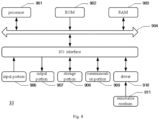
- the elevator control device can be configured, for example, as a processor 901, a read-only memory (ROM) 902, and a random-access memory (RAM) 903.
- the processor 901 can perform various appropriate actions and processes according to programs stored in the ROM 902 or programs loaded into the RAM 903 from the storage portion 908.
- the processor 901 may comprise, for example, a general-purpose microprocessor (for example, a CPU), an instruction set processor and/or a related chipset and/or a special-purpose microprocessor (for example, an application specific integrated circuit (ASIC)) and so on.
- the processor 901 may also comprise on-board memory for caching purposes.
- the processor 901 may comprise a single processing unit or multiple processing units for executing different actions of the process of the method according to an embodiment of the present disclosure.
- the processor 901 executes various operations of the process of the method according to an embodiment of the present disclosure by executing programs stored in the ROM 902 and/or RAM 903. It should be noted that the programs may also be stored in one or more memories other than the ROM 902 and the RAM 903. The processor 901 may also execute various operations of the process of the method according to an embodiment of the present disclosure by executing programs stored in the one or more memories.
- the elevator control device 10 may further comprise an input/output (I/O) interface 905.
- the input/output (I/O) interface 905 is also connected to the bus 904.
- the electronic equipment 900 may also comprise one or more of components connected to the I/O interface 905and selected from a group consisted of an input portion 906 comprising a keyboard, a mouse and the like; and an output portion 907 comprising a cathode ray tube (CRT), a liquid crystal display (LCD) and a speaker and the like; a storage portion 908 comprising a hard disk and the like; and a communication portion 909 comprising a network interface card such as a LAN card, a modem and the like.
- CTR cathode ray tube
- LCD liquid crystal display
- the communication portion 909 is configured to perform communication processing via a network such as the Internet.
- the driver 910 is also connected to an input/output (I/O) interface 905 as needed.
- a removable medium 911 such as a magnetic disk, an optical disk, a magneto-optical disk, a semiconductor memory and the like, is installed on the driver 910 as required, so that the computer programs read therefrom are installed into the storage portion 908 as required.
- a computer-readable storage medium can be provided in an elevator equipment or control device described in the above-mentioned embodiments. Alternatively, the computer-readable storage medium may exist alone without being assembled into such an equipment or such a device.
- the foregoing computer-readable storage medium is configured to carry one or more programs and implement the method according to the embodiments of the present invention when the above mentioned one or more programs are executed.
- the computer-readable storage medium may be a non-volatile computer-readable storage medium, for example, may include, but is not limited to a portable computer disk, a hard disk, a random-access memory (RAM), a read-only memory (ROM), an erasable programmable read-only memory (EPROM or flash memory), a portable compact disk read-only memory (CD-ROM), an optical storage device, a magnetic storage device, or any suitable combination of the above components.
- the computer-readable storage medium may be any tangible medium that contains or stores programs, and the programs may be used by or in combination with an instruction execution system, apparatus, or device.
- the computer-readable storage medium may include ROM 902 and RAM 903 described above and/or one or more memories other than the ROM 902 and/or RAM 903.
- the embodiments of the present invention also comprise a control program product with comprises computer programs code, in order to implement a control method according the present invention in the first aspect, when the computer program is executed by an elevator control device according to the present invention in the second aspect.
- the computer program is executed by the processor 901
- the above-mentioned functions defined in the device of the embodiment of the present disclosure are executed.
- the devices, modules, units, and the like described above may be implemented by computer program.
- the computer programs may rely on tangible storage media such as optical storage devices and magnetic storage devices.
- the computer programs may also be transmitted and distributed on network media in the form of signals, downloaded and installed through the communication portion 909, and/or installed from the removable medium 911.
- the program codes contained in the computer programs can be transmitted by any suitable network media including but not limited to wireless network media, wired network media and the like, or any suitable combination of the above-mentioned network media.
- the computer programs may be downloaded from the network and installed through the communication portion 909, and/or installed from the removable medium 911.
- the computer programs are executed by the processor 901
- the above-mentioned functions defined in the system of the embodiment of the present disclosure are executed.
- the systems, equipment, devices, modules, units and the like described above may be implemented by the computer program modules.
- the program codes for executing the computer programs provided by the embodiments of the present disclosure can be written in any combination of one or more programming languages.
- these calculation programs can be implemented using high-level procedural programming languages and/or object-oriented programming languages, and/or assembly languages or machine languages.
- Programming languages include but are not limited to such as Java, C++, python, C language or similar programming languages.
- the program codes may be entirely executed on the user's computing device, partly executed on the user's device, partly executed on the remote computing device, or entirely executed on the remote computing device or server.
- the remote computing device can be connected to the user's computing device through any kind of network including a local area network (LAN) or a wide area network (WAN), or it can be connected to an external computing device (for example, via the Internet provided by an Internet service provider).
- LAN local area network
- WAN wide area network
- each block in the flowcharts or block diagrams can represent a module, program segment, or part of codes, and the above-mentioned module, program segment, or part of codes contain one or more executable instructions for realizing the specified logic functions.
- the functions marked in the blocks may also occur in a different order from that marked in the accompanying drawings. For example, two blocks shown in succession can actually be executed substantially in parallel, or they can sometimes be executed in the reverse order, which depends on the functions involved.
- each block in the block diagrams or flowcharts and the combination of the blocks in the block diagrams or flowcharts can be implemented by a dedicated hardware-based system that performs the specified functions or operations, or it can be implemented by a combination of dedicated hardware and computer instructions.
Landscapes
- Engineering & Computer Science (AREA)
- Automation & Control Theory (AREA)
- Computer Networks & Wireless Communication (AREA)
- Indicating And Signalling Devices For Elevators (AREA)
Abstract
The present invention provides an elevator control method, an elevator control device (10), an elevator equipment with such a control device (10), and a computer program product. The elevator control method includes steps: acquiring a hand-written character track (S210); comparing the character track with characters in a character library (S220); identifying a destination floor according to one of the characters when only this character is matched with the acquired character track (S240); and identifying a destination floor according to an available floor of the elevator when more than one character is matched with the character track (S240).
Description
- The present disclosure relates to a technical field of elevator control, and more specifically, to an elevator control method, an elevator control device, and a control program.
- In related prior art, elevator call methods comprise contact call methods and non-contact call methods. In the contact call methods, the user needs to press a button to call the elevator or touch a touch screen to select the target floor. Therefore, it may cause situations of spread of some diseases or cross-infection since different users need to touch the same button or touch screen.
- In the non-contact call methods, it is necessary to use Bluetooth, NFC and other wireless technologies, or use a QR code to call the elevator, or use biometrics such as fingerprints, face and the like to call the elevator, or use upward, downward, turning left, or turning right gestures to call the elevator. The above-mentioned call methods using Bluetooth, NFC, QR code and biometrics may lead to divulging of user's privacy and make users be insecure; additionally, the above-mentioned call methods using Bluetooth, NFC, QR code and biometrics will cause users to be inconvenience without mobile networks and/or mobile phones so as to make them unable to call the elevator.
- The above-mentioned call method using upward, downward, turning left, or turning right gestures is complicated. The user can only go up or down one floor at a time. For high-floor users, for example, user located at 19th-floor wants to go down to the first floor or go up to the 19th floor from the first floor, eighteen gestures need to be made, which greatly increases the burden on the user and reduces the satisfaction degree of the user.
- In order to solve the above-mentioned problems in the prior art, the present invention relates an elevator control method, an elevator control device, and a control program.
- The first aspect of the present disclosure provides an elevator control method with following steps: acquiring a hand-written character track, comparing the acquired character track with characters in a character library, wherein the characters are assigned to represent different floors of the elevator; identifying a destination floor according to one of the characters when only this character is matched with the acquired character track; and identifying a destination floor according to an available floor of the elevator when more than one character is matched with the character track. An available floor of an elevator means that this floor exists in a building and/or the elevator in this building may arrive at this elevator.
- After the destination floor is identified, an elevator car can be driven to this floor. With such an elevator control method, for example, the execution of an elevator call, can be performed with higher safety and privacy, more hygiene, and more convenience. The present invention can realize a non-contact call, and thus some disease infection problems caused by touching elevator buttons or screens are avoided. The said control method can provide a more comfortable usage experience without any specialized training, and the operation experience of the non-contact call is improved by realizing the simplification of the non-contact call steps. Moreover, the present invention can solve problems that different users have different writing habits, which leads to identifying multiple different characters, thereby the probability that the elevator control device has a unique effective instruction is increased.
- In addition, the elevator control method of the present invention does not need to collect the user's personal information, which can address the concerns for the user's privacy; and does not need networks, which can solve the limitation of the existing technical solutions that must use the networks; and does not require the user to use peripheral devices such as mobile phones, which can solve problems that some people are not good at using mobile phones or those who do not have mobile phones cannot use the elevator, and there is no need to prepare a large amount of preset data and management systems in advance, which can solve problems that the non-contact solution need high demands on the management of elevator companies and property companies in the prior art. Based on this, the control method of the present invention can be easily added to a new elevator or easily make a renovation to an old elevator system, so that the product can be quickly compatible with the modified elevator system.
- As an improvement of the present invention, the available floor is determined according to a floor distribution of the elevator and/or according to the actual position of a car of the elevator and/or a travel direction in which the car is or will be moving. A floor distribution, for example, can be a plan of the floors in a building where an elevator is, or only the floors that an elevator may arrive at them.
- According to an improvement of the present invention, the said control method further comprises following steps: before identifying the destination floor, checking whether the available floor is unique; identifying the available floor as the destination floor if the available floor is unique; otherwise displaying all available floors or manually selecting one of them; acquiring the selected available floor; and identifying this selected available floor as the destination floor.
- In some embodiments of the present invention, the acquiring the hand-written character track is to acquire at least one of the hand-written numbers and alphabets, for example, alphabic letter/character. And the characters in the character library comprise numbers "0" to "9" and/or alphabets "A" to "Z" .
- According to a further improvement of the present invention, the said control method further comprises a step: generating a call-success-indicator and/or displaying the identified destination floor.
- According to the second aspect of the present invention, an elevator control device comprises: an acquisition module configured to acquire a hand-written character track, a comparing module configured to match the acquired character track with characters in a character library saved in the comparing module, wherein the characters are assigned to represent different floors of the elevator, an identification module configured to identify a destination floor according to one of the characters if only this character is matched with the acquired character track, and to identify a destination floor according to an available floor of the elevator if more than one character is matched with the acquired character track.
- According to a further improvement of the present invention, the identification module further is configured to determine the available floor according to a floor distribution of the elevator and/or according to the actual position of a car of the elevator and/or a travel direction in which the car is or will be moving.
- According to a further improvement of the present invention, the identification module further is configured to check, before identifying the destination floor, whether the available floor is unique, and identifying the available floor as the destination floor if the available floor is unique; otherwise displaying the available floors for manually selecting one of them; acquiring the selected available floor; and identifying this selected available floor as the destination floor.
- According to another embodiment of the present invention, the elevator control device may comprise one or more processors and one or more memories, wherein the memories are configured to store executable instructions which implement the control method as described above when executed by the processor.
- Furthermore, the elevator control device may comprise: an operation panel, which is an annular plate, and whereas inside the annular plate at least one acquisition module is provided, one end of the operation panel is connected to an inner wall of a car of the elevator, and a display panel, one end of the display panel is connected to the inner wall of the car, the other end of the display panel is connected to the other end of the operation panel, the operation panel and the display panel are at an angle to each other, the display panel is configured to display the destination floor.
- In some embodiments, the display panel comprises function keys which comprise a door-to-open key, a door-to-close key, an emergency call key, an emergency-stop key, number keys, and/or alphabets keys, wherein the number keys comprise at least one of the numbers "0" to "9" , and the alphabet keys comprise at least one of the alphabets "A" to "Z".
- In some embodiments, the elevator control device further comprises at least one mounting seat on which the display panel is arranged, and one end of the mounting seat is connected to the inner wall of the elevator car.
- According to the third aspect of the present invention, an elevator equipment is provided that comprises: contact buttons which comprise a door-to-open button, a door-to-close button, an emergency-call button, an emergency-stop button, number buttons, and/or alphabet buttons, wherein the number buttons comprise at least one of the numbers "0" to "9" , and/or the alphabet buttons comprise at least one of the alphabets "A" to "Z" ; and an afore-mentioned elevator control device.
- According to the fourth aspect of the present invention, a control program product with computer program code is provided, in order to implement a method described above, when the computer program is executed by an afore-mentioned elevator control device.
- The additional aspects and advantages of the present disclosure will be partly given in the following description, and partly will become obvious from the following description, or be understood through the practice of the present disclosure.
- For a more complete understanding of the present disclosure and its advantages, reference will now be made to the following description in conjunction with the accompanying drawings, in which:
-
FIG. 1 schematically shows a flowchart of an elevator control method according to an embodiment of the present invention, -
FIG. 2 schematically shows a flow chart of acquiring a hand-written character track according to an embodiment of the present invention, -
FIG. 3 schematically shows a flow chart of identifying a destination floor in accordance with an embodiment of the present invention, -
FIG. 4 schematically shows a flow chart of identifying a destination floor in accordance with an embodiment of the present invention, -
FIG. 5 schematically shows a flow chart of identifying a destination floor in accordance with an embodiment of the present invention, -
FIG. 6 schematically shows a structural block diagram of an elevator control device according to an embodiment of the present disclosure, -
FIG. 7 schematically shows a structural diagram of an elevator control device according to an embodiment of the present disclosure, -
FIG. 8 schematically shows a block diagram of electronic equipment according to an embodiment of the present disclosure. - Hereinafter, embodiments of the present disclosure will be described with reference to the accompanying drawings. However, these descriptions are only exemplary and not intended to limit the scope of the present disclosure. In addition, in the following description, descriptions of well-known structures and technologies are omitted to avoid unnecessarily obscuring the concepts of the present disclosure. In addition, the various embodiments provided below and the technical features in the embodiments of the present disclosure can be combined with each other in any manner.
- The terms used here are only for describing specific embodiments and are not intended to limit the present disclosure. Moreover, the terms "comprise", "comprising" and the like used herein indicate the existence of the described features, steps, operations and/or components, but do not exclude the existence or addition of one or more other features, steps, operations or components. All terms (including technical and scientific terms) used herein have the meanings commonly understood by those skilled in the art, unless otherwise defined. It should be noted that the terms used here should be interpreted as having meanings consistent with the context of this specification, and not be interpreted in an idealized or overly rigid manner.
- The elevator control method, elevator control device, elevator equipment, and computer programs according to the embodiments of the present disclosure will be described below with reference to
Figures 1-8 . - As shown in
Fig. 1-4 , an elevator control method of this embodiment comprises operation steps S210 to S240. - In step S210, a hand-written character track is acquired. It is understandable that users can write characters in a specific area, such as writing numbers and/or alphabets of the floor where they want to go to when they use an elevator. Therefore, as an implementable manner, as shown in
FIG. 2 , the step S210 for acquiring the hand-written character tracks comprises the step S211 particularly. In step S211, the hand-written numbers and/or alphabets are acquired. - In step S220, the character track is compared with characters in a character library in which the characters may comprise numbers "0" to "9" and/or alphabets "A" to "Z". The characters in the character library can be determined according to the actual identifiers of all floors and each floor of the elevator. For example, there are identifiers for 19 floors in the elevator, and the identifiers of each floor are marked with each
number 1 to 19 respectively, so the characters in the character library can comprise the numbers "0" to "9". For another example, there are identifiers for 19 floors in the elevator, and the identifiers of each floor are "B3", "B2", "B1", "1", "2", "3", "4", "5", "6", "7", "8", "9", "10", "11", "12", "13", "14", "15", and "16", the characters in the character library can comprise numbers "0" to "9" and alphabets "A" to "Z". For another example, there are 6 floors identifiers in the elevator, and the identifiers of each floor are "A", "B", "C", "D", "E" and "F". The characters in the character library can comprise the alphabets "A" to "Z". - In step S230, the destination floor is identified according to the matched result if the matched result is unique. After the destination floor is identified, the elevator can be controlled to travel to this floor. For example, when the user writes the number 6, the elevator control device acquires the character track of the number 6 and acquires the unique matched result "6" by matching the character track "6" with the characters in the character library. Thus, the destination floor can be identified as the 6th floor and the elevator is controlled to run to the 6th floor.
- In step S240, the destination floor can be identified according to an available floor of the elevator if there are multiple matched results of the characters. In this case, the available floor can be considered as an intermediate result. There may be multiple matched results when the hand-written character tracks are matched with the characters in the character library because the user's writing habits are different, or the tracks go beyond the writing area cannot be identified since a part of the hand-written tracks go beyond the writing area unintentionally during writing. For example, the number "13" and the characters "B", "10" and "P", "2" and "Z" or "2" and "3" and so on are this case. When there are multiple matched results, it is necessary to identify the destination floor and control the elevator to run according to the floors where the elevator is located.
- As a possible implementation, as shown in
FIG. 3 , step S240 is executed asstep 241 for identifying the destination floor according to a floor distribution of the elevator. For example, if the user writes the number "10", three matched results such as "10", "16" and "P" are acquired. If the total number of floors in the elevator is "13", and the identifiers of each floor are "B3", "B2", "B1", "1", "2", "3", "4", "5", "6", "7", "8", "9" and "10", respectively. The identifier "B3" represents the third floor underground, the identifier "B2" represents the second floor underground, the identifier B1 represents the 1st floor underground, and the numbers represent floors above ground. Therefore, it can be known that the number 16 and the identifier P are not included according to the floor distribution, the matched results "16" and "P" can be excluded, and thus the destination floor of the 10th floor is acquired, and the elevator is controlled to run to the 10th floor. - As another or a further possible implementation shown in
FIG. 4 , step S240 that identifying the destination floor according to the floors where the elevator is located, is executed as step S242. In step S242, the destination floor is identified according to the floor where the elevator is located currently and the travel direction of the elevator car. For example, if the user writes the number "5", two matched results are acquired, namely the numbers "5" and "8". If the elevator is located currently on the 6th floor, and the travel direction of the elevator car is downward, and it can be identified that the user may want to descend to the 5th floor according to the floor where the car is located currently and its travel direction, so the 5th floor is acquired as the destination floor, and the elevator car is controlled to run to the 5th floor. - As another possible implementation, as shown in
FIG. 5 , step S240 that identifying the destination floor according to the floors where the elevator is located comprises steps S243 to S245. - In step S243, the destination floor is identified according to the floor distribution of the elevator, and it is to check whether the available floor of the elevator is unique.
- In step S244, the available floor can be identified as the destination floor if this available floor intermediate result is unique. For example, if the user writes the
number 10, three matched results are acquired, namely "10", "16" and "P". If the total number of floors in the elevator is "13", and the identifiers of each floor are "B3", "B2", "B1", "1", "2", "3", "4", "5", "6", "7", "8", "9" and "10", respectively. The identifier "B3" represents the 3th floor underground, the identifier "B2" represents the 2nd floor underground, the identifier "B1" represents the 1st floor underground, and the pure numbers represent floors above the ground. Therefore, it can be known that the number "16" and the identifier "P" are not included according to the floor distribution, and the matched results "16" and "P" can be excluded, so the only intermediate result "10" can be obtained, and the number "10" can be used as the destination floor, and then the elevator car will be controlled to travel to the 10th floor. - In step S245, the destination floor is identified according again to the floor where the elevator is located currently and the travel direction of the car if there are multiple available floor possible. For example, if the user writes the number "13", three matched results are acquired, namely "13", "12" and "B". If the total number of the floors in the elevator is "19", there are no underground floors and the identifiers from the 1st floor to 19th floor are the number "1" ∼ "19" respectively, the matched result "B" can be excluded because all the floor identifiers do not include "B", and the intermediate results "13" and "12" are acquired. If the floor where the elevator is located currently is the 12th floor and the running status of the elevator is going up, it can be identified that the user may want to go up to the 13th floor according to the floor where the car is located currently and its travel direction, the destination floor, for example, the 13th floor is acquired.
- In step S246, it is to check whether the destination floor identified is unique.
- In operation step S247, the available floor will be taken as the destination floor if the intermediate result is unique.
- The elevator control method may further comprise operation steps S250 to S270 if there are multiple available floors.
- In step S250, all the available floors are displayed for manually selecting. For instance, a user can select one of the displayed available floors by gestures swiping left or right, sliding up or down; or the user's finger can stay above a certain available floor displayed for a time T to select this one, where the time T, for example, can be a time period greater than one second time.
- In step S260, the manually selected available floor is acquired.
- In S270, the selected available floor is identified as the destination floor. The elevator control device can be also configured to control the elevator car to travel upon the selected floor.
- According to the elevator control method of the embodiments of the present invention, the non-contact call is realized by the operation steps S210 to S240, thereby some disease infection problems caused by touching elevator buttons or touch screens can be avoided. Such an elevator control method can provide a comfortable user experience without any specialized training, and the operation experience of the non-contact call is improved by realizing the simplification of the non-contact call steps. Moreover, the problem of identifying multiple different characters due to the different writing habits of different users is well solved by the present disclosure by the operation steps S210 to S240; thereby the probability that the elevator call has a unique effective instruction is increased.
- In addition, this kind of elevator control method does not need to collect the user's personal information, which can address the concerns for the user's privacy. It does not need networks, which can solve the limitation of the existing technical solutions that the networks must be used. At last, it does not require to use peripheral devices such as mobile phones for the users, which can solve the problem that some people are not good at using mobile phones or those who do not have mobile phones cannot use mobile phones. There is no need to prepare a large amount of preset data and management systems in advance, which can solve the problem that the non-contact solution provides high demands on the management of elevator companies and property companies in the prior art. Based on this, the elevator control method of the present disclosure can be easily added to a new elevator or made renovation to an old elevator system, so that the present product can be quickly compatible with the modified elevator system.
- The acquired multiple available floors may be displayed as intermediate results for selection, while the unique available floor can be displayed to remind the user who selects this floor. If the automatically identified floor is not correct, the psychological expectation can be given to the user in advance, or the user can rewrite the floor and change the floor he/she is going to in time. Multiple available floors as results may also be acquired according to the matched comparing results and be displayed so that the user can select the unique result as the manual selection result by gestures swiping left or right, sliding up or down; or it is convenient for the user to make his finger stay above a certain displayed result for a time T to select the unique result as the manual selection result.
- In addition, in some examples, step S220 matches the character track with the characters in the character library, and it may also comprise displaying the matched result after acquiring the matched result. It is understandable that matching the character track with the characters in the character library may acquire a unique matched result, and thus the unique matched result can be displayed to remind the user of the selected floor. If the floor is not correct, the psychological expectations can be given to the user in advance, or the user can rewrite the floor and change the floor where he/she is going to in time. Matching the character track with the characters in the character library may also acquire multiple matched results, and the matched result can be identified according to the floors where the elevator is located, and the identification result is displayed after it is acquired.
- As shown in
Fig. 1 , according to some embodiments of the present disclosure, the step of identifying the destination floor also comprises the step S290. In the step S290, on a display panel of the elevator it can be displayed an indicator/instruction about the elevator successfully calling and/or the identified destination floor, while the elevator car is moving. As a result, it is convenient to users, as it keeps the user well informed before and during elevator travel, thereby the user's satisfaction is improved. - Based on the above elevator control method, the present disclosure also provides an
elevator control device 10. Theelevator control device 10 will be described in detail below with reference toFIGS. 6-8 . -
Fig. 6 schematically shows a structural block diagram of anelevator control device 10 according to an embodiment of the present disclosure. - The
elevator control device 10 comprises anacquisition module 1, amatching module 2, acontrol module 3 and anidentification module 4. - The acquiring
module 1 is configured to perform step S210: acquiring a hand-written character track. The acquiringmodule 1 here comprises but is not limited to an infrared sensor. - The comparing
module 2 is configured to perform step S220: comparing the acquired character track with the characters in the character library. - The
identification module 4 is configured to perform step S240 identifying the destination floor according to the available floors of the elevator if there are multiple matched results. - Moreover, the
elevator control device 10 may comprise acontrol module 3 which is configured to communicate with an elevator controller to operate an elevator car to travel to the identified destination floor. - In some embodiments, as shown in
FIG. 7 , theelevator control device 10 may further comprise anoperation panel 7 and adisplay panel 5. Theoperation panel 7 is an annular plate. The inner wall of the annular plate is provided with at least oneacquisition module 1. One end of theoperation panel 7 is connected to the inner wall of an elevator car (not shown here); the other end of theoperation panel 7 is connected to one end of thedisplay panel 5. The other end of thedisplay panel 5 is connected to the inner wall of the elevator car, and theoperation panel 7 and thedisplay panel 5 are at an angle to each other. Thedisplay panel 5 is configured to display the destination floor. It is understandable that the annular shape of the annular plate can enclose awriting area 71, and whereas inside the annular plate at least one acquisition module is provided, that means the inner wall of the annular plate can facilitate the installation of theacquisition module 1, which can facilitate the acquisition of the written character track. Thedisplay panel 5 and theoperation panel 7 are arranged on the inner wall of the elevator car at an angle to each other, which conforms to ergonomic characteristics, so that the user can easily observe the displayed content on thedisplay panel 5 when writing, thereby the user's satisfaction is improved. The available floors as intermediate results can be displayed on thisdisplay panel 5 for manually selecting. - According to some embodiments of the present disclosure, the
display panel 5 may have one or more function keys. The function keys comprise at least one of a door open key, a door close key, an emergency call key, an emergency stop key, number keys and alphabets keys. The number keys comprise at least one of the numbers "0" to "9" , and the alphabet keys comprise at least one of the alphabets "A" to "Z" . Thus, users can independently select a floor, opening door, closing door, making emergency call and emergency stopping by the display panel, so that users can call or control the elevator without contacting by clicking on the corresponding function keys and other gestures at hovering points above thedisplay panel 5. Alternatively, in some embodiments, thedisplay panel 5 can also be directly touched to call or control the elevator. - The
elevator control device 10 may also comprise at least one mountingseat 8. Thedisplay panel 5 is provided on this mountingseat 8, and one end of the mountingseat 8 is connected to the inner wall of the elevator car (not shown). Therefore, it is convenient to fixedly mount thedisplay panel 5 on the inner wall of the elevator car. - As the above-mentioned
elevator control device 10 is set based on an elevator control method, the beneficial effects of the above-mentionedelevator control device 10 are the same as those of the elevator control method and will not be repeated here. - In addition, according to the embodiment of the present invention, any number of modules among the
acquisition module 1, thematching module 2, thecontrol module 3 and theidentification module 4 can be combined into one module, or any one of theacquisition module 1, the comparingmodule 2, thecontrol module 3 and theidentification module 4 can be split into multiple modules. Alternatively, at least part of the functions of one or more of the above modules and at least part of the functions of other modules may be combined and implemented with one module. - According to an embodiment of the present invention, the
acquisition module 1, the comparingmodule 2, and/or theidentification module 4 may be at least partially implemented as a hardware circuit, such as a field programmable gate array (FPGA), a programmable logic array (PLA), system on chip, system on substrate, system on package, application specific integrated circuit (ASIC), or can be implemented as a hardware or firmware by integrating or packaging the circuit or in any other reasonable way, or implemented as any of the three implementations of software, hardware and firmware, or an appropriate combination of any of the three implementations. - Alternatively, the
acquisition module 1, the comparingmodule 2, and/or theidentification module 4 can be at least partially implemented as computer program modules, which can perform corresponding functions when they run. - The elevator equipment according to the embodiment of the present invention comprises
contact buttons 11. Thecontact buttons 11 may comprise, for example, a door open button, a door close button, an emergency call button, an emergency stop button, number buttons and/or alphabet buttons. The number buttons comprise at least one of the numbers "0" to "9", and the alphabet buttons comprise at least one of the alphabets "A" to "Z". - Here, the
contact buttons 11 can be understood as traditional buttons for calling an elevator, and the user can select the corresponding functions by pressing the buttons, such as opening the door, closing the door, emergency call, emergency stop and selecting the floor. - According to the elevator equipment of the embodiments of the present invention, the user can choose the contact call method or the non-contact call, thereby some disease infection problems caused by touching the elevator buttons or screens can be avoided. At the same time, the other call method can be used when the contact call or the non-contact call does not respond, thereby the convenience of using the elevator by users can be improved.
- As shown in
FIG. 7 , the elevator control device can be configured, for example, as aprocessor 901, a read-only memory (ROM) 902, and a random-access memory (RAM) 903. Theprocessor 901 can perform various appropriate actions and processes according to programs stored in theROM 902 or programs loaded into theRAM 903 from thestorage portion 908. Theprocessor 901 may comprise, for example, a general-purpose microprocessor (for example, a CPU), an instruction set processor and/or a related chipset and/or a special-purpose microprocessor (for example, an application specific integrated circuit (ASIC)) and so on. Theprocessor 901 may also comprise on-board memory for caching purposes. Theprocessor 901 may comprise a single processing unit or multiple processing units for executing different actions of the process of the method according to an embodiment of the present disclosure. - In the
RAM 903, various programs and data necessary for the operation of the electronic equipment 900 are stored. Theprocessor 901, theROM 902 and theRAM 903 are connected to each other throughbus 904. Theprocessor 901 executes various operations of the process of the method according to an embodiment of the present disclosure by executing programs stored in theROM 902 and/orRAM 903. It should be noted that the programs may also be stored in one or more memories other than theROM 902 and theRAM 903. Theprocessor 901 may also execute various operations of the process of the method according to an embodiment of the present disclosure by executing programs stored in the one or more memories. - The
elevator control device 10 may further comprise an input/output (I/O) interface 905. The input/output (I/O) interface 905 is also connected to thebus 904. The electronic equipment 900 may also comprise one or more of components connected to the I/O interface 905and selected from a group consisted of aninput portion 906 comprising a keyboard, a mouse and the like; and anoutput portion 907 comprising a cathode ray tube (CRT), a liquid crystal display (LCD) and a speaker and the like; astorage portion 908 comprising a hard disk and the like; and acommunication portion 909 comprising a network interface card such as a LAN card, a modem and the like. Thecommunication portion 909 is configured to perform communication processing via a network such as the Internet. Thedriver 910 is also connected to an input/output (I/O) interface 905 as needed. Aremovable medium 911, such as a magnetic disk, an optical disk, a magneto-optical disk, a semiconductor memory and the like, is installed on thedriver 910 as required, so that the computer programs read therefrom are installed into thestorage portion 908 as required. - A computer-readable storage medium can be provided in an elevator equipment or control device described in the above-mentioned embodiments. Alternatively, the computer-readable storage medium may exist alone without being assembled into such an equipment or such a device. The foregoing computer-readable storage medium is configured to carry one or more programs and implement the method according to the embodiments of the present invention when the above mentioned one or more programs are executed.
- The computer-readable storage medium may be a non-volatile computer-readable storage medium, for example, may include, but is not limited to a portable computer disk, a hard disk, a random-access memory (RAM), a read-only memory (ROM), an erasable programmable read-only memory (EPROM or flash memory), a portable compact disk read-only memory (CD-ROM), an optical storage device, a magnetic storage device, or any suitable combination of the above components. In the present disclosure, the computer-readable storage medium may be any tangible medium that contains or stores programs, and the programs may be used by or in combination with an instruction execution system, apparatus, or device. For example, according to an embodiment of the present disclosure, the computer-readable storage medium may include
ROM 902 andRAM 903 described above and/or one or more memories other than theROM 902 and/orRAM 903. - The embodiments of the present invention also comprise a control program product with comprises computer programs code, in order to implement a control method according the present invention in the first aspect, when the computer program is executed by an elevator control device according to the present invention in the second aspect. When the computer program is executed by the
processor 901, the above-mentioned functions defined in the device of the embodiment of the present disclosure are executed. According to the embodiments of the present invention, the devices, modules, units, and the like described above may be implemented by computer program. - In an embodiment, the computer programs may rely on tangible storage media such as optical storage devices and magnetic storage devices. In another embodiment, the computer programs may also be transmitted and distributed on network media in the form of signals, downloaded and installed through the
communication portion 909, and/or installed from theremovable medium 911. The program codes contained in the computer programs can be transmitted by any suitable network media including but not limited to wireless network media, wired network media and the like, or any suitable combination of the above-mentioned network media. - In such an embodiment, the computer programs may be downloaded from the network and installed through the
communication portion 909, and/or installed from theremovable medium 911. When the computer programs are executed by theprocessor 901, the above-mentioned functions defined in the system of the embodiment of the present disclosure are executed. According to the embodiments of the present disclosure, the systems, equipment, devices, modules, units and the like described above may be implemented by the computer program modules.
the program codes for executing the computer programs provided by the embodiments of the present disclosure can be written in any combination of one or more programming languages. Specifically, these calculation programs can be implemented using high-level procedural programming languages and/or object-oriented programming languages, and/or assembly languages or machine languages. Programming languages include but are not limited to such as Java, C++, python, C language or similar programming languages. The program codes may be entirely executed on the user's computing device, partly executed on the user's device, partly executed on the remote computing device, or entirely executed on the remote computing device or server. In the case of a remote computing device is used, the remote computing device can be connected to the user's computing device through any kind of network including a local area network (LAN) or a wide area network (WAN), or it can be connected to an external computing device (for example, via the Internet provided by an Internet service provider). - The flowcharts and block diagrams in the accompanying drawings illustrate the implementable architecture, functions, and operations of the device, method, equipment, and computer program product according to various embodiments of the present invention. In this regard, each block in the flowcharts or block diagrams can represent a module, program segment, or part of codes, and the above-mentioned module, program segment, or part of codes contain one or more executable instructions for realizing the specified logic functions. It should also be noted that, in some alternative implementations, the functions marked in the blocks may also occur in a different order from that marked in the accompanying drawings. For example, two blocks shown in succession can actually be executed substantially in parallel, or they can sometimes be executed in the reverse order, which depends on the functions involved. It should also be noted that each block in the block diagrams or flowcharts and the combination of the blocks in the block diagrams or flowcharts can be implemented by a dedicated hardware-based system that performs the specified functions or operations, or it can be implemented by a combination of dedicated hardware and computer instructions.
- Although the present invention has been shown and described with reference to specific exemplary embodiments of the present disclosure, those skilled in the art should understand that without departing from the spirit and scope of the present disclosure defined by the claims and their equivalents, various changes in form and details can be made to the present disclosure. Therefore, the scope of the present disclosure should not be limited to the above-mentioned embodiments, but it should be defined not only by the claims, but also by the equivalents of the claims.
Claims (15)
- Elevator control method, with following steps:acquiring a hand-written character track;comparing the acquired character track with characters in a character library, wherein the characters are assigned to represent different floors of an elevator;identifying a destination floor according to one of the characters when only this character is matched with the acquired character track; andidentifying a destination floor according to an available floor of the elevator when more than one character is matched with the character track.
- Elevator control method according to claim 1, wherein
the available floor is determined according to a floor distribution of the elevator and/or according to the actual position of an elevator car and/or a travel direction in which the car is or will be moving. - Elevator control method according to claim 2, comprising further:before identifying the destination floor, checking the number of the available floor;identifying the available floor as the destination floor if the available floor is unique; otherwisedisplaying the available floors (3b) for manually selecting one of them;acquiring the selected available floor; andidentifying this selected available floor as the destination floor.
- Elevator control method according to any one of the afore-mentioned claims, wherein the acquiring the hand-written character track is to acquire at least one of a hand-written number and an alphabet, especially an alphabetic character.
- Elevator control method according to claim 4, wherein
the characters in the character library comprise numbers "0" to "9" and/or alphabets "A" to "Z". - Elevator control method according to any one of the afore-mentioned claims, further comprising:
generating a call-success-indicator and/or displaying the identified destination floor. - Elevator control device (10), comprising:an acquisition module (1) configured to acquire a hand-written character track;a comparing module (2) configured to compare the acquired character track with characters in a character library saved in the comparing module (2), wherein the characters are assigned to represent different floors of an elevator;an identification module (4) configured to identify a destination floor according to one of characters if only this character is matched with the acquired character track, and to identify a destination floor according to an available floor of the elevator if more than one character is matched with the acquired character track.
- Elevator control device (10) according to claim 7, wherein
the identification module (4) further is configured to determine the available floor according to a floor distribution of the elevator and/or according to the actual position of an elevator car and/or a travel direction in which the car is or will be moving. - Elevator control device (10) according to claim 7 or 8, wherein,the identification module (1) further is configured to check, before identifying the destination floor, whether the available floor is unique,identifying the available floor as the destination floor if the available floor is unique; otherwisedisplaying all available floors (3b) for manually selecting one of them;acquiring the selected available floor; andidentifying this selected available floor as the destination floor.
- Elevator control device (10), comprises
one or more processors and one or more memories configured to store executable instructions which implement the method according to any one of claims 1-6 when executed by the processor. - Elevator control device (10) according to any one of claims 7 to 10, further comprising:an operation panel (7), which is an annular plate, and whereas inside the annular plate at least one acquisition module (1) is provided, one end of the operation panel (7) is connected to an inner wall of a car of the elevator, anda display panel (5), one end of the display panel (5) is connected to the inner wall of the car, another end of the display panel (5) is connected to the other end of the operation panel (7), the operation panel (7) and the display panel (5) are at an angle to each other, the display panel (7) is configured to display the destination floor.
- Elevator control device (10) according to claim 11, wherein
the display panel (5) comprises function keys (11) which comprise a door-to-open key, a door-to-close key, an emergency-call key, an emergency-stop key, number keys, and/or alphabets keys, wherein the number keys comprise at least one of the numbers "0" to "9" , and the alphabet keys comprise at least one of the alphabets "A" to "Z" . - Elevator control device (10) according to claim 11 or 12, further comprising:
at least one mounting seat (8) on which the display panel (5) is arranged, and one end of the mounting seat (8) is connected to the inner wall of the elevator car. - Elevator equipment, comprising:contact buttons (11) which comprise a door-to-open button, a door-to-close button, an emergency-call button, an emergency-stop button, number buttons, and/or alphabet buttons, wherein the number buttons comprise at least one of the numbers "0" to "9", and the alphabet buttons comprise at least one of the alphabets "A" to "Z" ; andan elevator control device (10) according to any one of claims 7-13.
- Control program product with computer program code, in order to implement an elevator method according to any one of the claims 1 to 6, when the computer program is executed by an elevator control device (10) according to the claims 7 to 13.
Priority Applications (1)
| Application Number | Priority Date | Filing Date | Title |
|---|---|---|---|
| EP21210193.5A EP4186838A1 (en) | 2021-11-24 | 2021-11-24 | Elevator control method, control device, and control program |
Applications Claiming Priority (1)
| Application Number | Priority Date | Filing Date | Title |
|---|---|---|---|
| EP21210193.5A EP4186838A1 (en) | 2021-11-24 | 2021-11-24 | Elevator control method, control device, and control program |
Publications (1)
| Publication Number | Publication Date |
|---|---|
| EP4186838A1 true EP4186838A1 (en) | 2023-05-31 |
Family
ID=78789708
Family Applications (1)
| Application Number | Title | Priority Date | Filing Date |
|---|---|---|---|
| EP21210193.5A Withdrawn EP4186838A1 (en) | 2021-11-24 | 2021-11-24 | Elevator control method, control device, and control program |
Country Status (1)
| Country | Link |
|---|---|
| EP (1) | EP4186838A1 (en) |
Citations (2)
| Publication number | Priority date | Publication date | Assignee | Title |
|---|---|---|---|---|
| EP2471735A1 (en) * | 2009-08-28 | 2012-07-04 | Mitsubishi Electric Corporation | Elevator operating panel |
| US20160096706A1 (en) * | 2013-05-24 | 2016-04-07 | Otis Elevator Company | Handwriting input and security |
-
2021
- 2021-11-24 EP EP21210193.5A patent/EP4186838A1/en not_active Withdrawn
Patent Citations (2)
| Publication number | Priority date | Publication date | Assignee | Title |
|---|---|---|---|---|
| EP2471735A1 (en) * | 2009-08-28 | 2012-07-04 | Mitsubishi Electric Corporation | Elevator operating panel |
| US20160096706A1 (en) * | 2013-05-24 | 2016-04-07 | Otis Elevator Company | Handwriting input and security |
Similar Documents
| Publication | Publication Date | Title |
|---|---|---|
| US11099812B2 (en) | Device and method for performing functions | |
| CA3001740C (en) | Operation method with fingerprint recognition, apparatus, and mobile terminal | |
| US10320799B2 (en) | Dynamic multi-user computer configuration settings | |
| KR102309175B1 (en) | Scrapped Information Providing Method and Apparatus | |
| KR102482850B1 (en) | Electronic device and method for providing handwriting calibration function thereof | |
| US10173861B2 (en) | Handwriting input for elevator destination floor input | |
| US8452057B2 (en) | Projector and projection control method | |
| US9891822B2 (en) | Input device and method for providing character input interface using a character selection gesture upon an arrangement of a central item and peripheral items | |
| US20180341400A1 (en) | Electronic device for selecting external device and controlling the same and operating method thereof | |
| US20100153313A1 (en) | Interface adaptation system | |
| US20100180210A1 (en) | Multi-User Multi-Input Desktop Workspaces And Applications | |
| CN107533641A (en) | Finger print information processing method and the electronic installation for supporting finger print information processing method | |
| US11914656B1 (en) | Systems and methods for generating hypermedia-based graphical user interfaces for mobile devices | |
| CN109086095A (en) | The quick open method of application program, device, terminal and storage medium | |
| US7961903B2 (en) | Handwriting style data input via keys | |
| KR101368584B1 (en) | Portable terminal apparatus and computer readable medium | |
| US20150373484A1 (en) | Electronic apparatus and method of pairing in electronic apparatus | |
| US11755198B2 (en) | Method, system and computer program product for operating a keyboard | |
| US10013595B2 (en) | Correlating fingerprints to pointing input device actions | |
| US8875060B2 (en) | Contextual gestures manager | |
| US20220261135A1 (en) | Virtual keyboard error correction based on a dynamic spatial model | |
| KR101352321B1 (en) | Switching method for multiple input method system | |
| EP3624044A1 (en) | System and method for transmitting and processing group message in shop | |
| CN116161500A (en) | Elevator control method, elevator device, electronic device, medium, and program | |
| KR102401506B1 (en) | Electric apparatus and method for control thereof |
Legal Events
| Date | Code | Title | Description |
|---|---|---|---|
| PUAI | Public reference made under article 153(3) epc to a published international application that has entered the european phase |
Free format text: ORIGINAL CODE: 0009012 |
|
| STAA | Information on the status of an ep patent application or granted ep patent |
Free format text: STATUS: THE APPLICATION HAS BEEN PUBLISHED |
|
| AK | Designated contracting states |
Kind code of ref document: A1 Designated state(s): AL AT BE BG CH CY CZ DE DK EE ES FI FR GB GR HR HU IE IS IT LI LT LU LV MC MK MT NL NO PL PT RO RS SE SI SK SM TR |
|
| STAA | Information on the status of an ep patent application or granted ep patent |
Free format text: STATUS: THE APPLICATION HAS BEEN WITHDRAWN |
|
| 18W | Application withdrawn |
Effective date: 20230602 |