EP4186765A1 - Driving assistance processing method and apparatus, computer-readable medium and electronic device - Google Patents
Driving assistance processing method and apparatus, computer-readable medium and electronic device Download PDFInfo
- Publication number
- EP4186765A1 EP4186765A1 EP21940577.6A EP21940577A EP4186765A1 EP 4186765 A1 EP4186765 A1 EP 4186765A1 EP 21940577 A EP21940577 A EP 21940577A EP 4186765 A1 EP4186765 A1 EP 4186765A1
- Authority
- EP
- European Patent Office
- Prior art keywords
- vehicle terminal
- blind spot
- information
- driving assistance
- spot detection
- Prior art date
- Legal status (The legal status is an assumption and is not a legal conclusion. Google has not performed a legal analysis and makes no representation as to the accuracy of the status listed.)
- Granted
Links
Images

Classifications
-
- B—PERFORMING OPERATIONS; TRANSPORTING
- B60—VEHICLES IN GENERAL
- B60W—CONJOINT CONTROL OF VEHICLE SUB-UNITS OF DIFFERENT TYPE OR DIFFERENT FUNCTION; CONTROL SYSTEMS SPECIALLY ADAPTED FOR HYBRID VEHICLES; ROAD VEHICLE DRIVE CONTROL SYSTEMS FOR PURPOSES NOT RELATED TO THE CONTROL OF A PARTICULAR SUB-UNIT
- B60W30/00—Purposes of road vehicle drive control systems not related to the control of a particular sub-unit, e.g. of systems using conjoint control of vehicle sub-units
- B60W30/08—Active safety systems predicting or avoiding probable or impending collision or attempting to minimise its consequences
-
- B—PERFORMING OPERATIONS; TRANSPORTING
- B60—VEHICLES IN GENERAL
- B60W—CONJOINT CONTROL OF VEHICLE SUB-UNITS OF DIFFERENT TYPE OR DIFFERENT FUNCTION; CONTROL SYSTEMS SPECIALLY ADAPTED FOR HYBRID VEHICLES; ROAD VEHICLE DRIVE CONTROL SYSTEMS FOR PURPOSES NOT RELATED TO THE CONTROL OF A PARTICULAR SUB-UNIT
- B60W40/00—Estimation or calculation of non-directly measurable driving parameters for road vehicle drive control systems not related to the control of a particular sub unit, e.g. by using mathematical models
- B60W40/02—Estimation or calculation of non-directly measurable driving parameters for road vehicle drive control systems not related to the control of a particular sub unit, e.g. by using mathematical models related to ambient conditions
-
- B—PERFORMING OPERATIONS; TRANSPORTING
- B60—VEHICLES IN GENERAL
- B60W—CONJOINT CONTROL OF VEHICLE SUB-UNITS OF DIFFERENT TYPE OR DIFFERENT FUNCTION; CONTROL SYSTEMS SPECIALLY ADAPTED FOR HYBRID VEHICLES; ROAD VEHICLE DRIVE CONTROL SYSTEMS FOR PURPOSES NOT RELATED TO THE CONTROL OF A PARTICULAR SUB-UNIT
- B60W40/00—Estimation or calculation of non-directly measurable driving parameters for road vehicle drive control systems not related to the control of a particular sub unit, e.g. by using mathematical models
- B60W40/02—Estimation or calculation of non-directly measurable driving parameters for road vehicle drive control systems not related to the control of a particular sub unit, e.g. by using mathematical models related to ambient conditions
- B60W40/06—Road conditions
-
- B—PERFORMING OPERATIONS; TRANSPORTING
- B60—VEHICLES IN GENERAL
- B60W—CONJOINT CONTROL OF VEHICLE SUB-UNITS OF DIFFERENT TYPE OR DIFFERENT FUNCTION; CONTROL SYSTEMS SPECIALLY ADAPTED FOR HYBRID VEHICLES; ROAD VEHICLE DRIVE CONTROL SYSTEMS FOR PURPOSES NOT RELATED TO THE CONTROL OF A PARTICULAR SUB-UNIT
- B60W40/00—Estimation or calculation of non-directly measurable driving parameters for road vehicle drive control systems not related to the control of a particular sub unit, e.g. by using mathematical models
- B60W40/02—Estimation or calculation of non-directly measurable driving parameters for road vehicle drive control systems not related to the control of a particular sub unit, e.g. by using mathematical models related to ambient conditions
- B60W40/06—Road conditions
- B60W40/076—Slope angle of the road
-
- B—PERFORMING OPERATIONS; TRANSPORTING
- B60—VEHICLES IN GENERAL
- B60W—CONJOINT CONTROL OF VEHICLE SUB-UNITS OF DIFFERENT TYPE OR DIFFERENT FUNCTION; CONTROL SYSTEMS SPECIALLY ADAPTED FOR HYBRID VEHICLES; ROAD VEHICLE DRIVE CONTROL SYSTEMS FOR PURPOSES NOT RELATED TO THE CONTROL OF A PARTICULAR SUB-UNIT
- B60W50/00—Details of control systems for road vehicle drive control not related to the control of a particular sub-unit, e.g. process diagnostic or vehicle driver interfaces
-
- B—PERFORMING OPERATIONS; TRANSPORTING
- B60—VEHICLES IN GENERAL
- B60W—CONJOINT CONTROL OF VEHICLE SUB-UNITS OF DIFFERENT TYPE OR DIFFERENT FUNCTION; CONTROL SYSTEMS SPECIALLY ADAPTED FOR HYBRID VEHICLES; ROAD VEHICLE DRIVE CONTROL SYSTEMS FOR PURPOSES NOT RELATED TO THE CONTROL OF A PARTICULAR SUB-UNIT
- B60W50/00—Details of control systems for road vehicle drive control not related to the control of a particular sub-unit, e.g. process diagnostic or vehicle driver interfaces
- B60W50/08—Interaction between the driver and the control system
- B60W50/14—Means for informing the driver, warning the driver or prompting a driver intervention
-
- G—PHYSICS
- G08—SIGNALLING
- G08G—TRAFFIC CONTROL SYSTEMS
- G08G1/00—Traffic control systems for road vehicles
- G08G1/09—Arrangements for giving variable traffic instructions
- G08G1/0962—Arrangements for giving variable traffic instructions having an indicator mounted inside the vehicle, e.g. giving voice messages
- G08G1/0967—Systems involving transmission of highway information, e.g. weather, speed limits
- G08G1/096708—Systems involving transmission of highway information, e.g. weather, speed limits where the received information might be used to generate an automatic action on the vehicle control
- G08G1/096716—Systems involving transmission of highway information, e.g. weather, speed limits where the received information might be used to generate an automatic action on the vehicle control where the received information does not generate an automatic action on the vehicle control
-
- G—PHYSICS
- G08—SIGNALLING
- G08G—TRAFFIC CONTROL SYSTEMS
- G08G1/00—Traffic control systems for road vehicles
- G08G1/09—Arrangements for giving variable traffic instructions
- G08G1/0962—Arrangements for giving variable traffic instructions having an indicator mounted inside the vehicle, e.g. giving voice messages
- G08G1/0967—Systems involving transmission of highway information, e.g. weather, speed limits
- G08G1/096733—Systems involving transmission of highway information, e.g. weather, speed limits where a selection of the information might take place
- G08G1/096741—Systems involving transmission of highway information, e.g. weather, speed limits where a selection of the information might take place where the source of the transmitted information selects which information to transmit to each vehicle
-
- G—PHYSICS
- G08—SIGNALLING
- G08G—TRAFFIC CONTROL SYSTEMS
- G08G1/00—Traffic control systems for road vehicles
- G08G1/09—Arrangements for giving variable traffic instructions
- G08G1/0962—Arrangements for giving variable traffic instructions having an indicator mounted inside the vehicle, e.g. giving voice messages
- G08G1/0967—Systems involving transmission of highway information, e.g. weather, speed limits
- G08G1/096766—Systems involving transmission of highway information, e.g. weather, speed limits where the system is characterised by the origin of the information transmission
- G08G1/096775—Systems involving transmission of highway information, e.g. weather, speed limits where the system is characterised by the origin of the information transmission where the origin of the information is a central station
-
- G—PHYSICS
- G08—SIGNALLING
- G08G—TRAFFIC CONTROL SYSTEMS
- G08G1/00—Traffic control systems for road vehicles
- G08G1/16—Anti-collision systems
- G08G1/167—Driving aids for lane monitoring, lane changing, e.g. blind spot detection
-
- H—ELECTRICITY
- H04—ELECTRIC COMMUNICATION TECHNIQUE
- H04W—WIRELESS COMMUNICATION NETWORKS
- H04W4/00—Services specially adapted for wireless communication networks; Facilities therefor
- H04W4/02—Services making use of location information
- H04W4/025—Services making use of location information using location based information parameters
-
- H—ELECTRICITY
- H04—ELECTRIC COMMUNICATION TECHNIQUE
- H04W—WIRELESS COMMUNICATION NETWORKS
- H04W4/00—Services specially adapted for wireless communication networks; Facilities therefor
- H04W4/30—Services specially adapted for particular environments, situations or purposes
- H04W4/40—Services specially adapted for particular environments, situations or purposes for vehicles, e.g. vehicle-to-pedestrians [V2P]
- H04W4/44—Services specially adapted for particular environments, situations or purposes for vehicles, e.g. vehicle-to-pedestrians [V2P] for communication between vehicles and infrastructures, e.g. vehicle-to-cloud [V2C] or vehicle-to-home [V2H]
-
- B—PERFORMING OPERATIONS; TRANSPORTING
- B60—VEHICLES IN GENERAL
- B60W—CONJOINT CONTROL OF VEHICLE SUB-UNITS OF DIFFERENT TYPE OR DIFFERENT FUNCTION; CONTROL SYSTEMS SPECIALLY ADAPTED FOR HYBRID VEHICLES; ROAD VEHICLE DRIVE CONTROL SYSTEMS FOR PURPOSES NOT RELATED TO THE CONTROL OF A PARTICULAR SUB-UNIT
- B60W50/00—Details of control systems for road vehicle drive control not related to the control of a particular sub-unit, e.g. process diagnostic or vehicle driver interfaces
- B60W2050/0001—Details of the control system
- B60W2050/0002—Automatic control, details of type of controller or control system architecture
- B60W2050/0004—In digital systems, e.g. discrete-time systems involving sampling
- B60W2050/0005—Processor details or data handling, e.g. memory registers or chip architecture
-
- B—PERFORMING OPERATIONS; TRANSPORTING
- B60—VEHICLES IN GENERAL
- B60W—CONJOINT CONTROL OF VEHICLE SUB-UNITS OF DIFFERENT TYPE OR DIFFERENT FUNCTION; CONTROL SYSTEMS SPECIALLY ADAPTED FOR HYBRID VEHICLES; ROAD VEHICLE DRIVE CONTROL SYSTEMS FOR PURPOSES NOT RELATED TO THE CONTROL OF A PARTICULAR SUB-UNIT
- B60W50/00—Details of control systems for road vehicle drive control not related to the control of a particular sub-unit, e.g. process diagnostic or vehicle driver interfaces
- B60W50/08—Interaction between the driver and the control system
- B60W50/14—Means for informing the driver, warning the driver or prompting a driver intervention
- B60W2050/146—Display means
-
- B—PERFORMING OPERATIONS; TRANSPORTING
- B60—VEHICLES IN GENERAL
- B60W—CONJOINT CONTROL OF VEHICLE SUB-UNITS OF DIFFERENT TYPE OR DIFFERENT FUNCTION; CONTROL SYSTEMS SPECIALLY ADAPTED FOR HYBRID VEHICLES; ROAD VEHICLE DRIVE CONTROL SYSTEMS FOR PURPOSES NOT RELATED TO THE CONTROL OF A PARTICULAR SUB-UNIT
- B60W2554/00—Input parameters relating to objects
-
- B—PERFORMING OPERATIONS; TRANSPORTING
- B60—VEHICLES IN GENERAL
- B60W—CONJOINT CONTROL OF VEHICLE SUB-UNITS OF DIFFERENT TYPE OR DIFFERENT FUNCTION; CONTROL SYSTEMS SPECIALLY ADAPTED FOR HYBRID VEHICLES; ROAD VEHICLE DRIVE CONTROL SYSTEMS FOR PURPOSES NOT RELATED TO THE CONTROL OF A PARTICULAR SUB-UNIT
- B60W2556/00—Input parameters relating to data
- B60W2556/10—Historical data
Definitions
- This application relates to the field of computer and communication technologies, and specifically, to a driving assistance processing method and apparatus, a computer-readable medium, and an electronic device.
- An advanced driving assistance system senses a surrounding environment in real time by using various sensors (millimeter-wave radar, LIDAR, monocular or binocular camera and satellite navigation, and the like) installed on a vehicle in a traveling process of the vehicle, collects data, identifies, detects, and tracks stationary and moving objects, and performs system operation and analysis in combination with navigation map data, to enable a driver to recognize potential hazards in advance, thereby effectively increasing the comfort and safety of car driving.
- various sensors millimeter-wave radar, LIDAR, monocular or binocular camera and satellite navigation, and the like
- a conventional ADAS has the problem of a limited sensing range, and a more effective collaboration mechanism between multiple vehicles is lacking when a driving safety risk arises. Therefore, there are limitations in terms of safety.
- Embodiments of this application provide a driving assistance processing method and apparatus, a computer-readable medium, and an electronic device, to reduce a probability of missed detection and missed warning of a blind spot at least to some extent, thereby effectively enhancing the safety of an ADAS.
- a driving assistance processing method performed by an electronic device, and including: obtaining location information and traveling status information of a vehicle terminal and road condition information of a road section on which the vehicle terminal travels, and obtaining blind spot detection capability information of the vehicle terminal; determining a potential blind spot of the vehicle terminal in a traveling process according to the location information and the traveling status information of the vehicle terminal and the road condition information to obtain a blind spot detection result; generating a blind spot supplementary reminder message according to the blind spot detection result and the blind spot detection capability information of the vehicle terminal; and sending the blind spot supplementary reminder message to the vehicle terminal.
- a driving assistance processing apparatus including: an obtaining unit, configured to: obtain location information and traveling status information of a vehicle terminal and road condition information of a road section on which the vehicle terminal travels, and obtain blind spot detection capability information of the vehicle terminal; a processing unit, configured to determine a potential blind spot of the vehicle terminal in a traveling process according to the location information and the traveling status information of the vehicle terminal and the road condition information to obtain a blind spot detection result; a generation unit, configured to generate a blind spot supplementary reminder message according to the blind spot detection result and the blind spot detection capability information of the vehicle terminal; and a sending unit, configured to send the blind spot supplementary reminder message to the vehicle terminal.
- a computer-readable medium storing a computer program, the computer program, when executed by a processor, implements the driving assistance processing method according to the foregoing embodiment.
- an electronic device including: one or more processors; and a storage apparatus, configured to store one or more programs, the one or more programs, when executed by the one or more processors, causing the one or more processors to implement the driving assistance processing method according to the foregoing embodiment.
- a computer program product or a computer program is provided, the computer program product or the computer program including computer instructions, the computer instructions being stored in a computer-readable storage medium.
- a processor of a computer device reads the computer instructions from the computer-readable storage medium, and executes the computer instructions, to cause the computer device to perform the driving assistance processing method provided in the foregoing embodiments.
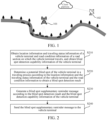
- FIG. 1 is a schematic diagram of an application scenario according to an embodiment of this application.
- a vehicle terminal may communicate with a cloud platform through a base station 101.
- the cloud platform may intercommunicate with a high-precision positioning system 102 and implement high-precision positioning of the vehicle terminal by collaborating with the vehicle terminal.
- the base station 101 may be a 5G base station or may be a 3G or 4G base station or may be a next-generation mobile communication base station.
- the cloud platform may be a road-side cloud platform or a central cloud platform.
- the road-side cloud platform is a cloud platform disposed near a road and is only configured to serve a few road sections.
- the central cloud platform is a cloud platform that serves many road sections or all road sections.
- the service area of the central cloud platform is much larger than that of the road-side cloud platform.
- the central cloud platform may be disposed at a back end of a core network.
- the vehicle terminal may interact with the cloud platform (including the central cloud platform and the road-side cloud platform) through the base station 101 (that is, a mobile communication network) as shown in FIG. 1 , and may further interact with the road-side cloud platform through vehicle-to-everything (V2X) communication.
- V2X vehicle-to-everything
- the vehicle terminal shown in FIG. 1 may be provided with an ADAS function.
- the ADAS function specifically includes a warning system and a control system.
- the warning system includes a forward collision warning (FCW) system, a lane departure warning (LDW) system, a blind spot detection (BSD) system, a driver fatigue warning (DFW) system, a tire pressure monitoring system (TPMS), and the like.
- the control system includes a lane keeping assist (LKA) system, an automated parking system (APS), an autonomous emergency braking (AEB) system, an adaptive cruise control (ACC) system, a pedestrian protection system (PPS), a down-hill assist control (DAC) system, and the like.
- LKA lane keeping assist
- APS automated parking system
- AEB autonomous emergency braking
- ACC adaptive cruise control
- PPS pedestrian protection system
- DAC down-hill assist control
- the vehicle terminal may report the location information and the traveling status information of the vehicle terminal and the road condition information of the road section on which the vehicle terminal travels to a cloud platform (for example, the cloud platform shown in FIG. 1 ), and may upload blind spot detection capability information of the vehicle terminal to the cloud platform.
- the cloud platform may determine a potential blind spot of the vehicle terminal in a traveling process according to the location information and the traveling status information of the vehicle terminal and the road condition information to obtain a blind spot detection result.
- the cloud platform may generate a blind spot supplementary reminder message according to the blind spot detection result and the blind spot detection capability information of the vehicle terminal, and then send the blind spot supplementary reminder message to the vehicle terminal.
- a cloud platform can assist a vehicle in blind spot detection to reduce a probability of missed detection and missed warning of a blind spot, to resolve the problem of a limited sensing range of a conventional single-vehicle ADAS, thereby effectively enhancing the safety of the ADAS.
- the cloud platform may determine a potential blind spot of a vehicle in a traveling process depending on an artificial intelligence (AI) technology.
- AI artificial intelligence
- the AI technology is a theory, method, technology, and application system that uses a digital computer or a machine controlled by the digital computer to simulate, extend, and expand human intelligence, perceive an environment, acquire knowledge, and use knowledge to obtain an optimal result.
- AI is a comprehensive technology in computer science. This technology attempts to understand the essence of intelligence and produce a new intelligent machine that can react in a manner similar to human intelligence. AI is to study the design principles and implementation methods of various intelligent machines, so that the machines can perceive, infer, and make decisions.
- AI technology is a comprehensive subject, relating to a wide range of fields, and involving both hardware and software techniques.
- Basic AI technologies generally include technologies such as a sensor, a dedicated AI chip, cloud computing, distributed storage, a big data processing technology, an operating/interaction system, and electromechanical integration.
- An AI software technology mainly includes fields such as a CV technology, a speech processing technology, a natural language processing technology, and machine learning/deep learning (DL).
- Computer vision is a science that studies how to use a machine to "see”, and furthermore, that uses a camera and a computer to replace human eyes to perform machine vision such as recognition, tracking, and measurement on a target, and further perform graphic processing, so that the computer processes the target into an image more suitable for human eyes to observe, or an image transmitted to an instrument for detection.
- CV studies related theories and technologies and attempts to establish an AI system that can obtain information from images or multidimensional data.
- the CV technologies generally include technologies such as image processing, image recognition, image semantic understanding, image retrieval, optical character recognition (OCR), video processing, video semantic understanding, video content/behavior recognition, three-dimensional object reconstruction, a 3D technology, virtual reality, augmented reality, synchronous positioning, and map construction, and further include biometric feature recognition technologies such as common face recognition and fingerprint recognition.
- technologies such as image processing, image recognition, image semantic understanding, image retrieval, optical character recognition (OCR), video processing, video semantic understanding, video content/behavior recognition, three-dimensional object reconstruction, a 3D technology, virtual reality, augmented reality, synchronous positioning, and map construction, and further include biometric feature recognition technologies such as common face recognition and fingerprint recognition.
- both the vehicle terminals and the cloud platform can use technologies such as CV and machine learning in the AI technology to improve the accuracy of driving assistance.
- the vehicle terminals can also implement autonomous driving based on this.
- FIG. 2 is a flowchart of a driving assistance processing method according to an embodiment of this application.
- the driving assistance processing method may be performed by a cloud platform, where the cloud platform may be a central cloud platform or a road-side cloud platform, or performed by the driving assistance processing apparatus shown in FIG. 5 , or performed by the electronic device shown in FIG. 6 .
- the driving assistance processing method includes S210 to S230, which are described below in detail:
- S210 Obtain location information and traveling status information of a vehicle terminal and road condition information of a road section on which the vehicle terminal travels, and obtain blind spot detection capability information of the vehicle terminal.
- the vehicle terminals may send the location information, the traveling status information, and the road condition information of the road section on which the vehicle terminals travel to the central cloud platform through a mobile communication network.
- the vehicle terminals may send the location information, the traveling status information, and the road condition information of the road section on which the vehicle terminals travel to the road-side cloud platform through a mobile communication network or V2X communication.
- the location information of the vehicle terminals may be sent to the cloud platform by the vehicle terminals or may be obtained by the cloud platform by intercommunicating with a high-precision positioning system and implementing high-precision positioning of the vehicle terminals by collaborating with the vehicle terminals.
- the traveling status information of the vehicle terminals includes speed information, acceleration information, and the like of the vehicle terminals.
- the road condition information of the road section on which the vehicle terminals travel includes a potential safety risk (for example, whether there is a landslide, whether there is a slippery road surface, whether there is a side wind, and whether there is a tunnel) on the road section on which the vehicle terminals travel or may include a vehicle condition (for example, whether there is a potential safety risk of another vehicle) on the road section.
- a process of obtaining blind spot detection capability information of the vehicle terminal by the cloud platform may be obtaining advanced driving assistance ADAS capability information sent by the vehicle terminal, the ADAS capability information including identifier information of the vehicle terminal and at least one piece of the following information of the vehicle terminal: information about support for a plurality of ADAS functions of the vehicle terminal and information about a sensor equipped on the vehicle terminal.
- the blind spot detection capability information of the vehicle terminal may be determined according to the ADAS capability information.
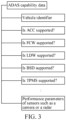
- the format of the ADAS capability information sent by the vehicle terminal may be shown in FIG. 3 .
- the ADAS capability information includes identifier information of each vehicle terminal and at least one of the following information: information about support for a plurality of ADAS functions of the vehicle terminal (for example, whether ACC is supported, whether FCW is supported, whether LDW is supported, whether BSD is supported, and whether a TPMS is supported); and information about a sensor equipped on the vehicle terminal (performance parameters of sensors such as a camera or a radar).
- a process of obtaining blind spot detection capability information of the vehicle terminal by the cloud platform may be obtaining a blind spot detection history record reported by the vehicle terminal, and then determining the blind spot detection capability information of the vehicle terminal according to the blind spot detection history record.
- the vehicle terminal detects and records blind spot information by using carried sensors in a traveling process.
- the cloud platform may analyze the blind spot detection history record of the vehicle terminal to determine the blind spot detection capability information of the vehicle terminal, for example, whether the vehicle terminal has a blind spot detection capability, the intensity of the blind spot detection capability of the vehicle terminal, and the like.
- a process of obtaining blind spot detection capability information of the vehicle terminal by the cloud platform may be obtaining a blind spot detection history record reported by the vehicle terminal and feedback information of a driver of the vehicle terminal to blind spot warning, and then determining the blind spot detection capability information of the vehicle terminal according to the blind spot detection history record and the feedback information of the driver of the vehicle terminal to the blind spot warning.
- the vehicle terminal detects a blind spot in a traveling process and performs blind spot warning. If the driver chooses to ignore the blind spot warning, it indicates that the blind spot warning of the vehicle terminal may be incorrect warning. If the driver accepts the blind spot warning or feeds back that the blind spot warning is accurate, it indicates that the blind spot warning of the vehicle terminal is correct.
- the cloud platform may analyze the intensity information and the like of the blind spot detection capability of the vehicle terminal.
- S220 Determine a potential blind spot of the vehicle terminal in a traveling process according to the location information and the traveling status information of the vehicle terminal and the road condition information to obtain a blind spot detection result.
- a process of determining a potential blind spot of the vehicle terminal in a traveling process by the cloud platform may be: in response to determining, according to the location information and the traveling status information of the vehicle terminal and the road condition information, that a visual obstacle exists at a location of the vehicle terminal, generate the potential blind spot of the vehicle terminal based on the location at which the visual obstacle exists.
- the vehicle terminal In response to determining, according to the location information and the traveling status information of the vehicle terminal and the road condition information, that the vehicle terminal meets at least one of the following conditions, determine that the visual obstacle exists at the location of the vehicle terminal: when the location of the vehicle terminal corresponds to a bend area (for example, if the angle of the bend is large, visual hindrance appears), or the vehicle terminal is in a tunnel, or the vehicle terminal is in an uphill state (for example, visual hindrance appears when the slope is steep), and/or an obstacle blockage exists at a nearby location of the vehicle terminal.
- a bend area for example, if the angle of the bend is large, visual hindrance appears
- the vehicle terminal is in a tunnel
- the vehicle terminal is in an uphill state (for example, visual hindrance appears when the slope is steep)
- an obstacle blockage exists at a nearby location of the vehicle terminal.
- S230 Generate a blind spot supplementary reminder message according to the blind spot detection result and the blind spot detection capability information of the vehicle terminal.
- the blind spot supplementary reminder message before the blind spot supplementary reminder message is generated, it may be determined, according to the blind spot detection result and the blind spot detection capability information of the vehicle terminal, whether it is necessary to send the blind spot supplementary reminder message to the vehicle terminal.
- the blind spot supplementary reminder message is generated in response to determining, according to the blind spot detection result and the blind spot detection capability information of the vehicle terminal, that it is necessary to send the blind spot supplementary reminder message to the vehicle terminal.
- S240 Send the blind spot supplementary reminder message to the vehicle terminal.
- the cloud platform may synchronize time with the vehicle terminal to allow the vehicle terminal to process the blind spot supplementary reminder message based on the synchronized time.
- the cloud platform may add explicit timestamp information to the blind spot supplementary reminder message to synchronize the time with the vehicle terminal.
- the cloud platform may synchronize the time with the vehicle terminal in an implicit indication mode, the implicit indication mode including implicitly indicating, based on explicit timestamp information of some data packets in data packets transmitted through the same transmission channel, timestamp information of other data packets.
- the cloud platform transmits a plurality of data packets through a transmission channel.
- explicit timestamp information may be added to some data packets, to implicitly indicate time information of other data packets that carry no timestamp information.
- the cloud platform may send a blind spot reminder message to all vehicle terminals on the road section on which the vehicle terminal travels, to remind vehicle terminals on the road section about traveling safety.
- the cloud platform in response to predicting, according to the location information and the traveling status information of the vehicle terminal and the road condition information of the road section on which the vehicle terminal travels, that a network status of an area that the vehicle terminal is about to enter is inadequate to support blind spot warning, the cloud platform may send warning information to the vehicle terminal before the vehicle terminal enters the area.
- the warning information sent by the cloud platform to the vehicle terminal before the vehicle terminal enters the area includes at least one of the following: information about a potential blind spot in the area that the vehicle is about to enter, and information prompting that blind spot warning cannot be provided in the area that the vehicle is about to enter.
- the area that the vehicle is about to enter is not within a network coverage area or network quality in the area that the vehicle is about to enter is less than a set value, determine that the network status of the area is inadequate to support blind spot warning.
- the network quality may be a network signal value, a network transmission rate value, or the like.
- a cloud platform (a central cloud platform or a road-side cloud platform) obtains location information and traveling status information of a vehicle, road condition information, and the like, and analyzes location information, speed information, and the like of vehicles near the vehicle to determine a potential blind spot of the vehicle, to determine, according to blind spot detection capability information of the vehicle, whether it is necessary to send a blind spot supplementary reminder message to the vehicle.
- a cloud platform obtains location information and traveling status information of a vehicle, road condition information, and the like, and analyzes location information, speed information, and the like of vehicles near the vehicle to determine a potential blind spot of the vehicle, to determine, according to blind spot detection capability information of the vehicle, whether it is necessary to send a blind spot supplementary reminder message to the vehicle.
- FIG. 4 is a flowchart of a driving assistance processing method according to an embodiment of this application. The method may be performed by the electronic device shown in FIG. 6 .
- the driving assistance processing method includes steps S410 to S460, which are described below in detail:
- a cloud platform obtains location information and traveling status information of vehicles and road condition information.
- the cloud platform may be a central cloud platform or a road-side cloud platform.
- the central cloud platform provides large-area coverage through a mobile communication network (for example, a 5G network).
- the road-side cloud platform provides small-area coverage through a 5G small base station or a road-side unit (RSU) of V2X.
- the road condition information may be a potential safety risk (for example, a landslide, a slippery road surface, a side wind, and a tunnel) on the road section on which the vehicle travels or may be a vehicle condition on a specific road section, for example, blind spots caused by a sharp turn, a tunnel, a slope, and another visual obstacle. The occurrence of these blind spots is also related to the location of the vehicle.
- a potential safety risk for example, a landslide, a slippery road surface, a side wind, and a tunnel
- a vehicle condition on a specific road section for example, blind spots caused by a sharp turn, a tunnel, a slope, and another visual obstacle.
- blind spots caused by a sharp turn, a tunnel, a slope, and another visual obstacle. The occurrence of these blind spots is also related to the location of the vehicle.
- the location information and the traveling status information of the vehicle are vital for blind spot detection.
- the location information and the traveling status information of the vehicle need to be transferred to the cloud platform in real time through a 5G network or a V2X network.
- time synchronization is required between the vehicle and the cloud platform, and an ADAS module of the vehicle terminal needs to support a compensation function. That is, a reminder of the cloud platform can be processed according to explicit timestamp information in a reminder message or implicit delay estimation.
- the cloud platform obtains blind spot detection capability information of the vehicle by combining history data and information about the vehicle.
- the configuration of the vehicle may support or may not support blind spot detection, and specific capabilities of supporting blind spot detection of vehicles are different. Therefore, a vehicle terminal may transmit history data of blind spot detection to a cloud and is configured to assist the cloud to provide a personalized blind spot detection service to the vehicle.
- the cloud platform also needs to learn information such as the identifier of the vehicle, ADAS related capabilities of the vehicle, the functions and performance indicators of the sensors of the vehicle, and communication capabilities.
- the communication capabilities of the vehicle include a Uu networking capability, a PC5 networking capability, and the like.
- each vehicle has blind spot detection behavior and a traveling record in a traveling process.
- the cloud platform may analyze the determination of a potential blind spot of the vehicle and the driver of the vehicle according to the information.
- the information includes safety warning information that already occurs and also includes traffic danger information and the like that may occur due to an error in blind spot detection. For example, for a case in which different road conditions such as a sharp turn, a tunnel, a slope, and another visual obstacle may cause blind spots, even if the vehicle is not involved in an accident, driving data of the vehicle can still be used for assessing a blind spot detection capability.
- S430 The cloud platform assesses a potential blind spot by combining a road section status and a panoramic view.
- the cloud platform may combine the road condition information of the road section on which the vehicle travels and the blind spot detection capability of the vehicle, whether there is a blind spot that cannot be perceived by the vehicle.
- the road condition information may be a potential safety risk (for example, a landslide, a slippery road surface, a side wind, and a tunnel) on the road section on which the vehicle travels or may be a temporary failure of camera detection of the vehicle caused by line of sight blockage and a sharp turn due to a vehicle condition on a specific road section such as a nearby large vehicle, incomplete view in front and behind the vehicle caused by a slope, and the like.
- the cloud platform may combine a relative location distribution relationship of vehicles to determine whether there is a blind spot.
- the reason is that for blind spot detection, a sharp turn, a tunnel, a slope, and another visual obstacle may all cause blind spots.
- the occurrence of these blind spots is also related to the location of the vehicle.
- regional warning may be performed to send blind spot information to all vehicles on the road section.
- the cloud platform may accurately analyze and determine direct, mutual blind spot relationships between vehicles according to location relationships between the vehicles, selective warning may be performed to send blind spot information to vehicles with a specific blind spot.
- the cloud platform may inform the vehicle in advance before the vehicle enters the weak-network area.
- S440 The cloud platform analyzes and determines information about a blind spot according to a road condition and the blind spot detection capability information of the vehicle.
- S450 The cloud platform determines whether it is necessary to push a blind spot supplementary reminder message.
- the cloud platform may determine, according to a blind spot obtained through the analysis of a panoramic view and in combination with the blind spot detection capability of the vehicle acquired by the cloud platform, whether it is necessary to send a blind spot supplementary reminder message to the ADAS module of the vehicle.
- S460 The cloud platform sends the blind spot supplementary reminder message to the vehicle.
- the cloud platform may notify the blind spot supplementary reminder message to the ADAS module of the vehicle through a 5G network or a V2X network.
- a cloud platform can assist a vehicle in blind spot detection to reduce a probability of missed detection and missed warning of a blind spot, to resolve the problem of a limited sensing range of a conventional single-vehicle ADAS, thereby effectively enhancing the safety of the ADAS.
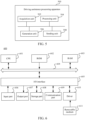
- FIG. 5 is a block diagram of a driving assistance processing apparatus according to an embodiment of this application.
- a driving assistance processing apparatus 500 includes an obtaining unit 502, a processing unit 504, a generation unit 506, and a sending unit 508.
- the obtaining unit 502 is configured to obtain location information and traveling status information of a vehicle terminal and road condition information of a road section on which the vehicle terminal travels.
- the obtaining unit 502 is configured to obtain blind spot detection capability information of the vehicle terminal.
- the processing unit 504 is configured to determine a potential blind spot of the vehicle terminal in a traveling process according to the location information and the traveling status information of the vehicle terminal and the road condition information to obtain a blind spot detection result.
- the generation unit 506 is configured to generate a blind spot supplementary reminder message according to the blind spot detection result and the blind spot detection capability information of the vehicle terminal.
- the sending unit 508 is configured to send the blind spot supplementary reminder message to the vehicle terminal.
- the processing unit 504 is configured to: in response to determining, according to the location information and the traveling status information of the vehicle terminal and the road condition information, that a visual obstacle exists at a location of the vehicle terminal, generate the potential blind spot of the vehicle terminal based on the location at which the visual obstacle exists.
- the processing unit 504 is configured to: in response to determining, according to the location information and the traveling status information of the vehicle terminal and the road condition information, that the vehicle terminal meets at least one of the following conditions, determine that the visual obstacle exists at the location of the vehicle terminal: the location of the vehicle terminal is a bend area, the vehicle terminal is in a tunnel, the vehicle terminal is in an uphill state, and an obstacle blockage exists at a nearby location of the vehicle terminal.
- the obtaining unit 502 is configured to: obtain ADAS capability information sent by the vehicle terminal, the ADAS capability information including identifier information of the vehicle terminal and at least one piece of the following information of the vehicle terminal: information about support for a plurality of ADAS functions of the vehicle terminal and information about a sensor equipped on the vehicle terminal; and determine the blind spot detection capability information of the vehicle terminal according to the ADAS capability information.
- the obtaining unit 502 is configured to: obtain a blind spot detection history record reported by the vehicle terminal; and determine the blind spot detection capability information of the vehicle terminal according to the blind spot detection history record.
- the obtaining unit 502 is configured to: obtain a blind spot detection history record reported by the vehicle terminal and feedback information of a driver of the vehicle terminal to blind spot warning; and determine the blind spot detection capability information of the vehicle terminal according to the blind spot detection history record and the feedback information of the driver of the vehicle terminal to the blind spot warning.
- the processing unit 504 is further configured to: synchronize time with the vehicle terminal to allow the vehicle terminal to process the blind spot supplementary reminder message based on the synchronized time.
- the processing unit 504 is configured to synchronize the time with the vehicle terminal in at least one of the following modes: adding explicit timestamp information to the blind spot supplementary reminder message to synchronize the time with the vehicle terminal; and synchronizing the time with the vehicle terminal in an implicit indication mode, the implicit indication mode including implicitly indicating, based on explicit timestamp information of some data packets in data packets transmitted through the same transmission channel, timestamp information of other data packets.
- the sending unit 508 is further configured to: when it is difficult to determine a potential blind spot of the vehicle terminal in the traveling process according to the location information and the traveling status information of the vehicle terminal and the road condition information, send a blind spot reminder message to all vehicle terminals on the road section on which the vehicle terminal travels.
- the sending unit 508 is further configured to: in response to predicting, according to the location information and the traveling status information of the vehicle terminal and the road condition information of the road section on which the vehicle terminal travels, that a network status of an area that the vehicle terminal is about to enter is inadequate to support blind spot warning, send warning information to the vehicle terminal before the vehicle terminal enters the area, where the warning information includes at least one of the following: information about a potential blind spot in the area, and information prompting that blind spot warning cannot be provided in the area.
- the processing unit 504 is further configured to: when the area is not within a network coverage area or network quality in the area is less than a set value, determine that the network status of the area is inadequate to support blind spot warning.
- the generation unit 506 is further configured to: determine, according to the blind spot detection result and the blind spot detection capability information of the vehicle terminal, whether it is necessary to send the blind spot supplementary reminder message to the vehicle terminal; and generate the blind spot supplementary reminder message in response to determining, according to the blind spot detection result and the blind spot detection capability information of the vehicle terminal, that it is necessary to send the blind spot supplementary reminder message to the vehicle terminal.
- a cloud platform determines a potential blind spot of a vehicle terminal in a traveling process according to location information and traveling status information of the vehicle terminal and road condition information of a road section on which the vehicle terminal travels to obtain a blind spot detection result, then generates a blind spot supplementary reminder message according to the blind spot detection result and blind spot detection capability information of the vehicle terminal, and sends the blind spot supplementary reminder message to the vehicle terminal, so that the cloud platform can assist a vehicle in blind spot detection to reduce a probability of missed detection and missed warning of a blind spot, to resolve the problem of a limited sensing range of a conventional single-vehicle ADAS, thereby effectively enhancing the safety of the ADAS.
- FIG. 6 is a schematic structural diagram of a computer system adapted to implement an electronic device according to an embodiment of this application.
- a computer system 600 of the electronic device shown in FIG. 6 is merely an example, and does not constitute any limitation on functions and use ranges of the embodiments of this application.
- the computer system 600 includes a central processing unit (CPU) 601, which may perform various suitable actions and processing based on a program stored in a read-only memory (ROM) 602 or a program loaded from a storage part 608 into a random access memory (RAM) 603, for example, perform the method described in the foregoing embodiments.
- the RAM 603 further stores various programs and data required for system operations.
- the CPU 601, the ROM 602, and the RAM 603 are connected to each other through a bus 604.
- An input/output (I/O) interface 605 is also connected to the bus 604.
- the following components are connected to the I/O interface 605: an input part 606 including a keyboard, a mouse, or the like, an output part 607 including a cathode ray tube (CRT), a liquid crystal display (LCD), a speaker, or the like, a storage part 608 including a hard disk, or the like, and a communication part 609 including a network interface card such as a local area network (LAN) card or a modem.
- the communication part 609 performs communication processing by using a network such as the Internet.
- a driver 610 is also connected to the I/O interface 605 as required.
- a removable medium 611 such as a magnetic disk, an optical disc, a magneto-optical disk, or a semiconductor memory, is mounted on the driver 610 as required, so that a computer program read from the removable medium is installed into the storage part 608 as required.
- an embodiment of this application includes a computer program product.
- the computer program product includes a computer program stored in a computer-readable medium.
- the computer program includes a computer program used for performing a method shown in the flowchart.
- the computer program may be downloaded and installed from a network through the communication part 609, and/or installed from the removable medium 611.
- the various functions defined in the system of this application are executed.
- the computer-readable medium shown in the embodiments of this application may be a computer-readable signal medium or a computer-readable storage medium or any combination thereof.
- the computer-readable storage medium may be, for example, but is not limited to, an electric, magnetic, optical, electromagnetic, infrared, or semi-conductive system, apparatus, or component, or any combination thereof.
- a more specific example of the computer-readable storage medium may include but is not limited to: an electrical connection having one or more wires, a portable computer magnetic disk, a hard disk, a RAM, a ROM, an erasable programmable read-only memory (EPROM), a flash memory, an optical fiber, a compact disc read-only memory (CD-ROM), an optical storage device, a magnetic storage device, or any appropriate combination thereof.
- the computer-readable storage medium may be any tangible medium including or storing a program, and the program may be used by or in combination with an instruction execution system, apparatus, or device.
- the computer-readable signal medium may include a data signal transmitted in a baseband or as part of a carrier, and stores a computer-readable computer program.
- the propagated data signal may be in a plurality of forms, including, but not limited to, an electromagnetic signal, an optical signal, or any appropriate combination thereof.
- the computer-readable signal medium may be further any computer-readable medium in addition to a computer-readable storage medium.
- the computer-readable medium may send, propagate, or transmit a program that is used by or used in combination with an instruction execution system, apparatus, or device.
- the computer program included in the computer-readable medium may be transmitted by using any suitable medium, including but not limited to: a wireless medium, a wire, or the like, or any suitable combination thereof.
- Each box in a flowchart or a block diagram may represent a module, a program segment, or a part of code.
- the module, the program segment, or the part of code includes one or more executable instructions used for implementing specified logic functions.
- functions marked in boxes may alternatively occur in a sequence different from that marked in an accompanying drawing. For example, two boxes shown in succession may actually be performed basically in parallel, and sometimes the two boxes may be performed in a reverse sequence. This is determined by a related function.
- Each block in the block diagram or the flowchart, and a combination of blocks in the block diagram or the flowchart may be implemented by using a dedicated hardware-based system that performs a specified function or operation, or may be implemented by using a combination of dedicated hardware and computer instructions.
- this application further provides a computer-readable medium.
- the computer-readable medium may be included in the electronic device described in the foregoing embodiments, or may exist alone and is not assembled in the electronic device.
- the computer-readable medium carries one or more programs, the one or more programs, when executed by the electronic device, causing the electronic device to implement the method described in the foregoing embodiments.
- modules or units of a device for action execution are mentioned in the foregoing detailed descriptions, the division is not mandatory. Actually, according to the implementations of this application, the features and functions of two or more modules or units described above may be specified in one module or unit. Conversely, the features and functions of one module or unit described above may be further divided into a plurality of modules or units to be embodied.
- the exemplary implementations described herein may be implemented by software, or may be implemented by combining software with necessary hardware. Therefore, the technical solutions of the embodiments of this application may be implemented in a form of a software product.
- the software product may be stored in a non-volatile storage medium (which may be a CD-ROM, a USB flash drive, a removable hard disk, or the like) or on a network, including several instructions for instructing a computing device (which may be a PC, a server, a touch terminal, a network device, or the like) to perform the methods according to the embodiments of this application.
Landscapes
- Engineering & Computer Science (AREA)
- Automation & Control Theory (AREA)
- Transportation (AREA)
- Mechanical Engineering (AREA)
- Physics & Mathematics (AREA)
- Mathematical Physics (AREA)
- Human Computer Interaction (AREA)
- General Physics & Mathematics (AREA)
- Signal Processing (AREA)
- Computer Networks & Wireless Communication (AREA)
- Life Sciences & Earth Sciences (AREA)
- Atmospheric Sciences (AREA)
- Traffic Control Systems (AREA)
Abstract
Description
- This application claims priority to
Chinese Patent Application No. 202110536723.3, entitled "DRIVING ASSISTANCE PROCESSING METHOD AND APPARATUS, COMPUTER-READABLE MEDIUM, AND ELECTRONIC DEVICE" and filed with the National Intellectual Property Administration, PRC on May 17, 2021 - This application relates to the field of computer and communication technologies, and specifically, to a driving assistance processing method and apparatus, a computer-readable medium, and an electronic device.
- An advanced driving assistance system (ADAS) senses a surrounding environment in real time by using various sensors (millimeter-wave radar, LIDAR, monocular or binocular camera and satellite navigation, and the like) installed on a vehicle in a traveling process of the vehicle, collects data, identifies, detects, and tracks stationary and moving objects, and performs system operation and analysis in combination with navigation map data, to enable a driver to recognize potential hazards in advance, thereby effectively increasing the comfort and safety of car driving.
- However, a conventional ADAS has the problem of a limited sensing range, and a more effective collaboration mechanism between multiple vehicles is lacking when a driving safety risk arises. Therefore, there are limitations in terms of safety.
- Embodiments of this application provide a driving assistance processing method and apparatus, a computer-readable medium, and an electronic device, to reduce a probability of missed detection and missed warning of a blind spot at least to some extent, thereby effectively enhancing the safety of an ADAS.
- Other characteristics and advantages of this application become apparent from the following detailed description, or may be learned in part through the practice of this application.
- According to an aspect of the embodiments of this application, a driving assistance processing method is provided, performed by an electronic device, and including: obtaining location information and traveling status information of a vehicle terminal and road condition information of a road section on which the vehicle terminal travels, and obtaining blind spot detection capability information of the vehicle terminal; determining a potential blind spot of the vehicle terminal in a traveling process according to the location information and the traveling status information of the vehicle terminal and the road condition information to obtain a blind spot detection result; generating a blind spot supplementary reminder message according to the blind spot detection result and the blind spot detection capability information of the vehicle terminal; and sending the blind spot supplementary reminder message to the vehicle terminal.
- According to an aspect of the embodiments of this application, a driving assistance processing apparatus is provided, including: an obtaining unit, configured to: obtain location information and traveling status information of a vehicle terminal and road condition information of a road section on which the vehicle terminal travels, and obtain blind spot detection capability information of the vehicle terminal; a processing unit, configured to determine a potential blind spot of the vehicle terminal in a traveling process according to the location information and the traveling status information of the vehicle terminal and the road condition information to obtain a blind spot detection result; a generation unit, configured to generate a blind spot supplementary reminder message according to the blind spot detection result and the blind spot detection capability information of the vehicle terminal; and a sending unit, configured to send the blind spot supplementary reminder message to the vehicle terminal.
- According to an aspect of the embodiments of this application, a computer-readable medium is provided, storing a computer program, the computer program, when executed by a processor, implements the driving assistance processing method according to the foregoing embodiment.
- According to an aspect of the embodiments of this application, an electronic device is provided, including: one or more processors; and a storage apparatus, configured to store one or more programs, the one or more programs, when executed by the one or more processors, causing the one or more processors to implement the driving assistance processing method according to the foregoing embodiment.
- According to an aspect of the embodiments of this application, a computer program product or a computer program is provided, the computer program product or the computer program including computer instructions, the computer instructions being stored in a computer-readable storage medium. A processor of a computer device reads the computer instructions from the computer-readable storage medium, and executes the computer instructions, to cause the computer device to perform the driving assistance processing method provided in the foregoing embodiments.
- It is to be understood that the above general descriptions and the following detailed descriptions are merely for exemplary and explanatory purposes, and cannot limit this application.
- The accompanying drawings herein, which are incorporated into the specification and constitute a part of this specification, show embodiments that conform to this application, and are used for describing a principle of this application together with this specification. Apparently, the accompanying drawings in the following description show merely some embodiments of this application, and a person of ordinary skill in the art may still derive other drawings from these accompanying drawings without creative efforts. In the accompanying drawings:
-
FIG. 1 is a schematic diagram of an application scenario according to an embodiment of this application. -
FIG. 2 is a flowchart of a driving assistance processing method according to an embodiment of this application. -
FIG. 3 is a schematic diagram of ADAS capability information according to an embodiment of this application. -
FIG. 4 is a flowchart of a driving assistance processing method according to an embodiment of this application. -
FIG. 5 is a block diagram of a driving assistance processing apparatus according to an embodiment of this application. -
FIG. 6 is a schematic structural diagram of a computer system adapted to implement an electronic device according to an embodiment of this application. - Now, exemplary implementations are described comprehensively with reference to the accompanying drawings. However, the exemplary implementations may be implemented in various forms, and are not to be understood as being limited to the examples described herein. Instead, the implementations are provided to make this application more thorough and complete and fully convey the idea of the exemplary implementations to a person skilled in the art.
- In addition, the described features, structures, or characteristics may be combined in one or more embodiments in any appropriate manner. In the following descriptions, a lot of specific details are provided to give a full understanding of the embodiments of this application. However, a person skilled in the art is to be aware of that, the technical solutions in this application may be implemented without one or more of the particular details, or other methods, unit, apparatus, or step may be adopted. In other cases, well-known methods, apparatuses, implementations, or operations are not shown or described in detail, to avoid obscuring the aspects of this application.
- The block diagrams shown in the accompanying drawings is merely a functional entity and does not necessarily correspond to a physically independent entity. To be specific, such functional entities may be implemented in the form of software, or implemented in one or more hardware modules or integrated circuits, or implemented in different networks and/or processor apparatuses and/or microcontroller apparatuses.
- The flowcharts shown in the accompanying drawings are merely examples for descriptions, do not necessarily include all content and operations/steps, and are not necessarily performed in the described orders. For example, some operations/steps may be further divided, while some operations/steps may be combined or partially combined. Therefore, an actual execution order may vary depending on an actual situation.
- "Plurality of mentioned in the specification means two or more. The term "and/or" describes an association relationship for describing associated objects and represents that three relationships may exist. For example, A and/or B may represent the following three cases: Only A exists, both A and B exist, and only B exists. The character "/" generally indicates an "or" relationship between the associated objects.
-
FIG. 1 is a schematic diagram of an application scenario according to an embodiment of this application. - As shown in
FIG. 1 , in an application scenario of this application, a vehicle terminal may communicate with a cloud platform through abase station 101. The cloud platform may intercommunicate with a high-precision positioning system 102 and implement high-precision positioning of the vehicle terminal by collaborating with the vehicle terminal. Thebase station 101 may be a 5G base station or may be a 3G or 4G base station or may be a next-generation mobile communication base station. The cloud platform may be a road-side cloud platform or a central cloud platform. The road-side cloud platform is a cloud platform disposed near a road and is only configured to serve a few road sections. With respect to the road-side cloud platform, the central cloud platform is a cloud platform that serves many road sections or all road sections. The service area of the central cloud platform is much larger than that of the road-side cloud platform. The central cloud platform may be disposed at a back end of a core network. - In some embodiments, the vehicle terminal may interact with the cloud platform (including the central cloud platform and the road-side cloud platform) through the base station 101 (that is, a mobile communication network) as shown in
FIG. 1 , and may further interact with the road-side cloud platform through vehicle-to-everything (V2X) communication. - In an embodiment of this application, the vehicle terminal shown in
FIG. 1 may be provided with an ADAS function. The ADAS function specifically includes a warning system and a control system. The warning system includes a forward collision warning (FCW) system, a lane departure warning (LDW) system, a blind spot detection (BSD) system, a driver fatigue warning (DFW) system, a tire pressure monitoring system (TPMS), and the like. The control system includes a lane keeping assist (LKA) system, an automated parking system (APS), an autonomous emergency braking (AEB) system, an adaptive cruise control (ACC) system, a pedestrian protection system (PPS), a down-hill assist control (DAC) system, and the like. Certainly, in the embodiments of this application, not all vehicles have the ADAS function. A vehicle with the ADAS function does not necessarily have all the foregoing functions, and may have only part of the ADAS function. - In an embodiment of this application, the vehicle terminal may report the location information and the traveling status information of the vehicle terminal and the road condition information of the road section on which the vehicle terminal travels to a cloud platform (for example, the cloud platform shown in
FIG. 1 ), and may upload blind spot detection capability information of the vehicle terminal to the cloud platform. The cloud platform may determine a potential blind spot of the vehicle terminal in a traveling process according to the location information and the traveling status information of the vehicle terminal and the road condition information to obtain a blind spot detection result. The cloud platform may generate a blind spot supplementary reminder message according to the blind spot detection result and the blind spot detection capability information of the vehicle terminal, and then send the blind spot supplementary reminder message to the vehicle terminal. As can be seen, in the technical solution in the embodiments of this application, a cloud platform can assist a vehicle in blind spot detection to reduce a probability of missed detection and missed warning of a blind spot, to resolve the problem of a limited sensing range of a conventional single-vehicle ADAS, thereby effectively enhancing the safety of the ADAS. - In an embodiment of this application, the cloud platform may determine a potential blind spot of a vehicle in a traveling process depending on an artificial intelligence (AI) technology. The AI technology is a theory, method, technology, and application system that uses a digital computer or a machine controlled by the digital computer to simulate, extend, and expand human intelligence, perceive an environment, acquire knowledge, and use knowledge to obtain an optimal result. In other words, AI is a comprehensive technology in computer science. This technology attempts to understand the essence of intelligence and produce a new intelligent machine that can react in a manner similar to human intelligence. AI is to study the design principles and implementation methods of various intelligent machines, so that the machines can perceive, infer, and make decisions.
- In addition, the AI technology is a comprehensive subject, relating to a wide range of fields, and involving both hardware and software techniques. Basic AI technologies generally include technologies such as a sensor, a dedicated AI chip, cloud computing, distributed storage, a big data processing technology, an operating/interaction system, and electromechanical integration. An AI software technology mainly includes fields such as a CV technology, a speech processing technology, a natural language processing technology, and machine learning/deep learning (DL).
- Computer vision (CV) is a science that studies how to use a machine to "see", and furthermore, that uses a camera and a computer to replace human eyes to perform machine vision such as recognition, tracking, and measurement on a target, and further perform graphic processing, so that the computer processes the target into an image more suitable for human eyes to observe, or an image transmitted to an instrument for detection. As a scientific discipline, the CV studies related theories and technologies and attempts to establish an AI system that can obtain information from images or multidimensional data. The CV technologies generally include technologies such as image processing, image recognition, image semantic understanding, image retrieval, optical character recognition (OCR), video processing, video semantic understanding, video content/behavior recognition, three-dimensional object reconstruction, a 3D technology, virtual reality, augmented reality, synchronous positioning, and map construction, and further include biometric feature recognition technologies such as common face recognition and fingerprint recognition.
- In combination with this application, both the vehicle terminals and the cloud platform can use technologies such as CV and machine learning in the AI technology to improve the accuracy of driving assistance. The vehicle terminals can also implement autonomous driving based on this.
- The implementation details of the technical solutions in the embodiments of this application are described below in detail.
-
FIG. 2 is a flowchart of a driving assistance processing method according to an embodiment of this application. The driving assistance processing method may be performed by a cloud platform, where the cloud platform may be a central cloud platform or a road-side cloud platform, or performed by the driving assistance processing apparatus shown inFIG. 5 , or performed by the electronic device shown inFIG. 6 . Referring toFIG. 2 , the driving assistance processing method includes S210 to S230, which are described below in detail: - S210: Obtain location information and traveling status information of a vehicle terminal and road condition information of a road section on which the vehicle terminal travels, and obtain blind spot detection capability information of the vehicle terminal.
- In an embodiment of this application, when the cloud platform is a central cloud platform, the vehicle terminals may send the location information, the traveling status information, and the road condition information of the road section on which the vehicle terminals travel to the central cloud platform through a mobile communication network. When the cloud platform is a road-side cloud platform, the vehicle terminals may send the location information, the traveling status information, and the road condition information of the road section on which the vehicle terminals travel to the road-side cloud platform through a mobile communication network or V2X communication.
- The location information of the vehicle terminals may be sent to the cloud platform by the vehicle terminals or may be obtained by the cloud platform by intercommunicating with a high-precision positioning system and implementing high-precision positioning of the vehicle terminals by collaborating with the vehicle terminals. The traveling status information of the vehicle terminals includes speed information, acceleration information, and the like of the vehicle terminals. The road condition information of the road section on which the vehicle terminals travel includes a potential safety risk (for example, whether there is a landslide, whether there is a slippery road surface, whether there is a side wind, and whether there is a tunnel) on the road section on which the vehicle terminals travel or may include a vehicle condition (for example, whether there is a potential safety risk of another vehicle) on the road section.
- In an embodiment of this application, a process of obtaining blind spot detection capability information of the vehicle terminal by the cloud platform may be obtaining advanced driving assistance ADAS capability information sent by the vehicle terminal, the ADAS capability information including identifier information of the vehicle terminal and at least one piece of the following information of the vehicle terminal: information about support for a plurality of ADAS functions of the vehicle terminal and information about a sensor equipped on the vehicle terminal. The blind spot detection capability information of the vehicle terminal may be determined according to the ADAS capability information.
- The format of the ADAS capability information sent by the vehicle terminal may be shown in
FIG. 3 . The ADAS capability information includes identifier information of each vehicle terminal and at least one of the following information: information about support for a plurality of ADAS functions of the vehicle terminal (for example, whether ACC is supported, whether FCW is supported, whether LDW is supported, whether BSD is supported, and whether a TPMS is supported); and information about a sensor equipped on the vehicle terminal (performance parameters of sensors such as a camera or a radar). - In an embodiment of this application, a process of obtaining blind spot detection capability information of the vehicle terminal by the cloud platform may be obtaining a blind spot detection history record reported by the vehicle terminal, and then determining the blind spot detection capability information of the vehicle terminal according to the blind spot detection history record. For example, the vehicle terminal detects and records blind spot information by using carried sensors in a traveling process. The cloud platform may analyze the blind spot detection history record of the vehicle terminal to determine the blind spot detection capability information of the vehicle terminal, for example, whether the vehicle terminal has a blind spot detection capability, the intensity of the blind spot detection capability of the vehicle terminal, and the like.
- In an embodiment of this application, a process of obtaining blind spot detection capability information of the vehicle terminal by the cloud platform may be obtaining a blind spot detection history record reported by the vehicle terminal and feedback information of a driver of the vehicle terminal to blind spot warning, and then determining the blind spot detection capability information of the vehicle terminal according to the blind spot detection history record and the feedback information of the driver of the vehicle terminal to the blind spot warning. For example, the vehicle terminal detects a blind spot in a traveling process and performs blind spot warning. If the driver chooses to ignore the blind spot warning, it indicates that the blind spot warning of the vehicle terminal may be incorrect warning. If the driver accepts the blind spot warning or feeds back that the blind spot warning is accurate, it indicates that the blind spot warning of the vehicle terminal is correct. In this case, the cloud platform may analyze the intensity information and the like of the blind spot detection capability of the vehicle terminal.
- S220: Determine a potential blind spot of the vehicle terminal in a traveling process according to the location information and the traveling status information of the vehicle terminal and the road condition information to obtain a blind spot detection result.
- In an embodiment of this application, a process of determining a potential blind spot of the vehicle terminal in a traveling process by the cloud platform may be: in response to determining, according to the location information and the traveling status information of the vehicle terminal and the road condition information, that a visual obstacle exists at a location of the vehicle terminal, generate the potential blind spot of the vehicle terminal based on the location at which the visual obstacle exists. In response to determining, according to the location information and the traveling status information of the vehicle terminal and the road condition information, that the vehicle terminal meets at least one of the following conditions, determine that the visual obstacle exists at the location of the vehicle terminal: when the location of the vehicle terminal corresponds to a bend area (for example, if the angle of the bend is large, visual hindrance appears), or the vehicle terminal is in a tunnel, or the vehicle terminal is in an uphill state (for example, visual hindrance appears when the slope is steep), and/or an obstacle blockage exists at a nearby location of the vehicle terminal.
- S230: Generate a blind spot supplementary reminder message according to the blind spot detection result and the blind spot detection capability information of the vehicle terminal.
- In an embodiment of this application, before the blind spot supplementary reminder message is generated, it may be determined, according to the blind spot detection result and the blind spot detection capability information of the vehicle terminal, whether it is necessary to send the blind spot supplementary reminder message to the vehicle terminal. The blind spot supplementary reminder message is generated in response to determining, according to the blind spot detection result and the blind spot detection capability information of the vehicle terminal, that it is necessary to send the blind spot supplementary reminder message to the vehicle terminal.
- S240: Send the blind spot supplementary reminder message to the vehicle terminal.
- In an embodiment of this application, to ensure that the vehicle terminal can process the blind spot supplementary reminder message in time, the cloud platform may synchronize time with the vehicle terminal to allow the vehicle terminal to process the blind spot supplementary reminder message based on the synchronized time.
- In an embodiment of this application, the cloud platform may add explicit timestamp information to the blind spot supplementary reminder message to synchronize the time with the vehicle terminal.
- In an embodiment of this application, the cloud platform may synchronize the time with the vehicle terminal in an implicit indication mode, the implicit indication mode including implicitly indicating, based on explicit timestamp information of some data packets in data packets transmitted through the same transmission channel, timestamp information of other data packets. For example, the cloud platform transmits a plurality of data packets through a transmission channel. In this case, explicit timestamp information may be added to some data packets, to implicitly indicate time information of other data packets that carry no timestamp information.
- In an embodiment of this application, when it is difficult to determine a potential blind spot of the vehicle terminal in the traveling process according to the location information and the traveling status information of the vehicle terminal and the road condition information, the cloud platform may send a blind spot reminder message to all vehicle terminals on the road section on which the vehicle terminal travels, to remind vehicle terminals on the road section about traveling safety.
- In an embodiment of this application, in response to predicting, according to the location information and the traveling status information of the vehicle terminal and the road condition information of the road section on which the vehicle terminal travels, that a network status of an area that the vehicle terminal is about to enter is inadequate to support blind spot warning, the cloud platform may send warning information to the vehicle terminal before the vehicle terminal enters the area. The warning information sent by the cloud platform to the vehicle terminal before the vehicle terminal enters the area includes at least one of the following: information about a potential blind spot in the area that the vehicle is about to enter, and information prompting that blind spot warning cannot be provided in the area that the vehicle is about to enter.
- In an embodiment of this application, when the area that the vehicle is about to enter is not within a network coverage area or network quality in the area that the vehicle is about to enter is less than a set value, determine that the network status of the area is inadequate to support blind spot warning. The network quality may be a network signal value, a network transmission rate value, or the like.
- In summary, in the embodiments of this application, mainly a cloud platform (a central cloud platform or a road-side cloud platform) obtains location information and traveling status information of a vehicle, road condition information, and the like, and analyzes location information, speed information, and the like of vehicles near the vehicle to determine a potential blind spot of the vehicle, to determine, according to blind spot detection capability information of the vehicle, whether it is necessary to send a blind spot supplementary reminder message to the vehicle. Detailed description is provided below with reference to
FIG. 4 . -
FIG. 4 is a flowchart of a driving assistance processing method according to an embodiment of this application. The method may be performed by the electronic device shown inFIG. 6 . Referring toFIG. 4 , the driving assistance processing method includes steps S410 to S460, which are described below in detail: - S410: A cloud platform obtains location information and traveling status information of vehicles and road condition information.
- In an embodiment of this application, the cloud platform may be a central cloud platform or a road-side cloud platform. The central cloud platform provides large-area coverage through a mobile communication network (for example, a 5G network). The road-side cloud platform provides small-area coverage through a 5G small base station or a road-side unit (RSU) of V2X.
- In an embodiment of this application, the road condition information may be a potential safety risk (for example, a landslide, a slippery road surface, a side wind, and a tunnel) on the road section on which the vehicle travels or may be a vehicle condition on a specific road section, for example, blind spots caused by a sharp turn, a tunnel, a slope, and another visual obstacle. The occurrence of these blind spots is also related to the location of the vehicle.
- In an embodiment of this application, the location information and the traveling status information of the vehicle are vital for blind spot detection. To improve the accuracy and pertinence of blind spot detection and reduce unnecessary false alarm, the location information and the traveling status information of the vehicle need to be transferred to the cloud platform in real time through a 5G network or a V2X network. In addition, due to a communication transmission delay and a processing delay, time synchronization is required between the vehicle and the cloud platform, and an ADAS module of the vehicle terminal needs to support a compensation function. That is, a reminder of the cloud platform can be processed according to explicit timestamp information in a reminder message or implicit delay estimation.
- S420: The cloud platform obtains blind spot detection capability information of the vehicle by combining history data and information about the vehicle.
- In an embodiment of this application, the configuration of the vehicle may support or may not support blind spot detection, and specific capabilities of supporting blind spot detection of vehicles are different. Therefore, a vehicle terminal may transmit history data of blind spot detection to a cloud and is configured to assist the cloud to provide a personalized blind spot detection service to the vehicle. In this embodiment, the cloud platform also needs to learn information such as the identifier of the vehicle, ADAS related capabilities of the vehicle, the functions and performance indicators of the sensors of the vehicle, and communication capabilities. The communication capabilities of the vehicle include a Uu networking capability, a PC5 networking capability, and the like.
- In an embodiment of this application, each vehicle has blind spot detection behavior and a traveling record in a traveling process. The cloud platform may analyze the determination of a potential blind spot of the vehicle and the driver of the vehicle according to the information. The information includes safety warning information that already occurs and also includes traffic danger information and the like that may occur due to an error in blind spot detection. For example, for a case in which different road conditions such as a sharp turn, a tunnel, a slope, and another visual obstacle may cause blind spots, even if the vehicle is not involved in an accident, driving data of the vehicle can still be used for assessing a blind spot detection capability.
- S430: The cloud platform assesses a potential blind spot by combining a road section status and a panoramic view.
- In an embodiment of this application, the cloud platform may combine the road condition information of the road section on which the vehicle travels and the blind spot detection capability of the vehicle, whether there is a blind spot that cannot be perceived by the vehicle. The road condition information may be a potential safety risk (for example, a landslide, a slippery road surface, a side wind, and a tunnel) on the road section on which the vehicle travels or may be a temporary failure of camera detection of the vehicle caused by line of sight blockage and a sharp turn due to a vehicle condition on a specific road section such as a nearby large vehicle, incomplete view in front and behind the vehicle caused by a slope, and the like.
- In an embodiment of this application, the cloud platform may combine a relative location distribution relationship of vehicles to determine whether there is a blind spot. The reason is that for blind spot detection, a sharp turn, a tunnel, a slope, and another visual obstacle may all cause blind spots. The occurrence of these blind spots is also related to the location of the vehicle.
- In an embodiment of this application, when the cloud platform cannot accurately analyze and determine direct, mutual blind spot relationships between vehicles according to location relationships between the vehicles, regional warning may be performed to send blind spot information to all vehicles on the road section.
- In an embodiment of this application, when the cloud platform may accurately analyze and determine direct, mutual blind spot relationships between vehicles according to location relationships between the vehicles, selective warning may be performed to send blind spot information to vehicles with a specific blind spot.
- In an embodiment of this application, for a vehicle with a lower sensing capability (especially a vehicle without a blind spot detection capability), that is, a vehicle that requires network assistance or even manipulation, when a 5G network has limited coverage in a geographical area or poor network quality and as a result the cloud platform cannot continuously provide a blind spot warning function, the cloud platform may inform the vehicle in advance before the vehicle enters the weak-network area.
- S440: The cloud platform analyzes and determines information about a blind spot according to a road condition and the blind spot detection capability information of the vehicle.
- S450: The cloud platform determines whether it is necessary to push a blind spot supplementary reminder message.
- In an embodiment of this application, the cloud platform may determine, according to a blind spot obtained through the analysis of a panoramic view and in combination with the blind spot detection capability of the vehicle acquired by the cloud platform, whether it is necessary to send a blind spot supplementary reminder message to the ADAS module of the vehicle.
- S460: The cloud platform sends the blind spot supplementary reminder message to the vehicle.
- The cloud platform may notify the blind spot supplementary reminder message to the ADAS module of the vehicle through a 5G network or a V2X network.
- In the technical solution in the foregoing embodiments of this application, a cloud platform can assist a vehicle in blind spot detection to reduce a probability of missed detection and missed warning of a blind spot, to resolve the problem of a limited sensing range of a conventional single-vehicle ADAS, thereby effectively enhancing the safety of the ADAS.
- The following describes apparatus embodiments of this application, and the apparatus embodiments may be used for performing the driving assistance processing method in the foregoing embodiments of this application. For details not disclosed in the apparatus embodiments of this application, refer to the foregoing embodiments of the driving assistance processing method of this application.
-
FIG. 5 is a block diagram of a driving assistance processing apparatus according to an embodiment of this application. - Referring to
FIG. 5 , a drivingassistance processing apparatus 500 according to an embodiment of this application includes an obtainingunit 502, aprocessing unit 504, ageneration unit 506, and a sendingunit 508. - The obtaining
unit 502 is configured to obtain location information and traveling status information of a vehicle terminal and road condition information of a road section on which the vehicle terminal travels. The obtainingunit 502 is configured to obtain blind spot detection capability information of the vehicle terminal. Theprocessing unit 504 is configured to determine a potential blind spot of the vehicle terminal in a traveling process according to the location information and the traveling status information of the vehicle terminal and the road condition information to obtain a blind spot detection result. Thegeneration unit 506 is configured to generate a blind spot supplementary reminder message according to the blind spot detection result and the blind spot detection capability information of the vehicle terminal. The sendingunit 508 is configured to send the blind spot supplementary reminder message to the vehicle terminal. - In some embodiments of this application, based on the foregoing solution, the
processing unit 504 is configured to: in response to determining, according to the location information and the traveling status information of the vehicle terminal and the road condition information, that a visual obstacle exists at a location of the vehicle terminal, generate the potential blind spot of the vehicle terminal based on the location at which the visual obstacle exists. - In some embodiments of this application, based on the foregoing solution, the
processing unit 504 is configured to: in response to determining, according to the location information and the traveling status information of the vehicle terminal and the road condition information, that the vehicle terminal meets at least one of the following conditions, determine that the visual obstacle exists at the location of the vehicle terminal: the location of the vehicle terminal is a bend area, the vehicle terminal is in a tunnel, the vehicle terminal is in an uphill state, and an obstacle blockage exists at a nearby location of the vehicle terminal. - In some embodiments of this application, based on the foregoing solution, the obtaining
unit 502 is configured to: obtain ADAS capability information sent by the vehicle terminal, the ADAS capability information including identifier information of the vehicle terminal and at least one piece of the following information of the vehicle terminal: information about support for a plurality of ADAS functions of the vehicle terminal and information about a sensor equipped on the vehicle terminal; and determine the blind spot detection capability information of the vehicle terminal according to the ADAS capability information. - In some embodiments of this application, based on the foregoing solution, the obtaining
unit 502 is configured to: obtain a blind spot detection history record reported by the vehicle terminal; and determine the blind spot detection capability information of the vehicle terminal according to the blind spot detection history record. - In some embodiments of this application, based on the foregoing solution, the obtaining
unit 502 is configured to: obtain a blind spot detection history record reported by the vehicle terminal and feedback information of a driver of the vehicle terminal to blind spot warning; and determine the blind spot detection capability information of the vehicle terminal according to the blind spot detection history record and the feedback information of the driver of the vehicle terminal to the blind spot warning. - In some embodiments of this application, based on the foregoing solution, the
processing unit 504 is further configured to: synchronize time with the vehicle terminal to allow the vehicle terminal to process the blind spot supplementary reminder message based on the synchronized time. - In some embodiments of this application, based on the foregoing solution, the
processing unit 504 is configured to synchronize the time with the vehicle terminal in at least one of the following modes: adding explicit timestamp information to the blind spot supplementary reminder message to synchronize the time with the vehicle terminal; and synchronizing the time with the vehicle terminal in an implicit indication mode, the implicit indication mode including implicitly indicating, based on explicit timestamp information of some data packets in data packets transmitted through the same transmission channel, timestamp information of other data packets. - In some embodiments of this application, based on the foregoing solution, the sending
unit 508 is further configured to: when it is difficult to determine a potential blind spot of the vehicle terminal in the traveling process according to the location information and the traveling status information of the vehicle terminal and the road condition information, send a blind spot reminder message to all vehicle terminals on the road section on which the vehicle terminal travels. - In some embodiments of this application, based on the foregoing solution, the sending
unit 508 is further configured to: in response to predicting, according to the location information and the traveling status information of the vehicle terminal and the road condition information of the road section on which the vehicle terminal travels, that a network status of an area that the vehicle terminal is about to enter is inadequate to support blind spot warning, send warning information to the vehicle terminal before the vehicle terminal enters the area, where the warning information includes at least one of the following: information about a potential blind spot in the area, and information prompting that blind spot warning cannot be provided in the area. - In some embodiments of this application, based on the foregoing solution, the
processing unit 504 is further configured to: when the area is not within a network coverage area or network quality in the area is less than a set value, determine that the network status of the area is inadequate to support blind spot warning. - In some embodiments of this application, based on the foregoing solution, the
generation unit 506 is further configured to: determine, according to the blind spot detection result and the blind spot detection capability information of the vehicle terminal, whether it is necessary to send the blind spot supplementary reminder message to the vehicle terminal; and generate the blind spot supplementary reminder message in response to determining, according to the blind spot detection result and the blind spot detection capability information of the vehicle terminal, that it is necessary to send the blind spot supplementary reminder message to the vehicle terminal. - In the technical solution provided in some embodiments of this application, a cloud platform determines a potential blind spot of a vehicle terminal in a traveling process according to location information and traveling status information of the vehicle terminal and road condition information of a road section on which the vehicle terminal travels to obtain a blind spot detection result, then generates a blind spot supplementary reminder message according to the blind spot detection result and blind spot detection capability information of the vehicle terminal, and sends the blind spot supplementary reminder message to the vehicle terminal, so that the cloud platform can assist a vehicle in blind spot detection to reduce a probability of missed detection and missed warning of a blind spot, to resolve the problem of a limited sensing range of a conventional single-vehicle ADAS, thereby effectively enhancing the safety of the ADAS.
-
FIG. 6 is a schematic structural diagram of a computer system adapted to implement an electronic device according to an embodiment of this application. - A
computer system 600 of the electronic device shown inFIG. 6 is merely an example, and does not constitute any limitation on functions and use ranges of the embodiments of this application. - As shown in
FIG. 6 , thecomputer system 600 includes a central processing unit (CPU) 601, which may perform various suitable actions and processing based on a program stored in a read-only memory (ROM) 602 or a program loaded from astorage part 608 into a random access memory (RAM) 603, for example, perform the method described in the foregoing embodiments. TheRAM 603 further stores various programs and data required for system operations. TheCPU 601, theROM 602, and theRAM 603 are connected to each other through abus 604. An input/output (I/O)interface 605 is also connected to thebus 604. - The following components are connected to the I/O interface 605: an
input part 606 including a keyboard, a mouse, or the like, anoutput part 607 including a cathode ray tube (CRT), a liquid crystal display (LCD), a speaker, or the like, astorage part 608 including a hard disk, or the like, and acommunication part 609 including a network interface card such as a local area network (LAN) card or a modem. Thecommunication part 609 performs communication processing by using a network such as the Internet. Adriver 610 is also connected to the I/O interface 605 as required. A removable medium 611, such as a magnetic disk, an optical disc, a magneto-optical disk, or a semiconductor memory, is mounted on thedriver 610 as required, so that a computer program read from the removable medium is installed into thestorage part 608 as required. - Particularly, according to an embodiment of this application, the processes described in the foregoing by referring to the flowcharts may be implemented as computer software programs. For example, an embodiment of this application includes a computer program product. The computer program product includes a computer program stored in a computer-readable medium. The computer program includes a computer program used for performing a method shown in the flowchart. In such an embodiment, the computer program may be downloaded and installed from a network through the
communication part 609, and/or installed from the removable medium 611. When the computer program is executed by theCPU 601, the various functions defined in the system of this application are executed. - The computer-readable medium shown in the embodiments of this application may be a computer-readable signal medium or a computer-readable storage medium or any combination thereof. The computer-readable storage medium may be, for example, but is not limited to, an electric, magnetic, optical, electromagnetic, infrared, or semi-conductive system, apparatus, or component, or any combination thereof. A more specific example of the computer-readable storage medium may include but is not limited to: an electrical connection having one or more wires, a portable computer magnetic disk, a hard disk, a RAM, a ROM, an erasable programmable read-only memory (EPROM), a flash memory, an optical fiber, a compact disc read-only memory (CD-ROM), an optical storage device, a magnetic storage device, or any appropriate combination thereof. In this application, the computer-readable storage medium may be any tangible medium including or storing a program, and the program may be used by or in combination with an instruction execution system, apparatus, or device. In this application, the computer-readable signal medium may include a data signal transmitted in a baseband or as part of a carrier, and stores a computer-readable computer program. The propagated data signal may be in a plurality of forms, including, but not limited to, an electromagnetic signal, an optical signal, or any appropriate combination thereof. The computer-readable signal medium may be further any computer-readable medium in addition to a computer-readable storage medium. The computer-readable medium may send, propagate, or transmit a program that is used by or used in combination with an instruction execution system, apparatus, or device. The computer program included in the computer-readable medium may be transmitted by using any suitable medium, including but not limited to: a wireless medium, a wire, or the like, or any suitable combination thereof.
- The flowcharts and block diagrams in the accompanying drawings illustrate possible system architectures, functions, and operations that may be implemented by a system, a method, and a computer program product according to various embodiments of this application. Each box in a flowchart or a block diagram may represent a module, a program segment, or a part of code. The module, the program segment, or the part of code includes one or more executable instructions used for implementing specified logic functions. In some implementations used as substitutes, functions marked in boxes may alternatively occur in a sequence different from that marked in an accompanying drawing. For example, two boxes shown in succession may actually be performed basically in parallel, and sometimes the two boxes may be performed in a reverse sequence. This is determined by a related function. Each block in the block diagram or the flowchart, and a combination of blocks in the block diagram or the flowchart may be implemented by using a dedicated hardware-based system that performs a specified function or operation, or may be implemented by using a combination of dedicated hardware and computer instructions.
- Related units described in the embodiments of this application may be implemented in a software manner, or may be implemented in a hardware manner, and the unit described can also be set in a processor. Names of these units do not constitute a limitation on the units in a case.
- According to another aspect, this application further provides a computer-readable medium. The computer-readable medium may be included in the electronic device described in the foregoing embodiments, or may exist alone and is not assembled in the electronic device. The computer-readable medium carries one or more programs, the one or more programs, when executed by the electronic device, causing the electronic device to implement the method described in the foregoing embodiments.
- Although several modules or units of a device for action execution are mentioned in the foregoing detailed descriptions, the division is not mandatory. Actually, according to the implementations of this application, the features and functions of two or more modules or units described above may be specified in one module or unit. Conversely, the features and functions of one module or unit described above may be further divided into a plurality of modules or units to be embodied.
- Through the description of the foregoing embodiments, a person skilled in the art can easily understand that the exemplary implementations described herein may be implemented by software, or may be implemented by combining software with necessary hardware. Therefore, the technical solutions of the embodiments of this application may be implemented in a form of a software product. The software product may be stored in a non-volatile storage medium (which may be a CD-ROM, a USB flash drive, a removable hard disk, or the like) or on a network, including several instructions for instructing a computing device (which may be a PC, a server, a touch terminal, a network device, or the like) to perform the methods according to the embodiments of this application.
- After considering the specification and practicing the implementations of this application, a person skilled in the art may easily conceive of other implementations of this application. This application is intended to cover any variation, use, or adaptive change of this application. These variations, uses, or adaptive changes follow the general principles of this application and include common general knowledge or common technical means in the art that are not disclosed in this application.
- This application is not limited to the precise structures described above and shown in the accompanying drawings, and various modifications and changes can be made without departing from the scope of this application. The scope of this application is subject only to the appended claims.
Claims (26)
- A driving assistance processing method, performed by an electronic device, the method comprising:obtaining location information and traveling status information of a vehicle terminal and road condition information of a road section on which the vehicle terminal travels, and obtaining blind spot detection capability information of the vehicle terminal;determining a potential blind spot of the vehicle terminal in a traveling process according to the location information and the traveling status information of the vehicle terminal and the road condition information to obtain a blind spot detection result;generating a blind spot supplementary reminder message according to the blind spot detection result and the blind spot detection capability information of the vehicle terminal; andsending the blind spot supplementary reminder message to the vehicle terminal.
- The driving assistance processing method according to claim 1, wherein determining the potential blind spot of the vehicle terminal in the traveling process according to the location information and the traveling status information of the vehicle terminal and the road condition information comprises:
in response to determining that a visual obstacle exists at a location of the vehicle terminal, according to the location information and the traveling status information of the vehicle terminal and the road condition information, generating the potential blind spot of the vehicle terminal based on the location at which the visual obstacle exists. - The driving assistance processing method according to claim 2, further comprising:
in response to determining, according to the location information and the traveling status information of the vehicle terminal and the road condition information, that the vehicle terminal meets at least one of the following conditions, determining that the visual obstacle exists at the location of the vehicle terminal: the location of the vehicle terminal corresponds to a bend area, the vehicle terminal is in a tunnel, the vehicle terminal is in an uphill state, and an obstacle blockage exists at a nearby location of the vehicle terminal. - The driving assistance processing method according to claim 1, wherein obtaining the blind spot detection capability information of the vehicle terminal comprises:obtaining advanced driving assistance system (ADAS) capability information sent by the vehicle terminal, the ADAS capability information comprising identifier information of the vehicle terminal and at least one piece of the following information of the vehicle terminal: information about support for a plurality of ADAS functions of the vehicle terminal and information about a sensor equipped on the vehicle terminal; anddetermining the blind spot detection capability information of the vehicle terminal according to the ADAS capability information.
- The driving assistance processing method according to claim 1, wherein obtaining the blind spot detection capability information of the vehicle terminal comprises:obtaining a blind spot detection history record reported by the vehicle terminal; anddetermining the blind spot detection capability information of the vehicle terminal according to the blind spot detection history record.
- The driving assistance processing method according to claim 1, wherein obtaining the blind spot detection capability information of the vehicle terminal comprises:obtaining a blind spot detection history record reported by the vehicle terminal and feedback information of a driver of the vehicle terminal to blind spot warning; anddetermining the blind spot detection capability information of the vehicle terminal according to the blind spot detection history record and the feedback information of the driver to blind spot warning.
- The driving assistance processing method according to claim 1, further comprising:
synchronizing time with the vehicle terminal to allow the vehicle terminal to process the blind spot supplementary reminder message based on the synchronized time. - The driving assistance processing method according to claim 7, wherein the synchronizing time with the vehicle terminal comprises one or more of:adding explicit timestamp information to the blind spot supplementary reminder message to synchronize the time with the vehicle terminal; andsynchronizing the time with the vehicle terminal in an implicit indication mode, the implicit indication mode comprising implicitly indicating, based on explicit timestamp information of some data packets in data packets transmitted through the same transmission channel, timestamp information of other data packets.
- The driving assistance processing method according to claim 1, further comprising:
when it is difficult to determine a potential blind spot of the vehicle terminal in the traveling process according to the location information and the traveling status information of the vehicle terminal and the road condition information, sending a blind spot reminder message to all vehicle terminals on the road section on which the vehicle terminal travels. - The driving assistance processing method according to claim 1, further comprising:in response to predicting, according to the location information and the traveling status information of the vehicle terminal and the road condition information of the road section on which the vehicle terminal travels, that a network status of an area that the vehicle terminal is about to enter is inadequate to support blind spot warning, sending warning information to the vehicle terminal before the vehicle terminal enters the area,wherein the warning information comprises at least one of the following: information about a potential blind spot in the area, and information prompting that blind spot warning cannot be provided in the area.
- The driving assistance processing method according to claim 10, further comprising:
when the area is not within a network coverage area or network quality in the area is less than a set value, determining that the network status of the area is inadequate to support blind spot warning. - The driving assistance processing method according to any one of claims 1 to 11, wherein before the generating a blind spot supplementary reminder message according to the blind spot detection result and the blind spot detection capability information of the vehicle terminal, the driving assistance processing method further comprises:determining, according to the blind spot detection result and the blind spot detection capability information of the vehicle terminal, whether it is necessary to send the blind spot supplementary reminder message to the vehicle terminal; andgenerating the blind spot supplementary reminder message in response to determining, according to the blind spot detection result and the blind spot detection capability information of the vehicle terminal, that it is necessary to send the blind spot supplementary reminder message to the vehicle terminal.
- A driving assistance processing apparatus, comprising:an obtaining unit, configured to: obtain location information and traveling status information of a vehicle terminal and road condition information of a road section on which the vehicle terminal travels, and obtain blind spot detection capability information of the vehicle terminal;a processing unit, configured to determine a potential blind spot of the vehicle terminal in a traveling process according to the location information and the traveling status information of the vehicle terminal and the road condition information to obtain a blind spot detection result;a generation unit, configured to generate a blind spot supplementary reminder message according to the blind spot detection result and the blind spot detection capability information of the vehicle terminal; anda sending unit, configured to send the blind spot supplementary reminder message to the vehicle terminal.
- The driving assistance processing apparatus according to claim 13, wherein the processing unit is further configured to: in response to determining, according to the location information and the traveling status information of the vehicle terminal and the road condition information, that a visual obstacle exists at a location of the vehicle terminal, generate the potential blind spot of the vehicle terminal based on the location at which the visual obstacle exists.
- The driving assistance processing apparatus according to claim 14, wherein the processing unit is further configured to: in response to determining, according to the location information and the traveling status information of the vehicle terminal and the road condition information, that the vehicle terminal meets at least one of the following conditions, determine that the visual obstacle exists at the location of the vehicle terminal: the location of the vehicle terminal is a bend area, the vehicle terminal is in a tunnel, the vehicle terminal is in an uphill state, and an obstacle blockage exists at a nearby location of the vehicle terminal.
- The driving assistance processing apparatus according to claim 13, wherein the obtaining unit is further configured to: obtain advanced driving assistance system (ADAS) capability information sent by the vehicle terminal, the ADAS capability information comprising identifier information of the vehicle terminal and at least one piece of the following information of the vehicle terminal: information about support for a plurality of ADAS functions of the vehicle terminal and information about a sensor equipped on the vehicle terminal; and determine the blind spot detection capability information of the vehicle terminal according to the ADAS capability information.
- The driving assistance processing apparatus according to claim 13, wherein the obtaining unit is further configured to: obtain a blind spot detection history record reported by the vehicle terminal; and determine the blind spot detection capability information of the vehicle terminal according to the blind spot detection history record.
- The driving assistance processing apparatus according to claim 13, wherein the obtaining unit is further configured to: obtain a blind spot detection history record reported by the vehicle terminal and feedback information of a driver of the vehicle terminal to blind spot warning; and determine the blind spot detection capability information of the vehicle terminal according to the blind spot detection history record and the feedback information of the driver of the vehicle terminal to the blind spot warning.
- The driving assistance processing apparatus according to claim 13, wherein the processing unit is further configured to: synchronize time with the vehicle terminal to allow the vehicle terminal to process the blind spot supplementary reminder message based on the synchronized time.
- The driving assistance processing apparatus according to claim 19, wherein the processing unit is further configured to synchronize the time with the vehicle terminal in at least one of the following modes: adding explicit timestamp information to the blind spot supplementary reminder message to synchronize the time with the vehicle terminal; and synchronizing the time with the vehicle terminal in an implicit indication mode, the implicit indication mode comprising implicitly indicating, based on explicit timestamp information of some data packets in data packets transmitted through the same transmission channel, timestamp information of other data packets.
- The driving assistance processing apparatus according to claim 13, wherein the sending unit is further configured to: in a case that it is difficult to determine a potential blind spot of the vehicle terminal in the traveling process according to the location information and the traveling status information of the vehicle terminal and the road condition information, send a blind spot reminder message to all vehicle terminals on the road section on which the vehicle terminal travels.
- The driving assistance processing apparatus according to claim 13, wherein the sending unit is further configured to: in response to predicting, according to the location information and the traveling status information of the vehicle terminal and the road condition information of the road section on which the vehicle terminal travels, that a network status of an area that the vehicle terminal is about to enter is inadequate to support blind spot warning, send warning information to the vehicle terminal before the vehicle terminal enters the area, wherein the warning information comprises at least one of the following: information about a potential blind spot in the area, and information prompting that blind spot warning cannot be provided in the area.
- The driving assistance processing apparatus according to claim 22, wherein the processing unit is further configured to: in a case that the area is not within a network coverage area or network quality in the area is less than a set value, determine that the network status of the area is inadequate to support blind spot warning.
- The driving assistance processing apparatus according to any one of claims 13 to 23, wherein the generation unit is further configured to: determine, according to the blind spot detection result and the blind spot detection capability information of the vehicle terminal, whether it is necessary to send the blind spot supplementary reminder message to the vehicle terminal; and generate the blind spot supplementary reminder message in response to determining, according to the blind spot detection result and the blind spot detection capability information of the vehicle terminal, that it is necessary to send the blind spot supplementary reminder message to the vehicle terminal.
- A computer-readable medium, storing a computer program, the computer program, when executed by a processor, causing the driving assistance processing method according to any one of claims 1 to 12 to be implemented.
- An electronic device, comprising:one or more processors; anda storage apparatus, configured to store one or more programs, the one or more programs, when executed by the one or more processors, causing the one or more processors to implement the driving assistance processing method according to any one of claims 1 to 12.
Applications Claiming Priority (2)
| Application Number | Priority Date | Filing Date | Title |
|---|---|---|---|
| CN202110536723.3A CN113119962B (en) | 2021-05-17 | 2021-05-17 | Driving assistance processing method, device, computer readable medium and electronic device |
| PCT/CN2021/138158 WO2022242134A1 (en) | 2021-05-17 | 2021-12-15 | Driving assistance processing method and apparatus, computer-readable medium and electronic device |
Publications (3)
| Publication Number | Publication Date |
|---|---|
| EP4186765A1 true EP4186765A1 (en) | 2023-05-31 |
| EP4186765A4 EP4186765A4 (en) | 2024-01-10 |
| EP4186765B1 EP4186765B1 (en) | 2025-10-29 |
Family
ID=76782065
Family Applications (1)
| Application Number | Title | Priority Date | Filing Date |
|---|---|---|---|
| EP21940577.6A Active EP4186765B1 (en) | 2021-05-17 | 2021-12-15 | Driving assistance processing method and apparatus, computer-readable medium and electronic device |
Country Status (4)
| Country | Link |
|---|---|
| US (1) | US11999371B2 (en) |
| EP (1) | EP4186765B1 (en) |
| CN (1) | CN113119962B (en) |
| WO (1) | WO2022242134A1 (en) |
Families Citing this family (8)
| Publication number | Priority date | Publication date | Assignee | Title |
|---|---|---|---|---|
| CN113119962B (en) | 2021-05-17 | 2025-02-18 | 腾讯科技(深圳)有限公司 | Driving assistance processing method, device, computer readable medium and electronic device |
| CN113415275A (en) * | 2021-07-19 | 2021-09-21 | 腾讯科技(深圳)有限公司 | Vehicle message processing method and device, readable medium and electronic equipment |
| CN115713865B (en) * | 2021-08-23 | 2025-09-19 | 深圳引望智能技术有限公司 | Communication capability information generation method, use method and device |
| CN115841748A (en) * | 2021-09-18 | 2023-03-24 | 中移(上海)信息通信科技有限公司 | Data adjusting method and device, terminal equipment and readable storage medium |
| CN115880942A (en) * | 2021-09-27 | 2023-03-31 | 上海汽车集团股份有限公司 | Early warning method and device |
| CN115123211A (en) * | 2021-12-29 | 2022-09-30 | 长城汽车股份有限公司 | Vehicle driving assistance method and device, vehicle and cloud server |
| CN120821377B (en) * | 2025-09-12 | 2026-01-13 | 中汽数据(天津)有限公司 | A quantitative analysis method for vehicle field of view visualization based on virtual reality |
| CN121425277B (en) * | 2025-12-31 | 2026-04-03 | 鄂尔多斯市卡尔动力科技有限公司 | Control method for automatic driving vehicle, electronic device, and readable storage medium |
Family Cites Families (15)
| Publication number | Priority date | Publication date | Assignee | Title |
|---|---|---|---|---|
| US8681016B2 (en) * | 2011-02-25 | 2014-03-25 | Volkswagen Ag | Driver assistance system |
| WO2016027351A1 (en) * | 2014-08-21 | 2016-02-25 | 日産自動車株式会社 | Driving support device and driving support method |
| CN105774809B (en) * | 2014-12-26 | 2019-01-08 | 中国移动通信集团公司 | A kind of method and apparatus of driving blind area prompt |
| US9858817B1 (en) * | 2016-10-04 | 2018-01-02 | International Busines Machines Corporation | Method and system to allow drivers or driverless vehicles to see what is on the other side of an obstruction that they are driving near, using direct vehicle-to-vehicle sharing of environment data |
| WO2018158911A1 (en) * | 2017-03-02 | 2018-09-07 | 日産自動車株式会社 | Drive assistance method and drive assistance device |
| CN109979238A (en) * | 2017-12-28 | 2019-07-05 | 北京百度网讯科技有限公司 | Barrier based reminding method, device and equipment in lane |
| CN109191911A (en) * | 2018-10-09 | 2019-01-11 | 湖南车路协同智能科技有限公司 | A kind of tunnel road conditions early warning system, method and computer readable storage medium |
| CN111391863B (en) * | 2019-01-02 | 2022-12-16 | 长沙智能驾驶研究院有限公司 | Blind spot detection method, vehicle-mounted unit, roadside unit, vehicle and storage medium |
| CN110379157A (en) * | 2019-06-04 | 2019-10-25 | 深圳市速腾聚创科技有限公司 | Road blind area monitoring method, system, device, equipment and storage medium |
| CN112216097A (en) * | 2019-07-09 | 2021-01-12 | 华为技术有限公司 | Method and device for detecting blind spot of vehicle |
| CN110430401B (en) * | 2019-08-12 | 2021-06-01 | 腾讯科技(深圳)有限公司 | Vehicle blind area early warning method, early warning device, MEC platform and storage medium |
| CN110853407B (en) * | 2019-10-22 | 2022-04-22 | 江苏广宇协同科技发展研究院有限公司 | Vehicle safety early warning method, device and system based on vehicle-road cooperation |
| CN111062318B (en) * | 2019-12-16 | 2022-04-22 | 桂林电子科技大学 | Sensor sharing optimal node selection method based on entropy weight method |
| CN111489564A (en) * | 2020-04-23 | 2020-08-04 | 新石器慧通(北京)科技有限公司 | Driving method, device and system of unmanned vehicle |
| CN113119962B (en) * | 2021-05-17 | 2025-02-18 | 腾讯科技(深圳)有限公司 | Driving assistance processing method, device, computer readable medium and electronic device |
-
2021
- 2021-05-17 CN CN202110536723.3A patent/CN113119962B/en active Active
- 2021-12-15 EP EP21940577.6A patent/EP4186765B1/en active Active
- 2021-12-15 WO PCT/CN2021/138158 patent/WO2022242134A1/en not_active Ceased
-
2022
- 2022-11-21 US US17/991,774 patent/US11999371B2/en active Active
Also Published As
| Publication number | Publication date |
|---|---|
| US11999371B2 (en) | 2024-06-04 |
| CN113119962B (en) | 2025-02-18 |
| EP4186765A4 (en) | 2024-01-10 |
| EP4186765B1 (en) | 2025-10-29 |
| WO2022242134A1 (en) | 2022-11-24 |
| US20230090975A1 (en) | 2023-03-23 |
| CN113119962A (en) | 2021-07-16 |
Similar Documents
| Publication | Publication Date | Title |
|---|---|---|
| EP4186765B1 (en) | Driving assistance processing method and apparatus, computer-readable medium and electronic device | |
| CN109739236B (en) | Vehicle information processing method and device, computer readable medium and electronic equipment | |
| US12424098B2 (en) | Driving assistance processing method and apparatus, computer-readable medium, and electronic device | |
| CN110880236B (en) | Road condition information processing method, device and system | |
| US12361831B2 (en) | Platooning processing method and apparatus, computer-readable medium, and electronic device | |
| US12511762B2 (en) | Learning model generation method, information processing device, and information processing system | |
| US11971481B2 (en) | Point cloud registration for lidar labeling | |
| JP6552992B2 (en) | Information processing apparatus, in-vehicle apparatus, and information processing method | |
| EP4266282A1 (en) | Method and apparatus for controlling formation driving, medium, and electronic device | |
| CN113612844B (en) | Data sharing method and device at vehicle end, medium and electronic equipment | |
| CN113221756B (en) | Traffic sign detection method and related equipment | |
| CN113415275A (en) | Vehicle message processing method and device, readable medium and electronic equipment | |
| US12275415B2 (en) | Driving assistance processing method and apparatus, computer-readable medium, and electronic device | |
| CN113888892B (en) | Road information prompting method and device, electronic equipment and computer readable medium | |
| CN109116357B (en) | Method, device and server for synchronizing time | |
| HK40048386A (en) | Drivering assistance processing method and apparatus, computer readable medium, and electronic device | |
| HK40048386B (en) | Drivering assistance processing method and apparatus, computer readable medium, and electronic device | |
| CN113160598A (en) | Route planning method, device, server and medium | |
| HK40048398A (en) | Drivering assistance processing method and apparatus, computer readable medium, and electronic device | |
| HK40055324A (en) | Data sharing method and apparatus on vehicle side, medium, and electronic device | |
| HK40048400A (en) | Drivering assistance processing method and apparatus, computer readable medium, and electronic device | |
| HK40051783A (en) | Vehicle message processing method, device, readable medium and electronic equipment | |
| HK40048388A (en) | Processing method and apparatus for traveling in formation, computer readable medium, and electronic device | |
| HK40048400B (en) | Drivering assistance processing method and apparatus, computer readable medium, and electronic device | |
| CN119898331A (en) | Vehicle-road cooperative system, vehicle-road cooperative method and vehicle |
Legal Events
| Date | Code | Title | Description |
|---|---|---|---|
| STAA | Information on the status of an ep patent application or granted ep patent |
Free format text: STATUS: THE INTERNATIONAL PUBLICATION HAS BEEN MADE |
|
| PUAI | Public reference made under article 153(3) epc to a published international application that has entered the european phase |
Free format text: ORIGINAL CODE: 0009012 |
|
| STAA | Information on the status of an ep patent application or granted ep patent |
Free format text: STATUS: REQUEST FOR EXAMINATION WAS MADE |
|
| 17P | Request for examination filed |
Effective date: 20230223 |
|
| AK | Designated contracting states |
Kind code of ref document: A1 Designated state(s): AL AT BE BG CH CY CZ DE DK EE ES FI FR GB GR HR HU IE IS IT LI LT LU LV MC MK MT NL NO PL PT RO RS SE SI SK SM TR |
|
| A4 | Supplementary search report drawn up and despatched |
Effective date: 20231213 |
|
| RIC1 | Information provided on ipc code assigned before grant |
Ipc: G08G 1/16 20060101ALI20231207BHEP Ipc: G08G 1/0967 20060101ALI20231207BHEP Ipc: B60W 50/14 20200101ALI20231207BHEP Ipc: B60W 50/00 20060101ALI20231207BHEP Ipc: B60W 40/02 20060101ALI20231207BHEP Ipc: B60W 30/08 20120101AFI20231207BHEP |
|
| DAV | Request for validation of the european patent (deleted) | ||
| DAX | Request for extension of the european patent (deleted) | ||
| RIC1 | Information provided on ipc code assigned before grant |
Ipc: G08G 1/16 20060101ALI20250404BHEP Ipc: G08G 1/0967 20060101ALI20250404BHEP Ipc: B60W 50/14 20200101ALI20250404BHEP Ipc: B60W 50/00 20060101ALI20250404BHEP Ipc: B60W 40/02 20060101ALI20250404BHEP Ipc: B60W 30/08 20120101AFI20250404BHEP |
|
| GRAP | Despatch of communication of intention to grant a patent |
Free format text: ORIGINAL CODE: EPIDOSNIGR1 |
|
| STAA | Information on the status of an ep patent application or granted ep patent |
Free format text: STATUS: GRANT OF PATENT IS INTENDED |
|
| INTG | Intention to grant announced |
Effective date: 20250522 |
|
| GRAS | Grant fee paid |
Free format text: ORIGINAL CODE: EPIDOSNIGR3 |
|
| GRAA | (expected) grant |
Free format text: ORIGINAL CODE: 0009210 |
|
| STAA | Information on the status of an ep patent application or granted ep patent |
Free format text: STATUS: THE PATENT HAS BEEN GRANTED |
|
| AK | Designated contracting states |
Kind code of ref document: B1 Designated state(s): AL AT BE BG CH CY CZ DE DK EE ES FI FR GB GR HR HU IE IS IT LI LT LU LV MC MK MT NL NO PL PT RO RS SE SI SK SM TR |
|
| REG | Reference to a national code |
Ref country code: CH Ref legal event code: F10 Free format text: ST27 STATUS EVENT CODE: U-0-0-F10-F00 (AS PROVIDED BY THE NATIONAL OFFICE) Effective date: 20251029 Ref country code: GB Ref legal event code: FG4D |
|
| REG | Reference to a national code |
Ref country code: DE Ref legal event code: R096 Ref document number: 602021041596 Country of ref document: DE |
|
| REG | Reference to a national code |
Ref country code: IE Ref legal event code: FG4D |
|
| PGFP | Annual fee paid to national office [announced via postgrant information from national office to epo] |
Ref country code: GB Payment date: 20251218 Year of fee payment: 5 |
|
| PGFP | Annual fee paid to national office [announced via postgrant information from national office to epo] |
Ref country code: AT Payment date: 20260113 Year of fee payment: 5 |
|
| PGFP | Annual fee paid to national office [announced via postgrant information from national office to epo] |
Ref country code: FR Payment date: 20251212 Year of fee payment: 5 |
|
| REG | Reference to a national code |
Ref country code: NL Ref legal event code: MP Effective date: 20251029 |
|
| PG25 | Lapsed in a contracting state [announced via postgrant information from national office to epo] |
Ref country code: ES Free format text: LAPSE BECAUSE OF FAILURE TO SUBMIT A TRANSLATION OF THE DESCRIPTION OR TO PAY THE FEE WITHIN THE PRESCRIBED TIME-LIMIT Effective date: 20251029 |
|
| REG | Reference to a national code |
Ref country code: LT Ref legal event code: MG9D |
|
| PG25 | Lapsed in a contracting state [announced via postgrant information from national office to epo] |
Ref country code: NO Free format text: LAPSE BECAUSE OF FAILURE TO SUBMIT A TRANSLATION OF THE DESCRIPTION OR TO PAY THE FEE WITHIN THE PRESCRIBED TIME-LIMIT Effective date: 20260129 |
|
| PGFP | Annual fee paid to national office [announced via postgrant information from national office to epo] |
Ref country code: DE Payment date: 20251222 Year of fee payment: 5 |
|
| PG25 | Lapsed in a contracting state [announced via postgrant information from national office to epo] |
Ref country code: HR Free format text: LAPSE BECAUSE OF FAILURE TO SUBMIT A TRANSLATION OF THE DESCRIPTION OR TO PAY THE FEE WITHIN THE PRESCRIBED TIME-LIMIT Effective date: 20251029 Ref country code: FI Free format text: LAPSE BECAUSE OF FAILURE TO SUBMIT A TRANSLATION OF THE DESCRIPTION OR TO PAY THE FEE WITHIN THE PRESCRIBED TIME-LIMIT Effective date: 20251029 Ref country code: AT Free format text: LAPSE BECAUSE OF FAILURE TO SUBMIT A TRANSLATION OF THE DESCRIPTION OR TO PAY THE FEE WITHIN THE PRESCRIBED TIME-LIMIT Effective date: 20251029 |
|
| REG | Reference to a national code |
Ref country code: AT Ref legal event code: MK05 Ref document number: 1851246 Country of ref document: AT Kind code of ref document: T Effective date: 20251029 |
|
| PG25 | Lapsed in a contracting state [announced via postgrant information from national office to epo] |
Ref country code: NL Free format text: LAPSE BECAUSE OF FAILURE TO SUBMIT A TRANSLATION OF THE DESCRIPTION OR TO PAY THE FEE WITHIN THE PRESCRIBED TIME-LIMIT Effective date: 20251029 |
|
| PG25 | Lapsed in a contracting state [announced via postgrant information from national office to epo] |
Ref country code: RS Free format text: LAPSE BECAUSE OF FAILURE TO SUBMIT A TRANSLATION OF THE DESCRIPTION OR TO PAY THE FEE WITHIN THE PRESCRIBED TIME-LIMIT Effective date: 20260129 |
|
| PG25 | Lapsed in a contracting state [announced via postgrant information from national office to epo] |
Ref country code: IS Free format text: LAPSE BECAUSE OF FAILURE TO SUBMIT A TRANSLATION OF THE DESCRIPTION OR TO PAY THE FEE WITHIN THE PRESCRIBED TIME-LIMIT Effective date: 20260228 |
|
| PG25 | Lapsed in a contracting state [announced via postgrant information from national office to epo] |
Ref country code: PT Free format text: LAPSE BECAUSE OF FAILURE TO SUBMIT A TRANSLATION OF THE DESCRIPTION OR TO PAY THE FEE WITHIN THE PRESCRIBED TIME-LIMIT Effective date: 20260302 |
|
| PG25 | Lapsed in a contracting state [announced via postgrant information from national office to epo] |
Ref country code: PL Free format text: LAPSE BECAUSE OF FAILURE TO SUBMIT A TRANSLATION OF THE DESCRIPTION OR TO PAY THE FEE WITHIN THE PRESCRIBED TIME-LIMIT Effective date: 20251029 |
|
| PG25 | Lapsed in a contracting state [announced via postgrant information from national office to epo] |
Ref country code: LV Free format text: LAPSE BECAUSE OF FAILURE TO SUBMIT A TRANSLATION OF THE DESCRIPTION OR TO PAY THE FEE WITHIN THE PRESCRIBED TIME-LIMIT Effective date: 20251029 |