EP4186535A1 - Gel material for treating tendon or ligament - Google Patents
Gel material for treating tendon or ligament Download PDFInfo
- Publication number
- EP4186535A1 EP4186535A1 EP21846289.3A EP21846289A EP4186535A1 EP 4186535 A1 EP4186535 A1 EP 4186535A1 EP 21846289 A EP21846289 A EP 21846289A EP 4186535 A1 EP4186535 A1 EP 4186535A1
- Authority
- EP
- European Patent Office
- Prior art keywords
- group
- tendon
- ligament
- polymer
- gel
- Prior art date
- Legal status (The legal status is an assumption and is not a legal conclusion. Google has not performed a legal analysis and makes no representation as to the accuracy of the status listed.)
- Granted
Links
Images

Classifications
-
- A—HUMAN NECESSITIES
- A61—MEDICAL OR VETERINARY SCIENCE; HYGIENE
- A61L—METHODS OR APPARATUS FOR STERILISING MATERIALS OR OBJECTS IN GENERAL; DISINFECTION, STERILISATION OR DEODORISATION OF AIR; CHEMICAL ASPECTS OF BANDAGES, DRESSINGS, ABSORBENT PADS OR SURGICAL ARTICLES; MATERIALS FOR BANDAGES, DRESSINGS, ABSORBENT PADS OR SURGICAL ARTICLES
- A61L27/00—Materials for grafts or prostheses or for coating grafts or prostheses
- A61L27/50—Materials characterised by their function or physical properties, e.g. injectable or lubricating compositions, shape-memory materials, surface modified materials
-
- A—HUMAN NECESSITIES
- A61—MEDICAL OR VETERINARY SCIENCE; HYGIENE
- A61L—METHODS OR APPARATUS FOR STERILISING MATERIALS OR OBJECTS IN GENERAL; DISINFECTION, STERILISATION OR DEODORISATION OF AIR; CHEMICAL ASPECTS OF BANDAGES, DRESSINGS, ABSORBENT PADS OR SURGICAL ARTICLES; MATERIALS FOR BANDAGES, DRESSINGS, ABSORBENT PADS OR SURGICAL ARTICLES
- A61L27/00—Materials for grafts or prostheses or for coating grafts or prostheses
- A61L27/50—Materials characterised by their function or physical properties, e.g. injectable or lubricating compositions, shape-memory materials, surface modified materials
- A61L27/52—Hydrogels or hydrocolloids
-
- A—HUMAN NECESSITIES
- A61—MEDICAL OR VETERINARY SCIENCE; HYGIENE
- A61L—METHODS OR APPARATUS FOR STERILISING MATERIALS OR OBJECTS IN GENERAL; DISINFECTION, STERILISATION OR DEODORISATION OF AIR; CHEMICAL ASPECTS OF BANDAGES, DRESSINGS, ABSORBENT PADS OR SURGICAL ARTICLES; MATERIALS FOR BANDAGES, DRESSINGS, ABSORBENT PADS OR SURGICAL ARTICLES
- A61L27/00—Materials for grafts or prostheses or for coating grafts or prostheses
- A61L27/14—Macromolecular materials
- A61L27/26—Mixtures of macromolecular compounds
-
- A—HUMAN NECESSITIES
- A61—MEDICAL OR VETERINARY SCIENCE; HYGIENE
- A61L—METHODS OR APPARATUS FOR STERILISING MATERIALS OR OBJECTS IN GENERAL; DISINFECTION, STERILISATION OR DEODORISATION OF AIR; CHEMICAL ASPECTS OF BANDAGES, DRESSINGS, ABSORBENT PADS OR SURGICAL ARTICLES; MATERIALS FOR BANDAGES, DRESSINGS, ABSORBENT PADS OR SURGICAL ARTICLES
- A61L2430/00—Materials or treatment for tissue regeneration
- A61L2430/10—Materials or treatment for tissue regeneration for reconstruction of tendons or ligaments
Definitions
- the present invention relates to a gel material suitable for treatment of a tendon or ligament, and a method for treating a tendon or ligament using the gel material.
- Non Patent Literature 1 Best et.al, The FASEB Journal, vol. 33, July 2019
- an object of the present invention is to provide a method for suppressing the entry of scar tissue in the treatment of a tendon or ligament, promoting healing by intratendinous cells, and efficiently restoring the original function of the tendon.
- the present inventors have found that coating the area around an injured or ruptured tendon or ligament with a hydrogel, which has a three-dimensional network structure formed by intermolecular crosslinking of hydrophilic polymers, suppresses the entry of scar tissue composed mainly of type III collagen, and efficiently achieves endogenous healing by intratendinous cells, thereby completing the present invention.
- the present invention relates to a gel material suitable for the treatment of an injured or ruptured tendon or ligament, and more specifically provides the followings.
- the present invention relates to the treatment of a tendon or ligament using the gel material, and more specifically provides the followings.
- the present invention also relates to a screening method using the gel material, and more specifically provides the following.
- the gel material and the treatment method of the present invention entry of inflammatory cells and fibroblasts from around the affected area can be suppressed, and entry of scar tissue containing type III collagen as a main component, which has been considered to be inevitable in the healing process of the tendon ligament, can be suppressed or eliminated.
- This has the effect of promoting endogenous healing based on the expression of type I collagen by intratendinous cells and efficiently restoring the original function of the tendon, which is an effect that has not been achieved by conventional methods.
- the gel material of the present invention is a gel material containing a polymer gel for suppressing the expression of type III collagen in the treatment of an injured or ruptured tendon or ligament.
- the polymer gel is a hydrogel having a structure in which hydrophilic polymers are crosslinked to form a three-dimensional network structure, and has a polymer content of from 1 to 5% by weight and an elastic modulus of from 100 to 10000 Pa.
- the "elastic modulus” means a storage modulus G'.
- the hydrophilic polymers constituting the polymer gel are those that can form a hydrogel by being crosslinked, and more specifically, those that can form a network structure, especially a three-dimensional network structure, in the final gel by crosslinking the polymers with each other or through any low molecular weight compounds.
- the hydrophilic polymers may be any hydrophilic polymers known in the art, as long as they can form a hydrogel by gelation reaction (crosslinking reaction or the like) in an aqueous solution, and are preferably hydrophilic polymers having a polyether or polyvinyl backbone.
- Typical examples of the polymer having a polyether backbone include polymer having a polyalkylene glycol backbone. Preferable examples thereof include polymers having a polyethylene glycol backbone with a plurality of branches, of these, bi-, tri-, or tetra-branched polyethylene glycols are particularly preferred.
- Gels composed of a tetra-branched polyethylene glycol backbone are generally known as Tetra-PEG gels, in which a network structure is constructed by an AB-type cross-end coupling reaction between two tetra-branched polymers having electrophilic functional groups such as active ester structures and nucleophilic functional groups such as amino groups at the ends ( Matsunaga et al., Macromolecules, Vol. 42, No.
- Tetra-PEG gels can be easily prepared in situ by simply mixing two polymer solutions, and the gelation time can be controlled by adjusting the pH and ionic strength during gel preparation. Since the gel includes PEG as a main component, it has excellent biocompatibility.
- hydrophilic polymer having a polyvinyl backbone examples include polyalkyl methacrylates such as polymethyl methacrylate, polyacrylates, polyvinyl alcohols, poly N-alkyl acrylamides, and polyacrylamides.
- the hydrophilic polymer has a weight average molecular weight (Mw) of from 1 ⁇ 10 3 to 1 ⁇ 10 5 , preferably from 5 x 10 3 to 5 x 10 4 , and more preferably from 1 ⁇ 10 4 to 4 x 10 4 .
- the hydrophilic polymer is a combination of a first polymer unit having one or more nucleophilic functional groups on the side chain or at the end and a second polymer unit having one or more electrophilic functional groups on the side chain or at the end.
- the first polymer unit preferably has one or more nucleophilic functional groups on the side chain or at the end
- the second polymer unit preferably has one or more electrophilic functional groups on the side chain or at the end.
- the nucleophilic and electrophilic functional groups are crosslinked to form a gel having a three-dimensional network structure.
- the total of the nucleophilic and electrophilic functional groups is preferably 5 or more. These functional groups are more preferably present at the end.
- nucleophilic functional group present in the first and second polymer units examples include thiol (-SH) and amino groups.
- nucleophilic functional groups known to those skilled in the art may be used as appropriate.
- the nucleophilic functional group is preferably a -SH group.
- the nucleophilic functional groups may be the same or different, but are preferably the same. When the functional groups are the same, reactivity with the electrophilic functional group that forms a crosslinking bond becomes uniform, and a gel having a homogenous network structure is easily obtained.
- the electrophilic functional groups present in the first and second polymer units may be active ester groups.
- the active ester group include a maleimidyl group, an N-hydroxy-succinimidyl (NHS) group, a sulfosuccinimidyl group, a phthalimidyl group, an imidazoyl group, an acryloyl group, a nitrophenyl group, an isothiocyanate group, an aldehyde group, an iodoacetamide group, a vinyl sulfone group, and -CO 2 PhNO 2 (Ph represents an o-, m-, or p-phenylene group), and other active ester groups known to those skilled in the art may be used as appropriate.
- the active ester group include a maleimidyl group, an N-hydroxy-succinimidyl (NHS) group, a sulfosuccinimidyl group, a phthalimidyl
- the electrophilic functional group is preferably a maleimidyl group.
- the electrophilic functional groups may be the same or different, but are preferably the same. When the functional groups are the same, reactivity with the nucleophilic functional group that forms a crosslinking bond becomes uniform, and a gel having a homogeneous network structure is easily obtained.
- a preferred non-limiting specific example of the polymer unit having a nucleophilic functional group at the end is a compound represented by the following formula (I) having four polyethylene glycol backbone branches and thiol groups at the ends.
- R 11 to R 14 are the same or different and each represent a C 1 -C 7 alkylene group, a C 2 -C 7 alkenylene group, -NH-R 15 -, -CO-R 15 -, -R 16 -O-R 17 -, -R 16 -NH-R 17 -, -R 16 -CO 2 -R 17 -, -R 16 -CO 2 -NH-R 17 -, -R 16 -CO-R 17 -, or -R 16 -CO-NH-R 17 - wherein R 15 represents a C 1 -C 7 alkylene group, R 16 represents a C 1 -C 3 alkylene group, and R 17 represents a C 1 -C 5 alkylene group.
- n 11 to n 14 may be the same or different from each other.
- the weight average molecular weight (Mw) thereof is from 1 x 10 3 to 1 ⁇ 10 5 , preferably from 5 ⁇ 10 3 to 5 x 10 4 , and more preferably from 1 ⁇ 10 4 to 4 ⁇ 10 4 .
- R 11 to R 14 are linker moieties connecting the functional groups and the core portion.
- R 11 to R 14 may be the same or different, but are preferably the same in order to produce a high-strength gel having a homogeneous network structure.
- R 11 to R 14 each represent a C 1 -C 7 alkylene group, a C 2 -C 7 alkenylene group, -NH-R 15 -, -CO-R 15 -, -R 16 -O-R 17 -, -R 16 -NH-R 17 -, -R 16 -CO 2 -R 17 -, - R 16 -CO 2 -NH-R 17 -, -R 16 -CO-R 17 -, or -R 16 -CO-NH-R 17 -.
- R 15 represents a C 1 -C 7 alkylene group.
- R 16 represents a C 1 -C 3 alkylene group.
- R 17 represents a C 1 -C 5 alkylene group.
- C 1 -C 7 alkylene group means an alkylene group having 1 to 7 carbon atoms which may be branched, and means a linear C 1 to C 7 alkylene group or a C 2 -C 7 alkylene group having one or more branches (the number of carbon atoms including the branch is from 2 to 7).
- Examples of the C 1 -C 7 alkylene group are methylene, ethylene, propylene, and butylene groups.
- Examples of the C 1 -C 7 alkylene group include -CH 2 -, -(CH 2 ) 2 -, -(CH 2 ) 3 -, -CH(CH 3 )-, -(CH 2 ) 3 -, -(CH(CH 3 )) 2 -, - (CH 2 ) 2 -CH(CH 3 )-, -(CH 2 ) 3 -CH(CH 3 )-, - (CH 2 ) 2 -CH(C 2 H 5 )-, -(CH 2 ) 6 -, -(CH 2 ) 2 -C(C 2 H 5 ) 2 -, and - (CH 2 ) 3 C 2 CH 2 -.
- the "C 2 -C 7 alkenylene group” is a linear or branched alkenylene group having 2 to 7 carbon atoms with one or more double bonds in the chain, and examples thereof include a divalent group having a double bond formed by removing 2 to 5 hydrogen atoms of adjacent carbon atoms from the above alkylene group.
- a preferred non-limiting specific example of the polymer unit having an electrophilic functional group at the end is a compound represented by the following formula (II) having four polyethylene glycol backbone branches and N-hydroxy-succinimidyl (NHS) groups at the ends.
- n 21 to n 24 may be the same or different from each other. The closer the values of n 21 to n 24 are, the more homogeneous the network structure of the gel and the higher the strength, so the values are preferably closer, and more preferable the same. If the values of n 21 to n 24 are too high, the gel strength is weak, and when the values of n 21 to n 24 are too low, the gel is difficult to form due to steric hindrance of the compound. Therefore, examples of n 21 to n 24 include integer values of from 5 to 300, of which 20 to 250 is preferred, 30 to 180 is more preferred, 45 to 115 is still more preferred, and 45 to 55 is still more preferred.
- the weight average molecular weight (Mw) of the second four-branched compound of the present invention is from 1 ⁇ 10 3 to 1 ⁇ 10 5 , preferably from 5 ⁇ 10 3 to 5 ⁇ 10 4 , and more preferably from 1 ⁇ 10 4 to 4 ⁇ 10 4 .
- R 21 to R 24 are linker moieties connecting the functional groups and the core portion.
- R 21 to R 24 may be the same or different, but are preferably the same in order to produce a high-strength gel having a homogeneous network structure.
- R 21 to R 24 are the same or different and each represent a C 1 -C 7 alkylene group, a C 2 to C 7 alkenylene group, -NH-R 25 -, -CO-R 25 -, -R 26 -O-R 27 -, -R 26 -NH-R 27 -, -R 26 -CO 2 -R 27 -, -R 26 -CO 2 -NH-R 27 -, -R 26 -CO-R 27 -, or -R 26 -CO-NH-R 27 -; wherein R 25 represents a C 1 -C 7 alkylene group; R 26 represents a C 1 -C 3 alkylene group; and R 27 represents a C 1 -C 5 alkylene group.
- the alkylene and alkenylene groups may have one or more optional substituents.
- substituents include, but are not limited to, alkoxy groups, halogen atoms (which may be fluorine, chlorine, bromine, or iodine atoms), amino groups, mono- or di-substituted amino groups, substituted silyl groups, acyl groups, and aryl groups.
- alkyl group has two or more substituents, they may be the same or different.
- alkyl moieties of other substituents including alkyl moieties (for example, alkyloxy and aralkyl groups).
- substituents When a functional group is defined herein as "may have substituents", the type of the substituent, the substitution position, and the number of substituents are not particularly limited, and when it has two or more substituents, they may be the same or different.
- substituents include, but are not limited to, alkyl groups, alkoxy groups, hydroxyl groups, carboxyl groups, halogen atoms, sulfo groups, amino groups, alkoxycarbonyl groups, and oxo groups. Further substituents may be present on these substituents.
- a low molecular weight compound may be additionally used to crosslink the hydrophilic polymers. More specifically, one of the first or second polymer unit may be replaced by a low molecular weight compound. In this case, the low molecular weight compound has one or more nucleophilic or electrophilic functional groups in the molecule. This allows crosslinking and gelation between the second polymers by, for example, replacing the first polymer with a low-molecular weight compound having a nucleophilic functional group in the molecule and reacting it with a second polymer having one or more electrophilic functional groups on the side chain or at the end. Examples of the "low-molecular compound having a nucleophilic functional group in the molecule” include compounds having a thiol group in the molecule, such as dithiothreitol.
- the gel material of the present invention includes a hydrogel (polymer gel) having a three-dimensional network structure formed by crosslinking of the hydrophilic polymers.
- the "gel” herein generally refers to a dispersion system of a polymer that has lost fluidity due to high viscosity, and satisfies G' ⁇ G", wherein G' is storage modulus, and G" is loss modulus.
- the "hydrogel” is a gel containing water.
- the hydrogel contained in the gel material of the present invention has a polymer content of from 1 to 5% by weight, preferably from 2 to 4% by weight.
- the hydrogel has an elastic modulus of from 100 to 10000 Pa, preferably from 500 to 5000 Pa.
- the hydrogel contained in the gel material of the present invention preferably has an osmotic pressure of from 500 to 10000 Pa.
- the osmotic pressure ( ⁇ os ) can be calculated by reverse osmosis of a sample prepared in a dialysis machine with polyvinyl pyrrolidone (PVP) solutions having different concentrations, and using the Flory-Rehner equilibrium equation shown below.
- ⁇ sw and ⁇ el represent the swelling pressure and elastic pressure of the target sample, respectively
- ⁇ PVP represents the osmotic pressure of the PVP solution.
- the present invention also relates to a method for treating an injured or ruptured tendon or ligament using the gel material. More specifically, it is a method to promote the healing of a tendon or ligament that needs to be treated due to injury or rupture by coating the affected area with the above gel material. Such coating of the affected area is typically performed after suture of a tendon or ligament.
- the present invention has revealed that healing of a tendon or ligament proceeds efficiently even when scar tissue, which has been considered inevitable in the healing process of tendons and ligaments, is suppressed or eliminated.
- the tendon or ligament to be treated herein is a tendon or ligament of a mammal selected from the group consisting of human, horse, pig, dog, cat, guinea pig, rabbit, rat, and mouse. It is typically a tendon or ligament in the human body.
- injury or rupture of a tendon or ligament may include traumatic injury or rupture (for example, by sports injuries, overuse, or medical or surgical intervention), injury due to genetic origin or disease, and disease.
- a "rupture” also includes a partial rupture.
- the "tendon” includes Achilles tendon, shoulder rotator cuff, hand and wrist tendons, patellar tendon, flexor tendon, and extensor tendon.
- Tendon “injuries” can include tendinosis, tendinitis, synovitis, tenosynovitis, and other injuries and tendon-related diseases such as avulsion.
- the "ligament” includes ligaments in the knee joint, shoulder, elbow, ankle joint, and spine.
- knee ligament “injuries” include lateral collateral ligament injuries, medial collateral ligament injuries, anterior cruciate ligament injuries, and posterior cruciate ligament injuries.
- the method of the present invention can also be said to be a method for suppressing the expression of type III collagen in a tendon or ligament, including coating the area around the tendon or ligament after suture with the gel material.
- coating the area around the tendon or ligament after suture with the gel material can suppress the expression of type III collagen and maintain the expression of type I collagen.
- the method for treating an injured or ruptured tendon or ligament of the present invention includes the steps of:
- hydrophilic polymers used in the steps a) and b) are as described above for the gel material of the present invention.
- the solvent in the polymer solutions A and B is water, but in some cases, it may be a mixed solvent containing alcohols such as ethanol and other organic solvents.
- the polymer solutions A and B are preferably aqueous solutions with water as a sole solvent.
- the volumes of the polymer solutions A and B can be appropriately adjusted according to the area and complexity of the structure of the affected area to which they are applied, but are typically from 0.1 to 20 ml each, and preferably from 1 to 10 ml.
- the pH of the polymer solutions A and B is typically from 4 to 8, and preferably from 5 to 7.
- the pH of polymer solutions A and B may be adjusted using pH buffers known in the art.
- the pH can be adjusted to the above range by using a citric acid-phosphate buffer (CPB) and changing the mixing ratio of citric acid and disodium hydrogen phosphate.
- CPB citric acid-phosphate buffer
- the polymer solutions A and B may be applied independently to the area around the tendon or ligament, or a mixed solution of the polymer solutions A and B may be prepared immediately before application and then applied to the area around the tendon or ligament. This allows in-situ formation of the polymer gel (hydrogel).
- the gelation time at that time is preferably from 10 to 300 seconds, and more preferably from 30 to 100 seconds. Again, the gelation time can be adjusted mainly by appropriately setting the polymer concentration, pH, and ionic strength in the polymer solution.
- the polymer gel formed around the tendon or ligament in step b) preferably remain around the affected area for the period necessary for the tendon or ligament to repair and regenerate.
- the polymer gel has a decomposition rate of preferably from 10 to 90 days, more preferably from 20 to 50 days in vivo.
- An example of a means for mixing the polymer solutions A and B is a two-component syringe as disclosed in International Publication WO2007/083522 .
- the temperature of the two liquids at the time of mixing is not particularly limited, and may be any temperature at which the precursor units are each dissolved and the respective liquids are fluid.
- the two liquids may be at different temperatures, but the same temperature is preferred for easier mixing.
- Step c) is a step of coating the area around the tendon or ligament with a polymer gel to suppress the expression of type III collagen in the tendon or ligament.
- a polymer gel to suppress the expression of type III collagen in the tendon or ligament.
- the present invention also relates to a kit for preparing the gel material (polymer gel), which includes two or more solutions containing hydrophilic polymers.
- the kit is suitable for use in the above-described treatment method.
- the type of the hydrophilic polymers contained in the solutions are as described above, and those that can form hydrogels by crosslinking may be used.
- the solutions are preferably a polymer solution A containing a first hydrophilic polymer having one or more nucleophilic functional groups on the side chain or at the end and a polymer solution B containing a second hydrophilic polymer having one or more electrophilic functional groups on the side chain or at the end.
- the first and second hydrophilic polymers are polymers having a polyether or polyvinyl backbone, preferably bi-, tri- or tetra-branched polyethylene glycols.
- the kit is suitable for use in the above-described treatment method.
- the kit may further include a medical instrument for covering the area around the tendon or ligament coated by the gel material.
- the medical instrument is suitable for stably fixing a tendon or ligament after suture, and is, for example, an instrument that can form a hollow cylindrical shape.
- an instrument having an appropriate shape may be used according to the position of the affected area, postoperative conditions, and the like.
- Tetrathiol-polyethylene glycol having a -SH group at the end and tetramaleimidyl-polyethylene glycol (Tetra-PEG-MA) having a maleimidyl group at the end were used as the raw material polymers.
- These raw material polymers were each commercially available from NOF Corporation. Both have a molecular weight (molar mass) of 20,000.
- sodium citrate buffer pH 5.10; manufactured by FUJIFILM Wako Pure Chemical Corporation was used.
- FIG. 1 shows the images of the repair tendon coated with the gel of the present invention (gel group) and those not coated with the gel (control group).
- the repaired tendon coated with the gel of the present invention (gel group) and those not coated with the gel (control group) were evaluated histologically; on postoperative day 21, the gel group showed strong cell proliferation along the long axis of the tendon in tissues within the tendon such as epitenon and paratenon, whereas the control group showed a strong presence of disordered abnormal proliferation of fibroblasts and neovascularization around the tendon ( Fig. 2 ). This suggested that in the gel group, precursor cells present in the tendon were mainly involved in the healing process.
Landscapes
- Health & Medical Sciences (AREA)
- Chemical & Material Sciences (AREA)
- Veterinary Medicine (AREA)
- General Health & Medical Sciences (AREA)
- Animal Behavior & Ethology (AREA)
- Oral & Maxillofacial Surgery (AREA)
- Transplantation (AREA)
- Public Health (AREA)
- Life Sciences & Earth Sciences (AREA)
- Medicinal Chemistry (AREA)
- Epidemiology (AREA)
- Dermatology (AREA)
- Dispersion Chemistry (AREA)
- Materials For Medical Uses (AREA)
- Cardiology (AREA)
- Orthopedic Medicine & Surgery (AREA)
- Engineering & Computer Science (AREA)
- Biomedical Technology (AREA)
- Heart & Thoracic Surgery (AREA)
- Vascular Medicine (AREA)
- Surgical Instruments (AREA)
- Prostheses (AREA)
- Rehabilitation Therapy (AREA)
- Rheumatology (AREA)
- Chemical Kinetics & Catalysis (AREA)
Abstract
Description
- The present invention relates to a gel material suitable for treatment of a tendon or ligament, and a method for treating a tendon or ligament using the gel material.
- In general, no effective treatment for tendon and ligament injuries has been established to date. On the other hand, surgical treatment, such as suture for tendon rupture and ligament reconstruction for ligament rupture, is the treatment of choice, while conservative treatment is chosen for partial injuries.
- However, in both treatments, the healing process of tendon ligament is mixed with healing by scar tissue composed of extra-tendon cells (fibroblasts and inflammatory cells), which inhibits healing of the tendon or ligament itself (for example, Non Patent Literature 1). Therefore, the strength of the cured tendon ligament decreases to the same level as that of the scar tissue, and thus the tendon cannot exert its original function. This leads to re-rupture after surgery and hinders return to sports, reducing the quality of life (QOL) of many patients.
- Non Patent Literature 1: Best et.al, The FASEB Journal, vol. 33, July 2019
- Therefore, an object of the present invention is to provide a method for suppressing the entry of scar tissue in the treatment of a tendon or ligament, promoting healing by intratendinous cells, and efficiently restoring the original function of the tendon.
- As a result of intensive studies to solve the above problems, the present inventors have found that coating the area around an injured or ruptured tendon or ligament with a hydrogel, which has a three-dimensional network structure formed by intermolecular crosslinking of hydrophilic polymers, suppresses the entry of scar tissue composed mainly of type III collagen, and efficiently achieves endogenous healing by intratendinous cells, thereby completing the present invention.
- That is, in one aspect, the present invention relates to a gel material suitable for the treatment of an injured or ruptured tendon or ligament, and more specifically provides the followings.
- <1> A gel material including a polymer gel for suppressing expression of type III collagen in a treatment of an injured or ruptured tendon or ligament, in which the polymer gel is a hydrogel having a structure in which a hydrophilic polymer is crosslinked to form a three-dimensional network structure, and has a polymer content of from 2 to 5% by weight and an elastic modulus of from 100 to 10000 Pa.
- <2> The gel material according to <1>, in which the hydrophilic polymer has a polyether or polyvinyl backbone.
- <3> The gel material according to <1> or <2>, in which the hydrophilic polymer is bi-, tri-, or tetra-branched polyethylene glycol.
- <4> The gel material according to any one of <1> to <3>, in which the hydrophilic polymer includes a first polymer unit having one or more nucleophilic functional groups on a side chain or at an end and a second polymer unit having one or more electrophilic functional groups on a side chain or at an end.
- <5> The gel material according to <4>, in which the nucleophilic functional group is selected from the group consisting of a thiol group and an amino group, and the electrophilic functional group is selected from the group consisting of a maleimidyl group, an N-hydroxy-succinimidyl (NHS) group, a sulfosuccinimidyl group, a phthalimidyl group, an imidazoyl group, an acryloyl group, a nitrophenyl group, and -CO2PhNO2.
- <6> The gel material according to any one of <1> to <5>, which is used for coating a tendon or ligament after suture of the tendon or ligament.
- <7> The gel material according to <6>, which is able to suppress expression of type III collagen and maintain expression of type I collagen by coating the tendon or ligament.
- <8> A kit for preparing the gel material according to any one of <1> to <7>, which includes two or more solutions each containing a hydrophilic polymer.
- In another aspect, the present invention relates to the treatment of a tendon or ligament using the gel material, and more specifically provides the followings.
- <9> A method for treating an injured or ruptured tendon or ligament, including coating an area around the tendon or ligament after suture with the gel material according to any one of <1> to <7>.
- <10> A method for suppressing expression of type III collagen in a tendon or ligament, including coating an area around the tendon or ligament after suture with the gel material according to any one of <1> to <7>.
- <11> A method for treating an injured or ruptured tendon or ligament, including the steps of: preparing a polymer solution A containing a first hydrophilic polymer having one or more nucleophilic functional groups on a side chain or at an end, and a polymer solution B containing a second hydrophilic polymer having one or more electrophilic functional groups on a side chain or at an end; applying the polymer solutions A and B to an area around the tendon or ligament after suture to form a polymer gel having a structure in which the hydrophilic polymers are crosslinked to form a three-dimensional network structure, thereby coating the area around the tendon or ligament; and suppressing expression of type III collagen in the tendon or ligament by the coating.
- <12> The treatment method according to <11>, in which the polymer gel has a polymer content of from 1 to 5% by weight and an elastic modulus of from 100 to 10000 Pa.
- <13> The treatment method according to <11> or <12>, in which the first and second hydrophilic polymers have a polyether or polyvinyl backbone.
- <14> The treatment method according to any one of <11> to <13>, in which the first and second hydrophilic polymers are bi-, tri-, or tetra-branched polyethylene glycols.
- <15> The treatment method according to any one of <11> to <14>, in which the nucleophilic functional group is selected from the group consisting of a thiol group and an amino group, and the electrophilic functional group is selected from the group consisting of a maleimidyl group, an N-hydroxy-succinimidyl (NHS) group, a sulfosuccinimidyl group, a phthalimidyl group, an imidazoyl group, an acryloyl group, a nitrophenyl group, an isothiocyanate group, an aldehyde group, an iodoacetamide group, a vinyl sulfone group, and -CO2PhNO2.
- In a further aspect, the present invention also relates to a screening method using the gel material, and more specifically provides the following.
- <16> A method for screening an agent effective for treatment of an injured or ruptured tendon or ligament, including a step of searching for and identifying a compound having activity to proliferate type I collagen in a tendon or ligament coated with the gel material according to any one of <1> to <7>.
- According to the gel material and the treatment method of the present invention, entry of inflammatory cells and fibroblasts from around the affected area can be suppressed, and entry of scar tissue containing type III collagen as a main component, which has been considered to be inevitable in the healing process of the tendon ligament, can be suppressed or eliminated. This has the effect of promoting endogenous healing based on the expression of type I collagen by intratendinous cells and efficiently restoring the original function of the tendon, which is an effect that has not been achieved by conventional methods.
-
-
Fig. 1 shows images of a flexor tendon coated with the gel of the present invention (gel group) and a flexor tendon not coated with the gel (control group) onDay 21 after surgery. -
Fig. 2 shows images of tissue cross sections of a flexor tendon coated with the gel of the present invention (gel group) and a flexor tendon not coated with the gel (control group). - Hereinafter, embodiments of the present invention will be described. The scope of the present invention is not limited by these descriptions, and the present invention can be implemented with modifications other than those shown in the examples below without impairing the gist of the invention.
- The gel material of the present invention is a gel material containing a polymer gel for suppressing the expression of type III collagen in the treatment of an injured or ruptured tendon or ligament. The polymer gel is a hydrogel having a structure in which hydrophilic polymers are crosslinked to form a three-dimensional network structure, and has a polymer content of from 1 to 5% by weight and an elastic modulus of from 100 to 10000 Pa. Here, the "elastic modulus" means a storage modulus G'.
- The hydrophilic polymers constituting the polymer gel are those that can form a hydrogel by being crosslinked, and more specifically, those that can form a network structure, especially a three-dimensional network structure, in the final gel by crosslinking the polymers with each other or through any low molecular weight compounds. The hydrophilic polymers may be any hydrophilic polymers known in the art, as long as they can form a hydrogel by gelation reaction (crosslinking reaction or the like) in an aqueous solution, and are preferably hydrophilic polymers having a polyether or polyvinyl backbone.
- Typical examples of the polymer having a polyether backbone include polymer having a polyalkylene glycol backbone. Preferable examples thereof include polymers having a polyethylene glycol backbone with a plurality of branches, of these, bi-, tri-, or tetra-branched polyethylene glycols are particularly preferred. Gels composed of a tetra-branched polyethylene glycol backbone are generally known as Tetra-PEG gels, in which a network structure is constructed by an AB-type cross-end coupling reaction between two tetra-branched polymers having electrophilic functional groups such as active ester structures and nucleophilic functional groups such as amino groups at the ends (Matsunaga et al., Macromolecules, Vol. 42, No. 4, pp. 1344-1351, 2009). Tetra-PEG gels can be easily prepared in situ by simply mixing two polymer solutions, and the gelation time can be controlled by adjusting the pH and ionic strength during gel preparation. Since the gel includes PEG as a main component, it has excellent biocompatibility.
- Examples of the hydrophilic polymer having a polyvinyl backbone include polyalkyl methacrylates such as polymethyl methacrylate, polyacrylates, polyvinyl alcohols, poly N-alkyl acrylamides, and polyacrylamides.
- The hydrophilic polymer has a weight average molecular weight (Mw) of from 1 × 10³ to 1 × 10⁵, preferably from 5 x 10³ to 5 x 10⁴, and more preferably from 1 × 10⁴ to 4 x 10⁴.
- In a preferred aspect, the hydrophilic polymer is a combination of a first polymer unit having one or more nucleophilic functional groups on the side chain or at the end and a second polymer unit having one or more electrophilic functional groups on the side chain or at the end. For example, the first polymer unit preferably has one or more nucleophilic functional groups on the side chain or at the end, and the second polymer unit preferably has one or more electrophilic functional groups on the side chain or at the end. The nucleophilic and electrophilic functional groups are crosslinked to form a gel having a three-dimensional network structure. The total of the nucleophilic and electrophilic functional groups is preferably 5 or more. These functional groups are more preferably present at the end.
- Examples of the nucleophilic functional group present in the first and second polymer units include thiol (-SH) and amino groups. In addition, nucleophilic functional groups known to those skilled in the art may be used as appropriate. The nucleophilic functional group is preferably a -SH group. The nucleophilic functional groups may be the same or different, but are preferably the same. When the functional groups are the same, reactivity with the electrophilic functional group that forms a crosslinking bond becomes uniform, and a gel having a homogenous network structure is easily obtained.
- The electrophilic functional groups present in the first and second polymer units may be active ester groups. Examples of the active ester group include a maleimidyl group, an N-hydroxy-succinimidyl (NHS) group, a sulfosuccinimidyl group, a phthalimidyl group, an imidazoyl group, an acryloyl group, a nitrophenyl group, an isothiocyanate group, an aldehyde group, an iodoacetamide group, a vinyl sulfone group, and -CO2PhNO2 (Ph represents an o-, m-, or p-phenylene group), and other active ester groups known to those skilled in the art may be used as appropriate. The electrophilic functional group is preferably a maleimidyl group. The electrophilic functional groups may be the same or different, but are preferably the same. When the functional groups are the same, reactivity with the nucleophilic functional group that forms a crosslinking bond becomes uniform, and a gel having a homogeneous network structure is easily obtained.
- A preferred non-limiting specific example of the polymer unit having a nucleophilic functional group at the end is a compound represented by the following formula (I) having four polyethylene glycol backbone branches and thiol groups at the ends.

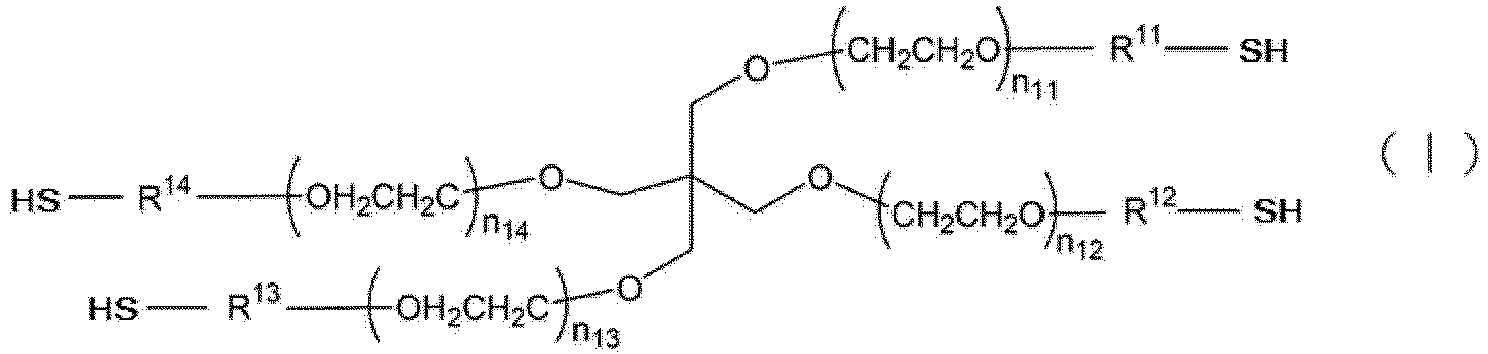
- In the formula (I), R11 to R14 are the same or different and each represent a C1-C7 alkylene group, a C2-C7 alkenylene group, -NH-R15-, -CO-R15-, -R16-O-R17-, -R16-NH-R17-, -R16-CO2-R17-, -R16-CO2-NH-R17-, -R16-CO-R17-, or -R16-CO-NH-R17- wherein R15 represents a C1-C7 alkylene group, R16 represents a C1-C3 alkylene group, and R17 represents a C1-C5 alkylene group.
- The n11 to n14 may be the same or different from each other. The closer the values of n11 to n14 are, the more homogeneous the network structure and the higher the strength. Therefore, in order to obtain a high-strength gel, they are preferably the same. If the values of n11 to n14 are too high, the gel strength is weak, and when the values of n11 to n14 are too low, the gel is difficult to form due to steric hindrance of the compound. Therefore, examples of n11 to n14 include integer values of from 25 to 250, of which 35 to 180 is preferred, 50 to 115 is even more preferred, and 50 to 60 is particularly preferred. The weight average molecular weight (Mw) thereof is from 1 x 10³ to 1 × 10⁵, preferably from 5 × 10³ to 5 x 10⁴, and more preferably from 1 × 10⁴ to 4 × 10⁴.
- In the above formula (I), R11 to R14 are linker moieties connecting the functional groups and the core portion. R11 to R14 may be the same or different, but are preferably the same in order to produce a high-strength gel having a homogeneous network structure. R11 to R14 each represent a C1-C7 alkylene group, a C2-C7 alkenylene group, -NH-R15-, -CO-R15-, -R16-O-R17-, -R16-NH-R 17-, -R16-CO2-R17-, - R16-CO2-NH-R17-, -R16-CO-R17-, or -R16-CO-NH-R17-. Wherein R15 represents a C1-C7 alkylene group. R16 represents a C1-C3 alkylene group. R17 represents a C1-C5 alkylene group.
- Here, the "C1-C7 alkylene group" means an alkylene group having 1 to 7 carbon atoms which may be branched, and means a linear C1 to C7 alkylene group or a C2-C7 alkylene group having one or more branches (the number of carbon atoms including the branch is from 2 to 7). Examples of the C1-C7 alkylene group are methylene, ethylene, propylene, and butylene groups. Examples of the C1-C7 alkylene group include -CH2-, -(CH2)2-, -(CH2)3-, -CH(CH3)-, -(CH2)3-, -(CH(CH3))2-, - (CH2)2-CH(CH3)-, -(CH2)3-CH(CH3)-, - (CH2)2-CH(C2H5)-, -(CH2)6-, -(CH2)2-C(C2H5)2-, and - (CH2)3C2CH2-.
- The "C2-C7 alkenylene group" is a linear or branched alkenylene group having 2 to 7 carbon atoms with one or more double bonds in the chain, and examples thereof include a divalent group having a double bond formed by removing 2 to 5 hydrogen atoms of adjacent carbon atoms from the above alkylene group.
- A preferred non-limiting specific example of the polymer unit having an electrophilic functional group at the end is a compound represented by the following formula (II) having four polyethylene glycol backbone branches and N-hydroxy-succinimidyl (NHS) groups at the ends.

- In the formula (II), n21 to n24 may be the same or different from each other. The closer the values of n21 to n24 are, the more homogeneous the network structure of the gel and the higher the strength, so the values are preferably closer, and more preferable the same. If the values of n21 to n24 are too high, the gel strength is weak, and when the values of n21 to n24 are too low, the gel is difficult to form due to steric hindrance of the compound. Therefore, examples of n21 to n24 include integer values of from 5 to 300, of which 20 to 250 is preferred, 30 to 180 is more preferred, 45 to 115 is still more preferred, and 45 to 55 is still more preferred. The weight average molecular weight (Mw) of the second four-branched compound of the present invention is from 1 × 10³ to 1 × 10⁵, preferably from 5 × 10³ to 5 × 10⁴, and more preferably from 1 × 10⁴ to 4 × 10⁴.
- In the above formula (II) , R21 to R24 are linker moieties connecting the functional groups and the core portion. R21 to R24 may be the same or different, but are preferably the same in order to produce a high-strength gel having a homogeneous network structure. In the formula (II), R21 to R24 are the same or different and each represent a C1-C7 alkylene group, a C2 to C7 alkenylene group, -NH-R25-, -CO-R25-, -R26-O-R27-, -R26-NH-R27-, -R26-CO2-R27-, -R26-CO2-NH-R27-, -R26-CO-R27-, or -R26-CO-NH-R27-; wherein R25 represents a C1-C7 alkylene group; R26 represents a C1-C3 alkylene group; and R27 represents a C1-C5 alkylene group.
- In the present description, the alkylene and alkenylene groups may have one or more optional substituents. Examples of the substituent include, but are not limited to, alkoxy groups, halogen atoms (which may be fluorine, chlorine, bromine, or iodine atoms), amino groups, mono- or di-substituted amino groups, substituted silyl groups, acyl groups, and aryl groups. When the alkyl group has two or more substituents, they may be the same or different. The same applies to alkyl moieties of other substituents including alkyl moieties (for example, alkyloxy and aralkyl groups).
- When a functional group is defined herein as "may have substituents", the type of the substituent, the substitution position, and the number of substituents are not particularly limited, and when it has two or more substituents, they may be the same or different. Examples of the substituent include, but are not limited to, alkyl groups, alkoxy groups, hydroxyl groups, carboxyl groups, halogen atoms, sulfo groups, amino groups, alkoxycarbonyl groups, and oxo groups. Further substituents may be present on these substituents.
- As another aspect, a low molecular weight compound may be additionally used to crosslink the hydrophilic polymers. More specifically, one of the first or second polymer unit may be replaced by a low molecular weight compound. In this case, the low molecular weight compound has one or more nucleophilic or electrophilic functional groups in the molecule. This allows crosslinking and gelation between the second polymers by, for example, replacing the first polymer with a low-molecular weight compound having a nucleophilic functional group in the molecule and reacting it with a second polymer having one or more electrophilic functional groups on the side chain or at the end. Examples of the "low-molecular compound having a nucleophilic functional group in the molecule" include compounds having a thiol group in the molecule, such as dithiothreitol.
- As described above, the gel material of the present invention includes a hydrogel (polymer gel) having a three-dimensional network structure formed by crosslinking of the hydrophilic polymers. The "gel" herein generally refers to a dispersion system of a polymer that has lost fluidity due to high viscosity, and satisfies G' ≥ G", wherein G' is storage modulus, and G" is loss modulus. The "hydrogel" is a gel containing water.
- The hydrogel contained in the gel material of the present invention has a polymer content of from 1 to 5% by weight, preferably from 2 to 4% by weight. The hydrogel has an elastic modulus of from 100 to 10000 Pa, preferably from 500 to 5000 Pa. By setting the polymer content and the elastic modulus within appropriate ranges, it is possible to suppress undesirable effects such as excessive expansion of the gel when the area around the tendon or ligament is coated with the hydrogel, and also to make the gel have appropriate strength to remain in the affected area for a certain period of time.
- The hydrogel contained in the gel material of the present invention preferably has an osmotic pressure of from 500 to 10000 Pa. In general, the osmotic pressure (Πos) can be calculated by reverse osmosis of a sample prepared in a dialysis machine with polyvinyl pyrrolidone (PVP) solutions having different concentrations, and using the Flory-Rehner equilibrium equation shown below.

- Here, Πsw and Πel represent the swelling pressure and elastic pressure of the target sample, respectively, and ΠPVP represents the osmotic pressure of the PVP solution.
- In another aspect, the present invention also relates to a method for treating an injured or ruptured tendon or ligament using the gel material. More specifically, it is a method to promote the healing of a tendon or ligament that needs to be treated due to injury or rupture by coating the affected area with the above gel material. Such coating of the affected area is typically performed after suture of a tendon or ligament.
- By coating the tendon or ligament after suture with the gel material, entry of inflammatory cells and fibroblasts from around the affected area can be suppressed, and entry of scar tissue can be suppressed or eliminated. Surprisingly, the present invention has revealed that healing of a tendon or ligament proceeds efficiently even when scar tissue, which has been considered inevitable in the healing process of tendons and ligaments, is suppressed or eliminated.
- The tendon or ligament to be treated herein is a tendon or ligament of a mammal selected from the group consisting of human, horse, pig, dog, cat, guinea pig, rabbit, rat, and mouse. It is typically a tendon or ligament in the human body.
- As used herein, "injury or rupture" of a tendon or ligament may include traumatic injury or rupture (for example, by sports injuries, overuse, or medical or surgical intervention), injury due to genetic origin or disease, and disease. A "rupture" also includes a partial rupture.
- As used herein, the "tendon" includes Achilles tendon, shoulder rotator cuff, hand and wrist tendons, patellar tendon, flexor tendon, and extensor tendon. Tendon "injuries" can include tendinosis, tendinitis, synovitis, tenosynovitis, and other injuries and tendon-related diseases such as avulsion.
- As used herein, the "ligament" includes ligaments in the knee joint, shoulder, elbow, ankle joint, and spine. Examples of knee ligament "injuries" include lateral collateral ligament injuries, medial collateral ligament injuries, anterior cruciate ligament injuries, and posterior cruciate ligament injuries.
- Although not necessarily bound by theory, as shown in the examples below, when the tendon or ligament is coated with the above gel material, the expression of type III collagen, which is characteristic of scar tissue, is significantly suppressed and the expression of type I collagen by the intratendinous cells is maintained, suggesting that the tendon or ligament is repaired by endogenous healing by the expression of the type I collagen. Such a healing process has not been elucidated previously, and is a mechanism that has been revealed for the first time by the present invention. Since about 95% of the collagen constituting the tendons is composed of type I collagen, this healing process is rational and ideal. This can be said to be the first effect achieved in the present invention in that healing occurs while the original function of the tendon or ligament is maintained.
- Therefore, the method of the present invention can also be said to be a method for suppressing the expression of type III collagen in a tendon or ligament, including coating the area around the tendon or ligament after suture with the gel material. Alternatively, it can also be expressed that coating the area around the tendon or ligament after suture with the gel material can suppress the expression of type III collagen and maintain the expression of type I collagen.
- As a typical aspect, the method for treating an injured or ruptured tendon or ligament of the present invention includes the steps of:
- a) preparing a polymer solution A containing a first hydrophilic polymer having one or more nucleophilic functional groups on the side chain or at the end, and a polymer solution B containing a second hydrophilic polymer having one or more electrophilic functional groups on the side chain or at the end;
- b) applying the polymer solutions A and B to the area around the tendon or ligament after suture to form a polymer gel having a three-dimensional network structure formed by crosslinking of the hydrophilic polymers, thereby coating the area around the tendon or ligament; and
- c) suppressing the expression of type III collagen in the tendon or ligament by the coating.
- The type and the like of the hydrophilic polymers used in the steps a) and b) are as described above for the gel material of the present invention.
- The solvent in the polymer solutions A and B is water, but in some cases, it may be a mixed solvent containing alcohols such as ethanol and other organic solvents. The polymer solutions A and B are preferably aqueous solutions with water as a sole solvent. The volumes of the polymer solutions A and B can be appropriately adjusted according to the area and complexity of the structure of the affected area to which they are applied, but are typically from 0.1 to 20 ml each, and preferably from 1 to 10 ml.
- The pH of the polymer solutions A and B is typically from 4 to 8, and preferably from 5 to 7. The pH of polymer solutions A and B may be adjusted using pH buffers known in the art. For example, the pH can be adjusted to the above range by using a citric acid-phosphate buffer (CPB) and changing the mixing ratio of citric acid and disodium hydrogen phosphate.
- In step b), the polymer solutions A and B may be applied independently to the area around the tendon or ligament, or a mixed solution of the polymer solutions A and B may be prepared immediately before application and then applied to the area around the tendon or ligament. This allows in-situ formation of the polymer gel (hydrogel).
- The gelation time at that time is preferably from 10 to 300 seconds, and more preferably from 30 to 100 seconds. Again, the gelation time can be adjusted mainly by appropriately setting the polymer concentration, pH, and ionic strength in the polymer solution. Here, the "gelation time" is the time required for the storage modulus G' and the loss modulus G becomes G' = G".
- The polymer gel formed around the tendon or ligament in step b) preferably remain around the affected area for the period necessary for the tendon or ligament to repair and regenerate. For example, the polymer gel has a decomposition rate of preferably from 10 to 90 days, more preferably from 20 to 50 days in vivo.
- An example of a means for mixing the polymer solutions A and B is a two-component syringe as disclosed in
International Publication WO2007/083522 . The temperature of the two liquids at the time of mixing is not particularly limited, and may be any temperature at which the precursor units are each dissolved and the respective liquids are fluid. For example, the two liquids may be at different temperatures, but the same temperature is preferred for easier mixing. - Step c) is a step of coating the area around the tendon or ligament with a polymer gel to suppress the expression of type III collagen in the tendon or ligament. This is mainly based on the fact that the polymer gel coating around the tendon or ligament suppresses the entry of inflammatory cells and fibroblasts from around the area and suppresses or eliminates the entry of scar tissue in which type III collagen is rich. Although not necessarily bound by theory, it is believed that the treatment method of the present invention can suppress the expression of exogenous type III collagen based on the above scar tissue entry, while maintaining the expression of type I collagen by intratendinous cells, thereby causing endogenous healing.
- In another aspect, the present invention also relates to a kit for preparing the gel material (polymer gel), which includes two or more solutions containing hydrophilic polymers. The kit is suitable for use in the above-described treatment method. The type of the hydrophilic polymers contained in the solutions are as described above, and those that can form hydrogels by crosslinking may be used. The solutions are preferably a polymer solution A containing a first hydrophilic polymer having one or more nucleophilic functional groups on the side chain or at the end and a polymer solution B containing a second hydrophilic polymer having one or more electrophilic functional groups on the side chain or at the end. Typically, the first and second hydrophilic polymers are polymers having a polyether or polyvinyl backbone, preferably bi-, tri- or tetra-branched polyethylene glycols.
- The kit is suitable for use in the above-described treatment method. In that case, the kit may further include a medical instrument for covering the area around the tendon or ligament coated by the gel material. The medical instrument is suitable for stably fixing a tendon or ligament after suture, and is, for example, an instrument that can form a hollow cylindrical shape. However, an instrument having an appropriate shape may be used according to the position of the affected area, postoperative conditions, and the like.
- The present invention will be described in more detail with reference to the following working examples, but these examples do not limit the present invention.
- Tetrathiol-polyethylene glycol (Tetra-PEG-SH) having a -SH group at the end and tetramaleimidyl-polyethylene glycol (Tetra-PEG-MA) having a maleimidyl group at the end were used as the raw material polymers. These raw material polymers were each commercially available from NOF Corporation. Both have a molecular weight (molar mass) of 20,000. As a buffer for the polymer solution, sodium citrate buffer (pH 5.10; manufactured by FUJIFILM Wako Pure Chemical Corporation) was used.
- The solution conditions used are as follows.
- [Polymer solution A]
- Concentration: 2.5% by weight, Tetra-PEG-SH
- pH: 5.10
- [Polymer solution B]
- Concentration: 2.5% by weight, Tetra-PEG-MA
- pH: 5.10
- A rat model with a ruptured flexor tendon was created, and 25 µl of the polymer solution A and 25 µl of the polymer solution B were injected around the tendon after tendon suture, and gelation was confirmed after 90 seconds. The coating of the sutured affected tendon with the gel was found to block the entry of inflammatory cells and fibroblasts from the surrounding area without any problem. On the other hand, when not coated with the gel, the tendon was strongly covered with the scar tissue.
Fig. 1 shows the images of the repair tendon coated with the gel of the present invention (gel group) and those not coated with the gel (control group). - The repaired tendon coated with the gel of the present invention (gel group) and those not coated with the gel (control group) were evaluated histologically; on
postoperative day 21, the gel group showed strong cell proliferation along the long axis of the tendon in tissues within the tendon such as epitenon and paratenon, whereas the control group showed a strong presence of disordered abnormal proliferation of fibroblasts and neovascularization around the tendon (Fig. 2 ). This suggested that in the gel group, precursor cells present in the tendon were mainly involved in the healing process. - Furthermore, a comparative analysis of the expressed genes in the healing process of both groups was performed using tendon tissue from organ culture; in the control group, Col3a1 (type III collagen), which is characteristic of scar tissue, was strongly expressed early postoperatively, whereas in the gel group, Col3a1 was expressed only in small amounts and Col1a1 (type 1 collagen) was strongly expressed from 2 to 3 weeks after surgery. From the above, it was found that in the control group, healing of scar tissue occurs early in the healing process with type III collagen as the main component, whereas in the gel group, healing with type III collagen by intratendinous cells occurs.
Claims (16)
- A gel material comprising a polymer gel for suppressing expression of type III collagen in a treatment of an injured or ruptured tendon or ligament,wherein the polymer gel is a hydrogel having a three-dimensional network structure formed by crosslinking of hydrophilic polymers, andwherein the polymer gel has a polymer content of from 1 to 5% by weight and an elastic modulus of from 100 to 10000 Pa.
- The gel material according to claim 1, wherein the hydrophilic polymer has a polyether or polyvinyl backbone.
- The gel material according to claim 1 or 2, wherein the hydrophilic polymer is bi-, tri- or tetra-branched polyethylene glycol.
- The gel material according to any one of claims 1 to 3, wherein the hydrophilic polymer comprises a first polymer unit having one or more nucleophilic functional groups on a side chain or at an end and a second polymer unit having one or more electrophilic functional groups on a side chain or at an end.
- The gel material according to claim 4, wherein the nucleophilic functional group is selected from the group consisting of a thiol group and an amino group, and the electrophilic functional group is selected from the group consisting of a maleimidyl group, an N-hydroxy-succinimidyl (NHS) group, a sulfosuccinimidyl group, a phthalimidyl group, an imidazoyl group, an acryloyl group, a nitrophenyl group, an isothiocyanate group, an aldehyde group, an iodoacetamide group, a vinyl sulfone group, and -CO2PhNO2.
- The gel material according to any one of claims 1 to 5, which is used for coating a tendon or ligament after suture of the tendon or ligament.
- The gel material according to claim 6, which is able to suppress expression of type III collagen and maintain expression of type I collagen by coating the tendon or ligament.
- A kit for preparing the gel material according to any one of claims 1 to 7, which comprises two or more solutions each containing a hydrophilic polymer.
- A method for treating an injured or ruptured tendon or ligament, comprising coating an area around the tendon or ligament after suture with the gel material according to any one of claims 1 to 7.
- A method for suppressing expression of type III collagen in a tendon or ligament, comprising coating an area around the tendon or ligament after suture with the gel material according to any one of claims 1 to 7.
- A method for treating an injured or ruptured tendon or ligament, comprising steps of:preparing a polymer solution A containing a first hydrophilic polymer having one or more nucleophilic functional groups on a side chain or at an end, and a polymer solution B containing a second hydrophilic polymer having one or more electrophilic functional groups on a side chain or at an end;applying the polymer solutions A and B to an area around the tendon or ligament after suture to form a polymer gel having a three-dimensional network structure formed by crosslinking of hydrophilic polymers, thereby coating the area around the tendon or ligament; andsuppressing expression of type III collagen in the tendon or ligament by the coating.
- The treatment method according to claim 11, wherein the polymer gel has a polymer content of from 1 to 5% by weight and an elastic modulus of from 100 to 10000 Pa.
- The treatment method according to claim 11 or 12, wherein the first and second hydrophilic polymers have a polyether or polyvinyl backbone.
- The treatment method according to any one of claims 11 to 13, wherein the first and second hydrophilic polymers are bi-, tri- or tetra-branched polyethylene glycols.
- The treatment method according to any one of claims 11 to 14, wherein the nucleophilic functional group is selected from the group consisting of a thiol group and an amino group, and the electrophilic functional group is selected from the group consisting of a maleimidyl group, an N-hydroxy-succinimidyl (NHS) group, a sulfosuccinimidyl group, a phthalimidyl group, an imidazoyl group, an acryloyl group, a nitrophenyl group, an isothiocyanate group, an aldehyde group, an iodoacetamide group, a vinyl sulfone group, and -CO2PhNO2.
- A method for screening an agent effective for treatment of an injured or ruptured tendon or ligament, comprising a step of searching for and identifying a compound having activity to proliferate type I collagen in a tendon or ligament coated with the gel material according to any one of claims 1 to 7.
Applications Claiming Priority (2)
| Application Number | Priority Date | Filing Date | Title |
|---|---|---|---|
| JP2020125055A JP7619544B2 (en) | 2020-07-22 | 2020-07-22 | Gel material for treating tendons or ligaments |
| PCT/JP2021/026352 WO2022019182A1 (en) | 2020-07-22 | 2021-07-13 | Gel material for treating tendon or ligament |
Publications (4)
| Publication Number | Publication Date |
|---|---|
| EP4186535A1 true EP4186535A1 (en) | 2023-05-31 |
| EP4186535A4 EP4186535A4 (en) | 2024-07-31 |
| EP4186535B1 EP4186535B1 (en) | 2026-05-27 |
| EP4186535C0 EP4186535C0 (en) | 2026-05-27 |
Family
ID=79728661
Family Applications (1)
| Application Number | Title | Priority Date | Filing Date |
|---|---|---|---|
| EP21846289.3A Active EP4186535B1 (en) | 2020-07-22 | 2021-07-13 | Gel material for treating tendon or ligament |
Country Status (8)
| Country | Link |
|---|---|
| US (1) | US20230330304A1 (en) |
| EP (1) | EP4186535B1 (en) |
| JP (1) | JP7619544B2 (en) |
| KR (1) | KR20230037504A (en) |
| CN (1) | CN116157083A (en) |
| AU (1) | AU2021311181A1 (en) |
| CA (1) | CA3189744A1 (en) |
| WO (1) | WO2022019182A1 (en) |
Families Citing this family (3)
| Publication number | Priority date | Publication date | Assignee | Title |
|---|---|---|---|---|
| JPWO2023145765A1 (en) * | 2022-01-31 | 2023-08-03 | ||
| JPWO2024048458A1 (en) * | 2022-09-01 | 2024-03-07 | ||
| JP2025076959A (en) * | 2023-11-02 | 2025-05-16 | 国立大学法人 東京大学 | Method for producing hydrogel having a porous structure |
Family Cites Families (11)
| Publication number | Priority date | Publication date | Assignee | Title |
|---|---|---|---|---|
| WO2000059516A1 (en) * | 1999-04-02 | 2000-10-12 | Fziomed, Inc. | Compositions of polyacids and polyethers and methods for their use in reducing adhesions |
| CA2571656A1 (en) * | 2004-06-23 | 2006-01-05 | Angiotech Biomaterials Corporation | Methods and crosslinked polymer compositions for cartilage repair |
| CA2637635A1 (en) | 2006-01-18 | 2007-07-26 | Next21 K.K. | Gel-forming composition for medical use, administration device for the composition, and drug release controlling carrier |
| WO2010070775A1 (en) | 2008-12-19 | 2010-06-24 | 株式会社ネクスト21 | Ultra-high strength injectable hydrogel and process for producing the same |
| CN104136602B (en) * | 2011-06-23 | 2017-06-09 | 成功大学 | Cell tissue adhesive |
| US9649190B2 (en) * | 2012-03-22 | 2017-05-16 | Trb Chemedica International S.A. | Method for repair of ligament or tendon |
| CN104307052B (en) * | 2014-10-27 | 2017-02-22 | 爱美客技术发展股份有限公司 | Medicinal injectable anti-adhesive gel and preparation method thereof |
| JP6712081B2 (en) * | 2015-03-10 | 2020-06-17 | 国立大学法人 東京大学 | Method for producing low-concentration gel using gel precursor cluster, and gel obtained by the method |
| JP6692021B2 (en) * | 2016-01-06 | 2020-05-13 | 国立大学法人 東京大学 | Gel material for ophthalmic treatment |
| ES2883839T3 (en) * | 2016-10-13 | 2021-12-09 | Allergan Inc | Coacervated Hyaluronan Hydrogels for Dermal Filler Applications |
| JP7272672B2 (en) | 2018-07-31 | 2023-05-12 | 国立大学法人 東京大学 | Polymer gel with sponge-like porous structure |
-
2020
- 2020-07-22 JP JP2020125055A patent/JP7619544B2/en active Active
-
2021
- 2021-07-13 AU AU2021311181A patent/AU2021311181A1/en active Pending
- 2021-07-13 EP EP21846289.3A patent/EP4186535B1/en active Active
- 2021-07-13 US US18/005,919 patent/US20230330304A1/en active Pending
- 2021-07-13 KR KR1020227045295A patent/KR20230037504A/en active Pending
- 2021-07-13 CA CA3189744A patent/CA3189744A1/en active Pending
- 2021-07-13 CN CN202180060328.0A patent/CN116157083A/en active Pending
- 2021-07-13 WO PCT/JP2021/026352 patent/WO2022019182A1/en not_active Ceased
Also Published As
| Publication number | Publication date |
|---|---|
| EP4186535B1 (en) | 2026-05-27 |
| WO2022019182A1 (en) | 2022-01-27 |
| CN116157083A (en) | 2023-05-23 |
| US20230330304A1 (en) | 2023-10-19 |
| AU2021311181A1 (en) | 2023-02-23 |
| JP2022021475A (en) | 2022-02-03 |
| KR20230037504A (en) | 2023-03-16 |
| CA3189744A1 (en) | 2022-01-27 |
| EP4186535C0 (en) | 2026-05-27 |
| JP7619544B2 (en) | 2025-01-22 |
| EP4186535A4 (en) | 2024-07-31 |
Similar Documents
| Publication | Publication Date | Title |
|---|---|---|
| Pan et al. | Silk fibroin hydrogel adhesive enables sealed-tight reconstruction of meniscus tears | |
| Feng et al. | Sulfated hyaluronic acid hydrogels with retarded degradation and enhanced growth factor retention promote hMSC chondrogenesis and articular cartilage integrity with reduced hypertrophy | |
| AU2019361962B2 (en) | Bioadhesive for soft tissue repair | |
| ES2708076T3 (en) | Synthetic peptidoglycans that bind to hyaluronic acid, preparation and methods of use | |
| US20230330304A1 (en) | Gel material for treating tendon or ligament | |
| US11406737B2 (en) | Gelatin/elastin composites for peripheral nerve repair | |
| JP2007508060A (en) | Tissue-biomaterial integration | |
| JP2004531534A (en) | Drug delivery matrix to promote wound healing | |
| CN115515658B (en) | Hemostatic polymer material kit | |
| Mohindra et al. | Local decorin delivery via hyaluronic acid microrods improves cardiac performance, ventricular remodeling after myocardial infarction | |
| JP2026041852A (en) | Uses of jellyfish collagen | |
| EP4190316A1 (en) | Biomimetic tissue-adhesive hydrogel patch for preventing or treating cartilage or bone diseases | |
| US10723783B2 (en) | Polypeptide compositions and methods of using the same | |
| Li et al. | Enhancing BMSC chondrogenesis with a dynamic viscoelastic hyaluronan hydrogel loaded with kartogenin for cartilage repair | |
| Li et al. | Peptide-conjugated alginate fiber: a skeletal muscle regenerative scaffold | |
| Qiu et al. | A fluorescent hyaluronic acid-gelatin hydrogel for traceable articular cartilage regeneration | |
| Wu et al. | Hyaluronan-based rapid-gelling hemostatic powder to bridge dynamic wound sealing and tissue regeneration | |
| Yang et al. | Adhesive ginsenoside compound K patches for cartilage tissue regeneration | |
| March et al. | Optimizing Tissue‐Engineered Periosteum Biochemical Cues to Hasten Bone Allograft Healing | |
| Sorushanova et al. | Tissue origin matters: Maintenance of tenogenic phenotype on the tendon and not skin collagen‐derived devices | |
| US20180282495A1 (en) | Narrowly Distributed Multi-Armed Polyethylene Glycol Compounds, Hydrogels, and Methods | |
| US20250250397A1 (en) | Anisotropic poly(ethylene glycol)-based hydrogels synthesized via two-stage polymerization and mechanical alignment | |
| US20260007808A1 (en) | Silk fibroin gel for adhesion prevention material, method for producing same, adhesion prevention material, and adhesion-preventing method | |
| Hou et al. | Customizable topological neuro-mimetic hydrogels based on mechanical training for functional recovery following peripheral nerve injury | |
| Wang et al. | Friction-adaptive hydrogel coating for mechanical-immune synergy in ligament-to-bone integration |
Legal Events
| Date | Code | Title | Description |
|---|---|---|---|
| STAA | Information on the status of an ep patent application or granted ep patent |
Free format text: STATUS: THE INTERNATIONAL PUBLICATION HAS BEEN MADE |
|
| PUAI | Public reference made under article 153(3) epc to a published international application that has entered the european phase |
Free format text: ORIGINAL CODE: 0009012 |
|
| STAA | Information on the status of an ep patent application or granted ep patent |
Free format text: STATUS: REQUEST FOR EXAMINATION WAS MADE |
|
| 17P | Request for examination filed |
Effective date: 20230127 |
|
| AK | Designated contracting states |
Kind code of ref document: A1 Designated state(s): AL AT BE BG CH CY CZ DE DK EE ES FI FR GB GR HR HU IE IS IT LI LT LU LV MC MK MT NL NO PL PT RO RS SE SI SK SM TR |
|
| DAV | Request for validation of the european patent (deleted) | ||
| DAX | Request for extension of the european patent (deleted) | ||
| A4 | Supplementary search report drawn up and despatched |
Effective date: 20240701 |
|
| RIC1 | Information provided on ipc code assigned before grant |
Ipc: A61F 2/30 20060101ALI20240625BHEP Ipc: A61B 17/56 20060101ALI20240625BHEP Ipc: A61L 27/50 20060101ALI20240625BHEP Ipc: A61L 27/52 20060101ALI20240625BHEP Ipc: A61L 27/18 20060101AFI20240625BHEP |
|
| REG | Reference to a national code |
Ref country code: DE Ref legal event code: R079 Free format text: PREVIOUS MAIN CLASS: A61L0027180000 Ipc: A61L0027260000 Ref document number: 602021055015 Country of ref document: DE |
|
| GRAP | Despatch of communication of intention to grant a patent |
Free format text: ORIGINAL CODE: EPIDOSNIGR1 |
|
| STAA | Information on the status of an ep patent application or granted ep patent |
Free format text: STATUS: GRANT OF PATENT IS INTENDED |
|
| RIC1 | Information provided on ipc code assigned before grant |
Ipc: A61L 27/26 20060101AFI20251208BHEP Ipc: A61L 27/52 20060101ALI20251208BHEP Ipc: A61L 27/50 20060101ALI20251208BHEP Ipc: A61B 17/56 20060101ALI20251208BHEP Ipc: A61F 2/30 20060101ALI20251208BHEP |
|
| INTG | Intention to grant announced |
Effective date: 20251219 |
|
| RIN1 | Information on inventor provided before grant (corrected) |
Inventor name: SAKAI, TAKAMASA Inventor name: SAITO, TAKU Inventor name: IWANAGA, YASUHIDE Inventor name: TANAKA, SAKAE Inventor name: MASUI, KOSUKE Inventor name: NARITA, SHINICHI |
|
| GRAS | Grant fee paid |
Free format text: ORIGINAL CODE: EPIDOSNIGR3 |
|
| GRAA | (expected) grant |
Free format text: ORIGINAL CODE: 0009210 |
|
| STAA | Information on the status of an ep patent application or granted ep patent |
Free format text: STATUS: THE PATENT HAS BEEN GRANTED |
|
| AK | Designated contracting states |
Kind code of ref document: B1 Designated state(s): AL AT BE BG CH CY CZ DE DK EE ES FI FR GB GR HR HU IE IS IT LI LT LU LV MC MK MT NL NO PL PT RO RS SE SI SK SM TR |
|
| REG | Reference to a national code |
Ref country code: CH Ref legal event code: F10 Free format text: ST27 STATUS EVENT CODE: U-0-0-F10-F00 (AS PROVIDED BY THE NATIONAL OFFICE) Effective date: 20260527 Ref country code: GB Ref legal event code: FG4D |
|
| REG | Reference to a national code |
Ref country code: DE Ref legal event code: R096 Ref document number: 602021055015 Country of ref document: DE |
|
| PGFP | Annual fee paid to national office [announced via postgrant information from national office to epo] |
Ref country code: GB Payment date: 20260616 Year of fee payment: 6 |
|
| U01 | Request for unitary effect filed |
Effective date: 20260625 |