EP4184442B1 - Artificial intelligence system and method for modifying image on basis of relationship between objects - Google Patents
Artificial intelligence system and method for modifying image on basis of relationship between objects Download PDFInfo
- Publication number
- EP4184442B1 EP4184442B1 EP21858552.9A EP21858552A EP4184442B1 EP 4184442 B1 EP4184442 B1 EP 4184442B1 EP 21858552 A EP21858552 A EP 21858552A EP 4184442 B1 EP4184442 B1 EP 4184442B1
- Authority
- EP
- European Patent Office
- Prior art keywords
- image
- objects
- relationship graph
- original image
- modification
- Prior art date
- Legal status (The legal status is an assumption and is not a legal conclusion. Google has not performed a legal analysis and makes no representation as to the accuracy of the status listed.)
- Active
Links
Images


Classifications
-
- G—PHYSICS
- G06—COMPUTING OR CALCULATING; COUNTING
- G06V—IMAGE OR VIDEO RECOGNITION OR UNDERSTANDING
- G06V10/00—Arrangements for image or video recognition or understanding
- G06V10/70—Arrangements for image or video recognition or understanding using pattern recognition or machine learning
- G06V10/82—Arrangements for image or video recognition or understanding using pattern recognition or machine learning using neural networks
-
- G—PHYSICS
- G06—COMPUTING OR CALCULATING; COUNTING
- G06T—IMAGE DATA PROCESSING OR GENERATION, IN GENERAL
- G06T11/00—Two-dimensional [2D] image generation
- G06T11/60—Creating or editing images; Combining images with text
-
- G—PHYSICS
- G06—COMPUTING OR CALCULATING; COUNTING
- G06F—ELECTRIC DIGITAL DATA PROCESSING
- G06F3/00—Input arrangements for transferring data to be processed into a form capable of being handled by the computer; Output arrangements for transferring data from processing unit to output unit, e.g. interface arrangements
- G06F3/01—Input arrangements or combined input and output arrangements for interaction between user and computer
- G06F3/048—Interaction techniques based on graphical user interfaces [GUI]
- G06F3/0484—Interaction techniques based on graphical user interfaces [GUI] for the control of specific functions or operations, e.g. selecting or manipulating an object, an image or a displayed text element, setting a parameter value or selecting a range
-
- G—PHYSICS
- G06—COMPUTING OR CALCULATING; COUNTING
- G06N—COMPUTING ARRANGEMENTS BASED ON SPECIFIC COMPUTATIONAL MODELS
- G06N3/00—Computing arrangements based on biological models
- G06N3/02—Neural networks
- G06N3/04—Architecture, e.g. interconnection topology
-
- G—PHYSICS
- G06—COMPUTING OR CALCULATING; COUNTING
- G06N—COMPUTING ARRANGEMENTS BASED ON SPECIFIC COMPUTATIONAL MODELS
- G06N3/00—Computing arrangements based on biological models
- G06N3/02—Neural networks
- G06N3/04—Architecture, e.g. interconnection topology
- G06N3/045—Combinations of networks
-
- G—PHYSICS
- G06—COMPUTING OR CALCULATING; COUNTING
- G06N—COMPUTING ARRANGEMENTS BASED ON SPECIFIC COMPUTATIONAL MODELS
- G06N3/00—Computing arrangements based on biological models
- G06N3/02—Neural networks
- G06N3/04—Architecture, e.g. interconnection topology
- G06N3/0475—Generative networks
-
- G—PHYSICS
- G06—COMPUTING OR CALCULATING; COUNTING
- G06N—COMPUTING ARRANGEMENTS BASED ON SPECIFIC COMPUTATIONAL MODELS
- G06N3/00—Computing arrangements based on biological models
- G06N3/02—Neural networks
- G06N3/08—Learning methods
-
- G—PHYSICS
- G06—COMPUTING OR CALCULATING; COUNTING
- G06N—COMPUTING ARRANGEMENTS BASED ON SPECIFIC COMPUTATIONAL MODELS
- G06N3/00—Computing arrangements based on biological models
- G06N3/02—Neural networks
- G06N3/08—Learning methods
- G06N3/09—Supervised learning
-
- G—PHYSICS
- G06—COMPUTING OR CALCULATING; COUNTING
- G06N—COMPUTING ARRANGEMENTS BASED ON SPECIFIC COMPUTATIONAL MODELS
- G06N3/00—Computing arrangements based on biological models
- G06N3/02—Neural networks
- G06N3/08—Learning methods
- G06N3/094—Adversarial learning
-
- G—PHYSICS
- G06—COMPUTING OR CALCULATING; COUNTING
- G06N—COMPUTING ARRANGEMENTS BASED ON SPECIFIC COMPUTATIONAL MODELS
- G06N5/00—Computing arrangements using knowledge-based models
- G06N5/02—Knowledge representation; Symbolic representation
- G06N5/022—Knowledge engineering; Knowledge acquisition
-
- G—PHYSICS
- G06—COMPUTING OR CALCULATING; COUNTING
- G06T—IMAGE DATA PROCESSING OR GENERATION, IN GENERAL
- G06T11/00—Two-dimensional [2D] image generation
- G06T11/20—Drawing from basic elements
- G06T11/26—Drawing of charts or graphs
-
- G—PHYSICS
- G06—COMPUTING OR CALCULATING; COUNTING
- G06T—IMAGE DATA PROCESSING OR GENERATION, IN GENERAL
- G06T7/00—Image analysis
- G06T7/10—Segmentation; Edge detection
- G06T7/13—Edge detection
-
- G—PHYSICS
- G06—COMPUTING OR CALCULATING; COUNTING
- G06V—IMAGE OR VIDEO RECOGNITION OR UNDERSTANDING
- G06V10/00—Arrangements for image or video recognition or understanding
- G06V10/70—Arrangements for image or video recognition or understanding using pattern recognition or machine learning
- G06V10/77—Processing image or video features in feature spaces; using data integration or data reduction, e.g. principal component analysis [PCA] or independent component analysis [ICA] or self-organising maps [SOM]; Blind source separation
- G06V10/778—Active pattern-learning, e.g. online learning of image or video features
- G06V10/7784—Active pattern-learning, e.g. online learning of image or video features based on feedback from supervisors
- G06V10/7788—Active pattern-learning, e.g. online learning of image or video features based on feedback from supervisors the supervisor being a human, e.g. interactive learning with a human teacher
-
- G—PHYSICS
- G06—COMPUTING OR CALCULATING; COUNTING
- G06V—IMAGE OR VIDEO RECOGNITION OR UNDERSTANDING
- G06V10/00—Arrangements for image or video recognition or understanding
- G06V10/70—Arrangements for image or video recognition or understanding using pattern recognition or machine learning
- G06V10/84—Arrangements for image or video recognition or understanding using pattern recognition or machine learning using probabilistic graphical models from image or video features, e.g. Markov models or Bayesian networks
-
- G—PHYSICS
- G06—COMPUTING OR CALCULATING; COUNTING
- G06T—IMAGE DATA PROCESSING OR GENERATION, IN GENERAL
- G06T2207/00—Indexing scheme for image analysis or image enhancement
- G06T2207/20—Special algorithmic details
- G06T2207/20081—Training; Learning
-
- G—PHYSICS
- G06—COMPUTING OR CALCULATING; COUNTING
- G06T—IMAGE DATA PROCESSING OR GENERATION, IN GENERAL
- G06T2207/00—Indexing scheme for image analysis or image enhancement
- G06T2207/20—Special algorithmic details
- G06T2207/20084—Artificial neural networks [ANN]
Definitions
- the present disclosure relates to an artificial intelligence system and method for modifying an image on the basis of a relationship between objects.
- an artificial intelligence (Al) system is a system in which a machine learns, judges, and becomes smarter by itself.
- Artificial intelligence technology consists of machine learning (deep learning) and element technologies using machine learning.
- Machine learning is an algorithm technology that classifies/learns features of input data by itself
- element technology is a technology that uses machine learning algorithms such as deep learning, and consists of technical fields such as language understanding, visual understanding, reasoning/prediction, knowledge expression, motion control.
- publication CN 111 475 668 A relates to methods for identifying and describing relationships between objects in an image.
- the processor may be further configured to display the modified image, receive a user input for the modified image, and update the image modification GNN model based on the user input.
- the at least one processor may be further configured to display objects and at least one relationship, which correspond to an image effect applied to the modified image, receive a selection input by a user, with respect to the displayed objects and the displayed at least one relationship, generate a final modified image, in which an image effect corresponding to the objects and the at least one relationship, for which the selection input is received, is applied, and update the image modification GNN model based on the selection input by the user.
- an image modification model training system including a processor, and a memory storing instructions, wherein the processor is configured to, by executing the instructions, receive an original image and a modified image which is the original image to which an image effect is applied, recognize a plurality of objects in the original image to generate object information representing the plurality of objects, generate an object relationship graph indicating relationships between the plurality of objects, based on the original image and the object information, generate, based on the original image, the object information, and the modified image, image effect data including image effects respectively applied to the plurality of objects in the modified image, and train, based on the object relationship graph and the image effect data, an image modification graph neural network (GNN) model including the object relationship graph as an input and the image effect data as an output, corresponding to the appended claims.
- GNN image modification graph neural network
- the object relationship graph may include each of the plurality of objects as a node, and each of the relationships between the plurality of objects as an edge.
- the object information may include respective features of the plurality of objects, and the object relationship graph may include each of the features of the plurality of objects as a node feature.
- each edge of the object relationship graph may have a weight according to a type of a relevant relationship.
- an edge which has a plurality of corresponding relationships among the edges may have, as a weight, an average of weights according to the plurality of relationships.
- the processor may be further configured to generate the object relationship graph based on metadata of the original image.
- an operating method of an image modification model training system including receiving an original image and a modified image which is the original image to which an image effect is applied, recognizing a plurality of objects in the original image to generate object information representing the plurality of objects, generating an object relationship graph indicating relationships between the plurality of objects, based on the original image and the object information, generating, based on the original image, the object information, and the modified image, image effect data including image effects respectively applied to the plurality of objects in the modified image, and training, based on the object relationship graph and the image effect data, an image modification graph neural network (GNN) model including the object relationship graph as an input and the image effect data as an output, corresponding to the appended claims.
- GNN image modification graph neural network
- a program product stored in a computer-readable recording medium to execute the method according to an embodiment of the present disclosure on a computer is included.
- a computer-readable recording medium having recorded thereon a program for executing the method according to an embodiment of the present disclosure on a computer is included.
- an artificial intelligence system and method for modifying an image on the basis of a relationship between objects are provided, so that a modified image, in which an image effect suitable for an original image is applied, may be generated.
- FIG. 1 is a schematic view illustrating a structure of an image modification system based on a relationship between objects, according to an embodiment of the present disclosure.
- an image modification system 100 may include a processor 110 and a memory 120 storing one or more instructions that are executable by the processor 110.
- An operation of the image modification system 100, performed by the processor 110 executing one or more instructions stored in the memory 120, is described below in detail with reference to FIGS. 3 to 13 .
- FIG. 3 is a schematic flowchart of a flow of an operating method of an image modification system, according to an embodiment of the present disclosure
- FIG. 4 is a diagram illustrating a data flow during operation of the image modification system, according to an embodiment of the present disclosure.
- the processor 110 of the image modification system 100 may receive an original image in operation S310, and recognize a plurality of objects in the original image and generate object information representing the recognized plurality of objects in operation S320.
- the objects may include a person, an animal, a thing, a background, etc. included in an original image. For example, like a person and a hand, a hand and a finger, a car and a wheel, one object may be included in another object.
- the processor 110 may recognize not only objects in an original image, but also features of the objects. That is, object information may include features of each of a plurality of objects.
- the features of an object may include a location of the object in an image, a size of the object, a color of the object, a type (category) of the object, a behavior of a person/animal, a type of a place, a region, and the like.
- the features of objects may be different for each type of object.
- the features of a person may include a person's gender, age, behavior, etc.
- the features of a dog may include a breed, size (large dog, medium-sized dog, small dog, etc.), hair color, behavior, etc.
- FIG. 10 is a diagram illustrating a node feature matrix of an object relationship graph according to an embodiment of the present disclosure.
- node features of the object relationship graph shown in FIG. 7 are represented by a node feature matrix. That is, the object relationship graph shown in FIG. 7 may be represented by the adjacent matrix shown in FIG. 8 and the node feature matrix shown in FIG. 10 .
- the processor 110 may generate an object relationship graph based on metadata about an original image.
- the metadata may include, for example, location information and date information of an image, and information about an application used. Metadata may include information automatically generated when a picture is taken, such as EXIF information.
- the processor 110 may determine a node or an edge based on the metadata. For example, the processor 110 may determine a region (e.g., Finland) or a place (e.g., a sports field) of an image as a node from location information of a picture.
- the image modification GNN model 230 is an artificial intelligence neural network model that has an object relationship graph as an input and image effect data as an output, and may determine, based on an object relationship graph of an original image, image effects suitable to be applied to the original image, for each object. A method of training the image modification GNN model 230 will be described in detail later with reference to FIGS. 14 to 17 .
- the image modification GNN model 230 may include a graph convolutional network (GCN).
- the operation of generating the modified image may be performed by the image modification unit 240.
- the image modification unit 240 may use a neural network model such as Generative Adversarial Networks (GAN) to apply an image effect to an original image.
- GAN Generative Adversarial Networks
- FIG. 14 is a schematic view illustrating a structure of an image modification model training system based on a relationship between objects, according to an embodiment of the present disclosure.
- an image modification model training system 1400 may include a processor 1410 and a memory 1420 storing one or more instructions that are executable by the processor 1410.
- the operation of the image modification model training system 1400 performed by the processor 1410 by executing one or more instructions stored in the memory 1420 will be described in detail below with reference to FIGS. 16 and 17 , and repeated descriptions provided previously with respect to the image modification system 100 will be omitted as much as possible.
- FIG. 16 is a schematic flowchart of a flow of an operating method of an image modification model training system, according to an embodiment of the present disclosure
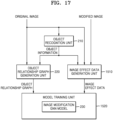
- FIG. 17 is a diagram illustrating a data flow during operation of the image modification model training system according to an embodiment of the present disclosure.
- the processor 1410 of the image modification model training system 1400 may receive an original image and a modified image in operation S1610.
- the modified image is the original image, to which an image effect is applied.
- different image effects may be applied to respective objects.
- the processor 1410 may recognize a plurality of objects in the original image to generate object information representing the recognized plurality of objects, in operation S1620.
- the processor 1410 may generate an object relationship graph indicating relationships between the objects based on the original image and the object information, in operation S1630.
- the processor 1410 may train the image modification GNN model 230 based on the object relationship graph and the image effect data in operation S1650. Training of the image modification GNN model 230 may be performed by the model training unit 1520. When the image modification GNN model 230 is trained, and when a change value of the image effect data is 'not relevant', a learning loss may not be applied to the corresponding object and image effect.
- the image modification model training system 1400 may train, based on a data set including various original images and modified images, the image modification GNN model 230 such that an image effect suitable for each object according to a relationship between objects of an original image is determined.
- the computer-readable storage media may be provided in the form of a non-transitory storage medium.
- the term 'non-transitory storage medium' may mean a tangible device without including a signal, e.g., electromagnetic waves, and may not distinguish between storing data in the storage medium semi-permanently and temporarily.
- the term the 'non-transitory storage medium' may include a buffer that temporarily stores data.
- module may refer to a hardware component such as a processor or a circuit, and/or a software component executed by the hardware component such as the processor.
- the expression "including at least one of a, b, or c" may denote including only a, including only b, including only c, including a and b, including b and c, including a and c, and including all of a, b, and c.
- the processor may include one or more processors.
- the one or more processors may include a universal processor such as a central processing unit (CPU), an application processor (AP), a digital signal processor (DSP), etc., a dedicated graphic processor such as a graphics processing unit (GP), a vision processing unit (VPU), etc., or a dedicated Al processor such as a neural processing unit (NPU).
- the one or more processors control to process input data according to a predefined operation rule or artificial intelligence model, stored in the memory.
- the one or more processors are the dedicated Al processors, they may be designed in a hardware structure that is specific to dealing with a particular Al model.
- the artificial intelligence model may be composed of a plurality of neural network layers.
- Each of the plurality of neural network layers has a plurality of weight values, and a neural network operation is performed through an operation between an operation result of a previous layer and a plurality of weights.
- the plurality of weights of the plurality of neural network layers may be optimized by a learning result of the artificial intelligence model. For example, a plurality of weights may be updated so that a loss value or a cost value obtained from the artificial intelligence model during a learning process is reduced or minimized.
- the artificial neural network may include a deep neural network (DNN), for example, a Convolutional Neural Network (CNN), a Deep Neural Network (DNN), a Recurrent Neural Network (RNN), a Restricted Boltzmann Machine (RBM), a Deep Belief Network (DBN), a Bidirectional Recurrent Deep Neural Network (BRDNN), or a Deep Q-Networks, but is not limited to the above-described examples.
- DNN deep neural network
- CNN Convolutional Neural Network
- DNN Deep Neural Network
- RNN Recurrent Neural Network
- RBM Restricted Boltzmann Machine
- DBN Deep Belief Network
- BBN Bidirectional Recurrent Deep Neural Network
- Deep Q-Networks a Deep Q-Networks
Landscapes
- Engineering & Computer Science (AREA)
- Theoretical Computer Science (AREA)
- Physics & Mathematics (AREA)
- General Physics & Mathematics (AREA)
- Software Systems (AREA)
- Evolutionary Computation (AREA)
- Artificial Intelligence (AREA)
- Computing Systems (AREA)
- General Engineering & Computer Science (AREA)
- Health & Medical Sciences (AREA)
- General Health & Medical Sciences (AREA)
- Computational Linguistics (AREA)
- Data Mining & Analysis (AREA)
- Mathematical Physics (AREA)
- Biophysics (AREA)
- Molecular Biology (AREA)
- Biomedical Technology (AREA)
- Life Sciences & Earth Sciences (AREA)
- Databases & Information Systems (AREA)
- Computer Vision & Pattern Recognition (AREA)
- Medical Informatics (AREA)
- Multimedia (AREA)
- Probability & Statistics with Applications (AREA)
- Human Computer Interaction (AREA)
- Image Analysis (AREA)
Description
- The present disclosure relates to an artificial intelligence system and method for modifying an image on the basis of a relationship between objects.
- Recently, as digital cameras and smartphones have become widespread, users are taking many pictures, and accordingly, demand for a technology for editing the pictures has increased. In particular, a technology has been developed, in which a device automatically edits or suggests editing without the need for a user to manually set and edit parameters. Users tend to set the editing type and parameters according to the type of subject, such as making a person's body slimmer, increasing the brightness of a person's face, and increasing the saturation of food.
- Unlike the existing rule-based smart system, an artificial intelligence (Al) system is a system in which a machine learns, judges, and becomes smarter by itself. The more the artificial intelligence system is used, the better the recognition rate and the more accurate the understanding of user preferences, and thus, the existing rule-based smart systems are gradually being replaced by deep learning-based Al systems. Artificial intelligence technology consists of machine learning (deep learning) and element technologies using machine learning. Machine learning is an algorithm technology that classifies/learns features of input data by itself, and element technology is a technology that uses machine learning algorithms such as deep learning, and consists of technical fields such as language understanding, visual understanding, reasoning/prediction, knowledge expression, motion control. In similar regards,
publication CN 111 475 668 A relates to methods for identifying and describing relationships between objects in an image. - According to an embodiment of the present disclosure, an artificial intelligence system and method for modifying an image on the basis of a relationship between objects are provided, so that a modified image, in which an image effect suitable for an original image is applied, may be generated.
- As technical means for achieving the above-described technical objective, according to an embodiment of the present disclosure, provided is an image modification system including a processor, and a memory storing instructions, wherein the processor is configured to, by executing the instructions, receive an original image, recognize a plurality of objects in the original image to generate object information representing the plurality of objects, generate an object relationship graph indicating relationships between the plurality of objects, based on the original image and the object information, obtain image effect data including image effects to be respectively applied to the plurality of objects by inputting the object relationship graph to an image modification graph neural network (GNN) model, and generate a modified image based on the original image, the object information, and the image effect data, corresponding to the appended claims.
- In an embodiment, the processor may be further configured to display the modified image, receive a user input for the modified image, and update the image modification GNN model based on the user input.
- In an embodiment, the at least one processor may be further configured to display objects and at least one relationship, which correspond to an image effect applied to the modified image, receive a selection input by a user, with respect to the displayed objects and the displayed at least one relationship, generate a final modified image, in which an image effect corresponding to the objects and the at least one relationship, for which the selection input is received, is applied, and update the image modification GNN model based on the selection input by the user.
- In an embodiment of the present disclosure, provided is an image modification model training system including a processor, and a memory storing instructions, wherein the processor is configured to, by executing the instructions, receive an original image and a modified image which is the original image to which an image effect is applied, recognize a plurality of objects in the original image to generate object information representing the plurality of objects, generate an object relationship graph indicating relationships between the plurality of objects, based on the original image and the object information, generate, based on the original image, the object information, and the modified image, image effect data including image effects respectively applied to the plurality of objects in the modified image, and train, based on the object relationship graph and the image effect data, an image modification graph neural network (GNN) model including the object relationship graph as an input and the image effect data as an output, corresponding to the appended claims.
- In an embodiment, the relationships between the plurality of objects included in the object relationship graph may include an interaction between at least one person among the plurality of objects and at least one thing among the plurality of objects.
- In an embodiment, the object relationship graph may include each of the plurality of objects as a node, and each of the relationships between the plurality of objects as an edge.
- In an embodiment, the object information may include respective features of the plurality of objects, and the object relationship graph may include each of the features of the plurality of objects as a node feature.
- In an embodiment, each edge of the object relationship graph may have a weight according to a type of a relevant relationship.
- In an embodiment, an edge which has a plurality of corresponding relationships among the edges may have, as a weight, an average of weights according to the plurality of relationships.
- In an embodiment, the processor may be further configured to generate the object relationship graph based on metadata of the original image.
- In an embodiment, the image effect data may include a table which includes each of the plurality of objects as a row and each of the image effects as a column.
- In an embodiment of the disclosure, provided is an operating method of an image modification system, the operating method including receiving an original image, recognizing a plurality of objects in the original image to generate object information representing the plurality of objects, generating an object relationship graph indicating relationships between the plurality of objects, based on the original image and the object information, obtaining image effect data including image effects to be respectively applied to the plurality of objects by inputting the object relationship graph to an image modification graph neural network (GNN) model, and generating a modified image based on the original image, the object information, and the image effect data, corresponding to the appended claims.
- In an embodiment of the disclosure, provided is an operating method of an image modification model training system, the operating method including receiving an original image and a modified image which is the original image to which an image effect is applied, recognizing a plurality of objects in the original image to generate object information representing the plurality of objects, generating an object relationship graph indicating relationships between the plurality of objects, based on the original image and the object information, generating, based on the original image, the object information, and the modified image, image effect data including image effects respectively applied to the plurality of objects in the modified image, and training, based on the object relationship graph and the image effect data, an image modification graph neural network (GNN) model including the object relationship graph as an input and the image effect data as an output, corresponding to the appended claims.
- In an embodiment of the disclosure, a program product stored in a computer-readable recording medium to execute the method according to an embodiment of the present disclosure on a computer is included.
- In an embodiment of the disclosure, a computer-readable recording medium having recorded thereon a program for executing the method according to an embodiment of the present disclosure on a computer is included.
- According to an embodiment of the present disclosure, an artificial intelligence system and method for modifying an image on the basis of a relationship between objects are provided, so that a modified image, in which an image effect suitable for an original image is applied, may be generated.
-
-
FIG. 1 is a schematic view illustrating a structure of an image modification system based on a relationship between objects, according to an embodiment of the present disclosure. -
FIG. 2 is a detailed view of a structure of an image modification system according to an embodiment of the present disclosure. -
FIG. 3 is a schematic flowchart of a flow of an operating method of an image modification system, according to an embodiment of the present disclosure. -
FIG. 4 is a diagram illustrating a data flow during an operation of an image modification system, according to an embodiment of the present disclosure. -
FIG. 5 is a diagram illustrating objects recognized in an original image, according to an embodiment of the present disclosure. -
FIG. 6 is a diagram illustrating a relationship between objects recognized in an original image, according to an embodiment of the present disclosure. -
FIG. 7 is a diagram showing an object relationship graph according to an embodiment of the present disclosure. -
FIG. 8 is a diagram illustrating an adjacent matrix of an object relationship graph according to an embodiment of the present disclosure. -
FIG. 9 is a diagram showing an object relationship graph according to an embodiment of the present disclosure. -
FIG. 10 is a diagram illustrating a node feature matrix of an object relationship graph according to an embodiment of the present disclosure. -
FIG. 11 is a diagram illustrating an adjacent matrix of an object relationship graph having edge weights, according to an embodiment of the present disclosure. -
FIG. 12 is a diagram illustrating image effect data according to an embodiment of the present disclosure. -
FIG. 13 is a diagram illustrating an operation of a user interface according to an embodiment of the present disclosure. -
FIG. 14 is a schematic view illustrating a structure of an image modification model training system based on a relationship between objects, according to an embodiment of the present disclosure. -
FIG. 15 is a detailed view of a structure of an image modification model training system according to an embodiment of the present disclosure. -
FIG. 16 is a schematic flowchart of a flow of an operating method of an image modification model training system, according to an embodiment of the present disclosure. -
FIG. 17 is a diagram illustrating a data flow during an operation of an image modification model training system, according to an embodiment of the present disclosure. - An embodiment of the present disclosure will be described in detail with reference to the accompanying drawings in order to clarify the technical considerations of the present disclosure. In the description of the present disclosure, certain detailed explanations of functions or components of the related art are omitted when it is deemed that they may unnecessarily obscure the essence of the present disclosure. Elements having substantially the same functional configuration in the drawings are given the same reference numbers and reference numerals as much as possible even though they are shown in different drawings. For convenience of explanation, when necessary, the device and method will be described together. Each operation of the present disclosure does not necessarily have to be performed in the order described, and may be performed in parallel, selectively, or individually.
-
FIG. 1 is a schematic view illustrating a structure of an image modification system based on a relationship between objects, according to an embodiment of the present disclosure. Referring toFIG. 1 , animage modification system 100 according to an embodiment of the present disclosure may include aprocessor 110 and amemory 120 storing one or more instructions that are executable by theprocessor 110. An operation of theimage modification system 100, performed by theprocessor 110 executing one or more instructions stored in thememory 120, is described below in detail with reference toFIGS. 3 to 13 . -
FIG. 2 is a detailed view of a structure of an image modification system according to an embodiment of the present disclosure. Referring toFIG. 2 , anobject recognition unit 210, an object relationshipgraph generation unit 220, an image modification graph neural network (GNN)model 230, and animage modification unit 240 may be stored in thememory 120, and theprocessor 110 may read them from thememory 120 to perform a method according to an embodiment of the present disclosure. -
FIG. 3 is a schematic flowchart of a flow of an operating method of an image modification system, according to an embodiment of the present disclosure, andFIG. 4 is a diagram illustrating a data flow during operation of the image modification system, according to an embodiment of the present disclosure. Referring toFIGS. 3 and4 , theprocessor 110 of theimage modification system 100 may receive an original image in operation S310, and recognize a plurality of objects in the original image and generate object information representing the recognized plurality of objects in operation S320. The objects may include a person, an animal, a thing, a background, etc. included in an original image. For example, like a person and a hand, a hand and a finger, a car and a wheel, one object may be included in another object. -
FIG. 5 is a view illustrating objects recognized in an original image, according to an embodiment of the present disclosure. Referring toFIG. 5 , in an original image which is a captured image of an American football game, objects such as a main person, a ball, background people, and a sports stadium are recognized. - An operation of recognizing a plurality of objects in an original image may be performed by the
object recognition unit 210. Theobject recognition unit 210 may use a neural network model for recognizing an object in an image. Theobject recognition unit 210 may use a multi-Al recognition model such as object detection, scene recognition, and food type classification. - Referring back to
FIGS. 3 and4 , theprocessor 110 may generate an object relationship graph indicating relationships between a plurality of objects, based on the original image and the object information, in operation S330. A relationship between objects may include interactions between objects, and in particular, interactions between at least one person and at least one object, such as looking, eating, catching, throwing, pushing, wearing, riding, etc. The relationships between objects may include 'not relevant'. A relationship between objects, included in an object relationship graph, may include a relationship between a main person of an original image with another object. -
FIG. 6 is a diagram illustrating a relationship between objects recognized in an original image, according to an embodiment of the present disclosure. Referring toFIG. 6 , it can be seen that a gaze and a throw, which are relationships between a main person and a ball, are recognized in the original image ofFIG. 5 . -
FIG. 7 is a diagram showing an object relationship graph according to an embodiment of the present disclosure. Referring toFIG. 7 , a graph is shown, in which each of the objects recognized inFIG. 5 is a node, and each of the relationships between the objects recognized inFIG. 6 , is an edge. That is, in the object relationship graph according to an embodiment of the present disclosure, each of the plurality of objects recognized in the original image may be a node, and each of the relationships between the plurality of objects may be an edge. -
FIG. 8 is a diagram illustrating an adjacent matrix of an object relationship graph according to an embodiment of the present disclosure. Referring toFIG. 8 , the object relationship graph shown inFIG. 7 is expressed as an adjacent matrix. As illustrated inFIGS. 6 to 8 , one edge may correspond to a plurality of relationships. - The operation of generating an object relationship graph may be performed by the object relationship
graph generation unit 220. The object relationshipgraph generation unit 220 may use a neural network model for generating an object relationship graph. - The
processor 110 may recognize not only objects in an original image, but also features of the objects. That is, object information may include features of each of a plurality of objects. The features of an object may include a location of the object in an image, a size of the object, a color of the object, a type (category) of the object, a behavior of a person/animal, a type of a place, a region, and the like. The features of objects may be different for each type of object. For example, the features of a person may include a person's gender, age, behavior, etc., and the features of a dog may include a breed, size (large dog, medium-sized dog, small dog, etc.), hair color, behavior, etc. of the dog, and the features of food may include the region, country, material, cooking method (baking, steaming, frying, etc.) of the food. That is, theprocessor 110 may recognize features of each type of objects in an original image. An operation of recognizing the features of objects in an original image may be performed by theobject recognition unit 210. - An object relationship graph may include features of each of a plurality of objects.
FIG. 9 is a diagram showing an object relationship graph according to an embodiment of the present disclosure. Referring toFIG. 9 , it can be seen that in the graph as shown inFIG. 7 , features of a corresponding object are added as node features to each node. That is, in the object relationship graph according to an embodiment of the present disclosure, each of the features of each of a plurality of objects may be a node feature. -
FIG. 10 is a diagram illustrating a node feature matrix of an object relationship graph according to an embodiment of the present disclosure. Referring toFIG. 10 , node features of the object relationship graph shown inFIG. 7 are represented by a node feature matrix. That is, the object relationship graph shown inFIG. 7 may be represented by the adjacent matrix shown inFIG. 8 and the node feature matrix shown inFIG. 10 . - Each edge of the object relationship graph may have a weight according to a type of relationship between objects.
FIG. 11 is a diagram illustrating an adjacent matrix of an object relationship graph having edge weights, according to an embodiment of the present disclosure. When one edge corresponds to a plurality of relationships, an average of weights according to the plurality of relationships may be used as a weight of the edge. The weights may be preset based on knowledge. - The
processor 110 may generate an object relationship graph based on metadata about an original image. The metadata may include, for example, location information and date information of an image, and information about an application used. Metadata may include information automatically generated when a picture is taken, such as EXIF information. Theprocessor 110 may determine a node or an edge based on the metadata. For example, theprocessor 110 may determine a region (e.g., Finland) or a place (e.g., a sports field) of an image as a node from location information of a picture. - Referring back to
FIGS. 3 and4 , theprocessor 110 may obtain image effect data including image effects to be respectively applied to a plurality of objects, by inputting the object relationship graph to the imagemodification GNN model 230 in operation S340. The image effect may include Adjust Saturation, Adjust Lightness, Adjust Color, Sharpen, Blur, Enlarge eyes, and the like. Each image effect may contain a change value. The change value may include 0. The change value may include 'not relevant'. -
FIG. 12 is a diagram illustrating image effect data according to an embodiment of the present disclosure. Referring toFIG. 12 , a table is shown in which each of the objects recognized inFIG. 5 is a row, and each of image effects to be applied to the objects is a column. That is, the image effect data according to an embodiment of the present disclosure may include a table in which each of a plurality of objects recognized in an original image is a row and each of image effects to be applied to the objects is a column. - The image
modification GNN model 230 is an artificial intelligence neural network model that has an object relationship graph as an input and image effect data as an output, and may determine, based on an object relationship graph of an original image, image effects suitable to be applied to the original image, for each object. A method of training the imagemodification GNN model 230 will be described in detail later with reference toFIGS. 14 to 17 . The imagemodification GNN model 230 may include a graph convolutional network (GCN). - Referring back to
FIGS. 3 and4 , theprocessor 110 may generate a modified image based on the original image, object information, and image effect data in operation S350. Here, the modified image is the original image, in which an image effect corresponding to each object is applied. That is, theprocessor 110 may generate, with respect to the original image, a modified image by applying an image effect determined by the imagemodification GNN model 230, to each of a plurality of recognized objects. - The operation of generating the modified image may be performed by the
image modification unit 240. Theimage modification unit 240 may use a neural network model such as Generative Adversarial Networks (GAN) to apply an image effect to an original image. - The
image modification system 100 according to an embodiment of the present disclosure may provide, with respect to an original image including a plurality of objects, a modified image, in which an image effect suitable for each object is applied. In particular, theimage modification system 100 may provide a modified image, in which a suitable image effect is applied according to the features of each object, according to the type of each object, or according to the features of each type of each object. For example, with respect to an original image of a person eating food in a restaurant, theimage modification system 100 may provide a modified image in which an effect of increasing brightness on a person's face, an effect of increasing saturation on food, and an effect of increasing sharpness on warm food among the food are applied. - In addition, by not only using the features of each object, but also using a relationship between the objects, the
image modification system 100 may provide a modified image, in which most suitable image effects for the entire image are applied. For example, in an original image, when various foods are placed in front of a person and the person is eating one of them, a modified image, in which an effect of increasing the saturation is applied only to the food that the person is eating among the various foods, may be obtained. - The
processor 110 may display the modified image, in which the image effect is applied, receive a user input for the modified image, and update the imagemodification GNN model 230 based on the user input.FIG. 13 is a diagram illustrating an operation of a user interface according to an embodiment of the present disclosure. Referring toFIG. 13 , theprocessor 110 may display objects recognized in an original image and relationships between the objects, and allow a user to select a desired object and a desired relationship to be applied to image modification. That is, theprocessor 110 may display objects to an image effect applied to the modified image, and at least one relationship, receive a user selection input for the displayed objects and the at least one relationship, and generate a final modified image, in which an image effect corresponding to the at least one object and the relationship, for which the selection input is received. Theprocessor 110 may update the imagemodification GNN model 230 based on the above user selection input. -
FIG. 14 is a schematic view illustrating a structure of an image modification model training system based on a relationship between objects, according to an embodiment of the present disclosure. Referring toFIG. 14 , an image modificationmodel training system 1400 according to an embodiment of the present disclosure may include aprocessor 1410 and amemory 1420 storing one or more instructions that are executable by theprocessor 1410. The operation of the image modificationmodel training system 1400 performed by theprocessor 1410 by executing one or more instructions stored in thememory 1420 will be described in detail below with reference toFIGS. 16 and17 , and repeated descriptions provided previously with respect to theimage modification system 100 will be omitted as much as possible. -
FIG. 15 is a detailed view of a structure of an image modification model training system according to an embodiment of the present disclosure. Referring toFIG. 15 , theobject recognition unit 210, the object relationshipgraph generation unit 220, an image effectdata generation unit 1510, and amodel training unit 1520 may be stored in thememory 1420, and theprocessor 1410 perform the method according to an embodiment of the present disclosure, by reading these from thememory 1420. Themodel training unit 1520 may include the imagemodification GNN model 230. -
FIG. 16 is a schematic flowchart of a flow of an operating method of an image modification model training system, according to an embodiment of the present disclosure, andFIG. 17 is a diagram illustrating a data flow during operation of the image modification model training system according to an embodiment of the present disclosure. Referring toFIGS. 16 and17 , theprocessor 1410 of the image modificationmodel training system 1400 may receive an original image and a modified image in operation S1610. The modified image is the original image, to which an image effect is applied. Here, different image effects may be applied to respective objects. Theprocessor 1410 may recognize a plurality of objects in the original image to generate object information representing the recognized plurality of objects, in operation S1620. Theprocessor 1410 may generate an object relationship graph indicating relationships between the objects based on the original image and the object information, in operation S1630. - The
processor 1410 may generate image effect data including image effects respectively applied to the plurality of objects in the modified image, based on the original image, the object information, and the modified image, in operation S1640. The image effect data is data including image effects respectively applied to the plurality of objects in the modified image, as described above with respect to theimage modification system 100. The image effect data may be generated by the image effectdata generation unit 1510. - The
processor 1410 may train the imagemodification GNN model 230 based on the object relationship graph and the image effect data in operation S1650. Training of the imagemodification GNN model 230 may be performed by themodel training unit 1520. When the imagemodification GNN model 230 is trained, and when a change value of the image effect data is 'not relevant', a learning loss may not be applied to the corresponding object and image effect. - The object relationship
graph generation unit 220 may include a neural network model for generating the object relationship graph, and theprocessor 1410 may receive an object relationship graph corresponding to the original image and train the neural network model for generating the object relationship graph. - 8/8 The image modification
model training system 1400 according to an embodiment of the present disclosure may train, based on a data set including various original images and modified images, the imagemodification GNN model 230 such that an image effect suitable for each object according to a relationship between objects of an original image is determined. - An embodiment of the present disclosure may also be implemented in the form of a recording medium including instructions executable by a computer, such as a program module executed by a computer. Computer-readable media can be any available media that can be accessed by a computer and includes both volatile and nonvolatile media, removable and non-removable media. Also, computer-readable media may include computer storage media and communication media. The computer storage media includes both volatile and nonvolatile, removable and non-removable media implemented in any method or technology for storage of information such as computer readable instructions, data structures, program modules or other data. The communication media may typically include other data of a modulated data signal, such as computer readable instructions, data structures, or program modules.
- Also, the computer-readable storage media may be provided in the form of a non-transitory storage medium. The term 'non-transitory storage medium' may mean a tangible device without including a signal, e.g., electromagnetic waves, and may not distinguish between storing data in the storage medium semi-permanently and temporarily. For example, the term the 'non-transitory storage medium' may include a buffer that temporarily stores data.
- In an embodiment of the disclosure, the aforementioned method according to the various embodiments of the disclosure may be provided in a computer program product. The computer program product may be a commercial product that may be traded between a seller and a buyer. The computer program product may be distributed in the form of a machine-readable storage medium (e.g., a compact disc read only memory (CD-ROM)), through an application store (e.g., Play Store™), directly between two user devices (e.g., smart phones), or online (e.g., downloaded or uploaded). In the case of online distribution, at least part of the computer program product (e.g., a downloadable app) may be at least temporarily stored or arbitrarily created in a storage medium that may be readable to a device such as a server of the manufacturer, a server of the application store, or a relay server.
- In the specification, the term "module" may refer to a hardware component such as a processor or a circuit, and/or a software component executed by the hardware component such as the processor.
- Also, in the present specification, the expression "including at least one of a, b, or c" may denote including only a, including only b, including only c, including a and b, including b and c, including a and c, and including all of a, b, and c.
- Functions related to artificial intelligence, according to the present disclosure, are operated via a processor and a memory. The processor may include one or more processors. The one or more processors may include a universal processor such as a central processing unit (CPU), an application processor (AP), a digital signal processor (DSP), etc., a dedicated graphic processor such as a graphics processing unit (GP), a vision processing unit (VPU), etc., or a dedicated Al processor such as a neural processing unit (NPU). The one or more processors control to process input data according to a predefined operation rule or artificial intelligence model, stored in the memory. When the one or more processors are the dedicated Al processors, they may be designed in a hardware structure that is specific to dealing with a particular Al model.
- The predefined operation rule or the artificial intelligence model is made by training. Specifically, the predefined operation rule or the Al model being made by training refers to the predefined operation rule or the Al model established to perform a desired feature (or a purpose) as a basic artificial intelligence model is trained using a plurality of pieces of training data according to a learning algorithm. Such training may be performed by a device itself in which artificial intelligence is performed according to the disclosure, or by a separate server and/or system. Examples of the learning algorithm may include supervised learning, unsupervised learning, semisupervised learning, or reinforcement learning, without being limited thereto.
- The artificial intelligence model may be composed of a plurality of neural network layers. Each of the plurality of neural network layers has a plurality of weight values, and a neural network operation is performed through an operation between an operation result of a previous layer and a plurality of weights. The plurality of weights of the plurality of neural network layers may be optimized by a learning result of the artificial intelligence model. For example, a plurality of weights may be updated so that a loss value or a cost value obtained from the artificial intelligence model during a learning process is reduced or minimized. The artificial neural network may include a deep neural network (DNN), for example, a Convolutional Neural Network (CNN), a Deep Neural Network (DNN), a Recurrent Neural Network (RNN), a Restricted Boltzmann Machine (RBM), a Deep Belief Network (DBN), a Bidirectional Recurrent Deep Neural Network (BRDNN), or a Deep Q-Networks, but is not limited to the above-described examples.
- The present disclosure has been described with reference to the embodiments thereof illustrated in the drawings. The embodiments are not intended to limit the present disclosure, and are merely exemplary, and should be considered in a descriptive sense only and not for purposes of limitation. It will be understood by one of ordinary skill in the art that the embodiments of the present disclosure may be easily modified in other specific forms all without changing the technical scope or the essential features of the present disclosure, as defined by the appended claims. For example, each component described as a single type may be implemented in a distributed manner, and similarly, components described as distributed may be implemented in a combined form. Although specific terms are used in this specification, they are used only for the purpose of describing the concept of the present disclosure, and are not used to limit the scope of the present invention as set forth in the claims.
Claims (15)
- An image modification system (100) comprising:a processor (110); anda memory (120) storing instructions,
wherein the processor is configured to, by executing the instructions,receive an original image,recognize a plurality of objects in the original image to generate object information representing the plurality of objects,generate an object relationship graph indicating relationships between the plurality of objects, based on the original image and the object information,obtain image effect data including image effects to be respectively applied to the plurality of objects by inputting the object relationship graph to an image modification graph neural network, GNN, model, andgenerate a modified image based on the original image, the object information, and the image effect data. - The image modification system of claim 1, wherein the relationships between the objects included in the object relationship graph comprise an interaction between at least one person among the plurality of objects and at least one thing among the plurality of objects.
- The image modification system of claim 1, wherein the object relationship graph includes each of the plurality of objects as a node, and each of the relationships between the plurality of objects as an edge.
- The image modification system of claim 3, wherein the object information comprises respective features of the plurality of objects, and
the object relationship graph includes each of the features of the plurality of objects as a node feature. - The image modification system of claim 3, wherein each edge of the object relationship graph has a weight according to a type of a relevant relationship, and
an edge which has a plurality of corresponding relationships among the edges has, as a weight, an average of weights according to the plurality of relationships. - The image modification system of claim 1, wherein the image effect data includes a table which includes each of the plurality of objects as a row and each of the image effects as a column.
- The image modification system of claim 1, wherein the processor is further configured todisplay the modified image,display objects and at least one relationship, which correspond to an image effect applied to the modified image,receive a selection input by a user, with respect to the displayed objects and the displayed at least one relationship,generate a final modified image, in which an image effect corresponding to the objects and the at least one relationship, for which the selection input is received, is applied, andupdate the image modification GNN model based on the selection input by the user.
- An image modification model training system (1400) comprising:a processor (1410); anda memory (1420) storing instructions,
wherein the processor is configured to, by executing the instructions,receive an original image and a modified image which is the original image to which an image effect is applied,recognize a plurality of objects in the original image to generate object information representing the plurality of objects,generate an object relationship graph indicating relationships between the plurality of objects, based on the original image and the object information,generate, based on the original image, the object information, and the modified image,image effect data including image effects respectively applied to the plurality of objects in the modified image, andtrain, based on the object relationship graph and the image effect data, an image modification graph neural network, GNN, model including the object relationship graph as an input and the image effect data as an output. - The image modification model training system of claim 8, wherein the relationships between the plurality of objects included in the object relationship graph comprise an interaction between at least one person among the plurality of objects and at least one thing among the plurality of objects.
- The image modification model training system of claim 8, wherein the object relationship graph includes each of the plurality of objects as a node, and each of the relationships between the plurality of objects as an edge.
- The image modification model training system of claim 10, wherein the object information comprises respective features of the plurality of objects, and
the object relationship graph includes each of the features of the plurality of objects as a node feature. - The image modification model training system of claim 10, wherein each edge of the object relationship graph has a weight according to a type of a relevant relationship, and
an edge which has a plurality of corresponding relationships among the edges has, as a weight, an average of weights according to the plurality of relationships. - An operating method of an image modification system, the operating method comprising:receiving an original image;recognizing a plurality of objects in the original image to generate object information representing the plurality of objects;generating an object relationship graph indicating relationships between the plurality of objects, based on the original image and the object information;obtaining image effect data including image effects to be respectively applied to the plurality of objects by inputting the object relationship graph to an image modification graph neural network, GNN, model; andgenerating a modified image based on the original image, the object information, and the image effect data.
- An operating method of an image modification model training system, the operating method comprising:receiving an original image and a modified image which is the original image to which an image effect is applied;recognizing a plurality of objects in the original image to generate object information representing the plurality of objects;generating an object relationship graph indicating relationships between the plurality of objects, based on the original image and the object information;generating, based on the original image, the object information, and the modified image, image effect data including image effects respectively applied to the plurality of objects in the modified image; andtraining, based on the object relationship graph and the image effect data, an image modification graph neural network, GNN, model including the object relationship graph as an input and the image effect data as an output.
- A computer-readable storage medium comprising instructions which, when executed by a computer, cause the computer to carry out the steps of the method of any one of claim 13 or claim 14.
Applications Claiming Priority (2)
| Application Number | Priority Date | Filing Date | Title |
|---|---|---|---|
| KR1020200103431A KR102808347B1 (en) | 2020-08-18 | 2020-08-18 | Artificial intelligence system and method for editing image based on relation between objects |
| PCT/KR2021/010867 WO2022039465A1 (en) | 2020-08-18 | 2021-08-17 | Artificial intelligence system and method for modifying image on basis of relationship between objects |
Publications (4)
| Publication Number | Publication Date |
|---|---|
| EP4184442A1 EP4184442A1 (en) | 2023-05-24 |
| EP4184442A4 EP4184442A4 (en) | 2024-01-31 |
| EP4184442B1 true EP4184442B1 (en) | 2025-04-16 |
| EP4184442C0 EP4184442C0 (en) | 2025-04-16 |
Family
ID=80350493
Family Applications (1)
| Application Number | Title | Priority Date | Filing Date |
|---|---|---|---|
| EP21858552.9A Active EP4184442B1 (en) | 2020-08-18 | 2021-08-17 | Artificial intelligence system and method for modifying image on basis of relationship between objects |
Country Status (5)
| Country | Link |
|---|---|
| US (2) | US12499675B2 (en) |
| EP (1) | EP4184442B1 (en) |
| KR (2) | KR102808347B1 (en) |
| CN (1) | CN115885318A (en) |
| WO (1) | WO2022039465A1 (en) |
Families Citing this family (10)
| Publication number | Priority date | Publication date | Assignee | Title |
|---|---|---|---|---|
| KR102670452B1 (en) * | 2022-03-21 | 2024-05-31 | 카페24 주식회사 | Method, device and system for visualize product sales status based on timeline |
| KR102803219B1 (en) * | 2022-03-21 | 2025-05-08 | 카페24 주식회사 | Method, device and system for visualize product sales status based on category |
| KR102589253B1 (en) * | 2022-06-22 | 2023-10-13 | 주식회사 드랩 | Method, server and computer program for providing artificial intelligence-based content processing service |
| CN115546589B (en) * | 2022-11-29 | 2023-04-07 | 浙江大学 | An Image Generation Method Based on Graph Neural Network |
| KR102838663B1 (en) * | 2022-12-22 | 2025-07-28 | 서울과학기술대학교 산학협력단 | A method and system for inserting an object in an image based on content |
| US20250111560A1 (en) * | 2023-10-02 | 2025-04-03 | Fisher-Rosemount Systems, Inc. | Methods and apparatus to modify user interfaces using artificial intelligence |
| WO2025150687A1 (en) * | 2024-01-12 | 2025-07-17 | 삼성전자주식회사 | Electronic device, method, and non-transitory computer-readable recording medium for managing user profile |
| WO2025150697A1 (en) * | 2024-01-12 | 2025-07-17 | 삼성전자주식회사 | Electronic device and method for generating artificial intelligence image by using user input |
| GB2642421A (en) * | 2024-05-10 | 2026-01-14 | Samsung Electronics Co Ltd | Method for improving accuracy of machine learning models |
| WO2026071491A1 (en) * | 2024-09-27 | 2026-04-02 | 삼성전자 주식회사 | Electronic device and content generation method of electronic device |
Family Cites Families (23)
| Publication number | Priority date | Publication date | Assignee | Title |
|---|---|---|---|---|
| JP2005303908A (en) | 2004-04-15 | 2005-10-27 | Fuji Photo Film Co Ltd | Image editing apparatus, method, and program |
| US7809192B2 (en) * | 2005-05-09 | 2010-10-05 | Like.Com | System and method for recognizing objects from images and identifying relevancy amongst images and information |
| KR101722687B1 (en) | 2010-08-10 | 2017-04-04 | 삼성전자주식회사 | Method for providing information between objects or object and user, user device, and storage medium thereof |
| US9135631B2 (en) * | 2011-08-18 | 2015-09-15 | Facebook, Inc. | Computer-vision content detection for sponsored stories |
| US9154709B2 (en) | 2012-12-21 | 2015-10-06 | Google Inc. | Recommending transformations for photography |
| AU2013205548A1 (en) | 2013-04-30 | 2014-11-13 | Canon Kabushiki Kaisha | Method, system and apparatus for tracking objects of a scene |
| US10019506B1 (en) | 2014-06-26 | 2018-07-10 | Google Llc | Identifying objects in images |
| KR20160051390A (en) | 2014-11-03 | 2016-05-11 | 삼성전자주식회사 | Electronic device and method for providing filter n electronic device |
| KR101771044B1 (en) * | 2015-11-27 | 2017-08-24 | 연세대학교 산학협력단 | Apparatus and Method of Object Recognition based on Space-Object Relation Graph |
| US10235536B2 (en) * | 2016-10-19 | 2019-03-19 | Lenovo (Singapore) Pte Ltd | Relationship-based image modification |
| WO2018088794A2 (en) | 2016-11-08 | 2018-05-17 | 삼성전자 주식회사 | Method for correcting image by device and device therefor |
| KR102359391B1 (en) * | 2016-11-08 | 2022-02-04 | 삼성전자주식회사 | method and device for adjusting an image |
| KR20180055708A (en) * | 2016-11-16 | 2018-05-25 | 삼성전자주식회사 | Device and method for image processing |
| US10425593B2 (en) | 2017-10-19 | 2019-09-24 | Paypal, Inc. | Digital image filtering and post-capture processing using user specific data |
| US10643130B2 (en) | 2018-03-23 | 2020-05-05 | The Governing Council Of The University Of Toronto | Systems and methods for polygon object annotation and a method of training and object annotation system |
| US10812736B2 (en) * | 2018-12-24 | 2020-10-20 | Polarr, Inc. | Detected object based image and video effects selection |
| KR102097905B1 (en) | 2019-06-04 | 2020-04-06 | 주식회사 딥엑스 | Apparatus and method for recognizing one or more objects in images |
| US11113532B2 (en) | 2019-04-16 | 2021-09-07 | Lg Electronics Inc. | Artificial intelligence apparatus for recognizing object and method therefor |
| CN114981836B (en) | 2020-01-23 | 2025-05-23 | 三星电子株式会社 | Electronic device and control method of electronic device |
| KR102743294B1 (en) | 2020-01-23 | 2024-12-17 | 삼성전자주식회사 | Electronic device and controlling method of electronic device |
| CN111461181B (en) * | 2020-03-16 | 2021-09-07 | 北京邮电大学 | A kind of vehicle fine-grained classification method and device |
| CN111460992A (en) * | 2020-03-31 | 2020-07-28 | 北京奇艺世纪科技有限公司 | Object recognition, correction model training and face recognition method and device |
| CN111475668B (en) * | 2020-04-14 | 2023-03-17 | 华南理工大学 | Picture visual reasoning method, equipment and storage medium for complex relation description |
-
2020
- 2020-08-18 KR KR1020200103431A patent/KR102808347B1/en active Active
-
2021
- 2021-08-17 CN CN202180050798.9A patent/CN115885318A/en active Pending
- 2021-08-17 EP EP21858552.9A patent/EP4184442B1/en active Active
- 2021-08-17 WO PCT/KR2021/010867 patent/WO2022039465A1/en not_active Ceased
-
2023
- 2023-02-17 US US18/111,401 patent/US12499675B2/en active Active
-
2025
- 2025-04-30 KR KR1020250057743A patent/KR20250065800A/en active Pending
- 2025-11-05 US US19/380,398 patent/US20260065662A1/en active Pending
Also Published As
| Publication number | Publication date |
|---|---|
| KR102808347B1 (en) | 2025-05-16 |
| EP4184442A4 (en) | 2024-01-31 |
| WO2022039465A1 (en) | 2022-02-24 |
| EP4184442A1 (en) | 2023-05-24 |
| US20230206618A1 (en) | 2023-06-29 |
| KR20220022354A (en) | 2022-02-25 |
| EP4184442C0 (en) | 2025-04-16 |
| KR20250065800A (en) | 2025-05-13 |
| US20260065662A1 (en) | 2026-03-05 |
| US12499675B2 (en) | 2025-12-16 |
| CN115885318A (en) | 2023-03-31 |
Similar Documents
| Publication | Publication Date | Title |
|---|---|---|
| US12499675B2 (en) | Artificial intelligence system and method for modifying image on basis of relationship between objects | |
| US12217390B2 (en) | Method for correcting image by device and device therefor | |
| US11487712B2 (en) | Digital image suitability determination to generate AR/VR digital content | |
| US11393133B2 (en) | Emoji manipulation using machine learning | |
| US10401860B2 (en) | Image analysis for two-sided data hub | |
| US11056225B2 (en) | Analytics for livestreaming based on image analysis within a shared digital environment | |
| KR20220140673A (en) | method and device for adjusting an image | |
| Marr | The intelligence revolution: transforming your business with AI | |
| US11430561B2 (en) | Remote computing analysis for cognitive state data metrics | |
| US20230419721A1 (en) | Electronic device for improving quality of image and method for improving quality of image by using same | |
| WO2020077011A1 (en) | Systems and methods for generating a product recommendation in a virtual try-on session | |
| US9235875B2 (en) | Image enhancement using learned non-photorealistic effects | |
| CN114981836A (en) | Electronic device and control method of electronic device | |
| JP2023174601A (en) | Computer device, method, and program for providing virtual try-on images | |
| US20240394837A1 (en) | Method for correcting image by device and device therefor | |
| KR20260069502A (en) | Artificial intelligence system and method for editing image based on relation between objects | |
| US12505494B2 (en) | Generating customized graphical elements from user-provided images | |
| Sharma et al. | Exploring cutting-edge deep learning techniques in image processing | |
| Siddarth et al. | Deep residual network based food recognition for enhanced augmented reality application | |
| CN120387855B (en) | Control method and control device of advertisement delivery equipment and advertisement delivery equipment | |
| Zaib et al. | Personalized saliency prediction using color spaces | |
| JP2026073623A (en) | system | |
| CN120823296A (en) | Digital human model processing method, virtual digital human lip-shaping driving method and computer device | |
| JP2026072772A (en) | system | |
| KR20220052500A (en) | Electronic device and Method for controlling th electronic device thereof |
Legal Events
| Date | Code | Title | Description |
|---|---|---|---|
| STAA | Information on the status of an ep patent application or granted ep patent |
Free format text: STATUS: THE INTERNATIONAL PUBLICATION HAS BEEN MADE |
|
| PUAI | Public reference made under article 153(3) epc to a published international application that has entered the european phase |
Free format text: ORIGINAL CODE: 0009012 |
|
| STAA | Information on the status of an ep patent application or granted ep patent |
Free format text: STATUS: REQUEST FOR EXAMINATION WAS MADE |
|
| 17P | Request for examination filed |
Effective date: 20230220 |
|
| AK | Designated contracting states |
Kind code of ref document: A1 Designated state(s): AL AT BE BG CH CY CZ DE DK EE ES FI FR GB GR HR HU IE IS IT LI LT LU LV MC MK MT NL NO PL PT RO RS SE SI SK SM TR |
|
| DAV | Request for validation of the european patent (deleted) | ||
| DAX | Request for extension of the european patent (deleted) | ||
| A4 | Supplementary search report drawn up and despatched |
Effective date: 20240105 |
|
| RIC1 | Information provided on ipc code assigned before grant |
Ipc: G06N 3/08 20230101ALI20231222BHEP Ipc: G06T 7/13 20170101ALI20231222BHEP Ipc: G06T 11/60 20060101AFI20231222BHEP |
|
| GRAP | Despatch of communication of intention to grant a patent |
Free format text: ORIGINAL CODE: EPIDOSNIGR1 |
|
| STAA | Information on the status of an ep patent application or granted ep patent |
Free format text: STATUS: GRANT OF PATENT IS INTENDED |
|
| INTG | Intention to grant announced |
Effective date: 20241118 |
|
| GRAS | Grant fee paid |
Free format text: ORIGINAL CODE: EPIDOSNIGR3 |
|
| GRAA | (expected) grant |
Free format text: ORIGINAL CODE: 0009210 |
|
| STAA | Information on the status of an ep patent application or granted ep patent |
Free format text: STATUS: THE PATENT HAS BEEN GRANTED |
|
| AK | Designated contracting states |
Kind code of ref document: B1 Designated state(s): AL AT BE BG CH CY CZ DE DK EE ES FI FR GB GR HR HU IE IS IT LI LT LU LV MC MK MT NL NO PL PT RO RS SE SI SK SM TR |
|
| REG | Reference to a national code |
Ref country code: GB Ref legal event code: FG4D |
|
| REG | Reference to a national code |
Ref country code: CH Ref legal event code: EP |
|
| REG | Reference to a national code |
Ref country code: IE Ref legal event code: FG4D |
|
| REG | Reference to a national code |
Ref country code: DE Ref legal event code: R096 Ref document number: 602021029371 Country of ref document: DE |
|
| U01 | Request for unitary effect filed |
Effective date: 20250506 |
|
| U07 | Unitary effect registered |
Designated state(s): AT BE BG DE DK EE FI FR IT LT LU LV MT NL PT RO SE SI Effective date: 20250605 |
|
| U20 | Renewal fee for the european patent with unitary effect paid |
Year of fee payment: 5 Effective date: 20250822 |
|
| PG25 | Lapsed in a contracting state [announced via postgrant information from national office to epo] |
Ref country code: ES Free format text: LAPSE BECAUSE OF FAILURE TO SUBMIT A TRANSLATION OF THE DESCRIPTION OR TO PAY THE FEE WITHIN THE PRESCRIBED TIME-LIMIT Effective date: 20250416 |
|
| PG25 | Lapsed in a contracting state [announced via postgrant information from national office to epo] |
Ref country code: NO Free format text: LAPSE BECAUSE OF FAILURE TO SUBMIT A TRANSLATION OF THE DESCRIPTION OR TO PAY THE FEE WITHIN THE PRESCRIBED TIME-LIMIT Effective date: 20250716 Ref country code: GR Free format text: LAPSE BECAUSE OF FAILURE TO SUBMIT A TRANSLATION OF THE DESCRIPTION OR TO PAY THE FEE WITHIN THE PRESCRIBED TIME-LIMIT Effective date: 20250717 |
|
| PG25 | Lapsed in a contracting state [announced via postgrant information from national office to epo] |
Ref country code: PL Free format text: LAPSE BECAUSE OF FAILURE TO SUBMIT A TRANSLATION OF THE DESCRIPTION OR TO PAY THE FEE WITHIN THE PRESCRIBED TIME-LIMIT Effective date: 20250416 |
|
| PGFP | Annual fee paid to national office [announced via postgrant information from national office to epo] |
Ref country code: GB Payment date: 20250722 Year of fee payment: 5 |
|
| PG25 | Lapsed in a contracting state [announced via postgrant information from national office to epo] |
Ref country code: HR Free format text: LAPSE BECAUSE OF FAILURE TO SUBMIT A TRANSLATION OF THE DESCRIPTION OR TO PAY THE FEE WITHIN THE PRESCRIBED TIME-LIMIT Effective date: 20250416 |
|
| PG25 | Lapsed in a contracting state [announced via postgrant information from national office to epo] |
Ref country code: RS Free format text: LAPSE BECAUSE OF FAILURE TO SUBMIT A TRANSLATION OF THE DESCRIPTION OR TO PAY THE FEE WITHIN THE PRESCRIBED TIME-LIMIT Effective date: 20250716 |
|
| PG25 | Lapsed in a contracting state [announced via postgrant information from national office to epo] |
Ref country code: IS Free format text: LAPSE BECAUSE OF FAILURE TO SUBMIT A TRANSLATION OF THE DESCRIPTION OR TO PAY THE FEE WITHIN THE PRESCRIBED TIME-LIMIT Effective date: 20250816 |
|
| PG25 | Lapsed in a contracting state [announced via postgrant information from national office to epo] |
Ref country code: SM Free format text: LAPSE BECAUSE OF FAILURE TO SUBMIT A TRANSLATION OF THE DESCRIPTION OR TO PAY THE FEE WITHIN THE PRESCRIBED TIME-LIMIT Effective date: 20250416 |
|
| PG25 | Lapsed in a contracting state [announced via postgrant information from national office to epo] |
Ref country code: CZ Free format text: LAPSE BECAUSE OF FAILURE TO SUBMIT A TRANSLATION OF THE DESCRIPTION OR TO PAY THE FEE WITHIN THE PRESCRIBED TIME-LIMIT Effective date: 20250416 |
|
| PG25 | Lapsed in a contracting state [announced via postgrant information from national office to epo] |
Ref country code: SK Free format text: LAPSE BECAUSE OF FAILURE TO SUBMIT A TRANSLATION OF THE DESCRIPTION OR TO PAY THE FEE WITHIN THE PRESCRIBED TIME-LIMIT Effective date: 20250416 |
|
| PLBE | No opposition filed within time limit |
Free format text: ORIGINAL CODE: 0009261 |
|
| STAA | Information on the status of an ep patent application or granted ep patent |
Free format text: STATUS: NO OPPOSITION FILED WITHIN TIME LIMIT |
|
| REG | Reference to a national code |
Ref country code: CH Ref legal event code: L10 Free format text: ST27 STATUS EVENT CODE: U-0-0-L10-L00 (AS PROVIDED BY THE NATIONAL OFFICE) Effective date: 20260225 |
|
| REG | Reference to a national code |
Ref country code: CH Ref legal event code: H13 Free format text: ST27 STATUS EVENT CODE: U-0-0-H10-H13 (AS PROVIDED BY THE NATIONAL OFFICE) Effective date: 20260324 |
|
| 26N | No opposition filed |
Effective date: 20260119 |
|
| PG25 | Lapsed in a contracting state [announced via postgrant information from national office to epo] |
Ref country code: MC Free format text: LAPSE BECAUSE OF FAILURE TO SUBMIT A TRANSLATION OF THE DESCRIPTION OR TO PAY THE FEE WITHIN THE PRESCRIBED TIME-LIMIT Effective date: 20250416 |
|
| PG25 | Lapsed in a contracting state [announced via postgrant information from national office to epo] |
Ref country code: CH Free format text: LAPSE BECAUSE OF NON-PAYMENT OF DUE FEES Effective date: 20250831 |