EP4184432A1 - Information processing device, information processing method, and information processing program - Google Patents
Information processing device, information processing method, and information processing program Download PDFInfo
- Publication number
- EP4184432A1 EP4184432A1 EP21950363.8A EP21950363A EP4184432A1 EP 4184432 A1 EP4184432 A1 EP 4184432A1 EP 21950363 A EP21950363 A EP 21950363A EP 4184432 A1 EP4184432 A1 EP 4184432A1
- Authority
- EP
- European Patent Office
- Prior art keywords
- heatmap
- machine learning
- input image
- heatmaps
- attribute
- Prior art date
- Legal status (The legal status is an assumption and is not a legal conclusion. Google has not performed a legal analysis and makes no representation as to the accuracy of the status listed.)
- Pending
Links
Images








Classifications
-
- G—PHYSICS
- G06—COMPUTING OR CALCULATING; COUNTING
- G06T—IMAGE DATA PROCESSING OR GENERATION, IN GENERAL
- G06T7/00—Image analysis
-
- G—PHYSICS
- G06—COMPUTING OR CALCULATING; COUNTING
- G06T—IMAGE DATA PROCESSING OR GENERATION, IN GENERAL
- G06T11/00—Two-dimensional [2D] image generation
- G06T11/10—Texturing; Colouring; Generation of textures or colours
-
- G—PHYSICS
- G06—COMPUTING OR CALCULATING; COUNTING
- G06T—IMAGE DATA PROCESSING OR GENERATION, IN GENERAL
- G06T7/00—Image analysis
- G06T7/10—Segmentation; Edge detection
- G06T7/11—Region-based segmentation
-
- G—PHYSICS
- G06—COMPUTING OR CALCULATING; COUNTING
- G06V—IMAGE OR VIDEO RECOGNITION OR UNDERSTANDING
- G06V10/00—Arrangements for image or video recognition or understanding
- G06V10/40—Extraction of image or video features
- G06V10/44—Local feature extraction by analysis of parts of the pattern, e.g. by detecting edges, contours, loops, corners, strokes or intersections; Connectivity analysis, e.g. of connected components
- G06V10/443—Local feature extraction by analysis of parts of the pattern, e.g. by detecting edges, contours, loops, corners, strokes or intersections; Connectivity analysis, e.g. of connected components by matching or filtering
- G06V10/449—Biologically inspired filters, e.g. difference of Gaussians [DoG] or Gabor filters
- G06V10/451—Biologically inspired filters, e.g. difference of Gaussians [DoG] or Gabor filters with interaction between the filter responses, e.g. cortical complex cells
- G06V10/454—Integrating the filters into a hierarchical structure, e.g. convolutional neural networks [CNN]
-
- G—PHYSICS
- G06—COMPUTING OR CALCULATING; COUNTING
- G06V—IMAGE OR VIDEO RECOGNITION OR UNDERSTANDING
- G06V10/00—Arrangements for image or video recognition or understanding
- G06V10/70—Arrangements for image or video recognition or understanding using pattern recognition or machine learning
- G06V10/77—Processing image or video features in feature spaces; using data integration or data reduction, e.g. principal component analysis [PCA] or independent component analysis [ICA] or self-organising maps [SOM]; Blind source separation
- G06V10/80—Fusion, i.e. combining data from various sources at the sensor level, preprocessing level, feature extraction level or classification level
- G06V10/806—Fusion, i.e. combining data from various sources at the sensor level, preprocessing level, feature extraction level or classification level of extracted features
-
- G—PHYSICS
- G06—COMPUTING OR CALCULATING; COUNTING
- G06V—IMAGE OR VIDEO RECOGNITION OR UNDERSTANDING
- G06V10/00—Arrangements for image or video recognition or understanding
- G06V10/70—Arrangements for image or video recognition or understanding using pattern recognition or machine learning
- G06V10/82—Arrangements for image or video recognition or understanding using pattern recognition or machine learning using neural networks
-
- G—PHYSICS
- G06—COMPUTING OR CALCULATING; COUNTING
- G06T—IMAGE DATA PROCESSING OR GENERATION, IN GENERAL
- G06T2207/00—Indexing scheme for image analysis or image enhancement
- G06T2207/20—Special algorithmic details
- G06T2207/20081—Training; Learning
-
- G—PHYSICS
- G06—COMPUTING OR CALCULATING; COUNTING
- G06T—IMAGE DATA PROCESSING OR GENERATION, IN GENERAL
- G06T2207/00—Indexing scheme for image analysis or image enhancement
- G06T2207/20—Special algorithmic details
- G06T2207/20084—Artificial neural networks [ANN]
-
- G—PHYSICS
- G06—COMPUTING OR CALCULATING; COUNTING
- G06T—IMAGE DATA PROCESSING OR GENERATION, IN GENERAL
- G06T2207/00—Indexing scheme for image analysis or image enhancement
- G06T2207/20—Special algorithmic details
- G06T2207/20112—Image segmentation details
- G06T2207/20132—Image cropping
-
- G—PHYSICS
- G06—COMPUTING OR CALCULATING; COUNTING
- G06T—IMAGE DATA PROCESSING OR GENERATION, IN GENERAL
- G06T2207/00—Indexing scheme for image analysis or image enhancement
- G06T2207/30—Subject of image; Context of image processing
- G06T2207/30196—Human being; Person
Definitions
- the present invention relates to an information-processing device, an information-processing method, and an information-processing program.
- Non Patent Literature 1 there is described so-called image cropping, that is, an image processing technology of extracting a principal portion in an image, which involves utilizing an attention map in a convolutional neural network to obtain an aesthetic value, and obtaining a frame of the principal portion to be extracted based on the aesthetic value.
- the position of the principal portion in the image is determined based on a single evaluation criterion (aesthetic value in Non Patent Literature 1).
- the principal portion of the image intrinsically varies in accordance with a purpose of application of this image. For example, when a photograph image obtained by capturing a scene is used as a landscape, the principal portion is to exist in a thing appearing in a background in the image, while when this photograph image is used as a portrait, the principal portion is to exist in a human image appearing in a foreground in the image. Similarly, when a photograph image obtained by capturing a person is used to identify the person, the principal portion is to exist in a face portion of the person, while when this photograph image is used to introduce fashion, the principal portion is to exist in clothes and accessories of the person in the image.
- the present invention has been made in view of the above-mentioned circumstances, and has an object to appropriately execute image cropping in accordance with a purpose of an image.
- FIG. 1 is a functional conceptual diagram of an information-processing device 100 conceptualized in common in various preferred embodiments of the present invention.
- the information-processing device 100 is implemented by appropriate physical means, for example, a computer for executing an appropriate computer program, implementing functions of FIG. 1 .
- the information-processing device 100 is a type of an image processing device including a machine learning model group 10, an output module 12, a generation module 20, and a cutout module 30. More specifically, the machine learning model group 10 includes a plurality of learned machine learning models 11 each of which is capable of outputting an intermediate heatmap based on input of an input image.
- the output module 12 inputs an input image to at least one machine learning model 11, to thereby obtain the same number of intermediate heatmaps. Whether or not the input image is input to all of the plurality of machine learning models 11 depends on a mode of implementation. When the input image is input to the plurality of machine learning models 11, the same number of intermediate heatmaps are obtained.
- the generation module 20 generates a heatmap based on the at least one obtained intermediate heatmap.
- the generation module 20 usually combines the plurality of intermediate heatmaps by a predetermined method to obtain the heatmap, and directly or indirectly uses an attribute of the input image in this case. That is, the generation module 20 generates the heatmap based on the attribute of the input image and based on the intermediate heatmaps.
- the information-processing device 100 may use the heatmap output from the generation module 20 as an end product.
- the information-processing device 100 includes, for example, at least two components being the machine learning model group 10 and the generation module 20.
- description is given below while assuming that the information-processing device 100 further includes the cutout module 30.
- the cutout module 30 cutouts a principal portion being a part of the input image based on the heatmap obtained by the generation module 20. That is, when the information-processing device 100 further includes the cutout module 30, the information-processing device 100 can be considered as a device which cuts out the principal portion of the input image based on the attribute of the input image.
- FIG. 2 is a view of an example of an input image.
- a photograph of a person is illustrated in FIG. 2 .
- what kind of subject is to be used is not particularly limited.
- the input image is acquired by actual capturing or by another method (such as an illustration).
- a format of the input image is not particularly limited. Whether the input image is a raster image or a vector image, a resolution, and a format can be freely set.
- the input image is at least prepared as electronic data.
- an object of the information-processing device 100 is to cut out the principal portion of the input image as illustrated in FIG. 2 , or to obtain a heatmap which can indicate the principal portion.
- a "principal portion" of a certain input image can vary in accordance with how the input image is used. Specifically, when, for an input image of FIG. 3 , which is the same as the input image of FIG. 2 , a human image is required as the "principal portion," a region which is within a frame indicated by broken lines A of FIG. 3 and from which unnecessary margins are removed is considered as appropriate. However, when clothes and accessories (or fashion) are required as the "principal portion,” a region which is within a frame indicated by one-dot chain lines B of FIG. 3 is appropriate as the "principal portion.” When a bag is required as the "principal portion,” a region which is within a frame indicated by two-dot chain lines C of FIG. 3 is appropriate.
- the "principal portion" of the input image based on information indicating how the input image is used.
- This information is provided by a certain method independently of the input image.
- This information is hereinafter referred to as "attribute" of the input image.
- the attribute of the input image may be provided based on structured data such as certain text data corresponding to the input image.
- the attribute of the input image may be selected from at least one attribute obtained by inputting the input image to a certain object detection model or a certain image classification model. In this case, those models refer to, for example, learned machine learning models.
- heatmap An individual evaluation value may be indicated for a plurality of pixels, such as 3 ⁇ 3 pixels or 5 ⁇ 5 pixels.
- a perspective (that is, attribute) based on which this heatmap is generated depends on the prepared learning data for the machine learning, and it is thus usually impossible to prepare a machine learning model which selects and outputs a heatmap from heatmaps different from one another in accordance with each of various attributes. It is possible to conceptualize a machine learning model which uses the attribute in addition to the input image as inputs and outputs the heatmap. However, it is not easy to prepare learning data for training such a machine learning model. Thus, in the information-processing device 100, as the machine learning model group 10, the plurality of learned machine learning models 11, implementation of which is relatively easy, are prepared.
- the machine learning model 11 outputs not a finally required heatmap which can vary in accordance with the attribute of the input image, but a heatmap based on a specific perspective defined for each machine learning model 11.
- the finally obtained heatmap which corresponds to the attribute of the input image is hereinafter simply referred to as "heatmap”
- the heatmap which is based on a single perspective and is obtained by the individual machine learning model 11 is referred to as "intermediate heatmap.” Both of those heatmaps are thus distinguished from each other.
- the intermediate heatmap corresponds to, for example, output of an attention map or an attention image generated through use of an attention model included in an individual machine learning model.
- the machine learning model uses the attention model to generate the output of, for example, the attention map or the attention image as the intermediate heatmap based on a feature amount map output from a feature extractor such as a convolutional neural network (CNN) included in this machine learning model.
- the attention map may be a map generated based on the attention model, or may be a map generated without being based on the attention model.
- an attention map as an intermediate heatmap in CTR prediction or aesthetic value prediction corresponds to an attention map generated based on the attention model.
- FIG. 4 to FIG. 7 are examples of the intermediate heatmap for the input image exemplified in FIG. 2 .
- the intermediate heatmap of FIG. 4 indicates the click through rate (CTR) prediction.
- the machine learning model 11 which outputs the CTR prediction as the intermediate heatmap can be obtained by being trained through use of, for example, the architecture of the machine learning known as CNN and an image annotated using scores corresponding to the CTR as the learning data. This learning data can be acquired by, for example, tracking a user operation on an image displayed on an electronic commerce (EC) website.
- EC electronic commerce
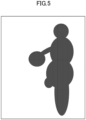
- the intermediate heatmap of FIG. 5 indicates the aesthetic value.
- learning data for obtaining the machine learning model 11 which outputs the aesthetic value as the intermediate heatmap learning data disclosed on the Internet for free or for a fee already exists for research purpose and practical applications.
- This learning data can accordingly be used to train the machine learning model 11, for example, a CNN to obtain this intermediate heatmap.
- this learning data is created by, for example, giving, as the aesthetic value, a high evaluation to a portion which is likely to attract attention of a viewer in an image, and giving a low evaluation to a portion which is less likely to attract the attention of the viewer without specifically restricting an application and the like, to thereby annotate the image.
- the aesthetic value as used herein can be paraphrased as "aesthetic score.”
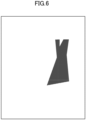
- the intermediate heatmap of FIG. 6 indicates clothes and accessories. That is, this intermediate heatmap is an image indicating a portion corresponding to "clothes and accessories" in the image, and indicates a region in which clothes worn by a person in the input image appear.
- dedicated learning data may be created exhaustively. However, as a simpler way, for example, regions of any image are extracted and labeled through use of the segmentation technology for image, and data on regions labeled as "clothes" are used as the learning data, to thereby train the machine learning model 11.
- this segmentation technology for image technologies known as R-CNN and Faster R-CNN are famous, and such technologies may be used.
- the R-CNN or the Faster R-CNN may directly be used as the machine learning model 11 to extract only the data on the regions labeled as "clothes," and the extracted data may be used as the intermediate heatmap.
- the intermediate heatmap of FIG. 7 indicates a bag, which means that this intermediate heatmap indicates a region of the input image in which the bag appears.
- processing equivalent to that described for the clothes of FIG. 6 is only required to be performed for the bag.
- any required number of types of machine learning models 11 are prepared, to thereby obtain intermediate heatmaps of the required number of types.
- the intermediate heatmaps are indicated as binary images for the convenience of illustration.
- the heatmap is not limited to those examples, and may be grayscale images having any number of bits.
- the machine learning model 11 is described to use the CNN in the above-mentioned example.
- the architecture of the machine learning model is not limited to this example.
- the architecture may use not only the deep neural network (DNN) such as the CNN, but also another machine learning method.
- DNN deep neural network
- the architectures of intermediate heatmap to be obtained, that is, the architectures of the machine learning models 11 may be different from each other.
- the format of the input image is converted in accordance with the machine learning model 11 to which the input image is to be input. For example, the input image is converted to a raster image having a predetermined size and a predetermined resolution.
- the plurality of obtained intermediate heatmaps are passed to the generation module 20.
- the generation module 20 creates the heatmap from the plurality of intermediate heatmaps directly or indirectly based on the attribute.
- directly based on the attribute means using the attribute in a certain form when the heatmap is created from the plurality of intermediate heatmaps passed to the generation module 20, for example, when the heatmap is created through, for example, the combination from the plurality of intermediate heatmaps, selecting intermediate heatmaps used for the combination in accordance with the attribute or changing the weights for the combination in accordance with the attribute.
- "indirectly based on the attribute” means passing a plurality of intermediate heatmaps prepared in advance by using the attribute in a certain form to the generation module 20, and using the passed intermediate heatmaps to create the heatmap, such as selecting the intermediate heatmaps created to be passed to the generation module 20 in accordance with the attribute in the first place.
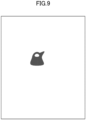
- FIG. 8 and FIG. 9 are views of examples of the heatmaps generated by the generation module 20.
- the heatmap of FIG. 8 is generated when the clothes are specified as the attribute.
- the heatmap of FIG. 9 is generated when the bag is specified as the attribute.
- Both of the heatmaps are generated based on the input image of FIG. 2 , and it is understood that the heatmaps completely different from each other are generated when the specified attributes are different from each other.
- the heatmap of FIG. 8 and the intermediate heatmap indicating the clothes of FIG. 6 are compared with each other, both thereof are not the same. That is, a region in which only the clothes appear is indicated in the intermediate heatmap of FIG.
- the cutout module 30 cuts out a principal portion being a part of the input image based on the heatmap generated by the generation module 20.
- the term "cutout" means specification of a position and a shape of the principal portion being a part of the input image, and it is not necessarily required to delete portions other than the principal portion from the image data itself of the input image. This is because, even when all of the image data of the input image is stored, as long as the position and the shape of the principal portion are specified, only the principal portion can be displayed when the image is displayed.
- the shape of the principal portion is rectangular, but the shape of the principal portion may be any shape such as an ellipsoid, a star shape, and another irregular shape.
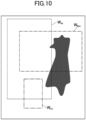
- FIG. 10 is a view for illustrating an example of the processing executed by the cutout module 30.
- a method described now uses a method called "sliding window.”
- the cutout module 30 sets, to the heatmap, various cutout windows W different in size and shape.
- all of W Al , W Bm , and W Cn of FIG. 10 are one of the cutout windows W.
- each of first suffixes (A, B, C, ...) of W indicates the size and the shape of the cutout window W
- each of second suffices (l, m, n, ...) indicates the position of the cutout window W on the heatmap.
- cutout windows W A which have a certain size and shape and are shifted in position are set as W A1 , ..., W Al so that the entire region on the heatmap is covered.
- m cutout windows W B and "n” cutout windows W C are set. Only the three types being W A to W C are described as the sizes and the shapes of the cutout window W for the convenience of description, but, in a case of cutout windows of a larger number of types in size and shape, those cutout windows are also similarly set.
- Expression 1 "x" is a pixel included in the heatmap, P(x) is a value of the heatmap at the pixel "x”, and ⁇ is any threshold value, and satisfies 0 ⁇ 1. That is, Expression 1 consequently expresses that a cutout window W having a ratio of a sum of the values of pixels "x" included in the cutout window W to a sum of the values of all of the pixels "x" of the heatmap larger than ⁇ is extracted as the candidate window W cand .
- the value of ⁇ may be given as any fixed value, for example, 0.7, or there may be provided such setting that any ratio, for example, 5% of top cutout windows W in terms of the ratio of the sum are extracted as candidate windows W cand from all of the cutout windows W.
- a candidate window W cand appropriate as a principal portion W opt is selected.
- W opt argmin W ⁇ W cand W
- the method of selecting a portion appropriate as the principal portion W opt from the cutout windows W included in the candidate windows W cand is not limited to the above-mentioned method.
- the machine learning model 11 which outputs the aesthetic value described with reference to FIG. 5 may be used to select a cutout window W which includes the highest aesthetic value out of the cutout windows W included in the candidate windows W cand as given by Expression 3.
- W opt argmax W ⁇ W cand Q W
- Expression 3 indicates the aesthetic value in the intermediate heatmap relating to the aesthetic value. That is, Expression 3 expresses that a cutout window W which includes the highest aesthetic value is selected from the cutout windows W included in the candidate windows W cand . In this embodiment, a certain score based on a total of one or a plurality of scores for the cutout window W may be treated as the aesthetic value in Expression 3.
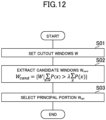
- FIG. 12 is a flowchart for illustrating a processing flow executed by the cutout module 30 in the above-mentioned examples.
- the cutout module 30 sets the cutout windows W having various sizes, shapes, and positions as described above in Step S01, and extracts candidate windows W cand by the method given by Expression 1 or another similar method in Step S02.
- the cutout module 30 selects a candidate window W cand appropriate as the principal portion W opt by the method given by Expression 2 or Expression 3, or another method.
- the size, the shape, and the position of the frame indicated by the selected principal portion W opt indicates the region to be cut out from the input image.
- the cutout module 30 may execute other processing to obtain the principal portion W opt .
- a machine learning model preferably a learned R-CNN may be used to directly output the size, the shape, and the position of the principal portion W opt from the heatmap.
- this machine learning model it is only required to execute training through use of learning data indicating various examples of a heatmap and corresponding principal portions W opt .
- the method called "sliding window" described as the processing executed by the cutout module 30 may be used.
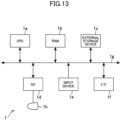
- FIG. 13 is a configuration diagram for illustrating a representative physical configuration of such a general computer 1.
- a central processing unit (CPU) 1a, a random access memory (RAM) 1b, an external storage device 1c, a graphics controller (GC) 1d, an input device 1e, and an input/output (I/O) 1f are connected through a data bus 1g so that electrical signals can mutually be transmitted and received.
- the external storage device 1c is a device which can statically record information, such as a hard disk drive (HDD) or a solid state drive (SSD).
- the signal from the GC 1d is output to a monitor 1h for a user to visually recognize an image, such as a cathode ray tube (CRT) or a so-called flat panel display, and is displayed as an image.
- CTR cathode ray tube
- the input device 1e is a device for the user to input information, such as a keyboard, a mouse, or a touch panel.
- the I/O 1f is an interface for the computer 1 to transmit and receive information to and from external devices.
- a plurality of CPUs 1a may be prepared so that parallel computing is executed in accordance with a load of the information processing required to be executed by the computer 1.
- An application program including an instruction sequence for causing the computer 1 to function as the information-processing device 100 is installed in the external storage device 1c, is read out onto the RAM 1b as required, and is executed by the CPU 1a.
- this program may be recorded in an appropriate computer-readable information recording medium such as an appropriate optical disc, magneto-optical disc, or flash memory, and may then be provided, or may be provided through an information communication line such as the Internet.
- the interface to be used by the user of the information-processing device 100 may be implemented on the computer 1 itself, and the user may directly operate the computer 1, may be implemented by a method of the so-called cloud computing in which general-purpose software such as a web browser is used on another computer and a function is provided from the computer 1 through the I/O 1f, or may further be implemented so that the computer 1 provides an application programing interface (API) available for another computer so that the computer 1 operates as the information-processing device 100 in response to a request from the another computer.
- API application programing interface
- FIG. 14 is a diagram for illustrating a functional configuration of an information-processing device 200 according to a first embodiment of the present invention.
- the first embodiment is an example in which the heatmap is generated indirectly based on the attribute of the input image in a generation module 220.
- the information-processing device 200 is configured to select, based on the attribute of the input image, at least a plurality of machine learning models 211 included in a machine learning model group 210, which are machine learning models 211c and 211d in the example of FIG. 14 . That is, whether the input image is input to the machine learning model 211c which outputs an intermediate heatmap of the clothes or to the machine learning model 211d which outputs an intermediate heatmap of the bag is switched in accordance with the attribute.
- FIG. 14 "clothes" are given as the attribute.
- the machine learning model 211c is selected, and the intermediate heatmap relating to the clothes is output.
- the machine learning model 211d is not selected, and the intermediate heatmap relating to the bag is not generated.
- the machine learning model selection module 212 selects, as a machine learning model to which the input image is to be input, at least one machine learning model of the plurality of machine learning models, that is, the machine learning model 211c and the machine learning model 211d in this case.
- the state in which the machine learning model 211d is not selected is indicated by the broken lines.
- the selection of machine learning models 211a and 211b based on the attribute is not made, and the machine learning models 211a and 211b are configured to always output intermediate heatmaps.
- This configuration is only required to be adjusted in accordance with, for example, a specific purpose of the information-processing device 200.
- the machine learning models which are not selected based on the attribute and are always used may exist or may not exist.
- the number of machine learning models selected based on the attribute is not limited.
- a plurality of machine learning models may be selected for a specific attribute, and the number of selected machine learning models may vary in accordance with each attribute.
- the machine learning models which output intermediate heatmaps relating to the CTR and the aesthetic value are treated as the machine learning models which are not selected based on the attribute
- the machine learning models which output the intermediate heatmaps relating to the clothes and the bag are treated as the machine learning models which are selected based on the attribute.
- the obtained intermediate heatmaps are as many as the machine learning models 211a to 211c to which the input image is input.
- the intermediate heatmaps are combined by the generation module 220, to thereby obtain a final heatmap.
- This method for the combination is not particularly limited, and, as an example, there is given a method of multiplying each intermediate heatmap by an appropriate weight, and summing the products. That is, a finally obtained heatmap H 0 is obtained by a method given by Expression 4.
- H 0 ⁇ k w k H k
- H k is a k-th intermediate heatmap
- w k is a weight coefficient for each intermediate heatmap.
- the weight coefficient w k may dynamically be defined as in a third embodiment described later, or may be given in advance as a fixed value.
- the weight coefficient w k may be set to 0.3 for the intermediate heatmap relating to the CTR and the aesthetic value, and may be set to 0.4 for the intermediate heatmaps relating to the clothes and the bag.
- the cutout module 230 cutouts a principal portion being a part of the input image based on the heatmap obtained as described above. This cutout processing may be the same as the cutout processing already described as common processing in the embodiments.
- FIG. 15 is a diagram for illustrating a functional configuration of an information-processing device 300 according to a second embodiment of the present invention.
- the second embodiment is an example in which the heatmap is generated directly based on the attribute of the input image in a generation module 320.
- the information-processing device 300 is configured to select at least one intermediate heatmap from a plurality of intermediate heatmaps. That is, any one of the intermediate heatmap of the clothes and the intermediate heatmap of the bag is selected by an intermediate heatmap selection module 321 schematically indicated as a switch in FIG. 15 . This selection is made based on the attribute, and the intermediate heatmap which is not selected is not used in the generation module 320.
- the intermediate heatmaps relating to the CTR and the aesthetic value based on the attributes is not made, and the intermediate heatmaps are configured as the intermediate heatmaps always used for the combination for the finally obtained heatmap.
- This configuration is also only required to be adjusted in accordance with, for example, a specific purpose of the information-processing device 300.
- the intermediate heatmaps which are not selected based on the attribute and are always used may exist or may not exist.
- the number of intermediate heatmaps selected based on the attribute is not limited.
- a plurality of intermediate heatmaps may be selected for a specific attribute, and the number of selected intermediate heatmaps may vary in accordance with each attribute.
- the number of intermediate heatmaps which include the selected intermediate heatmaps and are used for the combination for the heatmap is equal to or less than the number of machine learning models 311a to 311d to which the input image is input.
- the intermediate heatmaps are combined by the generation module 320, to thereby obtain the final heatmap.
- a method for this combination may be the same as that in the previous embodiment.
- the cutout module 330 cutout a principal portion being a part of the input image based on the heatmap obtained as described above.
- FIG. 16 is a diagram for illustrating a functional configuration of an information-processing device 400 according to the third embodiment of the present invention.
- the first embodiment is another example in which the heatmap is generated directly based on the attribute of the input image in a generation module 420.
- the information-processing device 400 is configured to use weights based on the attribute of the input image when the plurality of intermediate heatmaps are combined by the generation module 420 to generate the heatmap. That is, the input image is, in principle, input to a plurality of machine learning models 411a to 411d prepared in a machine learning model group 410, and as many intermediate heatmaps as the plurality of machine learning models 411a to 411d are obtained. The weights to be used when those intermediate heatmaps are combined are changed in accordance with the attribute.
- the generation module 420 generates at least a part of the weighs based on the attribute.
- the attribute is "clothes”
- the weights for the intermediate heatmaps relating to the CTR, the aesthetic value, the clothes, and the bag are assigned as 0.3, 0.3, 0.3, and 0.1, respectively.
- the attribute is "bag”
- the weights are similarly assigned as 0.3, 0.3, 0.1, and 0.3, respectively. It is not always required that the attribute correspond to a specific machine learning model. For example, it is possible to provide "fashion item" as an attribute, and to assign the corresponding weights as 0.3, 0.3, 0.2, and 0.2.
- 0.3 is always assigned to the weights for the intermediate heatmaps of the CTR and the aesthetic value.
- the weight may be given in advance as a constant.
- machine learning model group 410 and a cutout module 430 a machine learning model group and a cutout module equivalent to those in the previous embodiments may be used.
- the machine learning model selection module 212 may be provided to select, based on the attribute, at least one machine learning model to be used as the machine learning model to which the input image is to be input.
- the intermediate heatmap selection module 321 may be provided to select at least one intermediate heatmap based on the attribute, and the selected at least one intermediate heatmap may be used by the generation module 420, or the configurations both thereof may be provided.
- FIG. 17 is a flowchart for illustrating a common processing flow of an information-processing method executed by the information-processing devices 100 to 400 according to the respective embodiments of the present invention.
- Step S11 one or a plurality of intermediate heatmaps are output for the input of an input image.
- the processing in this step is executed by the machine learning model group 10 illustrated in FIG. 1 as being common in the embodiments, which has been described.
- the processing executed by each of the machine learning model group 210 of FIG. 14 , the machine learning model group 310 of FIG. 15 , and the machine learning model group 410 of FIG. 16 corresponds to this processing.
- Step S12 a heatmap is generated based on the attribute of the input image and the intermediate heatmaps.
- the processing in this step is executed by the generation module 20 illustrated in FIG. 1 as being common in the embodiments, which has been described.
- the processing executed by each of the generation module 220 of FIG. 14 , the generation module 320 of FIG. 15 , or the generation module 420 of FIG. 16 corresponds to this processing.
- the point that the generation of the heatmap is executed based on the attribute of the input image is implemented by the machine learning model selection module 212 of FIG. 14 selecting the machine learning model in the first embodiment, the selection of the intermediate heatmaps by the intermediate heatmap selection module of FIG. 15 in the second embodiment, and the determination of the weights by the generation module 420 of FIG. 16 in the third embodiment.
- Step S13 the principal portion being a part of the input image is cut out based on the heatmap.
- the processing in this step is executed by the cutout module 30 illustrated in FIG. 1 as being common in the embodiments, which has been described.
- the processing executed by the cutout modules 230, 330, and 430 in the respective embodiments are equivalent to this processing.
Landscapes
- Engineering & Computer Science (AREA)
- Theoretical Computer Science (AREA)
- General Physics & Mathematics (AREA)
- Computer Vision & Pattern Recognition (AREA)
- Physics & Mathematics (AREA)
- Evolutionary Computation (AREA)
- General Health & Medical Sciences (AREA)
- Health & Medical Sciences (AREA)
- Artificial Intelligence (AREA)
- Multimedia (AREA)
- Computing Systems (AREA)
- Medical Informatics (AREA)
- Software Systems (AREA)
- Databases & Information Systems (AREA)
- Life Sciences & Earth Sciences (AREA)
- Biodiversity & Conservation Biology (AREA)
- Biomedical Technology (AREA)
- Molecular Biology (AREA)
- Image Analysis (AREA)
Abstract
Description
- The present invention relates to an information-processing device, an information-processing method, and an information-processing program.
- In
Non Patent Literature 1, there is described so-called image cropping, that is, an image processing technology of extracting a principal portion in an image, which involves utilizing an attention map in a convolutional neural network to obtain an aesthetic value, and obtaining a frame of the principal portion to be extracted based on the aesthetic value. - [NPL 1] Wenguan Wang, Jianbing Shen, "Deep Cropping via Attention Box Prediction and Aesthetics Assessment," [online], ICCV-2017, [retrieved on August 13, 2021], Internet <URL:https://openaccess.thecvf.com/content_ICCV_2017/papers/Wa ng_Deep_Cropping_via_ICCV_2017_paper.pdf>
- In hitherto known technologies for the image cropping including the technology as disclosed in
Non Patent Literature 1, the position of the principal portion in the image is determined based on a single evaluation criterion (aesthetic value in Non Patent Literature 1). - However, the principal portion of the image intrinsically varies in accordance with a purpose of application of this image. For example, when a photograph image obtained by capturing a scene is used as a landscape, the principal portion is to exist in a thing appearing in a background in the image, while when this photograph image is used as a portrait, the principal portion is to exist in a human image appearing in a foreground in the image. Similarly, when a photograph image obtained by capturing a person is used to identify the person, the principal portion is to exist in a face portion of the person, while when this photograph image is used to introduce fashion, the principal portion is to exist in clothes and accessories of the person in the image.
- However, there has hitherto not been known a technology for appropriately executing the image cropping in accordance with the purpose of the image.
- The present invention has been made in view of the above-mentioned circumstances, and has an object to appropriately execute image cropping in accordance with a purpose of an image.
- The invention disclosed in the present application in order to solve the above-mentioned problem have various aspects, and representative aspects among the aspects are summarized as follows.
- (1) There is provided an information-processing device including: a plurality of machine learning models each configured to output an intermediate heatmap for input of an input image; and a generation module configured to generate a heatmap based on an attribute of the input image and the intermediate heatmaps.
- (2) In Item (1), the information-processing device further includes a machine learning model selection module configured to select, as a machine learning model to which the input image is to be input, at least one machine learning model from the plurality of machine learning models based on the attribute.
- (3) In Item (1), the information-processing device further includes an intermediate heatmap selection module configured to select at least one intermediate heatmap from a plurality of the intermediate heatmaps output from the plurality of machine learning models based on the attribute.
- (4) In the information processing device of any one of Items (1) to (3), the generation module is configured to generate the heatmap by giving a weight to each of a plurality of the intermediate heatmaps and combining the plurality of the weighted intermediate heatmaps.
- (5) In the information processing device of Item (4), the generation module is configured to determine at least a part of the weights based on the attribute.
- (6) In any one of Items (1) to (5), the information-processing device further includes a cutout module configured to cut out a principal portion being a part of the input image based on the heatmap.
- (7) There is provided an information-processing method of causing a computer to execute: an intermediate heatmap output step of outputting, through use of one or a plurality of machine learning models, one or a plurality of intermediate heatmaps for input of an input image; and a generation step of generating a heatmap based on an attribute of the input image and the one or the plurality of intermediate heatmaps.
- (8) There is provided an information-processing program for causing a computer to function as: an output module configured to output, through use of one or a plurality of machine learning models, one or a plurality of intermediate heatmaps for input of an input image; and a generation module configured to generate a heatmap based on an attribute of the input image and the one or the plurality of intermediate heatmaps.
-
-
FIG. 1 is a functional conceptual diagram of an information-processing device conceptualized in common in various preferred embodiments of the present invention. -
FIG. 2 is a view of an example of an input image. -
FIG. 3 is a view of examples of various "principal portions" of the input image. -
FIG. 4 is a view of an example of an intermediate heatmap indicating a CTR prediction. -
FIG. 5 is a view of an example of an intermediate heatmap indicating an aesthetic value. -
FIG. 6 is a view of an example of an intermediate heatmap indicating clothes and accessories. -
FIG. 7 is a view of an example of an intermediate heatmap indicating a bag. -
FIG. 8 is a view of an example of a generated heatmap. -
FIG. 9 is a view of an example of the generated heatmap. -
FIG. 10 is a view for illustrating an example of processing executed by a cutout module. -
FIG. 11 is a view of an example of an obtained principal portion. -
FIG. 12 is a flowchart for illustrating a processing flow executed by the cutout module. -
FIG. 13 is a configuration diagram for illustrating a representative physical configuration of a general computer. -
FIG. 14 is a diagram for illustrating a functional configuration of the information-processing device according to a first embodiment of the present invention. -
FIG. 15 is a diagram for illustrating a functional configuration of the information-processing device according to a second embodiment of the present invention. -
FIG. 16 is a diagram for illustrating a functional configuration of the information-processing device according to a third embodiment of the present invention. -
FIG. 17 is a flowchart for illustrating a common processing flow executed by the information-processing devices according to the present invention. -
FIG. 1 is a functional conceptual diagram of an information-processing device 100 conceptualized in common in various preferred embodiments of the present invention. The information-processing device 100 is implemented by appropriate physical means, for example, a computer for executing an appropriate computer program, implementing functions ofFIG. 1 . - The information-
processing device 100 is a type of an image processing device including a machinelearning model group 10, an output module 12, ageneration module 20, and acutout module 30. More specifically, the machinelearning model group 10 includes a plurality of learnedmachine learning models 11 each of which is capable of outputting an intermediate heatmap based on input of an input image. The output module 12 inputs an input image to at least onemachine learning model 11, to thereby obtain the same number of intermediate heatmaps. Whether or not the input image is input to all of the plurality ofmachine learning models 11 depends on a mode of implementation. When the input image is input to the plurality ofmachine learning models 11, the same number of intermediate heatmaps are obtained. - The
generation module 20 generates a heatmap based on the at least one obtained intermediate heatmap. Thegeneration module 20 usually combines the plurality of intermediate heatmaps by a predetermined method to obtain the heatmap, and directly or indirectly uses an attribute of the input image in this case. That is, thegeneration module 20 generates the heatmap based on the attribute of the input image and based on the intermediate heatmaps. - The information-
processing device 100 may use the heatmap output from thegeneration module 20 as an end product. In this case, the information-processing device 100 includes, for example, at least two components being the machinelearning model group 10 and thegeneration module 20. However, description is given below while assuming that the information-processing device 100 further includes thecutout module 30. Thecutout module 30 cutouts a principal portion being a part of the input image based on the heatmap obtained by thegeneration module 20. That is, when the information-processing device 100 further includes thecutout module 30, the information-processing device 100 can be considered as a device which cuts out the principal portion of the input image based on the attribute of the input image. - Description is also given below of technical and practical significance of the above-mentioned information-
processing device 100 and meanings of terms used in the present application. -
FIG. 2 is a view of an example of an input image. A photograph of a person is illustrated inFIG. 2 . However, what kind of subject is to be used is not particularly limited. Moreover, it does not matter whether the input image is acquired by actual capturing or by another method (such as an illustration). Moreover, a format of the input image is not particularly limited. Whether the input image is a raster image or a vector image, a resolution, and a format can be freely set. When the input image is input to the machinelearning model group 10, however, the input image is at least prepared as electronic data. - Incidentally, an object of the information-
processing device 100 is to cut out the principal portion of the input image as illustrated inFIG. 2 , or to obtain a heatmap which can indicate the principal portion. However, it is actually impossible to universally define a "principal portion" even for the simple input image illustrated in the example. - This is because a "principal portion" of a certain input image can vary in accordance with how the input image is used. Specifically, when, for an input image of
FIG. 3 , which is the same as the input image ofFIG. 2 , a human image is required as the "principal portion," a region which is within a frame indicated by broken lines A ofFIG. 3 and from which unnecessary margins are removed is considered as appropriate. However, when clothes and accessories (or fashion) are required as the "principal portion," a region which is within a frame indicated by one-dot chain lines B ofFIG. 3 is appropriate as the "principal portion." When a bag is required as the "principal portion," a region which is within a frame indicated by two-dot chain lines C ofFIG. 3 is appropriate. - Thus, it is required to define the "principal portion" of the input image based on information indicating how the input image is used. This information is provided by a certain method independently of the input image. This information is hereinafter referred to as "attribute" of the input image. In the case of
FIG. 3 , all of "human image," "clothes and accessories," and "bag" are a specific example of the attribute. The attribute of the input image may be provided based on structured data such as certain text data corresponding to the input image. Moreover, the attribute of the input image may be selected from at least one attribute obtained by inputting the input image to a certain object detection model or a certain image classification model. In this case, those models refer to, for example, learned machine learning models. - In the technical field of the image analysis, it is already known that it is possible to create an evaluation image numerically indicating evaluation in terms of importance of, as a unit, each pixel forming an image by preparing appropriate learning data. In the present application, this evaluation image is hereinafter referred to as "heatmap." A resolution of the heatmap is not always required to match that of the input image. An individual evaluation value may be indicated for a plurality of pixels, such as 3×3 pixels or 5×5 pixels.
- However, a perspective (that is, attribute) based on which this heatmap is generated depends on the prepared learning data for the machine learning, and it is thus usually impossible to prepare a machine learning model which selects and outputs a heatmap from heatmaps different from one another in accordance with each of various attributes. It is possible to conceptualize a machine learning model which uses the attribute in addition to the input image as inputs and outputs the heatmap. However, it is not easy to prepare learning data for training such a machine learning model. Thus, in the information-
processing device 100, as the machinelearning model group 10, the plurality of learnedmachine learning models 11, implementation of which is relatively easy, are prepared. - The
machine learning model 11 outputs not a finally required heatmap which can vary in accordance with the attribute of the input image, but a heatmap based on a specific perspective defined for eachmachine learning model 11. In the present application, the finally obtained heatmap which corresponds to the attribute of the input image is hereinafter simply referred to as "heatmap," and the heatmap which is based on a single perspective and is obtained by the individualmachine learning model 11 is referred to as "intermediate heatmap." Both of those heatmaps are thus distinguished from each other. The intermediate heatmap corresponds to, for example, output of an attention map or an attention image generated through use of an attention model included in an individual machine learning model. In this case, the machine learning model uses the attention model to generate the output of, for example, the attention map or the attention image as the intermediate heatmap based on a feature amount map output from a feature extractor such as a convolutional neural network (CNN) included in this machine learning model. The attention map may be a map generated based on the attention model, or may be a map generated without being based on the attention model. For example, an attention map as an intermediate heatmap in CTR prediction or aesthetic value prediction corresponds to an attention map generated based on the attention model. -
FIG. 4 to FIG. 7 are examples of the intermediate heatmap for the input image exemplified inFIG. 2 . - The intermediate heatmap of
FIG. 4 indicates the click through rate (CTR) prediction. Themachine learning model 11 which outputs the CTR prediction as the intermediate heatmap can be obtained by being trained through use of, for example, the architecture of the machine learning known as CNN and an image annotated using scores corresponding to the CTR as the learning data. This learning data can be acquired by, for example, tracking a user operation on an image displayed on an electronic commerce (EC) website. - The intermediate heatmap of
FIG. 5 indicates the aesthetic value. As learning data for obtaining themachine learning model 11 which outputs the aesthetic value as the intermediate heatmap, learning data disclosed on the Internet for free or for a fee already exists for research purpose and practical applications. This learning data can accordingly be used to train themachine learning model 11, for example, a CNN to obtain this intermediate heatmap. In general, this learning data is created by, for example, giving, as the aesthetic value, a high evaluation to a portion which is likely to attract attention of a viewer in an image, and giving a low evaluation to a portion which is less likely to attract the attention of the viewer without specifically restricting an application and the like, to thereby annotate the image. The aesthetic value as used herein can be paraphrased as "aesthetic score." - The intermediate heatmap of
FIG. 6 indicates clothes and accessories. That is, this intermediate heatmap is an image indicating a portion corresponding to "clothes and accessories" in the image, and indicates a region in which clothes worn by a person in the input image appear. In order to obtain themachine learning model 11 which outputs this intermediate heatmap, dedicated learning data may be created exhaustively. However, as a simpler way, for example, regions of any image are extracted and labeled through use of the segmentation technology for image, and data on regions labeled as "clothes" are used as the learning data, to thereby train themachine learning model 11. As this segmentation technology for image, technologies known as R-CNN and Faster R-CNN are famous, and such technologies may be used. As another example, the R-CNN or the Faster R-CNN may directly be used as themachine learning model 11 to extract only the data on the regions labeled as "clothes," and the extracted data may be used as the intermediate heatmap. - The intermediate heatmap of
FIG. 7 indicates a bag, which means that this intermediate heatmap indicates a region of the input image in which the bag appears. In order to obtain themachine learning model 11 which outputs this intermediate heatmap, processing equivalent to that described for the clothes ofFIG. 6 is only required to be performed for the bag. - Similarly, any required number of types of
machine learning models 11 are prepared, to thereby obtain intermediate heatmaps of the required number of types. In the examples of the intermediate heatmap ofFIG. 4 to FIG. 7 , the intermediate heatmaps are indicated as binary images for the convenience of illustration. However, the heatmap is not limited to those examples, and may be grayscale images having any number of bits. - Moreover, the
machine learning model 11 is described to use the CNN in the above-mentioned example. However, the architecture of the machine learning model is not limited to this example. The architecture may use not only the deep neural network (DNN) such as the CNN, but also another machine learning method. The architectures of intermediate heatmap to be obtained, that is, the architectures of themachine learning models 11 may be different from each other. Moreover, the format of the input image is converted in accordance with themachine learning model 11 to which the input image is to be input. For example, the input image is converted to a raster image having a predetermined size and a predetermined resolution. - The plurality of obtained intermediate heatmaps are passed to the
generation module 20. Thegeneration module 20 creates the heatmap from the plurality of intermediate heatmaps directly or indirectly based on the attribute. As used herein, "directly based on the attribute" means using the attribute in a certain form when the heatmap is created from the plurality of intermediate heatmaps passed to thegeneration module 20, for example, when the heatmap is created through, for example, the combination from the plurality of intermediate heatmaps, selecting intermediate heatmaps used for the combination in accordance with the attribute or changing the weights for the combination in accordance with the attribute. In contrast, "indirectly based on the attribute" means passing a plurality of intermediate heatmaps prepared in advance by using the attribute in a certain form to thegeneration module 20, and using the passed intermediate heatmaps to create the heatmap, such as selecting the intermediate heatmaps created to be passed to thegeneration module 20 in accordance with the attribute in the first place. -
FIG. 8 andFIG. 9 are views of examples of the heatmaps generated by thegeneration module 20. The heatmap ofFIG. 8 is generated when the clothes are specified as the attribute. The heatmap ofFIG. 9 is generated when the bag is specified as the attribute. Both of the heatmaps are generated based on the input image ofFIG. 2 , and it is understood that the heatmaps completely different from each other are generated when the specified attributes are different from each other. Meanwhile, for example, when the heatmap ofFIG. 8 and the intermediate heatmap indicating the clothes ofFIG. 6 are compared with each other, both thereof are not the same. That is, a region in which only the clothes appear is indicated in the intermediate heatmap ofFIG. 6 , while a region which is centered around the portion of the clothes and also includes a moderate region therearound is indicated in the heatmap ofFIG. 8 . It is thus understood that when the input image is used as an image indicating the cloth, the appropriate region is selected as a region indicating a principal portion of this image. Also in the heatmap ofFIG. 9 , it is understood that a region considered as appropriate is similarly selected appropriately. - The
cutout module 30 cuts out a principal portion being a part of the input image based on the heatmap generated by thegeneration module 20. As used herein, the term "cutout" means specification of a position and a shape of the principal portion being a part of the input image, and it is not necessarily required to delete portions other than the principal portion from the image data itself of the input image. This is because, even when all of the image data of the input image is stored, as long as the position and the shape of the principal portion are specified, only the principal portion can be displayed when the image is displayed. In examples of the present application, the shape of the principal portion is rectangular, but the shape of the principal portion may be any shape such as an ellipsoid, a star shape, and another irregular shape. -
FIG. 10 is a view for illustrating an example of the processing executed by thecutout module 30. A method described now uses a method called "sliding window." First, thecutout module 30 sets, to the heatmap, various cutout windows W different in size and shape. For example, all of WAl, WBm, and WCn ofFIG. 10 are one of the cutout windows W. In this notation, each of first suffixes (A, B, C, ...) of W indicates the size and the shape of the cutout window W, and each of second suffices (l, m, n, ...) indicates the position of the cutout window W on the heatmap. - That is, for example, "l" cutout windows WA which have a certain size and shape and are shifted in position are set as WA1, ..., WAl so that the entire region on the heatmap is covered. Similarly, "m" cutout windows WB and "n" cutout windows WC are set. Only the three types being WA to WC are described as the sizes and the shapes of the cutout window W for the convenience of description, but, in a case of cutout windows of a larger number of types in size and shape, those cutout windows are also similarly set.
- Of the cutout windows W set in this way, windows W which satisfy the following condition are extracted as candidate windows Wcand.

- In
Expression 1, "x" is a pixel included in the heatmap, P(x) is a value of the heatmap at the pixel "x", and λ is any threshold value, and satisfies 0<λ<1. That is,Expression 1 consequently expresses that a cutout window W having a ratio of a sum of the values of pixels "x" included in the cutout window W to a sum of the values of all of the pixels "x" of the heatmap larger than λ is extracted as the candidate window Wcand. The value of λ may be given as any fixed value, for example, 0.7, or there may be provided such setting that any ratio, for example, 5% of top cutout windows W in terms of the ratio of the sum are extracted as candidate windows Wcand from all of the cutout windows W. - After that, from the candidate windows Wcand, a candidate window Wcand appropriate as a principal portion Wopt is selected. As an example, a method given by Expression 2 may be used.

- In Expression 2, |W| indicates the number of pixels included in the cutout window W, and Expression 2 consequently expresses that a cutout window W having the smallest size is selected out of the cutout windows W included in the candidate windows Wcand. In the manner described above, the principal portion Wopt is finally obtained, for example, as illustrated in
FIG. 11 , and an image obtained by extracting only the portion considered as important from the input image is obtained by applying trimming having this principal portion Wopt as an outer frame to the input image. - The method of selecting a portion appropriate as the principal portion Wopt from the cutout windows W included in the candidate windows Wcand is not limited to the above-mentioned method. For example, the
machine learning model 11 which outputs the aesthetic value described with reference toFIG. 5 may be used to select a cutout window W which includes the highest aesthetic value out of the cutout windows W included in the candidate windows Wcand as given by Expression 3.
- In Expression 3, Q(W) indicates the aesthetic value in the intermediate heatmap relating to the aesthetic value. That is, Expression 3 expresses that a cutout window W which includes the highest aesthetic value is selected from the cutout windows W included in the candidate windows Wcand. In this embodiment, a certain score based on a total of one or a plurality of scores for the cutout window W may be treated as the aesthetic value in Expression 3.
-
FIG. 12 is a flowchart for illustrating a processing flow executed by thecutout module 30 in the above-mentioned examples. When thecutout module 30 starts the processing, thecutout module 30 sets the cutout windows W having various sizes, shapes, and positions as described above in Step S01, and extracts candidate windows Wcand by the method given byExpression 1 or another similar method in Step S02. After that, in Step S03, thecutout module 30 selects a candidate window Wcand appropriate as the principal portion Wopt by the method given by Expression 2 or Expression 3, or another method. The size, the shape, and the position of the frame indicated by the selected principal portion Wopt indicates the region to be cut out from the input image. - As another example, the
cutout module 30 may execute other processing to obtain the principal portion Wopt. As an example, a machine learning model, preferably a learned R-CNN may be used to directly output the size, the shape, and the position of the principal portion Wopt from the heatmap. In order to obtain this machine learning model, it is only required to execute training through use of learning data indicating various examples of a heatmap and corresponding principal portions Wopt. In order to obtain this learning data, the method called "sliding window" described as the processing executed by thecutout module 30 may be used. - The information-
processing device 100 described above may be physically implemented through use of a general computer.FIG. 13 is a configuration diagram for illustrating a representative physical configuration of such ageneral computer 1. - In the
computer 1, a central processing unit (CPU) 1a, a random access memory (RAM) 1b, anexternal storage device 1c, a graphics controller (GC) 1d, aninput device 1e, and an input/output (I/O) 1f are connected through adata bus 1g so that electrical signals can mutually be transmitted and received. In this configuration, theexternal storage device 1c is a device which can statically record information, such as a hard disk drive (HDD) or a solid state drive (SSD). Moreover, the signal from theGC 1d is output to amonitor 1h for a user to visually recognize an image, such as a cathode ray tube (CRT) or a so-called flat panel display, and is displayed as an image. Theinput device 1e is a device for the user to input information, such as a keyboard, a mouse, or a touch panel. The I/O 1f is an interface for thecomputer 1 to transmit and receive information to and from external devices. A plurality ofCPUs 1a may be prepared so that parallel computing is executed in accordance with a load of the information processing required to be executed by thecomputer 1. - An application program including an instruction sequence for causing the
computer 1 to function as the information-processing device 100 is installed in theexternal storage device 1c, is read out onto theRAM 1b as required, and is executed by theCPU 1a. Moreover, this program may be recorded in an appropriate computer-readable information recording medium such as an appropriate optical disc, magneto-optical disc, or flash memory, and may then be provided, or may be provided through an information communication line such as the Internet. Moreover, the interface to be used by the user of the information-processing device 100 may be implemented on thecomputer 1 itself, and the user may directly operate thecomputer 1, may be implemented by a method of the so-called cloud computing in which general-purpose software such as a web browser is used on another computer and a function is provided from thecomputer 1 through the I/O 1f, or may further be implemented so that thecomputer 1 provides an application programing interface (API) available for another computer so that thecomputer 1 operates as the information-processing device 100 in response to a request from the another computer. - An overall description has been given of the information-
processing device 100 conceptualized in common in various embodiments of the present invention described below. Description is now individually given of more specific embodiments of the information-processing device 100. -
FIG. 14 is a diagram for illustrating a functional configuration of an information-processing device 200 according to a first embodiment of the present invention. The first embodiment is an example in which the heatmap is generated indirectly based on the attribute of the input image in ageneration module 220. - The information-
processing device 200 is configured to select, based on the attribute of the input image, at least a plurality of machine learning models 211 included in a machinelearning model group 210, which aremachine learning models FIG. 14 . That is, whether the input image is input to themachine learning model 211c which outputs an intermediate heatmap of the clothes or to themachine learning model 211d which outputs an intermediate heatmap of the bag is switched in accordance with the attribute. - In
FIG. 14 , "clothes" are given as the attribute. Thus, themachine learning model 211c is selected, and the intermediate heatmap relating to the clothes is output. Meanwhile, themachine learning model 211d is not selected, and the intermediate heatmap relating to the bag is not generated. This selection is made by a machine learningmodel selection module 212 schematically illustrated as a switch inFIG. 14 . The machine learningmodel selection module 212 selects, as a machine learning model to which the input image is to be input, at least one machine learning model of the plurality of machine learning models, that is, themachine learning model 211c and themachine learning model 211d in this case. InFIG. 14 , the state in which themachine learning model 211d is not selected is indicated by the broken lines. - Meanwhile, the selection of
machine learning models machine learning models - This configuration is only required to be adjusted in accordance with, for example, a specific purpose of the information-
processing device 200. For example, the machine learning models which are not selected based on the attribute and are always used may exist or may not exist. The number of machine learning models selected based on the attribute is not limited. Moreover, a plurality of machine learning models may be selected for a specific attribute, and the number of selected machine learning models may vary in accordance with each attribute. In this embodiment, as one example, the machine learning models which output intermediate heatmaps relating to the CTR and the aesthetic value are treated as the machine learning models which are not selected based on the attribute, and the machine learning models which output the intermediate heatmaps relating to the clothes and the bag are treated as the machine learning models which are selected based on the attribute. - The obtained intermediate heatmaps are as many as the
machine learning models 211a to 211c to which the input image is input. The intermediate heatmaps are combined by thegeneration module 220, to thereby obtain a final heatmap. This method for the combination is not particularly limited, and, as an example, there is given a method of multiplying each intermediate heatmap by an appropriate weight, and summing the products. That is, a finally obtained heatmap H0 is obtained by a method given by Expression 4.
- In Expression 4, Hk is a k-th intermediate heatmap, and wk is a weight coefficient for each intermediate heatmap. The weight coefficient wk may dynamically be defined as in a third embodiment described later, or may be given in advance as a fixed value. For example, the weight coefficient wk may be set to 0.3 for the intermediate heatmap relating to the CTR and the aesthetic value, and may be set to 0.4 for the intermediate heatmaps relating to the clothes and the bag.
- The
cutout module 230 cutouts a principal portion being a part of the input image based on the heatmap obtained as described above. This cutout processing may be the same as the cutout processing already described as common processing in the embodiments. -
FIG. 15 is a diagram for illustrating a functional configuration of an information-processing device 300 according to a second embodiment of the present invention. The second embodiment is an example in which the heatmap is generated directly based on the attribute of the input image in ageneration module 320. - The information-
processing device 300 is configured to select at least one intermediate heatmap from a plurality of intermediate heatmaps. That is, any one of the intermediate heatmap of the clothes and the intermediate heatmap of the bag is selected by an intermediateheatmap selection module 321 schematically indicated as a switch inFIG. 15 . This selection is made based on the attribute, and the intermediate heatmap which is not selected is not used in thegeneration module 320. - In
FIG. 15 , "clothes" is given as the attribute. Thus, the intermediate heatmap of the clothes is selected, and the intermediate heatmap relating to the clothes is used for the combination for the finally obtained heatmap. Meanwhile, the intermediate heatmap relating to the bag is not selected, and is not used for this combination. InFIG. 15 , the state in which the intermediate heatmap relating to the bag is not selected is indicated by the broken line. - Meanwhile, the selection of the intermediate heatmaps relating to the CTR and the aesthetic value based on the attributes is not made, and the intermediate heatmaps are configured as the intermediate heatmaps always used for the combination for the finally obtained heatmap.
- This configuration is also only required to be adjusted in accordance with, for example, a specific purpose of the information-
processing device 300. For example, the intermediate heatmaps which are not selected based on the attribute and are always used may exist or may not exist. The number of intermediate heatmaps selected based on the attribute is not limited. Moreover, a plurality of intermediate heatmaps may be selected for a specific attribute, and the number of selected intermediate heatmaps may vary in accordance with each attribute. - The number of intermediate heatmaps which include the selected intermediate heatmaps and are used for the combination for the heatmap is equal to or less than the number of
machine learning models 311a to 311d to which the input image is input. The intermediate heatmaps are combined by thegeneration module 320, to thereby obtain the final heatmap. A method for this combination may be the same as that in the previous embodiment. Moreover, it is preferred that thecutout module 330 cutout a principal portion being a part of the input image based on the heatmap obtained as described above. -
FIG. 16 is a diagram for illustrating a functional configuration of an information-processing device 400 according to the third embodiment of the present invention. The first embodiment is another example in which the heatmap is generated directly based on the attribute of the input image in ageneration module 420. - The information-
processing device 400 is configured to use weights based on the attribute of the input image when the plurality of intermediate heatmaps are combined by thegeneration module 420 to generate the heatmap. That is, the input image is, in principle, input to a plurality ofmachine learning models 411a to 411d prepared in a machinelearning model group 410, and as many intermediate heatmaps as the plurality ofmachine learning models 411a to 411d are obtained. The weights to be used when those intermediate heatmaps are combined are changed in accordance with the attribute. - That is, in the information-
processing device 400, thegeneration module 420 generates at least a part of the weighs based on the attribute. Specifically, when the attribute is "clothes," the weights for the intermediate heatmaps relating to the CTR, the aesthetic value, the clothes, and the bag are assigned as 0.3, 0.3, 0.3, and 0.1, respectively. When the attribute is "bag," the weights are similarly assigned as 0.3, 0.3, 0.1, and 0.3, respectively. It is not always required that the attribute correspond to a specific machine learning model. For example, it is possible to provide "fashion item" as an attribute, and to assign the corresponding weights as 0.3, 0.3, 0.2, and 0.2. - Moreover, in the description given above, 0.3 is always assigned to the weights for the intermediate heatmaps of the CTR and the aesthetic value. For such an intermediate heatmap having the weight which does not depend on the attribute and is set to a fixed value, the weight may be given in advance as a constant.
- As the machine
learning model group 410 and acutout module 430, a machine learning model group and a cutout module equivalent to those in the previous embodiments may be used. - In the information-
processing device 400 according to the third embodiment, as described above for the information-processing device 200 according to the first embodiment with reference toFIG. 14 , the machine learningmodel selection module 212 may be provided to select, based on the attribute, at least one machine learning model to be used as the machine learning model to which the input image is to be input. As another example, as described above for the information-processing device 300 according to the second embodiment with reference toFIG. 15 , the intermediateheatmap selection module 321 may be provided to select at least one intermediate heatmap based on the attribute, and the selected at least one intermediate heatmap may be used by thegeneration module 420, or the configurations both thereof may be provided. -
FIG. 17 is a flowchart for illustrating a common processing flow of an information-processing method executed by the information-processingdevices 100 to 400 according to the respective embodiments of the present invention. - In this processing method, first, in Step S11, one or a plurality of intermediate heatmaps are output for the input of an input image. The processing in this step is executed by the machine
learning model group 10 illustrated inFIG. 1 as being common in the embodiments, which has been described. Moreover, in each embodiment, the processing executed by each of the machinelearning model group 210 ofFIG. 14 , the machinelearning model group 310 ofFIG. 15 , and the machinelearning model group 410 ofFIG. 16 corresponds to this processing. - After that, in Step S12, a heatmap is generated based on the attribute of the input image and the intermediate heatmaps. The processing in this step is executed by the
generation module 20 illustrated inFIG. 1 as being common in the embodiments, which has been described. In each embodiment, the processing executed by each of thegeneration module 220 ofFIG. 14 , thegeneration module 320 ofFIG. 15 , or thegeneration module 420 ofFIG. 16 corresponds to this processing. Moreover, the point that the generation of the heatmap is executed based on the attribute of the input image is implemented by the machine learningmodel selection module 212 ofFIG. 14 selecting the machine learning model in the first embodiment, the selection of the intermediate heatmaps by the intermediate heatmap selection module ofFIG. 15 in the second embodiment, and the determination of the weights by thegeneration module 420 ofFIG. 16 in the third embodiment. - Finally, in Step S13, the principal portion being a part of the input image is cut out based on the heatmap. The processing in this step is executed by the
cutout module 30 illustrated inFIG. 1 as being common in the embodiments, which has been described. The processing executed by thecutout modules
Claims (8)
- An information-processing device, comprising:a plurality of machine learning models each configured to output an intermediate heatmap for input of an input image; anda generation module configured to generate a heatmap based on an attribute of the input image and the intermediate heatmaps.
- The information-processing device according to claim 1, further comprising a machine learning model selection module configured to select, as a machine learning model to which the input image is to be input, at least one machine learning model from the plurality of machine learning models based on the attribute.
- The information-processing device according to claim 1, further comprising an intermediate heatmap selection module configured to select at least one intermediate heatmap from a plurality of the intermediate heatmaps output from the plurality of machine learning models based on the attribute.
- The information-processing device according to any one of claims 1 to 3, wherein the generation module is configured to generate the heatmap by giving a weight to each of a plurality of the intermediate heatmaps and combining the plurality of the weighted intermediate heatmaps.
- The information-processing device according to claim 4, wherein the generation module is configured to determine at least a part of the weights based on the attribute.
- The information-processing device according to any one of claims 1 to 5, further comprising a cutout module configured to cut out a principal portion being a part of the input image based on the heatmap.
- An information-processing method of causing a computer to execute:an intermediate heatmap output step of outputting, through use of one or a plurality of machine learning models, one or a plurality of intermediate heatmaps for input of an input image; anda generation step of generating a heatmap based on an attribute of the input image and the one or the plurality of intermediate heatmaps.
- An information-processing program for causing a computer to function as:an output module configured to output, through use of one or a plurality of machine learning models, one or a plurality of intermediate heatmaps for input of an input image; anda generation module configured to generate a heatmap based on an attribute of the input image and the one or the plurality of intermediate heatmaps.
Applications Claiming Priority (1)
| Application Number | Priority Date | Filing Date | Title |
|---|---|---|---|
| PCT/JP2021/036195 WO2023053364A1 (en) | 2021-09-30 | 2021-09-30 | Information processing device, information processing method, and information processing program |
Publications (2)
| Publication Number | Publication Date |
|---|---|
| EP4184432A1 true EP4184432A1 (en) | 2023-05-24 |
| EP4184432A4 EP4184432A4 (en) | 2023-10-11 |
Family
ID=85782009
Family Applications (1)
| Application Number | Title | Priority Date | Filing Date |
|---|---|---|---|
| EP21950363.8A Pending EP4184432A4 (en) | 2021-09-30 | 2021-09-30 | INFORMATION PROCESSING DEVICE, INFORMATION PROCESSING METHOD, AND INFORMATION PROCESSING PROGRAM |
Country Status (4)
| Country | Link |
|---|---|
| US (1) | US12597176B2 (en) |
| EP (1) | EP4184432A4 (en) |
| JP (1) | JP7395767B2 (en) |
| WO (1) | WO2023053364A1 (en) |
Families Citing this family (2)
| Publication number | Priority date | Publication date | Assignee | Title |
|---|---|---|---|---|
| JP7594075B1 (en) | 2023-11-17 | 2024-12-03 | 楽天グループ株式会社 | IMAGE GENERATION DEVICE, IMAGE GENERATION METHOD, AND IMAGE GENERATION PROGRAM |
| WO2025164632A1 (en) * | 2024-01-31 | 2025-08-07 | 京セラ株式会社 | Learning method, learning device, learning system, control program, and recording medium |
Family Cites Families (35)
| Publication number | Priority date | Publication date | Assignee | Title |
|---|---|---|---|---|
| JP2000075889A (en) | 1998-09-01 | 2000-03-14 | Oki Electric Ind Co Ltd | Voice recognizing system and its method |
| US8009921B2 (en) | 2008-02-19 | 2011-08-30 | Xerox Corporation | Context dependent intelligent thumbnail images |
| US20150170053A1 (en) * | 2013-12-13 | 2015-06-18 | Microsoft Corporation | Personalized machine learning models |
| JP6960722B2 (en) * | 2016-05-27 | 2021-11-05 | ヤフー株式会社 | Generation device, generation method, and generation program |
| GB201705876D0 (en) | 2017-04-11 | 2017-05-24 | Kheiron Medical Tech Ltd | Recist |
| JP7149692B2 (en) | 2017-08-09 | 2022-10-07 | キヤノン株式会社 | Image processing device, image processing method |
| US10521927B2 (en) | 2017-08-15 | 2019-12-31 | Siemens Healthcare Gmbh | Internal body marker prediction from surface data in medical imaging |
| US10909401B2 (en) | 2018-05-29 | 2021-02-02 | Sri International | Attention-based explanations for artificial intelligence behavior |
| GB201812050D0 (en) * | 2018-07-24 | 2018-09-05 | Dysis Medical Ltd | Computer classification of biological tissue |
| US12014530B2 (en) * | 2018-12-21 | 2024-06-18 | Hitachi High-Tech Corporation | Image recognition device and method |
| CN111488475B (en) * | 2019-01-29 | 2025-08-19 | 北京三星通信技术研究有限公司 | Image retrieval method, image retrieval device, electronic equipment and computer readable storage medium |
| CN110930547A (en) | 2019-02-28 | 2020-03-27 | 上海商汤临港智能科技有限公司 | Vehicle door unlocking method, vehicle door unlocking device, vehicle door unlocking system, electronic equipment and storage medium |
| JP7334432B2 (en) | 2019-03-15 | 2023-08-29 | オムロン株式会社 | Object tracking device, monitoring system and object tracking method |
| JP6929322B2 (en) * | 2019-05-31 | 2021-09-01 | 楽天グループ株式会社 | Data expansion system, data expansion method, and program |
| JP2021005301A (en) | 2019-06-27 | 2021-01-14 | 株式会社パスコ | Building extraction processor and program |
| US11532036B2 (en) * | 2019-11-04 | 2022-12-20 | Adobe Inc. | Digital image ordering using object position and aesthetics |
| JP7493323B2 (en) | 2019-11-14 | 2024-05-31 | キヤノン株式会社 | Information processing device, method for controlling information processing device, and program |
| US12217501B2 (en) | 2019-12-24 | 2025-02-04 | Nec Corporation | Identification apparatus, object identification method, learning apparatus, learning method, and recording medium |
| JP7490359B2 (en) | 2019-12-24 | 2024-05-27 | キヤノン株式会社 | Information processing device, information processing method, and program |
| US20220180528A1 (en) * | 2020-02-10 | 2022-06-09 | Nvidia Corporation | Disentanglement of image attributes using a neural network |
| CN111611240B (en) * | 2020-04-17 | 2024-09-06 | 第四范式(北京)技术有限公司 | Method, device and equipment for executing automatic machine learning process |
| CN111629212B (en) | 2020-04-30 | 2023-01-20 | 网宿科技股份有限公司 | Method and device for transcoding video |
| US11657230B2 (en) * | 2020-06-12 | 2023-05-23 | Adobe Inc. | Referring image segmentation |
| US12004871B1 (en) * | 2020-08-05 | 2024-06-11 | Amazon Technologies, Inc. | Personalized three-dimensional body models and body change journey |
| CN111709533B (en) * | 2020-08-19 | 2021-03-30 | 腾讯科技(深圳)有限公司 | Distributed training method, device and computer equipment for machine learning model |
| US12008811B2 (en) * | 2020-12-30 | 2024-06-11 | Snap Inc. | Machine learning-based selection of a representative video frame within a messaging application |
| US12406023B1 (en) | 2021-01-04 | 2025-09-02 | Nvidia Corporation | Neural network training method |
| CN112802034B (en) * | 2021-02-04 | 2024-04-12 | 精英数智科技股份有限公司 | Image segmentation and identification methods, model construction methods and devices, and electronic equipment |
| US11636663B2 (en) * | 2021-02-19 | 2023-04-25 | Microsoft Technology Licensing, Llc | Localizing relevant objects in multi-object images |
| US12175703B2 (en) * | 2021-02-19 | 2024-12-24 | Nvidia Corporation | Single-stage category-level object pose estimation |
| WO2022229976A1 (en) * | 2021-04-26 | 2022-11-03 | Jidoka Technologies Private Limited | Anomaly detection using a convolutional neural network and feature based memories |
| US12164556B2 (en) * | 2021-06-01 | 2024-12-10 | Google Llc | Smart suggestions for image zoom regions |
| US20230069310A1 (en) * | 2021-08-10 | 2023-03-02 | Nvidia Corporation | Object classification using one or more neural networks |
| US20230153374A1 (en) * | 2021-11-16 | 2023-05-18 | Nvidia Corporation | High-precision matrix multiplication for neural networks |
| US12417602B2 (en) * | 2023-02-27 | 2025-09-16 | Nvidia Corporation | Text-driven 3D object stylization using neural networks |
-
2021
- 2021-09-30 JP JP2022557886A patent/JP7395767B2/en active Active
- 2021-09-30 US US18/029,093 patent/US12597176B2/en active Active
- 2021-09-30 WO PCT/JP2021/036195 patent/WO2023053364A1/en not_active Ceased
- 2021-09-30 EP EP21950363.8A patent/EP4184432A4/en active Pending
Also Published As
| Publication number | Publication date |
|---|---|
| US12597176B2 (en) | 2026-04-07 |
| JPWO2023053364A1 (en) | 2023-04-06 |
| WO2023053364A1 (en) | 2023-04-06 |
| JP7395767B2 (en) | 2023-12-11 |
| US20240362831A1 (en) | 2024-10-31 |
| EP4184432A4 (en) | 2023-10-11 |
Similar Documents
| Publication | Publication Date | Title |
|---|---|---|
| US20230021555A1 (en) | Model training based on parameterized quantum circuit | |
| US10699166B2 (en) | Font attributes for font recognition and similarity | |
| US11507800B2 (en) | Semantic class localization digital environment | |
| US10572072B2 (en) | Depth-based touch detection | |
| US9501724B1 (en) | Font recognition and font similarity learning using a deep neural network | |
| US20180039853A1 (en) | Object Detection System and Object Detection Method | |
| CN108154222B (en) | Deep neural network training method and system, electronic device | |
| CN111279362A (en) | Capsule Neural Network | |
| WO2018099473A1 (en) | Scene analysis method and system, and electronic device | |
| CN112749695A (en) | Text recognition method and device | |
| JP6612487B1 (en) | Learning device, classification device, learning method, classification method, learning program, and classification program | |
| JP2022185144A (en) | Object detection method and training method and device of object detection model | |
| CN115294636A (en) | Face clustering method and device based on self-attention mechanism | |
| CN110023984A (en) | For summarizing the electronic equipment and method of content | |
| Patel | American sign language detection | |
| US20220092790A1 (en) | Digital Image Boundary Detection | |
| US12597176B2 (en) | Image generator and method of image generation | |
| WO2025088179A1 (en) | Method and system for diagnosing machine learning model underperformance or failure | |
| JP2022129792A (en) | Area conversion apparatus, area conversion method, and area conversion system | |
| CN114330585A (en) | Aircraft classification method and system fusing multi-source features | |
| Mekala et al. | Gesture recognition using neural networks based on HW/SW cosimulation platform | |
| EP4216155A1 (en) | Information processing device, information processing method, and information processing program | |
| Karakan et al. | Real-Time Detection of Turkish Sign Language Letters and Numbers with Deep Learning | |
| CN112801030A (en) | Method and device for positioning target text area | |
| CN113763313A (en) | Quality detection method, device, medium and electronic device for text image |
Legal Events
| Date | Code | Title | Description |
|---|---|---|---|
| STAA | Information on the status of an ep patent application or granted ep patent |
Free format text: STATUS: UNKNOWN |
|
| STAA | Information on the status of an ep patent application or granted ep patent |
Free format text: STATUS: THE INTERNATIONAL PUBLICATION HAS BEEN MADE |
|
| PUAI | Public reference made under article 153(3) epc to a published international application that has entered the european phase |
Free format text: ORIGINAL CODE: 0009012 |
|
| STAA | Information on the status of an ep patent application or granted ep patent |
Free format text: STATUS: REQUEST FOR EXAMINATION WAS MADE |
|
| 17P | Request for examination filed |
Effective date: 20230123 |
|
| AK | Designated contracting states |
Kind code of ref document: A1 Designated state(s): AL AT BE BG CH CY CZ DE DK EE ES FI FR GB GR HR HU IE IS IT LI LT LU LV MC MK MT NL NO PL PT RO RS SE SI SK SM TR |
|
| A4 | Supplementary search report drawn up and despatched |
Effective date: 20230911 |
|
| RIC1 | Information provided on ipc code assigned before grant |
Ipc: G06V 10/82 20220101ALI20230905BHEP Ipc: G06V 10/80 20220101ALI20230905BHEP Ipc: G06V 10/44 20220101ALI20230905BHEP Ipc: G06T 7/11 20170101ALI20230905BHEP Ipc: G06T 7/00 20170101AFI20230905BHEP |
|
| DAV | Request for validation of the european patent (deleted) | ||
| DAX | Request for extension of the european patent (deleted) |